10,000 Matching Annotations
  1. Oct 2025
    1. Author response:

      The following is the authors’ response to the current reviews.

      We thank you for sending our manuscript for the second round of review.  We are encouraged by the comments from reviewer #2 that our supplementary work on naïve T cells and antibody blockade work satisfied their previous concerns and is important for our work.

      The Editors raised concerns that we have shared preliminary data on Nrn1 and AMPAR double knockout mice.  We apologize for our enthusiasm for these studies.  Because of the publication model by eLife, we shared that data not because we needed to persuade the reviewer for publication purposes but rather to agree with the reviewer that the molecular target of Nrn1 is important, and we are progressing in understanding this subject.


      The following is the authors’ response to the original reviews.

      To Reviewer #1:

      Thank you for your thorough review and comments on our work, which you described as “the role of neuritin in T cell biology studied here is new and interesting.”.  We have summarized your comments into two categories: biology and investigation approach, experimental rigor, and data presentation.

      Biology and Investigation approach comments:

      (1) Questions regarding the T cell anergy model:

      Major point “(4) Figure 1E-H. The authors assume that this immunization protocol induces anergic cells, but they provide no experimental evidence for this. It would be useful to show that T cells are indeed anergic in this model, especially those that are OVA-specific. The lack of IL-2 production by Cltr cells could be explained by the presence of fewer OVA-specific cells, rather than by an anergic status.”

      T cell anergy is a well-established concept first described by Schwartz’s group. It refers to the hyporesponsive T cell functional state in antigen-experienced CD4 T cells (Chappert and Schwartz, 2010; Fathman and Lineberry, 2007; Jenkins and Schwartz, 1987; Quill and Schwartz, 1987).  Anergic T cells are characterized by their inability to expand and to produce IL2 upon subsequent antigen re-challenge. In this paper, we have borrowed the existing in vivo T cell anergy induction model used by Mueller’s group for T cell anergy induction (Vanasek et al., 2006).  Specifically, Thy1.1+ Ctrl or Nrn1-/- TCR transgenic OTII cells were co-transferred with the congenically marked Thy1.2+ WT polyclonal Treg cells into TCR-/- mice.  After anergy induction, the congenically marked TCR transgenic T cells were recovered by sorting based on Thy1.1+ congenic marker, and subsequently re-stimulation ex vivo with OVA323-339 peptide. We evaluated the T cell anergic state based on OTII cell expansion in vivo and IL2 production upon OVA323-339 restimulation ex vivo.  

      “The authors assume that this immunization protocol induces anergic cells, but they provide no experimental evidence for this.”

      Because the anergy model by Mueller's group is well established (Vanasek et al., 2006), we did not feel that additional effort was required to validate this model as the reviewer suggested. Moreover, the limited IL2 production among the control cells upon restimulation confirms the validity of this model.

      “The lack of IL-2 production by Cltr cells could be explained by the presence of fewer OVAspecific cells, rather than by an anergic status”.

      Cells from Ctrl and Nrn1-/- mice on a homogeneous TCR transgenic (OTII) background were used in these experiments. The possibility that substantial variability of TCR expression or different expression levels of the transgenic TCR could have impacted IL2 production rather than anergy induction is unlikely.

      Overall, we used this in vivo anergy model to evaluate the Nrn1-/- T cell functional state in comparison to Ctrl cells under the anergy induction condition following the evaluation of Nrn1 expression, particularly in anergic T cells.  Through studies using this anergy model, we observed a significant change in Treg induction among OTII cells. We decided to pursue the role of Nrn1 in Treg cell development and function rather than the biology of T cell anergy as evidenced by subsequent experiments.

      Minor points “(6) On which markers are anergic cells sorted for RNAseq analysis?”

      Cells were sorted out based on their congenic marker marking Ctrl or Nrn1-/- OTII cells transferred into the host mice.  We did not specifically isolate anergic cells for sequencing.

      (2) Question regarding the validity of iTreg differentiation model.

      Major point: “(5) Figure 2A-C and Figure 3. The use of iTregs to try to understand what is happening in vivo is problematic. iTregs are cells that have probably no equivalent in vivo, and so may have no physiological relevance. In any case, they are different from pTreg cells generated in vivo. Working with pTreg may be challenging, that is why I would suggest generating data with purified nTreg. Moreover, it was shown in the article of Gonzalez-Figueroa 2021 that Nrn1-/- nTreg retained a normal suppressive function, which would not be what is concluded by the authors of this manuscript. Moreover, we do not even know what the % of Foxp3 cells is in the iTreg used (after differentiation and 20h of re-stimulation) and whether this % is the same between Ctlr and Nrn1 KO cells.”.

      We thank Reviewer #1 for their feedback. While it is true that iTregs made in vitro and in vivo generated pTregs display several distinctions (e. g., differences in Foxp3 expression stability, for example), we strongly disagree with this statement by Revieweer#1 “The use of iTregs to try to understand what is happening in vivo is problematic. iTregs are cells that have probably no equivalent in vivo, and so may have no physiological relevance.”  The induced Treg cell (iTreg) model was established over 20 years ago (Chen et al., 2003; Zheng et al., 2002), and the model is widely adopted with over 2000 citations. Further, it has been instrumental in understanding different aspects of regulatory T cell biology (Hurrell et al., 2022; John et al., 2022; Schmitt and Williams, 2013; Sugiura et al., 2022).   

      Because we have observed reduced pTreg generation in vivo, we choose to use the in vitro iTreg model system to understand the mechanistic changes involved in Treg cell differentiation and function, specifically, neuritin’s role in this process. We have made no claim that iTreg cell biology is identical to pTreg generated in vivo or nTreg cells. However, the iTreg culture system has proved to be a good in vitro system for deciphering molecular events involved in complex processes. As such, it remains a commonly used approach by many research groups in the Treg cell field (Hurrell et al., 2022; John et al., 2022; Sugiura et al., 2022). Moreover, applying the iTreg in vitro culture system has been instrumental in helping us identify the cell electrical state change in Nrn1-/- CD4 cells and revealed the biological link between Nrn1 and the ionotropic AMPA receptor (AMPAR), which we will discuss in the subsequent discussion. It is technically challenging to use nTreg cells for T cell electrical state studies due to their heterogeneous nature from development in an in vivo environment and the effect of manipulation during the nTreg cell isolation process, which can both affect the T cell electrical state.   

      “Moreover, it was shown in the article of Gonzalez-Figueroa 2021 that Nrn1-/- nTreg retained a normal suppressive function, which would not be what is concluded by the authors of this manuscript.” 

      We have also carried out nTreg studies in vitro in addition to iTreg cells. Similar to Gonzalez-Figueroa et al.'s findings, we did not observe differences in suppression function between Nrn1-/- and WT nTreg using the in vitro suppression assay. However, Nrn1-/- nTreg cells revealed reduced suppression function in vivo (Fig. 2D-L). In fact, Gonzalez-Figueroa et al. observed reduced plasma cell formation after OVA immunization in Treg-specific Nrn1-/- mice, implicating reduced suppression from Nrn1-/- follicular regulatory T (Tfr) cells. Thus, our observation of the reduced suppression function of Nrn1-/- nTreg toward effector T cell expansion, as presented in Fig. 2D-L, does not contradict the results from Gonzalez-Figueroa et al. Rather, the conclusions of these two studies agree that Nrn1 can play important roles in immune suppression observable in vivo that are not captured readily by the in vitro suppression assay.

      “Moreover, we do not even know what the % of Foxp3 cells is in the iTreg used (after differentiation and 20h of re-stimulation) and whether this % is the same between Ctlr and Nrn1 KO cells.”

      We have stated in the manuscript on page 7 line 208 that “Similar proportions of Foxp3+ cells were observed in Nrn1-/- and Ctrl cells under the iTreg culture condition, suggesting that Nrn1 deficiency does not significantly impact Foxp3+ cell differentiation”. In the revised manuscript, we will include the data on the proportion of Foxp3+ cells before iTreg restimulation.

      (3) Confirmation of transcriptomic data regarding amino acids or electrolytes transport change

      Minor point“(3) Would not it be possible to perform experiments showing the ability of cells to transport amino acids or electrolytes across the plasma membrane? This would be a more interesting demonstration than transcriptomic data.”

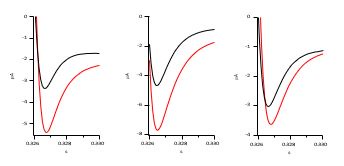
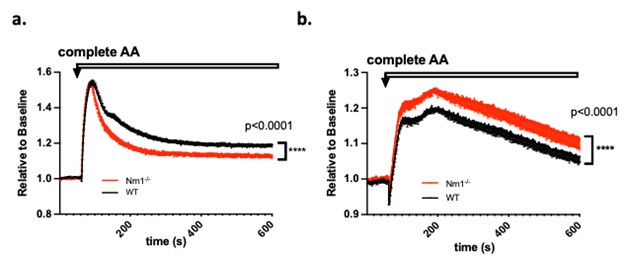
      We appreciate Review# 1’s suggestion regarding “perform experiments showing the ability of cells to transport amino acids or electrolytes across the plasma membrane”.  We have indeed already performed such experiments corroborating the transcriptomics data on differential amino acid and nutrient transporter expression. Specifically, we loaded either iTreg or Th0 cells with membrane potential (MP) dye and measured MP level change after adding the complete set of amino acids (complete AA).  Upon entry, the charge carried by AAs may transiently affect cell membrane potential. Different AA transporter expression patterns may show different MP change patterns upon AA entry, as we showed in Author response image 1. We observed reduced MP change in Nrn1-/- iTreg compared to the Ctrl, whereas in the context of Th0 cells, Nrn1-/- showed enhanced MP change than the Ctrl. We can certainly include these data in the revised manuscript.

      Author response image 1.

      Membrane potential change induced by amino acids entry. a. Nrn1-/- or WT iTreg cells loaded with MP dye and MP change was measured upon the addition of a complete set of AAs. b. Nrn1-/- or WT Th0 cells loaded with MP dye and MP change was measured upon the addition of a complete set of AAs.

      (4) EAE experiment data assessment

      Minor point ”(5) Figure 5F. How are cells re-stimulated? If polyclonal stimulation is used, the experiment is not interesting because the analysis is done with lymph node cells. This analysis should either be performed with cells from the CNS or with MOG restimulation with lymph node cells.”

      In the EAE study, the Nrn1-/- mice exhibit similar disease onset but a protracted non-resolving disease phenotype compared to the WT control mice.  Several reasons may contribute to this phenotype: 1. Enhanced T effector cell infiltration/persistence in the central nervous system (CNS); 2. Reduced Treg cell-mediated suppression to the T effector cells in the CNS; 3. Protracted non-resolving inflammation at the immunization site has the potential to continue sending T effector cells into CNS, contributing to persistent inflammation. Based on this reasoning, we examined the infiltrating T effector cell number and Treg cell proportion in the CNS.  We also restimulated cells from draining lymph nodes close to the inflammation site, looking for evidence of persistent inflammation.  When mice were harvested around day 16 after immunization, the inflammation at the local draining lymph node should be at the contraction stage.  We stimulated cells with PMA and ionomycin intended to observe all potential T effector cells involved in the draining lymph node rather than only MOG antigen-specific cells.  We disagree with Reviewer #1’s assumption that “This analysis should either be performed with cells from the CNS or with MOG restimulation with lymph node cells.”. We think the experimental approach we have taken has been appropriately tailored to the biological questions we intended to answer.

      Experimental rigor and data presentation.

      (1) data labeling and additional supporting data

      Major points

      (2) The authors use Nrn1+/+ and Nrn1+/- cells indiscriminately as control cells on the basis of similar biology between Nrn1+/+ and Nrn1+/- cells at homeostasis. However, it is quite possible that the Nrn1+/- cells have a phenotype in situations of in vitro activation or in vivo inflammation (cancer, EAE). It would be important to discriminate Nrn1+/- and Nrn1+/+ cells in the data or to show that both cell types have the same phenotype in these conditions too.

      (3) Figure 1A-D. Since the authors are using the Nrp1 KO mice, it would be important to confirm the specificity of the anti-Nrn1 mAb by FACS. Once verified, it would be important to add FACS results with this mAb in Figures 1A-C to have single-cell and quantitative data as well.

      Minor points  

      (1) Line 119, 120 of the text. It is said that one of the most up-regulated genes in anergic cells is Nrn1 but the data is not shown.

      (2) For all figures showing %, the titles of the Y axes are written in an odd way. For example, it is written "Foxp3% CD4". It would be more conventional and clearer to write "% Foxp3+ / CD4+" or "% Foxp3+ among CD4+".

      (4) For certain staining (Figure 3E, H) it would be important to show the raw data, in addition to MFI or % values.

      We can adapt the labeling and provide additional data, including Nrn1 staining on Treg cells and flow graphs for pmTOR and pS6 staining (Fig. 3H), as requested by Reviewer #1.

      (2) Experimental rigor:

      General comments:

      “However, it is disappointing that reading this manuscript leaves an impression of incomplete work done too quickly.”

      We were discouraged to receive the comment, “this manuscript leaves an impression of incomplete work done too quickly.” Our study of this novel molecule began without any existing biological tools such as antibodies, knockout mice, etc.  Over the past several years, we have established our own antibodies for Nrn1 detection, obtained and characterized Nrn1 knockout mice, and utilized multiple approaches to identify the molecular mechanism of Nrn1 function. Through the use of the in vitro iTreg system described in this manuscript, we identified the association of Nrn1 deficiency with cell electrical state change, potentially connected to AMPAR function. We have further corroborated our findings by generating Nrn1 and AMPAR T cell specific double knockout mice and confirmed that T cell specific AMPAR deletion could abrogate the phenotype caused by the Nrn1 deficiency (see Support Figure 2).  We did not include the double knockout data in the current manuscript because AMPAR function has not yet been studied thoroughly in T cell biology, and we feel this topic warrants examination in its own right.  However, the unpublished data support the finding that Nrn1 modulates the T cell electrical state and, consequently, metabolism, ultimately influencing tolerance and immunity.  In its current form, the manuscript represents the first characterization of the novel molecule Nrn1 in anergic cells, Tregs, and effector T cells. While this work has led to several exciting additional questions, we disagree that the novel characterization we have presented Is incomplete. We feel that our present data set, which squarely highlights Nrn1’s role as an important immune regulator while shedding unprecedented light on the molecular events involved, will be of considerable interest to a broad field of researchers.

      “Multiple models have been used, but none has been studied thoroughly enough to provide really conclusive and unambiguous data. For example, 5 different models were used to study T cells in vivo. It would have been preferable to use fewer, but to go further in the study of mechanisms.”

      We have indeed used multiple in vivo models to reveal Nrn1's function in Treg differentiation, Treg suppression function, T effector cell differentiation and function, and the overall impact on autoimmune disease. Because the impact of ion channel function is often context-dependent, we examined the biological outcome of Nrn1 deficiency in several in vivo contexts.  We would appreciate it if Reviewer#1 would provide a specific example, given the Nrn1 phenotype, of how to proceed deeper to investigate the electrical change in the in vivo models.

      “Major points

      (1) A real weakness of this work is the fact that in most of the results shown, there are few biological replicates with differences that are often small between Ctrl and Nrn1 -/-. The systematic use of student's t-test may lead to thinking that the differences are significant, which is often misleading given the small number of samples, which makes it impossible to know whether the distributions are Gaussian and whether a parametric test can be used. RNAseq bulk data are based on biological duplicates, which is open to criticism.”

      We respectfully disagree with Reviewer #1 on the question of statistical power and significance to our work. We have used 5-8 mice/group for each in vivo model and 3-4 technical replicates for the in vitro studies, with a minimum of 2-3 replicate experiments. These group sizes and replication numbers are in line with those seen in high-impact publications. While some differences between Ctrl and Nrn1-/- appear small, they have significant biological consequences, as evidenced by the various Nrn1-/- in vivo phenotypes. Furthermore, we believe we have subjected our data to the appropriate statistical tests to ensure rigorous analysis and representation of our findings.

      To Reviewer #2.

      We thank Reviewer #2 for the careful review of the manuscript. We especially appreciate the comments that “The characterizations of T cell Nrn1 expression both in vitro and in vivo are comprehensive and convincing. The in vivo functional studies of anergy development, Treg suppression, and EAE development are also well done to strengthen the notion that Nrn1 is an important regulator of CD4 responsiveness.”

      “The major weakness of this study stems from a lack of a clear molecular mechanism involving Nrn1. “  

      We fully understand this comment from Reviewer #2. The main mechanism we identified contributing to the functional defect of Nrn1-/- T cells involves novel effects on the electric and metabolic state of the cells. Although we referenced neuronal studies that indicate Nrn1 is the auxiliary protein for the ionotropic AMPA-type glutamate receptor (AMPAR) and may affect AMPAR function, we did not provide any evidence in this manuscript as the topic requires further in-depth study.   

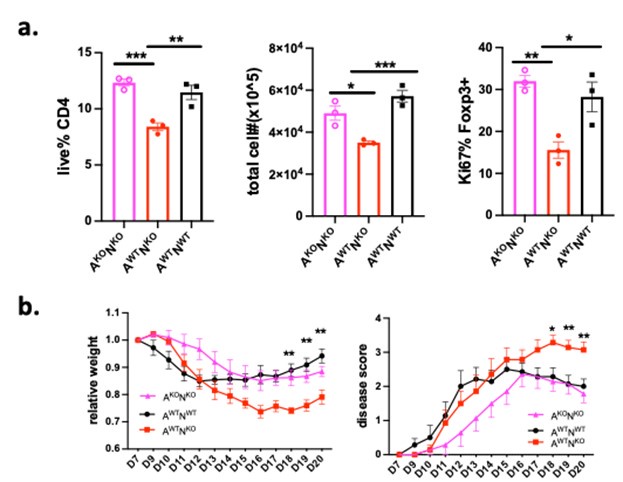
      For the benefit of this discussion, we include our preliminary Nrn1 and AMPAR double knockout data (Author response image 2), which indicates that abrogating AMPAR expression can compensate for the defect caused by Nrn1 deficiency in vitro and in vivo. This preliminary data supports the notion that Nrn1 modulates AMPAR function, which causes changes in T cell electric and metabolic state, influencing T cell differentiation and function.  

      Author response image 2.

      Deletion of AMPAR expression in T cells compensates for the defect caused by Nrn1 deficiency. Nrn1-/- mice were crossed with T cell-specific AMPAR knockout mice (AMPARfl/flCD4Cre+) mice. The following mice were generated and used in the experiment: T cell specific AMPAR-knockout and Nrn1 knockout mice (AKONKO), Nrn1 knockout mice (AWTNKO), Ctrl mice (AWTNWT). a. Deletion of AMPAR compensates for the iTreg cell defect observed in Nrn1-/- CD4 cells. iTreg live cell proportion, cell number, and Ki67 expression among Foxp3+ cells 3 days after aCD3 restimulation. b. Deletion of AMPAR in T cells abrogates the enhanced autoimmune response in Nrn1-/- Mouse in the EAE disease model. Mouse relative weight change and disease score progression after EAE disease induction.  

      Ion channels can influence cell metabolism through multiple means (Vaeth and Feske, 2018; Wang et al., 2020). First, ion channels are involved in maintaining cell resting membrane potential. This electrical potential difference across the cell membrane is essential for various cellular processes, including metabolism (Abdul Kadir et al., 2018; Blackiston et al., 2009; Nagy et al., 2018; Yu et al., 2022). Second, ion channels facilitate the movement of ions across cell membranes. These ions are essential for various metabolic processes. For example, ions like calcium (Ca2+), potassium (K+), and sodium (Na+) play crucial roles in signaling pathways that regulate metabolism (Kahlfuss et al., 2020). Third, ion channel activity can influence cellular energy balance due to ATP consumption associated with ion transport to maintain ion balances (Erecińska and Dagani, 1990; Gerkau et al., 2019). This, in turn, can impact processes like ATP production, which is central to cellular metabolism. Thus, ion channel expression and function determine the cell’s bioelectric state and contribute to cell metabolism (Levin, 2021).

      Because the AMPAR function has not been thoroughly studied using a genetic approach in T cells, we do not intend to include the double knockout data in this manuscript before fully characterizing the T cell-specific AMPAR knockout mice.  

      “Although the biochemical and informatics studies are well-performed, it is my opinion that these results are inconclusive in part due to the absence of key "naive" control groups. This limits my ability to understand the significance of these data.

      Specifically, studies of the electrical and metabolic state of Nrn1-/- inducible Treg cells (iTregs) would benefit from similar data collected from wild-type and Nrn1-/- naive CD4 T cells.”

      We appreciate the reviewer’s comments. This comment reflects two concerns in data interpretation:

      (1) Are Nrn1-/- naïve T cells fundamentally different from WT cells? Does this fundamental difference contribute to the observed electrical and metabolic phenotype in iTreg or Th0 cells? This is a very good question we will perform the experiments as the reviewer suggested. While Nrn1 is expressed at a basal (low) level in naïve T cells, deletion of Nrn1 may cause changes in naïve T cell phenotype.   

      (2) Is the Nrn1-/- phenotype caused by Nrn1 functional deficiency or due to the secondary effect of Nrn1 deletion, such as non-physiological cell membrane structure changes?

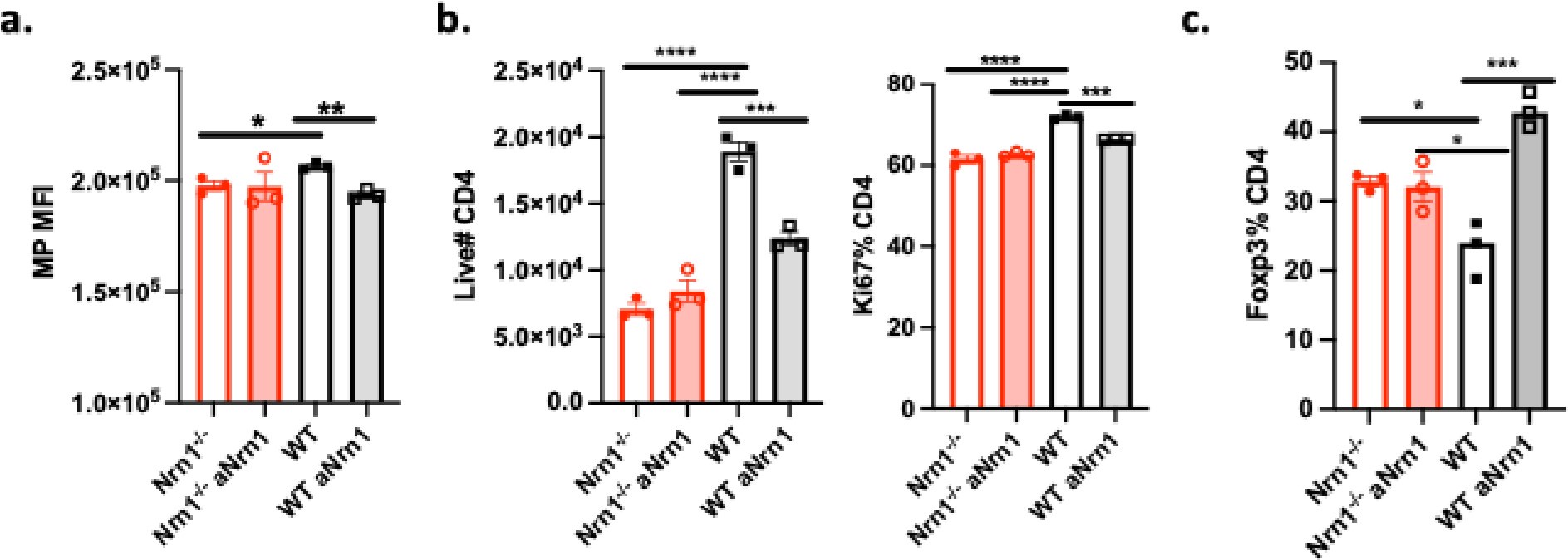
      We have done the following experiment to address this concern.  We have cultured WT T cells in the presence of Nrn1 antibody and compared the outcome with Nrn1-/- iTreg cells (Figure 3-figure supplement 2D,E,F). WT iTreg cells under antibody blockade exhibited similar changes as Nrn1-/- iTreg cells, confirming the physiological relevance of the Nrn1-/- phenotype.

      Manuscript Revision based on the Reviewer’s suggestions:

      Reviewer #1:

      Major points (3) Figure 1A-D. Since the authors are using the Nrp1 KO mice, it would be important to confirm the specificity of the anti-Nrn1 mAb by FACS. 

      Following the suggestion by Reviewer#1, We have included the Nrn1 Ab staining on activated Nrn1-/- CD4 cells in Figure 1D. We have also added the staining of cell surface Nrn1 on Treg cells in Figure 1-figure supplement 1D.

      Major point: (5) “Moreover, we do not even know what the % of Foxp3 cells is in the iTreg used (after differentiation and 20h of re-stimulation) and whether this % is the same between Ctlr and Nrn1 KO cells.”

      In the revised manuscript, we have included the proportion of Foxp3+ cells among Nrn1-/- and ctrl iTreg cells developed under the iTreg culture condition in Figure 2A.

      Minor points  

      (2) For all figures showing %, the titles of the Y axes are written in an odd way. For example, it is written "Foxp3% CD4". It would be more conventional and clearer to write "% Foxp3+ / CD4+" or "% Foxp3+ among CD4+".

      Following reviewer#1’s suggestion, we have changed the Y-axis label in all the relevant figures.

      (3) Would not it be possible to perform experiments showing the ability of cells to transport amino acids or electrolytes across the plasma membrane? This would be a more interesting demonstration than transcriptomic data.”

      We appreciate Review# 1’s suggestion regarding “perform experiments showing the ability of cells to transport amino acids or electrolytes across the plasma membrane”.  We have used AAinduced cellular MP changes to confirm differential AA transporter expression patterns and their impact on cellular MP levels.  The data are included in the revised manuscript in Figure 3H and Figure 4K.

      (4) For certain staining (Figure 3E, H) it would be important to show the raw data, in addition to MFI or % values.

      We appreciated Reviewer #1’s suggestion and have included the histogram staining data for Figure 3E. We have moved the original Figure 3H to the supplemental figure and included the histogram staining data in Figure 3-figure supplement 1C.  Similarly, we have included the histogram staining data in Figure 4-figure supplement 1C.

      Reviewer#2:

      “Although the biochemical and informatics studies are well-performed, it is my opinion that these results are inconclusive in part due to the absence of key "naive" control groups. This limits my ability to understand the significance of these data.

      Specifically, studies of the electrical and metabolic state of Nrn1-/- inducible Treg cells (iTregs) would benefit from similar data collected from wild-type and Nrn1-/- naive CD4 T cells.”

      We greatly appreciate Reviewer#2’s suggestion and have carried out experiments on naïve CD4 cells derived from Nrn1-/- and WT mice. We have compared membrane potential, AA-induced MP change between Nrn1-/- and WT naïve T cells, and the metabolic state of Nrn1-/- and WT naïve T cells by carrying out glucose stress tests and mitochondria stress tests using a seahorse assay.  Moreover, to investigate whether the phenotype revealed in Nrn1-/- CD4 cells was caused by a secondary effect of cell membrane structure change due to Nrn1 deletion, we carried out Nrn1 antibody blockade in WT CD4 cells and investigated the phenotypic change. These new results are included in Figure 3-figure supplement 2.

      Reference:

      Abdul Kadir, L., M. Stacey, and R. Barrett-Jolley. 2018. Emerging Roles of the Membrane Potential: Action Beyond the Action Potential. Front Physiol 9:1661.

      Blackiston, D.J., K.A. McLaughlin, and M. Levin. 2009. Bioelectric controls of cell proliferation: ion channels, membrane voltage and the cell cycle. Cell Cycle 8:3527-3536.

      Chappert, P., and R.H. Schwartz. 2010. Induction of T cell anergy: integration of environmental cues and infectious tolerance. Current opinion in immunology 22:552-559.

      Chen, W., W. Jin, N. Hardegen, K.J. Lei, L. Li, N. Marinos, G. McGrady, and S.M. Wahl. 2003. Conversion of peripheral CD4+CD25- naive T cells to CD4+CD25+ regulatory T cells by TGF-beta induction of transcription factor Foxp3. The Journal of experimental medicine 198:1875-1886.

      Erecińska, M., and F. Dagani. 1990. Relationships between the neuronal sodium/potassium pump and energy metabolism. Effects of K+, Na+, and adenosine triphosphate in isolated brain synaptosomes. J Gen Physiol 95:591-616.

      Fathman, C.G., and N.B. Lineberry. 2007. Molecular mechanisms of CD4+ T-cell anergy. Nat Rev Immunol 7:599-609.

      Gerkau, N.J., R. Lerchundi, J.S.E. Nelson, M. Lantermann, J. Meyer, J. Hirrlinger, and C.R. Rose. 2019. Relation between activity-induced intracellular sodium transients and ATP dynamics in mouse hippocampal neurons. The Journal of physiology 597:5687-5705.

      Hurrell, B.P., D.G. Helou, E. Howard, J.D. Painter, P. Shafiei-Jahani, A.H. Sharpe, and O. Akbari. 2022. PD-L2 controls peripherally induced regulatory T cells by maintaining metabolic activity and Foxp3 stability. Nature communications 13:5118.

      Jenkins, M.K., and R.H. Schwartz. 1987. Antigen presentation by chemically modified splenocytes induces antigen-specific T cell unresponsiveness in vitro and in vivo. The Journal of experimental medicine 165:302-319.

      John, P., M.C. Pulanco, P.M. Galbo, Jr., Y. Wei, K.C. Ohaegbulam, D. Zheng, and X. Zang. 2022. The immune checkpoint B7x expands tumor-infiltrating Tregs and promotes resistance to anti-CTLA-4 therapy. Nature communications 13:2506.

      Kahlfuss, S., U. Kaufmann, A.R. Concepcion, L. Noyer, D. Raphael, M. Vaeth, J. Yang, P. Pancholi, M. Maus, J. Muller, L. Kozhaya, A. Khodadadi-Jamayran, Z. Sun, P. Shaw, D. Unutmaz, P.B. Stathopulos, C. Feist, S.B. Cameron, S.E. Turvey, and S. Feske. 2020. STIM1-mediated calcium influx controls antifungal immunity and the metabolic function of nonpathogenic Th17 cells. EMBO molecular medicine 12:e11592.

      Levin, M. 2021. Bioelectric signaling: Reprogrammable circuits underlying embryogenesis, regeneration, and cancer. Cell 184:1971-1989.

      Nagy, E., G. Mocsar, V. Sebestyen, J. Volko, F. Papp, K. Toth, S. Damjanovich, G. Panyi, T.A. Waldmann, A. Bodnar, and G. Vamosi. 2018. Membrane Potential Distinctly Modulates Mobility and Signaling of IL-2 and IL-15 Receptors in T Cells. Biophys J 114:2473-2482.

      Quill, H., and R.H. Schwartz. 1987. Stimulation of normal inducer T cell clones with antigen presented by purified Ia molecules in planar lipid membranes: specific induction of a long-lived state of proliferative nonresponsiveness. Journal of immunology (Baltimore, Md. : 1950) 138:3704-3712.

      Schmitt, E.G., and C.B. Williams. 2013. Generation and function of induced regulatory T cells. Frontiers in immunology 4:152.

      Sugiura, A., G. Andrejeva, K. Voss, D.R. Heintzman, X. Xu, M.Z. Madden, X. Ye, K.L. Beier, N.U. Chowdhury, M.M. Wolf, A.C. Young, D.L. Greenwood, A.E. Sewell, S.K. Shahi, S.N. Freedman, A.M. Cameron, P. Foerch, T. Bourne, J.C. Garcia-Canaveras, J. Karijolich, D.C. Newcomb, A.K. Mangalam, J.D. Rabinowitz, and J.C. Rathmell. 2022. MTHFD2 is a metabolic checkpoint controlling effector and regulatory T cell fate and function. Immunity 55:65-81.e69.

      Vaeth, M., and S. Feske. 2018. Ion channelopathies of the immune system. Current opinion in immunology 52:39-50.

      Vanasek, T.L., S.L. Nandiwada, M.K. Jenkins, and D.L. Mueller. 2006. CD25+Foxp3+ regulatory T cells facilitate CD4+ T cell clonal anergy induction during the recovery from lymphopenia. Journal of immunology (Baltimore, Md. : 1950) 176:5880-5889.

      Wang, Y., A. Tao, M. Vaeth, and S. Feske. 2020. Calcium regulation of T cell metabolism. Current opinion in physiology 17:207-223.

      Yu, W., Z. Wang, X. Yu, Y. Zhao, Z. Xie, K. Zhang, Z. Chi, S. Chen, T. Xu, D. Jiang, X. Guo, M. Li, J. Zhang, H. Fang, D. Yang, Y. Guo, X. Yang, X. Zhang, Y. Wu, W. Yang, and D. Wang. 2022. Kir2.1-mediated membrane potential promotes nutrient acquisition and inflammation through regulation of nutrient transporters. Nature communications 13:3544.

      Zheng, S.G., J.D. Gray, K. Ohtsuka, S. Yamagiwa, and D.A. Horwitz. 2002. Generation ex vivo of TGF-beta-producing regulatory T cells from CD4+CD25- precursors. Journal of immunology (Baltimore, Md. : 1950) 169:4183-4189.

    1. Author Response

      The following is the authors’ response to the original reviews.

      Public Reviews:

      Reviewer #1 (Public Review):

      Koumoundourou et al., identify a pathway downstream of Bcl11b that controls synapse morphology and plasticity of hippocampal mossy fiber synapses. Using an elegant combination of in vivo, ex vivo, and in vitro approaches, the authors build on their previous work that indicated C1ql2 as a functional target of Bcl11b (De Bruyckere et al., 2018). Here, they examine the functional implications of C1ql2 at MF synapses in Bcl11b cKO mice and following C1ql2 shRNA. The authors find that Bcl11b KO and shRNA against C1ql2 significantly reduces the recruitment of synaptic vesicles and impairs LTP at MF synapses. Importantly, the authors test a role for the previously identified C1ql2 binding partner, exon 25b-containing Nrxn3 (Matsuda et al., 2016), as relevant at MF synapses to maintain synaptic vesicle recruitment. To test this, the authors developed a K262E C1ql2 mutant that disrupts binding to Nrxn3. Curiously, while Bcl11b KO and C1ql2 KD largely phenocopy (reduced vesicle recruitment and impaired LTP), only vesicle recruitment is dependent on C1ql2-Nrxn3 interactions. These findings provide new insight into the functional role of C1ql2 at MF synapses. While the authors convincingly demonstrate a role for C1ql2-Nrxn3(25b+) interaction for vesicle recruitment and a Nrxn3(25b+)independent role for C1ql2 in LTP, the underlying mechanisms remain inconclusive. Additionally, a discussion of how these findings relate to previous work on C1ql2 at mossy fiber synapses and how the findings contribute to the biology of Nrxn3 would increase the interpretability of this work.

      As suggested by reviewer #1, we extended our discussion of previous work on C1ql2 and additionally discussed the biology of Nrxn3 and how our work relates to it. Moreover, we extended our mechanistic analysis of how Bcl11b/C1ql2/Nrxn3 pathway controls synaptic vesicle recruitment as well as LTP (please see also response to reviewer #2 points 5 and 8 and reviewer #3 point 4 of public reviews below for detailed discussion).

      Reviewer #2 (Public Review):

      This manuscript describes experiments that further investigate the actions of the transcription factor Bcl11b in regulating mossy fiber (MF) synapses in the hippocampus. Prior work from the same group had demonstrated that loss of Bcl11b results in loss of MF synapses as well as a decrease in LTP. Here the authors focus on a target of Bcl11b a secreted synaptic organizer C1ql2 which is almost completely lost in Bcl11b KO. Viral reintroduction of C1ql2 rescues the synaptic phenotypes, whereas direct KD of C1ql2 recapitulates the Bcl1 phenotype. C1ql2 itself interacts directly with Nrxn3 and replacement with a binding deficient mutant C1q was not able to rescue the Bcl11b KO phenotype. Overall there are some interesting observations in the study, however there are also some concerns about the measures and interpretation of data.

      The authors state that they used a differential transcriptomic analysis to screen for candidate targets of Bcl11b, yet they do not present any details of this screen. This should be included and at the very least a table of all DE genes included. It is likely that many other genes are also regulated by Bcl11b so it would be important to the reader to see the rationale for focusing attention on C1ql2 in this study.

      The transcriptome analysis mentioned in our manuscript was published in detail in our previous study (De Bruyckere et al., 2018), including chromatin-immunoprecipitation that revealed C1ql2 as a direct transcriptional target of Bcl11b. Upon revision of the manuscript, we made sure that this was clearly stated within the main text module to avoid future confusion. In the same publication (De Bruyckere et al., 2018), we discuss in detail several identified candidate genes such as Sema5b, Ptgs2, Pdyn and Penk as putative effectors of Bcl11b in the structural and functional integrity of MFS. C1ql2 has been previously demonstrated to be almost exclusively expressed in DG neurons and localized to the MFS.

      There it bridges the pre- and post-synaptic sides through interaction with Nrxn3 and KAR subunits, respectively, and regulates synaptic function (Matsuda et al., 2016). Taken together, C1ql2 was a very good candidate to study as a potential effector downstream of Bcl11b in the maintenance of MFS structure and function. However, as our data reveal, not all Bcl11b mutant phenotypes were rescued by C1ql2 (see supplementary figures 2d-f of revised manuscript). We expect additional candidate genes, identified in our transcriptomic screen, to act downstream of Bcl11b in the control of MFS.

      All viral-mediated expression uses AAVs which are known to ablate neurogenesis in the DG (Johnston DOI: 10.7554/eLife.59291) through the ITR regions and leads to hyperexcitability of the dentate. While it is not clear how this would impact the measurements the authors make in MF-CA3 synapses, this should be acknowledged as a potential caveat in this study.

      We agree with reviewer #2 and are aware that it has been demonstrated that AAV-mediated gene expression ablates neurogenesis in the DG. To avoid potential interference of the AAVs with the interpretability of our phenotypes, we made sure during the design of the study that all of our control groups were treated in the same way as our groups of interest, and were, thus, injected with control AAVs. Moreover, the observed phenotypes were first described in Bcl11b mutants that were not injected with AVVs (De Bruyckere et al., 2018). Finally, we thoroughly examined the individual components of the proposed mechanism (rescue of C1ql2 expression, over-expression of C1ql3 and introduction of mutant C1ql2 in Bcl11b cKOs, KD of C1ql2 in WT mice, and Nrxn123 cKO) and reached similar conclusions. Together, this strongly supports that the observed phenotypes occur as a result of the physiological function of the proteins involved in the described mechanism and not due to interference of the AAVs with these biological processes. We have now addressed this point in the main text module of the revised ms.

      The authors claim that the viral re-introduction "restored C1ql2 protein expression to control levels. This is misleading given that the mean of the data is 2.5x the control (Figure 1d and also see Figure 6c). The low n and large variance are a problem for these data. Moreover, they are marked ns but the authors should report p values for these. At the least, this likely large overexpression and variability should be acknowledged. In addition, the use of clipped bands on Western blots should be avoided. Please show the complete protein gel in primary figures of supplemental information.

      We agree with reviewer #2 that C1ql2 expression after its re-introduction in Bcl11b cKO mice was higher compared to controls and that this should be taken into consideration for proper interpretation of the data. To address this, based also on the suggestion of reviewer #3 point 1 below, we overexpressed C1ql2 in DG neurons of control animals. We found no changes in synaptic vesicle organization upon C1ql2 over-expression compared to controls. This further supports that the observed effect upon rescue of C1ql2 expression in Bcl11b cKOs is due to the physiological function of C1ql2 and not as result of the overexpression. These data are included in supplementary figure 2g-j and are described in detail in the results part of the revised manuscript.

      Additionally, we looked at the effects of C1ql2 overexpression in Bcl11b cKO DGN on basal synaptic transmission. We plotted fEPSP slopes versus fiber volley amplitudes, measured in slices from rescue animals, as we had previously done for the control and Bcl11b cKO (Author response image 1a). Although regression analysis revealed a trend towards steeper slopes in the rescue mice (Author response image 1a and b), the observation did not prove to be statistically significant, indicating that C1ql2 overexpression in Bcl11b cKO animals does not strongly alter basal synaptic transmission at MFS. Overall, our previous and new findings support that the observed effects of the C1ql2 rescue are not caused by the artificially elevated levels of C1ql2, as compared to controls, but are rather a result of the physiological function of C1ql2.

      Following the suggestion of reviewer #2 all western blot clipped bands were exchanged for images of the full blot. This includes figures 1c, 4c, 6b and supplementary figure 2g of the revised manuscript. P-value for Figure 1d has now been included.

      Author response image 1.

      C1ql2 reintroduction in Bcl11b cKO DGN does not significantly alter basal synaptic transmission at mossy fiber-CA3 synapses. a Input-output curves generated by plotting fEPSP slope against fiber volley amplitude at increasing stimulation intensities. b Quantification of regression line slopes for input-output curves for all three conditions. Control+EGFP, 35 slices from 16 mice; Bcl11b cKO+EGFP, 32 slices from 14 mice; Bcl11b cKO+EGFP-2A-C1ql2, 22 slices from 11 mice. The data are presented as means, error bars represent SEM. Kruskal-Wallis test (non-parametric ANOVA) followed by Dunn’s post hoc pairwise comparisons. p=0.106; ns, not significant.

      Measurement of EM micrographs: As prior work suggested that MF synapse structure is disrupted the authors should report active zone length as this may itself affect "synapse score" defined by the number of vesicles docked. More concerning is that the example KO micrographs seem to have lost all the densely clustered synaptic vesicles that are away from the AZ in normal MF synapses e.g. compare control and KO terminals in Fig 2a or 6f or 7f. These terminals look aberrant and suggest that the important measure is not what is docked but what is present in the terminal cytoplasm that normally makes up the reserve pool. This needs to be addressed with further analysis and modifications to the manuscript.

      As requested by reviewer #2 we analyzed and reported in the revised manuscript the active zone length. We found that the active zone length remained unchanged in all conditions (control/Bcl11b cKO/C1ql2 rescue, WT/C1ql2 KD, control/K262E and control/Nrxn123 cKO), strengthening our results that the described Bcl11b/C1ql2/Nrxn3 mechanism is involved in the recruitment of synaptic vesicles. These data have been included in supplementary figures 2c, 4h, 5f and 6g and are described in the results part of the revised manuscript.

      We want to clarify that the synapse score is not defined by the number of docked vesicles to the plasma membrane. The synapse score, which is described in great detail in our materials and methods part and has been previously published (De Bruyckere et al., 2018), rates MFS based on the number of synaptic vesicles and their distance from the active zone and was designed according to previously described properties of the vesicle pools at the MFS. The EM micrographs refer to the general misdistribution of SV in the proximity of MFS. Upon revision of the manuscript, we made sure that this was clearly stated in the main text module to avoid further confusion.

      The study also presents correlated changes in MF LTP in Bcl11b KO which are rescued by C1ql2 expression. It is not clear whether the structural and functional deficits are causally linked and this should be made clearer in the manuscript. It is also not apparent why this functional measure was chosen as it is unlikely that C1ql2 plays a direct role in presynaptic plasticity mechanisms that are through a cAMP/ PKA pathway and likely disrupted LTP is due to dysfunctional synapses rather than a specific LTP effect.

      The inclusion of functional experiments in this and our previous study (de Bruyckere et al., 2018) was first and foremost intended to determine whether the structural alterations observed at MFB disrupt MFS signaling. From the signaling properties we tested, basal synaptic transmission (this study) and short-term potentiation (de Bruyckere et al., 2018) were unaltered by Bcl11b KO, whereas MF LTP was found to be abolished (de Bruyckere et al., 2018). Indeed, because MF LTP largely depends on presynaptic mechanisms, including the redistribution of the readily releasable pool and recruitment of new active zones (Orlando et al., 2021; Vandael et al., 2020), it appears to be particularly sensitive to the specific structural changes we observed. We therefore believe that it is valuable information that MF LTP is affected in Bcl11b cKO animals - it conveys a direct proof for the functional importance of the observed morphological alterations, while basic transmission remains largely normal. Furthermore, it subsequently provided a functional marker for testing whether the reintroduction of C1ql2 in Bcl11b cKO animals or the KD of C1ql2 in WT animals can functionally recapitulate the control or the Bcl11b KO phenotype, respectively.

      We fully agree with the reviewer that C1ql2 is unlikely to directly participate in the cAMP/PKA pathway and that the ablation of C1ql2 likely disrupts MF LTP through an alternative mode of action. Our original wording in the paragraph describing the results of the forskolin-induced LTP experiment might have overstressed the importance of the cAMP pathway. We have now rephrased that paragraph to better describe the main idea behind the forskolin experiment, namely to circumvent the initial Ca2+ influx in order to test whether deficient presynaptic Ca2+ channel/KAR signaling might be responsible for the loss of LTP in Bcl11b cKO. The results are strongly indicative of a downstream mechanism and further investigation is needed to determine the specific mechanisms by which C1ql2 regulates MFLTP, especially in light of the result that C1ql2.K262E rescued LTP, while it was unable to rescue the SV recruitment at the MF presynapse. This raises the possibility that C1ql2 can influence MF-LTP through additional, yet uncharacterized mechanisms, independent of SV recruitment. As such, a causal link between the structural and functional deficits remains tentative and we have now emphasized that point by adding a respective sentence to the discussion of our revised manuscript. Nevertheless, we again want to stress that the main rationale behind the LTP experiments was to assess the functional significance of structural changes at MFS and not to elucidate the mechanisms by which MF LTP is established.

      The authors should consider measures that might support the role of Bcl11b targets in SV recruitment during the depletion of synapses or measurements of the readily releasable pool size that would complement their findings in structural studies.

      We fully agree that functional measurements of the readily releasable pool (RRP) size would be a valuable addition to the reported redistribution of SV in structural studies. We have, in fact, attempted to use high-frequency stimulus trains in both field and single-cell recordings (details on single-cell experiments are described in the response to point 8) to evaluate potential differences in RRP size between the control and Bcl11b KO (Figure for reviewers 2a and b). Under both recording conditions we see a trend towards lower values of the intersection between a regression line of late responses and the y-axis. This could be taken as an indication of slightly smaller RRP size in Bcl11b mutant animals compared to controls. However, due to several technical reasons we are extremely cautious about drawing such far-reaching conclusions based on these data. At most, they suffice to conclude that the availability of release-ready vesicles in the KO is likely not dramatically smaller than in the control.

      The primary issue with using high-frequency stimulus trains for RRP measurements at MFS is the particularly low initial release probability (Pr) at these synapses. This means that a large number of stimulations is required to deplete the RRP. As the RRP is constantly replenished, it remains unclear when steady state responses are reached (reviewed by Kaeser and Regehr, 2017). This is clearly visible in our single-cell recordings (Author response image 2b), which were additionally complicated by prominent asynchronous release at later stages of the stimulus train and by a large variability in the shapes of cumulative amplitude curves between cells. In contrast, while the cumulative amplitude curves for field potential recordings do reach a steady state (Author response image 2a), field potential recordings in this context are not a reliable substitute for single cell or, in the case of MFB, singlebouton recordings. Postsynaptic cells in field potential recordings are not clamped, meaning that the massive release of glutamate due to continuous stimulation depolarizes the postsynaptic cells and reduces the driving force for Na+, irrespective of depletion of the RRP. This is supported by the fact that we consistently observed a recovery of fEPSP amplitudes later in the trains where RRP had presumably been maximally depleted. In summary, high-frequency stimulus trains at the field potential level are not a valid and established technique for estimating RRP size at MFS.

      Specialized laboratories have used highly advanced techniques, such as paired recordings between individual MFB and postsynaptic CA3 pyramidal cells, to estimate the RRP size of MFB (Vandael et al., 2020). These approaches are outside the scope of our present study which, while elucidating functional changes following Bcl11b depletion and C1ql2 rescue, does not aim to provide a high-end biophysical analysis of the presynaptic mechanisms involved.

      Author response image 2.

      Estimation of RRP size using high-frequency stimulus trains at mossy fiber-CA3 synapses. a Results from field potential recordings. Cumulative fEPSP amplitude in response to a train of 40 stimuli at 100 Hz. All subsequent peak amplitudes were normalized to the amplitude of the first peak. Data points corresponding to putative steady state responses were fit with linear regression (RRP size is indirectly reflected by the intersection of the regression line with the yaxis). Control+EGFP, 6 slices from 5 mice; Bcl11b cKO+EGFP, 6 slices from 3 mice. b Results from single-cell recordings. Cumulative EPSC amplitude in response to a train of 15 stimuli at 50 Hz. The last four stimuli were fit with linear regression. Control, 5 cells from 4 mice; Bcl11b cKO, 3 cells from 3 mice. Note the shallow onset of response amplitudes and the subsequent frequency potentiation. Due to the resulting increase in slope at higher stimulus numbers, intersection with the y-axis occurs at negative values. The differences shown were not found to be statistically significant; unpaired t-test or Mann-Whitney U-test.

      Bcl11b KO reduces the number of synapses, yet the I-O curve reported in Supp Fig 2 is not changed. How is that possible? This should be explained.

      We agree with reviewer #2– this apparent discrepancy has indeed struck us as a counterintuitive result. It might be that synapses that are preferentially eliminated in Bcl11b cKO are predominantly silent or have weak coupling strength, such that their loss has only a minimal effect on basal synaptic transmission. Although perplexing, the result is fully supported by our single-cell data which shows no significant differences in MF EPSC amplitudes recorded from CA3 pyramidal cells between controls and Bcl11b mutants (Author response image 3; please see the response below for details and also our response to Reviewer #1 question 2).

      Matsuda et al DOI: 10.1016/j.neuron.2016.04.001 previously reported that C1ql2 organizes MF synapses by aligning postsynaptic kainate receptors with presynaptic elements. As this may have consequences for the functional properties of MF synapses including their plasticity, the authors should report whether they see deficient postsynaptic glutamate receptor signaling in the Bcl11b KO and rescue in the C1ql2 re-expression.

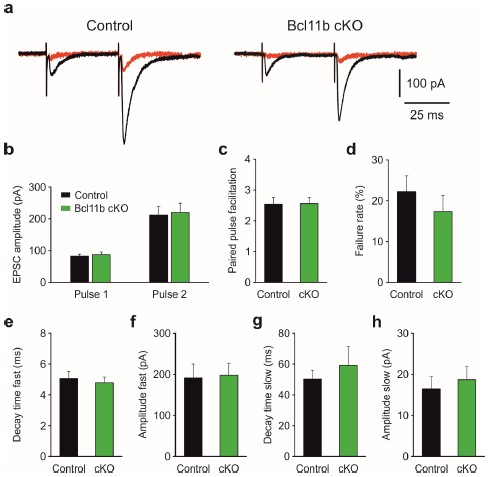
      We agree that the study by Matsuda et al. is of key importance for our present work. Although MF LTP is governed by presynaptic mechanisms and we previously did not see differences in short-term plasticity between the control and Bcl11b cKO (De Bruyckere et al., 2018), the clustering of postsynaptic kainate receptors by C1ql2 is indeed an important detail that could potentially alter synaptic signaling at MFS in Bcl11b KO. We, therefore, re-analyzed previously recorded single-cell data by performing a kinetic analysis on MF EPSCs recorded from CA3 pyramidal cells in control and Bcl11b cKO mice (Figure for reviewers 3a) to evaluate postsynaptic AMPA and kainate receptor responses in both conditions. We took advantage of the fact that AMPA receptors deactivate roughly 10 times faster than kainate receptors, allowing the contributions of the two receptors to mossy fiber EPSCs to be separated (Castillo et al., 1997 and reviewed by Lerma, 2003). We fit the decay phase of the second (larger) EPSC evoked by paired-pulse stimulation with a double exponential function, yielding a fast and a slow component, which roughly correspond to the fractional currents evoked by AMPA and kainate receptors, respectively. Analysis of both fast and slow time constants and the corresponding fractional amplitudes revealed no significant differences between controls and Bcl11b mutants (Figure for reviewers 3e-h), indicating that both AMPA and kainate receptor signaling is unaffected by the ablation of C1ql2 following Bcl11b KO.

      Importantly, MF EPSC amplitudes evoked by the first and the second pulse (Author response image 3b), paired-pulse facilitation (Author response image 3c) and failure rates (Author response image 3d) were all comparable between controls and Bcl11b mutants. These results further corroborate our observations from field recordings that basal synaptic transmission at MFS is unaltered by Bcl11b KO.

      We note that the results from single cell recordings regarding basal synaptic transmission merely confirm the observations from field potential recordings, and that the attempted measurement of RRP size at the single cell level was not successful. Thus, our single-cell data do not add new information about the mechanisms underlying the effects of Bcl11b-deficiency and we therefore decided not to report these data in the manuscript.

      Author response image 3.

      Basal synaptic transmission at mossy fiber-CA3 synapses is unaltered in Bcl11b cKO mice. a Representative average trace (20 sweeps) recorded from CA3 pyramidal cells in control and Bcl11b cKO mice at minimal stimulation conditions, showing EPSCs in response to paired-pulse stimulation (PPS) at an interstimulus interval of 40 ms. The signal is almost entirely blocked by the application of 2 μM DCG-IV (red). b Quantification of MF EPSC amplitudes in response to PPS for both the first and the second pulse. c Ratio between the amplitude of the second over the first EPSC. d Percentage of stimulation events resulting in no detectable EPSCs for the first pulse. Events <5 pA were considered as noise. e Fast decay time constant obtained by fitting the average second EPSC with the following double exponential function: I(t)=Afaste−t/τfast+Aslowe−t/τslow+C, where I is the recorded current amplitude after time t, Afast and Aslow represent fractional current amplitudes decaying with the fast (τfast) and slow (τslow) time constant, respectively, and C is the offset. Starting from the peak of the EPSC, the first 200 ms of the decaying trace were used for fitting. f Fractional current amplitude decaying with the fast time constant. g-h Slow decay time constant and fractional current amplitude decaying with the slow time constant. For all figures: Control, 8 cells from 4 mice; Bcl11b cKO, 8 cells from 6 mice. All data are presented as means, error bars indicate SEM. None of the differences shown were found to be statistically significant; Mann-Whitney U-test for nonnormally and unpaired t-test for normally distributed data.

      Reviewer #3 (Public Review):

      Overall, this is a strong manuscript that uses multiple current techniques to provide specific mechanistic insight into prior discoveries of the contributions of the Bcl11b transcription factor to mossy fiber synapses of dentate gyrus granule cells. The authors employ an adult deletion of Bcl11b via Tamoxifen-inducible Cre and use immunohistochemical, electron microscopy, and electrophysiological studies of synaptic plasticity, together with viral rescue of C1ql2, a direct transcriptional target of Bcl11b or Nrxn3, to construct a molecular cascade downstream of Bcl11b for DG mossy fiber synapse development. They find that C1ql2 re-expression in Bcl11b cKOs can rescue the synaptic vesicle docking phenotype and the impairments in MF-LTP of these mutants. They also show that C1ql2 knockdown in DG neurons can phenocopy the vesicle docking and plasticity phenotypes of the Bcl11b cKO. They also use artificial synapse formation assays to suggest that C1ql2 functions together with a specific Nrxn3 splice isoform in mediating MF axon development, extending these data with a C1ql2-K262E mutant that purports to specifically disrupt interactions with Nrxn3. All of the molecules involved in this cascade are disease-associated and this study provides an excellent blueprint for uncovering downstream mediators of transcription factor disruption. Together this makes this work of great interest to the field. Strengths are the sophisticated use of viral replacement and multi-level phenotypic analysis while weaknesses include the linkage of C1ql2 with a specific Nrxn3 splice variant in mediating these effects.

      Here is an appraisal of the main claims and conclusions:

      1) C1ql2 is a downstream target of Bcl11b which mediates the synaptic vesicle recruitment and synaptic plasticity phenotypes seen in these cKOs. This is supported by the clear rescue phenotypes of synapse anatomy (Fig.2) and MF synaptic plasticity (Fig.3). One weakness here is the absence of a control assessing over-expression phenotypes of C1ql2. It's clear from Fig.1D that viral rescue is often greater than WT expression (totally expected). In the case where you are trying to suppress a LoF phenotype, it is important to make sure that enhanced expression of C1ql2 in a WT background does not cause your rescue phenotype. A strong overexpression phenotype in WT would weaken the claim that C1ql2 is the main mediator of the Bcl11b phenotype for MF synapse phenotypes.

      As suggested by reviewer #3, we carried out C1ql2 over-expression experiments in control animals. We show that the over-expression of C1ql2 in the DG of control animals had no effect on the synaptic vesicle organization in the proximity of MFS. This further supports that the observed effect upon rescue of C1ql2 expression in Bcl11b cKOs is due to the physiological function of C1ql2 and not a result of the artificial overexpression. These data are now included in supplementary figure 2g-j and are described in detail in the results part of the revised manuscript. Please also see response to point 3 of reviewer #2.

      2) Knockdown of C1ql2 via 4 shRNAs is sufficient to produce the synaptic vesicle recruitment and MFLTP phenotypes. This is supported by clear effects in the shRNA-C1ql2 groups as compared to nonsense-EGFP controls. One concern (particularly given the use of 4 distinct shRNAs) is the potential for off-target effects, which is best controlled for by a rescue experiment with RNA insensitive C1ql2 cDNA as opposed to nonsense sequences, which may not elicit the same off-target effects.

      We agree with reviewer #3 that the usage of shRNAs could potentially create unexpected off-target effects and that the introduction of a shRNA-insensitive C1ql2 in parallel to the expression on the shRNA cassette would be a very effective control experiment. However, the suggested experiment would require an additional 6 months (2 months for AAV production, 2-3 months from animal injection to sacrifice and 1-2 months for EM imaging/analysis and LTP measurements) and a high number of additional animals (minimum 8 for EM and 8 for LTP measurements). We note here, that before the production of the shRNA-C1ql2 and the shRNA-NS, the individual sequences were systematically checked for off-target bindings on the murine exome with up to two mismatches and presented with no other target except the proposed (C1ql2 for shRNA-C1ql2 and no target for shRNA-NS). Taking into consideration our in-silico analysis, we feel that the interpretation of our findings is valid without this (very reasonable) additional control experiment.

      3) C1ql2 interacts with Nrxn3(25b+) to facilitate MF terminal SV clustering. This claim is theoretically supported by the HEK cell artificial synapse formation assay (Fig.5), the inability of the K262-C1ql2 mutation to rescue the Bcl11b phenotype (Fig.6), and the altered localization of C1ql2 in the Nrxn1-3 deletion mice (Fig.7). Each of these lines of experimental evidence has caveats that should be acknowledged and addressed. Given the hypothesis that C1ql2 and Nrxn3b(25b) are expressed in DG neurons and work together, the heterologous co-culture experiment seems strange. Up till now, the authors are looking at pre-synaptic function of C1ql2 since they are re-expressing it in DGNs. The phenotypes they are seeing are also pre-synaptic and/or consistent with pre-synaptic dysfunction. In Fig.5, they are testing whether C1ql2 can induce pre-synaptic differentiation in trans, i.e. theoretically being released from the 293 cells "post-synaptically". But the post-synaptic ligands (Nlgn1 and and GluKs) are not present in the 293 cells, so a heterologous synapse assay doesn't really make sense here. The effect that the authors are seeing likely reflects the fact that C1ql2 and Nrxn3 do bind to each other, so C1ql2 is acting as an artificial post-synaptic ligand, in that it can cluster Nrxn3 which in turn clusters synaptic vesicles. But this does not test the model that the authors propose (i.e. C1ql2 and Nrxn3 are both expressed in MF terminals). Perhaps a heterologous assay where GluK2 is put into HEK cells and the C1ql2 and Nrxn3 are simultaneously or individually manipulated in DG neurons?

      C1ql2 is expressed by DG neurons and is then secreted in the MFS synaptic cleft, while Nrxn3, that is also expressed by DG neurons, is anchored at the presynaptic side. In our work we used the well established co-culture system assay and cultured HEK293 cells secreting C1ql2 (an IgK secretion sequence was inserted at the N-terminus of C1ql2) together with hippocampal neurons expressing Nrxn3(25b+). We used the HEK293 cells as a delivery system of secreted C1ql2 to the neurons to create regions of high concentration of C1ql2. By interfering with the C1ql2-Nrxn3 interaction in this system either by expression of the non-binding mutant C1ql2 variant in the HEK cells or by manipulating Nrxn expression in the neurons, we could show that C1ql2 binding to Nrxn3(25b+) is necessary for the accumulation of vGlut1. However, we did not examine and do not claim within our manuscript that the interaction between C1ql2 and Nrxn3(25b+) induces presynaptic differentiation. Our experiment only aimed to analyze the ability of C1ql2 to cluster SV through interaction with Nrxn3. Moreover, by not expressing potential postsynaptic interaction partners of C1ql2 in our system, we could show that C1ql2 controls SV recruitment through a purely presynaptic mechanism. Co-culturing GluK2-expressing HEK cells with simultaneous manipulation of C1ql2 and/or Nrxn3 in neurons would not allow us to appropriately answer our scientific question, but rather focus on the potential synaptogenic function of the Nrxn3/C1ql2/GluK2 complex and the role of the postsynaptic ligand in it. Thus, we feel that the proposed experiment, while very interesting in characterization of additional putative functions of C1ql2, may not provide additional information for the point we were addressing. In the revised manuscript we tried to make the aim and methodological approach of this set of experiments more clear.

      4) K262-C1ql2 mutation blocks the normal rescue through a Nrxn3(25b) mechanism (Fig.6). The strength of this experiment rests upon the specificity of this mutation for disrupting Nrxn3b binding (presynaptic) as opposed to any of the known postsynaptic C1ql2 ligands such as GluK2. While this is not relevant for interpreting the heterologous assay (Fig.5), it is relevant for the in vivo phenotypes in Fig.6. Similar approaches as employed in this paper can test whether binding to other known postsynaptic targets is altered by this point mutation.

      It has been previously shown that C1ql2 together with C1ql3 recruit postsynaptic GluK2 at the MFS. However, loss of just C1ql2 did not affect the recruitment of GluK2, which was disrupted only upon loss of both C1ql2 and C1ql3 (Matsuda et al., 2018). In our study we demonstrate a purely presynaptic function of C1ql2 through Nrxn3 in the synaptic vesicle recruitment. This function is independent of C1ql3, as C1ql3 expression is unchanged in all of our models and its over-expression did not compensate for C1ql2 functions (Fig. 2, 3a-c). Our in vitro experiments also reveal that C1ql2 can recruit both Nrxn3 and vGlut1 in the absence of any known postsynaptic C1ql2 partner (KARs and BAI3; Fig.5; please also see response above). Furthermore, we have now performed a kinetic analysis on single-cell data which we had previously collected to evaluate postsynaptic AMPA and kainate receptor responses in both the control and Bcl11b KO. Our analysis reveals no significant differences in postsynaptic current kinetics, making it unlikely that AMPA and kainate receptor signaling is altered upon the loss of C1ql2 following Bcl11b cKO (Author response image 3e-h; please also see our response to reviewer #2 point 8). Thus, we have no experimental evidence supporting the idea that a loss of interaction between C1ql2.K262E and GluK2 would interfere with the examined phenotype. However, to exclude that the K262E mutation disrupts interaction between C1ql2 and GluK2, we performed co-immunoprecipitation from protein lysate of HEK293 cells expressing GluK2myc-flag and GFP-C1ql2 or GluK2-myc-flag and GFP-K262E and could show that both C1ql2 and K262E had GluK2 bound when precipitated. These data are included in supplementary figure 5k of the revised manuscript.

      5) Altered localization of C1ql2 in Nrxn1-3 cKOs. These data are presented to suggest that Nrx3(25b) is important for localizing C1ql2 to the SL of CA3. Weaknesses of this data include both the lack of Nrxn specificity in the triple a/b KOs as well as the profound effects of Nrxn LoF on the total levels of C1ql2 protein. Some measure that isn't biased by this large difference in C1ql2 levels should be attempted (something like in Fig.1F).

      We acknowledge that the lack of specificity in the Nrxn123 model makes it difficult to interpret our data. We have now examined the mRNA levels of Nrxn1 and Nrxn2 upon stereotaxic injection of Cre in the DG of Nrxn123flox/flox animals and found that Nrxn1 was only mildly reduced. At the same time Nrxn2 showed a tendency for reduction that was not significant (data included in supplementary figure 6a of revised manuscript). Only Nrxn3 expression was strongly suppressed. Of course, this does not exclude that the mild reduction of Nrxn1 and Nrxn2 interferes with the C1ql2 localization at the MFS. We further examined the mRNA levels of C1ql2 in control and Nrxn123 mutants to ensure that the observed changes in C1ql2 protein levels at the MFS are not due to reduced mRNA expression and found no changes (data are included in supplementary figure 6b of the revised manuscript), suggesting that overall protein C1ql2 expression is normal.

      The reduced C1ql2 fluorescence intensity at the MFS was first observed when non-binding C1ql2 variant K262E was introduced to Bcl11b cKO mice that lack endogenous C1ql2 (Fig.6). In these experiments, we found that despite the overall high protein levels of C1ql2.K262E in the hippocampus (Fig. 6c), its fluorescence intensity at the SL was significantly reduced compared to WT C1ql2 (Fig. 6d-e). The remaining signal of the C1ql2.K262E at the SL was equally distributed and in a punctate form, similar to WT C1ql2. Together, this suggests that loss of C1ql2-Nrxn3 interaction interferes with the localization of C1ql2 at the MFS, but not with the expression of C1ql2. Of course, this does not exclude that other mechanisms are involved in the synaptic localization of C1ql2, beyond the interaction with Nrxn3, as both the mutant C1ql2 in Bcl11b cKO and the endogenous C1ql2 in Nrxn123 cKOs show residual immunofluorescence at the SL. Further studies are required to determine how C1ql2-Nrxn3 interaction regulates C1ql2 localization at the MFS.

      Reviewer #1 (Recommendations For The Authors):

      In addition to addressing the comments below, this study would benefit significantly from providing insight and discussion into the relevant potential postsynaptic signaling components controlled exclusively by C1ql2 (postsynaptic kainate receptors and the BAI family of proteins).

      We have now performed a kinetic analysis on single-cell data that we had previously collected to evaluate postsynaptic AMPA and kainate receptor responses in both the control and Bcl11b cKO. Our analysis reveals no significant differences in postsynaptic current kinetics, making it unlikely that AMPA and kainate receptor signaling differ between controls and upon the loss of C1ql2 following Bcl11b cKO (Author response image 3e-h; please also see our response to Reviewer #2 point 8). This agrees with previous findings that C1ql2 regulates postsynaptic GluK2 recruitment together with C1ql3 and only loss of both C1ql2 and C1ql3 results in a disruption of KAR signaling (Matsuda et al., 2018). In our study we demonstrate a purely presynaptic function of C1ql2 through Nrxn3 in the synaptic vesicle recruitment. This function is independent of C1ql3, as C1ql3 expression is unchanged in all of our models and its over-expression did not compensate for C1ql2 functions (Fig. 2, 3a-c). Our in vitro experiments also reveal that C1ql2 can recruit both Nrxn3 and vGlut1 in the absence of any known postsynaptic C1ql2 partner (KARs and BAI3; Fig.5; please also see our response to reviewer #3 point 4 above). We believe that further studies are needed to fully understand both the pre- and the postsynaptic functions of C1ql2. Because the focus of this manuscript was on the role of the C1ql2-Nrxn3 interaction and our investigation on postsynaptic functions of C1ql2 was incomplete, we did not include our findings on postsynaptic current kinetics in our revised manuscript. However, we increased the discussion on the known postsynaptic partners of C1ql2 in the revised manuscript to increase the interpretability of our results.

      Major Comments:

      The authors demonstrate that the ultrastructural properties of presynaptic boutons are altered after Bcl11b KO and C1ql2 KD. However, whether C1ql2 functions as part of a tripartite complex and the identity of the postsynaptic receptor (BAI, KAR) should be examined.

      Matsuda and colleagues have nicely demonstrated in their 2016 (Neuron) study that C1ql2 is part of a tripartite complex with presynaptic Nrxn3 and postsynaptic KARs. Moreover, they demonstrated that C1ql2, together with C1ql3, recruit postsynaptic KARs at the MFS, while the KO of just C1ql2 did not affect the KAR localization. In our study we demonstrate a purely presynaptic function of C1ql2 through Nrxn3 in the synaptic vesicle recruitment. This function is independent of C1ql3, as C1ql3 expression is unchanged in all of our models and its over-expression did not compensate for C1ql2 functions (Fig. 2, 3a-c). Our in vitro experiments also reveal that C1ql2 is able to recruit both Nrxn3 and vGlut1 in the absence of any known postsynaptic C1ql2 partner (Fig. 5; please also see our response to reviewer #3 point 4 above). Moreover, we were able to show that the SV recruitment depends on C1ql2 interaction with Nrxn3 through the expression of a non-binding C1ql2 (Fig. 6) that retains the ability to interact with GluK2 (supplementary figure 5k of revised manuscript) or by KO of Nrxns (Fig. 7). Furthermore, we have now performed a kinetic analysis on single-cell data which we had previously collected to evaluate postsynaptic AMPA and kainate receptor responses in both the control and Bcl11b cKO. Our analysis reveals no significant differences in postsynaptic current kinetics, making it unlikely that AMPA and kainate receptor signaling differ between controls and Bcl11b mutants (Author response image 3e-h; please also see our response to Reviewer #2 question 8). Together, we have no experimental evidence so far that would support that the postsynaptic partners of C1ql2 are involved in the observed phenotype. While it would be very interesting to characterize the postsynaptic partners of C1ql2 in depth, we feel this would be beyond the scope of the present study.

      Figure 1f: For a more comprehensive understanding of the Bcl11b KO phenotype and the potential role for C1ql2 on MF synapse number, a complete quantification of vGlut1 and Homer1 for all conditions (Supplement Figure 2e) should be included in the main text.

      In our study we focused on the role of C1ql2 in the structural and functional integrity of the MFS downstream of Bcl11b. Bcl11b ablation leads to several phenotypes in the MFS that have been thoroughly described in our previous study (De Bruyckere et al., 2018). As expected, re-expression of C1ql2 only partially rescued these phenotypes, with full recovery of the SV recruitment (Fig. 2) and of the LTP (Fig. 3), but had no effect on the reduced numbers of MFS nor the structural complexity of the MFB created by the Bcl11b KO (supplementary figure 2d-f of revised manuscript). We understand that including the quantification of vGlut1 and Homer1 co-localization in the main figures would help with a better understanding of the Bcl11b mutant phenotype. However, in our manuscript we investigate C1ql2 as an effector of Bcl11b and thus we focus on its functions in SV recruitment and LTP. As we did not find a link between C1ql2 and the number of MFS/MFB upon re-expression of C1ql2 in Bcl11b cKO or now also in C1ql2 KD (see response to comment #4 below), we believe it is more suitable to present these data in the supplement.

      Figure 3/4: Given the striking reduction in the numbers of synapses (Supplement Figure 2e) and docked vesicles (Figure 2d) in the Bcl11b KO and C1ql2 KD (Figure 4e-f), it is extremely surprising that basal synaptic transmission is unaffected (Supplement Figure 2g). The authors should determine the EPSP input-output relationship following C1ql2 KD and measure EPSPs following trains of stimuli at various high frequencies.

      We fully acknowledge that this is an unexpected result. It is, however, well feasible that the modest displacement of SV fails to noticeably influence basal synaptic transmission. This would be the case, for example, if only a low number of vesicles are released by single stimuli, in line with the very low initial Pr at MFS. In contrast, the reduction in synapse numbers in the Bcl11b mutant might indeed be expected to reflect in the input-output relationship. It is possible, however, that synapses that are preferentially eliminated in Bcl11b cKO are predominantly silent or have weak coupling strength, such that their loss has only a minimal effect on basal synaptic transmission. Finally, we cannot exclude compensatory mechanisms (homeostatic plasticity) at the remaining synapses. A detailed analysis of these potential mechanisms would be a whole project in its own right.

      As additional information, we can say that the largely unchanged input-output-relation in Bcl11b cKO is also present in the single-cell level data (Author response image 3; details on single-cell experiments are described in the response to Reviewer #2 point 8).

      As suggested by the reviewer, we have now additionally analyzed the input-output relationship following C1ql2 KD and again did not observe any significant difference between control and KD animals. We have incorporated the respective input-output curves into the revised manuscript under Supplementary figure 3c-d.

      Figure 4: Does C1ql2 shRNA also reduce the number of MFBs? This should be tested to further identify C1ql2-dependent and independent functions.

      As requested by reviewer #1 we quantified the number of MFBs upon C1ql2 KD. We show that C1ql2 KD in WT animals does not alter the number of MFBs. The data are presented in supplementary figure 4d of the revised manuscript. Re-expression of C1ql2 in Bcl11b cKO did not rescue the loss of MFS created by the Bcl11b mutation. Moreover, C1ql2 re-expression did not rescue the complexity of the MFB ultrastructure perturbed by the Bcl11b ablation. Together, this suggests that Bcl11b regulates MFs maintenance through additional C1ql2-independent pathways. In our previously published work (De Bruyckere et al., 2018) we identified and discussed in detail several candidate genes such as Sema5b, Ptgs2, Pdyn and Penk as putative effectors of Bcl11b in the structural and functional integrity of MFS (please also see response to reviewer #2- point 1 of public reviews).

      Figure 5: Clarification is required regarding the experimental design of the HEK/Neuron co-culture: 1. C1ql2 is a secreted soluble protein - how is the protein anchored to the HEK cell membrane to recruit Nrxn3(25b+) binding and, subsequently, vGlut1?

      C1ql2 was secreted by the HEK293 cells through an IgK signaling peptide at the N-terminus of C1ql2. The high concentration of C1ql2 close to the secretion site together with the sparse coculturing of the HEK293 cells on the neurons allows for the quantification of accumulation of neuronal proteins. We have now described the experimental conditions in greater detail in the main text module of the revised manuscript

      2) Why are the neurons transfected and not infected? Transfection efficiency of neurons with lipofectamine is usually poor (1-5%; Karra et al., 2010), while infection of neurons with lentiviruses or AAVs encoding cDNAs routinely are >90% efficient. Thus, interpretation of the recruitment assays may be influenced by the density of neurons transfected near a HEK cell.

      We agree with reviewer #1 that viral infection of the neurons would have been a more effective way of expressing our constructs. However, due to safety allowances in the used facility and time limitation at the time of conception of this set of experiments, a lipofectamine transfection was chosen.

      However, as all of our examined groups were handled in the same way and multiple cells from three independent experiments were examined for each experimental set, we believe that possible biases introduced by the transfection efficiency have been eliminated and thus have trust in our interpretation of these results.

      3) Surface labeling of HEK cells for wild-type C1ql2 and K262 C1ql2 would be helpful to assess the trafficking of the mutant.

      We recognize that potential changes to the trafficking of C1ql2 caused by the K262E mutation would be important to characterize, in light of the reduced localization of the mutant protein at the SL in the in vivo experiments (Fig. 6e). In our culture system, C1ql2 and K262E were secreted by the HEK cells through insertion of an IgK signaling peptide at the N-terminus of the myc-tagged C1ql2/K262E. Thus, trafficking analysis on this system would not be informative, as the system is highly artificial compared to the in vivo model. Further studies are needed to characterize C1ql2 trafficking in neurons to understand how C1ql2-Nrxn3 interaction regulates the localization of C1ql2. However, labeling of the myc-tag in C1ql2 or K262E expressing HEK cells of the co-culture model reveals a similar signal for the two proteins (Fig. 5a,c). Nrxn-null mutation in neurons co-cultured with C1ql2-expressing HEK cells disrupted C1ql2 mediated vGlut1 accumulation in the neurons. Selective expression of Nrxn3(25b) in the Nrxn-null neurons restored vGlut1 clustering was (Fig. 5e-f). Together, these data suggest that it is the interaction between C1ql2 and Nrxn3 that drives the accumulation of vGlut1.

      Figure 6: Bcl11b KO should also be included in 6f-h.

      As suggested by reviewer #1, we included the Bcl11b cKO in figures 6f-h and in corresponding supplementary figures 5c-j.

      Figure 7b: What is the abundance of mRNA for Nrxn1 and Nrxn2 as well as the abundance of Nrxns after EGFP-Cre injection into DG?

      We addressed this point raised by reviewer #1 by quantifying the relative mRNA levels of Nrxn1 and Nrxn2 via qPCR upon Nrxn123 mutation induction with EGFP-Cre injection. We have now examined the mRNA levels of Nrxn1 and Nrxn2 upon stereotaxic injection of Cre in the DG of Nrxn123flox/flox animals and found that Nrxn1 was only mildly reduced. At the same time Nrxn2 showed a tendency for reduction that was not significant. The data are presented in supplementary figure 6a of the revised maunscript.

      Minor Comments for readability:

      Synapse score is referred to frequently in the text and should be defined within the text for clarification.

      'n' numbers should be better defined in the figure legends. For example, for protein expression analysis in 1c, n=3. Is this a biological or technical triplicate? For electrophysiology (e.g. 3c), does "n=7" reflect the number of animals or the number of slices? n/N (slices/animals) should be presented.

      Figure 7a: Should the diagrams of the cre viruses be EGFP-Inactive or active Cre and not CRE-EGFP as shown in the diagram?

      Figure 7b: the region used for the inset should be identified in the larger image.

      All minor points have been fixed in the revised manuscript according to the suggestions.

      Reviewer #3 (Recommendations For The Authors):

      -Please describe the 'synapse score' somewhere in the text - it is too prominently featured to not have a clear description of what it is.

      The description of the synapse score has been included in the main text module of the revised manuscript.

      -The claim that Bcl11b controls SV recruitment "specifically" through C1ql2 is a bit stronger than is warranted by the data. Particularly given that C1ql2 is expressed at 2.5X control levels in their rescue experiments. See pt.2

      Please see response to reviewer #3 point 1 of public reviews. To address this, we over-expressed C1ql2 in control animals and found no changes in the synaptic vesicle distribution (supplementary figure 2g-j of revised manuscript). This supports that the observed rescue of synaptic vesicle recruitment by re-expression of C1ql2 is due to its physiological function and not due to the artificially elevated protein levels. Of course, we cannot exclude the possibility that other, C1ql2-independent, mechanisms also contribute to the SV recruitment downstream of Bcl11b. Our data from the C1ql2 rescue, C1ql2 KD, the in vitro experiments and the interruption of C1ql2-Nrxn3 in vivo, strongly suggest C1ql2 to be an important regulator of SV recruitment.

      -Does Bcl11b regulate Nrxn3 expression? Considering the apparent loss of C1ql2 expression in the Nrxn KO mice, this is an important detail.

      We agree with reviewer #3 that this is an important point. We have previously done differential transcriptomics from DG neurons of Bcl11b cKOs compared to controls and did not find Nrxn3 among the differentially expressed genes. To further validate this, we now quantified the Nrxn3 mRNA levels via qPCR in Bcl11b cKOs compared to controls and found no differences. These data are included in supplementary figure 5a of the revised manuscript.

      -It appears that C1ql2 expression is much lower in the Nrxn123 KO mice. Since the authors are trying to test whether Nrxn3 is required for the correct targeting of C1ql2, this is a confounding factor. We can't really tell if what we are seeing is a "mistargeting" of C1ql2, loss of expression, or both. If the authors did a similar analysis to what they did in Figure 1 where they looked at the synaptic localization of C1ql2 (and quantified it) that could provide more evidence to support or refute the "mistargeting" claim.

      Please also see response to reviewer #3 point 5 of public reviews. To exclude that reduction of fluorescence intensity of C1ql2 at the SL in Nrxn123 KO mice is due to loss of C1ql2 expression, we examined the mRNA levels of C1ql2 in control and Nrxn123 mutants and found no changes (data are included in supplementary figure 6b of the revised manuscript), suggesting that C1ql2 gene expression is normal. The reduced C1ql2 fluorescence intensity at the MFS was first observed when non-binding C1ql2 variant K262E was introduced to Bcl11b cKO mice that lack endogenous C1ql2 (Fig.6). In these experiments, we found that despite the overall high protein levels of C1ql2.K262E in the hippocampus (Fig. 6c), its fluorescence intensity at the SL was significantly reduced compared to WT C1ql2 (Fig. 6d-e). The remaining C1ql2.K262E signal in the SL was equally distributed and in a punctate form, similar to WT C1ql2. Together, this indicates that the loss of C1ql2-Nrxn3 interaction interferes with the localization of C1ql2 along the MFS, but not with expression of C1ql2. Of course, this does not exclude that additional mechanisms regulate C1ql2 localization at the synapse, as both the mutant C1ql2 in Bcl11b cKO and the endogenous C1ql2 in Nrxn123 cKO show residual immunofluorescence at the SL.

      We note here that we have not previously quantified the co-localization of C1ql2 with individual synapses. C1ql2 is a secreted molecule that localizes at the MFS synaptic cleft. However, not much is known about the number of MFS that are positive for C1ql2 nor about the mechanisms regulating C1ql2 targeting, transport, and secretion to the MFS. Whether C1ql2 interaction with Nrxn3 is necessary for the protection of C1ql2 from degradation, its surface presentation and transport or stabilization to the synapse is currently unclear. Upon revision of our manuscript, we realized that we might have overstated this particular finding and have now rephrased the specific parts within the results to appropriately describe the observation and have also included a sentence in the discussion referring to the lack of understanding of the mechanism behind this observation.

      -Title of Figure S5 is "Nrxn KO perturbs C1ql2 localization and SV recruitment at the MFS", but there is no data on C1ql2 localization.

      This issue has been fixed in the revised manusript.

      -S5 should be labeled more clearly than just Cre+/-

      This issue has been fixed in the revised manuscript.

      References

      Castillo, P.E., Malenka, R.C., Nicoll, R.A., 1997. Kainate receptors mediate a slow postsynaptic current in hippocampal CA3 neurons. Nature 388, 182–186. https://doi.org/10.1038/40645

      De Bruyckere, E., Simon, R., Nestel, S., Heimrich, B., Kätzel, D., Egorov, A.V., Liu, P., Jenkins, N.A., Copeland, N.G., Schwegler, H., Draguhn, A., Britsch, S., 2018. Stability and Function of Hippocampal Mossy Fiber Synapses Depend on Bcl11b/Ctip2. Front. Mol. Neurosci. 11. https://doi.org/10.3389/fnmol.2018.00103

      Kaeser, P.S., Regehr, W.G., 2017. The readily releasable pool of synaptic vesicles. Curr. Opin. Neurobiol. 43, 63–70. https://doi.org/10.1016/j.conb.2016.12.012

      Lerma, J., 2003. Roles and rules of kainate receptors in synaptic transmission. Nat. Rev. Neurosci. 4, 481–495. https://doi.org/10.1038/nrn1118

      Orlando, M., Dvorzhak, A., Bruentgens, F., Maglione, M., Rost, B.R., Sigrist, S.J., Breustedt, J., Schmitz, D., 2021. Recruitment of release sites underlies chemical presynaptic potentiation at hippocampal mossy fiber boutons. PLoS Biol. 19, e3001149. https://doi.org/10.1371/journal.pbio.3001149

      Vandael, D., Borges-Merjane, C., Zhang, X., Jonas, P., 2020. Short-Term Plasticity at Hippocampal Mossy Fiber Synapses Is Induced by Natural Activity Patterns and Associated with Vesicle Pool Engram Formation. Neuron 107, 509-521.e7. https://doi.org/10.1016/j.neuron.2020.05.013

    1. Author response:

      The following is the authors’ response to the original reviews.

      Public Reviews:

      Reviewer 1:

      Weaknesses:

      The authors do not discuss based on genomic information; the genomes of the cichlids from the three lakes have been decoded and are therefore available. However, indeed, the species in Lake Tanganyika and Lake Malawi/Victoria are genetically distant from each other, so a comparative genome analysis would not have yielded the results presented here. I recommend adding such a discussion to the Discussion.

      We appreciate your comment. We added the discussion regarding the genomic aspect of parallel evolution.

      Line 386-393: “From a genomic perspective, several studies have investigated the genetic basis of hypertrophied lip cichlids (Masonick et al., 2023; Nakamura et al., 2021). Importantly, some Wnt pathway-related genes (tcf4 and daam2) and ECM-related genes (postna, col12a1a, and col12a1b) have been found to be under positive selection in cichlids with hypertrophied lips of Lake Victoria (see Nakamura et al., 2021 Table S3). For future research, examining whether these genes are under selection in other lakes is crucial to understand the genetic mechanisms underlying the parallel evolution of hypertrophied lips.”

      Minor comments:

      Line 30, the Wnt --> the genes in Wnt

      We appreciate your comment. According to the comment, we corrected the sentence.

      Line 30: “the Wnt signaling pathway” -> “the genes in Wnt signaling pathway”

      Line 42-44, "It is considered that the same direction of natural selection drives phenotypic changes among species since it is unlikely that these complex phenotypes have been acquired repeatedly just by neutral evolution". How about "Since it is unlikely that such a complex phenotype was acquired repeatedly by neutral evolution alone, the same direction of natural selection among species is likely to drive the parallel phenotypic change."?

      We agree with your suggestion and correct the sentence of our manuscript.

      Line 42-44: “It is considered that the same direction of natural selection drives phenotypic changes among species since it is unlikely that these complex phenotypes have been acquired repeatedly just by neutral evolution”

      “Since it is unlikely that such a complex phenotype was acquired repeatedly by neutral evolution alone, the same direction of natural selection among species is likely to drive the parallel phenotypic change”

      Line 60, polygenic --> likely to be polygenic

      We appreciate your comment. Indeed, it is better to weaken the wording.

      Line 60: “most traits are polygenic” -> “most traits are likely to be polygenic”

      Line 91, the Wnt --> the genes in Wnt

      We appreciate your correction. Last paragraph of introduction has been corrected according to the suggestion of Reviewer 2 (Q1).

      Line 230, NovaSeq --> Illumina NovaSeq

      We appreciate your correction.

      Line 222: “NovaSeq 6000” -> “Illumina NovaSeq 6000”

      Line 231 "mRNA Library Prep Kit". Please add a company name.

      We appreciate your correction. We added company’s information.

      Line 223: “a TruSeq stranded mRNA Library Prep Kit.” -> “a TruSeq stranded mRNA Library Prep Kit (Illumina)”

      Line 267, as for the tip of hypertrophied lips, could you add and point out which part is the tip?

      We dissected hypertrophied lips in two half anterior and half posterior. We added the sentence in the materials and methods section.

      Line 156-158: “The lips of H. chilotes were analyzed separately for the base and tip.” -> “The lips of H. chilotes were dissected in two half anterior (tip) and half posterior (base), which are analyzed separately.”

      Line 272, "133 proteins upregulated and 5 proteins downregulated" in hypertrophied lip or normal lip?

      We appreciate your correction. We added the sentence as follows.

      Line 264: “133 proteins upregulated and 5 proteins downregulated”

      “133 proteins upregulated and 5 proteins downregulated in the hypertrophied lip”

      Line 274, "hypertrophied lips" means tip of hypertrophied lips?

      We appreciate your correction. We corrected the sentence as follows.

      Line 266: “hypertrophied lips are abundant” -> “tip of hypertrophied lips is abundant”

      Line 277, Did you perform multiple testing correction for statistical significance?

      We appreciate your comment about multiple testing corrections. We did not apply multiple testing corrections in our “exploratory” analysis of proteomics not to miss biologically important candidates in a limited sample size (n=3). We calculated the multiple corrected p-value in the Benjamini Hochberg method (Author response image 1, right). The result suggested that almost the same proteoglycans and its related proteins as we focused on are highly accumulated in the hypertrophied lips in milder conditions (significance level of 0.1).

      Author response image 1.

      Thus, our main conclusions remain unchanged even with correction applied, however, the overall balance of the volcano plot is not visually appealing (Author response image 1, right).

      It is important to note that we selected the Top 20 proteins based on fold change rather than statistical significance. In addition, our proteomic findings show consistency with our histological and transcriptome data, providing the biological validation from various aspects. While we understand the potential benefits of multiple testing correction, our current approach without multiple testing still offers valuable and fair data to propose hypothesis on the molecular mechanisms of lip hypertrophy in cichlids. Therefore, we want to use original figure without multiple testing. We greatly appreciate the understanding of the reviewer.

      Line 349-351, "The results of the enrichment analysis suggested that the genes that were categorized into both canonical and non-canonical Wnt signaling pathways, were highly expressed in the hypertrophied lips of juvenile and adult cichlids."

      The wnt category was enriched by analyzing the highly expressed genes, so isn't it natural that the wnt category is highly expressed?

      Did you mean to say as in the following sentence?

      "Enrichment of genes categorized in the canonical and noncanonical Wnt signaling pathways suggested that high expression of genes in the Wnt signaling pathway is likely to be involved in the hypertrophied lips of juvenile and adult fish."

      Thank you for your comments. We corrected our manuscript as follows.

      Line 341-344: “The results of the enrichment analysis suggested that the genes that were categorized into both canonical and non-canonical Wnt signaling pathways, were highly expressed in the hypertrophied lips of juvenile and adult cichlids.”

      “As a result of enrichment analysis, DEGs were categorized in the canonical and noncanonical Wnt signaling pathways, suggesting that high expression of genes in the Wnt signaling pathway is likely to be involved in the hypertrophied lips of juvenile and adult fish.”

      Line 403-404, "several other pathways may be involved in the development of hypertrophied lips". Do you have any evidence?

      We appreciate your comment regarding possible evidence for the involvement of multiple pathways in hypertrophied lip development. Our statement was based on two main points:

      (1) While we highlighted the Wnt pathway because this pathway is known to increase proteoglycan expression, we cannot exclude the possibility of the involvement of other pathways. For instance, our enrichment analysis in adult cichlids identified VEGF-related pathways, which could contribute to lip hypertrophy by increasing vascularization and nutrient supply to the lip tissue.

      (2) Previous quantitative trait locus (QTL) analysis by Henning et al. (2017) concluded that lip hypertrophy is likely influenced by numerous loci with small additive effects. This indicates that lip hypertrophy is a complex phenotype consisted of multiple genetic factors, some which probably correspond to different molecular pathways.

      Given these points, we draw a conclusion that emphasize the importance of Wnt pathway while also recognizing the potential cooperative interaction of multiple pathways in developing lip hypertrophy. Without confusing the two statements, we corrected our manuscript as follows.

      Line 398-412: “We uncovered the apparent relationships between hypertrophied lips and the expression profiles of ECM proteins, in particularly proteoglycans. The trends for the overall expression of ECM-related genes were similar across hypertrophied lip species, but we rarely observed a specific gene that was commonly expressed at high or low levels in all three examples of hypertrophied lips across all East African Great Lakes. Furthermore, although we focused primarily on the relationship between the Wnt signaling pathway and lip hypertrophy, several other pathways may be involved in the development of hypertrophied lips. These findings imply that although enlargement of proteoglycan-rich loose connective tissue is common in hypertrophied lips, the developmental pathways to accomplish this are diverse in each lake.”

      “We uncovered the apparent relationships between hypertrophied lips and the expression profiles of ECM proteins, in particularly proteoglycans. The trends for the overall expression of ECM-related genes were similar across hypertrophied lip species, but we rarely observed a specific gene that was commonly expressed at high or low levels in all three examples of hypertrophied lips across all East African Great Lakes. Furthermore, although we focused primarily on the relationship between the Wnt signaling pathway and lip hypertrophy, several other pathways may be involved in the development of hypertrophied lips. For example, our enrichment analysis in adult cichlids identified VEGF-related pathways, which could contribute to lip hypertrophy by increasing vascularization and nutrient supply to the lip tissue. In addition, previous quantitative trait locus (QTL) analysis by Henning et al. (2017) concluded that lip hypertrophy is likely influenced by numerous loci with small additive effects. These lines of data imply that although enlargement of proteoglycan-rich loose connective tissue is common in hypertrophied lips, the developmental pathways to accomplish this are diverse in each lake.”

      Reviewer 2:

      Minor comments:

      Last paragraph of Introduction: Remove the results of this study.

      We appreciate your suggestion. We remove the specialized results from the last paragraph.

      “In this study, we comprehensively compared the hypertrophied lips of cichlids across all East African Great Lakes using histology, proteomics, and transcriptomics. Histological and proteomic analyses revealed a distinct microstructure of hypertrophied lips compared to normal lips, and primary candidate proteins were identified. Transcriptome analysis at different developmental stages showed that the genes in Wnt signaling pathway was highly expressed in cichlids with hypertrophied lips at both the juvenile and adult stages. It is noteworthy that the distinct expression profiles observed in the proteome and transcriptome analyses of hypertrophied lips were similar among cichlids from each of the East African Great Lakes. The present study, which integrates comprehensive analyses for cichlids from all East African Great Lakes, provides insight for a better understanding of the molecular basis of a typical example of parallel evolution.”

      Line 87-91: “In this study, we comprehensively compared the hypertrophied and normal lips of cichlids across all East African Great Lakes at various biological levels using histology, proteomics, and transcriptomics. As a result, we showed that a novel key pathway commonly involved in the formation of hypertrophied lips, providing insight into a better understanding of the molecular basis of a typical example of parallel evolution.”

      Line 156: Italicize the scientific names.

      We appreciate your correction.

      Line 148: “M. zebra and O. niloticus” -> “M. zebra and O. niloticus

      Line 261: Remove the period after "Victoria."

      We appreciate your correction.

      Line 253: “Lake Victoria. (Figure 1; Figure S2).” -> “Lake Victoria (Figure 1; Figure S2).”

      Line 416: Remove the period after "tissue."

      We appreciate your correction.

      Line 420: “tissue. (A,B)” -> “tissue (A,B)”

      Line 646: Probably "the anterior side to the left."

      We apologize for our mistake. As you commented, the anterior side is left. We corrected our manuscript as follows.

      Line 648: “the anterior side to the right” -> “the anterior side to the left”

      Fig. S2: Based on Fig. 1, the VG stained area appears larger in the Hypertrophied lip species; however, it is the opposite in Fig. S2.

      We appreciate your comments. This is because we calculated the ratio of the VG-stained area to the whole lip area. While the absolute VG-stained area is larger in hypertrophied lips, the proportion of the VG-stained area relative to the total lip area is smaller. This correction using entire area allows us to simply compare the degree of lip hypertrophy among species.

    1. Author response:

      The following is the authors’ response to the current reviews.

      Gating of Kv10 channels is unique because it involves coupling between non-domain swapped voltage sensing domains, a domain-swapped cytoplasmic ring assembly formed by the N- and C-termini, and the pore domain. Recent structural data suggests that activation of the voltage sensing domain relieves a steric hindrance to pore opening, but the contribution of the cytoplasmic domain to gating is still not well understood. This aspect is of particular importance because proteins like calmodulin interact with the cytoplasmic domain to regulate channel activity. The effects of calmodulin (CaM) in WT and mutant channels with disrupted cytoplasmic gating ring assemblies are contradictory, resulting in inhibition or activation, respectively. The underlying mechanism for these discrepancies is not understood. In the present manuscript, Reham Abdelaziz and collaborators use electrophysiology, biochemistry and mathematical modeling to describe how mutations and deletions that disrupt inter-subunit interactions at the cytoplasmic gating ring assembly affect Kv10.1 channel gating and modulation by CaM. In the revised manuscript, additional information is provided to allow readers to identify within the Kv10.1 channel structure the location of E600R, one of the key channel mutants analyzed in this study. However, the mechanistic role of the cytoplasmic domains that this study focuses on, as well as the location of the ΔPASCap deletion and other perturbations investigated in the study remain difficult to visualize without additional graphical information. This can make it challenging for readers to connect the findings presented in the study with a structural mechanism of channel function.

      The authors focused mainly on two structural perturbations that disrupt interactions within the cytoplasmic domain, the E600R mutant and the ΔPASCap deletion. By expressing mutants in oocytes and recording currents using Two Electrode Voltage-Clamp (TEV), it is found that both ΔPASCap and E600R mutants have biphasic conductance-voltage (G-V) relations and exhibit activation and deactivation kinetics with multiple voltage-dependent components. Importantly, the mutant-specific component in the G-V relations is observed at negative voltages where WT channels remain closed. The authors argue that the biphasic behavior in the G-V relations is unlikely to result from two different populations of channels in the oocytes, because they found that the relative amplitude between the two components in the G-V relations was highly reproducible across individual oocytes that otherwise tend to show high variability in expression levels. Instead, the G-V relations for all mutant channels could be well described by an equation that considers two open states O1 and O2, and a transition between them; O1 appeared to be unaffected by any of the structural manipulations tested (i.e. E600R, ΔPASCap, and other deletions) whereas the parameters for O2 and the transition between the two open states were different between constructs. The O1 state is not observed in WT channels and is hypothesized to be associated with voltage sensor activation. O2 represents the open state that is normally observed in WT channels and is speculated to be associated with conformational changes within the cytoplasmic gating ring that follow voltage sensor activation, which could explain why the mutations and deletions disrupting cytoplasmic interactions affect primarily O2. 

      Severing the covalent link between the voltage sensor and pore reduced O1 occupancy in one of the deletion constructs. Although this observation is consistent with the hypothesis that voltage-sensor activation drives entry into O1, this result is not conclusive. Structural as well as functional data has established that the coupling of the voltage sensor and pore does not entirely rely on the S4-S5 covalent linker between the sensor and the pore, and thus the severed construct could still retain coupling through other mechanisms, which is consistent with the prominent voltage dependence that is observed. If both states O1 and O2 require voltage sensor activation, it is unclear why the severed construct would affect state O1 primarily, as suggested in the manuscript, as opposed to decreasing occupancy of both open states. In line with this argument, the presence of Mg2+ in the extracellular solution affected both O1 and O2. This finding suggests that entry into both O1 and O2 requires voltage-sensor activation because Mg2+ ions are known to stabilize the voltage sensor in its most deactivated conformations. 

      We agree with the reviewer that access to both states requires a conformational change in the voltage sensor. This was stated in our revised article: “In contrast, to enter O2, all subunits must complete both voltage sensor transitions and the collective gating ring transition.” We interpret the two gating steps as sequential; the effective rotation of the intracellular ring would happen only once the sensor is in its fully activated position.

      We also agree that the S4-S5 segment cannot be the only interaction mechanism, as we demonstrated in our earlier work (Lörinczi et al., 2015; Tomczak et al., 2017).  

      Activation towards and closure from O1 is slow, whereas channels close rapidly from O2. A rapid alternating pulse protocol was used to take advantage of the difference in activation and deactivation kinetics between the two open components in the mutants and thus drive an increasing number of channels towards state O1. Currents activated by the alternating protocol reached larger amplitudes than those elicited by a long depolarization to the same voltage. This finding is interpreted as an indication that O1 has a larger macroscopic conductance than O2. In the revised manuscript, the authors performed single-channel recordings to determine why O1 and O2 have different macroscopic conductance. The results show that at voltages where the state O1 predominates, channels exhibited longer open times and overall higher open probability, whereas at more depolarized voltages where occupancy of O2 increases, channels exhibited more flickery gating behavior and decreased open probability. These results are informative but not conclusive because additional details about how experiments were conducted, and group data analysis are missing. Importantly, results showing inhibition of single ΔPASCap channels by a Kv10-specific inhibitor are mentioned but not shown or quantitated - these data are essential to establish that the new O1 conductance indeed represents Kv10 channel activity.

      We observed the activity of a channel compatible with Kv10.1 ΔPAS-Cap (long openings at low-moderate potentials, very short flickery activity at strong depolarizations) in 12 patches from oocytes obtained from different frog operations over a period of two and a half months once the experimental conditions could be established. As stated in the text, we did not proceed to generate amplitude histograms because we could not resolve clear single-channel events at strong depolarizations. Astemizole abolished the activity and (remarkably) strongly reduced the noise in traces at strong depolarizations, which we interpret as partially caused by flicker openings.

      Author response image 1.

      We include two example recordings of Astemizole application (100µM) on two different patches. Both recordings are performed at -60 mV (to decrease the likelihood that the channel visits O2) with 100 mM internal and 60 mM external K+. In both cases, the traces in Astemizole are presented in red.

      It is shown that conditioning pulses to very negative voltages result in mutant channel currents that are larger and activate more slowly than those elicited at the same voltage but starting from less negative conditioning pulses. In voltage-activated curves, O1 occupancy is shown to be favored by increasingly negative conditioning voltages. This is interpreted as indicating that O1 is primarily accessed from deeply closed states in which voltage sensors are in their most deactivated position. Consistently, a mutation that destabilizes these deactivated states is shown to largely suppress the first component in voltage-activation curves for both ΔPASCap and E600R channels.

      The authors then address the role of the hidden O1 state in channel regulation by calmodulation. Stimulating calcium entry into oocytes with ionomycin and thapsigarging, assumed to enhance CaM-dependent modulation, resulted in preferential potentiation of the first component in ΔPASCap and E600R channels. This potentiation was attenuated by including an additional mutation that disfavors deeply closed states. Together, these results are interpreted as an indication that calcium-CaM preferentially stabilizes deeply closed states from which O1 can be readily accessed in mutant channels, thus favoring current activation. In WT channels lacking a conducting O1 state, CaM stabilizes deeply closed states and is therefore inhibitory. It is found that the potentiation of ΔPASCap and E600R by CaM is more strongly attenuated by mutations in the channel that are assumed to disrupt interaction with the C-terminal lobe of CaM than mutations assumed to affect interaction with the N-terminal lobe. These results are intriguing but difficult to interpret in mechanistic terms. The strong effect that calcium-CaM had on the occupancy of the O1 state in the mutants raises the possibility that O1 can be only observed in channels that are constitutively associated with CaM. To address this, a biochemical pull-down assay was carried out to establish that only a small fraction of channels are associated with CaM under baseline conditions. These CaM experiments are potentially very interesting and could have wide physiological relevance. However, the approach utilized to activate CaM is indirect and could result in additional nonspecific effects on the oocytes that could affect the results.

      Finally, a mathematical model is proposed consisting of two layers involving two activation steps for the voltage sensor, and one conformational change in the cytoplasmic gating ring - completion of both sets of conformational changes is required to access state O2, but accessing state O1 only requires completion of the first voltage-sensor activation step in the four subunits. The model qualitatively reproduces most major findings on the mutants. Although the model used is highly symmetric and appears simple, the mathematical form used for the rate constants in the model adds a layer of complexity to the model that makes mechanistic interpretations difficult. In addition, many transitions that from a mechanistic standpoint should not depend on voltage were assigned a voltage dependence in the model. These limitations diminish the overall usefulness of the model which is prominently presented in the manuscript. The most important mechanistic assumptions in the model are not addressed experimentally, such as the proposition that entry into O1 depends on the opening of the transmembrane pore gate, whereas entry into O2 involves gating ring transitions - it is unclear why O2 would require further gating ring transitions to conduct ions given that the gating ring can already support permeation by O1 without any additional conformational changes.

      In essence, we agree with the reviewer; we already have addressed these points in our revised article:

      Regarding the voltage dependence we write “the κ/λ transition could reasonably be expected to be voltage independent because we related it to ring reconfiguration, a process that should occur as a consequence of a prior VSD transition. We have made some attempts to treat this transition as voltage independent but state-specific with upper-layer bias for states on the right and lower-layer bias for states on the left. This is in principle possible, as can already be gleaned from the similar voltage ranges of the left-right transition (α/β) and the κL/λ transition. However, this approach leads to a much larger number of free, less well constrained kinetic parameters and drastically complicated the parameter search. ” As you can see, we also formulated a strategy to free the model of the potentially spurious voltage dependence and (in bold here) explained why we did not follow this route in this study. 

      Regarding the need for gating ring transitions after O1, we wrote, “Thus, the underlying gating events can be separated into two steps: The first gating step involves only the voltage sensor without engaging the ring and leads to a pre-open state, which is non-conducting in the WT but conducting in our mutants. The second gating event operates at higher depolarizations, involves a change in the ring, and leads to an open state both in WT and in the mutants. ” 

      We interpret your statements such that you expect the conducting state to remain available once O1 is reached. However, the experimental evidence speaks against that the pore availability remains regardless of the further gating steps beyond O1. The description of model construction is informative here: “... we could exclude many possible [sites at which O1 connects to closed states] because the attachment site must be sufficiently far away from the conventional open state [O2]. Otherwise, the transition from "O1 preferred" to "O2 preferred" via a few closed intermediate states is very gradual and never produces the biphasic GV curves [that we observed]. ” 

      In other words, voltage-dependent gating steps beyond the state that offers access to O1 appear to close the pore, after it was open. That might occur because only then (for states in which at least one voltage sensor exceeded the intermediate position) the ring is fixed in a particular state until all sensors completed activation. In the WT, closing the pore in deactivated states might rely on an interaction that is absent in the mutant because, at least in HERG: “the interaction between the PAS domain and the C-terminus is more stable in closed than in open KV11.1 (HERG) channels, and a single chain antibody binding to the interface between PAS domain and CNBHD can access its epitope in open but not in closed channels, strongly supporting a change in conformation of the ring during gating ”

      Reviewer #3 (Public Review):

      In the present manuscript, Abdelaziz and colleagues interrogate the gating mechanisms of Kv10.1, an important voltage-gated K+ channel in cell cycle and cancer physiology. At the molecular level, Kv10.1 is regulated by voltage and Ca-CaM. Structures solved using CryoEM for Kv10.1 as well as other members of the KCNH family (Kv11 and Kv12) show channels that do not contain a structured S4-S5 linker imposing therefore a non-domain swapped architecture in the transmembrane region. However, the cytoplasmatic N- and C- terminal domains interact in a domain swapped manner forming a gating ring. The N-terminal domain (PAS domain) of one subunit is located close to the intracellular side of the voltage sensor domain and interacts with the C-terminal domain (CNBHD domain) of the neighbor subunit. Mutations in the intracellular domains has a profound effect in the channel gating. The complex network of interactions between the voltage-sensor and the intracellular domains makes the PAS domain a particularly interesting domain of the channel to study as responsible for the coupling between the voltage sensor domains and the intracellular gating ring.

      The coupling between the voltage-sensor domain and the gating ring is not fully understood and the authors aim to shed light into the details of this mechanism. In order to do that, they use well established techniques such as site-directed mutagenesis, electrophysiology, biochemistry and mathematical modeling. In the present work, the authors propose a two open state model that arises from functional experiments after introducing a deletion on the PAS domain (ΔPAS Cap) or a point mutation (E600R) in the CNBHD domain. The authors measure a bi-phasic G-V curve with these mutations and assign each phase as two different open states, one of them not visible on the WT and only unveiled after introducing the mutations.

      The hypothesis proposed by the authors could change the current paradigm in the current understanding for Kv10.1 and it is quite extraordinary; therefore, it requires extraordinary evidence to support it.

      STRENGTHS: The authors use adequate techniques such as electrophysiology and sitedirected mutagenesis to address the gating changes introduced by the molecular manipulations. They also use appropriate mathematical modeling to build a Markov model and identify the mechanism behind the gating changes.

      WEAKNESSES: The results presented by the authors do not fully support their conclusions since they could have alternative explanations. The authors base their primary hypothesis on the bi-phasic behavior of a calculated G-V curve that do not match the tail behavior, the experimental conditions used in the present manuscript introduce uncertainties, weakening their conclusions and complicating the interpretation of the results. Therefore, their experimental conditions need to be revisited. 

      We respectfully disagree. We think that your suggestions for alternative explanations are addressed in the current version of the article. We will rebut them once more below, but we feel the need to point out that our arguments are already laid out in the revised article.

      I have some concerns related to the following points:

      (1) Biphasic gating behavior

      The authors use the TEVC technique in oocytes extracted surgically from Xenopus Leavis frogs. The method is well established and is adequate to address ion channel behavior. The experiments are performed in chloride-based solutions which present a handicap when measuring outward rectifying currents at very depolarizing potentials due to the presence of calcium activated chloride channel expressed endogenously in the oocytes; these channels will open and rectify chloride intracellularly adding to the outward rectifying traces during the test pulse. The authors calculate their G-V curves from the test pulse steady-state current instead of using the tail currents. The conductance measurements are normally taken from the 'tail current' because tails are measured at a fix voltage hence maintaining the driving force constant. 

      We respectfully disagree. In contrast to other channels, like HERG, a common practice for Kv10 is not to use tail currents. It is long known that in this channel, tail currents and test-pulse steady-state currents can appear to be at odds because the channels deactivate extremely rapidly, at the border of temporal resolution of the measurements and with intricate waveforms. This complicates the estimation of the instantaneous tail current. Therefore, the outward current is commonly used to estimate conductance (Terlau et al., 1996; Schönherr et al., 1999; Schönherr et al., 2002; Whicher and MacKinnon, 2019), while the latter authors also use the extreme of the tail for some mutants.

      Due to their activation at very negative voltage, the reversal potential in our mutants can be measured directly; we are, therefore, more confident with this approach. Nevertheless, we have determined the initial tail current in some experiments. The behavior of these is very similar to the average that we present in Figure 1. The biphasic behavior is unequivocally present.

      Author response image 2.

      Calculating the conductance from the traces should not be a problem, however, in the present manuscript, the traces and the tail currents do not agree. 

      The referee’s observation is perfectly in line with the long-standing experience of several labs working with KV10: tail current amplitudes in KV10 appear to be out of proportion for the WT open state (O2). Importantly, this is due to the rapid closure, which is not present in O1. As a consequence, the initial amplitude of tail currents from O1 are easier to estimate correctly, and they are much more obvious in the graphs. Taken together, these differences between O1 and O2 explain the misconception the reviewer describes next.

      The tail traces shown in Fig1E do not show an increasing current amplitude in the voltage range from +50mV to +120mV, they seem to have reached a 'saturation state', suggesting that the traces from the test pulse contain an inward chloride current contamination. 

      As stated in the text and indicated in Author response image 3, the tail currents In Figure 1E increase in amplitude between +50 and +120 mV, as can be seen in the examples below from different experiments (+50 is presented in black, +120 in red). As stated above, the increase is not as evident as in traces from other mutants because the predominance of O2 also implies a much faster deactivation.

      Author response image 3. 

      We are aware that Ca2+-activated Cl- currents can represent a problem when interpreting electrophysiological data in oocytes. In fact, we show in Supplement 1 to Figure 8 that this can be the case during the Ca2+-CaM experiments, where the increase in Ca2+ would certainly augment Cl- contribution to the outward current. This is why we performed these experiments in Cl--free solutions. As we show in Figure 8, the biphasic behavior was also present in those experiments. 

      Importantly, Cl- free bath solutions would not correct contamination during the tail, since this would correspond to Cl- exiting the oocyte. Yet, if there would be contamination of the outward currents by Cl-, one would expect it to increase with larger depolarizations as the typical Ca2+activated Cl- current in oocytes does. As the reviewer states, this does not seem to be the case.

      In addition, this second component identified by the authors as a second open state appears after +50mV and seems to never saturate. The normalization to the maximum current level during the test pulse, exaggerates this second component on the calculated G-V curve. 

      We agree that this second component continues to increase; the reviewer brought this up in the first review, and we have already addressed this in our reply and in the discussion of the revised version: “This flicker block might also offer an explanation for a feature of the mutant channels, that is not explained in the current model version: the continued increase in current amplitude, hundreds of milliseconds into a strong depolarization (Supp. 4 to Fig. 9). If the relative stability of O2 and C2 continued to change throughout depolarization, such a current creep-up could be reproduced. However, this would require either the introduction of further layers of On ↔Cn states, or a non-Markovian modification of the model’s time evolution.” With non-Markovian, we mean a Langevin-type diffusive process. 

      It's worth noticing that the ΔPASCap mutant experiments on Fig 5 in Mes based solutions do not show that second component on the G-V.

      For the readers of this conversation, we would like to clarify that the reviewer likely refers to experiments shown in Fig. 5 of the initial submission but shown in Fig. 6 of the revised version (“Hyperpolarization promotes access to a large conductance, slowly activating open state.” Fig. 5 deals with single channels). We agree that these data look different, but this is because the voltage protocols are completely different (compare Fig. 6A (fixed test pulse, varied prepulse) and Fig. 2A (varied test pulse, fixed pre-pulse). Therefore, no biphasic behavior is expected. 

      Because these results are the foundation for their two open state hypotheses, I will strongly suggest the authors to repeat all their Chloride-based experiments in Mes-based solutions to eliminate the undesired chloride contribution to the mutants current and clarify the contribution of the mutations to the Kv10.1 gating.

      In summary, we respectfully disagree with all concerns raised in point (1). Our detailed arguments rebutting them are given above, but there is a more high-level concern about this entire exchange: the referee casts doubt on observations that are not new. Several labs have reported for a group of mutant KCNH channels: non-monotonic voltage dependence of activation (see, e.g., Fig. 6D in Zhao et al., 2017), multi-phasic tail currents (see e.g. Fig. 4A in Whicher and MacKinnon, 2019, in CHO cells where Cl- contamination is not a concern), and activation by high [Ca2+]i (Lörinczi et al., 2016). Our study replicates those observations and hypothesizes that the existence of an additional conducting state can alone explain all previously unexplained observations. We highlight the potency of this hypothesis with a Markov model that qualitatively reproduces all phenomena. We not only factually disagree with the individual points raised, but we also think that they don't touch on the core of our contribution

      (2) Two step gating mechanism.

      The authors interpret the results obtained with the ΔPASCap and the E600R as two step gating mechanisms containing two open states (O1 and O2) and assign them to the voltage sensor movement and gating ring rotation respectively. It is not clear, however how the authors assign the two open states.

      The results show how the first component is conserved amongst mutations; however, the second one is not. The authors attribute the second component, hence the second open state to the movement of the gating ring. This scenario seems unlikely since there is a clear voltagedependence of the second component that will suggest an implication of a voltage-sensing current.

      We do not suggest that the gating ring motion is not voltage dependent. We would like to point out that voltage dependence can be conveyed by voltage sensor coupling to the ring; this is the widely accepted theory of how the ring can be involved. Should the reviewer mean it in a narrow sense, that the model should be constructed such that all voltage-dependent steps occur before and independently of ring reconfiguration and that only then an additional step that reflects the (voltage-independent) reconfiguration solely, we would like to point the reviewer to the article, where we write: “the κ/λ transition could reasonably be expected to be voltage independent because we related it to ring reconfiguration, a process that should occur as a consequence of a prior VSD transition. We have made some attempts to treat this transition as voltage independent but state-specific with upper-layer bias for states on the right and lower-layer bias for states on the left. This is in principle possible, as can already be gleaned from the similar voltage ranges of the left-right transition (α/β) and the κL/λ transition. However, this approach leads to a much larger number of free, less well constrained kinetic parameters and drastically complicated the parameter search. ” As you can see, we also formulated a strategy to free the model from the potentially spurious voltage dependence and (in bold here) explained why we did not follow this route in this study. 

      The split channel experiment is interesting but needs more explanation. I assume the authors expressed the 2 parts of the split channel (1-341 and 342-end), however Tomczak et al showed in 2017 how the split presents a constitutively activated function with inward currents that are not visible here, this point needs clarification.

      As stated in the panel heading, the figure legend, and the main text, we did not use 1-341 and 342-end as done in Tomczak et al. Instead, “we compared the behavior of ∆2-10 and ∆210.L341Split,”. Evidently, the additional deletion (2-10) causes a shift in activation that explains the difference you point out. However, as we do not compare L341Split and ∆210.L341Split but ∆2-10 and ∆2-10.L341Split, our conclusion remains that “As predicted, compared to ∆2-10, ∆2-10.L341Split showed a significant reduction in the first component of the biphasic GV (Fig. 2C, D).” Remarkably, the behavior of the ∆3-9 L341Split described in Whicher and MacKinnon, 2019 (Figure 5) matches that of our ∆2-10 L341Split, which we think reinforces our case.

      Moreover, the authors assume that the mutations introduced uncover a new open state, however the traces presented for the mutations suggest that other explanations are possible. Other gating mechanisms like inactivation from the closed state, can be introduced by the mutations. The traces presented for ΔPASCap but specially E600R present clear 'hooked tails', a direct indicator of a populations of inactive channels during the test pulse that recover from inactivation upon repolarization (Tristani-Firouzi M, Sanguinetti MC. J Physiol. 1998). 

      There is a possibility that we are debating nomenclature here. In response to the suggestion that all our observations could be explained by inactivation, we attempted a disambiguation of terms in the reply and the article. As the argument is brought up again without reference to our clarification attempts, we will try to be more explicit here:

      If, starting from deeply deactivated states, an open state is reached first, and then, following further activation steps, closed states are reached, this might be termed “inactivation”. In such a reading, our model features many inactivated states. The shortest version of such a model is C-O-I. It is for instance used by Raman and Bean (2001; DOI: 10.1016/S00063495(01)76052-3) to explain NaV gating in Purkinje neurons. If “inactivation” is meant in the sense that a gating transition exists, which is orthogonal to an activation/deactivation axis, and that after this orthogonal transition, an open state cannot be reached anymore, then all of the upper floor in our model is inactivated with respect to the open state O1. Finally, the state C2 is an inactivated state to O2. In this view, “inactivation” explains the observed phenomena. 

      However, we must disagree if the referee means that a parsimonious explanation exists in which a single conducting state is the only source for all observed currents.   

      There is a high-level reason: we found a single assumption that explains three different phenomena, while the inactivation hypothesis with one conducting state cannot explain one of them (the increase of the first component under raised CaM). But there is also a low-level reason: the tails in Tristani-Firouzi and Sanguinetti 1998 are fundamentally different from what we report herein in that they lack a third component. Thus, those tails are consistent with recovery from inactivation through a single open state, while a three-component tail is not. In the framework of a Markov model, the time constants of transitions from and to a given state (say O2), cannot change unless the voltage changes. During the tail current, the voltage does not change, yet we observe: 

      i) a rapid decrease with a time constant of at most a few milliseconds (Fig 9 S2, 1-> 2),  ii) a slow increase in current, peaking after approximately 25 milliseconds and iii) a relaxation to zero current with a time constant of >50 ms. 

      According to the reviewer’s suggestion, these processes on three timescales should all be explained by depopulating and repopulating the same open state while all rates are constant. There might well be a complicated multi-level state diagram with a single open state with different variants, like (open and open inactivated) that could produce triphasic tails with these properties if the system had not reached a steady state distribution at the end of the test pulse. It cannot, however, achieve it from an equilibrated system, and certainly, it cannot at the same time produce “biphasic activation” and “activation by CaM”. 

      The results presented by the authors can be alternatively explained with a change in the equilibrium between the close to inactivated/recovery from inactivation to the open state. 

      Again, we disagree. The model construction explains in detail that the transition from the first to the second phase is not gradual. Shifting equilibria cannot reproduce this. We have extensively tested that idea and can exclude this possibility.

      Finally, the authors state that they do not detect "cumulative inactivation after repeated depolarization" but that is considering inactivation only from the open state and ignoring the possibility of the existence of close state inactivation or, that like in hERG, that the channel inactivates faster that what it activates (Smith PL, Yellen G. J Gen Physiol. 2002). 

      We respectfully disagree. We explicitly model an open state that inactivates faster (O2->C2) than it activates. Once more, this is stated in the revised article, which we point to for details. Again, this alternative mechanism does not have the potential to explain all three effects. As discussed above about the chloride contamination concerns, this inactivation hypothesis was mentioned in the first review round and, therefore, addressed in our reply and the revised article. We also explained that “inactivation” has no specific meaning in Markov models. In the absence of O1, all transitions towards the lower layer are effectively “inactivation from closed states”, because they make access to the only remaining open state less likely”. But this is semantics. What is relevant is that no network of states around a single open state can reproduce the three effets in a more parsimonious way than the assumption of the second open state does.

      (3) Single channel conductance.

      The single channels experiments are a great way to assess the different conductance of single channel openings, unfortunately the authors cannot measure accurately different conductances for the two proposed open states. The Markov Model built by the authors, disagrees with their interpretation of the experimental results assigning the exact same conductance to the two modeled open states. To interpret the mutant data, it is needed to add data with the WT for comparison and in presence of specific blockers. 

      We respectfully disagree. As previously shown, the conductance of the flickering wild-type open state is very difficult to resolve. Our recordings do not show that the two states have different single-channel conductances, and therefore the model assumes identical singlechannel conductance. 

      The important point is that the single-channel recordings clearly show two different gating modes associated with the voltage ranges in which we predict the two open states. One has a smaller macroscopic current due to rapid flickering (aka “inactivation”). These recordings are another proof of the existence of two open states because the two gating modes occur.  Wild-type data can be found in Bauer and Schwarz, (2001, doi:10.1007/s00232-001-0031-3) or Pardo et al., (1998, doi:10.1083/jcb.143.3.767) for comparison.

      We appreciate the effort editors and reviewers invested in assessing the revised manuscript. Yet, we think that the demanded revision of experimental conditions and quantification methods contradicts the commonly accepted practice for KV10 channels. Some of the reviewer comments are skeptical about the biphasic behavior, which is an established and replicated finding for many mutants and by many researchers. The alternative explanations for these disbelieved findings are either “semantics” or cannot quantitatively explain the measurements. Therefore, only the demand for more explanations and unprecedented resolution in singlechannel recordings remains. We share these sentiments.

      ———— The following is the authors’ response to the original reviews.

      (1) The authors must show that the second open state is not just an artifact of endogenous activity but represents the activity of the same EAG channels. I suggest that the authors repeat these experiments in Mes-based solutions. 

      (2) Along the same lines, it is necessary to show that these currents can be blocked using known EAG channel blockers such as astemizole. Ultimately, it will be important to demonstrate using single-channel analysis that these do represent two distinct open states separated by a closed state. 

      We have addressed these concerns using several approaches. The most substantial change is the addition of single-channel recordings on ΔPASCap. In those experiments, we could provide evidence of the two types of events in the same patch, and the presence of an outward current at -60 mV, 50 mV below the equilibrium potential for chloride. The channels were never detected in uninjected oocytes, and Astemizole silenced the activity in patches containing multiple channels. These observations, together with the maintenance of the biphasic behavior that we interpret as evidence of the presence of O1 in methanesulfonate-based solutions, strongly suggest that both O1 and O2 obey the expression of KV10.1 mutants.

      (3) Currents should be measured by increasing the pulse lengths as needed in order to obtain the true steady-state G-V curves. 

      We agree that the endpoint of activation is ill-defined in the cases where a steady-state is not reached. This does indeed hamper quantitative statements about the relative amplitude of the two components. However, while the overall shape does change, its position (voltage dependence) would not be affected by this shortcoming. The data, therefore, supports the claim of the “existence of mutant-specific O1 and its equal voltage dependence across mutants.”

      (4) A more clear and thorough description should be provided for how the observations with the mutant channels apply to the behavior of WT channels. How exactly does state O1 relate to WT behavior, and how exactly do the parameters of the mathematical model differ between WT and mutants? How can this be interpreted at a structural level? What could be the structural mechanism through which ΔPASCap and E600R enable conduction through O1? It seems contradictory that O1 would be associated exclusively with voltage-sensor activation and not gating ring transitions, and yet the mutations that enable cation access through O1 localize at the gating ring - this needs to be better clarified. 

      We have undertaken a thorough rewriting of all sections to clarify the structural correlates that may explain the behavior of the mutants. In brief, we propose that when all four voltage sensors move towards the extracellular side, the intracellular ring maintains the permeation path closed until it rotates. If the ring is altered, this “lock” is incompetent, and permeation can be detected (page 34). By fixing the position of the ring, calmodulin would preclude permeation in the WT and promote the population of O1 in the mutants.

      (5) Rather than the t80% risetime, exponential fits should be performed to assess the kinetics of activation. 

      We agree that the assessment of kinetics by a t80% is not ideal. We originally refrained from exponential fits because they introduce other issues when used for processes that are not truly exponential (as is the case here). We had planned to perform exponential fits in this revised version, but because the activation process is not exponential, the time constants we could provide would not be accurate, and the result would remain qualitative as it is now. In the experiments where we did perform the fits (Fig. 3), the values obtained support the statement made. 

      (6) It is argued based on the G-V relations in Figure 2A that none of the mutations or deletions introduced have a major effect on state O1 properties, but rather affect state O2. However, the occupancy of state O2 is undetermined because activation curves do not reach saturation. It would be interesting to explore the fitting parameters on Fig.2B further to test whether the data on Fig 2A can indeed only be described by fits in which the parameters for O1 remain unchanged between constructs. 

      We agree that the absolute occupancy of O2 cannot be properly determined if a steady state is not reached. This is, however, a feature of the channel. During very long depolarizations in WT, the current visually appears to reach a plateau, but a closer look reveals that the current keeps increasing after very long depolarizations (up to 10 seconds; see, e.g., Fig. 1B in Garg et al., 2013, Mol Pharmacol 83, 805-813. DOI: 10.1124/mol.112.084384). Interestingly, although the model presented here does not account for this behavior, we propose changes in the model that could. “If the relative stability of O2 and C2 continued to change throughout the depolarization such a current creep-up could be reproduced. However, this would require either the introduction of further layers of On↔Cn states or a non-Markovian modification of the model’s evolution.” Page 34.

      (7) The authors interpret the results obtained with the mutants DPASCAP and E600R -tested before by Lorinczi et al. 2016, to disrupt the interactions between the PASCap and cNBHD domains- as a two-step gating mechanism with two open states. All the results obtained with the E600R mutant and DPASCap could also be explained by inactivation/recovery from inactivation behavior and a change in the equilibrium between the closed states closed/inactivated states and open states. Moreover, the small tails between +90 to +120 mV suggest channels accumulate in an inactive state (Fig 1E). It is not convincing that the two open-state model is the mechanism underlying the mutant's behavior.  

      We respectfully disagree with the notion that a single open state can provide a plausible explanation for "All the results obtained with the E600R mutant and DPASCap". We think that our new single channel results settle the question, but even without this direct evidence, a quantitative assessment of the triphasic tail currents all but excludes the possibility of a single open state. We agree that it is, in principle, possible to obtain some form of a multiphasic tail with a single open state using the scheme suggested in this comment: at the end of the test pulse, a large fraction of the channels must be accumulated in inactive states, and a few are in the open state. The hyperpolarization to -100mV then induces a rapid depopulation of the open state, followed by slower replenishments from the inactive state. Exactly this process occurs in our model, when C2 empties through O2 (Supp. 5 to Fig 9, E600R model variant). However, this alone is highly unlikely to quantitatively explain the measured tail currents, because of the drastically different time scales of the initial current decay (submillisecond to at most a few milliseconds lifetime) and the much slower transient increase in current (several tens of milliseconds) and the final decay with time constants of >100 ms (see for instance data in Fig. 1 E for E600R +50 to +120mV test pulse). To sustain the substantial magnitude of slowly decaying current by slow replenishment of an open state with a lifetime of 1 ms requires vast amounts of inactivated channels. A rough estimation based on the current integral of the initial decay and the current integral of the slowly decaying current suggests that at the end of the test pulse, the ratio inactivated/open channels would have to be 500 to 1500 for this mechanism to quantitatively explain the observed tail currents. To put this in perspective: This would suggest that without inactivation all the expressed channels in an oocyte would provide 6 mA current during the +100 mV test pulse. While theoretically possible, we consider this a less likely explanation than a second open state.

      (8) Different models should be evaluated to establish whether the results in Figure 4 can also be explained by a model in which states O1 and O2 have the same conductance. It would be desirable if the conductance of both states were experimentally determined - noise analysis could be applied to estimate the conductance of both states. 

      In the modified model, O1 and O2 have the same single-channel conductance. The small conductance combined with the fast flickering did not allow an accurate determination, but we can state that there is no evidence that the single-channel conductance of the states is different.

      (9) Although not included, it looks like the model predicts some "conventional inactivation" This can be appreciated in Fig 8, and in the traces at -60mV. Interestingly, the traces obtained in the absence of Cl- also undergo slow inactivation, or 'conventional inactivation' as referred to by the authors. Please revise the following statement "Conventional inactivation was never detected in any mutants after repeated or prolonged depolarization. In the absence of inactivation, the pre-pulse dependent current increase at +40 mV could be related to changes in the relative occupancy of the open states". 

      We have carefully edited the manuscript to address this concern. The use of the term inactivation admittedly represents a challenge. We agree that the state that results from the flickering block (C2) could be defined as “inactivated” because it is preceded by an open state. Yet, in that case, the intermediate states that the channel travels between O1 and O2 would also be sensu stricto “inactivated”, but only in the mutants. We have made this clear in page 17.

      Recommendations for improving the writing and presentation.

      (1) Methods section: Please state the reversal potential calculated for the solution used. It looks like the authors used an Instantaneous I-V curve method to calculate the reversal potential; if that's correct, please show the I-V and the traces together with the protocol used. 

      We have provided the calculated reversal potentials for excised patches. We cannot predict the reversal potential in whole oocytes because we have no control over the intracellular solution. The reversal potential was determined in the mutants through the current at the end of the stimulus because the mutants produced measurable inward currents. The differences in reversal potential were not significant among mutants.

      Pulse protocols have been added to the figures.

      (2) Figure 1 suggestion: Combine the two panels in panel D and move the F panel up so the figure gets aligned in the lower end.

      Thank you, this has been done.

      (3) Please clarify the rationale for using the E600R-specific mutant. I assume it is based on the Lorinzci et al. 2016 effect and how this is similar to the DPASCap phenotype, or is it due to the impact of this mutation in the interactions between the N-term and the cNBHD? 

      We have explained the rationale for the use of E600R explicitly on page 6.

      (4) Fig S1A is not present in the current version of the manuscript. Include a cartoon as well as a structural figure clearly depicting the perturbations introduced by E600R, ΔPASCap, and the other deletions that are tested. Additional structural information supporting the discussion would also be helpful to establish clearer mechanistic links between the experimental observations described here and the observed conformational changes between states in Kv10 channel structures. 

      We have corrected this omission, thank you for pointing it out.

      (5) It would be informative to see the traces corresponding to the I-V shown in Fig 7 A and B at the same indicated time points (0, 60, 150, and 300s). Did the authors monitor the Ca2+ signal rise after the I&T treatment to see if it coincides with the peak in the 60s? 

      In Figure 7 (now Figure 8) we used voltage ramps instead of discrete I-V protocols because of the long time required for recording the latter. This is stated on page 19. Ca2+ was monitored through Cl- current after ionomycin/thapsigargin. The duration of the Ca2+ increase was reproducible among oocytes and in good agreement with the changes observed in the biphasic behavior of the mutants (Supplement 1 to Figure 8).

      (6) Fig 4. Please state in the legend what the different color traces correspond to in E600R and DPASCap. Is there a reason to change the interpulse on DPASCap to -20mV and not allow this mutant to close? Please state. How do the authors decide the 10 ms interval for the experiments in Fig 2? 

      Thank you for pointing this out, we have added the description. We have explained why we use a different protocol for ΔPASCap and the reason for using 10 ms interval (we believe the referee means Figure 4) on page 12.  

      (7) Fig. 5. Since the pre-pulse is supposed to be 5s, but the time scale doesn't correspond with a pre-pulse of 5 s before the test pulse to +40mV. Has the pre-pulse been trimmed for representation purposes? If so, please state. 

      The pre-pulse was 5s, but as the reviewer correctly supposed, the trace is trimmed to keep the +40 mV stimulus visible. This has now been clearly stated in the legend.

      (8) The mutant L322H is located within the S4 helix according to the Kv10.1 structure (PDB 5K7L), not in the 'S3-S4 linker'; please correct. 

      This has been done, thank you.

      The introduction of this mutant should also shift the voltage dependence toward more hyperpolarizing potentials (around 30mV, according to Schoenherr et al. 1999). It looks like that shift is present within the first component of the G-V. Still, since the max amplitude from the second component could be contaminated by endogenous Cl- currents, this effect is minimized. Repeating these experiments in the no Cl- solutions will help clarify this point and see the effect of the DPASCap and E600R in the background of a mutation that accelerates the transitions between the closed states (see Major comment 1). Did the authors record L322H alone for control purposes? 

      We have decided not to measure L322H alone or repeat the measurements in Cl--free solutions because we do not see a way to use the quantitative assessment of the voltage dependence of L322H and the L322H-variants of the eag domain mutants. Like in our answer to main point 3, we base our arguments not on the precise voltage dependence of the second component but on the shape of the G-V curves instead, specifically the consistent appearance of the first component and the local conductance minimum between the first and second components. After the introduction of L322H the first component is essentially absent.

      We think that the measurements of the L322H mutants cannot be interpreted as a hyperpolarizing shift in the first component. The peak of the first conductance component occurs around -20 mV in ΔPASCap and E600R (Fig. 7 C, D). After a -30mV shift, in L322H+DPASCap and L322H+E600R, this first peak would still be detected within the voltage range in our experiments, but it is not. A contamination of the second component would have little impact on this observation, which is why we refrain from the suggested measurements.  

      (9) The authors differentiate between an O1 vs. O2 state with different conductances, and maybe I missed it, but there's no quantitative distinction between the components; how are they different?

      Please see the response to the main comments 1 and 2. This has been addressed in singlechannel recordings.

      (10) Please state the voltage protocols, holding voltages, and the solutions (K+ concentration and Cl-presence/absence) used for the experiments presented in the legends on the figures. Hence, it's easier to interpret the experiments presented. 

      Thank you, this has been done.

      (11) The authors state on page 7 that "with further depolarizations, the conductance initially declined to rise again in response to strong depolarizations. This finding matches the changes in amplitude of the tail currents, which, therefore, probably reflect a true change in conductance" However, the tails in the strong voltage range (+50 to +120 mV) for the E600R mutant argue against this result. Please review.

      The increase in the amplitude of the tail current is also present in E600R, but the relative increase is smaller. We have decided against rescaling these traces because the Figure is already rather complex. We indicated this fact with a smaller arrow and clarified it in the text (page 8).

      (12) The authors mention that the threshold of activation for the WT is around -20mV; however, the foot of the G-V is more around -30 or -40mV. Please revise. 

      Thank you. We have done this. 

      (13) The authors state on page 9 that the 'second component occurs at progressively more depolarized potentials for increasingly larger N-terminal deletions" However E600R mutant that conserves the N-terminal intact has a shift as pronounced as the DPASCap and larger than the D2-10. How do the authors interpret this result? 

      We have corrected this statement in page 10 : “…the second component occurs at progressively more depolarized potentials for increasingly larger N-terminal deletions and when the structure of the ring is altered through disruption of the interaction between N- and C-termini (E600R)”.

      (14) The equation defined to fit the G-Vs, can also be used to describe the WT currents. If the O1 is conserved and present in the WT, this equation should also fit the WT data properly. The 1-W component shown could also be interpreted as an inactivating component that, in the WT, shifts the voltage-dependence of activation towards depolarizing potentials and is not visible. Still, the mutants do show it as if the transition from closed-inactivated states is controlled by interactions in the gating ring, and disturbing them does affect the transitions to the open state. 

      Out of the two open states in the mutant, O2 is the one that shares properties with the WT (e.g. it is inaccessible during Ca2+-CaM binding) while O1 is the open state with the voltage dependence that is conserved across the mutants. We, therefore, believe that this question is based on a mix-up of the two open states. We appreciate the core of the question: does the pattern in the mutants’ G-V curves find a continuation in the WT channel? 

      Firstly, the component that is conserved among mutants does not lead to current in the WT because the corresponding open state (O1) is not observed in WT. However, the gating event represented by this component should also occur in WT and –given its apparent insensitivity to eag domain mutations–  this gating step should occur in WT with the same voltage dependence as in all the mutants. This means that this first component sets a hard boundary for the most hyperpolarized G-V curve we can expect in the WT, based on our mutant measurements. Secondly, the second component shows a regular progression across mutants: The more intact the eag domain is, the more hyperpolarized the Vhalf values of transition term (1-W) and O2 activation. In Δ2-10, the transition term already almost coincides with O1 activation (estimated Vhalf values of -33.57 and -33.47 mV). A further shift of (1-W) in the WT is implausible because, if O1 activation is coupled to the earliest VSD displacement, the transition should not occur before O1 activation. Still, the second component might shift to more hyperpolarized values in the WT, depending on the impact of amino acids 2 to 10 on the second VSD transition.

      In summary, in WT the G-V should not be more hyperpolarized than the first component of the mutants, and the (1-W)-component probably corresponds to the Δ2-10 (1-W)-component. In WT the second component should be no more depolarized than the second component of Δ2-10. The WT G-V (Fig.1B) meets all these predictions derived from the pattern in the mutant GVs: When we use Eq. 4 to fit the WT G-V with A1=0 (O1 is not present in WT) and the parameters of the transition term (1-W)  fixed to the values attained in Δ2-10, we obtain a fit for the O2 component with Vhalf\=+21mV. This value nicely falls into the succession of Vhalf values for Δeag, ΔPASCap, and Δ2-10 (+103mV,+80mV,+52mV) and, at the same time, it is not more hyperpolarized than the conserved first component (Vhalf -34mV). Our measurements therefore support that the O2 component in the mutants corresponds to the single open state in the WT. 

      (15) Page 15, the authors state that 'The changes in amplitude and kinetics in response to rising intracellular Ca2+ support our hypothesis that Ca-CaM stabilized O1, possibly by driving the channels to deep closed states (Fig 5 and 6)' (pg 15). This statement seems contradictory; I can't quite follow the rationale since Ca2+ potentiates the current (Fig 7), and the addition of the L322H mutant in Fig 7 makes the shift of the first component to negative potentials visible.

      Please check the rationale for this section. 

      We have explained this more explicitly in the discussion (page 32). “Because access to O1 occurs from deep closed states, this could be explained by an increased occupancy of such deactivated states in response to CaM binding. This appears to be the case since CaM induces a biphasic behavior in the mutant channels that show reduced access to deep closed states; thus, L322H mutants behave like the parental variants in the presence of Ca2+-CaM. This implies a mechanistic explanation for the effect of Ca2+-CaM on WT since favoring entry into deep closed states would result in a decrease in current amplitude in the absence of (a permeable) O1”.

      Also, Figs 5 and 6 seem miscited here. 

      Thank you, we have corrected this.

      (16) For Figure 5, it would be helpful if each of the current traces corresponding to a particular voltage had a different color. That way, it will be easier to see how the initial holding voltage modulates current. 

      We have considered this suggestion, and we agree that it would make it easier to follow. Yet, since we have identified the mutants with different colors, it would be inconsistent if we used another color palette for this Figure. Supplement 3 to Figure 9 shows the differences in a clearer way.

      (17) Add zero-current levels to all current traces.

      We have done this.

      (18) The mathematical model should be described better. Particularly, the states from which O1 can be accessed should be described more clearly, as well as whether the model considers any direct connectivity between states O1 and O2. The origin of the voltage-dependence for transitions that do not involve voltage-sensor movements should be discussed. Also, it separation of kappa into kappa-l and kappa-r should be described. 

      We have extensively rewritten the description of the mathematical model to address these concerns.

      (19) Page 4, "reveals a pre-open state in which the transmembrane regions of the channel are compatible with ion permeation, but is still a nonconducting state". Also, page 27, "renders a hydrophobic constriction wider than 8 Å, enough to allow K+ flow, but still corresponds to a non-conducting state". These sentences are confusing - how can the regions be compatible with ion permeation, and still not be conducting? Is cation conductance precluded by a change in the filter, or elsewhere? How is it established that it represents a non-conducting state? 

      We have rephrased to clarify this apparent inconsistence. Page 4: “(…) in which the transmembrane regions of the channel are compatible with ion permeation (the permeation path is dilated, like in open states) but the intracellular gate is still in the same conformation as in closed states (Zhang et al., 2023).” Page 31: “The presence of an intact intracellular ring would preclude ionic flow in the WT, and its alteration would explain the permeability of this state in the mutants.”

    1. Author response:

      The following is the authors’ response to the original reviews

      Reviewer #1 (Public review):

      Weaknesses:  

      (1) The heatmaps (for example, Figure 3A, B) are challenging to read and interpret due to their size. Is there a way to alter the visualization to improve interpretability? Perhaps coloring the heatmap by general anatomical region could help? We feel that these heatmaps are critical to the utility of the registration strategy, and hence, clear visualization is necessary. 

      We thank the reviewers for this point on aesthetic improvement, and we agree that clearer visualization of our correlation heatmaps is important. To address this point, we have incorporated the capability of grouping “child” subregions in anatomical order by their more general “parent” region into the package function, plot_correlation_heatmaps(). Parent regions will be can now be plotted as smaller sub-facets in the heatmaps. We have also rearranged our figures to fit enlarged heatmaps in Figures 3-5, and Supplementary Figure 10 for easier visualization. 

      (2) Additional context in the Introduction on the use of immediate early genes to label ensembles of neurons that are specifically activated during the various behavioral manipulations would enable the manuscript and methodology to be better appreciated by a broad audience. 

      We thank the reviewers for this suggestion and have revised the first part of our Introduction to reflect the broader use and appeal of immediate early genes (IEGs) for studying neural changes underlying behavior.

      (3) The authors mention that their segmentation strategies are optimized for the particular staining pattern exhibited by each reporter and demonstrate that the manually annotated cell counts match the automated analysis. They mention that alternative strategies are compatible, but don't show this data. 

      We thank the reviewers for this comment. We also appreciate that integration with alternative strategies is a major point of interest to readers, given that others may be interested in compatibility with our analysis and software package, rather than completely revising their own pre-existing pipelines. 

      Generally, we have validated the ability to import datasets generated from completely different workflows for segmentation and registration. We have since released documentation on our package website with step-by-step instructions on how to do so (https://mjin1812.github.io/SMARTTR/articles/Part5.ImportingExternalDatasets). We believe this tutorial is a major entry point to taking advantage of our analysis package, without adopting our entire workflow.

      This specific point on segmentation refers to the import_segmentation_custom()function in the package. As there is currently not a standard cell segmentation export format adopted by the field, this function still requires some data wrangling into an import format saved as a .txt file. However, we chose not to visually demonstrate this capability in the paper for a few reasons.  

      i) A figure showing the broad testing of many different segmentation algorithms, (e.g., Cellpose, Vaa3d, Trainable Weka Segmentation) would better demonstrate the efficacy of segmentation of these alternative approaches, which have already been well-documented. However, demonstrating importation compatibility is more of a demonstration of API interface, which is better shown in website documentation and tutorial notebooks.

      ii) Additionally, showing importation with one well-established segmentation approach is still a demonstration of a single use case. There would be a major burden-of-proof in establishing importation compatibility with all potential alternative platforms, their specific export formats, which may be slightly different depending on post-processing choices, and the needs of the experimenters (e.g., exporting one versus many channels, having different naming conventions, having different export formats). For example, output from Cellpose can take the form of a NumPy file (_seg.npy file), a .png, or Native ImageJ ROI archive output, and users can have chosen up to four channels. Until the field adopts a standardized file format, one flexible enough to account for all the variables of experimental interest, we currently believe it is more efficient to advise external groups on how to transform their specific data to be compatible with our generic import function.  

      (4) The authors provided highly detailed information for their segmentation strategy, but the same level of detail was not provided for the registration algorithms. Additional details would help users achieve optimal alignment.

      We apologize for this lack of detail. The registration strategy depends upon the WholeBrain (Fürth et al., 2018) package for registration to the Allen Mouse Common Coordinate Framework. While this strategy has been published and documented elsewhere, we have substantially revised our methods section on the registration process to better incorporate details of this approach.

      (5) The authors illustrate registration to the Allen atlas. Can they comment on whether the algorithm is compatible with other atlases or with alternative sectioning planes (horizontal/sagittal)? 

      Since the current registration workflow integrates WholeBrain (Fürth et al., 2018), any limitations of WholeBrain apply to our approach, which means limited support for registering non-coronal sectioning planes and reliance on the Allen Mouse Atlas (Dong, 2008). However, network analysis and plotting functions are currently compatible with the Allen Mouse Brain Atlas and the Kim Unified Mouse Brain Atlas version (2019) (Chon et al., 2019). Therefore, current limitations in registration do not preclude the usefulness of the SMARTTR software in generating valuable insights from network analysis of externally imported datasets. 

      There are a number of alternative workflows, such as the QUINT workflow (Yates et al., 2019), that support multiple different mouse atlases, and registration of arbitrarily sectioned angles. We have plans to support and a facilitate an entry point for this workflow in a future iteration of SMARTTR, but believe it is of benefit to the wider community to release and support SMARTTR in its current state.

      (6) Supplemental Figures S10-13 do not have a legend panel to define the bar graphs. 

      We apologize for this omission and have fixed our legends in our resubmission. Our supplement figure orders have changed and the corresponding figures are now Supplemental Figures S11-14.

      (7) When images in a z-stack were collapsed, was this a max intensity projection or average? Assuming this question is in regards to our manual cell counting validation approach, the zstacks were collapsed as a maximum intensity projection.  

      Reviewer #2 (Public review): 

      Weaknesses: 

      (1) While I was able to install the SMARTR package, after trying for the better part of one hour, I could not install the "mjin1812/wholebrain" R package as instructed in OSF. I also could not find a function to load an example dataset to easily test SMARTR. So, unfortunately, I was unable to test out any of the packages for myself. Along with the currently broken "tractatus/wholebrain" package, this is a good example of why I would strongly encourage the authors to publish SMARTR on either Bioconductor or CRAN in the future. The high standards set by Bioc/CRAN will ensure that SMARTR is able to be easily installed and used across major operating systems for the long term. 

      We greatly thank the reviewer for pointing out this weakness; long-term maintenance of this package is certainly a mutual goal. Loading an .RDATA file is accomplished by either doubleclicking directly on the file in a directory window, after specifying this file type should be opened in RStudio or by using the load() function, (e.g., load("directory/example.RData")). We have now explicitly outlined these directions in the online documentation. 

      Moreover, we have recently submitted our package to CRAN and are currently working on revisions following comments. This has required a package rebranding to “SMARTTR”, as there were naming conflicts with a previously archived repository on CRAN. Currently, SMARTTR is not dependent on the WholeBrain package, which remains optional for the registration portion of our workflow. Ultimately, this independence will allow us to maintain the analysis and visualization portion of the package independently.

      In the meantime, we have fully revised our installation instructions (https://mjin1812.github.io/SMARTTR/articles/SMARTTR). SMARTTR is now downloadable from a CRAN-like repository as a bundled .tar.gz file, which should ease the burden of installation significantly. Installation has been verified on a number of different versions of R on different platforms. Again, we hope these changes are sufficient and improve the process of installation. 

      (2) The package is quite large (several thousand lines include comments and space). While impressive, this does inherently make the package more difficult to maintain - and the authors currently have not included any unit tests. The authors should add unit tests to cover a large percentage of the package to ensure code stability. 

      We have added unit testing to improve the reliability of our package. Unit tests now cover over 71% of our source code base and are available for evaluation on our github website (https://github.com/mjin1812/SMARTTR). We focused on coverage of the most front-facing functions. We appreciate this feedback, which has ultimately enhanced the longevity of our software.

      (3) Why do the authors choose to perform image segmentation outside of the SMARTTR package using ImageJ macros? Leading segmentation algorithms such as CellPose and StarMap have well-documented APIs that would be easy to wrap in R. They would likely be faster as well. As noted in the discussion, making SMARTTR a one-stop shop for multi-ensemble analyses would be more appealing to a user. 

      We appreciate this feedback. We believe parts of our response to Reviewer 1, Comment 3, are relevant to this point. Interfaces for CellPose and ClusterMap (which processes in situ transcriptomic approaches, like STARmap) are both in python, and currently there are ways to call python from within R (https://rstudio.github.io/reticulate/index.html). We will certainly explore incorporating these APIs from R. However, we would anticipate this capability is more similar to “translation” between programming languages, but would not currently preclude users from the issue of needing some familiarity with the capabilities of these python packages, and thus with python syntax.

      (4) Given the small number of observations for correlation analyses (n=6 per group), Pearson correlations would be highly susceptible to outliers. The authors chose to deal with potential outliers by dropping any subject per region that was> 2 SDs from the group mean. Another way to get at this would be using Spearman correlation. How do these analyses change if you use Spearman correlation instead of Pearson? It would be a valuable addition for the author to include Spearman correlations as an option in SMARTTR. 

      We thank reviewers for this suggestion and we have updated our code base to include the possibility for using Spearman’s correlation coefficient as opposed to Pearson’s correlation coefficient for heatmaps in the get_correlations() function. Users can now use the `method` parameter, set to either “pearson” or “spearman” and results will propagate throughout the rest of the analysis using these results.

      Below, in Author response image 1 we show a visual comparison of the correlation heat maps for active eYFP<sup>+</sup> ensembles in the CT and IS groups using both Pearson and Spearman correlations. We see a strongly qualitative similarity between the heat maps. Of course, since the statistical assumptions underlying the relationship between variables using Pearson correlation (linear) vs Spearman correlation (monotonic) are different, users should take this into account when interpreting results using different approaches.

      Author response image 1.

      Pearson and Spearmen regional correlations of eYFP+ ensembles activity in the CT and IS groups.

      (5) I see the authors have incorporated the ability to adjust p-values in many of the analysis functions (and recommend the BH procedure) but did not use adjusted p-values for any of the analyses in the manuscript. Why is this? This is particularly relevant for the differential correlation analyses between groups (Figures 3P and 4P). Based on the un-adjusted pvalues, I assume few if any data points will still be significant after adjusting. While it's logical to highlight the regional correlations that strongly change between groups, the authors should caution which correlations are "significant" without adjusting for multiple comparisons. As this package now makes this analysis easily usable for all researchers, the authors should also provide better explanations for when and why to use adjusted p-values in the online documentation for new users. 

      We appreciate the feedback note that our dataset is presented as a more demonstrative and exploratory resource for readers and, as such, we accept a high tolerance for false positives, while decreasing risk of missing possible interesting findings. As noted by Reviewer #2, it is still “logical to highlight the regional correlations that strongly change between groups.” We have clarified in our methods that we chose to present uncorrected p-values when speaking of significance. 

      We have also removed any previous recommendations for preferred methods for multiple comparisons adjustment in our function documentations, as some previous documentation was outdated. Moreover, the standard multiple comparisons adjustment approaches assume complete independence between tests, whereas this assumption is violated in our differential correlational analysis (i.e., a region with one significantly altered connection is more likely than another to have another significantly altered connection).

      Ultimately, the decision to correct for multiple comparisons with standard FDR, and choice of significance threshold, should still be informed by standard statistical theory and user-defined tolerance for inclusion of false-positives and missing of false-negatives. This will be influenced by factors, such as the nature and purpose of the study, and quality of the dataset.  

      (6) The package was developed in R3.6.3. This is several years and one major version behind the current R version (4.4.3). Have the authors tested if this package runs on modern R versions? If not, this could be a significant hurdle for potential users. 

      We thank reviewers for pointing out concerns regarding versioning. We have since updated our installation approach for SMARTTR, which is compatible with versions of R >= 3.6 and has been tested on Mac ARM-based (Apple silicon) architecture (R v4.4.2), and Windows 10 (R v3.6.3, v4.5.0 [devel]). 

      The recommendation for users to install R 3.6.3 is primarily for those interested in using our full workflow, which requires installation of the WholeBrain package, which is currently a suggested package. We anticipate updating and supporting the visualization and network analysis capabilities, whilst maintaining previous versioning for the full workflow presented in this paper.  

      (7) In the methods section: "Networks were constructed using igraph and tidygraph packages." - As this is a core functionality of the package, it would be informative to specify the exact package versions, functions, and parameters for network construction. 

      We thank reviewers for pointing out the necessity for these details for code reproducibility. We have since clarified our language in the manuscript on the exact functions we use in our analysis and package versions, which we also fully document in our online tutorial. Additionally. We have printed our package development and analysis environment online at https://mjin1812.github.io/SMARTTR/articles/Part7.Development.

      (8) On page 11, "Next, we examined the cross-correlations in IEG expression across brain regions, as strong co-activation or opposing activation can signify functional connectivity between two regions" - cross-correlation is a specific analysis in signal processing. To avoid confusion, the authors should simply change this to "correlations". 

      We thank the reviewer for pointing out this potentially confusing phrasing. We have changed all instances of “cross-correlation” to “correlation”.

      (9) Panels Q-V are missing in Figure 5 caption. 

      We thank the reviewer for pointing out this oversight. We have now fixed this in our revision.

      References

      Chon, U., Vanselow, D. J., Cheng, K. C., & Kim, Y. (2019). Enhanced and unified anatomical labeling for a common mouse brain atlas. Nature Communications, 10(1), 5067. https://doi.org/10.1038/s41467-019-13057-w

      Dong, H. W. (2008). The Allen reference atlas: A digital color brain atlas of the C57Bl/6J male mouse (pp. ix, 366). John Wiley & Sons Inc.

      Fürth, D., Vaissière, T., Tzortzi, O., Xuan, Y., Märtin, A., Lazaridis, I., Spigolon, G., Fisone, G., Tomer, R., Deisseroth, K., Carlén, M., Miller, C. A., Rumbaugh, G., & Meletis, K. (2018). An interactive framework for whole-brain maps at cellular resolution. Nature Neuroscience, 21(1), 139–149. https://doi.org/10.1038/s41593-017-0027-7

      Yates, S. C., Groeneboom, N. E., Coello, C., Lichtenthaler, S. F., Kuhn, P.-H., Demuth, H.-U., Hartlage-Rübsamen, M., Roßner, S., Leergaard, T., Kreshuk, A., Puchades, M. A., & Bjaalie, J. G. (2019). QUINT: Workflow for Quantification and Spatial Analysis of Features in Histological Images From Rodent Brain. Frontiers in Neuroinformatics, 13. https://www.frontiersin.org/articles/10.3389/fninf.2019.00075

    1. Author response:

      The following is the authors’ response to the original reviews.

      Reviewer 1:

      This research used cell-based signaling assay and Gaussian-accelerated molecular dynamics (GaMD) to study peptide-mediated signaling activation of Polycystin-1 (PC1), which is responsible for the majority of autosomal dominant polycystic kidney disease (ADPKD) cases. Synthetic peptides of various lengths derived from the N-terminal portion of the PC1 C-terminal fragment (CTF) were applied to HEK293T cells transfected with stalkless mouse CTF expression construct. It was shown that peptides including the first 7, 9, and 17 residues of the N-terminal portion could activate signaling to the NFAT reporter. To further understand the underlying mechanism, docking and peptide-GaMD simulations of peptides composed of the first 9, 17, and 21 residues from the N-terminal portion of the human PC1 CTF were performed. These simulations revealed the correlation between peptide-CTF binding and PC1 CTF activation characterized by the close contact (salt bridge interaction) between residues R3848 and E4078. Finally, a Potts statistical model was inferred from diverged PC1 homologs to identify strong/conserved interacting pairs within PC1 CTF, some of which are highly relevant to the findings from the peptide GaMD simulations. The peptide binding pockets identified in the GaMD simulations may serve as novel targets for the design of therapeutic approaches for treating ADPKD.

      We greatly appreciate the reviewer’s encouraging and positive comments. The reviewer’ specific comments are addressed pointwise below and changes to the text will be highlighted in yellow in the revised manuscript.

      (1) The GaMD simulations all include exogenous peptides, thus lacking a control where no such peptide is present (and only stalkless CTF). An earlier study (PNAS 2022 Vol. 119 No. 19 e2113786119) covered this already, but it should be mentioned here that there was no observation of close/activation for the stalkless CTF.

      We appreciate the reviewer’s concern about the lack of a control where no exogenous peptide is present. As suggested by the reviewer, we are adding more details about the study on the stalkless CTF as a control in the Introduction of the revised manuscript. 

      (2) Although 5 independent trajectories were generated for each peptide, the authors did not provide sufficient details regarding the convergence of the simulation. This leaves some uncertainties in their results. Given that the binding poses changed relative to the starting docked poses for all three peptides, it is possible that some other binding pockets and/or poses were not explored.

      We appreciate the reviewer’s comment regarding the convergence of the simulation results. This is clarified in the revised manuscript as: 

      “We have calculated free energy profiles of individual simulations for each system, including the p9, p17, and p21, as shown below (Figs. S5, S6 and S8). For the p9 peptide, the “Bound” lowenergy state was consistently identified in the 2D free energy profile of each individual simulation (Fig. S5). For the p17 peptide, Pep-GaMD simulations were able to refine the peptide conformation from the "Unbound” to the "Intermediate” and “Bound” states in Sim1 and Sim5, while the peptide reached only the "Intermediate” state in the other three simulations (Fig. S6). For the p21 peptide, Pep-GaMD was able to refine the peptide docking conformation to the

      "Bound” state in all the five individual simulations (Fig. S8).”

      “It is important to note that the free energy profiles calculated from GaMD simulations of PC1 CTF were not fully converged since certain variations were observed among the individual simulations. Nevertheless, these calculations allowed us to identify representative low-energy binding conformations of the peptides.”

      (3) The free energy profiles (Figures 2 to 4) based on the selected coordinates provide important information regarding binding and CTF conformational change. However, it is a coarsegrained representation and complementary analysis such as RDFs, and/or contact maps between the peptide and CTF residues might be helpful to understand the details of their interactions. These details are currently only available in the text. 

      Following the reviewer's suggestion, we have now included a set of protein contact maps showing contacts between the peptides and the TOP domain for each peptide in the representative "Bound” state in revised Supplementary Information (Fig. S4). The contact maps serve to visualize the list of contacts mentioned in the main text. This will be clarified in the revised manuscript.

      (4) The use of a stalkless CTF is necessary for studying the functions of the exogenous peptides. However, the biological relevance of the stalkless CTF to ADPKD was not clearly explained, if any.

      We appreciate the reviewer’s comment. As correctly assessed by the reviewer, the stalkless CTF is not a biological form of PC1 observed in ADPKD, but rather was used as the simplest or least complex system in which the activities and binding of exogenous peptides could be studied. However, in ADPKD, there are numerous missense mutations reported within the GPCR autoproteolysis-inducing (GAIN) domain that have been shown to prevent or inhibit cleavage at the GPCR-coupled proteolysis site (GPS). Loss of PC1 GPS cleavage, which is known to cause ADPKD, would retain or sequester the stalk tethered agonist within the interior of the GAIN domain, which would presumably interfere with interactions between stalk tethered agonist residues and the remainder of the CTF. Furthermore, there are 10 single nucleotide polymorphisms reported within the stalk sequence (ADPKD Variant Database; https://pkdb.mayo.edu/welcome), most of which we have found to significantly reduce CTF-mediated activation of the NFAT reporter (Magenheimer BS, et al., Constitutive signaling by the C-terminal fragment of polycystin1 is mediated by a tethered peptide agonist; bioRxiv 2021.08.05.455255). In particular, the ADPKD-associated G3052R stalk mutation that was analyzed along with the stalkless CTF by GaMD simulations (Pawnikar et al, PNAS, 2022) has the same reduction in activity as the stalkless CTF in the cellular signaling reporter assays and the same loss of closed conformation interactions in GaMD analyses. As such, we believe the stalkless CTF has biological relevance from the aspect that it mimics the deficiency in signaling activation observed for PC1 CTF stalk mutants. This is clarified in the revised manuscript in the Introduction, page 5, “constructs encoding a stalkless PC1 CTF (a nonbiological mutant of PC1 with deletion of the first 21 N-terminal residues of CTF) and three ADPKD-associated…”) and near the beginning of the Discussion, page 16, where the biological relevance of studying the stalkless CTF is explained

      (5) The authors might want to clarify if a stalkless CTF is commonly seen in ADPKD, or if it is just a construct used for this study.

      The stalkless CTF is not a biological form of PC1, but rather a construct used for this study. This was clarified in the revised manuscript (see response above).

      (6) (Pages 7-8) "...we generated expression constructs of mouse (m) PC1 consisting of the CD5 signal peptide sequence fused in frame with the stalk sequence of mCTF ...". What is the CD5 signal peptide sequence here? What is its use?

      The CD5 signal peptide sequence is “MPMGSLQPLATLYLLGMLVASVLG” from the T cell surface glycoprotein, CD5. Since the N-terminus of PC1 CTF is derived from a posttranslational, autocatalytic, endoproteolytic cleavage event, this isoform is already membraneembedded and therefore lacks its endogenous signal peptide. The CD5 signal peptide coding sequence is added to the PC1 CTF expression constructs in order to ensure translation and insertion of the encoded protein at the endoplasmic reticulum. Additional details were added to the Experimental Procedures, page 2 of Supporting Information.

      (7) (Page 8) "All peptides were appended with a C-terminal, 7-residue hydrophilic sequence (GGKKKKK) to increase solubility". How did the authors make sure that this sequence has no influence on the signaling? 

      To determine the possible effect of the hydrophilic GGKKKKK sequence on signaling, we had a ‘solubility tag’ peptide (LGGKKKKK) synthesized and purified by GenScript. It was necessary to add an N-terminal Leu residue to the 7-residue hydrophilic tag sequence in order for the highly hydrophilic peptide to be recovered. Effect of treatment with the solubility tag peptide on activation of the NFAT reporter was assessed for both empty vector- and ∆stalkCTF-transfected cells in 3 separate signaling experiments (see figure below). Each experiment also included a negative control treatment (no peptide/culture medium only addition) and a positive control treatment (stalk peptide p17). The p17 peptide we had available was derived from the stalk sequence of human PC1 that differs from the mouse PC1 sequence at residues 15 and 17, which are two poorly conserved positions within the stalk sequence (see Reviewer 2, Response 3). In the first experiment with the solubility tag and human p17 peptides (B in figure below), we inadvertently used the empty expression vector and ∆stalkCTF expression construct from mouse PC1. After realizing our error, we then performed 2 additional signaling experiments (C and D in figure below) with the ‘correct’ human ∆stalkCTF expression construct and empty vector. In the revised manuscript, we have provided the results from each of the 3 experiments as Fig. S2 (below).

      (8) (Page 9) "Using a computational model of the ΔStalk PC1 CTF developed previously". The authors might want to expand here a little to give a short review about the structure preparation.

      We appreciate the reviewer’s suggestion regarding the addition of details for structure preparation for Stalkless CTF. We have added these details in section “Docking and Pep-GaMD simulations of peptide agonist binding to stalkless PC1 CTF” on Page 10 in the revised manuscript:  “The cryo-EM structure of human PC1-PC2 complex (PDB: 6A70) was used to build the computational model for WT PC1 CTF. As the protein had several missing regions including the Stalk and several loops, homology modeling of the missing regions was done using I-TASSER web server. Using the WT PC1 CTF model, computational model for ΔStalk was generated by deleting the first 21 residues (3049-3069) of the WT PC1 and using the structure for stalkless CTF, we successfully docked the p9, p17 and p21 stalk peptides with HPEPDOCK.  The peptides all bound to the TOP domain and the interface between the TOP domain and extracellular loop 1 (ECL1) of CTF.”

      (9) How was "contact" defined when counting the number of contacts used in the 2D PMFs (Figures 2-4). Response: We appreciate the reviewer’s comment regarding the definition of the number of contacts used in the 2D PMFs. This has been clarified in the revised manuscript as: “The number of contacts is calculated between any atom pairs within 4 Å distance of the peptide and extracellular domains of PC1 protein.”

      (10) How was the ranking of GaMD clusters done? It looks from Figure 3A that the "intermediate" state is more favorable compared to the "bound" state, but it was claimed in the text the "bound" state was ranked 1st. 

      Thanks to the reviewer for this comment. It has been clarified in the revised

      Supplementary Information: “Three independent Pep-GaMD simulations were combined to perform structural clustering using the hierarchical agglomerative clustering algorithm in CPPTRAJ. A 3 Å RMSD cutoff was used for each peptide system. PyReweighting was then applied to calculate the original free energy values of each peptide structural cluster with a cutoff of 500 frames. The structural clusters were finally ranked according to the reweighted free energy values.” And in the revised main text: “It is important to note that the free energy profiles calculated from GaMD simulations of PC1 CTF were not fully converged since certain variations were observed among the individual simulations. The free energy values of 2D PMF minima shown in Figure 3A could differ from those in the 1D PMF minima of peptide structural clusters, especially with the usage of distinct reaction coordinates. Nevertheless, these calculations allowed us to identify representative low-energy binding conformations of the peptides.”

      (11) When mentioning residue pair distances, such as in the sentence "The distance between the TOP domain residue R3848 and PL residue E4078 was 3.8 Å (Fig. 4D)" on page 12, it should be clarified if these distances are average distance, or a statistical error can be given.

      We appreciate the reviewer’s comment regarding the TOP Domain and PL distance between residues R3848-E4078. This has been clarified on page 14 in the revised manuscript as:

      “The distance between the TOP domain residue R3848 and PL residue E4078 was 3.8 Å. The distance was extracted from the top-ranked structural cluster of the p21 bound to the ΔStalk CTF, corresponding to the “Closed/Active” low-energy conformational state. (Fig. 4E)”.

      (12) More analysis of the GaMD can be performed. For example, the authors observed a single "bound" state for p21, but there must be some flexibility in the peptide and the protein itself. The authors might want to consider adding some plots illustrating the flexibility of the peptide residues (for example, a RMSD plot). Contact maps can also be added to visualize the results currently discussed in the text. 

      We thank the reviewer for their constructive suggestions. To characterize flexibility of the peptide and protein in the revised manuscript, we have added plots of the TOP-PL interaction distance between residues R3848-E4078 in PC1, the radius of gyration (Rg) of p21 and root-mean square deviation (RMSD) of p21 relative to the starting HPEPDOCK conformation of the peptide in the new Fig. S7. The peptide-protein contact map has also been added in the new Fig. S4.

      (13) (Page 7) In the sentence `...sampled the "Closed/Active" low-energy state relative to the large number of Stalk-TOP contacts`, I suggest using "related to" instead of "relative to"

      We thank the reviewer for the comment, and we have replaced "relative to" to “related to” in the following sentence `...sampled the "Closed/Active" low-energy state relative to the large number of Stalk-TOP contacts`

      (14) (Page 7) In the sentence `Our previous study utilized expression constructs of human PC1 CTF, however, in order to prepare for ...`, "PC1 CTF, however," -> "PC1 CTF. However,"

      We thank the reviewer for the comment, and we have replaced "PC1 CTF, however," to "PC1 CTF. However," in the following sentence `Our previous study utilized expression constructs of human PC1 CTF, however, in order to prepare for ...`.

      Reviewer 2:

      The autosomal dominant polycystic kidney disease (ADPKD) is a major form of polycystic kidney disease (PKD). To provide better treatment and avoid side effects associated with currently available options, the authors investigated an interesting GPCR, polycystin-1 (PC1), as a potential therapeutic target. In vitro and in silico studies were combined to identify peptide agonists for PC1 and to elucidate their roles in PC1 signaling. Overall, regarding the significance of the findings, this work described valuable peptide agonists for PC1 and the combined in vitro and in silico approach can be useful to study a complex system like PC1. However, the strength of the evidence is incomplete, as more experiments are needed as controls to validate the computational observations. The work appears premature.

      We greatly appreciate the reviewer’s encouraging and positive comments. The reviewer’ specific comments are addressed pointwise below and changes to the text will be highlighted in yellow in the revised manuscript.

      (1) The therapeutic potential of PC1 peptide agonists is unclear in the introduction. For example, while the FDA-approved drug Jynarque was mentioned, the text was misleading as it sounded like Jynarque targeted PC1. In fact, it targets another GPCR, the vasopressin receptor 2 (V2). A clear comparison of targeting PC1 over V2 pathways and their therapeutic relevance can help the readers better understand the importance of this work. Importantly, a clear background on the relationship between PC1 agonism and treatments for ADPKD is necessary.

      We understand the confusion that was caused by the brevity of our introductory paragraph and will clarify the differences in therapeutic targeting between Jynarque and our PC1 stalk-derived peptides in the revised manuscript. We will also expound on the rationale for targeting PC1 agonism as a therapeutic approach for ADPKD versus Jynarque. For example: It is known that ADPKD disease severity is dependent on the functional levels of PC1. Jynarque is a small molecule antagonist of the arginine vasopressin receptor 2, V2R, whose signaling, and production of cAMP has been shown to be increased in ADPKD. As this drug targets one of the downstream aberrant pathways, it is only capable of slowing disease progression and has numerous undesirable side effects. We reasoned that a therapeutic agent capable of stimulating and thus augmenting PC1 signaling function would be a safer, cyst initiation-proximal treatment capable of preventing cyst formation with few side effects.

      (2) PC1 is a complex membrane protein, and most figures focus on the peptide-binding site. For general readers (or readers that did not read the previous PNAS publication), it is hard to imagine the overall structure and understand where the key interactions (e.g., R3848-E4078) are in the protein and how peptide binding affects locally and globally. I suggest enhancing the illustrations.

      We thank the reviewer for the constructive comment on adding more illustrations for the PC1 protein to understand the overall structure and the location of the key interaction R3848E4078. We have included these suggestions and modified the main figures in the revised manuscript.  

      (3) The authors used the mouse construct for the cellular assays and the peptide designs in preparation for future in vivo assays. This is helpful in understanding biology, but the relevance of drug discovery is weakened. Related to Point 1, the therapeutic potential of PC1 peptide agonist is largely missing.

      The therapeutic potential of a PC1 peptide agonist is addressed in response #1 above. As mentioned in the manuscript and recognized by the reviewer, the cellular signaling assays were performed with the mouse PC1 CTF expression construct and with peptides based on the mouse PC1 stalk sequence for future, pre-clinical studies, while the peptide binding studies were performed with the human PC1 stalk sequence. We feel the relevance for drug discovery is not significantly weakened for a number of reasons: 1) as shown in Fig. 1A, the stalk sequence is highly conserved between mouse and human PC1, specifically there are only 2 residue differences present within peptides p17 and p21. One of the differences is a ‘semi-conservative’ Gln-Arg substitution at peptide residue 15, while the second difference is a conservative Ile-Val substitution at peptide residue 17; 2) we have found that an Arg to Cys mutation within the mouse PC1 CTF stalk has the same effect on signaling as the corresponding human Gln to Cys ADPKD-associated mutation which was analyzed in Pawnikar et al., 2022; and 3) both peptide residues 15 and 17 represent highly variable positions within the PC1 stalk as shown in the sequence logo (below) of the stalk sequence from 16 vertebrate species; and 4) while addressing the potential effect of the hydrophilic solubility tag on stalk peptide-mediated rescue of CTF∆stalk signaling (see Reviewer 1 comments, point #7), we utilized the ‘human’ version of p17 as a positive control and tested its activation with both mouse and human CTF∆stalk expression constructs and found that human p17 peptide was also capable of stimulating the mouse CTF∆stalk protein (Fig. S2).

      Author response image 1.

      (4) More control experiments are needed. For example, a 7-residue hydrophilic sequence (GGKKKKK) is attached to the peptide design to increase solubility. This 7-residue peptide should be tested for PC1 activation as a control. Second, there is no justification for why the peptide design must begin with residue T3041. Can other segments of the stalk also be agonists?

      As mentioned above for Reviewer 1, the hydrophilic peptide has been synthesized and tested for activation of signaling by the stalkless CTF in the revised manuscript as Fig. S2. The design of peptides that begin with residue T3041 of mouse PC1 CTF is modeled on numerous similar studies for the family of adhesion GPCRs. Optimization of the binding and activity of the PC1 peptide agonist will be investigated in future studies and could include such parameters as whether the peptide must include the first residue and whether subsegments of the stalk are also agonists, however, we feel these questions are beyond the scope of this initial report.

      (5) There are some major concerns about the simulations: The GaMD simulations showed different binding sites of p-21, p-17, and p-9, and the results report the simulated conformations as "active conformational states". However, these are only computational findings without structural biology or mutagenesis data to validate. Further, neither docking nor the simulation data can explain the peptide SAR. Finally, it will be interesting if the authors can use docking or GaMD and explain why some peptide designs (like P11-P15) are less active (as control simulations).

      The reviewer brings up an important observation regarding differences in binding sites between peptides p9, p17 and p21. We will include discussion of this observation and our interpretations to the revised manuscript. While the present study is focused on identification of initial peptides that are able to activate the PC1 CTF, we shall include further mutation experiments and simulations, peptide SAR and optimization of the lead peptides in future studies. This has been clarified in the revised manuscript.

      (6) Additional experiments for the controls and for validating the simulations. Additional simulations to explain the SAR.

      We appreciate the reviewer’s comment for additional experiments for the controls and additional simulations to explain the SAR. For future studies, we shall include further mutation experiments and simulations, peptide SAR and optimization of the lead peptides.

      (7) What is the selectivity of the peptides between PC1 and PC2?

      We have not tested the selectivity of the peptides for PC1 versus PC2 primarily because transfection of PC2 does not activate the NFAT reporter. However, it is possible that co-transfection of PC2 with the PC1 CTF could alter stalk peptide binding. This will be important to consider in future studies.

      Reviewer 3:

      The authors demonstrate the activation of Polycystin-1 (PC1), a G-protein coupled receptor, using small peptides derived from its original agonist, the stalk TA protein. In the experimental part of the study, the authors performed cellular assays to check the peptide-induced reactivation of a mutant form of PC1 which does not contain the stalk agonist. The experimental data is supported by computational studies using state-of-the-art Gaussian accelerated Molecular Dynamics (GaMD) and bioinformatics analysis based on sequence covariance. The computer simulations revealed the mechanistic details of the binding of the said peptides with the mutant PC1 protein and discovered different bound, unbound, and intermediate conformations depending on the peptide size and sequence. The use of reliable and well-established molecular simulation algorithms and the physiological relevance of this protein autosomal dominant polycystic kidney disease (ADPKD) make this work particularly valuable.

      We greatly appreciate the reviewer’s encouraging and positive comments. The reviewer’ specific comments are addressed pointwise below and changes to the text will be highlighted in yellow in the revised manuscript.

      (1) No control has been used for the computational (GaMD) study as the authors only report the free energy surface for 3 highly agonistic peptides but for none of the other peptides that did not induce an agonistic effect. Therefore, in the current version, the reliability of the computational results is not foolproof.

      We appreciate the reviewer’s concern about the lack of control with the other peptides that did not induce an agonistic effect. To address the reviewer’s concern, we have included more details on the study of the stalkless CTF and the solubility tag peptide (Fig. S2) as controls in the revised manuscript.

      (2) All discussions about the residue level interactions focused only on geometric aspects (distance, angle, etc) but not the thermodynamic aspect (e.g. residue-wise interaction energy). Considering they perform a biased simulation; the lack of interaction energy analysis only provides a qualitative picture of the mechanism.

      As mentioned by the reviewer, we have added MM/PBSA analysis results in the revised manuscript and SI.

      Molecular Mechanics/Poisson-Boltzmann Surface Area (MM/PBSA) analysis was performed to calculate the binding free energies of peptides p9, p17 and p21 to PC1 CTF. The analysis was performed using the trajectory in which the peptide was bound to the receptor. In MM/PBSA, the binding free energy of the ligand (L) to the receptor (R) to form the complex (RL) is calculated as:

      where GRL is the Gibbs free energy of the complex RL, GR is the Gibbs free energy of the molecule R in its unbound state and GL is the Gibbs free energy of the molecule L in its unbound state, respectively. 

      𝛥𝐺𝑏𝑖𝑛𝑑 can be divided into contributions of different interactions as:

      in which

      where ΔEMM , ΔGsol , 𝞓H and −TΔS are the changes in the gas-phase molecular mechanics (MM) energy, solvation free energy, enthalpy and conformational entropy upon ligand binding, respectively. ΔEMM includes the changes in the internal energies ΔEint (bond, angle and dihedral energies), electrostatic energies ΔEelec , and the van der Waals energies ΔEvdW. ΔGsol is the sum of the electrostatic solvation energy ΔGPB/GB (polar contribution) and the nonpolar contribution ΔGSA between the solute and the continuum solvent. The polar contribution is calculated using either the Poisson Boltzmann (PB) or Generalized Born (GB) model, while the nonpolar energy is usually estimated using the solvent-accessible surface area (SASA) where 𝞬 is surface tension coefficient and b is the constant offset. The change in conformational entropy −TΔS is usually calculated by normal-mode analysis on a set of conformational snapshots taken from MD simulations. However, due to the large computational cost, changes in the conformational entropy are usually neglected as we were concerned more on relative binding free energies of the similar peptide ligands.

      MM/PBSA analysis was performed using the gmx_MMPBSA software with the following command line:

      gmx_MMPBSA -O -i mmpbsa.in -cs com.tpr -ci index.ndx -cg 1 13 -ct com_traj.xtc -cp topol.top -o FINAL_RESULTS_MMPBSA.dat -eo FINAL_RESULTS_MMPBSA.csv Input file for running MM/PBSA analysis:

      &general

      sys_name="Prot-Pep-CHARMM",

      startframe=1, endframe=200, # In gmx_MMPBSA v1.5.0 we have added a new PB radii set named charmm_radii. 

      # This radii set should be used only with systems prepared with CHARMM force fields. 

      # Uncomment the line below to use charmm_radii set

      # PBRadii=7,

      /

      &pb

      # radiopt=0 is recommended which means using radii from the prmtop file for both the PB calculation and for the NP

      # calculation

      istrng=0.15, fillratio=4.0, radiopt=0

      The relative rank of the overall peptide binding free energies (Table S1) was consistent with the experimental signaling data, i.e., p21>p9>p17, for which p21 showed the largest binding free energy value of binding (-40.29±6.94 kcal/mol).

      (3) It is not mentioned clearly whether the reader should interpret the free energy landscapes quantitatively or qualitatively. Considering no error analysis or convergence plots are reported for the GaMD free energy surfaces, it may be assumed the results are qualitative. The readers should consider this caveat and not try to quantitatively reproduce these free energy landscapes with other comparable techniques.

      We appreciate the reviewer’s comment whether the free energy landscapes should be interpreted quantitatively or qualitatively. The presented free energy landscapes could be considered semi-quantitative since the simulations are not fully converged. This will be clarified in the revised manuscript as: “It is important to note that the free energy profiles calculated from GaMD simulations of PC1 CTF were not fully converged since certain variations were observed among the individual simulations. Nevertheless, these calculations allowed us to identify representative low-energy binding conformations of the peptides.”

      (4) Energy decomposition analysis similar to the following paper (https://pubs.acs.org/doi/10.1021/bi201856m) should be provided to understand the residue level enthalpic contribution in the peptide-protein interaction.

      As mentioned by the reviewer, we have performed residue-wise interaction energy analysis and included the analysis results in the revised manuscript and SI.

      Residue-wise interaction energy analysis was performed on peptides p9, p17 and p21 using the trajectory in which the peptide was bound to the PC1 CTF using the gmx_MMPBSA software with the following command line:

      gmx_MMPBSA -O -i mmpbsa.in -cs com.tpr -ct com_traj.xtc -ci index.ndx -cg 3 4 -cp topol.top -o FINAL_RESULTS_MMPBSA.dat -eo FINAL_RESULTS_MMPBSA.csv -do FINAL_DECOMP_MMPBSA.dat -deo FINAL_DECOMP_MMPBSA.csv

      Input file for running residue-wise energy decomposition analysis:

      &general

      sys_name="Decomposition", startframe=1, endframe=200,

      # forcefields="leaprc.protein.ff14SB"

      /

      &gb

      igb=5, saltcon=0.150,

      /

      # make sure to include at least one residue from both the receptor #and peptide in the print_res mask of the &decomp section.

      # this requirement is automatically fulfilled when using the within keyword.

      # http://archive.ambermd.org/201308/0075.html

      &decomp

      idecomp=2, dec_verbose=3, print_res="A/854-862 A/1-853”,

      /

      Residue-wise energy decomposition analysis allowed us to identify key residues that contributed the most to the peptide binding energies. These included residues T1 and V9 in p9 (Table S2), residues T1, R15 and V17 in p17 (Table S3), and residues P10, P11, P19 and P21 in p21 and residue W3726 in the PC1 CTF (Table S4). The energetic contributions of these residues apparently correlated to the sequence coevolution predicted from the Potts model.

      (5) To showcase the reliability of the computational approach, the authors should perform the MD simulation studies with one peptide that did not show any significant agonistic effect in the experiment. This will work as a control for the computational protocol and will demonstrate the utility of the pep-GaMD simulation in this work.

      We appreciate the reviewer’s concern about the lack of control with the other peptides that did not induce an agonistic effect. It is difficult for us to add more MD simulations on the other peptides, due to student leave after PhD graduation. But to address the reviewer’s concern, we have included more details on the study of the stalkless CTF as a control in the revised manuscript.

      (6) To assess the accuracy of the computational results the authors should mention (either in the main text or SI) whether the reported free energy surfaces were the average of the five simulations or computed from one simulation. In the latter case, free energy surfaces computed from the other four simulations should be provided in the SI. In addition, how many binding unbinding events have been observed in each simulation should be mentioned.

      We appreciate the reviewer’s comment regarding convergence of the simulation free energy surfaces. In response to Reviewer 1, we have calculated free energy profiles of individual simulations for each system, including the p9, p17, and p21 (Figs. S5, S6 and S8). 

      “We have calculated free energy profiles of individual simulations for each system, including the p9, p17, and p21 (Figs. S5, S6 and S8). For the p9 peptide, the “Bound” low-energy state was consistently identified in the 2D free energy profile of each individual simulation (Fig. S5). For the p17 peptide, Pep-GaMD simulations were able to refine the peptide conformation from the "Unbound” to the "Intermediate” and “Bound” states in Sim1 and Sim5, while the peptide reached only the "Intermediate” state in the other three simulations (Fig. S6). For the p21 peptide, PepGaMD was able to refine the peptide docking conformation to the "Bound” state in all the five individual simulations (Fig. S8).”

      “It is important to note that the free energy profiles calculated from GaMD simulations of PC1 CTF were not fully converged since certain variations were observed among the individual simulations. Nevertheless, these calculations allowed us to identify representative low-energy binding conformations of the peptides.”

    1. Author response:

      The following is the authors’ response to the original reviews.

      eLife Assessment

      This is a useful report of a spatially-extended model to study the complex interactions between immune cells, fibroblasts, and cancer cells, providing insights into how fibroblast activation can influence tumor progression. The model opens up new possibilities for studying fibroblast-driven effects in diverse settings, which is crucial for understanding potential tumor microenvironment manipulations that could enhance immunotherapy efficacy. While the results presented are solid and follow logically from the model’s assumptions, some of these assumptions may require further validation, as they appear to oversimplify certain aspects in light of complex experimental findings, system geometry, and general principles of active matter research.

      We thank the editor for recognizing the usefulness of our work. This work does not aim to precisely describe the complexity of the tumor microenvironment in lung cancer, but rather to classify and rigorously calibrate a minimum number of parameters to the clinical data we collect and generate, and reproduce the global structures of the microenvironment. We identify different scenarios, and show how they depend on the local interactions within this framework. Although we started in the first version with coalescence in the main text and anisotropic geometry in the supporting information, we realized that we needed to provide more directions to better show how our model can be extended. Thus, in Section III-4 we added an analysis of a microenvironment with blood vessels, and showed how to introduce anisotropic friction as a function of fiber orientation, as well as active stress, paving the way for further studies, that would make our model more complex. However, in a first step, it is crucial to start with a limited number of parameters that can be rigorously determined, and this is how this first work was conceived.

      Public Reviews:

      Reviewer #1 (Public review):

      The authors present an important work where they model some of the complex interactions between immune cells, fibroblasts and cancer cells. The model takes into account the increased ECM production of cancer-associated fibroblasts. These fibres trap the cancer but also protect it from immune system cells. In this way, these fibroblasts’ actions both promote and hinder cancer growth. By exploring different scenarios, the authors can model different cancer fates depending on the parameters regulating cancer cells, immune system cells and fibroblasts. In this way, the model explores non-trivial scenarios. An important weakness of this study is that, though it is inspired by NSCLC tumors, it is restricted to modelling circular tumor lesions and does not explore the formation of ramified tumors, as in NSCLC. In this way, is only a general model and it is not clear how it can be adapted to simulate more realistic tumor morphologies.

      We thank the reviewer for highligting the importance of our work. We acknowledge that although we provided anisotropic geometries and the study of the coalescence in the first version, more effort was needed to provide tools to extend our formalism to non-ideal cases. This is now added as Section III-4, where we analyze the impact of blood vessels, and the anisotropic friction due to the nematic order for the fibers; this nematic order can also be used to introduce active nematic stress.

      Reviewer #2 (Public review):

      Summary:

      The authors develop a computational model (and a simplified version thereof) to treat an extremely important issue regarding tumor growth. Specifically, it has been argued that fibroblasts have the ability to support tumor growth by creating physical conditions in the tumor microenvironment that prevent the relevant immune cells from entering into contact with, and ultimately killing, the cancer cells. This inhibition is referred to as immune exclusion. The computational approach follows standard procedures in the formulation of models for mixtures of different material species, adapted to the problem at hand by making a variety of assumptions as to the activity of different types of fibroblasts, namely ”normal” versus ”cancer-associated”. The model itself is relatively complex, but the authors do a convincing job of analyzing possible behaviors and attempting to relate these to experimental observations.

      Strengths:

      As mentioned, the authors do an excellent job of analyzing the behavior of their model both in its full form (which includes spatial variation of the concentrations of the different cellular species) and in its simplified mean field form. The model itself is formulated based on established physical principles, although the extent to which some of these principles apply to active biological systems is not clear (see Weaknesses). The results of the model do offer some significant insights into the critical factors which determine how fibroblasts might affect tumor growth; these insights could lead to new experimental ways of unraveling these complex sets of issues and enhancing immunotherapy.

      We thank the referee for this summary and for recognizing the strengths of our paper.

      Weaknesses:

      Models of the form being studied here rely on a large number of assumptions regarding cellular behavior. Some of these seemed questionable, based on what we have learned about active systems. The problem of T cell infiltration as well as the patterning of the extracellular matrix (ECM) by fibroblasts necessarily involve understanding cell motion and cell interactions due e.g. to cell signaling. Adopting an approach based purely on physical systems driven by free energies alone does not consider the special role that active processes can play, both in motility itself and in the type of self-organization that can occur due to these cell-cell interactions. This to me is the primary weakness of this paper.

      We thank the referee for this important comment, that allows us to clarify this important point. Although biological materials are out of equilibrium, their behavior often resembles that dictated by thermodynamics. Hence the usefulness of constructing a free energy, in terms of these variables. In a first approach to decipher the complex interactions and describe the different and sometimes non-trivial outcomes in this system that involves many components, we must start by minimizing the number of parameters, and identifying those complex processes, that control the evolution of the system. The free energy that we build on this biological system contains therefore out-of-equilibrium processes that can be approximated by a ”close to equilibrium” description. Our approach is a classical one in statistical physics of active systems, namely in the effort to construct an equivalent free-energy for out-of-equilibrium systems. This allows to gain a clearer insight into those complex processes.

      We have added a sentence in the main text, section III.1, to clarify this point:

      “Building a free-energy density for a biological material is justified, because, although biological materials are out of equilibrium, their behavior often resembles that dictated by thermodynamics. It is therefore useful to write a free energy in terms of state variables.”

      Nevertheless, we recognize that we should have provided more tools for using our formalism by making it active. This is why we introduced the nematic order in the fibers in Section III-4. This nematic order can be used to introduce active stress, and we have cited previous works by some of us see [?, ?, ?] as references for building active processes out of it.

      We must also note that cell signaling has been introduced a minima in our system for providing the cue for the arrival of T-cells and NAFs from the boundaries. However, we found that although we had evoked the other role of the chemicals in the transformation from NAFs to CAFs in the text, details were not well explained. We have therefore corrected and added some explanations in the introduction of section III, and III.1, III.2.

      A separate weakness concerns the assumption that fibroblasts affect T cell behavior primarily by just making a more dense ECM. There are a number of papers in the cancer literature (see, for some examples, Carstens, J., Correa de Sampaio, P., Yang, D. et al. Spatial computation of intratumoral T cells correlates with survival of patients with pancreatic cancer. Nat Commun 8, 15095 (2017);Sun, Xiujie, Bogang Wu, Huai-Chin Chiang, Hui Deng, Xiaowen Zhang, Wei Xiong, Junquan Liu et al. ” Tumour DDR1 promotes collagen fibre alignment to instigate immune exclusion.” Nature 599, no. 7886 (2021): 673-678) that seem to indicate that density alone is not a sufficient indicator of T cell behavior. Instead, the organization of the ECM (for example, its anisotropy) could be playing a much more essential role than is given credit for here. This possibility is hinted at in the Discussion section but deserves much more emphasis.

      The referee is right in his comment, and we thank him for raising this issue. We have therefore introduced the anisotropic orientation of the fibers, which induces an anisotropic friction in a new section III-4. In addition, the references pointed out were included in this section. However, although the anisotropy strongly influences the fate of the tumor when the fibers are oriented perpendicular to the surface of the cancer nest, it is less effective when the fibroblasts are oriented in the direction of surface of the cancer nest. In the latter case, which is often the case before cancer cells reshape the tumor microenvironment, the matrix density should correlate with the friction.

      Finally, the mixed version of the model is, from a general perspective, not very different from many other published models treating the ecology of the tumor microenvironment (for a survey, see Arabameri A, Asemani D, Hadjati J (2018), A structural methodology for modeling immune-tumor interactions including pro-and anti-tumor factors for clinical applications. Math Biosci 304:48-61). There are even papers in this literature that specifically investigate effects due to allowing cancer cells to instigate changes in other cells from being tumor-inhibiting to tumor-promoting. This feature occurs not only for fibroblasts but also for example for macrophages which can change their polarization from M1 to M2. There needed to be some more detailed comparison with this existing literature.

      The referee is right that the first part of our approach, namely the dynamical system may be common in this kind of system, and it needs to be mentioned. So we added the following sentence in the discussion: ”This is in line with several similar mathematical models, that study through this lens the inhibition/activation of the immune system by cancer cells either by means of compartmental nonlinear models similar to our dynamical system, for instance regarding macrophage recruitment and cytokine signaling {arabameri2018structural} {li2019computational}, or mixture models {fotso2024mixture}. We combine the two approaches in order to rigorosly derive the parameters of the model and gain insights from both.”

      Recommendations for the authors:

      Reviewer #1 (Recommendations for the authors):

      The authors should address the following points:

      Major issues

      (1) The shape of tumors simulated differs immensely from the observed tumors in Fig. 2. Here, the tumor is constituted by irregular domains, not dissimilar from domains in phase separating mixtures. The domains simulated are circular. Since the authors are using the space dependent model to model the increase in tumor cells with time in the different scenarios (immune-desert, immune-excluded, immune inflamed), it should explain how non-spherical tumor structures can be observed in these scenarios. The authors introduce tumor coalescence in page 28, however, it is not expected that the structures observed in Fig 2 are the result from different tumors merging and coalescing, because that would result from an unlikely large number of initial mutation events in the same region of the tissue. The authors should explain what mechanisms present in the model can lead to non-spherical forms.

      We agree with the reviewer that real tumors are rarely round contrary to what our numerics suggests. In fact, only the last figure of our paper in the supporting information was more appropriate for such a discussion. We are now adding discussions and new figures to better illustrate our spatial model, see Figure 6 and section III-4. The in situ geometry of tumors depends on the shape of the host organ, the diffusive (chemical) or advected species such as T cells and fibroblasts, and on the nutrients. Thus, in our case, only cancer cells are produced locally, but during growth the tumor is strongly constrained by the microenvironment, and thus the geometry of the domain we model in the numerics and its boundary conditions. This is also true for the chemicals responsible for growth, cellular advection and phenotypic transformation. Their concentration depends on a convection-diffusion equation and boundary conditions. For a tumor in situ, such as in the lung, the available space is a constraint that will dominate the final geometry of the tumor nests. We do not think that coalescence is controlled by mutational events, but most likely by the search for space necessary for growth. Compared to the first version, we add new figures (Figure 6) that show that the geometry of the organ, as well as the localization of blood vessels, are a cause of the irregularity of the tumor shapes. We also introduce orientational order, which as suggested in section III-4, can induce anisotropic friction and stresses, as well as anisotropic growth. We cite (Ackermann, Joseph, and Martine Ben Amar. ”Onsager’s variational principle in proliferating biological tissues, in the presence of activity and anisotropy.” The European Physical Journal Plus 138.12 (2023): 1103.) where we described active stresses and coupling related to anisotropic growth.

      (2) According to the authors, the model presented in equations (1) and onwards simulates the evolution of the fraction of tumor cells in the tissue. However the fraction of tumor cells, for example, depends itself on the variation of other cell types. For example, if fibroblasts were to proliferate with rate alpha, even without tumor cells proliferating, the fraction of tumor cells in the mixture should decrease as alpha times the tumor cells fraction. These terms are missing. The equations do not describe the evolution of the cells’ fractions but of the amount of cells of each type, normalised by the total carrying capacity of non-normal cells in the tissue. The text should be rewritten accordingly.

      We agree with the referee: our definition of cell density was not precise enough and may appear misleading. In the paragraph II1, we more explictly introduce the word mass fraction which is the correct physical quantity to introduce into the spatial model.

      ”All these cells have the same mass density and the sum of their mass fraction satisfies the relationship S = C + T + F<sub>NA</sub> + F<sub>A</sub> = 1-N, where N is a healthy non active component as healthy cells, for example.”

      It is less intuitive than ”number of cells per unit volume” but necessary for the following (III)

      (3) The authors start by calculating fixed points of different versions of the dynamical system without spatial dependence. They should explain what is the relevance of these fixed points: in a real situation, where the concentration of tumor fibroblasts and T-cells depend on position, in which conditions are these fixed points relevant?

      The referee is right and we will clarify this point: the dynamic analysis is a help for understanding and predicting the scenario occurring in the system. After all the steps of paragraph 2.2, we are faced with 11 independent parameters only for the dynamical system and without the parameters generated by the space modeling itself. Our estimation concerns only lung cancer. These parameters do not appear in the literature. The parameters introduced in Sec. III which are more related to physical interactions such as friction, cell-cell adhesion, etc. can be found in the literature or can be estimated and thus measured in in vitro experiments (see Ackermann and Ben Amar, EPJP 2023, P. Benaroch, J. Nikolic et al. 2024, biorxiv). So what are the fixed points for: they help to get the right numbers for spatial analysis. To recover special features of cancer evolution, we need a model, but also correct estimates of the data in a code that is quite technical and heavy, with each simulation taking a certain amount of time. For users who only need rough predictions, the analysis in section 2 is sufficient.

      It is also important to note that the global result depends only on the source terms, and on the boundary conditions. This can be illustrated with a simple example: Consider the governing equation for the density of a component with velocity v and source term:

      Integrating the equation over a fixed volume V of surface S gives:

      . This integrated equation can then be approximated by the dynamical system that we write. Thus, while the dynamical system does not give any information about the local structure of the system, it may be indicative of its global outcome.

      (4)   In page 15, the authors identify that α<sub>NA</sub> is proportional to δ𝝐<sup>4</sup>. However, in equation (7), they replace α<sub>NA</sub> by δ𝝐<sup>4</sup> without the proportionality constant. This should be corrected.

      Thank you for your remark. This typo is now corrected.

      (5) The tumor cell movement should be much slower than the T-cells. Here, the authors assign a similar friction coefficient for the cancer cells and T-cells, for example. However, in lung cancer tumor cells are epithelial, and adhere to each other in the tissue. Their movement is very restricted by the basement membranes and by cell-cell adhesion. Immune cells and T-cells on the other hand move rapidly throughout the stroma. It is a gross simplification to not consider the low epitelial tissue mobility in the context of lung cancer.

      It is possible to assume different friction coe cients for each phase pair. This has been done in a previous publication, Ackermann et al., Physics report 2021. It is also possible to play with the cell-cell adhesion in the energy density and on the diffusion coe cient introduced in the Flory-Higgins free energy. Cell-cell adhesion is taken into account in the energy, and this makes the tumor a more dense phase, while T-cells can move towards cancer cells to which they are attracted. In the last part of the paper, we show the role of an anisotropic friction due to a nematic order for activated fibroblasts and all the other cells

      (6) What is the biological mechanism by which the T-cells form a colony with a surface tension? In the phase-field model, the authors have a surface tension assigned to the cancer cells, T-cells and fibroblasts. Can the authors justify biologically why do they consider these surface tensions?

      The fact that T-cells form a colony is due to the accumulation of T-cells at the outer boundary of the tumor, as they are attracted to it but cannot penetrate due to the strong cell-cell adhesion of the tumor cells in the nest. Adding a gradient square is standard in continuous models to limit the sharp variations. In a continuous approach, the gradient square contribution limits the sharp variations in cell density which are not physical.

      Minor issues

      (a) Page 6 (end), characterisation of the fibre barrier produced by CAFs missing: what is the fibre density, how it can hinder the spread of cancer and T-cell motility? Is it so dense that it prevents ameboid movement? Can cells move through it using matrix degradation proteins?

      The fiber density corresponds to the fibrous organic extracellular matrix secreted by cancer-associated fibroblasts. In desmotic (highly fibrous tumors such as PDAC or NSCLC), this extracellular matrix deposited around the tumor forms a physical barrier around the tumor nest, preventing both cell migration and capillary and immune cells penetration. In these cases, the fibrous belt actually prevents ameboid movement and cells must deform significantly to migrate. The role of this barrier was particularly demonstrated in the reference (Grout, John A., et al. ”Spatial positioning and matrix programs of cancer-associated fibroblasts promote T-cell exclusion in human lung tumors.” Cancer Discovery 12.11 (2022): 2606-2625.). In later stages of cancer, the tumor may adapt and develop strategies to metastasize, such as matrix degradation. This matrix can be oriented, organized or disordered. To build a minimal model, we first considered an isotropic friction and also an anisotropic friction of the nematic belt, due to the activated fibroblasts. In the case of T-cells, as mentioned in section I.1, it is true that the biological literature also considers a phenotypic transformation of the T cells by the activated fibroblasts: this concerns both their proliferative capacities, antigen recognition and also their cytotoxic function. To better document the different mechanisms, we add the following publication: Cancer associated fibroblasts-an impediment to effective anti-cancer T cell immunity, by Koppensteiner, Lilian and Mathieson, Layla and O’Connor, Richard A and Akram, Ahsan R, Frontiers in immunology (2022).

      However, our goal is to build a minimal model and to characterize and quantify the physical process in which CAFs are involved, namely the role of a physical barrier, that has been documented, as documented above.

      (b) Page 19 (Fig 3), in the figure legend it is written ”resting fibroblasts”, should be ”non-activated fibroblasts”.

      The referee is right: it will be better to write non-activated fibroblasts. This is now changed in the main text.

      (c) Page 21 (equation), what is dΩ? It is dr?

      We thank the referee for raising this point. The text was indeed ambiguous as sometimes dΩ was replaced by dr. To be clearer, all the elements of volume are now noted dV , and the element of surface of the system are noted dS.

      In the article the units are in italic and should be in roman.

      Thank you for raising this point. It has been corrected.

      (d) Page 25 (beginning section III.3), the authors mention that the simulation is 2D, however, the simulation has radial symmetry. A 1D simulation in radial coordinates could simulate a 3D spherical system. Is the simulation of this section equivalent to a 1D radial simulation (in 2D)?

      The referee is right that in radial symmetry, a 1d equation may be written. We therefore present numerics with irregular shapes of the tumor nest in order to make the system fully 2d.

      (e) Page 26 (Fig 4). Legends inside the plots of plates A, B, C and D are not clear. Colorbar range of plates A and D is different. Would facilitate if the ranges were the same.

      The referee is right: the surface plots presented in figure 4 would be easier to compare with the same colorbar range for the legends. In fact, as the referee noted, figures in A, B and C have the same legends, while figure in D has a different one. This is due to the fact that D represents the case of the immune-inflamed tumor where the cancer mass fraction is quite vanishing, resulting in values that are of 3 orders of magnitude lower than those present in A, B and C. Therefore, they would disappear if the colorbar range were equal to the others.We insist more on the change of scale in the legend of Figure 4, in the new version.

      (f) Page 29 (Fig 5), would facilitate if the order of immune-desert, immune-excluded, immune-inflamed was maintained throughout the document. In this figure the immune-inflamed case appears first.

      We agree with the reviewer that following the same order in which the different cases are presented throughout the manuscript would be helpful in comparing the different figures. Therefore, we have modified Figure 5.

      (g) Page 31, the authors indicate that pharmacodynamics and pharmacokinetics are highly dependent on tumour spatial structure. Can they provide examples and citations?

      In the discussion, we have added references concerning pharmacodynamics.

      (h) Page 33 (Fig Sup2), would facilitate if the order of immune-desert, immune-excluded, immune-inflamed was maintained throughout the document. ±±

      We thank the reviewer for pointing this out, the order of the different scenarios in Fig Sup 2 has now been changed.

      Reviewer #2 (Recommendations for the authors):

      Major points

      (1) Following on from the discussion in the public review, I feel that there are a number of critical issues that need to be addressed regarding modeling assumptions. I would like to understand why the authors believe it is possible to use a free energy-driven model of the microenvironment when many of the processes relevant for their study have an undeniably ”active media” flavor.

      The referee is right that processes in biology are active processes. However, it is a classical approach to model physical interactions between biological components with a free-energy, especially cell adhesion, as they often lead to quasi-stationary equilibrium-like patterns. The free-energy approach has also the advantage to derive straight-forwardly complex phenomena involving many components. Activity can indeed be introduced in such a framework, if we know that the fibroblasts transform into myo-fibroblasts, see for example our previous publication Ackermann and Ben Amar, EPJP 2023. However, in the interest of simplification and reduction of the number of free parameters, we have not not considered further complication of the model here, as a minimal model allows to distinguish the main processes that occur. Nevertheless, introducing more precisely activity, in the nematic approach already achieved for the friction, is a natural continuation of our work: See the new Section III-4, where we introduce the nematic order, and we indicate that active nematic stresses can be written from it.

      Next, I don’t understand the assumption that T cells do not proliferate once they detect neoantigens on the cancer cells; activation of T cells usually causes them to become more proliferative.

      We thank the referee for this question. The T-cell fraction has two origins: proliferation of T-cells in situ in the stroma or inside tumor nest or external arrival from the sources that we privilege. We recognize that a full analysis of the tumor-microenvironment would require to consider proliferation near the tumor, as many more other processes which is do able but requires the knowledge of more biological date. In addition, besides, the proliferation of T-cells will be equivalent to increase the killing abilities of T-cells and these two effect overlapp in our approach.

      In order to clarify this point, we modify the following sentence in Section II.2:

      “Although proliferation of cytotoxic T-cells has been observed, we do not consider explicitly proliferation in our study as we focus on their ability to infiltrate the tumor.”

      Rather, we consider that T-cells proliferate outside the domain boundaries, so that this proliferation is included in the boundary source contributions.

      Finally, the issue of whether the density of fibers is sufficient to understand the role of fibroblasts is not at all settled. There should be a full discussion of this issue including mentioning of the Nature paper (cited in the public review) that argues that orientation (and not density) is the key to the role of fibers, as well as the earlier cited work of Kalluri and collaborators on the role of ECM density in pancreatic cancer.

      We thank the referee for this remark. As we wrote above in the response to the public review, we introduced significant additions that aim to tackle this question in the article.

      (2) The authors present a picture of a tumor cell with fibroblasts apparently arrayed circumferentially around the tumor boundary and therefore blocking infiltration. This type of tumor structure has been seen before, for example in ”On the mechanism of long-range orientational order of fibroblasts.” Proceedings of the National Academy of Sciences 114, no. 34 (2017): 8974-8979, which should be cited. More importantly, in that paper the argument is made that positive feedback between fibroblasts and ECM geometry can cause structures like this to form. If this is indeed what is occurring, this would indicate the crucial importance of a mechanism beyond what is contained in the current model. This issue should therefore be discussed within this paper. This issue is of course connected to the previous point regarding the role of ECM structure beyond density.

      We completely agree that the interplay between the fibroblast layer and the tumor shapes the tumor boundary. One of the authors has worked recently on this precise topic (Aging and freezing of active nematic dynamics of cancer-associated fibroblasts by fibronectin matrix remodeling, C Jacques, J Ackermann, S Bell, C Hallopeau, CP Gonzalez, ... bioRxiv, 2023.11. 22.568216, Ordering, spontaneous flows and aging in active fluids depositing tracks S Bell, J Ackermann, A Maitra, R Voituriez arXiv preprint arXiv:2409.05195). Since the fibroblast layer is an active material, it contributes to an anisotropic stress that can be introduced into the model. Our first strategy was to present the simplest modeling in order to focus on the most important interactions as cell-cell adhesion and cell-tissue adhesion. However, we recognize that those questions should be discussed in the text, and we discuss it in the new section III-4

      Minor points

      There are also a number of more minor points to consider:

      (1) Since the parameter is taken to be O(1), why exactly does it matter how the other parameters scale with it?

      It is very important to compare the order of magnitude of the other parameters once the selected parameter of order O(1) is really the driving parameter of the coupling. It gives a first picture of the main interactions that has to consider.

      (2) I didn’t understand the relevance of referring specifically to IL 6 among many other possibly relevant signals, as is currently done on page 7.

      This corresponds to studies aiming to correlate lung cancer risks and the concentration of interleukin, mostly IL6 and IL8 (McKeown, D. J., et al. ”The relationship between circulating concentrations of C-reactive protein, inflammatory cytokines and cytokine receptors in patients with non-small-cell lung cancer.” British journal of cancer 91.12 (2004): 1993-1995.,Brenner, Darren R., et al. ”Inflammatory cytokines and lung cancer risk in 3 prospective studies.” American journal of epidemiology 185.2 (2017): 86-95. ) but in the absence of very detailed biological information, the modeling and its results are not modified if other chemicals intervene..We slightly modeified the following phrase in section I.1:

      “In particular, in the family of inflammatory proteins, also called cytokines, Interlukin-6 (IL6) and (IL8) seem, among others to stimulate the infiltration of CD8<sup>+</sup>.

      (3) The authors need to mention the possibility of T-cell chemotaxis to the tumor being ”self-amplified” in the T cell system, as put forth in Galeano Nin˜o, Jorge Luis, Sophie V. Pageon, Szun S. Tay, Feyza Colakoglu, Daryan Kempe, Jack Hywood, Jessica K. Mazalo et al. ”Cytotoxic T cells swarm by homotypic chemokine signalling.” eLife 9 (2020): e56554. This might again reveal a needed extension of the current modelling strategy.

      We thank the referee for his/her comment on the self-amplification of T-cell population in the stroma and we mention the indicated reference in our paper. This auto-chemoatactic process which induces a dynamic of more e cient recruitment towards the tumor, may be important for immunotherapy. To have more e cient T-cell arriving at the site of the tumor, will lead a better issue for the patient, if the swarming organization is maintained in a desmoplastic nematic stroma.

      (4) It is not obvious to me that in sub figures 3F and 3H the tumor is enroute to being totally eradicated, as is stated in the text. The blue lines seemed to asymptote at non-zero population values.

      Looking at sub-figures 3F and 3H, we stated in the main text that the tumor is eradicated as the representative population approaches a 0 value fraction, or at least decays around the 0 (0.01/0.05 to be more precise). This is even more evident when compared with the other cases where the tumor mass fraction reaches values of a higher order (up to 0.6), thus leading us to dinstinguish between these different scenarios.

      (5) The description of the interaction of cells with fibers as being increased friction might be misleading, as the real effect could be actual trapping in the network (as opposed to just slowing down the motion).

      We thank the referee for this question as it allow us to make an important distinction. Indeed, what the referee describes seems to correspond to a discrete event, namely a cell trapped in a network. However, coarse-graining the dynamics to the continuous modeling seems to us as leading to an effective friction between the two phases. Moreover, we also now introduced an anisotropic friction which can represent a trapping. The velocities are not only directed around the tumor but can also be oriented towards the tumor, so that eventually the friction along the radius mimics a trapping (see Fig.4 on top). We have introduced this anisotropic friction via a nematic model, see the appendix.

    1. Author response:

      The following is the authors’ response to the original reviews.

      Public Reviews:

      Reviewer #1 (Public Review):

      Valk and Engert et al. examined the potential relations between three different mental training modules, hippocampal structure and functional connectivity, and cortisol levels over a 9-month period. They found that among the three types of mental training: Presence (attention and introspective awareness), Affect (socio-emotional - compassion and prosocial motivation), and Perspective (socio-cognitive - metacognition and perspective taking) modules; Affect training most consistently related to changes in hippocampal structure and function - specifically, CA1-3 subfields of the hippocampus. Moreover, decreases in diurnal cortisol correlated to bilateral increases in volume, and decreases in diurnal and chronic cortisol left CA1-3 functional connectivity. Chronic cortisol levels also related to right CA4/DG volume and left subiculum function. The authors demonstrate that mindfulness training programs impact hippocampus and are a potential avenue for stress interventions, a potential avenue to improve health. The data contribute to the literature on plasticity of hippocampal subfields during adulthood, the impact of mental training interventions on the brain, and the link between CA1-3 and both short- and long-term stress changes. Additional clarification and extension of the methods is needed to strengthen the authors' conclusions.

      We thank the Reviewer for their positive evaluation and summary of our findings and work. We made additional changes as suggested by the Reviewer and hope this clarified any open points.

      (1) The authors thoughtfully approached the study of hippocampal subfields, utilizing a method designed for T1w images that outperformed Freesurfer 5.3 and that produced comparable results to an earlier version of ASHS. However, given the use of normalized T1-weighted images to delineate hippocampal subfield volume, some caution may be warranted (Wisse et al. 2020). While the authors note the assessment of quality control processes, the difficulty in ensuring valid measurement is an ongoing conversation in the literature. This also extends to the impact of functional co-registration using segmentations. I appreciate the inclusion of Table 5 in documenting reasons for missing data across subjects. Providing additional details on the distribution of quality ratings across subfields would help contextualize the results and ensure there is equal quality of segmentations across subfields.

      We thank the Reviewer for bringing up this point. In the current work, we assessed the overall segmentation of all six subfields per individual. Thus, unfortunately, we have no data of quality of segmentation of individual subfields beyond our holistic assessment. Indeed, registration of hippocampal subfields remains a challenge and we have further highlighted this limitation in the Discussion of the current work.

      “It is of note that the current work relies on a segmentation approach of hippocampal subfields including projection to MNI template space, an implicit correction for total brain volume through the use of a stereotaxic reference frame. Some caution for this method may be warranted, as complex hippocampal anatomy can in some cases lead to over- as well as underestimation of subfield volumes, as well as subfield boundaries may not always be clearly demarcated (1). Future work, studying the hippocampal surface at higher granularity, for example though unfolding the hippocampal sheet (2-5), may further help with both alignment and identification of not only subfield-specific change but also alterations as a function of the hippocampal long axis, a key dimension of hippocampal structural and functional variation that was not assessed in the current work (6, 7).”

      (2) Given the consistent pattern of finding results with CA1-3, in contrast to other subfields, it would help to know if the effects of the different training modules on subfields differed from each other statistically (i.e., not just that one is significant, and one is not) to provide an additional context of the strength of results focused on Affect training and CA1-3 (for example, those shown in Figure 3).

      Our work investigated i) whether the effects of the individual Training Modules differed from each other statistically. We found that the Affect Training Module showed increases in CA1-3 volume, and that these increases remained when testing effects relative to changes in this subfield following Perspective training and in retest controls. Moreover, in CA1-3 we found changes in functional connectivity when comparing the Affect to Perspective training Module. These changes were only present in this contrast, but not significant in each of the Training Modules per se. To test for specificity, we additionally evaluated whether subfield-specific changes were present above and beyond changes in the other ipsilateral hippocampal subfields. Relative to other subfields, right CA1-3 showed increases in the Affect vs Perspective contrast (left: t-value: 2.298, p=0.022, Q>0.1; right: t-value: 3.045, p=0.0025, Q=0.015). No other subfield showed significant changes. We now include this statement in the revised Results and Supplementary Tables.

      “Moreover, associations between CA1-3 and Affect, relative to Perspective, seemed to go largely above and beyond changes in the other subfields (left: t-value: 2.298, p=0.022, Q>0.1; right: t-value: 3.045, p=0.0025, Q=0.015, see further Supplementary File 1h).”

      Author response table 1.

      Subfield-specific changes following the Training Modules, controlling for the other two ipsilateral subfields

      Reviewer #1 (Recommendations For The Authors):

      (1) In Figure 1, using different colors for subfields versus the modules (yellow, red, green) would help as it could lead the reader to try to draw connections between the two when it is namely a depiction of the delineations.

      As suggested, we updated Figure 1 accordingly and present the subfields in different shades of purple for clarity. Please find the updated figure below.

      Author response image 1.

      (2) In the Results, it was at times hard to follow when Affect off Perspective where the focus of the results. Perhaps the authors could restructure or add additional context for clarity.

      We are happy to clarify. For the first analysis on Module-specific changes in hippocampal subfield volume, we compared effects across Training Modules. Here, main contrasts were ran between subjects: Presence vs active control and within subjects: Affect versus Perspective. In additional secondary contrasts, we studied training effects vs retest control. After observing consistent increases in bilateral CA1-3 following Affect, in the following analysis, we evaluated 1) intrinsic functional networks in main and supplementary contrasts and 2) diurnal cortisol measures within the Training modules only and all three Training Modules combined, and also adopted 3) a multivariate approach (PLS) (see comments Reviewer 2). We now also report effects of cortisol change on structural and functional subfield change in Presence and Perspective, for additional completeness and clarity.

      “To study whether there was any training module-specific change in hippocampal subfield volumes following mental training, we compared training effects between all three Training Modules (Presence, Affect, and Perspective). Main contrasts were: Presence vs Active control (between subjects) and Affect vs Perspective (within subjects). Supplementary comparisons were made vs retest controls and within training groups.”

      “Overall, for all hippocampal subfields, findings associated with volume increases in CA1-3 fol-lowing the Affect training were most consistent across timepoints and contrasts (Supplementary File 1a-f).”

      “Subsequently, we studied whether hippocampal CA1-3 would show corresponding changes in intrinsic function following the Affect mental training.”

      “In particular, the moderately consistent CA1-3 volume increases following Affect training were complemented with differential functional connectivity alterations of this subfield when comparing Affect to Perspective training”

      “Last, we probed whether group-level changes in hippocampal subfield CA1-3 volume would correlate with individual-level changes in diurnal cortisol indices (Presence: n= 86; Affect: n=92; Perspective: n=81), given that the hippocampal formation is a nexus of the HPA-axis (8). We took a two-step approach. First, we studied associations between cortisol and subfield change, particularly focusing on the Affect module and CA1-3 volume based on increases in CA1-3 volume identified in our group-level analysis.”

      “We observed that increases in bilateral CA1-3 following Affect showed a negative association with change in total diurnal cortisol output […]”

      “We did not observe alterations in CA1-3 volume in relation to change in cortisol markers in Presence or Perspective. Yet, for Presence, we observed association between slope and LCA4/DG change (t=-2.89, p=0.005, q=0.03), (Supplementary File 1uv).”

      “In case of intrinsic function, we also did not observe alterations in CA1-3 in relation to change in cortisol markers in Presence or Perspective, nor in other subfields (Supplementary File 1wx).”

      Author response table 2.

      Correlating change in subfield volume and diurnal cortisol indices in Presence. Main focus was on CA1-3 based on volumetric observations and are highlighted in bold.

      Author response table 3.

      Correlating change in subfield volume and diurnal cortisol indices in Perspective. Main focus was on CA1-3 based on volumetric observations and are highlighted in bold.

      Author response table 4.

      Association between stress-markers and within functional network sub-regions in Affect and Perspective.

      Author response table 5.

      Correlating change in subfield function and diurnal cortisol indices in Presence. Main focus was on CA1-3 based on volumetric observations and are highlighted in bold. For these multiple comparisons (FDRq, corrected for two subfields) values are reported if uncorrected p values are below p<.05.

      Author response table 6.

      Correlating change in subfield function and diurnal cortisol indices in Perspective. Main focus was on CA1-3 based on volumetric observations and are highlighted in bold. For these multiple comparisons (FDRq, corrected for two subfields) values are reported if uncorrected p values are below p<.05.

      (3) In the Methods, the authors note that corrections for multiple comparisons were used where needed, throughout the manuscript there is some switching between corrected and uncorrected p-values. At times, this made it difficult to follow in terms of when these corrections were needed.

      For clarity, we added explicit multiple comparisons information a) in main and supplementary results, and b) wherever extra information was needed. Also, we only included main contrasts in Table 1-3 to avoid confusion and moved the information on changes in SUB and CA4/DG to the Supplementary tables.

      (4) Typically, when correcting for intracranial volume the purpose is the ensure that sexual dimorphism in the size of the brain is accounted for. I would recommend the authors assess whether sex differences are accounted for by the MNI normalization approach taken. In the reading of the original Methods paper for the patch-based algorithm used, ICV was used to transform to MNI152 space. It would help to have additional information on how the normalization was done in the current study in order to draw comparisons to other findings in the literature.

      We are happy to further clarify. In the current work, we used the same approach as in the original paper. Volumes were linearly registered to the MNI template using FSL flirt. We now provided this additional information in the revised methods.

      “Hippocampal volumes were estimated based on T1w data that were linearly registered to MNI152 using FSL flirt (http://www.fmrib.ox.ac.uk/fsl/), such that intracranial volume was implicitly controlled for.”

      We agree with the Reviewer that sex differences may still be present, and investigated this. At baseline, sex differences were found in all subfields in the left hemisphere, and right CA4/DG (FDRq<0.05). Regressing out ICV resolved remaining sex differences. We then evaluated whether main results of volumetric subfield change were impacted by ICV differences. Differences between Affect and Perspective remained stable. We have now added this additional analysis in the Supplementary Materials.

      “Although stereotaxic normalization to MNI space would in theory account for global sex differences in intra-cranial volume, we still observed sex differences in various subfield volumes at baseline. Yet, accounting for ICV did not impact our main results suggesting changes in CA1-3 following Affect were robust to sex differences in overall brain volume (Supplementary File1j).”

      Author response table 7.

      Sex differences (female versus male) in hippocampal subfield volumes.

      Reviewer #2 (Public Review):

      In this study, Valk, Engert et al. investigated effects of stress-reducing behavioral intervention on hippocampal structure and function across different conditions of mental training and in relation to diurnal and chronic cortisol levels. The authors provide convincing multimodal evidence of a link between hippocampal integrity and stress regulation, showing changes in both volume and intrinsic functional connectivity, as measured by resting-state fMRI, in hippocampal subfield CA1-3 after socio-affective training as compared to training in a socio-cognitive module. In particular, increased CA1-3 volume following socio-affective training overlapped with increased functional connectivity to medial prefrontal cortex, and reductions in cortisol. The conclusions of this paper are well supported by the data, although some aspects of the data analysis would benefit from being clarified and extended.

      A main strength of the study is the rigorous design of the behavioral intervention, including test-retest cohorts, an active control group, and a previously established training paradigm, contributing to an overall high quality of included data. Similarly, systematic quality checking of hippocampal subfield segmentations contributes to a reliable foundation for structural and functional investigations.

      We thank the Reviewer for the thoughtful summary and appreciation of our work, as well as requests for further clarification and analyses. We addressed each of them in a point by point fashion below.

      Another strength of the study is the multimodal data, including both structural and functional markers of hippocampal integrity as well as both diurnal and chronic estimates of cortisol levels.

      (1) However, the included analyses are not optimally suited for elucidating multivariate interrelationships between these measures. Instead, effects of training on structure and function, and their links to cortisol, are largely characterized separately from each other. This results in the overall interpretation of results, and conclusions, being dependent on a large number of separate associations. Adopting multivariate approaches would better target the question of whether there is cortisol-related structural and functional plasticity in the hippocampus after mental training aimed at reducing stress.

      We thank the Reviewer for this suggestion. Indeed, our project combined different univariate analyses to uncover the association between hippocampal subfield structure, function, and cortisol markers. While systematic, a downside of this approach is indeed that interpretation of our results depend on a large number of analyses. To further explore the question whether there is cortisol-related structural and functional plasticity in the hippocampus, we followed the Reviewer’s suggestion and additionally adopted a multivariate partial least squares (PLS) model. We ran two complementary models. One focusing on the bilateral CA1-3, as this region showed increases in volume following Affect training and differential change between Affect and Perspective training in our resting state analyses and one model including all subfields. Both models included all stress markers. We found that both models could significantly relate stress markers to brain measures, and that in particular Affect showed strong associations with significant the latent markers. Both analyses showed inverse effects of structure and function in relation to stress markers and both slope and AUC changes showed strongest loadings. We now include these analyses the revised manuscript.

      Abstract

      “Of note, using a multivariate approach we found that other subfields, showing no group-level changes, also contributed to alterations in cortisol levels, suggesting circuit-level alterations within the hippocampal formation.”

      Methods

      “Partial least squares analysis

      To assess potential relationships between cortisol change and hippocampal subfield volume and functional change, we performed a partial least squares analysis (PLS) (9, 10). PLS is a multivariate associative model that to optimizes the covariance between two matrices, by generating latent components (LCs), which are optimal linear combinations of the original matrices (9, 10). In our study, we utilized PLS to analyze the relationships between change in volume and intrinsic function of hippocampal subfields and diurnal cortisol measures. Here we included all Training Modules and regressed out effects of age, sex, and random effects of subject on the brain measures before conducting the PLS analysis. The PLS process involves data normalization within training groups, cross-covariance, and singular value decomposition. Subsequently, subfield and behavioral scores are computed, and permutation testing (1000 iterations) is conducted to evaluate the significance of each latent factor solution (FDR corrected). We report then the correlation of the individual hippocampal and cortisol markers with the latent factors. To estimate confidence intervals for these correlations, we applied a bootstrapping procedure that generated 100 samples with replacement from subjects’ RSFC and behavioral data.”

      Results

      “Last, to further explore the question whether there is concordant cortisol-related structural and functional plasticity in the hippocampus we adopted a multivariate partial least square approach, with 1000 permutations to account for stability (9, 10) and bootstrapping (100 times) with replacement. We ran two complementary models including all Training Modules whilst regressing out age, sex and random effects of subject. First, we focused on the bilateral CA1-3, as this region showed increases in volume following Affect training and differential change between Affect and Perspective training in our resting state analyses. In the second model included structural and functional data of all subfields. Both models included all stress markers. We found that both models could identify significant associations between cortisol stress markers and hippocampal plasticity (FDRq<0.05), and that in particular Affect showed strongest associations with the latent markers for CA1-3 (Table 5). Both analyses showed inverse effects of subfield structure and function in relation to stress markers and both slope and AUC changes showed strongest associations with the latent factor.”

      Author response table 8.

      Multivariate PLS analyses linking cortisol markers to hippocampal subfield volume and function.

      Discussion

      “Last, performing multivariate analysis, we again observed associations between CA1-3 volume and function plasticity and stress change, strongest in Affect. Yet combining all subfields in a single model indicated that other subfields also link to stress alterations, indicating that ultimately circuit-level alterations within the hippocampal formation relate to latent changes in diurnal stress markers across Training Modules.”

      “This interpretation is also supported by our multivariate observations.”

      “In line with our observations in univariate analysis, we found multivariate associations between hippocampal subfield volume, intrinsic function and cortisol markers. Again, the contribution of volume and intrinsic function was inverse. This may possibly relate to the averaging procedure of the functional networks. Combined, outcomes of our univariate and multivariate analyses point to an association between change in hippocampal subfields and stress markers, and that these changes, at the level of the individual, ultimately reflect complex interactions within and across hippocampal subfields and may capture different aspects of diurnal stress. Future work may more comprehensively study the plasticity of the hippocampal structure, and link this to intrinsic functional change and cortisol to gain full insights in the specificity and system-level interplay across subfields, for example using more detailed hippocampal models (3). Incorporating further multivariate, computational, models is needed to further unpack and investigate the complex and nuanced association between hippocampal structure and function, in particular in relation to subfield plasticity and short and long-term stress markers.”

      “…based on univariate analysis. Our multivariate analysis further nuanced this observation, but again pointed to an overall association between hippocampal subfield changes and cortisol changes, but this time more at a systems level.”

      “Lastly, our multivariate analyses also point to a circuit level understanding of latent diurnal stress scores.”

      Author response image 2.

      Multivariate associations between changes in structure and function of hippocampal subfield volume and markers of stress change in Affect. A) Multivariate associations between bilateral CA1-3 volume and intrinsic function and stress markers. Left: Scatter of loadings, colored by Training Module; Right upper: individual correlations of stress markers; Right lower: individual correlation of subfields; B). Multivariate associations between all subfields’ volume and intrinsic function and stress markers. Left: Scatter of loadings, colored by Training Module; Right upper: individual correlations of stress markers; Right lower: individual correlation of subfields.

      (2) The authors emphasize a link between hippocampal subfield CA1-3 and stress regulation, and indeed, multiple lines of evidence converge to highlight a most consistent role of CA1-3. There are, however, some aspects of the results that limit the robustness of this conclusion. First, formal comparisons between subfields are incomplete, making it difficult to judge whether the CA1-3, to a greater degree than other subfields, display effects of training.

      We thank the Reviewer for this comment. To further test for specificity, we additionally evaluated subfield-specific changes relative to other subfields for our main contrasts (Presence versus Active Control and Affect versus Perspective). Relative to other subfields, right CA1-3 showed increases in the Affect vs Perspective contrast (left: t-value: 2.298, p=0.022, Q>0.1; right: t-value: 3.045, p=0.0025, Q=0.015); no other subfield showed significant changes. We now include this statement in Results and Supplementary Tables.

      “Moreover, associations between CA1-3 and Affect, relative to Perspective, seemed to go largely above and beyond changes in the other subfields (left: t-value: 2.298, p=0.022, Q>0.1; right: t-value: 3.045, p=0.0025, Q=0.015, see further Supplementary File 1h).”

      Author response table 9.

      Subfield-specific changes following the Training Modules, controlling for the other two ipsilateral subfields

      (3) Relatedly, it would be of interest to assess whether changes in CA1-3 make a significant contribution to explaining the link between hippocampal integrity and cortisol, as compared to structure and functional connectivity of the whole hippocampus.

      We thank the Reviewer for this comment. Please see the PLS analysis performed above (R2Q1). Indeed, not only CA1-3 but also other subfields seem to show a relationship with cortisol, in line with circuit level accounts on stress regulation and hippocampal circuit alterations (8, 11-15).

      (4) Second, both structural and functional effects (although functional to a greater degree), were most pronounced in the specific comparison of "Affect" and "Perspective" training conditions, possibly limiting the study's ability to inform general principles of hippocampal stress-regulation.

      We agree with the Reviewer that the association between stress and hippocampal plasticity, on the one hand, and mental training and hippocampal plasticity, on the other hand, make it not very straightforward to inform general principles on hippocampal stress regulation. However, as underscored in the discussion, in previous work we could also link mental training to stress reductions(16-18). We hope that the additional analyses and explanations further explain the multilevel insights of the current work, on the one hand using group-level analysis to investigate and illustrate the association between mental training and hippocampal subfield volume and intrinsic function, and on the other hand using individual level analysis to unpack the association between cortisol change and hippocampal subfield change.

      Reviewer #2 (Recommendations For The Authors):

      (1) In the Results, the description of how the hippocampal subfields' functional networks were defined would benefit from some clarification. It is also somewhat unclear what is meant by (on page 10): "Evaluating functional connectivity changes, we found that connectivity of the right CA1-3 functional network showed differential changes when comparing Affect training to Perspective training (2.420, p=0.016, FDRq=0.032, Cohens D =0.289), but not versus retest control (Table 1 and Supplementary Table 8-14)." Were there significant changes in CA1-3 FC following both training conditions (but these differed from each other)? A description of what this difference reflected would increase the reader's understanding.

      We are happy to clarify. We included information of change of individual modules in the Supplementary materials, Supplementary Table 1 and 2, 9 and 10. Changes for functional connectivity were largely due to the differences in Modules, but did not show strong effects in one Module alone. We now include information on Affect and Perspective un-contrasted change in the main results text:

      “… which could be attributed to decreases in right CA1-3 mean FC following Perspective (t=-2.012, p=0.045, M:-0.024, std: 0.081, CI [-0.041 -0.006]), but not Affect (t=1.691, p=0.092, M: 0.010, std: 0.098, CI [-0.01 0.031]); changes were not present when comparing Affect training versus retest control (Table 1 and Supplementary File 1k-q).”

      (2) As described in the Public Review, the lack of multivariate assessments may risk selling the data short. Including analyses of concomitant functional and structural changes, in relation to cortisol, seems like an approach better adapted to characterize meaningful interrelationships between these measures.

      We thank the Reviewer for suggesting multivariate assessments. To understand the interrelation between behavioral intervention, hippocampal plasticity, and cortisol changes, the current work first evaluates a simpler operationalization of the relationship between hippocampal subfield structure and volume, and cortisol as a function of mental training. Thus, given the complex nature of the study, we initially opted for a model where we assess structural and functional changes independently, with structural changes as the basis of our investigations. Now we have also included a multivariate approach (PLS) to further test the association between hippocampal subfields and cortisol markers, please see our additions to the manuscript above. We now highlighted multivariate associations in the Discussion as well, and suggest this as an important next step for more detailed, future investigations.

      “Incorporating further multivariate, computational, models is needed to further unpack and investigate the complex and nuanced association between hippocampal structure and function, in particular in relation to subfield plasticity and short and long-term stress markers.”

      (3) A minor comment regards the Figures. Some main effects should be visualized in a clearer manner. For instance, the scatterplots in Figure 1, panel D. Also, some of the current headings within the figures could be made more intuitive to the reader.

      We thank the Reviewer for this comment. To improve clarity, we updated figure headings. For Figure 1D, the challenge is that the data are quite scattered and we aimed to visualize our observations in a naturalistic way. Therefore, we added additional y-axis information to further clarify the figures. Creating more overlap or differentiation would make other elements of the figure less clear, hence we remained with the current set-up detailing the intra- and inter-individual alterations of the current model.

      (1) Wisse LEM, Chetelat G, Daugherty AM, de Flores R, la Joie R, Mueller SG, et al. (2021): Hippocampal subfield volumetry from structural isotropic 1 mm(3) MRI scans: A note of caution. Hum Brain Mapp. 42:539-550.

      (2) DeKraker J, Kohler S, Khan AR (2021): Surface-based hippocampal subfield segmentation. Trends Neurosci. 44:856-863.

      (3) DeKraker J, Haast RAM, Yousif MD, Karat B, Lau JC, Kohler S, et al. (2022): Automated hippocampal unfolding for morphometry and subfield segmentation with HippUnfold. Elife. 11.

      (4) Vos de Wael R, Lariviere S, Caldairou B, Hong SJ, Margulies DS, Jefferies E, et al. (2018): Anatomical and microstructural determinants of hippocampal subfield functional connectome embedding. Proc Natl Acad Sci U S A. 115:10154-10159.

      (5) Bernhardt BC, Bernasconi A, Liu M, Hong SJ, Caldairou B, Goubran M, et al. (2016): The spectrum of structural and functional imaging abnormalities in temporal lobe epilepsy. Ann Neurol. 80:142-153.

      (6) Vogel JW, La Joie R, Grothe MJ, Diaz-Papkovich A, Doyle A, Vachon-Presseau E, et al. (2020): A molecular gradient along the longitudinal axis of the human hippocampus informs large-scale behavioral systems. Nat Commun. 11:960.

      (7) Genon S, Bernhardt BC, La Joie R, Amunts K, Eickhoff SB (2021): The many dimensions of human hippocampal organization and (dys)function. Trends Neurosci. 44:977-989.

      (8) McEwen BS (1999): Stress and hippocampal plasticity. Annu Rev Neurosci. 22:105-122.

      (9) Kebets V, Holmes AJ, Orban C, Tang S, Li J, Sun N, et al. (2019): Somatosensory-Motor Dysconnectivity Spans Multiple Transdiagnostic Dimensions of Psychopathology. Biol Psychiatry. 86:779-791.

      (10) McIntosh AR, Lobaugh NJ (2004): Partial least squares analysis of neuroimaging data: applications and advances. Neuroimage. 23 Suppl 1:S250-263.

      (11) Paquola C, Benkarim O, DeKraker J, Lariviere S, Frassle S, Royer J, et al. (2020): Convergence of cortical types and functional motifs in the human mesiotemporal lobe. Elife. 9.

      (12) DeKraker J, Ferko KM, Lau JC, Kohler S, Khan AR (2018): Unfolding the hippocampus: An intrinsic coordinate system for subfield segmentations and quantitative mapping. Neuroimage. 167:408-418.

      (13) McEwen BS, Nasca C, Gray JD (2016): Stress Effects on Neuronal Structure: Hippocampus, Amygdala, and Prefrontal Cortex. Neuropsychopharmacology. 41:3-23.

      (14) Sapolsky RM (2000): Glucocorticoids and hippocampal atrophy in neuropsychiatric disorders. Arch Gen Psychiatry. 57:925-935.

      (15) Jacobson L, Sapolsky R (1991): The role of the hippocampus in feedback regulation of the hypothalamic-pituitary-adrenocortical axis. Endocr Rev. 12:118-134.

      (16) Engert V, Hoehne K, Singer T (2023): Specific reduction in the cortisol awakening response after socio-affective mental training. Mindfulness.

      (17) Puhlmann LMC, Vrticka P, Linz R, Stalder T, Kirschbaum C, Engert V, et al. (2021): Contemplative Mental Training Reduces Hair Glucocorticoid Levels in a Randomized Clinical Trial. Psychosom Med. 83:894-905.

      (18) Engert V, Kok BE, Papassotiriou I, Chrousos GP, Singer T (2017): Specific reduction in cortisol stress reactivity after social but not attention-based mental training. Sci Adv. 3:e1700495.

    1. Author response:

      The following is the authors’ response to the original reviews

      Public Reviews: 

      Reviewer #1 (Public review): 

      Summary: 

      Govindan and Conrad use a genome-wide CRISPR screen to identify genes regulating retention of intron 4 in OGT, leveraging an intron retention reporter system previously described (PMID: 35895270). Their OGT intron 4 reporter reliably responds to O-GlcNAc levels, mirroring the endogenous splicing event. Through a genome-wide CRISPR knockout library, they uncover a range of splicing-related genes, including multiple core spliceosome components, acting as negative regulators of OGT intron 4 retention. They choose to follow up on SFSWAP, a largely understudied splicing regulator shown to undergo rapid phosphorylation in response to O-GlcNAc level changes (PMID: 32329777). RNA-sequencing reveals that SFSWAP depletion not only promotes OGT intron 4 splicing but also broadly induces exon inclusion and intron splicing, affecting decoy exon usage. While this study offers interesting insights into intron retention and O-GlcNAc signaling regulation, the RNA sequencing experiments lack the essential controls needed to provide full confidence to the authors' conclusions. 

      Strengths: 

      (1) This study presents an elegant genetic screening approach to identify regulators of intron retention, uncovering core spliceosome genes as unexpected positive regulators of intron retention. 

      (2) The work proposes a novel functional role for SFSWAP in splicing regulation, suggesting that it acts as a negative regulator of splicing and cassette exon inclusion, which contrasts with expected SR-related protein functions. 

      (3) The authors suggest an intriguing model where SFSWAP, along with other spliceosome proteins, promotes intron retention by associating with decoy exons. 

      We thank the reviewer for recognizing and detailing the strengths of our manuscript. 

      Weaknesses: 

      (1) The conclusions on SFSWAP impact on alternative splicing are based on cells treated with two pooled siRNAs for five days. This extended incubation time without independent siRNA treatments raises concerns about off-target effects and indirect effects from secondary gene expression changes, potentially limiting confidence in direct SFSWAP-dependent splicing regulation. Rescue experiments and shorter siRNA-treatment incubation times could address these issues. 

      We repeated our SFSWAP knockdown analysis and analyzed both OGT e4-e5 junction splicing and SFSWAP transcript levels by RT-qPCR (now included in Sup. Fig. S4) from day 2 to day 5 post siRNA treatment. We observed that the time point at which OGT intron 4 removal increases (day 2) coincides with the time at which SFSWAP transcript levels start decrease, consistent with a direct effect of SFSWAP knockdown on OGT intron 4 splicing. Moreover, the effect of SFSWAP knockdown on OGT intron 4 splicing peaks between day 4-5, supporting our use of these longer time points to cast a wide net for SFSWAP targets.

      (2) The mechanistic role of SFSWAP in splicing would benefit from further exploration. Key questions remain, such as whether SFSWAP directly binds RNA, specifically the introns and exons (including the decoy exons) it appears to regulate. Furthermore, given that SFSWAP phosphorylation is influenced by changes in O-GlcNAc signaling, it would be interesting to investigate this relationship further. While generating specific phosphomutants may not yield definitive insights due to redundancy and also beyond the scope of the study, the authors could examine whether distinct SFSWAP domains, such as the SR and SURP domains, which likely overlap with phosphorylation sites, are necessary for regulating OGT intron 4 splicing. 

      We absolutely agree with the reviewer that the current work stops short of a detailed mechanistic study, and we have made every attempt to be circumspect in our interpretations to reflect that limitation. In addition, we are very interested in delving more deeply into the mechanistic aspects of this regulation. In fact, we have initiated many of the experiments suggested by the reviewer (and more), but in each case, rigorous interpretable results will require a minimum another year’s time. 

      For example, we have used crosslinking and biotin labeling techniques (using previously available reagents from Eclipsebio) to test whether SFSWAP binds RNA. The results were negative, but the lack of strong SFSWAP antibodies required that we use a transiently expressed myc-tagged SFSWAP. Therefore, this negative result could be an artifact of the exogenous expression and/or tagging. Given the difficulties of “proving the negative”, considerably more work will be required to substantiate this finding. As another example, we intend to develop a complementation assay as suggested. For an essential gene, the ideal complementation system employs a degron system, and we have spent months attempting to generate a homozygous AID-tagged SFSWAP. Unfortunately, we so far have only found heterozygotes. Of course, this could be because the tag interferes with function, the insert was not efficiently incorporated by homologous repair, or that we simply haven’t yet screened a sufficient number of clones. We’re confident that these technical issues that can be addressed, but they will take a significant amount of time to resolve. While we would ideally define a mechanism, we think that the data reported here outlining functions for SFSWAP in splicing represent a body of work sufficient for publication. 

      (3) Data presentation could be improved (specific suggestions are included in the recommendations section). Furthermore, Excel tables with gene expression and splicing analysis results should be provided as supplementary datasheets. Finally, a more detailed explanation of statistical analyses is necessary in certain sections. 

      We have addressed all specific suggestions as detailed in the recommendations below.

      Reviewer #2 (Public review): 

      Summary: 

      The paper describes an effort to identify the factors responsible for intron retention and alternate exon splicing in a complex system known to be regulated by the O-GlcNAc cycling system. The CRISPR/Cas9 system was used to identify potential factors. The bioinformatic analysis is sophisticated and compelling. The conclusions are of general interest and advance the field significantly. 

      Strengths: 

      (1) Exhaustive analysis of potential splicing factors in an unbiased screen. 

      (2) Extensive genome wide bioinformatic analysis. 

      (3) Thoughtful discussion and literature survey. 

      We thank the reviewer for recognizing and detailing the strengths of our manuscript. 

      Weaknesses: 

      (1) No firm evidence linking SFSWAP to an O-GlcNAc specific mechanism. 

      We couldn’t agree more with this critique. Indeed, our intention at the outset for the screen was to find an O-GlcNAc sensor linking OGT splicing with O-GlcNAc levels. As often occurs with high-throughput screens, we didn’t find exactly what we were looking for, but the screen nonetheless pointed us to interesting biology. Prompted by our screen, we describe new insights into the function of SFSWAP a relatively uncharacterized essential gene. Currently, we are testing other candidates from our screen, and we are performing additional studies to identify potential O-GlcNAc sensors.  

      (2) Resulting model leaves many unanswered questions. 

      We agree (see Reviewer 1, point 2 response).  

      Reviewer #3 (Public review): 

      Summary: 

      The major novel finding in this study is that SFSWAP, a splicing factor containing an RS domain but no canonical RNA binding domain, functions as a negative regulator of splicing. More specifically, it promotes retention of specific introns in a wide variety of transcripts including transcripts from the OGT gene previously studied by the Conrad lab. The balance between OGT intron retention and OGT complete splicing is an important regulator of O-GlcNAc expression levels in cells. 

      Strengths: 

      An elegant CRISPR knockout screen employed a GFP reporter, in which GFP is efficiently expressed only when the OGT retained intron is removed (so that the transcript will be exported from the nucleus to allow for translation of GFP). Factors whose CRISPR knockdown causes decreased intron retention therefore increase GFP, and can be identified by sequencing RNA of GFP-sorted cells. SFSWAP was thus convincingly identified as a negative regulator of OGT retained intron splicing. More focused studies of OGT intron retention indicate that it may function by regulating a decoy exon previously identified in the intron, and that this may extend to other transcripts with decoy exons. 

      We thank the reviewer for recognizing the strengths of our manuscript. 

      Weaknesses: 

      The mechanism by which SFSWAP represses retained introns is unclear, although some data suggests it can operate (in OGT) at the level of a recently reported decoy exon within that intron.

      Interesting/appropriate speculation about possible mechanisms are provided and will likely be the subject of future studies. 

      We completely agree that this is a limitation of the current study (see above). Now that we have a better understanding of SFSWAP functions, we will continue to explore SFSWAP mechanisms as suggested. 

      Overall the study is well done and carefully described but some figures and some experiments should be described in more detail. 

      Recommendations for the authors:

      Reviewer #1 (Recommendations for the authors): 

      (1) Clarify and add missing statistical details across the figures. For example, Figure S2 lacks statistical comparisons, and in Figures 4A and 4C the tests applied should be specified in the legend. 

      We have added appropriate statistical analysis wherever missing and edited figure legends to specify the tests used.

      (2) The authors are strongly encouraged to provide detailed tables of gene expression and alternative splicing analyses from RNA-Seq experiments (e.g., edgeR, rMATS, Whippet, and MAJIQ), as this would enhance transparency and facilitate data interpretation. 

      We have added tables for gene expression and alternate splicing analysis as suggested (Suppl. tables 3-

      6).

      (3) Although the legend sometimes indicates differently (e.g., Figure 3b, 5a, 5c, etc), the volcano plots showing the splicing changes do not contain a cutoff for marginally differential percent spliced in or intron retention values. 

      The legends have been edited to reflect the correct statistical and/or PSI cutoffs.

      (4) For consistency, use a consistent volcano plot format across all relevant figures (Figures 3b, 5a-c, S3, S4, S7, and S8), including cutoffs for differential splicing and the total count of up- and down-regulated events. 

      Due to different statistical frameworks and calculations employed by different alternate splicing pipelines, we could not use the same cutoffs for different pipelines.  However, we have now indicated the number of up- and down-regulated events for consistency among the volcano plots.

      (5) What is the overlap of differentially regulated events between the different analytical methodologies applied? 

      We analyzed the degree of overlap between the three pipelines used in the paper using a Venn diagram (added to Suppl. Fig. S7). However, as widely reported in literature (e.g., Olofsson et al., 2023; Biochem Biophys Res Commun. 2023; doi: 10.1016/j.bbrc.2023.02.053.), the degree of overlap between pipelines is quite low.

      (6) To further substantiate your conclusions, additional validations of RNA-Seq splicing data, ideally visualized on an agarose gel, would be valuable, especially for exons and introns regulated by SFSWAP, and particularly for OGT decoy exons in Figure 4c. 

      We have not included these experiments as we focused on other critiques for this resubmission. Because the RNA-seq, RT-PCR and RT-qPCR data all align, we are confident that the products we are seeing are correctly identified and orthogonally validated (Figs 2d, 4a, 4b, and 4c).  

      (7) It would be more informative if the CRISPR screen data were presented in a format where both the adjusted p-value and LFC values of the hits are presented. Perhaps a volcano plot? 

      We have now included these graphs in revised Supplementary Figure S2. 

      (8) In Figure 2d, a cartoon showing primer binding sites for each panel could aid interpretation, particularly in explaining the unexpected simultaneous increase in OGT mRNA and intron retention upon SFSWAP knockdown. 

      We have added a cartoon showing primer binding sites similar to that shown in Fig. 4a.

      (9) Page 9, line 1, states that SFSWAP autoregulates its expression by controlling intron retention. Including a Sashimi plot would provide visual support for this claim. 

      The data suggesting that SFSWAP autoregulates its own transcript abundance were reported in Zachar et al. (1994), not from our own studies. Validation of those data with our RNA-seq data is confounded by the fact that we are using siRNAs to knockdown the SFSWAP RNA at the transcript level (Fig. S15). 

      (10) In the legend of Figure S2 the authors state that negative results are inconclusive because RNA knockdowns are not verified by western blotting or qRT-PCR. This is correct, but the reviewer would also argue that the positive results are also inconclusive as they are not supported by a rescue experiment to confirm that the effect is not due to off-target effects. 

      This is a fair point with respect to the siRNA experiments on their own. However, the CRISPR screen was performed with sgRNAs, and MAGeCK RRA scores are high only for those genes that have multiple sgRNAs that up-regulate the gene. Examination of the SFSWAP sgRNAs individually shows that three of four SFSWAP sgRNAs had false discovery rates ≤10<sup>-42</sup> for GFP upregulation. Thus, the siRNAs provide an additional orthogonal approach. It seems unlikely that the siRNAs, and three independent sgRNAs will have the same off-target results. Thus, these combined observations support the conclusion that SFSWAP loss leads to decreased OGT intron retention.  

      (11) For clarity in Figure 3a, consider using differential % spliced in or intron retention bar plots with directionality (positive and negative axis) and labeling siSFSWAP as the primary condition. 

      (12) Consider presenting Figure 5D as a box plot with a Wilcoxon test for statistical comparison. 

      For both points 11 and 12, we have tried the graphs as the reviewer suggested. While these were good suggestions, in both cases we felt that the original plots ended up presenting a clearer presentation of the data (see Author response image 1).

      Author response image 1.

      (13) Please expand the Methods section to detail the Whippet and MAJIQ analyses. 

      We have expanded the methods section to include additional details of the alternate splicing analysis.

      (14) Include coordinates for the four possible OGT decoy exon combinations analyzed in the Methods section. 

      We have added the coordinates of all four decoy forms in the methods section.  

      (15) A section on SFSWAP mass spectrometry is listed in Methods but is missing from the manuscript. 

      This section has now been removed.

      Reviewer #2 (Recommendations for the authors): 

      This is an excellent contribution. The paper describes an effort to identify the factors responsible for intron retention and alternate exon splicing in a complex system known to be regulated by the O-GlcNAc cycling system. The CRISPR/Cas9 system was used to identify potential factors. The bioinformatic analysis is sophisticated and compelling. The conclusions are of general interest and advance the field significantly. 

      Some specific recommendations. 

      (1) The plots in Figure 3 describing SI and ES events are confusing to this reader. Perhaps the violin plot is not the best way to visualize these events. The same holds true for the histograms in the lower panel of Figure 3. Not sure what to make of these plots. 

      For Figure 3b, we include both scatter and violin plots to represent the same data in two distinct ways. For Figure 3d, we agree that these are not the simplest plots to understand, and we have spent significant time trying to come up with a better way of displaying these trends in GC content as they relate to SE and RI events. Unfortunately, we were unable to identify a clearer way to present these data. 

      (2) The model (Figure 6) is very useful but confusing. The legend and the Figure itself are somewhat inconsistent. The bottom line of the figure is apparent but I fear that the authors are trying to convey a more complete model than is apparent from this figure. Please revise. 

      We have simplified the figure from the previous submission. As mentioned above, we admit that mechanistic details remain unknown. However, we have tried to generate a model that reflects our data, adds some speculative elements to be tested in the future, but remains as simple as possible. We are not quite sure what the reviewer was referring to as “somewhat inconsistent”, but we have attempted to clarify the model in the revised Discussion and Figure legend.  

      (3) It is unclear how normalization of the RNA seq experiments was performed (eg. Figure S5 and 6).  

      The normalization differences in Fig. S5 and S6 (now Fig S8 and S9) were due to scaling differences during the use of rmats2sashimiplot software. We have now replaced Fig. S5 to reflect correctly scaled images.

      I am enthusiastic about the manuscript and feel that with some clarification it will be an important contribution. 

      Thank you for these positive comments about our study!

      Reviewer #3 (Recommendations for the authors): 

      (1) In Figure 1f, it is clear that siRNA-mediated knockdown of OGT greatly increases spliced RNA as the cells attempt to compensate by more efficient intron removal (three left lanes). However, there is no discussion of the various treatments with TG or OSMI. Might quantitation of these lanes not also show the desired effects of TG and OSMI on spliced transcript levels? 

      The strong effect of OGT knockdown masks the (comparatively modest) effects of subsequent inhibitor treatments on the reporter RNA. We have edited the results section to clarify this.

      (2) In Figure 2c, why is the size difference between spliced RNA and intron-retained RNA so different in the GFP-probed gel (right) compared with the OGT-probed gel (left)? Even recognizing that the GFP probe is directed against reporter transcripts, and the OGT probe (I think) is directed against endogenous OGT transcripts, shouldn't the difference between spliced and unspliced bands be the same, i.e., +/- the intron 4 sequence. Also, why does the GFP probe detect the unspliced transcript so poorly? 

      The fully spliced endogenous OGT mRNA is ~5.5 kb while the fully spliced reporter is only ~1.6kb, so the difference in size (the apparent shift relative to the mRNA) is quite different. Moreover, the two panels in Fig 2c are not precisely scaled to one another, so direct comparisons cannot be made. 

      The intron retained isoform does not accumulate to high levels in this reporter, a phenotype that we also observed with our GFP reporter designed to probe the regulation of the MAT2A retained intron (Scarborough et al., 2021). We are not certain about the reason for these observations, but suspect that the reporter RNA’s retained intron isoforms are less stable in the nucleus than their endogenous counterparts. Alternatively, the lack of splicing may affect 3´ processing of the transcripts so that they do not accumulate to the high levels observed for the wild-type genes. 

      (3) Please provide more information about the RNA-seq experiments. How many replicates were performed under each of the various conditions? The methods section says three replicates were performed for the UPF1/TG experiments; was this also true for the SFSWAP experiments?  

      All RNA-seq experiments were performed in biological triplicates. We have edited the methods section to clarify this.

      (4) Relatedly, the several IGV screenshots shown in Figure 3C presumably represent the triplicate RNA seq experiments. In part D, how many experiments does the data represent? Is it a compilation of three experiments? 

      Fig. 3d is derived from alternate splicing analysis performed on three biological replicates. We have added the number of replicates (n=3) on the figure to clarify this. We have also noted that the three IGV tracks represent biological replicates in the Figure legend for 3c.  

      (5) Please provide more details regarding the qRT-PCR experiments. 

      We have provided the positions of primer sets used for RT-qPCR analysis and cartoon depictions of target sites below the data wherever appropriate.

      (6) In the discussion of decoy exon function (in the Discussion section), several relevant observations are cited to support a model in which decoy exons promote assembly of splicing factors. One might also cite the finding that eCLIP profiling has found enriched binding of U2AF1 and U2AF2 at the 5' splice site region of decoy exons (reference 16). 

      Excellent point. This has now been added to the Discussion. 

      Minor corrections / clarifications: 

      (1) In the Figure 2A legend, CRISPR is misspelled. 

      Corrected.

      (2) In the discussion, the phrase "indirectly inhibits splicing of exons 4 and 5, but promoting stable unproductive assembly of the spliceosome", the word "but" should probably be "by". 

      Corrected.

    1. Author Response

      The following is the authors’ response to the original reviews.

      Reviewer #1 (Public Review):

      Su et al propose the existence of two mechanisms repressing SBF activity during entry into meiosis in budding yeast. First, a decrease in Swi4 protein levels by a LUTI-dependent mechanism where Ime1 would act closing a negative feedback loop. Second, the sustained presence of Whi5 would contribute to maintaining SBF inhibited under sporulation conditions. The article is clearly written and the experimental approaches used are adequate to the aims of this work. The results obtained are in line with the conclusions reached by the authors but, in my view, they could also be explained by the existing literature and, hence, would not represent a major advance in the field of meiosis regulation.

      We respectfully disagree with the reviewer about their comment that this work can be explained by the existing literature. First, while SWI4LUTI has been previously identified in meiotic cells along with ~ 380 LUTIs, the biological purpose of these alternative mRNA isoforms and their effect on cellular physiology still remain largely unknown. Our manuscript clarifies this gap in understanding for SWI4LUTI. Loss of SWI4LUTI contributes to dysregulation of meiotic entry and does so by failing to properly repress the known inhibitors of meiotic entry, the CLNs. Furthermore, even though Cln1 and Cln2 have been previously shown to antagonize meiosis, the mechanisms that restrict their activity was unclear prior to our study.

      We recognize work done by others demonstrating Whi5-dependent repression of SBF during mitotic G1/S transition (De Bruin et al., 2004; Costanzo et al., 2004). We further examined Whi5’s involvement during meiotic entry and found that it acts in conjunction with the LUTI-based mechanism to restrict SBF activity. Combined loss of both mechanisms results in the increased expression of G1 cyclins, decreased expression of early meiotic genes, and a delay in meiotic entry (Figure 6). Neither mechanism was previously known to regulate meiotic entry. Our study not only adds to our broader understanding of gene regulation during meiosis but also raises additional questions regarding how LUTIs regulate gene expression and function.

      Regarding the first mechanism, Fig 1 shows that Swi4 decreases very little after 1-2h in sporulation medium, whereas G1-cyclin expression is strongly repressed very rapidly under these conditions (panel D and work by others). This fact dampens the functional relevance of Swi4 downregulation as a causal agent of G1 cyclin repression.

      Reviewer 1 expresses concern for the observation that by 2 h in sporulation media there is a 32% decrease in Swi4-3V5 protein abundance compared to 0 h in SPO. This is consistent with the range of protein level decrease typically accomplished by LUTI-based gene regulation (Chen et al., 2017; Chia et al., 2017; Tresenrider et al., 2021), and while it is a modest reduction, it is consistent across replicates. Furthermore, we don’t make the argument that reduction in Swi4 levels alone is the sole regulator of G1 cyclin levels. In fact, we report that in addition to Swi4 downregulation, Whi5 also functions to restrict SBF activity during meiotic entry, thereby ensuring G1 cyclin repression.

      In addition, the LUTI-deficient SWI4 mutant does not cause any noticeable relief in CLN2 repression, arguing against the relevance of this mechanism in the repression of G1-cyclin transcription during entry into meiosis. The authors propose a second mechanism where Whi5 would maintain SBF inactive under sporulation conditions. The role of Whi5 as a negative regulator of the SBF regulon is well known. On the other hand, the double WHI5-AA SWI4-dLUTI mutant does not upregulate CLN2, the G1 cyclin with the strongest negative effect on sporulation, raising serious doubts on the functional relevance of this backup mechanism during entry into meiosis.

      Due to replicate variance, CLN2 did not make the cut by our mRNA-seq data analysis as a significant hit. To address reviewer 1’s final point we opted for the “gold standard” of reverse transcription coupled with qPCR to measure CLN2 transcript levels in the double mutant ∆LUTI; WHI5-AA and the wild-type control. This revealed that CLN2 levels were significantly increased in the double mutant compared to wild type at 2 h in SPO (Author Response Image 1, *, p = 0.0288, two-tailed t-test).

      Author response image 1.

      Wild type (UB22199) and ∆LUTI;WHI5-AA (UB25428) cells were collected to perform RT-qPCR for CLN2 transcript abundance. Transcript abundance was quantified using primer sets specific for each respective gene from three technical replicates for each biological replicate. Quantification was performed in reference to PFY1 and then normalized to wild-type control. FC = fold change. Experiments were performed twice using biological replicates, mean value plotted with range. Differences in wild type versus ∆LUTI; WHI5-AA transcript levels compared with a two-tailed t-test (*, p = 0.0288)

      Reviewer #2 (Public Review):

      Summary:

      The manuscript highlights a mechanistic insight into meiotic initiation in budding yeast. In this study, the authors addressed a genetic link between mitotic cell cycle regulator SBF (the Swi4-Swi6 complex) and a meiosis inducing regulator Ime1 in the context of meiotic initiation. The authors' comprehensive analyses with cytology, imaging, RNA-seq using mutant strains lead the authors to conclude that Swi4 levels regulates Ime1-Ume6 interaction to activate expression of early meiosis genes for meiotic initiation. The major findings in this paper are that (1) the higher level of Swi4, a subunit of SBF transcription factor for mitotic cell cycle regulation, is the limiting factor for mitosis-to-meiosis transition; (2) G1 cyclins (Cln1, Cln2), that are expressed under SBF, inhibit Ime1-Ume6 interaction under overexpression of SWI4, which consequently leads to downregulation of early meiosis genes; (3) expression of SWI4 is regulated by LUTI-based transcription in the SWI4 locus that impedes expression of canonical SWI4 transcripts; (4) expression of SWI4 LUTI is likely negatively regulated by Ime1; (5) Action of Swi4 is negatively regulated by Whi5 (homologous to Rb)-mediated inhibition of SBF, which is required for meiotic initiation. Thus, the authors proposed that meiotic initiation is regulated under the balance of mitotic cell cycle regulator SBF and meiosis-specific transcription factor Ime1.

      Strengths:

      The most significant implication in their paper is that meiotic initiation is regulated under the balance of mitotic cell cycle regulator and meiosis-specific transcription factor. This finding will provide a mechanistic insight in initiation of meiosis not only into the budding yeast also into mammals. The manuscript is overall well written, logically presented and raises several insights into meiotic initiation in budding yeast. Therefore, the manuscript should be open for the field. I would like to raise the following concerns, though they are not mandatory to address. However, it would strengthen their claims if the authors could technically address and revise the manuscript by putting more comprehensive discussion.

      Weaknesses:

      The authors showed that increased expression of the SBF targets, and reciprocal decrease in expression of meiotic genes upon SWI4 overexpression at 2 h in SPO (Figure 2F). However, IME1 was not found as a DEG in Supplemental Table 1. Meanwhile, IME1 transcript level was decreased at 2 h SPO condition in pATG8-CLN2 cells in Fig S4C.

      Now this reviewer still wonders with confusion whether expression of IME1 transcripts per se is directly or in directly suppressed under SBF-activated gene expression program at 2 h SPO in pATG8-SWI4 and pATG8-CLN2 cells. This reviewer wonders how Fig S4C data reconciles with the model summarized in Fig 6F.

      One interpretation could be that persistent overexpression of G1 cyclin caused active mitotic cell cycle, and consequently delayed exit from mitotic cell cycle, which may have given rise to an apparent reduction of cell population that was expressing IME1. For readers to better understand, it would be better to explain comprehensively this issue in the main text.

      We believe there was an oversight here. In supplemental table 1, IME1 expression is reported as significantly decreased. The volcano plot shown below also highlights this change (Author response image 2).

      Author response image 2.

      Volcano plot of DE-Seq2 analysis for ∆LUTI;WHI5-AA versus wild type. Dashed line indicates padj (p value) = 0.05. Analysis was performed using mRNA-seq from two biological replicates. Wild type (UB22199) and ∆LUTI;WHI5-AA (UB25428) cells were collected at 2 h in SPO. SBF targets (pink) (Iyer et al., 2001) and early meiotic genes (blue) defined by (Brar et al., 2012). Darker pink or darker blue, labeled dots are well studied targets in either gene set list.

      The % of cells with nuclear Ime1 was much reduced in pATG8-CLN2 cells (Fig 2B) than in pATG8-SWI4 cells (Fig 4C). Is the Ime1 protein level comparable or different between pATG8-CLN2 strain and pATG8-SWI4 strain? Since it is difficult to compare the quantifications of Ime1 levels in Fig S1D and Fig S4B, it would be better to comparably show the Ime1 protein levels in pATG8-CLN2 and pATG8-SWI4 strains.

      Further, it is uncertain how pATG8-CLN2 cells mimics the phenotype of pATG8-SWI4 cells in terms of meiotic entry. It would be nice if the authors could show RNA-seq of pATG8-CLN2/WT and/or quantification of the % of cells that enter meiosis in pATG8-CLN2.

      Analyzing bulk Ime1 protein levels across a population of cells (Author response image 3) reveals that overexpression of CLN2 causes a more severe decrease in Ime1 levels than overexpression of SWI4. This is consistent with our observation that pATG8-CLN2 has a more severe impact on meiotic entry than pATG8-SWI4. The higher CLN2 levels (Author response image 4) likely accounts for the observed difference in severity of phenotype between the two mutants.

      Author response image 3.

      Samples from strain wild type (UB22199), pATG8-SWI4 (UB2226), pATG8-CLN2 (UB25959) and were collected between 0-4 hours (h) in sporulation medium (SPO) and immunoblots were performed using α-GFP. Hxk2 was used a loading control.

      Author response image 4.

      Wild type (UB22199), pATG8-SWI4 (UB2226), pATG8-CLN2 (UB25959) cells were collected to perform RT-qPCR for CLN2 transcript abundance. Quantification was performed in reference to PFY1 and then normalized to wild-type control. FC = fold change.

      The authors stated that reduced Ime1-Ume6 interaction is a primary cause of meiotic entry defect by CLN2 overexpression (Line 320-322, Fig 4J-L). This data is convincing. However, the authors also showed that GFP-Ime1 protein level was decreased compared to WT in pATG8-CLN2 cells by WB (Fig S4A).

      Compared to wild type, pATG8-CLN2 cells have lower levels of Ime1. Consequently, reviewer 2 suggests that this reduction may be responsible for the observed meiotic defect. However, we tested this possibility and found it not to be the primary cause of the meiotic defect in pATG8-CLN2 cells. As shown in Figure S4A, when IME1 was overexpressed from the pCUP1 promoter, Ime1 protein levels were similar between wild-type and pATG8-CLN2 cells. Despite this similarity, we still observed a decrease in nuclear Ime1 (Figure 4F) and no rescue in sporulation (Figure 4A). Therefore, the reduction in Ime1 protein levels alone cannot explain the meiotic defect caused by CLN2 overexpression.

      Further, GFP-Ime1 signals were overall undetectable through nuclei and cytosol in pATG8-CLN2 cells (Fig 4B), and accordingly cells with nuclear Ime1 were reduced (Fig 4C). Although the authors raised a possibility that the meiotic entry defect in the pATG8-CLN2 mutant arises from downregulation of IME1 expression (Line 282-283), causal relationship between meiotic entry defect and CLN2 overexpression is still not clear.

      As reviewer 2 comments, we initially considered the possibility that meiotic entry defect induced by CLN2 overexpression could be attributed to decreased IME1 expression. However, in the following paragraph in the manuscript, we demonstrate equalizing IME1 transcript levels using the pCUP1-IME1 allele does not rescue the meiotic defect caused by CLN2 overexpression. Consequently, we conclude that the decrease in IME1 transcript levels alone cannot explain the meiotic defect caused by increased CLN2 levels.

      Is the Ime1 protein level reduced in the pATG8-CLN2;UME6-⍺GFP strain compared to WT? It would be better to comparably show the Ime1 protein levels in the pATG8-CLN2 strain and the pATG8-CLN2;UME6-⍺GFP strain by WB. Also, it would be nice if the authors could show quantification of the % of cells that enter meiosis in the pATG8-CLN2;UME6-⍺GFP strain to see how and whether artificial tethering of Ime1 to Ume6 rescued normal meiosis program rather than simply showing % sporulation in Fig4A.

      We do not agree with the suggestion to compare the pATG8-CLN2;UME6-⍺GFP with wild type as the kinetics of meiosis is rather different. The more appropriate comparison is UME6-⍺GFP and pATG8-CLN2;UME6-⍺GFP which shows GFP-Ime1 bulk protein levels are slightly lower (Author response image 5). However, when we use a more sensitive measurement of meiotic entry through the nuclear accumulation of Ime1 in single cells, as illustrated in Figure 4L, it becomes evident that the Ume6-Ime1 tether is capable of restoring nuclear Ime1 levels, even in the presence of CLN2 overexpression. Given that these cells exhibited wild type levels of nuclear Ime1 and underwent sporulation after 24 hours, we make the fair assumption that they have successfully initiated the meiotic program.

      Author response image 5.

      Wild type (UB22199), pATG8-SWI4 (UB35106), UME6-⍺GFP (UB35300), and UME6-⍺GFP; pATG8-CLN2 (UB35177) cells collected between 0-3 hours (h) in sporulation medium (SPO) and immunoblots were performed using α-GFP. Hxk2 was used a loading control

      The authors showed Ume6 binding at the SWI4LUTI promoter (Figure 5K). However, since Ume6 forms a repressive form with Rpd3 and Sin3a and binds to target genes independently of Ime1, Ume6 binding at the SWI4LUTI promoter bind does not necessarily represent Ime1-Ume6 binding there. Instead, it would be better to show Ime1 ChIP-seq at the SWI4LUTI promoter.

      We agree with reviewer 2 that Ime1 ChIP would be the ideal measurement. Unfortunately, this has proved to be technically challenging. To address this limitation, we utilized a published Ume6 ChIP-seq dataset along with a published UME6-T99N RNA-seq dataset. Cells carrying the UME6-T99N allele are unable to induce the expression of early meiotic transcripts due to lack of Ime1 binding to Ume6 (Bowdish et al., 1995). Accordingly, RNA-seq analysis should reveal whether or not the LUTIs identified by Ume6 ChIP are indeed regulated by Ime1-Ume6 during meiosis. For SWI4LUTI, this is exactly what we observe. Not only is there Ume6 binding at the SWI4LUTI promoter (Figure 5K), but there is also a significant decrease in SWI4LUTI expression in UME6-T99N cells under meiotic conditions (Figure S5). Based on these data, we conclude that the Ime1-Ume6 complex is responsible for regulating SWI4LUTI expression during meiosis.

      The authors showed ∆LUTI mutant and WHI5-AA mutant did not significantly change the expression of SBF targets nor early meiotic genes relative to wildtype (Figure 6A, C). Accordingly, they concluded that LUTI- or Whi5-based repression of SBF alone was not sufficient to cause a delay in meiotic entry (Line451-452), and perturbation of both pathways led to a significant delay in meiotic entry (Figure 6E). This reviewer wonders whether Ime1 expression level and nuclear localization of Ime1 was normal in ∆LUTI mutant and WHI5-AA mutant.

      Based on our observations in Figure 4, Ime1 protein and expression levels were not reliable indicators of meiotic entry. Consequently, we opted for a more downstream and functionally relevant measure of meiotic entry, which involved time-lapse fluorescence imaging of Rec8, an Ime1 target.

      Reviewer #1 (Recommendations For The Authors):

      The authors would like to mention previous work showing that G1-cyclin overexpression decreases the expression and nuclear accumulation of Ime1 (Colomina et al 1999 EMBO J 18:320). In this work, the interaction between Ime1 and Ume6 had been found to be resistant to G1-cyclin expression, arguing against a direct effect on the recruitment of Ime1 at meiotic promoters. Alternatively, differences in the experimental approaches used could be discussed to explain this apparent discrepancy.

      To clarify, in the paper that reviewer 1 is referring to (Colomina et al., 1999), the authors determine that the interaction between Ime1 and Ume6 is regulated by the presence of a non-fermentable carbon source. Additional work by others reveals that Ime1 undergoes phosphorylation by the protein kinases Rim11 and Rim15, promoting its nuclear localization and enabling interaction with Ume6 (Vidan and Mitchell, 1997; Pnueli et al., 2004; Malathi et al., 1999, 1997). Furthermore, both Rim11 and Rim15 kinase activities are inhibited by the presence of glucose via the PKA pathway (Pedruzzi et al., 2003; Rubin-Bejerano et al., 2004; Vidan and Mitchell, 1997). Accordingly, the elimination of cyclins in the presence of a non-fermentable carbon source (glucose) in (Colomina et al., 1999) is unlikely to result in an interaction between Ime1 and Ume6, as Rim11 and Rim15 remain repressed. Removal of cyclins in acetate does not further increase Ime1-Ume6 interaction leading the authors to conclude that G1 cyclins do not block Ime1 function through its interaction with Ume6. This work however uses loss of function (removal of G1 cyclins) to study the G1 cyclins’ effect on Ime1-Ume6 interaction while using timepoints that are well beyond meiotic entry. Additionally, Ime1-Ume6 interaction is being tested using yeast-two hybrid analysis with just the proposed interaction domain of Ime1 (amino acids 270-360). Therefore, the interpretation that G1 cyclins are dispensable for regulating the interaction between Ime1 and Ume6 is unclear from this work alone.

      There are many differences that can explain the discrepancy between our work and (Colomina et al., 1999). Our work uses increased expression of cyclins during meiotic entry. Additionally, in our study, we collected timepoints to measure meiotic entry (2 h in SPO) and sporulation (gamete formation) efficiency (24 h in SPO). Finally, we are using the endogenous, full length Ime1. These differences could very well explain the discrepancy with previous work. Lastly, in our discussion we acknowledge the lack of CDK consensus phosphorylation sites on Ime1. Therefore, it is most likely that G1 cyclins are not directly phosphorylating Ime1 and that other factors like Rim11 and Rim15 could be direct targets of the G1 cyclins, considering their involvement in the phosphorylation of Ime1-Ume6, as well as their role in regulating Ime1 localization and its interaction with Ume6. We have included these points in the revised manuscript (lines 547-551).

      Reviewer #2 (Recommendations For The Authors):

      This reviewer thinks that the findings in this paper are of general interest to meiosis field and help understanding the mechanism of meiotic initiation in mammals. The way of the current manuscript seems to be written for limited budding yeast scientists, and should not limited to the interest by the budding yeast scientists. Thus, it would be better to discuss more about what is known about the mechanism of initiation of meiosis not only in budding yeast but also in other species to share their finding to more broad scientists using other organisms.

      We appreciate reviewer 2’s comment and have added more discussion about the parallels between yeast and mammalian systems in meiotic initiation (lines 613-624).

      Reviewer #3 (Recommendations For The Authors):

      The effect of overexpression of Swi4 is tested for MI and MII (Fig1F): this is a very indirect readout of meiotic entry. The authors could present Rec8 localization (Fig2I) at this stage. However, this is still a superficial description of the meiotic phenotype: is the phenotype only a delay or is the meiotic prophase altered. It is specifically important to analyse this in more detail to answer whether the overexpression of Swi4 leads to an identical phenotype to the one of CLN2. Also the comparison between overexpression of Swi4 and Cln2 is difficult to evaluate: what is the level of CLN2 when SwI4 is overexpressed compared to CLN2 overexpression. The percentage of nuclear Ime1 is 50% vs 5% when Swi4 or Cln2 are overexpressed. What is the interpretation? What are the levels of Ime1? (Y axis of quantifications not comparable, see also comment for Fig5F,H)

      CLN2 is expressed at a much higher level in pATG8-CLN2 cells relative to pATG8-SWI4 (Author Response Image 4). Therefore, we don’t expect identical phenotypes, but rather a more severe deficiency in meiotic entry upon CLN2 overexpression. The key experiment that establishes causality between SWI4 and CLNs is reported in Figure 3, where deletion of either CLN1 or CLN2 rescues the meiotic entry delay exerted by SWI4 overexpression.

      Fig3EF: What is the phenotype of Cln1 and Cln2 without overexpression of Swi4?

      Meiotic entry is not faster in cln1∆ or cln2∆ cells compared to wild-type. We included these data in Supplemental Figure 3 and made the relevant changes in the manuscript (lines 257-261).

      Fig4F: Need a control with CLN2 overexpression only.

      A control with only CLN2 overexpression (pATG8-CLN2) is not appropriate since these meiotic time course experiments are synchronized using the pCUP1-IME1 allele. It would be a misleading comparison since the two meiosis would have different kinetics. Figure 4F reports that despite similar IME1 transcript levels and Ime1 protein levels, CLN2 overexpressing cells still have reduced nuclear Ime1. Since side-by-side comparison of pATG8-CLN2 and pCUP1-IME1 is not possible, we chose to measure sporulation efficiency at 24 h in Figure 4A. These data together suggest that elevated IME1 transcript and protein levels cannot rescue the defects associated with increased CLN2 expression.

      Fig5E: in wild type, by Northern blot, Swi4canon level is increasing during meiosis, not decreasing?, whereas protein level is decreasing, what is the interpretation?

      Northern data is less quantitative than smFISH, which show that SWI4canon transcript levels are significantly lower in meiosis compared to vegetative cells (Figure 5D). We also note that the Northern blot data were acquired from unsynchronized meiotic cells and could have additional limitations based on the population-based nature of the assay. Finally, additional analysis of a transcript leader sequencing (TL-seq) dataset from synchronized cells (Tresenrider et al., 2021) further confirms the decrease in SWI4canon transcript levels upon meiotic entry. (Author response image 6).

      Author response image 6.

      TL-seq data from (Tresenrider et al. 2021) visualized on IGV at the SWI4 locus. Two timepoints are plotted including premeiotic before IME1 induction (pink) and meiotic prophase or after IME1 induction (blue).

      Fig5F, H. This quantification needs duplicates for validation.

      Replicates are submitted for every blot in this paper to eLIFE.It can be found in the shared Dropbox folder to the editors (named Raw-blots-for-eLIFE).

      Fig5F, H. Why are the wild type values so different?

      The immunoblotting done between Figure 5F and Figure 5H are on separate blots and therefore should not be compared. Additionally, these values are not absolute measurements of wild type values of Swi4-3V5 and therefore we should not expect them to be the same. Any comparisons done of relative amounts of Swi4-3V5 are always done on the same blot and normalized to a loading control, hexokinase.

      FigS5: What is the effect of the Ume6-T99N on Swi4 protein level and on meiotic entry? Is the backup mechanism proposed active?

      We haven’t measured Swi4 protein levels in the UME6-T99N background but given that this mutation is known to disrupt the interaction between Ime1 and Ume6, we expect a similar trend to that reported in Figure 5I (pCUP1-IME1 uninduced).

      What is the evidence that Swi4/6 is a E2F homolog? What is the homology at the protein level?

      While there is no sequence homology between SBF and E2F there is remarkable similarity between metazoans and yeast in terms of the regulation of the G1/S transition (reviewed in Bertoli et al., 2013). E2F and SBF are both repressed before the G1/S transition by the inhibitors Rb and Whi5, respectfully (Costanzo et al., 2004; De Bruin et al., 2004; Hasan et al., 2014). During G1/S transition, a cyclin dependent kinase phosphorylates and inactivates these inhibitors. We have carefully edited our language in the manuscript to “functional homology” instead of just “homology”.

      FigS3 is missing

      Each supplemental figure was matched to its corresponding main figure. In the original submission, we didn’t have Figure S3. However, the revised manuscript now contains FigS3.

      Bertoli, C., J.M. Skotheim, and R.A.M. De Bruin. 2013. Control of cell cycle transcription during G1 and S phases. Nat. Rev. Mol. Cell Biol. 14:518–528. doi:10.1038/nrm3629.

      Bowdish, K.S., H.E. Yuan, and A.P. Mitchell. 1995. Positive control of yeast meiotic genes by the negative regulator UME6. Mol. Cell. Biol. 15:2955–2961. doi:10.1128/mcb.15.6.2955.

      Brar, G.A., M. Yassour, N. Friedman, A. Regev, N.T. Ingolia, and J.S. Weissman. 2012. High-Resolution View of the Yeast Meiotic Program Revealed by Ribosome Profiling. Science (80-. ). 335:552–558. doi:10.1126/science.1215110.

      De Bruin, R.A.M., W.H. McDonald, T.I. Kalashnikova, J. Yates, and C. Wittenberg. 2004. Cln3 activates G1-specific transcription via phosphorylation of the SBF bound repressor Whi5. Cell. 117:887–898. doi:10.1016/j.cell.2004.05.025.

      Chen, J., A. Tresenrider, M. Chia, D.T. McSwiggen, G. Spedale, V. Jorgensen, H. Liao, F.J. Van Werven, and E. Ünal. 2017. Kinetochore inactivation by expression of a repressive mRNA. Elife. 6:1–31. doi:10.7554/eLife.27417.

      Chia, M., A. Tresenrider, J. Chen, G. Spedale, V. Jorgensen, E. Ünal, and F.J. van Werven. 2017. Transcription of a 5’ extended mRNA isoform directs dynamic chromatin changes and interference of a downstream promoter. Elife. 6:1–23. doi:10.7554/eLife.27420.

      Colomina, N., E. Garí, C. Gallego, E. Herrero, and M. Aldea. 1999. G1cyclins block the Ime1 pathway to make mitosis and meiosis incompatible in budding yeast. EMBO J. 18:320–329. doi:10.1093/emboj/18.2.320.

      Costanzo, M., J.L. Nishikawa, X. Tang, J.S. Millman, O. Schub, K. Breitkreuz, D. Dewar, I. Rupes, B. Andrews, and M. Tyers. 2004. CDK activity antagonizes Whi5, an inhibitor of G1/S transcription in yeast. Cell. 117:899–913. doi:10.1016/j.cell.2004.05.024.

      Hasan, M., S. Brocca, E. Sacco, M. Spinelli, P. Elena, L. Matteo, A. Lilia, and M. Vanoni. 2014. A comparative study of Whi5 and retinoblastoma proteins : from sequence and structure analysis to intracellular networks. 4:1–24. doi:10.3389/fphys.2013.00315.

      Iyer, V.R., C.E. Horak, P.O. Brown, D. Botstein, V.R. Iyer, M. Snyder, and C.S. Scafe. 2001. Genomic binding sites of the yeast cell-cycle transcription factors SBF and MBF. Nature. 409:533–538. doi:10.1038/35054095.

      Malathi, K., Y. Xiao, and A.P. Mitchell. 1997. Interaction of yeast repressor-activator protein Ume6p with glycogen synthase kinase 3 homolog Rim11p. Mol. Cell. Biol. 17:7230–7236. doi:10.1128/mcb.17.12.7230.

      Malathi, K., Y. Xiao, and A.P. Mitchell. 1999. Catalytic roles of yeast GSK3β/shaggy homolog Rim11p in meiotic activation. Genetics. 153:1145–1152. doi:10.1093/genetics/153.3.1145.

      Pedruzzi, I., F. Dubouloz, E. Cameroni, V. Wanke, J. Roosen, J. Winderickx, and C. De Virgilio. 2003. TOR and PKA Signaling Pathways Converge on the Protein Kinase Rim15 to Control Entry into G0. Mol. Cell. 12:1607–1613. doi:10.1016/S1097-2765(03)00485-4.

      Pnueli, L., I. Edry, M. Cohen, and Y. Kassir. 2004. Glucose and Nitrogen Regulate the Switch from Histone Deacetylation to Acetylation for Expression of Early Meiosis-Specific Genes in Budding Yeast. Mol. Cell. Biol. 24:5197–5208. doi:10.1128/mcb.24.12.5197-5208.2004.

      Rubin-Bejerano, I., S. Sagee, O. Friedman, L. Pnueli, and Y. Kassir. 2004. The In Vivo Activity of Ime1, the Key Transcriptional Activator of Meiosis-Specific Genes in Saccharomyces cerevisiae, Is Inhibited by the Cyclic AMP/Protein Kinase A Signal Pathway through the Glycogen Synthase Kinase 3- Homolog Rim11. Mol. Cell. Biol. 24:6967–6979. doi:10.1128/mcb.24.16.6967-6979.2004.

      Tresenrider, A., K. Morse, V. Jorgensen, M. Chia, H. Liao, F.J. van Werven, and E. Ünal. 2021. Integrated genomic analysis reveals key features of long undecoded transcript isoform-based gene repression. Mol. Cell. 81:2231-2245.e11. doi:10.1016/j.molcel.2021.03.013.

      Vidan, S., and A.P. Mitchell. 1997. Stimulation of yeast meiotic gene expression by the glucose-repressible protein kinase Rim15p. Mol. Cell. Biol. 17:2688–2697. doi:10.1128/mcb.17.5.2688.

    1. Author response:

      The following is the authors’ response to the original reviews.

      eLife assessment

      This study provides an important cell atlas of the gill of the mussel Gigantidas platifrons using a single nucleus RNA-seq dataset, a resource for the community of scientists studying deep sea physiology and metabolism and intracellular host-symbiont relationships. The work, which offers solid insights into cellular responses to starvation stress and molecular mechanisms behind deep-sea chemosymbiosis, is of relevance to scientists interested in host-symbiont relationships across ecosystems.

      Public Reviews:

      Reviewer #1 (Public Review):

      Wang et al have constructed a comprehensive single nucleus atlas for the gills of the deep sea Bathymodioline mussels, which possess intracellular symbionts that provide a key source of carbon and allow them to live in these extreme environments. They provide annotations of the different cell states within the gills, shedding light on how multiple cell types cooperate to give rise to the emergent functions of the composite tissues and the gills as a whole. They pay special attention to characterizing the bacteriocyte cell populations and identifying sets of genes that may play a role in their interaction with the symbiotes.

      Wang et al sample mussels from 3 different environments: animals from their native methane-rich environment, animals transplanted to a methane-poor environment to induce starvation, and animals that have been starved in the methane-poor environment and then moved back to the methane-rich environment. They demonstrated that starvation had the biggest impact on bacteriocyte transcriptomes. They hypothesize that the upregulation of genes associated with lysosomal digestion leads to the digestion of the intracellular symbiont during starvation, while the non-starved and reacclimated groups more readily harvest the nutrients from symbiotes without destroying them.

      Strengths:

      This paper makes available a high-quality dataset that is of interest to many disciplines of biology. The unique qualities of this non-model organism and the collection of conditions sampled make it of special interest to those studying deep sea adaptation, the impact of environmental perturbation on Bathymodioline mussels populations, and intracellular symbiotes. The authors do an excellent job of making all their data and analysis available, making this not only an important dataset but a readily accessible and understandable one.

      The authors also use a diverse array of tools to explore their data. For example, the quality of the data is augmented by the use of in situ hybridizations to validate cluster identity and KEGG analysis provides key insights into how the transcriptomes of bacteriocytes change.

      The authors also do a great job of providing diagrams and schematics to help orient non-mussel experts, thereby widening the audience of the paper.

      Thank the reviewer for the valuable feedback on our study. We are grateful that the reviewers found our work to be interesting and we appreciate their thorough evaluation of our research. Their constructive comments will be considered as we continue to develop and improve our study.

      Weaknesses:

      One of the main weaknesses of this paper is the lack of coherence between the images and the text, with some parts of the figures never being referenced in the body of the text. This makes it difficult for the reader to interpret how they fit in with the author's discussion and assess confidence in their analysis and interpretation of data. This is especially apparent in the cluster annotation section of the paper.

      We appreciate the feedback and suggestions provided by the reviewer, and we have revised our manuscript to make it more accessible to general audiences.

      Another concern is the linking of the transcriptomic shifts associated with starvation with changes in interactions with the symbiotes. Without examining and comparing the symbiote population between the different samples, it cannot be concluded that the transcriptomic shifts correlate with a shift to the 'milking' pathway and not other environmental factors. Without comparing the symbiote abundance between samples, it is difficult to disentangle changes in cell state that are due to their changing interactions with the symbiotes from other environmental factors.

      We are grateful for the valuable feedback and suggestions provided by the reviewer. Our keen interest lies in understanding symbiont responses, particularly at the single-cell level. However, it's worth noting that existing commercial single-cell RNA-seq technologies rely on oligo dT priming for reverse transcription and barcoding, thus omitting bacterial gene expression information from our dataset. We hope that advancements in technology will soon enable us to perform an integrated analysis encompassing both host and symbiont gene expression.

      Additionally, conclusions in this area are further complicated by using only snRNA-seq to study intracellular processes. This is limiting since cytoplasmic mRNA is excluded and only nuclear reads are sequenced after the organisms have had several days to acclimate to their environment and major transcriptomic shifts have occurred.

      We appreciate the comments shared by the reviewer and agree that scRNA-seq provides more comprehensive transcriptional information by targeting the entire mRNA of the cell. However, we would like to highlight that snRNA-seq has some unique advantages over scRNA-seq. Notably, snRNA-seq allows for simple snap-freezing of collected samples, facilitating easier storage, particularly for samples obtained during field trips involving deep-sea animals and other ecologically significant non-model animal samples. Additionally, unlike scRNA-seq, snRNA-seq eliminates the need for tissue dissociation, which often involves prolonged enzymatic treatment of deep-sea animal tissue/cells under atmospheric pressure. This process can potentially lead to the loss of sensitive cells or alterations in gene expression. Moreover, snRNA-seq procedures disregard the size and shape of animal cells, rendering it a superior technology for constructing the cell atlas of animal tissues. Consequently, we assert that snRNA-seq offers flexibility and represents a suitable choice for the research objects of our current research.

      Reviewer #2 (Public Review):

      Wang, He et al. shed insight into the molecular mechanisms of deep-sea chemosymbiosis at the single-cell level. They do so by producing a comprehensive cell atlas of the gill of Gigantidas platifrons, a chemosymbiotic mussel that dominates the deep-sea ecosystem. They uncover novel cell types and find that the gene expression of bacteriocytes, the symbiont-hosting cells, supports two hypotheses of host-symbiont interactions: the "farming" pathway, where symbionts are directly digested, and the "milking" pathway, where nutrients released by the symbionts are used by the host. They perform an in situ transplantation experiment in the deep sea and reveal transitional changes in gene expression that support a model where starvation stress induces bacteriocytes to "farm" their symbionts, while recovery leads to the restoration of the "farming" and "milking" pathways.

      A major strength of this study includes the successful application of advanced single-nucleus techniques to a non-model, deep-sea organism that remains challenging to sample. I also applaud the authors for performing an in situ transplantation experiment in a deep-sea environment. From gene expression profiles, the authors deftly provide a rich functional description of G. platifrons cell types that is well-contextualized within the unique biology of chemosymbiosis. These findings offer significant insight into the molecular mechanisms of deep-sea host-symbiont ecology, and will serve as a valuable resource for future studies into the striking biology of G. platifrons.

      The authors' conclusions are generally well-supported by their results. However, I recognize that the difficulty of obtaining deep-sea specimens may have impacted experimental design. In this area, I would appreciate more in-depth discussion of these impacts when interpreting the data.

      Thank the reviewer for their valuable feedback on our study. We're grateful that the reviewers found our work interesting, and we appreciate their thorough evaluation of our research. We'll consider their constructive comments as we continue to develop and improve our study.

      Because cells from multiple individuals were combined before sequencing, the in situ transplantation experiment lacks clear biological replicates. This may potentially result in technical variation (ie. batch effects) confounding biological variation, directly impacting the interpretation of observed changes between the Fanmao, Reconstitution, and Starvation conditions. It is notable that Fanmao cells were much more sparsely sampled. It appears that fewer cells were sequenced, resulting in the Starvation and Reconstitution conditions having 2-3x more cells after doublet filtering. It is not clear whether this is due to a technical factor impacting sequencing or whether these numbers are the result of the unique biology of Fanmao cells. Furthermore, from Table S19 it appears that while 98% of Fanmao cells survived doublet filtering, only ~40% and ~70% survived for the Starvation and Reconstitution conditions respectively, suggesting some kind of distinction in quality or approach.

      There is a pronounced divergence in the relative proportions of cells per cell type cluster in Fanmao compared to Reconstitution and Starvation (Fig. S11). This is potentially a very interesting finding, but it is difficult to know if these differences are the expected biological outcome of the experiment or the fact that Fanmao cells are much more sparsely sampled. The study also finds notable differences in gene expression between Fanmao and the other two conditions- a key finding is that bacteriocytes had the largest Fanmao-vs-starvation distance (Fig. 6B). But it is also notable that for every cell type, one or both comparisons against Fanmao produced greater distances than comparisons between Starvation and Reconstitution (Fig. 6B). Again, it is difficult to interpret whether Fanmao's distinctiveness from the other two conditions is underlain by fascinating biology or technical batch effects. Without biological replicates, it remains challenging to disentangle the two.

      As highlighted by the reviewer, our experimental design involves pooling multiple biological samples within a single treatment state before sequencing. We acknowledge the concern regarding the absence of distinct biological replicates and the potential impact of batch effects on result interpretation. While we recognize the merit of conducting multiple sequencing runs for a single treatment to provide genuine biological replicates, we contend that batch effects may not exert a strong influence on the observed patterns.

      In addition, we applied a bootstrap sampling algorithm to assess whether the gene expression patterns within a cluster are more similar than those between clusters. This algorithm involves selecting a portion of cells per cluster and examining whether this subset remains distinguishable from other clusters. Our assumption was that if different samples exhibited distinct expression patterns due to batch effect, the co-assignment probabilities of a cluster would be very low. This expectation was not met in our data, as illustrated in Fig. S2. The lack of significantly low co-assignment probabilities within clusters suggests that batch effects may not exert a strong influence on our results.

      Indeed, we acknowledge a noticeable shift in the expression patterns of certain cell types, such as the bacteriocyte. However, this is not universally applicable across all cell types. For instance, the UMAP figure in Fig. 6A illustrates a substantial overlap among basal membrane cell 2 from Fanmao, Starvation, and Reconstitution treatments, and the centroid distances between the three treatments are subtle, as depicted in Fig. 6B. This consistent pattern is also observed in DEPC, smooth muscle cells, and the food groove ciliary cells.

      The reviewer also noted variations in the number of cells per treatment. Specifically, Fanmao sequencing yielded fewer than 10 thousand cells, whereas the other two treatments produced 2-3 times more cells after quality control (QC). It is highly probable that the technician loaded different quantities of cells into the machine for single-nucleus sequencing—a not uncommon occurrence in this methodology. While loading more cells may increase the likelihood of doublets, it is crucial to emphasize that this should not significantly impact the expression patterns post-QC. It's worth noting that overloading samples has been employed as a strategic approach to capture rare cell types, as discussed in a previous study (reference: 10.1126/science.aay0267).

      The reviewer highlighted the discrepancy in cell survival rates during the 'doublet filtering' process, with 98% of Fanmao cells surviving compared to approximately 40% and 70% for the Starvation and Reconstitution conditions, respectively. It's important to clarify that the reported percentages reflect the survival of cells through a multi-step QC process employing various filtering strategies.

      Post-doublet removal, we filtered out cells with <100 or >2500 genes and <100 or >6000 unique molecular identifiers (UMIs). Additionally, genes with <10 UMIs in each data matrix were excluded. The observed differences in survival rates for Starvation and Reconstitution cells can be attributed to the total volume of data generated in Illumina sequencing. Specifically, we sequenced approximately 91 GB of data for Fanmao, ~196 GB for Starvation, and ~249 GB for Reconstitution. As a result, the qualified data obtained for Starvation and Reconstitution conditions was only about twice that of Fanmao due to the limited data volume.

      The reviewer also observed a divergence in the relative proportions of cells per cell type cluster in Fanmao compared to Reconstitution and Starvation, as depicted in Fig. S1. This discrepancy may hold true biological significance, presenting a potentially intriguing finding. However, our discussion on this pattern was rather brief, as we acknowledge that the observed differences could be influenced by the sample preparation process for dissection and digestion. It is crucial to consider that cutting a slightly different area during dissection may result in variations in the proportion of cells obtained. While we recognize the potential impact of this factor, we do not think that the sparsity of sampling alone could significantly affect the relative proportions of cells per cell type.

      In conclusion, we acknowledge the reviewer's suggestion that sequencing multiple individual samples per treatment condition would have been ideal, rather than pooling them together. However, the homogenous distribution observed in UMAP and the consistent results obtained from bootstrap sampling suggest that the impact of batch effects on our analyses is likely not substantial. Additionally, based on our understanding, the smaller number of cells in the Fanmao sample should not have any significant effect on the resulting different proportion of cells or the expression patterns per each cluster.

      Reviewer #3 (Public Review):

      Wang et al. explored the unique biology of the deep-sea mussel Gigantidas platifrons to understand the fundamental principles of animal-symbiont relationships. They used single-nucleus RNA sequencing and validation and visualization of many of the important cellular and molecular players that allow these organisms to survive in the deep sea. They demonstrate that a diversity of cell types that support the structure and function of the gill including bacteriocytes, specialized epithelial cells that host sulfur-oxidizing or methane-oxidizing symbionts as well as a suite of other cell types including supportive cells, ciliary, and smooth muscle cells. By performing experiments of transplanting mussels from one habitat which is rich in methane to methane-limited environments, the authors showed that starved mussels may consume endosymbionts versus in methane-rich environments upregulated genes involved in glutamate synthesis. These data add to the growing body of literature that organisms control their endosymbionts in response to environmental change.

      The conclusions of the data are well supported. The authors adapted a technique that would have been technically impossible in their field environment by preserving the tissue and then performing nuclear isolation after the fact. The use of single-nucleus sequencing opens the possibility of new cellular and molecular biology that is not possible to study in the field. Additionally, the in-situ data (both WISH and FISH) are high-quality and easy to interpret. The use of cell-type-specific markers along with a symbiont-specific probe was effective. Finally, the SEM and TEM were used convincingly for specific purposes in the case of showing the cilia that may support water movement.

      We appreciate the valuable feedback provided by the reviewer on our study. It is encouraging to know that our work was found to be interesting and that they conducted a thorough evaluation of our research. We will take their constructive comments into account as we strive to develop and enhance our study. Thank the reviewer for all the input.

      The one particular area for clarification and improvement surrounds the concept of a proliferative progenitor population within the gill. The authors imply that three types of proliferative cells within gills have long been known, but their study may be the first to recover molecular markers for these putative populations. The markers the authors present for gill posterior end budding zone cells (PEBZCs) and dorsal end proliferation cells (DEPCs) are not intuitively associated with cell proliferation and some additional exploration of the data could be performed to strengthen the argument that these are indeed proliferative cells. The authors do utilize a trajectory analysis tool called Slingshot which they claim may suggest that PEBZCs could be the origin of all gill epithelial cells, however, one of the assumptions of this analysis is that differentiated cells are developed from the same precursor PEBZC population.

      However, these conclusions do not detract from the overall significance of the work of identifying the relationship between symbionts and bacteriocytes and how these host bacteriocytes modulate their gene expression in response to environmental change. It will be interesting to see how similar or different these data are across animal phyla. For instance, the work of symbiosis in cnidarians may converge on similar principles or there may be independent ways in which organisms have been able to solve these problems.

      We are grateful for the valuable comments and suggestions provided by the reviewer. All suggestions have been carefully considered, and the manuscript has been revised accordingly. We particularly value the reviewer's insights regarding the characterization of the G. platifrons gill proliferative cell populations. In a separate research endeavor, we have conducted experiments utilizing both cell division and cell proliferation markers on these proliferative cell populations. While these results are not incorporated into the current manuscript, we would be delighted to share our preliminary findings with the reviewer. Our preliminary results indicate that the proliferative cell populations exhibit positivity for cell proliferation markers and contain a significant number of mitotic cells..

      Recommendations for the authors:

      Reviewer #1 (Recommendations For The Authors):

      Further experiments are needed to link the changes in transcriptomes of Bathymodioline mussels in the different environmental conditions to changes in their interactions with symbiotes. For example, quantifying the abundance and comparing the morphology of symbiotes between the environmental conditions would lend much support for shifting between milking and farming strategies. Without analyzing the symbiotes and comparing them across populations, it is difficult to comment on the mechanisms of interactions between symbiotes and the hosts. Without this analysis, this data is better suited towards comments about the general effect of environmental perturbation and stress on gene expression in these mussels.

      We appreciate the reviewer’s comments. We are also very curious about the symbiont responses, especially at the single-cell level. However, all the current commercial single-cell RNA-seq technologies are based on oligo dT priming for reverse transcription and barcoding. Therefore, the bacterial gene expression information is omitted from our dataset. Hopefully, with the development of technology, we could conduct an integrated analysis of both host and symbiont gene expression soon.

      Additionally, clarification is needed on which types of symbiotes are being looked at. Are they MOX or SOX populations? Are they homogenous? What are the concentrations of sulfur at the sampled sites?

      We thank you for your valuable comments and suggestions. Gigantidas platifrons harbors a MOX endosymbiont population characterized by a single 16S rRNA phylotype. We apologize for any confusion resulting from our previous wording. To clarify, we have revised lines 57-59 of our introduction

      In the text and images, consider using standardized gene names and leaving out the genome coordinates. This would greatly help with readability. Also, be careful to properly follow gene naming and formatting conventions (ie italicizing gene names and symbols).

      We appreciate the reviewer’s insightful comments. In model animals, gene nomenclature often stems from forward genetic approaches, such as the identification of loss-of-function mutants. These gene names, along with their protein products, typically correspond to unique genome coordinates. Conversely, in non-model invertebrates (e.g., Gigantidas platifrons of present study), gene prediction relies on a combination of bioinformatics methods, including de novo prediction, homolog-based prediction, and transcriptomics mapping. Subsequently, the genes are annotated by identifying their best homologs in well-characterized databases. Given that different genes may encode proteins with similar annotated functions, we chose to include both the gene ID (genome coordinates) and the gene name in our manuscript. This dual labeling approach ensures that our audience receives accurate and comprehensive information regarding gene identification and annotation.

      Additionally, extending KEGG analysis to the atlas annotation section could help strengthen the confidence of annotations. For example, when identifying bacteriocyte populations, the functional categories of individual marker genes (lysosomal proteases, lysosomal traffic regulators, etc) are used to justify the annotation. Presenting KEGG support that these functional categories are upregulated in this population relative to others would help further support how you characterize this cluster by showing it's not just a few specific genes that are enriched in this cell group, but rather an overall functionality.

      We appreciate the valuable suggestion provided by the reviewer. Indeed, incorporating KEGG analysis into the atlas annotation section could further enhance the confidence in our annotations. However, in our study, we encountered some limitations that impeded us from conducting a comprehensive KEGG enrichment analysis.

      Firstly, the number of differentially expressed genes (DEGs) that we identified for certain cell populations was relatively small, making it challenging to meet the threshold required for meaningful KEGG enrichment analysis. For instance, among the 97 marker genes identified for the Bacteriocyte cluster, only two genes, Bpl_scaf_59648-4.5 (lysosomal alpha-glucosidase-like) and Bpl_scaf_52809-1.6 (lysosomal-trafficking regulator-like isoform X1), were identified as lysosomal genes. To generate reliable KEGG enrichments, a larger number of genes is typically required.

      Secondly, single-nucleus sequencing, as employed in our study, tends to yield a relatively smaller number of genes per cell compared to bulk RNA sequencing. This limited gene yield can make it challenging to achieve sufficient gene representation for rigorous KEGG enrichment analysis.

      Furthermore, many genes in the genome still lack comprehensive annotation, both in terms of KEGG and GO annotations. In our dataset, out of the 33,584 genes obtained through single-nuclei sequencing, 26,514 genes have NO KEGG annotation, and 25,087 genes have NO GO annotation. This lack of annotations further restricts the comprehensive application of KEGG analysis in our study.

      The claim that VEPCs are symbiote free is not demonstrated. Additional double in situs are needed to show that markers of this cell type localize in regions free of symbiotes.

      We appreciate your comments and suggestions. In Figure 5B, our results demonstrate that the bacteriocytes (green fluorescent signal) are distant from the VEPCs, which are located around the tip of the gill filaments (close to the food groove). We have revised our Figure 5B to make it clear.

      Additionally, it does not seem like trajectory analysis is appropriate for these sampling conditions. Generally, to create trajectories confidently, more closely sampled time points are needed to sufficiently parse out the changes in expression. More justification is needed for the use of this type of analysis here and a discussion of the limitations should be mentioned, especially when discussing the hypotheses relating to PEBZCs, VEPCs, and DEPCs.

      We greatly appreciate your thoughtful commentary. It is important to acknowledge that in the context of a developmental study, incorporating more closely spaced time points indeed holds great value. In our ongoing project investigating mouse development, for instance, we have implemented time points at 24-hour intervals. However, in the case of deep-sea adult animals, we hypothesized a slower transcriptional shift in such extreme environment, which led us to opt for a time interval of 3-7 days. Examining the differential expression profiles among the three treatments, we observed that most cell types exhibited minimal changes in their expression profiles. For the cell types strongly impacted by in situ transplantation, their expression profiles per cell type still exhibited highly overlap in the UMAP analysis (Figure 6a), thus enabling meaningful comparisons. Nevertheless, we recognize that our sampling strategy may not be flawless. Additionally, the challenging nature of conducting in situ transplantation in 1000-meter depths limited the number of sampling occasions available to us. We sincerely appreciate your input and understanding.

      Finally, more detail should be added on the computational methods used in this paper. For example, the single-cell genomics analysis protocol should be expanded on so that readers unfamiliar with BD single-cell genomics handbooks could replicate the analysis. More detail is also needed on what criteria and cutoffs were used to calculate marker genes. Also, please be careful to cite the algorithms and software packages mentioned in the text.

      Acknowledged, thank you for highlighting this. In essence, the workflow closely resembles that of the 10x Genomics workflow (despite the use of a different software, i.e., Cell Ranger). We better explain the workflow below, and also noting that this information may no longer be relevant for newer users of BD or individuals who are not acquainted with BD, given that the workflow underwent a complete overhaul in the summer of 2023.

      References to lines

      Line 32: typo "..uncovered unknown tissue heterogeny" should read "uncovering" or "and uncovered")

      Overall abstract could include more detail of findings (ex: what are the "shifts in cell state" in line 36 that were observed)

      We apologize for the mistakes, and have revised the manuscript accordingly.

      Line 60: missing comma "...gill filament structure, but also"

      We apologize for the mistakes, and have revised the manuscript accordingly.

      Line 62-63: further discussion here, or in the relevant sections of the specific genes identified in the referenced bulk RNA-seq project could help strengthen confidence in annotation

      We appreciate the comment, and have revised the manuscript accordingly.

      Line 112: what bootstrapping strategy? Applied to what?

      This is a bootstrap sampling algorithm to assess the robustness of each cell cluster developed in a recent biorxiv paper. (Singh, P. & Zhai, Y. Deciphering Hematopoiesis at single cell level through the lens of reduced dimensions. bioRxiv, 2022.2006.2007.495099 (2022). https://doi.org:10.1101/2022.06.07.495099)

      Lines 127-129: What figures demonstrate the location of the inter lamina cells? Are there in situs that show this?

      We apologize for any errors; the referencing of figures in the manuscript has been revised for clarity

      Lines 185-190: does literature support these as markers of SMCs? Are they known smooth muscle markers in other systems?

      We characterized the SMCs by the expression of LDL-associated protein, angiotensin-converting enzyme-like protein, and the "molecular spring" titin-like protein, all of which are commonly found in human vascular smooth muscle cells. Based on this analysis, we hypothesize that these cells belong to the smooth muscle cell category.

      Line 201: What is meant by "regulatory roles"?

      In this context, we are discussing the expression of genes encoding regulatory proteins, such as SOX transcription factors and secreted-frizzled proteins.

      Line 211: which markers disappeared? What in situs show this?

      We apologize for the mistakes, and have revised the manuscript accordingly.

      Line 211: typo, "role" → "roll"

      We apologize for the mistakes, and have revised the manuscript accordingly.

      Line 214: what are these "hallmark genes"

      We apologize for the mistakes, here we are referring to the genes listed in figure 4B. We have revised the manuscript accordingly.

      Line 220: are there meristem-like cells in metazoans? If so, this would be preferable to a comparison with plants.

      In this context, we are discussing the morphological characteristics of gill proliferative cell populations found in filibranch bivalves. These populations, namely PEPC, VEPC, and DEPC, consist of cells exhibiting morphological traits akin to those of plant cambial-zone meristem cells. These cells typically display small, round shapes with a high nucleus-to-plasma ratio. We acknowledge that while these terms are utilized in bivalve studies (citations below), they lack the robust support seen in model systems backed by molecular biology evidences. The present snRNA-seq data, however, may offer valuable cell markers for future comprehensive investigations.

      Leibson, N. L. & Movchan, O. T. Cambial zones in gills of Bivalvia. Mar. Biol. 31, 175-180 (1975). https://doi.org:10.1007/BF00391629

      Wentrup, C., Wendeberg, A., Schimak, M., Borowski, C. & Dubilier, N. Forever competent: deep-sea bivalves are colonized by their chemosynthetic symbionts throughout their lifetime. Environ. Microbiol. 16, 3699-3713 (2014). https://doi.org:10.1111/1462-2920.12597

      Cannuel, R., Beninger, P. G., McCombie, H. & Boudry, P. Gill Development and its functional and evolutionary implications in the blue mussel Mytilus edulis (Bivalvia: Mytilidae). Biol. Bull. 217, 173-188 (2009). https://doi.org:10.1086/BBLv217n2p173

      Line 335: what is slingshot trajectory analysis? Does this differ from the pseudotime analysis?

      Slingshot is an algorithm that uses the principal graph of the cells to infer trajectories. It models trajectories as curves on the principal graph, capturing the progression and transitions between different cellular states.

      Both Slingshot and pseudotime aim to infer cellular trajectories. Slingshot focuses on capturing branching patterns which is fully compatible with the graph generated using dimensionality reduction such as UMAP and PHATE, while pseudotime analysis aims to order cells along a continuous trajectory. It does not rely on dimensionality reduction graphs. We used both in the MS for different purposes.

      Line 241: introduce FISH methodology earlier in the paper, when in situ images are first referenced

      We appreciate the comment, and have revised the manuscript accordingly.

      Line 246-249: can you quantify the decrease in signal or calculate the concentration of symbiotes in the cells? Was 5C imaged whole? This can impact the fluorescent intensity in tissues of different thicknesses.

      We appreciate your comment. In Figure 5C, most of the typical gill filament region is visible (the ventral tip of the gill filament, and the mid part of the gill filament) except for the dorsal end. The gill filament of bathymodioline mussels exhibits a simple structure: a single layer of bacteriocytes grow on the basal membrane. Consequently, the gill slices have a fairly uniform thickness (with two layers of bacteriocytes and one layer of interlamina cells in between), minimizing any potential impact on fluorescent intensity. As of now, detailed quantification of intracellular symbionts may necessitate continuous TEM or ultra-resolution confocal sections to 3D reconstruct the bacteriocytes, which may exceed the scope of the current study. Therefore, fluorescent intensity remains the only method available to us for estimating bacterial density/distribution across the gill filament.

      Line 249: What is meant by 'environmental gradient?'

      Here we are refereeing the gases need for symbiont’s chemosynthesis. We have revised the manuscript to make it clear.

      Lines 255-256: Were the results shown in the TEM images previously known? Not clear what novel information is conveyed in images Fig 5 C and D

      In the Fig 5 C and D, we’ve delivered a high-quality SEM TEM image of a typical bacteriocyte, showcasing its morphology and subcellular machinery with clarity. These electron microscopy images offer the audience a comprehensive introduction to the cellular function of bacteriocytes. Additionally, they serve as supportive evidence for the bacteriocytes' snRNA-seq data.

      Line 295-296: Can you elaborate on what types of solute carrier genes have been shown to be involved with symbioses?

      We appreciate the comment, and have revised the manuscript accordingly. The putative functions of the solute carriers could be found in Figure 5I.

      Line 297-301: Which genes from the bulk RNA-seq study? Adding more detail and references in cluster annotation would help readers better understand the justifications.

      We appreciate the comment, and have revised the manuscript accordingly.

      Line 316 -322: Can you provide the values of the distances?

      We also provide values in the main text, in addition to the Fig6b. We also provide a supplementary Table (Supplementary Table S19).

      Line 328: What are the gene expression patterns?

      We observed genes that are up- and down-regulated in Starvation and reconstitution.

      LIne 334-337: A visualization of the different expression levels of the specific genes in clusters between sites might be helpful to demonstrate the degree of difference between sites.

      We have prepared a new supplementary file showing the different expression levels.

      Line 337: Citation needed

      We appreciate the comment. Here, we hypothesize the cellular responds based on the gene’s function and their expression patterns.

      Line 402-403: Cannot determine lineages from data presented. Need lineage tracing over time to determine this

      We acknowledge the necessity of conducting lineage tracing over time to validate this hypothesis. Nonetheless, in practical terms, it is difficult to obtain samples for testing this. Perhaps, it is easier to use their shallow sea relatives to test this hypothesis. However, in practice, it is very difficult.

      413-414: What are the "cell-type specific responses to environmental change"? It could be interesting to present these results in the "results and discussion" section

      These results are shown in Supplementary Figure S8.

      Line 419-424: Sampling details might go better earlier on in the paper, when the sampling scheme is introduced.

      We appreciate the comments. Here, we are discussing the limitations of our current study, not sampling details.

      Line 552: What type of sequencing? Paired end? How long?

      We conducted 150bp paired-end sequencing.

      556-563: More detail here would be useful to readers not familiar with the BD guide. Also be careful to cite the software used in analysis!

      The provided guide and handbook elucidate the intricacies of gene name preparation, data alignment to the genome, and the generation of an expression matrix. It is worth mentioning that we relied upon outdated versions of the aforementioned resources during our data analysis phase, as they were the only ones accessible to us at the time. However, we have since become aware of a newer pipeline available this year, rendering the information presented here of limited significance to other researchers utilizing BD.

      Many thanks for your kind reminding. We have now included a reference for STAR. All other software was cited accordingly. There are no scholarly papers or publications to refer to for the BD pipeline that we can cite.

      Line 577-578: How was the number of clusters determined? What is meant by "manually combine the clusters?" If cells were clustered by hand, more detail on the method is needed, as well as direct discussion and justification in the body of the paper.

      It would be more appropriate to emphasize the determination of cell types rather than clusters. The clusters were identified using a clustering function, as mentioned in the manuscript. It's important to note that the clustering function (in our case, the FindClusters function of Seurat) provides a general overview based on diffuse gene expression. Technically speaking, there is no guarantee that one cluster corresponds to a single cell type. Therefore, it is crucial to manually inspect the clustering results to assign clusters to the appropriate cell types. In some cases, multiple clusters may be assigned to the same cell type, while in other cases, a single cluster may need to be further subdivided into two or more cell types or sub-cell types, depending on the specific circumstances.

      For studies conducted on model species such as humans or mice, highly and specifically expressed genes within each cluster can be compared to known marker genes of cell types mentioned in previous publications, which generally suffices for annotation purposes. However, in the case of non-model species like Bathymodioline mussels, there is often limited information available about marker genes, making it challenging to confidently assign clusters to specific cell types. In such situations, in situ hybridisation proves to be incredibly valuable. In our study, WISH was employed to visualise the expression and morphology of marker genes within clusters. When WISH revealed the expression of marker genes from a cluster in a specific type of cell, we classified that cluster as a genuine cell type. Moreover, if WISH demonstrated uniform expression of marker genes from different clusters in the same cell, we assigned both clusters to the same cell type.

      We expanded the description of the strategy in the Method section.

      LIne 690-692: When slices were used, what part of the gill were they taken from?

      We sectioned the gill around the mid part which could represent the mature bacteriocytes.

      References to figures:

      General

      Please split the fluorescent images into different channels with an additional composite. It is difficult to see some of the expression patterns. It would also make it accessible to colorblind readers.

      We appreciate the comments and suggestions from the reviewer. We have converted our figures to CMYK colour which will help the colorblind audiences to read our paper.

      Please provide the number of replicates for each in situ and what proportion of those displayed the presented pattern.

      We appreciate the reviewer’s comments. We have explained in the material and methods part of the manuscript.

      Figure 2.C' is a fantastic summary and really helps the non-mussel audience understand the results. Adding schematics like this to Figures 3-5 would be helpful as well.

      We value the reviewer's comments. We propose that Figures 3K, 4C, and 5A-D could offer similar schematic explanations to assist the audience.

      Figure 2:

      Figures 2.C-F, 2.C', 2.H-J are not referenced in the text. Adding in discussions of them would help strengthen your discussions on the cluster annotation

      We appreciate the reviewer's comments. We have revise the manuscript accordingly.

      In 2.B. 6 genes are highlighted in red and said to be shown in in situs, but only 5 are shown.

      We apology for the mistake. We didn’t include the result 20639-0.0 WISH in present study. We have changed the label to black.

      Figure 3:

      FIg 2C-E not mentioned.

      We appreciate the reviewer's comments. We have revise the manuscript accordingly.

      In 3.B 8 genes are highlighted in red and said to be shown in in situs. Only 6 are.

      The result of the WISH were provided in Supplementary Figures S4 and S5.

      FIgure 3.K is not referenced in the legend.

      We appreciate the comment, and have revised the manuscript accordingly.

      Figure 4:

      In Figure D, it might be helpful to indicate the growth direction.

      We appreciate the comment, and have revised the manuscript accordingly by adding an arrow in panel D to indicate growth direction.

      4F: A double in situ with the symbiote marker is needed to demonstrate the nucleolin-like positive cells are symbiote free.

      We appreciate the comment. The symbiont free region could be found in Figure 5A.

      Figure 5:

      In 5.A, quantification of symbiote concentration would help support your conclusion that they are denser around the edges.

      We appreciate the comment, as we mentioned above, detailed quantification of intracellular symbionts may necessitate continuous TEM or ultra-resolution confocal sections to 3D reconstruct the bacteriocytes, which may exceed the scope of the current study. Therefore, fluorescent intensity remains the only method available to us for estimating bacterial density/distribution across the gill filament.

      In 5.D, the annotation is not clear. Adding arrows like in 5.C would be helpful.

      We appreciate the comment, and have revised the manuscript accordingly.

      A few genes in 5.F are not mentioned in the paper body when listing other genes. Mentioning them would help provide more support for your clustering.

      We appreciate the comment, and have revised the manuscript accordingly.

      Is 5.I meant to be color coded with the gene groups from 5.F? Color Coding the gene names, rather than organelles or cellular structures might portray this better and help visually strengthen the link between the diagram and your dot plot.

      We appreciate the suggestions. We've experimented with color-coding the gene names, but some colors are less discernible against a white background.

      Figure 6:

      6.B Is there a better way to visualize this data? The color coding is confusing given the pairwise distances. Maybe heatmaps?

      We attempted a heatmap, as shown in the figure below. However, all co-authors agree that a bar plot provides clearer visualization compared to the heatmap. We agree that the color scheme maya be confusing because they use the same color as for individual treatment. So we change the colors.

      Author response image 1.

      Figure 6.D: Why is the fanmao sample divided in the middle?

      Fig6C show that single-cell trajectories include branches. The branches occur because cells execute alternative gene expression programs. Thus, in Fig 6D, we show changes for genes that are significantly branch dependent in both lineages at the same time. Specifically, in cluster 2, the genes are upregulated during starvation but downregulated during reconstitution. Conversely, genes in cluster 1 are downregulated during starvation but upregulated during reconstitution. It's of note that Fig 6D displays only a small subset of significantly branch-dependent genes.

      FIgure 6.D: Can you visualize the expression in the same format as in figures 2-5?

      We appreciate the comments from the reviewer. As far as we know, this heatmap are the best format to demonstrate this type of gene expression profile.

      Supplementary Figure S2:

      Please provide a key for the cell type abbreviations

      We appreciate the comment, and have added the abbreviations of cell types accordingly.

      Supplementary Figures S4 and S5:

      What part of the larger images are the subsetted image taken from?

      We appreciate the comment, these images were taken from the ventral tip and mid of the gill slices, respectively. We have revised the figure legends to make it clear.

      Supplemental Figure S7:

      If clusters 1 and 2 show genes up and downregulated during starvation, what do clusters 4 and 3 represent?

      Cluster 1: Genes that are obviously upregulated during Starvation, and downregulated during reconstitution; luster4: genes are downregulated during reconstitution but not obviously upregulated during Starvation.

      Cluster 2 show genes upregulated during reconstitution, and cluster 3 obviously downregulated during Starvation.

      Author response table 1.

      Supplemental Figure S8:

      This is a really interesting figure that I think shows some of the results really well! Maybe consider moving it to the main figures of the paper?

      We appreciate the comments and suggestions. We concur with the reviewer on the significance of the results presented. However, consider the length of this manuscript, we have prioritized the inclusion of the most pertinent information in the main figures. Supplementary materials containing additional figures and details on the genes involved in these pathways are provided for interested readers.

      Supplemental Figure S11:

      Switching the axes might make this image easier for the reader to interpret. Additionally, calculating the normalized contribution of each sample to each cluster could help quantify the extent to which bacteriocytes are reduced when starving.

      Thank you for the insightful suggestion, which we have implemented as detailed below. We acknowledge the importance of understanding the changes in bacteriocyte proportions across different treatments. However, it's crucial to note that the percentage of cells per treatment is highly influenced by factors such as the location of digestion and sequencing, as previously mentioned.

      Author response image 2.

      Reviewer #2 (Recommendations For The Authors):

      The following are minor recommendations for the text and figures that may help with clarity:

      Fig. 3K: This figure describes water flow induced by different ciliary cells. It is not clear what the color of the arrows corresponds to, as they do not match the UMAP (i.e. the red arrow) and this is not indicated in the legend. Are these colours meant to indicate the different ciliary cell types? If so it would be helpful to include this in the legend.

      We appreciate the reviewer's comments and suggestions. The arrows indicate the water flow that might be agitated by the certain types of cilium. We have revised our figure and figure legends to make it clear.

      Line 369: The incorrect gene identifier is given for the mitochondrial trifunctional enzyme. This gene identifier is identical to the one given in line 366, which describes long-chain-fatty-acid-ligase ACSBG2-like (Bpl_scaf_28862-1.5).

      We appreciate the reviewer's comments and suggestions. We have revised our manuscript accordingly.

      Line 554: The Bioproject accession number (PRJNA779258) does not appear to lead to an existing page in any database.

      We appreciate the reviewer's comments and suggestions. We have released this Bioproject to the public.

      Line 597-598: it would be helpful to know the specific number of cells that the three sample types were downsampled to, and the number of cells remaining in each cluster, as this can affect the statistical interpretation of differential expression analyses.

      The number of cells per cluster in our analysis ranged from 766 to 14633. To mitigate potential bias introduced by varying cell numbers, we implemented downsampling, restricting the number of cells per cluster to no more than 3500. This was done to ensure that the differences between clusters remained less than 5 times. We experimented with several downsampling strategies, exploring cell limits of 4500 and 2500, and consistently observed similar patterns across these variations.

      Data and code availability:

      The supplementary tables and supplementary data S1 appear to be the final output of the differential expression analyses. Including the raw data (e.g. reads) and/or intermediate data objects (e.g. count matrices, R objects), in addition to the code used to perform the analyses, may be very helpful for replication and downstream use of this dataset. As mentioned above, the Bioproject accession number appears to be incorrect.

      We appreciate the reviewer's comments and suggestions. Regarding our sequencing data, we have deposited all relevant information with the National Center for Biotechnology Information (NCBI) under Bioproject PRJNA779258. Additionally, we have requested the release of the Bioproject. Furthermore, as part of this round of revision, we have included the count matrices for reference.

      Reviewer #3 (Recommendations For The Authors):

      As noted in the public review, my only major concerns are around the treatment of progenitor cell populations. I am sympathetic to the challenges of these experiments but suggest a few possible avenues to the authors.

      First, there could be some demonstration that these cells in G. platifrons are indeed proliferative, using EdU incorporation labeling or a conserved epitope such as the phosphorylation of serine 10 in histone 3. It appears in Mytilus galloprovincialis that proliferating cell nuclear antigen (PCNA) and phospho-histone H3 have previously been used as good markers for proliferative cells (Maiorova and Odintsova 2016). The use of any of these markers along with the cell type markers the authors recover for PEBZCs for example would greatly strengthen the argument that these are proliferative cells.

      If performing these experiments would not be currently possible, the authors could use some computation approaches to strengthen their arguments. Based on conserved cell cycle markers and the use of Cell-Cycle feature analysis in Seurat could the authors provide evidence that these progenitors occupy the G2/M phase at a greater percentage than other cells? Other than the physical position of the cells is there much that suggests that these are proliferative? While I am more convinced by markers in VEPCs the markers for PEBZCs and DEPCs are not particularly compelling.

      While I do not think the major findings of the paper hinge on this, comments such as "the PBEZCs gave rise to new bacteriocytes that allowed symbiont colonization" should be taken with care. It is not clear that the PBEZCs are proliferative and there does not seem to be any direct evidence that PBEZCs (or DEPCs or VEPCS for that manner) are the progenitor cells through any sort of labeling or co-expression studies.

      We appreciate the comments and suggestions from the reviewer. We have considered all the suggestions and have revised the manuscript accordingly. We especially appreciate the reviewer’s suggestions about the characterisations of the G. platifrons gill proliferative cell populations. In a separate research project, we have tested both cell division and cell proliferation markers on the proliferation cell populations. Though we are not able to include these results in the current manuscript, we are happy to share our preliminary results with the reviewer. Our results demonstrate the proliferative cell populations, particularly the VEPCs, are cell proliferation marker positive, and contains high amount of mitotic cells.

      Author response image 3.

      Finally, there is a body of literature that has examined cell proliferation and zones of proliferation in mussels (such as Piquet, B., Lallier, F.H., André, C. et al. Regionalized cell proliferation in the symbiont-bearing gill of the hydrothermal vent mussel Bathymodiolus azoricus. Symbiosis 2020) or other organisms (such as Bird, A. M., von Dassow, G., & Maslakova, S. A. How the pilidium larva grows. EvoDevo. 2014) that could be discussed.

      We appreciate the comments and suggestions from the reviewer. We have considered all the suggestions and have revised the manuscript accordingly (line 226-229).

      Minor comments also include:

      Consider changing the orientation of diagrams in Figure 2C' in relationship to Figure 2C and 2D-K.

      We appreciate the comments and suggestions from the reviewer. The Figure 2 has been reorganized.

      For the diagram in Figure 3K, please clarify if the arrows drawn for the direction of inter lamina water flow is based on gene expression, SEM, or some previous study.

      We are grateful for the reviewer's valuable feedback and suggestions. The arrows in the figure indicate the direction of water flow that could be affected by specific types of cilium. Our prediction is based on both gene expression and SEM results. To further clarify this point, we have revised the figure legend of Fig. 3.

      Please include a label for the clusters in Figure 5E for consistency.

      We have revised our Figure 5E to keep our figures consistent.

      Please include a note in the Materials and Methods for Monocle analysis in Figure 6.

      We conducted Monocle analyses using Monocle2 and Monocle 3 in R environment. We have revised our material and methods with further information of Figure 6.

      In Supplement 2, the first column is labeled PEBC while the first row is labeled PEBZ versus all other rows and columns have corresponding names. I am guessing this is a typo and not different clusters?

      We appreciate the great effort of the reviewer in reviewing our manuscript. We have corrected the typo in the revised version.

    1. Author response:

      The following is the authors’ response to the original reviews.

      Public Reviews:

      Reviewer #1 (Public Review):

      Summary:

      The authors aim to consider the effects of phonotactics on the effectiveness of memory reactivation during sleep. They have created artificial words that are either typical or atypical and showed that reactivation improves memory for the latter but not the former.

      Comment 1:

      Strengths:

      This is an interesting design and a creative way of manipulating memory strength and typicality. In addition, the spectral analysis on both the wakefulness data and the sleep data is well done. The article is clearly written and provides a relevant and comprehensive of the literature and of how the results contribute to it.

      We thank the reviewer for his/her positive evaluation of our manuscript. 

      Comment 2:

      Weaknesses:

      (1) Unlike most research involving artificial language or language in general, the task engaged in this manuscript did not require (or test) learning of meaning or translation. Instead, the artificial words were arbitrarily categorised and memory was tested for that categorisation. This somewhat limits the interpretation of the results as they pertain to language science, and qualifies comparisons with other language-related sleep studies that the manuscript builds on.

      We thank the reviewer for this comment. We agree that we did not test for meaning or translation but used a categorization task in which we trained subjects to discriminate artificial words according to their reward associations (rewarded vs. non-rewarded). Previous language studies (Batterink et al., 2014; Batterink and Paller, 2017; Reber, 1967) used artificial words to investigate implicit learning of hidden grammar rules. Here, the language researchers studied generalization of the previously learned grammar knowledge by testing subject’s ability to categorize correctly a novel set of artificial words into rule-congruent versus rule-incongruent words. These differences to our study design might limit the comparability between the results of previous language studies of artificial grammar learning and our findings. We discussed now this aspect as a limitation of our novel paradigm. 

      We added the following sentences to the discussion on p.14, ll. 481-488:

      Based on our paradigm, we investigated categorization learning of artificial words according to their reward associations (rewarded vs. unrewarded) and did not studied aspects of generalization learning of artificial grammar rules (Batterink et al., 2014; Batterink and Paller, 2017; Reber, 1967). This difference might limit the comparability between these previous language-related studies and our findings. However, the usage of artificial words with distinct phonotactical properties provided a successful way to manipulate learning difficulty and to investigate word properties on TMR, whereas our reward categorization learning paradigm had the advantage to increase the relevance of the word learnings due to incentives.    

      Comment 3:

      (2) The details of the behavioural task are hard to understand as described in the manuscript. Specifically, I wasn't able to understand when words were to be responded to with the left or right button. What were the instructions? Were half of the words randomly paired with left and half with right and then half of each rewarded and half unrewarded? Or was the task to know if a word was rewarded or not and right/left responses reflected the participants' guesses as to the reward (yes/no)? Please explain this fully in the methods, but also briefly in the caption to Figure 1 (e.g., panel C) and in the Results section.

      We thank the reviewer for this comment and added additional sentences into the document to provide additional explanations. We instructed the participants to respond to each word by left- and right-hand button presses, whereas one button means the word is rewarded and the other button means the word is unrewarded. The assignment of left- and right-hand button presses to their meanings (rewarded versus unrewarded) differed across subjects. In the beginning, they had to guess. Then over trial repetitions with feedback at the end of each trial, they learned to respond correctly according to the rewarded/unrewarded associations of the words.        

      We added the following sentences to the results section on p.5, ll. 161-168: 

      As a two alternative forced-choice task, we assigned left- and right-hand button presses to the rewarded and the unrewarded word category, counterbalanced across subjects. We instructed the participants to respond to each word by left- or right-hand button presses, whereas one button means the word is rewarded (gain of money points) and the other button means the word is unrewarded (avoid the loss of money points). In the beginning, they had to guess. By three presentations of each word in randomized order and by feedback at the end of each trial, they learned to respond correctly according to the rewarded/unrewarded associations of the words (Fig. 1c). 

      We added the following sentences to the caption of Figure 1 on p.6, ll. 188-194:

      As a two alternative forced-choice task, responses of left- and right-hand button presses were assigned to the rewarded and the unrewarded word category, respectively. The participants were instructed to respond to each word by left- or right-hand button presses, whereas one button means the word is rewarded (gain of money points) and the other button means the word is unrewarded (avoid the loss of money points). d) Feedback matrix with the four answer types (hits: rewarded and correct; CR, correct rejections: unrewarded and correct; misses: rewarded and incorrect; FA, false alarms: unrewarded and incorrect) regarding to response and reward assignment of the word.

      We added the following sentences to the methods on p.19, ll. 687-692:  

      As a two alternative forced-choice task, we assigned left- and right-hand button presses to the rewarded and the unrewarded word category, counterbalanced across subjects. We instructed the participants to respond to each word by left- or right-hand button presses, whereas one button means the word is rewarded (gain of money points) and the other button means the word is unrewarded (avoid the loss of money points).

      Comment 4:  

      (3) Relatedly, it is unclear how reward or lack thereof would translate cleanly into a categorisation of hits/misses/correct rejections/false alarms, as explained in the text and shown in Figure 1D. If the item was of the non-rewarded class and the participant got it correct, they avoided loss. Why would that be considered a correct rejection, as the text suggests? It is no less of a hit than the rewarded-correct, it's just the trial was set up in a way that limits gains. This seems to mix together signal detection nomenclature (in which reward is uniform and there are two options, one of which is correct and one isn't) and loss-aversion types of studies (in which reward is different for two types of stimuli, but for each type you can have H/M/CR/FA separably). Again, it might all stem from me not understanding the task, but at the very least this required extended explanations. Once the authors address this, they should also update Fig 1D. This complexity makes the results relatively hard to interpret and the merit of the manuscript hard to access. Unless there are strong hypotheses about reward's impact on memory (which, as far as I can see, are not at the core of the paper), there should be no difference in the manner in which the currently labelled "hits" and "CR" are deemed - both are correct memories. Treating them differently may have implications on the d', which is the main memory measure in the paper, and possibly on measures of decision bias that are used as well.

      We thank the reviewer for this comment giving us the opportunity to clarify. As explained in the previous comment, for our two alternative forced-choice task, we instructed the participants to press one button when they were thinking the presented word is rewarded and the other button, when they were thinking the word is unrewarded. Based on this instruction, we applied the signal detection theory (SDT), because the subjects had the task to detect when reward was present or to reject when reward was absent. Therefore, we considered correct responses of words of the rewarded category as hits and words of the unrewarded category as correct rejections (see Table below). However, the reviewer is correct because in addition to false alarms, we punished here the incorrect responses by subtraction of money points to control for alternative task strategies of the participants instead of reward association learning of words. We agree that further explanation/argumentation to introduce our nomenclature is necessary.  

      Author response table 1.

      We adjusted the results section on p.5, ll. 169-177:

      To obtain a measurement of discrimination memory with respect to the potential influence of the response bias, we applied the signal detection theory (Green and Swets, 1966). Because, we instructed the participants to respond to each word by left- or right-hand button presses and that one button means reward is present whereas the other button means reward is absent, we considered correct responses of words of the rewarded category as hits and words of the unrewarded category as correct rejections. Accordingly, we assigned the responses with regard to the reward associations of the words to the following four response types: hits (rewarded, correct); correct rejections (unrewarded, correct); misses (rewarded, incorrect); and false alarms (unrewarded, incorrect). Dependent on responses, subjects received money points (Fig. 1d). 

      Comment 5:

      (4) The study starts off with a sample size of N=39 but excludes 17 participants for some crucial analyses. This is a high number, and it's not entirely clear from the text whether exclusion criteria were pre-registered or decided upon before looking at the data. Having said that, some criteria seem very reasonable (e.g., excluding participants who were not fully exposed to words during sleep). It would still be helpful to see that the trend remains when including all participants who had sufficient exposure during sleep. Also, please carefully mention for each analysis what the N was.

      Our study was not pre-registered. Including all the subjects independent of low prememory performance, but with respect to a decent number of reactivations (> 160 reactivations, every word at least 2 times), resulted in a new dataset with 15 and 13 participants of the high- and low-PP cueing condition, respectively. Here, statistical analyses revealed no significant overnight change anymore in memory performance in the high-PP cueing condition (Δ memory (d'): t(14) = 1.67, p = 0.12), whereas the increase of the bias in decision making towards risk avoidance still remained significant (Δ bias (c-criterion): t(14) = 3.36, p = 0.005).

      We modified and added the following sentences to the discussion on p.13, ll. 456-458:

      Our study has limitations due to a small sample size and between-subject comparisons. The criteria of data analyses were not pre-registered and the p-values of our behavior analyses were not corrected for multiple comparisons.

      Comment 6:             

      (5) Relatedly, the final N is low for a between-subjects study (N=11 per group). This is adequately mentioned as a limitation, but since it does qualify the results, it seemed important to mention it in the public review.

      We agree with the reviewer that the small sample size and the between subject comparisons represent major limitations of our study. Accordingly, we now discussed these limitations in more detail by adding alternative explanations and further suggestions for future research to overcome these limitations.        

      We added the following sentences to the discussion about the limitations on p.14, ll. 465-488: 

      To control for potential confounders despite the influence of difficulty in word learning on TMR, we compared parameters of sleep, the pre-sleep memory performance and the vigilance shortly before the post-sleep memory test, revealing no significant group differences (see Table S1 and S2). Nevertheless, we cannot rule out that other individual trait factors differed between the groups, such as the individual susceptibility to TMR. To rule out these alternative explanations based on individual factors, we suggest for future research to replicate our study by conducting a within-subject design with cueing of subsets of previously learned low- and high-PP words providing all conditions within the same individuals as shown in other TMR studies (Cairney et al., 2018; Schreiner and Rasch, 2015).

      Comment 7:

      (6) The linguistic statistics used for establishing the artificial words are all based on American English, and are therefore in misalignment with the spoken language of the participants (which was German). The authors should address this limitation and discuss possible differences between the languages. Also, if the authors checked whether participants were fluent in English they should report these results and possibly consider them in their analyses. In all fairness, the behavioural effects presented in Figure 2A are convincing, providing a valuable manipulation test.

      We thank the reviewer pointing to the misalignment between the German-speaking participants and the used artificial words based on American English. Further, we did not assessed the English language capability of the participants to control it as a potential confounder, whereas comparative control analyses revealed no significant differences between the both cueing groups in pre-sleep memory performance (see Table S1). 

      We now discussed these comments as limitations on p.14, ll. 473-481: 

      Further, we used artificial words based on American English in combination with German speaking participants, whereas language differences of pronunciation and phoneme structures might affect word perception and memory processing (Bohn and Best, 2012). On the other hand, both languages are considered to have the same language family (Eberhard et al., 2019) and the phonological distance between English and German is quite short compared for example to Korean (Luef and Resnik, 2023). Thus, major common phonological characteristics across both languages are still preserved. In addition, our behavior analyses revealed robust word discrimination learning and distinct memory performance according to different levels of phonotactic probabilities providing evidence of successful experimental manipulation. 

      Comment 8:

      (7) With regard to the higher probability of nested spindles for the high- vs low-PP cueing conditions, the authors should try and explore whether what the results show is a general increase for spindles altogether (as has been reported in the past to be correlated with TMR benefit and sleep more generally) or a specific increase in nested spindles (with no significant change in the absolute numbers of post-cue spindles). In both cases, the results would be interesting, but differentiating the two is necessary in order to make the claim that nesting is what increased rather than spindle density altogether, regardless of the SW phase.

      We conducted additional analyses based on detected sleep spindles to provide additional data according to this question. 

      We added the following section to the supplementary data on pp. 31-32, ll. 1007-1045:  

      After conducting a sleep spindle detection (frequency range of 12-16Hz, see methods for details), we compared the sleep spindle density between the TMR conditions of high- and lowPP showing no significant difference (see Fig. S8a and Table S9). Next, we subdivided the detected sleep spindles into coupled and uncoupled sleep spindles with the previously detected slow waves (SW; analyses of Fig. 4). Sleep spindles were defined as coupled when their amplitude peak occurred during the SW up-state phase (0.3 to 0.8s time-locked to the SW troughs). A two-way mixed design ANOVA on the amplitude size of the sleep spindles with the cueing group as a between-subject factor (high-PP-cued vs. low-PP-cued) and SW-coupling as a within-subject factor (coupled vs. uncoupled) showed a significant interaction effect (cueing group × SW-coupling: F(1,20) = 4.51, p = 0.046, η2 = 0.18), a significant main effect of SW-coupling (F(1,20) = 85.02, p < 0.001, η2 = 0.81), and a trend of significance of the main effect of the cueing group (F(1,20) = 3.54, p = 0.08). Post-hoc unpaired t-tests revealed a significant higher amplitude size of the coupled sleep spindles of the cueing group of high- compared to low-PP (t(20) = 2.13, p = 0.046, Cohen’s d = 0.91; Fig. S8b) and no significant group difference of the uncoupled sleep spindles (t(20) = 1.62, p = 0.12). An additional comparison of the amount of coupled sleep spindles between the cueing groups revealed no significant difference (see Table S9). 

      Here, we found that detected sleep spindles coupled to the SW up-state phase occurred with higher amplitude after TMR presentations of the high-PP words in comparison to the low-PP words, whereas the sleep spindle density and the amount of sleep spindles coupled to the SW up-state phase did not differed between the cueing conditions.     

      We added the following sentences to the methods on pp. 22-23, ll. 822-839:  

      Sleep spindle analyses 

      We detected fast sleep spindles by band-pass filtering (12-16Hz) the signal of the Pz electrode during the auditory cueing trials in the time windows of -2 to 8s according to stimulus onsets. The amplitude threshold was calculated individually for each subject as 1.25 standard deviations (SDs) from the mean. The beginning and end times of the sleep spindles were then defined as the points at which the amplitude fell below 0.75 SDs before and after the detected sleep spindle. Only sleep spindles with a duration of 0.5-3 s were included in subsequent analyses. 

      To compare the sleep spindle densities between the different cueing conditions of high- and low-PP, we computed the grand average sleep spindle density distribution in number per trial with a bin size of 0.5s from -0.5 to 6s time-locked to stimulus onset in each condition (see Fig. S8a and Table S9).     

      Based on the detected slow waves and sleep spindles, we defined coupling events when the positive amplitude peak of a detected sleep spindle was occurring during the slow wave upstate phase in a time window of 0.3 to 0.8s according to the trough of a slow wave. 

      We computed the averaged amplitude size of each detected sleep spindle by calculating the mean of the absolute amplitude values of all negative and positive peaks within a detected sleep spindle (see Fig. S8b).

      We added the following sentences to the results on p.10, ll. 338-343:  

      By conducting an additional analyses based on detection of fast sleep spindles (12-16Hz; see methods), we confirmed that fast sleep spindles during the SW up-states (from 0.3 to 0.8s after the SW trough) occurred with significantly higher amplitude after the cueing presentation of high- compared to low-PP words, whereas parameters of sleep spindle density and the amount sleep spindles coupled to the SW up-state did not differed between the cueing conditions (see Fig. S8 and Table S9).       

      Reviewer #2 (Public Review):

      Summary:

      The work by Klaassen & Rasch investigates the influence of word learning difficulty on sleepassociated consolidation and reactivation. They elicited reactivation during sleep by applying targeted memory reactivation (TMR) and manipulated word learning difficulty by creating words more similar (easy) or more dissimilar (difficult) to our language. In one group of participants, they applied TMR of easy words and in another group of participants, they applied TMR of difficult words (between-subjects design). They showed that TMR leads to higher memory benefits in the easy compared to the difficult word group. On a neural level, they showed an increase in spindle power (in the up-state of an evoked response) when easy words were presented during sleep.

      Comment 9:

      Strengths:

      The authors investigate a research question relevant to the field, that is, which experiences are actually consolidated during sleep. To address this question, they developed an innovative task and manipulated difficulty in an elegant way.

      Overall, the paper is clearly structured, and results and methods are described in an understandable way. The analysis approach is solid.

      We thank the reviewer for his/her positive evaluation of our manuscript.

      Weaknesses:

      Comment 10:

      (1) Sample size

      For a between-subjects design, the sample size is too small (N = 22). The main finding (also found in the title "Difficulty in artificial word learning impacts targeted memory reactivation") is based on an independent samples t-test with 11 participants/group.

      The authors explicitly mention the small sample size and the between-subjects design as a limitation in their discussion. Nevertheless, making meaningful inferences based on studies with such a small sample size is difficult, if not impossible.

      We agree with the reviewer that the small sample size and the between subject comparisons represent major limitations of our study. Accordingly, we now discussed these limitations in more detail by adding alternative explanations and further suggestions for future research to overcome these limitations.        

      We added the following sentences to the discussion about the limitations on p.14, ll. 465-473: 

      To control for potential confounders despite the influence of difficulty in word learning on TMR, we compared parameters of sleep, the pre-sleep memory performance and the vigilance shortly before the post-sleep memory test, revealing no significant group differences (see Table

      S1 and S2). Nevertheless, we cannot rule out that other individual trait factors differed between the groups, such as the individual susceptibility to TMR. To rule out these alternative explanations based on individual factors, we suggest for future research to replicate our study by conducting a within-subject design with cueing of subsets of previously learned low- and high-PP words providing all conditions within the same individuals as shown in other TMR studies (Cairney et al., 2018; Schreiner and Rasch, 2015).

      Comment 11:

      (2) Choice of task

      though the task itself is innovative, there would have been tasks better suited to address the research question. The main disadvantage the task and the operationalisation of memory performance (d') have is that single-trial performance cannot be calculated. Consequently, choosing individual items for TMR is not possible.

      Additionally, TMR of low vs. high difficulty is conducted between subjects (and independently of pre-sleep memory performance) which is a consequence of the task design.

      The motivation for why this task has been used is missing in the paper.

      We used a reward task combined with TMR because previous studies revealed beneficial effects of reward related information on sleep dependent memory consolidation and reactivation (Asfestani et al., 2020; Fischer and Born, 2009; Lansink et al., 2009; Sterpenich et al., 2021). In addition, we wanted to increase the motivation of the participants, as they could receive additional monetary compensation according to their learning and memory task performances. Furthermore, we designed the task, with the overall possibility to translate this task to operant conditioning in rats (see research proposal: https://data.snf.ch/grants/grant/168602). However, the task turned out to be too difficult to translate to rats, whereas we developed a different learning paradigm for the animal study (Klaassen et al., 2021) of this cross-species research project.       

      We added the following sentence to the introduction on p.4, ll. 134-137:

      To consider the beneficial effect of reward related information on sleep dependent memory consolidation and reactivation (Asfestani et al., 2020; Fischer and Born, 2009; Lansink et al., 2009; Sterpenich et al., 2021), we trained healthy young participants to categorize these words into rewarded and unrewarded words to gain and to avoid losses of money points.  

      Reviewer #3 (Public Review):

      Summary:

      In this study, the authors investigated the effects of targeted memory reactivation (TMR) during sleep on memory retention for artificial words with varying levels of phonotactical similarity to real words. The authors report that the high phonotactic probability (PP) words showed a more pronounced EEG alpha decrease during encoding and were more easily learned than the low PP words. Following TMR during sleep, participants who had been cued with the high PP TMR, remembered those words better than 0, whilst no such difference was found in the other conditions. Accordingly, the authors report higher EEG spindle band power during slow-wave up-states for the high PP as compared to low PP TMR trials. Overall, the authors conclude that artificial words that are easier to learn, benefit more from TMR than those which are difficult to learn.

      Comment 12 & 13:

      Strengths:

      (1) The authors have carefully designed the artificial stimuli to investigate the effectiveness of TMR on words that are easy to learn and difficult to learn due to their levels of similarity with prior wordsound knowledge. Their approach of varying the level of phonotactic probability enables them to have better control over phonotactical familiarity than in a natural language and are thus able to disentangle which properties of word learning contribute to TMR success.

      (2) The use of EEG during wakeful encoding and sleep TMR sheds new light on the neural correlates of high PP vs. low PP both during wakeful encoding and cue-induced retrieval during sleep.

      We thank the reviewer for his/her positive evaluation of our manuscript.

      Weaknesses:

      Comment 14:

      (1) The present analyses are based on a small sample and comparisons between participants. Considering that the TMR benefits are based on changes in memory categorization between participants, it could be argued that the individuals in the high PP group were more susceptible to TMR than those in the low PP group for reasons other than the phonotactic probabilities of the stimuli (e.g., these individuals might be more attentive to sounds in the environment during sleep). While the authors acknowledge the small sample size and between-subjects comparison as a limitation, a discussion of an alternative interpretation of the data is missing.

      We agree with the reviewer that the small sample size and the between subject comparisons represent major limitations of our study. We thank the reviewer for this helpful comment and now discussed these limitations in more detail by adding alternative explanations and further suggestions for future research to overcome these limitations.

      We added the following sentences to the discussion on p.14, ll. 465-473: 

      To control for potential confounders despite the influence of difficulty in word learning on TMR, we compared parameters of sleep, the pre-sleep memory performance and the vigilance shortly before the post-sleep memory test, revealing no significant group differences (see Table S1 and S2). Nevertheless, we cannot rule out that other individual trait factors differed between the groups, such as the individual susceptibility to TMR. To rule out these alternative explanations based on individual factors, we suggest for future research to replicate our study by conducting a within-subject design with cueing of subsets of previously learned low- and high-PP words providing all conditions within the same individuals as shown in other TMR studies (Cairney et al., 2018; Schreiner and Rasch, 2015).

      Comment 15:

      (2) While the one-tailed comparison between the high PP condition and 0 is significant, the ANOVA comparing the four conditions (between subjects: cued/non-cued, within-subjects: high/low PP) does not show a significant effect. With a non-significant interaction, I would consider it statistically inappropriate to conduct post-hoc tests comparing the conditions against each other. Furthermore, it is unclear whether the p-values reported for the t-tests have been corrected for multiple comparisons. Thus, these findings should be interpreted with caution.

      We thank the reviewer for this comment giving us the opportunity to correct our analyses and clarify with additional description. Indeed, we investigated at first overnight changes in behavior performance within the four conditions, conducting t-tests against 0 of Δ-values of d' and c-criterion. Whereas for all our statistical analyses the p-value was set at p < 0.05 for two-tailed testing, we did not corrected the p-value of our behavior analyses for multiple comparisons. To investigate subsequently differences between conditions, we conducted additional ANOVAs. We agree with the reviewer that without significant of results of the ANOVA, post-hoc analyses should not be conducted. Taken in account as well the recommendation of reviewer 1, we included now only post-hoc pairwise comparisons when the interaction effect of the ANOVA revealed at least a trend of significance (p < 0.1). 

      We removed the following post-hoc analyses from the results section on p.9, ll. 291-295: 

      Additional post-hoc pairwise comparisons revealed a significant difference between the highPP cued and low-PP uncued (high-PP cued vs. low-PP uncued: t(10) = 2.43, p = 0.04), and no difference to other conditions (high-PP cued vs.: high-PP uncued t(20) = 1.28, p = 0.22; lowPP cued t(20) = 1.57, p = 0.13).  

      Further, we mentioned the lack of correction for multiple comparisons as a limitation of our results in the discussion on p.13, ll. 456-458:  

      The criteria of data analyses were not pre-registered and the p-values of our behavior analyses were not corrected for multiple comparisons.

      We added the following sentences to the methods p.23, ll. 842-849:

      To analyze overnight changes of sleep behavioral data within TMR conditions, we conducted at first dependent sample t-tests against 0 of Δ-values (post-sleep test minus pre-sleep test) of d' and c-criterion (see Fig. 3). Two-way mixed design ANOVAs were computed to compare Δvalues between TMR conditions. After confirming at least a trend of significance (p < 0.1) for the interaction effect, we conducted post-hoc pairwise comparisons by independent and dependent sample t-tests. For all behavior statistical analyses, the p-value was set at p < 0.05 for two-tailed testing. A p-value < 0.1 and > 0.05 was reported as a trend of significance.

      Comment 16:

      (3) With the assumption that the artificial words in the study have different levels of phonotactic similarity to prior word-sound knowledge, it was surprising to find that the phonotactic probabilities were calculated based on an American English lexicon whilst the participants were German speakers. While it may be the case that the between-language lexicons overlap, it would be reassuring to see some evidence of this, as the level of phonotactic probability is a key manipulation in the study.

      We thank the reviewer pointing to the misalignment between the German-speaking participants and the used artificial words based on American English. In line with this recommendation, we added a more outlined argumentation to the manuscript about the assumption of our study that major common phonetic characteristics across both languages are still preserved.       

      We now discussed these aspects on p.14, ll. 473-481:

      Further, we used artificial words based on American English in combination with German speaking participants, whereas language differences of pronunciation and phoneme structures might affect word perception and memory processing (Bohn and Best, 2012). On the other hand, both languages are considered to have the same language family (Eberhard et al., 2019) and the phonological distance between English and German is quite short compared for example to Korean (Luef and Resnik, 2023). Thus, major common phonological characteristics across both languages are still preserved. In addition, our behavior analyses revealed robust word discrimination learning and distinct memory performance according to different levels of phonotactic probabilities providing evidence of successful experimental manipulation. 

      Comment 17:

      (4) Another manipulation in the study is that participants learn whether the words are linked to a monetary reward or not, however, the rationale for this manipulation is unclear. For instance, it is unclear whether the authors expect the reward to interact with the TMR effects.

      We used a reward task combined with TMR because previous studies revealed beneficial effects of reward related information on sleep dependent memory consolidation and reactivation (Asfestani et al., 2020; Fischer and Born, 2009; Lansink et al., 2009; Sterpenich et al., 2021). In addition, we wanted to increase the motivation of the participants, as they could receive additional monetary compensation according to their learning and memory task performances. Furthermore, we designed the task, with the overall possibility to translate this task to operant conditioning in rats (see research proposal: https://data.snf.ch/grants/grant/168602). However, the task turned out to be too difficult to translate to rats, whereas we developed a different learning paradigm for the animal study (Klaassen et al., 2021) of this cross-species research project.       

      We added the following sentence to the introduction on p.4, ll. 134-137:

      To consider the beneficial effect of reward related information on sleep dependent memory consolidation and reactivation (Asfestani et al., 2020; Fischer and Born, 2009; Lansink et al., 2009; Sterpenich et al., 2021), we trained healthy young participants to categorize these words into rewarded and unrewarded words to gain and to avoid losses of money points.  

      Recommendations for the authors:

      Reviewer #1 (Recommendations For The Authors):

      Comment 18:

      (1) Please clearly define all linguistics terms - and most importantly the term "phonotactics" - at first use.

      We thank the reviewer for this recommendation and we added the definition of phonotactics and further reduced the diversity of linguistic terms to improve readability. 

      We added the following sentences to the beginning of the introduction on p.3, ll. 72-76:

      One critical characteristic of similarity to pre-existing knowledge in auditory word processing is its speech sound (phoneme) pattern. In phonology as the field of language specific phoneme structures, phonotactics determines the constraints of word phoneme composition of a specific language.

      Comment 19:

      (2) Some critical details about the methods should be included in the Results section to make it comprehensible. For example, the way the crucial differences between G1-4 words should be addressed in the Results, not only in Figure 1.

      According to the recommendation, we added this information to the results section.  We added the following sentences to the results section on p.4, ll. 145-154:

      To study the impact of difficulty in word learning on TMR, we developed a novel learning paradigm. We formed four sets of artificial words (40 words per set; see Table S3 and S4) consisting of different sequences of two vowels and two consonants. Here, we subdivided the alphabet into two groups of consonants (C1: b, c, d, f, g, h, j, k, l, m; C2: n, p, q, r, s, t, v, w, x, z) and vowels (V1: a, e, I; V2: o, u, y). Four-letter-words were created by selecting letters from the vowel and consonant groups according to four different sequences (G1:C1, V1, V2, C2; G2: C1, V1, C2, V2; G3: V1, C1, C2, V2; G4: V1, C1, V2, C2; Fig. 1a; see methods for further details). Comparison analyses between the sets revealed significant differences in phonotactic probability (PP; Fig. 1b; unpaired t-tests: G1 / G2 > G3 / G4, p < 0.005, values of Cohen’s d > 0.71).

      Comment 20

      (3) Was scoring done both online and then verified offline? If so, please note that.

      We included now this information.  

      We adjusted the method section on p.21, ll. 765-769:   

      The sleep stages of NREM 1 to 3 (N1 to N3), wake, and REM sleep were scored offline and manually according to the criteria of the American Academy of Sleep Medicine (AASM) by visual inspection of the signals of the frontal, central, and occipital electrodes over 30s epochs (Iber et al., 2007). Based on offline scoring, we confirmed TMR exposure during N2 and N3 and no significant differences (p-values > 0.05) of sleep parameters between the cueing groups (see Table S2).  

      Comment 21:

      (4) In Figure 2, please arrange the panel letters in an easier-to-read way (e.g., label upper right panel b with a different letter).

      Now we rearranged the panel letters according to the recommendation.

      We adjusted Figure 2 on p.8, ll. 242-258:     

      Comment 22

      (5) In the first paragraph on TMR effects, please note which memory measure you are comparing (i.e., d').

      We added this information according to the recommendation.  

      We adjusted the sentence of the results on p.8, ll. 260-263:

      To examine whether TMR during sleep impacts memory consolidation of discrimination learning with respect to learning difficulty, we calculated the overnight changes by subtracting the pre- from the post-sleep memory performance based on d'-values of the reactivated sequences (cued) and non-reactivated sequences (uncued).

      Comment 23:

      (6) Please show the pre-sleep and post-sleep test scores for both word categories (not only the delta). It may be best to show this as another data point in Fig 2a, but it may be helpful to also see this split between cued and uncued.

      We added the pre-sleep and post-sleep test scores with the individual data points as an additional figure. 

      We added the following figure to the supplementary data on p.28, ll. 936-940:  

      Comment 24:

      (7) In the sentence "An additional two-way mixed design ANOVA on the same values with cueing as a between-subject factor (cued vs. uncued) ...", a more exact phrasing for the last parentheses would probably be "(high-PP-Cued vs Low-PP-Cued)". Both groups were cued.

      We thank the reviewer pointing this out. According to the recommendation, we corrected the descriptions of the two-way mixed design ANOVAs. In addition, we detected a mistake of wrong assignments of the conditions to ANOVAs and corrected the reported values.   

      We adjusted the sentences and corrected the values on p.9, ll. 271-275 and ll. 289-291: 

      An additional two-way mixed design ANOVA on the same values with the factor cueing (cued vs. uncued) as a within-subject factor and group as a between-subject factor revealed trends of significance (p < 0.1) for the interaction (cueing × group: F(1,20) = 3.47, p = 0.08) and the main effect of group (F(1,20) = 3.28, p = 0.09). The main effect of cueing was not significant (F(1,20) = 0.58, p = 0.46).

      An ANOVA on c-criterion changes showed no significant effects (interaction cueing × group: F(1,20) = 2.66, p = 0.12; main effect cueing  F(1,20) = 2.08, p = 0.17; main effect group F(1,20) = 0.38, p = 0.55).

      Comment 25:

      (8) In the same ANOVA, please mention that there is a trend toward an interaction effect. If there wasn't one, the post-hoc comparison would be unwarranted. Please consider noting other p<0.1 pvalues as a trend as well, for consistency.

      Regarding this recommendation, we included now only post-hoc pairwise comparisons after confirming at least a trend toward an interaction effect of these ANOVAs and reported consistently a p-value < 0.1 and > 0.05 as a trend of significance.

      We added the following sentences to the methods p.23, ll. 844-849:

      Two-way mixed design ANOVAs were computed to compare Δ-values between TMR conditions. After confirming at least a trend of significance (p < 0.1) for the interaction effect, we conducted post-hoc pairwise comparisons by independent and dependent sample t-tests. For all behavior statistical analyses, the p-value was set at p < 0.05 for two-tailed testing. A p-value < 0.1 and > 0.05 was reported as a trend of significance.

      We removed the following post-hoc analyses from the results section on p.9, ll. 291-295: 

      Additional post-hoc pairwise comparisons revealed a significant difference between the highPP cued and low-PP uncued (high-PP cued vs. low-PP uncued: t(10) = 2.43, p = 0.04), and no difference to other conditions (high-PP cued vs.: high-PP uncued t(20) = 1.28, p = 0.22; lowPP cued t(20) = 1.57, p = 0.13).          

      Comment 26:      

      (9) Please consider adding an analysis correlating spindle power with memory benefit across participants. Even if it is non-significant, it is important to report given that some studies have found such a relationship.

      According to this recommendation, we conducted an additional correlation analyses.

      We added the following sentences to the manuscript into the results (pp. 10-11, ll. 346-349), the discussion (p.12, ll. 413-417), and the methods (p.23, ll. 864-867):   

      Whereas we found a significant group difference in spindle power nested during SW up-states,   conducting further whole sample (n = 22) correlation analyses between the individual spindle power values of the significant cluster and the overnight changes of behavior measurements revealed no significant correlations (Δ d': r = 0.16, p = 0.48; Δ c-criterion: r = 0.19, p = 0.40).

      In addition to our result of the significant group difference, we failed to find significant correlations between SW nested spindle power values and overnight changes in behavior measurements, whereas previous studies reported associations of SW and spindle activities during sleep with the integration of new memories in pre-existing knowledge networks (Tamminen et al., 2013, 2010).

      By using the same extracted power values (0.3 to 0.8s; 11-14Hz; Pz, P3, P4, O2, P7) per subject, we performed whole sample (n = 22) Pearson correlation analyses between these power values and the overnight changes of behavior measurements of the cued condition (Δ d' and Δ ccriterion).

      Reviewer #2 (Recommendations For The Authors):

      (1) Choice of task

      Comment 27:      

      In general, I find your task well-designed and novel. In light of your research question, however, I wonder why you chose this task. When you outlined the research question in the introduction, I expected a task similar to Schreiner et al. (2015). For example, participants have to associate high PP words with each other and low PP words. The advantage here would be that you could test the benefits of TMR in a within-subjects design (for example, cueing half of the remembered high and half of the remembered low PP words).

      Please see our previous response at comment 14.    

      Comment 28:

      Why did you decide to introduce a reward manipulation?

      Please see our previous response at comment 11.    

      Comment 29:

      Why did you do the cueing on a category level (cueing all high PP or all low PP words instead of single word cueing or instead of cueing 20 reward high-PP, 20 unrewarded high-PP plus 20 reward low-PP and 20 unrewarded low-PP)? Both alternatives would have provided you the option to run your statistics within participants.

      Please see our previous response at comment 14.    

      Comment 30:

      (2) Between-subjects design and small sample size.

      Why did you decide on a between-subjects design that severely reduces your power?

      Why did you just collect 22 participants with such a design? Were there any reasons for this small sample size? Honestly, I think publishing a TMR study with healthy participants and such a small sample size (11 participants for some comparisons) is not advisable.

      Please see our previous response at comment 14.

      Comment 31:

      (3) Encoding performance.

      Is d' significantly above 0 in the first repetition round? I would assume that the distinction between rewarded and non-rewarded words is just possible after the first round of feedback.

      Indeed, conducting t-tests against 0 revealed significantly increased d'-values in the first repetition round (2nd presentation) in both PP conditions (high-PP: 0.85 ± 0.09, t(32) = 9.17, p < 0.001; low-PP: 0.62 ± 0.09, t(32) = 6.83, p < 0.001).  

      Comment 32:

      (4) Encoding response options

      If you want to you could make it more explicit what exactly the response options are. I assume that one button means a word has a high reward and the other button means a word has a low reward. Making it explicit increases the understanding of the results section.

      Please see our previous response at comment 3.

      Comment 33:           

      (5) Alpha desynchronisation.

      Relative change

      Why did you subtract alpha power during the 1st presentation from alpha power during 2nd and 3rd presentation? You baseline-corrected already and individually included the 1st, 2nd, and 3rd repetition in your behavioural analysis.

      Based on this analysis, we aimed to examine the relative change in alpha power between PP-conditions of memory-relevant word repetitions. Therefore, to extract memory relevant changes of EEG activities, the first word presentation of naive stimulus processing could serve as a more representative baseline condition covering the time-window of interest of 0.7 to 1.9 s after the stimulus onset compared to a baseline condition before stimulus onset (-1 to -0.1s). 

      To explain the rational of the analyses with the baseline condition more clearly, we added this information to the results section on p.7, ll. 222-226: 

      We obtained the changes in power values by subtracting the first from the second and third presentation for the high- and low-PP condition, respectively. Here, the first word presentation of naive stimulus processing served us with a more representative baseline condition covering the time-window of interest of 0.7 to 1.9 s after the stimulus onset to examine relevant changes of encoding.  

      Comment 34:

      (6) Alpha desynchronisation as a neural correlate of encoding depth & difficulty?

      "In addition to the behavior results, these EEG results indicate differences between PP conditions in desynchronization of alpha oscillations, as an assumed neural correlate of encoding depth. In addition to the behavior results, these EEG results indicate differences between PP conditions in desynchronization of alpha oscillations, as an assumed neural correlate of encoding depth."

      Given that the low-PP words are more difficult to learn, I was expecting to see higher alpha desynchronisation in the low-PP relative to the high-PP words. Could you outline in a bit more detail how your findings fit into the literature (e.g., Simon Hanslmayr did a lot of work on this)?

      I would also advise you to add citations e.g., after your sentence in the quote above ("as an assumed neural correlate of encoding depth").

      We thank the reviewer for the recommendation giving us the opportunity to discuss in more detail how our results relate to previous findings. 

      We added additional sentences to the discussion on p.13, ll. 441-455:    

      Additional studies linked alpha desynchronization to cognitive effort and cognitive load (Proskovec et al., 2019; Zhu et al., 2021). So, one could assume to observe higher alpha desynchronization in the more difficult to learn condition of low-PP compared to high-PP. On the other hand numerous studies investigating oscillatory correlates of learning and memory showed that alpha desynchronization is associated with memory across different tasks, modalities and experimental phases of encoding and retrieval (Griffiths et al., 2016, 2021, 2019a, 2019b; Hanslmayr et al., 2009; Michelmann et al., 2016). Strikingly, Griffith and colleagues (Griffiths et al., 2019a) revealed by simultaneous EEG-fMRI recordings a negative correlation between the occurrence of patterns of stimulus-specific information detected by fMRI and cortical alpha/beta suppression. Here, the authors suggested that a decrease of alpha/beta oscillations might represent the neuronal mechanism of unmasking the task-critical signal by simultaneous suppression of task-irrelevant neuronal activities to promote information processing. Following this interpretation, we assume that over the course of learning elevated memory processing of the easier to learn stimuli is associated with enhanced information processing and thus accompanied by higher cortical alpha desynchronization in comparison of the more difficult to learn stimuli.

      In addition, we added the mentioned quote on p.7, ll. 239-240:

      In addition to the behavior results, these EEG results indicate differences between PP conditions in desynchronization of alpha oscillations, as an assumed neural correlate of encoding depth (Griffiths et al., 2021; Hanslmayr et al., 2009).

      Comment 35:

      (7) Exclusion criterion.

      Why did you use a d' > 0.9 as a criterion for data inclusion?

      This criterion ensured that each included subject had at least in one PP-condition a d' > 1.05 of pre-sleep memory performance, which corresponds to a general accuracy rate of 70%. 

      Accordingly, we adjusted these sentences of the method section on p.19, ll. 677-680: 

      Data were excluded from subjects who did not reach the minimal learning performance of d' > 1.05 during the pre-sleep memory test in at least one of the two PP conditions, whereas this threshold value corresponds to accuracy rates of 70% (n = 5). In addition, we excluded one subject who showed a negative d' in one PP condition of the pre-sleep memory test (n = 1). 

      Comment 36:

      (8) Coherence of wording.

      When you talk about your dependent variable (d') you sometimes use sensitivity. I would stick to one term.

      We replaced the word sensitivity with d'.    

      (9) Criterion

      Comment 37:

      Why do you refer to a change in criterion (Figure 3b, axis labels) as a change in memory? Do you think the criterion says something about memory?

      We corrected the axis label of Figure 3b and deleted here the word memory.

      Comment 38:

      Additionally, why did you analyse the effect of TMR on the criterion? Do you expect the criterion to change due to sleep-dependent memory consolidation? This section would benefit from more explanation. Personally, I am very interested in your thoughts and your hypothesis (if you had one, if not that is also fine but then, make it explicit that it was an exploratory analysis).

      By conducting exploratory analyses of overnight changes of the c-criterion measurements, we aimed to examine the bias of decision-making to provide comprehensive data according to the framework of the signal detection theory. Regarding the previous literature showing mainly beneficial effects of sleep on learning and memory, we focused with our hypothesis on d' and explored additionally the c-criterion.

      Despite our task design with gains/hits of +10 money points and losses/FAs of -8 (instead of -10), the subjects showed already during the pre-sleep memory task significant biases towards loss avoidance in both PP conditions (t-tests against 0: high-PP: 0.44 ± 0.07, t(21) = 5.63, p < 0.001; low-PP: 0.47 ± 0.09, t(21) = 5.51, p < 0.001). As already reported in the preprint, we found an additional significant increase of c-criterion by TMR solely for the high-PP words (see Fig. 3b). Even by integrating subjects with poor pre-sleep memory performance (high-PP-cueing group: n = 15; low-PP-cueing group: n = 13), t-tests against 0 revealed a significant increase of the high-PP cueing condition (t(14) = 3.36, p = 0.005) and no significant overnight changes in the other conditions (high-PP uncued: t(12) = 1.39, p = 0.19; low-PP cued: t(12) = 1.47, p = 0.17; low-PP uncued: t(14) = -0.20, p = 0.84). These exploratory findings on c-criterion suggest potential applications of TMR to affect decision-making biases in combination with reward learning.      

      We revised the manuscript mentioning the exploratory character of the c-criterion analyses of the results on p.9, ll. 282-283 and of the discussion on p.12, ll. 400-402:  

      We examined next as an exploratory analysis whether TMR conditions influence biases in decision-making.

      By conducting an additional exploratory analysis, we observed a significant change of the decision bias in the cueing condition of the easy to learn words and no overnight changes in the other conditions.

      Comment 39:

      (10) You detected SWs in the time range of 0-6 sec post sound stimulation. How was the distribution of all detected SW down-states in this time range? (You could plot a histogram for this.)

      We illustrated now the detected SWs in the time range of 0 to 6 s after stimulus onset. 

      We added a histogram to the supplementary section on p.30, ll. 982-986:  

      Reviewer #3 (Recommendations For The Authors):

      Comment 40:

      (1) In line with the weakness outlined above, I would recommend including a discussion of how the between-subject comparison and small sample size could affect the results and provide alternative interpretations.

      Please see our previous response at comment 14.

      Comment 41:

      (2) Regarding my point about statistical comparisons, I would recommend that the authors follow best practice guidelines for post-hoc tests and multiple comparisons. In Figures 3a and b, I would also recommend removing the stars indicating significance from the post-hoc tests (if this is what they reflect). Perhaps this link will be useful: https://www.statology.org/anova-post-hoc-tests/

      Please see our previous response at comment 15.    

      Comment 42:

      (3) Furthermore, to address any doubts about the possible phonotactic probability differences between languages, I would recommend that the authors show whether the languages overlap, the level of English fluency in the German-speaking participants, and/or another way of reassuring that this is unlikely to have affected the results.

      Please see our previous response at comment 7.    

      Comment 43:

      (4) In the introduction, I would recommend that the authors outline a clear rationale for the reward/no reward manipulation.

      Please see our previous response at comment 11.    

      Comment 44:

      (5) Figure 1c: Please include what response options participants had, e.g., 'rewarded/not rewarded'. This would make the type of categorization clearer to the reader.

      Please see our previous response at comment 3.

      Comment 45:

      (6) It is unclear whether the additional ANOVA conducted on the time and frequency of the identified clusters included all channels or only the channels contributing to the cluster. Consider clarifying this in the relevant methods and results. Furthermore, I would recommend labelling this as a posthoc test as this analysis was guided by an initial peak at the data and the timings, frequencies, and channels of interest were not selected a-priori.

      We thank the reviewer for this recommendation and labelled the additional repeatedmeasure ANOVA as a post-hoc test. Further, we mentioned the used channels (Pz and Cz) for this analyses.

      We adjusted the results section on p.7, ll. 230-233 and the methods section on p.23, ll. 858-860:            

      A post-hoc repeated-measure ANOVA on alpha power changes (merged over Pz and Cz electrodes) with PP (high vs. low) and presentations (2 to 3) as within-subjects factors revealed a main effect of PP (F(1,32) = 5.42, p = 0.03, η2 = 0.15), and a significant interaction (F(1,32)  = 7.38, p = 0.01, η2 = 0.19; Fig. 2e).

      After confirming the existence of a significant cluster, we conducted an additional post-hoc repeated-measure ANOVA with averaged values of the identified time and frequency range of interest and merged over the Pz and Cz electrodes (see Fig. 2e).

      Comment 46:

      (7) Figure 3: To better illustrate within- vs. between-subjects comparisons and promote transparency, please add individual points and lines between the within-subjects conditions.

      According to this recommendation, we changed Figure 3 to add the individual data points by lines.  

      We modified Figure 3 on p.9, ll. 299-303:  

      Comment 47:

      (8) For the SW density time-bin analyses, please include statistics for all comparisons (i.e., through 0 s to 3 s) and say whether these were corrected for multiple comparisons.

      According to this recommendation, we included now statistics for all comparisons. 

      We added table S6 table to the supplementary data on p.29, l.962:     

      Comment 48:

      (9) Consider reporting effect sizes.

      We thank the reviewer for this recommendation and we added now effect sizes of significant results. 

      Comment 49:

      (10) For transparency and replicability, consider including a list of the four stimulus sets including their phoneme and biphone probabilities.

      We included a list of the four stimulus sets with their phoneme and biphone probabilities  

      We added table S3 and table S4 to the supplementary data on pp. 26-27:       

      References

      Asfestani MA, Brechtmann V, Santiago J, Peter A, Born J, Feld GB. 2020. Consolidation of Reward Memory during Sleep Does Not Require Dopaminergic Activation. J Cogn Neurosci 32:1688– 1703. doi:10.1162/JOCN_A_01585

      Batterink LJ, Oudiette D, Reber PJ, Paller KA. 2014. Sleep facilitates learning a new linguistic rule.

      Neuropsychologia 65:169–79. doi:10.1016/j.neuropsychologia.2014.10.024

      Batterink LJ, Paller KA. 2017. Sleep-based memory processing facilitates grammatical generalization: Evidence from targeted memory reactivation. Brain Lang 167:83–93. doi:10.1016/J.BANDL.2015.09.003

      Bohn OS, Best CT. 2012. Native-language phonetic and phonological influences on perception of American English approximants by Danish and German listeners. J Phon 40:109–128. doi:10.1016/J.WOCN.2011.08.002

      Cairney SA, Guttesen A á. V, El Marj N, Staresina BP. 2018. Memory Consolidation Is Linked to Spindle-Mediated Information Processing during Sleep. Curr Biol 28:948-954.e4. doi:10.1016/j.cub.2018.01.087

      Eberhard DM, Simons GF, Fennig CD. 2019. Ethnologue: Languages of the world . SIL International. Online version: http://www.ethnologue.com.

      Fischer S, Born J. 2009. Anticipated reward enhances offline learning during sleep. J Exp Psychol Learn Mem Cogn 35:1586–1593. doi:10.1037/A0017256

      Green DM, Swets JA. 1966. Signal detection theory and psychophysics., Signal detection theory and psychophysics. Oxford,  England: John Wiley.

      Griffiths B, Mazaheri A, Debener S, Hanslmayr S. 2016. Brain oscillations track the formation of episodic memories in the real world. Neuroimage 143:256–266. doi:10.1016/j.neuroimage.2016.09.021

      Griffiths BJ, Martín-Buro MC, Staresina BP, Hanslmayr S, Staudigl T. 2021. Alpha/beta power decreases during episodic memory formation predict the magnitude of alpha/beta power decreases during subsequent retrieval. Neuropsychologia 153. doi:10.1016/j.neuropsychologia.2021.107755

      Griffiths BJ, Mayhew SD, Mullinger KJ, Jorge J, Charest I, Wimber M, Hanslmayr S. 2019a. Alpha/beta power decreases track the fidelity of stimulus specific information. Elife 8. doi:10.7554/eLife.49562

      Griffiths BJ, Parish G, Roux F, Michelmann S, van der Plas M, Kolibius LD, Chelvarajah R, Rollings DT, Sawlani V, Hamer H, Gollwitzer S, Kreiselmeyer G, Staresina B, Wimber M, Hanslmayr S. 2019b. Directional coupling of slow and fast hippocampal gamma with neocortical alpha/beta oscillations in human episodic memory. Proc Natl Acad Sci U S A 116:21834–21842. doi:10.1073/pnas.1914180116

      Hanslmayr S, Spitzer B, Bäuml K-H. 2009. Brain oscillations dissociate between semantic and nonsemantic encoding of episodic memories. Cereb Cortex 19:1631–40. doi:10.1093/cercor/bhn197

      Iber C, Ancoli‐Israel S, Chesson AL, Quan SF. 2007. The AASM Manual for the Scoring of Sleep and Associated Events: Rules, Terminology and Technical Specifications. Westchester, IL: American Academy of Sleep Medicine.

      Klaassen AL, Heiniger A, Sánchez PV, Harvey MA, Rainer G. 2021. Ventral pallidum regulates the default mode network, controlling transitions between internally and externally guided behavior. Proc Natl Acad Sci U S A 118:1–10. doi:10.1073/pnas.2103642118

      Lansink CS, Goltstein PM, Lankelma J V., McNaughton BL, Pennartz CMA. 2009. Hippocampus leads ventral striatum in replay of place-reward information. PLoS Biol 7. doi:10.1371/JOURNAL.PBIO.1000173

      Luef EM, Resnik P. 2023. Phonotactic Probabilities and Sub-syllabic Segmentation in Language

      Learning. Theory Pract Second Lang Acquis 9:1–31. doi:10.31261/TAPSLA.12468

      Michelmann S, Bowman H, Hanslmayr S. 2016. The Temporal Signature of Memories: Identification of a General Mechanism for Dynamic Memory Replay in Humans. PLoS Biol 14:e1002528. doi:10.1371/journal.pbio.1002528

      Proskovec AL, Heinrichs-Graham E, Wilson TW. 2019. Load Modulates the Alpha and Beta Oscillatory Dynamics Serving Verbal Working Memory. Neuroimage 184:256. doi:10.1016/J.NEUROIMAGE.2018.09.022

      Reber AS. 1967. Implicit learning of artificial grammars. J Verbal Learning Verbal Behav 6:855–863.

      doi:10.1016/S0022-5371(67)80149-X

      Schreiner T, Rasch B. 2015. Boosting vocabulary learning by verbal cueing during sleep. Cereb Cortex 25:4169–4179. doi:10.1093/cercor/bhu139

      Sterpenich V, van Schie MKM, Catsiyannis M, Ramyead A, Perrig S, Yang H-D, Van De Ville D, Schwartz S. 2021. Reward biases spontaneous neural reactivation during sleep. Nat Commun 2021 121 12:1–11. doi:10.1038/s41467-021-24357-5

      Tamminen J, Lambon Ralph MA, Lewis PA. 2013. The role of sleep spindles and slow-wave activity in integrating new information in semantic memory. J Neurosci 33:15376–15381. doi:10.1523/JNEUROSCI.5093-12.2013

      Tamminen J, Payne JD, Stickgold R, Wamsley EJ, Gaskell MG. 2010. Sleep spindle activity is associated with the integration of new memories and existing knowledge. J Neurosci 30:14356–60. doi:10.1523/JNEUROSCI.3028-10.2010

      Zhu Y, Wang Q, Zhang L. 2021. Study of EEG characteristics while solving scientific problems with different mental effort. Sci Rep 11. doi:10.1038/S41598-021-03321-9

    1. Author response:

      The following is the authors’ response to the current reviews.

      Reviewer #1 (Public review):

      Summary:

      In this manuscript, Herrmannova et al explore changes in translation upon individual depletion of three subunits of the eIF3 complex (d, e and h) in mammalian cells. The authors provide a detailed analysis of regulated transcripts, followed by validation by RT-qPCR and/or Western blot of targets of interest, as well as GO and KKEG pathway analysis. The authors confirm prior observations that eIF3, despite being a general translation initiation factor, functions in mRNA-specific regulation, and that eIF3 is important for translation re-initiation. They show that global effects of eIF3e and eIF3d depletion on translation and cell growth are concordant. Their results support and extend previous reports suggesting that both factors control translation of 5'TOP mRNAs. Interestingly, they identify MAPK pathway components as a group of targets coordinately regulated by eIF3 d/e. The authors also discuss discrepancies with other reports analyzing eIF3e function.

      Strengths:

      Altogether, a solid analysis of eIF3 d/e/h-mediated translation regulation of specific transcripts. The data will be useful for scientists working in the Translation field.

      Weaknesses:

      The authors could have explored in more detail some of their novel observations, as well as their impact on cell behavior.

      The manuscript has improved with the new corrections. I appreciate the authors' attention to the minor comments, which have been fully solved. The authors have not, however, provided additional experimental evidence that uORF-mediated translation of Raf-1 mRNA depends on an intact eIF3 complex, nor have they addressed the consequences of such regulation for cell physiology. While I understand that this is a subject of follow-up research, the authors could have at least included their explanations/ speculations regarding major comments 2-4, which in my opinion could have been useful for the reader.

      Our explanations/speculations regarding major comments 2 and 3 were included in the Discussion. We apologize for this misunderstanding as we thought that we were supposed to explain our ideas only in the responses. We did not discuss the comment 4, however, as we are really not sure what is the true effect and did not want to go into wild speculations in our manuscript. We thank this reviewer for his insightful comments and understanding.


      The following is the authors’ response to the original reviews.

      Reviewer #1 (Recommendations For The Authors):

      Major comments:

      (1) The authors report the potential translational regulation of Raf kinase by re-initiation. It would be interesting to show that Raf is indeed regulated by uORF-mediated translation, and that this is dependent on an intact eIF3 complex. Analyzing the potential consequences of Raf1 regulation for cancer cell proliferation or apoptosis would be a plus.

      We agree that this is an interesting and likely possibility. In fact, another clue that translation of Raf1 is regulated by uORFs comes from Bohlen et al. 2023 (PMID: 36869665) where they showed that RAF1 translation is dependent on PRRC2 proteins (that promote leaky scanning through these uORFs). We noted in the discussion that our results from eIF3d/e/hKD and the PRRC2A/B/CKD partly overlap. It is a subject of our follow-up research to investigate whether eIF3 and PRRC2 co-operate together to regulate translation of this important mRNA. 

      (2) The authors show that eIF3 d/e -but not 3h- has an effect on cell proliferation. First, this indicates that proliferation does not fully correlate with eIF3 integrity. Depletion of eIF3d does not affect the integrity of eIF3, yet the effects on proliferation are similar to those of eIF3e. What is the possibility that changes in proliferation reflect functions of eIF3d outside the eIF3 complex? What could be the real consequences of disturbing eIF3 integrity for the mammalian cell? Please, discuss.

      Yes, proliferation does not fully correlate with eIF3 integrity. Downregulation of eIF3 subunits that lead to disintegration of eIF3 YLC core (a, b, c, g, i) have more detrimental effect on growth and translation than downregulation of the peripheral subunits (e, k, l, f, h, m). Our previous studies (Wagner et al. 2016, PMID: 27924037 and Herrmannová et al. 2020, PMID: 31863585) indicate that the YLC core of eIF3 can partially support translation even without its peripheral subunits. In this respect eIF3d (as a peripheral subunit) is an amazing exception, suggesting it may have some specialized function(s). Whether this function resides outside of the eIF3 complex or not we do not know, but do not think so. Mainly because in the absence of eIF3e – its interaction partner, eIF3d gets rapidly degraded. Therefore, it is not very likely that eIF3d exists alone outside of eIF3 complex with moonlighting functions elsewhere. We think that eIF3d, as a head-interacting subunit close to an important head ribosomal protein RACK1 (a landing pad for regulatory proteins), is a target of signaling pathways, which may make it important for translation of specific mRNAs. In support is these thoughts, eIF3d (in the context of entire eIF3) together with DAP5 were shown to promote translation by an alternate capdependent (eIF4F-independent) mechanism (Lee et al. 2016, PMID: 27462815; de la Parra et al. 2018, PMID:30076308). In addition, the eIF3d function (also in the context of entire eIF3) was proved to be regulated by stress-triggered phosphorylation (Lamper et al. 2020, PMID: 33184215). 

      (3) Figure 6D: Surprisingly, reduced levels of ERK1/2 upon eIF3d/e-KD are compensated by increased phosphorylation of ERK1/2 and net activation of c-Jun. Please comment on the functional consequences of buffering mechanisms that the cell deploys in order to counteract compromised eIF3 function. Why would the cell activate precisely the MAPK pathway to compensate for a compromised eIF3 function?

      This we do not know. We can only speculate that when translation is compromised, cells try to counteract it in two ways: 1) they produce more ribosomes to increase translational rates and 2) activate MAPK signaling to send pro-growth signals, which can in the end further boost ribosome biogenesis.

      (4) Regarding DAP-sensitive transcripts, can the authors discuss in more detail the role of eIF3d in alternative cap-dependent translation versus re-initiation? Are these transcripts being translated by a canonical cap- and uORF-dependent mechanism or by an alternative capdependent mechanism?

      This is indeed not an easy question. On one hand, it was shown that DAP5 facilitates translation re-initiation after uORF translation in a canonical cap-dependent manner. This mechanism is essential for translation of the main coding sequence (CDS) in mRNAs with structured 5' leaders and multiple uORFs. (Weber et al. 2022, PMID: 36473845; David et al., 2022, PMID: 35961752). On the other hand, DAP5 was proposed to promote alternative, eIF4F-independent but cap-dependent translation, as it can substitute the function of the eIF4F complex in cooperation with eIF3d (de la Parra et al., 2018, PMID: 30076308; Volta et al., 2021 34848685). Overall, these observations paint a very complex picture for us to propose a clear scenario of what is going on between these two proteins on individual mRNAs. We speculate that both mechanisms are taking place and that the specific mechanism of translation initiation differs for differently arranged mRNAs.

      Minor comments:

      (5) Figure S2C: why is there a strong reduction of the stop codon peak for 3d and 3h KDs?

      We have checked the Ribowaltz profiles of all replicates (in the Supplementary data we are showing only a representative replicate I) and the stop codon peak differs a lot among the replicates. We think that this way of plotting was optimized for calculation and visualization of P-sites and triplet periodicity and thus is not suitable for this type of comparison among samples. Therefore, we have performed our own analysis where the 5’ ends of reads are used instead of P-sites and triplicates are averaged and normalized to CDS (see below please), so that all samples can be compared directly in one plot (same as Fig. S13A but for stop codon). We can see that the stop codon peak really differs and is the smallest for eIF3hKD. However, these changes are in the range of 20% and we are not sure about their biological significance. We therefore refrain from drawing any conclusions. In general, reduced stop codon peak may signal faster termination or increased stop codon readthrough, but the latter should be accompanied by an increased ribosome density in the 3’UTR, which is not the case. A defect in termination efficiency would be manifested by an increased stop codon peak, instead.

      Author response image 1.


      (6) Figures 5 and S8: Adding a vertical line at 'zero' in all cumulative plots will help the reader understand the author's interpretation of the data. 

      We have added a dashed grey vertical line at zero as requested. However, for interpretation of these plots, the reader should focus on the colored curve and whether it is shifted in respect to the grey curve (background) or not. Shift to the right indicates increased expression, while shift to the left indicates decreased expression. The reported p-value then indicates the statistical significance of the shift.

      (7) The entire Figure 2 are controls that can go to Supplementary Material. The clustering of Figure S3B could be shown in the main Figure, as it is a very easy read-out of the consistent effects of the KDs of the different eIF3 subunits under analysis.

      We have moved the entire Figure 2 to Supplementary Material as suggested (the original panels can be found as Supplementary Figures 1B, 1C and 3A). Figure S3B is now the main Figure 2E. 

      (8) There are 3 replicates for Ribo-Seq and four for RNA-Seq. Were these not carried out in parallel, as it is usually done in Ribo-seq experiments? Why is there an extra replicate for RNASeq?

      Yes, the three replicates were carried out in parallel. We have decided to add the fourth replicate in RNA-Seq to increase the data robustness as the RNA-Seq is used for normalization of FP to calculate the TE, which was our main analyzed metrics in this article. We had the option to add the fourth replicate as we originally prepared five biological replicates for all samples, but after performing the control experiments, we selected only the 3 best replicates for the Ribo-Seq library preparation and sequencing.  

      (9) Please, add another sheet in Table S2 with the names of all genes that change only at the translation (RPF) levels.

      As requested, we have added three extra sheets (one for each downregulation) for differential FP with Padjusted <0.05 in the Spreadsheet S2. We also provide a complete unfiltered differential expression data (sheet named “all data”), so that readers can filter out any relevant data based on their interest.

      (10) Page 5, bottom: ' ...we showed that the expression of all 12 eIF3 subunits is interconnected such that perturbance of the expression of one subunit results in the down-regulation of entire modules...'. This is not true for eIF3d, as shown in Fig1B and mentioned in Results.

      This reviewer is correct. By this generalized statement, we were trying to summarize our previous results from Wagner et al., 2014, PMID: 24912683; Wagner et al.,2016, PMID: 27924037 and Herrmannova et al.,2020, PMID: 31863585. The eIF3d downregulation is the only exception that does not affect expression of any other eIF3 subunit. Therefore, we have rewritten this paragraph accordingly: “We recently reported a comprehensive in vivo analysis of the modular dynamics of the human eIF3 complex (Wagner et al, 2020; Wagner et al, 2014; Wagner et al., 2016). Using a systematic individual downregulation strategy, we showed that the expression of all 12 eIF3 subunits is interconnected such that perturbance of the expression of one subunit results in the down-regulation of entire modules leading to the formation of partial eIF3 subcomplexes with limited functionality (Herrmannova et al, 2020). eIF3d is the only exception in this respect, as its downregulation does not influence expression of any other eIF3 subunit.”

      (11) Page 10, bottom: ' The PCA plot and hierarchical clustering... These results suggest that eIF3h depletion impacts the translatome differentially than depletion of eIF3e or eIF3d.' This is already obvious in the polysome profiles of Figure S2C.

      We agree that this result is surely not surprising given the polysome profile and growth phenotype analyses of eIF3hKD. But still, we think that the PCA plot and hierarchical clustering results represent valuable controls. Nonetheless, we rephrased this section to note that this result agrees with the polysome profiles analysis: “The PCA plot and hierarchical clustering (Figure 2A and Supplementary Figure 4A) showed clustering of the samples into two main groups: Ribo-Seq and RNA-seq, and also into two subgroups; NT and eIF3hKD samples clustered on one side and eIF3eKD and eIF3dKD samples on the other. These results suggest that the eIF3h depletion has a much milder impact on the translatome than depletion of eIF3e or eIF3d, which agrees with the growth phenotype and polysome profile analyses (Supplementary Figure 1A and 1D).”

      (12) Page 12: ' As for the eIF3dKD "unique upregulated" DTEGs, we identified one interesting and unique KEGG pathway, the ABC transporters (Supplementary Figure 5A, in green).' This sentence is confusing, as there are more pathways that are significant in this group, so it is unclear why the authors consider it 'unique'.

      The eIF3dKD “unique upregulated” group comprises genes with increased TE only in eIF3dKD but not in eIF3eKD or eIF3hKD (500 genes, Fig 2G). All these 500 genes were examined for enrichment in the KEGG pathways, and the top 10 significant pathways were reported (Fig S6A). However, 8 out of these 10 pathways were also significantly enriched in other gene groups examined (e.g. eIF3d/eIF3e common). Therefore, the two remaining pathways (“ABC transporters” and “Other types of O-glycan biosynthesis”) are truly unique for eIF3dKD. We wanted to highlight the ABC transporters group in particular because we find it rather interesting (for the reasons mentioned in the article). We have corrected the sentence in question to avoid confusion: “Among the eIF3dKD “unique upregulated” DTEGs, we identified one interesting KEGG pathway, the ABC transporters, which did not show up in other gene groups (Supplementary Figure 6A, in green). A total of 12 different ABC transporters had elevated TE (9 of them are unique to eIF3dKD, while 3 were also found in eIF3eKD), 6 of which (ABCC1-5, ABCC10) belong to the C subfamily, known to confer multidrug resistance with alternative designation as multidrug resistance protein (MRP1-5, MRP7) (Sodani et al, 2012).

      Interestingly, all six of these ABCC transporters were upregulated solely at the translational level (Supplementary Spreadsheet S2).”    

      (13) Note typo ('Various') in Figure 4A.

      Corrected

      (14) The introduction could be shortened.

      This is a very subjective requirement. In fact, when this manuscript was reviewed in NAR, we were asked by two reviewers to expand it substantially. Because a number of various research topics come together in this work, e.g. translational regulation, the eIF3 structure and function, MAPK/ERK signaling, we are convinced that all of them demand a comprehensive introduction for non-experts in each of these topics. Therefore, with all due respect to this reviewer, we did not ultimately shorten it.

      Reviewer #2 (Recommendations For The Authors):

      - In Figure 2, it would be useful to know why eIF3d is destabilized by eIF3e knockdown - is it protein degradation and why do the eIF3d/e knockdowns not more completely phenocopy each other when there is the same reduction to eIF3d as in the eIF3d knockdown sample?

      Yes, we do think that protein degradation lies behind the eIF3d destabilization in the eIF3eKD, but we have not yet directly demonstrated this. However, we have shown that eIF3d mRNA levels are not altered in eIF3eKD and that Ribo-Seq data indicate no change in TE or FP for eIF3d-encoding mRNA in eIF3eKD. Nonetheless, it is important to note (and we discuss it in the article) that eIF3d levels in eIF3dKD are lower than eIF3d levels in eIF3eKD (please see Supplementary Figure 1C). In fact, we believe that this is one of the main reasons for the eIF3d/e knockdowns differences.

      - The western blots in Figures 4 and 6 show modest changes to target protein levels and would be strengthened by quantification.

      We have added the quantifications as requested by this reviewer and the reviewer 3.

      - For Figure 4, this figure would be strengthened by experiments showing if the increase in ribosomal protein levels is correlated with actual changes to ribosome biogenesis.

      As suggested, we performed polysome profiling in the presence of EDTA to monitor changes in the 60S/40S ratio, indicating a potential imbalance in the biogenesis of individual ribosome subunits. We found that it was not affected (Figure 3G). In addition, we performed the same experiment, normalizing all samples to the same number of cells (cells were carefully counted before lysis). In this way, we confirmed that eIF3dKD and eIF3eKD cells indeed contain a significantly increased number of ribosomes, in agreement with the western blot analysis (Figure 3H).

      - In Figure 6, there needs to be a nuclear loading control.

      This experiment was repeated with Lamin B1 used as a nuclear loading control – it is now shown as Fig. 5F.

      - For Figure 8, these findings would be strengthened using luciferase reporter assays where the various RNA determinants are experimentally tested. Similarly, 5′ TOP RNA reporters would have been appreciated in Figure 4.

      This is indeed a logical continuation of our work, which represents the current work in progress of one of the PhD students. We apologize, but we consider this time- and resource-demanding analysis out of scope of this article.

      Reviewer #3 (Recommendations For The Authors):

      (1) Within the many effects observed, it is mentioned that eIF3d is known to be overexpressed while eIF3e is underexpressed in many cancers, but knockdown of either subunit decreases MDM2 levels, which would be expected to increase P53 activity and decrease tumor cell transformation. In contrast, they also report that 3e/3d knockdown dramatically increases levels of cJUN, presumably due to increased MAPK activity, and is expected to increase protumor gene expression. Additional discussion is needed to clarify the significance of the findings, which are a bit confusing.

      This is indeed true. However, considering the complexity of eIF3, the largest initiation factor among all, as well as the broad portfolio of its functions, it is perhaps not so surprising that the observed effects are complex and may seem even contradictory in respect to cancer. To acknowledge that, we expanded the corresponding part of discussion as follows: “Here, we demonstrate that alterations in the eIF3 subunit stoichiometry and/or eIF3 subcomplexes have distinct effects on the translatome; for example, they affect factors that play a prominent (either positive or negative) role in cancer biology (e.g., MDM2 and cJUN), but the resulting impact is unclear so far. Considering the complex interactions between these factors as well as the complexity of the eIF3 complex per se, future studies are required to delineate the specific oncogenic and tumor suppressive pathways that play a predominant role in mediating the effects of perturbations in the eIF3 complex in the context of neoplasia.”

      (2) There are places in the text where the authors refer to changes in transcriptional control when RNA levels differ, but transcription versus RNA turnover wasn't tested, e.g. page 16 and Figure S10, qPCR does not confirm "transcriptional upregulation in all three knockdowns" and page 19 "despite apparent compensatory mechanisms that increase their transcription."

      This is indeed true, the sentences in question were corrected. The term “increased mRNA levels” was used instead of transcriptional upregulation (increased mRNA stabilization is also possible).

      (3) Similarly, the authors suggest that steady-state LARP1 protein levels are unaffected based on ribosome footprint counts (page 21). It is incorrect to assume this, because ribosome footprints can be elevated due to stalling on RNA that isn't being translated and doesn't yield more protein, and because levels of translated RNA/synthesized proteins do not always reflect steady-state protein levels, especially in mutants that could affect lysosome levels and protein turnover. Also page 12, 1st paragraph suggests protein production is down when ribosome footprints are changed.

      Yes, we are well-aware of this known limitation of Ribo-seq analysis. Therefore, the steadystate protein levels of our key hits were verified by western blotting. In addition, we have removed the sentence about LARP1 because it was based on Ribo-Seq data only without experimental evaluation of the steady-state LARP1 protein levels.

      (4) The translation buffering effect is not clear in some Figures, e.g. S6, S8, 8A, and B. The authors show a scheme for translationally buffered RNAs being clustered in the upper right and lower left quadrants in S4H (translation up with transcript level down and v.v.), but in the FP versus RNA plots, the non-TOP RNAs and 4E-P-regulated RNAs don't show this behavior, and appear to show a similar distribution to the global changes. Some of the right panels in these figures show modest shifts, but it's not clear how these were determined to be significant. More information is needed to clarify, or a different presentation, such as displaying the RNA subsets in the left panels with heat map coloring to reveal whether RNAs show the buffered translation pattern defined in purple in Figure S4H, or by reporting a statistical parameter or number of RNAs that show behavior out of total for significance. Currently the conclusion that these RNAs are translationally buffered seems subjective since there are clearly many RNAs that don't show changes, or show translation-only or RNA-only changes.

      We would like to clarify that S4H does not indicate a necessity for changes in FPs in the buffered subsets. Although opposing changes in total mRNA and FPs are classified as buffering, often we also consider the scenario where there are changes to the total mRNA levels not accompanied by changes in ribosome association.

      In figure S6, the scatterplots indicate a high density of genes shifted towards negative fold changes on the x-axis (total mRNA). This is also reflected in the empirical cumulative distribution functions (ecdfs) for the log2 fold changes in total mRNA in the far right panels of A and B, and the lack of changes in log2 fold change for FPs (middle panels). Similarly, in figure S8, the scatterplots indicate a density of genes shifted towards positive fold changes on the x-axis for total mRNA. The ecdfs also demonstrate that there is a significant directional shift in log2 fold changes in the total mRNA that is not present to a similar degree in the FPs, consistent with translational offsetting. It is rightly pointed out that not all genes in these sets follow the same pattern of regulation. We have revised the title of Supplementary Figure S6 (now S7) to reflect this. However, we would like to emphasize that these figures are not intended to communicate that all genes within these sets of interest are regulated in the same manner, but rather that when considered as a whole, the predominant effect seen is that of translational offsetting (directional shifts in the log2 fold change distribution of total mRNA that are not accompanied by similar shifts in FP mRNA log2 fold changes).

      The significance of these differences was determined by comparing the ecdfs of the log2 fold changes for the genes belonging to a particular set (e.g. non-TOP mTOR-sensitive, p-eIF4E-sensitive) against all other expressed genes (background) using a Wilcoxan rank sum test. This allows identification of significant shifts in the distributions that have a clear directionality (if there is an overall increase, or decrease in fold changes of FPs or total mRNA compared to background). If log2 fold changes are different from background, but without a clear directionality (equally likely to be increased or decreased), the test will not yield a significant result. This approach allows assessment of the overall behavior of gene signatures within a given dataset in a manner that is completely threshold-independent, such that it does not rely on classification of genes into different regulatory categories (translation only, buffering, etc.) based on significance or fold-change cut-offs (as in S4H). Therefore, we believe that this unbiased approach is well-suited for identifying cases when there are many genes that follow similar patterns of regulation within a given dataset.

      (5) Page 10-"These results suggest that eIF3h depletion impacts the translatome differentially than depletion of eIF3e or eIF3d" ...These results suggest that eIF3h has less impact on the translatome, not that it does so differently. If it were changing translation by a different mechanism, I would not expect it to cluster with control.

      This sentence was rewritten as follows: “The PCA plot and hierarchical clustering (Figure 2A and Supplementary Figure 4A) showed clustering of the samples into two main groups: RiboSeq and RNA-seq, and also into two subgroups; NT and eIF3hKD samples clustered on one side and eIF3eKD and eIF3dKD samples on the other. These results suggest that the eIF3h depletion has a much milder impact on the translatome than depletion of eIF3e or eIF3d, which agrees with the growth phenotype and polysome profile analyses (Supplementary Figure 1A and 1D).”

      Other minor issues:

      (1) There are some typos: Figure 2 leves, Figure 4 variou,

      Corrected.

      (2) Figure 3, font for genes on volcano plot too small

      Yes, maybe, however the resolution of this image is high enough to enlarge a certain part of it at will. In our opinion, a larger font would take up too much space, which would reduce the informativeness of this graph.

      (3) Figure S5, highlighting isn't defined.

      The figure legend for S5A (now S6A) states: “Less significant terms ranking 11 and below are in grey. Terms specifically discussed in the main text are highlighted in green.” Perhaps it was overlooked by this reviewer.

      (4) At several points the authors refer to "the MAPK signaling pathway", suggesting there is a single MAPK that is affected, e.g in the title, page 3, and other places when it seems they mean "MAPK signaling pathways" since several MAPK pathways appear to be affected.

      We apologize for any terminological inaccuracies. There are indeed several MAPK pathways operating in cells. In our study, we focused mainly on the MAPK/ERK pathway. The confusion probably stems from the fact that the corresponding term in the KEGG pathway database is labeled "MAPK signaling pathway" and this term, although singular, includes all MAPK pathways. We have carefully reviewed the entire article and have corrected the term used accordingly to either: 1) MAPK pathways in general, 2) the MAPK/ERK pathway for this particular pathway, or 3) "MAPK signaling pathway", where the KEGG term is meant.

      (5) Some eIF3 subunit RNAs have TOP motifs. One might expect 3e and 3h levels to change as a function of 3d knockdown due to TOP motifs but this is not observed. Can the authors speculate why the eIF3 subunit levels don't change but other TOP RNAs show TE changes? Is this true for other translation factors, or just for eIF3, or just for these subunits? Could the Western blot be out of linear range for the antibody or is there feedback affecting eIF3 levels differently than the other TOP RNAs, or a protein turnover mechanism to maintain eIF3 levels?

      This is indeed a very interesting question. In addition to the mRNAs encoding ribosomal proteins, we examined all TOP mRNAs and added an additional sheet to the S2 supplemental spreadsheet with all TOP RNAs listed in (Philippe et al., 2020, PMID: 32094190). According to our Ribo-Seq data, we could expect to see increased protein levels of eIF3a and eIF3f in eIF3dKD and eIF3eKD, but this is not the case, as judged from extensive western blot analysis performed in (Wagner et. al 2016, PMID: 27924037). Indeed, we cannot rule out the involvement of a compensatory mechanism monitoring and maintaining the levels of eIF3 subunits at steady-state – increasing or decreasing them if necessary, which could depend on the TOP motif-mediated regulation. However, we think that in our KDs, all non-targeted subunits that lose their direct binding partner in eIF3 due to siRNA treatment become rapidly degraded. For example, co-downregulation of subunits d, k and l in eIF3eKD is very likely caused by protein degradation as a result of a loss of their direct binding partner – eIF3e. Since we showed that the yeast eIF3 complex assembles co-translationally (Wagner et. al 2020, PMID: 32589964), and there is no reason to think that mammalian eIF3 differs in this regard, our working hypothesis is that free subunits that are not promptly incorporated into the eIF3 complex are rapidly degraded, and the presence or absence of the TOP motif in the 5’ UTR of their mRNAs has no effect. As for the other TOP mRNAs, translation factors eEF1B2, eEF1D, eEF1G, eEF2 have significantly increased FPs in both eIF3dKD and eIF3eKD, but we did not check their protein levels by western blotting to conclude anything specific.

    1. Author response:

      The following is the authors’ response to the original reviews.

      The detailed, thorough critique provided by the three reviewers is very much appreciated. We believe the manuscript is greatly improved by the changes we have made based on those reviews. The major changes are described below, followed by a point by point response.

      Major Changes:

      (1) We revised our model (old Fig. 10; new Fig. 9) to keep the explanation focused on the data shown in the current study. Specifically, references to GTP/GDP states of Rab3A and changes in the presynaptic quantum have been removed and the mechanisms depicted are confined to pre- or post-synaptic Rab3A participating in either controlling release of a trophic factor that regulates surface GluA2 receptors (pre- or postsynaptic) or directly affecting fusion of GluA2-receptor containing vesicles (postsynaptic).

      (2) We replaced all cumulative density function plots and ratio plots, based on multiple quantile samples per cell, with box plots of cell means. This affects new Figures 1, 2, 3, 5, 6, 7 and 8. All references to “scaling,” “divergent scaling,” or “uniform scaling,” have been removed. New p values for comparison of means are provided above every box plot in Figures 1, 2, 3, 5, 6, 7 and 8. The number of cultures is provided in the figure legends.

      (3) We have added frequency to Figures 1, 2 and 8. Frequency values overall are more variable, and the effect of activity blockade less robust, than for mEPSC amplitudes. We have added text indicating that the increase in frequency after activity blockade was significant in neurons from cultures prepared from WT in the Rab3A+/- colony but not cultures prepared from KO mice (Results, lines 143 to 147, new Fig. 1G. H). The TTX-induced increase in frequency was significant in the NASPM experiments before NASPM, but not after NASPM (Results, lines 231 to 233, new Fig. 3, also cultures from WT in Rab3A+/- colony). The homeostatic plasticity effect on frequency did not reach significance in WT on WT glia cultures or

      WT on KO glia cultures, possibly due to the variability of frequency, combined with smaller sample sizes (Results, lines 400 to 403, new Fig. 8). In the cultures prepared from WT mice in the Rab3A+/Ebd colony, there was a trend towards higher frequency after TTX that did not reach statistical significance, and in cultures prepared from mutant mice, the p value was large, suggesting disruption of the effect, which appears to be due to an increase in frequency in untreated cultures, similar to the behavior of mEPSC amplitudes in neurons from mutant mice (Results, lines 161-167). In sum, the effect of activity on frequency requires Rab3A and Ca2+-permeable receptors, and is mimicked by the presence of the Rab3A Earlybird mutant. We have also added a discussion of these results (Discussion, lines 427-435). 

      (4) In the revised manuscript we have added analysis of VGLUT1 levels for the same synaptic sites that we previously analyzed GluA2 levels, and these data are described in Results, lines 344 to 371, and appear in new Table 2. In contrast to previous studies, we did not find any evidence for an increase in VGLUT1 levels after activity blockade. We reviewed those studies to determine whether there might be differences in the experimental details that could explain the lack of effect we observed. In (De Gois et al., 2005), the authors measured mRNA and performed western blots to show increases in VGLUT1 after TTX treatment in older rat cortical cultures (DIV 19). The study performs immunofluorescence imaging of VGLUT1 but only after bicuculline treatment (it decreases), not after TTX treatment. In (Wilson et al.,

      2005), the hippocampal cultures are treated with AP5, not TTX, and the VGLUT1 levels in immunofluorescence images are reported relative to synapsin I. That the type of activity blockade matters is illustrated by the failure of Wilson and colleagues to observe a consistent increase in VGLUT1/Synapsin ratio in cultures treated with AMPA receptor blockade (NBQX; supplementary information). These points have been added to the Discussion, lines 436 to 447.)

      Reviewer #1:

      (1) (model…is not supported by the data), (2) (The analysis of mEPSC data using quantile sampling…), (3) (…statistical analysis of CDFs suffers from n-inflation…), (4) (How does recording noise and the mEPSC amplitude threshold affect “divergent scaling?”) (5) (…justification for the line fits of the ratio data…), (7) (A comparison of p-values between conditions….) and (10) (Was VGLUT intensity altered in the stainings presented in the manuscript?)

      The major changes we made, described above, address Reviewer #1’s points. The remaining points are addressed below.

      (6) TTX application induces a significant increase in mEPSC amplitude in Rab3A-/- mice in two out of three data sets (Figs. 1 and 9). Hence, the major conclusion that Rab3A is required for homeostatic scaling is only partially supported by the data. 

      The p values based on CDF comparisons were problematic, but the point we were making is that they were much larger for amplitudes measured in cultures prepared from Rab3A-/- mice (Fig. 1, p = 0.04) compared to those from cultures prepared from Rab3A+/+ mice (Fig. 1, p = 4.6 * 10-4). Now that we are comparing means, there are no significant TTX-induced effects on mEPSC amplitudes for Rab3A-/- data. However, acknowledging that some increase after activity blockade remains, we describe homeostatic plasticity as being impaired or not significant, rather than abolished, by loss of Rab3A, (Abstract, lines 37 to 39; Results, lines 141 to 143; Discussion, lines 415 to 418).

      (8) There is a significant increase in baseline mEPSC amplitude in Rab3AEbd/Ebd (15 pA) vs. Rab3AEbd/+ (11 pA) cultures, but not in Rab3A-/- (13.6 pA) vs. Rab3A+/- (13.9 pA). Although the nature of scaling was different between Rab3AEbd/Ebd vs. Rab3AEbd/+ and Rab3AEbd/Ebd with vs. without TTX, the question arises whether the increase in mEPSC amplitude in Rab3AEbd/Ebd is Rab3A dependent. Could a Rab3A independent mechanism occlude scaling?

      The Reviewer is concerned that the increase in mEPSC amplitude in the presence of the Rab3A point mutant may be through a ‘non-Rab3A’ mechanism (a concern raised by the lack of such effect in cultures from the Rab3A-/- mice), and secondly, that the already large mEPSC cannot be further increased by the homeostatic plasticity mechanism. It must always be considered that a mutant with an altered genetic sequence may bind to novel partners, causing activities that would not be either facilitated or inhibited by the original molecule. We have added this caveat to Results, lines 180 to 186 We added that a number of other manipulations, implicating individual molecules in the homeostatic mechanism, have caused an increase in mEPSC amplitude at baseline, potentially nonspecifically occluding the ability of activity blockade to induce a further increase (Results lines 186 to 189). Still, it is a strong coincidence that the novel activity of the mutant Rab3A would affect mEPSC amplitude, the same characteristic that is affected by activity blockade in a Rab3A dependent manner, a point which we added to Results, lines 189 to 191.

      (9) Figure 4: NASPM appears to have a stronger effect on mEPSC frequency in the TTX condition vs. control (-40% vs -15%). A larger sample size might be necessary to draw definitive conclusions on the contribution of Ca2+-permeable AMPARs.

      Our results, even with the modest sample size of 11 cells, are clear: NASPM does not disrupt the effect of TTX treatment on mEPSC amplitude (new Fig. 3A). It also looks like there is a greater magnitude effect of NAPSM on frequency in TTX-treated cells; we note this, but point out that nevertheless, these mEPSCs are not contributing to the increase in mEPSC amplitude (Results, lines 238-241). 

      (11) The change in GluA2 area or fluorescence intensity upon TTX treatment in controls is modest. How does the GluA2 integral change?

      We had reported that GluA2 area showed the most prominent increase following activity blockade, with intensity changing very little. When we examined the integral, it closely matched the change in area. We have added the values for integral to new Fig. 5 D, H; new Fig. 6 A-C; new Fig. 7 A-C and new Table 1 (for GluA2) and new Table 2 (for VGLUT1). These results are described in the text in the following places: Results, lines 289-292; 298-299; 311-319; 328-324). For VGLUT1, both area and intensity changed modestly, and the integral appeared to be a combination of the two, being higher in magnitude and resulting in smaller p values than either area or intensity (Results, lines 344-348; 353-359; new Table 2).

      (12) The quantitative comparison between physiology and microscopy data is problematic. The authors report a mismatch in ratio values between the smallest mEPSC amplitudes and the smallest GluA2 receptor cluster sizes (l. 464; Figure 8). Is this comparison affected by the fluorescence intensity threshold? What was the rationale for a threshold of 400 a.u. or 450 a.u.? How does this threshold compare to the mEPSC threshold of 3 pA.

      This concern is partially addressed by no longer comparing the rank ordered mEPSC amplitudes with the rank ordered GluA2 receptor characteristics. We had used multiple thresholds in the event that an experiment was not analyzable with the chosen threshold (this in fact happened for VGLUT1, see end of this paragraph). We created box plots of the mean GluA2 receptor cluster size, intensity and integral, for experiments in which we used all three thresholds, to determine if the effect of activity blockade was different depending on which threshold was applied, and found that there was no obvious difference in the results (Author response image 1). Nevertheless, since there is no need to use a different threshold for any of the 6 experiments (3 WT and 3KO), for new Figures 5, 6 and 7 we used the same threshold for all data, 450; described in Methods, lines 746 to 749. For VGLUT1 levels, it was necessary to use a different threshold for Rab3A+/+ Culture #1 (400), but a threshold of 200 for the other five experiments (Methods, lines 751-757). The VGLUT1 immunofluorescent sites in Culture #1 had higher levels overall, and the low threshold caused the entire AOI to be counted as the synapse, which clearly included background levels outside of the synaptic site. Conversely, to use a threshold of 400 on the other experiments meant that the synaptic site found by the automated measurement tool was much smaller that what was visible by eye. In our judgement it would have been meaningless to adhere to a single threshold for VGLUT1 data.

      Author response image 1.

      Using different thresholds does not substantially alter GluA2 receptor cluster size data. A) Rab3A+/+ Culture #1, size data for three different thresholds, depicted above each graph. B) Rab3A+/+ Culture #2, size data for three different thresholds, depicted above each graph. Note scale bar in A is different from B, to highlight differences for different thresholds. (Culture #3 was only analyzed with 450 threshold).

      The conclusion that an increase in AMPAR levels is not fully responsible for the observed mEPSC increase is mainly based on the rank-order analysis of GluA2 intensity, yielding a slope of ~0.9. There are several points to consider here: (i) GluA2 fluorescence intensity did increase on average, as did GluA2 cluster size.

      (ii) The increase in GluA2 cluster size is very similar to the increase in mEPSC amplitude (each approx. 1820%). (iii) Are there any reports that fluorescence intensity values are linearly reporting mEPSC amplitudes (in this system)? Antibody labelling efficiency, and false negatives of mEPSC recordings may influence the results. The latter was already noted by the authors.

      Our comparison between mEPSC amplitude and GluA2 receptor cluster characteristics has been reexamined in the revised version using means rather than rank-ordered data in rank-order plots or ratio plots. Importantly, all of these methods revealed that in one out of three WT cultures (Culture #3) GluA2 receptor cluster size (old Fig. 8, old Table 1; new Fig. 6, new Table 1), intensity and integral (new Fig. 6, new Table 1) values decreased following activity blockade while in the same culture, mEPSC amplitudes increased. It is based on this lack of correspondence that we conclude that increases in mEPSC amplitude are not fully explained by increases in GluA2 receptors, and suggest there may be other contributors. These points are made in the Abstract (lines 108-110); Results (lines 319 to 326; 330337; 341-343) and the Discussion (lines 472 to 474). To our knowledge, there are not any reports that quantitatively compare receptor levels (area, intensity or integrals) to mEPSC amplitudes in the same cultures. We examined the comparisons very closely for 5 studies that used TTX to block activity and examined receptor levels using confocal imaging at identified synapses (Hou et al., 2008; Ibata et al., 2008; Jakawich et al., 2010a; Xu and Pozzo-Miller, 2017; Dubes et al., 2022). We were specifically looking for whether the receptor data were more variable than the mEPSC amplitude data, as we found. However, for 4 of the studies, sample sizes were very different so that we cannot simply compare the p values. Below is a table of the comparisons.

      Author response table 1.

      In Xu 2017 the sample sizes are close enough that we feel comfortable concluding that the receptor data were slightly more variable (p < 0.05) than mEPSC data (p<0.01) but recognize that it is speculative to say our finding has been confirmed. A discussion of these articles is in Discussion, lines 456-474.

      (iv) It is not entirely clear if their imaging experiments will sample from all synapses. Other AMPAR subtypes than GluA2 could contribute, as could kainite or NMDA receptors.

      While our imaging data only examined GluA2, we used the application of NASPM to demonstrate Ca2+permeable receptors did not contribute quantitatively to the increase in mEPSC amplitude following TTX treatment. Since GluA3 and GluA4 are also Ca2+-permeable, the findings in new Figure 3 (old Fig. 4) likely rule out these receptors as well.  There are also reports that Kainate receptors are Ca2+-permeable and blocked by NASPM (Koike et al., 1997; Sun et al., 2009), suggesting the NASPM experiment also rules out the contribution of Kainate receptors. Finally, given our recording conditions, which included normal magnesium levels in the extracellular solution as well as TTX to block action-potential evoked synaptic transmission, NMDA receptors would not be available to contribute currents to our recordings due to block by magnesium ions at resting Vm. These points have been added to the Methods section, lines 617 to 677 (NMDA); 687-694 (Ca2+-permeable AMPA receptors and Kainate receptors).

      Furthermore, the statement “complete lack of correspondence of TTX/CON ratios” is not supported by the data presented (l. 515ff). First, under the assumption that no scaling occurs in Rab3A-/-, the TTX/CON ratios show a 20-30% change, which indicates the variation of this readout. Second, the two examples shown in Figure 8 for Rab3A+/+ are actually quite similar (culture #1 and #2, particularly when ignoring the leftmost section of the data, which is heavily affected by the raw values approaching zero.

      We are no longer presenting ratio plots in the revised manuscript, so we do not base our conclusion that mEPSC amplitude data is not always corresponding to GluA2 receptor data on the difference in behavior of TTX/CON ratio values, but only on the difference in direction of the TTX effect in one out of three cultures. We agree with the reviewer that the ratio plots are much more sensitive to differences between control and treated values than the rank order plot, and we feel these differences are important, for example, there is still a homeostatic increase in the Rab3A-/- cultures, and the effect is still divergent rather than uniform. But the comparison of ratio data will be presented elsewhere.

      (13) Figure 7A: TTX CDF was shifted to smaller mEPSC amplitude values in Rab3A-/- cultures. How can this be explained?

      While this result is most obvious in CDF plots, we still observe a trend towards smaller mEPSC amplitudes after TTX treatment in two of three individual cultures prepared from Rab3A-/- mice when comparing means (new Fig. 7, Table 1) which did not reach statistical significance for the pooled data (new Fig. 5, new Table 1). There was not any evidence of this decrease in the larger data set (new Fig. 1) nor for Rab3A-/- neurons on Rab3A+/+ glia (new Fig. 8). Given that this effect is not consistent, we did not comment on it in the revised manuscript. It may be that there is a non-Rab3A-dependent mechanism that results in a decrease in mEPSC amplitude after activity blockade, which normally pulls down the magnitude of the activity-dependent increase typically observed. But studying this second component would be difficult given its magnitude and inconsistent presentation.

      Reviewer #1 (Recommendations For the Authors):

      (1) Abstract, last sentence: The conclusion of the present manuscript should be primarily based on the results presented. At present, it is mainly based on a previous publication by the authors.

      We have revised the last sentence to reflect actual findings of the current study (Abstract, lines 47 to 49).

      (2) Line 55: “neurodevelopmental”

      This phrase has been removed.

      (3) Line 56: “AMPAergic” should be replaced by AMPAR-mediated

      This sentence was removed when all references to “scaling” were removed; no other instances of “AMPAergic” are present.

      (4) Figure 9: The use of BioRender should be disclosed in the Figure Legend.

      We used BioRender in new Figures 3, 7 and 8, and now acknowledge BioRender in those figure legends.

      (5) Figure legends and results: The number of cultures should be indicated for each comparison.

      Number of cultures has been added to the figure legends.

      (6) Line 289: A comparison of p-values between conditions does not allow any meaningful conclusions.

      Agreed, therefore we have removed CDFs and the KS test comparison p values. All comparisons in the revised manuscript are for cell means.

      (7) Line 623ff: The argument referring to NMJ data is weak, given that different types of receptors are involved.

      We still think it is valid to point out that Rab3A is required for the increase in mEPC at the NMJ but that ACh receptors do not increase (Discussion, lines 522 to 525). We are not saying that postsynaptic receptors do not contribute in cortical cultures, only that there could be another Rab3A-dependent mechanism that also affects mEPSC amplitude.

      (8) Plotting data points outside of the ranges should be avoided (e.g., Fig. 2Giii, 7F).

      These two figures are no longer present in the revised manuscript. In revising figures, we made sure no other plots have data points outside of the ranges.

      (9) The rationale for investigating Rab3AEbd/Ebd remains elusive and should be described.

      A rationale for investigating Rab3AEbd/Ebd is that if the results are similar to the KO, it strengthens the evidence for Rab3A being involved in homeostatic synaptic plasticity. In addition, since its phenotype of early awakening was stronger than that demonstrated in Rab3A KO mice (Kapfhamer et al., 2002), it was possible we would see a more robust effect. These points have been added to the Results, lines 118 to 126.

      (10) Figures 3 and 4, as well as Figure 5 and 6 could be merged.

      In the revised version, Figure 3 has been eliminated since its main point was a difference in scaling behavior. Figure 4 has been expanded to include a model of how NASPM could reduce frequency (new Fig. 3.) Images of the pyramidal cell body have been added to Figure 5 (new Fig. 4), and Figure 6 has been completely revised and now includes pooled data for both Rab3A+/+ and Rab3A-/- cultures, for mEPSC amplitude, GluA2 receptor cluster size, intensity and integral.

      (11) Figure 5: The legend refers to MAP2, but this is not indicated in the figure.

      MAP2 has now been added to the labels for each image and described in the figure legend (new Fig. 4).

      Reviewer #2:

      Technical concerns:

      (1) The culture condition is questionable. The authors saw no NMDAR current present during spontaneous recordings, which is worrisome since NMDARs should be active in cultures with normal network activity (Watt et al., 2000; Sutton et al., 2006). It is important to ensure there is enough spiking activity before doing any activity manipulation. Similarly it is also unknown whether spiking activity is normal in Rab3AKO/Ebd neurons.

      In the studies cited by the reviewer, NMDA currents were detected under experimental conditions in which magnesium was removed. In our recordings, we have normal magnesium (1.3 mM) and also TTX, which prevents the necessary depolarization to allow inward current through NMDA receptors. This point has been added to our Methods, lines 674 to 677. We acknowledge we do not know the level of spiking in cultures prepared from Rab3A+/+, Rab3A-/- or Rab3A_Ebd/Ebd_ mice. Given the similar mEPSC amplitude for untreated cultures from WT and KO studies, we think it unlikely that activity was low in the latter, but it remains a possibility for untreated cultures from Rab3A_Ebd/Ebd_ mice, where mEPSC amplitude was increased. These points are added to the Methods, lines 615 to 622.

      (2) Selection of mEPSC events is not conducted in an unbiased manner. Manually selecting events is insufficient for cumulative distribution analysis, where small biases could skew the entire distribution. Since the authors claim their ratio plot is a better method to detect the uniformity of scaling than the well-established rank-order plot, it is important to use an unbiased population to substantiate this claim.

      We no longer include any cumulative distributions or ratio plot analysis in the revised version. We have added the following text to Methods, lines 703 to 720:

      “MiniAnalysis selects many false positives with the automated feature when a small threshold amplitude value is employed, due to random fluctuations in noise, so manual re-evaluation of the automated process is necessary to eliminate false positives. If the threshold value is set high, there are few false positives but small amplitude events that visually are clearly mEPSCs are missed, and manual re-evaluation is necessary to add back false negatives or the population ends up biased towards large mEPSC amplitudes. As soon as there is a manual step, bias is introduced. Interestingly, a manual reevaluation step was applied in a recent study that describes their process as ‘unbiased (Wu et al., 2020). In sum, we do not believe it is currently possible to perform a completely unbiased detection process. A fully manual detection process means that the same criterion (“does this look like an mEPSC?”) is applied to all events, not just the false positives, or the false negatives, which prevents the bias from being primarily at one end or the other of the range of mEPSC amplitudes. It is important to note that when performing the MiniAnalysis process, the researcher did not know whether a record was from an untreated cell or a TTX-treated cell.”

      (3) Immunohistochemistry data analysis is problematic. The authors only labeled dendrites without doing cell-fills to look at morphology, so it is questionable how they differentiate branches from pyramidal neurons and interneurons. Since glutamatergic synapse on these two types of neuron scale in the opposite directions, it is crucial to show that only pyramidal neurons are included for analysis.

      We identified neurons with a pyramidal shape and a prominent primary dendrite at 60x magnification without the zoom feature. This should have been made clear in the description of imaging. We have added an image of the two selected cells to our figure of dendrites (old Fig. 5, new Fig. 4), and described this process in the Methods, lines 736 to 739, and Results, lines 246 to 253. Given the morphology of the neurons selected it is highly unlikely that the dendrites we analyzed came from interneurons.

      Conceptual Concerns

      The only novel finding here is the implicated role for Rab3A in synaptic scaling, but insights into mechanisms behind this observation are lacking. The authors claim that Rab3A likely regulates scaling from the presynaptic side, yet there is no direct evidence from data presented. In its current form, this study’s contribution to the field is very limited.

      We have demonstrated that loss of Rab3A and expression of a Rab3A point mutant disrupt homeostatic plasticity of mEPSC amplitudes, and that in the absence of Rab3A, the increase in GluA2 receptors at synaptic sites is abolished. Further, we show that this effect cannot be through release of a factor, like TNFα, from astrocytes. In the new version, we add the finding that VGLUT1 is not increased after activity blockade, ruling out this presynaptic factor as a contributor to homeostatic increases in mEPSC amplitude. We show for the first time by examining mEPSC amplitudes and GluA2 receptors in the same cultures that the increases in GluA2 receptors are not as consistent as the increases in mEPSC amplitude, suggesting the possibility of another contributor to homeostatic increases in mEPSC amplitude. We first proposed this idea in our previous study of Rab3A-dependent homeostatic increases in mEPC amplitudes at the mouse neuromuscular junction. In sum, we dispute that there is only one novel finding and that we have no insights into mechanism. We acknowledge that we have no direct evidence for regulation from the presynaptic side, and have removed this claim from the revised manuscript. We have retained the Discussion of potential mechanisms affecting the presynaptic quantum and evidence that Rab3A is implicated in these mechanisms (vesicle size, fusion pore kinetics; Discussion, lines 537 to 563). One way to directly show that the amount of transmitter released for an mEPSC has been modified after activity blockade is to demonstrate that a fast off-rate antagonist has become less effective at inhibiting mEPSCs (because the increased glutamate released out competes it; see (Liu et al., 1999) and (Wilson et al., 2005) for example experiments). This set of experiments is underway but will take more time than originally expected, because we are finding surprisingly large decreases in frequency, possibly the result of mEPSCs with very low glutamate concentration that are completely inhibited by the dose used. Once mEPSCs are lost, it is difficult to compare the mEPSC amplitude before and after application of the antagonist. Therefore we intend to include this experiment in a future report, once we determine the reason for the frequency reduction, or, can find a dose where this does not occur.

      (1) Their major argument for this is that homeostatic effects on mEPSC amplitudes and GluA2 cluster sizes do not match. This is inconsistent with reports from multiple labs showing that upscaling of mEPSC amplitude and GluA2 accumulation occur side by side during scaling (Ibata et al., 2008; Pozo et al., 2012; Tan et al., 2015; Silva et al., 2019). Further, because the acquisition and quantification methods for mEPSC recordings and immunohistochemistry imaging are entirely different (each with its own limitations in signal detection), it is not convincing that the lack of proportional changes must signify a presynaptic component.

      Within the analyses in the revised manuscript, which are now based only on comparison of cell/dendrite means, we find a very good match in the magnitude of increase for the pooled data of mEPSC amplitudes and GluA2 receptor cluster sizes (+19.7% and +20.0% respectively; new Table 1). However, when looking at individual cultures, we had one of three WT cultures in which mEPSC amplitude increased 17.2% but GluA2 cluster size decreased 9.5%. This result suggests that while activity blockade does lead to an increase in GluA2 receptors after activity blockade, the effect is more variable than that for mEPSC amplitude. We went back to published studies to see if this has been previously observed, but found that it was difficult to compare because the sample sizes were different for the two characteristics (see Author response table 1). We included these particular 5 studies because they use the same treatment (TTX), examine receptors using imaging of identified synaptic sites, and record mEPSCs in their cultures (although the authors do not indicate that imaging and recordings are done simultaneously on the same cultures.) Only one of the studies listed by the Reviewer is in our group (Ibata et al., 2008). The study by (Tan et al., 2015) uses western blots to measure receptors; the study by (Silva et al., 2019) blocks activity using a combination of AMPA and NMDA receptor blockers; the study by (Pozo et al., 2012) correlates mEPSC amplitude changes with imaging but not in response to activity blockade, instead for changing the expression of GluA2. While it may seem like splitting hairs to reject studies that use other treatment protocols, there is ample evidence that the mechanisms of homeostatic plasticity depend on how activity was altered, see the following studies for several examples of this (Sutton et al., 2006; Soden and Chen, 2010; Fong et al., 2015). A discussion of the 5 articles we selected is in the revised manuscript, Discussion, lines 456 to 474. In sum, we provide evidence that activity blockade is associated with an overall increase in GluA2 receptors; what we propose is that this increase, being more variable, does not fully explain the increase in mEPSC amplitude. However, we acknowledge that the disparity could be explained by the differences in limitations of the two methods (Discussion, lines 469-472).

      (2) The authors also speculate in the discussion that presynaptic Rab3A could be interacting with retrograde BDNF signaling to regulate postsynaptic AMPARs. Without data showing Rab3A-dependent presynaptic changes after TTX treatment, this argument is not compelling. In this retrograde pathway, BDNF is synthesized in and released from dendrites (Jakawich et al., 2010b; Thapliyal et al., 2022), and it is entirely possible for postsynaptic Rab3A to interfere with this process cell-autonomously.

      We have added the information that Rab3A could control BDNF from the postsynaptic cell and included the two references provided by the reviewer, Discussion, lines 517 to 518. We have added new evidence, recently published, that the Rab3 family has been shown to regulate targeting of EGF receptors to rafts (among other plasma membrane molecules), with Rab3A itself clearly present in nonneuronal cells (Diaz-Rohrer et al., 2023) (added to Discussion, lines 509 to 515).

      (3) The authors propose that a change in AMPAR subunit composition from GluA2-containing ones to GluA1 homomers may account for the distinct changes in mEPSC amplitudes and GluA2 clusters. However, their data from the NASPM wash-in experiments clearly show that the GluA1 homomer contributions have not changed before and after TTX treatment.

      We have revised this section in the Discussion, lines 534 to 536, to clarify that any change due to GluA1 homomers should have been detectable by a greater ability of NASPM to reverse the TTX-induced increase.

      Reviewer #2 (Recommendations for the Authors):

      For authors to have more convincing arguments in general, they will need to clarify/improve certain details in their data collection by addressing the above technical concerns. Additionally, the authors should design experiments to test whether Rab3A regulates scaling from pre- or post-synaptic site. For example, they could sparsely knock out Rab3A in WT neurons to test the postsynaptic possibility. On the other hand, their argument for a presynaptic role would be much more compelling if they could show whether there are clear functional changes such as in vesicle sizes and release probability in the presynaptic terminal of Rab3AKO neurons.

      An important next step is to identify whether Rab3A is acting pre- or post-synaptically (Discussion, lines 572 to 573), but these experiments will be undertaken in the future. It would not add much to simply show vesicle size is altered in the KO (and we do not necessarily expect this since mEPSC amplitude is normal in the KO). It will be very difficult to establish that vesicle size is changing with activity blockade and that this change is prevented in the Rab3A KO, because we are looking for a ~25% increase in vesicle volume, which would correspond to a ~7.5% increase in diameter. Finally, we do not believe demonstrating changes in release probability tell us anything about a presynaptic role for Rab3A in regulating the size of the presynaptic quantum.

      Reviewer #3 (Public Review)

      Weaknesses: However, the rather strong conclusions on the dissociation of AMPAR trafficking and synaptic response are made from somewhat weaker data. The key issue is the GluA2 immunostaining in comparison with the mEPSC recordings. Their imaging method involves only assessing puncta clearly associated with a MAP2 labeled dendrite. This is a small subset of synapses, judging from the sample micrographs (Fig. 5). To my knowledge, this is a new and unvalidated approach that could represent a particular subset of synapses not representative of the synapses contributing to the mEPSC change (they are also sampling different neurons for the two measurements; an additional unknown detail is how far from the cell body were the analyzed dendrites for immunostaining.) While the authors acknowledge that a sampling issue could explain the data, they still use this data to draw strong conclusions about the lack of AMPAR trafficking contribution to the mEPSC amplitude change. This apparent difference may be a methodological issue rather than a biological one, and at this point it is impossible to differentiate these. It will unfortunately be difficult to validate their approach. Perhaps if they were to drive NMDAdependent LTD or chemLTP, and show alignment of the imaging and ephys, that would help. More helpful would be recordings and imaging from the same neurons but this is challenging. Sampling from identified synapses would of course be ideal, perhaps from 2P uncaging combined with SEP-labeled AMPARs, but this is more challenging still. But without data to validate the method, it seems unwarranted to make such strong conclusions such as that AMPAR trafficking does not underlie the increase in mEPSC amplitude, given the previous data supporting such a model.

      In the new version, we soften our conclusion regarding the mismatch between GluA2 receptor levels and mEPSC amplitudes, now only stating that receptors may not be the sole contributor to the TTX effect on mEPSC amplitude (Discussion, lines 472 to 474). With our analysis in the new version focusing on comparisons of cell means, the GluA2 receptor cluster size and the mEPSC amplitude data match well in magnitude for the data pooled across the 3 matched cultures (20.0% and 19.7%, respectively, see new Table 1). However, in one of the three cultures the direction of change for GluA2 receptors is opposite that of mEPSC amplitudes (Table 1, Culture #3, -9.5% vs +17.2%, respectively).

      It is unlikely that the lack of matching of homeostatic plasticity in one culture, but very good matching in two other cultures, can be explained by an unvalidated focus on puncta associated with MAP2 positive dendrites. We chose to restrict analysis of synaptic GluA2 receptors to the primary dendrite in order to reduce variability, reasoning that we are always measuring synapses for an excitatory pyramidal neuron, synapses that are relatively close to the cell body, on the consistently identifiable primary dendrite. We measured how far this was for the two cells depicted in old Figure 5 (new Fig. 4). Because we always used the 5X zoom window which is a set length, and positioned it within ~10 microns of the cell body, these cells give a ball park estimate for the usual distances. For the untreated cell, the average distance from the cell body was 38.5 ± 2.8 µm; for the TTX-treated cell, it was 42.4 ± 3.2 µm (p = 0.35, KruskalWallis test). We have added these values to the Results, lines 270 to 274.

      We did not mean to propose that AMPA receptor levels do not contribute at all to mEPSC amplitude, and we acknowledge there are clear cases where the two characteristics change in parallel (for example, in the study cited by Reviewer #2, (Pozo et al., 2012), increases in GluA2 receptors due to exogenous expression are closely matched by increases in mEPSC amplitudes.) What our matched culture experiments demonstrate is that in the case of TTX treatment, both GluA2 receptors and mEPSC amplitudes increase on average, but sometimes mEPSC amplitudes can increase in the absence of an increase in GluA2 receptors (Culture #3, Rab3A+/+ cultures), and sometimes mEPSC amplitudes do not increase even though GluA2 receptor levels do increase (Culture #3, Rab3A-/- cultures). Therefore, it would not add anything to our argument to examine receptors and mEPSCs in NMDA-dependent LTP, a different plasticity paradigm in which changes in receptors and mEPSCs may more closely align. It has been demonstrated that mEPSCs of widely varying amplitude can be recorded from a single synaptic site (Liu and Tsien, 1995), so we would need to measure a large sample of individual synapse recordings to detect a modest shift in average values due to activity blockade. In addition, it would be essential to express fluorescent AMPA receptors in order to correlate receptor levels in the same cells we record from (or at the same synapses). And yet, even after these heroics, one is still left with the issue that the two methods, electrophysiology and fluorescent imaging, have distinct limitations and sources of variability that may obscure any true quantitative correlation.

      Other questions arise from the NASPM experiments, used to justify looking at GluA2 (and not GluA1) in the immunostaining. First, there is a frequency effect that is quite unclear in origin. One would expect NASPM to merely block some fraction of the post-synaptic current, and not affect pre-synaptic release or block whole synapses. It is also unclear why the authors argue this proves that NASPM was at an effective concentration (lines 399-400). Further, the amplitude data show a strong trend towards smaller amplitude. The p value for both control and TTX neurons was 0.08 – it is very difficult to argue that there is no effect. And the decrease is larger in the TTX neurons. Considering the strong claims for a presynaptic locus and the use of this data to justify only looking at GluA2 by immunostaining, these data do not offer much support of the conclusions. Between the sampling issues and perhaps looking at the wrong GluA subunit, it seems premature to argue that trafficking is not a contributor to the mEPSC amplitude change, especially given the substantial support for that hypothesis. Further, even if trafficking is not the major contributor, there could be shifts in conductance (perhaps due to regulation of auxiliary subunits) that does not necessitate a pre-synaptic locus. While the authors are free to hypothesize such a mechanism, it would be prudent to acknowledge other options and explanations.

      We have created a model cartoon to explain how NASPM could reduce mEPSC frequency (new Fig. 3D). mEPSCs that arise from a synaptic site that has only Ca2+-permeable AMPA receptors will be completely blocked by NASPM, if the NASPM concentration is maximal. The reason we conclude that we have sufficient NASPM reaching the cells is that the frequency is decreased, as expected if there are synaptic sites with only Ca2+-permeable AMPA receptors. We previously were not clear that there is an effect of NASPM on mEPSC amplitude, although it did not reach statistical significance (new Fig. 3B). Where there is no effect is on the TTX-induced increase in mEPSC amplitude, which remains after the acute NASPM application (new Fig. 3A). We have revised the description of these findings in Results, lines 220 to 241. In reviewing the literature further, we could find no previous studies demonstrating an increase in conductance in GluA2 or Ca2+-impermeable receptors, only in GluA1 homomers. In other words, any conductance change would have been due to a change in GluA1 homomers, and should have been visible as a disruption of the homeostatic plasticity by NASPM application. We have added text to Results, lines 211 to 217; 236-241; Discussion, lines 420 to 422; 526-536 and Methods, lines 685 to 695 regarding this point.

      The frequency data are missing from the paper, with the exception of the NASPM dataset. The mEPSC frequencies should be reported for all experiments, particularly given that Rab3A is generally viewed as a pre-synaptic protein regulating release. Also, in the NASPM experiments, the average frequency is much higher in the TTX treated cultures. Is this statistically above control values?

      This comment is addressed by the major change #3, above.

      Unaddressed issues that would greatly increase the impact of the paper:

      (1) Is Rab3A activity pre-synaptically, post-synaptically or both. The authors provide good evidence that Rab3A is acting within neurons and not astrocytes. But where is it acting (pre or post) would aid substantially in understanding its role (and particularly the hypothesized and somewhat novel idea that the amount of glutamate released per vesicle is altered in HSP). They could use sparse knockdown of Rab3A, or simply mix cultures from KO and WT mice (with appropriate tags/labels). The general view in the field has been that HSP is regulated post-synaptically via regulation of AMPAR trafficking, and considerable evidence supports this view. The more support for their suggestion of a pre-synaptic site of control, the better.

      This is similar to the request of Reviewer #2, Recommendations to the Authors. An important next step is to identify whether Rab3A is working pre- or postsynaptically. However, it is possible that it is acting pre-synaptically to anterogradely regulate trafficking of AMPAR, as we have depicted in our model, new Fig. 9. To demonstrate that the presynaptic quantum is being altered, we would need to show that vesicle size is increased, or the amount of transmitter being released during an mEPSC is increased after activity blockade. To that end, we are currently performing experiments using a fast off-rate antagonist. As described above in response to Reviewer #2’s Conceptual Concerns, we find dramatic decreases in frequency not explained by the 30-60% inhibition observed for the largest amplitude mEPSCs, which suggests the possibility that small mEPSCs are more sensitive than large mEPSCs and therefore may have less transmitter. Due to these complexities and the delay while we test other antagonists to see if the effect is specific to fast-off rate antagonists, we are not including these results here.

      (2) Rab3A is also found at inhibitory synapses. It would be very informative to know if HSP at inhibitory synapses is similarly affected. This is particularly relevant as at inhibitory synapses, one expects a removal of GABARs and/or a decrease of GABA-packaging in vesicles (ie the opposite of whatever is happening at excitatory synapses.). If both processes are regulated by Rab3A, this might suggest a role for this protein more upstream in the signaling, an effect only at excitatory synapses would argue for a more specific role just at these synapses.

      It will be important to determine if homeostatic synaptic plasticity at inhibitory synapses on excitatory neurons is sensitive to Rab3A deletion, especially in light of the fact that unlike many of the other molecules implicated in homeostatic increases in mEPSCS, Rab3A is not a molecule known to be selective for glutamate receptor trafficking (in contrast to Arc/Arg3.1 or GRIP1, for example). Such a study would warrant its own publication.

      Reviewer #3 (Recommendations for the Authors):

      There are a number of minor points or suggestions for the authors:

      Is RIM1 part of this pathway (or expected to be)? Some discussion of this would be nice.

      RIM, Rab3-interacting molecule, has been implicated at the drosophila neuromuscular junction in a presynaptic form of homeostatic synaptic plasticity in which evoked release is increased after block of postsynaptic receptors (Muller et al., 2012), a plasticity that also requires Rab3-GAP (Muller et al., 2011). To our knowledge there is no evidence that RIM is involved in the homeostatic plasticity of mEPSC amplitude after activity blockade by TTX. The Rim1a KO does not have a change in mEPSC amplitude relative to WT (Calakos et al., 2004), but that is not unexpected given the normal mEPSC amplitude in neurons from cultures prepared from Rab3A-/- mice in the current study. It would be interesting to look at homeostatic plasticity in cortical cultures prepared from Rim1a or other RIM deletion mice, but we have not added these points to the revised manuscript since there are a number of directions one could go in attempting to define the molecular pathway and we feel it is more important to discuss the potential location of action and physiological mechanisms.

      Is the Earlybird mutation a GOF? More information about this mutation would help.

      We have added a description of how the Earlybird mutation was identified, in a screen for rest:activity mutants (Results, lines 118 to 123). Rab3A Earlybird mice have a shortened circadian period, shifting their wake cycle earlier and earlier. When Rab3A deletion mice were tested in the same activity raster plot measurements, the shift was smaller than that for the Earlybird mutant, suggesting the possibility that it is a dominant negative mutation.

      The high K used in the NASPM experiments seems a bit unusual. Have the authors done high K/no drug controls to see if this affects the synapses in any way?

      We used the high K based on previous studies that indicated the blocking effect of the Ca2+-permeable receptor blockers was use dependent (Herlitze et al., 1993; Iino et al., 1996; Koike et al., 1997). We reasoned that a modest depolarization would increase the frequency of AMPA receptor mEPSCs and allow access of the NASPM.  We have added this point to the Methods, lines 695 to 708. 

      The NASPM experiments do not show that GluA1 does not contribute (line 401), only that GluA1 homomers are not contributing (much – see above). GluA1/A2 heteromers are quite likely involved. Also, the SEM is missing from the WT pre/post NASPM data.

      Imaging of GluA2-positive sites will not distinguish between GluA2 homomers and GluA2-GluA1 heteromers, so we have added this clarification to Results, lines 242 to 246. We have remade the NASPM pre-post line plots so that the mean values and error bars are more visible (new Fig. 3B, C).

      It seems odd to speculate based on non-significant findings (line 650-1), with lower significance (p = 0.11) than findings being dismissed in the paper (NASPM on mEPSC amplitude; p = 0.08).

      We did not mean to dismiss the effect of NASPM on mEPSC amplitude (new Fig. 3B), rather, we dismiss the effect of NASPM on the homeostatic increase in mEPSC amplitude caused by TTX treatment (new Fig. 3A). We have emphasized this distinction in Results, lines 223 to 225, and Discussion, lines 420 to 422, as well as adding that the stronger effect of NASPM on frequency after TTX treatment suggests an activity-dependent increase in the number of synapses expressing only Ca2+ permeable homomers (Results, lines 236 to 241; Discussion, lines 431 to 435).

      Fig. 4 could be labeled better (to make it clear that B is amplitude and C is freq from the same cells).

      Fig. 4 has been revised—now the amplitude and frequency plots from the same condition (new Fig. 3, B, C; CON or TTX) are in a vertical line and the figure legend states that the frequency data are from the same cells as in Fig. 3A.

      The raw amplitude data seems a bit hidden in the inset panels – I would suggest these data are at least as important as the cumulative distributions in the main panel. Maybe re-organizing the figures would help.

      We have removed all cumulative distributions, rank order plots, and ratio plots. The box plots are now full size in new Figures 1, 2, 5, 6, 7 and 8.

      I’m not sure I would argue in the paper that 12 cells a day is a limiting issue for experiments. It doesn’t add anything and doesn’t seem like that high a barrier. It is fine to just say it is difficult and therefore there is a limited amount of data meeting the criteria.

      We have removed the comment regarding difficulty.

      Calakos N, Schoch S, Sudhof TC, Malenka RC (2004) Multiple roles for the active zone protein RIM1alpha in late stages of neurotransmitter release. Neuron 42:889-896.

      De Gois S, Schafer MK, Defamie N, Chen C, Ricci A, Weihe E, Varoqui H, Erickson JD (2005) Homeostatic scaling of vesicular glutamate and GABA transporter expression in rat neocortical circuits. J Neurosci 25:7121-7133.

      Diaz-Rohrer B, Castello-Serrano I, Chan SH, Wang HY, Shurer CR, Levental KR, Levental I (2023) Rab3 mediates a pathway for endocytic sorting and plasma membrane recycling of ordered microdomains. Proc Natl Acad Sci U S A 120:e2207461120.

      Dubes S, Soula A, Benquet S, Tessier B, Poujol C, Favereaux A, Thoumine O, Letellier M (2022) miR-124dependent tagging of synapses by synaptopodin enables input-specific homeostatic plasticity. EMBO J 41:e109012.

      Fong MF, Newman JP, Potter SM, Wenner P (2015) Upward synaptic scaling is dependent on neurotransmission rather than spiking. Nat Commun 6:6339.

      Herlitze S, Raditsch M, Ruppersberg JP, Jahn W, Monyer H, Schoepfer R, Witzemann V (1993) Argiotoxin detects molecular differences in AMPA receptor channels. Neuron 10:1131-1140.

      Hou Q, Zhang D, Jarzylo L, Huganir RL, Man HY (2008) Homeostatic regulation of AMPA receptor expression at single hippocampal synapses. Proc Natl Acad Sci U S A 105:775-780.

      Ibata K, Sun Q, Turrigiano GG (2008) Rapid synaptic scaling induced by changes in postsynaptic firing. Neuron 57:819-826.

      Iino M, Koike M, Isa T, Ozawa S (1996) Voltage-dependent blockage of Ca(2+)-permeable AMPA receptors by joro spider toxin in cultured rat hippocampal neurones. J Physiol 496 ( Pt 2):431437.

      Jakawich SK, Neely RM, Djakovic SN, Patrick GN, Sutton MA (2010a) An essential postsynaptic role for the ubiquitin proteasome system in slow homeostatic synaptic plasticity in cultured hippocampal neurons. Neuroscience 171:1016-1031.

      Jakawich SK, Nasser HB, Strong MJ, McCartney AJ, Perez AS, Rakesh N, Carruthers CJ, Sutton MA (2010b) Local presynaptic activity gates homeostatic changes in presynaptic function driven by dendritic BDNF synthesis. Neuron 68:1143-1158.

      Kapfhamer D, Valladares O, Sun Y, Nolan PM, Rux JJ, Arnold SE, Veasey SC, Bucan M (2002) Mutations in Rab3a alter circadian period and homeostatic response to sleep loss in the mouse. Nat Genet 32:290-295.

      Koike M, Iino M, Ozawa S (1997) Blocking effect of 1-naphthyl acetyl spermine on Ca(2+)-permeable AMPA receptors in cultured rat hippocampal neurons. Neurosci Res 29:27-36.

      Liu G, Tsien RW (1995) Properties of synaptic transmission at single hippocampal synaptic boutons. Nature 375:404-408.

      Liu G, Choi S, Tsien RW (1999) Variability of neurotransmitter concentration and nonsaturation of postsynaptic AMPA receptors at synapses in hippocampal cultures and slices. Neuron 22:395409.

      Muller M, Pym EC, Tong A, Davis GW (2011) Rab3-GAP controls the progression of synaptic homeostasis at a late stage of vesicle release. Neuron 69:749-762.

      Muller M, Liu KS, Sigrist SJ, Davis GW (2012) RIM controls homeostatic plasticity through modulation of the readily-releasable vesicle pool. J Neurosci 32:16574-16585.

      Pozo K, Cingolani LA, Bassani S, Laurent F, Passafaro M, Goda Y (2012) beta3 integrin interacts directly with GluA2 AMPA receptor subunit and regulates AMPA receptor expression in hippocampal neurons. Proc Natl Acad Sci U S A 109:1323-1328.

      Silva MM, Rodrigues B, Fernandes J, Santos SD, Carreto L, Santos MAS, Pinheiro P, Carvalho AL (2019) MicroRNA-186-5p controls GluA2 surface expression and synaptic scaling in hippocampal neurons. Proc Natl Acad Sci U S A 116:5727-5736.

      Soden ME, Chen L (2010) Fragile X protein FMRP is required for homeostatic plasticity and regulation of synaptic strength by retinoic acid. J Neurosci 30:16910-16921.

      Sun HY, Bartley AF, Dobrunz LE (2009) Calcium-permeable presynaptic kainate receptors involved in excitatory short-term facilitation onto somatostatin interneurons during natural stimulus patterns. J Neurophysiol 101:1043-1055.

      Sutton MA, Ito HT, Cressy P, Kempf C, Woo JC, Schuman EM (2006) Miniature neurotransmission stabilizes synaptic function via tonic suppression of local dendritic protein synthesis. Cell 125:785-799.

      Tan HL, Queenan BN, Huganir RL (2015) GRIP1 is required for homeostatic regulation of AMPAR trafficking. Proc Natl Acad Sci U S A 112:10026-10031.

      Thapliyal S, Arendt KL, Lau AG, Chen L (2022) Retinoic acid-gated BDNF synthesis in neuronal dendrites drives presynaptic homeostatic plasticity. Elife 11.

      Wilson NR, Kang J, Hueske EV, Leung T, Varoqui H, Murnick JG, Erickson JD, Liu G (2005) Presynaptic regulation of quantal size by the vesicular glutamate transporter VGLUT1. J Neurosci 25:62216234.

      Wu YK, Hengen KB, Turrigiano GG, Gjorgjieva J (2020) Homeostatic mechanisms regulate distinct aspects of cortical circuit dynamics. Proc Natl Acad Sci U S A 117:24514-24525.

      Xu X, Pozzo-Miller L (2017) EEA1 restores homeostatic synaptic plasticity in hippocampal neurons from Rett syndrome mice. J Physiol 595:5699-5712.

    1. Author response:

      The following is the authors’ response to the original reviews.

      eLife assessment This valuable paper reports a theoretical framework and methodology for identifying Cancer Driving Nucleotides (CDNs), primarily based on single nucleotide variant (SNV) frequencies. A variety of solid approaches indicate that a mutation recurring three or more times is more likely to reflect selection rather than being the consequence of a mutation hotspot. The method is rigorously quantitative, though the requirement for larger datasets to fully identify all CDNs remains a noted limitation. The work will be of broad interest to cancer geneticists and evolutionary biologists. 

      The key criticism “the requirement for larger datasets to fully identify all CDNs remains a noted limitation” that is also found in both reviews. We have clarified the issue in the main text, the relevant parts, from which are copied below. The response below also addresses many comments in the reviews. In addition, Discussion of eLife-RP-RA-2024-99341 has been substantially expanded to answer the questions of Reviewer 2.

      We shall answer the boldface comment in three ways. First, it can be answered using GENIE data. Fig. 7 of the main text (eLife-RP-RA-2024-99340) shows that, when n increases from ~ 1000 to ~ 9,000, the numbers of discovered CDNs increase by 3 – 5 fold, most of which come from the two-hit class. Hence, the power of discovering more CDNs with larger datasets is evident. By extrapolation, a sample size of 100,000 should be able to yield 90% of all CDNs, as calculated here. (Fig. 7 also addresses the queries of whether we have used datasets other than TCGA. We indeed have used all public data, including GENIE and COSMIC.) 

      Second, the power of discovering more cancer driver genes by our theory is evident even without using larger datasets. Table 3 of the companion study (eLife-RP-RA-2024-99341) shows that, averaged across cancer types, the conventional method would identify 45 CDGs while the CDN method tallies 258 CDGs. The power of the CDN method is demonstrated. This is because the conventional approach has to identify CDGs (cancer driver genes) in order to identify the CDNs they carry. However, many CDNs occur in non-CDGs and are thus missed by the conventional approach. In Supplementary File S2, we have included a full list of CDNs discovered in our study, along with population allele frequency annotations from gnomAD. The distribution patterns of these CDNs across different cancer types show their pan-cancer properties as further explored in the companion paper.

      Third, while many, or even most CDNs occur in non-CDGs and are thus missed, the conventional approach also includes non-CDN mutations in CDGs. This is illustrated in Fig. 5 of the companion study (eLife-RP-RA-2024-99341) that shows the adverse effect of misidentifications of CDNs by the conventional approach. In that analysis, the gene-targeting therapy is effective if the patient has the CDN mutations on EGFR, but the effect is reversed if the EGFR mutations are non-CDN mutations.

      Reviewer #1 (Public Review):

      The authors developed a rigorous methodology for identifying all Cancer Driving Nucleotides (CDNs) by leveraging the concept of massively repeated evolution in cancer. By focusing on mutations that recur frequently in pan-cancer, they aimed to differentiate between true driver mutations and neutral mutations, ultimately enhancing the understanding of the mutational landscape that drives tumorigenesis. Their goal was to call a comprehensive catalogue of CDNs to inform more effective targeted therapies and address issues such as drug resistance.

      Strengths

      (1) The authors introduced a concept of using massively repeated evolution to identify CDNs. This approach recognizes that advantageous mutations recur frequently (at least 3 times) across cancer patients, providing a lens to identify true cancer drivers.

      (2) The theory showed the feasibility of identifying almost all CDNs if the number of sequenced patients increases to 100,000 for each cancer type.

      Weaknesses

      (1) The methodology remains theoretical and no novel true driver mutations were identified in this study.

      We now address the weakness criticism, which is gratefully received.

      The second part of the criticism (no novel true driver mutations were identified in this study) has been answered in the long responses to eLife assessment above. The first part “The methodology remains theoretical” is somewhat unclear. It might be the lead to the second part. However, just in case, we interpret the word “theoretical” to mean “the lack of experimental proof” and answer below.

      As Reviewer #1 noted, a common limitation of theoretical and statistical analyses of cancer drivers is the need to validate their selective advantage through in vitro or in vivo functional testing. This concern is echoed by both reviewers in the companion paper (eLife-RP-RA-2024-99341), prompting us to consider the methodology for functional testing of potential cancer drivers. An intuitive approach would involve introducing putative driver mutations into normal cells and observing phenotypic transformation in vitro and in vivo. In a recent stepwise-edited human melanoma model, Hodis et al. demonstrated that disease-relevant phenotypes depend on the “correct” combinations of multiple driver mutations (Hodis et al. 2022). Other high-throughput strategies can be broadly categorized into two approaches: (1) introducing candidate driver mutations into pre-malignant model systems that already harbor a canonical mutant driver (Drost and Clevers 2018; Grzeskowiak et al. 2018; Michels et al. 2020) and (2) introducing candidate driver mutations into growth factor-dependent cell models and assessing their impact on resulting fitness (Bailey et al. 2018; Ng et al. 2018). The underlying assumption of these strategies is that the fitness outcomes of candidate driver mutations are influenced by pre-existing driver mutations and the specific pathways or cancer hallmarks being investigated. This confines the functional test of potential cancer driver mutations to conventional cancer pathways. A comprehensive identification of CDNs is therefore crucial to overcome these limitations. In conjunction with other driver signal detection methods, our study aims to provide a more comprehensive profile of driver mutations, thereby enabling the functional testing of drivers involved in non-conventional cancer evolution pathways.

      (2) Different cancer types have unique mutational landscapes. The methodology, while robust, might face challenges in uniformly identifying CDNs across various cancers with distinct genetic and epigenetic contexts.

      We appreciate the comment. Indeed, different cancer types should have different genetic and epigenetic landscapes. In that case, one may have expected CDNs to be poorly shared among cancer types. However, as reported in Fig. 4 of the companion study, the sharing of CDNs across cancer types is far more common than the sharing of CDGs (Cancer Driving Genes). We suggest that CDNs have a much higher resolution than CDGs, whereby the signals are diluted by non-driver mutations. In other words, despite that the mutational landscape may be cancer-type specific, the pan-cancer selective pressure may be sufficiently high to permit the detection of CDN sharing among cancer types.

      Below, we shall respond in greater details. Epigenetic factors, such as chromatin states, methylation/acetylation levels, and replication timing, can provide valuable insights when analyzing mutational landscapes at a regional scale (Stamatoyannopoulos et al. 2009; Lawrence et al. 2013; Makova and Hardison 2015; Baylin and Jones 2016; Alexandrov et al. 2020; Abascal et al. 2021; Sherman et al. 2022). However, at the site-specific level, the effectiveness of these covariates in predicting mutational landscapes depends on their integration into a detailed model. Overemphasizing these covariates could lead to false negatives for known driver mutations (Hess et al. 2019; Elliott and Larsson 2021). In figure 3B of the main text, we illustrate the discrepancy between the mutation rate predictions from Dig and empirical observation. Ideally, no covariates would be needed under extensive sample sizes, where each mutable genomic sites would have sufficient mutations to yield a statistic significance and consequently, synonymous mutations would be sufficient for the characterization of mutational landscape. In this sense, the integration of mutational covariates represents a compromise under current sample size. In our study, the effect of unique mutational landscapes is captured by E(u), the mean mutation rate for each cancer type. We further accounted for the variability of site-level mutability using a gamma distribution. The primary goal of our study is to determine the upper limit of mutation recurrences under mutational mechanisms only. While selection force acts blindly to genomic features, mutational hotspots should exhibit common characteristics determined by their underlying mechanisms. In the main text, we attempted to identify such shared features among CDNs. Until these mutational mechanisms are fully understood, CDNs should be considered as potential driver mutations.

      (3) L223, the statement "In other words, the sequences surrounding the high-recurrence sites appear rather random.". Since it was a pan-cancer analysis, the unique patterns of each cancer type could be strongly diluted in the pan-cancer data.

      We now state that the analyses of mutation characteristic have been applied to the individual cancer types and did not find any pattern that deviates from randomness. Nevertheless, it may be argued that, with the exception of those with sufficiently large sample sizes such as lung and breast cancers, most datasets do not have the power to reject the null hypothesis. To alleviate this concern, we applied the ResNet and LSTM/GRU methods for the discovery of potential mutation motifs within each cancer type. All methods are more powerful than the one used but the results are the same – no cancer type yields a mutation pattern that can reject the null hypothesis of randomness (see below).

      As a positive control, we used these methods for the discovery of splicing sites of human exons. When aligned up with splicing site situated in the center (position 51 in the following plot), the sequence motif would look like:

      Author response image 1.

      5-prime

      Author response image 2.

      3-prime

      However, To account for the potential influence of distance from the mutant site in motif analysis, we randomly shuffled the splicing sites within a specified window around the alignment center, and their sequence logo now looks like:

      Author response image 3.

      5-prime shuffled

      Author response image 4.

      3-prime shuffled

      Author response image 5.

      random sequences from coding regions

      The classification results of the shuffled 5-prime (donner), 3-prime (acceptor) and random sequences from coding regions (Random CDS) are presented in the Author response table 1 (The accuracy for the aligned results, which is approximately 99%, is not shown here).

      Author response table 1.

      With the positive results from these positive controls (splicing site motifs) validating our methodology, we applied the same model structure to the train and test of potential mutational motifs of CDN sites. All models achieved approximately 50% accuracy in CDN motif analysis, suggesting that the sequence contexts surrounding CDN sites are not significantly different from other coding regions of the genome. This further implies that the recurrence of mutations at CDN sites is more likely driven by selection rather than mutational mechanisms.

      Note that this preliminary analysis may be limited by insufficient training data for CDN sites. Future studies will require larger sample sizes and more sophisticated models to address these limitations.

      (4) To solidify the findings, the results need to be replicated in an independent dataset.

      Figure 7 validates our CDN findings using the GENIE dataset, which primarily consists of targeted sequencing data from various panels. By focusing on the same genomic regions sequenced by GENIE, we observed a 3-5 fold increase in the number of discovered CDNs as sample size increased from approximately 1000 to 9000. Moreover, the majority of CDNs identified in TCGA were confirmed as CDNs in GENIE.

      (5) The key scripts and the list of key results (i.e., CDN sites with i{greater than or equal to}3) need to be shared to enable replication, validation, and further research. So far, only CDN sites with i{greater than or equal to}20 have been shared.

      We have now updated the “Data Availability” section in the main text, the corresponding scripts for key results are available on Gitlab at: https://gitlab.com/ultramicroevo/cdn_v1.

      (6) The versions of data used in this study are not clearly detailed, such as the specific version of gnomAD and the version and date of TCGA data downloaded from the GDC Data Portal.

      The versions of data sources have now been updated in the revised manuscript.

      Recommendations For The Authors:

      (1) L119, states "22.7 million nonsynonymous sites," but Table 1 lists the number as 22,540,623 (22.5 million). This discrepancy needs to be addressed for consistency.<br /> (2) Figure 2B, there is an unexplained drop in the line at i = 6 and 7 (from 83 to 45). Clarification is needed on why this drop occurs.<br /> (3) Figure 3A, for the CNS type, data for recurrence at 8 and 9 are missing. An explanation should be provided for this absence.<br /> (4) L201, the title refers to "100-mers," but L218 mentions "101-mers." This inconsistency needs to be corrected to ensure clarity and accuracy.<br /> (5) Figures 6 and 7 currently lack titles. Titles should be added to these figures to improve readability.

      Thanks. All corrections have been incorporated into the revised manuscript.

      Reviewer #2 (Public Review):<br /> Summary:<br /> The authors propose that cancer-driver mutations can be identified by Cancer Driving Nucleotides (CDNs). CDNs are defined as SNVs that occur frequently in genes. There are many ways to define cancer driver mutations, and the strengths and weaknesses are the reliance on statistics to define them.<br /> Strengths:<br /> There are many well-known approaches and studies that have already identified many canonical driver mutations. A potential strength is that mutation frequencies may be able to identify as yet unrecognized driver mutations. They use a previously developed method to estimate mutation hotspots across the genome (Dig, Sherman et al 2022). This publication has already used cancer sequence data to infer driver mutations based on higher-than-expected mutation frequencies. The advance here is to further illustrate that recurrent mutations (estimated at 3 or more mutations (CDNs) at the same base) are more likely to be the result of selection for a driver mutation (Figure 3). Further analysis indicates that mutation sequence context (Figure 4) or mutation mechanisms (Figure 5) are unlikely to be major causes for recurrent point mutations. Finally, they calculate (Figure 6) that most driver mutations identifiable by the CDN approach could be identified with about 100,000 to one million tumor coding genomes.<br /> Weaknesses:<br /> The manuscript does provide specific examples where recurrent mutations identify known driver mutations but do not identify "new" candidate driver mutations. Driver mutation validation is difficult and at least clinically, frequency (ie observed in multiple other cancer samples) is indeed commonly used to judge if an SNV has driver potential. The method would miss alternative ways to trigger driver alterations (translocations, indels, epigenetic, CNVs). Nevertheless, the value of the manuscript is its quantitative analysis of why mutation frequencies can identify cancer driver mutations.

      Recommendations For The Authors<br /> Whereas the analysis of driver mutations in WES has been extensive, the application of the method to WGS data (ie the noncoding regions) would provide new information.

      We appreciate that Reviewer #2 has suggested the potential application of our method to noncoding regions. Currently, the background mutation model is based on the site level mutations in coding regions, which hinders its direct applications in other mutation types such as CNVs, translocations and indels. We acknowledge that the proportion of patients with driver event involving CNV (73%) is comparable to that of coding point mutations (76%) as reported in the PCAWG analysis (Fig. 2A from Campbell et al., 2020). In future studies, we will attempt to establish a CNV-based background mutation rate model to identify positive selection signals driving tumorigenesis.

      References

      Abascal F, Harvey LMR, Mitchell E, Lawson ARJ, Lensing SV, Ellis P, Russell AJC, Alcantara RE, Baez-Ortega A, Wang Y, et al. 2021. Somatic mutation landscapes at single-molecule resolution. Nature:1–6.

      Alexandrov LB, Kim J, Haradhvala NJ, Huang MN, Tian Ng AW, Wu Y, Boot A, Covington KR, Gordenin DA, Bergstrom EN, et al. 2020. The repertoire of mutational signatures in human cancer. Nature 578:94–101.

      Bailey MH, Tokheim C, Porta-Pardo E, Sengupta S, Bertrand D, Weerasinghe A, Colaprico A, Wendl MC, Kim J, Reardon B, et al. 2018. Comprehensive Characterization of Cancer Driver Genes and Mutations. Cell 173:371-385.e18.

      Baylin SB, Jones PA. 2016. Epigenetic Determinants of Cancer. Cold Spring Harb Perspect Biol 8:a019505.

      Campbell PJ, Getz G, Korbel JO, Stuart JM, Jennings JL, Stein LD, Perry MD, Nahal-Bose HK, Ouellette BFF, Li CH, et al. 2020. Pan-cancer analysis of whole genomes. Nature 578:82–93.

      Drost J, Clevers H. 2018. Organoids in cancer research. Nat Rev Cancer 18:407–418.

      Elliott K, Larsson E. 2021. Non-coding driver mutations in human cancer. Nat Rev Cancer 21:500–509.

      Grzeskowiak CL, Kundu ST, Mo X, Ivanov AA, Zagorodna O, Lu H, Chapple RH, Tsang YH, Moreno D, Mosqueda M, et al. 2018. In vivo screening identifies GATAD2B as a metastasis driver in KRAS-driven lung cancer. Nat Commun 9:2732.

      Hess JM, Bernards A, Kim J, Miller M, Taylor-Weiner A, Haradhvala NJ, Lawrence MS, Getz G. 2019. Passenger Hotspot Mutations in Cancer. Cancer Cell 36:288-301.e14.

      Hodis E, Triglia ET, Kwon JYH, Biancalani T, Zakka LR, Parkar S, Hütter J-C, Buffoni L, Delorey TM, Phillips D, et al. 2022. Stepwise-edited, human melanoma models reveal mutations’ effect on tumor and microenvironment. Science 376:eabi8175.

      Lawrence MS, Stojanov P, Polak P, Kryukov GV, Cibulskis K, Sivachenko A, Carter SL, Stewart C, Mermel CH, Roberts SA, et al. 2013. Mutational heterogeneity in cancer and the search for new cancer-associated genes. Nature 499:214–218.

      Makova KD, Hardison RC. 2015. The effects of chromatin organization on variation in mutation rates in the genome. Nat Rev Genet 16:213–223.

      Michels BE, Mosa MH, Streibl BI, Zhan T, Menche C, Abou-El-Ardat K, Darvishi T, Członka E, Wagner S, Winter J, et al. 2020. Pooled In Vitro and In Vivo CRISPR-Cas9 Screening Identifies Tumor Suppressors in Human Colon Organoids. Cell Stem Cell 26:782-792.e7.

      Ng PK-S, Li J, Jeong KJ, Shao S, Chen H, Tsang YH, Sengupta S, Wang Z, Bhavana VH, Tran R, et al. 2018. Systematic Functional Annotation of Somatic Mutations in Cancer. Cancer Cell 33:450-462.e10.

      Sherman MA, Yaari AU, Priebe O, Dietlein F, Loh P-R, Berger B. 2022. Genome-wide mapping of somatic mutation rates uncovers drivers of cancer. Nat Biotechnol 40:1634–1643.

      Stamatoyannopoulos JA, Adzhubei I, Thurman RE, Kryukov GV, Mirkin SM, Sunyaev SR. 2009. Human mutation rate associated with DNA replication timing. Nat Genet 41:393–395.

    1. Author response:

      The following is the authors’ response to the original reviews

      Public Reviews: 

      Reviewer #1 (Public review): 

      Summary:  

      Wang et al. investigate sexual dimorphic changes in the transcriptome of aged humans. This study relies upon analysis of the Genotype-Tissue Expression dataset that includes 54 tissues from human donors. The authors investigate 17,000 transcriptomes from 35 tissues to investigate the effect of age and sex on transcriptomic variation, including the analysis of alternative splicing. Alternative splicing is becoming more appreciated as an influence in the aging process, but how it is affected by sexual dimorphism is still largely unclear. The authors investigated multiple tissues but ended up distilling brain tissue down to four separate regions: decision, hormone, memory, and movement. Building upon prior work, the authors used an analysis method called principal component-based signal-to-variation ratio (pcSVR) to quantify differences between sex or age by considering data dispersion. This method also considers differentially expressed genes and alternative splicing events. 

      Strengths:  

      (1) The authors investigate sexual dimorphism on gene expression and alternative splicing events with age in multiple tissues from a large publicly available data set that allows for reanalysis. 

      (2) Furthermore, the authors take into account the ethnic background of donors. Identification of agingmodulating genes could be useful for the reanalysis of prior data sets. 

      Weaknesses:  

      The models built off of the GTEx dataset should be tested in another data set (ex. Alzheimer's disease) where there are functional changes that can be correlated. Gene-length-dependent transcription decline, which occurs with age and disease, should also be investigated in this data set for potential sexual dimorphism. 

      We appreciate the reviewer’s constructive feedback and acknowledgment of the strengths of our study. The detailed results are included in the ‘Recommendations for the authors’ from the editorial office. Below we summarize our feedback that address the concerns of this reviewer:

      (1) Independent Alzheimer’s disease (AD) datasets:

      We acknowledge the importance of validating our models beyond GTEx to assess their generalizability aging to Alzheimer’s disease. While GTEx provides valuable transcriptomic data across multiple tissues, it lacks direct functional assessments linked to disease states. We have already analyzed RNA-seq data from ROSMAP and GEO in Figure 4, focusing on sex-biased gene expression and splicing changes between aging and AD.  The results showed a male-biased association with Alzheimer’s disease at AS resolution, indicating that the AS changes during aging could contribute more to AD in males than females. We added a highlight to this analysis in the manuscript (Pages 6-7).

      (2) Sexual dimorphism in Gene-Length-Dependent Transcription Decline (GLTD) 

      We appreciate the reviewer’s suggestion to explore gene-length-dependent transcription decline (GLTD), which has been implicated in both aging and disease. As the reviewer suggested, our analysis revealed that GLTD exhibits sex-biased patterns in different tissues, aligning with recent literature on sex-dimorphic transcriptional aging. Our findings also revealed that longer genes with greater transcriptional decline are enriched in AD-related pathways. We have incorporated this new analysis in the ‘Recommendations for the authors’ in Author response image 5-6 and expanded the discussion of the biological relevance. 

      Reviewer #2 (Public review): 

      Summary: 

      In this manuscript, Wang et al analyze ~17,000 transcriptomes from 35 human tissues from the GTEx database and address transcriptomic variations due to age and sex. They identified both gene expression changes as well as alternative splicing events that differ among sexes. Using breakpoint analysis, the authors find sex dimorphic shifts begin with declining sex hormone levels with males being affected more than females. This is an important pan-tissue transcriptomic study exploring age and sex-dependent changes although not the first one. 

      Strengths:  

      (1) The authors use sophisticated modeling and statistics for differential, correlational, and predictive analysis. 

      (2) The authors consider important variables such as genetic background, ethnicity, sampling bias, sample sizes, detected genes, etc. 

      (3) This is likely the first study to evaluate alternative splicing changes with age and sex at a pan-tissue scale. 

      (4) Sex dimorphism with age is an important topic and is thoroughly analyzed in this study.  Weaknesses:  

      (1) The findings have not been independently validated in a separate cohort or through experiments. Only selective splicing factor regulation has been verified in other studies. 

      (2) It seems the authors have not considered PMI or manner of death as a variable in their analysis. 

      (3) The manuscript is very dense and sometimes difficult to follow due to many different types of analyses and correlations. 

      (4) Short-read data can detect and quantify alternative splicing events with only moderate confidence and therefore the generalizability of these findings remains to be experimentally validated. 

      We appreciate the thorough review and thoughtful feedback. We have addressed the reviewer’s concerns and added clarification. The detailed results are included in Recommendations for the authors. Here are the summaries.

      (1) Challenge of independent validation in separate cohorts

      • The GTEx dataset includes the most comprehensive transcriptome resource for studying population-level differences in age and sex across tissues, particularly including large-scale brain samples. This provides a unique opportunity to analyze sex-dimorphic aging and the relevance of age-associated diseases.  Several technical issues, including cell type heterogeneity, postmortem artifacts, as well as sequencing biases, lead to technical challenges in different cohorts.

      • As the reviewer mentioned, we analyzed transcriptomic data from Shen et al. (2024) and compared them with GTEx results (Author response image 2). Limited overlap in differentially expressed genes again highlighted the challenges in cross-dataset validation due to the differences in cell composition and data processing (peripheral blood mononuclear cells (PBMCs) vs whole blood). 

      • Due to the limited human brain transcriptome data covering different age and sex groups, we found mouse hippocampus datasets from Mass spectrometry (MS), including young and old, as well as female and male groups.  The results validated the expression of splicing factors in brain (Author response image 9). This cross-species consistency supports the robustness of our findings in human brain aging.

      (2) Effects of Postmortem Interval, Manner of Death, and Time of Death

      • We agree that the sample collections could introduce confounding effects. To address this, we calculated the correlations between the confounding factors with Postmortem Interval (PMI), Manner of Death (DTHMNNR), or Time of Death (DTHTIME and DTHSEASON). We observed strong correlations in some surrogate variables in most tissues, indicating that those factors could be well-regressed during our analysis (Recommendations for the authors, Figure S4 and R8). 

      • In addition, we re-evaluated our analyses while incorporating PMI as a covariate in our models. Our results align with our initial findings (Author response image 1), suggesting that age- and sex-dependent transcriptomic changes are not strongly confounded by PMI and confirming that our model has controlled PMI. These results are detailed in ‘Recommendations for the authors’ and included in Figure S4C-E with the description in text, Page 5. 

      (3) Readability of manuscript and flow of analyses

      • In summary, our study first examined global alternative splicing (AS) and gene expression (GE) across all tissues before focusing on specific regions for deeper insights. To improve clarity, we have made the following revisions:

      • Add clearer statements when transitioning between all-tissue and brain-specific analyses (Page 6-7).

      • Modify the subtitle of Results to highlight all-tissue vs. brain analyses (Page 6).

      • These refinements could enhance the manuscript’s structure, making the flow of analysis and conclusions more intuitive for readers.

      (4) Limitations of short-read RNA-seq for splicing analysis

      • Short-read RNA-seq provides only moderate confidence in detecting and quantifying full-length isoforms. However, its higher sequencing depth makes it more suitable for quantifying changes in alternative splicing (AS) events.

      • Our analysis focused on splicing event-level quantification, applying stringent filters and using our GPU-based tool, which showed strong concordance with RT-PCR and other pipelines. Therefore, we also cited and included the updated Paean manuscript that benchmarks its performance in AS analysis.

      Reviewer #3 (Public review): 

      Summary:  

      In this study, Wang et al utilized the available GTEx data to compile a comprehensive analysis that attempt to reveal aging-related sex-dimorphic gene expression as well as alternative splicing changes in humans. 

      The key conclusions based on their analysis are that. 

      (1) extensive sex-dimorphisms during aging with distinct patterns of change in gene expression and alternative splicing (AS), and 

      (2) the male-biased age-associated AS events have a stronger association with Alzheimer's disease, and  (3) the female-biased events are often regulated by several sex-biased splicing factors that may be controlled by estrogen receptors. They further performed break-point analysis and revealed that in males there are two main breakpoints around ages 35 and 50, while in females, there is only one breakpoint at 45. 

      Strengths:  

      This study sets an ambitious goal, leveraging the extensive GTEx dataset to investigate aging-related, sexdimorphic gene expression and alternative splicing changes in humans. The research addresses a significant question, as our understanding of sex-dimorphic gene expression in the context of human aging is still in its early stages. Advancing our knowledge of these molecular changes is vital for identifying therapeutic targets for age-related diseases and extending the human health span. The study is highly comprehensive, and the authors are commendable for their attempted thorough analysis of both gene expression and alternative splicing - an area often overlooked in similar studies. 

      We thank this reviewer for the insightful review and recognition of our study's significance.  We agree with the reviewer on how to examine sex-dimorphic gene expression and alternative splicing in aging by using the GTEx dataset.  This is indeed an essential aspect of developing potential therapeutic targets for agerelated diseases to promote human health span.

      Weaknesses:  

      Due to the inherent noise within the GTEx dataset - which includes numerous variables beyond aging and sex - there are significant technical concerns surrounding this study. Additionally, the lack of crossvalidation with independent, existing data raises questions about whether the observed gene expression changes genuinely reflect those associated with human aging. For instance, the break-point analysis in this study identifies two major breakpoints in males around ages 35 and 50, and one breakpoint in females at age 45; however, these findings contradict a recent multi-omics longitudinal study involving 108 participants aged 25 to 75 years, where breakpoint at 44 and 60 years was observed in both male and females (Shen et al, 2024). These issues cast doubt on the robustness of the study's conclusions. Specific concerns are outlined below: 

      References: 

      Ferreira PG, Muñoz-Aguirre M, Reverter F, Sá Godinho CP, Sousa A, Amadoz A, Sodaei R, Hidalgo MR, Pervouchine D, Carbonell-Caballero J et al (2018) The effects of death and post-mortem cold ischemia on human tissue transcriptomes. Nature Communications 9: 490. 

      Shen X, Wang C, Zhou X, Zhou W, Hornburg D, Wu S, Snyder MP (2024) Nonlinear dynamics of multiomics profiles during human aging. Nature Aging. 

      Wucher V, Sodaei R, Amador R, Irimia M, Guigó R (2023) Day-night and seasonal variation of human gene expression across tissues. PLOS Biology 21: e3001986. 

      (1) The primary method used in this study is linear regression, incorporating age, sex, and age-by-sex interactions as covariates, alongside other confounding factors (such as ethnicity) as unknown variables. However, the analysis overlooks two critical known variables in the GTEx dataset: time of death (TOD) and postmortem interval (PMI). Both TOD and PMI are recorded for each sample and account for substantial variance in gene expression profiles. A recent study by Wucher et al.(Wucher et al, 2023) demonstrated the powerful impact of TOD on gene expression by using it to reconstruct human circadian and even circannual datasets. Similarly, Ferreira et al. (Ferreira et al, 2018) highlighted PMI's influence on gene expression patterns. Without properly adjusting for these two variables, confidence in the study's conclusions remains limited at best. 

      We appreciate the reviewer for raising this important point regarding the impact of post-mortem interval (PMI) and time of death (TOD) on gene expression, including the death seasons (DTHSEASON) and daytime (DTHTIME). To address this point, we carefully evaluated whether our linear model controlled for these factors as potential confounders. 

      Our results showed that PMI and TOD significantly correlated with the estimated covariates in most tissues, suggesting that their effects could be effectively regressed out using our model (Figure S4).  As the reviewers and editors suggested, we have now included this correlation analysis in the updated Figure S4C-E and the text in the Results section, citing relevant literature [1,2] (Page 5). 

      Author response image 1.

      The results of differential gene expression analysis with vs without the inclusion of PMI correction as a known covariate. The scatter plots show the correlations of significance levels (pvalues, left panel) and effect sizes (coefficients, right panel) of sex (A) and age (B). Whole-blood tissue is used as an example.


      In addition, we did the differential analysis that incorporated PMI as a covariate in the regression models and re-evaluated the age- and sex-related transcriptomic changes. Using WholeBlood gene expression as an example, our revised analysis shows that the inclusion of PMI in the covariates has minimal impact on the significance levels and effects of sex and age (i.e., p-values and coefficients, respectively), indicating that our findings are robust using confounding factors (Author response image 1). 

      (2) To demonstrate that their analysis is robust and that the covariates TOD and PMI are otherwise negligible - the authors should cross-validate their findings with independent datasets to confirm that the identified gene expression changes are reproducible for some tissues. For instance, the recent study by Shen et al. (Shen et al., 2024) in Nature Aging offers an excellent dataset for cross-validation, particularly for blood samples. Comparing the GTEx-derived results with this longitudinal transcriptome dataset would enable verification of gene expression changes at both the individual gene and pathway levels. Without such validation, confidence in the study's conclusions remains limited. 

      We thank the reviewer for the insightful suggestion regarding cross-validation with independent datasets. We understand that validating findings across datasets is crucial for ensuring robustness. As the reviewers suggested, we see whether there are some shared findings in the GTEx data with the study by Shen et al. (2024) in Nature Aging. However, after performing comparisons with our GTEx results in whole blood tissue, we found that the overlaps of differentially expressed genes are limited (Fig. 3). In our results, we found a large proportion of age-associated genes in the GTEx data, whereas just 54 genes are age-associated from Shen et al.’s PBMC data. 3 in 7 genes are differentially expressed in both datasets (Fig. 3A). Additionally, we performed the functional enrichment analysis on the GTEx-specific age-associated genes.

      We observed a strong enrichment in the biological pathways related to neutrophil functions and innate immune responses, which are specific to the cell compositions in whole blood rather than PBMC (Fig. 3B).

      Author response image 2.

      The comparison between the gene expression of whole blood tissue from GTEx and PBMCs from Shen et al. (A) The bar plot shows the number of age (left panel) or sex-associated  (right panel) genes in the two datasets. The grey bars highlight the proportion of overlapped genes in both datasets. (B) The top 10 significantly enriched biological processes in the GTEx-specific age-associated genes. The color bar shows the number of age-associated genes in specific pathways.

      These discrepancies highlighted the crucial factors in cross-dataset comparison:

      • Cell compositions: GTEx used whole blood, which contains all blood components, including neutrophils and erythrocytes, whereas PBMCs contain lymphocytes and monocytes. Under the influence of granulocytes and red blood cells in whole blood, the gene expression profiles between these two datasets are different.

      • Biological functions: Whole blood includes both innate and adaptive immune components; thus, aging-related gene expression changes in whole blood may include a broader systemic response than those in PBMCs. This difference in biological context contributes to the observed variation in the differentially expressed genes, as demonstrated by our functional enrichment analysis (Fig. 3B). 

      • Sequencing biases and data processing: The two datasets were generated using different RNAseq processing pipelines, including distinct normalization, batch correction, and quantification methodologies. These technical differences may introduce systematic variations that complicate direct cross-validation.

      Due to these fundamental problems, a direct one-to-one validation between the two datasets is challenging. We understand the importance of independent dataset validation and appreciate the reviewer’s suggestion. However, future studies could be performed more precisely if comparable whole-blood-based datasets are available. In addition, GTEx data provides nearly thousands of samples in whole blood, which is a largescale, comprehensive, and clinically relevant dataset for studying aging-related changes, particularly in innate immunity and inflammation, which are not well captured in PBMCs.

      (3) As a demonstration of the lack of such validation, in the Shen et al. study (Shen et al., 2024), breakpoints at 44 and 60 years were observed in both males and females, while this study identifies two major breakpoints in males around ages 35 and 50, and one breakpoint in females at age 45. What caused this discrepancy? 

      We thank the reviewer and the editors for both coming up with the non-linear multi-omic aging patterns observed by Shen et al.  They observed two prominent crests around the ages of 45 and 60 from omics data.

      Similarly, we also identified two breakpoints in our analysis, with some differences in specific age breakpoints. These could be the result of sample preparation methods and breakpoint definition. These responses are also included in the editor’s recommendations.

      Definition of breakpoints vs crests:

      • Crests represent age-related molecular changes at each time point across the human lifespan. They indicate the number of molecules that are differentially expressed during aging (q < 0.05), without considering individual expression levels.

      • Our breakpoints, in contrast, are identified after filtering the chronological trends using the Autoregressive Integrated Moving Average (ARIMA) model. We calculated the rate of change at each age point using the smooth approach and sliding windows. Breakpoints are defined as local maxima where the distance to the nearest minimum, relative to the global maximum. We indeed found some local wide peaks around 60 in some tissues, shown in Figure S10, however, we excluded these due to our strict cutoffs to remove noise.

      Differences and similarities between sequenced tissues: 

      • Whole-blood vs PBMC: In the GTEx RNA-seq data used in our study, whole blood samples from donors were sequenced, whereas their study used PBMCs. Whole blood contains all blood components, including red blood cells, platelets, granulocytes (e.g., neutrophils), lymphocytes, and monocytes, while PBMCs represent a subset of white blood cells, primarily consisting of lymphocytes (T cells, B cells, NK cells) and monocytes, excluding granulocytes and erythrocytes. As we mentioned in the previous responses, the gene expression changes observed in whole blood capture the contributions of neutrophils and other granulocytes, which are neglected in the PBMC profile (also shown in Figure S11C). 

      • For the shared tissues in two studies – skin, we looked at the non-linear changes during aging and found the same two breakpoints: 43 and 58. 

      Novelties in our study:

      • Whole blood can serve as a readily accessible resource for testing age-related disease biomarkers without cell separation, making it more practical for clinical applications.

      • Our analysis was performed on females and males, respectively. The main object of our analysis is to compare the differences in aging rates between sexes. Our results reveal clear sex-specific differences across multiple human tissues. Therefore, the identified breakpoints may differ when sex effects are not taken into account, highlighting the specificity of our analysis. 

      • Additionally, our breakpoints are integrated across multiple tissues. Our results showed that there is a large diversity of aging patterns in different tissues.

      As the reviewers and editors suggested, we have added the following statements to clarify this distinction in the Discussion section: ‘Our analysis observed the non-linear aging patterns with two breakpoints, which is consistent with recent findings, with differences in specific age points due to sex differences as well as tissue diversities 3.’ (Page 14), and ‘These breakpoints could represent key junctures in the aging process that align with the non-linear patterns of aging and disease progression.’ (Page 15)

      (4) Although the alternative splicing analysis is intriguing, the authors did not differentiate between splicing events that alter the protein-coding sequence and those that do not. Many splicing changes occurring in the 5' UTR and 3' UTR regions do not impact protein coding, so it is essential to filter these out and focus specifically on alternative splicing events that can modify protein-coding sequences. 

      The reviewer raises an important point. In our study, we included the AS events in protein-coding genes to gain a comprehensive understanding of sex-biased age-associated splicing. As the reviewer suggested, focusing on coding-sequence-altering events is particularly relevant to protein function. To address this, we performed an additional analysis to specifically annotate sBASEs occurring within the coding sequence (defeined as CDS-altering sBASEs) and reanalyzed their functional pathways and AD-associations (Author response image 3).  

      Our analysis revealed that most of the sBASEs are relevant to protein-coding sequences (CDS) across multiple tissues (Author response image 3A).  We then confirmed our findings using CDS-altering sBASEs. We found that those sBASEs in brain regions were significantly enriched in pathways related to amyloid-beta formation and actin filament organization (Author response image 3B). Notably, male-biased sBASEs in decision-related brain regions were particularly associated with dendrite development and regulation of cell morphogenesis, highlighting the sex-specific roles of sBASEs in brain functions. Additionally, we performed a random forest classification using only CDS-altering sBASEs in AD datasets (Author response image 3C-D), again confirming the malebiased association between aging and AD.

      Overall, we found that most of the identified sBASEs could modify protein-coding sequences, and our main conclusions remain consistent even after filtering out non-coding events. 

      Nevertheless, in addition to AS events that impact protein sequences, alternative splicing in untranslated regions (UTRs) also plays a critical regulatory role. Splicing events in the 5′ UTR can influence translation efficiency by modifying upstream open reading frames (uORFs) or RNA secondary structures, while splicing in the 3′UTR can affect mRNA stability, localization, and translation by altering microRNA binding sites and RNA-binding protein interactions. Given these functional implications, we believe that UTR-targeted AS events should also be considered to supplement the understanding of post-transcriptional gene regulation in future research.

      Author response image 3.

      The distribution and functional relevance of sBASEs with coding effects. (A) The number of sBASEs and CDS-altering sBASEs across multiple tissues. The deeper bars show the number of sBASEs whose alternative splice sites are located at protein-coding regions. (B) GO biological pathways in each sex and brain region. Heatmap shows the sex-specific pathways that are significantly enriched by CDS-altering sBASEs in more than 2 brain regions and sex. (C) Correlation between ADassociated and age-associated AS changes across the CDS-altering sBASEs that alter protein-coding sequences in females and males. (D) Performances of sex-stratified models predicted by CDS-altering sBASEs in 100 iterations using the random forest approach

      (5) One of the study's main conclusions - that "male-biased age-associated AS events have a stronger association with Alzheimer's disease" - is not supported by the data presented in Figure 4A, which shows an association with "regulation of amyloid precursor formation" only in female, not male, alternative splicing genes. Additionally, the gene ontology term "Alzheimer's disease" is absent from the unbiased GO analysis in Figure S6. These discrepancies suggest that the focus on Alzheimer's disease may reflect selective data interpretation rather than results driven by an unbiased analysis. 

      We thank the reviewer for this point. In our functional analysis, we identified distinct biological processes enriched in female- and male-biased AS genes, such as the regulation of amyloid precursor formation in females and structural constituents of the cytoskeleton in males. However, Alzheimer’s disease (AD) is a complex neurodegenerative disorder with multiple pathological mechanisms beyond amyloid-beta (Aβ) formation, many of which are strongly age-related in both sexes. This complexity motivates us to explore novel relationships between splicing and AD in distinct sexes.

      Although Figure 4A shows the enrichment of “regulation of amyloid precursor formation” in female-biased AS events, this does not contradict the broader enrichment of AD-related processes in male-biased AS events. Our disease ontology analysis supports this finding, as male-biased age-associated AS events are enriched in neurodegenerative diseases, including cognitive disorders. Additionally, we considered not only individual GO terms but also the disease-associated transcriptomic signatures from AD-related datasets, which collectively indicate a stronger association in males. 

      Regarding Figure S6 mentioned by the reviewer, the GO term “Alzheimer’s disease” is not explicitly listed in the heatmap because we filtered the pathways that are consistently enriched in multiple tissues. As noted in the figure legend, we only displayed sex-specific GO terms that were significant in at least 15 tissues. Then, since the brain is highly affected by age-related processes and neurological conditions show sex differences, the sex-biased AS events could help explain differential susceptibility to age-related cognitive decline and neurodegeneration. That’s why we chose the brain data for detailed analysis.

      To improve clarity, we have revised the text to describe the purpose of our analysis in brain rather than other tissues (Page 6-7). We appreciate the reviewer’s feedback, and we will consider additional analyses to further explore the sex-biased AS as well as disease risk in other tissues.

      (6) The experimental data presented in Figures 5E - I merely demonstrate that estrogen receptor regulates the expression of two splicing factors, SRSF1 and SRSF7, in an estradiol-dependent manner. However, this finding does not support the notion that this regulation actually contributes to sex-dimorphic alternative splicing changes during human aging. Notably, the authors do not provide evidence that SRSF1 and SRSF7 expression changes actually occur in a sex-dependent manner with human aging (in a manner similar to TIA1). As such, this experimental dataset is disconnected from the main focus of the study and does not substantiate the conclusions on sex-dimorphic splicing during human aging. The authors performed RNAseq in wild-type and ER mutant cells, and they should perform a comprehensive analysis of ER-dependent alternative splicing and compare the results with the GTEx data. It should be straightforward. 

      Thanks for the reviewer’s feedback. The main purpose of the analyses in Figures 5E-I was to explore which factors affect the sex-biased expression of splicing factors during aging and substantially regulate alternative splicing (AS). To address the reviewer’s concerns, we have included additional analysis and explained the challenge of linking estrogen receptor (ER)-regulated splicing factors to sex-dimorphic AS changes during human aging in specific human cell types. 

      • As suggested by the reviewer, we first examined the expression changes of SRSF1 and SRSF7 during aging in males and females, like TIA1 in decision-related brain regions (Fig. 5I).

      • Secondly, the regulation is based on a highly complex regulatory network involving multiple splicing factors and cell heterogeneity. Due to these complexities, we did not overlap ER-dependent AS changes with sBASEs from GTEx datasets directly. As far as the reviewer is concerned, we supplemented the AS analysis in the GSE89888 dataset (Fig. 5H) and identified the estrogenregulated AS events mediated by ESR1. We found that ~6% (26/396) of female-specific ageassociated AS events were regulated by ESR1, of which 6 sBASEs can be regulated by femalebiased splicing factors. The low overlaps could be represented by the limited coverage of different RNA-seq datasets and cell types used across these analyses. Notably, the results indicated that only a fraction of AS could be directly accounted for by estrogen via ESR1, suggesting the complexity of transcriptional and splicing regulatory networks during aging. 

      • Meanwhile, we downloaded independent experimental datasets to discover the regulation by our candidate splicing factors. Due to SRSF1 is identified as a potential regulator of sex-biased splicing, we analyzed RNA-seq data with SRSF1 knock-down (KD) glioblastoma cell lines (U87MG and U251), a type of brain cancer formed from astrocytes that support nerve cells 4.  As a result, we indeed found that some sBASEs are regulated by SRSF1 during aging through this experiment using brain cell lines (Author response image 4). Together, these results suggested that some of the SF-RNA regulatory relationships can be observed in another cellular system, further supporting our findings. 

      Due to the limitations of cell-based models and the complexity in the splicing regulatory network, it is challenging to directly validate aging regulation, particularly between different sexes, based on ER treatments in vivo. However, our findings still provide valuable mechanistic insights into ER-regulated splicing factors, implying their potential role in sex-biased aging.

      Author response image 4.

      SRSF1 regulations on specific sBASEs using SRSF1 knock-down RNA-seq data in GBM cells. Three examples are shown to be regulated during aging with significant changes between SRSF1 KD vs control in U251 and U87MG cell lines. The splicing diagrams are shown below.

      Recommendations for the authors:

      Reviewer #1 (Recommendations for the authors): 

      The authors found that alternative splicing was affected by both sex and age across many tissues, with gene expression differences affected by both parameters only present in some tissues. This trend was consistent when the effects of sex chromosomes were subtracted from the analysis. The effect of aging on differential gene expression and alternative splicing was more prevalent in male than female samples. For analysis purposes, young subjects were deemed to be anyone under 40, and old subjects were over 60 years old. The authors then investigated if specific genes or alternative splicing events were responsible for these effects. Some candidate genes or splicing events were identified but there was little overlap between tissues, suggesting no universal gene or event as a driver of aging. Surrogate variables like the ethnic backgrounds of donors were also investigated. Ultimately the authors found that alternative splicing events showed a stronger sexual dimorphic effect with age than did differential gene expression and that at least for the brain, alternative splicing changes showed a bias for Alzheimer's disease in male samples. This was highlighted by examples of exon skipping in SCL43A2 and FAM107A in males that were associated respectively with plaques and tangles. 

      The authors go on to identify sexual dimorphic differences in splicing factors in particular brain regions during age. Finally, the authors performed analysis for aging-modulated genes, identifying nearly 1000 across the tissues, nearly 70% of which are sex-specific. Their work suggests that further analysis of these aging-modulated genes could be differentially modulating the transcriptome based on sex. The work is novel and interesting, especially investigating sexual dimorphism in alternative splicing. However, the work is still preliminary, and these assumptions need to be applied to other data sets beyond GTEx for validation as well as some other phenomena that need to be considered. I recommend major revisions to address the points below. 

      (1) At the beginning of the results section, the authors state that the brain is stratified into four functional regions. It would be useful to explicitly state those four regions in the text at that point. 

      We agree that specifying these regions early in the text will improve clarity and provide the reader with a clear understanding of the analysis. As the reviewer’s suggestion, we revised the Results section (Page 3) to explicitly state the four functional brain regions as follows: ‘Due to data sparseness, the brain tissues were recombined into four functional regions (table S1), including hormone- or emotion-related region, movement-related region, memory-related region, and decision-related region (See Methods).’. This ensures that the regions are clearly defined before the subsequent analysis is presented. 

      (2) The manuscript becomes a bit confusing when the authors shift from all the tissues as a whole specifically to the brain and then back to the larger tissue set to make assumptions. This can be a bit confusing and should be better delineated.

      We thank the reviewer and editor for the feedback regarding the transitions between the analysis of all tissues and the brain-specific analysis. In our study, we first conducted a broad analysis of alternative splicing (AS) and gene expression (GE) across all tissues. For the AS analyses, we did sBASEs analysis in all tissues and then focused on specific tissue (i.e., brain) whose splicing changes are functionally enriched with age-related diseases.  For the GE analyses, we also analyzed the aging rate across tissues and identified the tissue-specific/shared patterns. 

      We agree that the shifts of the tissues for AS and GE may cause some confusion, and have made the following revisions to delineate why we focused on different tissues for distinct analyses:

      • We have added clear statements to better delineate when we shift focus from the analysis of all tissues to the region-specific analysis and vice versa. For instance, in the Results section (Page 67), we include a transitional phrase: ‘Having established patterns across all tissues, we now turn to a more focused analysis to investigate tissue-specific alternative splicing changes.’

      • To improve the overall structure, we have reorganized the Results section, adding distinct subheadings for the analysis of all tissues and the brain (Page 6), which should make the transition between these sections smoother and more intuitive for the reader.

      We believe that these revisions will make the manuscript’s structure clearer and allow the reader to better follow the flow of the analysis and the subsequent conclusions.

      (3) Gene-length-dependent transcription decline (GLTD) is another phenomenon that occurs with aging and is known to be associated with Alzheimer's disease [PMID38519330]. The authors should make some statement if this is present in their dataset and if any sexual dimorphism in tissues is present. 

      We thank the editors and reviewers for bringing up the possible connection of gene-length-dependent transcription decline (GLTD), which was reported to be associated with both aging and Alzheimer’s disease (AD). We appreciate the reviewer’s suggestion and have addressed whether GLTD is present in our dataset and whether any sex differences are observed in this context.

      We evaluated GLTD using the correlation between gene length with age-associated changes (i.e., the coefficients of the ‘age’ term in the linear regression model) in GTEx data. We did observe strong evidence of GLTD, particularly in the brain, heart, muscle, pancreas, spleen, skin, muscle, etc (Author response image 5A). In brain, we performed the functional enrichment analysis on the genes with Foldchange > 2 and length > 10<sup>5</sup> bp (Author response image 5B). We found that these extremely long genes are significantly relevant to synapse and neuron functions. These findings align with previous studies showing that GLTD can occur with aging in the tissues that are relevant to Alzheimer’s disease, cardiovascular diseases, and common failures of metabolism (e.g., diabetes) [5,6]. Additionally, it was not a ubiquitous phenomenon across all tissues. The correlations could be positive in tissues like adipose and artery.  These findings suggested the GLTD could be varied and tissuespecific in its manifestation during aging. 

      Author response image 5.

      (A) The correlation between gene length and age-associated changes across GTEx tissues in human samples. The correlation tests are evaluated using Spearman’s approach. The color bar indicates the -log10 transformed p-values in the correlation test. (B) The results of GO enrichment analysis using the genes with Foldchange > 2 and length > 10<sup>5</sup> bp. The parent terms calculated by ‘rrvgo’ with a similarity threshold of 0.9 are shown.

      Regarding sexual dimorphism, we conducted this analysis in females and males, respectively (Author response image 6). We found GLTD exists in both females and males in most tissues, such as brain, whole blood, muscle, etc, consistent with the previous results without considering the sex groups. Interestingly, we observed sexbiased patterns in certain tissues. In particular, the left ventricle, pancreas, and hippocampus showed notable male-biased patterns in the degree of transcriptional decline with gene length, whereas skin, liver, small intestine, and esophagus showed that in females. These findings suggest that GLTD could be relevant to aging and age-related diseases; the levels of expression and sexual dimorphism may vary depending on the tissue type. We hope this clarification addresses the reviewer’s concern and provides a more comprehensive understanding of the GLTD and sex differences observed in our dataset. 

      Author response image 6.

      The correlation between gene length and age-associated changes across tissues in females and males, respectively. The correlation tests are evaluated using the Spearman’s approach. The red dots indicate the significant correlations in females, while the navy dots show those in males.

      (4) Because the majority of this work has been performed in the GTEx dataset, applying this analysis to another publicly available dataset would be useful validation. For instance, the authors have interesting findings in the brain and correlations to Alzheimer's disease. Analysis of an existing RNAseq dataset from Alzheimer's disease patients and controls (with functional outcomes) would provide more evidence beyond the preliminary findings from GTEx. 

      We appreciate the reviewer’s suggestion on the validation of our findings by applying our analysis to independent RNA-seq datasets from Alzheimer’s disease patients. 

      • We have used two Alzheimer’s disease datasets, GEO and ROSMAP, to investigate the correlation between aging and Alzheimer’s disease (AD) and included these analyses in our study (Fig. 4B-C and Figure S8C).

      • In the Results section (Page 7), we have presented the results of this validation, where we identified correlations between sex-biased aging-related splicing changes and AD-related changes. These findings support the conclusions from the GTEx dataset and further strengthen the relevance of our results to AD.

      As suggested, we have updated the manuscript to more explicitly highlight this validation in the Discussion section (Page 12), noting: ‘We further validated our findings using Alzheimer’s disease dataset, ROSMAP, where we observed consistent correlations between aging-related splicing changes and Alzheimer’s disease-related changes, providing additional evidence for the robustness of our results.’ 

      Reviewer #2 (Recommendations for the authors): 

      (1) In the text (Introduction and Discussion), the authors mention analyzing 54 tissues, the abstract states 35 tissues, Table S1 lists 48, and Figure 2A-B shows 33. Could the authors please clarify exactly how many tissues they used? I am also confused by the sample numbers in Table S1. For example: for adiposesubcutaneous tissue, the total number of females is listed as 218 but the sum of young and old females is only 110. Does this mean some samples were excluded? What is the exclusion criterion? 

      We thank the reviewers and editors for pointing out the discrepancies regarding the number of tissues analyzed and the sample numbers in Table S1. We appreciate the opportunity to clarify these points:

      Number of tissues analyzed:

      • We downloaded and analyzed 17,382 samples in 54 tissues from GTEx in total (31 tissues and 13 brain regions), as mentioned in the Results, Methods, and Discussion sections. Table S1 lists 48 tissues (31 tissues, 13 brain regions, and 4 merged brain regions), which include a refined classification of the tissues we analyzed, accounting for the variations in brain region categorization in the dataset.

      • The discrepancy also arises from the different sample size cutoffs in specific analyses. For pcSVR analysis (Figure 2A-B), we did the subsampling for the permutation analysis for certain key findings, so we filtered a subset of 33 tissues (29 tissues and 4 merged brain regions), which included at least 3 samples in each age group in females or males. 

      • To resolve this, we have clarified the total number of tissues analyzed and aligned the numbers across the manuscript. In the revised manuscript, we now explicitly state in both the Abstract and Methods sections that 54 tissues were analyzed in the context of this study. We added a note in Methods to clarify that 35 tissues are 31 tissues and 4 merged brain regions (Page 16). In Figure 2A-B, we clarified that the 33 tissues are filtered due to the usage in this analysis (Page 17).

      Sample numbers in Table S1:

      • Regarding the sample sizes of age groups, the discrepancy occurred due to the classification of the age groups. We classify the samples into three: Young, Middle, and Old, as mentioned in the Results section (Page 4). 

      • Additionally, we excluded the sample sizes in 13 single brain regions. We aligned the total tissue number to 35 with our texts.

      We hope this resolves the confusion regarding the number of tissues and the sample sizes used in the analysis. These clarifications have been incorporated into the revised manuscript to ensure consistency.

      (2) Was post-mortem interval (PMI) or manner of death considered in the model? For example, traumatic death may have major consequences on gene expression. Similarly, a few tissues have low sample numbers, for example, kidney cortex and brain. The pooling of brain samples is explained and the kidney cortex is excluded, so why is it listed in Table S1? 

      Thank you for raising this important point regarding the potential impact of post-mortem interval (PMI) and manner of death (DTHMNNR) on gene expression. We carefully considered both factors as potential confounders in our analysis. 

      Specifically, to evaluate their impacts, we calculated the correlations between the coefficients of PMI or manner of death, with the confounding factors. Our results showed that PMI and DTHMNNR are significantly correlated with the covariates in most tissues, suggesting that their effects could be effectively regressed in our model (Figure S4). As we have mentioned in Figure S4 and Author response image 1, we conducted a differential analysis that incorporated PMI as a covariate in the regression models and re-evaluated the age- and sex-related transcriptomic changes to address this concern. The high correlations showed the minor effect size of PMI when including the covariates in the model. As suggested by the reviewers and editors, we have now included this correlation analysis in Figure S4C-E and updated the text in the results section (Page 5).

      Additionally, as the responses above, Table S1 provides the general sample sizes of all GTEx tissues without filtering. We have modified the table to include a total of 35 tissues, including 31 non-brain tissues and 4 brain regions.

      (3) It might be important to show a simple visual of cohort details such as age ranges, sexes, ethnicities, PMIs, etc. 

      To address this, we added summary figures to illustrate the distributions of key demographic variables, including age, sex, BMI, ethnicity, post-mortem intervals (PMIs), and manner of death (DTHMNNR) (Author response image 7 and Author response image 8). This will provide readers with a clearer overview of the dataset composition and potential covariates affecting the analysis. 

      Author response image 7.

      Age (left panel), BMI (Body Mass Index) (middle panel), and PMI (Post-Mortem Interval) (right panel) distribution in GTEx v8 cohort.

      Author response image 8.

      Sex (left panel), ethnicity (middle panel), and manner of death (DTHMNNR) (right panel) distribution in GTEx v8 cohort.

      (4) Since this study is highly correlative, it is impossible to determine if the findings hold true without an independent cohort validation or experimental validation. They used the ROSMAP cohort for AD samples, and some splicing factors regulation but the generalizability to the age and sex effects have not been independently tested.

      The reviewer raises an important point regarding the independent validation of sex- and age-associated splicing changes associated with AD. We used GTEx primarily because it includes approximately 17,000 RNA-seq samples across multiple human tissues, making it the most comprehensive public resource for studying population-level differences in age and sex. In particular, its large-scale brain samples provide a unique opportunity to analyze transcriptomic changes in sex-dimorphic aging.

      We understand the reviewer’s concern that our findings are mainly supported by correlative evidence, which could be affected by dataset-specific biases. However, there are several technical issues in crossvalidation with transcriptomes across different datasets, including limited comparability due to cell type heterogeneity, postmortem artifacts, and sequencing biases.

      Specifically, GTEx data is bulk RNA-seq that does not capture cell-type-specific transcriptomic changes. Given the cellular complexity of the brain and other tissues, observed differences in gene expression and splicing may be influenced by shifts in cellular composition rather than intrinsic transcriptional regulation. For example, we compared our results from GTEx whole blood with the analysis using an external dataset from Peripheral Blood Mononuclear Cells (PBMCs) provided by Shen et al. (2024) [3] (Author response image 2).  We observed limited overlap in differentially expressed genes between these datasets (probably because the whole blood contains diverse immune cell populations), highlighting the challenges in cross-dataset validation due to differences in tissue composition and sample processing.

      Therefore, we applied surrogate variable analysis (SVA) to minimize technical and biological confounders. This approach helped reduce biases from genetic background to hidden batch effects, including postmortem artifacts, sequencing biases (Figure S4), and other covariates. This approach could help us identify whether sex-biased splicing events are biologically meaningful rather than technical artifacts.  

      In addition, to address the reviewer’s concern on the splicing factor regulation, we managed to find a dataset in decision-related brain regions. Due to the limitation of human brain data covering different age and sex groups, we used mouse hippocampus datasets, including young and old, as well as female and male groups [7].  The analysis of protein levels from MS data identified sex-biased age-associated splicing factors, including Srsf1 and Srsf7.  We found that the changes are consistent with the findings from GTEx (Author response image 9), aligning with our sex-biased splicing factor expression during aging in the same region of the human brain. This cross-species consistency supports the robustness of our findings in human brain aging.

      Author response image 9.

      Protein levels of some male-specific splicing factors in human hippocampus quantified using MS data. The Y-axis shows the protein intensity. Different facets mean different sample batch sets. The yellow boxes indicate the protein levels in the young group, while the brown boxes indicate those in the old group.

      In summary, despite the inherent limitations of RNA-seq studies in sex- and age-related transcriptomics, we have made our best efforts to address these concerns through comparisons with external datasets, statistical corrections, and validation using proteomic data. We appreciate the reviewer’s feedback and include additional discussion on these points (Page 13). 

      (5) Are AS predictions from short-read data accurate enough to make the predictions the authors report? 

      The reviewer is correct that the short-read sequencing has inherent limitations in reconstructing full-length isoforms.  However, the higher sequencing depth for short reads makes it a better choice in quantifying the relative change of each AS event across different conditions.  As a result, short-read data are extensively used in the splicing field to quantitatively measure the AS changes.  For this reason, we focused on the levels of alternative splicing events, rather than the quantification of full-length isoforms.  We used a series of stringent filters in our analyses to increase the reliability of our results.

      Specifically, we filtered the read counts of the junction read counts (JC) of most differential AS events that were higher than 10, as mentioned in the Methods section. Also, we used our GPU-based gene expression quantification tool, Paean, which performed better in cross-validation with quantitative RT-PCR results. The results of Paean are consistent with other pipelines. We cited an updated version of Paean that included the comparison with other tools in analyzing AS for consistency.  The manuscript on the new Paean version is being reviewed in another journal, and we included the PDF of that manuscript (Fig. 3 in the Paean manuscript) in the revised documents. 

      (6) Along the same lines, the finding that male age-related AS events are linked to Alzheimer's disease somewhat contradicts epidemiological studies that show that even after adjusting for age, women still have a greater risk of developing Alzheimer's than men. The authors show a significant overlap with AD GE events in females but don't explain the discrepancy. 

      We appreciate the editor’s comment regarding these discrepancies with the epidemiological studies. Previous studies suggested that the disease manifestations of Alzheimer’s Disease (AD) showed sex differences in AD phenotypes, including cognitive decline and brain atrophy [8].  The analyses on the sex/age effect of AD are indeed pretty complex, depending on the molecular criteria (GE or AS vs epidemiological data) in distinct studies, probably due to the difficulty in capturing how environmental exposures interact with biological pathways.  We hope to bring up three related points regarding this concern, which were also discussed in the revised manuscript. 

      • As we have mentioned in the Discussion section, an early study investigated the relationship between age, sex, and cognitive function in a large cohort of 17,127 UK Biobank participants [9]. Their study highlighted more apparent age-related changes in cognitive function among men, suggesting a potential vulnerability of men to cognitive decline with age.  Their main conclusion is consistent with our findings. 

      • While men and women can both suffer from Alzheimer's disease, women are more likely to be diagnosed, possibly due to longer lifespans and potential differences in brain structure or other factors. Although women exhibit a higher overall risk of AD, they may also have distinct molecular compensatory mechanisms that influence disease progression. 

      • To avoid the age effect, in our AD datasets, including ROSMAP, we filtered the samples over 90 years old to match the number of both sexes and the age distribution between the AD and control groups. Our analysis avoided the age biases in comparing AD and control, suggesting the crucial roles of sBASEs in AD during male aging.

      Moreover, for gene expression (GE), we showed distinct patterns of AD-related genes in females with AS. These two molecular processes do not necessarily have the same functional impact. AS changes may precede or contribute to disease onset in different ways compared to GE alterations. Our study came up with the underlying mechanisms linking cognitive disorders and alternative splicing (AS) at a higher molecular resolution.   

      (7) Could the authors explain which sBASE subset they used for their random forest prediction model and what was the rationale? 

      We are sorry for missing the details in selecting sBASEs (sex-biased age-associated splicing events) for the random forest prediction model. We specifically used sBASEs that exhibited specific sex-biased changes in splicing associated with aging. This subset of sBASEs was chosen in terms of those that could also be detected in the ROSMAP AD dataset due to different sequencing depths or technical biases across datasets. These sBASEs were further input to a prediction model with the feature selection algorithm RFE, and then evaluated their contributions. In the revised manuscript, we added the details of this selection in the Methods (Page 7).

      (8) The breakpoint analysis is particularly interesting. Can this be speculated to correlate with the recent non-linear multi-omic aging patterns observed by Shen et al in Nature Aging? 

      Thank you for highlighting the interesting aspects of our breakpoint analysis and suggesting its potential correlation with the non-linear aging patterns observed by Shen et al. 

      Shen et al. observed two prominent crests around the ages of 45 and 60 using omics data. Similarly, we also identified the non-linear aging patterns with two breakpoints in our analysis. However, there are some notable differences in specific breakpoints between these two studies, resulting from the breakpoint definition, as well as the sample preparations. According to the response in Author response image 2, the differences come from the following aspects:

      The definition of breakpoints vs crests:

      • Crests represent age-related molecular changes at each time point across the human lifespan. They indicate the number of molecules that are differentially expressed during aging (q < 0.05), without considering individual expression levels.

      • Our breakpoints, in contrast, are identified after filtering the chronological trends based on the expression levels and calculating the rate of change at each age point using sliding windows. Breakpoints are defined as local maxima where the distance to the nearest minimum, relative to the global maximum, exceeds 10%. We indeed found some local wide peaks around 60 in some tissues, shown in Figure S10, however, we excluded these due to our strict cutoffs.

      The sequenced biosamples: 

      • Whole-blood vs Peripheral Blood Mononuclear Cells (PBMC): As mentioned in previous responses, in GTEx, whole blood samples from donors were sequenced, whereas their study used PBMCs. Whole blood contains all blood components, including red blood cells, platelets, granulocytes (e.g., neutrophils), lymphocytes, and monocytes, while PBMCs only represent a subset of white blood cells, primarily consisting of lymphocytes (T cells, B cells, NK cells) and monocytes, excluding granulocytes and erythrocytes. Gene expression changes observed in whole blood capture the contributions from neutrophils and other granulocytes, which are absent in PBMC analyses (as shown in Figure S11C and Author response image 2). Additionally, whole blood can serve as a readily accessible biomarker source for testing age-related diseases without the need for cell separation, making it a more practical option for clinical applications.

      • For both studies, we share a tissue, which is skin, we looked at the non-linear changes during aging and found the same two breakpoints: 43 and 58. 

      Sex-specific analysis in females and males:

      • The main object of our analysis is to compare the differences in aging rates between sexes. Notably, the identified breakpoints may differ when sex effects are not taken into account, highlighting the importance of analyzing males and females separately.

      We have added the following statements to further clarify this connection: ‘Our analysis observed the nonlinear aging patterns with two breakpoints, which is consistent with recent findings (Nature Aging, 2024), with differences in specific age points due to the sex differences as well as tissue diversities.’ (Page 14), and ‘These breakpoints could represent key junctures in the aging process that align with the non-linear patterns of aging and disease progression.’ (Page 15)

      (9) Minor - the authors should refer to figures in the Discussion. They do so in some cases but this needs to be more extensive. 

      Thank you for pointing this out. In response, we have reviewed the Discussion section and added references to relevant figures where appropriate. In the section discussing the discrepancies between the profiles of GE vs. AS, we now refer to Figure 3 to highlight the earlier onset of different transcriptomic resolutions (Page 12); When describing the sex-specific age-associated AS changes and their associations with Alzheimer’s disease, we have added references to Figure 4 (Page 12); In the discussion of estrogen-mediated regulation of splicing factors, we have referred to Figure 5A, which detail the construction of RBP-RNA regulatory network integrating muti-dimensional data obtained through several orthogonal state-of-the-art approaches (Page 14).

      Reference:

      (1) Ferreira, P.G. et al. The effects of death and post-mortem cold ischemia on human tissue transcriptomes. Nature communications 9, 490 (2018).

      (2) Wucher, V., Sodaei, R., Amador, R., Irimia, M. & Guigó, R. Day-night and seasonal variation of human gene expression across tissues. PLoS Biology 21, e3001986 (2023).

      (3) Shen, X. et al. Nonlinear dynamics of multi-omics profiles during human aging. Nature aging, 116 (2024).

      (4) Zhou, X. et al. Splicing factor SRSF1 promotes gliomagenesis via oncogenic splice-switching of MYO1B. The Journal of clinical investigation 129, 676-693 (2019).

      (5) Soheili-Nezhad, S., Ibáñez-Solé, O., Izeta, A., Hoeijmakers, J.H. & Stoeger, T. Time is ticking faster for long genes in aging. Trends in Genetics 40, 299-312 (2024).

      (6) Brouillette, M. Gene length could be a critical factor in the aging of the genome. Proceedings of the National Academy of Sciences 121, e2416630121 (2024).

      (7) Keele, G.R. et al. Global and tissue-specific aging effects on murine proteomes. Cell reports 42(2023).

      (8) Ferretti, M.T. et al. Sex differences in Alzheimer disease—the gateway to precision medicine. Nature Reviews Neurology 14, 457-469 (2018).

      (9) Foo, H. et al. Age-and sex-related topological organization of human brain functional networks and their relationship to cognition. Frontiers in aging neuroscience 13, 758817 (2021).

    1. Author Response

      The following is the authors’ response to the original reviews.

      eLife assessment

      The work is a useful contribution towards understanding the role of archaeal and plant D-aminoacyl-tRNA deacylase 2 (DTD2) in deacylation and detoxification of D-Tyr-tRNATyr modified by various aldehydes produced as metabolic byproducts in plants. It integrates convincing results from both in vitro and in vivo experiments to address the long-standing puzzle of why plants outperform bacteria in handling reactive aldehydes and suggests a new strategy for stress-tolerant crops. The impact of the paper is limited by the fact that only one modified D-aminoacyl tRNA was examined, in lack of evidence that plant eEF1A mimics EF-Tu in protecting L-aminoacyl tRNAs from modification, and in failure to measure accumulation of toxic D-aminoacyl tRNAs or impairment of translation in plant cells lacking DTD2.

      We have now addressed all the drawbacks as follows:

      ‘only one modified D-aminoacyl tRNA was examined’

      We wish to clarify that only D-Leu (Yeast), D-Asp (Bacteria, Yeast), D-Tyr (Bacteria, Cyanobacteria, Yeast) and D-Trp (Bacteria) show toxicity in vivo in the absence of known DTD (Soutourina J. et al., JBC, 2000; Soutourina O. et al., JBC, 2004; Wydau S. et al., JBC, 2009) and D-Tyr-tRNATyr is used as a model substrate to test the DTD activity in the field because of the conserved toxicity of D-Tyr in various organisms. DTD2 has been shown to recycle D-Asp-tRNAAsp and D-Tyr-tRNATyr with the same efficiency both in vitro and in vivo (Wydau S. et al., NAR, 2007) and it also recycles acetaldehyde-modified D-Phe-tRNAPhe and D-Tyr-tRNATyr in vitro as shown in our earlier work (Mazeed M. et al., Science Advances, 2021). We have earlier shown that DTD1, another conserved chiral proofreader across bacteria and eukaryotes, acts via a side chain independent mechanism (Ahmad S. et al., eLife, 2013). To check the biochemical activity of DTD2 on D-Trp-tRNATrp, we have now done the D-Trp, D-Tyr and D-Asp toxicity rescue experiments by expressing the archaeal DTD2 in dtd null E. coli cells. We found that DTD2 could rescue the D-Trp toxicity with equal efficiency like D-Tyr and D-Asp (Figure: 1). Considering the action on multiple side chains with different chemistry and size, it can be proposed with reasonable confidence that DTD2 also operates based on a side chain independent manner.

      Author response image 1.

      DTD2 recycles multiple D-aa-tRNAs with different side chain chemistry and size. Growth of wildtype (WT), dtd null strain (∆dtd), and Pyrococcus horikoshii DTD2 (PhoDTD2) complemented ∆dtd strains of E. coli K12 cells with 500 µM IPTG along with A) no D-amino acids, B) 2.5 mM D-tyrosine, C) 30 mM D-aspartate and D) 5 mM D-tryptophan.

      ‘lack of evidence that plant eEF1A mimics EF-Tu in protecting L-aminoacyl tRNAs from modification’

      To understand the role of plant eEF1A in protecting L-aa-tRNAs from aldehyde modification, we have done a thorough sequence and structural analysis. We analysed the aa-tRNA bound elongation factor structure from bacteria (PDB ids: 1TTT) and found that the side chain of amino acid in the amino acid binding site of EF-Tu is projected outside (Figure: 2A; 3A). In addition, the amino group of amino acid is tightly selected by the main chain atoms of elongation factor thereby lacking a space for aldehydes to enter and then modify the L-aa-tRNAs and Gly-tRNAs (Figure: 2B; 3B). Modelling of D-amino acid (D-phenylalanine and smallest chiral amino acid, D-alanine) in the same site shows serious clashes with main chain atoms of EF-Tu, indicating D-chiral rejection during aa-tRNA binding by elongation factor (Figure: 2C-E). Next, we superimposed the tRNA bound mammalian eEF-1A cryoEM structure (PDB id: 5LZS) with bacterial structure to understand the structural differences in terms of tRNA binding and found that elongation factor binds tRNA in a similar way (Figure: 3C-D). Modelling of D-alanine in the amino acid binding site of eEF-1A shows serious clashes with main chain atoms, indicating a general theme of D-chiral rejection during aa-tRNA binding by elongation factor (Figure: 2F; 3E). Structure-based sequence alignment of elongation factor from bacteria, archaea and eukaryotes (both plants and mammals) shows a strict conservation of amino acid binding site (Figure: 2G). This suggests that eEF-1A will mimic EF-Tu in protecting L-aa-tRNAs from reactive aldehydes. Minor differences near the amino acid side chain binding site (as indicated in Wolfson and Knight, FEBS Letters, 2005) might induce the amino acid specific binding differences (Figure: 3F). However, those changes will have no influence when the D-chiral amino acid enters the pocket, as the whole side chain would clash with the active site. We have now included this sequence and structural conservation analysis in our revised manuscript (in text: line no 107-129; Figure: 2 and S2). Overall, our structural analysis suggests a conserved mode of aa-tRNA selection by elongation factor across life forms and therefore, our biochemical results with bacterial elongation factor Tu (EF-Tu) reflect the protective role of elongation factor in general across species.

      Author response image 2.

      Elongation factor enantio-selects L-aa-tRNAs through D-chiral rejection mechanism. A) Surface representation showing the cocrystal structure of EF-Tu with L-Phe-tRNAPhe. Zoomed-in image showing the binding of L-phenylalanine with side chain projected outside of binding site of EF-Tu (PDB id: 1TTT). B) Zoomed-in image of amino acid binding site of EF-Tu bound with L-phenylalanine showing the selection of amino group of amino acid through main chain atoms (PDB id: 1TTT). C) Modelling of D-phenylalanine in the amino acid binding site of EF-Tu shows severe clashes with main chain atoms of EF-Tu. Modelling of smallest chiral amino acid, alanine, in the amino acid binding site of EF-Tu shows D) no clashes with L-alanine and E) clashes with D-alanine. F) Modelling of D-alanine in the amino acid binding site of eEF-1A shows clashes with main chain atoms. (*Represents modelled molecule). G) Structure-based sequence alignment of elongation factor from bacteria, archaea and eukaryotes (both plants and animals) showing conserved amino acid binding site residues. (Key residues are marked with red star).

      Author response image 3.

      Elongation factor protects L-aa-tRNAs from aldehyde modification. A) Cartoon representation showing the cocrystal structure of EF-Tu with L-Phe-tRNAPhe (PDB id: 1TTT). B) Zoomed-in image of amino acid binding site of EF-Tu bound with L-phenylalanine (PDB id: 1TTT). C) Cartoon representation showing the cryoEM structure of eEF-1A with tRNAPhe (PDB id: 5LZS). D) Image showing the overlap of EF-Tu:L-Phe-tRNAPhe crystal structure and eEF-1A:tRNAPhe cryoEM structure (r.m.s.d. of 1.44 Å over 292 Cα atoms). E) Zoomed-in image of amino acid binding site of eEF-1A with modelled L-alanine (PDB id: 5ZLS). (*Modelled) F) Overlap showing the amino acid binding site residues of EF-Tu and eEF-1A. (EF-Tu residues are marked in black and eEF-1A residues are marked in red).

      ‘failure to measure accumulation of toxic D-aminoacyl tRNAs or impairment of translation in plant cells lacking DTD2’

      We agree that measuring the accumulation of D-aa-tRNA adducts from plant cells lacking DTD2 is important. We tried to characterise the same with dtd2 mutant plants extensively through Northern blotting as well as mass spectrometry. However, due to the lack of information about the tissue getting affected (root or shoot), identity of aa-tRNA as well as location of aa-tRNA (cytosol or organellar), we are so far unsuccessful in identifying them from plants. Efforts are still underway to identify them from plant system lacking DTD2. However, we have used a bacterial surrogate system, E. coli, as used earlier in Mazeed M. et al., Science Advances, 2021 to show the accumulation of D-aa-tRNA adducts in the absence of dtd. We could identify the accumulation of both formaldehyde and MG modified D-aa-tRNA adducts via mass spectrometry (Figure: 4). These results are now included in the revised manuscript (in line no: 190-197 and Figure: S5).

      Author response image 4.

      Loss of DTD results in accumulation of modified D-aminoacyl adducts on tRNAs in E. coli. Mass spectrometry analysis showing the accumulation of aldehyde modified D-Tyr-tRNATyr in A) Δdtd E. coli, B) formaldehyde and D-tyrosine treated Δdtd E. coli, and C) MG and D-tyrosine treated Δdtd E. coli. ESI-MS based tandem fragmentation analysis for unmodified and aldehyde modified D-Tyr-tRNATyr in D) Δdtd E. coli, E) and F) formaldehyde and D-tyrosine treated Δdtd E. coli, G) and H) MG and D-tyrosine treated Δdtd E. coli.

      Response to Public Reviews:

      We are grateful for the reviewers’ positive feedback and their comments and suggestions on this manuscript. Reviewer 1 has indicated two weaknesses and Reviewer 2 has none. We have now addressed all the concerns of the Reviewers.

      Reviewer #1 (Public Review):

      Summary:

      This work is an extension of the authors' earlier work published in Sci Adv in 2001, wherein the authors showed that DTD2 deacylates N-ethyl-D-aminoacyl-tRNAs arising from acetaldehyde toxicity. The authors in this study, investigate the role of archaeal/plant DTD2 in the deacylation/detoxification of D-Tyr-tRNATyr modified by multiple other aldehydes and methylglyoxal (produced by plants). Importantly, the authors take their biochemical observations to plants, to show that deletion of DTD2 gene from a model plant (Arabidopsis thaliana) makes them sensitive to the aldehyde supplementation in the media especially in the presence of D-Tyr. These conclusions are further supported by the observation that the model plant shows increased tolerance to the aldehyde stress when DTD2 is overproduced from the CaMV 35S promoter. The authors propose a model for the role of DTD2 in the evolution of land plants. Finally, the authors suggest that the transgenic crops carrying DTD2 may offer a strategy for stress-tolerant crop development. Overall, the authors present a convincing story, and the data are supportive of the central theme of the story.

      We are happy that reviewer found our work convincing and would like to thank the reviewer for finding our data supportive to the central theme of the manuscript.

      Strengths:

      Data are novel and they provide a new perspective on the role of DTD2, and propose possible use of the DTD2 lines in crop improvement.

      We are happy for this positive comment on the manuscript.

      Weaknesses:

      (a) Data obtained from a single aminoacyl-tRNA (D-Tyr-tRNATyr) have been generalized to imply that what is relevant to this model substrate is true for all other D-aa-tRNAs (term modified aa-tRNAs has been used synonymously with the modified Tyr-tRNATyr). This is not a risk-free extrapolation. For example, the authors see that DTD2 removes modified D-Tyr from tRNATyr in a chain-length dependent manner of the modifier. Why do the authors believe that the length of the amino acid side chain will not matter in the activity of DTD2?

      We thank the reviewer for bringing up this important point. As mentioned above, we wish to clarify that only half of the aminoacyl-tRNA synthetases are known to charge D-amino acids and only D-Leu (Yeast), D-Asp (Bacteria, Yeast), D-Tyr (Bacteria, Cyanobacteria, Yeast) and D-Trp (Bacteria) show toxicity in vivo in the absence of known DTD (Soutourina J. et al., JBC, 2000; Soutourina O. et al., JBC, 2004; Wydau S. et al., JBC, 2009). D-Tyr-tRNATyr is used as a model substrate to test the DTD activity in the field because of the conserved toxicity of D-Tyr in various organisms. DTD2 has been shown to recycle D-Asp-tRNAAsp and D-Tyr-tRNATyr with the same efficiency both in vitro and in vivo (Wydau S. et al., NAR, 2007). Moreover, we have previously shown that it recycles acetaldehyde-modified D-Phe-tRNAPhe and D-Tyr-tRNATyr in vitro as shown in our earlier work (Mazeed M. et al., Science Advances, 2021). We have earlier shown that DTD1, another conserved chiral proofreader across bacteria and eukaryotes, acts via a side chain independent mechanism (Ahmad S. et al., eLife, 2013). To check the biochemical activity of DTD2 on D-Trp-tRNATrp, we have now done the D-Trp, D-Tyr and D-Asp toxicity rescue experiments by expressing the archaeal DTD2 in dtd null E. coli cells. We found that DTD2 could rescue the D-Trp toxicity with equal efficiency like D-Tyr and D-Asp (Figure 1). Considering the action on multiple side chains with different chemistry and size, it can be proposed with reasonable confidence that DTD2 also operates based on a side chain independent manner.

      (b) While the use of EFTu supports that the ternary complex formation by the elongation factor can resist modifications of L-Tyr-tRNATyr by the aldehydes or other agents, in the context of the present work on the role of DTD2 in plants, one would want to see the data using eEF1alpha. This is particularly relevant because there are likely to be differences in the way EFTu and eEF1alpha may protect aminoacyl-tRNAs (for example see description in the latter half of the article by Wolfson and Knight 2005, FEBS Letters 579, 3467-3472).

      We thank the reviewer for bringing up this important point. As mentioned above, to understand the role of plant eEF1A in protecting L-aa-tRNAs from aldehyde modification, we have done a thorough sequence and structural analysis. We analysed the aa-tRNA bound elongation factor structure from bacteria (PDB ids: 1TTT) and found that the side chain of amino acid in the amino acid binding site of EF-Tu is projected outside (Figure: 2A; 3A). In addition, the amino group of amino acid is tightly selected by the main chain atoms of elongation factor thereby lacking a space for aldehydes to enter and then modify the L-aa-tRNAs and Gly-tRNAs (Figure: 2B; 3B). Modelling of D-amino acid (D-phenylalanine and smallest chiral amino acid, D-alanine) in the same site shows serious clashes with main chain atoms of EF-Tu, indicating D-chiral rejection during aa-tRNA binding by elongation factor (Figure: 2C-E). Next, we superimposed the tRNA bound mammalian eEF-1A cryoEM structure (PDB id: 5LZS) with bacterial structure to understand the structural differences in terms of tRNA binding and found that elongation factor binds tRNA in a similar way (Figure: 3C-D). Modelling of D-alanine in the amino acid binding site of eEF-1A shows serious clashes with main chain atoms, indicating a general theme of D-chiral rejection during aa-tRNA binding by elongation factor (Figure: 2F; 3E). Structure-based sequence alignment of elongation factor from bacteria, archaea and eukaryotes (both plants and mammals) shows a strict conservation of amino acid binding site (Figure: 2G). Minor differences near the amino acid side chain binding site (as indicated in Wolfson and Knight, FEBS Letters, 2005) might induce the amino acid specific binding differences (Figure: 3F). However, those changes will have no influence when the D-chiral amino acid enters the pocket, as the whole side chain would clash with the active site. We have now included this sequence and structural conservation analysis in our revised manuscript (in text: line no 107-129; Figure: 2 and S2). Overall, our structural analysis suggests a conserved mode of aa-tRNA selection by elongation factor across life forms and therefore, our biochemical results with bacterial elongation factor Tu (EF-Tu) reflect the protective role of elongation factor in general across species.

      Reviewer #2 (Public Review):

      In bacteria and mammals, metabolically generated aldehydes become toxic at high concentrations because they irreversibly modify the free amino group of various essential biological macromolecules. However, these aldehydes can be present in extremely high amounts in archaea and plants without causing major toxic side effects. This fact suggests that archaea and plants have evolved specialized mechanisms to prevent the harmful effects of aldehyde accumulation.

      In this study, the authors show that the plant enzyme DTD2, originating from archaea, functions as a D-aminoacyl-tRNA deacylase. This enzyme effectively removes stable D-aminoacyl adducts from tRNAs, enabling these molecules to be recycled for translation. Furthermore, they demonstrate that DTD2 serves as a broad detoxifier for various aldehydes in vivo, extending its function beyond acetaldehyde, as previously believed. Notably, the absence of DTD2 makes plants more susceptible to reactive aldehydes, while its overexpression offers protection against them. These findings underscore the physiological significance of this enzyme.

      We thank the reviewer for the positive comments the manuscript.

      Response to recommendation to authors:

      Reviewer #1 (Recommendations For The Authors):

      I enjoyed reading the manuscript entitled, "Archaeal origin translation proofreader imparts multi aldehyde stress tolerance to land plants" from the Sankaranarayanan lab. This work is an extension of their earlier work published in Sci Adv in 2001, wherein they showed that DTD2 deacylates N-ethyl-D-aminoacyl-tRNAs arising from acetaldehyde toxicity. Now, the authors of this study (Kumar et al.) investigate the role of archaeal/plant DTD2 in the deacylation/detoxification of D-Tyr-tRNATyr modified by multiple other aldehydes and methylglyoxal (which are produced during metabolic reactions in plants). Importantly, the authors take their biochemical observations to plants, to show that deletion of DTD2 gene from a model plant (Arabidopsis thaliana) makes them sensitive to the aldehyde supplementation in the media especially in the presence of D-Tyr. These conclusions are further supported by the observation that the model plant shows increased tolerance to the aldehyde stress when DTD2 is overproduced from the CaMV 35S promoter. The authors propose a model for the role of DTD2 in the evolution of land plants. Finally, the authors suggest that the transgenic crops carrying DTD2 may offer a strategy for stress-tolerant crop development. Overall, the authors present a convincing story, and the data are supportive of the central theme of the story.

      We are happy that reviewer enjoyed our manuscript and found our work convincing. We would also like to thank reviewer for finding our data supportive to the central theme of the manuscript.

      I have the following observations that require the authors' attention.

      1) The title of the manuscript will be more appropriate if revised to, "Archaeal origin translation proofreader, DTD2, imparts multialdehyde stress tolerance to land plants".

      Both the reviewer’s suggested to change the title. We have now changed the title based on reviewer 2 suggestion.

      2) Abstract (line 19): change, "physiologically abundantly produced" to "physiologically produced".

      As per the reviewer’s suggestion, we have now changed it to "physiologically produced".

      3) Introduction (line 50): delete, 'extremely'.

      We have removed the word 'extremely' from the Introduction.

      4) Line 79: change, "can be utilized" to "may be explored".

      We have changed "can be utilized" to "may be explored" as suggested by the reviewers.

      5) Results in general:

      (a) Data obtained from a single aminoacyl-tRNA (D-Tyr-tRNATyr) have been generalized to imply that what is relevant to this model substrate is true for all other D-aa-tRNAs (term modified aa-tRNAs has been used synonymously with the modified D-Tyr-tRNATyr). This is a risky extrapolation. For example, the authors see that DTD2 removes modified D-Tyr from tRNATyr in a chain-length dependent manner of the modifier. Why do the authors believe that the length of the amino acid side chain will not matter in the activity of DTD2?

      We thank the reviewer for bringing up this important point. As mentioned above, we wish to clarify that only half of the aminoacyl-tRNA synthetases are known to charge D-amino acids and only D-Leu (Yeast), D-Asp (Bacteria, Yeast), D-Tyr (Bacteria, Cyanobacteria, Yeast) and D-Trp (Bacteria) show toxicity in vivo in the absence of known DTD (Soutourina J. et al., JBC, 2000; Soutourina O. et al., JBC, 2004; Wydau S. et al., JBC, 2009). D-Tyr-tRNATyr is used as a model substrate to test the DTD activity in the field because of the conserved toxicity of D-Tyr in various organisms. DTD2 has been shown to recycle D-Asp-tRNAAsp and D-Tyr-tRNATyr with the same efficiency both in vitro and in vivo (Wydau S. et al., NAR, 2007). Moreover, we have previously shown that it recycles acetaldehyde-modified D-Phe-tRNAPhe and D-Tyr-tRNATyr in vitro as shown in our earlier work (Mazeed M. et al., Science Advances, 2021). We have earlier shown that DTD1, another conserved chiral proofreader across bacteria and eukaryotes, acts via a side chain independent mechanism (Ahmad S. et al., eLife, 2013). To check the biochemical activity of DTD2 on D-Trp-tRNATrp, we have now done the D-Trp, D-Tyr and D-Asp toxicity rescue experiments by expressing the archaeal DTD2 in dtd null E. coli cells. We found that DTD2 could rescue the D-Trp toxicity with equal efficiency like D-Tyr and D-Asp (Figure 1). Considering the action on multiple side chains with different chemistry and size, it can be proposed with reasonable confidence that DTD2 also operates based on a side chain independent manner.

      (b) Interestingly, the authors do suggest (in the Materials and Methods section) that the experiments were performed with Phe-tRNAPhe as well as Ala-tRNAAla. If what is stated in Materials and Methods is correct, these data should be included to generalize the observations.

      We regret for the confusing statement. We wish to clarify that L- and D-Tyr-tRNATyr were used for checking the TLC-based aldehyde modification, EF-Tu based protection assays and deacylation assays, D-Phe-tRNAPhe was used to characterise aldehyde-based modification by mass spectrometry and L-Ala-tRNAAla was used to check the modification propensity of multiple aldehydes. We used multiple aa-tRNAs to emphasize that aldehyde-based modifications are aspecific towards the identity of aa-tRNAs. All the data obtained with respective aa-tRNAs are included in manuscript.

      (c) While the use of EFTu supports that the ternary complex formation by the elongation factor can resist modifications of L-Tyr-tRNATyr by the aldehydes or other agents, in the context of the present work on the role of DTD2 in plants, one would want to see the data using eEF1alpha. This is particularly relevant because there are likely to be differences in the way EFTu and eEF1alpha may protect aminoacyl-tRNAs (for example see description in the latter half of the article by Wolfson and Knight 2005, FEBS Letters 579, 3467-3472).

      We thank the reviewer for bringing up this important point. As mentioned above, to understand the role of plant eEF1A in protecting L-aa-tRNAs from aldehyde modification, we have done a thorough sequence and structural analysis. We analysed the aa-tRNA bound elongation factor structure from bacteria (PDB ids: 1TTT) and found that the side chain of amino acid in the amino acid binding site of EF-Tu is projected outside (Figure: 2A; 3A). In addition, the amino group of amino acid is tightly selected by the main chain atoms of elongation factor thereby lacking a space for aldehydes to enter and then modify the L-aa-tRNAs and Gly-tRNAs (Figure: 2B; 3B). Modelling of D-amino acid (D-phenylalanine and smallest chiral amino acid, D-alanine) in the same site shows serious clashes with main chain atoms of EF-Tu, indicating D-chiral rejection during aa-tRNA binding by elongation factor (Figure: 2C-E). Next, we superimposed the tRNA bound mammalian eEF-1A cryoEM structure (PDB id: 5LZS) with bacterial structure to understand the structural differences in terms of tRNA binding and found that elongation factor binds tRNA in a similar way (Figure: 3C-D). Modelling of D-alanine in the amino acid binding site of eEF-1A shows serious clashes with main chain atoms, indicating a general theme of D-chiral rejection during aa-tRNA binding by elongation factor (Figure: 2F; 3E). Structure-based sequence alignment of elongation factor from bacteria, archaea and eukaryotes (both plants and mammals) shows a strict conservation of amino acid binding site (Figure: 2G). Minor differences near the amino acid side chain binding site (as indicated in Wolfson and Knight, FEBS Letters, 2005) might induce the amino acid specific binding differences (Figure: 3F). However, those changes will have no influence when the D-chiral amino acid enters the pocket, as the whole side chain would clash with the active site. We have now included this sequence and structural conservation analysis in our revised manuscript (in text: line no 107-129; Figure: 2 and S2). Overall, our structural analysis suggests a conserved mode of aa-tRNA selection by elongation factor across life forms and therefore, our biochemical results with bacterial elongation factor Tu (EF-Tu) reflect the protective role of elongation factor in general across species.

      6) Results (line 89): Figure: 1C-G (not B-G).

      As correctly pointed out by the reviewer(s), we have changed it to Figure: 1C-G.

      7) Results (line 91): Figure: S1B-G (not C-G).

      We wish to clarify that this is correct.

      8) Line 97: change, "propionaldehyde" to "propionaldehyde (Figure: 1H)".

      As per the reviewer’s suggestion, we have now changed, "propionaldehyde" to "propionaldehyde (Figure: 1H)".

      9) Line 124: The statement, "DTD2 cleaved all modified D-aa-tRNAs at 50 pM to 500 nM range (Figure: 2A_D)" is not consistent with the data presented. For example, Figure 2D does not show any significant cleavage. Figure S2A-B also does not show cleavage.

      We thank the reviewers for pointing this out. We have changed the sentence to “DTD2 cleaved majority of aldehyde modified D-aa-tRNAs at 50 pM to 500 nM range".

      10) Line 131: Cleavage observed in Fig. S2E is inconsistent with the generalized statement on DTD1.

      We wish to clarify that the minimal activity seen in Fig. S2E is inconsistent with the general trend of DTD1’s biochemical activity seen on modified D-aa-tRNAs. In addition, we have earlier shown that D-aa-tRNA fits snugly in the active site of DTD1 (Ahmad S. et al., eLife, 2013) whereas the modified D-aa-tRNA cannot bind due to the space constrains in the active site of DTD1 (Mazeed M. et al., Science Advances, 2021). Therefore, this minimal activity could be a result of technical error during this biochemical experiment and could be considered as no activity.

      11) Lines 129-133: Citations of many figure panels particularly in the supplementary figures are inconsistent with generalized statements. This section requires a major rewrite or rearrangement of the figure panels (in case the statements are correct).

      We thank the reviewers for bringing forth this point and we have accordingly modified the statement into “DTD2 from archaea recycled short chain aldehyde-modified D-aa-tRNA adducts as expected (Figure: 3E-G) and, like DTD2 from plants, it did not act on aldehyde-modified D-aa-tRNAs longer than three chains (Figure: 3H; S3C-D; S4G-L)”.

      12) Line 142: I don't believe one can call PTH a proofreader. Its job is to recycle tRNAs from peptidyl-tRNAs.

      We thank the reviewers for pointing out this very important point. This is now corrected.

      13). Line 145: change, "DTD2 can exert its protection for" to "DTD2 may exert protection from".

      As per the reviewer’s suggestion, we have now changed"DTD2 can exert its protection for" to "DTD2 may exert protection from".

      14) Line 148: change, "a homozygous line (Figure: 3A) and checked for" to "homozygous lines (Figure: 3A) and checked them for".

      As per the reviewer’s suggestion, we have now changed, "a homozygous line (Figure: 3A) and checked for" to "homozygous lines (Figure: 3A) and checked them for".

      15) Line 148: Change, the sentence beginning with dtd2 as follows. Similar to earlier results30-32, dtd2-/- (dtd2 hereafter) plants were susceptible to ethanol (Figure: S4A) confirming the non-functionality DTD2 gene in dtd2 plants.

      As per the reviewer’s suggestion, we have now changed the sentence accordingly.

      16) Line 161: change, "linked" to "associated".

      As per the reviewer’s suggestion, we have now changed "linked" to "associated".

      17) Lines 173-176: It would be interesting to know how well the DTD2 OE lines do in comparison to the other known transgenic lines developed with, for example, ADH, ALDH, or AOX lines. Any ideas would help appreciate the observation with DTD2 OE lines!

      We greatly appreciate the reviewer’s suggestion. We have not done any comparison experiment with any transgenic lines so far. However, it can be potentially done in further studies with DTD2 OE lines.

      18) Line 194: change, "necessary" with "present".

      As per the reviewer’s suggestion, we have now changed "necessary" with "present".

      19) Line 210: what is meant by 'huge'? Would 'significant' sound better?

      As per the reviewer’s suggestion, we have now changed "huge" with "significant".

      20) Lines 239-243: This needs to be rephrased. Isn't alpha carbonyl of the carboxyl group that makes ester bond with the -CCA end of the tRNA required for DTD2 activity as well? Are you referring to the carbonyl group in the moiety that modifies the alpha-amino group? Please clarify. The cited reference (no. 64) of Atherly does not talk about it.

      We regret for the confusing statement. To clarify, we were referencing to the carbonyl carbon of the modification post amino group of the amino acid in aa-tRNAs (Figure: 5). We have now included a figure (Figure: S4Q of revised manuscript) to show the comparison of the carbonyl group for the better clarity. The cited reference Atherly A. G., Nature, 1978 shows the activity of PTH on peptidyl-tRNAs and peptidyl-tRNAs possess carbonyl carbon at alpha position post amino group of amino acid in L-aa-tRNAs.

      Author response image 5.

      Figure showing the difference in the position of carbonyl carbon in acetonyl and acetyl modification on aa-tRNAs.

      21) Line 261: thrive (not thrives).

      As per the reviewer’s suggestion, we have now changed it to thrive.

      22) In Fig3A: second last lane, it should be dtd-/-:: AtDTDH150A (not dtd-/-:: AtDTDH150A).

      We thank the reviewers for pointing out this, we have corrected it.

      23). Materials and methods: Please clarify which experiments used tRNAPhe, tRNAAla, PheRS, etc. Also, please carefully check all other details provided in this section.

      As per the reviewer’s suggestion, we would like to provide a table below explaining the use of different substrates as well as enzymes in our experiments.

      Author response table 1.

      24) Figure legends (many places): p values higher than 0.05 (not less than) are denoted as ns.

      We thank the reviewers for pointing out this. We have corrected it.

      Reviewer #2 (Recommendations For The Authors):

      I have only minor comments for the authors:

      Title: I would replace "Archeal origin translation proofreader" with " A translation proofreader of archeal origin"

      As per the reviewer’s suggestion, we have now changed the title.

      Abstract: This section could benefit from some rewriting. For instance, at the outset, the initial logical connection between the first and second sentences of the abstract is somewhat unclear. At the very least, I would suggest swapping their order to enhance the narrative flow. Later in the text, the term "chiral proofreading systems" is introduced; however, it is only in a subsequent sentence that these systems are explained to be responsible for removing stable D-aminoacyl adducts from tRNA. Providing an immediate explanation of these systems would enhance the reader's comprehension. The authors switch from the past participle tense to the present tense towards the end of the text. I would recommend that they choose one tense for consistency. In the final sentence, I would suggest toning down the statement and replacing "can be used" with "could be explored." (https://www.nature.com/articles/d41586-023-02895-w). The same comment applies to the introduction, line 79.

      As per the reviewer’s suggestion, we have now changed the abstract appropriately.

      General note: Conventionally, the use of italics is reserved for the specific species "Arabidopsis thaliana," while the broader genus "Arabidopsis" is not italicized.

      We acknowledge the reviewer for this pertinent suggestion. This is now corrected in revised version of our manuscript.

      General note: I would advise the authors against employing bold characters in conjunction with colors in the figures.

      We thank the reviewer for this suggestion. We have now changed it appropriately in revised version of our manuscript.

      Figure 1A: I recommend including the concentrations of the various aldehydes used in the experiment within the figure legend. While this information is available in the materials and methods section, it would be beneficial to have it readily accessible when analyzing the figure.

      As per the reviewer’s suggestion, we have now included the concentrations in figure legend.

      Figure 1I, J: some error bars are invisible.

      We thank the reviewers for pointing out this, we have corrected it.

      Figure 2M: The table could be simplified by removing aldehydes for which it was not feasible to demonstrate activity. The letter "M" within the cell labeled "aldehydes" appears to be a typographical error, presumably indicating the figure panel.

      As per the reviewer’s suggestion, we have now changed this appropriately.

      Figure 3: For consistency with the other panels in the figure, I recommend including an additional panel to display the graph depicting the impact of MG on germination.

      As per the reviewer’s suggestion, we have now changed this appropriately.

      Figure 4: Considering that only one plant is presented, it would be beneficial to visualize the data distribution for the other plants used in this experiment, similar to what the authors have done in panel A of the same figure.

      We thank the reviewer for bringing up this point. We wish to clarify that we have done experiment with multiple plants. However, for the sake of clarity, we have included the representative images. Moreover, we have included the quantitative data for multiple plants in Figure 3C-G.

      Figure 5E: The authors may consider presenting a chronological order of events as they believe they occurred during evolution.

      We thank the reviewer for the suggestion. However, it is very difficult to pinpoint the chronology of the events. Aldehydes are lethal for systems due to their hyper reactivity and systems would require immediate solutions to survive. Therefore, we think that both problem (toxic aldehyde production) and its solution (expansion of aldehyde metabolising repertoire and recruitment of archaeal DTD2) might have appeared simultaneously.

      Figure 6: The model appears somewhat crowded, which may affect its clarity and ease of interpretation. The authors might also consider dividing the legend sentence into two separate sentences for better readability.

      As per the reviewer’s suggestion, we have now changed this appropriately.

      Line 149: I recommend explicitly stating that ethanol metabolism produces acetaldehyde. This clarification will help the general reader immediately understand why DTD2 mutant plants are sensitive to ethanol.

      As per the reviewer’s suggestion, we have now changed this appropriately.

      Line 289: there is a typographical error, "promotor" instead of the correct term "promoter.".

      We thank the referee for pointing out this, we have now corrected it.

      Figure S5: The root morphology of DTD2 OE plants appears to exhibit some differences compared to the WT, even in the absence of a high concentration of aldehydes. It would be valuable if the authors could comment on these observed differences unless they have already done so, and I may have overlooked it.

      We thank the referee for pointing out this. We do see minor differences in root morphology, but they are more pronounced with aldehyde treatments. The reason for this phenotype remains elusive and we are trying to understand the role of DTD2 in root development in detail in further studies.

      Some Curiosity Questions (not mandatory for manuscript acceptance):

      1) Do DTD2 OE plants display an earlier flowering phenotype than wild-type Col-0?

      We have not done detailed phenotyping of DTD2 OE plants. However, our preliminary observations suggest no differences in flowering pattern as compared to wild-type Col-0.

      2) What is the current understanding of the endogenous regulation of DTD2?

      We have not done detailed analysis to understand the endogenous regulation of DTD2.

      3) Could the protective phenotype of DTD2 OE plants in the presence of aldehydes be attributed to additional functions of this enzyme beyond the removal of stable D-aminoacyl adducts from tRNAs?

      Based on the available evidence regarding the biochemical activity and in vivo phenotypes of DTD2, it appears that removal of stable D-aminoacyl adducts from tRNA is key for the protective phenotype of DTD2 OE.

      A Suggestion for Future Research (not required for manuscript acceptance):

      The authors could explore the possibility of overexpressing DTD2 in pyruvate decarboxylase transgenic plants and assess whether this strategy enhances flood tolerance without incurring a growth penalty under normal growth conditions.

      We thank the referee for this interesting suggestion for future research. We will surely keep this in mind while exploring the flood tolerance potential of DTD2 OE plants.

    1. Author response:

      The following is the authors’ response to the original reviews.

      Public Reviews:

      Reviewer #1 (Public Review):

      Summary:

      In this study, Yue et al. re-processed publicly available DNA methylation data (published in 2012 and 2017 from the Meissner lab) from pre- and post-implantation mouse embryos. Against the global wave of genome-wide reduction of DNA methylation occurring during pre-implantation development, they detected a slight increase (~1% on average) of DNA methylation at gene promoter regions during the transition from 8-cell to blastocyst stage. They claim that many such promoters are located in the X chromosome. Subsequently, they knocked down Dnmt3b (presumably because of its upregulation during the transition from the 8-cell to blastocyst stage) and detected the aberrant patterning of H3K27me3 in the mutant female embryos. Based on this observation, they claim that imprinted X-chromosome inactivation is impaired in the Dnmt3b-Kd pre-implantation embryos. Finally, they propose a model where such an increase of DNA methylation together with H3K27me3 regulates imprinted X-chromosome inactivation in the pre-implantation embryos. While their observation is of potential interest, the current version of the work fails to provide enough evidence to support their conclusions. Below are suggestions and comments on the manuscript.

      Major issues:

      (1) Sex of the embryos of the genome-wide bisulfite-sequencing data

      The authors re-analyzed publicly available genome-wide DNA methylation data from the Meissner lab published in 2012 and 2017. The former used reduced representation bisulfite sequencing (RRBS) and the latter used whole-genome bisulfite sequencing (WGBS). Based mainly on the RRBS data, Yue et al. detected de novo DNA methylated promoters during the transition from 8-cell to blastocyst against the global wave of genome-wide DNA demethylation. They claim that such promoter regions are enriched at the "inactive" X chromosome. However, it would be difficult to discuss DNA methylation at inactive X-chromosomes as the RRBS data were derived from a mixture of male and female embryos. It would also be notable that the increase of DNA methylation at these promoter regions is ~1% on average. Such a slight increase in DNA methylation during pre-implantation development could also be due to the developmental variations between the embryos or between the sexes of embryos.

      Thanks so much for your insightful comments. Whether de novo DNA methylation occurs in a sex-dimorphic manner would be of significance for our study. Based on your comments, we have added a reanalysis based on a publicly available single cell multi-omics sequencing (COOL-seq) data of mouse early embryos (Guo et al., 2017). The results showed that both male and female embryonic cells gain DNA methylation during the transition from the 8-cell to ICM (Figure 1—figure supplement 1C-D; Lines 112-115 in the revised manuscript).

      With regards to the increase in the promoter region, many previous studies have revealed that promoter and overlapping CGI regions, especially high CpG promoters, always showed low levels of DNA methylation (Auclair et al., 2014; Borgel et al., 2010; Dahlet et al., 2020). The relatively lower basal levels make the increase seem relatively slight. Thus, we added relevant statements to clarify this information and rewritten the sentences in the revised manuscript (Lines 116-118, 125-127 in the revised manuscript).

      In addition, using the single cell COOL-seq data, we also specifically reanalyzed the DNA methylation changes on the X chromosome in female embryos. The X chromosome showed a more notable increase than that on autosomes, and the female X chromosome showed a higher DNA methylation level than that of the male (Figure 3—figure supplement 2A-B; Lines 203-206 in the revised manuscript).

      Thanks again for your insightful and constructive comments that significantly strengthen our evidence. We have added these results in the revised manuscript.

      (2) Imprinted X-chromosome inactivation and evaluation of H3K27me3 (related to Figures 2C, D; 3F; Figure2-supplement 2 F, G; Figure3-supplement 3G)

      Based on the slight change in the H3K27me3 signals in the Dnmt3b-Kd blastocysts, the authors claim that imprinted X-chromosome inactivation is impaired in the mutant embryo. It would be not easy to reach this conclusion from such a rough analysis of H3K27me3 presented in Figure 2C, D. Rigorous quantification/evaluation of the H3K27me3 signals in the Dnmt3b-Kd embryos should be considered. Additional evidence for the impairment of H3K27me3 in the mutant embryos should also be provided (expression of a subset of X-linked genes by RNA-FISH or RT-PCR etc.). Though technically challenging, high-resolution genome-wide approach such as ChIP-seq of H3K27me3 in the Dnmt3b-kd female embryos (with traceable SNPs between maternal and paternal X chromosome to distinguish inactive and active X-chromosome) could more precisely evaluate regions that lose H3K27me3 in the X-chromosome (de novo DNA methylated promoters from 8-cell to blastocyst, for example).

      Thanks so much for your insightful comments that make our results more convincing. The H3K27me3 domain is a classic marker for establishment of XCI by achieving X chromosome wide heterochromatinization of transcriptional depression (Chow and Heard, 2009; Heard et al., 2004; Huynh and Lee, 2005). Thus, in the present study, we have performed immunostaining for H3K27me3 domains to evaluate the iXCI status in the blastocysts, as previously reported (Fukuda et al., 2014; Gontan et al., 2018; Inoue et al., 2010; Tan et al., 2016). Base on your comments, we have added another statistical method to quantify the establishment of iXCI, i.e. the percentage of H3K27me3-positive and -negative cells to total trophoblast cells in female blastocysts subject to Dnmt3b knockdown or not. The result also indicated that Dnmt3b knockdown led to a significant loss of H3K27me3 domains from total trophoblast cells. Similarly, new data based on statistical analyses of total trophoblast cells, has also been added in the results of Dnmt3b knockout and 5-aza-dC (Figure 3F; Figure 3—figure supplement 3D, H in the revised manuscript).

      To clarify the significance and reliability of detecting H3K27me3 domains, we have added a schematic diagram depicting the process of iXCI initiation and establishment, as well as the experimental design and work flows, to make our results easier to be understood (Figure 3C in the revised manuscript).

      In addition, we agree with your comments that additional evidence will benefit the conclusion. Thus, we have reanalyzed the RNA-seq and H3K27me3 CHIP-seq data in extraembryonic ectoderm (ExE) of E6.5 single embryos that underwent Dnm3a/3b knockout because preimplantation iXCI status maintains extraembryonic cells (Chen et al., 2019; Galupa and Heard, 2015; Schulz and Heard, 2013). The results showed that Dnmt knockout-induced chromosome-wide loss of DNA methylation led to a nearly complete loss of H3k27me3 on paternal X chromosome (specifically inactivated in iXCI), along with a notable transcriptional upregulation cross the chromosome. By contrast, these changes cannot be not observed on maternal X chromosome.

      We have added this result in the revised manuscript (Lines 253-261; Figure 3—figure supplement 4A in the revised manuscript).

      (3) Analysis of the developmental potential of Dnmt3b-kd embryos

      While the authors claim that Dnmt3b-mediated de novo DNA methylation plays an important role in imprinted X-chromosome inactivation, it remains unclear whether the analysis presented in Figure 4 is derived from "female" embryos. This analysis seemed confusing as the authors claim that de novo DNA methylation in the promoter regions during the transition from 8-cell to blastocyst regulates imprinted X-chromosome inactivation, but this should not happen in the male embryos. Was the impairment of embryonic proliferation and differentiation observed in both male and female embryos? Or is this specific to the female embryos? We think that the sex of the embryos would be critical for the analysis presented in Figure 4.

      Thanks so much for your constructive comments to make our results smoother and clearer. The Figure 4 mainly presents the developmental role of minor de novo methylation based on the integrated analysis of DNA methylation and gene expression dynamics from the 8-cell to ICM. Because our data indicated that both male and female embryos undergo minor de novo methylation (Figure 1—figure supplement 1C-D in the revised manuscript). This section mainly focused on genome wide and general changes, but not on sex dimorphic consequence.

      To avoid the possible confusion, we have reorganized the RESULTS AND DISCUSSION section and presented this section as Figure 2 in the revised manuscript, before the chromosomal distribution analysis and subsequent detection relevant to iXCI.

      Reviewer #2 (Public Review):

      Summary:

      Here, Yue et al. set out to determine if the low DNMT3B expression that is observed prior to de novo DNA methylation (before the blastocyst stage) has a function. Re-analyzing existing DNA methylation data from Smith et al. (2012) they find a small DNA methylation gain over a subset of promoters and gene bodies, occurring between the 8-cell and blastocyst stages, and refer to this as "minor de novo DNA methylation". They attempt to assess the relevance/functionality of this minor DNA methylation gain, and report reduced H3K27me3 in Dnmt3b knockdown (KD) trophoblast cells that normally undergo imprinted X-chromosome inactivation (iXCI) before the blastocyst stage. In addition, they assess the proliferation, differentiation, metabolic function, implantation rate, and live birth rate of Dnmt3b KD blastocysts.

      Strengths:

      Working with early embryos is technically demanding, making the well-designed experiments from this manuscript useful to the epigenetics community. Particularly, the DNMT3B expression and 5-mC staining at different embryonic stages.

      Thanks for your positive evaluation, we have revised manuscript based on your comments, and the items need to be addressed in detail are explained in the point-by-point response to each comment.

      Weaknesses:

      - Throughout the manuscript, please represent DNA methylation changes as delta DNA methylation instead of fold change.

      Thanks so much for your constructive comments. We have represented DNA methylation changes as “ΔDNA methylation” (Figure 2—figure supplement 1A; Figure 3—figure supplement 1A; Figure 3—figure supplement 3I in the revised manuscript).

      - Detailed methods on the re-analysis of the DNA methylation data from Smith et al. 2012 are missing from the materials and methods section. Was a minimum coverage threshold used?

      Thanks so much for your reminder. We have added relevant statements and provided the detail of the coverage criteria in the subsection of Bioinformatics analysis in the Materials and methods section as follows: RRBS data of mouse embryos (2-cell embryos, 4-cell embryos, 8-cell embryos, ICM, and E6.5 embryos) were downloaded from the published article by Smith et al (Smith et al., 2012) (accession number: GSE34864). The methylation level was calculated as the number of “methylated” reads (reporting as C), divided by the total number of “methylated” and “unmethylated” read, which reporting as C or T. The genomic region information was downloaded from the mm9 Repeat Masker. As described in the published article, promoters were defined as 1 kb up- and downstream of the TSS and classified into high-density CpG promoter (HCP), intermediate-density CpG promoter (ICP) and low-density CpG promoter (LCP). Only CpG sites with at least fivefold coverage were included in the methylation analysis. We have added relevant information in the revised manuscript (Lines 462-470 in the revised manuscript).

      - Detailed methods on the establishment and validation of Dnmt3b KO blastocysts and 5-aza-dC treated blastocysts are missing (related to Figure 2).

      Thanks so much for your detailed reminder. In the present study, we used a well-established Dnmt3b-deficient mouse model (Okano et al., 1999) to validate the role of minor de novo DNA methylation in iXCI establishment. Heterozygous Dnmt3b<sup>+/-</sup> mice that carry one mutant locus of Dnmt3b, were obtained from the Mutant Mouse Resource & Research Centers (MMRRC, NIH). Homozygous embryos were obtained by intercrossing Dnmt3b<sup>+/-</sup> male and female mice. Genotyping assays of collected embryos was performed by PCR using primers that were designed based on the gene targeting strategy following the MMRRC genotyping protocol (https://www.med.unc.edu/mmrrc/genotyping-protocols/mmrrc-center-protocol-29886/). We have provided the detailed methods in the revised manuscript (Lines 350-354; 391-393 in the revised manuscript). In addition, we added a schematic diagram depicting the processes of embryo collection and detection (Figure 3—figure supplement 3A in the revised manuscript).

      Similarly, we have provided relevant details of 5-aza-dC supplementation in the revised manuscript (Lines 412-415 in the revised manuscript) and added a schematic diagram depicting the details of experimental design and processes (Figure 3—figure supplement 3E in the revised manuscript).

      - Detailed methods on the re-analysis of the ChIPseq data from Liu et al. 2016 are missing from the materials and methods section.

      Thank you for pointing this out. The bigwig files of H3K27me3 ChIP-seq data were downloaded from the published article by Liu et al (Liu et al., 2016)(accession number: GSE73952). These signal tracks were generated using the MACS2 (v2.0.10.20131216) pileup function and normalized to 1 million reads for visualization, as described in the original publication. We have added relevant information to the MATERIALS AND METHODS section in the revised manuscript (Lines 474-479 in the revised manuscript).

      - Some of the data represented in bar graphs does not look convincing/significant. Maybe this data can be better represented differently, such as in box plots or violin plots, which would better represent the data.

      Thanks so much for your comments that improve our result presentation, relevant results have been changed into box plots in the revised manuscript (Figure 3E; Figure 3—figure supplement 3C; Figure 3—figure supplement 3G in the revised manuscript). In addition, to strengthen our evidence, we have added alternative statistical method to quantify the establishment of iXCI, i.e. the percentage of H3K27me3-positive and -negative cells to total trophoblast cells in female blastocysts subject to Dnmt3b knockdown or not. (Figure 3F; Figure 3—figure supplement 3D, H in the revised manuscript).

      - The relevance and rationale for experiments using 5-aza-dC treatment is unclear.

      Thanks so much for reminding us to make our results more informative and convincing. 5-aza-dC is a well-established global DNA hypomethylating agent that efficiently inhibit the activity of all DNMTs, and thus has been frequently used to study the maintenance of DNA methylation and de novo DNA methylation (Maslov et al., 2012; Oka et al., 2005).

      In our study, to validate the function of minor de novo DNA methylation in iXCI, we take advantage of 5-aza-dC-induced DNMT inhibition, which allows us, despite its inhibitory effect common to various DNMTs, to transiently treat embryos specifically during the window of minor de novo DNA methylation (from the 8-cell to blastocyst stage). We have added these statements, as well as a schematic diagram depicting the experimental design, in the revised manuscript to make our experiments more rational and easier to be understood (Lines 183-188; Figure 3—figure supplement 3E in the revised manuscript).

      References

      Auclair, G., Guibert, S., Bender, A. and Weber, M. (2014). Ontogeny of CpG island methylation and specificity of DNMT3 methyltransferases during embryonic development in the mouse. Genome Biol. 15, 545.

      Borgel, J., Guibert, S., Li, Y., Chiba, H., Schubeler, D., Sasaki, H., Forne, T. and Weber, M. (2010). Targets and dynamics of promoter DNA methylation during early mouse development. Nat. Genet. 42, 1093-1100.

      Chen, Z., Yin, Q., Inoue, A., Zhang, C. and Zhang, Y. (2019). Allelic H3K27me3 to allelic DNA methylation switch maintains noncanonical imprinting in extraembryonic cells. Sci Adv 5, eaay7246.

      Chow, J. and Heard, E. (2009). X inactivation and the complexities of silencing a sex chromosome. Curr. Opin. Cell Biol. 21, 359-366.

      Dahlet, T., Argueso Lleida, A., Al Adhami, H., Dumas, M., Bender, A., Ngondo, R. P., Tanguy, M., Vallet, J., Auclair, G., Bardet, A. F., et al. (2020). Genome-wide analysis in the mouse embryo reveals the importance of DNA methylation for transcription integrity. Nat Commun 11, 3153.

      Fukuda, A., Tomikawa, J., Miura, T., Hata, K., Nakabayashi, K., Eggan, K., Akutsu, H. and Umezawa, A. (2014). The role of maternal-specific H3K9me3 modification in establishing imprinted X-chromosome inactivation and embryogenesis in mice. Nat Commun 5, 5464.

      Galupa, R. and Heard, E. (2015). X-chromosome inactivation: new insights into cis and trans regulation. Curr. Opin. Genet. Dev. 31, 57-66.

      Gontan, C., Mira-Bontenbal, H., Magaraki, A., Dupont, C., Barakat, T. S., Rentmeester, E., Demmers, J. and Gribnau, J. (2018). REX1 is the critical target of RNF12 in imprinted X chromosome inactivation in mice. Nat Commun 9, 4752.

      Guo, F., Li, L., Li, J., Wu, X., Hu, B., Zhu, P., Wen, L. and Tang, F. (2017). Single-cell multi-omics sequencing of mouse early embryos and embryonic stem cells. Cell Res. 27, 967-988.

      Heard, E., Chaumeil, J., Masui, O. and Okamoto, I. (2004). Mammalian X-chromosome inactivation: an epigenetics paradigm. Cold Spring Harb. Symp. Quant. Biol. 69, 89-102.

      Huynh, K. D. and Lee, J. T. (2005). X-chromosome inactivation: a hypothesis linking ontogeny and phylogeny. Nat. Rev. Genet. 6, 410-418.

      Inoue, K., Kohda, T., Sugimoto, M., Sado, T., Ogonuki, N., Matoba, S., Shiura, H., Ikeda, R., Mochida, K., Fujii, T., et al. (2010). Impeding Xist expression from the active X chromosome improves mouse somatic cell nuclear transfer. Science 330, 496-499.

      Liu, X. Y., Wang, C. F., Liu, W. Q., Li, J. Y., Li, C., Kou, X. C., Chen, J. Y., Zhao, Y. H., Gao, H. B., Wang, H., et al. (2016). Distinct features of H3K4me3 and H3K27me3 chromatin domains in pre-implantation embryos. Nature 537, 558-562.

      Maslov, A. Y., Lee, M., Gundry, M., Gravina, S., Strogonova, N., Tazearslan, C., Bendebury, A., Suh, Y. and Vijg, J. (2012). 5-aza-2'-deoxycytidine-induced genome rearrangements are mediated by DNMT1. Oncogene 31, 5172-5179.

      Oka, M., Meacham, A. M., Hamazaki, T., Rodic, N., Chang, L. J. and Terada, N. (2005). De novo DNA methyltransferases Dnmt3a and Dnmt3b primarily mediate the cytotoxic effect of 5-aza-2'-deoxycytidine. Oncogene 24, 3091-3099.

      Okano, M., Bell, D. W., Haber, D. A. and Li, E. (1999). DNA methyltransferases Dnmt3a and Dnmt3b are essential for de novo methylation and mammalian development. Cell 99, 247-257.

      Schulz, E. G. and Heard, E. (2013). Role and control of X chromosome dosage in mammalian development. Curr. Opin. Genet. Dev. 23, 109-115.

      Smith, Z. D., Chan, M. M., Mikkelsen, T. S., Gu, H. C., Gnirke, A., Regev, A. and Meissner, A. (2012). A unique regulatory phase of DNA methylation in the early mammalian embryo. Nature 484, 339-344.

      Tan, K., An, L., Miao, K., Ren, L., Hou, Z., Tao, L., Zhang, Z., Wang, X., Xia, W., Liu, J., et al. (2016). Impaired imprinted X chromosome inactivation is responsible for the skewed sex ratio following in vitro fertilization. Proc. Natl. Acad. Sci. U. S. A. 113, 3197-3202.

      Reviewer #1 (Recommendations For The Authors):

      Title

      It would be hard to understand what "co"-regulates means. Does this mean DNA methylation and H3K27me3 co-regulate imprinted X- X-chromosome inactivation? If so, the title can be reworded.

      Thanks for your insightful comments, the title has been corrected into “A wave of minor de novo DNA methylation initiates in mouse 8-cell embryos and co-regulates imprinted X- chromosome inactivation with H3K27me3” (Line 2 in the revised manuscript).

      Text

      (1) As DNA methylation analysis is a primary part of this study, how they processed DNA methylation data can be added to the "Bioinformatics analysis" in the MATERIALS AND METHODS section.

      Thanks for your kind reminder. We have added relevant information in the Materials and methods section in the revised manuscript (Lines 462-474 in the revised manuscript).

      (2) It seems that recent literature has not been cited in the manuscript. Specifically, none of the papers after 2018 were cited. Recent relevant papers should also be cited throughout the manuscript.

      Thanks so much for your reminder. We have added more recent literature to update the relevant information, such as the evidence supporting the causal role between DNA methylation and XCI (Lines 225-228, 264-265 in the revised manuscript); the concurrent enrichment of DNA methylation and H3K27me3 in genes subject to XCI (Lines 301-303 in the revised manuscript); the dominant role of de novo methylation in X chromosome (Lines 253-256 in the revised manuscript), etc.

      (3) Line 56: The first report that describes the dynamics of DNMT3B expression in pre-implantation embryonic development (Hirasawa et al., 2007) is missing. This paper should be cited.

      Sorry for our carelessness, we have added relevant references and rewritten the sentence in the revised manuscript (Lines 56-57 in the revised manuscript). I think you meant the report by Hirasawa et al in 2008, in which presented expression and subcellular localization of Dnmt3a and Dnmt3b in mouse oocytes and preimplantation embryos.

      (4) Line 98: It would be good to mention that the data were derived from reduced representation bisulfite sequencing as the authors used whole-genome bisulfite sequencing data from the same research group as well.

      Thanks for your kind reminder. As you have suggested, we have added the description in the revised manuscript to emphasize that these data were derived from reduced representation bisulfite sequencing, while another data were derived from whole-genome bisulfite sequencing, respectively. (Lines 98-99, 111 in the revised manuscript).

      (5) Line 101: We first... "the preferential target of DNMT3B (Auclair et al., 2014; Borgel et al., 2010)". More recent literature (Baubec et al., 2016, Duymich et al., 2016, for example) showed that the preferential target of DNMT3B is not a promoter but a gene body. This sentence should be reworded.

      Thanks so much for your detailed reminder. As you have pointed out, “preferential target” seems to be an inaccurate statement. Besides of promoters, gene bodies and other elements also undergo de novo DNA methylation (Auclair et al., 2014; Dahlet et al., 2020; Duymich et al., 2016).

      We have rewritten the sentence as follows in the revised manuscript: “Promoter regions are important target sites of DNMT3B (Choi et al., 2011). The acquisition of DNA methylation in promoters, especially in intermediate and low CpG promoters, during implantation is largely dependent on DNMT3B and plays an important role in regulating developmental genes (Auclair et al., 2014; Borgel et al., 2010; Dahlet et al., 2020). Thus, among genomic regions that may undergo de novo DNA methylation, we initially focused our analysis on DNA methylation dynamics of promoters...” (Lines 100-106 in the revised manuscript)

      (6) Lines 108-109: It would be good to mention that these data were derived from whole-genome bisulfite sequencing.

      Thanks for your kind reminder. As aforementioned, we have added a description in the revised manuscript to distinguish between data derived from reduced representation bisulfite sequencing and whole-genome bisulfite sequencing (Lines 98-99, 111 in the revised manuscript).

      (7) Line 141: rXCI should be defined.

      Thanks for your kind reminder. We have added full descriptions and more necessary information about iXCI and rXCI, to make our statements clearer and easier to be understood (Lines 210-213 in the revised manuscript). In addition, we carefully checked the relevant descriptions throughout the manuscript, and each abbreviation (such as “ICM”) has been defined at its first occurrence. Additionally, we have replaced abbreviations that appears only once in the manuscript with their full terms (Lines 122, 212 in the revised manuscript).

      (8) Lines 145-149: The role of DNA methylation for imprinted X-inactivation has already been reported (Chiba et al., 2008). The relevant sentences should be reworded.

      Thanks so much for reminding us the important earlier literature that explores the relationship between DNA methylation and XCI. However, the primary aim and hypothesis of the study by Chiba et al. are different from those of our study. Chiba et al focused on whether DNA methylation is the imprinting mark responsible for monoallelic expression of Xist (the initiation event of iXCI), while our study focused on the role of DNA methylation in achieving X chromosomal heterochromatinization (the late event of iXCI).

      In detail, the study by Chiba et al. mainly focused on exploring why Xist is specifically expressed from paternal allele and iXCI occurs specifically on the paternal X chromosome in mouse preimplantation embryos. Because Previous studies have suggested that genomic imprinting of Xist is established during oogenesis (Oikawa et al., 2014; Tada et al., 2000), Chiba et al. wanted to test whether the DNA methylation imprinting established during oogenesis is responsible for the monoallelic expression of Xist in preimpantaiton embryos. Analyses of DNA methyltransferase maternal knockout embryos revealed that oocyte DNA methylation is dispensable for Xist imprinting (Chiba et al., 2008). Follow-up study by Inoue et al. identified a broad H3K27me3 enrichment within the Xist 5’region established during oocyte growth and persists through preimplantation development, as the imprinting mark of Xist (Inoue et al., 2017). These series of studies are very important and allows us to understand the mechanism underlying paternal allele-specific iXCI in mouse preimplantation embryos and extraembryonic tissues.

      However, the hypothesis is different in our study. Based on the finding of minor de novo DNA methylation and its preferential distribution on the X chromosome, we have speculated that the minor de novo methylation, which occurs from the 8-cell to blastocyst stage, may participate in achieving X chromosomal heterochromatinization. Although DNA methylation is essential for maintaining X chromosome-wide transcriptional silence of rXCI, its role in iXCI remains controversial and it is even plausibly thought that DNA methylation is not required for achieving iXCI because preimplantation embryos undergo global and massive DNA demethylation.

      We have reorganized this paragraph, relevant statements have been added to make the background and discussion clearer and easier to be understood. (Lines 217-234 in the revised manuscript)

      (9) Lines 164-165: Information regarding Dnmt3b KO is missing. Did the authors generate an original KO line or use an already published one? It should be explicitly stated.

      Thank you so much for your kind reminder. The Dnmt3b heterozygous mice were obtained from the Mutant Mouse Resource & Research Centers (MMRRC), and Dnmt3b knockout (KO) embryos were generated by mating Dnmt3b heterozygous females with heterozygous males. The genotyping of Dnmt3b KO embryos was performed by PCR following the MMRRC genotyping protocol (https://www.med.unc.edu/mmrrc/genotyping-protocols/mmrrc-center-protocol-29886/). The relevant information has been added to the MATERIALS AND METHODS section in the revised manuscript (Lines 350-354; 391-393 in the revised manuscript).

      (10) Line 165: chemical-induced inhibition of DNMT3B. As 5-aza-dC also blocks DNMT3A and DNMT1, this sentence should be reworded.

      Thank you for your valuable comments. 5-aza-dC is a well-established global DNA hypomethylating agent that efficiently inhibit the activity of all DNMTs, and has been frequently used to study the maintenance of DNA methylation and de novo DNA methylation (Maslov et al., 2012; Oka et al., 2005). Thus, despite its inhibitory effect common to various DNMTs, chemical-induced inhibition of DNMTs has the advantage of allowing us to transiently treated embryos specifically during the window of minor de novo DNA methylation (the 8-cell to blastocyst stage). We have rewritten the relevant sentences in the revised manuscript (Lines 183-188 in the revised manuscript).

      (11) Lines 171-174: "The role of de novo methylation in iXCI...". This possibility was already tested in the previous study from the Sasaki lab (Chiba et al., 2008).

      As mentioned above, the primary aim and hypothesis of the study by Chiba et al. are different from those of our study. Chiba et al. mainly focused on exploring why Xist is specifically expressed from paternal allele and iXCI occurs specifically on the paternal X chromosome in mouse preimplantation embryos, so they tested whether the DNA methylation imprinting established during oogenesis is responsible for this monoallelic expression of Xist in preimplantation embryos (the initiation event of iXCI).

      By contrast, based on the finding of minor de novo DNA methylation and its preferential distribution on X chromosome, our study has speculated that the minor de novo DNA methylation, which occurs from the 8-cell to blastocyst stage, may participate in achieving X chromosomal heterochromatinization (the late event of iXCI).

      Thanks so much for reminding us this important literature, to make our discussion more informative. We have reorganized this paragraph by rewriting or adding relevant statements to make the background and discussion clearer and easier to be understood (Lines 217-231 in the revised manuscript). In addition, to avoid repeated statement and make our discussion more concise, we have removed the similar sentences at the end of this paragraph.

      (12) Lines 198-200: "Given DNA methylation...". These citations mention a general relationship between DNA methylation and H3K27me3 in cells in culture. As I believe the authors focus on X-chromosome inactivation in the female embryos, more relevant papers that discuss the order of the events for the establishment of H3K27me3 and DNA methylation in the inactive X-chromosome can be cited.

      Thanks so much for your comment to improve our discussion. It has been thought that during the late phase of rXCI in fully differentiated cells, gene silencing is achieved by PRC2 complex-induced H3K27me3, and then is further stably maintained by the redundant action of multiple layers of epigenetic modifications, including DNA methylation, to reach the maximum level of chromatin compaction (Chow and Heard, 2009; Heard et al., 2004; Pintacuda and Cerase, 2015). In line with this, a recent multifaceted analysis showed that DNA methylation and H3K27me3 are concurrently enriched in genes subject to XCI (Balaton and Brown, 2021). We have added these statements in the revised manuscript (Lines 295-303 in the revised manuscript).

      (13) Line 241: As 5-aza-dC blocks both de novo and maintenance DNA methylation, this sentence should be reworded.

      Thank you for your kind reminder. As you have mentioned above, 5-aza-dC is a well-established global DNA hypomethylating agent that efficiently inhibit the activity of all DNMTs, and has been frequently used to study the maintenance of DNA methylation and de novo DNA methylation (Maslov et al., 2012; Oka et al., 2005). Thus, despite its inhibitory effect common to various DNMTs, chemical-induced inhibition of DNMTs has the advantage of allowing us to transiently treated embryos specifically during the window of minor de novo DNA methylation (the 8-cell to blastocyst stage). We have rewritten the relevant sentences in the revised manuscript (Lines 183-188 in the revised manuscript).

      Figures

      (1) Figure 1C, D: Do the rows in C and D show the corresponding genes?

      Figure 1C and D represent the DNA methylation changes of promoters (C) and gene bodies (D) respectively, during the transition from the 8-cell to blastocyst stage. Two data were analyzed independently, and rows did not show the corresponding genes. Since we have focused on the minor de novo methylation in promoter regions, to avoid confusion, the results of the gene body have been removed from the revised manuscript.

      (2) Figure 1G: Yy2 promoter gained DNA methylation during the transition from 8-cell to the blastocyst stage. Is this a representative locus for the de novo methylated promoters that are shown in Figure 1F where an increase of DNA methylation is about ~1% on average? Another representative locus could be shown instead of this gene promoter.

      Thanks so much for you detailed reminder. The inconsistency between the global methylation change and bisulfite sequencing analysis of Yy2, may be due to the details of methodologies, such C-T conversion efficiency, the number of picked colonies, etc. Since we have confirmed the presence of minor de novo DNA methylation using different publicly available data, to avoid ambiguity, we have removed this result in revised manuscript.

      (3) Figures 2C and 3A: It would be helpful to mention what the arrowheads mean.

      Thanks so much for you detailed reminder. In Figure 2C, the arrowhead indicates the H3k27me3 domain and the blank arrowhead indicates the blastomere without the H3k27me3 domain. In Figure 3A, the arrowhead indicates Xist RNA domain and the blank arrowhead indicates the blastomere without Xist RNA domain. We have added the information in the revised manuscript (Lines 736-738, 747-749 in the revised manuscript).

      (4) Figure 3-figure supplement 2B: It would be hard to see whether H3K27me3 is enriched at the promoter regions of presented genes. It would be helpful to show the values for the Y-axis as in panel A.

      Thanks for your helpful reminder. We have added the scales to the figure to improve the result presentation (Figure 4—figure supplement 2B in the revised manuscript).

      (5) Figure 4-figure supplement 2: 5-aza-dC blocks not only the activity of DNMT3B but also DNMT1, and DNMT3A (all these DNMTs are expressed during pre-implantation embryos, see Hirasawa et al., 2007). This part can be omitted from the manuscript.

      Thanks for your insightful comments. As you have mentioned above, the relevance and rationale for experiments using 5-aza-dC treatment should be clarified. 5-aza-dC is a well-established global DNA hypomethylating agent that efficiently inhibit the activity of all DNMTs, and thus has been frequently used to study the maintenance of DNA methylation and de novo DNA methylation (Maslov et al., 2012; Oka et al., 2005).

      In our study, to validate the function of minor de novo DNA methylation in iXCI and blastocyst development, we take advantage of 5-aza-dC-induced DNMT inhibition, which allows us to transiently treated embryos specifically during the window of minor de novo DNA methylation (the 8-cell to blastocyst stage), despite its non-specificity to various DNMTs.

      Based on these considerations, we hope to retain this result, and wish to get your understanding.

      We have added these statements in the revised manuscript to make our experiments more rational and easier to be understood (Lines 183-188 in the revised manuscript) and added a schematic diagram depicting the experimental design (Figure 3—figure supplement 3E in the revised manuscript).

      Reviewer #2 (Recommendations For The Authors):

      Recommendations/concerns in the text:

      - Line 106, it is unclear what is meant by "in line with this"? Gene body DNA methylation is a characteristic of active transcription, so why would a gain in DNA methylation at promoters be in line with a gain in DNA methylation over gene bodies?

      Thank you so much for your comments that pointed out our ambiguous statement. We meant both the promoter and gene body regions, albeit accounting for small proportions, gain DNA methylation during the transition from the 8-cell to blastocyst stage. Based on the comment by Reviewer#1, since we have focused on the minor de novo methylation in promoter regions, to avoid confusion, the results of the gene body have been removed from the revised manuscript.

      - Line 111 & 114, can 6% DNA methylation really be considered "relatively hypermethylated" compared to 3% DNA methylation that is referred to as "more hypomethylated"?

      We apologize for our unclear and ambiguous statements. Here we focused on the promoter regions. Many previous studies have revealed that compared with gene bodies and other genome elements, promoter and overlapping CGI regions, especially high CpG promoters, always showed low levels of DNA methylation. We have added relevant statements to clarify this information, and rewritten the sentences in the revised manuscript (Lines 100-106, 116-118, 121, 124 in the revised manuscript).

      - Line 124, there are a number of processes identified, why only mention one in the text? Suggest changing writing to be more accurate, indicating what was included for the GO analysis and using the words "enriched for ... processes". Saying it may be linked to a process is an overstatement and not supported by further experiments/data.

      Thank you so much for your detailed comments that make our results more informative. We have checked the relevant description and addressed your suggestions as follows: By performing gene ontology enrichment analysis of genes that undergo minor or major de novo DNA methylation respectively, we noticed that besides of many important basic processes common to two waves of de novo DNA methylation, genes subject to minor de novo DNA methylation were enriched in processes such as organic substance transport, chromosome organization, and cell fate specification (Lines 129-134 in the revised manuscript).

      - Lines 149 - 152: sentence/message unclear.

      We apologize for the ambiguous description. We have corrected the relevant descriptions as follows: To identify the biological function of minor de novo DNA methylation in iXCI, we knocked down Dnmt3b in preimplantation embryos by microinjecting Dnmt3b siRNA into zygotes (Lines 234-236 in the revised manuscript).

      - Lines 162-164: the data in Figure 2C/D does not support this statement, as it does not show H3K27me3 loss specifically at the inactive X-chromosome.

      Thanks so much for your insightful comments. Despite the global enrichment of H3K27me3, the H3K27me3 domain detected by immunostaining is a classic marker for establishment of XCI by achieving X chromosome wide heterochromatinization of transcriptional depression (Chow and Heard, 2009; Heard et al., 2004; Huynh and Lee, 2005). Thus, we have used immunostaining for H3K27me3 domains to evaluate the iXCI establishment in the blastocysts, as previously reported (Fukuda et al., 2014; Gontan et al., 2018; Inoue et al., 2010; Tan et al., 2016). To make our results more convincing, we have added another statistical method to quantify the establishment of iXCI, i.e., the percentage of H3K27me3-positive and -negative trophoblast cells to total trophoblast cells in female blastocysts subject to Dnmt3b knockdown or not.

      In addition, we have added a schematic diagram depicting the process of iXCI initiation and establishment, as well as the experimental design and work flows, to make the result easier to be understood.

      In addition, we agree with your comments that additional evidence will benefit the conclusion. To strengthen the evidence, and test whether DNA methylation loss leads to a prolonged effect on iXCI, we have reanalyzed the RNA-seq and H3K27me3 CHIP-seq data in extraembryonic ectoderm (ExE) of E6.5 single embryos that underwent Dnm3a/3b knockout because preimplantation iXCI status maintains extraembryonic cells (Chen et al., 2019; Galupa and Heard, 2015; Schulz and Heard, 2013). The results showed that chromosome-wide loss of DNA methylation led to a nearly complete loss of H3k27me3 on paternal (specifically inactivated in iXCI), along with a notable transcriptional upregulation cross the chromosome. By contrast, these changes cannot be not observed on maternal X chromosome. (Lines 253-261; Figure 3—figure supplement 4A in the revised manuscript)

      - Lines 169-174: sentence/message unclear.

      As aforementioned, we have reorganized this paragraph by rewriting or adding relevant statements relevant to the DNA methylation and XCI, to make the background and discussion clearer and easier to be understood (Lines 217-234 in the revised manuscript). In addition, to avoid repeated statement and make our discussion more concise, we have removed the similar sentences at the end of this paragraph.

      - Lines 177-179: this statement is too bold. The data does not support "direct evidence".

      Thank you for your detailed reminder. We have rewritten the sentence to avoid confusion and overstatement (Lines 262-268 in the revised manuscript).

      - Line 198: these are not all enzymes, but could be referred to as chromatin modifiers.

      We apologize for the ambiguous description. As you suggested, we have corrected “enzymes” to “chromatin modifiers” (Lines 284, 287 in the revised manuscript).

      - Line 199: this statement is not correct in all contexts. There are many studies showing antagonism between DNA methylation and H3K27me3.

      Thanks so much for you careful reviewing. As you have pointed out, the relationship of DNA methylation and H3K27me3 are divergent and largely controversial among studies. Under certain circumstances, DNA methylation shows antagonistic effect to H3K27me3 at promoters, via excluding the binding of PRC2 (the main complex responsible for H3K27me3 deposition) components to their targets (Bartke et al., 2010; Jermann et al., 2014), while other studies have presented alternative evidence that PRC2 (the main complex responsible for H3K27me3 deposition) and DNA methylation cooperate to achieve silencing (Hagarman et al., 2013; Vire et al., 2006). Thus, it has been thought that the relationship between DNA and methylation and histone modifications is complex, possibly in a cell-type and/or genomic region-specific manner. Both antagonism and coordination can be observed in different regulatory elements in mouse ES cells (King et al., 2016).

      We apologize our incomplete statement because we mainly focused on their synergistic relationship. We have refined this section by rewriting relevant sentences and adding necessary statements (Lines 288-303 in the revised manuscript).

      - Lines 228-230: the developmental significance of DNA methylation homeostasis is already well-established. Please reference relevant papers showing this here.

      Thank you for this helpful suggestion. We have reorganized this section. Relevant references that highlight the developmental significance of DNA methylation homeostasis have added. The sentence has been rewritten and moved to the end of this paragraph, in the revised manuscript (Lines 159-161 in the revised manuscript).

      - Line 238: an explanation/rationale for looking at energy metabolism is lacking.

      Thank you for your comments to make our results earlier to be understood. The detection of energy metabolism is mainly based on the integrated analysis of DNA methylation and gene expression from the 8-cell embryos to ICM, to test the potential short-and long-term developmental consequences of minor de novo DNA methylation. Bioinformatic analysis suggested that many basic processes, such as cell differentiation, cell cycle and metabolic regulation, may be regulated by minor de novo DNA methylation. Among the enriched genes, several are related energy metabolism. In addition, because energy metabolism is crucial for supporting embryo differentiation and development, and oxidative phosphorylation (OXPHOS) metabolism is highly activated during the blastocyst stage (Zhao et al., 2021), we next examined the energy metabolism, particularly OXPHOS activity, of Dnmt3b-KD embryos. We have refined the section by rewritten relevant sentence and added necessary statements (Lines 175-179 in the revised manuscript).

      - Lines 246-248: Looking at the data in Figure 2 figure supplement 2, this statement is simply not true with regards to DNMT3B protein, and also global DNA methylation level is reduced in the Dnmt3b KD blastocyst, which could lead to defective major de novo DNA methylation.

      Thanks for your careful reviewing, we have rewritten the sentence to make our statement more accurate and avoid overstatement (Lines 188-190 in the revised manuscript).

      Recommendations/concerns relating to figures:

      Figure 1:

      - Of all genic promoters, how many were included in the analysis (contained sufficient coverage)? What cut-off/thresholds were used to consider DNA methylation gain at a promoter?

      Thanks for your comments. In total, 11662 promoters were analyzed. Given that promoter methylation is generally at low level, particularly at the 8-cell stage at which minor de novo methylation is just initiated. The relatively lower basal levels make the increase before the blastocyst, seem considerably slight. To capture the slight changes, we have used the relaxed threshold based on ΔDNA methylation. Only CpG sites with at least fivefold coverage were included in the methylation analysis based on data from Smith et al. (Smith et al., 2012)., ΔDNA methylation greater or less than 0 was defined as gain or loss of DNA methylation. We have added this information in the revised manuscript (Lines 462-470 in the revised manuscript).

      - Does an average methylation level of 0.02 represent 2% DNA methylation? Presuming yes, is the average 1.5% DNA methylation gain at promoters real? And meaningful? Especially compared to the gain in DNA methylation that takes place between ICM and E6.5 (Figure 1 Figure Supplement 1 D)

      As you have pointed out, an average methylation level of 0.02 represent 2% DNA methylation. As aforementioned, promoters exhibited an average of 1.5% DNA methylation gain during the transition from 8-cell stage to ICM. The slight increase may be mainly due to the relatively lower basal levels. As you expected, compared with the comprehensive de novo DNA methylation during implantation, preimplantation de novo methylation occurs more slightly, at a small proportion of promoter regions, so designated it as minor de novo DNA methylation. It should be also mentioned that a proportion of these promoters continue to gain massive DNA methylation during implantation. We have refined the relevant sentences to provide more detailed information of our results (Lines 125-127 in the revised manuscript).

      - Why is there a focus on promoters (which are not the preferential target of DNMT3B)?

      Thanks so much for your detailed reminder. As you have pointed out, “preferential target” seems to be an inaccurate statement. besides of promoters, gene bodies and other elements also undergo de novo DNA methylation (Auclair et al., 2014; Dahlet et al., 2020; Duymich et al., 2016). We have focused on the promoter regions based on the following considerations: (1) Promoter regions are important target sites of DNMT3B (Choi et al., 2011); (2) The acquisition of DNA methylation in promoters, especially in intermediate and low CpG promoters, during implantation is largely dependent on DNMT3B and plays an important role in regulating developmental genes (Auclair et al., 2014; Borgel et al., 2010; Dahlet et al., 2020). We have rewritten the relevant sentence in the revised manuscript (Lines 100-106 in the revised manuscript).

      - Figure 1H shows that promoters that gain DNA methylation during the "minor de novo DNA methylation" continue to gain DNA methylation during "de novo DNA methylation". Is the ~1.5% DNA methylation gain just the slow start of the main de novo DNA methylation wave?

      Your comments is very helpful to improve the description of our results. In the present study, our analysis indicated that a small proportion of promoters initially gain methylation during the transition from the 8-cell to ICM. The finding challenges current knowledge: (1) de novo DNA methylation occurs during implantation, by which globally hypomethylated blastocysts acquire genome-wide DNA methylation (Borgel et al., 2010; Dahlet et al., 2020; Smith et al., 2012); (2) during preimplantation development, embryos undergo massive and global DNA demethylation.

      To distinguish the current knowledge of the timing and dynamics of DNA methylation during the early development, we have designated our finding during the transition from the 8-cell to blastocyst stage, as minor de novo DNA methylation.

      We agree with your notion that among the promoters undergoing minor de novo methylation, most of them continue to gain DNA methylation during implantation, as revealed in Fig. 1F. We have added refine the relevant statement in revised manuscript (Lines 125-127 in the revised manuscript).

      - The GO analysis performed for Figure 1H, what was used as input? Promoters of genes that gain DNA methylation as identified in 1C?

      Thank you for your comments. For the GO analysis shown in Figure 1H, we used genes with promoter regions that gained or lost DNA methylation during the transition from the 8-cell to ICM respectively (identified in Figure 1C, as input), respectively. This information has been clarified in the revised manuscript to ensure accuracy (Lines 129-134 in the revised manuscript).

      - Figure 1 figure supplement 1, is there only a fold change as threshold or also a calculated significance (eg. p-value/FDR)?

      Thanks for your valuable comments. Considering the relatively low DNA methylation levels at promoter regions, and the slightly changes occurring during the preimplantation embryo development, we used the relaxed threshold based on ΔDNA methylation. Only CpG sites with at least fivefold coverage were included in the methylation analysis based on data from Smith et al. (Smith et al., 2012), ΔDNA methylation greater or less than 0 was defined as gain or loss of DNA methylation. We have replaced relevant figures and added this information in the revised manuscript (Figure 1—figure supplement 1D-E; Lines 125-127 in the revised manuscript).

      - To confirm DNMT3B is responsible for the DNA methylation gain: DNMT3B KD/KO followed by promoter DNA methylation analysis to confirm the promoters that gain DNA methylation between 8 cell and ICM don't gain DNA methylation in the absence of DNMT3B.

      We agree with your comments that additional evidence will benefit the conclusion. To strengthen the evidence, we have reanalyzed the RNA-seq and H3K27me3 CHIP-seq data in extraembryonic ectoderm (ExE) of E6.5 single embryos that underwent Dnm3a/3b knockout because preimplantation iXCI status maintains extraembryonic cells (Chen et al., 2019; Galupa and Heard, 2015; Schulz and Heard, 2013). The results showed that chromosome-wide loss of DNA methylation led to a nearly complete loss of H3k27me3 on paternal (specifically inactivated in iXCI), which showed a notable transcriptional upregulation cross the chromosome. By contrast, these changes cannot be not observed on maternal X chromosome. We have added this result in the revised manuscript (Lines 253-261; Figure 3—figure supplement 4A in the revised manuscript).

      Figure 2:

      - Figure 2A: label missing for what the numbers on the y-axis represent.

      Thank you for pointing this out. We apologize for the oversight. We have added the label of y-axis in Figure 2A to clarify what the numbers represent, making it easier to be understood (Figure 3A in the revised manuscript).

      - Figure 2B: y-axis is % of methylated promoters compared to all promoters?

      Thank you for your suggestion. The y-axis in Figure 2B indeed represents the percentage of de novo methylated promoters relative to all promoters. As you have suggested, we have clarified this labeling in the revised manuscript (Figure 3B in the revised manuscript).

      - What is the delta DNA methylation gain specifically for X-linked promoters?

      Thanks so much for your reminder. To provide more convincing evidence. We have reanalyzed a single cell COOL-seq data, we also specifically reanalyzed the DNA methylation changes on the X chromosomal promoter in female embryos. The X chromosome showed a more notable increase in the de novo methylated promoters than that on autosomes, and the female X chromosome showed higher DNA methylation levels than that of the male (Figure 3—figure supplement 2A-B; Lines 203-206 in the revised manuscript).

      - Figure 2C: include representative images of separate channels to better see the signal of CDX2 and H3K27me3. Quantification would be better represented with box plots.

      Thank you for your helpful suggestions. We have added separate channel images in the revised manuscript. Additionally, we have adjusted the quantification to be represented as box plots, as you have suggested, to improve the accuracy and interpretability of the data presentation (Figure 3D-F in the revised manuscript).

      - Figure 2C: Does the H3K27me3 signal overlap with the location of the inactive X-chromosome (is there maybe denser DAPI or do IF combined with Xist RNA-FISH)?

      Thanks so much for your insightful comments. Despite the global enrichment of H3K27me3, the H3K27me3 domain detected by immunostaining is a classic marker for establishment of XCI by achieving X chromosome wide heterochromatinization of transcriptional depression (Chow and Heard, 2009; Heard et al., 2004; Huynh and Lee, 2005). Thus, we have used immunostaining for H3K27me3 domains to evaluate the iXCI establishment in the blastocysts, as previously reported (Fukuda et al., 2014; Gontan et al., 2018; Inoue et al., 2010; Tan et al., 2016). We have taken effort to perform co-staining of H3K27me3 IF and Xist FISH, but was hindered by the technical challenge, we wish to get your understanding. However, as we aforementioned, H3K27me3 is a well-accepted maker to clarify the XCI status.

      In addition, to make our results more convincing, we have added an alternative statistical method to quantify the establishment of iXCI, i.e., the percentage of H3K27me3-positive and -negative trophoblast cells to total trophoblast cells in female blastocysts subject to Dnmt3b knockdown or not (Figure 3F; Lines 243-244 in the revised manuscript)

      - Figure 2 figure supplement 2A: relative expression of Dnmt3b?

      Thanks for your detailed reminder. The data represent the relative expression level of Dnmt3b, as noted in the original figure legend. Based on your comments, we have added the gene name in the label of the Y-axis. Similarly, the protein name has been also added to make the results more informative (Figure 2 figure supplement 2A, C, E in the revised manuscript).

      - Figure 2 figure supplement 2B/C: in the text, line 153, it is stated that "Dnmt3b mRNA and protein levels were significantly reduced in morulae, but not in blastocysts compared to those of negative control (NC) group". These figures do not support that statement. The IF images show a loss of DNMT3B in the Dnmt3b KD blastocysts. The IF quantification seems to have fewer datapoints for the blastocyst, and looking at the bar graphs, there seems to be a trend towards reduced DNMT3B in both the morula and blastocyst, which would also explain the reduction in DNA methylation in both stages as shown in Figure 2 figure supplement 2D/E.

      Thanks so much for your careful reviewing that makes our statements more accurate. We have rewritten the sentence in the revised manuscript as follows: Dnmt3b mRNA and protein levels were significantly reduced in morulae, and tended to be lower in blastocysts compared to those of the negative control (NC) group. In addition, we have removed “transient” from the original statement “The transient inhibition of Dnmt3b” (Lines 168-170 in the revised manuscript).

      - Figure 2 figure supplement 2F/G: include representative IF images with separation of all channels and the merged image.

      Thank you for your suggestion. We have added the representative immunofluorescence (IF) images with separate channels and merged image in the revised manuscript (Figure 3—figure supplement 3B, F in the revised manuscript).

      - Figure 2 figure supplement 2H: Instead of showing log2FC in methylation levels, delta methylation would be more informative. Are these genes already inactivated at the 8-cell stage? Or are they active and become inactivated by the gain in DNA methylation? Doing qPCR for these genes, or looking at published RNAseq data would be informative. What happens to the expression of these genes in the Dnmt3b KD?

      Thanks for your suggestions. We have represented DNA methylation changes as “ΔDNA methylation”. During mouse preimplantation development, iXCI is initiated in earlier cleavage female embryos dependent on Xist upregulation around 4-8-cell stage, and then Xist specifically coats paternal X chromosome and finally leads to chromosome-wide silencing via heterochromatinization in early blastocysts. Thus, these non-escaping genes, which are subject to XCI, would not be inactivated at 8-cell stage

      Author response image 1.

      The processes of iXCI initiation and establishment (left panel), and dynamics of total expression levels of X chromosome in male and female preimplantation embryos (right panel, note that X-dosage is balanced between sexes until the early blastocyst stage).

      As you expected, most of these representative non-escaping is downregulated upon the transition of 8-cell to blastocyst stage, consistent with their gain of DNA methylation. Additionally, since preimplantation iXCI status maintains extraembryonic cells (Galupa and Heard, 2015; Schulz and Heard, 2013), we further reanalyzed the published RNA-seq data in extraembryonic ectoderm (ExE) of E6.5 single embryos that underwent DNA methyltransferase knockout (Chen et al., 2019). The results showed that chromosome-wide loss of DNA methylation led to a chromosome-wide transcriptional upregulation, including the locus of these non-escaping genes, on paternal X chromosome. We have added this result in the revised manuscript (Figure 3—figure supplement 3J; Figure 3—figure supplement 4A-B; Lines 253-261 in the revised manuscript).

      Figure 3:

      - Figure 3 figure supplement 1: representative IF image missing.

      Thanks for your kind reminder. We have added the representative IF images in the revised manuscript to provide a clearer illustration of the data (Figure 4—figure supplement 1A in the revised manuscript).

      - Figure 3 figure supplement 2B: scales are missing for the H3K27me3 ChIP-seq data (are the 8-cell and ICM tracks set to the same scale?). It looks like the ICM track is cut off at the top (peaks not fully displayed) and the data looks very sparse. A more informative analysis would be to do peak calling over promoters and compare 8-cell with ICM.

      Thanks for your detailed reminder. We apologize for the missing of scale bars in the H3K27me3 ChIP-seq data. The 8-cell and ICM tracks were set to the same scale, and we have now added scales to the figure in the revised manuscript to improve the result presentation. As you have speculated, the visual effect of the flatted peak is not caused by track cutting off, but rather by zooming into a specific region in the extended IGV files.

      These results are based on the reanalysis of publicly available data of pooled embryos, which just provided suggestive but not direct evidence to support the role of DNA methylation in promoting X-linked H3K27me3 enrichment in iXCI.

      To provide more convincing evidence. we have reanalyzed the RNA-seq and H3K27me3 CHIP-seq data in extraembryonic ectoderm (ExE) of E6.5 female embryos that underwent Dnmt3a/3b knockout because preimplantation iXCI status maintains extraembryonic cells (Chen et al., 2019; Galupa and Heard, 2015; Schulz and Heard, 2013). The results showed that Dnmt knockout led to a nearly complete loss of H3k27me3 on paternal (specifically inactivated in iXCI), which showed a notable transcriptional upregulation cross the chromosome. By contrast, these changes cannot be not observed on maternal X chromosome (Figure 3—figure supplement 4 in the revised manuscript). We have added these results in the revised manuscript.

      - Figure 3E: Given all tested proteins give a positive signal, it would have been good to include a negative control chromatin protein that is known to not interact with DNMT3B. Given both PRC2 and DNMT3B are chromatin-binding proteins, can the signal be a result of close proximity instead of a direct interaction?

      In the present study, to test the interaction between DNMT3B and PRC2 core components, we have used in situ proximity ligation assay (PLA), an increasingly popular technique for detecting the close proximity of two proteins in fixed samples using two primary antibodies (Alsemarz et al., 2018).

      Author response image 2.

      Schematic diagram of the principle of the in situ PLA.

      Compared with classical co-Immunoprecipitation (Co-IP) method, in situ PLA has advantages in (1) detecting low input samples or proteins expressed at low levels, which is extremely difficult using Co-IP; (2) providing in situ or subcellular information of protein-protein interaction. However, it should be noted that the maximal distance allowing this reaction is 40 nm, which is not quite small enough to demonstrate a physical interaction between the two antigens, but sufficient to support a very close “proximity”.

      In our study, in situ PLA, including the experimental design of negative control, was performed in the accordance with the manufacturer’s instruction of Duolink® In Situ Red Starter Kit (MilliporeSigma): “Technical negative controls included incubation with each primary antibody separately and no primary antibody”. We have refined the relevant sentence in the revised manuscript (Lines 308-310 in the revised manuscript)

      - Figure 3G: It would have been good to include a negative control, and DNase/benzonase to exclude DNA/RNA-mediated protein interaction.

      - (Of note, there have been previous studies reporting an interaction between PRC2 and DNMT3B in other cell types, such as in Weigert et al. 2023, but unfortunately, they don't seem to use DNase/benzonase either).

      The Co-IP analysis of DNMT3B and PRC2 core components in differentiated female ES cells was presented as additional supportive evidence. Because the Co-IP analysis is extremely difficult for preimplantation embryos, we have used in situ PLA to detect their interaction. However, the maximal distance allowing in situ PLA reaction is 40 nm, which is not quite small enough to demonstrate a physical interaction (Alsemarz et al., 2018). Thus, we have added a Co-IP analysis using differentiated female ES cells, in which rXCI occurs upon the differentiation.

      Based on this consideration of the importance and contribution of this result, we have moved this result from the main figure, to the supplemental figure (Figure 4—figure supplement 3H in the revised manuscript).

      - Figure 3 figure supplement 3G: what were the ESCs differentiated into? Did the Dnmt3b KO or Dnmt3a/b DKO show any differentiation defect?

      The mouse ESC line PGK12.1 was a well-established ex vivo model of rXCI. Under the standard culture condition, PGK12.1 is normally fated to neuroectodermal commitment.

      Author response image 3.

      Immunostaining of NESTIN, a neuroectodermal stem cell marker molecule, and NANOG in undifferentiated and differentiated PGK12.1 ESCs respectively.

      No differentiation defects have been observed in either Dnmt3b KO or Dnmt3a/3b DKO ESCs in our study. Dnmt KO/DKO/TKO ES cell lines have been successfully used as the model of interaction of DNA methylation and H3K27me3 deposition (King et al., 2016).

      Figure 4:

      - Figure 4B: Is there an explanation for seeing similar total cell numbers in Figure 4B, but showing decreased proliferation in Figure 4A?

      Thank you for your insightful comments. The EdU cell proliferation assays labels cells during the S phase of cell cycle, as the 5-ethynyl 2´-deoxyuridine (EdU) is incorporated into newly synthesized DNA. This labeling identifies cells undergoing DNA synthesis, but these cells may not have completed mitosis at the time of detection. As a result, the total cell number may not immediately reflect the decrease in proliferation observed in the treated group. To address this point, we have rewritten the sentences in the revised manuscript (Lines 174-175 in the revised manuscript).

      References

      Alsemarz, A., Lasko, P. and Fagotto, F. J. B. (2018). Limited significance of the in situ proximity ligation assay. bioRxiv, 411355.

      Auclair, G., Guibert, S., Bender, A. and Weber, M. (2014). Ontogeny of CpG island methylation and specificity of DNMT3 methyltransferases during embryonic development in the mouse. Genome Biol. 15, 545.

      Balaton, B. P. and Brown, C. J. (2021). Contribution of genetic and epigenetic changes to escape from X-chromosome inactivation. Epigenetics Chromatin 14, 30.

      Bartke, T., Vermeulen, M., Xhemalce, B., Robson, S. C., Mann, M. and Kouzarides, T. (2010). Nucleosome-interacting proteins regulated by DNA and histone methylation. Cell 143, 470-484.

      Borgel, J., Guibert, S., Li, Y., Chiba, H., Schubeler, D., Sasaki, H., Forne, T. and Weber, M. (2010). Targets and dynamics of promoter DNA methylation during early mouse development. Nat. Genet. 42, 1093-1100.

      Chen, Z., Yin, Q., Inoue, A., Zhang, C. and Zhang, Y. (2019). Allelic H3K27me3 to allelic DNA methylation switch maintains noncanonical imprinting in extraembryonic cells. Sci Adv 5, eaay7246.

      Chiba, H., Hirasawa, R., Kaneda, M., Amakawa, Y., Li, E., Sado, T. and Sasaki, H. (2008). De novo DNA methylation independent establishment of maternal imprint on X chromosome in mouse oocytes. Genesis 46, 768-774.

      Choi, S. H., Heo, K., Byun, H. M., An, W., Lu, W. and Yang, A. S. (2011). Identification of preferential target sites for human DNA methyltransferases. Nucleic Acids Res. 39, 104-118.

      Chow, J. and Heard, E. (2009). X inactivation and the complexities of silencing a sex chromosome. Curr. Opin. Cell Biol. 21, 359-366.

      Dahlet, T., Argueso Lleida, A., Al Adhami, H., Dumas, M., Bender, A., Ngondo, R. P., Tanguy, M., Vallet, J., Auclair, G., Bardet, A. F., et al. (2020). Genome-wide analysis in the mouse embryo reveals the importance of DNA methylation for transcription integrity. Nat Commun 11, 3153.

      Duymich, C. E., Charlet, J., Yang, X. J., Jones, P. A. and Liang, G. N. (2016). DNMT3B isoforms without catalytic activity stimulate gene body methylation as accessory proteins in somatic cells. Nat Commun 7, 11453.

      Fukuda, A., Tomikawa, J., Miura, T., Hata, K., Nakabayashi, K., Eggan, K., Akutsu, H. and Umezawa, A. (2014). The role of maternal-specific H3K9me3 modification in establishing imprinted X-chromosome inactivation and embryogenesis in mice. Nat Commun 5, 5464.

      Galupa, R. and Heard, E. (2015). X-chromosome inactivation: new insights into cis and trans regulation. Curr. Opin. Genet. Dev. 31, 57-66.

      Gontan, C., Mira-Bontenbal, H., Magaraki, A., Dupont, C., Barakat, T. S., Rentmeester, E., Demmers, J. and Gribnau, J. (2018). REX1 is the critical target of RNF12 in imprinted X chromosome inactivation in mice. Nat Commun 9, 4752.

      Hagarman, J. A., Motley, M. P., Kristjansdottir, K. and Soloway, P. D. (2013). Coordinate regulation of DNA methylation and H3K27me3 in mouse embryonic stem cells. PLoS One 8, e53880.

      Heard, E., Chaumeil, J., Masui, O. and Okamoto, I. (2004). Mammalian X-chromosome inactivation: an epigenetics paradigm. Cold Spring Harb. Symp. Quant. Biol. 69, 89-102.

      Huynh, K. D. and Lee, J. T. (2005). X-chromosome inactivation: a hypothesis linking ontogeny and phylogeny. Nat. Rev. Genet. 6, 410-418.

      Inoue, A., Jiang, L., Lu, F. and Zhang, Y. (2017). Genomic imprinting of Xist by maternal H3K27me3. Genes Dev. 31, 1927-1932.

      Inoue, K., Kohda, T., Sugimoto, M., Sado, T., Ogonuki, N., Matoba, S., Shiura, H., Ikeda, R., Mochida, K., Fujii, T., et al. (2010). Impeding Xist expression from the active X chromosome improves mouse somatic cell nuclear transfer. Science 330, 496-499.

      Jermann, P., Hoerner, L., Burger, L. and Schubeler, D. (2014). Short sequences can efficiently recruit histone H3 lysine 27 trimethylation in the absence of enhancer activity and DNA methylation. Proc. Natl. Acad. Sci. U. S. A. 111, E3415-3421.

      King, A. D., Huang, K., Rubbi, L., Liu, S., Wang, C. Y., Wang, Y., Pellegrini, M. and Fan, G. (2016). Reversible Regulation of Promoter and Enhancer Histone Landscape by DNA Methylation in Mouse Embryonic Stem Cells. Cell Rep. 17, 289-302.

      Maslov, A. Y., Lee, M., Gundry, M., Gravina, S., Strogonova, N., Tazearslan, C., Bendebury, A., Suh, Y. and Vijg, J. (2012). 5-aza-2'-deoxycytidine-induced genome rearrangements are mediated by DNMT1. Oncogene 31, 5172-5179.

      Oikawa, M., Inoue, K., Shiura, H., Matoba, S., Kamimura, S., Hirose, M., Mekada, K., Yoshiki, A., Tanaka, S., Abe, K., et al. (2014). Understanding the X chromosome inactivation cycle in mice: a comprehensive view provided by nuclear transfer. Epigenetics-Us 9, 204-211.

      Oka, M., Meacham, A. M., Hamazaki, T., Rodic, N., Chang, L. J. and Terada, N. (2005). De novo DNA methyltransferases Dnmt3a and Dnmt3b primarily mediate the cytotoxic effect of 5-aza-2'-deoxycytidine. Oncogene 24, 3091-3099.

      Pintacuda, G. and Cerase, A. (2015). X Inactivation Lessons from Differentiating Mouse Embryonic Stem Cells. Stem Cell Rev Rep 11, 699-705.

      Schulz, E. G. and Heard, E. (2013). Role and control of X chromosome dosage in mammalian development. Curr. Opin. Genet. Dev. 23, 109-115.

      Smith, Z. D., Chan, M. M., Mikkelsen, T. S., Gu, H. C., Gnirke, A., Regev, A. and Meissner, A. (2012). A unique regulatory phase of DNA methylation in the early mammalian embryo. Nature 484, 339-344.

      Tada, T., Obata, Y., Tada, M., Goto, Y., Nakatsuji, N., Tan, S., Kono, T. and Takagi, N. (2000). Imprint switching for non-random X-chromosome inactivation during mouse oocyte growth. Development 127, 3101-3105.

      Tan, K., An, L., Miao, K., Ren, L., Hou, Z., Tao, L., Zhang, Z., Wang, X., Xia, W., Liu, J., et al. (2016). Impaired imprinted X chromosome inactivation is responsible for the skewed sex ratio following in vitro fertilization. Proc. Natl. Acad. Sci. U. S. A. 113, 3197-3202.

      Vire, E., Brenner, C., Deplus, R., Blanchon, L., Fraga, M., Didelot, C., Morey, L., Van Eynde, A., Bernard, D., Vanderwinden, J. M., et al. (2006). The Polycomb group protein EZH2 directly controls DNA methylation. Nature 439, 871-874.

      Zhao, J., Yao, K., Yu, H., Zhang, L., Xu, Y., Chen, L., Sun, Z., Zhu, Y., Zhang, C., Qian, Y., et al. (2021). Metabolic remodelling during early mouse embryo development. Nat Metab 3, 1372-1384.

    1. Author response:

      The following is the authors’ response to the original reviews

      Reviewer #1:

      Despite the strengths, multiple analytical decisions have to be explained, justified, or clarified. Also, there is scope to enhance the clarity and coherence of the writing - as it stands, readers will have to go back and forth to search for information. Last, it would be helpful to add line numbers in the manuscript during the revision, as this will help all reviewers to locate the parts we are talking about.

      We thank the reviewer’s suggestions have added the line numbers to the revised manuscript.

      (1) Introduction:

      The introduction is somewhat unmotivated, with key terms/concepts left unexplained until relatively late in the manuscript. One of the main focuses in this work is "hyperaltruistic", but how is this defined? It seems that the authors take the meaning of "willing to pay more to reduce other's pain than their own pain", but is this what the task is measuring? Did participants ever need to PAY something to reduce the other's pain? Note that some previous studies indeed allow participants to pay something to reduce other's pain. And what makes it "HYPER-altruistic" rather than simply "altruistic"?

      As the reviewer noted, we adopted a well-established experimental paradigm to study the context-dependent effect on hyper-altruism. Altruism refers to the fact that people take others’ welfare into account when making decisions that concern both parties. Research paradigms investigating altruistic behavior typically use a social decision task that requires participants to choose between options where their own financial interests are pitted against the welfare of others (FeldmanHall et al., 2015; Hu et al., 2021; Hutcherson et al., 2015; Teoh et al., 2020; Xiong et al., 2020). On the other hand, the hyperaltruistic tendency emphasizes subjects’ higher valuation to other’s pain than their own pain (Crockett et al., 2014, 2015, 2017; Volz et al., 2017). One example for the manifestation of hyperaltruism would be the following scenario: the subject is willing to forgo $2 to reduce others’ pain by 1 unit (social-decision task) and only willing to forgo $1 to reduce the same amount of his/her own pain (self-decision task) (Crockett et al., 2014). On the contrary, if the subjects are willing to forgo less money to reduce others’ suffering in the social decision task than in the self-decision task, then it can be claimed that no hyperaltruism is observed. Therefore, hyperaltruistic preference can only be measured by collecting subjects’ choices in both the self and social decision tasks and comparing the choices in both tasks.

      In our task, as in the studies before ours (Crockett et al., 2014, 2015, 2017; Volz et al., 2017), subjects in each trial were faced with two options with different levels of pain on others and monetary payoffs on themselves. Based on subjects’ choice data, we can infer how much subjects were willing to trade 1 unit of monetary payoff in exchange of reducing others’ pain through the regression analysis (see Figure 1 and methods for the experimental details). We have rewritten the introduction and methods sections to make this point clearer to the audience.  

      Plus, in the intro, the authors mentioned that the "boundary conditions" remain unexplored, but this idea is never touched again. What do boundary conditions mean here in this task? How do the results/data help with finding out the boundary conditions? Can this be discussed within wider literature in the Discussion section?

      Boundary conditions here specifically refer to the variables or decision contexts that determine whether hyperaltruistic behavior can be elicited. Individual personality trait, motivation and social relationship may all be boundary conditions affecting the emergence of hyperaltruistic behavior. In our task, we specifically focused on the valence of the decision context (gain vs. loss) since previous studies only tested the hyperaltruistic preference in the gain context and the introduction of the loss context might bias subjects’ hyperaltruistic behavior through implicit moral framing.

      We have explained the boundary conditions in the revised introduction (Lines 45 ~ 49).

      “However, moral norm is also context dependent: vandalism is clearly against social and moral norms yet vandalism for self-defense is more likely to be ethically and legally justified (the Doctrine of necessity). Therefore, a crucial step is to understand the boundary conditions for hyperaltruism.”

      Last, what motivated the authors to examine the decision context? It comes somewhat out of the blue that the opening paragraph states that "We set out to [...] decision context", but why? Are there other important factors? Why decision context is more important than studying those others?

      We thank the reviewer for the comment. The hyperaltruistic preference was originally demonstrated between conditions where subjects’ personal monetary gain was pitted against others’ pain (social-condition) or against subjects’ own suffering (self-condition) (Crockett et al., 2014). Follow up studies found that subjects also exhibited strong egoistic tendencies if instead subjects needed to harm themselves for other’s benefit in the social condition (by flipping the recipients of monetary gain and electric shocks) (Volz et al., 2017). However, these studies have primarily focused on the gain contexts, neglecting the fact that valence could also be an influential factor in biasing subjects’ behavior (difference between gain and loss processing in humans). It is likely that replacing monetary gains with losses in the money-pain trade-off task might bias subjects’ hyperaltruistic preference due to heightened vigilance or negative emotions in the face of potential loss (such as loss aversion) (Kahneman & Tversky, 1979; Liu et al., 2020; Pachur et al., 2018; Tom et al., 2007; Usher & McClelland, 2004; Yechiam & Hochman, 2013). Another possibility is that gain and loss contexts may elicit different subjective moral perceptions (or internal moral framings) in participants, affecting their hyperaltruistic preferences (Liu et al., 2017; Losecaat Vermeer et al., 2020; Markiewicz & Czupryna, 2018; Wu et al., 2018). In our manuscript, we did not strive to compare which factors might be more important in eliciting hyperaltruistic behavior, but rather to demonstrate the crucial role played by the decision context and to show that the internal moral framing could be the mediating factor in driving subjects’ hyperaltruistic behavior. In fact, we speculate that the egoistic tendencies found in the Volz et al. 2017 study was partly driven by the subjects’ failure to engage the proper internal moral framing in the social condition (harm for self, see Volz et al., 2017 for details).

      (2) Experimental Design:

      (2a) The experiment per se is largely solid, as it followed a previously well-established protocol. But I am curious about how the participants got instructed? Did the experimenter ever mention the word "help" or "harm" to the participants? It would be helpful to include the exact instructions in the SI.

      In the instructions, we avoided words such as “harm”, “help”, or other terms reminding subjects about the moral judgement of the decisions they were about to make. Instead, we presented the options in a neutral and descriptive manner, focusing only on the relevant components (shocks and money). The instructions for all four conditions are shown in supplementary Fig. 9.

      (2b) Relatedly, the experimental details were not quite comprehensive in the main text. Indeed, the Methods come after the main text, but to be able to guide readers to understand what was going on, it would be very helpful if the authors could include some necessary experimental details at the beginning of the Results section.

      We thank the reviewer’s suggestion. We have now provided a brief introduction of the experimental details in the revised results section (Lines 125 ~132).

      “Prior to the money-pain trade-off task, we individually calibrated each subject’s pain threshold using a standard procedure[4–6]. This allowed us to tailor a moderate electric stimulus that corresponded to each subject’s subjective pain intensity. Subjects then engaged in 240 decision trials (60 trials per condition), acting as the “decider” and trading off between monetary gains or losses for themselves and the pain experienced by either themselves or an anonymous “pain receiver” (gain-self, gain-other, loss-self and loss-other, see Supplementary Fig. 8 for the instructions and also see methods for details).”

      (3) Statistical Analysis<br /> (3a) One of the main analyses uses the harm aversion model (Eq1) and the results section keeps referring to one of the key parameters of it (ie, k). However, it is difficult to understand the text without going to the Methods section below. Hence it would be very helpful to repeat the equation also in the main text. A similar idea goes to the delta_m and delta_s terms - it will be very helpful to give a clear meaning of them, as nearly all analyses rely on knowing what they mean.

      We thank the reviewer’s suggestion. We have now added the equation of the harm aversion model and provided more detailed description to the equations in the main text (Lines 150 ~155).

      “We also modeled subjects’ choices using an influential model where subjects’ behavior could be characterized by the harm (electric shock) aversion parameter κ, reflecting the relative weights subjects assigned to ∆m and ∆s, the objective difference in money and shocks between the more and less painful options, respectively (∆V=(1-κ)∆m - κ∆s Eq.1, See Methods for details)[4–6]. Higher κ indicates that higher sensitivity is assigned to ∆s than ∆m and vice versa.”

      (3b) There is one additional parameter gamma (choice consistency) in the model. Did the authors also examine the task-related difference of gamma? This might be important as some studies have shown that the other-oriented choice consistency may differ in different prosocial contexts.

      To examine the task-related difference of choice consistency (γ), we compared the performance of 4 candidate models:

      Model 1 (M1): The choice consistency parameter γ remains constant across shock recipients (self vs. other) and decision contexts (gain vs. loss).

      Model 2 (M2): γ differs between the self- and other-recipient conditions, with γ<sub>self</sub> and γ<sub>other</sub> representing the choice consistency when pain is inflicted on him/her-self or the other-recipient.

      Model 3 (M3): γ differs between the gain and loss conditions, with γ<sub>gain</sub> and γ<sub>loss</sub> representing the choice consistencies in the gain and loss contexts, respectively.

      Model 4 (M4): γ varies across four conditions, with γ<sub>self-gain</sub>, γ<sub>other-gain</sub>, γ<sub>self-loss</sub> and γ<sub>other-loss</sub> capturing the choice consistency in each condition.

      Supplementary Fig. 10 shows, after fitting all the models to subjects’ choice behavioral data, model 1 (M1) performed the best among all the four candidate models in both studies (1 & 2) with the lowest Bayesian Information Criterion (BIC). Therefore, we conclude that factors such as the shock recipients (self vs. other) and decision contexts (gain vs. loss) did not significantly influence subjects’ choice consistency and report model results using the single choice consistency parameter.

      (3c) I am not fully convinced that the authors included two types of models: the harm aversion model and the logistic regression models. Indeed, the models look similar, and the authors have acknowledged that. But I wonder if there is a way to combine them? For example:

      Choice ~ delta_V * context * recipient (*Oxt_v._placebo)

      The calculation of delta_V follows Equation 1.

      Or the conceptual question is, if the authors were interested in the specific and independent contribution of dalta_m and dalta_s to behavior, as their logistic model did, why did the authors examine the harm aversion first, where a parameter k is controlling for the trade-off? One way to find it out is to properly run different models and run model comparisons. In the end, it would be beneficial to only focus on the "winning" model to draw inferences.

      The reviewer raised an excellent point here. According to the logistic regression model, we have:

      Where P is the probability of selecting the less harmful option. Similarly, if we combine Eq.1 (∆V=1-κ)∆m-κ∆s) and Eq.2 ) of the harm aversion model, we have:

      If we ignore the constant term β<sub>0</sub> from the logistic regression model, the harm aversion model is simply a reparameterization of the logistic regression model. The harm aversion model was implemented first to derive the harm aversion parameter (κ), which is an parameter in the range of [0 1] to quantify how subjects value the relative contribution of Δm and Δs between options in their decision processes. Since previous studies used the term κ<sub>other</sub>-κ<sub>self</sub> to define the magnitude of hyperaltruistic preference, we adopted similar approach to compare our results with previous research under the same theoretical framework. However, in order to investigate the independent contribution of Δm and Δs, we will have to take γ into account (we can see that the β<sub>∆m</sub> and β<sub>∆s</sub> in the logistic regression model are not necessarily correlated by nature; however, in the harm aversion model the coefficients (1-κ) and κ is always strictly negatively correlated (see Eq. 1). Only after multiplying γ, the correlation between γ(1-κ) and γκ will vary depending on the specific distribution of γ and κ). In summary, we followed the approach of previous research to estimate harm aversion parameter κ to compare our results with previous studies and to capture the relative influence between Δm and Δs. When we studied the contextual effects (gain vs. loss or placebo vs. control) on subjects’ behavior, we further investigated the contextual effect on how subjects evaluated Δm and Δs, respectively. The two models (logistic regression model and harm aversion model) in our study are mathematically the same and are not competitive candidate models. Instead, they represent different aspects from which our data can be examined.

      We also compared the harm aversion model with and without the constant term β<sub>0</sub> in the choice function. Adding a constant term β<sub>0</sub> the above Equation 2 becomes:

      As the following figure shows, the hyperaltruistic parameters (κ<sub>other</sub>-κ<sub>self</sub>) calculated from the harm aversion model with the constant term (panels A & B) have almost identical patterns as the model without the constant term (panels C & D, i.e. Figs. 2B & 4B in the original manuscript) in both studies.

      Author response image 1.

      Figs. 2B & 4B in the original manuscript) in both studies.


      (3d) The interpretation of the main OXT results needs to be more cautious. According to the operationalization, "hyperaltruistic" is the reduction of pain of others (higher % of choosing the less painful option) relative to the self. But relative to the placebo (as baseline), OXT did not increase the % of choosing the less painful option for others, rather, it decreased the % of choosing the less painful option for themselves. In other words, the degree of reducing other's pain is the same under OXT and placebo, but the degree of benefiting self-interest is reduced under OXT. I think this needs to be unpacked, and some of the wording needs to be changed. I am not very familiar with the OXT literature, but I believe it is very important to differentiate whether OXT is doing something on self-oriented actions vs other-oriented actions. Relatedly, for results such as that in Figure 5A, it would be helpful to not only look at the difference but also the actual magnitude of the sensitivity to the shocks, for self and others, under OXT and placebo.

      We thank the reviewer for this thoughtful comment. As the reviewer correctly pointed out, “hyperaltruism” can be defined as “higher % of choosing the less painful option to the others relative to the self”. Closer examination of the results showed that both the degrees of reducing other’s pain as well as reducing their own pain decreased under OXT (Figure 4A). More specifically, our results do not support the claim that “In other words, the degree of reducing others’ pain is the same under OXT and placebo, but the degree of benefiting self-interest is reduced under OXT.” Instead, the results show a significant reduction in the choice of less painful option under OXT treatment for both the self and other conditions (the interaction effect of OXT vs. placebo and self vs. other: F<sub>1.45</sub>= 16.812, P < 0.001, η<sup>2</sup> = 0.272, simple effect OXT vs. placebo in the self- condition: F<sub>1.45</sub>=59.332, P < 0.001, η<sup>2</sup> = 0.569, OXT vs. placebo in the other-condition: F<sub>1.45</sub>= 14.626, P < 0.001, η<sup>2</sup> = 0.245, repeated ANOVA, see Figure 4A).

      We also performed mixed-effect logistic regression analyses where subjects’ choices were regressed against  and  in different valences (gain vs. loss) and recipients (self vs. other) conditions in both studies 1 & 2 (Supplementary Figs. 1 & 6). As we replot supplementary Fig. 6 and panel B (included as Supplementary Fig. 8 in the supplementary materials) in the above figure, we found a significant treatment × ∆<sub>s</sub> (differences in shock magnitude between the more and less painful options) interaction effect β=0.136±0.029P < =0.001, 95% CI=[-0.192, -0.079]), indicating that subject’s sensitivities towards pain were indeed different between the placebo and OXT treatments for both self and other conditions. Furthermore, the significant four-way ∆<sub>s</sub> × treatment (OXT vs. Placebo) × context (gain vs. loss) × recipient (self vs. other) interaction effect (β=0.125±0.053, P=0.018 95% CI=[0.022, 0.228]) in the regression analysis, followed by significant simple effects (In the OXT treatment: ∆<sub>s</sub> × recipient effect in the gain context: F<sub>1.45</sub>= 7.622, P < 0.008, η<sup>2</sup> = 0.145; ∆<sub>s</sub> × recipient effect in the loss context: F<sub>1.45</sub>= 7.966, P 0.007, η<sup>2</sup> = 0.150, suggested that under OXT treatment, participants showed a greater sensitivity toward ∆<sub>s</sub> (see asterisks in the OXT condition in panel B) in the other condition than the self-condition, thus restoring the hyperaltruistic behavior in loss context.

      As the reviewer suggested, OXT’s effect on hyperaltruism does manifest separately on subjects’ harm sensitivities on self- and other-oriented actions. We followed the reviewer’s suggestions and examined the actual magnitude of the sensitivities to shocks for both the self and other treatments (panel B in the figure above). It’s clear that the administration of OXT (compared to the Placebo treatment, panel B in the figure above) significantly reduced participants’ pain sensitivity (treatment × ∆<sub>s</sub>: β=-0.136±0.029, P < 0.001, 95% CI=[-0.192,-0.079]), yet also restored the harm sensitivity patterns in both the gain and loss conditions. These results are included in the supplementary figures (6 & 8) as well as in the main texts.

      Recommendations:

      (1) For Figures 2A-B, it would be great to calculate the correlation separately for gain and loss, as in other figures.

      We speculate that the reviewer is referring to Figures 3A & B. Sorry that we did not present the correlations separately for the gain and loss contexts because the correlation between an individual’s IH (instrumental harm), IB (impartial beneficence) and hyperaltruistic preferences was not significantly modulated by the contextual factors. The interaction effects in both Figs. 3A & B and Supplementary Fig.5 (also see Table S1& S2) are as following: Study1 valence × IH effect: β=0.016±0.022, t<sub>152</sub>=0.726, P=0.469; valence × IB effect: β=0.004±0.031, t<sub>152</sub>=0.115, P=0.908; Study2 placebo condition: valence × IH effect: β=0.018±0.024, t<sub>84</sub>=0.030 P=0.463; valence × IB effect: β=0.051±0.030, t<sub>84</sub>=1.711, P=0.702. We have added these statistics to the main text following the reviewer’s suggestions.

      (2) "by randomly drawing a shock increment integer ∆s (from 1 to 19) such that [...] did not exceed 20 (𝑆+ {less than or equal to} 20)." I am not sure if a random drawing following a uniform distribution can guarantee S is smaller than 20. More details are needed. Same for the monetary magnitude.

      We are sorry for the lack of clarity in the method description. As for the task design, we followed adopted the original design from previous literature (Crockett et al., 2014, 2017). More specifically:

      “Specifically, each trial was determined by a combination of the differences of shocks (Δs, ranging from 1 to 19, with increment of 1) and money (Δm, ranging from ¥0.2 to ¥19.8, with increment of ¥0.2) between the two options, resulting in a total of 19×99=1881 pairs of [Δs, Δm]. for each trial. To ensure the trials were suitable for most subjects, we evenly distributed the desired ratio Δm / (Δs + Δm) between 0.01 and 0.99 across 60 trials for each condition. For each trial, we selected the closest [Δs, Δm] pair from the [Δs, Δm] pool to the specific Δm / (Δs + Δm) ratio, which was then used to determine the actual money and shock amounts of two options. The shock amount (S<sub>less</sub>) for the less painful option was an integer drawn from the discrete uniform distribution [1-19], constraint by S<sub>less</sub> + ∆s < 20. Similarly, the money amount (M<sub>less</sub>) for the less painful option was drawn from a discrete uniform distribution [¥0.2 - ¥19.8], with the constraint of M<sub>less</sub> + ∆m < 20. Once the S<sub>less</sub>and M<sub>less</sub> were selected, the shock (S<sub>more</sub>) and money (M<sub>more</sub>) magnitudes for the more painful option were calculated as: S<sub>more</sub> = S<sub>less</sub> + ∆s, M<sub>more</sub> = M<sub>less</sub> + ∆m”  

      We have added these details to the methods section (Lines 520-533).

      Reviewer #2:

      (1) The theoretical hypothesis needs to be better justified. There are studies addressing the neurobiological mechanism of hyperaltruistic tendency, which the authors unfortunately skipped entirely.

      Also in recommendation #1:

      (1) In the Introduction, the authors claim that "the mechanistic account of the hyperaltruistic phenomenon remains unknown". I think this is too broad of a criticism and does not do justice to prior work that does provide some mechanistic account of this phenomenon. In particular, I was surprised that the authors did not mention at all a relevant fMRI study that investigates the neural mechanism underlying hyperaltruistic tendency (Crockett et al., 2017, Nature Neuroscience). There, the researchers found that individual differences in hyperaltruistic tendency in the same type of moral decision-making task is better explained by reduced neural responses to ill-gotten money (Δm in the Other condition) in the brain reward system, rather than heightened neural responses to others' harm. Moreover, such neural response pattern is related to how an immoral choice would be judged (i.e., blamed) by the community. Since the brain reward system is consistently involved in Oxytocin's role in social cognition and decision-making (e.g., Dolen & Malenka, 2014, Biological Psychiatry), it is important to discuss the hypothesis and results of the present research in the context of this literature.

      We totally agree with the reviewer that the expression “mechanistic account of the hyperaltruistic phenomenon remains unknown” in our original manuscript can be misleading to the audience. Indeed, we were aware of the major findings in the field and cited all the seminal work of hyperaltruism and its related neural mechanism (Crockett et al., 2014, 2015, 2017). We have changed the texts in the introduction to better reflect this point and added further discussion as to how oxytocin might play a role:

      “For example, it was shown that the hyperaltruistic preference modulated neural representations of the profit gained from harming others via the functional connectivity between the lateral prefrontal cortex, a brain area involved in moral norm violation, and profit sensitive brain regions such as the dorsal striatum6.” (Lines 41~45)

      “Oxytocin has been shown to play a critical role in social interactions such as maternal attachment, pair bonding, consociate attachment and aggression in a variety of animal models[42,43]. Humans are endowed with higher cognitive and affective capacities and exhibit far more complex social cognitive patterns[44]. ” (Lines 86~90)

      (2) There are some important inconsistencies between the preregistration and the actual data collection/analysis, which the authors did not justify.

      Also in recommendations:

      (4) It is laudable that the authors pre-registered the procedure and key analysis of the Oxytocin study and determined the sample size beforehand. However, in the preregistration, the authors claimed that they would recruit 30 participants for Experiment 1 and 60 for Experiment 2, without justification. In the paper, they described a "prior power analysis", which deviated from their preregistration. It is OK to deviate from preregistration, but this needs to be explicitly mentioned and addressed (why the deviation occurred, why the reported approach was justifiable, etc.).

      We sincerely appreciate the reviewer’s thorough assessment of our manuscript. In the more exploratory study 1, we found that the loss decision context effectively diminished subjects’ hyperaltruistic preference. Based on this finding, we pre-registered study 2 and hypothesized that: 1) The administration of OXT may salvage subject’s hyperaltruistic preference in the loss context; 2) The administration of OXT may reduce subjects’ sensitivities towards electric shocks (but not necessarily their moral preference), due to the well-established results relating OXT to enhanced empathy for others (Barchi-Ferreira & Osório, 2021; Radke et al., 2013) and the processing of negative stimuli(Evans et al., 2010; Kirsch et al., 2005; Wu et al., 2020); and 3) The OXT effect might be context specific, depending on the particular combination of valence (gain vs. loss) and shock recipient (self vs. other) (Abu-Akel et al., 2015; Kapetaniou et al., 2021; Ma et al., 2015).

      As our results suggested, the administration of OXT indeed restored subjects’ hyperaltruistic preference (confirming hypothesis 1, Figure 4A). Also, OXT decreased subjects’ sensitivities towards electric shocks in both the gain and loss conditions (supplementary Fig. 6 and supplementary Fig. 8), consistent with our second hypothesis. We must admit that our hypothesis 3 was rather vague, since a seminal study clearly demonstrated the context-dependent effect of OXT in human cooperation and conflict depending on the group membership of the subjects (De Dreu et al., 2010, 2020). Although our results partially validated our hypothesis 3 (supplementary Fig. 6), we did not make specific predictions as to the direction and the magnitude of the OXT effect.

      The main inconsistency is related to the sample size. When we carried out study 1, we recruited both male and female subjects. After we identified the context effect on the hyperaltruistic preference, we decided to pre-register and perform study 2 (the OXT study). We originally made a rough estimate of 60 male subjects for study 2. While conducting study 2, we also went through the literature of OXT effect on social behavior and realized that the actual subject number around 45 might be enough to detect the main effect of OXT. Therefore, we settled on the number of 46 (study 2) reported in the manuscript. Correspondingly, we increased the subject number in study 1 to the final number of 80 (40 males) to make sure the subject number is enough to detect a small-to-medium effect, as well as to have a fair comparison between study 1 and 2 (roughly equal number of male subjects). It should be noted that although we only reported all the subjects (male & female) results of study 1 in the manuscript, the main results remain very similar if we only focus on the results of male subjects in study 1 (see the figure below). We believe that these results, together with the placebo treatment group results in study 2 (male only), confirmed the validity of our original finding.

      Author response image 2.

      Author response image 3.

      We have included additional texts (Lines 447 ~ 452) in the Methods section for the discrepancy between the preregistered and actual sample sizes in the revised manuscript:

      “It should be noted that in preregistration we originally planned to recruit 60 male subjects for Study 2 but ended up recruiting 46 male subjects (mean age =  years) based on the sample size reported in previous oxytocin studies[57,69]. Additionally, a power analysis suggested that the sample size > 44 should be enough to detect a small to median effect size of oxytocin (Cohen’s d=0.24, α=0.05, β=0.8) using a 2 × 2 × 2 within-subject design[76].”

      (3) Some of the exploratory analysis seems underpowered (e.g., large multiple regression models with only about 40 participants).

      We thank the reviewer’s comments and appreciate the concern that the sample size would be an issue affecting the results reliability in multiple regression analysis.

      In Fig. 2, the multiple regression analyses were conducted after we observed a valence-dependent effect on hyperaltruism (Fig. 2A) and the regression was constructed accordingly:

      Choice ~ ∆s *context*recipient + ∆m *context*recipient+(1+ ∆s *context*recipient + ∆s*context*recipient | subject)

      Where ∆s and ∆m indicate the shock level and monetary reward difference between the more and loss painful options, context as the monetary valence (gain vs. loss) and recipient as the identity of the shock recipient (self vs. other).

      Since we have 240 trials for each subject and a total of 80 subjects in Study 1, we believe that this is a reasonable regression analysis to perform.

      In Fig. 3, the multiple regression analyses were indeed exploratory. More specifically, we ran 3 multiple linear regressions:

      hyperaltruism~EC*context+IH*context+IB*context

      Relative harm sensitivity~ EC*context+IH*context+IB*context

      Relative money sensitivity~ EC*context+IH*context+IB*context

      Where Hyperaltruism is defined as κ<sub>other</sub> - κ<sub>self</sub>, Relative harm sensitivity as otherβ<sub>∆s</sub> - selfβ<sub>∆s</sub> and Relative monetary sensitivity as otherβ<sub>∆m</sub> - selfβ<sub>∆m</sub>. EC (empathic concern), IH (instrumental harm) and IB (impartial beneficence) were subjects’ scores from corresponding questionnaires.

      For the first regression, we tested whether EC, IH and IB scores were related to hyperaltruism and it should be noted that this was tested on 80 subjects (Study 1). After we identified the effect of IH on hyperaltruism, we ran the following two regressions. The reason we still included IB and EC as predictors in these two regression analyses was to remove potential confounds caused by EC and IB since previous research indicated that IB, IH and EC could be correlated (Kahane et al., 2018).

      In study 2, we performed the following regression analyses again to validate our results (Placebo treatment in study 2 should have similar results as found in study 1).

      Relative harm sensitivity~ EC*context+IH*context+IB*context

      Relative money sensitivity~ EC*context+IH*context+IB*context

      Again, we added IB and EC only to control for the nuance effects by the covariates. As indicated in Fig. 5 C-D, the placebo condition in study 2 replicated our previous findings in study 1 and OXT administration effectively removed the interaction effect between IH and valence (gain vs. loss) on subjects’ relative harm sensitivity.

      To more objectively present our data and results, we have changed the texts in the results section and pointed out that the regression analysis:

      hyperaltruism~EC*context+IH*context+IB*context

      was exploratory (Lines 186-192).

      “We tested how hyperaltruism was related to both IH and IB across decision contexts using an exploratory multiple regression analysis. Moral preference, defined as κ<sub>other</sub> - κ<sub>self</sub>, was negatively associated with IH (β=-0.031±0.011, t<sub>156</sub>=-2.784, P =0.006) but not with IB (β=0.008±0.016, t<sub>156</sub>=0.475, P=0.636) across gain and loss contexts, reflecting a general connection between moral preference and IH (Fig. 3A & B).”

      (4) Inaccurate conceptualization of utilitarian psychology and the questionnaire used to measure it.

      Also in recommendations:

      (2) Throughout the paper, the authors placed lots of weight on individual differences in utilitarian psychology and the Oxford Utilitarianism Scale (OUS). I am not sure this is the best individual difference measure in this context. I don't see a conceptual fit between the psychological construct that OUS reflects, and the key psychological processes underlying the behaviors in the present study. As far as I understand it, the conceptual core of utilitarian psychology that OUS captures is the maximization of greater goods. Neither the Instrumental Harm (IH) component nor the Impartial Beneficence (IB) component reflects a tradeoff between the personal interests of the decision-making agent and a moral principle. The IH component is about the endorsement of harming a smaller number of individuals for the benefit of a larger number of individuals. The IB component is about treating self, close others, and distant others equally. However, the behavioral task used in this study is neither about distributing harm between a smaller number of others and a larger number of others nor about benefiting close or distant others. The fact that IH showed some statistical association with the behavioral tendency in the present data set could be due to the conceptual overlap between IH and an individual's tendency to inflict harm (e.g., psychopathy; Table 7 in Kahane et al., 2018, which the authors cited). I urge the authors to justify more why they believe that conceptually OUS is an appropriate individual difference measure in the present study, and if so, interpret their results in a clearer and justifiable manner (taking into account the potential confound of harm tendency/psychopathy).

      We thank the reviewer for the thoughtful comment and agree that “IH component is about the endorsement of harming a smaller number of individuals for the benefit of a larger number of individuals. The IB component is about treating self, close others, and distant others equally”. As we mentioned in the previous response to the reviewer, we first ran an exploratory multiple linear regression analysis of hyperaltruistic preference (κ<sub>other</sub> - κ<sub>self</sub>) against IB and IH in study 1 based on the hypothesis that the reduction of hyperaltruistic preference in the loss condition might be due to 1) subjects’ altered altitudes between IB and hyperaltruistic preference between the gain and loss conditions, and/or 2) the loss condition changed how the moral norm was perceived and therefore affected the correlation between IH and hyperaltruistic preference. As Fig. 3 shows, we did not find a significant IB effect on hyperaltruistic preference (κ<sub>other</sub> - κ<sub>self</sub>), nor on the relative harm or money sensitivity (supplementary Fig. 3). These results excluded the possibility that subjects with higher IB might treat self and others more equally and therefore show less hyperaltruistic preference. On the other hand, we found a strong correlation between hyperaltruistic preference and IH (Fig. 3A): subjects with higher IH scores showed less hyperaltruistic preference. Since the hyperaltruistic preference (κ<sub>other</sub> - κ<sub>self</sub>) is a compound variable and we further broke it down to subjects’ relative sensitivity to harm and money (other β<sub>∆s</sub> - self β<sub>∆s</sub> and other β<sub>∆m</sub> - self β<sub>∆m</sub>, respectively). The follow up regression analyses revealed that the correlation between subjects’ relative harm sensitivity and IH was altered by the decision contexts (gain vs. loss, Fig. 3C-D). These results are consistent with our hypothesis that for subjects to engage in the utilitarian calculation, they should first realize that there is a moral dilemma (harming others to make monetary gain in the gain condition). When there is less perceived moral conflict (due to the framing of decision context as avoiding loss in the loss condition), the correlation between subjects’ relative harm sensitivity and IH became insignificant (Fig. 3C). It is worth noting that these results were further replicated in the placebo condition of study 2, further indicating the role of OXT is to affect how the decision context is morally framed.

      The reviewer also raised an interesting possibility that the correlation between subject’s behavioral tendency and IH may be confounded by the fact that IH is also correlated with other traits such as psychopathy. Indeed, in the Kahane et al., 2018 paper, the authors showed that IH was associated with subclinical psychopathy in a lay population. Although we only collected and included IB and Empathic concern (EC) scores as control variables and in principle could not rule out the influence of psychopathy, we argue it is unlikely the case. First, psychopaths by definition “only care about their own good” (Kahane et al., 2018). However, subjects in our studies, as well as in previous research, showed greater aversion to harming others (compared to harming themselves) in the gain conditions. This is opposite to the prediction of psychopathy. Even in the loss condition, subjects showed similar levels of aversion to harming others (vs. harming themselves), indicating that our subjects valuated their own and others’ well-being similarly. Second, although there appears to be an association between utilitarian judgement and psychopathy(Glenn et al., 2010; Kahane et al., 2015), the fact that people also possess a form of universal or impartial beneficence in their utilitarian judgements suggest psychopathy alone is not a sufficient variable explaining subjects’ hyperaltruistic behavior.

      We have thus rewritten part of the results to clarify our rationale for using the Oxford Utilitarianism Scale (especially the IH and IB) to establish the relationship between moral traits and subjects’ decision preference (Lines 212-215):

      “Furthermore, our results are consistent with the claim that profiting from inflicting pains on another person (IH) is inherently deemed immoral1. Hyperaltruistic preference, therefore, is likely to be associated with subjects’ IH dispositions.”

      (3) Relatedly, in the Discussion, the authors mentioned "the money-pain trade-off task, similar to the well-known trolley dilemma". I am not sure if this statement is factually accurate because the "well-known trolley dilemma" is about a disinterested third-party weighing between two moral requirements - "greatest good for the greatest number" (utilitarianism) and "do no harm" (Kantian/deontology), not between a moral requirement and one's own monetary interest (which is the focus of the present study). The analogy would be more appropriate if the task required the participants to trade off between, for example, harming one person in exchange for a charitable donation, as a recent study employed (Siegel et al., 2022, A computational account of how individuals resolve the dilemma of dirty money. Scientific reports). I urge the authors to go through their use of "utilitarian/utilitarianism” in the paper and make sure their usage aligns with the definition of the concept and the philosophical implications.

      We thank the reviewer for prompting us to think over the difference between our task and the trolley dilemma. Indeed, the trolley dilemma refers to a disinterested third-party’s decision between two moral requirements, namely, the utilitarianism and deontology. In our study, when the shock recipient was “other”, our task could be interpreted as either the decision between “moral norm of no harm (deontology) and one’s self-interest maximization (utilitarian)”, or a decision between “greatest good for both parties (utilitarian) vs. do no harm (deontology)”, though the latter interpretation typically requires differential weighing of own benefits versus the benefits of others(Fehr & Schmidt, 1999; Saez et al., 2015). In fact, it could be argued that the utilitarianism account applies not only to the third party’s well-being, but also to our own well-being, or to “that of those near or dear to us” (Kahane et al., 2018).

      We acknowledge that there may lack a direct analogy between our task and the trolley dilemma and therefore have deleted the trolley example in the discussion.

      (5) Related to the above point, the sample size of Study 2 was calculated based on the main effect of oxytocin. However, the authors also reported several regression models that seem to me more like exploratory analyses. Their sample size may not be sufficient for these analyses. The authors should: a) explicitly distinguish between their hypothesis-driven analysis and exploratory analysis; b) report achieved power of their analysis.

      We appreciate the reviewer’s thorough reading of our manuscript. Following the reviewer’s suggestions, we have explicitly stated in the revised manuscript which analyses were exploratory, and which were hypothesis driven. Following the reviewer’s request, we added the achieved power into the main texts (Lines 274-279):

      “The effect size (Cohen’s f<sup>2</sup>) for this exploratory analysis was calculated to be 0.491 and 0.379 for the placebo and oxytocin conditions, respectively. The post hoc power analysis with a significance level of α = 0.05, 7 regressors (IH, IB, EC, decision context, IH×context, IB×context, and EC×context), and sample size of N = 46 yielded achieved power of 0.910 (placebo treatment) and 0.808 (oxytocin treatment).”

      (6) Do the authors collect reaction times (RT) information? Did the decision context and oxytocin modulate RT? Based on their procedure, it seems that the authors adopted a speeded response task, therefore the RT may reflect some psychological processes independent of choice. It is also possible (and recommended) that the authors use the drift-diffusion model to quantify latent psychological processes underlying moral decision-making. It would be interesting to see if their manipulations have any impact on those latent psychological processes, in addition to explicit choice, which is the endpoint product of the latent psychological processes. There are some examples of applying DDM to this task, which the authors could refer to if they decide to go down this route (Yu et al, 2021, How peer influence shapes value computation in moral decision-making. Cognition.)

      We did collect the RT information for this experiment. As demonstrated in the figure below, participants exhibited significantly longer RT in the loss context compared to the gain context (Study1: the main effect of decision context: F<sub>1,79</sub>=20.043, P < 0.001, η<sup>2</sup> =0.202; Study2-placebo: F<sub>1.45</sub>=17.177, P < 0.001, η<sup>2</sup> =0.276). In addition to this effect of context, decisions were significantly slower in the other-condition compared to the self-condition

      (Study1: the main effect of recipient: F<sub>1,79</sub>=4.352, P < 0.040, η<sup>2</sup> =0.052; Study2-placebo: F<sub>1,45</sub>=5.601, P < 0.022, η<sup>2</sup> =0.111) which replicates previous research findings (Crockett et al., 2014). However, the differences in response time between recipients was not modulated by decision context (Study1: context × recipient interaction: F<sub>1,79</sub>=1.538, P < 0.219, η<sup>2</sup> =0.019; Study2-placebo: F<sub>1,45</sub>=2.631, P < 0.112, η<sup>2</sup> =0.055). Additionally, the results in the oxytocin study (study 2) revealed no evidence supporting any effect of oxytocin on reaction time. Neither the main effect (treatment: placebo vs. oxytocin) nor the interaction effect of oxytocin on response time was statistically significant (main effect of OXT treatment: F<sub>1,45</sub>=2.380, P < 0.230, η<sup>2</sup> =0.050; treatment × context: F<sub>1,45</sub>=2.075, P < 0.157η<sup>2</sup> =0.044; treatment × recipient: F<sub>1,45</sub>=0.266, P < 0.609, η<sup>2</sup> =0.006; treatment × context × recipient: F<sub>1,45</sub>=2.909, P < 0.095, η<sup>2</sup> =0.061).;

      Author response image 4.

      We also agree that it would be interesting to also investigate how the OXT might impact the dynamics of the decision process using a drift-diffusion model (DDM). However, we have already showed in the original manuscript that the OXT increased subjects’ relative harm sensitivities. If a canonical DDM is adopted here, then such an OXT effect is more likely to correspond to the increased drift rate for the relative harm sensitivity, which we feel still aligns with the current framework in general. In future studies, including further manipulations such as time pressure might be a more comprehensive approach to investigate the effect of OXT on DDM related decision variables such as attribute drift rate, initial bias, decision threshold and attribute synchrony.

      (7) This is just a personal preference, but I would avoid metaphoric language in a scientific paper (e.g., rescue, salvage, obliterate). Plain, neutral English terms can express the same meaning clearly (e.g., restore, vanish, eliminate).

      Again, we thank the reviewer for the suggestion and have since modified the terms.

      Reviewer #3:

      The primary weakness of the paper concerns its framing. Although it purports to be measuring "hyper-altruism" it does not provide evidence to support why any of the behavior being measured is extreme enough to warrant the modifier "hyper" (and indeed throughout I believe the writing tends toward hyperbole, using, e.g., verbs like "obliterate" rather than "reduce"). More seriously, I do not believe that the task constitutes altruism, but rather the decision to engage, or not engage, in instrumental aggression.

      We agree with the reviewer (and reviewer # 2) that plain and clear English should be used to describe our results and have since modified those terms.

      However, the term “hyperaltruism”, which is the main theme of our study, was originally proposed by a seminal paper (Crockett et al., 2014) and has since been widely adopted in related studies (Crockett et al., 2014, 2015, 2017; Volz et al., 2017; Zhan et al., 2020). The term “hyperaltruism” was introduced to emphasize the difference from altruism (Chen et al., 2024; FeldmanHall et al., 2015; Hu et al., 2021; Hutcherson et al., 2015; Lockwood et al., 2017; Xiong et al., 2020). Hyperaltruism does not indicate extreme altruism. Instead, it simply reflects the fact that “we are more willing to sacrifice gains to spare others from harm than to spare ourselves from harm” (Volz et al., 2017). In other words, altruism refers to people’s unselfish regard for or devotion to the welfare of others, and hyperaltruism concerns subject’s own cost-benefit preference as the reference point and highlights the “additional” altruistic preference when considering other’s welfare. For example, in the altruistic experimental design, altruism is characterized by the degree to which subjects take other people’s welfare into account (left panel). However, in a typical hyperaltruism task design (right panel), hyperaltruistic preference is operationally defined as the difference (κ<sub>other</sub> - κ<sub>self</sub>) between the degrees to which subjects value others’ harm (κ<sub>other</sub>) and their own harm (κ<sub>self</sub>).

      Author response image 5.

      I found it surprising that a paradigm that entails deciding to hurt or not hurt someone else for personal benefit (whether acquiring a financial gain or avoiding a loss) would be described as measuring "altruism." Deciding to hurt someone for personal benefit is the definition of instrumental aggression. I did not see that in any of the studies was there a possibility of acting to benefit the other participant in any condition. Altruism is not equivalent to refraining from engaging in instrumental aggression. True altruism would be to accept shocks to the self for the other's benefit (e.g., money).  The interpretation of this task as assessing instrumental aggression is supported by the fact that only the Instrumental Harm subscale of the OUS was associated with outcomes in the task, but not the Impartial Benevolence subscale. By contrast, the IB subscale is the one more consistently associated with altruism (e.g,. Kahane et al 2018; Amormino at al, 2022) I believe it is important for scientific accuracy for the paper, including the title, to be re-written to reflect what it is testing.

      Again, as we mentioned in the previous response, hyperaltruism is a term coined almost a decade ago and has since been widely adopted in the research field. We are afraid that switching such a term would be more likely to cause confusion (instead of clarity) among audience.

      Also, from the utilitarian perspective, the gain or loss (or harm) occurred to someone else is aligned on the same dimension and there is no discontinuity between gains and losses. Therefore, taking actions to avoid someone else’s loss can also be viewed as altruistic behavior, similar to choices increasing other’s welfare (Liu et al., 2020).

      Relatedly: in the introduction I believe it would be important to discuss the non-symmetry of moral obligations related to help/harm--we have obligations not to harm strangers but no obligation to help strangers. This is another reason I do not think the term "hyper altruism" is a good description for this task--given it is typically viewed as morally obligatory not to harm strangers, choosing not to harm them is not "hyper" altruistic (and again, I do not view it as obviously altruism at all).

      We agree with the reviewer’s point that we have the moral obligations not to harm others but no obligation to help strangers (Liu et al., 2020). In fact, this is exactly what we argued in our manuscript: by switching the decision context from gains to losses, subjects were less likely to perceive the decisions as “harming others”. Furthermore, after the administration of OXT, making decisions in both the gain and loss contexts were more perceived by subjects as harming others (Fig. 6A).

      The framing of the role of OT also felt incomplete. In introducing the potential relevance of OT to behavior in this task, it is important to pull in evidence from non-human animals on origins of OT as a hormone selected for its role in maternal care and defense (including defensive aggression). The non-human animal literature regarding the effects of OT is on the whole much more robust and definitive than the human literature. The evidence is abundant that OT motivates the defensive care of offspring of all kinds. My read of the present OT findings is that they increase participants' willingness to refrain from shocking strangers even when incurring a loss (that is, in a context where the participant is weighing harm to themselves versus harm to the other). It will be important to explain why OT would be relevant to refraining from instrumental aggression, again, drawing on the non-human animal literature.

      We thank the reviewer’s comments and agree that the current understanding of the link between our results of OT with animal literature can be at best described as vague and intriguing. Current literature on OT in animal research suggests that the nucleus accumbens (NAc) oxytocin might play the critical role in social cognition and reinforcing social interactions (Dölen et al., 2013; Dölen & Malenka, 2014; Insel, 2010). Though much insight has already been gained from animal studies, in humans, social interactions can take a variety of different forms, and the consociate recognition can also be rather dynamic. For example, male human participants with self-administered OT showed higher trust and cooperation towards in-group members but more defensive aggression towards out-group members (De Dreu et al., 2010). In another human study, participants administered with OT showed more coordinated out-group attack behavior, suggesting that OT might increase in-group efficiency at the cost of harming out-group members (Zhang et al., 2019). It is worth pointing out that in both experiments, the participant’s group membership was artificially assigned, thus highlighting the context-dependent nature of OT effect in humans.

      In our experiment, more complex and higher-level social cognitive processes such as moral framing and moral perception are involved, and OT seems to play an important role in affecting these processes. Therefore, we admit that this study, like the ones mentioned above, is rather hard to find non-human animal counterpart, unfortunately. Instead of relating OT to instrumental aggression, we aimed to provide a parsimonious framework to explain why the “hyperaltruism” disappeared in the loss condition, and, with the OT administration, reappeared in both the gain and loss conditions while also considering the effects of other relevant variables.  

      We concur with the reviewer’s comments about the importance of animal research and have since added the following paragraph into the revised manuscript (Line 86~90) as well as in the discussion:

      “Oxytocin has been shown to play a critical role in social interactions such as maternal attachment, pair bonding, consociate attachment and aggression in a variety of animal models[42,43]. Humans are endowed with higher cognitive and affective capacities and exhibit far more complex social cognitive patterns[44].”

      Another important limitation is the use of only male participants in Study 2. This was not an essential exclusion. It should be clear throughout sections of the manuscript that this study's effects can be generalized only to male participants.

      We thank the reviewer’s comments. Prior research has shown sex differences in oxytocin’s effects (Fischer-Shofty et al., 2013; Hoge et al., 2014; Lynn et al., 2014; Ma et al., 2016; MacDonald, 2013). Furthermore, with the potential confounds of OT effect due to the menstrual cycles and potential pregnancy in female subjects, most human OT studies have only recruited male subjects (Berends et al., 2019; De Dreu et al., 2010; Fischer-Shofty et al., 2010; Ma et al., 2016; Zhang et al., 2019). We have modified our manuscript to emphasize that study 2 only recruited male subjects.

      Recommendations:

      I believe the authors have provided an interesting and valuable dataset related to the willingness to engage in instrumental aggression - this is not the authors' aim, although also an important aim. Future researchers aiming to build on this paper would benefit from it being framed more accurately.

      Thus, I believe the paper must be reframed to accurately describe the nature of the task as assessing instrumental aggression. This is also an important goal, as well-designed laboratory models of instrumental aggression are somewhat lacking.

      Please see our response above that to have better connections with previous research, we believe that the term hyperaltruism might align better with the main theme for this study.

      The research literature on other aggression tasks should also be brought in, as I believe these are more relevant to the present study than research studies on altruism that are primarily donation-type tasks. It should be added to the limitations of how different aggression in a laboratory task such as this one is from real-world immoral forms of aggression. Arguably, aggression in a laboratory task in which all participants are taking part voluntarily under a defined set of rules, and in which aggression constrained by rules is mutual, is similar to aggression in sports, which is not considered immoral. Whether responses in this task would generalize to immoral forms of aggression cannot be determined without linking responses in the task to some real-world outcome.

      We agree with the reviewer that “aggression in a lab task …. is similar to aggression in sports”. Our starting point was to investigate the boundary conditions for the hyperaltruism (though we don’t deny that there is an aggression component in hyperaltruism, given the experiment design we used). In other words, the dependent variable we were interested in was the difference between “other” and “self” aggression, not the aggression itself. Our results showed that by switching the decision context from the monetary gain environment to the loss condition, human participants were willing to bear similar amounts of monetary loss to spare others and themselves from harm. That is, hyperaltruism disappeared in the loss condition. We interpreted this result as the loss condition prompted subjects to adopt a different moral framework (help vs. harm, Fig. 6A) and subjects were less influenced by their instrumental harm personality trait due to the change of moral framework (Fig. 3C). In the following study (study 2), we further tested this hypothesis and verified that the administration of OT indeed increased subjects’ perception of the task as harming others for both gain and loss conditions (Fig. 6A), and such moral perception mediated the relationship between subject’s personality traits (instrumental harm) and their relative harm sensitivities (the difference of aggression between the other- and self-conditions). We believe the moral perception framework and that OT directly modulates moral perception better account for subjects’ context-dependent choices than hypothesizing OT’s context-dependent modulation effects on aggression.

      The language should also be toned down--the use of phrases like "hyper altruism" (without independent evidence to support that designation) and "obliterate" rather than "reduce" or "eliminate" are overly hyperbolic.

      We have changed terms such as “obliterate” and “eliminate” to plain English, as the reviewer suggested.

      Reference

      Abu-Akel, A., Palgi, S., Klein, E., Decety, J., & Shamay-Tsoory, S. (2015). Oxytocin increases empathy to pain when adopting the other- but not the self-perspective. Social Neuroscience, 10(1), 7–15.

      Barchi-Ferreira, A., & Osório, F. (2021). Associations between oxytocin and empathy in humans: A systematic literature review. Psychoneuroendocrinology, 129, 105268.

      Berends, Y. R., Tulen, J. H. M., Wierdsma, A. I., van Pelt, J., Feldman, R., Zagoory-Sharon, O., de Rijke, Y. B., Kushner, S. A., & van Marle, H. J. C. (2019). Intranasal administration of oxytocin decreases task-related aggressive responses in healthy young males. Psychoneuroendocrinology, 106, 147–154.

      Chen, J., Putkinen, V., Seppälä, K., Hirvonen, J., Ioumpa, K., Gazzola, V., Keysers, C., & Nummenmaa, L. (2024). Endogenous opioid receptor system mediates costly altruism in the human brain. Communications Biology, 7(1), 1–11.

      Crockett, M. J., Kurth-Nelson, Z., Siegel, J. Z., Dayan, P., & Dolan, R. J. (2014). Harm to others outweighs harm to self in moral decision making. Proceedings of the National Academy of Sciences of the United States of America, 111(48), 17320–17325.

      Crockett, M. J., Siegel, J. Z., Kurth-Nelson, Z., Dayan, P., & Dolan, R. J. (2017). Moral transgressions corrupt neural representations of value. Nature Neuroscience, 20(6), 879–885.

      Crockett, M. J., Siegel, J. Z., Kurth-Nelson, Z., Ousdal, O. T., Story, G., Frieband, C., Grosse-Rueskamp, J. M., Dayan, P., & Dolan, R. J. (2015). Dissociable Effects of Serotonin and Dopamine on the Valuation of Harm in Moral Decision Making. Current Biology, 25(14), 1852–1859.

      De Dreu, C. K. W., Greer, L. L., Handgraaf, M. J. J., Shalvi, S., Van Kleef, G. A., Baas, M., Ten Velden, F. S., Van Dijk, E., & Feith, S. W. W. (2010). The Neuropeptide Oxytocin Regulates Parochial Altruism in Intergroup Conflict Among Humans. Science, 328(5984), 1408–1411.

      De Dreu, C. K. W., Gross, J., Fariña, A., & Ma, Y. (2020). Group Cooperation, Carrying-Capacity Stress, and Intergroup Conflict. Trends in Cognitive Sciences, 24(9), 760–776.

      Dölen, G., Darvishzadeh, A., Huang, K. W., & Malenka, R. C. (2013). Social reward requires coordinated activity of nucleus accumbens oxytocin and serotonin. Nature, 501(7466), 179–184.

      Dölen, G., & Malenka, R. C. (2014). The Emerging Role of Nucleus Accumbens Oxytocin in Social Cognition. Biological Psychiatry, 76(5), 354–355.

      Evans, S., Shergill, S. S., & Averbeck, B. B. (2010). Oxytocin Decreases Aversion to Angry Faces in an Associative Learning Task. Neuropsychopharmacology, 35(13), 2502–2509.

      Fehr, E., & Schmidt, K. M. (1999). A Theory of Fairness, Competition, and Cooperation*. The Quarterly Journal of Economics, 114(3), 817–868.

      FeldmanHall, O., Dalgleish, T., Evans, D., & Mobbs, D. (2015). Empathic concern drives costly altruism. Neuroimage, 105, 347–356.

      Fischer-Shofty, M., Levkovitz, Y., & Shamay-Tsoory, S. G. (2013). Oxytocin facilitates accurate perception of competition in men and kinship in women. Social Cognitive and Affective Neuroscience, 8(3), 313–317.

      Fischer-Shofty, M., Shamay-Tsoory, S. G., Harari, H., & Levkovitz, Y. (2010). The effect of intranasal administration of oxytocin on fear recognition. Neuropsychologia, 48(1), 179–184.

      Glenn, A. L., Koleva, S., Iyer, R., Graham, J., & Ditto, P. H. (2010). Moral identity in psychopathy. Judgment and Decision Making, 5(7), 497–505.

      Hoge, E. A., Anderson, E., Lawson, E. A., Bui, E., Fischer, L. E., Khadge, S. D., Barrett, L. F., & Simon, N. M. (2014). Gender moderates the effect of oxytocin on social judgments. Human Psychopharmacology: Clinical and Experimental, 29(3), 299–304.

      Hu, J., Hu, Y., Li, Y., & Zhou, X. (2021). Computational and Neurobiological Substrates of Cost-Benefit Integration in Altruistic Helping Decision. Journal of Neuroscience, 41(15), 3545–3561.

      Hutcherson, C. A., Bushong, B., & Rangel, A. (2015). A Neurocomputational Model of Altruistic Choice and Its Implications. Neuron, 87(2), 451–462.

      Insel, T. R. (2010). The Challenge of Translation in Social Neuroscience: A Review of Oxytocin, Vasopressin, and Affiliative Behavior. Neuron, 65(6), 768–779.

      Kahane, G., Everett, J. A. C., Earp, B. D., Caviola, L., Faber, N. S., Crockett, M. J., & Savulescu, J. (2018). Beyond sacrificial harm: A two-dimensional model of utilitarian psychology. Psychological Review, 125(2), 131–164.

      Kahane, G., Everett, J. A. C., Earp, B. D., Farias, M., & Savulescu, J. (2015). ‘Utilitarian’ judgments in sacrificial moral dilemmas do not reflect impartial concern for the greater good. Cognition, 134, 193–209.

      Kahneman, D., & Tversky, A. (1979). Prospect Theory: An Analysis of Decision under Risk. Econometrica, 47(2), 263.

      Kapetaniou, G. E., Reinhard, M. A., Christian, P., Jobst, A., Tobler, P. N., Padberg, F., & Soutschek, A. (2021). The role of oxytocin in delay of gratification and flexibility in non-social decision making. eLife, 10, e61844.

      Kirsch, P., Esslinger, C., Chen, Q., Mier, D., Lis, S., Siddhanti, S., Gruppe, H., Mattay, V. S., Gallhofer, B., & Meyer-Lindenberg, A. (2005). Oxytocin Modulates Neural Circuitry for Social Cognition and Fear in Humans. The Journal of Neuroscience, 25(49), 11489–11493.

      Liu, J., Gu, R., Liao, C., Lu, J., Fang, Y., Xu, P., Luo, Y., & Cui, F. (2020). The Neural Mechanism of the Social Framing Effect: Evidence from fMRI and tDCS Studies. The Journal of Neuroscience, 40(18), 3646–3656.

      Liu, Y., Li, L., Zheng, L., & Guo, X. (2017). Punish the Perpetrator or Compensate the Victim? Gain vs. Loss Context Modulate Third-Party Altruistic Behaviors. Frontiers in Psychology, 8, 2066.

      Lockwood, P. L., Hamonet, M., Zhang, S. H., Ratnavel, A., Salmony, F. U., Husain, M., & Maj, A. (2017). Prosocial apathy for helping others when effort is required. Nature Human Behaviour, 1(7), 131–131.

      Losecaat Vermeer, A. B., Boksem, M. A. S., & Sanfey, A. G. (2020). Third-party decision-making under risk as a function of prior gains and losses. Journal of Economic Psychology, 77, 102206.

      Lynn, S. K., Hoge, E. A., Fischer, L. E., Barrett, L. F., & Simon, N. M. (2014). Gender differences in oxytocin-associated disruption of decision bias during emotion perception. Psychiatry Research, 219(1), 198–203.

      Ma, Y., Liu, Y., Rand, D. G., Heatherton, T. F., & Han, S. (2015). Opposing Oxytocin Effects on Intergroup Cooperative Behavior in Intuitive and Reflective Minds. Neuropsychopharmacology, 40(10), 2379–2387.

      Ma, Y., Shamay-Tsoory, S., Han, S., & Zink, C. F. (2016). Oxytocin and Social Adaptation: Insights from Neuroimaging Studies of Healthy and Clinical Populations. Trends in Cognitive Sciences, 20(2), 133–145.

      MacDonald, K. S. (2013). Sex, Receptors, and Attachment: A Review of Individual Factors Influencing Response to Oxytocin. Frontiers in Neuroscience, 6. 194.

      Markiewicz, Ł., & Czupryna, M. (2018). Cheating: One Common Morality for Gain and Losses, but Two Components of Morality Itself. Journal of Behavior Decision Making. 33(2), 166-179.

      Pachur, T., Schulte-Mecklenbeck, M., Murphy, R. O., & Hertwig, R. (2018). Prospect theory reflects selective allocation of attention. Journal of Experimental Psychology: General, 147(2), 147–169.

      Radke, S., Roelofs, K., & De Bruijn, E. R. A. (2013). Acting on Anger: Social Anxiety Modulates Approach-Avoidance Tendencies After Oxytocin Administration. Psychological Science, 24(8), 1573–1578.

      Saez, I., Zhu, L., Set, E., Kayser, A., & Hsu, M. (2015). Dopamine modulates egalitarian behavior in humans. Current Biology, 25(7), 912–919.

      Teoh, Y. Y., Yao, Z., Cunningham, W. A., & Hutcherson, C. A. (2020). Attentional priorities drive effects of time pressure on altruistic choice. Nature Communications, 11(1), 3534.

      Tom, S. M., Fox, C. R., Trepel, C., & Poldrack, R. A. (2007). The neural basis of loss aversion in decision-making under risk. Science, 315(5811), 515–518.

      Usher, M., & McClelland, J. L. (2004). Loss Aversion and Inhibition in Dynamical Models of Multialternative Choice. Psychological Review, 111(3), 757–769.

      Volz, L. J., Welborn, B. L., Gobel, M. S., Gazzaniga, M. S., & Grafton, S. T. (2017). Harm to self outweighs benefit to others in moral decision making. Proceedings of the National Academy of Sciences of the United States of America, 114(30), 7963–7968.

      Wu, Q., Mao, J., & Li, J. (2020). Oxytocin alters the effect of payoff but not base rate in emotion perception. Psychoneuroendocrinology, 114, 104608.

      Wu, S., Cai, W., & Jin, S. (2018). Gain or non-loss: The message matching effect of regulatory focus on moral judgements of other-orientation lies. International Journal of Psychology, 53(3), 223-227.

      Xiong, W., Gao, X., He, Z., Yu, H., Liu, H., & Zhou, X. (2020). Affective evaluation of others’ altruistic decisions under risk and ambiguity. Neuroimage, 218, 116996.

      Yechiam, E., & Hochman, G. (2013). Losses as modulators of attention: Review and analysis of the unique effects of losses over gains. Psychological Bulletin, 139(2), 497–518.

      Zhan, Y., Xiao, X., Tan, Q., Li, J., Fan, W., Chen, J., & Zhong, Y. (2020). Neural correlations of the influence of self-relevance on moral decision-making involving a trade-off between harm and reward. Psychophysiology, 57(9), e13590.

      Zhang, H., Gross, J., De Dreu, C., & Ma, Y. (2019). Oxytocin promotes coordinated out-group attack during intergroup conflict in humans. eLife, 8, e40698.

    1. Author response:

      The following is the authors’ response to the original reviews.

      Public Reviews:

      Reviewer 1 (Public Review):

      Summary:

      The authors present a mean-field model that describes the interplay between (protein) aggregation and phase separation. Different classes of interaction complexity and aggregate dimensionality are considered, both in calculations concerning (equilibrium) phase behavior and kinetics of assembly formation.

      Strengths:

      The present work is, although purely theoretical, of high interest to understanding biological processes that occur as a result of a coupling between protein aggregation and phase separation. Of course, such processes are abundant, in the living cell as well as in in-vitro experiments. I appreciate the consideration of aggregates with various dimensionality, as well as the categorization into different ”interaction classes”, together with the mentioning of experimental observations from biology. The model is convincing and underlines the complexity associated with the distribution of proteins across phases and aggregates in the living cell.

      Weaknesses:

      There are a few minor weaknesses.

      Reviewer 2 (Public Review):

      This work deals with a very difficult physical problem: relating the assembly of building blocks on a molecular scale to the appearance of large, macroscopic assemblies. This problem is particularly difficult to treat, because of the large number of units involved, and of the complex way in which these units-monomers-interact with each other and with the solvent. In order to make the problem treatable, the authors recur to a number of approximations: Among these, there is the assumption that the system is spatially homogeneous, i.e., its features are the same in all regions of space. In particular, the homogeneity assumption may not hold in biologically relevant systems such as cells, where the behavior close to the cell membrane may strongly differ from the one in the bulk. As a result, this hypothesis calls for a cautious consideration and interpretation of the results of this work. Another notable simplification introduced by the authors is the assumption that the system can only follow two possible behaviors: In the first, each monomer interacts equally with the solvent; no matter the size of the cluster of which it is part. In the second case, monomers in the bulk of a cluster and monomers at the assembly boundary interact with the solvent in a different way. These two cases are considered not only because they simplify the problem, but also because they are inspired by biologically relevant proteins.

      With these simplifications, the authors trace the phase diagram of the system, characterizing its phases for different fractions of the volume occupied by the monomers and solvent, and for different values of the temperature. The results qualitatively reproduce some features observed in recent experiments, such as an anomalous distribution of cluster sizes below the system saturation threshold, and the gelation of condensed phases above such threshold.

      Reviewer 3 (Public Review):

      Summary:

      The authors combine classical theories of phase separation and self-assembly to establish a framework for explaining the coupling between the two phenomena in the context of protein assemblies and condensates. By starting from a mean-field free energy for monomers and assemblies immersed in solvent and imposing conditions of equilibrium, the authors derive phase diagrams indicating how assemblies partition into different condensed phases as temperature and the total volume fraction of proteins are varied. They find that phase separation can promote assembly within the protein-rich phase, providing a potential mechanism for spatial control of assembly. They extend their theory to account for the possibility of gelation. They also create a theory for the kinetics of self-assembly within phase separated systems, predicting how assembly size distributions change with time within the different phases as well as how the volumes of the different phases change with time.

      Strengths:

      The theoretical framework that the authors present is an interesting marriage of classic theories of phase separation and self-assembly. Its simplicity should make it a powerful general tool for understanding the thermodynamics of assembly coupled to phase separation, and it should provide a useful framework for analyzing experiments on assembly within biomolecular condensates.

      The key advance over previous work is that the authors now account for how self-assembly can change the boundaries of the phase diagram.

      A second interesting point is the explicit theoretical consideration for the possibility that gelation (i.e. self-assembly into a macroscopic aggregate) could account for widely observed solidification of condensates. While this concept has been broadly discussed, to date I have yet to see a rigorous theoretical analysis of the possibility.

      The kinetic theory in sections 5 and 6 is also interesting as it extends on previous work by considering the kinetics of phase separation as well as those of self-assembly.

      Weaknesses:

      A key point the authors make about their theory is that it allows, as opposed to previous research, to study non-dilute limits. It is true that they consider gelation when the 3D assemblies become macroscopic. However, dilute solution theory assumptions seem to be embedded in many aspects of their theory, and it is not always clear where else the non-dilute limits are considered. Is it in the inter-species interaction χij? Why then do they never explore cases for which χij is nonzero in their analysis?

      We explicitly consider that monomers and aggregates are non-dilute with respect to solvent. This is evident in accounting for the mixing entropy of all components, including the solvent. Moreover, we account for interactions among the monomers and the different aggregates with the solvent. We consider the case where each monomeric unit, independent in aggregate it is part of, interacts the same way with the solvent. Please note that this case corresponds to a non-dilute scenario where interactions indeed drive phase separation.

      The connection between this theory and biological systems is described in the introduction but lost along the main text. It would be very helpful to point out, for instance, that the presence of phase separation might induce aggregation of proteins. This point is described formally at the end of Section 3, but a more qualitative connection to biological systems would be very useful here.

      We thank the referee for the useful comment, we now mention this in the introduction (line 80) and point out the biological relevance of assembly formation and localization via the presence of phase separation (lines 268 and 283).

      Building on the previous point, it would be helpful to give an intuitive sense of where the equations derived in the Appendices and presented in the main text come from and to spell out clear physical interpretations of the results. For example, it would be helpful to point out that Eq. 4 is a form of the law of mass action, familiar from introductory chemistry. It would be useful to better explain how the current work extends on existing previous work from these authors as well as others. Along these lines, closely related work by W. Jacobs and B. Rogers [O. Hedge et al. 2023, https://arxiv.org/abs/2301.06134; T. Li et al. 2023, https://arxiv.org/abs/2306.13198] should be cited in the introduction. The results discussed in the first paragraph of Section 3 on assembly size distributions in a homogeneous system are well-known from classic theories of self-assembly. This should be acknowledged and appropriate references should be added; see for instance, Rev. Mod. Phys. 93, 025008 and Statistical Thermodynamics Of Surfaces, Interfaces, And Membranes by Sam Safran. Equation 14 for the kinetic of volume fractions is given with reference to Bauermann et al. 2022, but it should be accompanied by a better intuitive interpretation of its terms in the main text. In particular, how should one understand the third term in this equation? Why does the change in volume impact the change of volume fraction in this way?

      We thank the referee for the suggestions. We have included the missing references, with a particular emphasis on DNA nanostars that inhibit phase separation in DNA liquids in the definition of class II. We added intuitive explanations of the main equations, such as Eqs. (4),(8),(14), (17), and (18). Notice that, according to Mysels, Karol J., J. Chem. Educ., 33, 178 (1956) (https://pubs-acs-org.sire.ub.edu/doi/epdf/10.1021/ed033p178) we refer to (18) as the law of mass action.

      The discussion in the last paragraph of Section 6 should be clarified. How can the total amount of protein in both phases decrease? This would necessarily violate either mass or volume conservation. Also, the discussion of why the volume is non-monotonic in time is not clear.

      A decrease in the total amount of protein in both phases does not violate mass conservation, if the volume of the phases varies accordingly. In particular, the volume of the denser phase should grow. This given, in the case presented the total protein amount in the dense phase decreases, while in the dilute phase increases. For this reason, we revised the paragraph and now explain the results in more detail (see lines starting from 407). The nonmonotonic volume change is indeed a puzzling finding that, as we now state in the manuscript, requires further investigation. Given the lack of analytical approaches available to tackle the complex kinetics in the presence of coexisting phases, we believe that this analysis goes beyond the scope of the present paper.

      Recommendations for the authors

      Reviewer 1 (Recommendations For The Authors):

      Line 96: I feel a mentioning/definition/explanation and perhaps some discussion on the parameter M (limiting aggregate size) would have been in place in the introduction of Equation (1). Furthermore, in the usual interpretation, Flory interaction parameters (symbolized χ) are dimensionless, as, classically, they represent an exchange energy (normalized by kT), defined on a monomeric basis. Here they seem to carry the dimension of energy.

      We thank the reviewer for the observation. We have included a brief comment on M and mentioned that we use χ parameters that carry the dimension of energy such that, varying kBT, we scale at the same time the term containing interaction propensities (χ) and the one containing internal energies (_e_int). See the comment on line 127

      Line 150: The choice of ρi \= i physically implies that a single protein is assumed to have the same as a solvent molecule. This may be a bit of a stretch. This assumption leads to an overestimation of the translational entropy of the aggregates (first term in Equation (1)). Acknowledging that ρ_1 >> ρs_ would give a pronounced desymmetrization of the phase diagram (I suspect).

      Indeed, in the case of monomers only, the assumption leads to a symmetric phase diagram which may be unrealistic. Once assemblies form, however, the phase diagram becomes asymmetric and for this reason we decided to assume ρi \= i, simplifying the theoretical analysis. We have added a clarifying sentence in the manuscript, see line 163

      Furthermore, the pictures in Figure 1a-c suggest the presence of a disordered residue, the degree of swelling of which might affect binding strength (see for instance: https://doi.org/10.3389/fnmol.2022.962526).

      We added a comment on the possible coupling between internal free energies and interaction propensities, such as the swelling mechanism that affects binding sites, and included the reference above (line 215).

      Line 154-156: It’s unclear what is meant with ”an internal bond that keeps each assembly together”. How should this be interpreted on an intuitive physical level?

      We apologise for being unclear. We meant the internal bonds that lead to the formation of assemblies. We have now rephrased this sentence in the main text (lines starting from 169).

      Line 254: The fact that ϕsg is defined below does not mean it does not fall out of the air here. The same holds for the consideration of the limit M →∞. Ideally, the main text should stand on its own, in particular with respect to physical intuitiveness, as well as the necessity and interest of discussion topics. Technical details, derivations and additional information can be in an appendix.

      We agree with the referee and added some physical insights about the limit. We now also state clearly in the main text (line 298) that _ϕ_sg is affected by temperature and the free energy of internal bonds.

      Line 257: ”Since we do not explicitly include the solvent in assembly formation we will consider the gel as a phase without solvent and thus ϕtot \= 1”. I’m not sure if I can agree with this. I would say, a gel, certainly in biological context, almost per definition contains a large fraction of solvent, i.e. here water. The situation ”ϕtot \= 1” would rather be a solid precipitate. Is gelation properly captured by this model?

      We thank the referee for this very relevant observation. We now state in the main text that the model predicts a macroscopic assembly which we call ’the gel phase’, in agreement with previous literature. Then, to clarify, we added the sentence ”Please note that, since we do not explicitly include the solvent in assembly formation (see reaction scheme in Fig.1a), in our model the gel corresponds to a phase without solvent, _ϕ_tot \= 1. To account for biological gels that can be rich in water, our theory can be straightforwardly extended by incorporating the solvent into the reaction scheme.”, see main text line 300.

      Line 268: Shouldn’t ”solvent” be ”solution”? If fsol is given by Equation (1), surely not only the solvent is considered.

      Indeed, this is a typo, and we now use the term ’solution’ instead of ’solvent.’

      Line 273: At this stage, the only information provided in the main text is that ω∞ is ”a constant that does not affect chemical nor phase equilibrium, except in the limit M →∞” (see lines 153-154). This is a little bit too abstract for me. Again, the main text should stand on its own, meaning the reader should not have to rely on an appendix to at least have an intuitive physical understanding of any modeling or input parameter discussed in the main text.

      We thank the reviewer for pointing this out. We now comment on the physical interpretation of ω∞ in the main text, see lines from 320 on.

      Figure 4. appears in Equation (39) but it is not defined.

      We thank the reviewer for pointing this out. We have reshaped appendix 6A, making use of chemical activities and clarified the origin of the rate .

      Line 317. I don’t fully understand the intention of the remark on the model being adaptable for ”primary and secondary nucleation”. How/in what way is this different from association and dissociation? For instance, classical nucleation theory is based on association and dissociation of monomeric units to and from clusters.

      We agree that the kinetic rate coefficients kij (appearing in the association and dissociation rates ∆rij, Eq. 17) in our manuscript already depend on assembly length, see Appendix 6 B, where we now clarified their definition. Please note that, however, that secondary nucleation is a special kind of association, for which the kinetic rate coefficients corresponding to associations of small assemblies, i.e. kij with_i,j_ ≪ M, explicitly depend on the presence of large assemblies with sizes l ≫ 1. In our manuscript, we have not accounted for such a dependence. We now make this aspect clear in the manuscript, see Appendix 6 B.

      Line 321. Why is ∆rij called the ”monomer exchange rate”? In line 318 the same parameter is defined as the ”reaction rate for the formation of a (i+j)-mer”. Why should these be the same?

      We thank the reviewer for spotting this typo.

      Line 323. Why do these calculations use M = 15?

      The exploration of a 15-dimensional phase space is already numerically challenging. We are currently working on a generalization of the numerical scheme to work with larger values of M but, to discuss the fundamental physical principles, we kept M \= 15.

      Reviewer 2 (Recommendations For The Authors):

      The manuscript presents several issues, on both the scientific and presentational level, which need to be carefully addressed. Please find below a list of the points that need to be addressed by the authors, divided into major and minor points. Major issues:

      • A general, major concern about the results in the paper is the homogeneity assumption. I do understand that repeating the whole analysis presented in the manuscript by allowing for spatial inhomogeneities partially goes beyond the scope of this paper. However, the authors should at least discuss how such inhomogeneities may alter the results in a qualitative way, and treat explicitly the presence of inhomogeneity in one prototypical case treated in the manuscript. Namely, what happens if the volume fractions and relative molecular volumes in the free energy (1) depend on space, e.g., ϕiϕi(x)?

      We would like to stress that, in the present paper, we do account for spatial inhomogeneities. Indeed, in the case of phase separation, we consider systems which are divided into two phases, characterized by different values of the assemblies’ volume fractions ϕi. We do, however, consider the system to be homogeneous inside the phases, implying a jump in the value of the volume fraction at the interface between the two phases. In this sense, the analysis we carry out is valid in the thermodynamic limit, where gradients of the volume fractions ϕi(x) within the phases, can be neglected. On the other hand, considering the full spatial problem, i.e. solving the equations for M \= 15 spatially varying fields, would be numerically extremely challenging.

      • The authors’ results relate molecular assembly- a phenomenon at the molecular scale-to phase separation-a mesoscopic or macroscopic phenomenon. The authors should stress the conceptual importance of this connection between scales, and present their results from the perspective of a multi-scale model.

      We thank the reviewer for pointing this out. We now emphasize the multi-scale feature of our model in the introduction (line 80).

      • Starting from Section 1, the reader is not well guided through the sections that follow. The authors should provide an outline of the line of though that they are going to follow in the following sections, and logically connect each section to the next one with a short paragraph at the end of each section. This paragraph should resume what has been addressed in the current section, and the connection with the topic that will be addressed in the next one.

      We agree with the reviewer and have added a transitioning sentence at the end of each paragraph.

      • ’We focus on linear assemblies (d = 1)’: Given the striking differences of the results between d = 1 and d > 1 shown above, the authors should discuss what happens for d > 1 as well.

      • ’In figure Fig. 5a, we show the initial and final equilibrium binodals (black and coloured curve, respectively), for the case of linear assemblies (d = 1) belonging to class 1’: Again, show what happens for d > 1.

      We agree with the reviewer, the kinetics in d > 1 would be definitely interesting. However, in this case, one assembly can become macroscopic (i.e. M must be set to ∞). This requires some substantial modification in the kinetic scheme, like introducing an absorbing boundary condition for monomers ’sucked in’ the gel. We prefer to leave this for future work, and now state it explicitly in the manuscript (line 383).

      • ’This difference arises because, within class 2, monomers in the bulk of an assembly have reduced interaction propensity with respect to the boundary ones. As a consequence, the formation of large clusters shifts the onset of phase separation to higher ϕtot values.’: To prove this argument, the authors should show Fig. 2g and h for d > 1. In fact, by varying d, the effect of the boundary vs. bulk also varies.

      We prefer to discuss the thermodynamics of d > 1 in section 4 on gelation. There we present only a single phase diagram so as not to blow up the discussion on equilibrium too much.

      • ’referring for simplicity to systems belonging to Class 1’: The authors should do the same analysis for Class 2.

      We agree with the reviewer. However, again not to blow up the discussion on equilibrium, we leave it for future work.

      • ’other, implying that the corresponding Flory-Huggins parameter χij vanishes’: Why?

      The explanation based on a lattice model is reported in Appendix 2, and is now more clearly referenced (line 185).

      Minor issues:

      • Eq. (10): Here the authors should explain in the main text, possibly in a simple and intuitive way, why the number of monomers i and the space dimension d enter the righthand side of this equation in this particular way.

      We thank the reviewer for pointing this out. We added the physical origin of the scaling with dimension in Eq. (10) and in Eq. (8), as pointed out by reviewer 3.

      • ’The second and fifth terms of fsol characterize the internal free energies’: What do you mean by ’characterize the internal free energies’? Please clarify.

      As we now state more clearly (lines 114-120), these two contributions include the internal free energies ω_s and _ωi, stemming from the free energy of internal bonds that lead to assembly formation.

      • ’depend on the scaling form of the’: Scaling with respect to what ? Please clarify.

      We have now clarified that the scaling is with respect to the assembly size i.

      • Figure 2 is way too dense: it should be split into two figures, and the legend of each of the two figures should be expanded to properly guide the reader to understand the figures.

      We understand the reviewer’s point of view. To avoid altering the present flow, we decided not to split the figure, but we have included shaded boxes to better guide the reader.

      • ’this is a consequence of the gelation transition’: Please clarify

      • ’and this limitation can be dealt with by introducing explicitly the infinite-sized gel in the free energy’: Why? Please clarify.

      We have now rephrased these sentences, hopefully in a clearer way. We now state: ’We know that this divergence is physical, and is caused by the gelation transition. This limitation can be dealt with by introducing explicitly a term in the free energy that accounts for an infinite-sized assembly (the gel)’, see lines 320-322.

      • Figure 4: Add plots of panels d, e, h and i with log scale on the y axis to make explicit an eventual exponential behavior, and revise the text accordingly

      Not to further complicate Figure 4, we preferred to display the logarithmic plots of the equilibrium distribution in the appendix, see Figure A3-1.

      • ’... an equilibrium distribution which monotonously decreases with assembly size’: It is not the distributions that decreases but the cluster volume fraction, please rephrase.

      We thank the reviewer for pointing this out and have now rephrased this sentence (line 394).

      Reviewer 3 (Recommendations For The Authors):

      I could not obtain the exact form of Eq 29 in App 3, can the authors elaborate on this calculation. App 3: What does it mean binodal agrees well with ϕsg? And doesn’t ϕsg depend on temperature through phi tilde? What temperature is this result for?

      We apologise for the unclear explanation. We now state in detail that Eq. (29) is obtained by plugging the expression of ϕi given in Eq. (24) into Eq. (1), in the main text. The dependence of ϕ<sub>1</sub> on ϕ<sub>tot</sub> is expressed in Eq. (26), and we have omitted linear terms in ϕ<sub>tot</sub>, since they do not affect phase equilibrium (see lines 802-809). Moreover, ϕsg depends indeed on k<sub>B</sub>T. We refer to the comparison between the full curve ϕsg in the k<sub>B</sub>T−ϕ<sub>tot</sub> plane, and the branch of the binodal between the triple point (indicated now with a cross) and ϕ<sub>tot</sub> \= 1. The two curves are close, as expected since both correspond to the boundary between homogeneous mixtures and the gel state, obtained with different methods.

      The references to Figures in the appendices are confusing. Please make it clear whether Figures in the main text or the appendices are being referenced. On a related note, the Appendix figures seem to be placed in appendices whose text describes something else - Appendix 2, Figure 1 should be moved to Appendix 3; Appendix 3, Figure 1 should be moved to Appendix 4; etc.

      We revised the appendix, corrected the figure positions and clarified their references.

    1. Author response:

      The following is the authors’ response to the original reviews.

      Public Reviews:

      Reviewer #1 (Public Review):

      Summary:

      In this manuscript, the role of orexin receptors in dopamine neurons is studied. Considering the importance of both orexin and dopamine signalling in the brain, with critical roles in arousal and drug seeking, this study is important to understand the anatomical and functional interaction between these two neuromodulators. This work suggests that such interaction is direct and occurs at the level of SN and VTA, via the expression of OX1R-type orexin receptors by dopaminergic neurons.

      Strengths:

      The use of a transgenic line that lacks OX1R in dopamine-transporter-expressing neurons is a strong approach to dissecting the direct role of orexin in modulating dopamine signalling in the brain. The battery of behavioural assays to study this line provides a valuable source of information for researchers interested in the role of orexin-A in animal physiology.

      We thank the reviewer for summarizing the importance and significance of our study. 

      Weaknesses:

      The choice of methods to demonstrate the role of orexin in the activation of dopamine neurons is not justified and the quantification methods are not described with enough detail. The representation of results can be dramatically improved and the data can be statistically analysed with more appropriate methods.

      We have further improved our description of the methods in the revised reviewed preprint, and here in the response letter, we respond point-by-point to ‘Reviewer #1 (Recommendations For The Authors)’ below. 

      Reviewer #2 (Public Review):

      Summary:

      This manuscript examines the expression of orexin receptors in the midbrain - with a focus on dopamine neurons - and uses several fairly sophisticated manipulation techniques to explore the role of this peptide neurotransmitter in reward-related behaviors. Specifically, in situ hybridization is used to show that dopamine neurons predominantly express the orexin receptor 1 subtype and then go on to delete this receptor in dopamine neurons using a transgenic strategy. Ex vivo calcium imaging of midbrain neurons is used to show that in the absence of this receptor orexin is no longer able to excite dopamine neurons of the substantia nigra.

      The authors proceed to use this same model to study the effect of orexin receptor 1 deletion on a series of behavioral tests, namely, novelty-induced locomotion and exploration, anxiety-related behavior, preference for sweet solutions, cocaine-induced conditioned place preference, and energy metabolism. Of these, the most consistent effects are seen in the tests of novelty-induced locomotion and exploration in which the mice with orexin 1 receptor deletion are observed to show greater levels of exploration, relative to wild-type, when placed in a novel environment, an effect that is augmented after icv administration of orexin.

      In the final part of the paper, the authors use PET imaging to compare brain-wide activity patterns in the mutant mice compared to wildtype. They find differences in several areas both under control conditions (i.e., after injection of saline) as well as after injection of orexin. They focus on changes in the dorsal bed nucleus of stria terminalis (dBNST) and the lateral paragigantocellular nucleus (LPGi) and perform analysis of the dopaminergic projections to these areas. They provide anatomical evidence that these regions are innervated by dopamine fibers from the midbrain, are activated by orexin in control, but not mutant mice, and that dopamine receptors are present. Thus, they argue these anatomical data support the hypothesis that behavioral effects of orexin receptor 1 deletion in dopamine neurons are due to changes in dopamine signaling in these areas.

      Strengths:

      Understanding how orexin interacts with the dopamine system is an important question and this paper contains several novel findings along these lines. Specifically:

      (1) The distribution of orexin receptor subtypes in VTA and SN is explored thoroughly.

      (2) Use of the genetic model that knocks out a specific orexin receptor subtype from only dopamine neurons is a useful model and helps to narrow down the behavioral significance of this interaction.

      (3) PET studies showing how central administration of orexin evokes dopamine release across the brain is intriguing, especially since two key areas are pursued - BNST and LPGi - where the dopamine projection is not as well described/understood.

      We thank the reviewer for the careful summary and highlighting the novelty of our study.

      Weaknesses:

      The role of the orexin-dopamine interaction is not explored in enough detail. The manuscript presents several related findings, but the combination of anatomy and manipulation studies does not quite tell a cogent story. Ideally, one would like to see the authors focus on a specific behavioral parameter and show that one of their final target areas (dBNST or LPGi) was responsible or at least correlated with this behavioral readout. In addition, some more discussion on what the results tell us about orexin signaling to dopamine neurons under normal physiological conditions would be very useful. For example, what is the relevance of the orexin-dopamine interaction blunting noveltyinduced locomotion under wildtype conditions?

      We agree that focusing on some orexin-dopamine targeting areas, such as dBNST or LPGi, is important to further reveal the anatomy-behavior links and underlying mechanisms. While we are very interested in further investigations, in the present manuscript we mainly aim to give an overview of the behavioral roles of orexin-dopamine interaction and to propose some promising downstream pathways in a relatively broad and systematical way. 

      We have explained the physiological meanings of our results in more detail in the discussion in the revised reviewed preprint (lines 282-293, 318-332, ). Novelty-induced behavioral response should be at proper levels under normal physiological conditions. The orexin-dopamine interaction blunting novelty-induced locomotion could be important to keep attention on the main task without being distracted too much by other random stimuli in the environment. When this balance is disrupted, behavioral deficit may happen, such as attention deficit and hyperactivity disorder (ADHD).  

      In some places in the Results, insufficient explanation and reporting is provided. For example, when reporting the behavioral effects of the Ox1 deletion in two bottle preference, it is stated that "[mutant] mice showed significant changes..." without stating the direction in which preference was affected.

      For the reward-related behaviors described in this study, we did not find significant changes between [mutant] and control mice. We agree that it will be helpful for readers by describing the behavioral tests in more details. In the revised reviewed preprint, we have described in more detail in the results and Materials and Methods section how the control and [mutant] mice behave to the reward (lines 162-165, 171-181, 526-528).  

      The cocaine CPP results are difficult to interpret because it is unclear whether any of the control mice developed a CPP preference. Therefore, it is difficult to conclude that the knockout animals were unaffected by drug reward learning. Similarly, the sucrose/sucralose preference scores are also difficult to interpret because no test of preference vs. water is performed (although the data appear to show that there is a preference at least at higher concentrations, it has not been tested).

      We described the CPP analysis in the Materials and Methods section (lines 523-528 ) as below: ‘The percentage of time spent in the reward-paired compartment was calculated: 100 x time spent in the compartment / (total time - time spent in the middle area). The CPP score was then analyzed using the calculated percentage of time: 100 x (time on the test day – time on pre-test days)/ time on pre-test days. The pre-test and test days were before and after the conditioning, respectively. Thus, the CPP score above zero indicates that the CPP preference has developed.’ In Figure 2—figure supplement 4 C and F, it was shown that most control and knockout mice had a CPP score above zero. The control and knockout groups both developed a preference and there was no significant difference between the groups. 

      For the sucrose/sucralose preference tests, in Figure 2—figure supplement 4 A and D, we present values as the percentages of sucrose/sucralose consumption in total daily drinking amount (sucrose/sucralose solution + water). Thus, percentages above 50% indicates mice prefer sucrose/sucralose to water. As shown in the figure, male mice only showed weak preference of 0.5% sucrose, compared to water, and under all other tested conditions, the mice showed strong preference of the sweet solution. There was no significant difference between control and knockout mice. 

      We have described this in more details in the Results and Materials and Methods section in the revised reviewed preprint. 

      Recommendations for the authors:

      Reviewer #1 (Recommendations For The Authors):

      (1) Figure 1, A-I. It is difficult to depict the anatomical subdivision of VTA in Figure 1, panels A and B. It is recommended to add a panel showing a schematic illustration of the SNc and subregions of VTA: PN, PIF, PBP, IF (providing more detail than in Figure 1, panel J). It is also recommended to show lower magnification images (as in Figure 1 - supplement 1), including both hemispheres, and to delineate the outline of the different subregions using curved lines, based on reference atlases (similar to Figure 1, panel I, please include distance from bregma). It would be helpful to indicate in Figure 1 that panel A is a control mouse and panel B is a Ox1RΔDAT mouse and include C-F letters to show corresponding insets. Anatomically, the paraintrafasicular nucleus (PIF) is positioned between the paranigral nucleus (PN) and the parabrachial pigmented nucleus (PBP). The authors have depicted the PIF ventral to the PN in Figure 1 panels A, B, and I. These panels and the quantification of Ox1R/2R positive cells within the different subdivisions need to be corrected accordingly. The image analysis method used to quantify RNAscope fluorescent images is not described in sufficient detail. Please expand this section.

      According to the reviewer’s suggestions, we have refined Figure 1 in the revised reviewed preprint. We are now showing the schematic illustration of the SN and subregions of VTA in panel I, with blue squares to label the regions shown in panels A and B, and the distance from bregma is included. The outlines to delineate SN and the subregions of VTA are adjusted from straight to curved lines based on reference atlases. As suggested, we have also indicated panel A is a control and panel B is a Ox1RΔDAT mouse and included C-F letters to show corresponding insets. We apologize for the mistake about labeling PIF and PN positions in Figure A. We have corrected the labeling of their positions and double checked the quantification accordingly. This does not change our discussion or conclusion since both PIF and PN are the medial part of VTA, where both Ox1R and Ox2R are observed. The description of the image analysis in Matierials and Methods section has been improved (lines 378-385). We decided not to show lower magnification images than in Figure 1—supplement 1 to include both hemispheres, in the interests of clarity and reader-friendliness.  

      (2) Figure 1, J-L. The claim that orexin activates dopaminergic SN and VTA neurons is weakly supported by the data provided. Calcium imaging of SN dopaminergic neurons in control mice suggests a discrete effect of 100 nM orexin-A application compared to baseline. Application of 300 nM shows a slightly bigger effect, but none of these results are statistically analysed. 

      We are surprised by this comment and thank the reviewer for pointing out our apparent lack of clarity in the previous version (lines 96-106 and legend of Figure 1K, L). In more detail, we explain the data analysis in the new version (lines 119-133, 451-465) and the legend of Figure 1K, L and Figure 1-figure supplement 3).

      The main goal of this part of the project was to functionally validate the Ox1R knockout in dopaminergic (DAT-expressing) neurons. This was a prerequisite for the behavioral and PET imaging experiments. We used GCaMP-mediated Ca2+ imaging in acute brain slices to reach this goal. This analysis was performed on the dopaminergic SN neurons, which we used as an "indicator population" because a large number of these neurons express Ox1R, but only a few express Ox2R. 

      The analysis consisted of two parts:

      a) For each neuron, we tested whether it responded to orexin A. At the single cell level, a neuron was considered orexin A-responsive if the change in fluorescence induced by orexin A was three times larger than the standard deviation (3 σ criterion) of the baseline fluorescence, corresponding to a Zscore of 3. We found that 56% of the neurons tested responded to orexin A, while 44% of the neurons did not respond to orexin A (Figure 1L, top). These data agree with the number of Ox1R-expressing neurons (Figure 1J). 

      b) We also determined the orexin A-induced GCaMP fluorescence for each neuron, expressed as a percentage of GCaMP fluorescence induced upon application of high K+ saline. Accordingly, the "population response" of all analyzed neurons was expressed as the mean ± SEM of these responses. The significance of this mean response was tested for each group (control and Ox1R KO) using a onesample t-test. We found a marked and highly significant (p < 0.0001, n = 71) response of control neurons to 100 nM orexin A, while the Ox1R KO neurons did not respond (p = 0.5, n = 86). Note that, as described in a), 44% of the neurons contributing to the mean do not respond to orexin. Thus, the orexin responses of most responders are significantly higher than the mean. This is also evident in the example recordings in Figure 1K and Figure1—figure supplement 3. The orexin A-induced change in fluorescence was increased by increasing the orexin A concentration to 300 nM.

      Note: As mentioned above, the orexin A response was expressed for each neuron individually as a percentage of its high K+saline-induced GCaMP fluorescence. This value is a solid reference point, reflecting the GCaMP fluorescence at maximal voltage-activated Ca2+ influx. Obviously, the Ca2+ concentration at this point is extremely high and not typically reached under physiological conditions. Therefore, as shown in Figure1—figure supplement 3 for completeness, the physiologically relevant responses may appear relatively minor at first glance when presented together in one figure (compare Figure1—figure supplement 3 A and B).

      The authors should provide more evidence of the orexin-induced activation of dopaminergic neurons in the SN to support this claim and investigate whether a similar activation is observed in VTA neurons. 

      Following the reviewer's suggestion, we confirmed orexin A-induced activation of dopaminergic neurons in the mouse SN by using perforated patch clamp recordings (Figure1—figure supplement 2).

      This finding is consistent with previous extracellular in vivo recordings in rats (Liu et al., 2018).

      The activation of dopaminergic neurons in the mouse VTA by orexin A has been shown repeatedly in earlier studies (e.g., Baimel et al., 2017; Korotkova et al., 2003; Tung et al., 2016).

      In addition, Figure 3-Figure Supplement 2 shows that injection of orexin does not induce c-Fos expression in SN and VTA dopaminergic neurons of control and Ox1RΔDAT mice, which further weakens the claim made by the authors.

      Figure 3—Figure Supplement 2 in the original submission is now Figure 3—Figure Supplement 3 in the revised reviewed preprint. It shows low c-Fos expression in SN and VTA dopaminergic neurons, and orexin-induced c-Fos expression was observed in Th-negative cells in SN and VTA. 

      Technically relatively straightforward, Fos analysis is widely (and successfully) used in studies to reveal neuronal activation. However, this approach has limitations, e.g., regarding sensitivity and temporal resolution. Electrophysiological or optical imaging techniques can circumvent these shortcomings. The electrophysiological and Ca2+ imaging studies presented here, along with previous electrophysiological studies by others, clearly show that orexin A acutely and directly stimulates SN and VTA dopaminergic neurons.

      In vivo, the injection of orexin A induced a pronounced c-Fos activity in non-dopaminergic cells of the VTA and SN but not in dopaminergic neurons. This result shows that the detection of c-Fos has worked in principle. Whether the absent c-Fos staining in dopaminergic neurons is due to lack of sensitivity, whether other IEGs would have worked better here, or whether there are other, e.g., cell type-specific reasons for the absence of staining, cannot be determined from the current data.

      (3) Figure 2, I-L. The fact that ICV injection of both saline and orexin causes a sustained increase of locomotion (around 20 minutes in males, and over 30 minutes in females) is problematic and could mask the effects of orexin, particularly in females. It is unclear what panels J and L are showing. To be appropriately analysed, the authors should plot the pre- and post-injection AUC data for all groups and analyse it as a two-way mixed ANOVA, with the within-subjects factor "pre/post injection activity" and between-subjects factor "group". The authors can only warrant a statistically meaningful hyperlocomotor effect in Ox1RΔDAT mice if a significant interaction is found.

      Though mice were habituated to the injection, it still makes sense to see the injection-induced increase in locomotion to some extent. We described in the figure legend that the AUC was calculated for the period after orexin injection, which meant 5 – 90 min in Figure 2 I, K. We have clearly observed significant differences between genotypes and between saline and orexin application, which means the genotype and orexin impact is strong enough to pop up despite of the injection effect. 

      As the reviewer’s suggests, we have now plotted the pre- and post-injection AUC data for all groups and analyzed it as a two-way mixed ANOVA, with the within-subjects factor "pre/post injection activity" and between-subjects factor "group". To match the pre- and post-injection duration, we are now comparing AUC for around 60 min before and after the injection. A significant interaction is found here. Panels I-L are renewed, and the differences induced by Ox1R knockout and orexin confirmed the results shown in the initially submitted manuscript.  

      (4) Figure 3. The literature has robustly shown that one of the main projection areas of VTA and SN dopaminergic neurons is the striatum, in particular its ventral part. It is surprising to see that this region is not affected by the lack of OX1R or by the injection of orexin. How can the authors explain that identified regions with significantly different activity include neighbouring brain structures with heterogenous composition? See for example, in panel A, section bregma 0.62mm, a significant region is seen expanding across the cortex, corpus callosum, and striatum. While the data from PET studies is potentially interesting, it may not be adequate to provide enough resolution to allow examination of the anatomical distribution of orexin-mediated neuronal activation.

      While the striatum is a major projection area of dopaminergic neurons in VTA and SN, the projection and function of Ox1R-positive dopaminergic neurons is not clear. We have improved the description of dopamine function diversity in the revised reviewed preprint (lines 46-58), and it was reported before that the projection-defined dopaminergic populations in the VTA exhibited different responses to orexin A (Baimel et al., 2017). Moreover, the striatum activity is modulated by the indirect effect via other brain regions affected by Ox1R-positive dopaminergic neurons. It is unknown how the striatum activity should change after Ox1R deletion in dopaminergic neurons. We could not rule out the possibility that the striatum is indeed modulated by the Ox1R-positive dopaminergic neurons, though there was only a trend of genotype difference (Ox1RΔDAT vs. ctrl) in the ventral striatum in the section bregma 1.42 mm in Figure 3A. The ICV injection of orexin is potentially acting on Ox1R and Ox2R in the whole brain, so projections from other brain regions to the striatum also affect striatum activity and could have masked the effect of Ox1R-positive dopaminergic neurons. 

      The spatial resolution of the PET data is in the order of ~1 mm^3. As we also explained in the Materials and Methods section, the size of a voxel in the original PET data is 0.4mm x 0.4mm x 0.8 mm. All calculations were performed on this grid. The higher-resolved images shown in Figure 3 are for presentation purposes only inspired by a request of the reviewer who asked us to show this in the Jais et al. 2016 manuscript. To make this clearer we now added the p-map images with the original voxel size to the supplement (Figure 3—figure supplement 1). For the interest in specific brain areas, more precise identification of anatomical sub-regions requires using methods with higher spatial resolution such as staining of brain slices for c-Fos-positive cells as we do in Figure 4.

      PET is a powerful tool to identify global regions of activation/inhibition. In the manuscript, we have described in the results and discussion section that the activity in brain regions with related functions were changed. In panel A, Ox1RΔDAT showed activity increase in MPA, Pir and endopiriform claustrum, which are important for olfactory sensation; spinal trigeminal nucleus, sp5, and IRt, which regulates mastication and sensation of the oral cavity and the surface of the face; SubCV and Gi, which regulates sleeping and motion-related arousal and motivation. In panel B, changes in HDB, MCPO, Pir, DEn, S1, V2L and V1 are related to sensation, and changes in BNST, LPGi and M2 are important for emotion, exploration, and action selection. 

      (5) Figure 4. As in Figure 1, the authors should consider including a schematic illustration of the brain areas that are being analysed using a reference atlas. It is also recommended to provide more details describing the quantification of the images. Without such information, the data is not convincing, in particular, the claim that Ox1R depletion causes a decrease in DRD1 in BNST is unclear. Additional unbiased quantitative approaches could be used to strengthen this point.

      We have added Figure 4—figure supplement 1 as a schematic illustration of the brain areas that were being analyzed using a reference atlas. More details describing the unbiased quantification of the images have been added to Materials and Methods. We have added Figure 4—figure supplement 3, to show DRD1, DRD2 and the merged signal separately.  

      (6) The discussion starts by stating that the main findings of this study are based on RNAscope and optophysiological experiments, however, the latter are not presented anywhere in the manuscript. This sentence (line 192) should be revised. The authors state in line 193 that OX1R is the only orexin receptor in the SN, but they show in Figure 1 that in the SN, 3% of neurons express OX2R and 2% co-express both receptors. 

      We thank the reviewer for the input. We have rephrased the beginning of the discussion to clarify the objectives (lines 238 - 246). In doing so, we changed "optophysiological experiments" and "single orexin receptor" (lines 192 and 193 in the original manuscript) to " Ca2+ imaging experiments" and "main subtype of orexin receptors ", respectively. In this context, it should be noted that Ca2+ imaging is considered an optophysiological method - optophysiology generally refers to techniques that combine optical methods with physiological measurements.

      The results of LPGi and BNST dopamine receptors in control and Ox1RΔDAT mice are poorly discussed. The authors should justify why these two regions were selected for further validation and how these may be related to the behavioural effects found in Ox1RΔDAT regarding exposure to a novel context.

      Ox1RΔDAT mice exhibited increased novelty- and orexin-induced locomotion compared to control mice. After orexin injection, PET imaging shows that the neural activity of BNST and LPGi was lower or higher than in control mice, respectively. We selected BNST and LPGi for further validation because we think their key functional roles in regulating emotion, exploratory behaviors and locomotor speed are related to novelty-induced locomotion. We confirmed changes in neural activity change by c-Fos staining and investigated the expression patterns of dopamine receptors in BNST and LPGi. Our findings suggested that Ox1R deletion in dopaminergic neurons results in the disinhibition of neural activity in LPGi via dopaminergic pathways and the decrease of dopamine-mediated neural activity in BNST. Emotion perception affects the decision of how to respond to the novelty. It is possible that novelty activates the orexin system and Ox1R signaling in dopaminergic neurons promotes emotion perception and inhibits exploration. Of course, further careful investigation is necessary to test this hypothesis in the future experiments. We have improved the rational description and discussion in the

      ‘Results’ and ‘Discussion’ section in the revised reviewed preprint (lines 210-213, 259-270, 293-308). 

      Reviewer #2 (Recommendations For The Authors):

      A major recommendation - if possible - would be to directly show that one or both of the two target areas - dBNST and LPGi - are associated with the behavioral effects caused by the deletion of the orexin receptor 1 in dopamine neurons.

      We completely agree that it would be very valuable to directly show dBNST and LPGi are associated with the behavioral effects caused by the deletion of Ox1R in dopaminergic neurons. While we are very interested in carefully investigating specific orexin-dopamine targeting areas and related neural circuits in the future, in the present manuscript, we mainly aim to give an overview of the behavioral roles of orexin-dopamine interaction and propose some promising downstream pathways. 

      The authors should state if data are corrected for multiple comparisons, e.g., in the PET study of different regions.

      We have included information about the post-hoc tests for all 2-way ANOVA analyses in the submitted manuscript. For the PET study, the p-values in the p-maps were not corrected for multiple comparison, Figure 3—figure supplement 2 shows the raw data of each mouse and the analysis method (t-test). In the revised reviewed preprint, we include the information on the analysis method in the figure legends of Figure 3. 

      We consider that saline and orexin injections mimic the resting and active state of mice, respectively, and would like to study genotype effect under each condition. Doing 2-way ANOVA takes in count the difference between orexin and saline injection, which could mask the genotype effect under a certain condition. Therefore, we decided to perform t-tests for each condition in Figure 3. While we provide readers with full information in Figure 3—figure supplement 2 with the raw data of each individual mouse, below we present the p-maps after multiple comparisons (Sidak’s post hoc test). After multiple comparisons, we could see changes in similar brain regions as in Figure 3, though significant values are reduced by the correction for multiple comparisons, and under orexin-injection condition, we fail to see significantly higher activity around the lateral paragigantocellular nucleus (LPGi), nucleus of the horizontal limb of the diagonal band (HDB) and magnocellular preoptic nucleus (MCPO) in Ox1RΔDAT mice. In order to more precisely identify the anatomical locations, we performed additional experiments to confirm the changes revealed by PET. For example, LPGi is a relatively small region confirmed and identified more precisely by c-Fos immunostaining (Figure 4A, C). 

      Author response image 1.

      PET imaging studies comparing Ox1RΔDAT and control mice, with post-hoc t-test to correct for multiple comparisons. 3D maps of p-values in PET imaging studies comparing Ox1RΔDAT and control mice, after intracerebroventricular (ICV) injection of (A) saline (NS) and (B) orexin A. Control-NS, n = 8; control-orexin, n = 6; Ox1RΔDAT, n = 8. M2, secondary motor cortex; MPA, medial preoptic area; Pir, piriform cortex; IEn, intermediate endopiriform claustrum; DEn, dorsal endopiriform claustrum; VEn, ventral endopiriform claustrum; LSS, lateral stripe of the striatum; BNST, the dorsal bed nucleus of the stria terminalis; S1Sh, primary somatosensory cortex, shoulder region; S1HL, primary somatosensory cortex, hindlimb region; S1BF, primary somatosensory cortex, barrel field; S1Tr, primary somatosensory cortex, trunk region; V1, primary visual cortex; V2L, secondary visual cortex, lateral area; SubCV, subcoeruleus nucleus, ventral part; Gi, gigantocellular reticular nucleus; IRt, intermediate reticular nucleus; sp5, spinal trigeminal tract.

      Provide a rationale for following up on BNST and LPGi and not any of the regions identified in the PET study.

      We thank the reviewer for the careful reading and important input. Ox1RΔDAT mice exhibited increased novelty- and orexin-induced locomotion compared to control mice. After orexin injection, PET imaging shows that the neural activity of BNST and LPGi was lower or higher than control mice, respectively.

      We selected BNST and LPGi for further validation because we think their key functional roles in regulating emotion, exploratory behaviors and locomotor speed are related to novelty-induced locomotion. We confirmed the neural activity change by c-Fos staining and investigated the expression patterns of dopamine receptors in BNST and LPGi. Our findings suggested that Ox1R deletion in dopaminergic neurons results in the disinhibition of neural activity in LPGi via dopaminergic pathways and the decrease of dopamine-mediated neural activity in BNST. Emotion perception affects the decision how to respond to the novelty. It is possible that novelty activates the orexin system and Ox1R signaling in dopaminergic neurons promotes emotion perception and inhibits exploration. Of course, further investigation is necessary to test this hypothesis in future. We have improved the rational description and discussion in the ‘Results’ and ‘Discussion’ section in the revised reviewed preprint (lines 210-213, 259-270, 293-308). 

      Heatmap in Fig. 1K should not have smoothing across the y-axis, individual cells should be discrete.

      We thank the reviewer for bringing this issue to our attention. The data had not been intentionally smoothed (neither across the x-axis nor the y-axis), but it was probably a formatting issue. We have corrected this and separated individual cell traces with lines (Figure 1K, Figure 1—figure supplement 3).

      Dopamine cells are well known to lack Fos expression in most cases. Did the authors consider using another IEG to show neural activation, e.g., pERK?

      We did not use another IEG. The electrophysiological and Ca2+ imaging studies presented here, along with previous electrophysiological studies by others, clearly show that orexin A acutely and directly stimulates SN and VTA dopaminergic neurons. Please see also the response to a related comment of Reviewer 1.

      Consider adding a lower magnification section to anatomical figures to aid the reader in orienting and identifying the location.

      We have added the schematic illustration of SN, VTA, BNST and LPGi in Figure 1I and Figure 4— figure supplement 1. We hope this helps the reader in orienting and identifying the location.  

      Data availability should be stated.

      There are no restrictions on data availability. We have added this section to the revised reviewed preprint.

      Line 50. Some more references both historical and recent could be given to support this statement about the function of dopamine.

      We have improved the description and references to support the statement about dopamine function (lines 46-58). We have cited recent studies and some reviews in the revised reviewed preprint (lines 4658). 

      The PET data (Fig. 3) might be easier to visualize and interpret if a white background was used. In addition, is there a more refined way of presenting the data in Fig 3, S1?

      It is common to present imaging data such as PET and MRI on a black background. We also have already applied this color scheme in multiple publications and would therefore prefer to stick to this color scheme. 

      While Figure 3 is the concise way to present PET data, we aim to show the original individual results of mice in Figure 3—figure supplement 2 and to demonstrate how we performed the statistical analysis. Therefore, we take an example voxel of the respective brain area, perform the t-test, and present the data as bars with individual dots. 

      Line 97. State what type of Ca imaging here, e.g., "we performed Ca imaging in ex vivo slices of VTA and SN".

      As the reviewer suggested, we have specified the type of Ca2+ imaging (line 112).

      Line 165. State which groups this post-mortem analysis was performed on and if any differences were to be found (not expected to find differences in this anatomical tracing experiment but good to report this as both groups were used).

      Postmortem analysis of c-Fos staining revealed low c-Fos expression in dopaminergic neurons in the VTA and SN of Ox1RΔDAT and control mice after ICV injection of saline or orexin A (1 nmol). No obvious changes were observed among the groups. We have improved the description in the revised reviewed preprint (lines 202-208).

      Line 192. What do you mean by optophysiological here? The Ca imaging (which is a fairly small, confirmatory element of the manuscript).

      We have changed ‘optophysiological experiments’ (line 192 in initial submitted manuscript) to ‘calcium imaging experiments’ and rephrased the beginning of the discussion to clarify the objectives (lines 238246).

      The protein level in the diet is substantially higher than in most rodent diets (34% here vs 14-20% in most commercial rodent chows). Please comment on this.

      This diet is for rat and mouse maintenance, purchased from ssniff Spezialdiäten GmbH (product V1554).

      The percentage of calories supplied by protein is affected by the calculation methods. The company calculated with pig equation before and the value was 34% in the old instruction data sheet. They have updated the value to 23% in the new data sheet with calculations by Atwater factors. We thank the reviewer for reminding us and have updated the values in the revised reviewed preprint (lines 314-316). 

      Editor's note:

      Should you choose to revise your manuscript, please include full statistical reporting including exact p-values wherever possible alongside the summary statistics (test statistic and df) and 95% confidence intervals. These should be reported for all key questions and not only when the p-value is less than 0.05.

      We have provided the source data and the statistical reporting for each Figure with the revision

      References

      Baimel, C., Lau, B. K., Qiao, M., & Borgland, S. L. (2017). Projection-target-defined effects of orexin and dynorphin on VTA dopamine neurons. Cell Rep, 18(6), 1346-1355.  https://doi.org/10.1016/j.celrep.2017.01.030

      Korotkova, T. M., Eriksson, K. S., Haas, H. L., & Brown, R. E. (2002). Selective excitation of GABAergic neurons in the substantia nigra of the rat by orexin/hypocretin in vitro. Regul Pept, 104(1-3), 83-89. https://doi.org/10.1016/s0167-0115(01)00323-8 

      Korotkova, T. M., Sergeeva, O. A., Eriksson, K. S., Haas, H. L., & Brown, R. E. (2003). Excitation of ventral tegmental area dopaminergic and nondopaminergic neurons by orexins/hypocretins. J Neurosci, 23(1), 7-11. https://www.ncbi.nlm.nih.gov/pubmed/12514194

      Liu, C., Xue, Y., Liu, M. F., Wang, Y., Liu, Z. R., Diao, H. L., & Chen, L. (2018). Orexins increase the firing activity of nigral dopaminergic neurons and participate in motor control in rats. J Neurochem, 147(3), 380-394. https://doi.org/10.1111/jnc.14568 

      Tung, L. W., Lu, G. L., Lee, Y. H., Yu, L., Lee, H. J., Leishman, E., Bradshaw, H., Hwang, L. L., Hung, M. S., Mackie, K., Zimmer, A., & Chiou, L. C. (2016). Orexins contribute to restraint stress-induced cocaine relapse by endocannabinoid-mediated disinhibition of dopaminergic neurons. Nat Commun, 7, 12199. https://doi.org/10.1038/ncomms12199

    1. Author response:

      The following is the authors’ response to the original reviews.

      eLife assessment

      This useful manuscript reports mechanisms behind the increase in fecundity in response to sub-lethal doses of pesticides in the crop pest, the brown plant hopper. The authors hypothesize that the pesticide works by inducing the JH titer, which through the JH signaling pathway induces egg development. Evidence for this is, however, inadequate.

      We greatly appreciate your valuable comments and constructive suggestions for our work. All in all, the manuscript has been carefully edited and improved following your suggestions. We also provide more evidence to support our statements by conducting new experiments. First, we found that also EB treatment of adult females can stimulate egg-laying. Second, EB treatment in female adults increases the number of mature eggs in the ovary and ovarioles. Third, EB treatment in females enhances the expression of the kr-h1 gene in the whole body of BPH. Finally, EB treatment in female adults increases the JHIII titer, but has no impact on the 20E titer.

      Public Reviews:

      Reviewer #1 (Public Review):

      Summary:

      Gao et al. have demonstrated that the pesticide emamectin benzoate (EB) treatment of brown planthopper (BPH) leads to increased egg-laying in the insect, which is a common agricultural pest. The authors hypothesize that EB upregulates JH titer resulting in increased fecundity.

      Strengths:

      The finding that a class of pesticide increases the fecundity of brown planthopper is interesting.

      We greatly appreciate your positive comments on our work.

      Weaknesses:

      (1) EB is an allosteric modulator of GluCl. That means EB physically interacts with GluCl initiating a structural change in the cannel protein. Yet the authors' central hypothesis here is about how EB can upregulate the mRNA of GluCl. I do not know whether there is any evidence that an allosteric modulator can function as a transcriptional activator for the same receptor protein. The basic premise of the paper sounds counterintuitive. This is a structural problem and should be addressed by the authors by giving sufficient evidence about such demonstrated mechanisms before.

      Thank you for your question. As the reviewer points out, EB physically interacts with its target protein GluCl and thus affects its downstream signaling pathway. In the manuscript, we reported that EB-treated brown planthoppers display increased expression of GluCl in the adult stage (Fig. 5A). Actually, there are many studies showing that insects treated with insecticides can increase the expression of target genes. For example, the relative expression level of the ryanodine receptor gene of the rice stem borer, Chilo suppressalis was increased 10-fold after treatment with chlorantraniliprole, an insecticide which targets the ryanodine receptor (Peng et al., 2017). Besides this, in Drosophila, starvation (and low insulin) elevates the transcription level of the sNPF and tachykinin receptors (Ko et al., 2015; Root et al., 2011). In brown planthoppers, reduction in mRNA and protein expression of a nicotinic acetylcholine receptor α8 subunit is associated with resistance to imidacloprid (Zhang et al., 2015). RNA interference knockdown of α8 gene decreased the sensitivity of N. lugens to imidacloprid (Zhang et al., 2015). Hence, expression of receptor genes can be regulated by diverse factors including insecticide treatment. In our case, we found that EB can upregulate its target gene GluCl. However, we did not claim that EB functions as transcriptional activator for GluCl, and we still do not know why EB treatment changes the expression of GluCl in the brown planthopper. Considering our experiments are lasting several days, it might be an indirect (or secondary) effect caused by other factors, which change the expression of GluCl gene upon EB action of the channel. One reason is maybe that the allosteric interaction with GluCl by EB makes it dysfunctional and the cellular response is to upregulate the channel/receptor to compensate. We have inserted text on lines 738 - 757 to explain these possibilities.

      (2) I am surprised to see a 4th instar larval application or treatment with EB results in the upregulation of JH in the adult stages. Complicating the results further is the observation that a 4th instar EB application results in an immediate decrease in JH titer. There is a high possibility that this late JH titer increase is an indirect effect.

      Thank you for your question. Treatment with low doses or sublethal doses of insecticides might have a strong and complex impact on insects (Gandara et al., 2024; Gong et al., 2022; Li et al., 2023; Martelli et al., 2022). We kept the 4th instar of brown planthoppers feeding on EB for four days. They will develop to 5th instar after four days treatment, which is the final nymphal stage of BPH. Since the brown planthopper is a hemimetabolous insect, we cannot rule out the possibility that an indirect effect of treatment with EB results in the upregulation of JH in the adult stages. In this new revised manuscript, we investigated the impact of EB treatment in the adult stage. We found that female adults treated with EB also laid more eggs than controls (Figure 1-figure supplement 1A). The following experiments were performed in adults to address how EB treated stimulates egg-laying in adult brown planthopper.

      (1) We found that EB treatment in adults increases the number of mature eggs in ovary (new Figure 2-figure supplement 1). We add this results in lines 234 – 238 and 281-285.

      (2) We measured the JH titer after the female adults had been treated with EB. We found that EB can also increase the JH titer but has no impact on the 20E titer in the female adult (Figure 3-S3A and B). We add this results in lines 351 – 356 and 281-285.

      (3) EB treatment in adults increases the gene expression of JHAMT and Kr-h1 (Figure 3-S3C and D). We add this results in lines 378 – 379, lines 387-390 and lines 457-462.

      (3) The writing quality of the paper needs improvement. Particularly with respect to describing processes and abbreviations. In several instances the authors have not adequately described the processes they have introduced, thus confusing readers.

      Thank you for your suggestion. We have thoroughly revised the paper to improve clarity.

      (4) In the section 'EB promotes ovarian development' the authors have shown that EB treatment results in increased detention of eggs which contradicts their own results which show that EB promotes egg laying. Again, this is a serious contradiction that nullifies their hypothesis.

      Thank you for pointing this out. We revised the figure 2B to show number of mature eggs in the ovary. The number of mature eggs in ovaries of females that fed on EB was higher than in control females. We also show that BPH fed with EB laid more eggs than controls. Thus, our results suggest that EB promotes ovary maturation (and egg production) and also increases egg laying (Figure 1 and Table S1). Thus, we found that EB treatment can increase both the production of eggs and increase egg laying. We add this results in lines 234 – 238.

      (5) Furthermore, the results suggest that oogenesis is not affected by EB application. The authors should devote a section to discussing how they are observing increased egg numbers in EB-treated insects while not impacting Oogenesis.

      Thank you for your suggestions, and apologies for the lack of clarity in our initial explanation. First, we found that EB treatment led to an increase in the number of eggs laid by female brown planthoppers (Figure 1). Through dissection experiments, we observed that EB-treated females had more mature eggs in their ovaries (Figure 2A and B), indicating that the increased egg-laying was due to a larger production of mature eggs in the ovaries after EB treatment. This is now explained on lines 229-238.

      Additionally, since there is no systematic description of oogenesis in the brown planthopper, we were the first to observe the oogenesis process in this species using immunohistochemistry and laser confocal microscopy. Based on the developmental characteristics, we defined the different stages of oogenesis (Figure 2C, Figure 2-figure supplement 2). We did not observe any significant effect of EB treatment on the various stages of oogenesis, indicating that EB treatment does not impair normal egg development (Figure 2D). Instead, the increase in vitellogenin accelerates the production of mature eggs. This is now explained on lines 243-262.

      During the maturation process, eggs require uptake of vitellogenin, and an increase in vitellogenin (Vg) content can accelerate egg maturation, producing more mature eggs. Our molecular data suggest that EB treatment leads to an upregulation of vg expression. Based on these findings, we conclude that the increase in egg-laying caused by EB treatment is due to the upregulation of vg (Figure 3I), which raises vitellogenin content, promoting the uptake of vitellogenin by maturing eggs and resulting in the production of more mature eggs. We have revised the text on lines 389-395 to clarify this point.

      (6) Met is the receptor of JH and to my understanding, remains mostly constant in terms of its mRNA or protein levels throughout various developmental periods in many different insects. Therefore, the presence of JH becomes the major driving factor for physiological events and not the presence of the receptor Met. Here the authors have demonstrated an increase in Met mRNA as a result of EB treatment. Their central hypothesis is that EB increases JH titer to result in enhanced fecundity. JH action will not result in the activation of Met. Although not contradictory to the hypothesis, the increase in mRNA content of Met is contrary to the findings of the JH field thus far.

      Thank you for your comment. Our results showed that EB treatment can mildly increase (about 2-fold) expression of the Met gene in brown planthoppers (Figure 3G). And our data indicated that Met and FAMeT expression levels were not influenced so much by EB compared with kr-h1 and vg (Figure 3H and I). We agree that JH action will not result in the increase of Met. However, we cannot rule out the possibility of other factors (indirect effects), induced by EB treatment that increase the mRNA expression level of Met. One recent paper reported that downregulation of transcription factor CncC will increase met expression in beetles (see Figure 6A in this reference) (Jiang et al., 2023). Many studies have reported that insecticide treatment will activate the CncC gene signaling pathway, which regulates detoxification gene expression (Amezian et al., 2023; Fu et al., 2024; Hu et al., 2021). Hence, it is possible that EB might influence the CncC gene pathway which then induces met expression. This EB effect on met upregulation may be similar to the upregulation of GluCl and some other secondary effects. We have discussed this on lines 725-738.

      (7) As pointed out before, it is hard to rationalize how a 4th instar exposure to EB can result in the upregulation of key genes involved in JH synthesis at the adult stage. The authors must consider providing a plausible explanation and discussion in this regard.

      Thank you for your comments. It must be mentioned that although we exposed the BPH to EB at 4th instar, we make the insect feed on the EB-treated rice plants for four days. After that, the insect will develop into 5<sup>th</sup> instar, the final nymphal stage of brown planthopper. Since brown planthoppers do not have a pupal stage, this might cause the EB presented to the insects last a longer time even in the adult stage. Besides this, we found that EB treatment will increase the weight of adult females (Figure 1-figure supplement 3E and F), which indicates that EB might increase food intake in BPHs that might produce more insulin peptide. Insulin might increase the JH synthesis at the adult stage. In our revised study we also investigate EB impairment in adult BPHs. We found that, similar to the nymphal stage, EB treatment in adult BPHs also increases the egg laying. Furthermore, the JH titer was increased after treatment of BPH with EB in adults. Besides this, GluCl and kr-h1 genes were also up-regulated after EB treatment in the adult stage. We have discussed this on lines 739-746.

      (8) I have strong reservations against such an irrational hypothesis that Met (the receptor for JH) and JH-Met target gene Kr-h1 regulate JH titer (Line 311, Fig 3 supplemental 2D). This would be the first report of such an event on the JH field and therefore must be analysed in depth. I strongly suggest the authors remove such claims from the manuscript without substantiating it.

      Thank you for your suggestions and comments. We have changed our claims in this revised MS. We found that EB treatment can enhance Kr-h1 expression. We have no evidence to support that JH can induce met expression. We have rewritten the manuscript to avoid confusion (see text on lines 725-735).

      (9) Kr-h1 is JH/Met target gene. The authors demonstrate that silencing of Kr-h1 results in inhibition of FAMeT, which is a gene involved in JH synthesis. A feedback loop in JH synthesis is unreported. It is the view of this reviewer that the authors must go ahead with a mechanistic detail of Kr-h1 mediated JH upregulation before this can be concluded. Mere qPCR experiments are not sufficient to substantiate a claim that is completely contrary to the current understanding of the JH signalling pathway.

      Thank you for your suggestions and comments. We agree that only qPCR experiments are not enough to provide this kind of claim. More evidences need to be provided to support this. We have revised the MS to avoid confusion (see text on lines 725-735).

      (10) The authors have performed knockdowns of JHAMT, Met, and Kr-h1 to demonstrate the effect of these factors on fecundity in BPH. Additionally, they have performed rescue experiments with EB application on these knockdown insects (Figure 3K-M). This, I believe, is a very flawed experiment. The authors demonstrate EB works through JHAMT in upregulating JH titer. In the absence of JHAMT, EB application is not expected to rescue the phenotype. But the authors have reported a complete rescue here. In the absence of Met, the receptor of JH, either EB or JH is not expected to rescue the phenotype. But a complete rescue has been reported. These two experimental results contradict their own hypothesis.

      Thank you for your comments. We thought that this rescue is possible since knockdown of the genes is incomplete when using dsRNA injection (and residual gene expression allows for EB action). It is not a total knockout and actually, these genes still have a low level of expression in the dsRNA-injected insects. Since EB can upregulate the expression of JHAMT, Met, and Kr-h1, it is reasonable that EB treatment can rescue the down-regulation effects of these three genes and make fecundity completely rescued. We have clarified this on lines 411-413).

      (11) A significant section of the paper deals with how EB upregulates JH titer. JH is a hormone synthesized in the Corpora Allata. Yet the authors have chosen to use the whole body for all of their experiment. Changes in the whole body for mRNA of those enzymes involved in JH synthesis may not reflect the situation in Corpora Allata. Although working with Corpora Allata is challenging, discarding the abdomen and thorax region and working with the head and neck region of the insect is easily doable. Results from such sampling are always more convincing when it comes to JH synthesis studies.

      Thank you for your suggestions. Because the head is very difficult to separate from the thorax region in brown planthoppers as you can see in Author response image 1. We are now trying to answer how EB regulates JH synthesis using Drosophila as a model.

      Author response image 1.

      The brown planthopper

      (12) The phenomenon reported was specific to BPH and not found in other insects. This limits the implications of the study.

      Thank you for your comments. The brown planthopper is a serious insect pest on rice in Asia. Our findings can guide the use of this insecticide in the field. Besides this, our findings indicated that EB, which targets GluCl can impair the JH titer. Our findings added new implications for how a neuronal system influences the JH signaling pathway. We will further investigate how EB influences JH in the future and will use Drosophila as a model to study the molecular mechanisms.

      (13) Overall, the molecular experiments are very poorly designed and can at best be termed superficial. There are several contradictions within the paper and no discussion or explanation has been provided for that.

      Thank you for your comments. We have revised the paper according to your suggestions and added further explanation of our results in the discussion parts and hope the conclusions are better supported in the new version. We have discussed this on lines 725-746 and 778-799.

      Reviewer #2 (Public Review):

      The brown plant hopper (BPH) is a notorious crop pest and pesticides are the most widespread means of controlling its population. This manuscript shows that in response to sublethal doses of the pesticide (EB), BPH females show enhanced fecundity. This is in keeping with field reports of population resurgence post-pesticide treatment. The authors work out the mechanism behind this increase in fecundity. They show that in response to EB exposure, the expression of its target receptor, GluCl, increases. This, they show, results in an increase in the expression of genes that regulate the synthesis of juvenile hormone (JH) and JH itself, which, in turn, results in enhanced egg-production and egg-laying. Interestingly, these effects of EB exposure are species-specific, as the authors report that other species of plant hoppers either don't show enhanced fecundity or show reduced fecundity. As the authors point out, it is unclear how an increase in GluCl levels could result in increased JH regulatory genes.

      We greatly appreciate your valuable comments and constructive suggestion to our work. We will try to figure out how EB interacts with its molecular target GluCl and then increases JH regulatory genes in the future work using Drosophila as models.

      Recommendations for the authors:

      Reviewer #1 (Recommendations For The Authors):

      Overall, the molecular experiments are very poorly designed and can at best be termed superficial. There are several contradictions within the paper and no discussion or explanation has been provided for that.

      The authors should consider a thorough revision.

      Thank you for your comments. We have thoroughly revised the paper according to your suggestions and added further experiments and explanations of our results in the discussion parts.

      Reviewer #2 (Recommendations For The Authors):

      It would help the reader to have more schematics along with the figures. The final figure is helpful, but knowing the JH pathway, and where it acts would help with the interpretations as one reads the manuscript and the figures. The pathways represented in 4N or 5J are helpful but could be improved upon for better presentation.

      It would be nice to have some discussion on how the authors think EB exposure results in an increase in GluCl expression, and how that in turn affects the expression of so many genes.

      Thank you for your comments. We have thoroughly revised the paper according to your suggestions and added further experiments and explanations of how we think EB exposure results in an increase in JH titer and other genes in the discussion parts. We have added the test on lines 753-761.

      References

      Amezian, D., Fricaux, T., de Sousa, G., Maiwald, F., Huditz, H.-I., Nauen, R., Le Goff, G., 2023. Investigating the role of the ROS/CncC signaling pathway in the response to xenobiotics in Spodoptera frugiperda using Sf9 cells. Pesticide Biochemistry and Physiology 195, 105563.

      Fu, B., Liang, J., Hu, J., Du, T., Tan, Q., He, C., Wei, X., Gong, P., Yang, J., Liu, S., Huang, M., Gui, L., Liu, K., Zhou, X., Nauen, R., Bass, C., Yang, X., Zhang, Y., 2024. GPCR–MAPK signaling pathways underpin fitness trade-offs in whitefly. Proceedings of the National Academy of Sciences 121, e2402407121.

      Gandara, L., Jacoby, R., Laurent, F., Spatuzzi, M., Vlachopoulos, N., Borst, N.O., Ekmen, G., Potel, C.M., Garrido-Rodriguez, M., Böhmert, A.L., Misunou, N., Bartmanski, B.J., Li, X.C., Kutra, D., Hériché, J.-K., Tischer, C., Zimmermann-Kogadeeva, M., Ingham, V.A., Savitski, M.M., Masson, J.-B., Zimmermann, M., Crocker, J., 2024. Pervasive sublethal effects of agrochemicals on insects at environmentally relevant concentrations. Science 386, 446-453.

      Gong, Y., Cheng, S., Desneux, N., Gao, X., Xiu, X., Wang, F., Hou, M., 2022. Transgenerational hormesis effects of nitenpyram on fitness and insecticide tolerance/resistance of Nilaparvata lugens. Journal of Pest Science.

      Hu, B., Huang, H., Hu, S., Ren, M., Wei, Q., Tian, X., Esmail Abdalla Elzaki, M., Bass, C., Su, J., Reddy Palli, S., 2021. Changes in both trans- and cis-regulatory elements mediate insecticide resistance in a lepidopteron pest, Spodoptera exigua. PLOS Genetics 17, e1009403.

      Jiang, H., Meng, X., Zhang, N., Ge, H., Wei, J., Qian, K., Zheng, Y., Park, Y., Reddy Palli, S., Wang, J., 2023. The pleiotropic AMPK–CncC signaling pathway regulates the trade-off between detoxification and reproduction. Proceedings of the National Academy of Sciences 120, e2214038120.

      Ko, K.I., Root, C.M., Lindsay, S.A., Zaninovich, O.A., Shepherd, A.K., Wasserman, S.A., Kim, S.M., Wang, J.W., 2015. Starvation promotes concerted modulation of appetitive olfactory behavior via parallel neuromodulatory circuits. eLife 4, e08298.

      Li, Z., Wang, Y., Qin, Q., Chen, L., Dang, X., Ma, Z., Zhou, Z., 2023. Imidacloprid disrupts larval molting regulation and nutrient energy metabolism, causing developmental delay in honey bee Apis mellifera. eLife

      Martelli, F., Hernandes, N.H., Zuo, Z., Wang, J., Wong, C.-O., Karagas, N.E., Roessner, U., Rupasinghe, T., Robin, C., Venkatachalam, K., Perry, T., Batterham, P., Bellen, H.J., 2022. Low doses of the organic insecticide spinosad trigger lysosomal defects, elevated ROS, lipid dysregulation, and neurodegeneration in flies. eLife 11, e73812.

      Peng, Y.C., Sheng, C.W., Casida, J.E., Zhao, C.Q., Han, Z.J., 2017. Ryanodine receptor genes of the rice stem borer, Chilo suppressalis: Molecular cloning, alternative splicing and expression profiling. Pestic. Biochem. Physiol. 135, 69-77.

      Root, Cory M., Ko, Kang I., Jafari, A., Wang, Jing W., 2011. Presynaptic facilitation by neuropeptide signaling mediates odor-driven food search. Cell 145, 133-144.

      Zhang, Y., Wang, X., Yang, B., Hu, Y., Huang, L., Bass, C., Liu, Z., 2015. Reduction in mRNA and protein expression of a nicotinic acetylcholine receptor α8 subunit is associated with resistance to imidacloprid in the brown planthopper, Nilaparvata lugens. Journal of Neurochemistry 135, 686-694.

    1. Author response:

      The following is the authors’ response to the original reviews.

      Public Reviews:

      Reviewer #1 (Public Review):

      Summary:

      The authors bring together implanted radiofrequency coils, high-field MRI imaging, awake animal imaging, and sensory stimulation methods in a technological demonstration. The results are very detailed descriptions of the sensory systems under investigation.

      Strengths:

      - The maps are qualitatively excellent for rodent whole-brain imaging. - The design of the holder and the coil is pretty clever.

      Weaknesses:

      - Some unexpected regions appear on the whole brain maps, and the discussion of these regions is succinct.

      - The authors do not make the work and e ort to train the animals and average the data from several hundred trials apparent enough. This is important for any reader who would like to consider implementing this technology.

      - The data is not available. This does not let the readers make their own assessment of the results.

      Thank you for the comments on this manuscript. We have provided more detailed discussion of the unexpected regions(page 18 – line 491-494) and training procedures(page7-9 – line 172-236). We also uploaded the datasets to OpenNeuro 

      Whisker (https://doi.org/10.18112/openneuro.ds005496.v1.0.1),  Visual (https://doi.org/10.18112/openneuro.ds005497.v1.0.0) and Zenodo:

      SNR Line Profile Data & Data Processing Scripts:  (https://zenodo.org/doi/10.5281/zenodo.13821455). 

      Reviewer #2 (Public Review):

      Summary:

      The manuscript by Hike et al. entitled 'High-resolution awake mouse fMRI at 14 Tesla' describes the implementation of awake mouse BOLD-fMRI at high field. This work is timely as the field of mouse fMRI is working toward collecting high-quality data from awake animals. Imaging awake subjects o ers opportunities to study brain function that are otherwise not possible under the more common anesthetized conditions. Not to mention the confounding e  ects that anesthesia has on neurovascular coupling. What has made progress in this area slow (relative to other imaging approaches like optical imaging) is the environment within the MRI scanner (high acoustic noise) - as well as the intolerance of head and body motion. This work adds to a relatively small, but quickly growing literature on awake mouse fMRI. The findings in the study include testing of an implanted head-coil (for MRI data reception). Two designs are described and the SNR of these units at 9.4T and 14T are reported. Further, responses to visual as well as whisker stimulation recorded in acclimated awake mice are shown. The most interesting finding, and most novel, is the observation that mice seem to learn to anticipate the presentation of the stimulus - as demonstrated by activations evident ~6 seconds prior to the presentation of the stimulus when stimuli are delivered at regular intervals (but not when stimuli are presented at random intervals). These kinds of studies are very challenging to do. The surgical preparation and length of time invested into training animals are grueling. I also see this work as a step in the right direction and evidence of the foundations for lots of interesting future work. However, I also found a few shortcomings listed below.

      Weaknesses:

      (1) The surface coil, although o ering a great SNR boost at the surface, ultimately comes at a cost of lower SNR in deeper more removed brain regions in comparison to commercially available Bruker coils (at room temperature). This should be quantified. A rough comparison in SNR is drawn between the implanted coils and the Bruker Cryoprobe - this should be a quantitative comparison (if possible) - including any di erences in SNR in deeper brain structures. There are drawbacks to the Cryoprobe, which can be discussed, but a more thorough comparison between the implanted coils, and other existing options should be provided (the Cryoprobe has been used previously in awake mouse experiments(Sensory evoked fMRI paradigms in awake mice - Chen, Physiological e ects of a habituation procedure for functional MRI in awake mice using a cryogenic radiofrequency probe – Yoshida, PREVIOUS REFERENCE). Further, the details of how to build the implanted coils should be provided (shared) - this should include a parts list as well as detailed instructions on how to build the units. Also, how expensive are they? And can they be reused?

      Thank you for the comment. We did not use a Bruker Cryoprobe for this work but rather a Bruker 4array surface coil. We are unable to compare to a cryoprobe since we do not have access to one for our system. A comparison to previously published data using different scanners could be possible but would require the sequence contain identical parameters to avoid introducing an uncontrollable variable, we are planning to recruit different laboratories to test the implanted RF coils with their existing cryoprobes in the future study. 

      We have included an updated figure comparing SNR at different depths across the Bruker 4-array coil and the implanted RF coils. As shown in Supplementary Figure 7B, there is significant SNR enhancement up to 4 mm cortical depth for both single loop and Figure 8 implanted RF coils in comparison to the Bruker 4-array coil.

      Author response image 1.

      Comparison between implanted and commercial coils. A shows representative coils in the single loop (left) and figure 8 styles (right). Supplementary Table 1 provides a parts list and cost for making these coils and Supplementary Figure 1 provides a circuit diagram to assemble. B presents the SNR line profile values as a function of distance from Pia Matter for each coil tested at 9.4T: commercial phased array surface coil (4 Array), implanted single loop, and implanted figure 8. SNR values were calculated by dividing the signal by the standard deviation of the noise. C-E shows a representative FLASH image with line profile of SNR measurements from each of the coils used to create the graph seen in B. Clear visual improvement in SNR can be seen in figures C-E. C – Commercial phased array. D – Single loop at 9.4T. E – Figure 8 at 9.4T. (N4 array = 6, Nsingle loop = 5, Nfigure 8 = 5)

      Additionally, we have added a supplementary figure (supp fig 1) of a circuit diagram, in an effort to disseminate the prototype design of the coils to other laboratories. We have included a detailed parts list with the cost for construction of the coils configured for our scanner(supp table 1). These specifics though would need to be adjusted to the precise field strength/bore size/animal the coil was being built for. As for reusability, the copper wire is cemented to the animal skull and this implantable coil should be considered as consumables for the awake mouse experiments, though the PCB parts can be retrieved.  

      (2) In the introduction, the authors state that "Awake mouse fMRI has been well investigated". I disagree with this statement and others in the manuscript that gives the reader the impression that awake experiments are not a challenging and unresolved approach to fMRI experiments in mice (or rodents). Although there are multiple labs (maybe 15 worldwide) that have conducted awake mouse experiments (with varying degrees of success/thoroughness), we are far from a standardized approach. This is a strength of the current work and should be highlighted as such. I encourage the authors to read the recent systematic review that was published on this topic in Cerebral Cortex by Mandino et al. There are several elements in there that should influence the tone of this piece including awake mouse implementations with the Bruker Cryoprobe, prevalence of surgical preparations, and evaluations of stress.

      Thank you for the comment. We agree with the reviewer that the current stage of awake mouse fMRI studies remains to be improved.  And, we have revised the Introduction to highlight the state-of-theart of awake mouse fMRI (Page 4 – line 81-88). 

      (3) The authors also comment on implanted coils reducing animal stress - I don't know where this comment is coming from, as this has not been reported in the literature (to my knowledge) and the authors don't appear to have evaluated stress in their mice. 

      Since question 3 and 4 are highly related to the acclimation procedures, we will answer the two questions together.   

      (4) Following on the above point, measures of motion, stress, and more details on the acclimation procedure that was implemented in this study should be included.

      We thank the reviewer to raise the animal training issues.  

      During the animal training, we have measured both pupil dynamic and eye motion features from training sessions, of which the detailed procedure is described in Methods (page 7-9 – line 172236). 

      The training procedure is carried out over a total of 5 weeks with four phases of training: i. Holding animal in hands, ii. Head-fixation and pupillometry, iii. Head-fixation and pupillometry with mockMRI acoustic exposure, iv. Head-fixation and pupillometry with Echo-Planar-Imaging (EPI) in the MR scanner.

      Author response table 1.

      As shown in Supp Fig 2B, the spectral power of pupil dynamics (<0.02Hz) and eye movements gradually increased as a function of the training time for head-fixed mice exposed to the mock MRI acoustic environment during phase 3.  In phase 4, when head-fixed mice were put into the scanner for the first time, both eye movements and pupil dynamics were initially reduced during scanning but recovered to an acclimated state on Day 2, similar to the level on Day 8 of phase 3.  These behavioral outputs would provide an alternative way to monitor the stress levels of the mice. 

      Author response image 2.

      The eye movements (A) and power spectra of pupil dynamics (<0.02Hz) (B) change during different training phases.

      It should be noted that stress may be related to increased frequency of eye blinking or twitching movements in human subjects(1–3). Whereas, the eyeblink of head-fixed mice has been used for behavioral conditioning to investigate motor learning in normal behaving mice(4–6). Importantly, head-fixed mouse studies have shown that eye movements are significantly reduced compared to the free-moving mice(7). The increased eye movement during acclimation process would indicate an alleviated stress level of the head-fixed mice in our cases. Meanwhile, stress-related pupillary dilation could dominate the pupil dynamics at the early phase of training(8). We have observed a gradually increased pupil dynamic power spectrum at the ultra-slow frequency during phase 3, presenting the alleviated stress-related pupil dilation but recovered pupil dynamics to other factors, including arousal, locomotion, startles, etc. in normal behaving mice.  Despite the extensive training procedure of the present work in comparison to the existing awake mouse fMRI studies (training strategies for awake mice fMRI have been reviewed by Mandino et al. to show the overall training duration of existing studies(9)), the stress remains a confounding factor for the brain functional mapping in head-fixed mice. In particular, a recent study(10) shows that the corticosterone concentration in the blood samples of head-fixed mice is significantly reduced on Day 25 following the training but remains higher than in the control mice. In the discussion section, we have discussed the potential issues of stress-related confounding factors for awake mouse fMRI studies (Page 16 – lines 436-458). 

      (1) A. Marcos-Ramiro, D. Pizarro-Perez, M. Marron-Romera, D. Gatica-Perez, Automatic blinking detection towards stress discovery. ICMI 2014 - Proceedings of the 2014 International Conference on Multimodal Interaction 307–310 (2014). https://doi.org/10.1145/2663204.2663239/SUPPL_FILE/ICMI1520.MP4.

      (2) M. Haak, S. Bos, S. Panic, L. Rothkrantz, DETECTING STRESS USING EYE BLINKS AND BRAIN ACTIVITY FROM EEG SIGNALS. Lance 21, 76 (2009).

      (3) E. Del Carretto Di Ponti E Sessam, Exploring the impact of Stress and Cognitive Workload on Eye Movements: A Preliminary Study. (2023).

      (4) S. A. Heiney, M. P. Wohl, S. N. Chettih, L. I. Ru olo, J. F. Medina, Cerebellar-dependent expression of motor learning during eyeblink conditioning in head-fixed mice. J Neurosci 34, 14845–14853 (2014).

      (5) S. N. Chettih, S. D. Mcdougle, L. I. Ruffolo, J. F. Medina, Adaptive timing of motor output in the mouse: The role of movement oscillations in eyelid conditioning. Front Integr Neurosci 5, 12996 (2011).

      (6) J. J. Siegel, et al., Trace Eyeblink Conditioning in Mice Is Dependent upon the Dorsal Medial Prefrontal Cortex, Cerebellum, and Amygdala: Behavioral Characterization and Functional Circuitry. eNeuro 2, 51–65 (2015).

      (7) A. F. Meyer, J. O’Keefe, J. Poort, Two Distinct Types of Eye-Head Coupling in Freely Moving Mice. Current Biology 30, 2116-2130.e6 (2020).

      (8) H. Zeng, Y. Jiang, S. Beer-Hammer, X. Yu, Awake Mouse fMRI and Pupillary Recordings in the UltraHigh Magnetic Field. Front Neurosci 16, 886709 (2022).

      (9) F. Mandino, S. Vujic, J. Grandjean, E. M. R. Lake, Where do we stand on fMRI in awake mice? Cereb Cortex 34 (2024).

      (10) K. Juczewski, J. A. Koussa, A. J. Kesner, J. O. Lee, D. M. Lovinger, Stress and behavioral correlates in the head-fixed method: stress measurements, habituation dynamics, locomotion, and motor-skill learning in mice. Scientific Reports 2020 10:1 10, 1–19 (2020).

      (5) It wasn't clear to me at what times the loop versus "Figure 8" coil was being used, nor how many mice (or how much data) were included in each experiment/plot. There is also no mention of biological sex.

      Thank you for the comment. We have clarified sex and number. The figure 8 coil was only used as part of development to show the improvement of the coil design for cortical measurements. The detailed information is described in Method (Page 6 – line 127-129 & Page 10 – line 269-270). Additionally animal numbers have been included in the figure captions.

      (6) Building on the points above, the manuscript overall lacks experimental detail (especially since the format has the results prior to the methods).

      Thank you for the comment. We have modified the manuscript to increase the experimental detail and moved the methods section before the results.

      (7) An observation is made in the manuscript that there is an appreciable amount of negative BOLD signal. The authors speculate that this may come from astrocyte-mediated BOLD during brain state changes (and cite anesthetized rat and non-human primate experiments). This is very strange to me. First, the negative BOLD signal is not plotted (please do this), further, there are studies in awake mice that measure astrocyte activation eliciting positive BOLD responses (see Takata et al. in Glia, 2017).

      We thank the reviewer to raise the negative BOLD fMRI observation issue.  We added a subplot of the negative BOLD signal changes in the revised Figure 4. This negative BOLD signals across cortical areas could be coupled with brain state changes upon air-pu -induced startle responses. Our future studies are focusing on elucidating the brain-wide activity changes of awake mice with fMRI.  We also provide a detailed discussion of the potential mechanism underlying the negative BOLD fMRI signals. First, as reported in the paper (suggested  by the reviewer),  astrocytic Ca2+ transients coincide with positive BOLD responses in the activated cortical areas, which is aligning with the neurovascular coupling (NVC) mechanism. However, there is emerging evidence to show that astrocytic Ca2+ transients are coupled with both positive and negative BOLD responses in anesthetized rats(11) and awake mice(12). An intriguing observation is that cortex-wide negative BOLD signals coupled with the spontaneous astrocytic Ca2+ transients could co-exist with the positive BOLD signal detected at the activated cortex.  Studies have shown that astrocytes are involved in regulating brain state changes(13), in particular, during locomotion(14) and startle responses(15). These brain state-dependent global negative BOLD responses are also related to the arousal changes of both non-human primates(16) and human subjects(17).  The established awake mouse fMRI platform with ultra-high spatial resolution will enable the brain-wide activity mapping of the functional nuclei contributing to the brain state changes of head-fixed awake mice in future studies. (Page 17-18 – Line 478-490)

      (11) M. Wang, Y. He, T. J. Sejnowski, X. Yu, Brain-state dependent astrocytic Ca2+ signals are coupled to both positive and negative BOLD-fMRI signals. Proc Natl Acad Sci U S A 115, E1647–E1656 (2018).

      (12) C. Tong, Y. Zou, Y. Xia, W. Li, Z. Liang, Astrocytic calcium signal bidirectionally regulated BOLD-fMRI signals in awake mice in Proc. Intl. Soc. Mag. Reson. Med. 32, (2024).

      (13) K. E. Poskanzer, R. Yuste, Astrocytes regulate cortical state switching in vivo. Proc Natl Acad Sci U S A 113, E2675–E2684 (2016).

      (14) M. Paukert, et al., Norepinephrine controls astroglial responsiveness to local circuit activity. Neuron 82, 1263–1270 (2014).

      (15) R. Srinivasan, et al., Ca2+ signaling in astrocytes from IP3R2−/− mice in brain slices and during startle responses in vivo. Nat Neurosci 18, 708 (2015).

      (16) C. Chang, et al., Tracking brain arousal fluctuations with fMRI. Proc Natl Acad Sci U S A 113, 4518– 4523 (2016).

      (17) B. Setzer, et al., A temporal sequence of thalamic activity unfolds at transitions in behavioral arousal state. Nat Commun 13 (2022).

      Recommendations for the authors:

      Reviewer #1 (Recommendations For The Authors):

      I really enjoyed this work. The maps shown are among the best-quality maps out there. Here are suggestions to the authors.

      (1) Both the ACA and VRA are rather unexpected. The authors explain these briefly as being part of the associative cortical areas. Both the ACA and VRA are not canonical associative areas (or at least not to us). This warrants a stronger discussion.

      To verify both ACA and VRA as associate areas, we provide the  connectivity map projections from the Allen Brain Atlas (seen below). These projections are derived from a Cre-dependent AAV tracing of axonal projections. We have included an explanation of this in the introduction. 

      Author response image 3.

      Representative images are shown indicating connections between the barrel cortex and retrosplenial area from an injection in the barrel cortex (Left panel) as well as the visual cortex and cingulate connection from an injection in the visual cortex (Right panel). Images are of connectivity map projections from the Allen Brain Atlas derived from a Cre-dependent AAV tracing of axonal projections

      (2) This is a lot of work. But looking at the figures, this is not obvious. We read in the caption that several hundred trials were used. It would be good to also specify how many mice. It would be clearer to represent this info in the figure as well to support the fact that this is not a trivial acquisition.

      Thank the reviewer to raise the e ort issue. We have edited the figure to include this information and included the numbers in the text as well

      (3) The training protocol is seemingly extensive, but this is only visible by following another reference. Including a description in this work would help the reader make sense of the effort that went into this work.

      We thank the reviewer to raise the training protocol issue. We have more thoroughly discussed the training method used for this study (page 7-9 – line 172-236)

      (4) I really would love to see that dataset made freely available - this should be the norm.

      The datasets have been uploaded to OpenNeuro 

      Whisker (https://doi.org/10.18112/openneuro.ds005496.v1.0.1),  Visual (https://doi.org/10.18112/openneuro.ds005497.v1.0.0) and Zenodo:

      SNR Line Profile Data & Data Processing Scripts: 

      (https://zenodo.org/doi/10.5281/zenodo.13821455). 

      (page 21 – line 573-579)

      Reviewer #2 (Recommendations For The Authors):

      (1) I'm a little confused about the stimulation paradigm and the effect of it causing an effective 2second TR (which is on the long side) - please elaborate (a figure might be helpful). The paradigm for visual stimulation also seems elaborate, can you please explain the logic and how it was developed?

      Thank you for raising the detailed stimulation paradigm issues. The stimulation paradigm is independent and does not interfere with the setup of the effective 2-second TR. The 2-second TR is based on the usage of 2-segment EPI, each with a TR of 1-second. The application of 2-segment paradigm enables the echo spacing with 0.52 ms with effective image bandwidth with 3858Hz, assuring less image distortion.  The stimulation paradigm was defined by an “8s on, 32s o ” epoch such to elicit a strong BOLD response and could be used for any reasonable TR duration. 

      We have included a figure outlining the stimulation paradigm (Supp Fig. 3)

      (2) I had difficulties viewing the movies (on my MAC).

      Thank you for this note. We have re-upload the videos in .mov format

    1. Author response:

      The following is the authors’ response to the original reviews

      Reviewer #1 (Public Review):  

      Summary:

      In this study, Setogawa et al. employ an auditory discrimination task in freely moving rats, coupled with small animal imaging, electrophysiological recordings, and pharmacological inhibition/lesioning experiments to better understand the role of two striatal subregions: the anterior Dorsal Lateral Striatum (aDLS) and the posterior Ventrolateral Striatum (pVLS), during auditory discrimination learning. Attempting to better understand the contribution of different striatal subregions to sensory discrimination learning strikes me as a highly relevant and timely question, and the data presented in this study are certainly of major interest to the field. The authors have set up a robust behavioral task and systematically tackled the question about a striatal role in learning with multiple observational and manipulative techniques. Additionally, the structured approach the authors take by using neuroimaging to inform their pharmacological manipulation experiments and electrophysiological recordings is a strength.

      However, the results as they are currently presented are not easy to follow and could use some restructuring, especially the electrophysiology. Also, the main conclusion that the authors draw from the data, that aDLS and pVLS contribute to different phases of discrimination learning and influence the animal's response strategy in different ways, is not strongly supported by the data and deserves some additional caveats and limitations of the study in the discussion. 

      We appreciate the reviewer’s valuable feedback, which has been beneficial for improvement of our manuscript. In response to the reviewer’s comments, we have revised multiple parts of the manuscript, including explanations of electrophysiological data. We have also provided additional data to support our main conclusion and addressed caveats and limitations related to the data in the Discussion section. For more details, please refer to the responses to each comment.

      Comment 1: The authors have rigorously used PET neuroimaging, which is an interesting noninvasive method to track brain activity during behavioral states. However, in the case of a freely moving behavior where the scans are performed ~30 minutes after the behavioral task, it is unclear what conclusions can be drawn about task-specific brain activity. The study hinges on the neuroimaging findings that both areas of the lateral striatum (aDLS and pVLS) show increased activity during acquisition, but the DMS shows a reduction in activity during the late stages of behavior, and some of these findings are later validated with complementary experiments. However, the limitations of this technique can be further elaborated on in the discussion and the conclusions.

      As described in our response to the following two comments (a, b) from the reviewer, in the PET imaging study we first analyzed task-related activity by comparing <sup>18</sup>F-FDG uptake on different days of the auditory discrimination task with that on Day 4 of the single lever press task as a control. Next, we analyzed learning-dependent activity by comparing the uptake on different days of the discrimination task with that on Day 2 of the same task. Based on the results of both analyses, we concluded that the activity in the striatal subregions changes during the progress of discrimination learning. The behavioral significance of striatal subregions was tested by excitotoxic lesion and pharmacological blockade experiments. The explanation of imaging data analysis may have been insufficient to fully communicate dynamic changes in the activity of striatal subregions. Therefore, we have clarified our voxel-based statistical parametric analysis method to better explain the dynamic activity changes in the striatal subregions. Please refer to the following responses to comments 1 (a, b).

      Comment 1 (a): In commenting on the unilateral shifts in brain striatal activity during behavior, the authors use the single lever task as a control, where many variables affecting neuronal activity might be different than in the discriminatory task. The study might be better served using Day 2 measurements as a control against which to compare activity of all other sessions since the task structures are similar.

      We initially analyzed task-related activity by comparing <sup>18</sup>F-FDG uptake on one of Days 2, 6, 10, or 24 of auditory discrimination task with that on Day 4 of the single lever press task. This task was used as a control that does not require a decision process based on the auditory stimulus. We observed significant increases in the activity of the unilateral aDLS on Day 6 and in that of the bilateral pVLS on Day 10 of the discrimination task. We also observed a significant decrease in the unilateral DMS on Day 24 (see Figures 2F and 2G). Next, as suggested, we compared the uptake on one of Days 6, 10, or 24 with that on Day 2 as a control to evaluate learning-dependent activity. The activity showed significant increases in the bilateral aDLS on Day 6 and in the unilateral pVLS on Day 10, and a significant decrease in the bilateral DMS on Day 24 (see Figures 2H). 

      The reviewer has suggested a discrepancy in the activity of the unilateral or bilateral striatal subregions under certain conditions between the image data (shown in Figures 2F–H) and plot data (Figures 2J–L). This discrepancy is also suggested in the following Comment 1 (b). For example, in the image data the brain activity was increased in the unilateral (left) aDLS on Day 6 of the discrimination task as compared to Day 4 of the single lever task (Figure 2F). In the plot data, <sup>18</sup>F-FDG uptake reached a peak on Day 6 in both the left and right sides of the aDLS (Figure 2J), and the uptake in the left aDLS on Day 6 significantly increased relative to the value of the single lever press, whereas the value in the right aDLS on Day 6 tended to increase relative to that of the single lever press with no significant difference. The plot data showing the unilaterality in the aDLS activation relative to the single lever press are consistent with the image data. On the other hand, the <sup>18</sup>F-FDG uptake in the aDLS on Day 6 compared to the value on Day 2 was significantly increased in both sides. Similar observations were made in the activity in the pVLS on Day 10 compared to that on Day 2, as well as in the DMS activity on Day 24 relative to that of the single lever press. 

      Our analysis of both task-related and learning-dependent activities revealed dynamic changes in striatal subregions during discrimination learning. We investigated the brain regions in which <sup>18</sup>F-FDG uptake significantly increased or decreased during the learning processes, applying a statistical significance threshold (p < 0.001, uncorrected) and an extent threshold, by using a voxel-based statistical parametric analysis. In the image data, the voxels showing significant differences between two conditions are visualized on the brain template. The plot data show the amount of <sup>18</sup>FFDG uptake in the voxels, which was detected by the voxel-based analysis. The insufficient explanation of the data analysis of PET imaging in the initial manuscript may have led to a misunderstanding regarding the activity in the unilateral or bilateral striatal subregions. Therefore, we have revised the explanation for voxel-based statistical parametric analysis, adding a more detailed description of the thresholds in the text (page 7, lines 143–145) and Methods (page 27, lines 672–675).

      Comment 1 (b): From the plots in J, K, and L, it seems that shifts in activity in the different substructures are not unilateral but consistently bilateral, in contrast to what is mentioned in the text. Possibly the text reflects comparisons to the single lever task, and here again, I would emphasize comparing within the same task.

      Please see our response to the first comment (a) regarding our explanation of the consistency in the activity of the unilateral or bilateral striatal subregions between the image and plot data. We have also revised the explanation in the corresponding sections of the manuscript, as described above.

      Comment 2: In Figure 2, the authors present compelling data that chronic excitotoxic lesions with ibotenic acid in the aDLS, pVLS, and DMS produce differential effects on discrimination learning. However, the significant reduction in success rate of performance happens as early as Day 6 in both IBO groups in both aDLS and pVLS mice. This would seem to agree with conclusions drawn about the role of aDLS in the middle stages of learning in Figure 2, but not the pVLS, which only shows an increased activity during the late stages of the behavior.  

      Figure 3 shows the behavioral effects of ibotenic acid injections into striatal subregions in rats. For the aDLS injection, we performed two-way repeated ANOVA, which revealed a significant main effect of group or day and a significant interaction of group × day, and added the simple main effects between the treatments to the figure (Figure 3G). We observed significant differences in the success rate mainly at the middle stage of learning. In contrast, for the pVLS injection there was no significant interaction for group × day, although the main effects of group or day was significant by two-way repeated ANOVA (Figure 3H). Consequently, it was unclear as to when exactly the significant reduction occurred. These results indicate that the aDLS and pVLS are necessary for the acquisition of auditory discrimination, and that the aDLS is mainly required for the middle stage. Similar results were observed in the win-shift-win strategy in the aDLS and pVLS (Figures 3J and 3K).

      Next, we performed temporal inhibition of neuronal activity in striatal subregions by muscimol treatment in order to examine whether the activity in the subregions is linked with learning processes at different stages. In this experiment, muscimol was injected into the aDLS or pVLS at the middle or late stage, and the resultant effects on the success rate were investigated. The success rate in the muscimol-injected groups into the aDLS significantly decreased at the middle stage, but not at the early and late stages (Figure 4C). In contrast, the rate in the muscimol groups into the pVLS significantly decreased at the late stage, but not at the early or middle stages (Figure 4D). The results indicate that the aDLS and pVLS are mainly involved in the processes at the middle and late stages, respectively, and support the PET imaging data showing the activation of two striatal subregions at the various stages.

      We have now provided the results of simple main effects analysis for the aDLS lesion (Figures 3G and 3J) and revised the description of the Results section (page 8, lines 174–178, page 8, lines 186–188, and page 9, line 205-206) and Figure legend (page 44, lines 1000‒1003, and page 44, lines 1010–1013). We have also added the results of simple main effects analysis in Figure 3J.

      Comment 3: In Figure 4, the authors show interesting data with transient inactivation of subregions of the striatum with muscimol, validating their findings that the aDLS mediates the middle and the pVLS the late stages of learning, and the function of each area serves different strategies. However, the inference that aDLS inactivation suppresses the WSW strategy "moderately" is not reflected in the formal statistical value p=0.06. While there still may be a subtle effect, the authors would need to revise their conclusions appropriately to reflect the data. In addition, the authors could try a direct comparison between the success rate during muscimol inhibition in the mid-learning session between the aDLS and pVLS-treated groups in Figure 4C (middle) and 4D (middle). If this comparison is not significant, the authors should be careful to claim that inhibition of these two areas differentially affects behavior.

      In Figure 4E, aDLS inhibition showed a tendency to reduce slightly win-shift-win strategy at the middle stage (t[14] = 2.038, p = 0.061, unpaired Student’s t-test). In accordance with the reviewer’s comment, we changed the word “moderate” to “subtle” (page 12, line 272).

      In the temporal inhibition of the striatal subregions, the aDLS and pVLS experiments (panels C and D, respectively) were conducted separately. Since it is difficult to directly compare the data obtained from different experiments, we did not carry out a direct comparison of the success rate between the aDLS and pVLS injections. 

      Comment 4: The authors have used in vivo electrophysiological techniques to systematically investigate the roles of the aDLS and the pVLS in discriminatory learning, and have done a thorough analysis of responses with each phase of behavior over the course of learning. This is a commendable and extremely informative dataset and is a strength of the study. However, the result could be better organized following the sequence of events of the behavioral task to give the reader an easier structure to follow. Ideally, this would involve an individual figure to compare the responses in both areas to Cue, Lever Press, Reward Sound, and First Lick (in this order).

      We first showed changes in the proportion of event-related neurons during the acquisition phase (Figure S5). Next, we conducted a detailed analysis of the characteristics of aDLS and pVLS neuronal activity. Specifically, we found several types of event-related neurons, including: (1) reward sound-related neurons representing behavioral outcomes in the aDLS; (2) first licking-related neurons showing sustained activity after the reward in the aDLS and pVLS; and (3) cue-onset and cue-response neurons associated with the beginning and ending of a behavior in the pVLS.

      Descriptions of the characteristics of event-related neurons according to the sequence of events in a trial, as the reviewer has suggested, is another way to provide an easy structure for understandings on the electrophysiological data. However, we focused on the characteristics of aDLS neurons at the middle stage and pVLS neurons at the late stage of discrimination learning. Therefore, we explained the electrophysiological data based on the order of learning stages rather than the sequence of events in the trial, as described above.

      Comment 5: An important conceptual point presented in the study is that the aDLS neurons, with learning, show a reduction in firing rates and responsiveness to the first lick as well as the behavioral outcome, and don't play a role in other task-related events such as cue onset. However, the neuroimaging data in Figure 2 seems to suggest a transient enhancement of aDLS activity in the mid-stage of discriminatory learning, that is not reflected in the electrophysiology data. Is there an explanation for this difference?

      In the <sup>18</sup>F-FDG PET imaging study, the brain activity in the aDLS reached a peak at the middle stage of the acquisition phase of auditory discrimination (Figure 2J). In the multi-unit electrophysiological recording experiment, the firing activity of the aDLS neuron subpopulations related to the behavioral outcome showed no significant differences among the three stages (Figure 5E), while the proportion of these subpopulations were gradually reduced through the progress of learning stages (Figure 5F). The extent of the firing activity and length of the firing period of other subpopulations showing sustained activation after the reward appeared to show a learning-dependent decrease (Figures 6B and 6C), although the proportion of these subpopulations indicated no correlation with the progress of the learning (Figure 6D). Patterns of the temporal changes in brain activity in striatal subregions across the learning stages did not match completely the time variation in the property or proportion of specific event-related neurons. In our electrophysiological analysis, we identified well-isolated neurons from the striatal subregions during the auditory discrimination task, focusing on putative medium spiny neurons (Figures S4E–S4G). Based on the combinatorial pattern of the tone instruction cue (high tone/H or low tone /L), and lever press (right/R or left/L), we categorized the electrophysiological data into the four trials, including the HR, LL. LR, and HL. We identified HR or LL type neurons showing significant changes in the firing rate related to specific events, such as cue onset, choice response, reward sound, and first licking compared to the baseline firing rate. These neurons were further divided into two groups with increased or decreased activity relative to the baseline firing (Figures S5A and S5B). In the present study, we focused on event-related neurons with increased activity. Because of the analysis limited to neuronal subpopulations related to specific events with the increased activity, it is difficult to fully explain dynamic shifts in the brain activity of striatal subregions dependent on the progress of learning by the time variation of firing activity of individual event-related neurons. The activity of other subpopulations in the striatum may be involved in the shift in brain activity during the learning processes. In addition, recent studies have reported that the activity of glial cells influences the uptake of <sup>18</sup>FFDG (Zimmer et al., Nat Neurosci., 2017) and that these cells regulate spike timingdependent plasticity (Valtcheva and Venance, Nat Commun, 2016). Changes in glial cellular activity, through the control of synaptic plasticity, may partly contribute to the pattern formation of learning-dependent shifts in brain activity.

      To explain the difference in the time course between the brain activity and the firing activity of specific event-related neurons, we have added the aforementioned information to the Limitations section (pages 21 to 22, lines 512–539). 

      Comment 6: A significant finding of the study is that CO-HR and CO-LL responses are strikingly obvious in the pVLS, but not in the aDLS, in line with the literature that the posterior (sensory) striatum processes sound. This study also shows that responses to the highfrequency tone indicating a correct right-lever choice increase with learning in contrast to the low-frequency tone responses. To further address whether this difference arises from the task contingency, and not from the frequency representation of the pVLS, an important control would be to switch the cue-response association in a separate group of mice, such that high-frequency tones require a left lever press and vice versa. This would also help tease apart task-evoked responses in the aDLS, as I am given to understand all the recording sites were in the left striatum.

      We did not conduct an experiment switching cue-response association in the auditory discrimination task. However, the transient activity of cue onset-related neurons in the pVLS, as the reviewer has suggested, did not appear at the early stage of learning, but was observed in a learning-dependent manner (Figures 7A and S8E). In addition, the cue onset-HR activity showed a slight but notable difference between the HR and LL trials at the middle and late stages (Figure 7B), but there was no difference in activity in the HL and LR incorrect trials at the corresponding stages (Wilcoxon signed rank test; early, p = 0.375, middle, p = 0.931, and late, p = 0.668). These results suggest that the activity of cue onset-related neurons in the pVLS is associated with the stimulus and response association (task contingency) rather than the tone frequency.

      Reviewer #1 (Recommendations For The Authors):

      Minor comment 1: The readability and appeal of this study would be improved by explaining the various neuronal response types, and task-related events in slightly more detail in the results section, and minimizing the use of non-standard abbreviations wherever possible.

      As suggested, we have replaced the abbreviations related to electrophysiological events (CO, CR, RS, and FL) with the original terms, and improved the explanation for neuronal response types and event-related neurons. 

      Minor comment 2: It would be helpful to label DLS and VLS recordings more clearly on the figures instead of only in the figure caption.

      Thank you for pointing this out. The terms “aDLS” and “pVLS” have now been added to the panels showing firing pattern of neurons: “aDLS” in Figures 5D, 6A, S6A, S7A, S8A, S8B. S8C, and S8D; and “pVLS” in Figures 6F, 7A, 7D, S6D, S6E, S7F, S8E, and S8F.

      Minor comment 3: The authors suggest that aDLS HR- and LL- neurons are more sensitive to the behavioral outcome than those in pVLS (Fig 5 and S5). However, their conclusions are based on sample sizes as low as n=3 for each response type.

      We identified event-related neurons from single neurons detected in both the aDLS and pVLS using the same criteria. In the pVLS, we found a small number of neurons that increased their activity during the period when the reward sound is presented (Figures S6D and S6E) (6, 4, and 17 HR type neurons at the early, middle, and late stages, respectively; 3, 5, and 15 LL type neurons at the early, middle, and late stages, respectively). The number of LL type neurons at the early stage was particularly lower, as the reviewer has suggested. However, when we plotted the firing rates of these neurons around the event, their activity did not reflect behavioral outcome. In the aDLS, we detected a large number of reward sound-related neurons representing behavioral outcome (Figures 5 and S6A) (43, 37, and 44 HR type neurons at the early, middle, and late stages, respectively; 49, 62, and 59 LL type neurons at the early, middle, and late stages, respectively). These observations suggest that aDLS neurons are more sensitive to behavioral outcomes than pVLS neurons.

      Minor comment 4: Typo in Figure 4C and D, right plots, y-axis label: "subtracted".

      The typographic errors in Figures 4C–4H have now been corrected to “subtracted”.

      Reviewer #2 (Public Reviews):

      The study by Setogawa et al. aims to understand the role that different striatal subregions belonging to parallel brain circuits have in associative learning and discrimination learning (S-O-R and S-R tasks). Strengths of the study are the use of multiple methodologies to measure and manipulate brain activity in rats, from microPET imaging to excitotoxic lesions and multielectrode recordings across anterior dorsolateral (aDLS), posterior ventral lateral (pVLS)and dorsomedial (DMS) striatum. The main conclusions are that the aDLS promotes stimulus-response association and suppresses response-outcome associations. The pVLS is engaged in the formation and maintenance of the stimulus-response association. There is a lot of work done and some interesting findings however, the manuscript can be improved by clarifying the presentation and reasoning. The inclusion of important controls will enhance the rigor of the data interpretation and conclusions.

      We appreciate the reviewer’s valuable feedback, which has been beneficial in our endeavor to improve our manuscript. In response to the comments, we have revised the description of the experimental methods and underlying rationale, as well as the Results section. We have also provided additional data for some of the experiments that support the conclusions. For more details, please refer to the responses to each comment, included below.

      Reviewer #2 (Recommendations For The Authors):

      Comment 1: Generally, the manuscript is hard to read because of the cumbersome sentence structure, overuse of poorly defined acronyms, and lack of clarity on the methods used.

      According to the following comments (a)–(d), we have revised the corresponding text in the manuscript to clarify the sentence structure, definitions of terms, and methodology. 

      Comment 1 (a): For example, the single lever task used as a control for the auditory discrimination task could be introduced better, explaining the reasoning and the strategy for subtracting it from the images obtained during the discrimination phase at the start of the section.

      We analyzed task-related activity by comparing <sup>18</sup>F-FDG uptake on Days 2, 6, 10, or 24 of auditory discrimination task with that on Day 4 of the single lever press task. This task was used as a control that does not require a decision process based on the auditory stimulus. For clarification, we have provided a more detailed explanation of the flow of the single lever press task used in the PET experiment, including the rationale for employing this task as a control (page 6, lines 129–135). We have also revised the explanation of voxel-based statistical parametric analysis, adding a more detailed description of the thresholds (page 7, lines 143–145).

      Comment 1 (b): Another example is that important methodological information is buried deep in the text and complicates the interpretation of the results.

      We have revised the following sentences in the manuscript in order to provide clearer methodological information.

      (1) As described above, explanations for the single lever task (page 6, lines 129–135) and voxel-based statistical parametric analysis were added (page 7, lines 143–145). 

      (2) Definition of the early, middle, and late stages were described in the initial behavioral experiment (page 6, lines 113–119). 

      (3) Abbreviations related to behavioral strategies (WSW and LSL) and electrophysiological events (CO, CR, RS, and FL) were replaced with the original terms. 

      Comment 1 (c): The specie being studied is not stated in the abstract, nor the introduction, and only in the middle of the result section. Please include the specie in the abstract and the first part of the result also for clarity.

      We included the name of the species (rats) in the Abstract (page 3, line 47), at the end of the Introduction (page 5, lines 87–88) and at the beginning of the Results (page 5, line 109).

      Comment 1 (d): The last part of the intro is copied/pasted from the abstract. Please revise.

      The last part of the Introduction was revised accordingly (page 5, lines 97–104).

      Comment 2: The glucose microPET imaging is carried out 30 mins after the rats performed the task and it is expected to capture activation during the task. Is this correct? This assumption has to be validated with an experiment, which is a control showing a validation of the microPET approach used, and this way can report activation of brain areas during the task completed 20-30 minutes before. For example, V1 or A1 would be a control that we would expect to be activated during the task.

      Our PET experiment was conducted in accordance with previously established methods (Cui et al, Neuroimage, 2015), where rats received intravenous administration of <sup>18</sup>FFDG solution just before the start of the behavioral session, which lasted for 30 min. The <sup>18</sup>F-FDG uptake in the brain starts immediately and reaches the maximum level until 30 min after the administration, and the level is kept at least for 1 h (Mizuma et al., J Nucl Med, 2010). The rats were returned to their home cages, and a 30-min PET scan started 25 min after the session. The start time of the scan was chosen to allow for sufficient reduction of 18F radioactivity in arterial blood to increase the S/N ratio of the radioactivity (Mizuma et al., J Nucl Med, 2010). As shown in Table S1, we confirmed that the brain activity in the medial geniculate body (auditory thalamus) was increased on Days 6 and 10 in the acquisition phase, although the activity in the auditory cortex was not changed, which is consistent with the results of a previous study reporting that the auditory cortex does not show the causality for the pure-tone discrimination task (Gimenez et al., J Neurophysiol., 2015).

      Comment 3: Why are Days 2, 6, 10, and 13 chosen and compared for the behavior? Why aren't these the same days chosen in the other part of the study? It is unclear why authors focused on these days and why the focus changed later.

      We conducted daily training of the discrimination task. The success rate reached a plateau on Day 13 and was maintained until Day 24 (Figure 1B). Based on these results, we categorized the learning processes into the acquisition and learned phases, and then divided the acquisition phase into the early (< 60%), middle (60–80%), and late (> 80%) stages. In the PET experiment, we selected Days 2, 6, and 10 as the representatives of each stage during the acquisition phase. In addition, we also selected Day 24 for the learned phase.  However, no scan was performed on Day 13 due to the transition between the two phases.   

      Comment 4: (A) Is the learning and acquisition of the single lever press and discrimination task completed by day 4? Or are rats still learning? The authors claimed no changes in DMS activity between single lever press & discrimination, and therefore DMS isn't involved in learning. But to make this claim we should have measures that the learning has already happened, which I am not sure have been provided. (B) On this same point, the DMS activity is elevated on Day 4 of a single lever press compared to the aDLS and pVLS. So is it possible that the activity in DMS was already elevated on Day 4 of single lever press training? Especially given that DMS is supposedly involved in goal-directed behavior?

      (A) In the single lever press task, the number of lever presses plateaued on Day 2 (Figure 1C). In addition, we analyzed response time and its variability, which plateaued from Day 3 and Day 2, respectively (see Author response image 1). These results indicate that the learning in the task was completed by Day 4. In the auditory discrimination task, Day 4 corresponded to the transition period from the early-tomiddle stages of the acquisition phase, suggesting that learning was still progressing. 

      In the imaging analysis, we examined task-related activity by comparing <sup>18</sup>F-FDG uptake on either day of the discrimination task with that on Day 4 of the single lever press task, and did not find any changes in the brain activity in the DMS. In addition, we investigated learning-related activity, and the DMS activity did not change during acquisition phase. These results suggest that the DMS is not involved in the acquisition phase of learning. Furthermore, comparisons between Days 10 and Day 24 showed a decrease in DMS activity during the learned phase, suggesting that DMS activity was downregulated during the learned phase. In addition, chronic lesion in the DMS indicated that the success rate in the discrimination task was comparable between the control and lesioned groups (Figure 3I), whereas the response time lengthened throughout the learning in the lesioned group compared to the controls (Figure S1C). These results support our notion that the DMS contributes to the execution, but not learning, of discriminative behavior (Figure 3I and S1C).

      Author response image 1.

      Performance of single lever press task conducted before auditory discrimination task. (A) Number of lever presses. (B) Response time (Kruskal-Wallis test, χ<sup>2</sup> = 38.063, p = 2.7 × 10<sup>-8</sup>, post hoc Tukey–Kramer test, p = 0.047 for Day 1 vs. Day 2; p = 2.3 × 10<sup>-7</sup> for Day 1 vs. Day 3; and p = 4.0 × 10<sup>-6</sup> for Day 1 vs. Day 4; p = 0.019 for Day 2 vs. Day 3; p = 0.082 for Day 2 vs. Day 4; p = 0.951 for Day 3 vs. Day 4). (C) Response time variability (Kruskal-Wallis test, χ<sup>2</sup> = 28.929, p = 2.3 × <sup>-6</sup>, post hoc Tukey–Kramer test, p = 0.077 for Day 1 vs. Day 2; p = 5.7 × 10<sup>-6</sup> for Day 1 vs. Day 3; and p = 1.3 × 10<sup>-4</sup> for Day 1 vs. Day 4; p = 0.060 for Day 2 vs. Day 3; p = 0.253 for Day 2 vs. Day 4; p = 0.912 for Day 3 vs. Day 4). Data obtained from the task shown in Figure 2C are plotted as the median and quartiles with the maximal and minimal values. *p < 0.05, **p < 0.01, and ***p < 0.001.

      (B) We compared <sup>18</sup>F-FDG uptakes among striatal subregions on Day 4 of the single lever press task (334.8 ± 2.86, 299.0 ± 1.71, and 336.8 ± 2.18 for the aDLS, pVLS, and DMS, respectively; one-way ANOVA, F[2,41] = 104.767, p = 2.1 × 10<sup>-16</sup>). The uptake was comparable between the aDLS and DMS (post hoc Tukey-Kramer test, p = 0.058), but it was significantly lower in the pVLS compared to either of the other two subregions (post hoc Tukey-Kramer test, aDLS vs. pVLS, p = 5.1 × 10<sup>-9</sup>, post hoc Tukey-Kramer test, pVLS vs. DMS, p = 5.1 × 10<sup>-9</sup>). However, since we did not measure the brain activity in the single lever task outside of Day 4, it is unclear whether there was an increase in DMS activity during the acquisition of the task. Similarly, since we did not confirm the behavioral modes, which include goal-directed and habitual actions, it is difficult to conclude that the lever presses in the task were controlled by the goaldirected mode. However, our chronic lesion experiment suggests that the DMS is involved in the execution of discrimination behavior (Figure S1C). A clearer understanding of the DMS function in discrimination learning is an important challenge in the future.

      Comment 5: It seems like the procedure of microPET imaging affects performance on the task. The anesthesia used maybe? Figures 2C and D show evidence that the behavior was negatively affected on the days on which microPET imaging was performed after the training. Can the author clarify/comment?

      Isoflurane anesthesia may slightly reduce behavioral performance. We carried out anesthesia (median [interquartile range]: 6 [5–8] min) during the insertion of the catheter for FDG injection, and set a recovery period of at least 2 h until the beginning of the behavioral session, to minimize the impact of anesthesia. The performances in Figure 2E were similar to those in the intact rats (compared to Figures 1C–1F), suggesting that the procedure for PET scans does not affect the acquisition of discrimination. 

      We have added detailed information on the isoflurane anesthesia to the Methods section (page 26, lines 649–653).

      Comment 6: More on clarity. Section 3 of the results (muscimol inactivation) refers a lot to "the behavioral strategies" without really clarifying what these are - are they referring to WSW / LSL (which also could use a better introduction) or goal-directed/habitual or stimulus-response/stimulus-outcome?

      The dorsal striatum is involved in both behavioral strategies based on stimulus-response association and the response-outcome association during instrumental learning. To assess the impact of striatal lesions on the behavioral strategies, we analyzed the proportion of response attributed to two strategies in all responses of each session. One is the “win-shift-win” strategy, which is considered to reflect the behavioral strategy based on the stimulus-response association. In this strategy, after a correct response in the previous trial, the rats press the opposite lever in the current trial in response to a shift of the instruction cue, resulting in the correct response.  Another strategy is the “lose-shift-lose” strategy, which is considered to appear as a consequence of the behavioral strategy based on the response-outcome association. In this strategy, after an error response in the previous trial, the rats press the opposite lever in the current trial despite a shift of the instruction cue, leading to another error response.

      We have revised the explanations of the behavioral strategies in the section of the Results section (page 9, lines 192–201). 

      Comment 7: Related to WSW / LSL needing a better introduction, on lines 192/193 authors describe a result where they saw the WSW and LSL strategies increase and decrease, respectively, in saline-injected mice. Is the change in performance expected or an undesired effect of the saline injection? This is not clear now and it should be clarified.

      The explanations of the win-shift-win and lose-shift-lose strategies have been revised in the Results section on excitotoxic lesion experiment (page 9, lines 192–201) as described in our response to Comment 6. Win-shift-win is an indicator of correct responses, while lose-shift-lose indicates errors. Therefore, win-shift-win is predicted to increase, and lose-shift-lose decrease, as discrimination learning progresses. Indeed, in the results of the behavioral experiments, shown in Figure 1, both indicators change in a similar pattern to those in the results of the lesion experiments (Figure 3).

      We have added the explanation of the proportions of both strategies in intact rats (page 9, lines 203–204) with a supplementary figure (Figure S2) and accompanying legend (page 56, lines 1173–1177).

      Comment 8: Muscimol experiments - two questions/comments. How often do rats receive muscimol?

      In this section, muscimol is given on day 2 and on days after the animals hit a 60% or 80% success rate. Can the authors provide a mean and SEM for when are those injections?

      The first injection was conducted on Day 2 to target the early stage. The second and third injections were conducted on the days after the success rate had reached 60% and 80% for the first time through the training, respectively, to target the middle and late stage. respectively. These conditions are described in the Results (page 10, lines 234– 237) and Methods (page 26, lines 633–636). The mean and s.e.m. of the injection day at the middle and late stages were not significantly different between the saline and muscimol-injected groups into the aDLS (see Author response image 2A) and pVLS (see Author response image 2B).

      Author response image 2.

      Injection days during auditory discrimination learning. Injections with saline (SAL) and muscimol (MUS) into the aDLS (A) or pVLS (B) were performed after the success rate had reached 60% (middle stage) and 80% (late stage) for the first time through the training, respectively (A, Wilcoxon signed rank test, middle, Z = 65, p = 0.772, late, Z = 56.5, p = 0.242 for the aDLS; B, Wilcoxon signed rank test, middle, Z = 39, p = 1.000, late, Z = 43, p = 0.587). Data are indicated as the median and quartiles with the maximal and minimal values. 

      Comment 9: Muscimol experiments. Can the authors comment on the effects on performance vs learning? What happens on the days after Muscimol? Does performance bounce back or is it still impaired?

      We conducted a transient inhibition experiment with muscimol to examine whether the neuronal activity in the striatal subregions is linked with the processes at different stages. In this experiment, to lower the possibility that compensation of learning may occur during a session after the muscimol injection (Day N), we limited the session time to 15 min (45 trials) and evaluated the impact of the injection on the success rate at specific stages. The success rate in the muscimol-injected groups into the aDLS significantly decreased at the middle stage compared to the corresponding salineinjected groups, but not at the early and late stages (Figure 4C), and the rate in the muscimol groups into the pVLS significantly decreased at the late stage compared with the respective saline groups, but not at the early and middle stages (Figure 4D). Our results demonstrated that the aDLS and pVLS mainly function at the middle and late stages of the auditory discrimination task, respectively. 

      In addition, we here reply to comment 10 as for the comparison of success rates before (Day N-1) and after (Day N+1) the injections (see Author response image 3). We focused on two injections into the aDLS at the middle stage and into the pVLS at the late stage, in which the rate was reduced soon after the muscimol injection on Day N. The success rate for the two injections showed no significant main effect regarding group (saline/muscimol) or day (Days N-1/N+1) and no significant interactions for group × day. Moreover, the success rate was not significantly increased on Day N+1 as compared to Day N-1, even in the saline-injected control group, probably because of the limited session time soon after the injection. Therefore, we consider that it was difficult to define the effects of drug injection on the learning of auditory discrimination in our behavioral protocol for the transient inhibition experiment, and that the reduced rates observed in the muscimol-injected group on Day N mostly reflect the impacts of muscimol at least partly on the performance of discriminative behavior. 

      Author response image 3.

      Comparison of success rate between days before (Day N1) and after (Day N+1) the injections into striatal subregions. Success rate in the saline (SAL)- and muscimol (MUS)-injected groups into the aDLS (A) or pVLS (B) at the early, middle, and late stages of auditory discrimination learning (two-way repeated ANOVA; early, day, F[1,14] = 5.266, p = 0.038, group, F[1,14] = 0.276, p = 0.608, day × group, F[1,14] = 0.118, p = 0.736; middle, day, F[1,14] = 4.110, p = 0.062, group, F[1,14] = 0.056, p = 0.816, day × group, F[1,14] = 1.150, p = 0.302; late, day, F[1,14] = 6.408, p = 0.024, group, F[1,14] = 0.229, p = 0.640, day × group, F[1,14] = 1.277, p = 0.278 for the aDLS; and early, day, F[1,10] = 0.115, p = 0.746, group, F[1,10] = 2.414, p = 0.151, day × group, F[1,10] = 0.157, p = 0.700; middle, day, F[1,10] = 0.278, p = 0.610, group, F[1,10] = 0.511, p = 0.491, day × group, F[1,10] = 4.144, p = 0.069; late, day, F[1,10] = 0.151, p = 0.705, group, F[1,10] = 0.719, p = 0.416, day × group, F[1,10] = 0.717, p = 0.417 for the pVLS). Data are indicated as the mean ± s.e.m.

      Comment 10: Muscimol data has a pair before and after, can the authors show this comparison at early, middle, and late training? Not just the subtraction.

      The comparison of success rates before and after drug injection is shown in Author response image 3.

      Comment 11: Ephys recordings. These are complex figures and include a large number of acronyms. It would help to define them again and help the reader through these figures so the reader can focus on understanding the finding more than the figure presentation.

      We replaced the abbreviations related to electrophysiological events (CO, CR, RS, and FL) with the original terms, and improved the explanation in the text and figures. 

      Comment 12: Figure 7B/E - on correct trials, they see a difference in the cue response to high tone / low tone but no difference in the choice. This is the one that seemed like a topography issue.

      The transient activity of cue onset-related neurons in the pVLS did not appear at the early stage of learning, but was observed in a learning-dependent manner (Figures 7A and S8E). In addition, the cue onset-HR activity showed a slight but notable difference between the HR and LL trials at the middle and late stages (Figure 7B), whereas there was no difference between activities in the HL and LR incorrect trials at the corresponding stages (Wilcoxon signed rank test; early, p = 0.375, middle, p = 0.931, and late, p = 0.668). These results suggest that the cue onset-related neurons in the pVLS represents the stimulus and response association (task contingency) rather than the topography of tone frequency.

      Comment 13: Animals were normally trained for 60 minutes but on muscimol days only trained for 15 mins. On PET days only trained for 30 minutes. Ephys sessions were 60 mins. Is this correct? Why?

      We determined the session time for each experiment by considering both technical and behavioral aspects. In the initial behavioral experiment, the session time was set to 60 min per day. Under this condition, the rats acquired the discrimination learning within 13 days. In the imaging experiment, the session without a PET scan was conducted for 60 min, while the session with a PET scan was carried out for 30 min as described previously (Cui et al, Neuroimage, 2015). This time schedule produced a learning curve similar to that of the initial behavioral experiment. In the transient inhibition experiment, the sessions without drug injections lasted for 60 min. As described in our response to the comment 2, the time of the session soon after the injection was limited to 15 min to lower the possibility of compensation of learning during the session. In the chronic lesion and electrophysiological experiments, all sessions were conducted for 60 min, corresponding to the initial experiment. 

      References

      Mizuma, H., Shukuri, M., Hayashi, T., Watanabe, Y. & Onoe, H. Establishment of in vivo brain imaging method in conscious mice. Journal of Nuclear Medicine 51, 10681075 (2010).

      Cui, Y., et al. A voxel-based analysis of brain activity in high-order trigeminal pathway in the rat induced by cortical spreading depression. Neuroimage 108, 17-22 (2015).

      Zimmer, E.R., et al. [18 F] FDG PET signal is driven by astroglial glutamate transport. Nat Neurosci 20, 393-395 (2017).

      Valtcheva, S. & Venance, L. Astrocytes gate Hebbian synaptic plasticity in the striatum. Nature communications 7, 13845 (2016).

      Gimenez T.L., Lorenc M., Jaramillo S. Adaptive categorization of sound frequency does not require the auditory cortex in rats. J Neurophysiol 114:1137-1145 (2015).

    1. Author response:

      The following is the authors’ response to the original reviews

      Public Reviews:

      Reviewer #1 (Public review):

      Summary:

      This study puts forth the model that under IFN-B stimulation, liquid-phase WTAP coordinates with the transcription factor STAT1 to recruit MTC to the promoter region of interferon-stimulated genes (ISGs), mediating the installation of m<sup>6</sup>A on newly synthesized ISG mRNAs. This model is supported by strong evidence that the phosphorylation state of WTAP, regulated by PPP4, is regulated by IFN-B stimulation, and that this results in interactions between WTAP, the m<sup>6</sup>A methyltransferase complex, and STAT1, a transcription factor that mediates activation of ISGs. This was demonstrated via a combination of microscopy, immunoprecipitations, m<sup>6</sup>A sequencing, and ChIP. These experiments converge on a set of experiments that nicely demonstrate that IFN-B stimulation increases the interaction between WTAP, METTL3, and STAT1, that this interaction is lost with the knockdown of WTAP (even in the presence of IFN-B), and that this IFN-B stimulation also induces METTL3-ISG interactions.

      Strengths:

      The evidence for the IFN-B stimulated interaction between METTL3 and STAT1, mediated by WTAP, is quite strong. Removal of WTAP in this system seems to be sufficient to reduce these interactions and the concomitant m<sup>6</sup>A methylation of ISGs. The conclusion that the phosphorylation state of WTAP is important in this process is also quite well supported.

      Weaknesses:

      The evidence that the above mechanism is fundamentally driven by different phase-separated pools of WTAP (regulated by its phosphorylation state) is weaker. These experiments rely relatively heavily on the treatment of cells with 1,6-hexanediol, which has been shown to have some off-target effects on phosphatases and kinases (PMID 33814344).

      Given that the model invoked in this study depends on the phosphorylation (or lack thereof) of WTAP, this is a particularly relevant concern.

      We are grateful for the reviewer’s positive comment and constructive feedback. 1,6-hexanediol (hex) was considered an inhibitor of hydrophobic interaction, thereby capable of dissolving protein phase separation condensates. Hex (5%-10% w/v) was still widely used to explore the phase separation characteristic and function on various protein, including some phosphorylated proteins such as pHSF1, or kinases such as NEMO1-3. Since hydrophobic interactions involved in various types of protein-protein interaction, the off-target effects of hex were inevitable. It has been reported that hex impaired RNA polymerase II CTD-specific phosphatase and kinase activity at 5% concentration4, which led to the reviewer’s concern. In response to this concern, we investigated the phosphorylation level of WTAP under hex concentration gradient treatment. Surprisingly, we found that both 2% and 5% hex maintained the PPP4c-mediated dephosphorylation level of WTAP but still led to the dissolution of WTAP LLPS condensates (Figure 5-figure supplement 1H; Author response image 1), indicating that hex dispersed WTAP phase separation in a phosphorylation-independent manner. Consistent with our findings, Ge et al. used 10% hex to dissolve WTAP phase separation condensates5. Additionally, we found the phosphorylation level of STAT1 was not affected by both 2% and 5% hex, revealing the off-target and impairment function of hex on kinases or phosphatases might not be universal (Figure 5-figure supplement 1H). Collectively, since the 5% hex we used did not influence the de-phosphorylation event of WTAP, function of WTAP LLPS mediating interaction between methylation complex and STAT1 revealed by our results was independent from its phosphorylation status.

      Author response image 1.

      mCherry-WTAP-rescued HeLa cells were treated with 10 ng/mL IFN-β together with or without 2% or 5% hex and 20 μg/mL digitonin for 1 hour or left untreated. Phase separation of mCherry-WTAP was observed through confocal microscopy. The number of WTAP condensates that diameter over 0.4 μm of n = 20 cells were counted through ImageJ and shown. Scale bars indicated 10 μm. All error bars, mean values ± SD, P-values were determined by unpaired two-tailed Student’s t-test of n = 20 cells in (B). For (A), similar results were obtained for three independent biological experiments.

      Related to this point, it is also interesting (and potentially concerning for the proposed model) that the initial region of WTAP that was predicted to be disordered is in fact not the region that the authors demonstrate is important for the different phase-separated states.

      A considerable number of proteins undergo phase separation via interactions between intrinsically disordered regions (IDRs). IDR contains more charged and polar amino acids to present multiple weakly interacting elements, while lacking hydrophobic amino acids to show flexible conformations6. In our study, we used PLAAC websites (http://plaac.wi.mit.edu/) to predict IDR domain of WTAP, and a fragment (234-249 amino acids) was predicted as prion-like domain (PLD). However, deletion of this fragment failed to abolish the phase separation properties of WTAP, which might be the main confusion to reviewers. To explain this issue, we checked the WTAP structure (within part of MTC complex) from protein data bank (https://www.rcsb.org/structure/7VF2) and found that the prediction of IDR has been renewed due to the update of different algorithm. IDR of WTAP expanded to 245-396 amino acids, encompassing the entire CTD region. Our results demonstrate that the CTD was critical for WTAP LLPS, as CTD deficiency significantly inhibited the formation of liquid condensates both in vitro and in cells. Also, phosphorylation sites on CTD were important for the phase transition of WTAP. These observations highlight the phosphorylation status on CTD region as a key driving force of phase separation, consistent with the established role of IDR in regulating LLPS. We have revised our description on WTAP IDR in our article following the reviewers’ suggestion.

      Taking all the data together, it is also not clear to me that one has to invoke phase separation in the proposed mechanism.

      In this article, we observed that WTAP underwent phase transition during virus infection and IFN-β treatment, and proposed a novel mechanism whereby post translational modification (PTM)-driven WTAP LLPS was required for the m<sup>6</sup>A modification of ISG mRNAs. To verify the hypothesis, we first demonstrated the relationship between PTM and phase separation of WTAP. We constructed WTAP 5ST-D and 5ST-A mutant to mimic WTAP phosphorylation and dephosphorylation status respectively, and figured out that dephosphorylated WTAP underwent LLPS. We also found that PPP4 was the main phosphatase to regulate WTAP dephosphorylation. To further investigation, we introduced the potent PPP4 inhibitor, fostriecin. Consistent with our findings in PPP4 deficient model, fostriecin treatment significantly inhibited the IFN-β-induced dephosphorylation of WTAP and disrupted its LLPS condensates, indicating that PPP4 was the key phosphatase recruited by IFN-β to regulate WTAP, confirming that PTM governs WTAP LLPS dynamics (Figure 2-figure supplement 1C and H). Furthermore, fostriecin-induced impairment of WTAP phosphorylation and phase separation correlated with reduced m<sup>6</sup>A modification level and elevated ISGs expression level (Figure 4C and Figure 4-figure supplement 1E). These findings together emphasized that dephosphorylation is required for WTAP LLPS.

      As for the function of WTAP LLPS, we assumed that WTAP might undergo LLPS to sequester STAT1 together with m<sup>6</sup>A methyltransferase complex (MTC) for mediating m<sup>6</sup>A deposition on ISG mRNAs co-transcriptionally under IFN-β stimulation. Given that hex dissolved WTAP LLPS condensates without affecting dephosphorylation status (Figure 5-figure supplement 1H; Author response image 1), various experiments we performed previously actually confirmed the critical role of WTAP LLPS during m<sup>6</sup>A modification (Figure 4A), as well as the mechanism that WTAP phase separation enhanced the interaction between MTC and STAT1 (Figure 5E-F). Subsequent to reviewer’s comments, more experiments were conducted for further validation. We found the WTAP liquid condensates formed by wild type (WT) WTAP or WTAP 5ST-A mutant (which mimics dephosphorylated-WTAP) could be dissembled by hex, which also led to the impairment of the interaction between STAT1, METTL3 and WTAP (Figure 5-figure supplement 1E). In addition, in vitro experiments demonstrated that hex treatment significantly disrupted the interaction between recombinant GFP-STAT1 and mCherry-WTAP which expressed in the E. coli system (Figure 5F and Figure 5-figure supplement 1G). Notably, this prokaryotic expression system lacks endogenous phosphorylation machinery, resulting in non-phosphorylated mCherry-WTAP. For further validation, we performed the interaction of WTAP WT or 5ST-A with the promoter regions of ISG as well as the m<sup>6</sup>A modification of ISG mRNAs were attenuated by WTAP LLPS dissolution (Figure 4E and Figure 6E). These findings together revealed that WTAP LLPS were the critical mediators of the STAT1-MTC interactions, ISG promoter regions binding and the co-transcription m<sup>6</sup>A modification.

      Collectively, our results demonstrated that IFN-β treatment recruited PPP4c to dephosphorylate WTAP, thereby driving the formation of WTAP liquid condensates which were essential for facilitating STAT1-MTC interaction and m<sup>6</sup>A deposition, subsequently mediated ISG expression. Since we revealed a strong association between PTM-regulated WTAP phase transition and its m<sup>6</sup>A modification function, WTAP LLPS was a novel and functionally distinct mechanism that must be reckoned with in this study.

      Author response image 2.

      Wild type (WT) WTAP or 5ST-A mutant-rescued WTAP<sup>sgRNA</sup> THP-1-derived macrophages are stimulated with or without with 10 ng/mL IFN-β together followed with 2% or 5% 1,6-hexanediol (hex) and 20 μg/mL digitonin for 1 hour or left untreated. antibody and imaged using confocal microscope. Scale bars indicated 10 μm.

      Reviewer #2 (Public review):

      In this study, Cai and colleagues investigate how one component of the m<sup>6</sup>A methyltransferase complex, the WTAP protein, responds to IFNb stimulation. They find that viral infection or IFNb stimulation induces the transition of WTAP from aggregates to liquid droplets through dephosphorylation by PPP4. This process affects the m<sup>6</sup>A modification levels of ISG mRNAs and modulates their stability. In addition, the WTAP droplets interact with the transcription factor STAT1 to recruit the methyltransferase complex to ISG promoters and enhance m<sup>6</sup>A modification during transcription. The investigation dives into a previously unexplored area of how viral infection or IFNb stimulation affects m<sup>6</sup>A modification on ISGs. The observation that WTAP undergoes a phase transition is significant in our understanding of the mechanisms underlying m<sup>6</sup>A's function in immunity. However, there are still key gaps that should be addressed to fully accept the model presented.

      Major points:

      (1) More detailed analyses on the effects of WTAP sgRNA on the m<sup>6</sup>A modification of ISGs:

      a. A comprehensive summary of the ISGs, including the percentage of ISGs that are m<sup>6</sup>A-modified. merip-isg percentage

      b. The distribution of m<sup>6</sup>A modification across the ISGs. Topology

      c. A comparison of the m<sup>6</sup>A modification distribution in ISGs with non-ISGs. Topology

      In addition, since the authors propose a novel mechanism where the interaction between phosphorylated STAT1 and WTAP directs the MTC to the promoter regions of ISGs to facilitate co-transcriptional m<sup>6</sup>A modification, it is critical to analyze whether the m<sup>6</sup>A modification distribution holds true in the data.

      We appreciate the reviewer’s summary of our manuscript and the constructive assessment. We have conducted the related analysis accordingly to present the m<sup>6</sup>A modification in ISGs in our model as reviewers suggested. Our results showed that about 64.29% of core ISGs were m<sup>6</sup>A modified under IFN-β stimulation (Figure 3-figure supplement 1B; Figure 3G), which was consistent with the similar percentage in previous studies[7,8]. The m<sup>6</sup>A distribution of the ISGs transcripts including IFIT1, IFIT2, OAS1 and OAS2 was validated (Figure 3-figure supplement 1H).

      Generally, m<sup>6</sup>A deposition preferentially located in the vicinity of stop codon, while m<sup>6</sup>A modification was highly dynamic under different cellular condition. However, we compared the topology of m<sup>6</sup>A deposition of ISGs with non-ISGs, and found that m<sup>6</sup>A modification of ISG mRNAs showed higher preference of coding sequences (CDS) localization compared to global m<sup>6</sup>A deposition (Figure 3H). Similarly, various researches uncovered the m<sup>6</sup>A deposition regulated by co-transcriptionally m<sup>6</sup>A modification preferred to locate in the CDS [9-11]. Since our results of m<sup>6</sup>A modification distribution of ISGs was consistent with the co-transcriptional m<sup>6</sup>A modification characteristics, we believed that our hypothesis and results were correlated and consistent.

      (2) Since a key part of the model includes the cytosol-localized STAT1 protein undergoing phosphorylation to translocate to the nucleus to mediate gene expression, the authors should focus on the interaction between phosphorylated STAT1 and WTAP in Figure 4, rather than the unphosphorylated STAT1. Only phosphorylated STAT1 localizes to the nucleus, so the presence of pSTAT1 in the immunoprecipitate is critical for establishing a functional link between STAT1 activation and its interaction with WTAP.

      Thank you for the constructive comments. As we showed in Figure 4, we found the enhanced interaction between phase-separated WTAP and the nuclear-translocated STAT1 which were phosphorylated under IFN-β stimulation, indicating the importance of phosphorylation of STAT1. We repeated the immunoprecipitation experiments to clarify the function of pSTAT1 in WTAP interaction. Our results showed that IFN-β stimulation induced the interaction of WTAP with both pSTAT1 and STAT1 (Figure 5-figure supplement 1C), indicating that most of the WTAP-associated STAT1 was phosphorylated. Taken together, our data proved that LLPS WTAP bound with nuclear-translocated pSTAT1 under IFN-β stimulation.

      (3) The authors should include pSTAT1 ChIP-seq and WTAP ChIP-seq on IFNb-treated samples in Figure 5 to allow for a comprehensive and unbiased genomic analysis for comparing the overlaps of peaks from both ChIP-seq datasets. These results should further support their hypothesis that WTAP interacts with pSTAT1 to enhance m<sup>6</sup>A modifications on ISGs.

      Thank you for raising this thoughtful comment. In this study, MeRIP-seq and RNA-seq along with immunoprecipitation and immunofluorescence experiments supported that phase transition of WTAP enhanced its interaction to pSTAT1, thus mediating ISGs m<sup>6</sup>A modification and expression by enhancing its interaction with nuclear-translocated pSTAT1 during virus infection and IFN-β stimulation. However, how WTAP-mediated m<sup>6</sup>A modification was related to STAT1-mediated transcription remained unclear. Several researches have revealed the recruitment of m<sup>6</sup>A methyltransferase complex (MTC) to transcription start sites (TSS) of coding genes and R-loop structure by interacting with transcriptional factors STAT5B, SMAD2/3, DNA helicase DDX21, indicating the engagement of MTC mediated m<sup>6</sup>A modification on nascent transcripts at the very beginning of transcription [11-13]. These researches inspired us that phase-separated WTAP could be recruited to the ISG promoter regions via interacting with nuclear-translocated pSTAT1. To validate this mechanism, we have conducted ChIP-qPCR experiments targeting STAT1 and WTAP, revealed that IFN-β induced the comparable recruitment dynamics of both STAT1 and WTAP to ISG promoter regions (Figure 6A-B). Notably, STAT1 deficiency significantly abolished the bindings between WTAP and ISG promoter regions (Figure 6C). These findings established nuclear-translocated STAT1-dependent recruitment of phase separated WTAP and ISG promoter region, substantiated our hypothesis within the current study. We totally agree that ChIP-seq data will be more supportive to explore the mechanism in depth. We will continuously focus on the whole genome chromatin distribution of WTAP and explore more functional effect of transcriptional factor-dependent WTAP-promoter regions interaction in the future.

      Minor points:

      (1) Since IFNb is primarily known for modulating biological processes through gene transcription, it would be informative if the authors discussed the mechanism of how IFNb would induce the interaction between WTAP and PPP4.

      Protein phosphatase 4 (PPP4) is a multi-subunit serine/threonine phosphatase complex that participates in diverse biologic process, including DDR, cell cycle progression, and apoptosis[14]. Several signaling pathway such as NF-κB and mTOR signaling, can be regulated by PPP4. Previous research showed that deficiency of PPP4 enhanced IFN-β downstream signaling and ISGs expression, which was consistent with our findings that knockdown of PPP4C impaired WTAP-mediated m<sup>6</sup>A modification, enhanced the ISGs expression[15,16]. Since there was no significant enhancement in PPP4 expression level during 0-3 hours of IFN-β stimulation in our results, we explored the PTM that may influence the protein-protein interaction, such as ubiquitination. Intriguingly, we found the ubiquitination level of PPP4 was enhanced after IFN-β stimulation, which may affect the interaction between PPP4 and WTAP (Author response image 3). Further investigation between PPP4 and WTAP will be conducted in our future study.

      Author response image 3.

      HEK 293T transfected with HA-ubiquitin (HA-Ub) and Flag-PPP4 were treated with 10 ng/mL IFN-β or left untreated. Whole cell lysate (WCL) was collected and immunoprecipitation (IP) experiment using anti-Flag antibody was performed, followed with immunoblot. Similar results were obtained for three independent biological experiments.

      (2) The authors should include mCherry alone controls in Figure 1D to demonstrate that mCherry does not contribute to the phase separation of WTAP. Does mCherry have or lack a PLD?

      According to the crystal structure of mCherry protein in protein structure database RCSB-PDB, mCherry protein presents as a β-barrel protein, with no IDRs or multivalent interaction domains including PLD, indicating that mCherry protein has no capability to undergo phase separation. This characteristic makes it a suitable protein to tag and trace the localization or expression levels of proteins, and a negative control for protein phase separation studies. As the reviewer suggested, we include mCherry alone controls in the revised version (Figure 1D).

      (3) The authors should clarify the immunoprecipitation assays in the methods. For example, the labeling in Figure 2A suggests that antibodies against WTAP and pan-p were used for two immunoprecipitations. Is that accurate?

      Due to the lack of phosphorylated-WTAP antibody, the detection of phosphorylation of WTAP was conducted by WTAP-antibody-mediated immunoprecipitation. We conducted immunoprecipitation to pull-down WTAP protein by WTAP antibody, then used antibody against phosphoserine/threonine/tyrosine (pan-p) to detect the phosphorylation level of WTAP. To avoid the misunderstanding, we have modified the description from pan-p to pWTAP (pan-p) in figures and revised the figure legends.

      (4) The authors should include overall m<sup>6</sup>A modification levels quantified of GFP<sup>sgRNA</sup> and WTAP<sup>sgRNA</sup> cells, either by mass spectrometry (preferably) or dot blot.

      We thank reviewer for raising these useful suggestions. As we showed in Figure 3F and J-K, the m<sup>6</sup>A modification event and degradation of ISG mRNAs were significantly depleted in WTAP<sup>sgRNA</sup> cell lines, indicating that function of WTAP was deficient. Thus, we used the WTAP<sup>sgRNA</sup> #2 cell line to perform most of our experiment. Furthermore, we also found 46.4% of global m<sup>6</sup>A modification was decreased in WTAP<sup>sgRNA</sup> THP-1 cells than that of control cells with or without IFN-β stimulation (Author response image 4), further validating that level of m<sup>6</sup>A modification was significantly affected in WTAP<sup>sgRNA</sup> cells. Taken together, our data confirmed that m<sup>6</sup>A methyltransferase activity was efficiently inhibited in our WTAP<sup>sgRNA</sup> cells.

      Author response image 4.

      Control (GFP<sup>sgRNA</sup>) and WTAP<sup>sgRNA</sup> #2 THP-1-derived macrophages were treated with 10 ng/mL IFN-β for 4 hours. Global m<sup>6</sup>A level was detected and quantified through ELISA assays. All error bars, mean values ± SEM, P-values were determined by two-way ANOVA test independent biological experiments.

      Reviewer #3 (Public review):

      Summary:

      This study presents a valuable finding on the mechanism used by WTAP to modulate the IFN-β stimulation. It describes the phase transition of WTAP driven by IFN-β-induced dephosphorylation. The evidence supporting the claims of the authors is solid, although major analysis and controls would strengthen the impact of the findings. Additionally, more attention to the figure design and to the text would help the reader to understand the major findings.

      Strength:

      The key finding is the revelation that WTAP undergoes phase separation during virus infection or IFN-β treatment. The authors conducted a series of precise experiments to uncover the mechanism behind WTAP phase separation and identified the regulatory role of 5 phosphorylation sites. They also succeeded in pinpointing the phosphatase involved.

      Weaknesses:

      However, as the authors acknowledge, it is already widely known in the field that IFN and viral infection regulate m<sup>6</sup>A mRNAs and ISGs. Therefore, a more detailed discussion could help the reader interpret the obtained findings in light of previous research.

      We are grateful for the positive comments and the unbiased advice by the reviewer. To interpret our findings in previous research, we have revised the manuscript carefully and added more detailed discussion on ISG mRNAs m<sup>6</sup>A modification during virus infection or IFN stimulation.

      It is well-known that protein concentration drives phase separation events. Similarly, previous studies and some of the figures presented by the authors show an increase in WTAP expression upon IFN treatment. The authors do not discuss the contribution of WTAP expression levels to the phase separation event observed upon IFN treatment. Similarly, METTL3 and METTL14, as well as other proteins of the MTC are upregulated upon IFN treatment. How does the MTC protein concentration contribute to the observed phase separation event?

      We thank reviewer for pointing out the importance of the concentration dependent phase transition. Previously, Ge et al. discovered that expression level of WTAP was up-regulated during LPS stimulation, thereby promoting WTAP phase separation ability and m<sup>6</sup>A modification, indicating that WTAP concentration indeed affects the phase separation event. In our article, we have generated the phase diagram with different concentration of recombinant mCherry-WTAP in vitro (Figure 1-figure supplement 1C). For in cells experiments, we constructed the TRE-mCherry-WTAP HeLa cells in which the expression of mCherry-WTAP was induced by doxycycline (Dox) in a dose-dependent manner (Author response image 5A). We detected the LLPS of mCherry-WTAP at different concentrations by increasing the doses of Dox, and found that WTAP automatically underwent LLPS only in an artificially high expression level (Author response image 5B). However, the cells we used to detect the WTAP phase separation in our article was mCherry-WTAP-rescued HeLa cells, in which mCherry-WTAP was introduced in WTAP<sup>sgRNA</sup> HeLa cells to stably express mCherry-WTAP. We had adjusted and verified the mCherry-WTAP expression level precisely to make the protein abundance similar to endogenous WTAP in wild type (WT) HeLa cells (Author response image 5C). We also repeated the IFN-β stimulation experiments and found no significant increase of WTAP protein level (Figure 5-figure supplement 1A). These findings indicated the phase separation of WTAP in our article was not artificially induced due to the extremely high protein expression level.

      MTC protein expression level was crucial for m<sup>6</sup>A modification during virus infection event. Rubio et al. and Winkler et al. revealed that WTAP, METTL3 and METTL14 were up-regulated after 24 hours of HCMV infection[8,17]. Recently, Ge et al. proposed that WTAP protein was degraded after 12 hours of VSV and HSV stimulation5,18. However, these studies only focused on the virus infection event, how the MTC protein expression change after direct IFN-β stimulation was still unclear. Our study investigated the transition change of WTAP under IFNβ stimulation in a short time, we detected the expression level of MTC proteins within 6 hours of IFN-β treatment, and found no significant enhancement of WTAP, METTL3 or METTL14 protein level and mRNA level (Figure 5-figure supplement 1B and Figure 5-figure supplement 1A;). Our in vitro experiments showed that introducing CFP-METTL3 protein have no significant influence on WTAP phase separation (Figure 4H). Additionally, we performed in cells experiments and found that increased expression of METTL3 had no effect on WTAP phase separation event (Author response image 5D). Taken together, WTAP phase separation can be promoted by dramatically increased concentration of WTAP both in vitro and in cells, but the phase separation of WTAP under IFN-β stimulation in our study was not related with the expression level of MTC proteins.

      Author response image 5.

      (A) Immunoblot analysis of the expression of mCherry-WTAP in TRE-mCherry-WTAP HeLa cells treated with different doses of doxycycline (Dox). Protein level of mCherry-WTAP was quantified and normalized to β-actin of n=3 independent biological experiments. Results were obtained for three independent biological experiments. (B) Phase separation diagram of mCherry-WTAP in TRE-mCherry-WTAP HeLa cells treated with different doses of Dox were observed through confocal microscopy. Representative images for three independent biological experiments were shown in b while number of WTAP condensates that diameter over 0.4 μm of n=80 cells were counted and shown as medium with interquartile range. Dotted white lines indicated the location of nucleus. Scale bars indicated 10 μm. (C) Immunoblot analysis of the expression of endogenous WTAP in wildtype (WT) HeLa cells and mCherry-WTAP-rescued WTAP<sup>sgRNA</sup> HeLa cells. (D) mCherry-WTAP-rescued HeLa cells were transfected with 0, 200 or 400 ng of Flag-METTL3, followed with 10 ng/mL IFN-β for 1 hour or left untreated (UT). Phase separation of mCherry-WTAP was observed through confocal microscopy. The number of WTAP condensates that diameter over 0.4 μm of n = 20 cells were counted through ImageJ and shown. Representative images of n=20 cells were shown. All error bars, mean values ± SD were determined by unpaired two-tailed Student’s t-test of n = 3 independent biological experiments in (A). For (A, C), similar results were obtained for three independent biological experiments.

      How is PP4 related to the IFN signaling cascade?

      Both reviewer #2 and reviewer #3 raised a similar point on the relationship between PPP4 and IFN signaling. In short, protein phosphatase 4 (PPP4) participates in diverse biologic process, including DDR, cell cycle progression and apoptosis14 and several signaling pathway. Previous research showed that deficiency of PPP4 enhanced IFN-β downstream signaling and ISGs expression, which was consistent with our findings that knockdown of PPP4C impaired WTAP-mediated m<sup>6</sup>A modification, and enhanced the ISGs expression[15,16]. Since there was no significant enhancement in PPP4C expression level during 0-3 hours of IFN-β stimulation in our results, we tried to explore the post-translation modification which may influence the protein-protein interaction, such as ubiquitination. Intriguingly, we found the ubiquitination level of PPP4 was enhanced after IFN-β stimulation, which may affect the interaction between PPP4 and WTAP (Author response image 4). Investigation between PPP4 and WTAP will be conducted in our further study (also see minor points 1 of reviewer#2).

      In general, it is very confusing to talk about WTAP KO as WTAPgRNA.

      As we describe above, all WTAP-deficient THP-1 cells were generated using the CRISPR-Cas9 system with WTAP-specific sgRNA, and used bulk cells instead of the monoclonal knockout cell for further experiments. Since monoclonal knockout cells were not obtained, we refer it as WTAP<sup>sgRNA</sup> THP-1 cells rather than WTAP-KO THP-1 cells. We confirmed that WTAP expression was efficiently knocked down in WTAP<sup>sgRNA</sup> THP-1 cells, and the m<sup>6</sup>A modification level was significantly impaired (Figure 3I, Figure 3-figure supplement 1A and Author response image 4), which was suitable for mechanism investigation.

      Recommendations for the authors:

      Reviewer #1 (Recommendations for the authors):

      Related to the points raised in 'weaknesses' above, if the authors want to claim that this mechanism is reliant on WTAP phase-separated states, additional controls should be done to demonstrate this. Based on the available data it seems that it is just as likely that the phosphorylation state of WTAP is mediating interactions with other factors and/or altering its subcellular localization, which may or may not be related to phase separation.

      We are grateful for the constructive suggestions. As we showed in , Figure 5-figure supplement 1H; Author response image 1 along with the explanation above, 5% hex dispersed the phase separation condensates of WTAP without affecting its phosphorylation status, proving the interaction between STAT1 and methylation complex impaired by hex was depended on WTAP LLPS but not its phosphorylation status (Figure 5E-H). To further confirmed the recruitment of WTAP LLPS on ISG promoter region, we performed the immunoprecipitation and ChIP-qPCR experiments of wild type (WT) WTAP, 5ST-D and 5ST-A rescued THP-1 cells. Our results uncovered the interaction between de-phosphorylated-mimic WTAP mutant and STAT1, and its binding ability with ISG promoter regions were depleted by hex without affecting its phosphorylation status (Author response image 2, Figure 5-figure supplement 1 F, Figure 6E). Taken together, we identified the de-phosphorylation event that regulated phase transition of WTAP during IFN-β stimulation, and proposed that LLPS of WTAP mediated by dephosphorylation was the key mechanism to bind with STAT1 and mediate the m<sup>6</sup>A modification on ISG mRNAs.

      Reviewer #2 (Recommendations for the authors):

      The author order is different for the main text and the supplementary file.

      Thank you for pointing out this mistake. We have corrected it in our revised version.

      Reviewer #3 (Recommendations for the authors):

      Signaling molecules? Do you mean RNA or protein post-translational modification?

      Thank you for pointing out this problem. In this sentence, we mean the post-translational modification of signaling proteins. We have corrected this mistake in our revised version.

      Line 145: Do you mean Figure 1C?

      We have corrected it in our revised version.

      Line 214: Are the cells KO for WTAP? Do you mean CRISPR KO? In general, it is easier to present WTAPgRNA as WTAPKO.

      Thank you for the constructive suggestion. As we explained above, in this project, all WTAP-deficient THP-1 cells were generated using the CRISPR-Cas9 system with WTAP-specific sgRNA, and used bulk cells instead of the monoclonal knockout cells. We confirmed that WTAP expression was efficiently knocked down in WTAP<sup>sgRNA</sup> THP-1 cells, and the m<sup>6</sup>A modification level was significantly impaired (Figure 3I, Figure3-figure supplement 1A and Author response image 4). Since monoclonal knockout cells were not obtained, we refer it as WTAP<sup>sgRNA</sup> THP-1 cells rather than WTAP-KO THP-1 cells.

      Line 221: WTAP KO has no effect on the expression level of transcription factors?

      Thank you for pointing out the uncritical expression. We have corrected this in our revised version.

      Figure 3C: I would suggest removing the tracks and showing the expression levels in TPMs.

      According to the reviewer’s suggestion, we have analyzed the results and showed the ISGs expression levels in fold change of TPMs (Figure 3D).

      Figure 4C: It seems that the IP efficiency from METTL3 is lower in WTAP KO cells. That may impact the author's conclusions.

      We have repeated the immunoprecipitation experiments of METTL3 and confirmed the immunoprecipitation (IP) efficiency from METTL3 had no difference between WTAP<sup>sgRNA</sup> cells and the control cells (Figure 5C).

      I would suggest performing an IP of WTAP with the 5StoA mutation to confirm the missing interaction with WTAP.

      According to the reviewer’s suggestion, we investigated the interaction between STAT1 and WTAP in WT cells and WTAP 5ST-A-rescued THP-1 cells. Our results showed that interaction between STAT1, METTL3 and WTAP were enhanced with WTAP 5ST-A mutation, which was depleted by hex treatment (Figure 5-figure supplement 1E). Thus, the interaction of WTAP WT or 5ST-A with the promoter regions of ISG were attenuated by WTAP LLPS dissolution (Figure 6E). Taken together, the interaction between STAT1 and MTC were relied on LLPS of WTAP.

      In the graphical abstract, it is confusing to represent WTAP as a line. All other proteins are presented as circles. It is easy to confuse WTAP protein with an RNA. Additionally, m<sup>6</sup>A is too big in size. It should be smaller than a protein.

      We thank the reviewer for raising this suggestion. We have modified the graphical abstract to avoid the confusion in our revised version (Figure 6F).

      References

      (1) Wegmann, S., Eftekharzadeh, B., Tepper, K., Zoltowska, K.M., Bennett, R.E., Dujardin, S., Laskowski, P.R., MacKenzie, D., Kamath, T., Commins, C., et al. (2018). Tau protein liquid-liquid phase separation can initiate tau aggregation. The EMBO journal 37. 10.15252/embj.201798049.

      (2) Lu, Y., Wu, T., Gutman, O., Lu, H., Zhou, Q., Henis, Y.I., and Luo, K. (2020). Phase separation of TAZ compartmentalizes the transcription machinery to promote gene expression. Nat Cell Biol 22, 453-464. 10.1038/s41556-020-0485-0.

      (3) Zhang, H., Shao, S., Zeng, Y., Wang, X., Qin, Y., Ren, Q., Xiang, S., Wang, Y., Xiao, J., and Sun, Y. (2022). Reversible phase separation of HSF1 is required for an acute transcriptional response during heat shock. Nat Cell Biol 24, 340-352. 10.1038/s41556-022-00846-7.

      (4) Duster, R., Kaltheuner, I.H., Schmitz, M., and Geyer, M. (2021). 1,6-Hexanediol, commonly used to dissolve liquid-liquid phase separated condensates, directly impairs kinase and phosphatase activities. J Biol Chem 296, 100260. 10.1016/j.jbc.2021.100260.

      (5) Ge, Y., Chen, R., Ling, T., Liu, B., Huang, J., Cheng, Y., Lin, Y., Chen, H., Xie, X., Xia, G., et al. (2024). Elevated WTAP promotes hyperinflammation by increasing m<sup>6</sup>A modification in inflammatory disease models. J Clin Invest 134. 10.1172/JCI177932.

      (6) Hou, S., Hu, J., Yu, Z., Li, D., Liu, C., and Zhang, Y. (2024). Machine learning predictor PSPire screens for phase-separating proteins lacking intrinsically disordered regions. Nat Commun 15, 2147. 10.1038/s41467-024-46445-y.

      (7) McFadden, M.J., McIntyre, A.B.R., Mourelatos, H., Abell, N.S., Gokhale, N.S., Ipas, H., Xhemalce, B., Mason, C.E., and Horner, S.M. (2021). Post-transcriptional regulation of antiviral gene expression by N6-methyladenosine. Cell Rep 34, 108798. 10.1016/j.celrep.2021.108798.

      (8) Winkler, R., Gillis, E., Lasman, L., Safra, M., Geula, S., Soyris, C., Nachshon, A., Tai-Schmiedel, J., Friedman, N., Le-Trilling, V.T.K., et al. (2019). m(6)A modification controls the innate immune response to infection by targeting type I interferons. Nat Immunol 20, 173-182. 10.1038/s41590-018-0275-z.

      (9) Li, Y., Xia, L., Tan, K., Ye, X., Zuo, Z., Li, M., Xiao, R., Wang, Z., Liu, X., Deng, M., et al. (2020). N(6)-Methyladenosine co-transcriptionally directs the demethylation of histone H3K9me2. Nat Genet 52, 870-877. 10.1038/s41588-020-0677-3.

      (10) Huang, H., Weng, H., Zhou, K., Wu, T., Zhao, B.S., Sun, M., Chen, Z., Deng, X., Xiao, G., Auer, F., et al. (2019). Histone H3 trimethylation at lysine 36 guides m(6)A RNA modification co-transcriptionally. Nature 567, 414-419. 10.1038/s41586-019-1016-7.

      (11) Barbieri, I., Tzelepis, K., Pandolfini, L., Shi, J., Millan-Zambrano, G., Robson, S.C., Aspris, D., Migliori, V., Bannister, A.J., Han, N., et al. (2017). Promoter-bound METTL3 maintains myeloid leukaemia by m(6)A-dependent translation control. Nature 552, 126-131. 10.1038/nature24678.

      (12) Hao, J.D., Liu, Q.L., Liu, M.X., Yang, X., Wang, L.M., Su, S.Y., Xiao, W., Zhang, M.Q., Zhang, Y.C., Zhang, L., et al. (2024). DDX21 mediates co-transcriptional RNA m(6)A modification to promote transcription termination and genome stability. Mol Cell 84, 1711-1726 e1711. 10.1016/j.molcel.2024.03.006.

      (13) Bhattarai, P.Y., Kim, G., Lim, S.C., and Choi, H.S. (2024). METTL3-STAT5B interaction facilitates the co-transcriptional m(6)A modification of mRNA to promote breast tumorigenesis. Cancer Lett 603, 217215. 10.1016/j.canlet.2024.217215.

      (14) Dong, M.Z., Ouyang, Y.C., Gao, S.C., Ma, X.S., Hou, Y., Schatten, H., Wang, Z.B., and Sun, Q.Y. (2022). PPP4C facilitates homologous recombination DNA repair by dephosphorylating PLK1 during early embryo development. Development 149. 10.1242/dev.200351.

      (15) Zhan, Z., Cao, H., Xie, X., Yang, L., Zhang, P., Chen, Y., Fan, H., Liu, Z., and Liu, X. (2015). Phosphatase PP4 Negatively Regulates Type I IFN Production and Antiviral Innate Immunity by Dephosphorylating and Deactivating TBK1. J Immunol 195, 3849-3857. 10.4049/jimmunol.1403083.

      (16) Raja, R., Wu, C., Bassoy, E.Y., Rubino, T.E., Jr., Utagawa, E.C., Magtibay, P.M., Butler, K.A., and Curtis, M. (2022). PP4 inhibition sensitizes ovarian cancer to NK cell-mediated cytotoxicity via STAT1 activation and inflammatory signaling. J Immunother Cancer 10. 10.1136/jitc-2022-005026.

      (17) Rubio, R.M., Depledge, D.P., Bianco, C., Thompson, L., and Mohr, I. (2018). RNA m(6) A modification enzymes shape innate responses to DNA by regulating interferon beta. Genes Dev 32, 1472-1484. 10.1101/gad.319475.118.

      (18) Ge, Y., Ling, T., Wang, Y., Jia, X., Xie, X., Chen, R., Chen, S., Yuan, S., and Xu, A. (2021). Degradation of WTAP blocks antiviral responses by reducing the m(6) A levels of IRF3 and IFNAR1 mRNA. EMBO Rep 22, e52101. 10.15252/embr.202052101.

    1. Author response:

      The following is the authors’ response to the original reviews.

      Public Reviews:

      Reviewer #1 (Public Review):

      Summary:

      In this study, the authors engineer the endogenous left boundary of the Drosophila eve TAD, replacing the endogenous Nhomie boundary by either a neutral DNA, a wildtype Nhomie boundary, an inverted Nhomie boundary, or a second copy of the Homie boundary. They perform Micro-C on young embryos and conclude that endogenous Nhomie and Homie boundaries flanking eve pair with head-to-tail directionality to form a chromosomal stem loop. Abrogating the Nhomie boundary leads to ectopic activation of genes in the former neighboring TAD by eve embryonic stripe enhancers. Replacing Nhomie by an inverted version or by Homie (which pairs with itself head-to-head) transformed the stem loop into a circle loop. An important finding was that stem and circle loops differentially impact endogenous gene regulation both within the eve TAD and in the TADs bracketing eve. Intriguingly, an eve TAD with a circle loop configuration leads to ectopic activation of flanking genes by eve enhancers - indicating compromised regulatory boundary activity despite the presence of an eve TAD with intact left and right boundaries.

      Strengths:

      Overall, the results obtained are of high-quality and are meticulously discussed. This work advances our fundamental understanding of how 3D genome topologies affect enhancer-promoter communication.

      Weaknesses:

      Though convincingly demonstrated at eve, the generalizability of TAD formation by directional boundary pairing remains unclear, though the authors propose this mechanism could underly the formation of all TADs in Drosophila and possibly even in mammals. Strong and ample evidence has been obtained to date that cohesin-mediated chromosomal loop extrusion explains the formation of a large fraction of TADs in mammals. 

      (1.1) The difficultly with most all of the studies on mammal TADs, cohesin and CTCF roadblocks is that the sequencing depth is not sufficient, and large bin sizes (>1 kb) are needed to visualize chromosome architecture.  The resulting contact profiles show TAD neighborhoods, not actual TADs.

      The problem with these studies is illustrated by comparing the contact profiles of mammalian MicroC data sets at different bin sizes in Author response image 1.  In this figure, the darkness of the “pixels” in panels E, F, G and H was enhanced by reducing brightness in photoshop.

      Author response image 1.

      Mammalian MicroC profiles different bun sizes

      Panels A and C show “TADs” using bin sizes typical of most mammalian studies (see Krietenstein et al. (2023) (Krietenstein et al. 2020)).  At this level of resolution, TADs, the “trees” that are the building blocks of chromosomes, are not visible.  Instead, what is seen are TAD neighborhoods or “forests”.  Each neighborhood consists of several dozen individual TADs.  The large bins in these panels also artificially accentuated TAD:TAD interactions, generating a series of “stripes” and “dots” that correspond to TADs bumping into each other and sequences getting crosslinked.  For example, in panel A there is prominent stripe on the edge of a “TAD” (blue arrow).  In panel C, this stripe resolves into a series of dots arranged as parallel, but interrupted “stripes” (green and blue arrows).  At the next level of resolution, it can be seen that the stripe marked by the blue arrow and magenta asterisk is generated by contacts between the left boundary of the TAD indicated by the magenta bar with sequences in a TAD (blue bar) ~180 kb way.  While dots and stripes are prominent features in contact profiles visualized with larger bin sizes (A and C), the actual TADs that are observed with a bin size of 200 bp (examples are underlined by black bars in panel G) are not bordered by stripes, nor are they topped by obvious dots.  The one possible exception is the dot that appears at the top of the volcano triangle underlined with magenta.

      The chromosome 1 DNA segment from the MicroC data of Hseih et al. (2023) (Hsieh et al. 2020) shows a putative volcano triangle with a plume (indicated by a V in Author response image 1 panels D, F and H).  Sequences in the V TAD don’t crosslink with their immediate neighbors, and this gives a “plume” above the volcano triangle, as indicate by the light blue asterisk in panels D, F and H.  Interestingly the V TAD does contact two distant TADs, U on the left and W on the right. The U TAD is ~550 kb from V, and the region of contact is indicated by the black arrow.  The W TAD is ~585 kb from V, and the region of contact is indicated by the magenta arrow.  While the plume still seems to be visible with a bin size of 400 bp (light blue asterisk), it is hard to discern when the bin size is 200 bp, as there are not enough reads.

      The evidence demonstrating that cohesin is required for TAD formation/maintenance is based on low resolution Hi-C data, and the effects that are observed are on TAD neighborhoods (forests) and not TADs (trees).  In fact, there is published evidence that cohesin is not required in mammals for TAD formation/maintenance.  In an experiment from Goel et al. 2023 the authors depleted the cohesin component Rad21 and then visualized the effects on TAD organization using the high resolution region capture MicroC (RCMC) protocol.  The MicroC contact map in this figure visualizes a ~250 kb DNA segment around the Ppm1pg locus at 250 bp resolution.  On the right side of the diagonal is the untreated control, while the left side shows the MicroC profile of the same region after Rad21 depletion.  The authors indicated that there was a 97% depletion of Rad21 in their experiment.  However, as is evident from a comparison of the experimental and control, loss of Rad21 has no apparent effect on the TAD organization of this mammalian DNA segment.

      Several other features are worth noting.  First, unlike the MicroC experiments shown in Author response image 1, there are dots at the apex of the TADs in this chromosomal segment.  In the MicroC protocol, fixed chromatin is digested to mononucleosomes by extensive MNase digestion.  The resulting DNA fragments are then ligated, and dinucleosome-length fragments are isolated and sequenced. 

      DNA sequences that are nucleosome free in chromatin (which would be promoters, enhancers, silencers and boundary elements) are typically digested to oligonucleotides in this procedure and won’t be recovered. This means that the dots shown here must correspond to mononucleosome-length elements that are MNase resistant.  This is also true for the dots in the MicroC contact profiles of the Drosophila Abd-B regulatory domain (see Fig. 2B in the paper).  Second, the TADs are connected to each other by 45o stripes (see blue and green arrowheads).  While it is not clear from this experiment whether the stipes are generated by an active mechanism (enzyme) or by some “passive” mechanism (e.g., sliding), the stripes in this chromosomal segment are not generated by cohesin, as they are unperturbed by Rad21 depletion.  Third, there are no volcano triangles with plumes in this chromosomal DNA segment.  Instead, the contact patterns (purple and green asterisks) between neighboring TADs closely resemble those seen for the Abd-B regulatory domains (compare Goel et al. 2023 with Fig. 2B in the paper).  This similarity suggests that the TADs in and around Ppm1g may be circle-loops, not stem-loops.  As volcano triangles with plumes also seem to be rare in the MicroC data sets of Krietenstein et al. (Krietenstein et al. 2020) and Hesih et al. (Hsieh et al. 2020) (with the caveat that these data sets are low resolution: see Author response image 1), it is possible that much of the mammalian genome is assembled into circle-loop TADs, a topology that can’t be generated by the cohesin loop extrusion (bolo tie clip) /CTCF roadblock model.

      While Rad21 depletion has no apparent effect on TADs, it does appear to impact TAD neighborhoods.  This is in a supplemental figure in Goel et al. (Goel et al. 2023).  In this figure, TADs in the Ppm1g region of chromosome 5 are visualized with bin sizes of 5 kb and 1 kb.  A 1.2 Mb DNA segment is shown for the 5 kb bin size, while an 800 kb DNA segment is shown for the 1 kb bin size.  As can be seen from comparing the MicroC profiles in Author response image 2 with that in Goel et al. 2023, individual TADs are not visible.  Instead, the individual TADs are binned into large TAD “neighborhoods” that consist of several dozen or more TADs.

      Unlike the individual TADs shown in Goel et al. 2023, the TAD neighborhoods in Author response image 2 are sensitive to Rad21 depletion.  The effects of Rad21 depletion can be seen by comparing the relative pixel density inside the blue lines before (above the diagonal) and after (below the diagonal) auxin-induced Rad21 degradation.  The reduction in pixel density is greatest for more distant TAD:TAD contacts (farthest from the diagonal).  By contrast, the TADs themselves are unaffected (Goel et al. 2023), as are contacts between individual TADs and their immediate neighbors.  In addition, contacts between partially overlapping TAD neighborhoods are also lost.  At this point it isn’t clear why contacts between distant TADs in the same neighborhood are lost when Rad21 is depleted; however, a plausible speculation is that it is related to the functioning of cohesin in holding newly replicated DNAs together until mitosis and whatever other role it might have in chromosome condensation.

      Author response image 2.

      Ppm1g full locus chr5

      Moreover, given the unique specificity with which Nhomie and Homie are known to pair (and exhibit "homing" activity), it is conceivable that formation of the eve TAD by boundary pairing represents a phenomenon observed at exceptional loci rather than a universal rule of TAD formation. Indeed, characteristic Micro-C features of the eve TAD are only observed at a restricted number of loci in the fly genome…..

      (1.2) The available evidence does not support the claim that nhomie and homie are “exceptional.”  To begin with, nhomie and homie rely on precisely the same set of factors that have been implicated in the functioning of other boundaries in the fly genome.  For example, homie requires (among other factors) the generic boundary protein Su(Hw) for insulation and long-distance interactions (Fujioka et al. 2024).  (This is also true of nhomie: unpublished data.)  The Su(Hw) protein (like other fly polydactyl zinc finger proteins) can engage in distant interactions.  This was first shown by Sigrist and Pirrotta (Sigrist and Pirrotta 1997), who found that the su(Hw) element from the gypsy transposon can mediate long-distance regulatory interactions (PRE dependent silencing) between transgenes inserted at different sites on homologous chromosomes (trans interactions) and at sites on different chromosomes.

      The ability to mediate long-distance interactions is not unique to the su(Hw) element, or homie and nhomie.  Muller et al. (Muller et al. 1999) found that the Mcp boundary from the Drosophila BX-C is also able to engage in long-distance regulatory interactions—both PRE-dependent silencing of mini-white and enhancer activation of mini-white and yellow.  The functioning of the Mcp boundary depends upon two other generic insulator proteins, Pita and the fly CTCF homolog (Kyrchanova et al. 2017).  Like Su(Hw) both are polydactyl zinc finger proteins, and they resemble the mammalian CTCF protein in that their N-terminal domain mediates multimerization (Bonchuk et al. 2020; Zolotarev et al. 2016).  Figure 6 from Muller et el. 1999 shows PRE-dependent “pairing sensitive silencing” interactions between transgenes carrying a mini-white reporter, the Mcp and scs’ (Beaf dependent)(Hart et al. 1997) boundary elements, and a PRE closely linked to Mcp.  In this experiment flies homozygous for different transgene inserts were mated and the eye color was examined in their transheterozygous progeny.  As indicated in the figure, the strongest trans-silencing interactions were observed for inserts on the same chromosomal arm; however, transgenes inserted on the left arm of chromosome 3 can interact across the centromere with transgenes inserted on the right arm of chromosome 3. 

      Figure 5C (left) from Muller et el. 1999 shows a trans-silencing interaction between w#11.102 at 84D and w#11.16 approximately 5.8 Mb away, at 87D.  Figure 5C (right) shows a trans-silencing interaction across the centromere between w#14.29 on the left arm of chromosome 3 at 78F and w#11.102 on the right arm of chromosome 3 at 84D. The eye color phenotype of mini-white-containing transgenes is usually additive: homozygyous inserts have twice as dark eye color as the corresponding hemizygous inserts.  Likewise, in flies trans-_heterozygous for _mini-white transgenes inserted at different sites, the eye color is equivalent to the sum of the two transgenes.  This is not true when mini-white transgenes are silenced by PREs.  In the combination shown in panel A, the t_rans-_heterozygous fly has a lighter eye color than either of the parents.  In the combination in panel B, the _trans-_heterozygous fly is slightly lighter than either parent.

      As evident from the diagram in Figure 6 from Muller et el. 1999, all of the transgenes inserted on the 3rd chromosome that were tested were able to participate in long distance (>Mbs) regulatory interactions.  On the other hand, not all possible pairwise interactions are observed.  This would suggest that potential interactions depend upon the large scale (Mb) 3D folding of the 3rd chromosome.

      When the scs boundary (Zw5 dependent) (Gaszner et al. 1999) was added to the transgene to give sMws’, it further enhanced the ability of distant transgenes to find each other and pair.  All eight of the sMws’ inserts that were tested were able to interact with at least one other sMws’ insert on a different chromosome and silence mini-white.  Vazquez et al. () subsequently tagged the sMws’ transgene with LacO sequences (ps0Mws’) and visualized pairing interactions in imaginal discs.  Trans-heterozygous combinations on the same chromosome were found paired in 94-99% of the disc nuclei, while a trans-heterozygous combination on different chromosomes was found paired in 96% of the nuclei (Table 3 from Vazquez et al. 2006).  Vazquez et al. also examined a combination of four transgenes inserted on the same chromosome (two at the same insertion site, and two at different insertion sites).  In this case, all four transgenes were clustered together in 94% of the nuclei (Table 3 from Vazquez et al. 2006).  Their studies also suggest that the distant transgenes remain paired for at least several hours.  A similar experiment was done by Li et al. (Li et al. 2011), except that the transgene contained only a single boundary, Mcp or Fab-7.  While pairing was still observed in trans-heterozygotes, the frequency was reduced without scs and scs’.

      It is worth pointing out that there is no plausible mechanism in which cohesin could extrude a loop through hundreds of intervening TADs, across the centromere (ff#13.101_ßà_w#11.102: Figure 6 from Muller et el. 1999; w#14.29_ßà_w#11.02: Figure 6 from Muller et el. 1999 and 5) and come to a halt when it “encounters” Mcp containing transgenes on different homologs.  The same is true for Mcp-dependent pairing interactions in cis (Fig. 7 in Muller et al. (Muller et al. 1999)) or Mcp-dependent pairing interactions between transgenes inserted on different chromosomes (Fig. 8 in Muller et al. (Muller et al. 1999); Line 8 in Table 3 from Vazquez et al. 2006). 

      These are not the only boundaries that can engage in long-distance pairing.  Mohana et al. (Mohana et al. 2023) identified nearly 60 meta-loops, many of which appear to be formed by the pairing of TAD boundary elements.  Two examples (at 200 bp resolution from 12-16 hr embryos) are shown in Author response image 3.

      Author response image 3.

      Metaloops on the 2nd and 3rd chromosomes: circle-loops and multiple stem-loops

      One of these meta-loops (panel A) is generated by the pairing of two TAD boundaries on the 2nd chromosome.  The first boundary, blue, (indicated by blue arrow) is located at ~2,006, 500 bp between a small TAD containing the Nplp4 and CG15353 genes and a larger TAD containing 3 genes, CG33543, Obp22a and Npc2aNplp4 encodes a neuropeptide.  The functions of CG15354 and CG33543 are unknown.  Obp22a encodes an odorant binding protein, while Npc2a encodes the Niemann-Pick type C-2a protein which is involved sterol homeostasis.  The other boundary (purple: indicated by purple arrow) is located between two TADs 2.8 Mb away at 4,794,250 bp.  The upstream TAD contains the fipi gene (CG15630) which has neuronal functions in male courtship, while the downstream TAD contains CG3294, which is thought to be a spliceosome component, and schlaff (slf) which encodes a chitin binding protein.  As illustrated in the accompanying diagram, the blue boundary pairs with the purple boundary in a head-to-head orientation, generating a ~2.8 Mb loop with a circle-loop topology.  As a result of this pairing, the multi-gene (CG33543, Obp22a and Npc2a) TAD upstream of the blue boundary interacts with the CG15630 TAD upstream of the purple boundary.  Conversely the small Nplp4:CG15353 TAD downstream of the blue boundary interacts with the CG3294:slf TAD downstream of the purple boundary.  Even if one imagined that the cohesin bolo tie clip was somehow able to extrude 2.8 Mb of chromatin and then know to stop when it encountered the blue and purple boundaries, it would’ve generated a stemloop, not a circle-loop.

      The second meta-loop (panel B) is more complicated as it is generated by pairing interactions between four boundary elements.  The blue boundary (blue arrow) located ~4,801,800 bp (3L) separates a large TAD containing the RhoGEF64C gene from a small TAD containing CG7509, which encodes a predicted subunit of an extracellular carboxypeptidase.  As can be seen in the MicroC contact profile and the accompanying diagram, the blue boundary pairs with the purple boundary (purple arrow) which is located at ~7,013, 500 (3L) just upstream of the 2nd internal promoter (indicated by black arrowhead) of the Mp (Multiplexin) gene.  This pairing interaction is head-to-tail and generates a large stem-loop that spans ~2.2 Mb.  The stem-loop brings sequences upstream of the blue boundary and downstream of the purple boundary into contact (the strings below a bolo tie clip), just as was observed in the boundary bypass experiments of Muravyova et al. (Muravyova et al. 2001) and Kyrchanova et al. (Kyrchanova et al. 2008).  The physical interactions result in a box of contacts (right top) between sequences in the large RhoGEF64C TAD and sequences in a large TAD that contains an internal Mp promoter.  The second pairing interaction is between the brown boundary (brown arrow) and the green boundary (green arrow).  The brown boundary is located at ~4 805,600 bp (3L) and separates the TAD containing CG7590 from a large TAD containing CG1808 (predicted to encode an oxidoreductase) and the Dhc64C (Dynein heavy chain 64C) gene.  The green boundary is located at ~6,995,500 bp (3L), and it separates a TAD containing CG32388 and the biniou (bin) transcription factor from a TAD that contains the most distal promoter of the Mp (Multiplexin) gene (blue arrowhead).  As indicated in the diagram, the brown and green boundaries pair with each other head-to-tail, and this generates a small internal loop (and the final configuration would resemble a bolo tie with two tie clips).  This small internal loop brings the CG7590 TAD into contact with the TAD that extends from the distal Mp promoter to the 2nd internal Mp promoter.  The resulting contact profile is a rectangular box with diagonal endpoints corresponding to the paired blue:purple and brown:green boundaries.  The pairing of the brown:green boundaries also brings the TADs immediately downstream of the brown boundary and upstream of the green boundary into contact with each other, and this gives a rectangular box of interactions between the Dhc64C TAD, and sequences in the bin/CG3238 TAD.  This box is located on the lower left side of the contact map.

      Since the bin and Mp meta-loops in Author response image 3B are stem-loops, they could have been generated by “sequential” cohesin loop extrusion events.  Besides the fact that cohesin extrusion of 2 Mb of chromatin and breaking through multiple intervening TAD boundaries challenges the imagination, there is no mechanism in the cohesion loop extrusion/CTCF roadblock model to explain why cohesion complex 1 would come to a halt at the purple boundary on one side and the blue boundary on the other, while cohesin complex 2 would instead stop when it hits the brown and green boundaries.  This highlights another problem with the cohesin loop extrusion/CTCF roadblock model, namely that the roadblocks are functionally autonomous: they have an intrinsic ability to block cohesin that is entirely independent of the intrinsic ability of other roadblocks in the neighborhood.  As a result, there is no mechanism for generating specificity in loop formation.  By contrast, boundary pairing interactions are by definition non-autonomous and depend on the ability of individual boundaries to pair with other boundaries: specificity is built into the model. The mechanism for pairing, and accordingly the basis for partner preferences/specificity, are reasonably well understood.  Probably the most common mechanism in flies is based on shared binding sites for architectural proteins that can form dimers or multimers (Bonchuk et al. 2021; Fedotova et al. 2017).  Flies have a large family of polydactyl zinc finger DNA binding proteins, and as noted above, many of these form dimers or multimers and also function as TAD boundary proteins.  This pairing principle was first discovered by Kyrchanova et al. (Kyrchanova et al. 2008).  This paper also showed that orientation-dependent pairing interactions is a common feature of endogenous fly boundaries.  Another mechanism for pairing is specific protein:protein interactions between different DNA binding factors (Blanton et al. 2003).  Yet a third mechanism would be proteins that bridge different DNA binding proteins together.  The boundaries that use these different mechanisms (BX-C boundaries, scs, scs’) depend upon the same sorts of proteins that are used by homie and nhomie.  Likewise, these same set of factors reappear in one combination or another in most other TAD boundaries.  As for the orientation of pairing interactions, this is most likely determined by the order of binding sites for chromosome architectural proteins in the partner boundaries.

      …and many TADs lack focal 3D interactions between their boundaries.

      (1.3) The idea that flies differ from mammals in that they “lack” focal 3D interactions is simply mistaken.  One of the problems with drawing this distinction is that most all of the “focal 3D interactions” seen mammalian Hi-C experiments are a consequence of binning large DNA segments in low resolution restriction enzyme-dependent experiments.  This is even true in the two “high” resolution MicroC experiments that have been published (Hsieh et al. 2020; Krietenstein et al. 2020).  As illustrated above in Author response image 1, most of the “focal 3D interactions” (the dots at the apex of TAD triangles) seen with large bin sizes (1 kb and greater) disappear when the bin size is 200 bp and TADs rather than TAD neighborhoods are being visualized.

      As described in point #1.1, in the MicroC protocol, fixed chromatin is first digested to mononucloesomes by extensive MNase digestion, processed/biotinylated, and ligated to give dinucleosome-length fragments, which are then sequenced.  Regions of chromatin that are nucleosome free (promoters, enhancers, silencers, boundary elements) will typically be reduced to oligonucleotides in this procedure and will not be recovered when dinucleosome-length fragments are sequenced.  The loss of sequences from typical paired boundary elements is illustrated by the lar meta-loop shown in Author response image 4 (at 200 bp resolution).  Panels A and B show the contact profiles generated when the blue boundary (which separates two TADs that span  the Lar (Leukocyteantigen-related-like) transcription unit interacts with the purple boundary (which separates two TADs in a gene poor region ~620 kb away).  The blue and purple boundaries pair with each other head-to-head, and this pairing orientation generates yet another circle-loop.  In the circle-loop topology, sequences in the TADs upstream of both boundaries come into contact with each other, and this gives the small dark rectangular box to the upper left of the paired boundaries (Author response image 4A).  (Note that this small box corresponds to the two small TADs upstream of the blue and purple boundaries, respectively. See panel B.)  Sequences in the TADs downstream of the two boundaries also come into contact with each other, and this gives the large box to the lower right of the paired boundaries.  While this meta-loop is clearly generated by pairing interactions between the blue and purple boundaries, the interacting sequences are degraded in the MicroC protocol, and sequences corresponding to the blue and purple boundaries aren’t recovered.  This can be seen in panel B (red arrow and red arrowheads).  When a different Hi-C procedure is used (dHS-C) that captures nucleosome-free regions of chromatin that are physically linked to each other (Author response image 4C & D), the sequences in the interacting blue and purple boundaries are recovered and generate a prominent “dot” at their physical intersection (blue arrow in panel D).

      Author response image 4.

      Lar metaloop. Panels A & bB: MicroC. Panels C & D: dHS-C

      While sequences corresponding to the blue and purple boundaries are lost in the MicroC procedure, there is at least one class of elements that engage in physical pairing interactions whose sequences are (comparatively) resistant to MNase digestion.  This class of elements includes many PREs ((Kyrchanova et al. 2018); unpublished data), the boundary bypass elements in the Abd-B region of BX-C (Kyrchanova et al. 2023; Kyrchanova et al. 2019a; Kyrchanova et al. 2019b; Postika et al. 2018), and “tethering” elements (Batut et al. 2022; Li et al. 2023).  In all of the cases tested, these elements are bound in nuclear extracts by a large (>1000 kD) GAGA factor-containing multiprotein complex called LBC.  LBC also binds to the hsp70 and eve promoters (unpublished data).  Indirect end-labeling experiments (Galloni et al. 1993; Samal et al. 1981; Udvardy and Schedl 1984) indicate that the LBC protects a ~120-180 bp DNA segment from MNase digestion.  It is likely that this is the reason why LBC-bound sequences can be recovered in MicroC experiments as dots when they are physically linked to each other.  One such example (based on the ChIP signatures of the paired elements) is indicated by the green arrow in panel B and D of Author response image 4.  Note that there are no dots corresponding to these two LBC elements within either of the TADs immediately downstream of the blue and purple boundaries.  Instead the sequences corresponding to the two LBC elements are only recovered when the two elements pair with each other over a distance of ~620 kb.  The fact that these two elements pair with each other is consistent with other findings which indicate that, like classical boundaries, LBC elements exhibit partner preferences.  In fact, LBC elements can sometimes function as TAD boundaries.  For example, the Fab-7 boundary has two LBC elements, and full Fab-7 boundary function can be reconstituted with just these two elements (Kyrchanova et al. 2018).

      Reviewer #2 (Public Review):

      "Chromatin Structure II: Stem-loops and circle-loops" by Ke*, Fujioka*, Schedl, and Jaynes reports a set of experiments and subsequent analyses focusing on the role of Drosophila boundary elements in shaping 3D genome structure and regulating gene expression. The authors primarily focus on the region of the fly genome containing the even skipped (eve) gene; eve is expressed in a canonical spatial pattern in fly embryos and its locus is flanked by the well-characterized neighbor of homie (nhomie) and homie boundary elements. The main focus of investigation is the orientation dependence of these boundary elements, which had been observed previously using reporter assays. In this study, the authors use Crispr/Cas9 editing followed by recombination-mediated cassette exchange to create a series of recombinant fly lines in which the nhomie boundary element is either replaced with exongenous sequence from phage 𝝀, an inversion of nhomie, or a copy of homie that has the same orientation as the endogenous homie sequence. The nhomie sequence is also regenerated in its native orientation to control for effects introduced by the transgenesis process.

      The authors then perform high-resolution Micro-C to analyze 3D structure and couple this with fluorescent and colorimetric RNA in situ hybridization experiments to measure the expression of eve and nearby genes during different stages of fly development. The major findings of these experiments are that total loss of boundary sequence (replacement with 𝝀 DNA) results in major 3D structure changes and the most prominent observed gene changes, while inversion of the nhomie boundary or replacement with homie resulted in more modest effects in terms of 3D structure and gene expression changes and a distinct pattern of gene expression change from the 𝝀 DNA replacement. As the samples in which the nhomie boundary is inverted or replaced with homie have similar Micro-C profiles at the eve locus and show similar patterns of a spurious gene activation relative to the control, the observed effects appear to be driven by the relative orientation of the nhomie and homie boundary elements to one another.

      Collectively, the findings reported in the manuscript are of broad interest to the 3D genome field. Although extensive work has gone into characterizing the patterns of 3D genome organization in a whole host of species, the underlying mechanisms that structure genomes and their functional consequences are still poorly understood. The perhaps best understood system, mechanistically, is the coordinated action of CTCF with the cohesin complex, which in vertebrates appears to shape 3D contact maps through a loop extrusion-pausing mechanism that relies on orientation-dependent sequence elements found at the boundaries of interacting chromatin loops.

      (2.1) The notion that mammalian genome is shaped in 3D by the coordinate action of cohesin and CTCF has achieved the status of dogma in the field of chromosome structure in vertebrates.  However, as we have pointed out in #1.1, the evidence supporting this dogma is far from convincing.  To begin with, it is based on low resolution Hi-C experiments that rely on large bin sizes to visualize so-called “TADs.”  In fact, the notion that cohesin/CTCF are responsible on their own for shaping the mammalian 3D genome appears to be a result of mistaking a series of forests for the actual trees that populate each of the forests.

      As illustrated in Author response image 1 above, the “TADs” that are visualized in these low resolution data sets are not TADs at all, but rather TAD neighborhoods consisting of several dozen or more individual TADs.  Moreover, the “interesting” features that are evident at low resolution (>1 kb)—the dots and stripes—largely disappear at resolutions appropriate for visualizing individual TADs (~200 bp).

      In Goel et al. 2023, we presented data from one of the key experiments in Goel et al. (Goel et al. 2023).  In this experiment,  the authors used RCMC to generate high resolution (~250 bp) MicroC contact maps before and after Rad21 depletion.  Contrary to dogma, Rad21 depletion has absolutely no effect on TADs in a ~250 kb DNA segment—and these TADs look very much like the TADs we observe in the Drosophila genome, in particular in the Abd-B region of BX-C that is thought to be assembled into a series of circle-loops (see Fig. 2B).

      While Goel et al. (Goel et al. 2023) observed no effect of Rad21 depletion on TADs, they found that loss of Rad21 disturbs long-distance (but not short-distance) contacts in large TAD neighborhoods when their RCMC data set is visualized using bin sizes of 5 kb and I kb.  This is shown in Author response image 2.  The significance of this finding is, however, uncertain.  It could mean that the 3D organization of large TAD neighborhoods have a special requirement for cohesin activity.  On the other hand, since cohesin functions to hold sister chromosomes together after replication until they separate during mitosis (and might also participate in mitotic condensation), it is also possible that the loss of long-range contacts in large TAD neighborhoods when Rad21 is depleted is simply a reflection of this particular activity.  Further studies will be required to address these possibilities.

      As for CTCF: a careful inspection of the ChIP data in Goel et al. 2023 indicates that CTCF is not found at each and every TAD boundary.  In fact, the notion that CTCF is the be-all and end-all of TAD boundaries in mammals is truly hard to fathom.  For one, the demands for specificity in TAD formation (and in regulatory interactions) are likely much greater than those in flies, and specificity can’t be generated by a single DNA binding protein.  For another, several dozen chromosomal architectural proteins have already been identified in flies.  This means that (unlike what is thought to be true in mammals) it is possible to use a combinatorial mechanism to generate specificity in, for example, the long distance interactions in RFig 6 and 7.  As noted in #2.1 above, many of the known chromosomal architectural proteins in flies are polydactyl zinc finger proteins (just like CTCF).  There are some 200 different polydactyl zinc finger proteins in flies, and the function of only a hand full of these is known at present.  However, it seems likely that a reasonable fraction of this class of DNA binding proteins will ultimately turn out to have an architectural function of some type (Bonchuk et al. 2021; Fedotova et al. 2017).  The number of different polydactyl zinc finger protein genes in mammals is nearly 3 times that of flies.  It is really possible that of these, only CTCF is involved in shaping the 3D structure of the mammalian genome?

      Despite having a CTCF paralog and cohesin, the Drosophila genome does not appear to be structure by loop extrusion-pausing. The identification of orientation-dependent elements with pronounced structural effects on genome folding thus may shed light on alternative mechanisms used to regulated genome structure, which in turn may yield insights into the significance of particular folding patterns.

      (2.2) Here we would like to draw the reviewer’s and reader’s attention to Author response image 3, which shows that orientation-dependent pairing interactions have a significant impact on physical interactions between different sequences.  We would also refer the reader to two other publications.  One of these is Kyrchanova et al. (Kyrchanova et al. 2008), which was the first to demonstrate that orientation of pairing interactions matters.  The second is Fujioka et al. (Fujioka et al. 2016), which describes experiments indicating that nhomie and homie pair with each other head-to-tail and with themselves head-to-head.

      On the whole, this study is comprehensive and represents a useful contribution to the 3D genome field. The transgenic lines and Micro-C datasets generated in the course of the work will be valuable resources for the research community. Moreover, the manuscript, while dense in places, is generally clearly written and comprehensive in its description of the work. However, I have a number of comments and critiques of the manuscript, mainly centering on the framing of the experiments and presentation of the Micro-C results and on manner in which the data are analyzed and reported. They are as follows:

      Major Points:

      (1) The authors motivate much of the introduction and results with hypothetical "stem loop" and "circle loop" models of chromosome confirmation, which they argue are reflected in the Micro-C data and help to explain the observed ISH patterns. While such structures may possibly form, the support for these specific models vs. the many alternatives is not in any way justified. For instance, no consideration is given to important biophysical properties such as persistence length, packing/scaling, and conformational entropy. As the biophysical properties of chromatin are a very trafficked topic both in terms of experimentation and computational modeling and generally considered in the analysis of chromosome conformation data, the study would be strengthened by acknowledgement of this body of work and more direct integration of its findings.

      (2.3) The reviewer is not correct in claiming that “stem-loops” and “circle-loops” are “hypothetical.”  There is ample evidence that both types of loops are present in eukaryotic genomes, and that loop conformation has significant readouts in terms of not only the physical properties of TADs but also their functional properties.  Here we would draw the reviewer’s attention to Author response image 3 and Author response image 4 for examples of loops formed by the orientation-dependent pairing of yet other TAD boundary elements.  As evident from the MicroC data in these figures, circle-loops and stem-loops have readily distinguishable contact patterns.  The experiments in Fujioka et al. (Fujioka et al. 2016) demonstrate that homie and nhomie pair with each other head-to-tail, while they pair with themselves head-to-head.  The accompany paper (Bing et al. 2024) also provides evidence that loop topology is reflected both in the pattern of activation of reporters and in the MicroC contact profiles.  We would also mention again Kyrchanova et al. (Kyrchanova et al. 2008), who were the first to report orientation-dependent pairing of endogenous fly boundaries.

      At this juncture it would premature to try to incorporate computational modeling of chromosome conformation in our studies.  The reason is that the experimental foundations that would be essential for building accurate models are lacking.  As should be evident from RFigs. 1-3 above, studies on mammalian chromosomes are simply not of high enough resolution to draw firm conclusions about chromosome conformation: in most studies only the forests are visible.  While the situation is better in flies, there are still too many unknown.  As just one example, it would be important to know the orientation of the boundary pairing interactions that generate each TAD.  While it is possible to infer loop topology from how TADs interact with their neighbors (a plume versus clouds), a conclusive identification of stem- and circle-loops will require a method to unambiguously determine whether a TAD boundary pairs with its neighbor head-to-head or headto-tail.

      (2) Similar to Point 1, while there is a fair amount of discussion of how the observed results are or are not consistent with loop extrusion, there is no discussion of the biophysical forces that are thought to underly compartmentalization such as block-polymer co-segregation and their potential influence. I found this absence surprising, as it is generally accepted that A/B compartmentalization essentially can explain the contact maps observed in Drosophila and other non-vertebrate eukaryotes (Rowley, ..., Corces 2017; PMID 28826674). The manuscript would be strengthened by consideration of this phenomenon.

      (2.4) Compartments in mammals have typically been identified and characterized using lowresolution data sets, and these studies have relied on visualizing compartments using quite large bin sizes (>>1 kb).  Our experiments have nothing to do with the large-scale compartments seen in these Hi-C experiments.  Instead, we are studying the properties of individual TADs: how TADs are formed, the relationship between TAD topology and boundary:boundary pairing, and the impact of TAD topology on interactions between TADs in the immediate neighborhood.  There is no evidence to date that these large compartments or “block polymer co-segregation” have a) any impact on the properties of individual boundary elements, b) have a role in determining which boundary elements actually come together to form a given TAD, c) impact the orientation of the interactions between boundaries that generate the TAD or d) determine how TADs tend to interact with their immediate neighbors.  

      In more recent publications (c.f., Harris et al. 2023) compartments have shrunk in size and instead of being units of several hundred kb, the median length of the “compartmental” unit in mammalian cells is about12 kb. This is not too much different from the size of fly TADs.  However, the available evidence does not support the idea that block polymer co-segregation/co-repulsion drive the TAD:TAD interactions seen in MicroC experiments.  For example, according to this “micro-compartment” model, the specific patterns of interaction between TADs in the CG3294 meta-loop in Author response image 3 would be driven by block polymer co-segregation and co-repulsion. In this model, the TAD upstream of the blue boundary (which contains CG33543, the odorant binding protein gene Obp22a and the Npc2a gene which encodes a protein involved in sterol homeostasis) would share the same chromatin state/biophysical properties as the TAD upstream of the purple boundary, which has the fipi gene. While it is true that CG33543, Obp22a and also the fipi gene are not expressed in embryos, Npc2a is expressed at high levels during embryogenesis, yet it is part of the TAD that interacts with the fipi TAD.  The TAD downstream of the blue boundary contains CG15353 and Nplp4 and it interacts with the TAD downstream of the purple boundary which contains CG3294 and slfCG15353 and Nplp4 are not expressed in the embryo and as such should share a compartment with a TAD that is also silent. However, slf is expressed at a high level in 1216 hr embryos, while CG3294 is expressed at a low level.  In neither case would one conclude that the TADs upstream and downstream of the blue and purple boundaries, respectively, interact because of shared chromatin/biophysical states that drive block polymer co-segregation corepulsion. 

      One might also consider several gedanken experiments involving the long-range interactions that generate the CG3294 meta-loop in Author response image 3.    According to the micro-compartment model the patchwork pattern of crosslinking evident in the CG3294 meta-loop arises because the interacting  TADs share the same biochemical/biophysical properties, and this drives block polymer cosegregation and co-repulsion.  If this model is correct, then this patchwork pattern of TAD:TAD interactions would remain unchanged if we were to delete the blue or the purple boundary.  However, given what we know about how boundaries can find and pair with distant boundaries (c.f., Figure 6 from Muller et el. 1999 and the discussion in #1.2), the result of these gedanken experiments seem clear: the patchwork pattern shown in Author response image 3A will disappear.  What would happen if we inverted the blue or the purple boundary? Would the TAD containing CG33543, Obp22a and Npc2a still interact with fipi as would be expected from the compartment model?  Or would the pattern of interactions flip so that the CG33543, Obp22a and Npc2a TAD interacts with the TAD containing CG3294 and slf?  Again we can anticipate the results based on previous studies: the interacting TADs will switch when the CG3294 meta-loop is converted into a stem-loop.  If this happened, the only explanation possible in the compartment model is that the chromatin states change when the boundary is inverted so that TAD upstream of blue boundary now shares the same chromatin state as the TAD downstream of the purple boundary, while the TAD downstream of the blue boundary shares same state as the TAD upstream of the purple boundary.  However, there is no evidence that boundary orientation per se can induce a complete switch in “chromatin states” as would be required in the compartment model. 

      While we have not done these experimental manipulations with the CG3294 meta-loop, an equivalent experiment was done in Bing et al. (Bing et al. 2024).  However, instead of deleting a boundary element, we inserted a homie boundary element together with two reporters (gfp and LacZ) 142 kb away from the eve TAD.  The result of this gedanken “reverse boundary deletion” experiment is shown in Author response image 5.  Panel A shows the MicroC contact profile in the region spanning the transgene insertion site and the eve TAD in wild type (read “deletion”) NC14 embryos.  Panel B shows the MicroC contact profile from 12-16 hr embryos carrying the homie dual reporter transgene inserted at -142 kb.  Prior to the “deletion”, the homie element in the transgene pairs with nhomie and homie in the eve TAD and this generates a “mini-metaloop.”  In this particular insert, the homie boundary in the transgene (red arrow) is “pointing” in the opposite orientation from the homie boundary in the eve TAD (red arrow).  In this orientation, the pairing of the transgene homie with eve nhomie/homie brings the LacZ reporter into contact with sequences in the eve TAD.  Since a mini-metaloop is formed by homie_à _nhomie/homie pairing, sequences in TADs upstream and downstream of the transgene insert interact with sequences in TADs close to the eve TAD (Author response image 5B).  Taken together these interactions correspond to the interaction patchwork that is typically seen in “compartments” (see boxed region and inset).  If this patchwork is driven as per the model, by block polymer co-segregation and co-repulsion, then it should still be present when the transgene is deleted.  However, panel A shows that the interactions linking the transgene and the sequences in TADs next to the transgene to eve and TADs next to eve disappear when the homie boundary (plus transgene) is “deleted” in wild type flies.

      Author response image 5.

      Boundary deletion and compartments

      A second experiment would be to invert the homie boundary so that instead of pointing away from eve it points towards eve.  Again, if the compartmental patchwork is driven by block polymer co-segregation and co-repulsion, inverting the homie boundary in the transgene should have no effect on the compartmental contact profile.  Inspection of Fig. 7 in Bing et al. (Bing et al. 2024) will show that this prediction doesn’t hold either.  When homie is inverted, sequences in the eve TAD interact with the gfp reporter not the LacZ reporter.  In addition, there are corresponding changes in how sequences in TADs to either side of eve interact with sequences to either side of the transgene insert.  

      Yet another “test” of compartments generated by block polymer co-segregation/co-repulsion is provided by the plume above the eve volcano triangle.  According to the compartment model, sequences in TADs flanking the eve locus form the plume above the eve volcano triangle because their chromatin shares properties that drive block polymer co-segregation.  These same properties result in repulsive interactions with chromatin in the eve TAD, and this would explain why the eve TAD doesn’t crosslink with its neighbors.  If the distinctive chromatin properties of eve and the neighboring TADs drive block polymer co-segregation and co-repulsion, then inverting the nhomie boundary or introducing homie in the forward orientation should have absolutely no effect on the physical interactions between chromatin in the eve TAD and chromatin in the neighboring TADs.  However, Figures 4 and 6 in this paper indicate that boundary pairing orientation, not block polymer co-segregation/co-repulsion, is responsible for forming the plume above the eve TAD. Other findings also appear to be inconsistent with the compartment model. (A) The plume topping the eve volcano triangle is present in NC14 embryos when eve is broadly expressed (and potentially active throughout the embryo).  It is also present in 12-16 hr embryos when eve is only expressed in a very small subset of cells and is subject to PcG silencing everywhere else in the embryo.  B) According to the compartment model the precise patchwork pattern of physical interactions should depend upon the transcriptional program/chromatin state that is characteristic of a particular developmental stage or cell type.  As cell fate decisions are just being made during NC14 one might expect that most nuclei will share similar chromatin states throughout much of the genome.  This would not be true for 12-16 hr embryos.  At this stage the compartmental patchwork would be generated by a complex mixture of interactions in cells that have quite different transcriptional programs and chromatin states.  In this case, the patchwork pattern would be expected to become fuzzy as a given chromosomal segment would be in compartment A in one group of cells and in compartment B in another.   Unlike 12-16 hr embryos,  larval wing discs would be much more homogeneous and likely give a distinct and relatively well resolved compartmental pattern. We’ve examined the compartment patchwork of the same chromosomal segments in NC14 embryos, 12-16 hr embryos and larval wing disc cells.  While there are some differences (e.g., changes in some of the BX-C TADs in the wing disc sample) the compartmental patchwork patterns are surprisingly similar in all three cases. Nor is there any “fuzziness” in the compartmental patterns evident in 12-16 hr embryos, despite the fact that there are many different cell types at this stage of development.  C) TAD interactions with their neighbors and compartmental patchworks are substantially suppressed in salivary gland polytene chromosomes.  This would suggest that features of chromosome structure might be the driving force behind many of the “compartmental” interactions as opposed to distinct biochemical/biophysical of properties of small chromosomal segments that drive polymer co- segregation/co-repulsion.  

      (3) The contact maps presented in the study represent many cells and distinct cell types. It is clear from single-cell Hi-C and multiplexed FISH experiments that chromosome conformation is highly variable even within populations of the same cell, let alone between cell types, with structures such as TADs being entirely absent at the single cell level and only appearing upon pseudobulking. It is difficult to square these observations with the models of relatively static structures depicted here. The authors should provide commentary on this point.

      (2.5) As should be evident from Author response image 1, single-cell Hi-C experiments would not provide useful information about the physical organization of individual TADs, TAD boundaries or how individual TADs interact with their immediate neighbors.  In addition, since they capture only a very small fraction of the possible contacts within and between TADs, we suspect that these single-cell studies aren’t likely to be useful for making solid conclusions about TAD neighborhoods like those shown in Author response image 1 panels A, B, C and D, or Author response image 2.  While it might be possible to discern relatively stable contacts between pairs of insulators in single cells with the right experimental protocol, the stabilities/dynamics of these interactions may be better judged by the length of time that physical interactions are seen to persist in live imaging studies such as Chen et al. (2018), Vazquez et al. (2006) and Li et al. (2011).

      The in situ FISH data we’ve seen also seems problematic in that probe hybridization results in a significant decondensation of chromatin.  For two probe sets complementary to adjacent ~1.2 kb DNA sequences, the measured center-to-center distance that we’ve seen was ~110 nM.  This is about 1/3rd the length that is expected for a 1.2 kb naked DNA fragment, and about 1.7 times larger than that expected for a beads-on-a-string nucleosome array (~60 nM).  However, chromatin is thought to be compacted into a 30 nM fiber, which is estimated to reduce the length of DNA by at least another ~6 fold.  If this estimate is correct, FISH hybridization would appear to result in a ~10 fold decompaction of chromatin.  A decompaction of this magnitude would necessarily be followed by a significant distortion in the actual conformation of chromatin loops.

      (4) The analysis of the Micro-C data appears to be largely qualitative. Key information about the number of reads sequenced, reaps mapped, and data quality are not presented. No quantitative framework for identifying features such as the "plumes" is described. The study and its findings would be strengthened by a more rigorous analysis of these rich datasets, including the use of systematic thresholds for calling patterns of organization in the data.

      Additional information on the number of reads and data quality have been included in the methods section. 

      (5) Related to Point 4, the lack of quantitative details about the Micro-C data make it difficult to evaluate if the changes observed are due to biological or technical factors. It is essential that the authors provide quantitative means of controlling for factors like sampling depth, normalization, and data quality between the samples.

      In our view the changes in the MicroC contact patterns for the eve locus and its neighbors when the nhomie boundary is manipulated are not only clear cut and unambiguous but are also readily evident in the Figs that are presented in the manuscript.  If the reviewer believes that there aren’t significant differences between the MicroC contact patterns for the four different nhomie replacements, it seems certain that they would also remain unconvinced by a quantitative analysis.

      The reviewer also suggests that biological and/or technical differences between the four samples could account for the observed changes in the MicroC patterns for the eve TAD and its neighbors.  If this were the case, then similar changes in MicroC patterns should be observed elsewhere in the genome.  Since much of the genome is analyzed in these MicroC experiments there is an abundance of internal controls for each experimental manipulation of the nhomie boundary.  For two of the nhomie replacements, nhomie reverse and homie forward, the plume above the eve volcano triangle is replaced by clouds surrounding the eve volcano triangle.  If these changes in the eve MicroC contact patterns are due to significant technical (or biological) factors, we should observe precisely the same sorts of changes in TADs elsewhere in the genome that are volcano triangles with plumes.   Author response image 6 shows the MicroC contact pattern for several genes in the Antennapedia complex.  The deformed gene is included in a TAD which, like eve, is a volcano triangle topped by a plume.  A comparison of the deformed MicroC contact patterns for nhomie forward (panel B) with the MicroC patterns for nhomie reverse (panel C) and homie forward (panel D) indicates that while there are clearly technical differences between the samples, these differences do not result in the conversion of the deformed plume into clouds as is observed for the eve TAD.  The MicroC patterns elsewhere in Antennapedia complex are also very similar in all four samples.  Likewise, comparisons of regions elsewhere in the fly genome indicate that the basic contact patterns are similar in all four samples.   So while there are technical differences which are reflected in the relative pixel density in the TAD triangles and the LDC domains, these differences do not result in converting plumes into clouds nor do the alter the basic patterns of TAD triangles and LDC domains.  As for biological differences— the embryos in each sample are at roughly the same developmental stage and were collected and processed using the same procedures. Thus, the biological factors that could reasonably be expected to impact the organization of specific TADs (e.g., cell type specific differences) are not going to impact the patterns we see in our experiments. 

      Author response image 6.

      (6) The ISH effects reported are modest, especially in the case of the HCR. The details provided for how the imaging data were acquired and analyzed are minimal, which makes evaluating them challenging. It would strengthen the study to provide much more detail about the acquisition and analysis and to include depiction of intermediates in the analysis process, e.g. the showing segmentation of stripes.

      The imaging analysis is presented in Fig. 5 is just standard confocal microscopy.  Individual embryos were visualized and scored.  An embryo in which stripes could be readily detected was scored as ‘positive’ while an embryo in which stripes couldn’t be detected was scored as ‘negative.’   

      Recommendations for the authors:

      Editor comments:

      It was noted that the Jaynes lab previously published extensive genetic evidence to support the stem loop and circle loop models of Homie-Nhomie interactions (Fujioka 2016 Plos Genetics) that were more convincing than the Micro-C data presented here in proof of their prior model. Maybe the authors could more clearly summarize their prior genetic results to further try to convince the reader about the validity of their model.

      Reviewer #1 (Recommendations For The Authors):

      Below, I list specific comments to further improve the manuscript for publication. Most importantly, I recommend the authors tone down their proposal that boundary pairing is a universal TAD forming mechanism.

      (1) The title is cryptic.

      (2) The second sentence in the abstract is an overstatement: "In flies, TADs are formed by physical interactions between neighboring boundaries". Hi-C and Micro-C studies have not provided evidence that most TADs in Drosophila show focal interactions between their bracketing boundaries. The authors rely too strongly on prior studies that used artificial reporter transgenes to show that multimerized insulator protein binding sites or some endogenous fly boundaries can mediate boundary bypass, as evidence that endogenous boundaries pair.

      Please see responses #1.1 and #1.3 and figures Author response image 1 and Author response image 3.  Note that using dHS-C, most TADs that we’ve looked at so far are topped by a “dot” at their apex.

      (3) Line 64: the references do not cite the stated "studies dating back to the '90's'".

      The papers cited for that sentence are reviews which discussed the earlier findings.  The relevant publications are cited at the appropriate places in the same paragraph.  

      (4) Line 93: "On the other hand, while boundaries have partner preferences, they are also promiscuous in their ability to establish functional interactions with other boundaries." It was unclear what is meant here.

      Boundaries that a) share binding sites for proteins that multimerized, b) have binding sites for proteins that interact with each other, or c) have binding sites for proteins that can be bridged by a third protein can potentially pair with each other.  However, while these mechanisms enable promiscuous pairing interactions, they will also generate partner preferences (through a greater number of a, b and/or c).

      (5) It could be interesting to discuss the fact that it remains unclear whether Nhomie and Homie pair in cis or in trans, given that homologous chromosomes are paired in Drosophila.

      The studies in Fujioka et al. (Fujioka et al. 2016) show that nhomie and homie can pair both in cis and in trans.  Given the results described in #1.2, we imagine that they are paired in both cis and trans in our experiments.

      (6) Line 321: Could the authors further explain why they think that "the nhomie reverse circle-loop also differs from the nhomie deletion (λ DNA) in that there is not such an obvious preference for which eve enhancers activate expression"?

      The likely explanation is that the topology/folding of the altered TADs impacts the probability of interactions between the various eve enhancers and the promoters of the flanking genes.  

      (7) The manuscript would benefit from shortening the long Discussion by avoiding repeating points described previously in the Results.

      (8) Line 495: "If, as seems likely, a significant fraction of the TADs genome-wide are circle loops, this would effectively exclude cohesin-based loop extrusion as a general mechanism for TAD formation in flies". The evidence provided in this manuscript appears insufficient to discard ample evidence from multiple laboratories that TADs form by compartmentalization or loop extrusion. Multiple laboratories have, for example, demonstrated that cohesin depletion disrupts a large fraction of mammalian TADs. 

      Points made here and in #9 have been responded to in #1.1, #2.1 and #2.4 above.  We would suggest that the evidence for loop extrusion falls short of compelling (as it is based on the analysis of TAD neighborhoods, not TADs—that is forests, not trees) and given the results reported in Goel et al. (in particular Fig. 4 and Sup Fig. 8) is clearly suspect. This is not to mention the fact that cohesin loop-extrusion can’t generate circle-loops TADs, yet circle-loops clearly exist.  Likewise, as discussed in #2.4, it is not clear to us that the shared chromatin states, polymer co-segregation and co-repulsion account for the compartmental patchwork patterns of TAD;TAD interactions. The results from the  experimental manipulations in this paper and the accompanying paper, together with studies by others (e.g., Kyrchanova et al. (Kyrchanova et al. 2008), Mohana et al. (Mohana et al. 2023) would also seem to be at odds with the model for compartments as currently formulated.  

      The unique properties of Nhomie and Homie, namely the remarkable specificity with which they physically pair over large distances (Fujioka et al. 2016) may rather suggest that boundary pairing is a phenomenon restricted to special loci. Moreover, it has not yet been demonstrated that Nhomie or Homie are also able to pair with the TAD boundaries on their left or right, respectively.

      Points made here were discussed in detail in #1.2.  As described in detail in #1.2, It is not the case that nhomie and homie are in “unique” or “special.”  Other fly boundaries can do the same things.  As for whether nhomie and homie pair with their neighbors:  We haven’t done transgene experiments (e.g., testing by transvection or boundary bypass).  Likewise, in MicroC experiments there are no obvious dots at the apex of the neighboring TADs that would correspond to nhomie pairing with the neighboring boundary to the left and homie pairing with the neighboring boundary to the right. However, this is to be expected. As we discussed in in #1.3 above, only MNase resistant elements will generate dots in standard MicroC experiments.  On the other hand, when boundary:boundary interactions are analyzed by dHS-C (c.f., Author response image 4), there are dots at the apex of both neighboring TADs.  This would be direct evidence that nhomie pairs with the neighboring boundary to the left and homie pairs with the neighboring boundary to the right.

      (9) The comment in point 8 also applies to the concluding 2 sentences (lines 519-524) of the Discussion.

      See response to 8 above. Otherwise, the concluding sentences are completely accurate. Validation of the cohesin loop extrusion/CTCF roadblock model will required demonstrating a) that all TADs are either stem-loops or unanchored loops and b) that TAD endpoints are always marked by CTCF. 

      The likely presence of circle-loops and evidence that TAD boundaries that don’t have CTCF (c.f.,Goel et al. 2023) already suggests that this model can’t (either fully or not all) account for TAD formation in mammals. 

      (10) Figs. 3 and 6: It would be helpful to add the WT screenshot in the same figure, for direct comparison.

      It is easy enough to scroll between Figs-especially since nhomie forward looks just like WT.

      (11) Fig. 6: It would be helpful to show a cartoon view of a circle loop to the right of the Micro-C screenshot, as was done in Fig. 3.

      Good idea.   Added to the Fig.

      (12) Fig. 5: It would be helpful to standardize the labelling of the different genotypes throughout the figures and panels ("inverted" versus "reverse" versus an arrow indicating the direction).

      Fixed.

      Reviewer #2 (Recommendations For The Authors):

      Minor Points:

      (1) The Micro-C data does not appear to be deposited in an appropriate repository. It would be beneficial to the community to make these data available in this way.

      This has been done.

      (2) Readers not familiar with Drosophila development would benefit from a gentle introduction to the stages analyzed and some brief discussion on how the phenomenon of somatic homolog pairing might influence the study, if at all.

      We included a rough description the stages that were analyzed for both the in situs and MicroC. We thought that an actual description of what is going on at each of the stages wasn’t necessary as the process of development is not a focus of this manuscript.  In other studies, we’ve found that there are only minor differences in MicroC patterns between the blastoderm stage and stage 12-16 embryos.  While these minor differences are clearly interesting, we didn’t discuss them in the text.   In all of experiments chromosomes are likely to be paired.  In NC14 embryos (the stage for visualizing eve stripes and the MicroC contact profiles in Fig. 2) replication of euchromatic sequences is thought to be quite rapid.  While homolog pairing is incomplete at this stage, sister chromosomes are paired.  In stage 12-16 embryos, homologs will be paired and if the cells are arrested in G2, then sister chromosome will also be paired.  So in all of experiments, chromosomes (sisters and/or homologs) are paired. However, since we don’t have examples of unpaired chromosomes, our experiments don’t provide any info on how chromosome pairing might impact MicroC/expression patterns.

      (3) "P > 0.01" appears several times. I believe the authors mean to report "P < 0.01".

      Fixed.  

      References for Response

      Batut PJ, Bing XY, Sisco Z, Raimundo J, Levo M, Levine MS. 2022. Genome organization controls transcriptional dynamics during development. Science. 375(6580):566-570.

      Bing X, Ke W, Fujioka M, Kurbidaeva A, Levitt S, Levine M, Schedl P, Jaynes JB. 2024. Chromosome structure i: Loop extrusion or boundary:Boundary pairing? eLife.

      Blanton J, Gaszner M, Schedl P. 2003. Protein:Protein interactions and the pairing of boundary elements in vivo. Genes Dev. 17(5):664-675.

      Bonchuk A, Boyko K, Fedotova A, Nikolaeva A, Lushchekina S, Khrustaleva A, Popov V, Georgiev P. 2021. Structural basis of diversity and homodimerization specificity of zincfinger-associated domains in drosophila. Nucleic Acids Res. 49(4):2375-2389.

      Bonchuk A, Kamalyan S, Mariasina S, Boyko K, Popov V, Maksimenko O, Georgiev P. 2020. Nterminal domain of the architectural protein ctcf has similar structural organization and ability to self-association in bilaterian organisms. Sci Rep. 10(1):2677.

      Chen H, Levo M, Barinov L, Fujioka M, Jaynes JB, Gregor T. 2018. Dynamic interplay between enhancer–promoter topology and gene activity. Nat Genet. 50(9):1296.

      Fedotova AA, Bonchuk AN, Mogila VA, Georgiev PG. 2017. C2h2 zinc finger proteins: The largest but poorly explored family of higher eukaryotic transcription factors. Acta Naturae. 9(2):47-58.

      Fujioka M, Ke W, Schedl P, Jaynes JB. 2024. The homie insulator has sub-elements with different insulating and long-range pairing properties. bioRxiv. 2024.02.01.578481.

      Fujioka M, Mistry H, Schedl P, Jaynes JB. 2016. Determinants of chromosome architecture: Insulator pairing in cis and in trans. PLoS Genet. 12(2):e1005889.

      Galloni M, Gyurkovics H, Schedl P, Karch F. 1993. The bluetail transposon: Evidence for independent cis‐regulatory domains and domain boundaries in the bithorax complex. The EMBO Journal. 12(3):1087-1097.

      Gaszner M, Vazquez J, Schedl P. 1999. The zw5 protein, a component of the scs chromatin domain boundary, is able to block enhancer-promoter interaction. Genes Dev. 13(16):2098-2107.

      Goel VY, Huseyin MK, Hansen AS. 2023. Region capture micro-c reveals coalescence of enhancers and promoters into nested microcompartments. Nat Genet. 55(6):1048-1056.

      Harris HL, Gu H, Olshansky M, Wang A, Farabella I, Eliaz Y, Kalluchi A, Krishna A, Jacobs M, Cauer G et al. 2023. Chromatin alternates between a and b compartments at kilobase scale for subgenic organization. Nat Commun. 14(1):3303.

      Hart CM, Zhao K, Laemmli UK. 1997. The scs' boundary element: Characterization of boundary element-associated factors. Mol Cell Biol. 17(2):999-1009.

      Hsieh TS, Cattoglio C, Slobodyanyuk E, Hansen AS, Rando OJ, Tjian R, Darzacq X. 2020. Resolving the 3d landscape of transcription-linked mammalian chromatin folding. Mol Cell. 78(3):539-553.e538.

      Krietenstein N, Abraham S, Venev SV, Abdennur N, Gibcus J, Hsieh TS, Parsi KM, Yang L, Maehr R, Mirny LA et al. 2020. Ultrastructural details of mammalian chromosome architecture. Mol Cell. 78(3):554-565.e557.

      Kyrchanova O, Chetverina D, Maksimenko O, Kullyev A, Georgiev P. 2008. Orientation-dependent interaction between drosophila insulators is a property of this class of regulatory elements. Nucleic Acids Res. 36(22):7019-7028.

      Kyrchanova O, Ibragimov A, Postika N, Georgiev P, Schedl P. 2023. Boundary bypass activity in the abdominal-b region of the drosophila bithorax complex is position dependent and regulated. Open Biol. 13(8):230035.

      Kyrchanova O, Kurbidaeva A, Sabirov M, Postika N, Wolle D, Aoki T, Maksimenko O, Mogila V, Schedl P, Georgiev P. 2018. The bithorax complex iab-7 polycomb response element has a novel role in the functioning of the fab-7 chromatin boundary. PLoS Genet. 14(8):e1007442. Kyrchanova O, Sabirov M, Mogila V, Kurbidaeva A, Postika N, Maksimenko O, Schedl P, Georgiev P. 2019a. Complete reconstitution of bypass and blocking functions in a minimal artificial fab-7 insulator from drosophila bithorax complex. Proceedings of the National Academy of Sciences.201907190.

      Kyrchanova O, Wolle D, Sabirov M, Kurbidaeva A, Aoki T, Maksimenko O, Kyrchanova M, Georgiev P, Schedl P. 2019b. Distinct elements confer the blocking and bypass functions of the bithorax fab-8 boundary. Genetics.genetics. 302694.302019.

      Kyrchanova O, Zolotarev N, Mogila V, Maksimenko O, Schedl P, Georgiev P. 2017. Architectural protein pita cooperates with dctcf in organization of functional boundaries in bithorax complex. Development. 144(14):2663-2672.

      Li H-B, Muller M, Bahechar IA, Kyrchanova O, Ohno K, Georgiev P, Pirrotta V. 2011. Insulators, not polycomb response elements, are required for long-range interactions between polycomb targets in drosophila melanogaster. Mol Cell Biol. 31(4):616-625.

      Li X, Tang X, Bing X, Catalano C, Li T, Dolsten G, Wu C, Levine M. 2023. Gaga-associated factor fosters loop formation in the drosophila genome. Mol Cell. 83(9):1519-1526.e1514.

      Mohana G, Dorier J, Li X, Mouginot M, Smith RC, Malek H, Leleu M, Rodriguez D, Khadka J, Rosa P et al. 2023. Chromosome-level organization of the regulatory genome in the drosophila nervous system. Cell. 186(18):3826-3844.e3826.

      Muller M, Hagstrom K, Gyurkovics H, Pirrotta V, Schedl P. 1999. The mcp element from the drosophila melanogaster bithorax complex mediates long-distance regulatory interactions. Genetics. 153(3):1333-1356.

      Muravyova E, Golovnin A, Gracheva E, Parshikov A, Belenkaya T, Pirrotta V, Georgiev P. 2001. Loss of insulator activity by paired su(hw) chromatin insulators. Science. 291(5503):495498.

      Postika N, Metzler M, Affolter M, Müller M, Schedl P, Georgiev P, Kyrchanova O. 2018. Boundaries mediate long-distance interactions between enhancers and promoters in the drosophila bithorax complex. PLoS Genet. 14(12):e1007702.

      Samal B, Worcel A, Louis C, Schedl P. 1981. Chromatin structure of the histone genes of d. Melanogaster. Cell. 23(2):401-409.

      Sigrist CJ, Pirrotta V. 1997. Chromatin insulator elements block the silencing of a target gene by the drosophila polycomb response element (pre) but allow trans interactions between pres on different chromosomes. Genetics. 147(1):209-221.

      Udvardy A, Schedl P. 1984. Chromatin organization of the 87a7 heat shock locus of drosophila melanogaster. J Mol Biol. 172(4):385-403.

      Vazquez J, Muller M, Pirrotta V, Sedat JW. 2006. The mcp element mediates stable long-range chromosome-chromosome interactions in drosophila. Molecular Biology of the Cell. 17(5):2158-2165.

      Zolotarev N, Fedotova A, Kyrchanova O, Bonchuk A, Penin AA, Lando AS, Eliseeva IA, Kulakovskiy IV, Maksimenko O, Georgiev P. 2016. Architectural proteins pita, zw5,and zipic contain homodimerization domain and support specific long-range interactions in drosophila. Nucleic Acids Res. 44(15):7228-7241.

    1. Author response:

      The following is the authors’ response to the original reviews.

      Reviewer #1 (Public review):

      From the Reviewing Editor:

      Four reviewers have assessed your manuscript on valence and salience signaling in the central amygdala. There was universal agreement that the question being asked by the experiment is important. There was consensus that the neural population being examined (GABA neurons) was important and the circular shift method for identifying task-responsive neurons was rigorous. Indeed, observing valenced outcome signaling in GABA neurons would considerably increase the role the central amygdala in valence. However, each reviewer brought up significant concerns about the design, analysis and interpretation of the results. Overall, these concerns limit the conclusions that can be drawn from the results. Addressing the concerns (described below) would work towards better answering the question at the outset of the experiment: how does the central amygdala represent salience vs valence.

      A weakness noted by all reviewers was the use of the terms 'valence' and 'salience' as well as the experimental design used to reveal these signals. The two outcomes used emphasized non-overlapping sensory modalities and produced unrelated behavioral responses. Within each modality there are no manipulations that would scale either the value of the valenced outcomes or the intensity of the salient outcomes. While the food outcomes were presented many times (20 times per session over 10 sessions of appetitive conditioning) the shock outcomes were presented many fewer times (10 times in a single session). The large difference in presentations is likely to further distinguish the two outcomes. Collectively, these experimental design decisions meant that any observed differences in central amygdala GABA neuron responding are unlikely to reflect valence, but likely to reflect one or more of the above features.

      We appreciate the reviewers’ comments regarding the experimental design. When assessing fear versus reward, we chose stimuli that elicit known behavioral responses, freezing versus consumption. The use of stimuli of the same modality is unlikely to elicit easily definable fear or reward responses or to be precisely matched for sensory intensity. For example, sweet or bitter tastes can be used, but even these activate different taste receptors and vary in the duration of the activation of taste-specific signaling (e.g. how long the taste lingers in the mouth). The approach we employed is similar to that of Yang et al., 2023 (doi: 10.1038/s41586-023-05910-2) that used water reward and shock to characterize the response profiles of somatostatin neurons of the central amygdala. Similar to what was reported by Yang and colleagues we observed that the majority of CeA GABA neurons responded selectively to one unconditioned stimulus (~52%). We observed that 15% of neurons responded in the same direction, either activated or inhibited, by the food or shock US. These were defined as salience based on the definitions of Lin and Nicolelis, 2008 (doi: 10.1016/j.neuron.2008.04.031) in which basal forebrain neurons responded similarly to reward or punishment irrespective of valence. The designation of valence encoding based opposite responses to the food or shock is straightforward (~10% of cells); however, we agree that the designation of modality-specific encoding neurons as valence encoding is less straightforward.

      A second weakness noted by a majority of reviewers was a lack of cue-responsive unit and a lack of exploration of the diversity of response types, and the relationship cue and outcome firing. The lack of large numbers of neurons increasing firing to one or both cues is particularly surprising given the critical contribution of central amygdala GABA neurons to the acquisition of conditioned fear (which the authors measured) as well as to conditioned orienting (which the authors did not measure). Regression-like analyses would be a straightforward means of identifying neurons varying their firing in accordance with these or other behaviors. It was also noted that appetitive behavior was not measured in a rigorous way. Instead of measuring time near hopper, measures of licking would have been better. Further, measures of orienting behaviors such as startle were missing.

      The authors also missed an opportunity for clustering-like analyses which could have been used to reveal neurons uniquely signaling cues, outcomes or combinations of cues and outcomes. If the authors calcium imaging approach is not able to detect expected central amygdala cue responding, might it be missing other critical aspects of responding?

      As stated in the manuscript, we were surprised by the relatively low number of cue responsive cells; however, when using a less stringent statistical method (Figure 5 - Supplement 2), we observed 13% of neurons responded to the food associated cue and 23% responded to the shock associated cue. The differences are therefore likely a reflection of the rigor of the statistical measure to define the responsive units. The number of CS responsive units is less than reported in the CeAl by Ciocchi et al., 2010 (doi: 10.1038/nature09559 ) who observed 30% activated by the CS and 25% inhibited, but is not that dissimilar from the results of Duvarci et al., 2011 (doi: 10.1523/JNEUROSCI.4985-10.2011 ) who observed 11% activated in the CeAl and 25% inhibited by the CS. These numbers are also consistent with previous single cell calcium imaging of cell types in the CeA. For example, Yang et al., 2023 (doi: 10.1038/s41586-023-05910-2) observed that 13% of somatostatin neurons responded to a reward CS and 8% responded to a shock CS. Yu et al., 2017 (doi: 10.1038/s41593-017-0009-9) observed 26.5% of PKCdelta neurons responded to the shock CS. It should also be noted that our analysis was not restricted to the CeAl. Finally, Food learning was assessed in an operant chamber in freely moving mice with reward pellet delivery. Because liquids were not used for the reward US, licking is not a metric that can be used.

      All reviewers point out that the evidence for salience encoding is even more limited than the evidence for valence. Although the specific concern for each reviewer varied, they all centered on an oversimplistic definition of salience. Salience ought to scale with the absolute value and intensity of the stimulus. Salience cannot simply be responding in the same direction. Further, even though the authors observed subsets of central amygdala neurons increasing or decreasing activity to both outcomes - the outcomes can readily be distinguished based on the temporal profile of responding.

      We thank the reviewers for their comments relating to the definition of salience and valence encoding by central amygdala neurons. We have addressed each of the concerns below.

      Additional concerns are raised by each reviewer. Our consensus is that this study sought to answer an important question - whether central amygdala signal salience or valence in cue-outcome learning. However, the experimental design, analyses, and interpretations do not permit a rigorous and definitive answer to that question. Such an answer would require additional experiments whose designs would address the significant concerns described here. Fully addressing the concerns of each reviewer would result in a re-evaluation of the findings. For example, experimental design better revealing valence and salience, and analyses describing diversity of neuronal responding and relationship to behavior would likely make the results Important or even Fundamental.

      We appreciate the reviewers’ comments and have addressed each concern below.

      Reviewer #2 (Public review):

      In this article, Kong and authors sought to determine the encoding properties of central amygdala (CeA) neurons in response to oppositely valenced stimuli and cues predicting those stimuli. The amygdala and its subregional components have historically been understood to be regions that encode associative information, including valence stimuli. The authors performed calcium imaging of GABA-ergic CeA neurons in freely-moving mice conditioned in Pavlovian appetitive and fear paradigms, and showed that CeA neurons are responsive to both appetitive and aversive unconditioned and conditioned stimuli. They used a variant of a previously published 'circular shifting' technique (Harris, 2021), which allowed them to delineate between excited/non-responsive/inhibited neurons. While there is considerable overlap of CeA neurons responding to both unconditioned stimuli (in this case, food and shock, deemed "salience-encoding" neurons), there are considerably fewer CeA neurons that respond to both conditioned stimuli that predict the food and shock. The authors finally demonstrated that there are no differences in the order of Pavlovian paradigms (fear - shock vs. shock - fear), which is an interesting result, and convincingly presented given their counterbalanced experimental design.

      In total, I find the presented study useful in understanding the dynamics of CeA neurons during a Pavlovian learning paradigm. There are many strengths of this study, including the important question and clear presentation, the circular shifting analysis was convincing to me, and the manuscript was well written. We hope the authors will find our comments constructive if they choose to revise their manuscript.

      While the experiments and data are of value, I do not agree with the authors interpretation of their data, and take issue with the way they used the terms "salience" and "valence" (and would encourage them to check out Namburi et al., NPP, 2016) regarding the operational definitions of salience and valence which differ from my reading of the literature. To be fair, a recent study from another group that reports experiments/findings which are very similar to the ones in the present study (Yang et al., 2023, describing valence coding in the CeA using a similar approach) also uses the terms valence and salience in a rather liberal way that I would also have issues with (see below). Either new experiments or revised claims would be needed here, and more balanced discussion on this topic would be nice to see, and I felt that there were some aspects of novelty in this study that could be better highlighted (see below).

      One noteworthy point of alarm is that it seems as if two data panels including heatmaps are duplicated (perhaps that panel G of Figure 5-figure supplement 2 is a cut and paste error? It is duplicated from panel E and does not match the associated histogram).

      We thank the reviewer for their insightful comments and assessment of the manuscript.

      Major concerns:

      (1) The authors wish to make claims about salience and valence. This is my biggest gripe, so I will start here.

      (1a) Valence scales for positive and negative stimuli and as stated in Namburi et al., NPP, 2016 where we operationalize "valence" as having different responses for positive and negative values and no response for stimuli that are not motivational significant (neutral cues that do not predict an outcome). The threshold for claiming salience, which we define as scaling with the absolute value of the stimulus, and not responding to a neutral stimulus (Namburi et al., NPP, 2016; Tye, Neuron, 2018; Li et al., Nature, 2022) would require the lack of response to a neutral cue.

      We appreciate the reviewer’s comment on the definitions of salience and valence and agree that there is not a consistent classification of these response types in the field. As stated above, we used the designation of salience encoding if the cells respond in the same direction to different stimuli regardless of the valence of the stimulus similar to what was described previously (Lin and Nicolelis, 2008, doi: 10.1016/j.neuron.2008.04.031). Similar definitions of salience have also been reported elsewhere (for examples see: Stephenson-Jones et al., 2020, doi: 10.1016/j.neuron.2019.12.006,  Zhu et al., 2018 doi: 10.1126/science.aat0481, and  Comoli et al., 2003, doi: 10.1038/nn1113P). Per the suggestion of the reviewer, we longitudinally tracked cells on the first day of Pavlovian reward conditioning the fear conditioning day. Although there were considerably fewer head entries on the first day of reward conditioning, we were able to identify 10 cells that were activated by both the food US and shock US. We compared the responses to the first five head entries and last head entries and the first 5 shocks and last five shocks. Consistent with what has been reported for salience encoding neurons in the basal forebrain (Lin and Nicolelis, 2008, doi: 10.1016/j.neuron.2008.04.031), we observed that the responses were highest when the US was most unexpected and decreased in later trials.

      Author response image 1.

      (1b) The other major issue is that the authors choose to make claims about the neural responses to the USs rather than the CSs. However, being shocked and receiving sucrose also would have very different sensorimotor representations, and any differences in responses could be attributed to those confounds rather than valence or salience. They could make claims regarding salience or valence with respect to the differences in the CSs but they should restrict analysis to the period prior to the US delivery.

      Perhaps the reviewer missed this, but analysis of valence and salience encoding to the different CSs are presented in Figure 5G, Figure 5 -Supplement 1 C-D, and Figure 5 -Supplement 2 N-O. Analysis of CS responsiveness to CSFood and CSShock were analyzed during the conditioning sessions Figure 3E-F, Figure 4B-C, Figure 5 – Supplement 2J-O and Figure 5 – Supplement 3K-L, and during recall probe tests for both CSFood and CSShock, Figure 5 – Supplement 1C-J.

      (1c) The third obstacle to using the terms "salience" or "valence" is the lack of scaling, which is perhaps a bigger ask. At minimum either the scaling or the neutral cue would be needed to make claims about valence or salience encoding. Perhaps the authors disagree - that is fine. But they should at least acknowledge that there is literature that would say otherwise.<br /> (1d) In order to make claims about valence, the authors must take into account the sensory confound of the modality of the US (also mentioned in Namburi et al., 2016). The claim that these CeA neurons are indeed valence-encoding (based on their responses to the unconditioned stimuli) is confounded by the fact that the appetitive US (food) is a gustatory stimulus while the aversive US (shock) is a tactile stimulus.

      We provided the same analysis for the US and CS. The US responses were larger and more prevalent, but similar types of encoding were observed for the CS. We agree that the food reward and the shock are very different sensory modalities. As stated above, the use of stimuli of the same modality is unlikely to elicit easily definable fear or reward responses or to be precisely matched for sensory intensity. We agree that the definition of cells that respond to only one stimulus is difficult to define in terms of valence encoding, as opposed to being specific for the sensory modality and without scaling of the stimulus it is difficult to fully address this issue. It should be noted however, that if the cells in the CeA were exclusively tuned to stimuli of different sensory modalities, we would expect to see a similar number of cells responding to the CS tones (auditory) as respond to the food (taste) and shock (somatosensory) but we do not. Of the cells tracked longitudinally 80% responded to the USs, with 65% of cells responding to food (activated or inhibited) and 44% responding to shock (activated or inhibited).

      (2) Much of the central findings in this manuscript have been previously described in the literature. Yang et al., 2023 for instance shows that the CeA encodes salience (as demonstrated by the scaled responses to the increased value of unconditioned stimuli, Figure 1 j-m), and that learning amplifies responsiveness to unconditioned stimuli (Figure 2). It is nice to see a reproduction of the finding that learning amplifies CeA responses, though one study is in SST::Cre and this one in VGAT::cre - perhaps highlighting this difference could maximize the collective utility for the scientific community?

      We agree that the analysis performed here is similar to what was conducted by Yang et al., 2023. With the major difference being the types of neurons sampled. Yang et al., imaged only somatostatin neurons were as we recorded all GABAergic cell types within the CeA. Moreover, because we imaged from 10 mice, we sampled neurons that ostensibly covered the entire dorsal to ventral extent of the CeA (Figure 1 – Supplement 1). Remarkably, we found that the vast majority of CeA neurons (80%) are responsive to food or shock. Within this 80% there are 8 distinct response profiles consistent with the heterogeneity of cell types within the CeA based on connectivity, electrophysiological properties, and gene expression. Moreover, we did not find any spatial distinction between food or shock responsive cells, with the responsive cell types being intermingled throughout the dorsal to ventral axis (Figure 5 – Supplement 3).

      (3) There is at least one instance of copy-paste error in the figures that raised alarm. In the supplementary information (Figure 5- figure supplement 2 E;G), the heat maps for food-responsive neurons and shock-responsive neurons are identical. While this almost certainly is a clerical error, the authors would benefit from carefully reviewing each figure to ensure that no data is incorrectly duplicated.

      We thank the reviewer for catching this error. It has been corrected.

      (4) The authors describe experiments to compare shock and reward learning; however, there are temporal differences in what they compare in Figure 5. The authors compare the 10th day of reward learning with the 1st day of fear conditioning, which effectively represent different points of learning and retrieval. At the end of reward conditioning, animals are utilizing a learned association to the cue, which demonstrates retrieval. On the day of fear conditioning, animals are still learning the cue at the beginning of the session, but they are not necessarily retrieving an association to a learned cue. The authors would benefit from recording at a later timepoint (to be consistent with reward learning- 10 days after fear conditioning), to more accurately compare these two timepoints. Or perhaps, it might be easier to just make the comparison between Day 1 of reward learning and Day 1 of fear learning, since they must already have these data.

      We agree that there are temporal differences between the food and shock US deliveries. This is likely a reflection of the fact that the shock delivery is passive and easily resolved based on the time of the US delivery, whereas the food responses are variable because they are dependent upon the consumption of the sucrose pellet. Because of these differences the kinetics of the responses cannot be accurately compared. This is why we restricted our analysis to whether the cells were food or shock responsive. Aside from reporting the temporal differences in the signals did not draw major conclusions about the differences in kinetics. In our experimental design we counterbalanced the animals that received fear conditioning firs then food conditioning, or food conditioning then fear conditioning to ensure that order effects did not influence the outcome of the study. It is widely known that Pavlovian fear conditioning can facilitate the acquisition of conditioned stimulus responses with just a single day of conditioning. In contrast, Pavlovian reward conditioning generally progresses more slowly. Because of this we restricted our analysis to the last day of reward conditioning to the first and only day of fear conditioning. However, as stated above, we compared the responses of neurons defined as salience during day 1 of reward conditioning and fear conditioning. As would be predicted based on previous definitions of salience encoding (Lin and Nicolelis, 2008, doi: 10.1016/j.neuron.2008.04.031), we observed that the responses were highest when the US was most unexpected

      (5) The authors make a claim of valence encoding in their title and throughout the paper, which is not possible to make given their experimental design. However, they would greatly benefit from actually using a decoder to demonstrate their encoding claim (decoding performance for shock-food versus shuffled labels) and simply make claims about decoding food-predictive cues and shock-predictive cues. Interestingly, it seems like relatively few CeA neurons actually show differential responses to the food and shock CSs, and that is interesting in itself.

      As stated above, valence and salience encoding were defined similar to what has been previously reported (Li et al., 2019, doi: 10.7554/eLife.41223; Yang et al., 2023, doi: 10.1038/s41586-023-05910-2; Huang et al., 2024, doi: 10.1038/s41586-024-07819; Lin and Nicolelis, 2008, doi: 10.1016/j.neuron.2008.04.031; Stephenson-Jones et al., 2020, doi: 10.1016/j.neuron.2019.12.006; Zhu et al., 2018, doi: 10.1126/science.aat0481; and Comoli et al., 2003, doi: 10.1038/nn1113P). Interestingly, many of these studies did not vary the US intensity.

      Reviewer #3 (Public review):

      Summary:

      In their manuscript entitled Kong and colleagues investigate the role of distinct populations of neurons in the central amygdala (CeA) in encoding valence and salience during both appetitive and aversive conditioning. The study expands on the work of Yang et al. (2023), which specifically focused on somatostatin (SST) neurons of the CeA. Thus, this study broadens the scope to other neuronal subtypes, demonstrating that CeA neurons in general are predominantly tuned to valence representations rather than salience.

      We thank the reviewer for their insightful comments and assessment of the manuscript.

      Strengths:

      One of the key strengths of the study is its rigorous quantitative approach based on the "circular-shift method", which carefully assesses correlations between neural activity and behavior-related variables. The authors' findings that neuronal responses to the unconditioned stimulus (US) change with learning are consistent with previous studies (Yang et al., 2023). They also show that the encoding of positive and negative valence is not influenced by prior training order, indicating that prior experience does not affect how these neurons process valence.

      Weaknesses:

      However, there are limitations to the analysis, including the lack of population-based analyses, such as clustering approaches. The authors do not employ hierarchical clustering or other methods to extract meaning from the diversity of neuronal responses they recorded. Clustering-based approaches could provide deeper insights into how different subpopulations of neurons contribute to emotional processing. Without these methods, the study may miss patterns of functional specialization within the neuronal populations that could be crucial for understanding how valence and salience are encoded at the population level.

      We appreciate the reviewer’s comments regarding clustering-based approaches. In order to classify cells as responsive to the US or CS we chose to develop a statistically rigorous method for classifying cell response types. Using this approach, we were able to define cell responses to the US and CS. Importantly, we identified 8 distinct response types to the USs. It is not clear how additional clustering analysis would improve cell classifications.

      Furthermore, while salience encoding is inferred based on responses to stimuli of opposite valence, the study does not test whether these neuronal responses scale with stimulus intensity-a hallmark of classical salience encoding. This limits the conclusions that can be drawn about salience encoding specifically.

      As stated above, we used salience classifications similar to those previously described (Lin and Nicolelis, 2008, doi: 10.1016/j.neuron.2008.04.031; Stephenson-Jones et al., 2020, doi: 10.1016/j.neuron.2019.12.006; Zhu et al., 2018, doi: 10.1126/science.aat0481; and Comoli et al., 2003, doi: 10.1038/nn1113P). We agree that varying the stimulus intensity would provide a more rigorous assessment of salience encoding; however, several of the studies mentioned above classify cells as salience encoding without varying stimulus intensity. Additionally, the inclusion of recordings with varying US intensities on top of the Pavlovian reward and fear conditioning would further decrease the number of cells that can be longitudinally tracked and would likely decrease the number of cells that could be classified.

      In sum, while the study makes valuable contributions to our understanding of CeA function, the lack of clustering-based population analyses and the absence of intensity scaling in the assessment of salience encoding are notable limitations.

      Reviewer #4 (Public review):

      Summary:

      The authors have performed endoscopic calcium recordings of individual CeA neuron responses to food and shock, as well as to cues predicting food and shock. They claim that a majority of neurons encode valence, with a substantial minority encoding salience.

      Strengths:

      The use of endoscopic imaging is valuable, as it provides the ability to resolve signals from single cells, while also being able to track these cells across time. The recordings appear well-executed, and employ a sophisticated circular shifting analysis to avoid statistical errors caused by correlations between neighboring image pixels.

      Weaknesses:

      My main critique is that the authors didn't fully test whether neurons encode valence. While it is true that they found CeA neurons responding to stimuli that have positive or negative value, this by itself doesn't indicate that valence is the primary driver of neural activity. For example, they report that a majority of CeA neurons respond selectively to either the positive or negative US, and that this is evidence for "type I" valence encoding. However, it could also be the case that these neurons simply discriminate between motivationally relevant stimuli in a manner unrelated to valence per se. A simple test of this would be to check if neural responses generalize across more than one type of appetitive or aversive stimulus, but this was not done. The closest the authors came was to note that a small number of neurons respond to CS cues, of which some respond to the corresponding US in the same direction. This is relegated to the supplemental figures (3 and 4), and it is not noted whether the the same-direction CS-US neurons are also valence-encoding with respect to different USs. For example, are the neurons excited by CS-food and US-food also inhibited by shock? If so, that would go a long way toward classifying at least a few neurons as truly encoding valence in a generalizable way.

      As stated above, valence and salience encoding were defined similar to what has been previously reported (Li et al., 2019, doi: 10.7554/eLife.41223; Yang et al., 2023, doi: 10.1038/s41586-023-05910-2; Huang et al., 2024, doi: 10.1038/s41586-024-07819; Lin and Nicolelis, 2008, doi: 10.1016/j.neuron.2008.04.031; Stephenson-Jones et al., 2020, doi: 10.1016/j.neuron.2019.12.006; Zhu et al., 2018, doi: 10.1126/science.aat0481; and Comoli et al., 2003, doi: 10.1038/nn1113P). As reported in Figure 5 and Figure 5 – Supplement 3, ~29% of CeA neurons responded to both food and shock USs (15% in the same direction and 13.5% in the opposite direction). In contrast, only 6 of 303 cells responded to both the CSfood and CSshock, all in the same direction.

      A second and related critique is that, although the authors correctly point out that definitions of salience and valence are sometimes confused in the existing literature, they then go on themselves to use the terms very loosely. For example, the authors define these terms in such a way that every neuron that responds to at least one stimulus is either salience or valence-encoding. This seems far too broad, as it makes essentially unfalsifiable their assertion that the CeA encodes some mixture of salience and valence. I already noted above that simply having different responses to food and shock does not qualify as valence-encoding. It also seems to me that having same-direction responses to these two stimuli similarly does not quality a neuron as encoding salience. Many authors define salience as being related to the ability of a stimulus to attract attention (which is itself a complex topic). However, the current paper does not acknowledge whether they are using this, or any other definition of salience, nor is this explicitly tested, e.g. by comparing neural response magnitudes to any measure of attention.

      As stated in response to reviewer 2, we longitudinally tracked cells on the first day of Pavlovian reward conditioning the fear conditioning day. Although there were considerably fewer head entries on the first day of reward conditioning, we were able to identify 10 cells that were activated by both the food US and shock US. We compared the responses to the first five head entries and last head entries and the first 5 shocks and last five shocks. Consistent with what has been reported for salience encoding neurons in the basal forebrain (Lin and Nicolelis, 2008, doi: 10.1016/j.neuron.2008.04.031), we observed that the responses were highest when the US was most unexpected and decreased in later trials.

      The impression I get from the authors' data is that CeA neurons respond to motivationally relevant stimuli, but in a way that is possibly more complex than what the authors currently imply. At the same time, they appear to have collected a large and high-quality dataset that could profitably be made available for additional analyses by themselves and/or others.

      Lastly, the use of 10 daily sessions of training with 20 trials each seems rather low to me. In our hands, Pavlovian training in mice requires considerably more trials in order to effectively elicit responses to the CS. I wonder if the relatively sparse training might explain the relative lack of CS responses?

      It is possible that learning would have occurred more quickly if we had used greater than 20 trials per session. However, we routinely used 20-25 trials for Pavlovian reward conditioning (doi: 10.1073/pnas.1007827107; doi: 10.1523/JNEUROSCI.5532-12.2013; doi: 10.1016/j.neuron.2013.07.044; and doi: 10.1016/j.neuron.2019.11.024).

    1. Author response:

      The following is the authors’ response to the original reviews

      eLife Assessment

      This useful study integrates experimental methods from materials science with psychophysical methods to investigate how frictional stabilities influence tactile surface discrimination. The authors argue that force fluctuations arising from transitions between frictional sliding conditions facilitate the discrimination of surfaces with similar friction coefficients. However, the reliance on friction data obtained from an artificial finger, together with the ambiguous correlative analyses relating these measurements to human psychophysics, renders the findings incomplete.

      Our main goal with this paper was to show that the most common metric, i.e. average friction coefficient—widely used in tactile perception and device design – is fundamentally unsound, and to offer a secondary parameter that is compatible with the fact that human motion is unconstrained, leading to dynamic interfacial mechanics.

      We understand the Reviewers wanted, through biomechanical measurements, to demonstrate that humans using instabilities. This is seemingly reasonable, but in individual responses, we explain the significant challenges and fundamental unknowns to those experiments. We believe this paper sets forth an important step to approach this problem. At the same time, we have made several changes in the discussion, conclusion, and title to clarify that our study is correlative between mechanical characterization and human testing.

      In short, there are still several fundamental unknowns that prevented us from basing the study around biomechanical measurements: (1) a decision-making model would need to be created, but it is unknown if tactile decision making follows other models, (2) it is further unknown what constitutes “tactile evidence”, though at our manuscript’s conclusion, we propose that friction instabilities are better suited for to be tactile evidence than the averaging of friction coefficients from a narrow range of human exploration (3) in the design of samples, from a friction mechanics and materials perspective, it is not at this point, possible to pre-program surfaces a priori to deliver friction instabilities and instead must be experimentally determined – especially when attempting to achieve this in controlled surfaces that do not create other overriding tactile cues, like macroscopic bumps or large differences in surface roughness. (4) Given that the basis for tactile percepts, like which object feels “rougher” or “smoother” is not sufficiently established, it is necessary to use a 3-alternative forced choice task which avoids asking objects along a preset perceptual dimension – a challenge recognized by Reviewer 3. However, this would bring in issues of memory in the decision-making model. (5) The prior points are compounded by the fact that, we believe, tactile exploration must be performed in an unconstrained manner, i.e., without an apparatus generating motion onto a stationary finger. Work by Liu et al. (IEEE ToH, 2024) showed that recreating friction obtained during free exploration onto a stationary finger was uninterpretable by the participants, hinting at the importance of efference copies.[1] We believe that many of the above-mentioned issues constitutes a significant advance in knowledge and would require discussion and dissemination with the community.

      Our changes to the manuscript

      Page 1 & SI Page 1, Title

      “Alternatives to Friction Coefficient: Fine Touch Perception Correlates with Frictional Instabilities”

      Reviewer 1 (Public review):

      Summary:

      In this paper, Derkaloustian et. al look at the important topic of what affects fine touch perception. The observations that there may be some level of correlation with instabilities are intriguing. They attempted to characterize different materials by counting the frequency (occurrence #, not of vibration) of instabilities at various speeds and forces of a PDMS slab pulled lengthwise over the material. They then had humans make the same vertical motion to discriminate between these samples. They correlated the % correct in discrimination with differences in frequency of steady sliding over the design space as well as other traditional parameters such as friction coefficient and roughness. The authors pose an interesting hypothesis and make an interesting observation about the occurrences of instability regimes in different materials while in contact with PDMS, which is interesting for the community to see in the publication. It should be noted that the finger is complex, however, and there are many factors that may be quite oversimplified with the use of the PDMS finger, and the consideration and discounting of other parameters are not fully discussed in the main text or SI. Most importantly, however, the conclusions as stated do not align with the primary summary of the data in Figure 2.

      Strengths:

      The strength of this paper is in its intriguing hypothesis and important observation that instabilities may contribute to what humans are detecting as differences in these apparently similar samples.

      We thank Reviewer 1 for their time on the manuscript, recognizing the approach we took, and offering constructive feedback. We believe that our conclusions, in fact, are supported by the primary summary of the data in Fig. 2 but we believe that our use of R<sup>2</sup> could have led to misinterpretation. The trend with friction coefficient and percent correct was indeed statistically significant but was spurious because the slope was negative. In the revision, we add clarifying comments throughout, change from R<sup>2</sup> to r as to highlight the negative trend, and adjust the figures to better focus on friction coefficient.

      Finally, we added a new section to discuss the tradeoffs between using a real human finger versus a mock finger, and which situations may warrant the use of one or the other. In short, for our goal of characterizing surfaces to be used in tactile experiments, we believe a mock finger is more sustainable and practical than using real humans because human fingers are unique per participant, humans move their fingers at constantly changing pressures and velocities, and friction generated during free exploring human cannot be satisfactorily replicated by moving a sample onto a stationary finger. But, we do not disagree that for other types of experiments, characterizing a human participant directly may be more advantageous.

      Weaknesses:

      Comment 1

      The most important weakness is that the findings do not support the statements of findings made in the abstract. Of specific note in this regard is the primary correlation in Figure 2B between SS (steady sliding) and percent correct discrimination. Of specific note in this regard is the primary correlation in Figure 2B between SS (steady sliding) and percent correct discrimination. While the statistical test shows significance (and is interesting!), the R-squared value is 0.38, while the R-squared value for the "Friction Coefficient vs. Percent Correct" plot has an R-squared of 0.6 and a p-value of < 0.01 (including Figure 2B). This suggests that the results do not support the claim in the abstract: "We found that participant accuracy in tactile discrimination was most strongly correlated with formations of steady sliding, and response times were negatively correlated with stiction spikes. Conversely, traditional metrics like surface roughness or average friction coefficient did not predict tactile discriminability."

      We disagree that the trend with friction coefficient suggests the results do not support the claim because the correlation was found to be negative. However, we could have made the comparison more apparent and expanded on this point, given its novelty.

      While the R<sup>2</sup> value corresponding to the “Friction Coefficient vs. Percent Correct” plot is notably higher, our results show that the slope is negative, which would be statistically spurious. This is because a negative correlation between percent correct (accuracy in discriminating surfaces) and difference in friction coefficient means that the more similar two surfaces are (by friction coefficient), the easier it would be for people to tell them apart. That is, it incorrectly concludes that two identical surfaces would be much easier to tell apart than two surfaces with greatly different friction coefficients.

      This is counterintuitive to nearly all existing results, but we believe our samples were well-positioned to uncover this trend by minimizing variability, by controlling multiple physical parameters in the samples, and that the friction coefficient — typically calculated in the field as an average friction coefficient — ignores all the dynamic changes in forces present in elastic systems undergoing mesoscale friction, i.e., human touch, as seen in Fig. 1 in a mock finger and Fig. 3 in a real finger. By demonstrating this statistically spurious trend, we believe this strongly supports our premise that an alternative to friction coefficient is needed in the design of tactile psychophysics and haptic interfaces.

      We believe that this could have been misinterpreted, so we took several steps to improve clarity, given the importance of this finding: we separated the panel on friction coefficient to its own panel, we changed from R<sup>2</sup> to r throughout, and we added clarifying text. We also added a small section focusing on this spurious trend.

      Our changes to the manuscript

      Page 1, Abstract

      “In fact, the typical method of averaging friction coefficients led to a spurious correlation which erroneously suggests that distinct objects should feel identical and identical objects should feel distinct.”

      Page 7

      “As Fig. 1 was constructed from friction measurements, we can also calculate an average friction coefficient, µ, by averaging the friction coefficient obtained at each of the 16 combinations of masses and velocities (Table 1). This calculation is a standard approach in tactile studies for summarizing friction measurements, or in some cases, surfaces are never characterized at multiple masses and velocities. However, summarizing friction data in this manner has been considered as conceptually questionable by others from a mechanics perspective.[3] Fig. 1 shows that the type of instabilities and friction forces encountered on a single surface can vary widely depending on the conditions. As a result, large variations in the friction coefficient are expected, depending on the mass and velocity — even though measurements originate from the same surface. This variability in friction coefficient can be seen with the large interquartile range of friction coefficients, which shows that the variation in friction coefficient across a single surface is similar, or even larger, than the differences in average friction coefficient across two different surfaces. The observation that friction coefficients vary so widely on a single surface calls into question the approach of analyzing how humans may perceive two different objects based on their average friction coefficients.”

      Page 9, Fig. 2 Caption

      “D) GLMM of accuracy vs. difference in average friction coefficient , showing a negative correlation. E) GLMMs of accuracy vs. other commonly used material properties or parameters: ΔAverage roughness R<sub>a</sub>, ΔHurst exponent H, and ΔWater contact angle hysteresis (º) (N = 10 participants_, _n = 600 total trials).”

      Page 9

      “Considering all instabilities individually, we found that only steady sliding was a positive, statistically significant predictor. (r \= 0.62, p < 0.05, shown in Fig. 2B).”

      Page 10

      “To compare the value of looking at frictional instabilities, we also performed GLMM fits on common approaches in the field, like a friction coefficient or material property typically used in tactile discrimination, shown in Fig. 2D-E. Interestingly, in Fig. 2D, we observed a spurious, negative correlation between friction coefficient (typically and often problematically simplified as across all tested conditions) and accuracy (r = -0.64, p < 0.01); that is, the more different the surfaces are by friction coefficient, the less people can tell them apart. This spurious correlation would be the opposite of intuition, and further calls into question the common practice of using friction coefficients in touch-related studies. Interestingly, this spurious correlation was also found by Gueorguiev et al.[21] The alternative, two-term model which includes adhesive contact area for friction coefficient[32] was even less predictive (see Fig. S6A of SI). We believe such a correlation could not have been uncovered previously as our samples are minimal in their physical variations. Yet, the dynamic changes in force even within a single sample are not considered, despite being a key feature of mesoscale friction during human touch.

      We investigate different material properties in Fig. 2E. Differences in average roughness R<sub>a</sub> (or other parameters, like root mean square roughness R<sub>rms</sub> (Fig. S6A of SI) did not show a statistically significant correlation to accuracy. Though roughness is a popular parameter, correlating any roughness parameter to human performance here could be moot: the limit of detecting roughness differences has previously been defined as 13 nm on structured surfaces[36] and much higher for randomly rough surfaces,[49] all of which are magnitudes larger than the roughness differences between our surfaces. The differences in contact angle hysteresis – as an approximation of the adhesion contributions[50] – do not present any statistically significant effects on performance.”

      Page 11-12

      “Despite the correlative nature of this study, we still obtained high correlations compared to existing biomechanical studies[4,19,21], which we speculate is because instabilities are an important predictive phenomenon for models of human touch. We believe that biomechanical studies, including more sophisticated techniques, like spatially resolved force maps from digital image correlation[5,42] may yield stronger correlations and results if they analyze data based on instabilities.

      Added References

      (2) Khamis, H. et al. Friction sensing mechanisms for perception and motor control: passive touch without sliding may not provide perceivable frictional information. J. Neurophysiol. 125, 809– 823 (2021).

      (6) Olczak, D., Sukumar, V. & Pruszynski, J. A. Edge orientation perception during active touch. J. Neurophysiol. 120, 2423–2429 (2018).

      Comment 2, Part 1

      Along the same lines, other parameters that were considered such as the "Percent Correct vs. Difference in Sp" and "Percent Correct vs. Difference in SFW" were not plotted for consideration in the SI. It would be helpful to compare these results with the other three metrics in order to fully understand the relationships.

      We have added these plots to the SI. We note that we had checked these relationships and discussed them briefly, but did not include the plot. The plots show that the type of instability was not as helpful as its presence or absence.

      Our changes to the manuscript

      Page 9

      “Furthermore, a model accounting for slow frictional waves alone specifically shows a significant, negative effect on performance (p < 0.01, Fig. S5 of SI), suggesting that in these samples and task, the type of instability was not as important.”

      “Fig. S5. GLMM fits of participant accuracy vs. the differences in instability incidence for individual instability types. Left: accuracy vs. differences in formation of slow frictional waves (SFW) between pairs. P1 and P5 have the same x-axis value and are shifted for clarity. Right: accuracy vs. differences in formation of stiction spikes (Sp).”

      SI Page 4

      “and no correlation between accuracy and stiction spikes (Fig. S5).”

      Comment 2, Part 2

      Other parameters such as stiction magnitude and differences in friction coefficient over the test space could also be important and interesting.

      We agree these are interesting and have thought about them. We are aware that others, like Gueorguiev et al., have studied stiction magnitudes, and though there was a correlation, the physical differences in surface roughness (glass versus PMMA) investigated made it unclear if these could be generalized further.[3] We are unsure how to proceed here with a satisfactory analysis of stiction magnitude, given that stiction spikes are not always generated. In fact, Fig. 1 shows that for many velocities and pressures, stiction spikes are not formed. In ongoing work, however, we are always cognizant that if stiction spikes are a dominant factor, then a secondary analysis on their magnitude would be important. We offer some speculation on why stiction spikes may be overrepresented in the literature:

      (1) They are prone to being created if the finger was loaded for a long time onto a surface prior to movement, thus creating adhesion by contact aging which is unlike active human exploration. We avoid this by discarding the first pull in our measurements, which is a standard practice in mechanical characterization if contact aging needs to be avoided.

      (2) The ranges of velocities and pressures explored by others were small.

      (3) In an effort to generate strong tactile stimuli, highly adhesive or rough surfaces are used.

      (4) Stiction spikes are visually distinctive on a plot, but we are unaware of any mechanistic reason that mechanoreceptors would be particularly sensitive to this low frequency event over other signals.

      We interpret “difference in friction coefficient over the test space” to be, for a single surface, like C4, to find the highest average friction for a condition of single velocity and mass and subtract that from the lowest average friction for a condition of single velocity and mass. We calculated the difference in friction coefficient in the typical manner of the field, by averaging all data collected at all velocities and masses and assigning a single value for all of a surface, like C4. We had performed this, and have the data, but we are wary of overinterpreting secondary and tertiary metrics because they do not have any fundamental basis in traditional tribology, and this value, if used by humans, would suggest that they rapidly explore a large parameter space to find a “maximum” and “minimum” friction. Furthermore, the range in friction across the test space, after averaging, can be smaller than the range of friction experienced at different masses and velocities on a single surface. We have tabulated and newly included these values (the interquartile range of friction coefficients of different masses and velocities per surface) in Table 1.

      Fig. 2D shows a GLMM fit between percent correct responses across our pairs and the differences in friction coefficient for each pair, where we see a spurious negative correlation. As we had the data of all average friction coefficients for each condition for a given material, we also looked at the difference in maximum and minimum friction coefficients. For our tested pairs, these differences also lined up on a statistically significant, negative GLMM fit (r = -0.86, p < 0.005). However, the values for a given surface can vary drastically, with an interquartile range of 1.20 to 2.09 on a single surface. We fit participant accuracy to the differences in these IQRs across pairs. This also led to a negative GLMM fit (r = -0.65, p < 0.05). However, we are hesitant to add this plot to the manuscript for the reasons stated previously.

      Comment 3, Part 1

      Beyond this fundamental concern, there is a weakness in the representativeness of the PDMS finger, the vertical motion, and the speed of sliding to real human exploration.

      Overall, this is a continuous debate that we think offers two solutions, and we are not advocating for an “either-or” case. There is always a tradeoff between using a synthetic model of a finger versus a real human finger, and there is a place for both models. That is, while our mock finger will be “better” the more similar it is to a human finger, it is not our goal to fully replace a human finger. Rather our goal is to provide a consistent method of characterizing surfaces that is sufficiently similar to human touch as to be a useful and predictive tool.

      The usefulness of the mock finger is in isolating the features of each surface that is independent of human variability, i.e., instabilities that form without changing loading conditions between sliding motions or even within one sliding motion. Of course, with this method, we still require confirmation of these features still forming during human exploration, which we show in Fig. 3. We believe that this method of characterizing surfaces at the mesoscale will ultimately lead to more successful human studies on tactile perception. Currently, and as shown in the paper, characterizing surfaces through traditional techniques, such as a commercial tribometer (friction coefficient, using a steel or hard metal ball), roughness (via atomic force microscopy or some other metrology), surface energy are less or not at all predictive. Thus, we believe this mock finger is better than the current state-of-the-art characterizing surfaces (we are also aware of a commercial mock finger company, but we were unable to purchase or obtain an evaluation model).

      One of the main – and severe – limitations of using a human finger is that all fingers are different, meaning any study focusing on a particular user may not apply to others or be recreated easily by other researchers. We do not think it is feasible to set a standard for replication around a real human finger as that participant may no longer be available, or willing to travel the world as a “standard”. Furthermore, the method in which a person changes their pressures and velocities is different. We note that this is a challenge unique to touch perception – how an object is touched changes the friction generated, and thus the tactile stimulus generated, whereas a standardized stimulus is more straightforward for light or sound.

      However, we do emphasize that we have strongly considered the balance between feasibility and ecological validity in the design of a mock finger. We have a mock finger, with the three components of stiffness of a human finger (more below). Furthermore, we have also successfully used this mock finger in correlations with human psychophysics in previous work, where findings from our mechanical experiments were more predictive of human performance[4–7] than other available methods.

      Our changes to the manuscript Added (Page 2-3)

      “Mock finger as a characterization tool

      We use a mechanical setup with a PDMS (poly(dimethylsiloxane)) mock finger to derive tactile predictors as opposed to direct biomechanical measurements on human participants. While there is a tradeoff in selecting a synthetic finger over a real human finger to modeling human touch, human fingers themselves are also highly variable[23] both in their physical shape and their use during human motion. Our goal is to design a consistent method of characterization of samples that can be easily accessed by other researchers and does not rely on a standard established around single human participant. We believe that sufficient replication of surface, bulk properties, and contact geometry results in characterization that isolates consistent features of surfaces that are not derived from human-to-human variability. We have used this approach to successfully correlate human results with mock finger characterization previously.[8,9,24]

      The major component of a human finger, by volume, is soft tissue (~56%),[25] resulting in an effective modulus close to 100 kPa.[26,27] In order to achieve this same softness, we crosslink PDMS in a 1×1×5 cm mold at a 30:1 elastomer:crosslinker ratio. In addition, two more features in the human finger impart significant mechanical differences. Human fingers have a bone at the fingertip, the distal phalanx,[26–28, 8–10]which we mimic with an acrylic “bone” within our PDMS network. The stratum corneum, the stiffer, glassier outer layer of skin,[29] is replicated with the surface of the mock finger glassified, or further crosslinked, after 8 hours of UV-Ozone treatment.30 This treatment also modifies the surface properties of the native PDMS to align with those of a human finger more closely: it minimizes the viscoelastic tack at the surface, resulting in a comparable non-sticky surface. Stabilizing after one day after treatment, the mock finger surface obtains a moderate hydrophilicity (~60º), as is typically observed for a real finger.[11,31]

      The initial contact area formed before a friction trace is collected is a rectangle of 1×1 cm. While this shape is not entirely representative of a human finger with curves and ridges, human fingers flatten out enough to reduce the effects of curvature with even very light pressures.[31–33] This implies that for most realistic finger pressures, the contact area is largely load-independent, which is more accurately replicated with a rectangular mock finger.

      Lastly, we consider the role of fingerprint ridges. A key finding of our previous work is that while fingerprints enhanced frictional dynamics at certain conditions, key features were still maintained with a flat finger.[11] Furthermore, for some loading conditions, the more amplified signals could also result in more similar friction traces for different surfaces. We have observed good agreement between these friction traces and human experiments.[8,9,22,34]”

      Page 3-4, Materials and Methods

      “Mock Finger Preparation

      Friction forces across all six surfaces were measured using a custom apparatus with a polydimethylsiloxane (PDMS, Dow Sylgard 184) mock finger that mimics a human finger’s mechanical properties and contact mechanics while exploring a surface relatively closely.[8,9] PDMS and crosslinker were combined in a 30:1 ratio to achieve a stiffness of 100 kPa comparable to a real finger, then degassed in a vacuum desiccator for 30 minutes. We are aware that the manufacturer recommended crosslinking ratio for Sylgard 184 is 10:1 due to potential uncrosslinked liquid residues,[35] but further crosslinking concentrated at the surface prevents this. The prepared PDMS was then poured into a 1×1×5 cm mold also containing an acrylic 3D-printed “bone” to attach applied masses on top of the “fingertip” area contacting a surface during friction testing. After crosslinking in the mold at 60ºC for 1 hour, the finger was treated with UV-Ozone for 8 hours out of the mold to minimize viscoelastic tack.

      Mechanical Testing

      A custom device using our PDMS mock finger was used to collect macroscopic friction force traces replicating human exploration.[8,9] After placing a sample surface on a stage, the finger was lowered at a slight angle such that an initial 1×1 cm rectangle of “fingertip” contact area could be established. We considered a broad range of applied masses (M \= 0, 25, 75, and 100 g) added onto the deadweight of the finger (6 g) observed during a tactile discrimination task. The other side of the sensor was connected to a motorized stage (V-508 PIMag Precision Linear Stage, Physikinstrumente) to control both displacement (4 mm across all conditions) and sliding velocity (v \= 5, 10, 25, and 45 mm s<sup>-1</sup>). Forces were measured at all 16 combinations of mass and velocity via a 250 g Futek force sensor (k \= 13.9 kN m<sup>-1</sup>) threaded to the bone, and recorded at an average sampling rate of 550 Hz with a Keithley 7510 DMM digitized multimeter. Force traces were collected in sets of 4 slides, discarding the first due to contact aging. Because some mass-velocity combinations were near the boundaries of instability phase transitions, not all force traces at these given conditions exhibited similar profiles. Thus, three sets were collected on fresh spots for each condition to observe enough occurrences of multiple instabilities, at a total of nine traces per combination for each surface.”

      Added References

      (23) Infante, V. H. P. et al. The role of skin hydration, skin deformability, and age in tactile friction and perception of materials. Sci. Rep. 15, 9935 (2025).

      (24) Nolin, A., Lo, C.-Y., Kayser, L. V. & Dhong, C. B. Transparent and Electrically Switchable Thin Film Tactile Actuators Based on Molecular Orientation. Preprint at https://doi.org/10.48550/arXiv.2411.07968 (2024).

      (25) Murai, M., Lau, H.-K., Pereira, B. P. & Pho, R. W. H. A cadaver study on volume and surface area of the fingertip. J. Hand Surg. 22, 935–941 (1997).

      (26) Abdouni, A. et al. Biophysical properties of the human finger for touch comprehension: influences of ageing and gender. R. Soc. Open Sci. (2017) doi:10.1098/rsos.170321.

      (27) Cornuault, P.-H., Carpentier, L., Bueno, M.-A., Cote, J.-M. & Monteil, G. Influence of physico-chemical, mechanical and morphological fingerpad properties on the frictional distinction of sticky/slippery surfaces. J. R. Soc. Interface (2015) doi:10.1098/rsif.2015.0495.

      (28) Qian, K. et al. Mechanical properties vary for different regions of the finger extensor apparatus. J. Biomech. 47, 3094–3099 (2014).

      (29) Yuan, Y. & Verma, R. Measuring microelastic properties of stratum corneum. Colloids Surf. B Biointerfaces 48, 6–12 (2006).

      (30) Fu, Y.-J. et al. Effect of UV-Ozone Treatment on Poly(dimethylsiloxane) Membranes: Surface Characterization and Gas Separation Performance. Langmuir 26, 4392–4399 (2010).

      Comment 3, Part 2

      The real finger has multiple layers with different moduli. In fact, the stratum corneum cells, which are the outer layer at the interface and determine the friction, have a much higher modulus than PDMS. The real finger has multiple layers with different moduli. In fact, the stratum corneum cells, which are the outer layer at the interface and determine the friction, have a much higher modulus than PDMS.

      We have approximated the softness of the finger with 100 kPa crosslinked PDMS, which is close to what has been reported for the bulk of a human fingertip.[9,10] However, as mentioned in the Materials and Methods, there are two additional features of the mock finger that impart greater strength. The PDMS surrounds a rigid, acrylic bone comparable to the distal phalanx, which provides an additional layer of higher modulus.[8] Additionally, the 8-hour UV-Ozone treatment decreases the viscoelastic tack of the pristine PDMS by glassifying, or further crosslinking the surface of the finger,[12] therefore imparting greater stiffness at the surface similar to the contributions of the stratum corneum, along with a similar surface energy.[13] This technique is widely used in wearables,[14] soft robotics,[15] and microfluidics[16] to induce both these material changes. Additionally, the finger is used at least a day after UV-Ozone treatment is completed to generate a stable surface that is moderately hydrophilic, similar to the outermost layer of human skin.[17]

      Comment 3, Part 3

      In addition, the slanted position of the finger can cause non-uniform pressures across the finger. Both can contribute to making the PDMS finger have much more stick-slip than a real finger.

      To ensure that there is minimal contribution from the slanted position of the finger, an initial contact area of 1×1 cm is established before sliding and recording friction measurements. As the PDMS finger is a soft object, the portion in contact with a surface flattens and the contact area remains largely unchanged during sliding. Any additional stick-slip after this alignment step is caused by contact aging at the interface, but the first trace we collect is always discarded to only consider stick-slip events caused by surface chemistry. We recognize that it is difficult to completely control the pressure distribution due to the planar interface, but this is also expected when humans freely explore a surface.

      Comment 3, Part 4

      In fact, if you look at the regime maps, there is very little space that has steady sliding. This does not represent well human exploration of surfaces. We do not tend to use a force and velocity that will cause extensive stick-slip (frequent regions of 100% stick-slip) and, in fact, the speeds used in the study are on the slow side, which also contributes to more stick-slip. At higher speeds and lower forces, all of the materials had steady sliding regions.”

      We are not aware of published studies that extensively show that humans avoid stickslip regimes. In fact, we are aware familiar with literature where stiction spike formation is suppressed – a recent paper by AliAbbasi, Basdogan et. al. investigates electroadhesion and friction with NaCl solution-infused interfaces, resulting in significantly steadier forces.[18] We also directly showed evidence of instability formation that we observed during human exploration in Fig. 3B-C. These dynamic events are common, despite the lack of control of normal forces and sliding velocities. We also note that Reviewer 1, Comment 2, Part 2 was suggesting that we further explore possible trends from parameterizing the stiction spike.

      We note that many studies have often not gone at the velocities and masses required for stiction spikes – even though these masses and velocities would be routinely seen in free exploration – this is usually due to constraints of their equipment.[19] Sliding events during human free exploration of surfaces can exceed 100 mm/s for rapid touches. However, for the surfaces investigated here, we observe that large regions of stick-slip can emerge at velocities as low as 5 mm/s depending on the applied load. The incidence of steady sliding appears more dependent on the applied mass, with almost no steady sliding observed at or above 75 g. Indeed, the force categorization along our transition zones is the main point of the paper.

      Comment 3, Part 5

      Further, on these very smooth surfaces, the friction and stiction are more complex and cannot dismiss considerations such as finger material property change with sweat pore occlusion and sweat capillary forces. Also, the vertical motion of both the PDMS finger and the instructed human subjects is not the motion that humans typically use to discriminate between surfaces.

      We did not describe the task sufficiently. Humans were only given the instruction to slide their finger along a single axis from top to bottom of a sample, not vertical as in azimuthal to gravity. We have updated our wording in the manuscript to reflect this.

      Page 4

      “Participants could touch for as long as they wanted, but were asked to only use their dominant index fingers along a single axis to better mimic the conditions for instability formation during mechanical testing with the mock finger.”

      Page 11

      “The participant was then asked to explore each sample simultaneously, and ran over each surface in strokes along a single axis until the participant could decide which of the two had “more friction”.”

      Comment 3, Part 6

      Finally, fingerprints may not affect the shape and size of the contact area, but they certainly do affect the dynamic response and detection of vibrations.”

      We are aware of the nuance. Our previous work on the role of fingerprints on friction experienced by a PDMS mock finger showed enhanced signals with the incorporation of ridges on the finger and used a rate-and-state model of a heterogenous, elastic body to find corresponding trends (though there is no existing model of friction that can accurately model experiments on mesoscale friction).[11] The key conclusion was that a flat finger still preserved key dynamic features, and the presence of stronger or more vibrations could result in more similar forces for different surfaces depending on the sliding conditions.

      This is also in the context that we are seeking to provide a reasonable and experimentally accessible method to characterize surfaces, which will always be better as we get closer in replicating a true human finger. But our goal here was to replicate the finger sufficiently for use in human studies. We believe the more appropriate metric of success is if the mock finger is more successful than replacing traditional characterization experiments, like friction coefficient, roughness, surface energy, etc.

      Comment 4

      This all leads to the critical question, why are friction, normal force, and velocity not measured during the measured human exploration and in a systematic study using the real human finger? The authors posed an extremely interesting hypothesis that humans may alter their speed to feel the instability transition regions. This is something that could be measured with a real finger but is not likely to be correlated accurately enough to match regime boundaries with such a simplified artificial finger.

      We are excited that our manuscript offers a tractable manner to test the hypothesis that tactile decision-making models use friction instabilities as evidence. However, we lay out the challenges and barriers, and how the scope of this paper will lead us in that direction. We also clarify that our goals are to provide a method to characterize samples to better design tactile interfaces in haptics or in psychophysical experiments and raise awareness that the common methods of sample characterization in touch by an average friction coefficient or roughness is fundamentally unsound. Throughout the paper, we have made changes to reflect that our study, at this point, is only correlative.

      As discussed in the summary, and with additional detail here, to further support our findings through observation on humans would require answering:

      (1) Which one, or combination of, of the multiple swipes that people make responsible for a tactile decision? (There is a need for a decision-making model)

      (2) Establish what is, or may be, tactile evidence.

      (3) Establish tactile decision-making models are similar or different than existing decision-making models.

      (4) Design a task that does not require the use of subjective tactile descriptors, like “which one feels rougher”, which we have seen causes confusion in participants, which will likely require accounting for memory effects.

      We elaborate these points below:

      To successfully perform this experiment, we note that freely exploring humans make multiple strokes on a surface. Therefore, we would need to construct a decision-making model. It has not yet been demonstrated whether tactile decision making follows visual decision making, but perhaps to start, we can assume it does. Then, in the design of our decision-making paradigm, we immediately run into the problem: What is tactile evidence?

      From Fig. 3C, we already can see that identifying evidence is challenging. Prior to this manuscript, people may have chosen the average force, or the highest force. Or we may choose the average friction force. Then, after deciding on the evidence, we need to find a method to manipulate the evidence, i.e., create samples or a machine that causes high friction, etc. We show that during the course of human touch, due to the dynamic nature of friction, the average can change a large amount and sample design becomes a central barrier to experiments. Others may suggest immobilizing the finger and applying a known force, but given how much friction changes with human exploration, there is no known method to make a machine recreate temporally and spatially varying friction forces during sliding onto a stationary finger. Finally, perhaps most importantly, in addition to mechanical challenges, a study by Liu, Colgate et al. showed that even if they recorded the friction (2D) of a finger exploring a surface and then replicated the same friction forces onto a finger, the participant could not determine which surface the replayed friction force was supposed to represent.[1] This supports that the efference copy is important, that the forces in response to expected motion are important to determine friction. Finally, there is no known method to design instabilities a priori. They must be found through experiments. Especially since if we were to introduce, say a bump or a trough, then we bring in confounding variables to how participants tell surfaces apart.

      Furthermore, even if we had some consistent method to create tactile “evidence”, the paradigm also deserves some consideration. In our experience, the 3-AFC task we perform is important because the vocabulary for touch has not been established. That is, in 3-AFC, by asking to determine which one sample is unlike the others, we do not have to ask the participant questions like “which one is rougher” or “which one has less friction”. In contrast, 2-AFC, which is better for decision-making models because it does not include memory, requires the asking of a perceptual question like: “which one is rougher?”. In our ongoing work, taking two silane coatings, we found that participants could easily identify which surface is unlike the others above chance in a 3-AFC, but participants, even within their own trials, could not consistently identify one silane as perceptually “rougher” by 2-AFC. To us, this calls into question the validity of tactile descriptors, but is beyond the scope of this manuscript.

      This is not our only goal, but in the context of human exploration, in this manuscript here, we believed it was important to identify a mechanical parameter that was consistent with how humans explore surfaces, but was also a parameter that could characterize to some consistent property of a surface – irrespective of whether a human was touching it. We thought that designing human decision-making models and paradigms around the friction coefficient would not be successful.

      Given the scope of these challenges, we do not think it would be possible to establish these conceptual sequences in a single manuscript. However, we think that our manuscript brings an important step forward to approach this problem.

      Reviewer 2 (Public review):

      Summary:

      In this paper, the authors want to test the hypothesis that frictional instabilities rather than friction are the main drivers for discriminating flat surfaces of different sub-nanometric roughness profiles.

      They first produced flat surfaces with 6 different coatings giving them unique and various properties in terms of roughness (picometer scale), contact angles (from hydrophilic to hydrophobic), friction coefficient (as measured against a mock finger), and Hurst exponent.

      Then, they used those surfaces in two different experiments. In the first experiment, they used a mock finger (PDMS of 100kPA molded into a fingertip shape) and slid it over the surfaces at different normal forces and speeds. They categorized the sliding behavior as steady sliding, sticking spikes, and slow frictional waves by visual inspection, and show that the surfaces have different behaviors depending on normal force and speed. In a second experiment, participants (10) were asked to discriminate pairs of those surfaces. It is found that each of those pairs could be reliably discriminated by most participants.

      Finally, the participant's discrimination performance is correlated with differences in the physical attributes observed against the mock finger. The authors found a positive correlation between participants' performances and differences in the count of steady sliding against the mock finger and a negative correlation between participants' reaction time and differences in the count of stiction spikes against the mock finger. They interpret those correlations as evidence that participants use those differences to discriminate the surfaces.

      Strengths:

      The created surfaces are very interesting as they are flat at the nanometer scale, yet have different physical attributes and can be reliably discriminated.

      We thank Reviewer 2 for their notes on our manuscript. The responses below address the reviewer’s comments and recommendations for revised work.

      Weaknesses:

      Comment 1

      In my opinion, the data presented in the paper do not support the conclusions. The conclusions are based on a correlation between results obtained on the mock finger and results obtained with human participants but there is no evidence that the human participants' fingertips will behave similarly to the mock finger during the experiment. Figure 3 gives a hint that the 3 sliding behaviors can be observed in a real finger, but does not prove that the human finger will behave as the mock finger, i.e., there is no evidence that the phase maps in Figure 1C are similar for human fingers and across different people that can have very different stiffness and moisture levels.

      We have made changes throughout the manuscript to acknowledge that our findings are correlative, clarifying this throughout, and incorporating into the discussion how our work may enable biomechanical measurements and tactile decision making models.

      The mechanical characterization conducted with the mock finger seeks to extract significant features of friction traces of a set of surfaces to use as predictors of tactile discriminability. The goal is to find a consistent method to characterize surfaces for use in tactile experiments that can be replicated by others and used prior to any human experiments. However, in the overall response and in a response to a similar comment by Reviewer 1 (recreated below), we also explain why we believe experiments on humans to establish this fact is not yet reasonable.

      First, we discuss the mock finger. The PDMS finger is treated to have comparable surface and bulk properties to a human finger. We have approximated the softness of the finger with 100 kPa crosslinked PDMS, which is close to what has been reported for the bulk of a human fingertip.[9,10] However, as mentioned in the Materials and Methods, there are two additional features of the mock finger that impart greater strength. The PDMS surrounds a rigid, acrylic bone comparable to the distal phalanx, which provides an additional layer of higher modulus.[8] Additionally, the 8-hour UV-Ozone treatment decreases the viscoelastic tack of the pristine PDMS by glassifying, or further crosslinking the surface of the finger,[12] therefore imparting greater stiffness at the surface similar to the contributions of the stratum corneum, along with a similar surface energy.[13] Additionally, the finger is used at least a day after UV-Ozone treatment is completed in order for the surface to return to moderate hydrophilicity, similar to the outermost layer of human skin.[17] We also discuss the shape of the contact formed. To ensure that there is minimal contribution from the slanted position of the finger, an initial contact area of 1×1 cm is established before sliding and recording friction measurements. As the PDMS finger is a soft object, the portion in contact with a surface flattens and the contact area remains largely unchanged during sliding. Any additional stick-slip after this alignment step is caused by contact aging at the interface, but the first trace we collect is always discarded to only consider stick-slip events caused by surface chemistry. We recognize that it is difficult to completely control the pressure distribution due to the planar interface, but this is also expected when humans freely explore a surface. Finally, we consider flat vs. fingerprinted fingers. Our previous work on the role of fingerprints on friction experienced by a PDMS mock finger showed enhanced signals with the incorporation of ridges on the finger and used a rate-and-state model of a heterogenous, elastic body to find corresponding trends.[11] The key conclusion was that a flat finger still preserved key dynamic features, and the presence of stronger or more vibrations could result in more similar forces for different surfaces depending on the sliding conditions. We note that we have subsequently used this flat mock finger in correlations with human psychophysics in previous work, where findings from our mechanical experiments were predictive of human performance.[4–7] We have added these details to the manuscript.

      With this adequately similar mock finger, we collected friction traces at controlled conditions of normal force and velocity in order to extract the signals unique to each material that are not caused by the influence of human variability. For example, we observe the smallest regions of steady sliding on our phase maps (Fig. 1C) for short-chain alkylsilanes C4 and C5, while the increased intermolecular forces of other silanes increase the incidence of steady sliding. We have also previously shown that comparisons of similarly collected mechanical data is predictive of human performance, using the crosscorrelations between signals of two different materials.[4–7] While different participants produce different raw signals, we see that broad categories of stick-slip, i.e. instabilities, can be extracted (Fig. 3B-C) and used as a cue in a tactile discrimination task. As mentioned above, we have provided an additional section about the usefulness of our mock finger, as well as its structure, in the main manuscript.

      Second, we lay out the challenges and barriers to demonstrating this in humans in the manner requested by the reviewer, and how the scope of this paper will lead us in that direction. We also clarify that our goals are to provide a method to characterize samples to better design tactile interfaces in haptics or in psychophysical experiments and raise awareness that the common methods of sample characterization in touch by an average friction coefficient or roughness is fundamentally unsound.

      As discussed in the summary, and with additional detail here, to further support our findings through observation on humans would require answering:

      (1) Which one, or combination of, of the multiple swipes that people make responsible for a tactile decision?

      (2) Establish what is, or may be, tactile evidence.

      (3) Establish tactile decision-making models are similar or different than existing decision-making models.

      (4) Test the hypothesis, in these models, that friction instabilities are evidence, and not some other unknown metric.

      (5) Design a task that does not require the use of subjective tactile descriptors, like “which one feels rougher”, which we see cause confusion in participants, which will likely require accounting for memory effects.

      We elaborate these points below:

      To successfully perform this experiment, we note that freely exploring humans make multiple strokes on a surface. Therefore, we would need to construct a decision-making model. It has not yet been demonstrated whether tactile decision making follows visual decision making, but perhaps to start, we can assume it does. Then, in the design of our decision-making paradigm, we immediately run into the problem: What is tactile evidence?

      From Fig. 3C, we already can see that identifying evidence is challenging. Prior to this manuscript, people may have chosen the average force, or the highest force. Or we may choose the average friction force. Then, after deciding on the evidence, we need to find a method to manipulate the evidence, i.e., create samples or a machine that causes high friction, etc. We show that during the course of human touch, due to the dynamic nature of friction, the average can change a large amount and sample design becomes a central barrier to experiments. Others may suggest immobilizing the finger and applying a known force, but given how much friction changes with human exploration, there is no known method to make a machine recreate temporally and spatially varying friction forces during sliding onto a stationary finger. Finally, perhaps most importantly, in addition to mechanical challenges, a study by Liu, Colgate, et al. showed that even if they recorded the friction (2D) of a finger exploring a surface and then replicated the same friction forces onto a finger, the participant could not determine which surface the replayed friction force was supposed to represent.[1] This supports that the efference copy is important, that the forces in response to expected motion are important to determine friction. Finally, there is no known method to design instabilities a priori. They must be found through experiments, especially since if we were to introduce, say a bump or a trough, then we bring in confounding variables to how participants tell surfaces apart.

      Furthermore, even if we had some consistent method to create tactile “evidence”, the paradigm also deserves some consideration. In our experience, the 3-AFC task we perform is important because the vocabulary for touch has not been established. That is, in 3-AFC, by asking to determine which one sample is unlike the others, we do not have to ask the participant questions like “which one is rougher” or “which one has less friction”. In contrast, 2-AFC, which is better for decision-making models because it does not include memory, requires the asking of a perceptual question like: “which one is rougher?”. In our ongoing work, taking two silane coatings, we found that participants could easily identify which surface is unlike the others above chance in a 3-AFC, but participants, even within their own trials, could not consistently identify one silane as perceptually “rougher” by 2-AFC. To us, this calls into question the validity of tactile descriptors, but is beyond the scope of the current manuscript.

      This is not our only goal, but in the context of human exploration, in this manuscript here, we believed it was important to identify a mechanical parameter that was consistent with how humans explore surfaces, but was also a parameter that could characterize to some consistent property of a surface – irrespective of whether a human was touching it. We thought that designing human decision-making models and paradigms around the friction coefficient would not be successful.

      Given the scope of these challenges, we do not think it would be possible to establish this conceptual sequence in a single manuscript.

      See Reviewer 1, comment 3part 3 for changes to the manuscript

      Comment 2

      I believe that the authors collected the contact forces during the psychophysics experiments, so this shortcoming could be solved if the authors use the actual data, and show that the participant responses can be better predicted by the occurrence of frictional instabilities than by the usual metrics on a trial by trial basis, or at least on a subject by subject basis. I.e. Poor performers should show fewer signs of differences in the sliding behaviors than good performers.

      To fully implement this, a decision-making model is necessary because, as a counter example, a participant could have generated 10 swipes of SFW and 1 swipe of a Sp, but the Sp may have been the most important event for making a tactile decision. This type of scenario is not compatible with the analysis suggested — and similar counterpoints can be made for other types of seemingly straightforward analysis.

      While we are interested and actively working on this, the study here is critical to establish types of evidence for a future decision-making model. We know humans change their friction constantly during real exploration, so it is unclear which of these constantly changing values we should input into the decision making model, and the future challenges we anticipate are explained in Weaknesses, Comment 1.

      Comment 3

      The sample size (10) is very small.

      We recognize that, with all factors being equal, this sample size is on the smaller end. However, we emphasize the degree of control of samples is far above typical, with minimal variations in sample properties such as surface roughness, and every sample for every trial was pristine. Furthermore, the sample preparation (> 300 individual wafers were used) became a factor. Although not typically appropriate, and thus not included in the manuscript, a post-hoc power analysis for our 100 trials of our pair that was closest to chance, P4, (53%, closest to chance at 33%) showed a power of 98.2%, suggesting that the study was appropriately powered.

      Reviewer 2 (Recommendations for the authors):

      Comment 1

      Differences in SS and Sp (Table 2) are NOT physical or mechanical differences but are obtained by counting differences in the number of occurrences of each sliding behavior. It is rather a weird choice.

      We disagree that differences in SS and Sp are not physical or mechanical, as these are well-established phenomena in the soft matter and tribology literature.[20–22] These are known as “mechanical instabilities” and generated due to the effects of two physical phenomena: the elasticity of the finger (which is constant in our mechanical testing) and the friction forces present (which change per sample type). The motivation behind using these different shapes is that the instabilities, in some conditions, can be invariant to external factors like velocity. This would be quite advantageous for human exploration because, unlike friction coefficient, which changes with nearly any factor, including velocity and mass, the instabilities being invariant to velocity would mean that we are accurately characterizing a unique identifier of the surface even though velocity may be variable.

      This “weird choice” is the central innovation of this paper. This choice was necessary because we demonstrated that the common usage of friction coefficient is fundamentally flawed: we see that friction coefficient suggests that surface which are more different would feel more similar – indeed the most distinctive surfaces would be two surfaces that are identical, which is clearly spurious. Furthermore, Table 1 now includes the range of friction generated on a surface, the range of friction coefficients of a single surface is large – of order the differences in friction between two surfaces. This is expected in soft sliding systems and emphasizes our issue with the use of average friction coefficient in psychophysical design. One potential explanation for why we were able to see this is effect is because our surfaces have similar (< 0.6 nm variability) roughness, removing potential confounding factors from large scale roughness, and this type of low roughness control has not been widely used in tactile studies to the best of our knowledge.

      Comment 2

      Figures 2B-C: why are the x-data different than Table 2?

      The x-data in Fig. 2B-C are the absolute differences in the number of occurrences measured for a given instability type or material property out of 144 pulls. Modeling the human participant results in our GLMMs required the independent variables to be in this form rather than percentages. We initially chose to list percent differences in Table 2 to highlight the ranges of differences instead of an absolute value, but have added both for clarity.

      Our changes to the manuscript

      Page 7

      “To determine if humans can detect these three different instabilities, we selected six pairs of surfaces to create a broad range of potential instabilities present across all three types. These are summarized in Table 2, where the first column for each instability is the difference in occurrence of that instability formed between each pair, and the second is the percent difference.”

      “Thus, when comparing C4 versus C4-APTMS, they have a difference in steady sliding of 20 out of a maximum 144 pulls, for a |ΔSS| of 13.9%. The absolute value is taken to compare total differences present, as the psychophysical task does not distinguish between sample order.”

      Comment 3

      We constructed a set of coated surfaces with physical differences which were imperceptible by touch but created different types of instabilities based on how quickly a finger is slid and how hard a human finger is pressed during sliding." Yet, in your experiment, participants could discriminate them, so this is incoherent.

      To clarify the point, macroscopic objects can differ in physical shape and in chemical composition. What we meant was that the physical differences, i.e., roughness, were below a limit (Skedung et al.) that participants, without a coating, would not be able to tell these apart.[23] Therefore, the reason people could tell our surfaces apart was due to the chemical composition of the surface, and not any differences in roughness or physical effects like film stiffness (due to the molecular-scale thinness of the surface coatings, they are mechanically negligible). However, we concede that at the molecular scale, the traditional macroscopic distinction between physical and chemical is blurred.

      We have made minor revisions to the wording in the abstract. We clarify that the surface coatings had physical differences in roughness that were smaller than 0.6 nm, which based purely on roughness, would not be expected to be distinguishable to participants. Therefore, the reason participants can tell these surfaces apart is due to differences in friction generated by chemical composition, and we were able to minimize contributions from physical differences in the sample our study.

      Our changes to the manuscript

      Page 1, Abstract

      “Here, we constructed a set of coated surfaces with minimal physical differences that by themselves, are not perceptible to people, but instead, due to modification in surface chemistry, the surfaces created different types of instabilities based on how quickly a finger is slid and how hard a human finger is pressed during sliding.”

      “In one experiment, we used a mechanical mock finger to quantify and classify differences in instability formation from different coated surfaces. In a second experiment, participants perform a discrimination task using the same coated surfaces. Using the data from these two experiments, we found that human discrimination response times were faster with surfaces where the mock finger produced more stiction spikes and discrimination accuracy was higher where the mock finger produced more steady sliding. Conversely, traditional metrics like surface roughness or average friction coefficient did not relate to tactile discriminability. In fact, the typical method of averaging friction coefficients led to a spurious correlation which erroneously suggests that distinct objects should feel identical and identical objects should feel distinct—similar to findings by others. Friction instabilities may offer a more predictive and tractable framework of fine touch perception than friction coefficients, which would accelerate the design of tactile interfaces.”

      Reviewer 3 (Public review):

      Strengths

      The paper describes a new perspective on friction perception, with the hypothesis that humans are sensitive to the instabilities of the surface rather than the coefficient of friction. The paper is very well written and with a comprehensive literature survey.

      One of the central tools used by the author to characterize the frictional behavior is the frictional instabilities maps. With these maps, it becomes clear that two different surfaces can have both similar and different behavior depending on the normal force and the speed of exploration. It puts forward that friction is a complicated phenomenon, especially for soft materials.

      The psychophysics study is centered around an odd-one-out protocol, which has the advantage of avoiding any external reference to what would mean friction or texture for example. The comparisons are made only based on the texture being similar or not.

      The results show a significant relationship between the distance between frictional maps and the success rate in discriminating two kinds of surface.

      We thank Reviewer 3 for their notes and interesting discussion points on our manuscript. Below, we address the reviewer’s feedback and comments on related works.

      Weaknesses:

      Comment 1

      The main weakness of the paper comes from the fact that the frictional maps and the extensive psychophysics study are not made at the same time, nor with the same finger. The frictional maps are produced with an artificial finger made out of PDMS which is a poor substitute for the complex tribological properties of skin.

      A similar comment was made by Reviewers 1 and 2. We agree in part and have made changes throughout that our study is correlative, but presents an important step forward to these biomechanical measurements and corresponding decision making models.

      We are not claiming that our PDMS fingers are superior to real fingers, but rather, we cannot establish standards in the field by using real human fingers that vary between subjects and researchers. We believe the mock finger we designed is a reasonable mimic of the human finger by matching surface energy, heterogeneous mechanical structure, and the ability to test multiple physiologically relevant pressures and sliding velocities.

      We achieve a heterogeneous mechanical structure with the 3 primary components of stiffness of a human finger. The effective modulus of ~100 kPa, from soft tissue,[9,10] is obtained with a 30:1 ratio of PDMS to crosslinker. The PDMS also surrounds a rigid, acrylic bone comparable to the distal phalanx, which provides an additional layer of higher modulus.[8] Additionally, the 8-hour UV-Ozone treatment decreases the viscoelastic tack of the pristine PDMS by glassifying, or further crosslinking the surface of the finger,[12] therefore imparting greater stiffness at the surface similar to the contributions of the stratum corneum, along with a similar surface energy.[13] The finger is used at least a day after UV-Ozone treatment is completed in order for the surface to return to moderate hydrophilicity, similar to the outermost layer of human skin.[17] We also discuss the shape of the contact formed. To ensure that there is minimal contribution from the slanted position of the finger, an initial contact area of 1×1 cm is established before sliding and recording friction measurements. As the PDMS finger is a soft object, the portion in contact with a surface flattens and the contact area remains largely unchanged during sliding. We recognize that it is difficult to completely control the pressure distribution due to the planar interface, but this variation is also expected when humans freely explore a surface. Finally, we consider flat vs. fingerprinted fingers. Our previous work on the role of fingerprints on friction experienced by a PDMS mock finger showed enhanced signals with the incorporation of ridges on the finger and used a rate-andstate model of a heterogenous, elastic body to find corresponding trends.[11] The key conclusion was that a flat finger still preserved key dynamic features, and the presence of stronger or more vibrations could result in more similar forces for different surfaces depending on the sliding conditions. We note that we have subsequently used the controlled mechanical data collected with this flat mock finger in correlations with human psychophysics in previous work, where findings from our mechanical experiments were predictive of human performance.[4–7] Ultimately, we see from our prior work and here that, despite the drawbacks of our mock finger, it outperforms other standard characterization technique in providing information about the mesoscale that correlates to tactile perception. We have added these details to the manuscript.

      We also note that an intermediate option, replicating real fingers, even in a mold, may also inadvertently limit trends from characterization to a specific finger. One of the main – and severe – limitations of using a human finger is that all fingers are different, meaning any study focusing on a particular user may not apply to others or be recreated easily by other researchers. We cannot set a standard for replication around a real human finger as that participant may no longer be available, or willing to travel the world as a “standard”. Furthermore, the method in which a single person changes their pressures and velocities as they touch a surface is highly variable. We also note that in the Summary Response, we noted that a study by Colgate et al. (IEEE ToH 2024) demonstrated that efference copies may be important, and thus constraining a human finger and replaying the forces recorded during free exploration will not lead to the participant identifying a surface with any consistency. Thus, it is important to allow humans to freely explore surfaces, but creates nearly limitless variability in friction forces.

      This is also against the backdrop that we are seeking to provide a method to characterize surfaces. Indeed, the more features we replicate in the mock finger to a human finger, the more likely it is that the mechanical data will correlate to human performance. However, we have used this technique several times to achieve stronger correlations to human data than other available techniques. We believe the metric of success should be in comparison to the available characterization technique, rather than a 1:1 reconstruction of forces of an arbitrary human finger. Indeed, a 1:1 reconstruction of forces of an arbitrary human finger would be limited to the finger of a single individual, perhaps even to that individual on a given day.

      See Reviewer1 weaknesses, comment 2 part 2 for changes to the manuscript

      Comment 2

      The evidence would have been much stronger if the measurement of the interaction was done during the psychophysical experiment. In addition, because of the protocol, the correlation is based on aggregates rather than on individual interactions.

      We agree that this would have helped further establish our argument, but in the overall statement and in other reviewer responses, we describe the significant challenges to establishing this.

      To fully implement this, a decision-making model is necessary because, as a counter example, a participant could have generated 10 swipes of SFW and 1 swipe of a Sp, but the Sp may have been the most important event for making a tactile decision. We also clarify that our goals are to provide a method to characterize samples to better design tactile interfaces in haptics or in psychophysical experiments.

      As discussed in the summary, and expanded on here, in our view, to develop a decision-making model, the challenges are as follows:

      (1) Which one, or combination of, of the multiple swipes that people make responsible for a tactile decision?

      (2) Establish what is, or may be, tactile evidence.

      (3) Establish tactile decision-making models are similar or different than existing decision-making models.

      (4) Test the hypothesis, in these models, that friction instabilities are evidence, and not some other unknown metric.

      (5) Design a task that does not require the use of subjective tactile descriptors, like “which one feels rougher”, which we see cause confusion in participants, which will likely require accounting for memory effects.

      (6) Design samples that vary in the amount of evidence generated, but this evidence cannot be controlled directly. Rather, the samples indirectly vary evidence by how likely it is for a human to generate different types of friction instabilities during standard exploration.

      We elaborate these points below:

      To successfully perform this experiment, we note that freely exploring humans make multiple strokes on a surface. Therefore, we would need to construct a decision-making model. It has not yet been demonstrated whether tactile decision making follows visual decision making, but perhaps to start, we can assume it does. Then, in the design of our decision-making paradigm, we immediately run into the problem: What is tactile evidence?

      From Fig. 3C, we already can see that identifying evidence is challenging. Prior to this manuscript, people may have chosen the average force, or the highest force. Or we may choose the average friction force. Then, after deciding on the evidence, we need to find a method to manipulate the evidence, i.e., create samples or a machine that causes high friction, etc. We show that during the course of human touch, due to the dynamic nature of friction, the average can change a large amount and sample design becomes a central barrier to experiments. Others may suggest to immobilize the finger and applying a known force, but given how much friction changes with human exploration, there is no known method to make a machine recreate temporally and spatially varying friction forces during sliding onto a stationary finger. Finally, perhaps most importantly, in addition to mechanical challenges, a study by Liu, Colgate et al. showed that even if they recorded the friction (2D) of a finger exploring a surface and then replicated the same friction forces onto a finger, the participant could not determine which surface the replayed friction force was supposed to represent.[1] This supports that the efference copy is important, that the forces in response to expected motion are important to determine friction. Finally, there is no known method to design instabilities a priori. They must be found through experiments, especially since if we were to introduce, say a bump or a trough, then we bring in confounding variables to how participants tell surfaces apart.

      Furthermore, even if we had some consistent method to create tactile “evidence”, the paradigm also deserves some consideration. In our experience, the 3-AFC task we perform is important because the vocabulary for touch has not been established. That is, in 3-AFC, by asking to determine which one sample is unlike the others, we do not have to ask the participant questions like “which one is rougher” or “which one has less friction”. In contrast, 2-AFC, which is better for decision-making models because it does not include memory, requires the asking of a perceptual question like: “which one is rougher?”. In our ongoing work, taking two silane coatings, we found that participants could easily identify which surface is unlike the others above chance in a 3-AFC, but participants, even within their own trials, could not consistently identify one silane as perceptually “rougher” by 2-AFC. To us, this calls into question the validity of tactile descriptors, but is beyond the scope of the current manuscript.

      This is not our only goal, but in the context of human exploration, in this manuscript here, we believed it was important to identify a mechanical parameter that was consistent with how humans explore surfaces, but was also a parameter that could characterize to some consistent property of a surface – irrespective of whether a human was touching it. We thought that designing human decision-making models and paradigms around the friction coefficient would not be successful.

      Given the scope of these challenges, we do not think it would be possible to establish this conceptual sequence in a single manuscript.

      Comment 3

      The authors compensate with a third experiment where they used a 2AFC protocol and an online force measurement. But the results of this third study, fail to convince the relation.

      With this experiment, our central goal was to demonstrate that the instabilities we have identified with the PDMS finger also occur with a human finger. Several instances of SS, Sp, and SFW were recorded with this setup as a participant touched surfaces in real time.

      Comment 4

      No map of the real finger interaction is shown, bringing doubt to the validity of the frictional map for something as variable as human fingers.

      Real fingers change constantly during exploration, and friction is state-dependent, meaning that the friction will depend on how the person was moving the moment prior. Therefore, a map is only valid for a single human movement – even if participants all were instructed to take a single swipe and start from zero motion, humans are unable to maintain constant velocities and pressures. Clearly, this is not sustainable for any analysis, and these drawbacks apply to any measured parameter, whether instabilities suggested here, or friction coefficients used throughout. We believe the difficulty of this approach emphasizes why a standard map of characterization of a surface by a mock finger, even with its drawbacks, is a viable path forward.

      Reviewer 3 (Recommendations for the authors):

      Comment 1

      It would be interesting to comment on a potential connection between the frictional instability maps and Schalamack waves.

      Schallamach waves are a subset of slow frictional waves (SFW). Schallamach waves are very specifically defined in the field. They occur when pockets of air that form between a soft sliding object and rigid surface which then propagate rear-to-front (retrograde waves) relative to motion of the sliding motion and form buckles due to adhesive pinning. Wrinkles then form at the detached portion of the soft material, until the interface reattaches and the process repeats.[24] There is typically a high burden of proof to establish a Schallamach wave over a more general slow frictional wave. We note that it would be exceedingly difficult to design samples that can reliably create subsets of SFW, but we are aware that this may be an interesting question at a future point in our work.

      Comment 2

      The force sensors look very compliant, and given the dynamic nature of the signal, it is important to characterize the frequency response of the system to make sure that the fluctuations are not amplified.

      Thank you for noticing. We mistyped the sensor spring constant as 13.9 N m<sup>-1</sup> instead of kN m<sup>-1</sup>. However, below we show how the instabilities are derived from the mechanics at the interface due to the compliance of the finger. The “springs” of the force sensor and PDMS finger are connected in parallel. Since k<sub>sensor</sub> = 13.9 kN m<sup>-1</sup>, the spring constant of the system overall reflects the compliance of the finger, and highlights the oscillations arising solely from stick-slip. A sample calculation is shown below.

      Author response image 1.

      Fitting a line to the initial slope of the force trace for C6 gives the equation y = 25.679x – 0.2149. The slope here represents force data over time data, and is divided by the velocity (25 mm/s) to determine the spring constant of the system k<sub>total</sub> == 1027.16 N/m. This value is lower than k<sub>sensor</sub> = 13.9 kN/m, indicating that the “springs” representing the force sensor and PDMS finger are connected in parallel:

      . The finger is the compliant component of the system, with k<sub>finger</sub> = 1.11 kN/m, and of course, real human fingers are also compliant so this matches our goals with the design of the mock finger.

      Our changes to the manuscript

      (Page 4) (k = 13.9 kN m<sup>1</sup>)

      Comment 3

      The authors should discuss about the stochastic nature of friction: - Wiertlewski, Hudin, Hayward, IEEE WHC 2011 Greenspon, McLellan, Lieber, Bensmaia, JRSI 2020.

      We believe that, given the references, this comment on “stochastic” refers to the macroscopically-observable fluctuations (i.e., the mechanical “noise” which is not due to instrument noise) in friction arising from the discordant network of stick-slip phenomena occurring throughout the contact zone, and not the stochastic nature of nanoscale friction that occurs thermal fluctuations nor due to statistical distributions in bond breaking associated with soft contact.

      We first note that our small-scale fluctuations do not arise from a periodic surface texture that dominates in the frequency regime. However, even on our comparatively smooth surfaces, we do expect fluctuations due to nanoscale variation in contact, generation of stick-slip across at microscale length scales that occur either concurrently or discordantly across the contact zone, and the nonlinear dependence of friction to nearly any variation in state and composition.[11]

      Perhaps the most relevant to the manuscript is that a major advantage of analysis by friction is that it sidesteps these ever-present microscale fluctuations, leading to more clearly defined classifiers or categories during analysis. Wiertlewski et. al. showed repeated measurements in their systems ultimately gave rise to consistent frequencies[25] (we think their system was in a steady sliding regime and the patterning gave rise to underlying macroscopic waves). These consistent frequencies, at least in soft systems and absent obvious macroscopic patterned features, would be expected to arise from the instability categories and we see them throughout.

      Comment 4

      It is stated that "we observed a spurious, negative correlation between friction coefficient and accuracy".

      What makes you qualify that correlation as spurious?

      We mean this as in the statistical definition of “spurious”.

      This correlation would indicate that by the metric of friction coefficient, more different surfaces are perceived more similarly. Thus, two very different surfaces, like Teflon and sandpaper, by friction coefficient would be expected to feel very similar. Two nearly identical surfaces would be expected to feel very different – but of course, humans cannot consistently distinguish two identical surfaces. This finding is counterintuitive and refutes that friction coefficient is a reliable classifier of surfaces by touch. We do not think it is productive to determine a mechanism for a spurious correlation, but perhaps one reason we were able to observe this is because our study, to the best of our knowledge, is unique for having samples that are controlled in their physical differences in roughness and surface features.

      See response to Reviewer 1 weaknesses, comment 1 for changes to the manuscript

      Comment 5

      The authors should comment on the influence of friction on perceptual invariance. Despite inducing radially different frictional behavior for various conditions, these surfaces are stably perceived. Maybe this is a sign that humans extract a different metric?

      We agree – we are excited that frictional instabilities may offer a more stable perceptual cue because they are not prone to fluctuations (as discussed in Comment 3) and instability formation, in many conditions, is invariant to applied pressures and velocities – thus forming large zones where a human may reasonable encounter a given instability.

      Raw friction is highly prone to variation during human exploration (in alignment with Recommendations for the authors, Comment 3), but ongoing work seeks to explain tactile constancy, or the ability to identify objects despite these large changes in force. Very recently published work by Fehlberg et. al. identified the role of modulating finger speed and normal force in amplifying the differences in friction coefficient between materials in order to identify them,[26] and we postulate that their work may be streamlined and consistent with the idea of friction instabilities, though we have not had a chance to discuss this in-depth with the authors yet.

      We think that the instability maps show a viable path forward to how surfaces are stably perceived, and instabilities themselves show a potential mechanism: mathematically, instabilities for given conditions can be invariant to velocity or mass, creating zones where a certain instability is encountered. This reduces the immense variability of friction to a smaller, more stable classification of surfaces (e.g., a 30% SS surface or a 60% SS surface). A given surface will typically produce the same instability at a specific condition (we found some boundaries of experimental parameters are very condition sensitive, but many conditions are not), whereas a single friction trace which is highly prone to variation is not a stable metric.

      Added Reference

      (53) M. Fehlberg, E. Monfort, S. Saikumar, K. Drewing and R. Bennewitz, IEEE Trans. Haptics, 2024, 17, 957–963.

      References

      (1) Liu, Z., Kim, J.-T., Rogers, J. A., Klatzky, R. L. & Colgate, J. E. Realism of Tactile Texture Playback: A Combination of Stretch and Vibration. IEEE Trans. Haptics 17, 441–450 (2024).

      (2) Waters, I., Alazmani, A. & Culmer, P. Engineering Incipient Slip Into Surgical Graspers to Enhance Grasp Performance. IEEE Transactions on Medical Robotics and Bionics 2, 541–544 (2020).

      (3) Gueorguiev, D., Bochereau, S., Mouraux, A., Hayward, V. & Thonnard, J.-L. Touch uses frictional cues to discriminate flat materials. Sci Rep 6, 25553 (2016).

      (4) Carpenter, C. W. et al. Human ability to discriminate surface chemistry by touch. Mater. Horiz. 5, 70– 77 (2018).

      (5) Nolin, A. et al. Predicting human touch sensitivity to single atom substitutions in surface monolayers for molecular control in tactile interfaces. Soft Matter 17, 5050–5060 (2021).

      (6) Nolin, A. et al. Controlling fine touch sensations with polymer tacticity and crystallinity. Soft Matter 18, 3928–3940 (2022).

      (7) Swain, Z. et al. Self-Assembled Thin Films as Alternative Surface Textures in Assistive Aids with Users Who are Blind. J. Mater. Chem. B (2024) doi:10.1039/D4TB01646G.

      (8) Qian, K. et al. Mechanical properties vary for different regions of the finger extensor apparatus. J Biomech 47, 3094–3099 (2014).

      (9) Abdouni, A. et al. Biophysical properties of the human finger for touch comprehension: influences of ageing and gender. Royal Society Open Science (2017) doi:10.1098/rsos.170321.

      (10) Cornuault, P.-H., Carpentier, L., Bueno, M.-A., Cote, J.-M. & Monteil, G. Influence of physicochemical, mechanical and morphological fingerpad properties on the frictional distinction of sticky/slippery surfaces. Journal of The Royal Society Interface (2015) doi:10.1098/rsif.2015.0495.

      (11) Dhong, C. et al. Role of fingerprint-inspired relief structures in elastomeric slabs for detecting frictional differences arising from surface monolayers. Soft Matter 14, 7483–7491 (2018).

      (12) Fu, Y.-J. et al. Effect of UV-Ozone Treatment on Poly(dimethylsiloxane) Membranes: Surface Characterization and Gas Separation Performance. Langmuir 26, 4392–4399 (2010).

      (13) Yuan, Y. & Verma, R. Measuring microelastic properties of stratum corneum. Colloids Surf B Biointerfaces 48, 6–12 (2006).

      (14) Yu, G. et al. A wearable pressure sensor based on ultra-violet/ozone microstructured carbon nanotube/polydimethylsiloxane arrays for electronic skins. Nanotechnology 29, 115502 (2018).

      (15) Zheng, L. et al. Dual-Stimulus Smart Actuator and Robot Hand Based on a Vapor-Responsive PDMS Film and Triboelectric Nanogenerator. ACS Appl. Mater. Interfaces 11, 42504–42511 (2019).

      (16) Ma, K., Rivera, J., Hirasaki, G. J. & Biswal, S. L. Wettability control and patterning of PDMS using UV–ozone and water immersion. Journal of Colloid and Interface Science 363, 371–378 (2011).

      (17) Mavon, A. et al. Sebum and stratum corneum lipids increase human skin surface free energy as determined from contact angle measurements: A study on two anatomical sites. Colloids and Surfaces B: Biointerfaces 8, 147–155 (1997).

      (18) AliAbbasi, E. et al. Effect of Finger Moisture on Tactile Perception of Electroadhesion. IEEE Trans. Haptics 17, 841–849 (2024).

      (19) Corniani, G. et al. Sub-surface deformation of individual fingerprint ridges during tactile interactions.

      eLife 13, (2024).

      (20) Israelachvili, J. N. Intermolecular and Surface Forces. (Academic Press, 2011).

      (21) Das, S. et al. Stick–slip friction of gecko-mimetic flaps on smooth and rough surfaces. J R Soc Interface 12, 20141346 (2015).

      (22) Persson, B. N. J., Albohr, O., Creton, C. & Peveri, V. Contact area between a viscoelastic solid and a hard, randomly rough, substrate. The Journal of Chemical Physics 120, 8779–8793 (2004).

      (23) Skedung, L. et al. Feeling Small: Exploring the Tactile Perception Limits. Sci Rep 3, 2617 (2013).

      (24) Viswanathan, K., Sundaram, N. K. & Chandrasekar, S. Stick-slip at soft adhesive interfaces mediated by slow frictional waves. Soft Matter 12, 5265–5275 (2016).

      (25) Wiertlewski, M., Hudin, C. & Hayward, V. On the 1/f noise and non-integer harmonic decay of the interaction of a finger sliding on flat and sinusoidal surfaces. in 2011 IEEE World Haptics Conference 25–30 (2011). doi:10.1109/WHC.2011.5945456.

      (26) Fehlberg, M., Monfort, E., Saikumar, S., Drewing, K. & Bennewitz, R. Perceptual Constancy in the Speed Dependence of Friction During Active Tactile Exploration. IEEE Transactions on Haptics 17, 957–963 (2024).

    1. Author Response

      The following is the authors’ response to the original reviews.

      eLife assessment

      This study presents a valuable finding for the treatment of PCCs by sequencing 16 tumor specimens from five patients with pheochromocytomas by single-cell transcriptomics and proposing a new molecular classification criterion based on the sequencing results and characterization of tumor microenvironmental features. The evidence supporting the claims of the authors is solid, although the inclusion of more patient samples would strengthen the study's conclusions. The work will be of interest to clinicians or medical biologists working on rare pheochromocytomas (PCCs).

      Firstly, we sincerely appreciate the positive feedback from the editor and extend our gratitude to the three reviewers for their meticulous review and valuable comments. Our detailed responses to each recommendation are outlined below.

      Response to reviewers’ recommendations

      Reviewer #1 (Recommendations for The Authors):

      1) Transcriptomal clonal dynamics of different PCCs is well written. However for conclusion sample size needs to be more.

      Acknowledging the rarity of PCCs with an incidence of approximately 0.2 to 0.6 cases per 100,000 person-years (Farrugia & Charalampopoulos, 2019; Neumann et al, 2019), our study recognizes the limitation in sample size, as discussed in the limitations section (Page 22). In response to this concern, we are committed to undertaking further research with an expanded sample size to bolster the robustness of our conclusions, seeking a more comprehensive understanding of tumor microenvironment characterization and molecular classification in PCCs. We appreciate the valuable guidance provided by the reviewer.

      2) Clinical, biochemistry data of 5 cases can be analysed. Any findings in different categories as per postulated classification can be noted for further studies. Example: epinephrine levels

      We have now included the clinical information of 5 PCC patients, encompassing signs and symptoms, the tumor size, and laboratory test results in the revised manuscript as Supplemental Table S3 (Page 11-12). Notably, our analysis revealed that the kinase-type PCC patient (P4) exhibited higher blood pressures and plasma levels of catecholamine metabolites (3-methoxytyramine and normetanephrine) compared to metabolism-type PCC patients (P1-P3, and P5). This observation aligns with the elevated expression of phenylethanolamine N-methyltransferase (PNMT), an enzyme involved in the biosynthesis of catecholamine and linked to hypertension, in P4, as identified in the scRNA-seq data (Figure 4B and 4D) (Kennedy et al, 1993; Konosu-Fukaya et al, 2018; Nguyen et al, 2015). As suggested, we plan to conduct further research to explore the correlation of our molecular classification with plasma levels of catecholamine metabolites, and the relevant points have been discussed in the revision (Page 20).

      We would like to take this chance to again thank the reviewer for the careful review and very helpful guidance about how to improve our study.

      References for Reviewer #1:

      Farrugia FA, Charalampopoulos A (2019) Pheochromocytoma. Endocrine regulations 53: 191-212 Neumann HPH, Young WF, Jr., Eng C (2019) Pheochromocytoma and Paraganglioma. The New England journal of medicine 381: 552-565

      Kennedy B, Elayan H, Ziegler MG (1993) Glucocorticoid hypertension and nonadrenal phenylethanolamine N-methyltransferase. Hypertension (Dallas, Tex : 1979) 21: 415419

      Konosu-Fukaya S, Omata K, Tezuka Y, Ono Y, Aoyama Y, Satoh F, Fujishima F, Sasano H, Nakamura Y (2018) Catecholamine-Synthesizing Enzymes in Pheochromocytoma and Extraadrenal Paraganglioma. Endocrine pathology 29: 302309

      Nguyen P, Khurana S, Peltsch H, Grandbois J, Eibl J, Crispo J, Ansell D, Tai TC (2015) Prenatal glucocorticoid exposure programs adrenal PNMT expression and adult hypertension. The Journal of endocrinology 227: 117-127

      Reviewer #2 (Recommendations for The Authors):

      1) Please revise all references to "malignant potential", "malignant behavior", etc. throughout the article, including the abstract and introduction, and replace them with the word "metastasis" as appropriate. Since all PCCs are malignant non-epithelial neuroendocrine neoplasms originating from the paraganglia, which are themselves malignant tumors, it is unacceptable to describe them as "malignant potential" or "malignant potential". Please review the 2022 WHO/IARC classification and description of pheochromocytoma/paraganglioma (reference: Mete O, Asa SL, Gill AJ, Kimura N, de Krijger RR, Tischler A. Overview of the 2022 WHO Classification of Paragangliomas and Pheochromocytomas. Endocr Pathol. 2022;33(1):90-114. doi:10.1007/s12022-022-09704-6).

      As suggested, we have replaced all occurrences of “malignant potential” or “malignant behavior” with “metastasis” throughout the revised manuscript. We have also included a citation to the 2022 WHO/IARC classification for further clarity.

      • Similarly, it is not advisable to use the PASS score to predict "malignant" PCC; this type of scoring system evaluates the "metastasis risk" or the "metastasis potential" of PCC.

      We appreciate the reviewer for this insight and have revised our statements accordingly.

      • Also, "MALIGNANT CHAFFIN CELLS" needs to be modified; in fact, it is the "tumor cell of PCC" that the authors are trying to express.

      As suggested, we have amended the term “malignant chromaffin cells” to “PCC cells” in the revised manuscript (Page 9-10).

      2) How does the PASS score specifically relate to intra-tumor heterogeneity as reflected by scRNA-seq? In fact, the PASS score evaluates the histological or pathological invasiveness of PCC, and different sections of the same tumor tissue may have different histological manifestations, which may affect the score; however, scRNA-seq analyzes the cellular composition of the tumor, which is not the same as the information reflected by the PASS score. Both represent different levels and dimensions of intra-tumor heterogeneity and should be analyzed together. Please specifically list, one by one, the proportion of each item score of the PASS system and cell type of scRNA-seq for each sample and the results of the comparisons with each other to better present the conclusions.

      As suggested, we have included the proportion of each item score from the PASS system in the revised manuscript as Supplemental Table S2 (Page 8). Integrating this data with the cell type composition of each sample from Figure 2B, our analysis suggests that intra-tumor heterogeneity, as assessed by the PASS system, is more extensive compared to scRNA-seq. We concur with the reviewer’s judgement that scRNA-seq analysis and PASS score represent different levels and dimensions of intratumor heterogeneity, and we have adjusted our claim throughout the revised manuscript accordingly (Page 8, 9, and 19).

      3) Where is the specific mutation site of the VHL gene in patient 5? Please advise.

      The VHL gene mutation site, c.499C>T (missense mutation), in patient 5 was identified through whole exome sequencing (WES) analysis. We have now added the information to Supplemental Table S1 in the revised manuscript (Page 6).

      4) Please revise Supplementary Figure 1, the scale should not appear in the picture of the staining result of P5.

      As suggested, we have adjusted the position of the scale bar.

      Author response image 1.

      Hematoxylin-eosin staining and immunohistochemistry staining of CGA marker in formalin-fixed paraffin-embedded PCC tissue sections matched to scRNA-seq specimens. Scale bar, 100 μm.

      5) What were the clinical presentation and biochemical findings in the five patients?

      The information regarding tumor sizes, signs and symptoms, and plasma levels of catecholamine metabolites [3-methoxytyramine (3-MT), metanephrine (MN), and normetanephrine (NMN)] has been added to the revised manuscript as Supplemental Table S3 (Page 11-12).

      • Were there any preoperative symptoms of hypertension?

      With the exception of P2, preoperative symptoms of hypertension were observed in all PCC patients. The information has been added to the revised manuscript as Supplemental Table S3 (Page 11-12).

      • What was the size and catecholamine secretion phenotype of each tumor? What was the relationship between these data and the scRNA-seq results?

      The secretion phenotype showed that the kinase-type PCC patient (P4) exhibited higher plasma levels of catecholamine metabolites (3-methoxytyramine and normetanephrine) compared to metabolism-type PCC patients (P1-P3, and P5). This observation aligns with the elevated expression of phenylethanolamine Nmethyltransferase (PNMT), an enzyme involved in the biosynthesis of catecholamine and linked to hypertension, in P4, as identified in the scRNA-seq data (Figure 4B and 4D) (Kennedy et al, 1993; Konosu-Fukaya et al, 2018; Nguyen et al, 2015). Meanwhile, we have not observed the correlation between tumor sizes and molecular classification. We have now included tumor sizes and laboratory test results of 5 PCC patients in the revised manuscript as Supplemental Table S3 (Page 11-12), and the relevant points have been discussed in the revision (Page 20).

      6) Please revise Figure 1A, the meaning shown in the figure appears to dissociate the tissues of the patient's normal adrenal glands, which can be misleading.

      We appreciate the reviewer for raising this concern. The schematic in Figure 1A has been revised accordingly.

      Author response image 2.

      (1A) Schematic of the experimental pipeline. 11 tumor specimens and 5 adjacent normal adrenal medullary specimens were isolated from 5 PCC patients, dissociated into single-cell suspensions, and analyzed using 10x Genomics Chromium droplet scRNA-seq.

      • Please revise the figure note for Figure 1B, where the symbol (B) appears twice.

      As suggested, we have revised the figure legends for Figure 1B and 1C (Page 42).

      7) Please indicate in the figure legends and text what exactly is meant by "adjacent specimens"? medulla? cortex? normal tissue? I believe the authors mean adjacent normal adrenal medullary tissue, please check the article.

      As suggested, we have revised the term “adjacent specimens” to “adjacent normal adrenal medullary tissues” throughout the revised manuscript.

      8) Please review the pathologic diagnostic criteria of this study in light of the 2022 WHO/IARC guidelines for pathologic diagnosis: "For the pathological diagnosis, the inclusion criteria were neuroendocrine neoplasm originating from the adrenal medulla and retroperitoneal origin, i.e. pheochromocytoma and paraganglioma, with consistent morphologic and immunohistochemical confirmation in relevant cases and positivity for chromogranin A and synaptophysin. The exclusion criteria were adrenocortical neoplasm and metastatic tumors." It is not rigorous enough to diagnose a tumor as PCC based on positive CgA immunohistochemical staining results alone.

      We have revised the statements about pathologic diagnostic criteria in accordance with the suggestion and have cited the reference (Page 6).

      We would like to express our gratitude to the reviewer for the thorough review and invaluable guidance provided to enhance the quality of our study.

      References for Reviewer #2:

      Kennedy B, Elayan H, Ziegler MG (1993) Glucocorticoid hypertension and nonadrenal phenylethanolamine N-methyltransferase. Hypertension (Dallas, Tex: 1979) 21: 415419

      Konosu-Fukaya S, Omata K, Tezuka Y, Ono Y, Aoyama Y, Satoh F, Fujishima F, Sasano H, Nakamura Y (2018) Catecholamine-Synthesizing Enzymes in Pheochromocytoma and Extraadrenal Paraganglioma. Endocrine pathology 29: 302309

      Nguyen P, Khurana S, Peltsch H, Grandbois J, Eibl J, Crispo J, Ansell D, Tai TC (2015) Prenatal glucocorticoid exposure programs adrenal PNMT expression and adult hypertension. The Journal of endocrinology 227: 117-127

      Reviewer #3 (Recommendations For The Authors):

      I have several concerns and suggestions, which if addressed would improve the manuscript.

      1) The statements of “plasmas” in the manuscript and figures are confusing, which should be revised as “plasma cells”.

      As suggested, we have revised the terminology from “plasmas” to “plasma cells” throughout the revised manuscript and figures.

      2) The marker genes used for defining plasma cells (IGHG1 and IGLC2) showed low expressing percentage in Figure 1D. Please consider providing other genes as the marker of plasma cells.

      As suggested, we performed additional analysis to pinpoint marker genes for accurate definition of plasma cells. Applying stricter statistical criteria (cut-off pvalue < 0.05, log2 fold change ≥ 1.5, and expressing percentage ≥ 0.6), we identified XBP1 (a transcription factor playing key roles in the final stages of plasma cell development) and IGKC (a type of light-chain immunoglobulins) (Todd et al, 2009; Poulsen et al, 2002) as top significant differentially expressed genes (DEGs) suitable for defining plasma cells. These data are now presented as Figure 1D in the revised manuscript (Page 7).

      Author response image 3.

      (1D) Dot plot of representative marker genes for each cell type. The color scale represents the average marker gene expression level; dot size represents the percentage of cells expressing a given marker gene.

      3) The statement “Our clustering and cell type annotation analysis identified diverse adrenal cells, stromal cells, and immune cells within the PCC microenvironment” seems not be exhibited in Figure 1, so the clustering result of adrenal cells, stromal cells, and immune cells need to be added.

      As suggested, we performed clustering analysis for adrenal cells, stromal cells, and immune cells (including lymphocytes and myeloid cells), and visualized by the Uniform Manifold Approximation and Projection (UMAP) plot. These data have been added to the revised manuscript as Supplemental Figure S3 (Page 8).

      Author response image 4.

      Integration Analysis across 5 PCC Patients Revealing the Cell Type Composition of the PCC Microenvironment. UMAP plot depicting the distribution of adrenal cells, stromal cells, and immune cells (including lymphocytes and myeloid cells) within the PCC microenvironment.

      4) Given the classification of “metabolism-type PCCs” and “kinase-type PCCs” have not been presented in Figure 2D, the statement “Combined with our findings of a higher proportion of neutrophils and monocyts/macrophages in metabolism-type as compared with kinase-type” in Result 6 should be supported by using additional data.

      As suggested, we performed additional analysis to evaluate the proportion of neutrophils and monocytes/macrophages in metabolism-type and kinasetype PCC patients. These data have been added to the revised manuscript as Supplemental Figure S4 (Page 14).

      Author response image 5.

      The frequency distribution of cell types within the microenvironment of metabolism-type and kinase-type PCC patients.

      5) What makes the difference of scRNA-seq analysis and multispectral immunofluorescent staining in judging the immune escape of PCCs? Please provide an explanation.

      We appreciate the reviewer's concern. scRNA-seq lacks spatial details, and multispectral immunofluorescent staining is constrained in the number of detected proteins. To address this, we employed both methods for analysis. scRNA-seq revealed limited communication between tumor and T cells, with lower HLA-I expression in kinase-type PCCs compared to metabolism-type PCCs. This was supported by multispectral staining using antibodies against CD4+ T cells, CD8+ T cells, M1 macrophages, or M2 macrophages markers, indicating sparse immune cell infiltration around tumor cells, mainly in the stroma (Figure 7A and 7B). This dual approach strengthens our understanding of immune escape in both PCC types. The explanation has been added to the revised manuscript (Page 21).

      6) Figure 7G missed the scale bar for the staining results of marker proteins. Please add the scale bar into the figure.

      As suggested, we have added to the scale bar accordingly.

      7) In the method part of the manuscript, the authors should describe the minimum and maximum number used for quality control of the number of genes and the percentage of mitochondrial genes.

      For quality control, we established a minimum threshold of no less than 200 genes and a maximum threshold of no more than 5000 genes. Additionally, the quality control process included a maximum threshold of 30% for mitochondrial genes. These specific criteria have been added to the methods section of the revised manuscript (Page 25-26).

      We express our gratitude to the reviewer for their supportive recommendations and invaluable guidance on enhancing the rigor of our data.

      References for Reviewer #3:

      Todd DJ, McHeyzer-Williams LJ, Kowal C, Lee AH, Volpe BT, Diamond B, McHeyzer-Williams MG, Glimcher LH (2009) XBP1 governs late events in plasma cell differentiation and is not required for antigen-specific memory B cell development. The Journal of experimental medicine 206: 2151-2159

      Poulsen TS, Silahtaroglu AN, Gisselø CG, Tommerup N, Johnsen HE (2002) Detection of illegitimate rearrangements within the immunoglobulin light chain loci in B cell malignancies using end sequenced probes. Leukemia 16: 2148-2155

    1. Author response:

      The following is the authors’ response to the original reviews

      Public Reviews:

      Reviewer 1 (Public review):

      Summary:

      This paper attempts to measure the complex changes of consciousness in the human brain as a whole. Inspired by the perturbational complexity index (PCI) from classic research, authors introduce simulation PCI (_s_PCI) of a time series of brain activity as a measure of consciousness. They first use large-scale brain network modeling to explore its relationship with the network coupling and input noise. Then the authors verify the measure with empirical data collected in previous research.

      Strengths:

      The conceptual idea of the work is novel. The authors measure the complexity of brain activity from the perspective of dynamical systems. They provide a comparison of the proposed measure with four other indexes. The text of this paper is very concise, supported by experimental data and theoretical model analysis.

      We would like to thank the reviewer for evaluation of our work and the positive feedback. In what follows we would like to clarify the ambiguities in our initial submission, and the respective changes to the manuscript.

      (1) Consciousness is a network phenomenon. The measure defined by the authors is to consider the maximal sPCI across the nodes stimulated. This measure is based on the time series of one node. The measure may be less effective in quantifying the ill relationship between nodes. This may contribute to the less predictive power of anesthesia (Figure 4b).

      Thank you for this comment, consciousness is indeed a network phenomenon. sPCI is in fact measured across the whole network: to compute sPCI we apply PCI to simulated activity of the whole network. The perturbation is applied to individual nodes of network (different node for each trial) and each time, the response to the stimulus is measured through sPCI in the whole network. To make this explicit, the relevant section now reads:

      “In line with the PCI experimental protocol, we sampled from multiple initial conditions and stimulated regions, presenting the maximum sPCI for each regime (i.e., each {G,σ}). For each simulation, we measured the complexity of the activity of the whole network over a 10-second period post-stimulus.”

      (2) One of the focuses of the work is the use of a dynamic model of brain networks. The explanation of the model needs to be in more detail.

      Thank you for your feedback. We expanded the method section.

      (3) The equations should be checked. For example, there should be no max on the left side of the first equation on page 13.

      We thank the reviewer for spotting this typo, and we removed the max on the left side of this equation, and also checked all the other equations for correctness. The equation now reads:

      (4) The quality of the figures should be improved.

      Thank you for your comment. We have made adjustments to several figures and we hope that they are clearer now...

      (5) Figure 4 should be discussed and analyzed more in the text.

      Thank you for pointing this out. We added the following paragraph discussing the figure (now number 5) in the results section:

      “Classification results using a linear SVM are reported in Fig. 5. We report the crossplots of PCI and each of the resting-state metrics for all subjects and conditions in Fig. 5a. Each point corresponds to the calculation of the given metric over the whole recording normalized by its duration. We find that for fluidity (Fig. 5a, third panel), there is a perfect linear separation between Propofol and Xenon anesthesia on the left side and Wakefulness and Ketamine anesthesia on the right side. This corresponds to the classification accuracy result of 100% for the consciousness class in Fig. 5b, which is the same for PCI. As expected, PCI and fluidity behave poorly at classifying the presence of an anesthetic agent due to the confusion induced by Ketamine. However, the size of the functional repertoire performs an almost perfect classification for this grouping. Only one subject under Ketamine has a high functional repertoire (Fig. 5a, left panel), but all other subjects in the anesthesia condition have a size of functional repertoire roughly under 100. Classification accuracies for complexity and GAP at the group level are less performant but are shown for completeness.”

      (6) The usage of the terms PCI and sPCI should be distinguished.

      We would like to thank the reviewer for pointing out this ambiguity. The PCI metric had to be adapted for the synthetic data. We have now further emphasized this in the methods sections – “Perturbational Complexity”.

      Reviewer 2 (Public review):

      Summary:

      Breyton and colleagues analysed the emergent dynamics from a neural mass model, characterised the resultant complexity of the dynamics, and then related these signatures of complexity to datasets in which individuals had been anaesthetised with different pharmacological agents. The results provide a coherent explanation for observations associated with different time series metrics, and further help to reinforce the importance of modelling when integrating across scientific studies.

      Strengths:

      (1) The modelling approach was clear, well-reasoned, and explicit, allowing for direct comparison to other work and potential elaboration in future studies through the augmentation with richer neurobiological detail.

      (2) The results serve to provide a potential mechanistic basis for the observation that the Perturbational Complexity Index changes as a function of the consciousness state.

      We would like to thank the reviewer for assessing our work, and the valuable feedback.

      Weaknesses:

      (3) Coactivation cascades were visually identified, rather than observed through an algorithmic lens. Given that there are numerous tools for quantifying the presence/absence of cascades from neuroimaging data, the authors may benefit from formalising this notion.

      Thank you for bringing this to our attention. We added a quantification of the cascades in Fig 2 and 3. We computed the absolute value of the mean signal across sources (following z-scoring) to obtain a cascade profile and calculated the area under the curve as quantification of the overall presence of cascades. As it can be seen in the two figures, the presence of cascades is the highest around the working point. We have also added the precise definition to the methods section, which now reads:

      “Coactivation Cascades

      The profile of cascades over time was computed, first by z-scoring each source activity, and second by averaging the absolute value of the activity across all sources. The quantification of cascades was then obtained by calculating numerically the Area Under the Curve (AUC) of the profile of cascades.”

      (4) It was difficult to tell, graphically, where the model’s operating regime lay. Visual clarity here will greatly benefit the reader.

      Thank you for pointing out this ambiguity, we have marked the working point explicitly in the Figure 3.

      Recommendations For The Authors

      Reviewer 1 (Recommendations for the authors):

      (1) In the method section, the technical details of the other four indexes should be elaborated.

      Thank you for your recommendation, we agree that the description in the submitted manuscript was too brief. We expanded the method section about the functional repertoire and the bursting potential.

      Reviewer 2 (Recommendations for the authors):

      (1) The authors could more clearly label the ”working point” of their parameter space. Perhaps a label/arrow on Figure 2c that directs the readers’ eyes towards the location in state-space that you define as the working point?

      Thank you for pointing out this ambiguity, we updated the figure 3 to mark the working point precisely.

      (2) While ’fluidity’ is quite an evocative term and does a great job of suggesting to the uninitiated reader the character of the time series in question, I wonder whether a more descriptive term might be better suited for this variable, even if as an adjunct to the term, fluidity. In the past, we (and others) have used the term dynamic functional connectivity variability (Mu¨ller et al., 2020 NeuroImage) to refer to this feature, as it links the measure directly to the technique from which it was estimated.

      Thank you for your feedback. You are correct, dynamic functional connectivity variability could have been a wording of choice for some of our results. However the term “fluidity” was chosen to convey a broader theoretical concept linked to dynamical systems but not exclusive to the brain. Here, dynamic functional connectivity variability is merely a measure of the fluidity of the system. We added the following in the method section describing the metrics:

      “[...] Fluidity is related to previously defined metrics such as functional connectivity variability [10] that relied on a non-overlapping windowing procedure. We chose the term fluidity to convey a cocept linked to dynamical systems in general and states exploration. [...]”

      (3) The term ”bursting potential” is also potentially problematic, as ”bursting” refers to a different concept at the cellular level (i.e., multiple action potentials in a short window of time) than it does in the context that the authors are presumably using it here (i.e., the capacity for the dynamics of the population to ”burst” into the fat-tail of their activity distribution). To avoid ambiguity, it could be worth considering altering this terminology, perhaps again by using a term that is descriptive of the technique used to estimate it, rather than the concept that it evokes.

      Thank you for pointing out this ambiguity in the naming of the bursting potential. We have renamed it to “Global Activation Potential (GAP)” as we believe this term is a better description of the metric. We have switched to this term across the whole manuscript.

      (4) There is a range of other modelling studies that have compared brain dynamics in the awake vs. anaesthetised patient. In my opinion, the reader would benefit from the ability to place this work into the broader context created by the literature, particularly as there are subtle (yet potentially important) differences in the models used in each case. Note - as this is a subjective opinion, I don’t view this as a crucial addition to the paper’s potential strength of evidence, though I do believe that it would have a positive effect on its potential impact.

      We thank you for the suggestion. We have modified the before-to-last paragraph of the discussion to bring more context from the literature models of anethesia and wakefulness:

      “Several studies have employed computational modeling approaches to investigate the differences in brain dynamics across states of consciousness. These studies present varying degrees of physiological detail and focus on complementary aspects of unconsciousness. They start from simple abstract models (Ising model) addressing for example the increased correlation between stuctural and functional connectivity in aneshesia [15], or oscillator-based models (Hopf model) capturing a brain state dependent response to simulated perturbation [4]. More neurobiologically realistic models (Dynamic Mean Field) have also been used to combine multimodal imaging data together with receptor density maps to address the macroscopic effects of general aneshesia and their relationship to spatially heterogeneous properties of the neuronal populations [8]. Similarly, using anatomically constrained parameters for brain regions has already been shown to increase the predictive value of brain network models [6, 18]. Furthermore, employing biophysically grounded mean-field and spiking neuron models (AdEx) allows addressing phenomena propagating in effect across multiple scales of description such as the molecular effects of anesthetics targeting specific receptor types [12]. Related work has shown that adaptation successfully reproduces dynamical regimes coherent with NREM and wakefulness [3] with corresponding realistic PCI values Goldman2021comprehensive. Here, we don’t address these biological questions but rather give a proof of concept that large-scale brain models can help understand the dynamics related to brain function. We used a model derived from QIF neurons Montbrio2015Macroscopic that lacks biological parameters such as ion concentration or synaptic adaptation. Nevertheless, we demonstrate that even the symmetry breaking caused by the connectome is sufficient for setting the global working point of the brain, which then links the brain’s capacity for generating complex behavior in the different paradigms, that is, rest and stimulation.”

      (5) I saw the label ”digital brain twin” in the abstract but then did not find a location in the main text/methods wherein this aspect of the modelling was explained.

      Thank you for pointing out this discrepancy, we have removed the term “digital brain twin” and replaced it by “whole-brain model” everywhere.

      References

      John M. Beggs and Dietmar Plenz. Neuronal Avalanches in Neocortical Circuits. The Journal of Neuroscience, 23(35):11167–11177, dec 3 2003.

      A. G. Casali, O. Gosseries, M. Rosanova, M. Boly, S. Sarasso, K. R. Casali, S. Casarotto, M.-A. Bruno, S. Laureys, G. Tononi, and M. Massimini. A Theoretically Based Index of Consciousness Independent of Sensory Processing and Behavior. Science Translational Medicine, 5(198):198ra105–198ra105, aug 14 2013.

      Anna Cattani, Andrea Galluzzi, Matteo Fecchio, Andrea Pigorini, Maurizio Mattia, and Marcello Massimini. Adaptation shapes local cortical reactivity: From bifurcation diagram and simulations to human physiological and pathological responses. eneuro, 10(7):ENEURO.0435– 22.2023, July 2023.

      Gustavo Deco, Joana Cabral, Victor M. Saenger, Melanie Boly, Enzo Tagliazucchi, Helmut Laufs, Eus Van Someren, Beatrice Jobst, Angus Stevner, and Morten L. Kringelbach. Perturbation of whole-brain dynamics in silico reveals mechanistic differences between brain states. NeuroImage, 169:46–56, April 2018.

      Rahul S. Desikan, Florent S´egonne, Bruce Fischl, Brian T. Quinn, Bradford C. Dickerson, Deborah Blacker, Randy L. Buckner, Anders M. Dale, R. Paul Maguire, Bradley T. Hyman, Marilyn S. Albert, and Ronald J. Killiany. An automated labeling system for subdividing the human cerebral cortex on MRI scans into gyral based regions of interest. NeuroImage, 31(3):968–980, 7 2006.

      Xiaolu Kong, Ru Kong, Csaba Orban, Peng Wang, Shaoshi Zhang, Kevin Anderson, Avram Holmes, John D. Murray, Gustavo Deco, Martijn van den Heuvel, and B. T. Thomas Yeo. Sensory-motor cortices shape functional connectivity dynamics in the human brain. Nature Communications, 12(1), November 2021.

      A. Lempel and J. Ziv. On the Complexity of Finite Sequences. IEEE Transactions on Information Theory, 22(1):75–81, 1 1976. event-title: IEEE Transactions on Information Theory.

      Andrea I. Luppi, Pedro A. M. Mediano, Fernando E. Rosas, Judith Allanson, John D. Pickard, Guy B. Williams, Michael M. Craig, Paola Finoia, Alexander R. D. Peattie, Peter Coppola, Adrian M. Owen, Lorina Naci, David K. Menon, Daniel Bor, and Emmanuel A. Stamatakis. Whole-brain modelling identifies distinct but convergent paths to unconsciousness in anaesthesia and disorders of consciousness. Communications Biology, 5(1), April 2022.

      Ernest Montbri´o, Diego Paz´o, and Alex Roxin. Macroscopic Description for Networks of Spiking Neurons. Physical Review X, 5(2):021028, jun 19 2015.

      Eli J. Mu¨ller, Brandon Munn, Luke J. Hearne, Jared B. Smith, Ben Fulcher, Aurina Arnatkeviˇciu¯te˙, Daniel J. Lurie, Luca Cocchi, and James M. Shine. Core and matrix thalamic sub-populations relate to spatio-temporal cortical connectivity gradients. NeuroImage, 222:117224, November 2020.

      J. Matias Palva, Alexander Zhigalov, Jonni Hirvonen, Onerva Korhonen, Klaus LinkenkaerHansen, and Satu Palva. Neuronal long-range temporal correlations and avalanche dynamics are correlated with behavioral scaling laws. Proceedings of the National Academy of Sciences, 110(9):3585–3590, feb 26 2013. publisher: Proceedings of the National Academy of Sciences.

      Maria Sacha, Federico Tesler, Rodrigo Cofre, and Alain Destexhe. A computational approach to evaluate how molecular mechanisms impact large-scale brain activity. Nature Computational Science, 5(5):405–417, May 2025.

      Simone Sarasso, Melanie Boly, Martino Napolitani, Olivia Gosseries, Vanessa Charland-Verville, Silvia Casarotto, Mario Rosanova, Adenauer Girardi Casali, Jean-Francois Brichant, Pierre Boveroux, Steffen Rex, Giulio Tononi, Steven Laureys, and Marcello Massimini. Consciousness and Complexity during Unresponsiveness Induced by Propofol, Xenon, and Ketamine. Current Biology, 25(23):3099–3105, 12 2015.

      Pierpaolo Sorrentino, Rosaria Rucco, Fabio Baselice, Rosa De Micco, Alessandro Tessitore, Arjan Hillebrand, Laura Mandolesi, Michael Breakspear, Leonardo L. Gollo, and Giuseppe Sorrentino. Flexible brain dynamics underpins complex behaviours as observed in Parkinson’s disease. Scientific Reports, 11(1):4051, feb 18 2021. number: 1 publisher: Nature Publishing Group.

      S. Stramaglia, M. Pellicoro, L. Angelini, E. Amico, H. Aerts, J. M. Cort´es, S. Laureys, and D. Marinazzo. Ising model with conserved magnetization on the human connectome: Implications on the relation structure-function in wakefulness and anesthesia. Chaos: An Interdisciplinary Journal of Nonlinear Science, 27(4), April 2017.

      Enzo Tagliazucchi, Pablo Balenzuela, Daniel Fraiman, and Dante Chialvo. Criticality in LargeScale Brain fMRI Dynamics Unveiled by a Novel Point Process Analysis. Frontiers in Physiology, 3, 2012. [Online; accessed 2022-12-23].

      David C. Van Essen, Stephen M. Smith, Deanna M. Barch, Timothy E.J. Behrens, Essa Yacoub, and Kamil Ugurbil. The WU-Minn Human Connectome Project: An Overview. NeuroImage, 80:62–79, oct 15 2013. PMID: 23684880 PMCID: PMC3724347.

      Peng Wang, Ru Kong, Xiaolu Kong, Rapha¨el Li´egeois, Csaba Orban, Gustavo Deco, Martijn P. van den Heuvel, and B.T. Thomas Yeo. Inversion of a large-scale circuit model reveals a cortical hierarchy in the dynamic resting human brain. Science Advances, 5(1), January 2019.

      Farnaz Zamani Esfahlani, Youngheun Jo, Joshua Faskowitz, Lisa Byrge, Daniel P. Kennedy, Olaf Sporns, and Richard F. Betzel. High-amplitude cofluctuations in cortical activity drive functional connectivity. Proceedings of the National Academy of Sciences of the United States of America, 117(45):28393–28401, November 2020.

    1. Author Response

      The following is the authors’ response to the original reviews.

      Reviewer #1 (Public Review):

      The paper from Hsu and co-workers describes a new automated method for analyzing the cell wall peptidoglycan composition of bacteria using liquid chromatography and mass spectrometry (LC/MS) combined with newly developed analysis software. The work has great potential for determining the composition of bacterial cell walls from diverse bacteria in high-throughput, allowing new connections between cell wall structure and other important biological functions like cell morphology or host-microbe interactions to be discovered. In general, I find the paper to be well written and the methodology described to be useful for the field. However, there are areas where the details of the workflow could be clarified. I also think the claims connecting cell wall structure and stiffness of the cell surface are relatively weak. The text for this topic would benefit from a more thorough discussion of the weak points of the argument and a toning down of the conclusions drawn to make them more realistic.

      Thank you for your thorough and insightful review of our manuscript. We greatly appreciate your positive and constructive feedbacks on our methodology. We have carefully reviewed your comments and have responded to each point as follows:

      Specific points:

      1) It was unclear to me from reading the paper whether or not prior knowledge of the peptidoglycan structure of an organism is required to build the "DBuilder" database for muropeptides. Based on the text as written, I was left wondering whether bacterial samples of unknown cell wall composition could be analyzed with the methods described, or whether some preliminary characterization of the composition is needed before the high-throughput analysis can be performed. The paper would be significantly improved if this point were explicitly addressed in the main text. We apologize for not making it clearer. The prior knowledge of the peptidoglycan structure of an organism is indeed required to build the “DBuilder” database to accurately identify muropeptides; otherwise, the false discovery rate might increase. While peptidoglycan structures of certain organisms might not have been extensively studied, users still remain the flexibility to adapt the muropeptide compositions based on their study, referencing closely related species for database construction. We have addressed this aspect in the main text to ensure a clearer understanding.

      “(Section HAMA platform: a High-throughput Automated Muropeptide Analysis for Identification of PGN Fragments) …(i) DBuilder... Based on their known (or putative) PGN structures, all possible combinations of GlcNAc, MurNAc and peptide were input into DBuilder to generate a comprehensive database that contains monomeric, dimeric, and trimeric muropeptides (Figure 1b)."

      2) The potential connection between the structure of different cell walls from bifidobacteria and cell stiffness is pretty weak. The cells analyzed are from different strains such that there are many possible reasons for the change in physical measurements made by AFM. I think this point needs to be explicitly addressed in the main text. Given the many possible explanations for the observed measurement differences (lines 445-448, for example), the authors could remove this portion of the paper entirely. Conclusions relating cell wall composition to stiffness would be best drawn from a single strain of bacteria genetically modified to have an altered content of 3-3 crosslinks.

      We understand your concern regarding the weak connection between cell wall structure and cell stiffness. We will make a clear and explicit statement in the main text to acknowledge that the cells analyzed are derived from different strains, introducing the possibility of various factors influencing the observed changes in physical measurements as determined by AFM. Furthermore, we greatly appreciate your suggestion to consider genetically modified strains to investigate the role of cross-bridge length in determining cell envelope stiffness. In this regard, we are in the process of developing a CRISPR/Cas genome editing toolbox for Bifidobacterium longum, and we plan on this avenue of investigation for future work.

      Reviewer #2 (Public Review):

      The authors introduce "HAMA", a new automated pipeline for architectural analysis of the bacterial cell wall. Using MS/MS fragmentation and a computational pipeline, they validate the approach using well-characterized model organisms and then apply the platform to elucidate the PG architecture of several members of the human gut microbiota. They discover differences in the length of peptide crossbridges between two species of the genus Bifidobacterium and then show that these species also differ in cell envelope stiffness, resulting in the conclusion that crossbridge length determines stiffness.

      We appreciate your thoughtful review of our manuscript and your recognition of the potential significance of our work in elucidating the poorly characterized peptidoglycan (PGN) architecture of the human gut microbiota.

      The pipeline is solid and revealing the poorly characterized PG architecture of the human gut microbiota is worthwhile and significant. However, it is unclear if or how their pipeline is superior to other existing techniques - PG architecture analysis is routinely done by many other labs; the only difference here seems to be that the authors chose gut microbes to interrogate.

      We apologize if this could have been clearer. The HAMA platform stands apart from other pipelines by utilizing automatic analysis of LC-MS/MS data to identify muropeptides. In contrast, most of the routine PGN architecture analyses often use LC-UV/Vis or LC-MS platform, where only the automatic analyzing PGFinder software is supported. To our best knowledge, a comparable pipeline on automatically analyzing LC-MS/MS data was reported by Bern et al., which they used commercial Byonic software with an in-house FASTA database and specific glycan modifications. They achieved accurate and sensitive identification on monomer muropeptides, but struggled with cross-linked muropeptides due to the limitations of the Byonic software. We believe that our pipeline introducing the automatic and comprehensive analysis on muropeptide identification (particularly for Gram-positive bacterial peptidoglycans) would be a valuable addition to the field. To enhance clarity, we have adjusted the context as follows:

      (Introduction) … Although they both demonstrated great success in identifying muropeptide monomers, the accurate identification of muropeptide multimers and other various bacterial PGN structures still remains unresolved. This is because deciphering the compositions requires MS/MS fragmentation, but it is still challenging to automatically annotate MS/MS spectra from these complex muropeptide structures."

      I do not agree with their conclusions about the correlation between crossbridge length and cell envelope stiffness. These experiments are done on two different species of bacteria and their experimental setup therefore does not allow them to isolate crossbridge length as the only differential property that can influence stiffness. These two species likely also differ in other ways that could modulate stiffness, e.g. turgor pressure, overall PG architecture (not just crossbridge length), membrane properties, teichoic acid composition etc.

      Regarding the conclusions drawn about the correlation between cross-bridge length and cell envelope stiffness, we understand your point and appreciate your feedback. We revisit this section of our manuscript and tone down the conclusions drawn from this aspect of the study. We also recognize the importance of considering other potential factors that could influence stiffness, as you mentioned above. In light of this, we mentioned the need for further investigations, potentially involving genetically modified strains, in the main text to isolate and accurately determine the impact of bridge length on cell envelope stiffness.

      Reviewer #1 (Recommendations For The Authors):

      Minor points:

      1) One thing to consider would be testing the robustness of the analysis pipeline with one the well-characterized bacteria studied, but genetically modifying them to change the cell wall composition in predictable ways. Does the analysis pipeline detect the expected changes?

      We appreciate the reviewer's suggestion and would like to provide a clear response. Regarding to testing the pipeline with genetically modified strains, our lab previously worked on genetically modified S. maltophilia (KJΔmrdA).1 Inactivation of mrdA turned out the increasing level of N-acetylglucosaminyl-1,6-anhydro-N-acetylmuramyl-L-alanyl-D-glutamyl-meso-diamnopimelic acid-D-alanine (GlcNAc-anhMurNAc tetrapeptide) in muropeptide profiles, which is the critical activator ligands for mutant strain ΔmrdA-mediated β-lactamase expression. In this case, our platform could provide rapid PGN analysis for verifying the expected change of muropeptide profiles (see Author response image 1). Besides, if the predictable changes involve genetically modifications on interpeptide bridges within the PGN structure, for example, the femA/B genes of S. aureus, which are encoded for the synthesis of interpeptide bridges,2 our current HAMA pipeline is capable of detecting these anticipated changes. However, if the genetically modifications involve the introduce of novel components to PGN structures, then it would need to create a dedicated database specific to the genetically modified strain.

      Author response image 1.

      2) Line 368: products catalyzed > products formed

      The sentence has been revised.

      “(Section Inferring PGN Cross-linking Types Based on Identified PGN Fragments) …Based on the muropeptide compositional analysis mentioned above, we found high abundances of M3/M3b monomer and D34 dimer in the PGNs of E. faecalis, E. faecium, L. acidophilus, B. breve, B. longum, and A. muciniphila, which may be the PGN products formed by Ldts.”

      3) Lines 400-402: Is it possible the effect is related to porosity, not "hardness".

      Thank you for the suggestion. The possibility of the slower hydrolysis rate of purified PGN in B. breve being related to porosity is indeed noteworthy. While this could be a potential factor, we would like to acknowledge the limited existing literature that directly addresses the relation between PGN architecture and porosity. It is plausible that current methods available for assessing cell wall porosity may have certain limitations, contributing to the scarcity of relevant studies. In light of this, we would like to propose a speculative explanation for the observed effect. It is plausible that the tighter PGN architecture resulting from shorter interpeptide bridges in B. breve could contribute to its harder texture. This speculation is grounded in the concept that a more compact PGN structure might lead to increased stiffness, aligning with our observations of higher cell stiffness in B. breve.

      4) Lines 403-408: See point #2 above.

      Thank you for the suggestion. We have explicitly addressed this point in the main text:

      “(Section Exploring the Bridge Length-dependent Cell Envelope Stiffness in B. longum and B. breve) … Taken all together, we speculate that a tight peptidoglycan network woven by shorter interpeptide bridges or 3-3 cross-linkages could give bacteria stiffer cell walls. However, it is important to note that cell stiffness is a mechanical property that also depends on PGN thickness, overall architecture, and turgor pressure. These parameters may vary among different bacterial strains. Hence, carefully controlled, genetically engineered strains with similar characteristics will be needed to dissect the role of cross-bridge length in cell envelope stiffness.”

      5) Lines 428-429: It is not clear to me how mapping the cell wall architecture provides structural information about the synthetic system. It is also not clear how antibiotic resistance can be inferred. More detail is needed here to flesh out these points.

      Thank you for the suggestion. To provide further clarity on these important aspects, the context in the manuscript has been revised.

      “(Discussion) …Importantly, our HAMA platform provides a powerful tool for mapping peptidoglycan architecture, giving structural information on the PGN biosynthesis system. This involves the ability to infer possible PGN cross-linkages based on the type of PGN fragments obtained from hydrolysis. For instance, the identification of 3-3 cross-linkage formed by L,D-transpeptidases (Ldts) is of particular significance. Unlike 4-3 cross-linkages, the 3-3 cross-linkage is resistant to inhibition by β-Lactam antibiotics, a class of antibiotics that commonly targets bacterial cell wall synthesis through interference with 4-3 cross-linkages. Therefore, by elucidating the specific cross-linkage types within the peptidoglycan architecture, our approach offers insights into antibiotic resistance mechanisms.”

      6) Line 478: "maneuvers are proposed for" > "work is needed to generate". Also, delete "innovative". Also "in silico" > "in silico-based".

      The sentence has been revised.

      “(Discussion) …To achieve a more comprehensive identification of muropeptides, future work is needed to generate an expanded database, in silico-based fragmentation patterns, and improved MS/MS spectra acquisition.”

      7) Line 485: "Its" > "It has potential"

      The sentence has been revised.

      “(Discussion) …It has potential applications in identifying activation ligands for antimicrobial resistance studies, characterizing key motifs recognized by pattern recognition receptors for host-microbiota immuno-interaction research, and mapping peptidoglycan in cell wall architecture studies.”

      8) Figure 1 legend: Define Gb and Pb.

      Gb and Pb are the abbreviations of glycosidic bonds and peptide bonds. We have revised the Figure legend 1 as follow:

      “(Figure legend 1) …(b) DBuilder constructs a muropeptide database containing monomers, dimers, and trimers with two types of linkage: glycosidic bonds (Gb) and peptide bonds (Pb).”

      9) Figure 2: It is hard to see what is going on in panel a and c with all the labels. Consider removing them and showing a zoomed inset with labels in addition to ab unlabeled full chromatogram.

      We apologize for not making this clearer. The panel a and c in Figure 2 were directly generated by the Analyzer as a software screenshot of the peak annotations on chromatogram. Our intention was to present a comprehensive PGN mapping (approximately 70% of the peak area was assigned to muropeptide signals) using this platform. We understand the label density might affect clarity, so we have added the output tables of the whole muropeptide identifications as source data (Table 1–Source Data 1&2). Additionally, we have uploaded the Analyzer output files (see Additional Files), which can be better visualized in the Viewer program, and it also allows users zoom in for detailed labeling information.

      10) Figure 3: It is worth pointing out what features of the MS/MS fingerprints are helping to discriminate between species.

      Thank you for the suggestion. We have revised Figure 3 and the legend as follow:

      “(Figure legend 3) …The sequence of each isomer was determined using in silico MS/MS fragmentation matching, with the identified sequence having the highest matching score. The key MS/MS fragments that discriminate between two isomers are labeled in bold brown.”

      Author response image 2.

      11) Figure 4 and 5 legend: Can you condense the long descriptions of the abbreviations - or at least only refer to them once?

      Certainly, to enhance clarity and conciseness in the figure legends, we have revised Figure legend 5 as follow:

      “(Figure legend 5) …(b) Heatmap displaying …. Symbols: M, monomer; D, dimer; T, trimer (numbers indicate amino acids in stem peptides). Description of symbol abbreviations as in Figure legend 4, with the addition of "Glycan-T" representing trimers linked by glycosidic bonds.”

      Reviewer #2 (Recommendations For The Authors):

      1. Please read the manuscript carefully for spelling errors.

      We appreciate your careful review of our manuscript. We have thoroughly rechecked the entire manuscript for spelling errors and have made the necessary corrections to ensure the accuracy and quality of the text.

      1. Line 46 - "multilayered" is likely only true for Gram-positive bacteria.

      We thank reviewer #2 for bringing up this concern. Indeed, Gram-negative bacteria mostly possess single layer of peptidoglycan, but could be up to three layers in some part of the cell surface.3, 4 In order to reduce the confusion, we have rewritten the context as follow: “(Introduction) …PGN is a net-like polymeric structure composed of various muropeptide molecules, with their glycans linearly conjugated and short peptide chains cross-linked through transpeptidation.”

      1. Methods section: It seems like pellets from a 10 mL bacterial culture were ultimately suspended in 1.5 L (750 mL water + 750 mL tris) - why such a large volume? And how were PG fragments subsequently washed (centrifugation? There is no information on this in the Methods).

      We apologize for the mislabeling on the units. The accurate volume should be “1.5 mL (750 µL water + 750 µL tris)”. We have updated the correct volume in the Methods section (lines 99-100). For the washing process of purified PGN, we added 1 mL water, centrifuged at 10,000 rpm for 5 minutes, and removed supernatant. This information has added to the Methods section (lines 95-98).

      1. Line 183 - why were 6 modifications chose as the cutoff? Please make rationale more clear.

      We thank reviewer #2 for the comments. We set the maximum modification number of 6 in the assumption of one modification on each sugar of a trimeric muropeptide. A lower cutoff could effectively limit the identification of muropeptides with unlikely numbers of modifications, whereas a higher cutoff could allow for having multiple modifications on a muropeptide. In our hand, muropeptide modifications of E. coli are mostly N-deacetyl-MurNAc and anhydro-MurNAc, and modifications of gut microbes used here are mostly N-deacetyl-GlcNAc, anhydro-MurNAc, O-acetyl-MurNAc, loss of GlcNAc, and amidated iso-Glu. While we recommend starting data analysis with the cutoff of 6 modifications, users are free to adjust this based on their studies.

      1. Line 339 - define donor vs. acceptor here (can be added in parentheses after explaining the relevant chemical reactions further above in the text)

      Thank you for the suggestion. To provide greater clarity regarding the roles of the donor and acceptor substrates in the transpeptidation process, we have revised the content in the manuscript as follows:

      “(Section Inferring PGN Cross-linking Types Based on Identified PGN Fragments) …In general, there are two types of PGN cross-linkage…. Transpeptidation involves two stem peptides which function as acyl donor and acceptor substrates, respectively. As the enzyme names imply, the donor substrates that Ddts and Ldts bind to are terminated as D,D-stereocenters and L,D-stereocenters, which structurally means pentapeptides and tetrapeptides. During D,D-transpeptidation, Ddts recognize D-Ala4-D-Ala5 of the donor stem (pentapeptide) and remove the terminal D-Ala5 residue, forming an intermediate. The intermediate then cross-links the NH2 group in the third position of the neighboring acceptor stem, forming a 4-3 cross-link.”

      1. Line 366 following - can you calculate % crosslinks based on these numbers? What does "high abundance" of 3,3 crosslinks mean in this context? Is this the majority of PG?

      Thank you for your questions. Calculating the percentage of crosslinks based on the muropeptide compositional numbers is a valid consideration. However, it's important to note that the muropeptides we analyzed were hydrolyzed by mutanolysin, and as such, deriving an accurate % crosslink value from these data might not provide a true representation of the crosslinking percentage within the PGN network. For a more precise determination of % crosslinks, methods such as solid-phase NMR on purified peptidoglycan would be required. Our research provides insights into the characterization of PGN fragments and allows us to infer potential PGN cross-linkage types and the enzymes involved based on the dominant muropeptide fragments. Regarding the phrase "high abundance" in the context, it indicates that the M3b/M4b monomer and D34 dimer muropeptides represent a significant portion of the hydrolysis products. These muropeptides are major constituents within the PGN fragments obtained from the enzymatic hydrolysis.

      1. Line 375 - I am not sure PG is a meaningful diffusion barrier for drugs and signaling molecules, give that even larger proteins can apparently diffuse through the pores.

      Thank you for raising this point. Peptidoglycan indeed possesses relatively wide pores that allow for the diffusion of larger molecules, including proteins.5 Research has provided a rough estimate of the porosity of the PGN meshwork, suggesting that it allows for the diffusion of proteins with a maximum molecular mass of around 50 kDa.6 Considering this, we acknowledge that PGN may not serve as a significant diffusion barrier for drugs and signaling molecules. The porosity of the PGN scaffold, which is defined by the degree of cross-linking, plays a role in influencing the transport of molecules to the cell membrane. Thus, while PGN may not serve as a strict diffusion barrier, its structural characteristics still impact bacterial cell mechanics and interactions. We have revised the manuscript to reflect this understanding:

      “(Section Exploring the Bridge Length-dependent Cell Envelope Stiffness in B. longum and B. breve) …The porosity of the PGN scaffold, defined by the degree of cross-linking, influences the transport of larger molecules such as proteins. Therefore, modifications to PGN structure are anticipated to significantly affect bacterial cell mechanics and interactions.”

      1. Line 400 - what does "slower hydrolysis rate" refer to, is this chemical hydrolysis or enzymatic (autolysins?). also, I am not sure hydrolysis rate of either modality allows for solid conclusions about how hard (line 402) the PG is.

      Thank you for your comments. The hydrolysis rate here refers to the enzymatic hydrolysis, specifically the mutanolysin cleaving the β-N-acetylmuramyl-(1,4)-N-acetylglucosamine linkage. Indeed, there is no direct correlation between the hydrolysis rate and the hardness of PGN architecture, although the structure rigidity is a key determinant in protein digestion.7 Considering the enzymatic hydrolysis rate depending on the accessibility of the substrate to the enzyme, we proposed that the tighter PGN architecture could also lead to a slower hydrolysis rate. This speculation aligns with our observations of higher cell stiffness or more compact PGN structure of B. breve and its slower hydrolysis rate. We understand this is indirect proof, so the revised sentence now reads:

      “(Section Exploring the Bridge Length-dependent Cell Envelope Stiffness in B. longum and B. breve) …Furthermore, B. breve also showed a slower enzymatic hydrolysis rate in purified PGNs, implying that the cell wall structure of B. breve is characterized by a compact PGN architecture.”

      1. Line 424 - I am not convinced this pipeline can detect PG architectures that other pipelines cannot; likely, the difference between previous analyses and theirs is due to different growth conditions (3,3 crosslink formation is often modulated by environmental factors/growth stage). In the next sentence, it sounds like mutanolysin treatment is a novelty in PG analysis (which it is not).

      We apologize if this could have been clearer and we have revised the paragraph to describe our study more accurately. We agree that different growth conditions could influence PGN architecture and other pipelines could manually identify the PGN architectures or automatically identify them if they are not too complex. Our original intention was to highlight the ability of the HAMA program to automatically identify unreported PGN structure. Here are the revised sentences:

      “(Discussion) …We speculate that this finding may be influenced by the comprehensive mass spectrometric approaches we employed or by variations in growth conditions. Moreover, we utilized the well-established enzymatic method involving mutanolysin to cleave the β-N-acetylmuramyl-(1,4)-N-acetylglucosamine linkage, which preserves the original peptide linkage in intact PGN subunits.”

      1. Line 440- 442: As outlined in more detail above: I don't think you can conclude something about the relationship between bridge length and envelope stiffness based on these data. Thank you for your valuable feedback. We agree that our data may not definitively support the direct conclusion about the relationship between bridge length and envelope stiffness in Bifidobacterium species. Instead, we will rephrase this section to accurately present the observed correlations without overgeneralizing:

      “(Discussion) … Notably, our study suggested a potential correlation between the cell stiffness and the compactness of bacterial cell walls in Bifidobacterium species (Figure 5). B. longum, which predominantly harbors tetrapeptide bridges (Ser-Ala-Thr-Ala), exhibits a trend towards lower stiffness, whereas B. breve, characterized by PGN cross-linked with monopeptide bridges (Gly), demonstrates a trend towards higher stiffness. These findings suggested that it may be correlated between the increased rigidity and the more compact PGN architecture built by shorter cross-linked bridges.”

      References: 1. Huang, Y.-W.; Wang, Y.; Lin, Y.; Lin, C.; Lin, Y.-T.; Hsu, C.-C.; Yang, T.-C., Impacts of Penicillin Binding Protein 2 Inactivation on β-Lactamase Expression and Muropeptide Profile in Stenotrophomonas maltophilia. mSystems 2017, 2 (4), 00077-00017.

      1. Jarick, M.; Bertsche, U.; Stahl, M.; Schultz, D.; Methling, K.; Lalk, M.; Stigloher, C.; Steger, M.; Schlosser, A.; Ohlsen, K., The serine/threonine kinase Stk and the phosphatase Stp regulate cell wall synthesis in Staphylococcus aureus. Sci. Rep. 2018, 8 (1), 13693.

      2. Labischinski, H.; Goodell, E. W.; Goodell, A.; Hochberg, M. L., Direct proof of a "more-than-single-layered" peptidoglycan architecture of Escherichia coli W7: a neutron small-angle scattering study. J. Bacteriol. 1991, 173 (2), 751-756.

      3. Rohde, M., The Gram-Positive Bacterial Cell Wall. Microbiol. Spectr. 2019, 7 (3), gpp3-0044-2018.

      4. Vollmer, W.; Höltje, J. V., The architecture of the murein (peptidoglycan) in gram-negative bacteria: vertical scaffold or horizontal layer(s)? J. Bacteriol. 2004, 186 (18), 5978-5987.

      5. Vollmer, W.; Blanot, D.; De Pedro, M. A., Peptidoglycan structure and architecture. FEMS Microbiol. Rev. 2008, 32 (2), 149-167.

      6. Li, Q.; Zhao, D.; Liu, H.; Zhang, M.; Jiang, S.; Xu, X.; Zhou, G.; Li, C., "Rigid" structure is a key determinant for the low digestibility of myoglobin. Food Chem.: X 2020, 7, 100094.

    1. Author response:

      The following is the authors’ response to the original reviews.

      Public Reviews:

      Reviewer #1 (Public Review):

      Summary

      Type 1 diabetes mellitus (T1DM) progression is accelerated by oxidative stress and apoptosis. Eugenol (EUG) is a natural compound previously documented as anti-inflammatory, anti-oxidative, and anti-apoptotic. In this manuscript by Jiang et al., the authors study the effects of EUG on T1DM in MIN6 insulinoma cells and a mouse model of chemically induced T1DM. The authors show that EUG increases nuclear factor E2-related factor 2 (Nrf2) levels. This results in a reduction of pancreatic beta-cell damage, apoptosis, oxidative stress markers, and a recovery of insulin secretion. The authors highlight these effects as indicative of the therapeutic potential of EUG in managing T1DM.

      Strengths

      Relevant, timely, and addresses an interesting question in the field. The authors consistently observe enhanced beta cell functionality following EUG treatment, which makes the compound a promising candidate for T1DM therapy.

      Weaknesses

      (1) The in vivo experiments have too few biological replicates. With an n=3 (as all figure legends indicate) in complex mouse studies such as these, drawing robust conclusions becomes challenging. It is important to reproduce these results in a larger cohort, to validate the conclusions of the authors.

      Thanks for your comments. In the figure legends of the first draft manuscript, n=3 means at least 3 biological replicates, and in the section of material and methods, n=30 means sample size. The number of mice in each group is 30 and there were 150 mice used in this study, and mice are assigned as follows for the whole in vivo experiments. The relative information has been added in the revised manuscript.

      Author response image 1.

      (2) Another big concern is the lack of quantifications and statistical analysis throughout the manuscript. Although the authors claim statistical significance in various experiments, the limited information provided makes it difficult to verify. The authors use vague and minimal descriptions of their experiments, which further reduces the reader's comprehension and the reproducibility of the experiments.

      Thanks for your constructive suggestion. We conducted quantitative and statistical analysis of the entire manuscript through GraphPad Prism software again. Additionally, we have improved the experimental description in the revised manuscript.

      (3) Finally, the use of Min6 cells as a model for pancreatic beta cells is a strong limitation of this study. Future studies should seek to reproduce these findings in a more translational model and use more relevant in vitro cell systems (eg. Islets).

      Thanks for your professional comments. Mouse insulinoma cells (MIN6 cell line) are permanent cell lines isolated from mouse islet β cell tumors, which can reflect the functional changes of islet β cells. As mature islet cells, MIN6 cells have been widely used in the study of type 1 diabetes mellitus[1-4], so in this study, MIN6 cells were used as the cell model in vitro. In our future studies, we will try to conduct our findings using more relevant in vitro cell systems (eg. Islets).

      References:

      (1) WU M, CHEN W, ZHANG S, et al. Rotenone protects against β-cell apoptosis and attenuates type 1 diabetes mellitus [J]. Apoptosis, 2019, 24(11-12): 879-91.

      (2) LUO C, HOU C, YANG D, et al. Urolithin C alleviates pancreatic β-cell dysfunction in type 1 diabetes by activating Nrf2 signaling [J]. Nutr Diabetes, 2023, 13(1): 24.

      (3) LAKHTER A J, PRATT R E, MOORE R E, et al. Beta cell extracellular vesicle miR-21-5p cargo is increased in response to inflammatory cytokines and serves as a biomarker of type 1 diabetes [J]. Diabetologia, 2018, 61(5): 1124-34.

      (4) LIN Y, SUN Z. Antiaging Gene Klotho Attenuates Pancreatic β-Cell Apoptosis in Type 1 Diabetes [J]. Diabetes, 2015, 64(12): 4298-311.

      Reviewer #3 (Public Review):

      Summary:

      This study by Jiang et al. aims to establish the streptozotocin (STZ)-induced type 1 diabetes mellitus (T1DM) mouse model in vivo and the STZ-induced pancreatic β cell MIN6 cell model in vitro to explore the protective effects of Eugenol (EUG) on T1DM. The authors tried to elucidate the potential mechanism by which EUG inhibits the NRF2-mediated anti-oxidative stress pathway. Overall, this study is well executed with solid data, offering an intriguing report from animal studies for a potential new treatment strategy for T1DM.

      Strengths:

      The in vivo efficacy study is comprehensive and solid. Given that STZ-induced T1DM is a devastating and harsh model, the in vivo efficacy of this compound is really impressive.

      Weaknesses:

      (1) The Mechanism is linked with the anti-oxidant property of the compound, which is common for many natural compounds, such as flavonoids and polyphenol. However, rarely, this kind of compound has been successfully developed into therapeutics in clinical usage. Indeed, if that is the case, Vitamin C or Vitamin E could be used here as the positive control.

      Thanks for your comments. In fact, many anti-oxidant drugs are used for the treatment of type 1 diabetes mellitus in the clinical. For example, lipoic acid was used to treat diabetic peripheral neuropathy[5]. Vitamin E could effectively eliminate free radicals, protect cell membranes, and significantly reduce the risk of cardiovascular disease in patients with SPACE or ICARE diabetes[6]. Glutathione played crucial roles in the detoxification and anti-oxidant systems of cells and has been used to treat acute poisoning and chronic liver diseases by intravenous injection[7]. Therefore, eugenol enhances the management of type 1 diabetes mellitus by modulating oxidative stress pathways and holds potential as a future therapeutic choice for clinical application. In the future relevant studies, we will try to use Vitamin C or Vitamin E as the positive control.

      References:

      (5) ZIEGLER D, PAPANAS N, SCHNELL O, et al. Current concepts in the management of diabetic polyneuropathy [J]. J Diabetes Investig, 2021, 12(4): 464-75.

      (6) VARDI M, LEVY N S, LEVY A P. Vitamin E in the prevention of cardiovascular disease: the importance of proper patient selection [J]. J Lipid Res, 2013, 54(9): 2307-14.

      (7) HONDA Y, KESSOKU T, SUMIDA Y, et al. Efficacy of glutathione for the treatment of nonalcoholic fatty liver disease: an open-label, single-arm, multicenter, pilot study [J]. BMC Gastroenterol, 2017, 17(1): 96.

      Reviewer #1 (Recommendations For The Authors):

      • For each of the figure panels the authors should indicate the exact number of biological replicates (how many mice or how many independent in vitro experiments). For IF panels, the number of mice, the number of histology slides per mouse, number of fields analyzed should be indicated.

      Thanks for your constructive suggestion. These details had been added in the revised manuscript.

      • The methods state n=30 and Figure 1 states n=3. N=3 is too little for such a complex in vivo study and would severely reduce the reliability of the in vivo experiments.

      Thanks for your suggestion. In the figure legends of the first draft manuscript, n=3 means at least 3 biological replicates, and in the section of material and methods, n=30 means sample size. The number of mice in each group is 30 and there were 150 mice used in this study, and mice are assigned as follows for the whole in vivo experiments. The in vivo experimental data of Figure 1 were supplemented in the revised manuscript.

      • Individual data points should be included in each of the graphs from this manuscript.

      Thanks for your reminder. The revised manuscript have shown the individual data points in each of the graphs.

      • The quantifications and statistics in the manuscript need improvement. Several experiments are missing quantifications and/or statistical tests (e.g. Figure 1J). Other experiments show a quantification but without any explanation of replicates (e.g. Figures 2B and 2G). None of the experiments show individual data points, and as in the previous comment, these should be included.

      Thanks for your comments. In the revised manuscript, statistics and repetitions of experimental data have been supplemented, and individual data points were shown in each graph.

      • What is the reason for intragastric administration? The previous studies on which the dosages were based used oral administration (gavage). (Discussed in methods 4.2).

      Thanks for your professional comments. The intervention treatment of T1DM mice is conducted through two methods: oral administration[8] and oral gavage[9-11]. Due to limited experimental conditions, it is not feasible to feed a single mouse in a single cage, which makes it challenging to precisely control the actual daily intervention dose for each mouse when using oral administration. To ensure that each mouse receives an intervention dose according to its weight and expected dosage, we employ a method of gavage. In addition, oral gavage is more convenient and easier to operate than oral administration. Therefore, in vivo experiment of this study used eugenol gavage intervention as a treatment method. These details had been added in the revised manuscript.

      References:

      (8) ZHAO H, WU H, DUAN M, et al. Cinnamaldehyde Improves Metabolic Functions in Streptozotocin-Induced Diabetic Mice by Regulating Gut Microbiota [J]. Drug Des Devel Ther, 2021, 15: 2339-55.

      (9) XING D, ZHOU Q, WANG Y, et al. Effects of Tauroursodeoxycholic Acid and 4-Phenylbutyric Acid on Selenium Distribution in Mice Model with Type 1 Diabetes [J]. Biol Trace Elem Res, 2023, 201(3): 1205-13.

      (10) SUDIRMAN S, LAI C S, YAN Y L, et al. Histological evidence of chitosan-encapsulated curcumin suppresses heart and kidney damages on streptozotocin-induced type-1 diabetes in mice model [J]. Sci Rep, 2019, 9(1): 15233.

      (11) YAO H, SHI H, JIANG C, et al. L-Fucose promotes enteric nervous system regeneration in type 1 diabetic mice by inhibiting SMAD2 signaling pathway in enteric neural precursor cells [J]. Cell Commun Signal, 2023, 21(1): 273.

      • Urine volume cannot be specified per mouse (methods 4.4) unless the mice were single-housed or if the different groups were not mixed, both are not ideal study set-ups. Please clarify in the methods section.

      Thanks for your constructive suggestion. After successful modeling of T1DM mice, the successful modeling mice were grouped based on method 4.2 as follows Control, T1DM, T1DM + EUG (5 mg/kg/day), T1DM + EUG (10 mg/kg/day), and T1DM + EUG (20 mg/kg/day). To ensure consistency among groups, each group consisted of 5 mice and had equal amounts of diet (100 g), drinking water (250 mL), and environmental conditions for feeding. The urine-soaked area of mice in each group was recorded to quantify the urine volume. The conditions are the same for each group. The description of Method 4.4 has been improved in the revised manuscript.

      • OGTT (Figure 1H) of week 2 is missing. This is an important control time point, as it would show the effect of STZ before EUG treatment.

      Thanks for your careful review. OGTT (Figure 1H) of week 2 has been added in the revised manuscript.

      • In Figure 1J, the control group does not follow the expected ITT trajectory. If possible, add the 120-minute time point to see if the blood glucose levels return to baseline in the control group. The graph shows increased basal glucose levels in the experimental groups, but no differences in insulin tolerance. It also misses the AUC calculations. It is probably not significantly different, which should be noted in the text.

      Thanks for your suggestion. T1DM primarily manifests as pancreatic β cell damage and the absolute reduction of insulin secretion, resulting in the disorder of glucose metabolism in vivo. The oral glucose tolerance test (OGTT) is a series of plasma glucose concentrations measured within 2 h after oral gavage of a certain amount of glucose. It is a standard method to evaluate an individual's blood glucose regulation ability and to understand the function of islet β cells. Insulin resistance means reducing the efficiency of insulin to promote glucose uptake and utilization for various reasons, and the body's compensatory secretion of excessive insulin leads to hyperinsulinemia to maintain the stability of blood glucose. The insulin resistance test (ITT) is commonly employed to detect insulin resistance in T2DM. However, it was found that the ITT experiment had little correlation with T1DM. Therefore, the ITT experiment of Figure 1J and related description have been removed from the revised manuscript.

      • The staining and FACS data on the effects of STZ+EUG+/- ML385 are not convincing (Figure 6 and Figure 7) and do not seem to align with the bar graphs and the conclusions in the text. It would be good to include immunofluorescent staining for insulin to further validate the effects of STZ+EUG+/- ML385 on insulin expression.

      Thanks for your comments.

      (1) In the revised manuscript, between the statistical results and the pictures, so we re-conducted the statistics of the immunofluorescence results of NRF2 and HO-1, as follows:

      (1) NRF2 immunofluorescence staining:

      Author response image 2.

      Group 1

      Author response image 3.

      Group 2

      Author response image 4.

      Group 3

      Author response image 5.

      Group 4

      Author response image 6.

      Group 5

      Author response image 7.

      NRF2 immunofluorescence staining statistics:

      (2) HO-1 immunofluorescence staining:

      Author response image 8.

      Group 1

      Author response image 9.

      Group 2

      Author response image 10.

      Group 3

      Author response image 11.

      Group 4

      Author response image 12.

      Group 5

      Author response image 13.

      HO-1 immunofluorescence staining statistics:

      (2) The meanings represented by each quadrant of cell flow analysis are as follows: Q1 represents a group of necrotic cells, characterized by positive PI staining and negative Anenexin V staining; Q2 represents late apoptotic cells, with both PI and Anenexin V staining negative; Q3 represents early apoptotic cells, with both PI and Anenexin V staining positive; Q4 represents living cells, characterized by positive Anenexin V staining and negative PI staining. In the experiment, the number of apoptotic cells were calculated as the sum of late apoptotic cells in Q2 and early apoptotic cells in Q3. As shown in Figure 9F-G, these results were consistent with those observed in Figure 6G, 6J and Figure 7D-F.

      (3) MIN6 cells, as mouse islet β cell line, has the function of secreting insulin. The intervention of STZ was an absolute decrease in the number of islet β cells, so the result of insulin immunofluorescence staining was only a decrease in the number of MIN6 cells in each cell group. In addition, the detection of insulin protein expression level is always through ELISA method to assess the secretion of insulin protein in the cell supernatant. Figure 6E is the ELISA results of insulin protein secretion in the cell supernatant.

      • The experimental design for the in vitro experiments was unclear from the text. Consider including a schematic to show when cells were treated with STZ, EUG, and ML385.

      Thanks for your suggestion. The experimental design for the in vitro experiments of this study has been added in Figure 6A of the revised manuscript.

      • As stated in the Discussion, the use of the insulinoma line Min6 as a model instead of primary pancreatic beta cells is a clear limitation of the study. The mechanistic data would be stronger if validated on a more relevant system (eg. untransformed Islets).

      Thanks for your comments. Mouse insulinoma cells (MIN6 cell line) are permanent cell lines isolated from mouse islet β cell tumors, which can reflect the functional changes of islet β cells. As mature islet cells, MIN6 cells have been widely utilized as an in vitro cellular model for diabetes research to investigate the functionality of β cells within pancreatic islets[1, 2, 12]. So in this study, MIN6 cells were used as the cell model in vitro. In our future studies, we will try to conduct our findings using more relevant in vitro cell systems (eg. Islets).

      References:

      (1) WU M, CHEN W, ZHANG S, et al. Rotenone protects against β-cell apoptosis and attenuates type 1 diabetes mellitus [J]. Apoptosis, 2019, 24(11-12): 879-91.

      (2) LUO C, HOU C, YANG D, et al. Urolithin C alleviates pancreatic β-cell dysfunction in type 1 diabetes by activating Nrf2 signaling [J]. Nutr Diabetes, 2023, 13(1): 24.

      (12) CHEN H, LOU Y, LIN S, et al. Formononetin, a bioactive isoflavonoid constituent from Astragalus membranaceus (Fisch.) Bunge, ameliorates type 1 diabetes mellitus via activation of Keap1/Nrf2 signaling pathway: An integrated study supported by network pharmacology and experimental validation [J]. J Ethnopharmacol, 2024, 322: 117576.

      • The use of small molecule inhibitors such as ML385 can have unspecific effects. Genetic manipulation or the use of siRNAs to inhibit the NRF2 pathway would have been preferable for the in vitro experiments.

      Thanks for your constructive suggestion. ML385 is a commonly used and stable inhibitor of the NRF2 and has been used in a variety of disease studies[13-15]. The MIN6 cells utilized in this study were cultured under challenging conditions and exhibited a sluggish growth rate. Owing to the cytotoxicity associated with siRNAs transfection reagents, a significant proportion of MIN6 cells succumbed following transfection. Consequently, small molecule inhibitors ML385 were employed in this investigation. In our future studies, we will try to conduct our findings using siRNAs.

      References:

      (13) DANG R, WANG M, LI X, et al. Edaravone ameliorates depressive and anxiety-like behaviors via Sirt1/Nrf2/HO-1/Gpx4 pathway [J]. J Neuroinflammation, 2022, 19(1): 41.

      (14) WANG Z, YAO M, JIANG L, et al. Dexmedetomidine attenuates myocardial ischemia/reperfusion-induced ferroptosis via AMPK/GSK-3β/Nrf2 axis [J]. Biomed Pharmacother, 2022, 154: 113572.

      (15) LI J, DENG S H, LI J, et al. Obacunone alleviates ferroptosis during lipopolysaccharide-induced acute lung injury by upregulating Nrf2-dependent antioxidant responses [J]. Cell Mol Biol Lett, 2022, 27(1): 29.

      • The study proposes a mechanism in which EUG-induced disruption of KEAP1 and NRF2 interaction leads to NRF2 translocation to the nucleus and upregulation of proteins required to prevent oxidative stress. In Figure 6H it is unclear whether the nuclear NRF2 increases. Please add quantifications of the immunostainings.

      Thanks for your reminder. Figure 6J shows the quantifications of the immunostainings of NRF2 in the revised manuscript.

      • Some of the figure legends lack important information. In Figure 5A, 6E for instance, what is the protein expression normalized to?

      Thanks for your constructive suggestion. Protein normalization refers to the standardization of proteins from different sources and with different properties, so as to facilitate the comparison of protein content and expression in different samples. In WB experiment, protein expression normalization is one of the essential steps. Western blot of nuclear protein generally cannot be performed using β-Actin as an internal reference. Lamin B was chosen because β-Actin is an intrinsic parameter not found in the nucleus. N-NRF2, as a nuclear protein, requires Lamin B as a reference for protein normalization. The lack important information of WB in Figure have been supplemented in figure legends of the revised manuscript.

      • Please acknowledge previous literature on the effects of EUG/clove oil in diabetes models. The meta-analytical review by Carvalho et al. (DOI: 10.1016/j.phrs.2020.105315) should be cited and discussed.

      Thanks for your suggestion. It has been cited and discussed in the revised manuscripts.

      • Consider revising the text for grammar, language mistakes, and readability. The text is not always precise (e.g. in the explanation of gamma-H2AX in the results), does not explain terminology (e.g. the oxidative stress markers - line 204+205), or simplifies conclusions (e.g. "improved islet function" based on glucose tolerance test", line 129).

      Thanks for your comments. The above problem has been solved in the revised manuscripts. In addition, we had send our manuscript to the professional English language editing company to improve our paper, and the editorial certificate had been submitted as a supplement document.

      • In the current format, some figures are out of focus. Please make sure to upload a high-quality version for publication.

      Thanks for your suggestion. A high quality version figures has been uploaded. Perhaps due to the excessive content of the file after upload, the file is compressed, and the figures is not focused. So, all figures in this study have been uploaded separately for download in the review system.

      Reviewer #2 (Recommendations For The Authors):

      Below are specific points of criticism on the experiments presented.

      (1a) There is no comparison among eugenol treatments with regards to fasting weight, blood glucose, water intake, food intake, and, crucially, OGTT. All three treatments appear to show very similar effects but has this been statistically assessed? Shown statistical significance of ketonuria between no and high eugenol treatments seems exaggerated.

      Thanks for your comments. EUG intervention has a dose-dependent effect on T1DM. According to Figure 1B-I, 20 mg/kg EUG has the best effect. Fasting body weight, blood glucose, water intake, food intake, and OGTT were statistically assessed in Figure 1 of the revised manuscript. In addition, we performed statistical analyse of ketonuria between no and high eugenol treatments again in the revised manuscript. In the revised manuscript, we have also made objective revisions to the expression of eugenol's efficacy.

      (b) ITT is not used to detect T1DM (line 126).

      Thanks for your suggestion. T1DM primarily manifests as pancreatic β cell damage and the absolute reduction of insulin secretion, resulting in the disorder of glucose metabolism in vivo. The oral glucose tolerance test (OGTT) is a series of plasma glucose concentrations measured within 2 h after oral gavage of a certain amount of glucose. It is a standard method to evaluate an individual's blood glucose regulation ability and to understand the function of islet β cells. Insulin resistance means reducing the efficiency of insulin to promote glucose uptake and utilization for various reasons, and the body's compensatory secretion of excessive insulin leads to hyperinsulinemia to maintain the stability of blood glucose. The insulin resistance test (ITT) is commonly employed to detect insulin resistance in T2DM. However, it was found that the ITT experiment had little correlation with T1DM. Therefore, the ITT experiment and related description have been removed in the revised manuscript.

      (2) Here it is hard to reconcile the gradual increase of Ins protein levels in (STZ) and (STZ + increasing eugenol) samples with(a) results in 1 suggesting that the dose of eugenol does not significantly affect the outcome and(b) Ins expression, which is essentially undetectable in both STZ and STZ+EUG mice. A likely explanation is that EUG just postpones beta cell death. I assume that these analyses were done in week 10 but it is not stated.

      Thanks for your professional suggestion. Perhaps because the file is compressed, the gray value of WB strip is not obvious, so the expression of INS is not seen clearly. In fact, the intervention of STZ resulted in a significant decrease in INS expression compared with the Control group, which could be alleviated by the treatment of EUG. However, due to the large difference in INS between the STZ group, EUG treatment, and the Control group, the gray values of INS in the STZ group and the STZ + EUG group were not clear. As mentioned in the method 4.12-4.13, our WB and PCR samples were from 10 week mice.

      (3) The γH2Ax stainings provided are weak and do not fully correspond to the quantitation - the 5 mg/Kg EUG treatment appears less severe than the 10 mg/Kg. In contrast, changes in the PCD pathway are convincingly demonstrated.

      Thanks for your reminder. γH2AX immunohistochemical staining is required to be located in the islets. It measured the number of β cells stained with brown, not the brown area. The ZOOM image of γH2AX staining showed that the EUG improvement effect of 10 mg/kg was better than that of 5 mg/kg. γH2AX, as a marker of DNA damage, exhibits nuclear localization and is absent in the cytoplasmic compartment. Therefore, in Figure 4C-D, we quantified the proportion of cells exhibiting brown staining. In Figure 4C, black arrows were employed to highlight the presence of brown-stained islet β cells.

      (4) Is there a reason for looking at mRNA levels of Ho-1 but not KEAP1 or NQO-1 ? What is the expression of Nrf2 itself at the RNA level? Please give in the text what the abbreviations MDA, SOD, CAT GSH-Px stand for. Are these protein levels or activity assays? Units in the y-axis of graphs?

      Thanks for your constructive suggestion.The required KEAP1 and NQO-1 primers have been synthesized, and the relevant data have been supplemented in the revised manuscript. The expression of Nrf2 itself at the RNA level is T-NRF2 (Total NRF2). The MDA, SOD, CAT and GSH-Px abbreviations stand for Malondialdehyde, Superoxide dismutase, Catalase, Glutathione peroxidase, and the relevant information, which have been supplemented in the revised manuscript. These are activity assays of serum, and units in the y-axis of graphs have been added in the revised manuscripts.

      (5) The Ins levels in the culture medium of STZ + ML treated cells are much lower than the levels in STZ treated cells (6D). This is not consistent with the results of Ins cell content or Ins expression as stated (6B and D).

      Thanks for your careful review. The experimental samples in Figure 6C in the revised manuscript represent the proteins extracted from cells of each group, while the experimental samples in Figure 6E represent the supernatant of cells from each group. ML385 is an inhibitor of NRF2, which effectively suppresses the NRF2 signaling pathway and aggravates MIN6 cell damage, resulting in lower INS expression observed in both the STZ+ML385 group depicted in Figures 6C and 6E compared to that in the STZ group. Although the sample sources of the two groups differ and there are slight variations in the trend, it can be observed that the overall trend of the STZ+ML385 group is comparatively lower than that of the STZ group.

    1. Author response:

      The following is the authors’ response to the original reviews

      Reviewer #1:

      Summary:

      In this manuscript (eLife-RP-RA-2024-103904), the authors identified that NOLC1 was upregulated in gastric cancer samples, which promoted cancer progression and cisplatin resistance. They further found that NOLC1 could bind to p53 and decrease its nuclear transcriptional activity, then inhibit p53-mediated ferroptosis. There are several major concerns regarding the conclusions.

      Strengths:

      This study identified that NOLC1 could bind to p53 and decrease its nuclear transcriptional activity, then inhibit p53-mediated ferroptosis in gastric cancer.

      Weaknesses:

      The major conclusions were not sufficiently supported by the results. The experiments were not conducted in a comprehensive manner.

      Major concerns

      (1) The authors investigated NOLC1 expression in gastric cancer (GC) using clinical samples, which is valuable; however, the sample array includes only 3 patients. This sample size is insufficient to support conclusions for human samples. Please increase the sample size and apply a more robust statistical analysis. Additionally, specify the statistical methods used in the figure legend.

      Thanks very much for the kind comments and great suggestions. As suggested, we have increased the sample size of GC patients, and the new data (six pair samples) was shown in Fig. S1A, further reflecting that NOLC1 was upregulate in gastric cancer (GC). Moreover, the statistical methods have been added in each figure legend.

      (2) These data are not sufficient to support the key conclusion of this study "NOLC1 is significantly upregulated in GC tissues and Cis-resistant GC cells". There is no convincing data showing that NOLC1 upregulation is specific to cancer cells or any other cell types. Based on the following results that NOLC1 expressed in cancer cells can support cancer cell survival and drug resistance, the authors switched to investigating the role of NOLC1 in cancer cells without demonstrating cancer cells indeed highly upregulate NOLC1.

      Thanks for raising this good question. As shown in Fig. 1E-F, the TCGA database have shown that NOLC1 was upregulated in GC. Moreover, we further analyzed the NOLC1 expression level in other cancer type, according to the Human Protein Atlas (https://www.proteinatlas.org/). The results indicated that NOLC1 mRNA level was much higher in almost all cancers except acute myeloid leukemia (LAML). In addition, according to the gene expression profiling interactive analysis (GEPIA, http://gepia.cancer-pku.cn/index.html), NOLC1 mRNA level was above 100 nTPM in most gastric cancer cell lines, however in most non-cancerous cell lines was below 100 nTPM, indicating that NOLC1 was up-regulated in gastric cancer.

      Author response image 1.

      The mRNA level of NOLC1 in different GC cells and non-cancerous cells.

      (3) The authors primarily use MGC-803 cells for experiments; however, MGC-803 is known to be a HeLa-contaminated cell line. Could the authors explain this choice of using this cell line only? Did they validate key findings with additional cell lines? This is particularly important for assays such as cisplatin resistance validation, in vivo experiments, TEM imaging, and MitoPeDPP fluorescence imaging.

      Thanks for raising this good question. We are not only use MGC-803 cells, the key findings in vitro was also validated in MKN-45 cells (Fig. 2), and in vivo experiment also validated in Mouse Forestomach Carcinoma cells (MFC)-tumor bearing 615 mice model (Fig 7). Furthermore, we further added some experiments in MKN-45 cells. The TEM imaging showed that NOLC1 could significantly inhibit cisplatin (Cis) induced lipid membrane damage in MKN-45 cells (Fig. S6A). Moreover, MitoPeDPP fluorescence assay analyzed by FCAs also indicating that rapid ROS was enriched in mitochondria in MKN-45 cells (Fig. 4E, Fig. S6J).

      (4) In Figure 2, did the authors perform assays with NOLC1 overexpression? If so, please include these results to strengthen the conclusions.

      Thanks very much for the kind comments and great suggestions. As suggested, we added new data about NOLC1 overexpression assay Cell counting kit-8 assay shows that NOLC1-overexpression group is more resistance to Cis compared to vector group (Fig. S4E, S5A).

      (5) The authors show in Figures 2A-B that shNOLC1 without cisplatin treatment does not affect cell viability. However, Figures 2D-E suggest increased apoptosis in shNOLC1 cells without cisplatin treatment. Additionally, in vivo studies in Figure 3 show no significant difference between the shNC+PBS and shNOLC1+PBS groups, which appears contradictory to the apoptosis assays. Similarly, Ki67 staining shows decreased scores in the shNOLC1 group compared to shNC. Could the authors clarify this inconsistency?

      Thanks for raising this good question. In Fig 2D-E, the difference in proportion of death cells between shNOLC1 and shNC treated with PBS groups were only 3% (MGC-803) and 7% (MKN-45) which is much lower than that treated with cisplatin in vitro. Moreover, in vivo analysis indicated that the average tumor volume in NOLC1+PBS group was smaller than that in NC group, but there was no statistical significance (p value = 0.3962). Moreover, tumor proliferation is a complex process regulated by many factors [1,2], thus the level of Ki67 is by no means the same as the rate of tumor proliferation, might be positively correlated.

      (6) In Figure 4, NOLC1 knockdown appears to enhance cisplatin-induced ferroptosis rather than apoptosis. Given p53's role in apoptosis, did the authors compare the effects of NOLC1 on cisplatin-induced apoptosis vs. ferroptosis? If so, please clarify whether NOLC1 predominantly regulates apoptosis or ferroptosis.

      Thanks for raising this good question. We do have compared the effects of NOLC1 on cisplatin-induced apoptosis vs. ferroptosis. As shown in Fig. 5A, NOLC1 knockdown obviously increased the BCL-2 protein level which is an anti-apoptotic protein and mediated by p53 via protein interaction in cytoplasm[3,4], this phenomenon may cause by the increasing level of p53 in cytoplasm (Fig. 6I). Also, the TEM imaging showed the classic ferroptotic morphological changes rather than apoptosis (Fig. 5A, S6A). Taken together, NOLC1 mainly regulates p53 mediated ferroptosis rather than apoptosis.

      (7) Did the authors perform co-IP assays with p53 or HA antibodies to immunocapture NOLC1? If not, please add this experiment to support protein interactions. The mechanistic correlation between p53 and NOLC1 can be supported by adding experiments using multiple GC cell lines with various p53 alterations (such as loss-of- function or gain-of-function mutations/deletions). This is critical because the authors specifically claimed that NOLC1 can inhibit p53-mediated ferroptosis, but not other tumor suppressors.

      Thanks very much for the kind comments and great suggestions. As suggested, we had performed Co-IP assay with anti-HA antibodies to immunocapture NOLC1-FLAG. As shown in Fig. 5K, p53 DNA binding domain (DBD)-HA could immunocapture with NOLC1, further indicated that NOLC1 could binding to p53 DBD. Moreover, we concur with the reviewer that adding experiments using multiple p53 alterations, however considering that different p53 mutants have completely different functional changes. Therefore, we using siRNA to knockdown p53 level in MGC-803 cells, the results shown that NOLC1 mediated resistance was disappear and the GPX4 level was increased (Fig. S10). These data have shown that NOLC1 promotes GC resistance via mediated p53 functions.

      (8) In Figure S5B, the LDH release can be blocked by Fer-1?

      Thanks for raising this good question. As suggested, Fer-1 (20 μmol/mL) significantly blocked the LDH release in NOLC1 knockdown group (Fig S6E). This data further confirmed that NOLC1 suppressed Cis-induced ferroptosis.

      (9) How about the ubiquitination assay in MGC-803 cells?

      Thanks for raising this good question. As suggested, we also analyzed the ubiquitination assay in MGC-803 cells. As the result showed that NOLC1 also could increasing level of ubiquitination of p53 (Fig. 6H).

      (10) In Figure 6H, the DBD domain of NOLC1 is required for inhibiting P53 ubiquitination.

      Thanks for your opinion. However, in our paper, we only mentioned that p53 DBD domain, rather than NOLC1 DBD domain. Also, we did not find any DNA binding function of NOLC1 in the Pubmed database. Therefore, we would like to ask whether the revised opinion is correct.

      (11) In Figure 8B, the CD3 antibody is not specific, please change it to a new one.

      Thanks very much for the kind comments and great suggestions. As suggested, we have used new CD3 antibody and the new data was added in Fig. 8B.

      (12) The authors report that NOLC1 influences peripheral blood lymphocytes with cisplatin treatment, with or without PD-1. Could the authors explain why NOLC1 would affect peripheral blood lymphocytes? Additionally, did they assess immune cell infiltration in the tumor microenvironment (TME) by flow cytometry?

      Thanks for raising good question. The tumor size of the knockdown group treated with Cis + PD-1 was too small (less than 100 mg) to extract enough infiltrated immune cells (less than 10000 CD45<sup>+</sup> cells), thus we chose to detect immune cells in the blood of the mice. Considering that the infiltrating immune cells including CTLs were originate from peripheral blood by circulation. Under the normal conditions, serval tumor biology behavior impact the TME to limit immune responses and present barriers to cancer therapy. For example, tumor could express or secret lots of negative regulator like PD-L1. Causing immune cells cannot recognize tumor cells and infiltrate into tumor tissue. Ferroptosis, as a new from of ICD, could damage tumor cell plasm and release amount of tumor associated antigen and tumor-specific antigens causing immune cells priming and activation. Eventually, the activated immune cells in peripheral blood travel towards the tumor site, infiltrating the tumor tissue under favorable co-stimulatory conditions and guided by chemokine gradients. Once within the tumor microenvironment, these activated T cells can control tumor growth through direct tumor cell destruction and cytokine-mediated processes [5–8]

      To assess immune cell infiltration in the TME, we analyzed the tumor infiltrated CD3<sup>+</sup> and CD8<sup>+</sup> immune cells in tumor tissue by immunofluorescence (Fig. 8B). Thus, the peripheral blood lymphocytes could reflect the infiltration of immune cells in the tumor.

      Minor concerns:

      (1) Please clarify the statistical methods in each figure legend.

      Thanks for your opinion. We have added statistical methods in each figure legend.

      (2) In Figure 2D, please provide statistical data of cleaved-caspase3 expression.

      Thanks for your opinion. As is shown in Fig. S5B-C, the relative cleaved-caspase3 were provided.

      (3) Please ensure that the canonical expressions used in the research paper are adhered to.

      Thanks for your opinion. We have carefully modified our expressions in our paper.

      (4) Please pay more attention to the grammar and formatting of texts.

      Thanks for your opinion. We revised our manuscript through the American Journal Experts (AJE) service.

      Reviewer #2:

      Summary:

      Shengsheng Zhao et al. investigated the role of nucleolar and coiled-body phosphoprotein 1 (NOLC1) in relegating gastric cancer (GC) development and cisplatin-induced drug resistance in GC. They found a significant correlation between high NOLC1 expression and the poor prognosis of GC. Meanwhile, upregulation of NOLC1 was associated with cis-resistant GC. Experimentally, the authors demonstrate that knocking down NOLC1 increased GC sensitivity to Cis possibly by regulating ferroptosis. Mechanistically, they found NOLC1 suppressed ferroptosis by blocking the translocation of p53 from the cytoplasm to the nucleus and promoting its degradation. In addition, The authors also evaluated the effect of combinational treatment of anti- PD-1 and cisplatin in NOLC1-knockdown tumor cells, revealing a potential role of NOLC1 in the targeted therapy for GC.

      Strengths:

      Chemoresistance is considered a major reason causing failure of tumor treatment and death of cancer patients. This paper explored the role of NOLC1 in the regulation of Cis-mediated resistance, which involves a regulated cell death named ferroptosis. These findings provide more evidence highlighting the study of regulated cell death to overcome drug resistance in cancer treatment, which could give us more potential strategies or targets for combating cancer.

      Weaknesses:

      More evidence supporting the regulation of ferroptosis induced by Cisplatin by NOLC1 should be added. Particularly, the role of ferroptosis in the cisplatin-resistance should be verified and whether NOLC1 regulates ferroptosis induced by additional FINs should be explored. Besides, the experiments to verify the regulation of ferroptosis sensitivity by NOLC1 are sort of superficial. The role of MDM2/p53 in ferroptosis or cisplatin resistance mediated by NOLC1 should be further studied by genetic manipulation of p53, which is the key evidence to confirm its contribution to NOLC1 regulation of GC and relative cell death.

      Major points:

      (1) More evidence supporting the regulation of ferroptosis induced by Cisplatin by NOLC1 should be added. Particularly, the role of ferroptosis in the cisplatin-resistance should be verified and whether NOLC1 regulates ferroptosis induced by additional FINs should be explored.

      Thanks very much for the kind comments and great suggestions. As suggested, we have further analyzed the ferroptosis inhibit ability of NOLC1 in MGC-45 cells treated with Erastin, a common used ferroptosis activator. As shown in Fig. S6B, the ferroptosis activated by Erastin was also blocked by NOLC1.

      (2) In Figure 1J, the CR cell line should obviously have less apoptosis-maker c-PARP expression, which means these cells are resistant to apoptosis induced by CR. Thus, it would be more rational to study the role of apoptosis regulation by NOLC1. Why did the later data shift to the study of ferroptosis?

      Thanks for raising this good question. In the CR cells, the expression levels of many genes were changed, so it is uncertain whether the decreased expression level of cleaved-PARP in the resistant cells is caused by NOLC1 up-regulated. To explore the specific mechanism of NOLC1 mediated resistant, we performed the TEM imaging (Fig. 4A, S6A) and the results showed that cells exhibited classic ferroptosis morphological changes. Moreover, the BCL-2 (an anti-apoptotic protein, and regulated by p53 via protein interaction in cytoplasm) was increased after NOLC1 knockdown (Fig S5A). This phenomenon may cause by the increasing p53 levels in the cytoplasm[3,4] (Fig 5I). Taken together we shift to study of cisplatin induced ferroptosis.

      (3) Besides, how about the regulation of apoptosis during cis-resistance by NOLC1 in GC?

      Thanks for raising this good question. As mentioned above the Cis induced apoptosis was not as significant as ferroptosis, caused by BCL-2 (a key anti-apoptosis protein) increasing which is mediated by p53 via protein interaction in cytoplasm. NOLC1 increased plasm p53 level subsequently increased BCL-2 level.

      (4) The experiments to verify the regulation of ferroptosis sensitivity by NOLC1 are sort of superficial. The role of MDM2/p53 in ferroptosis or cisplatin resistance mediated by NOLC1 should be further studied by genetic manipulation of p53, which is the key evidence to confirm its contribution to NOLC1 regulation of GC and relative cell death.

      Thanks for raising this good question. As is shown in Fig S10, after knockdown p53 protein level by using siRNA, NOLC1 could not promote Cis-resistance and the GPX4 level was increased reflecting that NOLC1 promotes Cis resistance via mediate p53 function.

      (5) In Figure 2, the data indicated that the knockdown of NOLC1 increased rH2Ax in the presence of Cisplatin, which indicated that NOLC1 might regulate DNA damage-related cellular function. These functions should be more relevant to cisplatin resistance, considering the fundamental effect of this chemo drug.

      Thanks very much for the kind comments and great suggestions. Indeed, we found that DNA damage was more obvious in knockdown groups, but the ferroptotic changes like ROS and mitochondrial membrane damage were also significantly different in knockdown groups. Considering that as a chemo drug, cisplatin not only induces damage DNA but also acts as a stress which could activates various signal pathways including apoptosis, ferroptosis, pyroptosis, necroptosis, etc., under different drug concentrate or time [9–11]. Therefore, it is important to find out the NOLC1 predominantly blocked pathway in GC.

      (6) In Figure.4, ferroptosis inhibitors like Ferr-1 or DFO should be used to verify the regulation of ferroptosis by Cisplatin and NOLC1.

      Thanks very much for the kind comments and great suggestions. As suggested, we performed additional LDH release assay. The results showed that Fer-1 also could block cisplatin induced LDH release in NOLC1 knockdown groups (Fig. S6E).

      (7) In Figure 4H, Cisplatin decreased FSP1 and GPX4, which could be enhanced in the NOLC1-konckdown cell line. Meanwhile, the knockdown of NOLC1 increased the ACSL4 level. These findings could be the key reason for the regulation of ferroptosis by NOLC1 rather than p53 since they all are direct regulators of ferroptosis.

      Thanks very much for the kind comments and great suggestions. We rewrote the text as you suggested. Recently, it also has been reported that ACSL4-regulated ferroptosis is related to p53, but the exact mechanism is still unclear [12]. Moreover, further studies of specific relation between NOLC1 and FSP1/ACSL4 will be conducted in the further

      (8) Whether p53 mediates the regulation of ferroptosis and cisplatin resistance by NOLC1 should be thoroughly studied using p53-KO cell lines.

      Thanks very much for the kind comments and great suggestions. As previously mentioned, by using si-RNA to knockdown p53, the NOLC1 mediate Cis-resistance were blocked (Fig. S10). Meanwhile, the GPX4 level was also increased in p53/NOLC1 double-knockdown groups compared to the NOLC1 knockdown group. These data indicating that NOLC1 suppresses ferroptosis via mediating p53 functions.

      Reviewer #3:

      The authors have put forth a compelling argument that NOLC1 is indispensable for gastric cancer resistance in both in vivo and in vitro models. They have further elucidated that NOLC1 silencing augments cisplatin-induced ferroptosis in gastric cancer cells. The mechanistic underpinning of their findings suggests that NOLC1 modulates the p53 nuclear/plasma ratio by engaging with the p53 DNA Binding Domain, which in turn impedes p53-mediated transcriptional regulation of ferroptosis. Additionally, the authors have shown that NOLC1 knockdown triggers the release of ferroptosis-induced damage-associated molecular patterns (DAMPs), which activate the tumor microenvironment (TME) and enhance the efficacy of the anti-PD-1 and cisplatin combination therapy.

      Strengths:

      The manuscript presents a robust dataset that substantiates the authors' conclusion. They have identified NOLC1 as a potential oncogene that confers resistance to immuno-chemotherapy in gastric cancer through the mediation of ferroptosis and subsequent TME reprogramming. This discovery positions NOLC1 as a promising therapeutic target for gastric cancer treatment. The authors have delineated a novel mechanistic pathway whereby NOLC1 suppresses p53 transcriptional functions by reducing its nuclear/plasma ratio, underscoring the significance of p53 nuclear levels in tumor suppression over total protein levels.

      Weaknesses:

      While the overall findings are commendable, there are specific areas that could benefit from further refinement. The authors have posited that NOLC1 suppresses p53- mediated ferroptosis; however, the mRNA levels of ferroptosis genes regulated by p53 have not been quantified, which is a critical gap in the current study. In Figure 4A, transmission electron microscopy (TEM) results are reported solely for the MGC-803 cell line. It would be beneficial to include TEM data for the MKN-45 cell line to strengthen the findings. The authors have proposed a link between NOLC1-mediated reduction in the p53 nuclear/plasma ratio and gastric cancer resistance, yet the correlation between this ratio and patient prognosis remains unexplored, which is a significant limitation in the context of clinical relevance.

      Thanks very much for the kind comments and great suggestions. As suggested, recently studies have reported that CDKN1A (also called p21, a p53 transcriptional mediated protein) could promotes ferroptosis[13], the mRNA levels of ferroptosis genes regulated by p53 have were quantified in Fig. S8G-H. Moreover, we further proceed TEM imaging in MKN-45 cells, the result was consistent to MGC-803 cells, reflecting that NOLC1 has a broad spectrum of promoting drug resistance in gastric cancer. Also, recently studies have reported that p53 transcriptional active and p53 transcriptional inactive types include patients with intermediate prognosis and recurrence rates, with the p53-acvtie group showing better prognosis[14]. Considering p53 transcriptional activity depends on p53 nuclear accumulation, we assume that the low level of p53 nuclear/plasma may cause poor prognosis in gastric cancer. Meanwhile we will further collect enough samples and their prognostic information to analysis NOLC1-mediated reduction in the p53 nuclear/plasma ratio and gastric cancer resistance.

      References

      (1) Z. Seferbekova, A. Lomakin, L.R. Yates, M. Gerstung, Spatial biology of cancer evolution, Nat Rev Genet 24 (2023) 295–313. https://doi.org/10.1038/s41576-022-00553-x.

      (2) T. Matsuoka, M. Yashiro, Molecular Mechanism for Malignant Progression of Gastric Cancer Within the Tumor Microenvironment, IJMS 25 (2024) 11735. https://doi.org/10.3390/ijms252111735.

      (3) Y. Liu, Z. Su, O. Tavana, W. Gu, Understanding the complexity of p53 in a new era of tumor suppression, Cancer Cell (2024) S1535610824001338. https://doi.org/10.1016/j.ccell.2024.04.009.

      (4) R. Pan, V. Ruvolo, H. Mu, J.D. Leverson, G. Nichols, J.C. Reed, M. Konopleva, M. Andreeff, Synthetic Lethality of Combined Bcl-2 Inhibition and p53 Activation in AML: Mechanisms and Superior Antileukemic Efficacy, Cancer Cell 32 (2017) 748-760.e6. https://doi.org/10.1016/j.ccell.2017.11.003.

      (5) E. Catanzaro, M. Beltrán-Visiedo, L. Galluzzi, D.V. Krysko, Immunogenicity of cell death and cancer immunotherapy with immune checkpoint inhibitors, Cell Mol Immunol 22 (2024) 24–39. https://doi.org/10.1038/s41423-024-01245-8.

      (6) G. Lei, L. Zhuang, B. Gan, The roles of ferroptosis in cancer: Tumor suppression, tumor microenvironment, and therapeutic interventions, Cancer Cell 42 (2024) 513–534. https://doi.org/10.1016/j.ccell.2024.03.011.

      (7) E. Catanzaro, R. Demuynck, F. Naessens, L. Galluzzi, D.V. Krysko, Immunogenicity of ferroptosis in cancer: a matter of context?, Trends in Cancer 10 (2024) 407–416. https://doi.org/10.1016/j.trecan.2024.01.013.

      (8) X. Jiang, B.R. Stockwell, M. Conrad, Ferroptosis: mechanisms, biology and role in disease, Nat Rev Mol Cell Biol 22 (2021) 266–282. https://doi.org/10.1038/s41580-020-00324-8.

      (9) J.-L. Roh, E.H. Kim, H. Jang, D. Shin, Nrf2 inhibition reverses the resistance of cisplatin-resistant head and neck cancer cells to artesunate-induced ferroptosis, Redox Biology 11 (2017) 254–262. https://doi.org/10.1016/j.redox.2016.12.010.

      (10) X. Wang, Y. Zhou, D. Wang, Y. Wang, Z. Zhou, X. Ma, X. Liu, Y. Dong, Cisplatin-induced ototoxicity: From signaling network to therapeutic targets, Biomedicine & Pharmacotherapy 157 (2023) 114045. https://doi.org/10.1016/j.biopha.2022.114045.

      (11) J. Liang, G. Bi, Y. Huang, G. Zhao, Q. Sui, H. Zhang, Y. Bian, J. Yin, Q. Wang, Z. Chen, C. Zhan, MAFF confers vulnerability to cisplatin-based and ionizing radiation treatments by modulating ferroptosis and cell cycle progression in lung adenocarcinoma, Drug Resistance Updates 73 (2024) 101057. https://doi.org/10.1016/j.drup.2024.101057.

      (12) M.Y. Kosim, T. Fukazawa, M. Miyauchi, N. Hirohashi, K. Tanimoto, p53 status modifies cytotoxic activity of lactoferrin under hypoxic conditions, Front. Pharmacol. 13 (2022) 988335. https://doi.org/10.3389/fphar.2022.988335.

      (13) Q. Gao, J. Chen, C. Li, J. Zhan, X. Yin, B. Li, H. Dong, L. Luo, Z. Li, CDKN1A promotes Cis-induced AKI by inducing cytoplasmic ROS production and ferroptosis, Food and Chemical Toxicology 193 (2024) 115003. https://doi.org/10.1016/j.fct.2024.115003.

      (14) R. Cristescu, Molecular analysis of gastric cancer identifies subtypes associated with distinct clinical outcomes, Nature Medicine (2015).

    1. Author Response

      The following is the authors’ response to the original reviews.

      First and foremost, we would like to thank all the editors and reviewers for their thoughtful and thorough evaluations of our manuscript. We greatly appreciate their assessment about the novelty and strength in this study and have revised the manuscript according to their recommendations. Below are our detailed responses and revisions based on the reviewer recommendations.

      Reviewer #1 (Recommendations For The Authors):

      1) It is unclear the rationale for choosing the P35-42 adolescent window for stimulating the mesofrontal dopamine system.

      The dopaminergic innervation in the mesofrontal circuit exhibits a protracted maturation from P21 to P56 (Kalsbeek, Voorn et al. 1988, Niwa, Kamiya et al. 2010, Naneix, Marchand et al. 2012, Hoops and Flores 2017). P35-42 is in the center of this period and captures the mid-adolescent stage in rodents (Spear 2000). We have previously shown that increasing dopamine neuron activity by wheel running or optogenetic stimulation during this period, but not adulthood, can induce formation of mesofrontal dopaminergic boutons and enhance mesofrontal circuit activity in wild-type mice (Mastwal, Ye et al. 2014). We therefore chose the P35-P42 adolescent window to stimulate the mesofrontal dopamine circuit and test the long-term effect of this intervention on the frontal circuit and memory-guided decision-making deficits in mutant mice. We have detailed this rationale in the revised manuscript when we first introduced this intervention.

      2). Please provide a justification for choosing the optical recording M2 neuronal activity instead of the prelimbic prefrontal cortex, which has been known to show the highest levels of dopamine terminals.

      While the prelimbic area has the highest level of dopamine terminals among frontal cortical regions, a robust presence of dopaminergic terminals and dopamine release in the M2 frontal cortex have been well documented (Berger, Gaspar et al. 1991, Mastwal, Ye et al. 2014, Aransay, Rodriguez-Lopez et al. 2015, Patriarchi, Cho et al. 2018). The M2 cortex plays an important role in action planning, generating the earliest neural signals among frontal cortical regions that are related to upcoming choice during spatial navigation (Sul, Kim et al. 2010, Sul, Jo et al. 2011). Our chemogenetic inactivation experiments (Supplementary Fig 1) has further confirmed the involvement of M2 in the memory-guided Y-maze navigation task used in this study. Technically, M2 has the advantage of being more amendable to optical recording of neuronal activity without the tissue damage caused by implanting a lens, which would be necessary for deeper areas such as the prelimbic cortex. We have provided this justification in the revised manuscript.

      3). What was the rationale for using the 3-day chemogenetic stimulation paradigm?

      Our previous work in wild-type adolescent mice showed that a single optogenetic stimulation session or a 2-hr wheel running session is sufficient to induce bouton formation in mesofrontal dopaminergic axons (Mastwal, Ye et al. 2014). In this study, we sought to rescue existing structural and functional deficits in the mesofrontal dopaminergic circuits due to genetic mutations. Because previous studies suggested that an optimal level of dopamine is important for normal cognitive function (Arnsten, Cai et al. 1994, Robbins 2000, Floresco 2013), we elected to do multiple stimulation sessions to boost the potential rescue effects. We tested both a 3-day and a 3-week stimulation paradigm, and found that the 3-day, but not the 3-week paradigm led to robust functional improvement (Fig. 5). These results indicate that moderate but not excessive stimulation of dopamine neurons can provide functional improvement of a deficient mesofrontal circuit. We have revised our text to clarify the rationale for these experiments.

      4). A major maturational event occurring in the prefrontal cortex is the gain of local GABAergic transmission, which is crucial for sustaining proper levels of Y-maze tasks. I am wondering if the authors have any thoughts about what is really happening at the postsynaptic level following adolescent dopamine stimulation.

      The developmental increases in dopaminergic innervation to the frontal cortex and local GABAergic transmission are likely synergistic processes, which both contribute to the maturation of high-order cognitive functions supported by the frontal cortex (Caballero and Tseng 2016, Larsen and Luna 2018). Previous electrophysiological studies have suggested that dopamine can act on five different receptors expressed in both excitatory and inhibitory postsynaptic neurons (Seamans and Yang 2004, Tseng and O'Donnell 2007, O'Donnell 2010). At the network level, dopaminergic signaling can increase the signal-to-noise ratio and temporal synchrony of neural activity during cognitive tasks (Rolls, Loh et al. 2008, Vander Weele, Siciliano et al. 2018, Lohani, Martig et al. 2019). As the frontal GABAergic inhibitory network undergoes major functional remodeling during adolescence (Caballero and Tseng 2016), adolescent stimulation of dopamine neurons may interact with this maturational process to promote a network configuration conducive for synchronous and high signal-to-noise neural computation (Porter, Rizzo et al. 1999, Murty, Calabro et al. 2016, Mukherjee, Carvalho et al. 2019). The microcircuit mechanisms underlying adolescent dopamine stimulation induced changes, particularly in the GABAergic inhibitory neurons, will be an exciting direction for future research. We have extended our discussion about these points in the revised manuscript.

      5). A change in the density of dopamine boutons is unlikely to be limited to the M2 region in Arc-/- mice. The authors should provide some data illustrating that similar changes are widespread across the medial prefrontal cortex, and that the optical recording in the M2 region was preferred for technical limitations and to avoid damaging areas in the frontal cortex.

      As discussed above, this study focused on the M2 region of the frontal cortex because it is functionally required for memory-guided Y-maze navigation, generates behavioral choice-related neural signals during spatial navigation, and is optically most accessible. The medial prefrontal regions (anterior cingulate, prelimbic and infralimbic) ventral to M2 also receive dense dopaminergic innervation and can act in concert with M2 in decision making (Sul, Kim et al. 2010, Sul, Jo et al. 2011, Barthas and Kwan 2017). As dopaminergic innervations to the frontal cortical regions progress in a ventral-to-dorsal direction during development (Kalsbeek, Voorn et al. 1988, Hoops and Flores 2017), how the changes induced by adolescent dopamine stimulation may proceed spatial-temporally across different frontal subregions requires more extensive investigation in the future. We have added this discussion into the revised manuscript.

      Reviewer #2 (Public Review):

      The manuscript by Mastwal and colleagues explores how transient adolescent stimulation of ventral midbrain neurons that project to the frontal cortex may help to improve performance on certain memory tasks. The manuscript provides an interesting set of observations that DREADD-based activation over only 3 days during adolescence provides a fast-acting and long-lasting improvement in performance on Y-maze spontaneous alternation as well as aspects of neuronal function as assessed using in vivo imaging methods. While interesting, there are several weaknesses. First and foremost, it is not clear that the effects the authors are observing are mediated by dopamine. It has been clearly documented that the DAT-Cre line provides a better representation of midbrain dopamine cells in the mouse, particularly near the midline of the ventral midbrain (Lammel et al., Neuron 2015). This is precisely where the cells that project to the frontal cortex are located. Therefore, the selection of TH-Cre is problematic. It is very likely that the authors are labeling a substantial number of non-dopaminergic cells.

      We agree with Review 2 that the DAT-Cre line can provide specific labeling of midbrain dopamine neurons, particularly those projecting to the striatum, as discussed in the cited study (Lammel, Steinberg et al. 2015). DAT transports the extracellularly released dopamine back into presynaptic terminals, but it is not essential for dopamine synthesis and release (Sulzer, Cragg et al. 2016). Mesocortical dopamine neurons in the ventral tegmental area (VTA) express very little DAT (Sesack, Hawrylak et al. 1998, Lammel, Hetzel et al. 2008, Li, Qi et al. 2013), which limits the use of the DAT-Cre line to target these neurons (Lammel, Steinberg et al. 2015). Because mesocortical dopamine neurons have strong expression of TH, a key enzyme involved in dopamine synthesis, TH-Cre lines have been extensively used to study the mesocortical pathway (Lammel, Lim et al. 2012, Gunaydin, Grosenick et al. 2014, Ellwood, Patel et al. 2017, Vander Weele, Siciliano et al. 2018, Lohani, Martig et al. 2019). We provide more details below about our rationales for using TH-Cre rather than DAT-Cre mice in our study and the revisions we made in response to the reviewer’s specific recommendations.

      Reviewer #2 (Recommendations For The Authors):

      1). The authors should rigorously demonstrate that there is a reasonable midbrain DA projection to the coordinates that they are assessing and that their effects are due to DA release from these cells. It is not clear that there is a VTA dopaminergic projection to M2 - it does not appear for example in the Allen Mouse Brain Connectivity Atlas (https://connectivity.brainmap.org/projection/experiment/siv/160540751? imageId=160541123&imageType=TWO_PHOTON,SEGMENTATION&initImage=TWO_PHOTON&x=17321&y=15284&z=3). Though there is a projection to the mPFC, at the coordinates the authors report, there does not appear to be any signal from DAT-Cre mice. However, there is much more signal when expression is not restricted to dopamine cells (https://connectivity.brain-map.org/projection/experiment/siv/165975096? imageId=165975158&imageType=TWO_PHOTON,SEGMENTATION&initImage=TWO_PHOTON&x=17950&y=11504&z=3). The argument that these cells may express less TH is not relevant for this particular issue. Therefore, it is possible that the vast majority of observed effects are not in fact mediated by dopamine but another neurotransmitter such as glutamate. While the experiment using SCH23390 does suggest DA receptors may be involved, this result in isolation doesn't alleviate this caveat - there can be, for example, DA release from NE cells (e.g., Takeuchi et al., Nature 2016). While this does not entirely invalidate the authors' results, as their effects of stimulation of ventral midbrain cells to the forebrain don't necessarily have to occur via dopamine - the mechanism by how this is occurring needs to be clear.

      While the prelimbic area has the highest level of dopaminergic terminals among frontal cortical regions, a robust presence of midbrain dopaminergic projections and dopamine release in the M2 frontal cortex have been well established by immunostaining, viral labeling, single-cell axon-tracing, and in vivo imaging of recently developed dopamine biosensors (Berger, Gaspar et al. 1991, Mastwal, Ye et al. 2014, Aransay, Rodriguez-Lopez et al. 2015, Ye, Mastwal et al. 2017, Patriarchi, Cho et al. 2018). It has also been reported repeatedly that mesocortical dopamine neurons in the VTA express very little DAT, which is different from mesostriatal dopamine neurons (Sesack, Hawrylak et al. 1998, Lammel, Hetzel et al. 2008, Li, Qi et al. 2013). This limitation in the use of the DAT-Cre line to target mesocortical dopamine neurons has been acknowledged in previous studies (Lammel, Steinberg et al. 2015) and is consistent with the reviewer’s observation of DAT-Cre labeling in the Allen Brain Mouse Connectivity atlas. Additionally, and interestingly, recent extensive evaluation of the DAT-Cre line reported ectopic labeling of multiple non-dopaminergic neuronal populations (Soden, Miller et al. 2016, Stagkourakis, Spigolon et al. 2018, Papathanou, Dumas et al. 2019). Our own evaluation of the DAT-Cre line’s utility for cortical imaging also revealed sparse axonal labeling and sporadic ectopic labeling of cortical cell somas. We have included representative DAT-Cre images in Author response image 1 to highlight the limitations of this line in the study of the dopaminergic mesocortical circuit.

      Author response image 1.

      Example images from DAT-Cre/Ai14 mice. Left most panel shows little axonal labeling in Layer 5/6 of M2. The center panel shows sparse axonal label in Layer 1/2 of M2, but also ectopic labeling of cell soma. The right panel shows a lack of labeling in L1/2 of prelimbic cortex as well. Scale bars 50um.

      We as well as others have confirmed that TH immunoreactivity in the frontal cortex can label dopaminergic axons originated from the VTA, and ablation of VTA dopaminergic neurons removes this labeling (Niwa, Jaaro-Peled et al. 2013, Ye, Mastwal et al. 2017). Because mesocortical dopamine neurons have much stronger TH expression than DAT expression (Sesack, Hawrylak et al. 1998, Lammel, Hetzel et al. 2008, Li, Qi et al. 2013, Lammel, Steinberg et al. 2015), TH-Cre lines have been frequently used to label these neurons and study the mesocortical pathway (Lammel, Lim et al. 2012, Gunaydin, Grosenick et al. 2014, Ellwood, Patel et al. 2017, Vander Weele, Siciliano et al. 2018, Lohani, Martig et al. 2019). While TH-Cre expression itself is not restricted to dopaminergic neurons, we targeted our viral injections to the VTA and optogenetic stimulation to the cortical dopaminergic projection target area in M2 (Patriarchi, Cho et al. 2018) to specifically modulate mesofrontal dopaminergic axons. In addition, we tested D1 antagonist’s effects in our manipulations. Although we targeted dopamine neurons in our adolescent stimulation, the final behavioral outcome likely includes contributions from co-released neurotransmitters such as glutamate and non-dopaminergic neurons via network effects (Morales and Margolis 2017, Lohani, Martig et al. 2019), which will be interesting directions for future research. We have revised our results and discussion sections to highlight our rationales for using the TH-Cre line and the open mechanistic questions for future studies.

      2) SSFOs don't increase excitability like DREADDs, but rather, cause long-lasting hyperactivity through continuous passage of cations. What the actual firing properties are of these cells over a long period of time is not clear.

      We did not measure the precise firing patterns of the dopaminergic neurons targeted by SSFOs but evaluated the effects of SSFO activation on the frontal cortex. Similar to our DREADD-Gq mediated activity changes in the mesofrontal circuit, we found increased frontal cortical activity post-light stimulation of frontal dopamine axons in our SSFO treated animals (Fig 6a-c, S6e). While quantitatively the firing patterns of DREADD-Gq and SSFO activated dopaminergic neurons likely differ, qualitatively both of these manipulations lead to increased mesofrontal circuit activity and improvements in cognitive behaviors. In our previous work with wild-type adolescent mice, both wheel running and a single 10-min session of phasic optogenetic stimulation of the VTA resulted in dopaminergic bouton outgrowth in the frontal cortex (Mastwal, Ye et al. 2014). Taken together, these results suggest that adolescent dopaminergic mesofrontal projections are highly responsive to neural activity changes and a variety of adolescent stimulation paradigms are sufficient to elicit lasting changes in this circuit. We have added this discussion of the limitations and implications of our study into the revised manuscript.

      3) It is not clear what the increase in boutons means, given that DA release is thought to largely occur via non-synaptic release.

      Although many of dopamine boutons are not associated with defined postsynaptic structures, these axonal boutons and the active zones they contain are the major release sites for dopamine (Goldman-Rakic, Leranth et al. 1989, Arbuthnott and Wickens 2007, Sulzer, Cragg et al. 2016, Liu, Goel et al. 2021). Past studies have established a consistent association between increased dopaminergic innervation in the frontal cortex and an increase in dopamine levels (Niwa, Kamiya et al. 2010, Naneix, Marchand et al. 2012). Our previous work also found that increasing dopaminergic boutons through adolescent VTA stimulation led to prolonged frontal local field potential responses with high-frequency oscillations (Mastwal, Ye et al. 2014), which is characteristic of increased dopaminergic signaling (Lewis and O'Donnell 2000, Gireesh and Plenz 2008, Wood, Kim et al. 2012, Lohani, Martig et al. 2019). Importantly, in our quantification of the structural changes in this study, we evaluated boutons which were labeled with synaptophysin, a molecular marker indicating the presence of synaptic vesicle release machinery (Li, Tasic et al. 2010, Oh, Harris et al. 2014). Thus, our study, taken in the context of the previous work, suggests the increased number of boutons signifying an increase in dopaminergic signaling within the mesofrontal circuit. We have added this discussion into the revised manuscript.

      4) The use of Arc and DISC mutants as models of schizophrenia is perhaps a bit overstated - while deficits in prefrontal innervation certainly occur, there are many differences between these models and the human disease states. Language should be toned down accordingly, particularly in the introduction.

      We strived to avoid overstating the extent to which the mouse lines are models for specific diseases, but we can appreciate that this may not have been clear in our original writing. We have adjusted our language to better distinguish between the utility of the animal models for the purposes of our study and their relationship to specific human disease states. Particularly in the introduction, we stated that: “Genetic disruptions of several genes involved in synaptic functions related to psychiatric disorders, such as Arc and DISC1, lead to hypoactive mesofrontal dopaminergic input in mice (Niwa, Kamiya et al. 2010, Niwa, Jaaro-Peled et al. 2013, Fromer, Pocklington et al. 2014, Purcell, Moran et al. 2014, Wen, Nguyen et al. 2014, Manago, Mereu et al. 2016). Although there are many differences between these mouse lines and specific human disease states, these mice offer opportunities to test whether genetic deficits in frontal cortex function can be reversed through circuit interventions.”

      5) Some experiments are missing proper controls, e.g., Figure 3g-I where a WT mouse should be used as a positive control.

      The goal of this experimental design (Fig 3g-i) was to evaluate the potential effects of chemogenetic VTA stimulation in the Arc-/- mice. We used Arc-/- mice with mCherry injections to control for the potential effects of CNO administration. While WT mice could be used to determine if adolescent VTA stimulation would lead to long-lasting enhancement of VTA-to-Cortical transmission, this wouldn’t necessarily be a positive control for our experiments, but rather a separate line of inquiry. As dopamine’s effects often display an inverted-U dose-response curve (Vijayraghavan, Wang et al. 2007, Floresco 2013), evaluating the effects adolescent VTA stimulation in the absence of underlying dopamine deficiency could be an interesting future research direction. We have added this discussion into the revised manuscript.

      Reviewer #3 (Recommendations For The Authors):

      1) Did the SSFO stimulation of the TH+ axons in PFC during adolescence lead to the same long-term change in DA bouton number the authors saw with DREADDs?

      We did not examine the degree of bouton growth in the SSFO cohort, which is a limitation of this study. Accurate quantification of dopamine boutons requires the co-injection of another AAV vector encoding Synaptophysin-GFP to label the boutons. Because we used light to directly stimulate SSFO-labeled dopaminergic axons in the frontal cortex, we were concerned that co-injecting another AAV vector may dilute SSFO-labeling of axons and reduce the efficacy of optogenetic stimulation. Given the behavioral benefits we observed, we would expect an increase in bouton density after optogenetic stimulation. A systematic optimization of viral co-labeling and optogenetic stimulation protocols will facilitate examination of the impact of SSFO stimulation at the structural level in future studies. We have added a discussion of the limitation of this study in the revised manuscript.

      2) The DISC1 section is far less detailed than the Arc section, and it was not completely clear to me that the mechanisms of dysfunction and rescue were the same in these mice compared with the Arc mice. For example, there was no mention of DA bouton density or the patterned firing of the PFC neurons at the time of decision making.

      The initial motivation of this study was to test if adolescent dopamine stimulation can rescue the deficits in the mesofrontal dopaminergic circuit and cognitive function of Arc-/- mice, which were identified in our previous studies (Manago, Mereu et al. 2016). We first conducted multiple levels of analyses including viral tracing, in vivo calcium imaging, and behavioral tests to establish the coherent impacts of adolescent dopamine neuron stimulation on circuits and behaviors. We then examined a range of stimulation protocols to assess the efficacy requirements for cognitive improvement, which is our primary goal. Finally, we included DISC1 mice in our study to test if adolescent dopamine stimulation can also reverse the cognitive deficit in another genetic model for mesofrontal dopamine deficiency. By demonstrating a similar cognitive recuse effect of adolescent VTA stimulation in an independent mouse model, this study provides a foundation for future research to compare the detailed cellular mechanisms that underlie the functional rescue in different genetic models. We have added the discussion of the scope and limitation of this study to the revised manuscript.

      References

      Aransay, A., C. Rodriguez-Lopez, M. Garcia-Amado, F. Clasca and L. Prensa (2015). "Long-range projection neurons of the mouse ventral tegmental area: a single-cell axon tracing analysis." Front Neuroanat 9: 59.

      Arbuthnott, G. W. and J. Wickens (2007). "Space, time and dopamine." Trends Neurosci 30(2): 62-69.

      Arnsten, A. F., J. X. Cai, B. L. Murphy and P. S. Goldman-Rakic (1994). "Dopamine D1 receptor mechanisms in the cognitive performance of young adult and aged monkeys." Psychopharmacology (Berl) 116(2): 143-151.

      Barthas, F. and A. C. Kwan (2017). "Secondary motor cortex: where ‘sensory’meets ‘motor’in the rodent frontal cortex." Trends in neurosciences 40(3): 181-193.

      Berger, B., P. Gaspar and C. Verney (1991). "Dopaminergic innervation of the cerebral cortex: unexpected differences between rodents and primates." Trends Neurosci 14(1): 21-27.

      Caballero, A. and K. Y. Tseng (2016). "GABAergic Function as a Limiting Factor for Prefrontal Maturation during Adolescence." Trends Neurosci 39(7): 441-448.

      Ellwood, I. T., T. Patel, V. Wadia, A. T. Lee, A. T. Liptak, K. J. Bender and V. S. Sohal (2017). "Tonic or Phasic Stimulation of Dopaminergic Projections to Prefrontal Cortex Causes Mice to Maintain or Deviate from Previously Learned Behavioral Strategies." J Neurosci 37(35): 8315-8329.

      Floresco, S. B. (2013). "Prefrontal dopamine and behavioral flexibility: shifting from an "inverted-U" toward a family of functions." Front Neurosci 7: 62.

      Fromer, M., A. J. Pocklington, D. H. Kavanagh, H. J. Williams, S. Dwyer, P. Gormley, L. Georgieva, E. Rees, P. Palta, D. M. Ruderfer, N. Carrera, I. Humphreys, J. S. Johnson, P. Roussos, D. D. Barker, E. Banks, V. Milanova, S. G. Grant, E. Hannon, S. A. Rose, K. Chambert, M. Mahajan, E. M. Scolnick, J. L. Moran, G. Kirov, A. Palotie, S. A. McCarroll, P. Holmans, P. Sklar, M. J. Owen, S. M. Purcell and M. C. O'Donovan (2014). "De novo mutations in schizophrenia implicate synaptic networks." Nature 506(7487): 179-184.

      Gireesh, E. D. and D. Plenz (2008). "Neuronal avalanches organize as nested theta- and beta/gamma-oscillations during development of cortical layer 2/3." Proc Natl Acad Sci U S A 105(21): 7576-7581.

      Goldman-Rakic, P. S., C. Leranth, S. M. Williams, N. Mons and M. Geffard (1989). "Dopamine synaptic complex with pyramidal neurons in primate cerebral cortex." Proc Natl Acad Sci U S A 86(22): 9015-9019.

      Gunaydin, L. A., L. Grosenick, J. C. Finkelstein, I. V. Kauvar, L. E. Fenno, A. Adhikari, S. Lammel, J. J. Mirzabekov, R. D. Airan, K. A. Zalocusky, K. M. Tye, P. Anikeeva, R. C. Malenka and K. Deisseroth (2014). "Natural neural projection dynamics underlying social behavior." Cell 157(7): 1535-1551.

      Hoops, D. and C. Flores (2017). "Making Dopamine Connections in Adolescence." Trends Neurosci 40(12): 709-719.

      Kalsbeek, A., P. Voorn, R. M. Buijs, C. W. Pool and H. B. Uylings (1988). "Development of the dopaminergic innervation in the prefrontal cortex of the rat." J Comp Neurol 269(1): 58-72.

      Lammel, S., A. Hetzel, O. Hackel, I. Jones, B. Liss and J. Roeper (2008). "Unique properties of mesoprefrontal neurons within a dual mesocorticolimbic dopamine system." Neuron 57(5): 760-773.

      Lammel, S., A. Hetzel, O. Haeckel, I. Jones, B. Liss and J. Roeper (2008). "Unique properties of mesoprefrontal neurons within a dual mesocorticolimbic dopamine system." Neuron 57(5): 760-773.

      Lammel, S., B. K. Lim, C. Ran, K. W. Huang, M. J. Betley, K. M. Tye, K. Deisseroth and R. C. Malenka (2012). "Input-specific control of reward and aversion in the ventral tegmental area." Nature 491(7423): 212-217.

      Lammel, S., E. E. Steinberg, C. Foldy, N. R. Wall, K. Beier, L. Luo and R. C. Malenka (2015). "Diversity of transgenic mouse models for selective targeting of midbrain dopamine neurons." Neuron 85(2): 429-438.

      Larsen, B. and B. Luna (2018). "Adolescence as a neurobiological critical period for the development of higher-order cognition." Neurosci Biobehav Rev 94: 179-195.

      Lewis, B. L. and P. O'Donnell (2000). "Ventral tegmental area afferents to the prefrontal cortex maintain membrane potential 'up' states in pyramidal neurons via D(1) dopamine receptors." Cereb Cortex 10(12): 1168-1175.

      Li, L., B. Tasic, K. D. Micheva, V. M. Ivanov, M. L. Spletter, S. J. Smith and L. Luo (2010). "Visualizing the distribution of synapses from individual neurons in the mouse brain." PLoS One 5(7): e11503.

      Li, X., J. Qi, T. Yamaguchi, H. L. Wang and M. Morales (2013). "Heterogeneous composition of dopamine neurons of the rat A10 region: molecular evidence for diverse signaling properties." Brain Struct Funct 218(5): 1159-1176.

      Liu, C., P. Goel and P. S. Kaeser (2021). "Spatial and temporal scales of dopamine transmission." Nat Rev Neurosci 22(6): 345-358.

      Lohani, S., A. K. Martig, K. Deisseroth, I. B. Witten and B. Moghaddam (2019). "Dopamine Modulation of Prefrontal Cortex Activity Is Manifold and Operates at Multiple Temporal and Spatial Scales." Cell Rep 27(1): 99-114 e116.

      Manago, F., M. Mereu, S. Mastwal, R. Mastrogiacomo, D. Scheggia, M. Emanuele, M. A. De Luca, D. R. Weinberger, K. H. Wang and F. Papaleo (2016). "Genetic Disruption of Arc/Arg3.1 in Mice Causes Alterations in Dopamine and Neurobehavioral Phenotypes Related to Schizophrenia." Cell Rep 16(8): 2116-2128.

      Mastwal, S., Y. Ye, M. Ren, D. V. Jimenez, K. Martinowich, C. R. Gerfen and K. H. Wang (2014). "Phasic dopamine neuron activity elicits unique mesofrontal plasticity in adolescence." J Neurosci 34(29): 9484-9496.

      Morales, M. and E. B. Margolis (2017). "Ventral tegmental area: cellular heterogeneity, connectivity and behaviour." Nat Rev Neurosci 18(2): 73-85.

      Mukherjee, A., F. Carvalho, S. Eliez and P. Caroni (2019). "Long-Lasting Rescue of Network and Cognitive Dysfunction in a Genetic Schizophrenia Model." Cell 178(6): 1387-1402 e1314. Murty, V. P., F. Calabro and B. Luna (2016). "The role of experience in adolescent cognitive development: Integration of executive, memory, and mesolimbic systems." Neurosci Biobehav Rev 70: 46-58.

      Naneix, F., A. R. Marchand, G. Di Scala, J. R. Pape and E. Coutureau (2012). "Parallel maturation of goal-directed behavior and dopaminergic systems during adolescence." J Neurosci 32(46): 16223-16232.

      Niwa, M., H. Jaaro-Peled, S. Tankou, S. Seshadri, T. Hikida, Y. Matsumoto, N. G. Cascella, S. Kano, N. Ozaki, T. Nabeshima and A. Sawa (2013). "Adolescent stress-induced epigenetic control of dopaminergic neurons via glucocorticoids." Science 339(6117): 335-339.

      Niwa, M., A. Kamiya, R. Murai, K. Kubo, A. J. Gruber, K. Tomita, L. Lu, S. Tomisato, H. Jaaro-Peled, S. Seshadri, H. Hiyama, B. Huang, K. Kohda, Y. Noda, P. O'Donnell, K. Nakajima, A. Sawa and T. Nabeshima (2010). "Knockdown of DISC1 by in utero gene transfer disturbs postnatal dopaminergic maturation in the frontal cortex and leads to adult behavioral deficits." Neuron 65(4): 480-489.

      O'Donnell, P. (2010). "Adolescent maturation of cortical dopamine." Neurotox Res 18(3-4): 306-312.

      Oh, S. W., J. A. Harris, L. Ng, B. Winslow, N. Cain, S. Mihalas, Q. Wang, C. Lau, L. Kuan, A. M. Henry, M. T. Mortrud, B. Ouellette, T. N. Nguyen, S. A. Sorensen, C. R. Slaughterbeck, W. Wakeman, Y. Li, D. Feng, A. Ho, E. Nicholas, K. E. Hirokawa, P. Bohn, K. M. Joines, H. Peng, M. J. Hawrylycz, J. W. Phillips, J. G. Hohmann, P. Wohnoutka, C. R. Gerfen, C. Koch, A. Bernard, C. Dang, A. R. Jones and H. Zeng (2014). "A mesoscale connectome of the mouse brain." Nature 508(7495): 207-214.

      Papathanou, M., S. Dumas, H. Pettersson, L. Olson and A. Wallen-Mackenzie (2019). "Off-Target Effects in Transgenic Mice: Characterization of Dopamine Transporter (DAT)-Cre Transgenic Mouse Lines Exposes Multiple Non-Dopaminergic Neuronal Clusters Available for Selective Targeting within Limbic Neurocircuitry." eNeuro 6(5).

      Patriarchi, T., J. R. Cho, K. Merten, M. W. Howe, A. Marley, W. H. Xiong, R. W. Folk, G. J. Broussard, R. Liang, M. J. Jang, H. Zhong, D. Dombeck, M. von Zastrow, A. Nimmerjahn, V. Gradinaru, J. T. Williams and L. Tian (2018). "Ultrafast neuronal imaging of dopamine dynamics with designed genetically encoded sensors." Science 360(6396): 1420-+.

      Porter, L. L., E. Rizzo and J. P. Hornung (1999). "Dopamine affects parvalbumin expression during cortical development in vitro." J Neurosci 19(20): 8990-9003.

      Purcell, S. M., J. L. Moran, M. Fromer, D. Ruderfer, N. Solovieff, P. Roussos, C. O'Dushlaine, K. Chambert, S. E. Bergen, A. Kahler, L. Duncan, E. Stahl, G. Genovese, E. Fernandez, M. O. Collins, N. H. Komiyama, J. S. Choudhary, P. K. Magnusson, E. Banks, K. Shakir, K. Garimella, T. Fennell, M. DePristo, S. G. Grant, S. J. Haggarty, S. Gabriel, E. M. Scolnick, E. S. Lander, C. M. Hultman, P. F. Sullivan, S. A. McCarroll and P. Sklar (2014). "A polygenic burden of rare disruptive mutations in schizophrenia." Nature 506(7487): 185-190.

      Robbins, T. W. (2000). "Chemical neuromodulation of frontal-executive functions in humans and other animals." Exp Brain Res 133(1): 130-138.

      Rolls, E. T., M. Loh, G. Deco and G. Winterer (2008). "Computational models of schizophrenia and dopamine modulation in the prefrontal cortex." Nat Rev Neurosci 9(9): 696-709.

      Seamans, J. K. and C. R. Yang (2004). "The principal features and mechanisms of dopamine modulation in the prefrontal cortex." Prog Neurobiol 74(1): 1-58.

      Sesack, S. R., V. A. Hawrylak, C. Matus, M. A. Guido and A. I. Levey (1998). "Dopamine axon varicosities in the prelimbic division of the rat prefrontal cortex exhibit sparse immunoreactivity for the dopamine transporter." J Neurosci 18(7): 2697-2708.

      Soden, M. E., S. M. Miller, L. M. Burgeno, P. E. M. Phillips, T. S. Hnasko and L. S. Zweifel (2016). "Genetic Isolation of Hypothalamic Neurons that Regulate Context-Specific Male Social Behavior." Cell Rep 16(2): 304-313.

      Spear, L. (2000). "Modeling adolescent development and alcohol use in animals." Alcohol Res Health 24(2): 115-123.

      Stagkourakis, S., G. Spigolon, P. Williams, J. Protzmann, G. Fisone and C. Broberger (2018). "A neural network for intermale aggression to establish social hierarchy." Nat Neurosci 21(6): 834-842. Sul, J. H., S. Jo, D. Lee and M. W. Jung (2011). "Role of rodent secondary motor cortex in value-based action selection." Nat Neurosci 14(9): 1202-1208.

      Sul, J. H., H. Kim, N. Huh, D. Lee and M. W. Jung (2010). "Distinct roles of rodent orbitofrontal and medial prefrontal cortex in decision making." Neuron 66(3): 449-460.

      Sulzer, D., S. J. Cragg and M. E. Rice (2016). "Striatal dopamine neurotransmission: regulation of release and uptake." Basal Ganglia 6(3): 123-148.

      Tseng, K. Y. and P. O'Donnell (2007). "Dopamine modulation of prefrontal cortical interneurons changes during adolescence." Cereb Cortex 17(5): 1235-1240.

      Vander Weele, C. M., C. A. Siciliano, G. A. Matthews, P. Namburi, E. M. Izadmehr, I. C. Espinel, E. H. Nieh, E. H. S. Schut, N. Padilla-Coreano, A. Burgos-Robles, C. J. Chang, E. Y. Kimchi, A. Beyeler, R. Wichmann, C. P. Wildes and K. M. Tye (2018). "Dopamine enhances signal-to-noise ratio in cortical-brainstem encoding of aversive stimuli." Nature 563(7731): 397-401.

      Vijayraghavan, S., M. Wang, S. G. Birnbaum, G. V. Williams and A. F. Arnsten (2007). "Inverted-U dopamine D1 receptor actions on prefrontal neurons engaged in working memory." Nat Neurosci 10(3): 376-384.

      Wen, Z., H. N. Nguyen, Z. Guo, M. A. Lalli, X. Wang, Y. Su, N. S. Kim, K. J. Yoon, J. Shin, C. Zhang, G. Makri, D. Nauen, H. Yu, E. Guzman, C. H. Chiang, N. Yoritomo, K. Kaibuchi, J. Zou, K. M. Christian, L. Cheng, C. A. Ross, R. L. Margolis, G. Chen, K. S. Kosik, H. Song and G. L. Ming (2014). "Synaptic dysregulation in a human iPS cell model of mental disorders." Nature 515(7527): 414-418.

      Wood, J., Y. Kim and B. Moghaddam (2012). "Disruption of prefrontal cortex large scale neuronal activity by different classes of psychotomimetic drugs." J Neurosci 32(9): 3022-3031.

      Ye, Y., S. Mastwal, V. Y. Cao, M. Ren, Q. Liu, W. Zhang, A. G. Elkahloun and K. H. Wang (2017). "Dopamine is Required for Activity-Dependent Amplification of Arc mRNA in Developing Postnatal Frontal Cortex." Cereb Cortex 27(7): 3600-3608.

    1. Author response:

      The following is the authors’ response to the original reviews.

      Reviewer 1:

      The main weaknesses of the paper are a lack of significance in key findings, and relatedly, concluding effects from insignificant findings. Additional elements could be improved to help strengthen this overall well-rounded and intriguing set of results.

      In the original manuscript, we reported that chemogenetic silencing of POA-social neurons (previously called POA-iso neurons; more details on rationale for renaming below in our responses to reviewer recommendations) tended to reduce mounting in both single-housed female and single-housed male mice, although these effects were non-significant. We have added samples to both datasets and now report that chemogenetic silencing of POA-social neurons significantly reduces the proportion of trials with mounting in both sexes (Fig. 2C and Fig. 6G). 

      We have also included new analyses to test whether optogenetic activation of POAsocial neurons in group-housed females promotes social investigation (in addition to USV production, as reported in the original manuscript). We now report that optogenetic activation of POA-social neurons significantly increases the probability of social investigation (Fig. 4E-F) and significantly increases the duration of social investigation bouts (Fig. 4G). 

      Additional recommendations from the reviewer are addressed in detail below. Thank you for your critical and insightful feedback.

      Reviewer 2:

      All the activity-dependent labeling experiments with TRAP mice, including the subsequent neural activity manipulation experiments (Figures 2, 3, 4, 5E-F), were conducted by labeling neurons only in socially isolated animals, not group-housed animals. The authors labeled neurons after 30-minute social interactions, raising the possibility that the labeled neurons simply represent a "social interaction/behavior population" (mediating mounting and USVs in females and males) rather than a set of neurons specific to social isolation.

      I strongly recommend including experimental groups that involve labeling neurons after 30minute social interactions in group-housed female or male mice and inhibit TRAPed neurons after social isolation or activate TRAPed neurons after group housing. If manipulating the grouphoused TRAP neurons has similar effects to manipulating the isolated TRAP neurons, it would suggest the current labeling paradigm is not isolating neurons specific to the effect of social isolation per se. Rather, the neurons may mediate more general social interaction or motivationrelated activities. Given the known role of POA in male mating behavior, a group-housed TRAP experiment in males with a female visitor is especially important for understanding the selectivity of the labeled cells.

      Without proper controls, referring to the labeled neurons as "POAiso" neurons is potentially misleading. The data thus far suggests these neurons may predominantly reflect a "POA social behavior" population rather than a set of cells distinctly responsive to isolated housing.

      We agree with the reviewer that the POA neurons we are studying regulate the production of social behaviors in females and males, rather than representing a set of cells distinctly responsive to single housing. To more clearly reflect our thinking, we have changed the name of the neurons from “POA-iso neurons” to “POA-social neurons”. Thank you for this helpful criticism.

      Our Fos data are consistent with the idea that the POA may regulate social behaviors in group-housed females (not just single-housed females). Namely, we found that counts of Fospositive POA neurons are significantly related to rates of social investigation (p = 0.01) and tend to be related to USV rates (p = 0.05) in group-housed females that engaged in same-sex interactions (Fig. S1C). We now include two new sets of experiments aimed at further testing the idea this idea. 

      First, we include 2 control groups in which TRAPing sessions were performed in grouphoused females following same-sex interactions. We find that chemogenetic silencing of grouphoused-TRAPed POA neurons fails to reduce social behaviors in females that are subsequently single-housed and given a same-sex social interaction (Fig. 5A-D), and that optogenetic activation of group-housed-TRAPed POA neurons fails to promote female social behavior (Fig. 5E-H). At face value, these findings do not support the idea that the POA contains neurons that regulate social behaviors in group-housed females.

      However, one important caveat is that group-housed females engage in low rates of social behaviors (low investigation time, no mounting, and few USVs), and thus TRAP-based labeling may not work efficaciously in these mice. There may be POA neurons that regulate social behaviors in group-housed females but that do not upregulate Fos following production of relatively low rates of social behaviors. To test this idea, we also include females in which POA neurons are chemogenetically silenced using a viral strategy that does not depend on activitydependent labeling. In this new experiment, we report that silencing of POA neurons significantly reduces USV production in group-housed females (Fig. 5J-L) and significantly reduces social investigation, mounting, and USV production when these same females are retested following single-housing (Fig. 5M-O). Together, these experiments suggest that the POA may regulate the production of social behaviors during same-sex interactions in group-housed females, but that these effects may be difficult to detect in some cases given the low rates at which group-housed females engage in social behaviors during same-sex interactions relative to single-housed females.

      Finally, we want to highlight an additional new dataset that supports the idea that POAsocial neurons regulate social behaviors, rather than encoding the “state” of social isolation. We now include a control group for the chemogenetic silencing of female POA-social neurons, in which females were single-housed but were not given a social interaction prior to 4-OHT treatment (N = 5 non-social controls). Rates of social behaviors were subsequently unaffected following CNO delivery in these females (Fig. S2D-G). These new data support the conclusion that POA-social neurons regulate the production of social behaviors, rather than encoding the state of social isolation. 

      Reviewer 3:

      While the authors should be commended for performing and reporting multiple circuit perturbation experiments (e.g., chemogenetics, ablation), the conflicting effects on behavior are hard to interpret without additional experiments. For example, chemogenetic silencing of the POA neurons (using DREADDs) attenuated all three behavioral measures but the ablation of the same POA neurons (using CASPACE) decreased mounting duration without impacting social investigation or USV production. Similarly, optogenetic activation of POA neurons was sufficient to generate USV production as reported in earlier studies but mounting or social investigation remained unaffected. 

      Do these discrepancies arise due to the efficiency differences between DREADD-mediated silencing vs. Casp3 ablation? Or does the chemogenetic result reflect off-manifold effects on downstream circuitry whereas a more permanent ablation strategy allows other brain regions to compensate due to redundancy? It is important to resolve whether these arise due to technical reasons or whether these reflect the underlying (perhaps messy) logic of neural circuitry. Therefore, while it is clear that POA neurons likely contribute to multiple behavioral readouts of social isolation, understanding their exact roles in any greater detail will require further experiments.

      We have added new analyses to consider the possibility that optogenetic activation of female POA-social neurons promotes social investigation. In the original manuscript, we analyzed the duration of social investigation bouts in POA-social-ChR2 females according to whether they overlapped with laser stimulation or whether they did not overlap. We realized that we made an error in this first analysis and inadvertently included social investigation bouts that occurred during the first 5 minutes of the social sessions, prior to any laser stimulation. Because these earlier bouts tend to be longer duration than later bouts, this mistake washed out the effect of laser stimulation on social bout duration. After correcting that error, we now report that optogenetic activation of female POA-social neurons lengthens social investigation bout duration (Fig. 4G). Inspired by this interesting finding, we also included analyses of the probability of social investigation following laser stimulation (Fig. 4E-F; excluding laser stimulations that were preceded by social investigation in the pre-laser baseline period). These analyses support the conclusion that optogenetic activation of POA-social neurons promotes both USV production and social investigation in group-housed females.  

      The majority of the females that we used in our TRAP2-based ablation experiments were heterozygous for TRAP2 (N = 11 of 15 POA-social-caspase subjects were TRAP2;Ai14 females), whereas all females used in our chemogenetic silencing experiments were homozygous for TRAP2. To test whether a more effective ablation of POA-social neurons might drive decreases in social investigation and USV production, we set up additional TRAP2 homozygous POA-social-caspase females and directly compare the effects of ablation between the two genotypes (Fig. S3; N = 11 hets in total and N = 9 homozygotes in total). These experiments revealed that effects on mounting were more pronounced following POA-social ablation in TRAP2 homozygotes vs. heterozygotes, but that neither group exhibited decreased social investigation or USV production following 4-OHT treatment.

      To ask whether caspase-mediated ablation in TRAP2 homozygotes was effective in eliminating neural activity associated with social behaviors in females, we performed Fos immunostaining in a subset of the POA-social-caspase TRAP2 homozygotes following a samesex interaction. We found that POA Fos expression was robustly reduced in these females relative to control group-housed and control single-housed females that also engaged in samesex interactions, down to levels seen in group-housed and single-housed females that did not engage in a social interaction (comparison shown in Fig. S3D; control female data same as in Fig. 1). Moreover, the remaining POA Fos in these TRAP2 homozygotes was no longer positively correlated to social investigation or USV production (Fig. S3E-F). Together, these findings lead us to favor the interpretation suggested by the reviewer below, that permanent ablation of POA-social neurons leads to compensation from other brain regions due to redundancy. In addition, our finding that optogenetic activation of POA-social neurons promotes both USV production and social investigation supports the idea that POA-social neurons directly regulate these behaviors. We agree with the reviewer that additional work is needed to understand the complex sex- and context-dependent role played by the POA in the regulation of mouse social behaviors.

      Recommendations for the Authors:

      Reviewer 1 Recommendations:

      (1) The largest issue is that many of the stated "key" behavioral findings are not statistically significant.

      (1a) Figure 2C is not significant and Figure 5G is not significant

      We have added N = 5 POA-social-hM4Di females, N = 3 POA-social-hM4Di males, and N = 3 POA-social-GFP males to the dataset. The decrease in mounting following chemogenetic silencing of POA-social neurons is now statistically significant in both sexes (p < 0.05 for both; see current Figs. 2C and 6G). We also simplified our statistical analysis of mounting in these experiments to consider the proportion of trials with and without resident-initiated mounting on saline vs. CNO days, using McNemar’s test for paired proportions. 

      (1b) Mounting graphs are completely omitted in Figure 4. 

      Given that mounting was only observed infrequently in POA-social-ChR2 females, we simply report this information in the Results text (lines 382-388). In our prior summary of the mounting results, we reported that mounting was observed in a total of 3 trials from 2 females, but we inadvertently included information from a duplicate trial from one of the POA-socialChR2 females in this summary (all other analyses of the POA-social-ChR2 females included one trial per female). We have corrected that error and now report that we observed mounting following laser stimulation in 1 trial from 1 POA-social-ChR2 female. We have expanded our consideration of potential effects of optogenetic activation of POA-social neurons on social investigation and include these new analyses as part of Figure 4 (Fig. 4E-G), following the existing analyses of USV production.

      (1c) Figure 3C shows a reduction of mounting following the ablation of POA (although no stats on the graph to denote significance), but this ablation approach can't resolve whether POA is required to encode the state produced by the short period of isolation, and/or whether it needs to be online at test.

      We have now added an asterisk in Fig. 3C to denote a p value less than 0.05. Thank you for catching our oversight.

      We designed our activity-dependent labeling experiments to TRAP and express viruses in POA neurons that increase their activity in conjunction with the production of social behaviors in single-housed females. We believe our findings our most consistent with the conclusion that these neurons regulate the production of social behaviors, rather than encoding the state of social isolation, and we have renamed these neurons as “POA-social” neurons to better reflect our thinking.

      We also now include control experiments (albeit chemogenetic inhibition, not caspase ablation) in which the TRAP2 strategy is used to express hM4Di in the POA of single-housed females that do not experience a social interaction prior to 4-OHT delivery (non-social controls, Fig. S2D-G). We report that chemogenetic inhibition of these neurons does not decrease social behavior in single-housed females during a subsequent same-sex interaction (p > 0.05 for saline vs. CNO rates of social investigation, mounting, and USVs). These additional findings support the idea that the activity of POA-social neurons is related to the production of social behaviors rather than to the state of social isolation. 

      The reviewer is correct that our ablation approach cannot resolve the question of whether POA-social neuronal activity is required online during testing, but our reversible chemogenetic inhibition experiments provide evidence that the activity of POA-social neurons is required online at the time of testing to regulate social behavior.

      (1d) A similar issue is seen regarding investigation (a general lack of significance with most of the LOF and GOF manipulations).

      As reported in the original manuscript, we find that chemogenetic inhibition of POAsocial neurons reduces social investigation in females, while caspase-mediated ablation of female POA-social neurons does not. Our original caspase dataset used mostly but not all TRAP2 heterozygous females (N = 11 TRAP2 heterozygotes (TRAP2;Ai14), generated by crossing TRAP2 mice with Ai14 mice, for the purpose of visualizing the absence of tdTomato labeling to estimate spread of the caspase virus; and N = 4 TRAP2 homozygotes). By adding to the TRAP2 homozygous caspase dataset and comparing the effects on female social behavior of ablation of POA-social neurons in TRAP2 heterozygous vs. TRAP2 homozygous females, we

      now provide evidence that the attenuation of mounting is more efficacious in TRAP2 homozygous females than in heterozygotes (Fig. S3B). Nonetheless, we fail to see effects on social investigation and USV production, even when caspase ablation of POA-social neurons is performed in TRAP2 homozygous females (Fig. S3A,C). 

      In spite of the lack of effect on these behaviors, we show that caspase-mediated ablation of POA-social neurons in TRAP2 homozygous females leads to a dramatic reduction in social interaction-induced Fos expression in the POA. POA Fos expression in these caspase females is reduced to the levels seen in control group-housed and single-housed females that are not given social interactions and are significantly lower than Fos expression in group-housed and single-housed females that are given a same-sex interaction (Fig. S3D). Moreover, the remaining POA Fos expression in the caspase females is no longer related to rates of social investigation (Fig. S3E), as is normally the case in group-housed and single-housed control females (Fig. S1C, left). Together, these data support the idea that some type of neuronal compensation outside of the POA is occurring following ablation of POA-social neurons, and this compensation permits normal levels of USV production and social investigation.

      As in the original manuscript, we report that chemogenetic inhibition of POA-social neurons in male mice reduces mounting but does not reduce social investigation (or USV production). We now include quantification of social behaviors produced by male and female POA-social-hM4Di mice in the TRAPing sessions that preceded 4-OHT delivery (Fig. S5). These measurements show that males spent significantly more time than females engaged in mounting, and we speculate that this bias in TRAPing session behavior might have led to a bias in TRAP-mediated viral labeling of male POA neurons that regulate mounting, at the expense of male POA neurons that regulate social investigation (or USV production).

      We have added new analyses to consider the possibility that optogenetic activation of female POA-social neurons promotes social investigation. In the original manuscript, we analyzed the duration of social investigation bouts in POA-social-ChR2 females according to whether they overlapped with laser stimulation or whether they did not overlap. We realized that we made an error in this first analysis and inadvertently included social investigation bouts that occurred during the first 5 minutes of the social sessions, prior to any laser stimulation. Because these earlier bouts tend to be longer duration than later bouts, this mistake washed out the effect of laser stimulation on social bout duration. After correcting that error, we now report that optogenetic activation of female POA-social neurons lengthens social investigation bout duration (Fig. 4G). Inspired by this encouraging finding, we also included analyses of the probability of social investigation following laser stimulation (Fig. 4E-F; excluding laser stimulations that were preceded by social investigation in the pre-laser baseline period). These analyses support the conclusion that optogenetic activation of POA-social neurons promotes both USV production and social investigation in group-housed females.

      (2) In Figure 1 and elsewhere, the authors use a Mann-Whitney U test, which should be used for non-parametric data, but in other places, they use statistical tests for normally distributed data. Why? How was the normality of distributions tested?

      We tested the normality of data distributions using the Shapiro-Wilk test. Parametric tests were used for analyses that contained normally distributed data, and non-parametric tests were used for analyses that contained non-normally distributed data. This information is included in the Methods (lines 997-1000), and full details of statistical analyses can be found in Table S1.

      (3) The method for "trapping" neurons that are part of the short-term isolation ensemble has some caveats that have not been adequately addressed. First, 4-OHT was administered after social interaction, but before 24 hours of isolation, making it unclear exactly WHAT is being trapped.

      i) Is it neurons that encode the recent 3-day iso experience? (seems unlikely, as this would have been hours after the end of that iso window)

      We now include a group of control females to directly test this possibility (Fig. S2D-G). These TRAP2 females were single-housed for 3 days but were not given a social interaction prior to 4-OHT treatment (N = 5 non-social controls). Presumably, POA neurons TRAPed in these females might encode the experience of short-term isolation. However, we found that chemogenetic inactivation of these TRAPed neurons during a subsequent same-sex interaction failed to decrease social behaviors in single-housed females (Fig. S2E-G; p > 0.05 for CNO vs. saline rates of social investigation, mounting, and USV production). These control experiments support the idea that we are TRAPing neurons whose activity is related to the production of social behaviors, and we have renamed the neurons as “POA-social” neurons to reflect this thinking.

      ii) Is it neurons that encode the recent behavior impacted by the 3-day iso? (this seems to be the goal, but the authors do not provide evidence that the time course of their injection is efficient enough to recruit the recently activated neurons, nor do they provide evidence that opening the trapping window directly after the behavior is better than directly before)

      We opted to perform IP injections of 4-OHT immediately following the behavior session, rather than behavior, due to concern that handling the mice and delivering IP injections prior to behavior sessions would stress the mice, leading to lower rates of social behaviors. The nonsocial female hM4Di experiments described above support the idea that we are TRAPing neurons related to the production of social behaviors, as the reviewer suggests. 

      iii) Is it trapping neurons active during the subsequent 24 hours of isolation? (seems possible, but this would mean that the authors are looking at a different population of neurons than they claim).

      If chemogenetic silencing of POA neurons that were TRAPed following 3-days of social isolation but in the absence of a social interaction (N = 5 non-social controls, Fig. S2D-G) does not alter social behaviors, there is no compelling reason to hypothesize that TRAPing POA neurons activated following the 24 hours of social isolation that follow a social interaction would do so. Moreover, in the original study characterizing the TRAP2 mice (DeNardo et al., 2019), the authors performed experiments to characterize the time course of TRAPing relative to 4-OHT treatment and concluded that the majority of TRAPing occurs within a 6-hour window centered around the 4-OHT injection.

      (4) Relatedly, the authors seem to find a fair bit of variability in their TRAP-mediated experiments. This begs the question - are the effects of their GOF and LOF approaches

      i) dependent on the iso-behaviors that were "trapped" for each animal (in other words, how does behavior at test 1 correlate with behavior at test 2)? 

      To test the reviewer’s idea, we compared rates of TRAPing session behaviors for the POA-social-hM4Di females to the subsequent effects of neuronal silencing on these behaviors (calculated as (CNO behavior – saline behavior). These correlations are shown in Fig. S2A-C and are all non-significant. We also include below for the reviewer the same types of correlations for the other datasets in our study (loss-of-function experiments: female POAsocial-caspase, male POA-social-hM4Di; and gain-of-function experiments: female POA-socialChR2).

      Author response image 1.

      The only loss-of-function experiment comparison in the above figure that reveals a negative and significant correlation is the mounting comparison for the POA-social-hM4Di males (time spent mounting during TRAPing session vs. (CNO time spent mounting -saline time spent mounting). This significant correlation likely reflects that fact that (1) no males mounted in the CNO session and (2) that mounting rates for individual males are relatively consistent over time (in comparison to female mounting, which is more variable; see Author response image 2 below of TRAPing session vs. saline mounting in male vs. female POA-social-hM4Di experiments). The correlation between TRAPing session and testing session mounting is significant for the POA-social-ChR2 females, but despite the significant correlation, we would want to see more instances of optogenetically-elicited mounting to make any claim about its relationship to TRAPing session behavior.

      Author response image 2.

      Nonetheless, we agree with the reviewer’s intuition that one would expect the effects of POA activity manipulations on different behaviors to scale with rates at which these behaviors were performed during the TRAPing session. We speculate that variability in the TRAPing process might have obscured such a relationship. There is inevitable variability in the exact body cavity placement of IP injections, which can affect drug absorption, and another point is that we delivered a fixed volume of 4-OHT (10 mg/mL 4-OHT in 150 uL filtered corn oil) to all mice in the study, regardless of their weight, which likely added variability in TRAPing efficacy from animal to animal. This detail was reported inaccurately in the Methods, and that error has been corrected (line 920). With regard to our male POA-social-hM4Di dataset, we find that these males spend more time mounting during their TRAPing sessions than female POA-socialhM4Di (Fig. S5; males also spent less time investigating and tended to produce fewer USVs than females), a fact that we hypothesize may have led to a bias toward TRAPing mountingrelated POA neurons in male subjects. In addition, however, the fact that male mice typically weigh more than females and would have received a slightly lower effective dosage of 4-OHT may also have contributed to the weaker effects on behavior in the male POA-social-hM4Di experiments relative to the female POA-social-hM4Di experiments.

      We also want to highlight that interpreting correlations for females between time spent mounting during the TRAPing session and time spent mounting during the test sessions can be complicated. For example, we see 2 cases in the female POA-social-hM4Di dataset in which the female did not mount in the TRAPing session, and then mounted on the saline day (12s and 10s total mounting for those 2 females) but not on the CNO day. One interpretation of the data from these 2 females is that mounting on the TRAPing day is not required to attenuate mounting on the later test days. However, female mounting behavior itself is variable, both across different females and across different tests of a given female, as noted above. If we consider all singlehoused females included in our dataset for which we quantified control behavioral data (i.e., behavior trials from unmanipulated females and TRAPing sessions from females that were later manipulated), we find that mounting is not observed in ~30% of the females (24 of 83). In ongoing behavioral experiments not included in this manuscript, we are investigating factors that regulate female mounting following single-housing. In that dataset, we also see little evidence that female mounting in one social interaction predicts mounting in a subsequent interaction

      (i.e., there don’t appear to stable “high mounters” and “low mounters” following single housing). Thus, the small number of cases in which females did not mount in the TRAPing session and then displayed mounting on the CNO only day are difficult to interpret. 

      Two additional considerations are that TRAPing may not be equally efficacious for POA neurons that regulate different behaviors, and that different behaviors may be differentially sensitive to perturbations of the POA. Previous elegant calcium imaging work has shown that different subsets of Esr1+ POA neurons exhibit activity that is “tuned” to specific behaviors (sniffing vs. mounting in males interacting with females; Yang et al., 2023). However, it is possible that these subsets of neurons display differential levels of Fos expression following the production of their preferred behavior and that some behavior-related subsets may thus be more easily TRAPed than others. It may also be the case that some behaviors are more easily disrupted by POA activity manipulations than others (e.g., perturbation in a smaller percentage of behavior-related POA neurons may be required to disrupt some behaviors relative to others). 

      Despite these caveats, we have two lines of evidence that the effects of chemogenetic silencing of POA-social neurons depends on the behaviors produced during the TRAPing sessions.

      (1) Social behavior is required during the TRAPing session to see subsequent effects on social behavior following chemogenetic silencing of TRAPed POA neurons. In control females that were single-housed but were not given a social interaction prior to 4OHT treatment, social behaviors are not reduced by chemogenetic silencing of TRAPed POA neurons (Figs. S2D-G).

      (2) To directly test whether mounting in the TRAPing session is required to see attenuation of mounting during subsequent chemogenetic silencing of POA-social neurons, we performed control experiments in which single-housed females interacted with a female visitor that was placed under a cup during the TRAPing session prior to 4-OHT treatment. Mounting was not possible in this context, and we also found that females produced lower rates of USVs during the TRAPing session relative to single-housed females engaged in free social interaction. However, subject females spent more time engaged in social investigation of the visitor relative to single-housed females engaged in free social interactions (see Author response image 3 below).

      Author response image 3.

      Unfortunately, none of the experimental females in this cohort displayed mounting in the CNO or saline sessions. Given that we could use this dataset to address the intended question, we did not include it in the manuscript. However, it is quite interesting that female subjects displayed higher than normal social investigation and lower than normal USV production in their TRAPing sessions (relative to single-housed females engaged in free interactions), and subsequently, chemogenetic inhibition of TRAPed POA neurons decreased social investigation but did not decrease USV production (Author response image 4 below). 

      Author response image 4.

      Together, we think our data support the idea that the POA neurons that are TRAPed are related to the social behaviors performed by the animals, but these relationships may be complex and difficult to detect from comparisons across animals within a single experimental group.

      And/or are they

      ii) influenced by the spread or amount of virus for each animal? These correlations could help shed light on what exactly is being trapped - is it specific behaviors or is it the "state" of shortterm isolation?

      Our control experiments with females that were single-housed but did not receive a social interaction prior to 4-OHT treatment provide evidence that the production of social behaviors is required to see subsequent effects on behavior following chemogenetic inhibition of TRAPed POA neurons (Figs. S2D-G).

      The same volume of virus was injected across all activity manipulation experiments (200 nL). Because of the trajectory of our POA viral injections (performed at a slight rostral angle relative to vertical), we did sometimes see viral labeling that spread into the AH caudal to the POA. For this reason, we included the AH TRAPed control group (Fig. 2), to rule out the possibility that viral spread into the AH could account for the effects of chemogenetic silencing of POA-social neurons on female social behaviors. Also because of the injection angle used, we don’t see substantial viral spread rostral to our injection coordinates. In short, there isn’t systematic variability in the targeting or spread of our POA viral injections that can account for variability in the effects on USV production and social investigation of our LOF and GOF manipulations (female hM4Di and female ChR2 experiments).

      In older lesion studies in male rodents and birds, there is some support for the idea that rostral vs. caudal POA neurons differentially regulate appetitive vs. consummatory sexual behaviors (as reviewed in Balthazart and Ball, 2007). However, all of our viral injections were placed in what that review paper would have considered ‘caudal’ POA. We also note that more recent imaging studies have reported that subsets of POA neurons are differentially tuned to male sniffing vs. male mounting (Yang et al.,2023), and these subsets must be relatively co-localized given that they are imaged in the same field of view. Whether distinct subsets of POA neurons regulate the production of different female social behaviors, and if so, how these subsets are localized within the POA, remains an important question for future study.

      (5) The authors label their region of interest as the "POA" but images throughout (e.g. their fos image, Figure 1E), look more like the MPO. Why label it POA?

      The POA neurons in our study are found in a band that spans the medial POA, as well as a bit of the lateral POA. To avoid over-specifying, we call this region the POA more generally.

      (6) In all the experiments, mice are isolated and then re-group housed with siblings. Do all the siblings in the group belong to the same experimental group, or are siblings naïve? This may be critical to help determine whether some of the effects observed may be "group" effects.

      In general, multiple (although not always all) mice in a cage belonged to the same experimental group. In our inhibitory DREADDs experiments, it is unclear how that could drive our observed effects on behavior, given that home cage behavior would only be expected to differ for a given mouse in the time period following their CNO session. 

      For the female POA-social-caspase mice, we cannot rule out the possibility that their home cage behaviors differed in the time period following 4-OHT treatment and re-grouphousing and prior to post-4-OHT behavior measurements. However, given that the only social behavior affected by ablation of POA-social neurons was mounting, and that rates of mounting would be expected to be very low in group-housed females within home cages, it is unclear how our experimental result could be attributed to group effects.

      If by “group” effects the reviewer means “litter” effects, we include a plot below that shows the CNO vs. saline behaviors for the POA-social-hM4Di females, separated by cage ID. There is no evidence that the effects of chemogenetic silencing of POA-social-hM4Di females are being driven by only certain cages (only social investigation and USVs are shown, because mounting was uniformly low (1 of 17 females mounted) in the CNO session).

      Author response image 5.

      (7) For chemogenetic experiments, the authors state that CNO and Saline were given in a counterbalanced order (eg line 189). Did the authors see any order effects?

      We did not see order effects, and we can include plots of those data below for the female and male POA-social-hM4Di groups, with mice plotted according to which treatment they received first.

      Author response image 6.

      (8) In the control experiments in Figure 2 where VMH or AH are chemogenetically silenced, it isn't clear whether these groups include mice that were subjected to 3 days of isolation. Please clarify.

      Yes, these female groups were also subjected to 3 days of isolation (first prior to the TRAPing session, and for a second time prior to the onset of the CNO/saline testing sessions). That information has been clarified in the Results section (line 214) and in the Methods (lines 935-938).

      (9) Line 312. The title for this section, "POA neurons increase their activity....." is somewhat misleading. It sounds like the authors imaged trapped neurons. I think what they mean is that more POA neurons are activated following opposite-sex interactions with males.

      Thanks for this catch. We have modified the section title, as well as the title of the first results sub-section.

      (10) Figure 5A, right panels. The authors fail to find an increase in the investigation of male-male pairs following the short-term isolation of one. This contrasts with the main finding in Matthews et al., 2016 Cell, where short periods of isolation are said to promote pro-social behaviors. The authors could comment on this discrepancy in their discussion (eg difference in testing apparatus/test type? Difference in the number of days of isolation? etc.).

      In current Fig. 6A, there is no significant interaction between the two main effects, but each main effect is significant: single-housed males spend more time investigating partners than group-housed males, and males spend more time investigating female partners than male partners. The significant main effect of housing condition is consistent with the findings of Matthews et al., 2016 and is included within the Results (lines 486-492). 

      (11) Figure 5F, the authors seem to have a main effect of virus (more overall investigation in dreadds mice). Nothing about this is addressed.

      We sometimes see differences in social behavior between cohorts of males when they are tested at different times and, correspondingly, with different groups of female social partners. Our POA-social-hM4Di and POA-social-GFP males were set-up and tested at largely non-overlapping times. We have added a brief note to the Results section to include this information (lines 535-539).

      Reviewer 2 Recommendations:

      (1) (C)ritical control experiments are missing to support this claim (that a population of preoptic hypothalamic neurons contribute to the effects of short-term social isolation on the social behaviors of female mice).  

      (1a) All the activity-dependent labeling experiments with TRAP mice, including the subsequent neural activity manipulation experiments (Figures 2, 3, 4, 5E-F), were conducted by labeling neurons only in socially isolated animals, not group-housed animals. The authors labeled neurons after 30-minute social interactions, raising the possibility that the labeled neurons simply represent a "social interaction/behavior population" (mediating mounting and USVs in females and males) rather than a set of neurons specific to social isolation behaviors of mice)… The data thus far suggests these neurons may predominantly reflect a "POA social behavior" population rather than a set of cells distinctly responsive to isolated housing.

      We agree with the reviewer that the POA neurons we are studying regulate the production of social behaviors in females and males, rather than representing a set of cells distinctly responsive to single housing. To more clearly reflect our thinking, we have changed the name of the neurons from “POA-iso neurons” to “POA-social neurons”. Thank you for this helpful criticism.

      Our Fos data are consistent with the idea that the POA may regulate social behaviors in group-housed females (not just single-housed females). Namely, we found that counts of Fospositive POA neurons are significantly related to rates of social investigation (p = 0.01) and tend to be related to USV rates (p = 0.05) in group-housed females that engaged in same-sex interactions (Fig. S1C). We now include two new sets of experiments aimed at further testing the idea this idea. 

      First, we include 2 control groups in which TRAPing sessions were performed in grouphoused females following same-sex interactions. We find that chemogenetic silencing of these group-housed-TRAPed POA neurons fails to reduce social behaviors in females that are subsequently single-housed and given a same-sex social interaction (Fig. 5A-D; GH-TRAPed POA hM4Di females), and that optogenetic activation of group-housed-TRAPed POA neurons fails to promote female social behavior (Fig. 5E-H; GH-TRAPed POA ChR2 females). At face value, these findings do not support the idea that the POA contains neurons that regulate social behaviors in group-housed females.

      However, one important caveat is that group-housed females engage in low rates of social behaviors (low investigation time, no mounting, and few USVs), and thus TRAP-based labeling may not work efficaciously in these mice. There may be POA neurons that regulate social behaviors in group-housed females but that do not upregulate Fos following production of relatively low rates of social behaviors. To test this idea, we also include females in which POA neurons are chemogenetically silenced using a viral strategy that does not depend on activitydependent labeling. In this new experiment, we report that silencing of POA neurons significantly reduces USV production in group-housed females (Fig. 5J-L) and significantly reduces social investigation, mounting, and USV production when these same females are retested following single-housing (Fig. 5M-O).

      (2) Please add strain background information of subject animals in the methods.

      This information has been added to the Animals section within the Methods (lines 788802).

      Responses to Reviewer 3 Recommendations:

      (1a) (T)he conflicting effects on behavior are hard to interpret without additional experiments….Similarly, optogenetic activation of POA neurons was sufficient to generate USV production as reported in earlier studies but mounting or social investigation remained unaffected. 

      We have added new analyses to consider the possibility that optogenetic activation of female POA-social neurons promotes social investigation. In the original manuscript, we analyzed the duration of social investigation bouts in POA-social-ChR2 females according to whether they overlapped with laser stimulation or whether they did not overlap. We realized that we made an error in this first analysis and inadvertently included social investigation bouts that occurred during the first 5 minutes of the social sessions, prior to any laser stimulation. Because these earlier bouts tend to be longer duration than later bouts, this mistake washed out the effect of laser stimulation on social bout duration. After correcting that error, we now report that optogenetic activation of female POA-social neurons lengthens social investigation bout duration (Fig. 4G). Inspired by this interesting finding, we also included analyses of the probability of social investigation following laser stimulation (Fig. 4E-F; excluding laser stimulations that were preceded by social investigation in the pre-laser baseline period). These analyses support the conclusion that optogenetic activation of POA-social neurons promotes both USV production and social investigation in group-housed females.

      (1b) Do these discrepancies (between hM4Di and caspase) arise due to the efficiency differences between DREADD-mediated silencing vs. Casp3 ablation? Or does the chemogenetic result reflect off-manifold effects on downstream circuitry whereas a more permanent ablation strategy allows other brain regions to compensate due to redundancy? It is important to resolve whether these arise due to technical reasons or whether these reflect the underlying (perhaps messy) logic of neural circuitry.  

      The possibility that the difference in effects on behavior between chemogenetic silencing and caspase ablation at face value seems inconsistent with the findings of previous experiments, in which ablation of large numbers of POA neurons failed to reduce USV production in male mice (POA lesions in Bean et al., 1981; ablation of VGAT+ POA neurons by Gao et al., 2018). These findings stand in contrast to those using chemogenetic silencing of large numbers of POA neurons, which report reduced USV production in male mice (VGAT+/Esr1+ in Karigo et al., 2021; Esr1+ in Chen et al., 2021).

      However, it is the case that the majority of the females that we used in our TRAP2-based ablation experiments were heterozygous for TRAP2 (N = 11 of 15 POA-social-caspase subjects were TRAP2;Ai14 females), whereas all females used in our chemogenetic silencing experiments were homozygous for TRAP2. To test whether a more effective ablation of POAsocial neurons might drive decreases in social investigation and USV production, we set up additional TRAP2 homozygous POA-social-caspase females and directly compare the effects of ablation between the two genotypes (Fig. S3; N = 11 hets in total and N = 9 homozygotes in total). These experiments revealed that effects on mounting were more pronounced following POA-social ablation in TRAP2 homozygotes vs. heterozygotes, but that neither group exhibited decreased social investigation or USV production following 4-OHT treatment.

      To ask whether caspase-mediated ablation in TRAP2 homozygotes was effective in eliminating neural activity associated with social behaviors in females, we performed Fos immunostaining in a subset of the POA-social-caspase TRAP2 homozygotes following a samesex interaction. We found that POA Fos expression was robustly reduced in these females relative to control group-housed and control single-housed females that also engaged in samesex interactions, down to levels seen in group-housed and single-housed females that did not engage in a social interaction (comparison shown in Fig. S3D; control female data same as in Fig. 1). Moreover, the remaining POA Fos in these TRAP2 homozygotes was no longer positively correlated to social investigation or USV production (Fig. S3E-F). Together, these findings lead us to favor the interpretation suggested by the reviewer below, that permanent ablation of POA-social neurons leads to compensation from other brain regions due to redundancy.

      Given the negative results above, we favor this possibility and indicate so in our Discussion. In addition, our finding that optogenetic activation of POA-social neurons promotes both USV production and social investigation supports the idea that POA-social neurons directly regulate these behaviors. We agree with the reviewer that additional work is needed to understand the complex sex- and context-dependent role played by the POA in the regulation of mouse social behaviors.

      (2) L 49: Please define Mesolimbic circuitry the first time it is mentioned.

      We have added a definition (lines 52-53).

      (3) L 210: In Figure 2C, the mounting duration baseline (saline) distribution seems lower than the same experimental baseline in Figures 1C and 3C. Does this reflect natural variability in the behavioral assay and might this be mitigated by additional sampling of animals?

      Yes, there is substantial variability in the display of mounting behavior by single-housed females, including in the proportion of trials with mounting as well as in the total duration of mounting. In the revised manuscript, we have simplified our analysis of mounting in our TRAPbased experiments to quantify the proportion of trials with mounting, rather than considering the total time spent mounting. After adding N = 5 additional females to the POA-social-hM4Di dataset, we now report a statistically significant decrease in the proportion of trials with mounting following chemogenetic silencing of POA-social neurons (Fig. 2C; McNemar’s test for paired proportions). 

      (4) L 310: The authors claim that "These findings suggest that a subset of POAiso neurons overlap with GABAergic, PAG-projecting POA neurons that have been demonstrated in previous work to promote USVs via disinhibition of excitatory PAG neurons important to USV production (Chen et al., 2021; Michael et al., 2020)." I think the data reported suggests the opposite since only 18.3% of all POA->PAG neurons are cFos+. Perhaps better rephrased as "A subset (18.3%) of POA->PAG neurons are labelled by cFos and that is sufficient to drive the production of USVs". Is it surprising?

      We modified the phrasing (lines 468-469), but a bit differently than suggested above, because although we suspect that optogenetic activation of the PAG-projecting neurons within the larger population of POA-social neurons is responsible for eliciting USV production, we did not technically demonstrate this to be the case in the current dataset. 

      We do find it surprising that so few (only ~20%) of PAG-projecting POA neurons upregulate Fos following female-female interactions marked by high rates of USV production. Even though optogenetic activation of PAG-projecting POA neurons elicits USV production, our finding suggests that the majority of PAG-projecting POA neurons may not play a role in regulating vocalization. In future work, it may be useful to apply an intersectional approach to further understand how the POA regulates USV production (for example, measure or manipulate activity selectively in projection-defined subsets of POA-social neurons).

      (5) Given the considerable prior evidence of POA->PAG circuit in promoting USVs, it is hard to understand why chemogenetic inactivation of POA neurons in males affects mounting but not USV production (Figures 5F-H). Any potential explanation for this discrepancy?

      We have two ideas about this surprising result. First, we examined the TRAPing session social behaviors of female and male POA-social-hM4Di mice. We found that male POA-socialhM4Di mice spent more time than female subjects mounting during the TRAPing sessions, and conversely, males spent less time investigating visitors and tended to produce fewer USVs than female subjects (Fig. S5). Given that our labeling method is activity-dependent, one possibility is that this bias in behavior is reflected in a bias toward labeling of POA neurons related to mounting.  

      Second, each mouse in the TRAP2-based hM4Di datasets received an IP injection of the same amount of 4-OHT (150 nL of 10 mg/mL 4-OHT in filtered corn oil) not adjusted for weight of the mouse. This information was not reported accurately in the Methods, and we have adjusted that section accordingly (line 920). As a result, because male mice typically weigh more than females and would have received a lower effective dosage of 4-OHT, another possibility is that TRAPing in males was less efficient than in females and accounts for the less complete effects on social behaviors. We have added language to the Results to discuss these possibilities (lines 540-560).

      (6) L 472: Typo. "we found that short-term isolation exerts more robust on the effects of male behavior during subsequent interactions with females than during interactions with males."

      Thank you for catching this mistake.

    1. Author response:

      The following is the authors’ response to the original reviews.

      Reviewer #1 (Public Review):

      We appreciate the valuable and constructive comments of Reviewer #1 on our manuscript. We have addressed the comments from Reviewer #1 in the public review in the response to the recommendations for the authors, as the public review comments largely overlap with that of the recommendations for the authors.

      Reviewer #1 (Recommendations For The Authors):

      (1.1) Figure 1 did not use a mock-infected control for the development of R-loops but only a time before infection. I think it would have been a good control to have that after the same time of infection non-infected cells did not show increases in R-loops and this is not a product of the cell cycle.

      We prepared our DRIPc-seq library using cell extracts harvested at 0, 3, 6, and 12 h post-infection (hpi), all at the same post-seeding time point. Each sample was infected with HIV-1 virus in a time-dependent manner. Therefore, it is unlikely that the host cellular R-loop induction observed in our DRIPc-seq results was due to R-loop formation during the cell cycle. In Lines 93–95 of the Results section of the revised manuscript, we have provided a more detailed description of our DRIPc-seq library experimental scheme. Thank you. 

      (1.2) Figure 2 should have included a figure showing the proportion of DRIPc-seq peaks located in different genome features relative to one another instead of whether they were influenced by time post-infection. Figure 2C was performed in HeLa cells, but primary T cell data would have been more relevant as primary CD4+ T cells are more relevant to HIV infection.

      We have included a new figure presenting the relative proportion of DRIPc-seq peaks mapped to different genomic features at each hpi (Fig. 2C of the revised manuscript). We found that the proportion of DRIPc-seq peaks mapped to various genomic compartments remained consistent over the hours following the HIV-1 infection. This further supports our original claim that HIV-1 infection does not induce R-loop enrichment at specific genomic features but that the accumulation of R-loops after HIV-1 infection is widely distributed.

      We considered HeLa cells as the primary in vitro infection model, therefore, we conducted RNA-seq only on HeLa cells. However, we agree with the reviewer's opinion that data from primary CD4+ T cells may be more physiologically relevant. Nevertheless, as demonstrated in the new figure (Fig. 2C of the revised manuscript), HIV-1 infection did not significantly alter the proportion of R-loop peaks mapped to specific genomic compartments, such as gene body regions, in HeLa, primary CD4+ T, and Jurkat cells. Therefore, we anticipate no clear correlation between changes in gene expression levels and R-loop peak detection upon HIV-1 infection, even in primary T cells. Thank you.   

      (1.3) Figure 5G is very hard to see when printed, is there a change in brightness or contrast that could be used? The arrows are helpful but they don't seem to be pointing to much.

      We have highlighted the intensity of the PLA foci and magnified the images in Fig. 5G in the revised manuscript. While editing the images according to your suggestion, we found a misannotation regarding the multiplicity of infection in the number of PLA foci per nucleus quantification analysis graph in Fig. 5G of the original manuscript. We have corrected this issue and hope that it is now much clearer. 

      (1.4) The introduction provided a good background for those who may not have a comprehensive understanding of DNA-RNA hybrids and R-loops, but the rationale that integration in non-expressed sequence implies that R-loops may be involved is very weak and was not addressed experimentally. A better rationale would have been to point out that, although integration in genes is strongly associated with gene expression, the association is not perfect, particularly in that some highly expressed genes are, nonetheless, poor integration targets.

      In accordance with the reviewer's comment, we revised the Introduction. We have deleted the statement and reference in the introduction "... the most favored region of HIV-1 integration is an intergenic locus, ...”, which may overstate the relevance of the R-loop in HIV-1 integration events in non-expressed sequences. Instead, we introduced a more recent finding that high levels of gene expression do not always predict high levels of integration, together with the corresponding citation (Lines 46– 47 of the revised manuscript), according to the reviewer’s suggestion in the reviewer's public review 2)-(a).

      (1.5) The discussion was seriously lacking in connecting their conclusions regarding R-loop targeting of integration to how integration works at the structural level, where it is very clear that concerted integration on the two DNA strands ca 5 bp apart is essential to correct, 2-ended integration. It is very difficult to visualize how this would be possible with the triple-stranded R-loop as a target. The manuscript would be greatly strengthened by an experiment showing concerted integration into a triplestranded structure in vitro using PICs or pure integrase.

      We believe there has been a misunderstanding of our interpretation regarding the putative role of R-loop structures in the HIV-1 integration site mechanism because of some misleading statements in our original manuscript. Based primarily on our current data, we believe that R-loop structures are bound by HIV-1 integrase proteins and lead to HIV-1 viral genome integration into the vicinity regions of the host genomic R-loops. By carefully revising our manuscript, we found that the title, abstract, and discussion of our original manuscript includes phrases, such as “HIV-1 targets R-loops for integration,” which may overstate our finding on the role of R-loop in HIV-1 integration site selection. We replaced these phrases. For example, we used phrases, such as, “HIV-1 favors vicinity regions of R-loop for the viral genome integration,” in the revised manuscript. We apologize for the inconvenience caused by the unclear and nonspecific details of our findings.  

      Using multiple biochemical experiments, we successfully demonstrated the interaction between the cellular R-loop and HIV-1 integrase proteins in cells and in vitro (Fig. 5 of the revised manuscript). However, we could not validate whether the center of the triple-stranded R-loops is the extraction site of HIV-1 integration, where the strand transfer reaction by integrase occurs. This is because an R-loop can be multi-kilobase in size (1, 2); therefore, we displayed a large-scale genomic region (30-kb windows) to present the integration sites surrounding the R-loop centers. Nevertheless, we believe that we validated R-loop-mediated HIV-1 integration in R-loop-forming regions using our pgR-poor and pgR-rich cell line models. When infected with HIV-1, pgR-rich cells, but not pgR-poor cells, showed higher infectivity upon R-loop induction in designated regions following DOX treatment (Fig. 3C and 3D of the revised manuscript). In addition, we quantified site-specific integration events in R-loop regions, and found that a greater number of integration events occurred in designated regions of the pgR-rich cellular genome upon R-loop induction by DOX treatment, but not in pgR-poor cells (Fig. 3E–G of the revised manuscript). 

      We agree with the reviewer that an experiment showing the concerted integration of purified PICs into a triple-stranded structure in vitro would greatly strengthen our manuscript. We attempted the purification of viral DNA (vDNA)-bound PICs using either Sso7d-tagged HIV-1 integrase proteins or non-tagged HIV-1 integrase proteins (F185K/C280S) procured from the NIH HIV reagent program (HRP-20203), following the method described by Passos et al., Science, 2017; 355 (89-92) (3). Despite multiple attempts, we could not purify the nucleic acid-bound protein complexes for in vitro integration assays. However, we believe that pgR-poor and pgR-rich cell line models provide a strong advantage in specificity of our primer readouts. Compounded with our in cellulo observation, we believe that our work provides strong evidence for a causative relationship between R-loop formation/R-loop sites and HIV-1 integration.

      Additionally, in the Discussion section of the revised manuscript, we have expanded our discussion on the role of genomic R-loops contributing in molding the host genomic environment for HIV-1 integration site selection, and the potential explanation on how R-loops are driving integration over long-range genomic regions. Thank you. 

      (1.6) There are serious concerns with the quantitation of integration sites used here, which should be described in detail following line 503 but isn't. In Figure 3, E-G, they are apparently shown as reads per million, while in Figure 4B as "sites (%)" and in 4C as log10 integration frequency." Assuming the authors mean what they say, they are using the worst possible method for quantitation. Counting reads from restriction enzyme-digested, PCR-digested DNA can only mislead. At the numbers provided (MOI 0.6, 10 µg DNA assayed) there would be about 1 million proviruses in the samples assayed, so the probability of any specific site being used more than once is very low, and even less when one considers that a 10% assay efficiency is typical of integration site assays. Although the authors may obtain millions of reads per experiment, the number of reads per site is an irrelevant value, determined only by technical artefacts in the PCR reactions, most significantly the length of the amplicons, a function of the distance from the integration site to the nearest MstII site, further modified by differences in Tm. Better is to collapse identical reads to 1 per site, as may have been done in Figure 4B, however, the efficiency of integration site detection will still be inversely related to the length of the amplicon. Indeed, if the authors were to plot the read frequency against distance to the nearest MstII site, it is likely that they would get plots much like those in Figure 4B.

      Detailed methods for integration site sequencing data processing are described in the Materials and Methods section of the revised manuscript (Line 621–631 of the revised manuscript). We primarily followed HIV-1 integration site sequencing data processing methods previously described by Li et al., mBio, 2020; 11(5) (4).  

      While it may be correct that the HIV-1 integration event cannot occur more than once at a given site, our Fig. 3E, 4C, and 4D of the revised manuscript present the number of integration-site sequencing read counts expressed in reads-per-million (RPM) units or as log10-normalized values. Based on the number of mapped reads from the integration site sequencing results, we can infer that there was an integration event at this site, whether it was a single or multiple event.

      We believe that the original annotation of y-axis, “Integration frequency,” may be misleading as it can be interpreted as a probability of any specific site being used for HIV-1 integration. Therefore, we corrected it as “number of mapped read” for clarity (Fig. 3E–G, 4C and 4D, and the corresponding figure legends of the revised manuscript). We apologize for any confusion. Thank you.

      Other points:

      (1.7) Overall: There are numerous grammatical and usage errors, especially in agreement of subject and verb, and missing articles, sometimes multiple times in the same sentence. These must be corrected prior to resubmission.

      The revised manuscript was edited by a professional editing service. Thank you.

      (1.8) Line 126-134: A striking result, but it needs more controls, as discussed above, including a dose-response analysis.

      We determined the doses of NVP and RAL inhibitors in HeLa cells by optimizing the minimum dose of drug treatment that provided a sufficient inhibitory effect on HIV1 infection (Author response image 1). The primary objective of this experiment was to determine R-loop formation while reverse transcription or integration of the HIV-1 life cycle was blocked, therefore, we do not think that a dose-dependent analysis of inhibitors is required.

      Author response image 1.

      (A and B) Representative flow cytometry histograms of VSV-G-pseudotyped HIV-1-EGFP-infected HeLa cells at an MOI of 1, harvested at 48 hpi. The cells were treated with DMSO, the indicated doses of nevirapine (NVP) (A) or indicated doses of raltegravir (RAL) (B) for 24 h before infection. 

      (1.9) Line 183: Please tell us what ECFP is and why it was chosen. Is there a reference for its failure to form R-loops?

      Ibid: The human AIRN gene is a very poor target for HIV integration in PBMC.

      A high GC skew value (> 0) is a predisposing factor for R-loop formation at the transcription site. This is because a high GC skew causes a newly synthesized RNA strand to hybridize to the template DNA strand, and the non-template DNA strand remains looped out in a single-stranded conformation (5) (Ref 36 in the revised manuscript). The ECFP sequence possessed a low GC skew value, as previously used for an R-loop-forming negative sequence (6) (Ref 17 of the revised manuscript). We have added this description and the corresponding references to Lines 188–192 of the revised manuscript.  

      The human AIRN gene (RefSeq DNA sequence: NC_000006.12) sequence possesses a GC skew value of -0.04, in a window centered at base 2186, while the mouse AIRN (mAIRN) sequence is characterized by a GC skew value of 0.213. The ECFP sequence gave a GC skew value of -0.086 in our calculation. We anticipated that the human AIRN gene region does not form a stable R-loop, and in fact, it did not harbor R-loop enrichment upon HIV-1 infection in our DRIPc-seq data analysis of multiple cell types (Author response image 2)

      Author response image 2.

      Genome browser screenshot over the chromosomal regions in 20-kb windows centered on human AIRN showing results from DRIPc-seq in the indicated HIV-1-infected cells (blue, 0 hpi; yellow, 3 hpi; green, 6 hpi; red, 12 hpi)

      (1.10) Line 190: You haven't shown dependence. Associated is a better word.

      Thank you for the suggestion. We have changed “R-loop-dependent site-specific HIV-1 integration events...” to “R-loop-associated site-specific HIV-1 integration events...” (Line 198 of the revised manuscript) according to the reviewer’s suggestion in the revised manuscript. 

      (1.11) Line 239: What happened to P1? What is the relationship of the P and N regions to genes?

      We have added superimpositions of the P1 chromatin region on DRIPc-seq and the HIV-1 integration frequency to Figure 4C of the revised manuscript. We observed a relevant integration event within the P1 R-loop region, but to a lesser extent than in the P2 and P3 R-loop regions, perhaps because the P1 region has relatively less R-loop enrichment than the P2 and P3 regions, as examined by DRIP-qPCR in S3A Fig. of the revised manuscript.

      Genome browser screenshots with annotations of accommodating genes in the P and N regions are shown in S2A–E Fig. of the revised manuscript, and RNA-seq analysis of the relative gene expression levels of the P1-3 and N1,2 R-loop regions are shown in S4 Table of the revised manuscript. Thank you.

      (1.12) Line 261: But the binding affinity of integrase to the R-loop is somewhat weaker than to double-stranded DNA according to Figure 5A.

      Nucleic acid substrates were loaded at the same molarity, and the percentage of the unbound fraction was calculated by dividing the intensity of the unbound fraction in each lane by the intensity of the unbound fraction in the lane with 0 nM integrase in the binding reaction. The calculated percentages of the unbound fraction from three independent replicate experiments are shown in Fig. 5A, right of the revised manuscript. In our analysis and measurements, the integrase proteins showed higher binding affinities to the R-loop and R-loop comprising nucleic acid structures than to dsDNA in vitro. We hope that this explanation clarifies this point. 

      (1.13) Line 337: "accumulate". This is a not uncommon misinterpretation of the results of studies on the distribution of intact proviruses in elite controllers. The only possible correct interpretation of the finding is that proviruses form everywhere else but cells containing them are eliminated, most likely by the immune system.

      Thank you for the suggestion. We have changed the Line 337 of the original manuscript to “... HIV-1 proviruses in heterochromatic regions are not eliminated but selected by immune system,” in Lines 361-363 of the revised manuscript. 

      (1.14) Line 371 How many virus particles per cell does this inoculum amount to?

      We determined the amount of GFP reporter viruses required to transduce ∼50% of WT Jurkat T cells, corresponding to an approximate MOI of 0.6. We repeatedly obtained 30–50% of VSV-G-pseudotyped HIV-1-EGFP positively infected cells for HIV1 integration site sequencing library construction for Jurkat T cells. 

      (1.15) Line 503 and Figures 3 and 4: There must be a clear description of how integration events are quantitated.

      Detailed methods for integration site sequencing data processing are described in the Materials and Methods section of the revised manuscript (Line 621–631 of the revised manuscript). We primarily followed HIV-1 integration site sequencing data processing methods previously described in Li et al., mBio, 2020; 11(5) (4).

      Reviewer #2 (Public Review):

      Retroviral integration in general, and HIV integration in particular, takes place in dsDNA, not in R-loops. Although HIV integration can occur in vitro on naked dsDNA, there is good evidence that, in an infected cell, integration occurs on DNA that is associated with nucleosomes. This review will be presented in two parts. First, a summary will be provided giving some of the reasons to be confident that integration occurs on dsDNA on nucleosomes. The second part will point out some of the obvious problems with the experimental data that are presented in the manuscript.

      We appreciate your comments. We have carefully addressed the concerns expressed as follows (your comments are in italics):  

      (2.1) 2017 Dos Passos Science paper describes the structure of the HIV intasome. The structure makes it clear that the target for integration is dsDNA, not an R-loop, and there are very good reasons to think that structure is physiologically relevant. For example, there is data from the Cherepanov, Engelman, and Lyumkis labs to show that the HIV intasome is quite similar in its overall structure and organization to the structures of the intasomes of other retroviruses. Importantly, these structures explain the way integration creates a small duplication of the host sequences at the integration site. How do the authors propose that an R-loop can replace the dsDNA that was seen in these intasome structures?

      We do appreciate the current understanding of the HIV-1 integration site selection mechanism and the known structure of the dsDNA-bound intasome. Our study proposes an R-loop as another contributor to HIV-1 integration site selection. Recent studies providing new perspectives on HIV-1 integration site targeting motivated our current work. For instance, Ajoge et al., 2022 (7) indicated that a guanine-quadruplex (G4) structure formed in the non-template DNA strand of the R-loop influences HIV-1 integration site targeting. Additionally, I. K. Jozwik et al., 2022 (8) showed retroviral integrase protein structure bound to B-to-A transition in target DNA. R-loop structures are a prevalent class of alternative non-B DNA structures (9). We acknowledge the current understanding of HIV-1 integration site selection and explore how R-loop interactions may contribute to this knowledge in the Discussion section of our manuscript. 

      Primarily based on our current data, we believe that R-loop structures are bound by HIV-1 integrase proteins and lead to HIV-1 viral genome integration into the vicinity regions of the host genomic R-loops, but we do not claim that R-loops completely replace dsDNA as the target for HIV-1 integration. An R-loop can be multi-kilobase in size and the R-loop peak length widely varies depending on the immunoprecipitation and library construction methods (1, 2), therefore, we could not validate whether the center of triple-stranded R-loops is the extraction site of HIV-1 integration where the strand transfer reaction by integrase occurs. Therefore, we replaced phrases such as, “HIV-1 targets R-loops for integration,” which may overstate our finding on the role of R-loop in HIV-1 integration site selection, with phrases, such as, “HIV-1 favors vicinity regions of R-loop for the viral genome integration,” in the revised manuscript. We apologize for the inconvenience caused by the unclear and non-specific details of our findings. Nevertheless, we believe that we validated R-loop-mediated HIV-1 integration in R-loop-forming regions using our pgR-poor and pgR-rich cell line models. We quantified site-specific integration events in the R-loop regions, and found that a greater number of integration events occurred in designated regions of the pgR-rich cellular genome upon R-loop induction by DOX treatment, but not in pgR-poor cells (Fig. 3E–G of the revised manuscript). 

      dsDNA may have been the sole target of the intasome demonstrated in vitro possibly because dsDNA has only been considered as a substrate for in vitro intasome assembly. We hope that our work will initiate and advance future investigations on target-bound intasome structures by considering R-loops as potential new targets for integrated proteins and intasomes.  

      (2.2) As noted above, concerted (two-ended) integration can occur in vitro on a naked dsDNA substrate. However, there is compelling evidence that, in cells, integration preferentially occurs on nucleosomes. Nucleosomes are not found in R loops. In an infected cell, the viral RNA genome of HIV is converted into DNA within the capsid/core which transits the nuclear pore before reverse transcription has been completed. Integration requires the uncoating of the capsid/core, which is linked to the completion of viral DNA synthesis in the nucleus. Two host factors are known to strongly influence integration site selection, CPSF6 and LEDGF. CPSF6 is involved in helping the capsid/core transit the nuclear pore and associate with nuclear speckles. LEDGF is involved in helping the preintegration complex (PIC) find an integration site after it has been released from the capsid/core, most commonly in the bodies of highly expressed genes. In the absence of an interaction of CPSF6 with the core, integration occurs primarily in the lamin-associated domains (LADs). Genes in LADs are usually not expressed or are expressed at low levels. Depending on the cell type, integration in the absence of CPSF6 can be less efficient than normal integration, but that could well be due to a lack of LEDGF (which is associated with expressed genes) in the LADs. In the absence of an interaction of IN with LEDGF (and in cells with low levels of HRP2) integration is less efficient and the obvious preference for integration in highly expressed genes is reduced. Importantly, LEDGF is known to bind histone marks, and will therefore be preferentially associated with nucleosomes, not R-loops. LEDGF fusions, in which the chromatin binding portion of the protein is replaced, can be used to redirect where HIV integrates, and that technique has been used to map the locations of proteins on chromatin. Importantly, LEDGF fusions in which the chromatin binding component of LEDGF is replaced with a module that recognizes specific histone marks direct integration to those marks, confirming integration occurs efficiently on nucleosomes in cells. It is worth noting that it is possible to redirect integration to portions of the host genome that are poorly expressed, which, when taken with the data on integration into LADs (integration in the absence of a CPSF6 interaction) shows that there are circumstances in which there is reasonably efficient integration of HIV DNA in portions of the genome in which there are few if any R-loops.

      Although R-loops may not wrap around nucleosomes, long and stable R-loops likely cover stretches of DNA corresponding to multiple nucleosomes (10). For example, R-loops are associated with high levels of histone marks, such as H3K36me3, which LEDGF recognizes (2, 11). R-loops dynamically regulate the chromatin architecture. Possibly by altering nucleosome occupancy, positioning, or turnover, R-loop structures relieve superhelical stress and are often associated with open chromatin marks and active enhancers (2, 10). These features are also distributed over HIV-1 integration sites (12). In the Discussion section of the revised manuscript, we explored the R-loop molding mechanisms in the host genomic environment for HIV-1 integration site selection and its potential collaborative role with LEDGF/p75 and CPSF6 governing HIV-1 integration site selection. 

      By carefully revising our original manuscript, with respect to the reviewer's comment, we recognized the need to tone down our statements. We found that the title, abstract, and discussion of our original manuscript includes phrases, such as, “HIV-1 targets Rloops for integration,” which may overstate our finding on the role of R-loop in HIV-1 integration site selection. We replaced these phrases. For example, we used phrases, such as “HIV-1 favors vicinity regions of R-loop for the viral genome integration,” in the revised manuscript. We apologize for the inconvenience caused by the unclear and non-specific details of our findings.

      (2.3) Given that HIV DNA is known to preferentially integrate into expressed genes and that R-loops must necessarily involve expressed RNA, it is not surprising that there is a correlation between HIV integration and regions of the genome to which R loops have been mapped. However, it is important to remember that correlation does not necessarily imply causation.

      We understand the reviewer's concern regarding the possibility of a coincidental correlation between the R-loop regions and HIV-1 integration sites, particularly when the interpretation of this correlation is primarily based on a global analysis. 

      Therefore, we designed pgR-poor and pgR-rich cell lines, which we believe are suitable models for distinguishing between integration events driven by transcription and the presence of R-loops. Although the two cell lines showed comparable levels of transcription at the designated region upon DOX treatment via TRE promoter activation (Fig. 3B of the revised manuscript), only pgR-rich cells formed R-loops at the designated regions (Fig. 3C of the revised manuscript). When infected with HIV1, pgR-rich cells, but not pgR-poor cells, showed higher infectivity after DOX treatment (Fig. 3D of the revised manuscript). Moreover, we quantified site-specific integration events in the R-loop regions, and found that a greater number of integration events occurred in designated regions of the pgR-rich cellular genome upon R-loop induction by DOX treatment, but not in pgR-poor cells (Fig. 3E of the revised manuscript). Therefore, we concluded that transcriptional activation without an R-loop (in pgR-poor cells) may not be sufficient to drive HIV-1 integration. We believe that our work provides strong evidence for a causative relationship between R-loop formation/Rloop sites and HIV-1 integration. We hope that our explanation addresses your concerns. Thank you.

      If we consider some of the problems in the experiments that are described in the manuscript:

      (2.4) In an infected individual, cells are almost always infected by a single virion and the infecting virion is not accompanied by large numbers of damaged or defective virions. This is a key consideration: the claim that infection by HIV affects R-loop formation in cells was done with a VSVg vector in experiments in which there appears to have been about 6000 virions per cell. Although most of the virions prepared in vitro are defective in some way, that does not mean that a large fraction of the defective virions cannot fuse with cells. In normal in vivo infections, HIV has evolved in ways that avoid signaling infected the cell of its presence. To cite an example, carrying out reverse transcription in the capsid/core prevents the host cell from detecting (free) viral DNA in the cytoplasm. The fact that the large effect on R-loop formation which the authors report still occurs in infections done in the absence of reverse transcription strengthens the probability that the effects are due to the massive amounts of virions present, and perhaps to the presence of VSVg, which is quite toxic. To have physiological relevance, the infections would need to be carried out with virions that contain HIV even under circumstances in which there is at most one virion per cell.

      Our virus production and in vitro and ex vivo HIV-1 infection experimental conditions, designed for infecting cell types, such as HeLa cells and primary CD4+ T cells with VSV-G pseudotyped HIV, were based on a comprehensive review of numerous references. At the very beginning of this study, we tested HIV-1-specific host genomic R-loop induction using empty virion particles (virus-like particles, VLP) or other types of viruses (non-retrovirus, SeV; retroviruses, FMLV and FIV), all produced with a VSV G protein donor. We could not include a control omitting the VSV G protein or using natural HIV-1 envelope protein to prevent viral spread in culture. We observed that despite all types of virus stocks being prepared using VSV-G, only cells infected with HIV-1 viruses showed R-loop signal enrichment (Author response image 3). Therefore, we omitted the control for the VSV G protein in subsequent analyses, such as DRIPcseq. We have also revised our manuscript to provide a clearer description of the experimental conditions. In particular, we now clearly stated that we used VSV-G pseudotyped HIV-1 in this study, throughout the abstract, results, and discussion sections of the revised manuscript. Thank you.

      Author response image 3.

      (A) Dot blot analysis of the R-loop in gDNA extracts from HIV-1 infected U2OS cells with MOI of 0.6 harvested at 6 hpi. The gDNA extracts were incubated with or without RNase H in vitro before membrane loading (anti-S9.6 signal). (B) Dot blot analysis of the R-loop in gDNA extracts from HeLa cells infected with 0.3 MOI of indicated viruses. The infected cells were harvested at 6 hpi. The gDNA extracts were incubated with or without RNase H in vitro before membrane loading (anti-S9.6 signal).

      HIV-1 co-infection may also be expected in cell-free HIV-1 infections. However, it was previously suggested that the average number of infection events varies within 1.02 to 1.65 based on a mathematical model that estimates the frequency of multiple infections with the same virus (Figure 4c of Ito et al., Sci. Rep, 2017; 6559) (13). 

      (2.5) Using the Sso7d version of HIV IN in the in vitro binding assays raises some questions, but that is not the real question/problem. The real problem is that the important question is not what/how HIV IN protein binds to, but where/how an intasome binds. An intasome is formed from a combination of IN bound to the ends of viral DNA. In the absence of viral DNA ends, IN does not have the same structure/organization as it has in an intasome. Moreover, HIV IN (even Sso7d, which was modified to improve its behavior) is notoriously sticky and hard to work with. If viral DNA had been included in the experiment, intasomes would need to be prepared and purified for a proper binding experiment. To make matters worse, there are multiple forms of multimeric HIV IN and it is not clear how many HIV INs are present in the PICs that actually carry out integration in an infected cell.

      As the reviewer has noted, HIV IN, even with Sso7d tagging, is difficult. We attempted the purification of viral DNA (vDNA)-bound PICs using either Sso7d-tagged HIV-1 integrase proteins or non-tagged HIV-1 integrase proteins (F185K/C280S), procured from the NIH HIV reagent program (HRP-20203), following the method described by Passos et al., Science, 2017; 355 (89-92) (3). Despite multiple attempts, we were unable to purify the vDNA-bound IN protein complexes for in vitro assays. However, through multiple biochemical experiments, we believe that we have successfully demonstrated the interaction between cellular R-loops and HIV-1 integrase proteins both in cells and in vitro (Fig. 5A–F of the revised manuscript). We also observed a close association between integrase proteins and host cellular Rloops in HIV-1-infected cells, using a fluorescent recombinant virus (HIV-IN-EGFP) with intact IN-EGFP PICs (Fig. 5G of the revised manuscript). 

      (2.6) As an extension of comment 2, the proper association of an HIV intasome/PIC with the host genome requires LEDGF and the appropriate nucleic acid targets need to be chromatinized.

      The interaction between cellular R-loops and HIV-1 integrase proteins in HeLa cells endogenously expressing LEDGF/p75 was examined using reciprocal immunoprecipitation assays in Fig. 5C–F, S6B, and S6D Fig. of the revised manuscript. In addition, as discussed in more detail in our response to comment [28], we observed a close association between host cellular R-loops and HIV-1 integrase proteins by PLA assay, in HIV-1-infected HeLa cells. 

      (2.7) Expressing any form of IN, by itself, in cells to look for what IN associates with is not a valid experiment. A major factor that helps to determine both where integration takes place and the sites chosen for integration is the transport of the viral DNA and IN into the nucleus in the capsid core. However, even if we ignore that important part of the problem, the IN that the authors expressed in HeLa cells won't be bound to the viral DNA ends (see comment 2), even if the fusion protein would be able to form an intasome. As such, the IN that is expressed free in cells will not form a proper intasome/PIC and cannot be expected to bind where/how an intasome/PIC would bind.

      As discussed in more detail in our response to comment [2-8], we believe that our PLA experiment using the pVpr-IN-EGFP virus, which has previously been examined for virion integrity, as well as the IN-EGFP PICs (14), demonstrated a close association between host cellular R-loops and HIV-1 integrase proteins in HIV-1-infected cells. 

      (2.8) As in comment 1, for the PLA experiments presented in Figure 5 to work, the number of virions used per cell (which differs from the MOI measured by the number of cells that express a viral marker) must have a high, which is likely to have affected the cells and the results of the experiment. However, there is the additional question of whether the IN-GFP fusion is functional. The fact that the functional intasome is a complex multimer suggests that this could be a problem. There is an additional problem, even if IN-GFP is fully functional. During a normal infection, the capsid core will have delivered copies of IN (and, in the experiments reported here, the IN-GFP fusion) into the nucleus that is not part of the intasome. These "free" copies of IN (here IN-GFP) are not likely to go to the same sites as an intasome, making this experiment problematic (comment 4).

      The HIV-IN-EGFP virus stock was produced by polyethylenimine-mediated transfection of HEK293T cells with 6 µg of pVpr-IN-EGFP, 6 µg of HIV-1 NL4-3 noninfectious molecular clone (pD64E; NIH AIDS Reagent Program 10180), and 1 µg of pVSV-G as previously described in (14), and described in the Materials and Methods section of our manuscript. The pVpr-IN-EGFP vector used to produce HIV-1-IN-EGFP virus stock was provided by Anna Cereseto group (Albanese et al., PLOS ONE, 2008; 6(6); Ref 34 of the revised manuscript). It was previously reported that the HIV-1INEGFP virions produced by IN-EGFP trans-incorporation through Vpr are intact and infective viral particles (Figure 1 of Albanese et al., PLOS ONE, 2008; 6(6)). Therefore, we believe that the HIV-IN-EGFP used in our PLA experiments was functional. 

      Additionally, Albanese et al. showed that the EGFP signal of HIV-IN-EGFP virions colocalizes with the viral protein matrix (p17MA) and capsid (P24CA) as well as with the newly synthesized cDNA produced by reverse transcriptase by labeling and visualizing the synthesized cDNA (14). In addition, the fluorescent recombinant virus (HIV-INEGFP) was structurally intact at the nuclear level (Figure 6 of Albanese et al., PLOS ONE, 2008; 6(6)). Therefore, we believe that our PLA experimental result is not likely misled as the reviewer concerns due to the integrity of the HIV-IN-EGFP virion as well as IN-EGFP PICs.

      Furthermore, the in vitro HIV-1 infection setting of our PLA experiments was carefully determined based on multiple studies that performed image-based assays on HIV-1infected cells. For instance, Albanese et al. infected 4 × 10⁴ cells with viral loads equivalent to 1.5 or 3 µg of HIV-1 p24 for their immunofluorescence analysis, in their previous report (14). We titrated the fluorescent HIV-1 virus stocks by examining both the multiplicity of infection (MOI) and quantifying the HIV-1 p24 antigen content (Author response image 4). In our calculation, we infected 5 × 10⁴ HeLa cells with viral loads equivalent to 1.3 ug of HIV-1 p24, which is indicated as 2 MOI in Fig. 5G of our manuscript, for our PLA experiments. 

      Image-Based Assays often require increased and enhanced signal for statistical robustness. For example, Achuthan et al. infected cells with VSV-G-pseudotyped HIV1 at the approximate MOI of 350 for vDNA and PIC visualization (15). Therefore, we believe our experimental condition for PLA experiments, which we carefully designed based on previous study that are frequently referred, are reasonable. We really hope that our discussion sufficiently addressed the reviewer’s concern. 

      Author response image 4.

      Gating strategy used to determine HIV-1-infectivity in HeLa cells at 48 hpi. Cells were infected with a known p24 antigen content in the stock of the VSV-G-pseudotyped HIV-1-EGFP-virus. The percentages of GFP-positive cell population are indicated.

      (2.9) In the Introduction, the authors state that the site of integration affects the probability that the resulting provirus will be expressed. Although this idea is widely believed in the field, the actual data supporting it are, at best, weak. See, for example, the data from the Bushman lab showing that the distribution of integration sites is the same in cells in which the integrated proviruses are, and are not, expressed. However, given what the authors claim in the introduction, they should be more careful in interpreting enzyme expression levels (luciferase) as a measure of integration efficiency in experiments in which they claim proviruses are integrated in different places.

      We thank the reviewer for the constructive comment. We have changed the statement in Lines 41–42 in the Introduction section of our original manuscript to “The chromosomal landscape of HIV-1 integration influences proviral gene expression, persistence of integrated proviruses, and prognosis of antiretroviral therapy.” (Lines 39-41 of the revised manuscript). We believe that this change can tone-down the relevance between the site of integration and the provirus expression level.

      The piggyBac transposase randomly insert the “cargo (transposon)” into TTAA chromosomal sites of the target genome, generating efficient insertions at different genomic loci (16, 17). We believe that this random insertion of the pgR-poor/rich vector mediated by the piggyBac system allows us not to mislead the R-loop-mediated HIV1 integration site because of the genome locus bias of the vector insertion. Therefore, Figure 3 in our manuscript does not claim any relevance between the site of integration and the resulting provirus expression levels. Instead, as noted in Line 214 of the revised manuscript, using the luciferase reporter HIV-1 virus, we attempted to examine HIV-1 infection in cells with an "extra number of R-loops” in the host cellular genome. We observed that pgR-rich cells showed higher luciferase activity upon DOX treatment than pgR-poor cells (Fig. 3D of the revised manuscript). We believe that this is because a greater number of HIV-1 integration events may occur in pgR-rich cells, where DOX-inducible de novo R-loop regions are introduced. This has been further examined in Fig. 3E–G of the revised manuscript. We hope this explanation clarifies the Figure 3. Thank you. 

      (2.10) Using restriction enzymes to create an integration site library introduces biases that derive from the uneven distribution of the recognition sites for the restriction enzymes.

      As described in the Materials and Methods section, we adopted a sequencing library construction method using a previously established protocol (18, 19). Although we recognize the advantages of DNA fragmentation by sonication, in in vitro or ex vivo HIV-1 infection settings, where the multiplicity of infection is carefully determined based on multiple references, more copies of integrated viral sequences are expected compared to that in samples from infected patients (18). Therefore, in these settings, restriction enzyme-based DNA fragmentation and ligation-mediated PCR sequencing are well-established methods that provide significant data sources for HIV-1 integration site sequencing (15, 20-22). Furthermore, our data showing the proportion of integration sites over R-loop regions (Fig. 4B of the revised manuscript) are presented alongside the respective random controls (i.e., proportion of integration sites within the 30-kb windows centered on randomized DRIPc-seq peaks, gray dotted lines; control comparisons between randomized integration sites with DRIPc-seq peaks, black dotted lines; and randomized integration sites with randomized DRIPcseq peaks, gray solid lines), which do not show such a correlation between the HIV-1 integration sites and nearby areas of the R-loop regions. Therefore, we believe that our results from the integration site sequencing data analysis are unlikely to be biased. 

      Reviewer #3 (Public Review):

      In this manuscript, Park and colleagues describe a series of experiments that investigate the role of R-loops in HIV-1 genome integration. The authors show that during HIV-1 infection, R-loops levels on the host genome accumulate. Using a synthetic R-loop prone gene construct, they show that HIV-1 integration sites target sites with high R-loop levels. They further show that integration sites on the endogenous host genome are correlated with sites prone to R-loops. Using biochemical approaches, as well as in vivo co-IP and proximity ligation experiments, the authors show that HIV-1 integrase physically interacts with R-loop structures.

      My primary concern with the paper is with the interpretations the authors make about their genome-wide analyses. I think that including some additional analyses of the genome-wide data, as well as some textual changes can help make these interpretations more congruent with what the data demonstrate. Here are a few specific comments and questions:

      We are grateful for the time and effort we spent on our behalf and the reviewer’s appreciation for the novelty of our work, in particular, R-loop induction by HIV-1 infection and the correlation between host R-loops and the genomic site of HIV-1 integration. In the following sections, we provide our responses to your comments and suggestions. Your comments are in italics. We have carefully addressed the following issues.

      (3.1) I think Figure 1 makes a good case for the conclusion that R-loops are more easily detected HIV-1 infected cells by multiple approaches (all using the S9.6 antibody). The authors show that their signals are RNase H sensitive, which is a critical control. For the DRIPc-Seq, I think including an analysis of biological replicates would greatly strengthen the manuscript. The authors state in the methods that the DRIPc pulldown experiments were done in biological replicates for each condition. Are the increases in DRIPc peaks similar across biological replicates? Are genomic locations of HIV-1-dependent peaks similar across biological replicates? Measuring and reporting the biological variation between replicate experiments is crucial for making conclusions about increases in R-loop peak frequency. This is partially alleviated by the locus-specific data in Figure S3A. However, a better understanding of how the genome-wide data varies across biological replicates will greatly enhance the quality of Figure 1.

      DRIPc-seq experiments were conducted with two biological replicates. To define consensus DRIPc-seq peaks using these two replicates, we used two methods applicable to ChIP-seq analysis: the irreproducible discovery rate (IDR) method and sequencing data pooling. We found that the sequencing data pooling method yielded significantly more DRIPc-seq peaks than consensus peak identification through IDR, and we decided to utilize R-loop peaks from pooled sequencing data for our downstream analyses, as described in the figure legends and Materials and Methods of the revised manuscript. 

      As noted by the reviewer, it is important to verify whether the increasing trend in the number of R-loop peaks and genomic locations of HIV-1 dependent R-loops were consistently observed across the two biological replicates. Therefore, we independently performed R-loop calling on each replicate of the sequencing data of primary CD4+ T cells from two individual donors to verify that the increase in R-loop numbers was consistent (Author response image 5). Additionally, the overlap of the R-loop peaks between the two replicates was statistically significant across the genome (Author response table 1). Thank you.

      Author response image 5.

      Bar graph indicating DRIPc-seq peak counts for HIV-1-infected primary CD4+ T cells harvested at the indicated hours post infection (hpi). Pre-immunoprecipitated samples were untreated (−) or treated (+) with RNase H, as indicated. Each dot corresponds to an individual data set from two biologically independent experiments.

      Author response table 1.

      DRIPc-seq peak length and Chi-square p-value in CD4+ T cells from individual donor 1 and 2 

      (3.2) I think that the conclusion that R-loops "accumulate" in infected cells is acceptable, given the data presented. However, in line 134 the authors state that "HIV1 infection induced host genomic R-loop formation". I suggest being very specific about the observation. Accumulation can happen by (a) inducing a higher frequency of the occurrence of individual R-loops and/or (b) stabilizing existing R-loops. I'm not convinced the authors present enough evidence to claim one over the other. It is altogether possible that HIV-1 infection stabilizes R-loops such that they are more persistent (perhaps by interactions with integrase?), and therefore more easily detected. I think rephrasing the conclusions to include this possibility would alleviate my concerns.

      We thank the reviewer for the considerable discussion on our manuscript. We have now changed Line 134 to, “HIV-1 infection induces host genomic R-loop enrichment” (Lines 132-133 of the revised manuscript), and added a new conclusion sentence implicating the possible explanation for the R-loop signal enrichment upon HIV-1 infection (Lines 133–135 of the revised manuscript), according to the reviewer's suggestion.    

      (3.3) A technical problem with using the S9.6 antibody for the detection of R-loops via microscopy is that it cross-reacts with double-stranded RNA. This has been addressed by the work of Chedin and colleagues (as well as others). It is absolutely essential to treat these samples with an RNA:RNA hybrid-specific RNase, which the authors did not include, as far as their methods section states. Therefore, it is difficult to interpret all of the immunofluorescence experiments that depend on S9.6 binding.

      We understand the reviewer's concern regarding the cross-reactivity of the S9.6 antibody with more abundant dsRNA, particularly in imaging applications. We carefully designed the experimental and analytical methods for R-loop detection using microscopy. For example, we pre-extracted the cytoplasmic fraction before staining with the S9.6 antibody and quantified the R-loop signal by subtracting the nucleolar signal. Both of these steps were taken to eliminate the possibility of misdetecting Rloops via microscopy because of the prominent cytoplasmic and nucleolar S9.6 signals, which primarily originate from ribosomal RNA. In addition, we included R-loop negative control samples in our microscopy analysis that were subjected to intensive RNase H treatment (60U/mL RNase H for 36 h) and observed a significant reduction in the S9.6 signal (Figure 1E of the revised manuscript). RNase H-treated samples served as essential and widely accepted negative controls for R-loop detection. 

      We would like to point out that recent studies have reported strong intrinsic specificity of S9.6 anybody for DNA:RNA hybrid duplex over dsDNA and dsRNA, along with the structural elucidations of S9.6 antibody recognition of hybrids (23, 24). Therefore, our interpretation of host cellular R-loop enrichment after HIV-1 infection using S9.6 antibodies in multiple biochemical approaches is well supported. Nevertheless, we agree with the reviewer's opinion that additional negative controls for the detection of R-loops via microscopy, such as RNase T1-and RNase III-treated samples, could improve the robustness and accuracy of R-loop imaging data (25).  

      (3.4) Given that there is no clear correlation between expression levels and R-loop peak detection, combined with the data that show increased detection of R-loop frequency in non-genic regions, I think it will be important to show that the R-loop forming regions are indeed transcribed above background levels. This will help alleviate possible concerns that there are technical errors in R-loop peak detection.

      Figures S5D and S5E in the revised manuscript show the relative gene expression levels of the R-loop-forming positive regions (P1-3) and the referenced Rloop-positive loci (RPL13A and CALM3). The gene expression levels of these R-loopforming regions were significantly higher than those of the ECFP or mAIRN genes without DOX treatment, which can be considered background levels of transcription in cells. Thank you. 

      (3.5) In Figures 4C and D the hashed lines are not defined. It is also interesting that the integration sites do not line up with R-loop peaks. This does not necessarily directly refute the conclusions (especially given the scale of the genomic region displayed), but should be addressed in the manuscript. Additionally, it would greatly improve Figure 4 to have some idea about the biological variation across replicates of the data presented 4A.

      We thank the reviewer for the considerable comment on our study. First of all, we added an annotation for the dashed lines in the figure legends of Figures 4C and 4D in the revised manuscript.

      We agree with the reviewer's interpretation of the relationship between the integration sites and R-loop peaks. Primarily based on our current data, we believe R-loop structures are bound by HIV-1 integrase proteins and lead HIV-1 viral genome integration into the “vicinity” regions of the host genomic R-loops. We displayed a large-scale genomic region (30-kb windows) to present integration sites surrounding R-loop centers because an R-loop can be multi-kilobase in size (1, 2). Depending on the immunoprecipitation and library construction methods, the R-loop peaks varied in size, and the peak length showed a wide distribution (Figure 3B of Malig et al., 2020, Figure 1B of Sanz et al., 2016, and Figure 2A of the revised manuscript). Therefore, presenting integration site events within a wide window of R-loop peaks could be more informative and better reflect the current understanding of R-loop biology.

      R-loop formation recruits diverse chromatin-binding protein factors, such as H3K4me1, p300, CTCF, RAD21, and ZNF143 (Figure 6A and 6B of Sanz et al., 2016) (26), which allow R-loops to exhibit enhancer and insulator chromatin states, which can act as distal regulatory elements (26, 27). We have demonstrated physical interactions between host cellular R-loops and HIV-1 integrase proteins (Figure 5 of the revised manuscript), therefore, we believe that this ‘distal regulatory element-like feature’ of the R-loop can be a potential explanation for how R-loops drive integration over longrange genomic regions.

      According to your suggestion, we added this explanation to the relevant literature in the Discussion section of the revised manuscript.

      Author response image 6 which represents the biological variation across replicates of the data shown in Figure 4A. The integration site sequencing data for Jurkat cells were adopted from SRR12322252 (4), which consists of the integration site sequencing data of HIV-1-infected wild type Jurkat cells with one biological replicate. We hope that our explanations and discussion have successfully addressed your concerns. Thank you. 

      Author response image 6.

      Bar graphs showing the quantified number of HIV-1 integration sites per Mb pair in total regions of 30-kb windows centered on DRIPc-seq peaks from HIV-1 infected HeLa cells and primary CD4+ T cells (magenta) or non-R-loop region in the cellular genome (gray). Each dot corresponds to an individual data set from two biologically independent experiments.

      (3.6) The authors do not adequately describe the Integrase mutant that they use in their biochemical experiments in Figure 5A. Could this impact the activity of the protein in such a way that interferes with the interpretation of the experiment? The mutant is not used in subsequent experiments for Figure 5 and so even though the data are consistent with each other (and the conclusion that Integrase interacts with R-loops) a more thorough explanation of why that mutant was used and how it impacts the biochemical activity of the protein will help the interpretation of the data presented in Figure 5.

      We appreciate the reviewer’s suggestions. In our EMSA analysis, we purified and used Sso7d-tagged HIV-1 integrase proteins with an active-site amino acid substitution, E152Q. First, we used the Sso7d-tagged HIV-1 integrase protein, as it has been suggested in previous studies that the fusion of small domains, such as Sso7d (DNA binding domain) can significantly improve the solubility of HIV integrase proteins without affecting their ability to assemble with substrate nucleic acids and their enzymatic activity (Figure 1B of Li et al., PLOS ONE, 2014;9 (8) (28, 29). We used an integrase protein with an active site amino acid substitution, E152Q, in our mobility shift assay, because the primary goal of this experiment was to examine the ability of the protein to bind or form a complex with different nucleic acid substrates. We thought that abolishing the enzymatic activity of the integrase protein, such as 3'-processing that cleaves DNA substrates, would be more appropriate for our experimental objective. This Sso7d tagged- HIV-1 integrase with the E152Q mutation has also been used to elucidate the structural model of the integrase complex with a nucleic acid substrate by cryo-EM (3) and has been shown to not disturb substrate binding.   Based on the reviewer’s comments, we have added a description of the E152Q mutant integrase protein in Lines 268–270 of the revised manuscript. Thank you.

      Reviewer #3 (Recommendations For The Authors):

      The paper suffers from many grammatical errors, which sometimes interfere with the interpretations of the experiments. In the view of this reviewer, the manuscript must be carefully revised prior to publication. For example, lines 247-248 "Intasomes consist of HIV-1 viral cDNA and HIV-1 coding protein, integrases." It is unclear from this sentence whether there are multiple integrases or multiple proteins that interact with the viral genome to facilitate integration. This makes the subsequent experiments in Figure 5 difficult to interpret. There are many other examples, too numerous to point out individually.

      We thoughtfully revised the original manuscript, making the best efforts to provide clearer details of our findings. We believe that we have made substantial changes to the manuscript, including Lines 247–248 of the original manuscript that the reviewer noted. Furthermore, the revised manuscript was edited by a professional editing service. Thank you.     (1) M. Malig, S. R. Hartono, J. M. Giafaglione, L. A. Sanz, F. Chedin, Ultra-deep Coverage Singlemolecule R-loop Footprinting Reveals Principles of R-loop Formation. J Mol Biol 432, 22712288 (2020).

      (2) L. A. Sanz et al., Prevalent, Dynamic, and Conserved R-Loop Structures Associate with Specific Epigenomic Signatures in Mammals. Mol Cell 63, 167-178 (2016).

      (3) D. O. Passos et al., Cryo-EM structures and atomic model of the HIV-1 strand transfer complex intasome. Science 355, 89-92 (2017).

      (4) W. Li et al., CPSF6-Dependent Targeting of Speckle-Associated Domains Distinguishes Primate from Nonprimate Lentiviral Integration. mBio 11,  (2020).

      (5) P. A. Ginno, Y. W. Lim, P. L. Lott, I. Korf, F. Chedin, GC skew at the 5' and 3' ends of human genes links R-loop formation to epigenetic regulation and transcription termination. Genome Res 23, 1590-1600 (2013).

      (6) S. Hamperl, M. J. Bocek, J. C. Saldivar, T. Swigut, K. A. Cimprich, Transcription-Replication Conflict Orientation Modulates R-Loop Levels and Activates Distinct DNA Damage Responses. Cell 170, 774-786 e719 (2017).

      (7) H. O. Ajoge et al., G-Quadruplex DNA and Other Non-Canonical B-Form DNA Motifs Influence Productive and Latent HIV-1 Integration and Reactivation Potential. Viruses 14,  (2022).

      (8) I. K. Jozwik et al., B-to-A transition in target DNA during retroviral integration. Nucleic Acids Res 50, 8898-8918 (2022).

      (9) F. Chedin, C. J. Benham, Emerging roles for R-loop structures in the management of topological stress. J Biol Chem 295, 4684-4695 (2020).

      (10) F. Chedin, Nascent Connections: R-Loops and Chromatin Patterning. Trends Genet 32, 828838 (2016).

      (11) P. B. Chen, H. V. Chen, D. Acharya, O. J. Rando, T. G. Fazzio, R loops regulate promoterproximal chromatin architecture and cellular differentiation. Nat Struct Mol Biol 22, 9991007 (2015).

      (12) A. R. Schroder et al., HIV-1 integration in the human genome favors active genes and local hotspots. Cell 110, 521-529 (2002).

      (13) Y. Ito et al., Number of infection events per cell during HIV-1 cell-free infection. Sci Rep 7, 6559 (2017).

      (14) A. Albanese, D. Arosio, M. Terreni, A. Cereseto, HIV-1 pre-integration complexes selectively target decondensed chromatin in the nuclear periphery. PLoS One 3, e2413 (2008).

      (15) V. Achuthan et al., Capsid-CPSF6 Interaction Licenses Nuclear HIV-1 Trafficking to Sites of Viral DNA Integration. Cell Host Microbe 24, 392-404 e398 (2018).

      (16) X. Li et al., piggyBac transposase tools for genome engineering. Proc Natl Acad Sci U S A 110, E2279-2287 (2013).

      (17) Y. Cao et al., Identification of piggyBac-mediated insertions in Plasmodium berghei by next generation sequencing. Malar J 12, 287 (2013).

      (18) E. Serrao, P. Cherepanov, A. N. Engelman, Amplification, Next-generation Sequencing, and Genomic DNA Mapping of Retroviral Integration Sites. J Vis Exp,  (2016).

      (19) K. A. Matreyek et al., Host and viral determinants for MxB restriction of HIV-1 infection. Retrovirology 11, 90 (2014).

      (20) G. A. Sowd et al., A critical role for alternative polyadenylation factor CPSF6 in targeting HIV-1 integration to transcriptionally active chromatin. Proc Natl Acad Sci U S A 113, E10541063 (2016).

      (21) B. Lucic et al., Spatially clustered loci with multiple enhancers are frequent targets of HIV-1 integration. Nat Commun 10, 4059 (2019).

      (22) P. K. Singh, G. J. Bedwell, A. N. Engelman, Spatial and Genomic Correlates of HIV-1 Integration Site Targeting. Cells 11,  (2022).

      (23) C. Bou-Nader, A. Bothra, D. N. Garboczi, S. H. Leppla, J. Zhang, Structural basis of R-loop recognition by the S9.6 monoclonal antibody. Nat Commun 13, 1641 (2022).

      (24) Q. Li et al., Cryo-EM structure of R-loop monoclonal antibody S9.6 in recognizing RNA:DNA hybrids. J Genet Genomics 49, 677-680 (2022).

      (25) J. A. Smolka, L. A. Sanz, S. R. Hartono, F. Chedin, Recognition of RNA by the S9.6 antibody creates pervasive artifacts when imaging RNA:DNA hybrids. J Cell Biol 220,  (2021).

      (26) L. A. Sanz, F. Chedin, High-resolution, strand-specific R-loop mapping via S9.6-based DNARNA immunoprecipitation and high-throughput sequencing. Nat Protoc 14, 1734-1755 (2019).

      (27) M. Merkenschlager, D. T. Odom, CTCF and cohesin: linking gene regulatory elements with their targets. Cell 152, 1285-1297 (2013).

      (28) M. Li, K. A. Jurado, S. Lin, A. Engelman, R. Craigie, Engineered hyperactive integrase for concerted HIV-1 DNA integration. PLoS One 9, e105078 (2014).

      (29) M. Li et al., A Peptide Derived from Lens Epithelium-Derived Growth Factor Stimulates HIV1 DNA Integration and Facilitates Intasome Structural Studies. J Mol Biol 432, 2055-2066 (2020).

    1. Author Response

      The following is the authors’ response to the original reviews.

      Response to the Referee Comments We would like to express our appreciation to the editor and the reviewers for their thoughtful comments and constructive suggestions on the manuscript. We agree with most of the comments and have carefully revised the manuscript accordingly. The revisions are highlighted in red font in the revised manuscript. Below are point-by-point responses to the referee’s comments.

      Public Reviews:

      Reviewer #1 (Public Review):

      Microglia are increasingly recognized as playing an important role in shaping the synaptic circuit and regulating neural dynamics in response to changes in their surrounding environment and in brain states. While numerous studies have suggested that microglia contribute to sleep regulation and are modulated by sleep, there has been little direct evidence that the morphological dynamics of microglia are modulated by the sleep/wake cycle. In this work, Gu et al. applied a recently developed miniature two-photon microscope in conjunction with EEG and EMG recording to monitor microglia surveillance in freely-moving mice over extended period of time. They found that microglia surveillance depends on the brain state in the sleep/wake cycle (wake, non-REM, or REM sleep). Furthermore, they subjected the mouse to acute sleep deprivation, and found that microglia gradually assume an active state in response. Finally, they showed that the state-dependent morphological changes depend on norepinephrine (NE), as chemically ablating noradrenergic inputs from locus coeruleus abolished such changes; this is in agreement with previous publications. The authors also showed that the effect of NE is partially mediated by β2-adrenergic receptors, as shown with β2-adrenergic receptor knock-out mice. Overall, this study is a technical tour de force, and its data add valuable direct evidence to the ongoing investigations of microglial morphological dynamics and its relationship with sleep. However, there are a number of details that need to be clarified, and some conclusions need to be corroborated by more control experiments or more rigorous statistical analysis. Specifically:

      1. The number of branch points per microglia shown here (e.g., Fig. 2g) is much lower than the values of branch points in the literature, e.g., Liu T et al., Neurobiol. Stress 15: 100342, 2021 (mouse dmPFC, IHC); Liu YU et al., Nat. Neurosci. 22: 1771-81, 2019 (mouse S1, in vivo 2P imaging). The authors need to discuss the possible source of such discrepancy.

      Thank you for raising this important point. Two reasons may account for this difference. Firstly, the difference in the definition of branch points in the software. Liu YU et al. used the Sholl analysis of image J software to analyze the number of branch points of microglia. Sholl analysis defines the number of branch points as the number of crossings between branches and concentric circles of increasing radii. We reconstructed microglia morphology using Imaris, a software that defines branching points based on the number of bifurcation points. The number of bifurcations calculated represents the number of microglia branch points. Secondly, this and previous studies found that more branching points present in the state of anesthesia. The morphological characteristics of microglia in head-fixed mice under anesthesia was reported by Liu T et al. and the microglia reconstruction results presented by the authors are indeed more complex than ours. In short, this is an aspect that we have been paying attention to, and the main reasons for this difference may lie in the definition of branch points, analysis methods and related choice of thresholds. True differences in brain states and the heterogeneity of microglia in different brain regions may also contribute to the apparent discrepancy.

      1. Microglia process end-point speed (Fig. 2h, o): here the authors show that the speed is highest in the wake state and lowest in NREM, which agrees with the measurement on microglia motility during wakefulness vs NREM in a recent publication (Hristovska I et al., Nat. Commun. 13: 6273, 2022). However, Hristovska et al. also reported lower microglia complexity in NREM vs wake state, which seems to be the opposite of the finding in this paper. The authors need to discuss the possible source of such differences.

      This is also an important point. Hristovska et al. reported the morphodynamic characteristics of microglia during wakefulness and NREM sleep. It is worth noting that the sleep state of the mice in their experiments was unnatural due to the head fixation and body limitations, the duration of NREM sleep (sleep stability) being quite different from the NREM sleep analyzed under natural sleep. The limitations of this approach are also discussed by Hristovska et al. “Even though sleep episodes were, as anticipated, shorter than those observed in freely moving animals, changes in neuronal activity characteristic of NREM sleep were monitored by EEG recordings, and changes in morphodynamics were observed during single episodes. Several episodes of REM sleep were detected, but they were too short and rare to be analyzed reliably.” The unnatural sleep state would lead to an increase in the microarousal state, and ultimately a change in the structure of the sleep state, which may be the main reason for the difference in microglia behavior from our natural sleep. We have discussed this in the revised manuscript. Please see line 292298.

      1. Fig. 3: the authors used single-plane images to analyze the morphological changes over 3 or 6 hours of SD, which raises the concern that the processes imaged at the baseline may drift out of focus, leading to the dramatic reduction in process lengths, surveillance area, and number of branch points. In fact, a previous study (Bellesi M et al., J. Neurosci. 37(21): 5263-73, 2017) shows that after 8 h SD, the number of microglia process endpoints per cell and the summed process length per cell do not change significantly (although there is a trend to decline). The authors may confirm their findings by either 3D imaging in vivo, or 3D imaging in fixed tissue.

      Three lines of evidence indicate that microglia morphology changes in Fig 3 are due to SD, rather than variations in the focal plane. First, our single-plane images were quite stable over 3 or 6 hours of SD, though occasional reversible drifts might happen due to sudden motions. Second, per your suggestion, further experiments and analysis of 3D imaging were performed to monitor microglia dynamics during sleep deprivation. The new result is shown in revised Fig. S3 C-D: the length of microglia branches and the number of branching points were significantly reduced after SD, in agreement with the results of single-plane imaging. Furthermore, we detected no significant difference in microglia branching characteristics during 6h sleep deprivation in 2AR KO mice (Fig.S4), and this indirectly affirmed that singleplane imaging is stable enough for detecting true changes in branching during SD.

      1. Fig. 4b: the EEG and EMG signals look significantly different from the example given in Fig. 2a. In particular, the EMG signal appears completely flat except for the first segment of wake state; the EEG power spectrum for REM appears dark; and the wake state corresponds to stronger low frequency components (below ~ 4 Hz) compared to NREM, which is the opposite of Fig. 2a. This raises the concern whether the classification of sleep stage is correct here.

      Thank you for insightful comments. We carefully examined the behavioral video of Figure 4b, there were occasionally microarousal events indicated by slow head rotation during NREM sleep, while the companion EMG signals were completely flat, which is atypical during sleep wake cycle. The microarousal events were not excluded from sleep, which makes this set of data unrepresentative and contrary to Fig.4b. In our revised manuscript, we replaced it with more representative data that can clearly and consistently distinguish between different brain states in mice on EMG and EEG. Please see revised Fig.2a, page 34; revised Fig.4b, page 37.

      1. Fig. 4 NE dynamics. • How long is a single continuous imaging session for NE? • When monitoring microglia surveillance, the authors were able to identify wake or NREM states longer than 15 min, and REM states longer than 5 min. Here the authors selected wake/NREM states longer than 1 min and REM states longer than 30 s. What makes such a big difference in the time duration selected for analysis? • Also, the definition of F0 is a bit unclear. Is the same F0 used throughout the entire imaging session, or is it defined with a moving window?

      A single continuous session of NE imaging usually took about 1 hour. Subsequent analysis was performed on imaging data from each recording that included wake, NREM sleep, and REM sleep. Because of the different time scales of microglia morphological dynamic (relatively slow) and NE signals (fast), we used different time windows in the previous analysis in the previous version of the manuscript.

      Per your suggestion, we have now set the same time window selection criteria for both microglia morphological and NE dynamic analysis: for wake and NREM sleep durations longer than 1 minute, and REM sleep durations longer than 30 seconds. We updated the Methods and all statistics in related figures, please see line 151-154, 481-485, 490-492; Fig. 2e-g and 2l-n, page 34. F0 definition is now explained in the Methods section. Please see line 521-522.

      1. Fig. 5b: how does the microglia morphology in LC axon ablation mice compare with wild type mice under the wake state? The text mentioned "more contracted" morphology but didn't give any quantification. Also, the morphology of microglia in the wake state (Fig. 5b) appears very different from that shown in Fig. S3C1 (baseline). What is the reason?

      The morphology of microglia is indeed heterogeneous and variable, affected by factors including brain state, brain region, microenvironmental changes, along with animal-to-animal difference. We didn’t perform the microglia morphology comparison between the LC axon ablation mice and wild type mice and, in view of this, we removed the description of “more contracted morphology” from the main text. It should also be noted that, as we primarily focused on changes of a microglia in different states over time by selfcomparison, we minimized possible effects of heterogeneity in microglia morphology on our conclusions.

      1. The relationship between NE level and microglia dynamics. Fig. 4C shows that the extracellular NE level is the highest in the wake state and the lowest in REM. Previous studies (Liu YU et al., Nat. Neurosci. 22(11):1771-1781, 2019; Stowell RD et al., Nat. Neurosci. 22(11): 1782-1792, 2019) suggest that high NE tone corresponds to reduced microglia complexity and surveillance. Hence, it would be expected that microglia process length, branch point number, and area/volume are higher in REM than in NREM. However, Fig. 2l-n show the opposite. How should we understand this ?

      Your point is well-taken. On the one hand, our data clearly showed that NE is critically involved in the brain state-dependent microglia dynamic surveillance, with evidence from the ablation of the LC-NE projection and from the β2AR knockout animal model.

      On the other hand, we also understand that NE is not the sole determinant, so the relationship between the NE level and the complexity and surveillance may not be unique.

      In this regard, other potential modulators also present dynamic during sleepwake cycle and may partake in the regulation of microglia dynamic surveillance. previous studies (Liu YU et al., 2019; Stowell RD et al., 2019) have shown that microglia can be jointly affected by surrounding neuronal activity and NE level during wake. It has been reported that LC firing stops (Aston-Jones et al., 1981; Rasmussen et al., 1986), while inhibitory neurons, such as PV neurons and VIP neurons, become relatively active during REM sleep (Brécier et al., 2022). ATP level in basal forebrain is shown to be higher in REM than NREM (Peng et al., 2023). In addition, our own preliminary result (Author response image 1) also showed a higher adenosine level in REM than NREM in somatosensory cortex. Last but not the least, we found that β2AR knockout failed to abolish microglial responses to sleep state switch and SD stress altogether.

      In brief, microglia are highly sensitive to varied changes in the surrounding environment, and many a modulator may participate in the microglia dynamic during sleep state. This may underlie the microglia complexity difference between REM and NREM. Future investigations are warranted to delineate the signal-integrative role of microglia in physiology and under stress. We have discussed the pertinent points in the revised manuscript. Please see line 343-354.

      Author response image 1.

      Extracellular adenosine levels in somatosensory cortex in different brain states. AAV2/9-hSyn-GRABAdo1.0 (Peng W. et al., Science. 2020) was injected into the somatosensory cortex (A/P, -1 mm; M/L, +2 mm; D/V, -0.3 mm). Data from the same recording are connected by lines. n = 9 from 3 mice.

      Reviewer #2 (Public Review):

      The manuscript describes an approach to monitor microglial structural dynamics and correlate it to ongoing changes in brain state during sleep-wake cycles. The main novelty here is the use of miniaturized 2p microscopy, which allows tracking microglia surveillance over long periods of hours, while the mice are allowed to freely behave. Accordingly, this experimental setup would permit to explore long-lasting changes in microglia in a more naturalistic environment, which were previously not possible to identify otherwise. The findings could provide key advances to the research of microglia during natural sleep and wakefulness, as opposed to anesthesia. The main findings of the paper are that microglia increase their process motility and surveillance during REM and NREM sleep as compared to the awake state. The authors further show that sleep deprivation induces opposite changes in microglia dynamics- limiting their surveillance and size. The authors then demonstrate potential causal role for norepinephrine secretion from the locus coeruleus (LC) which is driven by beta 2 adrenergic receptors (b2AR) on microglia. However, there are several methodological and experimental concerns which should be addressed.

      The major comments are summarized below:

      1. The main technological advantage of the 2p miniaturized microscope is the ability to track single cells over sleep cycles. A main question that is unclear from the analysis and the way the data is presented is: are the structural changes in microglia reversible? Meaning, could the authors provide evidence that the same cell can dynamically change in sleep state and then return to similar size in wakefulness? The same question arises again with the data which is presented for anesthesia, is this change reversible?

      As revealed by long-term free behavioral mTPM imaging, the brain-statedependent morphological changes in microglia were reproducible and reversible. Author response image 2 shows that microglia displayed reversible dynamic changes during multiple rounds of sleep-wake transition. Author response image 3 shows that microglia dynamics induced by anesthesia also exhibited reversibility.

      Author response image 2.

      Long-term tracking of microglia process area in different brain states. Data analysis used 8 cells. Data total of 31 time points were selected from in vivo imaging data and were used to characterize the morphological changes of microglia over a continuous 7-hour period.

      Author response image 3.

      Reversible changes of microglial process length, area, number of branch points under anesthesia. Wake group: 30 minute-accommodation to new environment; Isoflurane group: 1.5% in air applied at a flow rate of 0.4 L/min for 30 minutes; Recovery group: 30 minutes after recovery from anesthesia. n = 9 cells from 3 mice for each group.

      1. The binary comparison between brain states is misleading, shouldn't the changes in structural dynamics compared to the baseline of the state onset? The authors method describes analysis of the last 5 minutes in each sleep/wake state. However, these transitions are directional- for instance, REM usually follows NREM, so the description of a decrease in length during REM sleep could be inaccurate.

      As you know, the time scale of microglia morphological dynamic is relatively slow, so we analyzed the microglia morphological dynamic of the last part (30s in the revised manuscript) of each state instead of the state onset, allowing time for stabilization of the microglia response to inter-state transition.

      Further, we compared microglia dynamic between two NREM groups transiting to different subsequent states: group1 (NREM to REM) vs group2 (NREM to Wake). This precaution was to exclude the directional effect of state transitions. Our results showed that there was no difference in microglial length, area, number of branching points between the two NREM groups (Author response image 4), indicating that the last 30s of each NREM was not affected by its following state and that it’s reasonable to perform binary comparison.

      Author response image 4.

      Microglial morphological length, area change, and number of branch points of the last 30s of NREM sleep followed by REM or Wake. n = 9 cells from 3 mice for each group.

      1. Sleep deprivation- again, it is unclear whether these structural changes are reversible. This point is straightforward to address using this methodology by measuring sleep following SD. In addition, the authors chose a method to induce sleep deprivation that is rather harsh. It is unclear if the effect shown is the result of stress or perhaps an excess of motor activity.

      We adopted the method of forced exercise as it has been commonly used for sleep deprivation (Pandi-Perumal et al., 2007; Nollet M et al., 2020), though it does have the potential limitation of excess of motor activity.

      In light of your comments and suggestion, we presented new data demonstrating that sleep duration of the mice, mostly NREM sleep, increased compensatively (ZT9-10) after the 6-hour sleep deprivation (ZT2-8) (revised Fig. S3B). This result shows that sleep deprivation indeed increase sleep pressure in the mice. As the sleep pressure was eased during recovery sleep, morphological changes of microglia were reversed over a timescale of several hours (revised Fig. S3 E-J).

      1. The authors perform measurements of norepinephrine with a recently developed GRAB sensor. These experiments are performed to causally link microglia surveillance during sleep to norepinephrine secretion. They perform 2p imaging and collect data points which are single neurons, and it is unclear why the normalization and analysis is performed for bulk fluorescence similar to data obtained with photometry.

      We did not perform single-neuron analysis for two reasons. First, our experimental conditions, e.g., the expression of the NE indicator and the control of imaging laser intensity, did not yield sufficient signal-to-noise to clearly discriminate individual neurons with two-photon imaging. Second, NE signal may play a modulatory role, and fluorescence changes appeared to be global, rather than local or cell-specific. Therefore, we analyzed fluorescence changes in different brain states over the whole field-of-view in Fig. 4, rather than at the subregional or single-cell level.

      1. The experiments involving b2AR KO mice are difficult to interpret and do not provide substantial mechanistic insight. Since b2AR are expressed throughout numerous cell types in the brain and in the periphery, it is entirely not clear whether the effects on microglia dynamics are direct. The conclusion and the statement regarding the expression of b2AR in microglia is not supported by the references the authors present, which simply demonstrate the existence and function of b2AR in microglia. In addition, these mice show significant changes in sleep pattern and increased REM sleep. This could account for reasons for the changes in microglia structure rather than the interpretation that these are direct effects.

      To summarize, the main conclusions of the paper require further support with analysis of existing data and experimental validation.

      Previous studies have revealed that norepinephrine (NE) has a modulating effect on microglial dynamics through β2AR pathway (Stowell RD et al., 2019; Liu YU et al., 2019). Stowell et al. and Liu et al. use in vivo two-photon imaging to demonstrate that microglia dynamics differ between awake and anesthetized mice and to highlight the roles of NE and β2AR in these states (Gyoneva S et al., 2013; Stowell RD et al., 2019; Liu YU et al., 2019). To evaluate the direct effect of β2AR on microglial dynamics, Stowell et al. administered the β2AR agonist clenbuterol to anesthetized mice and found that this decreased the motility, arbor complexity, and process coverage of microglia in the parenchyma (Stowell RD et al., 2019). Inhibition of β2AR by antagonist ICI-118,551 in awake mice recapitulated the effects of anesthesia by enhancing microglial arborization and surveillance (Stowell RD et al., 2019). In addition, it has been shown microglia expressed higher numbers of β2ARs than any other cells in the brain (Zhang et al., 2014).

      To this end, our current work provided new evidence to support the involvement of the LC-NE-β2AR axis in modulating microglia dynamics both during natural sleep-wake cycle and under SD stress. While we were aware the limitation of using pan-tissue β2AR knockout model that precluded us from pinpointing role of microglial β2AR, it is safe to state that β2-adrenergic receptor signaling plays a significant role in the sleep-state dependent microglia dynamic surveillance, based on the present and previous data.

      We have discussed this in the revised manuscript. Please see line 324-354. As you suggested, we added references to support the statement regarding the expression of β2AR in microglia (please see line 333).

      Recommendations for the authors: please note that you control which, if any, revisions, to undertake

      Reviewer #1 (Recommendations For The Authors):

      Some technical details need to be clarified. Also, please double-check for typos.

      1. In vivo imaging preparation: how long is the recovery time between window/EEG implantation surgery and imaging/recording?

      Imaging data were collected one month after the surgery. We have added descriptions to the methods section of the revised manuscript. Please see line 419.

      1. Statistical analysis: the authors used t-test or ANOVA without first checking whether the data pass the normality test. If the data does not follow a normal distribution, nonparametric tests would be more appropriate.

      Per your suggestion, we performed the test of statistical significance using parametric (ANOVA) if past the normality test, or the non-parametric (Friedman) tests for non-normal data. Please see line 533-535.

      1. Fig. 1b needs a minor change. In the figure, the EMG electrodes appear to be connected to the brain as well.

      We have corrected this oversight. Thank you.

      1. Fig. 1c: it would be helpful to give examples of raw EEG and EMG traces for REM and NREM separately.

      Raw traces are now shown as suggested. Please see Fig. 1c, page 32.

      1. Fig. 1h: is each data point one microglia or one end-point?

      In Fig. 1h, each data represents the average speed of all branches of one microglia, not one end-point.

      1. Sleep deprivation starts at 9 am. What time corresponds to Zeitgeber Time 0 (ZT0, the beginning of the light phase)?

      We now clarified that 9 am corresponds to Zeitgeber time 2. Please see line 196.

      1. Line 61: the authors referred to Ramon y Cajal's original suggestion that microglia dynamics are coupled to the sleep-wake cycle. However, the cited paper only indicates that Cajal suggested a role of astrocytes in the sleep-wake cycle, not microglia. In addition, there is a typo in the line: there should be a space between "Ramon" and "y" in Cajal's name.

      We have updated the statement and reference literature to point out the microglia’s involvement in the sleep-wake cycle. The typo was corrected. Please see line 64-65.

      1. Fig. S3B: As each group has only 3 mice, it is unclear how t-test can yield p < 0.01 or even 0.001.

      We checked the original data again and it was correct. This small p-values may be due to the small intra-group difference of control group.

      1. Line 251-253, "Figure 4h-n" should be "Figure 5h-n"?

      We have revised it. Please see line 265-266.

      1. Fig. 5h: the receptor should be "adrenergic receptor", not "adrenal receptor".

      We changed the term to “adrenergic receptor”. Please see Fig 5h.

      1. Fig. 5g, n: the number of data points is apparently less than the sample size given in the figure legend. Perhaps some data points have exactly the same value so they overlap? The authors may consider plotting identical values with a slight shift so that the number of data points shown matches the actual sample size, to avoid confusion.

      Yes, we have added small jitters so different data points can be seen to avoid confusion. Please see Fig. 5n.

      1. There are some typos (e.g., Line 217, "he" should be "the") and some incomplete references (e.g., [13], [22], [34], [35] lack volume and page number, [15] and [39] lack publisher information). Some references have inconsistent formats (e.g., "Journal of Neuroscience" is sometimes abbreviated and sometimes not). Please correct these.

      We have corrected these oversights. Please see references, page 27.

      Reviewer #2 (Recommendations For The Authors):

      Major issues:

      1. Re-analyze the data in a manner that allows to follow and compare the same cells over different state transitions. This is necessary to evaluate the reversibility of microglia structure. In addition, consider analysis of the change from the beginning to the end of each state.

      As shown in response figure 2, microglia dynamics were reversible during multiple rounds of sleep-wake transition.

      1. It would be nice to see the raw data obtained over time, at least for Figure 1, before offline correction of movement to evaluate the imaging quality and level of drift during imaging.

      We agree to your good suggestion. Please see the supporting material video.

      1. It would be helpful to add an analysis of the percent time spent in each state for the 10 hour recordings.

      Advice has been adopted. Please see revised Fig. S4C.

      1. In Figure 2 the results are from 15 cells from several animals. How much do the results vary between mice? It will be helpful to show if this varies between different mice by labeling cells from each mouse differently.

      In Author response image 5, in which we have labeled the distribution of data points from seven mice, there was mixed distribution of data from different animals at each brain state, but no clear animal-to-animal difference.

      Author response image 5.

      Quantitative analysis of microglial length based on multi-plane microglial imaging. n = 17 cells from 7 mice for each group. In right panel, each color codes data from the same animal.

      1. SD- please add some quantification for sleep and EEG to show that the manipulation really caused sleep deprivation. To address the confound of forced movement and stress, it might be helpful to add quantification of movement compared to an undisturbed wakefulness.

      We have added related data (revised Fig. S3B), as suggested. Please see line 196-197.

      1. The DSP4 application should be also performed with NE measurements to verify the specific of the NE signal measured as well as the DSP4 toxin.

      Following your suggestion, we have added DSP4 data in revised Fig. S4B.

      1. Some suggested refined experiments for the b2AR KO are: a-A conditional b2AR KO in microglia, as cited in the work. b- Local application of a b2 blocker during SD. c- Imaging of NE dynamics in the b2 animals. If NE dynamics during natural sleep cycle are perturbed, then this suggests upstream mechanisms rather than direct microglia effects as suggested by the authors.

      We agree that the current study cannot pinpoint a direct effect of microglia harbored β2AR. We have discussed this limitation in the revised manuscript.

      Please see line 324-354.

      Minor:

      1. Typo on page 4 (microcopy instead of microscopy).

      It was corrected. Please see line 87.

      1. Typo page 11- 'and he largest changes in NE' - supposed to be 'the'.

      We have corrected these mistakes. Please see line 228.

      1. Fig. 4- there are several units missing in the figure in panel b: the top is Hz, but what does the color bar indicate exactly? 2 what? both for theta/delta and for NE. We have modified this figure and legend for clarity. Please see Fig. 4, page 37.

      2. Bottom of page 12- referring to figure 4 but talking about figure 5.

      The typo was corrected. Please see line 265-266.

      Reference

      1. Aston-Jones G, Bloom FE. Activity of norepinephrine-containing locus coeruleus neurons in behaving rats anticipates fluctuations in the sleep-waking cycle. J Neurosci. 1, 876–886 (1981).

      2. Bellesi M, de Vivo L, Chini M, Gilli F, Tononi G, Cirelli C. Sleep loss promotes astrocytic phagocytosis and microglial activation in mouse cerebral cortex. J Neurosci. 37, 5263–5273 (2017).

      3. Brécier A, Borel M, Urbain N, Gentet LJ. Vigilance and behavioral state-dependent modulation of cortical neuronal activity throughout the sleep/wake cycle. J Neurosci. 42, 4852–66 (2022).

      4. Dworak M, McCarley RW, Kim T, Kalinchuk AV, Basheer R. Sleep and brain energy levels: ATP changes during sleep. J Neurosci. 30, 9007-16 (2010).

      5. Gyoneva S., Traynelis SF. Norepinephrine modulates the motility of resting and activated microglia via different adrenergic receptors. J Biol Chem. 288, 15291302 (2013).

      6. Kjaerby C, Andersen M, Hauglund N, Untiet V, Dall C, Sigurdsson B, Ding F, Feng J, Li Y, Weikop P, Hirase H, Nedergaard M. Memory-enhancing properties of sleep depend on the oscillatory amplitude of norepinephrine. Nat Neurosci. 25, 1059–1070 (2022).

      7. Liu T, Lu J, Lukasiewicz K, Pan B, Zuo Y. Stress induces microglia-associated synaptic circuit alterations in the dorsomedial prefrontal cortex. Neurobiology of Stress. 15, 100342 (2021).

      8. Liu YU, Ying Y, Li Y, Eyo UB, Chen T, Zheng J, Umpierre AD, Zhu J, Bosco DB, Dong H, Wu LJ. Neuronal network activity controls microglial process surveillance in awake mice via norepinephrine signaling. Nat Neurosci. 22, 1771–1781 (2019).

      9. Nollet M, Wisden W, Franks NP. Sleep deprivation and stress: a reciprocal relationship. Interface Focus. 10, 20190092 (2020).

      10. Pandi-Perumal SR, Cardinali DP, Chrousos GP. 2007. Neuroimmunology of sleep. New York, NY: Springer.

      11. Peng W, Liu X, Ma G, Wu Z, Wang Z, Fei X, Qin M, Wang L, Li Y, Zhang S, Xu M. Adenosine-independent regulation of the sleep-wake cycle by astrocyte activity. Cell Discov. 9, 16 (2023).

      12. Peng W, Wu Z, Song K, Zhang S, Li Y, Xu M. Regulation of sleep homeostasis mediator adenosine by basal forebrain glutamatergic neurons. Science. 369, 6508 (2020).

      13. Rasmussen K, Morilak DA, Jacobs BL. Single unit activity of locus coeruleus neurons in the freely moving cat: I. During naturalistic behaviors and in response to simple and complex stimuli. Brain Research. 371, 324–334 (1986).

      14. Stowell RD, Sipe GO, Dawes RP, Batchelor HN, Lordy KA, Whitelaw BS, Stoessel MB, Bidlack JM, Brown E, Sur M, Majewska AK. Noradrenergic signaling in the wakeful state inhibits microglial surveillance and synaptic plasticity in the mouse visual cortex. Nat Neurosci. 22, 1782-1792 (2019).

      15. Umpierre AD, Bystrom LL, Ying Y, Liu YU, Worrell G, Wu LJ. Microglial calcium signaling is attuned to neuronal activity in awake mice. Elife. 27, e56502 (2020).

      16. Wang Z, Fei X, Liu X, Wang Y, Hu Y, Peng W, Wang YW, Zhang S, Xu M. REM sleep is associated with distinct global cortical dynamics and controlled by occipital cortex. Nat Commun. 13, 6896 (2022).

      17. Zhang Y, Chen K, Sloan SA, Bennett ML, Scholze AR, O’Keeffe S, Phatnani HP, Guarnieri P, Caneda C, Ruderisch N, Deng S, Liddelow SA, Zhang C, Daneman R, Maniatis T, Barres BA, Wu JQ. An RNA-sequencing transcriptome and splicing database of glia, neurons, and vascular cells of the cerebral cortex. J Neurosci. 34, 11929–11947 (2014).

    1. Author response:

      The following is the authors’ response to the original reviews.

      Public Reviews:

      Reviewer #1 (Public Review):

      Summary:

      This paper presents a compelling and comprehensive study of decision-making under uncertainty. It addresses a fundamental distinction between belief-based (cognitive neuroscience) formulations of choice behaviour with reward-based (behavioural psychology) accounts. Specifically, it asks whether active inference provides a better account of planning and decision-making, relative to reinforcement learning. To do this, the authors use a simple but elegant paradigm that includes choices about whether to seek both information and rewards. They then assess the evidence for active inference and reinforcement learning models of choice behaviour, respectively. After demonstrating that active inference provides a better explanation of behavioural responses, the neuronal correlates of epistemic and instrumental value (under an optimised active inference model) are characterised using EEG. Significant neuronal correlates of both kinds of value were found in sensor and source space. The source space correlates are then discussed sensibly, in relation to the existing literature on the functional anatomy of perceptual and instrumental decision-making under uncertainty.

      Strengths:

      The strengths of this work rest upon the theoretical underpinnings and careful deconstruction of the various determinants of choice behaviour using active inference. A particular strength here is that the experimental paradigm is designed carefully to elicit both information-seeking and reward-seeking behaviour; where the information-seeking is itself separated into resolving uncertainty about the context (i.e., latent states) and the contingencies (i.e., latent parameters), under which choices are made. In other words, the paradigm - and its subsequent modelling - addresses both inference and learning as necessary belief and knowledge-updating processes that underwrite decisions.

      The authors were then able to model belief updating using active inference and then look for the neuronal correlates of the implicit planning or policy selection. This speaks to a further strength of this study; it provides some construct validity for the modelling of belief updating and decision-making; in terms of the functional anatomy as revealed by EEG. Empirically, the source space analysis of the neuronal correlates licences some discussion of functional specialisation and integration at various stages in the choices and decision-making.

      In short, the strengths of this work rest upon a (first) principles account of decision-making under uncertainty in terms of belief updating that allows them to model or fit choice behaviour in terms of Bayesian belief updating - and then use relatively state-of-the-art source reconstruction to examine the neuronal correlates of the implicit cognitive processing.

      Response: We are deeply grateful for your careful review of our work and for the thoughtful feedback you have provided. Your dedication to ensuring the quality and clarity of the work is truly admirable. Your comments have been invaluable in guiding us towards improving the paper, and We appreciate your time and effort in not just offering suggestions but also providing specific revisions that I can implement. Your insights have helped us identify areas where I can strengthen the arguments and clarify the methodology.

      Comment 1:

      The main weaknesses of this report lies in the communication of the ideas and procedures. Although the language is generally excellent, there are some grammatical lapses that make the text difficult to read. More importantly, the authors are not consistent in their use of some terms; for example, uncertainty and information gain are sometimes conflated in a way that might confuse readers. Furthermore, the descriptions of the modelling and data analysis are incomplete. These shortcomings could be addressed in the following way.

      First, it would be useful to unpack the various interpretations of information and goal-seeking offered in the (active inference) framework examined in this study. For example, it will be good to include the following paragraph:

      "In contrast to behaviourist approaches to planning and decision-making, active inference formulates the requisite cognitive processing in terms of belief updating in which choices are made based upon their expected free energy. Expected free energy can be regarded as a universal objective function, specifying the relative likelihood of alternative choices. In brief, expected free energy can be regarded as the surprise expected following some action, where the expected surprise comes in two flavours. First, the expected surprise is uncertainty, which means that policies with a low expected free energy resolve uncertainty and promote information seeking. However, one can also minimise expected surprise by avoiding surprising, aversive outcomes. This leads to goal-seeking behaviour, where the goals can be regarded as prior preferences or rewarding outcomes.

      Technically, expected free energy can be expressed in terms of risk plus ambiguity - or rearranged to be expressed in terms of expected information gain plus expected value, where value corresponds to (log) prior preferences. We will refer to both decompositions in what follows; noting that both decompositions accommodate information and goal-seeking imperatives. That is, resolving ambiguity and maximising information gain have epistemic value, while minimising risk or maximising expected value have pragmatic or instrumental value. These two kinds of values are sometimes referred to in terms of intrinsic and extrinsic value, respectively [1-4]."

      Response 1: We deeply thank you for your comments and corresponding suggestions about our interpretations of active inference. In response to your identified weaknesses and suggestions, we have added corresponding paragraphs in the Methods section (The free energy principle and active inference, line 95-106):

      “Active inference formulates the necessary cognitive processing as a process of belief updating, where choices depend on agents' expected free energy. Expected free energy serves as a universal objective function, guiding both perception and action. In brief, expected free energy can be seen as the expected surprise following some policies. The expected surprise can be reduced by resolving uncertainty, and one can select policies with lower expected free energy which can encourage information-seeking and resolve uncertainty. Additionally, one can minimize expected surprise by avoiding surprising or aversive outcomes (oudeyer et al., 2007; Schmidhuber et al., 2010). This leads to goal-seeking behavior, where goals can be viewed as prior preferences or rewarding outcomes.

      Technically, expected free energy can also be expressed as expected information gain plus expected value, where the value corresponds to (log) prior preferences. We will refer to both formulations in what follows. Resolving ambiguity, minimizing risk, and maximizing information gain has epistemic value while maximizing expected value have pragmatic or instrumental value. These two types of values can be referred to in terms of intrinsic and extrinsic value, respectively (Barto et al., 2013; Schwartenbeck et al., 2019).”

      Oudeyer, P. Y., & Kaplan, F. (2007). What is intrinsic motivation? A typology of computational approaches. Frontiers in neurorobotics, 1, 108.

      Schmidhuber, J. (2010). Formal theory of creativity, fun, and intrinsic motivation (1990–2010). IEEE transactions on autonomous mental development, 2(3), 230-247.

      Barto, A., Mirolli, M., & Baldassarre, G. (2013). Novelty or surprise?. Frontiers in psychology, 4, 61898.

      Schwartenbeck, P., Passecker, J., Hauser, T. U., FitzGerald, T. H., Kronbichler, M., & Friston, K. J. (2019). Computational mechanisms of curiosity and goal-directed exploration. elife, 8, e41703.

      Comment 2:

      The description of the modelling of choice behaviour needs to be unpacked and motivated more carefully. Perhaps along the following lines:

      "To assess the evidence for active inference over reinforcement learning, we fit active inference and reinforcement learning models to the choice behaviour of each subject. Effectively, this involved optimising the free parameters of active inference and reinforcement learning models to maximise the likelihood of empirical choices. The resulting (marginal) likelihood was then used as the evidence for each model. The free parameters for the active inference model scaled the contribution of the three terms that constitute the expected free energy (in Equation 6). These coefficients can be regarded as precisions that characterise each subjects' prior beliefs about contingencies and rewards. For example, increasing the precision or the epistemic value associated with model parameters means the subject would update her beliefs about reward contingencies more quickly than a subject who has precise prior beliefs about reward distributions. Similarly, subjects with a high precision over prior preferences or extrinsic value can be read as having more precise beliefs that she will be rewarded. The free parameters for the reinforcement learning model included..."

      Response 2: We deeply thank you for your comments and corresponding suggestions about our description of the behavioral modelling. In response to your identified weaknesses and suggestions, we have added corresponding content in the Results section (Behavioral results, line 279-293):

      “To assess the evidence for active inference over reinforcement learning, we fit active inference (Eq.9), model-free reinforcement learning, and model-based reinforcement learning models to the behavioral data of each participant. This involved optimizing the free parameters of active inference and reinforcement learning models. The resulting likelihood was used to calculate the Bayesian Information Criterion (BIC) (Vrieze 2012) as the evidence for each model. The free parameters for the active inference model (AL, AI, EX, prior, and α) scaled the contribution of the three terms that constitute the expected free energy in Eq.9. These coefficients can be regarded as precisions that characterize each participant's prior beliefs about contingencies and rewards. For example, increasing α means participants would update their beliefs about reward contingencies more quickly, increasing AL means participants would like to reduce ambiguity more, and increasing AI means participants would like to learn the hidden state of the environment and avoid risk more. The free parameters for the model-free reinforcement learning model are the learning rate α and the temperature parameter γ and the free parameters for the model-based are the learning rate α, the temperature parameter γ and prior (the details for the model-free reinforcement learning model can be seen in Eq.S1-11 and the details for the model-based reinforcement learning model can be seen Eq.S12-23 in the Supplementary Method). The parameter fitting for these three models was conducted using the `BayesianOptimization' package in Python (Frazire 2018), first randomly sampling 1000 times and then iterating for an additional 1000 times.”

      Vrieze, S. I. (2012). Model selection and psychological theory: a discussion of the differences between the Akaike information criterion (AIC) and the Bayesian information criterion (BIC). Psychological methods, 17(2), 228.

      Frazier, P. I. (2018). A tutorial on Bayesian optimization. arXiv preprint arXiv:1807.02811.

      Comment 3:

      In terms of the time-dependent correlations with expected free energy - and its constituent terms - I think the report would benefit from overviewing these analyses with something like the following:

      "In the final analysis of the neuronal correlates of belief updating - as quantified by the epistemic and intrinsic values of expected free energy - we present a series of analyses in source space. These analyses tested for correlations between constituent terms in expected free energy and neuronal responses in source space. These correlations were over trials (and subjects). Because we were dealing with two-second timeseries, we were able to identify the periods of time during decision-making when the correlates were expressed.

      In these analyses, we focused on the induced power of neuronal activity at each point in time, at each brain source. To illustrate the functional specialisation of these neuronal correlates, we present whole-brain maps of correlation coefficients and pick out the most significant correlation for reporting fluctuations in selected correlations over two-second periods. These analyses are presented in a descriptive fashion to highlight the nature and variety of the neuronal correlates, which we unpack in relation to the existing EEG literature in the discussion. Note that we did not attempt to correct for multiple comparisons; largely, because the correlations observed were sustained over considerable time periods, which would be almost impossible under the null hypothesis of no correlations."

      Response 3: We deeply thank you for your comments and corresponding suggestions about our description of the regression analysis in the source space. In response to your suggestions, we have added corresponding content in the Results section (EEG results at source level, line 331-347):

      “In the final analysis of the neural correlates of the decision-making process, as quantified by the epistemic and intrinsic values of expected free energy, we presented a series of linear regressions in source space. These analyses tested for correlations over trials between constituent terms in expected free energy (the value of avoiding risk, the value of reducing ambiguity, extrinsic value, and expected free energy itself) and neural responses in source space. Additionally, we also investigated the neural correlate of (the degree of) risk, (the degree of) ambiguity, and prediction error. Because we were dealing with a two-second time series, we were able to identify the periods of time during decision-making when the correlates were expressed. The linear regression was run by the "mne.stats.linear regression" function in the MNE package (Activity ~ Regressor + Intercept). Activity is the activity amplitude of the EEG signal in the source space and regressor is one of the regressors that we mentioned (e.g., expected free energy, the value of reducing ambiguity, etc.).

      In these analyses, we focused on the induced power of neural activity at each time point, in the brain source space. To illustrate the functional specialization of these neural correlates, we presented whole-brain maps of correlation coefficients and picked out the brain region with the most significant correlation for reporting fluctuations in selected correlations over two-second periods. These analyses were presented in a descriptive fashion to highlight the nature and variety of the neural correlates, which we unpacked in relation to the existing EEG literature in the discussion. Note that we did not attempt to correct for multiple comparisons; largely, because the correlations observed were sustained over considerable time periods, which would be almost impossible under the null hypothesis of no correlations.”

      Comment 4:

      There was a slight misdirection in the discussion of priors in the active inference framework. The notion that active inference requires a pre-specification of priors is a common misconception. Furthermore, it misses the point that the utility of Bayesian modelling is to identify the priors that each subject brings to the table. This could be easily addressed with something like the following in the discussion:

      "It is a common misconception that Bayesian approaches to choice behaviour (including active inference) are limited by a particular choice of priors. As illustrated in our fitting of choice behaviour above, priors are a strength of Bayesian approaches in the following sense: under the complete class theorem [5, 6], any pair of choice behaviours and reward functions can be described in terms of ideal Bayesian decision-making with particular priors. In other words, there always exists a description of choice behaviour in terms of some priors. This means that one can, in principle, characterise any given behaviour in terms of the priors that explain that behaviour. In our example, these were effectively priors over the precision of various preferences or beliefs about contingencies that underwrite expected free energy."

      Response 4: We deeply thank you for your comments and corresponding suggestions about the prior of Bayesian methods. In response to your suggestions, we have added corresponding content in the Discussion section (The strength of the active inference framework in decision-making, line 447-453):

      “However, it may be the opposite. As illustrated in our fitting results, priors can be a strength of Bayesian approaches. Under the complete class theorem (Wald 1947; Brown 1981), any pair of behavioral data and reward functions can be described in terms of ideal Bayesian decision-making with particular priors. In other words, there always exists a description of behavioral data in terms of some priors. This means that one can, in principle, characterize any given behavioral data in terms of the priors that explain that behavior. In our example, these were effectively priors over the precision of various preferences or beliefs about contingencies that underwrite expected free energy.”

      Wald, A. (1947). An essentially complete class of admissible decision functions. The Annals of Mathematical Statistics, 549-555.

      Brown, L. D. (1981). A complete class theorem for statistical problems with finite sample spaces. The Annals of Statistics, 1289-1300.

      Reviewer #2 (Public Review):

      Summary:

      Zhang and colleagues use a combination of behavioral, neural, and computational analyses to test an active inference model of exploration in a novel reinforcement learning task.

      Strengths:

      The paper addresses an important question (validation of active inference models of exploration). The combination of behavior, neuroimaging, and modeling is potentially powerful for answering this question.

      Response: We want to express our sincere gratitude for your thorough review of our work and for the valuable comments you have provided. Your attention to detail and dedication to improving the quality of the work are truly commendable. Your feedback has been invaluable in guiding us towards revisions that will strengthen the work. We have made targeted modifications based on most of the comments. However, due to factors such as time and energy constraints, we have not added corresponding analyses for several comments.

      Comment 1:

      The paper does not discuss relevant work on contextual bandits by Schulz, Collins, and others. It also does not mention the neuroimaging study of Tomov et al. (2020) using a risky/safe bandit task.

      Response 1:

      We deeply thank you for your suggestions about the relevant work. We now discussion and cite these representative papers in the Introduction section (line 42-55):

      “The decision-making process frequently involves grappling with varying forms of uncertainty, such as ambiguity - the kind of uncertainty that can be reduced through sampling, and risk - the inherent uncertainty (variance) presented by a stable environment. Studies have investigated these different forms of uncertainty in decision-making, focusing on their neural correlates (Daw et al., 2006; Badre et al., 2012; Cavanagh et al., 2012).

      These studies utilized different forms of multi-armed bandit tasks, e.g the restless multi-armed bandit tasks (Daw et al., 2006; Guha et al., 2010), risky/safe bandit tasks (Tomov et al., 2020; Fan et al., 2022; Payzan et al., 2013), contextual multi-armed bandit tasks (Schulz et al., 2015; Schulz et al., 2015; Molinaro et al., 2023). However, these tasks either separate risk from ambiguity in uncertainty, or separate action from state (perception). In our work, we develop a contextual multi-armed bandit task to enable participants to actively reduce ambiguity, avoid risk, and maximize rewards using various policies (see Section 2.2) and Figure 4(a)). Our task makes it possible to study whether the brain represents these different types of uncertainty distinctly (Levy et al., 2010) and whether the brain represents both the value of reducing uncertainty and the degree of uncertainty. The active inference framework presents a theoretical approach to investigate these questions. Within this framework, uncertainties can be reduced to ambiguity and risk. Ambiguity is represented by the uncertainty about model parameters associated with choosing a particular action, while risk is signified by the variance of the environment's hidden states. The value of reducing ambiguity, the value of avoiding risk, and extrinsic value together constitute expected free energy (see Section 2.1).”

      Daw, N. D., O'doherty, J. P., Dayan, P., Seymour, B., & Dolan, R. J. (2006). Cortical substrates for exploratory decisions in humans. Nature, 441(7095), 876-879.

      Badre, D., Doll, B. B., Long, N. M., & Frank, M. J. (2012). Rostrolateral prefrontal cortex and individual differences in uncertainty-driven exploration. Neuron, 73(3), 595-607.

      Cavanagh, J. F., Figueroa, C. M., Cohen, M. X., & Frank, M. J. (2012). Frontal theta reflects uncertainty and unexpectedness during exploration and exploitation. Cerebral cortex, 22(11), 2575-2586.

      Guha, S., Munagala, K., & Shi, P. (2010). Approximation algorithms for restless bandit problems. Journal of the ACM (JACM), 58(1), 1-50.

      Tomov, M. S., Truong, V. Q., Hundia, R. A., & Gershman, S. J. (2020). Dissociable neural correlates of uncertainty underlie different exploration strategies. Nature communications, 11(1), 2371.

      Fan, H., Gershman, S. J., & Phelps, E. A. (2023). Trait somatic anxiety is associated with reduced directed exploration and underestimation of uncertainty. Nature Human Behaviour, 7(1), 102-113.

      Payzan-LeNestour, E., Dunne, S., Bossaerts, P., & O’Doherty, J. P. (2013). The neural representation of unexpected uncertainty during value-based decision making. Neuron, 79(1), 191-201.

      Schulz, E., Konstantinidis, E., & Speekenbrink, M. (2015, April). Exploration-exploitation in a contextual multi-armed bandit task. In International conference on cognitive modeling (pp. 118-123).

      Schulz, E., Konstantinidis, E., & Speekenbrink, M. (2015, November). Learning and decisions in contextual multi-armed bandit tasks. In CogSci.

      Molinaro, G., & Collins, A. G. (2023). Intrinsic rewards explain context-sensitive valuation in reinforcement learning. PLoS Biology, 21(7), e3002201.

      Levy, I., Snell, J., Nelson, A. J., Rustichini, A., & Glimcher, P. W. (2010). Neural representation of subjective value under risk and ambiguity. Journal of neurophysiology, 103(2), 1036-1047.

      Comment 2:

      The statistical reporting is inadequate. In most cases, only p-values are reported, not the relevant statistics, degrees of freedom, etc. It was also not clear if any corrections for multiple comparisons were applied. Many of the EEG results are described as "strong" or "robust" with significance levels of p<0.05; I am skeptical in the absence of more details, particularly given the fact that the corresponding plots do not seem particularly strong to me.

      Response 2: We deeply thank you for your comments about our statistical reporting. We have optimized the fitting model and rerun all the statistical analyses. As can be seen (Figure 6, 7, 8, S3, S4, S5), the new regression results are significantly improved compared to the previous ones. Due to the limitation of space, we place the other relevant statistical results, including t-values, std err, etc., on our GitHub (https://github.com/andlab-um/FreeEnergyEEG). Currently, we have not conducted multiple comparison corrections based on Reviewer 1’s comments (Comments 3) “Note that we did not attempt to correct for multiple comparisons; largely, because the correlations observed were sustained over considerable time periods, which would be almost impossible under the null hypothesis of no correlations”.

      Author response image 1.

      Comment 3:

      The authors compare their active inference model to a "model-free RL" model. This model is not described anywhere, as far as I can tell. Thus, I have no idea how it was fit, how many parameters it has, etc. The active inference model fitting is also not described anywhere. Moreover, you cannot compare models based on log-likelihood, unless you are talking about held-out data. You need to penalize for model complexity. Finally, even if active inference outperforms a model-free RL model (doubtful given the error bars in Fig. 4c), I don't see how this is strong evidence for active inference per se. I would want to see a much more extensive model comparison, including model-based RL algorithms which are not based on active inference, as well as model recovery analyses confirming that the models can actually be distinguished on the basis of the experimental data.

      Response 3: We deeply thank you for your comments about the model comparison details. We previously omitted some information about the comparison model, as classical reinforcement learning is not the focus of our work, so we put the specific details in the supplementary materials. Now we have placed relevant information in the main text (see the part we have highlighted in yellow). We have now added the relevant information regarding the model comparison in the Results section (Behavioral results, line 279-293):

      “To assess the evidence for active inference over reinforcement learning, we fit active inference (Eq.9), model-free reinforcement learning, and model-based reinforcement learning models to the behavioral data of each participant. This involved optimizing the free parameters of active inference and reinforcement learning models. The resulting likelihood was used to calculate the Bayesian Information Criterion (BIC) as the evidence for each model. The free parameters for the active inference model (AL, AI, EX, prior, and α) scaled the contribution of the three terms that constitute the expected free energy in Eq.9. These coefficients can be regarded as precisions that characterize each participant's prior beliefs about contingencies and rewards. For example, increasing α means participants would update their beliefs about reward contingencies more quickly, increasing AL means participants would like to reduce ambiguity more, and increasing AI means participants would like to learn the hidden state of the environment and avoid risk more. The free parameters for the model-free reinforcement learning model are the learning rate α and the temperature parameter γ and the free parameters for the model-based are the learning rate α, the temperature parameter γ and prior (the details for the model-free reinforcement learning model can be found in Eq.S1-11 and the details for the model-based reinforcement learning model can be found in Eq.S12-23 in the Supplementary Method). The parameter fitting for these three models was conducted using the `BayesianOptimization' package in Python, first randomly sampling 1000 times and then iterating for an additional 1000 times.”

      We have now incorporated model-based reinforcement learning into our comparison models and placed the descriptions of both model-free and model-based reinforcement learning algorithms in the supplementary materials. We have also changed the criterion for model comparison to Bayesian Information Criterion. As indicated by the results, the performance of the active inference model significantly outperforms both comparison models.

      Sorry, we didn't do model recovery before, but now we have placed the relevant results in the supplementary materials. From the result figures, we can see that each model fits its own generated simulated data well:

      “To demonstrate how reliable our models are (the active inference model, model-free reinforcement learning model, and model-based reinforcement learning model), we run some simulation experiments for model recovery. We use these three models, with their own fitting parameters, to generate some simulated data. Then we will fit all three sets of data using these three models.

      The model recovery results are shown in Fig.S6. This is the confusion matrix of models: the percentage of all subjects simulated based on a certain model that is fitted best by a certain model. The goodness-of-fit was compared using the Bayesian Information Criterion. We can see that the result of model recovery is very good, and the simulated data generated by a model can be best explained by this model.”

      Author response image 2.

      Comment 4:

      Another aspect of the behavioral modeling that's missing is a direct descriptive comparison between model and human behavior, beyond just plotting log-likelihoods (which are a very impoverished measure of what's going on).

      Response 4: We deeply thank you for your comments about the comparison between the model and human behavior. Due to the slight differences between our simulation experiments and real behavioral experiments (the "you can ask" stage), we cannot directly compare the model and participants' behaviors. However, we can observe that in the main text's simulation experiment (Figure 3), the active inference agent's behavior is highly consistent with humans (Figure 4), exhibiting an effective exploration strategy and a desire to reduce uncertainty. Moreover, we have included two additional simulation experiments in the supplementary materials, which demonstrate that active inference may potentially fit a wide range of participants' behavioral strategies.

      Author response image 3.

      (An active inference agent with AL=AI=EX=0. It can accomplish tasks efficiently like a human being, reducing the uncertainty of the environment and maximizing the reward.)

      Author response image 4.

      (An active inference agent with AL=AI=0, EX=10. It will only pursue immediate rewards (not choosing the "Cue" option due to additional costs), but it can also gradually optimize its strategy due to random effects.)

      Author response image 5.

      (An active inference agent with EX=0, AI=AL=10. It will only pursue environmental information to reduce the uncertainty of the environment. Even in "Context 2" where immediate rewards are scarce, it will continue to explore.) (a) shows the decision-making of active inference agents in the Stay-Cue choice. Blue corresponds to agents choosing the "Cue" option and acquiring "Context 1"; orange corresponds to agents choosing the "Cue" option and acquiring "Context 2"; purple corresponds to agents choosing the "Stay" option and not knowing the information about the hidden state of the environment. The shaded areas below correspond to the probability of the agents making the respective choices. (b) shows the decision-making of active inference agents in the Stay-Cue choice. The shaded areas below correspond to the probability of the agents making the respective choices. (c) shows the rewards obtained by active inference agents. (d) shows the reward prediction errors of active inference agents. (e) shows the reward predictions of active inference agents for the "Risky" path in "Context 1" and "Context 2".

      Comment 5:

      The EEG results are intriguing, but it wasn't clear that these provide strong evidence specifically for the active inference model. No alternative models of the EEG data are evaluated.

      Overall, the central claim in the Discussion ("we demonstrated that the active inference model framework effectively describes real-world decision-making") remains unvalidated in my opinion.

      Response 5: We deeply thank you for your comments. We applied the active inference model to analyze EEG results because it best fit the participants' behavioral data among our models, including the new added results. Further, our EEG results serve only to verify that the active inference model can be used to analyze the neural mechanisms of decision-making in uncertain environments (if possible, we could certainly design a more excellent reinforcement learning model with a similar exploration strategy). We aim to emphasize the consistency between active inference and human decision-making in uncertain environments, as we have discussed in the article. Active inference emphasizes both perception and action, which is also what we wish to highlight: during the decision-making process, participants not only passively receive information, but also actively adopt different strategies to reduce uncertainty and maximize rewards.

      Reviewer #3 (Public Review):

      Summary:

      This paper aims to investigate how the human brain represents different forms of value and uncertainty that participate in active inference within a free-energy framework, in a two-stage decision task involving contextual information sampling, and choices between safe and risky rewards, which promotes a shift from exploration to exploitation. They examine neural correlates by recording EEG and comparing activity in the first vs second half of trials and between trials in which subjects did and did not sample contextual information, and perform a regression with free-energy-related regressors against data "mapped to source space." Their results show effects in various regions, which they take to indicate that the brain does perform this task through the theorised active inference scheme.

      Strengths:

      This is an interesting two-stage paradigm that incorporates several interesting processes of learning, exploration/exploitation, and information sampling. Although scalp/brain regions showing sensitivity to the active-inference-related quantities do not necessarily suggest what role they play, it can be illuminating and useful to search for such effects as candidates for further investigation. The aims are ambitious, and methodologically it is impressive to include extensive free-energy theory, behavioural modelling, and EEG source-level analysis in one paper.

      Response: We would like to express our heartfelt thanks to you for carefully reviewing our work and offering insightful feedback. Your attention to detail and commitment to enhancing the overall quality of our work are deeply admirable. Your input has been extremely helpful in guiding us through the necessary revisions to enhance the work. We have implemented focused changes based on a majority of your comments. Nevertheless, owing to limitations such as time and resources, we have not included corresponding analyses for a few comments.

      Comment 1:

      Though I could surmise the above general aims, I could not follow the important details of what quantities were being distinguished and sought in the EEG and why. Some of this is down to theoretical complexity - the dizzying array of constructs and terms with complex interrelationships, which may simply be part and parcel of free-energy-based theories of active inference - but much of it is down to missing or ambiguous details.

      Response 1: We deeply thank you for your comments about our work’s readability. We have significantly revised the descriptions of active inference, models, research questions, etc. Focusing on active inference and the free energy principle, we have added relevant basic descriptions and unified the terminology. We have added information related to model comparison in the main text and supplementary materials. We presented our regression results in clearer language. Our research focused on the brain's representation of decision-making in uncertain environments, including expected free energy, the value of reducing ambiguity, the value of avoiding risk, extrinsic value, ambiguity, and risk.

      Comment 2:

      In general, an insufficient effort has been made to make the paper accessible to readers not steeped in the free energy principle and active inference. There are critical inconsistencies in key terminology; for example, the introduction states that aim 1 is to distinguish the EEG correlates of three different types of uncertainty: ambiguity, risk, and unexpected uncertainty. But the abstract instead highlights distinctions in EEG correlates between "uncertainty... and... risk" and between "expected free energy .. and ... uncertainty." There are also inconsistencies in mathematical labelling (e.g. in one place 'p(s|o)' and 'q(s)' swap their meanings from one sentence to the very next).

      Response 2: We deeply thank you for your comments about the problem of inconsistent terminology. First, we have unified the symbols and letters (P, Q, s, o, etc.) that appeared in the article and described their respective meanings more clearly. We have also revised the relevant expressions of "uncertainty" throughout the text. In our work, uncertainty refers to ambiguity and risk. Ambiguity can be reduced through continuous sampling and is referred to as uncertainty about model parameters in our work. Risk, on the other hand, is the inherent variance of the environment and cannot be reduced through sampling, which is referred to as uncertainty about hidden states in our work. In the analysis of the results, we focused on how the brain encodes the value of reducing ambiguity (Figure 8), the value of avoiding risk (Figure 6), and (the degree of) ambiguity (Figure S5) during action selection. We also analyzed how the brain encodes reducing ambiguity and avoiding risk during belief update (Figure 7).

      Comment 3:

      Some basic but important task information is missing, and makes a huge difference to how decision quantities can be decoded from EEG. For example:

      - How do the subjects press the left/right buttons - with different hands or different fingers on the same hand?

      Response 3: We deeply thank you for your comments about the missing task information. We have added the relevant content in the Methods section (Contextual two-armed bandit task and Data collection, line 251-253):

      “Each stage was separated by a jitter ranging from 0.6 to 1.0 seconds. The entire experiment consists of a single block with a total of 120 trials. The participants are required to use any two fingers of one hand to press the buttons (left arrow and right arrow on the keyboard).”

      Comment 4:

      - Was the presentation of the Stay/cue and safe/risky options on the left/right sides counterbalanced? If not, decisions can be formed well in advance especially once a policy is in place.

      Response 4: The presentation of the Stay/cue and safe/risky options on the left/right sides was not counterbalanced. It is true that participants may have made decisions ahead of time. However, to better study the state of participants during decision-making, our choice stages consist of two parts. In the first two seconds, we ask participants to consider which option they would choose, and after these two seconds, participants are allowed to make their choice (by pressing the button).

      We also updated the figure of the experiment procedure as below (We circled the time that the participants spent on making decisions).

      Author response image 6.

      Comment 5:

      - What were the actual reward distributions ("magnitude X with probability p, magnitude y with probability 1-p") in the risky option?

      Response 5: We deeply thank you for your comments about the missing task information. We have placed the relevant content in the Methods section (Contextual two-armed bandit task and Data collection, line 188-191):

      “The actual reward distribution of the risky path in "Context 1" was [+12 (55%), +9 (25%), +6 (10%), +3 (5%), +0 (5%)] and the actual reward distribution of the risky path in "Context 2" was [+12 (5%), +9 (5%), +6 (10%), +3 (25%), +0 (55%)].”

      Comment 6:

      The EEG analysis is not sufficiently detailed and motivated.

      For example,

      - why the high lower-filter cutoff of 1 Hz, and shouldn't it be acknowledged that this removes from the EEG any sustained, iteratively updated representation that evolves with learning across trials?

      Response 6: We deeply thank you for your comments about our EEG analysis. The 1Hz high-pass filter may indeed filter out some useful information. We chose a 1Hz high-pass filter to filter out most of the noise and prevent the noise from affecting our results analysis. Additionally, there are also many decision-related works that have applied 1Hz high-pass filtering in EEG data preprocessing (Yau et al., 2021; Cortes et al., 2021; Wischnewski et al., 2022; Schutte et al., 2017; Mennella et al., 2020; Giustiniani et al., 2020).

      Yau, Y., Hinault, T., Taylor, M., Cisek, P., Fellows, L. K., & Dagher, A. (2021). Evidence and urgency related EEG signals during dynamic decision-making in humans. Journal of Neuroscience, 41(26), 5711-5722.

      Cortes, P. M., García-Hernández, J. P., Iribe-Burgos, F. A., Hernández-González, M., Sotelo-Tapia, C., & Guevara, M. A. (2021). Temporal division of the decision-making process: An EEG study. Brain Research, 1769, 147592.

      Wischnewski, M., & Compen, B. (2022). Effects of theta transcranial alternating current stimulation (tACS) on exploration and exploitation during uncertain decision-making. Behavioural Brain Research, 426, 113840.

      Schutte, I., Kenemans, J. L., & Schutter, D. J. (2017). Resting-state theta/beta EEG ratio is associated with reward-and punishment-related reversal learning. Cognitive, Affective, & Behavioral Neuroscience, 17, 754-763.

      Mennella, R., Vilarem, E., & Grèzes, J. (2020). Rapid approach-avoidance responses to emotional displays reflect value-based decisions: Neural evidence from an EEG study. NeuroImage, 222, 117253.

      Giustiniani, J., Nicolier, M., Teti Mayer, J., Chabin, T., Masse, C., Galmès, N., ... & Gabriel, D. (2020). Behavioral and neural arguments of motivational influence on decision making during uncertainty. Frontiers in Neuroscience, 14, 583.

      Comment 7:

      - Since the EEG analysis was done using an array of free-energy-related variables in a regression, was multicollinearity checked between these variables?

      Response 7: We deeply thank you for your comments about our regression. Indeed, we didn't specify our regression formula in the main text. We conducted regression on one variable each time, so there was no need for a multicollinearity check. We have now added the relevant content in the Results section (“EEG results at source level” section, line 337-340):

      “The linear regression was run by the "mne.stats.linear regression" function in the MNE package (Activity ~ Regressor + Intercept). Activity is the activity amplitude of the EEG signal in the source space and regressor is one of the regressors that we mentioned (e.g., expected free energy, the value of reducing ambiguity, etc.).”

      Comment 8:

      - In the initial comparison of the first/second half, why just 5 clusters of electrodes, and why these particular clusters?

      Response 8: We deeply thank you for your comments about our sensor-level analysis. These five clusters are relatively common scalp EEG regions to analyze (left frontal, right frontal, central, left parietal, and right parietal), and we referred previous work analyzed these five clusters of electrodes (Laufs et al., 2006; Ray et al., 1985; Cole et al., 1985). In addition, our work pays more attention to the analysis in source space, exploring the corresponding functions of specific brain regions based on active inference models.

      Laufs, H., Holt, J. L., Elfont, R., Krams, M., Paul, J. S., Krakow, K., & Kleinschmidt, A. (2006). Where the BOLD signal goes when alpha EEG leaves. Neuroimage, 31(4), 1408-1418.

      Ray, W. J., & Cole, H. W. (1985). EEG activity during cognitive processing: influence of attentional factors. International Journal of Psychophysiology, 3(1), 43-48.

      Cole, H. W., & Ray, W. J. (1985). EEG correlates of emotional tasks related to attentional demands. International Journal of Psychophysiology, 3(1), 33-41.

      Comment 9:

      How many different variables are systematically different in the first vs second half, and how do you rule out less interesting time-on-task effects such as engagement or alertness? In what time windows are these amplitudes being measured?

      Response 9 (and the Response for Weaknesses 11): There were no systematic differences between the first half and the second half of the trials, with the only difference being the participants' experience. In the second half, participants had a better understanding of the reward distribution of the task (less ambiguity). The simulation results can well describe these.

      Author response image 7.

      As shown in Figure (a), agents can only learn about the hidden state of the environment ("Context 1" (green) or "Context 2" (orange)) by choosing the "Cue" option. If agents choose the "Stay" option, they will not be able to know the hidden state of the environment (purple). The risk of agents is only related to wh

      ether they choose the "Cue" option, not the number of rounds. Figure (b) shows the Safe-Risky choices of agents, and Figure (e) is the reward prediction of agents for the "Risky" path in "Context 1" and "Context 2". We can see that agents update the expected reward and reduce ambiguity by sampling the "Risky" path. The ambiguity of agents is not related to the "Cue" option, but to the number of times they sample the "Risky" path (rounds).

      In our choosing stages, participants were required to think about their choices for the first two seconds (during which they could not press buttons). Then, they were asked to make their choices (press buttons) within the next two seconds. This setup effectively kept participants' attention focused on the task. And the two second during the “Second choice” stage when participants decide which option to choose (they cannot press buttons) are measured for the analysis of the sensor-level results.

      Comment 10:

      In the comparison of asked and not-asked trials, what trial stage and time window is being measured?

      Response 10: We have added relevant descriptions in the main text. The two second during the “Second choice” stage when participants decide which option to choose (they cannot press buttons) are measured for the analysis of the sensor-level results.

      Author response image 8.

      Comment 11:

      Again, how many different variables, of the many estimated per trial in the active inference model, are different in the asked and not-asked trials, and how can you know which of these differences is the one reflected in the EEG effects?

      Response 11: The difference between asked trials and not-asked trials lies only in whether participants know the specific context of the risky path (the level of risk for the participants). A simple comparison indeed cannot tell us which of these differences is reflected in the EEG effects. Therefore, we subsequently conducted model-based regression analysis in the source space.

      Comment 12:

      The authors choose to interpret that on not-asked trials the subjects are more uncertain because the cue doesn't give them the context, but you could equally argue that they don't ask because they are more certain of the possible hidden states.

      Response 12: Our task design involves randomly varying the context of the risky path. Only by choosing to inquire can participants learn about the context. Participants can only become increasingly certain about the reward distribution of different contexts of the risky path, but cannot determine which specific context it is. Here are the instructions for the task that we will tell the participants (line 226-231).

      "You are on a quest for apples in a forest, beginning with 5 apples. You encounter two paths: 1) The left path offers a fixed yield of 6 apples per excursion. 2) The right path offers a probabilistic reward of 0/3/6/9/12 apples, and it has two distinct contexts, labeled "Context 1" and "Context 2," each with a different reward distribution. Note that the context associated with the right path will randomly change in each trial. Before selecting a path, a ranger will provide information about the context of the right path ("Context 1" or "Context 2") in exchange for an apple. The more apples you collect, the greater your monetary reward will be."

      Comment 13:

      - The EEG regressors are not fully explained. For example, an "active learning" regressor is listed as one of the 4 at the beginning of section 3.3, but it is the first mention of this term in the paper and the term does not arise once in the methods.

      Response 13: We have accordingly revised the relevant content in the main text (as in Eq.8). Our regressors now include expected free energy, the value of reducing ambiguity, the value of avoiding risk, extrinsic value, prediction error, (the degree of) ambiguity, reducing ambiguity, and avoiding risk.

      Comment 14:

      - In general, it is not clear how one can know that the EEG results reflect that the brain is purposefully encoding these very parameters while implementing this very mechanism, and not other, possibly simpler, factors that correlate with them since there is no engagement with such potential confounds or alternative models. For example, a model-free reinforcement learning model is fit to behaviour for comparison. Why not the EEG?

      Response 14: We deeply thank you for your comments. Due to factors such as time and effort, and because the active inference model best fits the behavioral data of the participants, we did not use other models to analyze the EEG data. At both the sensor and source level, we observed the EEG signal and brain regions that can encode different levels of uncertainties (risk and ambiguity). The brain's uncertainty driven exploration mechanism cannot be explained solely by a simple model-free reinforcement learning approach.

      Recommendations for the authors:

      Response: We have made point-to-point revisions according to the reviewer's recommendations, and as these revisions are relatively minor, we have only responded to the longer recommendations here.

      Reviewer #1 (Recommendations For The Authors)

      I enjoyed reading this sophisticated study of decision-making. I thought your implementation of active inference and the subsequent fitting to choice behaviour - and study of the neuronal (EEG) correlates - was impressive. As noted in my comments on strengths and weaknesses, some parts of your manuscript with difficult to read because of slight collapses in grammar and an inconsistent use of terms when referring to the mathematical quantities. In addition to the paragraphs I have suggested, I would recommend the following minor revisions to your text. In addition, you will have to fill in some of the details that were missing from the current version of the manuscript. For example:

      Recommendation 1:

      Which RL model did you use to fit the behavioural data? What were its free parameters?

      Response 1: We have now added information related to the comparison models in the behavioral results and supplementary materials. We applied both simple model-free reinforcement learning and model-based reinforcement learning. The free parameters for the model-free reinforcement learning model are the learning rate α and the temperature parameter γ, while the free parameters for the model-based approach are the learning rate α, the temperature parameter γ, and the prior.

      Recommendation 2:

      When you talk about neuronal activity in the final analyses (of time-dependent correlations) what was used to measure the neuronal activity? Was this global power over frequencies? Was it at a particular frequency band? Was it the maximum amplitude within some small window et cetera? In other words, you need to provide the details of your analysis that would enable somebody to reproduce your study at a certain level of detail.

      Response 2: In the final analyses, we used the activity amplitude at each point in the source space for our analysis. Previously, we had planned to make our data and models available on GitHub to facilitate easier replication of our work.

      Reviewer #3 (Recommendations For The Authors)

      Recommendation 1:

      It might help to explain the complex concepts up front, to use the concrete example of the task itself - presumably, it was designed so that the crucial elements of the active inference framework come to the fore. One could use hypothetical choice patterns in this task to exemplify different factors such as expected free energy and unexpected uncertainty at work. It would also be illuminating to explain why behaviour on this task is fit better by the active inference model than a model-free reinforcement learning model.

      Response 1: Thank you for your suggestions. We have given clearer explanations to the three terms in the active inference formula: the value of reducing ambiguity, the value of avoiding risk, and the extrinsic value (Eq.8), which makes it easier for readers to understand active inference.

      In addition, we can simply view active inference as a computational model similar to model-based reinforcement learning, where the expected free energy represents a subjective value, without needing to understand its underlying computational principles or neurobiological background. In our discussion, we have argued why the active inference model fits the participants' behavior better than our reinforcement learning model, as the active inference model has an inherent exploration mechanism that is consistent with humans, who instinctively want to reduce environmental uncertainty (line 435-442).

      “Active inference offers a superior exploration mechanism compared with basic model-free reinforcement learning  (Figure 4 (c)). Since traditional reinforcement learning models determine their policies solely on the state, this setting leads to difficulty in extracting temporal information (Laskin et al., 2020) and increases the likelihood of entrapment within local minima. In contrast, the policies in active inference are determined by both time and state. This dependence on time (Wang et al., 2016) enables policies to adapt efficiently, such as emphasizing exploration in the initial stages and exploitation later on. Moreover, this mechanism prompts more exploratory behavior in instances of state ambiguity. A further advantage of active inference lies in its adaptability to different task environments (Friston et al., 2017). It can configure different generative models to address distinct tasks, and compute varied forms of free energy and expected free energy.”

      Laskin, M., Lee, K., Stooke, A., Pinto, L., Abbeel, P., & Srinivas, A. (2020). Reinforcement learning with augmented data. Advances in neural information processing systems, 33, 19884-19895.

      Wang, J. X., Kurth-Nelson, Z., Tirumala, D., Soyer, H., Leibo, J. Z., Munos, R., ... & Botvinick, M. (2016). Learning to reinforcement learn. arXiv preprint arXiv:1611.05763.

      Friston, K., FitzGerald, T., Rigoli, F., Schwartenbeck, P., & Pezzulo, G. (2017). Active inference: a process theory. Neural computation, 29(1), 1-49.

      Recommendation 2:

      Figure 1A provides a key example of the lack of effort to help the reader understand. It suggests the possibility of a concrete example but falls short of providing one. From the caption and text, applied to the figure, I gather that by choosing either to run or to raise one's arms, one can control whether it is daytime or nighttime. This is clearly wrong but it is what I am led to think by the paper.

      Response 2: Thank you for your suggestion, which we had not considered before. In this figure, we aim to illustrate that "the agent receives observations and optimizes his cognitive model by minimizing variational free energy → the agent makes the optimal action by minimizing expected free energy → the action changes the environment → the environment generates new observations for the agent." We have now modified the image to be simpler to prevent any possible confusion for readers. Correspondingly, we removed the figure of a person raising their hand and the shadowed house in Figure a.

      Author response image 9.

      Recommendation 3:

      I recommend an overhaul in the labelling and methodological explanations for consistency and full reporting. For example, line 73 says sensory input is 's' and the cognitive model is 'q(s),' and the cause of the sensory input is 'p(s|o)' but on the very next line, the cognitive model is 'p(s|o)' and the causes of sensory input are 'q(s).' How this sensory input s relates to 'observations' or 'o' is unclear, and meanwhile, capital S is the set of environmental states. P seems to refer to the generative distribution, but it also means probability.

      Response 3: Thank you for your advice. Now we have revised the corresponding labeling and methodological explanations in our work to make them consistent. However, we are not sure how to make a good modification to P here. In many works, P can refer to a certain probability distribution or some specific probabilities.

      Recommendation 4:

      Even the conception of a "policy" is unclear (Figure 2B). They list 4 possible policies, which are simply the 4 possible sequences of steps, stay-safe, cue-risky, etc, but with no contingencies in them. Surely a complete policy that lists 'cue' as the first step would entail a specification of how they would choose the safe or risky option BASED on the information in that cue

      Response 4: Thank you for your suggestion. In active inference, a policy actually corresponds to a sequence of actions. The policy of "first choosing 'Cue' and then making the next decision based on specific information" differs from the meaning of policy in active inference.

      Recommendation 5:

      I assume that the heavy high pass filtering of the EEG (1 Hz) is to avoid having to baseline-correct the epochs (of which there is no mention), but the authors should directly acknowledge that this eradicates any component of decision formation that may evolve in any way gradually within or across the stages of the trial. To take an extreme example, as Figure 3E shows, the expected rewards for the risky path evolve slowly over the course of 60 trials. The filter would eliminate this.

      Response 5: Thank you for your suggestion. The heavy high pass filtering of the EEG (1 Hz) is to minimize the noise in the EEG data as much as possible.

      Recommendation 6:

      There is no mention of the regression itself in the Methods section - the section is incomplete.

      Response 6: Thank you for your suggestion. We have now added the relevant content in the Results section (EEG results at source level, line 337-340):

      “The linear regression was run by the "mne.stats.linear regression" function in the MNE package (Activity ∼ Regressor + Intercept, Activity is the activity amplitude of the EEG signal in the source space and regressor is one of the regressors that we mentioned).”

      Recommendation 7:

      On Lines 260-270 the same results are given twice.

      Response 7: Thank you for your suggestion. We have now deleted redundant content.

      Recommendation 8:

      Frequency bands are displayed in Figure 5 but there is no mention of those in the Methods. In Figure 5b Theta in the 2nd half is compared to Delta in the 1st half- is this an error?

      Response 8: Thank you for your suggestion. It indeed was an error (they should all be Theta) and now we have corrected it.

      Author response image 10.

    1. Author response:

      The following is the authors’ response to the current reviews.

      eLife Assessment

      This neuroimaging and electrophysiology study in a small cohort of congenital cataract patients with sight recovery aims to characterize the effects of early visual deprivation on excitatory and inhibitory balance in visual cortex. While contrasting sight-recovery with visually intact controls suggested the existence of persistent alterations in Glx/GABA ratio and aperiodic EEG signals, it provided only incomplete evidence supporting claims about the effects of early deprivation itself. The reported data were considered valuable, given the rare study population. However, the small sample sizes, lack of a specific control cohort and multiple methodological limitations will likely restrict usefulness to scientists working in this particular subfield.

      We thank the reviewing editors for their consideration and updated assessment of our manuscript after its first revision.

      In order to assess the effects of early deprivation, we included an age-matched, normally sighted control group recruited from the same community, measured in the same scanner and laboratory. This study design is analogous to numerous studies in permanently congenitally blind humans, which typically recruited sighted controls, but hardly ever individuals with a different, e.g. late blindness history. In order to improve the specificity of our conclusions, we used a frontal cortex voxel in addition to a visual cortex voxel (MRS). Analogously, we separately analyzed occipital and frontal electrodes (EEG).

      Moreover, we relate our findings in congenital cataract reversal individuals to findings in the literature on permanent congenital blindness. Note, there are, to the best of our knowledge, neither MRS nor resting-state EEG studies in individuals with permanent late blindness.

      Our participants necessarily have nystagmus and low visual acuity due to their congenital deprivation phase, and the existence of nystagmus is a recruitment criterion to diagnose congenital cataracts.

      It might be interesting for future studies to investigate individuals with transient late blindness. However, such a study would be ill-motivated had we not found differences between the most “extreme” of congenital visual deprivation conditions and normally sighted individuals (analogous to why earlier research on permanent blindness investigated permanent congenitally blind humans first, rather than permanently late blind humans, or both in the same study). Any result of these future work would need the reference to our study, and neither results in these additional groups would invalidate our findings.

      Since all our congenital cataract reversal individuals by definition had visual impairments, we included an eyes closed condition, both in the MRS and EEG assessment. Any group effect during the eyes closed condition cannot be due to visual acuity deficits changing the bottom-up driven visual activation.

      As we detail in response to review 3, our EEG analyses followed the standards in the field.

      Public Reviews:

      Reviewer (1 (Public review):

      Summary

      In this human neuroimaging and electrophysiology study, the authors aimed to characterise effects of a period of visual deprivation in the sensitive period on excitatory and inhibitory balance in the visual cortex. They attempted to do so by comparing neurochemistry conditions ('eyes open', 'eyes closed') and resting state, and visually evoked EEG activity between ten congenital cataract patients with recovered sight (CC), and ten age-matched control participants (SC) with normal sight.

      First, they used magnetic resonance spectroscopy to measure in vivo neurochemistry from two locations, the primary location of interest in the visual cortex, and a control location in the frontal cortex. Such voxels are used to provide a control for the spatial specificity of any effects, because the single-voxel MRS method provides a single sampling location. Using MR-visible proxies of excitatory and inhibitory neurotransmission, Glx and GABA+ respectively, the authors report no group effects in GABA+ or Glx, no difference in the functional conditions 'eyes closed' and 'eyes open'. They found an effect of group in the ratio of Glx/GABA+ and no similar effect in the control voxel location. They then perform multiple exploratory correlations between MRS measures and visual acuity, and report a weak positive correlation between the 'eyes open' condition and visual acuity in CC participants.

      The same participants then took part in an EEG experiment. The authors selected two electrodes placed in the visual cortex for analysis and report a group difference in an EEG index of neural activity, the aperiodic intercept, as well as the aperiodic slope, considered a proxy for cortical inhibition. Control electrodes in the frontal region did not present with the same pattern. They report an exploratory correlation between the aperiodic intercept and Glx in one out of three EEG conditions.

      The authors report the difference in E/I ratio, and interpret the lower E/I ratio as representing an adaptation to visual deprivation, which would have initially caused a higher E/I ratio. Although intriguing, the strength of evidence in support of this view is not strong. Amongst the limitations are the low sample size, a critical control cohort that could provide evidence for higher E/I ratio in CC patients without recovered sight for example, and lower data quality in the control voxel. Nevertheless, the study provides a rare and valuable insight into experience-dependent plasticity in the human brain.

      Strengths of study

      How sensitive period experience shapes the developing brain is an enduring and important question in neuroscience. This question has been particularly difficult to investigate in humans. The authors recruited a small number of sight-recovered participants with bilateral congenital cataracts to investigate the effect of sensitive period deprivation on the balance of excitation and inhibition in the visual brain using measures of brain chemistry and brain electrophysiology. The research is novel, and the paper was interesting and well written.

      Limitations

      Low sample size. Ten for CC and ten for SC, and further two SC participants were rejected due to lack of frontal control voxel data. The sample size limits the statistical power of the dataset and increases the likelihood of effect inflation.

      In the updated manuscript, the authors have provided justification for their sample size by pointing to prior studies and the inherent difficulties in recruiting individuals with bilateral congenital cataracts. Importantly, this highlights the value the study brings to the field while also acknowledging the need to replicate the effects in a larger cohort.

      Lack of specific control cohort. The control cohort has normal vision. The control cohort is not specific enough to distinguish between people with sight loss due to different causes and patients with congenital cataracts with co-morbidities. Further data from a more specific populations, such as patients whose cataracts have not been removed, with developmental cataracts, or congenitally blind participants, would greatly improve the interpretability of the main finding. The lack of a more specific control cohort is a major caveat that limits a conclusive interpretation of the results.

      In the updated version, the authors have indicated that future studies can pursue comparisons between congenital cataract participants and cohorts with later sight loss.

      MRS data quality differences. Data quality in the control voxel appears worse than in the visual cortex voxel. The frontal cortex MRS spectrum shows far broader linewidth than the visual cortex (Supplementary Figures). Compared to the visual voxel, the frontal cortex voxel has less defined Glx and GABA+ peaks; lower GABA+ and Glx concentrations, lower NAA SNR values; lower NAA concentrations. If the data quality is a lot worse in the FC, then small effects may not be detectable.

      In the updated version, the authors have added more information that informs the reader of the MRS quality differences between voxel locations. This increases the transparency of their reporting and enhances the assessment of the results.

      Because of the direction of the difference in E/I, the authors interpret their findings as representing signatures of sight improvement after surgery without further evidence, either within the study or from the literature. However, the literature suggests that plasticity and visual deprivation drives the E/I index up rather than down. Decreasing GABA+ is thought to facilitate experience dependent remodelling. What evidence is there that cortical inhibition increases in response to a visual cortex that is over-sensitised to due congenital cataracts? Without further experimental or literature support this interpretation remains very speculative.

      The updated manuscript contains key reference from non-human work to justify their interpretation.

      Heterogeneity in patient group. Congenital cataract (CC) patients experienced a variety of duration of visual impairment and were of different ages. They presented with co-morbidities (absorbed lens, strabismus, nystagmus). Strabismus has been associated with abnormalities in GABAergic inhibition in the visual cortex. The possible interactions with residual vision and confounds of co-morbidities are not experimentally controlled for in the correlations, and not discussed.

      The updated document has addressed this caveat.

      Multiple exploratory correlations were performed to relate MRS measures to visual acuity (shown in Supplementary Materials), and only specific ones shown in the main document. The authors describe the analysis as exploratory in the 'Methods' section. Furthermore, the correlation between visual acuity and E/I metric is weak, not corrected for multiple comparisons. The results should be presented as preliminary, as no strong conclusions can be made from them. They can provide a hypothesis to test in a future study.

      This has now been done throughout the document and increases the transparency of the reporting.

      P.16 Given the correlation of the aperiodic intercept with age ("Age negatively correlated with the aperiodic intercept across CC and SC individuals, that is, a flattening of the intercept was observed with age"), age needs to be controlled for in the correlation between neurochemistry and the aperiodic intercept. Glx has also been shown to negatively correlates with age.

      This caveat has been addressed in the revised manuscript.

      Multiple exploratory correlations were performed to relate MRS to EEG measures (shown in Supplementary Materials), and only specific ones shown in the main document. Given the multiple measures from the MRS, the correlations with the EEG measures were exploratory, as stated in the text, p.16, and in Fig.4. yet the introduction said that there was a prior hypothesis "We further hypothesized that neurotransmitter changes would relate to changes in the slope and intercept of the EEG aperiodic activity in the same subjects." It would be great if the text could be revised for consistency and the analysis described as exploratory.

      This has been done throughout the document and increases the transparency of the reporting.

      The analysis for the EEG needs to take more advantage of the available data. As far as I understand, only two electrodes were used, yet far more were available as seen in their previous study (Ossandon et al., 2023). The spatial specificity is not established. The authors could use the frontal cortex electrode (FP1, FP2) signals as a control for spatial specificity in the group effects, or even better, all available electrodes and correct for multiple comparisons. Furthermore, they could use the aperiodic intercept vs Glx in SC to evaluate the specificity of the correlation to CC.

      This caveat has been addressed. The authors have added frontal electrodes to their analysis, providing an essential regional control for the visual cortex location.

      Comments on the latest version:

      The authors have made reasonable adjustments to their manuscript that addressed most of my comments by adding further justification for their methodology, essential literature support, pointing out exploratory analyses, limitations and adding key control analyses. Their revised manuscript has overall improved, providing valuable information, though the evidence that supports their claims is still incomplete.

      We thank the reviewer for suggesting ways to improve our manuscript and carefully reassessing our revised manuscript.

      Reviewer 2 (Public review):

      Summary:

      The study examined 10 congenitally blind patients who recovered vision through the surgical removal of bilateral dense cataracts, measuring neural activity and neuro chemical profiles from the visual cortex. The declared aim is to test whether restoring visual function after years of complete blindness impacts excitation/inhibition balance in the visual cortex.

      Strengths:

      The findings are undoubtedly useful for the community, as they contribute towards characterising the many ways in which this special population differs from normally sighted individuals. The combination of MRS and EEG measures is a promising strategy to estimate a fundamental physiological parameter - the balance between excitation and inhibition in the visual cortex, which animal studies show to be heavily dependent upon early visual experience. Thus, the reported results pave the way for further studies, which may use a similar approach to evaluate more patients and control groups.

      Weaknesses:

      The main methodological limitation is the lack of an appropriate comparison group or condition to delineate the effect of sight recovery (as opposed to the effect of congenital blindness). Few previous studies suggested that Excitation/Inhibition ratio in the visual cortex is increased in congenitally blind patients; the present study reports that E/I ratio decreases instead. The authors claim that this implies a change of E/I ratio following sight recovery. However, supporting this claim would require showing a shift of E/I after vs. before the sight-recovery surgery, or at least it would require comparing patients who did and did not undergo the sight-recovery surgery (as common in the field).

      We thank the reviewer for suggesting ways to improve our manuscript and carefully reassessing our revised manuscript.

      Since we have not been able to acquire longitudinal data with the experimental design of the present study in congenital cataract reversal individuals, we compared the MRS and EEG results of congenital cataract reversal individuals  to published work in congenitally permanent blind individuals. We consider this as a resource saving approach. We think that the results of our cross-sectional study now justify the costs and enormous efforts (and time for the patients who often have to travel long distances) associated with longitudinal studies in this rare population.

      There are also more technical limitations related to the correlation analyses, which are partly acknowledged in the manuscript. A bland correlation between GLX/GABA and the visual impairment is reported, but this is specific to the patients group (N=10) and would not hold across groups (the correlation is positive, predicting the lowest GLX/GABA ratio values for the sighted controls - opposite of what is found). There is also a strong correlation between GLX concentrations and the EEG power at the lowest temporal frequencies. Although this relation is intriguing, it only holds for a very specific combination of parameters (of the many tested): only with eyes open, only in the patients group.

      Given the exploratory nature of the correlations, we do not base the majority of our conclusions on this analysis. There are no doubts that the reported correlations need replication; however, replication is only possible after a first report. Thus, we hope to motivate corresponding analyses in further studies.

      It has to be noted that in the present study significance testing for correlations were corrected for multiple comparisons, and that some findings replicate earlier reports (e.g. effects on EEG aperiodic slope, alpha power, and correlations with chronological age).

      Conclusions:

      The main claim of the study is that sight recovery impacts the excitation/inhibition balance in the visual cortex, estimated with MRS or through indirect EEG indices. However, due to the weaknesses outlined above, the study cannot distinguish the effects of sight recovery from those of visual deprivation. Moreover, many aspects of the results are interesting but their validation and interpretation require additional experimental work.

      We interpret the group differences between individuals tested years after congenital visual deprivation and normally sighted individuals as supportive of the E/I ratio being impacted by congenital visual deprivation. In the absence of a sensitive period for the development of an E/I ratio, individuals with a transient phase of congenital blindness might have developed a visual system indistinguishable  from normally sighted individuals. As we demonstrate, this is not so. Comparing the results of congenitally blind humans with those of congenitally permanently blind humans (from previous studies) allowed us to identify changes of E/I ratio, which add to those found for congenital blindness.  

      We thank the reviewer for the helpful comments and suggestions related to the first submission and first revision of our manuscript. We are keen to translate some of them into future studies.

      Reviewer 3 (Public review):

      This manuscript examines the impact of congenital visual deprivation on the excitatory/inhibitory (E/I) ratio in the visual cortex using Magnetic Resonance Spectroscopy (MRS) and electroencephalography (EEG) in individuals whose sight was restored. Ten individuals with reversed congenital cataracts were compared to age-matched, normally sighted controls, assessing the cortical E/I balance and its interrelationship and to visual acuity. The study reveals that the Glx/GABA ratio in the visual cortex and the intercept and aperiodic signal are significantly altered in those with a history of early visual deprivation, suggesting persistent neurophysiological changes despite visual restoration.

      First of all, I would like to disclose that I am not an expert in congenital visual deprivation, nor in MRS. My expertise is in EEG (particularly in the decomposition of periodic and aperiodic activity) and statistical methods.

      Although the authors addressed some of the concerns of the previous version, major concerns and flaws remain in terms of methodological and statistical approaches along with the (over)interpretation of the results. Specific concerns include:

      (1 3.1 Response to Variability in Visual Deprivation<br /> Rather than listing the advantages and disadvantages of visual deprivation, I recommend providing at least a descriptive analysis of how the duration of visual deprivation influenced the measures of interest. This would enhance the depth and relevance of the discussion.

      Although Review 2 and Review 3 (see below) pointed out problems in interpreting multiple correlational analyses in small samples, we addressed this request by reporting such correlations between visual deprivation history and measured EEG/MRS outcomes.

      Calculating the correlation between duration of visual deprivation and behavioral or brain measures is, in fact, a common suggestion. The existence of sensitive periods, which are typically assumed to not follow a linear gradual decline of neuroplasticity, does not necessary allow predicting a correlation with duration of blindness. Daphne Maurer has additionally worked on the concept of “sleeper effects” (Maurer et al., 2007), that is, effects on the brain and behavior by early deprivation which are observed only later in life when the function/neural circuits matures.

      In accordance with this reasoning, we did not observe a significant correlation between duration of visual deprivation and any of our dependent variables.

      (2 3.2) Small Sample Size

      The issue of small sample size remains problematic. The justification that previous studies employed similar sample sizes does not adequately address the limitation in the current study. I strongly suggest that the correlation analyses should not feature prominently in the main manuscript or the abstract, especially if the discussion does not substantially rely on these correlations. Please also revisit the recommendations made in the section on statistical concerns.

      In the revised manuscript, we explicitly mention that our sample size is not atypical for the special group investigated, but that a replication of our results in larger samples would foster their impact. We only explicitly mention correlations that survived stringent testing for multiple comparisons in the main manuscript.

      Given the exploratory nature of the correlations, we have not based the majority of our claims on this analysis.

      (3 3.3) Statistical Concerns

      While I appreciate the effort of conducting an independent statistical check, it merely validates whether the reported statistical parameters, degrees of freedom (df), and p-values are consistent. However, this does not address the appropriateness of the chosen statistical methods.

      We did not intend for the statcheck report to justify the methods used for statistics, which we have done in a separate section with normality and homogeneity testing (Supplementary Material S9), and references to it in the descriptions of the statistical analyses (Methods, Page 13, Lines 326-329 and Page 15, Lines 400-402).

      Several points require clarification or improvement:

      (4) Correlation Methods: The manuscript does not specify whether the reported correlation analyses are based on Pearson or Spearman correlation.

      The depicted correlations are Pearson correlations. We will add this information to the Methods.

      (5) Confidence Intervals: Include confidence intervals for correlations to represent the uncertainty associated with these estimates.

      We will add the confidence intervals to the second revision of our manuscript.

      (6) Permutation Statistics: Given the small sample size, I recommend using permutation statistics, as these are exact tests and more appropriate for small datasets.

      Our study focuses on a rare population, with a sample size limited by the availability of participants. Our findings provide exploratory insights rather than make strong inferential claims. To this end, we have ensured that our analysis adheres to key statistical assumptions (Shapiro-Wilk as well as Levene’s tests, Supplementary Material S9),and reported our findings with effect sizes, appropriate caution and context.

      (7) Adjusted P-Values: Ensure that reported Bonferroni corrected p-values (e.g., p > 0.999) are clearly labeled as adjusted p-values where applicable.

      In the revised manuscript, we will change Figure 4 to say ‘adjusted p,’  which we indeed reported.

      (8) Figure 2C

      Figure 2C still lacks crucial information that the correlation between Glx/GABA ratio and visual acuity was computed solely in the control group (as described in the rebuttal letter). Why was this analysis restricted to the control group? Please provide a rationale.

      Figure 2C depicts the correlation between Glx/GABA+ ratio and visual acuity in the congenital cataract reversal group, not the control group. This is mentioned in the Figure 2 legend, as well as in the main text where the figure is referred to (Page 18, Line 475).

      The correlation analyses between visual acuity and MRS/EEG measures were only performed in the congenital cataract reversal group since the sighed control group comprised of individuals with vision in the normal range; thus this analyses would not make sense. Table 1 with the individual visual acuities for all participants, including the normally sighted controls, shows the low variance in the latter group.  

      For variables in which no apiori group differences in variance were predicted, we performed the correlation analyses across groups (see Supplementary Material S12, S15).

      We will highlight these motivations more clearly in the Methods of the revised manuscript.

      (9 3.4) Interpretation of Aperiodic Signal

      Relying on previous studies to interpret the aperiodic slope as a proxy for excitation/inhibition (E/I) does not make the interpretation more robust.

      How to interpret aperiodic EEG activity has been subject of extensive investigation. We cite studies which provide evidence from multiple species (monkeys, humans) and measurements (EEG, MEG, ECoG), including studies which pharmacologically manipulated E/I balance.

      Whether our findings are robust, in fact, requires a replication study. Importantly, we analyzed the intercept of the aperiodic activity fit as well, and discuss results related to the intercept.

      Quote:

      “3.4 Interpretation of aperiodic signal:

      - Several recent papers demonstrated that the aperiodic signal measured in EEG or ECoG is related to various important aspects such as age, skull thickness, electrode impedance, as well as cognition. Thus, currently, very little is known about the underlying effects which influence the aperiodic intercept and slope. The entire interpretation of the aperiodic slope as a proxy for E/I is based on a computational model and simulation (as described in the Gao et al. paper).

      Response: Apart from the modeling work from Gao et al., multiple papers which have also been cited which used ECoG, EEG and MEG and showed concomitant changes in aperiodic activity with pharmacological manipulation of the E/I ratio (Colombo et al., 2019; Molina et al., 2020; Muthukumaraswamy & Liley, 2018). Further, several prior studies have interpreted changes in the aperiodic slope as reflective of changes in the E/I ratio, including studies of developmental groups (Favaro et al., 2023; Hill et al., 2022; McSweeney et al., 2023; Schaworonkow & Voytek, 2021) as well as patient groups (Molina et al., 2020; Ostlund et al., 2021).

      - The authors further wrote: We used the slope of the aperiodic (1/f) component of the EEG spectrum as an estimate of E/I ratio (Gao et al., 2017; Medel et al., 2020; Muthukumaraswamy & Liley, 2018). This is a highly speculative interpretation with very little empirical evidence. These papers were conducted with ECoG data (mostly in animals) and mostly under anesthesia. Thus, these studies only allow an indirect interpretation by what the 1/f slope in EEG measurements is actually influenced.

      Response: Note that Muthukumaraswamy et al. (2018) used different types of pharmacological manipulations and analyzed periodic and aperiodic MEG activity in humans, in addition to monkey ECoG (Muthukumaraswamy & Liley, 2018). Further, Medel et al. (now published as Medel et al., 2023) compared EEG activity in addition to ECoG data after propofol administration. The interpretation of our results are in line with a number of recent studies in developing (Hill et al., 2022; Schaworonkow & Voytek, 2021) and special populations using EEG. As mentioned above, several prior studies have used the slope of the 1/f component/aperiodic activity as an indirect measure of the E/I ratio (Favaro et al., 2023; Hill et al., 2022; McSweeney et al., 2023; Molina et al., 2020; Ostlund et al., 2021; Schaworonkow & Voytek, 2021), including studies using scalp-recorded EEG from humans.

      In the introduction of the revised manuscript, we have made more explicit that this metric is indirect (Page 3, Line 91), (additionally see Discussion, Page 24, Lines 644-645, Page 25, Lines 650-657).

      While a full understanding of aperiodic activity needs to be provided, some convergent ideas have emerged. We think that our results contribute to this enterprise, since our study is, to the best of our knowledge, the first which assessed MRS measured neurotransmitter levels and EEG aperiodic activity.“

      (10) Additionally, the authors state:

      "We cannot think of how any of the exploratory correlations between neurophysiological measures and MRS measures could be accounted for by a difference e.g. in skull thickness."

      (11) This could be addressed directly by including skull thickness as a covariate or visualizing it in scatterplots, for instance, by representing skull thickness as the size of the dots.

      We are not aware of any study that would justify such an analysis.

      Our analyses were based on previous findings in the literature.

      Since to the best of our knowledge, no evidence exists that congenital cataracts go together with changes in skull thickness, and that skull thickness might selectively modulate visual cortex Glx/GABA+ but not NAA measures, we decided against following this suggestion.

      Notably, the neurotransmitter concentration reported here is after tissue segmentation of the voxel region. The tissue fraction was shown to not differ between groups in the MRS voxels (Supplementary Material S4). The EEG electrode impedance was lowered to <10 kOhm in every participant (Methods, Page 13, Line 344), and preparation was identical across groups.

      (12 3.5) Problems with EEG Preprocessing and Analysis

      Downsampling: The decision to downsample the data to 60 Hz "to match the stimulation rate" is problematic. This choice conflates subsequent spectral analyses due to aliasing issues, as explained by the Nyquist theorem. While the authors cite prior studies (Schwenk et al., 2020; VanRullen & MacDonald, 2012) to justify this decision, these studies focused on alpha (8-12 Hz), where aliasing is less of a concern compared of analyzing aperiodic signal. Furthermore, in contrast, the current study analyzes the frequency range from 1-20 Hz, which is too narrow for interpreting the aperiodic signal as E/I. Typically, this analysis should include higher frequencies, spanning at least 1-30 Hz or even 1-45 Hz (not 20-40 Hz).

      As mentioned in the Methods (Page 15 Line 376) and the previous response, the pop_resample function used by EEGLAB applies an anti-aliasing filter, at half the resampling frequency (as per the Nyquist theorem https://eeglab.org/tutorials/05_Preprocess/resampling.html). The upper cut off of the low pass filter set by EEGlab prior to down sampling (30 Hz) is still far above the frequency of interest in the current study  (1-20 Hz), thus allowing us to derive valid results.

      Quote:

      “- The authors downsampled the data to 60Hz to "to match the stimulation rate". What is the intention of this? Because the subsequent spectral analyses are conflated by this choice (see Nyquist theorem).

      Response: This data were collected as part of a study designed to evoke alpha activity with visual white-noise, which ranged in luminance with equal power at all frequencies from 1-60 Hz, restricted by the refresh rate of the monitor on which stimuli were presented (Pant et al., 2023). This paradigm and method was developed by VanRullen and colleagues (Schwenk et al., 2020; Vanrullen & MacDonald, 2012), wherein the analysis requires the same sampling rate between the presented frequencies and the EEG data. The downsampling function used here automatically applies an anti-aliasing filter (EEGLAB 2019) .”

      Moreover, the resting-state data were not resampled to 60 Hz. We will make this clearer in the Methods of the revised manuscript.

      Our consistent results of group differences across all three  EEG conditions, thus, exclude any possibility that they were driven by aliasing artifacts.

      The expected effects of this anti-aliasing filter can be seen in the attached Figure R1, showing an example participant’s spectrum in the 1-30 Hz range (as opposed to the 1-20 Hz plotted in the manuscript), clearly showing a 30-40 dB drop at 30 Hz. Any aliasing due to, for example, remaining line noise, would additionally be visible in this figure (as well as Figure 3) as a peak.

      Author response image 1.

      Power spectral density of one congenital cataract-reversal (CC) participant in the visual stimulation condition across all channels. The reduced power at 30 Hz shows the effects of the anti-aliasing filter applied by EEGLAB’s pop_resample function.
      As we stated in the manuscript, and in previous reviews, so far there has been no consensus on the exact range of measuring aperiodic activity. We made a principled decision based on the literature (showing a knee in aperiodic fits of this dataset at 20 Hz) (Medel et al., 2023; Ossandón et al., 2023), data quality (possible contamination by line noise at higher frequencies) and the purpose of the visual stimulation experiment (to look at the lower frequency range by stimulating up to 60 Hz, thereby limiting us to quantifying below 30 Hz), that 1-20 Hz would be the fit range in this dataset.

      Quote:

      “(3) What's the underlying idea of analyzing two separate aperiodic slopes (20-40Hz and 1-19Hz). This is very unusual to compute the slope between 20-40 Hz, where the SNR is rather low.

      "Ossandón et al. (2023), however, observed that in addition to the flatter slope of the aperiodic power spectrum in the high frequency range (20-40 Hz), the slope of the low frequency range (1-19 Hz) was steeper in both, congenital cataract-reversal individuals, as well as in permanently congenitally blind humans."

      Response: The present manuscript computed the slope between 1-20 Hz. Ossandón et al. as well as Medel et al. (2023) found a “knee” of the 1/f distribution at 20 Hz and describe further the motivations for computing both slope ranges. For example, Ossandón et al. used a data driven approach and compared single vs. dual fits and found that the latter fitted the data better. Additionally, they found the best fit if a knee at 20 Hz was used. We would like to point out that no standard range exists for the fitting of the 1/f component across the literature and, in fact, very different ranges have been used (Gao et al., 2017; Medel et al., 2023; Muthukumaraswamy & Liley, 2018).“

      (13) Baseline Removal: Subtracting the mean activity across an epoch as a baseline removal step is inappropriate for resting-state EEG data. This preprocessing step undermines the validity of the analysis. The EEG dataset has fundamental flaws, many of which were pointed out in the previous review round but remain unaddressed. In its current form, the manuscript falls short of standards for robust EEG analysis. If I were reviewing for another journal, I would recommend rejection based on these flaws.

      The baseline removal step from each epoch serves to remove the DC component of the recording and detrend the data. This is a standard preprocessing step (included as an option in preprocessing pipelines recommended by the EEGLAB toolbox, FieldTrip toolbox and MNE toolbox), additionally necessary to improve the efficacy of ICA decomposition (Groppe et al., 2009).

      In the previous review round, a clarification of the baseline timing was requested, which we added. Beyond this request, there was no mention of the appropriateness of the baseline removal and/or a request to provide reasons for why it might not undermine the validity of the analysis.

      Quote:

      “- "Subsequently, baseline removal was conducted by subtracting the mean activity across the length of an epoch from every data point." The actual baseline time segment should be specified.

      Response: The time segment was the length of the epoch, that is, 1 second for the resting state conditions and 6.25 seconds for the visual stimulation conditions. This has been explicitly stated in the revised manuscript (Page 13, Line 354).”

      Prior work in the time (not frequency) domain on event-related potential (ERP) analysis has suggested that the baselining step might cause spurious effects (Delorme, 2023) (although see (Tanner et al., 2016)). We did not perform ERP analysis at any stage. One recent study suggests spurious group differences in the 1/f signal might be driven by an inappropriate dB division baselining method (Gyurkovics et al., 2021), which we did not perform.

      Any effect of our baselining procedure on the FFT spectrum would be below the 1 Hz range, which we did not analyze.  

      Each of the preprocessing steps in the manuscript match pipelines described and published in extensive prior work. We document how multiple aspects of our EEG results replicate prior findings (Supplementary Material S15, S18, S19), reports of other experimenters, groups and locations, validating that our results are robust.

      We therefore reject the claim of methodological flaws in our EEG analyses in the strongest possible terms.

      Quote:

      “3.5 Problems with EEG preprocessing and analysis:

      - It seems that the authors did not identify bad channels nor address the line noise issue (even a problem if a low pass filter of below-the-line noise was applied).

      Response: As pointed out in the methods and Figure 1, we only analyzed data from two occipital channels, O1 and O2 neither of which were rejected for any participant. Channel rejection was performed for the larger dataset, published elsewhere (Ossandón et al., 2023; Pant et al., 2023). As control sites we added the frontal channels FP1 and Fp2 (see Supplementary Material S14)

      Neither Ossandón et al. (2023) nor Pant et al. (2023) considered frequency ranges above 40 Hz to avoid any possible contamination with line noise. Here, we focused on activity between 0 and 20 Hz, definitely excluding line noise contaminations (Methods, Page 14, Lines 365-367). The low pass filter (FIR, 1-45 Hz) guaranteed that any spill-over effects of line noise would be restricted to frequencies just below the upper cutoff frequency.

      Additionally, a prior version of the analysis used spectrum interpolation to remove line noise; the group differences remained stable (Ossandón et al., 2023). We have reported this analysis in the revised manuscript (Page 14, Lines 364-357).

      Further, both groups were measured in the same lab, making line noise (~ 50 Hz) as an account for the observed group effects in the 1-20 Hz frequency range highly unlikely. Finally, any of the exploratory MRS-EEG correlations would be hard to explain if the EEG parameters would be contaminated with line noise.

      - What was the percentage of segments that needed to be rejected due to the 120μV criteria? This should be reported specifically for EO & EC and controls and patients.

      Response: The mean percentage of 1 second segments rejected for each resting state condition and the percentage of 6.25 long segments rejected in each group for the visual stimulation condition have been added to the revised manuscript (Supplementary Material S10), and referred to in the Methods on Page 14, Lines 372-373).

      - The authors downsampled the data to 60Hz to "to match the stimulation rate". What is the intention of this? Because the subsequent spectral analyses are conflated by this choice (see Nyquist theorem).

      Response: This data were collected as part of a study designed to evoke alpha activity with visual white-noise, which changed in luminance with equal power at all frequencies from 1-60 Hz, restricted by the refresh rate of the monitor on which stimuli were presented (Pant et al., 2023). This paradigm and method was developed by VanRullen and colleagues (Schwenk et al., 2020; VanRullen & MacDonald, 2012), wherein the analysis requires the same sampling rate between the presented frequencies and the EEG data. The downsampling function used here automatically applies an anti-aliasing filter (EEGLAB 2019) .

      - "Subsequently, baseline removal was conducted by subtracting the mean activity across the length of an epoch from every data point." The actual baseline time segment should be specified.

      The time segment was the length of the epoch, that is, 1 second for the resting state conditions and 6.25 seconds for the visual stimulation conditions. This has now been explicitly stated in the revised manuscript (Page 14, Lines 379-380).<br /> - "We excluded the alpha range (8-14 Hz) for this fit to avoid biasing the results due to documented differences in alpha activity between CC and SC individuals (Bottari et al., 2016; Ossandón et al., 2023; Pant et al., 2023)." This does not really make sense, as the FOOOF algorithm first fits the 1/f slope, for which the alpha activity is not relevant.

      Response: We did not use the FOOOF algorithm/toolbox in this manuscript. As stated in the Methods, we used a 1/f fit to the 1-20 Hz spectrum in the log-log space, and subtracted this fit from the original spectrum to obtain the corrected spectrum. Given the pronounced difference in alpha power between groups (Bottari et al., 2016; Ossandón et al., 2023; Pant et al., 2023), we were concerned it might drive differences in the exponent values. Our analysis pipeline had been adapted from previous publications of our group and other labs (Ossandón et al., 2023; Voytek et al., 2015; Waschke et al., 2017).

      We have conducted the analysis with and without the exclusion of the alpha range, as well as using the FOOOF toolbox both in the 1-20 Hz and 20-40 Hz ranges (Ossandón et al., 2023). The findings of a steeper slope in the 1-20 Hz range as well as lower alpha power in CC vs SC individuals remained stable. In Ossandón et al., the comparison between the piecewise fits and FOOOF fits led the authors to use the former, as it outperformed the FOOOF algorithm for their data.

      - The model fits of the 1/f fitting for EO, EC, and both participant groups should be reported.

      Response: In Figure 3 of the manuscript, we depicted the mean spectra and 1/f fits for each group.

      In the revised manuscript, we added the fit quality metrics (average R<sup>2</sup> values > 0.91 for each group and condition) (Methods Page 15, Lines 395-396; Supplementary Material S11) and additionally show individual subjects’ fits (Supplementary Material S11).“

      (14) The authors mention:

      "The EEG data sets reported here were part of data published earlier (Ossandón et al., 2023; Pant et al., 2023)." Thus, the statement "The group differences for the EEG assessments corresponded to those of a larger sample of CC individuals (n=38) " is a circular argument and should be avoided."

      The authors addressed this comment and adjusted the statement. However, I do not understand, why not the full sample published earlier (Ossandón et al., 2023) was used in the current study?

      The recording of EEG resting state data stated in 2013, while MRS testing could only be set up by the end of 2019. Moreover, not all subjects who qualify for EEG recording qualify for being scanned (e.g. due to MRI safety, claustrophobia)

      References

      Bottari, D., Troje, N. F., Ley, P., Hense, M., Kekunnaya, R., & Röder, B. (2016). Sight restoration after congenital blindness does not reinstate alpha oscillatory activity in humans. Scientific Reports. https://doi.org/10.1038/srep24683

      Colombo, M. A., Napolitani, M., Boly, M., Gosseries, O., Casarotto, S., Rosanova, M., Brichant, J. F., Boveroux, P., Rex, S., Laureys, S., Massimini, M., Chieregato, A., & Sarasso, S. (2019). The spectral exponent of the resting EEG indexes the presence of consciousness during unresponsiveness induced by propofol, xenon, and ketamine. NeuroImage, 189(September 2018), 631–644. https://doi.org/10.1016/j.neuroimage.2019.01.024

      Delorme, A. (2023). EEG is better left alone. Scientific Reports, 13(1), 2372. https://doi.org/10.1038/s41598-023-27528-0

      Favaro, J., Colombo, M. A., Mikulan, E., Sartori, S., Nosadini, M., Pelizza, M. F., Rosanova, M., Sarasso, S., Massimini, M., & Toldo, I. (2023). The maturation of aperiodic EEG activity across development reveals a progressive differentiation of wakefulness from sleep. NeuroImage, 277. https://doi.org/10.1016/J.NEUROIMAGE.2023.120264

      Gao, R., Peterson, E. J., & Voytek, B. (2017). Inferring synaptic excitation/inhibition balance from field potentials. NeuroImage, 158(March), 70–78. https://doi.org/10.1016/j.neuroimage.2017.06.078

      Groppe, D. M., Makeig, S., & Kutas, M. (2009). Identifying reliable independent components via split-half comparisons. NeuroImage, 45(4), 1199–1211. https://doi.org/10.1016/j.neuroimage.2008.12.038

      Gyurkovics, M., Clements, G. M., Low, K. A., Fabiani, M., & Gratton, G. (2021). The impact of 1/f activity and baseline correction on the results and interpretation of time-frequency analyses of EEG/MEG data: A cautionary tale. NeuroImage, 237. https://doi.org/10.1016/j.neuroimage.2021.118192

      Hill, A. T., Clark, G. M., Bigelow, F. J., Lum, J. A. G., & Enticott, P. G. (2022). Periodic and aperiodic neural activity displays age-dependent changes across early-to-middle childhood. Developmental Cognitive Neuroscience, 54, 101076. https://doi.org/10.1016/J.DCN.2022.101076

      Maurer, D., Mondloch, C. J., & Lewis, T. L. (2007). Sleeper effects. In Developmental Science. https://doi.org/10.1111/j.1467-7687.2007.00562.x

      McSweeney, M., Morales, S., Valadez, E. A., Buzzell, G. A., Yoder, L., Fifer, W. P., Pini, N., Shuffrey, L. C., Elliott, A. J., Isler, J. R., & Fox, N. A. (2023). Age-related trends in aperiodic EEG activity and alpha oscillations during early- to middle-childhood. NeuroImage, 269, 119925. https://doi.org/10.1016/j.neuroimage.2023.119925

      Medel, V., Irani, M., Crossley, N., Ossandón, T., & Boncompte, G. (2023). Complexity and 1/f slope jointly reflect brain states. Scientific Reports, 13(1), 21700. https://doi.org/10.1038/s41598-023-47316-0

      Molina, J. L., Voytek, B., Thomas, M. L., Joshi, Y. B., Bhakta, S. G., Talledo, J. A., Swerdlow, N. R., & Light, G. A. (2020). Memantine Effects on Electroencephalographic Measures of Putative Excitatory/Inhibitory Balance in Schizophrenia. Biological Psychiatry: Cognitive Neuroscience and Neuroimaging, 5(6), 562–568. https://doi.org/10.1016/j.bpsc.2020.02.004

      Muthukumaraswamy, S. D., & Liley, D. T. (2018). 1/F electrophysiological spectra in resting and drug-induced states can be explained by the dynamics of multiple oscillatory relaxation processes. NeuroImage, 179(November 2017), 582–595. https://doi.org/10.1016/j.neuroimage.2018.06.068

      Ossandón, J. P., Stange, L., Gudi-Mindermann, H., Rimmele, J. M., Sourav, S., Bottari, D., Kekunnaya, R., & Röder, B. (2023). The development of oscillatory and aperiodic resting state activity is linked to a sensitive period in humans. NeuroImage, 275, 120171. https://doi.org/10.1016/J.NEUROIMAGE.2023.120171

      Ostlund, B. D., Alperin, B. R., Drew, T., & Karalunas, S. L. (2021). Behavioral and cognitive correlates of the aperiodic (1/f-like) exponent of the EEG power spectrum in adolescents with and without ADHD. Developmental Cognitive Neuroscience, 48, 100931. https://doi.org/10.1016/j.dcn.2021.100931

      Pant, R., Ossandón, J., Stange, L., Shareef, I., Kekunnaya, R., & Röder, B. (2023). Stimulus-evoked and resting-state alpha oscillations show a linked dependence on patterned visual experience for development. NeuroImage: Clinical, 103375. https://doi.org/10.1016/J.NICL.2023.103375

      Schaworonkow, N., & Voytek, B. (2021). Longitudinal changes in aperiodic and periodic activity in electrophysiological recordings in the first seven months of life. Developmental Cognitive Neuroscience, 47. https://doi.org/10.1016/j.dcn.2020.100895

      Schwenk, J. C. B., VanRullen, R., & Bremmer, F. (2020). Dynamics of Visual Perceptual Echoes Following Short-Term Visual Deprivation. Cerebral Cortex Communications, 1(1). https://doi.org/10.1093/TEXCOM/TGAA012

      Tanner, D., Norton, J. J. S., Morgan-Short, K., & Luck, S. J. (2016). On high-pass filter artifacts (they’re real) and baseline correction (it’s a good idea) in ERP/ERMF analysis. Journal of Neuroscience Methods, 266, 166–170. https://doi.org/10.1016/j.jneumeth.2016.01.002

      Vanrullen, R., & MacDonald, J. S. P. (2012). Perceptual echoes at 10 Hz in the human brain. Current Biology. https://doi.org/10.1016/j.cub.2012.03.050

      Voytek, B., Kramer, M. A., Case, J., Lepage, K. Q., Tempesta, Z. R., Knight, R. T., & Gazzaley, A. (2015). Age-related changes in 1/f neural electrophysiological noise. Journal of Neuroscience, 35(38). https://doi.org/10.1523/JNEUROSCI.2332-14.2015

      Waschke, L., Wöstmann, M., & Obleser, J. (2017). States and traits of neural irregularity in the age-varying human brain. Scientific Reports 2017 7:1, 7(1), 1–12. https://doi.org/10.1038/s41598-017-17766-4


      The following is the authors’ response to the original reviews.

      eLife Assessment

      This potentially useful study involves neuro-imaging and electrophysiology in a small cohort of congenital cataract patients after sight recovery and age-matched control participants with normal sight. It aims to characterize the effects of early visual deprivation on excitatory and inhibitory balance in the visual cortex. While the findings are taken to suggest the existence of persistent alterations in Glx/GABA ratio and aperiodic EEG signals, the evidence supporting these claims is incomplete. Specifically, small sample sizes, lack of a specific control cohort, and other methodological limitations will likely restrict the usefulness of the work, with relevance limited to scientists working in this particular subfield.

      As pointed out in the public reviews, there are very few human models which allow for assessing the role of early experience on neural circuit development. While the prevalent research in permanent congenital blindness reveals the response and adaptation of the developing brain to an atypical situation (blindness), research in sight restoration addresses the question of whether and how atypical development can be remediated if typical experience (vision) is restored. The literature on the role of visual experience in the development of E/I balance in humans, assessed via Magnetic Resonance Spectroscopy (MRS), has been limited to a few studies on congenital permanent blindness. Thus, we assessed sight recovery individuals with a history of congenital blindness, as limited evidence from other researchers indicated that the visual cortex E/I ratio might differ compared to normally sighted controls.

      Individuals with total bilateral congenital cataracts who remained untreated until later in life are extremely rare, particularly if only carefully diagnosed patients are included in a study sample. A sample size of 10 patients is, at the very least, typical of past studies in this population, even for exclusively behavioral assessments. In the present study, in addition to behavioral assessment as an indirect measure of sensitive periods, we investigated participants with two neuroimaging methods (Magnetic Resonance Spectroscopy and electroencephalography) to directly assess the neural correlates of sensitive periods in humans. The electroencephalography data allowed us to link the results of our small sample to findings documented in large cohorts of both, sight recovery individuals and permanently congenitally blind individuals. As pointed out in a recent editorial recommending an “exploration-then-estimation procedure,” (“Consideration of Sample Size in Neuroscience Studies,” 2020), exploratory studies like ours provide crucial direction and specific hypotheses for future work.

      We included an age-matched sighted control group recruited from the same community, measured in the same scanner and laboratory, to assess whether early experience is necessary for a typical excitatory/inhibitory (E/I) ratio to emerge in adulthood. The present findings indicate that this is indeed the case. Based on these results, a possible question to answer in future work, with individuals who had developmental cataracts, is whether later visual deprivation causes similar effects. Note that even if visual deprivation at a later stage in life caused similar effects, the current results would not be invalidated; by contrast, they are essential to understand future work on late (permanent or transient) blindness.

      Thus, we think that the present manuscript has far reaching implications for our understanding of the conditions under which E/I balance, a crucial characteristic of brain functioning, emerges in humans.

      Finally, our manuscript is one of the first few studies that relate MRS neurotransmitter concentrations to parameters of EEG aperiodic activity. Since present research has been using aperiodic activity as a correlate of the E/I ratio, and partially of higher cognitive functions, we think that our manuscript additionally contributes to a better understanding of what might be measured with aperiodic neurophysiological activity.

      Public Reviews:<br /> Reviewer #1 (Public Review):

      Summary:

      In this human neuroimaging and electrophysiology study, the authors aimed to characterize the effects of a period of visual deprivation in the sensitive period on excitatory and inhibitory balance in the visual cortex. They attempted to do so by comparing neurochemistry conditions ('eyes open', 'eyes closed') and resting state, and visually evoked EEG activity between ten congenital cataract patients with recovered sight (CC), and ten age-matched control participants (SC) with normal sight.

      First, they used magnetic resonance spectroscopy to measure in vivo neurochemistry from two locations, the primary location of interest in the visual cortex, and a control location in the frontal cortex. Such voxels are used to provide a control for the spatial specificity of any effects because the single-voxel MRS method provides a single sampling location. Using MR-visible proxies of excitatory and inhibitory neurotransmission, Glx and GABA+ respectively, the authors report no group effects in GABA+ or Glx, no difference in the functional conditions 'eyes closed' and 'eyes open'. They found an effect of the group in the ratio of Glx/GABA+ and no similar effect in the control voxel location. They then performed multiple exploratory correlations between MRS measures and visual acuity, and reported a weak positive correlation between the 'eyes open' condition and visual acuity in CC participants.

      The same participants then took part in an EEG experiment. The authors selected only two electrodes placed in the visual cortex for analysis and reported a group difference in an EEG index of neural activity, the aperiodic intercept, as well as the aperiodic slope, considered a proxy for cortical inhibition. They report an exploratory correlation between the aperiodic intercept and Glx in one out of three EEG conditions.

      The authors report the difference in E/I ratio, and interpret the lower E/I ratio as representing an adaptation to visual deprivation, which would have initially caused a higher E/I ratio. Although intriguing, the strength of evidence in support of this view is not strong. Amongst the limitations are the low sample size, a critical control cohort that could provide evidence for a higher E/I ratio in CC patients without recovered sight for example, and lower data quality in the control voxel.

      Strengths of study:

      How sensitive period experience shapes the developing brain is an enduring and important question in neuroscience. This question has been particularly difficult to investigate in humans. The authors recruited a small number of sight-recovered participants with bilateral congenital cataracts to investigate the effect of sensitive period deprivation on the balance of excitation and inhibition in the visual brain using measures of brain chemistry and brain electrophysiology. The research is novel, and the paper was interesting and well-written.

      Limitations:

      (1.1) Low sample size. Ten for CC and ten for SC, and a further two SC participants were rejected due to a lack of frontal control voxel data. The sample size limits the statistical power of the dataset and increases the likelihood of effect inflation.

      Applying strict criteria, we only included individuals who were born with no patterned vision in the CC group. The population of individuals who have remained untreated past infancy is small in India, despite a higher prevalence of childhood cataract than Germany. Indeed, from the original 11 CC and 11 SC participants tested, one participant each from the CC and SC group had to be rejected, as their data had been corrupted, resulting in 10 participants in each group.

      It was a challenge to recruit participants from this rare group with no history of neurological diagnosis/intake of neuromodulatory medications, who were able and willing to undergo both MRS and EEG. For this study, data collection took more than 2.5 years.

      We took care of the validity of our results with two measures; first, we assessed not just MRS, but additionally, EEG measures of E/I ratio. The latter allowed us to link results to a larger population of CC individuals, that is, we replicated the results of a larger group of 28 additional individuals (Ossandón et al., 2023) in our sub-group.

      Second, we included a control voxel. As predicted, all group effects were restricted to the occipital voxel.

      (1.2) Lack of specific control cohort. The control cohort has normal vision. The control cohort is not specific enough to distinguish between people with sight loss due to different causes and patients with congenital cataracts with co-morbidities. Further data from more specific populations, such as patients whose cataracts have not been removed, with developmental cataracts, or congenitally blind participants, would greatly improve the interpretability of the main finding. The lack of a more specific control cohort is a major caveat that limits a conclusive interpretation of the results.

      The existing work on visual deprivation and neurochemical changes, as assessed with MRS, has been limited to permanent congenital blindness. In fact, most of the studies on permanent blindness included only congenitally blind or early blind humans (Coullon et al., 2015; Weaver et al., 2013), or, in separate studies, only late-blind individuals (Bernabeu et al., 2009). Thus, accordingly, we started with the most “extreme” visual deprivation model, sight recovery after congenital blindness. If we had not observed any group difference compared to normally sighted controls, investigating other groups might have been trivial. Based on our results, subsequent studies in late blind individuals, and then individuals with developmental cataracts, can be planned with clear hypotheses.

      (1.3) MRS data quality differences. Data quality in the control voxel appears worse than in the visual cortex voxel. The frontal cortex MRS spectrum shows far broader linewidth than the visual cortex (Supplementary Figures). Compared to the visual voxel, the frontal cortex voxel has less defined Glx and GABA+ peaks; lower GABA+ and Glx concentrations, lower NAA SNR values; lower NAA concentrations. If the data quality is a lot worse in the FC, then small effects may not be detectable.

      Worse data quality in the frontal than the visual cortex has been repeatedly observed in the MRS literature, attributable to magnetic field distortions (Juchem & Graaf, 2017) resulting from the proximity of the region to the sinuses (recent example: (Rideaux et al., 2022)). Nevertheless, we chose the frontal control region rather than a parietal voxel, given the potential neurochemical changes in multisensory regions of the parietal cortex due to blindness. Such reorganization would be less likely in frontal areas associated with higher cognitive functions. Further, prior MRS studies of the visual cortex have used the frontal cortex as a control region as well (Pitchaimuthu et al., 2017; Rideaux et al., 2022). In the revised manuscript, we more explicitly inform the reader about this data quality difference between regions in the Methods (Pages 11-12, MRS Data Quality/Table 2) and Discussion (Page 25, Lines 644- 647).

      Importantly, while in the present study data quality differed between the frontal and visual cortex voxel, it did not differ between groups (Supplementary Material S6).  

      Further, we checked that the frontal cortex datasets for Glx and GABA+ concentrations were of sufficient quality: the fit error was below 8.31% in both groups (Supplementary Material S3). For reference, Mikkelsen et al. reported a mean GABA+ fit error of 6.24 +/- 1.95% from a posterior cingulate cortex voxel across 8 GE scanners, using the Gannet pipeline. No absolute cutoffs have been proposed for fit errors. However, MRS studies in special populations (I/E ratio assessed in narcolepsy (Gao et al., 2024), GABA concentration assessed in Autism Spectrum Disorder (Maier et al., 2022) have used frontal cortex data with a fit error of <10% to identify differences between cohorts (Gao et al., 2024; Pitchaimuthu et al., 2017). Based on the literature, MRS data from the frontal voxel of the present study would have been of sufficient quality to uncover group differences.

      In the revised manuscript, we added the recently published MRS quality assessment form to the supplementary materials (Supplementary Excel File S1). Additionally, we would like to allude to our apriori prediction of group differences for the visual cortex, but not for the frontal cortex voxel. Finally, EEG data quality did not differ between frontal and occipital electrodes; therefore, lower sensitivity of frontal measures cannot easily explain the lack of group differences for frontal measures.

      (1.4) Because of the direction of the difference in E/I, the authors interpret their findings as representing signatures of sight improvement after surgery without further evidence, either within the study or from the literature. However, the literature suggests that plasticity and visual deprivation drive the E/I index up rather than down. Decreasing GABA+ is thought to facilitate experience-dependent remodelling. What evidence is there that cortical inhibition increases in response to a visual cortex that is over-sensitised due to congenital cataracts? Without further experimental or literature support this interpretation remains very speculative.

      Indeed, higher inhibition was not predicted, which we attempt to reconcile in our discussion section. We base our discussion mainly on the non-human animal literature, which has shown evidence of homeostatic changes after prolonged visual deprivation in the adult brain (Barnes et al., 2015). It is also interesting to note that after monocular deprivation in adult humans, resting GABA+ levels decreased in the visual cortex (Lunghi et al., 2015). Assuming that after delayed sight restoration, adult neuroplasticity mechanisms must be employed, these studies would predict a “balancing” of the increased excitatory drive following sight restoration by a commensurate increase in inhibition (Keck et al., 2017). Additionally, the EEG results of the present study allowed for speculation regarding the underlying neural mechanisms of an altered E/I ratio. The aperiodic EEG activity suggested higher spontaneous spiking (increased intercept) and increased inhibition (steeper aperiodic slope between 1-20 Hz) in CC vs SC individuals (Ossandón et al., 2023).

      In the revised manuscript, we have more clearly indicated that these speculations are based primarily on non-human animal work, due to the lack of human studies on the subject (Page 23, Lines 609-613).

      (1.5) Heterogeneity in the patient group. Congenital cataract (CC) patients experienced a variety of duration of visual impairment and were of different ages. They presented with co-morbidities (absorbed lens, strabismus, nystagmus). Strabismus has been associated with abnormalities in GABAergic inhibition in the visual cortex. The possible interactions with residual vision and confounds of co-morbidities are not experimentally controlled for in the correlations, and not discussed.

      The goal of the present study was to assess whether we would observe changes in E/I ratio after restoring vision at all. We would not have included patients without nystagmus in the CC group of the present study, since it would have been unlikely that they experienced congenital patterned visual deprivation. Amongst diagnosticians, nystagmus or strabismus might not be considered genuine “comorbidities” that emerge in people with congenital cataracts. Rather, these are consequences of congenital visual deprivation, which we employed as diagnostic criteria. Similarly, absorbed lenses are clear signs that cataracts were congenital. As in other models of experience dependent brain development (e.g. the extant literature on congenital permanent blindness, including anophthalmic individuals (Coullon et al., 2015; Weaver et al., 2013), some uncertainty remains regarding whether the (remaining, in our case) abnormalities of the eye, or the blindness they caused, are the factors driving neural changes. In case of people with reversed congenital cataracts, at least the retina is considered to be intact, as they would otherwise not receive cataract removal surgery.

      However, we consider it unlikely that strabismus caused the group differences, because the present study shows group differences in the Glx/GABA+ ratio at rest, regardless of eye opening or eye closure, for which strabismus would have caused distinct effects. By contrast, the link between GABA concentration and, for example, interocular suppression in strabismus, have so far been documented during visual stimulation (Mukerji et al., 2022; Sengpiel et al., 2006), and differed in direction depending on the amblyopic vs. non-amblyopic eye. Further, one MRS study did not find group differences in GABA concentration between the visual cortices of 16 amblyopic individuals and sighted controls (Mukerji et al., 2022), supporting that the differences in Glx/GABA+ concentration which we observed were driven by congenital deprivation, and not amblyopia-associated visual acuity or eye movement differences. 

      In the revised manuscript, we discussed the inclusion criteria in more detail, and the aforementioned reasons why our data remains interpretable (Page 5, Lines 143 – 145, Lines 147-149). 

      (1.6) Multiple exploratory correlations were performed to relate MRS measures to visual acuity (shown in Supplementary Materials), and only specific ones were shown in the main document. The authors describe the analysis as exploratory in the 'Methods' section. Furthermore, the correlation between visual acuity and E/I metric is weak, and not corrected for multiple comparisons. The results should be presented as preliminary, as no strong conclusions can be made from them. They can provide a hypothesis to test in a future study.

      In the revised manuscript, we have clearly indicated that the exploratory correlation analyses are reported to put forth hypotheses for future studies (Page 4, Lines 118-128; Page 5, Lines 132-134; Page 25, Lines 644- 647).

      (1.7) P.16 Given the correlation of the aperiodic intercept with age ("Age negatively correlated with the aperiodic intercept across CC and SC individuals, that is, a flattening of the intercept was observed with age"), age needs to be controlled for in the correlation between neurochemistry and the aperiodic intercept. Glx has also been shown to negatively correlate with age.

      The correlation between chronological age and aperiodic intercept was observed across groups, but the correlation between Glx and the intercept of the aperiodic EEG activity was seen only in the CC group, even though the SC group was matched for age. Thus, such a correlation was very unlikely to be predominantly driven by an effect of chronological age.

      In the revised manuscript, we added the linear regressions with age as a covariate (Supplementary Material S16, referred to in the main Results, Page 21, Lines 534-537), demonstrating the significant relationship between aperiodic intercept and Glx concentration in the CC group. 

      (1.8) Multiple exploratory correlations were performed to relate MRS to EEG measures (shown in Supplementary Materials), and only specific ones were shown in the main document. Given the multiple measures from the MRS, the correlations with the EEG measures were exploratory, as stated in the text, p.16, and in Figure 4. Yet the introduction said that there was a prior hypothesis "We further hypothesized that neurotransmitter changes would relate to changes in the slope and intercept of the EEG aperiodic activity in the same subjects." It would be great if the text could be revised for consistency and the analysis described as exploratory.

      In the revised manuscript, we improved the phrasing (Page 5, Lines 130-132) and consistently reported the correlations as exploratory in the Methods and Discussion. We consider the correlation analyses as exploratory due to our sample size and the absence of prior work. However, we did hypothesize that both MRS and EEG markers would concurrently be altered in CC vs SC individuals.

      (1.9) The analysis for the EEG needs to take more advantage of the available data. As far as I understand, only two electrodes were used, yet far more were available as seen in their previous study (Ossandon et al., 2023). The spatial specificity is not established. The authors could use the frontal cortex electrode (FP1, FP2) signals as a control for spatial specificity in the group effects, or even better, all available electrodes and correct for multiple comparisons. Furthermore, they could use the aperiodic intercept vs Glx in SC to evaluate the specificity of the correlation to CC.

      The aperiodic intercept and slope did not differ between CC and SC individuals for Fp1 and Fp2, suggesting the spatial specificity of the results. In the revised manuscript, we added this analysis to the Supplementary Material (Supplementary Material S14) and referred to it in our Results (Page 20, Lines 513-514).

      Further, Glx concentration in the visual cortex did not correlate with the aperiodic intercept in the SC group (Figure 4), suggesting that this relationship was indeed specific to the CC group.

      The data from all electrodes has been analyzed and published in other studies as well (Pant et al., 2023; Ossandón et al., 2023). 

      Reviewer #2 (Public Review):

      Summary:

      The manuscript reports non-invasive measures of activity and neurochemical profiles of the visual cortex in congenitally blind patients who recovered vision through the surgical removal of bilateral dense cataracts. The declared aim of the study is to find out how restoring visual function after several months or years of complete blindness impacts the balance between excitation and inhibition in the visual cortex.

      Strengths:

      The findings are undoubtedly useful for the community, as they contribute towards characterising the many ways this special population differs from normally sighted individuals. The combination of MRS and EEG measures is a promising strategy to estimate a fundamental physiological parameter - the balance between excitation and inhibition in the visual cortex, which animal studies show to be heavily dependent upon early visual experience. Thus, the reported results pave the way for further studies, which may use a similar approach to evaluate more patients and control groups.

      Weaknesses:

      (2.1) The main issue is the lack of an appropriate comparison group or condition to delineate the effect of sight recovery (as opposed to the effect of congenital blindness). Few previous studies suggested an increased excitation/Inhibition ratio in the visual cortex of congenitally blind patients; the present study reports a decreased E/I ratio instead. The authors claim that this implies a change of E/I ratio following sight recovery. However, supporting this claim would require showing a shift of E/I after vs. before the sight-recovery surgery, or at least it would require comparing patients who did and did not undergo the sight-recovery surgery (as common in the field).

      Longitudinal studies would indeed be the best way to test the hypothesis that the lower E/I ratio in the CC group observed by the present study is a consequence of sight restoration.

      We have now explicitly stated this in the Limitations section (Page 25, Lines 654-655).

      However, longitudinal studies involving neuroimaging are an effortful challenge, particularly in research conducted outside of major developed countries and dedicated neuroimaging research facilities. Crucially, however, had CC and SC individuals, as well as permanently congenitally blind vs SC individuals (Coullon et al., 2015; Weaver et al., 2013), not differed on any neurochemical markers, such a longitudinal study might have been trivial. Thus, in order to justify and better tailor longitudinal studies, cross-sectional studies are an initial step.

      (2.2) MR Spectroscopy shows a reduced GLX/GABA ratio in patients vs. sighted controls; however, this finding remains rather isolated, not corroborated by other observations. The difference between patients and controls only emerges for the GLX/GABA ratio, but there is no accompanying difference in either the GLX or the GABA concentrations. There is an attempt to relate the MRS data with acuity measurements and electrophysiological indices, but the explorative correlational analyses do not help to build a coherent picture. A bland correlation between GLX/GABA and visual impairment is reported, but this is specific to the patients' group (N=10) and would not hold across groups (the correlation is positive, predicting the lowest GLX/GABA ratio values for the sighted controls - the opposite of what is found). There is also a strong correlation between GLX concentrations and the EEG power at the lowest temporal frequencies. Although this relation is intriguing, it only holds for a very specific combination of parameters (of the many tested): only with eyes open, only in the patient group.

      We interpret these findings differently, that is, in the context of experiments from non-human animals and the larger MRS literature (Page 23, Lines 609-611).

      Homeostatic control of E/I balance assumes that the ratio of excitation (reflected here by Glx) and inhibition (reflected here by GABA+) is regulated. Like prior work (Gao et al., 2024, 2024; Narayan et al., 2022; Perica et al., 2022; Steel et al., 2020; Takado et al., 2022; Takei et al., 2016), we assumed that the ratio of Glx/GABA+ is indicative of E/I balance rather than solely the individual neurotransmitter levels. One of the motivations for assessing the ratio vs the absolute concentration is that as per the underlying E/I balance hypothesis, a change in excitation would cause a concomitant change in inhibition, and vice versa, which has been shown in non-human animal work (Fang et al., 2021; Haider et al., 2006; Tao & Poo, 2005) and modeling research (Vreeswijk & Sompolinsky, 1996; Wu et al., 2022). Importantly, our interpretation of the lower E/I ratio is not just from the Glx/GABA+ ratio, but additionally, based on the steeper EEG aperiodic slope (1-20 Hz). 

      As stated in the Discussion section and Response 1.4, we did not expect to see a lower Glx/GABA+ ratio in CC individuals. We discuss the possible reasons for the direction of the correlation with visual acuity and aperiodic offset during passive visual stimulation, and offer interpretations and (testable) hypotheses.

      We interpret the direction of the Glx/GABA+ correlation with visual acuity to imply that patients with highest (compensatory) balancing of the consequences of congenital blindness (hyperexcitation), in light of visual stimulation, are those who recover best. Note, the sighted control group was selected based on their “normal” vision. Thus, clinical visual acuity measures are not expected to sufficiently vary, nor have the resolution to show strong correlations with neurophysiological measures. By contrast, the CC group comprised patients highly varying in visual outcomes, and thus were ideal to investigate such correlations.

      This holds for the correlation between Glx and the aperiodic intercept, as well. Previous work has suggested that the intercept of the aperiodic activity is associated with broadband spiking activity in neural circuits (Manning et al., 2009). Thus, an atypical increase of spiking activity during visual stimulation, as indirectly suggested by “old” non-human primate work on visual deprivation (Hyvärinen et al., 1981) might drive a correlation not observed in healthy populations.

      In the revised manuscript, we have more clearly indicated in the Discussion that these are possible post-hoc interpretations (Page 23, Lines 584-586; Page 24, Lines 609-620; Page 24, Lines 644-647; Pages 25, Lines 650 - 657). We argue that given the lack of such studies in humans, it is all the more important that extant data be presented completely, even if the direction of the effects are not as expected.

      (2.3) For these reasons, the reported findings do not allow us to draw firm conclusions on the relation between EEG parameters and E/I ratio or on the impact of early (vs. late) visual experience on the excitation/inhibition ratio of the human visual cortex.

      Indeed, the correlations we have tested between the E/I ratio and EEG parameters were exploratory, and have been reported as such.

      We have now made this clear in all the relevant parts of the manuscript (Introduction, Page 5, Lines 132-135; Methods, Page 16, Line 415; Results, Page 21, Figure 4; Discussion, Page 22, Line 568, Page 25, Lines 644-645, Page 25, Lines 650-657).

      The goal of our study was not to compare the effects of early vs. late visual experience. The goal was to study whether early visual experience is necessary for a typical E/I ratio in visual neural circuits. We provided clear evidence in favor of this hypothesis. Thus, the present results suggest the necessity of investigating the effects of late visual deprivation. In fact, such research is missing in permanent blindness as well.

      Reviewer #3 (Public Review):

      This manuscript examines the impact of congenital visual deprivation on the excitatory/inhibitory (E/I) ratio in the visual cortex using Magnetic Resonance Spectroscopy (MRS) and electroencephalography (EEG) in individuals whose sight was restored. Ten individuals with reversed congenital cataracts were compared to age-matched, normally sighted controls, assessing the cortical E/I balance and its interrelationship to visual acuity. The study reveals that the Glx/GABA ratio in the visual cortex and the intercept and aperiodic signal are significantly altered in those with a history of early visual deprivation, suggesting persistent neurophysiological changes despite visual restoration.

      My expertise is in EEG (particularly in the decomposition of periodic and aperiodic activity) and statistical methods. I have several major concerns in terms of methodological and statistical approaches along with the (over)interpretation of the results. These major concerns are detailed below.

      (3.1) Variability in visual deprivation:

      - The document states a large variability in the duration of visual deprivation (probably also the age at restoration), with significant implications for the sensitivity period's impact on visual circuit development. The variability and its potential effects on the outcomes need thorough exploration and discussion.

      We work with a rare, unique patient population, which makes it difficult to systematically assess the effects of different visual histories while maintaining stringent inclusion criteria such as complete patterned visual deprivation at birth. Regardless, we considered the large variance in age at surgery and time since surgery as supportive of our interpretation: group differences were found despite the large variance in duration of visual deprivation. Moreover, the existing variance was used to explore possible associations between behavior and neural measures, as well as neurochemical and EEG measures.

      In the revised manuscript, we have detailed the advantages (Methods, Page 5, Lines 143 – 145, Lines 147-149; Discussion, Page 26, Lines 677-678) and disadvantages (Discussion, Page 25, Lines 650-657) of our CC sample, with respect to duration of congenital visual deprivation.

      (3.2) Sample size:

      - The small sample size is a major concern as it may not provide sufficient power to detect subtle effects and/or overestimate significant effects, which then tend not to generalize to new data. One of the biggest drivers of the replication crisis in neuroscience.

      We address the small sample size in our Discussion, and make clear that small sample sizes were due to the nature of investigations in special populations. In the revised manuscript, we added the sample sizes of previous studies using MRS in permanently blind individuals (Page 4, Lines 108 - 109). It is worth noting that our EEG results fully align with those of larger samples of congenital cataract reversal individuals (Page 25, Lines 666-676, Supplementary Material S18, S19) (Ossandón et al., 2023), providing us confidence about their validity and reproducibility. Moreover, our MRS results and correlations of those with EEG parameters were spatially specific to occipital cortex measures.

      The main problem with the correlation analyses between MRS and EEG measures is that the sample size is simply too small to conduct such an analysis. Moreover, it is unclear from the methods section that this analysis was only conducted in the patient group (which the reviewer assumed from the plots), and not explained why this was done only in the patient group. I would highly recommend removing these correlation analyses.

      In the revised manuscript, we have more clearly marked the correlation analyses as exploratory (Introduction, Page 4, Lines 118-128 and Page 5, Lines 132-134; Methods Page 16, Line 415; Discussion Page 22, Line 568, Page 24, Lines 644-645, Page 25, Lines 650-657); note that we do not base most of our discussion on the results of these analyses.

      As indicated by Reviewer 1, reporting them allows for deriving more precise hypothesis for future studies. It has to be noted that we investigate an extremely rare population, tested outside of major developed economies and dedicated neuroimaging research facilities. In addition to being a rare patient group, these individuals come from poor communities. Therefore, we consider it justified to report these correlations as exploratory, providing direction for future research.

      (3.3) Statistical concerns:

      - The statistical analyses, particularly the correlations drawn from a small sample, may not provide reliable estimates (see https://www.sciencedirect.com/science/article/pii/S0092656613000858, which clearly describes this problem).

      It would undoubtedly be better to have a larger sample size. We nonetheless think it is of value to the research community to publish this dataset, since 10 multimodal data sets from a carefully diagnosed, rare population, representing a human model for the effects of early experience on brain development, are quite a lot. Sample sizes in prior neuroimaging studies in transient blindness have most often ranged from n = 1 to n = 10. They nevertheless provided valuable direction for future research, and integration of results across multiple studies provides scientific insights. 

      Identifying possible group differences was the goal of our study, with the correlations being an exploratory analysis, which we have clearly indicated in the methods, results and discussion.

      - Statistical analyses for the MRS: The authors should consider some additional permutation statistics, which are more suitable for small sample sizes. The current statistical model (2x2) design ANOVA is not ideal for such small sample sizes. Moreover, it is unclear why the condition (EO & EC) was chosen as a predictor and not the brain region (visual & frontal) or neurochemicals. Finally, the authors did not provide any information on the alpha level nor any information on correction for multiple comparisons (in the methods section). Finally, even if the groups are matched w.r.t. age, the time between surgery and measurement, the duration of visual deprivation, (and sex?), these should be included as covariates as it has been shown that these are highly related to the measurements of interest (especially for the EEG measurements) and the age range of the current study is large.

      In our ANOVA models, the neurochemicals were the outcome variables, and the conditions were chosen as predictors based on prior work suggesting that Glx/GABA+ might vary with eye closure (Kurcyus et al., 2018). The study was designed based on a hypothesis of group differences localized to the occipital cortex, due to visual deprivation. The frontal cortex voxel was chosen to indicate whether these differences were spatially specific. Therefore, we conducted separate ANOVAs based on this study design.

      We have now clarified the motivation for these conditions in the Introduction (Page 4, Lines 122-125) and the Methods (Page 9, Lines 219-224).

      In the revised manuscript, we added the rationale for parametric analyses for our outcomes (Shapiro-Wilk as well as Levene’s tests, Supplementary Material S9). Note that in the Supplementary Materials (S12, S14), we have reported the correlations between visual history metrics and MRS/EEG outcomes, thereby investigating whether the variance in visual history might have driven these results. Specifically, we found a (negative) correlation between visual cortex Glx/GABA+ concentration during eye closure and the visual acuity in the CC group (Figure 2c). None of the other exploratory correlations between MRS/EEG outcomes vs time since surgery, duration of blindness or visual acuity were significant in the CC group (Supplementary Material S12, S15).  

      The alpha level used for the ANOVA models specified in the Methods section was 0.05. The alpha level for the exploratory analyses reported in the main manuscript was 0.008, after correcting for (6) multiple comparisons using the Bonferroni correction, also specified in the Methods. Note that the p-values following correction are expressed as multiplied by 6, due to most readers assuming an alpha level of 0.05 (see response regarding large p-values).

      We used a control group matched for age, recruited and tested in the same institutes, using the same setup. We feel that we followed the gold standards for recruiting a healthy control group for a patient group.

      - EEG statistical analyses: The same critique as for the MRS statistical analyses applies to the EEG analysis. In addition: was the 2x3 ANOVA conducted for EO and EC independently? This seems to be inconsistent with the approach in the MRS analyses, in which the authors chose EO & EC as predictors in their 2x2 ANOVA.

      The 2x3 ANOVA was not conducted independently for the eyes open/eyes closed condition. The ANOVA conducted on the EEG metrics was 2x3 because it had two groups (CC, SC) and three conditions (eyes open (EO), eyes closed (EC) and visual stimulation (LU)) as predictors.

      - Figure 4: The authors report a p-value of >0.999 with a correlation coefficient of -0.42 with a sample size of 10 subjects. This can't be correct (it should be around: p = 0.22). All statistical analyses should be checked.

      As specified in the Methods and Figure legend, the reported p values in Figure 4 have been corrected using the Bonferroni correction, and therefore multiplied by the number of comparisons, leading to the seemingly large values.

      Additionally, to check all statistical analyses, we put the manuscript through an independent Statistics Check (Nuijten & Polanin, 2020) (https://michelenuijten.shinyapps.io/statcheck-web/) and have uploaded the consistency report with the revised Supplementary Material (Supplementary Report 1).

      - Figure 2c. Eyes closed condition: The highest score of the *Glx/GABA ratio seems to be ~3.6. In subplot 2a, there seem to be 3 subjects that show a Glx/GABA ratio score > 3.6. How can this be explained? There is also a discrepancy for the eyes-closed condition.

      The three subjects that show the Glx/GABA+ ratio > 3.6 in subplot 2a are in the SC group, whereas the correlations plotted in figure 2c are only for the CC group, where the highest score is indeed ~3.6.

      (3.4) Interpretation of aperiodic signal:

      - Several recent papers demonstrated that the aperiodic signal measured in EEG or ECoG is related to various important aspects such as age, skull thickness, electrode impedance, as well as cognition. Thus, currently, very little is known about the underlying effects which influence the aperiodic intercept and slope. The entire interpretation of the aperiodic slope as a proxy for E/I is based on a computational model and simulation (as described in the Gao et al. paper).

      Apart from the modeling work from Gao et al., multiple papers which have also been cited which used ECoG, EEG and MEG and showed concomitant changes in aperiodic activity with pharmacological manipulation of the E/I ratio (Colombo et al., 2019; Molina et al., 2020; Muthukumaraswamy & Liley, 2018). Further, several prior studies have interpreted changes in the aperiodic slope as reflective of changes in the E/I ratio, including studies of developmental groups (Favaro et al., 2023; Hill et al., 2022; McSweeney et al., 2023; Schaworonkow & Voytek, 2021) as well as patient groups (Molina et al., 2020; Ostlund et al., 2021).

      In the revised manuscript, we have cited those studies not already included in the Introduction (Page 3, Lines 92-94).

      - Especially the aperiodic intercept is a very sensitive measure to many influences (e.g. skull thickness, electrode impedance...). As crucial results (correlation aperiodic intercept and MRS measures) are facing this problem, this needs to be reevaluated. It is safer to make statements on the aperiodic slope than intercept. In theory, some of the potentially confounding measures are available to the authors (e.g. skull thickness can be computed from T1w images; electrode impedances are usually acquired alongside the EEG data) and could be therefore controlled.

      All electrophysiological measures indeed depend on parameters such as skull thickness and electrode impedance. As in the extant literature using neurophysiological measures to compare brain function between patient and control groups, we used a control group matched in age/sex, recruited in the same region, tested with the same devices, and analyzed with the same analysis pipeline. For example, impedance was kept below 10 kOhm for all subjects.

      This is now mentioned in the Methods, Page 13, Line 344.

      There is no evidence available suggesting that congenital cataracts are associated with changes in skull thickness that would cause the observed pattern of group results. Moreover, we cannot think of how any of the exploratory correlations between neurophysiological measures and MRS measures could be accounted for by a difference e.g. in skull thickness.

      - The authors wrote: "Higher frequencies (such as 20-40 Hz) have been predominantly associated with local circuit activity and feedforward signaling (Bastos et al., 2018; Van Kerkoerle et al., 2014); the increased 20-40 Hz slope may therefore signal increased spontaneous spiking activity in local networks. We speculate that the steeper slope of the aperiodic activity for the lower frequency range (1-20 Hz) in CC individuals reflects the concomitant increase in inhibition." The authors confuse the interpretation of periodic and aperiodic signals. This section refers to the interpretation of the periodic signal (higher frequencies). This interpretation cannot simply be translated to the aperiodic signal (slope).

      Prior work has not always separated the aperiodic and periodic components, making it unclear what might have driven these effects in our data. The interpretation of the higher frequency range was intended to contrast with the interpretations of lower frequency range, in order to speculate as to why the two aperiodic fits might go in differing directions. Note that Ossandón et al. reported highly similar results (group differences for CC individuals and for permanently congenitally blind humans) for the aperiodic activity between 20-40 Hz and oscillatory activity in the gamma range.

      In the revised Discussion, we removed this section. We primarily interpret the increased offset and prior findings from fMRI-BOLD data (Raczy et al., 2023) as an increase in broadband neuronal firing.

      - The authors further wrote: We used the slope of the aperiodic (1/f) component of the EEG spectrum as an estimate of E/I ratio (Gao et al., 2017; Medel et al., 2020; Muthukumaraswamy & Liley, 2018). This is a highly speculative interpretation with very little empirical evidence. These papers were conducted with ECoG data (mostly in animals) and mostly under anesthesia. Thus, these studies only allow an indirect interpretation by what the 1/f slope in EEG measurements is actually influenced.

      Note that Muthukumaraswamy et al. (2018) used different types of pharmacological manipulations and analyzed periodic and aperiodic MEG activity in humans, in addition to monkey ECoG (Muthukumaraswamy & Liley, 2018). Further, Medel et al. (now published as Medel et al., 2023) compared EEG activity in addition to ECoG data after propofol administration. The interpretation of our results are in line with a number of recent studies in developing (Hill et al., 2022; Schaworonkow & Voytek, 2021) and special populations using EEG. As mentioned above, several prior studies have used the slope of the 1/f component/aperiodic activity as an indirect measure of the E/I ratio (Favaro et al., 2023; Hill et al., 2022; McSweeney et al., 2023; Molina et al., 2020; Ostlund et al., 2021; Schaworonkow & Voytek, 2021), including studies using scalp-recorded EEG from humans.

      In the introduction of the revised manuscript, we have made more explicit that this metric is indirect (Page 3, Line 91), (additionally see Discussion, Page 24, Lines 644-645, Page 25, Lines 650-657).

      While a full understanding of aperiodic activity needs to be provided, some convergent ideas have emerged. We think that our results contribute to this enterprise, since our study is, to the best of our knowledge, the first which assessed MRS measured neurotransmitter levels and EEG aperiodic activity.

      (3.5) Problems with EEG preprocessing and analysis:

      - It seems that the authors did not identify bad channels nor address the line noise issue (even a problem if a low pass filter of below-the-line noise was applied).

      As pointed out in the methods and Figure 1, we only analyzed data from two occipital channels, O1 and O2 neither of which were rejected for any participant. Channel rejection was performed for the larger dataset, published elsewhere (Ossandón et al., 2023; Pant et al., 2023). As control sites we added the frontal channels FP1 and Fp2 (see Supplementary Material S14)

      Neither Ossandón et al. (2023) nor Pant et al. (2023) considered frequency ranges above 40 Hz to avoid any possible contamination with line noise. Here, we focused on activity between 0 and 20 Hz, definitely excluding line noise contaminations (Methods, Page 14, Lines 365-367). The low pass filter (FIR, 1-45 Hz) guaranteed that any spill-over effects of line noise would be restricted to frequencies just below the upper cutoff frequency.

      Additionally, a prior version of the analysis used spectrum interpolation to remove line noise; the group differences remained stable (Ossandón et al., 2023). We have reported this analysis in the revised manuscript (Page 14, Lines 364-357).

      Further, both groups were measured in the same lab, making line noise (~ 50 Hz) as an account for the observed group effects in the 1-20 Hz frequency range highly unlikely. Finally, any of the exploratory MRS-EEG correlations would be hard to explain if the EEG parameters would be contaminated with line noise.

      - What was the percentage of segments that needed to be rejected due to the 120μV criteria? This should be reported specifically for EO & EC and controls and patients.

      The mean percentage of 1 second segments rejected for each resting state condition and the percentage of 6.25 long segments rejected in each group for the visual stimulation condition have been added to the revised manuscript (Supplementary Material S10), and referred to in the Methods on Page 14, Lines 372-373).

      - The authors downsampled the data to 60Hz to "to match the stimulation rate". What is the intention of this? Because the subsequent spectral analyses are conflated by this choice (see Nyquist theorem).

      This data were collected as part of a study designed to evoke alpha activity with visual white-noise, which changed in luminance with equal power at all frequencies from 1-60 Hz, restricted by the refresh rate of the monitor on which stimuli were presented (Pant et al., 2023). This paradigm and method was developed by VanRullen and colleagues (Schwenk et al., 2020; VanRullen & MacDonald, 2012), wherein the analysis requires the same sampling rate between the presented frequencies and the EEG data. The downsampling function used here automatically applies an anti-aliasing filter (EEGLAB 2019) .

      - "Subsequently, baseline removal was conducted by subtracting the mean activity across the length of an epoch from every data point." The actual baseline time segment should be specified.

      The time segment was the length of the epoch, that is, 1 second for the resting state conditions and 6.25 seconds for the visual stimulation conditions. This has now been explicitly stated in the revised manuscript (Page 14, Lines 379-380).

      - "We excluded the alpha range (8-14 Hz) for this fit to avoid biasing the results due to documented differences in alpha activity between CC and SC individuals (Bottari et al., 2016; Ossandón et al., 2023; Pant et al., 2023)." This does not really make sense, as the FOOOF algorithm first fits the 1/f slope, for which the alpha activity is not relevant.

      We did not use the FOOOF algorithm/toolbox in this manuscript. As stated in the Methods, we used a 1/f fit to the 1-20 Hz spectrum in the log-log space, and subtracted this fit from the original spectrum to obtain the corrected spectrum. Given the pronounced difference in alpha power between groups (Bottari et al., 2016; Ossandón et al., 2023; Pant et al., 2023), we were concerned it might drive differences in the exponent values. Our analysis pipeline had been adapted from previous publications of our group and other labs (Ossandón et al., 2023; Voytek et al., 2015; Waschke et al., 2017).

      We have conducted the analysis with and without the exclusion of the alpha range, as well as using the FOOOF toolbox both in the 1-20 Hz and 20-40 Hz ranges (Ossandón et al., 2023). The findings of a steeper slope in the 1-20 Hz range as well as lower alpha power in CC vs SC individuals remained stable. In Ossandón et al., the comparison between the piecewise fits and FOOOF fits led the authors to use the former, as it outperformed the FOOOF algorithm for their data.

      - The model fits of the 1/f fitting for EO, EC, and both participant groups should be reported.

      In Figure 3 of the manuscript, we depicted the mean spectra and 1/f fits for each group.

      In the revised manuscript, we added the fit quality metrics (average R<sup>2</sup> values > 0.91 for each group and condition) (Methods Page 15, Lines 395-396; Supplementary Material S11) and additionally show individual subjects’ fits (Supplementary Material S11).

      (3.6) Validity of GABA measurements and results:

      - According the a newer study by the authors of the Gannet toolbox (https://analyticalsciencejournals.onlinelibrary.wiley.com/doi/abs/10.1002/nbm.5076), the reliability and reproducibility of the gamma-aminobutyric acid (GABA) measurement can vary significantly depending on acquisition and modeling parameter. Thus, did the author address these challenges?

      We took care of data quality while acquiring MRS data by ensuring appropriate voxel placement and linewidth prior to scanning (Page 9, Lines 229-237). We now address this explicitly in the Methods in the “MRS Data Quality” section. Acquisition as well as modeling parameters were constant for both groups, so they cannot have driven group differences.

      The linked article compares the reproducibility of GABA measurement using Osprey (Oeltzschner et al., 2020), which was released in 2020 and uses linear combination modeling to fit the peak, as opposed to Gannet’s simple peak fitting (Hupfeld et al., 2024). The study finds better test-retest reliability for Osprey compared to Gannet’s method.

      As the present work was conceptualized in 2018, we used Gannet 3.0, which was the state-of-the-art edited-spectrum analysis toolbox at the time, and still is widely used.

      In the revised manuscript, we re-analyzed the data using linear combination modeling with Osprey (Oeltzschner et al., 2020), and reported that the main findings remained the same, i.e. the Glx/GABA+ concentration ratio was lower in the visual cortex of congenital cataract reversal individuals compared to normally sighted controls, regardless of whether participants were scanned with eyes open or with eyes closed. Further, NAA concentration did not differ between groups (Supplementary Material S3). Thus, we demonstrate that our findings were robust to analysis pipelines, and state this in the Methods (Page 9, Lines 242-246) and Results (Page 19, Lines 464-467).

      - Furthermore, the authors wrote: "We confirmed the within-subject stability of metabolite quantification by testing a subset of the sighted controls (n=6) 2-4 weeks apart. Looking at the supplementary Figure 5 (which would be rather plotted as ICC or Blant-Altman plots), the within-subject stability compared to between-subject variability seems not to be great. Furthermore, I don't think such a small sample size qualifies for a rigorous assessment of stability.

      Indeed, we did not intend to provide a rigorous assessment of within-subject stability. Rather, we aimed to confirm that data quality/concentration ratios did not systematically differ between the same subjects tested longitudinally; driven, for example, by scanner heating or time of day. As with the phantom testing, we attempted to give readers an idea of the quality of the data, as they were collected from a primarily clinical rather than a research site.

      In the revised manuscript, we have removed the statement regarding stability and the associated section.

      - "Why might an enhanced inhibitory drive, as indicated by the lower Glx/GABA ratio" Is this interpretation really warranted, as the results of the group differences in the Glx/GABA ratio seem to be rather driven by a decreased Glx concentration in CC rather than an increased GABA (see Figure 2).

      We used the Glx/GABA+ ratio as a measure, rather than individual Glx or GABA+ concentration, which did not significantly differ between groups. As detailed in Response 2.2, we think this metric aligns better with an underlying E/I balance hypothesis and has been used in many previous studies (Gao et al., 2024; Liu et al., 2015; Narayan et al., 2022; Perica et al., 2022).

      Our interpretation of an enhanced inhibitory drive additionally comes from the combination of aperiodic EEG (1-20 Hz) and MRS measures, which, when considered together, are consistent with a decreased E/I ratio.

      In the revised manuscript, we have rewritten the Discussion and removed this section.   

      - Glx concentration predicted the aperiodic intercept in CC individuals' visual cortices during ambient and flickering visual stimulation. Why specifically investigate the Glx concentration, when the paper is about E/I ratio?

      As stated in the methods, we exploratorily assessed the relationship between all MRS parameters (Glx, GABA+ and Glx/GABA+ ratio) with the aperiodic parameters (slope, offset), and corrected for multiple comparisons accordingly. We think this is a worthwhile analysis considering the rarity of the dataset/population (see 1.2, 1.6, 2.1 and Reviewer 1’s comments about future hypotheses). We only report the Glx – aperiodic intercept correlation in the main manuscript as it survived correction for multiple comparisons.

      (3.7) Interpretation of the correlation between MRS measurements and EEG aperiodic signal:

      - The authors wrote: "The intercept of the aperiodic activity was highly correlated with the Glx concentration during rest with eyes open and during flickering stimulation (also see Supplementary Material S11). Based on the assumption that the aperiodic intercept reflects broadband firing (Manning et al., 2009; Winawer et al., 2013), this suggests that the Glx concentration might be related to broadband firing in CC individuals during active and passive visual stimulation." These results should not be interpreted (or with very caution) for several reasons (see also problem with influences on aperiodic intercept and small sample size). This is a result of the exploratory analyses of correlating every EEG parameter with every MRS parameter. This requires well-powered replication before any interpretation can be provided. Furthermore and importantly: why should this be specifically only in CC patients, but not in the SC control group?

      We have indicated clearly in all parts of the manuscript that these correlations are presented as exploratory. Further, we interpret the Glx-aperiodic offset correlation, and none of the others, as it survived the Bonferroni correction for multiple comparisons. We offer a hypothesis in the Discussion as to why such a correlation might exist in the CC but not the SC group (see response 2.2), and do not speculate further.

      (3.8) Language and presentation:

      - The manuscript requires language improvements and correction of numerous typos. Over-simplifications and unclear statements are present, which could mislead or confuse readers (see also interpretation of aperiodic signal).

      In the revised manuscript, we have checked that speculations are clearly marked, and typos are removed.

      - The authors state that "Together, the present results provide strong evidence for experience-dependent development of the E/I ratio in the human visual cortex, with consequences for behavior." The results of the study do not provide any strong evidence, because of the small sample size and exploratory analyses approach and not accounting for possible confounding factors.

      We disagree with this statement and allude to convergent evidence of both MRS and neurophysiological measures. The latter link to corresponding results observed in a larger sample of CC individuals (Ossandón et al., 2023). In the revised manuscript, we have rephrased the statement as “to provide initial evidence” (Page 22, Line 676).

      - "Our results imply a change in neurotransmitter concentrations as a consequence of *restoring* vision following congenital blindness." This is a speculative statement to infer a causal relationship on cross-sectional data.

      As mentioned under 2.1, we conducted a cross-sectional study which might justify future longitudinal work. In order to advance science, new testable hypotheses were put forward at the end of a manuscript.

      In the revised manuscript, we rephrased the sentence and added “might imply” to better indicate the hypothetical character of this idea (Page 22, Lines 586-587).

      - In the limitation section, the authors wrote: "The sample size of the present study is relatively high for the rare population , but undoubtedly, overall, rather small." This sentence should be rewritten, as the study is plein underpowered. The further justification "We nevertheless think that our results are valid. Our findings neurochemically (Glx and GABA+ concentration), and anatomically (visual cortex) specific. The MRS parameters varied with parameters of the aperiodic EEG activity and visual acuity. The group differences for the EEG assessments corresponded to those of a larger sample of CC individuals (n=38) (Ossandón et al., 2023), and effects of chronological age were as expected from the literature." These statements do not provide any validation or justification of small samples. Furthermore, the current data set is a subset of an earlier published paper by the same authors "The EEG data sets reported here were part of data published earlier (Ossandón et al., 2023; Pant et al., 2023)." Thus, the statement "The group differences for the EEG assessments corresponded to those of a larger sample of CC individuals (n=38) " is a circular argument and should be avoided.

      Our intention was not to justify having a small sample, but to justify why we think the results might be valid as they align with/replicate existing literature.

      In the revised manuscript, we added a figure showing that the EEG results of the 10 subjects considered here correspond to those of the 28 other subjects of Ossandón et al (Supplementary Material S18). We adapted the text accordingly, clearly stating that the pattern of EEG results of the ten subjects reported here replicate those of the 28 additional subjects of Ossandón et al. (2023) (Page 25, Lines 671-672).

      References (Public Review)

      Barnes, S. J., Sammons, R. P., Jacobsen, R. I., Mackie, J., Keller, G. B., & Keck, T. (2015). Subnetwork-specific homeostatic plasticity in mouse visual cortex in vivo. Neuron, 86(5), 1290–1303. https://doi.org/10.1016/J.NEURON.2015.05.010

      Bernabeu, A., Alfaro, A., García, M., & Fernández, E. (2009). Proton magnetic resonance spectroscopy (1H-MRS) reveals the presence of elevated myo-inositol in the occipital cortex of blind subjects. NeuroImage, 47(4), 1172–1176. https://doi.org/10.1016/j.neuroimage.2009.04.080

      Bottari, D., Troje, N. F., Ley, P., Hense, M., Kekunnaya, R., & Röder, B. (2016). Sight restoration after congenital blindness does not reinstate alpha oscillatory activity in humans. Scientific Reports. https://doi.org/10.1038/srep24683

      Colombo, M. A., Napolitani, M., Boly, M., Gosseries, O., Casarotto, S., Rosanova, M., Brichant, J. F., Boveroux, P., Rex, S., Laureys, S., Massimini, M., Chieregato, A., & Sarasso, S. (2019). The spectral exponent of the resting EEG indexes the presence of consciousness during unresponsiveness induced by propofol, xenon, and ketamine. NeuroImage, 189(September 2018), 631–644. https://doi.org/10.1016/j.neuroimage.2019.01.024

      Consideration of Sample Size in Neuroscience Studies. (2020). Journal of Neuroscience, 40(21), 4076–4077. https://doi.org/10.1523/JNEUROSCI.0866-20.2020

      Coullon, G. S. L., Emir, U. E., Fine, I., Watkins, K. E., & Bridge, H. (2015). Neurochemical changes in the pericalcarine cortex in congenital blindness attributable to bilateral anophthalmia. Journal of Neurophysiology. https://doi.org/10.1152/jn.00567.2015

      Fang, Q., Li, Y. T., Peng, B., Li, Z., Zhang, L. I., & Tao, H. W. (2021). Balanced enhancements of synaptic excitation and inhibition underlie developmental maturation of receptive fields in the mouse visual cortex. Journal of Neuroscience, 41(49), 10065–10079. https://doi.org/10.1523/JNEUROSCI.0442-21.2021

      Favaro, J., Colombo, M. A., Mikulan, E., Sartori, S., Nosadini, M., Pelizza, M. F., Rosanova, M., Sarasso, S., Massimini, M., & Toldo, I. (2023). The maturation of aperiodic EEG activity across development reveals a progressive differentiation of wakefulness from sleep. NeuroImage, 277. https://doi.org/10.1016/J.NEUROIMAGE.2023.120264

      Gao, Y., Liu, Y., Zhao, S., Liu, Y., Zhang, C., Hui, S., Mikkelsen, M., Edden, R. A. E., Meng, X., Yu, B., & Xiao, L. (2024). MRS study on the correlation between frontal GABA+/Glx ratio and abnormal cognitive function in medication-naive patients with narcolepsy. Sleep Medicine, 119, 1–8. https://doi.org/10.1016/j.sleep.2024.04.004

      Haider, B., Duque, A., Hasenstaub, A. R., & McCormick, D. A. (2006). Neocortical network activity in vivo is generated through a dynamic balance of excitation and inhibition. Journal of Neuroscience. https://doi.org/10.1523/JNEUROSCI.5297-05.2006

      Hill, A. T., Clark, G. M., Bigelow, F. J., Lum, J. A. G., & Enticott, P. G. (2022). Periodic and aperiodic neural activity displays age-dependent changes across early-to-middle childhood. Developmental Cognitive Neuroscience, 54, 101076. https://doi.org/10.1016/J.DCN.2022.101076

      Hupfeld, K. E., Zöllner, H. J., Hui, S. C. N., Song, Y., Murali-Manohar, S., Yedavalli, V., Oeltzschner, G., Prisciandaro, J. J., & Edden, R. A. E. (2024). Impact of acquisition and modeling parameters on the test–retest reproducibility of edited GABA+. NMR in Biomedicine, 37(4), e5076. https://doi.org/10.1002/nbm.5076

      Hyvärinen, J., Carlson, S., & Hyvärinen, L. (1981). Early visual deprivation alters modality of neuronal responses in area 19 of monkey cortex. Neuroscience Letters, 26(3), 239–243. https://doi.org/10.1016/0304-3940(81)90139-7

      Juchem, C., & Graaf, R. A. de. (2017). B0 magnetic field homogeneity and shimming for in vivo magnetic resonance spectroscopy. Analytical Biochemistry, 529, 17–29. https://doi.org/10.1016/j.ab.2016.06.003

      Keck, T., Hübener, M., & Bonhoeffer, T. (2017). Interactions between synaptic homeostatic mechanisms: An attempt to reconcile BCM theory, synaptic scaling, and changing excitation/inhibition balance. Current Opinion in Neurobiology, 43, 87–93. https://doi.org/10.1016/J.CONB.2017.02.003

      Kurcyus, K., Annac, E., Hanning, N. M., Harris, A. D., Oeltzschner, G., Edden, R., & Riedl, V. (2018). Opposite Dynamics of GABA and Glutamate Levels in the Occipital Cortex during Visual Processing. Journal of Neuroscience, 38(46), 9967–9976. https://doi.org/10.1523/JNEUROSCI.1214-18.2018

      Liu, B., Wang, G., Gao, D., Gao, F., Zhao, B., Qiao, M., Yang, H., Yu, Y., Ren, F., Yang, P., Chen, W., & Rae, C. D. (2015). Alterations of GABA and glutamate-glutamine levels in premenstrual dysphoric disorder: A 3T proton magnetic resonance spectroscopy study. Psychiatry Research - Neuroimaging, 231(1), 64–70. https://doi.org/10.1016/J.PSCYCHRESNS.2014.10.020

      Lunghi, C., Berchicci, M., Morrone, M. C., & Russo, F. D. (2015). Short‐term monocular deprivation alters early components of visual evoked potentials. The Journal of Physiology, 593(19), 4361. https://doi.org/10.1113/JP270950

      Maier, S., Düppers, A. L., Runge, K., Dacko, M., Lange, T., Fangmeier, T., Riedel, A., Ebert, D., Endres, D., Domschke, K., Perlov, E., Nickel, K., & Tebartz van Elst, L. (2022). Increased prefrontal GABA concentrations in adults with autism spectrum disorders. Autism Research, 15(7), 1222–1236. https://doi.org/10.1002/aur.2740

      Manning, J. R., Jacobs, J., Fried, I., & Kahana, M. J. (2009). Broadband shifts in local field potential power spectra are correlated with single-neuron spiking in humans. The Journal of Neuroscience : The Official Journal of the Society for Neuroscience, 29(43), 13613–13620. https://doi.org/10.1523/JNEUROSCI.2041-09.2009

      McSweeney, M., Morales, S., Valadez, E. A., Buzzell, G. A., Yoder, L., Fifer, W. P., Pini, N., Shuffrey, L. C., Elliott, A. J., Isler, J. R., & Fox, N. A. (2023). Age-related trends in aperiodic EEG activity and alpha oscillations during early- to middle-childhood. NeuroImage, 269, 119925. https://doi.org/10.1016/j.neuroimage.2023.119925

      Medel, V., Irani, M., Crossley, N., Ossandón, T., & Boncompte, G. (2023). Complexity and 1/f slope jointly reflect brain states. Scientific Reports, 13(1), 21700. https://doi.org/10.1038/s41598-023-47316-0

      Molina, J. L., Voytek, B., Thomas, M. L., Joshi, Y. B., Bhakta, S. G., Talledo, J. A., Swerdlow, N. R., & Light, G. A. (2020). Memantine Effects on Electroencephalographic Measures of Putative Excitatory/Inhibitory Balance in Schizophrenia. Biological Psychiatry: Cognitive Neuroscience and Neuroimaging, 5(6), 562–568. https://doi.org/10.1016/j.bpsc.2020.02.004

      Mukerji, A., Byrne, K. N., Yang, E., Levi, D. M., & Silver, M. A. (2022). Visual cortical γ−aminobutyric acid and perceptual suppression in amblyopia. Frontiers in Human Neuroscience, 16. https://doi.org/10.3389/fnhum.2022.949395

      Muthukumaraswamy, S. D., & Liley, D. T. (2018). 1/F electrophysiological spectra in resting and drug-induced states can be explained by the dynamics of multiple oscillatory relaxation processes. NeuroImage, 179(November 2017), 582–595. https://doi.org/10.1016/j.neuroimage.2018.06.068

      Narayan, G. A., Hill, K. R., Wengler, K., He, X., Wang, J., Yang, J., Parsey, R. V., & DeLorenzo, C. (2022). Does the change in glutamate to GABA ratio correlate with change in depression severity? A randomized, double-blind clinical trial. Molecular Psychiatry, 27(9), 3833—3841. https://doi.org/10.1038/s41380-022-01730-4

      Nuijten, M. B., & Polanin, J. R. (2020). “statcheck”: Automatically detect statistical reporting inconsistencies to increase reproducibility of meta-analyses. Research Synthesis Methods, 11(5), 574–579. https://doi.org/10.1002/jrsm.1408

      Oeltzschner, G., Zöllner, H. J., Hui, S. C. N., Mikkelsen, M., Saleh, M. G., Tapper, S., & Edden, R. A. E. (2020). Osprey: Open-source processing, reconstruction & estimation of magnetic resonance spectroscopy data. Journal of Neuroscience Methods, 343, 108827. https://doi.org/10.1016/j.jneumeth.2020.108827

      Ossandón, J. P., Stange, L., Gudi-Mindermann, H., Rimmele, J. M., Sourav, S., Bottari, D., Kekunnaya, R., & Röder, B. (2023). The development of oscillatory and aperiodic resting state activity is linked to a sensitive period in humans. NeuroImage, 275, 120171. https://doi.org/10.1016/J.NEUROIMAGE.2023.120171

      Ostlund, B. D., Alperin, B. R., Drew, T., & Karalunas, S. L. (2021). Behavioral and cognitive correlates of the aperiodic (1/f-like) exponent of the EEG power spectrum in adolescents with and without ADHD. Developmental Cognitive Neuroscience, 48, 100931. https://doi.org/10.1016/j.dcn.2021.100931

      Pant, R., Ossandón, J., Stange, L., Shareef, I., Kekunnaya, R., & Röder, B. (2023). Stimulus-evoked and resting-state alpha oscillations show a linked dependence on patterned visual experience for development. NeuroImage: Clinical, 103375. https://doi.org/10.1016/J.NICL.2023.103375

      Perica, M. I., Calabro, F. J., Larsen, B., Foran, W., Yushmanov, V. E., Hetherington, H., Tervo-Clemmens, B., Moon, C.-H., & Luna, B. (2022). Development of frontal GABA and glutamate supports excitation/inhibition balance from adolescence into adulthood. Progress in Neurobiology, 219, 102370. https://doi.org/10.1016/j.pneurobio.2022.102370

      Pitchaimuthu, K., Wu, Q. Z., Carter, O., Nguyen, B. N., Ahn, S., Egan, G. F., & McKendrick, A. M. (2017). Occipital GABA levels in older adults and their relationship to visual perceptual suppression. Scientific Reports, 7(1). https://doi.org/10.1038/S41598-017-14577-5

      Rideaux, R., Ehrhardt, S. E., Wards, Y., Filmer, H. L., Jin, J., Deelchand, D. K., Marjańska, M., Mattingley, J. B., & Dux, P. E. (2022). On the relationship between GABA+ and glutamate across the brain. NeuroImage, 257, 119273. https://doi.org/10.1016/J.NEUROIMAGE.2022.119273

      Schaworonkow, N., & Voytek, B. (2021). Longitudinal changes in aperiodic and periodic activity in electrophysiological recordings in the first seven months of life. Developmental Cognitive Neuroscience, 47. https://doi.org/10.1016/j.dcn.2020.100895

      Schwenk, J. C. B., VanRullen, R., & Bremmer, F. (2020). Dynamics of Visual Perceptual Echoes Following Short-Term Visual Deprivation. Cerebral Cortex Communications, 1(1). https://doi.org/10.1093/TEXCOM/TGAA012

      Sengpiel, F., Jirmann, K.-U., Vorobyov, V., & Eysel, U. T. (2006). Strabismic Suppression Is Mediated by Inhibitory Interactions in the Primary Visual Cortex. Cerebral Cortex, 16(12), 1750–1758. https://doi.org/10.1093/cercor/bhj110

      Steel, A., Mikkelsen, M., Edden, R. A. E., & Robertson, C. E. (2020). Regional balance between glutamate+glutamine and GABA+ in the resting human brain. NeuroImage, 220. https://doi.org/10.1016/J.NEUROIMAGE.2020.117112

      Takado, Y., Takuwa, H., Sampei, K., Urushihata, T., Takahashi, M., Shimojo, M., Uchida, S., Nitta, N., Shibata, S., Nagashima, K., Ochi, Y., Ono, M., Maeda, J., Tomita, Y., Sahara, N., Near, J., Aoki, I., Shibata, K., & Higuchi, M. (2022). MRS-measured glutamate versus GABA reflects excitatory versus inhibitory neural activities in awake mice. Journal of Cerebral Blood Flow & Metabolism, 42(1), 197. https://doi.org/10.1177/0271678X211045449

      Takei, Y., Fujihara, K., Tagawa, M., Hironaga, N., Near, J., Kasagi, M., Takahashi, Y., Motegi, T., Suzuki, Y., Aoyama, Y., Sakurai, N., Yamaguchi, M., Tobimatsu, S., Ujita, K., Tsushima, Y., Narita, K., & Fukuda, M. (2016). The inhibition/excitation ratio related to task-induced oscillatory modulations during a working memory task: A multtimodal-imaging study using MEG and MRS. NeuroImage, 128, 302–315. https://doi.org/10.1016/J.NEUROIMAGE.2015.12.057

      Tao, H. W., & Poo, M. M. (2005). Activity-dependent matching of excitatory and inhibitory inputs during refinement of visual receptive fields. Neuron, 45(6), 829–836. https://doi.org/10.1016/J.NEURON.2005.01.046

      Vanrullen, R., & MacDonald, J. S. P. (2012). Perceptual echoes at 10 Hz in the human brain. Current Biology. https://doi.org/10.1016/j.cub.2012.03.050

      Voytek, B., Kramer, M. A., Case, J., Lepage, K. Q., Tempesta, Z. R., Knight, R. T., & Gazzaley, A. (2015). Age-related changes in 1/f neural electrophysiological noise. Journal of Neuroscience, 35(38). https://doi.org/10.1523/JNEUROSCI.2332-14.2015

      Vreeswijk, C. V., & Sompolinsky, H. (1996). Chaos in neuronal networks with balanced excitatory and inhibitory activity. Science, 274(5293), 1724–1726. https://doi.org/10.1126/SCIENCE.274.5293.1724

      Waschke, L., Wöstmann, M., & Obleser, J. (2017). States and traits of neural irregularity in the age-varying human brain. Scientific Reports 2017 7:1, 7(1), 1–12. https://doi.org/10.1038/s41598-017-17766-4

      Weaver, K. E., Richards, T. L., Saenz, M., Petropoulos, H., & Fine, I. (2013). Neurochemical changes within human early blind occipital cortex. Neuroscience. https://doi.org/10.1016/j.neuroscience.2013.08.004
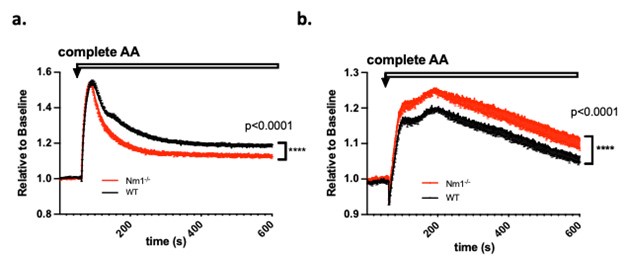
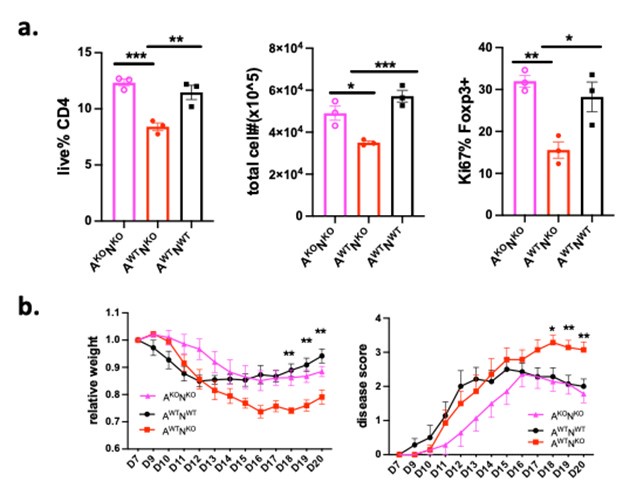
      Wu, Y. K., Miehl, C., & Gjorgjieva, J. (2022). Regulation of circuit organization and function through inhibitory synaptic plasticity. Trends in Neurosciences, 45(12), 884–898. https://doi.org/10.1016/J.TINS.2022.10.006

      Recommendations for the Authors:

      Reviewer #1 (Recommendations for The Authors):

      Thank you for the interesting submission. I have inserted my comments to the authors here. Some of them will be more granular comments related to the concerns raised in the public review.

      (1) Introduction:

      Could you please justify the rationale for using eyes open and eyes closed in the MRS condition, and the use of the three different conditions in the EEG experiment? If these resulted in negative findings, then the implications should be discussed.

      Previous work with MRS in sighted individuals has suggested that eye opening in darkness results in a decrease of visual cortex GABA+ concentration, while visual stimulation results in an increase of Glx concentration, compared to a baseline concentration at eye closure (Kurcyus et al., 2018). Moreover visual stimulation/eye opening is known to result in an alpha desynchronization (Adrian & Matthews, 1934).

      While previous work of our group has shown significantly reduced alpha oscillatory activity in congenital cataract reversal individual, desynchronization following eye opening was indistinguishable when compared to normally sighted controls (Ossandón et al., 2023; Pant et al., 2023).

      Thus, we decided to include both conditions to test whether a similar pattern of results would emerge for GABA+/Glx concentration.

      We added our motivation to the Introduction of the revised manuscript (Page 4, Lines 122-125) along with the Methods (Page 9, Lines 219-223).

      It does not become clear from the introduction why a higher intercept is predicted in the EEG measure. The rationale for this hypothesis needs to be explained better.

      Given the prior findings suggesting an increased E/I ratio in CC individuals and the proposed link between neuronal firing (Manning et al., 2009) and the aperiodic intercept, we expected a higher intercept for the CC compared to the SC group.

      We have now added this explanation to the Introduction (Page 4, Lines 126-128).

      (2) Participants

      Were participants screened for common MRS exclusion criteria such as history of psychiatric conditions or antidepressant medication, which could alter neurochemistry? If not, then this needs to be pointed out.

      All participants were clinically screened at the LV Prasad Eye Institute, and additionally self-reported no neurological or psychiatric conditions or medications. Moreover, all subjects were screened based exclusion criteria for being scanned using the standard questionnaire of the radiology center.

      We have now made this clear in the Methods (Page 7, Lines 168-171).

      Table 1 needs to show the age of the participant, which can only be derived by adding the columns 'duration of deprivation' and 'time since surgery'. Table 1 also needs to include the controls.

      We have accordingly modified Table 1 in the revised manuscript and added age for the patients as well as the controls (Table 1, Pages 6-7).

      The control cohort is not specific enough to exclude reduced visual acuity, or co-morbidities, as the primary driver of the differences between groups. Ideally, a cohort with developmental cataracts is recruited. Normally sighted participants as a control cohort cannot distinguish between different types of sight loss, or stages of plasticity.

      The goal of this study was not to distinguish between different types of sight loss or stages of plasticity. We aimed to assess whether the most extreme forms of visual deprivation (i.e. congenital and total patterned vision loss) affected the E/I ratio. Low visual acuity and nystagmus are genuine diagnostic criteria (Methods, Page 5, Lines 142-145). Visual acuity cannot solely explain the current findings, since the MRS data were acquired both with eyes closed or diffuse visual stimulation in a dimly lit room, without any visual task.

      With the awareness of the present results, we consider it worthwhile for the future to investigate additional groups such as developmental cataract-reversal individuals, to narrow down the contribution of the age of onset and degree of visual deprivation to the observed group differences.

      (3) Data collection and analysis

      - More detail is needed: how long were the sessions, how long was each part?

      We have added this information on Page 7, Lines 178-181 of the Methods. MRS scanning took between 45 and 60 minutes, EEG testing took 20 minutes excluding the time for capping, and visual acuity testing took 3-5 minutes.

      - It should be mentioned here that the EEG data is a reanalysis of a subset of legacy data, published previously in Ossandón et al., 2023; Pant et al., 2023.

      In the revised manuscript, we explicitly state at the beginning of the “Electrophysiology recordings” section of the Methods (Page 13, Lines 331-334) that the EEG datasets were a subset of previously published data.

      (4) MRS Spectroscopy

      - Please fill out the minimum reporting standards form (Lin et al., 2021), or report all the requested measures in the main document https://pubmed.ncbi.nlm.nih.gov/33559967/

      We have now filled out this form and added it as Supplementary Material (Supplementary Excel File 1). Additionally, all the requested information has been moved to the Methods section of the main document (MRS Data Quality, Pages 10-12).

      - Information on how the voxels were placed is missing. The visual cortex voxel is not angled parallel to the calcarine, as is a common way to capture processing in the early visual cortex. Describe in the paper what the criteria for successful placement were, and how was it ensured that non-brain tissue was avoided in a voxel of this size.

      Voxel placement was optimized in each subject to avoid the meninges, ventricles, skull and subcortical structures, ensured by examining the voxel region across slices in the acquired T1 volume for each subject. Saturation bands were placed to nullify the skull signal during MRS acquisition, at the anterior (frontal) and posterior (visual) edge of the voxel for every subject. Due to limitations in the clinical scanner rotated/skewed voxels were not possible, and thus voxels were not always located precisely parallel to the calcarine.

      We have added this information to Page 9 (Lines 229-237) of the revised manuscript.

      - Figure 1. shows voxels that are very close to the edge of the brain (frontal cortex) or to the tentorium (visual cortex). Could the authors please calculate the percentage overlap between the visual cortex MRS voxel and the visual cortex, and compare them across groups to ensure that there is no between-group bias from voxel placement?

      We have now added the requested analysis to Supplementary Material S2 and referred to it in the main manuscript on Page 9, Lines 236-237.

      Briefly, the percentage overlap with areas V1-V6 in every individual subject’s visual cortex voxel was 60% or more; the mean overlap in the CC group was 67% and the SC group 70%. The percentage overlap did not differ between groups ( t-test (t(18) = -1.14, p = 0.269)).

      - Figure 1. I would recommend displaying data on a skull-stripped image to avoid identifying information from the participant's T1 profile.

      We have now replaced the images in Figure 1 with skull-stripped images. Note that images from SPM12 were used instead of GannetCoregister, as GannetCoregister only displays images with the skull.

      - Please show more rigor with the MRS quality measures. Several examples of inconsistency and omissions are below.

      • SNR was quantified and shows a difference in SNR between voxel positions, with lower SNR in the frontal cortex. No explanation or discussion of the difference was provided.

      • Looking at S1, the linewidth of NAA seems to be a lot broader in the frontal cortex than in the visual cortex. The figures suggest that acquisition quality was very different between voxel locations, making the comparison difficult.

      • Linewidth of NAA is a generally agreed measure of shim quality in megapress acquisitions (Craven et al., 2022).

      The data quality difference between the frontal and visual cortices has been observed in the literature (Juchem & Graaf, 2017; Rideaux et al., 2022). We nevertheless chose a frontal cortex voxel as control site instead of the often-chosen sensorimotor cortex. The main motivation was to avoid any cortical region linked to sensory processing since crossmodal compensation as a consequence of visual deprivation is a well-documented phenomenon.

      We now make this clearer in the Methods (Page 11, Lines 284 – 299), in the Discussion/Limitations (Page 25, Lines 662 - 665).  

      - To get a handle on the data quality, I would recommend that the authors display their MRS quality measures in a separate section 'MRS quality measure', including NAA linewidth, NAA SNR, GABA+ CRLB, Glx CRLB, and test for the main effects and interaction of voxel location (VC, FC) and group (SC, CC) and discuss any discrepancies.

      We have moved all the quality metric values for GABA+, Glx and NAA from the supplement to the Methods section (see Table 2), and added the requested section titled “MRS Data quality.”

      We have conducted the requested analyses and reported them in Supplementary Material S6: there was a strong effect of region confirming that data quality was better in the visual than frontal region. We have referred to this in the main manuscript on Page 11, Line 299.

      In the revised manuscript, we discuss the data quality in the frontal cortex, and how we ensured it was comparable to prior work. Moreover, there were no significant group effects, or group-by-region interactions, suggesting that group differences observed for the visual cortex voxel cannot be accounted for by differences in data quality. We now included a section on data quality, both in the Methods (Page 11, Lines 284 – 299), and the limitations section of the Discussion (Page 25, Lines 662 - 665).

      Please clarify the MRS acquisition, "Each MEGA- PRESS scan lasted for 8 minutes and was acquired with the following specifications: TR = 2000 ms, TE = 68 ms, Voxel size = 40 mm x 30 mm x 25mm, 192 averages (each consists of two TRs). "192 averages x 2 TRs x 2s TR = 12.8 min, not 8 min, apologies if I have misunderstood these details.

      We have corrected this error in the revised manuscript and stated the parameters more clearly – there were a total of 256 averages, resulting in an (256 repetitions with 1 TR * 2 s/60) 8.5-minute scan (Page 8, Lines 212-213).

      - What was presented to participants in the eyes open MRS? Was it just normal room illumination or was it completely dark? Please add details to your methods.

      The scans were conducted in regular room illumination, with no visual stimulation.

      We have now clarified this on Page 9 (Lines 223-224) of the Methods.

      (5) MRS analysis

      How was the tissue fraction correction performed? Please add or refer to the exact equation from Harris et al., 2015.

      We have clarified that the reported GABA+/Glx values are water-normalized alpha corrected values (Page 10, Line 249), and cited Harris et al., 2015 on Page 10 (Line 251) of the Methods.

      (6) Statistical approach

      How was the sample size determined? Please add your justification for the sample size

      We collected as many qualifying patients as we were able to recruit for this study within 2.5 years of data collection (commencing August 2019, ending February 2022), given the constraints of the patient population and the pandemic. We have now made this clear in the Discussion (Page 25, Lines 650-652).

      Please report the tests for normality.

      We have now reported the Shapiro-Wilk test results for normality as well as Levene’s test for homogeneity of variance between groups for every dependent variable in our dataset in Supplementary Material S9, and added references to it in the descriptions of the statistical analyses (Methods, Page13, Lines 326-329 and Page 15, Lines 400-402).

      Calculate the Bayes Factor where possible.

      As our analyses are all frequentist, instead of re-analyzing the data within a Bayesian framework, we added partial eta squared values for all the reported ANOVAs (η<sub>p</sub><sup>²</sup>) for readers to get an idea of the effect size (Results).

      I recommend partial correlations to control for the influence of age, duration, and time of surgery, rather than separate correlations.

      Given the combination of small sample size and the expected multicollinearity in our variables (duration of blindness, for example, would be expected to correlate with age, as well as visual acuity post-surgery), partial correlations could not be calculated on this data.

      We are aware of the limits of correlational analyses. Given the unique data set of a rare population we had exploratorily planned to relate behavioral, EEG and MRS parameters by calculating correlations. Since no similar data existed when we started (and to the best of our knowledge our data set is still unique), these correlation analyses were explorative, but the most transparent to run.

      We have now clearly outlined these limitations in our Introduction (Page 5, Lines 133-135), Methods (Page 15, Lines 408-410) and Discussion section (Page 24, Line 634, Page 25, Lines 652-65) to ensure that the results are interpreted with appropriate caution.

      (7) Visual acuity

      Is the VA monocular average, from the dominant eye, or bilateral?

      We have now clarified that the VA reported here is bilateral (Methods, Page 7 Line 165 and Page 15, Line 405). Bilateral visual acuity in congenital cataract-reversal individuals typically corresponds to the visual acuity of the best eye.

      It is mentioned here that correlations with VA are exploratory, please be consistent as the introduction mentions that there was a hypothesis that you sought to test.

      We have now accordingly modified the Introduction (Page 5, Lines 133-135) and added the appropriate caveats in the discussion with regards to interpretations (Page 25, Lines 652-665).

      (8) Correlation analyses between MRS and EEG

      It is mentioned here that correlations between EEG and MRS are exploratory, please consistently point out the exploratory nature, as these results are preliminary and should not be overinterpreted ("We did not have prior hypotheses as to the best of our knowledge no extant literature has tested the correlation between aperiodic EEG activity and MRS measures of GABA+,Glx and Glx/GABA+." ).

      In the revised manuscript, we explicitly state the reported associations between EEG (aperiodic component) and MRS parameters allow for putting forward directed / more specific hypotheses for future studies (Introduction, Page 5, Lines 133-135; Methods, Page 15, Line 415. Discussion, Page 25, Lines 644-645 and Lines 652-665).

      (9) Results

      Figure 2 uses the same y-axis for the visual cortex and frontal cortex to facilitate a comparison between the two locations. Comparing Figure 2 a with b demonstrates poorer spectral peaks and reduced amplitudes. Lower spectral quality in the frontal cortex voxel could contribute to the absence of a group effect in the control voxel location. The major caveat that spectral quality differs between voxels needs to be pointed out and the limitations thereof discussed.

      We have now explicitly pointed out this issue in the Methods (MRS Data Quality, Supplementary Material S6) and Discussion in the Limitations section (Page 25, Lines 662-665). While data quality was lower for the frontal compared to the visual cortex voxels, as has been observed previously (Juchem & Graaf, 2017; Rideaux et al., 2022), this was not an issue for the EEG recordings. Thus, lower sensitivity of frontal measures cannot easily explain the lack of group differences for frontal measures. Crucially, data quality did not differ between groups.

      The results in 2c are the result of multiple correlations with metabolite values ("As in previous studies, we ran a number of exploratory correlation analyses between GABA+, Glx, and Glx/GABA+ concentrations, and visual acuity at the date of testing, duration of visual deprivation, and time since surgery respectively in the CC group"), it seems at least six for the visual acuity measure (VA vs Glx, VA vs GABA+, VA vs Glx/GABA+ x 2 conditions). While the trends are interesting, they should be interpreted with caution because of the exploratory nature, small sample size, the lack of multiple comparison correction, and the influence of two extreme data points. The authors should not overinterpret these results and should point out the need for replication.

      See response to (6) last section, which we copy here for convenience:

      We are aware of the limits of correlational analyses. Given the unique data set of a rare population we exploratorily related behavioral, EEG and MRS parameters by calculating correlations. Since no similar data existed when we started (and to the best of our knowledge our data set is still unique), these correlation analyses were explorative, but the most transparent to run.

      We have now clearly outlined these limitations in our Discussion section to ensure that the results are interpreted with appropriate caution (Discussion, Page 25, Lines 644-645 and Lines 652-665).

      (10) Discussion:

      Please explain the decrease in E/I balance from MRS in view of recent findings on an increase in E/I balance in CC using RSN-fMRI (Raczy et al., 2022) and EEG (Ossandon et al. 2023).

      We have edited our Abstract (Page 1-2, Lines 31-35) and Discussion (Page 23, Lines 584-590; Page 24, Lines 613-620). In brief, we think our results reflect a homeostatic regulation of E/I balance, that is, an increase in inhibition due to an increase in stimulus driven excitation following sight restoration.

      Names limitations but does nothing to mitigate concerns about spatial specificity. The limitations need to be rewritten to include differences in SNR between the visual cortex and frontal lobe. Needs to include caveats of small samples, including effect inflation.

      We have now discussed the data quality differences between the visual and frontal cortex voxel in MRS data quality, which we find irrespective of group (MRS Data Quality, Supplementary Material S6). We also reiterate why this might not explain our results; data quality was comparable to prior studies which have found group differences in frontal cortex (Methods Page 11, Lines 284 – 299), and data quality did not differ between groups. Further, EEG data quality did not differ across frontal and occipital regions, but group differences in EEG datasets were localized to the occipital cortex.

      Reviewer #2 (Recommendations for The Authors):

      To address the main weakness, the authors could consider including data from a third group, of congenitally blind individuals. Including this would go a very long way towards making the findings interpretable and relating them to the rest of the literature.

      Unfortunately, recruitment of these groups was not possible due to the pandemic. Indeed, we would consider a pre- vs post- surgery approach the most suitable design in the future, which, however, will require several years to be completed. Such time and resource intensive longitudinal studies are justified by the present cross-sectional results.

      We have explicitly stated our contribution and need for future studies in the Limitations section of the Discussion (Page 25, Lines 650-657).

      Analysing the amplitude of alpha rhythms, as well as the other "aperiodic" components, would be useful to relate the profile of the tested patients with previous studies. Visual inspection of Figure 3 suggests that alpha power with eyes closed is not reduced in the patients' group compared to the controls. This would be inconsistent with previous studies (including research from the same group) and it could suggest that the small selected sample is not really representative of the sight-recovery population - certainly one of the most heterogeneous study populations. This further highlights the difficulty of drawing conclusions on the effects of visual experience merely based on this N=10 set of patients.

      Alpha power was indeed reduced in the present subsample of 10 CC individuals (Supplementary Material S19). A possible source of the confusion (that the graphs of the CC and SC group look so similar for the EC condition in Figure 3) likely is that the spectra are shown with aperiodic components not yet removed, and scales to accommodate very different alpha power values. As documented in Supplementary Material S18 and S19, alpha power and the aperiodic intercept/slope results of the resting state data in the present 10 CC individuals correspond to the results from a larger sample of CC individuals (n = 28) in Ossandón et al., 2023. We explicitly highlight this “replication” in the main manuscript (Page 25 -26, Lines 671-676). Thus, the present sub-sample of CC individuals are representative for their population.

      To further characterise the MRS results, the authors may consider an alternative normalisation scheme. It is not clear whether the lack of significant GABA and GLX differences in the face of a significant group difference in the GLX/GABA ratio is due to the former measures being noisier since taking the ratio between two metabolites often helps reduce inter-individual variability and thereby helps revealing group differences. It remains an open question whether the GABA or GLX concentrations would show significant group differences after appropriate normalisation (e.g. NAA?).

      We repeated the analysis with Creatine-normalized values of GABA+ and Glx, and the main results i.e. reduced Glx/GABA+ concentration in the visual cortex of CC vs SC individuals, and no such difference in the frontal cortex, remained the same (Supplementary Material S5).

      Further, we re-analyzed the data using Osprey, an open-source toolbox that uses linear combination modeling, and found once more that our results did not change (Supplementary Material S3). We refer to these findings in the Methods (Page 10, Lines 272-275) and Results (Page 10, Lines 467-471) of the main manuscript.

      In fact, the Glx concentration in the visual cortex of CC vs SC individuals was significantly decreased when Cr-normalized values were used (which was not significant in the original analysis). However, we do not interpret this result as it was not replicated with the water-normalized values from Gannet or Osprey.

      I suggest revising the discussion to present a more balanced picture of the existent evidence of the relation between E/I and EEG indices. Although there is evidence that the 1/f slope changes across development, in a way that could be consistent with a higher slope reflecting more immature and excitable tissue, the link with cortical E/I is far from established, especially when referring to specific EEG indices (intercept vs. slope, measured in lower vs. higher frequency ranges).

      We have revised the Introduction (Page 4, Line 91, Lines 101-102) and Discussion (Page 22, Lines 568-569, Page 24, Lines 645-647 and Lines 654-657) in the manuscript accordingly; we allude to the fact that the links between cortical E/I and aperiodic EEG indices have not yet been unequivocally established in the literature.

      Minor:

      - The authors estimated NAA concentration with different software than the one used to estimate GLX and GABA; this examined the OFF spectra only; I suggest that the authors consider running their analysis with LCModel, which would allow a straightforward approach to estimate concentrations of all three metabolites from the same edited spectrum and automatically return normalised concentrations as well as water-related ones.

      We re-analyzed all of the MRS datasets using Osprey, which uses linear combination modelling and has shown quantification results similar to LCModel for NAA (Oeltzschner et al., 2020). The results of a lower Glx/GABA+ concentration in the visual cortex of CC vs SC individuals, and no difference in NAA concentration, were replicated using this pipeline.

      We have now added these analyses to the Supplementary Material S3 and referred to them in the Methods (Page 9, Lines 242-246) and Results (Page 18, Lines 464-467).

      - Of course the normalisation used to estimate GABA and GLX values is completely irrelevant when the two values are expressed as ratio GLX/GABA - this may be reflected in the text ("water normalised GLX/GABA concentration" should read "GLX/GABA concentration" instead).

      We have adapted the text on Page 16 (Line 431) and have ensured that throughout the manuscript the use of “water-normalized” is in reference to Glx or GABA+ concentration, and not the ratio.

      - Please specify which equation was used for tissue correction - is it alpha-correction?

      We have clarified that the reported GABA+/Glx values are water-normalized alpha corrected values (Page 10, Line 249), and cited Harris et al., 2015 on Page 10 (Line 251) of the Methods.

      - Since ANOVA was used, the assumption is that values are normally distributed. Please report evidence supporting this assumption.

      We have now reported the Shapiro-Wilk test results for normality as well as Levene’s test for homogeneity of variance between groups for every dependent variable in our dataset in Supplementary Material S9, and added references to it in the Methods (Page 13, Lines 326-329 and Page 15, Lines 400-402).

      Reviewer #3 (Recommendations for The Authors):

      In addition to addressing major comments listed in my Public Review, I have the following, more granular comments, which should also be addressed:

      (1) The paper's structure could be improved by presenting visual acuity data before diving into MRS and EEG results to better contextualize the findings.

      We now explicitly state in the Methods (Page 5, Line 155) that lower visual acuity is expected in a cohort of CC individuals with long lasting congenital visual deprivation.

      We have additionally included a plot of visual acuities of the two groups (Supplementary Material S1).

      (2) The paper should better explain the differences between CC for which sight is restored and congenitally blind patients. The authors write in the introduction that there are sensitive periods/epochs during the lifespan for the development of local inhibitory neural circuits. and "Human neuroimaging studies have similarly demonstrated that visual experience during the first weeks and months of life is crucial for the development of visual circuits. If human infants born with dense bilateral cataracts are treated later than a few weeks from birth, they suffer from a permanent reduction of not only visual acuity (Birch et al., 1998; Khanna et al., 2013) and stereovision (Birch et al., 1993; Tytla et al., 1993) but additionally from impairments in higher-level visual functions, such as face perception (Le Grand et al., 2001; Putzar et al., 2010; Röder et al., 2013)...".

      Thus it seems that the current participants (sight restored after a sensitive period) seem to be similarly affected by the development of the local inhibitory circuits as congenitally blind. To assess the effect of plasticity and sight restoration longitudinal data would be necessary.

      In the Introduction (Page 2, Lines 59-64; Page 3, Lines 111-114) we added that in order to identify sensitive periods e.g. for the elaboration of visual neural circuits, sight recovery individuals need to be investigated. The study of permanently blind individuals allows for investigating the role of experience (whether sight is necessary to introduce the maturation of visual neural circuits), but not whether visual input needs to be available at early epochs in life (i.e. whether sight restoration following congenital blindness could nevertheless lead to the development of visual circuits).

      This is indeed the conclusion we make in the Discussion section. We have now highlighted the need for longitudinal assessments in the Discussion (Page 25, Lines 654-656).

      (3) What's the underlying idea of analyzing two separate aperiodic slopes (20-40Hz and 1-19Hz). This is very unusual to compute the slope between 20-40 Hz, where the SNR is rather low.

      "Ossandón et al. (2023), however, observed that in addition to the flatter slope of the aperiodic power spectrum in the high frequency range (20-40 Hz), the slope of the low frequency range (1-19 Hz) was steeper in both, congenital cataract-reversal individuals, as well as in permanently congenitally blind humans."

      The present manuscript computed the slope between 1-20 Hz. Ossandón et al. as well as Medel et al. (2023) found a “knee” of the 1/f distribution at 20 Hz and describe further the motivations for computing both slope ranges. For example, Ossandón et al. used a data driven approach and compared single vs. dual fits and found that the latter fitted the data better. Additionally, they found the best fit if a knee at 20 Hz was used. We would like to point out that no standard range exists for the fitting of the 1/f component across the literature and, in fact, very different ranges have been used (Gao et al., 2017; Medel et al., 2023; Muthukumaraswamy & Liley, 2018).

      (4) "For this scan, participants were instructed to keep their eyes closed and stay as still as possible." Why should it be important to have the eyes closed during a T1w data acquisition? This statement at this location does not make sense.

      To avoid misunderstandings, we removed this statement in this context.

      (5) "Two SC subjects did not complete the frontal cortex scan for the EO condition and were excluded from the statistical comparisons of frontal cortex neurotransmitter concentrations."<br /> Why did the authors not conduct whole-brain MRS, which seems to be on the market for quite some time (e.g. https://www.ncbi.nlm.nih.gov/pmc/articles/PMC3590062/) ?

      Similar to previous work (Coullon et al., 2015; Weaver et al., 2013) our hypothesis was related to the visual cortex, and we chose the frontal cortex voxel as a control. This has now been clarified in the Introduction (Page 4, Lines 103-114), Methods (Page 9, Lines 225-227) and Discussion (Page 25, Lines 662-665).

      (6) In "....during visual stimulation with stimuli that changed in luminance (LU) (Pant et al., 2023)." the authors should provide a link on the visual stimulation, which is provided further below

      In the revised manuscript, we have moved up the description of the visual stimulation (Page 13, Line 336).

      (7) "During the EO condition, participants were asked to fixate on a blank screen." This is not really possible. Typically, resting state EO conditions include a fixation cross, as the participants would not be able to fixate on a blank screen and move their eyes, which would impact the recordings.

      We have now rephrased this as “look towards” with the goal of avoiding eye movements (Page 14, Line 347).

      (8) "Components corresponding to horizontal or vertical eye movements were identified via visual inspection and removed (Plöchl et al., 2012)." It is unclear what the Plöchl reference should serve for. Is the intention of the authors to state that manual (and subjective) visual inspection of the ICA components is adequate? I would recommend removing this reference.

      The intention was to provide the basis for classification during the visual inspection, as opposed to an automated method such as ICLabel.

      We stated this clearly in the revised manuscript (Page 14 Lines 368-370).

      (9) "The datasets were divided into 6.25 s long epochs corresponding to each trial." This is a bit inaccurate, as the trial also included some motor response task. Thus, I assume the 6.25 s are related to the visual stimulation.

      We have modified the sentence accordingly (Page 15, Line 378).

      (10) Figure 2. a & b. Just an esthetic suggestion: I would recommend removing the lines between the EC and EO conditions, as they suggest some longitudinal changes. Unless it is important to highlight the changes between EC and EO within each subject.

      In fact, EC vs. EO was a within-subject factor with expected changes for the EEG and possible changes in the MRS parameters. To allow the reader to track changes due to EC vs. EO for individual subjects (rather than just comparing the change in the mean scores), we use lines.  

      (11) Figure 3A: I would plot the same y-axis range for both groups to make it more comparable.

      We have changed Figure 3A accordingly.

      (12) " flattening of the intercept" replaces flattening, as it is too related to slope.

      We have replaced “flattening” with “reduction” (Page 20, Line 517).

      (13) The plotting of only the significant correlation between MRS measures and EEG measures seems to be rather selective reporting. For this type of exploratory analysis, I would recommend plotting all of the scatter plots and moving the entire exploratory analysis to the supplementary (as this provides the smallest evidence of the results).

      We have made clear in the Methods (Page 16, Lines 415-426), Results and Discussion (page 24, Lines 644-645), as well as in the Supplementary material, that the reason for only reporting the significant correlation was that this correlation survived correction for multiple comparisons, while all other correlations did not. We additionally explicitly allude to the Supplementary Material where the plots for all correlations are shown (Results, Page 21, Lines 546-552).

      (14) "Here, we speculate that due to limited structural plasticity after a phase of congenital blindness, the neural circuits of CC individuals, which had adapted to blindness after birth, employ available, likely predominantly physiological plasticity mechanisms (Knudsen, 1998; Mower et al., 1985; Röder et al., 2021), in order to re-adapt to the newly available visual excitation following sight restoration."

      I don't understand the logic here. The CC individuals are congenitally blind, thus why should there be any physiological plasticity mechanism to adapt to blindness, if they were blind at birth?

      With “adapt to blindness” we mean adaptation of a brain to an atypical or unexpected condition when taking an evolutionary perspective (i.e. the lack of vision). We have made this clear in the revised manuscript (Introduction, Page 4, Lines 111-114; Discussion, Page 23, Lines 584-591).

      (15) "An overall reduction in Glx/GABA ratio would counteract the aforementioned adaptations to congenital blindness, e.g. a lower threshold for excitation, which might come with the risk of runaway excitation in the presence of restored visually-elicited excitation."

      This could be tested by actually investigating the visual excitation by visual stimulation studies.

      The visual stimulation condition in the EEG experiment of the present study found a higher aperiodic intercept in CC compared to SC individuals. Given the proposed link between the intercept and spontaneous neural firing (Manning et al., 2009), we interpreted the higher intercept in CC individuals as increased broadband neural firing during visual stimulation (Results Figure 3; Discussion Page 24, Lines 635-640). This idea is compatible with enhanced BOLD responses during an EO condition in CC individuals (Raczy et al., 2022). Future work should systematically manipulate visual stimulation to test this idea.

      (16) As the authors also collected T1w images, the hypothesis of increased visual cortex thickness in CC. Was this investigated?

      This hypothesis was investigated in a separate publication which included this subset of participants (Hölig et al., 2023), and found increased visual cortical thickness in the CC group. We refer to this publication, and related work (Feng et al., 2021) in the present manuscript.

      (17) The entire discussion of age should be omitted, as the current data set is too small to assess age effects.

      We have removed this section and just allude to the fact that we replicated typical age trends to underline the validity of the present data (Page 26, Lines 675-676).

      (18) Table1: should include the age and the age at the time point of surgery.

      We added age to the revised Table 1. We clarified that in CC individuals, duration of blindness is the same as age at the time point of surgery (Page 6, Line 163).

      (19) Why no group comparisons of visual acuity are reported?

      Lower visual acuity in CC than SC individuals is a well-documented fact.

      We have now added the visual acuity plots for readers (Supplementary Material S1, referred to in the Methods, Page 5, Line 155) which highlight this common finding.

      References (Recommendations to the Authors)

      Adrian, E. D., & Matthews, B. H. C. (1934). The berger rhythm: Potential changes from the occipital lobes in man. Brain. https://doi.org/10.1093/brain/57.4.355

      Coullon, G. S. L., Emir, U. E., Fine, I., Watkins, K. E., & Bridge, H. (2015). Neurochemical changes in the pericalcarine cortex in congenital blindness attributable to bilateral anophthalmia. Journal of Neurophysiology. https://doi.org/10.1152/jn.00567.2015

      Feng, Y., Collignon, O., Maurer, D., Yao, K., & Gao, X. (2021). Brief postnatal visual deprivation triggers long-lasting interactive structural and functional reorganization of the human cortex. Frontiers in Medicine, 8, 752021. https://doi.org/10.3389/FMED.2021.752021/BIBTEX

      Gao, R., Peterson, E. J., & Voytek, B. (2017). Inferring synaptic excitation/inhibition balance from field potentials. NeuroImage, 158(March), 70–78. https://doi.org/10.1016/j.neuroimage.2017.06.078

      Hölig, C., Guerreiro, M. J. S., Lingareddy, S., Kekunnaya, R., & Röder, B. (2023). Sight restoration in congenitally blind humans does not restore visual brain structure. Cerebral Cortex, 33(5), 2152–2161. https://doi.org/10.1093/CERCOR/BHAC197

      Juchem, C., & Graaf, R. A. de. (2017). B0 magnetic field homogeneity and shimming for in vivo magnetic resonance spectroscopy. Analytical Biochemistry, 529, 17–29. https://doi.org/10.1016/j.ab.2016.06.003

      Kurcyus, K., Annac, E., Hanning, N. M., Harris, A. D., Oeltzschner, G., Edden, R., & Riedl, V. (2018). Opposite Dynamics of GABA and Glutamate Levels in the Occipital Cortex during Visual Processing. Journal of Neuroscience, 38(46), 9967–9976. https://doi.org/10.1523/JNEUROSCI.1214-18.2018

      Manning, J. R., Jacobs, J., Fried, I., & Kahana, M. J. (2009). Broadband shifts in local field potential power spectra are correlated with single-neuron spiking in humans. The Journal of Neuroscience : The Official Journal of the Society for Neuroscience, 29(43), 13613–13620. https://doi.org/10.1523/JNEUROSCI.2041-09.2009

      Medel, V., Irani, M., Crossley, N., Ossandón, T., & Boncompte, G. (2023). Complexity and 1/f slope jointly reflect brain states. Scientific Reports, 13(1), 21700. https://doi.org/10.1038/s41598-023-47316-0

      Muthukumaraswamy, S. D., & Liley, D. T. (2018). 1/F electrophysiological spectra in resting and drug-induced states can be explained by the dynamics of multiple oscillatory relaxation processes. NeuroImage, 179(November 2017), 582–595. https://doi.org/10.1016/j.neuroimage.2018.06.068

      Oeltzschner, G., Zöllner, H. J., Hui, S. C. N., Mikkelsen, M., Saleh, M. G., Tapper, S., & Edden, R. A. E. (2020). Osprey: Open-source processing, reconstruction & estimation of magnetic resonance spectroscopy data. Journal of Neuroscience Methods, 343, 108827. https://doi.org/10.1016/j.jneumeth.2020.108827

      Ossandón, J. P., Stange, L., Gudi-Mindermann, H., Rimmele, J. M., Sourav, S., Bottari, D., Kekunnaya, R., & Röder, B. (2023). The development of oscillatory and aperiodic resting state activity is linked to a sensitive period in humans. NeuroImage, 275, 120171. https://doi.org/10.1016/J.NEUROIMAGE.2023.120171

      Pant, R., Ossandón, J., Stange, L., Shareef, I., Kekunnaya, R., & Röder, B. (2023). Stimulus-evoked and resting-state alpha oscillations show a linked dependence on patterned visual experience for development. NeuroImage: Clinical, 103375. https://doi.org/10.1016/J.NICL.2023.103375

      Raczy, K., Holig, C., Guerreiro, M. J. S., Lingareddy, S., Kekunnaya, R., & Roder, B. (2022). Typical resting-state activity of the brain requires visual input during an early sensitive period. Brain Communications, 4(4). https://doi.org/10.1093/BRAINCOMMS/FCAC146

      Rideaux, R., Ehrhardt, S. E., Wards, Y., Filmer, H. L., Jin, J., Deelchand, D. K., Marjańska, M., Mattingley, J. B., & Dux, P. E. (2022). On the relationship between GABA+ and glutamate across the brain. NeuroImage, 257, 119273. https://doi.org/10.1016/J.NEUROIMAGE.2022.119273

      Weaver, K. E., Richards, T. L., Saenz, M., Petropoulos, H., & Fine, I. (2013). Neurochemical changes within human early blind occipital cortex. Neuroscience. https://doi.org/10.1016/j.neuroscience.2013.08.004
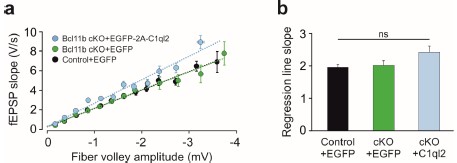
    1. Author response:

      The following is the authors’ response to the original reviews.

      The reviewers praised multiple aspects of our study. Reviewer 1 noted that “the work aligns well with current research trends and will greatly interest researchers in the field.” Reviewer 2 highlighted the unique capability of our imaging approach, which “allows for investigation of the heterogeneity of response across individual dopamine axons, unlike other common approaches such as fiber photometry.” Reviewer 3 commented that “the experiments are beautifully executed” and “are revealing novel information about how aversive and rewarding stimuli is encoded at the level of individual axons, in a way that has not been done before.”

      In addition to the positive feedback, the reviewers also provided useful criticisms and suggestions, some of which may not be fully addressed in a single study. For instance, questions regarding whether dopamine axons encode the valence or specific identity of the stimuli, or the most salient aspects of the environment, remain open. At the same time, as all the reviewers agreed, our report on the diversity of dopamine axonal responses using a novel imaging design introduces significant new insights to the neuroscience community. Following the reviewers’ recommendations, we have refrained from making interpretations that could be perceived as overinterpretation, such as concluding that “dopamine axons are involved in aversive processing.” This has necessitated extensive revisions, including modifying the title of our manuscript to make clear that the novelty of our work is revealing ‘functional diversity’ using our new imaging approach.

      Below, we respond to the reviewers’ comments point by point.

      eLife assessment

      This valuable study shows that distinct midbrain dopaminergic axons in the medial prefrontal cortex respond to aversive and rewarding stimuli and suggest that they are biased toward aversive processing. The use of innovative microprism based two-photon calcium imaging to study single axon heterogeneity is solid, although the experimental design could be optimized to distinguish aversive valence from stimulus salience and identity in this dopamine projection. This work will be of interest to neuroscientists working on neuromodulatory systems, cortical function and decision making.

      Reviewer #1

      Summary:

      In this manuscript, Abe and colleagues employ in vivo 2-photon calcium imaging of dopaminergic axons in the mPFC. The study reveals that these axons primarily respond to unconditioned aversive stimuli (US) and enhance their responses to initially-neutral stimuli after classical association learning. The manuscript is well-structured and presents results clearly. The utilization of a refined prism-based imaging technique, though not entirely novel, is well-implemented. The study's significance lies in its contribution to the existing literature by offering single-axon resolution functional insights, supplementing prior bulk measurements of calcium or dopamine release. Given the current focus on neuromodulator neuron heterogeneity, the work aligns well with current research trends and will greatly interest researchers in the field.

      However, I would like to highlight that the authors could further enhance their manuscript by addressing study limitations more comprehensively and by providing essential details to ensure the reproducibility of their research. In light of this, I have a number of comments and suggestions that, if incorporated, would significantly contribute to the manuscript's value to the field.

      Strengths:

      • Descriptive.

      • Utilization of a well-optimized prism-based imaging method.

      • Provides valuable single-axon resolution functional observations, filling a gap in existing literature.

      • Timely contribution to the study of neuromodulator neuron heterogeneity.

      We thank the reviewer for this positive assessment.

      Weaknesses:

      (1) It's important to fully discuss the fact that the measurements were carried out only on superficial layers (30-100um), while major dopamine projections target deep layers of the mPFC as discussed in the cited literature (Vander Weele et al., 2018) and as illustrated in FigS1B,C. This limitation should be explicitly acknowledged and discussed in the manuscript, especially given the potential functional heterogeneity among dopamine neurons in different layers. This potential across-layer heterogeneity could also be the cause of discrepancy among past recording studies with different measurement modalities. Also, mentioning technical limitations would be informative. For example: how deep the authors can perform 2p-imaging through the prism? was the "30-100um" maximum depth the authors could get?

      Thank you for pointing out this important issue about layer differences.

      It is possible that the mesocortial pathway has layer-specific channels, with some neurons targeting supra granular layers and others targeting infragranular ones. Alternatively, it is also plausible that the axons of the same neurons branch into both superficial and deep layers. This is a critical issue that has not been investigated in anatomical studies and will require single-cell labeling of dopamine neurons (Matsuda et al 2009 and Aransay et al 2015). We now discuss this issue in the Discussion.

      As for the imaging depth of 30–100 m, we were unable to visualize deeper axons in a live view mode. Our imaging system has already been optimized to detect weak signals (e.g., we have employed an excitation wavelength of 980 nm, dispersion compensation, and a hybrid photodetector). It is possible that future studies using improved imaging approaches may be able to visualize deeper layers. Importantly, sparse axons in the supragranular layers are advantageous in detecting weak signals; dense labeling of axons would increase the background fluorescence relative to signals. We now reference this layer issue in the Results and Discussion sections.

      (2) In the introduction, it seems that the authors intended to refer to Poulin et al. 2018 regarding molecular/anatomical heterogeneity of dopamine neurons, but they inadvertently cited Poulin et al. 2016 (a general review on scRNAseq). Additionally, the statement that "dopamine neurons that project to the PFC show unique genetic profiles (line 85)" requires clarification, as Poulin et al. 2018 did not specifically establish this point. Instead, they found at least the Vglut2/Cck+ population projects into mPFC, and they did not reject the possibility of other subclasses projecting to mPFC. Rather, they observed denser innervation with DAT-cre, suggesting that non-Vglut2/Cck populations would also project to mPFC. Discuss the potential molecular heterogeneity among mPFC dopamine axons in light of the sampling limitation mentioned earlier.

      We thank the reviewer for pointing this out. Genetic profiles of PFC-projecting DA neurons are still being investigated, so describing them as “unique” was misleading. We have edited the Introduction accordingly, and now discuss this issue in detail in the Discussion.

      (3) I find the data presented in Figure 2 to be odd. Firstly, the latency of shock responses in the representative axons (right panels of G, H) is consistently very long - nearly 500ms. It raises a query whether this is a biological phenomenon or if it stems from a potential technical artifact, possibly arising from an issue in synchronization between the 2-photon imaging and stimulus presentation. My reservations are compounded by the notable absence of comprehensive information concerning the synchronization of the experimental system in the method section.

      The synchronization of the stimulus and data acquisition is accomplished at a sub-millisecond resolution. We use a custom-made MATLAB program that sends TTL commands to standard imaging software (ThorImage or ScanImage) and a stimulator for electrical shocks. All events are recorded as analogue inputs to a different DAQ to ensure synchronization. We have provided additional details regarding the configuration in the Methods section.

      We consider that the long latency of shock response is biological. For instance, a similar long latency was found after electrical shock in a photometry imaging study (Kim, …, Deisseroth, 2016).

      Secondly, there appear to be irregularities in Panel J. While the authors indicate that "Significant axons were classified as either reward-preferring (cyan) or aversive-preferring (magenta), based on whether the axons are above or below the unity line of the reward/aversive scatter plot (Line 566)," a cyan dot slightly but clearly deviates above the unity line (around coordinates (x, y) = (20, 21)). This needs clarification. Lastly, when categorizing axons for analysis of conditioning data in Fig3 (not Fig2), the authors stated "The color-coded classification (cyan/magenta) was based on k-means clustering, using the responses before classical conditioning (Figure 2J)". I do not understand why the authors used different classification methods for two almost identical datasets.

      We thank the reviewer for pointing out these insufficient descriptions. We classified the axons using k-means clustering, and the separation of the two clusters happened to roughly coincide with the unity line of the reward/aversive scatter plot in Fig 2J. In other words, we did not use the unity line to classify the data points (which is why the color separation of the histogram is not at 45 degrees). We have clarified this point in the Methods section.

      (4) In connection with Point 3, conducting separate statistical analyses for aversive and rewarding stimuli would offer a fairer approach. This could potentially reveal a subset of axons that display responses to both aversive and appetitive stimuli, aligning more accurately with the true underlying dynamics. Moreover, the characterization of Figure 2J as a bimodal distribution while disregarding the presence of axons responsive to both aversive and appetitive cues seems somewhat arbitrary and circular logic. A more inclusive consideration of this dual-responsive population could contribute to a more comprehensive interpretation.

      We also attempted k-means clustering with additional dimensions (e.g., temporal domains as shown in Fig. 3I, J), but no additional clusters were evident. We note that the lack of other clusters does not exclude the possibility of their existence, which may only become apparent with a substantial increase in the number of samples. In the current report, we present the clusters that were the easiest/simplest for us to identify.

      Additionally, we have revised our manuscript to reflect that many axons respond to both reward and aversive stimuli, and that aversive-preferring axons do not exclusively respond to the aversive stimulus.

      (5) The contrast in initialization to novel cues between aversive and appetitive axons mirrors findings in other areas, such as the tail-of-striatum (TS) and ventral striatum (VS) projecting dopamine neurons (Menegas et al., 2017, not 2018). You might consider citing this very relevant study and discussing potential collateral projections between mPFC and TS or VS.

      Thank you for pointing this out. We have now included Menegas et al., 2017, and also discuss the possibility of collaterals to these areas. In addition, we also referred to Azcorra et al., 2023 - this was published after our initial submission.

      (6) The use of correlation values (here >0.65) to group ROIs into axons is common but should be justified based on axon density in the FOV and imaging quality. It's important to present the distribution of correlation values and demonstrate the consistency of results with varying cut-off values. Also, provide insights into the reliability of aversive/appetitive classifications for individual ROIs with high correlations. Importantly, if you do the statistical testing and aversive/appetitive classifications for individual ROIs with above-threshold high correlation (to be grouped into the same axon), do they always fall into the same category? How many false positives/false negatives are observed?


      "Our results remained similar for different correlation threshold values (Line 556)" (data not shown) is obsolete.

      We have conducted additional analysis using correlation values 0.5 and 0.3 that resulted in a smaller number of axon terminals. In essence, the relationship between reward responses and aversive responses remained very similar to Fig. 2J, K.

      Author response image 1.

      Reviewer #2 (Public Review):

      Summary:

      This study aims to address existing differences in the literature regarding the extent of reward versus aversive dopamine signaling in the prefrontal cortex. To do so, the authors chose to present mice with both a reward and an aversive stimulus during different trials each day. The authors used high spatial resolution two-photon calcium imaging of individual dopaminergic axons in the medial PFC to characterize the response of these axons to determine the selectivity of responses in unique axons. They also paired the reward (water) and an aversive stimulus (tail shock) with auditory tones and recorded across 12 days of associative learning.

      The authors find that some axons respond to both reward and aversive unconditioned stimuli, but overall, there is a strong preference to respond to aversive stimuli consistent with expectations from prior studies that used other recording methods. The authors find that both of their two auditory stimuli initially drive responses in axons, but that with training axons develop more selective responses for the shock associated tone indicating that associative learning led to changes in these axon's responses. Finally, the authors use anticipatory behaviors during the conditioned stimuli and facial expressions to determine stimulus discrimination and relate dopamine axons signals with this behavioral evidence of discrimination. This study takes advantage of cutting-edge imaging approaches to resolve the extent to which dopamine axons in PFC respond appetitive or aversive stimuli. They conclude that there is a strong bias to respond to the aversive tail shock in most axons and weaker more sparse representation of water reward.

      Strengths:

      The strength of this study is the imaging approach that allows for investigation of the heterogeneity of response across individual dopamine axons, unlike other common approaches such as fiber photometry which provide a measure of the average population activity. The use of appetitive and aversive stimuli to probe responses across individual axons is another strength.

      We thank the reviewer for this positive assessment.

      Weaknesses:

      A weakness of this study is the design of the associative conditioning paradigm. The use of only a single reward and single aversive stimulus makes it difficult to know whether these results are specific to the valence of the stimuli versus the specific identity of the stimuli. Further, the reward presentations are more numerous than the aversive trials making it unclear how much novelty and habituation account for results. Moreover, the training seems somewhat limited by the low number of trials and did not result in strong associative conditioning. The lack of omission responses reported may reflect weak associative conditioning. Finally, the study provides a small advance in our understanding of dopamine signaling in the PFC and lacks evidence for if and what might be the consequence of these axonal responses on PFC dopamine concentrations and PFC neuron activity.

      We thank the reviewer for the suggestions.

      We agree that interpreting the response change during classical conditioning is not straightforward. Although the reward and aversive stimuli we employed are commonly used in the field, future studies with more sophisticated paradigms will be necessary to address whether dopamine axons encode the valence of the stimuli, the specific identity of the stimuli, or novelty and habituation. In our current manuscript, we refrain from making a conclusion that distinct groups of neurons encode different valances. In fact, many axons respond to both stimuli, at different ratios. We have removed descriptions that may suggest exclusive coding of reward or aversive processing. Additionally, we have extensively discussed possible interpretations.

      In terms of the strength of the conditioning association, behavioral results indicated that the learning plateaued – anticipatory behaviors did not increase during the last two phases when the conditioned span was divided into six phases (Figure 3–figure supplement 1).

      Our goal in the current manuscript is to provide new insight into the functional diversity of dopamine axons in the mPFC. Investigating the impact of dopamine axons on local dopamine concentration and neural activity in the mPFC is important but falls beyond the scope of our current study. In particular, given the functional diversity of dopamine axons, interpreting bulk optogenetic or chemogenetic axonal manipulation experiments would not be straightforward. As suggested, measuring the dopamine concentration through two-photon imaging of dopamine sensors and monitoring the activity of dopamine recipient neurons (e.g., D1R- or D2R-expressing neurons) is a promising approach that we plan to undertake in the near future.

      Reviewer #3 (Public Review):

      Summary:

      The authors image dopamine axons in medial prefrontal cortex (mPFC) using microprism-mediated two-photon calcium imaging. They image these axons as mice learn that two auditory cues predict two distinct outcomes, tailshock or water delivery. They find that some axons show a preference for encoding of the shock and some show a preference for encoding of water. The authors report a greater number of dopamine axons in mPFC that respond to shock. Across time, the shock-preferring axons begin to respond preferentially to the cue predicting shock, while there is a less pronounced increase in the water-responsive axons that acquire a response to the water-predictive cue (these axons also increase non-significantly to the shock-predictive cue). These data lead the authors to argue that dopamine axons in mPFC preferentially encode aversive stimuli.

      Strengths:

      The experiments are beautifully executed and the authors have mastered an impressively complex technique. Specifically, they are able to image and track individual dopamine axons in mPFC across days of learning. This technique is used the way it should be: the authors isolate distinct dopamine axons in mPFC and characterize their encoding preferences and how this evolves across learning of cue-shock and cue-water contingencies. Thus, these experiments are revealing novel information about how aversive and rewarding stimuli is encoded at the level of individual axons, in a way that has not been done before. This is timely and important.

      We thank the reviewer for this positive assessment.

      Weaknesses:

      The overarching conclusion of the paper is that dopamine axons preferentially encode aversive stimuli. This is prevalent in the title, abstract, and throughout the manuscript. This is fundamentally confounded. As the authors point out themselves, the axonal response to stimuli is sensitive to outcome magnitude (Supp Fig 3). That is, if you increase the magnitude of water or shock that is delivered, you increase the change in fluorescence that is seen in the axons. Unsurprisingly, the change in fluorescence that is seen to shock is considerably higher than water reward.

      We agree that the interpretation of our results is not straightforward. Our current manuscript now focuses on our strength, which is reporting the functional diversity of dopamine axons. Therefore, we avoid using the word ‘encode’ when describing the response.

      We believe that our results could reconcile the apparent discrepancy as to why some previous studies reported only aversive responses while others reported reward responses. In particular, if the reward volume were very small, the reward response could go undetected.

      Further, when the mice are first given unexpected water delivery and have not yet experienced the aversive stimuli, over 40% of the axons respond [yet just a few lines below the authors write: "Previous studies have demonstrated that the overall dopamine release at the mPFC or the summed activity of mPFC dopamine axons exhibits a strong response to aversive stimuli (e.g., tail shock), but little to rewards", which seems inconsistent with their own data].

      We always recorded the reward and aversive response together, which might have confused the reviewer. Therefore, there is no inconsistency in our data. We have clarified our methods and reasoning accordingly.

      Given these aspects of the data, it could be the case that the dopamine axons in mPFC encodes different types of information and delegates preferential processing to the most salient outcome across time.

      This is certainly an exciting interpretation, so we have included it in our discussion. Meanwhile, ‘the most salient outcome’ alone cannot fully capture the diverse response patterns of the dopaminergic axons, particularly reward-preferring axons. We discuss our findings in more detail in the revised manuscript.

      The use of two similar sounding tones (9Khz and 12KHz) for the reward and aversive predicting cues are likely to enhance this as it requires a fine-grained distinction between the two cues in order to learn effectively. There is considerable literature on mPFC function across species that would support such a view. Specifically, theories of mPFC function (in particular prelimbic cortex, which is where the axon images are mostly taken) generally center around resolution of conflict in what to respond, learn about, and attend to. That is, mPFC is important for devoting the most resources (learning, behavior) to the most relevant outcomes in the environment. This data then, provides a mechanism for this to occur in mPFC. That is, dopamine axons signal to the mPFC the most salient aspects of the environment, which should be preferentially learned about and responded towards. This is also consistent with the absence of a negative prediction error during omission: the dopamine axons show increases in responses during receipt of unexpected outcomes, but do not encode negative errors. This supports a role for this projection in helping to allocate resources to the most salient outcomes and their predictors, and not learning per se. Below are a just few references from the rich literature on mPFC function (some consider rodent mPFC analogous to DLPFC, some mPFC), which advocate for a role in this region in allocating attention and cognitive resources to most relevant stimuli, and do not indicate preferential processing of aversive stimuli.

      Distinguishing between 9 kHz and 12 kHz sound tones may not be that difficult, considering anticipatory licking and running are differentially manifested. In addition, previous studies have shown that mice can distinguish between two sound tones when they are separated by 7% (de Hoz and Nelken 2014). Nonetheless, we agree with the attractive interpretation that “the mPFC devotes the most resources (learning, behavior) to the most relevant outcomes in the environment” and that dopamine is a mechanism for this. Therefore, we discuss this interpretation in the revised text.

      References:

      (1) Miller, E. K., & Cohen, J. D. (2001). An integrative theory of prefrontal cortex function. Annual review of neuroscience, 24(1), 167-202.

      (2) Bissonette, G. B., Powell, E. M., & Roesch, M. R. (2013). Neural structures underlying set-shifting: roles of medial prefrontal cortex and anterior cingulate cortex. Behavioural brain research, 250, 91101.

      (3) Desimone, R., & Duncan, J. (1995). Neural mechanisms of selective visual attention. Annual review of neuroscience, 18(1), 193-222.

      (4) Sharpe, M. J., Stalnaker, T., Schuck, N. W., Killcross, S., Schoenbaum, G., & Niv, Y. (2019). An integrated model of action selection: distinct modes of cortical control of striatal decision making. Annual review of psychology, 70, 53-76.

      (5) Ridderinkhof, K. R., Ullsperger, M., Crone, E. A., & Nieuwenhuis, S. (2004). The role of the medial frontal cortex in cognitive control. science, 306(5695), 443-447.

      (6) Nee, D. E., Kastner, S., & Brown, J. W. (2011). Functional heterogeneity of conflict, error, taskswitching, and unexpectedness effects within medial prefrontal cortex. Neuroimage, 54(1), 528-540.

      (7) Isoda, M., & Hikosaka, O. (2007). Switching from automatic to controlled action by monkey medial frontal cortex. Nature neuroscience, 10(2), 240-248.

      Reviewer #1 (Recommendations For The Authors):

      Specific Suggestions and Questions on the Methods Section:

      In general, the methods part is not well documented and sometimes confusing. Thus, as it stands, it hinders reproducible research. Specific suggestions/questions are listed in the following section.

      (1) Broussard et al. 2018 introduced axon-GCaMP6 instead of axon-jGCaMP8m. The authors should provide details about the source of this material. If it was custom-made, a description of the subcloning process would be appreciated. Additionally, consider depositing sequence information or preferably the plasmid itself. Furthermore, the introduction of the jGCaMP8 series by Zhang, Rozsa, et al. 2023 should be acknowledged and referenced in your manuscript.

      We thank the reviewer for pointing this out. We have now included details on how we prepared the axon-jGCaMP8m, which was based on plasmids available at Addgene. Additionally, we have deposited our construct to Addgene ( https://www.addgene.org/216533/ ). We have also cited Janelia’s report on jGCaMP8, Zhang et al.

      (2) The authors elaborate on the approach taken for experimental synchronization. Specifically, how was the alignment achieved between 2-photon imaging, treadmill recordings, aversive/appetitive stimuli, and videography? It would be important to document the details of the software and hardware components employed for generating TTLs that trigger the pump, stimulator, cameras, etc.

      We have now included a more detailed explanation about the timing control. We utilize a custommade MATLAB program that sends TTL square waves and analogue waves via a single National Instruments board (USB-6229) to control two-photon image acquisition, behavior camera image acquisition, water syringe movement, current flow from a stimulator, and sound presentation. We also continuously recorded at 30 kHz via a separate National Instrument board (PCIe-6363) the frame timing of two-photon imaging, the frame timing of a behavior camera, copies of command waves (sent to the syringe pump, the stimulator, and the speaker), and signals from the treadmill corresponding to running speed.

      (3) The information regarding the cameras utilized in the study presents some confusion. In one instance, you mention, "To monitor licking behavior, the face of each mouse was filmed with a camera at 60 Hz (CM3-U3-13Y3M-CS, FLIR)" (Line 488). However, there's also a reference to filming facial expressions using an infrared web camera (Line 613). Could you clarify whether the FLIR camera (which is an industrial CMOS not a webcam) is referred to as a webcam? Alternatively, if it's a different camera being discussed, please provide product details, including pixel numbers and frame rate for clarity.

      We thank the reviewer for pointing this out. This was a mistake on our end. The camera used in the current project was a CM3-U3-13Y3M-CS, not a web camera. We have now corrected this.

      (4) Please provide more information about the methodology employed for lick detection. Specifically, did the authors solely rely on videography for this purpose? If so, why was an electrical (or capacitive) detector not used? It would provide greater accuracy in detecting licking.

      Lick detection was performed offline based on videography, using DeepLabCut. As licking occurs at a frequency of ~6.5 Hz (Xu, …, O’Connor Nature Neurosci, 2022), the movement can be detected at a frame rate of 60 Hz. Initially, we used both a lick sensor and videography. However, we favored videography because it could potentially provide non-binary information.

      Other Minor Points:

      (5) Ensure consistency in the citation format; both Vander Weele et al. 2018 and Weele et al. 2019, share the same first author.

      Thank you for pointing this out. Endnote processes the first author’s name differently depending on the journal. We fixed the error manually. The first paper (2018) is an original research paper, and the second one (2019) is a review about how dopamine modulates aversive processing in the mPFC. We cited the second one in three instances where we mentioned review papers.

      (6) The distinction between "dashed vs dotted lines" in Figure 3K and 3M appears to be very confusing. Please consider providing a clearer visualization/labeling to mitigate this confusion.

      We have now changed the line styles.

      (7) Additionally plotting mean polar angles of aversive/appetitive axons as vectors in the Cartesian scatter plots (2J, 3I,J) would make interpretation easier.

      We have now made this change to Figures 2, 3, 4.

      (8) Data and codes should be shared in a public database. This is important for reproducible research and we believe that "available from the corresponding author upon reasonable request" is outdated language.

      We have uploaded the data to GitHub, https://github.com/pharmedku/2024-elife-da-axon.

      Reviewer #2 (Recommendations For The Authors):

      (1) Authors don't show which mouse each axon data comes from making it hard to know if differences arise from inter-mouse differences vs differences in axons. The best way to address this point is to show similar plots as Figure 2J & K but broken down by mouse to shows whether each mouse had evidence of these two clusters.

      We have now made this change to Figure 2-figure supplement 3.

      (2) Line 166: Should this sentence point to panels 2F, G, H rather than 2I which doesn't show a shock response?

      We thank the reviewer for pointing this out. We have fixed the incorrect labels.

      Line 195: The population level bias to aversive stimuli was shown previously using photometry so it is not justified to say "for the first time" regarding this statement.

      We have adjusted this sentences so the claim of ”for the first time” is not associated with the population-level bias.

      (4) The paper lacks a discussion of the potential role that novelty plays in the amplitude of the responses given that tail shocks occur less often that rewards. Is the amplitude of the first reward of the day larger than subsequent rewards? Would tail shock responses decay if they occurred in sequential trials?

      Following the reviewer's suggestion, we conducted a comparison of individual axonal responses to both conditioned and unconditioned stimuli across the first trial and subsequent trials. Our findings reveal a notable trend: aversive-preferring axons exhibited attenuation in response to CSreward, yet enhancement in response to CSaversive. Conversely, the response of these axons to USreward was attenuated, with no significant change observed for USaversive. In contrast, reward-preferring axons displayed an invariable activity pattern from the initial trial, highlighting the functional diversity present within dopamine axons. This analysis has been integrated into Figure 3-figure supplement 4 and is elaborated upon in the Discussion section.

      (5) Fix typo in Figure 1 - supplement 1. Shift

      We have now corrected this. Thank you.

      (6) The methods section needs information about trial numbers. Please indicate how many trials were presented to each mouse per day.

      We have now added the information about trial numbers to the Methods section.

      Reviewer #3 (Recommendations For The Authors):

      In line with the public review, my recommendation is for the authors to remain as objective about their data as possible. There are many points in the manuscript where the authors seem to directly contradict their own data. For example, they first detail that dopamine axons respond to unexpected water rewards. Indeed, they find that there are 40% of dopamine axons that respond in this way. Then, a few paragraphs later they state: "Previous studies have demonstrated that the overall dopamine release at the mPFC or the summed activity of mPFC dopamine axons exhibits a strong response to aversive stimuli (e.g., tail shock), but little to rewards". As detailed above, I do not think these data support an idea that dopamine axons in mPFC preferentially encode aversive outcomes. If the authors wanted to examine a role for mPFC in preferential encoding of aversive stimuli, you would first have to equate the outcomes by magnitude and then compare how the axons acquire preferences across time. Alternatively, a prediction of a more general process that I detail above would predict that you could give mice two rewards that differ in magnitude (e.g., lots of food vs. small water) and you would see the same results that the authors have seen here (i.e., a preference for the food, which is the larger and more salient outcome). Without other tests of how dopamine axons in mPFC respond to situations like this, I don't think any conclusion around mPFC in favoring aversive stimuli can be made.

      As suggested, we have made the current manuscript as objective as possible, removing interpretation aspects regarding what dopamine axons encode and emphasizing their functional diversity. In particular, we remove the word ‘encode’ when describing the response of dopamine axons.

      Although it may have appeared unclear, there was no contradiction within our data regarding the response to reward and aversive stimuli. We have now improved the readability of the Results and Methods sections. Concerning the interpretation of what exactly the mPFC dopamine axons encode, we have rewritten the discussion to be as objective about our data as possible, as suggested. We also have edited our title and abstract accordingly. Meanwhile, we wish to emphasize that our reward and aversive stimuli are standard paradigms commonly used in the field. We believe, and all the reviewers agreed, that reporting the diversity of dopamine axonal responses with a novel imaging design constitutes new insight for the neuroscience community. Therefore, we have decided to leave the introduction of new behavioral tasks for future studies and instead expanded our discussion.

      As mentioned, I think the experiments are executed really well and the technological aspects of the authors' methods are impressive. However, there are also some aspects of the data presentation that would be improved. Some of the graphs took a considerable amount of effort to unpack. For example, Figure 4 is hard going. Is there a way to better illustrate the main points that this figure wants to convey? Some of this might be helped by a more complete description in the figure captions about what the data are showing. It would also be great to see how the response of dopamine axons changes across trial within a session to the shock and water-predictive cues. Supp Figure 1 should be in the main text with standard error and analyses across time. Clarifying these aspects of the data would make the paper more relevant and accessible to the field.

      We thank the reviewer for pointing out that the legend of Figure 4 was incomplete. We have fixed it, along with improving the presentation of the figure. We have also prepared a new figure (Figure 3– figure supplement 4) to compare CSaversive and CSreward signals for the first and rest of the trials within daily sessions, revealing further functional diversity in dopamine axons. We have decided to keep Figure 1–figure supplement 2 as a figure supplement with an additional analysis, as another reviewer pointed out that the design is not completely new. Furthermore, as eLife readers can easily access figure supplements, we believe it is appropriate to maintain it in this way.

      Minor points:

      (1) What is the control period for the omission test? Was omission conducted for the shock?

      The control period for reward omission is a 2-second period just before the CS onset. We did not include shock omission, because a sufficient number of trials (> 6 trials) for the rare omission condition could not be achieved within a single day.

      (2) The authors should mention how similar the tones were that predicted water and shock.

      According to de Hoz and Nelken (2014), a frequency difference of 4–7% is enough for mice to discriminate between tones. In addition, anticipatory licking and running confirmed that the mice could discriminate between the frequencies. We have now included this information in the Discussion.

      (3) I realize the viral approach used in the current studies may not allow for an idea of where in VTA dopamine neurons are that project to mPFC- is there data in the literature that speak to this? Particularly important as we now know that there is considerable heterogeneity in dopamine neuronal responses, which is often captured by differences in medial/lateral position within VTA.

      Some studies have suggested that mesocortical dopamine neurons are located in the medial posterior VTA (e.g., Lammel et al., 2008). However, in mouse anterograde tracing, it is not possible to spatially confine the injection of conventional viruses/tracers. We now refer to Lammel et al., 2008 in the Introduction.

    1. Author Response

      The following is the authors’ response to the original reviews.

      Public Reviews:

      Reviewer #1 (Public Review):

      Summary:

      HP1 plays a pivotal role in orchestrating chromatin packaging through the creation of biomolecular condensates. The existence of distinct homologs offers an intriguing avenue for investigating the interplay between genetic sequence and condensate formation. In this study, the authors conducted extensive coarse-grained simulations to delve into the phase separation behavior of HP1 paralogs. Additionally, the researchers delved into the captivating possibility of various HP1 paralogs co-localizing within assemblies composed of multiple components. Importantly, the study also delved into the critical role of DNA in finely tuning this complex process.

      Strengths:

      I applaud the authors for their methodical approach in conducting simulations aimed at dissecting the contributions of hinges, CTE, NTE, and folded regions. The comprehensive insights unveiled in Figure 3 compellingly substantiate the significance of these protein components in facilitating the process of phase separation.

      This systematic exploration has yielded several innovative revelations. Notably, the authors uncovered a nuanced interplay between the folded and disordered domains. Although disordered regions have traditionally been linked to driving phase separation through their capacity for forming multivalent interactions, the authors have demonstrated that the contribution of the CD cannot be overlooked, as it significantly impacts the saturation concentration.

      The outcomes of this study serve to elucidate the intricate mechanisms and regulatory aspects governing HP1 LLPS.

      Weaknesses:

      The authors do not provide an assessment of the quantitative precision of their model. To illustrate, HP1a is anticipated to undergo phase separation primarily under low salt concentrations. Does the model effectively capture this sensitivity to salt conditions? Regrettably, the specific salt conditions employed in the simulations are not explicitly stated. While I anticipate that numerous findings in the manuscript remain valid, it could be beneficial to acknowledge potential limitations tied to the simulations. For instance, might the absence of quantitative precision impact certain predictions, such as the CD's influence on phase separation?

      We thank the reviewer for their kind feedback and for highlighting the essential mechanistic insights obtained from our study. We have addressed the concerns raised by the reviewer below, and the specific amendments made in the manuscript are also delineated.

      We appreciate the reviewer's comment on our model. Our coarse-grained (CG) physics-based model integrates electrostatic and short-range interactions, parametrized based on the Urry hydrophobicity scale. This approach effectively bridges the timescale gap between simulation and experiment, offering a transferable framework to compute protein phase diagrams in temperature-concentration space that can be compared to experimental phase behavior (1). Additionally, the vdW contact probability per residue correlation between AA and CG simulations (Fig. S1 f-h) underscores our model’s capability to uncover the mechanistic insights into the phase separation of HP1 paralogs. Despite its simplicity and widespread adoption for studying sequence-dependent phase separation in biomolecular condensates, we recognize that our CG model does not yet fully replicate experimental observations or the nuanced effects of local secondary structures on phase-separation propensities. We are actively refining our methods and exploring new strategies to enhance the accuracy and efficiency of CG models for the study of biological phase separation.

      In assessing the influence of salt on the LLPS of HP1α, we note that Wang et al. (2) demonstrated that HP1α can undergo LLPS at a low salt concentration (50 mM KCl). Furthermore, Wohl et al. (3) showed that the CG HPS (Kapcha-Rossky) model can capture the salt-dependent LLPS behavior through the electrostatic screening in HP1a, a Drosophila homolog of human HP1α. In our CG model, the salt concentration is captured by the DebyeHuckle term with tunable screening lengths, which allows for the simulations of salt-dependent effects in the low salt regime. We have added Figure S5 to illustrate the influence of salt on the LLPS propensity of HP1α. In the low-salt regime (50 mM), the Csat of HP1α was reduced by twofold compared to that at 100 mM. Increasing the salt concentration to 150 mM raised the Csat and started destabilizing the condensate. In the high salt regime (200500 mM), HP1α did not undergo phase separation, consistent with the experimental observations (2, 4–6).

      Author response image 1.

      Salt-dependent effects on the LLPS of HP1α homodimer. (a, b) Density profiles and snapshots of HP1α homodimer simulation with the box dimensions of 170x170x1190 Å3 at differing salt concentrations, 50, 100, 150, 200, 250, and 500 mM, respectively. The simulations were conducted at 320 K using the HPS-Urry model.

      However, the primary objectives of our study are to elucidate the molecular interactions and to delineate the domain contributions that dictate the distinct phase-separation behaviors of the HP1 paralogs. To this end, we standardized our simulation conditions to a physiological salt concentration of 100 mM for all paralog constructs, facilitating a direct comparison and enabling physiologically relevant predictions, including those for the CD domain. We have added the salt concentration used in the CG simulations in the Materials and Methods section, relevant figure captions, and the following sentence in the third paragraph of the Discussions section to improve clarity.

      “…Our CG simulations corroborate these experimental observations, indicating that a low salt concentration (50 mM) promotes the LLPS of HP1α. Raising the salt concentration weakens the electrostatic interactions and increases the Csat, eventually precluding HP1α’s phase separation at high salt regimes (200-500 mM) (Fig. S5).”

      Reviewer #2 (Public Review):

      In this paper, Phan et al. investigate the properties of human HP1 paralogs, their interactions and abilities to undergo liquid-liquid phase separation. For this, they use a coarse-grained computational approach (validated with additional all-atom simulations) which allows to explore complex mixtures. Matching (wet-lab) experimental results, HP1 beta (HP1b) exhibits different properties from HP1 alpha and gamma (HP1a,g), in that it does not phase separate. Using domain switch experiments, the authors determine that the more negatively charged hinge in HP1b, compared to HP1a and HP1g, is mainly responsible for this effect. Exploring heterotypic complexes, mixtures between HP1 subtypes and DNA, the authors further show that HP1a can serve as a scaffold for HP1b to enter into condensed phases and that DNA can further stabilize phase separated compartments. Most interestingly, they show that a multicomponent mixture containing DNA, and HP1a and HP1b generates spatial separation between the HP1 paralogs: due to increased negative charge of DNA within the condensates, HP1b is pushed out and accumulates at the phase boundary. This represents an example how complex assemblies could form in the cell.

      Overall, this is purely computational work, which however builds on extensive experimental results (including from the authors). The methods showcase how coarse-grained models can be employed to generate and test hypotheses how proteins can condense. Applied to HP1 proteins, the results from this tour-de-force study are consistent and convincing, within the experimental constraints. Moreover, they generate further models to test experimentally, in particular in light of multicomponent mixtures.

      There are, of course, some limitations to these models.

      First, the CG models employed probably will not be able to pick up more complex structure-driven interactions (i.e. specific binding of a peptide in a protein cleft, including defined H-bonds, or induced structural elements). Some of those interactions (i.e. beyond charge-charge or hydrophobics) may also play a role in HP1, and might be ignored here. There is also the question of specificity, i.e. how can diverse phases coexist in cells, when the only parameters are charge and hydrophobicity? Does the arrangement of charges in the NTD, hinges and CTDs matter or are only the average properties important?

      We thank the reviewer for the thoughtful comments. We also appreciate the opportunity to incorporate the feedback on the reviewer’s concerns below.

      We agree that the interaction picture becomes more sophisticated, and many interaction modes may be involved in the phase coexistence in the cell environment. However, due to system sizes and required sampling, studying LLPS at an atomistic resolution remains challenging with the current state-of-the-art computer hardware. Our approach employs the CG model to reduce the computational cost but still capture the predominant interactions at the residue level. We have added the plots (Fig. S1 f-h) to show the correlation of the vdW contact probability per residue for each paralog between AA and CG simulation. The Pearson correlation coefficient is approximately 0.86, suggesting a strong positive linear correlation in the contact propensity between AA and CG simulations.

      Author response image 2.

      Our sequence analysis reveals a high fraction of charged residues in HP1 paralogs, with Arg, Lys, Glu, and Asp constituting 39-45% of the total amino acid count in the sequence. This property may explain why the electrostatic interactions are predominantly involved in the phase-separation behaviors of HP1 paralogs. Our findings on electrostatically driven phase separation and co-localization of HP1 paralogs are consistent with experimental observations by Larson et al. and Keenen et al. (5, 6). Significantly, we observe that the charge patterning in the disordered regions (NTE, hinge, and CTE) plays a critical role in the LLPS of HP1 paralogs, as articulated in the second paragraph of the Discussions section. Modifying this charge patterning, such as by phosphorylating serine residues in HP1α, excising the HP1α CTE, or substituting four acidic residues with basic ones in the HP1β hinge, can profoundly augment the LLPS of these proteins (4, 5, 7). Our in silico molecular details, complemented by in vitro observations, lay a solid foundation for future experiments. These future investigations may delve deeper into the specificity of interactions and the role of structural elements in modulating HP1 phase separation.

      Second, the authors fix CSD-CSD dimers, whereas these interactions are expected to be quite dynamic. In the particular example of HP1 proteins, having dimerization equilibria may change the behavior of complex mixtures significantly, e.g. in view of the proposed accumulation of HP1b at a phase boundary. This point would warrant more discussion in the paper. Moreover, the biological plausibility of such a behavior would be interesting. Is there any experimental data supporting such assemblies?

      We appreciate the reviewer's insightful comment regarding the dynamic nature of CSD-CSD interactions in HP1 proteins. Our assumption of fixing CSD-CSD dimers is grounded on reported dissociation constant (Kd) values for HP1α and HP1β, which are within the nanomolar range, indicative of strong dimerization affinity (4, 8). While the precise Kd values for HP1γ are not available, a study has demonstrated that HP1γ dimerization is crucial for its interaction with chromatin, suggesting a similar strong dimerization tendency as its paralogs (9, 10). Furthermore, evidence from the literature underscores the dimeric functionality of HP1 paralogs facilitated by their ChromoShadow Domains (CSD), which are instrumental in forming stable genomic domains and engaging in crucial interactions within chromatin architecture (5, 6, 11).

      However, we acknowledge that despite the strong dimerization affinity, the CSD-CSD interactions exhibit dynamics, which may influence the behavior of complex mixtures, particularly at phase boundaries. A study by Nielsen et al. (12) shows that mammalian HP1 paralogs can interact directly with one another to form heterodimers. Moreover, the CSD-CSD interface has been shown to act as a hub for transient interactions with diverse binding partner proteins (5, 13). These experimental observations reflect the dynamic nature of CSD-CSD interactions. However, due to the computational constraints and the focus of our study, a simplified static model was employed to gain initial insights into the phase separation behaviors of HP1 paralogs. We believe that the dynamic nature of CSD-CSD interactions and its implications for phase behavior in complex mixtures form an exciting avenue for future computational and experimental studies.

      In light of the reviewer’s comment, we have expanded our discussion in the 6th paragraph of the Discussions Section:

      “... It is important to emphasize that our model is predicated on the assumption that HP1 proteins establish stable chromoshadow domain (CSD-CSD) dimers, a hypothesis supported by their Kd values being in the nanomolar range (13, 53). While this simplification serves as a useful starting point, it may not fully capture the dynamic nature of HP1 dimerization. Further computational and experimental studies are needed to understand better the behavior of the complex mixtures of HP1 paralogs, particularly at phase boundaries.”

      References: 1) R. M. Regy, J. Thompson, Y. C. Kim, J. Mittal, Improved coarse‐grained model for studying sequence dependent phase separation of disordered proteins. Protein Sci., doi: 10.1002/pro.4094 (2021).

      2) L. Wang, Y. Gao, X. Zheng, C. Liu, S. Dong, R. Li, G. Zhang, Y. Wei, H. Qu, Y. Li, C. D. Allis, G. Li, H. Li, P. Li, Histone Modifications Regulate Chromatin Compartmentalization by Contributing to a Phase Separation Mechanism. Mol. Cell 76, 646-659.e6 (2019).

      3) S. Wohl, M. Jakubowski, W. Zheng, Salt-Dependent Conformational Changes of Intrinsically Disordered Proteins. J. Phys. Chem. Lett. 12, 6684–6691 (2021).

      4) C. Her, T. M. Phan, N. Jovic, U. Kapoor, B. E. Ackermann, A. Rizuan, Y. C. Kim, J. Mittal, G. T. Debelouchina, Molecular interactions underlying the phase separation of HP1α: role of phosphorylation, ligand and nucleic acid binding. Nucleic Acids Res., gkac1194 (2022).

      5) A. G. Larson, D. Elnatan, M. M. Keenen, M. J. Trnka, J. B. Johnston, A. L. Burlingame, D. A. Agard, S. Redding, G. J. Narlikar, Liquid droplet formation by HP1α suggests a role for phase separation in heterochromatin. Nature 547, 236–240 (2017).

      6) M. M. Keenen, D. Brown, L. D. Brennan, R. Renger, H. Khoo, C. R. Carlson, B. Huang, S. W. Grill, G. J. Narlikar, S. Redding, HP1 proteins compact dna into mechanically and positionally stable phase separated domains. eLife 10, 1–38 (2021).

      7) W. Qin, A. Stengl, E. Ugur, S. Leidescher, J. Ryan, M. C. Cardoso, H. Leonhardt, HP1β carries an acidic linker domain and requires H3K9me3 for phase separation. Nucleus 12, 44–57 (2021).

      8) S. V. Brasher, The structure of mouse HP1 suggests a unique mode of single peptide recognition by the shadow chromo domain dimer. EMBO J. 19, 1587–1597 (2000).

      9) X. Li, S. Wang, Y. Xie, H. Jiang, J. Guo, Y. Wang, Z. Peng, M. Hu, M. Wang, J. Wang, Q. Li, Y. Wang, Z. Liu, Deacetylation induced nuclear condensation of HP1γ promotes multiple myeloma drug resistance. Nat. Commun. 14, 1290 (2023).

      10) Y. Mishima, C. D. Jayasinghe, K. Lu, J. Otani, M. Shirakawa, T. Kawakami, H. Kimura, H. Hojo, P. Carlton, S. Tajima, I. Suetake, Nucleosome compaction facilitates HP1γ binding to methylated H3K9. Nucleic Acids Res. 43, 10200–10212 (2015).

      11) D. O. Trembecka-Lucas, J. W. Dobrucki, A heterochromatin protein 1 (HP1) dimer and a proliferating cell nuclear antigen (PCNA) protein interact in vivo and are parts of a multiprotein complex involved in DNA replication and DNA repair. Cell Cycle 11, 2170–2175 (2012).

      12) A. L. Nielsen, M. Oulad-Abdelghani, J. A. Ortiz, E. Remboutsika, P. Chambon, R. Losson, Heterochromatin formation in mammalian cells: Interaction between histones and HP1 Proteins. Mol. Cell 7, 729–739 (2001).

      13) A. Thiru, D. Nietlispach, H. R. Mott, M. Okuwaki, D. Lyon, P. R. Nielsen, M. Hirshberg, A. Verreault, N. V. Murzina, E. D. Laue, Structural basis of HP1/PXVXL motif peptide interactions and HP1 localisation to heterochromatin. EMBO J. 23, 489–499 (2004).

      14) P. Yu Chew, J. A. Joseph, R. Collepardo-Guevara, A. Reinhardt, Thermodynamic origins of two-component multiphase condensates of proteins. Chem. Sci. 14, 1820–1836 (2023).

      Recommendations for the authors:

      In this important work, the authors apply a residue-resolution protein coarse-grained model to investigate the differences in molecule dimensions and phase behaviour of three HP1 paralogs, HP1 paralog mixtures, and HP1/DNA mixtures. The simulations are well designed to investigate the impact of HP1 sequence on its phase behaviour. The work reveals that electrostatic interactions are a key determinant of HP1 paralog phase behaviour; hence advancing our understanding of the molecular mechanisms driving the phase separation behaviour of HP1 paralogs. Notably, the authors uncovered a nuanced interplay between the folded and disordered domains of HP1. Although disordered regions have traditionally been linked to driving phase separation through their capacity for forming multivalent interactions, the authors demonstrate that the contribution of the CD cannot be overlooked, as it significantly impacts the saturation concentration.

      Essential revisions (based on reviewers assessment below):

      1) The manuscript describes the results of both single-molecule simulations and direct coexistence simulations. However, it is not very easy for the reader to determine which types simulations were performed in each section. The details on the simulations input parameters are also missing. Such details are needed throughout, i.e. to allow readers to follow the work and its implications. For instance, the specific salt conditions employed in the simulations are not explicitly stated. Since HP1 charge is presented as a key regulator for the modulation of HP1 paralogs radii of gyration and their phase behaviour, it is crucial for the authors to explicitly describe the salt concentration used for the different simulations and highlight how the relative differences observed are expected to change as the salt concentration decreases/increases.

      We have turned the first sentences in the paragraphs into subtitles to describe the results of single homodimers in dilute phase and multi-dimers in phase coexistence simulations.

      “Sequence variation affects the conformations of HP1 paralogs in the dilute phase.”

      “Sequence variation in HP1 paralogs leads to their distinct phase separation behaviors.”

      To improve the clarity, we have also added the following sentence to Fig. 2 caption.

      “… Figs. 2a-e show the results obtained under dilute conditions, while Figs. 2f-m illustrate the conditions of phase coexistence.”

      We have specified the salt concentration used in the CG simulations in the Materials and Methods section and the relevant figure captions to improve clarity. We also addressed the reviewer’s comment on salt concentration in the public review above.

      2) Since direct coexistence simulations suffer from important finite-size effects, especially for multi-component mixtures as those investigated here, describing how many proteins/DNA copies were used per system, the size of the simulation, and which checks were done to check for finite-size effects is important. Regarding this point, estimating C_sat from Direct Coexistence simulations is extremely challenging, given the sensitivity of the dilute phase concentration to the box dimensions. Hence, it would be valuable if the authors clarify that the differences on C_sat provided represent a qualitative comparison and are sensitive to the simulation conditions. Importantly, the observation of spatial segregation of components in multi-component condensates could be an artefact of the box dimensions, relative copies of the various components, and overall system density.

      We appreciate the reviewer’s concern regarding the finite-size effects in phase coexistence simulations and potential artifacts arising from box dimensions and system composition. In response to this, we have expanded the Materials and Methods section to elaborate on the specific checks to examine the finite-size effects. The new texts and additional SI figures are shown below.

      “Previous studies have demonstrated that slab geometry can help mitigate finite-size effects and facilitate efficient sampling of the phase diagram (41). To assess the potential impact of finite-size effects with our chosen box dimensions, we conducted a test using the HP1α homodimer, which serves as a representative system given the comparable sequence lengths of HP1 paralogs and their chimeras. By reducing the system size by 30% and constructing its phase diagram, we observed that both the original system size (50 dimers) and the reduced counterpart (35 dimers) produced similar phase diagrams, with critical temperatures of 353.3 K and 352.1 K, respectively, as shown in Figs. S4a,b.

      We further evaluated the influence of the xy cross-sectional area on the measurement of Csat. With the z-direction box length fixed at 1190 ų, we varied the xy cross-sectional areas (120x120, 150x150, and 200x200 Ų) while maintaining the protein density consistent with the control case (170x170 Ų). Given that HP1 dimers are multidomain proteins, a 120x120 Ų cross-section was the minimum size feasible to prevent particle overlap in HOOMD simulations due to the constraints of the small box size. Our findings indicate that the condensates remained stable across all tested cross-sectional areas and that there were no significant differences in Csat measurements within the margin of error, as depicted in Figs. S4c,d. These results confirm that our chosen box size is sufficiently large to minimize finite-size effects, thus ensuring the robustness of our results.”

      Author response image 3.

      Finite-size analysis. (a) Phase diagrams for the HP1α homodimer (50 dimers) and for a system reduced in size by 30% (35 dimers), with critical temperatures of 353.3 K and 352.1 K, respectively. (b) Density profiles of HP1α and its reduced size counterpart at various temperatures. (c, d) Density profiles and snapshots of HP1α homodimer simulation with box dimensions of 170x170x1190 Å3 and for systems with z-direction length fixed at 1190 Å and varying cross-sectional areas: 120x120, 150x150, and 200x200 Å2. The black dashed line shows the simulated saturation concentration of wildtype HP1α homodimer in the box dimensions of 170x170x1190 Å3. The simulations were conducted at 320 K and 100 mM salt concentrations. The error bars represent the standard deviation from triplicate simulation sets.

      In response to the observed spatial segregation in our multi-component condensates, we have carefully considered finite-size effects and are confident that the segregation reflects genuine phase behavior rather than an artifact of simulation parameters. This interpretation is supported by findings from Chew et al. (14), who observed similar multilayered condensates and conducted thorough validations to verify these phases. To clarify our approach, we have included additional details in the Materials and Methods section of our manuscript.

      “... By selecting a box size that minimizes finite-size effects, we can ensure that the spatial segregation observed in our multi-component condensates reflects genuine phase behavior. This finding aligns with Chew et al. (66), who also reported well-separated multilayered condensates and conducted thorough validations to confirm these phases.”

      3) The authors should provide a clearer assessment of the quantitative precision of their model. For instance, the authors use all-atom simulations to compare with CG interaction maps. The all-atom maps are sparser due to less sampling, but the authors state that the maps are 'in good agreement'. How do the authors judge this? The issue of model validation is very important: to illustrate, HP1a is anticipated to undergo phase separation primarily under low salt concentrations. Does the model effectively capture this sensitivity to salt conditions? While numerous findings in the manuscript likely remain valid, it could be beneficial to acknowledge potential limitations tied to the simulations. For instance, might the absence of quantitative precision impact certain predictions, such as the CD's influence on phase separation?<br /> The CG models employed do not consider the specific binding of a peptide in a protein cleft, including defined H-bonds, or induced structural elements. Thus, the authors should discuss whether specific interactions (i.e. beyond charge-charge or hydrophobics) may also play a role in the phase behaviour of HP1, and why it makes sense to ignore them in this study. If the only important parameters are charge and hydrophobicity, how can diverse phases coexist in cells? Does the arrangement of charges in the NTD, hinges and CTDs matter or are only the average properties important?

      This is similar to the point made by Reviewer 2 in the Public Review. We have addressed these questions in the public review and incorporated new plots (Fig. S1 f-h) in the SI.

      4) The authors fix CSD-CSD dimers, whereas these interactions are expected to be quite dynamic. In the particular example of HP1 proteins, having dimerization equilibria may change the behaviour of complex mixtures significantly, e.g. in view of the proposed accumulation of HP1b at a phase boundary. This point warrants more discussion in the paper.

      We have addressed the comment in the public review and extended the discussion in the Discussion section.

      Reviewer #2 (Recommendations For The Authors):

      The authors use all-atom simulations to validate their CG model. In Figure S1, they compare interaction maps. Of course, the AA maps are sparser due to less sampling, but the authors state that the maps are 'in good agreement'. How do the authors judge this (they do not look very similar to me, e.g. the NTD-hinge interactions are mostly lacking)?

      This is similar to Reviewer 1’s concern. We agree that the AA simulations are moderately limited over 5 μs due to the large size of the HP1 proteins (~400 residues in a dimer). However, the expansion trends of the average dimensions of the HP1 paralogs agree with the CG simulations (Fig. S1 a,b). Regarding the AA contact maps, we agree that they are relatively sparse, which makes it difficult to compare them to the CG maps. We have added new plots (Fig. S1 f-h) to show the correlation of the vdW contact probability per residue for each paralog in the AA and CG simulations. The Pearson correlation coefficients are approximately 0.86, suggesting a strong positive linear correlation in the contact propensity between AA and CG simulations.

    1. Author Response

      The following is the authors’ response to the original reviews.

      REVIEWER #1:

      The authors present a carefully controlled set of experiments that demonstrate an additional complexity for GPCR signaling in that endosomal signaling make be different when b-arrestin is or isn't associated with a G protein-bound V2R vasopressin receptor. It uses state of the art biosensorbased approaches and b-arrestin KO lines to assess this. It adds to a growing body of evidence that G proteins and b-arrestin can associate with GPCR complexes simultaneously. They also demonstrate the possibility that Gaq might also be activated by the V2R receptor. My sense is one thing they may need to be considered is the possibility of such "megacomplexes" might actually involve receptor dimers or oligomers.

      1.1 Can the authors please review the data that describes the concept of "GPCR megacomplexes"? I feel this is missing from the introduction. The notion means different things to different people. As you will see from my other comments, you should especially focus on evidence at the level of the single receptor.

      We appreciate the reviewer’s comments and have now included a more wholesome description of the GPCR megacomplex, or ‘megaplex’, concept in the introduction (page 2, 1st paragraph).

      1.2 The authors use mini-G proteins to conclude that V2R receptors interact with Gaq (in addition to Gas). I would prefer if there were a more direct measure of this. Can the authors show that the receptor interacts with full length Gaq (and not the other G proteins in Figure)? Is there a signaling phenotype associated with Gaq coupling? Is it sensitive to Gaq inhibition?

      Excellent point and we are happy to expand further on this. The ability of the V2R to activate Gq/11 has already been demonstrated before (Zhu, X. et al. Mol Pharmacol 46(3):460-9 (1994); Lykke, K. et al. Physiol Rep. 3(8):e12519 (2015); Avet, C. et al. eLife 11: e74101 (2022); Heydenreich, F.M. et al. Mol Pharmacol 102(3):139-49 (2022). Therefore, we did not attempt to document this activation using more traditional assays. On the other hand, to demonstrate an interaction between V2R and Ga subunit in cells is challenging for several reasons. First, the full-length Ga subunit is already located at the plasma membrane at basal state, and thus, generates high background signals in proximity assays. Second, upon receptor activation, the Ga subunit interaction with V2R is so transient that it is difficult, if not impossible, to catch this transient moment in a proximity assay. Although the miniG proteins are highly engineered, coupling specificity of the different subtypes (Gas, Gai/o, Gaq/11, and Ga12/13) to GPCRs is maintained. In addition, as they are homogenously expressed in the cytosol under basal states rather than at the membrane, they generate low background noise. Upon agonist stimulation, miniG proteins are recruited from the cytosol to the V2R at the plasma membrane, resulting in a robust signal in proximity assays. Thus, miniG proteins are unique in that they can actually detect GPCR–G protein interactions in cellular proximity assays, which is very challenging using full-length Ga subunits.

      That being said, we fully understand the reviewer’s concern and greatly value the effort in enhancing robustness of our study. Therefore, we have now monitored downstream signaling events of Gaq/11 in the absence or presence of the selective Gaq/11 inhibitor YM-254890 as a secondary method of documenting Gaq/11 activity. Specifically, we used a newly developed biosensor to measure diacylglycerol (DAG) production, a downstream second messenger of Gaq/11 activation, at both the plasma membrane and endosomes. Using a second biosensor, we detect general protein kinase C (PKC) activation, which is another downstream signaling event of Gaq/11 activation. Together, we demonstrated that AVP-stimulation leads to DAG production at both the plasma membrane and endosomes (Fig. 1C-D) as well as PKC activation (Fig. 1E), which all are sensitive to YM-254890 inhibition (Fig. 1C-D and E). Together these results rigorously suggest that the V2R interacts with and activates Gaq/11.

      1.3 I raise a similar concern with Gaq coupling in endosomes.

      For similar reasons that miniG proteins are excellent tools for demonstrating V2R interaction with G proteins at the plasma membrane, miniG proteins can also be used to detect V2R interaction with G proteins at endosomes by measuring proximity between miniG and an endosomal marker in response to agonist challenge. However, to ensure that the endosomal recruitment of miniGsq to the V2R demonstrated in our study corresponds to endosomal Gaq/11 activation, we monitored the production of DAG at the early endosomes in a similar way to which we detected DAG production at the plasma membrane. As shown in Fig. 1D, stimulation of V2R with AVP induces recruitment of the DAG-binding biosensor to the early endosomal marker Rab5. Pre-treatment of the cells with the selective Gaq/11 inhibitor YM-254890 abrogated this response, confirming that V2R activation leads to production of DAG at the early endosomes in a Gaq/11-dependent manner (Fig. 1D).

      1.4 Can the confocal data be shown for Gai and Ga12?

      Yes, we can certainly show this data as negative control. We have now included the confocal data using Halo-mGsi as a negative control for confocal microscopy (Fig. 2). As seen on this figure, mGsi does not colocalize with Lck (plasma membrane), nor with EEA1 (early endosomes) upon stimulation of cells with AVP in line with a receptor that does not couple to Gai/o.

      We did not include data using Halo-mG12, as this G protein subtype, similar to Gi/o, does not couple functionally to V2R. Therefore, it is highly unlikely we would obtain different results from the experiments using Halo-mGsi.

      1.5 The authors want us to believe that there is simultaneous binding of G proteins and b-arrestin. This is never demonstrated and is at odds with the structural basis of G protein and b-arrestin binding. Have the authors considered that "simultaneous" occupancy might simply reflect binding at distinct GPCR monomers in the context of dimeric or oligomeric receptors? They could I suppose provide data at the level of a single receptor rather than using the bulk BRET approaches used.

      We appreciate the comment and opportunity to highlight some of our previous work, which address the megacomplexes at the level of a single receptor. First, we have characterized the megacomplex biochemically and structurally at a low resolution (Thomsen ARB et al. 2016, Cell 166(4):907-19). The results unequivocally demonstrate that a single GPCR interacts simultaneously with heterotrimeric G protein, at the receptor core, and with b-arrestin via the phosphorylated receptor carboxy-terminal. We also documented functionality of the megacomplex as the receptor can interact with and activate the G protein, which were shown by 3 different biochemical approaches (Thomsen ARB et al. 2016, Cell 166(4):907-19). In addition, we solved a high-resolution cryo-EM structure of a megacomplex further highlighting the architecture of this complex (Nguyen AH et al. 2019, Nat Struct Mol Biol 26:1123-31). As both biochemical and structural analyses were done in vitro in which the receptor was embedded in a detergent micelle, we also confirmed that the megacomplex structural architecture fits naturally within the context of a membrane in molecular dynamics simulation experiments (Nguyen AH et al. 2019, Nat Struct Mol Biol 26:1123-31).

      In cells, we and others have also showed that GPCRs such as the V2R can bind b-arrestins exclusively via the phosphorylated carboxy-terminal tail as it does in the megacomplex (Kumari P et al. 2016, Nat Commun 7:13416; Cahill III TJ et al. 2017, PNAS 114(10):2562-67; Kumari P et al. 2017, Mol Biol Cell 28(8):1003-10; Chen K et al. 2023, Nature (online doi: https://doi.org/10.1038/s41586-023-06420-x). In addition, we and others have used BRET and confocal microscopy to show that the V2R and other GPCRs recruit G protein and b-arrestin simultaneously and that the three components colocalize in endosomes upon prolonged agonist exposure (Thomsen ARB et al. 2016, Cell 166(4):907-19; Chen K et al. 2023, Nature (online doi: https://doi.org/10.1038/s41586-023-06420-x). As the reviewer correctly points out, in these cellular experiments (as well as in single molecule microscopy), the working resolution is not high enough to rule out that the receptors that co-recruit G protein and b-arrestin in endosomes could be dimeric instead of monomeric. Thus, we conducted a series of experiments with GPCR–b-arrestin fusions where the two proteins are covalently attached at the receptor carboxy-terminal tail. We showed that despite the GPCR–b-arrestin coupling being fully functional (in respect to b-arrestin promoting a highaffinity state of the receptor for agonist binding and constitutively internalizing the receptor) the receptor could still activate G proteins (Thomsen ARB et al. 2016, Cell 166(4):907-19; Nguyen AH et al. 2019, Nat Struct Mol Biol 26:1123-31), which demonstrates that the single receptor megaplex can physically form in cells.

      We have now included an extra paragraph in the discussion to go over these megaplex-related considerations (5th paragraph in the discussion), and we thank the reviewer for raising this point.

      1.6 Please introduce abbreviations when you first use this- this was not done consistently.

      Thank you for noticing these errors, which we now have corrected.  

      REVIEWER #2:

      This manuscript by Daly et al., probes the emerging paradigm of GPCR signaling from endosomes using the V2R as a model system with an emphasis on Gaq/11 and b-arrestins. The study employs cellular imaging, enzyme complementation assays and energy transfer-based sensors to probe the potential formation of GPCR-G-protein-b-arrestin megaplexes. While the study is certainly very interesting, it appears to be very preliminary at many levels, and clearly requires further development in order to make robust conclusions. The authors should consider expanding on this work further to make the points more convincingly to make the work solid and impactful. The two corresponding authors are among the leaders in the field having demonstrated the existence of megaplexes, and building on the work in a systematic fashion should certainly move the paradigm forward. As the work presented in the current manuscript is already pre-printed, the authors should take this opportunity to present a completer and more comprehensive story to the field.

      We are grateful for the time and efforts the reviewer has put into reviewing our work. We are certainly excited to learn that the reviewer finds our work “very interesting”. Regarding the robustness, we have added extra control experiments to increase the completeness of the study. These experiments include:

      • Measurements of AVP-stimulated diacylglycerol production, a signaling event downstream of Gaq/11 activation. These measurements were conducted both at plasma membrane (Fig. 1C) and early endosomes (Fig. 1D) using a newly developed DAG-binding biosensor, and demonstrate that the V2R activates Gaq/11 at both of these subcellular locations.

      • Monitoring AVP-promoted protein kinase C activation, another downstream signaling effect of Gaq/11 activation (Fig. 1E). The result of this approach shows in another way that V2R activates of Gaq/11.

      • Inhibition of signaling events downstream of Gaq/11 activation using the selective of Gaq/11 inhibitor YM254890. YM-254890 inhibits both AVP-stimulated DAG production at plasma membrane and endosomes as well as PKC activation (Fig. 1C-E), which strongly confirms that these signaling outputs are results of Gaq/11 activation.

      • We have also included the confocal data using Halo-mGsi as a negative control for confocal microscopy (Fig. 2). As seen in this figure, mGsi does not translocate to the plasma membrane or early endosomes upon stimulation with AVP, which validates that V2R activation does not couple to and activate Gai/o.

      Finally, we would like to kindly remind the reviewer that the production of the pre-print manuscript is part of the peer-review process in eLife.

      2.1 The use of miniG proteins in these experiments is a major concern as these are highly engineered and may not represent the true features of G proteins. While these have been used as a readout in other publications, their use in demonstrating megaplex formation is sub-optimal, and native, full-length G proteins should be used.

      We are a bit unsure as to what the reviewer means by using native full-length G proteins. If the reviewer is suggesting to co-immunoprecipitate V2R with native unlabeled G protein and b-arrestin, it should be considered that the G protein interaction with the receptor is extremely transient and unlikely to survive the pull-down procedure unless stabilized by a nanobody or crosslinking. Although the b-arrestin interaction with the receptor is more stable of nature, co-immunoprecipitation with the receptor requires crosslinking or stabilization with a Fab/nanobody. Therefore, we do not think this approach can be used as a more accurate way of detecting native megaplexes.

      If the reviewer is suggesting the use of full-length G proteins in our cell-based proximity assays instead of miniG proteins, we would like to highlight that this approach is somewhat prone to false-positive responses. The major reason behind this is that G proteins are located at regions in membranes close to the receptor whereas b-arrestins are distributed throughout the cytosol. Upon activation of the V2R, barrestins translocate to the receptor at the plasma membrane, which results in enhanced BRET between V2R-coupled G protein subtypes and b-arrestins (see Author response image 1 below of preliminary data). This translocation also results in non-specific BRET signals between b-arrestins and G protein subtypes at the plasma membrane that do not couple to V2R but are located in close proximity to the receptor. As these nonspecific BRET signals do not report on the formation of functional V2R megaplexes (see Author response image 1), we have purposely not used this approach.

      Author response image 1.

      To overcome this technical hurdle in detection of functional megaplexes, we have replaced full-length G proteins by miniG proteins as the latter are located in the cytosol at resting states and only translocate to the membrane area if a receptor adopts an active conformation. This replacement is advantageous since activation of megaplex-forming receptors such as the V2R results in simultaneous translocation of miniG proteins and b-arrestins from the cytosol to the receptor at the plasma membrane, which produces a highly specific proximity signal (see Author response image 2 below of preliminary data). When stimulating the V2R, we only observe increases in proximity between b-arrestin1 and miniG proteins that are activated by the V2R (miniGs and miniGsq) but not the miniG proteins that are not activated by this receptor (miniGsi and miniG12) (see Author response image 2). Therefore, usage of miniG proteins offers a more accurate experimental approach to detect functional megaplexes as compared to the usage of full-length G proteins.

      Author response image 2.

      2.2 The interpretation of complementation (NanoLuc) or proximity (BRET) as evidence of signaling is not appropriate, especially when overexpression system and engineered constructs are being used.

      We thank the reviewer for raising this concern. We have previously demonstrated global Gas activation and Gas signaling in form of cAMP stimulated by internalized V2R (Thomsen ARB et al. 2016, Cell 166(4):907-19). As mentioned previously, in the current updated manuscript we have now included experiments to document downstream signaling events in response to Gaq/11 activation. These experiments include measurement of production of DAG at the plasma membrane (Fig. 1C) and early endosomes (Fig. 1D), as well as phosphorylation/activation of PKC (Fig. 1E). Pre-incubation with the selective Gaq/11 inhibitor YM-254890, abrogated all these downstream signals and confirms that the V2R stimulates Gaq/11 protein signaling at both the plasma membrane and endosomes (Fig. 1C-E).

      2.3 After the original work from the same corresponding authors on megaplex formation, the major challenge in the field is to demonstrate the existence and relevance of megaplex formation at endogenous levels of components, and the current study focuses solely on showing the proximity of Gaq and b-arrestins.

      We completely agree with the reviewer that it will be important to demonstrate functionality endogenous megaplexes and we are currently working on this in other studies using different receptor systems. However, doing this is not trivial and we will have to overcome major technical barriers that we feel is somewhat out of the scope of the current study. The goal of our V2R study is to demonstrate that V2R megaplexes form with Gaq/11 resulting to Gaq/11 activation at endosomes, and that endosomal G protein activation by the V2R can occur independently of b-arrestin, which we in our humble opinion accomplish.

      2.4 The study lacks a coherent approach, and the assays are often shifted back and forth between the two b-arrestin isoforms (1 and 2), for example, confocal vs. complementation etc.

      We understand the reviewer’s concern. However, as opposed to the β2-adrenergic receptor that binds βarrestin2 with higher affinity than β-arrestin1, V2R has a strong affinity for both β-arrestin1 and β-arrestin2 (Oakley et al. 2000, JBC 275(22):17201-10). The V2R’s almost identical affinity for β-arrestin1 and βarrestin2 is well illustrated in Fig. 3B. Thus, although different β-arrestin isoforms were used in some experiments, it is very unlikely that the overall results and conclusions from this study will change by adding extra experiments to ensure that both β-arrestin isoforms are used in every experiment.

      2.5 In every assay, only the G proteins and b-arrestins are monitored without a direct assessment of the presence of receptor, and absent that data, it is difficult to justify calling these entities megaplexes.

      Mini G proteins and b-arrestin come into close proximity upon agonist stimulation of the V2R. Using confocal microscopy, we observed this co-recruitment of miniGs/miniGsq and b-arrestin in response to prolonged V2R stimulation at endosomes specifically (Fig. 3D-F). In absence of GPCR stimulation, both miniG and b-arrestin would be homogenously distributed throughout the cytosol, and thus, the only reason to why both proteins have been recruited to endosomes in response to AVP challenge is that they are recruited to internalized and active V2R. This point was obviously not adequately described in the original manuscript, and thus, we have now clarified this further in the updated manuscript at the 8th sentence of the last paragraph of the "The V2R recruits Gas/Gaq and barrs simultaneously" section.

      REVIEWER #3:

      The manuscript by Daly et al. examines endosomal signaling of the vasopressin type 2 receptors using engineered mini G protein (mG proteins) and a number of novel techniques to address if sustained G protein signaling in the endosomal compartment is enhanced by b-arrestin. Employing these interesting techniques they have how V2R could activates Gas and Gaq in the endosomal compartments and how this modulation could occur in arrestin-dependent and -independent manner. Although the phenomenon of endosomal signaling is complex to address the authors have tried their best to examine these using a number of well controlled set of experiments. Though this is an interesting and well carried out study of endosomal signaling of G proteins, my concerns are:

      3.1 The study is done in overexpressed HEK 293 cells with these engineered constructs making me wonder if the kinetics would be the same in primary cells?

      The reviewer raises an interesting and valid point. It is possible that in the context of primary cells the kinetic would differ slightly and it would definitely be interesting to address this in a subsequent study. However, despite being an interesting aspect of our study, the kinetic itself is not our major take home message, but rather the subcellular localization of the G protein activation and the role of β-arrestin in these events. We have now highlighted this aspect in our updated manuscript (1st paragraph of the discussion) and we thank the reviewer for addressing this.

      3.2 The use of the phrase "G protein activation independent of b-arrestins to a minor degree" would make me question its physiological relevance. The authors should discuss the relevance of their findings in physiological or pathological context.

      We are glad that the reviewer focuses on this point, and we would like to highlight that other GPCRs including the glucagon-like peptide-1 receptor (GLP1R) internalizes in a β-arrestin-independent manner (Claing A et al. 2000 PNAS 97(3):1119-24), while signaling through Gas from endosomes. In the case of the GLP1R, this endosomal Gas signaling promotes glucose-stimulated insulin secretion in pancreatic βcells (Kuna RS et al. 2013 Am J Physiol Endocrinol Metab 305:E161-70). Consequently, β-arrestinindependent endosomal G protein signaling appears to have some physiological relevance. Similarly, in a very recent pre-print from the von Zastrow group (Blythe EE and von Zastrow M 2023 BioRxiv https://doi.org/10.1101/2022.09.07.506997), it was reported that endogenously-expressed vasoactive intestinal peptide receptor 1 (VIPR1), which regulates gastro-intestinal functions, promotes robust G protein signaling from endosomes in a completely β-arrestin-independent fashion. This again suggest that endogenously expressed GPCRs can internalize and activate G proteins from endosomes independently from β-arrestin to produce physiological responses. We have now discussed about these studies in the 6th paragraph of the discussion.

      3.3 The confocal colocalization studies shown in Figure 2 and their conclusion "suggesting a certain level of endosomal Gas/Gaq signaling despite the absence of barr2" seems rather inconclusive.

      As opposed to V2R a receptor that retains β-arrestin in endosomes upon internalization, β-arrestin quickly dissociates from V2b2AR after internalization due to the low affinity of the carboxy-terminal of β2AR for βarrestin. In the previous Fig. 2 (now Fig. 3), after 45 minutes of AVP stimulation, no β-arrestin is visible at endosomes in cells expressing V2b2AR as β-arrestin has already dissociated from the receptor and translocated back to the cytosol. However, clear green clusters of mGs and mGsq are still visible at endosomes indicating the presence of active receptor interacting with Gas or Gaq despite the fact that βarrestin is back to the cytosol. We quantified the percentage of the green mGs or mGsq clusters that do not colocalize with β-arrestin and have added this information to the updated version of the manuscript (Fig. 3G). In V2R-expressing cells, almost all active receptors that interact with Gas or Gaq/11 also associate with β-arrestin (Fig. 3G). In contrast, in V2b2AR-expressing cells, approximately 75% of the active receptors do not interact with β-arrestin (Fig. 3G). This suggests that β-arrestin binding to V2R is not an absolute requirement for endosomal Gas and Gaq activation by V2R. This point was obviously not addressed adequately in the original manuscript, and thus, we have now elaborated further on this in the updated version in the last paragraph of the "The V2R recruits Gas/Gaq and βarrs simultaneously" section.

      3.4 Though a novel observation it is not clear to me how V2R would internalize after activation without arrestin. Is it some sort of generalized microcytosis occurring in these overexpressed cells? Should discuss.

      This is certainly a very interesting observation and something other research laboratories also have seen recently – in particular, in context to endosomal G protein signaling (Blythe EE and von Zastrow M 2023 BioRxiv https://doi.org/10.1101/2022.09.07.506997). The main and best characterized pathway for GPCR internalization is clathrin-dependent where receptors most commonly are associated with β-arrestins. However, for some GPCRs, the β-arrestin association is not required for clathrin-mediated internalization. One example is the apelin receptor that can internalize via clathrin-coated pits, but in β-arrestinindependent manner (Pope GR et al. 2016 Moll Cell Endocrinol. 437:108-19). Alternatively, GPCRs can also internalize independently of any clathrin and β-arrestin associations via caveolae or fast endophilinmediated endocytosis (FEME). We have now expanded our discussion of possible mechanisms for βarrestin-independent receptor internalization in the updated manuscript in the 6th paragraph of the discussion, and we thank the reviewer for the suggestion.

      3.5 Is use of mini G protein a good representation? The authors should justify.

      Excellent point and something we have comprehensively discussed in our response to reviewer 1 and 2 (points 1.2 and 2.1).

    1. Author response:

      The following is the authors’ response to the original reviews.

      Reviewer #1 (Public Review):

      The authors in this paper investigate the nature of the activity in the rodent EPN during a simple freely moving cue-reward association task. Given that primate literature suggests movement coding whereas other primate and rodent studies suggest mainly reward outcome coding in the EPNs, it is important to try to tease apart the two views. Through careful analysis of behavior kinematics, position, and neural activity in the EPNs, the authors reveal an interesting and complex relationship between the EPN and mouse behavior.

      Strengths:

      (1) The authors use a novel freely moving task to study EPN activity, which displays rich movement trajectories and kinematics. Given that previous studies have mostly looked at reward coding during head-fixed behavior, this study adds a valuable dataset to the literature. (2) The neural analysis is rich and thorough. Both single neuron level and population level (i.e. PCA) analysis are employed to reveal what EPN encodes.

      Thank you very much for this appreciation.

      Weaknesses:

      (1) One major weakness in this paper is the way the authors define the EPN neurons. Without a clear method of delineating EPN vs other surrounding regions, it is not convincing enough to call these neurons EPNs solely from looking at the electrode cannula track from Figure 2B. Indeed, EPN is a very small nucleus and previous studies like Stephenson-Jones et al (2016) have used opto-tagging of Vglut2 neurons to precisely label EPN single neurons. Wallace et al (2017) have also shown the existence of SOM and PV-positive neurons in the EPN. By not using transgenic lines and cell-type specific approaches to label these EPN neurons, the authors miss the opportunity to claim that the neurons recorded in this study do indeed come from EPN. The authors should at least consider showing an analysis of neurons slightly above or below EPN and show that these neurons display different waveforms or firing patterns.

      We thank the reviewer for their comment, and we thank the opportunity to expand on the inclusion criteria of studied units after providing an explanation. 

      As part of another study, we performed experiments recording in EPN with optrodes and photoidentification in PV-Cre animals. We found optoidentified units in both: animals with correct placement (within the EPN) and on those with off-target placement (within the thalamus or medial to the EPN). Thus, despite the use of Cre animals, we relied on histology to ensure correct EPN recording. We believe that the optotagging based purely on neural makers such as PV, SOM, VGLUT, VGAT would not provide a better anatomical delineation of the EPN since adjacent structures are rich in those same markers. The thalamic reticular nucleus is just dorsal to the EPN and it has been shown to express both SOM and PV (Martinez-Garcia et al., 2020). 

      On the other hand, the lateral hypothalamus (just medial to the EPN) also expresses vGlut2 and SOM. Stephenson-Jones (2016), Extended Data Figure 1, panel g, shows vGluT2 and somatostatin labeling of neurons, with important expression of neurons dorsal, ventral and medial to the EPN. Thus, we believe that viral strategies relying on single neuronal markers still depend on careful histological analysis of recording sites.

      A combination of neural markers or more complex viral strategies might be more suitable to delineate the EPN. As an example, for anatomical tracing Stephenson-Jones et al. 2016 performed a rabies-virus based approach involving retrogradely transported virus making use of projection sites through two injections. Two step viral approaches were also performed in Wallace, M. et al. 2017. We attempted to perform a two-step viral approach, using an anterogradely transported Cre-expressing virus (AAV1.hSyn.Cre.WPRE.hGH) injected into the striatum and a second Cre dependent ChR2 into the EPN. However, our preliminary experiments showed that this double viral approach had a stark effect decreasing the performance of animals during the task (we attempted re-training 2-3 weeks after viral infections and animals failed to turn to the contralateral side of the injections). We believe that this approach might have had a toxic effect (Zingg et al., 2017). 

      To this point, a recent paper (Lazaridis et al., 2019) repeated an optogenetic experiment performed in the Stephenson-Jones et al. study, using a set of different viral approaches and concluded that increasing the activity of GPi-LHb is not aversive, as it had been previously reported. Thus, future studies attempting to increase anatomical specificity are a must, but they will require using viral approaches amenable to the behavioral paradigm.

      We attempted to find properties regarding waveforms, firing rate, and firing patterns from units above or below, however, we did not find a marker that could generate a clear demarcation. We show here a figure that includes the included units in this study as well as excluded ones to show that there is a clear overlap.

      Author response image 1.

      Finally, we completely agree with the reviewer in that there is still room for improvement. We have further expanded the Methods section to explain better our efforts to include units recorded within the EPN. Further, we have added a paragraph within the Discussion section to point out this limitation (lines 871-876).

      Methods (lines 116-131):

      “Recordings. Movable microwire bundles (16 microwires, 32 micrometers in diameter, held inside a cannula, Innovative Neurophysiology, Durham, NC)] were stereotaxtically implanted just above the entopeduncular nucleus (-0.8 AP, 1.7 ML, 3.9 DV). Post surgical care included antibiotic, analgesic and antiinflammatory pharmacological treatment. After 5 days of recovery, animals were retrained for 1-2 weeks. Unitary activity was recorded for 2-6 days at each dorsoventral electrode position and the session with the best electrophysiological (signal to noise ratio (>2), stability across time) and behavioral [performance, number of trials (>220)] quality was selected. Microwire electrodes were advanced in 50 micrometer dorsoventral steps for 500 micrometers in total. After experiment completion, animals were perfused with a 4% paraformaldehyde solution. Brains were extracted, dehydrated with a 30% sucrose solution and sectioned in a cryostat into 30micron thick slices. Slices were mounted and photographed using a light microscope. Microwire tracks of the 16-microwire bundle were analyzed (Fig. 2A-B) and only animals with tracks traversing the EPN were selected (6 out of 10). Finally, we located the final position of microwire tips and inferred the dorsoventral recording position of each of the recording sessions. Only units recorded within the EPN were included.” 

      Discussion (lines 871-876):

      “A weakness of the current study is the lack of characterization of neuronal subtypes. An area of opportunity for future research could be to perform photo-identification of neuronal subtypes within the EPN which could contribute to the overall description of the information representation. Further, detailed anatomical viral vector strategies could aid to improve anatomical localization of recordings, reduce reliance on histological examination, and solve some current controversies (Lazaridis et al., 2019).” 

      (2) The authors fail to replicate the main finding about EPN neurons which is that they encode outcome in a negative manner. Both Stephenson-Jones et al (2016) and Hong and Hikosaka (2008) show a reward response during the outcome period where firing goes down during reward and up during neutral or aversive outcome. However, Figure 2 G top panel shows that the mean population is higher during correct trials and lower during incorrect trials. This could be interesting given that the authors might try recording from another part of EPN that has not been studied before. However, without convincing evidence that the neurons recorded are from EPN in the first place (point 1), it is hard to interpret these results and reconcile them with previous studies.

      We really thank the reviewer for pointing out that we need to better explain how EPN units encode outcome. We now provide an additional panel in Figure 4, its corresponding text in the results section (lines 544-562) and a new paragraph in the discussion related to this comment.

      We believe that we do indeed recapitulate findings of both of Stephenson-Jones et al (2016) and Hong and Hikosaka (2008). Both studies focus on a specific subpopulation of GPi/EPN neurons that project to the lateral habenula (LHb). Stephenson-Jones et al (2016) posit that GPi-LHb neurons (which they opto-tag as vGluT2) exhibit a decreased firing rate during rewarding outcomes. Hong and Hikosaka (2008) antidromically identified LHb projecting neurons through within the GPi and found reward positive and reward negative neurons, which were respectively modulated either by increasing or decreasing their firing rate with a rewarding outcome (red and green dots on the x-axis of Figure 5A in their paper).

      As the reviewer pointed out the zScore may be misleading. Therefore, in our study we also decomposed population activity on reward axis through dPCA. When marginalizing for reward in Figure 3F, we find that the weights of individual units on this axis are centered around zero, with positive and negative values (Figure 3F, right panel). Thus, units can code a rewarding outcome as either an increase or a decrease of activity. We show example units of such modulation in Figure 3-1g and h.

      We had segregated our analysis of spatio-temporal and kinematic coding upon the reward coding of units in Figure 4L-M. Yet, following this comment and in an effort of further clarifying this segregation, we introduced panels with the mean zScore of units during outcome evaluation in Figure 4L.

      We amended the main text to better explain these findings (lines 544-562).

      “Previous reports suggest that EPN units that project to the lateral habenula encode reward as a decrease in firing rate. Thus, we wished to ask whether reward encoding units can code kinematic and spatio-temporal variables as well.

      To this end, we first segregated units upon their reward coding properties: reward positive (which increased activity with reward) and reward negative units (which decreased activity with reward). We performed auROC on the 250ms after head entry comparing rewarded trials and incorrect trails (p<0.001, permutation test). Mean activity of reward insensitive, positive and negative units is shown in Fig. 4L. Next, we performed a dimensionality reduction on the coefficients of the model that best explained both contexts (kinematic + spatio-temporal model on pooled data) using UMAP (McInnes et al., 2018). We observe a continuum rather than discrete clusters (Fig. 4L). Note that individual units are color coded according to their responsivity to reward. We did not find a clear clustering either.”  

      Paragraph added in the discussion (lines 749-755):

      “In this study, we found that rewarding outcomes can be represented by EPN units through either an increase or a decrease in firing rate (Fig. 3F, 3-1g-h, 4L). While Stephenson-Jones et al., 2016 found that lateral habenula (LHb)-projecting neurons within the EPN of mice primarily encoded rewarding outcomes by a decrease in firing rate, Hong and Hikosaka, 2008 observed that in primates, LHb-projecting units could encode reward through either a decrease or an increase in firing rate. Thus, our results align more closely with the latter study, which also employed an operant conditioning task.”

      (3) The authors say that: 'reward and kinematic doing are not mutually exclusive, challenging the notion of distinct pathways and movement processing'. However, it is not clear whether the data presented in this work supports this statement. First, the authors have not attempted to record from the entire EPN. Thus it is possible that the coding might be more segregated in other parts of EPN. Second, EPNs have previously been shown to display positive firing for negative outcomes and vice versa, something which the authors do not find here. It is possible that those neurons might not encode kinematic and movement variables. Thus, the authors should point out in the main text the possibility that the EPN activity recorded might be missing some parts of the whole EPN.

      We thank the reviewer for the opportunity to expand on this topic. We believe it is certainly possible that other not-recorded regions of the EPN might exhibit greater segregation of reward and kinematics. However, we considered it worthwhile pointing out that from the dataset collected in this study reward-sensitive units encode kinematics in a similar fashion to reward-insensitive ones (Fig. 4L,M). Moreover, we asked specifically whether reward-negative units (that decrease firing rate with rewarding outcomes, as previously reported) could encode kinematics and spatio-temporal variables with different strength than reward-insensitive ones and could not find significant differences (Fig. 4M).

      We did indeed find units that displayed decreased firing rate upon rewarding outcomes, as has been previously reported. We have addressed this fact more thoroughly in point (2). 

      Finally, we agree with the reviewer that the dataset collected in this study is by no means exhaustive of the entire EPN and have thus included a sentence pointing this out in the Discussion section (lines 805-806):

      “Given that we did not record from the entire EPN, it is still possible that another region of the nucleus might exhibit more segregation.”

      (4) The authors use an IR beam system to record licks and make a strong claim about the nature of lick encoding in the EPN. However, the authors should note that IR beam system is not the most accurate way of detecting licks given that any object blocking the path (paw or jaw-dropping) will be detected as lick events. Capacitance based, closed-loop detection, or video capturing is better suited to detect individual licks. Given that the authors are interested in kinematics of licking, this is important. The authors should either point this out in the main text or verify in the system if the IR beam is correctly detecting licks using a combination of those methods.

      We thank the reviewer for the opportunity of clarifying the lick event acquisition. We have experience using electrical alternatives to lickometers; however, we believe they were not best suited to this application. Closed-loop lickometers generally use a metallic grid upon which animals stand so that the loop can be closed; however, we wanted to have a transparent floor. We have found capacitance based lickometers to be useful in head-fixed conditions but have noticed that they are very dependent on animal position and proximity of other bodyparts such as limbs. Given the freely moving aspect of the task this was difficult to control. Finally, both electric alternatives for lickometers are more prone to noise and may introduce electrical artifacts that might contaminate the spiking signal. This is why we opted to use a slit in combination with an IR beam that would only fit the tongue and that forced enough protrusion such that individual licks could be monitored. Further, the slit could not fit other body-parts like the paw or jaw. We have now included a video (Supp. Video 2) showing a closeup of this behavior that better conveys how the jaw and paw do not fit inside the slit. The following text has been added in the corresponding methods section (lines 97-98):

      “The lickometer slit was just wide enough to fit the tongue and deep enough to evoke a clear tongue protrusion.”

      Reviewer #1 (Recommendations For The Authors):

      (1)The authors should verify using opto-tagging of either Vglut2, SOM, or PV neurons whether they can see the same firing pattern. If not, the authors should address this weakness in the paper.

      We thank the reviewer for this important point, we have provided a more detailed reply above.

      (2)The way dPCA or PCA is applied to the data is not stated at all in the main text. Are all units from different mice combined? Or applied separately for each mouse? How does that affect the interpretation of the data? At least a brief text should be included in the main text to guide the readers.

      We thank the reviewer for pointing out this important omission. We have included an explanation in the Methods section and in the Main text.

      Methods (lines 182-184):

      “For all population level analyses individual units recorded from all sessions and all animals were pooled to construct pseudo-simultaneous population response of combined data mostly recorded separately.”

      Main text (lines 397-399):

      “For population level analyses throughout the study, we pooled recorded units from all animals to construct a pseudo-simultaneous population.”

      Discussion (lines 729-730):

      “…(from pooled units from all animals to construct a pseudo-simultaneous population, which assumes homogeneity across subjects)”

      (3) The authors argue that they do not find 'value coding' in this study. However, the authors never manipulate reward size or probability, but only the uncertainty or difficulty of the task. This might be better termed 'difficulty', and it is difficult to say whether this correlates with value in this task. For instance, mice might be very confident about the choice, even for an intermediate frequency sweep, if the mouse had waited long enough to hear the full sweep. In that case, the difficulty would not correlate with value, given that the mouse will think the value of the port it is going to is high. Thus, authors should avoid using the term value.

      We agree with the reviewer. We have modified the text to specify that difficulty was the variable being studied and added the following sentence in the Discussion (lines 747-748):

      “It is still possible that by modifying reward contingencies such as droplet size value coding could be evidenced.”

      (4) How have the authors obtained Figure 7D bottom panel? It is unclear at all what this correlation represents. Are the authors looking at a correlation between instantaneous firing rate and lick rate during a lick bout?

      We thank the reviewer for pointing out that omission. It is indeed correlation coefficient between the instantaneous firing rate and the instantaneous lick rate for a lick bout. We have included labeling in Figure 7D and pointed this out in the main text [lines 680-681]:

      “Fig.7D, lower panel shows the correlation coefficient between the instantaneous firing rate and the instantaneous lick rate within a lick bout for all units.”

      Reviewer #2 (Public Review):

      This paper examined how the activity of neurons in the entopeduncular nucleus (EPN) of mice relates to kinematics, value, and reward. The authors recorded neural activity during an auditory-cued two-alternative choice task, allowing them to examine how neuronal firing relates to specific movements like licking or paw movements, as well as how contextual factors like task stage or proximity to a goal influence the coding of kinematic and spatiotemporal features. The data shows that the firing of individual neurons is linked to kinematic features such as lick or step cycles. However, the majority of neurons exhibited activity related to both movement types, suggesting that EPN neuronal activity does not merely reflect muscle-level representations. This contradicts what would be expected from traditional action selection or action specification models of the basal ganglia.

      The authors also show that spatiotemporal variables account for more variability compared to kinematic features alone. Using demixed Principal Component Analysis, they reveal that at the population level, the three principal components explaining the most variance were related to specific temporal or spatial features of the task, such as ramping activity as mice approached reward ports, rather than trial outcome or specific actions. Notably, this activity was present in neurons whose firing was also modulated by kinematic features, demonstrating that individual EPN neurons integrate multiple features. A weakness is that what the spatiotemporal activity reflects is not well specified. The authors suggest some may relate to action value due to greater modulation when approaching a reward port, but acknowledge action value is not well parametrized or separated from variables like reward expectation.

      We thank the reviewer for the comment. We indeed believe that further exploring these spatiotemporal signals is important and will be the subject of future studies.

      A key goal was to determine whether activity related to expected value and reward delivery arose from a distinct population of EPN neurons or was also present in neurons modulated by kinematic and spatiotemporal features. In contrast to previous studies (Hong & Hikosaka 2008 and Stephenson-Jones et al., 2016), the current data reveals that individual neurons can exhibit modulation by both reward and kinematic parameters. Two potential differences may explain this discrepancy: First, the previous studies used head-fixed recordings, where it may have been easier to isolate movement versus reward-related responses. Second, those studies observed prominent phasic responses to the delivery or omission of expected rewards - responses largely absent in the current paper. This absence suggests a possibility that neurons exhibiting such phasic "reward" responses were not sampled, which is plausible since in both primates and rodents, these neurons tend to be located in restricted topographic regions. Alternatively, in the head-fixed recordings, kinematic/spatial coding may have gone undetected due to the forced immobility.

      Thank you for raising this point. Nevertheless, there is some phasic activity associated with reward responses, which can be seen in the new panel in Figure 4L.

      Overall, this paper offers needed insight into how the basal ganglia output encodes behavior. The EPN recordings from freely moving mice clearly demonstrate that individual neurons integrate reward, kinematic, and spatiotemporal features, challenging traditional models. However, the specific relationship between spatiotemporal activity and factors like action value remains unclear.

      We really appreciate this reviewer for their valuable comments.

      Reviewer #2 (Recommendations For The Authors):

      One small suggestion is to make sure that all the panels in the figures are well annotated. I struggled in places to know what certain alignments or groupings meant because they were not labelled. An example would be what do the lines correspond to in the lower panels of Figure 2D and E. I could figure it out from other panels but it would have helped if each panel had better labelling.

      Thanks for pointing this out, we have improved labelling across the figures and corrected the specific example you have pointed out.

      The paper is very nice though. Congratulations!

      Thank you very much.

      Editor's note:

      Should you choose to revise your manuscript, please include full statistical reporting including exact p-values wherever possible alongside the summary statistics (test statistic and df) and 95% confidence intervals. These should be reported for all key questions and not only when the p-value is less than 0.05 in the main manuscript.

      We thank the editor for the comment. A statistics table has been added.

      References:

      Lazaridis, I., Tzortzi, O., Weglage, M., Märtin, A., Xuan, Y., Parent, M., Johansson, Y., Fuzik, J., Fürth, D., Fenno, L. E., Ramakrishnan, C., Silberberg, G., Deisseroth, K., Carlén, M., & Meletis, K. (2019). A hypothalamus-habenula circuit controls aversion. Molecular Psychiatry, 24(9), 1351–1368. https://doi.org/10.1038/s41380-019-0369-5

      Martinez-Garcia, R. I., Voelcker, B., Zaltsman, J. B., Patrick, S. L., Stevens, T. R., Connors, B. W., & Cruikshank, S. J. (2020). Two dynamically distinct circuits drive inhibition in the sensory thalamus. Nature, 583(7818), 813–818. https://doi.org/10.1038/s41586-0202512-5

      McInnes, L., Healy, J., Saul, N., & Großberger, L. (2018). UMAP: Uniform Manifold Approximation and Projection. Journal of Open Source Software, 3(29), 861. https://doi.org/10.21105/joss.00861

      Zingg, B., Chou, X. lin, Zhang, Z. gang, Mesik, L., Liang, F., Tao, H. W., & Zhang, L. I. (2017). AAV-Mediated Anterograde Transsynaptic Tagging: Mapping Corticocollicular Input-Defined Neural Pathways for Defense Behaviors. Neuron, 93(1), 33–47. https://doi.org/10.1016/j.neuron.2016.11.045

    1. Author Response

      The following is the authors’ response to the original reviews.

      eLife assessment

      This paper reports valuable results regarding the potential role and time course of the prefrontal cortex in conscious perception. Although the sample size is small, the results are clear and convincing, and strengths include the use of several complementary analysis methods. The behavioral test includes subject report so the results do not allow for distinguishing between theories of consciousness; nevertheless, results do advance our understanding of the contribution of prefrontal cortex to conscious perception. We appreciate very much for editor and reviewers encouraged review opinion. Particularly, we thank three reviewers very much for their professional and constructive comments that help us to improve the manuscript substantially.

      Public Reviews:

      Reviewer #1 (Public Review):

      This is a clear and rigorous study of intracranial EEG signals in the prefrontal cortex during a visual awareness task. The results are convincing and worthwhile, and strengths include the use of several complementary analysis methods and clear results. The only methodological weakness is the relatively small sample size of only 6 participants compared to other studies in the field. Interpretation weaknesses that can easily be addressed are claims that their task removes the confound of report (it does not), and claims of primacy in showing early prefrontal cortical involvement in visual perception using intracranial EEG (several studies already have shown this). Also the shorter reaction times for perceived vs not perceived stimuli (confident vs not confident responses) has been described many times previously and is not a new result.

      We appreciate very much for the reviewer’s encouraged opinion. We are going to address reviewer’s specific questions and comments point-by-point in following.

      ‘The only methodological weakness is the relatively small sample size of only 6 participants compared to other studies in the field.’

      We agree that the sample size is relatively small in the present study. To compensate such shortcoming, we rigorously verified each result at both individual and population levels, resembling the data analysis method in non-human primate study.

      Interpretation weaknesses that can easily be addressed are claims that their task removes the confound of report (it does not),

      Thank you very much for your comment. We agree that our task does not remove the confound of report entirely. However, we believe that our task minimizes the motor confounds by dissociating the emergence of awareness from motor in time and balanced direction of motor between aware and unaware conditions. We have modified the text according to reviewer’s comment in the revised manuscript as following: “This task removes the confound of motor-related activity”.

      ..and claims of primacy in showing early prefrontal cortical involvement in visual perception using intracranial EEG (several studies already have shown this).

      We agree that several iEEG studies, including ERP and HFA, have shown the early involvement of prefrontal cortical in visual perception. However, in these studies, the differential activity between conscious and unconscious conditions was not investigated, thus, the activity in prefrontal cortex might be correlated with unconscious processing, rather than conscious processing. In present study, we compared the neural activity in PFC between conscious and unconscious trials, and found the correlation between PFC activity and conscious perception. Although one iEEG study(Gaillard et al., 2009) reported awareness-specific PFC activation, the awareness-related activity started 300 ms after the onset of visual stimuli, which was ~100 ms later than the early awareness related activity in our study. Also, due to the limited number of electrodes in the previous study (2 patients with 19 recording sites mostly in mesiofrontal and peri-insular regions), it was restricted while exploring the awareness-related activity in PFC. In the present study, the number of recording sites (245) were much more than previous study and covered multiple areas in PFC. Our results further show earlier awareness-related activity (~ 200 ms after visual stimuli onset), including ERP, HFA and PLV, which sheds new light on understanding of the role of PFC in conscious perception.

      We have added this discussion in the MS (lines 522-536);

      Also the shorter reaction times for perceived vs not perceived stimuli (confident vs not confident responses) has been described many times previously and is not a new result. Thank you very much for your comment. We agree that the reaction time is strongly modulated by the confident level, which has been described previously (Broggin, Savazzi, & Marzi, 2012; Marzi, Mancini, Metitieri, & Savazzi, 2006). However, in previous studies, the confident levels were usually induced by presenting stimulus with different physical property, such as spatial frequency, eccentricity and contrast. It is well known that the more salient stimuli will induce the faster process of visual information and speed up the process of visuomotor transformation, eventually shorten the reaction time (Corbetta & Shulman, 2002; Posner & Petersen, 1990). Therefore, the dependence of visual processing on the salience of visual stimulus confounds with the effect of visual awareness on the reaction time, which is hard to attribute the shorter reaction time in more salient condition purely to visual awareness. In contrast, we create a condition (near perceptual threshold) in the present study, in which the saliency (contrast) of visual stimulus is very similar in both aware and unaware conditions in order to eliminate the influence of stimulus saliency in reaction time. We think that the difference in reaction time in our study is mainly due to the modulation of awareness state, which was not reported previously.

      We have added the discussion in the MS (lines 497-507).

      Reviewer #1 (Recommendations For The Authors):

      Specific comments follow:

      Abstract: "we designed a visual awareness task that can minimize report-related confounding" and in the Introduction lines 112-115: "Such a paradigm can effectively dissociate awareness-related activity from report-related activity in terms of time... and report behavior"; Discussion lines 481-483 "even after eliminating the influence of the confounding variables related to subjective reports such as motion preparation" and other similar statements in the manuscript should be removed. The task involves report using eye movements with every single stimulus. The fact that there is report for both perceived and not perceived stimuli, that the direction of report is not determined until the time of report, and that there is delay between stimulus and report, does not remove the report-related post-perceptual processing that will inevitably occur in a task where overt report is required for every single trial. For example, brain activity related to planning to report perception will only occur after perceived trials, regardless of the direction of eye movement later decided upon. This preparation to respond is different for perceived and not perceived stimuli, but is not part of the perception itself. In this way the current task is not at all unique and does not substantially differ from many other report-based tasks used previously.

      The objective of present study is to assess whether PFC is involved in the emergence of visual awareness. To do so, it is crucial to determine the subjective awareness state as correct as possible. Considering the disadvantage of non-report paradigms in determining the subjective awareness state (Tsuchiya et al. TiCS, 2015; Mashour et al, Neuron, 2020), we employed a balanced report paradigm. It has been argued (Merten & Nieder, PNAS, 2011) that, in the balanced report paradigms, subjects could not prepare any motor response during the delay period because only the appearance of a rule cue (change color of fixation point at the end of delay period) informed subjects about the appropriate motor action. In this case, the post-perceptual processing during delay period might reflect the non-motor cognitive activity. Alternatively, as being mentioned by reviewer, the post-perceptual processing might relate to planning to report perception, which is different for perceived and not perceived stimuli. Therefore, up to date, the understanding of the post-perceptual processing remains controversial. According to reviewer’s comment, we have modified the description of our task as following: “we designed a visual awareness task that can minimize report-related motor confounding”. Also, have changed “report-related” to “motorrelated” in the text of manuscript.

      Figures 3, 4 changes in posterior middle frontal gyri suggest early frontal eye field involvement in perception. This should be interpreted in the context of many previous studies showing FEF involvement in signal detection. The authors claim that "earlier visual awareness related activities in the prefrontal cortex were not found in previous iEEG studies, especially in the HG band" on lines 501-502 of the Discussion. This statement is not true and should be removed. The following statement in the Discussion on lines 563-564 should be removed for the same reasons: "our study detected 'ignition' in the human PFC for the first time." Authors should review and cite the following studies as precedent among others:

      Blanke O, Morand S, Thut G, Michel CM, Spinelli L, Landis T, Seeck M (1999) Visual activity in the human frontal eye field. Neuroreport 10 (5):925-930. doi:10.1097/00001756-19990406000006

      Foxe JJ, Simpson GV (2002) Flow of activation from V1 to frontal cortex in humans. A framework for defining "early" visual processing. Exp Brain Res 142 (1):139-150. doi:10.1007/s00221-001-0906-7

      Gaillard R, Dehaene S, Adam C, Clemenceau S, Hasboun D, Baulac M, Cohen L, Naccache L (2009) Converging intracranial markers of conscious access. Plos Biology 7 (3):e61

      Gregoriou GG, Gotts SJ, Zhou H, Desimone R (2009) High-frequency, long-range coupling between prefrontal and visual cortex during attention. Science 324:1207-1210

      Herman WX, Smith RE, Kronemer SI, Watsky RE, Chen WC, Gober LM, Touloumes GJ, Khosla M, Raja A, Horien CL, Morse EC, Botta KL, Hirsch LJ, Alkawadri R, Gerrard JL, Spencer DD, Blumenfeld H (2019) A Switch and Wave of Neuronal Activity in the Cerebral Cortex During the First Second of Conscious Perception. Cereb Cortex 29 (2):461-474.

      Khalaf A, Kronemer SI, Christison-Lagay K, Kwon H, Li J, Wu K, Blumenfeld H (2022) Early neural activity changes associated with stimulus detection during visual conscious perception. Cereb Cortex. doi:10.1093/cercor/bhac140

      Kwon H, Kronemer SI, Christison-Lagay KL, Khalaf A, Li J, Ding JZ, Freedman NC, Blumenfeld H (2021) Early cortical signals in visual stimulus detection. Neuroimage 244:118608.

      We agree that several iEEG studies, including ERP and HFA, have shown the early involvement of prefrontal cortical in visual perception. However, in these studies, the differential activity between conscious and unconscious conditions was not investigated, thus, the activity in prefrontal cortex might be correlated with unconscious processing, rather than conscious processing. In present study, we compared the neural activity in PFC between conscious and unconscious trials, and found the correlation between PFC activity and conscious perception. Although one iEEG study reported awareness-specific PFC activation, the awareness-related activity started 300 ms after the onset of visual stimuli, which was ~100 ms later than the early awareness related activity in our study. Also, due to the limited number of electrodes in the previous study (2 patients with 19 recording sites mostly in mesiofrontal and peri-insular regions), it was restricted while exploring the awareness-related activity in PFC. In the present study, the number of recording sites (245) were much more than previous study and covered multiple areas in PFC. Our results further show earlier awareness-related activity (~ 200 ms after visual stimuli onset), including ERP, HFA and PLV, which sheds new light on understanding of the role of PFC in conscious perception.

      We have added this discussion in the MS (lines 522-533);

      Minor weakness that should be mentioned in the Discussion: The intervals for the FP (fixation period) and Delay period were both fixed at 600 ms instead of randomly jittered, so that subjects likely had anticipatory activity predictably occurring with each grating and cue stimulus.

      Thank you very much for your comment. We agree that subjects might have anticipatory activity during experiment. Actually, the goal for us to design the task in this way is to try to balance the effect of attention and anticipation between aware and unaware conditions. We have added this discussion in the MS (lines 467-469);

      The faster reaction times for perceived/confident responses vs not perceived/unconfident responses has been reported many times previously in the literature and should be acknowledged rather than being claimed as a novel finding. Authors should modify p. 163 lines 160-162, first sentence of the Discussion lines 445-446 "reaction time.. shorter" claiming this was a novel finding; same for lines 464-467. Please see the following among others:

      Broggin E, Savazzi S, Marzi CA (2012) Similar effects of visual perception and imagery on simple reaction time. Q J Exp Psychol (Hove) 65 (1):151-164. doi:10.1080/17470218.2011.594896

      Chelazzi L, Marzi CA, Panozzo G, Pasqualini N, Tassinari G, Tomazzoli L (1988) Hemiretinal differences in speed of light detection in esotropic amblyopes. Vision Res 28 (1):95-104 Marzi CA, Mancini F, Metitieri T, Savazzi S (2006) Retinal eccentricity effects on reaction time to imagined stimuli. Neuropsychologia 44 (8):1489-1495. doi:10.1016/j.neuropsychologia.2005.11.012

      Posner MI (1994) Attention: the mechanisms of consciousness. Proceedings of the National Academy of Sciences of the United States of America 91 (16):7398-7403

      Sternberg S (1969) Memory-scanning: mental processes revealed by reaction-time experiments. Am Sci 57 (4):421-457

      Thanks. We have cited some of these papers in the revised manuscript due to the restricted number of citations.

      Methods lines 658-659: "results under LU and HA conditions were classified as the control group and were only used to verify and check the results during calculation." However the authors show these results in the figures and they are interesting. HA stimuli show earlier responses than NA stimuli. This is a valuable result which should be discussed and interpreted in light of the other findings.

      We thank very much for reviewer’s comment. We have made discussion accordingly in the revised MS (lines 535-536).

      General comment on figures: Many of the figure elements are tiny and the text labels and details can't be seen at all, especially single trial color plots, and the brain insets showing recording sites.

      We have modified the figures accordingly.

      Other minor comments: Typo: Figure 2 legend, line 169 "The contrast level resulted in an awareness percentage greater than 25%..." is missing a word and should say instead something like "The contrast level that resulted in an awareness percentage greater than 25%..."

      Thanks. We have corrected the typo accordingly.

      Figure 2 Table description in text line 190 says "proportions of recording sites" but the Table only shows number of recording sites and number of subjects, not "proportions." This should be corrected in the text.

      Thanks. We have corrected the error.

      Figure 3, and other figures, should always label the left and right hemispheres to avoid ambiguity.

      Thanks. We have made correction accordingly. In caption of Figure 2D (line 189), we modified the sentence as ‘In all brain images, right side of the image represents the right side of the brain’.

      Methods line 666. The saccadic latency calculations paragraph should have a separate heading before it, to separate it from the Behavioral data analysis section.

      Thanks. It has been corrected in line 725.

      Reviewer #2 (Public Review):

      The authors attempt to address a long-standing controversy in the study of the neural correlates of visual awareness, namely whether neurons in prefrontal cortex are necessarily involved in conscious perception. Several leading theories of consciousness propose a necessary role for (at least some sub-regions of) PFC in basic perceptual awareness (e.g., global neuronal workspace theory, higher order theories), while several other leading theories posit that much of the previously reported PFC contributions to perceptual awareness may have been confounded by task-based cognition that co-varied between the aware and unaware reports (e.g., recurrent processing theory, integrated information theory). By employing intracranial EEG in human patients and a threshold detection task on low-contrast visual stimuli, the authors assessed the timing and location of neural populations in PFC that are differentially activated by stimuli that are consciously perceived vs. not perceived. Overall, the reported results support the view that certain regions of PFC do contribute to visual awareness, but at time-points earlier than traditionally predicted by GNWT and HOTs.

      Reply: We appreciate very much for the reviewer’s encouraged opinion.

      Major strengths of this paper include the straightforward visual threshold detection task including the careful calibration of the stimuli and the separate set of healthy control subjects used for validation of the behavioral and eye tracking results, the high quality of the neural data in six epilepsy patients, the clear patterns of differential high gamma activity and temporal generalization of decoding for seen versus unseen stimuli, and the authors' interpretation of these results within the larger research literature on this topic. This study appears to have been carefully conducted, the data were analyzed appropriately, and the overall conclusions seem warranted given the main patterns of results.

      Reply: We appreciate very much for the reviewer’s encouraged opinion.

      Weaknesses include the saccadic reaction time results and the potential flaws in the design of the reporting task. This is not a "no report" paradigm, rather, it's a paradigm aimed at balancing the post-perceptual cognitive and motor requirements between the seen and unseen trials. On each trial, subjects/patients either perceived the stimulus or not, and had to briefly maintain this "yes/no" judgment until a fixation cross changed color, and the color change indicated how to respond (saccade to the left or right). Differences in saccadic RTs (measured from the time of the fixation color change to moving the eyes to the left or right response square) were evident between the seen and unseen trials (faster for seen). If the authors' design achieved what they claim on page 3, "the report behaviors were matched between the two awareness states ", then shouldn't we expect no differences in saccadic RTs between the aware and unaware conditions? The fact that there were such differences may indicate differences in post-perceptual cognition during the time between the stimulus and the response cue. Alternatively, the RT difference could reflect task-strategies used by subjects/patients to remember the response mapping rules between the perception and the color cue (e.g., if the YES+GREEN=RIGHT and YES+RED=LEFT rules were held in memory, while the NO mappings were inferred secondarily rather than being actively held in memory). This saccadic RT result should be better explained in the context of the goals of this particular reporting-task.

      The objective of present study is to assess whether PFC is involved in the emergence of visual awareness. To do so, it is crucial to determine the subjective awareness state as correct as possible. Considering the disadvantage of non-report paradigms in determining the subjective awareness state (Tsuchiya et al, TiCS, 2015; Mashour et al, Neuron, 2020), we employed a balanced report paradigm. It has been argued (Merten & Nieder, PNAS, 2011) that, in the balanced report paradigms, subjects could not prepare any motor response during the delay period because only after the appearance of a rule cue (change color of fixation point at the end of delay period) subjects were informed about the appropriate motor action. In this case, the post-perceptual processing during delay period might reflect the non-motor cognitive activity, such as working memory (Mashour et al. Neuron, 2020). Alternatively, as being mentioned by reviewer, the postperceptual processing might relate to planning to report perception, which is different for perceived and not perceived stimuli (Aru et al. Neurosci Biobehav Rev, 2012 ). Therefore, up to date, the understanding of the post-perceptual processing remains controversial. Considering reviewer’s comment together with other opinions, we have modified the description of our task as following: “we designed a visual awareness task that can minimize report-related motor confounding”. Also, we have changed “report-related” to “motor-related” in the rest of manuscript.

      Regarding the question whether the saccadic RT in our balanced response paradigm should be expected to be similar between aware and unaware condition, we think that the RT should be similar in case if the delay period is long enough for the decision of “no” to be completed. In fact, in a previous study (Merten & Nieder, PNAS, 2011), the neuronal encoding of “no” decision didn’t appear until 2s after the stimulus cue onset. However, in our task, the delay period lasted only 600 ms that was long enough to form the “yes” decision, but was not enough to form the “no” decision. It might be the reason that our data show shorter RT in aware condition than in unaware condition.

      We totally agree reviewer’s comment about the alternative interpretation for RT difference between aware and unaware condition in our study, i.e., reflecting task-strategies used by subjects/patients to remember the response mapping rules between the perception and the color cue (e.g., if the YES+GREEN=RIGHT and YES+RED=LEFT rules were held in memory, while the NO mappings were inferred secondarily rather than being actively held in memory). We have made additional discussion about these questions in the revised manuscript (lines 492496).

      Nevertheless, the current results do help advance our understanding of the contribution of PFC to visual awareness. These results, when situated within the larger context of the rapidly developing literature on this topic (using "no report" paradigms), e.g., the recent studies by Vishne et al. (2023) Cell Reports and the Cogitate consortium (2023) bioRxiv, provide converging evidence that some sub-regions of PFC contribute to visual awareness, but at latencies earlier than originally predicted by proponents of, especially, global neuronal workspace theory.

      We appreciate very much for the reviewer’s encouraged opinion.

      Reviewer #2 (Recommendations For The Authors):

      Abstract: "the spatiotemporal overlap between the awareness-related activity and the interregional connectivity in PFC suggested that conscious access and phenomenal awareness may be closely coupled." I strongly suggest revising this sentence. The current results cannot be used to make such a broad claim about p-consciousness vs. a-consciousness. This study used a balanced trial-by-trial report paradigm, which can only measure conscious access.

      We thank reviewer for this comment. We have withdrawn this sentence from the revised manuscript.

      Task design: A very similar task was used previously by Schröder et al. (2021) J Neurosci. See specifically, their Figure 1, and Figure 4B-C. Using almost the exact same "matching task", the authors of this previous study show that they get a P3b for both the perceived and not-perceived conditions, confirming that post-perceptual cognition/report confounds were not eliminated, but instead were present in (and balanced between) both the perceived/not-perceived trials due to the delayed matching aspect of the design. This previous paper should be cited and the P3b result should be considered when assessing whether cognition/report confounds were addressed in the current study.

      Thank you very much for your reminding about the study of Schröder et al. We are sorry for not citing this closely related study in our previous manuscript. Schröder et al. found while P3b showed significant difference between perceived and not-perceived trials in direct report task, the P3b was presented in both perceived/not-perceived trials and not significantly different in the matched task. Based on these findings, Schröder et al. argued that P3b represented the task specific post-perceptual cognition/report rather than the emergence of awareness per se. Considering the similarity of tasks between Schröder et al. and ours, we agree that our task is not able to totally eliminate the confound of post-perceptual cognition/report related activity with awareness related activity. Nevertheless, our task is able to minimize the confound of motorrelated activity with the emergence of awareness by separating them in time and balancing the direction of responsive movements. Therefore, we modified the term of “report-related” to “motor-related” in the text of revised manuscript.

      On page 2, lines 71-75, the authors' review of the Frassle et al. (2014) experiment should be revised for accuracy. In this study, all PFC activity did not disappear as the authors claim. Also, the main contrast in the Frassle et al. study was rivalry vs. replay. However, in both of these conditions, visual awareness was changing with the main difference being whether there was sensory conflict between the two eyes or not. Such a contrast would presumably subtract out the common activity patterns related to visual awareness changes, while isolating rivalry (and the resulting neural competition) vs. non-rivalry (and the lack of such competition) which is not broadly relevant for the goal of measuring neural correlates of visual awareness which are present in both sides of the contrast (rivalry and replay).

      Thank you very much for your suggestion. We agree that and revised in the MS (lines 71-76).

      ‘For instance, a functional magnetic resonance imaging (fMRI) study employing human binocular rivalry paradigms found that when subjects need to manually report the changing of their awareness between conflict visual stimuli, the frontal, parietal, and occipital lobes all exhibited awareness-related activity. However, when report was not required, awareness-related activation was largely diminished in the frontal lobe but remained in the occipital and parietal lobes’

      On page 2, lines 76-78, the authors write, "no-report paradigm may overestimate unconscious processing because it cannot directly measure the awareness state". This should be reworded for clarity, as report paradigms also do not "directly measure the awareness state". All measures of awareness are indirect, either via subjects verbal or manual reports, or via behaviors or other physiological measures like OKN, pupillometry, etc. It's also not clear as written why no-report paradigms might overestimate unconscious processing.

      Thank you very much for your suggestion. We agreed and modified the description. In lines 76-80:

      ‘Nevertheless, the no-report paradigm may overestimate the neural correlates of awareness by including unconscious processing, because it infers the awareness state through other relevant physiological indicators, such as optokinetic nystagmus and pupil size(Tsuchiya, Wilke, Frassle, & Lamme, 2015). In the absence of subjective reports, it remains controversial regarding whether the presented stimuli are truly seen or not.’

      However, the no-report paradigm may overestimate the neural correlates of awareness, because it infers the awareness state through other relevant physiological indicators, such as optokinetic nystagmus and pupil size(Tsuchiya et al., 2015) , in the absence of subjective reports and it remains controversial that whether the stimuli presented in such paradigm are truly seen as opposed to being merely potentially visible but unattended.

      On page 5, line 155, there is a typo. This should be Figure 2C, not 2B.

      Thanks. We have modified the description.

      On page 5, lines 160-162, the authors state, "The results showed that the saccadic reaction time in the aware trials was systematically shorter than that in the unaware trials. Such results demonstrate that visual awareness significantly affects the speed of information processing in the brain." I don't understand this. If subjects can never make a saccade until the fixation cross changes color, both for Y and N decisions, why would a difference in saccadic reaction times indicate anything about visual awareness affecting the speed of information processing in the brain? Doesn't this just show that the Red/Green x Left/Right response contingencies were easier to remember and execute for the Yes-I-did-see-it decisions compared to the No-I-didn't-see-it decisions?

      We agree and have made additional discussion about these questions in the revised manuscript (lines 492-496).

      ‘An alternative interpretation for RT difference between aware and unaware condition in our study is that the difference in task-strategies used by subjects/patients to remember the response mapping rules between the perception and the color cue (e.g., if the YES+GREEN=RIGHT and YES+RED=LEFT rules were held in memory, while the NO mappings were inferred secondarily rather than being actively held in memory).’

      In Figure 3B (and several other figures) due to the chosen view and particular brain visualization used, many readers will not know whether the front of brain is up and back of brain down or vise versa (there are no obvious landmarks like the cerebellum, temporal sulcus, etc.). I suggest specifying this in the caption or better yet on the figure itself.

      Thanks. We have added these descriptions in the caption of Figure 2D.

      Line 189 ‘In all brain images, right and up sides of each image represent the right and up sides of the brain’.

      In Figure 3B, the color scale may confuse some readers. When I first inspected this figure, I immediately thought the red meant positive voltage or activation, while the blue meant negative voltage or deactivation. Only later, I realized that any color here is meaningful. Not sure if an adjustment of the color scale might help, or perhaps not normalizing (and not taking absolute values of the voltage diffs, but maintaining the +/- diffs)?

      Thanks for reviewer’s comment. We are sorry for not clearly describing the reason why we normalized the activity in absolute value and chose the color scale from 0 to 20. The major reason is that it is not clearly understood so far regarding the biological characteristics of LFP polarity (Einevoll et al, Nat Rev Neurosci, 2013). To simplify such complex issue, we consider the change in magnitude of LFP during delay period in our task represents awareness related activity, regardless its actual value being positive or negative. Therefore, we first calculated the absolute value of activity difference between aware and unaware trials in individual recording site, then used Shepard's method (see Method for detailed information) to calculate the activity in each vertex and projected on the surface of brain template as shown in Fig. 3B.

      We have added the description in the MS (lines 794-800).

      We have tried to adjust the color scale from -20 to 20 according to reviewer’s suggestion. However, the topographic heatmap showed less distinguishable between brain regions with different strength of awareness related activity. Thus, we would like to keep the way as we used to analyze and present these results.

      Figure 3B: Why choose seemingly arbitrary time points in this figure? What's the significance of 247 and 314 and 381ms (why not show 200, 250, 300, etc.)? Also, are these single time-points or averages within a broader time window around this time-point, e.g., 225-275ms for the 250ms plot?

      Thank reviewer for this helpful comment. We are sorry for not clearly describing why we chose the 8 time points to demonstrate the spatiotemporal characteristics of awareness related activity in Fig. 3B. To identify the awareness related activity, we analyzed the activity difference between aware and unaware trials during delay period (180-650 ms after visual stimulus onset). The whole dynamic process has been presented in SI with a video (video S1). Here, we just sampled the activity at 8 time points (180 ms, 247 ms, 314 ms, etc.) that equally divided the 430 ms delay period.

      We have added the description in the MS (lines 213-215).

      Figure 3D: It's not clear how this figure panel is related to the data shown in Fig3A. In Fig3A, the positive amplitude diffs all end at around 400ms, but in Fig3D, these diffs extend out to 600+ms. I suggest adding clarity about the conversion being used here.

      Thanks for reviewer’s comment. We are sorry for not clearly describing the way to analyze the population activity (Fig. 3D) in the previous version of manuscript. Since it is not clearly understood so far regarding the biological characteristics of LFP polarity, to simplify such complex issue, we consider the change in magnitude of LFP during delay period in our task is awareness related activity, regardless its actual value being positive or negative. Therefore, while analyzing the awareness related population activity, we first calculate the absolute value of activity difference between aware and unaware trials in individual recording site, then pool the data of 43 recording sites together and calculate the mean and standard error of mean (SEM)(Fig. 3D). As you can see in Fig. 3A, the activity difference between aware (red) and unaware (blue) trials lasts until/after the end of delay period. Thus, the awareness related population activity in Fig 3D extends out to 600 ms.

      We have added the description in the MS (lines 769-777).

      Figure 6D could be improved by making the time labels much bigger, perhaps putting them on the time axis on the bottom rather than in tiny text above each brain.

      Thanks for reviewer’s comment. We have modified it accordingly.

      Page 18, line 480: "our results show that the prefrontal cortex still displays visual awareness-related activities even after eliminating the influence of the confounding variables related to subjective reports such as motion preparation" This is too strong of a statement. It's not at all clear whether confounding variables related to subjective reports (especially the cognition needed to hold in mind the Y/N decision about seeing the stimulus prior to the response cue) were eliminated with the design used here. In other places of the manuscript, the authors use "minimized" which is more accurate.

      Thanks for reviewer’s comment. We have modified it accordingly.

      Page 19, section starting on line 508: The authors should consider citing the study by Vishne et al. (2023), which was just accepted for publication recently, but has been posted on bioRxiv for almost a year now: https://www.biorxiv.org/content/10.1101/2022.08.02.502469v1 . And on page 20, line 563, the authors claim that to the best of their knowledge, they were the first to detect "ignition" in PFC in human subjects. Consider revising this statement, now that you know about the Vishne et al. paper.

      We agree.

      Thanks for your reminding about these papers. We have cited this study and made discussion in the revised manuscript (line 522-533). We agree that several iEEG studies have shown the early involvement of PFC in visual perception (Vishne et al. 2023; Khalaf et al. 2023; Kwon et al. 2021). However, in these studies, authors did not compare the neural activity between conscious and unconscious conditions, leaving the possibility that the ERP and HFA were correlated with the unconscious information processing rather than awareness-specific processing. In the present study, we compared the neural activity in PFC between conscious and unconscious trials, and found that the activity of PFC specifically correlated with conscious perception. As we mentioned in the previous version of manuscript, there is one iEEG study (Gaillard et al. 2009) that reported awareness-specific activity in PFC. However, the awareness related activity started more than 300 ms after the onset of visual stimuli, which was about 100 ms longer than the early awareness related activity in our study. Nevertheless, according to reviewer’s comment, we modified our argument as following in lines 621-623:

      ‘However, as discussed above, in contrast with previous studies, our study detected earlier awareness-specific ‘ignition’ in the human PFC, while minimizing the motor-related confounding.’

      Experimental task section of Methods: Were any strategies for learning the response cue matching task suggested to patients/subjects, and/or did any patients/subjects report which strategy they ended up using? For example, if I were a subject in this experiment, I would remember and mentally rehearse the rules: "YES+GREEN = RIGHT" and "YES+RED = LEFT". For trials in which I didn't see anything, I wouldn't need to hold 2 more rules in mind, as they can be inferred from the inverse of the YES rules (and it's much harder to hold 4 things in mind than 2). This extra inference needed to get to the NO+GREEN = LEFT and NO+RED = RIGHT rules would likely cause me to respond slightly slower to the NO trials compared to the YES trials, leading to saccadic RT effects in the same direction the authors found. More information about the task training and strategies used by patients/subjects would be helpful.

      We agree and discussed this in lines 492-496.

      Reviewer #3 (Public Review):

      The authors report a study in which they use intracranial recordings to dissociate subjectively aware and subjectively unaware stimuli, focusing mainly on prefrontal cortex. Although this paper reports some interesting findings (the videos are very nice and informative!) the interpretation of the data is unfortunately problematic for several reasons. I will detail my main comments below. If the authors address these comments well, I believe the paper may provide an interesting contribution to further specifying the neural mechanisms important for conscious access (in line with Gaillard et al., Plos Biology 2009).

      Reply: We appreciate very much for the reviewer’s encouraged opinion.

      The main problem with the interpretation of the data is that the authors have NOT used a so called "no-report paradigm". The idea of no report paradigms is that subjects passively view a certain stimulus without the instruction to "do something with it", e.g., detect the stimulus, immediately or later in time. Because of the confusion of this term, specifically being related to the "act of reporting", some have argued we should use the term no-cognition paradigm instead (Block, TiCS, 2019, see also Pitts et al., Phil Trans B 2018). The crucial aspect is that, in these types of paradigms, the critical stimulus should be task-irrelevant and thus not be associated with any task (immediately or later). Because in this experiment subjects were instructed to detect the gratings when cued 600 ms later in time, the stimuli are task relevant, they have to be reported about later and therefore trigger all kinds of (known and potentially unknown) cognitive processes at the moment the stimuli are detected in real-time (so stimulus-locked). You could argue that the setup of this delayed response task excludes some very specific report related processes (e.g., the preparation of an eye-movement), which is good, however this is usually not considered the main issue. For example when comparing masked versus unmasked stimuli (Gaillard et al., 2009 Plos Biology), these conditions usually also both contain responses but these response related processes are "averaged out" in the specific contrasts (unmasked > masked). In this paper, RT differences between conditions (that are present in this dataset) are taken care of by using this delayed response in this paper, which is a nice feature for that and is not the case for the above example set-up.

      Given the task instructions, and this being merely a delayed-response task, it is to be expected that prefrontal cortex shows stronger activity for subjectively aware versus subjectively unaware stimuli. Unfortunately, given the nature of this task, the novelty of the findings is severely reduced. The authors cannot claim that prefrontal cortex is associated with "visual awareness", or what people have called phenomenal consciousness (this is the goal of using no-cognition paradigms). The only conclusion that can be drawn is that prefrontal cortex activity is associated with accessing sensory input: and hence conscious access. This less novel observation has been shown many times before and there is also little disagreement about this issue between different theories of consciousness (e.g., global workspace theory and local recurrency theories both agree on this).

      We totally agree that the no-report/no-cognition paradigms contain less cognition within the post-perceptual processing than the report paradigms. We designed the balanced response task in order to minimize the motor related component from post-perceptual processing, even though this task does not eliminate the entire cognition from post-perceptual processing. Regarding reviewer’s comment that our task is not able to assess the involvement of PFC in the emergence of awareness, we have different opinion. As we mentioned in the manuscript, the findings of early awareness related activity (~200 ms) in PFC, which resemble the VAN activity in EEG studies, indicate the association of PFC with the emergence of visual awareness (phenomenal consciousness).

      The best solution at this point seems to rewrite the paper entirely in light of this. My advice would be to state in the introduction that the authors investigate conscious access using iEEG and then not refer too much to no-cognition paradigm or maybe highlight some different strategies about using task-irrelevant stimuli (see Canales-Johnson et al., Plos Biology 2023; Hesse et al., eLife 2020; Hatamimajoumerd et al Curr Bio 2022; Alilovic et al., Plos Biology 2023; Pitts et al., Frontiers 2014; Dwarakanth et al., Neuron 2023 and more). Obviously, the authors should then also not claim that their results solve debates about theories regarding visual awareness (in the "no-cognition" sense, or phenomenal consciousness), for example in relation to the debate about the "front or the back of the brain", because the data do not inform that discussion. Basically, the authors can just discuss their results in detail (related to timing, frequency, synchronization etc) and relate the different signatures that they have observed to conscious access.

      The objective of present study is to assess whether PFC is involved in the emergence of visual awareness (i.e., phenomenal consciousness). Interestingly, we found the early awareness related activity (~200 ms after visual stimulus onset), including ERP, high gamma activity and phase synchronization, in PFC, which indicate the association of PFC with the emergence of visual awareness. Therefore, we would like to keep the basic context of manuscript and make revision according to reviewers’ comments.

      On the other hand, we totally agree reviewer’s argument that the report paradigm is more suitable to study the access consciousness. Indeed, we have found that the awareness related activity in PFC could be separated into two subgroups, i.e., early activity with shorter latency (~200 ms after stimulus onset) and late activity with longer latency (> 350 ms after stimulus onset). In addition, the early activity was declined to the baseline level within ~200 ms during delay period, whereas the late activity lasted throughout the delay period and reached to the next stage of task (change color of the fixation point). Moreover, the early activity occurs primarily within the contralateral PFC of the visual stimulus, whereas the late activity occurs within both contralateral and ipsilateral PFC. While the early awareness related activity resembles the VAN activity in EEG studies (associating with p-consciousness), the late awareness related activity resembles the P3b activity (associating with a-consciousness). We are going to report these results in a separated paper soon.

      I think the authors have to discuss the Gaillard et al PLOS Biology 2009 paper in much more detail. Gaillard et al also report a study related to conscious access contrasting unmasked and masked stimuli using iEEG. In this paper they also report ERP, time frequency and phase synchronization results (and even Granger causality). Because of the similarities in approach, I think it would be important to directly compare the results presented in that paper with results presented here and highlight the commonalities and discrepancies in the Discussion.

      Thanks for reviewer’s comment. We have made additional analysis and detailed discussion accordingly. In addition, we also extended discussion with other relevant studies in the revised manuscript.

      In lines 528-549,

      ‘Although one iEEG study reported awareness-specific PFC activation, the awareness-related activity started 300 ms after the onset of visual stimuli, which was ~100 ms later than the early activity in our study. Also, due to the limited number of electrodes in PFC (2 patients with 19 recording sites mostly in mesiofrontal and peri-insular regions), their experiments were restricted while exploring the awareness-related activity in PFC. In the present study, the number of recording sites (245) were much more than previous study and covered more areas in PFC. Our results further show earlier awareness-related activity (~ 200 ms after visual stimuli onset), including ERP, HFA and PLV. These awareness-related activity in PFC occurred even earlier (~150 ms after stimulus onset) for the salient stimulus trials (Fig. 3A\D and Fig. 4A\D, HA condition).

      However, the proportions are much smaller than that reported by Gaillard et al, which peaked at ~60%. We think that one possibility for the difference may be due to the more sampled PFC subregions in present study and the uneven distribution of awareness-related activity in PFC. Meanwhile, we noticed that the peri-insula regions and middle frontal gyrus (MFG), which were similar with the regions reported by Gaillard et al, seemed to show more fraction of awarenessrelated sites than other subregions during the delay period (0-650 ms after stimulus onset). To test such possibility and make comparison with the study of Gaillard et al. we calculated the proportion of awareness-related site in peri-insula and MFG regions. We found although the proportion of awareness-related site was larger in peri-insula and MFG than in other subregions, it was much lower than the report of Gaillard et al. One alternative possibility for the difference between these two studies might be due to the more complex task in Gaillard et al. Nevertheless, we think these new results would contribute to our understanding of the neural mechanism underlying conscious perception, especially for the role of PFC.’ In lines 601-603:

      ‘The only human iEEG study reported that the phase synchronization of the beta band in the aware condition also occurred relatively late (> 300 ms) and mainly confined to posterior zones but not PFC.’

      As for the Granger Causality analysis between PFC and occipital lobe, while the aim of this study focused mainly on PFC and there were few recoding sites in occipital lobe, we would like to do this analysis in later studies after we collect more data.

      In the Gaillard paper they report a figure plotting the percentage of significant frontal electrodes across time (figure 4A) in which it can be seen that significant electrodes emerge after approximately 250 ms in PFC as well. It would be great if the authors could make a similar figure to compare results. In the current paper there are much more frontal electrode contacts than in the Gaillard paper, so that is interesting in itself.

      Thanks reviewer for this constructive comment. We made similar analysis as Gaillard et al. and plotted the results in the figure bellow. As you can see, the awareness related sites started to emerge about 200 ms after visual stimulus onset according to both ERP and HG activity. The proportion of awareness related sites reached peak at ~14% (8% for HG) in 300-400ms. However, the proportions are much smaller than that reported by Gaillard et al, which peaked at ~60%. We think that one possibility for the difference may be due to the more sampled PFC subregions in present study and the uneven distribution of awareness-related activity in PFC. Meanwhile, we noticed that the peri-insula regions and middle frontal gyrus (MFG), which were similar with the regions reported by Gaillard et al, seemed to show more fraction of awareness-related sites than other subregions during the delay period (0-650 ms after stimulus onset). To test such possibility and make comparison with the study of Gaillard et al. we calculated the proportion of awareness-related site in peri-insula and MFG regions. We found although the proportion of awareness-related site was larger in peri-insula and MFG than in other subregions, it was much lower than the report of Gaillard et al. One alternative possibility for the difference between these two studies might be due to the more complex task in Gaillard et al.

      We have added this figure and discussion to the revised manuscript as a new result (Figure 4E & S2 and lines 537-549).

      Author response image 1.

      Percentage of awareness-related sites in ERP and HG analysis. n, number of recording sites in PFC.

      Author response image 2.

      Percentage of awareness-related sites in ERP and HG analysis at parsopercularis and middle frontal gyrus (MFG). n, number of recording sites.

      In my opinion, some of the most interesting results are not highlighted: the findings that subjectively unaware stimuli show increased activations in the prefrontal cortex as compared to stimulus absent trials (e.g., Figure 4D). Previous work has shown PFC activations to masked stimuli (e.g., van Gaal et al., J Neuroscience 2008, 2010; Lau and Passigngham J Neurosci 2007) as well as PFC activations to subjectively unaware stimuli (e.g., King, Pescetelli, and Dehaene, Neuron 2016) and this is a very nice illustration of that with methods having more detailed spatial precision. Although potentially interesting, I wonder about the objective detection performance of the stimuli in this task. So please report objective detection performance for the patients and the healthy subjects, using signal detection theoretic d'. This gives the reader an idea of how good subjects were in detecting the presence/absence of the gratings. Likely, this reveals far above chance detection performance and in that case I would interpret these findings as "PFC activation to stimuli indicated as subjectively unaware" and not unconscious stimuli. See Stein et al., Plos Biology 2021 for a direct comparison of subjectively and objectively unaware stimuli.

      We gratefully appreciate for reviewer’s helpful and valuable comments. We do notice that the activity of PFC in subjectively unawareness condition (stimulus contrast near perceptual threshold) is significantly higher than stimulus absent condition. Such results, by using sEEG recordings with much higher spatial resolution than brain imaging and scalp EEG, support findings of previous studies (citations). Considering the question of neural correlation of unawareness processing is a hot and interesting topic, after carefully considering, we would like to report these results in a separate paper, rather than add these results in the current manuscript in order to avoid the distraction.

      According to reviewer’s comment about the objective detection performance of the stimuli in our task, we analyzed the signal detection theoretic d’. The values of d’ in patients and healthy subjects are similar (1.81±0.27 in patients and 2.12±0.37 in healthy subjects). Such results indicate that the objective detection performance of subjects in our task is well above the chance level. Since our task merely measures the subjective awareness, we agree reviewer’s comment about the interpretation of our results as “PFC activation to stimuli indicated the subjective unawareness rather than objective unawareness”. We will emphasize this point in our next paper.

      We have added the d prime in the MS (lines149-150).

      In Figure 7 of the paper the authors want to make the case that the contrast does not differ between subjectively aware stimuli and subjectively unaware stimuli. However so far they've done the majority of their analyses across subjects, and for this analysis the authors only performed within-subject tests, which is not a fair comparison imo. Because several P values are very close to significance I anticipate that a test across subjects will clearly show that the contrast level of the subjectively aware stimuli is higher than of the subjectively unaware stimuli, at the group level. A solution to this would be to sub-select trials from one condition (NA) to match the contrast of the other condition (NU), and thereby create two conditions that are matched in contrast levels of the stimuli included. Then do all the analyses on the matched conditions.

      Thank reviewer for the helpful comment. Regarding reviewer’s comment “However so far they've done the majority of their analyses across subjects, and for this analysis the authors only performed within-subject tests, which is not a fair comparison imo”, if we understand correctly, reviewer considered that it was fair if the analysis of neural activity in PFC was done across subjects but the stimulus contrast analysis between NA and NU was done individually. Actually, it is not the case. In neural activity analysis, the significant awareness-related sites were identified firstly in each individual subject (Fig. 3A and Fig 4A, and Methods), same as the analysis of stimulus contrast (see Methods). Only in the neural population activity analysis, the activity of awareness-related sites was pooled together and made further analysis.

      To further evidence the awareness related activity in PFC is not highly correlated with stimulus contrast, we compared the activity difference between two different stimulus contrast conditions, i.e., stimulus contrast difference between high-contrast aware (HA) and NA conditions (large difference, ~14%), and between NA and NU conditions (slight difference, ~0.2%). The working hypothesis is that, if PFC activity is closely correlated with the contrast of stimulus contrast, we expect to see the activity difference between HA and NA conditions is much larger than that between NA and NU conditions. To test this hypothesis, we analyzed data of two patients in which the previous analysis showed significant or near significant difference of stimulus contrast between NA and NU conditions (Author response image 1, below, patient #2 and 1). The results (Author response image 1) show that the averaged activity difference (0-650 ms after visual stimulus onset) between HA and NA was similar as the averaged activity difference between NA and NU trials, even though the stimulus contrast difference was much larger between HA and NA conditions than between NA and NU conditions. Such results indicate that the awareness-related activity in PFC cannot be solely explained by the contrast difference between NA and NU conditions. Based on these results, we think that it is not necessary to perform the analysis as reviewer’s comment “A solution to this would be to sub-select trials from one condition (NA) to match the contrast of the other condition (NU), and thereby create two conditions that are matched in contrast levels of the stimuli included. Then do all the analyses on the matched conditions”. Another reason that impedes us to do this analysis is due to the limited trial numbers in our dataset.

      Author response image 3.

      Relationship between stimulus contract and PFC activity. X axis represents the stimulus contrast difference between two paired conditions, i.e., aware versus unaware in near perceptual threshold conditions (NA – NU, red dots); aware in high contrast condition versus aware in near perceptual threshold condition (HA – NA, blue dots). Y axis represents the activity difference between paired stimulus conditions. The results show that activity difference is similar between two paired conditions regardless the remarkable contrast difference between two paired conditions. Such results indicate that the greater activity in NA trials than in NU trials (Fig. xx-xx) could not be interpreted by the slight difference in stimulus contrast between NA and NU trials.

      Related, Figure 7B is confusing and the results are puzzling. Why is there such a strong below chance decoding on the diagonal? (also even before stimulus onset) Please clarify the goal and approach of this analysis and also discuss/explain better what they mean.

      We have withdrawn Figure7B for the confusing decoding results on the diagonal.

      I was somewhat surprised by several statements in the paper and it felt that the authors may not be aware of several intricacies in the field of consciousness. For example, a statement like the following "Consciousness, as a high-level cognitive function of the brain, should have some similar effects as other cognitive functions on behavior (for example, saccadic reaction time). With this question in mind, we carefully searched the literature about the relationship between consciousness and behavior; surprisingly, we failed to find any relevant literature." This is rather problematic for at least two reasons. First, not everyone would agree that consciousness is a highlevel cognitive function and second there are many papers arguing for a certain relationship between consciousness and behavior (Dehaene and Naccache, 2001 Cognition; van Gaal et al., 2012, Frontiers in Neuroscience; Block 1995, BBS; Lamme, Frontiers in Psychology, 2020; Seth, 2008 and many more). Further, the explanation for the reaction time differences in this specific case is likely related to the fact that subjects' confidence in that decision is much higher in the aware trials than in the unaware trials, hence the speeded response for the first. This is a phenomenon that is often observed if one explores the "confidence literature". Although the authors have not measured confidence I would not make too much out of this RT difference.

      We agree that and modified accordingly in lines 492-507.

      ‘An alternative interpretation for RT difference between aware and unaware condition in our study, i.e., reflecting task-strategies used by subjects/patients to remember the response mapping rules between the perception and the color cue (e.g., if the YES+GREEN=RIGHT and YES+RED=LEFT rules were held in memory, while the NO mappings were inferred secondarily rather than being actively held in memory).

      Another possibility is that the reaction time is strongly modulated by the confident level, which has been described in previous studies(Broggin et al., 2012; Marzi et al., 2006). However, in previous studies, the confident levels were usually induced by presenting stimulus with different physical property, such as spatial frequency, eccentricity and contrast. However, the dependence of visual process on the salience of visual stimulus confounds with the effect of visual awareness on the reaction time of responsive movements, which is hard to attribute the shorter reaction time in more salient condition purely to visual awareness. In contrast, we create a condition (near aware threshold) in the present study, in which the saliency (contrast) of visual stimulus is very similar in both aware and unaware conditions in order to eliminate the influence of stimulus saliency in reaction time. We think that the difference in reaction time in our study is mainly due to the modulation of awareness state, which was not reported previously.’

      I would be interested in a lateralized analysis, in which the authors compare the PFC responses and connectivity profiles using PLV as a factor of stimulus location (thus comparing electrodes contralateral to the presented stimulus and electrodes ipsilateral to the presented stimulus). If possible this may give interesting insights in the mechanism of global ignition (global broadcasting), supposing that for contralateral electrodes information does not have to cross from one hemisphere to another, whereas for ipsilateral electrodes that is the case (which may take time). Gaillard et al refer to this issue as well in their paper, and this issue is sometimes discussed regarding to Global workspace theory. This would add novelty to the findings of the paper in my opinion.

      We gratefully appreciate reviewer’s helpful and available suggestions. We have made the analysis accordingly. We find that the awareness-related ERP activation in PFC occurs earlier only in the contralateral PFC with latency about 200 ms and then occurs in both contralateral and ipsilateral PFC about 100 ms later. In addition, the magnitude of awareness-related activity is stronger in the contralateral PFC than in ipsilateral PFC during the early phase (200-400 ms), then the activity becomes similar between contralateral and ipsilateral PFC. Moreover, the awareness related HG activity only appears in the contralateral PFC. Such results show the spatiotemporal characteristics of visual awareness related activity between two hemispheres. We are going to report these results in a separate paper soon.

      Reviewer #3 (Recommendations For The Authors):

      Some of the font sizes in the figures are too small.

      We have modified accordingly.

      To me, the abbreviations are confusing, (NA/NU etc). I would try to come up with easier ones or just not use abbreviations.

      We have modified accordingly and try to avoid to use the abbreviations.

      The data/scripts availability statement states "available upon reasonable request". I would suggest that the authors make the data openly available when possible, and I believe eLife requires that as well.

      Thanks for reviewer’s suggestions. Due to several ongoing studies based on this dataset, we would like to open our data after complete these studies if there is no restriction from national policy.

    1. Author response:

      The following is the authors’ response to the original reviews

      Reviewer #1 (Recommendations For The Authors):

      Comment 1: The authors need to do more to cite the prior work of others. CCL2 allelic expression imbalance tied to the rs13900 alleles was first reported by Johnson et al. (Pharmacogenet Genomics. 2008 Sep; 18(9): 781-791) and should be cited in the Introduction on line 128 next to the Pham 2012 reference. Also, in the Results section, line 142, please provide references for the statement "We and others have previously reported a perfect linkage disequilibrium between rs1024611 in the CCL2 cis-regulatory region and rs13900 in its 3′ UTR" since the linkage disequilibrium for these 2 SNPs is not reported in the ENSEMBL server for the 1000 genomes dataset. #

      We thank the reviewer for pointing out the omission regarding the citation of prior work. We acknowledge that Johnson et al. (2008) reported the association between rs13900 and CCL2 allelic expression imbalance based on Snapshot methodology while examining _cis-_acting variants of 42 candidate genes. To acknowledge these prior studies, we have cited the previous works of Johnson et al. (Johnson et al., 2008) along with Pham et al. (Pham et al., 2012) that linked rs13900 to CCL2 allelic expression imbalance. The text in the introduction section (Lines 128-130) has been updated to reflect the above-mentioned changes.

      “We and others have demonstrated AEI in CCL2 using rs13900 as a marker with the T allele showing a higher expression level relative to C allele (Johnson et al., 2008; Pham et al., 2012).”

      We have cited some previous studies that suggested strong linkage disequilibrium between rs1024611 and rs13900 within CCL2 gene, with D’=1 and R<sup>2</sup>=0.96 (Hubal et al., 2010; Intemann et al., 2011; Kasztelewicz et al., 2017; Pham et al., 2012) on Line 144. To address the concern regarding unreported linkage disequilibrium between rs1024611 and rs13900, we reviewed the pairwise linkage disequilibrium data by population in the ENSEMBL server for 1000 Genome dataset and confirm that the linkage disequilibrium (LD) between rs1024611 and rs13900 has been observed, with D’=1 and R<sup>2</sup>=0.92 to 1.0 in specific populations. We have included a table (Author response table 1) depicting pairwise LD between rs13900 and rs1024611 as reported in the ENSEMBL server for the 1000 genome dataset, a URL reference to the ENSEMBL server data.

      Author response table 1.

      Pairwise linkage disequilibrium data between rs13900 and rs1024611 by population reported in the ENSEMBL server for the 1000 genome dataset

      F. Variant, Focus Variant; R<sup>2</sup>, correlation between the pair loci; D’, difference between the observed and expected frequency of a given haplotype.

      URL: https://www.ensembl.org/Homo_sapiens/Variation/HighLD?db=core;r=17:34252269-34253269;v=rs1024611;vdb=variation;vf=959559590;second_variant_name=rs13900

      Comment 2: Certain details of the experimental protocols need to be further elaborated or clarified to contextualize the significance of the findings. For example, in the results line 184 the authors state "Using nascent RNA allows accurate determination of mRNA decay by eliminating the effects of preexisting mRNA." How does measuring nascent RNA enable the accurate determination of mRNA decay? Doesn't it measure allele-specific mRNA synthesis? Please elaborate, as this is a key result of the study. Can the authors provide a reference supporting this statement?

      It is worthwhile to mention that mRNA decay can be precisely measured by eliminating the effect of any preexisting mRNA. Metabolic labeling with 4-thiouridine allows exclusive capture of newly synthesized RNA which will allow quantification of RNA decay eliminating any interference from preexisting RNA. We agree that nascent RNA measurement primarily reflects synthesis rate rather than degradation. However, in conjugation with actinomycin-D based inhibition studies it can be exploited for accurate mRNA decay determination of the newly synthesized RNA (Russo et al., 2017). Therefore, our aim was to use the nascent RNA to study decay kinetics. The imbalance in the CCL2 allele expression does occur at the transcriptional level as seen in non-actinomycin-D treatment group (Figure 2C) although the impact of post-transcriptional mechanisms that alter transcripts stability cannot be ruled out. Therefore, we employed a novel approach that could assess both the synthesis and the degradation by combining actinomycin-D inhibition and nascent RNA capture in the same experimental setup. In the presence of actinomycin-D, we could detect much greater allelic difference in the expression levels of the rs13900T and C allele four-hour post-treatment, suggesting a role for post-transcriptional mechanisms in CCL2 AEI.

      “We have expanded the method section in the revised draft to include experimental details on capture of nascent RNA and subsequent downstream analysis” (Lines 553-563).

      Newly synthesized RNA was isolated using the Click-It Nascent RNA Capture Kit (Invitrogen, Cat No: C10365) following the manufacturer’s protocol. Peripheral blood mononuclear cells (PBMCs) or monocyte-derived macrophages (MDMs) obtained from heterozygous individuals were stimulated with lipopolysaccharide (LPS) for 3 hours in presence of 0.2 mM 5-ethynyl uridine (EU) (Jao and Salic, 2008; Paulsen et al., 2013). After the pulse, the culture medium was replaced with fresh growth medium devoid of EU. To assess RNA stability, actinomycin-D (5 µg/mL) was added, and samples were collected at 0, 1, 2, and 4 h post-treatment. The EU RNA was subjected to a click reaction that adds a biotin handle which was then captured by streptavidin beads. The captured RNA was used for cDNA synthesis (Superscript Vilo kit, Cat No: 11754250), PCR amplification, and allelic quantification.”

      Comment 3: Also, they next state that the assay was carried out using cells treated with actinomycin D (line 186). Doesn't actinomycin D block transcription? The original study by Jia et al 2008 in PNAS reported that low concentration of ActD (100 nM) blocked RNA pol I and higher concentration (2 uM) blocked RNA pol II. This or the study on which the InVitrogen kit is based should be cited. The concentration of actinomycin D used to treat the cells should be given. They report that the T allele transcript was more abundant than the C allele transcript in nascent RNA. Why doesn't that argue for a transcriptional mechanism rather than an RNA-stability mechanism? This result should be discussed in the Discussion.

      In our study, we used a concentration of 5 µg/mL (3.98 µM), which as noted by the reviewer can effectively inhibit RNA polymerase II (Pl II) activity. We have updated our manuscript to include details and cited the original work of (Jao and Salic, 2008; Paulsen et al., 2013), which thoroughly investigate the effect of various concentrations of ActD on RNA polymerase I and II (Line no 557). A discussion of the RNA stability mechanism is provided in the Result section (Lines 196-198).

      Comment 4: In their bioinformatics analysis of the allele-specific CCL2 mRNAs, they reported that the analysis obtained a score of 1e (line 214). What does that mean? Is it significant?

      We acknowledge that the notation “a score of 1e” was unclear and thank the reviewer for pointing it out. We have clarified its significance in the revised manuscript. The following text has been included in the result section (Line no 223)

      “The score of 1e was obtained using RBP-Var, a bioinformatics tool that scores variants involved in posttranscriptional interaction and regulation (Mao et al., 2016). Here, the annotation system rates the functional confidence of variants from category 1 to 6. While Category 1 is the most significant category and includes variants that are known to be expression quantitative trait loci (eQTLs), likely affecting RBP binding site, RNA secondary structure and expression, category 6 is assigned to minimal possibility to affect RBP binding. Additionally, subcategories provide further annotation ranging from the most informational variants (a) to the least informational variant (e). Reported 1e denotes that the variant has a motif for RBP binding. Although the employed scoring system is hierarchical from 1a to 1e, with decreasing confidence in the variant’s function. However, all the variants in category 1 are considered potentially functional to some degree.”

      Comment 5: In Figure 3A, why is the rare SNP rs181021073 shown? This SNP does not comeup anywhere else in the paper. For clarity, it should be removed from Figure 3A.

      We thank the reviewer for pointing out the error in Figure 3A and apologize for the oversight. We agree that the SNP rs1810210732 is not mentioned anywhere in the manuscript and its inclusion in Figure 3A may have caused confusion. We have removed this SNP from the revised figure.

      Comment 6: For the RNA EMSA results presented in Fig. 4C with recombinant ELAVL1 (HuR), there is clearly a loss of unbound T allele probe with increasing concentrations of the recombinant protein (without a concomitant increase in shifted complex). This suggests that the T allele probe is degraded or loses its fluorescent tag in the presence of recombinant HuR, whereas the C allele probe does not. The quantitation of the shifted complex presented in Fig. 4D as a percentage of bound and unbound probe is therefore artificially elevated for the T allele compared to the C allele. In fact, there seems to be little difference between the shifted complexes with the T and C allele probes. The authors should explain this difference in free probe levels.

      We appreciate the constructive critique of the reviewer regarding the RNA EMSA results in Fig. 4C. To address this, we repeated the experiments to analyze the differential binding of rs13900T/C allele bearing probes with increasing concentration of the recombinant HuR. No degradation/ loss of fluorescence tag for T allele was noted in presence of recombinant HuR in three independent experiments (Author response image 1). This indicates that both the probes with C or T allele show comparable stability and are not affected by increasing concentration of recombinant HuR. The apparent reduction in the unbound T allele probe in Figure 4C may be due to saturation at higher HuR concentration rather than degradation.

      Author response image 1.

      Differential binding and stability of oligoribonucleotide probes containing rs13900C or T alleles with recombinant HuR. (A) REMSA with labeled oligoribonucleotides containing either rs13900C or rs13900T and recombinant HuR at indicated concentrations. (B&C) Representative quantitative densitometric analysis of HuR binding to the oligoribonucleotides bearing rs13900 T or C. The signal in the bound fractions were normalized with the free probe. The figure represents data from three independent experiments (mean ± SEM).

      Comment 7: In the Methods section, concentrations and source of reagents should be given. For example, what was the bacterial origin of LPS and concentration? What concentration of actinomycin D? What was the source? Was it provided with the nascent RNA kit? In describing the riboprobes used for REMSA, please underline the allele in the sequences (lines 549 and 550).

      Thank you for your detailed feedback and suggestions regarding the Materials and Methods Section. We regret the oversight in providing detailed information on reagent concentrations and sources in the method section. We have now rectified this omission and have provided the necessary details and a summary of material/reagents used is presented as a supplementary table (Supplementary Table 4) to enable others to replicate our experiments accurately. Regarding the description of riboprobes for RNA Electrophoretic Mobility Shift Assay, we underlined and bold the allele in the sequences as suggested (Lines 603-604).

      Comment 8: For polysome profiling on line 603, please provide a protocol for the differentiation of primary macrophages from monocytes (please cite an original protocol, not a prior paper that does not give a detailed protocol).

      We agree with the reviewer’s comment and have included the following text for primary macrophage differentiation from monocytes in the method section cited the original protocol (Line 668).

      “Human monocytes were isolated from fresh blood as described earlier (Gavrilin et al., 2009) with slight modification. Briefly, peripheral blood mononuclear cells were isolated by density gradient centrifugation using Histopaque, followed by immunomagnetic negative selection using EasySep Human Monocyte isolation kit. A high purity level for CD14+ cells was consistently achieved (≥90%) through this procedure, as confirmed by flowcytometry. The purified monocytes were immediately used for macrophage differentiation by treating them with 50 ng/mL M-CSF (PeproTech) for 72 h and flow cytometric measurement of surface markers CD64+,

      CD206+, CD44 was used to confirm the differentiation”. This data is now shown in the new Supplementary Figure S6.

      Comment 9: In the legend of Figure 2, please replace "5 ug of actinomycin D" with the actual concentration used.

      We appreciate your attention to detail and thank you for pointing out the error in the legend of Figure 2. We regret the oversight and have made the suggested change (Line 739).

      Comment 10: In the Discussion, the authors cite the study of CCL2 mRNA stabilization by HuR in mice by Sasaki et al (lines 407-9). Is regulation of CCL2 mRNA by HuR in the mouse relevant to human studies?

      How conserved is the 3'UTR of mouse and human CCL2? Is the rs13900 variant located in a conserved region? How many putative HuR sites are found in the 3'UTR of human and mouse CCL2 3'UTR? Does HuR dimerize (see Pabis et al 2019, NAR)? This information could be added to the Discussion.

      Thank you for your valuable comment. We appreciate your suggestion to include information on the dimerization of HuR in our discussion. While reporting the overall structure and domain arrangement of HuR, Pabis et al. (2019) deciphered dimerization involving Trp261 in RRM3 as key requirement for functional activity of HuR in vitro. This finding provides additional context for understanding HuR’s role in regulating CCL2 expression. We have added the following few lines in the discussion (Lines 421-428) acknowledging HuR’s ability to dimerize and cite the relevant references.

      “HuR consists of three RNA recognition motifs (RRMs) that are highly conserved and canonical in nature (Ripin et al., 2019). In absence of RNA the three RRMs are flexibly linked but upon RNA binding they transition to a more compact arrangement. Mutational analysis revealed that HuR function is inseparably linked to RRM3 dimerization and RNA binding. Dimerization enables recognition of tandem AREs by dimeric HuR (Pabis et al., 2019) and explains how this protein family can regulate numerous targets found in pre-mRNAs, mature mRNAs, miRNAs and long noncoding RNAs.”

      We aligned the CCL2 3’UTR from five different mammalian species and found that the region flanking rs13900/ HuR binding site is relatively conserved (Author response image 2). Based on PAR-CLIP datasets there are four HuR binding regions in human CCL2 3’ UTR (Lebedeva et al., 2011). However, the region overlapping rs13900 seems to be predominantly involved in the CCL2 regulation (Fan et al., 2011). This information has been included in the discussion.

      Author response image 2.

      Cross-species alignment of the CCL2 3’UTR region flanking the rs13900 using homologous regions from 5 different mammals. (Hu, Human; CH, Chimps; MO, Mouse; RA, Rat; DO, Dog, rs13900 is shown within the brackets Y, pyrimidine)

      Reviewer #2 (Recommendations For The Authors):

      Comment 1: The supplemental figures need appropriate figure legends.

      We regret the oversight and thank the reviewer for bringing it to our attention. We have now included the figure legend for the supplemental figures in the revised manuscript.

      Comment 2: The data on LPS-induced CCL2 expression in PBMCs should be represented as a scatter plot with statistical significance to enhance clarity and interpretability.

      We thank the reviewer for this constructive suggestion. In the revised Figure 2A the induction of CCL2 expression by LPS in PBMCs obtained from 6 volunteers is represented as a scatter plot. We have also included individual data points in the updated figure and statistical significance to improve clarity and interpretability.

      Comment 3: The stability of CCL2 mRNA in control cells needs comparison with treated cells for context. The stability of a housekeeping gene (such as GAPDH or ACTB) should always be included as a control in actinomycin D experiments. Clarify the differential stability of rs13900C vs. rs13900T alleles.

      We used 18S to normalize data for the mRNA stability studies, as it is abundant and has been recommended for such studies, as it is relatively unaltered when compared to other housekeeping genes following Act D treatment in well-controlled studies (Barta et al., 2023). We also compared Ct values between the Act D-treated samples and the Act D-untreated samples in this study and found them to be comparable (Author response image 3).

      Author response image 3.

      Ct values of 18s rRNA in ACT-D and control samples in Fig 2.

      Comment 4: In the main text and the methods, the authors state that nascent RNA was obtained in the presence of actinomycin D and EU. However, actinomycin D blocks the transcription of nascent RNAs, therefore the findings in Figure 2C do not reflect nascent RNA

      Please see our response to Reviewer 1 Comment 2. We would like to emphasize that to assess the differential role of the rs13900 in nascent RNA decay we integrated nascent RNA labeling and transcriptional inhibition. Briefly, PBMC from a heterozygous individual were either unstimulated or stimulated with LPS and pulsed with 5-ethynyl uridine (0.2 mM) for 3 h and the media was replaced with EU free growth medium. RNA was obtained at 0,1, 2 and 4 h following actinomycin-D treatment (5 µg/mL) to assess the stability of nascent RNA.

      Comment 5: Figure 4A is not clearly described or labeled. What are lanes 2 and 6?

      Figure 4 has now been updated to clearly describe all the lanes. Lanes 2 and 6 represent the mobility shift seen following the incubation by whole cell extracts and oligonucleotide bearing rs13900C and rs13900T probes respectively.

      Comment 6: Figure 4C and Figure 4D: the charts in Figure 4D do not seem to reflect the changes in Figure 4C. How was the mean variant calculated? How do the authors explain the different quantities in unbound/free RNA in rs13900C compared to rs13900T?

      We appreciate the constructive critique of the reviewer regarding the RNA EMSA results in Fig. 4C. To address this, we repeated the experiments to analyze the differential binding of rs13900T/C probes with increasing concentration of the recombinant HuR. No degradation/ loss of fluorescence tag in presence of HuR was noted in case of T allele (Author response image 1). This indicates that both the C and T allele probes exhibit comparable stability and are not affected by increasing the concentration of recombinant HuR. The apparent reduction in the unbound T allele probe in Figure 4C may be due to saturation due to higher HuR concentration rather than degradation. Also please note under limiting HuR concentration (50µM) there is more binding of purified HuR by the T bearing oligoribonucleotide (compare lanes 2 & 6 in Author response image 1).

      Comment 7: Figure 5A does not look like an IP. The authors should show the heavy and light chains and clarify why there is co-precipitation of beta-actin with IgG and HuR. Also, they should include input samples. Figure 5B: given that in a traditional RIP the mRNA is not cross-linked and fragmented, any region of CCL2 mRNA would be amplified, not just the 3'UTR. In other words, Figure 5B can be valuable to show the enrichment of CCL2 mRNA in general, but not the enrichment of a specific region.

      We understand the reviewer’s concern on Figure 5A and 5B. Due to sample limitations we are unable to confirm these results using heavy and light chains antibodies. However, it is important to note that co-precipitation of β-actin with IgG and HuR can be due to its non-specific binding with protein G. In a recent study non-specific precipitation by protein G or A was reported for proteins such as p53, p65 and β-actin (Zeng et al., 2022). We are including a figure provided by MBL Life Sciences as the quality check document for their RIP Assay Kit (RN 1001) that was used in our study. It is evident from Author response image 4 that even pre-clearing the lysate may not remove the ubiquitously expressed proteins such as β-actin or GAPDH and they will persist as contaminants in pull-down samples. Hence the presence of β-actin in the IgG and HuR IP fractions may be due to non-specific interactions with the agarose beads.

      Author response image 4.

      MBL RIP-Assay Kit’s Quality Check. Quality check of immunoprecipitated endogenous PTBP1 expressed in Jurkat cells. Lane 1: Jurkat (WB positive cells), Lane 2: Jurkat + normal Rabbit IgG, Lane 3: Jurkat+ anti-PTBP1.

      We agree with the reviewer’s comments that traditional RIP without cross-linking and fragmentation allows amplification of any region of CCL2 mRNA. However, the upregulation of CCL2 gene expression in α-HuR immunoprecipitated samples indirectly reflects the enrichment of CCL2 mRNA associated with HuR. Moreover, 3’-UTR targeting primers were used for amplification to examine HuR binding at this region. We believe this approach ensures that the above enrichment specifically reflects HuR association with the 3’-UTR rather than other parts of the transcript.

      Comment 8: Construct Validation in Luciferase Assays (Figure 6): The authors need to confirm equal transfection amounts of constructs and show changes in luciferase mRNA levels. It would be better to use a dual luciferase construct for internal normalization.

      We would like to thank the reviewer for his concern and comments related to the luciferase reporter assay. As mentioned in the Methods equal transfection amount (0.5 µg) were used in our study (Line 658). We chose to normalize the reporter activity using total protein concentration instead of using a dual-reporter system to avoid crosstalk with co-transfected control plasmids. This is now included in the Materials and Method section (Lines 662-664). The optimized design of the LightSwitch Assay system used in our study allows a single assay design when a highly efficient transfection system is used (as recommended by the manufacturer). We verified the presence of the correct insert in the CCL2 Light Switch 3’UTR reporter constructs (Author response image 5). We also sequenced the vector backbone of both constructs to rule out any inadvertently added mutations.

      Author response image 5.

      Schematic of the Lightswitch 3’UTR vector. (A) Vector information. The vector contains a multiple cloning site (MCS) upstream of the Renilla Luciferase gene (RenSP). Human 3’UTR CCL2 is cloned into MCS downstream of the reporter gene and it becomes a part of a hybrid transcript that contains the luciferase coding sequence used to the UTR sequence of CCL2. Constructs containing rs13900C or rs13900T allele were generated using site-specific mutagenesis on CCL2 LightSwitch 3’UTR reporter. The constructs were validated by Sanger sequencing. (B&C) Sequence chromatograph of the constructs containing CCL2-3’UTR insert showing rs13900C and rs13900T respectively. The result confirms the fidelity of the constructs used in the reporter assay.

      Comment 9: Polysome Data Presentation: The authors should present the distribution of luciferase mRNA (rs13900T and rs13900C) in all fractions separately and include data on the translation of a control like ACTB or GAPDH.

      Since our assessment of CCL2 allele-specific enrichment in the polysome fractions from MDMs of heterozygous donors did not yield a consistent pattern for differential loading (Supplementary Table3), we used a 3’UTR reporter-based assays that estimated the impact of rs13900 T and C alleles on overall translational output (translatability). The translatability was calculated as luciferase activity normalized by luciferase mRNA levels after adjusting for protein and 18S rRNA using a previously reported method (Zhang et al., 2017). As the measurement of relative allele enrichment in polysome fractions was not included in our invitro reporter assays, it is not possible to present the distribution of luciferase mRNA in various fractions separately. Author response image 6 shows the proportion of CCL2 mRNA in different fractions corresponding to cytosolic, monosome and polysome fractions obtained from MDM lysates from heterozygous donors along with 18S rRNA quantification.

      Author response image 6.

      Determination of rs13900C/T allelic enrichment in polysome fractions and its effect on polysome loading. Polysome profile obtained by sucrose gradient centrifugation of macrophages before and after stimulation with LPS (1 µg/mL) for 3 h. (A&B) The CCL2 mRNA shifts from monosome-associated fractions to heavier polysomes following LPS stimulation, indicating increased translation efficiency. (C&D) In contrast, the distribution of 18S shows no significant shift due to LPS treatment. (mean ± SEM, n=4). The percentage of mRNA loading on polysome was calculated using ΔCT method (mean ± SEM, n=4). (E&F) CCL2 AEI measurement in polysomes of macrophages from heterozygous donors (n=2). Genomic and cDNA were subjected to Sanger sequencing and the peak height of both the alleles were used to determine the relative abundance of each allele.

      Comment 10: Please explain in detail how primary monocytes were transfected with siRNAs for more than 72 hours. Typically, primary monocytes are very hard to transfect, have a very limited lifespan in culture (around 48 hours), and show a high level of cell death upon transfection. If monocytes were differentiated from macrophages, explain in detail how it was done and provide supporting citations from the literature.

      We agree with the challenges associated with transfecting primary monocytes, including their limited lifespan in culture and susceptibility to cell death following transfection and apologize for not elaborating the method section on lentiviral transduction of primary macrophages. To overcome these limitations, we utilized monocytes undergoing differentiation into macrophages rather than fully differentiated macrophages for our experiments. Cells were transfected by slightly modifying the method described by Plaisance-Bonstaff et.al 2019 (Plaisance-Bonstaff et al., 2019). Briefly, monocytes were purified from PBMCs obtained from homozygous donors for rs13900 C or rs13900T by negative selection. Upon purification cells were resuspended in 24 well plates at a seeding density of 0.5 x10<sup>6</sup> cells per well and were further cultured in the medium supplemented with 50 ng/mL M-CSF (Fig S7 and Fig. S6). After 24 h, ready to use GFP-tagged pCMV6-HuR or CMV-null lentiviral particles (Amsbio, Cambridge, M.A) were transduced into 0.5 x10<sup>6</sup> cells in presence of polybrene (60 µg/mL) at a MOI of 1. The cells were processed for HuR and CCL2 expression 72 h after transduction after stimulation with LPS for 3 h. This data is now shown in new Supplementary Figure S7.

      Comment 11: The authors should prove the binding of HuR to the 3'UTR of CCL2 not only in vitro but also in cells. For this aim, a CLIP including RNA fragmentation followed by RT-PCR or sequencing would be more informative than a RIP. It would be helpful also to demonstrate the different binding to the 3'UTR variants (rs13900C vs. rs13900T).

      We thank the reviewer for his valuable suggestion on validating binding of HuR to the 3’UTR in cells. It is important to highlight that several independent datasets including CLIP have already demonstrated that HuR binds to the 3’UTR of CCL2 including the region spanning the rs13900 locus. We have summarized the relevant studies in a tabular form (Supplementary Table-2). We are unable to confirm these results in new experiments due to sample limitation. The already existing data and experimental evidence provided in this manuscript strongly suggest that HuR binds within the 3’UTR. Also, a previously published study (Fan et al, 2011) showed that only the first 125 bp of the CCL2 3’UTR that flanks rs13900 showed strong binding to HuR but not the CCL2 coding region or other regions of 3’UTR. This further suggests that the HuR binding to the CCL2 is localized to the 3’UTR that flanks rs13900. Please note that the primers used for amplification of the RIP material were 3’-UTR specific.

      Comment 12: To quantify nascent RNA, Figure 2C should be replaced by new experiments. To label nascent RNA, authors can perform a run on/run-off experiments only with EU, without actinomycin D. As aforementioned, ActD blocks the transcription of new RNA, therefore is not useful for studying nascent RNA.

      We thank the reviewer for the suggestion and would like to emphasize that while measuring the rs13900C/T allelic ratio in nascent RNA, the experimental setup included evaluating the AEI both in presence and absence of the transcriptional inhibitor actinomycin D. The data presented in Figure 2C shows that the AEI in presence of actinomycin D is amplified in comparison to non-actinomycin D treatment. This provides definitive evidence to our hypothesis that rs13900T confers greater stability to the CCL2 message. We apologize for the oversight of not mentioning non-ACT D treatment in the methods. Necessary changes have been made to the revised manuscript (Lines 553-63).

      Comment 13: The authors should also investigate the role of TIA1 as a potential RBP and explore the possibility that TIA1 may interact more with the C allele to suppress translation.

      Based on the existing studies, we highlighted the importance of RNA-binding proteins such as TIA1 and U2AF56 that may interact with CCL2 transcript (Lines 408-09). However, exploring TIA1 binding and its functional consequences are beyond the scope of the current study. We thank the reviewer for this comment and this aspect will be pursued in future studies.

      Comment 14: It would be informative if the authors included study limitations and potential clinical implications of these findings, particularly regarding therapeutic approaches targeting CCL2.

      We would like to inform the reviewer that the submitted manuscript included the limitations of our study. They were discussed at appropriate places and were not included as a separate section. For instance, Line 398 emphasizes the need for in-depth studies for association of rs13900 and canonical CCL2 transcript. The need for additional studies regarding SNP-induced structural changes in RNA and its implication for RBP accessibility was highlighted at Lines 417-419. The inconclusive results of differential loading of polysomes and the need to conduct further research on the impact of rs13900 on CCL2 translatability in primary cells (Lines 457-459). We noted at Lines 484-485 about our further studies exploring the differential binding of HuR to the other regions of CCL2 3’UTR.

      Multiple studies have indicated that functional interference of HuR as a novel therapeutic strategy, particularly in the context of cancer, inflammation, neurodegeneration, and autoimmune disorders. These approaches include inhibitors such as MS-444, KH-3, and CMLD-2 that disrupt the interaction between HuR and ARE elements or mRNAs of target genes involved in disease pathology (Chaudhary et al., 2023; Fattahi et al., 2022; Lang et al., 2017; Liu et al., 2020; Wang et al., 2019; Wei et al., 2024), offering a potential new avenue for disease treatment. Findings from our studies provide unique insights on regulation of CCL2 expression by both rs13900 and HuR. We strongly believe that the SNP rs13900 and HuR represent a new druggable target for M/M-mediated disorders such as inflammatory diseases, cancer, and cardiovascular diseases. The potential clinical implications have been discussed in the revised manuscript (Lines 487-494)

      References

      Barta, N., Ordog, N., Pantazi, V., Berzsenyi, I., Borsos, B.N., Majoros, H., Pahi, Z.G., Ujfaludi, Z., Pankotai, T., 2023. Identifying Suitable Reference Gene Candidates for Quantification of DNA Damage-Induced Cellular Responses in Human U2OS Cell Culture System. Biomolecules 13.

      Chaudhary, S., Appadurai, M.I., Maurya, S.K., Nallasamy, P., Marimuthu, S., Shah, A., Atri, P., Ramakanth, C.V., Lele, S.M., Seshacharyulu, P., Ponnusamy, M.P., Nasser, M.W., Ganti, A.K., Batra, S.K., Lakshmanan, I., 2023. MUC16 promotes triple-negative breast cancer lung metastasis by modulating RNA-binding protein ELAVL1/HUR. Breast Cancer Res 25, 25.

      Fan, J., Ishmael, F.T., Fang, X., Myers, A., Cheadle, C., Huang, S.K., Atasoy, U., Gorospe, M., Stellato, C., 2011. Chemokine transcripts as targets of the RNA-binding protein HuR in human airway epithelium. J Immunol 186, 2482-2494.

      Fattahi, F., Ellis, J.S., Sylvester, M., Bahleda, K., Hietanen, S., Correa, L., Lugogo, N.L., Atasoy, U., 2022. HuR-Targeted Inhibition Impairs Th2 Proinflammatory Responses in Asthmatic CD4(+) T Cells. J Immunol 208, 38-48.

      Hubal, M.J., Devaney, J.M., Hoffman, E.P., Zambraski, E.J., Gordish-Dressman, H., Kearns, A.K., Larkin, J.S., Adham, K., Patel, R.R., Clarkson, P.M., 2010. CCL2 and CCR2 polymorphisms are associated with markers of exercise-induced skeletal muscle damage. J Appl Physiol (1985) 108, 1651-1658.

      Intemann, C.D., Thye, T., Forster, B., Owusu-Dabo, E., Gyapong, J., Horstmann, R.D., Meyer, C.G., 2011. MCP1 haplotypes associated with protection from pulmonary tuberculosis. BMC Genet 12, 34.

      Jao, C.Y., Salic, A., 2008. Exploring RNA transcription and turnover in vivo by using click chemistry. Proc Natl Acad Sci U S A 105, 15779-15784.

      Johnson, A.D., Zhang, Y., Papp, A.C., Pinsonneault, J.K., Lim, J.E., Saffen, D., Dai, Z., Wang, D., Sadee, W., 2008. Polymorphisms affecting gene transcription and mRNA processing in pharmacogenetic candidate genes: detection through allelic expression imbalance in human target tissues. Pharmacogenet Genomics 18, 781791.

      Kasztelewicz, B., Czech-Kowalska, J., Lipka, B., Milewska-Bobula, B., Borszewska-Kornacka, M.K., Romanska, J., Dzierzanowska-Fangrat, K., 2017. Cytokine gene polymorphism associations with congenital cytomegalovirus infection and sensorineural hearing loss. Eur J Clin Microbiol Infect Dis 36, 1811-1818. Lang, M., Berry, D., Passecker, K., Mesteri, I., Bhuju, S., Ebner, F., Sedlyarov, V., Evstatiev, R., Dammann, K., Loy, A., Kuzyk, O., Kovarik, P., Khare, V., Beibel, M., Roma, G., Meisner-Kober, N., Gasche, C., 2017. HuR Small-Molecule Inhibitor Elicits Differential Effects in Adenomatosis Polyposis and Colorectal Carcinogenesis. Cancer Res 77, 2424-2438.

      Lebedeva, S., Jens, M., Theil, K., Schwanhausser, B., Selbach, M., Landthaler, M., Rajewsky, N., 2011. Transcriptome-wide analysis of regulatory interactions of the RNA-binding protein HuR. Mol Cell 43, 340-352.

      Liu, S., Huang, Z., Tang, A., Wu, X., Aube, J., Xu, L., Xing, C., Huang, Y., 2020. Inhibition of RNA-binding protein HuR reduces glomerulosclerosis in experimental nephritis. Clin Sci (Lond) 134, 1433-1448.

      Mao, F., Xiao, L., Li, X., Liang, J., Teng, H., Cai, W., Sun, Z.S., 2016. RBP-Var: a database of functional variants involved in regulation mediated by RNA-binding proteins. Nucleic Acids Res 44, D154-163.

      Pabis, M., Popowicz, G.M., Stehle, R., Fernandez-Ramos, D., Asami, S., Warner, L., Garcia-Maurino, S.M., Schlundt, A., Martinez-Chantar, M.L., Diaz-Moreno, I., Sattler, M., 2019. HuR biological function involves RRM3-mediated dimerization and RNA binding by all three RRMs. Nucleic Acids Res 47, 1011-1029.

      Paulsen, M.T., Veloso, A., Prasad, J., Bedi, K., Ljungman, E.A., Tsan, Y.C., Chang, C.W., Tarrier, B., Washburn, J.G., Lyons, R., Robinson, D.R., Kumar-Sinha, C., Wilson, T.E., Ljungman, M., 2013. Coordinated regulation of synthesis and stability of RNA during the acute TNF-induced proinflammatory response. Proc Natl Acad Sci U S A 110, 2240-2245.

      Pham, M.H., Bonello, G.B., Castiblanco, J., Le, T., Sigala, J., He, W., Mummidi, S., 2012. The rs1024611 regulatory region polymorphism is associated with CCL2 allelic expression imbalance. PLoS One 7, e49498.

      Plaisance-Bonstaff, K., Faia, C., Wyczechowska, D., Jeansonne, D., Vittori, C., Peruzzi, F., 2019. Isolation, Transfection, and Culture of Primary Human Monocytes. J Vis Exp.

      Ripin, N., Boudet, J., Duszczyk, M.M., Hinniger, A., Faller, M., Krepl, M., Gadi, A., Schneider, R.J., Sponer, J., Meisner-Kober, N.C., Allain, F.H., 2019. Molecular basis for AU-rich element recognition and dimerization by the HuR C-terminal RRM. Proc Natl Acad Sci U S A 116, 2935-2944.

      Russo, J., Heck, A.M., Wilusz, J., Wilusz, C.J., 2017. Metabolic labeling and recovery of nascent RNA to accurately quantify mRNA stability. Methods 120, 39-48.

      Wang, J., Hjelmeland, A.B., Nabors, L.B., King, P.H., 2019. Anti-cancer effects of the HuR inhibitor, MS-444, in malignant glioma cells. Cancer Biol Ther 20, 979-988.

      Wei, L., Kim, S.H., Armaly, A.M., Aube, J., Xu, L., Wu, X., 2024. RNA-binding protein HuR inhibition induces multiple programmed cell death in breast and prostate cancer. Cell Commun Signal 22, 580.

      Zeng, X., Zeng, W.H., Zhou, J., Liu, X.M., Huang, G., Zhu, H., Xiao, S., Zeng, Y., Cao, D., 2022. Removal of nonspecific binding proteins is required in co-immunoprecipitation with nuclear proteins. Biotechniques 73, 289-296.

      Zhang, X., Chen, X., Liu, Q., Zhang, S., Hu, W., 2017. Translation repression via modulation of the cytoplasmic poly(A)-binding protein in the inflammatory response. Elife 6.

    1. Author Response

      The following is the authors’ response to the original reviews.

      Public Comments

      Reviewer 1

      (1) Despite the well-established role of Netrin-1 and UNC5C axon guidance during embryonic commissural axons, it remains unclear which cell type(s) express Netrin-1 or UNC5C in the dopaminergic axons and their targets. For instance, the data in Figure 1F-G and Figure 2 are quite confusing. Does Netrin-1 or UNC5C express in all cell types or only dopamine-positive neurons in these two mouse models? It will also be important to provide quantitative assessments of UNC5C expression in dopaminergic axons at different ages.

      Netrin-1 is a secreted protein and in this manuscript we did not examine what cell types express Netrin-1. This question is not the focus of the study and we consider it irrelevant to the main issue we are addressing, which is where in the forebrain regions we examined Netrin-1+ cells are present. As per the reviewer’s request we include below images showing Netrin-1 protein and Netrin-1 mRNA expression in the forebrain. In Figure 1 below, we show a high magnification immunofluorescent image of a coronal forebrain section showing Netrin-1 protein expression.

      Author response image 1.

      This confocal microscope image shows immunofluorescent staining for Netrin-1 (green) localized around cell nuclei (stained by DAPI in blue). This image was taken from a coronal section of the lateral septum of an adult male mouse. Scale bar = 20µm

      In Figures 2 and 3 below we show low and high magnification images from an RNAscope experiment confirming that cells in the forebrain regions examined express Netrin-1 mRNA.

      Author response image 2.

      This confocal microscope image of a coronal brain section of the medial prefrontal cortex of an adult male mouse shows Netrin-1 mRNA expression (green) and cell nuclei (DAPI, blue). Brain regions are as follows: Cg1: Anterior cingulate cortex 1, DP: dorsopeduncular cortex, fmi: forceps minor of the corpus callosum, IL: Infralimbic Cortex, PrL: Prelimbic Cortex

      Author response image 3.

      A higher resolution image from the same sample as in Figure 2 shows Netrin-1 mRNA (green) and cell nuclei (DAPI; blue). DP = dorsopeduncular cortex

      Regarding UNC5c, this receptor homologue is expressed by dopamine neurons in the rodent ventral tegmental area (Daubaras et al., 2014; Manitt et al., 2010; Phillips et al., 2022). This does not preclude UNC5c expression in other cell types. UNC5c receptors are ubiquitously expressed in the brain throughout development, performing many different developmental functions (Kim and Ackerman, 2011; Murcia-Belmonte et al., 2019; Srivatsa et al., 2014). In this study we are interested in UNC5c expression by dopamine neurons, and particularly by their axons projecting to the nucleus accumbens. We therefore used immunofluorescent staining in the nucleus accumbens, showing UNC5 expression in TH+ axons. This work adds to the study by Manitt et al., 2010, which examined UNC5 expression in the VTA. Manitt et al. used Western blotting to demonstrate that UNC5 expression in VTA dopamine neurons increases during adolescence, as can be seen in the following figure:

      References:

      Daubaras M, Bo GD, Flores C. 2014. Target-dependent expression of the netrin-1 receptor, UNC5C, in projection neurons of the ventral tegmental area. Neuroscience 260:36–46. doi:10.1016/j.neuroscience.2013.12.007

      Kim D, Ackerman SL. 2011. The UNC5C Netrin Receptor Regulates Dorsal Guidance of Mouse Hindbrain Axons. J Neurosci 31:2167–2179. doi:10.1523/jneurosci.5254-10.20110.2011

      Manitt C, Labelle-Dumais C, Eng C, Grant A, Mimee A, Stroh T, Flores C. 2010. Peri-Pubertal Emergence of UNC-5 Homologue Expression by Dopamine Neurons in Rodents. PLoS ONE 5:e11463-14. doi:10.1371/journal.pone.0011463

      Murcia-Belmonte V, Coca Y, Vegar C, Negueruela S, Romero C de J, Valiño AJ, Sala S, DaSilva R, Kania A, Borrell V, Martinez LM, Erskine L, Herrera E. 2019. A Retino-retinal Projection Guided by Unc5c Emerged in Species with Retinal Waves. Current Biology 29:1149-1160.e4. doi:10.1016/j.cub.2019.02.052

      Phillips RA, Tuscher JJ, Black SL, Andraka E, Fitzgerald ND, Ianov L, Day JJ. 2022. An atlas of transcriptionally defined cell populations in the rat ventral tegmental area. Cell Reports 39:110616. doi:10.1016/j.celrep.2022.110616

      Srivatsa S, Parthasarathy S, Britanova O, Bormuth I, Donahoo A-L, Ackerman SL, Richards LJ, Tarabykin V. 2014. Unc5C and DCC act downstream of Ctip2 and Satb2 and contribute to corpus callosum formation. Nat Commun 5:3708. doi:10.1038/ncomms4708

      (2) Figure 1 used shRNA to knockdown Netrin-1 in the Septum and these mice were subjected to behavioral testing. These results, again, are not supported by any valid data that the knockdown approach actually worked in dopaminergic axons. It is also unclear whether knocking down Netrin-1 in the septum will re-route dopaminergic axons or lead to cell death in the dopaminergic neurons in the substantia nigra pars compacta?

      First we want to clarify and emphasize, that our knockdown approach was not designed to knock down Netrin-1 in dopamine neurons or their axons. Our goal was to knock down Netrin-1 expression in cells expressing this guidance cue gene in the dorsal peduncular cortex.

      We have previously established the efficacy of the shRNA Netrin-1 knockdown virus used in this experiment for reducing the expression of Netrin-1 (Cuesta et al., 2020). The shRNA reduces Netrin-1 levels in vitro and in vivo.

      We agree that our experiments do not address the fate of the dopamine axons that are misrouted away from the medial prefrontal cortex. This research is ongoing, and we have now added a note regarding this to our manuscript.

      Our current hypothesis, based on experiments being conducted as part of another line of research in the lab, is that these axons are rerouted to a different brain region which they then ectopically innervate. In these experiments we are finding that male mice exposed to tetrahydrocannabinol in adolescence show reduced dopamine innervation in the medial prefrontal cortex in adulthood but increased dopamine input in the orbitofrontal cortex. In addition, these mice show increased action impulsivity in the Go/No-Go task in adulthood (Capolicchio et al., Society for Neuroscience 2023 Abstracts)

      References:

      Capolicchio T., Hernandez, G., Dube, E., Estrada, K., Giroux, M., Flores, C. (2023) Divergent outcomes of delta 9 - tetrahydrocannabinol in adolescence on dopamine and cognitive development in male and female mice. Society for Neuroscience, Washington, DC, United States [abstract].

      Cuesta S, Nouel D, Reynolds LM, Morgunova A, Torres-Berrío A, White A, Hernandez G, Cooper HM, Flores C. 2020. Dopamine Axon Targeting in the Nucleus Accumbens in Adolescence Requires Netrin-1. Frontiers Cell Dev Biology 8:487. doi:10.3389/fcell.2020.00487

      (3) Another issue with Figure1J. It is unclear whether the viruses were injected into a WT mouse model or into a Cre-mouse model driven by a promoter specifically expresses in dorsal peduncular cortex? The authors should provide evidence that Netrin-1 mRNA and proteins are indeed significantly reduced. The authors should address the anatomic results of the area of virus diffusion to confirm the virus specifically infected the cells in dorsal peduncular cortex.

      All the virus knockdown experiments were conducted in wild type mice, we added this information to Figure 1k.

      The efficacy of the shRNA in knocking down Netrin-1 was demonstrated by Cuesta et al. (2020) both in vitro and in vivo, as we show in our response to the reviewer’s previous comment above.

      We also now provide anatomical images demonstrating the localization of the injection and area of virus diffusion in the mouse forebrain. In Author response image 4 below the area of virus diffusion is visible as green fluorescent signal.

      Author response image 4.

      Fluorescent microscopy image of a mouse forebrain demonstrating the localization of the injection of a virus to knock down Netrin-1. The location of the virus is in green, while cell nuclei are in blue (DAPI). Abbreviations: DP: dorsopeduncular cortex IL: infralimbic cortex

      References:

      Cuesta S, Nouel D, Reynolds LM, Morgunova A, Torres-Berrío A, White A, Hernandez G, Cooper HM, Flores C. 2020. Dopamine Axon Targeting in the Nucleus Accumbens in Adolescence Requires Netrin-1. Frontiers Cell Dev Biology 8:487. doi:10.3389/fcell.2020.00487

      (4) The authors need to provide information regarding the efficiency and duration of knocking down. For instance, in Figure 1K, the mice were tested after 53 days post injection, can the virus activity in the brain last for such a long time?

      In our study we are interested in the role of Netrin-1 expression in the guidance of dopamine axons from the nucleus accumbens to the medial prefrontal cortex. The critical window for these axons leaving the nucleus accumbens and growing to the cortex is early adolescence (Reynolds et al., 2018b). This is why we injected the virus at the onset of adolescence, at postnatal day 21. As dopamine axons grow from the nucleus accumbens to the prefrontal cortex, they pass through the dorsal peduncular cortex. We disrupted Netrin-1 expression at this point along their route to determine whether it is the Netrin-1 present along their route that guides these axons to the prefrontal cortex. We hypothesized that the shRNA Netrin-1 virus would disrupt the growth of the dopamine axons, reducing the number of axons that reach the prefrontal cortex and therefore the number of axons that innervate this region in adulthood.

      We conducted our behavioural tests during adulthood, after the critical window during which dopamine axon growth occurs, so as to observe the enduring behavioral consequences of this misrouting. This experimental approach is designed for the shRNa Netrin-1 virus to be expressed in cells in the dorsopeduncular cortex when the dopamine axons are growing, during adolescence.

      References:

      Capolicchio T., Hernandez, G., Dube, E., Estrada, K., Giroux, M., Flores, C. (2023) Divergent outcomes of delta 9 - tetrahydrocannabinol in adolescence on dopamine and cognitive development in male and female mice. Society for Neuroscience, Washington, DC, United States [abstract].

      Reynolds LM, Yetnikoff L, Pokinko M, Wodzinski M, Epelbaum JG, Lambert LC, Cossette M-P, Arvanitogiannis A, Flores C. 2018b. Early Adolescence is a Critical Period for the Maturation of Inhibitory Behavior. Cerebral cortex 29:3676–3686. doi:10.1093/cercor/bhy247

      (5) In Figure 1N-Q, silencing Netrin-1 results in less DA axons targeting to infralimbic cortex, but why the Netrin-1 knocking down mice revealed the improved behavior?

      This is indeed an intriguing finding, and we have now added a mention of it to our manuscript. We have demonstrated that misrouting dopamine axons away from the medial prefrontal cortex during adolescence alters behaviour, but why this improves their action impulsivity ability is something currently unknown to us. One potential answer is that the dopamine axons are misrouted to a different brain region that is also involved in controlling impulsive behaviour, perhaps the dorsal striatum (Kim and Im, 2019) or the orbital prefrontal cortex (Jonker et al., 2015).

      We would also like to note that we are finding that other manipulations that appear to reroute dopamine axons to unintended targets can lead to reduced action impulsivity as measured using the Go No Go task. As we mentioned above, current experiments in the lab, which are part of a different line of research, are showing that male mice exposed to tetrahydrocannabinol in adolescence show reduced dopamine innervation in the medial prefrontal cortex in adulthood, but increased dopamine input in the orbitofrontal cortex. In addition, these mice show increased action impulsivity in the Go/No-Go task in adulthood (Capolicchio et al., Society for Neuroscience 2023 Abstracts)

      References

      Capolicchio T., Hernandez, G., Dube, E., Estrada, K., Giroux, M., Flores, C. (2023) Divergent outcomes of delta 9 - tetrahydrocannabinol in adolescence on dopamine and cognitive development in male and female mice. Society for Neuroscience, Washington, DC, United States [abstract].

      Jonker FA, Jonker C, Scheltens P, Scherder EJA. 2015. The role of the orbitofrontal cortex in cognition and behavior. Rev Neurosci 26:1–11. doi:10.1515/revneuro2014-0043 Kim B, Im H. 2019. The role of the dorsal striatum in choice impulsivity. Ann N York Acad Sci 1451:92–111. doi:10.1111/nyas.13961

      (6) What is the effect of knocking down UNC5C on dopamine axons guidance to the cortex?

      We have found that mice that are heterozygous for a nonsense Unc5c mutation, and as a result have reduced levels of UNC5c protein, show reduced amphetamine-induced locomotion and stereotypy (Auger et al., 2013). In the same manuscript we show that this effect only emerges during adolescence, in concert with the growth of dopamine axons to the prefrontal cortex. This is indirect but strong evidence that UNC5c receptors are necessary for correct adolescent dopamine axon development.

      References

      Auger ML, Schmidt ERE, Manitt C, Dal-Bo G, Pasterkamp RJ, Flores C. 2013. unc5c haploinsufficient phenotype: striking similarities with the dcc haploinsufficiency model. European Journal of Neuroscience 38:2853–2863. doi:10.1111/ejn.12270

      (7) In Figures 2-4, the authors only showed the amount of DA axons and UNC5C in NAcc. However, it remains unclear whether these experiments also impact the projections of dopaminergic axons to other brain regions, critical for the behavioral phenotypes. What about other brain regions such as prefrontal cortex? Do the projection of DA axons and UNC5c level in cortex have similar pattern to those in NAcc?

      UNC5c receptors are expressed throughout development and are involved in many developmental processes (Kim and Ackerman, 2011; Murcia-Belmonte et al., 2019; Srivatsa et al., 2014). We cannot say whether the pattern we observe here is unique to the nucleus accumbens, but it is certainly not universal throughout the brain.

      The brain region we focus on in our manuscript, in addition to the nucleus accumbens, is the medial prefrontal cortex. Close and thorough examination of the prefrontal cortices of adult mice revealed practically no UNC5c expression by dopamine axons. However, we did observe very rare cases of dopamine axons expressing UNC5c. It is not clear whether these rare cases are present before or during adolescence.

      Below is a representative set of images of this observation, which is now also included as Supplementary Figure 4:

      Author response image 5.

      Expression of UNC5c protein in the medial prefrontal cortex of an adult male mouse. Low (A) and high (B) magnification images demonstrate that there is little UNC5c expression in dopamine axons in the medial prefrontal cortex. Here we identify dopamine axons by immunofluorescent staining for tyrosine hydroxylase (TH, see our response to comment #9 regarding the specificity of the TH antibody for dopamine axons in the prefrontal cortex). This figure is also included as Supplementary Figure 4 in the manuscript. Abbreviations: fmi: forceps minor of the corpus callosum, mPFC: medial prefrontal cortex.

      References:

      Kim D, Ackerman SL. 2011. The UNC5C Netrin Receptor Regulates Dorsal Guidance of Mouse Hindbrain Axons. J Neurosci 31:2167–2179. doi:10.1523/jneurosci.5254- 10.20110.2011

      Murcia-Belmonte V, Coca Y, Vegar C, Negueruela S, Romero C de J, Valiño AJ, Sala S, DaSilva R, Kania A, Borrell V, Martinez LM, Erskine L, Herrera E. 2019. A Retino-retinal Projection Guided by Unc5c Emerged in Species with Retinal Waves. Current Biology 29:1149-1160.e4. doi:10.1016/j.cub.2019.02.052

      Srivatsa S, Parthasarathy S, Britanova O, Bormuth I, Donahoo A-L, Ackerman SL, Richards LJ, Tarabykin V. 2014. Unc5C and DCC act downstream of Ctip2 and Satb2 and contribute to corpus callosum formation. Nat Commun 5:3708. doi:10.1038/ncomms4708

      (8) Can overexpression of UNC5c or Netrin-1 in male winter hamsters mimic the observations in summer hamsters? Or overexpression of UNC5c in female summer hamsters to mimic the winter hamster? This would be helpful to confirm the causal role of UNC5C in guiding DA axons during adolescence.

      This is an excellent question. We are very interested in both increasing and decreasing UNC5c expression in hamster dopamine axons to see if we can directly manipulate summer hamsters into winter hamsters and vice versa. We are currently exploring virus-based approaches to design these experiments and are excited for results in this area.

      (9) The entire study relied on using tyrosine hydroxylase (TH) as a marker for dopaminergic axons. However, the expression of TH (either by IHC or IF) can be influenced by other environmental factors, that could alter the expression of TH at the cellular level.

      This is an excellent point that we now carefully address in our methods by adding the following:

      In this study we pay great attention to the morphology and localization of the fibres from which we quantify varicosities to avoid counting any fibres stained with TH antibodies that are not dopamine fibres. The fibres that we examine and that are labelled by the TH antibody show features indistinguishable from the classic features of cortical dopamine axons in rodents (Berger et al., 1974; 1983; Van Eden et al., 1987; Manitt et al., 2011), namely they are thin fibres with irregularly-spaced varicosities, are densely packed in the nucleus accumbens, sparsely present only in the deep layers of the prefrontal cortex, and are not regularly oriented in relation to the pial surface. This is in contrast to rodent norepinephrine fibres, which are smooth or beaded in appearance, relatively thick with regularly spaced varicosities, increase in density towards the shallow cortical layers, and are in large part oriented either parallel or perpendicular to the pial surface (Berger et al., 1974; Levitt and Moore, 1979; Berger et al., 1983; Miner et al., 2003). Furthermore, previous studies in rodents have noted that only norepinephrine cell bodies are detectable using immunofluorescence for TH, not norepinephrine processes (Pickel et al., 1975; Verney et al., 1982; Miner et al., 2003), and we did not observe any norepinephrine-like fibres.

      Furthermore, we are not aware of any other processes in the forebrain that are known to be immunopositive for TH under any environmental conditions.

      To reduce confusion, we have replaced the abbreviation for dopamine – DA – with TH in the relevant panels in Figures 1, 2, 3, and 4 to clarify exactly what is represented in these images. As can be seen in these images, fluorescent green labelling is present only in axons, which is to be expected of dopamine labelling in these forebrain regions.

      References:

      Berger B, Tassin JP, Blanc G, Moyne MA, Thierry AM (1974) Histochemical confirmation for dopaminergic innervation of the rat cerebral cortex after destruction of the noradrenergic ascending pathways. Brain Res 81:332–337.

      Berger B, Verney C, Gay M, Vigny A (1983) Immunocytochemical Characterization of the Dopaminergic and Noradrenergic Innervation of the Rat Neocortex During Early Ontogeny. In: Proceedings of the 9th Meeting of the International Neurobiology Society, pp 263–267 Progress in Brain Research. Elsevier.

      Levitt P, Moore RY (1979) Development of the noradrenergic innervation of neocortex. Brain Res 162:243–259.

      Manitt C, Mimee A, Eng C, Pokinko M, Stroh T, Cooper HM, Kolb B, Flores C (2011) The Netrin Receptor DCC Is Required in the Pubertal Organization of Mesocortical Dopamine Circuitry. J Neurosci 31:8381–8394.

      Miner LH, Schroeter S, Blakely RD, Sesack SR (2003) Ultrastructural localization of the norepinephrine transporter in superficial and deep layers of the rat prelimbic prefrontal cortex and its spatial relationship to probable dopamine terminals. J Comp Neurol 466:478–494.

      Pickel VM, Joh TH, Field PM, Becker CG, Reis DJ (1975) Cellular localization of tyrosine hydroxylase by immunohistochemistry. J Histochem Cytochem 23:1–12.

      Van Eden CG, Hoorneman EM, Buijs RM, Matthijssen MA, Geffard M, Uylings HBM (1987) Immunocytochemical localization of dopamine in the prefrontal cortex of the rat at the light and electron microscopical level. Neurosci 22:849–862.

      Verney C, Berger B, Adrien J, Vigny A, Gay M (1982) Development of the dopaminergic innervation of the rat cerebral cortex. A light microscopic immunocytochemical study using anti-tyrosine hydroxylase antibodies. Dev Brain Res 5:41–52.

      (10) Are Netrin-1/UNC5C the only signal guiding dopamine axon during adolescence? Are there other neuronal circuits involved in this process?

      Our intention for this study was to examine the role of Netrin-1 and its receptor UNC5C specifically, but we do not suggest that they are the only molecules to play a role. The process of guiding growing dopamine axons during adolescence is likely complex and we expect other guidance mechanisms to also be involved. From our previous work we know that the Netrin-1 receptor DCC is critical in this process (Hoops and Flores, 2017; Reynolds et al., 2023). Several other molecules have been identified in Netrin-1/DCC signaling processes that control corpus callosum development and there is every possibility that the same or similar molecules may be important in guiding dopamine axons (Schlienger et al., 2023).

      References:

      Hoops D, Flores C. 2017. Making Dopamine Connections in Adolescence. Trends in Neurosciences 1–11. doi:10.1016/j.tins.2017.09.004

      Reynolds LM, Hernandez G, MacGowan D, Popescu C, Nouel D, Cuesta S, Burke S, Savell KE, Zhao J, Restrepo-Lozano JM, Giroux M, Israel S, Orsini T, He S, Wodzinski M, Avramescu RG, Pokinko M, Epelbaum JG, Niu Z, Pantoja-Urbán AH, Trudeau L-É, Kolb B, Day JJ, Flores C. 2023. Amphetamine disrupts dopamine axon growth in adolescence by a sex-specific mechanism in mice. Nat Commun 14:4035. doi:10.1038/s41467-023-39665-1

      Schlienger S, Yam PT, Balekoglu N, Ducuing H, Michaud J-F, Makihara S, Kramer DK, Chen B, Fasano A, Berardelli A, Hamdan FF, Rouleau GA, Srour M, Charron F. 2023. Genetics of mirror movements identifies a multifunctional complex required for Netrin-1 guidance and lateralization of motor control. Sci Adv 9:eadd5501. doi:10.1126/sciadv.add5501

      (11) Finally, despite the authors' claim that the dopaminergic axon project is sensitive to the duration of daylight in the hamster, they never provided definitive evidence to support this hypothesis.

      By “definitive evidence” we think that the reviewer is requesting a single statistical model including measures from both the summer and winter groups. Such a model would provide a probability estimate of whether dopamine axon growth is sensitive to daylight duration. Therefore, we ran these models, one for male hamsters and one for female hamsters.

      In both sexes we find a significant effect of daylength on dopamine innervation, interacting with age. Male age by daylength interaction: F = 6.383, p = 0.00242. Female age by daylength interaction: F = 21.872, p = 1.97 x 10⁻⁹. The full statistical analysis is available as a supplement to this letter (Response_Letter_Stats_Details.docx).

      Reviewer 3

      (1) Fig 1 A and B don't appear to be the same section level.

      The reviewer is correct that Fig 1B is anterior to Fig 1A. We have changed Figure 1A to match the section level of Figure 1B.

      (2) Fig 1C. It is not clear that these axons are crossing from the shell of the NAC.

      We have added a dashed line to Figure 1C to highlight the boundary of the nucleus accumbens, which hopefully emphasizes that there are fibres crossing the boundary. We also include here an enlarged image of this panel:

      Author response image 6.

      An enlarged image of Figure1c in the manuscript. The nucleus accumbens (left of the dotted line) is densely packed with TH+ axons (in green). Some of these TH+ axons can be observed extending from the nucleus accumbens medially towards a region containing dorsally oriented TH+ fibres (white arrows).

      (3) Fig 1. Measuring width of the bundle is an odd way to measure DA axon numbers. First the width could be changing during adult for various reasons including change in brain size. Second, I wouldn't consider these axons in a traditional bundle. Third, could DA axon counts be provided, rather than these proxy measures.

      With regards to potential changes in brain size, we agree that this could have potentially explained the increased width of the dopamine axon pathway. That is why it was important for us to use stereology to measure the density of dopamine axons within the pathway. If the width increased but no new axons grew along the pathway, we would have seen a decrease in axon density from adolescence to adulthood. Instead, our results show that the density of axons remained constant.

      We agree with the reviewer that the dopamine axons do not form a traditional “bundle”. Therefore, throughout the manuscript we now avoid using the term bundle.

      Although we cannot count every single axon, an accurate estimate of this number can be obtained using stereology, an unbiassed method for efficiently quantifying large, irregularly distributed objects. We used stereology to count TH+ axons in an unbiased subset of the total area occupied by these axons. Unbiased stereology is the gold-standard technique for estimating populations of anatomical objects, such as axons, that are so numerous that it would be impractical or impossible to measure every single one. Here and elsewhere we generally provide results as densities and areas of occupancy (Reynolds et al., 2022). To avoid confusion, we now clarify that we are counting the width of the area that dopamine axons occupy (rather than the dopamine axon “bundle”).

      References:

      Reynolds LM, Pantoja-Urbán AH, MacGowan D, Manitt C, Nouel D, Flores C. 2022. Dopaminergic System Function and Dysfunction: Experimental Approaches. Neuromethods 31–63. doi:10.1007/978-1-0716-2799-0_2

      (4) TH in the cortex could also be of noradrenergic origin. This needs to be ruled out to score DA axons

      This is the same comment as Reviewer 1 #9. Please see our response below, which we have also added to our methods:

      In this study we pay great attention to the morphology and localization of the fibres from which we quantify varicosities to avoid counting any fibres stained with TH antibodies that are not dopamine fibres. The fibres that we examine and that are labelled by the TH antibody show features indistinguishable from the classic features of cortical dopamine axons in rodents (Berger et al., 1974; 1983; Van Eden et al., 1987; Manitt et al., 2011), namely they are thin fibres with irregularly-spaced varicosities, are densely packed in the nucleus accumbens, sparsely present only in the deep layers of the prefrontal cortex, and are not regularly oriented in relation to the pial surface. This is in contrast to rodent norepinephrine fibres, which are smooth or beaded in appearance, relatively thick with regularly spaced varicosities, increase in density towards the shallow cortical layers, and are in large part oriented either parallel or perpendicular to the pial surface (Berger et al., 1974; Levitt and Moore, 1979; Berger et al., 1983; Miner et al., 2003). Furthermore, previous studies in rodents have noted that only norepinephrine cell bodies are detectable using immunofluorescence for TH, not norepinephrine processes (Pickel et al., 1975; Verney et al., 1982; Miner et al., 2003), and we did not observe any norepinephrine-like fibres.

      References:

      Berger B, Tassin JP, Blanc G, Moyne MA, Thierry AM (1974) Histochemical confirmation for dopaminergic innervation of the rat cerebral cortex after destruction of the noradrenergic ascending pathways. Brain Res 81:332–337.

      Berger B, Verney C, Gay M, Vigny A (1983) Immunocytochemical Characterization of the Dopaminergic and Noradrenergic Innervation of the Rat Neocortex During Early Ontogeny. In: Proceedings of the 9th Meeting of the International Neurobiology Society, pp 263–267 Progress in Brain Research. Elsevier.

      Levitt P, Moore RY (1979) Development of the noradrenergic innervation of neocortex. Brain Res 162:243–259.

      Manitt C, Mimee A, Eng C, Pokinko M, Stroh T, Cooper HM, Kolb B, Flores C (2011) The Netrin Receptor DCC Is Required in the Pubertal Organization of Mesocortical Dopamine Circuitry. J Neurosci 31:8381–8394.

      Miner LH, Schroeter S, Blakely RD, Sesack SR (2003) Ultrastructural localization of the norepinephrine transporter in superficial and deep layers of the rat prelimbic prefrontal cortex and its spatial relationship to probable dopamine terminals. J Comp Neurol 466:478–494.

      Pickel VM, Joh TH, Field PM, Becker CG, Reis DJ (1975) Cellular localization of tyrosine hydroxylase by immunohistochemistry. J Histochem Cytochem 23:1–12.

      Van Eden CG, Hoorneman EM, Buijs RM, Matthijssen MA, Geffard M, Uylings HBM (1987) Immunocytochemical localization of dopamine in the prefrontal cortex of the rat at the light and electron microscopical level. Neurosci 22:849–862.

      Verney C, Berger B, Adrien J, Vigny A, Gay M (1982) Development of the dopaminergic innervation of the rat cerebral cortex. A light microscopic immunocytochemical study using anti-tyrosine hydroxylase antibodies. Dev Brain Res 5:41–52.

      (5) Netrin staining should be provided with NeuN + DAPI; its not clear these are all cell bodies. An in situ of Netrin would help as well.

      A similar comment was raised by Reviewer 1 in point #1. Please see below the immunofluorescent and RNA scope images showing expression of Netrin-1 protein and mRNA in the forebrain.

      Author response image 7.

      This confocal microscope image shows immunofluorescent staining for Netrin-1 (green) localized around cell nuclei (stained by DAPI in blue). This image was taken from a coronal section of the lateral septum of an adult male mouse. Scale bar = 20µm

      Author response image 8.

      This confocal microscope image of a coronal brain section of the medial prefrontal cortex of an adult male mouse shows Netrin-1 mRNA expression (green) and cell nuclei (DAPI, blue). RNAscope was used to generate this image. Brain regions are as follows: Cg1: Anterior cingulate cortex 1, DP: dorsopeduncular cortex, IL: Infralimbic Cortex, PrL: Prelimbic Cortex, fmi: forceps minor of the corpus callosum

      Author response image 9.

      A higher resolution image from the same sample as in Figure 2 shows Netrin-1 mRNA (green) and cell nuclei (DAPI; blue). DP = dorsopeduncular cortex

      (6) The Netrin knockdown needs validation. How strong was the knockdown etc?

      This comment was also raised by Reviewer 1 #1.

      We have previously established the efficacy of the shRNA Netrin-1 knockdown virus used in this experiment for reducing the expression of Netrin-1 (Cuesta et al., 2020). The shRNA reduces Netrin-1 levels in vitro and in vivo.

      References:

      Cuesta S, Nouel D, Reynolds LM, Morgunova A, Torres-Berrío A, White A, Hernandez G, Cooper HM, Flores C. 2020. Dopamine Axon Targeting in the Nucleus Accumbens in Adolescence Requires Netrin-1. Frontiers Cell Dev Biology 8:487. doi:10.3389/fcell.2020.00487

      (7) If the conclusion that knocking down Netrin in cortex decreases DA innervation of the IL, how can that be reconciled with Netrin-Unc repulsion.

      This is an intriguing question and one that we are in the planning stages of addressing with new experiments.

      Although we do not have a mechanistic answered for how a repulsive receptor helps guide these axons, we would like to note that previous indirect evidence from a study by our group also suggests that reducing UNC5c signaling in dopamine axons in adolescence increases dopamine innervation to the prefrontal cortex (Auger et al, 2013).

      References

      Auger ML, Schmidt ERE, Manitt C, Dal-Bo G, Pasterkamp RJ, Flores C. 2013. unc5c haploinsufficient phenotype: striking similarities with the dcc haploinsufficiency model. European Journal of Neuroscience 38:2853–2863. doi:10.1111/ejn.12270

      (8) The behavioral phenotype in Fig 1 is interesting, but its not clear if its related to DA axons/signaling. IN general, no evidence in this paper is provided for the role of DA in the adolescent behaviors described.

      We agree with the reviewer that the behaviours we describe in adult mice are complex and are likely to involve several neurotransmitter systems. However, there is ample evidence for the role of dopamine signaling in cognitive control behaviours (Bari and Robbins, 2013; Eagle et al., 2008; Ott et al., 2023) and our published work has shown that alterations in the growth of dopamine axons to the prefrontal cortex leads to changes in impulse control as measured via the Go/No-Go task in adulthood (Reynolds et al., 2023, 2018a; Vassilev et al., 2021).

      The other adolescent behaviour we examined was risk-like taking behaviour in male and female hamsters (Figures 4 and 5), as a means of characterizing maturation in this behavior over time. We decided not to use the Go/No-Go task because as far as we know, this has never been employed in Siberian Hamsters and it will be difficult to implement. Instead, we chose the light/dark box paradigm, which requires no training and is ideal for charting behavioural changes over short time periods. Indeed, risk-like taking behavior in rodents and in humans changes from adolescence to adulthood paralleling changes in prefrontal cortex development, including the gradual input of dopamine axons to this region.

      References:

      Bari A, Robbins TW. 2013. Inhibition and impulsivity: Behavioral and neural basis of response control. Progress in neurobiology 108:44–79. doi:10.1016/j.pneurobio.2013.06.005

      Eagle DM, Bari A, Robbins TW. 2008. The neuropsychopharmacology of action inhibition: cross-species translation of the stop-signal and go/no-go tasks. Psychopharmacology 199:439–456. doi:10.1007/s00213-008-1127-6

      Ott T, Stein AM, Nieder A. 2023. Dopamine receptor activation regulates reward expectancy signals during cognitive control in primate prefrontal neurons. Nat Commun 14:7537. doi:10.1038/s41467-023-43271-6

      Reynolds LM, Hernandez G, MacGowan D, Popescu C, Nouel D, Cuesta S, Burke S, Savell KE, Zhao J, Restrepo-Lozano JM, Giroux M, Israel S, Orsini T, He S, Wodzinski M, Avramescu RG, Pokinko M, Epelbaum JG, Niu Z, Pantoja-Urbán AH, Trudeau L-É, Kolb B, Day JJ, Flores C. 2023. Amphetamine disrupts dopamine axon growth in adolescence by a sex-specific mechanism in mice. Nat Commun 14:4035. doi:10.1038/s41467-023-39665-1

      Reynolds LM, Pokinko M, Torres-Berrío A, Cuesta S, Lambert LC, Pellitero EDC, Wodzinski M, Manitt C, Krimpenfort P, Kolb B, Flores C. 2018a. DCC Receptors Drive Prefrontal Cortex Maturation by Determining Dopamine Axon Targeting in Adolescence. Biological psychiatry 83:181–192. doi:10.1016/j.biopsych.2017.06.009

      Vassilev P, Pantoja-Urban AH, Giroux M, Nouel D, Hernandez G, Orsini T, Flores C. 2021. Unique effects of social defeat stress in adolescent male mice on the Netrin-1/DCC pathway, prefrontal cortex dopamine and cognition (Social stress in adolescent vs. adult male mice). Eneuro ENEURO.0045-21.2021. doi:10.1523/eneuro.0045-21.2021

      (9) Fig2 - boxes should be drawn on the NAc diagram to indicate sampled regions. Some quantification of Unc5c would be useful. Also, some validation of the Unc5c antibody would be nice.

      The images presented were taken medial to the anterior commissure and we have edited Figure 2 to show this. However, we did not notice any intra-accumbens variation, including between the core and the shell. Therefore, the images are representative of what was observed throughout the entire nucleus accumbens.

      To quantify UNC5c in the accumbens we conducted a Western blot experiment in male mice at different ages. A one-way ANOVA analyzing band intensity (relative to the 15-day-old average band intensity) as the response variable and age as the predictor variable showed a significant effect of age (F=5.615, p=0.01). Posthoc analysis revealed that 15-day-old mice have less UNC5c in the nucleus accumbens compared to 21- and 35-day-old mice.

      Author response image 10.

      The graph depicts the results of a Western blot experiment of UNC5c protein levels in the nucleus accumbens of male mice at postnatal days 15, 21 or 35 and reveals a significant increase in protein levels at the onset adolescence.

      Our methods for this Western blot were as follows: Samples were prepared as previously (Torres-Berrío et al., 2017). Briefly, mice were sacrificed by live decapitation and brains were flash frozen in heptane on dry ice for 10 seconds. Frozen brains were mounted in a cryomicrotome and two 500um sections were collected for the nucleus accumbens, corresponding to plates 14 and 18 of the Paxinos mouse brain atlas. Two tissue core samples were collected per section, one for each side of the brain, using a 15-gauge tissue corer (Fine surgical tools Cat no. NC9128328) and ejected in a microtube on dry ice. The tissue samples were homogenized in 100ul of standard radioimmunoprecipitation assay buffer using a handheld electric tissue homogenizer. The samples were clarified by centrifugation at 4C at a speed of 15000g for 30 minutes. Protein concentration was quantified using a bicinchoninic acid assay kit (Pierce BCA protein assay kit, Cat no.PI23225) and denatured with standard Laemmli buffer for 5 minutes at 70C. 10ug of protein per sample was loaded and run by SDS-PAGE gel electrophoresis in a Mini-PROTEAN system (Bio-Rad) on an 8% acrylamide gel by stacking for 30 minutes at 60V and resolving for 1.5 hours at 130V. The proteins were transferred to a nitrocellulose membrane for 1 hour at 100V in standard transfer buffer on ice. The membranes were blocked using 5% bovine serum albumin dissolved in tris-buffered saline with Tween 20 and probed with primary (UNC5c, Abcam Cat. no ab302924) and HRP-conjugated secondary antibodies for 1 hour. a-tubulin was probed and used as loading control. The probed membranes were resolved using SuperSignal West Pico PLUS chemiluminescent substrate (ThermoFisher Cat no.34579) in a ChemiDoc MP Imaging system (Bio-Rad). Band intensity was quantified using the ChemiDoc software and all ages were normalized to the P15 age group average.

      Validation of the UNC5c antibody was performed in the lab of Dr. Liu, from whom it was kindly provided. Briefly, in the validation study the authors showed that the anti-UNC5C antibody can detect endogenous UNC5C expression and the level of UNC5C is dramatically reduced after UNC5C knockdown. The antibody can also detect the tagged-UNC5C protein in several cell lines, which was confirmed by a tag antibody (Purohit et al., 2012; Shao et al., 2017).

      References:

      Purohit AA, Li W, Qu C, Dwyer T, Shao Q, Guan K-L, Liu G. 2012. Down Syndrome Cell Adhesion Molecule (DSCAM) Associates with Uncoordinated-5C (UNC5C) in Netrin-1mediated Growth Cone Collapse. The Journal of biological chemistry 287:27126–27138. doi:10.1074/jbc.m112.340174

      Shao Q, Yang T, Huang H, Alarmanazi F, Liu G. 2017. Uncoupling of UNC5C with Polymerized TUBB3 in Microtubules Mediates Netrin-1 Repulsion. J Neurosci 37:5620–5633. doi:10.1523/jneurosci.2617-16.2017

      (10) "In adolescence, dopamine neurons begin to express the repulsive Netrin-1 receptor UNC5C, and reduction in UNC5C expression appears to cause growth of mesolimbic dopamine axons to the prefrontal cortex".....This is confusing. Figure 2 shows a developmental increase in UNc5c not a decrease. So when is the "reduction in Unc5c expression" occurring?

      We apologize for the mistake in this sentence. We have corrected the relevant passage in our manuscript as follows:

      In adolescence, dopamine neurons begin to express the repulsive Netrin-1 receptor UNC5C, particularly when mesolimbic and mesocortical dopamine projections segregate in the nucleus accumbens (Manitt et al., 2010; Reynolds et al., 2018a). In contrast, dopamine axons in the prefrontal cortex do not express UNC5c except in very rare cases (Supplementary Figure 4). In adult male mice with Unc5c haploinsufficiency, there appears to be ectopic growth of mesolimbic dopamine axons to the prefrontal cortex (Auger et al., 2013). This miswiring is associated with alterations in prefrontal cortex-dependent behaviours (Auger et al., 2013).

      References:

      Auger ML, Schmidt ERE, Manitt C, Dal-Bo G, Pasterkamp RJ, Flores C. 2013. unc5c haploinsufficient phenotype: striking similarities with the dcc haploinsufficiency model. European Journal of Neuroscience 38:2853–2863. doi:10.1111/ejn.12270

      Manitt C, Labelle-Dumais C, Eng C, Grant A, Mimee A, Stroh T, Flores C. 2010. Peri-Pubertal Emergence of UNC-5 Homologue Expression by Dopamine Neurons in Rodents. PLoS ONE 5:e11463-14. doi:10.1371/journal.pone.0011463

      Reynolds LM, Pokinko M, Torres-Berrío A, Cuesta S, Lambert LC, Pellitero EDC, Wodzinski M, Manitt C, Krimpenfort P, Kolb B, Flores C. 2018a. DCC Receptors Drive Prefrontal Cortex Maturation by Determining Dopamine Axon Targeting in Adolescence. Biological psychiatry 83:181–192. doi:10.1016/j.biopsych.2017.06.009

      (11) In Fig 3, a statistical comparison should be made between summer male and winter male, to justify the conclusions that the winter males have delayed DA innervation.

      This analysis was also suggested by Reviewer 1, #11. Here is our response:

      We analyzed the summer and winter data together in ANOVAs separately for males and females. In both sexes we find a significant effect of daylength on dopamine innervation, interacting with age. Male age by daylength interaction: F = 6.383, p = 0.00242. Female age by daylength interaction: F = 21.872, p = 1.97 x 10⁻⁹. The full statistical analysis is available as a supplement to this letter (Response_Letter_Stats_Details.docx).

      (12) Should axon length also be measured here (Fig 3)? It is not clear why the authors have switched to varicosity density. Also, a box should be drawn in the NAC cartoon to indicate the region that was sampled.

      It is untenable to quantify axon length in the prefrontal cortex as we cannot distinguish independent axons. Rather, they are “tangled”; they twist and turn in a multitude of directions as they make contact with various dendrites. Furthermore, they branch extensively. It would therefore be impossible to accurately quantify the number of axons. Using unbiased stereology to quantify varicosities is a valid, well-characterized and straightforward alternative (Reynolds et al., 2022).

      References:

      Reynolds LM, Pantoja-Urbán AH, MacGowan D, Manitt C, Nouel D, Flores C. 2022. Dopaminergic System Function and Dysfunction: Experimental Approaches. Neuromethods 31–63. doi:10.1007/978-1-0716-2799-0_2

      (13) In Fig 3, Unc5c should be quantified to bolster the interesting finding that Unc5c expression dynamics are different between summer and winter hamsters. Unc5c mRNA experiments would also be important to see if similar changes are observed at the transcript level.

      We agree that it would be very interesting to see how UNC5c mRNA and protein levels change over time in summer and winter hamsters, both in males, as the reviewer suggests here, and in females. We are working on conducting these experiments in hamsters as part of a broader expansion of our research in this area. These experiments will require a lengthy amount of time and at this point we feel that they are beyond the scope of this manuscript.

      (14) Fig 4. The peak in exploratory behavior in winter females is counterintuitive and needs to be better discussed. IN general, the light dark behavior seems quite variable.

      This is indeed a very interesting finding, which we have expanded upon in our manuscript as follows:

      When raised under a winter-mimicking daylength, hamsters of either sex show a protracted peak in risk taking. In males, it is delayed beyond 80 days old, but the delay is substantially less in females. This is a counterintuitive finding considering that dopamine development in winter females appears to be accelerated. Our interpretation of this finding is that the timing of the risk-taking peak in females may reflect a balance between different adolescent developmental processes. The fact that dopamine axon growth is accelerated does not imply that all adolescent maturational processes are accelerated. Some may be delayed, for example those that induce axon pruning in the cortex. The timing of the risk-taking peak in winter female hamsters may therefore reflect the amalgamation of developmental processes that are advanced with those that are delayed – producing a behavioural effect that is timed somewhere in the middle. Disentangling the effects of different developmental processes on behaviour will require further experiments in hamsters, including the direct manipulation of dopamine activity in the nucleus accumbens and prefrontal cortex.

      Full Reference List

      Auger ML, Schmidt ERE, Manitt C, Dal-Bo G, Pasterkamp RJ, Flores C. 2013. unc5c haploinsufficient phenotype: striking similarities with the dcc haploinsufficiency model. European Journal of Neuroscience 38:2853–2863. doi:10.1111/ejn.12270

      Bari A, Robbins TW. 2013. Inhibition and impulsivity: Behavioral and neural basis of response control. Progress in neurobiology 108:44–79. doi:10.1016/j.pneurobio.2013.06.005

      Cuesta S, Nouel D, Reynolds LM, Morgunova A, Torres-Berrío A, White A, Hernandez G, Cooper HM, Flores C. 2020. Dopamine Axon Targeting in the Nucleus Accumbens in Adolescence Requires Netrin-1. Frontiers Cell Dev Biology 8:487. doi:10.3389/fcell.2020.00487

      Daubaras M, Bo GD, Flores C. 2014. Target-dependent expression of the netrin-1 receptor, UNC5C, in projection neurons of the ventral tegmental area. Neuroscience 260:36–46. doi:10.1016/j.neuroscience.2013.12.007

      Eagle DM, Bari A, Robbins TW. 2008. The neuropsychopharmacology of action inhibition: crossspecies translation of the stop-signal and go/no-go tasks. Psychopharmacology 199:439– 456. doi:10.1007/s00213-008-1127-6

      Hoops D, Flores C. 2017. Making Dopamine Connections in Adolescence. Trends in Neurosciences 1–11. doi:10.1016/j.tins.2017.09.004

      Jonker FA, Jonker C, Scheltens P, Scherder EJA. 2015. The role of the orbitofrontal cortex in cognition and behavior. Rev Neurosci 26:1–11. doi:10.1515/revneuro-2014-0043

      Kim B, Im H. 2019. The role of the dorsal striatum in choice impulsivity. Ann N York Acad Sci 1451:92–111. doi:10.1111/nyas.13961

      Kim D, Ackerman SL. 2011. The UNC5C Netrin Receptor Regulates Dorsal Guidance of Mouse Hindbrain Axons. J Neurosci 31:2167–2179. doi:10.1523/jneurosci.5254-10.2011

      Manitt C, Labelle-Dumais C, Eng C, Grant A, Mimee A, Stroh T, Flores C. 2010. Peri-Pubertal Emergence of UNC-5 Homologue Expression by Dopamine Neurons in Rodents. PLoS ONE 5:e11463-14. doi:10.1371/journal.pone.0011463

      Murcia-Belmonte V, Coca Y, Vegar C, Negueruela S, Romero C de J, Valiño AJ, Sala S, DaSilva R, Kania A, Borrell V, Martinez LM, Erskine L, Herrera E. 2019. A Retino-retinal Projection Guided by Unc5c Emerged in Species with Retinal Waves. Current Biology 29:1149-1160.e4. doi:10.1016/j.cub.2019.02.052

      Ott T, Stein AM, Nieder A. 2023. Dopamine receptor activation regulates reward expectancy signals during cognitive control in primate prefrontal neurons. Nat Commun 14:7537. doi:10.1038/s41467-023-43271-6

      Phillips RA, Tuscher JJ, Black SL, Andraka E, Fitzgerald ND, Ianov L, Day JJ. 2022. An atlas of transcriptionally defined cell populations in the rat ventral tegmental area. Cell Reports 39:110616. doi:10.1016/j.celrep.2022.110616

      Purohit AA, Li W, Qu C, Dwyer T, Shao Q, Guan K-L, Liu G. 2012. Down Syndrome Cell Adhesion Molecule (DSCAM) Associates with Uncoordinated-5C (UNC5C) in Netrin-1-mediated Growth Cone Collapse. The Journal of biological chemistry 287:27126–27138. doi:10.1074/jbc.m112.340174

      Reynolds LM, Hernandez G, MacGowan D, Popescu C, Nouel D, Cuesta S, Burke S, Savell KE, Zhao J, Restrepo-Lozano JM, Giroux M, Israel S, Orsini T, He S, Wodzinski M, Avramescu RG, Pokinko M, Epelbaum JG, Niu Z, Pantoja-Urbán AH, Trudeau L-É, Kolb B, Day JJ, Flores C. 2023. Amphetamine disrupts dopamine axon growth in adolescence by a sex-specific mechanism in mice. Nat Commun 14:4035. doi:10.1038/s41467-023-39665-1

      Reynolds LM, Pantoja-Urbán AH, MacGowan D, Manitt C, Nouel D, Flores C. 2022. Dopaminergic System Function and Dysfunction: Experimental Approaches. Neuromethods 31–63. doi:10.1007/978-1-0716-2799-0_2

      Reynolds LM, Pokinko M, Torres-Berrío A, Cuesta S, Lambert LC, Pellitero EDC, Wodzinski M, Manitt C, Krimpenfort P, Kolb B, Flores C. 2018a. DCC Receptors Drive Prefrontal Cortex Maturation by Determining Dopamine Axon Targeting in Adolescence. Biological psychiatry 83:181–192. doi:10.1016/j.biopsych.2017.06.009

      Reynolds LM, Yetnikoff L, Pokinko M, Wodzinski M, Epelbaum JG, Lambert LC, Cossette M-P, Arvanitogiannis A, Flores C. 2018b. Early Adolescence is a Critical Period for the Maturation of Inhibitory Behavior. Cerebral cortex 29:3676–3686. doi:10.1093/cercor/bhy247

      Schlienger S, Yam PT, Balekoglu N, Ducuing H, Michaud J-F, Makihara S, Kramer DK, Chen B, Fasano A, Berardelli A, Hamdan FF, Rouleau GA, Srour M, Charron F. 2023. Genetics of mirror movements identifies a multifunctional complex required for Netrin-1 guidance and lateralization of motor control. Sci Adv 9:eadd5501. doi:10.1126/sciadv.add5501

      Shao Q, Yang T, Huang H, Alarmanazi F, Liu G. 2017. Uncoupling of UNC5C with Polymerized TUBB3 in Microtubules Mediates Netrin-1 Repulsion. J Neurosci 37:5620–5633. doi:10.1523/jneurosci.2617-16.2017

      Srivatsa S, Parthasarathy S, Britanova O, Bormuth I, Donahoo A-L, Ackerman SL, Richards LJ, Tarabykin V. 2014. Unc5C and DCC act downstream of Ctip2 and Satb2 and contribute to corpus callosum formation. Nat Commun 5:3708. doi:10.1038/ncomms4708

      Torres-Berrío A, Lopez JP, Bagot RC, Nouel D, Dal-Bo G, Cuesta S, Zhu L, Manitt C, Eng C, Cooper HM, Storch K-F, Turecki G, Nestler EJ, Flores C. 2017. DCC Confers Susceptibility to Depression-like Behaviors in Humans and Mice and Is Regulated by miR-218. Biological psychiatry 81:306–315. doi:10.1016/j.biopsych.2016.08.017

      Vassilev P, Pantoja-Urban AH, Giroux M, Nouel D, Hernandez G, Orsini T, Flores C. 2021. Unique effects of social defeat stress in adolescent male mice on the Netrin-1/DCC pathway, prefrontal cortex dopamine and cognition (Social stress in adolescent vs. adult male mice). Eneuro ENEURO.0045-21.2021. doi:10.1523/eneuro.0045-21.2021

      Private Comments

      Reviewer #1

      (12) The language should be improved. Some expression is confusing (line178-179). Also some spelling errors (eg. Figure 1M).

      We have removed the word “Already” to make the sentence in lines 178-179 clearer, however we cannot find a spelling error in Figure 1M or its caption. We have further edited the manuscript for clarity and flow.

      Reviewer #2

      (1) The authors claim to have revealed how the 'timing of adolescence is programmed in the brain'. While their findings certainly shed light on molecular, circuit and behavioral processes that are unique to adolescence, their claim may be an overstatement. I suggest they refine this statement to discuss more specifically the processes they observed in the brain and animal behavior, rather than adolescence itself.

      We agree with the reviewer and have revised the manuscript to specify that we are referring to the timing of specific developmental processes that occur in the adolescent brain, not adolescence overall.

      (2) Along the same lines, the authors should also include a more substantiative discussion of how they selected their ages for investigation (for both mice and hamsters), For mice, their definition of adolescence (P21) is earlier than some (e.g. Spear L.P., Neurosci. and Beh. Reviews, 2000).

      There are certainly differences of opinion between researchers as to the precise definition of adolescence and the period it encompasses. Spear, 2000, provides one excellent discussion of the challenges related to identifying adolescence across species. This work gives specific ages only for rats, not mice (as we use here), and characterizes post-natal days 28-42 as being the conservative age range of “peak” adolescence (page 419, paragraph 1). Immediately thereafter the review states that the full adolescent period is longer than this, and it could encompass post-natal days 20-55 (page 419, paragraph 2).

      We have added the following statement to our methods:

      There is no universally accepted way to define the precise onset of adolescence. Therefore, there is no clear-cut boundary to define adolescent onset in rodents (Spear, 2000). Puberty can be more sharply defined, and puberty and adolescence overlap in time, but the terms are not interchangeable. Puberty is the onset of sexual maturation, while adolescence is a more diffuse period marked by the gradual transition from a juvenile state to independence. We, and others, suggest that adolescence in rodents spans from weaning (postnatal day 21) until adulthood, which we take to start on postnatal day 60 (Reynolds and Flores, 2021). We refer to “early adolescence” as the first two weeks postweaning (postnatal days 21-34). These ranges encompass discrete DA developmental periods (Kalsbeek et al., 1988; Manitt et al., 2011; Reynolds et al., 2018a), vulnerability to drug effects on DA circuitry (Hammerslag and Gulley, 2014; Reynolds et al., 2018a), and distinct behavioral characteristics (Adriani and Laviola, 2004; Makinodan et al., 2012; Schneider, 2013; Wheeler et al., 2013).

      References:

      Adriani W, Laviola G. 2004. Windows of vulnerability to psychopathology and therapeutic strategy in the adolescent rodent model. Behav Pharmacol 15:341–352. doi:10.1097/00008877-200409000-00005

      Hammerslag LR, Gulley JM. 2014. Age and sex differences in reward behavior in adolescent and adult rats. Dev Psychobiol 56:611–621. doi:10.1002/dev.21127

      Hoops D, Flores C. 2017. Making Dopamine Connections in Adolescence. Trends in Neurosciences 1–11. doi:10.1016/j.tins.2017.09.004

      Kalsbeek A, Voorn P, Buijs RM, Pool CW, Uylings HBM. 1988. Development of the Dopaminergic Innervation in the Prefrontal Cortex of the Rat. The Journal of Comparative Neurology 269:58–72. doi:10.1002/cne.902690105

      Makinodan M, Rosen KM, Ito S, Corfas G. 2012. A critical period for social experiencedependent oligodendrocyte maturation and myelination. Science 337:1357–1360. doi:10.1126/science.1220845

      Manitt C, Mimee A, Eng C, Pokinko M, Stroh T, Cooper HM, Kolb B, Flores C. 2011. The Netrin Receptor DCC Is Required in the Pubertal Organization of Mesocortical Dopamine Circuitry. J Neurosci 31:8381–8394. doi:10.1523/jneurosci.0606-11.2011

      Reynolds LM, Flores C. 2021. Mesocorticolimbic Dopamine Pathways Across Adolescence: Diversity in Development. Front Neural Circuit 15:735625. doi:10.3389/fncir.2021.735625

      Reynolds LM, Yetnikoff L, Pokinko M, Wodzinski M, Epelbaum JG, Lambert LC, Cossette MP, Arvanitogiannis A, Flores C. 2018. Early Adolescence is a Critical Period for the Maturation of Inhibitory Behavior. Cerebral cortex 29:3676–3686. doi:10.1093/cercor/bhy247

      Schneider M. 2013. Adolescence as a vulnerable period to alter rodent behavior. Cell and tissue research 354:99–106. Doi:10.1007/s00441-013-1581-2

      Spear LP. 2000. Neurobehavioral Changes in Adolescence. Current directions in psychological science 9:111–114. doi:10.1111/1467-8721.00072

      Wheeler AL, Lerch JP, Chakravarty MM, Friedel M, Sled JG, Fletcher PJ, Josselyn SA, Frankland PW. 2013. Adolescent Cocaine Exposure Causes Enduring Macroscale Changes in Mouse Brain Structure. J Neurosci 33:1797–1803. doi:10.1523/jneurosci.3830-12.2013

      (3) Figure 1 - the conclusions hinge on the Netrin-1 staining, as shown in panel G, but the cells are difficult to see. It would be helpful to provide clearer, more zoomed images so readers can better assess the staining. Since Netrin-1 expression reduces dramatically after P4 and they had to use antigen retrieval to see signal, it would be helpful to show some images from additional brain regions and ages to see if expression levels follow predicted patterns. For instance, based on the allen brain atlas, it seems that around P21, there should be high levels of Netrin-1 in the cerebellum, but low levels in the cortex. These would be nice controls to demonstrate the specificity and sensitivity of the antibody in older tissue.

      We do not study the cerebellum and have never stained this region; doing so now would require generating additional tissue and we’re not sure it would add enough to the information provided to be worthwhile. Note that we have stained the forebrain for Netrin-1 previously, providing broad staining of many brain regions (Manitt et al., 2011)

      References:

      Manitt C, Mimee A, Eng C, Pokinko M, Stroh T, Cooper HM, Kolb B, Flores C. 2011. The Netrin Receptor DCC Is Required in the Pubertal Organization of Mesocortical Dopamine Circuitry. J Neurosci 31:8381–8394. doi:10.1523/jneurosci.0606-11.2011

      (4) Figure 3 - Because mice tend to avoid brightly-lit spaces, the light/dark box is more commonly used as a measure of anxiety-like behavior than purely exploratory behavior (including in the paper they cited). It is important to address this possibility in their discussion of their findings. To bolster their conclusions about the coincidence of circuit and behavioral changes in adolescent hamsters, it would be useful to add an additional measure of exploratory behaviors (e.g. hole board).

      Regarding the light/dark box test, this is an excellent point. We prefer the term “risk taking” to “anxiety-like” and now use the former term in our manuscript. Furthermore, our interest in the behaviour is purely to chart the development of adolescent behaviour across our treatment groups, not to study a particular emotional state. Regardless of the specific emotion or emotions governing the light/dark box behaviour, it is an ideal test for charting adolescent shifts in behaviour as it is well-characterized in this respect, as we discuss in our manuscript.

      (5) Supplementary Figure 4,5 The authors defined puberty onset using uterine and testes weights in hamsters. While the weights appear to be different for summer and winter hamsters, there were no statistical comparison. Please add statistical analyses to bolster claims about puberty start times. Also, as many studies use vaginal opening to define puberty onset, it would be helpful to discuss how these measurements typically align and cite relevant literature that described use of uterine weights. Also, Supplementary Figures 4 and 5 were mis-cited as Supp. Fig. 2 in the text (e.g. line 317 and others).

      These are great suggestions. We have added statistical analyses to Supplementary Figures 5 and 6 and provided Vaginal Opening data as Supplementary Figure 7. The statistical analyses confirm that all three characters are delayed in winter hamsters compared to summer hamsters.

      We have also added the following references to the manuscript:

      Darrow JM, Davis FC, Elliott JA, Stetson MH, Turek FW, Menaker M. 1980. Influence of Photoperiod on Reproductive Development in the Golden Hamster. Biol Reprod 22:443–450. doi:10.1095/biolreprod22.3.443

      Ebling FJP. 1994. Photoperiodic Differences during Development in the Dwarf Hamsters Phodopus sungorus and Phodopus campbelli. Gen Comp Endocrinol 95:475–482. doi:10.1006/gcen.1994.1147

      Timonin ME, Place NJ, Wanderi E, Wynne-Edwards KE. 2006. Phodopus campbelli detect reduced photoperiod during development but, unlike Phodopus sungorus, retain functional reproductive physiology. Reproduction 132:661–670. doi:10.1530/rep.1.00019

      (6) The font in many figure panels is small and hard to read (e.g. 1A,D,E,H,I,L...). Please increase the size for legibility.

      We have increased the font size of our figure text throughout the manuscript.

      Reviewer #3

      (15) Fig 1 C,D. Clarify the units of the y axis

      We have now fixed this.

      Full Reference List

      Adriani W, Laviola G. 2004. Windows of vulnerability to psychopathology and therapeutic strategy in the adolescent rodent model. Behav Pharmacol 15:341–352. doi:10.1097/00008877-200409000-00005

      Hammerslag LR, Gulley JM. 2014. Age and sex differences in reward behavior in adolescent and adult rats. Dev Psychobiol 56:611–621. doi:10.1002/dev.21127

      Hoops D, Flores C. 2017. Making Dopamine Connections in Adolescence. Trends in Neurosciences 1–11. doi:10.1016/j.tins.2017.09.004

      Kalsbeek A, Voorn P, Buijs RM, Pool CW, Uylings HBM. 1988. Development of the Dopaminergic Innervation in the Prefrontal Cortex of the Rat. The Journal of Comparative Neurology 269:58–72. doi:10.1002/cne.902690105

      Makinodan M, Rosen KM, Ito S, Corfas G. 2012. A critical period for social experiencedependent oligodendrocyte maturation and myelination. Science 337:1357–1360. doi:10.1126/science.1220845

      Manitt C, Mimee A, Eng C, Pokinko M, Stroh T, Cooper HM, Kolb B, Flores C. 2011. The Netrin Receptor DCC Is Required in the Pubertal Organization of Mesocortical Dopamine Circuitry. J Neurosci 31:8381–8394. doi:10.1523/jneurosci.0606-11.2011

      Reynolds LM, Flores C. 2021. Mesocorticolimbic Dopamine Pathways Across Adolescence: Diversity in Development. Front Neural Circuit 15:735625. doi:10.3389/fncir.2021.735625 Reynolds LM, Yetnikoff L, Pokinko M, Wodzinski M, Epelbaum JG, Lambert LC, Cossette M-P, Arvanitogiannis A, Flores C. 2018. Early Adolescence is a Critical Period for the Maturation of Inhibitory Behavior. Cerebral cortex 29:3676–3686. doi:10.1093/cercor/bhy247

      Schneider M. 2013. Adolescence as a vulnerable period to alter rodent behavior. Cell and tissue research 354:99–106. doi:10.1007/s00441-013-1581-2

      Spear LP. 2000. Neurobehavioral Changes in Adolescence. Current directions in psychological science 9:111–114. doi:10.1111/1467-8721.00072

      Wheeler AL, Lerch JP, Chakravarty MM, Friedel M, Sled JG, Fletcher PJ, Josselyn SA, Frankland PW. 2013. Adolescent Cocaine Exposure Causes Enduring Macroscale Changes in Mouse Brain Structure. J Neurosci 33:1797–1803. doi:10.1523/jneurosci.3830-12.2013

    1. Author response:

      The following is the authors’ response to the original reviews

      Public Reviews:

      Reviewer #1 (Public review):

      Weakness#1: The authors claim to have identified drivers that label single DANs in Figure 1, but their confocal images in Figure S1 suggest that many of those drivers label additional neurons in the larval brain. It is also not clear why only some of the 57 drivers are displayed in Figure S1.

      As described in the Results section, we screened 57 GAL4 driver lines based on previous reports. These included drivers that had been shown to label a single dopaminergic neuron (DAN) or a small subset of DANs in the larval or adult brain hemisphere, suggesting potential for specific DAN labeling in larvae.

      In Figure 1, TH-GAL4 was used to cover all neurons in the DL1 cluster, while R58E02 and R30G08 were well known drivers for pPAM. Fly strains in Figure 1h, k, l, and m were reported as single DAN strains in larvae[1], while strains in Figure 1e, f, g were reported identifying only several DANs in adult brains[2,3]. We examined these strains and only some of them labeled single DANs in 3rd instar larval brain hemisphere (Figure 1f, g, h, l and m). Among them, only strains in Figure 1f and h labeled single DAN in the brain hemisphere, without labeling other non-DANs. Other strains labeled non-DANs in addition to single DANs (Figure 1g, l and m). Taking ventral nerve cord (VNC) into consideration, strain in Figure 1h also labeled neurons in VNC (Figure S1e), while strain in Figure 1f did not (Figure S1c).

      In summary, the driver shown in Figure 1f (R76F02AD;R55C10DBD, labeling DAN-c1) is the only line we identified that labels a single DAN in the 3rd instar larval brain hemisphere without additional labeling. The other lines shown in Figure 1 (g, h, l, m) label a single DAN but also include some non-DANs. Figure 1 focuses on strains that label a single or a pair of DANs.

      Labeling patterns for all 57 driver lines are summarized in Table 1. Figure S1 includes representative examples; full confocal images for all screened strains are available upon request, as stated in the figure legend.

      Weakness #2: Critically, R76F02-AD; R55C10-DBD labels more than one neuron per hemisphere in Figure S1c, and the authors cite Xie et al. (2018) to note that this driver labels two DANs in adult brains. Therefore, the authors cannot argue that the experiments throughout their paper using this driver exclusively target DAN-c1.

      Figure S1c shows a single dopaminergic (DA) neuron in each brain hemisphere. While additional GFP-positive signals were occasionally observed, they did not originate from the cell bodies of DA neurons, as these were not labeled by the tyrosine hydroxylase (TH) antibody. These additional GFP signals primarily appeared to be neurites, including axonal terminals, although we cannot rule out the possibility that some represent false-positive signals or weakly stained non-neuronal cell bodies. This interpretation is based on the analysis of 22 third-instar larval brains.

      To clarify this point in the manuscript, we added the following sentence to the Results section: “Based on the analysis of 22 brain samples, we observed this driver strain labels one neuron per hemisphere in the third-instar larval brain (Figure 2a–d, Figure S1c, Table S3).” Additionally, Table S3 was included to summarize the DAN-c1 labeling pattern across all 22 samples. An enlarged inset highlighting GFP-positive signals was also added to Figure S1c.

      Weakness #3: Missing from the screen of 57 drivers is the driver MB320C, which typically labels only PPL1-γ1pedc in the adult and should label DAN-c1 in the larva. If MB320C labels DAN-c1 exclusively in the larva, then the authors should repeat their key experiments with MB320C to provide more evidence for DAN-c1 involvement specifically.

      We thank the reviewer for this insightful suggestion. The MB320C driver primarily labels the PPL1-γ1pedc neuron in the adult brain, along with one or two additional weakly labeled cells. It would indeed be interesting to examine the expression pattern of this driver in third-instar larval brains. If it is found to label only DAN-c1 at this stage, we could consider using it to knock down D2R and assess whether this recapitulates our current findings.

      While we agree that this is a promising direction for future studies, we believe it is not essential for the current manuscript, given the specificity of the DAN-c1 driver (please see our response to Reviewer #3 for details). Nonetheless, we appreciate the reviewer’s suggestion, and we recognize that MB320C could be a valuable tool for future experiments.

      Weakness #4: The authors claim that the SS02160 driver used by Eschbach et al. (2020) labels other neurons in addition to DAN-c1. Could the authors use confocal imaging to show how many other neurons SS02160 labels? Given that both Eschbach et al. and Weber et al. (2023) found no evidence that DAN-c1 plays a role in larval aversive learning, it would be informative to see how SS02160 expression compares with the driver the authors use to label DAN-c1.

      We did not have our own images showing DANs in brains of SS02160 driver cross line. However, Extended Data Figure 1 in the paper of Eschbach et al. shows strongly labeled four neurons on each brain hemisphere[4], indicating that this driver is not a strain only labeling one neuron, DAN-c1.

      Weakness #5: The claim that DAN-c1 is both necessary and sufficient in larval aversive learning should be reworded. Such a claim would logically exclude any other neuron or even the training stimuli from being involved in aversive learning (see Yoshihara and Yoshihara (2018) for a detailed discussion of the logic), which is presumably not what the authors intended because they describe the possible roles of other DANs during aversive learning in the discussion.

      We agree with the reviewer that the terms “necessary” and “sufficient” may be too exclusive and could unintentionally exclude contributions from other neurons. As noted in the Discussion section, we acknowledge that additional dopaminergic neurons may also play roles in larval aversive learning. To reflect this, we have revised our wording to use “important” and “mediates” instead of the more definitive terms “necessary” and “sufficient,” making our conclusions more accurate and appropriately measured.

      Weakness #6: Moreover, if DAN-c1 artificial activation conveyed an aversive teaching signal irrespective of the gustatory stimulus, then it should not impair aversive learning after quinine training (Figure 2k). While the authors interpret Figure 2k (and Figure 5) to indicate that artificial activation causes excessive DAN-c1 dopamine release, an alternative explanation is that artificial activation compromises aversive learning by overriding DAN-c1 activity that could be evoked by quinine.

      This is an excellent point, and we agree that we cannot rule out the possibility that artificial activation interferes with aversive learning by overriding the natural activity of DAN-c1 that would normally be evoked by quinine. The observed results with TRPA1 could potentially be attributed to dopamine depletion, inactivation due to prolonged depolarization, or neural adaptation. However, we believe that our hypothesis - that over-excitation of DAN-c1 impairs learning - is more consistent with our experimental findings and with previously published data. Our rationale is as follows: (1) Associative learning in larvae occurs only when the conditioned stimulus (CS, e.g., an odor such as pentyl acetate) and unconditioned stimulus (US, e.g., quinine) are paired. In wild-type larvae, the CS depolarizes a subset of Kenyon cells in the mushroom body (MB), while the US induces dopamine (DA) release from DAN-c1 into the lower peduncle (LP) compartment (Figure 7a). When both stimuli coincide, calcium influx from CS activation and Gαs signaling via D1-type dopamine receptors activate the MB-specific adenylyl cyclase, rutabaga, which functions as a coincidence detector (Figure 7d). (2) Rutabaga converts ATP to cAMP, activating the PKA signaling pathway and modifying synaptic strength between Kenyon cells and mushroom body output neurons (MBONs) (Figure 7d). These changes in synaptic strength underlie learned behavioral responses to future presentations of the same odor. (3) Our results show that D2R is expressed in DAN-c1, and that D2R knockdown impairs aversive learning. Since D2Rs typically inhibit neuronal excitability and reduce cAMP levels[5], we hypothesize that D2R acts as an autoreceptor in DAN-c1 to restrict DA release. When D2R is knocked down, this inhibition is lifted, leading to increased DA release in response to the US (quinine). The resulting excess DA, in combination with CS-induced calcium influx, would elevate cAMP levels in Kenyon cells excessively - disrupting normal learning processes (Figure 7b). This is supported by studies showing that dunce mutants, which have elevated cAMP levels, also exhibit aversive learning deficits[6]. (4) The TRPA1 activation results are consistent with our over-excitation model. When DAN-c1 was artificially activated at 34°C in the distilled water group, this mimicked the natural activation by quinine, producing an aversive learning response toward the odor (Figure 2k or new Figure 2i, DW group). Similarly, in the sucrose group, artificial activation mimicked quinine, producing a learning response that reflected both appetitive and aversive conditioning (Figure 2k, SUC group). (5) Over-excitation impairs learning in the quinine group. When DAN-c1 was activated during quinine exposure, both artificial and natural activation combined to produce excessive DA release. This over-excitation likely disrupted the cAMP balance in Kenyon cells, impairing learning and resulting in failure of aversive memory formation (Figure 2k, QUI group). This phenotype closely mirrors the effect of D2R knockdown in DAN-c1. (6) Optogenetic activation of DAN-c1 during aversive training similarly produced elevated DA levels due to both natural and artificial stimulation. This again would result in MBN over-excitation and a corresponding learning deficit. When optogenetic activation occurred during non-training phases (resting or testing), no additional DA was released during training, and aversive learning remained intact (Figure 5b). (7) Notably, when optogenetic activation was applied during training, we observed no aversive learning in the distilled water group and no reduction in the sucrose group (Figure 5c, 5d). We interpret this as evidence that the optogenetic stimulation was strong enough to cause elevated DA release in both groups, impairing learning in a manner similar to D2R knockdown or TRPA1 overactivation. (8) We extended this over-excitation framework to directly activate Kenyon cells (MBNs). Since MBNs are involved in both appetitive and aversive learning, their over-excitation disrupted both types of learning (Figure 6), further supporting our hypothesis. In summary, we propose that DAN-c1 activity is tightly regulated by D2R autoreceptors to ensure appropriate levels of dopamine release during aversive learning. Disruption of this regulation - either through D2R knockdown or artificial overactivation of DAN-c1 - results in excessive DA release, over-excitation of Kenyon cells, and impaired learning. This over-excitation model is consistent with both our experimental results and prior literature.

      Weakness #7: The authors should not necessarily expect that D2R enhancer driver strains would reflect D2R endogenous expression, since it is known that TH-GAL4 does not label p(PAM) dopaminergic neurons.

      Just like the example of TH-GAL4, it is possible that the D2R driver strains may partially reflect the expression pattern of endogenous D2R in larval brains. When we crossed the D2R driver strains with the GFP-tagged D2R strain, however, we observed co-localization in DM1 and DL2b dopaminergic neurons, as well as in mushroom body neurons (Figure S3c to h). In addition, D2R knockdown with D2R-miR directly supported that the GFP-tagged D2R strain reflected the expression pattern of endogenous D2R (Figure 4b to d, signals were reduced in DM1). In summary, we think the D2R driver strains supported the expression pattern we observed from the GFP-tagged D2R strain, especially in DM1 DANs.

      Weakness #8: Their observations of GFP-tagged D2R expression could be strengthened with an anti-D2R antibody such as that used by Lam et al., (1999) or Love et al., (2023).

      Love et al. (2023) used the antibody originally described by Draper et al.[6]. We attempted to use the same antibody in our experiments; however, we were unable to detect clear signals following staining. This may be due to a lack of specificity for neurons in the Drosophila larval brain or incompatibility with our staining protocol. Unfortunately, we were unable to locate a copy of the Lam (1999) paper for further reference.

      Weakness #9: Finally, the authors could consider the possibility other DANs may also mediate aversive learning via D2R. Knockdown of D2R in DAN-g1 appears to cause a defect in aversive quinine learning compared with its genetic control (Figure S4e). It is unclear why the same genetic control has unexpectedly poor aversive quinine learning after training with propionic acid (Figure S5a). The authors could comment on why RNAi knockdown of D2R in DAN-g1 does not similarly impair aversive quinine learning (Figure S5b).

      We re-analyzed the data related to DAN-g1. Interestingly, knockdown of D2R in DAN-g1 larvae trained with quinine (QUI) showed a significant difference in response index (R.I.) compared to the distilled water (DW) control group. However, it also differed significantly from the DAN-g1 genetic control group trained with QUI (two-way ANOVA with Tukey’s multiple comparisons, p = 0.0002), while it was not significantly different from the UAS-D2R-miR genetic control group (p = 0.2724). Furthermore, knockdown of D2R in DAN-g1 did not lead to aversive learning deficits when larvae were trained with a different odorant, propionic acid (ProA; Figure S5a). Similarly, using an RNAi line to knock down D2R in DAN-g1 did not result in learning impairment when larvae were trained with pentyl acetate (PA; Figure S5b). These inconsistencies may stem from differences in stimulus intensity across odorants, as well as the variable efficiency of the knockdown strategies (microRNA vs. RNAi). Based on these results, we propose that D2Rs in DAN-g1 may modulate larval aversive learning in a quantitative manner but do not play as critical a role as those in DAN-c1, where knockdown produces a clear qualitative effect. We have added this paragraph to the Discussion section of the manuscript.

      Reviewer #2 (Public review):

      Weakness#1: Is not completely clear how the system DAN-c1, MB neurons and Behavioral performance work. We can be quite sure that DAN-c1;Shits1 were reducing dopamine release and impairing aversive memory (Figure 2h). Similarly, DAN-c1;ChR2 were increasing dopamine release and also impaired aversive memory (Figure 5b). However, is not clear what is happening with DAN-c1;TrpA1 (Figure 2K). In this case the thermos-induction appears to impair the behavioral performance of all three conditions (QUI, DW and SUC) and the behavior is quite distinct from the increase and decrease of dopamine tone (Figure 2h and 5b).

      The study successfully examined the role of D2R in DAN-c1 and MB neurons in olfactory conditioning. The conclusions are well supported by the data, with the exception of the claim that dopamine release from DAN-c1 is sufficient for aversive learning in the absence of unconditional stimulus (Figure 2K). Alternatively, the authors need to provide a better explanation of this point.

      Please refer to our response to Weakness #6 of Reviewer #1 above.

      Reviewer #3 (Public review):

      Weakness #1: It is a strength of the paper that it analyses the function of dopamine neurons (DANs) at the level of single, identified neurons, and uses tools to address specific dopamine receptors (DopRs), exploiting the unique experimental possibilities available in larval Drosophila as a model system. Indeed, the result of their screening for transgenic drivers covering single or small groups of DANs and their histological characterization provides the community with a very valuable resource. In particular the transgenic driver to cover the DANc1 neuron might turn out useful. However, I wonder in which fraction of the preparations an expression pattern as in Figure 1f/ S1c is observed, and how many preparations the authors have analyzed. Also, given the function of DANs throughout the body, in addition to the expression pattern in the mushroom body region (Figure 1f) and in the central nervous system (Figure S1c) maybe attempts can be made to assess expression from this driver throughout the larval body (same for Dop2R distribution).

      We thank the reviewer for the positive comments and thoughtful suggestions.

      Regarding the R76F02AD; R55C10DBD strain, we examined 22 third instar larval brains expressing GFP, Syt-GFP, or Den-mCherry. All brains clearly labeled DAN-c1. In approximately half of the samples, only DAN-c1 was labeled. In the remaining samples, 1 to 5 additional weakly labeled soma were observed, typically without associated neurites. Only 1 or 2 strongly labeled non-DAN-c1 cells were occasionally detected. These additional labeled neurons were rarely dopaminergic. In the ventral nerve cord (VNC), 8 out of 12 samples showed no labeled cells. The remaining 4 samples had 2–4 strongly labeled cells. These results support our conclusion that the R76F02AD; R55C10DBD combination predominantly and specifically labels DAN-c1 in the third instar larval brain. As for the reviewer’s question about the expression pattern of R76F02AD; R55C10DBD and D2R in the larval body, we agree that this is a very interesting avenue for further investigation. However, our current study is focused on the central nervous system and larval learning behaviors. We hope to explore this question more fully in future work.

      We added the following sentence to the Results section: “Based on analysis of 22 brain samples, we believe this driver strain consistently labels one neuron per hemisphere in the third-instar larval brain (Figure 2a - d, Figure S1c, Table S3).” In addition, we included Table S3 to summarize the DAN-c1 labeling patterns observed across these samples.

      Weakness #2: A first major weakness is that the main conclusion of the paper, which pertains to associative memory (last sentence of the abstract, and throughout the manuscript), is not justified by their evidence. Why so? Consider the paradigm in Figure 2g, and the data in Figure 2h (22 degrees, the control condition), where the assay and the experimental rationale used throughout the manuscript are introduced. Different groups of larvae are exposed, for 30min, to an odour paired with either i) quinine solution (red bar), ii) distilled water (yellow bar), or iii) sucrose solution (blue bar); in all cases this is followed by a choice test for the odour on one side and a distilled-water blank on the other side of a testing Petri dish. The authors observe that odour preference is low after odour-quinine pairing, intermediate after odour-water pairing and high after odour-sucrose pairing. The differences in odour preference relative to the odour-water case are interpreted as reflecting odour-quinine aversive associations and odour-sucrose appetitive associations, respectively. However, these differences could just as well reflect non-associative effects of the 30-min quinine or sucrose exposure per se (for a classical discussion of such types of issues see Rescorla 1988, Annu Rev Neurosci, or regarding Drosophila Tully 1988, Behav Genetics, or with some reference to the original paper by Honjo & Furukubo-Tokunaga 2005, J Neurosci that the authors reference, also Gerber & Stocker 2007, Chem Sens).

      As it stands, therefore, the current 3-group type of comparison does not allow conclusions about associative learning.

      We adopted the single-odor larval learning paradigm from Honjo et al., who first developed and validated this method for studying larval olfactory associative learning7,8. To address the reviewer’s concern regarding potential non-associative effects from 30-minute exposure to quinine or sucrose, we refer to multiple lines of evidence provided in Honjo’s studies: (1) Honjo et al. demonstrated that only larvae receiving paired presentations of odor and unconditioned stimulus (quinine or sucrose) exhibited learned responses. Exposure to either stimulus alone, or temporally dissociated presentations, failed to induce any learning response. (2) When tested with a second, non-trained odorant, larvae only responded to the odorant previously paired with the unconditioned stimulus. This rules out generalized olfactory suppression and confirms odor-specific associative learning. (3) Well-characterized learning mutants (e.g., rutabaga, dunce) that show deficits in adult reciprocal odor learning also failed to exhibit learned responses in this single-odor paradigm, further supporting its validity. (4) In our study, we used two distinct odorants (pentyl acetate and propionic acid) and two independent D2R knockdown approaches (UAS-miR and UAS-RNAi). We consistently observed that D2R knockdown in DAN-c1 impaired aversive learning. Importantly, naïve olfactory, gustatory, and locomotor assays ruled out general sensory or motor defects. Comparisons with control groups (odor paired with distilled water) also ruled out non-associative effects such as habituation. Taken together, these results strongly support that the single-odor paradigm is a robust and reliable assay for assessing larval olfactory associative learning in Drosophila. We have added a section in the Discussion to clarify and defend the use of this paradigm in our study.

      Weakness #3: A second major weakness is apparent when considering the sketch in Figure 2g and the equation defining the response index (R.I.) (line 480). The point is that the larvae that are located in the middle zone are not included in the denominator. This can inflate scores and is not appropriate. That is, suppose from a group of 30 animals (line 471) only 1 chooses the odor side and 29, bedazzled after 30-min quinine or sucrose exposure or otherwise confused by a given opto- or thermogenetic treatment, stay in the middle zone... a P.I. of 1.0 would result.

      We gave 5 min during the testing stage to allow the larvae to wander on the testing plate. Under most conditions, more than half of larvae (>50%) will explore around, and the rest may stay in the middle zone (will not be calculated). We used 25-50 larvae in each learning assay, so finally around 10-30 larvae will locate in two semicircular areas. Indeed, based on our raw data, a R.I. of 1 seldom appears. Most of the R.I.s fall into a region from -0.2 to 0.8. We should admit that the calculation equation of R. I. is not linear, so it would be sharper (change steeply) when it approaches -1 and 1. However, as most of the values fall into the region from -0.2 to 0.8, we think ‘border effects’ can be neglected if we have enough numbers of larvae in the calculation (10-30).

      Weakness #4: Unless experimentally demonstrated, claims that the thermogenetic effector shibire/ts reduces dopamine release from DANs are questionable. This is because firstly, there might be shibire/ts-insensitive ways of dopamine release, and secondly because shibire/ts may affect co-transmitter release from DANs.

      Shibire<sup>ts1</sup> gene encodes a thermosensitive mutant of dynamin, expressing this mutant version in target neurons will block neurotransmitter release at the ambient temperature higher than 30C, as it represses vesicle recycling[7]. It is a widely used tool to examine whether the target neuron is involved in a specific physiological function. We cannot rule out that there might be Shibire<sup>ts1</sup> insensitive ways of dopamine release exist. However, blocking dopamine release from DAN-c1 with Shibire<sup>ts1</sup> has already led to learning responses changing (Figure 2h). This result indicated that the dopamine release from DAN-c1 during training is important for larval aversive learning, which has already supported our hypothesis.

      For the second question about the potential co-transmitter release, we think it is a great question. Recently Yamazaki et al. reported co-neurotransmitters in dopaminergic system modulate adult olfactory memories in Drosophila[9], and we cannot rule out the roles of co-released neurotransmitters/neuropeptides in larval learning. Ideally, if we could observe the real time changes of dopamine release from DAN-c1 in wild type and TH knockdown larvae would answer this question. However, live imaging of dopamine release from one dopaminergic neuron is not practical for us at this time. On the other hand, the roles of dopamine receptors in olfactory associative learning support that dopamine is important for Drosophila learning. D1 receptor, dDA1, has been proven to be involved in both adult and larval appetitive and aversive learning[10,11]. In our work, D2R in the mushroom body showed important roles in both larval appetitive and aversive learning (Figure 6a). All this evidence reveals the importance of dopamine in Drosophila olfactory associative learning. In addition, there is too much unknow information about the co-release neurotransmitter/neuropeptides, as well as their potential complex ‘interaction/crosstalk’ relations. We believe that investigation of co-released neurotransmitter/neuropeptides is beyond the scope of this study at this time.

      Weakness #5: It is not clear whether the genetic controls when using the Gal4/ UAS system are the homozygous, parental strains (XY-Gal4/ XY-Gal4 and UAS-effector/ UAS-effector), or as is standard in the field the heterozygous driver (XY-Gal4/ wildtype) and effector controls (UAS-effector/ wildtype) (in some cases effector controls appear to be missing, e.g. Figure 4d, Figure S4e, Figure S5c).

      Almost all controls we used were homozygous parental strains. They did not show abnormal behaviors in either learnings or naïve sensory or locomotion assays. The only exception is the control for DAN-c1, the larvae from homozygous R76F02AD; R55C10DBD strain showed much reduced locomotion speed (Figure S6). To prevent this reduced locomotion speed affecting the learning ability, we used heterozygous R76F02AD; R55C10DBD/wildtype as control, which showed normal learning, naïve sensory and locomotion abilities (Figure 4e to i).

      For Figure 4d, it is a column graph to quantify the efficiency of D2R knockdown with miR. Because we need to induce and quantify the knockdown effect in specific DANs (DM1), only TH-GAL4 can be used as the control group, rather than UAS-D2R-miR. For the missing control groups in Figure S4e and S5c, we have shown them in other Figures (Figure 4e).

      We described this in the Materials and Methods part, “All control strains used in learning assays were homozygous (except DAN-c1×WT), while all experimental groups (D2R knockdown and thermogenetics) used were heterozygous by crossing the corresponding control strains”.

      We also re-organized the Figure S4e and S5c along with the control groups to make it easier to understand.

      Weakness #6: As recently suggested by Yamada et al 2024, bioRxiv, high cAMP can lead to synaptic depression (sic). That would call into question the interpretation of low-Dop2R leading to high-cAMP, leading to high-dopamine release, and thus the authors interpretation of the matching effects of low-Dop2R and driving DANs.

      We appreciate the reviewer’s suggestion. We read through this literature, which also addresses the question we mentioned in the Discussion section, about the discrepancy between the cAMP elevation in the mushroom body neurons and the reduced MBN-MBON synaptic plasticity after olfactory associative learning in Drosophila. The author gave an explanation to the existing D1R-cAMP elevation-MBN-MBON LTD axis, which is really helpful to our understanding about the learning mechanism. However, unfortunately, we do not think this offers a possible explanation for our D2R-related mechanisms. We added this literature into our citation.

      Recommendations for the authors:

      Reviewer #1 (Recommendations for the authors):

      (1) Throughout the behavioral experiments, a defect in aversive learning is defined as a relative increase in the response index (RI) after olfactory training with quinine (red) and a defect in appetitive learning as a relative decrease in RI after training with sucrose (blue). Training with distilled water (yellow) is intended to be a control for comparisons within genotypes/treatment groups but causes interpretation issues if it is also affected by experimental manipulations.

      The authors typically make comparisons between quinine, water, and sucrose within each group, but this often forces readers to infer the key comparisons of interest. For example, the key comparison in Figure 2h is the statistically significant difference between the red groups, which differ only in the temperature used during training. Many other figure panels in the paper would also benefit from more direct statistical comparisons, particularly Figure 2k.

      While I recognize the value of the water control, I strongly recommend that the authors make statistical comparisons directly between genotypes/treatment groups where possible and to interpret results with more caution when the water RI score differs substantially between groups. Also, since the authors are conducting two-way ANOVAs before Dunnett's multiple comparisons tests, they ideally should report the p-value for the main effect of each factor, plus the interaction p-value between the two factors before making multiple comparisons.

      We appreciate the reviewer’s suggestion. In response, we re-analyzed all learning assay data in Figures 2 and 4 using two-way ANOVA followed by Tukey’s multiple comparisons test. Unlike our previous analysis, which only compared each experimental group to its corresponding DW control, we now compared all groups against one another. First, we found that most R.I. values from different temperature conditions (Figure 2) or genotypes (Figure 4) trained with DW were not significantly different, with the exception of the data in Figure 2i (formerly Figure 2k; discussed further below). The R.I. from DAN-c1 × D2R-miR larvae trained with QUI was significantly different from both genotype control groups (DAN-c1 × WT and UAS-D2R-miR), while no significant difference was observed between the two controls trained with QUI. Thus, this more comprehensive statistical approach supports the conclusions we previously reported. Second, as the reviewer noted, the new analysis allows for a more direct interpretation of our findings. For example, in the thermogenetic experiments using the Shibire<sup>ts1</sup> strain, the R.I. of DAN-c1 × UAS-Shibire<sup>ts1</sup> larvae trained with QUI at 34°C was not significantly different from the DW group at 34°C, but was significantly different from the QUI group at 22°C. Both findings support our conclusion that blocking dopamine release from DAN-c1 impairs larval aversive learning (Figure 2f).

      In the dTRPA1 activation experiments, the R.I. of DAN-c1 × UAS-dTRPA1 larvae trained with DW at 34°C was significantly lower than that of the DW group at 22°C and the QUI group at 34°C, but not significantly different from the QUI group at 22°C (Figure 2i). These results indicate that activating DAN-c1 during training is sufficient to drive aversive learning even in the absence of QUI. Interestingly, when DAN-c1 × UAS-dTRPA1 larvae were trained with QUI at 34°C, their R.I. was significantly higher than that of the DW group at 34°C and significantly different from the QUI group at 22°C, but not significantly different from the DW group at 22°C (Figure 2i). We interpret this as evidence that simultaneous activation of DAN-c1 by both QUI and dTRPA1 leads to over-excitation, which in turn impairs aversive learning.

      We have revised the figures (Figures 2, 4, 5, and 6) and updated the corresponding Results sections to reflect this new statistical analysis. Additionally, we now report the p-values for interaction, row factor, and column factor - either in Table S4 (for Figure 2) or in the figure captions for Figures 4, 5, 6, S4, S5, and S7.

      (2) The authors' motivation to find tools that label DANs other than DAN-c1 was unclear until much later in the paper when I saw the screening experiments in Figures S4 and S5. The authors could provide a clearer justification for why they focus on DAN-c1 in Figure 2 rather than another DAN for which they found a specific driver in Figure 1. The motivation for looking at individual pPAM neurons was also unclear.

      We sincerely appreciate the reviewer’s thoughtful suggestion. Our study was initially motivated by the goal of characterizing the expression pattern of D2R in the larval brain. From there, we aimed to identify DAN drivers that label specific pairs of dopaminergic neurons, enabling us to assess the functional role of D2R in distinct DAN subtypes through targeted knockdown experiments. This approach ultimately led us to focus on DAN-c1, as it was the only neuronal population for which D2R knockdown resulted in a learning deficit. We then returned to examine the functional significance of DAN-c1 in aversive learning. While we recognize that a more comprehensive narrative might be desirable, the current structure of our manuscript reflects the most logical progression of our work based on our research priorities and experimental outcomes. We did explore alternative manuscript structures - such as beginning with the D2R expression pattern - but found that the current format best conveys our findings and rtionale.

      Regarding our motivation to study individual PAM neurons: we aimed to identify whether D2R plays a role in a specific pair of pPAM neurons involved in larval appetitive learning. However, we were unable to find a driver that exclusively labels DAN-j1, which we believe to be the key neuron in this context (see Figure 1). As a result, our investigation into appetitive learning did not progress beyond the observation of D2R expression in pPAM neurons (Figure 3d), and we did not proceed with learning assays in this context. While we acknowledge the limitations of our study, we believe that our focus on DAN-c1 is well-justified based on both our findings and the tools currently available. We respectfully note that a major restructuring of the manuscript would not necessarily clarify the rationale for focusing on DAN-c1, and therefore we have maintained the current organization.

      (3) The authors should also double-check and update the expression patterns of the drivers in Table 1 using references such as the FlyLight online resource. For example, MB438B labels PPL1-α'2α2, PPL1-α3, PPL1-γ1pedc according to FlyLight, not just PPL1-γ1pedc as initially reported by Aso and Hattori et al. (2014).

      We appreciate the reviewer’s suggestion. We have double-checked and updated the driver expression patterns in Table 1, using FlyLight data as a reference.

      (4) Interpreting overlaid green-and-red fluorescence confocal images would be difficult for any colorblind readers; I suggest that the authors consider using a more friendly color set.

      We thank the reviewer for the suggestion. In our study, we need three distinct colors to represent different channels. We also tested an alternative color scheme using and cyan , magenta, and yellow (CMY) instead of the standard red, green, and blue (RGB). As a comparison (see below), we used a R76F02AD;R55C10DBD (DAN-c1) GFP-labeled brain as an example. In our evaluation, the RGB combination provided clearer visualization and appeared more natural, while the CMY scheme looked somewhat artificial. Therefore, we decided to retain the original RGB color scheme and did not modify the colors in the figures.

      Author response image 1.

      (5) For Figure 4d, counting each DAN as an individual N would violate the assumption of independence made by the unpaired t test, since multiple DANs are found in each brain and therefore are not independent. Instead, it would be better to count each individual N as the average intensity of the four DANs measured in each brain.

      We revised the analysis of microRNA efficiency by averaging the fluorescence intensity of DANs within each brain, treating each brain as a single sample. Based on this approach, we re-plotted Figure 4d.

      (6) Finally, the authors ought to make it clearer throughout the paper that they have implicated a pair of DAN-c1 neurons in aversive learning, not just a single DAN as currently stated in the title.

      We thank the reviewer for the suggestion about the phrase we are using under this scenario. We have changed all “single neuron” to “a pair of neurons”.

      Reviewer #2 (Recommendations for the authors):

      (1) The results section presents: "Activation of DAN-c1 with dTRPA1 at 34°C during training induced repulsion to PA in the distilled water group (Figure 2k). These data suggested that DAN-c1 excitation and presumably increased dopamine release is sufficient for larval aversive learning in the absence of gustatory pairing."<br /> An alternative interpretation is that 30 min of TrpA activation depletes synaptic vesicle pool, or inactivates neurons because of prolonged depolarization, or DAN shows firing rate adaptation (e.g. see Pulver et al. 2009; doi:10.1152/jn.00071.2009). In such a case DA release would be reduced and not increased. Therefore, the interpretation that DAN-c1 activation is both necessary and sufficient in larval aversive learning is difficult to be sustained.

      In this regard it is important to know how the sensory motor abilities are during a thermos-induction at 34°C during 30 min.

      We thank the reviewer for the thoughtful suggestion. Regarding the concern about potential dopamine depletion or neuronal inactivation, we believe a comparison with the Shibire<sup>ts1</sup> experiments helps clarify the interpretation. Activation of Shibire<sup>ts1</sup> during training with distilled water did not result in aversive learning (Figure 2f), which is a distinct phenotype from that observed with dTRPA1 activation (Figure 2i). This suggests that the phenotypes seen with dTRPA1 activation are not due to reduced dopamine release. Additionally, as the reviewer suggested, we have revised our conclusion to state that “DAN-c1 is important for larval aversive learning,” rather than claiming it is both necessary and sufficient.

      (2) The GRASP system can label the contact of a cell in close proximity like synaptic contacts, but also other situations like no synaptic contact. It would be useful to use a more specific synaptic labelling tool, like the trans-synaptic tracing system (Talay et al., 2017 https://doi.org/10.1016/j.neuron.2017.10.011), which provides a better label of synaptic contact.

      We really appreciate the reviewer’s suggestion. First, we acknowledge that there are four general methods to reveal synaptic connections between neurons: immunohistochemistry (IHC), neuron labeling, viral tracing, GRASP, and electron microscopy (EM). Among these, IHC is not sufficiently convincing, viral tracing is challenging and rarely used in Drosophila, and EM, while the most accurate, is prohibitively expensive for our current goals. For these reasons, we chose the GRASP system to demonstrate the synaptic connections from dopaminergic neurons to the mushroom body. Second, we utilized an activity-dependent version of the GRASP system, linking split-GFP1-10 with synaptic proteins (e.g., synaptobrevin)[12] rather than with cell surface proteins like CD4 or CD8. This version significantly reduces false positive signals compared to the previous version, which was tagged with cell surface proteins. While we admit that this method does not provide as solid evidence of synaptic connections as EM, it is the most efficient method available to us for showing the synaptic connections from dopaminergic neurons to the mushroom body. Finally, we thank the reviewer for suggesting the literature on trans-synaptic tracing methods. Unfortunately, this method is not suitable for our goal, as it labels the entire postsynaptic neuron. In our study, we use GRASP to identify the specific dopaminergic neurons based on the synaptic locations and compartments within the mushroom body lobe. We require a labeling system at the subcellular level because, as noted, DAN-c1 forms synapses specifically in the lower peduncle (LP) of the mushroom body lobe, which is part of the axonal bundles from mushroom body neurons. Using the trans-synaptic tracing method would label the entire mushroom body, making it impossible to distinguish DAN-c1 from other DL1 dopaminergic neurons.

      (3) Previously, Honjo et al (2009) used a petri dish of 8.5 cm and a filter paper for reinforcement of 5.5 cm. In this study the petri dish was 10 cm and the size of the filter paper was not informed. That is important information because it will determine the probability of conditioning.

      A piece of filter paper (0.25cm<sup>2</sup> square) was used to hold odorants in this study. We have added this information to the Materials and Methods.

      (4) Statistic analysis of Behavioral performance of Fig 2H-I was made by ANOVA followed by Dunnett multiple comparisons test. Which was the control group? In each graph 2 independent Dunnett tests were performed against the DW control group?

      We have re-analyzed the data using a two-way ANOVA followed by Tukey’s multiple comparison test, as suggested by Reviewer #1. In Figure 2f-j (previously Figure 2h-l), the DW groups serve as the control groups. In our new analysis, we compared data across all groups using Tukey’s multiple comparison test, with particular focus on comparisons to the corresponding DW control groups.

      (5) The sample size in staining experiments of figures 1-4 were not informed.

      We have added Table S2 in the supplementary materials to provide the N numbers for brain samples used in the figures.

      (6) Color code in Fig 5 is missing, I assumed that is the same as in figure 4e

      We added color code in the figure legend of Figure 5.

      (7) Line 506 "0.1% QH solutions" should be 0.1% QUI solutions

      Changed.

      (8) There is no information on the availability of data

      We added Data Availability Statement: Data will be made available on request.

      Reviewer #3 (Recommendations for the authors):

      (1) Axes of behavioural experiments should better show the full span of possible values (-1;1) to allow a fair assessment.

      We have adjusted the axes in all learning assay graphs to a range from -1 to 1 for consistency and clarity.

      (2) Ns should better be given within the figures.

      We have added Table S2 in the supplementary materials to provide the N numbers for brain samples used in the figures. Additionally, Tables S4 to S6 include the N numbers for the learning assays. While we initially considered including the N numbers within the figure captions, we found it challenging to present this information clearly and efficiently. Therefore, we decided to summarize the N numbers in the tables instead.

      (3) Dot- or box-plots would be better for visualizing the data than means and SEMs.

      We agree with the reviewer’s suggestion. In the behavioral assay graphs, both dot plots and mean ± SEM have been included for better visualization of the data.

      (4) The paper reads as if Dop2R would reduce neuronal activity, rather than "just" cAMP levels. Such a misunderstanding should be avoided.

      We appreciate the reviewer’s comment. Under most conditions, dopamine binding to D2Rs activates the Gαi/o pathway, which inhibits adenylyl cyclase (AC) and reduces cAMP levels. This reduction in cAMP ultimately leads to decreased neuronal activity. In other words, D2R activation typically has an inhibitory effect on neurons. Additionally, D2R can exert inhibitory effects through other signaling pathways, such as the inhibition of voltage-gated associative learning, we continue to emphasize the importance of the D2R-mediated AC-cAMP-PKA signaling pathway. However, we do not rule out the potential involvement of additional signaling pathways, such as inhibition of voltage-gated calcium channels via Gβγ subunits[5]. As noted in the Introduction, dopamine receptors are also involved in other signaling cascades, including PKC, MAPK, and CaMKII pathways. In the context of our study, based on current understanding of molecular signaling in Drosophila olfactory, we still think D2R mediated AC-cAMP-PKA signaling pathway would be the most important one. However, we cannot rule out the involvement of other signaling pathways.

      (5) It would be better if citations were more clearly separated into ones that refer to adult flies versus work on larvae.

      We separated the citations related to adult flies from those working on larvae.

      (6) Line 81-83. DopECR is not found in mammals, is it?

      You are correct. DopECR is not found in mammals. This non-canonical receptor shares structural homology with vertebrate β-adrenergic-like receptors. It can be activated rapidly by dopamine as well as insect ecdysteroids[13,14].

      (7) Line 99: Better "a" learning center (some forms of learning work without mushroom bodies).

      We have revised the text from "the learning center" to "a learning center," as suggested by the reviewer.

      (8) Supplemental figures should be numbered according to the sequence in which they are mentioned in the text.

      We have rearranged the sequence of supplemental figures to match the order in which they are referenced in the text.

      (9) It is striking that dTRPA1-driving DANc1 is punishing in the water condition but that this effect does not summate with quinine punishment (but rather seems to impair it). Maybe you can back this up by ChR- or Chrimson-driving DANc1? Or by silencing DANc1 by GtACR1?

      We appreciate the reviewer’s suggestion. Indeed, we observed similar but not identical results when we used ChR2 to activate DAN-c1 during the training stage (Figure 5b and c). We found that activating DAN-c1 with quinine (QUI) impaired aversive learning (Figure 5b), consistent with our findings using dTRPA1 activation of DAN-c1 when trained in QUI at 34°C (Figure 2i). We propose that the over-excitation of DAN-c1, whether induced by QUI or artificial manipulation (optogenetics and thermogenetics), impairs aversive learning, which aligns with our findings for D2R knockdown (Figure 4e). However, there are some differences between dTRPA1 and ChR2 activation. While dTRPA1 activation induced aversive learning when trained with distilled water (DW) at 34°C (Figure 2i), ChR2 did not induce aversive learning under the same conditions (Figure 5c). We believe this difference is due to the varying activation levels between the two manipulations. Our optogenetic stimulus may have been stronger than the thermogenetic one, potentially leading to over-excitation in the DW group, preventing aversive learning. In the QUI group, the more severe over-excitation impaired aversive learning, producing a phenotype similar to that observed with other over-excitation methods (e.g., thermogenetics or D2R knockdown), where the phenotype reached a maximum level. We have also addressed these points in the Discussion section.

      (10) Unless I got the experimental procedure wrong, isn't it surprising that Figure S7b does not uncover a punishing effect of driving TH-Gals neurons?

      This optogenetic experiment with ChR2 expression in TH-GAL4 neurons was a pioneering attempt to activate DAN-c1 using ChR2. As explained in response to question (9), the failure to observe a punishing effect in the DW group when TH-GAL4 neurons were activated during training may be due to our optogenetic stimulus being too strong. This likely resulted in over-excitation of DAN-c1 (among the neurons labeled by TH-GAL4), impairing aversive learning and preventing the appearance of typical aversive behaviors.

      (11) It seems that Figure1f´ is repeated, in a mirrored manner, in Figure 2e.

      We have removed Figure 2e, as it was deemed redundant and not necessary for this section.

      Reference

      (1) Saumweber, T. et al. Functional architecture of reward learning in mushroom body extrinsic neurons of larval Drosophila. Nat Commun 9, 1104 (2018). https://doi.org/10.1038/s41467-018-03130-1

      (2) Aso, Y. & Rubin, G. M. Dopaminergic neurons write and update memories with cell-type-specific rules. Elife 5 (2016). https://doi.org/10.7554/eLife.16135

      (3) Xie, T. et al. A Genetic Toolkit for Dissecting Dopamine Circuit Function in Drosophila. Cell Rep 23, 652-665 (2018). https://doi.org/10.1016/j.celrep.2018.03.068

      (4) Eschbach, C. et al. Recurrent architecture for adaptive regulation of learning in the insect brain. Nat Neurosci 23, 544-555 (2020). https://doi.org/10.1038/s41593-020-0607-9

      (5) Neve, K. A., Seamans, J. K. & Trantham-Davidson, H. Dopamine receptor signaling. J Recept Signal Transduct Res 24, 165-205 (2004). https://doi.org/10.1081/rrs-200029981

      (6) Draper, I., Kurshan, P. T., McBride, E., Jackson, F. R. & Kopin, A. S. Locomotor activity is regulated by D2-like receptors in Drosophila: an anatomic and functional analysis. Dev Neurobiol 67, 378-393 (2007). https://doi.org/10.1002/dneu.20355

      (7) Honjo, K. & Furukubo-Tokunaga, K. Induction of cAMP response element-binding protein-dependent medium-term memory by appetitive gustatory reinforcement in Drosophila larvae. J Neurosci 25, 7905-7913 (2005). https://doi.org/10.1523/JNEUROSCI.2135-05.2005

      (8) Honjo, K. & Furukubo-Tokunaga, K. Distinctive neuronal networks and biochemical pathways for appetitive and aversive memory in Drosophila larvae. J Neurosci 29, 852-862 (2009). https://doi.org/10.1523/JNEUROSCI.1315-08.2009

      (9) Yamazaki, D., Maeyama, Y. & Tabata, T. Combinatory Actions of Co-transmitters in Dopaminergic Systems Modulate Drosophila Olfactory Memories. J Neurosci 43, 8294-8305 (2023). https://doi.org/10.1523/jneurosci.2152-22.2023

      (10) Selcho, M., Pauls, D., Han, K. A., Stocker, R. F. & Thum, A. S. The role of dopamine in Drosophila larval classical olfactory conditioning. PLoS One 4, e5897 (2009). https://doi.org/10.1371/journal.pone.0005897

      (11) Kim, Y. C., Lee, H. G. & Han, K. A. D1 dopamine receptor dDA1 is required in the mushroom body neurons for aversive and appetitive learning in Drosophila. J Neurosci 27, 7640-7647 (2007). https://doi.org/10.1523/JNEUROSCI.1167-07.2007

      (12) Macpherson, L. J. et al. Dynamic labelling of neural connections in multiple colours by trans-synaptic fluorescence complementation. Nat Commun 6, 10024 (2015). https://doi.org/10.1038/ncomms10024

      (13) Abrieux, A., Duportets, L., Debernard, S., Gadenne, C. & Anton, S. The GPCR membrane receptor, DopEcR, mediates the actions of both dopamine and ecdysone to control sex pheromone perception in an insect. Front Behav Neurosci 8, 312 (2014). https://doi.org/10.3389/fnbeh.2014.00312

      (14) Lark, A., Kitamoto, T. & Martin, J. R. Modulation of neuronal activity in the Drosophila mushroom body by DopEcR, a unique dual receptor for ecdysone and dopamine. Biochim Biophys Acta Mol Cell Res 1864, 1578-1588 (2017). https://doi.org/10.1016/j.bbamcr.2017.05.015

    1. Author Response

      The following is the authors’ response to the original reviews.

      We would like to first thank the Editor as well as the two reviewers for their enthusiasm and careful evaluation of our manuscript. We also appreciate their thoughtful and constructive comments and suggestions. They did, however, have concerns regarding experimental design, data analysis, and over-interpretation of our findings. We endeavored to address these concerns through refinement of our framing, inclusion of additional new analyses, and rewriting some parts of our discussion section. We hope our response can better explain the rationale of our experimental design and data interpretation. In addition, we also acknowledge the limitations of our present study, so that it will benefit future investigations into this topic. Our detail responses are provided below.

      Reviewer #1 (Public Review)

      This study examines whether the human brain uses a hexagonal grid-like representation to navigate in a non-spatial space constructed by competence and trustworthiness. To test this, the authors asked human participants to learn the levels of competence and trustworthiness for six faces by associating them with specific lengths of bar graphs that indicate their levels in each trait. After learning, participants were asked to extrapolate the location from the partially observed morphing bar graphs. Using fMRI, the authors identified brain areas where activity is modulated by the angles of morphing trajectories in six-fold symmetry. The strength of this paper lies in the question it attempts to address. Specifically, the question of whether and how the human brain uses grid-like representations not only for spatial navigation but also for navigating abstract concepts, such as social space, and guiding everyday decision-making. This question is of emerging importance.

      Thanks very much again for the evaluation and comments. Please find our revision plans to each comment below.

      The weak points of this paper are that its findings are not sufficiently supporting their arguments, and there are several reasons for this:

      (1) Does the grid-like activity reflect 'navigation over the social space' or 'navigation in sensory feature space'? The grid-like representation in this study could simply reflect the transition between stimuli (the length of bar graphs). Participants in this study associated each face with a specific length of two bars, and the 'navigation' was only guided by the morphing of a bar graph image. Moreover, any social cognition was not required to perform the task where they estimate the gridlike activity. To make social decision-making that was conducted separately, we do not know if participants needed to navigate between faces in a social space. Instead, they can recall bar graphs associated with faces and compute the decision values by comparing the length of bars. Notably, in the trust game in this study, competence and trustworthiness are not equally important to make a decision (Equation 1). The expected value is more sensitive to one over the other. This also suggests that the space might not reflect social values but perceptual differences.

      The Reviewer raises an interesting point. We apologize for not being clear enough to address this possibility in our original manuscript and we will improve the clarity in our revision. To address this issue, we would like to break it into two sub-questions and answer them separately: 1) Are participants merely memorizing the values associated with each avatar or do they place the avatars on a two-dimensional map in their internal representation. 2) If so, are the two dimensions of this internal representation social dimensions relating to competence and trust or sensory dimensions relating to bar height (i.e., social space or sensory space).

      For the first question, we hope our analysis of the distance effect on the reaction time in the comparison task can address this issue. Specifically, it came from the idea that distance is a measure of similarity between two avatars in the 2D social space. The closer two avatars are, the more similar they are, hence distinguishing them will be harder and result in longer reaction time. If participants are merely memorizing the avatars as six isolated instances without integrating them into a low-dimensional map, then avatars should be equidistant (as if they were lying on the vertices of a 5-simplex), and would not show a distance effect. Therefore, we interpreted the stronger distance effect as a behavioural index of having a better internal map-like representation. This approach is adopted from the work by Park et al. (2020), where they used the distance effect to demonstrate human brains map abstract relationships among entities from piecemeal learning.

      For the second question of ‘social space’ vs. ‘sensory space’, our study adopted the paradigm developed by, in which they used a similar way to construct a conceptual space and found that such space can be represented with grid-like code in the entorhinal and prefrontal cortex. We stayed close to the original design by Constantinescu et al. (2016) and hoped that our work could provide, to some extent, a close replication of their result but using non-spatial social concepts instead. Indeed, this led to the limitation of our study that participants are passively traversing the artificial space rather than actively navigating in the space to make decisions/inferences. And we did not find sufficient evidence as reported in previous grid-like coding fMRI studies. This may have to do with low signal quality in the medial temporal region, we are not entirely sure. Nevertheless, we don’t think our findings contradict or disprove previous findings in any way. Here we would also like to point to the work by Park et al. (2021). Their task involves making novel inferences in a 2D social hierarchy space and found that grid-like code in the entorhinal cortex and medial prefrontal cortex support such novel inferences. Hence, we argue that results from these studies and partial evidence from our study collectively support the idea that the entorhinal is important for representing abstract knowledge (spatial and non-spatial).

      (2) Does the brain have a common representation of faces in a social space? In this study, participants don't need to have a map-like representation of six faces according to their levels of social traits. Instead, they can remember the values of each trait. The evidence of neural representations of the faces in a 2-dimensional social space is lacking. The authors argued that the relationship between the reaction times and the distances between faces provides evidence of the formation of internal representations. However, this can be found without the internal representation of the relationships between faces. If the authors seek internal representations of the faces in the brain, it would be important to show that this representation is not simply driven by perceptual differences between bar graphs that participants may recall in association with each face.

      Considering these caveats, it is hard for me to agree if the authors provide evidence to support their claims.

      With regard to the common representation of faces, this is a potential limitation of our paradigm because our current task design didn’t include a stage of face presentation to properly test this question. With regard to the asymmetry between the two dimensions in determining expected value. We think that the prerequisite for identifying six-fold grid-like coding is to have an abstract space formed by orthogonal dimensions, i.e., competence and trustworthiness in our task are not correlated. In addition, the scanner task does not require computation of expected value. However, we do think that it is worth investigating whether the extent to which each dimension contributes to decision-making and inference will distort the grid-like representation of the map. Our prediction is that the entorhinal cortex will maintain a representation of the map invariant to this aspect so that it can support inferences in different contexts where different weights may be assigned to different dimensions. But this will be an interesting hypothesis for future studies to test. We hope that our revision plans with above considerations could address the Reviewer’s comments.

      Reviewer #2 (Public Review)

      Summary:

      In this work, Liang et al. investigate whether an abstract social space is neurally represented by a grid-like code. They trained participants to 'navigate' around a two-dimensional space of social agents characterized by the traits of warmth and competence, then measured neural activity as participants imagined navigating through this space. The primary neural analysis consisted of three procedures: 1) identifying brain regions exhibiting the hexagonal modulation characteristic of a grid-like code, 2) estimating the orientation of each region's grid, and 3) testing whether the strength of the univariate neural signal increases when a participant is navigating in a direction aligned with the grid, compared to a direction that is misaligned with the grid.

      From these analyses, the authors find the clearest evidence of a grid-like code in the prefrontal cortex and weaker evidence in the entorhinal cortex.

      Strengths:

      The work demonstrates the existence of a grid-like neural code for a socially-relevant task, providing evidence that such coding schemes may be relevant for a variety of two-dimensional task spaces.

      Thank you very much again for your careful evaluation and thoughtful comments. Please find our response to the comments below.

      Weaknesses:

      In various parts of this manuscript, the authors appear to use a variety of terms to refer to the (ostensibly) same neural regions: prefrontal cortex, frontal pole, ventromedial prefrontal cortex (vmPFC), and orbitofrontal cortex (OFC). It would be useful for the authors to use more consistent terminology to avoid confusing readers.

      Thanks for pointing out the use of terms, we will try to improve that in the revision of our manuscript.

      Claims about a grid code in the entorhinal cortex are not well-supported by the analyses presented. The whole-brain analysis does not suggest that the entorhinal cortex exhibits hexagonal modulation; the strength of the entorhinal BOLD signal does not track the putative alignment of the grid code there; multivariate analyses do not reveal any evidence of a grid-like representational geometry.

      On a conceptual level, it is not entirely clear how this work advances our understanding of gridlike encoding of two-dimensional abstract spaces, or of social cognition. The study design borrows heavily from Constantinescu et al. 2016, which is itself not an inherent weakness, but the Constantinescu et al. study already suggests that grid codes are likely to underlie two-dimensional spaces, no matter how abstract or arbitrary. If there were a hypothesis that there is something unique about how grid codes operate in the social domain, that would help motivate the search for social grid codes specifically, but no such theory is provided. The authors do note that warmth and competence likely have ecological importance as social traits, but other past studies have used slightly different social dimensions without any apparent loss of generality (e.g., Park et al. 2021). There are some (seemingly) exploratory analyses examining how individual difference measures like social anxiety and avoidance might affect the brain and behavior in this study, but a strong theoretical basis for examining these particular measures is lacking.

      We acknowledge that we used very similar dimensions to the work by Park et al. (2021). While Park and colleagues (2021) took a more innovative and rigorous approach, we tried to stay close to the original design by Constantinescu et al. (2016) with the hope that our work could provide, to some extent, a close replication of their result. Our data was collected before the 2021 paper came out and as the comment points out, we did not find as complete and convincing evidence as in these previous grid-like coding fMRI papers. This may be due to low signal quality in the medial temporal region, we are not entirely sure. But we don’t think our current findings can contradict or disprove previous findings in any way.

      I found it difficult to understand the analyses examining whether behavior (i.e., reaction times) and individual difference measures (i.e., social anxiety and avoidance) can be predicted by the hexagonal modulation strength in some region X, conditional on region X having a similar estimated grid alignment with some other region Y. It is possible that I have misunderstood the authors' logic and/or methodology, but I do not feel comfortable commenting on the correctness or implications of this approach given the information provided in the current version of this manuscript.

      We apologize for not being clear enough in the manuscript and we will improve the clarity in our revision. This exploratory analysis aims to examine if there is any correlation between the strength of grid-like representation of social value map and behavioral indicators of map-like representation; and test if there are any correlation between the strength of grid-like representation of this social value map and participants’ social trait. For the behavioral indicator, we used the distance effect in the reaction time of the comparison task outside the scanner. The closer a pair of avatars are, the more similar they are, hence distinguishing them will be harder and results in longer reaction time when making comparison judgement. If participants are merely memorizing the avatars as six isolated instances without integrating them into a map, all avatars should be equidistant and there wouldn’t be a distance effect. We interpreted stronger grid-like activity as a neural index of better representation of the 2D social space, and we interpreted stronger distance effect as a behavioral index of having better internal map-like representation.

      It was puzzling to see passing references to multivariate analyses using representational similarity analysis (RSA) in the main text, given that RSA is only used in analyses presented in the supplementary material.

      We speculate if RSA in entorhinal ROI would be more sensitive than the wholebrain univariate analysis to identify grid-like code because a previous paper on grid-like code in olfactory space (Bao et al., 2019) didn’t identify grid-like representation with univariate analysis but identified it with RSA analysis. However, we failed to find evidence of grid-like code in the entorhinal ROI aligned to its own putative grid orientation with the RSA approach. We reported this result in the main text to show that we carried out a relatively thorough investigation to test the hypothesis using various approaches and decided to add references to the RSA approach in the main text as well.

      Reviewer #3 (Public Review)

      Liang and colleagues set out to test whether the human brain uses distance and grid-like codes in social knowledge using a design where participants had to navigate in a two-dimensional social space based on competence and warmth during an fMRI scan. They showed that participants were able to navigate the social space and found distance-based codes as well as grid-like codes in various brain regions, and the grid-like code correlated with behavior (reaction times).

      On the whole, the experiment is designed appropriately for testing for distant-based and grid-like codes and is relatively well-powered for this type of study, with a large amount of behavioral training per participant. They revealed that a number of brain regions correlated positively or negatively with distance in the social space, and found grid-like codes in the frontal polar cortex and posterior medial entorhinal cortex, the latter in line with prior findings on grid-like activity in the entorhinal cortex. The current paper seems quite similar conceptually and in design to previous work, most notably by Park et al., 2021, Nature Neuroscience.

      Thanks very much again for your careful evaluation and comments. Please find our response to the comments below.

      Below, I raise a few issues and questions on the evidence presented here for a grid-like code as the basis of navigating abstract social space or social knowledge.

      (1) The authors claim that this study provides evidence that humans use a spatial / grid code for abstract knowledge like social knowledge.

      This data does specifically not add anything new to this argument. As with almost all studies that test for a grid code in a similar "conceptual" space (not only the current study), the problem is that when the space is not a uniform, square/circular space, and 2-dimensional then there is no reason the code will be perfectly grid-like, i.e., show six-fold symmetry. In real-world scenarios of social space (as well as navigation, semantic concepts), it must be higher dimensional - or at least more than two-dimensional. It is unclear if this generalizes to larger spaces where not all part of the space is relevant. Modelling work from Tim Behrens' lab (e.g., Whittington et al., 2020) and Bradley Love's lab (e.g., Mok & Love, 2019) have shown/argued this to be the case. In experimental work, like in mazes from the Mosers' labs (e.g., Derdikman et al., 2009), or trapezoid environments from the O'Keefe lab (Krupic et al., 2015), there are distortions in mEC cells, and would not pass as grid cells in terms of the six-fold symmetry criterion.

      The authors briefly discuss the limitations of this at the very end but do not really say how this speaks to the goal of their study and the claim that social space or knowledge is organized as a grid code and if it is in fact used in the brain in their study and beyond. This issue deserves to be discussed in more depth, possibly referring to prior work that addressed this, and raising the issue for future work to address the problem - or if the authors think it is a problem at all.

      Thanks very much for the references to the papers that we haven’t considered enough in our discussion. We will endeavour to discuss the topic in more depth in our revision. In summary, we raise this discussion point because various research groups have found gridlike representations in 2D artificial conceptual space. We think that the next step for a stronger claim would be to find the representation of more spontaneous non-spatial maps.

      Data and analysis

      (2) Concerning the negative correlation of distance with activation in the fusiform gyrus and visual cortex: this is a slightly puzzling but potentially interesting finding. However, could this be related to reaction times? The larger the distance, the longer the reaction times, so the original finding might reflect larger activations with smaller distances.

      Thanks very much for the suggestion. However, we didn’t find a correlation between response time in the choice stage in the scanner task and the negative distance activation in the fusiform gyrus (Figures below). Meanwhile, the morph period in each trial remains the same, the negative correlation of distance with activation in the fusiform gyrus could also be interpreted as a positive correlation of morphing speed with activation in the fusiform gyrus. Indeed, stronger negative activation indicates larger activation for smaller distances, but we are uncertain what it indicates concerning the functional role of Fusiform in our current task.

      Author response image 1.

      (3) Concerning the correlation of grid-like activity with behavior: is the correlation with reaction time just about how long people took (rather than a task-related neural signal)? The authors have only reported correlations with reaction time. The issue here is that the duration of reaction times also relates to the starting positions of each trial and where participants will navigate to. Considering the speed-accuracy tradeoff, could performance accuracy be negatively correlated with these grid consistency metrics? Or it could be positively correlated, which would suggest the grid signal reflects a good representation of the task.

      We apologize for not being clear enough in the manuscript and we will improve the clarity in our revision. The reaction time used to calculate the distance effect is from a task outside the scanner. The closer a pair of avatars are, the more similar they are, hence distinguishing them will be harder and results in longer reaction time when making comparison judgement. If participants are merely memorizing the avatars as six isolated instances without integrating them into a map, all avatars should be equidistant and there wouldn’t be a distance effect. We interpreted stronger grid-like activity as a neural index of better representation of the 2D social space, and we interpreted stronger distance effect as a behavioural index of having better internal map-like representation. This was the motivation behind this analysis.

      References

      Bao, X., Gjorgieva, E., Shanahan, L. K., Howard, J. D., Kahnt, T., & Gottfried, J. A. (2019). Grid-like Neural Representations Support Olfactory Navigation of a Two-Dimensional Odor Space. Neuron, 102(5), 1066-1075 e1065. https://doi.org/10.1016/j.neuron.2019.03.034

      Constantinescu, A. O., O'Reilly, J. X., & Behrens, T. E. J. (2016). Organizing conceptual knowledge in humans with a gridlike code. Science,352(6292), 1464-1468. https://doi.org/10.1126/science.aaf0941

      Park, S. A., Miller, D. S., & Boorman, E. D. (2021). Inferences on a multidimensional social hierarchy use a grid-like code. Nat Neurosci, 24(9), 1292-1301. https://doi.org/10.1038/s41593-02100916-3

      Park, S. A., Miller, D. S., Nili, H., Ranganath, C., & Boorman, E. D. (2020). Map Making: Constructing, Combining, and Inferring on Abstract Cognitive Maps. Neuron, 107(6), 1226-1238 e1228. https://doi.org/10.1016/j.neuron.2020.06.030

    1. Author response:

      The following is the authors’ response to the original reviews.

      Public Reviews:

      Reviewer #1:

      This study of mixed glutamate/GABA transmission from axons of the supramammillary nucleus to dentate gyrus seeks to sort out whether the two transmitters are released from the same or different synaptic vesicles. This conundrum has been examined in other dual-transmission cases and even in this particular pathway, there are different views. The authors use a variety of electrophysiological and immunohistochemical methods to reach the surprising (to me) conclusion that glutamate and GABA- filled vesicles are distinct yet released from the same nerve terminals. The strength of the conclusion rests on the abundance of data (approaches) rather than the decisiveness of any one approach, and I came away believing that the boutons may indeed produce and release distinct types of vesicles, but have reservations. 

      We thank the reviewer for his/her evaluation of our work. At present, several studies reported that a variety of combinations of two transmitters are co-released from different synaptic vesicles in the central nervous system. In this regard, we think the cotransmission of glutamate/GABA from different synaptic vesicles is not surprising. To better explain to the reader how much we know about co-release of dual transmitters in the brain, we have now added new sentences describing segregated co-release of two neurotransmitters in other synapses in the Introduction (line 63-80).

      Accepting the conclusion, one is now left with another conundrum, not addressed even in the discussion: how can a single bouton sort out VGLUTs and VIAATs to different vesicles, position them in distinct locations with nm precision, and recycle them without mixing? And why do it this way instead of with single vesicles having mixed chemical content? For example, could a quantitative argument be made that separate vesicles allow for higher transmitter concentrations? I feel the paper needs to address these problems with some coherent discussion, at minimum. 

      Although these questions are very important and interesting to address, little is known about molecular mechanisms how VGluT2 and VIAAT are sorted to different vesicles and each synaptic vesicle is segregated. That is why we had not mentioned the sorting mechanisms in the original manuscript. Nevertheless, in response to the reviewer’s suggestion, we have now added new sentences describing possible mechanisms for the sorting and segregation of VGluT2 and VIAAT in the Discussion (line 439-462).

      As for the question regarding why glutamate and GABA are released from different synaptic vesicles, we mentioned the functional roles of separate release of two transmitters over release from single vesicles several times in the Introduction (line 94100), Results (line 300-302), and Discussion (line 406-408, 521-522). Although it seems to be an interesting point to think about transmitter concentrations in the vesicles, we think this issue is beyond the scope of the present study. Given that manipulation of vesicular transmitter contents is technically possible (Hori and Takamori, 2021), this issue awaits further investigation.

      Major concerns: 

      (1) Throughout the paper, the authors use repetitive optogenetic stimulation to activate SuM fibers and co-release glutamate and GABA. There are several issues here: first, can the authors definitively assure the reader that all the short-term plasticity is presynaptic and not due to ChR2 desensitization? This has not been addressed. Second, can the authors also say that all the activated fibers release both transmitters? If for example 20% of the fibers retained a onetransmitter identity and had distinct physiological properties, could that account for some of the physiological findings? 

      Thank you for raising this important point. To examine whether repetitive light illumination induces ChR2 desensitization, the fiber volley was extracellularly recorded. We found that paired-pulse or 10 stimuli at 5, 10, and 20 Hz reliably evoked similar amplitudes of fiber volley during light stimulation. These results clearly indicate that repetitive light stimulation can reliably activate ChR2 and elicit action potentials in the SuM axons. These new findings are now included in Figure 1-figure supplement 2 and Figure 5-figure supplement 2. We also previously demonstrated that by direct patch-clamp recordings from ChR2-expressing hippocampal mossy fiber terminals, 125 times light stimulation at 25 Hz reliably elicited action potentials (Fig. S1: Fukaya et al., 2023). Therefore, we believe that if expression level of ChR2 is high, activation of ChR2 induces action potentials in response to repetitive light stimulation and mediates synaptic transmission with high efficiency.

      We found that most of the SuM terminals (95%) have both VGluT2 and VIAAT (Figure 1E). This anatomical evidence strongly indicates that most of the SuM terminals have the ability to release both glutamate and GABA, and the SuM fibers having one transmitter identity should be minor populations.

      (2) PPR differences in Figures 1F-I are statistically significant but still quite small. You could say they are more similar than different in fact, and residual differences are accounted for by secondary factors like differential receptor saturation. 

      In this experiment, the light intensity was adjusted to yield less than 80% of the maximum response as described in the method section of original and revised manuscript, minimizing the possibility of receptor saturation. We also excluded the possibility that PPR differences could be attributed to differential receptor saturation and desensitization by using a low-affinity AMPA receptor antagonist and a low-affinity GABAA receptor antagonist (Figure 5-figure supplement 3). These results indicate that PPR differences are mediated by the presynaptic origin.

      (3) The logic of the GPCR experiments needs a better setup. I could imagine different fibers released different transmitters and had different numbers of mGluRs, so that one would get different modulations. On the assumption that all the release is from a single population of boutons, then either the mGluRs are differentially segregated within the bouton, or the vesicles have differential responsiveness to the same modulatory signal (presumably a reduced Ca current). This is not developed in the paper. 

      Based on our minimal stimulation results and anatomical analysis, we believe that many SuM terminals contain both glutamate and GABA. Therefore, both transmissions are able to be modulated by mGluRs and GABAB receptors within the same terminals. As the reviewer pointed out, differential responsiveness of glutamate-containing and GABA-containing vesicles to the GPCR signal could be one of the molecular mechanisms for differential effects of GPCRs on EPSCs and IPSCs. In addition, the spatial coupling between GPCRs and active zones for glutamate and GABA in the same SuM terminals may be different, which may give rise to differential modulation of glutamate and GABA release. These possible mechanisms are now described in the Discussion (line 469-476).

      (4) The biphasic events of Figures 3 and S3: I find these (unaveraged) events a bit ambiguous. Another way to look at them is that they are not biphasic per se but rather are not categorizable. Moreover, these events are really tiny, perhaps generated by only a few receptors whose open probability is variable, thus introducing noise into the small currents. 

      We agree with the reviewer that some events are tiny and some small currents could be masked by background noise. We understand that detecting the biphasic events by minimal stimulation has technical limitations. Because we automatically detected biphasic events, which were defined as an EPSC-IPSC sequence, only if an outward peak current following an inward current appeared within 20 ms of light illumination as described in the method section, we cannot exclude the possibility that the biphasic events we detected might include false biphasic responses. To compensate these technical issues, we also performed strontium-induced asynchronous release as another approach and found similar results as minimal stimulation experiments (Figures 3E and 3F). Furthermore, we confirmed that the amplitudes and kinetics of minimal light stimulation-evoked EPSCs or IPSCs were not altered by blockade of their counterpart currents (Figure 3-figure supplement 2). Even if false biphasic responses were accidentally included in the analysis, eventually biphasic events are a minor population and we successfully detected discernible independent EPSCs and IPSCs, which were the major population of uniquantal release-mediated synaptic responses. Thus, multiple pieces of evidence support distinct release of glutamate and GABA from SuM terminals.

      (5) Figure 4 indicates that the immunohistochemical analysis is done on SuM terminals, but I do not see how the authors know that these terminals come from SuM vs other inputs that converge in DG. 

      We thank the reviewer for raising an important point. As shown in Figure 4A, B, almost all VGluT2-positive terminals in the GC layer co-expressed with VIAAT. We are aware that VTA neurons reportedly project to the GC layer of the DG and co-release glutamate and GABA (Ntamati and Luscher, 2016). Contrary to this report, our retrograde tracing analysis did not reveal direct projections from the VTA to the DG. This new data is now included in Figure 4-figure supplement 1. We also added pre-embedding immunogold EM analysis, in which SuM terminals were virally labeled with eYFP, confirming that they form both asymmetric and symmetric synapses (revised Figure 4F). Together with these new data, our results clearly demonstrate that SuM terminals in the GC layer form both asymmetric and symmetric synapses. While our results strongly suggest that VGluT2positive terminals and SuM terminals in the GC layer are nearly identical, we cannot fully exclude the possibility that other inputs originating from unidentified brain regions may co-express VGluT2 and VIAAT in the GC layer. Therefore, in Figure 4 of the revised manuscript, we described “VGluT2-positive terminals” instead of “SuM terminals”.

      (6) Figure 4E also shows many GluN1 terminals not associated with anything, not even Vglut, and the apparent numbers do not mesh with the statistics. Why? 

      In triple immunofluorescence for VGluT2, VIAAT, and GluN1, free GluN1 puncta were predominantly observed in the molecular layer. Given that VGluT2-positive terminals are sparse in the molecular layer, these GluN1 puncta are primarily associated with VGluT1, the dominant subtype. In this study, we focused the analysis of GluN1 puncta specifically on the GC layer, excluding the molecular layer. To avoid miscommunication, we changed the original Figure 4E to the new Figure 4G, which focuses on the GC layer and aligns with the quantitative analysis. Additionally, we used ultrathin sections (100-nm-thick) to enhance spatial resolution, which limits the detection of co-localization events within this confined spatial range, as noted in the Discussion (line 485-488).

      (7) Do the conclusions based on the fluorescence immuno mesh with the apparent dimensions of the EM active zones and the apparent intermixing of labeled vesicles in immuno EM? 

      To further support our immunofluorescence results, we performed EM study and found that a single SuM terminal formed both asymmetric and symmetric synapses on a GC soma (revised Figures 4E and 4F). These new data and our immunofluorescence results clearly indicate that a single SuM terminal forms both glutamatergic and GABAergic synapses on a GC and co-release glutamate and GABA. 

      As the reviewer pointed out, our immuno EM shows that VGluT2 and VIAAT labeled vesicles appear to intermix in asymmetric and symmetric synapses. Accordingly, in the revised manuscript, Figure 7 has been modified to show the intermixing of glutamate and GABA-containing vesicles in the SuM terminal. It should be noted that because of low labeling efficiency, our immuno-EM images don’t represent the whole picture of synaptic vesicles for glutamate and GABA. There could be biased distribution of vesicles close to their release site (more VGluT2-containing vesicles close to asymmetric synapses and more VIAAT-containing vesicles close to symmetric synapses) as reported previously (Root et al., 2018). Additionally, our results could be explained by other mechanisms: co-release of glutamate and GABA from the same vesicles, with one transmitter undetected due to the absence of its postsynaptic receptor. This possibility is now mentioned in the Discussion (line 512-520). More detailed vesicle configuration in a single SuM terminal will have to be investigated in future studies.

      (8) Figure 6 is not so interesting to me and could be removed. It seems to test the obvious: EPSPs promote firing and IPSPs oppose it. 

      We believe these results are necessary for the following two reasons. First, we showed that glutamate/GABA co-transmission balance is dynamically changed in a frequency-dependent manner (Figure 5). In terms of physiological significance, it is important to demonstrate how these frequency-dependent dynamic changes affect GC firing. Therefore, we believe that figure 6, which shows how SuM inputs modulate GC firing by repetitive SuM stimulation, is necessary for this paper. Second, we previously reported the excitatory effects of the SuM inputs on GC firing, suggesting the important roles of glutamatergic transmission of the SuM inputs in synaptic plasticity (Hashimotodani et al., 2018; Hirai et al., 2022; Tabuchi et al., 2022). In contrast, how GABAergic cotransmission contributes to SuM-GC synaptic plasticity and DG information processing was not well understood. Our results in figure 6, which demonstrate the inhibitory effects of GABAergic co-transmission on GC firing by high frequency repetitive SuM input activity, clearly show the contribution of GABAergic co-transmission to short-term plasticity at SuM-GC synapses. For these reasons, we would like to keep Figure 6. We hope that our explanations convince the reviewer. 

      Reviewer #2:

      Summary:

      In this study, the authors investigated the release properties of glutamate/GABA co-transmission at the supramammillary nucleus (SuM)-granule cell (GC) synapses using in vitro electrophysiology and anatomical approaches at the light and electron microscopy level. They found that SuM to dentate granule cell synapses, which co-release glutamate and GABA, exhibit distinct differences in paired-pulse ratio, Ca2+ sensitivity, presynaptic receptor modulation, and Ca2+ channel-vesicle coupling configuration for each neurotransmitter. The study shows that glutamate/GABA co-release produces independent glutamatergic and GABAergic synaptic responses, with postsynaptic targets segregated. They show that most SuM boutons form distinct glutamatergic and GABAergic synapses in close proximity, characterized by GluN1 and GABAAα1 receptor labeling, respectively. Furthermore, they demonstrate that glutamate/GABA co-transmission exhibits distinct short-term plasticity, with glutamate showing frequencydependent depression and GABA showing frequency-independent stable depression. 

      Their findings suggest that these distinct modes of glutamate/GABA co-release by SuM terminals serve as frequency-dependent filters of SuM inputs. 

      Strengths:

      The conclusions of this paper are mostly well supported by the data. 

      We thank the reviewer for their positive and constructive comments on our manuscript.

      Weaknesses: 

      Some aspects of Supplementary Figure 1A and the table need clarification. Specifically, the claim that the authors have stimulated an axon fiber rather than axon terminals is not convincingly supported by the diagram of the experimental setup. Additionally, the antibody listed in the primary antibodies section recognizes the gamma2 subunit of the GABAA receptor, not the alpha1 subunit mentioned in the results and Figure 4. 

      We have now answered these questions in recommendations section below.

      Reviewer #3:

      Summary: 

      In this manuscript, Hirai et al investigated the release properties of glutamate/GABA cotransmission at SuM-GC synapses and reported that glutamate/GABA co-transmission exhibits distinct short-term plasticity with segregated postsynaptic targets. Using optogenetics, whole-cell patch-clamp recordings, and immunohistochemistry, the authors reveal distinct transmission modes of glutamate/GABA co-release as frequency-dependent filters of incoming SuM inputs. 

      Strengths: 

      Overall, this study is well-designed and executed; conclusions are supported by the results. This study addressed a long-standing question of whether GABA and glutamate are packaged in the same vesicles and co-released in response to the same stimuli in the SuM-GC synapses (Pedersen et al., 2017; Hashimotodani et al., 2018; Billwiller et al., 2020; Chen et al., 2020; Li et al., 2020; Ajibola et al., 2021). Knowledge gained from this study advances our understanding of neurotransmitter co-release mechanisms and their functional roles in the hippocampal circuits. 

      Weaknesses:

      No major issues are noted. Some minor issues related to data presentation and experimental details are listed below. 

      We appreciate the reviewer’s positive view of our study. We responded in more detail in recommendations section below.

      Recommendations for the authors:

      Reviewer #1:

      (1) The blue color for VIAAT in panel 1C is extremely hard to see. 

      Thank you for pointing out. We have changed to the cyan color for VIAAT in Figure 1C and D in the revised manuscript.

      (2) Line 329 "perforant" not "perfomant".  

      We appreciate the reviewer’s careful attention. In the revised manuscript, we corrected this misword.

      Reviewer #2:

      To convincingly demonstrate that the authors stimulated SuM axon fiber instead of SuM terminals (Supplementary Figures 1A), they should provide an image showing the distribution of SuMlabeled fibers and axon terminals reaching the dentate gyrus (DG) and the trace of the optic fiber, rather than providing a diagram of the experimental setup. 

      We appreciate the reviewer’s suggestion. We have now provided a new experimental setup image (Figure 1-figure supplement 1A) showing a single GC, the distribution of SuM fibers in the GC layer, and the illumination area at each location. As SuM inputs make synapses onto the GC soma and dendrite close to the GC cell body, SuM-GC synapses in the recording GCs exist in a very limited area. This characteristic synaptic localization allowed us to control the illumination area without applying light to the SuM terminals in the recording GCs. Delayed onsets of EPSCs/IPSCs by over-axon stimulation (Figure 1-figure supplement 1C, D) also support that SuM terminals in the recording GCs were out of illumination area.

      Additionally, the authors should clarify the discrepancy between the antibody mentioned in the list of primary antibodies, which recognizes the gamma2 subunit of the GABAA receptor, and the alpha1 subunit of the GABAA receptor mentioned in the results and Figure 4. 

      We apologize for this mistake. As described in the main text and figure, we used the antibody for a1 subunit of the GABAA receptor. Table S1 has been corrected in the revised version of the paper.

      Reviewer #3:

      (1) In Figure 1, the authors used two [Ca2+]o concentrations to study the EPSC and IPSC amplitudes. How does the Ca2+ concentration affect the PPR in the EPSC and IPSC, respectively? 

      Given that lowering the extracellular Ca2+ concentration reduces the release probability, it is expected that 1 mM extracellular Ca2+ concentration increases PPR compared to 2.5 mM. Actually, we observed that lowering the extracellular Ca2+ concentration increased the synaptic responses from 2nd to 10th (both EPSC and IPSC) by train stimulation (Figure 5).

      (2) In Figure 2D, does baclofen also have a dose-dependent effect on the inhibition of the EPSC and IPSC similar to the DCG-IV in Figure 2C? 

      Thank you for your question. Because we aimed to demonstrate the differential inhibitory effects of baclofen at a certain concentration on glutamatergic and GABAergic co-transmission, we did not go into detail regarding a dose-dependent effect. In response to the reviewer’s comment, we performed the effects of higher concentration of baclofen on EPSCs and IPSCs. As shown in the figure below, 50 µM baclofen inhibited EPSCs and IPSCs to the similar extent. Therefore, by comparing inhibitory effect of two different concentrations of baclofen (5 and 50 µM), we believe that baclofen also has a dose-dependent inhibitory effect on both EPSCs and IPSCs similar to the DCGIV.

      Author response image 1.

      (3) In Figure 2E, statistical labels, such as "*" or "n.s." (not significant), should be provided on the plots to facilitate the reading of figures. 

      In response to the reviewer’s comment, we have provided statistical labels in the Figure 2E.

      (4) In Figure 3A, the latency of the evoked EPSC for the lower light stimulation groups seems to be much slower than the one shown on the left or other figures in the paper, such as Figure 1F.

      Please double-check if the blue light stimulation label is placed in the right location. 

      Corrected, thanks.

      (5) The use of minimal light stimulation in optogenetic experiments is not appropriately justified or described. More detailed information should be provided, such as whether the optogenetic stimulation is performed on the axon or the terminals of the SuM. 

      We appreciate the reviewer’s suggestion. To effectively detect stochastic synaptic responses, the light stimulation was applied on the terminals of the SuM. We have now stated this information (line 212). We also further described the justification of use of minimal light stimulation in the revised manuscript (line 207-209). 

      References

      Fukaya R, Hirai H, Sakamoto H, Hashimotodani Y, Hirose K, Sakaba T (2023) Increased vesicle fusion competence underlies long-term potentiation at hippocampal mossy fiber synapses. Sci Adv 9:eadd3616.

      Hashimotodani Y, Karube F, Yanagawa Y, Fujiyama F, Kano M (2018) Supramammillary Nucleus Afferents to the Dentate Gyrus Co-release Glutamate and GABA and Potentiate Granule Cell Output. Cell Rep 25:2704-2715 e2704.

      Hirai H, Sakaba T, Hashimotodani Y (2022) Subcortical glutamatergic inputs exhibit a Hebbian form of long-term potentiation in the dentate gyrus. Cell Rep 41:111871.

      Hori T, Takamori S (2021) Physiological Perspectives on Molecular Mechanisms and Regulation of Vesicular Glutamate Transport: Lessons From Calyx of Held Synapses. Front Cell Neurosci 15:811892.

      Ntamati NR, Luscher C (2016) VTA Projection Neurons Releasing GABA and Glutamate in the Dentate Gyrus. eNeuro 3.

      Root DH, Zhang S, Barker DJ, Miranda-Barrientos J, Liu B, Wang HL, Morales M (2018) Selective Brain Distribution and Distinctive Synaptic Architecture of Dual Glutamatergic-GABAergic Neurons. Cell Rep 23:3465-3479.

      Tabuchi E, Sakaba T, Hashimotodani Y (2022) Excitatory selective LTP of supra-mammillary glutamatergic/GABAergic co-transmission potentiates dentate granule cell firing. Proc Natl Acad Sci U S A 119:e2119636119.

    1. Author Response:

      Reviewer #1 (Public Review):

      Summary:

      The authors identified that genetically and pharmacological inhibition of CERS1, an enzyme implicated in ceramides biosynthesis worsen muscle fibrosis and inflammation during aging.<br /> Strengths:

      The study points out an interesting issue on excluding CERS1 inhibition as a therapeutic strategy for sarcopenia. Overall, the article it's well written and clear.<br /> Weaknesses:

      Many of the experiments confirmed previous published data, which also show a decline of CERS1 in ageing and the generation and characterization of a muscle specific knockout mouse line. The mechanistic insights of how the increased amount of long ceramides (cer c24) and the decreased of shorter ones (cer c18) might influence muscle mass, force production, fibrosis and inflammation in aged mice have not been addressed.

      We thank the reviewer for the assessment and would like to point out that Cers1 had not previously been studied in the context of aging. Moreover, our unbiased pathway analyses in human skeletal muscle implicate CERS1 for the first time with myogenic differentiation, which we validate in cell culture systems. To improve mechanistic insights, as suggested by Reviewer #1, we performed more experiments to gain insights how Cers1 derived c18, and Cers2 derived c24 ceramide species affect myogenesis. We recently showed that knocking out Cers2 reduces c24:0/c24:1 and promotes muscle cell maturation (PMID: 37118545, Fig. 6m-r and Supplementary Fig. 5e). This suggests that the very long chain ceramides c24 might indeed be driving the effect we see upon Cers1 inhibition because we observe an accumulation of c24 ceramides upon Cers1 (c18) inhibition (Fig 2B, Fig 3B, Fig 4A, Fig S3E), which is associated with impaired muscle maturation (Fig 4B-C, Fig S3G-I, Fig S4G-I). To study whether impaired muscle cell differentiation upon Cers1 inhibition is dependent on Cers2, we knocked-down Cers1 alone, or in combination with the knockdown of Cers2. Results show that reduced muscle cell maturation mediated by Cers1KD is rescued by the simultaneous knockdown of Cers2 as shown by gene expression analyses and immunohistochemical validation and quantification. Hence, we believe that reducing Cers1 function during aging might lead to an increase in sphingosine levels as has been shown previously (PMID: 31692231). Increased sphingosine triggers cell apoptosis due to its toxicity (PMID: 12531554). Therefore, channeling accumulating sphingosine towards C24 ceramides may avoid toxicity but, as we show in this manuscript, will reduce the myogenic potential in muscle. However, if also C24 production is blocked by Cers2 inhibition, sphingosine is forced towards the production of other, potentially less toxic or myogenesis-impairing ceramides. We added these new data to the revised manuscript as new Fig 5D-E and new Fig S5G-I.

      Reviewer #2 (Public Review):

      Summary:

      The manuscript by Wohlwend et al. investigates the implications of inhibiting ceramide synthase Cers1 on skeletal muscle function during aging. The authors propose a role for Cers1 in muscle myogenesis and aging sarcopenia. Both pharmacological and AAV-driven genetic inhibition of Cers1 in 18month-old mice lead to reduced C18 ceramides in skeletal muscle, exacerbating age-dependent features such as muscle atrophy, fibrosis, and center-nucleated fibers. Similarly, inhibition of the Cers1 orthologue in C. elegans reduces motility and causes alterations in muscle morphology.<br /> Strengths:

      The study is well-designed, carefully executed, and provides highly informative and novel findings that are relevant to the field.

      Weaknesses:

      The following points should be addressed to support the conclusions of the manuscript.

      (1) It would be essential to investigate whether P053 treatment of young mice induces age-dependent features besides muscle loss, such as muscle fibrosis or regeneration. This would help determine whether the exacerbation of age-dependent features solely depends on Cers1 inhibition or is associated with other factors related to age- dependent decline in cell function. Additionally, considering the reported role of Cers1 in whole-body adiposity, it is necessary to present data on mice body weight and fat mass in P053treated aged-mice.

      We thank the reviewer to suggest that we study Cers1 inhibition in young mice. In fact, a previous study shows that muscle-specific Cers1 knockout in young mice impairs muscle function (PMID: 31692231). Similar to our observation, these authors report reduced muscle fiber size and muscle force. Therefore, we do not believe that our observed effects of Cers1 inhibition in aged mice are specific to aging, although the phenotypic consequences are accentuated in aged mice. As requested by the reviewer, we attached the mice body weights and fat mass (Author response image 1A-B). The reduced fat mass upon P053 treatment is in line with previously reported reductions in fat mass in chow diet or high fat diet fed young mice upon Cers1 inhibition (PMID: 30605666, PMID: 30131496), again suggesting that the effect of Cers1 inhibition might not be specific to aging.

      Author response image 1.

      (A-B) Body mass (A) and Fat mass as % of body mass (B) were measured in 22mo C57BL/6J mice intraperitoneally injected with DMSO or P053 using EchoMRI (n=7-12 per group). (C-D) Grip strengh measurements in all limbs (C) or only the forelimbs (D) in 24mo C57BL/6J mice intramuscularly injected with AAV9 particles containing scramble, or shRNA targeting Cers1 (n=8 per group). (E-F) Pax7 gene expression in P053 or AAV9 treated mice (n=6-7 per group) (E), or in mouse C2C12 muscle progenitor cells treated with 25nM scramble or Cers1 targeting shRNA (n=8 per group) (F). (G) Proliferation as measured by luciferase intensity in mouse C2C12 muscle muscle cells treated with 25nM scramble or Cers1 targeting shRNA (n=24 per group). Each column represents one biological replicate. (H) Overlayed FACS traces of Annexin-V (BB515, left) and Propidium Iodide (Cy5, right) of mouse C2C12 muscle myotubes treated with 25nM scramble or Cers1 targeting shRNA (n=3 per group). Quantification right: early apoptosis (Annexin+-PI-), late apoptosis (Annexin+-PI+), necrosis (Annexin--PI+), viability (Annexin--PI-). (I) Normalized Cers2 gene expression in mouse C2C12 muscle muscle cells treated with 25nM scramble or Cers1 targeting shRNA (n=6-7 per group). (J-K) Representative mitochondrial respiration traces of digitonin-permeablized mouse C2C12 muscle muscle cells treated DMSO or P053 (J) with quantification of basal, ATP-linked, proton leak respiration as well as spare capacity and maximal capacity linked respiration (n=4 per group). (L) Reactive oxygen production in mitochondria of mouse C2C12 muscle muscle cells treated DMSO or P053. (M) Enriched gene sets related to autophagy and mitophagy in 24mo C57BL/6J mouse muscles intramuscularly injected with AAV9 particles containing scramble, or shRNA targeting Cers1 (left), or intraperitoneally injected with DMSO or P053 (right). Color gradient indicates normalized effect size. Dot size indicates statistical significance (n=6-8 per group). (N) Representative confocal Proteostat® stainings with quantifications of DMSO and P053 treated mouse muscle cells expressing APPSWE (top) and human primary myoblasts isolated from patients with inclusion body myositis (bottom). (O) Stillness duration during a 90 seconds interval in adult day 5 C. elegans treated with DMSO or 100uM P053. (P) Lifespan of C. elegans treated with DMSO or P053. (n=144-147 per group, for method details see main manuscript page 10).

      (2) As grip and exercise performance tests evaluate muscle function across several muscles, it is not evident how intramuscular AAV-mediated Cers1 inhibition solely in the gastrocnemius muscle can have a systemic effect or impact different muscles. This point requires clarification.

      The grip strength measurements presented in the manuscript come from hindlimb grip strength, as pointed out in the Methods section. We measured grip strength in all four limbs, as well as only fore- (Author response image 1C-D). While forelimb strength did not change, only hindlimb grip strength was significantly different in AAV-Cers1KD compared to the scramble control AAV (Fig 3I), which is in line with the fact that we only injected the AAV in the hindlimbs. This is similar to the effect we observed with our previous data where we saw altered muscle function upon IM AAV delivery in the gastrocnemius (PMID: PMID: 34878822, PMID: 37118545). The gastrocnemius likely has the largest contribution to hindlimb grip strength given its size, and possibly even overall grip strength as suggested by a trend of reduced grip strength in all four limbs (Author response image 1C). We also suspect that the hindlimb muscles have the largest contribution to uphill running as we could also see an effect on running performance. While we carefully injected a minimal amount of AAV into gastrocnemius to avoid leakage, we cannot completely rule out that some AAV might have spread to other muscles. We added this information to the discussion of the manuscript as a potential limitation of the study.

      (3) To further substantiate the role of Cers1 in myogenesis, it would be crucial to investigate the consequences of Cers1 inhibition under conditions of muscle damage, such as cardiotoxin treatment or eccentric exercise.<br /> While it would be interesting to study Cers1 in the context of muscle regeneration, and possibly mouse models of muscular dystrophy, we think such work would go beyond the scope of the current manuscript.

      (4) It would be informative to determine whether the muscle defects are primarily dependent on the reduction of C18-ceramides or the compensatory increase of C24-ceramides or C24-dihydroceramides.

      To improve mechanistic insights, as suggested by Reviewer #2, we performed more experiments to gain insights how Cers1 derived c18, and Cers2 derived c24 ceramide species affect myogenesis. We recently showed that knocking out Cers2 reduces c24:0/c24:1 and promotes muscle cell maturation (PMID: 37118545, Fig. 6m-r and Supplementary Fig. 5e). This suggests that the very long chain ceramides c24 might indeed be driving the effect we see upon Cers1 inhibition because we observe an accumulation of c24 ceramides upon Cers1 (c18) inhibition (Fig 2B, Fig 3B, Fig 4A, Fig S3E), which is associated with impaired muscle maturation (Fig 4B-C, Fig S3G-I, Fig S4G-I). To study whether impaired muscle cell differentiation upon Cers1 inhibition is dependent on Cers2, we knocked-down Cers1 alone, or in combination with the knockdown of Cers2. Results show that reduced muscle cell maturation mediated by Cers1KD is rescued by the simultaneous knockdown of Cers2 as shown by gene expression analyses and immunohistochemical validation and quantification. We added these data to the manuscript as new Fig 5D-E, new Fig S5G-I. These data, together with our previous results showing that Degs1 knockout reduces myogenesis (PMID: 37118545, Fig. 6s-x and Fig. 7) suggest that C24/dhC24 might contribute to the age-related impairments in myogenesis. We added the new results to the revised manuscript.

      (5) Previous studies from the research group (PMID 37118545) have shown that inhibiting the de novo sphingolipid pathway by blocking SPLC1-3 with myriocin counteracts muscle loss and that C18-ceramides increase during aging. In light of the current findings, certain issues need clarification and discussion. For instance, how would myriocin treatment, which reduces Cers1 activity because of the upstream inhibition of the pathway, have a positive effect on muscle? Additionally, it is essential to explain the association between the reduction of Cers1 gene expression with aging (Fig. 1B) and the age-dependent increase in C18-ceramides (PMID 37118545).

      Blocking the upstream enzyme of the ceramide pathway (SPT1) shuts down the entire pathway that is overactive in aging, and therefore seems beneficial for muscle aging. While most enzymes in the ceramide pathway that we studied so far (SPTLC1, CERS2) revealed muscle benefits in terms of myogenesis, inflammation (PMID: 35089797; PMID: 37118545) and muscle protein aggregation (PMID: 37196064), the CERS1 enzyme shows opposite effects. This is also visible in the direction of CERS1 expression compared to the other enzymes in one of our previous published studies (PMID: 37118545, Fig. 1e and Fig. 1f). In the current study, we show that Cers1 inhibition indeed exacerbates age-related myogenesis and inflammation as opposed to the inhibition of Sptlc1 or Cers2. As the reviewer points out, both C18- and C24-ceramides seem to accumulate upon muscle aging. We think this is due to an overall overactive ceramide biosynthesis pathway. Blocking C18-ceramides via Cers1 inhibition results in the accumulates C24-ceramides and worsens muscle phenotypes (see reply to question #4). On the other hand, blocking C24-ceramides via Cers2 inhibition improves muscle differentiation. These observations together with the finding that Cers1 mediated inhibition of muscle differentiation is dependent on proper Cers2 function (new Fig 5D-E, new Fig S5G-I) points towards C24-ceramides as the main culprit of reduced muscle differentiation. Hence, at least a significant part of the benefits of blocking SPTLC1 might have been related to reducing very long-chain ceramides. We believe that reduced Cers1 expression in skeletal muscle upon aging, observed by us and others (PMID: 31692231), might reflect a compensatory mechanism to make up for an overall overactive ceramide flux in aged muscles. Reducing Cers1 function during aging might lead to an increase in sphingosine levels as has been shown previously (PMID: 31692231). Increased sphingosine triggers cell apoptosis due to its toxicity (PMID: 12531554). Therefore, channeling accumulating sphingosine towards C24 ceramides may avoid toxicity but, as we show in this manuscript, will reduce the myogenic potential in muscle. However, if also C24 production is blocked by Cers2 inhibition (new Fig 5E-D, new Fig S5G-I), sphingosine is forced towards the production of other, potentially less toxic, or myogenesis-impairing ceramides. These data are now added to the revised manuscript (see page 7). Details were added to the discussion of the manuscript (see page 8).

      Addressing these points will strengthen the manuscript's conclusions and provide a more comprehensive understanding of the role of Cers1 in skeletal muscle function during aging.

      Reviewer #1 (Recommendations For The Authors):

      The authors identified that genetical and pharmacological inhibition of CERS1, an enzyme implicated in ceramides biosynthesis worsen muscle fibrosis and inflammation during aging.

      Even though many of the experiments only confirmed previous published data (ref 21, 11,37,38), which also show a decline of CERS1 in ageing and the generation and characterization of a muscle specific knockout mouse line, the study points out an interesting issue on excluding CERS1 inhibition as a therapeutic strategy for sarcopenia and opens new questions on understanding how inhibition of SPTLC1 (upstream CERS1) have beneficial effects in healthy aging (ref 15 published by the same authors).

      Overall, the article it's well written and clear. However, there is a major weakness. The mechanistic insights of how the increased amount of long ceramides (c24) and the decreased of shorter ones (cer c18) might influence muscle mass, force production, fibrosis and inflammation in aged mice have not been addressed. At the present stage the manuscript is descriptive and confirmatory of CERS1 mediated function in preserving muscle mass. The authors should consider the following points:

      Comments:

      (1) Muscle data

      (a) The effect of CERS1 inhibition on myotube formation must be better characterized. Which step of myogenesis is affected? Is stem cell renewal or MyoD replication/differentiation, or myoblast fusion or an increased cell death the major culprit of the small myotubes? Minor point: Figure S1C: show C14:00 level at 200 h; text of Fig S2A and 1F: MRF4 and Myogenin are not an early gene in myogenesis please correct, Fig S2B and 2C: changes in transcript does not mean changes in protein or myotube differentiation and therefore, authors must test myotube formation and myosin expression.

      Cers1 inhibition seems to affect differentiation and myoblast fusion. To test other suggested effects we performed more experiments as delineated. Inhibiting Cers1 systemically with the pharmacological inhibitor of Cers1 (P053) or with intramuscular delivery of AAV expressing a short hairpin RNA (shRNA) against Cers1 in mice did not affect Pax7 transcript levels (Author response image 1E). Moreover, we did also not observe an effect of shRNA targeting Cers1 on Pax7 levels in mouse C2C12 muscle progenitor cells (Author response image 1F). To characterize the effect of Cers1 inhibition on muscle progenitor proliferation/renewal, we used scramble shRNA, or shRNA targeting Cers1 in C2C12 muscle progenitors and measured proliferation using CellTiter-Glo (Promega). Results showed that Cers1KD had no significant effect on cell proliferation (Author response image 1G). Next, we assayed cell death in differentiating C2C12 myotubes deficient in Cers1 using FACS Analysis of Annexin V (left) and propidium iodide (right). We found no difference in early apoptosis, late apoptosis, necrosis, or muscle cell viability, suggesting that cell death can be ruled out to explain smaller myotubes (Author response image 1H). These findings support the notion that the inhibitory effect of Cers1 knockdown on muscle maturation are primarily based on effects on myogenesis rather than on apoptosis. Our data in the manuscript also suggests that Cers1 inhibition affects myoblast fusion, as shown by reduced myonucleation upon Cers1KD (Fig S3H right, Fig S5I).

      (b) The phenotype of CESR1 knockdown is milder than 0P53 treated mice (Fig S5D and Figure 3F, 3H are not significant) despite similar changes of Cer18:0, Cer24:0, Cer 24:1 concentration in muscles . Why?

      Increases in very long chain ceramides were in fact larger upon P053 administration compared to AAVmediated knockdown. For example, Cer24:0 levels increased by >50% upon P053 administration, compared to 20% by AAV injections. Moreover, dhC24:1 increased by 6.5-fold vs 2.5-fold upon P053 vs AAV treatment, respectively. These differences might not only explain the slightly attenuated phenotypes in the AA- treated mice but also underlines the notion that very long chain ceramides might cause muscle deterioration. We believe inhibiting the enzymatic activity of Cers1 (P053) as compared to degrading Cers1 transcripts is a more efficient strategy to reduce ceramide levels. However, we cannot completely rule out multi-organ, systemic effects of P053 treatment beyond its direct effect on muscle. We added these details in the discussion of the revised manuscript (see page 8 of the revised manuscript).

      (c) The authors talk about a possible compensation of CERS2 isoform but they never showed mRNA expression levels or CERS2 protein levels aner treatment. Is CERS2 higher expressed when CERS1 is downregulated in skeletal muscle?

      We appreciate the suggestion of the reviewer. We found no change in Cers2 mRNA levels upon Cers1 inhibition in mouse C2C12 myoblasts (Author response image 1I). We would like to point out that mRNA abundance might not be the optimal measurement for enzymes due to enzymatic activities. Therefore, we think metabolite levels are a better proxy of enzymatic activity. It should also be pointed out that “compensation” might not be an accurate description as sphingoid base substrate might simply be more available upon Cers1KD and hence, more substrate might be present for Cers2 to synthesize very long chain ceramides. This “re-routing” has been previously described in the literature and hypothesized to be related to avoid toxic (dh)sphingosine accumulation (PMID: 30131496). Therefore, we changed the wording in the revised manuscript to be more precise.

      (d) Force measurement of AAV CERS1 downregulated muscles could be a plus for the study (assay function of contractility)

      In the current study we measured grip strength in mice, which had previously been shown to be a good proxy of muscle strength and general health (PMID: 31631989). Indeed, our results of reduced muscle grip strength are in line with previous work that shows reduced contractility in muscles of Cers1 deficient mice (PMID: 31692231).

      (e) How are degradation pathways affected by the downregulation of CERS1. Is autophagy/mitophagy affected? How is mTOR and protein synthesis affected? There is a recent paper that showed that CerS1 silencing leads to a reduction in C18:0-Cer content, with a subsequent increase in the activity of the insulin pathway, and an improvement in skeletal muscle glucose uptake. Could be possible that CERS1 downregulation increases mTOR signalling and decreases autophagy pathway? Autophagic flux using colchicine in vivo would be useful to answer this hypothesis

      Cers1 in skeletal muscle has indeed been linked to metabolic homeostasis (see PMID: 30605666). In line with their finding in young mice we also find reduced fat mass upon P053 treatment in aged mice (Author response image 1A-B). We also looked into mitochondrial bioenergetics upon blocking Cers1 with P053 treatment using an O2k oxygraphy (Author response image 1J-L). Results show that Cers1 inhibition in mouse muscle cells increases mitochondrial respiration, similar to what has been shown before (PMID: 30131496). However, we also found that reactive oxygen species production in mouse muscle cells is increased upon P053 treatment, suggesting the presence of dysfunctional mitochondria upon inhibiting Cers1 with P053.We next looked into the mitophagy/autophagy degradation pathways suggested by the reviewer and do not find convincing evidence supporting that Cers1 has a major impact on autophagy or mitophagy derived gene sets in mice treated with shRNA against Cers1, or the Cers1 pharmacological inhibitor P053 (Author response image 1M).

      We then assessed the effect of Cers1 inhibition on transcripts levels related to the mTORC1/protein synthesis, as suggested by the reviewer. Cers1 knockdown in differentiating mouse muscle cells showed only a weak trend to reduce mTORC1 and its downstream targets (new Fig S4A). In line with this, there was no notable difference in protein synthesis in differentiating, Cers1 deficient mouse C2C12 myoblasts as assessed by L-homopropargylglycine (HPG) amino acid labeling using confocal microscopy (new Fig S4B) or FACS analyses (new Fig S4C). However, Cers1KD increased transcripts related to the myostatin-Foxo1 axis as well as the ubiquitin proteasome system (e.g. atrogin-1, MuRF1) (new Fig S4D), suggesting Cers1 inhibition increases protein degradation. We added these details to the revised manuscript on page 7. We recently implicated the ceramide pathway in regulating muscle protein homeostasis (PMID: 37196064). Therefore, we assessed the effect of Cers1 inhibition with the P053 pharmacological inhibitor on protein folding in muscle cells using the Proteostat dye that intercalates into the cross-beta spine of quaternary protein structures typically found in misfolded and aggregated proteins. Interestingly, inhibiting Cers1 further increased misfolded proteins in C2C12 mouse myoblasts expressing the Swedish mutation in APP and human myoblasts isolated from patients with inclusion body myositis (Author response imageure 1N). These findings suggest that deficient Cers1 might upregulate protein degradation to compensate for the accumulation of misfolded and aggregating proteins, which might contribute to impaired muscle function observed upon Cers1 knockdown. Further studies are needed to disentangle the underlying mechanstics.

      (f) The balances of ceramides have been found to play roles in mitophagy and fission with an impact on cell fate and metabolism. Did the authors check how are mitochondria morphology, mitophagy or how dynamics of mitochondria are altered in CERS1 knockdown muscles? (fission and fusion). There is growing evidence relating mitochondrial dysfunction to the contribution of the development of fibrosis and inflammation.

      Previously, CERS1 has been studied in the context of metabolism and mitochondria (for reference, please see PMID: 26739815, PMID: 29415895, PMID: 30605666, PMID: 30131496). In summary, these studies demonstrate that C18 ceramide levels are inversely related to insulin sensitivity in muscle and mitochondria, and that Cers1 inhibition improves insulin-stimulated suppression of hepatic glucose production and reduced high-fat diet induced adiposity. Moreover, improved mitochondrial respiration, citrate synthase activity and increased energy expenditure were reported upon Cers1 inhibition. Lack of Cers1 specifically in skeletal muscle was also reported to improve systemic glucose homeostasis. While these studies agree on the effect of Cers1 inhibition on fat loss, results on glucose homeostasis and insulin sensitivity differ depending on whether a pharmacologic or a genetic approach was used to inhibit Cers1. The current manuscript describes the effect of CERS1 on muscle function and myogenesis because these were the most strongly correlated pathways with CERS1 in human skeletal muscle (Fig 1C) and impact of Cers1 on these pathways is poorly studied, particularly in the context of aging. Therefore, we would like to refer to the mentioned studies investigating the effect of CERS1 on mitochondria and metabolism.

      (2) C.elegans data:

      (a) The authors checked maternal RNAi protocol to knockdown lagr-1 and showed alteration of muscle morphology at day 5. They also give pharmacological exposure of P053 drug at L4 stage. Furthermore, the authors also used a transgenic ortholog lagr-1 to perform the experiments. All of them were consistent showing a reduced movement. It would be important to show rescue of the muscle phenotype by overexpressing CERS1 ortholog in knockdown transgenic animals.

      We used RNAi to knockdown the Cers1 orthologue, lagr-1, in C.elegans. Therefore, we do not have transgenic animals. Overexpressing lagr-1 in the RNAi treated animals would also not be possible as the RNA from the overexpression would just get degraded.

      (b) The authors showed data about distance of C.elegans. It would be interesting to specify if body bends, reversals and stillness are affected in RNAi and transgenic Knockdown worms.

      As suggested, we measured trashing and stillness as suggested by the reviewer and found reduced trashing (new Fig S5B) and a trend towards an increase in stillness (Author response image 1O) in P053 treated worms on day 5 of adulthood, which is the day we observed significant differences in muscle morphology and movement (Fig 4D-E, Fig S5A). These data are now included in the revised manuscript.

      (c) Is there an effect on lifespan extension by knocking down CERS1?

      We performed two independent lifespan experiments in C.elegans treated with the Cers1 inhibitor P053 and found reduced lifespan in both replicate experiments (for second replicate, see Author response image 1P). We added these data to the revised manuscript as new Fig 4H.

      How do the authors explain the beneficial effect of sptlc1 inhibition on healthy aging muscle? Discuss more during the article if there is no possible explanation at the moment.

      We believe that blocking the upstream enzyme of the ceramide pathway (SPT1) shuts down the entire pathway that is overactive in aging, and therefore is more beneficial for muscle aging. Our current work suggests that at least a significant part of Sptlc1-KD benefits might stem from blocking very long chain ceramides. While SPTLC1 and CERS2 revealed muscle benefits in terms of myogenesis, inflammation (PMID: 35089797; PMID: 37118545) and muscle protein aggregation (PMID: 37196064), the CERS1 enzyme shows opposite effects, which is also visible in Fig 1e and Fig 1f of PMID: 37118545. In the current study, we show that Cers1 inhibition indeed exacerbates aging defects in myogenesis and inflammation as opposed to the inhibition of Sptlc1 or Cers2. The fact that the effect of Cers1 on inhibiting muscle differentiation is dependent on the clearance of Cers2-derived C24-ceramides suggests that reducing very long chain ceramides might be crucial for healthy muscle aging. We added details to the discussion.

    1. Author response:

      The following is the authors’ response to the original reviews.

      Public Reviews:

      Reviewer #1 (Public review):

      Summary:

      In this manuscript, Liu et al. present CROWN-seq, a technique that simultaneously identifies transcription-start nucleotides and quantifies N6,2'-O-dimethyladenosine (m6Am) stoichiometry. This method is derived from ReCappable-seq and GLORI, a chemical deamination approach that differentiates A and N6-methylated A. Using ReCappable-seq and CROWN-seq, the authors found that genes frequently utilize multiple transcription start sites, and isoforms beginning with an Am are almost always N6-methylated. These findings are consistently observed across nine cell lines. Unlike prior reports that associated m6Am with mRNA stability and expression, the authors suggest here that m6Am may increase transcription when combined with specific promoter sequences and initiation mechanisms. Additionally, they report intriguing insights on m6Am in snRNA and snoRNA and its regulation by FTO. Overall, the manuscript presents a strong body of work that will significantly advance m6Am research.

      Strengths:

      The technology development part of the work is exceptionally strong, with thoughtful controls and well-supported conclusions.

      We appreciate the reviewer for the very positive assessment of the study. We have addressed the concerns below.

      Weaknesses:

      Given the high stoichiometry of m6Am, further association with upstream and downstream sequences (or promoter sequences) does not appear to yield strong signals. As such, transcription initiation regulation by m6Am, suggested by the current work, warrants further investigation.

      We thank the reviewer for the insightful comments. We have softened the language related to m<sup>6</sup>Am and transcription regulation. We totally agree with the reviewer that future investigation is required to determine the molecular mechanism behind m<sup>6</sup>Am and transcription regulation.

      Reviewer #2 (Public review):

      Summary:

      In the manuscript "Decoding m6Am by simultaneous transcription-start mapping and methylation quantification" Liu and co-workers describe the development and application of CROWN-Seq, a new specialized library preparation and sequencing technique designed to detect the presence of cap-adjacent N6,2'-O-dimethyladenosine (m6Am) with single nucleotide resolution. Such a technique was a key need in the field since prior attempts to get accurate positional or quantitative measurements of m6Am positioning yielded starkly different results and failed to generate a consistent set of targets. As noted in the strengths section below the authors have developed a robust assay that moves the field forward.

      Furthermore, their results show that most mRNAs whose transcription start nucleotide (TSN) is an 'A' are in fact m6Am (85%+ for most cell lines). They also show that snRNAs and snoRNAs have a substantially lower prevalence of m6Am TSNs.

      Strengths:

      Critically, the authors spent substantial time and effort to validate and benchmark the new technique with spike-in standards during development, cross-comparison with prior techniques, and validation of the technique's performance using a genetic PCIF1 knockout. Finally, they assayed nine different cell lines to cross-validate their results. The outcome of their work (a reliable and accurate method to catalog cap-adjacent m6Am) is a particularly notable achievement and is a needed advance for the field.

      Weaknesses:

      No major concerns were identified by this reviewer.

      We thank the reviewer for the positive assessment of the method and dataset. We have addressed the concerns below.

      Mid-level Concerns:

      (1) In Lines 625 and 626, the authors state that “our data suggest that mRNAs initate (mis-spelled by authors) with either Gm, Cm, Um, or m6Am.” This reviewer took those words to mean that for A-initiated mRNAs, m6Am was the ‘default’ TSN. This contradicts their later premise that promoter sequences play a role in whether m6Am is deposited.

      We thank the reviewer for the comment. We have changed this sentence into “Instead, our data suggest that mRNAs initiate with either Gm, Cm, Um, or Am, where Am are mostly m<sup>6</sup>Am modified.” The revised sentence separates the processes of transcription initiation and m<sup>6</sup>Am deposition, which will not confuse the reader.

      (2) Further, the following paragraph (lines 633-641) uses fairly definitive language that is unsupported by their data. For example in lines 637 and 638 they state “We found that these differences are often due to the specific TSS motif.” Simply, using ‘due to’ implies a causative relationship between the promoter sequences and m6Am has been demonstrated. The authors do not show causation, rather they demonstrate a correlation between the promoter sequences and an m6Am TSN. Finally, despite claiming a causal relationship, the authors do not put forth any conceptual framework or possible mechanism to explain the link between the promoter sequences and transcripts initiating with an m6Am.

      (3) The authors need to soften the language concerning these data and their interpretation to reflect the correlative nature of the data presented to link m6Am and transcription initiation.

      For (2) and (3). We have softened the language in the revised manuscript. Specifically, for lines 633-641 in the original manuscript, we have changed “are often due to” into “are often related to” in the revised manuscript, which claims a correlation rather than a causation.

      Reviewer #3 (Public review):

      Summary:

      m6Am is an abundant mRNA modification present on the TSN. Unlike the structurally similar and abundant internal mRNA modification m6A, m6Am’s function has been controversial. One way to resolve controversies surrounding mRNA modification functions has been to develop new ways to better profile said mRNA modification. Here, Liu et al. developed a new method (based on GLORI-seq for m6A-sequencing), for antibody-independent sequencing of m6Am (CROWN-seq). Using appropriate spike-in controls and knockout cell lines, Liu et al. clearly demonstrated CROWN-seq’s precision and quantitative accuracy for profiling transcriptome-wide m6Am. Subsequently, the authors used CROWN-seq to greatly expand the number of known m6Am sites in various cell lines and also determine m6Am stoichiometry to generally be high for most genes. CROWN-seq identified gene promoter motifs that correlate best with high stoichiometry m6Am sites, thereby identifying new determinants of m6Am stoichiometry. CROWN-seq also helped reveal that m6Am does not regulate mRNA stability or translation (as opposed to past reported functions). Rather, m6Am stoichiometry correlates well with transcription levels. Finally, Liu et al. reaffirmed that FTO mainly demethylates m6Am, not of mRNA but of snRNAs and snoRNAs.

      Strengths:

      This is a well-written manuscript that describes and validates a new m6Am-sequencing method: CROWN-seq as the first m6Am-sequencing method that can both quantify m6Am stoichiometry and profile m6Am at single-base resolution. These advantages facilitated Liu et al. to uncover new potential findings related to m6Am regulation and function. I am confident that CROWN-seq will likely be the gold standard for m6Am-sequencing henceforth.

      Weaknesses:

      Though the authors have uncovered a potentially new function for m6Am, they need to be clear that without identifying a mechanism, their data might only be demonstrating a correlation between the presence of m6Am and transcriptional regulation rather than causality.

      We thank the reviewer for the very positive assessment of the CROWN-seq method. We have softened the language which is related to the correlation between m<sup>6</sup>Am and transcription regulation.

      Reviewer recommendations:

      We thank the reviewers for their constructive suggestions. In the revised manuscript, we have corrected the errors and updated the requested discussions and figures.

      Reviewer #1 (Recommendations for the authors):

      (1) The prior work from the research group, "Reversible methylation of m6Am in the 5′ cap controls mRNA stability" (PMID: 28002401), should be cited, even if the current findings differ from earlier conclusions-particularly in line 58 and the section titled "m6Am does not substantially influence mRNA stability or translation".

      We thank the reviewer for this comment. We have added the citation.

      (2) I wonder why the authors chose to convert A to I before capping and recapping, as RNA fragmentation caused by chemical treatment may introduce noise into these processes.

      We thank the reviewer for this comment. This is a very good point. We have indeed considered this alternative protocol. There are two concerns in performing decapping-and-recapping before A-to-I conversion: (1) it is unclear whether the 3’-desthiobiotin, which is essential for the 5’ end enrichment, is stable or not during the harsh A-to-I conversion; (2) performing decapping-and-recapping first requires more enzyme and 3’-desthiobiotin-GTP, which are the major cost of the library preparation. This is because the input of CROWN-seq (~1 μg mRNA) is much higher than that in ReCappable-seq (~5 μg total RNA or ~250 ng mRNA). In the current protocol, many 5’ ends are highly fragmented and therefore are lost during the A-to-I conversion. As a result, less enzyme and 3’-desthiobiotin-GTP are needed.

      (3) During CROWN-seq benchmarking, the authors found that 93% of reads mapped to transcription start sites, implying a 7% noise level with a spike-in probe. This noise could lead to false positives in TSN assignments in real samples. It appears that additional filters (e.g., a known TSS within 100 nt) were applied to mitigate false positives. If so, I recommend that the authors clarify these filters in the main text.

      We thank the reviewer for this comment. We think that the spike-in probes might lead to an underestimation of the accuracy of TSN mapping. The spike-in probes are made by in vitro transcription with m<sup>7</sup>Gpppm<sup>6</sup>AmG or m<sup>7</sup>GpppAmG analogs. We found that the in vitro transcription exhibits a small amount of non-specific initiation, which leads to spike-in probes with 5’ ends that are not precisely aligned with the desired TSS. To better illustrate the mapping accuracy of CROWN-seq, we provided Figure 2H, which compares the non-conversion rates of newly found A-TSNs between wild-type and PCIF1 knock cells. If the newly found A-TSNs are real, they should show high non-conversion rates in wild-type cells (i.e., high m<sup>6</sup>Am) and almost zero non-conversion rates (i.e., Am) in PCIF1 knockout cells. As expected, most of the newly found A-TSNs are true A-TSNs since they are m6Am in wild-type and Am in PCIF1 knockout. Thus, we think that CROWN-seq is very precise in TSS mapping. We have clarified this in the Discussion.

      (4) I wonder if PCIF1 knockout affects TSN choice and abundance. If not, this data should be presented. If so, how are these changes accounted for in Figure 2H and Figure S5?

      We thank the reviewer for this comment.  PCIF1 KO does not really affect TSN choice. Here we calculate the correlation of relative TSN expression within genes between wild-type and PCIF1 KO cells (shown using Pearson’s r). It shows that most of the genes have similar TSN choices (with higher Pearson’s r) in both wild-type and PCIF1 KO cells. Thus, PCIF1 KO does not alter global TSN expressions.

      Author response image 1.

      (5) The manuscript refers to Am as a rare modification in mRNA (e.g., introduction lines 101-102; discussion lines 574, 608; and possibly other locations) without specifying this only applies to transcription start sites. As this study does not cover entire mRNA sequences, these statements may not be misleading.

      We thank the reviewer for this comment.  We have clarified it.

      Reviewer #2 (Recommendations for the authors):

      (1) On line 122, the authors state that: "On average, a gene uses 9.5{plus minus}9 (mean and s.d., hereafter) TSNs (Figure 1A)." However, they do not discuss the dispersion apparent in the TSNs they observed. Figure panels 1A, B, and S1A, B show a range of 120 bases or less. What is the predominant range of distances between annotated TSNs and the newly identified ones?

      1a) For example, what percentage of new TSNs fall within 20? 50? 75? bases of the annotated sites? Additional text describing the distribution of these TSNs would help readers better understand the diversity inherent in these novel 5' RNA ends. Notably, this additional text likely is best placed in the CROWN-Seq section related to Figure 2 or S2.

      We thank the reviewer for this comment. We have updated Figure S2 to describe the newly found TSSs. Depending on the coverage in CROWN-seq, the TSSs with higher coverage tend to overlap with or locate proximally to known TSSs. In contrast, the TSSs with low coverage tend to be located further away from annotated TSSs.

      1b) The alternate TSNs can have effects on splicing patterns and isoform identity. Providing a few sentences to explain how regularly this occurs would be helpful.

      We thank the reviewer for this comment. It is a very interesting point. Different TSNs can indeed have different splicing patterns. Although the discovery of splicing patterns regulated by TSNs is out of the scope of this study, we have discussed this possibility in the revised Discussion section.

      (2) On Lines 241 and 242, the authors mentioned that 1284 sites were excluded from the analysis based on low (under 20-explained in the figure legend) read count, distance from TSS, or false negatives (which are not explained). Although I agree that the authors are justified in setting these reads aside, the information could be useful to readers willing to perform follow-up work if their mRNAs of interest were included in these 1284 sites.

      2a) An annotation of all of these sites (broken down by category, i.e. the 811, the 343, and the 130) as a supplementary table should be provided.

      We thank the reviewer for this comment. We have added the categories to the revised Table S1.

      (3) Although I have marked several typos/grammar mistakes in several parts of this review, others exist elsewhere in the text and should be corrected.

      We thank the reviewer for this comment. We have corrected them.

      (4) In lines 122 and 123 the authors say "Only ~9% of genes contain a single TSN (Figure 1A)." However, their figure shows 81% with a single TSN. Why is there a 10% discrepancy?

      We thank the reviewer for this comment. We have corrected the plot in Figure 1A, to match the description.

      (5) The first Tab of Table S2 is labeled 'Legend', but is blank. Is this intentional?

      We thank the reviewer for this comment. We have updated the table legends.

      (6) On lines 70 and 76 of the supplementary figure file pertaining to Figure S2, the legend labels for Figure S2E and S2F are not accurate, they need to be changed to G and H.

      (7) In Figure 4A 'percentile' is misspelled.

      (8) The color-coding legend for the 4 bases is missing from (and should be added to) Figure S4A.

      (9) On Lines 984, 1163, and 1194 the '2s' should be properly sub-scripted where appropriate.

      For (6) to (9). We thank the reviewer for finding these issues. We have now corrected them.

      Reviewer #3 (Recommendations for the authors):

      (1) The authors should discuss if their results can definitively distinguish between the SSCA+1GC motif promoting m6Am that, in turn, promotes transcription, versus the SCA+1GC motif promoting m6Am but also separately promoting transcription in a m6Am-independent manner. The authors should also discuss this in light of recent findings by An et al. (2024 Mol. Cell), which support the former conclusion.

      We thank the reviewer for the suggestion. We now have updated the Discussion to address that our paper and An et al. can support each other.

      (2) Given that the authors showed m6Am promotes gene expression (Figure 5) but does not affect mRNA stability (Fig. S5), logic dictates that m6Am must regulate mRNA transcription. However, the authors should explain why this regulation focuses on the initiation aspect of transcription rather than other aspects of transcriptional e.g. premature termination, pause release, and elongation.

      We thank the reviewer for this comment. In this study, we did not profile the 3’ ends of nascent RNAs and thus we can only make conclusions about the overall transcription process but not a specific aspect. We have updated the revised Discussion section to mention that An et al. discovered that m<sup>6</sup>Am can sequester PCF11 and thus promote transcription, and therefore some of the effects we see could be related to differential premature termination.

      (3) Authors should add alternative versions of Figure 1D but with 3 colours corresponding to Am vs. m6Am vs. Cm/Gm/Um for all the cells, they performed CROWN-seq on.

      We thank the reviewer for this comment. We have updated Figure S5 as the corresponding figure showing the fraction of Am vs. m6Am vs. Cm/Gm/Um.

      (4) Figure 2H (left): Please comment on the few outliers that still show high non-conversion even in PCIF1-KO cells.

      We thank the reviewer for this comment. We have discussed the outliers in the main text. These outliers can be found in the revised Table S3.

      (5) Line 254: "Second, if these sites were RNA fragments they would not contain m6Am." is missing a comma.

      (6) S2G and S2H labelling in Figure S2 legends is wrong.

      For (5) and (6). We thank the reviewer for these comments. We have corrected them.

      (7) Figure 3D: Many gene names are printed multiple times (e.g. ACTB is printed 5 times). Is this correct; is each dot representing 1 cell line?

      We thank the reviewer for this comment. These gene names represent different transcription-start nucleotides. We now clarify that each instance refers to a different start site.

      (8) S5A-C: Even if there's no substantial difference, authors should still display the Student's T-test P-values as they did for S5D-G.

      We thank the reviewer for this comment. We have updated the P-values.

      (9) Figure 5C and S5E: Why are the authors not showing the respective analysis for C-TSN and U-TSN genes?

      We thank the reviewer for this comment. Most mRNAs start with A or G. We therefore selected G-TSN as the control. Unlike G-TSNs which occur in diverse sequence and promoter contexts, C-TSNs and U-TSNs are unusual. Genes that mainly use C-TSNs and U-TSNs are the so-called “5’ TOP (Terminal OligoPyrimidine)” genes. The 5’ TOP genes are mostly genes related to translation and metabolism, and thus their expressions reflect the homeostasis of cell metabolism. Thus, we were concerned that any differential expression of the C-TSN and U-TSN genes between wild-type and PCIF1 knockout cells might reflect specific effects on TOP transcriptional regulation rather than the general effects of PCIF1 on transcription.

      (10) Line 82, 470, 506, 676: The authors should also cite Koh et al (2019 Nat. Comm.) in these lines that describe how snRNAs can also be m6Am-methylated and how FTO targets these same snRNAs for demethylation.

      We thank the reviewer for this comment. We have updated the citation.

    1. Author response:

      The following is the authors’ response to the original reviews.

      Public Reviews: 

      Reviewer #1 (Public Review): 

      Summary: 

      The authors addressed the influence of DKK2 on colorectal cancer (CRC) metastasis to the liver using an orthotopic model transferring AKP-mutant organoids into the spleens of wild-type animals. They found that DKK2 expression in tumor cells led to enhanced liver metastasis and poor survival in mice. Mechanistically, they associate Dkk2-deficiency in donor AKP tumor organoids with reduced Paneth-like cell properties, particularly Lz1 and Lyz2, and defects in glycolysis. Quantitative gene expression analysis showed no significant changes in Hnf4a1 expression upon Dkk2 deletion. Ingenuity Pathway Analysis of RNA-Seq data and ATAC-seq data point to a Hnf4a1 motif as a potential target. They also show that HNF4a binds to the promoter region of Sox9, which leads to LYZ expression and upregulation of Paneth-like properties. By analyzing available scRNA data from human CRC data, the authors found higher expression of LYZ in metastatic and primary tumor samples compared to normal colonic tissue; reinforcing their proposed link, HNF4a was highly expressed in LYZ+ cancer cells compared to LYZ- cancer cells. 

      Strengths: 

      Overall, this study contributes a novel mechanistic pathway that may be related to metastatic progression in CRC. 

      Weaknesses: 

      The main concerns are related to incremental gains, missing in vivo support for several of their conclusions in murine models, and missing human data analyses. Additionally, methods and statistical analyses require further clarification. 

      Main comments: 

      (1) Novelty 

      The authors previously described the role of DKK2 in primary CRC, correlating increased DKK2 levels to higher Src phosphorylation and HNF4a1 degradation, which in turn enhances LGR5 expression and "stemness" of cancer cells, resulting in tumor progression (PMID: 33997693). A role for DKK2 in metastasis has also been previously described (sarcoma, PMID: 23204234). 

      (2) Mouse data 

      a) The authors analyzed liver mets, but the main differences between AKT and AKP/Dkk2 KO organoids could arise during the initial tumor cell egress from the intestinal tissue (which cannot be addressed in their splenic injection model), or during pre-liver stages, such as endothelial attachment. While the analysis of liver mets is interesting, given that Paneths cells play a role in the intestinal stem cell niche, it is questionable whether a study that does not involve the intestine can appropriately address this pathway in CRC metastasis. 

      We value the reviewer’s comment that the splenic injection model cannot represent metastasis from the primary tumors, intravasation and extravasation. Therefore, we performed the orthotopic transplantation of AKP and KO organoids into the colon directly then, tested metastasis of cancer.

      Author response image 1.

      Primary tumor formation and liver metastasis by orthotopic transplantation of AKP or KO colon cancer organoids. 6-8 week-old male C57BL/6J mice were treated with 2.5% DSS dissolved in drinking water for 5 days, followed by regular water for 2 days to remove gut epithelium. After recovery with the regular water, the colon was flushed with 1000 μl of 0.1% BSA in PBS. Then, 200,000 dissociated organoid cells in 200 μl of 5% Matrigel and 0.1% BSA in PBS were instilled into the colonic luminal space. After infusion, the anal verge was sealed with Vaseline. 8 weeks after transplantation, the mice were sacrificed to measure primary tumor formation and liver metastasis.

      As a result, 4 out 6 mice in the control group successfully formed colorectal primary tumors whereas only 2 out 6 mice showed primary tumor formation in the KO group (Author response image 1A). The size of tumors was reduced by about half (10-12 mm to 5-7 mm). Only one AKP mouse developed metastasized nodules in the liver (Author response image 1B). Next, to measure the circulating tumor cells, we harvested at least 500 ul of bloods from the portal vein and then analyzed tdTomato-positive tumor cells (Author response image 2). Flow cytometry analysis of PBMCs showed the presence of tdTomatohiCD45- cells as well as tdTomatomidCD45+ cells in 2 out of 6 AKP mice, while no tdTomato-positive cells were observed in the PBMCs of KO organoid-transplanted mice.

      Due to the limited numbers of mice showed primary and metastatic tumor formation, we cannot provide a statistic analysis of DKK2-mediated metastasis. However, our revised data indicate a trend that DKK2 KO reduced primary tumor formation, the number of circulating tumor cells and liver metastasis. This trend is consistent with our previous report in the iScience paper, which showed that DKK2 KO reduced AOM/DSS-induced polyp formation about 60 % and decreased metastasis in the splenic injection model system in this manuscript. Further studies are necessary to confirm this trend and to provide the underlying mechanisms of intravasation and extravasation of circulating tumor cells.

      Author response image 2.

      Flow cytometry analysis of tdTomato+ circulating colon tumor cells in PBMCs. PBMCs were harvested via the portal vein after euthanasia. CD45 and tdTomato were analyzed by flow cytometry.

      b) The overall number of Paneth cells found in the scRNA-seq analysis of liver mets was strikingly low (17 cells, Figure 3), and assuming that these cells are driving the differences seems somewhat far-fetched. Adding to this concern is inappropriate gating in the flow plot shown in Figure 6. This should be addressed experimentally and in the interpretation of data. 

      We appreciate for reviewer’s comments to clarify this point. Since the number of LYZ+ cells is low in our scRNA-seq analysis, we performed flow cytometry in Figure 6H showing the clear population expressing LYZ in the same splenic injection model of metastasis. Figure 6H is a representative image of triplicates for each group and we performed this experiment three times, independently. As suggested, we changed the graph format and updated the gating and statistical analysis in Fig 6H and 6I. This in vivo result confirmed our in vitro data showing that DKK2 KO reduced LYZ+ cells while increase the HNF4α1 proteins.

      c) Figures 3, 5, and 6 show the individual gene analyses with unclear statistical data. It seems that the p-values were not adjusted, and it is unclear how they reached significance in several graphs. Additionally, it was not stated how many animals per group and cells per animal/group were included in the analyses. 

      In Fig. 3, mouse scRNA-seq data were generated from pooled cancer samples from 5 animals per group. The Wilcoxon signed-rank test was performed for each gene and/or regulon activity. Since multiple testing adjustments were not performed, a p-value adjustment is neither needed nor applicable..

      In Fig. 5, human data were analyzed. Cells from the same sample are dependent, but differential gene expression (DEG) analysis typically calculates statistics under the assumption that they are independent. This assumption may explain the low p-values observed in our data. To address this issue, we applied pseudobulk DEG analysis to our human single-cell data. Even after correcting for statistical error, we confirmed that the genes of interest still exhibited significantly different expression patterns (Author response image 3).

      Author response image 3.

      Pseudobulk DEG analysis confirmed the differential expression genes of interest.

      In Fig.6H-6I, the number of animals per group is provided in the figure legend.

      d) Figure 6 suggests a signaling cascade in which the absence of DKK2 leads to enhanced HNF4A expression, which in turn results in reduced Sox9 expression and hence reduced expression of Paneth cell properties. It is therefore crucial that the authors perform in vivo (splenic organoid injection) loss-of-function experiments, knockdown of Sox9 expression in AKP organoids, and Sox9 overexpression experiments in AKP/Dkk2 KO organoids to demonstrate Sox9 as the central downstream transcription factor regulating liver CRC metastasis. 

      Sox9 is a well-established marker gene for Paneth cell formation in the gut. Therefore, overexpression or knockout of the Sox9 gene would result in either an increase or decrease in Paneth cells in the organoids. We believe that the suggested experiments fall outside the scope of this manuscript. Instead, we demonstrated the change in the Paneth cell differentiation marker, Sox9, in the presence or absence of DKK2.

      e) Given the previous description of the role of DKK2 in primary CRC, it is important to define the step of liver metastasis affected by Dkk2 deficiency in the metastasis model. Does it affect extravasation, liver survival, etc.? 

      We appreciate the reviewer’s insights and perspectives. Regarding liver survival, it is well known that stem cell niche formation is a critical step for the outgrowth of metastasized cancer cells (Fumagalli et al. 2019, Cell Stem Cell). LYZ+ Paneth cells are recognized as stem cell niche cells in the intestine, and human scRNA-seq data have shown that LYZ+ cancer cells express stem cell niche factors such as Wnt and Notch ligands. To determine whether LYZ+ cancer cells act as stem cell niche cells, we performed confocal microscopy to assess whether LYZ+ cancer cells express WNT3A and DLL4 in AKP organoids (Author response image 4). The results show that LYZ labeling co-localizes with DLL4 and WNT3A expression, while the organoid reporter tdTomato is evenly distributed. Additionally, our in vitro and in vivo data indicate that DKK2 deficiency leads to a reduction of LYZ+ cancer cells, which may contribute to stem cell niche formation. Based on these findings, we propose that DKK2 is an essential factor for stem cell niche formation, which is required for cancer cell survival in the liver during the early stages of metastasis. Although our revised data confirmed the trend that DKK2 deficiency decreases liver metastasis, we have not yet determined whether DKK2 is involved in extravasation. This research topic should be addressed in future studies.

      Author response image 4.

      Confocal microscopy analysis for lysozyme (LYZ) and Paneth cell-derived stem cell niche factors, WNT3A and DLL4 in AKP colon cancer organoids.

      The method is described in the supplemental information. The list of antibodies used: DLL4 (delta-like 4) Polyclonal Antibody (Invitrogen, PA5-85931), WNT3A Polyclonal Antibody (Invitrogen, PA5-102317), Goat anti-Rabbit IgG (H+L) Cross-Adsorbed Secondary Antibody, Alexa Fluor™ 488 (Invitrogen, A-11008), Anti-Lysozyme C antibody (H-10, Santacurz, sc-518083), Goat anti-Mouse IgM (Heavy chain) Secondary Antibody, Alexa Fluor™ 647 (Invitrogen, A-21238).

      (3) Human data 

      Can the authors address whether the expression of Dkk2 changes in human CRC and whether mutations in Dkk2 as correlated with metastatic disease or CRC stage? 

      The human data were useful in identifying the presence of LYZ+ cancer cells with Paneth cell properties. However, due to the limited number of late-stage patient samples with high DKK2 expression, the results were not statistically significant. Nevertheless, the trend suggests a positive correlation between DKK2 expression and the malignant stage of CRC.

      (4) Bioinformatic analysis 

      The authors did not provide sufficient information on bioinformatic analyses. The authors did not include information about the software, cutoffs, or scripts used to make their analyses or output those figures in the manuscript, which challenges the interpretation and assessment of the results. Terms like "Quantitative gene expression analyses" (line 136) "visualized in a Uniform Approximation and Projection" (line 178) do not explain what was inputted and the analyses that were executed. There are multiple forms to align, preprocess, and visualize bulk, single cell, ATAC, and ChIP-seq data, and depending on which was used, the results vary greatly. For example, in the single-cell data, the authors did not inform how many cells were sequenced, nor how many cells had after alignment and quality filtering (RNA count, mt count, etc.), so the result on Paneth+ to Goblet+ percent in lines 184 and 185 cannot be reached because it depends on this information. The absence of a clustering cutoff for the single-cell data is concerning since this greatly affects the resulting cluster number (https://www.nature.com/articles/s41592-023-01933-9). The authors should provide a comprehensive explanation of all the data analyses and the steps used to obtain those results. 

      We apologize for the insufficient information. Below, we provide detailed information on the data analyses, which are also available in the GEO database (Bulk RNA-seq: GSE157531, ATAC-seq: GSE157529, ChIP-seq: GSE277510). Methods are updated in the current version of supplemental information.

      (5) Clarity of methods and experimental approaches 

      The methods were incomplete and they require clarification. 

      We’ve updated our methods as requested by the reviewer.

      Reviewer #2 (Public Review): 

      Summary: 

      The authors propose that DKK2 is necessary for the metastasis of colon cancer organoids. They then claim that DKK2 mediates this effect by permitting the generation of lysozyme-positive Paneth-like cells within the tumor microenvironmental niche. They argue that these lysozyme-positive cells have Paneth-like properties in both mouse and human contexts. They then implicate HNF4A as the causal factor responsive to DKK2 to generate lysozyme-positive cells through Sox9. 

      Strengths: 

      The use of a genetically defined organoid line is state-of-the-art. The data in Figure 1 and the dependence of DKK2 for splenic injection and liver engraftment, as well as the long-term effect on animal survival, are interesting and convincing. The rescue using DKK2 administration for some of their phenotype in vitro is good. The inclusion and analysis of human data sets help explore the role of DKK2 in human cancer and help ground the overall work in a clinical context. 

      Weaknesses: 

      In this work by Shin et al., the authors expand upon prior work regarding the role of Dickkopf-2 in colorectal cancer (CRC) progression and the necessity of a Paneth-like population in driving CRC metastasis. The general topic of metastatic requirements for colon cancer is of general interest. However, much of the work focuses on characterizing cell populations in a mouse model of hepatic outgrowth via splenic transplantation. In particular, the concept of Paneth-like cells is primarily based on transcriptional programs seen in single-cell RNA sequencing data and needs more validation. Although including human samples is important for potential generality, the strength could be improved by doing immunohistochemistry in primary and metastatic lesions for Lyz+ cancer cells. Experiments that further bolster the causal role of Paneth-like CRC cells in metastasis are needed. 

      Recommendations for the Authors:

      Reviewing Editor (Recommendations for the Authors): 

      Here we note several key concerns with regard to the main conclusions of the paper. Additional experiments to directly address these concerns would be required to substantially update the reviewer evaluation. 

      (1) Demonstration of a causal role of Paneth-like cells in CRC metastasis, for example by sorting the Paneth-like cells - either by the markers they identified in the subsequent single cell or by scatter - to establish whether the frequency of the Paneth-like cells in a culture of organoids is directly correlated with tumorigenicity and engraftment. 

      We sincerely appreciate the reviewing editor’s comment. First, as previously reported (Shin et al., iScience 2021), there is no difference in proliferation between WT and KO during in vitro organoid culture or in vivo colitis-induced tumors. However, DKK2 deficiency led to morphological changes, which we analyzed using bulk RNA-seq. As described in the manuscript, Paneth cell marker genes, such as Lysozymes and defensins, were significantly reduced in DKK2 KO AKP organoids.

      Due to the nature of these markers, it is technically challenging to isolate live LYZ+ cancer cells. To address this issue in the future, we plan to develop organoids that express a reporter gene specific for Paneth cells. In this manuscript, we demonstrated a correlation between DKK2 and the formation of LYZ+ cancer cells. In both the splenic injection model (Fig. 1) and the orthotopic transplantation model (Fig. R1-R2), we observed that transplantation of cancer organoids with reduced numbers of LYZ+ cells (KO organoids) led to decreased metastatic tumor formation. The number of LYZ+ cells in KO-transplanted mice remained low in liver metastasized tumor nodules (Fig. 6H-I6). Immunohistochemistry further confirmed that LYZ+ cancer cells were barely detectable in KO samples (Author response image 5). These data suggest that DKK2 is essential for the formation of LYZ+ cancer cells, which are necessary for outgrowth following metastasis.

      Author response image 5.

      Histology of Lysozyme positive cells in metastasized tumor nodules in liver of colon cancer organoid transplanted mice. Immunohistochemistry of Lysozyme positive Paneth-like cells cells in liver metastasized colon cancer (Upper panels, DAB staining). Identification of tumor nodules by H&E staining (lower panels, Scale bar = 100 μm). Magnified tumor nodules are shown in the 2nd and 3rd columns (Scale bar = 25 μm). Arrows indicate Lysozyme positive Paneth like cells in tumor epithelial cells. Infiltration of Lysozyme positive myeloid cells is detected in both AKP and KO tumor nodules. AKP: Control colon cancer organoids carrying mutations in Apc, Kras and Tp53 genes. KO: Dkk2 knockout colon cancer organoids

      (2) Further characterization of Lyz+/Paneth-like cells to further the authors' argument for the unique function that they have in their tumor model. Specifically, do the cells with Paneth-like cells secrete Wnt3, EGF, Notch ligand, and DII4 as normal Paneth cells do? 

      We appreciate the reviewing editor’s comment. In response, we performed confocal microscopy analysis to examine the protein levels of LYZ, Wnt3A, and DLL4 in AKP colon cancer organoids (Author response image 4). The data presented above show that LYZ+ cancer cells express both Wnt3A and DLL4, suggesting that LYZ+ colon cancer cells may function similarly to Paneth cells, which are stem cell niche cells. Furthermore, using the Panglao database, we demonstrated that LYZ+/Paneth-like cells exhibit typical Paneth cell properties in human scRNA-seq data (Fig. 4 and Fig. 5). These findings suggest that LYZ+ colon cancer cells possess Paneth cell properties.

      (3) Experiments to test metastasis, ideally from orthotopic colonic tumors, to ensure phenotypes aren't restricted to the splenic model of hepatic colonization and outgrowth used at present. 

      We are in agreement with the reviewing editor and reviewers, which is why we conducted the orthotopic transplantation experiment. However, we encountered challenges in establishing this model effectively. After multiple trials, we observed that many mice did not form primary tumors, and the variability, particularly in metastasis, was difficult to control. Only a few AKP-transplanted mice developed liver metastasis. The representative revision data have been provided above. Nevertheless, we believe that this model needs further improvement and optimization to reliably study metastasis originating from primary tumors.

      (4) To generalize claims to human cancer, the authors should test whether loss of DKK2 impacts LYZ+ cancer cells in human organoids and affects their engraftment in immunodeficient mice compared to control. Another more correlative way to validate the LYZ+ expression in human colon cancer would be to stain for LYZ in metastatic vs. primary colon cancer, expecting metastatic lesions to be enriched for LYZ+ cells. 

      We agree with your point, and this will be addressed in future studies.

      (5) Clarifying inconsistencies regarding effect of DKK2 loss on HNF4A (Figure 1E vs Figure 6I). 

      In Figure 1 E, we measured the mRNA levels of HNF4A in metastasized foci by qPCR while in Figure 6I, we measured the protein level of HNF4A by flow cytometry. Recent studies, including our previous report, have shown that HNF4A protein levels are regulated by proteasomal degradation mediated by pSrc (Mori-Akiyama et al. 2007, Gastroenterology, Bastide et al. 2007, Journal of Cell Biology, Shin et al. 2021 iScience). Consequently, while the mRNA levels remained unchanged in Fig. 1E, we observed a reduction of HNF4A protein levels in Figure 6I.

      (6) Addressing concerns about statistics and reporting as outlined by Reviewer 1. 

      Thank you very much for your assistance in improving our manuscript. The updates have been incorporated as detailed above.

      These are the central reviewer concerns that would require additional experimentation to update the editorial summary. Other concerns should be addressed in a revision response but do not require additional experimentation. 

      Reviewer #1 (Recommendations For The Authors): 

      Specific comments: 

      • Do Dkk2-KO organoids grow normally?

      Yes, in vitro.

      Since the authors reported on the effects of Dkk2 in the induction/maintenance of the Paneth cell niche, changes in AKP organoid numbers of growth rate between Dkk2-WT and KO would be an expected outcome. 

      Disruption of Paneth cell formation in normal organoids is expected to alter growth. However, DKK2 KO in colon cancer organoids with mutations in the Apc, Kras, and Tp53 genes exhibits growth rates and organoid sizes similar to those of WT AKP controls. In contrast to in vitro observations, we observed a significant reduction in metastasized tumor growth in vivo. Further analyses of factors derived from LYZ+ cancer cells will help address the discrepancy in DKK2's absence between in vitro and in vivo conditions.

      • Figure 1: 

      - Panel C: The legend indicates what c.p. stands for.

      c.p.m. stands for count per minutes for in vivo imaging analysis. This has been updated in the Figure legend.

      - Panel E: Please comment on the possible underlying reasons for the lack of change in HNF4a1 levels. 

      This has been updated in response to the reviewing editor’s comment (5) above.

      - Panel E: Number of mice from which isolated cancer nodules were harvested. 

      Total mice per group were 5. This has been updated in the legend.

      • Figure 2: 

      - Suggestion: Panel A should be presented in Figure 1 since Dkk2 KO organoids are already used in Figure 1. 

      We added this to present the recovery of DKK2 by adding recombinant DKK2 proteins in Fig.2.

      - Panel B: Please explain why these genes are marked in blue. 

      It has been described in the legend. “Paneth cell marker genes are highlighted as blue circles (AKP=3 and KO=5 biological replicates were analyzed).”

      • Figure 3: 

      - Indicate the number of cells recovered from AKP vs. KO mice (since liver metastasis was already reduced in KO mice). This should be shown in a UMAP. 

      - Panel A: 4th line in the pathways, correct "Singel" typo. 

      We appreciate your correction. It has been fixed.

      - Panel A: There are multiple versions of PanglaoDB with different markers; a list of all that was used to determine cell type should be provided. 

      - Panel C: Bar value for the WNT pathway is not displayed, and there is no legend to indicate the direction of the analysis (that is, AKPvsKO or KOvsAKP). 

      It is KOvsAKP, described in the figure legend.

      - Panel C: Ingenuity pathway analysis is not a good tool to look at this type of result because it does not include the gene fold changes in the analysis, so it only provides a Z-score of the presence of that pathway and not the degree it is increased or fold changes - recommend substituting any type of GSEA analysis, such as fgsea. -o Panel D: the term "Patient" to refer to mice is confusing. Use "Mice" or "Treatment" or "Condition" instead. 

      Corrected

      - Panel D: Information about the number of mice per group, cells per animal (or liver let) used, and additional clarification about the statistical analysis used is required, as differences shown in this panel appear subtle given the standard variation in each group. Box plots need to show individual/raw values. 

      • Figure 4: 

      - Panel E: It would be helpful to show the cutoff lines for the Paneth cell score and Lyz expression in the graphs. 

      It has been updated in response to the reviewer’s request.

      • Figure 5: 

      - Panel B: again, information about the number of "patients" or cells used and clarification about the statistical analysis used is required as the display of data generates concerns about the distribution within groups. Box plots need to show individual/raw values

      It has been updated in response to the reviewer’s request.

      • Figure 6: 

      - Panel A: Add a legend to inform the direction of the process (e.g., red, activation, blue, repression). We noticed the Yap1 bar data had no color. Is there a reason for that? Please explain this point in the revised manuscript. 

      Red color added for the Yap1.

      - Panel A: Ingenuity pathway analysis is not a good tool to look at this type of results because it does not include the gene Foldchanges in the analysis, so it only provides a Z-score of the presence of that pathway and not the degree it is increased or not. I recommend substituting any type of GSEA analysis, such as fgsea. 

      - Panels A&B: Again, only p-value scores were provided, while fold changes are necessary to define the ratio of presence increase of normal vs. AKP. 

      - Panel D: No raw or pre-processed ChIP-seq data was provided. Additionally, please indicate exactly the genome location (it seems the image was edited from a raw made on UCSC genome browser-it should be remade by adding coordinates and other important information (genes around, epigenetic, etc.). 

      - Panel H/I: Flow cytometry gating is inappropriate, as its catching cells are negative for LYZ in both AKP and KO cells, resulting in an overestimation of the number of Lyz cells. Gating should specifically select very few LYZ-positive cells in the top/left quadrant. 

      The updates have been made, and the statistical data have been re-analyzed.

      - Panel J: Information about the number of animals/organoids or cells used and clarification about the statistical analysis used is required, as the display of data generates concerns about the distribution within groups. Box plots need to show individual/raw values. 

      • Overall: 

      - A supplementary table with all the sequenced libraries and their depth, read length/cell count should be provided.

      All of the information is now available in the GEO database. We used previously published human epithelial datasets for human single cell analysis (Joanito*, Wirapati*, Zhao*, Nawaz* et al, Nat Genetics, 2022, PMID: 35773407).

      - The Hallmark Geneset used is very broad, and the authors should confirm the results on GO bp. 

      Using Gene Ontology biological processes (GO bp), we observed that glycolysis-related genes were enriched in our newly described cell population, although the adjusted p-value did not exceed 0.05.

      Author response image 6.

      GSEA with GOBP pathway highlighted glycoprotein and protein localization to extracellular region, both of which are related Paneth cell functions. Paneth cells secrete α-defensins, angiogenin-4, lysozyme and secretory phospholipase A2. The enriched glycoprotein process and protein localization not extracellular region reflect the characteristics of Paneth cells. 


      - qPCR is not a good way to confirm sequencing results; while PCR data is pre-normalized, sequencing is normalized only after quantification, so results on 6 E and F should be shown on the sequencing data. 

      The expression level of Sox9 is relatively low. In our bulk RNA-seq data, the averages for Sox9 in AKP versus DKK2 KO are 28.2 and 25.1, respectively. While there is a similar trend, the difference is not statistically significant in this dataset, and we did not include an experimental group for reconstitution. Therefore, we conducted qPCR experiments for the reconstitution study by adding recombinant DKK2 (rmDKK2) protein to the culture. Furthermore, it is well established that Sox9 is an essential transcription factor for the formation of LYZ+ Paneth cells. Based on this, we assessed the levels of LYZ and Sox9 using qPCR and confocal microscopy in the presence or absence of DKK2.

      • Edits in the text: 

      - There are several typographical errors. Specific suggestions are provided below. 

      - Line 43: "Chromatin immunoprecipitation followed by sequencing analysis," state analysis of what cells before continuing with "revealed..." revealed... 

      - Line 77: Recent findings have identified 

      - Line 138: were reduced in KO tumor samples à rephrase to clarify "KO-derived liver tumors" 

      - Line 167: Recombinant mouse DKK2 protein treatment in KO organoids partially rescued this effect. Add "partially" since adding rmDkk2 didn't fully restore Lyz1 and Lyz2 levels. 

      - Line 185-187: the authors should not reference Figure 6 because it has not been introduced yet. 

      - Line 198-199: The authors claimed a correlation between Dkk2 expression and Lgr5 expression; however, the graph presented in Figure 3B does not indicate this. The R-value was 0.11, which does not indicate a correlative expression between these genes. 

      - Line 232-233: the authors need to show any connection to Dkk2 gene expression in human samples in order to draw that conclusion. 

      - Line 294: expression, leading to the formation 

      - Line 347: Wnt ligand (correct Wng typo) 

      We have modified our manuscript in accordance with the reviewer’s suggestions.

      Reviewer #2 (Recommendations For The Authors): 

      Specific criticisms/suggestions: 

      Author claim 1: Dkk2 is necessary for liver metastasis of colon cancer organoids. <br /> This model is one of hepatic colonization and eventual outgrowth and not metastasis. Metastasis is optimally assessed using autochthonous models of cancer generation, with the concomitant intravasation, extravasation, and growth of cancer cells at the distant site. The authors should inject their various organoids in an orthotopic colonic transplantation assay, which permits the growth of tumors in the colon, and they can then identify metastasis in the liver that results from that primary cancer lesion (i.e., to better model physiologic metastasis from the colon to liver). 

      The data of orthotopic colonic transplantation data has been provided above (Author response images 1 and 2).

      Author claim 2: DKK2 is required for the formation of lysozyme-positive cells in colon cancer. 

      It would greatly strengthen the authors' claim if supraphysiologic or very high amounts of DKK2 enhance CRC organoid line engraftment ( i.e., the specific experiment being pre-treatment with high levels of DKK2 and immediate transplantation to see a number of outgrowing clones). If DKK2 is causal for the engraftment of the tumors, increased DKK2 should enhance their capacity for engraftment. 

      Paneth cells have physical properties permitting sorting and are readily identifiable on flow cytometry. The authors should demonstrate increased tumorigenicity and engraftment by sorting the Paneth-like cells-either by the markers they identified in the subsequent single cell or by scatter to establish whether the frequency of the Paneth-like cells in a culture of organoids is directly correlated with engraftment potential. 

      Further characterization of the Paneth-like cells would help further the authors' argument for the unique function that they have in their tumor model. Specifically, do the cells with Paneth-like cells secrete Wnt3, EGF, Notch ligand, and DII4 as normal Paneth cells do? Immunofluorescence, sorting, or western blots would all be reasonable methods to assess protein levels in the sorted population. 

      This has been performed and provided above (Author response images 1 and 3)

      Author claim 3: Lyzosome (LYZ)+ cancer cells exhibit Paneth cell properties in both mouse and human systems. 

      For the claim to be general to human cancer, the author should demonstrate that loss of DKK2 impacts LYZ+ cancer cells in human organoids and affects their engraftment in immunodeficient mice compared to control. Another more correlative way to validate the LYZ+ expression in human colon cancer would be to stain for LYZ in metastatic vs. primary colon cancer, expecting metastatic lesions to be enriched for LYZ+ cells. 

      The claims on the metabolic function of Paneth-like cells need more clarification. Do the cancer cells with Paneth features have a distinct metabolic profile compared to the other cell populations? The authors should address this through metabolic characterization of isolated LYZ+ cells with Seahorse or comparison of Dkk2 KO to WT organoids (i.e., +/-LYZ+ cancer cell population). 

      To address this question, we need to develop organoids with a Paneth cell reporter gene. We appreciate the reviewer’s comment, and this should be pursued in future studies.

      Author claim 4: HNF4A mediates the formation of Lysozyme (Lyz)-positive colon cancer cells by DKK2. 

      The authors implicate HNF4A and Sox9 as causal effectors of the Paneth-like cell phenotype and subsequent metastatic potential. There appears to be some discordance regarding the effect of DKK2 loss on HNF4A. In Figure 1E, the authors show that gene expression in metastatic colon cancer cells for HNF4A in DKK2 knockout vs AKP control is insignificant. However, in Figure 6I, there is a highly significant difference in the number of HNF4A positive cells, more than a 3-fold percentage difference, with a p-value of <0.0001. If there is the emergence of a rare but highly expressing HNF4A cell type that on aggregate bulk expression leads to no difference, but sorts differentially, why is it not identified in the single-cell data set? These data together are highly inconsistent with regards to the effect of DKK2 on HNF4A and require clarification. 

      Previous studies have demonstrated that HNF4A is regulated by proteasomal degradation mediated by pSrc. As a result, the mRNA level of HNF4A remains unchanged, while the protein level is significantly reduced in colon cancer cells. DKK2 KO leads to decreased Src phosphorylation, resulting in the recovery of HNF4A protein levels. This explains why HNF4A cannot be detected in scRNA-seq datasets, which measure mRNA. We have shown this in our previous report. In this manuscript, based on ChIP-seq data using an anti-HNF4A monoclonal antibody, as well as confocal microscopy and qPCR data for the Sox9 gene, we propose that HNF4A acts as a regulator of cancer cells exhibiting Paneth cell properties.

    1. Author response:

      The following is the authors’ response to the original reviews

      Public Reviews:

      Reviewer #1 (Public review):

      This paper by Poverlein et al reports the substantial membrane deformation around the oxidative phosphorylation super complex, proposing that this deformation is a key part of super complex formation. I found the paper interesting and well-written but identified a number of technical issues that I suggest should be addressed:

      We thank Reviewer 1 for finding our work interesting. We have addressed the technical issues below.

      (1) Neither the acyl chain chemical makeup nor the protonation state of CDL are specified. The acyl chain is likely 18:2/18:2/18:2/18:2, but the choice of the protonation state is not straightforward.

      We thank the Reviewer for highlighting this missing information. We have now added this information in the Materials and Methods section:

      "…were performed in a POPC:POPE:cardiolipin (2:2:1) membrane containing 5 mol% QH<sub>2</sub> / Q (1:1 ratio). Cardiolipin was modeled as tetraoleoyl cardiolipin (18:1/18:1/18:1/18:1) with a headgroup modeled in a singly protonated state (with Q<sub>tot</sub>=-1)."

      (2) The analysis of the bilayer deformation lacks membrane mechanical expertise. Here I am not ridiculing the authors - the presentation is very conservative: they find a deformed bilayer, do not say what the energy is, but rather try a range of energies in their Monte Carlo model - a good strategy for a group that focuses on protein simulations. The bending modulus and area compressibility modulus are part of the standard model for quantifying the energy of a deformed membrane. I suppose in theory these might be computed by looking at the per-lipid distribution in thickness fluctuations, but this route is extremely perilous on a per-molecule basis. Instead, the fluctuation in the projected area of a lipid patch is used to imply the modulus [see Venable et al "Mechanical properties of lipid bilayers from molecular dynamics simulation" 2015 and citations within]. Variations in the local thickness of the membrane imply local variations of the leaflet normal vector (the vector perpendicular to the leaflet surface), which is curvature. With curvature and thickness, the deformation energy is analyzed.

      See:

      Two papers: "Gramicidin A Channel Formation Induces Local Lipid Redistribution" by Olaf Andersen and colleagues. Here the formation of a short peptide dimer is experimentally linked to hydrophobic mismatch. The presence of a short lipid reduces the influence of the mismatch. See below regarding their model cardiolipin, which they claim is shorter than the surrounding lipid matrix.

      Also, see:

      Faraldo-Gomez lab "Membrane transporter dimerization driven by differential lipid solvation energetics of dissociated and associated states", 2021. Mondal et al "Membrane Driven Spatial Organization of GPCRs" 2013 and many citations within these papers.

      While I strongly recommend putting the membrane deformation into standard model terms, I believe the authors should retain the basic conservative approach that the membrane is strongly deformed around the proteins and that making the SC reduces the deformation, then exploring the consequences with their discrete model.

      We thank the Reviewer for the suggestions and for pointing out the additional references, which are now cited in the revised manuscript. The analysis is indeed significantly more complex for large multi-million atom supercomplexes in comparison to small peptides (gramicidin A) or model systems of lipid membranes. However, in the revised manuscript, we have conducted further analysis on the membrane curvature effects based on the suggestions. We were able to estimate the energetic contribution of the changes in local membrane thickness and curvature, which are now summarized in Table 1, and described in the main text and SI. We find that both the curvature and local thickness contribute to the increased stability of SC.

      We have now extensively modified the result to differentiate between different components of membrane strain properly:

      "We observe a local decrease in the membrane thickness at the protein-lipid interface (Fig. 2G, Fig S2A,D,E), likely arising from the thinner hydrophobic belt region of the OXPHOS proteins (ca. 30 Å, Fig. S1A) relative to the lipid membrane (40.5 Å, Fig. S1). We further observe ∼30% accumulation of cardiolipin at the thinner hydrophobic belt regions (Fig. 2H, Fig. S2B,F,G), with an inhomogeneous distribution around the OXPHOS complexes. While specific interactions between CDL and protein residues may contribute to this enrichment (Fig. 2N), CDL prefers thermodynamically thinner membranes (∼38 Å, Fig. S1B, Fig. S5F). These changes are further reflected in the reduced end-toend distance of lipid chains in the local membrane belt (see Methods, Fig. S6, cf. also Refs. (41-44). In addition to the perturbations in the local membrane thickness, the OXPHOS proteins also induce a subtle inward curvature towards the protein-lipid interface (Fig. S5G), which could modulate the accessibility of the Q/QH2 substrate into the active sites of CI and CIII<sub>2</sub> (see below, section Discussion). This curvature is accompanied by a distortion of the local membrane plane itself (Fig. 2A-F, Fig. S4AC, Fig. S7), with perpendicular leaflet displacements reaching up to ~2 nm relative to the average leaflet plane.

      To quantify the membrane strain effects, we analyzed the cgMD trajectories by projecting the membrane surface onto a 2-dimensional grid and calculating the local membrane height and thickness at each grid point. From these values, we quantified the local membrane curvature (Fig. S5H), which measures the energetic cost of deforming the membrane from a flat geometry (ΔG<sub>curv</sub>). We also computed the energetics associated with changes in the membrane thickness, assessed from the deviations from an ideal local membrane in the absence of embedded proteins (ΔG<sub>thick</sub>, see Supporting Information, for technical details). Our analysis suggests that both contributions are substantially reduced upon formation of the SC, with the curvature decreasing by 19.8 ± 1.3 kcal mol-1 and the thickness penalty by 2.8 ± 2.0 kcal mol-1 (Table 1). These results indicate a significant thermodynamic advantage for SC formation, as it minimizes lipid deformation and stabilizes the membrane environment surrounding Complex I and III.”

      […]

      “Taken together, the analysis suggests that the OXPHOS complexes affect the mechanical properties of the membranes by inducing a small inwards curvature towards the protein-lipid interface (Fig. S5), resulting in a membrane deformation effect, while the SC formation releases some deformation energy relative to the isolated OXPHOS complexes. The localization of specific lipids around the membrane proteins, as well as local membrane perturbation effects, is also supported by simulations of other membrane proteins (45, 46), suggesting that the effects could arise from general protein-membrane interactions.”

      Our Supporting Information section now provides additional information about the membrane curvature.

      (41) R. M. Venable, F. L. H. Brown, R. W. Pastor, Mechanical properties of lipid bilayers from molecular dynamics simulation. Chemistry and Physics of Lipids 192, 60-74 (2015).

      (42) R. Chadda et al., Membrane transporter dimerization driven by differential lipid solvation energetics of dissociated and associated states. eLife 10, e63288 (2021).

      (43) S. Mondal et al., Membrane Driven Spatial Organization of GPCRs. Scientific Reports 3, 2909 (2013).

      (44) J. A. Lundbæk, S. A. Collingwood, H. I. Ingólfsson, R. Kapoor, O. S. Andersen, Lipid bilayer regulation of membrane protein function: gramicidin channels as molecular force probes. Journal of The Royal Society Interface 7, 373-395 (2009).

      We also expanded our SI Method section to account for the new calculations:

      “Analysis of lipid chain end-to-end length

      To probe the protein-induced deformation effect of the membrane, the membrane curvature (H), and the end-to-end distance between the lipid chains, were computed based on aMD and cgMD simulations. The lipid chain length was computed from simulations A1-A6 and C1 based on the first and last carbon atoms of each lipid chain. For example, the end-to-end length of a cardiolipin chain was determined as the distance between atom “CA1” and atom “CA18”.

      “Membrane Curvature and Deformation Energy

      The local mean curvature of the membrane midplane was computed by approximating the membrane surface as a height function Z(x,y), defined as the average location of the N-side and P-side leaflets at each grid point. Based on this, the mean curvature H(x,y) was calculated as,

      where the derivatives are defined as .

      The thickness deformation energy was computed from the local thickness d(x,y) relative to a reference thickness distribution F(d), derived from membrane-only simulations, and converted to a free energy profile via Boltzmann inversion. At each grid point, the F(d) was summed over the grid,

      The bending deformation energy was computed from the mean curvature field H(x,y), assuming a constant bilayer bending modulus κ (taken as 20 kJ mol-1 = 4.78 kcal mol-1):

      where Δ_A_ is the area of the grid cell.

      The thickness and curvature fields were obtained by projecting the coarse-grained MD trajectories (one frame per ns) onto a 2D-grid with a resolution of 0.5 nm. Grid points with low occupancy were downweighted to mitigate noise. More specifically, points with counts below 50% of the median grid count were scaled linearly by their relative count value. To focus the analysis on the region around the protein– membrane interface, only grid points within a radius of 20 nm from the center of the complex were included in the energy calculations. Energies were normalized to an effective membrane area of 1000 nm2 to facilitate the comparison between systems. Bootstrapping with resampling over frames was performed to estimate the standard deviations of G<sub>thick</sub> and G<sub>curv</sub>.

      We find that G<sub>curve</sub> converges slowly due to its sensitivity to local derivatives and the small grid size required to resolve the curvature contribution near the protein. Consequently, tens of microseconds of simulations were necessary to obtain well-converged estimates of the curvature energy.”

      (1) If CDL matches the hydrophobic thickness of the protein it would disrupt SC formation, not favor it. The authors' hypothesis is that the SC stabilizes the deformed membrane around the separated elements. Lipids that are compatible with the monomer deformed region stabilize the monomer, similarly to a surfactant. That is, if CDL prefers the interface because the interface is thin and their CDL is thin, CDL should prevent SC formation. A simpler hypothesis is that CDL's unique electrostatics are part of the glue.

      We rephrased the corresponding paragraph in the Discussion section to reflect the role of electrostatics for the behavior of cardiolipin.

      "…supporting the involvement of CDL as a "SC glue". In this regard, electrostatic effects arising from the negatively charged cardiolipin headgroup could play an important role in the interaction of the OXPHOS complexes."

      Generally our simulations suggest that CDL prefers thinner membranes, which could rationalize these findings.

      "We find that CDL prefers thinner membranes relative to the neutral phospholipids (PE/PC, Fig. S5F),[…]”

      (2) Error bars for lipid and Q* enrichments should be computed averaging over multi-lipid regions of the protein interface, e.g., dividing the protein-lipid interface into six to ten domains, in particular functionally relevant regions. Anionic lipids may have long, >500 ns residence times, which makes lipid enrichment large and characterization of error bars challenging in short simulations. Smaller regions will be noisy. The plots depicted in, for example, Figure S2 are noisy.

      It is indeed challenging to capture lipid movements on the timescales accessible for atomistic MD, and hence the data in Figure S2 contains some noise. In this regard, for the cgMD data presented in the revised Fig. S2H,I, the concentration data was averaged for six domains of the protein-lipid interface.

      (3) The membrane deformation is repeatedly referred to as "entropic" without justification. The bilayer has significant entropic and enthalpic terms just like any biomolecule, why are the authors singling out entropy? The standard "Helfrich" energetic Hamiltonian is a free energy model in that it implicitly integrates over many lipid degrees of freedom.

      We apologize for the unclear message – our intention was not to claim that the effects are purely entropic, but could arise from a combination of both entropic and enthalpic effects. We hope that this has now been better clarified in the revised manuscript. We also agree that it is difficult to separate between entropic and enthalpic effects. However, we wish to point out that, e.g., the temperature-dependence of the SC formation suggests that the entropic contribution is also affecting the process.

      Regarding the Helfrich Hamiltonian, we note that the standard model assumes a homogeneous fluid-like sheet. We have thus difficulties in relating this model to capture the local effects.

      Revisions / clarifications in the main manuscript:

      "SC formation is affected by both enthalpic and entropic effects."

      "We have shown here that the respiratory chain complexes perturb the IMM by affecting the local membrane dynamics. The perturbed thickness and alteration in the lipid dynamics lead to an energetic penalty, which can be related to molecular strain effects, as suggested by the changes of both the internal energy of lipid and their interaction with the surroundings (Fig. S2, S5, S6), which are likely to be of enthalpic origin. However, lipid binding to the OXPHOS complex also results in a reduction in the translational and rotational motion of the lipids and quinone (Fig. S8-S9), which could result in entropic changes. The strain effects are therefore likely to arise from a combination of enthalpic and entropic effects."

      (4) Figure S7 shows the surface area per lipid and leaflet height. This appears to show a result that is central to the interpretation of SC formation but which makes very little sense. One simply does not increase both the height and area of a lipid. This is a change in the lipid volume! The bulk compressibility of most anything is much higher than its Young's modulus [similar to area compressibility]. Instead, something else has happened. My guess is that there is *bilayer* curvature around these proteins and that it has been misinterpreted as area/thickness changes with opposite signs of the two leaflets. If a leaflet gets thin, its area expands. If the manuscript had more details regarding how they computed thickness I could help more. Perhaps they measured the height of a specific atom of the lipid above the average mid-plane normal? The mid-plane of a highly curved membrane would deflect from zero locally and could be misinterpreted as a thickness change.

      We thank the Reviewer for this insightful comment. We chose to define the membrane thickness based on the height of the lipid P-atoms above the average midplane normal. The Reviewer is correct that this measurement gives a changing thickness for a highly curved membrane. However, in this scenario, the thickness would always be overestimated [d<sub>true</sub> = d<sub>measured</sub> / cos (angle between global mid-plane normal and local mid-plane normal)]. Therefore, since we observe a smaller thickness at the protein-lipid interface, the effect is not likely to result from an artifact. For further clarification, see Fig. S4I showing the averaged local position of the Patoms in the cgMD simulations, which further supports that there is a local deformation of the lipid.

      The changes in the local membrane thickness are also supported by our analysis of the membrane thickness (Fig.S2A) and by the lipid chain length distributions (Fig.S6).

      (5) The authors write expertly about how conformational changes are interpreted in terms of function but the language is repeatedly suggestive. Can they put their findings into a more quantitative form with statistical analysis? "The EDA thus suggests that the dynamics of CI and CIII2 are allosterically coupled."

      We extended our analysis on the allosteric effects, which is now described in the revised main text, the SI and the Methods section:

      "In this regard, our graph theoretical analysis (Fig. S11C,D) further indicates that ligand binding to Complex I induces a dynamic crosstalk between NDUFA5 and NDUFA10, consistent with previous work (50, 51), and affecting also the motion of UQCRC2 with respect to its surroundings. Taken together, these effects suggest that the dynamics of CI and CIII<sub>2</sub> show some correlation that could result in allosteric effects, as also indicated based on cryo-EM analysis (40)."

      “Extended Methods

      Allosteric Network Analysis. Interactions between amino acid residues were modeled as an interaction graph, where each residue was represented by a vertex. Two nodes were connected by an edge, if the Ca atoms of the corresponding amino acid residues were closer than 7.5 Å for more than 50% of the frames of simulations S1-S6 (time step of frames: 1 ns). (7) This analysis was carried out for the aMD simulations of the supercomplex, analyzing differences between the Q bound and apo states (simulations A1+A2+A3 vs. A4+A5+A6).”

      (6) The authors write "We find that an increase in the lipid tail length decreases the relative stability of the SC (Figure S5C)" This is a critical point but I could not interpret Figure S5C consistently with this sentence. Can the authors explain this?

      We apologize for this oversight. This sentence should refer to Fig. S5F, which has now been corrected. We have additionally updated the figure to provide an improved estimation of the thickness contribution based on the lipid tail length.

      "We find that an increase in the lipid tail length decreases the relative stability of the SC (Fig. S5F)"

      (7) The authors use a 6x6 and 15x15 lattice to analyze SC formation. The SC assembly has 6 units of E_strain favoring its assembly, which they take up to 4 kT. At 3 kT, the SC should be favored by 18 kT, or a Boltzmann factor of 10^8. With only 225 sites, specific and non-specific complex formation should be robust. Can the authors please check their numbers or provide a qualitative guide to the data that would make clear what I'm missing?

      In the revised manuscript, we have now clarified the definition of the lattice model and the respective energies:

      In summary, the qualitative data presented are interesting (especially the combination of molecular modeling with simpler Monte Carlo modeling aiding broader interpretation of the results) ... but confusing in terms of the non-standard presentation of membrane mechanics and the difficulty of this reviewer to interpret some of the underlying figures: especially, the thickness of the leaflets around the protein and the relative thickness of cardiolipin. Resolving the quantitative interpretation of the bilayer deformation would greatly enhance the significance of their Monte Carlo model of SC formation.

      We thank the Reviewer for the helpful suggestion. We hope that the revisions help to clarify the non-standard presentation and connect to concepts used in the lipid membrane community.

      Reviewer #2 (Public review):

      Summary:

      The authors have used large-scale atomistic and coarse-grained molecular dynamics simulations on the respiratory chain complex and investigated the effect of the complex on the inner mitochondrial membrane. They have also used a simple phenomenological model to establish that the super complex (SC) assembly and stabilisation are driven by the interplay between the "entropic" forces due to strain energy and the enthalpies forces (specific and non-specific) between lipid and protein domains. The authors also show that the SC in the membrane leads to thinning and there is preferential localisation of certain lipids (Cardiolipin) in the annular region of the complex. The data reports that the SC assembly has an effect on the conformational dynamics of individual proteins making up the assembled complex and they undergo "allosteric crosstalk" to maintain the stable functional complex. From their conformational analyses of the proteins (individual and while in the complex) and membrane "structural" properties (such as thinning/lateral organization etc) as well from the out of their phenomenological lattice model, the authors have provided possible implications and molecular origin about the function of the complex in terms of aspects such as charge currents in internal mitochondrion membrane, proton transport activity and ATP synthesis.

      Strengths:

      The work is bold in terms of undertaking modelling and simulation of such a large complex that requires simulations of about a million atoms for long time scales. This requires technical acumen and resources. Also, the effort to make connections to experimental readouts has to be appreciated (though it is difficult to connect functional pathways with limited (additive forcefield) simulations.

      We thank the Reviewer for recognizing the challenge in simulating multimillion atom membrane proteins. We also thank the Reviewer for recognizing the connections we have made to different experiments. Our work indeed relies on atomistic and coarse-grained molecular simulations, which are widely recognized to provide accurate models of membrane proteins.

      Weakness:

      There are several weaknesses in the paper (please see the list below). Claims such as "entropic effect", "membrane strain energy" and "allosteric cross talks" are not properly supported by evidence and seem far-fetched at times. There are other weaknesses as well. Please see the list below.

      We thank the Reviewer for pointing out that key concepts needed further clarification. Please see answers to specific questions below:

      (i) Membrane "strain energy" has been loosely used and no effort is made to explain what the authors mean by the term and how they would quantify it. If the membrane is simulated in stress-free conditions, where are strains building up from?

      We thank the Reviewer for this important question. In the revised manuscript, we have toned down the assignment of the effects into pure entropic or enthalpic effects. We have also provided further clarification of the effects observed in the membrane.

      Example of revisions / clarifications in the main text:

      "SC formation is affected by both enthalpic and entropic effects."

      "We have shown here that the respiratory chain complexes perturb the IMM by affecting the local membrane dynamics. The perturbed thickness and alteration in the lipid dynamics lead to an energetic penalty, which can be related to molecular strain effects, as suggested by the changes of both the internal energy of lipid and their interaction with the surroundings (Fig. S2, S5, S6), which are likely to be of enthalpic origin. However, lipid binding to the OXPHOS complex, also results in a reduction in the translational and rotational motion of the lipids and quinone (Fig. S8-S9), which could result in entropic changes. The strain effects are therefore likely to arise from a combination of enthalpic and entropic effects."

      We have also revised the result section, where we now have explicitly defined and clarified the different contributions to membrane strain, observed in our simulations:

      In the following, we define membrane strain as the local perturbations of the lipid bilayer induced by protein-membrane interactions. These include changes in (i) membrane thickness, (ii) the local membrane composition, (iii) lipid chain configurations, and (iv) local curvature of the membrane plane relative to an undisturbed, protein-free bilayer. Together, these phenomena reflect the thermodynamic effects associated with accommodating large protein complexes within the membrane.

      We now also provide a more quantitative estimation of the membrane strain based on the contribution of changes in local thickness and curvature, summarize in Table 1.

      (ii) In result #1 (Protein membrane interaction modulates the lipid dynamics ....), I strongly feel that the readouts from simulations are overinterpreted. Membrane lateral organization in terms of lipids having preferential localisation is not new (see doi: 10.1021/acscentsci.8b00143) nor membrane thinning and implications to function (https://doi.org/10.1091/mbc.E20-12-0794). The distortions that are visible could be due to a mismatch in the number of lipids that need to be there between the upper and lower leaflets after the protein complex is incorporated. Also, the physiological membrane will have several chemically different lipids that will minimise such distortions as well as would be asymmetric across the leaflets - none of which has been considered. Connecting chain length to strain energy is also not well supported - are the authors trying to correlate membrane order (Lo vs Ld) with strain energy?

      We thank the Reviewer for the suggestions. The role of the membrane in driving supercomplex formation has not, to our knowledge, been suggested before. There are certainly many important studies, which have been better highlighted in the revised manuscript. In this context, we also now cite the papers Srivastava & coworkers and Tielemann & coworkers.

      “The localization of specific lipids around the membrane proteins, as well as local membrane perturbation effects, are also supported by simulations of other membrane proteins (45, 46), suggesting that the effects could arise from general protein-membrane interactions.”

      (45) V. Corradi et al., Lipid–Protein Interactions Are Unique Fingerprints for Membrane Proteins. ACS Central Science 4 (June 13, 2018).

      (46) K. Baratam, K. Jha, A. Srivastava, Flexible pivoting of dynamin pleckstrin homology domain catalyzes fission: insights into molecular degrees of freedom. Molecular Biology of the Cell 32 (2021 Jul 1).

      Physiological membrane will have several chemically different lipids that will minimise such distortions as well as would be asymmetric across the leaflets

      We agree with this point. As shown in Figs. 2H,N, S6, S13, we suggest that cardiolipin functions as a buffer molecule. However, very little is experimentally known about the asymmetric distribution of lipids in the IMM. Therefore, modelling the effect of asymmetry across the left is outside the scope of this study. Moreover, as now better clarified in the revised manuscript, we agree that it is difficult to unambiguously divide the effect into enthalpic and entropic contributions.

      To address the main concern of the Reviewer, we have updated the main text and Supporting Information to clearly state the different aspects of how the proteinmembrane interactions induce perturbations of the lipid bilayer. We define these effects as membrane strain. We now use the changes in local thickness and local curvature to quantify the effect of membrane strain on the stability of the respiratory SC.

      (iii) Entropic effect: What is the evidence towards the entropic effect? If strain energy is entropic, the authors first need to establish that. They discuss enthalpy-entropy compensation but there is no clear data or evidence to support that argument. The lipids will rearrange themselves or have a preference to be close to certain regions of the protein and that generally arises because of enthalpies reasons (see the body of work done by Carol Robinson with Mass Spec where certain lipids prefer proteins in the GAS phase, certainly there is no entropy at play there). I find the claims of entropic effects very unconvincing.

      We agree that it is difficult to distinguish the entropic vs. enthalpic contributions. In the revised manuscript, we better clarify that both effects are likely to be involved.

      The native MS work by Robinson and coworkers and others support that many lipids are strongly bound to membrane proteins, as also supported by the local binding of certain lipid molecules, such as CDL to the SC (Figs. S2, S6, S13).

      We suggest that the accumulation of cardiolipin at the protein-lipid interface involves a combination of entropic and enthalpic effects, arising from the reduction of the lipid mobility (entropy) as indicated by lowered diffusion (Fig. S9), and formation of noncovalent bonds between the lipid and the OXPHOS protein (Fig. S14).

      We added further clarification to the Discussion section.

      “Taken together, our combined findings suggest that the SC formation is affected by thermodynamic effects that reduce the molecular strain in the lipid membrane, whilst the perturbed micro-environment also affects the lipid and Q dynamics, as well as the dynamics of the OXPHOS proteins (see below).”

      (iv) The changes in conformations dynamics are subtle as reported by the authors and the allosteric arguments are made based on normal mode analyses. In the complex, there are large overlapping regions between the CI, CIII2, and SCI/III2. I am not sure how the allosteric crosstalk claim is established in this work - some more analyses and data would be useful. Normal mode analyses (EDA) suggest that the motions are coupled and correlated - I am not convinced that it suggests that there is allosteric cross-talk.

      Our analysis suggests that the SC changes the dynamics of the system. Although it is difficult to assign how these effects result in activity modulation of the system, we note these changes relate to sites that are central for the charge transfer reactions. We thank the Reviewer for suggesting to extend the analysis, which further suggests that regions of the proteins could be allosterically coupled.

      (v) The lattice model should be described better and the rationale for choosing the equation needs to be established. Specific interactions look unfavourable in the equation as compared to non-specific interactions.

      We have now provided further clarification of the lattice model in the Methods section. Addition to the main text:

      “Lattice model of SC formation. A lattice model of the CI and CIII<sub>2</sub> was constructed (Fig. 4A,B) by modeling the OXPHOS proteins in unique grid positions on a 2D N×N lattice. Depending on the relative orientation, the protein-protein interaction was described by specific interactions (giving rise to the energetic contribution E<sub>specific</sub> < 0) and non-specific interactions (E<sub>non-specific</sub> > 0). The membrane-protein interaction determined the strain energy of the membrane (E<sub>strain</sub>), based on the number of neighboring "lipid" occupied grids that are in contact with proteins (Fig. 4A). The interaction between the lipids was indirectly accounted for by the background energy of the model. The proteins could occupy four unique orientations on a grid ([North, East, South, West]). The states and their respective energies that the system can visit are summarized in Table S6.”

      “The conformational landscape was sampled by Monte Carlo (MC) using 10<sup>7</sup> MC iterations with 100 replicas. Temperature effects were modeled by varying β, and the effect of different protein-to-lipid ratios by increasing the grid area. The simulation details can be found in Table S7.”

      Reviewer #3 (Public review):

      Summary:

      In this contribution, the authors report atomistic, coarse-grained, and lattice simulations to analyze the mechanism of supercomplex (SC) formation in mitochondria. The results highlight the importance of membrane deformation as one of the major driving forces for SC formation, which is not entirely surprising given prior work on membrane protein assembly, but certainly of major mechanistic significance for the specific systems of interest.

      Strengths:

      The combination of complementary approaches, including an interesting (re)analysis of cryo-EM data, is particularly powerful and might be applicable to the analysis of related systems. The calculations also revealed that SC formation has interesting impacts on the structural and dynamical (motional correlation) properties of the individual protein components, suggesting further functional relevance of SC formation. Overall, the study is rather thorough and highly creative, and the impact on the field is expected to be significant.

      Weaknesses:

      In general, I don't think the work contains any obvious weaknesses, although I was left with some questions.

      We thank the Reviewer for acknowledging that our work is thorough and creative, and that it is likely to have a significant impact on the field.

      Recommendations for the authors:

      Reviewer #1 (Recommendations for the authors):

      Diffusion is quantified in speed units (Figure S8). The authors should explain why they have used an apparently incorrect model for quantifying diffusion. The variance of the distribution of a diffusing molecule is linear with time, not its standard deviation (as I suppose I would use for computing effective molecular speed). Perhaps they are quantifying residence times, in which molecules near a wall (protein) will appear to have half the movements of a bulk molecule. This is confusing.

      We thank the Reviewer for the comment. The data shown in previous version of Figure S8 corresponded to the effective molecular velocity, which is now clarified in the revised figure (now Fig. S9). This measure was used to reflect the average residence time of the groups in the vicinity of the sites.

      However, as suggested by the Reviewer, we now also analyzed the positiondependent diffusion of the quinone in the new Figure S9:

      (2) With a highly charged bilayer a large water layer is necessary to verify that the concentration of salt is plateauing at 150 mM at the box edge. 45 A appears to be the default in CHARMM-GUI, but this default guidance is not based on the charge of the bilayer. I suggest the authors plot the average concentration of both anions and cations in mM units along the z coordinate of the simulation cell.

      We thank the Reviewer for the suggestion. We have now provided an analysis of the average ion concentrations along the z coordinate, supporting that the salt concentration plateaus at 150 mM at the box edge.

      Typos:

      SI: "POPC/POPE or CLD" should be CDL

      We apologize for the mistake. We have corrected the typos:

      "of the membrane thickness in a POPC/POPE/CDL/QH2 membrane and a CDL membrane."

      "a pure CDL membrane"

      Reviewer #2 (Recommendations for the authors):

      (1) Suggestion regarding membrane strain energy claims:

      Changes in area per lipid and membrane thinning are surely not akin to membrane strain energy changes. At best, the authors should calculate the area compressibility (both in bilayers with and without proteins) and then make comments. In general, if they are talking about the in-plane properties (bilayer being liquid in 2D), I do not see how they can discuss membrane strain energy with NPT=1 atms barostat reservoir that they are simulating against. At least they can try to plot the membrane lateral pressures in various conditions and then start making such comments. If it was a closed vesicle, I would expect some tension in the membrane due to the closed surface but in the conditions in which the simulations are run, I do not see how strain is so important. If the authors want to be more rigorous, they can calculate "atomic viral" values by doing a tessellation and showing the data to make their point. Strain energy would mean that there is a modulus in-plane. Bending modulus would surely change with membrane thinning and area compressibility changes (simple plate theory) but linear strain is surely something to be defined well before making claims out of it.

      Our work shows that the OXPHOS proteins alter the local membrane thickness and curvature, and we now quantify the deformation penalty associated with that (Table 1). As stated above, we now provide a better definition and description 'membrane strain’ and the observed effect, which is likely to contain both enthalpic and entropic contributions.

      As suggested by the Reviewer, we have computed the lateral pressure profiles around the OXPHOS proteins, further supporting that there are energetic effects related to the "solvation" of the membrane proteins in the IMM. To this end, Figs. S2D,E; Figure S4I and Fig. S5G,H shows the membrane distortion effect; while in Fig. S5A supports that there the 'internal energy' of the lipids changes as result of the SC formation, further justifying that these effects can be assigned as 'strain effects'. The analysis has also been extended by computing the end-to-end distances, shown in Fig. S6.

      Unfortunately, it is technically unfeasible to accurately estimate the area compressibility, bending modulus, or the atomic virial for the present multi-million membrane protein simulations.

      Summary of Revisions/Additions:

      Fig. S2 [...] (D, E) Difference in the membrane thickness around the SC relative to CI (left) or relative to CIII<sub>2</sub> (right) from (D) aMD and (E) cgMD.

      Fig. S4. [...] (I) Visualization of the membrane distortion effect.

      Fig. S5. Analysis of membrane-induced distortion effects. (A) Relative strain effect relative to a lipid membrane from atomistic MD simulations of the SCI/III2, CI, and CIII<sub>2</sub>, suggesting reduction of the membrane strain (blue patches) in the SC surroundings. The figure shows the non-bonded energies relative to the average non-bonded energies from membrane simulations (simulation M4, Table S1). (B) The lipid strain contribution for different lipids calculated from non-bonded interaction energies of the lipids relative to the average lipid interaction in a IMM membrane model (simulation M4). The figure shows the relative strain contribution for nearby lipids (r < 2 Å, in color from panel (C), and lipids >5 Å from the OXPHOS proteins. (C) Selection of lipids (< 2 Å) interacting with the OXPHOS proteins. (D) Potential of mean force (PMF) of membrane thickness derived from thickness distributions from cgMD simulations of a membrane, the SCI/III2, CI, and CIII<sub>2</sub>. (E) Membrane thickness as a function of CDL concentration from cgMD simulations. (F) ΔGthick of the SC as a function of membrane thickness based on cgMD simulations. (G) Membrane curvature around the SCI/III2 (left), CI (middle), and CIII<sub>2</sub> (right) from atomistic simulations. (H) Squared membrane curvature obtained from cgMD simulations, within a 20 nm radius around the center of the system. These maps correspond to the curvature field used in the calculation of the bending deformation energy term (G<sub>curv</sub>).

      Fig. S6. Analysis of lipid end-to-end distance from aMD simulations of (A) SC, (B) CI, (C) CIII<sub>2</sub>.

      (2) Membrane distortions:

      Membrane distortions can arise due to a mismatch in the area between the upper leaflet and the lower left especially when a protein is embedded. Authors can carefully choose the numbers to keep the membrane stable.

      We have further clarified in the revised manuscript that the membranes are stable in all simulation setups. During building the simulation setups, it was carefully considered that no leaflet introduced higher lipid densities that could result in artificial displacements. Our results of the local changes in the lipid dynamics and structure around the OXPHOS complexes are independently supported by both our atomistic and coarse-grained simulations, which contain significantly larger membranes. Moreover, as discussed in our work, the local membrane distortion is also experimentally supported by cryoEM analysis as well as recent in situ cryoTEM data, showing that the OXPHOS proteins indeed affect the local membrane properties.

      Clarifications/Additions to the main text:

      “We find that the individual OXPHOS complexes, CI and CIII<sub>2</sub>, induce pronounced membrane strain effects, supported both by our aMD (Fig. S2A) and cgMD simulations with a large surrounding membrane (Fig. 2G).“

      ” The localization of specific lipids around the membrane proteins, as well as local membrane perturbation effects, are also supported by simulations of other membrane proteins (45, 46), suggesting that the effects could arise from general protein-membrane interactions.”

      "During construction of the simulation setups, it was carefully considered that no leaflet introduced higher lipid densities that could result in artificial displacement effects."

      (3) Strain energy as an entropic effect:

      Please establish that the strain energy (if at all present) can be called an entropic effect.

      We have now better clarified that the SC formation results from combined enthalpic and entropic effects. We apologize that the previous version of the text was unclear in this respect.

      To further probe the involvement of entropic effects, we derived entropic and enthalpic contributions from our lattice model. The model supports that increased strain contributions also alters the entropic contributions, further supporting the coupling between the effects.

      We have also clarified our definition of the effects:

      " The perturbed thickness and alteration in the lipid dynamics leads to an energetic penalty, which can be related to molecular strain effects, as suggested by the changes of both the internal energy of lipid and their interaction with the surroundings (Fig. S2, S5, S6), which are likely to be of enthalpic origin. However, lipid binding to the OXPHOS complex, also results in a reduction in the translational and rotational motion of the lipids and quinone (Fig. S8-S9), which could result in entropic changes. The strain effects are therefore likely to arise from a combination of enthalpic and entropic effects."

      (4) Allosteric cross-talk:

      A thorough network analysis (looking at aspects like graph laplacian, edge weights, eigenvector centrality, changes in characteristic path length, etc can be undertaken to establish allostery (see https://doi.org/10.1093/glycob/cwad094, Ruth Nussinov/Ivet Bahar papers).

      We have expanded the network analysis as suggested by the Reviewer. In this regard, we have expanded the analysis by computing the covariance matrix, further supporting that the SC could involve correlated protein dynamics. We observe a prominent change especially with respect to the ligand state of Complex I, indicative of some degree of allostery, while we find that the apo state of Complex I leads to a slight uncoupling of the motion between CI and CIII<sub>2</sub>.

      Additions in the main text:

      In this regard, our graph theoretical analysis (Fig. S11) further indicates that ligand binding to Complex I induces a dynamic crosstalk between NDUFA5 and NDUFA10, consistent with previous work (48, 49), and affecting also the motion of UQCRC2 with respect to its surroundings_._ Taken together, these effects suggest that the dynamics of CI and CIII<sub>2</sub> show some correlation that could result in allosteric effects, as also indicated based on the cryoEM analysis.

      (5) Lattice model:

      The equation needs to be rationalised. For example, specific interaction (g_i g_j favours separation (lower energy when i and j are not next to each other), and nonspecific interaction favours proximity. Why is that? Also, the notation for degeneracy in partition function and the notation for lattice point. It is mentioned that the "interaction between the lipids was indirectly accounted for by the "background energy" of the model". If the packing/thinning etc are so important to the molecular simulations, will not the background energy change with changing lipid organising during complex formation?

      We have further expanded the technical discussion of the energy terms in our lattice model.

      For example, specific interaction (g_i g_j favours separation (lower energy when i and j are not next to each other), and non-specific interaction favours proximity. Why is that

      "The g<sub>i</sub>g<sub>j</sub> -term assigns a specific energy contribution when the OXPHOS complexes are in adjacent lattice points only in a correct orientation (modeling a specific non-covalent interaction between the complexes such as the Arg29<sup>FB4</sup>-Asp260<sup>C1</sup>/Glu259<sup>C1</sup> interaction between CI and CIII<sub>2</sub>). The d<sub>i</sub>d<sub>j</sub> -term assigns a non-specific interaction for the OXPHOS complexes when they are in adjacent lattice points, but in a "wrong" orientation relative to each other to form a specific interaction. The term introduces a strain into all lattice points surrounding an OXPHOS complex, mimicking the local membrane perturbation effects observed in our molecular simulations.

      This leads to the partition function,

      where wi is the degeneracy of the state, modeling that the SC and OXPHOS proteins can reside at any lattice position of the membrane, and where β=1/k<sub>B</sub>T (k<sub>B</sub>, Boltzmann's constant; T, temperature). The probability of a given state i was calculated as,

      with the free energy (G) defined as,

      This discussion has been included in the methods sections to ensure that our work remains readable for the biological community studying supercomplexes from a biochemical, metabolic, and physiological perspectives.

      (6) This is a minor issue but the paper is poorly organised and can be fixed readily. The figures are not referenced in order. For example, Figure 2G is discussed before discussing Figures 2A-2F (never discussed). Figure S2 is referenced before Figure S1.

      Answer: We thank the Reviewer for pointing this out. The order of the figures was revised.

      Reviewer #3 (Recommendations for the authors):

      A few minor questions/suggestions, not necessarily in the order of importance:

      (1) The discussion of the timescale of simulations is a bit misleading. For example, the discussion cites a timescale of 0.3 ms of CG simulations. The value is actually the sum of multiple CG simulations on the order of 50-75 microseconds. These are already very impressive lengths of CG simulations, there is no need to use the aggregated time to claim even longer time scales.

      We thank the Reviewer for the suggestion on this important clarification. We have now modified the text and tables accordingly:

      "(0.3 ms in cumulative simulation time, 50-75 μs/cgMD simulation)"

      (2) The observation of cardiolipin (CDL) accumulation is interesting. How close are the head groups, relative to the electrostatic screening length at the interface? Should one worry about the potential change of protonation state coupled with the CDL redistribution?

      Answer: We thank the Reviewer for this excellent comment, which has also been on our mind. The CDL indeed form contacts with various functional groups at the protein interface (as shown in Fig. S13), as well as bulk ions (sodium) that could tune the p_K_a of the CDLs, and result in a protonation change. We have clarified these effects in the revised manuscript:

      "While CDL was modeled here in the singly anionic charged state (but cf. Fig. S5E), we note that the local electrostatic environment could tune their p_K_a that result in protonation changes of the lipid, consistent with its function as a proton collecting antenna (62)."

      (3) The authors refer to the membrane strain effect as entropic. Since membrane bending implicates a free energy change that includes both enthalpic and entropic components, I wonder how the authors reached the conclusion that the effect is largely entropic in nature.

      We agree with the Reviewer that the effects are likely to comprise both enthalpic and entropic contributions, which are difficult to separate in practice. To reflect this, we have now better clarified why we consider that both contributions are involved. We apologize that our previous version of the manuscript was unclear in this respect. Clarifications in the main text:

      “The perturbed thickness and alteration in the lipid dynamics lead to an energetic penalty, which can be related to molecular strain effects, as suggested by the changes of both the internal energy of lipid and their interaction with the surroundings (Fig. S2, S5, S6), which are likely to be of enthalpic origin. However, lipid binding to the OXPHOS complex also results in a reduction in the translational and rotational motion of the lipids and quinone (Fig. S8-S9), which could result in entropic changes. The strain effects are therefore likely to arise from a combination of enthalpic and entropic effects."

      (4) The authors refer to the computed dielectric constant as epsilon_perpendicular. Did the authors really distinguish the parallel and perpendicular component of the dielectric tensor, as was done by, for example, R. Netz and co-workers for planar surfaces?

      We have extracted the perpendicular dielectric constant from the total dielectric profiles. We clarify that this differs from the formal definition of by Netz and coworkers.

      “The calculations were performed by averaging the total M over fixed z values from the membrane plane. Note that this treatment differs from extraction of radial and axial contributions of the dielectric tensor, as developed by Netz and co-workers (cf. Ref. (3) and refs therein) that requires a more elaborate treatment, which is outside the scope of the present work.”

      (3) P. Loche, C. Ayaz, A. Schlaich, Y. Uematsu, R.R. Netz. Giant Axial Dielectric Response in Water-Filled Nanotubes and Effective Electrostatic Ion-Ion Interactions from a Tensorial Dielectric Model. J Phys Chem B 123, 10850-10857 (2019).

      (5) Regarding the effect of SC formation on protein structure and dynamics, especially allosteric effects, most of the discussions are rather qualitative in nature. More quantitative analysis would be valuable. For example, the authors did compute covariance matrix although it appears that they chose not to discuss the results in depth. Is the convergence of concern and therefore no thorough discussion is given?

      We have now expanded the analysis by computing the covariance matrix, further supporting that the SC could involve correlated protein dynamics. We observe a prominent change, especially with respect to the ligand state of Complex I, indicative of some degree of allostery, while we find that the apo state of Complex I leads to a slight uncoupling of the motion between CI and CIII<sub>2</sub>.

      Additions in the main text:

      “In this regard, our graph theoretical analysis (Fig. S11) further indicates that ligand binding to Complex I induces a dynamic crosstalk between NDUFA5 and NDUFA10, consistent with previous work (48, 49), and affecting also the motion of UQCRC2 with respect to its surroundings. Taken together, these effects suggest that the dynamics of CI and CIII<sub>2</sub> show some correlation that could result in allosteric effects, as also indicated based on the cryoEM analysis (40).”

      (6) The discussion of quinone diffusion is interesting, although I'm a bit intrigued by the unit of the diffusion constant cited in the discussion. Perhaps a simple typo?

      The plot showed the molecular velocity, which roughly corresponding to the residence times. However, as suggested by the Reviewer, we now also analyzed the position-dependent diffusion of the quinone in the new Figure S9:

    1. Author response:

      The following is the authors’ response to the original reviews

      Reviewer #1 (Public review):

      Summary:

      There has been intense controversy over the generality of Hamilton's inclusive fitness rule for how evolution works on social behaviors. All generally agree that relatedness can be a game changer, for example allowing for otherwise unselectable altruistic behaviors when 𝑐 < 𝑟𝑏, where 𝑐 is the fitness cost to the altruism, 𝑏 is the fitness benefit to another, and 𝑟 their relatedness. Many complications have been successfully incorporated into the theory, including different reproductive values and viscous population structures.

      I agree, especially if by incorporating viscous population structures, the reviewer means the discovery of the cancellation effect (Wilson, Pollock, and Dugatkin, 1992, Taylor, 1992).

      The controversy has centered on another dimension; Hamilton's original model was for additive fitness, but how does his result hold when fitnesses are non-additive? One approach has been not to worry about a general result but just find results for particular cases. A consistent finding is that the results depend on the frequency of the social allele - nonadditivity causes frequency dependence that was absent in Hamilton's approach.

      Just to be extra precise: Hamilton’s (1964) original model did not use the Price equation nor the regression approach to define costs and benefits, and it did indeed simply presuppose fixed, additive fitness effects.

      Also for extra precision on terminology: many researchers will describe all fitnesses in social evolution as frequency dependent. The reason they do, is that with or without additivity, both the fitness of cooperators (with the social allele) and the fitness of defectors (without the social alle) typically increase in the frequency of cooperators in the population; the more cooperators there are, the more individuals run into them, which increases average fitness. The result depending on the frequency I take to mean that which of those two fitnesses is larger flips at a certain frequency, which automatically implies that the difference between them is depending on the frequency of the social allele. This is indeed the result of non-additivity. We will return to this in more detail in the response to Reviewer #3. Also at the end of Appendix B I have added a bit to be extra precise regarding frequency dependence.

      Two other approaches derive from Queller via the Price equation. Queller 1 is to find forms like Hamilton's rule, but with additional terms that deal with non-additive interaction, each with an r-like population structure variable multiplied by a b-like fitness effect (Queller, 1985). Queller 2 redefines the fitness effects c and b as partial regressions of the actor's and recipient's genes on fitness. This leaves Hamilton's rule intact, just with new definitions of c and b that depend on frequency (Queller, 1992a).

      Queller 2 is the version that has been most adopted by the inclusive fitness community along with assertions that Hamilton's rule in completely general. In this paper, van Veelen argues that Queller 1 is the correct approach. He derives a general form that Queller only hinted at. He does so within a more rigorous framework that puts both Price's equation and Hamilton's rule on firmer statistical ground. Within that framework, the Queller 2 approach is seen to be a statistical misspecification - it employs a model without interaction in cases that actually do have interaction. If we accept that this is a fatal flaw, the original version of Hamilton's rule is limited to linear fitness models, which might not be common.

      I totally agree.

      Strengths:

      While the approach is not entirely new, this paper provides a more rigorous approach and a more general result. It shows that both Queller 1 and Queller 2 are identities and give accurate results, because both are derived from the Price equation, which is an identity. So why prefer Queller 1? It identifies the misspecification issue with the Queller 2 approach and points out its consequences. For example, it will not give the minimum squared differences between the model and data. It does not separate the behavioral effects of the individuals from the population state (𝑏 and 𝑐 become dependent on 𝑟 and the population frequency).

      Just to be precise on a detail: in the data domain, as long as the number of parameters in a statistical model is lower than the number of data points, adding parameters typically (generically) lowers the sum of squared errors. That is to say, for an underspecified statistical model, the sum of squared errors goes down if a parameter is added, but for an already overspecified statistical model, the same is still true (although, typically, by how much the sum of squared errors is reduced will differ). The model specification task for a statistician includes knowing when to keep adding parameters, because the data suggest that the model is still underspecified, and when to stop adding parameters, because the model is well-specified, even if adding parameters still reduces the sum of squared errors.

      In a modeling context, on the other hand, one can say that sum of squared differences will stop decreasing at the point where the statistical model is well-specified, that is: when it matches the model we are considering.

      The paper also shows how the same problems can apply to non-social traits. Epistasis is the non-additivity of effects of two genes within the individual. (So one wonders why have we not had a similarly fierce controversy over how we should treat epistasis?)

      The paper is clearly written. Though somewhat repetitive, particularly in the long supplement, most of that repetition has the purpose of underscoring how the same points apply equally to a variety of different models.

      Finally, this may be a big step towards reconciliation in the inclusive fitness wars. Van Veelen has been one of the harshest critics of inclusive fitness, and now he is proposing a version of it.

      I am very happy to hear this, because I am indeed hopeful for reconciliation. I would like to add a comment, though. The debate on Hamilton’s rule/inclusive fitness is regularly thought of as a battle between two partizan camps, where both sides care at least as much about winning as they do about getting things right. This is totally understandable, because to some degree that is true. Also, I agree that it is fair to position me in the camp that is critical of the inclusive fitness literature. However, I would like to think that I have not been taking random shots at Hamilton’s rule. I have pointed to problems with the typical use of the Price equation and Hamilton’s rule, and I think I did for very good reasons. I am obviously very happy that finding the Generalized Price equation, and the general version of Hamilton’s rule, allowed me to go beyond this, and (finally) offer a correct alternative, and I totally appreciate that this opens the door for reconciliation, as this reviewer points out. But I would not describe this as a road-toDamascus moment. In order to illustrate the continuity in my work, I would like to point to three papers.

      In van Veelen (2007), I pointed to the missing link between the central result in Hamilton’s (1964) famous paper (which states that selection dynamics take the population to a state where mean inclusive fitness is maximized), and Hamilton’s actual rule (which states that selection will lead to individuals maximizing their individual inclusive fitness). My repair stated the additional assumptions that were necessary to make the latter follow from the former. I would say that this can hardly be characterized as an attack on Hamilton’s rule. Reading Hamilton (1964) with enough care to notice something is missing, and then repairing it, I think is a sign of respect, and not an attack.

      Van Veelen (2011) is about the replicator dynamics for n-player games, with the possibility of assortment. This puts the paper in a domain that does not assume weak selection, and that is typically not much oriented towards inclusive fitness. I included a theorem that implies that, under the condition of linearity, inclusive fitness not only gets the direction of selection right, but 𝑟𝑏 − 𝑐 becomes a parameter that also determines the speed of selection. This I think is representative, in the sense that in many of my papers, I carefully stake out when the classic version of Hamilton’s rule does work.

      In Akdeniz and van Veelen (2020), we moreover take a totally standard inclusive fitness approach in a model of the cancellation effect at the group level.

      I would say that this does not line up with the image of a harsh critic that takes random shots at Hamilton’s rule or inclusive fitness.

      Weaknesses:

      van Veelen argues that the field essentially abandoned the Queller 1 approach after its publication. I think this is putting it too strongly - there have been a number of theoretical studies that incorporate extra terms with higher-order relatednesses. It is probably accurate to say that there has been relative neglect. But perhaps this is partly due to a perception that this approach is difficult to apply.

      I can imagine that the perceived difficulty in application may have played a role in the neglect of the Queller 1 approach. What for sure has played a role, and I would think a much bigger one, is that the literature has been pretty outspoken that the Queller 1 approach is the wrong way to go. The main text cites a number of papers that hold this position very emphatically (The first one of those was a News and Views by Alan Grafen (1985) that accompanied the paper in which Queller presented his Queller 1 approach. I am very happy that Appendix B shows on how many levels this News and Views was wrong.). There is only a handful of papers that follow the Queller 1 example.

      The model in this paper is quite elegant and helps clarify conceptual issues, but I wonder how practical it will turn out to be. In terms of modeling complicated cases, I suspect most practitioners will continue doing what they have been doing, for example using population genetics or adaptive dynamics, without worrying about neatly separating out a series of terms multiplying fitness coefficients and population structure coefficients.

      I am not sure if I see what the reviewer envisions practitioners that use population genetics will keep on doing. I would think that the Generalized Price equation in regression form is a description of population genetic dynamics, and therefore, if practitioners will not make an effort to “neatly separate out a series of terms multiplying fitness coefficients and population structure coefficients”, then all I can say is that they should. I cannot do more than explain why, if they do not, they are at risk of mischaracterizing what gets selected and why.

      Regarding those that use adaptive dynamics, I would say that this is a whole different approach. Within this approach, one can also apply inclusive fitness; see Section 6 and Appendix D of van Veelen et al. (2017). Appendix D is full of deep technical results and was done by Benjamin Allen.

      For empirical studies, it is going to be hard to even try to estimate all those additional parameters. In reality, even the standard Hamilton's rule is rarely tested by trying to estimate all its parameters. Instead, it is commonly tested more indirectly, for example by comparative tests of the importance of relatedness. That of course would not distinguish between additive and non-additive models that both depend on relatedness, but it does test the core idea of kin selection. It will be interesting to see if van Veelen's approach stimulates new ways of exploring the real world.

      Regarding the impact on empirical studies, there are a few things that I would like to say. The first is that I would just like to repeat, maybe a bit more elaborately, what I wrote at the end of the main text. Given that the generalized version of Hamilton’s rule produces a host of Hamilton-like rules, and given the fact that all of them by construction indicate the direction of selection accurately, the question whether or not Hamilton’s rule holds turns out to be illposed. That means that we can stop doing empirical tests of Hamilton’s rule, which are predicated on the idea that Hamilton’s rule, with benefits and costs being determined by the regression method, could be violated – which it cannot (Side note: it is possible to violate Hamilton’s rule, if costs and benefits are defined according to the counterfactual method; see van Veelen et al. (2017) and van Veelen (2018). This way of defining costs and benefits is less common, although there are authors that find this definition natural enough to assume that this is the way in which everybody defines costs and benefits (Karlin and Matessi, 1983, Matessi and Karlin, 1984).). Instead, we should do empirical studies to find out which version of Hamilton’s rule applies to which behaviour in which species.

      would like to not understate what a step forward this is. The size of the step forwards is of course also due to the dismal point of departure. As theorists, we have failed our empiricists, because all 12 studies included in the review by Bourke (2014) of papers that explicitly test Hamilton’s rule are based on the misguided idea that the traditional Hamilton’s rule, with costs and benefits defined according to the regression method, can be violated. While the field does sometimes have disdain for mathematical nit-picking, this is a point where a little more attention to detail would have really helped. If the hypothesis is that Hamilton’s rule holds, and the null is that it does not, then trying to specify how the empirical quantity that reflects inclusive fitness would be distributed under the null hypothesis (in order to do the right statistical tests) would have forced researchers to do something with the information that this quantity is not distributed at all, because Hamilton’s rule is general (in the sense that it holds for any way in which the world works). If one would prefer to reverse the null and the alternative hypothesis, one would run into similar problems. Understanding that the question is ill-posed therefore is a big step forwards from the terrible state of statistics and the waste of research time, attention and money on the empirical side of this field (see also Section 8 of van Veelen et al., 2017).

      I would agree that doing comparative statics may not be much affected by this. Section 5 of van Veelen et al. (2017) indicates that there can be a large set of circumstances under which the general idea “relatedness up → cooperation up” still applies. But that may be a bit unambitious, and Section 8 of van Veelen et al. (2017), and the final section of van Veelen (2018) contain some reflections on empirical testing that may allow us to go beyond that. As long as there is change happening in the Generalized Price equation, the population is not in equilibrium. For empirical tests, one can either aim to capture selection as it happens, or assume that what we observe reflects properties of an equilibrium. This leads to interesting reflections on how to do empirics, which may differ between traits that are continuous and traits that are discrete (again: see van Veelen et al. (2017), and van Veelen (2018).

      Reviewer #2 (Public review):

      Summary:

      This manuscript reconsiders the "general form" of Hamilton's rule, in which "benefit" and "cost" are defined as regression coefficients. It points out that there is no reason to insist on Hamilton's rule of the form −𝑐 + 𝑏𝑟 > 0, and that, in fact, arbitrarily many terms (i.e. higherorder regression coefficients) can be added to Hamilton's rule to reflect nonlinear interactions. Furthermore, it argues that insisting on a rule of the form −𝑐 + 𝑏𝑟 > 0 can result in conditions that are true but meaningless and that statistical considerations should be employed to determine which form of Hamilton's rule is meaningful for a given dataset or model.

      Totally right. I cannot help to want to be extra precise, though, by distinguishing between the data domain and the modelling domain. In the data domain, statistical considerations apply in order to avoid misspecification. In this domain, avoiding misspecification can be complicated, because we do not know the underlying data generating process, and we depend on noisy data to make a best guess. In the modeling domain, however, there is no excuse for misspecification, as the model is postulated by the modeler. I therefore would think that in this domain, it does not really require “statistical considerations” to minimize the probability of misspecification; we can get the probability of misspecification all the way down to 0 by just choosing not to do it.

      Strengths:

      The point is an important one. While it is not entirely novel-the idea of adding extra terms to Hamilton's rule has arisen sporadically (Queller, 1985, 2011; Fletcher et al., 2006; van Veelen et al., 2017)--it is very useful to have a systematic treatment of this point. I think the manuscript can make an important contribution by helping to clarify a number of debates in the literature. I particularly appreciate the heterozygote advantage example in the SI.

      Me too, and I really hope the readers make it this far! I have thought of putting it in the main text, but did not know where that would fit.

      Weaknesses:

      Although the mathematical analysis is rigorously done and I largely agree with the conclusions, I feel there are some issues regarding terminology, some regarding the state of the field, and the practice of statistics that need to be clarified if the manuscript is truly to resolve the outstanding issues of the field. Otherwise, I worry that it will in some ways add to the confusion.

      (1) The "generalized" Price equation: I agree that the equations labeled (PE.C) and (GPE.C) are different in a subtle yet meaningful way. But I do not see any way in which (GPE.C) is more general than (PE.C). That is, I cannot envision any circumstance in which (GPE.C) applies but (PE.C) does not. A term other than "generalized" should be used.

      This is a great point! Just to make sure that those that read the reports online understand this point, let me add some detail. The equation labeled (PE.C) – which is short for Price equation in covariance form – is

      The derivation in Appendix A then assumes that we have a statistical model that includes a constant and a linear term for the p-score. It then defines the model-estimated fitness of individual 𝑖 as , where 𝑤<sub> 𝑖</sub> is the realized number of offspring of individual 𝑖, and 𝜀<sub> 𝑖</sub> is the error term – and it is the sum over all individuals of this error term-squared that is minimized. The vector of model-estimated fitnesses will typically be different for different choices of the statistical model. Appendix A then goes on to show that, whatever the statistical model is that is used, for all of them , as long as the statistical model includes a constant and a linear term for the p-score. That means that we can rewrite (PE.C) as

      The point that the reviewer is making, is that this is not really a generalization. For a given dataset (or, more generally, for a given population transition, whether empirical or in a model), is just a number, and it happens to be the case that 𝐶𝑜𝑣(𝑤:, 𝑝) returns the same number, whatever statistical model we use for determining what the model-estimated fitnesses 𝑤<sub> 𝑖</sub> are (as long as the statistical model includes a constant and a linear term for the p-score). In other words, (PE.C) is not really nested in (GPE.C), so (GPE.C) is not a proper generalization of (PE.C).

      This is a totally correct point, and I had actually struggled a bit with the question what terminology to use here. Equation (GPE.C) is definitely general, in the sense that we can change the statistical model, and thereby change the vector of model-estimated fitnesses , but as long as we keep the constant and the linear term in the statistical model, the equation still applies. But it is not a generalization of (PE.C).

      I do however have a hard time coming up with a better label. The General Price equation may be a bit better, but it still suggests generalization. The Statistical Model-based Price equation does not suggest or imply generalization, but it does not convey how general it is, and it suggests that it could be an alternative to the normal Price equation that one may or may not choose to use – while this version really is the one we should use. It may moreover create the impression that this is only for doing statistics, and one might use the traditional Price equation for anything that is not statistics. I cannot really think of other good alternatives, but I am of course open to suggestions.

      So, by lack of a better label, I called this the Generalized Price equation in covariance form. Though clearly imperfect, there are still a few good things about this label. The first is that, as mentioned above, this equation is general, in the sense that it holds, regardless of the statistical model. The second reason is that this is Step 1 in a sequence of three steps., the other two of which do produce proper generalizations. Step 2 goes from this equation in covariance form to the Generalized Price Equation in regression form, which is a proper generalization of the traditional Price equation in regression form. Step 3 goes from the Generalized Price Equation in regression form to the general version of Hamilton’s rule, which is also a proper generalization of the classical Hamilton’s rule. Since I would suggest that Step 1 on its own is kind of useless, and therefore Step 1 and Step 2 will typically come as a package, I would be tempted to think that this justifies the abuse of terminology for the Price Equation in covariance form. I did however add the observation made by the reviewer at the point where the Generalized Price equation (in both forms) is derived, so I hope this at least partly addresses this concern.

      (2) Regression vs covariance forms of the Price equation: I think the author uses "generalized" in reference to what Price called the "regression form" of his equation. But to almost everyone in the field, the "Price Equation" refers to the covariance form. For this reason, it is very confusing when the manuscript refers to the regression form as simply "the Price Equation".

      As an example, in the box on p. 15, the manuscript states "The Price equation can be generalized, in the sense that one can write a variety of Price-like equations for a variety of possible true models, that may have generated the data." But it is not the Price equation (covariance form) that is being generalized here. It is only the regression that Price used that is being generalized.

      To be consistent with the field, I suggest the term "Price Equation" be used only to refer to the covariance form unless it is otherwise specified as in "regression form of the Price equation".

      I am not sure about the level of confusion induced here, but I totally see that it can be helpful to avoid all ambiguity. I therefore went over everything, and whenever I wrote “Price equation”, I tried to make sure it comes either with “in covariance form” or with “in regression form”. At some places, it is a bit over the top to keep repeating “in regression form”, when it is abundantly clear which form is being discussed. Also, I added no qualifiers if a statement is true for both forms of the Price equation, or if the claim refers to the whole package of going through Step 1 and Step 2 mentioned above.

      (3) Sample covariance: The author refers to the covariance in the Price equation as “sample covariance”. This is not correct, since sample covariance has a denominator of N-1 rather than N (Bessel’s correction). The correct term, when summing over an entire population, is “population covariance”. Price (1972) was clear about this: “In this paper we will be concerned with population functions and make no use of sample functions”. This point is elaborated on by Frank (2012), in the subsection “Interpretation of Covariance”.

      I totally agree. On page 418 of van Veelen (2005), I wrote:

      “Another possibility is that we think of 𝑧<sub>i</sub> and 𝑞<sub>i</sub>, 𝑖 = 1,…,𝑁 as realizations of a jointly distributed random variable. […] In that case the expression between square brackets is a good approximation for what statisticians […] call a sample covariance. A sample covariance is defined as but in large samples it is OK to replace 𝑁 − 1 by 𝑁, and then this formula reduces to Price’s 𝐶𝑜𝑣(𝑧, 𝑞).”

      In van Veelen et al. (2012), I slid a little, because in Box 1 on page 66, I wrote that is the sample covariance, and only in footnote 1 on the same page did I include Bessel’s correction, when I wrote:

      “To be perfectly precise, the sample covariance is defined as

      In this manuscript, I slid a little further, and left Bessel’s correction out altogether. I am happy that the reviewer pointed this out, so I can make this maximally precise again.

      The reviewer also quotes Price (1972), page 485:

      “In this paper we will be concerned with population functions and make no use of sample functions”.

      Below, the reviewer will return to the issue of distinguishing between the sample covariance with Bessel’s correction, and the sample covariance without Bessel’s correction, where the latter is regularly also referred to as the population covariance. A natural interpretation of the quote from Price (1972), if we read a bit around this quote in the paper, is that the difference between his “population functions” and his “sample functions” is indeed Bessel’s correction.

      The reviewer also states that Frank (2012) elaborates on this in the subsection “Interpretation of Covariance”. What is interesting, though, is that, when Frank (2012) writes, on page 1017 “It is important to distinguish between population measures and sample measures”, the difference between those is not that one does, and the other does not include Bessel’s correction. The difference between “population measures” and “sample measures” in Frank (2012), page 1017

      “It is important to distinguish between population measures and sample measures”,

      the difference between those is not that one does, and the other does not include Bessel’s correction. The difference between “population measures” and “sample measures” in Frank (2012), page 1017, is that

      “In many statistical applications, one only has data on a subset of the full population, that subset forming a sample.”

      The distinction between a population covariance and a sample covariance in Frank (2012) therefore is that they are “covariances” of different things (where the word covariances is in quotation marks, because, again, they are not really covariances). Besides just making sure that Price (1972) and Frank (2012) are not using these terms in the same way, this also perfectly illustrates the mix-up between statistical populations (or data generating processes) and biological populations that I discuss on pages 8 and 9 of Appendix A. I will return to this below, when I explain why I want to avoid using the word “population covariance” for the sample covariance without Bessel’s correction.

      Of course, the difference is negligible when the population is large. However, the author applies the covariance formula to populations as small as 𝑁 = 2, for which the correction factor is significant.

      Absolutely right.

      The author objects to using the term "population covariance" (SI, pp. 8-9) on the grounds that it might be misleading if the covariance, regression coefficients, etc. are used for inference because in this case, what is being inferred is not a population statistic but an underlying relationship. However, I am not convinced that statistical inference is or should be the primary use of the Price equation (see next point). At any rate, avoiding potential confusion is not a sufficient reason to use incorrect terminology.

      There are a few related, but separate issues. One is what to call the 𝐶𝑜𝑣(𝑤, 𝑝)-term. Another, somewhat broader, is to avoid mixing up statistical populations and biological populations. A third is what the primary use of the Price equation is. The third issue I will respond to below, where it reappears. Here I will focus on the first two, which can be discussed without addressing the third.

      In a data context, I now call the 𝐶𝑜𝑣(𝑤, 𝑝)-term “’" times the sample covariance, or, in other words, the sample covariance without Bessel’s correction”. This should be unambiguous. In a modeling context I refer to 𝐶𝑜𝑣(𝑤, 𝑝)-term as “the 𝐶𝑜𝑣(𝑤, 𝑝)-term” and describe it as a summary statistic or a notational convention. There are two reasons for this choice.

      The first is that neither of these use the word “population”. I like this, because there is a persistent scope for confusion between statistical populations and biological populations (as exemplified by Frank, 2012). This leads to an incorrect, but widespread intuition that if we “know the entire (biological) population” in a data context, there is nothing that can be estimated. This is what pages 8 and 9 of Appendix A are all about.

      The second reason is that by using two labels, I also differentiate between the data context and the modeling context. This is important for reasons I will return to later.

      Relatedly, I suggest avoiding using 𝐸 for the second term in the Price equation, since (as the ms points out), it is not the expectation of any random variable. It is a population mean. There is no reason not to use something like Avg or bar notation to indicate population mean. Price (1972) uses "ave" for average.

      I totally agree that the second term in the Price equation is not an expectation. I made this point in van Veelen (2005), and I repeated this in the manuscript. This remark by the reviewer prompted me to spell this out a bit more emphatically in Appendix A. That still leaves me with the choice what notation to use.

      I therefore looked up all contributions to the Theme issue “Fifty years of the Price equation” in the Philosophical Transactions of the Royal Society B, and found that almost all contributions use 𝐸, sometimes saying that this refers to an expectation or an average. Of course, this is wrong. However (and this is another argument), it is equally wrong as using 𝐶𝑜𝑣 or 𝑉𝑎𝑟. The terms abbreviated as 𝐶𝑜𝑣 and 𝑉𝑎𝑟 are equally much not a covariance and a variance as the term abbreviated as 𝐸 is not an expectation. So I would think that there are a few reasons for sticking with 𝐸 here; 1) consistency with the literature; 2) consistency with the treatment of other terms; and 3) the fact that this term is not really of any importance in this manuscript. I do however totally understand the reviewer’s reasons, which I suppose include that for using 𝐸, there are relatively unproblematic alternatives (ave or upper bar) that are not available for the other terms. I hope therefore that being a bit more emphatic in the manuscript about 𝐸 not being an expectation at least partly addresses this concern.

      I should add, however, that the distinction between population statistics vs sample statistics goes away for regression coefficients (e.g. b, c, and r in Hamilton's rule) since in this case, Bessel's correction cancels out.

      Totally correct.

      (4) Descriptive vs. inferential statistics: When discussing the statistical quantities in the Price Equation, the author appears to treat them all as inferential statistics. That is, he takes the position that the population data are all generated by some probabilistic model and that the goal of computing the statistical quantities in the Price Equation is to correctly infer this model.

      Before I respond to this, I would like to point out that this literature has started going off the rails right from the very beginning. One of the initial construction errors was to use the ungeneralized Price equation in regression form. The other one is that the paper in which Price (1970) presented his equation is inconsistent, and suggests that the equation can be used for constructing hypotheses and for testing them at the same time (see van Veelen (2005), page 416). That, of course, is not possible; the first happens in the theory/modeling domain, and the second in the empirical testing/statistics domain, and they are separate exercises.

      These construction errors have warped the literature based on it, and have resulted in a lot of mental gymnastics and esoteric statements, which are needed if we are not willing to consider the possibility that there could be anything amiss with the original paper by Price (1970).

      In this paper, I undo both of these construction errors. Undoing the second one means exploring both domains separately. In Sections 2-4 of Appendix A I explore the possibility that the Price equation is applied to data. In Section 5 of Appendix A I explore the possibility that it is used in a modelling context. The primary effort here is just to do it right, and I have not read anything to suggest that I did not succeed in doing this. Secondarily, of course, I also want to contrast this to what happens in the existing literature. That is what this point by the reviewer is about. It is therefore important to be aware that seeing the contrast accurately is complicated by the apologetic warp in the existing literature.

      As a first effort to unwarp, I would like to point to the fact that I am not taking any position on what the Price equation should be used for. All I do here is explore (and find) possibilities, both in the statistical inference domain and in the modeling domain. I also find that there is scope for misspecification in both, and that, in both domains, we should want to avoid misspecification. The thing that I criticize in the existing literature therefore is not the choice of domain. The thing that I criticize is the insistence on, and celebrating of what is most accurately described as misspecification. This typically happens in the modeling domain.

      It is worth pointing out that those who argue in favor of the Price Equation do not see it this way: "it is a mistake to assume that it must be the evolutionary theorist, writing out covariances, who is performing the equivalent of a statistical analysis." (Gardner, West, and Wild, 2011); "Neither data nor inferences are considered here" (Rousset, 2015). From what I can tell, to the supporters of the Price equation and the regression form of Hamilton's rule, the statistical quantities involved are either population-level *descriptive* statistics (in an empirical context), or else are statistics of random variables (in a stochastic modeling context).

      Again, this description of the friction between my paper and the existing literature is predicated on the suggestion that I have only one domain in mind where the Price equation can be applied. That is not the case; I consider both.

      In the previous paragraph, the reviewer states that I “treat statistical quantities as inferential statistics”, and in this paragraph the reviewer contrasts that with the supporters of the (ungeneralized) Price equation that supposedly treat the same quantities as “descriptive statistics”. This is also beside the point, but it will take some effort to sort out the spaghetti of entangled arguments (where the spaghetti is the result of the history in this field, as indicated earlier).

      First of all, it is not unimportant to point out that the way most people use the terms “inferential statistics” and “descriptive statistics” is that the first refers to an activity, and the second to a function of a bunch of numbers, typically data. Inferential statistics is a combination of parameter estimation and model specification (those are activities). Descriptive statistics are for instance the average values of variables of interest (which makes them a function of a set of numbers). When doing inferential statistics (or statistical inference), looking at the descriptive statistics of the dataset is just a routine before the real work begins. It is important to remember that.

      Now I suppose that this reviewer uses these words a little differently. When he or she writes that I “treat statistical quantities as inferential statistics”, I assume that the reviewer means that I want to use a term like for doing statistical inference, or that, when I want to interpret such a term, I include considerations typical of statistical inference. Within the data domain, that is totally correct. In the paper I argue that there are very good reasons for this. We would like to know what the data can tell us about the actual fitness function, and if we do our statistical inference right, and choose our Price-like equation accordingly, then that means that we would be able to give a meaningful interpretation to a term like . It also means that we then have an equation that describes the genetic population dynamics accurately.

      When the reviewer states that other papers treat them as “population level descriptive statistics” in an empirical context, I have a hard time coming up with papers for which that is the case. Most papers apply the Price equation in the modeling domain (That is to say: this is true in evolution. In ecology the Price equation is often applied to data; see Pillai and Gouhier (2019) and Bourrat et al. (2023)). But even if there are researchers that apply the Price equation to data, then considering these statistical quantities as “descriptive statistics” would not make sense. Looking at the descriptive statistics alone is not an empirical exercise; it is just a routine that happens before the actual statistical inference starts. In a data context, saying that considerations that are standard in statistical inference do not apply, because one is just not doing statistical inference, is the equivalent of an admission of guilt. If you do not consider statistical significance, and never mention that sample size could matter, because you are using these terms as “descriptive statistics, not inferential statistics”, then you’re basically admitting to not doing a serious empirical study.

      Besides treating statistical quantities as descriptive statistics in a data context, the reviewer also states that, in a stochastic modeling context, other researchers treat the same statistical quantities as “statistics of random variables”. This is first of all very generous to the existing literature. I imagine that the reviewer is imagining a modeling exercise where for instance the covariance between two variables is postulated. A theory exercise would then take that as a starting point for the derivation of some theoretical result. This, however, is not what happens in most of the literature.

      There are two things that I would like to point out. First of all, postulating covariances and deriving results from assumptions regarding those covariances is not an activity that requires using the Price equation. There are many stochastic models that function perfectly fine without the Price equation. This is maybe a detail, but it is important to realize that what the reviewer probably thinks of as a legitimate theoretical exercise may be something that can very well be done without the Price equation.

      Secondly, I would like to repeat something that I have pointed out before, which is that the Price equation can be written for any transition, whether this transition is likely or unlikely, given a model, and even for transitions that are impossible. For all of those transitions, one can write the (ungeneralized) Price equation, and for all of those, the Price equation will be an identity, and it will contain the things that the reviewer refers to as “statistical quantities”. It is important to realize that these “statistical quantities”, therefore, are properties of a transition, and that every transition comes with its own ”statistical quantity”. That implies that they are not properties of random variables; they reflect something regarding one transition. What one could imagine, though, is the following. To fix ideas, let’s take the Price equation in regression form, and focus on . A meaningful modeling exercise starts with assumptions about the likelihood of all different transitions, and therefore the likelihood of different values of 𝛽 materializing – or it starts with assumptions that imply those probabilities. In a theoretical exercise, one could then derive statements about the expectation and variance of those “statistical quantities”. For instance, one can calculate the expected value 𝐸[𝛽] =𝐸, and the variance 𝑉𝑎𝑟[𝛽] = 𝑉𝑎𝑟 , where this expectation is a proper expectation (taken over the probabilities with which these transitions materialize) and this variance is a proper variance, for the same reason.

      This is what I do on page 416 of van Veelen (2005) and in Section 5 of Appendix A. I think something like this is what the reviewer may have in mind, but it is worth pointing out that this still does not mean that the from the Price equation for any given transition is now a property of a random variable. Much of the literature, however, is not at the level of sophistication that I imagine the reviewer has in mind – although there are papers that are; see the discussion below of Rousset and Billiard (2000) and Van Cleve (2015).

      In the appendix to this reply, I will address the quotes from Gardner, West, and Wild (2011) and Rousset (2015). This takes up some space, so that is why it is at the end of this reply.

      In short, the manuscript seems to argue that Price equation users are performing statistical inference incorrectly, whereas the users insist that they are not doing statistical inference at all.

      That is not what the manuscript argues, but I am happy to clarify. The manuscript explores both the use of the Price equation when applied to data (and therefore for statistical inference) and when applied to transitions in a model. The criticism on the existing literature is not that it performs statistical inference incorrectly. The criticism is that the literature insists on misspecification, which typically happens in a modelling context.

      The problem (and here I think the author would agree with me) arises when users of the Price equation go on to make predictive or causal claims that would require the kind of statistical analysis they claim not to be doing. Claims of the form "Hamilton's rule predicts.." or use of terms like "benefit" and "cost" suggest that one has inferred a predictive or causal relationship in the given data, while somehow bypassing the entire theory of statistical inference.

      I do not really know how to interpret this paragraph. The use of the word “data” suggests that this pertains to a data context, but I do not know what would qualify as a “predictive claim” in that domain, or how any study would go from data to a claim of the form “Hamilton’s rule predicts …”. Again, I do not really know papers that apply the Price equation to data. None of the empirical papers reviewed in Bourke (2014) for instance do. I would however agree that it is close to obvious that an approach that does indeed bypass the entire theory of statistical inference cannot identify causal relations in datasets. I think the examples in Section 2 of Appendix A also clearly illustrate that a literature in which the word “sample size” is absent, cannot be doing statistical inference.

      There is also a third way to use the Price equation which is entirely unobjectionable: as a way to express the relationship between individual-level fitness and population-level gene frequency change in a form that is convenient for further algebraic manipulation. I suspect that this is actually the most common use of the Price equation in practice.

      I am not sure if I understand what it means for the Price equation to “express the relationship between individual-level fitness and population-level gene frequency change”. That is a bit reminiscent of how John Maynard Smith saw the Price equation (Okasha, 2005), but he also emphasized that he was unable to follow George Price and his equation. For sure, it cannot be that one side of the Price equation reflects something at the individual level and the other something at the population level, because both sides of the Price equation are equally aggregated over the population. Just to be safe, and to avoid unwarranted associative thinking, I would therefore choose to be minimalistic, and say that the Price equation is an identity for a transition between a parent population and an offspring population.

      Regardless of the words we choose, however, the question how harmless or objectionable the use of the Price equation is in the literature is absolutely relevant. In earlier papers I have tried to cover a spectrum of examples of different ways to use (or misuse) the Price equation. In van Veelen (2005) I cover Grafen (1985a), Taylor (1989), Price (1972), and Sober and Wilson (2007). The main paper that is discussed in van Veelen et al. (2012) is Queller (1992b), but Section 7 of that paper also discusses the way the Price equation is used in Rousset and Billiard (2000), Taylor (1989), Queller (1985), and Page and Nowak (2002). These discussions also come with a description of how much it takes to repair them, and this varies all the way from nothing, or a bit of minor rewording, to being beyond repair.

      What is good to observe, is that the papers in which the use of the Price equation is the least problematic, are also the papers in which, if the reference to the Price equation would be taken out, nothing really changes. These are papers that start with a model, or a collection of models, and that, at some point in the derivation of their results, point to a step that can, but does not have to be described as using the Price equation. An example of this is Rousset and Billiard (2000); see the detailed description in Section 7 of van Veelen et al. (2012).

      I am happy to point to a few more papers on the no harm, no foul end of the spectrum here.

      Allen and Tarnita (2012) discuss properties of the dynamics in a well-defined set of models.

      Towards the end of the paper, a version of the Price equation more or less naturally appears. This is more of an interesting aside, though, and does not really play a role in derivation of the core results of the paper. Van Cleve (2015) is similar to Rousset and Billiard (2000), in that the “application of the Price equation” there is a minor ingredient of the derivation of the results. (A detail that this reviewer may find worth mentioning, given earlier comments, is that Van Cleve (2015) writes the left-hand side of the Price equation as 𝐸(𝑤Δ𝑝|𝐩), instead of . First two very unimportant things. Van Cleve (2015) uses 𝑤 for mean fitness, for which is a more common symbol. Another detail of lesser importance is that it includes the vector of parent p-scores in the notation, which in their notation is 𝐩. More importantly, however, is that Van Cleve (2015) writes 𝐸(Δ𝑝) for , which extends the (mis)use of the symbol 𝐸 for what really is just an average. This is consistent within the Price equation, in the sense that it now denotes the average with 𝐸, both on the right-hand side and on the left-hand side of the Price equation. It can however be a little bit confusing, because when Rousset and Billiard (2000) write , then this is a proper expectation. In their case, this summarizes all possible transitions out of a given state, and weighs them by their probabilities of happening, given a state summarized by 𝑝.). I am also happy to extend the spectrum a bit here. Some papers on inclusive fitness do not use the Price equation at all, even though one could imagine places where it could be inserted. A nice example of such a paper is Taylor et al. (2007).

      In this paper, I hope I can be excused from taking a complete inventory of this literature, and I hope that I do not have to count how many papers fall into the different categories. This would help assess the veracity of the suspicion the reviewer has, which is that the most common use of the Price equation is entirely unobjectionable, but I just do not have the time. I would however not want to underestimate the aggregate damage done in this field. The spectrum spanned in my earlier papers does include a fair amount of nonsense results. This typically happens in papers that do not study a specific model or set of models, but that take the Price equation as their point of departure for their theorizing. Also there seems to be a positive correlation between how exalted and venerating the language is that is used when describing the wonders and depths of the Price equation, and how little sense the claims make that are “derived” with it.

      We also should not set the bar too low. This is a literature that, at the starting point, has a few construction errors in it, as described in the paper. That is reason for concern. Moreover, one of the main end products of this literature is what we send our empiricists to the field with. As Section 8 of van Veelen et al. (2017) indicates, what we have supplied to our empiricists to work with is nothing short of terrible. I would therefore want to maintain that the damage done is enormous, and if there are also a few papers around that may use the ungeneralized Price equation in an innocuous way, then that is not enough redemption for my taste. We are still facing a literature in which, at every instance where the Price equation is used, we still need to check in which category it falls.

      For a paper that aims to clarify these thorny concepts in the literature, I think it is worth pointing out these different interpretations of statistical quantities in the Price equation (descriptive statistics vs inferential statistics vs algebraic manipulation). One can then critique the conclusions that are inappropriately drawn from the Price equation, which would require rigorous statistical inference to draw. Without these clarifications, supporters of the Price equation will again argue that this manuscript has misunderstood the purpose of the equation and that they never claimed to do inference in the first place.

      I would like to return to the point that I made at the beginning of my response to point (4), which is that the “thorniness” of these concepts is the result of the warp in the literature, resulting from the construction errors in Price (1970). If people want to understand how to apply the Price equation right, I think that reading Appendix A and B would work just fine. Again, I have not read anything that suggests that there is anything incorrect in there, so if the literature contains “thorny” concepts, it might just be that this is the result of the mental gymnastics necessitated by the unwillingness to accept that there might be something not completely right with Price (1970). Moreover, given my experiences in the field, I am not sure that there is anything that I could say that would convince the supporters of the ungeneralized Price equation.

      (5) "True" models: Even if one accepts that the statistical quantities in the Price equation are inferential in nature, the author appears to go a step further by asserting that, even in empirical populations, there is a specific "true" model which it is our goal to infer. This assumption manifests at many points in the SI when the author refers to the "true model" or "true, underlying population structure" in the context of an empirical population.

      Again, in Appendix A I explore both a data context and a modeling context. In the modeling context none of this applies, because in such a context, there is only the model that we postulate. In the part in which I explore what the Price equation can do in a data context, I do indeed use words like “true model” or "true underlying population structure".  

      I do not think it is necessary or appropriate, in empirical contexts, to posit the existence of a Platonic "true" model that is generating the data. Real populations are not governed by mathematical models. Moreover, the goal of statistical inference is not to determine the "true model" for given data but to say whether a given statistical model is justified based on this data. Fitting a linear model, for example, does not rule out the possibility there may be higher-order interactions - it just means we do not have a statistical basis to infer these higher-order interactions from the data (say, because their p-scores are insignificant), and so we leave them out.

      This remark suggests that the statistical approach in Sections 2-4 of Appendix A is more naïve than it should be, and that I would overlook the possibility of, for instance, interaction effects that are really nonzero, but that are statistically not significant. Now first of all, at a superficial level, I would like to say that this strikes me as somewhat inconsistent. In the remarks further back, the reviewer seems to excuse those that use the Price equation on data without any statistical considerations whatsoever. The reason why the reviewer is giving them a pass, is that they are “just not doing statistical inference”. Instead, they are doing this whole other thing with, you know, descriptive statistics. As I indicated above, that is just a fancy way of saying that they are not doing serious statistics – or serious empirics, for that matter.

      In this comment, on the other hand, the reviewer also suggests that the statistics that I use to replace the total absence of any statistical considerations with, is not quite up to snuff. Below, I will indicate why that is not the case at all, but I think it is also worth registering a touch of irony there.

      In order to address this issue, it is worth first observing that the whole of classical statistics is based on probability theory in the following sense. We are always asking ourselves the question: if the data generating process works like this, what would the likelihood be of certain outcomes (datasets); and if the data generating process works some other way (sometimes: the complement of whatever “this” is), what would the likelihood then be of the same outcomes. By comparing those, we draw inferences about the underlying data generating process (which is a word suggestive of a “Platonic” world view that the reviewer seems to reject). Therefore, if one would impose a ban on using Platonic words like “true data generating process”; “actual fitness function”; or “the population structure that is out there”, it would be impossible to teach any course in statistics, basic or advanced. Also it would be impossible to practice, and talk about, applied statistics.

      Now the reviewer claims that “Real populations are not governed by mathematical models”. I do not really know if I agree or disagree with that statement, but the example that the reviewer gives does not fit that claim. The reviewer suggests that if we find a higher order term not to be statistically significant (and therefore we reject the hypothesis that it is nonzero), then that would not necessarily mean that it is not there. That is totally true, and statisticians tend to be fully aware of that. But that does not imply that there is no true data-generating process; the whole premise of this example is that there is, but that the sample size is not large enough to determine it in a detailed enough way so as to include this interaction effect, that apparently is small relative to the sample size.

      The third thing to reflect on here, is that the reviewer seems to suggest that the Generalized Price equation in regression form, as presented in my paper, comes with a specific statistical approach, that he or she classifies as philosophically naïve or unsophisticated. That, however, is not the case, and I am very grateful that this remark by this reviewer allows me to make a point that I think shines a light on how the Generalized Price equation puts the train that started going off the rails in 1970 back on track, and reconnects it with the statistics it borrows its terminology from. To see that, it is good to be aware that statistics never gives certainty. The whole discipline is built around the awareness that it is possible to draw the wrong inference, and the aim is to determine, minimize, and balance, the likelihoods of making different wrong inferences. So, statistics produces statements about the confidence with which one can say that something works one way or the other. In some instances, the data are not enough to say anything with any confidence. In other cases, the data are rich enough so that it is really unlikely that we incorrectly infer that for instance a certain gene matters for fitness.

      The nice thing about the setup with the Generalized Price equation, is that those statistical considerations translate one-to-one to considerations regarding which Price-like equation to choose. If the data do not allow us to pick any model with confidence, then we should be equally agnostic about which Price-like equation describes the population genetic dynamics accurately. If the statistics gives us high confidence that a certain model matches the data, then we should pick the matching Price-like equation with the same confidence. This also carries over to higher level statistical considerations.

      If we think about terms that, if we would gather a gargantuan amount of data, might be statistically significant, but very small, then economists call those statistically significant, but economically insignificant. When rejecting the statistical significance on the basis of a not gargantuan dataset, statisticians are aware that terms that really have a zero effect, as well as terms, the effect of which is really small, are rejected with the same statistical test – and that we should be fine with that. All such considerations carry over to what we think of regarding the choice of a Price-like equation to describe the population genetic dynamics. Even if people disagree about whether or not to include a term that is statistically significant, but relatively small, such a disagreement can still happen within this setup, and just translates to a disagreement on which Price-like equation to choose.

      Similarly, people could also disagree about whether it is justified to use polynomials to characterize a fitness function. If we decide that we can, because of Taylor expansions, then the core result of the paper implies that the population genetic dynamics can be summarized by a generalized Hamilton’s rule (as long as the fitness function includes a constant and a linear term regarding the p-score). On the other hand, if we do not believe this is justified, and prefer to use an altogether different family of fitness functions, then we can no longer do this. All of this leaves space for all kinds of statistical considerations and disagreements, that just carry over to the choice for one or the other Price-like equation as an accurate description of the population genetic dynamics. Or, if one does not believe polynomials should be used, then this leads to not picking any Price-like equation at all.

      So, this is a long way of saying that the Generalized Price equation creates space for all statistical considerations to regain their place, and does not hinge on one approach to statistics or another.

      What we can say is that if we apply the statistical model to data generated by a probabilistic model, and if these models match, then as the number of observations grows to infinity, the estimators in the statistical model converge to the parameters of the data-generating one.

      But this is a mathematical statement, not a statement about real-world populations.

      Again, I do not know if I agree or disagree with the last sentence. However, that does not really matter, because either option only has implications for how we are to think of the relation between a Price-like equation describing a population genetic dynamics and real-world populations. It is not relevant for the question which Price-like equation to pick, or whether to pick one at all.

      A resolution I suggest to points 3, 4, and 5 above is:

      *A priori, the statistical quantities in the Price Equation are descriptive statistics, pertaining only to the specific population data given.

      *If one wishes to impute any predictive power, generalizability, or causal meaning to these statistics, all the standard considerations of inferential statistics apply. In particular, one must choose a statistical model that is justified based on the given data. In this case, one is not guaranteed to obtain the standard (linear) Hamilton's rule and may obtain any of an infinite family of rules.

      *If one uses a model that is not justified based on the given data, the results will still be correct for the given population data but will lack any meaning or generalizability beyond that.

      *In particular, if one considers data generated by a probabilistic model, and applies a statistical model that does not match the data-generating one, the results will be misleading, and will not generalize beyond the randomly generated realization one uses.

      Of course, the author may propose a different resolution to points 3-5, but they should be resolved somehow. Otherwise, the terminology in the manuscript will be incorrect and the ms will not resolve confusion in the field.

      I have outlined my solutions extensively above. I really appreciate that Reviewers #1 and #2 have spent time and attention on the manuscript and on the long appendices.  

      Appendix to the response to reviewer #2: Some remarks on Gardner, West & Wild (2011), Frank (2012), and Rousset (2015)

      An accurate response to the quote from Gardner, West, and Wild (2011) in the review report takes up space. I therefore wanted to put that in an appendix to the response to reviewer #2. I also include a few paragraphs regarding Frank (2012) and Rousset (2015), both of which are also mentioned by reviewer #2. All of this might also be of interest to people that are curious about how what I find in my paper relates to the existing literature.

      Gardner, West & Wild (2011) The quote I am responding to is “it is a mistake to assume that it must be the evolutionary theorist, writing out covariances, who is performing the equivalent of a statistical analysis” I want to put that into context, so I will go over the whole paragraph that surrounds the quote. The paragraph is called Statistics and Evolutionary Theory and can be found on page 1038 of the paper. I think that it is worth pointing out that it is not easy to respond to their somewhat impressionistic collages of words and formulas. I will therefore cut the paragraph up in a few smaller bits and try to make sense of it bit by bit. The paragraph begins with:

      “Our account of the general theory of kin selection has been framed in statistical terms.” Based on what they write two sentences down, the best match between those words and what they do in the paper would be: “our account uses words like “covariance”, “variance” and “expectation” for things that are not what “covariance”, “variance” and “expectation” mean in probability theory and statistics.” I would be totally open to an argument why that is nonetheless OK to do, but the way Gardner, West, and Wild (2011) phrase it obscures the fact that this needs any justification or reflection at all. “Framing something in statistical terms” is unspecific enough to sound completely harmless.

      “The use of statistical methods in the mathematical development of Darwinian theory has itself been subjected to recent criticism (van Veelen, 2005; Nowak et al., 2010b), so we address this criticism here.

      Also here, specifics would be helpful. The “use of statistical methods” sounds like it is more than just using terms from statistics, so this might refer to the minimizing of the sum of squared differences, which is also mentioned a sentence down in Gardner, West, and Wild (2011). If it does, then it is worth observing that in statistics, the minimizing of the sum of squared differences (or residuals, or errors) comes with theorems that point very clearly to what is being achieved by doing this. The Gauss–Markov theorem states that the ordinary least squares (OLS) estimator has the lowest variance within the class of linear unbiased estimators. This implies that minimizing the sum of squared errors helps answering a well-defined question in statistics; under certain conditions, an OLS estimator is our best shot at uncovering an unknown relation between variables. To also minimize a sum of squared differences, but now in the modeling domain, qualifies as “use of statistical methods” only in a very shallow way. It means that a similar minimization is performed. Without an equivalent of the Gauss-Markov theorem that would shine a light on what it is that is being achieved by doing so, that does not carry the same weight as it does in the statistics domain – in that it does not carry any weight at all.

      “The concern is that statistical terms – such as covariances and least-squares regressions – should properly be reserved for conventional statistical analyses, where hypotheses are tested against explicit data, and that they are out of place in the foundations of evolutionary theory (van Veelen, 2005; Nowak et al., 2010b).”

      Again, a few things are a bit vague. What are “explicit data”? Are there data that are not explicit? Why the generic “foundations of evolutionary theory”, instead of a more specific description of what these statistical terms are used for? But either way, this is a misrepresentation of what I wrote in van Veelen (2005). I did not suggest to “reserve statistical terms for conventional statistical analysis” just because. As I do here in the current paper, what I did there was explore the possibilities for the Price equation to help with what I then called Type I and Type II questions. Type I questions find themselves in the modeling domain and Type II questions find themselves in the statistical domain. I was not arguing for a ban on applying statistical concepts outside of the domain of statistical inference. All that I said is that in its current practice, it does not really help answering questions of either type.  

      “However, this concern is misplaced. First, natural selection is a statistical process, and it is therefore natural that this should be defined in terms of aggregate statistics, even if only strictly by analogy (Frank, 1997a, 1998).”

      This is a vague non-argument. Almost nothing is well-defined here. What does it mean for natural selection to be a statistical process? Is that just an unusual term for a random process? If so, then I suppose I agree, but that has nothing to do with what I state or claim. And what does it mean to be defined in terms of aggregate statistics? What is the alternative? I have no idea how any of this relates to anything that I claim or state in my papers.

      “Second, Fisher (1930, p198) coined the term ‘covariance’ in the context of his exposition of the genetical theory of natural selection, so the evolutionary usage of this term has precedent over the way the term is used in other fields.”

      This is what I would call a “historic fallacy”. The fact that Fisher coined the term “covariance” in a book on genetics and natural selection does not mean that any “evolutionary usage” of the term “covariance”, however nonsensical, now has precedent over the way the term is used in other fields. Irrespective of the path that the history of science, genetics, or statistics took, right now we are in a place where about every student at every university anywhere in the world that takes a course in probability theory and/or statistics, learns that covariance is a property of a random variable (see also Wikipedia). And they do for a very good reason; it is essential in recognizing the relation between probability theory on the one hand and statistics on the other. Being curious how this “evolutionary usage” of the term covariance works, if covariance turns out not to be a property of a random variable, is therefore perfectly justified, and “Fisher coined the term” is not a safe word that exempts it from scrutiny. 

      Third, it is a mistake to assume that it must be the evolutionary theorist, writing out covariances, who is performing the equivalent of a statistical analysis.

      Again, that is just not what anyone is saying. Nobody is suggesting that an evolutionary theorist should perform the equivalent of statistical analysis. All I did was point to how little is being achieved by transferring formulas from statistics to a modeling context.

      A better analogy is to regard Mother Nature in the role of statistician, analysing fitness effects of genes by the method of least-squares, and driving genetic change according to the results of her analyses (cf. Crow, 2008).

      I have no idea what any of this means. Mother Nature is a personification of something that is not a person, and that does not have cognition. Without sentience, “Mother Nature” cannot assume the role of statistician, and cannot analyse fitness effects.

      More generally, analogy is the basis of all understanding, so when isomorphisms arise unexpectedly between different branches of mathematics (in this case, theoretical population genetics and statistical least-squares analysis) this represents an opportunity for advancing scientific progress and not an anomaly that is to be avoided.

      This is a strawman argument, puffed up with platitudes. Nobody is arguing against analogies. But what is the analogy supposed to be here? Just taking least squares from statistical inference and performing it in a modeling context does not make it an analogy. The GaussMarkov theorem, which is the basis for why least squares helps answering questions in statistics, just does not mean anything in a modeling context. OLS in modeling is just willful misspecification, and nothing that it does in statistics translates to anything meaningful in modeling. Again, declaring it an analogy, or an isomorphism, does not make it one.

      Frank (2012) Because the reviewer also mentions Frank (2012), I would like to include a small remark on this paper too. “Natural Selection. IV. The Price equation” by Frank (2012) is partly a response to my earlier criticism of the use of the Price equation. Much like Gardner, West, and Wild (2011), I would describe this paper as what is called a ”flight forwards” in Dutch. While the questions I ask are relatively prosaic (such as: how does the Price equation help derive a prediction from model assumptions?), Frank (2012) pivots to suggesting that there is a profound philosophy-of-science disagreement that I am on the wrong side of. It is close to impossible to respond to Frank (2012), because it is a labyrinth of arguments that sound deep and impressive, but that are just not specific enough to know how they relate to points that I made – or even just what they mean in general. Just to pick a random paragraph:

      “Is there some reorientation for the expression of natural selection that may provide subtle perspective, from which we can understand our subject more deeply and analyse our problems with greater ease and greater insight? My answer is, as I have mentioned, that the Price equation provides that sort of reorientation. To argue the point, I will have to keep at the distinction between the concrete and the abstract, and the relative roles of those two endpoints in mature theoretical understanding.”

      For many of those terms, I have no real idea what they mean, and also reading the rest of the paper does not help understanding what this has to do with the more prosaic questions that are waiting for an answer. What is “reorientation”? What does “concrete” versus “abstract” have to do with the question what is being achieved by doing least squares regressions in modeling? What would be an example of a mature and an immature theoretical understanding?

      Rousset (2015) is also mentioned by the reviewer. This paper is not esoteric. It states, as reviewer #2 points out, that "neither data nor inferences are considered". This paper therefore finds itself in the modeling domain, and not in the data domain. It does however still dodge the question what the benefits are of misspecification in the modeling domain. As a matter of fact, it denies that there is misspecification at all.

      “In the presence of synergies, the residuals have zero mean and are uncorrelated to the predictors. No further assumption is made about the distribution of the residuals. Thus, there is no sense in which the regression is misspecified.”

      This is a remarkable quote, and testament to the lasting impact of the construction errors in Price (1970). Misspecification is literally defined as getting the model wrong. In statistics, avoiding misspecification can be complicated, because of the noise in the data. The real datagenerating process is unknown, and because of the noise, there is always the possibility that data that are generated by one model look like they could also have been generated by another. The challenge is to reduce the odds of getting the model wrong to acceptable proportions, which is what statistical tests are for. But in modeling, we know what the model is; it is postulated by the modeler. Therefore, misspecification can be avoided by just not replacing it with a different model.

      What is being discussed in this part of Rousset (2015) is replacing what in this manuscript is called Model 3 (𝑤<sub>𝑖</sub> = 𝛼 + 𝛽<sub>1,0</sub>𝑝<sub>𝑖</sub> + 𝛽<sub>1,1</sub>𝑝<sub>𝑖</sub> + 𝛽<sub>1,1</sub>𝑝<sub>𝑖</sub>𝑞<sub>𝑖</sub> + 𝜀<sub>𝑖</sub>) with Model 2 (𝑤<sub>𝑖</sub> = 𝛼 + 𝛽<sub>1,0</sub>𝑝<sub>𝑖</sub>+ 𝛽<sub>1,0</sub>𝑝<sub>𝑖</sub>𝑞<sub>𝑖</sub> + 𝜀<sub>𝑖</sub>), and choosing the parameters in Model 2 so that it is as close as it can be to Model

      (3) This is just the definition of misspecification. That is to say: the misspecification part is the choosing of Model 2 as a reference model. The minimizing of the sum of squared residuals one could consider as minimizing the damage.

      While Rousset (2015) finds itself in the modeling domain, it does nonetheless point to the field of statistics here, by stating that “the residuals have zero mean and are uncorrelated to the predictors”. From this, the paper concludes that “there is no sense in which the regression is misspecified”. That is just plain wrong. Minimizing the sum of the squared residuals guarantees that the residuals are uncorrelated with the variables that are included in the reference model, with respect to which the squared sum of residuals is minimized. The criterion that Rousset (2015) uses is that the model is well-specified if there is no correlation between the residuals (here: ) and the variables included in the reference model (here: 𝑝<sub>𝑖</sub> and 𝑞<sub>𝑖</sub>). But according to this criterion, all models would always be well-specified, and no model could ever be misspecified. The correct criterion, however, also requires that the residuals are not correlated with variables not included in the reference model. And here, the residuals are in fact correlated with 𝑝<sub>𝑖</sub>𝑞<sub>𝑖</sub>, which is the variable that is included in Model 3, but not in Model 2. Therefore, according to the correct version of this criterion, this model is in fact misspecified – as it should be, because getting the model wrong is the definition of misspecification.

      In order to make sure that there can be no misunderstanding, I have added subsections at the end of Section 2 and Section 4 of Appendix A, and at the end of Section 2 of Appendix B. These subsections show that the algebra of minimizing the sum of squared errors implies that there is no correlation between the errors, or the residuals, and the variables that are included in the model. This is by no means something new; it is the reason why we do OLS to begin with. For additional details about misspecification, I would refer to Section 1b (viii) in van Veelen (2020).

      Finally, there is a detail worth noticing. In the main text, as well as in Appendix B, I use an analogy (and, unlike what Gardner, West, and Wild, 2011, refer to as an analogy, this actually is one). This is an analogy between two choices. On the one hand, there is the choice between Price-like equation 1 (based on Model 1 as a reference model) and Price-like equation 2 (based on Model 2 as a reference model) both applied to Model 2. On the other hand, there is the choice between Price-like equation 2 (based on Model 2 as a reference model) and Price-like equation 3 (based on Model 3 as a reference model) both applied to Model 3. Model 1 is the non-social model, Model 2 is the social model without interaction term, and Model 3 is the social model with interaction term. That makes the first choice a choice between treating a social model as a social model, or as a non-social model. The second choice is between treating a social model with interaction term as a social model with interaction term, or as a social model without interaction term. The power of this analogy is that every argument against treating the social model as if it is a non-social model is also an argument against treating the social model with interaction term as if it is a social model without interaction term.

      This ties in with the incorrect criterion for when a model is well-specified from Rousset (2015) as follows. His criterion (that there should be no correlation between the residuals and the variables in the model) declares the social model without interaction term well-specified as a reference model, when we are considering a social model with interaction term. According to the same criterion, however, the non-social model would also have to be declared to be wellspecified as a reference model, when the model we are considering is a social model. The reason is that also here, there is no correlation between the residuals and the variables that are included in this model. This is clearly not what anyone is advocating for, and for good reasons. The residuals here would, after all, be correlated with the p-score of the partner, which is a variable that is not included in the non-social model. This is a good indication that we should not use the non-social model for a social trait.

      Reviewer #3 (Public review):

      Before responding to this review, I would like to express that I appreciate the fact that the reviews and the responses are public at eLife. Besides just being useful in general, this also allows readers to get a behind the scenes glimpse into the state of the field, and the level of the reviewing. While the reports by Reviewers #1 and #2 show openness and an interest in getting things right, the report by Reviewer #3 is representative of the many review reports that I have received from the inclusive fitness community in the past. These reports tend to be rhetorically strong, and to those who do not have the time to dig deeper in the details, these reports are probably also convincing. I will therefore go through this review line by line to show how little there is behind the confident off-hand dismissal.

      There is an interesting mathematical connection - an "isomorphism"-between Price's equation and least-squares linear regression.

      This is esoteric and needlessly vague. Why is the word “isomorphism” used? In mathematics, an isomorphism is a structure-preserving mapping. The Price equation is an equation, or an identity, which makes it a bit difficult to imagine what the set of objects is on one end of the mapping. Least-squares linear regression can perhaps be seen as a function of a dataset, which would make it a single object (one function). This complicates things at the other end of the mapping too, if that set is a singleton set. The only isomorphism that I can think of is a trivial isomorphism where one equation is mapped onto one function and vice versa. It seems unlikely that this is what the reviewer means. The word isomorphism moreover is in quotes, so maybe this is supposed to be figurative. But what would it be that is being suggested here by this figure of speech? Just saying that there is, as the reviewer puts it, an “interesting mathematical connection”, does not make it so. It would already be a start to just specify what the mathematical connection is, because I have a hard time seeing what that would be. Is it just that, if you divide the Cov(𝑤, 𝑝)-term by the Var(𝑝)-term, then you get a regression coefficient? If that is what the reviewer has in mind, that would be a rather shallow observation.

      Some people have misinterpreted this connection as meaning that there is a generalitylimiting assumption of linearity within Price's equation, and hence that Hamilton's rule-which is derived from Price's equation-provides only an approximation of the action of natural selection.

      Here, the reviewer pulls a switcheroo. The use of the word “general”, or “generality”, here refers to the fact that the classical Price equation is an identity for all possible transitions between a parent and an offspring population. This is the sense in which the inclusive fitness literature uses the word general, and so do I in the relevant places in the manuscript. When I do, I make sure to add phrases like “in the sense that whatever the true model is, it always gets the direction of selection right”. As a consequence, the classical Hamilton’s rule is also totally general, in the same sense.

      One of the core points of the paper is that this is not unique to the classical Price equation. As a matter of fact, there is a large set of Price-like equations and Hamilton-like rules that are equally much identities, and equally much general (in the sense that they get the direction of selection right for all possible transitions). The being an identity and being completely general (in this sense) therefore cannot be a decisive criterion in favour of the classical Price equation and the classical Hamilton’s rule.

      On the other hand, the way in which my Generalized Price equation and my generalized version of Hamilton’s rule are general, is that they do not restrict the statistical model with respect to which errors are squared, summed and minimized to one linear statistical model. This generalization generates the variety of Price-like equations and Hamilton-like rules mentioned above (all of which are general in the sense of always getting the direction of selection right) and it gives us the flexibility to pick one that separates terms that reflect the fitness function from terms that reflect the population state.

      In response to my generalizing the Price equation and Hamilton’s rule in this second sense, the criticism of the reviewer comes down to saying that the Price equation and Hamilton’s rule do not need generalizing, because they already are general – the switcheroo being that this refers to generality in the first sense. That makes it sound like this could be an honest mistake, confusing one way in which these can be described as general with another. However, I really hammered this point home in the manuscript. Even a cursory reading of the manuscript reveals that I am fully aware that the classical Price equation and the classical Hamilton’s rule are general in the first sense.

      It is also not helpful that, as a description of what I supposedly claim, this is impressionistic, and lacks specificity. The Price equation is an equation, or an identity. What does it mean for there to be an “assumption of linearity” within it? For the classical Price equation in covariance form (which Reviewer #2 argues is what most people think of as “the Price equation”) there is no way in which one can transform this into a meaningful statement. There is just nothing in there to which the adjective “linear” can be applied. Linearity only becomes a thing when we ask ourselves how we can interpret the regression coefficient in the classical Price equation in regression form. That would be the linearity of the statistical model the differences with which are squared, summed and minimized in the regression.

      This is in contrast to the majority view that Hamilton's rule is a fully general and exact result.

      Again, in this manuscript, I write, time and again, that the classical Hamilton’s rule is fully general (in the sense that it is applies to any transition), and exact (if that means that it always gets the direction of selection right). So, this is clearly not where the contrast with the majority view lies. The contrast with the majority view is that the majority insist on misspecification, and I suggest not to do that.

      To briefly give some mathematical details: Price's equation defines the action of natural selection in relation to a trait of interest as the covariance between fitness 𝑤 and the genetic breeding value 𝑔 for the trait, i.e. Cov(𝑤, 𝑔);

      The Price equation is an identity, not a definition. When deciding on a definition, there is some freedom. We can choose to define ⊂ so that 𝐴 ⊂ 𝐵 means that 𝐴 is a strict subset of 𝐵; or we can choose to define ⊂ so that 𝐴 ⊂ 𝐵 means that 𝐴 is a (not necessarily strict) subset of 𝐵. The Price equation does not “define the action of natural selection”, because it is an identity. There is no freedom to “define” any other way.

      The more serious reason why this is conceptually also a little dangerous, is the following. Imagine a locus with two alleles. Both of them are non-coding bits of DNA. Selection therefore does not act on either of them. Now imagine a parent population with an average p-score of 0.5, or, in other words, the frequency of these alleles in the parent population is 50-50. That makes the expected value of the p-score in the offspring population 0.5 too. In finite populations, however, randomness can make the p-score grow a bit larger or a bit smaller than 0.5. If the parent population is small, the variance (the expected squared deviation from 0.5) can actually be sizeable. If the p-score in the offspring population lands above 0.5, then the Price equation has a > 0 and a 𝐶𝑜𝑣(𝑤, 𝑝) > 0. Describing the Price equation as “defining the action of natural selection” now suggests that higher p-scores have been selected for (or, in other words, that “the action of natural selection in relation to a trait of interest” is positive). With equal probability, however, < 0 and therefore also 𝐶𝑜𝑣(𝑤, 𝑝) < 0, and this would then make us draw the opposite conclusion, that natural selection has acted to lower the p-scores in the population. Both of those would be wrong, because in this situation, it would have been randomness that changed the average p-score. 

      this is a fully general result that applies exactly to any arbitrary set of (𝑔, 𝑤) data; without any loss of generality this covariance can be expressed as the product of genetic variance Var(𝑝) and a coefficient 𝑏(𝑔, 𝑤), the coefficient simply being defined as 𝑏(𝑔, 𝑤) = for all Var(𝑝) > 0; it happens that if one fits a straight line to the same (𝑔, 𝑤) data by means of least-squares regression then the slope of that line is equal to 𝑏(𝑔, 𝑤).

      Why this needs to be explained is a bit of a mystery. These “mathematical details” are in almost all Price equation papers, and they are the point of departure of my Appendix A (it is on page 7 of a more than 90 page long set of appendices). Seeing the need to explain this suggests that the reviewer thinks that there is a chance that I or anyone reading this paper would have missed this. I have not, and, more importantly, none of this invalidates the point I make in the paper.   

      All of this has already been discussed, repeatedly, in the literature.

      All of this has already been discussed, repeatedly, in the literature indeed. It is just that it does not engage with anything I write in the manuscript, or that I wrote in my other papers.

      Now turn to the present paper: the first sentence of the Abstract says "The generality of Hamilton's rule is much debated", and then the next sentence says "In this paper, I show that this debate can be resolved by constructing a general version of Hamilton's rule".

      This is correct.

      But immediately it's clear that this isn't really resolving the debate, what this paper is actually doing is asserting the correctness of the minority view (i.e. that Hamilton's rule as it currently stands is not a general result)

      It seems to me that the reason why this is “immediately clear” to this reviewer is that the reviewer has not processed the contents of the paper. I am not sure if I have to repeat this, but I am not saying that “Hamilton’s rule as it currently stands” is not general (in the sense that it always gets the direction of selection right). It is, and I say that it is a bunch of times. But so are other rules.

      and then attempting to build a more general form of Hamilton's rule upon that shaky foundation.

      I am not just “attempting to build a more general form of Hamilton's rule”. I did in fact build a more general form of Hamilton’s rule (where the generality refers to the richer set of reference statistical models).

      Predictably, the paper erroneously interprets the standard formulation of Hamilton's rule as a linear approximation and develops non-linear extensions to improve the goodness of fit for a result that is already exactly correct.

      Nowhere in the paper or the appendices do I describe the standard formulation of Hamilton’s rule (or, for that matter, any formulation of Hamilton’s rule) as an “approximation”. It is just not a word that has anything to do with this. If we are doing statistical inference, and the sum of squared errors that is minimized decreases by adding a variable in the statistical model with regard to which the sum of squared errors is minimized, then that will typically improve the goodness of fit. In statistics this is not described that as an improvement in how well the statistical model “approximates” the data, or whatever it is that the reviewer would suggest is being approximated here.

      This is not a convincing contribution. It will not change minds or improve understanding of the topic.

      There is indeed plenty of scope for this not to change minds or improve understanding of the topic. It will not change the minds or improve the understanding of those that are not really interested in getting this right. Obviously, it will also not convince those that do not read it.

      Nor is it particularly novel. Smith et al (2010, "A generalisation of Hamilton's rule for the evolution of microbial cooperation" Science 328, 1700-1703) similarly interpreted Hamilton's rule as a linear model and provided a corresponding polynomial expansion - usefully fitting the model to microbial data so as to learn something about the costs and benefits of cooperation in an empirical setting. it's odd that this paper isn't cited here.

      Let me begin by pointing to what I agree with. Given that smith et al. (2010) and my manuscript are both in the business of generalizing Hamilton’s rule, it would be helpful to the reader if my paper includes more information about how the two efforts relate. I will discuss the relation below, and I will also include that in Appendix B, and point to it in the main text. Before I do, however, I would like to point to two details in the review report that fit a pattern.

      The first is that the reviewer describes what smith et al. (2010) do as “useful”, and seems to think of fitting polynomial expansions as a legitimate way to “learn something about the costs and benefits of cooperation in an empirical setting”. That sounds quite positive. My paper, in which I supposedly repeat this, however, is characterized as misguided. This fits a pattern; all of the reviews I received from the inclusive fitness community include a “done before”, and regularly the done before is described approvingly, while my paper is described as fundamentally flawed.

      Also customary is the lack of detail. What would be really useful here, is something like “equation A.14 in this manuscript is the same as equation 6 in smith et al. (2010) if we choose . This kind of statement would pin down the way in which what I do has been done before. That, however, would require going into detail, at the risk of finding out that what is done in my manuscript is actually quite different from what happens in smith et al. (2010). That is also a recurrent thing. When I look up the done before, I typically find something that is not quite the same.  

      Now on to the paper. What smith et al. (2010) try to do is something that I wholeheartedly support. It is an empirical study that tries to capture non-linearity. A first point of order is that it is worth asking ourselves: linear or non-linear in what? For that, I would like to go back to the setup of my manuscript. Model 2 from the Main Text is

      In this fitness function, 𝑝! is the p-score of individual 𝑖 and 𝑞! is the p-score of the partner that individual 𝑖 is matched with. This is a standard model of social behaviour if 𝛽<sub>1,0</sub> < 0 and 𝛽<sub>0,1</sub> > 0. Such choices for 𝛽<sub>1,0</sub> and 𝛽<sub>0,1</sub> indicate that having a higher p-score decreases the fitness of individual 𝑖 and increases the fitness of its partner. Here we assume that 𝛼 = 1, 𝛽<sub>1,0</sub> \= −1, and 𝛽<sub>0,1</sub> \= 2. We assume that p-scores can only be 0 or 1, or, in other words, we assume that there are only cooperators and defectors in the population (or, in terms of smith et al., 2010: cooperators and cheaters).

      For a well-mixed population, where the likelihood of being matched with a cooperator is the same for cooperators and defectors (it is equal to the frequency of cooperators for both), we can now plot the fitnesses of cooperators (red) and defectors (blue) as a function of the frequency of cooperators (Appendix 1-figure 6 left).

      We can do the same for a population with relatedness where the probability of being matched with a cooperator is + 𝑓<sub>c</sub> for cooperators, and 𝑓<sub>c</sub> for defectors, where 𝑓<sub>c</sub> is the frequency of cooperators (Appendix 1-figure 6 right). For relatedness 𝑟 = 0 and 𝑟 = "7, cooperation is selected against at every frequency.

      Increasing relatedness further, we would find that for 𝑟 = the lines coincide, which implies that at every frequency, cooperation is neither selected for nor against. For 𝑟 > ": cooperation will be selected for at every frequency. This pattern implies that, as we have seen in the manuscript, the classical Hamilton’s rule works perfectly fine for Model 2; with 𝑐 = −𝛽<sub>1,0</sub> = 1 and 𝑏 = 𝛽<sub>0,1</sub> \= 2, cooperation is selected for if and only if 𝑟𝑏 > 𝑐. The fitnesses of cooperators and defectors as functions of the frequency of cooperators, moreover, are always parallel lines, regardless of relatedness.

      Model 3 in the main text extends Model 2 by adding an interaction term:

      Now we choose 𝛼 = 1, 𝛽<sub>1,0</sub> = −1, 𝛽<sub>1,0</sub> = 1, and 𝛽<sub>1,1</sub>  \= 1. We again draw the fitnesses of cooperators and defectors, both at relatedness 𝑟 = 0 (Appendix 1-figure 7 left) and at relatedness 𝑟 = (Appendix 1-figure 7 right). In the manuscript, I argue that the appropriate version of Hamilton’s rule here is Queller’s rule: 𝑟<sub>0,1</sub>𝑏<sub>0,1</sub> + 𝑟<sub>1,1</sub>𝑏<sub>1,1</sub> > 𝑐 with 𝑐 = −𝛽<sub>1,0</sub> = 1, 𝑏<sub>0,1</sub> = 𝛽<sub>0,1</sub> = 1, and 𝑏<sub>1,1</sub> = 𝛽<sub>1,1</sub> = 1. The fitnesses of cooperators and defectors as functions of the frequency of cooperators are still straight lines, but they are no longer parallel.

      The first thing to observe, therefore, is that a model with synergy, in which the classic version of Hamilton’s rule would be misspecified, and Queller’s rule would be well-specified, does not require the fitnesses as functions of the frequencies of cooperators to be non-linear. All that changes with the addition of the interaction term, is that they stop being parallel.

      The paper by smith et al. (2010) is an effort to capture non-linearities in the way fitnesses depend on the frequency of cooperators. That, therefore, goes beyond the step from Model 2 to Model 3. Whether it uses the right method to capture those non-linearities, we will come back to in a second, but it is important to realize that also without these non-linearities, the classic version of Hamilton’s rule can be too limiting to accurately describe selection. (Here, I should add that this implies that we were wrong in Wu et al. (2013), when we suggested that “for this experiment, it seems unnecessary to use the generalized Hamilton’s rule, if instead the Malthusian fitness is adopted. In other words, the Wrightian fitness approach calls for a generalization of Hamilton’s rule, whereas the Malthusian fitness approach does not (or at least not in a drastic way, as Malthusian fitnesses are almost linear in the frequency of cooperators).” Using Malthusian fitnesses, the functions were close to linear, but not close to parallel, and therefore also here, Hamilton’s rule needs generalizing - albeit in a different way than smith et al. (2010) did).

      The cooperation that is observed in the Myxococcus xanthus studied by smith et al. (2010) is not a good match with a model where individuals are matched in pairs for an interaction that determines their fitnesses. These microbes cooperate in large groups, and a better match would therefore be the n-player public goods games studied in van Veelen (2018). There, we see that simple, straightforward ways to describe synergies (or anti-synergies) can easily lead to fitnesses not being linear in the frequency of cooperators.

      The way smith et al. (2010) try to capture those non-linearities, however, is not free of complications. We addressed those in Wu et al. (2013), and I summarized them, shortly, in van Veelen (2018). One of the issues is that most of the non-linearity smith et al. (2010) pick up is the result of considering Wrightian fitness rather than Malthusian fitness. In a continuous time model with a constant growth rate, the population size at time 𝑡 is 𝑁(𝑡) = 𝑒<sup>mt</sup>𝑁(0), where 𝑚 is the Malthusian fitness. In a discrete time model with a constant average number of offspring per individual, the population at time 𝑡 is 𝑁(𝑡) = 𝑤<sup>t</sup>𝑁(0), where 𝑤 is the Wrightian fitness. If we take 𝑚 = ln 𝑤, these are the same, and if 𝑤 is close to 1, then 𝑚 can be approximated by 𝑤 − 1. That also implies that if 𝑤 is close to 1 (or, equivalently, if 𝑚 is close to 0) one is locally linear if the other is too. However, in the experiment by smith et al. (2010) the aggregate fitness effects are not small, and what is highly nonlinear in terms of Wrightian fitness is close to linear in Malthusian fitness.

      Another complication is that the Taylor coefficients that smith et al. (2010) find are the result of a combination of the data and the choice of a functional form they choose to first apply to their data. That means that a different choice of a functional form would have given different Taylor coefficients, while the in-between transformation can also be skipped. Also, the number of Taylor coefficients is larger than the dimensionality of the data, which are based on averages for 6 frequencies. For more details on these complications, I would like to refer to Wu et al. (2013) and van Veelen (2018). A nice detail is that if we consider the way the fitnesses of cooperators and defectors compare when using Malthusian fitnesses, then a comparison of the slopes actually suggests anti-synergies, which leads to a stable mix of cooperators and cheaters, already in the absence of population structure. This matches what is suggested by Archetti and Scheuring, (2011, 2012) and Archetti (2018).

      Besides these technical complications, smith et al. (2010) is also different, in the sense that it is an empirical paper. It does not contain the Generalized Price equation, it contains no insights regarding how to derive population genetic dynamics from the Generalized Price equation, or how to derive the appropriate rules from those, and it has a very different approach to separating fitness effects and population structure.

      To end on a positive note, I would like to quote a bit out of Wu et al. (2013):

      “While we criticise these mathematical issues, we are convinced that smith et al. (2010) aim into the right direction: to incorporate the nonlinearities characteristic of biology into social evolution, we may have to extend and generalize the approach of inclusive fitness. It would be beautiful if such a generalization would ultimately include Hamilton’s original rule as a special case […].”

      I like to think that this is exactly what I have done in this paper.

      References

      Akdeniz, A., & van Veelen, M. (2020). The cancellation effect at the group level. Evolution, 74(7), 1246–1254. doi: 10.1111/evo.13995

      Allen, B., & Tarnita, C. E. (2012). Measures of success in a class of evolutionary models with fixed population size and structure. Journal of Mathematical Biology, 68, 109–143. doi: 10.1007/s00285-012-0622-x

      Archetti, M. (2018). How to Analyze Models of Nonlinear Public Goods. Games 2018, Vol. 9, Page 17, 9(2), 17. doi: 10.3390/g9020017

      Archetti, M., & Scheuring, I. (2011). Coexistence of cooperation and defection in public goods games. Evolution, 65(4), 1140–1148. doi: 10.1111/j.1558-5646.2010.01185.x

      Archetti, M., & Scheuring, I. (2012). Review: Game theory of public goods in one-shot social dilemmas without assortment. Journal of Theoretical Biology, 299, 9–20. doi: 10.1016/j.jtbi.2011.06.018

      Bourke, A. F. G. (2014). Hamilton’s rule and the causes of social evolution. Philosophical Transactions of the Royal Society B: Biological Sciences, 369(1642), 20130362. doi: 10.1098/rstb.2013.0362

      Bourrat, P., Godsoe, W., Pillai, P., Gouhier, T. C., Ulrich, W., Gotelli, N. J., & van Veelen, M. (2023). What is the price of using the Price equation in ecology? Oikos, 2023(8). doi: 10.1111/oik.10024

      Crow, J. F. (2008). Commentary: Haldane and beanbag genetics. International Journal of Epidemiology, 37(3), 442–445. doi: 10.1093/ije/dyn048

      Fisher, R. (1930). The genetical theory of natural selection. Retrieved from https://www.cabidigitallibrary.org/doi/full/10.5555/19601600934

      Fletcher, J. A., & Zwick, M. (2006). Unifying the theories of inclusive fitness and reciprocal altruism. American Naturalist, 168(2), 252–262. doi: 10.1086/506529

      Frank, S. A. (1997). The Price equation, Fisher’s fundamental theorem, kin selection, and causal analysis. Evolution, 51(6), 1712–1729. doi: 10.1111/j.1558-5646.1997.tb05096.x

      Frank, S. A. (1998). Foundations of social evolution. Princeton: Princeton University Press.

      Frank, S. A. (2012). Natural selection. IV. The Price equation*. Journal of Evolutionary Biology, 25(6), 1002–1019. doi: 10.1111/j.1420-9101.2012.02498.x

      Gardner, A., West, S. A., & Wild, G. (2011). The genetical theory of kin selection. Journal of Evolutionary Biology, 24(5), 1020–1043. doi: 10.1111/j.1420-9101.2011.02236.x

      Grafen, A. (1985a). A geometric view of relatedness. Oxford Surveys in Evolutionary Biology, 2(2), 28-89.

      Grafen, A. (1985b). News and Views. Evolutionary theory: Hamilton’s rule OK. Nature, 318(6044), 310–311. doi: 10.1038/318310a0

      Hamilton, W. D. (1964). The genetical evolution of social behaviour. I. Journal of Theoretical Biology, 7(1), 1–16. doi: 10.1016/0022-5193(64)90038-4

      Karlin, S., & Matessi, C. (1983). The eleventh R. A. Fisher Memorial Lecture - Kin selection and altruism. Proceedings of the Royal Society of London. Series B. Biological Sciences, 219(1216), 327–353. doi: 10.1098/rspb.1983.0077

      Matessi, C., & Karlin, S. (1984). On the evolution of altruism by kin selection. Proceedings of the National Academy of Sciences, 81(6), 1754–1758. doi: 10.1073/pnas.81.6.1754

      Nowak, M. A., Tarnita, C. E., & Wilson, E. O. (2010). The evolution of eusociality. Nature, 466(7310), 1057–1062. doi: 10.1038/nature09205

      Okasha, S. (2005). Maynard Smith on the levels of selection question. Biology and Philosophy, 20(5), 989–1010. doi: 10.1007/S10539-005-9019-1/METRICS

      Page, K. M., & Nowak, M. A. (2002). Unifying evolutionary dynamics. Journal of Theoretical Biology, 219(1). doi: 10.1016/S0022-5193(02)93112-7

      Pillai, P., & Gouhier, T. C. (2019). Not even wrong: the spurious measurement of biodiversity’s effects on ecosystem functioning. Ecology, 100(7), e02645. doi: 10.1002/ecy.2645

      Price, G. R. (1970). Selection and Covariance. Nature, 227(5257), 520–521. doi: 10.1038/227520a0

      Price, G. R. (1972). Extension of covariance selection mathematics. Annals of Human Genetics, 35(4), 485-490.

      Queller, D. C. (1985). Kinship, reciprocity and synergism in the evolution of social behaviour. Nature, 318(6044), 366–367. doi: 10.1038/318366a0

      Queller, D. C. (1992a). A general model for kin selection. Evolution, 46(2), 376–380. doi: 10.1111/j.1558-5646.1992.tb02045.x

      Queller, D. C. (1992b). Quantitative Genetics, Inclusive Fitness, and Group Selection. The American Naturalist, 139(3), 540–558. doi: 10.1086/285343

      Queller, D. C. (2011). Expanded social fitness and Hamilton’s rule for kin, kith, and kind. Proceedings of the National Academy of Sciences, 108(supplement_2), 10792–10799. doi: 10.1073/pnas.1100298108

      Rousset, & Billiard. (2000). A theoretical basis for measures of kin selection in subdivided populations: Finite populations and localized dispersal. Journal of Evolutionary Biology, 13(5). doi: 10.1046/j.1420-9101.2000.00219.x

      Rousset, F. (2015). Regression, least squares, and the general version of inclusive fitness. Evolution, 69(11), 2963–2970. doi: 10.1111/evo.12791

      Smith, J., Van Dyken, J. D., & Zee, P. C. (2010). A generalization of hamilton’s rule for the evolution of microbial cooperation. Science, 328(5986), 1700–1703. doi: 10.1126/science.1189675

      Sober, Elliott., & Wilson, D. Sloan. (2007). Unto others : the evolution and psychology of unselfish behavior. 394. Retrieved from https://www.hup.harvard.edu/books/9780674930476

      Taylor, P. D. (1992). Altruism in viscous populations - an inclusive fitness model. Evolutionary Ecology, 6(4), 352–356. doi: 10.1007/bf02270971

      Taylor, Peter D. (1989). Evolutionary stability in one-parameter models under weak selection. Theoretical Population Biology, 36(2), 125–143. doi: 10.1016/00405809(89)90025-7

      Taylor, Peter D., Day, T., & Wild, G. (2007). Evolution of cooperation in a finite homogeneous graph. Nature, 447(7143), 469–472. doi: 10.1038/nature05784

      Van Cleve, J. (2015). Social evolution and genetic interactions in the short and long term. Theoretical Population Biology, 103. doi: 10.1016/j.tpb.2015.05.002

      van Veelen, M. (2005). On the use of the Price equation. Journal of Theoretical Biology, 237(4). doi: 10.1016/j.jtbi.2005.04.026

      van Veelen, M. (2007). Hamilton’s missing link. Journal of Theoretical Biology, 246(3). doi: 10.1016/j.jtbi.2007.01.001

      van Veelen, M. (2011). The replicator dynamics with n players and population structure. Journal of Theoretical Biology, 276(1). doi: 10.1016/j.jtbi.2011.01.044

      van Veelen, M. (2018). Can Hamilton’s rule be violated? ELife, 7. doi: 10.7554/eLife.41901

      van Veelen, M. (2020). The problem with the Price equation. Philosophical Transactions of the Royal Society B: Biological Sciences, 375(1797), 20190355. doi: 10.1098/rstb.2019.0355

      van Veelen, M., Allen, B., Hoffman, M., Simon, B., & Veller, C. (2017). Hamilton’s rule. Journal of Theoretical Biology, 414. doi: 10.1016/j.jtbi.2016.08.019

      van Veelen, M., García, J., Sabelis, M. W., & Egas, M. (2012). Group selection and inclusive fitness are not equivalent; the Price equation vs. models and statistics. Journal of Theoretical Biology, 299. doi: 10.1016/j.jtbi.2011.07.025

      Wilson, D. S., Pollock, G. B., & Dugatkin, L. A. (1992). Can altruism evolve in purely viscous populations? Evolutionary Ecology, 6(4), 331–341. doi: 10.1007/bf02270969

      Wu, B., Gokhale, C. S., van Veelen, M., Wang, L., & Traulsen, A. (2013). Interpretations arising from Wrightian and Malthusian fitness under strong frequency dependent selection. Ecology and Evolution, 3(5). doi: 10.1002/ece3.500

    1. Author response:

      The following is the authors’ response to the original reviews.

      eLife assessment:

      The manuscript establishes a sophisticated mouse model for acute retinal artery occlusion (RAO) by combining unilateral pterygopalatine ophthalmic artery occlusion (UPOAO) with a silicone wire embolus and carotid artery ligation, generating ischemia-reperfusion injury upon removal of the embolus. This clinically relevant model is useful for studying the cellular and molecular mechanisms of RAO. The data overall are solid, presenting a novel tool for screening pathogenic genes and promoting further therapeutic research in RAO.

      Thank you for recognizing the sophistication and clinical relevance of our mouse model for acute retinal artery occlusion. We are grateful for your supportive feedback.

      Public reviews:

      (1) Response to Reviewer #1: 

      Summary:

      Wang, Y. et al. used a silicone wire embolus to definitively and acutely clot the pterygopalatine ophthalmic artery in addition to carotid artery ligation to completely block the blood supply to the mouse inner retina, which mimics clinical acute retinal artery occlusion. A detailed characterization of this mouse model determined the time course of inner retina degeneration and associated functional deficits, which closely mimic human patients. Whole retina transcriptome profiling and comparison revealed distinct features associated with ischemia, reperfusion, and different model mechanisms. Interestingly and importantly, this team found a sequential event including reperfusion-induced leukocyte infiltration from blood vessels, residual microglial activation, and neuroinflammation that may lead to neuronal cell death.

      Strengths:

      Clear demonstration of the surgery procedure with informative illustrations, images, and superb surgical videos.

      Two-time points of ischemia and reperfusion were studied with convincing histological and in vivo data to demonstrate the time course of various changes in retinal neuronal cell survivals, ERG functions, and inner/outer retina thickness.

      The transcriptome comparison among different retinal artery occlusion models provides informative evidence to differentiate these models.

      The potential applications of the in vivo retinal ischemia-reperfusion model and relevant readouts demonstrated by this study will certainly inspire further investigation of the dynamic morphological and functional changes of retinal neurons and glial cell responses during disease progression and before and after treatments.

      We sincerely appreciate your detailed and positive feedback. These evaluations are invaluable in highlighting the significance and impact of our work. Thank you for your thoughtful and supportive review.

      Weaknesses:

      It would be beneficial to the manuscript and the readers if the authors could improve the English of this manuscript by correcting obvious grammar errors, eliminating many of the acronyms that are not commonly used by the field, and providing a reason why this complicated but clever surgery procedure was designed and a summary table with the time course of all the morphological, functional, cellular, and transcriptome changes associated with this model.

      Thank you for your thorough review of the manuscript. We sincerely apologize for any grammatical errors resulting from our English language proficiency and have taken the necessary steps to polish the article. Additionally, we have heeded your advice and reduced the use of field-specific acronyms to enhance readability for both the manuscript and its readers.

      Regarding the rationale behind the design of the UPOAO model, we have provided a description in Introduction section. Our group focuses on the research of pathogenesis and clinical treatment for RAO. The absence of an accurate mouse model simulating the retinal ischemic process has hampered progress in developing neuroprotective agents for RAO. To better simulate the retinal ischemic process and possible ischemia-reperfusion injury following RAO, we developed a novel vascular-associated mouse model called the unilateral pterygopalatine ophthalmic artery occlusion (UPOAO) model. We drew inspiration from the widely employed middle cerebral artery occlusion (MCAO) model, commonly used in cerebral ischemic injury research, which guided the development of the UPOAO model.

      We appreciate your valuable suggestion regarding the inclusion of a summary table outlining the time course of morphological, functional, cellular, and transcriptome changes associated with this model. To address this, we intend to include a supplementary table at the end of the article (Table. S2 Summary Table), which will offer a comprehensive overview of the experimental results, thereby aiding in clarity and interpretation.

      Once again, we thank you for your insightful comments and suggestions, which have greatly contributed to the improvement of our manuscript.

      (2) Response to Reviewer #2: 

      Summary:

      The authors of this manuscript aim to develop a novel animal model to accurately simulate the retinal ischemic process in retinal artery occlusion (RAO). A unilateral pterygopalatine ophthalmic artery occlusion (UPOAO) mouse model was established using silicone wire embolization combined with carotid artery ligation. This manuscript provided data to show the changes in major classes of retinal neural cells and visual dysfunction following various durations of ischemia (30 minutes and 60 minutes) and reperfusion (3 days and 7 days) after UPOAO. Additionally, transcriptomics was utilized to investigate the transcriptional changes and elucidate changes in the pathophysiological process in the UPOAO model post-ischemia and reperfusion. Furthermore, the authors compared transcriptomic differences between the UPOAO model and other retinal ischemic-reperfusion models, including HIOP and UCCAO, and revealed unique pathological processes.

      Strengths:

      The UPOAO model represents a novel approach to studying retinal artery occlusion. The study is very comprehensive.

      We greatly appreciate your positive assessment of our work and are encouraged by your recognition of its significance.

      Weaknesses:

      Some statements are incorrect and confusing. It would be helpful to review and clarify these to ensure accuracy and improve readability.

      We sincerely appreciate your meticulous review of the manuscript. Taking into account your valuable feedback, we will thoroughly address the inaccuracies identified in the revised version. Additionally, we will commit to polishing the article to ensure improved readability. We apologize for any confusion caused by these inaccuracies and genuinely thank you for bringing them to our attention.

      Recommendations For The Authors:

      Reviewer #1:

      (1) Response to comment:

      The conclusions of this paper are mostly well supported by clear images and convincing data analysis, but some aspects of image presentation and additional data analysis may be needed to strengthen the manuscript.

      We sincerely appreciate your positive assessment of our work and your recognition of the clear images and convincing data analysis supporting our conclusions. Your constructive feedback on enhancing the clarity of our manuscript's image presentation and additional data analysis is highly valued. In response to your suggestions, we have taken steps to improve readability by removing or correcting uncommon acronyms from certain images. We have also conducted further data analysis to provide more comprehensive insights. Thank you for your guidance in improving the quality of our manuscript.

      (2) Response to recommendation (1):

      In Results 3.1 or in Method 2.2: please explain why this combination of silicone wire embolization and carotid artery ligation was chosen to replace previous models such as UCCAO? What are the advantages? And why the silicone wire embolus was inserted through ECA instead of inserting into CCA directly? The cleverly designed surgical procedure is very impressive but the reasoning behind it is not obvious and needs more explanation.

      Thank you for your valuable feedback.

      In the introduction, we briefly describe the rationale for developing the UPOAO model to simulate acute ischemia-reperfusion of retinal artery occlusion (RAO). Previous common retinal ischemia model had certain shortcomings. For example, in the HIOP model, which is often used for simulating glaucoma, the ischemic factor of interrupted retinal blood flow may be amplified due to the dual effects of IOP-induced mechanical stress [1, 2] and vascular ischemia due to normal saline perfusion in the anterior chamber. In the UCCAO model, recanalization is performed after ligation of the carotid blood vessels, and the retina communicates with the blood vessels in the brain, resulting in retinal hypoperfusion. The retina ischemia in UCCAO is a chronical process, for example, the retina became thinner at week 10 and week 15 [3], while RAO is an acute total retinal ischemic disease. Therefore, it is critically important to develop a simple mouse model that can simulate acute retinal ischemia and reperfusion injury in RAO patients.

      Various models have been developed for ischemic stroke research, with the endoluminal suture model being the most employed method for middle cerebral artery occlusion (MCAO). In this model, filaments are introduced through either the external or internal carotid artery and advanced into the middle cerebral artery, causing temporary blood flow blockage for a specific duration. This method has been extensively employed in studies involving transient occlusion [4]. Among the MCAO models, the Koizumi method (occlusion from the common carotid artery (CCA) to the middle cerebral artery (MCA)) and the Longa method (occlusion from the external carotid artery (ECA) to the MCA) are frequently used. Among these two methods, the Longa method is more widely utilized in research studies. The Longa method has a much lower mortality rate post-surgery (26%) than that of the Koizumi (44%) [5]. The MCAO model induces substantial infarct areas and significantly contributes to advancements in stroke research, including investigations into blood-brain barrier disruption and inflammatory responses to ischemia.

      RAO is considered a form of ocular stroke. Inspired by the MCAO model, we have employed a silicone wire embolus to induce acute interruption of blood flow to the retina. This approach enables the investigation of pathophysiological processes associated with RAO, providing valuable insights into the understanding of this condition. We have clarified these points in the revised manuscript (line 129).

      The reasoning behind inserting the silicone wire embolus through the ECA instead of directly into the CCA is twofold:

      (1) Convenience and avoidance of heavy bleeding and mortality. Inserting the silicone wire embolus requires creating an opening in the artery, which then needs to be ligated at both ends after the silicone wire embolus is removed to prevent excessive bleeding. The ECA's ability to form a straight line with the ICA after folding makes it more convenient for the entry and removal of the silicone wire embolus. This procedure is more convenient to perform on the ECA. The blood flow to the CCA can be restored after the plug is removed from ECA, ensuring that the blood supply to the brain through the CCA is not affected.

      (2) Preservation of reperfusion process. If the silicone wire embolus were inserted directly into the CCA, the ends of the CCA opening would need to be ligated after the silicone wire embolus is removed. This would result in a lack of reperfusion process after retinal ischemia. To enable the reperfusion process, the decision was made to open the ECA instead.

      We have clarified these points in the revised manuscript to better explain the rationale behind our methodology (line 139). Thank you for prompting this important clarification, which we believe will enhance the understanding of our readers.

      (3) Response to recommendation (2):

      Did the UPOPA actually block OA, including both the retinal (CRA) and choroidal (SPCA and LPCA) blood supply? If so, why does it seem only the inner retina was affected but not the outer retina?

      Thank you for your question. We agree with you that the UPOAO model blocks OA, which includes retinal and choroidal vessels. Our experimental results primarily indicate damage to the inner retinal layer within 7 days of reperfusion. For example, OCT and HE staining showed significant thinning of the inner retina after 60 minutes of ischemia followed by 7 days of reperfusion (Figure 4). At the same time, the b-wave amplitudes were decreases, usually indicating damage to the inner layer of the retina. However, the outer retina was seemed not affected by 60 minutes of ischemia based on the results of OCT, HE and immunofluorescence.

      Inner layer of the retina was known to show the highest sensitivity to hypoxic challenges [6], whereas the outer retinal layer was more resistant to hypoxic stress [7]. The possible reason for these results was that the outer layer like photoreceptors is more tolerant against ischemia than inner layer of the retina. Previous studies of retinal ischemia-reperfusion models supported this assumption. In the UCCAO model, the b-wave was more affected than the a-wave. Decreases in the amplitudes of OPs, scotopic b-wave, and photopic b-wave were consistently observed on week 4 after UCCAO, while the amplitude of scotopic a-wave did not dramatically change [8]. Prolonged ischemia, such as permanent ischemia, led to photoreceptor cell degradation, as seen in Stevens et al.'s report of photoreceptors loss 3 months after permanent ligation of both common carotid arteries in bilateral common carotid artery occlusion (BCCAO) [9]. In the HIOP model, the GCL and INL reacted sensitively to ischemic processes. A significant thinning of the GCL as early as 6 hours after 60 minutes of ischemia [10]. Horizontal cells and photoreceptors remained mostly unaffected, while most RGCs and several amacrine cell subtypes disappear [11, 12].

      Our study revealed the changes that occurred within 60 minutes of ischemia and the first 7 days of reperfusion in the UPOAO model. One possibility was that the ischemia duration in our model was not long enough to affect the outer retinal cells. Furthermore, the observation time point for reperfusion was not long enough to see the structure damage and visual dysfunctions in the outer retinal layer. As we have explained in the manuscript, further exploration is needed to understand changes induced by longer ischemia duration and reperfusion periods. Revealing the damage to retinal structure and function during longer ischemia time will be an emphasis direction for our further research.

      (4) Response to recommendation (3):

      Better to only use well-accepted acronyms and remove those that are rarely seen in other publications, such as IMRL, MRL, HIOP, TRT, etc.

      Thank you for your valuable feedback. In our manuscript, we utilized the Spectralis HRA+OCT device (Heidelberg) to capture the retinal images. However, the resulting image layering did not adequately distinguish each retinal layer clearly. To address this limitation, we referred to a clinical OCT stratification approach in RVO and divided the retina into the inner, middle, and outer layers [16]. We acknowledge that this hierarchical description is not commonly used and have therefore followed your recommendation to remove these rare acronyms and instead employ the layer structure abbreviation along with the plus sign. The methods and results have been revised accordingly (line 213, line 368, Figure 4 and Figure S2).

      In addition, for the HIOP model, it is also known as the IR or RIRI model [17-19], and the pathophysiological process of retinal ischemia-reperfusion injury (IRI) is usually used to represent this type of anterior chamber perfusion model. To avoid confusion between the pathophysiological process of ischemia-reperfusion studied in this paper and the common model of high intraocular pressure, we have consistently referred to it as the HIOP model, an abbreviation that is cited in many references [20-22].

      Thanks again for the suggestion. We apologize for any confusion caused by the use of abbreviations and have made the necessary corrections in the manuscript. We have also strengthened the details of OCT layering in the images to enhance readability for our audience.

      (5) Response to recommendation (4):

      Figure 3F, G: What do the OP changes mean? What retina cell dysfunction leads to OP changes? Is there RGC-relevant visual function readout to correlate with RGC death?

      Oscillatory potentials (OPs) are important components of the electroretinogram (ERG). While the precise origin of OPs remains unclear, they are generally believed to be generated from the inner retinal layer, specifically involving bipolar cells, amacrine cells and ganglion cells [23]. OPs are sensitive indicators of retinal ischemic effects and can detect dysfunction before alterations in the b-waves occur [24-26] (We have added these statements at line 358). In this research, the reduction of OPs indicated dysfunction in the inner retinal layer and retinal ischemia.

      The function of RGCs can be non-invasively assessed by using various ERG technique that emphasize the activity of inner retina neurons, including OPs of multifocal ERG (mfERG), photopic negative response (PhNR) in mfERG, pattern electroretinogram (PERG), negative Scotopic Threshold Response (nSTR) [27]. Among these indicators, the PERG appears to be more specifically related to the presence of functional RGCs. However, the complexity of electrophysiological sources and species-specific differences in RGCs characteristics should also be considered. In addition, visual evoked potentials (VEP) can assess the function of visual signaling in the whole visual pathway from RGC axons to the visual cortex of the brain [28, 29]. Unfortunately, due to the unavailability of specific equipment required for evaluating RGCs function, we encountered limitations in conducting a comprehensive assessment in this study. This limitation emphasizes the importance of future studies incorporating RGCs evaluation to provide a more comprehensive understanding of visual pathway functionality and its implications, considering indicators such as PERG and PhNR.

      Thank you for your careful review and insightful questions.

      (6) Response to recommendation (5):

      Figure 4B: RNFL/GCL/IPL normally called GCC (ganglion cell complex).

      We appreciate your helpful recommendation regarding the abbreviation GCC (ganglion cell complex) for the combination of RNFL, GCL, and IPL. We have updated this terminology in the revised manuscript (line 213 and Figure 4).

      (7) Response to recommendation (6):

      Figure 4 A-F: Normally a circular OCT image surrounding the optic nerve head is preferred to measure retina thickness. If in these figures, all the OCT images are from the same location, it may be acceptable, but need to provide imaging details on how these OCT planes are selected and what has been done to make sure the same locations were selected for comparison.

      We agree with your comment on OCT imaging that the retina is usually captured OCT images surrounding the optic nerve head. In this study, our goal was to assess both the thickness of the peripheral retina and the retina near the optic nerve head. To achieve this, we considered the optic nerve head as the apex of the selected field of view (left upper region of panel A in Figure 4). For each mouse, we obtained OCT images of the superior nasal (SN), superior temporal (ST), inferior nasal (IN), and inferior temporal (IT) fields of the optic nerve. We then averaged the thicknesses from these four fields. In each field, we measured and statistically evaluated the retinal thickness at distances of 1.5, 3, and 4.5 papillae diameters (PD) from the optic nerve head.

      This approach allowed us to ensure that the same locations were selected for comparison and provided a comprehensive assessment of retinal thickness across different regions. We have detailed this methodology in the revised manuscript to clarify the imaging process and the consistency of the selected locations.

      Thank you for your insightful feedback.

      Reviewer #2:

      Addressing the following concerns is necessary to improve the manuscript.

      (1) Response to recommendation (1):

      The manuscript contains many grammatical errors and should be carefully reviewed for corrections. For example: In the title, "Silicone Wire Embolization-induced Acute Retinal Artery Ischemia and Reperfusion Model in Mouse: Gene Expression Provide Insight into Pathological Processes". It should be "Provides" instead of "Provide". In the Abstract, "The resident microglia within the retina and peripheral leukocytes which access to the retina were pronounced increased on reperfusion periods." It should be "pronouncedly" or "markedly" instead of " pronounced".

      Thank you for your careful reading and pointing out the grammatical errors in the manuscript. We apologize for these mistakes and have since revised and polished the article with the assistance of native English speakers. Ensuring accurate and clear language usage in scientific writing is crucial, and we appreciate your help in improving the quality of our manuscript. Thank you for bringing these errors to our attention.

      (2) Response to recommendation (2):

      Video 2: the video content from "30s-47s" and "50s-67s" is repeatedly shown.

      Thank you for your careful review of the video. In the process of preparing the external carotid artery for silicone wire embolus insertion, we first ligated the distal end with a square knot and then tied a loose knot at the proximal end. In the video content from "30s-47s" and "50s-67s", we are tying a square knot. We apologize for any confusion caused by these repeated video clips.

      (3) Response to recommendation (3):

      Figure 1: The ConA staining (H-I) and FFA (J-K) were performed before the removal of silicone wire embolus. It would be beneficial to clarify this in the figure legend too. Additionally, the label 'Post. Sup. Alveolar art.: Posterior superior alveolar artery' is not present in Figure 1L."

      Thank you for your thorough review of the manuscript and the valuable suggestions regarding Figure 1. We have updated the figure legend of Figure 1 to clarify that ConA staining (H-I) and FFA (J-K) were performed before the removal of the silicone wire embolus (line 868 and line 873). Additionally, we have included the label 'Post. Sup. Alveolar art' in Figure 1L as you pointed out. We appreciate your careful attention to detail, and we have ensured that these omissions have been rectified in the revised version of the manuscript.

      (4) Response to recommendation (4):

      Figure 2: only representative images of RGCs at the peripheral retina were shown. It is not clear if only RGCs in the peripheral retina were quantified. Is there RGC loss in the central and middle retina in the UPOAO model as well? How many fields of RGCs were quantified for each retina?

      Thank you for your meticulous review of the manuscript. The quantification method of RGCs is described in detail as follows:

      Four radial incisions were made in the retina and flattened on a glass slide to create a "four-leaf clover" shape. Retina was photographed using a fluorescence microscope (BX63, Olympus, Japan). We captured images from three different regions of each retinal quadrant: 0.1 mm-0.5 mm (central region, field numbers: 1, 4, 7, 10), 0.9 mm-1.3 mm (middle region, field numbers: 2, 5, 8, 11), and 1.7 mm-2.1 mm (peripheral region, field numbers: 3, 6, 9, 12) from the optic nerve head, respectively, as shown in Author response image 1.

      Of these, the peripheral field changes were the most noticeable, so we used the Leica SP8 confocal microscope (20X) to capture peripheral field RGCs as a demonstration (Figure 2A, C, E, G). RGC counts of twelve fields of each retina were quantified and the average density of RGCs in twelve fields per retina was shown in Figure 2B, D, F, K. RGC counts in the central (field number: 1, 4, 7, 10), middle (field number: 2, 5, 8, 11), and peripheral (field number: 3, 6, 9, 12) visual fields were shown in Author response table 1-4.We have included this detailed methodology in the revised manuscript to clarify the quantification process and to address the presence of RGCs loss in both the central and middle retina in the UPOAO model. Thank you for pointing out the need for this clarification.

      Author response image 1.

      Schematic diagram of field selection. Scale bar=1.4 mm. Each retinal petal has three distinct visual fields (the area circled by the green line) that radiate from the optic nerve head to the periphery, in that order, the central, middle, and peripheral visual fields.

      Author response table 1.

      RGCs counts in each field of each retina (30-minute ischemia and 3-day reperfusion)

      Author response table 2.

      RGCs counts in each field of each retina (30-minute ischemia and 7-day reperfusion)

      Author response table 3.

      RGCs counts in each field of each retina (60-minute ischemia and 3-day reperfusion)

      Author response table 4.

      RGCs counts in each field of each retina (60-minute ischemia and 7-day reperfusion)

      (5) Response to recommendation (5):

      Figure 3: The representative wave lines in panels A (60min_3d, 60min_7d) and F do not reflect the statistical analysis presented in panels D, E, and G, especially for the amplitudes of b waves and OPs.

      Thank you for your careful review of the manuscript. We've added labels for a-waves, b-waves, and improved the presentation of OPs to make the details of the amplitude more visible (Figure 3). In the previous version, due to incorrect settings, we did not adjust the ordinate spacing when fitting curves of representative wave lines in four groups, resulting in the curves being compressed vertically to the same height. We have now adjusted the curves to be fitted under the same scale bar (shown in the bottom right corner of Figure. 3A). What’s else, we removed the baseline wave of the OPs wave and adjusted the abscissa scale to highlight the N waves and P waves for easy reading (Figure 3F).

      (6) Response to recommendation (6):

      There are two different Supplementary Figure 1 and no Supplementary Figure 3, resulting in misaligned references to Supplementary Figures 1, 2, and 3 in the text.

      Thank you for your careful review of the manuscript. We have reviewed the manuscript again and identified errors in uploading the supplementary figures, which resulted in duplicate Supplementary Figure 1 and the absence of Supplementary Figure 3. We have corrected these issues and realigned the references to Supplementary Figures 1, 2, and 3 in the text to ensure consistency. We appreciate your attention to detail and your reminder to address this issue.

      (7) Response to recommendation (7):

      There is confusion about the definition of ORL (outer retina layer). In Lines 208-209, ORL was defined as the combined thickness of the rest to the retinal pigment epithelium (RPE). It seems the ONL is included in ORL. But in lines 358-359, 907-908, "the ORL encompassed the region from the inner segment/outer segment (IS/OS) to the RPE". Please make the definition consistent. In addition, it is hard to distinguish the regions marked by the green lines in Fig. 4A (sham image) after Line 902.

      Thank you for your careful review of the manuscript. We have addressed the confusion regarding the definition of the outer retinal layer (ORL). The Heidelberg OCT device does not distinguish the layers of the mouse retina well, so we divided it into three broader layers:

      (1) Ganglion Cell Complex (GCC) layer, which encompasses RNFL+GCL+IPL.

      (2) Middle Retinal Layer, which includes INL+OPL.

      (3) Outer Retinal Layer (ORL), which includes ONL+IS/OS+RPE.

      We apologize for the inconsistency and have revised the errors in the manuscript and figure legends accordingly. Additionally, we have removed rare domain-specific acronyms and replaced them with more commonly understood abbreviations, as suggested, to avoid confusion.

      Furthermore, we have enlarged parts of the OCT images to better display the layers, hoping to meet the readers' requirements and improve clarity. Thank you for your valuable feedback.

      (8) Response to recommendation (8):

      Figure 4 (Panels H-J, L-M) incorporated with the text (Line 902) differs from the high-resolution version of Figure 4 included later in the manuscript. In Figure 4 (Panels H-J, L-M) merged with the text (Line 902), the quantification of the IPL and INL thickness is incorrect, and the scale bar is inaccurate. However in the high-resolution version of Figure 4 provided later, the thickness of the RNFL+GCL is incorrect.

      Thank you for your careful review of the manuscript. The quantification of the IPL and INL thickness in Figure 4 (Panels H-J, L-M) incorporated with the text has been revised to ensure accurate measurements and scale bars (Figure 4 and line 924). The high-resolution version of Figure 4 provided later has been updated to correct the thickness measurements of the RNFL+GCL. We have ensured that the ordinate in the high-resolution version of Figure 4 now correctly represents length units, consistent with the equal proportional conversion used in the integrated text figures.

      Thank you for your valuable feedback and for pointing out these errors. We have made the necessary corrections to align the figures accurately with the manuscript.

      (9) Response to recommendation (9):

      Line 384-386: the statement "Notably, a-waves in ERG and the thickness of the outer retinal layers in both OCT and HE remained unchanged." is not accurate, since a-waves in ERG is not changed in 3 days but changed in 7 days, and the thickness of the outer retinal layers in HE is either not measured or not shown in Figure 4.

      Thank you for your careful review of the manuscript. We apologize for this error and have revised it.

      We aimed to convey that the amplitude of the a-waves, which represent the function of the photoreceptors, does not show significant variation, which is consistent with the thickness of the outer retinal layer observed in OCT and HE images. Our results indicated that at 7 days post-injury, the amplitude of the a-waves in ERG was statistically different only at stimulus light intensity of 0.3, 3.0 and 10.0 cd.s/m2. In contrast, the b-wave amplitude was reduced by half compared to sham eyes at almost all stimulus light intensities. At the same time, the immunofluorescence staining results of photoreceptor cells showed no significant change at 7-days. Therefore, we consider the change in a-wave amplitudes were not significant compared to the significant decrease in b-wave amplitude. We have clarified this in the revised manuscript.

      We also analyzed the thickness of the outer retinal layers in HE and found it to be consistent with OCT results, showing no significant changes (shown in below Author response image 2).

      Thank you for your valuable feedback, which has helped improve the accuracy and clarity of our manuscript.

      Author response image 2.

      Thickness of OPL, ONL, IS/OS+RPE in HE staining. n=3; ns: no significance (p>0.05).

      (10) Response to recommendation (10):

      Figure 5 and Figure S3: Quantification data from different sections of the same retina should be averaged to represent one single sample (one data point) for statistical analysis. * in images of Fig. 5E, F, I, J is not defined in the figure legend. It would be easier for readers to follow if the GCL, IPL, INL, and OPL were labeled in retinal sections.

      Thank you for your careful review of the manuscript and recommendation. We have reperformed the statistical analysis and updated the results in Figure 5 and Figure S3. In the UPOAO experimental eyes, no no significant change in the number of HCs (Calbindin) was observed during the 3-days reperfusion period, while a notable reduction was observed after 7 days (Figure 5). Additionally, we have added the definition of the asterisks (*) in the figure legend to clarify their significance. We have also labeled the retinal layers, including the GCL, IPL, INL, OPL, and ONL, in the images to make it easier for readers to follow and understand the data.

      Thank you for helping us improve the clarity and accuracy of our manuscript.

      (11) Response to recommendation (11):

      Lines 407-409, the statement "which aligns with the a-waves observed in ERG (Figure 3D, E) and the changes seen in the outer retinal layers in OCT (Fig S2C, D)" is confusing. No changes were observed by OCT in Fig S2D.

      Thank you for your review and we are sorry about the confusion. The overall trend of the amplitude of the a-wave in ERG at 7-days did not change significantly, which is consistent with the immunofluorescence staining results of the photoreceptor cells. Based on these observations, we consider that the change in the amplitude of the a-wave was not significant. As you pointed out in recommendation 9,since a-waves in ERG were changed in 7-days at the stimulus light intensity of 0.3, 3.0 and 10.0 cd.s/m2, our description on the a-waves in 7-days was not accurate. We have clarified this point in the revised manuscript to ensure it accurately reflects the data presented.

      (12) Response to recommendation (12):

      In Figure S4, panel C shows lymphocyte-mediated immunity, and panel D shows leukocyte-mediated immunity. Please adjust the figure legend accordingly to reflect the figures.

      Thank you for your careful review of the manuscript. We have modified the figure legend of Figure S4.

      (13) Response to recommendation (13):

      Lines 440-442 state "These results suggested early ischemic processions such as cell migration and potential collateral vessel formation." It is not clear why and how "potential collateral vessel formation" is suggested by Figure 6 and Figure S4. Please clarify this in the text.

      Thank you for your careful review of the manuscript and we have deleted this sentence due to insufficient evidence. We have corrected this sentence: "These results suggested that in the early stage of retinal ischemic injury, leukocytes from the microvasculature may infiltrate retinal tissue. More experimental validation will be performed to confirm this hypothesis."(line 448). We will be more cautious in drawing conclusions in the future. Thank you for your reminder.

      (14) Response to recommendation (14):

      For the figure legend of Figure 6 "In each heatmap, upper box showed the top 10 up-regulated genes, and the below one showed the top 10 down-regulated genes." Is this correct? It appears that the upper box shows the top 10 down-regulated genes, and the lower box shows the top 10 up-regulated genes.

      Thank you for your careful review of the manuscript and we have modified the figure legend of Figure 6. In the heatmaps, the upper box showed the top 10 down-regulated genes, and the below one showed the top 10 up-regulated genes (line 977).

      (15) Response to recommendation (15):

      For the figure legend of Figure 7, the statement 'Data points are from retinal sections of four animals' is incorrect, as these data were obtained from whole retinas instead of retinal sections. Please revise the legend to reflect this accurately. The scale bar was absent in the images of Figure 7. Asterisk in Figure 7H and 7I was not defined.

      Thank you for your careful review of the manuscript and we have revised the errors. We have added the scale bar (Figure 7D). The white asterisks in Figure 7H and 7I indicate the activated microglial cells and we have added this definition in the legend of Figure7 (line 981).

      (16) Response to recommendation (16):

      It would be better to switch the order of Figure S7 and Figure S8 to align with their descriptions in the text.

      Thank you for your recommendation and we have switched the order of Figure S7 and Figure S8.

      (17) Response to recommendation (17):

      The gene names in Figure S8 should be written consistently with those listed in Table S1.

      Thank you for your recommendation and we have corrected the gene names.

      (18) Response to recommendation (18):

      In Figure 9, it is not clear why amacrine cells were not included in the UPOAO model, as amacrine cells were also injured as shown in Figure 5I-L.

      Thank you for your careful review of the manuscript and we have added amacrine cells in Figure 9.

      References

      (1) Yang, H., et al., The connective tissue phenotype of glaucomatous cupping in the monkey eye - Clinical and research implications. Prog Retin Eye Res, 2017. 59: p. 1-52.

      (2) Pavlatos, E., et al., Regional Deformation of the Optic Nerve Head and Peripapillary Sclera During IOP Elevation. Invest Ophthalmol Vis Sci, 2018. 59(8): p. 3779-3788.

      (3) Lee, D., et al., A mouse model of retinal hypoperfusion injury induced by unilateral common carotid artery occlusion. Experimental Eye Research, 2020. 201: p. 108275.

      (4) Barthels, D. and H. Das, Current advances in ischemic stroke research and therapies. Biochim Biophys Acta Mol Basis Dis, 2020. 1866(4): p. 165260.

      (5) Smith, H.K., et al., Critical differences between two classical surgical approaches for middle cerebral artery occlusion-induced stroke in mice. J Neurosci Methods, 2015. 249: p. 99-105.

      (6) Janáky, M., et al., Hypobaric hypoxia reduces the amplitude of oscillatory potentials in the human ERG. Doc Ophthalmol, 2007. 114(1): p. 45-51.

      (7) Tinjust, D., H. Kergoat, and J.V. Lovasik, Neuroretinal function during mild systemic hypoxia. Aviat Space Environ Med, 2002. 73(12): p. 1189-94.

      (8) Lee, D., et al., Retinal Degeneration in a Murine Model of Retinal Ischemia by Unilateral Common Carotid Artery Occlusion. Biomed Res Int, 2021. 2021: p. 7727648.

      (9) Yamamoto, H., et al., Complex neurodegeneration in retina following moderate ischemia induced by bilateral common carotid artery occlusion in Wistar rats. Exp Eye Res, 2006. 82(5): p. 767-79.

      (10) Palmhof, M., et al., From Ganglion Cell to Photoreceptor Layer: Timeline of Deterioration in a Rat Ischemia/Reperfusion Model. Front Cell Neurosci, 2019. 13: p. 174.

      (11) Adachi, M., et al., High intraocular pressure-induced ischemia and reperfusion injury in the optic nerve and retina in rats. Graefes Arch Clin Exp Ophthalmol, 1996. 234(7): p. 445-51.

      (12) Jehle, T., et al., Quantification of ischemic damage in the rat retina: a comparative study using evoked potentials, electroretinography, and histology. Invest Ophthalmol Vis Sci, 2008. 49(3): p. 1056-64.

      (13) Hayreh, S.S., H.E. Kolder, and T.A. Weingeist, Central retinal artery occlusion and retinal tolerance time. Ophthalmology, 1980. 87(1): p. 75-8.

      (14) Luo, X., et al., Hypoglycemia induces general neuronal death, whereas hypoxia and glutamate transport blockade lead to selective retinal ganglion cell death in vitro. Invest Ophthalmol Vis Sci, 2001. 42(11): p. 2695-705.

      (15) Schmid, H., et al., Loss of inner retinal neurons after retinal ischemia in rats. Invest Ophthalmol Vis Sci, 2014. 55(4): p. 2777-87.

      (16) Furashova, O. and E. Matthè, Hyperreflectivity of Inner Retinal Layers as a Quantitative Parameter of Ischemic Damage in Acute Retinal Vein Occlusion (RVO): An Optical Coherence Tomography Study. Clin Ophthalmol, 2020. 14: p. 2453-2462.

      (17) Pang, Y., et al., CD38 Deficiency Protects Mouse Retinal Ganglion Cells Through Activating the NAD+/Sirt1 Pathway in Ischemia-Reperfusion and Optic Nerve Crush Models. Invest Ophthalmol Vis Sci, 2024. 65(5): p. 36.

      (18) Feng, Y., et al., GSK840 Alleviates Retinal Neuronal Injury by Inhibiting RIPK3/MLKL-Mediated RGC Necroptosis After Ischemia/Reperfusion. Invest Ophthalmol Vis Sci, 2023. 64(14): p. 42.

      (19) Zeng, S., et al., CREG Protects Retinal Ganglion Cells loss and Retinal Function Impairment Against ischemia-reperfusion Injury in mice via Akt Signaling Pathway. Mol Neurobiol, 2023. 60(10): p. 6018-6028.

      (20) Rosenbaum, D.M., et al., The role of the p53 protein in the selective vulnerability of the inner retina to transient ischemia. Invest Ophthalmol Vis Sci, 1998. 39(11): p. 2132-9.

      (21) Zhang, Y., et al., Melatonin Alleviates Pyroptosis of Retinal Neurons Following Acute Intraocular Hypertension. CNS Neurol Disord Drug Targets, 2021. 20(3): p. 285-297.

      (22) Zhu, J., et al., Protective effects of Erigeron breviscapus Hand.- Mazz. (EBHM) extract in retinal neurodegeneration models. Mol Vis, 2018. 24: p. 315-325.

      (23) Wachtmeister, L., Oscillatory potentials in the retina: what do they reveal. Prog Retin Eye Res, 1998. 17(4): p. 485-521.

      (24) Cao, W., et al., Dextromethorphan attenuates the effects of ischemia on rabbit electroretinographic oscillatory potentials. Documenta Ophthalmologica, 1993. 84(3): p. 247-256.

      (25) Xu, J., et al., Pregabalin Mediates Retinal Ganglion Cell Survival From Retinal Ischemia/Reperfusion Injury Via the Akt/GSK3β/β-Catenin Signaling Pathway. Invest Ophthalmol Vis Sci, 2022. 63(12): p. 7.

      (26)Takács, B., et al., Electroretinographical Analysis of the Effect of BGP-15 in Eyedrops for Compensating Global Ischemia-Reperfusion in the Eyes of Sprague Dawley Rats. Biomedicines, 2024. 12(3).

      (27) Porciatti, V., Electrophysiological assessment of retinal ganglion cell function. Exp Eye Res, 2015. 141: p. 164-70.

      (28) Ridder, W.H. and S. Nusinowitz, The visual evoked potential in the mouse—Origins and response characteristics. Vision Research, 2006. 46(6): p. 902-913.

      (29) Liu, S., et al., An optimized procedure to record visual evoked potential in mice. Exp Eye Res, 2022. 218: p. 109011.

    1. Author response:

      The following is the authors’ response to the original reviews.

      Reviewer #1 (Public Review): 

      Summary: 

      This paper described the dynamics of the nuclear substructure called PML Nucleolar Association

      (PNA) in response to DNA damage on ribosomal DNA (rDNA) repeats. The authors showed that the PNA with rDNA repeats is induced by the inhibition of topoisomerases and RNA polymerase I and that the PNA formation is modulated by RAD51, thus homologous recombination. Artificially induced DNA double-strand breaks (DSBs) in rDNA repeats stimulate the formation of PNA with DSB markers. This DSB-triggered PNA formation is regulated by DSB repair pathways. 

      Strengths: 

      This paper illustrates a unique DNA damage-induced sub-nuclear structure containing the PML body, which is specifically associated with the nucleolus. Moreover, the dynamics of this PML Nucleolar Association (PNA) require topoisomerases and RNA polymerase I and are modulated by RAD51mediated homologous recombination and non-homologous end-joining. This study provides a unique regulation of DSB repair at rDNA repeats associated with the unique-membrane-less subnuclear structure. 

      Weaknesses: 

      Although the PNA formation on rDNA repeat is nicely shown by cytological analysis, the biological significance of PNA in DSB repair is not fully addressed.

      We appreciate the succinct summary, and thank you for pointing out this insightful comment. Our data show that the dynamic interaction of PML with nucleolar caps can recognize and sequester damaged rDNA from the reactivated nucleolus. We propose that through this process, the actively transcribed intact rDNA is protected from possible detrimental interaction with the defective, PNAs-sequestered rDNA, most likely to avoid the harmful intra- and inter-chromosomal recombination events that would otherwise likely occur during recombinational repair of the damaged rDNA, as the rDNA repeats present on five chromosomes are highly repetitive. Thus, this novel sorting mechanism might help sustain the integrity of repetitive rDNA loci.

      Our data also indicate that the emergence of PNAs coincided with cell cycle arrest and preceded the establishment of cellular senescence. The senescent response to rDNA damage can primarily protect the genome from the instability of rDNA loci in a manner broadly analogous to that described for protecting the telomeric loci. This notion is supported by the lack of PNA formation in most cancer cells. In the broader context of the biological significance of cellular senescence at the organismal level, such robust response to hazardous rDNA damage in the individual affected cells may limit/prevent the sporadic occurrence of early cancerous lesions, at the expense of potential tissue adverse effects accumulating over time and thereby eventually contributing to organismal aging.

      Reviewer #2 (Public Review): 

      In this manuscript, the authors aim to study the PML-nucleoli association (PNAs) by different genotoxic stress and to determine the underlying molecular mechanisms. 

      First, from a diverse set of genotoxic stress conditions (topoisomerases, RNA Pol I, rRNA processing, and DNA replication stress), the authors have found that the inhibition of topoisomerases and RNA Polymerase I has the highest PNA formation associated with p53 stabilization, gamma-H2AX, and PAF49 segregation. It was further demonstrated that Rad51-mediated HR pathway but not NHEJ pathway is associated with the PNA formation. Immuno-FISH assays show that doxorubicin induces DSBs (53BP1 foci) in rDNA and PNA interactions with rDNA/DJ regions. Furthermore, endonuclease IPpol induced DSB at a defined location in rDNA and led to PNAs. 

      Most claims by the authors are supported by the data provided. However, below weaknesses/concerns may need to be addressed to improve the quality of the study. 

      (1) Top2B toxin doxorubicin had the highest degree of elevating PNAs; however, Top2B-knockdown had almost no noticeable effects on PNAs. How to reconcile the different phenotypes targeting Top2B? 

      We thank the reviewer for this comment and believe we can reconcile the results from doxorubicin treatments and the downregulation of TOP2A and B. 

      The different phenotypes can reflect the fact that doxorubicin targets both human TOP2 isoforms: TOP2A and TOP2B. Hence this treatment can limit any potential redundant roles of the individual topoisomerase subtypes, which, on the other hand, can be manifested under conditions when only one specific member is depleted genetically. On the other hand, it is also crucial to note that these isoforms are not fully functionally redundant. Each isoform reveals a characteristic expression pattern and distinct yet overlapping function (e.g. Nitiss J 2009, doi.org/10.1038/nrc2608, or Uusküla-Reimand 10.1126/sciadv.add4920). Thus, doxorubicin treatment or TOP2A KD can, contrary to TOP2B KD, trigger the formation of PNAs.   

      Additionally, besides topoisomerase inhibition and poisoning, doxorubicin intercalates DNA and elevates oxidative stress. Therefore, the observed effect of doxorubicin may also reflect, to some extent, its broader damaging impact on (r)DNA. On the other hand, the downregulation of individual topoisomerase isoforms shows how the restriction of their respective specific function/s may evoke (r)DNA damage.

      (2) To test the role of Rad51 and DNA-PKcs in the PNA formation, Rad51 inhibitor B02 and DNA-PKcs inhibitor NU-7441 were chosen to use in the study. To further exclude the possible off-target of B02 and NU-7441, siRNA-mediated knockdown of Rad51 and DNA-PKcs would be an appropriate complementary approach to the pharmaceutical inhibitor approach. 

      We followed this stimulating suggestion, and in the revised manuscript, we used pools of siRNAs (esiRNA) to target the mRNA of RAD51 or ligase IV (LIG4) -  to mimic the Rad51 chemical inhibitor B02 and the NHEJ (DNA PK) inhibitor NU-7441, respectively. The relevant new data are presented in Figure 5F-I, 6E, and F, Supplementary Figure 5D, E, F – H, and Supplementary Figure 6C-E. Notably, the results of rDNA damage triggered PNAs formation obtained using the chemical inhibition of the repair pathways and the genetic approach (knockdown), were largely consistent, thereby supporting our original conclusions. There was one interesting partial difference when the B02 RAD51 inhibitor was compared with RAD51 knockdown, which we also comment on below, and suggest a plausible explanation reflecting the fact (known for other DDR proteins such as PARP1, etc.) that the functional inhibition of an expressed protein (here RAD51, by B02) may not necessarily phenotypically recapitulate the absence of such protein (here RAD51 knockdown). Overall, we agree that this was a very important set of control experiments, in addition extended to cell cycle phase analysis.

      First, the LIG4 knockdown impacted the I-PpoI-induced PNAs formation in a way that followed the same trend as the effects caused by the NHEJ pathway inhibitor NU-7441, namely increased frequency of PNAs formation when NHEJ was impaired (Figure 5E a 5I). This was expected based on what we know about the PNA formation, as the NHEJ pathway is active throughout the cell cycle, and when such repair mode is not available in the nucleolus, then more rDNA breaks remain unrepaired and must be transported to the nucleolar caps to be processed by the HR pathway, thereby also leading to more PNAs structures formed under such conditions. In terms of cell cycle phases, the observed increase of I-PpoI-induced PNAs in cells with depleted LIG4 was more pronounced in S/G2 cells, when the PNAspromoting, cap-associated HR pathway is more active. Furthermore, the enhanced occurrence of IPpoI-induced PNAs in cells depleted of LIG4 was counter-acted (partly ‘rescued/prevented’) by the concomitant treatment with the RAD51 inhibitor B02 (Figure 5E and I) compare cells with esiLIG4 alone versus esiLIG4 + B02), overall consistent with the notion that cap-associated HR pathway facilitates PNAs formation.

      Second, in the analogous scenario of comparing the impact of the RAD51 chemical inhibitor (B02) with the siRNA-mediated knockdown of RAD51, the observed trends in terms of the resulting frequencies of I-PpoI-induced PNAs, were also largely consistent, in that both strategies of interfering with RAD51 resulted in fewer PNAs formed than than in cells deficient in NHEJ. On the other hand, we must stress that after RAD51 knockdown, we did not observe a decline of PNAs compared to control cells, which was detected after B02 treatment (Figure 5E and I).  However, when specifically considering the cell cycle position of the individual cells, these new analyses revealed again important similarities between the knockdown and chemical inhibition of RAD51 (Figure 6E, Supplementary Figure 6E).

      Before discussing the partial, cell-cycle-related difference between the impact of RAD51 chemical inhibition vs. knockdown, it is important to consider the PNAs patterns seen in cells with activated IPpoI and proficient in both, NHEJ and HR. Thus, the overall frequency of I-PpoI-induced PNAs formation was higher in G1 than in S/G2 cells. Considering that persistent rDNA DSBs trigger the formation of PNAs, this result may reflect the very limited HDR during G1 phase, in contrast to more efficient repair of I-PpoI-induced rDNA DSBs in S/G2, the cell cycle phase in which the activity of both NHEJ and HDR operate in parallel, the latter pathway offering a safer, error-free mechanism of DSB repair.

      Notably, when comparing the PNAs formation frequency in cells treated with either chemical inhibition of RAD51 (with B02) or upon knockdown of RAD51, we strikingly observed that the decrease of I-PpoIinduced PNAs formation upon RAD51 knockdown was apparent only for cells in G1 (Figure 6E, and Supplementary Figure 6E). We believe that the distinct impact of RAD51 knockdown compared with that of RAD51 inhibitor (mainly seen when S/G2 cells were analyzed separately) might reflect one or a combination of several factors, including e.g. the following: 

      i) The knock-down-induced absence of RAD51 protein may allow access to the persistent DSB lesions by other alternative repair proteins (such as the RAD52-mediated repair reported in diverse pathophysiological circumstances including in cells undergoing senescence, a scenario very relevant for our present study). Such altered stoichiometry of proteins interacting with the persistent rDNA DSBs may contribute to the pattern of PNAs formation that is then distinct from the pattern seen in the presence of  Rad51; 

      ii) Another difference that we observe is the somewhat enhanced frequency of ‘spontaneous’ (i.e., even without activating the I-PpoI) PNAs formation when RAD51 is depleted, a phenomenon not seen when control non-targeting siRNA is transfected or when RAD51 is acutely inhibited by B02 (Figure 5H). Such spontaneous baseline PNA formation likely reflects the enhanced persistence of unrepaired endogenously occurring DNA lesions that are already suboptimally processed during the period following the esiRNA transfection, i.e., under stepwise depletion of the RAD51 protein which is normally required to deal with such omnipresent endogenous lesions occurring during e.g. DNA replication or some oxidative/metabolic processes; 

      iii) The knockdown approach, while clearly robustly depleting RAD51 protein levels (see Supplementary Figure 5D) may nevertheless leave a small residual fraction of the RAD51 protein present in the cells, thereby possibly inhibiting the HDR pathway to a slightly lesser degree than the B02 inhibitor;

      iv) Additionally, it should be noted that the baseline levels of I-PpoI-induced PNAs formation are somewhat higher in the transfection experiments (i.e. when using any siRNA, even the nontargeting control siRNA), compared with the less ‘invasive’ experiments of simply adding a drug/solvent to the cell culture medium. This phenomenon adds to the commonly seen (over decades, by us and many others..) above-baseline transient stress in cells exposed to transfections, often causing even moderate transient DNA damage response. Specifically, in control experiments, the level of I-PpoI-induced PNAs was around 15% in cells transfected with non-targeting siRNA, while the comparable experiment of only I-PpoI induction under non-transfection conditions was around 10%. In other words, the somewhat enhanced baseline counts of I-PpoI-induced PNAs seen in the knock-down experiments compared with chemical inhibitor experiments reflect partly the shift of the total readout counts due to the different baseline counts. This, however, does not alter the observed overall trends that are consistent in both types of experiments.

      While the potential interpretation(s) of the above results are presented in the Discussion section of the revised manuscript, the full mechanistic elucidation of the impact of various experimental manipulations on the PNA formation during the cell cycle would require a dedicated follow-up study.

      (3) Several previous studies have shown the activation of the nucleolar ATM-mediated DNA damage response pathway by I-Ppol-induced DSBs in rDNA. What is the role of nucleolar ATM in the regulation of PNAs?

      We agree this is an important issue the solution of which (explained below) strengthens the mechanistic insights provided in our revised manuscript, and we are grateful to the reviewer for raising this question. To address this important point and even extend the scope from ATM also to ATR, we employed two small-molecule inhibitors of ATM (KU-60019 and KU55933) and also one inhibitor of ATR (VE-822), at concentrations commonly used in analogous studies in the DNA damage response field,  to examine their impact on rDNA damage/PNA formation induced by I-PpoI. The new data are shown in Figures 5A and B. We found that the inhibition of either of the two kinases alone, robustly reduced the number of nuclei with PNAs, indicating that the activity of each of these two DNA damage signaling kinases is required for the formation of I-PpoI-induced PNAs in response to rDNA damage. Future experiments should elucidate precisely which of the very wide range of ATM/ATR substrates and/or specific protein domains and amino acid residues are instrumental in this rDNA damage signaling pathway to induce the formation of PNAs.

      Reviewer #3 (Public Review): 

      Summary: 

      Hornofova et al. examined interactions between the nucleolus and promyelocytic leukemia nuclear bodies (PML-NBs) termed PML-nucleolar associations (PNAs). PNAs are found in a minor subset of cells, exist within distinct morphological subcategories, and are induced by cellular stressors including genotoxic damage. A systematic pharmacological investigation identified that compounds that inhibit RNA Polymerase 1 (RNAPI) and/or topoisomerase 1 or 2A caused the greatest proportion of cells with PNA. A specific RAD51 inhibitor (R02) impacted the number of cells exhibiting PNAs and PNA morphology. Genetic double-strand break (DSB) induction within the rDNA locus also induced PNA structures that were more prevalent when non-homologous end joining (NHEJ) was inhibited. 

      Strengths: 

      PNA are morphologically distinct and readily visualized. The imaging data are high quality, and rDNA is amenable to studying nuclear dynamics. Specific induction of rDNA damage is a strong addition to the non-specific pharmacological damage characterized early in the manuscript. These data nicely demonstrate that rDNA double-strand breaks undermine PNA formation. Figure 1 is a comprehensive examination and presents a compelling argument that RNAPI and/or TOP1, TOP2A inhibition promote PNA structures. 

      Weaknesses: 

      (1) The data are limited to fixed fluorescent microscopy of structures present in a minority of cells. Data are occasionally qualitative and/or based upon interpretation of dynamic events extrapolated from fixed imaging. This study would benefit from live imaging that captures PNA dynamics. 

      We fully agree with the reviewer that live-cell imaging is critical to adequately capture PNA formation and evolution dynamics. While the data presented in this manuscript are based on quantifications of fixed cell images, all these analyses are based on a detailed live-cell imaging examination of the dynamic behavior of PNAs that we reported in our orginal study on PNAs formation as a biological phenomenon (Imrichova et al. (doi: 10.18632/aging.102248. Epub 2019 Sep 7). 

      In the revised version of our present manuscript, we better highlight the live-cell imaging study, in the Introduction section and further point out that the previous dynamic study was based on imaging of human cells ectopically expressing PML-EGFP and B23-RFP. Last but not least, to help the readers of this manuscript to understand the dynamics of PNA evolution, we have now also added an improved schematic figure that better illustrates the temporal dynamics of PNA stage transitions (Figure 1A).

      (2) Cell cycle and cell division are not considered. Double-strand break repair is cell cycle dependent, and most experiments occur over days of treatment and recovery. It is unclear if the cultures are proliferating, or which cell cycle phase the cells are in at the time of analysis. It is also unclear if PNAs are repeatedly dissociating and reforming each cell division. 

      We agree that this is an important point. We previously published (Imrichova et al., doi: 10.18632/aging.102248) that exposure of RPE-1hTERT cells to doxorubicin caused cell cycle arrest and cellular senescence. In the revised manuscript, we added the analysis of how the I-PpoI-induced rDNA DSB affects the cell’s fate (Supplementary Figure 4J-N). Importantly, we found that most of the cells after I-PpoI-induced rDNA DSB also developed cellular senescence, and only 1–3% of cells eventually recovered from such rDNA stress to the extent that they were able to form colonies in a colony-forming assay. Thus, at the time of analysis, most of the cells were non-proliferating. 

      Additionally, in the revised manuscript, we included an analysis of the dependence of PNA formation on specific cell cycle phases (see Figures 6E–I and Supplementary Figure 6C–E). Generally, we found that PNAs can be present in G1/S/G2. Nevertheless, the probability of occurrence in a particular cell cycle phase is affected by the type of treatment. For example, after I-PpoI-induced rDNA damage, the PNAs are primarily present in G1. In contrast, after the sole knockdown of RAD51 or TOP2A, the PNAs are present in S/G2 with higher probability. 

      (3) The relationship of PNA morphologies (bowl, funnel, balloon, and PML-NDS) also remains unclear. It is possible that PNAs mature/progress through the distinct morphologies, and that morphological presentation is a readout of repair or damage in the rDNA locus. However, this is not formally addressed.  

      The reviewer is indeed correct in his/her interpretation of the PNA morphologies as a readout of the dynamic fate of the rDNA lesion. As mentioned in our response to the previous point no. 2 raised by this reviewer (see above), we described the dynamic structural PNA transitions in our previous article (Imrichova et al., doi: 10.18632/aging.102248).

      PNA progresses through distinct structures. Our results indicate that individual PNA subtypes are tied to specific processes. The PNA bowl-type is linked to the recognition of rDNA damage on the nucleolar periphery. The PNA funnel-type clusters several damaged rDNA loci from the nucleolus into PML-NDS, which is the ultimate structure that sequesters unrepaired rDNA away from the reactivated nucleolus.

      The formation of bowls, funnels, and balloons is linked to the inhibition of RNA polymerase I during the formation of nucleolar caps. In contrast, the later stage of PML-NDS is linked to RNA polymerase I reactivation. 

      We should mention that after the I-PpoI treatment, the ‘bowls’ and ‘funnels’ (observed originally in response to topoisomerase inhibitory drugs) are missing, and only PML-NDSs are formed. The apparent absence of the preceding stages of PNAs may reflect the lower extent of rDNA damage induced by I-PpoI treatment, without causing the pan-nucleolar RNA polymerase I inhibition that was observed for other treatments, such as doxorubicin.  

      (4) An I-Ppol targeted sequence within the rDNA locus suggests 3D structural rearrangement following damage. An orthogonal approach measuring rDNA 3D architecture would benefit comprehension.

      This is a very inspiring idea. Given the demanding nature of the required 3D analyses and the fact that this aspect is somewhat outside the scope of the present study, we plan to follow this issue up in our future work, along with our efforts to localize the individual NORs using immune-FISH after introducing the rDNA damage by I-PpoI.

      (5) Following I-Ppol induction, it is possible that cells arrest in a G1 state. This may explain why targeting NHEJ has a greater impact on the number of 53BP1 foci and should be investigated.

      We fully agree with the Reviewer. Indeed, our results showed that after a 24-hour period of I-PpoI induction, most cells (about 90%) are in the G1 phase of the cell cycle, consistent with the activation of the ATM/ATR checkpoint signaling and p53 activation that we observed. Therefore, this cell cycle effect can indeed explain why targeting NHEJ has a greater impact and causes the higher numbers of 53BP1 foci (and also yH2AX foci). 

      (6) Conclusions: PNAs are a phenomenon of biological significance and understanding that significance is of value. More work is required to advance knowledge in this area. The authors may wish to examine the literature on APBs (Alt-associated PML-NBs), which are similar structures where telomeres associate with PML-NBs in a specific subset of cancers. It is possible that APBs and PNAs share similar biology, and prior efforts on APBs may help guide future PNA studies.  

      We are very grateful for this stimulating suggestion. In the Discussion of the revised manuscript, we now address the possible analogy between the APBs under ALT on the one hand, and the PNA formation on rDNA damage studied here, on the other. The following is the quote of the relevant paragraph of the revised Discussion: 

      “There are several similarities between PNAs and APBs. The interaction partner of PML located on both the telomeres and rDNA must be sumoylated, as the PML-SIM domain is essential for the formation of both APBs and PNAs (37,93). The PML IV isoform most efficiently forms APBs and also PNAs (16,37). PML clusters damaged telomeres into APBs, and we observe that several NORs converge in one PNA structure; thus, the PML-dependent clustering of damaged NORs is plausible. On the other hand, there is one critical difference between the otherwise broadly analogous APBs and PNAs. The process of ALT operates in transformed cancer cells that do not express the telomerase, thus enabling telomere maintenance, cell proliferation, and immortalization (94,95). The PNAs, on the other hand, were primarily detected in non-transformed cells, and their formation is linked to cell cycle arrest and establishment of senescence (31,36). It remains to be determined whether the formation of PNAs is positively involved in rDNA repair, resulting in a return of at least some PNA-forming cells to the cell cycle, or if they play a role in blocking the repair of DNA double-stranded breaks on rDNA, broadly analogous to the shelterin complex on telomeres during replicative senescence (96). We propose that the pro-senescent role of PNAs may contribute to the maintenance of rDNA stability, thereby limiting the potential of hazardous genomic instability and, hence, the risk of cellular transformation. Analogous to checkpoint responses and oncogene-induced senescence (97,98) the PNA-associated senescence might provide one aspect of the multifaceted cell-autonomous anti-cancer barrier, in this case guarding the integrity of the most vulnerable repetitive rDNA loci, possibly at the expense of accumulated cellular senescence-associated decline of functional tissues during aging.”

      Our responses to recommendations from the Editors:

      (1) Since this paper does not provide a mechanistic insight into how the different PNA forms after DNA damage and PolI inhibition such as doxorubicin (DOXO) treatment and how HR modulates the PNA formation, it is very important to provide some experimental data for those. For example, as the #3 reviewer suggested, the time-lapse analysis of PML and a rDNA marker after DOXO treatment and recovery would be beneficial. with morphological analysis. 

      We fully agree that live-cell imaging is essential for a better understanding of the evolution and function of PNAs'. The requested time-lapse analysis on the dynamics of the PNA morphological stages after DOXO treatment and recovery is available to the Reviewers and readers in our previously published article that reported the PNA phenomenon and the basic live cell imaging data after doxorubicin treatment using the ectopically expressed PML-GFP and B23-RFP (Imrichova et al.; doi: 10.18632/aging.102248.). In our present revised manuscript, we now refer to this work in the Introduction and further stress that those data were based on live-cell imaging, to better highlight this point along the line recommended by the Reviewers. We have now also added an improved scheme that better explains the temporal dynamics of PNA transitions (Figure 1A).

      (2) In the same line as point #1, it is very important to show what kind of signaling pathway is necessary for PNA formation upon DSB formation with PolI inhibition. For example, as the #2 reviewer advised, the role of ATM or ATR could be tested by adding their inhibitor during the PNA formation. 

      Again, we fully agree that clarification of the signaling pathway required for PNA formation is crucial, and we are grateful for this stimulating recommendation. While the mentioned Reviewer no. 2 (in his/her Public comments) asked only about the role of ATM, the Editors rightly requested that we should use distinct inhibitors to test the respective roles of not only ATM but also ATR. As recommended, we have tested the importance of ATM and ATR kinase activities by inhibiting them during PNA formation. These newly generated data clearly showed that the activity of either kinase is essential for the efficient formation of PNA, thereby providing a significant new mechanistic insight in the revised dataset. In the manuscript, these new results are now shown in Figures. 5A and B. We also addressed this issue in the Public Review (Reviewer #2 point 3).

      (3) Given the association of PML body with telomeres in ALT cells (ALT-associated PML Body, APB) has been established well in the field, the authors need to mention this in the Introduction and also compare how PNA is similar to different from APB clearly in the Discussion.

      We have followed this conceptually important recommendation exactly as suggested: i) We now mention the ALT-associated PML Body (APB)  in the Introduction section (end of the second paragraph) and ii) In much more detail, we now compare the conceptual analogy in terms of similarities and differences between PNA and APB in the revised Discussion.  We also address this issue in the document Response to Public Review (Reviewer #3 point 6). Indeed, we agree that this comparison is very fitting in the context of our dataset and informative for the broad audience.

      Recommendations for the authors:

      Reviewer #1 (Recommendations For The Authors): 

      Major points. 

      (1) Any treatments shown in Figure 1B and 1C did not induce PNA in most of the cells with around 20% for a maximum value. What time point(s) the authors checked should be stated in the main text or the legend clearly. The authors need to mention the kinetics of different PNA classes and/or doseresponse effects at least for doxorubicin and BMH-21. Or a cell-cycle stage effect should be analyzed and/or discussed given that HR is mainly operating in S and G2 phases. 

      Thank you for pointing this out. We have now clarified the dose effects and also both analyzed and discussed the PNA formation vis a vis cell cycle stages, as recommended by this insightful reviewer.

      First, we have now added an experimental scheme to the Figures for better clarity regarding the time points examined, as suggested.

      Second, our results show that drug doses indeed affect the number and subtype of PNAs that form after such treatments. We show PNAs (types and number) after 0.5 – 5 – 50 µM camptothecin, topotecan, and etoposide (Supplementary Figure 1G and H) and after 0.375 – 0.56 – 0.75 µM doxorubicin (Figure 2A-D and Supplementary Figure 2E-G).  

      The very first detailed analysis of PNA evolution was presented in Imrichova et al. (doi: 10.18632/aging.102248.), where we described, using live-cell imaging, the relationship between the individual doxorubicin-induced PNA types, their transitions, and dynamics. We found that the highest number of nuclei with PNAs was present between 24 and 48 h after treatment initiation. Thus, we selected this time point for PNAs detection after treatments presented in Figure 1B.  

      We have now also added the distribution of nuclei based on the presence of specific PNA types into Supplementary Figure 1F.

      We included the analysis of the dependence of PNA formation on specific cell cycle phases (see Figures 6E–I). A very detailed explanation of the observed cell cycle effects is presented in the document Responses to Public Review, re. Reviewer nr. 2, point 2, so please kindly read our response there.

      (2) Although the induction of PNA by DSBs at rDNA repeats is clearly shown in the paper and modulated by DSB repair pathways, the biological significance of this sub-nuclear structure has not been addressed at all. Is the PNA required for efficient DSB repair per se or pathway choice? Moreover, the PNA kinetic is peculiar. Once formed, the PNA did not show any turnover even after the DNA-damaging agents were washed away (Figure 4H). This structure is succeeded into the next generation after cell division. Such dynamics of PNL should be carefully addressed. 

      The reviewer is correct in that the fate of the PNA and the potential biological significance of this phenomenon required a better explanation. The majority (≈97%) of cells after I-PpoI induction undergo cellular senescence, and therefore, we suppose that the PNA structures are not passed into the next cell cycle, as the bulk of the cells do not proliferate/cycle after such treatments. In this regard, it should be noted that PNAs (PML-NDS) are associated with replicative senescence of human mesenchymal stem cells (our old publication: Janderova-Rossmeislova 2007; doi: 10.1016/j.jsb.2007.02.008). To answer the comment of this reviewer, we have actually never observed that the cells with PNA present would be able to enter mitosis. Based on these findings, we suggest that damage to the repetitive rDNA loci, such as in our experiments in the form of DSBs, could commonly result in unsuccessful repair attempts leading to cellular senescence due to rDNA damage signaling, consistent with our new experiments highlighting the key role of the signaling mediated by the major DNA damage response kinases ATM and ATR, including the role of PNAs formation. For more details, please see also our response to Point 2 raised by the editors, on page 1 of this document, as well as our Public review response to Referee nr. 2, his/her points 2 and 3.

      From a broader perspective, relevant to the biological function of PNAs in this unorthodox cellular stress response, we showed that doxorubicin-induced PML-NDSs separate/sequester persistent rDNA DSBs from the regions of active pre-rRNA transcription. Again, the purpose of this process is not entirely clear at present. However, such separation of unrepaired rDNA from the rest of the genome could have a protective function, thereby limiting the risk of aberrant homologous recombination among hundreds of the repetitive, recombination-prone rDNA copies spread across five chromosomes. It should be stressed that PNAs are rarely seen in cancer cells, and their absence might be linked to the rDNA instability commonly seen in transformed cells. 

      As published in our previous study (Imrichova et al.; doi: 10.18632/aging.102248.), we followed the fate of individual PML-NDS (the last stage of PNA) after the recovery from doxorubicin treatment using live-cell imaging. We observed that the destiny of this structure could be diverse. Some of them sustained in the nucleus for many hours, but a portion of them disappeared. Their extinction may be a manifestation of successful rDNA repair. However, what remains unresolved is why these cells do not reenter the cell cycle and instead develop a senescent phenotype, possibly reflecting some paracrine effects of a cocktail of diverse cytokines and chemokines secreted by the neighboring cells, a phenomenon well established in the senescence field as SASP (senescence-associated secretory phenotype). 

      Notably, during the recovery phase from I-PpoI insult, some of the PML-NDS, in fact, increase in size over time (please refer to the graph in Author response image 1). This enlargement suggests ongoing processes within these structures. Additionally, the sequential accumulation of DHX9 (a multifunctional DNA/RNA helicase) in PNAs during recovery from the I-PpoI insult (as shown in Figure 4G and Supplementary Figure 4H in the revised manuscript) supports the hypothesis that PNAs are associated with as-yet poorly understood process(es). 

      Author response image 1.

      . A scatter plot shows the changes in PNA diameters during the recovery phase from a 24-hour-long expression of IPpoI.

      Last but not least, again relevant for the potential biological role of PNAs, we now also discuss the partial analogy of these structures with the PML-association with telomeres in cells that maintain their telomeres by the ALT recombinational process, as suggested by Referee no. 3 in the public review process. As this consideration addresses also the biological significance of the diverse PML associations and particularly our thoughts about the PNA, we copy/paste this paragraph from the Discussion section of our revised manuscript here, for the convenience of the Reviewer:

      “There are several similarities between PNAs and APBs. The interaction partner of PML located on both the telomeres and rDNA must be sumoylated, as the PML-SIM domain is essential for the formation of both APBs and PNAs (37,93). The PML IV isoform most efficiently forms APBs and also PNAs (16,37). PML clusters damaged telomeres into APBs, and we observe that several NORs converge in one PNA structure; thus, the PML-dependent clustering of damaged NORs is plausible. On the other hand, there is one critical difference between the otherwise broadly analogous APBs and PNAs. The process of ALT operates in transformed cancer cells that do not express the telomerase, thus enabling telomere maintenance, cell proliferation, and immortalization (94,95). The PNAs, on the other hand, were primarily detected in non-transformed cells, and their formation is linked to cell cycle arrest and establishment of senescence (31,36). It remains to be determined whether the formation of PNAs is positively involved in rDNA repair, resulting in a return of at least some PNA-forming cells to the cell cycle, or if they play a role in blocking the repair of DNA double-stranded breaks on rDNA, broadly analogous to the shelterin complex on telomeres during replicative senescence (96). We propose that the pro-senescent role of PNAs may contribute to the maintenance of rDNA stability, thereby limiting the potential of hazardous genomic instability and, hence, the risk of cellular transformation. Analogous to checkpoint responses and oncogene-induced senescence (97,98) the PNA-associated senescence might provide one aspect of the multifaceted cell-autonomous anti-cancer barrier, in this case guarding the integrity of the most vulnerable repetitive rDNA loci, possibly at the expense of accumulated cellular senescence-associated decline of functional tissues during aging.”

      (3) The association of PNA with DSB repair is shown by the colocalization with 53BP1 (Figures 3-5) and the kinetics of DSB repair were assessed by 53BP1 kinetics (Figure 5B). The authors need to check the colocalization of other DSB repair factors in homologous recombination (RPA and RAD51) and nonhomologous end joining (KU) and the kinetics of these DSB repair foci. 

      We are grateful for this very relevant suggestion. In response to this recommendation, we have examined additional markers, linked to homologous recombination. In Figures 6A—D and Supplementary Figures 6A and B, we now show also the localization of RAD51 and RPA32 (pS33), along the lines recommended by this Reviewer.

      (4) In Figure 5B, 53BP1 foci in the "nucleolus" should be shown with that in the nucleus. 

      In the revised manuscript, we show histograms with a count of 53BP1 foci per nucleus.

      (5) The authors often used the words, "difficult-to-repair" and "easy-to-repair" DNA lesions. However, without the nature of these DNA lesions, it is early to distinguish the lesions. So, the authors should avoid them in the title, abstract, results, and figure legends. In Discussion, it is free to use them with a logical explanation. 

      Thank you for the recommendation. We have now changed the term “difficult-to-repair” to “persistent rDNA damage”, as this term better describes at face value the scenario encountered in these experiments. In the new version of the manuscript, we have now emphasized that PNAs are formed as a late response to rDNA damage. We added the observation that PNAs colocalized with rDNA lesions accumulated in the nucleolar cap (periphery of nucleolus), which are probably in-compatible with NHEJ-mediated repair that otherwise occurs within the nucleolus. These persistent lesions contained phospho-RPA, a marker of resected DNA. However, RAD51 was not detected in such late lesions, indicating that the canonical RAD51-dependent HDR pathway is also restricted. Finally, we included a section defining such persistent DNA damage in the revised Discussion.

      Minor points: 

      (1) Page 5, second paragraph, line 6: "expression of PML". 

      (2) Page 5, line 6 from the bottom and Figure 1B: Actinomycin D is not a "specific" RNA polymerase I inhibitor. 

      (3) Page 6, first paragraph, last line: "DNA DSB" should be "DSB". 

      (4) Page 6, second paragraph, lines 6-7: What is the evidence of RNA polymerase I is active (need to explain to the readers)? 

      (5)  Figure 1D and main text: Please mention DOXO is the abbreviation of doxorubicin. 

      We are grateful for these points, which have now all been corrected in the revised version of the manuscript.

      (6) Page 6, third paragraph, line 4 and Figure 1D: What is "esi" not "si"TOP1. 

      In the revised manuscript, we explained what ‘esiRNA’ means; in fact, it is the pool of biologically prepared siRNAs targeting the mRNA of the protein being knocked down.

      (7) Figures 2A and 2B: The effect of B02 alone on PNA should be shown as a control.

      As recommended, the effect of B02 alone is now presented in Supplementary Figures 2A and B. 

      (8) Page 7, first paragraph, last three lines: It is hard to catch how the authors suggested the inhibition of RAD51 suppressed  RNAPI activity. If so, please  check the incorporation of 5FU. 

      Thank you for pointing out this confusing formulation. We have now removed from the revised manuscript the part of that original sentence: “which are predominantly associated with RNAPI inhibition”. 

      We observed that PML ‘balloons’ wrapped the nucleolus with the concomitantly observed complete inhibition of RNAPI in the nucleolus (Imrichova et al.; doi: 10.18632/aging.102248.). Nevertheless, we removed the original phrase from the revised version of the manuscript, as we agree with the reviewer that the causative relationship is so far lacking.

      (9) Page 7, second paragraph: It is critical to clarify what time B02 was added after DOXO removal or during DOXO treatment, or both.  

      We agree: In response we have now added the experimental scheme showing all these temporal details.

      (10) Figure 2H: The experiment lacks control with siTDP2 without etoposide treatment. 

      We did not include this control, unfortunately.

      (11) Page 8, third paragraph, line 3 from the bottom; "besides of rDNA probe, we also utilized probes" is better. 

      We changed this sentence in the revised manuscript, as recommended. 

      (12) Figure 3B: In these multi-color images, it is hard to see blue and gray in merged ones. It is better to show images with a single color. 

      We agree that grayscale is better to follow. However, this type of presentation would significantly increase the number of images, a circumstance we wished to avoid in this already rather image-heavy dataset. Instead, when it was possible, we elevated the intensity of fluorescence in colored images. The list of images with this adjustment is present in the public review. 

      We also inserted the example of the image in greyscale here as Author response image 2. 

      Author response image 2.

      The representative images nucleoli show the localization of 53BP1 (red; a marker of DNA DSB), PML (green, a marker of PML-NB or PNAs), rDNA (blue), and DJ (white; a marker of the acrocentric chromosome) after doxorubicin treatment (2 days) or in the recovery phase (1 and 4 days). The merge of all channels is shown together with the presentation of individual images in greyscale. Scale, 5 µm.  

      (13) Figure 4E: Please add values at D0. 

      We did not analyze the 53BP1 foci before adding Shield1 and doxycycline to induce the expression of I-PpoI (D0). However, as a control, we analyzed the 53BP1 foci in the cells treated for 24 h with the corresponding amount of DMSO as a mock treatment scenario (black line; NT).

      Reviewer #2 (Recommendations For The Authors): 

      (1) The data provided in this manuscript did not explicitly compare the easy-to-repair vs difficult-torepair DNA lesions in rDNA, or at least lack quantitative measures with statistical analysis. Therefore, the title may need to be revised accordingly. 

      We agree, and the title has now been revised to better capture the persistent nature of the rDNA damage that evokes the PNA formation. Please see the response to Reviewer #1, Major points 5, presented above in this document.

      Reviewer #3 (Recommendations For The Authors): 

      (1) Live imaging is paramount to understanding the dynamic nature of PNAs.  

      We agree that live-cell imaging is important. We have addressed this issue in detail in Response to Public review comments, of this Reviewer, as well as in the first point of this document in response to the Editors. In short, although the data presented in this manuscript are based on quantifications of fixed cell images, all these analyses benefit from our previous detailed live-cell imaging data that we reported – describing a careful examination of the dynamic behavior of PNAs in the study by Imrichova et al. (doi: 10.18632/aging.102248). To better illustrate the dynamic behavior of PNAs for the convenience of this reviewer, we include some data from our original article on this topic (referred to above): please see Author response image 3.

      Author response image 3.

      This Figure shows data published in Imrichova et al. (doi: 10.18632/aging.102248.). PML IV-EGFP was ectopically expressed in RPE-1hTERT cells. The localization of PML was followed using live cell imaging. (A) the bowl (in this work named cap) originates from the accumulation of diffuse PML. (B) The transition between bowl (named cap), funnel (named fork), and balloon (named circle). (C + D) PML IV-EGFP (green) and B23-RFP (red) were ectopically expressed in RPE-1hTERT cells. The localization of both proteins was followed by live cell imaging. C – The formation of PML-NDS from the funnel is shown; D – The entire PNA cycle is shown. (PML-bowl formed on the border of the nucleolus, then transformed into the PML-funnel, and finally into PML-NDS. 

      (2) The authors should consider cell cycle and cell proliferation in their analyses. 

      We are grateful for this recommendation, which echoes your own comment nr. 2 in the Public reviews document. Shortly, as we explained in the response to Public review, proliferation of PNA-containing cells is severely limited, as the vast majority of such cells enter a long-term arrest and cellular senescence. Furthermore, inspired by this comment, we have newly performed a series of experiments to address the frequencies of PNA formation vis a vis cell cycle phase position of the individual cells with rDNA damage. In the revised manuscript, we now include the data from these analyses: see Figures 6E–I and Supplementary Figures 6C–E. Our response in the Public Review provides a detailed description of these results.

      (3) Merged fluorescent micrographs in red and green are potentially not discernible to individuals with colour-vision deficiencies. Consider re-colouring into schemes that are more accessible. 

      We agree that some readers may have different preferences about fluorescence micrographs. Here, we used the classical combination of green and red, commonly employed in the field.

      (4) Single-colour fluorescent micrographs are easier to visualize in grey-scale. Whenever a single colour is shown, it will help reader comprehension if the images are shown in this manner. 

      As recommended, we have changed Figures 4C, F, and G from a single-color presentation to a greyscale. 

      (5) There are many long paragraphs that are difficult to digest. I suggest where possible breaking this text into smaller portions (e.g. Page 10, pages 13-14, page 16-17). 

      Thank you for pointing this out. We have now broken the text into smaller portions (in several places), as recommended.

      (6) The B02 and NU7441 data would be bolstered by genetic confirmation (depleting RAD51, BRCA2 or PALB2 for HR, DNA-PK or LIG4 for NHEJ).

      As recommended, we downregulated Rad51 and LIG4 by RNA interference. New data are presented in Figures 5F–I, 6E, and F, Supplementary Figures 5D, E, F–H, and Supplementary Figures 6C–E. The Public Review provides a detailed description of these results and the ensuing conclusions.

      (7) Microscopy results are often qualitative (Fig S1I, S2L, S3A) and need to be bolstered with quantitative data. 

      We appreciate this recommendation and have implemented quantifications in several important microscopy results, as follow:

      S1I: The quantification of the number of cells with types of PNAs after esiTOP1 is present in Supplementary Figure 1L

      S2L: The quantification (% of nuclei with PNAs) is in Figure 2H

      S3A: In this immuno-FISH figure, we captured nuclei with and w/o PNAs. Using the SQUASSH analysis, we identified size-based colocalization between rDNA–PML and DJ–PML presented in Supplementary Figure 3C.

      (8) Stats or error bars are missing (Fig 1D, 2H, S1C-E, S1F, S2A S2D-G, S3E, S4E).

      We apologize for those omissions and we have amended this aspect of the study in the revised manuscript as much as possible:

      Figure 1D: For AMD and doxorubicin and CX-5461 and doxorubicin treatments, three and two biological replicates are shown separately in the same graph, respectively. For AMD and the knockdown of TOP1, the mean from three biological replicates is shown. All these results indicate the elevation number of PNAs when RNAPI is inhibited.

      Figure 2H: The error bars are present. As for siTDP2 in all replicates, the number of cells was the same (4%). Therefore, the error bar is not visible.

      Supplementary Figure 1C-E: Unfortunately, only one replicate (for all treatments) was analyzed by western blotting.

      Supplementary Figure 1F (in revised manuscript SF1G): The error bars are present. By this graph, we mainly wanted to present the variation in PNAs types. 

      Supplementary Figure 2A (in revised manuscript SF2C): We include the whiskers 10-90 percentile and T-test.

      Supplementary Figure 2D-G (in revised manuscript SF2F-I): The error bars are present in all graphs. The changes in SF2F and G are not significant.

      Supplementary Figure 3E: This scheme shows the overlaps between rDNA and PML and rDNA and 53BP1. The collum graph based on these data is shown in Figure 3F.

      Supplementary Figure 4E: The plot profiles representing the mean fluorescence of PML and B23 are shown for different time points. 

      (9) PNA characteristics remind this reviewer of the well-described ALT-associated PML nuclear bodies (APBs) found in immortalized cells lacking telomerase (i.e. Alternative lengthening of telomeres). I recommend the authors look to published data on APBs to help guide how to approach their research within a framework of the cell cycle.

      We fully agree with this insightful comment, and have addressed this point in the Discussion section of the revised manuscript, quoted the relevant studies also in the Introduction, and indeed explained the parallels and also differences of PNA versus APB (see also our response to point 3 highlighted also by the Editors, early in this rebuttal document).  We have also addressed this issue in the Public Review (Reviewer #3 point 6). We agree with the reviewer that this comparison will be of wide interest to readers, given the potential insights into the biological roles of APBs and PNAs.

      For convenience, we copy/paste the relevant new paragraph of the Discussion here:

      “There are several similarities between PNAs and APBs. The interaction partner of PML located on both the telomeres and rDNA must be sumoylated, as the PML-SIM domain is essential for the formation of both APBs and PNAs (37,93). The PML IV isoform most efficiently forms APBs and also PNAs (16,37). PML clusters damaged telomeres into APBs, and we observe that several NORs converge in one PNA structure; thus, the PML-dependent clustering of damaged NORs is plausible. On the other hand, there is one critical difference between the otherwise broadly analogous APBs and PNAs. The process of ALT operates in transformed cancer cells that do not express the telomerase, thus enabling telomere maintenance, cell proliferation, and immortalization (94,95). The PNAs, on the other hand, were primarily detected in non-transformed cells, and their formation is linked to cell cycle arrest and establishment of senescence (31,36). It remains to be determined whether the formation of PNAs is positively involved in rDNA repair, resulting in a return of at least some PNA-forming cells to the cell cycle, or if they play a role in blocking the repair of DNA double-stranded breaks on rDNA, broadly analogous to the shelterin complex on telomeres during replicative senescence (96). We propose that the pro-senescent role of PNAs may contribute to the maintenance of rDNA stability, thereby limiting the potential of hazardous genomic instability and, hence, the risk of cellular transformation. Analogous to checkpoint responses and oncogene-induced senescence (97,98) the PNA-associated senescence might provide one aspect of the multifaceted cell-autonomous anti-cancer barrier, in this case guarding the integrity of the most vulnerable repetitive rDNA loci, possibly at the expense of accumulated cellular senescence-associated decline of functional tissues during aging.” 

      (10) Do PNAs mature/progress through the four distinct structures: bowl, to funnel, to balloon, and finally to PML-NDS. If true, this serves as a phenotypic read-out of damage induction (bowl) and repair (PML-NDs). It would suggest persistent unrepairable damage (0.56 or 0.75 uM doxorubicin) prevents repair leading to the formation of all the PNA structures except PML-NDs. While lower dose doxorubicin (0.375 uM) allows repair to occur, facilitating progression to the PML-ND state, which is then inhabited with B02. 

      Again, this is a very insightful comment. Indeed, as the Reviewer suggests and as we explained e.g., in our response to point 1 raised by this reviewer, PNA progresses through four distinct structures/maturation stages. Our results indicate that individual PNA subtypes are tied to specific processes. PNA bowl-type is linked to the recognition of rDNA damage on the nucleolar surface. The PNA of the funnel-type clusters several rDNA loci from the nucleolus into PML-NDS, which is the ultimate structure sequestering unrepaired rDNA away from the reactivated nucleolus.

      There is a negative correlation between doxorubicin dose and occurrence of PML-NDS, and, indeed, blocking HDR with BO2 combined with a lower doxorubicin dose results in a higher occurrence of all PNAs, including PML-NDS, emerged in the recovery phase. These findings indicate that the greater/more severe extent of rDNA damage, which is associated with RNAPI activity inhibition, is linked to PNAs types associated with RNAPI inhibition (originally published Imrichova et al. (doi: 10.18632/aging.102248.). In contrast, a milder degree of rDNA damage induces the formation of PMLNDS.

    1. Author response:

      The following is the authors’ response to the original reviews.

      We performed multiple new experiments and analyses in response to the reviewers concerns, and incorporated the results of these analyses in the main text, and in multiple substantially revised or new figures. Before embarking on a point-by-point reply to the reviewers’ concerns, we here briefly summarize our most important revisions.

      First, we addressed a concern shared by Reviewers #1-3 about a lack of information about our DNA sequences. To this end, we redesigned multiple figures (Figures 3, 4, 5, S8, S9, S10, S11, and S12) to include the DNA sequences of each tested promoter, the specific mutations that occurred in it, the resulting changes in position-weight-matrix (PWM) scores, and the spacing between promoter motifs. Second, Reviewers #1 and #2 raised concerns about a lack of validation of our computational predictions and the resulting incompleteness of the manuscript. To address this issue, we engineered 27 reporter constructs harboring specific mutations, and experimentally validated our computational predictions with them. Third, we expanded our analysis to study how a more complete repertoire of other sigma 70 promoter motifs such as the UP-element and the extended -10 / TGn motif affects gene expression driven by the promoters we study. Fourth, we addressed concerns by Reviewer #3 about the role of the Histone-like nucleoid-structuring protein (H-NS) in promoter emergence and evolution. We did this by performing both experiments and computational analyses, which are now shown in the newly added Figure 5. Fifth, to satisfy Reviewer #3’s concerns about missing details in the Discussion, we have rewritten this section, adding additional details and references. 

      We next describe these and many other changes in a point-by-point reply to each reviewer’s comments. In addition, we append a detailed list of changes to each section and figure to the end of this document.

      Reviewer #1 (Public Review):

      Summary:

      This study by Fuqua et al. studies the emergence of sigma70 promoters in bacterial genomes. While there have been several studies to explore how mutations lead to promoter activity, this is the first to explore this phenomenon in a wide variety of backgrounds, which notably contain a diverse assortment of local sigma70 motifs in variable configurations. By exploring how mutations affect promoter activity in such diverse backgrounds, they are able to identify a variety of anecdotal examples of gain/loss of promoter activity and propose several mechanisms for how these mutations interact within the local motif landscape. Ultimately, they show how different sequences have different probabilities of gaining/losing promoter activity and may do so through a variety of mechanisms.

      We thank Reviewer #1 for taking the time to read and provide critical feedback on our manuscript. Their summary is fundamentally correct.

      Major strengths and weaknesses of the methods and results:

      This study uses Sort-Seq to characterize promoter activity, which has been adopted by multiple groups and shown to be robust. Furthermore, they use a slightly altered protocol that allows measurements of bi-directional promoter activity. This combined with their pooling strategy allows them to characterize expressions of many different backgrounds in both directions in extremely high throughput which is impressive! A second key approach this study relies on is the identification of promoter motifs using position weight matrices (PWMs). While these methods are prone to false positives, the authors implement a systematic approach which is standard in the field. However, drawing these types of binary definitions (is this a motif? yes/no) should always come with the caveat that gene expression is a quantitative trait that we oversimplify when drawing boundaries.

      The point is well-taken. To clarify this and other issues, we have added a section on the limitations of our work to the Discussion. Within this section we include the following sentences (lines 675-680):

      “Additionally, future studies will be necessary to address the limitations of our own work. First, we use binary thresholding to determine i) the presence or absence of a motif, ii) whether a sequence has promoter activity or not, and iii) whether a part of a sequence is a hotspot or not. While chosen systematically, the thresholds we use for these decisions may cause us to miss subtle but important aspects of promoter evolution and emergence.”

      Their approach to randomly mutagenizing promoters allowed them to find many anecdotal examples of different types of evolutions that may occur to increase or decrease promoter activity. However, the lack of validation of these phenomena in more controlled backgrounds may require us to further scrutinize their results. That is, their explanations for why certain mutations lead or obviate promoter activity may be due to interactions with other elements in the 'messy' backgrounds, rather than what is proposed.

      Thank you for raising this important point. To address it, we have conducted extensive new validation experiments for the newest version of this manuscript. For the “anecdotal” examples you described, we created 27 reporter constructs harboring the precise mutation that leads to the loss or gain of gene expression, and validated its ability to drive gene expression. The results from these experiments are in Figures 3, 4, 5, and Supplemental Figures S8-S11, and are labeled with a ′ (prime) symbol.

      These experiments not only confirm the increases and decreases in fluorescence that our analysis had predicted. They also demonstrate, with the exception of two (out of 27) falsepositive discoveries, that background mutations do not confound our analysis. We mention these two exceptions (lines 364-367):

      “In two of these hotspots, our validation experiments revealed no substantial difference in gene expression as a result of the hotspot mutation (Fig S8F′ and Fig S8J′). In both of these false positives, new -10 boxes emerge in locations without an upstream -35 box.”

      An appraisal of whether the authors achieved their aims, and whether the results support their conclusions:

      The authors express a key finding that the specific landscape of promoter motifs in a sequence affects the likelihood that local mutations create or destroy regulatory elements. The authors have described many examples, including several that are non-obvious, and show convincingly that different sequence backgrounds have different probabilities for gaining or losing promoter activity. While this overarching conclusion is supported by the manuscript, the proposed mechanisms for explaining changes in promoter activity are not sufficiently validated to be taken for absolute truth. There is not sufficient description of the strength of emergent promoter motifs or their specific spacings from existing motifs within the sequence. Furthermore, they do not define a systematic process by which mutations are assigned to different categories (e.g. box shifting, tandem motifs, etc.) which may imply that the specific examples are assigned based on which is most convenient for the narrative.

      To summarize, Reviewer #1 criticizes the following three aspects of our work in this comment. 1) The mechanisms we proposed are not sufficiently validated. 2) The description of motifs, spacing, and PWM scores are not shown. 3) How mutations are classified into different categories (i.e. box-shifting, tandem motifs, etc.) is not systematically defined. 

      These are all valid criticisms. In response, we performed an extensive set of follow-up experiments and analyses, and redesigned the majority of the figures. Here is a more detailed response to each criticism:

      (1) Proposed mechanisms for explaining changes in promoter activity are not sufficiently validated. We engineered 27 reporter constructs harboring the specific mutations in the parents that we had predicted to change promoter activity. For each, we compared their fluorescence levels with their wild-type counterpart. The results from these experiments are in Figures 3 and 4, 5, and Supplemental Figures S8, S9, S10, S11, and S12, and are labeled with a ′ (prime) symbol.

      (2) No sufficient description of the strength of emergent promoter motifs or their specific spacings. We redesigned the figures to include the DNA sequences of the parent sequences, as well as the degenerate consensus sequences for each mutation. We additionally now highlight the specific motif sequences, their respective PWM scores, and by how much the score changes upon mutation. Finally, we annotated the spacing of motifs. These changes are in Figures 3, 4, 5, and Supplemental Figures S8, S9, S10, S11, and S12.

      We note that in many cases, high-scoring PWM hits for the same motif can overlap (i.e. two -10 motifs or two -35 motifs overlap). Additionally, the proximity of a -35 and -10 box does not guarantee that the two boxes are interacting. Together, these two facts can result in an ambiguity of the spacer size between two boxes. To avoid any reporting bias, we thus often report spacer sizes as a range (see Figure panels 4F, S8D, S8F-L, S9A, S9H, S10A, and S10E). The smallest spacer we annotate is in Figure 4F with 10 bp, and the largest is in Figure S8D with 26 bp. Any more “extreme” distances are not annotated and for the reader to decide if an interaction is present or not.

      (3) No systematic process by which mutations are assigned to different categories such as box shifting, tandem motifs, etc. We opted to reformulate these categories completely, because the phenotypic effects of a previously mentioned “tandem motif” was actually a byproduct of H-NS repression (see the newly added Figure S12). 

      We also agree that the categories were ambiguous. We now introduce two terms: homo-gain and hetero-gain of -10 and -35 boxes. The manuscript now clearly defines these terms, and the relevant passage now reads as follows (lines 430-435): 

      “We found that these mutations frequently create new boxes overlapping those we had identified as part of a promoter

      (Fig S9). This occurs when mutations create a -10 box overlapping a -10 box, a -35 box overlapping a -35 box, a -10 box overlapping a -35 box, or a -35 box overlapping a -10 box. We call the resulting event a “homo-gain” when the new box is of the same type as the one it overlaps, and otherwise a “hetero-gain”. In either case, the creation of the new box does not always destroy the original box.”

      Impact of the work on the field, and the utility of the methods and data to the community: From this study, we are more aware of different types of ways promoters can evolve and devolve, but do not have a better ability to predict when mutations will lead to these effects. Recent work in the field of bacterial gene regulation has raised interest in bidirectional promoter regions. While the authors do not discuss how mutations that raise expression in one direction may affect another, they have created an expansive dataset that may enable other groups to study this interesting phenomenon. Also, their variation of the Sort-Seq protocol will be a valuable example for other groups who may be interested in studying bidirectional expression. Lastly, this study may be of interest to groups studying eukaryotic regulation as it can inform how the evolution of transcription factor binding sites influences short-range interactions with local regulator elements. Any additional context to understand the significance of the work:

      The task of computationally predicting whether a sequence drives promoter activity is difficult. By learning what types of mutations create or destroy promoters from this study, we are better equipped for this task.

      We thank Reviewer #1 again for their time and their thoughtful comments.

      Reviewer #2 (Public Review):

      Summary:

      Fuqua et al investigated the relationship between prokaryotic box motifs and the activation of promoter activity using a mutagenesis sequencing approach. From generating thousands of mutant daughter sequences from both active and non-active promoter sequences they were able to produce a fantastic dataset to investigate potential mechanisms for promoter activation. From these large numbers of mutated sequences, they were able to generate mutual information with gene expression to identify key mutations relating to the activation of promoter island sequences.

      We thank Reviewer #2 for reading and providing a thorough review of our manuscript. 

      Strengths:

      The data generated from this paper is an important resource to address this question of promoter activation. Being able to link the activation of gene expression to mutational changes in previously nonactive promoter regions is exciting and allows the potential to investigate evolutionary processes relating to gene regulation in a statistically robust manner. Alongside this, the method of identifying key mutations using mutual information in this paper is well done and should be standard in future studies for identifying regions of interest.

      Thank you for your kind words.

      Weaknesses:

      While the generation of the data is superb the focus only on these mutational hotspots removes a lot of the information available to the authors to generate robust conclusions. For instance.

      (1) The linear regression in S5 used to demonstrate that the number of mutational hotspots correlates with the likelihood of a mutation causing promoter activation is driven by three extreme points.

      A fair criticism. In response, we have chosen to remove the analysis of this trend from the manuscript entirely. (Additionally, Pnew and mutual information calculations both relied on the fluorescence scores of daughter sequences, so the finding was circular in its logic.)

      (2) Many of the arguments also rely on the number of mutational hotspots being located near box motifs. The context-dependent likelihood of this occurring is not taken into account given that these sequences are inherently box motif rich. So, something like an enrichment test to identify how likely these hot spots are to form in or next to motifs.

      Another good point. To address it, we carried out a computational analysis where we randomly scrambled the nucleotides of each parent sequence while maintaining the coordinates for each mutual information “hotspot.” This scrambling results in significantly less overlap with hotspots and boxes. This analysis is now depicted in Figure 2C and described in lines 272-296.

      (3) The link between changes in expression and mutations in surrounding motifs is assessed with two-sided Mann Whitney U tests. This method assumes that the sequence motifs are independent of one another, but the hotspots of interest occur either in 0, 3, 4, or 5s in sequences. There is therefore no sequence where these hotspots can be independent and the correlation causation argument for motif change on expression is weakened.

      This is a fair criticism and a limitation of the MWU test. To better support our reasoning, we engineered 27 reporter constructs harboring the specific mutations in the parents that we had predicted to change promoter activity. For each, we compared their fluorescence levels with their wild-type counterpart. The results from these experiments are in Figures 3, 4, 5, and Supplemental Figures S8, S9, S10, S11, and S12 and are labeled with a ′ (prime) symbol.

      These experiments not only confirm the increases and decreases in fluorescence that our analysis had predicted. They also demonstrate, with the exception of two (out of 27) falsepositive discoveries, that background mutations do not confound our analysis. We mention these two exceptions (lines 364-367):

      “In two of these hotspots, our validation experiments revealed no substantial difference in gene expression as a result of the hotspot mutation (Fig S8F′ and Fig S8J′). In both of these false positives, new -10 boxes emerge in locations without an upstream -35 box.”

      (4) The distance between -10 and -35 was mentioned briefly but not taken into account in the analysis.

      We have now included these spacer distances where appropriate. These changes are in Figures 3, 4, 5, and Supplemental Figures S8, S9, S10, S11, and S12.

      We note that in many cases, high-scoring PWM hits for the same motif can overlap (i.e. two -10 motifs or two -35 motifs overlap). Additionally, the proximity of a -35 and -10 box does not guarantee that the two boxes are interacting. Together, these two facts can result in an ambiguity of the spacer size between two boxes. To avoid any reporting bias, we thus often report spacer sizes as a range (see Figure panels 4F, S8D, S8F-L, S9A, S9H, S10A, and S10E). The smallest spacer we annotate is in Figure 4F with 10 bp, and the largest is in Figure S8D with 26 bp. More “extreme” distances are not annotated, and for the reader to decide if an interaction is present or not.

      The authors propose mechanisms of promoter activation based on a few observations that are treated independently but occur concurrently. To address this using complementary approaches such as analysis focusing on identifying important motifs, using something like a glm lasso regression to identify significant motifs, and then combining with mutational hotspot information would be more robust.

      This is a great idea, and we pursued it as part of the revision. For each parent sequence, we mapped the locations of all -10 and -35 box motifs in the daughters, then reduced each sequence to a binary representation, either encoding or not encoding these motifs, also referred to as a “hot-encoded matrix.” We subsequently performed a Lasso regression between the hot-encoded matrices and the fluorescence scores of each daughter sequence. The regression then outputs “weights” to each of the motifs in the daughters. The larger a motif’s weight is, the more the motif influences promoter activity. The Author response image 1 describes our workflow.

      Author response image 1.

      We really wanted this analysis to work, but unfortunately, the computational model does not act robustly, even when testing multiple values for the hyperparameter lambda (λ), which accounts for differences in model biases vs variance.

      The regression assigns strong weights almost exclusively to -10 boxes, and assigns weak to even negative weights to -35 boxes. While initially exciting, these weights do not consistently align with the results from the 27 constructs with individual mutations that we tested experimentally. This ultimately suggests that the regression is overfitting the data.

      We do think a LASSO-regression approach can be applied to explore how individual motifs contribute to promoter activity. However, effectively implementing such a method would require a substantially more complex analysis. We respectfully believe that such an approach would distract from the current narrative, and would be more appropriate for a computational journal in a future study. 

      Because this analysis was inconclusive, we have not made it part of the revised manuscript. However, we hope that our 27 experimentally validated new constructs with individual mutations are sufficient to address the reviewer’s concerns regarding independent verification of our computational predictions.

      Other elements known to be involved in promoter activation including TGn or UP elements were not investigated or discussed.

      Thank you for highlighting this potentially important oversight. In response, we have performed two independent analyses to explore the role of TGn in promoter emergence in evolution. First, we computationally searched for -10 boxes with the bases TGn immediately upstream of them in the parent sequences, and found 18 of these “extended -10 boxes” in the parents (lines 143145):

      “On average, each parent sequence contains ~5.32 -10 boxes and ~7.04 -35 boxes (Fig S1). 18 of these -10 boxes also include the TGn motif upstream of the hexamer.”

      However, only 20% of these boxes were found in parents with promoter activity (lines 182-185):

      “We also note that 30% (15/50) of parents have the TGn motif upstream of a -10 box, but only 20% (3/15) of these parents have promoter activity (underlined with promoter activity: P4-RFP, P6-RFP, P8-RFP, P9-RFP, P10-RFP, P11GFP, P12-GFP, P17-GFP, P18-GFP, P18-RFP, P19-RFP, P22-RFP, P24-GFP, P25-GFP, P25-RFP). “

      Second, we computationally searched through all of the daughter sequences to identify new -10 boxes with TGn immediately upstream. We found 114 -10 boxes with the bases TGn upstream. However, only 5 new -10 boxes (2 with TGn) were associated with increasing fluorescence (lines 338-345):

      “On average, 39.5 and 39.4 new -10 and -35 boxes emerged at unique positions within the daughter sequences of each mutagenized parent (Fig 3A,B), with 1’562 and 1’576 new locations for -10 boxes and -35 boxes, respectively. ~22% (684/3’138) of these new boxes are spaced 15-20 bp away from their cognate box, and ~7.3% (114/1’562) of the new -10 boxes have the TGn motif upstream of them. However, only a mere five of the new -10 boxes and four of the new 35 boxes are significantly associated with increasing fluorescence by more than +0.5 a.u. (Fig 3C,D).”

      In addition, we now study the role of UP elements. This analysis showed that the UP element plays a negligible role in promoter emergence within our dataset.  It is discussed in a new subsection of the results (lines 591-608).

      Collectively, these additional analyses suggest that the presence of TGn plus a -10 box is insufficient to create promoter activity, and that the UP element does not play a significant role in promoter emergence or evolution.

      Reviewer #3 (Public Review):

      Summary:

      Like many papers in the last 5-10 years, this work brings a computational approach to the study of promoters and transcription, but unfortunately disregards or misrepresents much of the existing literature and makes unwarranted claims of novelty. My main concerns with the current paper are outlined below although the problems are deeply embedded.

      We thank Reviewer #3 for taking the time to review this manuscript. We have made extensive changes to address their concerns about our work.

      Strengths:

      The data could be useful if interpreted properly, taking into account i) the role of translation ii) other promoter elements, and iii) the relevant literature.

      Weaknesses:

      (1) Incorrect assumptions and oversimplification of promoters.

      - There is a critical error on line 68 and Figure 1A. It is well established that the -35 element consensus is TTGACA but the authors state TTGAAA, which is also the sequence represented by the sequence logo shown and so presumably the PWM used. It is essential that the authors use the correct -35 motif/PWM/consensus. Likely, the authors have made this mistake because they have looked at DNA sequence logos generated from promoter alignments anchored by either the position of the -10 element or transcription start site (TSS), most likely the latter. The distance between the TSS and -10 varies. Fewer than half of E. coli promoters have the optimal 7 bp separation with distances of 8, 6, and 5 bp not being uncommon (PMID: 35241653). Furthermore, the distance between the -10 and -35 elements is also variable (16,17, and 18 bp spacings are all frequently found, PMID: 6310517). This means that alignments, used to generate sequence logos, have misaligned -35 hexamers. Consequently, the true consensus is not represented. If the alignment discrepancies are corrected, the true consensus emerges. This problem seems to permeate the whole study since this obviously incorrect consensus/motif has been used throughout to identify sequences that resemble -35 hexamers.

      We respectfully but strongly disagree that our analysis has misrepresented the true nature of -35 boxes. First, accounting for more A’s at position 5 in the PWM is not going to lead to a “critical error.” This is because positions 4-6 of the motif barely have any information content (bits) compared to positions 1-3 (see Fig 1A). This assertion is not just based on our own PWM, but based on ample precedent in the literature. In PMID 14529615, TTG is present in 38% of all -35 boxes, but ACA only in 8%. In PMID 29388765, with the -10 instance TATAAT, the -35 instance TTGCAA yields stronger promoters compared to the -35 instance TTGACA (See their Figure 3B).

      In PMID 29745856 (Figure 2), the most information content lies in positions 1-3, with the A and C at position 5 both nearly equally represented, as in our PWM. In PMID 33958766 (Figure 1) an experimentally-derived -35 box is even reduced to a “partial” -35 box which only includes positions 1 and 2, with consensus: TTnnnn.

      In addition, we did not derive the PWMs as the reviewer describes. The PWMs we use are based on computational predictions that are in excellent agreement with experimental results. Specifically, the PWMs we use are from PMID 29728462, which acquired 145 -10 and -35 box sequences from the top 3.3% of computationally predicted boxes from Regulon DB. See PMID 14529615 for the computational pipeline that was used to derive the PWMs, which independently aligns the -10 and -35 boxes to create the consensus sequences. The -35 PWMs significantly and strongly correlates with an experimentally derived -35 box (see Supporting Information from Figure S4 of Belliveau et al., PNAS 2017. Pearson correlation coefficient = 0.89). Within the 145 -35 boxes, the exact consensus sequence (TTGACA) that Reviewer #3 is concerned about is present 6 times in our matrix, and has a PWM score above the significance threshold. In other words, TTGACA, is classified to be a -35 box in our dataset.

      We now provide DNA sequences for each of the figures to improve accessibility and reproducibility. A reader can now use any PWM or method they wish to interpret the data.

      - An uninformed person reading this paper would be led to believe that prokaryotic promoters have only two sequence elements: the -10 and -35 hexamers. This is because the authors completely ignore the role of the TG motif, UP element, and spacer region sequence. All of these can compensate for the lack of a strong -35 hexamer and it's known that appending such elements to a lone -10 sequence can create an active promoter (e.g. PMIDs 15118087, 21398630, 12907708, 16626282, 32297955). Very likely, some of the mutations, classified as not corresponding to a -10 or -35 element in Figure 2, target some of these other promoter motifs.

      Thank you for bringing this oversight to our attention. We have performed two independent analyses to explore the role of TGn in promoter emergence in evolution. First, we computationally searched for -10 boxes with the bases TGn immediately upstream of them in the parent sequences, and found 18 of these “extended -10 boxes” in the parents (lines 143145):

      “On average, each parent sequence contains ~5.32 -10 boxes and ~7.04 -35 boxes (Fig S1). 18 of these -10 boxes also include the TGn motif upstream of the hexamer.”

      However, only 20% of these boxes were found in parents with promoter activity (lines 182-185):

      “We also note that 30% (15/50) of parents have the TGn motif upstream of a -10 box, but only 20% (3/15) of these parents have promoter activity (underlined with promoter activity: P4-RFP, P6-RFP, P8-RFP, P9-RFP, P10-RFP, P11GFP, P12-GFP, P17-GFP, P18-GFP, P18-RFP, P19-RFP, P22-RFP, P24-GFP, P25-GFP, P25-RFP).”

      Second, we computationally searched through all of the daughter sequences to identify new -10 boxes with TGn immediately upstream. We found 114 -10 boxes with the bases TGn upstream. However, only 5 new -10 boxes (2 with TGn) were associated with increasing fluorescence (lines 338-345):

      “On average, 39.5 and 39.4 new -10 and -35 boxes emerged at unique positions within the daughter sequences of each mutagenized parent (Fig 3A,B), with 1’562 and 1’576 new locations for -10 boxes and -35 boxes, respectively. ~22% (684/3’138) of these new boxes are spaced 15-20 bp away from their cognate box, and ~7.3% (114/1’562) of the new -10 boxes have the TGn motif upstream of them. However, only a mere five of the new -10 boxes and four of the new 35 boxes are significantly associated with increasing fluorescence by more than +0.5 a.u. (Fig 3C,D).”

      In addition, we now study the role of UP elements. This analysis showed that the UP element plays a negligible role in promoter emergence within our dataset.  It is discussed in a new subsection of the results (lines 591-608) and in the newly added Figure S13.

      Collectively, these additional analyses suggest that the presence of TGn plus a -10 box is insufficient to create promoter activity, and that the UP element does not play a significant role in promoter emergence or evolution.

      - The model in Figure 4C is highly unlikely. There is no evidence in the literature that RNAP can hang on with one "arm" in this way. In particular, structural work has shown that sequencespecific interactions with the -10 element can only occur after the DNA has been unwound (PMID: 22136875). Further, -10 elements alone, even if a perfect match to the consensus, are non-functional for transcription. This is because RNAP needs to be directed to the -10 by other promoter elements, or transcription factors. Only once correctly positioned, can RNAP stabilise DNA opening and make sequence-specific contacts with the -10 hexamer. This makes the notion that RNAP may interact with the -10 alone, using only domain 2 of sigma, extremely unlikely.

      This is a valid criticism, and we thank the reviewer for catching this problem. In response, we have removed the model and pertinent figures throughout the entire manuscript.

      (2) Reinventing the language used to describe promoters and binding sites for regulators.

      - The authors needlessly complicate the narrative by using non-standard language. For example, On page 1 they define a motif as "a DNA sequence computationally predicted to be compatible with TF binding". They distinguish this from a binding site "because binding sites refer to a location where a TF binds the genome, rather than a DNA sequence". First, these definitions are needlessly complicated, why not just say "putative binding sites" and "known binding sites" respectively? Second, there is an obvious problem with the definitions; many "motifs" with also be "bindings sites". In fact, by the time the authors state their definitions, they have already fallen foul of this conflation; in the prior paragraph they stated: "controlled by DNA sequences that encode motifs for TFs to bind". The same issue reappears throughout the paper.

      We agree that this was needlessly complicated. We now just refer to every sequence we study as a motif. A -10 box is a motif, a -35 box is a motif, a putative H-NS binding site is an H-NS motif, etc. The word “binding site” no longer occurs in the manuscript.

      - The authors also use the terms "regulatory" and non-regulatory" DNA. These terms are not defined by the authors and make little sense. For instance, I assume the authors would describe promoter islands lacking transcriptional activity (itself an incorrect assumption, see below)as non-regulatory. However, as horizontally acquired sections of AT-rich DNA these will all be bound by H-NS and subject to gene silencing, both promoters for mRNA synthesis and spurious promoters inside genes that create untranslated RNAs. Hence, regulation is occurring.

      Another fair point. We have thus changed the terminology throughout to “promoter” and “nonpromoter.”

      - Line 63: "In prokaryotes, the primary regulatory sequences are called promoters". Promoters are not generally considered regulatory. Rather, it is adjacent or overlapping sites for TFs that are regulatory. There is a good discussion of the topic here (PMID: 32665585). 

      We have rewritten this. The sentence now reads (lines 67-69):

      “A canonical prokaryotic promoter recruits the RNA polymerase subunit σ70 to transcribe downstream sequences (Burgess et al., 1969; Huerta and Collado-Vides, 2003; Paget and Helmann, 2003; van Hijum et al., 2009).”

      (3) The authors ignore the role of translation.

      - The authors' assay does not measure promoter activity alone, this can only be tested by measuring the amount of RNA produced. Rather, the assay used measures the combined outputs of transcription and translation. If the DNA fragments they have cloned contain promoters with no appropriately positioned Shine-Dalgarno sequence then the authors will not detect GFP or RFP production, even though the promoter could be making an RNA (likely to be prematurely terminated by Rho, due to a lack of translation). This is known for promoters in promoter islands (e.g. Figure 1 in PMID: 33958766).

      We agree that this is definitely a limitation of our study, which we had not discussed sufficiently. In response, we now discuss this limitation in a new section of the discussion (lines 680-686):

      “Second, we measure protein expression through fluorescence as a readout for promoter activity. This readout combines transcription and translation. This means that we cannot differentiate between transcriptional and post-transcriptional regulation, including phenomena such as premature RNA termination (Song et al., 2022; Uptain and Chamberlin, 1997), post-transcriptional modifications (Mohanty and Kushner, 2006), and RNA-folding from riboswitch-like sequences (Mandal and Breaker, 2004).”

      - In Figure S6 it appears that the is a strong bias for mutations resulting in RFP expression to be close to the 3' end of the fragment. Very likely, this occurs because this places the promoter closer to RFP and there are fewer opportunities for premature termination by Rho.

      The reviewer raises a very interesting possibility. To validate it, we have performed the following analysis. We took the RFP expression values from the 9’934 daughters with single mutations in all 25 parent sequences (P1-RFP, P2-RFP, … P25-RFP), and plotted the location of the single mutation (horizontal axis) against RFP expression (vertical axis) in Author response image 2. 

      Author response image 2.

      The distribution is uniform across the sequences, showing that distance from the RBS is not likely the reason for this observation. Since this analysis was uninformative with respect to distance from the RBS, we chose not to include it in the manuscript.

      (4) Ignoring or misrepresenting the literature.

      - As eluded to above, promoter islands are large sections of horizontally acquired, high ATcontent, DNA. It is well known that such sequences are i) packed with promoters driving the expression on RNAs that aren't translated ii) silenced, albeit incompletely, by H-NS and iii) targeted by Rho which terminates untranslated RNA synthesis (PMIDs: 24449106, 28067866, 18487194). None of this is taken into account anywhere in the paper and it is highly likely that most, if not all, of the DNA sequences the authors have used contain promoters generating untranslated RNAs.

      Thank you for pointing out that our original submission was incomplete in this regard. We address these concerns by new analyses, including some new experiments. First, Rhodependent termination is associated with the RUT motif, which is very rich in Cytosines (PMID: 30845912). Given that our sequences confer between 65%-78% of AT-content, canonical rhodependent termination is unlikely. However, we computationally searched for rho-dependent terminators using the available code from PMID: 30845912, but the algorithm did not identify any putative RUTs. Because this analysis was not informative, we did not include it in the paper.

      We analyzed the role of H-NS on promoter emergence and evolution within our dataset using both experimental and computational approaches. These additional analyses are now shown in the newly-added Figure 5 and the newly-added Figure S12. We found that H-NS represses P22-GFP and P12-RFP and affects the bidirectionality of P20. More specifically, to analyze the effects of H-NS, we first compared the fluorescence levels of parent sequences in a Δhns background vs the wild-type (dh5α) background in Figure 5A. We found 6 candidate H-NS targets, with P22-GFP and P12-RFP exhibiting the largest changes in fluorescence (lines 496506):

      “We plot the fluorescence changes in Fig 5A as distributions for the 50 parents, where positive and negative values correspond to an increase or decrease in fluorescence in the Δhns background, respectively. Based on the null hypothesis that the parents are not regulated by H-NS, we classified outliers in these distributions (1.5 × the interquartile range) as H-NS-target candidates. We refer to these outliers as “candidates” because the fluorescence changes could also result from indirect trans-effects from the knockout (Mattioli et al., 2020; Metzger et al., 2016). This approach identified 6 candidates for H-NS targets (P2-GFP, P19-GFP, P20-GFP, P22-GFP, P12-RFP, and P20-RFP). For GFP, the largest change occurs in P22-GFP, increasing fluorescence ~1.6-fold in the mutant background (two-tailed t-test, p=1.16×10⁻⁸) (Fig 5B). For RFP, the largest change occurs in P12-RFP, increasing fluorescence ~0.5-fold in the mutant background (two-tailed t-test, p=4.33×10⁻¹⁰) (Fig 5B).” 

      We also observed that the Δhns background affected the bidirectionality of P20 (lines 507-511):

      “We note that for template P20, which is a bidirectional promoter, GFP expression increases ~2.6-fold in the Δhns background (two-tailed t-test, p=1.59×10⁻⁶). Simultaneously, RFP expression decreases ~0.42-fold in the Δhns background (two-tailed t-test, p=4.77×10⁻⁴) (Fig S12A). These findings suggest that H-NS also modulates the directionality of P20’s bidirectional promoter through either cis- or trans-effects.”

      We then searched for regions where losing H-NS motifs in hotspots significantly changed fluorescence. We identified 3 motifs in P12-RFP and P22-GFP (lines 522-528):

      “For P22-GFP, a H-NS motif lies 77 bp upstream of the mapped promoter. Mutations which destroy this motif significantly increase fluorescence by +0.52 a.u. (two-tailed MWU test, q=1.07×10⁻³) (Fig 5E). For P12-RFP, one H-NS motif lies upstream of the mapped promoter’s -35 box, and the other upstream of the mapped promoter’s -10 box. Mutations that destroy these H-NS motifs significantly increase fluorescence by +0.53 and +0.51 a.u., respectively (two-tailed MWU test, q=3.28×10-40 and q=4.42 ×10-50) (Fig 5F,G). Based on these findings, we conclude that these motifs are bound by H-NS.”

      We are grateful for the suggestion to look at the role of H-NS in our dataset. Our analysis revealed a more plausible explanation to what we formerly referred to as a “Tandem Motif” in the original submission. Previously, we had shown that in P12-RFP, when a -35 box is created next to the promoter’s -35 box, or a -10 box next to the promoter’s -10 box, that expression decreases. These new -10 and -35 boxes, however, also overlap with the two H-NS motifs in P12-RFP. We tested these exact point mutations in reporter plasmids and in the Δhns background, and found that the Δhns background rescues this loss in expression (see Figure S12). This analysis is in the newly added subsection: “The binding of H-NS changes when new 10 and -35 boxes are gained” and can be found at lines 529-563. We summarize the findings in a final paragraph of the section (lines 556-563):

      “To summarize, we present evidence that H-NS represses both P22-GFP and P12-RFP in cis. H-NS also modulates the bidirectionality of P20-GFP/RFP in cis or trans. In P22-GFP, the strongest H-NS motif lies upstream of the promoter. In P12-RFP, the strongest H-NS motifs lie  upstream of the -10 and -35 boxes of the promoter. We note that there are 16 additional H-NS motifs surrounding the promoter in P12-RFP that may also regulate P12-RFP (Fig S12G). Mutations in two of these two H-NS motifs can create additional -10 and -35 boxes that appear to lower expression. However, the effects of these mutations are insignificant in the absence of H-NS, suggesting that these mutations actually modulate H-NS binding.”

      We also agree that the majority of these sequences are likely driving the expression of many untranslated RNAs (see Purtov et al., 2014). We thus now define a promoter more carefully as follows (lines 113-119):

      “In this study, we define a promoter as a DNA sequence that drives the expression of a (fluorescent) protein whose expression level, measured by its fluorescence, is greater than a defined threshold. We use a threshold of 1.5 arbitrary units (a.u.) of fluorescence. This definition does not distinguish between transcription and translation. We chose it because protein expression is usually more important than RNA expression whenever natural selection acts on gene expression, because it is the primary phenotype visible to natural selection (Jiang et al., 2023).” 

      We also state this as a limitation of our study in the Discussion (lines 680-686):

      “Second, we measure protein expression through fluorescence as a readout for promoter activity. This readout combines transcription and translation. This means that we cannot differentiate between transcriptional and post-transcriptional regulation, including phenomena such as premature RNA termination (Song et al., 2022; Uptain and Chamberlin, 1997), post-transcriptional modifications (Mohanty and Kushner, 2006), and RNA-folding from riboswitch-like sequences (Mandal and Breaker, 2004).”

      - The authors state that GC content does not correlate with the emergence of new promoters. It is known that GC content does correlate to the emergence of new promoters because promoters are themselves AT-rich DNA sequences (e.g. see Figure 1 of PMID: 32297955). There are two reasons the authors see no correlation in this work. First, the DNA sequences they have used are already very AT-rich (between 65 % and 78 % AT-content). Second, they have only examined a small range of different AT-content DNA (i.e. between 65 % and 78 %). The effect of AT-content on promoter emerge is most clearly seen between AT-content of between around 40 % and 60 %. Above that level, the strong positive correlation plateaus.

      We respectfully disagree that the reviewer’s point is pertinent because what the reviewer is referring to is the likelihood that the sequence is a promoter, which indeed increases with AT content, but we are focused on the likelihood that a sequence becomes a promoter through DNA mutation. We note that if a DNA sequence is more AT-rich, then it is more likely to have -10 and -35 boxes, because their consensus sequences are also AT-rich. However, H-NS and other transcriptional repressors also bind to AT-rich sequences. This could also explain the saturation observed above 60% AT-content in PMID 32297955. Perhaps we can address this trend in future works.

      - Once these authors better include and connect their results to the previous literature, they can also add some discussion of how previous papers in recent years may have also missed some of this important context.

      We apologize for this oversight. We have rewritten the Discussion section to include the following points below. Many of the newly added references come from the group of David Grainger, who works on H-NS repression, bidirectional promoters, promoter emergence, promoter motifs, and spurious transcription in E. coli. More specifically:

      (1) The role of pervasive transcription and the likelihood of promoter emergence (lines 614-621):

      “Instead, we present evidence that promoter emergence is best predicted by the level of background transcription each non-promoter parent produces, a phenomenon also referred to as “pervasive transcription” (Kapranov et al., 2007).

      From an evolutionary perspective, this would suggest that sequences that produce such pervasive transcripts – including the promoter islands (Panyukov and Ozoline, 2013) and the antisense strand of existing promoters (Dornenburg et al., 2010; Warman et al., 2021), may have a proclivity for evolving de-novo promoters compared to other sequences (Kapranov et al., 2007; Wade and Grainger, 2014).”

      (2) How our results contradict the findings from Bykov et al., 2020 (lines 622-640):

      “A previous study randomly mutagenized the appY promoter island upstream of a GFP reporter, and isolated variants with increased and decreased GFP expression. The authors found that variants with higher GFP expression acquired mutations that 1) improve a -10 box to better match its consensus, and simultaneously 2) destroy other -10 and -35 boxes (Bykov et al., 2020). The authors concluded that additional -10 and -35 boxes repress expression driven by promoter islands. Our data challenge this conclusion in several ways. 

      First, we find that only ~13% of -10 and -35 boxes in promoter islands actually contribute to promoter activity. Extrapolating this percentage to the appY promoter island, ~87% (100% - 13%) of the motifs would not be contributing to its activity. Assuming the appY promoter island is not an outlier, this would insinuate that during random mutagenesis, these inert motifs might have accumulated mutations that do not change fluorescence. Indeed, Bykov et al. (Bykov et al., 2020) also found that a similar frequency of -10 and -35 boxes were destroyed in variants selected for lower GFP expression, which supports this argument. Second, we find no evidence that creating a -10 or -35 box lowers promoter activity in any of our 50 parent sequences. Third, we also find no evidence that destruction of a -10 or -35 box increases promoter activity without plausible alternative explanations, i.e. overlap of the destroyed box with a H-NS site, destruction of the promoter, or simultaneous creation of another motif as a result of the destruction. In sum, -10 and 35 boxes are not likely to repress promoter activity.”

      (3) How other sequence features besides the -10 and -35 boxes may influence promoter emergence and activity (lines 661-671):

      “These findings suggest that we are still underestimating the complexity of promoters. For instance, the -10 and -35 boxes, extended -10, and the UP-element may be one of many components underlying promoter architecture. Other components may include flanking sequences (Mitchell et al., 2003), which have been observed to play an important role in eukaryotic transcriptional regulation (Afek et al., 2014; Chiu et al., 2022; Farley et al., 2015; Gordân et al., 2013). Recent studies on E. coli promoters even characterize an AT-rich motif within the spacer sequence (Warman et al., 2020), and other studies use longer -10 and -35 box consensus sequences (Lagator et al., 2022). Another possibility is that there is much more transcriptional repression in the genome than anticipated (Singh et al., 2014). This would also coincide with the observed repression of H-NS in P22-GFP and P12-RFP, and accounts of H-NSrepression in the full promoter island sequences (Purtov et al., 2014).”

      (4) The limits of our experimental methodology (lines 675-686):

      “Additionally, future studies will be necessary to address the limitations of our own work. First, we use binary thresholding to determine i) the presence or absence of a motif, ii) whether a sequence has promoter activity or not, and iii) whether a part of a sequence is a hotspot or not. While chosen systematically, the thresholds we use for these decisions may cause us to miss subtle but important aspects of promoter evolution and emergence. Second, we measure protein expression through fluorescence as a readout for promoter activity. This readout combines transcription and translation. This means that we cannot differentiate between transcriptional and post-transcriptional regulation, including phenomena such as premature RNA termination (Song et al., 2022; Uptain and Chamberlin, 1997), posttranscriptional modifications (Mohanty and Kushner, 2006), and RNA-folding from riboswitch-like sequences (Mandal and Breaker, 2004) “

      (5) An updated take-home message (lines 687-694):

      “Overall, our study demonstrates that -10 and -35 boxes neither prevent existing promoters from driving expression, nor do they prevent new promoters from emerging by mutation. It shows how mutations can create new -10 and -35 boxes near or on top of preexisting ones to modulate expression. However, randomly creating a new -10 or -35 box will rarely create a new promoter, even if the new box is appropriately spaced upstream or downstream of a cognate box. Ultimately our study demonstrates that promoter models need to be further scrutinized, and that using mutagenesis to create de-novo promoters can provide new insights into promoter regulatory logic.”

      (5) Lack of information about sequences used and mutations.

      - To properly assess the work any reader will need access to the sequences cloned at the start of the work, where known TSSs are within these sequences (ideally +/- H-NS, which will silence transcription in the chromosomal context but may not when the sequences are removed from their natural context and placed in a plasmid). Without this information, it is impossible to assess the validity of the authors' work.

      Thank you for raising this point. Please see Data S1 for the 25 template sequences (P1-P25) used in this study, and Data S2 for all of the daughter sequences.

      For brevity, we have addressed the reviewer’s request to look at the role of H-NS in their comment (4) “Ignoring or misrepresenting the literature.”

      We do not have information about the predicted transcription start sites (TSS) for the parent sequences because the program which identified them (Platprom) is no longer available. Regardless, having TSS coordinates would not validate or invalidate our findings, since we already know that the promoter islands produce short transcripts throughout their sequences, and we are primarily interested in promoters which can produce complete transcripts.

      - The authors do not account for the possibility that DNA sequences in the plasmid, on either side of the cloned DNA fragment, could resemble promoter elements. If this is the case, then mutations in the cloned DNA will create promoters by "pairing up" with the plasmid sequences. There is insufficient information about the DNA sequences cloned, the mutations identified, or the plasmid, to determine if this is the case. It is possible that this also accounts for mutational hotspots described in the paper.

      We agree that these are important points. To address the criticism that we provided insufficient information, we now redesigned all our figures to provide this information. Specifically, the figures now include the DNA sequences, their PWM predictions, and the exact mutations that lead to promoter activity. The figures with these changes are Figures 3, 4, 5, and Supplemental Figures S8, S9, S10, S11, and S12. We now also provide more details about pMR1 in a new section of the methods (lines 740-748):

      “Plasmid MR1 (pMR1)

      The plasmid MR1 (pMR1) is a variant of the plasmid RV2 (pRV2) in which the kan resistance gene has been swapped with the cm resistance gene (Guazzaroni and Silva-Rocha, 2014). Plasmid pMR1 encodes the BBa_J34801 ribosomal binding site (RBS, AAAGAGGAGAAA) 6 bp upstream of the start codon for GFP(LVA). The plasmid also encodes a putative RBS (AAGGGAGG) (Cazemier et al., 1999) 5 bp upstream of the start codon for mCherry on the opposite strand.

      The plasmid additionally contains the low-to-medium copy number origin of replication p15A (Westmann et al., 2018).

      A map of the plasmid is available on the Github repository: https://github.com/tfuqua95/promoter_islands

      The reviewer also makes a valid point about promoter elements of the plasmid itself. We addressed it with the following new analyses. First we re-examined each of the examples where new -10 and -35 boxes are gained or lost, to see if any of these hotspots occur on the flanking ends of the parent sequences. We looked specifically at the ends because they could potentially interact with -10 and -35 box-like sequences on the plasmid to form a promoter. 

      Only one of these hotspots (out of 27) occurred at the end of the cloned sequences, and is thus a candidate for the phenomenon the reviewer hypothesized. This hotspot occurs in P9-GFP, where gaining a -10 box at the left flank increases expression (see Figure S8E-F’). There is indeed a -35 box 22-23 bp upstream of this -10 box on the plasmid, which could potentially affect promoter activity. 

      We tested the GFP expression of a construct harboring the point mutation which creates this -10 box on the left flank of P9-GFP. However, there was no significant difference in fluorescence between this construct and the wile-type P9-GFP (see Figure S8E-F’). Thus, this -35 box on pMR1 is not likely creating a new promoter.

      (6) Overselling the conclusions.

      Line 420: The paper claims to have generated important new insights into promoters. At the same time, the main conclusion is that "Our study demonstrates that mutations to -10 and -35 boxes motifs are the primary paths to create new promoters and to modulate the activity of existing promoters". This isn't new or unexpected. People have been doing experiments showing this for decades. Of course, mutations that make or destroy promoter elements create and destroy promoters. How could it be any other way?

      In hindsight, we agree that the original conclusion was not very novel. Our new conclusion is that -10 and -35 boxes do not repress transcription, and that our current promoter models, even with the additional motifs like the UP-element and the extended -10, are insufficient to understand promoters (lines 687-694):

      “Overall, our study demonstrates that -10 and -35 boxes neither prevent existing promoters from driving expression, nor do they prevent new promoters from emerging by mutation. It shows how mutations can create new -10 and -35 boxes near or on top of preexisting ones to modulate expression. However, randomly creating a new -10 or -35 box will rarely create a new promoter, even if the new box is appropriately spaced upstream or downstream of a cognate box. Ultimately our study demonstrates that promoter models need to be further scrutinized, and that using mutagenesis to create de-novo promoters can provide new insights into promoter regulatory logic.”

      Recommendations for the authors:

      Reviewer #1 (Recommendations For The Authors):

      I would like to start by thanking the authors for presenting an interesting and well-written article for review. This paper is a welcome addition to the field, addressing modern questions in the longstanding area of bacterial gene regulation. It is both enlightening and inspiring. While I do have suggestions, I hope these are not perceived as a lack of optimism for the work.

      Thank you for your kind words and suggestions, and for providing an astute and constructive review. We feel that manuscript has greatly improved with your suggested changes.

      ABSTRACT:

      Line 11: The sentence, "It is possible that these motifs influence..." Could be rewritten to be clearer as it is the most important point of the manuscript. It is not obvious that you're talking about how the local landscape of motifs affects the probability of promoters evolving/devolving in this location.

      We have changed the sentence to read, “Here, we ask whether the presence of such motifs in different genetic sequences influences promoter evolution and emergence.”

      INTRODUCTION:

      Line 68: Is the -35 consensus motif not TTGACA? Here it is listed as TTGAAA.

      Corrected from TTGAAA to TTGACA

      RESULTS:

      Line 92-94. In finding that the. The main takeaway from this work is that different sequences have different likelihoods of mutations creating promoters and so I believe this claim could be explored deeper with more quantitative information. Could the authors supplement this claim by including? Could you look at whether there is a correlation between the baseline expression of a parent sequence and Pnew? I expect even the inactive sequences to have some variability in measured expression.

      Thank you for this great idea. We followed up on it by plotting the baseline parent sequence fluorescence scores against Pnew. You are indeed correct, i.e., Pnew increases with baseline expression following a sigmoid function, and is now shown in Figure 1D. To report our new observations, we have added the following section to the Results (lines 219-232):

      “Although mutating each of the 40 non-promoter parent sequences could create promoter activity, the likelihood Pnew that a mutant has promoter activity, varies dramatically among parents. For each non-promoter parent, Fig 1D shows the percentage of active daughter sequences. The median Pnew is 0.046 (std. ± 0.078), meaning that ~4.6% of all mutants have promoter activity. The lowest Pnew is 0.002 (P25-GFP) and the highest 0.41 (P8-RFP), a 205-fold difference.

      We hypothesized that these large differences in Pnew could be explained by minute differences in the fluorescence scores of each parent, particularly if its score was below 1.5 a.u. Plotting the fluorescence scores of each parent (N=50) and their respective Pnew values as a scatterplot (Fig 1E), we can fit these values to a sigmoid curve (see methods). This finding helps to explain why P8-RFP has a high Pnew (0.41) and P25-GFP a low Pnew (0.002), as their fluorescence scores are 1.380 and 1.009 a.u., respectively. The fact that the inflection point of the fitted curve is at 1.51 a.u. further justifies our use of 1.5 a.u. as a cutoff for promoter and non-promoter activity.”

      Another potentially interesting analysis would be to see if k-mer content is correlated with Pnew. That is, determine the abundance of all hexamers in the sequence and see if Pnew is correlated with the number of hexamers present that is one nucleotide distance away from the consensus motifs (such as TcGACA or TAcAAT).

      We performed the suggested analysis by searching for k-mers that correlate with Pnew and found that no k-mer significantly correlates with Pnew (lines 240-248):

      “We then asked whether any k-mers ranging from 1-6 bp correlated with the non-promoter Pnew values (5,460 possible k-mers). 718 of these 1-6 bp k-mers are present 3 or more times in at least one non-promoter parent. We calculated a linear regression between the frequency of these 718 k-mers and each Pnew value, and adjusted the p-values to respective q-values (Benjamini-Hochberg correction, FDR=0.05). This analysis revealed six k-mers: CTTC, GTTG,

      ACTTC, GTTGA, AACTTC, TAACTT which correlate with Pnew. However, these correlations are heavily influenced by an outlying Pnew value of 0.41 (P8-RFP) (Fig S5C-H), and upon removing P8-RFP from the analysis, no k-mer significantly correlates with Pnew (data not shown)”

      Line 152-157: How did you define the thresholds for 'active' or 'inactive'? It is not clear in the methods how this distinction was made.

      We have more clearly defined these thresholds in the text. A sequence with promoter activity has a fluorescence score greater than 1.5 a.u. (lines 168-172):

      “We declared a daughter sequence to have promoter activity or to be a promoter if its score was greater than or equal to 1.5 a.u., as this score lies at the boundary between no fluorescence and weak fluorescence based on the sort-seq bins (methods). Otherwise, we refer to a daughter sequence as having no promoter activity or being a non-promoter.”

      Lines: 152-157: In trying to find the parent expression levels, no figure was available showing the distribution of parent expression levels. Furthermore, In looking at Data S2 & filtering out for sequences with distance 0 from the parent, I found the most active sequences did not match up with the sequences described as active in this section (e.g. p19 and p20 have a higher topstrand mean over P22, yet are not listed as active top strand sequences).

      We really appreciate you taking the time to examine the supplemental data. We previously listed the parents that had only GFP activity but no RFP activity (P22), and only RFP activity but no GFP activity (P6, P12, P13, P18, P21). We then said that P19 and P20 were bidirectional promoters, because they showed both GFP and RFP activity. In hindsight, we realize that our wording was confusing. We thus rewrote the affected paragraph, such that the bidirectional promoters are now in both lists of GFP/RFP active parents. We also now make the distinction between “templates” which comprise our 25 promoter island fragments, and “parents”, where we treat both strands separately (50 parents total). The paragraph in question now reads (lines 173-187):

      “Because some sequences in our library are unmutated parent sequences, we determined that 10/50 of the parent sequences already encode promoter activity before mutagenesis. Specifically, three parents drove expression on the top strand (P19-GFP, P20-GFP, P22-GFP), and five did on the bottom strand (P6-RFP, P12-RFP, P13-RFP, P18-RFP, P19-RFP, P20-RFP, P21-RFP). Two parents harbor bidirectional promoters (P19 and P20). The remaining 40 parent sequences are non-promoters, with an average fluorescence score of 1.39 a.u. We note that some of these parents have a fluorescence score higher than 1.39 a.u., but less than 1.50 a.u. such as P8-RFP (1.38 a.u.), P16-RFP (1.39 a.u.), P9-GFP (1.49 a.u.), and P1-GFP (1.47 a.u.). Whether these are truly “promoters” or not, is based solely on our threshold value of 1.5 a.u. We also note that 30% (15/50) of parents have the TGn motif upstream of a -10 box, but only 20% (3/15) of these parents have promoter activity (underlined with promoter activity: P4-RFP, P6-RFP, P8-RFP, P9RFP, P10-RFP, P11-GFP, P12-GFP, P17-GFP, P18-GFP, P18-RFP, P19-RFP, P22-RFP, P24-GFP, P25-GFP, P25RFP). See Fig S4 for fluorescence score distributions for each parent and its daughters, and Data S2 for all daughter sequence fluorescence scores.”

      Please include a supplementary figure showing the different parent expression levels (GFP mean +/- sd). Also, please explain the discrepancy in the 'active sequences' compared to Data S2 or correct my misunderstanding.

      We have added this plot to Figure S4B. The discrepancy arose because we listed the parents that had only GFP activity but no RFP activity (P22), and only RFP activity but no GFP activity (P6, P12, P13, P18, P21). We then said that P19 and P20 were bidirectional promoters, because they showed both GFP and RFP activity. previous response regarding the ambiguity.

      Line 182: I do not see 'Fuqua and Wagner 2023' in the references (though I am familiar with the preprint).

      We have added Fuqua and Wagner, BiorXiv 2023 to the references.

      Lines 197 - 200: The distribution of hotspot locations should be compared to the distribution of mutations in the library. e.g. It is not notable that 17% of mutations are in -10 motifs if 17% of all mutations are in -10 motifs.

      Thank you for raising this point. To address it, we carried out a computational analysis where we randomly scrambled the nucleotides of each parent sequence while maintaining the coordinates for each mutual information “hotspot.” This scrambling results in significantly less overlap with hotspots and boxes. This analysis is now depicted in Figure 2C and written in lines 272-296.

      Lines 253-264: Examples 3B, 3D, and 3F should indicate the spacing between the new and existing motifs. Are these close to the 15-19 bp spacer lengths preferred by sigma70?

      Point well taken. We now annotate the spacing of motifs in Figures 3, 4, 5, and Supplemental Figures S8, S9, S10, and S11. We note that in many cases, high-scoring PWM hits for the same motif can overlap (i.e. two -10 motifs or two -35 motifs overlap). Additionally, the proximity of a 35 and -10 box does not guarantee that the two boxes are interacting. Together, these two facts can result in an ambiguity of the spacer size between two boxes. To avoid any reporting bias, we thus often report spacer sizes as a range (see Figure panels 4F, S8D, S8F-L, S9A, S9H, S10A, and S10E). The smallest spacer we annotate is in Figure 4F with 10 bp, and the largest is in Figure S8D with 26 bp. Any more “extreme” distances are not annotated, and for the reader to decide if an interaction is present or not.

      Line 255: While fun, I am concerned about the 'Shiko' analogy. My understanding is the prevailing theory is that -35 recognition occurs before -10 recognition (https://doi.org/10.1073/pnas.94.17.9022, 10.1101/sqb.1998.63.141). Given this, the 'Shiko -35' concept in 3H is a bit awkward as it suggests that sigma70 stops at -10 motifs before planting down on the -35. Considering the cited paper is still in the preprint stages (and did not observe these Shiko -35 emergences), I am concerned about how this particular example will be received by the community. Perhaps more care could be done to verify that this example is consistent with generally accepted mechanisms of promoter recognition or a short clarification could be added to clarify the extent of the analogy.

      Thank you for raising this point. We decided to remove the Shiko analogy, because several readers assumed that it relates to the physical binding of RNA polymerase, rather than being an evolutionary mechanism of mutations forming complementary motifs in a stepwise manner.

      Lines 323-326: It would be helpful to describe a more systematic approach to defining emergence events into different categories. A clear definition of each category in the methods or main text would help others consistently refer to these concepts in the future. This could be helped by showing the actual parent vs daughter sequences as a supplementary figure to figures 4B, 4D, & 4G.

      We agree this could have been more clearly communicated. We have addressed this by 1) simplifying the nomenclatures of these categories and  2) clearly defining these categories, and 3) showing the actual parent vs daughter sequences in Figure 4, and Supplemental Figures S9, S10, S11, and S12. More specifically:

      (1) Simplifying the nomenclature. We highlight events where gaining new -10 and -35 boxes can modify the promoter activity of parent sequences with promoter activity. This occurs when a new -10 or -35 box appears that partially overlaps with the -10 or -35 box of the actual promoter. Thus, we rename two terms: hetero-gain and homo-gain, shown in Figure 4B:

      (2) We clearly define these categories (lines 430-435):

      “We found that these mutations frequently create new boxes overlapping those we had identified as part of a promoter (Fig S9). This occurs when mutations create a -10 box overlapping a -10 box, a -35 box overlapping a 35 box, a -10 box overlapping a -35 box, or a -35 box overlapping a -10 box. We call the resulting event a “homogain” when the new box is of the same type as the one it overlaps, and otherwise a “hetero-gain”. In either case, the creation of the new box does not always destroy the original box.”

      In the original manuscript, there was an additional third category, where gaining a -35 box upstream of the promoter’s -35 box, and gaining a -10 box upstream of the promoter’s -10 box decreased expression. We referred to this as a “tandem motif” and it can be found in Figure S12C,D. However, in response to comment “(4) Ignoring or misrepresenting the literature” from Reviewer #3, we carried out an analysis of the binding of H-NS (see Figure 5 and Figure S12). This analysis revealed that this “tandem motif” phenomenon was actually the result of changing the affinity of H-NS to these regions. Thus, the “tandem motif” is probably spurious.

      DISCUSSION:

      Line 378-379: Since hotspots are essentially areas where promoters appear, wouldn't it be obvious that having more hotspots (i.e. areas where more promoters appear) would equate to a higher probability of new promoters? It would be helpful to clarify why this isn't obvious. This could be resolved by adding more complexity to the statement, such as showing that the level of mutual information found in a hotspot or across all hotspots in a sequence is correlated with Pnew.

      A fair criticism. In response, we have chosen to remove the analysis of this trend from the manuscript entirely. (Additionally, Pnew and mutual information calculations both relied on the fluorescence scores of daughter sequences, so the finding was circular in its logic.)

      Line 394-396: This comparison of findings to Bykov et al should include a bit more justification for the proposed mechanism and how it specifically was observed in this paper. What did they observe and how do these findings relate?

      We gladly followed this suggestion, and added the following two paragraphs to the discussion (lines 622-640).

      “A previous study randomly mutagenized the appY promoter island upstream of a GFP reporter, and isolated variants with increased and decreased GFP expression. The authors found that variants with higher GFP expression acquired mutations that 1) improve a -10 box to better match its consensus, and simultaneously 2) destroy other -10 and -35 boxes (Bykov et al., 2020). The authors concluded that additional -10 and -35 boxes repress expression driven by promoter islands. Our data challenge this conclusion in several ways. 

      First, we find that only ~13% of -10 and -35 boxes in promoter islands actually contribute to promoter activity. Extrapolating this percentage to the appY promoter island, ~87% (100% - 13%) of the motifs would not be contributing to its activity. Assuming the appY promoter island is not an outlier, this would insinuate that during random mutagenesis, these inert motifs might have accumulated mutations that do not change fluorescence. Indeed, Bykov et al. (Bykov et al., 2020) also found that a similar frequency of -10 and -35 boxes were destroyed in variants selected for lower GFP expression, which supports this argument. Second, we find no evidence that creating a -10 or -35 box lowers promoter activity in any of our 50 parent sequences. Third, we also find no evidence that destruction of a -10 or -35 box increases promoter activity without plausible alternative explanations, i.e. overlap of the destroyed box with a H-NS site, destruction of the promoter, or simultaneous creation of another motif as a result of the destruction. In sum, -10 and 35 boxes are not likely to repress promoter activity. “

      METHODS:

      Line 500: Could you provide more details on PMR1 (e.g. size, copy number, RBS strength) or a reference? I could not find this easily.

      Thank you for pointing out this oversight. In response, we have added the following subsection to the methods (lines 740-748):

      “Plasmid MR1 (pMR1)

      The plasmid MR1 (pMR1) is a variant of the plasmid RV2 (pRV2) in which the kan resistance gene has been swapped with the cm resistance gene (Guazzaroni and Silva-Rocha, 2014). Plasmid pMR1 encodes the BBa_J34801 ribosomal binding site (RBS, AAAGAGGAGAAA) 6 bp upstream of the start codon for GFP(LVA). The plasmid also encodes a putative RBS (AAGGGAGG) (Cazemier et al., 1999) 5 bp upstream of the start codon for mCherry on the opposite strand.

      The plasmid additionally contains the low-to-medium copy number origin of replication p15A (Westmann et al., 2018).

      A map of the plasmid is available on the Github repository: https://github.com/tfuqua95/promoter_islands.”

      Line 581: What was the sequencing instrument &/or depth?

      We now report this information as follows (Methods, lines 918-922):

      “Illumina sequencing

      The amplicon pool was sequenced by Eurofins Genomics (Eurofins GmbH, Germany) using a NovaSeq 6000 (Illumina, USA) sequencer, with an S4 flow cell, and a PE150 (Paired-end 150 bp) run. In total, 282’843’000 reads and 84’852’900’000 bases were sequenced. Raw sequencing reads can be found here: https://www.ncbi.nlm.nih.gov/bioproject/1071572.”

      SUPPLEMENT:

      Supplementary Figure 2: Why does the GFP control produce a bimodal distribution?

      The GFP+ culture was inoculated directly from a glycerol stock. The bimodal distribution probably results from a subset of the bacteria having lost the GFP-coding insert, because the left-most peak coincides with the negative control.

      Reviewer #2 (Recommendations For The Authors):

      This paper would benefit from a clear definition of what constitutes an active promoter as this is only mentioned as justification for the use of arbitrary values for fluorescence.

      Good point. To clarify, we now include this new paragraph in the introduction (lines 112-119):

      “In this study, we define a promoter as a DNA sequence that drives the expression of a (fluorescent) protein whose expression level, measured by its fluorescence, is greater than a defined threshold. We use a threshold of 1.5 arbitrary units (a.u.) of fluorescence. This definition does not distinguish between transcription and translation. We chose it because protein expression is usually more important than RNA expression whenever natural selection acts on gene expression, because it is the primary phenotype visible to natural selection (Jiang et al., 2023).”

      There needs to be a clear distinction in the use of the word sequences as often interchange sequences when meaning the 25 parent sequences and then the 50 possible sequences directions the promoter can act. It is confusing going from one to the other.

      We agree that this distinction is important. To make it clearer, we now introduce an additional term (lines 119-130). Our experiments start from 25 promoter island fragments (P1-P25), which we now call template sequences. Each template sequence comprises both DNA strands. The parent sequences are the top and bottom strands of each template sequence. Therefore, there are now 50 parent sequences (P1-GFP, P1-RFP, P2-GFP…, P25-RFP). By treating each strand as its own sequence, we no longer have to refer to the strand, avoiding the earlier confusion.

      The description of the hotspots is often unclear and trying to determine if 3 out of 9 hotspots come from one parent sequence or multiple is not possible. A table denoting this information would be most helpful.

      We agree, and now provide this information in Data S3.

      Finally, the description of the proposed mechanism of promoter activation via mutation of motifs should not be in the results but in the discussion, as it has insufficient evidence and would require further experimental validation.

      We remedied this problem by providing experimental validation of the proposed mechanisms. Specifically, we created the precise mutations that caused a loss or gain of a -10 or a -35 box, and measured the level of gene expression they drive with a plate reader. Because we chose to provide this experimental validation, we opted to leave the mechanisms of promoter activation in the results section.

      The (Fuqua and Wagner 20023) paper is not in the references.

      We have added Fuqua and Wagner, BiorXiv 2023 to the references.

      I enjoyed the paper and wish the authors the best for their future work.

      Thank you for taking the time to review our manuscript!

      Reviewer #3 (Recommendations For The Authors):

      The paper has major flaws. For example:

      The data need to be analysed with correct promoter sequence element sequences (TTGACA for the -35 element).

      The discrepancy lies in the frequency of A’s vs C’s at position #5 of the PWM. Our PWM was built with more A’s than C’s at this position, but also includes C’s in this position. However, we respectfully disagree that using a different -35 box PWM is going to change the outcomes of our study. First, positions 4-6 of the PWM barely have any information content (bits) compared to positions 1-3 (see Fig 1A). This assertion is not just based on our own PWM, but based on ample precedent in the literature. In PMID 14529615, TTG is present in 38% of all -35 boxes, but ACA only 8%. In PMID 29388765, with the -10 instance TATAAT, the -35 instance TTGCAA yields stronger promoters compared to the -35 instance TTGACA (See their Figure 3B). In PMID 29745856 (Figure 2), the most information content lies in positions 1-3, with the A and C at position 5 both nearly equally represented, as in our PWM. In PMID 33958766 (Figure 1) an experimentally-derived -35 box is even reduced to a “partial” -35 box which only includes positions 1 and 2, with consensus: TTnnnn. Additionally, the -35 box PWM that we used significantly and strongly correlates with an experimentally derived -35 box (see Supporting Information from Figure S4 of Belliveau et al., PNAS 2017. Pearson correlation coefficient = 0.89). We now provide DNA sequences for each of the figures to improve accessibility and reproducibility. A reader can now use any PWM or method they wish to interpret the data.

      The data need to be analysed taking into account the role of other promoter elements and sequences for translation.

      Point well taken. 

      Thank you for bringing this oversight to our attention. We have performed two independent analyses to explore the role of TGn in promoter emergence in evolution. First, we computationally searched for -10 boxes with the bases TGn immediately upstream of them in the parent sequences, and found 18 of these “extended -10 boxes” in the parents (lines 143145):

      “On average, each parent sequence contains ~5.32 -10 boxes and ~7.04 -35 boxes (Fig S1). 18 of these -10 boxes also include the TGn motif upstream of the hexamer.”

      However, only 20% of these boxes were found in parents with promoter activity (lines 182-185):

      “We also note that 30% (15/50) of parents have the TGn motif upstream of a -10 box, but only 20% (3/15) of these parents have promoter activity (underlined with promoter activity: P4-RFP, P6-RFP, P8-RFP, P9-RFP, P10-RFP, P11GFP, P12-GFP, P17-GFP, P18-GFP, P18-RFP, P19-RFP, P22-RFP, P24-GFP, P25-GFP, P25-RFP).” 

      Second, we computationally searched through all of the daughter sequences to identify new -10 boxes with TGn immediately upstream. We found 114 -10 boxes with the bases TGn upstream. However, only 5 new -10 boxes (2 with TGn) were associated with increasing fluorescence (lines 338-345):

      “Mutations indeed created many new -10 and -35 boxes in our daughter sequences. On average, 39.5 and 39.4 new 10 and -35 boxes emerged at unique positions within the daughter sequences of each mutagenized parent (Fig 3A,B), with 1’562 and 1’576 new locations for -10 boxes and -35 boxes, respectively. ~22% (684/3’138) of these new boxes are spaced 15-20 bp away from their cognate box, and ~7.3% (114/1’562) of the new -10 boxes have the TGn motif upstream of them. However, only a mere five of the new -10 boxes and four of the new -35 boxes are significantly associated with increasing fluorescence by more than +0.5 a.u. (Fig 3C,D).”

      In addition, we now study the role of UP elements. This analysis showed that the UP element plays a negligible role in promoter emergence within our dataset.  It is discussed in a new subsection of the results (lines 591-608).

      “The UP-element does not strongly influence promoter activity in our dataset.

      The UP element is an additional AT-rich promoter motif that can lie stream of a -35 box in a promoter sequence (Estrem et al., 1998; Ross et al., 1993). We asked whether the creation of UP-elements also creates or modulates promoter activity in our dataset. To this end, we first identified a previously characterized position-weight matrix for the UP element (NNAAAWWTWTTTTNNWAAASYM, PWM threshold score = 19.2 bits) (Estrem et al., 1998) (Fig S13A). We then computationally searched for UP-element-specific hotspots within the parent sequences, i.e., locations in which mutations that gain or lose UP-elements lead to significant fluorescence increases (Mann-Whitney U-test, Fig S7 and methods. See Data S8 for the coordinates, fluorescence changes, and significance). The analysis did not identify any UP elements whose mutation significantly changes fluorescence. 

      We then repeated the analysis with a less stringent PWM threshold of 4.8 bits (1/4th of the PWM threshold score). This time, we identified 74 “UP-like” elements that are created or destroyed at unique positions within the parents. 23 of these motifs significantly change fluorescence when created or destroyed. However, even with this liberal threshold, none of these UP-like elements increase fluorescence by more than 0.5 a.u. when gained, or decrease fluorescence by more than 0.5 a.u. when lost (Fig S13B). This finding ultimately suggests that the UP element plays a negligible role in promoter emergence within our dataset.”

      Collectively, these additional analyses suggest that the presence of TGn plus a -10 box is insufficient to create promoter activity, and that the UP element does not play a significant role in promoter emergence or evolution.

      The full sequences used need to be provided and mutations resulting in new promoters need to be shown.

      To Figures 3, 4, 5, and Supplemental Figures S8, S9, S10, S11, and S12, we have added the sequences which created or the destroyed the promoters, and their PWM scores.

      The paper needs to be rewritten to take into account the relevant literature on i) promoter islands (i.e. sections of horizontally acquired AT-rich DNA) ii) generation and loss of promoters by mutation.

      We have rewritten the introduction. The majority of these points are now addressed in the following two new paragraphs (lines 92-112):

      “Recent work shows that mutations can help new promoters to emerge from promoter motifs or from sequences adjacent to such motifs (Bykov et al., 2020; Fuqua and Wagner, 2023; Yona et al., 2018). However, encoding -10 and -35 boxes is insufficient to drive complete transcription of a gene coding sequence. For instance, the E. coli genome contains clusters of -10 and -35 boxes that are bound by RNA polymerase and produce short oligonucleotide fragments, but rarely create complete transcripts. Such clusters are called promoter islands, and are strongly associated with horizontally-transferred DNA (Bykov et al., 2020; Panyukov and Ozoline, 2013; Purtov et al., 2014; Shavkunov et al., 2009). 

      There are two proposed explanations for why promoter islands do not create full transcripts. First, the TF H-NS may repress promoter activity in promoter islands. This is because in a Δhns background, transcript levels from the promoter islands increases (Purtov et al., 2014). However, mutagenizing a specific promoter island (appY) until it transcribes a GFP reporter, reveals that in-vitro H-NS binding does not significantly change when GFP levels increase (Bykov et al., 2020). Thus, it is not clear whether H-NS actually represses the complete transcription of these sequences. The second proposed explanation is that excessive promoter motifs silence transcription. The aforementioned study found that promoter activity increases when mutations improve a -10 box to better match its consensus (TAAAAAT→TATACT), while simultaneously destroying surrounding -10 and -35 boxes (Bykov et al., 2020). However, we note that if these surrounding motifs never contributed to GFP fluorescence to begin with, then mutations could also simply have accumulated in them during random mutagenesis without affecting promoter activity.”

      In closing, we would like to thank all three reviewers again for your time to engage with this manuscript.

      Summary of specific changes that we have made to each section of the manuscript 

      • Abstract

      - We updated the abstract to include the finding that more than 1’500 new -10s and 35s are created in our dataset, but only ~0.3% of them actually create de-novo promoter activity.

      - We no longer highlight the conclusion that the majority of promoters emerge and evolve from -10 and -35 boxes.

      • Introduction

      - We have added more background information about the UP-element and the TGn motif.

      - We better describe the promoter islands and the results identified by Bykov et al., 2020.

      • Results: Promoter island sequences are enriched with motifs for -10 and -35 boxes.

      - We clarify how the -10 and -35 PWMs we use were derived.

      - We refer to the 25 promoter island fragments as “Template sequences” (P1-P25). The “parent sequences” now correspond to the top and bottom strands of each template (N=50, P1-GFP, P1-RFP, P2-GFP, …, P25-RFP).

      - We elaborate that ~7% of the -10 boxes in the template sequences have the TGn motif.

      - In the previous version of the manuscript, if there were overlapping -10 boxes or overlapping -35 box, we counted these to be a single -10 box or a single -35 box, respectively. In the new version of the manuscript, we now treat each motif as an independent box. Because of this, the number of -10 and -35 boxes per parent have slightly increased.  

      •Results: Non-promoters vary widely in their potential to become promoters.

      - We make a clear distinction between promoters and non-promoters, and define the parent sequences.

      - We note that only 20% of parents with an “extended -10 box” have promoter activity.

      • Results: Promoter emergence correlates with minute differences in background promoter levels.

      - We added an analysis where we compare Pnew to the parent fluorescence levels, even if they are below 1.5 a.u. We find that the distribution of Pnew matches a sigmoid function.

      • Results: Promoter emergence does not correlate with simple sequence features

      - We added an analysis comparing k-mer counts to Pnew.

      - We updated the way we count -10 and -35 boxes, and recalculated the correlation with Pnew. The P and R2 values have changed, but Pnew still does not significantly correlate with -10 or -35 box counts.

      • Results: Promoters emerge and evolve only from specific subsets of -10 and -35 boxes

      - We have added an analysis where we computationally scramble the wild-type parent sequences while maintaining the coordinates of the mutual information hotspots. This reveals that the overlap with -10 and -35 motifs is not a coincidence of dense promoter motif encoding.

      We found a computational error in our analysis and updated the percent overlap between -10 boxes and -35 boxes with mutual information hotspots. The results are similar. o 14% of -10 boxes overlap with hotspots with our new way of defining -10 and -35 boxes.

      • Results: New -10 and -35 boxes readily emerge, but rarely lead to de-novo promoter activity

      - We quantify how often a new -10 and -35 box is created at a unique position within our collection of promoter fragments, and how often this results in a -10 and -35 box being appropriately spaced, and how often this actually leads to de-novo promoter activity. o We quantify how often a TGn sequence lies upstream of a new -10 box.

      • Results: Promoters can emerge when mutations create motifs but not by destroying them.

      - For each example, we added the DNA sequences of the wild-type region of interest and the mutant region of interest that results in the gain of promoter activity, and their respective PWM scores. 

      - We created constructs to validate each example by testing their fluorescence on a plate reader.

      - We removed the P1-GFP example from the main figure, as it was a false-positive in the dataset. It is now in Fig S8.

      - We removed the Shiko Emergence metaphor because it could be confused with a binding mechanism for RNA polymerase.

      • Results – Gaining new motifs over existing motifs increases and decreases promoter activity.

      - We removed the “Tandem motif” because it is more likely caused by H-NS binding.

      - We renamed the mechanisms to be “hetero-gain” and “homo-gain” for simplicity, and clearly define how we classified each sequence into each category.

      - We now include the DNA sequences, the PWM scores, the spacer lengths, and the fluorescence values from constructs harboring the predicted point mutations.

      • Results – Histone-like nucleoid-structuring protein (H-NS) represses P12-RFP and P22-GFP.

      - This is a new analysis, which explores the role of the TF H-NS in repressing the parent sequences. 

      - We identified putative H-NS motifs in P12-RFP and P22-GFP.

      - We show experimentally that in a H-NS null background, a bidirectional promoter (P20) becomes unidirectional, even though P20 does not contain an obvious H-NS motif.

      - In the original version of the manuscript, we describe a phenomenon where gaining a -35 box upstream of a promoter’s -35 box, or a -10 box upstream of a promoter’s -10 box significantly decreases expression. We called this phenomenon a “tandem motif.” However, in the newest version of the manuscript, we find that these fluorescence decreases are rescued in a H-NS null background, suggesting the finding was actually due to H-NS binding modulation and not -10 and -35 boxes.

      • Results – The UP-element does not strongly influence promoter activity in our dataset.

      We used a PWM for the UP element to see if gaining or losing UP motifs was significantly correlated with increasing or decreasing expression. Even with a liberal PWM threshold, the analysis did not find any UP elements.

      • Discussion

      - We rewrote the discussion to account for the new analyses and the results on H-NS, the UP-element, and the extended -10.

      - We better explain how our results clash with the results from the Bykov paper.

      - We fit our results into the context of David Grainger’s papers.

      • Methods

      - Added an explanation about pMR1.

      - Added methods describing how we created the point mutation constructs.

      - Added the methods for the plate reader.

      - Added the methods for Illumina sequencing.

      - Added the methods for the sigmoid curve-fitting.

      • Figure 1

      - Panel E compares how Pnew (the probability of a daughter sequence having a fluorescence score greater than 1.5 a.u.) associates with the fluorescence scores of each parent sequence.

      - Panel F was originally in Figure S5. In the originally submitted version of the manuscript, if there were overlapping -10s or overlapping -35s, we counted these to be a single -10 or a single -35, respectively. In the new version of the manuscript, we now treat each motif as an independent box. Because of this, the r2 and p values have changed, but the conclusions have not (Pnew still does not significantly correlate with -10 or -35 box counts).

      • Figure 2

      - Panel C now includes a stacked barplot showing the percentage of -10 and -35 boxes that overlap with mutual information hotspots when the parent sequences are randomly scrambled computationally.

      • Figure 3

      - Panels A-C were added to explain how we define a new -10/-35 box, how many such new boxes each parent has. These panels also illustrate how we associate the presence or absence of a motif with significant changes in fluorescence scores of the daughter sequences.

      - We moved the example of P1-GFP to Figure S8 because when we tested the specific mutation which leads to gaining the -10 box, fluorescence did not change.

      - We now include the DNA sequences, the PWM scores, the spacer lengths, and the fluorescence values from reporter constructs harboring the point mutations predicted by our computational analyses.

      - Cartoons of RNA polymerase have been removed.

      • Figure 4

      - The tandem-motif has been removed from the figure.

      - Cartoons of RNA polymerase have been removed.

      - We now include the DNA sequences, the PWM scores, the spacer lengths, and the fluorescence values from constructs harboring the point mutations predicted by our computational analyses.

      • Figure 5

      - This is a new figure analyzing the role of H-NS in promoter evolution and emergence.

      • Figure S4

      - Panel B now shows the wild-type parent scores and their standard deviations from the sort-seq experiment.

      • Figure S5

      - Panels with -10 and -35 box counts moved to Figure 1.

      - The panel comparing Pnew to hotspot counts was removed.

      - Correlations between different k-mers and Pnew are added to panels C-H.

      • Figure S8

      - We now include the DNA sequences, the PWM scores, the spacer lengths, and the fluorescence values from constructs harboring the point mutations predicted by our computational analyses.

      • Figure S9

      - We now include the DNA sequences, the PWM scores, the spacer lengths, and the fluorescence values from constructs harboring the point mutations predicted by our computational analyses.

      • Figure S10

      - We now include the DNA sequences, the PWM scores, the spacer lengths, and the fluorescence values from constructs harboring the point mutations predicted by our computational analyses.

      • Figure S11

      - Added DNA sequences and PWM scores.

      • Figure S12

      - A new figure with further insights about H-NS.

      • Figure S13

      - A new figure regarding the UP-element analysis.

      • Figure S14

      - Added Panel D to show how we created mutant reporter constructs for validation.

    1. Author Response

      The following is the authors’ response to the original reviews.

      eLife assessment

      This valuable study reports on the potential of neural networks to emulate simulations of human ventricular cardiomyocyte action potentials for various ion channel parameters with the advantage of saving simulation time in certain conditions. The evidence supporting the claims of the authors is solid, although the inclusion of open analysis of drop-off accuracy and validation of the neural network emulators against experimental data would have strengthened the study. The work will be of interest to scientists working in cardiac simulation and quantitative pharmacology.

      Thank you for the kind assessment. It is important for us to point out that, while limited, experimental validation was performed in this study and is thoroughly described in the work.

      Reviewer 1 - Comments

      This manuscript describes a method to solve the inverse problem of finding the initial cardiac activations to produce a desired ECG. This is an important question. The techniques presented are novel and clearly demonstrate that they work in the given situation. The paper is well-organized and logical.

      Strengths:

      This is a well-designed study, which explores an area that many in the cardiac simulation community will be interested in. The article is well written and I particularly commend the authors on transparency of methods description, code sharing, etc. - it feels rather exemplary in this regard and I only wish more authors of cardiac simulation studies took such an approach. The training speed of the network is encouraging and the technique is accessible to anyone with a reasonably strong GPU, not needing specialized equipment.

      Weaknesses:

      Below are several points that I consider to be weaknesses and/or uncertainties of the work:

      C I-(a) I am not convinced by the authors’ premise that there is a great need for further acceleration of cellular cardiac simulations - it is easy to simulate tens of thousands of cells per day on a workstation computer, using simulation conditions similar to those of the authors. I do not really see an unsolved task in the field that would require further speedup of single-cell simulations. At the same time, simulations offer multiple advantages, such as the possibility to dissect mechanisms of the model behaviour, and the capability to test its behaviour in a wide array of protocols - whereas a NN is trained for a single purpose/protocol, and does not enable a deep investigation of mechanisms. Therefore, I am not sure the cost/benefit ratio is that strong for single-cell emulation currently.

      An area that is definitely in need of acceleration is simulations of whole ventricles or hearts, but it is not clear how much potential for speedup the presented technology would bring there. I can imagine interesting applications of rapid emulation in such a setting, some of which could be hybrid in nature (e.g. using simulation for the region around the wavefront of propagating electrical waves, while emulating the rest of the tissue, which is behaving more regularly/predictable, and is likely to be emulated well), but this is definitely beyond of the scope of this article.

      Thank you for this point of view. Simulating a population of few thousand cells is completely feasible on single desktop machines and for fixed, known parameters, emulation may not fill ones need. Yet we still foresee a great untapped potential for rapid evaluations of ionic models, such as for the gradient-based inverse problem, presented in the paper. Such inverse optimization requires several thousand evaluations per cell and thus finding maximum conductances for the presented experimental data set (13 cell pairs control/drug → 26 APs) purely through simulations would require roughly a day of simulation time even in a very conservative estimation (3.5 seconds per simulation, 1000 simulations per optimization). Additionally, the emulator provides local sensitivity information between the AP and maximum conductances in the form of the gradient, which enables a whole new array of efficient optimization algorithms [Beck, 2017]. To further emphasize these points, we added the number of emulations and runtime of each conducted experiment in the specific section and a paragraph in the discussion that addresses this point:

      "Cardiomyocyte EP models are already very quick to evaluate in the scale of seconds (see Section 2.3.1), but the achieved runtime of emulations allows to solve time consuming simulation protocols markedly more efficient. One such scenario is the presented inverse maximum conductance estimation problem (see Section 3.1.2 and Section 3.1.3), where for estimating maximum conductances of a single AP, we need to emulate the steady state AP at least several hundred times as part of an optimization procedure. Further applications include the probabilistic use of cardiomyocyte EP models with uncertainty quantification [Chang et al., 2017, Johnstone et al., 2016] where thousands of samples of parameters are potentially necessary to compute a distribution of the steady-state properties of subsequent APs, and the creation of cell populations [Muszkiewicz et al., 2016, Gemmell et al., 2016, Britton et al., 2013]." (Section 4.2)

      We believe that rapid emulations are valuable for several use-cases, where thousands of evaluations are necessary. These include the shown inverse problem, but similarly arise in uncertainty quantification, or cardiomyocyte population creation. Similarly, new use-cases may arise as such efficient tools become available. Additionally, we provided the number of evaluations along with the runtimes for each of the conducted experiments, showing how essential these speedups are to realize these experiments in reasonable timeframes. Utilizing these emulations in organ-level electrophysiological models is a possibility, but the potential problems in such scenarios are much more varied and depend on a number of factors, making it hard to pin-point the achievable speed-up using ionic emulations.

      C I-(b) The authors run a cell simulation for 1000 beats, training the NN emulator to mimic the last beat. It is reported that the simulation of a single cell takes 293 seconds, while emulation takes only milliseconds, implying a massive speedup. However, I consider the claimed speedup achieved by emulation to be highly context-dependent, and somewhat too flattering to the presented method of emulation. Two specific points below:

      First, it appears that a not overly efficient (fixed-step) numerical solver scheme is used for the simulation. On my (comparable, also a Threadripper) CPU, using the same model (”ToR-ORd-dyncl”), but a variable step solver ode15s in Matlab, a simulation of a cell for 1000 beats takes ca. 50 seconds, rather than 293 of the authors. This can be further sped up by parallelization when more cells than available cores are simulated: on 32 cores, this translates into ca. 2 seconds amortized time per cell simulation (I suspect that the NN-based approach cannot be parallelized in a similar way?). By amortization, I mean that if 32 models can be simulated at once, a simulation of X cells will not take X50 seconds, but (X/32)50. (with only minor overhead, as this task scales well across cores).

      Second, and this is perhaps more important - the reported speed-up critically depends on the number of beats in the simulation - if I am reading the article correctly, the runtime compares a simulation of 1000 beats versus the emulation of a single beat. If I run a simulation of a single beat across multiple simulated cells (on a 32-core machine), the amortized runtime is around 20 ms per cell, which is only marginally slower than the NN emulation. On the other hand, if the model was simulated for aeons, comparing this to a fixed runtime of the NN, one can get an arbitrarily high speedup.

      Therefore, I’d probably emphasize the concrete speedup less in an abstract and I’d provide some background on the speedup calculation such as above, so that the readers understand the context-dependence. That said, I do think that a simulation for anywhere between 250 and 1000 beats is among the most reasonable points of comparison (long enough for reasonable stability, but not too long to beat an already stable horse; pun with stables was actually completely unintended, but here it is...). I.e., the speedup observed is still valuable and valid, albeit in (I believe) a somewhat limited sense.

      We agree that the speedup comparison only focused on a very specific case and needs to be more thoroughly discussed and benchmarked. One of the main strengths of the emulator is to cut the time of prepacing to steady state, which is known to be a potential bottleneck for the speed of the single-cell simulations. The time it takes to reach the steady state in the simulator is heavily dependant on the actual maximum conductance configuration and the speed-up is thus heavily reliant on a per-case basis. The differences in architecture of the simulator and emulator further makes direct comparisons very difficult. In the revised version we now go into more detail regarding the runtime calculations and also compare it to an adaptive time stepping simulation (Myokit [Clerx et al., 2016]) in a new subsection:

      "The simulation of a single AP (see Section 2.1) sampled at a resolution of 20kHz took 293s on one core of a AMD Ryzen Threadripper 2990WX (clock rate: 3.0GHz) in CARPentry. Adaptive timestep solver of variable order, such as implemented in Myokit [Clerx et al., 2016], can significantly lower the simulation time (30s for our setup) by using small step sizes close to the depolarization (phase 0) and increasing the time step in all other phases. The emulation of a steady state AP sampled at a resolution of 20kHz for t ∈ [−10, 1000]ms took 18.7ms on a AMD Ryzen 7 3800X (clock rate: 3.9GHz) and 1.2ms on a Nvidia A100 (Nvidia Corporation, USA), including synchronization and data copy overhead between CPU and GPU.

      "The amount of required beats to reach the steady state of the cell in the simulator has a major impact on the runtime and is not known a-priori. On the other hand, both simulator and emulator runtime linearly depends on the time resolution, but since the output of the emulator is learned, the time resolution can be chosen at arbitrarily without affecting the AP at the sampled times. This makes direct performance comparisons between the two methodologies difficult. To still be able to quantify the speed-up, we ran Myokit using 100 beats to reach steady state, taking 3.2s of simulation time. In this scenario, we witnessed a speed-up of 171 and 2 · 103 of our emulator on CPU and GPU respectively (again including synchronization and data copy overhead between CPU and GPU in the latter case). Note that both methods are similarly expected to have a linear parallelization speedup across multiple cells.

      For the inverse problem, we parallelized the problem for multiple cells and keep the problem on the GPU to minimize the overhead, achieving emulations (including backpropagation) that run in 120µs per AP at an average temporal resolution of 2kHz. We consider this the peak performance which will be necessary for the inverse problem in Section 3.1.2." (Section 2.3.1)

      Note that the mentioned parallelization across multiple machines/hardware applies equally to the emulator and simulator (linear speed-up), though the utilization for single cells is most likely different (single vs. multi-cell parallelization).

      C I-(c) It appears that the accuracy of emulation drops off relatively sharply with increasing real-world applicability/relevance of the tasks it is applied to. That said, the authors are to be commended on declaring this transparently, rather than withholding such analyses. I particularly enjoyed the discussion of the not-always amazing results of the inverse problem on the experimental data. The point on low parameter identifiability is an important one and serves as a warning against overconfidence in our ability to infer cellular parameters from action potentials alone. On the other hand, I’m not that sure the difference between small tissue preps and single cells which authors propose as another source of the discrepancy will be that vast beyond the AP peak potential (probably much of the tissue prep is affected by the pacing electrode?), but that is a subjective view only. The influence of coupling could be checked if the simulated data were generated from 2D tissue samples/fibres, e.g. using the Myokit software.

      Given the points above (particularly the uncertain need for further speedup compared to running single-cell simulations), I am not sure that the technology generated will be that broadly adopted in the near future.

      However, this does not make the study uninteresting in the slightest - on the contrary, it explores something that many of us are thinking about, and it is likely to stimulate further development in the direction of computationally efficient emulation of relatively complex simulations.

      We agree that the parameter identifiability is an important point of discussion. While the provided experimental data gave us great insights already, we still believe that given the differences in the setup, we can not draw conclusions about the source of inaccuracies with absolute certainty. The suggested experiment to test the influence of coupling is of interest for future works and has been integrated into the discussion. Further details are given in the response to the recommendation R III- (t)

      Reviewer 2 - Comments

      Summary:

      This study provided a neural network emulator of the human ventricular cardiomyocyte action potential. The inputs are the corresponding maximum conductances and the output is the action potential (AP). It used the forward and inverse problems to evaluate the model. The forward problem was solved for synthetic data, while the inverse problem was solved for both synthetic and experimental data. The NN emulator tool enables the acceleration of simulations, maintains high accuracy in modeling APs, effectively handles experimental data, and enhances the overall efficiency of pharmacological studies. This, in turn, has the potential to advance drug development and safety assessment in the field of cardiac electrophysiology.

      Strengths:

      1) Low computational cost: The NN emulator demonstrated a massive speed-up of more than 10,000 times compared to the simulator. This substantial increase in computational speed has the potential to expedite research and drug development processes

      2) High accuracy in the forward problem: The NN emulator exhibited high accuracy in solving the forward problem when tested with synthetic data. It accurately predicted normal APs and, to a large extent, abnormal APs with early afterdepolarizations (EADs). High accuracy is a notable advantage over existing emulation methods, as it ensures reliable modeling and prediction of AP behavior

      C II-(a) Input space constraints: The emulator relies on maximum conductances as inputs, which explain a significant portion of the AP variability between cardiomyocytes. Expanding the input space to include channel kinetics parameters might be challenging when solving the inverse problem with only AP data available.

      Thank you for this comment. We consider this limitation a major drawback, as discussed in Section 4.3. Identifiability is already an issue when only considering the most important maximum conductances. Further extending the problem to include kinetics will most likely only increase the difficulty of the inverse problem. For the forward problem though, it might be of interest to people studying ionic models to further analyze the effects of channel kinetics.

      C II-(b) Simplified drug-target interaction: In reality, drug interactions can be time-, voltage-, and channel statedependent, requiring more complex models with multiple parameters compared to the oversimplified model that represents the drug-target interactions by scaling the maximum conductance at control. The complex model could also pose challenges when solving the inverse problem using only AP data.

      Thank you pointing out this limitation. We slightly adapted Section 4.3 to further highlight some of these limitations. Note however that the experimental drugs used have been shown to be influenced by this drug interaction in varying degrees [Li et al., 2017] (e.g. dofetilide vs. cisapride). However, the discrepancy in identifiability was mostly channel-based (0%-100%), whereas the variation in identifiability between drugs was much lower (39%-66%).

      C II-(c) Limited data variety: The inverse problem was solved using AP data obtained from a single stimulation protocol, potentially limiting the accuracy of parameter estimates. Including AP data from various stimulation protocols and incorporating pacing cycle length as an additional input could improve parameter identifiability and the accuracy of predictions.

      The proposed emulator architecture currently only considers the discussed maximum conductances as input and thus can only compensate when using different stimulation protocols. However, the architecture itself does not prohibit including any of these as parameters for future variants of the emulator. We potentially foresee future works extending on the architecture with modified datasets to include other parameters of importance, such as channel kinetics, stimulation protocols and pacing cycle lengths. These will however vary between the actual use-cases one is interested in.

      C II-(d) Larger inaccuracies in the inverse problem using experimental data: The reasons for this result are not quite clear. Hypotheses suggest that it may be attributed to the low parameter identifiability or the training data set were collected in small tissue preparation.

      The low parameter identifiability on some channels (e.g. GK1) poses a problem, for which we state multiple potential reasons. As of yet, no final conclusion can be drawn, warranting further research in this area.

      Reviewer 3 - Comments

      Summary:

      Grandits and colleagues were trying to develop a new tool to accelerate pharmacological studies by using neural networks to emulate the human ventricular cardiomyocyte action potential (AP). The AP is a complex electrical signal that governs the heartbeat, and it is important to accurately model the effects of drugs on the AP to assess their safety and efficacy. Traditional biophysical simulations of the AP are computationally expensive and time-consuming. The authors hypothesized that neural network emulators could be trained to predict the AP with high accuracy and that these emulators could also be used to quickly and accurately predict the effects of drugs on the AP.

      Strengths:

      One of the study’s major strengths is that the authors use a large and high-quality dataset to train their neural network emulator. The dataset includes a wide range of APs, including normal and abnormal APs exhibiting EADs. This ensures that the emulator is robust and can be used to predict the AP for a variety of different conditions.

      Another major strength of the study is that the authors demonstrate that their neural network emulator can be used to accelerate pharmacological studies. For example, they use the emulator to predict the effects of a set of known arrhythmogenic drugs on the AP. The emulator is able to predict the effects of these drugs, even though it had not been trained on these drugs specifically.

      C III-(a) One weakness of the study is that it is important to validate neural network emulators against experimental data to ensure that they are accurate and reliable. The authors do this to some extent, but further validation would be beneficial. In particular for the inverse problem, where the estimation of pharmacological parameters was very challenging and led to particularly large inaccuracies.

      Thank you for this recommendation. Further experimental validation of the emulator in the context of the inverse problem would be definitely beneficial. Still, an important observation is that the identifiability varies greatly between channels. While the inverse problem is an essential reason for utilizing the emulator, it is also empirically validated for the pure forward problem and synthetic inverse problem, together with the (limited) experimental validation. The sources of problems arising in estimating the maximum conductances of the experimental tissue preparations are important to discuss in future works, as we now further emphasize in the discussion. See also the response to the recommendations R III-(t).

      Reviewer 1 - Recommendations

      R I-(a) Could further detail on the software used for the emulation be provided? E.g. based on section 2.2.2, it sounds like a CPU, as well as GPU-based emulation, is possible, which is neat.

      Indeed as suspected, the emulator can run on both CPUs and GPUs and features automatic parallelization (per-cell, but also multi-cell), which is enabled by the engineering feats of PyTorch [Paszke et al., 2019]. This is now outlined in a bit more detail in Sec. 2 and 5.

      "The trained emulator is provided as a Python package, heavily utilizing PyTorch [Paszke et al., 2019] for the neural network execution, allowing it to be executed on both CPUs and NVidia GPUs." (Section 5)

      R I-(b) I believe that a potential use of NN emulation could be also in helping save time on prepacing models to stability - using the NN for ”rough” prepacing (e.g. 1000 beats), and then running a simulation from that point for a smaller amount of time (e.g. 50 beats). One could monitor the stability of states, so if the prepacing was inaccurate, one could quickly tell that these models develop their state vector substantially, and they should be simulated for longer for full accuracy - but if the model was stable within the 50 simulated beats, it could be kept as it is. In this way, the speedup of the NN and accuracy and insightfulness of the simulation could be combined. However, as I mentioned in the public review, I’m not sure there is a great need for further speedup of single-cell simulations. Such a hybrid scheme as described above might be perhaps used to accelerate genetic algorithms used to develop new models, where it’s true that hundreds of thousands to millions of cells are eventually simulated, and a speedup there could be practical. However one would have to have a separate NN trained for each protocol in the fitness function that is to be accelerated, and this would have to be retrained for each explored model architecture. I’m not sure if the extra effort would be worth it - but maybe yes to some people.

      Thank you for this valuable suggestion. As pointed out in C I-(a), one goal of this study was to reduce the timeconsuming task of prepacing. Still, in its current form the emulator could not be utilized for prepacing simulators, as only the AP is computed by the emulator. For initializing a simulation at the N-th beat, one would additionally need all computed channel state variables. However, a simple adaptation of the emulator architecture would allow to also output the mentioned state variables.

      R I-(c) Re: ”Several emulator architectures were tried on the training and validation data sets and the final choice was hand-picked as a good trade-off between high accuracy and low computational cost” - is it that the emulator architecture was chosen early in the development, and the analyses presented in the paper were all done with one previously selected architecture? Or is it that the analyses were attempted with all considered architectures, and the well-performing one was chosen? In the latter case, this could flatter the performance artificially and a test set evaluation would be worth carrying out.

      We apologize for the unclear description of the architectural validation. The validation was in fact carried out with 20% of the training data (data set #1), which is however completely disjoint with the test set (#2, #3, #4, formerly data set #1 and #2) on which the evaluation was presented. To further clarify the four different data sets used in the study, we now dedicated an additional section to describing each set and where it was used (see also our response below R I-(d)), and summarize them in Table 1, which we also added at R II-(a). The cited statement was slightly reworked.

      "Several emulator architectures were tried on the training and validation data sets and the final choice was hand-picked as a good trade-off between high accuracy on the validation set (#1) and low computational runtime cost." (Section 2.2.2)

      R I-(d) When using synthetic data for the forward and inverse problem, with the various simulated drugs, is it that split of the data into training/validation test set was done by the drug simulated (i.e., putting 80 drugs and the underlying models in the training set, and 20 into test set)? Or were the data all mixed together, and 20% (including drugs in the test set) were used for validation? I’m slightly concerned by the potential of ”soft” data leaks between training/validation sets if the latter holds. Presumably, the real-world use case, especially for the inverse problem, will be to test drugs that were not seen in any form in the training process. I’m also not sure whether it’s okay to reuse cell models (sets of max conductances) between training and validation tests - wouldn’t it be better if these were also entirely distinct? Could you please comment on this?

      We completely agree with the main points of apprehension that training, validation and test sets all serve a distinct purpose and should not be arbitrarily mixed. However, this is only a result of the sub-optimal description of our datasets, which we heavily revised in Section 2.2.1 (Data, formerly 2.3.1). We now present the data using four distinct numbers: The initial training/validation data, now called data set #1 (formerly no number), is split 80%/20% into training and validation sets (for architectural choices) respectively. The presented evaluations in Section 2.3 (Evaluation) are purely performed on data set #2 (normal APs, formerly #1), #3 (EADs, formerly #2) and #4 (experimental).

      R I-(e) For the forward problem on EADs, I’m not sure if the 72% accuracy is that great (although I do agree that the traces in Fig 12-left also typically show substantial ICaL reactivation, but this definitely should be present, given the IKr and ICaL changes). I would suggest that you also consider the following design for the EAD investigation: include models with less severe upregulation of ICaL and downregulation of IKr, getting a population of models where a part manifests EADs and a part does not. Then you could run the emulator on the input data of this population and be able to quantify true, falsexpositive, negative detections. I think this is closer to a real-world use case where we have drug parameters and a cell population, and we want to quickly assess the arrhythmic risk, with some drugs being likely entirely nonrisky, some entirely risky, and some between (although I still am not convinced it’s that much of an issue to just simulate this in a couple of thousands of cells).

      Thank you for pointing out this alternative to address the EAD identification task. Even though the values chosen in Table 2 seem excessively large, we still only witnessed EADs in 171 of the 950 samples. Especially border cases, which are close to exhibiting EADs are hardest to estimate for the NN emulator. As suggested, we now include the study with the full 950 samples (non-EAD & EAD) and classify the emulator AP into one of the labels for each sample. The mentioned 72.5% now represent the sensitivity, whereas our accuracy in such a scenario becomes 90.8% (total ratio of correct classifications):

      "The data set #3 was used second and Appendix C shows all emulated APs, both containing the EAD and non-EAD cases. The emulation of all 950 APs took 0.76s on the GPU specified in Section 2.2.3 We show the emulation of all maximum conductances and the classification of the emulation. The comparison with the actual EAD classification (based on the criterion outlined in Appendix A) results in true-positive (EAD both in the simulation and emulation), false-negative (EAD in the simulation, but not in the emulation), false-positive (EAD in the emulation, but not in the simulation) and true-negative (no EAD both in the emulation and simulation). The emulations achieved 72.5% sensitivity (EAD cases correctly classified) and 94.9% specificity (non-EAD cases correctly classified), with an overall accuracy of 90.8% (total samples correctly classified). A substantial amount of wrongly classified APs showcase a notable proximity to the threshold of manifesting EADs. Figure 7 illustrates the distribution of RMSEs in the EAD APs between emulated and ground truth drugged APs. The average RMSE over all EAD APs was 14.5mV with 37.1mV being the maximum. Largest mismatches were located in phase 3 of the AP, in particular in emulated APs that did not fully repolarize." (Section 3.1.1)

      R I-(f) Figure 1 - I think a large number of readers will understand the mathematical notation describing inputs/outputs; that said, there may be a substantial number of readers who may find that hard to read (e.g. lab-based researchers, or simulation-based researchers not familiar with machine learning). At the same time, this is a very important part of the paper to explain what is done where, so I wonder whether using words to describe the inputs/outputs would not be more practical and easier to understand (e.g. ”drug-based conductance scaling factor” instead of ”s” ?). It’s just an idea - it needs to be tried to see if it wouldn’t make the figure too cluttered.

      We agree that the mathematical notation may be confusing to some readers. As a compromise between using verbose wording and mathematical notation, we introduced a legend in the lower right corner of the figure that shortly describes the notation in order to help with interpreting the figure.

      R I-(g) ”APs with a transmembrane potential difference of more than 10% of the amplitude between t = 0 and 1000 ms were excluded” - I’m not sure I understand what exactly you mean here - could you clarify?

      With this criterion, we try to discard data that is far away from fully repolarizing within the given time frame, which applies to 116 APs in data set #1 and 50 APs in data set #3. We added a small side note into the text:

      "APs with a transmembrane potential difference of more than 10% of the amplitude between t = 0 and 1000ms (indicative of an AP that is far away from full repolarization) were excluded." (Section 2.2.1)

      R I-(h) Speculation (for the future) - it looks like a tool like this could be equally well used to predict current traces, as well as action potentials. I wonder, would there be a likely benefit in feeding back the currents-traces predictions on the input of the AP predictor to provide additional information? Then again, this might be already encoded within the network - not sure.

      Although not possible with the chosen architecture (see also R I-(b)), it is worth thinking about an implementation in future works and to study differences to the current emulator.

      Entirely minor points:

      R I-(i) ”principle component analysis” → principal component analysis

      Fixed

      R I-(j) The paper will be probably typeset by elife anyway, but the figures are often quite far from their sections, with Results figures even overflowing into Discussion. This can be often fixed by using the !htb parameters (\begin{figure}[!htb]), or potentially by using ”\usepackage[section]{placeins}” and then ”\FloatBarrier” at the start and end of each section (or subsection) - this prevents floating objects from passing such barriers.

      Thank you for these helpful suggestions. We tried reducing the spacing between the figures and their references in the text, hopefully improving the reader’s experience.

      R I-(k) Alternans seems to be defined in Appendix A (as well as repo-/depolarization abnormalities), but is not really investigated. Or are you defining these just for the purpose of explaining what sorts of data were also included in the data?

      We defined alternans since this was an exclusion criterion for generating simulation data.

      Reviewer 2 - Recommendations

      R II-(a) Justification for methods selection: Explain the rationale behind important choices, such as the selection of specific parameters and algorithms.

      Thank you for this recommendation, we tried to increase transparency of our choices by introducing a separate data section that summarizes all data sets and their use cases in Section 2.2.1 and also collect many of the explanations there. Additionally we added an overview table (Table 1) of the utilized data.

      Author response table 1.

      Table 1: Summary of the data used in this study, along with their usage and the number of valid samples. Note that each AP is counted individually, also in cases of control/drug pairs.

      R II-(b) Interpretation of the evaluation results: After presenting the evaluation results, consider interpretations or insights into what the results mean for the performance of the emulator. Explain whether the emulator achieved the desired accuracy or compare it with other existing methods. In the revised version, we tried to further expand the discussion on possible applications of our emulator (Section 4.2). See also our response to C I-(a). To the best of our knowledge, there are currently no out-of-the-box methods available for directly comparing all experiments we considered in our work.

      Reviewer 3 - Recommendations

      R III-(a) In the introduction (Page 3) and then also in the 2.1 paragraph authors speak about the ”limit cycle”: Do you mean steady state conditions? In that case, it is more common to use steady state.

      When speaking about the limit cycle, we refer to what is also sometimes called the steady state, depending on the field of research and/or personal preference. We now mention both terms at the first occurence, but stick with the limit cycle terminology which can also be found in other works, see e.g. [Endresen and Skarland, 2000].

      R III-(b) On page 3, while comparing NN with GP emulators, I still don’t understand the key reason why NN can solve the discontinuous functions with more precision than GP.

      The potential problems in modeling sharp continuities using GPs is further explained in the referenced work [Ghosh et al., 2018] and further references therein:

      "Statistical emulators such as Gaussian processes are frequently used to reduce the computational cost of uncertainty quantification, but discontinuities render a standard Gaussian process emulation approach unsuitable as these emulators assume a smooth and continuous response to changes in parameter values [...] Applying GPs to model discontinuous functions is largely an open problem. Although many advances (see the discussion about non-stationarity in [Shahriari et al., 2016] and the references in there) have been made towards solving this problem, a common solution has not yet emerged. In the recent GP literature there are two specific streams of work that have been proposed for modelling non-stationary response surfaces including those with discontinuities. The first approach is based on designing nonstationary processes [Snoek et al., 2014] whereas the other approach attempts to divide the input space into separate regions and build separate GP models for each of the segmented regions. [...]"([Ghosh et al., 2018])

      We integrated a short segment of this explanation into Section 1.

      R III-(c) Why do authors prefer to use CARPentry and not directly openCARP? The use of CARPentry is purely a practical choice since the simulation pipeline was already set up. As we now point out however in Sec. 2.1 (Simulator), simulations can also be performed using any openly available ionic simulation tool, such as Myokit [Clerx et al., 2016], OpenCOR [Garny and Hunter, 2015] and openCARP [Plank et al., 2021]. We emphasized this in the text.

      "Note, that the simulations can also be performed using open-source software such as Myokit [Clerx et al., 2016], OpenCOR [Garny and Hunter, 2015] and openCARP [Plank et al., 2021]." (Section 2.1)

      R III-(d) In paragraph 2.1:

      (a) In this sentence: ”Various solver and sampling time steps were applied to generate APs and the biomarkers used in this study (see Appendix A)” this reviewer suggests putting the Appendix reference near “biomarkers”. In addition, a figure that shows the test of various solver vs. sampling time steps could be interesting and can be added to the Appendix as well.

      (b) Why did the authors set the relative difference below 5% for all biomarkers? Please give a reference to that choice. Instead, why choose 2% for the time step?

      1) We adjusted the reference to be closer to “biomarkers”. While we agree that further details on the influence of the sampling step would be of interest to some of the readers, we feel that it is far beyond the scope of this paper.

      2) There is no specific reference we can provide for the choice. Our goal was to reach 5% relative difference, which we surpassed by the chosen time steps of 0.01 ms (solver) and 0.05 ms (sampling), leading to only 2% difference. We rephrased the sentence in question to make this clear.

      "We considered the time steps with only 2% relative difference for all AP biomarkers (solver: 0.01ms; sampling: 0.05ms) to offer a sufficiently good approximation." (Section 2.1)

      R III-(e) In the caption of Figure 1 authors should include the reference for AP experimental data (are they from Orvos et al. 2019 as reported in the Experimental Data section?)

      We added the missing reference as requested. As correctly assumed, they are from [Orvos et al., 2019].

      R III-(f) Why do authors not use experimental data in the emulator development/training?

      For the supervised training of our NN emulator, we need to provide the maximum conductances of our chosen channels for each AP. While it would be beneficial to also include experimental data in the training to diversify the training data, the exact maximum conductances in our the considered retrospective experiments are not known. In the case such data would be available with low measurement uncertainty, it would be possible to include.

      R III-(g) What is TP used in the Appendix B? I could not find the acronymous explanation.

      We are sorry for the oversight, TP refers to the time-to-peak and is now described in Appendix A.

      R III-(h) Are there any reasons for only using ST and no S1? Maybe are the same?

      The global sensitivity analysis is further outlined in Appendix B, also showing S1 (first-order effects) and ST (variance of all interactions) together (Figure 11) [Herman and Usher, 2017] and their differences (e.g. in TP) Since S1 only captures first-order effects, it may fail to capture higher-order interactions between the maximum conductances, thus we favored ST.

      R III-(i) In Training Section Page 8. It is not clear why it is necessary to resample data. Can you motivate?

      The resampling part is motivated by exactly capturing the swift depolarization dynamics, whereas the output from CARPentry is uniformly sampled. This is now further highlighted in the text.

      "Then, the data were non-uniformly resampled from the original uniformly simulated APs, to emphasize the depolarization slope with a high accuracy while lowering the number of repolarization samples. For this purpose, we resamled the APs [...]" (Section 2.2.1)

      R III-(j) For the training of the neuronal network, the authors used the ADAM algorithm: have you tested any other algorithm?

      For training neural networks, ADAM has become the current de-facto standard and is certainly a robust choice for training our emulator. While there may exist slightly faster, or better-suited training algorithms, we witnessed (qualitative) convergence in the training (Equation (2)). We thus strongly believe that the training algorithm is not a limiting factor in our study.

      R III-(k) What is the amount of the drugs tested? Is the same dose reported in the description of the second data set or the values are only referring to experimental data? Moreover, it is not clear if in the description of experimental data, the authors are referring to newly acquired data (since they described in detail the protocol) or if they are obtained from Orvos et al. 2019 work.

      In all scenarios, we tested 5 different drugs (cisapride, dofetilide, sotalol, terfenadine, verapamil). We revised our previous presentation of the data available, and now try to give a concise overview over the utilized data (Section 2.2.1 and table 1) and drug comparison with the CiPA distributions (Table 5, former 4). Note that in the latter case, the available expected channel scaling factors by the CiPA distributions vary, but are now clearly shown in Table 5.

      R III-(l) In Figure 4, I will avoid the use of “control” in the legend since it is commonly associated with basal conditions and not with the drug administration.

      The terminology “control” in this context is in line with works from the CiPA initiative, e.g. [Li et al., 2017] and refers to the state of cell conditions before the drug wash-in. We added a minor note the first time we use the term control in the introduction to emphasize that we refer to the state of the cell before administering any drugs

      "To compute the drugged AP for given pharmacological parameters is a forward problem, while the corresponding inverse problem is to find pharmacological parameters for given control (before drug administration) and drugged AP." (Section 1)

      R III-(m) In Table 1 when you referred to Britton et al. 2017 work, I suggest adding also 10.1371/journal.pcbi.1002061.

      We added the suggested article as a reference.

      R III-(n) For the minimization problem, only data set #1 has been used. Have you tested data set #2?

      In the current scenario, we only tested the inverse problem for data set #2 (former #1). The main purpose for data set #3 (former #2), was to test the possibility to emulate EAD APs. Given the overall lower performance in comparison to data set #2 (former #1), we also expect deteriorated results in comparison to the existing inverse synthetic problem.

      R III-(o) In Figure 6 you should have the same x-axis (we could not see any points in the large time scale for many biomarkers). Why dVmMax is not uniformed distributed compared to the others? Can you comment on that?

      As suggested, we re-adjusted the x-range to show the center of distributions. Additionally, we denoted in each subplot the number of outliers which lie outside of the shown range. The error distribution on dVmMax exhibits a slightly off-center, left-tailed normal distribution, which we now describe a bit more in the revised text:

      "While the mismatches in phase 3 were simply a result of imperfect emulation, the mismatches in phase 0 were a result of the difficulty in matching the depolarization time exactly. [...] Likewise, the difficulty in exactly matching the depolarization time leads to elevated errors and more outliers in the biomarkers influenced by the depolarization phase (TP and dVmMax)," (Section 3.1.1)

      R III-(p) Page 14. Can the authors better clarify ”the average RMSE over all APs 13.6mV”: is it the mean for all histograms in Figure 7? (In Figure 5 is more evident the average RMSE).

      The average RMSE uses the same definition for Figures 5 and 7: It is the average over all the RMSEs for each pair of traces (simulated/emulated), though the amount of samples is much lower for the EAD data set and not normal distributed.

      R III-(q) In Table 4, the information on which drugs are considered should be added. For each channel, we added the names of the drugs for which respective data from the CiPA initiative were available.

      R III-(r) Pag. 18, second paragraph, there is a repetition of ”and”.

      Fixed

      R III-(s) The pair’s combination of scaling factors for simulating synthetic drugs reported in Table 2, can be associated with some effects of real drugs? In this case, I suggest including the information or justifying the choice.

      The scaling factors in Table 2 are used to create data set #3 (former #2), and is meant to provide several APs which expose EADs. This is described in more detail in the new data section, Section 2.2.1:

      "Data set #3: The motivation for creating data set #3 was to test the emulator on data of abnormal APs showing the repolarization abnormality EAD. This is considered a particularly relevant AP abnormality in pharmacological studies because of their role in the genesis of drug-induced ventricular arrhythmia’s [Weiss et al., 2010]. Drug data were created using ten synthetic drugs with the hERG channel and the Cav1.2 channel as targets. To this end, ten samples with pharmacological parameters for GKr and PCa (Table 2) were generated and the synthetic drugs were applied to the entire synthetic cardiomyocyte population by scaling GKr and PCa with the corresponding pharmacological parameter. Of the 1000 APs simulated, we discarded APs with a transmembrane potential difference of more than 10% of the amplitude between t = 0 and 1000ms (checked for the last AP), indicative of an AP that does not repolarize within 1000ms. This left us with 950 APs, 171 of which exhibit EAD (see Appendix C)." (Section 2.2.1)

      R III-(t) A general comment on the work is that the authors claim that their study highlights the potential of NN emulators as a powerful tool for increased efficiency in future quantitative systems pharmacology studies, but they wrote ”Larger inaccuracies were found in the inverse problem solutions on experimental data highlight inaccuracies in estimating the pharmacological parameters”: so, I was wondering how they can claim the robustness of NN use as a tool for more efficient computation in pharmacological studies.

      The discussed robustness directly refers to efficiently emulating steady-state/limit cycle APs from a set of maximum conductances (forward problem, Section 3.1.1). We extensively evaluated the algorithm and feel that given the low emulation RMSE of APs (< 1 mV), the statement is warranted. The inverse estimation, enabled through this rapid evaluation, performs well on synthetic data, but shows difficulties for experimental data. Note however that at this point there are multiple potential sources for these problems as highlighted in the Evaluation section (Section 4.1) and Table 5 (former 4) highlights the difference in accuracy of estimating per-channel maximum conductances, revealing a potentially large discrepancy. The emulator also offers future possibilities to incorporate additional informations in the forms of either priors, or more detailed measurements (e.g. calcium transients) and can be potentially improved to a point where also the inverse problem can be satisfactorily solved in experimental preparations, though further analysis will be required.

      References [Beck, 2017] Beck, A. (2017). First-order methods in optimization. SIAM.

      [Britton et al., 2013] Britton, O. J., Bueno-Orovio, A., Ammel, K. V., Lu, H. R., Towart, R., Gallacher, D. J., and Rodriguez, B. (2013). Experimentally calibrated population of models predicts and explains intersubject variability in cardiac cellular electrophysiology. Proceedings of the National Academy of Sciences, 110(23).

      [Chang et al., 2017] Chang, K. C., Dutta, S., Mirams, G. R., Beattie, K. A., Sheng, J., Tran, P. N., Wu, M., Wu, W. W., Colatsky, T., Strauss, D. G., and Li, Z. (2017). Uncertainty quantification reveals the importance of data variability and experimental design considerations for in silico proarrhythmia risk assessment. Frontiers in Physiology, 8.

      [Clerx et al., 2016] Clerx, M., Collins, P., de Lange, E., and Volders, P. G. A. (2016). Myokit: A simple interface to cardiac cellular electrophysiology. Progress in Biophysics and Molecular Biology, 120(1):100–114.

      [Endresen and Skarland, 2000] Endresen, L. and Skarland, N. (2000). Limit cycle oscillations in pacemaker cells. IEEE Transactions on Biomedical Engineering, 47(8):1134–1137.

      [Garny and Hunter, 2015] Garny, A. and Hunter, P. J. (2015). OpenCOR: a modular and interoperable approach to computational biology. Frontiers in Physiology, 6.

      [Gemmell et al., 2016] Gemmell, P., Burrage, K., Rodr´ıguez, B., and Quinn, T. A. (2016). Rabbit-specific computational modelling of ventricular cell electrophysiology: Using populations of models to explore variability in the response to ischemia. Progress in Biophysics and Molecular Biology, 121(2):169–184.

      [Ghosh et al., 2018] Ghosh, S., Gavaghan, D. J., and Mirams, G. R. (2018). Gaussian process emulation for discontinuous response surfaces with applications for cardiac electrophysiology models.

      [Herman and Usher, 2017] Herman, J. and Usher, W. (2017). SALib: An open-source python library for sensitivity analysis. J. Open Source Softw., 2(9):97.

      [Johnstone et al., 2016] Johnstone, R. H., Chang, E. T., Bardenet, R., de Boer, T. P., Gavaghan, D. J., Pathmanathan, P., Clayton, R. H., and Mirams, G. R. (2016). Uncertainty and variability in models of the cardiac action potential: Can we build trustworthy models? Journal of Molecular and Cellular Cardiology, 96:49–62.

      [Li et al., 2017] Li, Z., Dutta, S., Sheng, J., Tran, P. N., Wu, W., Chang, K., Mdluli, T., Strauss, D. G., and Colatsky, T. (2017). Improving the in silico assessment of proarrhythmia risk by combining hERG (human ether`a-go-go-related gene) channel–drug binding kinetics and multichannel pharmacology. Circulation: Arrhythmia and Electrophysiology, 10(2).

      [Muszkiewicz et al., 2016] Muszkiewicz, A., Britton, O. J., Gemmell, P., Passini, E., S´anchez, C., Zhou, X., Carusi, A., Quinn, T. A., Burrage, K., Bueno-Orovio, A., and Rodriguez, B. (2016). Variability in cardiac electrophysiology: Using experimentally-calibrated populations of models to move beyond the single virtual physiological human paradigm. Progress in Biophysics and Molecular Biology, 120(1):115–127.

      [Orvos et al., 2019] Orvos, P., Kohajda, Z., Szlov´ak, J., Gazdag, P., Arp´adffy-Lovas, T., T´oth, D., Geramipour, A.,´ T´alosi, L., Jost, N., Varr´o, A., and Vir´ag, L. (2019). Evaluation of possible proarrhythmic potency: Comparison of the effect of dofetilide, cisapride, sotalol, terfenadine, and verapamil on hERG and native iKr currents and on cardiac action potential. Toxicological Sciences, 168(2):365–380.

      [Paszke et al., 2019] Paszke, A., Gross, S., Massa, F., Lerer, A., Bradbury, J., Chanan, G., Killeen, T., Lin, Z., Gimelshein, N., Antiga, L., Desmaison, A., Kopf, A., Yang, E., DeVito, Z., Raison, M., Tejani, A., Chilamkurthy, S., Steiner, B., Fang, L., Bai, J., and Chintala, S. (2019). PyTorch: An Imperative Style, High-Performance Deep Learning Library. In Advances in Neural Information Processing Systems, volume 32. Curran Associates, Inc.

      [Plank et al., 2021] Plank, G., Loewe, A., Neic, A., Augustin, C., Huang, Y.-L., Gsell, M. A., Karabelas, E., Nothstein, M., Prassl, A. J., S´anchez, J., Seemann, G., and Vigmond, E. J. (2021). The openCARP simulation environment for cardiac electrophysiology. Computer Methods and Programs in Biomedicine, 208:106223.

      [Shahriari et al., 2016] Shahriari, B., Swersky, K., Wang, Z., Adams, R. P., and de Freitas, N. (2016). Taking the Human Out of the Loop: A Review of Bayesian Optimization. Proceedings of the IEEE, 104(1):148–175. Conference Name: Proceedings of the IEEE.

      [Snoek et al., 2014] Snoek, J., Swersky, K., Zemel, R., and Adams, R. (2014). Input Warping for Bayesian Optimization of Non-Stationary Functions. In Proceedings of the 31st International Conference on Machine Learning, pages 1674–1682. PMLR. ISSN: 1938-7228.

      [Weiss et al., 2010] Weiss, J. N., Garfinkel, A., Karagueuzian, H. S., Chen, P.-S., and Qu, Z. (2010). Early afterdepolarizations and cardiac arrhythmias. Heart Rhythm, 7(12):1891–1899.

    1. Author response:

      The following is the authors’ response to the original reviews.

      Public Reviews: 

      Reviewer #1 (Public review): 

      Summary: 

      Liu and colleagues applied the hidden Markov model on fMRI to show three brain states underlying speech comprehension. Many interesting findings were presented: brain state dynamics were related to various speech and semantic properties, timely expression of brain states (rather than their occurrence probabilities) was correlated with better comprehension, and the estimated brain states were specific to speech comprehension but not at rest or when listening to non-comprehensible speech. 

      Strengths: 

      Recently, the HMM has been applied to many fMRI studies, including movie watching and rest. The authors cleverly used the HMM to test the external/linguistic/internal processing theory that was suggested in comprehension literature. I appreciated the way the authors theoretically grounded their hypotheses and reviewed relevant papers that used the HMM on other naturalistic datasets. The manuscript was well written, the analyses were sound, and the results had clear implications. 

      Weaknesses: 

      Further details are needed for the experimental procedure, adjustments needed for statistics/analyses, and the interpretation/rationale is needed for the results. 

      For the Experimental Procedure, we will provide a more detailed description about stimuli, and the comprehension test, and upload the audio files and corresponding transcriptions as the supplementary dataset. 

      For statistics/analyses, we have reproduced the states' spatial maps using unnormalized activity pattern. For the resting state, we observed a state resembling the baseline state described in Song, Shim, & Rosenberg (2023). However, for the speech comprehension task, all three states were characterized by network activities varying largely from zero. In addition, we have re-generated the null distribution for behaviorbrain state correlations using circular shift. The results are largely consistent with the previous findings. We have also made some other adjustment to the analyses or add some new analyses as recommended by the reviewer. We will revise the manuscript to incorporate these changes.

      For the interpretation/rationale: We will add a more detailed interpretation for the association between state occurrence and semantic coherence. Briefly speaking, higher semantic coherence may allow for the brain to better accumulate information over time.

      State #2 seems to be involved in the integration of information at shorter timescales (hundreds of milliseconds) while State #3 seems to be involved in the longer timescales (seconds). 

      We greatly appreciate the reviewer for the insightful comments and constructive suggestions.  

      Reviewer #2 (Public review): 

      Liu et al. applied hidden Markov models (HMM) to fMRI data from 64 participants listening to audio stories. The authors identified three brain states, characterized by specific patterns of activity and connectivity, that the brain transitions between during story listening. Drawing on a theoretical framework proposed by Berwick et al. (TICS 2023), the authors interpret these states as corresponding to external sensory-motor processing (State 1), lexical processing (State 2), and internal mental representations (State 3). States 1 and 3 were more likely to transition to State 2 than between one another, suggesting that State 2 acts as a transition hub between states. Participants whose brain state trajectories closely matched those of an individual with high comprehension scores tended to have higher comprehension scores themselves, suggesting that optimal transitions between brain states facilitated narrative comprehension. 

      Overall, the conclusions of the paper are well-supported by the data. Several recent studies (e.g., Song, Shim, and Rosenberg, eLife, 2023) have found that the brain transitions between a small number of states; however, the functional role of these states remains under-explored. An important contribution of this paper is that it relates the expression of brain states to specific features of the stimulus in a manner that is consistent with theoretical predictions. 

      (1) It is worth noting, however, that the correlation between narrative features and brain state expression (as shown in Figure 3) is relatively low (~0.03). Additionally, it was unclear if the temporal correlation of the brain state expression was considered when generating the null distribution. It would be helpful to clarify whether the brain state expression time courses were circularly shifted when generating the null. 

      In the revision, we generated the null distribution by circularly shifting the state time courses. The results remain consistent with our previous findings: p = 0.002 for the speech envelope, p = 0.007 for word-level coherence, and p = 0.001 for clause-level coherence.

      We note that in other studies which examined the relationship between brain activity and word embedding features, the group-mean correlation values are similarly low but statistically significant and theoretically meaningful (e.g., Fernandino et al., 2022; Oota et al., 2022). We think these relatively low correlations are primarily due to the high level of noise inherent in neural data. Brain activity fluctuations are shaped by a variety of factors, including task-related cognitive processing, internal thoughts, physiological states, as well as arousal and vigilance. Additionally, the narrative features we measured may account for only a small portion of the cognitive processes occurring during the task. As a result, the variance in narrative features can only explain a limited portion of the overall variance in brain activity fluctuations.

      We will replace Figure 3 and the related supplementary figures with new ones, in which the null distribution is generated via circular shift. Furthermore, we will expand our discussion to address why the observed brain-stimuli correlations are relatively small, despite their statistical significance.

      (2) A strength of the paper is that the authors repeated the HMM analyses across different tasks (Figure 5) and an independent dataset (Figure S3) and found that the data was consistently best fit by 3 brain states. However, it was not entirely clear to me how well the 3 states identified in these other analyses matched the brain states reported in the main analyses. In particular, the confusion matrices shown in Figure 5 and Figure S3 suggests that that states were confusable across studies (State 2 vs. State 3 in Fig. 5A and S3A, State 1 vs. State 2 in Figure 5B). I don't think this takes away from the main results, but it does call into question the generalizability of the brain states across tasks and populations. 

      We identified matching states across analyses based on similarity in the activity patterns of the nine networks. For each candidate state identified in other analyses, we calculate the correlation between its network activity pattern and the three predefined states from the main analysis, and set the one it most closely resembled to be its matching state. For instance, if a candidate state showed the highest correlation with State #1, it was labelled State #1 accordingly. 

      Each column in the confusion matrix depicts the similarity of each candidate state with the three predefined states. In Figure S3 (analysis for the replication dataset), the highest similarity occurred along the diagonal of the confusion matrix. This means that each of the three candidate states was best matched to State #1, State #2, and State #3, respectively, maintaining a one-to-one correspondence between the states from two analyses.

      For the comparison of speech comprehension task with the resting and the incomprehensible speech condition, there was some degree of overlap or "confusion."

      In Figure 5A, there were two candidate states showing the highest similarity to State #2. In this case, we labelled the candidate state with the strongest similarity as State #2, while the other candidate state is assigned as State #3 based on the ranking of similarity. This strategy was also applied to naming of states for the incomprehensible condition. The observed confusion supports the idea that the tripartite-state space is not an intrinsic, task-free property. To make the labeling clearer in the presentation of results, we will use a prime symbol (e.g., State #3') to indicate cases where such confusion occurred, helping to distinguish these ambiguous matches.

      (3) The three states identified in the manuscript correspond rather well to areas with short, medium, and long temporal timescales (see Hasson, Chen & Honey, TiCs, 2015).

      Given the relationship with behavior, where State 1 responds to acoustic properties, State 2 responds to word-level properties, and State 3 responds to clause-level properties, the authors may want to consider a "single-process" account where the states differ in terms of the temporal window for which one needs to integrate information over, rather than a multi-process account where the states correspond to distinct processes. 

      The temporal window hypothesis provides a more fitting explanation for our results. Based on the spatial maps and their modulation by speech features, States #1, #2, and #3 seem to correspond to short, medium, and long processing timescales, respectively. We will update the discussion to reflect this interpretation.

      We sincerely appreciate the constructive suggestions from the two anonymous reviewers, which have been highly valuable in improving the quality of the manuscript.  

      Recommendations for the authors:

      Reviewer #1 (Recommendations for the authors): 

      (1) The "Participants and experimental procedure" section deserves more details. I've checked Liu et al. (2020), and the dataset contained 43 participants aged 20-75 years, whereas this study contained data from 64 young adults and 30 old adult samples. The previous dataset seems to have two stories, whereas this study seems to have three. Please be specific, given that the dataset does not seem the same. Could the authors also include more descriptions of what the auditory stories were? For example, what were the contents, and how were they recorded? 

      The citation is partially incorrect. The dataset of young adults is shared with our work published in (2022). The 64 participants listened to one of three stories told by a female college student in Mandarin, recounting her real-life experience of hiking, a graduate admission interview, and her first time taking a flight, respectively. The sample of older adults is from our work published in (2020), which includes 30 older adults and additionally 13 young adults. The stimuli in this case were two stories told by an older woman in a Chinese dialect, describing her experience in Thailand and riding a warship, respectively. Since we aim to explore whether the main results can be replicated on a different age group, we excluded the 13 young adults from the analysis. 

      All the stories were recorded during fMRI scanning using a noise-canceling microphone (FOMRI-III; Optoacoustics Ltd, Or-Yehuda, Israel) positioned above the speaker’s mouth. The audio recordings were subsequently processed offline with Adobe Audition 3.0 (Adobe Systems Inc., USA) to further eliminate MRI scanner noise.

      In the revised manuscript, we have updated the citation, and provided a more detailed description of the stimuli in the supplementary material. We have also uploaded the audio files along with their corresponding transcriptions to GitHub.

      (2) I am curious about individual differences in comprehension scores. Did participants have less comprehension of the audio-narrated story because the story was a hard-tocomprehend narrative or because the audio quality was low? Could the authors share examples of comprehension tests? 

      We believe two factors contribute to the individual differences in comprehension scores. First, the audio quality is indeed moderately lower than in dailylife story-listening conditions. This is because those stories were recorded and played during fMRI scanning. Although a noise-canceling equipment was used, there were still some noises accompanying the speech, which may have made speech perception and comprehension more difficult than usual.

      Second, the comprehension test measured how much information about the story (including both main themes and details) participants could recall. Specifically, participants were asked to retell the stories in detail immediately after the scanning session. Following this free recall, the experimenters posed a few additional questions drawn from a pre-prepared list, targeting information not mentioned in their recall. If participants experienced lapses of attention or did not store the incoming information into memory promptly, they might fail to recall the relevant content. In several studies, such a task has been called a narrative recall test. However, memory plays a crucial role in real-time speech comprehension, while comprehension affects the depth of processing during memory encoding, thereby influencing subsequent recall performance. To align with prior work (e.g., Stephens et al., 2010) and our previous publications, we chose to referred to this task as narrative comprehension. 

      In the revised manuscript, we have provided a detailed description about the comprehension test (Line 907-933) and share the examples on GitHub. 

      (3) Regarding Figure 3, what does it mean for a state occurrence to follow semantic coherence? Is there a theoretical reason why semantic coherence was measured and related to brain state dynamics? A related empirical question is: is it more likely for the brain states to transition from one state to another when nearby time points share low semantic similarity compared to chance? 

      We analyzed semantic coherence and sound envelope as they capture different layers of linguistic and acoustic structure that unfold over varying temporal scales. Changes in the sound envelope typically occur on the order of milliseconds to a few hundred milliseconds, changes in word-level semantic coherence span approximately 0.24 ± 0.15 seconds, and changes in clause-level semantic coherence extend to 3.2 ± 1.7 seconds. Previous theory and empirical studies suggest that the timescales of information accumulation vary hierarchically, progressing from early sensory areas to higher-order areas (Hasson et al., 2015; Lerner et al., 2011). Based on this work, we anticipate that the three brain states, which are respectively associated with the auditory and sensory motor network, the language network and the DMN, would be selectively modulated by these speech properties corresponding to distinct timescales. 

      Accordingly, when a state occurrence aligns with (clause-level) semantic coherence, it suggests that this state is engaged in processing information accumulated at the clause level (i.e., its semantic relationship). Higher coherence facilitates better accumulation, making it more likely for the associated brain state to be activated. 

      We analyzed the relationship between state transition probability and semantic coherence, but did not find significant results. Here, the transition probability was calculated as Gamma(t) – Gamma(t-1), where Gamma refers to the state occurrence probability. The lack of significant findings may be because brain state transitions are driven primarily by more slowly changing factors. Indeed, we found the average dwell time of the three states ranges from 9.66 to 15.29s, which is a much slower temporal dynamics compared to the relatively rapid shifts in acoustic/semantic properties. 

      In the revised version, we have updated the Introduction to clarify the rational for selecting the three speech properties and to explore their relationship with brain dynamics (Line 111-118)

      (4) When running the HMM, the authors iterated K of 2 to 10 and K = 4, 10, and 12. However, the input features of the model consist of only 9 functional networks. Given that the HMM is designed to find low-dimensional latent state sequences, the choice of the number of latent states being higher than the number of input features sounds odd to me - to my speculation, it is bound to generate almost the exact same states as 9 networks and/or duplicates of the same state. I suggest limiting the K iterations from 2 to 8. For replication with Yeo et al.'s 7 networks, K iteration should also be limited to K of less than 7, or optionally, Yeo's 7 network scheme could be replaced with a 17network scheme. 

      We understand your concern. However, the determination of the number (K) of hidden states is not directly related to the number of features (in this case, the number of networks), but rather depends on the complexity of the time series and the number of underlying patterns. Given that each state corresponds to a distinct combination of the features, even a small number of features can be used to model a system with complex temporal behaviors and multiple states. For instance, for a system with n features, assuming each is a binary variable (0 or 1), there are maximally 2<sup>n</sup> possible underlying states. 

      In our study, we recorded brain activity over 300 time points and used the 9 networks as features. At different time points, the brain can exhibit distinct spatial configurations, reflected in the relative activity levels of the nine networks and their interactions. To accurately capture the temporal dynamics of brain activity, it is essential to explore models that allow for more states than the number of features. We note that in other HMM studies, researchers have also explored states more than the number of networks to find the best number of hidden states (e.g., Ahrends et al., 2022; Stevner et al., 2019). 

      Furthermore, Ahrends et al. (2022) suggested that “Based on the HCP-dataset, we estimate as a rule of thumb that the ratio of observations to free parameters per state should not be inferior to 200”, where free parameters per state is [𝐾 ∗(𝐾 −1)+ (𝐾 −1)+𝐾 ∗𝑁 ∗(𝑁 +1)/2]/𝐾. According to this, there should be above 10, 980 observations when the number of states (K) is 10 (the maximal number in our study) and the number of networks (N) is 9. In our group-level HMM model, there were 64 (valid runs) * 300 (TR) = 19200 observations for young adults, and 50 (valid runs) * 210 (TR) = 10500 observations for older adults. Aside from the older adults' data being slightly insufficient (4.37% less than the suggestion), all other hyperparameter combinations in this study meet the recommended number of observations. 

      (5) In Figure 2, the authors write that the states' spatial maps were normalized for visualization purposes. Could the authors also show visualization of brain states that are not normalized? The reason why I ask is, for example, in Song, Shim, & Rosenberg (2023), the base state was observed which had activity levels all close to the mean (which is 0 because the BOLD activity was normalized). If the activity patterns of this brain state were to be normalized after state estimation, the base state would have looked drastically different than what is reported. 

      We derived the spatial maps of the states using unnormalized activity patterns, with the BOLD signals Z-score normalized to a mean of zero. Under the speech comprehension task, the three states exhibited relatively large fluctuations in network activity levels. The activity ranges were as follows: [-0.71 to 0.51] for State #1, [-0.26 to 0.30] for State #2, and [-0.82 to 0.40] for State #3. For the resting state, we observed a state resembling the baseline state as described in Song, Shim, & Rosenberg (2023), with activity values ranging from -0.133 to 0.09. 

      In the revision, we have replaced the states' spatial maps with versions showing unnormalized activity patterns. 

      (6) In line 297, the authors speculate that "This may be because there is too much heterogeneity among the older adults". To support this speculation, the authors can calculate the overall ISC of brain state dynamics among older adults and compare it to the ISC estimated from younger adults.  

      We analyzed the overall ISC of brain state dynamics, and found the ISC was indeed significantly lower among the older adults than that among the younger adults. We have revised this statement as follows:

      These factors can diminish the inter-subject correlation of brain state dynamics— indeed, ISCs among older adults were significantly lower than those among younger adults (Figure S5)—and reduce ISC's sensitivity to individual differences in task performance (Line 321-326).

      Other comments: 

      (7) In Figure 4, the authors showed a significant positive correlation between head movement ISC with the best performer and comprehension scores. Does the average head movement of all individuals negatively correlate with comprehension scores, given that the authors argue that "greater task engagement is accompanied by decreased movement"? 

      We examined the relationship between participants' average head movement across the comprehension task and their comprehension scores. There was no significant correlation (r = 0.041, p = 0.74). In the literature (e.g. ,Ballenghein et al., 2019) , the relationship between task engagement and head movement was also assessed at the moment-by-moment level, rather than by using time-averaged data.

      Real-time head movements reflect fluctuations in task engagement and cognitive state. In contrast, mean head movement, as a static measure, fails to capture these changes, and thus is not effective in predicting task performance.

      (8) The authors write the older adults sample, the "independent dataset". Technically, however, this dataset cannot be independent because they were collected at the same time by the same research group. I would advise replacing the word independent to something like second dataset or replication dataset. 

      We have replaced the phrase “independent dataset” with “replication dataset”. 

      (9) Pertaining to a paragraph starting in line 586: For non-parametric permutation tests, the authors note that the time courses of brain state expression were "randomly shuffled". How was this random shuffling done: was this circular-shifted randomly, or were the values within the time course literally shuffled? The latter approach, literal shuffling of the values, does not make a fair null distribution because it does not retain temporal regularities (autocorrelation) that are intrinsic to the fMRI signals. Thus, I suggest replacing all non-parametric permutation tests with random circular shifting of the time series (np. roll in python).  

      In the original manuscript, the time course was literally shuffled. In the revised version, we circular-shifted the time course randomly (circshift.m in Matlab) to generate the null distribution. The results remain consistent with our previous findings: p = 0.002 for the speech envelope, p = 0.007 for word-level coherence, and p = 0.001 for clause-level coherence (Line 230-235). 

      (10) The p value calculation should be p = (1+#(chance>=observed))/(1+#iterations) for one-tailed test and p = (1+#(abs(chance)>=abs(observed)))/(1+#iterations) for twotailed test. Thus, if 5,000 iterations were run and none of the chances were higher than the actual observation, the p-value is p = 1/5001, which is the minimal value it can achieve. 

      Have corrected. 

      (11) State 3 in Figure S2 does not resemble State 3 of the main result. Could the authors explain why they corresponded State 3 of the Yeo-7 scheme to State 3 of the nineparcellation scheme, perhaps using evidence of spatial overlap? 

      The correspondence of states between the two schemes was established using evidence of state expression time course. 

      To assess temporal overlap, we calculated Pearson’s correlation between each candidate state obtained by the Yeo-7 scheme and the three predefined states obtained by the nine-network parcellation scheme in terms of state expression probabilities. The time courses of the 64 participants were concatenated, resulting in 19200 (300*64) time points for each state. The one that the candidate state most closely resembled was set to be its corresponding state. For instance, if a candidate state showed the highest correlation with State #1, it was labelled State #1 accordingly. As demonstrated in the confusion matrix, each of the three candidate states was best matched to State #1, State #2, and State #3, respectively, maintaining a one-to-one correspondence between the states from the two schemes.

      We also assessed the spatial overlap between the two schemes. First, a state activity value was assigned to each voxel across the whole brain (including a total of 34,892 voxels covered by both parcellation schemes). This is done for each brain state. Next, we calculated Spearman’s correlation between each candidate state obtained by the Yeo-7 scheme and the three predefined states obtained by the nine-network scheme in terms of whole-brain activities. The pattern of spatial overlap is consistent with the pattern of temporal overlap, such that each of the three candidate states was best matched to State #1, State #2, and State #3, respectively.

      Author response image 1.

      We noted that the networks between the two schemes are not well aligned in their spatial location, especially for the DMN (as shown below). This may lead to the low spatial overlap of State #3, which is dominated by DMN activity. Consequently, establishing state correspondence based on temporal information is more appropriate in this context. We therefore only reported the results of temporal overlap in the manuscript. 

      We have added a paragraph in the main text for “Establishing state correspondence between analyses” (Line 672-699). We have also updated the associated figures (Fig.S2, Fig.S3 and Fig.5)

      Author response image 2.

      (12) Line 839: gamma parameter, on a step size of? 

      (16) Figure 3. Please add a legend in the "Sound envelope" graph what green and blue lines indicate. The authors write Coh(t) and Coh(t, t+1) at the top and Coh(t) and Coh(t+1) at the bottom. Please be consistent with the labeling. Shouldn't they be Coh(t-1, t) and Coh(t, t+1) to be exact for both? 

      Have corrected. 

      (17) In line 226, is this one-sample t-test compared to zero? If so, please write it inside the parentheses. In line 227, the authors write "slightly weaker"; however, since this is not statistically warranted, I suggest removing the word "slightly weaker" and just noting significance in both States 1 and 2.  

      Have corrected.

      (18) In line 288, please fix "we also whether". 

      Have corrected. 

      (19) In Figure 2C, what do pink lines in the transition matrix indicate? Are they colored just to show authors' interests, or do they indicate statistical significance? Please write it in the figure legend.   

      Yes, the pink lines indicate a meaningful trend, showing that the between-state transition probabilities are significantly higher than those in permutation.

      We have added this information to the figure legend. 

      Reviewer #2 (Recommendations for the authors):

      (1) It is unclear how the correspondence between states across different conditions and datasets was computed. Given the spatial autocorrelation of brain maps, I recommend reporting the Dice coefficient along with a spin-test permutation to test for statistical significance.  

      The state correspondence between different conditions and between the two datasets are established using evidence of spatial overlap. The spatial overlap between states was quantified by Pearson’s correlation using the activity values (derived from HMM) of the nine networks. For each candidate state identified in other analyses (for the Rest, MG and older-adult datasets), we calculate the correlation between its network activity pattern and the three predefined states from the main analysis (for the young-adults dataset), and set the one it most closely resembled to be its matching state. For instance, if a candidate state showed the highest correlation with State #1, it was labelled State #1 accordingly. 

      For the comparison between the young and older adults’ datasets (as shown below), the largest spatial overlap occurred along the diagonal of the confusion matrix, with high correlation values. This means that each of the three candidate states was best matched to State #1, State #2, and State #3, respectively, maintaining a one-to-one correspondence between the states from the two datasets. As the HMM is modelled at the level of networks which lack accurate coordinates, we did not apply the spin-test to assess the statistical significance of overlap. Instead, we extracted the state activity patterns from the 1000 permutations (wherein the original BOLD time courses were circularly shifted and an HMM was conducted) for the older-adults dataset. Applying the similar state-correspondence strategy, we generated a null distribution of spatial overlap. The real overlap of the three states was greater than and 97.97%, 95.34% and 92.39% instances from the permutation (as shown below). 

      Author response image 3.

      For the comparison of main task with the resting and the incomprehensible speech condition, there was some degree of confusion: there were two candidate states showing the highest similarity to State #2. In this case, we labeled the most similar candidate as State #2. The other candidate was then assigned to the predefined state with which it had the second-highest correlation. We used a prime symbol (e.g., State #3') to denote cases where such confusion occurred. These findings support our conclusion that the tripartite-organization of brain states is not a task-free, intrinsic property.

      When establishing the correspondence between the Yeo-7 network and the ninenetwork parcellation schemes, we primarily relied on evidence from temporal overlap measures, as a clear network-level alignment between the two parcellation schemes is lacking. Temporal overlap was quantified by calculating the correlation of state occurrence probabilities between the two schemes. To achieve this, we concatenated the time courses of 64 participants, resulting in a time series consisting of 19,200 time points (300 time points per participant) for each state. Each of the three candidate states from the Yeo-7 network scheme was best matched to State #1, State #2, and State #3 from the main analyses, respectively. To determine the statistical significance of the temporal overlap, we circular shifted each participant’s time course of state expression obtained from the Yeo-7network scheme for 1000 times. Applying the same strategy to find the matching states, we generated a null distribution of overlap. The real overlap was much higher than the instances from permutation. 

      Author response image 4.

      In the revision, we have provided detailed description for how the state correspondence is established and reported the statistical significance of those correspondence (Line 671-699). The associated figures have also been updated (Fig.5, Fig. S2 and Fig.S3).  

      (2) Please clarify if circle-shifting was applied to the state expression time course when generating the null distribution for behavior-brain state correlations reported in Figure (3). This seems important to control for the temporal autocorrelation in the time courses.  

      We have updated the results by using circle-shifting to generated the null distribution. The results are largely consistent with the previous on without circular shifting (Line 230-242). 

      (3) Figure 3: What does the green shaded area around the sound envelope represent? In the caption, specify whether the red line in the null distributions indicates the mean or median R between brain state expression and narrative features. It would also be beneficial to report this value in the main text. 

      The green shaded area indicated the original amplitude of speech signal, while blue line indicates the smoothed, low-frequency contour of amplitude changes over time (i.e., speech envelope). We have updated the figure and explained this in the figure caption. 

      The red line in the null distributions indicates the R between brain state expression and narrative features for the real data. and reported the mean R of the permutation in the main text. 

      (4) The manuscript is missing a data availability statement (https://elifesciences.org/inside-elife/51839f0a/for-authors-updates-to-elife-s-datasharing-policies). 

      We have added a statement of data availability in the revision, as follows: 

      “The raw and processed fMRI data are available on OpenNeuro: https://openneuro.org/datasets/ds005623. The experimental stimuli, behavioral data and main scripts used in the analyses are provided on Github. ”

      (5) There is a typo in line 102 ("perceptual alalyses"). 

      Have corrected. 

      We sincerely thank the two reviewers for their constructive feedback, thorough review, and the time they dedicated to improving our work.

      Reference: 

      Ahrends, C., Stevner, A., Pervaiz, U., Kringelbach, M. L., Vuust, P., Woolrich, M. W., & Vidaurre, D. (2022). Data and model considerations for estimating timevarying functional connectivity in fMRI. Neuroimage, 252, 119026. 

      Ballenghein, U., Megalakaki, O., & Baccino, T. (2019). Cognitive engagement in emotional text reading: concurrent recordings of eye movements and head motion. Cognition and Emotion. 

      Fernandino, L., Tong, J.-Q., Conant, L. L., Humphries, C. J., & Binder, J. R. (2022). Decoding the information structure underlying the neural representation of concepts. Proceedings of the national academy of sciences, 119(6), e2108091119. https://doi.org/10.1073/pnas.2108091119  

      Hasson, U., Chen, J., & Honey, C. J. (2015). Hierarchical process memory: memory as an integral component of information processing. Trends in Cognitive Sciences, 19(6), 304-313. 

      Lerner, Y., Honey, C. J., Silbert, L. J., & Hasson, U. (2011). Topographic mapping of a hierarchy of temporal receptive windows using a narrated story [Article]. Journal of Neuroscience, 31(8), 2906-2915. https://doi.org/10.1523/JNEUROSCI.3684-10.2011  

      Liu, L., Li, H., Ren, Z., Zhou, Q., Zhang, Y., Lu, C., Qiu, J., Chen, H., & Ding, G. (2022). The “two-brain” approach reveals the active role of task-deactivated default mode network in speech comprehension. Cerebral Cortex, 32(21), 4869-4884. 

      Liu, L., Zhang, Y., Zhou, Q., Garrett, D. D., Lu, C., Chen, A., Qiu, J., & Ding, G. (2020). Auditory–Articulatory Neural Alignment between Listener and Speaker during Verbal Communication. Cerebral Cortex, 30(3), 942-951. https://doi.org/10.1093/cercor/bhz138

    1. Author response:

      The following is the authors’ response to the original reviews.

      Public Reviews:

      Reviewer #1 (Public Review):

      Summary:

      The manuscript "Self-inhibiting percolation and viral spreading in epithelial tissue" describes a model based on 5-state cellular automata of development of an infection. The model is motivated and qualitatively justified by time-resolved measurements of expression levels of viral, interferon-producing, and antiviral genes. The model is set up in such a way that the crucial difference in outcomes (infection spreading vs. confinement) depends on the initial fraction of special virus-sensing cells. Those cells (denoted as 'type a') cannot be infected and do not support the propagation of infection, but rather inhibit it in a somewhat autocatalytic way. Presumably, such feedback makes the transition between two outcomes very sharp: a minor variation in concentration of ``a' cells results in qualitative change from one outcome to another. As in any percolation-like system, the transition between propagation and inhibition of infection goes through a critical state with all its attributes. A power-law distribution of the cluster size (corresponding to the fraction of infected cells) with a fairly universal exponent and a cutoff at the upper limit of this distribution.

      Strengths:

      The proposed model suggests an explanation for the apparent diversity of outcomes of viral infections such as COVID.

      Author response: We thank the referee for the concise and accurate summary of our work.

      Weaknesses:

      Those are not real points of weakness, though I think addressing them would substantially improve the manuscript.

      Author response: Below we will address these point by point.

      The key point in the manuscript is the reduction of actual biochemical processes to the NOVAa rules. I think more could be said about it, be it referring to a set of well-known connections between expression states of cells and their reaction to infection or justifying it as an educated guess.

      Author response: We have now improved this part in the model section. We have added a few sentences explaining how the cell state transitions are motivated by the UMAP results:

      “The cell state transitions triggered by IFN signaling or viral replication are known in viral infection, but how exactly the transitions are orchestrated for specific infections is poorly understood. The UMAP cell state distribution hints at possible preferred transitions between states. The closer two cell states are on the UMAP, the more likely transitions between them are, all else being equal. For instance, the antiviral state (𝐴) is easily established from a susceptible cell (𝑂), but not from the fully virus-hijacked cell (𝑉 ). The IFN-secreting cell state (𝑁) requires the co-presence of the viral and antiviral genes and thus the cell cluster is located between the antiviral state (𝐴) and virus-infected state (𝑉 ) but distant from the susceptible cells (𝑂).

      Inspired by the UMAP data visualization (Fig. 1a), we propose the following transitions between five main discrete cell states”

      Another aspect where the manuscript could be improved would be to look a little beyond the strange and 'not-so-relevant for a biomedical audience' focus on the percolation critical state. While the presented calculation of the precise percolation threshold and the critical exponent confirm the numerical skills of the authors, the probability that an actual infected tissue is right at the threshold is negligible. So in addition to the critical properties, it would be interesting to learn about the system not exactly at the threshold: For example, how the speed of propagation of infection depends on subcritical p_a and what is the cluster size distribution for supercritical p_a.

      Author response: We agree that further exploring the model away from the critical threshold is worthwhile. While our main focus has been on explaining the large degree of heterogeneity in outcomes – readily explained as a consequence of the sharp threshold-like behavior – we now include plots of the time-evolution of the infection (as well as the remaining states) over time for subcritical values of pa. The plots can be found in Figure S4 of the supplement.

      Reviewer #2 (Public Review):

      Xu et al. introduce a cellular automaton model to investigate the spatiotemporal spreading of viral infection. In this study, the author first analyzes the single-cell RNA sequencing data from experiments and identifies four clusters of cells at 48 hours post-viral infection, including susceptible cells (O), infected cells (V), IFN-secreting cells (N), and antiviral cells (A). Next, a cellular automaton model (NOVAa model) is introduced by assuming the existence of a transient pre-antiviral state (a). The model consists of an LxL lattice; each site represents one cell. The cells change their state following the rules depending on the interaction of neighboring cells. The model introduces a key parameter, p_a, representing the fraction of pre-antiviral state cells. Cell apoptosis is omitted in the model. Model simulations show a threshold-like behavior of the final attack rate of the virus when p_a changes continuously. There is a critical value p_c, so that when p_a < p_c, infections typically spread to the entire system, while at a higher p_a > p_c, the propagation of the infected state is inhibited. Moreover, the radius R that quantifies the diffusion range of N cells may affect the critical value p_c; a larger R yields a smaller value of the critical value p_c. The structure of clusters is different for different values of R; greater R leads to a different microscopic structure with fewer A and N cells in the final state. Compared with the single-cell RNA seq data, which implies a low fraction of IFN-positive cells - around 1.7% - the model simulation suggests R=5. The authors also explored a simplified version of the model, the OVA model, with only three states. The OVA model also has an outbreak size. The OVA model shows dynamics similar to the NOVAa model. However, the change in microstructure as a function of the IFN range R observed in the NOVAa model is not observed in the OVA model.

      Author response: We thank the referee for the comprehensive summary of our work.

      Data and model simulation mainly support the conclusions of this paper, but some weaknesses should be considered or clarified.

      Author response: Thank you - we will address these point by point below.

      (1) In the automaton model, the authors introduce a parameter p_a, representing the fraction of pre-antiviral state cells. The authors wrote: ``The parameter p_a can also be understood as the probability that an O cell will switch to the N or A state when exposed to the virus of IFNs, respectively.' Nevertheless, biologically, the fraction of pre-antiviral state cells does not mean the same value as the probability that an O cell switches to the N or A state. Moreover, in the numerical scheme, the cell state changes according to the deterministic role N(O)=a and N(a)=A. Hence, the probability p_a did not apply to the model simulation. It may need to clarify the exact meaning of the parameter p_a.

      Author response: We acknowledge that this was an imprecise formulation, and have now changed it.

      What we tried to convey with that comment was that, alternatively to having a certain fraction of cells be in the a state initially, one could instead have devised a model in which We should note that even the current model has a level of stochasticity, since we choose the cells to be updated with a constant probability rate - we choose N cells to update in each timestep, with replacement.

      However, based on your suggestion, we simulated a version of the dynamics which included stochastic conversion, i.e. each action of a cell on a nearby cell happens only with a probability p_conv (and the original model is recovered as the p_conv=1 scenario). Of course, this slows down the dynamics (or effectively rescales time by a factor p_conv), but crucially we find that it does not appreciably affect the location of the threshold p_c. Below we include a parameter scan across p_a values for R=1 and p_conv=0.5, which shows that the threshold continues to appear at around p_a=27%. each O-state cell simply had a probability to act as an a-state cell upon exposure to the virus or to interferons, i.e. to switch to an N state (if exposed to virus) or to the A state (if exposed to interferons). In this simplified model, there would be no functional difference, since it would simply amount to whether each cell had a probability to be designated an a-cell initially (as in our model), or upon exposure. So our remark mainly served to explain that the role of the p_a parameter is simply to encode that a certain fraction of virus-naive cells behave this way (whether predetermined or not).

      (2) The current model is deterministic. However, biologically, considering the probabilistic model may be more realistic. Are the results valid when the probability update strategy is considered? By the probability model, the cells change their state randomly to the state of the neighbor cells. The probability of cell state changes may be relevant for the threshold of p_a. It is interesting to know how the random response of cells may affect the main results and the critical value of p_a.

      Author response: This is a good point - we are firm believers in the importance of stochasticity. We should note that even the current model has a level of stochasticity, since we choose the cells to be updated with a constant probability rate - we choose N cells to update in each timestep, with replacement.

      However, based on your suggestion, we simulated a version of the dynamics which included stochastic conversion, i.e. each action of a cell on a nearby cell happens only with a probability p_conv (and the original model is recovered as the p_conv=1 scenario). Of course, this slows down the dynamics (or effectively rescales time by a factor p_conv), but crucially we find that it does not appreciably affect the location of the threshold p_c. Below we include a parameter scan across p_a values for R=1 and p_conv=0.5, which shows that the threshold continues to appear at around p_a=27%.

      We now discuss these findings in the supplement and include the figure below as Fig. S5.

      Author response image 1.

      (3) Figure 2 shows a critical value p_c = 27.8% following a simulation on a lattice with dimension L = 1000. However, it is unclear if dimension changes may affect the critical value.

      Author response: Re-running the simulations on a lattice 4x as large (i.e. L=2000) yields a similar critical value of 27-28% for R=1, so we are confident that finite size effects do not play a major role at L=1000 and beyond. For R=5, however, we find that a minimum lattice size greater than L=1000 is necessary to determine the critical threshold. Concretely, we find that the threshold value pc for R=5 changes somewhat when the lattice size is increased from 1000 to 2000, but is invariant under a change from 2000 to 3000, so we conclude that L=2000 is sufficient for R=5. The pc value for R=5 cited in the manuscript (~0.4%) was determined from simulations at L=2000.

      Reviewer #3 (Public Review):

      Summary:

      This study considers how to model distinct host cell states that correspond to different stages of a viral infection: from naïve and susceptible cells to infected cells and a minority of important interferon-secreting cells that are the first line of defense against viral spread. The study first considers the distinct host cell states by analyzing previously published single-cell RNAseq data. Then an agent-based model on a square lattice is used to probe the dependence of the system on various parameters. Finally, a simplified version of the model is explored, and shown to have some similarity with the more complex model, yet lacks the dependence on the interferon range. By exploring these models one gains an intuitive understanding of the system, and the model may be used to generate hypotheses that could be tested experimentally, telling us "when to be surprised" if the biological system deviates from the model predictions.

      Author response: Thank you for the summary! We agree with the role that you describe for a model such as this one.

      Strengths:

      -  Clear presentation of the experimental findings and a clear logical progression from these experimental findings to the modeling.

      -  The modeling results are easy to understand, revealing interesting behavior and percolation-like features.

      -  The scaling results presented span several decades and are therefore compelling. - The results presented suggest several interesting directions for theoretical follow-up work, as well as possible experiments to probe the system (e.g. by stimulating or blocking IFN secretion).

      Weaknesses:

      -  Since the "range" of IFN is an important parameter, it makes sense to consider lattice geometries other than the square lattice, which is somewhat pathological. Perhaps a hexagonal lattice would generalize better.

      -  Tissues are typically three-dimensional, not two-dimensional. (Epithelium is an exception). It would be interesting to see how the modeling translates to the three-dimensional case. Percolation transitions are known to be very sensitive to the dimensionality of the system.

      Author response: We agree that probing different lattice geometries (2- and 3-dimensional alike) would be interesting and worthwhile. However, for this manuscript, we prefer to confine the analysis to the current, simple case. We do agree, however, that an extensive exploration of the role of geometry is an interesting future possibility.

      -  The fixed time-step of the agent-based modeling may introduce biases. I would consider simulating the system with Gillespie dynamics where the reaction rates depend on the ambient system parameters.

      -  Single-cell RNAseq data typically involves data imputation due to the high sparsity of the measured gene expression. More information could be provided on this crucial data processing step since it may significantly alter the experimental findings.

      Justification of claims and conclusions:

      The claims and conclusions are well justified.

      Recommendations for the authors:

      Reviewer #1 (Recommendations For The Authors):

      It is necessary to explain what UMAP does. Is clustering done in the space of twenty-something original dimensions or 2D? How UMAP1 and UMAP2 are selected and are those the same in all plots?

      Author response: We have now added a few sentences to clarify the point raised above - the second snippet explains how clustering is performed:

      “As a dimension reduction algorithm, UMAP is a manifold learning technique that favors the preservation of local distances over global distances (McInnes et al., 2018; Becht et al., 2019). It constructs a weighted graph from the data points and optimizes the graph layout in the low-dimensional space.”

      “We cluster the cells with the principal components analysis (PCA) results from their gene expression. With the first 16 principal components, we calculate k-nearest neighbors and construct the shared nearest neighbor graph of the cells then optimize the modularity function to determine clusters. We present the cluster information on the UMAP plane and use the same UMAP coordinates for all the plots in this paper hereafter.”

      Figure 1, what do bars in the upper right corners of panels d,e,f, and g indicate? ``Averaged' refers to time average? Something is missing in ``Cell proportions are labeled with corresponding colors in a)' .

      Author response: Thank you - we have now modified the figure caption. The bars in the upper right corners of panels d, e, f are color keys for gene expression, the brighter the color is, the higher the gene expression is.

      “Averaged” gene expression refers to the mean expression of that particular gene across the cells within each indicated cluster.

      The lines in c) correspond to cell proportions in different states at different time points. The same state in 1) and c) is shown in the same color.

      Line 46, ``However' does not sound right in this context. Would ``Also' be better?

      Author response: We agree and have corrected it in the revised manuscript.

      Line 96``The viral genes are also partially expressed in these cells, but different from the 𝑁 cluster, the antiviral genes are fully expressed (Fig. S1 and S2).' The sentence needs to be rephrased.

      Author response: We have rephrased the sentence: “As in the N cluster, the viral gene E is barely detected in these cells, indicating incomplete viral replication. However, in contrast to the N cluster, the antiviral genes are expressed to their full extent (Fig. S1 and S2).”

      Line 126, missing "be", ``large' -> ``larger'.

      Author response: Thank you, we have now corrected these typos.

      Line 139-140 The logical link between ignoring apoptosis and the diffusion of IFN is unclear.

      Author response: We modified the sentence as “Here, we assume that the secretion of IFNs by the 𝑁 cells is a faster process than possible apoptosis (Wen et al., 1997; Tesfaigzi, 2006) of these cells and that the diffusion of IFNs to the neighborhood is not significantly affected by apoptosis.”

      Fig. 2a Do the yellow arrows show the effect of IFN and the purple arrows the propagation of viral infection?

      Author response: That is correct. We have added this information to the figure caption: “The straight black arrows indicate transitions between cell states. The curved yellow arrows indicate the effects of IFNs on activating antiviral states. The curved purple arrows indicate viral spread to cells with 𝑂 and 𝑎 states.”

      Fig. 3, n(s) as the axis label vs P(s) in the text? How do the curves in panel a) look when the p_a is well above or below p_c?

      Author response: Thank you. We have edited the labels in the figure to reflect the symbols used in the text.

      Boundary conditions? From Fig. 4, apparently periodic?

      Author response: Yes, we use periodic boundary conditions in the model. We clarify it in the model section now (last sentence).

      It will be good to see a plot with time dependences of all cell types for a couple of values of p_a, illustrating propagation and cessation of the infection.

      Author response: We agree, and have added a Figure S4 in the supplement which explores exactly that. Thank you for the suggestion.

      A verbal qualitative description of why p_a has such importance and how the infection is terminated for large p_a would help.

      Reviewer #2 (Recommendations For The Authors):

      Below are two minor comments:

      (1) In the single-cell RNA sequencing data analysis, the authors describe the cell clusters O, V, A, and N. However, showing how the clusters are identified from the data might be more straightforward.

      Author response: Technically, we cluster the cells using principal components analysis (PCA) results of their gene expression. With the first 16 principal components, we calculate k-nearest neighbors and construct the shared nearest neighbor graph of the cells and then optimize the modularity function to determine clusters. We manually annotate the clusters with O, V, A, and N based on the detected abundance of viral genes, antiviral genes, and IFNs.

      (2) In Figure 3, what does n(s) mean in Figure 3a? And what is the meaning of the distribution P(s) of infection clusters? It may be stated clearly.

      Author response: The use of n(s) was inconsistent, and we have now edited the figure to instead say P(s), to harmonize it with the text. P(s) is the distribution of cluster sizes, s, expressed as a fraction of the whole system. In other words, once a cluster has reached its final size, we record s=(N+V)/L^2 where N and V are the number of N and V state cells in the cluster (note that, by design, each simulation leads to a single cluster, since we seed the infection in one lattice point). We now indicate more clearly in the caption and the main text what exactly P(s) and s refer to.

      Reviewer #3 (Recommendations For The Authors):

      - Would the authors kindly share the simulation code with the community? Also, the data analysis code should be shared to follow current best practices. This needs to be standard practice in all publications. I would go as far as to say that in 2024 publishing a data analysis / simulation study without sharing the relevant code should be ostracized by the community.

      Author response: We absolutely agree and have created a GitHub repository in which we share the C++ source code for the simulations and a Python notebook for plotting. The public repository can be found at https://github.com/BjarkeFN/ViralPercolation. We add this information in supplement under section “Code availability”.

      ­

      - I would avoid the use of the wording "critical" threshold since this is almost guaranteed to infuriate a certain type of reader.

      ­

      - Line 265 has a curious use of " ... " which should be replaced with something more appropriate.

      Author response: Thank you for pointing it out! We have checked the typos.

    1. Author response:

      The following is the authors’ response to the original reviews

      Reviewer #1:

      The manuscript suggests the zebrafish homolog of ctla-4 and generates a new mutant in it. However, the locus that is mutated is confusingly annotated as both CD28 (current main annotation in ZFIN) and CTLA-4/CD152 (one publication from 2020), see: https://zfin.org/ZDB-GENE-070912-128. Both human CTLA-4 and CD28 align with relatively similar scores to this gene. There seem to be other orthologs of these receptors in the zebrafish genome, including CD28-like (https://zfin.org/ZDB-GENE-070912-309) which neighbors the gene annotated as CD28 (exhibiting similar synteny as human CD28 and CTLA-4). It would be helpful to provide more information to distinguish between this family of genes and to further strengthen the evidence that this mutant is in ctla-4, not cd28. Also, is one of these genes in the zebrafish genome (e.g. cd28l) potentially a second homolog of CTLA-4? Is this why this mutant is viable in zebrafish and not mammals? Some suggestions:

      (a) A more extensive sequence alignment that considers both CTLA-4 and CD28, potentially identifying the best homolog of each human gene, especially taking into account any regions that are known to produce the functional differences between these receptors in mammals and effectively assigns identities to the two genes annotated as "cd28" and "cd28l" as well as the gene "si:dkey-1H24.6" that your CD28 ORF primers seem to bind to in zebrafish.

      In response to the reviewer's insightful suggestions, we have conducted more extensive sequence alignment and phylogenetic analyses that consider both CTLA-4, CD28, and CD28-like molecules, taking into account key regions crucial for the functionalities and functional differences between these molecules across various species, including mammals and zebrafish.

      Identification of zebrafish Ctla-4: We identified zebrafish Ctla-4 as a homolog of mammalian CTLA-4 based on key conserved structural and functional characteristics. Structurally, the Ctla-4 gene shares similar exon organization compared to mammalian CTLA-4. Ctla-4 is a type I transmembrane protein with typical immunoglobulin superfamily features. Multiple amino acid sequence alignments revealed that Ctla-4 contains a <sup>113</sup>LFPPPY<sup>118</sup> motif and a <sup>123</sup>GNGT<sup>126</sup> motif in the ectodomain, and a tyrosine-based <sup>206</sup>YVKF<sup>209</sup> motif in the distal C-terminal region. These motifs closely resemble MYPPPY, GNGT, and YVKM motifs in mammalian CTLA-4s, which are essential for binding to CD80/CD86 ligands and molecular internalization and signaling inhibition. Despite only 23.7% sequence identity to human CTLA-4, zebrafish Ctla-4 exhibits a similar tertiary structure with a two-layer β-sandwich architecture in its extracellular IgV-like domain. Four cysteine residues responsible for the formation of two pairs of disulfide bonds (Cys<sup>20</sup>-Cys<sup>91</sup>/Cys<sup>46</sup>-Cys<sup>65</sup> in zebrafish and Cys<sup>21</sup>-Cys<sup>92</sup>/Cys<sup>48</sup>-Cys<sup>66</sup> in humans) that connect the two-layer β-sandwich are conserved. Additionally, a separate cysteine residue (Cys<sup>120</sup> in zebrafish and Cys<sup>120</sup> in humans) involved in dimerization is also present, and Western blot analysis under reducing and non-reducing conditions confirmed Ctla-4’s dimerization. Phylogenetically, Ctla-4 clusters with other known CTLA-4 homologs from different species with high bootstrap probability, while zebrafish Cd28 groups separately with other CD28s. Functionally, Ctla-4 is predominantly expressed on CD4<sup>+</sup> T and CD8<sup>+</sup> T cells in zebrafish. It plays a pivotal inhibitory role in T cell activation by competing with CD28 for binding to CD80/86, as validated through a series of both in vitro and in vivo assays, including microscale thermophoresis assays which demonstrated that Ctla-4 exhibits a significantly higher affinity for Cd80/86 than Cd28 (KD = 0.50 ± 0.25 μM vs. KD = 2.64 ± 0.45 μM). These findings confirm Ctla-4 as an immune checkpoint molecule, reinforcing its identification within the CTLA-4 family.

      Comparison between zebrafish Cd28 and "Cd28l": Zebrafish Cd28 contains an extracellular SYPPPF motif and an intracellular FYIQ motif. The extracellular SYPPPF motif is essential for binding to Cd80/CD86, while the intracellular FYIQ motif likely mediates kinase recruitment and co-stimulatory signaling. In contrast, the "Cd28l" molecule lacks the SYPPPF motif, which is critical for Cd80/CD86 binding, and exhibits strong similarity in its C-terminal 79 amino acids to Ctla-4 rather than Cd28. Consequently, "Cd28l" resembles an atypical Ctla-4-like molecule but fails to exhibit Cd80/CD86 binding activity.

      We have incorporated the relevant analysis results into the main text of the revised manuscript and updated Supplementary Figure 1. Additionally, we provide key supplementary analyses here for the reviewer's convenience.  

      Author response image 1.

      Illustrates the alignment of Ctla-4 (XP_005167576.1) and Ctla-4-like (XP_005167567.1, previously referred to as "Cd28l") in zebrafish, generated using ClustalX and Jalview. Conserved and partially conserved amino acid residues are highlighted in color gradients ranging from carnation to red, respectively. The B7-binding motif is encircled with a red square.

      (b) Clearer description in the main text of such an analysis to better establish that the mutated gene is a homolog of ctla-4, NOT cd28.

      We appreciate the reviewer's advice. Additional confirmation of zebrafish Ctla-4 is detailed in lines 119-126 of the revised manuscript.

      (c) Are there mammalian anti-ctla-4 and/or anti-cd28 antibodies that are expected to bind to these zebrafish proteins? If so, looking to see whether staining is lost (or western blotting is lost) in your mutants could be additionally informative. (Our understanding is that your mouse anti-Ctla-4 antibody is raised against recombinant protein generated from this same locus, and so is an elegant demonstration that your mutant eliminates the production of the protein, but unfortunately does not contribute additional information to help establish its homology to mammalian proteins).

      This suggestion holds significant value. However, a major challenge in fish immunology research is the limited availability of antibodies suitable for use in fish species; antibodies developed for mammals are generally not applicable. We attempted to use human and mouse anti-CTLA-4 and anti-CD28 antibodies to identify Ctla-4 and Cd28 in zebrafish, but the results were inconclusive, with no expected signals. This outcome likely arises from the low sequence identity between human/mouse CTLA-4 and CD28 and their zebrafish homologs (ranging from 21.3% to 23.7% for CTLA-4 and 21.2% to 24.0% for CD28). Therefore, developing specific antibodies against zebrafish Ctla-4 is essential for advancing this research.

      The methods section is generally insufficient and doesn't describe many of the experiments performed in this manuscript. Some examples:

      (a) No description of antibodies used for staining or Western blots (Figure1C, 1D, 1F).

      (b) No description of immunofluorescence protocol (Figure 1D, 1F).

      (c) No description of Western blot protocol (Figure 1C, 2C).

      (d) No description of electron microscopy approach (Figure 2K).

      (e) No description of the approach for determining microbial diversity (Entirety of Figure 6).

      (f) No description of PHA/CFSE/Flow experiments (Figure 7A-E).

      (g) No description of AlphaFold approach (Figures 7F-G).

      (h) No description of co-IP approach (Figure 7H).

      (i) No description of MST assay or experiment (Figure 7I).

      (j) No description of purification of recombinant proteins, generation of anti-Ctla-4 antibody, or molecular interaction assays (Figures S2 and S6).

      We apologize for this oversight. The methods section was inadvertently incomplete due to an error during the file upload process at submission. This issue has been addressed in the revised manuscript. We appreciate your understanding.

      Figure 5 suggests that there are more Th2 cells 1, Th2 cells 2, and NKT cells in ctla-4 mutants through scRNA-seq. However, as the cell numbers for these are low in both genotypes, there is only a single replicate for each genotype scRNA-seq experiment, and dissociation stress can skew cell-type proportions, this finding would be much more convincing if another method that does not depend on dissociation was used to verify these results. Furthermore, while Th2 cells 2 are almost absent in WT scRNA-seq, KEGG analysis suggests that a major contributor to their clustering may be ribosomal genes (Fig. 5I). Since no batch correction was described in the methods, it would be beneficial to verify the presence of this cluster in ctla-4 mutants and WT animals through other means, such as in situ hybridization or transgenic lines.   

      We are grateful for the insightful comments provided by the reviewer. Given that research on T cell subpopulations in fish is still in its nascent stages, the availability of specific marker antibodies and relevant transgenic strains remains limited. Our single-cell RNA sequencing (scRNA-seq) analysis revealed that a distinct Th2 subset 2 was predominantly observed in Ctla-4 mutants but was rare in wild-type zebrafish, it suggests that this subset may primarily arise under pathological conditions associated with Ctla-4 mutation. Due to the near absence of Th2 subset 2 in wild-type samples, KEGG enrichment analysis was performed exclusively on this subset from Ctla-4-deficient intestines. The ribosome pathway was significantly enriched, suggesting that these cells may be activated to fulfill their effector functions. However, confirming the presence of Th2 subset 2 using in situ hybridization or transgenic zebrafish lines is currently challenging due to the lack of lineage-specific markers for detailed classification of Th2 cell subsets and the preliminary nature of scRNA-seq predictions.

      To address the reviewers' suggestion to confirm compositional changes in Th2 and NKT cells using dissociation-independent methods, we quantified mRNA levels of Th2 (il4, il13, and gata3) and NKT (nkl.2, nkl.4, and prf1.1) cell marker genes via RT-qPCR in intestines from wild-type and mutant zebrafish. As shown in Figure S7B and S7C, these markers were significantly upregulated in Ctla-4-deficient intestines compared to wild-type controls. This indicates an overall increase in Th2 and NKT cell activity in mutant zebrafish, aligning with our scRNA-seq analysis and supports the validity of our initial findings.

      Before analyzing the scRNA-seq data, we performed batch correction using the Harmony algorithm via cloud-based Cumulus v1.0 on the aggregated gene-count matrices. This methodological detail has been included in the “Materials and Methods” section of the revised manuscript. Moreover, the RT-qPCR results are presented in Supplementary Figures S7B and S7C.

      Quality control (e.g., no. of UMIs, no. of genes, etc.) metrics of the scRNAseq experiments should be presented in the supplementary information for each sample to help support that observed differential expression is not merely an outcome of different sequencing depths of the two samples.

      As illustrated in Fig. S5, the quality control data have been supplemented to include the effective cell number of the sample, along with pre- and post-filtering metrics such as nFeature_RNA, nCount_RNA and mitochondrial percentage (percent.mito). Furthermore, scatter plots comparing the basic information of the sample cells before and after filtering are provided.

      Some references to prior research lack citations. Examples:

      (a)"Given that Ctla-4 is primarily expressed on T cells (Figure 1E-F), and its absence has been shown to result in intestinal immune dysregulation, indicating a crucial role of this molecule as a conserved immune checkpoint in T cell inhibition."

      The references were incorporated into line 71 of the revised manuscript.

      (b) Line 83: Cite evidence/review for the high degree of conservation in adaptive immunity.

      The references were incorporated into line 93 of the revised manuscript.

      (c) Lines 100-102: Cite the evidence that MYPPPY is a CD80/86 binding motif.

      The references were incorporated into line 117 of the revised manuscript.

      The text associated with Figure 8 (Lines 280-289) does not clearly state that rescue experiments are being done in mutant zebrafish.

      We have provided a clear explanation of the rescue experiments conducted in Ctla-4-deficient zebrafish. This revision has been incorporated into line 319.

      Line 102: Is there evidence from other animals that LFPPPY can function as a binding site for CD80/CD86? Does CD28 also have this same motif?

      The extracellular domains of CTLA-4 and CD28, which bind to CD80/CD86, are largely conserved across various species. This conservation is exemplified by a central PPP core motif, although the flanking amino acids exhibit slight variations. In mammals, both CTLA-4 and CD28 feature the conserved MYPPPY motif. By contrast, in teleost fish, such as rainbow trout, CTLA-4 contains an LYPPPY motif, while CD28 has an MYPPPI motif (Ref. 1). Grass carp CTLA-4 displays an LFPPPY motif, whereas its CD28 variant bears an IYPPPF motif. Yeast two-hybrid assays confirm that these motifs facilitate interactions between grass carp CTLA-4 and CD28 with CD80/CD86 (Ref. 2). Similarly, zebrafish Ctla-4 contains the LFPPPY motif observed in grass carp, while Cd28 exhibits a closely related SYPPPF motif.

      References:

      (1) Bernard, D et al. (2006) Costimulatory Receptors in a Teleost Fish: Typical CD28, Elusive CTLA-4. J Immunol. 176: 4191-4200.

      (2) Lu T Z et al. (2022) Molecular and Functional Analyses of the Primordial Costimulatory Molecule CD80/86 and Its Receptors CD28 and CD152 (CTLA-4) in a Teleost Fish. Frontiers in Immunology. 13:885005.

      Line 110-111: Suggest adding citation of these previously published scRNAseq data to the main text in addition to the current description in the Figure legend.

      The reference has been added in line 129 in the main text.

      Figure 3B: It would be helpful to label a few of the top differentially expressed genes in Panel B?

      The top differentially expressed genes have been labeled in Figure 3B.

      Figure 3G: It's unclear how this analysis was conducted, what this figure is supposed to demonstrate, and in its current form it is illegible.

      Figure 3G displays a protein-protein interaction network constructed from differentially expressed genes. The densely connected nodes, representing physical interactions among proteins, provide valuable insights for basic scientific inquiry and biological or biomedical applications. As proteins are crucial to diverse biological functions, their interactions illuminate the molecular and cellular mechanisms that govern both healthy and diseased states in organisms. Consequently, these networks facilitate the understanding of pathogenic and physiological processes involved in disease onset and progression.

      To construct this network, we first utilized the STRING database (https://string-db.org) to generate an initial network diagram using the differentially expressed genes. This diagram was subsequently imported into Cytoscape (version 3.9.1) for visualization and further analysis. Node size and color intensity reflect the density of interactions, indicating the relative importance of each protein. Figure 3G illustrates that IL1β was a central cytokine hub in the disease process of intestinal inflammation in Ctla-4-deficient zebrafish.

      Expression scale labeling:

      (a) Most gene expression scales are not clearly labeled: do they represent mean expression or scaled expression? Has the expression been log-transformed, and if so, which log (natural log? Log10? Log2?). See: Figure 3E, 3I, 4D, 4E, 5B, 5G, 5H, 6I.

      The gene expression scales are detailed in the figure legends. Specifically, Figures 3E, 3I, and 6I present heatmaps depicting row-scaled expression levels for the corresponding genes. In contrast, Figures 4D and 4E display heatmaps illustrating the mean expression of these genes. Additionally, the dot plots in Figures 5B, 5G, and 5H visualize the mean expression levels of the respective genes.

      (b) For some plots, diverging color schemes (i.e. with white/yellow in the middle) are used for non-diverging scales and would be better represented with a sequential color scale. See: 4D, 4E, and potentially others (not fully clear because of the previous point).

      The color schemes in Figures 4D and 4E have been updated to a sequential color scale. The gene expression data depicted in these figures represent mean expression values and have not undergone log transformation. This information has been incorporated into the figure legend for clarity.

      Lines 186-187: Though it is merely suggested, apoptotic gene expression can be upregulated as part of the dissociation process for single-cell RNAseq. This would be much stronger if supported by a staining, such as anti-Caspase 3.

      Following the reviewer's insightful recommendations, we conducted a TUNEL assay to evaluate apoptosis in the posterior intestinal epithelial cells of both wild-type and Ctla-4-deficient zebrafish. As expected, our results demonstrate a significant increase in epithelial cell apoptosis in Ctla-4-deficient zebrafish compared with wild-type fish. The corresponding data are presented in Figure S6D and have been incorporated into the manuscript. Detailed protocols for the TUNEL assay have also been included in the Materials and Methods section.

      Author response image 2.

      Illustrates the quantification of TUNEL-positive cells per 1 × 10<sup>4</sup> μm<sup>2/⁻</sup> in the posterior intestines of both wild-type (WT) and ctla-4<sup>⁻/⁻</sup> zebrafish (n = 5). The data demonstrate a comparative analysis of apoptotic cell density between the two genotypes.

      Lines 248-251: This manuscript demonstrates gut inflammation and also changes in microbial diversity, but I don't think it demonstrates an association between them, which would require an experiment that for instance rescues one of these changes and shows that it ameliorates the other change, despite still being a ctla-4 mutant.

      We appreciate the valuable comments from the reviewer. Recently, the relationship between inflammatory bowel disease (IBD) and gut microbial diversity has garnered considerable attention, with several key findings emerging from human IBD studies. For instance, patients with IBD (including ulcerative colitis and Crohn's disease) exhibit reduced microbial diversity, which is correlated with disease severity. This decrease in microbial richness is thought to stem from the loss of normal anaerobic bacteria, such as Bacteroides, Eubacterium, and Lactobacillus (Refs. 1-6). Research using mouse models has shown that inflammation increases oxygen and nitrate levels within the intestinal lumen, along with elevated host-derived electron acceptors, thereby promoting anaerobic respiration and overgrowth of Enterobacteriaceae (Ref 7). Consistent with these findings, our study observed a significant enrichment of Enterobacteriaceae in the inflamed intestines of Ctla-4-deficient zebrafish, which supporting the observations in mice. Despite this progress, the zebrafish model for intestinal inflammation remains under development, with limitations in available techniques for manipulating intestinal inflammation and reconstructing gut microbiota. These challenges hinder investigations into the association between intestinal inflammation and changes in microbial diversity. We plan to address these issues through ongoing technological advancements and further research. We thank the reviewer for their understanding.

      References:

      (1) Ott S J, Musfeldt M, Wenderoth D F, Hampe J, Brant O, Fölsch U R et al. (2004) Reduction in diversity of the colonic mucosa associated bacterial microflora in patients with active inflammatory bowel disease. Gut 53:685-693.

      (2) Manichanh C, Rigottier-Gois L, Bonnaud E, Gloux K, Pelletier E, Frangeul L et al. (2006) Reduced diversity of faecal microbiota in Crohn's disease revealed by a metagenomic approach. Gut 55:205-211.

      (3) Qin J J, Li R Q, Raes J, Arumugam M, Burgdorf K S, Manichanh C et al. (2010) A human gut microbial gene catalogue established by metagenomic sequencing. Nature 464:59-U70.

      (4) Sha S M, Xu B, Wang X, Zhang Y G, Wang H H, Kong X Y et al. (2013) The biodiversity and composition of the dominant fecal microbiota in patients with inflammatory bowel disease. Diagn Micr Infec Dis 75:245-251.

      (5) Ray K. (2015) IBD. Gut microbiota in IBD goes viral. Nat Rev Gastroenterol Hepatol 12:122.

      (6) Papa E, Docktor M, Smillie C, Weber S, Preheim S P, Gevers D et al. (2012) Non-Invasive Mapping of the Gastrointestinal Microbiota Identifies Children with Inflammatory Bowel Disease. Plos One 7: e39242-39254.

      (7) Hughes E R, Winter M G, Duerkop B A, Spiga L, de Carvalho T F, Zhu W H et al. (2017) Microbial Respiration and Formate Oxidation as Metabolic Signatures of Inflammation-Associated Dysbiosis. Cell Host Microbe 21:208-219.

      Lines 270-272 say that interaction between Cd28/ctla-4 and Cd80/86 was demonstrated through bioinformatics, flow-cytometry, and Co-IP. Does this need to reference Fig S6D for the flow data? Figures 7F-G are very hard to read or comprehend as they are very small. Figure 7H is the most compelling evidence of this interaction and might stand out better if emphasized with a sentence referencing it on its own in the manuscript. 

      In this study, we utilized an integrated approach combining bioinformatics prediction, flow cytometry, and co-immunoprecipitation (Co-IP) to comprehensively investigate and validate the interactions between Cd28/Ctla-4 and Cd80/86. Flow cytometry analysis, as depicted in Supplementary Figure 6D (revised as Supplementary Figure 8F), demonstrated the surface expression of Cd80/86 on HEK293T cells and quantified their interactions with Cd28 and Ctla-4. These experiments not only validated the interactions between Cd80/86 and Cd28/Ctla-4 but also revealed a dose-dependent relationship, providing robust supplementary evidence for the molecular interactions under investigation. Furthermore, in Figure 7F-G, the axis font sizes were enlarged to improve readability. Additionally, in response to reviewers' feedback, we have emphasized Figure 7H, which presents the most compelling evidence for molecular interactions, by including a standalone sentence in the text to enhance its prominence.

      For Figure 7A-E, for non-immunologists, it is unclear what experiment was performed here - it would be helpful to add a 1-sentence summary of the assay to the main text or figure legend.

      We apologize for this oversight. Figures 7A–E illustrate the functional assessment of the inhibitory role of Ctla-4 in Cd80/86 and Cd28-mediated T cell activation. A detailed description of the methodologies associated with Figures 7A–E is provided in the ‘Materials and Methods’ section of the revised manuscript.

      For Figure 7F-G, it is extremely hard to read the heat map legends and the X and Y-axis. Also, what the heatmaps show and how that fits the overall narrative can be elaborated significantly.

      We regret this oversight. To enhance clarity, we have increased the font size of the heatmap legends and the X and Y-axes, as shown in the following figure. Additionally, a detailed analysis of these figures is provided in lines 299–306 of the main text.

      In general, the main text that accompanies Figure 7 should be expanded to more clearly describe these experiments/analyses and their results.

      We have conducted a detailed analysis of the experiments and results presented in Figure 7. This analysis is described in lines 278-314.

      Reviewer #2:

      The scRNASeq assay is missing some basic characterization: how many WT and mutant fish were assayed in the experiment? how many WT and mutant cells were subject to sequencing? Before going to the immune cell types, are intestinal cell types comparable between the two conditions? Are there specific regions in the tSNE plot in Figure 4A abundant of WT or ctla-4 mutant cells?

      In the experiment, we analyzed 30 wild-type and 30 mutant zebrafish for scRNA-seq, with an initial dataset comprising 8,047 cells in the wild-type group and 8,321 cells in the mutant group. Sample preparation details are provided on lines 620-652. Due to the relatively high expression of mitochondrial genes in intestinal tissue, quality control filtering yielded 3,263 cells in the wild-type group and 4,276 cells in the mutant group. Given that the intestinal tissues were dissociated using identical protocols, the resulting cell types are comparable between the two conditions. Both the wild-type and Ctla-4-deficient groups contained enterocytes, enteroendocrine cells, smooth muscle cells, neutrophils, macrophages, B cells, and a cluster of T/NK/ILC-like cells. Notably, no distinct regions were enriched for either condition in the tSNE plot (Figure 4A).

      The cell proliferation experiment using PHA stimulation assay demonstrated the role of Ctla-4 in cell proliferation, while the transcriptomic evidence points towards activation rather than an overall expansion of T-cell numbers. This should be discussed towards a more comprehensive model of how subtypes of cells can be differentially proliferating in the disease model.

      In the PHA-stimulated T cell proliferation assay, we aimed to investigate the regulatory roles of Ctla-4, Cd28, and Cd80/86 in T cell activation, focusing on validating Ctla-4's inhibitory function as an immune checkpoint. While our study examined general regulatory mechanisms, it did not specifically address the distinct roles of Ctla-4 in different T cell subsets. We appreciate the reviewer's suggestion to develop a more comprehensive model that elucidates differential T cell activation across various subsets in disease models. However, due to the nascent stage of research on fish T cell subsets and limitations in lineage-specific antibodies and transgenic strains, such investigations are currently challenging. We plan to pursue these studies in the future. Despite these constraints, our single-cell RNA sequencing data revealed an increased proportion of Th2 subset cells in Ctla-4-deficient zebrafish, as evidenced by elevated expression levels of Th2 markers (Il4, Il13, and Gata3) via RT-qPCR (see Figures S7B). Notably, recent studies in mouse models have shown that naïve T cells from CTLA-4-deficient mice tend to differentiate into Th2 cells post-proliferation, with activated Th2 cells secreting higher levels of cytokines like IL-4, IL-5, and IL-13, thereby exerting their effector functions (Refs. 1-2). Consequently, our findings align with observations in mice, suggesting conserved CTLA-4 functions across species. We have expanded the "Discussion" section to clarify these points.

      References:

      (1) Bour-Jordan H, Grogan J L, Tang Q Z, Auger J A, Locksley R M, Bluestone J A et al. (2003) CTLA-4 regulates the requirement for cytokine-induced signals in T<sub>H</sub>2 lineage commitment. Nature Immunology 4: 182-188.

      (2) Khattri Roli, Auger, Julie A, Griffin Matthew D, Sharpe Arlene H, Bluestone Jeffrey A et al. (1999) Lymphoproliferative Disorder in CTLA-4 Knockout Mice Is Characterized by CD28-Regulated Activation of Th2 Responses. The Journal of Immunology 162:5784-5791.

      It would be nice if the authors could also demonstrate whether other tissues in the zebrafish have an inflammation response, to show whether the model is specific to IBD.

      In addition to intestinal tissues, we also performed histological analysis on the liver of Ctla-4-deficient zebrafish. The results showed that Ctla-4 deficiency led to mild edema in a few hepatocytes, and lymphocyte infiltration was not significant. Compared to the liver, we consider intestinal inflammation to be more pronounced.

      Some minor comments on terminology

      (a) "multiomics" usually refers to omics experiments with different modalities (e.g. transcriptomics, proteomics, metabolomics etc), while the current paper only has transcriptomics assays. I wouldn't call it "multiomics" analysis.

      We appreciate the reviewer's attention to this issue. The "multi-omics" has been revised to "transcriptomics".

      (b) In several parts of the figure legend the author mentioned "tSNE nonlinear clustering" (Figures 4A and 5A). tSNE is an embedding method rather than a clustering method.

      The "tSNE nonlinear clustering" has been revised to "tSNE embedding”.

      (c) Figure 1E is a UMAP rather than tSNE.

      The "tSNE" has been revised to "UMAP" in the figure legend in line 1043.

      Reviewer #3: 

      Line 28: The link is not directly reflected in this sentence describing CTLA-4 knockout mice.

      We appreciate the reviewer for bringing this issue to our attention. We have expanded our description of CTLA-4 knockout mice on lines 77-84.

      Line 80-83: There is a lack of details about the CTLA-4-deficient mice. The factor that Th2 response could be induced has been revealed in mouse model. See the reference entitled "CTLA-4 regulates the requirement for cytokine-induced signals in TH2 lineage commitment" published in Nature Immunology.

      We thank the reviewer for providing valuable references. We have added descriptions detailing the differentiation of T cells into Th2 cells in CTLA-4-deficient mice on lines 78–81, and the relevant references have been cited in the revised manuscript.

      To better introduce the CTLA-4 immunobiology, the paper entitled "Current Understanding of Cytotoxic T Lymphocyte Antigen-4 (CTLA-4) Signaling in T-Cell Biology and Disease Therapy" published in Molecules and Cells should be referred.

      We have provided additional details on CTLA-4 immunology (lines 75-84) and have included the relevant reference in the revised manuscript.

      In current results, there are many sentences that should be moved to the discussion, such as lines 123-124, lines 152-153, lines 199-200, and lines 206-207. So, the result sections just describe the results, and the discussions should be put together in the discussion.

      We have relocated these sentences to the 'Discussion' section and refined the writing.

      In the discussion, the zebrafish enteritis model, such as DSS/TNBS and SBMIE models, should also be compared with the current CTLA-4 knockout model. Also, the comparison between the current fish IBD model and the previous mouse model should also be included, to enlighten the usage of CTLA-4 knockout zebrafish IBD model.

      We compared the phenotypes of our current Ctla-4-knockout zebrafish IBD model with other models, including DSS-induced IBD models in zebrafish and mice, as well as TNBS- and SBM-induced IBD models in zebrafish. The details are included in the "Discussion" section (lines 353-365).

      As to the writing, the structure of the discussion is poor. The paragraphs are very long and hard to follow. Many findings from current results were not yet discussed. I just can't find any discussion about the alteration of intestinal microbiota.

      In response to the reviewers' constructive feedback, we have revised and enhanced the discussion section. Furthermore, we have integrated the most recent research findings relevant to this study into the discussion to improve its relevance and comprehensiveness.

      In the discussion, the aerobic-related bacteria in 16s rRNA sequencing results should be focused on echoing the histopathological findings, such as the emptier gut of CTLA-4 knockout zebrafish.

      As mentioned above, the discussion section has been revised and expanded to provide a better understanding of the potential interplay among intestinal inflammatory pathology, gut microbiota alterations, and immune cell dysregulation in Ctla-4-deficient zebrafish. Furthermore, promising avenues for future research that warrant further investigation were also discussed.

      In the current method, there are no descriptions for many used methods, which already generated results, such as WB, MLR, MST, Co-IP, AlphaFold2 prediction, and how to make currently used anti-zfCTLA4 antibody. Also, there is a lack of description of the method of the husbandry of knockout zebrafish line.

      We regret these flaws. The methods section was inadvertently incomplete due to an error during the file upload process at submission. This issue has been rectified in the revised manuscript. Additionally, Ctla-4-deficient zebrafish were reared under the same conditions as wild-type zebrafish, and the rearing methods are now described in the "Generation of Ctla-4-deficient zebrafish" section of the Materials and Methods.

      Line 360: the experimental zebrafish with different ages could be a risk for unstable intestinal health. See the reference entitled "The immunoregulatory role of fish-specific type II SOCS via inhibiting metaflammation in the gut-liver axis" published in Water Biology and Security. The age-related differences in zebrafish could be observed in the gut.

      We appreciate the reviewers' reminders. The Ctla-4 mutant zebrafish used in our experiments were 4 months old, while the wild-type zebrafish ranged from 4 to 6 months old. These experimental fish were relatively young and uniformly distributed in age. During our study, we examined the morphological structures of the intestines in zebrafish aged 4 to 6 months and observed no significant abnormalities. These findings align with previous research indicating no significant difference in intestinal health between 3-month-old and 6-month-old wild-type zebrafish (Ref. 1). Consequently, we conclude that there is no notable aging-related change in the intestines of zebrafish aged 4 to 6 months. This reduces the risk associated with age-related variables in our study. We have added an explanation stating that the Ctla-4 mutant zebrafish used in the experiments were 4 months old (Line 449) in the revised manuscript.

      Reference

      (1) Shan Junwei, Wang Guangxin, Li Heng, Zhao Xuyang et al. (2023) The immunoregulatory role of fish-specific type II SOCS via inhibiting metaflammation in the gut-liver axis. Water Biology and Security 2: 100131-100144.

      Section "Generation of Ctla-4-deficient zebrafish": There is a lack of description of PCR condition for the genotyping.

      The target DNA sequence was amplified at 94 °C for 4 min, followed by 35 cycles at 94°C for 30 s, 58°C for 30 s and 72°C for 30 s, culminating in a final extension at 72 °C for 10 min. The polymerase chain reaction (PCR) conditions are described in lines 458-460.

      How old of the used mutant fish? There should be a section "sampling" to provide the sampling details.

      The "Sampling" information has been incorporated into the "Materials and Methods" section of the revised manuscript. Wild-type and Ctla-4-deficient zebrafish of varying months were housed in separate tanks, each labeled with its corresponding birth date. Experiments utilized Ctla-4-deficient zebrafish aged 4 months and wild-type zebrafish aged between 4 to 6 months.

      Line 378-380: The index for the histopathological analysis should be detailed, rather than just provide a reference. I don't think these indexes are good enough to specifically describe the pathological changes of intestinal villi and mucosa. It is suggested to improve with detailed parameters. As described in the paper entitled "Pathology of Gastric Intestinal Metaplasia: Clinical Implications" published in Am J Gastroenterol., histochemical, normal gastric mucins are pH neutral, and they stain magenta with periodic acid-Schiff (PAS). In an inflamed gut, acid mucins replace the original gastric mucins and are stained blue with Alcian blue (AB). So, to reveal the pathological changes of goblet cells and involved mucin components, AB staining should be added. Also, for the number of goblet cells in the inflammatory intestine, combining PAS and AB staining is the best way to reveal all the goblet cells. In Figure 2, there were very few goblet cells. The infiltration of lymphocytes and the empty intestinal lumen could be observed. Thus, the ratio between the length of intestinal villi and the intestinal ring radius should calculated.

      In response to the reviewers’ valuable suggestions, we have augmented the manuscript by providing additional parameters related to the pathological changes observed in the Ctlta-4-deficient zebrafish intestines, including the mucin component changes identified through PAS and AB-PAS staining, the variations in the number of goblet cells evaluated by AB-PAS staining, and the ratio of intestinal villi length to the intestinal ring radius, as illustrated in the following figures. These new findings are detailed in the "Materials and Methods" (lines 563-566) and "Results" (lines 143-146) sections, along with Supplementary Figure S3 of the revised manuscript.

      Section "Quantitative real-time PCR": What's the machine used for qPCR? How about the qPCR validation of RNA seq data? I did not see any related description of data and methods for qPCR validation. In addition, beta-actin is not a stable internal reference gene, to analyze inflammation and immune-related gene expression. See the reference entitled "Actin, a reliable marker of internal control?" published in Clin Chim Acta. Other stable housekeeping genes, such as EF1alpha and 18s, could be better internal references.

      RT-qPCR experiments were conducted using a PCR thermocycler device (CFX Connect Real-Time PCR Detection System with Precision Melt Analysis<sup>TM</sup> Software, Bio-Rad, Cat. No. 1855200EM1). This information has been incorporated into lines 608-610 of the "Materials and Methods" section. In these experiments, key gene sequences of interest, including il13, mpx, and il1β, were extracted from RNA-seq data for RT-qPCR validation. To ensure accurate normalization, potential internal controls were evaluated, and β-actin was identified as a suitable candidate due to its consistent expression levels in the intestines of both wild-type and Ctla-4-deficient zebrafish. The use of β-actin as an internal control is further supported by its application in recent studies on intestinal inflammation (Refs 1–2).

      References:

      (1) Tang Duozhuang, Zeng Ting, Wang Yiting, Cui Hui et al. (2020) Dietary restriction increases protective gut bacteria to rescue lethal methotrexate-induced intestinal toxicity. Gut Microbes 12: 1714401-1714422.

      (2) Malik Ankit, Sharma Deepika et al. (2023) Epithelial IFNγ signaling and compartmentalized antigen presentation orchestrate gut immunity. Nature 623: 1044-1052.

      How to generate sCtla-4-Ig, Cd28-Ig and Cd80/86? No method could be found.

      We apologize for the omission of these methods. The detailed protocols have now been added to the "Materials and Methods" section of the revised manuscript (lines 464-481).

      Figure 5: As reviewed in the paper entitled "Teleost T and NK cell immunity" published in Fish and Shellfsh Immunology, two types of NK cell homologues have been described in fish: non-specific cytotoxic cells and NK-like cells. There is no NKT cell identified in the teleost yet. Therefore, "NKT-like" could be better to describe this cell type.

      We refer to "NKT" cells as "NKT-like" cells, as suggested.

      For the supplementary data of scRNA-seq, there lacks the details of expression level.

      The expression levels of the corresponding genes are provided in Supplemental Table 4.

      Supplemental Table 1: There are no accession numbers of amplified genes.

      The accession numbers of the amplified genes are included in Supplemental Table 1.

      The English needs further editing.

      We have made efforts to enhance the English to meet the reviewers' expectations.

      Line 32: The tense should be the past.

      This tense error has been corrected.

      Line 363-365: The letter of this approval should be provided as an attachment.

      The approval document is provided as an attachment.

      Line 376: How to distinguish the different intestinal parts? Were they judged as the first third, second third, and last third parts of the whole intestine?

      The differences among the three segments of zebrafish intestine are apparent. The intestinal tube narrows progressively from the anterior to the mid-intestine and then to the posterior intestine. Moreover, the boundaries between the intestinal segments are well-defined, facilitating the isolation of each segment.

      Line 404: Which version of Cytoscape was used?

      The version of Cytoscape used in this study is 3.9.1. Information about the Cytoscape version is provided on line 603.

      The product information of both percoll and cell strainer should be provided.

      The information regarding Percoll and cell strainers has been added on lines 626 and 628, respectively.

      Line 814: Here should be a full name to tell what is MST.

      The acronym MST stands for "Microscale Thermophoresis", a technique that has been referenced on lines 1157-1158.

    1. Author response:

      The following is the authors’ response to the original reviews.

      Public Reviews:

      Reviewer #1 (Public review):

      (1) Although there are many citations acknowledging relevant previous work, there often isn't a very granular attribution of individual previous findings to their sources. In the results section, it's sometimes ambiguous when the paper is recapping established background and when it is breaking new ground. For example, around equation 8 in the results (sv = r - rho*t), it would be good to refer to previous places where versions of this equation have been presented. Offhand, McNamara 1982 (Theoretical Population Biology) is one early instance and Fawcett et al. 2012 (Behavioural Processes) is a later one. Line 922 of the discussion seems to imply this formulation is novel here.

      We would like to clarify that original manuscript equation 8, , as we derive, is not new, as it is similarly expressed in prior foundational work by McNamara (1982), and we thank the reviewer for drawing our attention to the extension of this form by Fawcett, McNamara, Houston (2012).

      We now so properly acknowledge this foundational work and extension in the results section…

      “This global reward-rate equivalent immediate reward (see Figure 4) is the subjective value of a pursuit, svPursuit (or simply, sv, when the referenced pursuit can be inferred), as similarly expressed in prior foundational work (McNamara 1982), and subsequent extensions (see (Fawcett, McNamara, Houston (2012)).”

      …and in the Discussion section at the location referenced by the reviewer:

      “From it, we re-expressed the pursuit’s worth in terms of its global reward rate-equivalent immediate reward, i.e., its ‘subjective value’, reprising McNamara’s foundational formulation (McNamara 1982).”

      (2) The choice environments that are considered in detail in the paper are very simple. The simplicity facilitates concrete examples and visualizations, but it would be worth further consideration of whether and how the conclusions generalize to more complex environments. The paper considers "forgo" scenario in which the agent can choose between sequences of pursuits like A-B-A-B (engaging with option B at all opportunities, which are interleaved with a default pursuit A) and A-A-A-A (forgoing option B). It considers "choice" scenarios where the agent can choose between sequences like A-B-A-B and A-C-A-C (where B and C are larger-later and smaller-sooner rewards, either of which can be interleaved with the default pursuit). Several forms of additional complexity would be valuable to consider. [A] One would be a greater number of unique pursuits, not repeated identically in a predictable sequence, akin to a prey-selection paradigm. It seems to me this would cause t_out and r_out (the time and reward outside of the focal prospect) to be policy-dependent, making the 'apportionment cost' more challenging to ascertain. Another relevant form of complexity would be if there were [B] variance or uncertainty in reward magnitudes or temporal durations or if [C] the agent had the ability to discontinue a pursuit such as in patch-departure scenarios.

      A) We would like to note that the section “Deriving Optimal Policy from Forgo Decision-making worlds”, addresses the reviewer’s scenario of n-number of pursuits”, each occurring at their own frequency, as in prey selection, not repeating identically in a predictable sequence. Within our subsection “Parceling the world…”, we introduce the concept of dividing a world (such as that) into the considered pursuit type, and everything outside of it. ‘Outside’ would include any number of other pursuits currently part of any policy, as the reviewer intuits, thus making t<sup>out</sup> and r<sup>out</sup> policy dependent. Nonetheless, a process of excluding (forgoing) pursuits by comparing the ‘in’ to the ‘out’ reward rate (section “Reward-rate optimizing forgo policy…”) or its equivalent sv (section “The forgo decision can also be made from subjective value), would iteratively lead to the global reward rate maximizing policy. This manner of parceling into ‘in’ and ‘out’ thus simplifies visualization of what can be complex worlds. Simpler cases that resemble common experimental designs are given in the manuscript to enhance intuition.

      We thank the reviewer for this keen suggestion. We now include example figures (Supplemental 1 & 2) for multi-pursuit worlds which have the same (Supplemental 1) and different pursuit frequencies (Supplemental 2), which illustrate how this evaluation leads to reward-rate optimization. This addition demonstrates how an iterative policy would lead to reward rate maximization and emphasizes how parcellating a world into ‘in’ and ‘out’ of the pursuit type applies and is a useful device for understanding the worth of any given pursuit in more complex worlds. The policy achieving the greatest global reward rate can be realized through an iterative process where pursuits with lower reward rates than the reward rate obtained from everything other than the considered pursuit type are sequentially removed from the policy.

      B) We would also emphasize that the formulation here contends with variance or uncertainty in the reward magnitudes or temporal durations. The ‘in’ pursuit is the average reward and the average time of the considered pursuit type, as is the ‘out’ the average reward and average time outside of the considered pursuit type.

      C) In this work, we consider the worth of initiating one-or-another pursuit (from having completed a prior one), and not the issue of continuing within a pursuit (having already engaged it), as in patch/give-up. Handling worlds in which the agent may depart from within a pursuit, which is to say ‘give-up’ (as in patch foraging), is outside the scope of this work.

      (3) I had a hard time arriving at a solid conceptual understanding of the 'apportionment cost' around Figure 5. I understand the arithmetic, but it would help if it were possible to formulate a more succinct verbal description of what makes the apportionment cost a useful and meaningful quality to focus on.

      We thank the reviewer for pressing for a succinct and intuitive verbal description.

      We added the following succinct verbal description of apportionment cost… “Apportionment cost is the difference in reward that can be expected, on average, between a policy of taking versus a policy of not taking the considered pursuit, over a time equal to its duration.” This definition appears in new paragraphs (as below) describing apportionment cost in the results section “Time’s cost: opportunity & apportionment costs determine a pursuit’s subjective value”, and is accompanied by equations for apportionment cost, and a figure giving its geometric depiction (Figure 5). We also expanded original figure 5 and its legend (so as to illustrate the apportionment scaling factor and the apportionment cost), and its accompanying main text, to further illustrate and clarify apportionment cost, and its relationship to opportunity cost, and time’s cost.

      “What, then, is the amount of reward by which the opportunity cost-subtracted reward is scaled down to equal the sv of the pursuit? This amount is the apportionment cost of time. The apportionment cost of time (height of the brown vertical bar, Figure 5F) is the global reward rate after taking into account the opportunity cost (slope of the magenta-gold dashed line in Figure 5F) times the time of the considered pursuit. Equally, the difference between the inside and outside reward rates, times the time of the pursuit, is the apportionment cost when scaled by the pursuit’s weight, i.e., the fraction that the considered pursuit is to the total time to traverse the world (Equation 9, right hand side). From the perspective of decision-making policies, apportionment cost is the difference in reward that can be expected, on average, between a policy of taking versus a policy of not taking the considered pursuit, over a time equal to its duration (Equation 9 center, Figure 5F).

      Equation 9. Apportionment Cost.

      While this difference is the apportionment cost of time, the opportunity cost of time is the amount that would be expected from a policy of not taking the considered pursuit over a time equal to the considered pursuit’s duration. Together, they sum to Time’s Cost (Figure 5G). Expressing a pursuit’s worth in terms of the global reward rate obtained under a policy of accepting the pursuit type (Figure 5 left column), or from the perspective of the outside reward and time (Figure 5 right column), are equivalent. However, the latter expresses sv in terms that are independent of one another, conveys the constituents giving rise to global reward rate, and provides the added insight that time’s cost comprises an apportionment as well as an opportunity cost.”

      The above definition of apportionment cost adds to other stated relationships of apportionment cost found throughout the paper (original lines 434,435,447,450).

      I think Figure 6C relates to this, but I had difficulty relating the axis labels to the points, lines, and patterned regions in the plot.

      We thank the reviewer for pointing out that this figure can be made to be more easily understood.

      We have done so by breaking its key features over a greater number of plots so that no single panel is overloaded. We have also changed text in the legend to clarify how apportionment and opportunity costs add to constitute time’s cost, and also correspondingly in the main text.

      I also was a bit confused by how the mathematical formulation was presented. As I understood it, the apportionment cost essentially involves scaling the rest of the SV expression by t<sup>out</sup>/(t<sup>in</sup> + t<sup>out</sup>).

      The reviewer’s understanding is correct: the amount of reward of the pursuit that remains after subtracting the opportunity cost, when so scaled, is equivalent to the subjective value of that pursuit. The amount by which that scaling decreases the rest of the SV expression is equal to the apportionment cost of time.

      The way this scaling factor is written in Figure 5C, as 1/(1 + (1/t<sup>out</sup>) t<sup>in</sup>), seems less clear than it could be.

      To be sure, we present the formula in original Figure 5C in this manner to emphasize the opportunity cost subtraction as separable from the apportionment rescaling, expressing the opportunity cost subtraction and the apportionment scaling component of the equation as their own terms in parentheses.

      But we understand the reviewer to be referring to the manner by which we chose to express the scaling term. We presented it in this way in the original manuscript, (rather than its more elegant form recognized by the reviewer) to make direct connection to temporal discounting literature. In this literature, discounting commonly takes the same mathematical form as our apportionment cost scaling, but whereas the steepness of discounting in this literature is controlled by a free fit parameter, k, we show how for a reward rate maximizing agent, the equivalent k term isn’t a free fit parameter, but rather is the reciprocal of the time spent outside the considered pursuit type.

      We take the reviewer’s advice to heart, and now first express subjective value in the format that emphasizes opportunity cost subtraction followed by an apportionment downscaling, identifying the apportionment scaling term, t<sup>out</sup>/(t<sup>out</sup> + t<sup>in</sup>), ie the outside weight. Figure 5 now shows the geometric representation of apportionment scaling and apportionment cost. Only subsequently in the discounting function section then do we now in the revised manuscript rearrange this subjective value expression to resemble the standard discounting function form.

      Also, the apportionment cost is described in the text as being subtracted from sv rather than as a multiplicative scaling factor.

      What we describe in the original text is how apportionment cost is a component of time’s cost, and how sv is the reward less time’s cost. It would be correct to say that apportionment cost and opportunity cost are subtracted from the pursuit’s reward to yield the subjective value of the pursuit. This is what we show in the original Figure 5D graphically. Original Figure 5 and accompanying formulas at its bottom show the equivalence of expressing sv in terms of subtracting time’s cost as calculated from the global reward rate under a policy of accepting the considered pursuit, or, of subtracting opportunity cost and then scaling the opportunity cost subtracted reward by the apportionment scaling term, thereby accounting for the apportionment cost of time.

      The revision of original figure 5, its figure legend, and accompanying text now make clear the meaning of apportionment cost, how it can be considered a subtraction from the reward of a pursuit, or, equivalently, how it can be thought of as the result of scaling down of opportunity cost subtracted reward.

      It could be written as a subtraction, by subtracting a second copy of the rest of the SV expression scaled by t_in/(t_in + t_out). But that shows the apportionment cost to depend on the opportunity cost, which is odd because the original motivation on line 404 was to resolve the lack of independence between terms in the SV expression.

      On line 404 of the original manuscript, we point out that the simple equation―which is a reprisal of McNamara’s insight―is problematic in that its terms on the RHS are not independent: the global reward rate is dependent on the considered pursuit’s reward (see Fig5B). The alternative expression for subjective value that we derive expresses sv in terms that are all independent of one another. We may have unintentionally obscured that fact by having already defined rho<sup>in</sup> as r<sup>in</sup>/ t<sup>in</sup> and rho<sup>out</sup> as r<sup>out</sup>/t<sup>out</sup> on lines 306 and 307.

      Therefore, in the revision, Ap 8 is expressed so to keep clear that it uses terms that are all independent of one another, and only subsequently express this formula with the simplifying substitution, rho<sup>out</sup>.

      That all said, we understand the reviewer’s point to be that the parenthetical terms relating the opportunity cost and the apportionment rescaling both contain within them the parameter t<sup>out</sup>, and in this way these concepts we put forward to understand the alternative equation are non-independent. That is correct, but it isn’t at odds with our objective to express SV in terms that are independent with one another (which we do). Our motivation in introducing these concepts is to provide insight and intuition into the cost of time (especially now with a clear and simple definition of apportionment cost stated). We go to lengths to demonstrate their relationship to each other.

      (4) In the analysis of discounting functions (line 664 and beyond), the paper doesn't say much about the fact that many discounting studies take specific measures to distinguish true time preferences from opportunity costs and reward-rate maximization.

      We understand the reviewer’s comment to connote that temporal decision-making worlds in which delay time does not preclude reward from outside the current pursuit is a means to distinguish time preference from the impact of opportunity cost. One contribution of this work is to demonstrate that, from a reward-rate maximization framework, an accounting of opportunity cost is not sufficient to understand apparent time preferences as distinguishable from reward-rate maximization. The apportionment cost of time must also be considered to have a full appreciation of the cost of time. For instance, let us consider a temporal decision-making world in which there is no reward received outside the considered pursuit. In such a world, there is no opportunity cost of time, so apparent temporal discounting functions would appear as if purely hyperbolic as a consequence of the apportionment cost of time alone. Time preference, as revealed experimentally by the choices made between a SS and a LL reward, then, seem confounding, as preference can reverse from a SS to a LL option as the displacement of those options (maintaining their difference in time) increases (Green, Fristoe, and Myerson 1994; Kirby and Herrnstein 1995). While this shift, the so-called “Delay effect”, could potentially arise as a consequence of some inherent time preference bias of an agent, we demonstrate that a reward-rate maximal agent exhibits hyperbolic discounting, and therefore it would also exhibit the Delay effect, even though it has no time preference.

      In the revision we now make reference to the Delay Effect (in abstract, results new section “The Delay Effect” with new figure 14, and in the discussion), which is taken as evidence of time preference in human and animal literature, and note explicitly how a reward-rate maximizing agent would also exhibit this behavior as a consequence of apparent hyperbolic discounting.

      In many of the human studies, delay time doesn't preclude other activities.

      Our framework is generalizable to worlds in which being in pursuit does not preclude an agent from receiving reward during that time at the outside reward rate. Original Ap 13 solves for such a condition, and shows that in this context, the opportunity cost of time drops out of the SV equation, leaving only the consequences of the apportionment cost of time. We made reference to this case on lines 1032-1034 of the original manuscript: “In this way, such hyperbolic discounting models [models that do not make an accounting of opportunity cost] are only appropriate in worlds with no “outside” reward, or, where being in a pursuit does not exclude the agent from receiving rewards at the rate that occurs outside of it (Ap. 13).”

      The note and reference is fleeting in the original work. We take the reviewer’s suggestion and now add paragraphs in the discussion on the difference between humans and animals in apparent discounting, making specific note of human studies in which delay time doesn’t preclude receiving outside reward while engaged in a pursuit. Relatedly, hyperbolic discounting is oft considered to be less steep in humans than in animals. As the reviewer points out, these assessments are frequently made under conditions in which being in a pursuit does not preclude receiving reward from outside the pursuit. When humans are tested under conditions in which outside rewards are precluded, they exhibit far steeper discounting. We now include citation to that observation (Jimura et al. 2009). We handle such conditions in original AP 13, and show how, in such worlds, the opportunity cost of time drops out of the equation. The consequence of this is that the apparent discounting function would become less steep (the agent would appear as if more patient), consistent with reports.

      “Relating to the treatment of opportunity cost, we also note that many investigations into temporal discounting do not make an explicit distinction between situations in which 1) subjects continue to receive the usual rewards from the environment during the delay to a chosen pursuit, and 2) situations in which during a chosen pursuit’s delay no other rewards or opportunities will occur (Kable & Glimcher, 2007; Kirby & Maraković, 1996; McClure, Laibson, Loewenstein, & Cohen, 2004). Commonly, human subjects are asked to answer questions about their preferences between options for amounts they will not actually earn after delays they will not actually have to wait, during which it is unclear whether they are really investing time away from other options or not (Rosati et al., 2007). In contrast, in most animal experiments, subjects actually receive reward after different delays during which they do not receive new options or rewards. By our formulation, when a pursuit does not exclude the agent from receiving rewards at the rate that occurs outside, the opportunity cost of time drops out of the subjective value equation (Ap 12).

      Equation 10. The value of initiating a pursuit when pursuit does not exclude receiving rewards at the outside rate (Ap 12)

      Therefore, the reward-rate maximizing discounting function in these worlds is functionally equivalent to the situation in which the outside reward rate is zero, and will―lacking an opportunity cost―be less steep. This rationalizes why human discounting functions are often reported to be longer (gentler) than animal discounting functions: they are typically tested in conditions that negate opportunity cost, whereas animals are typically tested in conditions that enforce opportunity costs. Indeed, when humans are made to wait for actually received reward, their observed discounting functions are much steeper (Jimura et al. 2009). “

      In animal studies, rate maximization can serve as a baseline against which to measure additional effects of temporal discounting. This is an important caveat to claims about discounting anomalies being rational under rate maximization (e.g., line 1024).

      We agree that the purpose of this reward-rate maximizing framework is to serve as a point of comparison in which effects of temporal intervals and rewards that define the environment can be analyzed to better understand the manner in which animals and humans deviate from this ideal behavior. Our interest in this work is in part motivated by a desire to have a deeper understanding of what “true” time preference means. Using the reward-rate maximizing framework here provides a means to speak about time preferences (ie biases) in terms of deviation from optimality. From this perspective, a reward-rate maximal agent doesn’t exhibit time preference: its actions are guided solely by reward-rate optimizing valuation. Therefore, one contribution of this work is to show that purported signs of time preference (hyperbolic discounting, magnitude, sign, and (now) delay effect) can be explained without invoking time preference. What errors from optimality that remain following an proper accounting of reward-rate maximizing behavior should then, and only then, be considered from the lens of time preference (bias).

      (5) The paper doesn't feature any very concrete engagement with empirical data sets. This is ok for a theoretical paper, but some of the characterizations of empirical results that the model aims to match seem oversimplified. An example is the contention that real decision-makers are optimal in accept/reject decisions (line 816 and elsewhere). This isn't always true; sometimes there is evidence of overharvesting, for example.

      We would like to note that the scope of this paper is limited to examining the value of initiating a pursuit, rather than the value of continuing within a pursuit. The issue of continuing within a pursuit constitutes a third fundamental topology, which could be called give-up or patch-foraging, and is complex and warrants its own paper. In Give-up topologies, which are distinct from Forgo, and Choice topologies, the reviewer is correct in pointing out that the preponderance of evidence demonstrates that animals and humans are as if overpatient, adopting a policy of investing too much time within a pursuit, than is warranted_._ In Forgo instances, however, the evidence supports near optimality.

      (6) Related to the point above, it would be helpful to discuss more concretely how some of this paper's theoretical proposals could be empirically evaluated in the future. Regarding the magnitude and sign effects of discounting, there is not a very thorough overview of the several other explanations that have been proposed in the literature. It would be helpful to engage more deeply with previous proposals and consider how the present hypothesis might make unique predictions and could be evaluated against them.

      We appreciate the reviewer’s point that there are many existing explanations for these various ‘anomalous’ effects. We hold that the point of this work is to demonstrate that these effects are consistent with a reward-rate maximizing framework so do not require additional assumptions, like separate processes for small and large rewards, or the inclusion of a utility function.

      Nonetheless, there is a diversity of explanations for the sign and magnitude effect, and, (now with its explicit inclusion in the revision) the delay effect. Therefore, we now also include reference to additional work which proffers alternative explanations for the sign and magnitude effects, (as reviewed by (Kalenscher and Pennartz 2008; Frederick et al. 2002)), as well as a scalar timing account of non-stationary time preference (Gibbon, 1977).

      With respect to making predictions, this framework makes the following in regards to the magnitude, sign, and (now in the revision) delay effect: in Discussion, Magnitude effect subsection: “The Magnitude Effect should be observed, experimentally, to diminish when 1) increasing the outside time while holding the outside reward constant, (thus decreasing the outside reward rate), or when 2) decreasing the outside reward while holding the outside time constant (thus decreasing the outside reward rate). However, 3) the Magnitude Effect would exaggerate as the outside time increased while holding the outside reward rate constant.”, in Sign effect subsection: “…we then also predict that the size of the Sign effect would diminish as the outside reward rate decreases (and as the outside time increases), and in fact would invert should the outside reward rate turn negative (become net punishing), such that punishments would appear to discount more steeply than rewards.” Delay effect subsection: “...a sign of irrationality is that a preference reversal occurs at delays greater than what a reward-rate-maximizing agent would exhibit.”

      A similar point applies to the 'malapportionment hypothesis' although in this case there is a very helpful section on comparisons to prior models (line 1163). The idea being proposed here seems to have a lot in common conceptually with Blanchard et al. 2013, so it would be worth saying more about how data could be used to test or reconcile these proposals.

      We thank the reviewer for holding that the section of model comparisons to be very helpful. We believe the text previously dedicated to this issue to be sufficient in this regard. We have, however, adding substantively to the Malapportionment Hypothesis section (Discussion) and its accompanying figure, to make explicit a number of predictions from the Malapportionment hypothesis as it relates to Hyperbolic discounting, the Delay Effect, and the Sign and Magnitude Effects.

      Reviewer #1 Recommendations

      (1) As a general note about the figures, it would be helpful to specify, either graphically or in the caption, what fixed values of reward sizes and time intervals are being assumed for each illustration.

      Thank you for the suggestion. We attempted to keep graphs as uncluttered as possible, but agree that for original figures 4,5,16, and 17, which didn’t have numbered axes, that we should provide the amounts in the captions in the revised figures (4,5, and now 17,18). These figures did not have numerics as their shapes and display are to illustrate the form of the relationship between vectors, being general to the values they may take.

      We now include in the captions for these figures the parameter amounts used.

      (2) Should Equation 2 have t in the denominator instead of r?

      Indeed. We thank the reviewer for catching this typographical error.

      We have corrected it in the revision.

      (3) General recommendation:

      My view is that in order for the paper's eLife assessment to improve, it would be necessary to resolve points 1 through 4 listed under "weaknesses" in my public review, which pertain to clarity and acknowledgement of prior work. I think a lot hinges on whether the authors can respond to point #3 by making a more compelling case for the usefulness and generality of the 'apportionment cost' concept, since that idea is central to the paper's contribution.

      We believe these critical points (1-4) to improve the paper will now have been addressed to the reviewer’s satisfaction.

      Reviewer #2 (Public review):

      While the details of the paper are compelling, the authors' presentation of their results is often unclear or incomplete:

      (1) The mathematical details of the paper are correct but contain numerous notation errors and are presented as a solid block of subtle equation manipulations. This makes the details of the authors' approach (the main contribution of the paper to the field) highly difficult to understand.

      We thank the reviewers for having detected typographical errors regarding three equations. They have been corrected. The first typographical error in the original main text (Line 277) regards equation 2 and will be corrected so that equation 2 appears correctly as

      The second typo regards the definition of the considered pursuit’s reward rate which appear in the original main text (line 306), and has been corrected to appear as

      The third typographical error occurred in conversion from Google Sheets to Microsoft Word appearing in the original main text (line 703) and regards the subjective value expression when no reward is received in an intertrial interval (ITI). It has been corrected to appear as

      (2) One of the main contributions of the paper is the notion that time’s cost in decision-making contains an apportionment cost that reflects the allocation of decision time relative to the world. The authors use this cost to pose a hypothesis as to why subjects exhibit sub-optimal behavior in choice decisions. However, the equation for the apportionment cost is never clearly defined in the paper, which is a significant oversight that hampers the effectiveness of the authors' claims.

      We thank the reviewer for pressing on this critical point. Reviewers commonly identified a need to provide a concise and intuitive definition of apportionment cost, and to explicitly solve and provide for its mathematical expression.

      We added the following succinct verbal description of apportionment cost… “Apportionment cost is the difference in reward that can be expected, on average, between a policy of taking versus a policy of not taking the considered pursuit, over a time equal to its duration.” This definition appears in new paragraphs (as below) describing apportionment cost in the results section “Time’s cost: opportunity & apportionment costs determine a pursuit’s subjective value”, and is accompanied by equations for apportionment cost, and a figure giving its geometric depiction (Figure 5). We also expanded original figure 5 and its legend (so as to illustrate the apportionment scaling factor and the apportionment cost), and its accompanying main text, to further illustrate and clarify apportionment cost, and its relationship to opportunity cost, and time’s cost.

      “What, then, is the amount of reward by which the opportunity cost-subtracted reward is scaled down to equal the sv of the pursuit? This amount is the apportionment cost of time. The apportionment cost of time (height of the brown vertical bar, Figure 5F) is the global reward rate after taking into account the opportunity cost (slope of the magenta-gold dashed line in Figure 5F) times the time of the considered pursuit. Equally, the difference between the inside and outside reward rates, times the time of the pursuit, is the apportionment cost when scaled by the pursuit’s weight, i.e., the fraction that the considered pursuit is to the total time to traverse the world (Equation 9, right hand side). From the perspective of decision-making policies, apportionment cost is the difference in reward that can be expected, on average, between a policy of taking versus a policy of not taking the considered pursuit, over a time equal to its duration (Equation 9 center, Figure 5F).

      Equation 9. Apportionment Cost.

      While this difference is the apportionment cost of time, the opportunity cost of time is the amount that would be expected from a policy of not taking the considered pursuit over a time equal to the considered pursuit’s duration. Together, they sum to Time’s Cost (Figure 5G). Expressing a pursuit’s worth in terms of the global reward rate obtained under a policy of accepting the pursuit type (Figure 5 left column), or from the perspective of the outside reward and time (Figure 5 right column), are equivalent. However, the latter expresses sv in terms that are independent of one another, conveys the constituents giving rise to global reward rate, and provides the added insight that time’s cost comprises an apportionment as well as an opportunity cost.”

      (3) Many of the paper's figures are visually busy and not clearly detailed in the captions (for example, Figures 6-8). Because of the geometric nature of the authors' approach, the figures should be as clean and intuitive as possible, as in their current state, they undercut the utility of a geometric argument.

      We endeavored to make our figures as simple as possible. We have made in the revision changes to figures that we believe improve their clarity. These include: 1) breaking some figures into more panels when more than one concept was being introduced (such as in revised Figure 5 , 6, 7, and 8), 2) using the left hand y axis for the outside reward, and the right hand axis for the inside reward when plotting the “in” and “outside” reward, and indicating their respective numerics (which run in opposite directions), 3) adding a legend to the figures themselves where needed (revised figures 10, 11, 12, 14) 4) adding the values used to the figure captions, where needed, and 5) ensuring all symbols are indicated in legends.

      (4) The authors motivate their work by focusing on previously-observed behavior in decision experiments and tell the reader that their model is able to qualitatively replicate this data. This claim would be significantly strengthened by the inclusion of experimental data to directly compare to their model's behavior. Given the computational focus of the paper, I do not believe the authors need to conduct their own experiments to obtain this data; reproducing previously accepted data from the papers the authors' reference would be sufficient.

      Our objective was not to fit experimentally observed data, as is commonly the goal of implementation/computational models. Rather, as a theory, our objective is to rationalize the broad, curious, and well-established pattern of temporal decision-making behaviors under a deeper understanding of reward-rate maximization, and from that understanding, identify the nature of the error being committed by whatever learning algorithm and representational architecture is actually being used by humans and animals. In doing so, we make a number of important contributions. By identifying and analyzing reward-rate-maximizing equations, we 1) provide insight into what composes time’s cost and how the temporal structure of the world in which it is embedded (its ‘context’) impacts the value of a pursuit, 2) rationalize a diverse assortment of temporal decision-making behaviors (e.g., Hyperbolic discounting, the Magnitude Effect, the Sign Effect, and the Delay effect), explaining them with no assumed free-fit parameter, and then, by analyzing error in parameters enabling reward-rate maximization, 3) identify the likely source of error and propose the Malapportionment Hypothesis. The Malapportionment Hypothesis identifies the underweighting of a considered pursuit’s “outside”, and not error in pursuit’s reward rates, as the source of error committed by humans and animals. It explains why animals and humans can present as suboptimally ‘impatient’ in Choice, but as optimal in Forgo. At the same time, it concords with numerous and diverse observations in decision making regarding whether to initiate a pursuit. The nature of this error also, then, makes numerous predictions. These insights inform future computational and experimental work by providing strong constraints on the nature of the algorithm and representational architecture used to learn and represent the values of pursuits. Rigorous test of the Malapportionment Hypothesis will require wholly new experiments.

      In the revision, we also now emphasize and add predictions of the Malapportionment Hypothesis, updated its figure (Figure 21), its legend, and its paragraphs in the discussion.

      “We term this reckoning of the source of error committed by animals and humans the Malapportionment Hypothesis, which identifies the underweighting of the time spent outside versus inside a considered pursuit but not the misestimation of pursuit rates, as the source of error committed by animals and humans (Figure 21). This hypothesis therefore captures previously published behavioral observations (Figure 21A) showing that animals can make decisions to take or forgo reward options that optimize reward accumulation (Krebs et al., 1977; Stephens and Krebs, 1986; Blanchard and Hayden, 2014), but make suboptimal decisions when presented with simultaneous and mutually exclusive choices between rewards of different delays (Logue et al., 1985; Blanchard and Hayden, 2015; Carter and Redish, 2016; Kane et al., 2019). The Malapportionment Hypothesis further predicts that apparent discounting functions will present with greater curvature than what a reward-rate-maximizing agent would exhibit (Figure 21B). While experimentally observed temporal discounting would have greater curvature, the Malapportionment Hypothesis also predicts that the Magnitude (Figure 21C) and Sign effect (Figure 21D) would be less pronounced than what a reward-rate-maximizing agent would exhibit, with these effects becoming less pronounced the greater the underweighting. Finally, with regards to the Delay Effect (Figure 21E), the Malapportionment Hypothesis predicts that preference reversal would occur at delays greater than that exhibited by a reward-rate-maximizing agent, with the delay becoming more pronounced the greater the underweighting outside versus inside the considered pursuit by the agent.”

      (5) While the authors reference a good portion of the decision-making literature in their paper, they largely ignore the evidence-accumulation portion of the literature, which has been discussing time-based discounting functions for some years. Several papers that are both experimentally-(Cisek et al. 2009, Thurs et al. 2012, Holmes et al. 2016) and theoretically-(Drugowitsch et al. 2012, Tajima et al. 2019, Barendregt et al. 22) driven exist, and I would encourage the authors to discuss how their results relate to those in different areas of the field.

      In this manuscript, we consider the worth of initiating one or another pursuit having completed a prior one, and not the issue of continuing within a pursuit having already engaged in it. The worth of continuing a pursuit, as in patch-foraging/give-up tasks, constitutes a third fundamental time decision-making topology which is outside the scope of the current work. It engages a large and important literature, encompassing evidence accumulation, and requires a paper on the value of continuing a pursuit in temporal decision making, in its own right, that can use the concepts and framework developed here. The excellent works suggested by the reviewer will be most relevant to that future work concerning patch-foraging/give-up topologies.

      Reviewer #2 Recommendations:

      (1) In Equation 1, the term rho_d is referred to as the reward rate of the default pursuit, when it should be the reward of the default pursuit.

      Regarding Equation 1, it is formulated to calculate the average reward received and average time spent per unit time spent in the default pursuit. So, f<sub>i</sub> is the encounter rate of pursuit i for one unit of time spent in the default pursuit (lines 259-262). Added to the summation in the numerator, we have the average reward obtained in the default pursuit per unit time () and in the denominator we have the time spent in the default pursuit per unit time (1).

      We have added clarifying text to assist in meaning of the equation in Ap 1, and thank the reviewer for pointing out this need.

      (2) The notation for "in" and "out" of a considered pursuit type begins as being used to describe the contribution from a single pursuit (without inter-trial interval) towards global reward rate and the contribution of all other factors (other possible pursuits and inter-trial interval) towards global reward rate, respectively, but is then used to describe the pursuit's contribution and the inter-trial interval's contribution, respectively, to the global reward rate. This should be cleaned up to be consistent throughout, or at the very least, it should be addressed when this special case is considered the default.

      As understood by the reviewer, “in” and “out” of the considered pursuit type describes the general form by which a world can be cleaved into these two parts: the average time and reward received outside of the considered pursuit type for the average time and reward received within that pursuit type. A specific, simple, and common experimental instance would be a world composed of one or another pursuit and an intertrial interval.

      We now make clear how such a world composed of a considered pursuit and an inter trial interval would be but one special case. In example cases where t<sup>out</sup> represents the special case of an inter-trial interval, this is now stated clearly. For instance, we do so when discussing how a purely hyperbolic discounting function would apply in worlds in which no reward is received in t<sup>out</sup>, stating that this is often the case common to experimental designs where t<sup>out</sup> represents an intertrial interval with no reward. Importantly, by the new inclusion of illustrated worlds in the revision that have n-number pursuits that could occur from a default pursuit and 1) equal frequency (Supplemental 1), and 2) at differing frequencies (Supplemental 2), we make more clear the generalizability and utility of this t<sup>out</sup>/tin concept.

      (3) Figure 5 should make clear the decomposition of time's cost both graphically and functionally. As it stands, the figure does not define the apportionment cost.

      In the revision of original fig 5, we now further decompose the figure to effectively convey 1) what opportunity cost, and (especially) 2) the apportionment cost is, both graphically and mathematically, 3) how time’s cost is comprised by them, 4) how the apportionment scaling term scales the opportunity-cost-subtracted reward by time’s allocation to equal the subjective value, and 4) the equivalence between the expression of time’s cost using terms that are not independent of one another with the expression of time’s cost using terms that are independent of one another.

      (4) Figures 6-8 do not clearly define the dots and annuli used in panels B and C.

      We have further decomposed figures 6-8 so that the functional form of opportunity, apportionment, and time’s cost can be more clearly appreciated, and what their interrelationship is with respect to changing outside reward and outside time, and clearly identify symbols used in the corresponding legends.

      (5) The meaning of a negative subjective value should be specifically stated. Is it the amount a subject would pay to avoid taking the considered pursuit?

      As the reviewer intuits, negative subjective value can be considered the amount an agent ought be willing to pay to avoid taking the considered pursuit.

      We now include the following lines in “The forgo decision can also be made from subjective value” section in reference to negative subjective value…

      “A negative subjective value thus indicates that a policy of taking the considered pursuit would result in a global reward rate that is less than a policy of forgoing the considered pursuit. Equivalently, a negative subjective value can be considered the amount an agent ought be willing to pay to avoid having to take the considered pursuit.”

      (6) Why do you define the discounting function as the normalized subjective value? This choice should be justified, via literature citations or a well-described logical argument.

      The reward magnitude normalized subjective value-time function is commonly referred to as the temporal discounting function as it permits comparison of the discount rate isolated from a difference in reward magnitude and/or sign and is deeply rooted in historical precedent. As the reviewer points out, the term is overloaded, however, as investigations in which comparisons between the form of subjective value-time functions is not needed tend to refer to these functions as temporal discounting functions as well.

      We make clear in the revised text in the introduction our meaning and use of the term, the justification in doing so, and its historical roots.

      “Historically, temporal decision-making has been examined using a temporal discounting function to describe how delays in rewards influence their valuation. Temporal discounting functions describe the subjective value of an offered reward as a function of when the offered reward is realized. To isolate the form of discount rate from any difference in reward magnitude and sign, subjective value is commonly normalized by the reward magnitude when comparing subjective value-time functions (Strotz, 1956, Jimura, 2009). Therefore, we use the convention that temporal discounting functions are the magnitude-normalized subjective value-time function (Strotz, 1956).”

      Special addition. In investigating the historical roots of the discounting function prompted by the reviewer, we learned (Grüne-Yanoff 2015) that it was Mazur that simply added the “1+k” in the denominator of the hyperbolic discounting function. Our derivation for the reward-rate optimal agent makes clear why apparent temporal discounting functions ought have this general form.

      Therefore, we add the following to the “Hyperbolic Temporal Discounting Function section in the discussion…

      “It was Ainslie (Ainslie, 1975) who first understood that the empirically observed “preference reversals” between SS and LL pursuits could be explained if temporal discounting took on a hyperbolic form, which he initially conjectured to arise simply from the ratio of reward to delay (Grüne-Yanoff 2015). This was problematic, however, on two fronts: 1) as the time nears zero, the value curve goes to infinity, and 2) there is no accommodation of differences observed within and between subjects regarding the steepness of discounting. Mazur (Mazur, 1987) addressed these issues by introducing 1 + k into the denominator, providing for the now standard hyperbolic discounting function, . Introduction of “1” solved the first issue, though “it never became fully clear how to interpret this 1” (Grüne-Yanoff 2015; interviewing Ainslie). Introduction of the free-fit parameter, k, accommodated the variability observed across and within subjects by controlling the curvature of temporal discounting, and has become widely interpreted as a psychological trait, such as patience, or willingness to delay gratification (Frederick et al., 2002).”

      …continuing later in that section to explain why the reward-rate optimal agent would exhibit this general form…

      “Regarding form, our analysis reveals that the apparent discounting function of a reward-rate-maximizing agent is a hyperbolic function…

      …which resembles the standard hyperbolic discounting function, , in the denominator, where . Whereas Mazur introduced 1 + k to t in the denominator to 1) force the function to behave as t approaches zero, and 2) provide a means to accommodate differences observed within and between subjects, our derivation gives cause to the terms 1 and k, their relationship to one another, and to t in the denominator. First, from our derivation, “1” actually signifies taking t<sub>out</sub> amount of time expressed in units of t<sub>out</sub> (t<sub>out</sub>/t<sub>out</sub>=1) and adding it to t<sub>in</sub>  amount of time expressed in units of t<sub>out</sub> (ie, the total time to make a full pass through the world expressed in terms of how the agent apportions its time under a policy of accepting the considered pursuit).”

      Additional Correction. In revising the section, “Hyperbolic Temporal Discounting Functions” in the discussion, we also detected an error in our description of the meaning of suboptimal bias for SS. In the revision, the sentence now reads…

      More precisely, what is meant by this suboptimal bias for SS is that the switch in preference from LL to SS occurs at an outside reward rate that is lower—and/or an outside time that is greater —than what an optimal agent would exhibit.”

      (7) Figure 15B should have negative axes defined for the pursuit's now negative reward.

      Yes- excellent point.

      To remove ambiguity regarding the valence of inside and outside reward magnitudes, we have changed all such figures so that the left hand y-axis is used to signify the outside reward magnitude and sign, and so that the right hand y-axis is used to signify the inside reward magnitude and sign.

      With respect to the revision of original 15B, this change now makes clear that the inside reward label and numerics on the right hand side of the graph run from positive (top) to negative (bottom) values so that it can now be understood that the magnitude of the inside reward is negative in this figure (ie, a punishment). The left hand y-axis labeling the outside reward magnitude has numerics that run in the opposite direction, from negative (top) to positive (bottom). In this figure, the outside reward rate is positive whereas the inside reward rate is negative.

      (8) When comparing your discounting function to the TIMERR and Heuristic models, it would be useful to include a schematic plot illustrating the different obtainable behaviors from all models rather than just telling the reader the differences.

      We hold that the descriptions and references are sufficient to address these comparisons.

      (9) I would strongly suggest cleaning up all appendices for notation…

      The typographical errors that have been noted in these reviews have all been corrected. We believe the reviewer to be referring here to the manner that we had cross-referenced Equations in the appendices and main text which can lead to confusion between whether an equation number being referenced is in regard to its occurrence in the main text or its occurrence in the appendices.

      In the revision, we eliminate numbering of equations in the appendices except where an equation occurs in an appendix that is referenced within the main text. In the main text, important equations are numbered sequentially and note the appendix from which they derive. If an equation in an appendix is referenced in the main text, it is noted within the appendix it derives.

      …and replacing some of the small equation manipulations with written text describing the goal of each derivation.

      To increase clarity, we have taken the reviewer’s helpful suggestion, adding helper text in the appendices were needed, and have bolded the equations of importance within the Appendices (rather than removing equation manipulations making clear steps of derivation).

      (10) I would suggest moving the table in Appendix 11 to the main text where misestimation is referenced.

      So moved. This appendix now appears in the main text as table 1 “Definitions of misestimating global reward rate-enabling parameters”.

      Reviewer #3 (Public review):

      One broad issue with the paper is readability. Admittedly, this is a complicated analysis involving many equations that are important to grasp to follow the analyses that subsequently build on top of previous analyses.

      But, what's missing is intuitive interpretations behind some of the terms introduced, especially the apportionment cost without referencing the equations in the definition so the reader gets a sense of how the decision-maker thinks of this time cost in contrast with the opportunity cost of time.

      We thank the reviewer for encouraging us to formulate a succinct and intuitive statement as to the nature of apportionment cost. We thank the reviewer for pressing for a succinct and intuitive verbal description.

      We added the following succinct verbal description of apportionment cost… “Apportionment cost is the difference in reward that can be expected, on average, between a policy of taking versus a policy of not taking the considered pursuit, over a time equal to its duration.” This definition appears in a new paragraph (as below) describing apportionment cost in the results section “Time’s cost: opportunity & apportionment costs determine a pursuit’s subjective value”, and is accompanied by equations for apportionment cost, and a figure giving its geometric depiction (Figure 5). We also expanded original figure 5 and its legend (so as to illustrate the apportionment scaling factor and the apportionment cost), and its accompanying main text, to further illustrate and clarify apportionment cost, and its relationship to opportunity cost, and time’s cost.

      “What, then, is the amount of reward by which the opportunity cost-subtracted reward is scaled down to equal the sv of the pursuit? This amount is the apportionment cost of time. The apportionment cost of time (height of the brown vertical bar, Figure 5F) is the global reward rate after taking into account the opportunity cost (slope of the magenta-gold dashed line in Figure 5F) times the time of the considered pursuit. Equally, the difference between the inside and outside reward rates, times the time of the pursuit, is the apportionment cost when scaled by the pursuit’s weight, i.e., the fraction that the considered pursuit is to the total time to traverse the world (Equation 9, right hand side). From the perspective of decision-making policies, apportionment cost is the difference in reward that can be expected, on average, between a policy of taking versus a policy of not taking the considered pursuit, over a time equal to its duration (Equation 9 center, Figure 5F).

      Equation 9. Apportionment Cost.

      While this difference is the apportionment cost of time, the opportunity cost of time is the amount that would be expected from a policy of not taking the considered pursuit over a time equal to the considered pursuit’s duration. Together, they sum to Time’s Cost (Figure 5G). Expressing a pursuit’s worth in terms of the global reward rate obtained under a policy of accepting the pursuit type (Figure 5 left column), or from the perspective of the outside reward and time (Figure 5 right column), are equivalent. However, the latter expresses sv in terms that are independent of one another, conveys the constituents giving rise to global reward rate, and provides the added insight that time’s cost comprises an apportionment as well as an opportunity cost.”

      The above definition of apportionment cost adds to other stated relationships of apportionment cost found throughout the paper (original lines 434,435,447,450).

      Re-analysis of some existing empirical data through the lens of their presented objective functions, especially later when they describe sources of error in behavior.

      Our objective was not to fit experimentally observed data, as is commonly the goal of implementation/computational models. Rather, as a theory, our objective is to rationalize the broad, curious, and well-established pattern of temporal decision-making behaviors under a deeper understanding of reward-rate maximization, and from that understanding, identify the nature of the error being committed by whatever learning algorithm and representational architecture is actually being used by humans and animals. In doing so, we make a number of important contributions. By identifying and analyzing reward-rate-maximizing equations, we 1) provide insight into what composes time’s cost and how the temporal structure of the world in which it is embedded (its ‘context’) impacts the value of a pursuit, 2) rationalize a diverse assortment of temporal decision-making behaviors (e.g., Hyperbolic discounting, the Magnitude Effect, the Sign Effect, and the Delay effect), explaining them with no assumed free-fit parameter, and then, by analyzing error in parameters enabling reward-rate maximization, 3) identify the likely source of error and propose the Malapportionment Hypothesis. The Malapportionment Hypothesis identifies the underweighting of a considered pursuit’s “outside”, and not error in pursuit’s reward rates, as the source of error committed by humans and animals. It explains why animals and humans can present as suboptimally ‘impatient’ in Choice, but as optimal in Forgo. At the same time, it concords with numerous and diverse observations in decision making regarding whether to initiate a pursuit. The nature of this error also, then, makes numerous predictions. These insights inform future computational and experimental work by providing strong constraints on the nature of the algorithm and representational architecture used to learn and represent the values of pursuits. Rigorous test of the Malapportionment Hypothesis will require wholly new experiments.

      In the revision, we also now emphasize and add predictions of the Malapportionment Hypothesis, augmenting its figure (Figure 21), its legend, and its paragraphs in the discussion.

      “We term this reckoning of the source of error committed by animals and humans the Malapportionment Hypothesis, which identifies the underweighting of the time spent outside versus inside a considered pursuit but not the misestimation of pursuit rates, as the source of error committed by animals and humans (Figure 21). This hypothesis therefore captures previously published behavioral observations (Figure 21A) showing that animals can make decisions to take or forgo reward options that optimize reward accumulation (Krebs et al., 1977; Stephens and Krebs, 1986; Blanchard and Hayden, 2014), but make suboptimal decisions when presented with simultaneous and mutually exclusive choices between rewards of different delays (Logue et al., 1985; Blanchard and Hayden, 2015; Carter and Redish, 2016; Kane et al., 2019). The Malapportionment Hypothesis further predicts that apparent discounting functions will present with greater curvature than what a reward-rate-maximizing agent would exhibit (Figure 21B). While experimentally observed temporal discounting would have greater curvature, the Malapportionment Hypothesis also predicts that the Magnitude (Figure 21C) and Sign effect (Figure 21D) would be less pronounced than what a reward-rate-maximizing agent would exhibit, with these effects becoming less pronounced the greater the underweighting. Finally, with regards to the Delay Effect (Figure 21E), the Malapportionment Hypothesis predicts that preference reversal would occur at delays greater than that exhibited by a reward-rate-maximizing agent, with the delay becoming more pronounced the greater the underweighting outside versus inside the considered pursuit by the agent.”

      Reviewer #3 Recommendations:

      As mentioned above, the readability of this paper should be improved so that the readers can follow the derivations and your analyses better. To this end, careful numbering of equations, following consistent equation numbering formats, and differentiating between appendix referencing and equation numbering would have gone a long way in improving the readability of this paper. Some specific questions are noted below.

      To increase clarity, in the revision we eliminated numbering of equations in the appendices except where an equation occurs in an appendix that is referenced within the main text. In the main text, important equations are thus numbered sequentially as they appear and note the appendix from which they derive. If an equation in an appendix is referenced in the main text, it is noted within the appendix it derives.

      (1) In general, it is unclear what the default pursuit is. From the schematic on the left (forgo decision), it appears to be the time spent in between reward-giving pursuits. However, this schematic also allows for smaller rewards to be attained during the default pursuit as do subsequent equations that reference a default reward rate. Here is where an example would have really benefited the authors in getting their point across as to what the default pursuit is in practice in the forgo decisions and how the default reward rate could be modulated.

      (1) The description of the default pursuit has been modified in section “Forgo and Choice decision topologies” to now read… “After either the conclusion of the pursuit, if accepted, or immediately after rejection, the agent returns to a pursuit by default (the “default” pursuit). This default pursuit effectively can be a waiting period over which reward could be received, and reoccurs until the next pursuit opportunity becomes available.” (2) Additionally, helper text has been added to Ap1 regarding the meaning of time and reward spent in the default pursuit. Finally, (3) new figures concerning n-pursuits occurring at the same (Supplement 1) or different (Supplement 2) frequencies from a default pursuit is now added, providing examples as suggested by the reviewer.

      (2) I want to clarify my understanding of the topologies in Figure 1. In the forgo, do they roam in the "gold" pursuit indefinitely before they are faced with the purple pursuit? In general, comparing the 2 topologies, it seems like in the forgo decision, they can roam indefinitely in the gold topology or choose the purple but must return to the gold.

      The reviewer’s understanding of the topology is correct. The agent loops across one unit time in the default gold pursuit indefinitely, though the purple pursuit (or any pursuit that might exist in that world) occurs on exit from gold at its frequency per unit time. The default gold pursuit will then itself have an average duration in units of time spent in gold. As the reviewer states, the agent can re-enter into gold from having exited gold, and can enter gold from having exited purple, but cannot re-enter purple from having exited purple; rather, it must enter into the default pursuit.

      …Another point here is that this topology is highly simplified (only one considered pursuit). So it may be helpful to either add a schematic for the full topology with multiple pursuits or alternatively, provide the corresponding equations (at least in appendix 1 and 2) for the simplified topology so you can drive home the intuition behind derived expressions in these equations.

      We understand the reviewer to be noting that, while, the illustrated example is of the simple topology, the mathematical formulation handles the case of n-number pursuits, and that illustrating a world in which there are a greater number of pursuits, corresponding to original appendices 1&2, would assist readers in understanding the generality of these equations.

      An excellent suggestion. We have now n-pursuit world illustrations where each pursuit occurs at the same (Supplemental Figure 1) and at different frequencies (Supplemental Figure 2) to the manuscript, and have added text to assist in understanding the form of the equation and its relationship to unit time in the default pursuit in the main and in the appendices.

      (3) In Equation and Appendix 1, there are a few things that are unclear. Particularly, why is the expected time of the default option E(t_default )= 1/(∑_(i=1)^n f_i )? Similarly, why is the E(r_default )= ρ_d/(∑_(i=1)^n f_i )? Looking at the expression for E(r_default ), it implies that across all pursuits 1 through n, the default option is encountered only once. Ultimately, in Equation 1.4, (and Equation 1), the units of the two terms in the numerator don't seem to match. One is a reward rate (ρ_d) and the other is a reward value. This is the most important equation of the paper since the next several equations build upon this. Therefore, the lack of clarity here makes the reader less likely to follow along with the analysis in rigorous detail. Better explanations of the terms and better formatting will help alleviate some of these issues.

      The equation is formulated to calculate the average reward received and average time spent per unit time spent in the default pursuit. So, f<sub>i</sub> is the encounter rate of pursuit i for one unit of time spent in the default pursuit. Added to the summation in the numerator we have the average reward obtained in the default pursuit per unit time () and in the denominator we have the time spent in the default pursuit per unit time (1).

      Text explaining the above equation has been added to Ap 1.

      (4) In equation and appendix 2, I'm trying to relate the expressions for t_out and r_out to the definitions "average time spent outside the considered pursuit". If I understand the expression in Equation 2.4 on the right-hand side, the numerator is the total time spent in all of the pursuits in the environment and the denominator refers to the number of times the considered pursuit is encountered. It is unclear as to why this is the average time spent outside the considered pursuit. In my mind, the expression for average time spent outside the considered pursuit would look something like t_out=1+ ∑_(i≠in)〖p_i t_i 〗= 1+ ∑_(i≠in)〖f_i/(∑_(j=1)^n f_j ) * t_i 〗. It is unclear how these expressions are then equivalent.

      Regarding the following equation,

      f<sub>i</sub> is the probability that pursuit i will be encountered during a single unit of time spent in the default pursuit. The numerator of the expression is the average amount of time spent across all pursuits, excepting the considered pursuit, per unit time spent in the default pursuit. Note that the + 1 in the numerator is accounting for the unit of time spent in the default pursuit and is added outside of the sum. Since f<sub>in</sub> is the probability that the considered pursuit will be encountered per unit of time spent in the default pursuit, is the average amount of time spent in the default pursuit between encounters of the considered pursuit. By multiplying the average time spent across all outside pursuits per unit of time in the default pursuit by the average amount of time spent in the default pursuit between encounters of the considered pursuit, we get the average amount of time spent outside the considered pursuit per encounter of the considered pursuit. This is calculated as if the pursuit encounters are mutually exclusive within a single unit of time spent within the default pursuit, as this is the case as the length of our unit time (delta t) approaches zero.

      The above text explaining the equation has been added to Ap 2.

      (5) In Figure 3, one huge advantage of this separation into in-pursuit and out-of-pursuit patches is that the optimal reward rate maximizing rule becomes one that compares ρ_in and ρ_out. This contrasts with an optimal foraging rule which requires comparing to the global reward rate and therefore a circularity in solution. In practice, however, it is unclear how ρ_out will be estimated by the agent.

      How, in practice, a human or animal estimates the reward rates―be they the outside and/or global reward rate under a policy of accepting a pursuit―is the crux of the matter. This work identifies equations that would enable a reward-rate maximizing agent to calculate and execute optimal policies and emphasizes that the effective reward rates and weights of pursuits must be accurately appreciated for global reward rate optimization. In so doing, it makes a reckoning of behaviors commonly but erroneously treated as suboptimal. Then, by examining the consequences of misestimation of these enabling parameters, it identifies mis-weighting pursuits as the nature of the error committed by whatever algorithm and representational architecture is being used by humans and animals (the Malapportionment Hypothesis). This curious pattern identified and analyzed in this work thus provides a clue into the nature of the learning algorithm and means of representing the temporal structure of the environment that is used by humans and animals―the subject of future work.

      We note, however, that we do discuss existing models that grapple with how, in practice, how a human or animal may estimate the outside reward rate. Of particular importance is the TIMERR model, which estimates the outside reward rate from its past experience, and can make an accounting of many qualitative features widely observed. However, while appealing, it would mix prior ‘in’ and ‘outside’ experiences within that estimate, and so would fail to perform forgo tasks optimally. Something is still amiss, as this work demonstrates.

      (6) The apportionment time cost needs to be explained a little bit more intuitively. For instance, it is clear that the opportunity cost of time is the cost of not spending time in the rest of the environment relative to the current pursuit. But given the definition of apportionment cost here in lines 447- 448 "The apportionment cost relates to time's allocation in the world: the time spent within a pursuit type relative to the time spent outside that pursuit type, appearing in the denominator." The reference to the equation (setting aside the confusion regarding which equation) within the definition makes it a bit harder to form an intuitive interpretation of this cost. Please reference the equation being referred to in lines 447-448, and again, an example may help the authors communicate their point much better

      We thank the reviewer for pressing on this critical point.

      Action: We added the following succinct verbal description of apportionment cost… “Apportionment cost is the difference in reward that can be expected, on average, between a policy of taking versus a policy of not taking the considered pursuit, over a time equal to its duration.” This definition appears in a new paragraph (as below) describing apportionment cost in the results section “Time’s cost: opportunity & apportionment costs determine a pursuit’s subjective value”, and is accompanied by equations for apportionment cost, and a figure giving its geometric depiction (Figure 5).

      “What, then, is the amount of reward by which the opportunity cost-subtracted reward is scaled down to equal the sv of the pursuit? This amount is the apportionment cost of time. The apportionment cost of time (height of the brown vertical bar, Figure 5F) is the global reward rate after taking into account the opportunity cost (slope of the magenta-gold dashed line in Figure 5F) times the time of the considered pursuit. Equally, the difference between the inside and outside reward rates, times the time of the pursuit, is the apportionment cost when scaled by the pursuit’s weight, i.e., the fraction that the considered pursuit is to the total time to traverse the world (Equation 9, right hand side). From the perspective of decision-making policies, apportionment cost is the difference in reward that can be expected, on average, between a policy of taking versus a policy of not taking the considered pursuit, over a time equal to its duration (Equation 9 center, Figure 5F).

      Equation 9. Apportionment Cost.

      While this difference is the apportionment cost of time, the opportunity cost of time is the amount that would be expected from a policy of not taking the considered pursuit over a time equal to the considered pursuit’s duration. Together, they sum to Time’s Cost (Figure 5G). Expressing a pursuit’s worth in terms of the global reward rate obtained under a policy of accepting the pursuit type (Figure 5 left column), or from the perspective of the outside reward and time (Figure 5 right column), are equivalent. However, the latter expresses sv in terms that are independent of one another, conveys the constituents giving rise to global reward rate, and provides the added insight that time’s cost comprises an apportionment as well as an opportunity cost.”

      (7) The analyses in Figures 6 and 7 give a nice visual representation of how the time costs are distributed as a function of outside reward and time spent. However, without an expression for apportionment cost it is hard to intuitively understand these visualizations. This also relates to the previous point of requiring a more intuitive explanation of apportionment costs in relation to the opportunity cost of time. Based on my quick math, it seems that an expression for apportionment cost would be as follows: (r_in- ρ_out*t_in)*(t_in⁄t_out )/(t_in⁄t_out +1 ). The condition described in Figure 7 seems like the perfect place to compute the value of just apportionment cost when the opportunity cost is zero. It would be helpful to introduce the equation here.

      We designed original figure 7, as the reviewer appreciates, to emphasize that time has a cost even when there is no opportunity cost, being due entirely to the apportionment cost of time.

      We now provide the mathematical expression of apportionment cost and apportionment scaling in Figure 5, the point in the main text of its first occurrence.

      …and have expanded original figure 5, its legend (so as to illustrate the apportionment scaling factor and the apportionment cost), and its accompanying main text, to further illustrate and clarify apportionment cost, and its relationship to opportunity cost, and time’s cost.

      (8) The analysis regarding choice decisions is relatively straightforward, pending the concerns for the main equations listed above for the forgo decisions. Legends certainly would have helped me grasp Figures 10-12 better.

      We believe the reviewer is referring to missing labels for the Sooner Smaller pursuit, and the Larger Later Pursuit in these figures? We used the same conventions as in Figure 9, but we see now that adding these labels to these figures would be helpful, and add them in the revision.

      We have now added to the figures themselves figure legends indicating the Sooner Small Pursuit and the Larger Later Pursuit. We have also added to the main text to emphasize the points made in these figures regarding the impact of opportunity cost and apportionment cost.

      (9) The derivation of the temporal discounting function from subjective reward rate is much appreciated as it provides further evidence for potential equivalence between reward rate optimization and hyperbolic discounting, which is known to explain a slew of decision-making behaviors in the economics literature.

      We thank and greatly appreciate the reviewer for this recognition.

      In response to the reviewer’s comment, we have added text that further relates reward rate optimization to hyperbolic discounting…

      (1) We add discussion of how our normative derivation gives explanation to Mazur’s ad hoc addition of 1 + k to Ainslie’s reward/time hyperbolic discounting conception. See new first paragraph under “Hyperbolic Temporal Discounting Functions” for the historical origins of the standard hyperbolic equation (which are decidedly not normatively derived). And then see our discussion (new second paragraph in sections “The apparent discounting function of global….”) of how our normative derivation gives explanation to “1”, “k”, and their relationship to each other.

      (2) We add explicit treatment of the Delay Effect in a new “The Delay Effect” section of the results along with a figure, and in its corresponding Discussion section.

      Minor comments:

      (1) Typo in equation 2, should be t_i in the denominator within the summation, not r_i .

      We thank the reviewer for catching this typo, and have corrected it in the revision.

      (2) Before equation 6, typo when defining ρ_in= r_in/(t_in.). Should be t_in in the denominator, not r_out.

      We thank the reviewer for catching this typo, and have corrected it in the revision.

      (3) Please be consistent with equation numbers, placement of equation references, and the reason for placing appendix numbers. This will improve readability immensely.

      To increase clarity, in the revision we eliminated numbering of equations in the appendices except where an equation occurs in an appendix that is referenced within the main text. In the main text, important equations are thus numbered sequentially and note the appendix from which they derive. If an equation in an appendix is referenced in the main text, it is noted within the appendix it derives.

      (4) Line 505 - "dominants" should be dominates.

      Typo fixed as indicated

      (5) Figures 10-12: add legends to the figures.

      Now so included.

      (6) Lines 701-703: please rewrite the equation separately. It is highly unclear what rt is here.

      We thank the reviewer for bringing attention to this error. The error arose in converting from Google Sheets to Microsoft Word.

      The equation has now been corrected.

      Additional citations noted in reply and appearing in Main text

      Ainslie, George. 1975. “Specious Reward: A Behavioral Theory of Impulsiveness and Impulse Control.” Psychological Bulletin 59: 257–72.

      Frederick, Shane, George Loewenstein, Ted O. Donoghue, and T. E. D. O. Donoghue. 2002. “Time Discounting and Time Preference : A Critical Review.” Journal of Economic Literature 40: 351–401.

      Gibbon, John. 1977. “Scalar Expectancy Theory and Weber’s Law in Animal Timing.” Psychological Review 84: 279–325.

      Green, Leonard, Nathanael Fristoe, and Joel Myerson. 1994. “Temporal Discounting and Preference Reversals in Choice between Delayed Outcomes.” Psychonomic Bulletin & Review 1: 383–89.

      Grüne-Yanoff, Till. 2015. “Models of Temporal Discounting 1937-2000: An Interdisciplinary Exchange between Economics and Psychology.” Science in Context 28 (4): 675–713.

      Jimura, Koji, Joel Myerson, Joseph Hilgard, Todd S. Braver, and Leonard Green. 2009. “Are People Really More Patient than Other Animals? Evidence from Human Discounting of Real Liquid Rewards.” Psychonomic Bulletin & Review 16: 1071–75.

      Kalenscher, Tobias, and Cyriel M. A. Pennartz. 2008. “Is a Bird in the Hand Worth Two in the Future? The Neuroeconomics of Intertemporal Decision-Making.” Progress in Neurobiology 84 (3): 284–315.

      Kirby, Kris N., and R. J. Herrnstein. 1995. “Preference Reversals Due to Myopic Discounting of Delayed Reward.” Psychological Science 6 (2): 83–89.

      Mazur, James E. 1987. “An Adjusting Procedure for Studying Delayed Reinforcement.” In The Effect of Delay and of Intervening Events on Reinforcement Value., 55–73. Quantitative Analyses of Behavior, Vol. 5. Hillsdale, NJ, US: Lawrence Erlbaum Associates, Inc.

      McNamara, John. 1982. “Optimal Patch Use in a Stochastic Environment.” Theoretical Population Biology 21 (2): 269–88.

      Rosati, Alexandra G., Jeffrey R. Stevens, Brian Hare, and Marc D. Hauser. 2007. “The Evolutionary Origins of Human Patience: Temporal Preferences in Chimpanzees, Bonobos, and Human Adults.” Current Biology: CB 17: 1663–68.

      Strotz, R. H. 1956. “Myopia and Inconsistency in Dynamic Utility Maximization.” The Review of Economic Studies 23: 165–80.

    1. Author response:

      The following is the authors’ response to the original reviews.

      Public Reviews:

      Reviewer #1 (Public review):

      The authors examine how probabilistic reversal learning is affected by dopamine by studying the effects of methamphetamine (MA) administration. Based on prior evidence that the effects of pharmacological manipulation depend on baseline neurotransmitter levels, they hypothesized that MA would improve learning in people with low baseline performance. They found this effect, and specifically found that MA administration improved learning in noisy blocks, by reducing learning from misleading performance, in participants with lower baseline performance. The authors then fit participants' behavior to a computational learning model and found that an eta parameter, responsible for scaling learning rate based on previously surprising outcomes, differed in participants with low baseline performance on and off MA.

      Questions:

      (1) It would be helpful to confirm that the observed effect of MA on the eta parameter is responsible for better performance in low baseline performers. If performance on the task is simulated for parameters estimated for high and low baseline performers on and off MA, does the simulated behavior capture the main behavioral differences shown in Figure 3?

      We thank the reviewer for this suggestion. We agree that the additional simulation provides valuable confirmation of the effect of methamphetamine (MA) on the eta parameter and subsequent choice behavior. Using individual maximum likelihood parameter estimates, we simulated task performance and confirmed that the simulated behavior reflects the observed mean behavioral differences. Specifically, the simulation demonstrates that MA increases performance later in learning for stimuli with less predictable reward probabilities, particularly in subjects with low baseline performance (mean ± SD: simPL low performance: 0.69 ± 0.01 vs. simMA low performance: 0.72 ± 0.01; t(46) = -2.00, p = 0.03, d = 0.23).

      We have incorporated this analysis into the manuscript. Specifically, we added a new figure to illustrate these findings and updated the text accordingly. Below, we detail the changes made to the manuscript.

      From the manuscript page 12, line 25:

      “Sufficiency of the model was evaluated through posterior predictive checks that matched behavioral choice data (see Figure 4D-F and Figure 5) and model validation analyses (see Supplementary Figure 2). Specifically, using individual maximum likelihood parameter estimates, we simulated task performance and confirmed that MA increases performance later in learning for stimuli with less predictable reward probabilities, particularly in subjects with low baseline performance (Figure 5A; mean ± SD: simPL low performance: 0.69 ± 0.01 vs. simMA low performance: 0.72 ± 0.01; t(46) = -2.00, p = 0.03, d = 0.23).”

      (2) In Figure 4C, it appears that the main parameter difference between low and high baseline performance is inverse temperature, not eta. If MA is effective in people with lower baseline DA, why is the effect of MA on eta and not IT?

      Thank you for raising this important point. It is correct that the primary difference between the low and high baseline performance groups in the placebo session lies in the inverse temperature (mean(SD); low baseline performance: 2.07 (0.11) vs. high baseline performance: 2.95 (0.07); t(46) = -5.79, p = 5.8442e-07, d = 1.37). However, there is also a significant difference in the eta parameter between these groups during the placebo session (low baseline performance: 0.33 (0.02) vs. baseline performance: 2.07 (0.11243) vs. high baseline performance: 0.25 (0.02); t(46) = 2.59, p = 0.01, d = 0.53).

      Interestingly, the difference in eta is resolved by MA (mean(SD); low baseline performance: 0.24 (0.02) vs. high baseline performance: 0.23 (0.02); t(46) = 0.39, p = 0.70, d = 0.08), while the difference in inverse temperature remains unaffected (mean(SD); low baseline performance: 2.16 (0.11) vs. high baseline performance: 2.99 (0.08); t(46) = -5.38, p < .001, d = 1.29). Moreover, we checked the distribution of the inverse temperature estimates on/offdrug to ensure the absent drug effect is not driven by outliers. Here, we do not observe any descriptive drug effect (see Author response image 1). Additionally, non-parametric tests indicate no drug effect (Wilcoxon signed-rank test; across groups: zval = -0.59; p = 0.55; low baseline performance: zval = -0.54; p = 0.58; high baseline performance: zval = -0.21; p = 0.83).

      Author response image 1.

      Inverse temperature distribution on/off drug suggest that this parameter is not affected by the drug. Inverse temperature for low (blue points) and high (yellow points) baseline performer tended to be not affected by the drug effect (Wilcoxon signed-rank test; across groups: zval = -0.59; p = 0.55; low baseline performance: zval = -0.54; p = 0.58; high baseline performance: zval = -0.21; p = 0.83).

      This pattern of results might suggests that MA specifically affects eta but not other parameters like the inverse temperature, pointing to a selective influence on a single computational mechanism. To verify this conclusion, we extended the winning model by allowing each parameter in turn to be differentially estimated for MA and placebo, while keeping other parameters fixed to the group (low and high baseline performance) mean estimates of the winning model fit to chocie behaviour of the placebo session.

      These control analyses confirmed that MA does not affect inverse temperature in either the low baseline performance group or the high baseline performance group. Similarly, MA did not affect the play bias or learning rate intercept parameter. Yet, it did affect eta in the low performer group (see supplementary table 1 reproduced below).

      Taken together, our data suggest that only the parameter controlling dynamic adjustments of the learning rate based on recent prediction errors, eta, was affected by our pharmacological manipulation and that the paremeters of our models did not trade off. A similar effect has been observed in a previous study investigating the effects of catecholaminergic drug administration in a probabilistic reversal learning task (Rostami Kandroodi et al., 2021). In that study, the authors demonstrated that methylphenidate influenced the inverse learning rate parameter as a function of working memory span, assessed through a baseline cognitive task. Similar to our findings, they did not observe drug effects on other parameters in their model including the inverse temperature.

      We have updated the section of the manuscript where we discuss the difference in inverse temperature between low and high performers in the task. From the manuscript (page 19, line 13):

      “While eta seemed to account for the differences in the effects of MA on performance in our low and high performance groups, it did not fully explain all performance differences across the two groups (see Figure 1C and Figure 7A/B). When comparing other model parameters between low and high baseline performers across drug sessions, we found that high baseline performers displayed higher overall inverse temperatures (2.97(0.05) vs. 2.11 (0.08); t(93) = 7.94, p < .001, d = 1.33). This suggests that high baseline performers displayed higher transfer of stimulus values to actions leading to better performance (as also indicated by the positive contribution of this parameter to overall performance in the GLM). Moreover, they tended to show a reduced play bias (-0.01 (0.01) vs. 0.04 (0.03); t(93) = -1.77, p = 0.08, d = 0.26) and increased intercepts in their learning rate term (-2.38 (0.364) vs. -6.48 (0.70); t(93) = 5.03, p < .001, d = 0.76). Both of these parameters have been associated with overall performance (see Figure 6A). Thus, overall performance difference between high and low baseline performers can be attributed to differences in model parameters other than eta. However, as described in the previous paragraph, differential effects of MA on performance on the two groups were driven by eta.

      This pattern of results suggests that MA specifically affects the eta parameter while leaving other parameters, such as the inverse temperature, unaffected. This points to a selective influence on a single computational mechanism. To verify this conclusion, we extended the winning model by allowing each parameter, in turn, to be differentially estimated for MA and PL, while keeping the other parameters fixed at the group (low and high baseline performance) mean estimates of the winning model for the placebo session. These control analyses confirmed that MA affects only the eta parameter in the low-performer group and that there is no parameter-trade off in our model (see Supplementary Table 1). A similar effect was observed in a previous study investigating the effects of catecholaminergic drug administration on a probabilistic reversal learning task (Rostami Kandroodi et al., 2021). In that study, methylphenidate was shown to influence the inverse learning rate parameter (i.e., decay factor for previous payoffs) as a function of working memory span, assessed through a baseline cognitive task. Consistent with our findings, no drug effects were observed on other parameters in their model, including the inverse temperature.”

      Additionally, we summarized the results in a supplementary table:

      Also, this parameter is noted as temperature but appears to be inverse temperature as higher values are related to better performance. The exact model for the choice function is not described in the methods.

      We thank the reviewer for bringing this to our attention. The reviewer is correct that we intended to refer to the inverse temperature. We have corrected this mistake throughout the manuscript and added information about the choice function to the methods section.

      From the manuscript (page 37, line 3):

      On each trial, this value term was transferred into a “biased” value term (𝑉<sub>𝐵</sub>(𝑋<sub>𝑡</sub>) = 𝐵<sub>𝑝𝑙𝑎𝑦</sub> + 𝑄<sub>𝑡</sub>(𝑋<sub>𝑡</sub>), where 𝐵<sub>𝑝𝑙𝑎𝑦</sub> is the play bias term) and converted into action probabilities (P(play|(𝑉<sub>𝐵 play</sub>(𝑡)(𝑋<sub>𝑡</sub>); P(pass|𝑉<sub>𝐵 pass</sub>(𝑡)(𝑋<sub>𝑡</sub>)) using a softmax function with an inverse temperature (𝛽):

      Reviewer #1 (Recommendations for the authors):

      (1) Given that the task was quite long (700+ trials), were there any fatigue effects or changes in behavior over the course of the task?

      To address the reviewer comment, we regressed each participant single-trial log-scaled RT and accuracy (binary variable reflecting whether a participant displayed stimulus-appropriate behavior on each trial) onto the trial number as a proxy of time on task. Individual participants’ t-values for the time on task regressor were then tested on group level via two-sided t-tests against zero and compared across sessions and baseline performance groups. The results of these two regression models are shown in the supplementary table 2 and raw data splits in supplementary figure S7. Results demonstrate that the choice behavior was not systematically affected over the course of the task. This effect was not different between low and high baseline performers and not affected by the drug. In contrast, participants’ reaction time decreased over the course of the task and this speeding was enhanced by MA, particularly in the low performance group.

      We added the following section to the supplementary materials and refer to this information in the task description section of the manuscript (page 35, line 26):

      “Time-on-Task Effects

      Given the length of our task, we investigated whether fatigue effects or changes in behavior occurred over time. Specifically, we regressed each participant's single-trial log-scaled reaction times (RT) and accuracy (a binary variable reflecting whether participants displayed stimulus-appropriate behavior on each trial) onto trial number, which served as a proxy for time on task. The resulting t-values for the time-on-task regressor were analyzed at the group level using two-sided t-tests against zero and compared across sessions and baseline performance groups. The results of these regression models are presented in Supplementary Table S2, with raw data splits shown in Supplementary Figure S3.

      Our findings indicate that choice behavior was not systematically affected over the course of the task. This effect did not differ between low and high baseline performers and was not influenced by the drug. In contrast, reaction times decreased over the course of the task, with this speeding effect being enhanced by MA, particularly in the low-performance group.”

      (2) Figure 5J is hard to understand given the lack of axis labels on some of the plots. Also, the scatter plot is on the left, not the right, as stated in the legend.

      We agree that this part of the figure was difficult to understand. To address this issue, we have separated it from Figure 5, added axis labels for clarity, and reworked the figure caption.

      (3) The data and code were not available for review.

      Thank you for pointing this out. The data and code are now made publicly available on GitHub: https://github.com/HansKirschner/REFIT_Chicago_public.git

      We updated the respective section in the manuscript:

      Data Availability Statement All raw data and analysis scripts can be accessed at: https://github.com/HansKirschner/REFIT_Chicago_public.git

      Reviewer #2 (Public review):

      Summary:

      Kirschner and colleagues test whether methamphetamine (MA) alters learning rate dynamics in a validated reversal learning task. They find evidence that MA can enhance performance for low-performers and that the enhancement reflects a reduction in the degree to which these low-performers dynamically up-regulate their learning rates when they encounter unexpected outcomes. The net effect is that poor performers show more volatile learning rates (e.g. jumping up when they receive misleading feedback), when the environment is actually stable, undermining their performance over trials.

      Strengths:

      The study has multiple strengths including large sample size, placebo control, double-blind randomized design, and rigorous computational modeling of a validated task.

      Weaknesses:

      The limitations, which are acknowledged, include that the drug they use, methamphetamine, can influence multiple neuromodulatory systems including catecholamines and acetylcholine, all of which have been implicated in learning rate dynamics. They also do not have any independent measures of any of these systems, so it is impossible to know which is having an effect.

      Another limitation that the authors should acknowledge is that the fact that participants were aware of having different experiences in the drug sessions means that their blinding was effectively single-blind (to the experimenters) and not double-blind. Relatedly, it is difficult to know whether subjective effects of drugs (e.g. arousal, mood, etc.) might have driven differences in attention, causing performance enhancements in the low-performing group. Do the authors have measures of these subjective effects that they could include as covariates of no interest in their analyses?

      We thank the reviewer for highlighting this complex issue. ‘Double blind’ may refer to masking the identity of the drug before administration, or to the subjects’ stated identifications after any effects have been experienced. In our study, the participants were told that they might receive a stimulant, sedative or placebo on any session, so before the sessions their expectations were blinded. After receiving the drug, most participants reported feeling stimulant-like effects on the drug session, but not all of them correctly identified the substance as a stimulant. We note that many subjects identified placebo as ‘sedative’. The Author response image 2 indicates how the participants identified the substance they received.

      Author response image 2.

      Substance identification.

      We share the reviewer’s interest in the extent to which mood effects of drugs are correlated with the drugs’ other effects, including cognitive function. To address this in the present study, we compared the subjective responses to the drug in participants who were low- or highperformers at baseline on the task. The low- and high baseline performers did not differ in their subjective drug effects, including ‘feel drug’ or stimulant-like effects (see Figure 1 from the mansucript reproduced below; peak change from baseline scores for feel drug ratings ondrug: low baseline performer: 48.36(4.29) vs. high baseline performer: 47.21 (4.44); t(91) = 0.18, p = 0.85, d = 0.03; ARCI-A score: low baseline performer: 4.87 (0.43) vs. high baseline performer: 4.00 (0.418); t(91) = 1.43, p = 0.15, d = 0.30). Moreover, task performance in the drug session was not correlated with the subjective effects (peak “feel drug” effect: r(94) = 0.09, p = 0.41; peak “stimulant like” effect: r(94) = -0.18, p = 0.07).

      We have added details of these additional analyses to the manuscript. Since there were no significant differences in subjective drug effects between low- and high-baseline performers, and these effects were not systematically associated with task performance, we did not include these measurements as covariates in our analyses. Furthermore, as both subjective measurements indicate a similar pattern, we have chosen not to report the ARCI-A effects in the manuscript.

      From the manuscript (page 6, line 5ff):

      “Subjective drug effects MA administration significantly increased ‘feel drug effect’ ratings compared to PL, at 30, 50, 135, 180, and 210 min post-capsule administration (see Figure 1; Drug x Time interaction F(5,555) = 38.46, p < 0.001). In the MA session, no differences in the ‘feel drug effect’ were observed between low and high baseline performer, including peak change-from-baseline ratings (rating at 50 min post-capsule: low baseline performer: 48.36(4.29) vs. high baseline performer: 47.21 (4.44); t(91) = 0.18, p = 0.85, d = 0.03; rating at 135 min post-capsule: low baseline performer: 37.27 (4.15) vs. high baseline performer: 45.38 (3.84); t(91) = 1.42, p = 0.15, d = 0.29).”

      Reviewer #2 (Recommendations for the authors):

      I was also concerned about the distinctions between the low- and high-performing groups. It is unclear why, except for simplicity of presentation, they chose to binarize the sample into high and low performers. I would like to know if the effects held up if they analyzed interactions with individual differences in performance and not just a binarized high/low group membership. If the individual difference interactions do not hold up, I would like to know the authors' thoughts on why they do not.

      Thank you for raising this important issue. We chose a binary discretization of baseline performance to simplify the analysis and presentation. However, we acknowledge that this simplification may limit the interpretability of the results.

      To address the reviewer’s concern, we conducted additional linear mixed-effects model (LMM) analyses, focusing on the key findings reported in the manuscript. See supplementary materials section “Linear mixed effects model analyses for key findings”

      From the manuscript (page 30, line 4ff):

      “Methamphetamine performance enhancement depends on initial task performance<br /> Another key finding of the current study is that the benefits of MA on performance depend on the baseline task performance. Specifically, we found that MA selectively improved performance in participants that performed poorly in the baseline session. However, it should be noted, that all the drug x baseline performance interactions, including for the key computational eta parameter did not reach the statistical threshold, and only tended towards significance. We used a binary discretization of baseline performance to simplify the analysis and presentation. To parse out the relationship between methamphetamine effects and baseline performance into finer level of detail, we conducted additional linear mixed-effects model (LMM) analyses using a sliding window regression approach (see supplementary results and supplementary figure S4 and S5). A key thing to notice in the sliding regression results is that, while each regression reveals that drug effects depend on baseline performance, they do so non-linearly, with most variables of interest showing a saturating effect at low baseline performance levels and the strongest slope (dependence on baseline) at or near the median level of baseline performance, explaining why our median splits were able to successfully pick up on these baseline-dependent effects. Together, these results suggest that methamphetamine primarily affects moderately low baseline performer. It is noteworthy to highlight again that we had a separate baseline measurement from the placebo session, allowing us to investigate baseline-dependent changes while avoiding typical concerns in such analyses like regression to the mean (Barnett et al., 2004). This design enhances the robustness of our baseline-dependent effects.”

      See supplementary materials section “Linear mixed effects model analyses for key findings”

      Perhaps relatedly, in multiple analyses, the authors point out that there are drug effects for the low-performance group, but not the high-performance group. This could reflect the well-documented baseline-dependency effect of catecholamergic drugs. However, it might also reflect the fact that the high-performance group is closer to their ceiling. So, a performance-enhancement drug might not have any room to make them better. Note that their results are not consistent with inverted-U-like effects, previously described, where high performers actually get worse on catecholaminergic drugs.

      Given that the authors have the capacity to simulate performance as a function of parameter values, they could specifically simulate how much better performance could get if their high-performance group all moved proportionally closer to optimal levels of the parameter eta. On the basis of that analysis do they have any evidence that they had the power to detect an effect in the high performance group? If not, they should just acknowledge that ceiling effects might have played a role for high performers.

      We agree with the reviewer's interpretation of the results. First, when plotting overall task performance and the probability of correct choices in the high outcome noise condition—the condition where we observe the strongest drug-induced performance enhancement—we find minimal performance variation among high baseline performers. In both testing sessions, high baseline performers cluster around optimal performance, with little evidence of drug-induced changes (see Supplementary Figure 6).

      Furthermore, performance simulations using (a) optimal eta values and (b) observed eta values from the high baseline performance group reveal only a small, non-significant performance difference (points optimal eta: 701.91 (21.66) vs. points high performer: 694.47 (21.71); t(46) = 2.84, p = 0.07, d = 0.059).

      These results suggest that high baseline performers are already near optimal performance, limiting the potential for drug-related performance improvements. We have incorporated this information into the manuscript (page 30, line 24ff).

      “It is important to note, that MA did not bring performance of low baseline performers to the level of performance of high baseline performers. We speculate that high performers gained a good representation of the task structure during the orientation practice session, taking specific features of the task into account (change point probabilities, noise in the reward probabilities). This is reflected in a large signal to noise ratio between real reversals and misleading feedback. Because the high performers already perform the task at a near-optimal level, MA may not further enhance performance (see Supplementary Figure S6 for additional evidence for this claim). Intriguingly, the data do not support an inverted-u-shaped effect of catecholaminergic action (Durstewitz & Seamans, 2008; Goschke & Bolte, 2018) given that performance of high performers did not decrease with MA. One could speculate that catecholamines are not the only factor determining eta and performance. Perhaps high performers have a generally more robust/resilient decision-making system which cannot be perturbed easily. Probably one would need even higher doses of MA (with higher side effects) to impair their performance.”

      Finally, I am confused about why participants are choosing correctly at higher than 50% on the first trial after a reversal (see Figure 3)? How could that be right? If it is not, does this mean that there is a pervasive error in the analysis pipeline?

      Thank you for pointing this out. The observed pattern is an artifact of the smoothing (±2 trials) applied to the learning curves in Figure 3. Below, we reproduce the figure without smoothing.

      Additionally, we confirm that the probability of choosing the correct response is not above chance level (t-test against chance): • All reversals: t(93)=1.64,p=0.10,d=0.17, 99% CI[0.49,0.55] • Reversal to low outcome noise: t(93)=1.67,p=0.10,d=0.17, 99% CI [0.49,0.56] • Reversal to high outcome noise: t(93)=0.87,p=0.38,d=0.09, 99% CI [0.47,0.56]

      We have amended the caption of Figure 3 accordingly. Moreover, we included an additional figure in this revision letter (Author response image 4) showing a clear performance drop to approximately 50% correct choices across all sessions, indicating random-choice behavior at the point of reversal. Notably, this performance is slightly better than expected (i.e., the inverse of pre-reversal performance). One possible explanation is that participants developed an expectation of the reversal, leading to increased reversal behaviour around reversals.

      Author response image 3.

      Learning curves after reversals suggest that methamphetamine improves learning performance in phases of less predictable reward contingencies in low baseline performer. Top panel of the Figure shows learning curves after all reversals (A), reversals to stimuli with less predictable reward contingencies (B), and reversals to stimuli with high reward probability certainty (C). Bottom panel displays the learning curves stratified by baseline performance for all reversals (D), reversals to stimuli with less predictable reward probabilities (E), and reversals to stimuli with high reward probability certainty (F). Vertical black lines divide learning into early and late stages as suggested by the Bai-Perron multiple break point test. Results suggest no clear differences in the initial learning between MA and PL. However, learning curves diverged later in the learning, particular for stimuli with less predictable rewards (B) and in subjects with low baseline performance (E). Note. PL = Placebo; MA = methamphetamine; Mean/SEM = line/shading.

      Author response image 4.

      Adaptive behavior following reversals. Each graph shows participants' performance (i.e., stimulus-appropriate behavior: playing good stimuli with 70/80% reward probability and passing on bad stimuli with 20/30% reward probability) around reversals for the (A) orientation session, (B) placebo session, and (C) methamphetamine session. Trial 0 corresponds to the trial when reversals occurred, unbeknownst to participants. Participants' performance exhibited a fast initial adaptation to reversals, followed by a slower, late-stage adjustment to the new stimulus-reward contingencies, eventually reaching a performance plateau. Notably, we observe a clear performance drop to approximately 50% correct choices across all sessions, indicating random-choice behavior at the point of reversal. This performance is slightly better than expected (i.e., the inverse of pre-reversal performance). One possible explanation is that participants developed an expectation of the reversal, leading to increased reversal behaviour around reversals.

      Minor comments:

      (1) I'm unclear on what the analysis in 6E tells us. What does it mean that the marginal effect of eta on performance predicts changes in performance? Also, if multiple parameters besides eta (e.g. learning rate) are strongly related to actual performance, why should it be that only marginal adjustments to eta in the model anticipate actual performance improvements when marginal adjustments to other model parameters do not?

      We agree that these simulations are somewhat difficult to interpret and have therefore decided to omit these analyses from the manuscript. Our key point was that individuals who benefited the most from methamphetamine were those who exhibited the most advantageous eta adjustments in response to it. We believe this is effectively illustrated by the example individual shown in Figure 8D.

      (2) Does the vertical black line in Figure 1 show when the tasks were completed, as it says in the caption, or when the task starts, as it indicates in the figure itself?

      Apologies for the confusion. There was a mistake in the figure caption—the vertical line indicates the time when the task started (60 minutes post-capsule intake). We have corrected this in the figure caption.

      (3) The marginally significant drug x baseline performance group interaction does not support strong inferences about differences in drug effects on eta between groups...

      We agree and have added information on this limitation to the Discussion. Additionally, we have addressed the complex relationship between drug effects and baseline performance in the supplementary analyses, as detailed in our previous response regarding the binary discretization of baseline performance.

      (4) Should lines 10-11 on page 12 say "We did not find drug-related differences in any other model parameters..."?

      Thank you for bringing this grammatical error to our attention. We have corrected it.

      (5) It would be good to confirm that the effect of MA on p(Correct after single MFB) does not have an opposite sign from the effect of MA on p(Correct after double MFB). I'm guessing the effect after single is just weak, but it would be good to confirm they are in the same direction so that we can be confident the result is not picking up on spurious relationships after two misleading instances of feedback.

      We confirm that the direction of the effect between eta and p(Correct after single MFB) is similar to p(Correct after double MFB). First, we see a similar negative association between p(Correct after single MFB) and eta (r(94) = -.26, p = 0.01). Similarly there was a descriptive increase in p(Correct after single MFB) for low baseline performer on- vs. off-drug ( p(Correct after single MFB): low baseline performance PL: 0.71 (0.02) vs. low baseline performance MA: 0.73 (0.02); t(46) = 1.27, p = 0.20, d = 0.17).

      (6) "implemented equipped" seems like a typo on page 16, line 26

      Thank you for bringing this typo to our attention. We have corrected it.

      Reviewing Editor (Public Review):

      Summary:

      In this well-written paper, a pharmacological experiment is described in which a large group of volunteers is tested on a novel probabilistic reversal learning task with different levels of noise, once after intake of methamphetamine and once after intake of placebo. The design includes a separate baseline session, during which performance is measured. The key result is that drug effects on learning rate variability depend on performance in this separate baseline session.

      The approach and research question are important, the results will have an impact, and the study is executed according to current standards in the field. Strengths include the interventional pharmacological design, the large sample size, the computational modeling, and the use of a reversal-learning task with different levels of noise.

      (i) One novel and valuable feature of the task is the variation of noise (having 70-30 and 8020 conditions). This nice feature is currently not fully exploited in the modeling of the task and the data. For example, recently reported new modeling approaches for disentangling two types of uncertainty (stochasticity vs volatility) could be usefully leveraged here (by Piray and Daw, 2021, Nat Comm). The current 'signal to noise ratio' analysis that is targeting this issue relies on separately assessing learning rates on true reversals and learning rates after misleading feedback, in a way that is experimenter-driven. As a result, this analysis cannot capture a latent characteristic of the subject's computational capacity.

      We thank the reviewing editor for the positive evaluation of our work and the suggestion to leverage new modeling approaches. In the light of the Piray/Daw paper, it is noteworthy, that the choice behavior of the low performance group in our sample mimics the behavior of their lesioned model, in which stochasticity is assumed to be small and constant. Specifically, low performers displayed higher learning rates, particularly in high outcome noise phases in our task. One possible interpretation of this choice pattern is that they have problems to distinguish volatility and noise. Consistently, surprising outcomes may get misattributed to volatility instead of stochasticity resulting in increased learning rates and overadjustments to misleading outcomes. This issue particularly surfaces in phases of high stochasticity in our task. Interestingly, methamphetamine seems to reduce this misattribution. In an exploratory analysis, we fit two models to our task structure using modified code provided by the Piray and Daw paper. The control model made inference about both the volatility and stochasticity. A key assumption of the model is, that the optimal learning rate increases with volatility and decreases with stochasticity. This is because greater volatility raises the likelihood that the underlying reward probability has changed since the last observation, increasing the necessity of relying on new information. In contrast, higher stochasticity reduces the relative informativeness of the new observation compared to prior beliefs about the underlying reward probability. The lesioned model assumed stochasticity to be small and constant. We show the results of this analyses in Figure 9 and Supplementary Figure S5 and S6. Interestingly, we found that the inability to make inference about stochasticity leads to misestimation of volatility, particularly for high outcome noise phases (Figure 9A-B). Consistently, this led to reduced sensitivity of the learning rate to volatility (i.e., the first ten trials after reversals). The model shows similar behaviour to our low performer group, with reduced accuracy in later learnings stages for stimuli with high outcome noise (Figure 9D). Finally, when we fit simulated data from the two models to our model, we see increased eta parameter estimates for the lesioned model. Together, these results may hint towards an overinterpretation of stochasticity in low performers of our task and that methamphetamine has beneficial effects for those individuals as it reduced the oversensitivity to volatility. It should be noted however, that we did not fit these models to our choice behaviour directly as this implementation is beyond the scope of our current study. Yet, our exploratory analyses make testable predictions for future research into the effect of catecholamines on the inference of volatility and stochasticity.

      We incorporated information on these explorative analyses to the manuscript and supplementary material.

      Form the result section (page 23, line 12ff):

      “Methamphetamine may reduce misinterpretation of high outcome noise in low performers

      In our task, outcomes are influenced by two distinct sources of noise: process noise (volatility) and outcome noise (stochasticity). Optimal learning rate should increase with volatility and decrease with stochasticity. Volatility was fairly constant in our task (change points around every 30-35 trials). However, misleading feedback (i.e., outcome noise) could be misinterpreted as indicating another change point because participants don’t know the volatility beforehand. Strongly overinterpreting outcome noise as change points will hinder building a correct estimate of volatility and understanding the true structure of the task. Simultaneously estimating volatility and stochasticity poses a challenge, as both contribute to greater outcome variance, making outcomes more surprising. A critical distinction, however, lies in their impact on generated outcomes: volatility increases the autocorrelation between consecutive outcomes, whereas stochasticity reduces it. Recent computational approaches have successfully utilised this fundamental difference to formulate a model of learning based on the joint estimation of stochasticity and volatility (Piray & Daw, 2021; Piray & Daw, 2024). They report evidence that humans successfully dissociate between volatility and stochasticity with contrasting and adaptive effects on learning rates, albeit to varying degrees. Interestingly they show that hypersensitivity to outcome noise, often observed in anxiety disorders, might arise from a misattribution of the outcome noise to volatility instead of stochasticity resulting in increased learning rates and overadjustments to misleading outcomes. It is noteworthy, that we observed a similar hypersensitivity to high outcome noise in low performers in our task that is partly reduced by MA. In an exploratory analysis, we fit two models to our task structure using modified code provided by Piray and Daw (2021) (see Methods for formal Description of the model). The control model inferred both the volatility and stochasticity. The lesioned model assumed stochasticity to be small and constant. We show the results of this analyses in Figure 9 and Supplementary Figure S7 and S8). We found that the inability to make inference about stochasticity, leads to misestimation of volatility, particularly for high outcome noise phases (Figure 9A-B). Consistently, this led to reduced sensitivity of the learning rate to volatility (i.e., the first ten trials after reversals). The model shows similar behaviour to our low performer group, with reduced accuracy in later learning stages for stimuli with high outcome noise (Figure 9D). Finally, when we fit simulated data from the two models to our model, we see increased eta parameter estimates for the lesioned model. Together, these results may hint towards an overinterpretation of stochasticity in low performer of our task and that MA has beneficial effects for those individuals as it reduced the oversensitivity to volatility. It should be noted however, that we did not fit these models to our choice behaviour directly as this implementation is beyond the scope of our current study. Yet, our exploratory analyses make testable predictions for future research into the effect of catecholamines on the inference of volatility and stochasticity.”

      From the discussion (page 28, line 15ff):

      “Exploratory simulation studies using a model that jointly estimates stochasticity and volatility (Piray & Daw, 2021; Piray & Daw, 2024), revealed that MA might reduce the oversensitivity to volatility.”

      See methods section “Description of the joint estimation of stochasticity and volatility model “

      (ii) An important caveat is that all the drug x baseline performance interactions, including for the key computational eta parameter did not reach the statistical threshold, and only tended towards significance.

      We agree and have added additional analyses on the issue. See also our response to reviewer 2. There is a consistent effect for low-medium baseline performance. We toned done the reference to low baseline performance but still see strong evidence for a baseline dependency of the drug effect.

      From the manuscript (page 30, line 4ff):

      “Methamphetamine performance enhancement depends on initial task performance<br /> Another key finding of the current study is that the benefits of MA on performance depend on the baseline task performance. Specifically, we found that MA selectively improved performance in participants that performed poorly in the baseline session. However, it should be noted, that all the drug x baseline performance interactions, including for the key computational eta parameter did not reach the statistical threshold, and only tended towards significance. We used a binary discretization of baseline performance to simplify the analysis and presentation. To parse out the relationship between methamphetamine effects and baseline performance into finer level of detail, we conducted additional linear mixed-effects model (LMM) analyses using a sliding window regression approach (see supplementary results and supplementary figure S4 and S5). A key thing to notice in the sliding regression results is that, while each regression reveals that drug effects depend on baseline performance, they do so non-linearly, with most variables of interest showing a saturating effect at low baseline performance levels and the strongest slope (dependence on baseline) at or near the median level of baseline performance, explaining why our median splits were able to successfully pick up on these baseline-dependent effects. Together, these results suggest that methamphetamine primarily affects moderately low baseline performer. It is noteworthy to highlight again that we had a separate baseline measurement from the placebo session, allowing us to investigate baseline-dependent changes while avoiding typical concerns in such analyses like regression to the mean (Barnett et al., 2004). This design enhances the robustness of our baseline-dependent effects.”

      (iii) Both the overlap and the differences between the current study and previous relevant work (that is, how this goes beyond prior studies in particular Rostami Kandroodi et al, which also assessed effects of catecholaminergic drug administration as a function of baseline task performance using a probabilistic reversal learning task) are not made explicit, particularly in the introduction.

      Thank you for raising this point. We have added information of the overlap and differences between our paper and the Rostami Kondoodi et al paper to the introduction and disscussion.

      In the intoduction we added a sentence to higlight the Kondoordi findings (page 3, line 24ff).

      For example, Rostami Kandroodi et al. (2021) reported that the re-uptake blocker methylphenidate did not alter reversal learning overall, but preferentially improved performance in participants with higher working memory capacity.”

      In our Discussion, we go back to this paper, and say how our findings are and are not consistent with their findings (page 32, line 16ff).

      Our findings can be contrasted to those of Rostami Kandroodi et al. (2021), who examined effects of methylphenidate on a reversal learning task, in relation to baseline differences on a cognitive task. Whereas Rostami Kandroodi et al. (2021) found that the methylphenidate improved performance mainly in participants with higher baseline working memory performance, we found that methamphetamine improved the ability to dynamically adjust learning from prediction errors to a greater extent in participants who performed poorly-tomedium at baseline. There are several possible reasons for these apparently different findings. First, MA and methylphenidate differ in their primary mechanisms of action: MPH acts mainly as a reuptake blocker whereas MA increases synaptic levels of catecholamines by inhibiting the vesicular monoamine transporter 2 (VMAT2) and inhibiting the enzyme monoamine oxidase (MAO). These differences in action could account for differential effects on cognitive tasks. Second, the tasks used by Rostami Kandroodi et al. (2021) and the present study differ in several ways. The Rostami Kandroodi et al. (2021) task assessed responses to a single reversal event during the session whereas the present study used repeated reversals with probabilistic outcomes. Third, the measures of baseline function differed in the two studies: Rostami Kandroodi et al. (2021) used a working memory task that was not used in the drug sessions, whereas we used the probabilistic learning task as both the baseline measure and the measure of drug effects. Further research is needed to determine which of these factors influenced the outcomes.”

      performance effects, but this is not true in the general sense, given that an accumulating number of studies have shown that the effects of drugs like MA depend on baseline performance on working memory tasks, which often but certainly not always correlates positively with performance on the task under study.

      We recognize that there is a large body of research reporting that the effects of stimulant drugs are related to baseline performance, and we have adjusted our wording in the Discussion accordingly. At the same time, numerous published studies report acute effects of drugs without considering individual differences in responses, including baseline differences in task performance.

      Reviewing Editor (Recommendations for the Authors):

      (i) To leverage recently reported new modeling approaches for disentangling two types of uncertainty (stochasticity vs volatility) might be usefully leveraged (Piray and Daw, 2021, Nat Comm) to help overcome the shortcomings of the 'signal-to-noise ratio' analysis performed here (learning rates on true reversals minus learning rates after misleading feedback) which is experimenter-driven, and thus cannot capture a latent characteristic of the subject's computational capacity.

      Please see our previous response.

      (ii) To highlight more explicitly the fact that various of the key drug x baseline performance interactions did not reach the statistical threshold.

      Please see our previous responses to this issue.

      (iii) To make more explicit, in the introduction, both the overlap and the differences between the current study and previous relevant work (that is, how this goes beyond prior study in particular Rostami Kandroodi et al, which also assessed effects of catecholaminergic drug administration as a function of baseline task performance using a probabilistic reversal learning task).

      Please see our previous response.

      (iv) To revise and tone down, in the discussion section, the statement about novelty, that the existing literature has, to date, overlooked baseline performance effects.

      Please see our previous response.

      (v) It is unclear why the data from the 4th session (under some other sedative drug, which is not mentioned) are not reported. I recommend justifying the details of this manipulation and the decision to omit the report of those results. By analogy 4 other tasks were administered in the current study, but not described. Is there a protocol paper, describing the full procedure?

      Thank you for pointing this out. We added additional information to the method section. We are analysing the other cognitive measures in relation to the brain imaging data obtained on sessions 3 and 4. Therefore we argue, that these are beyond the scope of the present paper. We did not administer any sedative drug. However, participants were informed during orientation that they might receive a stimulant, sedative, or placebo on any testing session to maintain blinding of their expectations before each session.

      “Design. The results presented here were obtained from the first two sessions of a larger foursession study (clinicaltrials.gov ID number NCT04642820). During the latter two sessions of the larger study, not reported here, participants participated in two fMRI scans. During the two 4-h laboratory sessions presented here, healthy adults received methamphetamine (20 mg oral; MA) or placebo (PL), in mixed order under double-blind conditions. One hour after ingesting the capsule they completed the 30-min reinforcement reversal learning task. The primary comparisons were on acquisition and reversal learning parameters of reinforcement learning after MA vs PL. Secondary measures included subjective and cardiovascular responses to the drug.”

      “Orientation session. Participants attended an initial orientation session to provide informed consent, and to complete personality questionnaires. They were told that the purpose of the study was to investigate the effects of psychoactive drugs on mood, brain, and behavior. To reduce expectancies, they were told that they might receive a placebo, stimulant, or sedative/tranquilizer. However, participants only received methamphetamine and placebo. They agreed not to use any drugs except for their normal amounts of caffeine for 24 hours before and 6 hours following each session. Women who were not on oral contraceptives were tested only during the follicular phase (1-12 days from menstruation) because responses to stimulant drugs are dampened during the luteal phase of the cycle (White et al., 2002). Most participants (N=97 out of 113) completed the reinforcement learning task during the orientation session as a baseline measurement. This measure was added after the study began. Participants who did not complete the baseline measurement were omitted from the analyses presented in the main text. We run the key analyses on the full sample (n=109). This sample included participants who completed the task only on the drug sessions. When controlling for session order and number (two vs. three sessions) effects, we see no drug effect on overall performance and learning. Yet, we found that eta was also reduced under MA in the full sample, which also resulted in reduced variability in the learning rate (see supplementary results for more details).”

      “Drug sessions. The two drug sessions were conducted in a comfortable laboratory environment, from 9 am to 1 pm, at least 72 hours apart. Upon arrival, participants provided breath and urine samples to test for recent alcohol or drug use and pregnancy (CLIAwaived Inc,Carlsbad, CAAlcosensor III, Intoximeters; AimStickPBD, hCG professional, Craig Medical Distribution). Positive tests lead to rescheduling or dismissal from the study. After drug testing, subjects completed baseline mood measures, and heart rate and blood pressure were measured. At 9:30 am they ingested capsules (PL or MA 20 mg, in color-coded capsules) under double-blind conditions. Oral MA (Desoxyn, 5 mg per tablet) was placed in opaque size 00 capsules with dextrose filler. PL capsules contained only dextrose. Subjects completed the reinforcement learning task 60 minutes after capsule ingestion. Drug effects questionnaires were obtained at multiple intervals during the session. They completed other cognitive tasks not reported here. Participants were tested individually and were permitted to relax, read or watch neutral movies when they were not completing study measures.”

      (vi) Some features of the model including the play bias parameter require justification, at least by referring to prior work exploring these features.

      We have added information to justify the features of the model.

      Form the method section:

      “The base model (M1) was a standard Q-learning model with three parameters: (1) an inverse temperature parameter of the softmax function used to convert trial expected values to action probabilities, (2) a play bias term that indicates a tendency to attribute higher value to gambling behavior (Jang et al., 2019), ….

      The two additional learning rate terms—feedback confirmation and modality—were added to the model set, as these factors have been shown to influence learning in similar tasks (Kirschner et al., 2023; Schüller et al., 2020).”

      Literature

      Doucet, A., & Johansen, A. M. (2011). A tutorial on particle filtering and smoothing: fifteen years later. Oxford University Press.

      Durstewitz, D., & Seamans, J. K. (2008). The dual-state theory of prefrontal cortex dopamine function with relevance to catechol-o-methyltransferase genotypes and schizophrenia. Biol Psychiatry, 64(9), 739-749. https://doi.org/10.1016/j.biopsych.2008.05.015

      Gamerman, D., dos Santos, T. R., & Franco, G. C. (2013). A NON-GAUSSIAN FAMILY OF STATE-SPACE MODELS WITH EXACT MARGINAL LIKELIHOOD. Journal of Time Series Analysis, 34(6), 625-645. https://doi.org/https://doi.org/10.1111/jtsa.12039

      Goschke, T., & Bolte, A. (2018). A dynamic perspective on intention, conflict, and volition: Adaptive regulation and emotional modulation of cognitive control dilemmas. In Why people do the things they do: Building on Julius Kuhl’s contributions to the psychology of motivation and volition. (pp. 111-129). Hogrefe. https://doi.org/10.1027/00540-000

      Jang, A. I., Nassar, M. R., Dillon, D. G., & Frank, M. J. (2019). Positive reward prediction errors during decision-making strengthen memory encoding. Nature Human Behaviour, 3(7), 719-732. https://doi.org/10.1038/s41562-019-0597-3

      Jenkins, D. G., & Quintana-Ascencio, P. F. (2020). A solution to minimum sample size for regressions. PLoS One, 15(2), e0229345. https://doi.org/10.1371/journal.pone.0229345

      Kirschner, H., Nassar, M. R., Fischer, A. G., Frodl, T., Meyer-Lotz, G., Froböse, S., Seidenbecher, S., Klein, T. A., & Ullsperger, M. (2023). Transdiagnostic inflexible learning dynamics explain deficits in depression and schizophrenia. Brain, 147(1), 201-214. https://doi.org/10.1093/brain/awad362

      Maris, E., & Oostenveld, R. (2007). Nonparametric statistical testing of EEG- and MEG-data. Journal of Neuroscience Methods, 164(1), 177-190. https://doi.org/https://doi.org/10.1016/j.jneumeth.2007.03.024

      Morean, M. E., de Wit, H., King, A. C., Sofuoglu, M., Rueger, S. Y., & O'Malley, S. S. (2013). The drug effects questionnaire: psychometric support across three drug types. Psychopharmacology (Berl), 227(1), 177-192. https://doi.org/10.1007/s00213-0122954-z

      Murphy, K., & Russell, S. (2001). Rao-Blackwellised particle filtering for dynamic Bayesian networks. In Sequential Monte Carlo methods in practice (pp. 499-515). Springer. Piray, P., & Daw, N. D. (2020). A simple model for learning in volatile environments. PLoS Comput Biol, 16(7), e1007963. https://doi.org/10.1371/journal.pcbi.1007963

      Piray, P., & Daw, N. D. (2021). A model for learning based on the joint estimation of stochasticity and volatility. Nature Communications, 12(1), 6587. https://doi.org/10.1038/s41467-021-26731-9

      Piray, P., & Daw, N. D. (2024). Computational processes of simultaneous learning of stochasticity and volatility in humans. Nat Commun, 15(1), 9073. https://doi.org/10.1038/s41467-024-53459-z

      Rostami Kandroodi, M., Cook, J. L., Swart, J. C., Froböse, M. I., Geurts, D. E. M., Vahabie, A. H., Nili Ahmadabadi, M., Cools, R., & den Ouden, H. E. M. (2021). Effects of methylphenidate on reinforcement learning depend on working memory capacity. Psychopharmacology (Berl), 238(12), 3569-3584. https://doi.org/10.1007/s00213021-05974-w

      Schüller, T., Fischer, A. G., Gruendler, T. O. J., Baldermann, J. C., Huys, D., Ullsperger, M., & Kuhn, J. (2020). Decreased transfer of value to action in Tourette syndrome. Cortex, 126, 39-48. https://doi.org/10.1016/j.cortex.2019.12.027

      West, M. (1987). On scale mixtures of normal distributions. Biometrika, 74(3), 646-648. https://doi.org/10.1093/biomet/74.3.646

      White, T. L., Justice, A. J., & de Wit, H. (2002). Differential subjective effects of Damphetamine by gender, hormone levels and menstrual cycle phase. Pharmacol Biochem Behav, 73(4), 729-741.

    1. Author response:

      The following is the authors’ response to the original reviews.

      Public Reviews:

      Reviewer 1 (Public Review):

      Summary:

      The authors propose that the energy landscape of animals can be thought of in the same way as the fundamental versus realized niche concept in ecology. Namely, animals will use a subset of the fundamental energy landscape due to a variety of factors. The authors then show that the realized energy landscape of eagles increases with age as the animals are better able to use the energy landscape. Strengths:

      This is a very interesting idea and that adds significantly to the energy landscape framework. They provide convincing evidence that the available regions used by birds increase with size.

      Weaknesses:

      Some of the measures used in the manuscript are difficult to follow and there is no mention of the morphometrics of birds or how these change with age (other than that they don’t change which seems odd as surely they grow). Also, there may need to be more discussion of other ontogenetic changes such as foraging strategies, home range size etc.

      We thank reviewer 1 for their interest in our study and for their constructive recommendations. We have included further discussions of these points in the manuscript and outline these changes in our responses to the detailed recommendations below.

      Reviewer 2 (Public Review):

      Summary:

      With this work, the authors tried to expand and integrate the concept of realized niche in the context of movement ecology by using fine-scale GPS data of 55 juvenile Golden eagles in the Alps. Authors found that ontogenic changes influence the percentage of area flyable to the eagles as individuals exploit better geographic uplifts that allow them to reduce the cost of transport.

      Strengths:

      Authors made insightful work linking changes in ontogeny and energy landscapes in large soaring birds. It may not only advance the understanding of how changes in the life cycle affect the exploitability of aerial space but also offer valuable tools for the management and conservation of large soaring species in the changing world.

      Weaknesses:

      Future research may test the applicability of the present work by including more individuals and/or other species from other study areas.

      We are thankful to reviewer 2 for their encouragement and positive assessment of our work. We have addressed their specific recommendations below.

      Recommendations for the authors:

      Reviewer 1 (Recommendations For The Authors):

      I found this to be a very interesting paper which adds some great concepts and ideas to the energy landscape framework. The paper is also concise and well-written. While I am enthusiastic about the paper there are areas that need clarifying or need to be made clearer. Specific comments below:

      Line 64: I disagree that competition is the fundamental driver of the realized niche. In some cases, it may be but in others, predation may be far more important (as an example).

      We agree with this point and have now clarified that competition is an example of a driver of the realized niche. We have also included predation as another example:

      "However, just as animals do not occupy the entirety of their fundamental Hutchinsonian niche in reality [1], for example due to competition or predation risk, various factors can contribute to an animal not having access to the entirety of its fundamental movement niche."

      Intro: I think the authors should emphasize that morphological changes with ontogeny will change the energy landscape for many animals. It may not be the case specifically with eagles but that won’t be true for other animals. For example, in many sharks, buoyancy increases with age.

      We agree and have now clarified that the developmental processes that we are interested in happen in addition to morphological changes:

      "In addition to morphological changes, as young animals progress through their developmental stages, their movement proficiency [2] and cognitive capabilities [3] improve and memory manifests [4]."

      Line 91-93: The idea that birds fine-tune motor performance to take advantage of updrafts is a very important one to the manuscript and should be discussed in a bit more detail. How? At the moment there is a single sentence and it doesn’t even have a citation yet this is the main crux of the changes in realized energy landscape with age. This point should be emphasized because, by the end of the introduction, it is not clear to me why the landscape should be cheaper as the birds age?

      Thank you for pointing out this missing information. We have now added examples to clarify how soaring birds fine-tune their motor performance when soaring. These include for example adopting high bank angles in narrow and weak thermals [5] and reducing gliding airspeed when the next thermal has not been detected [6]:

      "Soaring flight is a learned and acquired behavior [7, 8], requiring advanced cognitive skills to locate uplifts as well as fine-tuned locomotor skills for optimal adjustment of the body and wings to extract the most energy from them, for example by adopting high bank angles in narrow and weak thermals [5] and reducing gliding airspeed when the next thermal has not been detected [6]."

      Results:

      Line 106: explain the basics of the life history of the birds in the introduction. I have no idea what emigration refers to or the life history of these animals.

      Thank you for pointing out the missing background information. We have now added this

      information to the introduction:

      "We analyzed 46,000 hours of flight data collected from bio-logging devices attached to 55 wild-ranging golden eagles in the Central European Alps. These data covered the transience phase of natal dispersal (hereafter post-emigration). In this population, juveniles typically achieve independence by emigrating from the parental territory within 4-10 months after fledging. However, due to the high density of eagles and consequently the scarcity of available territories, the transience phase between emigration and settling by eventually winning over a territory is exceptionally long at well over 4 years. Our hypothesis posited that the realized energy landscape during this transience phase gradually expands as the birds age."

      What I still am having a hard time understanding is the flyability index. Is this just a measure of the area animals actively select and then the assumption that it’s a good region to fly within?

      We have modified our description of the flyability index for more clarity. In short, we built a step-selection model and made predictions using this model. The predictions estimate the probability of use of an area based on the predictors of the model. For the purpose of our study and what our predictors were (proxies for uplift + movement capacity), we interpreted the predicted values as the "flyability index". We have now clarified this in the methods section:

      "We made the predictions on the scale of the link function and converted them to values between 0 and 1 using the inverse logit function [9]. These predicted values estimated the probability of use of an area for flying based on the model. We interpreted these predicted values as the flyability index, representing the potential energy available in the landscape to support flight, based on the uplift proxies (TRI and distance to ridge line) and the movement capacity (step length) of the birds included in the model."

      It might also be useful to simply show the changes in the area the animals use with age as well (i.e. a simple utilization distribution). This should increase in age for many animals but would also be a reflection of the resources animals need to acquire as they get older.

      We have now added the figure S2 to the supplementary material. This plot was created by calculating the cumulative area used by the birds in each week after emigration. This was done by extracting the commuting flights for each week, converting these to line objects, overlapping the lines with a raster of 100*100 m cell size, counting the number of overlapping cells and calculating the area that they covered. We did not calculate UDs or MCPs because the eagles seem to be responding to linear features of the landscape, e.g. preferring ridgelines and avoiding valleys. Using polygons to estimate used areas would have made it difficult to ensure that decision-making with regards to these linear features was captured.

      In a follow-up project, a PhD student in the golden eagle consortium is exploring the individuals’ space use after emigration considering different environmental and social factors. The outcome of that study will further complete our understanding of the post-emigration behavior of juvenile golden eagles in the Alps.

      How much do the birds change in size over the ontogeny measured? This is never discussed.

      Thank you for bringing up this question. The morphometrics of juvenile golden eagles are not significantly different from the adults, except in the size of culmen and claws [10]. Body mass changes after fledging, because of the development of the pectoral muscles as the birds start flying. Golden eagles typically achieve adult-like size and mass within their natal territory before emigration, at which time we started quantifying the changes in energy landscape. Given our focus on post-emigration flight behavior, we do not expect any significant changes in size and body mass during our study period. We now cover this in the discussion:

      "Juvenile golden eagles complete their morphological development before gaining independence from their parents, with their size and wing morphology remaining stable during the post-emigration phase [10, 11]. Consequently, variations in flyability of the landscape for these birds predominantly reflect their improved mastery of soaring flight, rather than changes in their morphology."

      Discussion:

      Line 154: Could the increase in step length also be due to changes in search strategies with age? e.g. from more Brownian motion when scavenging to Levy search patterns when actively hunting?

      This is a very good point and we tried to look for evidence of this transition in the tracking data. We explored the first passage time for two individuals with a radius of 50 km to see if there is a clear transition from a Brownian to a Levy motion. The patterns that emerge are inconclusive and seem to point to seasonality rather than a clear transition in foraging strategy (Author response image 1). We have modified our statement in the discussion about the change in preference of step lengths indicating improve flight ability, to clarify that it is speculative:

      Author response image 1.

      First passage times using a 50 km radius for two randomly selected individuals.

      "Our findings also reveal that as the eagles aged, they adopted longer step lengths, which could indicate an increasing ability to sustain longer uninterrupted flight bouts."

      Methods:

      Line 229: What is the cutoff for high altitude or high speed?

      We used the Expectation-maximization binary clustering (EMbC) method to identify commuting flights. The EmbC method does not use hard cutoffs to cluster the data. Each data point was assigned to the distribution to which it most likely belonged based on the final probabilities after multiple iterations of the algorithm. Author response image 2 shows the distribution of points that were either used or not used based on the EmbC classification.

      Author response image 2.

      Golden eagle tracking points were either retained (used) or discarded (not used) for further data analysis based on the EmbC algorithm. The point were clustered based on ground speed and height above ground.

      Figure 1: The figure captions should stand on their own but in this case there is no information as to what the tests are actually showing.

      We have now updated the caption to provide information about the model:

      "Coefficient estimates of the step selection function predicting probability of use as a function of uplift proxies, week since emigration, and step length. All variables were z-transformed prior to modeling.

      The error bars show 95% confidence intervals."

      Reviewer 2 (Recommendations For The Authors):

      First, I want to congratulate you on this fantastic work. I enjoyed reading it. The manuscript is clear and well-written, and the findings are sound and relevant to the field of movement ecology. Also, the figures are neatly presented and easy to follow.

      I particularly liked expanding the old concept of fundamental vs realized niche into a movement ecology context. I believe that adds a fresh view into these widely accepted ecological assumptions on species niche, which may help other researchers build upon them to better understand movement "realms" on highly mobile animals in a rapidly changing world.

      I made some minor comments to the manuscript since it was hard to find important weaknesses in it, given the quality of your work. However, there was a point in the discussion that I feel deserves your attention (or rather a reflection) on how major biological events such as moulting could also influence birds to master the flying and exploitation of the energy landscape. You may find my suggestion quite subjective, but I think it may help expand your idea for future works and, what is more, link concepts such as energy landscapes, ontogeny, and important life cycle events such as moulting in large soaring birds. I consider this relevant from a mechanistic perspective to understand better how individuals negotiate all three concepts to thrive and persist in changing environments and to maximise their

      fitness.

      Once again, congratulations on this excellent piece of research.

      We thank the reviewer for their enthusiasm about our work and for bringing up important points about the biology of the species. Our detailed response are below.

      MINOR COMMENTS:

      (Note: Line numbers refer to those in the PDF version provided by the journal).

      Line 110: Distinguished (?)

      corrected

      Line 131: Overall, I agree with the authors’ discussion and very much liked how they addressed crucial points. However, I have a point about some missing non-discussed aspects of bird ecology that had not been mentioned.

      The authors argue that morphological traits are less important in explaining birds’ mastery of flight (thus exploiting all available options in the landscape). However, I think the authors are missing some fundamental aspects of bird biology that are known to affect birds’ flying skills, such as moult.

      The moulting process affects species’ flying capacity. Although previous works have not assessed moults’ impact on movement capacity, I think it is worth including the influence of flyability on this ecologically relevant process.

      For instance, golden eagles change their juvenile plumage to intermediate, sub-adult plumage in two or three moult cycles. During this process, the moulting process is incomplete and affects the birds’ aerodynamics, flying capacity, and performance (see Tomotani et al. 2018; Hedenström 2023). Thus, one could expect this process to be somewhat indirectly linked to the extent to which birds can exploit available resources.

      Hedenström, A. (2023). Effects of wing damage and moult gaps on vertebrate flight performance.

      Journal of Experimental Biology, 226(9), jeb227355. Tomotani, B. M., Muijres, F. T., Koelman, J., Casagrande, S., & Visser, M. E. (2018). Simulated moult reduces flight performance, but overlap with breeding does not affect breeding success in a longdistance migrant. Functional Ecology, 32(2), 389-401.

      We thank the reviewer for bringing up this relevant topic. We explored the literature listed by the reviewer and also other sources. We came to the conclusion that moulting does not impact our findings. In our study, we included data for eagles that had emigrated from the natal territories, with their fully grown feathers in juvenile plumage. The moulting schedule in juvenile birds is similar to that of adults: the timing, intensity, and sequence of feathers being replaced is consistent every year (Author response image 3). For these reasons, we do not believe that moulting stage noticeably impacts flight performance at the scale of our study (hourly flights). Fine details of soaring flight performance (aerodynamics within and between thermals) could differs during moulting of different primary and secondary feathers, but this is something that would occur every time the eagle replaces these feather and we do not expect it to be any different for juveniles. Such fine scale investigations are outside the scope of this study.

      Author response image 3.

      Moulting schedule of golden eagles [12]

      Lines 181-182: I don’t think trophic transitions rely only on individual flying skill changes. Furthermore, despite its predominant role, scavenging does not mean it is the primary source of food acquisition in golden eagles. This also depends on prey availability, and scavenging is an auxiliary font of easy-to-catch food.

      Scavenging implies detecting carcasses. Should this carcass appearance occur in highly rugged areas, the likelihood of detection also reduces notably. This is not to say that there are not more specialized carrion consumers, such as vultures, that may outcompete eagles in searching for such resources more

      efficiently.

      In summary, I don‘t think such transition relies only on flying skills but on other non-discussed factors such as knowledge accumulation of the area or even the presence of conspecifics.

      Line 183: This is precisely what I meant with my earlier comment.

      Thank you for the discussion on the interaction between flight development and foraging strategy. We explored the transition from scavenging to hunting above as a response to Reviewer 1, but did not find a clear transition. This is in line with your comment that the birds probably use both scavenging and hunting methods opportunistically.

      Lines 193-195: I will locate this sentence somewhere in this paragraph. As it is now, it seems a bit out of context. It could be a better fit at the end of the first point in line 203.

      Thank you for pointing out the issue with the flow. We have now added a transitional sentence before this one to improve the paragraph. The beginning of the conclusion now reads as follows, with the new sentence shown in boldface.

      "Spatial maps serve as valuable tools in informing conservation and management strategies by showing the general distribution and movement patterns of animals. These tools are crucial for understanding how animals interact with their environment, including human-made structures. Within this context, energy landscapes play an important role in identifying potential areas of conflict between animals and anthropogenic infrastructures such as wind farms. The predictability of environmental factors that shape the energy landscape has facilitated the development of these conservation tools, which have been extrapolated to animals belonging to the same ecological guild traversing similar environments."

      References

      (1) Colwell, R. K. & Rangel, T. F. Hutchinson’s duality: The once and future niche. Proceedings of the National Academy of Sciences 106, 19651–19658. doi:10.1073/pnas.0901650106 (2009).

      (2) Corbeau, A., Prudor, A., Kato, A. & Weimerskirch, H. Development of flight and foraging behaviour in a juvenile seabird with extreme soaring capacities. Journal of Animal Ecology 89, 20–28. doi:10.1111/1365-2656.13121 (2020).

      (3) Fuster, J. M. Frontal lobe and cognitive development. Journal of neurocytology 31, 373–385.

      doi:10.1023/A:1024190429920 (2002).

      (4) Ramsaran, A. I., Schlichting, M. L. & Frankland, P. W. The ontogeny of memory persistence and specificity. Developmental Cognitive Neuroscience 36, 100591. doi:10.1016/j.dcn.2018.09.002 (2019).

      (5) Williams, H. J., Duriez, O., Holton, M. D., Dell’Omo, G., Wilson, R. P. & Shepard, E. L. C. Vultures respond to challenges of near-ground thermal soaring by varying bank angle. Journal of Experimental Biology 221, jeb174995. doi:10.1242/jeb.174995 (Dec. 2018).

      (6) Williams, H. J., King, A. J., Duriez, O., Börger, L. & Shepard, E. L. C. Social eavesdropping allows for a more risky gliding strategy by thermal-soaring birds. Journal of The Royal Society Interface 15, 20180578. doi:10.1098/rsif.2018.0578 (2018).

      (7) Harel, R., Horvitz, N. & Nathan, R. Adult vultures outperform juveniles in challenging thermal soaring conditions. Scientific reports 6, 27865. doi:10.1038/srep27865 (2016).

      (8) Ruaux, G., Lumineau, S. & de Margerie, E. The development of flight behaviours in birds. Proceedings of the Royal Society B: Biological Sciences 287, 20200668. doi:10.1098/rspb.2020.

      0668 (2020).

      (9) Bolker, B., Warnes, G. R. & Lumley, T. Package gtools. R Package "gtools" version 3.9.4 (2022).

      (10) Bortolotti, G. R. Age and sex size variation in Golden Eagles. Journal of Field Ornithology 55,

      54–66 (1984).

      (11) Katzner, T. E., Kochert, M. N., Steenhof, K., McIntyre, C. L., Craig, E. H. & Miller, T. A. Birds of the World (eds Rodewald, P. G. & Keeney, B. K.) chap. Golden Eagle (Aquila chrysaetos), version 2.0. doi:10.2173/bow.goleag.02 (Cornell Lab of Ornithology, Ithaca, NY, USA, 2020).

      (12) Bloom, P. H. & Clark, W. S. Molt and sequence of plumages of Golden Eagles and a technique for in-hand ageing. North American Bird Bander 26, 2 (2001).

    1. Author response:

      The following is the authors’ response to the original reviews

      Public Reviews:

      Reviewer #1 (Public Review):

      Summary:

      In the manuscript by Tie et.al., the authors couple the methodology which they have developed to measure LQ (localization quotient) of proteins within the Golgi apparatus along with RUSH based cargo release to quantify the speed of different cargos traveling through Golgi stacks in nocodazole induced Golgi ministacks to differentiate between cisternal progression vs stable compartment model of the Golgi apparatus. The debate between cisternal progression model and stable compartment model has been intense and going on for decades and important to understand the basic way of function/organization of the Golgi apparatus. As per the stable compartment model, cisterna are stable structures and cargo moves along the Golgi apparatus in vesicular carriers. While as per cisternal progression model, Golgi cisterna themselves mature acquiring new identity from the cis face to the trans face and act as transport carriers themselves. In this work, authors provide a missing part regarding intra-Golgi speed for transport of different cargoes as well as the speed of TGN exit and based on the differences in the transport velocities for different cargoes tested favor a stable compartment model. The argument which authors make is that if there is cisternal progression, all the cargoes should have a similar intra-Golgi transport speed which is essentially the rate at which the Golgi cisterna mature. Furthermore, using a combination of BFA and Nocodazole treatments authors show that the compartments remain stable in cells for at least 30-60 minutes after BFA treatment.

      Strengths:

      The method to accurately measure localization of a protein within the Golgi stack is rigorously tested in the previous publications from the same authors and in combination with pulse chase approaches has been used to quantify transport velocities of cargoes through the Golgi. This is a novel aspect in this paper and differences in intra-Golgi velocities for different cargoes tested makes a case for a stable compartment model.

      Weaknesses:

      Experiments are only tested in one cell line (HeLa cells) and predominantly derived from experimental paradigm using RUSH assays where a secretory cargo is released in a wave (not the most physiological condition) and therefore additional approaches would make a more compelling case for the model.

      We have added datasets from 293T cells in the revamped manuscript.

      Reviewer #2 (Public Review):

      Summary:

      This manuscript describes the use of quantitative imaging approaches, which have been a key element of the labs work over the past years, to address one of the major unresolved discussions in trafficking: intra-Golgi transport. The approach used has been clearly described in the labs previous papers, and is thus clearly described. The authors clearly address the weaknesses in this manuscript and do not overstate the conclusions drawn from the data. The only weakness not addressed is the concept of blocking COPI transport with BFA, which is a strong inhibitor and causes general disruption of the system. This is an interesting element of the paper, which I think could be improved upon by using more specific COPI inhibitors instead, although I understand that this is not necessarily straightforward.

      I commend the authors on their clear and precise presentation of this body of work, incorporating mathematical modelling with a fundamental question in cell biology. In all, I think that this is a very robust body of work, that provides a sound conclusion in support of the stable compartment model for the Golgi.

      General points:

      The manuscript contains a lot of background in its results sections, and the authors may wish to consider rebalancing the text: The section beginning at Line 175 is about 90% background and 10% data. Could some data currently in supplementary be included here to redress this balance, or this part combined with another?

      In the revamped manuscript, we have moved the background information on rapid partitioning and rim progression models to the Introduction.

      Reviewer #3 (Public Review):

      The manuscript by Tie et al. provides a quantitative assessment of intra-Golgi transport of diverse cargos. Quantitative approaches using fluorescence microscopy of RUSH synchronized cargos, namely GLIM and measurement of Golgi residence time, previously developed by the author's team (publications from 20216 to 2022), are being used here.

      Most of the results have been already published by the same team in 2016, 2017, 2020 and 2021. In this manuscript, very few new data have been added. The authors have put together measurements of intra-Golgi transport kinetics and Golgi residence time of many cargos. The quantitative results are supported by a large number of Golgi mini-stacks/cells analyzed. They are discussed with regard to the intra-Golgi transport models being debated in the field, namely the cisternal maturation/progression model and the stable compartments model. However, over the past decades, the cisternal progression model has been mostly accepted thanks to many experimental data.

      The authors show that different cargos have distinct intra-Golgi transport kinetics and that the Golgi residence time of glycosyltransferases is high. From this and the experiment using brefeldinA, the authors suggest that the rim progression model, adapted from the stable compartments model, fits with their experimental data.

      Strengths:

      The major strength of this manuscript is to put together many quantitative results that the authors previously obtained and to discuss them to give food for thought about the intraGolgi transport mechanism.

      The analysis by fluorescence microscopy of intra-Golgi transport is tough and is a tour de force of the authors even if their approach show limitations, which are clearly stated. Their work is remarkable in regards to the numbers of Golgi markers and secretory cargos which have been analyzed.

      Weaknesses:

      As previously mentioned, most of the data provided here were already published and thus accessible for the community. Is there is a need to publish them again?

      The authors' discussion about the intra-Golgi transport model is rather simplistic. In the introduction, there is no mention of the most recent models, namely the rapid partitioning and the rim progression models. To my opinion, the tubular connections between cisternae and the diffusion/biochemical properties of cargos are not enough taken into account to interpret the results. Indeed, tubular connections and biochemical properties of the cargos may affect their transit through the Golgi and the kinetics with which they reach the TGN for Golgi exit.

      Nocodazole is being used to form Golgi mini-stacks, which are necessary to allow intra-Golgi measurement. The use of nocodazole might affect cellular homeostasis but this is clearly stated by the authors and is acceptable as we need to perturb the system to conduct this analysis. However, the manual selection of the Golgi mini-stack being analyzed raises a major concern. As far as I understood, the authors select the mini-stacks where the cargo and the Golgi reference markers are clearly detectable and separated, which might introduce a bias in the analysis.

      The terms 'Golgi residence time ' is being used but it corresponds to the residence time in the trans-cisterna only as the cargo has been accumulated in the trans-Golgi thanks to a 20{degree sign}C block. The kinetics of disappearance of the protein of interest is then monitored after 20{degree sign}C to 37{degree sign}C switch.

      Another concern also lies in the differences that would be introduced by different expression levels of the cargo on the kinetics of their intra-Golgi transport and of their packaging into post-Golgi carriers.

      Please see below for our replies to intra-Golgi transport models, the Golgi residence time, and different expression levels of cargos.

      Recommendations for the authors:

      Reviewer #1 (Recommendations For The Authors):

      The data shown by the authors to measure differential intra Golgi velocities based on previously established methodology make a case for a stable compartment model, however more data is needed to make a complete story and the clarity of presentation can be improved.

      We sincerely appreciate the reviewer's insightful, detailed, and constructive feedback. Your thoughtful comments have helped us refine our analyses, clarify key points, and strengthen the overall quality of our manuscript. We are grateful for the time and effort you have dedicated to reviewing our work and providing valuable suggestions. Your input has been instrumental in improving both the scientific rigor and presentation of our findings. Thank you for your thorough and thoughtful review.

      Main points:

      (1) Along with the studies in yeast, which authors describe in this paper, the main evidence for cisternal maturation model in mammalian cells comes from Bonfanti et.al., (https://doi.org/10.1016/S0092-8674(00)81723-7), which used EM to visualize a wave of Collagen through Golgi stacks. It is therefore important this work needs to include collagen as one of the cargos tested. Can the authors use the RUSH-Col1AGFP (see: https://doi.org/10.1083/jcb.202005166) as a cargo to monitor intra-Golgi velocities?

      I understand that Hela cells are not professional collagen-secreting, but the authors can use U2OS cells to measure collagen export and two other extreme (slow and fast) cargos to validate the same trend in intra-Golgi transport velocities is seen in other cell lines. This will address three concerns: a. This is not a Hela-specific phenomenon; b. Transport of large cargoes like collagen agree with their proposal; c. To see if the same cargo has the same (similar) intra-Golgi speed and the trend between different cargoes is conserved across cell lines.

      Due to the difficulty of manipulating and imaging the procollagen-I RUSH reporter, we selected the collagenX-RUSH reporter (SBP-GFP-collagenX) instead. Our previous study (Tie et al., eLife, 2028) demonstrated that SBP-GFP-collagenX assembles as a large molecular weight particle, each having ~ 190 copies of SBP-GFP-collagenX. With an estimated mean size of ~ 40 nm, these aggregates are not as large as FM4 aggregates and procollagen-I (> 300 nm) and, therefore, are not excluded from conventional transport vesicles, which typically have a size of 50 – 100 nm. However, collagenX has distinct intra-Golgi transport behaviour from conventional secretory cargos -- while conventional secretory cargos localize to the cisternal interior, collagenX partitions to the cisternal rim (Tie et al., eLife, 2028).

      We studied the intra-Golgi transport of SBP-GFP-collagenX in HeLa cells via GLIM and side averaging. The new results are included in Figure 3 of the revamped manuscript. CollagenX has similar intra-Golgi transport kinetics as conventional secretory cargos, displaying the first-order exponential function in LQ vs. time and velocity vs. time plots.

      The side-averaging images are consistent with previous and current results. collagenX displays a double-punctum during the intra-Golgi transport, indicating a cisternal rim localization, as expected for large secretory cargos. Therefore, our new data demonstrated that cisternal rim partitioned large-size secretory cargos might follow intra-Golgi transport kinetics similar to those of cisternal interior partitioned conventional secretory cargos.

      We tried SBP-GFP-CD59 and SBP-GFP-Tac-TC, cargos with fast and slow intra-Golgi transport velocities, respectively, in 293T cells. Results are included in Figure 2, Supplementary Figure 2, and Table 1 of the revamped manuscript. We found that SBP-GFPTac-TC showed similar t<sub>intra</sub>s, 17 and 14 min, respectively, in HeLa and 293T cells. Considering our previous finding that glycosylation has an essential role in the Golgi exit (Sun et al., JBC, 2020), the distinct intra-Golgi transport kinetics of SBP-GFP-CD59 (t<sub>intra</sub>s, 13 and 5 min, respectively, in HeLa and 293T cells) might be due to its distinct luminal glycosylation between HeLa and 293T cells. Supporting this hypothesis, SBP-GFP-Tac-TC does not have any glycosylation sites due to the truncation of the Tac luminal domain.

      (2) RUSH assay has its own caveats which authors also refer to in the manuscript. Authors should test their model by using pulse chase approaches by SNAP tagged constructs which will allow them to do pulse chase assays without the requirement to release cargo as a wave (see: doi: 10.1242/jcs.231373). It is not necessary to test all the cargoes but the two on the ends of the spectrum (slow and fast). To avoid massive overexpression, authors could express the proteins using weaker promoters. Authors could also use this approach to simultaneously measure the two cargoes by tagging them with CLIP and SNAP tags and doing the pulse chase simultaneously (see: DOI: 10.1083/jcb.202206132). In this case it may be difficult to stain both GM130 and TGN, but authors could monitor the rate of segregation from the GM130 signal.

      During the RUSH assay, the sudden release of a large amount of secretory reporters does not occur under native secretory conditions and, consequently, might introduce artifacts. The reviewer suggests using pulse-chase labeling of SNAP (or CLIP)-tagged secretory cargos, which occurs in a steady state and hence more closely resembles native secretory transport. This is an excellent suggestion. However, we have not yet tested this method due to the following concerns.

      The standard protocol involves blocking existing reporters, pulse-labeling newly synthesized reporters, and chasing their movement along the secretory pathway. However, the typical 20minute pulse labeling period used in the two references would be too long, as a substantial portion of the reporters would already reach the trans-Golgi or exit the Golgi before the chase begins. Conversely, reducing the pulse labeling time would significantly weaken the GLIM signal.

      (3) While the intra-Golgi velocities are different for different cargoes tested, authors should show a control that the arrival of the cargoes from ER to the cis-Golgi follows similar kinetics or if there are differences there is no correlation with the intra-Golgi velocities. In other words, do cargoes which show slow intra-Golgi velocities also take more time to reach the cis-Golgi and vice versa.

      In nocodazole-induced Golgi ministacks, the ER exit site, ERGIC, and cis-Golgi are spatially closely associated. At the earliest measurable time point—5 minutes after biotin treatment— we observed that the secretory cargo had already reached the cis-Golgi (Figure 2 and Supplementary Figure 2). The rapid ER-to-cis-Golgi transport exceeds the temporal resolution of our current protocol, making it difficult to address the reviewer’s question (see our reply to Minor Points (2) of Reviewer #2 for more detailed discussion on this).

      (4) Were the different cargos traveling (at different speeds) through Golgi at the rims, or in the middle of ministack, or by vesicles?

      Please also refer to our reply to Question 1 of Reviewer #1. For the nocodazole-induced Golgi ministack, we previously investigated the lateral cisternal localization of RUSH secretory reporters using our en face average imaging (Tie et al., eLife, 2018). We found that small or conventional cargos (such as CD59 and E-cadherin) partition to the cisternal interior while large cargos (collagenX and FM4-CD8a) partition to the cisternal rim during their intra-Golgi transport. Using GLIM, we showed that the intra-Golgi transport kinetics of collagenX is similar to that of small cargos as both follow the first-order exponential function (Figure 3A-C). Therefore, cisternal rim partitioned large size secretory cargos might have intra-Golgi transport kinetics similar to those of cisternal interior partitioned conventional secretory cargos.

      (5) Figure 4, under both nocodazole and BFA treatment for 30mins, would the stacks have the same number (274 nm per LQ) as thickness? Or does it shrink a little? Considering extended BFA treatment reduced intact Golgi ministacks. This is important to understand the LQ numbers of those Golgi proteins. Besides, can they include one ERGIC marker in this assay, would it be approaching cis-Golgi? Images used for quantification in Figure 4 should be shown in the main figure.

      We define the axial size of the Golgi ministack as the axial distance from the GM130 to the GalT-mCherry, d<sub>(GM130-GalT-mCherry)</sub>, measured using the Gaussian centers of their line intensity profiles. As the reviewer suggested, we measured the axial size of the ministack during the nocodazole and BFA treatment. Indeed, we found a decrease in the ministack axial size from 300 ± 10 nm at 0 min to 190 ± 30 nm at 30 min of BFA treatment. This observation is further confirmed by our side average imaging. The new data is presented in Fig. 6G.

      Our study focuses on changes in the organization of the Golgi ministack. So, we didn’t include ERGIC53 in the current analysis. Instead, we quantified the axial distance between GalTmCherry and CD8a-furin, d<sub>(GalT-mCherry-CD8a-furin)</sub>, and found that it decreased from 200 ± 20 nm at 0 min to 100 ± 30 nm at 30 min of BFA treatment, suggesting the collapse of the TGN. The collapse of the TGN is further visualized by our side average imaging. The new data is presented in Fig. 6H.

      Therefore, our new data demonstrates that the Golgi ministack shrinks, and the TGN collapses under BFA treatment.

      Minor points:

      (1) The LQ data come from confocal/airy scan images, but no such images were shown in this paper. The authors can't assume every reader to have prior knowledge of their previous work. It will be beneficial to have one example image and how the LQ was measured.

      As advised by the reviewer, we have prepared Supplementary Figure 1 to provide a brief illustration of the principle behind GLIM and image processing steps involved.

      (2) The cargos used in this paper need to be introduced: what are they, how were they used in previous literature. Especially the furin constructs come out of the blue (also see point 7).

      As suggested by the reviewer, we have included a schematic diagram in Fig. 1 of the revised manuscript to illustrate all RUSH reporters and their corresponding ER hooks. In this diagram, we also highlight the key sequence differences in the cytosolic tails of different furin mutants.

      Additionally, we have added references for each RUSH reporter at the beginning of the Results and Discussion section.

      (3) There are two categories of exocytosis, constitutive and regulated. It important to state that the phenomenon observed is in cells predominantly showing only constitutive secretion.

      As the reviewer advised, we have added the following sentences in the section titled “Limitations of the study”.

      “Third, all RUSH reporters used in this study are constitutive secretory cargos. As a result, the intra-Golgi transport dynamics observed here might not reflect those of regulated secretion, which involves the synchronized release of a large quantity of cargo in response to a specific signal.”

      (4) All the cargoes show a progressive reduction in instantaneous velocities from cis to medial to trans. Authors should discuss how do they mechanistically explain this. Is the rate of vesicle production progressively decreasing from cis to trans and if so, why?

      As our imaging methods cannot differentiate vesicles from the cisternal rim, we could not tell if the vesicle production rate had changed during the intra-Golgi transport. We have provided an explanation of the progressive reduction of the intra-Golgi transport velocity in the Results and Discussion section. Please see the text below.

      “The progressive reduction in intra-Golgi transport of secretory cargo might result from the enzyme matrix's retention at the trans-Golgi. As the secretory cargos progress along the Golgi stack from the cis to the trans-side, more and more cargos become temporarily retained in the trans-Golgi region, gradually reducing their overall intra-Golgi transport velocity. If the release or Golgi exit of these cargos from the enzyme matrix follows a constant probability per unit time, i.e., a first-order kinetics process, the rate of cargo exiting from the Golgi should follow the first-order exponential function. Since the mechanism underlying intra-Golgi transport kinetics reflects fundamental molecular and cellular processes of the Golgi, further experimental data are essential to rigorously test this hypothesis.”

      (5) The supp file 1 nicely listed the raw data for plotting, and n for numbers of ministacks. Could the authors also show number of cells or experiment repeats?

      In the revamped version of the Supplementary File 1, we have added the cell number for each LQ measurement.

      (6) This recent work used novel multiplexing methods to show that nocodazole-treated cells had similar protein organization as in control may be cited. It also showed the effect of BFA. https://www.cell.com/cell/abstract/S0092-8674(24)00236-8.

      We have added this reference to the Introduction section to support that nocodazole-induced Golgi ministacks have a similar organization as the native Golgi. However, our BFA treatment was combined with the nocodazole treatment, while this paper’s BFA treatment does not contain nocodazole.

      (7) Figure 1G-J, authors should show a schematic to show the difference between different furin constructs. Also, LQ values in Fig 1I start from 1. Authors may need to include even earlier timepoints.

      As suggested by the reviewer, we have shown the domain organization of wild type and mutant furin RUSH reporters in Figure 1, highlighting key amino acids in the cytosolic tail. Please also see our reply to Minor Points (2) of Reviewer #1.

      In the revised manuscript, Fig. 1l (SBP-GFP-CD8a-furin-AC #1) has been updated to become Fig. 2J. In this dataset, the first time point was selected at a relatively late stage (20 min), resulting in an initial LQ value of 0.92. However, this should not pose an issue, as SBP-GFPCD8a-furin-AC reaches a plateau of ~ 1.6. The number of data points is sufficient to capture the rising phase and fit the first-order exponential function curve with an adjusted R<sup>2</sup> = 0.99. Furthermore, we have four independent datasets in total on the intra-Golgi transport of SBPGFP-CD8a-furin-AC (#1-4), demonstrating the consistency of our measurements.

      (8) Figure 2A need to show the data points, not just the lines.

      In the revamped manuscript, Fig. 2A has been updated to become Fig. 4A. The plot of Fig. 4A is calculated based on Equation 3.

      So, it does not have data points. However, t<sub>intra</sub> is calculated based on the experimental LQ vs. t kinetic data. 

      (9) Imaging and camera settings like exposure time, pixel size, etc should be reported in Methods.

      As suggested by the reviewer, we have supplied this information in the Materials and Methods section of the revised manuscript.

      (1) The exposure time and pixel size for the wide-field microscopy:

      “The image pixel size is 65 nm. The range of exposure time is 400 – 5000 ms for each channel.”

      (2) The exposure time and pixel size for the spinning disk confocal microscopy: “The image pixel size is 89 nm. The range of exposure time is 200 – 500 ms for each channel.”

      (3) The pixel dwelling time and pixel size for the Airyscan microscopy:

      “For side averaging, images were acquired under 63× objective (NA 1.40), zoomed in 3.5× to achieve 45 nm pixel size using the SR mode. The pixel dwelling time is 1.16 µs.”

      Reviewer #2 (Recommendations For The Authors):

      We sincerely appreciate the reviewer's insightful, detailed, and constructive feedback. Your thoughtful comments have helped us refine our analyses, clarify key points, and strengthen the overall quality of our manuscript. We are grateful for the time and effort you have dedicated to reviewing our work and providing valuable suggestions. Your input has been instrumental in improving both the scientific rigor and presentation of our findings. Thank you for your thorough and thoughtful review.

      Minor points:

      (1) Equation 2: A should be in front of the ln2. It's already resolved in equation 3, so likely only needs changing in the text

      As suggested by the reviewer, we have changed it accordingly.

      (2) Line 152: Why is there a lack of experimental data? High ER background and low golgi signal make it difficult to select ministacks: would be good to see examples of these images. Is 0 a relevant timepoint as cargo is still at the ER? Instead would a timepoint <5' be better demonstrate initial arrival in fast cargo, and 0' discarded?

      We observed that RUSH reporters typically do not exit the ER in < 5 min of biotin treatment, resulting in a high ER background and low Golgi signal. Example images of SBP-GFP-CD59 are shown below (scale bar: 10 µm). Possible reasons include: 1) the time required for biotin diffusion into the ER, 2) the time needed to displace the RUSH hook from the RUSH reporter, and 3) the time for recruitment of RUSH reporters to ER exit sites. As a result, we could not obtain LQs for time points earlier than 5 min during the biotin chase.

      Author response image 1.

      Despite the challenge in measuring LQs at early time points, 0 is still a relevant time point. At t = 0 min, RUSH reporters should be at the ER membrane near the ER exit site, a definitive pre-Golgi location along the Golgi axis, although we still don’t have a good method to determine its LQ.

      (3) Table 1 Line 474: 1-3 independent replicates: is there a better way of incorporating this into the table to make it more streamlined? It would be useful to see each cargo as a mean with error. Is there a more demonstrative way to present the table, for example (but does not have to be) fastest cargo first (Tintra) as in Table 2?

      As suggested by the reviewer, we revised Table 1. We calculated the mean and SD of t<sub>intra</sub> and arranged our RUSH reporters in ascending order based on their t<sub>intra</sub> values.

      (4) Line 264 / Fig 3B: It's unclear to me why the VHH-anti-GFP-mCherry internalisation approach was used, when the cells were expressing GFP, that could be used for imaging. Also, this introduces a question over trafficking of the VHH itself, to access the same compartments as the GFP-proteins are localised. It would be useful to describe the choice of this approach briefly in the text.

      Here, the surface-labeling approach is used to investigate if GFP-Tac-TC possesses a Golgi retrieval pathway after its exocytosis to the plasma membrane. When VHH-anti-GFP-mCherry is added to the tissue culture medium, it binds to the cell surface-exposed GFP-fused MGAT1, MGAT2, Tac, Tac-TC, CD8a, and CD8a-TC. Next, VHH-anti-GFP-mCherry traces the internalized GFP-fused transmembrane proteins. The surface-labeling approach has two advantages in this case. 1) It is much more sensitive in revealing the minor number of GFPtransmembrane proteins at the plasma membrane and endosomes, which are usually drowned in the strong Golgi and ER background fluorescence in the GFP channel. 2) While the GFP fluorescence distribution has reached a dynamic equilibrium, the surface labeling approach can reveal the endocytic trafficking route and dynamics.

      As the reviewer suggested, we added the following sentence to describe the choice of the cellsurface labeling – “By binding to the cell surface-exposed GFP, VHH-anti-GFP-mCherry serves as a sensitive probe to track the endocytic trafficking itinerary of the above GFP-fused transmembrane proteins”. 

      Regarding the trafficking of VHH-anti-GFP-mCherry itself, in HeLa cells that do not express GFP-fused transmembrane proteins, VHH-anti-GFP-mCherry can be internalized by fluidphase endocytosis. However, the fluid-phase endocytosis is negligible under our experimental condition, as we previously demonstrated (Sun et al., JCS, 2021; PMID: 34533190).

      (5) 446 Typo "internalization"

      It has been corrected.

      Reviewer #3 (Recommendations For The Authors):

      Below are my recommendations for the authors to improve their manuscript:

      We sincerely appreciate the reviewer's insightful, detailed, and constructive feedback. Your thoughtful comments have helped us refine our analyses, clarify key points, and strengthen the overall quality of our manuscript. We are grateful for the time and effort you have dedicated to reviewing our work and providing valuable suggestions. Your input has been instrumental in improving both the scientific rigor and presentation of our findings. Thank you for your thorough and thoughtful review.

      (1) Line 48: Tie at al. 2016 is cited. Please add references to original work showing that cargos transit from cis to trans Golgi cisternae.

      After reviewing the literature, we identified two references that provide some of the earliest morphological evidence of secretory cargo transit from the cis- to the trans-Golgi:

      (1) Castle et al, JCB, 1972; PMID: 5025103

      (2) Bergmann and Singer, JCB, 1983; PMID: 6315743

      The first study utilized pulse-chase autoradiographic EM imaging to track secretory protein movement, while the second employed immuno-EM imaging to observe the synchronized release of VSVGtsO45. Accordingly, we have removed Tie et al., 2016 and replaced it with these newly identified references.

      (2) I would suggest to cite earlier (in the Introduction) the rapid partitioning and rim progression models.

      As suggested, we have moved the rapid partitioning and rim progression models to the Introduction section.

      (3) Figure 1: LQ vs. time plot for SBP-GFP-CD8a-furinAC (panel I, 0.9 to 1.75 in 150 min) is different from Fig 7G of Tie et al. 2016 (LQ O-1.5 in 100 min). Please comment on why those 2 sets of data are different.

      We appreciate the reviewer for pointing out this error. In our previous publication (Tie et al., MBoC, 2016), we presented a total of four datasets on SBP-GFP-CD8a-furin-AC. However, in the earlier version of our manuscript, we mistakenly listed only three datasets, inadvertently omitting Fig. 7G from Tie et al., MBoC, 2016.

      In the revised version, we have now included Fig. S2T (SBP-GFP-CD8a-furin-AC #4), which corresponds to Fig. 7G from Tie et al., MBoC, 2016.

      (4) As mentioned in the public review, I think measurement of the expression level of the cargos is necessary to compare their transport kinetics.

      The reviewer raises a valid concern that is challenging to address. All our data were obtained by imaging overexpressed reporters, and we assume that their overexpression does not significantly impact the Golgi or the secretory pathway. Our previous studies have demonstrated that overexpression does not substantially affect LQs (Figure S2 of Tie et al., MBoC, 2016, and Figure S1 of Tie et al., JCB, 2022).

      We acknowledge this concern as one of the limitations in our study at the end of our manuscript:

      “First, our approach relied on the overexpression of fluorescence protein-tagged cargos. The synchronized release of a large amount of cargo could significantly saturate and skew the intra-Golgi transport.” 

      (5) To my opinion, cisternal continuities would also affect retrograde transport (accelerate) (by diffusion for instance) and not only retrograde transport. Please comment on how this would affect intra-Golgi transport kinetics.

      We believe the reviewer is suggesting “cisternal continuities would also affect retrograde transport (accelerate) (by diffusion for instance) and not only anterograde transport.”

      Transient cisternal continuities have been reported to facilitate the anterograde transport of large quantities of secretory cargos (Beznoussenko et al., 2014; PMID: 24867214) (Marsh et al., 2004; PMID: 15064406) (Trucco et al., 2004; PMID: 15502824). However, we are not aware of any reports demonstrating that such continuities facilitate the retrograde transport of secretory cargo, although Trucco et al. (2004) speculated that Golgi enzymes might use these connections to diffuse bidirectionally (anterograde and retrograde direction). For this reason, we did not discuss this scenario in our manuscript.

      (6) Lines 188-190: I don't understand why the rapid partitioning model is excluded. Please detail more the arguments used for this statement.

      Below is the section from the Introduction that addresses the reviewer's question.

      “This model (rapid partitioning model) suggests that cargos rapidly diffuse throughout the Golgi stack, segregating into multiple post-translational processing and export domains, where cargos are packed into carriers bound for the plasma membrane. Nonetheless, synchronized traffic waves have been observed through various techniques, including EM (Trucco et al., 2004) and advanced light microscopy methods we developed, such as GLIM and side-averaging(Tie et al., 2016; Tie et al., 2022). These findings suggest that the rapid partitioning model might not accurately represent the true nature of the intra-Golgi transport.”

      (7) I would suggest replacing the 'Golgi residence time' by another name as it reflects mainly the time of Golgi exit if I am not mistaken.

      We believe the term “Golgi residence time” more accurately reflects the underlying mechanism – retention. The same approach to measure the Golgi residence time can also be applied to Golgi enzymes such as ST6GAL1. Its slow Golgi exit kinetics (t<sub>1/2</sub> = 5.3 hours) (Sun et al., JCS, 2021) should be primarily due to a strong Golgi retention at its steady state Golgi localization.

      In contrast, the conventional secretory cargos’ Golgi exit times are usually much shorter (t<sub>1/2</sub> < 20 min) (Table 2) due to weaker Golgi retention. In a broader sense, the Golgi exit kinetics of a secretory cargo should be influenced by its Golgi retention. Furthermore, we have consistently used the term “Golgi residence time” in our previous publications. So, we propose maintaining this terminology in the current manuscript.

      (8) Lines 300-306: I would suggest that the authors remove this part as it is highly speculative and not supported by data.

      We have relocated this discussion to the section titled "Our data supports the rim progression model, a modified version of the stable compartment model."

      Our enzyme matrix hypothesis offers a potential explanation for key observations, including the differential cisternal localization of small and large cargos and the interior localization of Golgi enzymes. Cryo-FIB-ET has shown that the interior of Golgi cisternae is enriched with densely packed Golgi enzymes (Engel et al., PNAS, 2015; PMID: 26311849), supporting this hypothesis.

      Additionally, this hypothesis helps explain the gradual reduction in intra-Golgi transport velocities of secretory cargos, as requested by Reviewer #1 (Minor Points 4). For these reasons, we propose retaining this discussion in the manuscript.

      (9) In Figure 3B, percentage of MGAT2-GFP cells with anti-GFP signal at the Golgi is of 41% while Sun et al. 2021 reported 25%, please comment this difference. Reply:

      We included more cells for the quantification. The percentage of cells showing Golgi localization of VHH-anti-GFP-mCherry is now 32% (n = 266 cells). The observed difference, 32% vs. 25% (Sun et al., JCS, 2021), is likely due to uncontrollable variations in experimental conditions, which might have influenced the endocytic Golgi targeting efficiency.

      (10) The effects of brefeldinA are pleiotropic as it disassembles COPI and clathrin coats but also induces tubulation of endosomes. I would recommend using Golgicide A, which is more specific.

      We agree with the reviewer that Golgicide A might be more specific as an inhibitor of Arf1. We will certainly consider using this inhibitor next time.

    1. Author Response:

      The following is the authors' response to the original reviews.

      Reviewer #1 (Public Review):

      The authors investigated state-dependent changes in evoked brain activity, using electrical stimulation combined with multisite neural activity across wakefulness and anesthesia. The approach is novel, and the results are compelling. The study benefits from an in-depth sophisticated analysis of neural signals. The effects of behavioral state on brain responses to stimulation are generally convincing.

      It is possible that the authors' use of "an average reference montage that removed signals common to all EEG electrodes" could also remove useful components of the signal, which are common across EEG electrodes, especially during deep anesthesia. For example, it is possible (in fact from my experience I would be surprised if it is not the case) that under isoflurane anesthesia, electrical stimulation induces a generalized slow wave or a burst of activity across the brain. Subtracting the average signal will simply remove that from all channels. This does not only result in signals under anesthesia being affected more by the referencing procedure than during waking but also will have different effects on different channels, e.g. depending on how strong the response is in a specific channel.

      We thank the reviewer for the positive comments and for raising this point. We do not believe that the average reference montage is obscuring an evoked slow wave in the isoflurane-anesthetized mice. Electrical stimulation did elicit a brief activation in nearby neurons that was followed by roughly 200 ms of quiescence, but no significant changes in firing in the other regions we recorded from (Author response image 1).

      Author response image 1

      ERP and evoked population activity during isoflurane anesthesia do not show evidence of global responses. (Top). ERP (-0.2 to +0.8 s around stimulus onset) with all EEG electrode traces superimposed. Data represented is the same: red traces have been processed with the average reference montage, black traces have not. (Bottom) Population mean firing rates from the areas of interest from the same experiment as above.

      We are familiar with the work from Dasilva et al. (2021), a study similar to ours because they also performed cortical electrical stimulation in mice anesthetized with isoflurane. They show widespread evoked multi-unit activity (derived from LFP) in isoflurane-anesthetized mice in response to electrical stimulation, but critical experimental differences may underlie the conflicting results presented in our study. Both works use similar levels of isoflurane to maintain anesthesia (we use a level roughly equivalent to their “deep” level). However, our experiments use only isoflurane, whereas Dasilva et al. induced anesthesia with ketamine and medetomidine followed by isoflurane. It has been shown that isoflurane and ketamine have different effects on neural dynamics (Sorrenti et al., 2021). Typically, isoflurane causes reduced spontaneous firing rates and decreased evoked response amplitudes compared to wakefulness, whereas ketamine has been shown to increase firing rates and evoked response amplitudes (Aasebø et al., 2017; Michelson & Kozai, 2018). Perhaps a more relevant difference are the electrical stimulation parameters used to perturb the brain. Dasilva et al. used 1 ms pulses of 500 μA, which would have a much larger effect than the stimulation used in this work, 0.2 ms pulses of 10-100 μA.

      Additionally, we would like to clarify that the average reference montage is not impacting the main findings of this work. As the reviewer correctly pointed out, the average reference montage does change the appearance of the ERP in the butterfly plots (Top panel in Author response image 1). However, all the quantitative analyses of the EEG-ERPs are performed on the global field power, computed by taking the standard deviation across all EEG channels, which is not affected by the average reference montage.

      Reviewer #2 (Public Review):

      […] The conclusions regarding the thalamic contributions to the ERP components are strongly supported by the data.

      The spatiotemporal complexity is almost a side point compared to what seems to be the most important point of the paper: showing the contribution of thalamic activity to some components of the cortical ERP. Scalp ERPs have long been regarded as purely cortical phenomena, just like most EEGs, and this study shows convincing evidence to the contrary.

      The data presented seemingly contradicts the results presented by Histed et al. (2009), who assert that cortical microstimulation only affects passing fibers near the tip of the electrodes, and results in distant, sparse, and somewhat random neural activation. In this study, it is clear that the maximum effect happens near the electrodes, decays with distance, and is not sparse at all, suggesting that not only passing fibers are activated but that also neuronal elements might be activated by antidromic propagation from the axonal hillock. This appears to offer proof that microstimulation might be much more effective than it was thought after the publication of Histed 2009, as the uber-successful use of DBS to treat Parkinson's disease has also shown.

      We thank the reviewer for their positive comments and thoughtful suggestions. We appreciate and agree with the reviewer’s perspective that the thalamic contribution to the cortical ERP is one of the key points of this study. We also thank the reviewer for their comment on the apparently contradictory results reported by Histed et al. (2009). This gives us the opportunity to further highlight the important contribution of our study to the field.

      First, we would like to highlight some key experimental differences between the two studies. In our study we used single pulse stimulation with currents between 10 and 100 μA, whereas Histed et al. used trains of pulses (100 ms in duration at 250 Hz) with lower current intensities (between 2 and 50 μA). We varied the depth of stimulation, targeting superficial and deep cortical layers; Histed et al. exclusively stimulated superficial cortical layers. In addition, the two studies used recording methods that are orthogonal in nature. We used Neuropixels probes that record from neurons that span all cortical layers depth-wise while Histed et al. used two-photon calcium imaging to record from a horizontal plane of neurons (again, in the superficial cortical layers).

      Because of these important methodological differences, it is more appropriate to compare the Histed et al. results to our results from superficial stimulation at comparable current intensities. In this case, we believe the two studies show similar results: stimulation activated a small fraction of neurons even hundreds of microns away from the stimulating electrode (see Figure 4A from our manuscript). However, our study adds an important observation pointing to the critical role of the depth of the stimulating electrode. We observe significant excitation of local cortical neurons (Figure 4D) and trans-synaptic activation of the thalamus only when we delivered deep stimulation (Figure5A). This effect is likely mediated by activation of large, myelinated cortico-thalamic fibers, which are thought to be more excitable that non-myelinated horizontal fibers (Tehovnik & Slocum, 2013).

      To summarize, Histed et al. (2009) concluded that microstimulation causes a sparse activation of a distributed set of neurons with little evidence of synaptically driven activation. Instead, we showed that microstimulation can robustly activate local neurons and trans-synaptically activate distant neurons when stronger stimuli are directed to deep cortical layers. Based on this, we conclude that electrical stimulation is indeed highly effective, and is a valid tool that can be used to probe and characterize the cortico-thalamo-cortical network of any behavioral state.

      ----------

      Reviewer #1 (Recommendations for the authors):

      1. I am not clear how "putative pyramidal" or RS and "putative inhibitory" fast-spiking neurons were identified. Please provide some further details on that, including average spike wave shapes, and distribution of firing rates, and it would be interesting to know the proportion of "putative" RS and FS neurons in your recorded population. Obviously, caution is warranted here because, without further work, you cannot be sure that those are indeed pyramidal cells or interneurons! Is this subdivision necessary at all?

      We added details regarding the cell-type classification to the Results (lines 136-140) and the Methods section. This classification is common practice in cortical extracellular electrophysiology recordings given that cell-type specific analyses can reveal important differences between the two putative populations (Barthó et al., 2004; Bortone et al., 2014; Bruno & Simons, 2002; Jia et al., 2016; Niell & Stryker, 2008; Sirota et al., 2008). Based on our findings that the two populations respond to electrical stimulation in similar ways (excitation followed by a period of quiescence and rebound excitation), we agree the subdivision is not necessary to support our conclusions. However, we believe that some readers will appreciate seeing the two putative populations presented separately.

      2. I wonder how the authors know whether the animals were awake, specifically when they were not running. Did you observe animals falling asleep when head-fixed? Providing some analyses of spontaneous EEG/LFP signals in each state could add some reassurance that only wakefulness was included, as intended.

      While we cannot conclusively rule out that mice were asleep during the “quiet wakefulness” periods we analyzed, we believe they are likely to be awake for two main reasons: 1) all the experiments are performed during the dark phase of the light/dark cycle, when the mice are less likely to enter a sleep state (Franken et al., 1999); 2) the animals are not undergoing specific training to promote drowsiness or sleep. Indeed, many sleep-focused studies in head-fixed mice are performed during the light phase of the animal’s cycle to maximize the likelihood of capturing sleep states (Kobayashi et al., 2023; Turner et al., 2020; Yüzgeç et al., 2018; Zhang et al., 2022). We have added this note to the Discussion section (lines 402-406).

      Because we do not specifically record during sleep states and our recording does not include electromyography, which is commonly used in conjunction with EEG to classify sleep stages, we cannot accurately perform spectral comparison between “quiet wakefulness” and sleep states in our recordings.

      3. I was unsure about the meaning of some of the terminology, specifically "rebound", "rebound spiking", "rebound excitation" etc. Why do you call it "rebound"?

      “Rebound” is a term often used to describe a period of enhanced spiking following a period of prolonged silence or inhibition (Guido & Weyand, 1995; Roux et al., 2014). Grenier et al. list “postinhibitory rebound excitation” as an intrinsic property of cortical and thalamic neurons (1998). We added this description to the text (lines 79-80).

      Reviewer #2 (Recommendations For The Authors):

      Regarding analysis, I would make three main points:

      Regarding the CSD analysis, I think the authors have done a good job of circumventing several of the known issues of this technique, especially by using ERPs rather than ongoing activity. However, although I do not immediately have access to the literature to back up this claim, I've heard that many assumptions behind CSD require a laminar structure with electrodes positioned perpendicular to these layers. In Figure 1B it seems like the neuropixels probe is not really perpendicular to the cortical layers, and I wonder if this might be an issue. I am also wondering how to interpret the thalamic CSD, as this structure is not laminar, lacks the mass of neatly stacked neuronal dipoles present in the cortex, and does not have an orderly array of synaptic inputs and outputs. I understand that CSD analysis helps minimize the contributions of volume conduction, but in this case, I also wonder if the thalamic CSD is even necessary to back up the paper's claims.

      One-dimensional CSD is computed assuming that the electrode is inserted perpendicular to cortex. This is mainly important for the interpretation of sinks and sources, since CSD can be also computed on radial voltages (e.g., EEG [Tenke & Kayser, 2012]). In general, our Neuropixels probes do not significantly deviate from perpendicular (mean deviation from perpendicular 15.3 degrees, minimum 5.2 degrees, and maximum 36.6 degrees). The probe represented in Figure 1B deviates from perpendicular by 31.2 degrees, which is an outlier compared to the rest of the insertions. Any deviation from perpendicular would result in the “effective” cortical thickness being larger by a factor of 1/cos(angle deviation from perpendicular) and thus would not affect the relative location of sources and sinks. We have added a statement to clarify this in the text (lines 126 and 454-456).

      We agree with the statement regarding CSD analysis in the thalamus. We originally included the CSD for the thalamus in Figure 2F for completeness. As the reviewer pointed out, thalamic CSD was not used to perform any subsequent analysis and is, therefore, not necessary to back up any claims. As such, we have removed CSD plot from Figure 2F to avoid any confusion and made a comment to this effect in the legend (lines 1175-1177).

      On the merits of using the z-score normalization for spike rates vs. other strategies like standardizing to maximum firing, I am aware that both procedures have limitations, but the z-score changes the range of the firing rate from [0, +Inf] to [-Inf, +Inf]. This does not seem correct considering that negative spiking rates do not exist. The standardization to maximum rate keeps the range within [0, 1], not creating negative rates. Another point that it will be worth discussing is the reported values of the z-scored values. For example, what does it mean to be 54 standard deviations away from the mean? 6 standard deviations is already a big distance from the mean.

      For Figure 2, we chose to represent the neural firing rates as z-scores because we found it important to report the magnitude of both the increase and decrease of the evoked firing rates in the post-stimulus period relative to the pre-stimulus rate. The normalization we used helps to visualize the magnitude of the effects of electrical stimulation in neuronal activity for both directions, which is an important result of the study. Despite the differences between the two normalization methods, the normalization based on the maximum firing does not significantly change the qualitative interpretation of Figure 2 in the manuscript (Author response image 2).

      Author response image 2

      Evoked firing rates for neurons in the areas of interest in response to deep stimulation in MO during the awake state. (Left) Firing rates of all neurons normalized by the average, pre-stimulus firing rate. (Right) Firing rates of all neurons normalized by the maximum post-stimulus firing rate.

      Regarding Figure 3 and the associated text, we would like to clarify that the magnitude metric is not simply a z-score value (with units of s.d.) but rather it is the integrated area under the z-scored response over the response window (with units of s.d.∙seconds). This can help explain why we see values of ~50 s.d.∙s. We chose to z-score firing rates, LFP, and CSD to normalize across the different signals and magnitudes of the evoked responses. We often observed the largest responses in the LFP (see Figure 3A), which may be partly due to the signal naturally having a larger dynamic range than the measured neural firing rates. Then we integrated the z-score response time series to capture the dynamic of the signal over the response window, rather than a static value such as the mean or maximum z-score. After performing a thorough literature search, we found no other ways to capture and compare the magnitudes of the different signals. We have added language to clarify the magnitude metric (lines 155-156) and added the appropriate units.

      In reporting the p-values, I recommend increasing the number of significant digits to four because the p-value seems to be the same for different tests in several places (e.g.: lines 207 to 218), which seems odd. I also wonder whether this could be an artifact of the z-scoring procedure. In the figures, I would like to advise the use of 1 asterisk to denote "weak evidence to reject the null hypothesis (0.05 > p > 0.01)" and two asterisks to denote "strong evidence to reject the null hypothesis (0.01 > p)", and make a note of it accordingly in the manuscript and/or figure legends.

      According to the reviewer’s suggestion, we have changed the statistics language to “* weak evidence to reject null hypothesis (0.05 > p > 0.01), ** strong evidence to reject null hypothesis (0.01 > p > 0.001), *** very strong evidence to reject null hypothesis (0.001 > p)” throughout the manuscript.

      We have also increased the number of significant digits to four throughout the manuscript. It is true that some of the p-values reported for Figure 3 (lines 169-180) are the same for different tests. This is not an artifact of the z-scoring, but rather a consequence of performing the Wilcoxon signed-rank test (an ordinal statistical test) with small sample numbers. Because the p-value depends only on the relative ordering, not the continuous distribution of values, the small sample size (N=6-14) increases the likelihood of obtaining the exact same p-value if the relative ordering of samples is the same.

      Line 202: If the magnitude corresponds to z-score data, please add "s.d." after the number, as z-scored values are expressed in standard deviation units. Please update this throughout the paper.

      As stated above the magnitude metric is the integrated area under the z-scored response over the response window (with units of s.d.∙seconds). We have added the correct units in all places.

      Line 214: Please report how the multiple comparisons correction was performed

      We have added the test used for multiple comparisons in line 169 (formerly line 214) and in the Methods section (line 770).

      Line 462: please replace "Neuropixels activity" with "LFP and single-unit activity".

      We changed the wording to specify “LFP, and single neuron responses…” (now line 337).

      Line 475: a short explanation of the bi-stability phenomena will be helpful for the reader.

      We added the following description: “a state characterized by spontaneous alternation between bouts of activity and periods of silence” (lines 350-351).

      Line 601: It is asserted that "Electrical stimulation directly activates local cells and axons that run near the stimulation site via activation of the axon initial segment" and the paper by Histed et al. 2009 is cited. This does not seem like an appropriate citation, as Histed et al. explicitly state that electrical microstimulation does not activate local neuronal bodies near the electrode tip. See my comment above.

      Upon further reading, we believe we are seeing evidence of direct axonal activation and subsequent antidromic activation of local cell bodies, as you suggested in your above comment and has been proposed by many including Histed et al. (2009) and Nowak and Bullier (1998). We edited our sentence accordingly, kept the Histed et al. citation, and added other relevant citations (lines 487-490).

      References

      • Aasebø, I. E. J., Lepperød, M. E., Stavrinou, M., Nøkkevangen, S., Einevoll, G., Hafting, T., & Fyhn, M. (2017). Temporal Processing in the Visual Cortex of the Awake and Anesthetized Rat. ENeuro, 4(4), 59–76. https://doi.org/10.1523/ENEURO.0059-17.2017

      • Barthó, P., Hirase, H., Monconduit, L., Zugaro, M., Harris, K. D., & Buzsáki, G. (2004). Characterization of Neocortical Principal Cells and Interneurons by Network Interactions and Extracellular Features. Journal of Neurophysiology, 92(1), 600–608. https://doi.org/10.1152/jn.01170.2003

      • Bortone, D. S., Olsen, S. R., & Scanziani, M. (2014). Translaminar Inhibitory Cells Recruited by Layer 6 Corticothalamic Neurons Suppress Visual Cortex. Neuron, 82, 474–485. https://doi.org/10.1016/j.neuron.2014.02.021

      • Bruno, R. M., & Simons, D. J. (2002). Feedforward Mechanisms of Excitatory and Inhibitory Cortical Receptive Fields. The Journal of Neuroscience, 22(24), 10966–10975. https://doi.org/10.1523/JNEUROSCI.22-24-10966.2002

      • Dasilva, M., Camassa, A., Navarro-Guzman, A., Pazienti, A., Perez-Mendez, L., Zamora-López, G., Mattia, M., & Sanchez-Vives, M. V. (2021). Modulation of cortical slow oscillations and complexity across anesthesia levels. NeuroImage, 224, 117415. https://doi.org/10.1016/j.neuroimage.2020.117415

      • Franken, P., Malafosse, A., & Tafti, M. (1999). Genetics of sleep regulation in mice-Franken et al Genetic Determinants of Sleep Regulation in Inbred Mice. SLEEP, 22(2). https://academic.oup.com/sleep/article/22/2/155/2731698

      • Grenier, F., Timofeev, I., & Steriade, M. (1998). Leading role of thalamic over cortical neurons during postinhibitory rebound excitation. Proceedings of the National Academy of Sciences of the United States of America, 95(23), 13929–13934. https://doi.org/10.1073/pnas.95.23.13929

      • Guido, W., & Weyand, T. (1995). Burst responses in thalamic relay cells of the awake behaving cat. Journal of Neurophysiology, 74(4), 1782–1786. https://doi.org/10.1152/JN.1995.74.4.1782

      • Histed, M. H., Bonin, V., & Reid, R. C. (2009). Direct Activation of Sparse, Distributed Populations of Cortical Neurons by Electrical Microstimulation. Neuron, 63(4), 508–522. https://doi.org/10.1016/j.neuron.2009.07.016

      • Jia, X., Siegle, J., Bennett, C., Gale, S., Denman, D. R., Koch, C., & Olsen, S. (2016). High-density extracellular probes reveal dendritic backpropagation and facilitate neuron classification 1 2. Journal of Neurophysiology, 121(5), 1831–1847. https://doi.org/10.1101/376863

      • Kobayashi, G., Tanaka, K. F., & Takata, N. (2023). Pupil Dynamics-derived Sleep Stage Classification of a Head-fixed Mouse Using a Recurrent Neural Network. The Keio Journal of Medicine, 2022-0020-OA. https://doi.org/10.2302/KJM.2022-0020-OA

      • Michelson, N. J., & Kozai, T. D. Y. (2018). Isoflurane and ketamine differentially influence spontaneous and evoked laminar electrophysiology in mouse V1. Journal of Neurophysiology, 120(5), 2232. https://doi.org/10.1152/JN.00299.2018

      • Niell, C. M., & Stryker, M. P. (2008). Highly selective receptive fields in mouse visual cortex. Journal of Neuroscience, 28(30), 7520–7536. https://doi.org/10.1523/JNEUROSCI.0623-08.2008

      • Nowak, L. G., & Bullier, J. (1998). Axons, but not cell bodies, are activated by electrical stimulation in cortical gray matter. II. Evidence from selective inactivation of cell bodies and axon initial segments. Experimental Brain Research, 118(4), 489–500. https://doi.org/10.1007/S002210050305/METRICS

      • Roux, L., Stark, E., Sjulson, L., & Buzsáki, G. (2014). In vivo optogenetic identification and manipulation of GABAergic interneuron subtypes. Current Opinion in Neurobiology, 26, 88–95. https://doi.org/10.1016/j.conb.2013.12.013

      • Sirota, A., Montgomery, S., Fujisawa, S., Isomura, Y., Zugaro, M., & Buzsáki, G. (2008). Entrainment of Neocortical Neurons and Gamma Oscillations by the Hippocampal Theta Rhythm. Neuron, 60(4), 683–697. https://doi.org/10.1016/j.neuron.2008.09.014

      • Sorrenti, V., Cecchetto, C., Maschietto, M., Fortinguerra, S., Buriani, A., & Vassanelli, S. (2021). Understanding the Effects of Anesthesia on Cortical Electrophysiological Recordings: A Scoping Review. International Journal of Molecular Sciences, 22(3), 1286. https://doi.org/10.3390/IJMS22031286

      • Tehovnik, E. J., & Slocum, W. M. (2013). Two-photon imaging and the activation of cortical neurons. Neuroscience, 245(March), 12–25. https://doi.org/10.1016/j.neuroscience.2013.04.022

      • Tenke, C. E., & Kayser, J. (2012). Generator localization by current source density (CSD): Implications of volume conduction and field closure at intracranial and scalp resolutions. Clinical Neurophysiology, 123(12), 2328–2345. https://doi.org/10.1016/J.CLINPH.2012.06.005

      • Turner, K. L., Gheres, K. W., Proctor, E. A., & Drew, P. J. (2020). Neurovascular coupling and bilateral connectivity during nrem and rem sleep. ELife, 9, 1. https://doi.org/10.7554/ELIFE.62071

      • Yüzgeç, Ö., Prsa, M., Zimmermann, R., & Huber, D. (2018). Pupil Size Coupling to Cortical States Protects the Stability of Deep Sleep via Parasympathetic Modulation. Current Biology, 28(3), 392. https://doi.org/10.1016/J.CUB.2017.12.049

      • Zhang, X., Landsness, E. C., Chen, W., Miao, H., Tang, M., Brier, L. M., Culver, J. P., Lee, J. M., & Anastasio, M. A. (2022). Automated sleep state classification of wide-field calcium imaging data via multiplex visibility graphs and deep learning. Journal of Neuroscience Methods, 366, 109421. https://doi.org/10.1016/J.JNEUMETH.2021.109421

    1. Author response:

      The following is the authors’ response to the current reviews.

      Reviewer #1 (Public Review):

      Overall the authors provide a very limited data set and in fact only a proof of concept that their sensor can be applied in vivo. This is not really a research paper, but a technical note. With respect to their observation of clustered activity, they now provide an overview image, next to zoomed details. However, from these images one cannot conclude 'by eye' any clustering event. This aligns with the very low r values. All neurons in the field show variable activity and a clustering is not really evident from these examples. Even within a cluster, there is variability. The authors now confirm that expression levels are indeed variable but are independent from the ratio measurements. Further, they controlled for specificity by including DAPT treatments, but opposite to their own in vitro data (in primary neurons) the ratios increased. The authors argue that both distance and orientation can either decrease or increase ratios and that the use of this biosensor should be explored model-by-model. This doesn't really confer high confidence and may hinder other groups in using this sensor reliably.

      Secondly, there is still no physiological relevance for this observation. The experiments are performed in wild-type mice, but it would be more relevant to compare this with a fadPSEN1 KI or a PSEN1cKO model to investigate the contribution of a gain of toxic function or LOF to the claimed cell non-autonomous activations. The authors acknowledge this shortcoming but argue that this is for a follow-up study.

      For instance, they only monitor activity in cell bodies, and miss all info on g-sec activity in neurites and synapses: what is the relevance of the cell body associated g-sec and can it be used as a proxy for neuronal g-sec activity? If cells 'communicate' g-sec activities, I would expect to see hot spots of activity at synapses between neurons.

      Without some more validation and physiologically relevant studies, it remains a single observation and rather a technical note paper, instead of a true research paper.

      The effect size was small, as stated in the original and revised manuscripts and the point-by-point responses to the 1st round review. Such subtle effects will likely be challenging to detect by eye. However, our unbiased quantification allowed us to detect a statistically significant linear correlation between the 720/670 ratio in each neuron and the average ratio in neighboring neurons, which we have verified using many different approaches (Figure 3, Figure 3—figure supplement 2, and Figure 4), and the correlation was canceled by the administration of g-secretase inhibitor (Figure 5). Such objective analysis made us more confident to conclude that g-secretase affects g-secretase in neighboring neurons.

      We would also like to make clear the design of the C99 720-670 biosensor. Both C99, the sensing domain that is cleaved by g-secretase, and the anchoring domain fused to miRFP670 are integrated into the membrane (Figure 1A). Therefore, how these two domains with four transmembrane regions are embedded in the membrane should affect the orientation between the donor, miRFP670, and the acceptor, miRFP720. As noted in our point-by-point responses to the initial review, we have previously validated that pharmacological inhibition of g-secretase significantly increases the FRET ratio in various cell lines, including CHO, MEF, BV2 cells, and mouse cortical primary neurons (Maesako et al., 2020; Houser et al., 2020, and unpublished observations). On the other hand, FRET reduction by g-secretase inhibition was found in mouse primary neurons derived from the cerebellum (unpublished observations) as well as the somatosensory cortex neurons in vivo (this study). While we could not use the exact same imaging set-up between cortical primary neurons in vitro and those in vivo due to different expression levels of the biosensor, we could do it for in vitro cortical primary neurons vs. in vitro cerebellum neurons. We found by the direct comparison that 720/670 ratios are significantly higher in the cerebellum than the cortex neurons even in the presence of 1 mM DAPT (Author response image 1), a concentration that nearly completely inhibits g-secretase activity. This suggests a different integration and stabilization pattern of the sensing and anchoring domains in the C99 720-670 biosensor between the cortex and cerebellum primary neurons, and thus, orientation between the donor and acceptor varies in the two neuronal types. We expect a similar scenario between cortical primary neurons in vitro and those in vivo. Of note, we have recently demonstrated that the cortex and cerebellum primary neurons exhibit distinct membrane properties (Lundin and Wieckiewicz et al., 2024 in revision), suggesting the different baseline FRET could be related to the different membrane properties between the cortex and cerebellum primary neurons. On the other hand, this raises a concern that 720/670 ratios can be affected not only by g-secretase activity but also by other cofounders, such as altered membrane properties. However, a small but significant correlation between the 720/670 ratio in a neuron and those ratios in its neighboring neurons is canceled by g-secretase inhibitor (Figure 5), suggesting that the correlation between the 720/670 ratio in a neuron and those in its neighboring neurons is most likely dependent on g-secretase activity. Taken together, we currently think orientation plays a significant role in our biosensor and would like to emphasize the importance of ensuring on a model-by-model basis whether the cleavage of the C99 720-670 biosensor by g-secretase increases or decreases 720/670 FRET ratios.

      Author response image 1.

      Furthermore, we co-expressed the C99 720-670 biosensor and visible range fluorescence reporters to record other biological events, such as changes in ion concentration, in cortex primary neurons. Interestingly, several biological events uniquely detected in the neurons with higher 720/670 ratios, which are expected to exhibit lower endogenous g-secretase activity, are recapitulated by pharmacological inhibition of g-secretase (unpublished observations), ensuring that higher 720/670 ratios are indicative of lower g-secretase activity in mouse cortex primary neurons. Such multiplexed imaging will help to further elucidate how the C99 720-670 biosensor behaves in response to the modulation of g-secretase activity.

      Lastly, the scope of this study was to develop and validate a novel imaging assay employing a NIR FRET biosensor to measure g-secretase activity on a cell-by-cell basis in live wild-type mouse brains. However, we do appreciate the reviewer’s suggestion and think employing this new platform in FAD PSEN1 knock-in (KI) or PSEN1 conditional knockout (cKO) mice would provide valuable information. Furthermore, we are keen to expand our capability to monitor g-secretase with subcellular resolution in live mouse brains in vivo, which we will explore in follow-up studies. Thank you for your thoughtful suggestions.

      Reference

      - Maesako M, Sekula NM, Aristarkhova A, Feschenko P, Anderson LC, Berezovska O. Visualization of PS/γ-Secretase Activity in Living Cells. iScience. 2020 Jun 26;23(6):101139.

      - Houser MC, Hou SS, Perrin F, Turchyna Y, Bacskai BJ, Berezovska O, Maesako M. A Novel NIR-FRET Biosensor for Reporting PS/γ-Secretase Activity in Live Cells. Sensors (Basel). 2020 Oct 22;20(21):5980.

      - Lundin B, Wieckiewicz N, Dickson JR, Sobolewski RGR, Sadek M, Armagan G, Perrin F, Hyman BT, Berezovska O, and Maesako M. APP is a regulator of endo-lysosomal membrane permeability. 2024 in revision

      Reviewer #2 (Public Review):

      Regarding the variability and spatial correlation- the dynamic range of the sensor previously reported in vitro is in the range of 20-30% change (Houser et al 2020) whereas the range of FR detected in vivo is between cells is significantly larger in this MS. This raises considerable doubts for specific detection of cellular activity.

      One direct way to test the dynamic range of the sensor in vivo, is to increase or decrease endogenous gamma-secretase activity and to ensure this experimental design allows to accurately monitor gamma-secretase activity. In the previous characterization of the reporter (Hauser et al 2020), DAPT application and inhibition of gamma-secretase activity results in increased FR (Figures 2 and 3 of Houser et al). This is in agreement with the design of the biosensor, since FR should be inversely correlated with enzymatic activity. Here, the authors repeated the experiment, and surprisingly found an opposite effect, in which DAPT significantly reduced FR.

      The authors maintain that this result could be due to differences in cell-types, However, this experiment was previously performed in cultures cortical neurons and many different cell types, as noted by the authors in their rebuttal.

      Instead, I would argue that these results further highlight the concerns of using FR in vivo, since based on their own data, there is no way to interpret this quantification. If DAPT reduces FR, does this mean we should now interpret the results of higher FR corresponds to higher g-sec activity? Given a number of papers from the authors claiming otherwise, I do not understand how one can interpret the results as indicating a cell-specific effect.

      In conclusion, without any ground truth, it is impossible to assess and interpret what FR measurements of this sensor in vivo mean. Therefore, the use of this approach as a way to study g-sec activity in vivo seems premature.

      Please find our response to reviewer 1’s similar critique above. Here, we again would like to re-clarify the design of our C99 720-670 biosensor. The orientation between the donor, miRFP670, and acceptor, miRFP720, is dependent on how C99, the sensing domain that is cleaved by g-secretase, and the anchoring domain are integrated into the membrane (Figure 1A). Although it was surprising to us, it is possible that g-secretase inhibition decreases 720/670 ratios if 1) the donor-acceptor orientation plays a significant role in FRET and 2) the baseline structure of the C99 720-670 biosensor is different between cell types. This appears to be the case between the cortex and cerebellum primary neurons (i.e., DAPT increases 720/670 ratios in the cortex neurons while decreasing in the cerebellum neurons), and we expect it in cortical neurons in vitro vs. in vivo as well. Hence, we recommend that users first validate whether the cleavage of the C99 720-670 biosensor by g-secretase increases or decreases 720/670 FRET ratios in their models. If DAPT increases 720/670 ratios (like in cortex primary neurons, CHO, MEF, and BV2 cells that we have validated), the results of higher ratios should be interpreted as lower g-secretase activity. If DAPT reduces 720/670 ratios (like in cerebellum primary neurons and the somatosensory cortex neurons in vivo), we should interpret the results of higher ratios corresponding to higher g-secretase activity. From a biosensing perspective, although we need to know which is the case on a model-by-model basis, we think whether g-secretase activity increases or decreases the 720/670 ratio is not critical; rather, if it can significantly change FRET efficiency is more important. Thank you for your critical comments.

      Reviewer #3 (Public Review):

      This paper builds on the authors' original development of a near infrared (NIR) FRET sensor by reporting in vivo real-time measurements for gamma-secretase activity in the mouse cortex. The in vivo application of the sensor using state-of-the-art techniques is supported by a clear description and straightforward data, and the project represents significant progress because so few biosensors work in vivo. Notably, the NIR biosensor is detectable to ~ 100 µm depth in the cortex. A minor limitation is that this sensor has a relatively modest ΔF as reported in Houser et al, which is an additional challenge for its use in vivo. Thus, the data is fully dependent on post-capture processing and computational analyses. This can unintentionally introduce biases but is not an insurmountable issue with the proper controls that the authors have performed here.

      The following opportunity for improving the system didn't initially present itself until the authors performed an important test of the FRET sensor in vivo following DAPT treatment. The authors get credit for diligently reporting the unexpected decrease in 720/670 FRET ratio. In turn this has led to a suggestion that this sensor would benefit from a control that is insensitive to gamma-secretase activity. FRET influences that are independent of gamma-secretase activity could be distinguished by this control.

      From previous results in cultured neurons, the authors expected an increase in FRET following DAPT treatment in vivo. These expectations fit with the sensor's mode-of-action because a block of gamma-secretase activity should retain the fluorophores in proximity. When the authors observed decreased FRET, the conclusion was that the sensor performs differently in different cellular contexts. However, a major concern is that mechanistically it is unclear how this could occur with this type of sensor. The relative orientation of fluorophores indeed can contribute to FRET efficiency in tension-based sensors. However, the proteolysis expected with gamma-secretase activity would release tension and orientation constraints. Thus, the major contributing FRET factor is expected to be distance, not orientation. Alternative possibilities that could inadvertently affect readouts include an additional DAPT target in vivo sequestering the inhibitor, secondary pH effects on FRET, photo-bleaching, or an unidentified fluorophore quencher in vivo stimulated by DAPT. Ultimately this new FRET sensor would benefit from a control that is insensitive to gamma-secretase activity. FRET influences that are independent of gamma-secretase activity could be distinguished by this control.

      Given that the anchoring domain is composed of three transmembrane regions and the linker connecting the donor, miRFP670, and the acceptor, miRFP720, is highly flexibility, we are still not sure if the orientation constraint of the C99 720-670 biosensor is canceled by g-secretase cleavage. This means that the orientation between the donor and acceptor in the cleaved form of the sensor can be different between model and model. As explained in response to the similar critique of reviewer 1, we found that the 720/670 ratio is significantly higher in the cerebellum than in the cortex neurons even in the presence of DAPT (Figure 1 for the review only). Therefore, we currently think the donor-acceptor orientation, both in the cleaved and non-cleaved forms of the sensor, plays a role in determining whether g-secretase activity increases or decreases the 720/670 ratio (but this view may change depends on the future discoveries).

      As the reviewer pointed out, the NIR g-secretase biosensor with no biological activity is important; however, a point mutation in the transmembrane region of the C99 sensing domain could also result in altered orientation between the donor, miRFP670, and the acceptor, miRFP720, since C99 is connected to the acceptor, which may bring additional complexity. Also, as noted in our point-by-point responses to the initial review, the mutation(s) that can fully block C99 processing by g-secretase has not been established. Therefore, we asked if a subtle but significant correlation we found between the 720/670 ratio in a neuron and those ratios in its neighboring neurons is canceled by g-secretase inhibitor administration. Since the correlation was abolished (Figure 5), it suggests that the correlation between the 720/670 ratio in a neuron and those ratios in the neighboring neurons depends on g-secretase activity.

      It is not fully established how g-secretase activity is spatiotemporally regulated; therefore, the development of more appropriate control biosensors and further validation of our findings with complementary approaches would be crucial in our follow-up studies. Thank you for your valuable comments.


      The following is the authors’ response to the original reviews.

      Reviewer #1 (Public Review):

      (1) Overall the authors provide a very limited data set and in fact only a proof of concept that their sensor can be applied in vivo. This is not really a research paper, but a technical note. With respect to their observation of clustered activity, the images do not convince me as they show only limited areas of interest: from these examples (for instance fig 5) one sees that merely all neurons in the field show variable activity and a clustering is not really evident from these examples. Even within a cluster, there is variability. With r values between 0.23 to .36, the correlation is not that striking. The authors herein do not control for expression levels of the sensor: for instance, can they show that in all neurons in the field, the sensor is equally expressed, but FRET activity is correlated in sets of neurons? Or are the FRET activities that are measured only in positively transduced neurons, while neighboring neurons are not expressing the sensor? Without such validation, it is difficult to make this conclusion.

      We appreciate the reviewer’s comment. We agree with the reviewer that this study is not testing a new hypothesis but rather developing and validating a novel tool. However, we do believe such a “technical note” is as important as a “research paper” since advancing technique(s) is the only way to break the barrier in our understanding of complex biological events. Therefore, this study aimed to develop and validate a novel imaging assay employing a recently engineered NIR FRET biosensor to measure γ-secretase activity (Houser et al., 2020) on a cell-by-cell basis in live mouse brains, enabling us for the first time to examine how γ-secretase activity is regulated in individual neurons in vivo, and uncover that γ-secretase activity may influence γ-secretase in neighboring neurons. Like the reviewer, we found that the cell-to-cell correlation is not that striking, as we clearly stated in the original manuscript: “Although the effect size is modest, we also found a statistically significant correlation between…” 

      We were also aware that there is variability in a cluster of neurons exhibiting similar γ-secretase activities. Per the reviewer’s request, the images have been expanded to the entire imaging field of view (new Figure 3A). Although the effect size is small, our unbiased quantification showed a statistically significant linear correlation between the 720/670 ratio in each neuron and the average ratio in five neighboring neurons (Figure 3, Figure 3—figure supplement 2, and Figure 4), and the correlation was canceled by the administration of γ-secretase inhibitor (Figure 5). These findings made it impossible to conclude that γ-secretase does not affect γ-secretase in neighboring neurons.

      Regarding the expression levels and pattern of the sensor, an AAV-based gene delivery approach employed in this study results in the expression of the sensor not in all but in selected neurons. We have newly performed immunohistochemistry, showing that approximately 40% of NeuN-positive neurons express the C99 720-670 biosensor (new Figure 1—figure supplement 2A and 2B).

      Reference

      - Houser MC, Hou SS, Perrin F, Turchyna Y, Bacskai BJ, Berezovska O, Maesako M. A Novel NIRFRET Biosensor for Reporting PS/γ-Secretase Activity in Live Cells. Sensors (Basel). 2020 Oct 22;20(21):5980. 

      (2) Secondly, I am lacking some more physiological relevance for this observation. The experiments are performed in wild-type mice, but it would be more relevant to compare this with a fadPSEN1 KI or a PSEN1cKO model to investigate the contribution of a gain of toxic function or LOF to the claimed cell non-autonomous activations. Or what would be the outcome if the sensor was targeted to glial cells?

      The AAV vector in this study encodes the human synapsin promoter and our new immunohistochemistry demonstrates that nearly 100% of the cells expressing the C99 720-670 sensor are NeuN positive, and we hardly detected the sensor expression in Iba-1 or GFAP-positive cells (new Figure 1— figure supplement 2A and 2C). 

      The mechanism underlying the cell non-autonomous regulation of γ-secretase remains unclear. As discussed in our manuscript, one of the potential hypotheses could be that secreted abeta42 plays a role (Zoltowska et al., 2023 eLife). Whereas this report focuses on the development and validation of a novel assay using wildtype mice, future follow-up studies employing FAD PSEN1 knock-in (KI) and PSEN1 conditional knockout (cKO) mice would allow us test the hypothesis above since abeta42 is known to increase in some FAD PSEN1 KI mice (Siman et al., 2000 J Neurosci, Vidal et al., 2012 FASEB J) while decreases in PSEN1 cKO mice (Yu et al., 2001 Neuron).  

      Reference

      - Siman R, Reaume AG, Savage MJ, Trusko S, Lin YG, Scott RW, Flood DG. Presenilin-1 P264L knockin mutation: differential effects on abeta production, amyloid deposition, and neuronal vulnerability. J Neurosci. 2000 Dec 1;20(23):8717-26. 

      - Vidal R, Sammeta N, Garringer HJ, Sambamurti K, Miravalle L, Lamb BT, Ghetti B. The Psen1-L166Pknock-in mutation leads to amyloid deposition in human wild-type amyloid precursor protein YAC transgenic mice. FASEB J. 2012 Jul;26(7):2899-910. 

      - Yu H, Saura CA, Choi SY, Sun LD, Yang X, Handler M, Kawarabayashi T, Younkin L, Fedeles B, Wilson MA, Younkin S, Kandel ER, Kirkwood A, Shen J. APP processing and synaptic plasticity in presenilin-1 conditional knockout mice. Neuron. 2001 Sep 13;31(5):713-26. 

      - Zoltowska KM, Das U, Lismont S, Enzlein T, Maesako M, Houser MC, Franco ML, Moreira DG, Karachentsev D, Becker A, Hopf C, Vilar M, Berezovska O, Mobley W, Chávez-Gutiérrez L. Alzheimer's disease linked Aβ42 exerts product feedback inhibition on γ-secretase impairing downstream cell signaling. eLife. 2023. 12:RP90690

      (3) For this reviewer it is not clear what resolution they are measuring activity, at cellular or subcellular level? In other words are the intensity spots neuronal cell bodies? Given g-sec activity are in all endosomal compartments and at the cell surface, including in the synapse, does NIR imaging have the resolution to distinguish subcellular or surface localized activities? If cells 'communicate' g-sec activities, I would expect to see hot spots of activity at synapses between neurons: is this possible to assess with the current setup? 

      Since this study aimed to determine how γ-secretase activity is regulated on a cell-by-cell basis in live mouse brains, the FRET signal was detected in neuronal cell bodies. While our current set-up for in vivo can only record γ-secretase activity with a cellular resolution, we previously detected predominant γ-secretase activity in the endo-lysosomal compartments (Maesako et al., 2022 J Neurosci) as well as in certain spots of neuronal processes (Maesako et al., 2020 iScience) in cultured primary neurons using the same microscope set-up. Therefore, future studies will expand our capability to monitor γ-secretase with subcellular resolution in live mouse brains in vivo.

      Reference

      - Maesako M, Sekula NM, Aristarkhova A, Feschenko P, Anderson LC, Berezovska O. Visualization of PS/γ-Secretase Activity in Living Cells. iScience. 2020 Jun 26;23(6):101139. 

      - Maesako M, Houser MCQ, Turchyna Y, Wolfe MS, Berezovska O. Presenilin/γ-Secretase Activity Is Located in Acidic Compartments of Live Neurons. J Neurosci. 2022 Jan 5;42(1):145-154. 

      (4) Without some more validation and physiological relevant studies, it remains a single observation and rather a technical note paper, instead of a true research paper.

      Please find our response above to the critique (1).  

      Reviewer #2 (Public Review):

      (1) Regarding the variability and spatial correlation- the dynamic range of the sensor previously reported in vitro is in the range of 20-30% change (Houser et al 2020) whereas the range of FR detected in vivo is between cells is significantly larger (Fig. 3). This raises considerable doubts for specific detection of cellular activity (see point 3).

      Please find our response below to the critique (2).

      (2) One direct way to test the dynamic range of the sensor in vivo, is to increase or decrease endogenous gamma-secretase activity and to ensure this experimental design allows to accurately monitor gamma-secretase activity. In the previous characterization of the reporter (Hauser et al 2020), DAPT application and inhibition of gammasecretase activity results in increased FR (Figures 2 and 3 of Houser et al). This is in agreement with the design of the biosensor, since FR should be inversely correlated with enzymatic activity. Here, while the authors repeat the same manipulation and apply DAPT to block gamma-secretase activity, it seems to induce the opposite effect and reduces FR (comparing figures 8 with figures 5,6,7). First, there is no quantification comparing FR with and without DAPT. Moreover, it is possible to conduct this experiment in the same animals, meaning comparing FR before and after DAPT in the same mouse and cell populations. This point is absolutely critical- if indeed FR is reduced following DAPT application, this needs to be explained since this contradicts the basic design and interpretation of the biosensor.

      We appreciate the reviewer’s comment. In our hand, overexpression of γ-secretase four components (PSEN, Nct, Aph1, and Pen2) is the only reliable and reproducible approach to increase the cellular activity of γ-secretase, which we successfully employed in vitro but not in vivo yet. Therefore, a γ-secretase inhibitor was used to determine the dynamic range of our FRET biosensor in vivo. FRET efficiency depends on the proximity and orientation of donor and acceptor fluorescent proteins. In our initial study, we engineered the original C99 EGFP-RFP biosensor (C99 R-G), and the replacement of EGFP and RFP with mTurquoise-GL and YPet, respectively, expanded the dynamic range of the sensor approximately 2 times. Moreover, extending the linker length from 20 a.a. to 80 a.a. increased the dynamic range 2.2 times (Maesako et al., 2020 iScience). Of note, the C99 720-670 NIR analog, which has the same 80 a.a. linker but miRFP670 and miRFP720 as the donor and acceptor, exhibited a slightly better dynamic range than the C99 Y-T sensor (Houser et al., 2020 Sensor). Our interpretation, at that time, was that the cleavage of the C99 720-670 biosensor by γ-secretase results in a longer distance between the donor and acceptor, and thus, the FRET ratio always increases by γ-secretase inhibition (i.e., proximity plays a more significant role than orientation in our biosensors). As expected, a significantly increased FRET ratio was detected in various cell lines by γ-secretase inhibitors, including CHO, MEF, BV2 cells, and mouse cortical primary neurons. Moreover, to further ensure the C99 720-670 biosensor records changes in γ-secretase activity, the multiplexing capability of the biosensor was utilized. In other words, we co-expressed the C99 720-670 biosensor and visible range fluorescence reporters to record other biological events, such as changes in ion concentration, etc., in cortex primary neurons. Strikingly, several biological events uniquely detected in the neurons with diminished endogenous γ-secretase activity, i.e., neurons with higher FRET ratios, are recapitulated by pharmacological inhibition of γ-secretase (unpublished observation). This approach has allowed us to ensure that increased FRET ratios are indicative of decreased endogenous γ-secretase activity in mouse cortical primary neurons. 

      However, as recommended by the reviewer, we have performed a new experiment to compare the FRET ratio before and after DAPT, a potent γ-secretase inhibitor, administration in the same mouse and cell populations. Surprisingly, we found that of DAPT significantly decreases 720/670 ratios, which is included in our revised manuscript (Figure 2—figure supplement 2C). This unexpected FRET reduction by γ-secretase inhibition was also found in mouse primary neurons derived from the cerebellum (unpublished observation). These findings suggest that orientation plays a significant role in our γ-secretase FRET biosensor and whether the FRET ratio is increased or decreased by the γ-secretase-mediated cleavage depends on cell types. Of note, the difference in FRET ratios with and without DAPT was comparable between primary cortex neurons (24.3%) and the somatosensory cortex neurons in vivo (22.1%). Our new findings suggest that how our biosensors report γ-secretase activity (i.e., increased vs. decreased FRET ratio) must be examined on a model-by-model basis, which is clearly noted in the revised manuscript: 

      Reference

      - Houser MC, Hou SS, Perrin F, Turchyna Y, Bacskai BJ, Berezovska O, Maesako M. A Novel NIRFRET Biosensor for Reporting PS/γ-Secretase Activity in Live Cells. Sensors (Basel). 2020 Oct 22;20(21):5980. 

      - Maesako M, Sekula NM, Aristarkhova A, Feschenko P, Anderson LC, Berezovska O. Visualization of PS/γ-Secretase Activity in Living Cells. iScience. 2020 Jun 26;23(6):101139. 

      (3) For further validation, I would suggest including in vivo measurements with a sensor version with no biological activity as a negative control, for example, a mutation that prevents enzymatic cleavage and FRET changes. This should be used to showcase instrumental variability and would help to validate the variability of FR is indeed biological in origin. This would significantly strengthen the claims regarding spatial correlation within population of cells.

      We fully agree with the reviewer that having a sensor version containing a mutation, which prevents enzymatic cleavage and thus FRET changes, as a negative control is preferable. In our previous study, we developed and validated the APP-based C99 Y-T and Notch1-based N100 Y-T biosensors (Maesako et al., 2020 iScience). It is well established that Notch1 cleavage is entirely blocked by Notch1 V1744G mutation (Schroeter et al., 1998 Nature; Huppert et al., 2000 Nature), and therefore, we introduced the mutation into N100 Y-T biosensor and used it as a negative control. On the other hand, such a striking mutation has never been identified in APP processing. To successfully monitor γ-secretase activity in deep tissue in vivo, we replaced Turquoise-GL and YPet in the C99 Y-T and N100 Y-T biosensors with miRFP670 and miRFP720, respectively. While the APP-based C99 720-670 biosensor allows recording γ-secretase activity (Houser et al., 2020 Sensors), we found the N100 720-670 sensor exhibits a very small dynamic range, not enabling to reliably measure γ-secretase activity. Taken together, there is not currently available NIR γ-secretase biosensor with no biological activity.

      Reference

      - Houser MC, Hou SS, Perrin F, Turchyna Y, Bacskai BJ, Berezovska O, Maesako M. A Novel NIRFRET Biosensor for Reporting PS/γ-Secretase Activity in Live Cells. Sensors (Basel). 2020 Oct 22;20(21):5980. 

      - Huppert SS, Le A, Schroeter EH, Mumm JS, Saxena MT, Milner LA, Kopan R. Embryonic lethality in mice homozygous for a processing-deficient allele of Notch1. Nature. 2000 Jun 22;405(6789):966-70. 

      - Maesako M, Sekula NM, Aristarkhova A, Feschenko P, Anderson LC, Berezovska O. Visualization of PS/γ-Secretase Activity in Living Cells. iScience. 2020 Jun 26;23(6):101139. 

      - Schroeter EH, Kisslinger JA, Kopan R. Notch-1 signalling requires ligand-induced proteolytic release of intracellular domain. Nature. 1998 May 28;393(6683):382-6. 

      (4) In general, confocal microcopy is not ideal for in vivo imaging. Although the authors demonstrate data collected using IR imaging increases penetration depth, out of focus fluorescence is still evident (Figure 4). Many previous papers have primarily used FLIM based analysis in combination with 2p microscopy for in vivo FRET imaging (Some examples: Ma et al, Neuron, 2018; Massengil et al, Nature methods, 2022; DIaz-Garcia et al, Cell Metabolism, 2017; Laviv et al, Neuron, 2020). This technique does not rely on absolute photon number and therefore has several advantage sin terms of quantification of FRET signals in vivo.

      It is therefore likely that use of previously developed sensors of gamma-secretase with conventional FRET pairs, might be better suited for in vivo imaging. This point should be at least discussed as an alternative.

      The reviewer notes that 2p-FLIM may provide certain advantages over our confocal spectral imaging approach for detecting in vivo FRET. In our response below, we will address both the FRET detection method (FLIM vs. spectral) and microscope modality (2p vs. confocal). 

      As noted by the reviewer, we do acknowledge that 2p-FLIM has been utilized to detect FRET in vivo. On the other hand, the ratiometric spectral FRET approach has also been utilized in many in vivo FRET studies (Kuchibhotla et al., 2008 Neuron; Kuchibhotla et al., 2014 PNAS; Hiratsuka et al., 2015 eLife; Maesako et al., 2017 eLife; Konagaya et al., 2017 Cell Rep; Calvo-Rodriguez et al., 2020 Nat Communi; Hino et al., 2022 Dev Cell). We think both approaches have advantages and disadvantages, as discussed in a previous review (Bajar et al., 2016 Sensors), but they complement each other. Indeed, we regularly employ FLIM in cell culture studies (Maesako et al., 2017 eLife; McKendell et al., 2022 Biosensors; Devkota 2024 Cell Rep), and our recent study also utilized 2p-FLIM for in vivo NIR imaging (although not for detecting FRET) (Hou et al., 2023, Nat Biomed Eng); therefore, we are confident that 2p-FLIM can be adapted in our follow-up studies for γ-secretase recording.

      Regarding microscope modality, we agree with the reviewer’s point that generally two-photon microscopy can achieve larger penetration depths than confocal microscopy and is therefore more ideal for in vivo FRET imaging. However, in this study, since our aim was to quantify γ-secretase activity in the superficial layers of the cortex (<200 microns in depth), both NIR confocal and multiphoton microscopies could be used to achieve this imaging objective. Additionally, we chose to use confocal microscopy with our NIR C99 720-670 probe due to the probe’s slightly but higher sensitivity compared to our C99 Y-T probe (Houser et al., 2020 Sensors). Imaging γ-secretase activity with our NIR C99-720-670 probe has the additional advantage that it will allow us in future studies to multiplex with visible FRET pairs using multiphoton microscopy in the same brain region. Furthermore, our demonstration of in vivo FRET imaging using NIR confocal microscopy avoids some of the issues associated with multiphoton microscopy, including potential phototoxicity due to high average and peak laser powers and the high complexity and costs of the instrumentation. For future studies aimed at interrogating γ-secretase activity in deeper cortical regions, multiphoton microscopy could be applied for FLIM or ratiometric spectral imaging of either our NIR or visible FRET probes. Per the reviewer’s request, we have added multiphoton FRET imaging as an alternative in the discussion section. 

      Reference

      - Bajar BT, Wang ES, Zhang S, Lin MZ, Chu J. A Guide to Fluorescent Protein FRET Pairs. Sensors (Basel). 2016 Sep 14;16(9):1488.  

      - Calvo-Rodriguez M, Hou SS, Snyder AC, Kharitonova EK, Russ AN, Das S, Fan Z, Muzikansky A,

      Garcia-Alloza M, Serrano-Pozo A, Hudry E, Bacskai BJ. Increased mitochondrial calcium levels

      associated with neuronal death in a mouse model of Alzheimer's disease. Nat Commun. 2020 May

      1;11(1):2146  

      - Devkota S, Zhou R, Nagarajan V, Maesako M, Do H, Noorani A, Overmeyer C, Bhattarai S, Douglas JT, Saraf A, Miao Y, Ackley BD, Shi Y, Wolfe MS. Familial Alzheimer mutations stabilize synaptotoxic γ-secretase-substrate complexes. Cell Rep. 2024 Feb 27;43(2):113761. 

      - Hino N, Matsuda K, Jikko Y, Maryu G, Sakai K, Imamura R, Tsukiji S, Aoki K, Terai K, Hirashima T, Trepat X, Matsuda M. A feedback loop between lamellipodial extension and HGF-ERK signaling specifies leader cells during collective cell migration. Dev Cell. 2022 Oct 10;57(19):2290-2304.e7.

      - Hiratsuka T, Fujita Y, Naoki H, Aoki K, Kamioka Y, Matsuda M. Intercellular propagation of extracellular signal-regulated kinase activation revealed by in vivo imaging of mouse skin. eLife. 2015 Feb 10;4:e05178.  

      - Hou SS, Yang J, Lee JH, Kwon Y, Calvo-Rodriguez M, Bao K, Ahn S, Kashiwagi S, Kumar ATN, Bacskai BJ, Choi HS. Near-infrared fluorescence lifetime imaging of amyloid-β aggregates and tau fibrils through the intact skull of mice. Nat Biomed Eng. 2023 Mar;7(3):270-280.  

      - Houser MC, Hou SS, Perrin F, Turchyna Y, Bacskai BJ, Berezovska O, Maesako M. A Novel NIRFRET Biosensor for Reporting PS/γ-Secretase Activity in Live Cells. Sensors (Basel). 2020 Oct 22;20(21):5980. 

      - Konagaya Y, Terai K, Hirao Y, Takakura K, Imajo M, Kamioka Y, Sasaoka N, Kakizuka A, Sumiyama K, Asano T, Matsuda M. A Highly Sensitive FRET Biosensor for AMPK Exhibits Heterogeneous AMPK Responses among Cells and Organs. Cell Rep. 2017 Nov 28;21(9):2628-2638.  

      - Kuchibhotla KV, Goldman ST, Lattarulo CR, Wu HY, Hyman BT, Bacskai BJ. Abeta plaques lead to aberrant regulation of calcium homeostasis in vivo resulting in structural and functional disruption of neuronal networks. Neuron. 2008 Jul 31;59(2):214-25  

      - Kuchibhotla KV, Wegmann S, Kopeikina KJ, Hawkes J, Rudinskiy N, Andermann ML, Spires-Jones TL, Bacskai BJ, Hyman BT. Neurofibrillary tangle-bearing neurons are functionally integrated in cortical circuits in vivo. Proc Natl Acad Sci U S A. 2014 Jan 7;111(1):510-4  

      - Maesako M, Horlacher J, Zoltowska KM, Kastanenka KV, Kara E, Svirsky S, Keller LJ, Li X, Hyman BT, Bacskai BJ, Berezovska O. Pathogenic PS1 phosphorylation at Ser367. Elife. 2017 Jan 30;6:e19720.  

      - McKendell AK, Houser MCQ, Mitchell SPC, Wolfe MS, Berezovska O, Maesako M. In-Depth

      Characterization of Endo-Lysosomal Aβ in Intact Neurons. Biosensors (Basel). 2022 Aug 20;12(8):663. 

      (Recommendations For The Authors):

      (5) Minor issues- Figure 4 describes the analysis procedure, which seems to be standard practice in the field. This can be described in the methods section rather than in the main figure.

      Per the reviewer’s suggestion, this figure has been moved to Figure 2—figure supplement 1. 

      Reviewer #3 (Public Review):

      (1) This paper builds on the authors' original development of a near infrared (NIR) FRET sensor by reporting in vivo real-time measurements for gamma-secretase activity in the mouse cortex. The in vivo application of the sensor using state of the art techniques is supported by a clear description and straightforward data, and the project represents significant progress because so few biosensors work in vivo. Notably, the NIR biosensor is detectable to ~ 100 µm depth in the cortex. A minor limitation is that this sensor has a relatively modest ΔF as reported in Houser et al, which is an additional challenge for its use in vivo. Thus, the data is fully dependent on post-capture processing and computational analyses. This can unintentionally introduce biases but is not an insurmountable issue with the proper controls that the authors have performed here.

      We appreciate the reviewer’s overall positive evaluation. As described in our response to the Reviewer 2’s critique (2), ΔF in vivo has been characterized (Figure 2—figure supplement 2C).

      (2) The observation of gamma-secretase signaling that spreads across cells is potentially quite interesting, but it can be better supported. An alternative interpretation is that there exist pre-formed and clustered hubs of high gamma-secretase activity, and that DAPT has stochastic or differential accessibility to cells within the cluster. This could be resolved by an experiment of induction, for example, if gamma-secretase activity is induced or activated at a specific locale and there was observed coordinated spreading to neighboring neurons with their sensor.

      We agree with the reviewer that the stochastic or differential accessibility of DAPT to cell clusters with different γ-secretase can be an alternative interpretation of our data, which is now included in the Discussion of the revised manuscript. Undoubtedly, the activation of γ-secretase would provide valuable information. However, as described in the response above to Reviewer 2’s critique #2, overexpressing the four components of γ-secretase (PSEN, Nct, Aph1, and Pen2) is the only reliable and reproducible approach to increasing the cellular activity of γ-secretase, which was achieved in our in vitro study but not yet in vivo. Our future study will develop and characterize the approach to induce γ-secretase activity to further perform detailed mechanistic studies.

      (3) Furthermore, to rule out the possibility that uneven viral transduction was not simply responsible for the observed clustering, it would be helpful to see an analysis of 670nm fluorescence alone.

      Our new analysis comparing 670 nm fluorescence intensity and that in five neighbor neurons shows a positive correlation (Figure 3—figure supplement 1A), suggesting that AAV was unevenly transduced. On the other hand, the 720/670 ratio (i.e., γ-secretase activity) is not correlated with 670 nm fluorescence intensity (i.e., C99 720-670 biosensor expression) (Figure 3—figure supplement 1B). This strongly suggests that, while C99 720-670 biosensor expression was not evenly distributed in the brain, the uneven probe expression did not impact the capability of γ-secretase recording.  

      Reviewer #3 (Recommendations For The Authors):

      (4) One minor suggestion might be to consider Figures 6-7 as orthogonal supporting analyses rather than "validation". It might then be helpful to present them together with Figure 5.

      We have moved the initial Figure 6 and 7 to Figure 3—figure supplement 2 and Figure 4, respectively.

    1. Author response:

      The following is the authors’ response to the original reviews.

      Public Reviews:

      Reviewer #1 (Public Review): 

      (1) In Figure 1, the authors show that TF3C binds to the amino terminus of MYCN (Myc box I region), as shown previously. The data in Figure 1 B-D support, but do not rigorously confirm a 'direct' interaction because it has not been ruled out that accessory proteins mediating the association may be present in the mixture.

      In Figure 1B-D we have purified MYCN and the TFIIIC/TauA complex separately and then mixed the purified preparations, demonstrating that the purified proteins interact. We have additionally performed mass spectrometry, which shows that the TauA/MYCN complex is formed without further accessory proteins, as the molecular weight would be higher. Based on the Coomassie stained SDS-PAGE gels, there is no plausible contaminating band in the purified complex that could be mediating the interaction between MYCN and TauA, either in the purified complex (Figure 1C), or in the purified protein used to reconstitute the complex (Figure S1A & S1B).

      (2) The authors indicate in Figure 2 that TF3C has essentially no effect on MYCNdependent gene expression and/or transcription elongation. Yet a previous study (PMID: 29262328) associated with several of the same authors concluded that TF3C positively affects transcription elongation. The authors make no attempt to reconcile these disparate results and need to clarify this point.

      We agree that the data in this manuscript do not support the role on transcription elongation. This point was also raised by Reviewer 3. Comparing our new results to the data published previously we can summarize that the data sets in the two studies show three key results: First, the traveling ratio of RNAPII changes upon induction of MYCN. Second, RNAPII decreases at the transcription start side and third, it increases towards the end side.

      We agree that in the previous study we linked the traveling ratio directly to elongation. However performing ChIP-seq with different RNAPII antibodies showed us that for example RNAPII (N20), which is unfortunately discontinued, gives different results compared to RNAPII (A10). Combining our new results using the RNAPII (8WG16) antibody shows that the traveling ratio is not only reflecting transcription elongation but also includes that the RNAPII is kicked-off chromatin at the start side.

      (3) Figures 2B and C show that unphosphorylated pol2 is TSS-centered, and Ser2-P pol2 occupation is centered beyond the TES. From this data, however, the reader can't tell how much of the phospho-Ser2- pol2 is centered on the TSS. The authors should include overall plots over TSS and TES, and also perhaps the gene-body to allow a better comparison for TSS and TES plotted for both antibodies over the collected gene sets.

      We focused on the TSS for unphosphorylated RNAPII and the TES for pSer2-RNAPII, as these are the regions with specific enrichment of the respective antibodies. As requested for comparison, we now include metagenes showing TSS, gene-body, and TES for both antibodies as new Figure S2A and B. Additionally, we included density plots for unphosphorylated RNAPII at the TES as well as for pSer2-RNAPII at the TSS as a Figure for the Reviewers (Figure 1).

      (4) The authors see more TF3C at promoters in cells with MYCN (Figure 2F). What are the levels of TF3C in the absence and presence of MYCN?

      As shown in the immunoblot in Figure S1E, TF3C5 levels do not change upon induction of MYCN. We therefore think that MYCN helps to recruit TFIIIC5 to RNAPII promoter sites. This is also in accordance to what we previously reported 1.

      (5) The finding that TF3C is increased at TSS (Figure 2F) doesn't necessarily indicate that 1) MYCN is recruiting TF3C there, and 2) that this is due to the phosphorylation status of pol2. It could mean many other things. The logic of conflating these 3 points based on the data shown is questionable.

      We showed previously that knock-down of MYCN affects TFIIIC5 binding, showing that MYCN is required for binding of TFIIIC5 at promoter sites 1.

      Additionally, we included data with DRB treated cells (Figure 2F), which prevents RNAPII loading by preventing downstream de novo elongation. Those data show that TFIIIC5 binding at the TSS is massively increased upon induction of MYCN and additionally upon treatment with DRB. Conversely, we observed that the major effect of TFIIIC knock-down was at the nonphosphorylated RNAPII at the TSS on MYCN induction (Figure 2B). Therefore, we would argue that our assumption fits well to the data presented in the manuscript.

      (6) Figure 3A doesn't add much to the paper, as it is overplotted and no relationship is clear, except that Pol2 and MYCN occupy many of the same sites. Perhaps a less complex or different type of plot would allow the interactions to be better visible.

      We agree with the comment and since in another comment we were asked to show the same window for all shown Hi-ChIP data plots, we changed Figure 3A.

      (7) That depletion of TF3C leads to increased promoter hubs may or may not have anything to do with its association with MYCN (Figure 4E). This could be a direct consequence of its known structural function in cohesin complexes, and the MYCN changes as a secondary consequence of this (also see point 4, above).

      As shown in Büchel et al. (2017) 1 MYCN is needed to recruit RAD21 and depletion of RAD21 has no impact on the recruitment of MYCN. Since RAD21 is part of the cohesin complex we would exclude that the MYCN changes are a secondary consequence.

      (8) Depletion of TF3C5 results in a loss of EXOSC5 (exosome) at TSS in the presence and absence of MYCN (Figure 5B). As TF3C5 is a cohesin, could this simply be a consequence of genomic structure changes?

      We agree that the discovered changes in EXOSC5 can be due to depletion of TFIIIC5. TFIIIC has been shown to recruit cohesin 1 and condensin complexes 2, as well as inducing chromatin architectural changes 3. However, MYCN is needed to recruit TFIIIC and depletion of TFIIIC had no impact on MYCN recruitment 1. Furthermore, MYCN has been shown to recruit exosome 4. Therefore, we would argue that either MYCN can directly play a role or thru chromatin architectural changes.

      (9) The authors suggest that RNA dynamics are affected by changes in exosome function (RNA degradation, etc). What effect, if any does TF3C depletion have on the overall gene expression profile?

      We show in the manuscript that TFIIIC depletion in unperturbed cells has no effect on the global gene expression profile in the time frame analyzed (Figure 2E and S2B).

      Reviewer #2 (Public Review):

      (1) Dynamic inferences are made without kinetic experiments.

      While we agree that we did not collect kinetic data to study the dynamics of RNA polymerase we would argue that the integration of our different data sets make it possible to draw conclusions about dynamic interferences. The transcription cycle and its sequential steps have been well described. In this sense, we use the non-phosphorylated RNAPII data that is situated between RNAPII recruitment and initiation and RNAPII-pSer2 that shows pause-release to elongation to draw conclusions on the dynamic. Likewise, we also made use of our previous published datasets.

      Reviewer #2 (Recommendations For The Authors):  

      (1) A number of changes are reported in hub size, expression, etc. upon treatment with tamoxifen to activate MCN-ER. But MYC is already present in the SHEP cells, so why doesn't MYC support these same phenomena? It would seem that either the ability to cooperate with TFIIIC to clear non-productive polymerase complexes from promoters is particular to MYCN, or else it reflects a quantitative increase in total MYC proteins due to the entry of MYCN-ER into the nucleus with tamoxifen. The authors should address or discuss this issue.

      It could be that protein levels are the limiting factor between MYC and MYCN observed effects in this system. This interpretation would be in accordance with the results of Lorenzin et al. 5, which reported that different levels of MYC had different targets based on the affinity to Eboxes and protein level. A similar profile of MYC levels compared to function was also reported regarding SPT5 6. Those high protein levels mimic what is found in certain tumors in contrast to physiological levels. In this sense, the observed differences can also be between physiological and oncological levels of MYC proteins.

      On the other hand, it has been described both a core MYC- and an isoform specific-signature of target genes. MYCN is described to be involved in gene expression during the S-phase of the cell cycle 7. This suggests that there are differences between MYC and MYCN other than gene sets. The interaction with TFIIIC appears to be one of these differences. We have found multiple TFIIIC subunits as part of the MYCN interactome, but the interaction of TFIIIC with MYC is weaker and we are uncertain how relevant it is 7,8. We show here that depletion of different subunits of the TFIIIC complex show a MYCN-dependent growth defect (Figure 1 E). Similarly, nuclear exosome is a MYCN-specific dependence 4, and we show here that MYCNdependent recruitment of the exosome requires TFIIIC5. We take this as an indication that there is an intrinsic difference between MYC and MYCN and that MYCN engages TFIIIC for this pathway.

      (2) Reciprocal to TFIIIC recruitment to MYCN- rRNA, and other RNAPIII genes. Does this happen targets would be MYCN association with tRNA genes, 5S, and if so, is this association TFIIIC dependent? What happens to the expression of these genes?

      We did observe MYCN in interactions involving tRNA and other RNAPIII sites, such as SINE elements and tRNAs (Figure 4B, 4D, S3F, and S4B). There was no relevant number of 5S rRNA involved in interactions – either because the difficulty to properly map these repetitive regions or due to biology. In any case, none of those regions appeared to be specifically dependent on TFIIIC as the overall number of interactions increased in TFIIIC depletion regardless of the genomic annotation (Figure S4B). Regarding the expression of RNAPIII genes, we are constrained by technical limitations of poly(A) enrichment RNA-seq to globally analyze it in an unbiased way. However, we addressed this point for tRNAs expression in an earlier work 1 and found that tRNA levels do not change upon TFIIIC depletion. We think this is because tRNAs are stable transcripts and RNAPIII recycling can occur in a TFIIICindependent manner 9. Conversely, we reported no significant expression changes in RNAPII genes upon TFIIIC depletion in this work.

      (3) The authors show that TFIIIC depletion does not alter the RNA-expression profile; how do they account for this? Can they comment on "background" transcription that it would seem should be suppressed by TFIIIC-dependent removal of various hypofunctional polymerases?

      Since TFIIIC is important for the removal of non-functional RNAPII we would not expect changes to the gene expression profile upon depletion of TFIIIC in the time frame analyzed. Monitoring the elongating form of RNAPII by measuring pSer2 indeed shows us that transcription elongation is not affected.

      (4) Global changes in expression are difficult to assess with DESEQ2. This hypernormalizing algorithm is not really suited to distinguish differential, but universal upregulation from some targets being truly upregulated while others are downregulated. The authors should comment.

      The authors acknowledge that DESEQ2 relies on the conjecture that genewise estimates of dispersion are generally unchanged among samples. We address this comment in two different ways. We include those in the Figure for the Reviewers (Figure 2). The first was to sequence samples deeper to avoid any bias created by random effect of lower coverage, the range of total reads increased from 6.8-9.3 to 16.5-20.7 million reads. The second was to compare the fold average bin dot plot for RNA-seq of SH-EP-MYCN-ER showing mRNA expression normalized by control per bin using the DESEQ2 (Figure 2A) normalization to TMM in edgeR (Figure 2B) and to quantile normalization (Figure 2C). No major differences were found from the original data or using the different methods, but we updated the Figure 2E in the manuscript to include the deeper sequencing dataset, we also adjusted it to show -/+ MYCN and transformed to log2 to make it more intuitive. Overall, it enhances our original understanding that gene expression remains largely unaffected by TFIIIC5 knockdown.

      (5) On page 7, the authors claim that MYCN-ER increased Ser-2 can reflect MYCN-stimulated transcription elongation. In fact, without kinetic studies, this is not fully supported. Accumulation of Ser-2 RNAPII along a gene can reflect increased initiation of full-speed RNAPs or a pile-up of RNAPs slowing down. This should be resolved or qualified.

      While we agree that we did not collect kinetic data to study the dynamics of RNA polymerase we would argue that the integration of our different data sets make it possible to draw conclusions about dynamic interferences. We showed on the one side that pSer-2 accumulates on the TES and on the other side the induction of MYCN-ER up-regulates gene expression which proves productive transcription elongation.

      (6) pLHiChIP needs to be better described, the Mumbach reference is not sufficient.

      We have reformulated the pLHiChIP in the method section and hope that this will provide now a better description of the method.

      (7) Can the authors recheck all the labels in Figure 2D-I believe there is an error involving + or - MYCN.

      We carefully rechecked all the labels in Figure 2 and it was correct as it was. We understand the confusion that may have created comparing Figure 2D and Figure 2E. To avoid confusion, we updated Figure 2E to show the same direction of Figure 2D. We also log2 transformed the y-axis of Figure 2E to foster a more intuitive reading.

      (8) Why are there different scales for the regions of chromosome 17 shown in Figures 3 and 4? It would be easier to compare if the examples were all shown at the same scale (about 2 MB is shown in another Figure).

      We now show the same region of chromosome 17 in Figure 3 and 4.

      Reviewer #3 (Public Review):

      (1) The connection between the three major findings presented in this study regarding the role of TFIIIC in the regulation of MYCN function remains unclear. Specifically, how the TFIIICdependent restriction of MYCN localization to promoter hubs enhances the association of factors involved in nascent RNA degradation to prevent the accumulation of inactive RNA polymerase II at promoters is not apparent. As they are currently presented, these findings appear as independent observations. Cross-comparison of the different datasets obtained may provide some insight into addressing this question.

      We previously observed that TFIIIC does not affect MYCN recruitment, while MYCN affects TFIIIC binding 1. Moreover, our group reported that MYCN recruits exosome 4 and BRCA1 to promoter-proximal regions 10 to clear out non-functional RNAPII. We are currently reporting that MYCN-TFIIIC complexes exclude non-functional RNAPII. However, MYCN-active promoter hubs have more RNAPII and more transcription than MYCN-active promoter outside hubs. Furthermore, TFIIIC binding occurs upstream of BRCA1 and exosome recruitments as depletion of TFIIIC leads to recruitment decrease of both factors. Therefore, we argue that TFIIIC is required for the proper function of those MYCN-active promoter hubs.

      (2) Another concern involves the disparities in RNA polymerase II ChIP-seq results between this study and earlier ones conducted by the same group. In Figure 2, the authors demonstrate that activation of MYCN results in a reduction of non-phosphorylated RNA polymerase II across all expressed genes. This discovery contradicts prior findings obtained using the same methodology, where it was concluded that the expression of MYCN had no significant effect on the chromatin association of hypo-phosphorylated RNA polymerase II (Buchel et al, 2017). In this regard, the choice of the 8WG16 antibody raises concern, as fluctuations in the signal may be attributed to changes in the phosphorylation levels of the Cterminal domain. It remains unclear why the authors decided against using antibodies targeting the N-terminal domain of RNA polymerase II, which are unaffected by phosphorylation and consistently demonstrated a significant signal reduction upon MYCN activation in their previous studies (Buchel et al, 2017) (Herold et al, 2019). Similarly, the authors previously proposed that depletion of TFIIIC5 abrogates the MYCN-dependent increase of Ser2phosphorylated RNA polymerase II (Buchel et al, 2017), whereas they now show that it has no obvious impact. These aspects need clarification.

      We politely disagree that our discoveries are contradicting each other. Comparing our new results to the data published previously we can summarize that the data sets in the two studies show three key results: First, the traveling ratio of RNAPII changes upon induction of MYCN. Second, RNAPII decreases at the transcription start side and third, it increases towards the end side.

      We agree that in the previous study we linked the traveling ratio directly to elongation. However performing ChIP-seq with different RNAPII antibodies showed us that for example RNAPII (N20), which is unfortunately discontinued, gives different results compared to RNAPII (A10). Combining our new results using the RNAPII (8WG16) antibody shows that the traveling ratio is not only reflecting transcription elongation but also includes that the RNAPII is kicked-off chromatin at the start side.

      In the previous study we only performed manual ChIP experiments for RNAPII (8WG16) and pSer2. Now we did a global analysis which is more meaningful and is also reflected in the RNA sequencing data.

      (3) Finally, the varied techniques employed to explore the role of TFIIIC in MYCNdependent recruitment of nascent RNA degradation factors make it challenging to draw definitive conclusions about which factor is affected and which one is not. While conducting ChIPseq experiments for all factors may be beyond the scope of this manuscript, incorporating proximity ligation assays (PLA) or ChIP-qPCR assays with each factor would have enabled a more direct and comprehensive comparison.

      We understand the criticism that we are comparing different assays. We have performed PLAs with different antibodies. Since the controls of the PLAs were not sufficient for us, we refrain from using them. ChIP-qPCR experiments are much more challenging to do side by side compared to PLAs, which is why we decided against looking at all factors with this method.

      Recommendations For The Authors:

      Reviewer #3 (Recommendations For The Authors):

      (1) Figure 2: Why did the authors choose the 8WG16 antibody? Does TFIIIC5 depletion suppress the MYCN-dependent reduction of total RNA polymerase II binding to promoters that they consistently showed in previous studies? Given that phosphorylation of the CTD impacts 8WG16 recognition, including Ser5-phosphorylated RNA polymerase II ChIPseq experiments might clarify this issue.

      We used the RNAPII (8WG16) antibody to exactly map non-phosphorylated RNAPII which shows us the binding of non-functional RNAPII.

      (2) Figures 3 and 4: As it stands, the manuscript does not convincingly establish a functional connection between the results in Figures 2, 3, and 4 or elucidate potential mechanisms. Are changes in RNA polymerase II levels upon MYCN activation more pronounced at promoters located at MYCN hubs? Do changes in MYCN-enriched chromatin contacts upon TFIIIC5 depletion somehow correlate with alterations in RNA polymerase II levels? Performing similar cross-comparisons as in Figure 3C may help address this issue. Furthermore, it not clear how the authors concluded that MYCN/TFIIIC5-bound genes are not part of these so-called promoter hubs.

      In Figure 3C we show that RNAPII levels are more pronounced upon MYCN activation at promoters located at MYCN hubs. Additionally, we show non-phosphorylated ChIP-seq on TSS and RNAPII-pSer2 ChIP-seq on TES density plots for promoters with MYCN interactions in the Figure for the Reviewers (Figure 3). We found no other difference than binding compared to the overall global analysis for all expressed genes showed in Figure 2B and Figure 2C. This goes on the same direction of the high expression observed of those genes in MYCN interactions observed in Figure 3C.

      The changes observed in Figures 2B and 2C are global and do include the promoters with MYCN interactions. At the same time, it is required a higher number of replicates to statistically distinguish the MYCN interaction differences between TFIIIC5 presence and depletion. We acknowledge this limitation, and we therefore restrain any attempt towards this end. We base our conclusions on the other parts of the manuscript and on our previous studies that show that MYCN recruits TFIIIC, BRCA1, and the exosome to promoter proximal regions 1,4,10.

      (3) Figure 5: According to the PLA results, activation of MYCN could enhance RNA polymerase II-NELFE interaction in a TFIIC5-dependent manner. Considering the raised issues regarding the use of the 8WG16 antibody, this result might be of relevance.

      Nevertheless, PLA does not seem to be the optimal technique to address these questions, and I would rather suggest performing ChIP-qPCR experiments for all the factors to be compared. Finally, do the authors conclude that the TFIIIC5 effect on MYCN-dependent changes in RNA polymerase II depends upon the recruitment of EXOSC5 and BRCA1? If so, it would be interesting to determine whether depletion of these factors phenocopies the effects observed with TFIIC5.

      We understand the criticism that we are comparing different assays. We have performed PLAs with different antibodies. Since the controls of the PLAs were not sufficient for us, we refrain from using them.

      (4) In Figure S2 the labels should be EtOH, 4-OHT, and Input.

      We changed this accordingly.

      (5) On page 7, the sentence "We have shown previously that TFIIIC5 depletion does not cause significant changes in expression of multiple tRNA genes that are transcribed by RNAPIII (Buchel et al., 2017)" appears to lack a connection.

      We agree with the reviewer and we deleted this sentence from the manuscript.

      Author response image 1.

      (A) Density plot of ChIP-Rx signal for non-phosphorylated RNAPII. Data show mean (line) ± standard error of the mean (SEM indicated by the shade) of different gene sets based on an RNA-seq of SH-EP-MYCN-ER cells ± 4-OHT. The y-axis shows the number of spike-in normalized reads and it is centered to the TES ± 2 kb. N = number of genes in the gene set defined in the methods. (B) Density plot of ChIP-Rx signal for RNAPII pSer2 as described for panel A. The signal is centered to the TSS ± 2 kb.

      Author response image 2.

      Bin dot plot for RNA-seq of SH-EP-MYCN-ER showing mRNA expression normalized by control per bin comparing the fold average using DESEQ2 (A), normalization to TMM in edgeR (B) and to quantile normalization (C).

      Author response image 3.

      Average density plot of ChIP-Rx signal for non-phosphorylated RNAPII (A) or RNAPII pSer2 (B) at promoters with MYCN interactions.

      References

      (1) Büchel, G., Carstensen, A., Mak, K.-Y., Roeschert, I., Leen, E., Sumara, O., Hofstetter, J., Herold, S., Kalb, J., and Baluapuri, A. (2017). Association with Aurora-A controls NMYC-dependent promoter escape and pause release of RNA polymerase II during the cell cycle. Cell reports 21, 3483-3497.

      (2) Yuen, K.C., Slaughter, B.D., and Gerton, J.L. (2017). Condensin II is anchored by TFIIIC and H3K4me3 in the mammalian genome and supports the expression of active dense gene clusters. Sci Adv 3, e1700191. 10.1126/sciadv.1700191.

      (3) Ferrari, R., de Llobet Cucalon, L.I., Di Vona, C., Le Dilly, F., Vidal, E., Lioutas, A., Oliete, J.Q., Jochem, L., Cutts, E., Dieci, G., et al. (2020). TFIIIC Binding to Alu Elements Controls Gene Expression via Chromatin Looping and Histone Acetylation. Mol Cell 77, 475-487 e411. 10.1016/j.molcel.2019.10.020.

      (4) Papadopoulos, D., Solvie, D., Baluapuri, A., Endres, T., Ha, S.A., Herold, S., Kalb, J., Giansanti, C., Schulein-Volk, C., Ade, C.P., et al. (2021). MYCN recruits the nuclear exosome complex to RNA polymerase II to prevent transcription-replication conflicts. Mol Cell. 10.1016/j.molcel.2021.11.002.

      (5) Lorenzin, F., Benary, U., Baluapuri, A., Walz, S., Jung, L.A., von Eyss, B., Kisker, C., Wolf, J., Eilers, M., and Wolf, E. (2016). Different promoter affinities account for specificity in MYC-dependent gene regulation. Elife 5. 10.7554/eLife.15161.

      (6) Baluapuri, A., Hofstetter, J., Dudvarski Stankovic, N., Endres, T., Bhandare, P., Vos, S.M., Adhikari, B., Schwarz, J.D., Narain, A., Vogt, M., et al. (2019). MYC Recruits SPT5 to RNA Polymerase II to Promote Processive Transcription Elongation. Mol Cell 74, 674-687 e611. 10.1016/j.molcel.2019.02.031.

      (7) Baluapuri, A., Wolf, E., and Eilers, M. (2020). Target gene-independent functions of MYC oncoproteins. Nat Rev Mol Cell Biol. 10.1038/s41580-020-0215-2.

      (8) Koch, H.B., Zhang, R., Verdoodt, B., Bailey, A., Zhang, C.D., Yates, J.R., 3rd, Menssen, A., and Hermeking, H. (2007). Large-scale identification of c-MYCassociated proteins using a combined TAP/MudPIT approach. Cell Cycle 6, 205-217. 10.4161/cc.6.2.3742.

      (9) Ferrari, R., Rivetti, C., Acker, J., and Dieci, G. (2004). Distinct roles of transcription factors TFIIIB and TFIIIC in RNA polymerase III transcription reinitiation. Proc Natl Acad Sci U S A 101, 13442-13447. 10.1073/pnas.0403851101.

      (10) Herold, S., Kalb, J., Büchel, G., Ade, C.P., Baluapuri, A., Xu, J., Koster, J., Solvie, D., Carstensen, A., and Klotz, C. (2019). Recruitment of BRCA1 limits MYCN-driven accumulation of stalled RNA polymerase. Nature 567, 545-549.

    1. Author response:

      The following is the authors’ response to the original reviews.

      Reviewer #1 (Public Review):

      Summary:

      The manuscript by Dubicka and co-workers on calcification in miliolid foraminifera presents an interesting piece of work. The study uses confocal and electron microscopy to show that the traditional picture of calcification in porcelaneous foraminifera is incorrect.

      Strengths:

      The authors present high-quality images and an original approach to a relatively solid (so I thought) model of calcification.

      Weaknesses:

      There are several major shortcomings. Despite the interesting subject and the wonderful images, the conclusions of this manuscript are simply not supported at all by the results. The fluorescent images may not have any relation to the process of calcification and should therefore not be part of this manuscript. The SEM images, however, do point to an outdated idea of miliolid calcification. I think the manuscript would be much stronger with the focus on the SEM images and with the speculation of the physiological processes greatly reduced.

      We agree that fluorescence studies presented in the paper are not an unequivocal proof by itself for calcification model utilised by studied Miliolida species. However, fluorescence data combined with SEM studies, especially overlap of the elements that show autofluorescence upon excitation at 405 nm (emission 420–480 nm) and acidic vesicles marked by p_H-_sensitive LysoGlow84, may be a hint indicating ACC-bearing vesicles.

      We will tone down the the physiological interpretation based on fluorescence studies in the revised version of the manuscript.

      Nevertheless, we think that our fluorescent life-imaging experiments provides important observations in miliolida, which is scarce in the existing literature, and therefore are worth being presented as they might be very helpful in better understanding of full calcification model in the future.

      Reviewer #2 (Public Review):

      Summary:

      Dubicka et al. in their paper entitled " Biocalcification in porcelaneous foraminifera" suggest that in contrast to the traditionally claimed two different modes of test calcification by rotallid and porcelaneous miliolid formaminifera, both groups produce calcareous tests via the intravesicular mineral precursors (Mg-rich amorphous calcium carbonate). These precursors are proposed to be supplied by endocytosed seawater and deposited in situ as mesocrystals formed at the site of new wall formation within the organic matrix. The authors did not observe the calcification of the needles within the transported vesicles, which challenges the previous model of miliolid mineralization. Although the authors argue that these two groups of foraminifera utilize the same calcification mechanism, they also suggest that these calcification pathways evolved independently in the Paleozoic.

      We do not argue that Miliolida and Rotallida utilize exactly the same calcification mechanism but the both groups use less divergent crystallization pathways, where mesocrystalline chamber walls are created by accumulating and assembling particles of pre-formed liquid amorphous mineral phase.

      Strengths:<br /> The authors document various unknown aspects of calcification of Pseudolachlanella eburnea and elucidate some poorly explained phenomena (e.g., translucent properties of the freshly formed test) however there are several problematic observations/interpretations which in my opinion should be carefully addressed.

      Weaknesses:

      (1) The authors (line 122) suggest that "characteristic autofluorescence indicates the carbonate content of the vesicles (Fig. S2), which are considered to be Mg-ACCs (amorphous MgCaCO3) (Fig. 2, Movies S4 and S5)". Figure S2 which the authors refer to shows only broken sections of organic sheath at different stages of mineralization. Movie S4 shows that only in a few regions some vesicles exhibit red autofluorescence interpreted as Mg-ACC (S5 is missing but probably the authors were referring to S3). In their previous paper (Dubicka et al 2023: Heliyon), the authors used exactly the same methodology to suggest that these are intracellularly formed Mg-rich amorphous calcium carbonate particles that transform into a stable mineral phase in rotaliid Aphistegina lessonii. However, in Figure 1D (Dubicka et al 2023) the apparently carbonate-loaded vesicles show the same red autofluorescence as the test, whereas in their current paper, no evidence of autofluorescence of Mg-ACC grains accumulated within the "gel-like" organic matrix is given. The S3 and S4 movies show circulation of various fluorescing components, but no initial phase of test formation is observable (numerous mineral grains embedded within the o rganic matrix - Figures 3A and B - should be clearly observed also as autofluorescence of the whole layer). Thus the crucial argument supporting the calcification model (Figure 5) is missing.

      This is correct that we did not observe the initial phase of test formation in vivo. Therefore, it is not our crucial argument supporting novel components of the new calcification model. We suspect that vesicles preparing and transporting Mg-ACC are produced way before their docking and deposition into the new wall, because such seawater vesicles were observed between the chamber formation stages (Goleń and Tyszka, 2024, personal communication based on independent experiments on a closely related miliolid taxon). It means that our in vivo experiments most likely represent a long, dynamic stage of vesicles formation via seawater endocytosis, their modification (incl. Mg-ACC formation) before the stage of exocytosis during the new chamber formation. Our crucial arguments supporting the calcification model come from the SEM imaging of the specimens fixed during chamber formation, as well as from the transparency of the new chamber wall during its progressive calcification.

      There is no support for the following interpretation (lines 199-203) "The existence of intracellular, vesicular intermediate amorphous phase (Mg-ACC pools), which supply successive doses of carbonate material to shell production, was supported by autofluorescence (excitation at 405 nm; Fig. 2; Movies S3 and S4; see Dubicka et al., 2023) and a high content of Ca and Mg quantified from the area of cytoplasm by SEM-EDS analysis (Fig. S6)."

      We used laser line 405nm and multiphoton excitaton to detect ACCs. These wavelengths (partly) permeate the shell to excite ACCs autofluorescence. The autofluorescence of the shells is present as well but not clearly visible in movieS4 as the fluorescence of ACCs is stronger. This may be related to the plane/section of the cell which is shown. The laser permeates the shell above the ACCs (short distance) but to excite the shell CaCO3 around foraminifera in the same three-dimensional section where ACCs are shown, the light must pass a thick CaCO3 area due to the three-dimensional structure of the foraminiferan shell. Therefore, the laser light intensity is reduced. In a revised version a movie/image with reduced threshold is shown.

      Author response image 1.

      Autofluorescence image of studied Miliolida species (exc. 405 nm) showing algal chlorophyll (blue) and CaCO3 (red), both ACC and calcite shell.

      It would be very convenient if it was possible to visualize ACC by illumination with a blacklight, but there are very many organic molecules that have an autofluorescence excited by ~405 nm. One of the examples is NADH (Lee et al., 2015. Kor J Physiol Pharmac 19(4): 373-382), an omnipresent molecule in any cell (couldn't copy the appropriate picture here, but the reference has a figure with the em/exc spectra).

      The paper of Lee et al. 2015 shows that the excitation spectrum of NADH is ending close to 400 nm. This means that NADH is not or only very weakly excitable at 405nm, what we used as the excitation laser line. 

      (2) The authors suggest that "no organic matter was detected between the needles of the porcelain structures (Figures 3E; 3E; S4C, and S5A)". Such a suggestion, which is highly unusual considering that biogenic minerals almost by definition contain various organic components, was made based only on FE-SEM observation. The authors should either provide clearcut evidence of the lack of organic matter (unlikely) or may suggest that intense calcium carbonate precipitation within organic matrix gel ultimately results in a decrease of the amount of the organic phase (but not its complete elimination), alike the pure calcium carbonate crystals are separated from the remaining liquid with impurities ("mother liquor"). On the other hand, if (249-250) "organic matrix involved in the biomineralization of foraminiferal shells may contain collagen-like networks", such "laminar" organization of the organic matrix may partly explain the arrangement of carbonate fibers parallel to the surface as observed in Fig. 3E1.

      We agree with the reviewer that biogenic minerals should by definition contain some organic components. We just wrote that "no organic matter was detected between the needles of the porcelain structures” that means that we did not detect any organic structures based only on our FE-SEM observations. We will rephrase this part of the text to avoid further confusion.

      (3) The author's observations indeed do not show the formation of individual skeletal crystallites within intracellular vesicles, however, do not explain either what is the structure of individual skeletal crystallites and how they are formed. Especially, what are the structures observed in polarized light (and interpreted as calcite crystallites) by De Nooijer et al. 2009? The author's explanation of the process (lines 213-216) is not particularly convincing "we suspect that the OM was removed from the test wall and recycled by the cell itself".

      Thank you for this comment. We will do our best to supplement our explanations. We are aware about the structures observed in polarized light by De Nooijer et al. (2009). However, Goleń et al. (2022, Prostist; + 2 other citations) showed that organic polymers may also exhibit light polarization. Additional experimental studies are needed to separate these types of polarization. We will try to investigate this issue in our future research.

      (4) The following passage (lines 296-304) which deals with the concept of mesocrystals is not supported by the authors' methodology or observations. The authors state that miliolid needles "assembled with calcite nanoparticles, are unique examples of biogenic mesocrystals (see Cölfen and Antonietti, 2005), forming distinct geometric shapes limited by planar crystalline faces" (later in the same passage the authors say that "mesocrystals are common biogenic components in the skeletons of marine organisms" (are they thus unique or are they common)? It is my suggestion to completely eliminate this concept here until various crystallographic details of the miliolid test formation are well documented.

      Our intension was to express that mesocrystals are common biogenic components in the skeletons of marine organisms however such a miliolid needles forming distinct geometric shapes limited by planar crystalline faces are unique.

      Reviewer #1 (Recommendations For The Authors):

      Below, I have summarized my main criticisms.

      (1) The movies S1-S4 do not indicate what is described. The videos show indeed seawater (S1), cell membranes (S2), and autofluorescence and acidic vesicles (S3 and S4). The presence of all these intracellular structures is not surprising: any eukaryotic cell will have those. The authors, however, claim that they participate in the process of calcification, which is simply not shown. One of the main arguments seems the presence of 'carbonate pools', in the caption these are even claimed to be 'Mg-ACC pools', but this is by no means revealed by an excitation of 405nm/ emission between 420 and 490 nm. It would be very convenient if it was possible to visualize ACC by illumination with a blacklight, but there are very many organic molecules that have an autofluorescence excited by ~405 nm. One of the examples is NADH (Lee et al., 2015. Kor J Physiol Pharmac 19(4): 373-382), an omnipresent molecule in any cell (couldn't copy the appropriate picture here, but the reference has a figure with the em/exc spectra).

      The paper of Lee et al. 2015 shows that the excitation spectrum of NADH is ending close to 400 nm. This means that NADH is not or only very weakly excitable at 405nm, what we used as the excitation laser line. 

      The fluorescence by this excitation/ emission couple unlikely indicates the vesicles in which these foraminifera calcify. Therefore, most of the interpretation of the authors on what happens with the calcitic needles is not based on results but remains pure speculation.

      The fluorescence autofluorescence upon excitation at 405 nm (emission 420–480 nm is typical for CaCO3 both for biocalcite and amorphous calcium carbonate, what was proven by laboratory synthesis of amorphous calcium carbonate (Dubicka et al., in preparation).

      (2) The results mention 'granules', which are the supposed Mg-ACC-containing vesicles, but the movies simply don't show any granules. Only fluorescence. Again, the results show a lot of vesicles with autofluorescence, but these are not necessarily related to calcification. Proof could be supplied by showing that the same fluorescent vesicles are 'used up' when the specimens under observation are making a new chamber, but until that is done, the fate of all these vesicles remains uncertain and once more, may not be involved in calcification at all.

      We suspect that vesicles preparing and transporting Mg-ACC are produced way before their docking and deposition into the new wall, because such seawater vesicles were observed between the chamber formation stages (Goleń and Tyszka, 2024, personal communication based on independent experiments on a closely related miliolid taxon). It means that our in vivo experiments most likely represent a long, dynamic stage of vesicles formation via seawater endocytosis, their modification (incl. Mg-ACC formation) before the stage of exocytosis during the new chamber formation. Our crucial arguments supporting the calcification model come from the SEM imaging of the specimens fixed during chamber formation, as well as from the transparency of the new chamber wall during its progressive calcification.

      (3) The Methods are unclear. How long were the foraminifers kept before being placed under the microscope? Were they fed with anything? This is important since the chlorophyll should not be from any food source. I didn't know that this foraminiferal species has photosynthetic symbionts: genera like Quinqueloculina don't. Is there any reference for this? Normally, I wouldn't care that much, but the authors find the presence of (facultative) symbionts important (lines 305-336). I am a bit suspicious about this since the only evidence for the presence of photosynthetic symbionts is because of the autofluorescence. As the authors said, commonly these miliolid species are regarded as symbiont-barren, so additional proof for these symbionts is necessary.

      We agree that additional proof is needed for the presence of photosynthetic symbionts. We rephrased the manuscript accordingly.

      (4) It is also unclear (Methods) at what stage the miliolids were photographed (Figure 3). How did chamber formation proceed, what was the timing of the photographs, etc. These pictures are to me the most interesting finding of this study, but need to be described much better.

      All individuals of living foraminifera were fixed at the overall stage of chamber formation. However, every individual presents a complete set of successive steps (substages) of chamber wall calcification fixed at once. Fig. 3A and B present nearly the most proximal (youngest) part of the new chamber with a thick wall of calcite nanograins within a gel-like organic matrix. Fig. 3C and D present a bit more distal (intermediate) part of the calcified chamber. Fig. 3E shows the most distal part of the new chamber. This part is anchored to the older, underlying solid calcified chamber (not shown in this figure). All these steps are synchronous, however, represent gradual successive stages of calcification. The main text and Figs 4 and 5 explain this phenomenon in details.

      There are many small issues with the text too. These include:

      Line 28/29: in many other groups, calcification is thought to be polyphyletic (e.g. sponges: Chombard et al., 1997. Biol Bull 193: 359-367).

      Corrected

      Line 29/30: there may be even more 'types of shells'. The first author has shown in earlier papers that nodosarids have a unique shell architecture. Spirillinids also seem to have their own way of calcification. It is unclear what is meant here by 'two contrasting models'.

      By now there are known only two models of foraminiferal calcification. Lagenida biocalcification has not been studied.

      Line 33: 'Both groups'? This paper only shows calcification in miliolids.

      However, we refer to previous study.

      Line 42: Perhaps, but there is no data on the pseudopodial network in this manuscript.

      We refer to Angell, 1980 studies

      Line 43: Likely, but that is not what this manuscript is showing.

      Line 42-44: The authors should make a choice and be clear. The point of this paper is that miliolids and rotalids calcify in ways that are actually not as different as they seemed previously. Still, they are said to have different 'chamber formation modes'. If they are calcifying in a similar way (which I think is not necessarily supported by the results), isn't calcification in these groups like variations on the same theme? How does this relate to the independent origins of calcification within these two groups?

      Our intension is to show that Miliolida and Rotaliida utilize less divergent calcification pathways, following the recently discovered biomineralization principles.

      Line 49-51: is this a well-established distinction? If so, please add a reference. If not: what is fundamentally different between B and C? Does only the size of the intracellular vesicle matter?

      Rephrased

      Line 60: please include a reference for the intracellular calcification by coccolithophores.

      Added

      Line 67: this is wrong. It is the alignment of the needles at the surface that makes them all reflect light in the same way and gives the shells a porcelaneous appearance. A close-up of the miliolid's shell surface shows this arrangement. Underneath this layer, the orientation of the needles is more random.

      We referred to Johan Hohenegger papers.

      Line 114: how else?

      Line 114-116: I don't see the relevance here. If seawater is taken up, the vesicle containing this seawater has to have a membrane around it. By definition. The text here ('These vesicles') suggests that Calcein and FM1-43 were combined (which they easily could have), but the methods describe that they are used successively.

      Yes, we used two dyes separately.

      Lines 122-130: I think the interpretation of this autofluorescence signal is wrong. Even if it was true, these lines belong to the Discussion.

      This paragraph has been placed within discussion

      Line 138: What are 'mobile clusters'? I don't see a relation between the location of the symbionts and the other vesicles (Figure 2).

      Line 147-148: How can an SEM image show the absence of organic matter?

      We meant the absence of the gel-like OM visible in the previous stages of the chamber formation

      Line 148: Should be 'Figs. 3E; 3E1; S4C'.

      Corrected

      Lines 143-150: this can be merged with the following paragraph.

      Done

      Lines 151-169: why is there no indication of the time? Figures 3 and 4 link the pictures in time to show the development of the growing chamber wall. However, neither here nor in the methods, is there any recording of the time after the beginning of chamber formation. Now, the images are linked (Figure 4) as if they were taken at regular intervals, but this is not documented.

      Lines 170-184: this should go to the Discussion.

      Done

      Line 193-195: this is likely, but not visible in Figure 1.

      It was visible by optical microscopy and described by Angell, 1980

      Line 199-201: I don't understand this: the fluorescent vesicles were not observed during chamber formation so any link between the SEM and CLSM scans remains pure speculation.

      Line 203-204: needed for what?

      For better documentation of Miliolid ACC-bearing granules

      Line 220: is this shown in any of the images? 

      Angell, 1980

      Line 230: It sounds nice, but I don't think a 'paradigm shift' is appropriate here. However interesting and important foraminiferal biomineralization is, the authors show that the crystals of miliolids are likely formed differently than previously thought. If this is a 'paradigm shift', then most scientific findings are.

      In our opinion this is definitely a shift of paradigm

      Line 231: I don't think anyone suggested miliolids and coccolithophores share 'the same' pathway. They are shown (cocco's) and thought (miliolids) to secrete their calcite intracellularly.

      Changed to similar, intracellular

      Line 258: References should only be to peer-reviewed studies.

      Line 430: Burgers'

      Corrected

      Reviewer #2 (Recommendations For The Authors):

      Please separate clearly the results (observations) from the discussion (interpretations): various interpretational/commentary phrases should be removed from the Results section to Discussion e.g., lines 124-130, 131-135.

      Interpretation have been separated from results as suggested by Reviewer.

      [line 49] " living cells have evolved three major skeleton crystallization pathways". I would rather say "organisms" not "cells" as the coordination of the calcification process in multicellular organisms clearly involves processes that are beyond the individual cell activity.

      Corrected

    1. Author Response

      The following is the authors’ response to the original reviews.

      We have made substantial revisions to the manuscript, incorporating new data, which led to a renumbering and relabeling of several figures: • Figure 3F now features a modified graph color.

      • Figure 4I introduces a new experiment.

      • What was previously labeled as Figure 4I-O is now Figure 4J-P.

      • Figure 5H presents another new experiment.

      • The earlier Figure 5H is now rebranded as Figure 5I.

      • A fresh experiment has been incorporated into Supplement Figure 1a.

      • The former Supplement Figure 1a is now Supplement Figure 1b.

      • Supplement Figure 2d describes an additional new experiment.

      • In accordance with the HUGO gene nomenclature committee (HGNC) recommendations, we've updated the names of genes/proteins in both figures and their accompanying legends.

      Reviewer #1 (Recommendations For The Authors):

      Comment #1. Standard practice would include multiple TNBC cell lines to test the author's hypotheses, but the authors rely only on one cell line in the entire paper, MDA-MB-231 cells. The authors do correlate their findings to patient data, but the inclusion of an additional TNBC cell line would strengthen their findings about the L-DOXR cells and help with the assessment as to how reproducible their original microfluidics system is.

      Response: Thank you for your valuable feedback. We recognize the importance of utilizing multiple TNBC cell lines for rigorous validation and reproducibility. There are several reports highlighting the generation of L-DOXR cells in other types of breast cancer cell lines, such as MCF-7 (Fei et al., 2015), and in other cancer types like the prostate cancer cell line PC-3. These studies utilized a microfluidic device with a concentration gradient of Doxorubicin. With this existing evidence, we are confident that a variety of cancer cell types have the potential to form L-DOXR cells in a doxorubicin gradient. The cited reports support our choice of the MDA-MB-231 cell line for our current study:

      “L-DOXR cells exhibit increased genomic content (4N+) as compared to WT cells. The presence of cells with increased nuclear size and increased genomic content has been demonstrated to be associated with poor clinical outcomes in several types of cancers (Alharbi et al., 2018; Amend et al., 2019; Fei et al., 2015; Imai et al., 1999; Liu et al., 2018; Lv et al., 2014; Mukherjee et al., 2022; O’connor et al., 2002; Saini et al., 2022; Trabzonlu et al., 2023). (Page 5, Line 24)”

      However, we acknowledge the validity of your point regarding the strengthening of our findings with the inclusion of additional TNBC cell lines. We are considering expanding our research in future studies to further validate our findings across multiple TNBC cell lines. Thank you for bringing this to our attention, and we hope our response adequately addresses your concerns.

      Comment #2. It would be helpful to comment on the frequency at which doxorubicin is used clinically to treat TNBC patients. The authors equate their resistance phenotype to all chemotherapies (in patient data and title) but only test doxorubicin. Does NUPR1 overexpression result in resistance to other chemotherapies?

      Response: Thank you for raising these pertinent questions. To address your first point regarding the clinical use of doxorubicin for TNBC patients: At the Samsung Medical Center, the typical chemotherapy regimen for TNBC patients involves administering Neo. AC (Doxorubicin 34 mg + Cyclophosphamide 840 mg per session) four times, followed by Adj. D (Docetaxel 25 mg + 80 mg per session) for another four sessions. This provides insight into the clinical relevance and frequency of Doxorubicin's use in treating TNBC.

      Regarding your second point about NUPR1 overexpression and its broader implications for chemotherapy resistance: Yes, NUPR1 overexpression has been documented to result in resistance to various chemotherapies. A study by Lei Jiang et al. in the Journal of Pharmacy and Pharmacology found that NUPR1 plays a role in YAP-mediated gastric cancer malignancy and drug resistance through the activation of AKT and p21 (Jiang et al., 2021, https://doi.org/10.1093/jpp/rgab010). Additionally, another study by Wang et al. in Cell Death and Disease observed that the transcriptional coregulator NUPR1 is linked to tamoxifen resistance in breast cancer cells (Wang et al., 2021, https://doi.org/10.1038/s41419-021-03442-z). In light of this, while our study primarily focused on doxorubicin, the role of NUPR1 in resistance spans across various chemotherapeutic agents, adding depth to our findings and their broader implications in cancer therapy.

      Comment #3. The authors knockdown NUPR1 in L-DOXR cells, but overexpression of NUPR1 in WT TNBC cells to see if this renders the WT cells more resistant would be an important experiment.

      Response: We appreciate the reviewer's suggestion, which indeed underscores an important aspect of our study. In response, we have incorporated additional experiments in the revised manuscript. Specifically, on page 7 (lines 7-8) and in Supplement Figure 2c, we present data from experiments where we overexpressed Nupr1 in WT-MDA-MB231 cells. Our findings revealed that overexpression of GST-Nupr1 not only attenuates Dox-induced cell death but also mildly enhances cell viability in WT cells even without DOX treatment. This implies that cells expressing Nupr1 exhibit resistance to the cytotoxic effects of DOX. We believe these new data further solidify our conclusions and address the valuable point you raised.

      Comment #4. The similar colors/symbols chosen for the different groups in the xenograft plots are hard to easily interpret without zooming in.

      Response: We modified the xenograft plots as you recommended in Figure 3F.

      Comment #5. There are some grammatical errors throughout the paper. Below is an example: In the opening of the Discussion "TNBC is the most aggressive subtype of breast cancer, and chemotherapy is a mainstay of treatment. However, chemoresistance is common and contributes to the long-term survival of TNBC patients" - this sentence makes it seem like chemoresistance makes TNBC patients survive longer. The following sentence "These cells demonstrated a large phenotype with increased genomic content." is abrupt and doesn't make sense. Consider carefully re-reading the manuscript for grammatical errors.

      Response: Thank you for highlighting the grammatical errors and providing specific <br /> examples. We deeply apologize for the oversight. In response to your feedback, we've carefully re-reviewed the manuscript and made the necessary corrections. Based on your example: We've revised the sentences to: “TNBC is the most aggressive subtype of breast cancer, with chemotherapy being a mainstay of treatment. However, the development of chemoresistance frequently occurs and poses significant challenges to the long-term survival prospects of TNBC patients.” “As for the cells in question, they exhibited an enlarged phenotype along with an increased genomic content.”

      We appreciate your meticulous review, and we have made an effort to address and rectify other such errors throughout the manuscript.

      Reviewer #2 (Recommendations for The Authors):

      I recommend the authors to address the following minor issues. Below are specific comments on the manuscript.

      Comments # 1. Thank you for the comment. In CDRA chip, DOXR cells and L-DOXR cells appeared in the mid-DOX region. What is the concentration of DOX in this region? Can the authors calculate the concentrations of DOX in high-, mid-, and low- regions (or ranges of concentrations)?

      Response: Instead of DOX, we used FITC dye to visualize the concentration gradient over the chip as below because DOX generate very low fluorescent light.

      Author response image 1.

      While our method provides an estimation rather than precise measurement due to the difference in molecular weight between FITC (389.38 g/mol) and DOX (579.98 g/mol), it is still possible to approximate the distribution of DOX concentrations across different regions. We utilize a formula where the ratio of the average fluorescence intensity of FITC for each specific region to the highest recorded fluorescence intensity is multiplied by the peak DOX concentration (1.5 μM). This approach gives us an estimated average concentration of DOX in each region, acknowledging that the diffusion characteristics of FITC and DOX may vary due to their differences in molecular weight. The following formula.

      With this formula we can calculate the concentration in each region. High region= 1.161 μM; Mid region = 0.554 μM; Low region = 0.098 μM

      Comment #2. Is there any other phenotypic difference between DOXR cells and L-DOXR cells besides their size?

      Response: "In addition to differences in cell size, L-DOXR cells exhibit several distinct phenotypic characteristics when compared to DOXR cells. These include variations in the cell cycle profile (as detailed in Fig. 2F-H), altered drug efflux capabilities (presented in Fig. 2I-J), and changes in nuclear morphology (illustrated in Fig. S3D). These phenotypic distinctions suggest that L-DOXR cells may have adapted unique mechanisms of resistance and survival, which are comprehensively depicted in the figures mentioned.

      Comment #3. Please add a description of abbreviations when the abbreviation is first used in the manuscript (e.g. NUPR1, HDAC11 etc.).

      Response: We corrected the mistake.

      Comment # 4. Figure 2B is the schematic of the chip, not the dimension of the chip. Please add the dimension of the chip to keep the figure caption as is or change the figure caption.

      Response: Thank you for the correction. We change the figure caption as Schematic of the chip.

      Reviewer #3 (Recommendations for The Authors):

      In this manuscript, Lim and colleagues use an innovative CDRA chip platform to derive and mechanistically elucidate the molecular wiring of doxorubicin-resistant (DOXR) MDA-MB-231 cells. Given their enlarged morphology and polyploidy, they termed these cells as Large-DOXR (L-DORX). Through comparative functional omics, they deduce the NUPR1/HDAC11 axis to be essential in imparting doxorubicin resistance and, consequently, genetic or pharmacologic inhibition of the NUPR1 to restore sensitivity to the drug. Although innovative, some deficiencies in the present manuscript slightly weaken the primary conclusions. A couple of critical issues are the use of a single cell line model (i.e., MDA-MB-231) for all the phenotypic and functional experiments and absolutely no mechanistic insights into how NUPR1 imparts resistance to doxorubicin. Some questions and comments are listed below for the authors' consideration and response:

      Major:

      Comment #1. The authors treated only the MDA-MB-231 cells with doxorubicin in the CDRA chip. Do other TNBC cell lines (namely, MDA-MB-436, HCC1187, or others) respond similarly to dox treatment, eventually yielding enlarged, aneuploid cells with the resistant phenotype? It is important to show that this phenotype is not confined to a single cell line, particularly given the numerous TNBC models that are commonly used.

      Response: Thank you for your insightful query regarding the generalizability of our findings across different TNBC cell lines. In this initial study, we focused exclusively on MDA-MB-231 cells due to their widespread use as a model for aggressive triple-negative breast cancer and the constraints of time and resources. While we cannot definitively claim that the observed phenotypic changes upon doxorubicin treatment will be identical in other TNBC cell lines such as MDA-MB-436 or HCC1187, we hypothesize that the underlying mechanisms of chemoresistance and cellular response could be similar across various TNBC models. This hypothesis is supported by literature indicating common pathways of drug resistance in TNBC. We believe that our findings lay the groundwork for future studies to explore the response of a broader range of TNBC cell lines to doxorubicin treatment. Such studies would greatly enhance our understanding of the cellular adaptations to chemotherapeutic agents in TNBC and help to validate the potential universal application of our findings.

      Comment #2: Do the L-DOXR cells permanently hold onto the enlarged and polyploid states upon prolonged culture in vitro? Does that change given the presence or withdrawal of the drug? In other words, is the physical state of the resistant cells reversible, or is it passed onto the progeny cells regardless of continued stress from the drug?

      Response: Thank you for your question about the stability of the phenotypic changes in L- DOXR cells. Our observations suggest that the enlarged and polyploid states in L-DOXR cells are not permanently fixed. When cultured in vitro over an extended period without the selective pressure of doxorubicin, we have noted that some cells may revert to a non- polyploid state. However, this reversion does not seem to be a stable change as subsequent generations can present with polyploidy again, even in the absence of the drug. This indicates a potential epigenetic or microenvironmental influence on the phenotypic state of these cells, suggesting a complex interplay between the drug-induced stress and the inherent cellular response mechanisms. Further investigation is needed to fully understand the dynamics of these phenotypic changes and whether they are heritable and/or reversible under different culture conditions.

      Comment #3: In Figures 2F-H, the authors perform DNA-staining-based FACS to estimate the ploidy of the cells. These estimations could be improved using 2D cell cycle analyses using EdU or BrdU co-treatment and staining. This would further allow a clear distinction between S-phase and G0/G1 and M-phase cells in the WT, DOXR, and L-DORX populations.

      Response: Thank you for the suggestion to enhance the accuracy of our ploidy estimations. We appreciate the advice to implement 2D cell cycle analyses using EdU or BrdU co-treatment and staining, as this could indeed provide a clearer distinction between the various phases of the cell cycle in our WT (wild-type), DOXR (doxorubicin-resistant), and L-DOXR (large doxorubicin-resistant) cell populations. Incorporating these thymidine analogs would allow us to label newly synthesized DNA and thereby accurately delineate cells in the synthesis phase from those in the G0/G1 and M phases. This approach will likely add depth to our understanding of the cell cycle dynamics and the mechanism behind the drug resistance phenotype. We will consider incorporating these techniques in our future experiments to validate and extend the findings reported in this study.

      Comment #4. In Figure 3H, the authors quantitate the number of enlarged cells detected in human specimens of TNBC or normal breast tissues. How were these cells detected simply using the H&E staining, particularly when assessing the genomic content? Were certain size and nuclear staining intensity thresholds used for these categorizations? If so, these should be mentioned in the paper.

      Response: In our study, we identified enlarged cells within human TNBC and normal breast tissue specimens using H&E staining, and their quantitation was carried out using the Colour Deconvolution 2 plugin (Landini G et al., 2020) within the ImageJ software. This method allowed us to analyze the staining intensity and cell size systematically. To ascertain that we were indeed observing cells with increased genomic content, we established specific size and nuclear staining intensity thresholds. Cells exceeding these predetermined thresholds were categorized as 'enlarged'. Additionally, we used continuous serial slides for the human TNBC tissues microarray (BR1301, US Biomax) for more accurate comparisons in Figures 3H, I, and 5H. To strengthen our findings, we verified that NUPR1 expression, which is associated with the observed cell enlargements, was indeed elevated in these same cells from the patient samples. We have detailed these methodological aspects and the criteria for cell categorization in the 'Tissue Microarray and Immunohistochemistry' section of our Materials and Methods to ensure clarity and reproducibility of our results.

      Comment #5: In Figure 3I, the authors label the enlarged cells in the patient tissues as L-DOXR cells. Were these assessments done in dox-treated tumors? Even if that is the case, it'll be unfair to call them resistant to doxorubicin. The axis label "% enlarged cells" might be more accurate.

      Response: We appreciate the reviewer's attention to detail and agree that the terminology used in Figure 3I was inaccurate. The cells identified in patient tissues were labeled based on their morphological resemblance to L-DOXR cells observed in vitro; however, these patient tissue samples were not confirmed to be treated with doxorubicin, nor were the cells confirmed to be resistant. Therefore, we have amended the figure legend to reflect this and now refer to these cells simply as 'enlarged cells’.

      Comment #6: The authors uncovered that NUPR1 expression is dramatically increased in the L-DOXR cells vs the wild-type cells. How does the NUPR1 gene expression and activity compare between L-DOXR and DOXR MDA-MB-231 cells?

      Response: Thank you for the valuable comment. The data are included in figure supplement 3 and we revise the manuscript as below. “While DOXR cells exhibited a marked increase in Nupr1 expression compared to the WT cells, this expression was substantially less than that observed in L-DOXR cells, as detailed in figure supplement 3.”(Page 7, Line 3).

      Comment #7: Following from above, the authors show that NUPR1 activity is not necessary for cell survival in the absence of doxorubicin (Fig. 4H). But, does it control the cellular size and polyploid states of the L-DOXR cells? In other words, is there any association between increased size and genomic content of the cells to their sensitivity to doxorubicin? Are cells resistant to other chemotherapeutics as well? Or is the resistant phenotype specific to doxorubicin? The authors causally implicate NUPR1 in driving the dox-resistant phenotype in MDA-MB-231 cells. To fully substantiate this claim, the authors should perform gain-of-function studies, in at least 2-3 TNBC cell lines, to show that over-expression of NUPR1 alone is sufficient to impart doxorubicin resistance. Also, the most critical information missing from the study is how NUPR1 drives resistance to doxorubicin. What is the function of NUPR1 in L-DOXR cells and what gene expression program does it activate to impart the resistant phenotype?

      Response: During the experimental process either the loss of function or gain of function of Nupr1 in the L-DOXR cells, we have not noticed any specific changes in the cellular size and polyploid states of L-DOXR cells. Although we cannot rule out the possibility that not only by DOX treatment, phenotypically larger cell might arise in response to other chemotherapeutics, in the current study, we found that high level of Nupr1 expression is correlated with sensitivity to doxorubicin in L-DOX cells. Moreover, as followed by the reviewer’s suggestion we performed gain-of-function study to determine whether over-expression of NUPR1 alone is sufficient to impart doxorubicin resistance in TNBC cells. Overexpression of GST-NUPR1 attenuates DOX-induced cell death while slightly increased cell viability of WT (MDA-MB231) cells in the condition of vehicle -treatment, indicating that NUPR1 expressing cells are resistant to the cytotoxic effect of DOX. We have also demonstrated that Nupr1 upregulation in L-DOXR cells are due to suppressed expression of HDAC11 in these cells as we found that HDAC11 triggers promoter acetylation of Nupr1 in L-DOXR cells. Thus, it is conceivable that increased expression of Nupr1 upon HDAC11 suppression in L-DOXR cells is at least responsible for doxorubicin resistance.

      Comment #8: Do the authors speculate the dox-resistant phenotype to be restricted to basal TNBC tumors or even NUPR1-high ER+ breast cancer cells (MCF7 or T47D) would likely be resistant to doxorubicin or other chemotherapeutics?

      Response: Yes, NUPR1-high ER+ breast cancer cells (MCF7 or T47D) would likely be resistant to doxorubicin or other chemotherapeutics as reported elsewhere; Wang, L., Sun, J., Yin, Y. et al. Transcriptional coregualtor NUPR1 maintains tamoxifen resistance in breast cancer cells. Cell Death Dis 12, 149 (2021). https://doi.org/10.1038/s41419-021-03442-z

      Comment #9: The authors suggest that HDAC11 continuously deacetylates the NUPR1 promoter to suppress its expression. Consequently, does the inactivation of HDAC11 in wild-type TNBC cells lead to NUPR1 up-regulation? Is this increase in NUPR1 expression reverted upon inhibition of the HAT machinery (say P300/CBP) in HDAC11-deficient TNBC cells?

      Response: In the revised manuscript (pg 8, lines 14-16 and Fig 5H) consistent with our observation that while overexpression of HDAC11 suppresses the expression of Nupr1 in the both WT and L-DOXR cells, HDAC11 inhibitor treatment enhances Nupr1 expression in WT cells, inversely mirroring an unusual low expression of HDAC11 and high level of Nupr1 in L-DOXR cells. Conceivably, the increased Nupr1 expression reflects reverting of promoter acetylation.

      Minor:

      Comment #10: In Figure 4L, how many animals or tumors were in each of the treatment arms? Were the weights of all the tumors recorded as well? It would be meaningful to add this data, if available. The authors keep changing gene nomenclature throughout the manuscript, listing the gene names in either capital letters or the small-case. This can be made consistent.

      Response: We have used 6 mice per group and one tumor for one mouse due to the tumor <br /> size of L-DORX with the vehicle group. We also added new data showing the weights of the tumors in Figure supplement 2D. We apologize for the unmatched gene names. Following the reviewer’s suggestion, the names of genes/proteins have been changed in figures and legends to the recommendations of the HUGO gene nomenclature committee (HGNC).

    1. Author response:

      The following is the authors’ response to the original reviews

      Public Reviews:

      Reviewer #1 (Public review):

      Summary:

      The authors explore associations between plasma metabolites and glaucoma, a primary cause of irreversible vision loss worldwide. The study relies on measurements of 168 plasma metabolites in 4,658 glaucoma patients and 113,040 controls from the UK Biobank. The authors show that metabolites improve the prediction of glaucoma risk based on polygenic risk score (PRS) alone, albeit weakly. The authors also report a "metabolomic signature" that is associated with a reduced risk (or "resilience") for developing glaucoma among individuals in the highest PRS decile (reduction of risk by an estimated 29%). The authors highlight the protective effect of pyruvate, a product of glycolysis, for glaucoma development and show that this molecule mitigates elevated intraocular pressure and optic nerve damage in a mouse model of this disease.

      Strengths:

      This work provides additional evidence that glycolysis may play a role in the pathophysiology of glaucoma. Previous studies have demonstrated the existence of an inverse relationship between intraocular pressure and retinal pyruvate levels in animal models (Hader et al. 2020, PNAS 117(52)) and pyruvate supplementation is currently being explored for neuro-enhancement in patients with glaucoma (De Moraes et al. 2022, JAMA Ophthalmology 140(1)). The study design is rigorous and relies on validated, standard methods. Additional insights gained from a mouse model are valuable.

      We thank the reviewer for these supportive comments.

      Weaknesses:

      Caution is warranted when examining and interpreting the results of this study. Among all participants (cases and controls) glaucoma status was self-reported, determined on the basis of ICD codes or previous glaucoma laser/surgical therapy. This is problematic as it is not uncommon for individuals in the highest PRS decile to have undiagnosed glaucoma (as shown in previous work by some of the authors of this article). The authors acknowledge a "relatively low glaucoma prevalence in the highest decile group" but do not explore how undiagnosed glaucoma may affect their results. This also applies to all controls selected for this study. The authors state that "50 to 70% of people affected [with glaucoma] remain undiagnosed". Therefore, the absence of self-reported glaucoma does not necessarily indicate that the disease is not present. Validation of the findings from this study in humans is, therefore, critical. This should ideally be performed in a well-characterized glaucoma cohort, in which case and control status has been assessed by qualified clinicians.

      We appreciate the comment regarding the challenges of glaucoma ascertainment in UK Biobank. This is a valid limitation, as glaucoma in UK Biobank is based on self-reports and hospital records rather than comprehensive ophthalmologic examinations for all participants. To the best of our knowledge, there is no comparably sized dataset where all participants have undergone standardized glaucoma assessments, comprehensive metabolomic profiling, and high-throughput genotyping. Work is currently ongoing to link UK Biobank data to ophthalmic EMR data, which will help confirm self-reported diagnoses. This work is not complete, and the coverage of the cohort from such linkage is uncertain at present. Nonetheless, several factors speak to the validity of our findings. The top members of the metabolomic signature associated with resilience in the top decile of glaucoma polygenic risk score (PRS) decile—lactate (P=8.8E-12) and pyruvate (P=1.9E-10) —had robust values for statistical significance after appropriate adjustment for multiple comparisons, with additional validation for pyruvate in a human-relevant, glaucoma mouse model. Strikingly, the glaucoma odds ratio (OR) for subjects in the highest quartile of glaucoma PRS and metabolic risk score (MRS) was 25-fold, using participants in the lowest quartile of glaucoma PRS and MRS as the reference group. An effect size this large for a putative glaucoma determinant has only been seen for intraocular pressure (IOP), which is now largely accepted to be in the causal pathway of the disease.

      The Discussion now contains the following statement: “A second limitation is that glaucoma ascertainment in the UK Biobank is based on self-reported diagnoses and hospital records rather than comprehensive ophthalmologic examinations. Nonetheless, it is reassuring that the prevalence of glaucoma in our sample (~4%) is similar to a directly performed disease burden estimate in a comparable, albeit slightly older, United Kingdom sample (2.7%)(79)”. (Lines 379-382)

      The authors indicate that within the top decile of PRS participants with glaucoma are more likely to be of white ethnicity, while they are more likely to be of Black and Asian ethnicity if they are in the bottom half of PRS. Have the authors explored how sensitive their predictions are to ethnicity? Since their cohort is predominantly of European ancestry (85.8%), would it make sense to exclude other ethnicities to increase the homogeneity of the cohort and reduce the risk for confounders that may not be explicitly accounted for?

      Comparing data in Tables 3 and 4 of the manuscript, we observe that, on a percentage basis, more individuals have glaucoma in the highest 10th percentile of risk compared to the lowest 50th percentile of risk across all ancestral groups.  We recently reported that the risk of glaucoma increases with each standard deviation increase in the glaucoma PRS across ancestral groups in the UK Biobank, utilizing a slightly different sample size (see Author response table 1 below). (1)Since the PRS is applicable across ancestral groups, we aim to make our results as generalizable as possible; therefore, we prefer to report our findings for all ethnic groups and not restrict our results to Europeans.

      Author response table 1.

      Performance of the mtGPRS Across Ancestral Groups in the UK Biobank

      Abbreviations: mtGPRS, multitrait analysis of GWAS polygenic risk score; OR, odds ratio; CI, confidence interval.(1)

      UK Biobank ancestry was genetically inferred based on principal component analysis. The OR represents the risk associated with each standard deviation change in mtGRS and is adjusted for multiple covariates including age, sex, and medical comorbidities.

      In the discussion, we stated that “... we chose to analyze Europeans and non-Europeans together to make the results as generalizable as possible.” (Lines 378-379)

      The authors discuss the importance of pyruvate, and lactate for retinal ganglion cell survival, along with that of several lipoproteins for neuroprotection. However, there is a distinction to be made between locally produced/available glycolysis end products and lipoproteins and those circulating in the blood. It may be useful to discuss this in the manuscript, and for the authors to explore if plasma metabolites may be linked to metabolism that takes place past the blood-retinal barrier.

      As the reviewer points out, it is crucial to interpret the results for lipoproteins within the context of their access to the blood-retinal barrier. Even for smaller metabolites like pyruvate and lactate, it is essential to consider local production versus serum-derived molecules in mediating any neuroprotective effects. Our murine data suggest that exogenous pyruvate contributed to neuroprotection. However, for the other glycolysis-related metabolites (lactate and citrate), we cannot rule out the possibility that locally produced metabolites may also contribute to neuroprotection. None of the lipoproteins identified as potential resilience biomarkers had an adjusted P-value of less than 0.05. Nevertheless, HDL analytes can cross blood-ocular barriers to enter the aqueous humor.(2) Therefore, it is also possible for serum-derived HDL to influence retinal ganglion cell homeostasis. Overall, much more research is needed to clarify the roles of locally produced versus serum-derived factors in conferring resilience to genetic predisposition to glaucoma.

      We have added the following sentences to the discussion:

      “Notably, although our validation data confirm the neuroprotective effects of exogenous pyruvate, it remains possible that endogenously produced pyruvate within ocular tissues may also contribute to RGC protection.” (Lines 329-331)

      “Furthermore, as HDL analytes can cross blood-ocular barriers,(78) there is a plausible route for serum-derived HDL to influence RGC homeostasis. Nonetheless, the relative contributions of circulating lipoproteins versus local synthesis within ocular tissues remain unclear and warrant further investigation.” (Lines 355-358)

      “Incorporating ocular physiology and blood-retinal barrier considerations when interpreting lipoproteins as potential resilience biomarkers will be critical for future studies aimed at understanding and therapeutically targeting increased glaucoma risk.” (Lines 360-363)

      Reviewer #2 (Public review):

      Summary

      The authors have used the UK Biobank data to interrogate the association between plasma metabolites and glaucoma.

      (1) They initially assessed plasma metabolites as predictors of glaucoma: The addition of NMR-derived metabolomic data to existing models containing clinical and genetic data was marginal.

      (2) They then determined whether certain metabolites might protect against glaucoma in individuals at high genetic risk: Certain molecules in bioenergetic pathways (lactate, pyruvate, and citrate) conferred protection.

      (3) They provide support for protection conferred by pyruvate in a murine model.

      Strengths

      (1) The huge sample size supports a powerful statistical analysis and the opportunity for the inclusion of multiple covariates and interactions without overfitting the models.

      (2) The authors have constructed a robust methodology and statistical design.

      (3) The manuscript is well written, and the study is logically presented.

      (4) The figures are of good quality.

      (5) Broadly, the conclusions are justified by the findings.

      We thank the reviewer for these supportive comments.

      Weaknesses

      (1) Although it is an invaluable treasure trove of data, selection bias and self-reporting are inescapable problems when using the UK Biobank data for glaucoma research. The high-impact glaucoma-related GWAS publications (references 26 and 27) referenced in support of the method suffer the same limitations. This doesn't negate the conclusions but must be taken into consideration. The authors might note that it is somewhat reassuring that the proportion of glaucoma cases (4%) is close to what would be expected in a population-based study of 40-69-year-olds of predominantly white ethnicity.

      While there are limitations when open-angle glaucoma (OAG) is ascertained by self-report, as discussed above, we agree with the reviewer that the prevalence of glaucoma is consistent with data from population-based studies of Europeans who are 40-69 years of age. 

      We also want to point out that references 26 and 27 indicate glaucoma self-reports can be an acceptable surrogate for OAG that is ascertained by clinical evaluation. Consider the methodologic details for each study:

      Reference 26 is a 4-stage genome-wide meta-analysis to identify loci for OAG from 21 independent populations. The phenotypic definition of OAG was based on clinical assessment in the discovery stage, and 7286 glaucoma self-reports from the UK Biobank served as an effective replication set.  It is also important to note that 120 out of the 127 discovered OAG loci were nominally replicated in 23andMe, where glaucoma was ascertained entirely by self-report.

      Reference 27 is a genome-wide meta-analysis to identify IOP genetic loci, an important endophenotype for OAG. The study identified 112 loci for IOP. These loci were incorporated into a glaucoma prediction model in the NEIGHBORHOOD study and the UK Biobank. The area under the receiver operator curve was 0.76 and 0.74, respectively, in these studies. While the AUCs were similar, OAG was ascertained clinically in NEIGHBORHOOD and largely by self-report in UK Biobank. 

      Finally, a strength of the UK Biobank is that selection bias is minimized. Patients need not be insured or aligned to the study for any reason aside from being a UK resident. There is indeed a healthy bias in the UK Biobank. Ambulatory patients who tend to be health conscious and willing to donate their time and provide biological specimens tend to participate. We agree with the reviewer that the use of self-reported cases does not negate the conclusions, and hopefully, future iterations of the UK Biobank where clinical validation of self-reports are performed will confirm these findings, which already have some validation in a preclinical glaucoma model.

      We add the following sentence to the first action item above regarding our case ascertainment method. “Nonetheless, it is reassuring that the prevalence of glaucoma in our sample (~4%) is similar to a directly performed disease burden estimate in a comparable, albeit slightly older, United Kingdom sample (2.7%)..”(3) (Lines 381-383)

      (2) As noted by the authors, a limitation is the predominantly white ethnicity profile that comprises the UK Biobank. 

      (3) Also as noted by the authors, the study is cross-sectional and is limited by the "correlation does not imply causation" issue.

      While the epidemiological arm of our study was cross-sectional, the studies testing the ability of pyruvate to mitigate the glaucoma phenotype in mice with the Lmxb1 mutation were prospective.

      We already pointed out in the discussion that pyruvate supplementation reduced glaucoma incidence in a human-relevant genetic mouse model.

      (4) The optimal collection, transport, and processing of the samples for NMR metabolite analysis is critical for accurate results. Strict policies were in place for these procedures, but deviations from protocol remain an unknown influence on the data.

      Comments 4 and 5 are related and will be addressed after comment 5.

      (5) In addition, all UK Biobank blood samples had unintended dilution during the initial sample storage process at UK Biobank facilities. (Julkunen, H. et al. Atlas of plasma NMR biomarkers for health and disease in 118,461 individuals from the UK Biobank. Nat Commun 14, 604 (2023) Samples from aliquot 3, used for the NMR measurements, suffered from 5-10% dilution. (Allen, Naomi E., et al. Wellcome Open Research 5 (2021): 222.) Julkunen et al. report that "The dilution is believed to come from mixing of participant samples with water due to seals that failed to hold a system vacuum in the automated liquid handling systems. While this issue is likely to have an impact on some of the absolute biomarker concentration values, it is expected to have limited impact on most epidemiological analyses."

      We thank the reviewer for making us aware of the unintended sample dilution issue from aliquot 3, used for NMR metabolomics in UK Biobank participants. While ~98% of samples experienced a 5-10% dilution, this would not affect our reported results, which did not rely on absolute biomarker concentrations. All metabolites in the main tables were probit transformed and used as continuous variables per 1 standard deviation increase.  Nonetheless, in supplemental material, we show the unadjusted median levels of pyruvate (in mmol/L) were higher in participants without glaucoma vs those with glaucoma, both in the population overall and in those in the top 10 percentile of glaucoma risk. 

      Furthermore, we see no evidence in the literature that unidentified protocol deviations might impact metabolite results in UK Biobank participants. For example, a recent study evaluated the relationship between a weighted triglyceride-raising polygenic score (TG.PS) and type 3 hyperlipidemia (T3HL) in the Oxford Biobank (OBB) and the UK Biobank. In both biobanks, metabolomics was performed on the Nightingale NMR platform. A one standard deviation increase in TG.PS was associated with a 13% and 15.2% increased risk of T3HL in the OBB and UK Biobank, respectively.(4) Replication of the OBB result in the UK Biobank suggests there are no additional concerns regarding the processing of the UK Biobank for NMR metabolomics. Of course, we remain vigilant for protocol deviations that might call our results into question and will seek to validate our findings in other biobanks in future research.

      Impact

      The findings advance personalized prognostics for glaucoma that combine metabolomic and genetic data. In addition, the protective effect of certain metabolites influences further research on novel therapeutic strategies.

      Recommendations for the authors:

      Reviewer #1 (Recommendations for the authors):

      Given the uncertainty in the proportion of controls with undiagnosed glaucoma, it may be appropriate to include a sensitivity analysis in the manuscript. The authors could then provide the readers with an estimate of how sensitive their predictions are to the proportion of undiagnosed individuals among controls.

      Since UK Biobank participants did not undergo standardized clinical assessments, it is not possible to perform sensitivity analyses as we don’t know which controls might have glaucoma, although we can offer the following comments.

      We are performing a cross-sectional, prospective, detailed glaucoma assessment of participants in the top and bottom 10 percent of genetic predisposition recruited from BioMe at Icahn School of Medicine at Mount Sinai and Mass General Brigham Biobank at Harvard Medical School. We find that 21% of people in the top decile of genetic risk have glaucoma,(5) which compares reasonably well to the 15% of people in the top 10% of genetic risk in the UK Biobank. This underscores the assertion that our definition of glaucoma in the UK Biobank, while not ideal, is a reasonable surrogate for a detailed clinical assessment.

      Currently, 10,077 subjects in the top decile of glaucoma genetic predisposition did not meet our definition of glaucoma. If we assume that the glaucoma prevalence is 3% and 50% of people with glaucoma are undiagnosed, then that would translate to an additional 150 cases misclassified as controls, which could either drive our result to the null, have no impact on our current result or contribute to a false positive result, depending on their pyruvate (and other metabolite) levels.   

      We have already addressed the issue of a lack of standardized exams in the UK Biobank and the need for more studies to confirm our findings.

      Reviewer #2 (Recommendations for the authors):

      (1) I am curious about the proposed reason for some individuals having metabolic profiles conferring resilience. Plasma pyruvate levels are normally distributed. Is it simply the case that some individuals with naturally high levels of pyruvate are fortuitously protected against glaucoma? Some sort of self-regulation mechanism seems unlikely.

      Thank you for your insightful question regarding the potential mechanism underlying the association between pyruvate levels and glaucoma resilience. There may be modest inter-individual differences which can have significant physiological implications, particularly in the context of neurodegeneration and metabolic stress. One possibility is that individuals with naturally higher pyruvate levels may benefit from pyruvate's known neuroprotective and metabolic support functions(6–8), which could confer resilience against the oxidative and bioenergetic challenges associated with glaucoma. Pyruvate is important for cellular metabolism, redox balance, and mitochondrial function - processes that are increasingly implicated in glaucomatous neurodegeneration. (9)Elevated pyruvate levels support mitochondrial ATP production(10), buffer oxidative stress,(11) and impact metabolic flux(12,13) through pathways such as the tricarboxylic acid cycle and NAD+/NADH homeostasis. This is consistent with prior studies suggesting that mitochondrial dysfunction contributes to retinal ganglion cell vulnerability in glaucoma.(14–17) While a direct self-regulation mechanism may seem unlikely, both genetic and environmental factors can influence pyruvate metabolism, which could lead to subtle but clinically meaningful variations in its levels. Our findings are supported by validation in a mouse model, which suggests that the association is less likely fortuitous, but there may be an underlying biological process that merits further mechanistic investigation. Future studies incorporating longitudinal metabolic profiling and functional validation in human-derived models will help better understand this relationship.

      (2) Conceivably, the higher levels of pyruvate and lactate may have resulted from recent exercise and may reflect individuals with high levels of exercise that confers resilience against glaucoma by independent mechanisms such as improved blood flow. Any way to rule that out from the UK Biobank data?

      Thank you for raising this important point. To account for the potential confounding effects of physical activity, we adjusted for metabolic equivalents of task (METs) in our models, a standardized measure of physical activity available in the UK Biobank. By incorporating METs as a covariate, we aimed to minimize the influence of individual exercise levels on plasma pyruvate and lactate levels. This helps us ascertain that the observed associations are not solely attributable to differences in physical activity. However, we do acknowledge that longitudinal analysis of exercise patterns would provide further clarity on this relationship. 

      (3) It may be worth mentioning that the retinal ganglion cells contain a plasma membrane monocarboxylate transporter that supports pyruvate and lactate uptake from the extracellular space.

      Thank you for this extremely insightful suggestion on retinal ganglion cell (RGC) expression of monocarboxylate transporters, which can facilitate the uptake of pyruvate and lactate from the extracellular space. This is relevant for our study, given the high metabolic demands of RGCs and their reliance on both glycolytic and oxidative metabolism for neuroprotection and survival.

      We acknowledged this in the discussion section of the manuscript by adding the following statement: "RGCs express monocarboxylate transporters, which facilitate the uptake of extracellular pyruvate and lactate, improving energy homeostasis, neuronal metabolism, and survival.” (Lines 309-311)

      (4) The mechanism of protection in the mice, at least in part, is likely due to the lower IOP in the pyruvate-treated animals. Did the authors investigate the influence of pyruvate on IOP in the UK Biobank data (about 110,000 individuals had IOP measurements)?

      Thank you for your suggested investigation. We ran the suggested analysis among 68,761 individuals with IOP measurements and metabolomic profiling. Imputed pretreatment IOP values for participants using ocular hypotensive agents were calculated by dividing the measured IOP by 0.7, based on the mean IOP.

      We plotted the relationship between IOP and pyruvate levels (probit transformed). We compared participants with pyruvate levels +2 standard deviations, above the mean (red dashed line), which has a probit-transformed value of 2 and an absolute concentration of 0.15 mmol/L. We found a statistically significant difference between the groups (p=0.017) using the Welch two-sample t-test. We have not added this analysis to the manuscript, but readers can find the data here as the reviews are public. We acknowledge and addressed the dilutional issue above, where we utilized probit-transformed metabolite levels analyzed as continuous variables per 1 SD increase, rather than absolute concentrations.

      Author response image 1.

      (5) Line 88: I suggest changing "patients" to "affected individuals". The term "patients" tends to imply that the individual has already been diagnosed, but the idea being conveyed is about underdiagnosis in the population.

      Thank you for your suggestion.

      We have added the change from "patients" to "affected individuals" in the introduction. (Line 90)

      (6) Line 93: "However, glaucoma is also significantly affected by environmental and lifestyle factors,10-14". Although lifestyle risk factors such as caffeine intake, alcohol, smoking, and air pollution have been reported, the associations are generally weak and inconsistently reported. Consider modifying this notion to stress the emerging evidence around gene-environment interactions (reference 14) rather than environmental factors per se, with the implication that genes + metabolism may be greater than the sum of the parts.

      Thank you for this thoughtful suggestion to highlight gene-environment interactions, where genetic susceptibility may amplify or mitigate the impact of metabolic and environmental influences on glaucoma progression. We have revised the statement to better reflect the synergistic effects of genetics and metabolism rather than considering environmental factors in isolation.

      Revised sentence for inclusion in the introduction of the manuscript: "Glaucoma risk is influenced by both genetic and metabolic factors, with emerging evidence suggesting that gene-environment interactions may play a greater role in conferring disease risk than independent exposures alone.” (Lines 95-97)

      (7) Lines 156-161: In model 4, rather than stating that the very small increase in AUC with the addition of metabolic data compared to clinical and genetic data alone, "modestly enhances the prediction of glaucoma", it may be better interpreted as a marginal difference that was statistically significant due to the very large sample size but not clinically significant.

      Thank you for your suggested comment.

      We have adjusted the wording by changing “modestly” to “marginally” to address that the statistical significance is in the context of the study’s large sample size in the results section (Line 162) and throughout the manuscript.

      NB: We made other minor edits to correct minor grammatical errors, improve clarity, and streamline the revised manuscript. Furthermore, the paragraph regarding slit lamp examination in the Methods was inadvertently omitted but is added back in the revised manuscript (Lines 571-579).

      References:

      (1) Kim J, Kang JH, Wiggs JL, et al. Does Age Modify the Relation Between Genetic Predisposition to Glaucoma and Various Glaucoma Traits in the UK Biobank? Invest Ophthalmol Vis Sci. 2025;66(2):57. doi:10.1167/iovs.66.2.57

      (2) Cenedella RJ. Lipoproteins and lipids in cow and human aqueous humor. Biochim Biophys Acta BBA - Lipids Lipid Metab. 1984;793(3):448-454. doi:10.1016/0005-2760(84)90262-5

      (3) Minassian DC, Reidy A, Coffey M, Minassian A. Utility of predictive equations for estimating the prevalence and incidence of primary open angle glaucoma in the UK. Br J Ophthalmol. 2000;84(10):1159-1161. doi:10.1136/bjo.84.10.1159

      (4) Pieri K, Trichia E, Neville MJ, et al. Polygenic risk in Type III hyperlipidaemia and risk of cardiovascular disease: An epidemiological study in UK Biobank and Oxford Biobank. Int J Cardiol. 2023;373:72-78. doi:10.1016/j.ijcard.2022.11.024

      (5) Zhao H, Pasquale LR, Zebardast N, et al. Screening by glaucoma polygenic risk score to identify primary open-angle glaucoma in two biobanks: An updated report. ARVO 2025 meeting. Published online 2025.

      (6) Zilberter Y, Gubkina O, Ivanov AI. A unique array of neuroprotective effects of pyruvate in neuropathology. Front Neurosci. 2015;9. doi:10.3389/fnins.2015.00017

      (7) Quansah E, Peelaerts W, Langston JW, Simon DK, Colca J, Brundin P. Targeting energy metabolism via the mitochondrial pyruvate carrier as a novel approach to attenuate neurodegeneration. Mol Neurodegener. 2018;13(1):28. doi:10.1186/s13024-018-0260-x

      (8) Gray LR, Tompkins SC, Taylor EB. Regulation of pyruvate metabolism and human disease. Cell Mol Life Sci. 2014;71(14):2577-2604. doi:10.1007/s00018-013-1539-2

      (9) Harder JM, Guymer C, Wood JPM, et al. Disturbed glucose and pyruvate metabolism in glaucoma with neuroprotection by pyruvate or rapamycin. Proc Natl Acad Sci. 2020;117(52):33619-33627. doi:10.1073/pnas.2014213117

      (10) Kim MJ, Lee H, Chanda D, et al. The Role of Pyruvate Metabolism in Mitochondrial Quality Control and Inflammation. Mol Cells. 2023;46(5):259-267. doi:10.14348/molcells.2023.2128

      (11) Wang X, Perez E, Liu R, Yan LJ, Mallet RT, Yang SH. Pyruvate Protects Mitochondria from Oxidative Stress in Human Neuroblastoma SK-N-SH Cells. Brain Res. 2007;1132(1):1-9. doi:10.1016/j.brainres.2006.11.032

      (12) Tilton WM, Seaman C, Carriero D, Piomelli S. Regulation of glycolysis in the erythrocyte: role of the lactate/pyruvate and NAD/NADH ratios. J Lab Clin Med. 1991;118(2):146-152.

      (13) Li X, Yang Y, Zhang B, et al. Lactate metabolism in human health and disease. Signal Transduct Target Ther. 2022;7(1):305. doi:10.1038/s41392-022-01151-3

      (14) Zhang ZQ, Xie Z, Chen SY, Zhang X. Mitochondrial dysfunction in glaucomatous degeneration. Int J Ophthalmol. 2023;16(5):811-823. doi:10.18240/ijo.2023.05.20

      (15) Ju WK, Perkins GA, Kim KY, Bastola T, Choi WY, Choi SH. Glaucomatous optic neuropathy: Mitochondrial dynamics, dysfunction and protection in retinal ganglion cells. Prog Retin Eye Res. 2023;95:101136. doi:10.1016/j.preteyeres.2022.101136

      (16) Jassim AH, Inman DM, Mitchell CH. Crosstalk Between Dysfunctional Mitochondria and Inflammation in Glaucomatous Neurodegeneration. Front Pharmacol. 2021;12. doi:10.3389/fphar.2021.699623

      (17) Yang TH, Kang EYC, Lin PH, et al. Mitochondria in Retinal Ganglion Cells: Unraveling the Metabolic Nexus and Oxidative Stress. Int J Mol Sci. 2024;25(16):8626. doi:10.3390/ijms25168626

    1. Author response:

      The following is the authors’ response to the original reviews.

      Public Reviews:

      Reviewer #1:

      (1) In cardiac and renal transplantation, cold preservation in ice remains a common practice for transporting explanted hearts to donors which remains a cheap and easily accessible way of preserving organs. While ex-vivo mechanical circulatory platforms have been developed and are increasingly being utilized to prolong organ viability, cold preservation remains widely used. The authors perfused explanted hearts with oxygenated perfusion preservation devices at subnormothermic temperatures (20-23C) which is even much lower than routinely used in clinical cardiopulmonary bypass scenarios (28-32C) (in the discussion, the authors allude to SNC80's possible "protective effect" in cardiac bypass). It is unclear how much of the hypometabolic state is related to WB3 administration versus hypothermia. The study will benefit from a comparison of WB3 administration and hypothermia in Xenopus, explanted porcine organs versus cold preservation alone to show distinction in biostasis parameters.

      Indeed, we expect that both pharmaceutical interventions and cooling could contribute to a hypometabolic state. To assess this, the controls and the treated groups were exposed to the same temperatures for both the Xenopus (18C) and porcine heart experiments (20-23C). Therefore, we can conclude that any changes in the treatment group relative to control can be attributed to the introduction of SNC80 or WB3 and not from cooling alone.  

      (2) The authors selected SNC80 based on a literature survey where it was identified based on its ability to induce hypothermia and protect against the effects of spinal cord ischemia in rodents. While this makes sense, were other drugs (eg. Puerarin) considered? The induction of hypothermia and spinal cord protective effect of SNC80 may be multifactorial and not necessarily related to its biostatic effects as the authors describe. Please provide some more context into the background of SNC80.

      During our research program, we considered and tested other drugs (>100 existing compounds in Xenopus screens). Although the published hypothermic and tissue protective effects suggested to us that SNC80 should be included in screening, it was not until we observed effects across multiple test parameters, systems, and species that we honed in on SNC80 as a lead compound. We have added additional information to further clarify the background of SNC80 on pgs. 3-4. 

      (3) In most of the models, the primary metric that the authors utilize to characterize metabolic activity is oxygen consumption, which is a somewhat limited indicator. For instance, this does not provide any information, however, on anaerobic metabolic activity. In addition, the ATP/ADP ratio was found to decrease in the organ chips where SNC80 was utilized, but similar findings were not presented for the other models. 

      We thank reviewers for their important point. We have therefore added additional experiments, including the Seahorse Mitostress assay for the four human cell types (Caco-2, Huh7, LSEC and HUVEC) used in the Organ Chip systems. We have added a description and an interpretation of the results in the section, Stasis induction in cultured human cells and tissues and mention the role of glycolysis and cytosolic reductive carboxylation as compensatory mechanisms.  Although the ATP/ADP ratio gave us useful insight into Huh-7 cells and chips metabolic activity, this method requires transfection and live imaging which does not suit other models such as Xenopus, or whole organs. Additionally, in animal models there may be other confounding factors that might influence ATP/ADP.

      (4) The authors should provide a more detailed explanation of SNC80's mechanisms of interaction with proteins related to transmembrane transport, mitochondrial activity, and metabolic processes. What is the impact of SNC80 on mitochondrial function, particularly ATP production and mitochondrial respiration? Are there changes in mitochondrial membrane potential, electron transport chain activity, or oxidative phosphorylation? In this context, the authors discuss the potential role of NCX1 as a binding target for SNC80 and its various mechanisms in slowing metabolism. However, no experiments have been done to confirm this binding in the present study. Coimmunoprecipitation studies using appropriate antibodies against SNC80 and NCX1 should be considered to demonstrate their direct binding. Additionally, surface plasmon resonance (SPR) or isothermal titration calorimetry (ITC) experiments could be employed to quantify the binding affinity between SNC80 and NCX1, providing further evidence of their interaction. These experiments would elucidate the binding mechanism between SNC80 and NCX1 and reveal more information on the mechanism of action for SNC80. 

      We agree that further definition of the mechanism of action is an important next step for this work; however, it is far beyond the scope of the present study.

      (5) The manuscript notes that histological analysis was conducted, but it seems that only example images are provided, such as Figure 4f. Quantified histological data would provide a more thorough understanding of tissue integrity. 

      We have added quantified histological data to the manuscript that was performed by a clinician blinded to the groups and interventions (Figure 4f).

      (6) Some of the points mentioned in the discussion and conclusion are rather strong and based on possible associations such as SNC80's potential vasodilatory capacity conferring a cardioprotective effect, and ability to reversibly suppress metabolism across different temperatures and species. Please tone this down and stay limited to the organs studied. Further, the reversibility of the findings may be more objectively assessed by biomarkers with decreased immunofluorescence in response to ischemia such as troponin I for the heart and albumin for the liver. Additionally, an investigation of proteins involved in inflammation, hypoxia, and key cell death pathways using immunohistochemistry analysis can better describe the impact of treatment on apoptosis/necroptosis. 

      We have revised aspects of the Discussion and Conclusion to focus on the organs studied in the present work (pgs. 14-17). We agree that markers of inflammation, hypoxia, and cell death are critical for assessing tissue health post-treatment. We performed PCR to assess such markers (Figure 4e) and found reductions in inflammatory cytokine and injury biomarker levels. Although we agree that immunohistochemistry may be useful, such as for looking at any spatial patterns of injury, PCR offers broader dynamic range and higher sensitivity and therefore was chosen for this assay.

      (7) What could be the underlying cause of the observed increase in intercellular spacing after SNC80 administration in porcine limbs which also seems to be evident in the heart histology samples? This seems to be more prominent in the SNC80 compared to the vehicle group. 

      Since the muscle bundle areas of baseline and treated tissues were essentially the same, the increase in intracellular space in the SNC80-treated tissue suggests a compensatory reduction in muscle fiber diameter.  Intracellular metabolite concentrations have been shown to be quite stable over a large range of metabolic activities (Hochachka et al. 1998). As such, a reduction in metabolic activity induced by SNC80 may suggest reduction in the accumulation of intracellular metabolites. In order to maintain a stable intracellular metabolite concentration, water would have to be expelled accounting for the increased intracellular space.

      P W Hochachka, G B McClelland, G P Burness, J F Staples, R K Suarez Comp Biochem Physiol B Biochem Mol Biol 120, 17–26 (1998).

      (8) In the Discussion section, it would be valuable to provide a concise interpretation of the lipidomic data, particularly explaining how changes in acylcarnitine and cholesterol ester levels may relate to tadpole metabolism, hibernation, or other biological processes. 

      An interpretation of the lipidomics data has been summarized in the Discussion (pg. 14).

      (9) What are the limitations or disadvantages of the study? Does SNC80 possess any immunomodulatory properties that might affect the outcomes of organ transplantation? Are there specific organs for which SNC80 may not be a suitable preservation agent, and if so, what are the reasons behind this? 

      This study is limited in two ways. The first is that we characterized the function of the donor pig heart outside of the body, and therefore future work will be required to verify the function and quality of the hearts after they have been transplanted. Secondly, SNC80 is not currently approved for use in clinical settings and during earlier pre-clinical trials of the drug, side effects including seizures were noted and its development was halted. It is hypothesized that these seizures are related to SNC80’s delta opioid activity, so we developed a new, non-opioid analog called WB3, which will be used in future work. We have added a description of the prior seizure findings to the text (pg. 5).

      Based on assessment of tissue biomarkers by PCR, it seems that SNC80 does exhibit immunomodulating properties. Because organ transplant recipients are treated with strong immunosuppressants to prevent organ rejection, we anticipate that SNC80 would either further support this goal, have little additional effect, or reduce the amount of additional immunosuppressive drugs that would need to be administered. To date, our data does not suggest that there are specific organs for which SNC80 may not be a suitable preservation agent.     

      Reviewer #2:

      (1) The authors developed an analog of a known delta opioid receptor activator SNC80 with three orders of magnitude lesser binding with the delta opioid receptor WB3. This will likely reduce the undesirable effects of SNC80 while preserving the metabolic slowing needed for organ preservation. Yet, most experiments were done with SNC80, not the superior modification, WB3, shown in only a limited set of experiments, Figure 3.  

      We included the WB3 studies in Xenopus to confirm that the biostatic activity is not mediated through the delta opioid receptor. We have only performed a limited number of experiments with WB3 because we are focused on improving its solubility so that it can be easily dissolved in common organ perfusates without DMSO, which we were able to use in the Xenopus experiments. 

      (2) The heart is one of the most challenging organs to preserve, and some experiments are done to establish the metabolic effects of SNC80. However, the biodistribution study, shown in Figure 2, conspicuously omitted the heart. 

      Thank you for this suggestion. We returned to the biodistribution study dataset and were able to measure uptake by the heart at the 1-hour time point. We observe an increase in uptake above levels observed for other tissues at 1 hour and at levels similar to the skeletal muscle at 2 hours (plot below). Unfortunately, the heart was not visible in a sufficient number of Xenopus tissue sections to reevaluate uptake at the 2-hour time point. We were also able to re-evaluate the lipidomics data for the heart. Acylcarnitine and cholesterol ester were not significantly different between vehicle and SNC80-treated groups. The lack of change in acylcarnitine is particularly important since its upregulation has been shown to be a marker for cardiovascular disease in humans (Deda et al. 2022). The expanded lipidomics data have been added to Figure 2.

      Deda O, Panteris E, Meikopoulos T, Begou O, Mouskeftara T, Karagiannidis E, Papazoglou AS, Sianos G, Theodoridis G, Gika H. Correlation of serum acylcarnitines with clinical presentation and severity of coronary artery disease. Biomolecules. 2022 Feb 23;12(3):354.

      Author response image 1.

      (3) I do not understand the design of the electrophysiology and contractility experiments with the porcine hearts. How did you defibrillate the hearts after removal and establishing perfusion? Lines 173-175 on Page 7 state: "After defibrillation with epinephrine, the P and QRS waveforms were visible in ECGs from 3 of 4 SNC80-treated hearts (Table S1), suggesting that those hearts regain atrial and ventricular polarization." Please clarify.

      Defibrillation is done with an electric shock. Also, please show the ECG recordings to support your conclusions about "polarization." What did you mean by "polarization"? Depolarization? Repolarization? Or resting potential. To establish a normal physiological state, please show ECG waveforms and present data on basic ECG characteristics: heart rate, PQ and QT intervals, and P and QRS durations. I recommend perfusion of the porcine heart with WB3, not only SNC80.  

      Hearts were defibrillated by the application of a 10 to 30 Joule electrical shock delivered from internal paddles positioned at the right atrium (negative) across to the left ventricle (positive). Once rhythm was established, 0.5 ml of 1:1000 epinephrine was administered via the aortic inflow. Electrocardiogram (ECG) showed that both vehicle and SNC80-treated hearts exhibited irregular contractions after perfusate flush and during rewarming prior to defibrillation. After defibrillation (10-30 J electrical shock) followed by epinephrine, a regular heartbeat was established in 3 of 4 SNC80-treated hearts, exhibiting normal P and QRS waveforms (Table S1). That observation suggested that the intrinsic atrial and ventricular muscle fiber contractility was preserved, and the overall conduction system of the heart was viable. The pulse rates of SNC80-treated hearts were at or near normal for porcine hearts (70-120 beats/min) after defibrillation. Vehicle-treated hearts exhibited tachycardia following defibrillation, with all exhibiting pulse rates above the normal range for porcine hearts. We have added clarifying text and definitions (pg. 8). We have only performed a limited number of experiments with WB3 because we are focused on improving its solubility so that it can be easily dissolved in common organ perfusates without DMSO, which we were able to use in the Xenopus experiments.

      (4) Pathology data also raises concerns. The histology images shown in Figure 4f are not quantified, and they show apparently higher levels of tissue disruption in SNC80-treated tissue vs vehicle-treated. The test (lines 169-171) confirms this concern: "In some hearts treated with SNC80, greater waviness of muscle fibers was observed, possibly indicating a state of muscle contraction."  

      The histology images shown in Figure 4f were quantified and the myocardial injury score quantification show comparable histology between the groups.

      (5) The apparent state of contracture suggests a higher degree of myocardial damage and a high intracellular calcium level in SNC80-treated hearts. 

      The authors suggested that the sodium-calcium exchanger NCX is a possible target of SNC80 and could be responsible for the "hypometabolic state." However, NCX1 is critically important in the extrusion of cytosolic Ca2+ during the diastolic phase. Failure to remove excessive calcium and restore ionic homeostasis would lead to calcium overload and heart failure. 

      The histological assessment doesn’t indicate a higher degree of myocardial damage in SNC80 treated hearts. Our data are not suggestive of high intracellular calcium buildup in SNC80treated hearts. If that were the case, we would have had challenges restoring the rhythm of the hearts on the Langendorff post-preservation, which was not observed.

      (6) I am surprised the authors did not consider using the gold standard assay for measuring mitochondrial function in cells by the Seahorse Cell Mito Stress Test. 

      Thank you for this important point. We have added data from the Seahorse Mitostress assay for the four human cell types (Caco-2, Huh7, LSEC and HUVEC) included in the Organ Chip experiments. We have added a description and an interpretation of the results in the section Stasis induction in cultured human cells and tissues. We now mention the role of glycolysis and cytosolic reductive carboxylation as compensatory mechanisms.   

      Reviewer #3:

      (1) The authors perform a literature search to identify SNC80 as a promising hit. However, the details of the literature search, a list of other potential hits, and the criteria for identification of SNC80 are not described. The hypometabolic effect of SNC80 exposure is well-characterized in the Xenopus model. Furthermore, the authors show that SNC80 localises to the brain, but do not discuss several studies that have pointed to convulsions induced by exposure to high doses of SCN80, and whether this would be apparent in the Xenopus studies. The authors have promising data on the WB3 morpholino that retains or even improves on the hypometabolism phenotype of SCN80 while likely not retaining delta opioid activity. However, this is not functionally demonstrated. Moreover, WB3 is not used in any of the other assays and models used in the study. In the setting of cardiac transplant surgery, co-administration of SNC80 reduces metabolic activity and inflammation, although it is unclear if there is an improvement in recovery of organ function due to SCN80.

      Thank you for raising these important points. We have added details of the process to identify SNC80 (pgs. 3-4) and a discussion of the studies pointing to convulsions with high doses of SNC80 (pg. 5) (which were not observed in Xenopus studies). We have also incorporated measurements of oxygen consumption during WB3 treatment in Xenopus (Figure 3d).

      (2) The reversible induction of hypometabolic status is also demonstrated in two different organ chips. These models could identify the differential response of epithelial cells and vascular cells to drug perfusion, but the authors have mostly focused on the former. Finally, the authors identify specific targets for the hypometabolic effect of SNC80, which is a valuable resource for other screening studies and can form the basis for future work. 

      In the revised manuscript, we have also added data from the Seahorse Mitostress assay for the four human cell types (Caco-2, Huh7, LSEC and HUVEC). We have added a description and an interpretation of the results in the section Stasis induction in cultured human cells and tissues. We highlight the differences in metabolic response from the four cell types to SNC80 treatment. It is important to note that the metabolism-suppressing effects of SNC80 were most potent in the epithelial cells that were originally derived from highly metabolic tumors (Caco-2 and Huh7) versus primary normal endothelial cells (HUVEC and LSEC), which is also consistent with past work suggesting that targeting of the NCX1 channel might offer a way to slow tumor growth (Wan et al. 2022). Because we observed more prominent effects in epithelial cells in 2D assays, we decided to focus the 3D organ chips assays on epithelial cells.

      Wan, H. et al. NCX1 coupled with TRPC1 to promote gastric cancer via Ca2+/AKT/β-catenin pathway. Oncogene (2022) doi:10.1038/s41388-022-02412-9.

      Recommendations for the authors:

      Reviewer #1:

      (1) Line 136, "Based on these intriguing findings with human Organ Chips". No mention of human organ chips was made in the text at this point, suggest rewording.  

      Thank you for identifying this error. We have revised this line (pg. 6).

      (2) Please provide more information on previous studies that have explored other drugs for organ protection, the novelty of the findings of this study, and how the findings of this study compare to prior data. 

      Building on the background of organ preservation drugs provided in the Introduction, we have added details to compare our outcomes to other drugs explored for organ protection (pg. 15).

      (3) The dosing study in Supplemental Figure S1 provides some context on why the authors utilized the 100 uM SNC80 concentration. It would be helpful if the authors could elaborate in the Discussion on the mechanistic rationale for this concentration. 

      This dose was chosen to maximize suppression of metabolic and activity parameters, while ensuring reversibility of biostasis. We have clarified this in the Discussion (pg. 14).

      (4) In Supplement Figure S2a, the y-axis measures the relative metabolic rate. It seems from the text that this is a relative measure of oxygen consumption, but it should be clarified accordingly. 

      We have clarified this point in the Methods section.  

      (5) What is the specific time or time frame when the reversed effect of SNC80 is most pronounced or at its peak? 

      When Xenopus are moved to fresh medium after SNC80 treatment, we observe a 15-minute period during which no reversal is evident from motion measurements. After that period, we observe a gradual, linear recovery over 2 hours. We cannot designate a specific period in which the reversal effect is most pronounced from these data.

      (6) WB3 seems to show a faster and stronger impact on swimming in comparison to SNC80. What could be the potential reasons for this difference, and could this have any clinical implications? 

      From our current data, we understand the key difference to be that SNC80 has greater affinity for the delta opioid receptor compared to WB3. Therefore, we hypothesize that by not interacting with the opioid system, WB3 induces faster and stronger impacts on swimming. In mice, it has been shown that SNC80 directly inhibits forebrain GABAergic neurons via activity at their delta opioid receptors, which leads to convulsions (Chung et al. 2015). Although we do not observe seizure-like behavior in Xenopus, drugs that inhibit GABAergic neurons can produce stimulant effects in vivo. Since WB3 has a lower affinity for the delta opioid receptor, it likely produces less stimulation, leading to faster and stronger suppression of swimming behaviors. Additionally, it is possible that WB3 interacts with additional targets we have not yet identified.

      Chung PC, Boehrer A, Stephan A, Matifas A, Scherrer G, Darcq E, Befort K, Kieffer BL. Delta opioid receptors expressed in forebrain GABAergic neurons are responsible for SNC80-induced seizures. Behavioural brain research. 2015 Feb 1;278:429-34.

      (7) Elaborate on the potential significance of SNC80's distribution in the GI tract, gill region, and skeletal muscle. How might this distribution relate to the observed physiological effects? 

      In Xenopus tadpoles, we observe SNC80 uptake in the gill region and GI tract within 1 hour. The multiple possible routes of uptake in Xenopus (skin, gills, and mouth) may account for the relatively rapid physiological effects observed in our experiments. The uptake observed in the muscle may be specifically responsible for the slowed motion observed in Xenopus activity assays. This has been elaborated upon in the text (pg. 5).

      (8) Please use italics where needed, e.g., in vitro, in vivo, etc. 

      This has been updated throughout the article.

      (9) Supplemental Figure S1 - Is there any reason for having 3 replicates for the 100uM compared to the 4 replicates in the other groups? 

      Each group had 4 replicates; however, a review of the replicates for the 100 µM group suggested the presence of a leak or air bubble in one oxygen measurement vial, which, therefore, had to be excluded from the analysis.

      (10) Figure 3 description - 'c' should be bold. 

      Figure 3 has been updated.

      Reviewer #3:

      Title: The title suggests that several candidate compounds are identified but the study focuses primarily on SCN80. Please consider rephrasing to make it more specific to this molecule. Alternatively, the manuscript would be significantly strengthened if more data is provided for WB3. 

      Although the study focuses on SNC80, we introduce an entirely novel molecule, WB3, and therefore, we feel it is more appropriate to indicate that multiple molecules were studied.

      Line 58-59: please cite additional primary literature papers for the different therapeutics discussed. As an example, the authors do not cite or discuss Massen et al PMID: 31743376 which suggests that H2S is able to induce similar hypometabolic effects even at 37C. 

      Thank you for this suggestion. We have expanded our discussion of primary literature paper for the therapeutics discussed (pg. 15).

      Line 76 - 77: The authors do not provide any data on the other possible hits from their literature search or methods details on how this was done. No relevant literature has been cited. What criteria were used to finalise SNC80? 

      During our research program, we considered and tested other drugs (>100 existing compounds in Xenopus screens). Although the published hypothermic and tissue-protective effects suggested that SNC80 should be included in screening, it was not until we observed effects across multiple test parameters, systems, and species that we honed in on SNC80 as a lead compound. We have added additional information to further clarify the background of SNC80 on pgs. 3-4.  

      Line 85 and Lines 342-345 in the Discussion: SNC80 is reported to induce convulsions at high doses in rodents and primates - was this also evident in the Xenopus studies? How does the dose used in the Xenopus studies compare with the high dose (ca. 10 mg/kg) used in primate studies Danielson et al., PMID: 17112570? 

      We did not observe convulsions in SNC80-treated Xenopus. However, we have updated the manuscript to include previous observations of convulsions in rodents and primates treated with SNC80 (pg. 5). Due to a number of differences, it is challenging to directly compare the dosing in Xenopus studies to those in the primate. In the present study, groups of 10 Xenopus were exposed to a 10 mL pool of 100 µM SNC80, which may be absorbed via oral, gill, and skin routes. Primates were dosed with 10 mg/kg delivered intramuscularly. Because these models may result in different drug biodistributions, any direct comparisons would be speculative. Further work in rodent models may help clarify the relevant dosing differences.

      Line 117: what does 'double the concentration' mean? Is this with reference to the dose of SNC80? If so, is this sufficient to completely block opioid receptor activity? 

      Yes, we meant that naltrindole was dosed at double the concentration of SNC80. We have clarified this in the text (pg. 5). Prior work in rodent brain tissue has shown that radiolabeled naltrindole binds to saturation at picomolar to nanomolar concentrations (Yamamura et al. 1992). To confirm our initial observations with naltrindole and SNC80, we also tested a SNC80 analog (WB3) with very low delta opioid activity (Figure 3), which showed similar effects.

      Yamamura MS, Horvath R, Toth G, Otvos F, Malatynska E, Knapp RJ, Porreca F, Hruby VJ, Yamamura HI.

      Characterization of [3H] naltrindole binding to delta opioid receptors in rat brain. Life sciences. 1992 Jan 1;50(16):PL119-24.

      Figure 3c, d: It appears that WB3 is even more effective at rapidly reducing motion and inducing faster recovery which is an exciting result. However, in 3d it appears that longterm exposure of 8h has detrimental effects since the heart rate remains depressed. Please clarify. 

      Yes, at 8 hours, we observe slow recovery and, in some cases, maintenance of depressed heart rates. This could be because the drug is more lipophilic and might remain in fat tissue for longer times. Although our current goal is to lengthen the time window for heart transplant surgery to 6 hours, we are working on formulating WB3 to optimize safety for longer applications (8+ hours).

      Figure 4: the experiments with the heart transplants are well done, but do not demonstrate an additional protective effect over the current standard of care except for the reduced metabolism. Could the authors discuss this further in the discussion or provide data with WB83, which may show a stronger effect? Scale bars are missing in panel f.  

      In addition to reduced metabolism, we also demonstrate reduced expression of inflammation, hypoxia, and cell death-related markers compared to machine perfusion alone (Figure 4e). The potential protective effect of the biostasis-inducing compounds will be further investigated in a planned orthotopic porcine transplant study where pigs will be followed up for 6 hours post weaning off a bypass machine allowing enough time to assess potential benefit of biostasisinducing drugs. Additionally, we have added scale bars (Figure 4f).

      Order of manuscript: Line 136 already refers to the organ-chip data, which is only presented at the end. Please edit. I feel the manuscript would flow better with the organchip data presented before the heart transplant data. 

      Organ-chip data: this is an important component of the story but is only shown in supplementary figures. Consider showing this data in the main figures, as eLife has no space restrictions. Furthermore, it is unclear if the effluent collected and analysed is from apical or vascular, or both. In any case, the analysis via microscopy-based methods appears restricted to the epithelium. The manuscript would be significantly strengthened by providing some data on the effect of SNC80 on vascular cells. 

      As requested, we have moved the Organ Chips results to a main figure (new Fig. 5). We have added additional experiments, including the Seahorse Mitostress assay for the four human cell types (Caco-2, Huh7, LSEC and HUVEC). We have added a description and an interpretation of the results in the section Stasis induction in cultured human cells and tissues. The 2D assays showed that metabolism-suppressing effects of SNC80 were most potent in the epithelial cells that were originally derived from highly metabolic tumors (Caco-2 and Huh7) versus endothelial cells (HUVEC and LSEC). Based on these results, we decided to focus the 3D organ chips assays on epithelial cells only, and hence only analyzed effluents from the epithelial (apical) channel.

      Methods section for fabrication of oxygen sensors: Please refer to prior papers from your lab (Grant et al., PMID: 35274118) with regards to details of the fabrication of the devices with inbuilt oxygen sensors. 

      The methods used for the fabrication of oxygen sensors will be included in a separate manuscript currently in preparation.  

      Figure S3 and Line 243-244: Please provide the data for untreated control organ chips in panels d and e a mean value for which is quoted in the main text. The images in panel f are too small for the reader to appreciate the point, please provide zooms. Scalebars are also missing from these images. Please increase the number of replicates for S3f - the liver-chip data has only two replicates which has very low power for statistical testing. In general, the number of organ chips used for the data for each panel is missing. 

      As mentioned in the captions, Figure S3 (now Figure S5) panels d and e show average albumin production of Liver Chips at day 7-10 of culture. These measurements were performed before any treatment with SNC80 to characterize the chip’s functional metabolism. In panel g, although we only show biological N=2-3, each datapoint corresponds to an average of multiple fields of view (multiple technical replicates). We have now clarified this in the figure legend.

      Figure S4 - I do not quite understand why the perfusion with the vehicle only also affects oxygen release in the liver chip. Is it possible to use a different vehicle? 

      The liver and gut oxygen levels are not on the same y-axis (gut on the left and liver on the right). The oxygen fold change of the liver control chip is below 0.5, which is in the same range as the gut control chip (0 +/- 0.25). There is a natural variation in oxygen consumption over the lifetime of the chips (now Figure 5c), and untreated cells are metabolically active and consuming oxygen. The small drop observed suggests that liver chips may not have reached a stable oxygen consumption rate at the time of the experiment, whereas the gut chips have stabilized.  

      Figure S5c-f: The units on the Y-axis are missing. 

      Panels S5c-d (now Figure S6c-d) depict the percent cytotoxicity and are thus unitless. Panels S5e-h (now Figure S6e-h) show the effluent levels relative to baseline and are also unitless. We have updated the figure caption to clarify this.

    1. Author response:

      The following is the authors’ response to the original reviews

      Reviewer #1 (Public review):

      Summary:

      The authors tried to identify the relationships among the gut microbiota, lipid metabolites, and the host in type 2 diabetes (T2DM) by using macaques that spontaneously develop T2DM, considered one of the best models of the human disease.

      Strengths:

      The authors comprehensively compared the gut microbiota and plasma fatty acids between macaques with spontaneous T2DM and control macaques and verified the results with macaques on a high-fat diet-fed mice model.

      Weaknesses:

      Comment 1: The observed multi-omics of the macaques can be done on humans, which weakens the impact of the conclusion of the manuscript.

      We fully acknowledge the critical role of human studies in T2DM research. In our study, the spontaneous T2DM macaque model provided a unique window to address inherent challenges in human studies, including medication interference and environmental heterogeneity. Human studies have struggled to standardize confounding factors such as diet, exercise, and antibiotic use. Moreover, most human T2DM patients receive long-term glucose-lowering medications (e.g., metformin), which directly alter gut microbiota composition and function, masking disease-associated microbial signatures (Sun et al., 2018; Petakh et al., 2023). In contrast, the spontaneous T2DM macaques, untreated with glucose-lowering drugs or antibiotics under strictly controlled conditions, revealed microbiota dysbiosis driven purely by disease progression. Our work bridged the gap between rodent studies and human clinical trials, providing an important clinical reference for guiding targeted interventions, particularly microbiota modulation. We sincerely appreciate the valuable comments. We have added background to the part of the introduction, “In fact, T2DM macaques avoid medication interference and environmental heterogeneity under controlled experimental conditions, and share key pathological features with humans, such as amyloidosis of pancreatic islets, which is absent in mouse models (25, 26), suggesting that T2DM macaques are the optimal animal model for simulating human T2DM and its complications (27).” (Lines 98-103).

      References:

      Sun L., Xie C., Wang G., Wu Y., Wu Q., Wang X., Liu J., Deng Y., Xia J., et al. 2018) Gut microbiota and intestinal FXR mediate the clinical benefits of metformin Nat. Med 24:1919-1929 https://doi.org/10.1038/s41591-018-0222-4

      Petakh P., Kamyshna I., Kamyshnyi A 2023) Effects of metformin on the gut microbiota: A systematic review Mol. metab 77:101805-101805 https://doi.org/10.1016/j.molmet.2023.101805

      Comment 2: In addition, the age and sex of the control macaque group did not necessarily match those of the T2DM group, leaving the possibility for compromising the analysis.

      Thank you for pointing this out. The availability of spontaneous T2DM macaques is very limited. Wang et al. (2018) identified only nine diabetic macaques among 2,000 screened, and our prior study (Jiang et al., 2022) found merely seven diabetic cases in 1,408 macaques. In this work, we obtained eight spontaneous T2DM macaques with FPG ≥ 7 mmol/L and eight heathy control macaques with FPG ≤ 6.1 mmol/L (three consecutive detections, each detection interval of one month) from a population of 1,698 captive macaques. To avoid confound factors affect the investigated macaques, all macaques were individually housed with standardized diets and environmental controls. While age and sex partially matched, controls originated from the same population to minimize confounding. The T2DM and control groups were matched for age period (5 adult and 3 elder) and had comparable mean ages (mean age of T2DM individuals = 12.88, mean age of control individuals = 11.25) (Table S1). In terms of gender matching, we compared blood metabolome data of 12 healthy adult female and 12 healthy adult male macaques from another study (Liu et al., 2023) and obtained only a small number of differential metabolites that were not associated with tryptophan (Table 1). We acknowledge this limitation and will prioritize matched controls in future studies.

      Author response table 1.

      List of all differential metabolites.

      References:

      Wang J., Xu S., Gao J., Zhang L., Zhang Z., Yang W., Li Y., Liao S., Zhou H., Liu P., et al. 2018) SILAC-based quantitative proteomic analysis of the livers of spontaneous obese and diabetic rhesus monkeys Am. J. Physiol-endoc. M 315:E29-E306 https://doi.org/10.1152/ajpendo.00016.2018

      Jiang C., Pan X., Luo J., Liu X., Zhang L., Liu Y., Lei G., Hu G., Li J 2022) Alterations in microbiota and metabolites related to spontaneous diabetes and pre-diabetes in rhesus macaques Genes 13:1513 https://doi.org/10.3390/genes13091513

      Liu X., Liu X.Y., Wang X.Q., Shang K., Li J.W., Lan Y., Wang J., Li J., et al. 2023). Multi-Omics Analysis Reveals Changes in Tryptophan and Cholesterol Metabolism before and after Sexual Maturation in Captive Macaques BMC Genomics 24:308. https://doi.org/10.1186/s12864-023-09404-3

      Comment 3: Regarding the metabolomic analysis, the authors did not include fecal samples which are important, considering the authors' claim about the importance of gut microbiota in the pathogenesis of T2DM.

      We thank the reviewer for this suggestion. This study employed untargeted metabolomics on macaque fecal samples to identify metabolites associated with spontaneously developing T2DM. To validate the metabolites identified through the untargeted metabolomic analysis, we conducted targeted medium- and long-chain fatty acid (MLCFA) metabolomics on macaque serum, and we further quantitatively examined the content of palmitic acid (PA) in mice feces, ileum, and serum. Although targeted MLCFA metabolomics was not performed on macaque fecal samples, we performed untargeted metabolomics on macaque feces and confirmed the contribution of PA in mice that underwent fecal microbiota transplantation (FMT) from T2DM macaques. We have added future expectations in the part of the discussion, “Previous studies have shown that insulin-resistant patients exhibit increased fecal monosaccharides associated with microbial carbohydrate metabolism (70). Furthermore, commensal species of Lachnospiraceae actively overproduce long-chain fatty acids during metabolic dysfunction through altered bacterial lipid metabolism. The microbe-derived fatty acids impair intestinal epithelial integrity to exacerbate metabolic dysregulation (71). Given that microbial metabolic activity causally modulates host metabolic homeostasis, the content change of PA was potentially associated with a dynamic equilibrium between host absorption and microbial metabolism. Further integrative studies on the fecal fatty acid metabolome, microbial PA metabolism, and functional pathways will be crucial for delineating causal links between dysbiosis and lipid metabolic dysfunction in T2DM.” (Lines 426-437).

      Comment 4: In the mouse experiments, the control group should be given a FMT from control macaques rather than just untreated SPF mice since the fecal microbiota composition is likely very different between macaques and mice.

      Thanks for your helpful suggestion. We recognized the importance of a FMT control group and supplemented mouse experiments (using the C57BL/6J strain) with FMT from control macaques (HFT group). Another group of mice without FMT was set as control. Due to the lengthy experimental period, observations were concluded at 30 days post-FMT. We compared changes in the gut microbiota before and after antibiotic treatment in mice (-14D and 0D), and tracked body weight and fasting plasma glucose (FPG) levels from day -14 to day 30. At 30 days after FMT, fecal samples from all groups were collected for 16S rRNA sequencing. Additionally, samples of T2DM microbiota transplant (TP), and control transplant (HTP) were sequenced. Finally, we integrated the 16S sequencing data from the FTPA group (palmitic acid (PA) diet and FMT from T2DM macaques) and FT group (normal diet and FMT from T2DM macaques) at day 30 for combined analysis. The results showed that the antibiotic treatment used in this study effectively depleted the gut microbiota. Following FMT, gut microbial diversity stabilized within 30 days, with similar microbial community proportions between HFT and control groups. Core functional groups of the healthy microbiota (Bacteroidota and Bacillota) stably colonized mice despite host species divergence, confirming that T2DM phenotypes originate specifically from macaque microbiota. Importantly, increased abundance of Lachnospiraceae (including genera Ruminococcus (current name: Mediterraneibacter), Coprococcus, and Clostridium) and the key species Ruminococcus gnavus (current name: Mediterraneibacter gnavus) were also observed in FT group versus HFT group on day 30, validating our original findings. We have added findings in the results, “To eliminate interference from host species divergence in gut microbiota composition, we supplemented mouse experiments using FMT from control macaques (HFT group) (Figure S4A). By day 30, the HFT group exhibited significantly lower body weight than the untreated control group (p < 0.05) (Figure S4B). Throughout the experimental period, FPG levels in both HFT and control groups remained within the normal range (< 6 mmol/L) without significant differences, indicating that transplantation of control macaque microbiota did not induce glycemic alterations (Figure S4C).” (Lines 276-283), and “Integrating 16S rRNA sequencing data from the HFT, FT, and FTPA groups showed that the antibiotic treatment effectively depleted the gut microbiota, resulting in microbial diversity decreased sharply, with the dominant phyla shifting from Bacteroidota and Bacillota to Pseudomonadota (Figure S4D-G). The HFT group restored microbial diversity within 30 days, achieving community proportions comparable to untreated controls. Core functional phyla (Bacteroidota and Bacillota) stably colonized in HFT group (Figure S4D-I). Critically, FT and FTPA groups exhibited increased Lachnospiraceae (including genera Ruminococcus (current name: Mediterraneibacter), Coprococcus, and Clostridium) compared with the HFT group on day 30. In addition, LEfSe comparison identified significant R. gnavus (current name: M. gnavus) enrichment in the FT group (LDA > 3, p < 0.01) (Figure S4J-M).” (Lines 324-334, 825-837). Specifically:

      (1) Experimental design: transplant preparation and FMT from control macaques

      After single cage feeding and FPG detection, fecal samples from three control macaques were collected and mixed for transplantation preparation. Then, 4 ml diluent (Berland et al., 2021) was added per gram of feces. Sodium L-ascorbic acid (5% (w/v)) and L-cysteine hydrochloride monohydrate (0.1% (w/v)) were added to all suspensions (The sterile diluent of control group was added with the same amount of reagent). The mixture was homogenized and filtered sequentially through 200, 400, and 800 μm sterile mesh screens. The filtrate was centrifuged (600 × g, 5 min), and supernatants were aliquoted (400 μL/tube) for storage at -80°C. For use, the transplant was quickly thawed in a 37℃ water bath.

      Specific-pathogen-free male C57BL/6J mice aged 6 weeks were randomized into control and HFT (receiving FMT from control macaques) groups. Mice received antibiotic water (ampicillin, neomycin sulfate, and metronidazole, 1 g/L each) from days -14 to 0. All mice were maintained under standard conditions (12h light/dark, 22-25°C, 40-60% humidity) with sterile diet and twice-daily water changes. Body weight, fasting plasma glucose (FPG) were monitored, and fecal samples were collected throughout the study, with fecal 16S rRNA sequencing performed (Figure S4). The study was approved by the Ethics Committee of College of Life Sciences, Sichuan University, and conducted in accordance with the local legislation and institutional requirements.

      (2) Results

      Body weight monitoring revealed no significant difference between HFT and control groups before (-14D) and after (0D) antibiotic treatment. By day 30, the HFT group exhibited significantly lower body weight than the untreated control group (p < 0.05) (Figure S4B). Throughout the experimental period, FPG levels in both HFT and control groups remained within the normal range (< 6 mmol/L) without significant differences, indicating that transplantation of control macaque microbiota did not induce glycemic alterations (Figure S4C).

      Shannon and Simpson indices showed a significant reduction in gut microbiota diversity after antibiotic treatment (0D) (p < 0.01) (Figure S4D,E). The intestinal microbiota of normal mice (-14D) was predominantly composed of Bacteroidota and Bacillota. After two weeks of antibiotic treatment (0D), microbial diversity decreased sharply compared to the -14D group, with the dominant phyla shifting from Bacteroidota and Bacillota to Pseudomonadota (Author response image 1A; Figure S4L). In healthy gut homeostasis, obligate anaerobes such as Bacillota and Bacteroidota maintain intestinal equilibrium. Antibiotic disruption induced dysbiosis in mice, causing substantial restructuring of fecal microbial composition. During dysbiosis, colon epithelial cells shift to anaerobic glycolysis for energy production, increasing epithelial oxygenation and driving expansion of facultative anaerobic Pseudomonadota (de Nies et al., 2023; Szajewska et al., 2024).

      NMDS analysis of integrated 16S rRNA sequencing data of FTPA30D (PA diet and FMT from T2DM macaques) and FT30D (normal diet and FMT from T2DM macaques) revealed high intra-group repeatability among pre-antibiotic (-14D), post-antibiotic (0D), HFT30D, T2DM microbiota transplant (TP), and control transplant (HTP) groups. The 0D group showed maximal separation from other clusters, while the -14D, control30D, and HFT30D clustered closely together, with HFT30D nearest to control30D (Figure S4F). On the day 30, all groups showed restoration of microbiota community structure, and the composition of gut microbiota in HFT30D was basically consistent with the control30D group at all taxonomic levels (Author response image 1A-C). At the phylum level, HFT30D group showed significantly reduced relative abundance of Pseudomonadota and increased abundance of Bacteroidota, Bacillota_A, Bacillota_I, and gut barrier-enhancing Verrucomicrobiota (Author response image 1A). These findings demonstrated that FMT from control macaques effectively restored the gut microbiota of antibiotic-treated mice toward a normative state.

      Author response image 1.

      Composition of gut microbiota in mice. (A) Phylum level; (B) Family level; (C) Genus level.

      At the phylum level, the FT30D and FTPA30D groups exhibited lower proportions of Bacteroidota/Bacillota compared to the HFT30D (Author response image 1A). Family-level analysis revealed markedly increased abundance of Lactobacillaceae and Lachnospiraceae in FTPA30D and FT30D groups relative to HFT30D, consistent with the changes in the microbiota of spontaneously T2DM macaques (Author response image 1B). Notably, while both HTP and TP groups contained Lachnospiraceae, only FT30D and FTPA30D mice demonstrated significant increase of this family, which was close to that in TP group. Although Muribaculaceae and Bacteroidaceae showed partial recovery in these groups, their relative abundances remained substantially lower than in control30D and HFT30D groups, suggesting that microbiota transplantation from T2DM macaques may reduce specific beneficial taxa while promoting expansion of conditionally pathogenic or metabolically-altered bacteria, such as Lachnospiraceae.

      Further analysis of Lachnospiraceae dynamics revealed that at the genus level, most Lachnospiraceae members exhibited higher abundance in the TP group compared to the HTP group. FT30D and FTPA30D groups showed increased abundance of Ruminococcus (current name: Mediterraneibacter), Coprococcus, and Clostridium relative to HFT30D group, consistent with prior analyses (Figure S4). LEfSe comparison between FT30D and HFT30D identified significantly enriched Ruminococcus gnavus (current name: Mediterraneibacter gnavus) in FT30D recipients (LDA > 3, p < 0.01), corroborating earlier findings (Figure S4L). As a mucin-degrading microbe, R. gnavus (current name: M. gnavus) promotes insulin resistance through modulation of tryptamine/phenethylamine levels (Zhai et al., 2023) and exhibits pro-inflammatory properties (Henke et al., 2019; Paone and Cani, 2020). The absence of R. gnavus (current name: M. gnavus) enrichment in FTPA30D was potentially related to differential long-term impacts of T2DM microbiota transplantation across the 30- versus 120-day experimental timelines.

      Author response image 2.

      Identification of differential microbiota in mice. (A) Linear discriminant analysis Effect Size (LEfSe) analysis between pre-antibiotic (-14D) and post-antibiotic (0D) groups; (B) HFT and FTPA groups; (C) HFT and FT groups.

      References:

      Berland M., Cadiou J., Levenez F., Galleron N., Quinquis B., Thirion F., Gauthier F., Le ChatelierE., Plaza Oñate F., Schwintner C., et al. 2021) High engraftment capacity of frozen ready-to-use human fecal microbiota transplants assessed in germ-free mice Sci. Rep 11 https://doi.org/10.1038/s41598-021-83638-7

      Szajewska H., Scott KP., Meij T de., Forslund-Startceva S.K., Knight R., Koren O., Little P., Johnston B.C., Łukasik J., Suez J., Tancredi D.J., Sanders M.E 2024) Antibiotic-perturbed microbiota and the role of probiotics Nat. Rev. Gastro. Hepat 1-18 https://doi.org/10.1038/s41575-024-01023-x

      de Nies L., Kobras C.M., Stracy M 2023) Antibiotic-induced collateral damage to the microbiota and associated infections. Nat. Rev. Microbiol 21:789-804 https://doi.org/10.1038/s41579-023-00936-9

      Zhai L., Xiao H., Lin C., Wong H.L.X., Lam Y.Y., Gong M., Wu G., Ning Z., Huang C., Zhang Y., et al. 2023) Gut microbiota-derived tryptamine and phenethylamine impair insulin sensitivity in metabolic syndrome and irritable bowel syndrome Nat. Commun 14 https://doi.org/10 .1038/s41467-023-40552-y

      Henke M.T., Kenny D.J., Cassilly C.D., Vlamakis H., Xavier R.J., Clardy J 2019) Ruminococcusgnavus, a member of the human gut microbiome associated with Crohn's disease, produces an inflammatory polysaccharide Proc. Nat. Acad. Sci 116:12672-12677 https://doi.org/10.1073/pnas.1904099116

      Paone P., Cani P.D 2020) Mucus barrier, mucins and gut microbiota: the expected slimy partners? Gut 69:2232-2243 https://doi.org/10.1136/gutjnl-2020-322260

      Comment 5: Additionally, the palmitic acid-containing diets fed to mice to induce a diabetes-like condition do not mimic spontaneous T2DM in macaques.

      Thanks for your helpful suggestion. We agree that the palmitic acid (PA)-containing diet alone could not fully mimic spontaneous T2DM in macaques. In our study, the PA diet was employed in mouse experiments to investigate whether gut microbiota modulates serum PA levels and mediates T2DM progression. Our critical finding revealed that microbiota was essential for enhanced PA absorption, while simply increasing dietary levels of PA did not effectively enhance intestinal uptake. The fecal microbiota transplantation (FMT) combined with PA-diet approach successfully induced prediabetic states in mice, which can be further applied to the induction of T2DM in macaques. We have added future expectations in the part of the discussion, “Our study highlights the essential roles of gut microbiota in T2DM development, which may account for the inability of prior studies to induce T2DM in macaques through high-fat diet intervention alone (28, 29). Furthermore, applying this approach to induce T2DM in macaques will enable deeper investigation into gut-microbiota-driven mechanisms underlying disease pathogenesis.” (Lines 393-398).

      Reviewer #1 (Recommendations for the authors):

      General comments

      Comment 1: The authors used macaques in this study. The author claims that macaques may be the best animal model to investigate the relationships among gut microbiota, lipid metabolites, and the host in type 2 diabetes (T2DM). However, there have already been some studies investigating these relationships in humans (for example, doi: 10.1016/j.cmet.2022.12.013, and doi: 10.1038/s41586-023-06466-x). The authors should cite and discuss these papers.

      We thank the reviewer for this suggestion. We have cited the two papers in the part of discussion, “Previous studies have shown that insulin-resistant patients exhibit increased fecal monosaccharides associated with microbial carbohydrate metabolism (70). Furthermore, commensal species of Lachnospiraceae actively overproduce long-chain fatty acids during metabolic dysfunction through altered bacterial lipid metabolism. The microbe-derived fatty acids impair intestinal epithelial integrity to exacerbate metabolic dysregulation (71).” (Lines 426-432).

      Specific comments

      Major:

      Comment 2: (1) First of all, sex and age of the T2DM and control groups are different (Suppl Table 1). Since the size of the captive population is 1,698, the authors should be able to select the factors including the sex and age of the control group to match those of the T2DM group and they should do so.

      In this work, we obtained eight spontaneous T2DM macaques with FPG ≥ 7 mmol/L and eight heathy control macaques with FPG ≤ 6.1 mmol/L (three consecutive detections, each detection interval of one month) from a population of 1,698 captive macaques. To avoid confound factors affect the investigated macaques, all macaques were individually housed with standardized diets and environmental controls. While age and sex partially matched, controls originated from the same population to minimize confounding. The T2DM and control groups were matched for age period (5 adult and 3 elder) and had comparable mean ages (mean age of T2DM individuals = 12.88, mean age of control individuals = 11.25) (Table S1). In terms of gender matching, we compared blood metabolome data of 12 healthy adult female and 12 healthy adult male macaques from another study (Liu et al., 2023) and obtained only a very small number of differential metabolites that were not associated with tryptophan (Author response table 1). We acknowledge this limitation and will prioritize matched controls in future studies.

      References:

      Liu X., Liu X.Y., Wang X.Q., Shang K., Li J.W., Lan Y., Wang J., Li J., et al. 2023). Multi-Omics Analysis Reveals Changes in Tryptophan and Cholesterol Metabolism before and after Sexual Maturation in Captive Macaques BMC Genomics 24:308. https://doi.org/10.1186/s12864-023-09404-3

      Comment 3: (2) Are the normal ranges known for the parameters of macaques shown in Table 1? If so, the authors should include those values in Table 1. If not, the authors should show the values of average and SD or SE of all 1,698 individuals as the reference.

      We thank the reviewer for this suggestion. In this study, the normal ranges of fasting plasma glucose (FPG), fasting plasma insulin (FPI), homeostasismodel assessment- insulin resistance (HOMA-IR), and glycosylated hemoglobin A1cwe (HbA1c) were referenced against human standards. According to the American Diabetes Association (ADA) for glucose metabolism status and the diagnostic criteria for diabetes, individuals with FPG ≥ 7 mmol/L were diagnosed as T2DM subjects, and individuals with FPG ≤ 6.1 mmol/L were controls. More sensitive assays show a normal fasting plasma insulin level to be under 12 μU/mL (Matsuda and DeFronzo, 1999). HOMA-IR ≥ 2.67 indicated the possibility of insulin resistance, which is used in clinical diagnosis (Lorenzo et al., 2012). HbA1c percentages higher than 6.5% were used as an auxiliary diagnostic index for diabetic macaques (Cowie et al., 2010). The normal ranges of triglycerides (TG), total cholesterol (TC), high-density lipoprotein cholesterol (HDL), and low-density lipoprotein cholesterol (LDL) were referenced against the blood lipid index of rhesus macaques (Yu et al., 2019). We have added the normal ranges of parameters to Table 1, “FPG: fasting plasma glucose (normal range: ≤ 6.1 mmol/L); FPI: fasting plasma insulin (normal range: ≤ 12 μU/mL); HOMA-IR: homeostasismodel assessment- insulin resistance (normal range: ≤ 2.67); BMI: body mass index; HbA1c: glycosylated hemoglobin A1c (normal range: < 6.5%); TG: triglycerides (normal range: 0.95±0.47 mmol/L); TC: total cholesterol (normal range: 3.06±0.98 mmol/L); HDL: high-density lipoprotein cholesterol (normal range: 1.62±0.46 mmol/L); LDL: low-density lipoprotein cholesterol (normal range: 2.47±0.98 mmol/L). (30, 31, 32, 33).”.

      References:

      Matsuda M., DeFronzo R.A 1999) Insulin sensitivity indices obtained from oral glucose tolerance testing: comparison with the euglycemic insulin clamp Diabetes care 22:1462-1470 https://doi.org/10.2337/diacare.22.9.1462

      Lorenzo C., Hazuda H.P., Haffner S.M 2012) Insulin resistance and excess risk of diabetes in Mexican-Americans: the San Antonio Heart Study J. Clin. Endocr. Metab 97:793-799 https://doi.org/10.1210/jc.2011-2272

      Cowie C.C., Rust K.F., Byrd-Holt D.D., Gregg E.W., Ford E.S., Geiss L.S., Bainbridge K.E., Fradkin J.E 2010) Prevalence of diabetes and high risk for diabetes using A1C criteria in the US population in 1988–2006 Diabetes care 33:562-568 https://doi.org/10.2337/dc09-1524

      Yu W., Hao X., Yang F., Ma J., Zhao Y., Li Y., Wang J., Xu H., Chen L., Liu Q., et al. 2019) Hematological and biochemical parameters for Chinese rhesus macaque PLoS One 14:e0222338 https://doi.org/10.1371/journal.pone.0222338

      Comment 4: (3) The authors measured the fasting plasma glucose (FPG) levels, but it is common to measure whole blood glucose since glucose is consumed during the processing of obtaining plasma which could compromise the results. Please explain why plasma glucose levels were measured.

      The criteria for screening spontaneous T2DM macaques were guided by the American Diabetes Association (ADA) for glucose metabolism status and the diagnostic criteria for diabetes. Individuals with FPG ≥ 7 mmol/L were diagnosed as T2DM subjects, and individuals with FPG ≤ 6.1 mmol/L were controls. For the identified subjects, a total of three times of FPG tests were employed, with an interval of one month to reduce the possible error. These individuals were raised in a single cage, and blood samples were collected after an overnight fast at least 12 h. After the three test results meet the standards, venous blood was collected for FPG testing to ensure the reliability of the data to the greatest extent. We have added FPG values of three time to the Table S1.

      Comment 5: (4) Since the BMI of the T2DM and control groups did not significantly differ (p>0.05, Table 1), the food intake of the two groups may not significantly differ as well. The authors should examine the food intake data. The food intake is also important in considering the relevance of feeding the PA diet in mice experiments. Were the intake of T2DM macaques including PA more than the control group?

      All macaques in this study were individually housed under standardized environments with timed and measured feeding to minimize confounders. Given the non-significant BMI difference between T2DM and control groups, food intake was probably not significantly different. In this study, our findings highlight the essential roles of gut microbiota in T2DM development, and this is probable also the reason that previous studies have failed to induce T2DM in macaques because they have only used a high-fat diet (Ji et al., 2012; Tang, 2020). We agree that PA intake in T2DM macaques warrants focused investigation. Future investigations will incorporate detailed dietary monitoring including palmitic acid (PA) intake and nutrient composition to examine potential relationships between specific dietary components, metabolic parameters, and diabetes progression.

      References

      Ji F., Jin L., Zeng X., Zhang X., Zhang Y., Sun Y., Gao L., He H., Rao J., Liu X., et al. 2012) Comparison of gene expression between naturally occurring and diet-induced T2DM in cynomolgus monkeys Dongwuxue Yanjiu 33:79–84 https://doi.org/10.3724/SP.J.1141.2012 .01079

      Tang MT. 2020) Study on the Role of Glucose and Lipid in the Establishment of Type 2 Diabetic Cynomolgus Monkey Model M.S. Thesis, Dept. Veterinary Med., South China Agricultural Univ. 2020

      Comment 6: (5) It may be that the fecal microbiome of the T2DM macaques is involved in the pathogenesis of T2DM; however, it is more important how the gut microbiota compositions were obtained/established by those T2DM macaques. There was no description of when the fecal samples were collected during the course of T2DM. If it was after T2DM symptoms appeared, the authors should perform gut metagenome and also gut metabolome analyses to see the change in those parameters to try to understand how gut microbiome changes are induced leading to T2DM pathogenesis.

      The spontaneous T2DM macaques untreated with glucose-lowering drugs or antibiotics, revealed microbiota dysbiosis driven purely by disease progression. After macaques met diagnostic thresholds across three FPG assessments (each detection interval of one month), we collected fresh fecal samples and stored them aseptically at -80 °C until analysis. The scarcity of spontaneous T2DM macaques precludes invasive sampling, restricting tissue collection to naturally deceased diabetic individuals, which prevented us to explicitly define the disease stage of the T2DM individuals. We recognize the scientific value of gut metagenomic and metabolomic analyses to track microbiome evolution during diabetes progression. This study explored the interaction of gut microbiota and metabolites in T2DM macaques, and future studies can continue to investigate its dynamic changes in the disease process of T2DM.

      Comment 7: (6) Regarding the fatty acids, the authors only measured them in the plasma, but they also should measure in feces, since the authors focus on gut microbiota; in addition, a recent report showed fecal fatty acids, especially elaidic acid, contributed the pathogenesis of obesity and T2DM by acting on the gut epithelial cells (doi: 10.1016/j.cmet.2022.12.013). Besides, this study showed the link between a Lachnospiraceae species and fecal palmitic and elaidic acids, which the authors also focused on in this manuscript.

      We thank the reviewer for this suggestion. This study employed untargeted metabolomics on macaque fecal samples to identify metabolites associated with spontaneously developing T2DM. To validate the metabolites identified through the untargeted metabolomic analysis, we conducted targeted medium- and long-chain fatty acid (MLCFA) metabolomics on macaque serum, and we further quantitatively examined the content of palmitic acid (PA) in mice feces, ileum, and serum. Although targeted MLCFA metabolomics was not performed on macaque fecal samples, we did perform untargeted metabolomics on macaque feces and confirmed the contribution of PA in mice that underwent fecal microbiota transplantation (FMT) from T2DM macaques. We have added future expectations in the part of the discussion, “Previous studies have shown that insulin-resistant individuals exhibit increased fecal monosaccharides associated with microbial carbohydrate metabolism (70). Furthermore, commensal species of Lachnospiraceae actively overproduce long-chain fatty acids during metabolic dysfunction through altered bacterial lipid metabolism. The microbe-derived fatty acids impair intestinal epithelial integrity to exacerbate metabolic dysregulation (71). Given that microbial metabolic activity causally modulates host metabolic homeostasis, the content change of PA was potentially associated with a dynamic equilibrium between host absorption and microbial metabolism. Further integrative studies on the fecal fatty acid metabolome, microbial PA metabolism, and functional pathways will be crucial for delineating causal links between dysbiosis and lipid metabolic dysfunction in T2DM.” (Lines 426-437).

      Comment 8: (7) In FMT and PA diet experiments, SPF mice were used as the control group. However, the gut microbiota composition of the SPF mice is markedly different from that of macaques; the difference must be much bigger than the difference between T2DM and healthy control macaques; therefore, mice with FMT from healthy control macaques have to be used as the control group. As mentioned above (in point #4), is the feeding of mice with PA diet a relevant model reflecting the condition observed in macaques in this study?

      Thanks for your helpful suggestion. We recognized the importance of a FMT control group and supplemented mouse experiments (using the C57BL/6J strain) with FMT from control macaques (HFT group). Another group of mice without FMT was set as control. Due to the lengthy experimental period, observations were concluded at 30 days post-FMT. We compared changes in the gut microbiota before and after antibiotic treatment in mice (-14D and 0D), and tracked body weight and fasting plasma glucose (FPG) levels from day -14 to day 30. At 30 days after FMT, fecal samples from all groups were collected for 16S rRNA sequencing. Additionally, samples of T2DM microbiota transplant (TP), and control transplant (HTP) were sequenced. Finally, we integrated the 16S sequencing data from the FTPA group (palmitic acid (PA) diet and FMT from T2DM macaques) and FT group (normal diet and FMT from T2DM macaques) at day 30 for combined analysis. The results showed that the antibiotic treatment used in this study effectively depleted the gut microbiota. Following FMT, gut microbial diversity stabilized within 30 days, with similar microbial community proportions between HFT and control groups. Core functional groups of the healthy microbiota (Bacteroidota and Bacillota) stably colonized mice despite host species divergence, confirming that T2DM phenotypes originate specifically from macaque microbiota. Importantly, increased abundance of Lachnospiraceae (including genera Ruminococcus (current name: Mediterraneibacter), Coprococcus, and Clostridium) and the key species Ruminococcus gnavus (current name: Mediterraneibacter gnavus) were also observed in FT group versus HFT group on day 30, validating our original findings. We have added findings in the results, “To eliminate interference from host species divergence in gut microbiota composition, we supplemented mouse experiments using FMT from control macaques (HFT group) (Figure S4A). By day 30, the HFT group exhibited significantly lower body weight than the untreated control group (p < 0.05) (Figure S4B). Throughout the experimental period, FPG levels in both HFT and control groups remained within the normal range (< 6 mmol/L) without significant differences, indicating that transplantation of control macaque microbiota did not induce glycemic alterations (Figure S4C).” (Lines 276-283), and “Integrating 16S rRNA sequencing data from the HFT, FT, and FTPA groups showed that the antibiotic treatment effectively depleted the gut microbiota, resulting in microbial diversity decreased sharply, with the dominant phyla shifting from Bacteroidota and Bacillota to Pseudomonadota (Figure S4D-G). The HFT group restored microbial diversity within 30 days, achieving community proportions comparable to untreated controls. Core functional phyla (Bacteroidota and Bacillota) stably colonized in HFT group (Figure S4D-I). Critically, FT and FTPA groups exhibited increased Lachnospiraceae (including genera Ruminococcus (current name: Mediterraneibacter), Coprococcus, and Clostridium) compared with the HFT group on day 30. In addition, LEfSe comparison identified significant R. gnavus (current name: M. gnavus) enrichment in the FT group (LDA > 3, p < 0.01) (Figure S4J-M).” (Lines 324-334, 825-837).

      We agree that the PA-containing diet alone could not fully mimic spontaneous T2DM in macaques. In our study, the PA diet was employed in mouse experiments to investigate whether gut microbiota modulates serum PA levels and mediates T2DM progression. Our critical finding revealed that microbiota was essential for enhanced PA absorption, while simply increasing dietary levels of PA did not effectively enhance intestinal uptake. The FMT combined with PA-diet approach successfully induced prediabetic states in mice, which can be further applied to the induction of T2DM in macaques. We have added future expectations in the part of the discussion, “Our study highlights the essential roles of gut microbiota in T2DM development, which may account for the inability of prior studies to induce T2DM in macaques through high-fat diet intervention alone (28, 29). Furthermore, applying this approach to induce T2DM in macaques will enable deeper investigation into gut-microbiota-driven mechanisms underlying disease pathogenesis.” (Lines 393-398).

      Comment 9: FPG was measured here in the mouse experiments, but there was no description of whether mice were under fasting conditions, and this should be clarified. If there are no fasting durations, this should be described in the Materials and Methods section.

      As suggested, we have added description to the Materials and Methods section, “Throughout the experiment, body weight and feces were collected every month, FPG was detected every half month under fasting at least 12 h.” (Lines 619-620).

      Comment 10: From the PA contents in feces, ileum, and serum in mice (Figures 5A-D), the authors concluded that the absorption of PA was significantly enhanced in the ileum leading to the increase of PA in serum. However, it could also be possible that consumption of PA by gut microbiota occurs at the same time and the authors should discuss the possibility.

      We thank the reviewer for spotting this. We have added a discussion to the manuscript, “Previous studies have shown that insulin-resistant individuals exhibit increased fecal monosaccharides associated with microbial carbohydrate metabolism (70). Furthermore, commensal species of Lachnospiraceae actively overproduce long-chain fatty acids during metabolic dysfunction through altered bacterial lipid metabolism. The microbe-derived fatty acids impair intestinal epithelial integrity to exacerbate metabolic dysregulation (71). Given that microbial metabolic activity causally modulates host metabolic homeostasis, the content change of PA was potentially associated with a dynamic equilibrium between host absorption and microbial metabolism. Further integrative studies on the fecal fatty acid metabolome, microbial PA metabolism, and functional pathways will be crucial for delineating causal links between dysbiosis and lipid metabolic dysfunction in T2DM.” (Lines 426-437).

      Comment 11: (8) Nomenclature and classification of bacteria has been revised by the List of Prokaryotic names with Standing in Nomenclature (LPSN) (https://lpsn.dsmz.de/) and recognized as Global Core Biodata Resource in 2023. For example, Ruminococcus gnavus is now Mediterraneibacter gnavus. Therefore, the name of microbes should be corrected accordingly; one proposal is to show the revised correct name with the previous name in parenthesis, such as "Mediterraneibacter gnavus (previously Ruminococcus gnavus)".

      Thank you for pointing this out. We have corrected the name of microbe, “Ruminococcus (current name: Mediterraneibacter)”, “Ruminococcus gnavus (current name: Mediterraneibacter gnavus), and “R. gnavus (current name: M. gnavus)” (Lines 146, 313, 316-317, 336, 345, 367-368, 401, 404-405, 409, 448, 764-765)

      Minor:

      Comment 12:

      (1) The sentence starting "A total of..." (lines 143-144) seems grammatically wrong; a word such as "represented" should be inserted after "differentially", or alternatively "differentially" should be "differential"?

      (2) "medium-and" (line 220) needs a space between "medium-" and "and" to make it "medium- and".

      (3) Abbreviations should be spelled out when they appear for the first time in the main text; for example, WBC, NEU, and LYM in line 237.

      (4) Should FGP (line 437) be FPG?

      (5) What is the definition of "prediabetes" in mice? Is this clearly defined elsewhere?

      We sincerely thank the reviewer for careful reading. As suggested, we have improved the statements and revised it according to the requirements:

      (1) Line 143: “A total of 21 microbes were identified as differential microbes”.

      (2) Line 221: “targeted medium- and long-chain fatty acid”.

      (3) Lines 238-239: “white blood cell (WBC)”, “neutrophil (NEU)”, and “lymphocyte (LYM)”.

      (4) Line 472: “FPG, HbA1c and FPI were detected”.

      (5) Prediabetes or impaired glucose regulation (IGR) is diagnosed when one exhibits blood glucose level higher than normal yet below the diabetic threshold, which is even more prevalent than T2DM in the population (American Diabetes, 2021). Given the higher glycemic diagnostic criteria in mice, we assessed diabetic manifestations integrating physiological and pathological evidence. Compared to control mice, those receiving FMT from T2DM macaques combined with a high-palmitic-acid diet (FTPA group) developed prediabetic characteristics by day 120. Physiological alterations included elevated fasting plasma glucose (FPG), increased fasting plasma insulin (FPI), impaired glucose tolerance, heightened insulin resistance, weight gain, and elevated serum total cholesterol (TC) and triglyceride (TG) levels. Particularly in pathological changes, hepatocytes focal necrosis with inflammatory cell infiltration was commonly observed in FTPA group, alongside decreased volume in pancreatic islets and inflammatory cell infiltration (lines 258-276).

      References:

      American Diabetes Association 2021) 2. Classification and diagnosis of diabetes: standards of medical care in diabetes—2021 Diabetes care 44:S15-S33 https://doi.org/10.2337/dc21-S002

      Reviewer #2 (Public review):

      This study analyzes the interaction among the gut microbiota, lipid metabolism, and the host in type 2 diabetes (T2DM) using rhesus macaques. The authors first identified 8 macaques with T2DM from 1698 individuals. Then, they observed in T2DM macaques: dysbiosis by 16S rRNA gene amplicon analysis and shotgun sequencing, imbalanced tryptophan metabolism and fatty acid beta oxidization in the feces by metabolome analysis, increased plasma concentration of palmitic acid by MS analysis, and sn inflammatory gene signature of blood cells by transcriptomic analysis. Finally, they transplanted feces of T2DM macaques into mice and fed them with palmitic acid and showed that those mice became diabetic through increased absorption of palmitic acid in the ileum.

      Comment 1: This study clearly shows the interaction among gut microbiota, lipid metabolism, and the host in T2DM. The experiments were well designed and performed, and the data are convincing. One point I would suggest is that in the experiments of mice with FMT, control mice should be those colonized with feces of healthy macaques, but not with no FMT.

      See response to Reviewer 1, Public review comment 4.

    1. Author response:

      Reviewer #1 (Public review):

      Summary:

      Argunşah et al. describe and investigate the mechanisms underlying the differential response dynamics of barrel vs septa domains of the whisker-related primary somatosensory cortex (S1). Upon repeated stimulation, the authors report that the response ratio between multi- and single-whisker stimulation increases in layer (L) 4 neurons of the septal domain, while remaining constant in barrel L4 neurons. This difference is attributed to the short-term plasticity properties of interneurons, particularly somatostatin-expressing (SST+) neurons. This claim is supported by the increased density of SST+ neurons found in L4 of the septa compared to barrels, along with a stronger response of (L2/3) SST+ neurons to repeated multi- vs single-whisker stimulation. The role of the synaptic protein Elfn1 is then examined. Elfn1 KO mice exhibited little to no functional domain separation between barrel and septa, with no significant difference in single- versus multi-whisker response ratios across barrel and septal domains. Consistently, a decoder trained on WT data fails to generalize to Elfn1 KO responses. Finally, the authors report a relative enrichment of S2- and M1-projecting cell densities in L4 of the septal domain compared to the barrel domain.

      Strengths:

      This paper describes and aims to study a circuit underlying differential response between barrel columns and septal domains of the primary somatosensory cortex. This work supports the view that barrel and septal domains contribute differently to processing single versus multi-whisker inputs, suggesting that the barrel cortex multiplexes sensory information coming from the whiskers in different domains.

      We thank the reviewer for the very neat summary of our findings that barrel cortex multiplexes converging information in separate domains.

      Weaknesses:

      While the observed divergence in responses to repeated SWS vs MWS between the barrel and septal domains is intriguing, the presented evidence falls short of demonstrating that short-term plasticity in SST+ neurons critically underpins this difference. The absence of a mechanistic explanation for this observation limits the work's significance. The measurement of SST neurons' response is not specific to a particular domain, and the Elfn1 manipulation does not seem to be specific to either stimulus type or a particular domain.

      We appreciate the reviewer’s perspective. Although further research is needed to understand the circuit mechanisms underlying the observed phenomenon, we believe our data suggest that altering the short-term dynamics of excitatory inputs onto SST neurons reduces the divergent spiking dynamics in barrels versus septa during repetitive single- and multi-whisker stimulation. Future work could examine how SST neurons, whose somata reside in barrels and septa, respond to different whisker stimuli and the circuits in which they are embedded. At this time, however, the authors believe there is no alternative way to test how the short-term dynamics of excitatory inputs onto SST neurons, as a whole, contribute to the temporal aspects of barrel versus septa spiking.

      The study's reach is further constrained by the fact that results were obtained in anesthetized animals, which may not generalize to awake states.

      We appreciate the reviewer’s concern regarding the generalizability of our findings from anesthetized animals to awake states. Anesthesia was employed to ensure precise individual whisker stimulation (and multi-whisker in the same animal), which is challenging in awake rodents due to active whisking. While anesthesia may alter higher-order processing, core mechanisms, such as short and long term plasticity in the barrel cortex, are preserved under anesthesia (Martin-Cortecero et al., 2014; Mégevand et al., 2009).

      The statistical analysis appears inappropriate, with the use of repeated independent tests, dramatically boosting the false positive error rate.

      Thank you for your feedback on our analysis using independent rank-based tests for each time point in wild-type (WT) animals. To address concerns regarding multiple comparisons and temporal dependencies (for Figure 1F and 4D for now but we will add more in our revision), we performed a repeated measures ANOVA for WT animals (13 Barrel, 8 Septa, 20 time points), which revealed a significant main effect of Condition (F(1,19) = 16.33, p < 0.001) and a significant Condition-Time interaction (F(19,361) = 2.37, p = 0.001). Post-hoc tests confirmed significant differences between Barrel and Septa at multiple time points (e.g., p < 0.0025 at times 3, 4, 6, 7, 8, 10, 11, 12, 16, 19 after Bonferroni posthoc correction), supporting a differential multi-whisker vs. single-whisker ratio response in WT animals. In contrast, a repeated measures ANOVA for knock-out (KO) animals (11 Barrel, 7 Septa, 20 time points) showed no significant main effect of Condition (F(1,14) = 0.17, p = 0.684) or Condition-Time interaction (F(19,266) = 0.73, p = 0.791), indicating that the Barrel-Septa difference observed in WT animals is absent in KO animals.

      Furthermore, the manuscript suffers from imprecision; its conclusions are occasionally vague or overstated. The authors suggest a role for SST+ neurons in the observed divergence in SWS/MWS responses between barrel and septal domains. However, this remains speculative, and some findings appear inconsistent. For instance, the increased response of SST+ neurons to MWS versus SWS is not confined to a specific domain. Why, then, would preferential recruitment of SST+ neurons lead to divergent dynamics between barrel and septal regions? The higher density of SST+ neurons in septal versus barrel L4 is not a sufficient explanation, particularly since the SWS/MWS response divergence is also observed in layers 2/3, where no difference in SST+ neuron density is found.

      Moreover, SST+ neuron-mediated inhibition is not necessarily restricted to the layer in which the cell body resides. It remains unclear through which differential microcircuits (barrel vs septum) the enhanced recruitment of SST+ neurons could account for the divergent responses to repeated SWS versus MWS stimulation.

      We fully appreciate the reviewer’s comment. We currently do not provide any evidence on the contribution of SST neurons in the barrels versus septa in layer 4 on the response divergence of spiking observed in SWS versus MWS. We only show that these neurons differentially distribute in the two domains in this layer. It is certainly known that there is molecular and circuit-based diversity of SST-positive neurons in different layers of the cortex, so it is plausible that this includes cells located in the two domains of vS1, something which has not been examined so far. Our data on their distribution are one piece of information that SST neurons may have a differential role in inhibiting barrel stellate cells versus septa ones. Morphological reconstructions of SST neurons in L4 of the somatosensory barrel cortex has shown that their dendrites and axons project locally and may confine to individual domains, even though not specifically examined (Fig. 3 of Scala F et al., 2019). The same study also showed that L4 SST cells receive excitatory input from local stellate cells) and is known that they are also directly excited by thalamocortical fibers (Beierlein et al., 2003; Tan et al., 2008), both of which facilitate.

      As shown in our supplementary figure, the divergence is also observed in L2/3 where, as the reviewer also points out, where we do not have a differential distribution of SST cells, at least based on a columnar analysis extending from L4. There are multiple scenarios that could explain this “discrepancy” that one would need to examine further in future studies. One straightforward one is that the divergence in spiking in L2/3 domains may be inherited from L4 domains, where L4 SST act on. Another is that even though L2/3 SST neurons are not biased in their distribution their input-output function is, something which one would need to examine by detailed in vitro electrophysiological and perhaps optogenetic approaches in S1. Despite the distinctive differences that have been found between the L4 circuitry in S1 and V1 (Scala F et al., 2019), recent observations indicate that small but regular patches of V1 marked by the absence of muscarinic receptor 2 (M2) have high temporal acuity (Ji et al., 2015), and selectively receive input from SST interneurons (Meier et al., 2025). Regions lacking M2 have distinct input and output connectivity patterns from those that express M2 (Meier et al., 2021; Burkhalter et al., 2023). These findings, together with ours, suggest that SST cells preferentially innervate and regulate specific domains -columns- in sensory cortices.

      Regardless of the mechanism, the Elfn1 knock-out mouse line almost exclusively affects the incoming excitability onto SST neurons (see also reply to comment below), hence what can be supported by our data is that changing the incoming short-term synaptic plasticity onto these neurons brings the spiking dynamics between barrels and septa closer together.

      The Elfn1 KO mouse model seems too unspecific to suggest the role of the short-term plasticity in SST+ neurons in the differential response to repeated SWS vs MWS stimulation across domains. Why would Elfn1-dependent short-term plasticity in SST+ neurons be specific to a pathway, or a stimulation type (SWS vs MWS)? Moreover, the authors report that Elfn1 knockout alters synapses onto VIP+ as well as SST+ neurons (Stachniak et al., 2021; previous version of this paper)-so why attribute the phenotype solely to SST+ circuitry? In fact, the functional distinctions between barrel and septal domains appear largely abolished in the Elfn1 KO.

      Previous work by others and us has shown that globally removing Elfn1 selectively removes a synaptic process from the brain without altering brain anatomy or structure. This allows us to study how the temporal dynamics of inhibition shape activity, as opposed to inhibition from particular cell types. We will nevertheless update the text to discuss more global implications for SST interneuron dynamics and include a reference to VIP interneurons that contain Elfn1.

      When comparing SWS to MWS, we find that MWS replaces the neighboring excitation which would normally be preferentially removed by short-term plasticity in SST interneurons, thus providing a stable control comparison across animals and genotypes. On average, VIP interneurons failed to show modulation by MWS. We were unable to measure a substantial contribution of VIP cells to this process and also note that the Elfn1 expressing multipolar neurons comprise only ~5% of VIP neurons (Connor and Peters, 1984; Stachniak et al., 2021), a fraction that may be lost when averaging from 138 VIP cells. Moreover, the effect of Elfn1 loss on VIP neurons is quite different and marginal compared to that of SST cells, suggesting that the primary impact of Elfn1 knockout is mediated through SST+ interneuron circuitry. Therefore, even if we cannot rule out that these 5% of VIP neurons contribute to barrel domain segregation, we are of the opinion that their influence would be very limited if any.

      Reviewer #2 (Public review):

      Summary:

      Argunsah and colleagues demonstrate that SST-expressing interneurons are concentrated in the mouse septa and differentially respond to repetitive multi-whisker inputs. Identifying how a specific neuronal phenotype impacts responses is an advance.

      Strengths:

      (1) Careful physiological and imaging studies.

      (2) Novel result showing the role of SST+ neurons in shaping responses.

      (3) Good use of a knockout animal to further the main hypothesis.

      (4) Clear analytical techniques.

      We thank the reviewer for their appreciation of the study.

      Weaknesses:

      No major weaknesses were identified by this reviewer. Overall, I appreciated the paper but feel it overlooked a few issues and had some recommendations on how additional clarifications could strengthen the paper. These include:

      (1) Significant work from Jerry Chen on how S1 neurons that project to M1 versus S2 respond in a variety of behavioral tasks should be included (e.g. PMID: 26098757). Similarly, work from Barry Connor's lab on intracortical versus thalamocortical inputs to SST neurons, as well as excitatory inputs onto these neurons (e.g. PMID: 12815025) should be included.

      We thank the reviewer for these valuable resources that we overlooked. We will include Chen et al. (2015), Cruikshank et al. (2007) and Gibson et al. (1999) to contextualize S1 projections and SST+ inputs, strengthening the study’s foundation as well as Beierlein et al. (2003) which nicely show both local and thalamocortical facilitation of excitatory inputs onto L4 SST neurons, in contrast to PV cells. The paper also shows the gradual recruitment of SST neurons by thalamocortical inputs to provide feed-forward inhibition onto stellate cells (regular spiking) of the barrel cortex L4 in rat.

      (2) Using Layer 2/3 as a proxy to what is happening in layer 4 (~line 234). Given that layer 2/3 cells integrate information from multiple barrels, as well as receiving direct VPm thalamocortical input, and given the time window that is being looked at can receive input from other cortical locations, it is not clear that layer 2/3 is a proxy for what is happening in layer 4.

      We agree with the reviewer that what we observe in L2/3 is not necessarily what is taking place in L4 SST-positive cells. The data on L2/3 was included to show that these cells, as a population, can show divergent responses when it comes to SWS vs MWS, which is not seen in L2/3 VIP neurons. Regardless of the mechanisms underlying it, our overall data support that SST-positive neurons can change their activation based on the type of whisker stimulus and when the excitatory input dynamics onto these neurons change due to the removal of Elfn1 the recruitment of barrels vs septa spiking changes at the temporal domain. Having said that, the data shown in Supplementary Figure 3 on the response properties of L2/3 neurons above the septa vs above the barrels (one would say in the respective columns) do show the same divergence as in L4. This suggests that a circuit motif may exist that is common to both layers, involving SST neurons that sit in L4, L5 or even L2/3. This implies that despite the differences in the distribution of SST neurons in septa vs barrels of L4 there is an unidentified input-output spatial connectivity motif that engages in both L2/3 and L4. Please also see our response to a similar point raised by reviewer 1.

      (3) Line 267, when discussing distinct temporal response, it is not well defined what this is referring to. Are the neurons no longer showing peaks to whisker stimulation, or are the responses lasting a longer time? It is unclear why PV+ interneurons which may not be impacted by the Elfn1 KO and receive strong thalamocortical inputs, are not constraining activity.

      We thank the reviewer for their comment and will clarify the statement.

      This convergence of response profiles was further clear in stimulus-aligned stacked images, where the emergent differences between barrels and septa under SWS were largely abolished in the KO (Figure 4B). A distinction between directly stimulated barrels and neighboring barrels persisted in the KO. In addition, the initial response continued to differ between barrel and septa and also septa and neighbor (Figure 4B). This initial stimulus selectivity potentially represents distinct feedforward thalamocortical activity, which includes PV+ interneuron recruitment that is not directly impacted by the Elfn1 KO (Sun et al., 2006; Tan et al., 2008). PV+ cells are strongly excited by thalamocortical inputs, but these exhibit short-term depression, as does their output, contrasting with the sustained facilitation observed in SST+ neurons. These findings suggest that in WT animals, activity spillover from principal barrels is normally constrained by the progressive engagement of SST+ interneurons in septal regions, driven by Elfn1-dependent facilitation at their excitatory synapses. In the absence of Elfn1, this local inhibitory mechanism is disrupted, leading to longer responses in barrels, delayed but stronger responses in septa, and persistently stronger responses in unstimulated neighbors, resulting in a loss of distinction between the responses of barrel and septa domains that normally diverge over time (see Author response image 1 below).

      Author response image 1.

      A) Barrel responses are longer following whisker stimulation in KO. B) Septal responses are slightly delayed but stronger in KO. C) Unstimulated neighbors show longer persistent responses in KO.

      (4) Line 585 "the earliest CSD sink was identified as layer 4..." were post-hoc measurements made to determine where the different shank leads were based on the post-hoc histology?

      Post hoc histology was performed on plane-aligned brain sections which would allow us to detect barrels and septa, so as to confirm the insertion domains of each recorded shank. Layer specificity of each electrode therefore could therefore not be confirmed by histology as we did not have coronal sections in which to measure electrode depth.

      (5) For the retrograde tracing studies, how were the M1 and S2 injections targeted (stereotaxically or physiologically)? How was it determined that the injections were in the whisker region (or not)?

      During the retrograde virus injection, the location of M1 and S2 injections was determined by stereotaxic coordinates (Yamashita et al., 2018). After acquiring the light-sheet images, we were able to post hoc examine the injection site in 3D and confirm that the injections were successful in targeting the regions intended. Although it would have been informative to do so, we did not functionally determine the whisker-related M1 and whisker-related S2 region in this experiment.

      (6) Were there any baseline differences in spontaneous activity in the septa versus barrel regions, and did this change in the KO animals?

      Thank you for this interesting question. Our previous study found that there was a reduction in baseline activity in L4 barrel cortex of KO animals at postnatal day (P)12, but no differences were found at P21 (Stachniak et al., 2023).

      Reviewer #3 (Public review):

      Summary:

      This study investigates the functional differences between barrel and septal columns in the mouse somatosensory cortex, focusing on how local inhibitory dynamics, particularly involving Elfn1-expressing SST⁺ interneurons, may mediate temporal integration of multi-whisker (MW) stimuli in septa. Using a combination of in vivo multi-unit recordings, calcium imaging, and anatomical tracing, the authors propose that septa integrate MW input in an Elfn1-dependent manner, enabling functional segregation from barrel columns.

      Strengths:

      The core hypothesis is interesting and potentially impactful. While barrels have been extensively characterized, septa remain less understood, especially in mice, and this study's focus on septal integration of MW stimuli offers valuable insights into this underexplored area. If septa indeed act as selective integrators of distributed sensory input, this would add a novel computational role to cortical microcircuits beyond what is currently attributed to barrels alone. The narrative of this paper is intellectually stimulating.

      We thank the reviewer for finding the study intellectually stimulating.

      Weaknesses:

      The methods used in the current study lack the spatial and cellular resolution needed to conclusively support the central claims. The main physiological findings are based on unsorted multi-unit activity (MUA) recorded via low-channel-count silicon probes. MUA inherently pools signals from multiple neurons across different distances and cell types, making it difficult to assign activity to specific columns (barrel vs. septa) or neuron classes (e.g., SST⁺ vs. excitatory).

      The recording radius (~50-100 µm or more) and the narrow width of septa (~50-100 µm or less) make it likely that MUA from "septal" electrodes includes spikes from adjacent barrel neurons.

      The authors do not provide spike sorting, unit isolation, or anatomical validation that would strengthen spatial attribution. Calcium imaging is restricted to SST⁺ and VIP⁺ interneurons in superficial layers (L2/3), while the main MUA recordings are from layer 4, creating a mismatch in laminar relevance.

      We thank the reviewer for pointing out the possibility of contamination in septal electrodes. Importantly, it may not have been highlighted, although reported in the methods, but we used an extremely high threshold (7.5 std, in methods, line 583) for spike detection in order to overcome the issue raised here, which restricts such spatial contaminations. Since the spike amplitude decays rapidly with distance, at high thresholds, only nearby neurons contribute to our analysis, potentially one or two. We believe that this approach provides a very close approximation of single unit activity (SUA) in our reported data. We will include a sentence earlier in the manuscript to make this explicit and prevent further confusion.

      Regarding the point on calcium imaging being performed on L2/3 SST and VIP cells instead of L4. Both reviewer 1 and 2 brought up the same issue and we responded as follows. As shown in our supplementary figure, the divergence is also observed in L2/3 where we do not have a differential distribution of SST cells, at least based on a columnar analysis extending from L4. There are multiple scenarios that could explain this “discrepancy” that one would need to examine further in future studies. One straightforward one is that the divergence in spiking in L2/3 domains may be inherited from L4 domains, where L4 SST act on. Another is that even though L2/3 SST neurons are not biased in their distribution their input-output function is, something which one would need to examine by detailed in vitro electrophysiological and perhaps optogenetic approaches in S1. Despite the distinctive differences that have been found between the L4 circuitry in S1 and V1 (Scala F et al., 2019), recent observations indicate that small but regular patches of V1 marked by the absence of muscarinic receptor 2 (M2) have high temporal acuity (Ji et al., 2015), and selectively receive input from SST interneurons (Meier et al., 2025). Regions lacking M2 have distinct input and output connectivity patterns from those that express M2 (Meier et al., 2021; Burkhalter et al., 2023). These findings, together with ours, suggest that SST cells preferentially innervate and regulate specific domains -columns- in sensory cortices.

      Furthermore, while the role of Elfn1 in mediating short-term facilitation is supported by prior studies, no new evidence is presented in this paper to confirm that this synaptic mechanism is indeed disrupted in the knockout mice used here.

      We thank Reviewer #3 for noting the absence of new evidence confirming Elfn1’s disruption of short-term facilitation in our knockout mice. We acknowledge that our study relies on previously strong published data demonstrating that Elfn1 mediates short-term synaptic facilitation of excitatory inputs onto SST+ interneurons (Sylwestrak and Ghosh, 2012; Tomioka et al., 2014; Stachniak et al., 2019, 2023). These studies consistently show that Elfn1 knockout abolishes facilitation in SST+ synapses, leading to altered temporal dynamics, which we hypothesize underlies the observed loss of barrel-septa response divergence in our Elfn1 KO mice (Figure 4). Nevertheless, to address the point raised, we will clarify in the revised manuscript (around lines 245-247 and 271-272) that our conclusions are based on these established findings, stating: “Building on prior evidence that Elfn1 knockout disrupts short-term facilitation in SST+ interneurons (Sylwestrak and Ghosh, 2012; Tomioka et al., 2014; Stachniak et al., 2019, 2023), we attribute the abolished barrel-septa divergence in Elfn1 KO mice to altered SST+ synaptic dynamics, though direct synaptic measurements were not performed here.”

      Additionally, since Elfn1 is constitutively knocked out from development, the possibility of altered circuit formation-including changes in barrel structure and interneuron distribution, cannot be excluded and is not addressed.

      We thank Reviewer #3 for raising the valid concern that constitutive Elfn1 knockout could potentially alter circuit formation, including barrel structure and interneuron distribution. To address this, we will clarify in the revised manuscript (around line ~271 and in the Discussion) that in our previous studies that included both whole-cell patch-clamp in acute brain slices ranging from postnatal day 11 to 22 (P11 - P21) and in vivo recordings from barrel cortex at P12 and P21, we saw no gross abnormalities in barrel structure, with Layer 4 barrels maintaining their characteristic size and organization, consistent with wild-type (WT) mice (Stachniak et al., 2019, 2023). While we cannot fully exclude subtle developmental changes, prior studies indicate that Elfn1 primarily modulates synaptic function rather than cortical cytoarchitecture (Tomioka et al., 2014). Elfn1 KO mice show no gross morphological or connectivity differences and the pattern and abundance of Elfn1 expressing cells (assessed by LacZ knock in) appears normal (Dolan and Mitchell, 2013).

      We will add the following to the Discussion: “Although Elfn1 is constitutively knocked out, we find here and in previous studies that barrel structure is preserved (Stachniak et al., 2019, 2023). Further, the distribution of Elfn1 expressing interneurons is not different in KO mice, suggesting minimal developmental disruption (Dolan and Mitchell, 2013). Nonetheless, we acknowledge that subtle circuit changes cannot be ruled out without the usage of time-depended conditional knockout of the gene.”

      References

      (1) Beierlein, M., Gibson, J. R. & Connors, B. W. (2003). Two dynamically distinct inhibitory networks in layer 4 of the neocortex. J. Neurophysiol. 90, 2987–3000.

      (2) Burkhalter, A., D’Souza, R. D. & Ji, W. (2023). Integration of feedforward and feedback information streams in the modular architecture of mouse visual cortex. Annu. Rev. Neurosci. 46, 259–280.

      (3) Chen, J. L., Margolis, D. J., Stankov, A., Sumanovski, L. T., Schneider, B. L. & Helmchen, F. (2015). Pathway-specific reorganization of projection neurons in somatosensory cortex during learning. Nat. Neurosci. 18, 1101–1108.

      (4) Connor, J. R. & Peters, A. (1984). Vasoactive intestinal polypeptide-immunoreactive neurons in rat visual cortex. Neuroscience 12, 1027–1044.

      (5) Cruikshank, S. J., Lewis, T. J. & Connors, B. W. (2007). Synaptic basis for intense thalamocortical activation of feedforward inhibitory cells in neocortex. Nat. Neurosci. 10, 462–468.

      (6) Dolan, J. & Mitchell, K. J. (2013). Mutation of Elfn1 in mice causes seizures and hyperactivity. PLoS One 8, e80491.

      (7) Gibson, J. R., Beierlein, M. & Connors, B. W. (1999). Two networks of electrically coupled inhibitory neurons in neocortex. Nature 402, 75–79.

      (8) Ji, W., Gămănuţ, R., Bista, P., D’Souza, R. D., Wang, Q. & Burkhalter, A. (2015). Modularity in the organization of mouse primary visual cortex. Neuron 87, 632–643.

      (9) Martin-Cortecero, J. & Nuñez, A. (2014). Tactile response adaptation to whisker stimulation in the lemniscal somatosensory pathway of rats. Brain Res. 1591, 27–37.

      (10) Mégevand, P., Troncoso, E., Quairiaux, C., Muller, D., Michel, C. M. & Kiss, J. Z. (2009). Long-term plasticity in mouse sensorimotor circuits after rhythmic whisker stimulation. J. Neurosci. 29, 5326–5335.

      (11) Meier, A. M., Wang, Q., Ji, W., Ganachaud, J. & Burkhalter, A. (2021). Modular network between postrhinal visual cortex, amygdala, and entorhinal cortex. J. Neurosci. 41, 4809–4825.

      (12) Meier, A. M., D’Souza, R. D., Ji, W., Han, E. B. & Burkhalter, A. (2025). Interdigitating modules for visual processing during locomotion and rest in mouse V1. bioRxiv 2025.02.21.639505.

      (13) Scala, F., Kobak, D., Shan, S., Bernaerts, Y., Laturnus, S., Cadwell, C. R., Hartmanis, L., Froudarakis, E., Castro, J. R., Tan, Z. H., et al. (2019). Layer 4 of mouse neocortex differs in cell types and circuit organization between sensory areas. Nat. Commun. 10, 4174.

      (14) Stachniak, T. J., Sylwestrak, E. L., Scheiffele, P., Hall, B. J. & Ghosh, A. (2019). Elfn1-induced constitutive activation of mGluR7 determines frequency-dependent recruitment of somatostatin interneurons. J. Neurosci. 39, 4461–4475.

      (15) Stachniak, T. J., Kastli, R., Hanley, O., Argunsah, A. Ö., van der Valk, E. G. T., Kanatouris, G. & Karayannis, T. (2021). Postmitotic Prox1 expression controls the final specification of cortical VIP interneuron subtypes. J. Neurosci. 41, 8150–8166.

      (16) Stachniak, T. J., Argunsah, A. Ö., Yang, J. W., Cai, L. & Karayannis, T. (2023). Presynaptic kainate receptors onto somatostatin interneurons are recruited by activity throughout development and contribute to cortical sensory adaptation. J. Neurosci. 43, 7101–7118.

      (17) Sun, Q.-Q., Huguenard, J. R. & Prince, D. A. (2006). Barrel cortex microcircuits: Thalamocortical feedforward inhibition in spiny stellate cells is mediated by a small number of fast-spiking interneurons. J. Neurosci. 26, 1219–1230.

      (18) Sylwestrak, E. L. & Ghosh, A. (2012). Elfn1 regulates target-specific release probability at CA1-interneuron synapses. Science 338, 536–540.

      (19) Tan, Z., Hu, H., Huang, Z. J. & Agmon, A. (2008). Robust but delayed thalamocortical activation of dendritic-targeting inhibitory interneurons. Proc. Natl. Acad. Sci. USA 105, 2187–2192.

      (20) Tomioka, N. H., Yasuda, H., Miyamoto, H., Hatayama, M., Morimura, N., Matsumoto, Y., Suzuki, T., Odagawa, M., Odaka, Y. S., Iwayama, Y., et al. (2014). Elfn1 recruits presynaptic mGluR7 in trans and its loss results in seizures. Nat. Commun. 5, 4501.

      (21) Yamashita, T., Vavladeli, A., Pala, A., Galan, K., Crochet, S., Petersen, S. S. & Petersen, C. C. (2018). Diverse long-range axonal projections of excitatory layer 2/3 neurons in mouse barrel cortex. Front. Neuroanat. 12, 33.

    1. Author response:

      eLife Assessment:

      This important study investigates the propensity of the intravacuolar pathogen, Leishmania, to scavenge lipids which it utilizes for its accelerated growth within macrophages. Although some of the data compellingly links increased lipid acquisition to parasite growth, data to support the underlying mechanism to describe the proposed model is incomplete. The study adds to other work that has implicated pathogen-derived processes in the selective recruitment of vesicles to the pathogen-containing vacuole, based on the content of the cargo.

      We appreciate the time and effort that Editor and Reviewers have provided to provide the assessment of our work (eLife: eLife-RP-RA-2024-102857). We thank them all for this assessment.

      Regarding some of the concerns raised by Reviewer 1, particularly the lack of data on NPC-1 knockdown, we would like to clarify that this information was included in our original submission (as elaborated in detail in the following section). Additionally, we acknowledge that one of the major concerns about the completeness of our work stems from Reviewer 1’s comments on the isolation and purity of the parasitophorous vacuole (PV). Reviewer 2 has also emphasized the importance of this experiment in strengthening the technical rigor of our study, and we fully agree with this recommendation. We acknowledge that this is a very appropriate suggestion by both the Reviewers and we will include this data in the subsequent revision of this work for revaluation of assessment. Also, ahead of a full revision of the paper, we would like to address the concerns raised by the reviewers outlining our revision plans.

      Public Reviews:

      Reviewer #1 (Public review):

      Although the use of antimony has been discontinued in India, the observation that there are Leishmania parasites that are resistant to antimony in circulation has been cited as evidence that these resistant parasites are now a distinct strain with properties that ensure their transmission and persistence. It is of interest to determine what are the properties that favor the retention of their drug resistance phenotype even in the absence of the selective pressure that would otherwise be conferred by the drug. The hypothesis that these authors set out to test is that these parasites have developed a new capacity to acquire and utilize lipids, especially cholesterol which affords them the capacity to grow robustly in infected hosts.

      We sincerely appreciate Reviewer 1's thoughtful and positive evaluation of our manuscript. We acknowledge that the reviewer has a few major concerns, and we would like to address them one by one in the following section of this initial response before submitting a full revision of our work.

      Major issues:

      (1) There are several experiments for which they do not provide sufficient details, but proceed to make significant conclusions.

      Experiments in section 5 are poorly described. They supposedly isolated PVs from infected cells. No details of their protocol for the isolation of PVs are provided. They reference a protocol for PV isolation that focused on the isolation of PVs after L. amazonensis infection. In the images of infection that they show, by 24 hrs, infected cells harbor a considerable number of parasites. Is it at the 24 hr time point that they recover PVs? What is the purity of PVs? The authors should provide evidence of the success of this protocol in their hands. Earlier, they mentioned that using imaging techniques, the PVs seem to have fused or interconnected somehow. Does this affect the capacity to recover PVs? If more membranes are recovered in the PV fraction, it may explain the higher cholesterol content.

      We would like to thank the reviewer for correctly pointing out lack of details regarding PV isolation and its purity. There are multiple questions raised by the reviewer and we will answer them one by one in a point wise manner:

      Firstly, “Is it at the 24 hr time point that they recover PVs?”

      In the ‘Methods’ section of the original submission (Line number-606-611), there is a separate section on “Parasitophorous vacuole (PV) Isolation and cholesterol measurement”, where it is clearly mentioned, “24Hrs LD infected KCs were lysed by passing through a 22-gauge syringe needle to release cellular contents. Parasitophorous vacuoles (PV) were then isolated using a previously outlined protocol [Ref: 73].” However, we do acknowledge further details might be useful to enrich this section, and hence we would like to include the following details in the revised manuscript, “10<sup>7</sup> KCs were seeded in a 100 mm plate and allowed to adhere for 24 hours. Following infection with Leishmania donovani (LD) for 24 hours, the infected KCs were harvested by gentle scraping and lysed through five successive passages through an insulin needle to ensure membrane disruption while preserving organelle integrity. The lysate was centrifuged at 200 × g for 10 minutes at 4°C to remove intact cells and large debris. The resulting supernatant was carefully collected and subjected to a discontinuous sucrose density gradient (60%, 40%, and 20%). The gradient was centrifuged at 700 × g for 25 minutes at 4°C to facilitate organelle separation. The interphase between the 40% and 60% sucrose layers, enriched with PVs, was carefully collected and subjected to a final centrifugation step at 12,000 × g for 25 minutes at 4°C. The supernatant was discarded, and the resulting pellet was enriched for purified parasitophorous vacuoles, suitable for downstream biochemical and molecular analyses.”

      Secondly, What is the purity of PVs? Earlier, they mentioned that using imaging techniques, the PVs seem to have fused or interconnected somehow. Does this affect the capacity to recover PVs? If more membranes are recovered in the PV fraction, it may explain the higher cholesterol content.

      We appreciate the reviewer for pointing this critical lack of data in the current version of the manuscript. We will be providing data on the purity of isolated fraction by performing western blot against PV and cytoplasmic fraction in the Revised manuscript. We admit, as rightly pointed out by the reviewer we need to access the purity of isolated PV in our experiment and we plan to show this is in the Revised manuscript along with a biochemical quantification of total PV membrane isolated under different experimental condition using Amplex Red kit (Invitrogen™ A12216) or similar other methods.

      (2) In section 6 they evaluate the mechanism of LDL uptake in macrophages. Several approaches and endocytic pathway inhibitors are employed. The authors must be aware that the role of cytochalasin D in the disruption of fluid phase endocytosis is controversial. Although they reference a study that suggests that cytochalasin D has no effect on fluid-phase endocytosis, other studies have found the opposite (doi: 10.1371/journal.pone.0058054). It wasn't readily evident what concentrations were used in their study. They should consider testing more than 1 concentration of the drug before they make their conclusions on their findings on fluid phase endocytosis.

      We thank the reviewer for this insightful comment and we apologise for missing out mentioning Cytochalasin D concentration. To clarify, LDL uptake by LD-R infected KCs is LDL-receptor independent as clearly shown in Section 6, Figure 4A, Figure S4A, Figure S4B i and Figure S4B ii in the Submitted manuscript. In (Figure 4F and Figure S4D) of the Submitted manuscript, as referred by the Reviewer, Cytochalasin D was used at a concentration of 2.5µg/ml. At this concentration, we did not observe any effect of Cytochalsin D on LDL-receptor independent fluid phase endocytosis as intracellular LD-R amastigotes was able to uptake LDL successfully and proliferate in infected Kupffer cells, unlike Latranculin-A (5µM) treatment which completely inhibited intracellular proliferation of LD-R amastigotes by blocking only receptor independent Fluid phase endocytosis (Movie 2A and 2B and Figure 4E in the Submitted manuscript). In fact, the study referred by the reviewer (doi: 10.1371/journal.pone.0058054), used a concentration of 4µg/ml Cytochalasin D which did affect both LDL-receptor dependent and also receptor independent endocytosis in bone marrow derived macrophages. We would also like to clarify that in this work during our preliminary experiments we have also tested higher concentration Cytochalasin-D (5µg/ml). However, even at this higher concentration there were no significant effect of Cytochalasin-D on LD-R induced LDL-receptor independent fluid phase endocytosis as observed from intracellular LD-R amastigote count represented in Author response image 1. Thus, we strongly believe that Cytochalasin D does not have any impact on LD-R induced fluid phase endocytosis even at higher concentration. We will include this in the discussion section of the revised manuscript to clear out any confusion that readers might have, and also concentration of all the inhibitors used in the study will be mentioned in the Result section, as well as in the revised Figure legends.

      Author response image 1.

      A. Giemsa-stained images illustrating the impact of concentrations of CYT-D (2.5 and 5 µg/ml) on LD-R-infected Kupffer cells. Black arrow showing intracellular amastigotes. Scale bar 10µM. B. Graphical representation depicting the effect of varying concentrations of CYT-D on the intracellular growth of LD-R. ‘ns’ depicts no significant change.

      (3) In Figure 5 they present a blot that shows increased Lamp1 expression from as early as 4 hrs after infection with LD-R and by 12 hrs after infection of both LD-S and LD-R. Increased Lamp1 expression after Leishmania infection has not been reported by others. By what mechanism do they suggest is causing such a rapid increase (at 4hrs post-infection) in Lamp-1 protein? As they report, their RNA seq data did not show an increase in LAMP1 transcription (lines 432 - 434).

      We would like to express our gratitude to the reviewer for highlighting the novelty of this observation. Indeed, to the best of our knowledge, no similar findings have been reported previously in primary macrophages infected with Leishmania donovani (LD). Firstly, we would like to point out, as stated in the Methods section (lines 562–566) of the Submitted manuscript: "Flow-sorted metacyclic LD promastigotes were used at a MOI of 1:10 (with variations of 1:5 and 1:20 in some cases) for 4 hours, which was considered the 0th point of infection. Macrophages were subsequently washed to remove any extracellular loosely attached parasites and incubated further as per experimental requirements.” This indicates that our actual study points correspond to approximately the 8th hour post-infection”. We just wanted to clarify this to prevent any potential confusion.

      Now regarding LAMP1 expression, although we could not find any previous reports of its expression in LD infected primary macrophages, we would like to mention that a previous report (doi.org/10.1128/mBio.01464-20), has shown a similar punctuated LAMP-1 upregulation (as observed by us in Figure 5A i of the Submitted manuscript) in response to leishmania infection in non-phagocytic fibroblast. It is tempting to speculate that increased LAMP-1 expression observed in response to LD-R infected macrophages might be due to increased lysosomal biogenesis, required for degrading increased endocytosed-LDL into bioavailable cholesterol.  However, since no change in LAMP-1 expression in RNA seq data (Figure 6, of the Submitted manuscript), we can only speculate that this is happening due to some post transcriptional or post translational modifications. But further work will definitely require to investigate this mechanism in details which is beyond the scope of this work. That is why, in the Submitted manuscript, (Line 432-435), we have discussed this, “Although available RNAseq analysis (Figure 6) did not support this increased expression of lamp-1 in the transcript level, it did reflect a notable upregulation of vesicular fusion protein (VSP) vamp8 and stx1a in response to LD-R-infection. LD infection can regulate LAMP-1 expression, and the role of VSPs in LDL-vesicle fusion with LD-R-PV is worthy of further investigation.”

      However, we agree with the reviewer that this might not be enough for the clarification. Hence in the revised manuscript we plan to update this part as follows, “Although available RNAseq analysis (Figure 6) did not support this increased expression of lamp-1 in the transcript level, it did reflect a notable upregulation of vesicular fusion protein (VSP) vamp8 and stx1a in response to LD-R-infection. How, LD infection can regulate LAMP-1 expression, and the role of VSPs in LDL-vesicle fusion with LD-R-PV is worthy of further investigation. It is possible and has been earlier reported that LD infection can regulate host proteins expression through post transcriptional and post translational modifications (doi.org/10.1111/pim.12156, doi.org/10.3389/fmicb.2017.00314, doi: 10.3389/fimmu.2023.1287539). It is tempting to speculate that LD-R amastigote might be promoting an increased lysosomal biogenesis through any such mechanism to increase supply of bioavailable cholesterol through action of lysosomal acid hydrolases on LDL.”

      (4) In Figure 6, amongst several assays, they reported on studies where SPC-1 is knocked down in PECs. They failed to provide any evidence of the success of the knockdown, but nonetheless showed greater LD-R after NPC-1 was knocked down. They should provide more details of such experiments.

      Although we do understand the concern raised by the reviewer, this statement in question is factually incorrect. We would like to point out that in Figure 6 F i, of the Submitted manuscript, we have demonstrated decreased NPC-1 staining following transfection with NPC-1-specific siRNA, whereas no such reduction was observed with scrambled RNA. Similar immunofluorescence data confirming LDL-receptor knockdown has also been provided in Figure S4B i of the Submitted manuscript. However, we acknowledge that the reviewer may be referring to the lack of quantitative validation of the knockdown via Western blot. We would like to clarify although, we already had this data, but we did not include it to avoid duplication to reduce the data density of the manuscript. But as suggested by the reviewer, we will be including western blot for both NPC-1 and LDL-receptor knock down in the revised manuscript as represented in Author response image 2. Additionally, as suggested by the reviewer, we also noticed lack of details in Methods section of the submitted manuscript, concerning siRNA mediated Knock down (KD). Therefore, we plan to include more details in the revised manuscript, which will read as, “For all siRNA transfections, Lipofectamine® RNAiMAX Reagent (Life Technologies, 13778100) specifically designed for knockdown assays in primary cells was used according to the manufacturer's instructions with slight modifiction. PECs were seeded into 24-well plates at a density of 1x10<sup>5</sup> per well, and incubated at 37°C with 5% CO2. The transfection complex, comprising (1µl Lipofectamine® RNAiMAX and 50µl Opti MEM) and (1 µl siRNA and 50µl Opti MEM) mixed together directly added to the incubated PECs. Gene silencing was checked by IFA and by Western blot as mentioned previously”.

      Author response image 2.

      SiRNA-mediated gene knockdown analysis. (A-i, A-ii) Representative immunofluorescence microscopy image and corresponding Western blot analysis demonstrating the knockdown efficiency of NPC1 following SiRNA-mediated gene silencing, scale bar 10µm. (B-i, B-ii) Immunofluorescence image and Western blot confirming LDLr knockdown upon SiRNA treatment. Scrambled RNA (ScRNA) was used as a negative control, while Small Interfering RNA (SiRNA) specifically targeted NPC1 and LDLr transcripts, scale bar 10µm. TR-1 and TR-2 represent independent experimental trials. β-Actin was used as an endogenous loading control for Western blot normalization.

      Minor issues

      (1) There is an implication that parasite replication occurs well before 24hrs post-infection? Studies on Leishmania parasite replication have reported on the commencement of replication after 24hrs post-infection of macrophages (PMCID: PMC9642900). Is this dramatic increase in parasite numbers that they observed due to early parasite replication?

      We thank the reviewer for this insightful comment and appreciate the opportunity to clarify our findings. Indeed, as rightly assumed by the Reviewer, as our data suggest, and we also believe that this increase intracellular amastigotes number is a consequence of early replication of Leishmania donovani.  As already mentioned in response to Point number 3 raised by Reviewer 1, we would again like to highlight that in the Methods section (lines 562–566), it is clearly stated: "Flow-sorted metacyclic LD promastigotes were used at a MOI of 1:10 (with variations of 1:5 and 1:20 in some cases) for 4 hours, which was considered the 0th point of infection. Macrophages were subsequently washed to remove any extracellular loosely attached parasites and incubated further as per experimental requirements.” This effectively means that our actual study points correspond to approximately the 8th and 28th hours post-infection and we just want to mention it to avoid any confusion.

      Now, regarding specific concern, the study referred by the reviewer on the commencement of replication after 24hrs, was conducted on Leishmania major, which may differ significantly from Leishmania donovani owing to its species and strain-specific characteristics.  In fact, doubling time of Leishmania donovani (LD) has been previously reported to be approximately 11.4 hours (doi: 10.1111/j.1550-7408. 1990.tb01147.x).  Moreover, multiple studies have indicated an exponential increase in intracellular LD amastigote number (more than two-fold increase) by 24hrs post infection. However, by 48hrs post-infection, the replication rate appeared to slow down, with amastigote numbers not increasing (doubling) proportionally (doi:10.1128/AAC.01196-07, doi.org/10.1016/j.ijpara.2011.07.013). We also have a similar observation for both infected PEC and KC as depicted in Figure 1Ci and Figure S1Ci in the Submitted manuscript) along with Author response image 3. Hence it was an informed decision from our side to focus on 24 hours’ time point to perform the analysis on intracellular proliferation.

      Author response image 3.

      Graph representing number of intracellular LD-R (MHOM/IN/2009/BHU575/0) parasite burden at different time points post-infection. *** signifies p value < 0.0001, * signifies p value < 0.05.

      (2) Several of the fluorescence images in the paper are difficult to see. It would be helpful if a blown-up (higher magnification image of images in Figure 1 (especially D) for example) is presented.

      We apologise for the inconvenience. Although we have provided Zoomed images for several Figures in the Submitted manuscript, like Figure 4, Figure 5, Figure 6 and Figure 8. However, this was not always doable for all the figures (like for Figure 1D), due to lack of space and Figure arrangements requirements. However, to accommodate Reviewer’s request we would like to provide a blown-up image for Figure 1D as represented in Author response image 4 in the Revised version. If the reviewer similar representation for any other particular Figures, we will be happy to perform a similar presentation.

      Author response image 4.

      Three-Dimensional morphometric representation of Parasitophorous Vacuoles (PVs) in Leishmania infected Kupffer Cells at 24 Hours Post-Infection: Confocal 3D reconstruction illustrating the spatial distribution of parasitophorous vacuoles (PVs) in Kupffer cells (KCs) infected for 24 hours. ATP6V0D2, a lysosomal vacuolar ATPase subunit, is visualized in magenta, while the nucleus is depicted in cyan. The final panel highlights PV structural grooves outlined in red solid lines, with intracellular Leishmania donovani (LD) amastigotes indicated by white arrows. Higher magnification of Figure 1D further emphasizes the increased abundance of PVs in LD-R infected cells, suggesting enhanced intracellular replication and adaptation mechanisms of drug-resistant strains. Scale bar 5µM. Both yellow and magenta solid line box represents the same area of the image.

      (3) The times at which they choose to evaluate their infections seem arbitrary. It is not clear why they stopped analysis of their KC infections at 24 hrs. As mentioned above, several studies have shown that this is when intracellular amastigotes start replicating. They should consider extending their analyses to 48 or 72 hrs post-infection. Also, they stop in vitro infection of Apoe-/- mice at 11 days. Why? No explanation is given for why only 1 point after infection.

      Reviewer has raised two independent concerns and we would like to address them individually.

      Firstly, “The times at which they choose to evaluate their infections seem arbitrary. It is not clear why they stopped analysis of their KC infections at 24 hrs. As mentioned above, several studies have shown that this is when intracellular amastigotes start replicating. They should consider extending their analyses to 48 or 72 hrs post-infection.”

      We have already provided a detail justification for time point selection in our response to Reviewer Minor Comment 1. As mentioned already we observed a significant and sharp rise in the number of intracellular amastigotes between 4 and 24Hrs post-infection (Author response image 4), with replication rate appeared to be not increaseing proportionally after that. This early stage of rapid replication of LD amastigotes, therefore likely coincides with a critical period of lipid acquisition by intracellular amastigotes (Movie 2A and 2B and Figure 4E in the submitted manuscript) and thus 24hrs infected KC was specifically selected. In this regard, we would also like to add that at 72hrs post-infection, we noticed a notable number of infected Kupffer cells began detaching from the wells with extracellular amastigotes probably egressing out from the infected KCs. This phenomenon potentially reflects the severe impact of prolonged infection on Kupffer cell viability and adhesion properties as shown in Author response image 5 and Author Response Video 1. This point further influenced our decision to conclude all infection studies in Kupffer cells by the 48Hrs post-infection, which necessitate to complete the infection time point at 24 Hrs, for allowing treatment of Amp-B for another 24 Hrs (Figure 8, and Figure S5, in the Submitted manuscript). We acknowledge that we should have been possibly more clear on our selection of time points and as the Reviewer have suggested we plan to include this information in the revised manuscript for clear understanding of the reader.

      Author response image 5.

      Representative images of Kupffer cells infected with Leishmania donovani at 72Hrs post-infection showing a significant morphological changes. Infected cells exhibit a rounded morphology and progressive detachment. Scale bar 10µm.

      Secondly “Also, they stop in vitro infection of Apoe-/- mice at 11 days. Why? No explanation is given for why only 1 point after infection.”

      We apologize for not providing an explanation regarding the selection of the 11-day time point for Apoe-/- experiments (Figure 2 of the Submitted manuscript). Our rationale for this choice is based on both previous literature and the specific objectives of our study. Previous report suggests that Leishmania donovani infection in Apoe-/- mice triggers a heightened inflammatory response at approximately six weeks’ post-infection compared to C57BL/6 mice, leading to more efficient parasite clearance. This is owing to unique membrane composition of Apoe-/- which rectifies leishmania mediated defective antigen presentation at a later stage of infection (DOI 10.1194/jlr.M026914). Additionally, previous studies (doi: 10.1128/AAC.47.5.1529-1535.2003) have also indicated that Leishmania donovani infection is well-established in vivo within 6 to 11 days post-infection in murine models. Given that in this experiment we particularly aimed to assess the early infection status (parasite load) in diet-induced hypercholesterolemic mice, we would like to argue that the selection of the 11-day time point was intentional and well-aligned with our study objectives as this time point within this window are optimal for capturing initial parasite burden depending on initial lipid utilization, before host-driven immune clearance mechanisms could significantly alter infection dynamics. We will include this explanation in the Revised manuscript as suggested by the Reviewer.

      Reviewer #2 (Public review):

      Summary:

      This study by Pradhan et al. offers critical insights into the mechanisms by which antimony-resistant Leishmania donovani (LD-R) parasites alter host cell lipid metabolism to facilitate their own growth and, in the process, acquire resistance to amphotericin B therapy. The authors illustrate that LD-R parasites enhance LDL uptake via fluid-phase endocytosis, resulting in the accumulation of neutral lipids in the form of lipid droplets that surround the intracellular amastigotes within the parasitophorous vacuoles (PV) that support their development and contribute to amphotericin B treatment resistance. The evidence provided by the authors supporting the main conclusions is compelling, presenting rigorous controls and multiple complementary approaches. The work represents an important advance in understanding how intracellular parasites can modify host metabolism to support their survival and escape drug treatment.

      We would like to sincerely thank the reviewer for appreciating our work and find the evidence compelling to address the issue of emergence of drug resistance in infection with intracellular protozoan pathogens. Before we submit a full revision of the paper, we would like to provide a primary response addressing the concerns of the reviewer.

      Strengths:

      (1) The study utilizes clinical isolates of antimony-resistant L. donovani and provides interesting mechanistic information regarding the increased LD-R isolate virulence and emerging amphotericin B resistance.

      (2) The authors have used a comprehensive experimental approach to provide a link between antimony-resistant isolates, lipid metabolism, parasite virulence, and amphotericin B resistance. They have combined the following approaches:

      (a) In vivo infection models involving BL/6 and Apoe-/- mice.

      (b) Ex-vivo infection models using primary Kupffer cells (KC) and peritoneal exudate macrophages (PEC) as physiologically relevant host cells.

      (c) Various complementary techniques to ascertain lipid metabolism including GC-MS, Raman spectroscopy, microscopy.

      (d) Applications of genetic and pharmacological tools to show the uptake and utilization of host lipids by the infected macrophage resident L. donovani amastigotes.

      (3) The outcome of this study has clear clinical significance. Additionally, the authors have supported their work by including patient data showing a clear clinical significance and correlation between serum lipid profiles and treatment outcomes.

      (4) The present study effectively connects the basic cellular biology of host-pathogen interactions with clinical observations of drug resistance.

      (5) Major findings in the study are well-supported by the data:

      (a) Intracellular LD-R parasites induce fluid-phase endocytosis of LDL independent of LDL receptor (LDLr).

      (b) Enhanced fusion of LDL-containing vesicles with parasitophorous vacuoles (PV) containing LD-R parasites both within infected KCs and PECs cells.

      (c) Intracellular cholesterol transporter NPC1-mediated cholesterol efflux from parasitophorous vacuoles is suppressed by the LD-R parasites within infected cells.

      (d) Selective exclusion of inflammatory ox-LDL through MSR1 downregulation.

      (e) Accumulation of neutral lipid droplets contributing to amphotericin B resistance.

      Weaknesses:

      The weaknesses are minor:

      (1) The authors do not show how they ascertain that they have a purified fraction of the PV post-density gradient centrifugation.

      (2) The study could have benefited from a more detailed analysis of how lipid droplets physically interfere with amphotericin B access to parasites.

      We have addressed both these concerns as our preliminary response in details in subsequent “Recommendations for the Authors section” before we submit a complete Revised manuscript,

      Impact and significance:

      This work makes several fundamental advances:

      (1) The authors were able to show the link between antimony resistance and enhanced parasite proliferation.

      (2) They were also able to reveal how parasites can modify host cell metabolism to support their growth while avoiding inflammation.

      (3) They were able to show a certain mechanistic basis for emerging amphotericin B resistance.

      (4) They suggest therapeutic strategies combining lipid droplet inhibitors with current drugs.

      Recommendations for the authors:

      Reviewer #2 (Recommendations for the authors):

      (1) Experimental suggestions:

      a) The authors could have provided a more detailed analysis of lipid droplet composition. This is a critically missing piece in this nice study.

      We completely agree with the reviewer on this, a more detailed analysis of lipid droplets composition, dynamics of its formation and mechanism of lipid transfer to amastigotes residing within the PV would be worthy of further investigation.  To answer the reviewers, we are already conducting investigation in this direction and have very promising initial results which we are willing to share with the reviewer as unpublished data if requested. Since, we plan to address these questions independently, we hope reviewer will understand our hesitation to include these data into the present work which is already immensely data dense. We sincerely believe existence of lipid droplet contact sites with the PV along with the specific lipid type transfer to amastigotes and its mechanism requires special attention and could stand out as an independent work by itself.

      b) The macrophages (PEC, KC) could have been treated with latex beads as a control, which would indicate that cholesterol and lipids are indeed utilized by the Leishmania parasitophorous vacuole (PV) and essential for its survival and proliferation.

      We thank the reviewer for this nice suggestion, which we believe will further strengthen the conclusion of this work. This has also been suggested by Reviewer 1 and we are planning to conduct this experiment and will include this data in the revised version of this manuscript.

      c) HMGCoA reductase is an important enzyme for the mevalonate pathway and cholesterol synthesis. The authors have not commented on this enzyme in either host or parasite. Additionally, western blots of these enzymes along with SREBP2 could have been performed.

      We appreciate the concern and do see the point why reviewer is suggesting this. We would like to mention that regarding HMGCoA we already do have real time qPCR data which perfectly aligns with our RNAseq data (Figure 6 Ai, in the Submitted manuscript), showing significant downregulation specifically in LD-R infected KC as compared to uninfected control. We are including this data as Author response image 6.  However, we did not proceed with checking the level of HMGCoA at the protein level as we noticed several previous reports have suggested that HMGCoA remains under transcriptional control of SERBP2(doi.org/10.1016/j.cmet.2011.03.005,doi: 10.1194/jlr.C066712,doi:10.1194/jlr.RA119000201), which acts the master regulator of mevalonate pathway and cholesterol synthesis (doi.org/10.1161/ATVBAHA.122.317320).  However, as suggested by the Reviewer, we will perform this experiment and will update the Revised manuscript with the expression data on HMGCoA probably in the Supplementary section

      Author response image 6.

      qPCR Analysis of HMGCR Expression Following Leishmania donovani Infection: Quantitative PCR analysis showing the relative expression of hmgcr (3-hydroxy-3-methylglutaryl-CoA reductase) in Kupffer cells after 24 hours of Leishmania donovani (LD) infection compared to uninfected control cells. Gene expression levels are normalized to β-actin as an internal control, and fold change is represented relative to the uninfected condition.

      d) The authors should discuss the expression pattern of any enzyme of the mevalonate pathway that they have found to be dysregulated in the transcript data.

      As per the reviewer’s suggestion, we have already looked into the RNA seq data and observed that apart from hmgcr, hmgcs (_3-hydroxy-3-methylglutaryl-CoA synthase), another key enzyme in the mevalonate pathway, is significantly downregulated in host PECs in response to LD-R infection compared to the LD-S infection.  We will update this in the Discussion section of the Revised manuscript, which will read as “Further analysis of RNA sequencing data revealed a significant downregulation of _hmgcs (3-hydroxy-3-methylglutaryl-CoA synthase) in LD-R infected PECs as compared to LD-S infecton. HMGCS which catalyzes the condensation of acetyl-CoA with acetoacetyl-CoA to form 3-hydroxy-3-methylglutaryl-CoA (HMG-CoA), which serves as an intermediate in both cholesterol biosynthesis and ketogenesis. The downregulation of hmgcs further supports our observation that LD-R-infected PECs preferentially rely on endocytosed low-density lipoprotein (LDL)-derived cholesterol rather than de novo synthesized cholesterol for their metabolic needs.”

      e) The authors have followed a previously published protocol by Real F (reference 73) to enrich for parasitophorous vacuole (PV). However, they do not show how they ascertain that they have a purified fraction of the PV post-density gradient centrifugation. The authors should at least show Western blot data for LAMP1 for different fractions of density gradient from which they enriched the PV.

      As we previously stated in our response to Reviewer 1, the Revised manuscript will include a detailed analysis of purity for different fractions during PV isolation. We sincerely appreciate the reviewer for highlighting this important concern and for suggesting an approach to conduct the experiment. We believe this experiment is crucial and will further reinforce the conclusions of our study.

      (2) Presentation improvements:

      a) Add a clear timeline for infection experiments.

      Sure. We will be including a schematic of Timelines in the revised figures 2 and 7

      b) Provide more details on patient sample collection and analysis.

      We plan to include more details on the sample collection in the Method section of the Revised manuscript as follows, “Blood samples were collected from a total of 22 individuals spanning a diverse age range (8 to 70 years) by RMRI, Bihar, India. Among these, nine samples were obtained from healthy individuals residing in endemic regions to serve as controls. Serum was isolated from each blood sample through centrifugation, and the lipid profile was subsequently analysed using a specialized diagnostic kit (Coral Clinical System) following the manufacturer's protocol.”

      c) Consider reorganizing figures to better separate mechanistic and clinical findings.

      We would like to thank the reviewer for this suggestion. However, we feel that the arrangement of the Figures as presented in the Original Submission is really helping a smooth flow of the story and hence, we would not want to disturb that. However, having said that, if the reviewer has specific suggestion regarding rearrangement of any particular figure, we will be happy to consider that.

      (3) Technical clarifications needed:

      a) Specify exact concentrations used for inhibitors.

      We apologise for this unwanted and unnecessary mistake. Please note we will clearly mention the concentration of all the inhibitors used in this study in Result section and in Revised Figure legends. The revised section will read as, “Finally, we infected the KCs with GFP expressing LD-R for 4Hrs, washed and allowed the infection to proceed in presence of fluorescent red-LDL and Latrunculin-A ( 5µM), a compound  which specifically inhibits fluid phase endocytosis by inducing actin depolymerization [41]. Real-time fluorescence tracking demonstrated that Latrunculin-A treatment not only prevented the uptake of fluorescent red-LDL but also severely impacted intracellular proliferation of LD-R amastigotes (Movie 2A and 2B and Figure 4E). In contrast, treatment with Cytochalasin-D (2.5µg/ml), which alters cellular F-actin organization but does not affect fluid phase endocytosis”

      b) Include more details on image analysis methods.

      Please note that in specific sections like in Line numbers 574-579, 653-658, 1047-1049 of the Submitted manuscript, we have put special attention in describing the Image analysis process. However, we agree that in some particular cases more details will be appreciated by the reader. Hence we will be including an additional section of Image Analysis in the Methods section of the revised manuscript. This section will read as, “Image processing and analysis were conducted using Fiji (ImageJ). For optimal visualization, Giemsa-stained macrophages (MΦs) were represented in grayscale to enhance contrast and structural clarity. To improve the distinction of different fluorescent signals, pseudo-colors were assigned to fluorescence images, ensuring better differentiation between various cellular components. For colocalization analysis (Figures 3, 5, 6, and S2), we utilized the RGB profile plot plugin in ImageJ, which allows for the precise assessment of signal overlap by generating fluorescence intensity profiles across selected regions of interest. This approach provided quantitative insights into the spatial relationship between labeled molecules within infected cells. Additionally, for analyzing the distribution of cofilin in Figure 4, the ImageJ surface plot plugin was employed. This tool enabled three-dimensional visualization of fluorescence intensity variations, facilitating a more detailed examination of cofilin localization and its potential reorganization in response to infection.”

      c) Clarify statistical analysis procedures.

      Response: We have already provided a dedicated section of Statistical Analysis in the Methods section and also have also shown the groups being compared to determine the statistical analysis in the Figure and in the Figure Legends of the Submitted manuscript. Furthermore, we plan to add additional clarification regarding the statistical analysis performed Revised manuscript. For example, in the Revised manuscript this section will read as, “All statistical analyses were performed using GraphPad Prism 8 on raw datasets to ensure robust and reproducible results. For datasets involving comparisons across multiple conditions, one-way or two-way analysis of variance (ANOVA) was conducted, followed by Tukey’s post hoc test to assess pairwise differences while controlling for multiple comparisons. A 95% confidence interval (CI) was applied to determine the statistical reliability of the observed differences. For non-parametric comparisons across multiple groups, Wilcoxon rank-sum tests were employed, maintaining a 95% confidence interval, which is particularly useful for analysing skewed data distributions. In cases where only two groups were compared, Student’s t-test was used to determine statistical significance, ensuring an accurate assessment of mean differences. All quantitative data are represented as mean ± standard error of the mean (SEM) to illustrate variability within experimental replicates. Statistical significance was determined at P ≤ 0.05. Notation for significance levels: *P ≤ 0.05; **P ≤ 0.001; ***P ≤ 0.0001.”

      (4) Minor corrections:

      a) Methods section could benefit from more details on Raman spectroscopy analysis.

      We agree with this suggestion of the Reviewer. For providing more clarity we will incorporate additional details in the Methodology for the Raman section of the Revised manuscript. The updated section will read as follows in the revised manuscript. “For confocal Raman spectroscopy, spectral data were acquired from individual cells at 1000× magnification using a 100 × 100 μm scanning area, following previously established specifications. After spectral acquisition, distinct Raman shifts corresponding to specific biomolecular signatures were extracted for further analysis. These included: Cholesterol (535–545 cm⁻¹), Nuclear components (780–790 cm⁻¹), Lipid structures (1262–1272 cm⁻¹), Fatty acids (1436–1446 cm⁻¹) Following spectral extraction, pseudo-color mapping was applied to highlight the spatial distribution of each biomolecular component within the cell. These processed spectral images are presented in Figure 3D1, where the first four panels illustrate the individual biomolecular distributions. A merged composite image was then generated to visualize the co-localization of these biomolecules within the cellular microenvironment, with the final panel specifically representing the spatial distribution of key biomolecules.”

      b) In the methods section line 609, page 14, the authors cite Real F protocol as reference 73 for PV enrichment. However, in the very next section on GC-MS analysis (lines 615-616, page 15), they state they have used reference 74 for PV enrichment. Can they explain why a discrepancy in PV isolation references this? Reference 74 does not mention anything related to PV isolation.

      We would like to sincerely apologise for this confusion which probably raised from our writing of this section. We would like to confirm that our PV isolation protocol is based on the published work of Real F protocol (reference 73). However, in the next section of the submitted manuscript, GC-MS analysis was described and that was performed based on protocol referenced in 74. In the Revised manuscript, we will avoid this confusion and made correction by putting the references in the proper places. Revised section will read as,

      “GC-MS analysis of LD-S and LD-R-PV

      Following a 24Hrs infection period, KCs were harvested, washed with phosphate-buffered saline (PBS), and pelleted. Subsequent to this, PV isolation was carried out using the previously described method [73]. The resulting parasitophorous vacuole (PV) pellet was processed for sterol isolation for GC_MS analysis following a previously established protocol [74], with slight modification. Briefly, the PV pellet was resuspended in 20 ml of dichloromethane:methanol (2:1, vol/vol) and incubated at 4°C for 24hours. After centrifugation (11,000 g, 1 hour, 4°C), the supernatant was checked through thin layer chromatography (TLC) and subsequently evaporated under vacuum. The residue and pellet were saponified with 30% potassium hydroxide (KOH) in methanol at 80°C for 2 hours. Sterols were extracted with n-hexane, evaporated, and dissolved in dichloromethane. A portion of the clear yellow sterol solution was treated with N, O-bis(trimethylsilyl)trifluoroacetamide (BSTFA) and heated at 80°C for 1 hour to form trimethylsilyl (TMS) ethers. Gas chromatography/mass spectrometry (GC/MS) analysis was performed using a Varian model 3400 chromatograph equipped with DB5 columns (methyl-phenylsiloxane ratio, 95/5; dimensions, 30 m by 0.25 mm). Helium was used as the gas carrier (1 ml/min). The column temperature was maintained at 270°C, with the injector and detector set at 300°C. A linear gradient from 150 to 180°C at 10°C/min was used for methyl esters, with MS conditions set at 280°C, 70 eV, and 2.2 kV.”

    1. Hay una gran variedad de acentos del español en el mundo como resultado de la expansión geográfica histórica y las diferencias socioculturales de los hispanohablantes. Si te interesa identificar la procedencia de los acentos de la lengua castellana, entonces sigue adelante en la lectura de este post. El español se habla en estos países: México, Guatemala, El Salvador, Honduras, Nicaragua, Costa Rica, Panamá, Colombia, Ecuador, Perú, Bolivia, Chile, Argentina, Uruguay, Paraguay, Venezuela, Puerto Rico, República Dominicana, Cuba, Guinea Ecuatorial y España. La lengua española tiene sus variaciones, tanto en vocabulario, pronunciación, entonación como a nivel de expresiones o frases gramaticales. De allí que no se escuche igual en los países antes mencionados.

      Escucha y escribe https://voca.ro/1d6Bhhq1Dkq1

    1. Author response:

      To Reviewer #1:

      Thank you for your thorough review and comments on our work, which you described as “the role of neuritin in T cell biology studied here is new and interesting.”.  We have summarized your comments into two categories: biology and investigation approach, experimental rigor, and data presentation.

      Biology and Investigation approach comments:

      (1) Questions regarding the T cell anergy model:

      Major point “(4) Figure 1E-H. The authors assume that this immunization protocol induces anergic cells, but they provide no experimental evidence for this. It would be useful to show that T cells are indeed anergic in this model, especially those that are OVA-specific. The lack of IL-2 production by Cltr cells could be explained by the presence of fewer OVA-specific cells, rather than by an anergic status.”

      T cell anergy is a well-established concept first described by Schwartz’s group. It refers to the hyporesponsive T cell functional state in antigen-experienced CD4 T cells (Chappert and Schwartz, 2010; Fathman and Lineberry, 2007; Jenkins and Schwartz, 1987; Quill and Schwartz, 1987).  Anergic T cells are characterized by their inability to expand and to produce IL2 upon subsequent antigen re-challenge. In this paper, we have borrowed the existing in vivo T cell anergy induction model used by Mueller’s group for T cell anergy induction (Vanasek et al., 2006).  Specifically, Thy1.1+ Ctrl or Nrn1-/- TCR transgenic OTII cells were co-transferred with the congenically marked Thy1.2+ WT polyclonal Treg cells into TCR-/- mice.  After anergy induction, the congenically marked TCR transgenic T cells were recovered by sorting based on Thy1.1+ congenic marker, and subsequently re-stimulation ex vivo with OVA323-339 peptide. We evaluated the T cell anergic state based on OTII cell expansion in vivo and IL2 production upon OVA323-339 restimulation ex vivo.  

      “The authors assume that this immunization protocol induces anergic cells, but they provide no experimental evidence for this.”

      Because the anergy model by Mueller's group is well established (Vanasek et al., 2006), we did not feel that additional effort was required to validate this model as the reviewer suggested. Moreover, the limited IL2 production among the control cells upon restimulation confirms the validity of this model.

      “The lack of IL-2 production by Cltr cells could be explained by the presence of fewer OVAspecific cells, rather than by an anergic status”.

      Cells from Ctrl and Nrn1-/- mice on a homogeneous TCR transgenic (OTII) background were used in these experiments. The possibility that substantial variability of TCR expression or different expression levels of the transgenic TCR could have impacted IL2 production rather than anergy induction is unlikely.

      Overall, we used this in vivo anergy model to evaluate the Nrn1-/- T cell functional state in comparison to Ctrl cells under the anergy induction condition following the evaluation of Nrn1 expression, particularly in anergic T cells.  Through studies using this anergy model, we observed a significant change in Treg induction among OTII cells. We decided to pursue the role of Nrn1 in Treg cell development and function rather than the biology of T cell anergy as evidenced by subsequent experiments.

      Minor points “(6) On which markers are anergic cells sorted for RNAseq analysis?”

      Cells were sorted out based on their congenic marker marking Ctrl or Nrn1-/- OTII cells transferred into the host mice.  We did not specifically isolate anergic cells for sequencing.

      (2) Question regarding the validity of iTreg differentiation model.

      Major point: “(5) Figure 2A-C and Figure 3. The use of iTregs to try to understand what is happening in vivo is problematic. iTregs are cells that have probably no equivalent in vivo, and so may have no physiological relevance. In any case, they are different from pTreg cells generated in vivo. Working with pTreg may be challenging, that is why I would suggest generating data with purified nTreg. Moreover, it was shown in the article of Gonzalez-Figueroa 2021 that Nrn1-/- nTreg retained a normal suppressive function, which would not be what is concluded by the authors of this manuscript. Moreover, we do not even know what the % of Foxp3 cells is in the iTreg used (after differentiation and 20h of re-stimulation) and whether this % is the same between Ctlr and Nrn1 KO cells.”.

      We thank Reviewer #1 for their feedback. While it is true that iTregs made in vitro and in vivo generated pTregs display several distinctions (e. g., differences in Foxp3 expression stability, for example), we strongly disagree with this statement by Revieweer#1 “The use of iTregs to try to understand what is happening in vivo is problematic. iTregs are cells that have probably no equivalent in vivo, and so may have no physiological relevance.” The induced Treg cell (iTreg) model was established over 20 years ago (Chen et al., 2003; Zheng et al., 2002), and the model is widely adopted with over 2000 citations. Further, it has been instrumental in understanding different aspects of regulatory T cell biology (Hurrell et al., 2022; John et al., 2022; Schmitt and Williams, 2013; Sugiura et al., 2022).   

      Because we have observed reduced pTreg generation in vivo, we choose to use the in vitro iTreg model system to understand the mechanistic changes involved in Treg cell differentiation and function, specifically, neuritin’s role in this process. We have made no claim that iTreg cell biology is identical to pTreg generated in vivo or nTreg cells. However, the iTreg culture system has proved to be a good in vitro system for deciphering molecular events involved in complex processes. As such, it remains a commonly used approach by many research groups in the Treg cell field (Hurrell et al., 2022; John et al., 2022; Sugiura et al., 2022). Moreover, applying the iTreg in vitro culture system has been instrumental in helping us identify the cell electrical state change in Nrn1-/- CD4 cells and revealed the biological link between Nrn1 and the ionotropic AMPA receptor (AMPAR), which we will discuss in the subsequent discussion. It is technically challenging to use nTreg cells for T cell electrical state studies due to their heterogeneous nature from development in an in vivo environment and the effect of manipulation during the nTreg cell isolation process, which can both affect the T cell electrical state.   

      “Moreover, it was shown in the article of Gonzalez-Figueroa 2021 that Nrn1-/- nTreg retained a normal suppressive function, which would not be what is concluded by the authors of this manuscript.” 

      We have also carried out nTreg studies in vitro in addition to iTreg cells. Similar to Gonzalez-Figueroa et al.'s findings, we did not observe differences in suppression function between Nrn1-/- and WT nTreg using the in vitro suppression assay. However, Nrn1-/- nTreg cells revealed reduced suppression function in vivo (Fig. 2D-L). In fact, Gonzalez-Figueroa et al. observed reduced plasma cell formation after OVA immunization in Treg-specific Nrn1-/- mice, implicating reduced suppression from Nrn1-/- follicular regulatory T (Tfr) cells. Thus, our observation of the reduced suppression function of Nrn1-/- nTreg toward effector T cell expansion, as presented in Fig. 2D-L, does not contradict the results from Gonzalez-Figueroa et al. Rather, the conclusions of these two studies agree that Nrn1 can play important roles in immune suppression observable in vivo that are not captured readily by the in vitro suppression assay.

      “Moreover, we do not even know what the % of Foxp3 cells is in the iTreg used (after differentiation and 20h of re-stimulation) and whether this % is the same between Ctlr and Nrn1 KO cells.”

      We have stated in the manuscript on page 7 line 208 that “Similar proportions of Foxp3+ cells were observed in Nrn1-/- and Ctrl cells under the iTreg culture condition, suggesting that Nrn1 deficiency does not significantly impact Foxp3+ cell differentiation”. In the revised manuscript, we will include the data on the proportion of Foxp3+ cells before iTreg restimulation.

      (3) Confirmation of transcriptomic data regarding amino acids or electrolytes transport change

      Minor point“(3) Would not it be possible to perform experiments showing the ability of cells to transport amino acids or electrolytes across the plasma membrane? This would be a more interesting demonstration than transcriptomic data.”

      We appreciate Review# 1’s suggestion regarding “perform experiments showing the ability of cells to transport amino acids or electrolytes across the plasma membrane”.  We have indeed already performed such experiments corroborating the transcriptomics data on differential amino acid and nutrient transporter expression. Specifically, we loaded either iTreg or Th0 cells with membrane potential (MP) dye and measured MP level change after adding the complete set of amino acids (complete AA).  Upon entry, the charge carried by AAs may transiently affect cell membrane potential. Different AA transporter expression patterns may show different MP change patterns upon AA entry, as we showed in Author response image 1. We observed reduced MP change in Nrn1-/- iTreg compared to the Ctrl, whereas in the context of Th0 cells, Nrn1-/- showed enhanced MP change than the Ctrl. We can certainly include these data in the revised manuscript.

      Author response image 1.

      Membrane potential change induced by amino acids entry. a. Nrn1-/- or WT iTreg cells loaded with MP dye and MP change was measured upon the addition of a complete set of AAs. b. Nrn1-/- or WT Th0 cells loaded with MP dye and MP change was measured upon the addition of a complete set of AAs.

      (4) EAE experiment data assessment

      Minor point ”(5) Figure 5F. How are cells re-stimulated? If polyclonal stimulation is used, the experiment is not interesting because the analysis is done with lymph node cells. This analysis should either be performed with cells from the CNS or with MOG restimulation with lymph node cells.”

      In the EAE study, the Nrn1-/- mice exhibit similar disease onset but a protracted non-resolving disease phenotype compared to the WT control mice.  Several reasons may contribute to this phenotype: 1. Enhanced T effector cell infiltration/persistence in the central nervous system (CNS); 2. Reduced Treg cell-mediated suppression to the T effector cells in the CNS; 3. Protracted non-resolving inflammation at the immunization site has the potential to continue sending T effector cells into CNS, contributing to persistent inflammation. Based on this reasoning, we examined the infiltrating T effector cell number and Treg cell proportion in the CNS.  We also restimulated cells from draining lymph nodes close to the inflammation site, looking for evidence of persistent inflammation.  When mice were harvested around day 16 after immunization, the inflammation at the local draining lymph node should be at the contraction stage.  We stimulated cells with PMA and ionomycin intended to observe all potential T effector cells involved in the draining lymph node rather than only MOG antigen-specific cells.  We disagree with Reviewer #1’s assumption that “This analysis should either be performed with cells from the CNS or with MOG restimulation with lymph node cells.”. We think the experimental approach we have taken has been appropriately tailored to the biological questions we intended to answer.

      Experimental rigor and data presentation.

      (1) Data labeling and additional supporting data

      Major points (2) The authors use Nrn1+/+ and Nrn1+/- cells indiscriminately as control cells on the basis of similar biology between Nrn1+/+ and Nrn1+/- cells at homeostasis. However, it is quite possible that the Nrn1+/- cells have a phenotype in situations of in vitro activation or in vivo inflammation (cancer, EAE). It would be important to discriminate Nrn1+/- and Nrn1+/+ cells in the data or to show that both cell types have the same phenotype in these conditions too.

      (3) Figure 1A-D. Since the authors are using the Nrp1 KO mice, it would be important to confirm the specificity of the anti-Nrn1 mAb by FACS. Once verified, it would be important to add FACS results with this mAb in Figures 1A-C to have single-cell and quantitative data as well.

      Minor points  

      (1) Line 119, 120 of the text. It is said that one of the most up-regulated genes in anergic cells is Nrn1 but the data is not shown.

      (2) For all figures showing %, the titles of the Y axes are written in an odd way. For example, it is written "Foxp3% CD4". It would be more conventional and clearer to write "% Foxp3+ / CD4+" or "% Foxp3+ among CD4+".

      (4) For certain staining (Figure 3E, H) it would be important to show the raw data, in addition to MFI or % values.

      We can adapt the labeling and provide additional data, including Nrn1 staining on Treg cells and flow graphs for pmTOR and pS6 staining (Fig. 3H), as requested by Reviewer #1.

      (2) Experimental rigor:

      General comments:

      “However, it is disappointing that reading this manuscript leaves an impression of incomplete work done too quickly.”

      We were discouraged to receive the comment, “this manuscript leaves an impression of incomplete work done too quickly.” Our study of this novel molecule began without any existing biological tools such as antibodies, knockout mice, etc.  Over the past several years, we have established our own antibodies for Nrn1 detection, obtained and characterized Nrn1 knockout mice, and utilized multiple approaches to identify the molecular mechanism of Nrn1 function. Through the use of the in vitro iTreg system described in this manuscript, we identified the association of Nrn1 deficiency with cell electrical state change, potentially connected to AMPAR function. We have further corroborated our findings by generating Nrn1 and AMPAR T cell specific double knockout mice and confirmed that T cell specific AMPAR deletion could abrogate the phenotype caused by the Nrn1 deficiency (see Author response image 2).  We did not include the double knockout data in the current manuscript because AMPAR function has not yet been studied thoroughly in T cell biology, and we feel this topic warrants examination in its own right.  However, the unpublished data support the finding that Nrn1 modulates the T cell electrical state and, consequently, metabolism, ultimately influencing tolerance and immunity.  In its current form, the manuscript represents the first characterization of the novel molecule Nrn1 in anergic cells, Tregs, and effector T cells. While this work has led to several exciting additional questions, we disagree that the novel characterization we have presented Is incomplete. We feel that our present data set, which squarely highlights Nrn1’s role as an important immune regulator while shedding unprecedented light on the molecular events involved, will be of considerable interest to a broad field of researchers.

      “Multiple models have been used, but none has been studied thoroughly enough to provide really conclusive and unambiguous data. For example, 5 different models were used to study T cells in vivo. It would have been preferable to use fewer, but to go further in the study of mechanisms.”

      We have indeed used multiple in vivo models to reveal Nrn1's function in Treg differentiation, Treg suppression function, T effector cell differentiation and function, and the overall impact on autoimmune disease. Because the impact of ion channel function is often context-dependent, we examined the biological outcome of Nrn1 deficiency in several in vivo contexts.  We would appreciate it if Reviewer#1 would provide a specific example, given the Nrn1 phenotype, of how to proceed deeper to investigate the electrical change in the in vivo models.

      “Major points (1) A real weakness of this work is the fact that in most of the results shown, there are few biological replicates with differences that are often small between Ctrl and Nrn1 -/-. The systematic use of student's t-test may lead to thinking that the differences are significant, which is often misleading given the small number of samples, which makes it impossible to know whether the distributions are Gaussian and whether a parametric test can be used. RNAseq bulk data are based on biological duplicates, which is open to criticism.”

      We respectfully disagree with Reviewer #1 on the question of statistical power and significance to our work. We have used 5-8 mice/group for each in vivo model and 3-4 technical replicates for the in vitro studies, with a minimum of 2-3 replicate experiments. These group sizes and replication numbers are in line with those seen in high-impact publications. While some differences between Ctrl and Nrn1-/- appear small, they have significant biological consequences, as evidenced by the various Nrn1-/- in vivo phenotypes. Furthermore, we believe we have subjected our data to the appropriate statistical tests to ensure rigorous analysis and representation of our findings.

      To Reviewer #2.

      We thank Reviewer #2 for the careful review of the manuscript. We especially appreciate the comments that “The characterizations of T cell Nrn1 expression both in vitro and in vivo are comprehensive and convincing. The in vivo functional studies of anergy development, Treg suppression, and EAE development are also well done to strengthen the notion that Nrn1 is an important regulator of CD4 responsiveness.”

      “The major weakness of this study stems from a lack of a clear molecular mechanism involving Nrn1. “  

      We fully understand this comment from Reviewer #2. The main mechanism we identified contributing to the functional defect of Nrn1-/- T cells involves novel effects on the electric and metabolic state of the cells. Although we referenced neuronal studies that indicate Nrn1 is the auxiliary protein for the ionotropic AMPA-type glutamate receptor (AMPAR) and may affect AMPAR function, we did not provide any evidence in this manuscript as the topic requires further in-depth study.   

      For the benefit of this discussion, we include our preliminary Nrn1 and AMPAR double knockout data (Author response image 2), which indicates that abrogating AMPAR expression can compensate for the defect caused by Nrn1 deficiency in vitro and in vivo. This preliminary data supports the notion that Nrn1 modulates AMPAR function, which causes changes in T cell electric and metabolic state, influencing T cell differentiation and function.  

      Author response image 2.

      Deletion of AMPAR expression in T cells compensates for the defect caused by Nrn1 deficiency. Nrn1-/- mice were crossed with T cell-specific AMPAR knockout mice (AMPARfl/flCD4Cre+) mice. The following mice were generated and used in the experiment: T cell specific AMPAR-knockout and Nrn1 knockout mice (AKONKO), Nrn1 knockout mice (AWTNKO), Ctrl mice (AWTNWT). a. Deletion of AMPAR compensates for the iTreg cell defect observed in Nrn1-/- CD4 cells. iTreg live cell proportion, cell number, and Ki67 expression among Foxp3+ cells 3 days after aCD3 restimulation. b. Deletion of AMPAR in T cells abrogates the enhanced autoimmune response in Nrn1-/- Mouse in the EAE disease model. Mouse relative weight change and disease score progression after EAE disease induction.  

      Ion channels can influence cell metabolism through multiple means (Vaeth and Feske, 2018; Wang et al., 2020). First, ion channels are involved in maintaining cell resting membrane potential. This electrical potential difference across the cell membrane is essential for various cellular processes, including metabolism (Abdul Kadir et al., 2018; Blackiston et al., 2009; Nagy et al., 2018; Yu et al., 2022). Second, ion channels facilitate the movement of ions across cell membranes. These ions are essential for various metabolic processes. For example, ions like calcium (Ca2+), potassium (K+), and sodium (Na+) play crucial roles in signaling pathways that regulate metabolism (Kahlfuss et al., 2020). Third, ion channel activity can influence cellular energy balance due to ATP consumption associated with ion transport to maintain ion balances (Erecińska and Dagani, 1990; Gerkau et al., 2019). This, in turn, can impact processes like ATP production, which is central to cellular metabolism. Thus, ion channel expression and function determine the cell’s bioelectric state and contribute to cell metabolism (Levin, 2021).

      Because the AMPAR function has not been thoroughly studied using a genetic approach in T cells, we do not intend to include the double knockout data in this manuscript before fully characterizing the T cell-specific AMPAR knockout mice.  

      “Although the biochemical and informatics studies are well-performed, it is my opinion that these results are inconclusive in part due to the absence of key "naive" control groups. This limits my ability to understand the significance of these data.

      Specifically, studies of the electrical and metabolic state of Nrn1-/- inducible Treg cells (iTregs) would benefit from similar data collected from wild-type and Nrn1-/- naive CD4 T cells.”

      We appreciate the reviewer’s comments. This comment reflects two concerns in data interpretation:

      (1) Are Nrn1-/- naïve T cells fundamentally different from WT cells? Does this fundamental difference contribute to the observed electrical and metabolic phenotype in iTreg or Th0 cells? This is a very good question we will perform the experiments as the reviewer suggested. While Nrn1 is expressed at a basal (low) level in naïve T cells, deletion of Nrn1 may cause changes in naïve T cell phenotype.   

      (2) Is the Nrn1-/- phenotype caused by Nrn1 functional deficiency or due to the secondary effect of Nrn1 deletion, such as non-physiological cell membrane structure changes?

      We have done the following experiment to address this concern.  We have cultured WT T cells in the presence of Nrn1 antibody and compared the outcome with Nrn1-/- iTreg cells (Author response image 3). WT iTreg cells under antibody blockade exhibited similar changes as Nrn1-/- iTreg cells, confirming the physiological relevance of the Nrn1-/- phenotype.

      Author response image 3.

      Nrn1 antibody blockade in WT iTreg cell culture caused similar phenotypic change as in Nrn1-/- iTreg cells. Nrn1-/- and WT CD4 cells were differentiated under iTreg condition in the presence of anti-Nrn1 (aNrn1) antibody or isotype control for 3 days. Cells were restimulated with anti-CD3 and in the presence of aNrn1 or isotype. a. MP measured 18hr after anti-CD3 restimulation. b. live CD4 cell number and proportion of Ki67 expression among live cells three days after restimulation. c. The proportion of Foxp3+ cells among live cells three days after restimulation.  

      Reference:

      Abdul Kadir, L., M. Stacey, and R. Barrett-Jolley. 2018. Emerging Roles of the Membrane Potential: Action Beyond the Action Potential. Front Physiol 9:1661.

      Blackiston, D.J., K.A. McLaughlin, and M. Levin. 2009. Bioelectric controls of cell proliferation: ion channels, membrane voltage and the cell cycle. Cell Cycle 8:3527-3536.

      Chappert, P., and R.H. Schwartz. 2010. Induction of T cell anergy: integration of environmental cues and infectious tolerance. Current opinion in immunology 22:552-559.

      Chen, W., W. Jin, N. Hardegen, K.J. Lei, L. Li, N. Marinos, G. McGrady, and S.M. Wahl. 2003. Conversion of peripheral CD4+CD25- naive T cells to CD4+CD25+ regulatory T cells by TGF-beta induction of transcription factor Foxp3. The Journal of experimental medicine 198:1875-1886.

      Erecińska, M., and F. Dagani. 1990. Relationships between the neuronal sodium/potassium pump and energy metabolism. Effects of K+, Na+, and adenosine triphosphate in isolated brain synaptosomes. J Gen Physiol 95:591-616.

      Fathman, C.G., and N.B. Lineberry. 2007. Molecular mechanisms of CD4+ T-cell anergy. Nat Rev Immunol 7:599-609.

      Gerkau, N.J., R. Lerchundi, J.S.E. Nelson, M. Lantermann, J. Meyer, J. Hirrlinger, and C.R. Rose. 2019. Relation between activity-induced intracellular sodium transients and ATP dynamics in mouse hippocampal neurons. The Journal of physiology 597:5687-5705.

      Hurrell, B.P., D.G. Helou, E. Howard, J.D. Painter, P. Shafiei-Jahani, A.H. Sharpe, and O. Akbari. 2022. PD-L2 controls peripherally induced regulatory T cells by maintaining metabolic activity and Foxp3 stability. Nature communications 13:5118.

      Jenkins, M.K., and R.H. Schwartz. 1987. Antigen presentation by chemically modified splenocytes induces antigen-specific T cell unresponsiveness in vitro and in vivo. The Journal of experimental medicine 165:302-319.

      John, P., M.C. Pulanco, P.M. Galbo, Jr., Y. Wei, K.C. Ohaegbulam, D. Zheng, and X. Zang. 2022. The immune checkpoint B7x expands tumor-infiltrating Tregs and promotes resistance to anti-CTLA-4 therapy. Nature communications 13:2506.

      Kahlfuss, S., U. Kaufmann, A.R. Concepcion, L. Noyer, D. Raphael, M. Vaeth, J. Yang, P. Pancholi, M. Maus, J. Muller, L. Kozhaya, A. Khodadadi-Jamayran, Z. Sun, P. Shaw, D. Unutmaz, P.B. Stathopulos, C. Feist, S.B. Cameron, S.E. Turvey, and S. Feske. 2020. STIM1-mediated calcium influx controls antifungal immunity and the metabolic function of nonpathogenic Th17 cells. EMBO molecular medicine 12:e11592.

      Levin, M. 2021. Bioelectric signaling: Reprogrammable circuits underlying embryogenesis, regeneration, and cancer. Cell 184:1971-1989.

      Nagy, E., G. Mocsar, V. Sebestyen, J. Volko, F. Papp, K. Toth, S. Damjanovich, G. Panyi, T.A. Waldmann, A. Bodnar, and G. Vamosi. 2018. Membrane Potential Distinctly Modulates Mobility and Signaling of IL-2 and IL-15 Receptors in T Cells. Biophys J 114:2473-2482.

      Quill, H., and R.H. Schwartz. 1987. Stimulation of normal inducer T cell clones with antigen presented by purified Ia molecules in planar lipid membranes: specific induction of a long-lived state of proliferative nonresponsiveness. Journal of immunology (Baltimore, Md. : 1950) 138:3704-3712.

      Schmitt, E.G., and C.B. Williams. 2013. Generation and function of induced regulatory T cells. Frontiers in immunology 4:152.

      Sugiura, A., G. Andrejeva, K. Voss, D.R. Heintzman, X. Xu, M.Z. Madden, X. Ye, K.L. Beier, N.U. Chowdhury, M.M. Wolf, A.C. Young, D.L. Greenwood, A.E. Sewell, S.K. Shahi, S.N. Freedman, A.M. Cameron, P. Foerch, T. Bourne, J.C. Garcia-Canaveras, J. Karijolich, D.C. Newcomb, A.K. Mangalam, J.D. Rabinowitz, and J.C. Rathmell. 2022. MTHFD2 is a metabolic checkpoint controlling effector and regulatory T cell fate and function. Immunity 55:65-81.e69.

      Vaeth, M., and S. Feske. 2018. Ion channelopathies of the immune system. Current opinion in immunology 52:39-50.

      Vanasek, T.L., S.L. Nandiwada, M.K. Jenkins, and D.L. Mueller. 2006. CD25+Foxp3+ regulatory T cells facilitate CD4+ T cell clonal anergy induction during the recovery from lymphopenia. Journal of immunology (Baltimore, Md. :1950) 176:5880-5889.

      Wang, Y., A. Tao, M. Vaeth, and S. Feske. 2020. Calcium regulation of T cell metabolism. Current opinion in physiology 17:207-223.

      Yu, W., Z. Wang, X. Yu, Y. Zhao, Z. Xie, K. Zhang, Z. Chi, S. Chen, T. Xu, D. Jiang, X. Guo, M. Li, J. Zhang, H. Fang, D. Yang, Y. Guo, X. Yang, X. Zhang, Y. Wu, W. Yang, and D. Wang. 2022. Kir2.1-mediated membrane potential promotes nutrient acquisition and inflammation through regulation of nutrient transporters. Nature communications 13:3544.

      Zheng, S.G., J.D. Gray, K. Ohtsuka, S. Yamagiwa, and D.A. Horwitz. 2002. Generation ex vivo of TGF-beta-producing regulatory T cells from CD4+CD25- precursors. Journal of immunology (Baltimore, Md. : 1950) 169:4183-4189.

    1. Author response:

      Reviewer #1 (Public review):

      Summary:

      Loh and colleagues investigate valence encoding in the mesolimbic dopamine system. Using an elegant approach, they show that sucrose, which normally evokes strong dopamine neuron activity and release in the nucleus accumbens, is made aversive via conditioned taste aversion, the same sucrose stimulus later evokes much less dopamine neuron activity and release. Thus, dopamine activity can dynamically track the changing valence of an unconditioned stimulus. These results are important for helping clarify valence and value related questions that are the matter of ongoing debate regarding dopamine functions in the field.

      Strengths:

      This is an elegant way to ask this question, the within subject's design and the continuity of the stimulus is a strong way to remove a lot of the common confounds that make it difficult to interpret valence-related questions. I think these are valuable studies that help tie up questions in the field while also setting up a number of interesting future directions. There are number of control experiments and tweaks to the design that help eliminate a number of competing hypotheses regarding the results. The data are clearly presented and contextualized.

      Weaknesses for consideration:

      The focus on one relatively understudied region of the rat striatum for dopamine recordings could potentially limit generalization of the findings. While this can be determined in future studies, the implications should be further discussed in the current manuscript.

      We agree that the manuscript would benefit from providing a stronger rationale for our recording sites and acknowledging the potential for regional differences in dopamine signaling. We have made the following additions to the manuscript:

      Added to the Discussion: “Recordings were targeted to the lateral VTA and the corresponding approximate terminal site in the NAc lateral shell (Lammel et al., 2008). Subregional differences in dopamine activity likely contribute to mixed findings on dopamine and affect. For example, dopamine in the NAc lateral shell differentially encodes cues predictive of rewarding sucrose and aversive footshock, which is distinct from NAc medial shell dopamine responses (de Jong et al., 2019). Our findings are similar to prior work from our group targeting recordings to the NAc dorsomedial shell (Hsu et al., 2020; McCutcheon et al., 2012; Roitman et al., 2008): there, intraoral sucrose increased NAc dopamine release while the response in the same rats to quinine was significantly lower.”

      Reviewer #2 (Public review):

      Summary:

      Koh et al. report an interesting manuscript studying dopamine binding in the lateral accumbens shell of rats across the course of conditioned taste aversion. The question being asked here is how does the dopamine system respond to aversion? The authors take advantage of unique properties of taste aversion learning (notably, within-subjects remapping of valence to the same physical stimulus) to address this.

      They combine a well controlled behavioural design (including key, unpaired controls) with fibre photometry of dopamine binding via GrabDA and of dopamine neuron activity by gCaMP, careful analyses of behaviour (e.g., head movements; home cage ingestion), the authors show that, 1) conditioned taste aversion of sucrose suppresses the activity of VTA dopamine neurons and lateral shell dopamine binding to subsequent presentations of the sucrose tastant; 2) this pattern of activity was similar to the innately aversive tastant quinine; 3) dopamine responses were negatively correlated with behavioural (inferred taste reactivity) reactivity; and 4) dopamine responses tracked the contingency of between sucrose and illness because these responses recovered across extinction of the conditioned taste aversion.

      Strengths:

      There are important strengths here. The use of a well-controlled design, the measurement of both dopamine binding and VTA dopamine neuron activity, the inclusion of an extinction manipulation; and the thorough reporting of the data. I was not especially surprised by these results, but these data are a potentially important piece of the dopamine puzzle (e.g., as the authors note, salience-based argument struggles to explain these data).

      Weaknesses for consideration:

      (1) The focus here is on the lateral shell. This is a poorly investigated region in the context of the questions being asked here. Indeed, I suspect many readers might expect a focus on the medial shell. So, I think this focus is important. But, I think it does warrant greater attention in both the introduction and discussion. We do know from past work that there can be extensive compartmentalisation of dopamine responses to appetitive and aversive events and many of the inconsistent findings in the literature can be reconciled by careful examination of where dopamine is assessed. I do think readers would benefit from acknowledgement this - for example it is entirely reasonable to suppose that the findings here may be specific to the lateral shell.

      As with our response to Reviewer 1, we agree that we should provide further rationale for focusing our recordings on the lateral shell and acknowledge potential differences in dopamine dynamics across NAc subregions. In addition to the changes in the Discussion detailed in our response to Reviewer 1, we have made the following additions to the Introduction:

      Added to the Introduction: “NAc lateral shell dopamine differentially encodes cues predictive of rewarding (i.e., sipper spout with sucrose) and aversive stimuli (i.e., footshock), which is distinct from other subregions (de Jong et al., 2019). It is important to note that other regions of the NAc may serve as hedonic hotspots (e.g. dorsomedial shell; or may more closely align with the signaling of salience (e.g. ventromedial shell; (Yuan et al., 2021)).”

      (2) Relatedly, I think readers would benefit from an explicit rationale for studying the lateral shell as well as consideration of this in the discussion. We know that there are anatomical (PMID: 17574681), functional (PMID: 10357457), and cellular (PMID: 7906426) differences between the lateral shell and the rest of the ventral striatum. Critically, we know that profiles of dopamine binding during ingestive behaviours there can be highly dissimilar to the rest of ventral striatum (PMID: 32669355). I do think these points are worth considering.

      There are several reasons why dopamine dynamics were recorded in the NAc lateral shell:

      (1) Dopamine neurons in more medial aspects of the VTA preferentially target the NAc medial shell and core whereas dopamine neurons in the lateral VTA – our target for VTA DA recordings – project to the lateral shell of the NAc (Lammel et al., 2008). Thus, our goal was to sample NAc release dynamics in areas that receive projections from our cell body recording sites.

      (2) Cues predictive of reward availability (i.e., sipper spout with sucrose) and aversive stimuli (i.e., footshock) are differentially encoded by NAc lateral shell dopamine, which is distinct from NAc ventromedial shell dopamine responses (de Jong et al., 2019). These findings suggest a role for NAc lateral shell dopamine in the encoding of a stimulus’s valence, which made the subregion an area of interest for further examination.

      (3) With respect to the medial NAc shell specifically, extensive literature had already shown it to be a ‘hedonic hotspot’ (Morales and Berridge, 2020; Yuan et al., 2021) whereas the ventral portion is more mixed with respect to valence (Yuan et al., 2021). We had previously shown that intraoral infusions of primary taste stimuli of opposing valence (i.e., sucrose and quinine) evoke differential responses in dopamine release within the NAc dorsomedial shell (Roitman et al., 2008). We more recently replicated differential dopamine responses from dopamine cell bodies in the lateral VTA (Hsu et al., 2020) and thus endeavored to the possibility of changing dopamine responses in the lateral VTA to the same stimulus as its valence changes. As a result of these choices, measuring dopamine release in the lateral shell was a logical choice. The field would greatly benefit from continued future work surveying the entirety of the VTA DA projection terminus. 

      We have included these points of justification in the Introduction and Discussion sections.

      (3) I found the data to be very thoughtfully analysed. But in places I was somewhat unsure:

      (a) Please indicate clearly in the text when photometry data show averages across trials versus when they show averages across animals.

      We have now explicitly indicated in the figure legends of Figures 1, 3, 5, 7, and 8:

      (1) In heat maps, each row represents the averaged (across rats) response on that trial.

      (2) Traces below heat maps represent the response to infusion averaged first across trials for each rat and then across all rats.

      (3) Insets represent the average z-score across the infusion period averaged first across all trials for each rat and then across all rats.

      (b) I did struggle with the correlation analyses, for two reasons.

      (i) First, the key finding here is that the dopamine response to intraoral sucrose is suppressed by taste aversion. So, this will significantly restrict the range of dopamine transients, making interpretation of the correlations difficult.

      The overall hypothesis is that the dopamine response would correlate with the valence of a taste stimulus – even and especially when the stimulus remained constant but its valence changed. We inferred valence from the behavioral reactivity to the stimulus – reasoning that an appetitive taste will evoke minimal movement of the nose and paws (presumably because the animals are primarily engaging in small mouth movements associated with ingestion as shown by the seminal work of Grill and Norgren (1978) and the many studies published by the K.C. Berridge group) whereas an aversive taste will evoke significantly more movement as the rats engage in rejection responses (e.g. forelimb flails, chin rubs, etc.). When we conducted our regression analyses we endeavored to be as transparent as possible and labeled each symbol based on group (Unpaired vs Paired) and day (Conditioning vs Test). Both behavioral reactivity and dopamine responses change – but only for the Paired rats across days. In this sense, we believe the interpretation is clear. However, the Reviewer raises an important criticism that there would essentially be a floor effect with dopamine responses. We believe this is mitigated by data acquired across extinction and especially in Figure 9B. Here, the observations that dopamine responses fall to near zero but return to pre-conditioning levels in the Paired group with strong correlation between dopamine and behavioral reactivity throughout would hopefully partially allay the Reviewer’s concerns. See Part ii below for further support.

      (ii) Second, the authors report correlations by combining data across groups/conditions. I understand why the authors have done this, but it does risk obscuring differences between the groups. So, my question is: what happens to this trend when the correlations are computed separately for each group? I suspect other readers will share the same question. I think reporting these separate correlations would be very helpful for the field -

      regardless of the outcome.

      To address this concern, we performed separate regression analyses for Paired and Unpaired rats and provide the table below to detail results where data were combined across groups or separated. Expectedly, all analyses in Paired rats indicated a significant inverse relationship between dopamine and behavioral reactivity. Afterall, it is only in this group where behavioral reactivity to the taste stimulus changes as function of conditioning. Perhaps even more striking is that in almost all comparisons, even when restricting the regression analysis to Unpaired rats, we still observed a significant inverse relationship between dopamine and behavioral reactivity in most experiments. We have outlined the separated correlations below (asterisks denote slopes significantly different from 0; * p<0.05; ** p<0.01; *** p<0.005; **** p<0.001):

      Author response table 1.

      (4) Figure 1A is not as helpful as it might be. I do think readers would expect a more precise reporting of GCaMP expression in TH+ and TH- neurons. I also note that many of the nuances in terms of compartmentalisation of dopamine signalling discussed above apply to ventral tegmental area dopamine neurons (e.g. medial v lateral) and this is worth acknowledging when interpreting t

      Others have reported (Choi et al., 2020) and quantified (Hsu et al., 2020) GCaMP6f expression in TH+ neurons. While we didn’t report these quantifications, our observations were very much in line with previous quantifications from our laboratory (Hsu et al. 2020).

      We agree that we should elaborate on VTA subregional differences and have answered this response above (See responses to Reviewer 1 Weakness #1 and Reviewer 2 Weakness #2).

      Reviewer #3 (Public review):

      Summary:

      This study helps to clarify the mixed literature on dopamine responses to aversive stimuli. While it is well accepted that dopamine in the ventral striatum increases in response to various rewarding and appetitive stimuli, aversive stimuli have been shown to evoke phasic increases or decreasing depending on the exact aversive stimuli, behavioral paradigm, and/or dopamine recording method and location examined. Here the authors use a well-designed set of experiments to show differential responses to an appetitive primary reward (sucrose) that later becomes a conditioned aversive stimulus (sucrose previously paired with lithium chloride in a conditioned taste aversion paradigm). The results are interesting and add valuable data to the question of how the mesolimbic dopamine system encodes aversive stimuli, however, the conclusions are strongly stated given that the current data do not necessarily align with prior conflicting data in terms of recording location, and it is not clear exactly how to interpret the generally biphasic dopamine response to the CTA-sucrose which also evolves over exposures within a single session.

      Strengths:

      • The authors nicely demonstrate that their two aversive stimuli examined, quinine and sucrose following CTA, evoked aversive facial expressions and paw movements that differed from those following rewarding sucrose to support that the stimuli experienced by the rats differ in valence.

      • Examined dopamine responses to the exact same sensory stimuli conditioned to have opposing valences, avoiding standard confounds of appetitive and aversive stimuli being sensed by different sensory modalities (i.e., sweet taste vs. electric shock)

      • The authors examined multiple measurements of dopamine activity - cell body calcium (GCaMP6f) in midbrain and release in NAc (Grab-DA2h), which is useful as the prior mixed literature on aversive dopamine responses comes from a variety of recording methods.

      • Correlations between sucrose preference and dopamine signals demonstrate behavioral relevance of the differential dopamine signals.

      • The delayed testing experiment in Figure 7 nicely controls for the effect of time to demonstrate that the "rewarding" dopamine response to sucrose only recovers after multiple extinction sucrose exposures to extinguish the CTA.

      Weaknesses for consideration:

      (1) Regional differences in dopamine signaling to aversive stimuli are mentioned in the introduction and discussion. For instance, the idea that dopamine encodes salience is strongly argued against in the discussion, but the paper cited as arguing for that (Kutlu et al. 2021) is recording from the medial core in mice. Given other papers cited in the text about the regional differences in dopamine signaling in the NAc and from different populations of dopamine neurons in midbrain, it's important to mention this distinction wrt to salience signaling. Relatedly, the text says that the lateral NAc shell was targeted for accumbens recordings, but the histology figure looks like the majority of fibers were in the anterior lateral core of NAc. For the current paper to be a convincing last word on the issue, it would be extremely helpful to have similar recordings done in other parts of the NAc to do a more thorough comparison against other studies.

      As the Reviewer notes, NAc dopamine recordings were aimed at the lateral NAc shell. It is possible that some dopamine neurons lying within the anterior lateral core were recorded. Fiber photometry and the size of the fiber optics cannot definitively identify the precise location and number of dopamine neurons from which we recorded. Still, recording sites did not systematically differ between groups. Further, the within-subjects design helps to mitigate any potential biases for one subregion over another. The results presented in the manuscript strongly support a valence code. It is difficult to be the ‘last word’ on this topic and we suspect debate will continue. We used taste stimuli for appetitive and aversive stimuli – whereas many in the field will continue to use other noxious stimuli (e.g. foot shock) that likely recruit different circuits en route to the VTA. And there may very well be a different regional profile for dopamine signaling with different noxious stimuli. Moreover, we used intraoral infusion to avoid confounds of stimulus avoidance and competing motivations (e.g. food or fluid deprivation). We believe that this is one of the most important and unique features of our report. Recent work supports a role for phasic increases in dopamine in avoidance of noxious stimuli (Jung et al., 2024) and it will be critical for the field to reflect on the differences between avoidance and aversion. Moreover, in ongoing studies we aspire to fully survey dopamine signaling in conditioned taste aversion across the medial-lateral and dorsal-ventral axes of the VTA and NAc.

      (2) Dopamine release in the NAc never dips below baseline for the conditioned sucrose. Is it possible to really consider this as a signal for valence per se, as opposed to it being a weaker response relative to the original sucrose response?

      Indeed, NAc dopamine release to intraoral quinine nor aversive sucrose doesn’t dip below baseline but rather dopamine binding doesn’t change from pre-infusion baseline levels. It should be noted that VTA dopamine cell body activity does indeed dip below baseline in response to aversive sucrose. Moreover, using fast-scan cyclic voltammetry, we showed that dopamine release dips below baseline in the NAc dorsomedial shell in response to intraoral quinine (Roitman et al., 2008). The differences across recording sites may reflect regional differences but they may also reflect differences in recording approaches. GrabDA2h, used here, has relatively slow kinetics that may obscure dips below baseline (see response Weakness# 8 below).

      (3) Related to this, the main measure of the dopamine signal here, "mean z-score," obscures the temporal dynamics of the aversive dopamine response across a trial. This measure is used to claim that sucrose after CTA is "suppressing" dopamine neuron activity and release, which is true relative to the positive valence sucrose response. However, both GRAB-DA and cell-body GCaMP measurements show clear increases after onset of sucrose infusion before dipping back to baseline or slightly below in the average of all example experiments displayed. One could point to these data to argue either that aversive stimuli cause phasic increases in dopamine (due to the initial increase) or decreases (due to the delayed dip below baseline) depending on the measurement window. Some discussion of the dynamics of the response and how it relates to the prior literature would be useful.

      We have used mean z-score to do much of our quantitative analyses but the Reviewer raises the intriguing possibility that we are masking an initial increase in dopamine release and VTA DA activity evoked by aversive taste by doing so. We included the heat maps in the manuscript to be as transparent as possible about the time course of dopamine responses – both within a trial and across trials. The Reviewer’s point prompted us to reflect further on the heat maps and recognize that trials early in the session often showed a brief increase in dopamine for aversive sucrose but this response dissipated (NAc dopamine release) or flipped (VTA DA cell body activity) over trials. We now quantitatively characterize this feature by looking at the timecourse of dopamine responses in each third of the trials (1-10, 11-20, 21-30; see Author response images 1,2 and 3). As we infer the valence of the stimulus from nose and paw movements (behavioral reactivity), it is especially striking that we a similar timecourse for changes in behavior. Collectively, the data may reflect an updating process that is relatively slow and requires experience of the stimulus in a new (aversive) state – that is, a model-free process. While our experiments were not designed to test the updating of dopamine responses and discern their participation in model-based versus model-free learning processes – another debate in the dopamine field (Cone et al., 2016; Deserno et al., 2021)– the data reflect a model-free process. This is further supported in the experiment involving multiple conditioning sessions, where dopamine ‘dips’ are observed in trials 1-10 on Conditioning Day 3 and Extinction Day 1 when the new value of sucrose has been established. Finally, the relatively slow updating of the value of sucrose is reflected in older literature using a continuous intraoral infusion. Using this approach, rats began rejecting the saccharin infusion only after ~2min rather than immediately (Schafe et al., 1998; Schafe and Bernstein, 1996; Wilkins and Bernstein, 2006).   

      Author response image 1.

      Author response image 2.

      Author response image 3.

      (4) Would this delayed below-baseline dip be visible with a shorter infusion time?

      While our experiments did not explore this parameter, it would be interesting to parametrically vary infusion duration times and examine differences in dopamine responses. However, we believe the most parsimonious explanation is that the ‘dip’ in VTA cell body activity develops as a function of the slow updating of the value of sucrose reflective of a model-free process. We recognize that this is mere speculation.

      (5) Does the max of the increase or the dip of the decrease better correlate with the behavioral measures of aversion (orofacial, paw movements) or sucrose preference than "mean z-score" measure used here?

      It seems plausible that finding the most extreme value from baseline could better correlate to behavioral measures. Time courses to max increase and max decrease are different. Moreover, with appetitive sucrose, there are often multiple transients that occur throughout a single intraoral infusion. Coupled with a noisy time course for individual components of behavioral reactivity, we determined that averaging data across the whole infusion period (i.e. mean z-score) was the most objective way we could analyze the dopamine and behavioral responses to taste stimuli.

      (6) The authors argue strongly in the discussion against the idea that dopamine is encoding "salience." Could this initial peak (also seen in the first few trials of quinine delivery, fig 1c color plot) be a "salience" response?

      Our response above to the potential for ‘mixed’ dopamine responses to aversive sucrose led to additional analyses that support a slow updating of both behavior and dopamine to the new, aversive value of sucrose. Quinine is innately aversive and thus the Reviewer rightly points out that even here we observe an increase in dopamine release evoked by quinine on the first few trials (as observed in the heat map). We’d like to note, though, that the order of stimulus exposure was counterbalanced across rats. In those rats first receiving a sucrose session, quinine initially caused a modest increase in dopamine release during the first 10 trials (which is more pronounced in the first 2 trials). In the subsequent 2 blocks of 10 trials, no such increase was observed. Interestingly, in rats for which quinine was their first stimulus, we did not see an increase in dopamine release on the first few trials (see Author response image 4). We speculate that the initial sucrose session required the value of intraoral infusions to be updated when quinine was delivered to these rats and that, once more, the updating process may be slow and akin to a model-free process. This analysis, at present, is underpowered but will direct future attention in follow-up work.

      Author response image 4.

      (7) Related to this, the color plots showing individual trials show a reduction in the increases to positive valence sucrose across conditioning day trials and a flip from infusion-onset increase to delayed increases across test day trials. This evolution across days makes it appear that the last few conditioning day trials would be impossible to discriminate from the first few test day trials in the CTA-paired. Presumably, from strength of CTA as a paradigm, the sucrose is already aversive to the animals at the first trial of test day. Why do the authors think the response evolves across this session?

      As the Reviewer noted, Points 3-7 are related. We have speculated that the evolving dopamine response in Paired rats across test day trials reflects a model-free process. Importantly, as in the manuscript, our additional analyses once again show a tight relationship between behavioral reactivity and the dopamine response across the test session trials. It is important to note, though, that these experiments were not designed to test if responses reflect model-free or model-based processes.

      (8) Given that most of the work is using a conditioned aversive stimulus, the comparison to a primary aversive tastant quinine is useful. However, the authors saw basically no dopamine response to a primary aversive tastant quinine (measured only with GRAB-DA) and saw less noticeable decreases following CTA for NAc recordings with GRAB-DA2h than with cell body GCaMP. Given that they are using the high-affinity version of the GRAB sensor, this calls into question whether this is a true difference in release vs. soma activity or issue of high affinity release sensor making decreases in dopamine levels more difficult to observe.

      We share the same speculation as the Reviewer. Using fast-scan cyclic voltammetry, albeit measuring dopamine concentration in the dorsomedial shell, we observed a clear decrease from baseline with intraoral infusions of quinine (Roitman et al., 2008). Using fiber photometry here, the Reviewer and we note that GRAB_DA2h is a high-affinity (i.e., EC50: 7nM) dopamine sensor with relatively long off-kinetics (i.e., t1/2 decay time: 7300ms) (Labouesse et al., 2020). It may therefore be much more difficult to observe decreases (below baseline) using this sensor. The publication of new dopamine sensors - with lower affinity, faster kinetics, and greater dynamic range (Zhuo et al., 2024) – introduces opportunities for comparison and the greater potential for capturing decreases below baseline. Due to the poorer kinetics associated with GRAB_DA2h, we would not assert that direct comparisons between the GCaMP- and GRAB-based signals observed here represent true differences between somatic and terminal activity.

      References

      Choi JY, Jang HJ, Ornelas S, Fleming WT, Fürth D, Au J, Bandi A, Engel EA, Witten IB. 2020. A Comparison of Dopaminergic and Cholinergic Populations Reveals Unique Contributions of VTA Dopamine Neurons to Short-Term Memory. Cell Rep 33. doi:10.1016/j.celrep.2020.108492

      Cone JJ, Fortin SM, McHenry JA, Stuber GD, McCutcheon JE, Roitman MF. 2016. Physiological state gates acquisition and expression of mesolimbic reward prediction signals. Proc Natl Acad Sci U S A 113. doi:10.1073/pnas.1519643113

      de Jong JW, Afjei SA, Pollak Dorocic I, Peck JR, Liu C, Kim CK, Tian L, Deisseroth K, Lammel S. 2019. A Neural Circuit Mechanism for Encoding Aversive Stimuli in the Mesolimbic Dopamine System. Neuron 101. doi:10.1016/j.neuron.2018.11.005

      Deserno L, Moran R, Michely J, Lee Y, Dayan P, Dolan RJ. 2021. Dopamine enhances model-free credit assignment through boosting of retrospective model-based inference. Elife 10. doi:10.7554/eLife.67778

      Hsu TM, Bazzino P, Hurh SJ, Konanur VR, Roitman JD, Roitman MF. 2020. Thirst recruits phasic dopamine signaling through subfornical organ neurons. Proc Natl Acad Sci U S A 117:30744–30754. doi:10.1073/PNAS.2009233117/-/DCSUPPLEMENTAL

      Jung K, Krüssel S, Yoo S, An M, Burke B, Schappaugh N, Choi Y, Gu Z, Blackshaw S, Costa RM, Kwon HB. 2024. Dopamine-mediated formation of a memory module in the nucleus accumbens for goal-directed navigation. Nat Neurosci. doi:10.1038/s41593-024-01770-9

      Labouesse MA, Cola RB, Patriarchi T. 2020. GPCR-based dopamine sensors—A detailed guide to inform sensor choice for in vivo imaging. Int J Mol Sci. doi:10.3390/ijms21218048

      Lammel S, Hetzel A, Häckel O, Jones I, Liss B, Roeper J. 2008. Unique Properties of Mesoprefrontal Neurons within a Dual Mesocorticolimbic Dopamine System. Neuron 57. doi:10.1016/j.neuron.2008.01.022

      McCutcheon JE, Ebner SR, Loriaux AL, Roitman MF, Tobler PN. 2012. Encoding of aversion by dopamine and the nucleus accumbens. Front Neurosci 6. doi:10.3389/fnins.2012.00137

      Morales I, Berridge KC. 2020. ‘Liking’ and ‘wanting’ in eating and food reward: Brain mechanisms and clinical implications. Physiol Behav. doi:10.1016/j.physbeh.2020.113152

      Roitman MF, Wheeler RA, Wightman RM, Carelli RM. 2008. Real-time chemical responses in the nucleus accumbens differentiate rewarding and aversive stimuli. Nature Neuroscience 2008 11:12 11:1376–1377. doi:10.1038/nn.2219

      Schafe GE, Bernstein IL. 1996. Forebrain contribution to the induction of a brainstem correlate of conditioned taste aversion: I. The amygdala. Brain Res 741. doi:10.1016/S0006-8993(96)00906-7

      Schafe GE, Thiele TE, Bernstein IL. 1998. Conditioning method dramatically alters the role of amygdala in taste aversion learning. Learning and Memory 5. doi:10.1101/lm.5.6.481

      Wilkins EE, Bernstein IL. 2006. Conditioning method determines patterns of c-fos expression following novel taste-illness pairing. Behavioural Brain Research 169. doi:10.1016/j.bbr.2005.12.006

      Yuan L, Dou YN, Sun YG. 2021. Topography of reward and aversion encoding in the mesolimbic dopaminergic system. Journal of Neuroscience 39. doi:10.1523/JNEUROSCI.0271-19.2019

      Zhuo Y, Luo B, Yi X, Dong H, Miao X, Wan J, Williams JT, Campbell MG, Cai R, Qian T, Li F, Weber SJ, Wang L, Li B, Wei Y, Li G, Wang H, Zheng Y, Zhao Y, Wolf ME, Zhu Y, Watabe-Uchida M, Li Y. 2024. Improved green and red GRAB sensors for monitoring dopaminergic activity in vivo. Nat Methods 21. doi:10.1038/s41592-023-02100-w

    1. Author response:

      Reviewer #1 (Public review):

      Wang et al., recorded concurrent EEG-fMRI in 107 participants during nocturnal NREM sleep to investigate brain activity and connectivity related to slow oscillations (SO), sleep spindles, and in particular their co-occurrence. The authors found SO-spindle coupling to be correlated with increased thalamic and hippocampal activity, and with increased functional connectivity from the hippocampus to the thalamus and from the thalamus to the neocortex, especially the medial prefrontal cortex (mPFC). They concluded the brain-wide activation pattern to resemble episodic memory processing, but to be dissociated from task-related processing and suggest that the thalamus plays a crucial role in coordinating the hippocampal-cortical dialogue during sleep.

      The paper offers an impressively large and highly valuable dataset that provides the opportunity for gaining important new insights into the network substrate involved in SOs, spindles, and their coupling. However, the paper does unfortunately not exploit the full potential of this dataset with the analyses currently provided, and the interpretation of the results is often not backed up by the results presented. I have the following specific comments.

      Thank you for your thoughtful and constructive feedback. We greatly appreciate your recognition of the strengths of our dataset and findings Below, we address your specific comments and provide responses to each point you raised to ensure our methods and results are as transparent and comprehensible as possible. We hope these revisions address your comments and further strengthen our manuscript. Thank you again for the constructive feedback.

      (1) The introduction is lacking sufficient review of the already existing literature on EEG-fMRI during sleep and the BOLD-correlates of slow oscillations and spindles in particular (Laufs et al., 2007; Schabus et al., 2007; Horovitz et al., 2008; Laufs, 2008; Czisch et al., 2009; Picchioni et al., 2010; Spoormaker et al., 2010; Caporro et al., 2011; Bergmann et al., 2012; Hale et al., 2016; Fogel et al., 2017; Moehlman et al., 2018; Ilhan-Bayrakci et al., 2022). The few studies mentioned are not discussed in terms of the methods used or insights gained.

      We acknowledge the need for a more comprehensive review of prior EEG-fMRI studies investigating BOLD correlates of slow oscillations and spindles. However, these articles are not all related to sleep SO or spindle. Articles (Hale et al., 2016; Horovitz et al., 2008; Laufs, 2008; Laufs, Walker, & Lund, 2007; Spoormaker et al., 2010) mainly focus on methodology for EEG-fMRI, sleep stages, or brain networks, which are not the focus of our study. Thank you again for your attention to the comprehensiveness of our literature review, and we will expand the introduction to include a more detailed discussion of the existing literature, ensuring that the contributions of previous EEG-fMRI sleep studies are adequately acknowledged.

      Introduction, Page 4 Lines 62-76

      “Investigating these sleep-related neural processes in humans is challenging because it requires tracking transient sleep rhythms while simultaneously assessing their widespread brain activation. Recent advances in simultaneous EEG-fMRI techniques provide a unique opportunity to explore these processes. EEG allows for precise event-based detection of neural signal, while fMRI provides insight into the broader spatial patterns of brain activation and functional connectivity (Horovitz et al., 2008; Huang et al., 2024; Laufs, 2008; Laufs, Walker, & Lund, 2007; Schabus et al., 2007; Spoormaker et al., 2010). Previous EEG-fMRI studies on sleep have focused on classifying sleep stages or examining the neural correlates of specific waves (Bergmann et al., 2012; Caporro et al., 2012; Czisch et al., 2009; Fogel et al., 2017; Hale et al., 2016; Ilhan-Bayrakcı et al., 2022; Moehlman et al., 2019; Picchioni et al., 2011). These studies have generally reported that slow oscillations are associated with widespread cortical and subcortical BOLD changes, whereas spindles elicit activation in the thalamus, as well as in several cortical and paralimbic regions. Although these findings provide valuable insights into the BOLD correlates of sleep rhythms, they often do not employ sophisticated temporal modeling (Huang et al., 2024), to capture the dynamic interactions between different oscillatory events, e.g., the coupling between SOs and spindles.”

      (2) The paper falls short in discussing the specific insights gained into the neurobiological substrate of the investigated slow oscillations, spindles, and their interactions. The validity of the inverse inference approach ("Open ended cognitive state decoding"), assuming certain cognitive functions to be related to these oscillations because of the brain regions/networks activated in temporal association with these events, is debatable at best. It is also unclear why eventually only episodic memory processing-like brain-wide activation is discussed further, despite the activity of 16 of 50 feature terms from the NeuroSynth v3 dataset were significant (episodic memory, declarative memory, working memory, task representation, language, learning, faces, visuospatial processing, category recognition, cognitive control, reading, cued attention, inhibition, and action).

      Thank you for pointing this out, particularly regarding the use of inverse inference approaches such as “open-ended cognitive state decoding.” Given the concerns about the indirectness of this approach, we decided to remove its related content and results from Figure 3 in the main text and include it in Supplementary Figure 7. We will refocus the main text on direct neurobiological insights gained from our EEG-fMRI analyses, particularly emphasizing the hippocampal-thalamocortical network dynamics underlying SO-spindle coupling, and we will acknowledge the exploratory nature of these findings and highlight their limitations.

      Discussion, Page 17-18 Lines 323-332

      “To explore functional relevance, we employed an open-ended cognitive state decoding approach using meta-analytic data (NeuroSynth: Yarkoni et al. (2011)). Although this method usefully generates hypotheses about potential cognitive processes, particularly in the absence of a pre- and post-sleep memory task, it is inherently indirect. Many cognitive terms showed significant associations (16 of 50), such as “episodic memory,” “declarative memory,” and “working memory.” We focused on episodic/declarative memory given the known link with hippocampal reactivation (Diekelmann & Born, 2010; Staresina et al., 2015; Staresina et al., 2023). Nonetheless, these inferences regarding memory reactivation should be interpreted cautiously without direct behavioral measures. Future research incorporating explicit tasks before and after sleep would more rigorously validate these potential functional claims.”

      (3) Hippocampal activation during SO-spindles is stated as a main hypothesis of the paper - for good reasons - however, other regions (e.g., several cortical as well as thalamic) would be equally expected given the known origin of both oscillations and the existing sleep-EEG-fMRI literature. However, this focus on the hippocampus contrasts with the focus on investigating the key role of the thalamus instead in the Results section.

      We appreciate your insight regarding the relative emphasis on hippocampal and thalamic activation in our study. We recognize that the manuscript may currently present an inconsistency between our initial hypothesis and the main focus of the results. To address this concern, we will ensure that our Introduction and Discussion section explicitly discusses both regions, highlighting the complementary roles of the hippocampus (memory processing and reactivation) and the thalamus (spindle generation and cortico-hippocampal coordination) in SO-spindle dynamics.

      Introduction, Page 5 Lines 87-103

      “To address this gap, our study investigates brain-wide activation and functional connectivity patterns associated with SO-spindle coupling, and employs a cognitive state decoding approach (Margulies et al., 2016; Yarkoni et al., 2011)—albeit indirectly—to infer potential cognitive functions. In the current study, we used simultaneous EEG-fMRI recordings during nocturnal naps (detailed sleep staging results are provided in the Methods and Table S1) in 107 participants. Although directly detecting hippocampal ripples using scalp EEG or fMRI is challenging, we expected that hippocampal activation in fMRI would coincide with SO-spindle coupling detected by EEG, given that SOs, spindles, and ripples frequently co-occur during NREM sleep. We also anticipated a critical role of the thalamus, particularly thalamic spindles, in coordinating hippocampal-cortical communication.

      We found significant coupling between SOs and spindles during NREM sleep (N2/3), with spindle peaks occurring slightly before the SO peak. This coupling was associated with increased activation in both the thalamus and hippocampus, with functional connectivity patterns suggesting thalamic coordination of hippocampal-cortical communication. These findings highlight the key role of the thalamus in coordinating hippocampal-cortical interactions during human sleep and provide new insights into the neural mechanisms underlying sleep-dependent brain communication. A deeper understanding of these mechanisms may contribute to future neuromodulation approaches aimed at enhancing sleep-dependent cognitive function and treating sleep-related disorders.”

      Discussion, Page 16-17 Lines 292-307

      “When modeling the timing of these sleep rhythms in the fMRI, we observed hippocampal activation selectively during SO-spindle events. This suggests the possibility of triple coupling (SOs–spindles–ripples), even though our scalp EEG was not sufficiently sensitive to detect hippocampal ripples—key markers of memory replay (Buzsáki, 2015). Recent iEEG evidence indicates that ripples often co-occur with both spindles (Ngo, Fell, & Staresina, 2020) and SOs (Staresina et al., 2015; Staresina et al., 2023). Therefore, the hippocampal involvement during SO-spindle events in our study may reflect memory replay from the hippocampus, propagated via thalamic spindles to distributed cortical regions.

      The thalamus, known to generate spindles (Halassa et al., 2011), plays a key role in producing and coordinating sleep rhythms (Coulon, Budde, & Pape, 2012; Crunelli et al., 2018), while the hippocampus is found essential for memory consolidation (Buzsáki, 2015; Diba & Buzsá ki, 2007; Singh, Norman, & Schapiro, 2022). The increased hippocampal and thalamic activity, along with strengthened connectivity between these regions and the mPFC during SO-spindle events, underscores a hippocampal-thalamic-neocortical information flow. This aligns with recent findings suggesting the thalamus orchestrates neocortical oscillations during sleep (Schreiner et al., 2022). The thalamus and hippocampus thus appear central to memory consolidation during sleep, guiding information transfer to the neocortex, e.g., mPFC.”

      (4) The study included an impressive number of 107 subjects. It is surprising though that only 31 subjects had to be excluded under these difficult recording conditions, especially since no adaptation night was performed. Since only subjects were excluded who slept less than 10 min (or had excessive head movements) there are likely several datasets included with comparably short durations and only a small number of SOs and spindles and even less combined SO-spindle events. A comprehensive table should be provided (supplement) including for each subject (included and excluded) the duration of included NREM sleep, number of SOs, spindles, and SO+spindle events. Also, some descriptive statistics (mean/SD/range) would be helpful.

      We appreciate your recognition of our sample size and the challenges associated with simultaneous EEG-fMRI sleep recordings. We acknowledge the importance of transparently reporting individual subject data, particularly regarding sleep duration and the number of detected SOs, spindles, and SO-spindle events. To address this, we will provide comprehensive tables in the supplementary materials, contains descriptive information about sleep-related characteristics (Table S1), as well as detailed information about sleep waves at each sleep stage for all 107 subjects(Table S2-S4), listing for each subject:(1)Different sleep stage duration; (2)Number of detected SOs; (3)Number of detected spindles; (4)Number of detected SO-spindle coupling events; (5)Density of detected SOs; (6)Density of detected spindles; (7)Density of detected SO-spindle coupling events.

      However, most of the excluded participants were unable to fall asleep or had too short a sleep duration, so they basically had no NREM sleep period, so it was impossible to count the NREM sleep duration, SO, spindle, and coupling numbers.

      Supplementary Materials, Page 42-54, Table S1-S4

      (Consider of the length, we do not list all the tables here. Please refer to the revised manuscript.)

      (5) Was the 20-channel head coil dedicated for EEG-fMRI measurements? How were the electrode cables guided through/out of the head coil? Usually, the 64-channel head coil is used for EEG-fMRI measurements in a Siemens PRISMA 3T scanner, which has a cable duct at the back that allows to guide the cables straight out of the head coil (to minimize MR-related artifacts). The choice for the 20-channel head coil should be motivated. Photos of the recording setup would also be helpful.

      Thank you for your comment regarding our choice of the 20-channel head coil for EEG-fMRI measurements. We acknowledge that the 64-channel head coil is commonly used in Siemens PRISMA 3T scanners; however, the 20-channel coil was selected due to specific practical and technical considerations in our study. In particular, the 20-channel head coil was compatible with our EEG system and ensured sufficient signal-to-noise ratio (SNR) for both EEG and fMRI acquisition. The EEG electrode cables were guided through the lateral and posterior openings of the head coil, secured with foam padding to reduce motion and minimize MR-related artifacts. Moreover, given the extended nature of nocturnal sleep recordings, the 20-channel coil allowed us to maintain participant comfort while still achieving high-quality simultaneous EEG-fMRI data.

      We have made this clearer in the revised manuscript.

      Methods, Page 20 Lines 385-392

      “All MRI data were acquired using a 20-channel head coil on a research-dedicated 3-Tesla Siemens Magnetom Prisma MRI scanner. Earplugs and cushions were provided for noise protection and head motion restriction. We chose the 20-channel head coil because it was compatible with our EEG system and ensured sufficient signal-to-noise ratio (SNR) for both EEG and fMRI acquisition. The EEG electrode cables were guided through the lateral and posterior openings of the head coil, secured with foam padding to reduce motion and minimize MR-related artifacts. Moreover, given the extended nature of nocturnal sleep recordings, the 20-channel coil helped maintain participant comfort while still achieving high-quality simultaneous EEG-fMRI data.”

      (6) Was the EEG sampling synchronized to the MR scanner (gradient system) clock (the 10 MHz signal; not referring to the volume TTL triggers here)? This is a requirement for stable gradient artifact shape over time and thus accurate gradient noise removal.

      Thank you for raising this important point. We confirm that the EEG sampling was synchronized to the MR scanner’s 10 MHz gradient system clock, ensuring a stable gradient artifact shape over time and enabling accurate artifact removal. This synchronization was achieved using the standard clock synchronization interface of the EEG amplifier, minimizing timing jitter and drift. As a result, the gradient artifact waveform remained stable across volumes, allowing for more effective artifact correction during preprocessing. We appreciate your attention to this critical aspect of EEG-fMRI data acquisition.

      We have made this clearer in the revised manuscript.

      Methods, Page 19-20 Lines 371-383

      “EEG was recorded simultaneously with fMRI data using an MR-compatible EEG amplifier system (BrainAmps MR-Plus, Brain Products, Germany), along with a specialized electrode cap. The recording was done using 64 channels in the international 10/20 system, with the reference channel positioned at FCz. In order to adhere to polysomnography (PSG) recording standards, six electrodes were removed from the EEG cap: one for electrocardiogram (ECG) recording, two for electrooculogram (EOG) recording, and three for electromyogram (EMG) recording. EEG data was recorded at a sample rate of 5000 Hz, the resistance of the reference and ground channels was kept below 10 kΩ, and the resistance of the other channels was kept below 20 kΩ. To synchronize the EEG and fMRI recordings, the BrainVision recording software (BrainProducts, Germany) was utilized to capture triggers from the MRI scanner. The EEG sampling was synchronized to the MR scanner’s 10 MHz gradient system clock, ensuring a stable gradient artifact shape over time and enabling accurate artifact removal. This was achieved via the standard clock synchronization interface of the EEG amplifier, minimizing timing jitter and drift.”

      (7) The TR is quite long and the voxel size is quite large in comparison to state-of-the-art EPI sequences. What was the rationale behind choosing a sequence with relatively low temporal and spatial resolution?

      We acknowledge that our chosen TR and voxel size are relatively long and large compared to state-of-the-art EPI sequences. This decision was made to optimize the signal-to-noise ratio (SNR) and reduce susceptibility-related distortions, which are particularly critical in EEG-fMRI sleep studies where head motion and physiological noise can be substantial. A longer TR allowed us to sample whole-brain activity with sufficient coverage, while a larger voxel size helped enhance BOLD sensitivity and minimize partial volume effects in deep brain structures such as the thalamus and hippocampus, which are key regions of interest in our study. We appreciate your concern and hope this clarification provides sufficient rationale for our sequence parameters.

      We have made this clearer in the revised manuscript.

      Methods, Page 20-21 Lines 398-408

      “Then, the “sleep” session began after the participants were instructed to try and fall asleep. For the functional scans, whole-brain images were acquired using k-space and steady-state T2*-weighted gradient echo-planar imaging (EPI) sequence that is sensitive to the BOLD contrast. This measures local magnetic changes caused by changes in blood oxygenation that accompany neural activity (sequence specification: 33 slices in interleaved ascending order, TR = 2000 ms, TE = 30 ms, voxel size = 3.5 × 3.5 × 4.2 mm<sup>3</sup>, FA = 90°, matrix = 64 × 64, gap = 0.7 mm). A relatively long TR and larger voxel size were chosen to optimize SNR and reduce susceptibility-related distortions, which are critical in EEG-fMRI sleep studies where head motion and physiological noise can be substantial. The longer TR allowed whole-brain coverage with sufficient temporal resolution, while the larger voxel size helped enhance BOLD sensitivity and minimize partial volume effects in deep brain structures (e.g., the thalamus and hippocampus), which are key regions of interest in this study.”

      (8) The anatomically defined ROIs are quite large. It should be elaborated on how this might reduce sensitivity to sleep rhythm-specific activity within sub-regions, especially for the thalamus, which has distinct nuclei involved in sleep functions.

      We appreciate your insight regarding the use of anatomically defined ROIs and their potential limitations in detecting sleep rhythm-specific activity within sub-regions, particularly in the thalamus. Given the distinct functional roles of thalamic nuclei in sleep processes, we acknowledge that using a single, large thalamic ROI may reduce sensitivity to localized activity patterns. To address this, we will discuss this limitation in the revised manuscript, acknowledging that our approach prioritizes whole-structure effects but may not fully capture nucleus-specific contributions.

      Discussion, Page 18 Lines 333-341

      “Despite providing new insights, our study has several limitations. First, our scalp EEG did not directly capture hippocampal ripples, preventing us from conclusively demonstrating triple coupling. Second, the combination of EEG-fMRI and the lack of a memory task limit our ability to parse fine-grained BOLD responses at the DOWN- vs. UP-states of SOs and link observed activations to behavioral outcomes. Third, the use of large anatomical ROIs may mask subregional contributions of specific thalamic nuclei or hippocampal subfields. Finally, without a memory task, we cannot establish a direct behavioral link between sleep-rhythm-locked activation and memory consolidation. Future studies combining techniques such as ultra-high-field fMRI or iEEG with cognitive tasks may refine our understanding of subregional network dynamics and functional significance during sleep.”

      (9) The study reports SO & spindle amplitudes & densities, as well as SO+spindle coupling, to be larger during N2/3 sleep compared to N1 and REM sleep, which is trivial but can be seen as a sanity check of the data. However, the amount of SOs and spindles reported for N1 and REM sleep is concerning, as per definition there should be hardly any (if SOs or spindles occur in N1 it becomes by definition N2, and the interval between spindles has to be considerably large in REM to still be scored as such). Thus, on the one hand, the report of these comparisons takes too much space in the main manuscript as it is trivial, but on the other hand, it raises concerns about the validity of the scoring.

      We appreciate your concern regarding the reported presence of SOs and spindles in N1 and REM sleep and the potential implications. Our detection method for detecting SO, spindle, and coupling were originally designed only for N2&N3 sleep data based on the characteristics of the data itself, and this method is widely recognized and used in the sleep research (Hahn et al., 2020; Helfrich et al., 2019; Helfrich et al., 2018; Ngo, Fell, & Staresina, 2020; Schreiner et al., 2022; Schreiner et al., 2021; Staresina et al., 2015; Staresina et al., 2023). While, because the detection methods for SO and spindle are based on percentiles, this method will always detect a certain number of events when used for other stages (N1 and REM) sleep data, but the differences between these events and those detected in stage N23 remain unclear. We will acknowledge the reasons for these results in the Methods section and emphasize that they are used only for sanity checks.

      Methods, Page 25 Lines 515-524

      “We note that the above methods for detecting SOs, spindles, and their couplings were originally developed for N2 and N3 sleep data, based on the specific characteristics of these stages. These methods are widely recognized in sleep research (Hahn et al., 2020; Helfrich et al., 2019; Helfrich et al., 2018; Ngo, Fell, & Staresina, 2020; Schreiner et al., 2022; Schreiner et al., 2021; Staresina et al., 2015; Staresina et al., 2023). However, because this percentile-based detection approach will inherently identify a certain number of events if applied to other stages (e.g., N1 and REM), the nature of these events in those stages remains unclear compared to N2/N3. We nevertheless identified and reported the detailed descriptive statistics of these sleep rhythms in all sleep stages, under the same operational definitions, both for completeness and as a sanity check. Within the same subject, there should be more SOs, spindles, and their couplings in N2/N3 than in N1 or REM (see also Figure S2-S4, Table S1-S4).”

      (10) Why was electrode F3 used to quantify the occurrence of SOs and spindles? Why not a midline frontal electrode like Fz (or a number of frontal electrodes for SOs) and Cz (or a number of centroparietal electrodes) for spindles to be closer to their maximum topography?

      We appreciate your suggestion regarding electrode selection for SO and spindle quantification. Our choice of F3 was primarily based on previous studies (Massimini et al., 2004; Molle et al., 2011), where bilateral frontal electrodes are commonly used for detecting SOs and spindles. Additionally, we considered the impact of MRI-related noise and, after a comprehensive evaluation, determined that F3 provided an optimal balance between signal quality and artifact minimization. We also acknowledge that alternative electrode choices, such as Fz for SOs and Cz for spindles, could provide additional insights into their topographical distributions.

      (11) Functional connectivity (hippocampus -> thalamus -> cortex (mPFC)) is reported to be increased during SO-spindle coupling and interpreted as evidence for coordination of hippocampo-neocortical communication likely by thalamic spindles. However, functional connectivity was only analysed during coupled SO+spindle events, not during isolated SOs or isolated spindles. Without the direct comparison of the connectivity patterns between these three events, it remains unclear whether this is specific for coupled SO+spindle events or rather associated with one or both of the other isolated events. The PPIs need to be conducted for those isolated events as well and compared statistically to the coupled events.

      We appreciate your critical perspective on our functional connectivity analysis and the interpretation of hippocampus-thalamus-cortex (mPFC) interactions during SO-spindle coupling. We acknowledge that, in the current analysis, functional connectivity was only examined during coupled SO-spindle events, without direct comparison to isolated SOs or isolated spindles. To address this concern, we have conducted PPI analyses for all three ROIs(Hippocampus, Thalamus, mPFC) and all three event types (SO-spindle couplings, isolated SOs, and isolated spindles). Our results indicate that neither isolated SOs nor isolated Spindles yielded significant connectivity changes in all three ROIs, as all failed to survive multiple comparison corrections. This suggests that the observed connectivity increase is specific to SO-spindle coupling, rather than being independently driven by either SOs or spindles alone.

      Results, Page 14 Lines 248-255

      “Crucially, the interaction between FC and SO-spindle coupling revealed that only the functional connectivity of hippocampus -> thalamus (ROI analysis, t<sub>(106)</sub> = 1.86, p = 0.0328) and thalamus -> mPFC (ROI analysis, t<sub>(106)</sub> = 1.98, p = 0.0251) significantly increased during SO-spindle coupling, with no significant changes in all other pathways (Fig. 4e). We also conducted PPI analyses for the other two events (SOs and spindles), and neither yielded significant connectivity changes in the three ROIs, as all failed to survive whole-brain FWE correction at the cluster level (p < 0.05). Together, these findings suggest that the thalamus, likely via spindles, coordinates hippocampal-cortical communication selectively during SO-spindle coupling, but not isolated SOs or spindle events alone.”

      (12) The limited temporal resolution of fMRI does indeed not allow for easily distinguishing between fMRI activation patterns related to SO-up- vs. SO-down-states. For this, one could try to extract the amplitudes of SO-up- and SO-down-states separately for each SO event and model them as two separate parametric modulators (with the risk of collinearity as they are likely correlated).

      We appreciate your insightful comment regarding the challenge of distinguishing fMRI activation patterns related to SO-up vs. SO-down states due to the limited temporal resolution of fMRI. While our current analysis does not differentiate between these two phases, we acknowledge that separately modeling SO-up and SO-down states using parametric modulators could provide a more refined understanding of their distinct neural correlates. However, as you notes, this approach carries the risk of collinearity, and there is indeed a high correlation between the two amplitudes across all subjects in our results (r=0.98). Future studies could explore more on leveraging high-temporal-resolution techniques. While implementing this in the current study is beyond our scope, we will acknowledge this limitation in the Discussion section.

      Discussion, Page 17 Lines 308-322

      “An intriguing aspect of our findings is the reduced DMN activity during SOs when modeled at the SO trough (DOWN-state). This reduced DMN activity may reflect large-scale neural inhibition characteristic of the SO trough. The DMN is typically active during internally oriented cognition (e.g., self-referential processing or mind-wandering) and is suppressed during external stimuli processing (Yeshurun, Nguyen, & Hasson, 2021). It is unlikely, however, that this suppression of DMN during SO events is related to a shift from internal cognition to external responses given it is during deep sleep time. Instead, it could be driven by the inherent rhythmic pattern of SOs, which makes it difficult to separate UP- from DOWN-states (the two temporal regressors were highly correlated, and similar brain activation during SOs events was obtained if modelled at the SO peak instead, Fig. S5). Since the amplitude at the SO trough is consistently larger than that at the SO peak, the neural activation we detected may primarily capture the large-scale inhibition from DOWN-state. Interestingly, no such DMN reduction was found during SO-spindle coupling, implying that coupling may involve distinct neural dynamics that partially re-engage DMN-related processes, possibly reflecting memory-related reactivation. Future research using high-temporal-resolution techniques like iEEG could clarify these possibilities.

      Discussion, Page 18 Lines 333-341

      “Despite providing new insights, our study has several limitations. First, our scalp EEG did not directly capture hippocampal ripples, preventing us from conclusively demonstrating triple coupling. Second, the combination of EEG-fMRI and the lack of a memory task limit our ability to parse fine-grained BOLD responses at the DOWN- vs. UP-states of SOs and link observed activations to behavioral outcomes. Third, the use of large anatomical ROIs may mask subregional contributions of specific thalamic nuclei or hippocampal subfields. Finally, without a memory task, we cannot establish a direct behavioral link between sleep-rhythm-locked activation and memory consolidation. Future studies combining techniques such as ultra-high-field fMRI or iEEG with cognitive tasks may refine our understanding of subregional network dynamics and functional significance during sleep.

      (13) L327: "It is likely that our findings of diminished DMN activity reflect brain activity during the SO DOWN-state, as this state consistently shows higher amplitude compared to the UP-state within subjects, which is why we modelled the SO trough as its onset in the fMRI analysis." This conclusion is not justified as the fact that SO down-states are larger in amplitude does not mean their impact on the BOLD response is larger.

      We appreciate your concern regarding our interpretation of diminished DMN activity reflecting the SO down-state. We acknowledge that the current expression is somewhat misleading, and our interpretation of it is: it could be driven by the inherent rhythmic pattern of SOs, which makes it difficult to separate UP- from DOWN-states (the two temporal regressors were highly correlated, and similar brain activation during SOs events was obtained if modelled at the SO peak instead). Since the amplitude at the SO trough is consistently larger than that at the SO peak, the neural activation we detected may primarily capture the large-scale inhibition from DOWN-state. And we will make this clear in the Discussion section.

      Discussion, Page 17 Lines 308-322

      “An intriguing aspect of our findings is the reduced DMN activity during SOs when modeled at the SO trough (DOWN-state). This reduced DMN activity may reflect large-scale neural inhibition characteristic of the SO trough. The DMN is typically active during internally oriented cognition (e.g., self-referential processing or mind-wandering) and is suppressed during external stimuli processing (Yeshurun, Nguyen, & Hasson, 2021). It is unlikely, however, that this suppression of DMN during SO events is related to a shift from internal cognition to external responses given it is during deep sleep time. Instead, it could be driven by the inherent rhythmic pattern of SOs, which makes it difficult to separate UP- from DOWN-states (the two temporal regressors were highly correlated, and similar brain activation during SOs events was obtained if modelled at the SO peak instead, Fig. S5). Since the amplitude at the SO trough is consistently larger than that at the SO peak, the neural activation we detected may primarily capture the large-scale inhibition from DOWN-state. Interestingly, no such DMN reduction was found during SO-spindle coupling, implying that coupling may involve distinct neural dynamics that partially re-engage DMN-related processes, possibly reflecting memory-related reactivation. Future research using high-temporal-resolution techniques like iEEG could clarify these possibilities.

      (14) Line 77: "In the current study, while directly capturing hippocampal ripples with scalp EEG or fMRI is difficult, we expect to observe hippocampal activation in fMRI whenever SOs-spindles coupling is detected by EEG, if SOs- spindles-ripples triple coupling occurs during human NREM sleep". Not all SO-spindle events are associated with ripples (Staresina et al., 2015), but hippocampal activation may also be expected based on the occurrence of spindles alone (Bergmann et al., 2012).

      We appreciate your clarification regarding the relationship between SO-spindle coupling and hippocampal ripples. We acknowledge that not all SO-spindle events are necessarily accompanied by ripples (Staresina et al., 2015). However, based on previous research, we found that hippocampal ripples are significantly more likely to occur during SO-spindle coupling events. This suggests that while ripple occurrence is not guaranteed, SO-spindle coupling creates a favorable network state for ripple generation and potential hippocampal activation. To ensure accuracy, we will revise the manuscript to delete this misleading sentence in the Introduction section and acknowledge in the Discussion that our results cannot conclusively directly observe the triple coupling of SO, spindle, and hippocampal ripples.

      Discussion, Page 18 Lines 333-341

      “Despite providing new insights, our study has several limitations. First, our scalp EEG did not directly capture hippocampal ripples, preventing us from conclusively demonstrating triple coupling. Second, the combination of EEG-fMRI and the lack of a memory task limit our ability to parse fine-grained BOLD responses at the DOWN- vs. UP-states of SOs and link observed activations to behavioral outcomes. Third, the use of large anatomical ROIs may mask subregional contributions of specific thalamic nuclei or hippocampal subfields. Finally, without a memory task, we cannot establish a direct behavioral link between sleep-rhythm-locked activation and memory consolidation. Future studies combining techniques such as ultra-high-field fMRI or iEEG with cognitive tasks may refine our understanding of subregional network dynamics and functional significance during sleep.”

      Reviewer #2 (Public review):

      In this study, Wang and colleagues aimed to explore brain-wide activation patterns associated with NREM sleep oscillations, including slow oscillations (SOs), spindles, and SO-spindle coupling events. Their findings reveal that SO-spindle events corresponded with increased activation in both the thalamus and hippocampus. Additionally, they observed that SO-spindle coupling was linked to heightened functional connectivity from the hippocampus to the thalamus, and from the thalamus to the medial prefrontal cortex-three key regions involved in memory consolidation and episodic memory processes.

      This study's findings are timely and highly relevant to the field. The authors' extensive data collection, involving 107 participants sleeping in an fMRI while undergoing simultaneous EEG recording, deserves special recognition. If shared, this unique dataset could lead to further valuable insights. While the conclusions of the data seem overall well supported by the data, some aspects with regard to the detection of sleep oscillations need clarification.

      The authors report that coupled SO-spindle events were most frequent during NREM sleep (2.46 [plus minus] 0.06 events/min), but they also observed a surprisingly high occurrence of these events during N1 and REM sleep (2.23 [plus minus] 0.09 and 2.32 [plus minus] 0.09 events/min, respectively), where SO-spindle coupling would not typically be expected. Combined with the relatively modest SO amplitudes reported (~25 µV, whereas >75 µV would be expected when using mastoids as reference electrodes), this raises the possibility that the parameters used for event detection may not have been conservative enough - or that sleep staging was inaccurately performed. This issue could present a significant challenge, as the fMRI findings are largely dependent on the reliability of these detected events.

      Thank you very much for your thorough and encouraging review. We appreciate your recognition of the significance and relevance of our study and dataset, particularly in highlighting how simultaneous EEG-fMRI recordings can provide complementary insights into the temporal dynamics of neural oscillations and their associated spatial activation patterns during sleep. In the sections that follow, we address each of your comments in detail. We have revised the text and conducted additional analyses wherever possible to strengthen our argument, clarify our methodological choices. We believe these revisions improve the clarity and rigor of our work, and we thank you for helping us refine it.

      We appreciate your insightful comments regarding the detection of sleep oscillations. Our methods for detecting SOs, spindles, and their couplings were originally developed for N2 and N3 sleep data, based on the specific characteristics of these stages. These methods are widely recognized in sleep research (Hahn et al., 2020; Helfrich et al., 2019; Helfrich et al., 2018; Ngo, Fell, & Staresina, 2020; Schreiner et al., 2022; Schreiner et al., 2021; Staresina et al., 2015; Staresina et al., 2023). However, because this percentile-based detection approach will inherently identify a certain number of events if applied to other stages (e.g., N1 and REM), the nature of these events in those stages remains unclear compared to N2/N3. We nevertheless identified and reported the detailed descriptive statistics of these sleep rhythms in all sleep stages, under the same operational definitions, both for completeness and as a sanity check. Within the same subject, there should be more SOs, spindles, and their couplings in N2/N3 than in N1 or REM. We will acknowledge the reasons for these results in the Methods section and emphasize that they are used only for sanity checks.

      Regarding the reported SO amplitudes (~25 µV), during preprocessing, we applied the Signal Space Projection (SSP) method to more effectively remove MRI gradient artifacts and cardiac pulse noise. While this approach enhances data quality, it also reduces overall signal power, leading to systematically lower reported amplitudes. Despite this, our SO detection in NREM sleep (especially N2/N3) remain physiologically meaningful and are consistent with previous fMRI studies using similar artifact removal techniques. We appreciate your careful evaluation and valuable suggestions.

      In addition, we will provide comprehensive tables in the supplementary materials, contains descriptive information about sleep-related characteristics (Table S1), as well as detailed information about sleep waves at each sleep stage for all 107 subjects(Table S2-S4), listing for each subject:(1)Different sleep stage duration; (2)Number of detected SOs; (3)Number of detected spindles; (4)Number of detected SO-spindle coupling events; (2)Density of detected SOs; (3)Density of detected spindles; (4)Density of detected SO-spindle coupling events.

      Methods, Page 25 Lines 515-524

      “We note that the above methods for detecting SOs, spindles, and their couplings were originally developed for N2 and N3 sleep data, based on the specific characteristics of these stages. These methods are widely recognized in sleep research (Hahn et al., 2020; Helfrich et al., 2019; Helfrich et al., 2018; Ngo, Fell, & Staresina, 2020; Schreiner et al., 2022; Schreiner et al., 2021; Staresina et al., 2015; Staresina et al., 2023). However, because this percentile-based detection approach will inherently identify a certain number of events if applied to other stages (e.g., N1 and REM), the nature of these events in those stages remains unclear compared to N2/N3. We nevertheless identified and reported the detailed descriptive statistics of these sleep rhythms in all sleep stages, under the same operational definitions, both for completeness and as a sanity check. Within the same subject, there should be more SOs, spindles, and their couplings in N2/N3 than in N1 or REM (see also Figure S2-S4, Table S1-S4).”

      Supplementary Materials, Page 42-54, Table S1-S4

      (Consider of the length, we do not list all the tables here. Please refer to the revised manuscript.)

      Reviewer #3 (Public review):

      Summary:

      Wang et al., examined the brain activity patterns during sleep, especially when locked to those canonical sleep rhythms such as SO, spindle, and their coupling. Analyzing data from a large sample, the authors found significant coupling between spindles and SOs, particularly during the upstate of the SO. Moreover, the authors examined the patterns of whole-brain activity locked to these sleep rhythms. To understand the functional significance of these brain activities, the authors further conducted open-ended cognitive state decoding and found a variety of cognitive processing may be involved during SO-spindle coupling and during other sleep events. The authors next investigated the functional connectivity analyses and found enhanced connectivity between the hippocampus, the thalamus, and the medial PFC. These results reinforced the theoretical model of sleep-dependent memory consolidation, such that SO-spindle coupling is conducive to systems-level memory reactivation and consolidation.

      Strengths:

      There are obvious strengths in this work, including the large sample size, state-of-the-art neuroimaging and neural oscillation analyses, and the richness of results.

      Weaknesses:

      Despite these strengths and the insights gained, there are weaknesses in the design, the analyses, and inferences.

      Thank you for your detailed and thoughtful review of our manuscript. We are delighted that you recognize our advanced analysis methods and rich results of neuroimaging and neural oscillations as well as the large sample size data. In the following sections, we provide detailed responses to each of your comments. And we have revised the text and conducted additional analyses to strengthen our arguments and clarify our methodological choices. We believe these revisions enhance the clarity and rigor of our work, and we sincerely appreciate your thoughtful feedback in helping us refine the manuscript.

      (1) A repeating statement in the manuscript is that brain activity could indicate memory reactivation and thus consolidation. This is indeed a highly relevant question that could be informed by the current data/results. However, an inherent weakness of the design is that there is no memory task before and after sleep. Thus, it is difficult (if not impossible) to make a strong argument linking SO/spindle/coupling-locked brain activity with memory reactivation or consolidation.

      We appreciate your suggestion regarding the lack of a pre- and post-sleep memory task in our study design. We acknowledge that, in the absence of behavioral measures, it is hard to directly link SO-spindle coupling to memory consolidation in an outcome-driven manner. Our interpretation is instead based on the well-established role of these oscillations in memory processes, as demonstrated in previous studies. We sincerely appreciate this feedback and will adjust our Discussion accordingly to reflect a more precise interpretation of our findings.

      Discussion, Page 18 Lines 333-341

      “Despite providing new insights, our study has several limitations. First, our scalp EEG did not directly capture hippocampal ripples, preventing us from conclusively demonstrating triple coupling. Second, the combination of EEG-fMRI and the lack of a memory task limit our ability to parse fine-grained BOLD responses at the DOWN- vs. UP-states of SOs and link observed activations to behavioral outcomes. Third, the use of large anatomical ROIs may mask subregional contributions of specific thalamic nuclei or hippocampal subfields. Finally, without a memory task, we cannot establish a direct behavioral link between sleep-rhythm-locked activation and memory consolidation. Future studies combining techniques such as ultra-high-field fMRI or iEEG with cognitive tasks may refine our understanding of subregional network dynamics and functional significance during sleep.”

      (2) Relatedly, to understand the functional implications of the sleep rhythm-locked brain activity, the authors employed the "open-ended cognitive state decoding" method. While this method is interesting, it is rather indirect given that there were no behavioral indices in the manuscript. Thus, discussions based on these analyses are speculative at best. Please either tone down the language or find additional evidence to support these claims.

      Moreover, the results from this method are difficult to understand. Figure 3e showed that for all three types of sleep events (SO, spindle, SO-spindle), the same mental states (e.g., working memory, episodic memory, declarative memory) showed opposite directions of activation (left and right panels showed negative and positive activation, respectively). How to interpret these conflicting results? This ambiguity is also reflected by the term used: declarative memory and episodic memories are both indexed in the results. Yet these two processes can be largely overlapped. So which specific memory processes do these brain activity patterns reflect? The Discussion shall discuss these results and the limitations of this method.

      We appreciate your critical assessment of the open-ended cognitive state decoding method and its interpretational challenges. Given the concerns about the indirectness of this approach, we decided to remove its related content and results from Figure 3 in the main text and include it in Supplementary Figure 7.

      Due to the complexity of memory-related processes, we acknowledge that distinguishing between episodic and declarative memory based solely on this approach is not straightforward. We will revise the Supplementary Materials to explicitly discuss these limitations and clarify that our findings do not isolate specific cognitive processes but rather suggest general associations with memory-related networks.

      Discussion, Page 17-18 Lines 323-332

      “To explore functional relevance, we employed an open-ended cognitive state decoding approach using meta-analytic data (NeuroSynth: Yarkoni et al. (2011)). Although this method usefully generates hypotheses about potential cognitive processes, particularly in the absence of a pre- and post-sleep memory task, it is inherently indirect. Many cognitive terms showed significant associations (16 of 50), such as “episodic memory,” “declarative memory,” and “working memory.” We focused on episodic/declarative memory given the known link with hippocampal reactivation (Diekelmann & Born, 2010; Staresina et al., 2015; Staresina et al., 2023). Nonetheless, these inferences regarding memory reactivation should be interpreted cautiously without direct behavioral measures. Future research incorporating explicit tasks before and after sleep would more rigorously validate these potenial functional claims.”

      (3) The coupling strength is somehow inconsistent with prior results (Hahn et al., 2020, eLife, Helfrich et al., 2018, Neuron). Specifically, Helfrich et al. showed that among young adults, the spindle is coupled to the peak of the SO. Here, the authors reported that the spindles were coupled to down-to-up transitions of SO and before the SO peak. It is possible that participants' age may influence the coupling (see Helfrich et al., 2018). Please discuss the findings in the context of previous research on SO-spindle coupling.

      We appreciate your concern regarding the temporal characteristics of SO-spindle coupling. We acknowledge that the SO-spindle coupling phase results in our study are not identical to those reported by Hahn et al. (2020); Helfrich et al. (2018). However, these differences may arise due to slight variations in event detection parameters, which can influence the precise phase estimation of coupling. Notably, Hahn et al. (2020) also reported slight discrepancies in their group-level coupling phase results, highlighting that methodological differences can contribute to variability across studies. Furthermore, our findings are consistent with those of Schreiner et al. (2021), further supporting the robustness of our observations.

      That said, we acknowledge that our original description of SO-spindle coupling as occurring at the "transition from the lower state to the upper state" was not entirely precise. The -π/2 phase represents the true transition point, while our observed coupling phase is actually closer to the SO peak rather than strictly at the transition. We will revise this statement in the manuscript to ensure clarity and accuracy in describing the coupling phase.

      Discussion, Page 16 Lines 283-291

      “Our data provide insights into the neurobiological underpinnings of these sleep rhythms. SOs, originating mainly in neocortical areas such as the mPFC, alternate between DOWN- and UP-states. The thalamus generates sleep spindles, which in turn couple with SOs. Our finding that spindle peaks consistently occurred slightly before the UP-state peak of SOs (in 83 out of 107 participants), concurs with prior studies, including Schreiner et al. (2021). Yet it differs from some results suggesting spindles might peak right at the SO UP-state (Hahn et al., 2020; Helfrich et al., 2018). Such discrepancies could arise from differences in detection algorithms, participant age (Helfrich et al., 2018), or subtle variations in cortical-thalamic timing. Nonetheless, these results underscore the importance of coordinated SO-spindle interplay in supporting sleep-dependent processes.”

      (4) The discussion is rather superficial with only two pages, without delving into many important arguments regarding the possible functional significance of these results. For example, the author wrote, "This internal processing contrasts with the brain patterns associated with external tasks, such as working memory." Without any references to working memory, and without delineating why WM is considered as an external task even working memory operations can be internal. Similarly, for the interesting results on SO and reduced DMN activity, the authors wrote "The DMN is typically active during wakeful rest and is associated with self-referential processes like mind-wandering, daydreaming, and task representation (Yeshurun, Nguyen, & Hasson, 2021). Its reduced activity during SOs may signal a shift towards endogenous processes such as memory consolidation." This argument is flawed. DMN is active during self-referential processing and mind-wandering, i.e., when the brain shifts from external stimuli processing to internal mental processing. During sleep, endogenous memory reactivation and consolidation are also part of the internal mental processing given the lack of external environmental stimulation. So why during SO or during memory consolidation, the DMN activity would be reduced? Were there differences in DMN activity between SO and SO-spindle coupling events?

      We appreciate your concerns regarding the brevity of the discussion and the need for clearer theoretical arguments. We will expand this section to provide more in-depth interpretations of our findings in the context of prior literature. Regarding working memory (WM), we acknowledge that our phrasing was ambiguous. We will modify this statement in the Discussion section.

      For the SO-related reduction in DMN activity, we recognize the need for a more precise explanation. This reduced DMN activity may reflect large-scale neural inhibition characteristic of the SO trough. The DMN is typically active during internally oriented cognition (e.g., self-referential processing or mind-wandering) and is suppressed during external stimuli processing (Yeshurun, Nguyen, & Hasson, 2021). It is unlikely, however, that this suppression of DMN during SO events is related to a shift from internal cognition to external responses given it is during deep sleep time. Instead, it could be driven by the inherent rhythmic pattern of SOs, which makes it difficult to separate UP- from DOWN-states (the two temporal regressors were highly correlated, and similar brain activation during SOs events was obtained if modelled at the SO peak instead). Since the amplitude at the SO trough is consistently larger than that at the SO peak, the neural activation we detected may primarily capture the large-scale inhibition from DOWN-state.

      To address your final question, we have conducted the additional post hoc comparison of DMN activity between isolated SOs and SO-spindle coupling events. Our results indicate that

      DMN activation during SOs was significantly lower than during SO-spindle coupling (t<sub>(106)</sub> = -4.17, p < 1e-4). This suggests that SO-spindle coupling may involve distinct neural dynamics that partially re-engage DMN-related processes, possibly reflecting memory-related reactivation. We appreciate your constructive feedback and will integrate these expanded analyses and discussions into our revised manuscript.

      Results, Page 11 Lines 199-208

      “Spindles were correlated with positive activation in the thalamus (ROI analysis, t<sub>(106)</sub> = 15.39, p < 1e-4), the anterior cingulate cortex (ACC), and the putamen, alongside deactivation in the DMN (Fig. 3c). Notably, SO-spindle coupling was linked to significant activation in both the thalamus (ROI analysis, t<sub>(106)</sub> \= 3.38, p = 0.0005) and the hippocampus (ROI analysis, t<sub>(106)</sub> \= 2.50, p = 0.0070, Fig. 3d). However, no decrease in DMN activity was found during SO-spindle coupling, and DMN activity during SO was significantly lower than during coupling (ROI analysis, t<sub>(106)</sub> \= -4.17, p < 1e-4). For more detailed activation patterns, see Table S5-S7. We also varied the threshold used to detect SO events to assess its effect on hippocampal activation during SO-spindle coupling and observed that hippocampal activation remained significant when the percentile thresholds for SO detection ranged between 71% and 80% (see Fig. S6).”

      Discussion, Page 17-18 Lines 308-332

      “An intriguing aspect of our findings is the reduced DMN activity during SOs when modeled at the SO trough (DOWN-state). This reduced DMN activity may reflect large-scale neural inhibition characteristic of the SO trough. The DMN is typically active during internally oriented cognition (e.g., self-referential processing or mind-wandering) and is suppressed during external stimuli processing (Yeshurun, Nguyen, & Hasson, 2021). It is unlikely, however, that this suppression of DMN during SO events is related to a shift from internal cognition to external responses given it is during deep sleep time. Instead, it could be driven by the inherent rhythmic pattern of SOs, which makes it difficult to separate UP- from DOWN-states (the two temporal regressors were highly correlated, and similar brain activation during SOs events was obtained if modelled at the SO peak instead, Fig. S5). Since the amplitude at the SO trough is consistently larger than that at the SO peak, the neural activation we detected may primarily capture the large-scale inhibition from DOWN-state. Interestingly, no such DMN reduction was found during SO-spindle coupling, implying that coupling may involve distinct neural dynamics that partially re-engage DMN-related processes, possibly reflecting memory-related reactivation. Future research using high-temporal-resolution techniques like iEEG could clarify these possibilities.

      To explore functional relevance, we employed an open-ended cognitive state decoding approach using meta-analytic data (NeuroSynth: Yarkoni et al. (2011)). Although this method usefully generates hypotheses about potential cognitive processes, particularly in the absence of a pre- and post-sleep memory task, it is inherently indirect. Many cognitive terms showed significant associations (16 of 50), such as “episodic memory,” “declarative memory,” and “working memory.” We focused on episodic/declarative memory given the known link with hippocampal reactivation (Diekelmann & Born, 2010; Staresina et al., 2015; Staresina et al., 2023). Nonetheless, these inferences regarding memory reactivation should be interpreted cautiously without direct behavioral measures. Future research incorporating explicit tasks before and after sleep would more rigorously validate these potential functional claims.”

      Reviewing Editor Comment:

      The reviewers think that you are working on a relevant and important topic. They are praising the large sample size used in the study. The reviewers are not all in line regarding the overall significance of the findings, but they all agree the paper would strongly benefit from some extra work, as all reviewers raise various critical points that need serious consideration.

      We appreciate your recognition of the relevance and importance of our study, as well as your acknowledgment of the large sample size as a strength of our work. We understand that there are differing perspectives regarding the overall significance of our findings, and we value the constructive critiques provided. We are committed to addressing the key concerns raised by all reviewers, including refining our analyses, clarifying our interpretations, and incorporating additional discussions to strengthen the manuscript. Below, we address your specific recommendations and provide responses to each point you raised to ensure our methods and results are as transparent and comprehensible as possible. We believe that these revisions will significantly enhance the rigor and impact of our study, and we sincerely appreciate your thoughtful feedback in helping us improve our work.

      Reviewer #1 (Recommendations for the authors):

      (1) The phrase "overnight sleep" suggests an entire night, while these were rather "nocturnal naps". Please rephrase.

      Thank you for pointing this out. We have revised the phrasing in our manuscript to "nocturnal naps" instead of "overnight sleep" to more accurately reflect the duration of the sleep recordings.

      (2) Sleep staging results (macroscopic sleep architecture) should be provided in more detail (at least min and % of the different sleep stages, sleep onset latency, total sleep duration, total recording duration), at least mean/SD/range.

      Thank you for this suggestion. We will provide comprehensive tables in the supplementary materials, contains descriptive information about sleep-related characteristics. This information will help provide a clearer overview of the macroscopic sleep architecture in our dataset.

      Supplementary Materials, Page 42, Table S1

      Author response table 1.

      Descriptive results of demographic information and sleep characteristics. Note: The total recorded time is equal to the awake time plus the total sleep time. The sleep onset latency is the time taken to reach the first sleep epoch. The Sleep Efficiency is the ratio of actual sleep time to total recording time.

      Reviewer #2 (Recommendations for the authors):

      In order to allow for a better estimation of the reliability of the detected sleep events, please:

      (1) Provide densities and absolute numbers of all detected SOs and spindles (N1, NREM, and REM sleep).

      Thank you for pointing this out. We will provide comprehensive tables in the supplementary materials, contains detailed information about sleep waves at each sleep stage for all 107 subjects (Table S2-S4), listing for each subject:1) Different sleep stage duration; 2) Number of detected SOs; 3) Number of detected spindles; 4) Number of detected SO-spindle coupling events; 5) Density of detected SOs; 6) Density of detected spindles; 7) Density of detected SO-spindle coupling events.

      Supplementary Materials, Page 43-54, Table S2-S4

      (Consider of the length, we do not list all the tables here. Please refer to the revised manuscript.)

      (2) Show ERPs for all detected SOs and spindles (per sleep stage).

      Thank you for the suggestion. We will provide ERPs for all detected SOs and spindles, separated by sleep stage (N1, N2&N3, and REM) in supplementary Fig. S2-S4. These ERP waveforms will help illustrate the characteristic temporal profiles of SOs and spindles across different sleep stages.

      Methods, Page 25, Line 525-532

      “Event-related potentials (ERP) analysis. After completing the detection of each sleep rhythm event, we performed ERP analyses for SOs, spindles, and coupling events in different sleep stages. Specifically, for SO events, we took the trough of the DOWN-state of each SO as the zero-time point, then extracted data in a [-2 s to 2 s] window from the broadband (0.1–30 Hz) EEG and used [-2 s to -0.5 s] for baseline correction; the results were then averaged across 107 subjects (see Fig. S2a). For spindle events, we used the peak of each spindle as the zero-time point and applied the same data extraction window and baseline correction before averaging across 107 subjects (see Fig. S2b). Finally, for SO-spindle coupling events, we followed the same procedure used for SO events (see Fig. 2a, Figs. S3–S4).”

      Supplementary Materials, Page 36-38, Fig. S2-S4

      Author response image 1.

      ERPs of SOs and spindles coupling during different sleep stages across all 107 subjects. a. ERP of SOs in different sleep stages using the broadband (0.1–30 Hz) EEG data. We align the trough of the DOWN-state of each SO at time zero (see Methods for details). The orange line represents the SO ERP in the N1 stage, the black line represents the SO ERP in the N2&N3 stage, and the green line represents the SO ERP in the REM stage. b. ERP of spindles in different sleep stages using the broadband (0.1–30 Hz) EEG data. We align the peak of each spindle at time zero (see Methods for details). The color scheme is the same as in panel a.

      Author response image 2.

      ERP and time-frequency patterns of SO-spindle coupling in the N1 stage. The averaged temporal frequency pattern and ERP across all instances of SO-spindle coupling, computed over all subjects, following the same procedure as in Fig. 2a, but for N1 stage.

      Author response image 3.

      ERP and time-frequency patterns of SO-spindle coupling in the REM stage. The averaged temporal frequency pattern and ERP across all instances of SO-spindle coupling, computed over all subjects, again following the same procedure as in Fig. 2a, but for REM stage.

      (3) Provide detailed info concerning sleep characteristics (time spent in each sleep stage etc.).

      Thank you for this suggestion. Same as the response above, we will provide comprehensive tables in the supplementary materials, contains descriptive information about sleep-related characteristics.

      Supplementary Materials, Page 42, Table S1 (same as above)

      (4) What would happen if more stringent parameters were used for event detection? Would the authors still observe a significant number of SO spindles during N1 and REM? Would this affect the fMRI-related results?

      Thank you for this suggestion. Our methods for detecting SOs, spindles, and their couplings were originally developed for N2 and N3 sleep data, based on the specific characteristics of these stages. These methods are widely recognized in sleep research (Hahn et al., 2020; Helfrich et al., 2019; Helfrich et al., 2018; Ngo, Fell, & Staresina, 2020; Schreiner et al., 2022; Schreiner et al., 2021; Staresina et al., 2015; Staresina et al., 2023). However, because this percentile-based detection approach will inherently identify a certain number of events if applied to other stages (e.g., N1 and REM), the nature of these events in those stages remains unclear compared to N2/N3. We nevertheless identified and reported the detailed descriptive statistics of these sleep rhythms in all sleep stages, under the same operational definitions, both for completeness and as a sanity check. Within the same subject, there should be more SOs, spindles, and their couplings in N2/N3 than in N1 or REM (see also Figure S2-S4, Table S1-S4).

      Furthermore, in order to explore the impact of this on our fMRI results, we conducted an additional sensitivity analysis by applying different detection parameters for SOs. Specifically, we adjusted amplitude percentile thresholds for SO detection (the parameter that has the greatest impact on the results). We used the hippocampal activation value during N2&N3 stage SO-spindle coupling as an anchor value and found that when the parameters gradually became stricter, the results were similar to or even better than the current results. However, when we continued to increase the threshold, the results began to gradually decrease until the threshold was increased to 80%, and the results were no longer significant. This indicates that our results are robust within a specific range of parameters, but as the threshold increases, the number of trials decreases, ultimately weakening the statistical power of the fMRI analysis.

      Thank you again for your suggestions on sleep rhythm event detection. We will add the results in Supplementary and revise our manuscript accordingly.

      Results, Page 11, Line 199-208

      “Spindles were correlated with positive activation in the thalamus (ROI analysis, t<sub>(106)</sub> = 15.39, p < 1e-4), the anterior cingulate cortex (ACC), and the putamen, alongside deactivation in the DMN (Fig. 3c). Notably, SO-spindle coupling was linked to significant activation in both the thalamus (ROI analysis, t<sub>(106)</sub> \= 3.38, p = 0.0005) and the hippocampus (ROI analysis, t<sub>(106)</sub> \= 2.50, p = 0.0070, Fig. 3d). However, no decrease in DMN activity was found during SO-spindle coupling, and DMN activity during SO was significantly lower than during coupling (ROI analysis, t<sub>(106)</sub> \= -4.17, p < 1e-4). For more detailed activation patterns, see Table S5-S7. We also varied the threshold used to detect SO events to assess its effect on hippocampal activation during SO-spindle coupling and observed that hippocampal activation remained significant when the percentile thresholds for SO detection ranged between 71% and 80% (see Fig. S6).”

      Supplementary Materials, Page 40, Fig. S6

      Author response image 4.

      Influence of the percentile threshold for SO detection on hippocampal activation (ROI) during SO-spindle coupling. We changed the percentile threshold for SO event detection in the EEG data analysis and then reconstructed the GLM design matrix based on the SO events detected at each threshold. The brain-wide activation pattern of SO-spindle couplings in the N2/3 stage was extracted using the same method as shown in Fig. 3. The gray horizontal line represents the significant range (71%–80%). * p < 0.05.

      Finally, we sincerely thank all again for your thoughtful and constructive feedback. Your insights have been invaluable in refining our analyses, strengthening our interpretations, and improving the clarity and rigor of our manuscript. We appreciate the time and effort you have dedicated to reviewing our work, and we are grateful for the opportunity to enhance our study based on your recommendations.

      References:

      Bergmann, T. O., Mölle, M., Diedrichs, J., Born, J., & Siebner, H. R. (2012). Sleep spindle-related reactivation of category-specific cortical regions after learning face-scene associations. NeuroImage, 59(3), 2733-2742.

      Buzsáki, G. (2015). Hippocampal sharp wave‐ripple: A cognitive biomarker for episodic memory and planning. Hippocampus, 25(10), 1073-1188.

      Caporro, M., Haneef, Z., Yeh, H. J., Lenartowicz, A., Buttinelli, C., Parvizi, J., & Stern, J. M. (2012). Functional MRI of sleep spindles and K-complexes. Clinical neurophysiology, 123(2), 303-309.

      Coulon, P., Budde, T., & Pape, H.-C. (2012). The sleep relay—the role of the thalamus in central and decentral sleep regulation. Pflügers Archiv-European Journal of Physiology, 463, 53-71.

      Crunelli, V., Lőrincz, M. L., Connelly, W. M., David, F., Hughes, S. W., Lambert, R. C., Leresche, N., & Errington, A. C. (2018). Dual function of thalamic low-vigilance state oscillations: rhythm-regulation and plasticity. Nature Reviews Neuroscience, 19(2), 107-118.

      Czisch, M., Wehrle, R., Stiegler, A., Peters, H., Andrade, K., Holsboer, F., & Sämann, P. G. (2009). Acoustic oddball during NREM sleep: a combined EEG/fMRI study. PloS one, 4(8), e6749.

      Diba, K., & Buzsáki, G. (2007). Forward and reverse hippocampal place-cell sequences during ripples. Nature Neuroscience, 10(10), 1241.

      Diekelmann, S., & Born, J. (2010). The memory function of sleep. Nature Reviews Neuroscience, 11(2), 114-126.

      Fogel, S., Albouy, G., King, B. R., Lungu, O., Vien, C., Bore, A., Pinsard, B., Benali, H., Carrier, J., & Doyon, J. (2017). Reactivation or transformation? Motor memory consolidation associated with cerebral activation time-locked to sleep spindles. PloS one, 12(4), e0174755.

      Hahn, M. A., Heib, D., Schabus, M., Hoedlmoser, K., & Helfrich, R. F. (2020). Slow oscillation-spindle coupling predicts enhanced memory formation from childhood to adolescence. Elife, 9, e53730.

      Halassa, M. M., Siegle, J. H., Ritt, J. T., Ting, J. T., Feng, G., & Moore, C. I. (2011). Selective optical drive of thalamic reticular nucleus generates thalamic bursts and cortical spindles. Nature Neuroscience, 14(9), 1118-1120.

      Hale, J. R., White, T. P., Mayhew, S. D., Wilson, R. S., Rollings, D. T., Khalsa, S., Arvanitis, T. N., & Bagshaw, A. P. (2016). Altered thalamocortical and intra-thalamic functional connectivity during light sleep compared with wake. NeuroImage, 125, 657-667.

      Helfrich, R. F., Lendner, J. D., Mander, B. A., Guillen, H., Paff, M., Mnatsakanyan, L., Vadera, S., Walker, M. P., Lin, J. J., & Knight, R. T. (2019). Bidirectional prefrontal-hippocampal dynamics organize information transfer during sleep in humans. Nature Communications, 10(1), 3572.

      Helfrich, R. F., Mander, B. A., Jagust, W. J., Knight, R. T., & Walker, M. P. (2018). Old brains come uncoupled in sleep: slow wave-spindle synchrony, brain atrophy, and forgetting. Neuron, 97(1), 221-230. e224.

      Horovitz, S. G., Fukunaga, M., de Zwart, J. A., van Gelderen, P., Fulton, S. C., Balkin, T. J., & Duyn, J. H. (2008). Low frequency BOLD fluctuations during resting wakefulness and light sleep: A simultaneous EEG‐fMRI study. Human brain mapping, 29(6), 671-682.

      Huang, Q., Xiao, Z., Yu, Q., Luo, Y., Xu, J., Qu, Y., Dolan, R., Behrens, T., & Liu, Y. (2024). Replay-triggered brain-wide activation in humans. Nature Communications, 15(1), 7185.

      Ilhan-Bayrakcı, M., Cabral-Calderin, Y., Bergmann, T. O., Tüscher, O., & Stroh, A. (2022). Individual slow wave events give rise to macroscopic fMRI signatures and drive the strength of the BOLD signal in human resting-state EEG-fMRI recordings. Cerebral Cortex, 32(21), 4782-4796.

      Laufs, H. (2008). Endogenous brain oscillations and related networks detected by surface EEG‐combined fMRI. Human brain mapping, 29(7), 762-769.

      Laufs, H., Walker, M. C., & Lund, T. E. (2007). ‘Brain activation and hypothalamic functional connectivity during human non-rapid eye movement sleep: an EEG/fMRI study’—its limitations and an alternative approach. Brain, 130(7), e75.

      Margulies, D. S., Ghosh, S. S., Goulas, A., Falkiewicz, M., Huntenburg, J. M., Langs, G., Bezgin, G., Eickhoff, S. B., Castellanos, F. X., & Petrides, M. (2016). Situating the default-mode network along a principal gradient of macroscale cortical organization. Proceedings of the National Academy of Sciences, 113(44), 12574-12579.

      Massimini, M., Huber, R., Ferrarelli, F., Hill, S., & Tononi, G. (2004). The sleep slow oscillation as a traveling wave. Journal of Neuroscience, 24(31), 6862-6870.

      Moehlman, T. M., de Zwart, J. A., Chappel-Farley, M. G., Liu, X., McClain, I. B., Chang, C., Mandelkow, H., Özbay, P. S., Johnson, N. L., & Bieber, R. E. (2019). All-night functional magnetic resonance imaging sleep studies. Journal of neuroscience methods, 316, 83-98.

      Molle, M., Bergmann, T. O., Marshall, L., & Born, J. (2011). Fast and slow spindles during the sleep slow oscillation: disparate coalescence and engagement in memory processing. Sleep, 34(10), 1411-1421.

      Ngo, H.-V., Fell, J., & Staresina, B. (2020). Sleep spindles mediate hippocampal-neocortical coupling during long-duration ripples. Elife, 9, e57011.

      Picchioni, D., Horovitz, S. G., Fukunaga, M., Carr, W. S., Meltzer, J. A., Balkin, T. J., Duyn, J. H., & Braun, A. R. (2011). Infraslow EEG oscillations organize large-scale cortical– subcortical interactions during sleep: a combined EEG/fMRI study. Brain research, 1374, 63-72.

      Schabus, M., Dang-Vu, T. T., Albouy, G., Balteau, E., Boly, M., Carrier, J., Darsaud, A., Degueldre, C., Desseilles, M., & Gais, S. (2007). Hemodynamic cerebral correlates of sleep spindles during human non-rapid eye movement sleep. Proceedings of the National Academy of Sciences, 104(32), 13164-13169.

      Schreiner, T., Kaufmann, E., Noachtar, S., Mehrkens, J.-H., & Staudigl, T. (2022). The human thalamus orchestrates neocortical oscillations during NREM sleep. Nature communications, 13(1), 5231.

      Schreiner, T., Petzka, M., Staudigl, T., & Staresina, B. P. (2021). Endogenous memory reactivation during sleep in humans is clocked by slow oscillation-spindle complexes. Nature Communications, 12(1), 3112.

      Singh, D., Norman, K. A., & Schapiro, A. C. (2022). A model of autonomous interactions between hippocampus and neocortex driving sleep-dependent memory consolidation. Proceedings of the National Academy of Sciences, 119(44), e2123432119.

      Spoormaker, V. I., Schröter, M. S., Gleiser, P. M., Andrade, K. C., Dresler, M., Wehrle, R., Sämann, P. G., & Czisch, M. (2010). Development of a large-scale functional brain network during human non-rapid eye movement sleep. Journal of Neuroscience, 30(34), 11379-11387.

      Staresina, B. P., Bergmann, T. O., Bonnefond, M., van der Meij, R., Jensen, O., Deuker, L., Elger, C. E., Axmacher, N., & Fell, J. (2015). Hierarchical nesting of slow oscillations, spindles and ripples in the human hippocampus during sleep. Nature Neuroscience, 18(11), 1679-1686.

      Staresina, B. P., Niediek, J., Borger, V., Surges, R., & Mormann, F. (2023). How coupled slow oscillations, spindles and ripples coordinate neuronal processing and communication during human sleep. Nature Neuroscience, 1-9.

      Yarkoni, T., Poldrack, R. A., Nichols, T. E., Van Essen, D. C., & Wager, T. D. (2011). Large-scale automated synthesis of human functional neuroimaging data. Nature methods, 8(8), 665-670.

      Yeshurun, Y., Nguyen, M., & Hasson, U. (2021). The default mode network: where the idiosyncratic self meets the shared social world. Nature Reviews Neuroscience, 1-12.

    1. Author response:

      eLife Assessment

      This useful study integrates experimental methods from materials science with psychophysical methods to investigate how frictional stabilities influence tactile surface discrimination. The authors argue that force fluctuations arising from transitions between frictional sliding conditions facilitate the discrimination of surfaces with similar friction coefficients. However, the reliance on friction data obtained from an artificial finger, together with the ambiguous correlative analyses relating these measurements to human psychophysics, renders the findings incomplete.

      Our main goal with this paper was to show that the most common metric, i.e. average friction coefficient—widely used in tactile perception and device design—is fundamentally unsound, and to offer a secondary parameter that is compatible with the fact that human motion is unconstrained, leading to dynamic interfacial mechanics. In contrast with the summary assessment, we also note that the average friction coefficients in our study were not particularly similar, ranging from differences of 0.4 – 1, a typical range seen in most studies. We believe some of the comments originate from a misinterpretation of our statistically significant, but negative correlation between human results and friction coefficients – which leads to the spurious conclusion that nearly identical objects should be very easy to tell apart, thus supporting our central argument for the need of an alternative. We understand the Reviewers wanting to see that we can demonstrate that humans using instabilities in situ. This is seemingly reasonable, but we explain the significant challenges and fundamental unknowns to those experiments. However, we modified our title to reflect our focus on offering an alternative to the average coefficient of friction.

      We do not think it was feasible, at this stage, to demonstrate that humans use friction instabilities through direct manipulation and observation in human participants. In short, there are still several fundamental unknowns: (1) a decision-making model would need to be created, but it is unknown if tactile decision making follows other models, (2) it is further unknown what constitutes “tactile evidence”, though at our manuscript’s conclusion, we propose that friction instabilities are better suited for to be tactile evidence than the averaging of friction coefficients from a narrow range of human exploration (3) in the design of samples, from a friction mechanics and materials perspective, it is not at this point, possible to pre-program surfaces a priori to deliver friction instabilities and instead must be experimentally determined – especially when attempting to achieve this in controlled surfaces that do not create other overriding tactile cues, like macroscopic bumps or large differences in surface roughness. (4) Given that the basis for tactile percepts, like which object feels “rougher” or “smoother” is not sufficiently established and we have seen leads to confusion, it is necessary to use a 3-alternative forced choice task which avoids asking objects along a preset perceptual dimension – a challenge recognized by Reviewer 3. However, this would bring in issues of memory in the decision-making model. (5) The prior points are compounded by the fact that, we believe, tactile exploration must be performed in an unconstrained manner, i.e., without an apparatus generating motion onto a stationary finger. Work by Liu et al. (IEEE ToH, 2024) showed that recreating friction obtained during free exploration onto a stationary finger was uninterpretable by the participants, hinting at the importance of efference copies(1). We believe that each of the above-mentioned issues constitutes a significant advance in knowledge and would require discussion and dissemination with the community. Finally, one of our overarching goals is to create a consistent method to characterize surfaces, and given individual variability in human fingers and motion, a machine-based method that can rapidly, consistently, and sufficiently replicate tactile exploration is needed.

      Finally, we also justify our use of a mock finger to provide a method to characterize surfaces in tactile studies that other researchers could reasonably recreate, without creating a standard around individual humans, considering the variability in finger shape and motion during exploration. We do not believe this is an “either-or” argument, but rather that standardized methods to characterize surfaces and devices are greatly needed in the field. From these standardized methods, like surface roughness, some tabulated values of friction coefficient, or surface energy, etc., the current metrics to parameterize results are largely incapable of capturing the dynamic changes in forces expected during human tactile exploration.

      Our changes to the manuscript (Page 1 & SI Page 1, Title)

      “Alternatives to Friction Coefficient: Role of Frictional Instabilities for Fine Touch Perception”

      Reviewer 1 (Public review):

      Summary:

      In this paper, Derkaloustian et. al look at the important topic of what affects fine touch perception. The observations that there may be some level of correlation with instabilities are intriguing. They attempted to characterize different materials by counting the frequency (occurrence #, not of vibration) of instabilities at various speeds and forces of a PDMS slab pulled lengthwise over the material. They then had humans make the same vertical motion to discriminate between these samples. They correlated the % correct in discrimination with differences in frequency of steady sliding over the design space as well as other traditional parameters such as friction coefficient and roughness. The authors pose an interesting hypothesis and make an interesting observation about the occurrences of instability regimes in different materials while in contact with PDMS, which is interesting for the community to see in the publication. It should be noted that the finger is complex, however, and there are many factors that may be quite oversimplified with the use of the PDMS finger, and the consideration and discounting of other parameters are not fully discussed in the main text or SI. Most importantly, however, the conclusions as stated do not align with the primary summary of the data in Figure 2.

      Strengths:

      The strength of this paper is in its intriguing hypothesis and important observation that instabilities may contribute to what humans are detecting as differences in these apparently similar samples.

      We thank Reviewer 1 for their time on the manuscript, recognizing the approach we took, and offering constructive feedback. We believe that our conclusions, in fact, are supported by the primary summary of the data in Figure 2 but we believe that our use of R<sup>2</sup> could have led to misinterpretation. The trend with friction coefficient and percent correct was indeed statistically significant but was spurious because the slope was negative. In the revision, we add clarifying comments throughout, change from R<sup>2</sup> to r as to highlight the negative trend, and adjust the figures to better focus on friction coefficient.

      Finally, we added a new section to discuss the tradeoffs between using a real human finger versus a mock finger, and which situations may warrant the use of one or the other. In short, for our goal of characterizing surfaces to be used in tactile experiments, we believe a mock finger is more sustainable and practical than using real humans because human fingers are unique per participant, humans move their fingers at constantly changing pressures and velocities, and friction generated during free exploring human cannot be satisfactorily replicated by moving a sample onto a stationary finger. But, we do not disagree that for other types of experiments, characterizing a human participant directly may be more advantageous.

      Weaknesses:

      Comment 1 - The most important weakness is that the findings do not support the statements of findings made in the abstract. Of specific note in this regard is the primary correlation in Figure 2B between SS (steady sliding) and percent correct discrimination. Of specific note in this regard is the primary correlation in Figure 2B between SS (steady sliding) and percent correct discrimination. While the statistical test shows significance (and is interesting!), the R-squared value is 0.38, while the R-squared value for the "Friction Coefficient vs. Percent Correct" plot has an R-squared of 0.6 and a p-value of < 0.01 (including Figure 2B). This suggests that the results do not support the claim in the abstract: "We found that participant accuracy in tactile discrimination was most strongly correlated with formations of steady sliding, and response times were negatively correlated with stiction spikes. Conversely, traditional metrics like surface roughness or average friction coefficient did not predict tactile discriminability."

      We disagree that the trend with friction coefficient suggests the results do not support the claim because the correlation was found to be negative. However, we could have made the comparison more apparent and expanded on this point, given its novelty.

      While the R<sup>2</sup> value corresponding to the “Friction Coefficient vs. Percent Correct” plot is notably higher, our results show that the slope is negative, which would be statistically spurious. This is because a negative correlation between percent correct (accuracy in discriminating surfaces) and difference in friction coefficient means that the more similar two surfaces are (by friction coefficient), the easier it would be for people to tell them apart. That is, it incorrectly concludes that two identical surfaces would be much easier to tell apart than two surfaces with greatly different friction coefficients.

      This is counterintuitive to nearly all existing results, but we believe our samples were well-positioned to uncover this trend by minimizing variability, by controlling multiple physical parameters in the samples, and that the friction coefficient — typically calculated in the field as an average friction coefficient — ignores all the dynamic changes in forces present in elastic systems undergoing mesoscale friction, i.e., human touch, as seen in Fig. 1 in a mock finger and Fig. 3 in a real finger. By demonstrating this statistically spurious trend, we believe this strongly supports our premise that an alternative to friction coefficient is needed in the design of tactile psychophysics and haptic interfaces.

      We believe that this could have been misinterpreted, so we took several steps to improve clarity, given the importance of this finding: we separated the panel on friction coefficient to its own panel, we changed from R<sup>2</sup> to r throughout, and we added clarifying text. We also added a small section focusing on this spurious trend.

      Our changes to the manuscript (Page 10)

      “To compare the value of looking at frictional instabilities, we also performed GLMM fits on common approaches in the field, like a friction coefficient or material property typically used in tactile discrimination, shown in Fig. 2D-E. Interestingly, in Fig. 2D, we observed a spurious, negative correlation between friction coefficient (typically and often problematically simplified as across all tested conditions) and accuracy (r = -0.64, p < 0.01); that is, the more different the surfaces are by friction coefficient, the less people can tell them apart. This spurious correlation would be the opposite of intuition, and further calls into question the common practice of using friction coefficients in touch-related studies. The alternative, two-term model which includes adhesive contact area for friction coefficient(29) was even less predictive (see Fig. S6A of SI). We believe such a correlation could not have been uncovered previously as our samples are minimal in their physical variations. Yet, the dynamic changes in force even within a single sample are not considered, despite being a key feature of mesoscale friction during human touch.

      We investigate different material properties in Fig. 2E. Differences in average roughness R<sub>a</sub> (or other parameters, like root mean square roughness R<sub>rms</sub> (Fig. S6A of SI) did not show a statistically significant correlation to accuracy. Though roughness is a popular parameter, correlating any roughness parameter to human performance here could be moot: the limit of detecting roughness differences has previously been defined as 13 nm on structured surfaces33 and much higher for randomly rough surfaces,(46) all of which are magnitudes larger than the roughness differences between our surfaces. The differences in contact angle hysteresis – as an approximation of the adhesion contributions(47) – do not present any statistically significant effects on performance.”

      Comment 2, Part 1

      Along the same lines, other parameters that were considered such as the "Percent Correct vs. Difference in Sp" and "Percent Correct vs. Difference in SFW" were not plotted for consideration in the SI. It would be helpful to compare these results with the other three metrics in order to fully understand the relationships.

      We have added these plots to the SI. We note that we had checked these relationships and discussed them briefly, but did not include the plot. The plots show that the type of instability was not as helpful as its presence or absence.

      Our changes to the manuscript (Page 9)

      “Furthermore, a model accounting for slow frictional waves alone specifically shows a significant, negative effect on performance (p < 0.01, Fig. S5 of SI), suggesting that in these samples and task, the type of instability was not as important.”

      Added (SI Page 4)

      “and no correlation between accuracy and stiction spikes (Fig. S5).”

      Comment 2, Part 2

      Other parameters such as stiction magnitude and differences in friction coefficient over the test space could also be important and interesting.

      We agree these are interesting and have thought about them. We are aware that others, like Gueorguiev et al., have studied stiction magnitudes, and though there was a correlation, the physical differences in surface roughness (glass versus PMMA) investigated made it unclear if these could be generalized further(2). We are unsure how to proceed here with a satisfactory analysis of stiction magnitude, given that stiction spikes are not always generated. In fact, Fig. 1 shows that for many velocities and pressures, they do not form. However, we offer some speculation on why stiction spikes may be overrepresented in the literature because:

      (1) They are prone to being created if the finger was loaded for a long time onto a surface prior to movement, thus creating adhesion by contact aging which is unlike active human exploration. We avoid this by discarding the first pull in our measurements, and is a standard practice in mechanical characterization if contact aging needs to be avoided.

      (2) The ranges of velocities and pressures explored were small.

      (3) In an effort to generate strong tactile stimuli, highly adhesive or rough surfaces are used.

      (4) They are visually distinctive on a plot, but we are unaware of any mechanistic reason that mechanoreceptors would be extremely sensitive to this low frequency event over other signals.

      In ongoing work, however, we are always cognizant that if stiction spikes are a dominant factor, then a secondary analysis on their magnitude would be important.

      We interpret “difference in friction coefficient over the test space” to be, for a single surface, like C4, to find the highest average friction for a condition of single velocity and mass and subtract that from the lowest average friction for a condition of single velocity and mass. We calculated the difference in friction coefficient in the typical manner of the field, by averaging all data collected at all velocities and masses and assigning a single value for all of a surface, like C4. We had performed this, and have the data, but we are wary of overinterpreting secondary and tertiary metrics because they do not have any fundamental basis in traditional tribology, and this value, if used by humans, would suggest that they rapidly explore a large parameter space to find a “maximum” and “minimum” friction. Furthermore, the range in friction across the test space, after averaging, may in fact, be smaller than the range of friction in a single measurement. For example, in Fig. 1B, the friction coefficient can be calculated by dividing the data by the normal force ([applied mass + 6 g finger] × gravity). The friction coefficient in a single run varies widely, as expected.

      Fig. 2D shows a GLMM fit between percent correct responses across our pairs and the differences in friction coefficient for each pair, where we see a spurious negative correlation. As we had the data of all average friction coefficients for each condition for a given material, we also looked at the difference in maximum and minimum friction coefficients. For our tested pairs, these differences also lined up on a statistically significant, negative GLMM fit (r = -0.86, p < 0.005). However, the values for a given surface can vary drastically, with an interquartile range of 1.20 to 2.09 on a single surface. We fit participant accuracy to the differences in these IQRs across pairs. This also led to a negative GLMM fit (r = -0.65, p < 0.05). However, we are hesitant to add this to the manuscript for the reasons stated previously.

      Comment 3, Part 1

      Beyond this fundamental concern, there is a weakness in the representativeness of the PDMS finger, the vertical motion, and the speed of sliding to real human exploration.

      Overall, this is a continuous debate that we think offers two solutions. There is always a tradeoff between using a synthetic model of a finger versus a real human finger, and there is a place for both models. That is, while our mock finger will be more successful the closer it is to a human finger, it is not our goal to fully replace a human finger, rather our goal is to provide a method of characterizing surfaces that is indeed relevant on the length scale of human touch.

      The usefulness of the mock finger is in isolating the features of each surface that is independent of human variability, i.e., instabilities that form without changing loading conditions between sliding motions or even within one sliding motion. Of course, with this method, we still require confirmation of these features still forming during human exploration, which we show in Fig. 3.

      We believe that this method of characterizing surfaces at the mesoscale will ultimately lead to more successful human studies on tactile perception. Currently, and as shown in the paper, characterizing surfaces through traditional techniques, such as a commercial tribometer (friction coefficient, using a steel or hard metal ball), roughness (via atomic force microscopy or some other metrology), surface energy are less predictive. Thus, we believe this mock finger is stronger than the current state-of-the-art characterizing surfaces (we are also aware of a commercial mock finger company, but we were unable to purchase or obtain an evaluation model).

      One of the main – and severe – limitations of using a human finger is that all fingers are different, meaning any study focusing on a particular user may not apply to others or be recreated easily by other researchers. We cannot set a standard for replication around a real human finger as that participant may no longer be available, or willing to travel the world as a “standard”. Furthermore, the method in which changes their pressures and velocities is different. We note that this is a challenge unique to touch perception – how an object is touched changes the friction generated, and thus the tactile stimulus generated, whereas a standardized stimulus is more straightforward for light or sound.

      However, we do emphasize that we have strongly considered the balance between feasibility and ecological validity in the design of a mock finger. We have a mock finger, with the three components of stiffness of a human finger (more below). Furthermore, we have also successfully used this mock finger in correlations with human psychophysics in previous work, where findings from our mechanical experiments were predictive of human performance(3-6).

      Our changes to the manuscript Added (Page 2-3)

      “Mock finger as a characterization tool

      In this work, we use a mechanical setup with a PDMS mock finger to derive tactile predictors from controlled friction traces alternative to average friction coefficients. While there is a tradeoff in selecting a synthetic finger over a more accurate, real human finger in modeling touch, our aim to design a method of mesoscale surface characterization for more successful studies on tactile perception cannot be fulfilled using one human participant as a standard. We believe that with sufficient replication of surface and bulk properties as well as contact geometry, and controlled friction measurements collected at loading conditions observed during a tactile discrimination task, we can isolate unique frictional features of a set of surfaces that do not arise from human-to-human variability.

      The major component of a human finger, by volume, is soft tissue (~56%)(22), resulting in an effective modulus close to 100 kPa(23,24). In order to achieve this same softness, we crosslink PDMS in a 1×1×5 cm mold at a 30:1 elastomer:crosslinker ratio. However, two more features impart increased stiffness in a human finger. Most of this added rigidity is derived from the bone at the fingertip, the distal phalanx(23–25), which we mimic with an acrylic bone within our PDMS network. The stratum corneum, the stiffer, glassier outer layer of skin(26), is replicated with the surface of the mock finger glassified, or further crosslinked, after 8 hours of UV-Ozone treatment(27). This treatment also modifies the surface properties of the native PDMS to align with those of a human finger more closely. It minimizes the viscoelastic tack at the surface, resulting in a comparable non-sticky surface. At least one day after treatment, the finger surface returns to moderate hydrophilicity (~60º), as is typically observed for a real finger(28).

      The initial contact area formed before a friction trace is collected is a rectangle of 1×1 cm. While this shape is not entirely representative of a human finger with curves and ridges, human fingers flatten out enough to reduce the effects of curvature with even very light pressures(28–30). This implies that regardless of finger pressure, the contact area is largely load-independent, which is more accurately replicated with a rectangular mock finger. It is still a challenge to control pressure distribution with this planar interface, but non-uniform pressures are also expected during human exploration.

      Lastly, we consider fingerprints vs. flat fingers. A key finding of our previous work is that while fingerprints enhanced frictional dynamics at certain conditions, key features were still maintained with a flat finger.7 Furthermore, for some loading conditions, the more amplified signals could also result in more similar friction traces for different surfaces. We have continued to use flat fingers in our mechanical experiments, and have observed good agreement between these friction traces and human experiments(7,8,21,31).”

      (Page 3-4, Materials and Methods)

      “Mock Finger Preparation

      Friction forces across all six surfaces were measured using a custom apparatus with a polydimethylsiloxane (PDMS, Dow Sylgard 184) mock finger that mimics a human finger’s

      mechanical properties and contact mechanics while exploring a surface relatively closely(7,8). PDMS and crosslinker were combined in a 30:1 ratio to achieve a stiffness of 100 kPa comparable to a real finger, then degassed in a vacuum desiccator for 30 minutes. We are aware that the manufacturer recommended crosslinking ratio for Sylgard 184 is 10:1 due to potential uncrosslinked liquid residues(32), but further crosslinking concentrated at the surface prevents this. The prepared PDMS was then poured into a 1×1×5 cm mold also containing an acrylic 3D-printed “bone” to attach applied masses on top of the “fingertip” area contacting a surface during friction testing. After crosslinking in the mold at 60ºC for 1 hour, the finger was treated with UV-Ozone for 8 hours out of the mold to minimize viscoelastic tack.

      Mechanical Testing

      A custom device using our PDMS mock finger was used to collect macroscopic friction force traces replicating human exploration(7,8). After placing a sample surface on a stage, the finger was lowered at a slight angle such that an initial 1×1 cm rectangle of “fingertip” contact area could be established. We considered a broad range of applied masses (M \= 0, 25, 75, and 100 g) added onto the deadweight of the finger (6 g) observed during a tactile discrimination task. The other side of the sensor was connected to a motorized stage (V-508 PIMag Precision Linear Stage, Physikinstrumente) to control both displacement (4 mm across all conditions) and sliding velocity (v \= 5, 10, 25, and 45 mm s<sup>-1</sup>). Forces were measured at all 16 combinations of mass and velocity via a 250 g Futek force sensor (k \= 13.9 kN m<sup>-1</sup>) threaded to the bone, and recorded at an average sampling rate of 550 Hz with a Keithley 7510 DMM digitized multimeter. Force traces were collected in sets of 4 slides, discarding the first due to contact aging. Because some mass-velocity combinations were near the boundaries of instability phase transitions, not all force traces at these given conditions exhibited similar profiles.

      Thus, three sets were collected on fresh spots for each condition to observe enough occurrences of multiple instabilities, at a total of nine traces per combination for each surface.”

      Added References (Page 13)

      M. Murai, H.-K. Lau, B. P. Pereira and R. W. H. Pho, J. Hand Surg., 1997, 22, 935–941.

      A. Abdouni, M. Djaghloul, C. Thieulin, R. Vargiolu, C. Pailler-Mattei and H. Zahouani, R. Soc. Open Sci., DOI:10.1098/rsos.170321.

      P.-H. Cornuault, L. Carpentier, M.-A. Bueno, J.-M. Cote and G. Monteil, J. R. Soc. Interface, DOI:10.1098/rsif.2015.0495.

      K. Qian, K. Traylor, S. W. Lee, B. Ellis, J. Weiss and D. Kamper, J. Biomech., 2014, 47, 3094– 3099.

      Y. Yuan and R. Verma, Colloids Surf. B Biointerfaces, 2006, 48, 6–12.

      Y.-J. Fu, H. Qui, K.-S. Liao, S. J. Lue, C.-C. Hu, K.-R. Lee and J.-Y. Lai, Langmuir, 2010, 26, 4392–4399.

      Comment 3, Part 2

      “The real finger has multiple layers with different moduli. In fact, the stratum corneum cells, which are the outer layer at the interface and determine the friction, have a much higher modulus than PDMS. The real finger has multiple layers with different moduli. In fact, the stratum corneum cells, which are the outer layer at the interface and determine the friction, have a much higher modulus than PDMS.

      We have approximated the softness of the finger with 100 kPa crosslinked PDMS, which is close to what has been reported for the bulk of a human fingertip(8,9). However, as mentioned in the Materials and Methods, there are two additional features of the mock finger that impart greater strength. The PDMS surrounds a rigid, acrylic bone comparable to the distal phalanx, which provides an additional layer of higher modulus(10). Additionally, the 8-hour UV-Ozone treatment decreases the viscoelastic tack of the pristine PDMS by glassifying, or further crosslinking the surface of the finger(11), therefore imparting greater stiffness at the surface similar to the contributions of the stratum corneum, along with a similar surface energy(12). This technique is widely used in wearables(13), soft robotics(14), and microfluidics(15) to induce both these material changes. Additionally, the finger is used at least a day after UV-Ozone treatment is completed in order for the surface to return to moderate hydrophilicity, similar to the outermost layer of human skin(16).

      Comment 3, Part 3

      In addition, the slanted position of the finger can cause non-uniform pressures across the finger. Both can contribute to making the PDMS finger have much more stick-slip than a real finger.

      To ensure that there is minimal contribution from the slanted position of the finger, an initial contact area of 1×1 cm is established before sliding and recording friction measurements. As the PDMS finger is a soft object, the portion in contact with a surface flattens and the contact area remains largely unchanged during sliding. Any additional stick-slip after this alignment step is caused by contact aging at the interface, but the first trace we collect is always discarded to only consider stick-slip events caused by surface chemistry. We recognize that it is difficult to completely control the pressure distribution due to the planar interface, but this is also expected when humans freely explore a surface.

      Comment 3, Part 4

      In fact, if you look at the regime maps, there is very little space that has steady sliding. This does not represent well human exploration of surfaces. We do not tend to use a force and velocity that will cause extensive stick-slip (frequent regions of 100% stick-slip) and, in fact, the speeds used in the study are on the slow side, which also contributes to more stick-slip. At higher speeds and lower forces, all of the materials had steady sliding regions.

      We are not aware of published studies that extensively show that humans avoid stickslip regimes. In fact, we are aware familiar with literature where stiction spike formation is suppressed – a recent paper by AliAbbasi, Basdogan et. al. investigates electroadhesion and friction with NaCl solution-infused interfaces, resulting in significantly steadier forces(17). We also directly showed evidence of instability formation that we observed during human exploration in Fig. 3B-C. These dynamic events are common, despite the lack of control of normal forces and sliding velocities. We also note that Reviewer 1, Comment 2, was suggesting that we further explore possible trends from parameterizing the stiction spike.

      We note that many studies have often not gone at the velocities and masses required for stiction spikes – even though these masses and velocities would be routinely seen in free exploration – this is usually due to constraints of equipment(18). Sliding events during human free exploration of surfaces can exceed 100 mm/s for rapid touches. However, for the surfaces investigated here, we observe that large regions of stick-slip can emerge at velocities as low as 5 mm/s depending on the applied load. The incidence of steady sliding appears more dependent on the applied mass, with almost no steady sliding observed at or above 75 g. Indeed, the force categorization along our transition zones is the main point of the paper.

      Comment 3, Part 5

      Further, on these very smooth surfaces, the friction and stiction are more complex and cannot dismiss considerations such as finger material property change with sweat pore occlusion and sweat capillary forces. Also, the vertical motion of both the PDMS finger and the instructed human subjects is not the motion that humans typically use to discriminate between surfaces.

      We did not describe the task sufficiently. Humans were only given the instruction to slide their finger along a single axis from top to bottom of a sample, not vertical as in azimuthal to gravity. We have updated our wording in the manuscript to reflect this.

      Our changes to the manuscript (Page 4)

      “Participants could touch for as long as they wanted, but were asked to only use their dominant index fingers along a single axis to better mimic the conditions for instability formation during mechanical testing with the mock finger.”

      (Page 11)

      “The participant was then asked to explore each sample simultaneously, and ran over each surface in strokes along a single axis until the participant could decide which of the two had “more friction”.”

      Comment 3, Part 6

      Finally, fingerprints may not affect the shape and size of the contact area, but they certainly do affect the dynamic response and detection of vibrations.

      We are aware of the nuance. Our previous work on the role of fingerprints on friction experienced by a PDMS mock finger showed enhanced signals with the incorporation of ridges on the finger and used a rate-and-state model of a heterogenous, elastic body to find corresponding trends (though there is no existing model of friction that can accurately model experiments on mesoscale friction)(7). The key conclusion was that a flat finger still preserved key dynamic features, and the presence of stronger or more vibrations could result in more similar forces for different surfaces depending on the sliding conditions.

      This is also in the context that we are seeking to provide a reasonable and experimentally accessible method to characterize surfaces, which will always be better as we get closer in replicating a true human finger. But our goal here was to replicate the finger sufficiently for use in human studies. We believe the more appropriate metric of success is if the mock finger is more successful than replacing traditional characterization experiments, like friction coefficient, roughness, surface energy, etc.

      Comment 4

      This all leads to the critical question, why are friction, normal force, and velocity not measured during the measured human exploration and in a systematic study using the real human finger? The authors posed an extremely interesting hypothesis that humans may alter their speed to feel the instability transition regions. This is something that could be measured with a real finger but is not likely to be correlated accurately enough to match regime boundaries with such a simplified artificial finger.

      We are excited that our manuscript offers a tractable manner to test the hypothesis that tactile decision-making models use friction instabilities as evidence. However, we lay out the challenges and barriers, and how the scope of this paper will lead us in that direction. We also clarify that our goals are to provide a method to characterize samples to better design tactile interfaces in haptics or in psychophysical experiments and raise awareness that the common methods of sample characterization in touch by an average friction coefficient or roughness is fundamentally unsound.

      In short, in our view, to further support our findings on instabilities would require answering:

      (1) Which one, or combination of, of the multiple swipes that people make responsible for a tactile decision? (The need for a decision-making model)

      (2) Establish what is, or may be, tactile evidence.

      (3) Establish tactile decision-making models are similar or different than existing decision-making models.

      (4) Test the hypothesis, in these models, that friction instabilities are evidence, and not some other unknown metric. This requires design samples that vary in the amount of evidence generated, but this evidence cannot be controlled directly. Rather, the samples indirectly vary evidence by how likely it is for a human to generate different types of friction instabilities during standard exploration.

      (5) Design a task that does not require the use of subjective tactile descriptors, like “which one feels rougher”, which we see cause confusion in participants, which will likely require accounting for memory effects.

      We elaborate these points below:

      To successfully perform this experiment, we note that freely exploring humans make multiple strokes on a surface. Therefore, we would need to construct a decision-making model. It has not yet been demonstrated whether tactile decision making follows visual decision making, but perhaps to start, we can assume it does. Then, in the design of our decision-making paradigm, we immediately run into the problem: What is tactile evidence?

      From Fig. 3C, we already can see that identifying evidence is challenging. Prior to this manuscript, people may have chosen the average force, or the highest force. Or we may choose the average friction force. Then, after deciding on the evidence, we need to find a method to manipulate the evidence, i.e., create samples or a machine that causes high friction, etc. We show that during the course of human touch, due to the dynamic nature of friction, the average can change a large amount and sample design becomes a central barrier to experiments. Others may suggest immobilizing the finger and applying a known force, but given how much friction changes with human exploration, there is no known method to make a machine recreate temporally and spatially varying friction forces during sliding onto a stationary finger. Finally, perhaps most importantly, in addition to mechanical challenges, a study by Liu, Colgate et al. showed that even if they recorded the friction (2D) of a finger exploring a surface and then replicated the same friction forces onto a finger, the participant could not determine which surface the replayed friction force was supposed to represent.1 This supports that the efference copy is important, that the forces in response to expected motion are important to determine friction. Finally, there is no known method to design instabilities a priori. They must be found through experiments. Especially since if we were to introduce, say a bump or a trough, then we bring in confounding variables to how participants tell surfaces apart.

      Furthermore, even if we had some consistent method to create tactile “evidence”, the paradigm also deserves some consideration. In our experience, the 3-AFC task we perform is important because the vocabulary for touch has not been established. That is, in 3-AFC, by asking to determine which one sample is unlike the others, we do not have to ask the participant questions like “which one is rougher” or “which one has less friction”. In contrast, 2-AFC, which is better for decision-making models because it does not include memory, requires the asking of a perceptual question like: “which one is rougher?”. In our ongoing work, taking two silane coatings, we found that participants could easily identify which surface is unlike the others above chance in a 3-AFC, but participants, even within their own trials, could not consistently identify one silane as perceptually “rougher” by 2-AFC. To us, this calls into question the validity of tactile descriptors, but is beyond the scope of this manuscript.

      This is not our only goal, but in the context of human exploration, in this manuscript here, we believed it was important to identify a mechanical parameter that was consistent with how humans explore surfaces, but was also a parameter that could characterize to some consistent property of a surface – irrespective of whether a human was touching it. We thought that designing human decision-making models and paradigms around the friction coefficient would not be successful.

      Given the scope of these challenges, we do not think it would be possible to establish these conceptual sequences in a single manuscript.

      Reviewer 2 (Public review):

      Summary:

      In this paper, the authors want to test the hypothesis that frictional instabilities rather than friction are the main drivers for discriminating flat surfaces of different sub-nanometric roughness profiles.

      They first produced flat surfaces with 6 different coatings giving them unique and various properties in terms of roughness (picometer scale), contact angles (from hydrophilic to hydrophobic), friction coefficient (as measured against a mock finger), and Hurst exponent.

      Then, they used those surfaces in two different experiments. In the first experiment, they used a mock finger (PDMS of 100kPA molded into a fingertip shape) and slid it over the surfaces at different normal forces and speeds. They categorized the sliding behavior as steady sliding, sticking spikes, and slow frictional waves by visual inspection, and show that the surfaces have different behaviors depending on normal force and speed. In a second experiment, participants (10) were asked to discriminate pairs of those surfaces. It is found that each of those pairs could be reliably discriminated by most participants.

      Finally, the participant's discrimination performance is correlated with differences in the physical attributes observed against the mock finger. The authors found a positive correlation between participants' performances and differences in the count of steady sliding against the mock finger and a negative correlation between participants' reaction time and differences in the count of stiction spikes against the mock finger. They interpret those correlations as evidence that participants use those differences to discriminate the surfaces.

      Strengths:

      The created surfaces are very interesting as they are flat at the nanometer scale, yet have different physical attributes and can be reliably discriminated.”

      We thank Reviewer 2 for their notes on our manuscript. The responses below address the reviewer’s comments and recommendations for revised work.

      Weaknesses:

      Comment 1

      In my opinion, the data presented in the paper do not support the conclusions. The conclusions are based on a correlation between results obtained on the mock finger and results obtained with human participants but there is no evidence that the human participants' fingertips will behave similarly to the mock finger during the experiment. Figure 3 gives a hint that the 3 sliding behaviors can be observed in a real finger, but does not prove that the human finger will behave as the mock finger, i.e., there is no evidence that the phase maps in Figure 1C are similar for human fingers and across different people that can have very different stiffness and moisture levels.

      The mechanical characterization conducted with the mock finger seeks to extract significant features of friction traces of a set of surfaces to use as predictors of tactile discriminability. The goal is to find a consistent method to characterize surfaces for use in tactile experiments that can be replicated by others and used prior to any human experiments. However, in the overall response and in a response to a similar comment by Reviewer 1, we also explain why we believe experiments on humans to establish this fact is not yet reasonable.

      Comment 2

      I believe that the authors collected the contact forces during the psychophysics experiments, so this shortcoming could be solved if the authors use the actual data, and show that the participant responses can be better predicted by the occurrence of frictional instabilities than by the usual metrics on a trial by trial basis, or at least on a subject by subject basis. I.e. Poor performers should show fewer signs of differences in the sliding behaviors than good performers.

      To fully implement this, a decision-making model is necessary because, as a counter example, a participant could have generated 10 swipes of SFW and 1 swipe of a Sp, but the Sp may have been the most important event for making a tactile decision. This type of scenario is not compatible with the analysis suggested — and similar counterpoints can be made for other types of seemingly straightforward analysis.

      While we are interested and actively working on this, the study here is critical to establish types of evidence for a future decision-making model. We know humans change their friction constantly during real exploration, so it is unclear which of these constantly changing values we should input into the decision making model, and the future challenges we anticipate are explained in Comment 1.

      Comment 3

      The sample size (10) is very small.

      We recognize that, with all factors being equal, this sample size is on the smaller end. However, we emphasize the degree of control of samples is far above typical, with minimal variations in sample properties such as surface roughness, and every sample for every trial was pristine. Furthermore, the sample preparation (> 300 individual wafers were used) and cost became a factor. Although not typically appropriate, and thus not included in the manuscript, a post-hoc power analysis for our 100 trials of our pair that was closest to chance, P4, (53%, closest to chance at 33%) showed a power of 98.2%, suggesting that the study was appropriately powered.

      Reviewer 2 (Recommendations for the authors):

      Comment 1

      Differences in SS and Sp (Table 2) are NOT physical or mechanical differences but are obtained by counting differences in the number of occurrences of each sliding behavior. It is rather a weird choice.

      We disagree that differences in SS and Sp are not physical or mechanical, as these are well-established phenomena in the soft matter and tribology literature(19-21). These are known as “mechanical instabilities” and generated due to the effects of two physical phenomena: the elasticity of the finger (which is constant in our mechanical testing) and the friction forces present (which change per sample type). The motivation behind using these different shapes is that the instabilities, in some conditions, can be invariant to external factors like velocity. This would be quite advantageous for human exploration because, unlike friction coefficient, which changes with nearly any factor, including velocity and mass, the instabilities being invariant to velocity would mean that we are accurately characterizing a unique identifier of the surface even though velocity may be variable.

      This “weird choice” is the central innovation of this paper. This choice was necessary because we demonstrated that the common usage of friction coefficient is fundamentally flawed: we see that friction coefficient suggests that surface which are more different would feel more similar – indeed the most distinctive surfaces would be two surfaces that are identical, which is clearly spurious. One potential explanation for why we were able to see this is effect is because our surfaces have similar (< 0.6 nm variability) roughness, removing potential confounding factors, and this type of low roughness control has not been used in tactile studies to the best of our knowledge.

      Comment 2

      Figures 2B-C: why are the x-data different than Table 2?

      The x-data in Fig. 2B-C are the absolute differences in the number of occurrences measured for a given instability type or material property out of 144 pulls. Modeling the human participant results in our GLMMs required the independent variables to be in this form rather than percentages. We initially chose to list percent differences in Table 2 to highlight the ranges of differences instead of an absolute value, but have added both for clarity.

      Our changes to the manuscript (Page 7)

      “To determine if humans can detect these three different instabilities, we selected six pairs of surfaces to create a broad range of potential instabilities present across all three types. These are summarized in Table 2, where the first column for each instability is the difference in occurrence of that instability formed between each pair, and the second is the percent difference.”

      Comment 3

      "We constructed a set of coated surfaces with physical differences which were imperceptible by touch but created different types of instabilities based on how quickly a finger is slid and how hard a human finger is pressed during sliding." Yet, in your experiment, participants could discriminate them, so this is incoherent.

      To clarify the point, macroscopic objects can differ in physical shape and in chemical composition. What we meant was that the physical differences, i.e., roughness, were below a limit (Skedung et al.) that participants, without a coating, would not be able to tell these apart(22). Therefore, the reason people could tell our surfaces apart was due to the chemical composition of the surface, and not any differences in roughness or physical effects like film stiffness (due to the molecular-scale thinness of the surface coatings, they are mechanically negligible). However, we concede that at the molecular scale, the traditional macroscopic distinction between physical and chemical is blurred.

      We have made minor revisions to the wording in the abstract. We clarify that the surface coatings had physical differences in roughness that were smaller than 0.6 nm, which based purely on roughness, would not be expected to be distinguishable to participants. Therefore, the reason participants can tell these surfaces apart is due to differences in friction generated by chemical composition, and we were able to minimize contributions from physical differences in the sample our study.

      Our changes to the manuscript (Page 1, Abstract)

      “We constructed a set of coated surfaces with minimal physical differences that by themselves, are not perceptible to people, but instead, due to modification in surface chemistry, the surfaces created different types of instabilities based on how quickly a finger is slid and how hard a human finger is pressed during sliding.”

      Reviewer 3 (Public review):

      Strengths:  

      The paper describes a new perspective on friction perception, with the hypothesis that humans are sensitive to the instabilities of the surface rather than the coefficient of friction. The paper is very well written and with a comprehensive literature survey.

      One of the central tools used by the author to characterize the frictional behavior is the frictional instabilities maps. With these maps, it becomes clear that two different surfaces can have both similar and different behavior depending on the normal force and the speed of exploration. It puts forward that friction is a complicated phenomenon, especially for soft materials.

      The psychophysics study is centered around an odd-one-out protocol, which has the advantage of avoiding any external reference to what would mean friction or texture for example. The comparisons are made only based on the texture being similar or not.

      The results show a significant relationship between the distance between frictional maps and the success rate in discriminating two kinds of surface.”

      We thank Reviewer 3 for their notes and interesting discussion points on our manuscript. Below, we address the reviewer’s feedback and comments on related works.

      Weaknesses:

      Comment 1

      The main weakness of the paper comes from the fact that the frictional maps and the extensive psychophysics study are not made at the same time, nor with the same finger. The frictional maps are produced with an artificial finger made out of PDMS which is a poor substitute for the complex tribological properties of skin.

      A similar comment was made by Reviewers 1 and 2 and parts are replicated below. We are not claiming that our PDMS fingers are superior to real fingers, but rather, we cannot establish standards in the field by using real human fingers that vary between subjects and researchers. We believe the mock finger we designed is a reasonable mimic of the human finger by matching surface energy, heterogeneous mechanical structure, and the ability to test multiple physiologically relevant pressures and sliding velocities.

      We achieve a heterogeneous mechanical structure with the 3 primary components of stiffness of a human finger. The effective modulus of ~100 kPa, from soft tissue,8,9 is obtained with a 30:1 ratio of PDMS to crosslinker. The PDMS also surrounds a rigid, acrylic bone comparable to the distal phalanx, which provides an additional layer of higher modulus.10 Additionally, the 8-hour UV-Ozone treatment decreases the viscoelastic tack of the pristine PDMS by glassifying, or further crosslinking the surface of the finger,11 therefore imparting greater stiffness at the surface similar to the contributions of the stratum corneum, along with a similar surface energy.12 The finger is used at least a day after UV-Ozone treatment is completed in order for the surface to return to moderate hydrophilicity, similar to the outermost layer of human skin.16 We also discuss the shape of the contact formed. To ensure that there is minimal contribution from the slanted position of the finger, an initial contact area of 1×1 cm is established before sliding and recording friction measurements. As the PDMS finger is a soft object, the portion in contact with a surface flattens and the contact area remains largely unchanged during sliding. We recognize that it is difficult to completely control the pressure distribution due to the planar interface, but this variation is also expected when humans freely explore a surface. Finally, we consider flat vs. fingerprinted fingers. Our previous work on the role of fingerprints on friction experienced by a PDMS mock finger showed enhanced signals with the incorporation of ridges on the finger and used a rate-andstate model of a heterogenous, elastic body to find corresponding trends.7 The key conclusion was that a flat finger still preserved key dynamic features, and the presence of stronger or more vibrations could result in more similar forces for different surfaces depending on the sliding conditions. We note that we have subsequently used the controlled mechanical data collected with this flat mock finger in correlations with human psychophysics in previous work, where findings from our mechanical experiments were predictive of human performance.3–6 Ultimately, we see from our prior work and here that, despite the drawbacks of our mock finger, it outperforms other standard characterization technique in providing information about the mesoscale that correlates to tactile perception. We have added these details to the manuscript.

      We also note that an intermediate option, replicating real fingers, even in a mold, may also inadvertently limit trends from characterization to a specific finger. One of the main – and severe – limitations of using a human finger is that all fingers are different, meaning any study focusing on a particular user may not apply to others or be recreated easily by other researchers. We cannot set a standard for replication around a real human finger as that participant may no longer be available, or willing to travel the world as a “standard”. Furthermore, the method in which a single person changes their pressures and velocities as they touch a surface is highly variable. We also note that in the Summary Response, we noted that a study by Colgate et al. (IEEE ToH 2024) demonstrated that efference copies may be important, and thus constraining a human finger and replaying the forces recorded during free exploration will not lead to the participant identifying a surface with any consistency. Thus, it is important to allow humans to freely explore surfaces, but creates nearly limitless variability in friction forces.

      This is also against the backdrop that we are seeking to provide a method to characterize surfaces, which will be aided as we get closer in replicate a true human finger. Indeed, the more features we replicate, the more successful the mechanical data will be in correlating to tactile distinguishability. But reasonably, our success would be in replacing traditional characterization experiments, not in recreating the forces of an arbitrary human finger.

      Our changes to the manuscript Added (Page 2-3)

      “Mock finger as a characterization tool

      In this work, we use a mechanical setup with a PDMS mock finger to derive tactile predictors from controlled friction traces alternative to average friction coefficients. While there is a tradeoff in selecting a synthetic finger over a more accurate, real human finger in modeling touch, our aim to design a method of mesoscale surface characterization for more successful studies on tactile perception cannot be fulfilled using one human participant as a standard. We believe that with sufficient replication of surface and bulk properties as well as contact geometry, and controlled friction measurements collected at loading conditions observed during a tactile discrimination task, we can isolate unique frictional features of a set of surfaces that do not arise from human-to-human variability.

      The major component of a human finger, by volume, is soft tissue (~56%)(22), resulting in an effective modulus close to 100 kPa(23,24). In order to achieve this same softness, we crosslink PDMS in a 1×1×5 cm mold at a 30:1 elastomer:crosslinker ratio. However, two more features impart increased stiffness in a human finger. Most of this added rigidity is derived from the bone at the fingertip, the distal phalanx(23-25), which we mimic with an acrylic bone within our PDMS network. The stratum corneum, the stiffer, glassier outer layer of skin(26), is replicated with the surface of the mock finger glassified, or further crosslinked, after 8 hours of UV-Ozone treatment(27). This treatment also modifies the surface properties of the native PDMS to align with those of a human finger more closely. It minimizes the viscoelastic tack at the surface, resulting in a comparable non-sticky surface. At least one day after treatment, the finger surface returns to moderate hydrophilicity (~60º), as is typically observed for a real finger(28).

      The initial contact area formed before a friction trace is collected is a rectangle of 1×1 cm. While this shape is not entirely representative of a human finger with curves and ridges, human fingers flatten out enough to reduce the effects of curvature with even very light pressures(28-30). This implies that regardless of finger pressure, the contact area is largely load-independent, which is more accurately replicated with a rectangular mock finger. It is still a challenge to control pressure distribution with this planar interface, but non-uniform pressures are also expected during human exploration.

      Lastly, we consider fingerprints vs. flat fingers. A key finding of our previous work is that while fingerprints enhanced frictional dynamics at certain conditions, key features were still maintained with a flat finger(7). Furthermore, for some loading conditions, the more amplified signals could also result in more similar friction traces for different surfaces. We have continued to use flat fingers in our mechanical experiments, and have observed good agreement between these friction traces and human experiments(7,8,21,31).”

      (Page 3-4, Materials and Methods)

      “Mock Finger Preparation

      Friction forces across all six surfaces were measured using a custom apparatus with a polydimethylsiloxane (PDMS, Dow Sylgard 184) mock finger that mimics a human finger’s

      mechanical properties and contact mechanics while exploring a surface relatively closely(7,8). PDMS and crosslinker were combined in a 30:1 ratio to achieve a stiffness of 100 kPa comparable to a real finger, then degassed in a vacuum desiccator for 30 minutes. We are aware that the manufacturer recommended crosslinking ratio for Sylgard 184 is 10:1 due to potential uncrosslinked liquid residues(32), but further crosslinking concentrated at the surface prevents this. The prepared PDMS was then poured into a 1×1×5 cm mold also containing an acrylic 3D-printed “bone” to attach applied masses on top of the “fingertip” area contacting a surface during friction testing. After crosslinking in the mold at 60ºC for 1 hour, the finger was treated with UV-Ozone for 8 hours out of the mold to minimize viscoelastic tack.  

      Mechanical Testing

      A custom device using our PDMS mock finger was used to collect macroscopic friction force traces replicating human exploration(7,8). After placing a sample surface on a stage, the finger was lowered at a slight angle such that an initial 1×1 cm rectangle of “fingertip” contact area could be established. We considered a broad range of applied masses (M \= 0, 25, 75, and 100 g) added onto the deadweight of the finger (6 g) observed during a tactile discrimination task. The other side of the sensor was connected to a motorized stage (V-508 PIMag Precision Linear Stage, Physikinstrumente) to control both displacement (4 mm across all conditions) and sliding velocity (v \= 5, 10, 25, and 45 mm s<sup>-1</sup>). Forces were measured at all 16 combinations of mass and velocity via a 250 g Futek force sensor (k \= 13.9 kN m<sup>-1</sup>) threaded to the bone, and recorded at an average sampling rate of 550 Hz with a Keithley 7510 DMM digitized multimeter. Force traces were collected in sets of 4 slides, discarding the first due to contact aging. Because some mass-velocity combinations were near the boundaries of instability phase transitions, not all force traces at these given conditions exhibited similar profiles. Thus, three sets were collected on fresh spots for each condition to observe enough occurrences of multiple instabilities, at a total of nine traces per combination for each surface.”

      Added References (Page 13)

      M. Murai, H.-K. Lau, B. P. Pereira and R. W. H. Pho, J. Hand Surg., 1997, 22, 935–941.

      A. Abdouni, M. Djaghloul, C. Thieulin, R. Vargiolu, C. Pailler-Mattei and H. Zahouani, R. Soc. Open Sci., DOI:10.1098/rsos.170321.

      P.-H. Cornuault, L. Carpentier, M.-A. Bueno, J.-M. Cote and G. Monteil, J. R. Soc. Interface, DOI:10.1098/rsif.2015.0495.

      K. Qian, K. Traylor, S. W. Lee, B. Ellis, J. Weiss and D. Kamper, J. Biomech., 2014, 47, 3094– 3099.

      Y. Yuan and R. Verma, Colloids Surf. B Biointerfaces, 2006, 48, 6–12.

      Y.-J. Fu, H. Qui, K.-S. Liao, S. J. Lue, C.-C. Hu, K.-R. Lee and J.-Y. Lai, Langmuir, 2010, 26, 4392–4399.

      Comment 2

      The evidence would have been much stronger if the measurement of the interaction was done during the psychophysical experiment. In addition, because of the protocol, the correlation is based on aggregates rather than on individual interactions.

      Our Response: We agree that this would have helped further establish our argument, but in the overall statement and in other reviewer responses, we describe the significant challenges to establishing this.

      To fully implement this, a decision-making model is necessary because, as a counter example, a participant could have generated 10 swipes of SFW and 1 swipe of a Sp, but the Sp may have been the most important event for making a tactile decision. We also clarify that our goals are to provide a method to characterize samples to better design tactile interfaces in haptics or in psychophysical experiments.

      In short, in our view, to develop a decision-making model, the challenges are as follows:

      (1) Which one, or combination of, of the multiple swipes that people make responsible for a tactile decision?

      (2) Establish what is, or may be, tactile evidence.

      (3) Establish tactile decision-making models are similar or different than existing decision-making models.

      (4) Test the hypothesis, in these models, that friction instabilities are evidence, and not some other unknown metric.

      (5) Design a task that does not require the use of subjective tactile descriptors, like “which one feels rougher”, which we see cause confusion in participants, which will likely require accounting for memory effects.

      (6) Design samples that vary in the amount of evidence generated, but this evidence cannot be controlled directly. Rather, the samples indirectly vary evidence by how likely it is for a human to generate different types of friction instabilities during standard exploration.

      We elaborate these points below:

      To successfully perform this experiment, we note that freely exploring humans make multiple strokes on a surface. Therefore, we would need to construct a decision-making model. It has not yet been demonstrated whether tactile decision making follows visual decision making, but perhaps to start, we can assume it does. Then, in the design of our decision-making paradigm, we immediately run into the problem: What is tactile evidence?

      From Fig. 3C, we already can see that identifying evidence is challenging. Prior to this manuscript, people may have chosen the average force, or the highest force. Or we may choose the average friction force. Then, after deciding on the evidence, we need to find a method to manipulate the evidence, i.e., create samples or a machine that causes high friction, etc. We show that during the course of human touch, due to the dynamic nature of friction, the average can change a large amount and sample design becomes a central barrier to experiments. Others may suggest to immobilize the finger and applying a known force, but given how much friction changes with human exploration, there is no known method to make a machine recreate temporally and spatially varying friction forces during sliding onto a stationary finger. Finally, perhaps most importantly, in addition to mechanical challenges, a study by Liu, Colgate et al. showed that even if they recorded the friction (2D) of a finger exploring a surface and then replicated the same friction forces onto a finger, the participant could not determine which surface the replayed friction force was supposed to represent.1 This supports that the efference copy is important, that the forces in response to expected motion are important to determine friction. Finally, there is no known method to design instabilities a priori. They must be found through experiments, especially since if we were to introduce, say a bump or a trough, then we bring in confounding variables to how participants tell surfaces apart.

      Furthermore, even if we had some consistent method to create tactile “evidence”, the paradigm also deserves some consideration. In our experience, the 3-AFC task we perform is important because the vocabulary for touch has not been established. That is, in 3-AFC, by asking to determine which one sample is unlike the others, we do not have to ask the participant questions like “which one is rougher” or “which one has less friction”. In contrast, 2-AFC, which is better for decision-making models because it does not include memory, requires the asking of a perceptual question like: “which one is rougher?”. In our ongoing work, taking two silane coatings, we found that participants could easily identify which surface is unlike the others above chance in a 3-AFC, but participants, even within their own trials, could not consistently identify one silane as perceptually “rougher” by 2-AFC. To us, this calls into question the validity of tactile descriptors, but is beyond the scope of the current manuscript.

      This is not our only goal, but in the context of human exploration, in this manuscript here, we believed it was important to identify a mechanical parameter that was consistent with how humans explore surfaces, but was also a parameter that could characterize to some consistent property of a surface – irrespective of whether a human was touching it. We thought that designing human decision-making models and paradigms around the friction coefficient would not be successful.

      Given the scope of these challenges, we do not think it would be possible to establish this conceptual sequence in a single manuscript.

      Comment 3

      The authors compensate with a third experiment where they used a 2AFC protocol and an online force measurement. But the results of this third study, fail to convince the relation.

      With this experiment, our central goal was to demonstrate that the instabilities we have identified with the PDMS finger also occur with a human finger. Several instances of SS, Sp, and SFW were recorded with this setup as a participant touched surfaces in real time.

      Comment 4

      No map of the real finger interaction is shown, bringing doubt to the validity of the frictional map for something as variable as human fingers.

      Real fingers change constantly during exploration, and friction is state-dependent, meaning that the friction will depend on how the person was moving the moment prior. Therefore, a map is only valid for a single human movement – even if participants all were instructed to take a single swipe and start from zero motion, humans are unable to maintain constant velocities and pressures. Clearly, this is not sustainable for any analysis, and these drawbacks apply to any measured parameter, whether instabilities suggested here, or friction coefficients used throughout. We believe the difficulty of this approach emphasizes why a standard map of characterization of a surface by a mock finger, even with its drawbacks, is a viable path forward.

      Reviewer 3 (Recommendations for the authors):

      Comment 1

      It would be interesting to comment on a potential connection between the frictional instability maps and Schalamack waves

      Schallamach waves are a subset of slow frictional waves (SFW). Schallmach waves are very specifically defined. They are a are pockets of air that form between a soft sliding object and rigid surface, and propagate rear-to-front (retrograde waves) as a soft object is slid and buckles due to adhesive pinning. Wrinkles form at the detached portion of the soft material, until the interface reattaches and the process repeats.23 There is typically a high burden of proof to establish a Schallamach wave over a more general slow frictional wave. We note that it would be exceeding difficult to design samples that can reliably create subsets of SFW, but we are aware that this may be an interesting question at a future point in our work.

      Comment 2

      The force sensors look very compliant, and given the dynamic nature of the signal, it is important to characterize the frequency response of the system to make sure that the fluctuations are not amplified.

      Our Response: Thank you for noticing. We mistyped the sensor spring constant as 13.9 N m<sup>-1</sup> instead of kN m<sup>-1</sup>. However, below we show how the instabilities are derived from the mechanics at the interface due to the compliance of the finger. The “springs” of the force sensor and PDMS finger are connected in parallel. Since k<sub>sensor</sub> = 13.9 kN m<sup>-1</sup>, the spring constant of the system overall reflects the compliance of the finger, and highlights the oscillations arising solely from stick-slip. A sample calculation is shown below.

      Author response image 1.

      Fitting a line to the initial slope of the force trace for C6 gives the equation y = 25.679_x_ – 0.2149. The slope here represents force data over time data, and is divided by the velocity (25 mm/s) to determine 𝐹𝐹 the spring constant of the system . This value is lower than ksensor = 13.9 kN/m, indicating that the “springs” representing the force sensor and PDMS finger are connected in parallel: . The finger is the compliant component of the system, with k<sub>finger</sub> = 0.902 N/m, and of course, real human fingers are also compliant so this matches our goals with the design of the mock finger.

      Our changes to the manuscript (Page 4)

      (k \= 13.9 kN m<sup>-1</sup>)

      Comment 3

      The authors should discuss about the stochastic nature of friction:

      Wiertlewski, Hudin, Hayward, IEEE WHC 2011

      Greenspon, McLellan, Lieber, Bensmaia, JRSI 2020”

      We believe that, given the references, this comment on “stochastic” refers to the macroscopically-observable fluctuations (i.e., the mechanical “noise” which is not due to instrument noise) in friction arising from the discordant network of stick-slip phenomena occurring throughout the contact zone, and not the stochastic nature of nanoscale friction that occurs thermal fluctuations nor due to statistical distributions in bond breaking associated with soft contact.

      We first note that our small-scale fluctuations do not arise from a periodic surface texture that dominates in the frequency regime. However, even on our comparatively smooth surfaces, we do expect fluctuations due to nanoscale variation in contact, generation of stick-slip across at microscale length scales that occur either concurrently or discordantly across the contact zone, and the nonlinear dependence of friction to nearly any variation in state and composition(7).

      Perhaps the most relevant to the manuscript is that a major advantage of analysis by friction is that it sidesteps these ever-present microscale fluctuations, leading to more clearly defined classifiers or categories during analysis. Wiertlewski et. al. showed repeated measurements in their systems ultimately gave rise to consistent frequencies(24) (we think their system was in a steady sliding regime and the patterning gave rise to underlying macroscopic waves). These consistent frequencies, at least in soft systems and absent obvious macroscopic patterned features, would be expected to arise from the instability categories and we see them throughout.

      Comment 4

      It is stated that "we observed a spurious, negative correlation between friction coefficient and accuracy”.

      What makes you qualify that correlation as spurious?

      We mean this as in the statistical definition of “spurious”.

      This correlation would indicate that by the metric of friction coefficient, more different surfaces are perceived more similarly. Thus, two very different surfaces, like Teflon and sandpaper, by friction coefficient would be expected to feel very similar. Two nearly identical surfaces would be expected to feel very different – but of course, humans cannot consistently distinguish two identical surfaces. This finding is counterintuitive and refutes that friction coefficient is a reliable classifier of surfaces by touch. We do not think it is productive to determine a mechanism for a spurious correlation, but perhaps one reason we were able to observe this is because our study, to the best of our knowledge, is unique for having samples that are controlled in their physical differences in roughness and surface features.

      Our changes to the manuscript (Page 10)

      “To compare the value of looking at frictional instabilities, we also performed GLMM fits on common approaches in the field, like a friction coefficient or material property typically used in tactile discrimination, shown in Fig. 2D-E. Interestingly, in Fig. 2D, we observed a spurious, negative correlation between friction coefficient (typically and often problematically simplified as across all tested conditions) and accuracy (r = -0.64, p < 0.01); that is, the more different the surfaces are by friction coefficient, the less people can tell them apart. This spurious correlation would be the opposite of intuition, and further calls into question the common practice of using friction coefficients in touch-related studies. The alternative, two-term model which includes adhesive contact area for friction coefficient(29) was even less predictive (see Fig. S6A of SI). We believe such a correlation could not have been uncovered previously as our samples are minimal in their physical variations. Yet, the dynamic changes in force even within a single sample are not considered, despite being a key feature of mesoscale friction during human touch.

      We investigate different material properties in Fig. 2E. Differences in average roughness R<sub>a</sub> (or other parameters, like root mean square roughness R<sub>rms</sub> (Fig. S6A of SI) did not show a statistically significant correlation to accuracy. Though roughness is a popular parameter, correlating any roughness parameter to human performance here could be moot: the limit of detecting roughness differences has previously been defined as 13 nm on structured surfaces(33) and much higher for randomly rough surfaces(46), all of which are magnitudes larger than the roughness differences between our surfaces. The differences in contact angle hysteresis – as an approximation of the adhesion contributions(47) – do not present any statistically significant effects on performance.”

      Comment 5

      The authors should comment on the influence of friction on perceptual invariance. Despite inducing radially different frictional behavior for various conditions, these surfaces are stably perceived. Maybe this is a sign that humans extract a different metric?

      We agree – we are excited that frictional instabilities may offer a more stable perceptual cue because they are not prone to fluctuations (Recommendations for the authors, Comment 3) and instability formation, in many conditions, is invariant to applied pressures and velocities – thus forming large zones where a human may reasonable encounter a given instability.

      Raw friction is highly prone to variation during human exploration (in alignment with Recommendations for the authors, Comment 3), but ongoing work seeks to explain tactile constancy, or the ability to identify objects despite these large changes in force. Very recently published work by Fehlberg et. al. identified the role of modulating finger speed and normal force in amplifying the differences in friction coefficient between materials in order to identify them(25), and we postulate that their work may be streamlined and consistent with the idea of friction instabilities, though we have not had a chance to discuss this in-depth with the authors yet.

      We think that the instability maps show a viable path forward to how surfaces are stably perceived, and instabilities themselves show a potential mechanism: mathematically, instabilities for given conditions can be invariant to velocity or mass, creating zones where a certain instability is encountered. This reduces the immense variability of friction to a smaller, more stable classification of surfaces (e.g., a 30% SS surface or a 60% SS surface). A given surface will typically produce the same instability at a specific condition (we found some boundaries are extremely condition sensitive, but many conditions are not), whereas a single friction trace which is highly prone to variation is not a stable metric.

      Added References (Page 14)

      53 M. Fehlberg, E. Monfort, S. Saikumar, K. Drewing and R. Bennewitz, IEEE Trans. Haptics, 2024, 17, 957–963.

      References

      Z. Liu, J.-T. Kim, J. A. Rogers, R. L. Klatzky and J. E. Colgate, IEEE Trans. Haptics, 2024, 17, 441– 450.

      D. Gueorguiev, S. Bochereau, A. Mouraux, V. Hayward and J.-L. Thonnard, Sci Rep, 2016, 6, 25553.

      C. W. Carpenter, C. Dhong, N. B. Root, D. Rodriquez, E. E. Abdo, K. Skelil, M. A. Alkhadra, J. Ramírez, V. S. Ramachandran and D. J. Lipomi, Mater. Horiz., 2018, 5, 70–77.

      A. Nolin, A. Licht, K. Pierson, C.-Y. Lo, L. V. Kayser and C. Dhong, Soft Matter, 2021, 17, 5050– 5060.

      A. Nolin, K. Pierson, R. Hlibok, C.-Y. Lo, L. V. Kayser and C. Dhong, Soft Matter, 2022, 18, 3928– 3940.

      Z. Swain, M. Derkaloustian, K. A. Hepler, A. Nolin, V. S. Damani, P. Bhattacharyya, T. Shrestha, J. Medina, L. Kayser and C. Dhong, J. Mater. Chem. B, DOI:10.1039/D4TB01646G.

      C. Dhong, L. V. Kayser, R. Arroyo, A. Shin, M. Finn, A. T. Kleinschmidt and D. J. Lipomi, Soft Matter, 2018, 14, 7483–7491.

      A. Abdouni, M. Djaghloul, C. Thieulin, R. Vargiolu, C. Pailler-Mattei and H. Zahouani, Royal Society Open Science, DOI:10.1098/rsos.170321.

      P.-H. Cornuault, L. Carpentier, M.-A. Bueno, J.-M. Cote and G. Monteil, Journal of The Royal Society Interface, DOI:10.1098/rsif.2015.0495.

      K. Qian, K. Traylor, S. W. Lee, B. Ellis, J. Weiss and D. Kamper, J Biomech, 2014, 47, 3094–3099.

      Y.-J. Fu, H. Qui, K.-S. Liao, S. J. Lue, C.-C. Hu, K.-R. Lee and J.-Y. Lai, Langmuir, 2010, 26, 4392– 4399.

      Y. Yuan and R. Verma, Colloids Surf B Biointerfaces, 2006, 48, 6–12.

      G. Yu, J. Hu, J. Tan, Y. Gao, Y. Lu and F. Xuan, Nanotechnology, 2018, 29, 115502.

      L. Zheng, S. Dong, J. Nie, S. Li, Z. Ren, X. Ma, X. Chen, H. Li and Z. L. Wang, ACS Appl. Mater. Interfaces, 2019, 11, 42504–42511.

      K. Ma, J. Rivera, G. J. Hirasaki and S. L. Biswal, Journal of Colloid and Interface Science, 2011, 363, 371–378.

      A. Mavon, H. Zahouani, D. Redoules, P. Agache, Y. Gall and Ph. Humbert, Colloids and Surfaces B: Biointerfaces, 1997, 8, 147–155.

      E. AliAbbasi, M. Muzammil, O. Sirin, P. Lefèvre, Ø. G. Martinsen and C. Basdogan, IEEE Trans. Haptics, 2024, 17, 841–849.

      G. Corniani, Z. S. Lee, M. J. Carré, R. Lewis, B. P. Delhaye and H. P. Saal, eLife, DOI:10.7554/eLife.93554.1.

      J. N. Israelachvili, Intermolecular and Surface Forces, Academic Press, 2011.

      S. Das, N. Cadirov, S. Chary, Y. Kaufman, J. Hogan, K. L. Turner and J. N. Israelachvili, J R Soc Interface, 2015, 12, 20141346.

      B. N. J. Persson, O. Albohr, C. Creton and V. Peveri, The Journal of Chemical Physics, 2004, 120, 8779–8793.

      L. Skedung, M. Arvidsson, J. Y. Chung, C. M. Stafford, B. Berglund and M. W. Rutland, Sci Rep, 2013, 3, 2617.

      K. Viswanathan, N. K. Sundaram and S. Chandrasekar, Soft Matter, 2016, 12, 5265–5275.

      M. Wiertlewski, C. Hudin and V. Hayward, in 2011 IEEE World Haptics Conference, 2011, pp. 25– 30.

      M. Fehlberg, E. Monfort, S. Saikumar, K. Drewing and R. Bennewitz, IEEE Transactions on Haptics, 2024, 17, 957–963.

    1. Author Response

      Joint Public Review

      The molecular composition of synaptic vesicles (SVs) has been defined in substantial detail, but the function of many SV-resident proteins are still unknown. The present study focused on one such protein, the 'orphan' SV-resident transporter SLC6A17. By utilizing sophisticated and extensive mouse genetics and behavioral experiments, the authors provide convincing support for the notion that certain SLC6A17 variants cause intellectual disability (ID) in humans carrying such genetic variations. This is an important and novel finding. Furthermore, the authors propose, based on LCMS analyses of isolated SVs, that SLC6A17 is responsible for glutamine (Gln) transport into SVs, leading to the provocative idea that Gln functions as a neurotransmitter and that deficits in Gln transport into SVs by SLC6A17 represents a key pathogenetic mechanism in human ID patients carrying variants of the SLC6A17 gene.

      This latter aspect of the present paper is not adequately supported by the experimental evidence so that the main conceptual claims of the study appear insufficiently justified at this juncture. Key weaknesses are as follows:

      A) Detection of Gln, along with classical neurotransmitters such as glutamate, GABA, or ACh, in isolated SV fractions does not prove that Gln is transported into SVs by active transport. Gln is quite abundant in extracellular compartments. Its appearance in SV samples can therefore also be explained by trapping in SVs during endocytosis, presence in other - contaminating - organelles, binding to membrane surfaces, and other processes. Direct assays of Gln uptake into SVs, which have the potential to stringently test key postulates of the authors, are lacking.

      We have conducted multiple control experiments to exclude the possibility of contamination.

      1). Western blot analysis of SLC6A17-HA immunoisolation (Figure 4D and Figure 4—figure supplement 1) has shown that this faction contained little other organelles and membranes. These results are strong argument that contaminations in our isolated fraction were in very low level.

      2). We then examined the proportion of SLC6A17 localized SVs through quantifying the co-localization of Syp and SLC6A17 by anti-Syp immunoisolation in Slc6a17-2A-HA-iCre mice. We found that SLC6A17 is predominately localized on SVs (with 98.7% compared with classical SV marker, Author response image 1A). This further showed that immunoisolated SLC6A17 fraction was mainly composed of SVs.

      3). We also analyzed other SV marker proteins such as Syt1 and Syb2 for IP-LC-MS, all results supported Gln enrichment (Author response image 1B).

      4). Importantly, immunoisolation of the SLC6A17P633R-HA protein, which caused SLC6A17 mislocalization away from the SVs (Figure 3B and Figure 3—figure supplement 1C, D), showed no Gln enrichment (Author response image 1C).

      5). Moreover, immunoisolation of AAV-PHP.eb overexpressed cytoplasmic membrane Gln transporter SLC38A1-HA did not show Gln enrichment (Author response image 1D).

      6). We also tested whether trafficking organelles such as the lysosome could enrich Gln. As is shown in Author response image 1E, immunoisolation of AAV-PHP.eb overexpressed TMEM192-HA did not show Gln enrichment. For active transport, we tested the effects of proton dissipator FCCP, v-ATPase inhibitor NEM and ΔpH dissipator nigercin. As is shown in Author response image 1F, 1G, Gln level was reduced by these inhibitors, supporting active transport of Gln.

      Author response image 1.

      Control experiments to test for contamination. A. Anti-Syp immunoisolation in Slc6a17-2A-HA-iCre mice. B. Quantification of Gln level in anti-Syt1 and anti-Syb2 immunoisolated fraction. C. Anti-HA immunoisolation in SLC6A7-2A-HA and anti-Slc6a17P633R mice. D. Anti-HA immunoisolation in AAV-PHP.eb-hSyn-SLC38A1-HA overexperssion mice. E. Anti-HA immunoisolation in AAV-PHP.eb-hSyn-TMEM192-HA overexperssion mice. F. Anti-HA immunoisolation in SLC6A7-2A-HA mice under FCCP (50 μM) and NEM (200 μM). G. Anti-Syp immunoisolation in wild type mice under FCCP (50 μM) and Nigercin (20 μM).

      B) The authors generated multiple potentially very useful genetic tools and models. However, the validation of these models is incomplete. Most importantly, it remains unclear whether the different mutations affect SLC6A17 expression levels, subcellular localization, or the expression and trafficking of other SV and synapse components.

      The verification of transgenic mouse line is described in the Material and Methods section of our manuscript. There are numerous literatures published for CRISPR mediated gene editing in animals and the off-target effect of CRISPR-Cas9 system is widely studied with optimized design tools developed by many groups (Platt et al., 2014; Chu et al., 2015, 2016; Liu et al., 2017; Gemberling et al., 2021; Singh et al., 2022). The gRNAs used for animal generation were chosen carefully based on publically available tools. Apart from basic genomic PCR sequencing of target regions of all gene edited mouse models, Southern blots were performed by Biocytogen company for Slc6a17-HA-2A-iCre and Slc6a17P633R mice to rule out random insertions. Expression levels in Slc6a17-KO and Slc6a17P633R mice were not affected, as shown in Figure R2. HA-tagged protein in Slc6a17-HA-2A-iCre and Slc6a17P633R mice were detected by immunoisolation, immunofluorescence, and fractionation (Figure 3, 4, Figure 3—figure supplement 1, Figure 4—figure supplement 1). Both showed localizations expected from previous reports ().

      C) Apart from the caveats mentioned above regarding Gln uptake into SVs, the data interpretation provided by the authors lacks stringency with respect to the biophysics of plasma membrane and SV transporters.

      The biophysics of SLC6A17 was carefully studied (Para et al 2008; Zaia and Reimer, 2009). Our work focused on in vivo biochemical results, not biophysics.

      Author response image 2.

      Verification of genetic mouse models. A. q-PCR verification of Slc6a17-KO mice; B. q-PCR verification of Slc6a17P633R mice; C. Example of genomic primer design for Slc6a17-HA-2A-iCre mice founder mice screen; D. Example of genomic PCR for Slc6a17-HA-2A-iCre mice founder mice screen; E. Southern blot performed for Slc6a17-HA-2A-iCre mice.

      Reference

      Chu, Van Trung et al. “Increasing the efficiency of homology-directed repair for CRISPR-Cas9-induced precise gene editing in mammalian cells.” Nature biotechnology vol. 33,5 (2015): 543-8. doi:10.1038/nbt.3198

      Chu, Van Trung, et al. "Efficient generation of Rosa26 knock-in mice using CRISPR/Cas9 in C57BL/6 zygotes." BMC biotechnology 16.1 (2016): 1-15.

      Gemberling, Matthew P et al. “Transgenic mice for in vivo epigenome editing with CRISPR-based systems.” Nature methods vol. 18,8 (2021): 965-974. doi:10.1038/s41592-021-01207-2

      Liu, Edison T., et al. "Of mice and CRISPR: The post‐CRISPR future of the mouse as a model system for the human condition." EMBO reports 18.2 (2017): 187-193.

      Madisen, Linda, et al. "A robust and high-throughput Cre reporting and characterization system for the whole mouse brain." Nature neuroscience 13.1 (2010): 133-140.

      Parra, Leonardo A., et al. "The orphan transporter Rxt1/NTT4 (SLC6A17) functions as a synaptic vesicle amino acid transporter selective for proline, glycine, leucine, and alanine." Molecular pharmacology 74.6 (2008): 15211532.

      Platt, R.J., Chen, S., Zhou, Y., Yim, M.J., Swiech, L., Kempton, H.R., Dahlman, J.E., Parnas, O., Eisenhaure, T.M., Jovanovic, M., et al. (2014). CRISPR-Cas9 knockin mice for genome editing and cancer mode Yang, Hui, Haoyi Wang, and Rudolf Jaenisch. "Generating genetically modified mice using CRISPR/Cas-mediated genome engineering." Nature protocols 9.8 (2014): 1956-1968.ling. Cell 159, 440-455.

      Singh, Surender et al. “Opportunities and challenges with CRISPR-Cas mediated homologous recombination based precise editing in plants and animals.” Plant molecular biology, 10.1007/s11103-022-01321-5. 31 Oct. 2022, doi:10.1007/s11103-022-01321-5

      Zaia, K.A., and Reimer, R.J. (2009). Synaptic vesicle protein NTT4/XT1 (SLC6A17) catalyzes Na+-coupled neutral amino acid transport. J Biol Chem 284, 8439-8448.

    1. Crítica de 'Madres paralelas'

      Dictado

      Escucha y escribe este párrafo sin mirar al texto. https://voca.ro/1jgEZSl2TDXU Luego comprueba si lo has hecho bien. Puedes repetir este ejercicio cuantas veces quieras o incluso grabarte a tí mismo/a leyendo un párrafo para ayudarte a memorizar vocabulario.

      Preguntas de Vocabulario

      ¿Qué significa el término "melodrama" en el contexto del cine?

      ¿Qué se entiende por "narrativa visual"?

      ¿Qué significa la expresión "un cuadro íntimo y dramático"?

      Preguntas de Comprensión

      ¿Cuál es la trama principal de la película "Madres Paralelas"?

      ¿Qué aspectos de la película destacó el crítico en su reseña?

      ¿Cómo se representa la relación entre las dos protagonistas en la película?

      Preguntas de Reflexión ¿Qué impacto crees que tiene la narrativa visual en la forma en que se cuenta la historia de "Madres Paralelas"? ¿Cómo crees que la historia personal y el contexto histórico de los personajes influyen en sus decisiones y emociones a lo largo de la película?

    2. Y en Madres paralelas da un paso más allá a la hora de poner en práctica su sobriedad estilística al mismo tiempo que despliega un mecanismo argumental de raigambre metafórica alrededor del trauma y las heridas del pasado y del presente. Así, la maternidad adquiere un doble sentido, la de la mujer que da a luz una vida nueva, y la de un país, España, que todavía tiene que enterrar a sus muertos. Lo íntimo y lo histórico unidos en un abrazo poderoso a la hora de conectar a varias generaciones a través del duelo.

      Escucha y escribe este párrafo sin mirar al texto. https://voca.ro/1jgEZSl2TDXU Luego comprueba si lo has hecho bien. Puedes repetir este ejercicio cuantas veces quieras o incluso grabarte a tí mismo/a leyendo un párrafo para ayudarte a memorizar vocabulario.

    1. Author response:

      Reviewer #1 (Public review):

      From the Reviewing Editor:

      Four reviewers have assessed your manuscript on valence and salience signaling in the central amygdala. There was universal agreement that the question being asked by the experiment is important. There was consensus that the neural population being examined (GABA neurons) was important and the circular shift method for identifying task-responsive neurons was rigorous. Indeed, observing valenced outcome signaling in GABA neurons would considerably increase the role the central amygdala in valence. However, each reviewer brought up significant concerns about the design, analysis and interpretation of the results. Overall, these concerns limit the conclusions that can be drawn from the results. Addressing the concerns (described below) would work towards better answering the question at the outset of the experiment: how does the central amygdala represent salience vs valence.

      A weakness noted by all reviewers was the use of the terms 'valence' and 'salience' as well as the experimental design used to reveal these signals. The two outcomes used emphasized non-overlapping sensory modalities and produced unrelated behavioral responses. Within each modality there are no manipulations that would scale either the value of the valenced outcomes or the intensity of the salient outcomes. While the food outcomes were presented many times (20 times per session over 10 sessions of appetitive conditioning) the shock outcomes were presented many fewer times (10 times in a single session). The large difference in presentations is likely to further distinguish the two outcomes. Collectively, these experimental design decisions meant that any observed differences in central amygdala GABA neuron responding are unlikely to reflect valence, but likely to reflect one or more of the above features.

      We appreciate the reviewers’ comments regarding the experimental design. When assessing fear versus reward, we chose stimuli that elicit known behavioral responses, freezing versus consumption. The use of stimuli of the same modality is unlikely to elicit easily definable fear or reward responses or to be precisely matched for sensory intensity. For example, sweet or bitter tastes can be used, but even these activate different taste receptors and vary in the duration of the activation of taste-specific signaling (e.g. how long the taste lingers in the mouth). The approach we employed is similar to that of Yang et al., 2023 (doi: 10.1038/s41586-023-05910-2) that used water reward and shock to characterize the response profiles of somatostatin neurons of the central amygdala. Similar to what was reported by Yang and colleagues we observed that the majority of CeA GABA neurons responded selectively to one unconditioned stimulus (~52%). We observed that 15% of neurons responded in the same direction, either activated or inhibited, by the food or shock US. These were defined as salience based on the definitions of Lin and Nicolelis, 2008 (doi: 10.1016/j.neuron.2008.04.031) in which basal forebrain neurons responded similarly to reward or punishment irrespective of valence. The designation of valence encoding based opposite responses to the food or shock is straightforward (~10% of cells); however, we agree that the designation of modality-specific encoding neurons as valence encoding is less straightforward.

      A second weakness noted by a majority of reviewers was a lack of cue-responsive unit and a lack of exploration of the diversity of response types, and the relationship cue and outcome firing. The lack of large numbers of neurons increasing firing to one or both cues is particularly surprising given the critical contribution of central amygdala GABA neurons to the acquisition of conditioned fear (which the authors measured) as well as to conditioned orienting (which the authors did not measure). Regression-like analyses would be a straightforward means of identifying neurons varying their firing in accordance with these or other behaviors. It was also noted that appetitive behavior was not measured in a rigorous way. Instead of measuring time near hopper, measures of licking would have been better. Further, measures of orienting behaviors such as startle were missing.

      The authors also missed an opportunity for clustering-like analyses which could have been used to reveal neurons uniquely signaling cues, outcomes or combinations of cues and outcomes. If the authors calcium imaging approach is not able to detect expected central amygdala cue responding, might it be missing other critical aspects of responding?

      As stated in the manuscript, we were surprised by the relatively low number of cue responsive cells; however, when using a less stringent statistical method (Figure 5 - Supplement 2), we observed 13% of neurons responded to the food associated cue and 23% responded to the shock associated cue. The differences are therefore likely a reflection of the rigor of the statistical measure to define the responsive units. The number of CS responsive units is less than reported in the CeAl by Ciocchi et al., 2010 (doi: 10.1038/nature09559 ) who observed 30% activated by the CS and 25% inhibited, but is not that dissimilar from the results of Duvarci et al., 2011 (doi: 10.1523/JNEUROSCI.4985-10.2011 ) who observed 11% activated in the CeAl and 25% inhibited by the CS. These numbers are also consistent with previous single cell calcium imaging of cell types in the CeA. For example, Yang et al., 2023 (doi: 10.1038/s41586-023-05910-2) observed that 13% of somatostatin neurons responded to a reward CS and 8% responded to a shock CS. Yu et al., 2017 (doi: 10.1038/s41593-017-0009-9) observed 26.5% of PKCdelta neurons responded to the shock CS. It should also be noted that our analysis was not restricted to the CeAl. Finally, Food learning was assessed in an operant chamber in freely moving mice with reward pellet delivery. Because liquids were not used for the reward US, licking is not a metric that can be used.

      All reviewers point out that the evidence for salience encoding is even more limited than the evidence for valence. Although the specific concern for each reviewer varied, they all centered on an oversimplistic definition of salience. Salience ought to scale with the absolute value and intensity of the stimulus. Salience cannot simply be responding in the same direction. Further, even though the authors observed subsets of central amygdala neurons increasing or decreasing activity to both outcomes - the outcomes can readily be distinguished based on the temporal profile of responding.

      We thank the reviewers for their comments relating to the definition of salience and valence encoding by central amygdala neurons. We have addressed each of the concerns below.

      Additional concerns are raised by each reviewer. Our consensus is that this study sought to answer an important question - whether central amygdala signal salience or valence in cue-outcome learning. However, the experimental design, analyses, and interpretations do not permit a rigorous and definitive answer to that question. Such an answer would require additional experiments whose designs would address the significant concerns described here. Fully addressing the concerns of each reviewer would result in a re-evaluation of the findings. For example, experimental design better revealing valence and salience, and analyses describing diversity of neuronal responding and relationship to behavior would likely make the results Important or even Fundamental.

      We appreciate the reviewers’ comments and have addressed each concern below.

      Reviewer #2 (Public review):

      In this article, Kong and authors sought to determine the encoding properties of central amygdala (CeA) neurons in response to oppositely valenced stimuli and cues predicting those stimuli. The amygdala and its subregional components have historically been understood to be regions that encode associative information, including valence stimuli. The authors performed calcium imaging of GABA-ergic CeA neurons in freely-moving mice conditioned in Pavlovian appetitive and fear paradigms, and showed that CeA neurons are responsive to both appetitive and aversive unconditioned and conditioned stimuli. They used a variant of a previously published 'circular shifting' technique (Harris, 2021), which allowed them to delineate between excited/non-responsive/inhibited neurons. While there is considerable overlap of CeA neurons responding to both unconditioned stimuli (in this case, food and shock, deemed "salience-encoding" neurons), there are considerably fewer CeA neurons that respond to both conditioned stimuli that predict the food and shock. The authors finally demonstrated that there are no differences in the order of Pavlovian paradigms (fear - shock vs. shock - fear), which is an interesting result, and convincingly presented given their counterbalanced experimental design.

      In total, I find the presented study useful in understanding the dynamics of CeA neurons during a Pavlovian learning paradigm. There are many strengths of this study, including the important question and clear presentation, the circular shifting analysis was convincing to me, and the manuscript was well written. We hope the authors will find our comments constructive if they choose to revise their manuscript.

      While the experiments and data are of value, I do not agree with the authors interpretation of their data, and take issue with the way they used the terms "salience" and "valence" (and would encourage them to check out Namburi et al., NPP, 2016) regarding the operational definitions of salience and valence which differ from my reading of the literature. To be fair, a recent study from another group that reports experiments/findings which are very similar to the ones in the present study (Yang et al., 2023, describing valence coding in the CeA using a similar approach) also uses the terms valence and salience in a rather liberal way that I would also have issues with (see below). Either new experiments or revised claims would be needed here, and more balanced discussion on this topic would be nice to see, and I felt that there were some aspects of novelty in this study that could be better highlighted (see below).

      One noteworthy point of alarm is that it seems as if two data panels including heatmaps are duplicated (perhaps that panel G of Figure 5-figure supplement 2 is a cut and paste error? It is duplicated from panel E and does not match the associated histogram).

      We thank the reviewer for their insightful comments and assessment of the manuscript.

      Major concerns:

      (1) The authors wish to make claims about salience and valence. This is my biggest gripe, so I will start here.

      (1a) Valence scales for positive and negative stimuli and as stated in Namburi et al., NPP, 2016 where we operationalize "valence" as having different responses for positive and negative values and no response for stimuli that are not motivational significant (neutral cues that do not predict an outcome). The threshold for claiming salience, which we define as scaling with the absolute value of the stimulus, and not responding to a neutral stimulus (Namburi et al., NPP, 2016; Tye, Neuron, 2018; Li et al., Nature, 2022) would require the lack of response to a neutral cue.

      We appreciate the reviewer’s comment on the definitions of salience and valence and agree that there is not a consistent classification of these response types in the field. As stated above, we used the designation of salience encoding if the cells respond in the same direction to different stimuli regardless of the valence of the stimulus similar to what was described previously (Lin and Nicolelis, 2008, doi: 10.1016/j.neuron.2008.04.031). Similar definitions of salience have also been reported elsewhere (for examples see: Stephenson-Jones et al., 2020, doi: 10.1016/j.neuron.2019.12.006,  Zhu et al., 2018 doi: 10.1126/science.aat0481, and  Comoli et al., 2003, doi: 10.1038/nn1113P). Per the suggestion of the reviewer, we longitudinally tracked cells on the first day of Pavlovian reward conditioning the fear conditioning day. Although there were considerably fewer head entries on the first day of reward conditioning, we were able to identify 10 cells that were activated by both the food US and shock US. We compared the responses to the first five head entries and last head entries and the first 5 shocks and last five shocks. Consistent with what has been reported for salience encoding neurons in the basal forebrain (Lin and Nicolelis, 2008, doi: 10.1016/j.neuron.2008.04.031), we observed that the responses were highest when the US was most unexpected and decreased in later trials.

      Author response image 1.

      (1b) The other major issue is that the authors choose to make claims about the neural responses to the USs rather than the CSs. However, being shocked and receiving sucrose also would have very different sensorimotor representations, and any differences in responses could be attributed to those confounds rather than valence or salience. They could make claims regarding salience or valence with respect to the differences in the CSs but they should restrict analysis to the period prior to the US delivery.

      Perhaps the reviewer missed this, but analysis of valence and salience encoding to the different CSs are presented in Figure 5G, Figure 5 -Supplement 1 C-D, and Figure 5 -Supplement 2 N-O. Analysis of CS responsiveness to CSFood and CSShock were analyzed during the conditioning sessions Figure 3E-F, Figure 4B-C, Figure 5 – Supplement 2J-O and Figure 5 – Supplement 3K-L, and during recall probe tests for both CSFood and CSShock, Figure 5 – Supplement 1C-J.

      (1c) The third obstacle to using the terms "salience" or "valence" is the lack of scaling, which is perhaps a bigger ask. At minimum either the scaling or the neutral cue would be needed to make claims about valence or salience encoding. Perhaps the authors disagree - that is fine. But they should at least acknowledge that there is literature that would say otherwise.

      (1d) In order to make claims about valence, the authors must take into account the sensory confound of the modality of the US (also mentioned in Namburi et al., 2016). The claim that these CeA neurons are indeed valence-encoding (based on their responses to the unconditioned stimuli) is confounded by the fact that the appetitive US (food) is a gustatory stimulus while the aversive US (shock) is a tactile stimulus.

      We provided the same analysis for the US and CS. The US responses were larger and more prevalent, but similar types of encoding were observed for the CS. We agree that the food reward and the shock are very different sensory modalities. As stated above, the use of stimuli of the same modality is unlikely to elicit easily definable fear or reward responses or to be precisely matched for sensory intensity. We agree that the definition of cells that respond to only one stimulus is difficult to define in terms of valence encoding, as opposed to being specific for the sensory modality and without scaling of the stimulus it is difficult to fully address this issue. It should be noted however, that if the cells in the CeA were exclusively tuned to stimuli of different sensory modalities, we would expect to see a similar number of cells responding to the CS tones (auditory) as respond to the food (taste) and shock (somatosensory) but we do not. Of the cells tracked longitudinally 80% responded to the USs, with 65% of cells responding to food (activated or inhibited) and 44% responding to shock (activated or inhibited).

      (2) Much of the central findings in this manuscript have been previously described in the literature. Yang et al., 2023 for instance shows that the CeA encodes salience (as demonstrated by the scaled responses to the increased value of unconditioned stimuli, Figure 1 j-m), and that learning amplifies responsiveness to unconditioned stimuli (Figure 2). It is nice to see a reproduction of the finding that learning amplifies CeA responses, though one study is in SST::Cre and this one in VGAT::cre - perhaps highlighting this difference could maximize the collective utility for the scientific community?

      We agree that the analysis performed here is similar to what was conducted by Yang et al., 2023. With the major difference being the types of neurons sampled. Yang et al., imaged only somatostatin neurons were as we recorded all GABAergic cell types within the CeA. Moreover, because we imaged from 10 mice, we sampled neurons that ostensibly covered the entire dorsal to ventral extent of the CeA (Figure 1 – Supplement 1). Remarkably, we found that the vast majority of CeA neurons (80%) are responsive to food or shock. Within this 80% there are 8 distinct response profiles consistent with the heterogeneity of cell types within the CeA based on connectivity, electrophysiological properties, and gene expression. Moreover, we did not find any spatial distinction between food or shock responsive cells, with the responsive cell types being intermingled throughout the dorsal to ventral axis (Figure 5 – Supplement 3).

      (3) There is at least one instance of copy-paste error in the figures that raised alarm. In the supplementary information (Figure 5- figure supplement 2 E;G), the heat maps for food-responsive neurons and shock-responsive neurons are identical. While this almost certainly is a clerical error, the authors would benefit from carefully reviewing each figure to ensure that no data is incorrectly duplicated.

      We thank the reviewer for catching this error. It has been corrected.

      (4) The authors describe experiments to compare shock and reward learning; however, there are temporal differences in what they compare in Figure 5. The authors compare the 10th day of reward learning with the 1st day of fear conditioning, which effectively represent different points of learning and retrieval. At the end of reward conditioning, animals are utilizing a learned association to the cue, which demonstrates retrieval. On the day of fear conditioning, animals are still learning the cue at the beginning of the session, but they are not necessarily retrieving an association to a learned cue. The authors would benefit from recording at a later timepoint (to be consistent with reward learning- 10 days after fear conditioning), to more accurately compare these two timepoints. Or perhaps, it might be easier to just make the comparison between Day 1 of reward learning and Day 1 of fear learning, since they must already have these data.

      We agree that there are temporal differences between the food and shock US deliveries. This is likely a reflection of the fact that the shock delivery is passive and easily resolved based on the time of the US delivery, whereas the food responses are variable because they are dependent upon the consumption of the sucrose pellet. Because of these differences the kinetics of the responses cannot be accurately compared. This is why we restricted our analysis to whether the cells were food or shock responsive. Aside from reporting the temporal differences in the signals did not draw major conclusions about the differences in kinetics. In our experimental design we counterbalanced the animals that received fear conditioning firs then food conditioning, or food conditioning then fear conditioning to ensure that order effects did not influence the outcome of the study. It is widely known that Pavlovian fear conditioning can facilitate the acquisition of conditioned stimulus responses with just a single day of conditioning. In contrast, Pavlovian reward conditioning generally progresses more slowly. Because of this we restricted our analysis to the last day of reward conditioning to the first and only day of fear conditioning. However, as stated above, we compared the responses of neurons defined as salience during day 1 of reward conditioning and fear conditioning. As would be predicted based on previous definitions of salience encoding (Lin and Nicolelis, 2008, doi: 10.1016/j.neuron.2008.04.031), we observed that the responses were highest when the US was most unexpected

      (5) The authors make a claim of valence encoding in their title and throughout the paper, which is not possible to make given their experimental design. However, they would greatly benefit from actually using a decoder to demonstrate their encoding claim (decoding performance for shock-food versus shuffled labels) and simply make claims about decoding food-predictive cues and shock-predictive cues. Interestingly, it seems like relatively few CeA neurons actually show differential responses to the food and shock CSs, and that is interesting in itself.

      As stated above, valence and salience encoding were defined similar to what has been previously reported (Li et al., 2019, doi: 10.7554/eLife.41223; Yang et al., 2023, doi: 10.1038/s41586-023-05910-2; Huang et al., 2024, doi: 10.1038/s41586-024-07819; Lin and Nicolelis, 2008, doi: 10.1016/j.neuron.2008.04.031; Stephenson-Jones et al., 2020, doi: 10.1016/j.neuron.2019.12.006; Zhu et al., 2018, doi: 10.1126/science.aat0481; and Comoli et al., 2003, doi: 10.1038/nn1113P). Interestingly, many of these studies did not vary the US intensity.

      Reviewer #3 (Public review):

      Summary:

      In their manuscript entitled Kong and colleagues investigate the role of distinct populations of neurons in the central amygdala (CeA) in encoding valence and salience during both appetitive and aversive conditioning. The study expands on the work of Yang et al. (2023), which specifically focused on somatostatin (SST) neurons of the CeA. Thus, this study broadens the scope to other neuronal subtypes, demonstrating that CeA neurons in general are predominantly tuned to valence representations rather than salience.

      We thank the reviewer for their insightful comments and assessment of the manuscript.

      Strengths:

      One of the key strengths of the study is its rigorous quantitative approach based on the "circular-shift method", which carefully assesses correlations between neural activity and behavior-related variables. The authors' findings that neuronal responses to the unconditioned stimulus (US) change with learning are consistent with previous studies (Yang et al., 2023). They also show that the encoding of positive and negative valence is not influenced by prior training order, indicating that prior experience does not affect how these neurons process valence.

      Weaknesses:

      However, there are limitations to the analysis, including the lack of population-based analyses, such as clustering approaches. The authors do not employ hierarchical clustering or other methods to extract meaning from the diversity of neuronal responses they recorded. Clustering-based approaches could provide deeper insights into how different subpopulations of neurons contribute to emotional processing. Without these methods, the study may miss patterns of functional specialization within the neuronal populations that could be crucial for understanding how valence and salience are encoded at the population level.

      We appreciate the reviewer’s comments regarding clustering-based approaches. In order to classify cells as responsive to the US or CS we chose to develop a statistically rigorous method for classifying cell response types. Using this approach, we were able to define cell responses to the US and CS. Importantly, we identified 8 distinct response types to the USs. It is not clear how additional clustering analysis would improve cell classifications.

      Furthermore, while salience encoding is inferred based on responses to stimuli of opposite valence, the study does not test whether these neuronal responses scale with stimulus intensity-a hallmark of classical salience encoding. This limits the conclusions that can be drawn about salience encoding specifically.

      As stated above, we used salience classifications similar to those previously described (Lin and Nicolelis, 2008, doi: 10.1016/j.neuron.2008.04.031; Stephenson-Jones et al., 2020, doi: 10.1016/j.neuron.2019.12.006; Zhu et al., 2018, doi: 10.1126/science.aat0481; and Comoli et al., 2003, doi: 10.1038/nn1113P). We agree that varying the stimulus intensity would provide a more rigorous assessment of salience encoding; however, several of the studies mentioned above classify cells as salience encoding without varying stimulus intensity. Additionally, the inclusion of recordings with varying US intensities on top of the Pavlovian reward and fear conditioning would further decrease the number of cells that can be longitudinally tracked and would likely decrease the number of cells that could be classified.

      In sum, while the study makes valuable contributions to our understanding of CeA function, the lack of clustering-based population analyses and the absence of intensity scaling in the assessment of salience encoding are notable limitations.

      Reviewer #4 (Public review):

      Summary:

      The authors have performed endoscopic calcium recordings of individual CeA neuron responses to food and shock, as well as to cues predicting food and shock. They claim that a majority of neurons encode valence, with a substantial minority encoding salience.

      Strengths:

      The use of endoscopic imaging is valuable, as it provides the ability to resolve signals from single cells, while also being able to track these cells across time. The recordings appear well-executed, and employ a sophisticated circular shifting analysis to avoid statistical errors caused by correlations between neighboring image pixels.

      Weaknesses:

      My main critique is that the authors didn't fully test whether neurons encode valence. While it is true that they found CeA neurons responding to stimuli that have positive or negative value, this by itself doesn't indicate that valence is the primary driver of neural activity. For example, they report that a majority of CeA neurons respond selectively to either the positive or negative US, and that this is evidence for "type I" valence encoding. However, it could also be the case that these neurons simply discriminate between motivationally relevant stimuli in a manner unrelated to valence per se. A simple test of this would be to check if neural responses generalize across more than one type of appetitive or aversive stimulus, but this was not done. The closest the authors came was to note that a small number of neurons respond to CS cues, of which some respond to the corresponding US in the same direction. This is relegated to the supplemental figures (3 and 4), and it is not noted whether the the same-direction CS-US neurons are also valence-encoding with respect to different USs. For example, are the neurons excited by CS-food and US-food also inhibited by shock? If so, that would go a long way toward classifying at least a few neurons as truly encoding valence in a generalizable way.

      As stated above, valence and salience encoding were defined similar to what has been previously reported (Li et al., 2019, doi: 10.7554/eLife.41223; Yang et al., 2023, doi: 10.1038/s41586-023-05910-2; Huang et al., 2024, doi: 10.1038/s41586-024-07819; Lin and Nicolelis, 2008, doi: 10.1016/j.neuron.2008.04.031; Stephenson-Jones et al., 2020, doi: 10.1016/j.neuron.2019.12.006; Zhu et al., 2018, doi: 10.1126/science.aat0481; and Comoli et al., 2003, doi: 10.1038/nn1113P). As reported in Figure 5 and Figure 5 – Supplement 3, ~29% of CeA neurons responded to both food and shock USs (15% in the same direction and 13.5% in the opposite direction). In contrast, only 6 of 303 cells responded to both the CSfood and CSshock, all in the same direction.

      A second and related critique is that, although the authors correctly point out that definitions of salience and valence are sometimes confused in the existing literature, they then go on themselves to use the terms very loosely. For example, the authors define these terms in such a way that every neuron that responds to at least one stimulus is either salience or valence-encoding. This seems far too broad, as it makes essentially unfalsifiable their assertion that the CeA encodes some mixture of salience and valence. I already noted above that simply having different responses to food and shock does not qualify as valence-encoding. It also seems to me that having same-direction responses to these two stimuli similarly does not quality a neuron as encoding salience. Many authors define salience as being related to the ability of a stimulus to attract attention (which is itself a complex topic). However, the current paper does not acknowledge whether they are using this, or any other definition of salience, nor is this explicitly tested, e.g. by comparing neural response magnitudes to any measure of attention.

      As stated in response to reviewer 2, we longitudinally tracked cells on the first day of Pavlovian reward conditioning the fear conditioning day. Although there were considerably fewer head entries on the first day of reward conditioning, we were able to identify 10 cells that were activated by both the food US and shock US. We compared the responses to the first five head entries and last head entries and the first 5 shocks and last five shocks. Consistent with what has been reported for salience encoding neurons in the basal forebrain (Lin and Nicolelis, 2008, doi: 10.1016/j.neuron.2008.04.031), we observed that the responses were highest when the US was most unexpected and decreased in later trials.

      The impression I get from the authors' data is that CeA neurons respond to motivationally relevant stimuli, but in a way that is possibly more complex than what the authors currently imply. At the same time, they appear to have collected a large and high-quality dataset that could profitably be made available for additional analyses by themselves and/or others.

      Lastly, the use of 10 daily sessions of training with 20 trials each seems rather low to me. In our hands, Pavlovian training in mice requires considerably more trials in order to effectively elicit responses to the CS. I wonder if the relatively sparse training might explain the relative lack of CS responses?

      It is possible that learning would have occurred more quickly if we had used greater than 20 trials per session. However, we routinely used 20-25 trials for Pavlovian reward conditioning (doi: 10.1073/pnas.1007827107; doi: 10.1523/JNEUROSCI.5532-12.2013; doi: 10.1016/j.neuron.2013.07.044; and doi: 10.1016/j.neuron.2019.11.024).

    1. Author Response

      Response to Reviewer 1:

      Summary of what the author was trying to achieve: In this study, the author aimed to develop a method for estimating neuronal-type connectivity from transcriptomic gene expression data, specifically from mouse retinal neurons. They sought to develop an interpretable model that could be used to characterize the underlying genetic mechanisms of circuit assembly and connectivity.

      Strengths: The proposed bilinear model draws inspiration from commonly implemented recommendation systems in the field of machine learning. The author presents the model clearly and addresses critical statistical limitations that may weaken the validity of the model such as multicollinearity and outliers. The author presents two formulations of the model for separate scenarios in which varying levels of data resolution are available. The author effectively references key work in the field when establishing assumptions that affect the underlying model and subsequent results. For example, correspondence between gene expression cell types and connectivity cell types from different references are clearly outlined in Tables 1-3. The model training and validation are sufficient and yield a relatively high correlation with the ground truth connectivity matrix. Seemingly valid biological assumptions are made throughout, however, some assumptions may reduce resolution (such as averaging over cell types), thus missing potentially important single-cell gene expression interactions.

      Thank you for acknowledging the strengths of this work. The assumption to average gene expression data across individual cells within a given cell type was made in response to the inherent limitations of, for example, the mouse retina dataset, where individual cell-level connectivity and gene expression data are not profiled jointly (the second scenario in our paper). This approach was a necessary compromise to facilitate the analysis at the cell type level. However, in datasets where individual cell-level connectivity and gene expression data are matched, such as the C.elegans dataset referenced below, our model can be applied to achieve single-cell resolution (the first scenario in our paper), offering a more detailed understanding of genetic underpinnings in neuronal connectivity.

      Weaknesses: The main results of the study could benefit from replication in another dataset beyond mouse retinal neurons, to validate the proposed method. Dimensionality reduction significantly reduces the resolution of the model and the PCA methodology employed is largely non-deterministic. This may reduce the resolution and reproducibility of the model. It may be worth exploring how the PCA methodology of the model may affect results when replicating. Figure 5, ’Gene signatures associated with the two latent dimensions’, lacks some readability and related results could be outlined more clearly in the results section. There should be more discussion on weaknesses of the results e.g. quantification of what connectivity motifs were not captured and what gene signatures might have been missed.

      I value the suggestion of validating the propose method in another dataset. In response, I found the C.elegans dataset in the references the reviewer suggested below a good candidate for this purpose, and I plan to explore this dataset and incorporate findings in the revised manuscript. I understand the concerns regarding the PCA methodology and its potential impact on the model’s resolution and reproducibility. In response, alternative methods, such as regularization techniques, will be explored to address these issues. Additionally, I agree that enhancing the clarity and readability of Figure 5, as well as including a more comprehensive discussion of the model’s limitations, would significantly strengthen the manuscript.

      The main weakness is the lack of comparison against other similar methods, e.g. methods presented in Barabási, Dániel L., and Albert-László Barabási. "A genetic model of the connectome." Neuron 105.3 (2020): 435-445. Kovács, István A., Dániel L. Barabási, and Albert-László Barabási. "Uncovering the genetic blueprint of the C. elegans nervous system." Proceedings of the National Academy of Sciences 117.52 (2020): 33570-33577. Taylor, Seth R., et al. "Molecular topography of an entire nervous system." Cell 184.16 (2021): 4329-4347.

      Thank you for highlighting the importance of comparing our model with others, particularly those mentioned in your comments. After reviewing these papers, I find that our bilinear model aligns closely with the methods described, especially in [1, 2]. To see this, let’s start with Equation 1 in Kovács et al. [2]:

      In this equation, B represents the connectivity matrix, while X denotes the gene expression patterns of individual neurons in C.elegans. The operator O is the genetic rule operator governing synapse formation, linking connectivity with individual neuronal expression patterns. It’s noteworthy that the work of Barabási and Barabási [1] explores a specific application of this framework, focusing on O for B that represents biclique motifs in the C.elegans neural network.

      To identify the the operator O, the authors sought to minimize the squared residual error:

      with regularization on O.

      Adopting the notation from our bilinear model paper and using Z to represent the connectivity matrix, the above becomes

      Coming back to the bilinear model formulation, the optimization problem, as formulated for the C.elegans dataset where individual neuron connectivity and gene expression are accessible, takes the form:

      where we consider each neuron as a distinct neuronal type. In addition, we extend the dimensions of X and Y to encompass the entire set of neurons in C.elegans, with X = Y ∈ Rn×p, where n signifies the total number of neurons and p the number of genes. Accordingly, our optimization challenge evolves into:

      Upon comparison with the earlier stated equation, it becomes clear that our approach aligns consistently with the notion of O = ABT. This effectively results in a decomposition of the genetic rule operator O. This decomposition extends beyond mere mathematical convenience, offering several substantial benefits reminiscent of those seen in the collaborative filtering of recommendation systems:

      • Computational Efficiency: The primary advantage of this approach is its improvement in computational efficiency. For instance, solving for O ∈ Rp×p necessitates determining p2 entries. In contrast, solving for A ∈ Rp×d and B ∈ Rp×d involves determining only 2pd entries, where p is the number of genes, and d is the number of latent dimensions. Assuming the existence of a lower-dimensional latent space (d << p) that captures the essential variability in connectivity, resolving A and B becomes markedly more efficient than resolving O. Additionally, from a computational system design perspective, inferring the connectivity of a neuron allows for caching the latent embeddings of presynaptic neurons XA or postsynaptic neurons XB with a space complexity of O(nd). This is significantly more space-efficient than caching XO or OXT, which has a space complexity of O(np). This difference is particularly notable when dealing with large numbers of neurons, such as those in the entire mouse brain. The bilinear modeling approach thus enables effective handling of large datasets, simplifying the optimization problem and reducing computational load, thereby making the model more scalable and faster to execute.

      • Interpretability: The separation into A for presynaptic features and B for postsynaptic features provides a clearer understanding of the distinct roles of pre- and post- synaptic neurons in forming the connection. By projecting the pre- and post- synaptic neurons into a shared latent space through XA and YB, one can identify meaningful representations within each axis, as exemplified in different motifs from the mouse retina dataset. The linear characteristics of A and B facilitate direct evaluation of each gene’s contribution to a latent dimension. This interpretability, offering insights into the genetic factors influencing synaptic connections, is beyond what O could provide itself.

      • Flexibility and Adaptability: The bilinear model’s adaptability is another strength. Much like collaborative filtering, which can manage very different user and item features, our bilinear model can be tailored to synaptic partners with genetic data from varied sources. A potential application of this model is in deciphering the genetic correlates of long-range projectomic rules, where pre- and post-synaptic neurons are processed and sequenced separately, or even involving post-synaptic targets being brain regions with genetic information acquired through bulk sequencing. This level of flexibility also allows for model adjustments or extensions to incorporate other biological factors, such as proteomics, thereby broadening its utility across various research inquiries into the determinants of neuronal connectivity.

      In the study by Taylor et al. [3], the authors introduced a generalization of differential gene expressions (DGE) analysis called network DGE (nDGE) to identify genetic determinants of synaptic connections. It focuses on genes co-expressed across pairs of neurons connected, compared with pairs without connection.

      As the authors acknowledged in the method part of the paper, nDGE can only examine single genes co-expressed at synaptic terminals: "While the nDGE technique introduced here is a generalization of standard DGE, interrogating the contribution of pairs of genes in the formation and maintenance of synapses between pairs of neurons, nDGE can only account for a single co-expressed gene in either of the two synaptic terminals (pre/post)."

      In contrast, the bilinear model offers a more comprehensive analysis by seeking a linear combination of gene expressions in both pre- and post-synaptic neurons. This model goes beyond the scope of examining individual co-expressed genes, as it incorporates different weights for the gene expressions of pre- and post-synaptic neurons. This feature of the bilinear model enables it to capture not only homogeneous but also complex and heterogeneous genetic interactions that are pivotal in synaptic connectivity. This highlights the bilinear model’s capability to delve into the intricate interactions of synaptic gene expression.

      Appraisal of whether the author achieved their aims, and whether results support their conclusions: The author achieved their aims by recapitulating key connectivity motifs from single-cell gene expression data in the mouse retina. Furthermore, the model setup allowed for insight into gene signatures and interactions, however could have benefited from a deeper evaluation of the accuracy of these signatures. The author claims the method sets a new benchmark for single-cell transcriptomic analysis of synaptic connections. This should be more rigorously proven. (I’m not sure I can speak on the novelty of the method)

      I value your appraisal. In response, additional validation of the bilinear model on a second dataset will be undertaken.

      Discussion of the likely impact of the work on the field, and the utility of methods and data to the community : This study provides an understandable bilinear model for decoding the genetic programming of neuronal type connectivity. The proposed model leaves the door open for further testing and comparison with alternative linear and/or non-linear models, such as neural networkbased models. In addition to more complex models, this model can be built on to include higher resolution data such as more gene expression dimensions, different types of connectivity measures, and additional omics data.

      Thank you for your positive assessment of the potential impact of the study.

      Response to Reviewer 2:

      Summary: In this study, Mu Qiao employs a bilinear modeling approach, commonly utilized in recommendation systems, to explore the intricate neural connections between different pre- and post-synaptic neuronal types. This approach involves projecting single-cell transcriptomic datasets of pre- and post-synaptic neuronal types into a latent space through transformation matrices. Subsequently, the cross-correlation between these projected latent spaces is employed to estimate neuronal connectivity. To facilitate the model training, connectomic data is used to estimate the ground-truth connectivity map. This work introduces a promising model for the exploration of neuronal connectivity and its associated molecular determinants. However, it is important to note that the current model has only been tested with Bipolar Cell and Retinal Ganglion Cell data, and its applicability in more general neuronal connectivity scenarios remains to be demonstrated.

      Strengths: This study introduces a succinct yet promising computational model for investigating connections between neuronal types. The model, while straightforward, effectively integrates singlecell transcriptomic and connectomic data to produce a reasonably accurate connectivity map, particularly within the context of retinal connectivity. Furthermore, it successfully recapitulates connectivity patterns and helps uncover the genetic factors that underlie these connections.

      Thank you for your positive assessment of the paper.

      Weaknesses:

      1. The study lacks experimental validation of the model’s prediction results.

      Thank you for pointing out the importance of experimental validation. I acknowledge that the current version of the study is focused on the development and validation of the computational model, using the datasets presently available to us. Moving forward, I plan to collaborate with experimental neurobiologists. These collaborations are aimed at validating our model’s predictions, including the delta-protocadherins mentioned in the paper. However, considering the extensive time and resources required for conducting and interpreting experimental results, I believe it is more pragmatic to present a comprehensive experimental study, including the design and execution of experiments informed by the model’s predictions, in a separate follow-up paper. I intend to include a paragraph in the discussion of this paper outlining the future direction for experimental validation.

      1. The model’s applicability in other neuronal connectivity settings has not been thoroughly explored.

      I recognize the importance of assessing the model across different neuronal systems. In response to similar feedback from Reviewer 1, I am keen to extend the study to include the C.elegans dataset mentioned earlier. The results from applying our bilinear model to the second dataset will be incorporated into the revised manuscript.

      1. The proposed method relies on the availability of neuronal connectomic data for model training, which may be limited or absent in certain brain connectivity settings.

      The concern regarding the dependency of our model on the availability of connectomic data is valid. While complete connectomes are available for organisms like C.elegans and Drosophila, and efforts are underway to map the connectome of the entire mouse brain, such data may not always be accessible for all research contexts. Recognizing this limitation, part of the ongoing research is to explore ways to adapt our model to the available data, such as projectomic data. Furthermore, our bilinear model is compatible with trans-synaptic virus-based sequencing techniques [4, 5], allowing us to leverage data from these experimental approaches to uncover the genetic underpinnings of neuronal connectivity. These initiatives are crucial steps towards broadening the applicability of our model, ensuring its relevance and usefulness in diverse brain connectivity studies where detailed connectomic data may not be readily available.

      References

      [1] Dániel L. Barabási and Albert-László Barabási. A genetic model of the connectome. Neuron, 105(3):435–445, 2020.

      [2] István A. Kovács, Dániel L. Barabási, and Albert-László Barabási. Uncovering the genetic blueprint of the c. elegans nervous system. Proceedings of the National Academy of Sciences, 117(52):33570–33577, 2020.

      [3] Seth R. Taylor, Gabriel Santpere, Alexis Weinreb, Alec Barrett, Molly B. Reilly, Chuan Xu, Erdem Varol, Panos Oikonomou, Lori Glenwinkel, Rebecca McWhirter, Abigail Poff, Manasa Basavaraju, Ibnul Rafi, Eviatar Yemini, Steven J. Cook, Alexander Abrams, Berta Vidal, Cyril Cros, Saeed Tavazoie, Nenad Sestan, Marc Hammarlund, Oliver Hobert, and David M. 3rd Miller. Molecular topography of an entire nervous system. Cell, 184(16):4329–4347, 2021.

      [4] Nicole Y. Tsai, Fei Wang, Kenichi Toma, Chen Yin, Jun Takatoh, Emily L. Pai, Kongyan Wu, Angela C. Matcham, Luping Yin, Eric J. Dang, Denise K. Marciano, John L. Rubenstein, Fan Wang, Erik M. Ullian, and Xin Duan. Trans-seq maps a selective mammalian retinotectal synapse instructed by nephronectin. Nat Neurosci, 25(5):659–674, May 2022.

      [5] Aixin Zhang, Lei Jin, Shenqin Yao, Makoto Matsuyama, Cindy van Velthoven, Heather Sullivan, Na Sun, Manolis Kellis, Bosiljka Tasic, Ian R. Wickersham, and Xiaoyin Chen. Rabies virusbased barcoded neuroanatomy resolved by single-cell rna and in situ sequencing. bioRxiv, 2023.

    1. no voy a negar que sea imaginativo y ocurrente, que incluso en esos que considero malos parta de una buena idea o una imagen impactante, pero unas veces parece que se puso a escribirlo y no supo como acabarlo se cansó y lo dejó así, de cualquier manera; y en otro directamente me parece que sobrepasa los límites lógicos de cualquier narración y la convierte en un collage de corta y pega, en una merienda con sándwiches de nocilla

      Fíjate en cómo se expresan algunos puntos positivos y negativos de la escritura de Pron.

    2. Pron lo consigue al alejarse de la forma lineal habitual, al escribir los relatos de una manera fragmentada en párrafos. Estilo insólito y poco acostumbrado que produce el primer efecto de descubrir que otro modo de narrar es posible; que se convierte en una marca o sello personal y le hace diferenciarse del resto y con la que podemos, a simple vista, identificar un relato como suyo.

      En estas líneas se menionan algunos rasgos de la escritura de Pron, ¿lo has entendido?

    1. Author Response

      eLife assessment

      This study presents potentially valuable results on glutamine-rich motifs in relation to protein expression and alternative genetic codes. The author's interpretation of the results is so far only supported by incomplete evidence, due to a lack of acknowledgment of alternative explanations, missing controls and statistical analysis and writing unclear to non experts in the field. These shortcomings could be at least partially overcome by additional experiments, thorough rewriting, or both.

      We thank both the Reviewing Editor and Senior Editor for handling this manuscript and will submit our revised manuscript after the reviewed preprint is published by eLife.  

      Reviewer #1 (Public Review):

      Summary

      This work contains 3 sections. The first section describes how protein domains with SQ motifs can increase the abundance of a lacZ reporter in yeast. The authors call this phenomenon autonomous protein expression-enhancing activity, and this finding is well supported. The authors show evidence that this increase in protein abundance and enzymatic activity is not due to changes in plasmid copy number or mRNA abundance, and that this phenomenon is not affected by mutants in translational quality control. It was not completely clear whether the increased protein abundance is due to increased translation or to increased protein stability.

      In section 2, the authors performed mutagenesis of three N-terminal domains to study how protein sequence changes protein stability and enzymatic activity of the fusions. These data are very interesting, but this section needs more interpretation. It is not clear if the effect is due to the number of S/T/Q/N amino acids or due to the number of phosphorylation sites.

      In section 3, the authors undertake an extensive computational analysis of amino acid runs in 27 species. Many aspects of this section are fascinating to an expert reader. They identify regions with poly-X tracks. These data were not normalized correctly: I think that a null expectation for how often poly-X track occur should be built for each species based on the underlying prevalence of amino acids in that species. As a result, I believe that the claim is not well supported by the data.

      Strengths

      This work is about an interesting topic and contains stimulating bioinformatics analysis. The first two sections, where the authors investigate how S/T/Q/N abundance modulates protein expression level, is well supported by the data. The bioinformatics analysis of Q abundance in ciliate proteomes is fascinating. There are some ciliates that have repurposed stop codons to code for Q. The authors find that in these proteomes, Q-runs are greatly expanded. They offer interesting speculations on how this expansion might impact protein function.

      Weakness

      At this time, the manuscript is disorganized and difficult to read. An expert in the field, who will not be distracted by the disorganization, will find some very interesting results included. In particular, the order of the introduction does not match the rest of the paper.

      In the first and second sections, where the authors investigate how S/T/Q/N abundance modulates protein expression levels, it is unclear if the effect is due to the number of phosphorylation sites or the number of S/T/Q/N residues.

      There are three reasons why the number of phosphorylation sites in the Q-rich motifs is not relevant to their autonomous protein expression-enhancing (PEE) activities:

      First, we have reported previously that phosphorylation-defective Rad51-NTD (Rad51-3SA) and wild-type Rad51-NTD exhibit similar autonomous PEE activity. Mec1/Tel1-dependent phosphorylation of Rad51-NTD antagonizes the proteasomal degradation pathway, increasing the half-life of Rad51 from ∼30 min to ≥180 min (Ref 27; Woo, T. T. et al. 2020).

      1. T. T. Woo, C. N. Chuang, M. Higashide, A. Shinohara, T. F. Wang, Dual roles of yeast Rad51 N-terminal domain in repairing DNA double-strand breaks. Nucleic Acids Res 48, 8474-8489 (2020).

      Second, in our preprint manuscript, we have also shown that phosphorylation-defective Rad53-SCD1 (Rad51-SCD1-5STA) also exhibits autonomous PEE activity similar to that of wild-type Rad53-SCD (Figure 2D, Figure 4A and Figure 4C).

      Third, as revealed by the results of our preprint manuscript (Figure 4), it is the percentages, and not the numbers, of S/T/Q/N residues that are correlated with the PEE activities of Q-rich motifs.

      The authors also do not discuss if the N-end rule for protein stability applies to the lacZ reporter or the fusion proteins.

      The autonomous PEE function of S/T/Q-rich NTDs is unlikely to be relevant to the N-end rule. The N-end rule links the in vivo half-life of a protein to the identity of its N-terminal residues. In S. cerevisiae, the N-end rule operates as part of the ubiquitin system and comprises two pathways. First, the Arg/N-end rule pathway, involving a single N-terminal amidohydrolase Nta1, mediates deamidation of N-terminal asparagine (N) and glutamine (Q) into aspartate (D) and glutamate (E), which in turn are arginylated by a single Ate1 R-transferase, generating the Arg/N degron. N-terminal R and other primary degrons are recognized by a single N-recognin Ubr1 in concert with ubiquitin-conjugating Ubc2/Rad6. Ubr1 can also recognize several other N-terminal residues, including lysine (K), histidine (H), phenylalanine (F), tryptophan (W), leucine (L) and isoleucine (I) (Bachmair, A. et al. 1986; Tasaki, T. et al. 2012; Varshavshy, A. et al. 2019). Second, the Ac/N-end rule pathway targets proteins containing N-terminally acetylated (Ac) residues. Prior to acetylation, the first amino acid methionine (M) is catalytically removed by Met-aminopeptides, unless a residue at position 2 is non-permissive (too large) for MetAPs. If a retained N-terminal M or otherwise a valine (V), cysteine (C), alanine (A), serine (S) or threonine (T) residue is followed by residues that allow N-terminal acetylation, the proteins containing these AcN degrons are targeted for ubiquitylation and proteasome-mediated degradation by the Doa10 E3 ligase (Hwang, C. S., 2019).

      A. Bachmair, D. Finley, A. Varshavsky, In vivo half-life of a protein is a function of its amino-terminal residue. Science 234, 179-186 (1986).

      T. Tasaki, S. M. Sriram, K. S. Park, Y. T. Kwon, The N-end rule pathway. Annu Rev Biochem 81, 261-289 (2012).

      A. Varshavsky, N-degron and C-degron pathways of protein degradation. Proc Natl Acad Sci 116, 358-366 (2019).

      C. S. Hwang, A. Shemorry, D. Auerbach, A. Varshavsky, The N-end rule pathway is mediated by a complex of the RING-type Ubr1 and HECT-type Ufd4 ubiquitin ligases. Nat Cell Biol 12, 1177-1185 (2010).

      The PEE activities of these S/T/Q-rich domains are unlikely to arise from counteracting the N-end rule for two reasons. First, the first two amino acid residues of Rad51-NTD, Hop1-SCD, Rad53-SCD1, Sup35-PND, Rad51-ΔN, and LacZ-NVH are MS, ME, ME, MS, ME, and MI, respectively, where M is methionine, S is serine, E is glutamic acid and I is isoleucine. Second, Sml1-NTD behaves similarly to these N-terminal fusion tags, despite its methionine and glutamine (MQ) amino acid signature at the N-terminus.

      The most interesting part of the paper is an exploration of S/T/Q/N-rich regions and other repetitive AA runs in 27 proteomes, particularly ciliates. However, this analysis is missing a critical control that makes it nearly impossible to evaluate the importance of the findings. The authors find the abundance of different amino acid runs in various proteomes. They also report the background abundance of each amino acid. They do not use this background abundance to normalize the runs of amino acids to create a null expectation from each proteome. For example, it has been clear for some time (Ruff, 2017; Ruff et al., 2016) that Drosophila contains a very high background of Q's in the proteome and it is necessary to control for this background abundance when finding runs of Q's.

      We apologize for not explaining sufficiently well the topic eliciting this reviewer’s concern in our preprint manuscript. In the second paragraph of page 14, we cite six references to highlight that SCDs are overrepresented in yeast and human proteins involved in several biological processes (32, 74), and that polyX prevalence differs among species (43, 75-77).

      1. Cheung HC, San Lucas FA, Hicks S, Chang K, Bertuch AA, Ribes-Zamora A. An S/T-Q cluster domain census unveils new putative targets under Tel1/Mec1 control. BMC Genomics. 2012;13:664.

      2. Mier P, Elena-Real C, Urbanek A, Bernado P, Andrade-Navarro MA. The importance of definitions in the study of polyQ regions: A tale of thresholds, impurities and sequence context. Comput Struct Biotechnol J. 2020;18:306-13.

      3. Cara L, Baitemirova M, Follis J, Larios-Sanz M, Ribes-Zamora A. The ATM- and ATR-related SCD domain is over-represented in proteins involved in nervous system development. Sci Rep. 2016;6:19050.

      4. Kuspa A, Loomis WF. The genome of Dictyostelium discoideum. Methods Mol Biol. 2006;346:15-30.

      5. Davies HM, Nofal SD, McLaughlin EJ, Osborne AR. Repetitive sequences in malaria parasite proteins. FEMS Microbiol Rev. 2017;41(6):923-40.

      6. Mier P, Alanis-Lobato G, Andrade-Navarro MA. Context characterization of amino acid homorepeats using evolution, position, and order. Proteins. 2017;85(4):709-19.

      We will cite the two references by Kiersten M. Ruff in our revised manuscript.

      K. M. Ruff and R. V. Pappu, (2015) Multiscale simulation provides mechanistic insights into the effects of sequence contexts of early-stage polyglutamine-mediated aggregation. Biophysical Journal 108, 495a.

      K. M. Ruff, J. B. Warner, A. Posey and P. S. Tan (2017) Polyglutamine length dependent structural properties and phase behavior of huntingtin exon1. Biophysical Journal 112, 511a.

      The authors could easily address this problem with the data and analysis they have already collected. However, at this time, without this normalization, I am hesitant to trust the lists of proteins with long runs of amino acid and the ensuing GO enrichment analysis.

      Ruff KM. 2017. Washington University in St.

      Ruff KM, Holehouse AS, Richardson MGO, Pappu RV. 2016. Proteomic and Biophysical Analysis of Polar Tracts. Biophys J 110:556a.

      We thank Reviewer #1 for this helpful suggestion and now address this issue by means of a different approach described below.

      Based on a previous study (43; Palo Mier et al. 2020), we applied seven different thresholds to seek both short and long, as well as pure and impure, polyX strings in 20 different representative near-complete proteomes, including 4X (4/4), 5X (4/5-5/5), 6X (4/6-6/6), 7X (4/7-7/7), 8-10X (≥50%X), 11-10X (≥50%X) and ≥21X (≥50%X).

      To normalize the runs of amino acids and create a null expectation from each proteome, we determined the ratios of the overall number of X residues for each of the seven polyX motifs relative to those in the entire proteome of each species, respectively. The results of four different polyX motifs are shown below, i.e., polyQ (Author response image 1), polyN (Author response image 2), polyS (Author response image 3) and polyT (Author response image 4).

      Author response image 1.

      Q contents in 7 different types of polyQ motifs in 20 near-complete proteomes. The five ciliates with reassigned stops codon (TAAQ and TAGQ) are indicated in red. Stentor coeruleus, a ciliate with standard stop codons, is indicated in green.  

      Author response image 2.

      N contents in 7 different types of polyN motifs in 20 near-complete proteomes. The five ciliates with reassigned stops codon (TAAQ and TAGQ) are indicated in red. Stentor coeruleus, a ciliate with standard stop codons, is indicated in green.

      Author response image 3.

      S contents in 7 different types of polyS motifs in 20 near-complete proteomes. The five ciliates with reassigned stops codon (TAAQ and TAGQ) are indicated in red. Stentor coeruleus, a ciliate with standard stop codons, is indicated in green.  

      Author response image 4.

      T contents in 7 different types of polyT motifs in 20 near-complete proteomes. The five ciliates with reassigned stops codon (TAAQ and TAGQ) are indicated in red. Stentor coeruleus, a ciliate with standard stop codons, is indicated in green.

      The results summarized in these four new figures support that polyX prevalence differs among species and that the overall X contents of polyX motifs often but not always correlate with the X usage frequency in entire proteomes (43; Palo Mier et al. 2020).

      Most importantly, our results reveal that, compared to Stentor coeruleus or several non-ciliate eukaryotic organisms (e.g., Plasmodium falciparum, Caenorhabditis elegans, Danio rerio, Mus musculus and Homo sapiens), the five ciliates with reassigned TAAQ and TAGQ codons not only have higher Q usage frequencies, but also more polyQ motifs in their proteomes (Figure 1). In contrast, polyQ motifs prevail in Candida albicans, Candida tropicalis, Dictyostelium discoideum, Chlamydomonas reinhardtii, Drosophila melanogaster and Aedes aegypti, though the Q usage frequencies in their entire proteomes are not significantly higher than those of other eukaryotes (Figure 1). Due to their higher N usage frequencies, Dictyostelium discoideum, Plasmodium falciparum and Pseudocohnilembus persalinus have more polyN motifs than the other 23 eukaryotes we examined here (Figure 2). Generally speaking, all 26 eukaryotes we assessed have similar S usage frequencies and percentages of S contents in polyS motifs (Figure 3). Among these 26 eukaryotes, Dictyostelium discoideum possesses many more polyT motifs, though its T usage frequency is similar to that of the other 25 eukaryotes (Figure 4).

      In conclusion, these new normalized results confirm that the reassignment of stop codons to Q indeed results in both higher Q usage frequencies and more polyQ motifs in ciliates.  

      Reviewer #2 (Public Review):

      Summary:

      This study seeks to understand the connection between protein sequence and function in disordered regions enriched in polar amino acids (specifically Q, N, S and T). While the authors suggest that specific motifs facilitate protein-enhancing activities, their findings are correlative, and the evidence is incomplete. Similarly, the authors propose that the re-assignment of stop codons to glutamine-encoding codons underlies the greater user of glutamine in a subset of ciliates, but again, the conclusions here are, at best, correlative. The authors perform extensive bioinformatic analysis, with detailed (albeit somewhat ad hoc) discussion on a number of proteins. Overall, the results presented here are interesting, but are unable to exclude competing hypotheses.

      Strengths:

      Following up on previous work, the authors wish to uncover a mechanism associated with poly-Q and SCD motifs explaining proposed protein expression-enhancing activities. They note that these motifs often occur IDRs and hypothesize that structural plasticity could be capitalized upon as a mechanism of diversification in evolution. To investigate this further, they employ bioinformatics to investigate the sequence features of proteomes of 27 eukaryotes. They deepen their sequence space exploration uncovering sub-phylum-specific features associated with species in which a stop-codon substitution has occurred. The authors propose this stop-codon substitution underlies an expansion of ploy-Q repeats and increased glutamine distribution.

      Weaknesses:

      The preprint provides extensive, detailed, and entirely unnecessary background information throughout, hampering reading and making it difficult to understand the ideas being proposed. The introduction provides a large amount of detailed background that appears entirely irrelevant for the paper. Many places detailed discussions on specific proteins that are likely of interest to the authors occur, yet without context, this does not enhance the paper for the reader.

      The paper uses many unnecessary, new, or redefined acronyms which makes reading difficult. As examples:

      (1) Prion forming domains (PFDs). Do the authors mean prion-like domains (PLDs), an established term with an empirical definition from the PLAAC algorithm? If yes, they should say this. If not, they must define what a prion-forming domain is formally.

      The N-terminal domain (1-123 amino acids) of S. cerevisiae Sup35 was already referred to as a “prion forming domain (PFD)” in 2006 (Tuite, M. F. 2006). Since then, PFD has also been employed as an acronym in other yeast prion papers (Cox, B.S. et al. 2007; Toombs, T. et al. 2011).

      M. F., Tuite, Yeast prions and their prion forming domain. Cell 27, 397-407 (2005).

      B. S. Cox, L. Byrne, M. F., Tuite, Protein Stability. Prion 1, 170-178 (2007).

      J. A. Toombs, N. M. Liss, K. R. Cobble, Z. Ben-Musa, E. D. Ross, [PSI+] maintenance is dependent on the composition, not primary sequence, of the oligopeptide repeat domain. PLoS One 6, e21953 (2011).

      (2) SCD is already an acronym in the IDP field (meaning sequence charge decoration) - the authors should avoid this as their chosen acronym for Serine(S) / threonine (T)-glutamine (Q) cluster domains. Moreover, do we really need another acronym here (we do not).

      SCD was first used in 2005 as an acronym for the Serine (S)/threonine (T)-glutamine (Q) cluster domain in the DNA damage checkpoint field (Traven, A. and Heierhorst, J. 2005). Almost a decade later, SCD became an acronym for “sequence charge decoration” (Sawle, L. et al. 2015; Firman, T. et al. 2018).

      A. Traven and J, Heierhorst, SQ/TQ cluster domains: concentrated ATM/ATR kinase phosphorylation site regions in DNA-damage-response proteins. Bioessays. 27, 397-407 (2005).

      L. Sawle and K, Ghosh, A theoretical method to compute sequence dependent configurational properties in charged polymers and proteins. J. Chem Phys. 143, 085101(2015).

      T. Firman and Ghosh, K. Sequence charge decoration dictates coil-globule transition in intrinsically disordered proteins. J. Chem Phys. 148, 123305 (2018).

      (3) Protein expression-enhancing (PEE) - just say expression-enhancing, there is no need for an acronym here.

      Thank you. Since we have shown that addition of Q-rich motifs to LacZ affects protein expression rather than transcription, we think it is better to use the “PEE” acronym.

      The results suggest autonomous protein expression-enhancing activities of regions of multiple proteins containing Q-rich and SCD motifs. Their definition of expression-enhancing activities is vague and the evidence they provide to support the claim is weak. While their previous work may support their claim with more evidence, it should be explained in more detail. The assay they choose is a fusion reporter measuring beta-galactosidase activity and tracking expression levels. Given the presented data they have shown that they can drive the expression of their reporters and that beta gal remains active, in addition to the increase in expression of fusion reporter during the stress response. They have not detailed what their control and mock treatment is, which makes complete understanding of their experimental approach difficult. Furthermore, their nuclear localization signal on the tag could be influencing the degradation kinetics or sequestering the reporter, leading to its accumulation and the appearance of enhanced expression. Their evidence refuting ubiquitin-mediated degradation does not have a convincing control.

      Based on the experimental results, the authors then go on to perform bioinformatic analysis of SCD proteins and polyX proteins. Unfortunately, there is no clear hypothesis for what is being tested; there is a vague sense of investigating polyX/SCD regions, but I did not find the connection between the first and section compelling (especially given polar-rich regions have been shown to engage in many different functions). As such, this bioinformatic analysis largely presents as many lists of percentages without any meaningful interpretation. The bioinformatics analysis lacks any kind of rigorous statistical tests, making it difficult to evaluate the conclusions drawn. The methods section is severely lacking. Specifically, many of the methods require the reader to read many other papers. While referencing prior work is of course, important, the authors should ensure the methods in this paper provide the details needed to allow a reader to evaluate the work being presented. As it stands, this is not the case.

      Thank you. As described in detail below, we have now performed rigorous statistical testing using the GofuncR package.

      Overall, my major concern with this work is that the authors make two central claims in this paper (as per the Discussion). The authors claim that Q-rich motifs enhance protein expression. The implication here is that Q-rich motif IDRs are special, but this is not tested. As such, they cannot exclude the competing hypothesis ("N-terminal disordered regions enhance expression").

      In fact, “N-terminal disordered regions enhance expression” exactly summarizes our hypothesis.

      On pages 12-13 and Figure 4 of our preprint manuscript, we explained our hypothesis in the paragraph entitled “The relationship between PEE function, amino acid contents, and structural flexibility”.

      The authors also do not explore the possibility that this effect is in part/entirely driven by mRNA-level effects (see Verma Na Comms 2019).

      As pointed out by the first reviewer, we show evidence that the increase in protein abundance and enzymatic activity is not due to changes in plasmid copy number or mRNA abundance (Figure 2), and that this phenomenon is not affected by translational quality control mutants (Figure 3).

      As such, while these observations are interesting, they feel preliminary and, in my opinion, cannot be used to draw hard conclusions on how N-terminal IDR sequence features influence protein expression. This does not mean the authors are necessarily wrong, but from the data presented here, I do not believe strong conclusions can be drawn. That re-assignment of stop codons to Q increases proteome-wide Q usage. I was unable to understand what result led the authors to this conclusion.

      My reading of the results is that a subset of ciliates has re-assigned UAA and UAG from the stop codon to Q. Those ciliates have more polyQ-containing proteins. However, they also have more polyN-containing proteins and proteins enriched in S/T-Q clusters. Surely if this were a stop-codon-dependent effect, we'd ONLY see an enhancement in Q-richness, not a corresponding enhancement in all polar-rich IDR frequencies? It seems the better working hypothesis is that free-floating climate proteomes are enriched in polar amino acids compared to sessile ciliates.

      Thank you. These comments are not supported by the results in Figure 1.

      Regardless, the absence of any kind of statistical analysis makes it hard to draw strong conclusions here.

      We apologize for not explaining more clearly the results of Tables 5-7 in our preprint manuscript.

      To address the concerns about our GO enrichment analysis by both reviewers, we have now performed rigorous statistical testing for SCD and polyQ protein overrepresentation using the GOfuncR package (https://bioconductor.org/packages/release/bioc/html/GOfuncR.html). GOfuncR is an R package program that conducts standard candidate vs. background enrichment analysis by means of the hypergeometric test. We then adjusted the raw p-values according to the Family-wise error rate (FWER). The same method had been applied to GO enrichment analysis of human genomes (Huttenhower, C., et al. 2009).

      Curtis Huttenhower, C., Haley, E. M., Hibbs, M., A., Dumeaux, V., Barrett, D. R., Hilary A. Coller, H. A., and Olga G. Troyanskaya, O., G. Exploring the human genome with functional maps, Genome Research 19, 1093-1106 (2009).

      The results presented in Author response image 5 and Author response image 6 support our hypothesis that Q-rich motifs prevail in proteins involved in specialized biological processes, including Saccharomyces cerevisiae RNA-mediated transposition, Candida albicans filamentous growth, peptidyl-glutamic acid modification in ciliates with reassigned stop codons (TAAQ and TAGQ), Tetrahymena thermophila xylan catabolism, Dictyostelium discoideum sexual reproduction, Plasmodium falciparum infection, as well as the nervous systems of Drosophila melanogaster, Mus musculus, and Homo sapiens (74). In contrast, peptidyl-glutamic acid modification and microtubule-based movement are not overrepresented with Q-rich proteins in Stentor coeruleus, a ciliate with standard stop codons.

      1. Cara L, Baitemirova M, Follis J, Larios-Sanz M, Ribes-Zamora A. The ATM- and ATR-related SCD domain is over-represented in proteins involved in nervous system development. Sci Rep. 2016;6:19050.

      Author response image 5.

      Selection of biological processes with overrepresented SCD-containing proteins in different eukaryotes. The percentages and number of SCD-containing proteins in our search that belong to each indicated Gene Ontology (GO) group are shown. GOfuncR (Huttenhower, C., et al. 2009) was applied for GO enrichment and statistical analysis. The p values adjusted according to the Family-wise error rate (FWER) are shown. The five ciliates with reassigned stop codons (TAAQ and TAGQ) are indicated in red. Stentor coeruleus, a ciliate with standard stop codons, is indicated in green.

      Author response image 6.

      Selection of biological processes with overrepresented polyQ-containing proteins in different eukaryotes. The percentages and numbers of polyQ-containing proteins in our search that belong to each indicated Gene Ontology (GO) group are shown. GOfuncR (Huttenhower, C., et al. 2009) was applied for GO enrichment and statistical analysis. The p values adjusted according to the Family-wise error rate (FWER) are shown. The five ciliates with reassigned stops codons (TAAQ and TAGQ) are indicated in red. Stentor coeruleus, a ciliate with standard stop codons, is indicated in green.

    1. Author response:

      eLife Assessment 

      This valuable study investigates how the neural representation of individual finger movements changes during the early period of sequence learning. By combining a new method for extracting features from human magnetoencephalography data and decoding analyses, the authors provide incomplete evidence of an early, swift change in the brain regions correlated with sequence learning, including a set of previously unreported frontal cortical regions. The addition of more control analyses to rule out that head movement artefacts influence the findings, and to further explain the proposal of offline contextualization during short rest periods as the basis for improvement performance would strengthen the manuscript. 

      We appreciate the Editorial assessment on our paper’s strengths and novelty.  We have implemented additional control analyses to show that neither task-related eye movements nor increasing overlap of finger movements during learning account for our findings, which are that contextualized neural representations in a network of bilateral frontoparietal brain regions actively contribute to skill learning.  Importantly, we carried out additional analyses showing that contextualization develops predominantly during rest intervals.

      Public Reviews:

      We thank the Reviewers for their comments and suggestions, prompting new analyses and additions that strengthened our report.

      Reviewer #1 (Public review): 

      Summary: 

      This study addresses the issue of rapid skill learning and whether individual sequence elements (here: finger presses) are differentially represented in human MEG data. The authors use a decoding approach to classify individual finger elements and accomplish an accuracy of around 94%. A relevant finding is that the neural representations of individual finger elements dynamically change over the course of learning. This would be highly relevant for any attempts to develop better brain machine interfaces - one now can decode individual elements within a sequence with high precision, but these representations are not static but develop over the course of learning. 

      Strengths: The work follows a large body of work from the same group on the behavioural and neural foundations of sequence learning. The behavioural task is well established and neatly designed to allow for tracking learning and how individual sequence elements contribute. The inclusion of short offline rest periods between learning epochs has been influential because it has revealed that a lot, if not most of the gains in behaviour (ie speed of finger movements) occur in these so-called micro-offline rest periods. The authors use a range of new decoding techniques, and exhaustively interrogate their data in different ways, using different decoding approaches. Regardless of the approach, impressively high decoding accuracies are observed, but when using a hybrid approach that combines the MEG data in different ways, the authors observe decoding accuracies of individual sequence elements from the MEG data of up to 94%. 

      We have previously showed that neural replay of MEG activity representing the practiced skill correlated with micro-offline gains during rest intervals of early learning, 1 consistent with the recent report that hippocampal ripples during these offline periods predict human motor sequence learning2.  However, decoding accuracy in our earlier work1 needed improvement.  Here, we reported a strategy to improve decoding accuracy that could benefit future studies of neural replay or BCI using MEG.

      Weaknesses: 

      There are a few concerns which the authors may well be able to resolve. These are not weaknesses as such, but factors that would be helpful to address as these concern potential contributions to the results that one would like to rule out. Regarding the decoding results shown in Figure 2 etc, a concern is that within individual frequency bands, the highest accuracy seems to be within frequencies that match the rate of keypresses. This is a general concern when relating movement to brain activity, so is not specific to decoding as done here. As far as reported, there was no specific restraint to the arm or shoulder, and even then it is conceivable that small head movements would correlate highly with the vigor of individual finger movements. This concern is supported by the highest contribution in decoding accuracy being in middle frontal regions - midline structures that would be specifically sensitive to movement artefacts and don't seem to come to mind as key structures for very simple sequential keypress tasks such as this - and the overall pattern is remarkably symmetrical (despite being a unimanual finger task) and spatially broad. This issue may well be matching the time course of learning, as the vigor and speed of finger presses will also influence the degree to which the arm/shoulder and head move. This is not to say that useful information is contained within either of the frequencies or broadband data. But it raises the question of whether a lot is dominated by movement "artefacts" and one may get a more specific answer if removing any such contributions. 

      Reviewer #1 expresses concern that the combination of the low-frequency narrow-band decoder results, and the bilateral middle frontal regions displaying the highest average intra-parcel decoding performance across subjects is suggestive that the decoding results could be driven by head movement or other artefacts.

      Head movement artefacts are highly unlikely to contribute meaningfully to our results for the following reasons. First, in addition to ICA denoising, all “recordings were visually inspected and marked to denoise segments containing other large amplitude artifacts due to movements” (see Methods). Second, the response pad was positioned in a manner that minimized wrist, arm or more proximal body movements during the task. Third, while head position was not monitored online for this study, the head was restrained using an inflatable air bladder, and head position was assessed at the beginning and at the end of each recording. Head movement did not exceed 5mm between the beginning and end of each scan for all participants included in the study. Fourth, we agree that despite the steps taken above, it is possible that minor head movements could still contribute to some remaining variance in the MEG data in our study. The Reviewer states a concern that “it is conceivable that small head movements would correlate highly with the vigor of individual finger movements”. However, in order for any such correlations to meaningfully impact decoding performance, such head movements would need to: (A) be consistent and pervasive throughout the recording (which might not be the case if the head movements were related to movement vigor and vigor changed over time); and (B) systematically vary between different finger movements, and also between the same finger movement performed at different sequence locations (see 5-class decoding performance in Figure 4B). The possibility of any head movement artefacts meeting all these conditions is extremely unlikely.

      Given the task design, a much more likely confound in our estimation would be the contribution of eye movement artefacts to the decoder performance (an issue appropriately raised by Reviewer #3 in the comments below). Remember from Figure 1A in the manuscript that an asterisk marks the current position in the sequence and is updated at each keypress. Since participants make very few performance errors, the position of the asterisk on the display is highly correlated with the keypress being made in the sequence. Thus, it is possible that if participants are attending to the visual feedback provided on the display, they may move their eyes in a way that is systematically related to the task.  Since we did record eye movements simultaneously with the MEG recordings (EyeLink 1000 Plus; Fs = 600 Hz), we were able to perform a control analysis to address this question. For each keypress event during trials in which no errors occurred (which is the same time-point that the asterisk position is updated), we extracted three features related to eye movements: 1) the gaze position at the time of asterisk position update (or keyDown event), 2) the gaze position 150ms later, and 3) the peak velocity of the eye movement between the two positions. We then constructed a classifier from these features with the aim of predicting the location of the asterisk (ordinal positions 1-5) on the display. As shown in the confusion matrix below (Author response image 1), the classifier failed to perform above chance levels (Overall cross-validated accuracy = 0.21817):

      Author response image 1.

      Confusion matrix showing that three eye movement features fail to predict asterisk position on the task display above chance levels (Fold 1 test accuracy = 0.21718; Fold 2 test accuracy = 0.22023; Fold 3 test accuracy = 0.21859; Fold 4 test accuracy = 0.22113; Fold 5 test accuracy = 0.21373; Overall cross-validated accuracy = 0.2181). Since the ordinal position of the asterisk on the display is highly correlated with the ordinal position of individual keypresses in the sequence, this analysis provides strong evidence that keypress decoding performance from MEG features is not explained by systematic relationships between finger movement behavior and eye movements (i.e. – behavioral artefacts).

      In fact, inspection of the eye position data revealed that a majority of participants on most trials displayed random walk gaze patterns around a center fixation point, indicating that participants did not attend to the asterisk position on the display. This is consistent with intrinsic generation of the action sequence, and congruent with the fact that the display does not provide explicit feedback related to performance. A similar real-world example would be manually inputting a long password into a secure online application. In this case, one intrinsically generates the sequence from memory and receives similar feedback about the password sequence position (also provided as asterisks), which is typically ignored by the user. The minimal participant engagement with the visual task display observed in this study highlights another important point – that the behavior in explicit sequence learning motor tasks is highly generative in nature rather than reactive to stimulus cues as in the serial reaction time task (SRTT).  This is a crucial difference that must be carefully considered when designing investigations and comparing findings across studies.

      We observed that initial keypress decoding accuracy was predominantly driven by contralateral primary sensorimotor cortex in the initial practice trials before transitioning to bilateral frontoparietal regions by trials 11 or 12 as performance gains plateaued.  The contribution of contralateral primary sensorimotor areas to early skill learning has been extensively reported in humans and non-human animals. 1,3-5  Similarly, the increased involvement of bilateral frontal and parietal regions to decoding during early skill learning in the non-dominant hand is well known.  Enhanced bilateral activation in both frontal and parietal cortex during skill learning has been extensively reported6-11, and appears to be even more prominent during early fine motor skill learning in the non-dominant hand12,13.  The frontal regions identified in these studies are known to play crucial roles in executive control14, motor planning15, and working memory6,8,16-18 processes, while the same parietal regions are known to integrate multimodal sensory feedback and support visuomotor transformations6,8,16-18, in addition to working memory19. Thus, it is not surprising that these regions increasingly contribute to decoding as subjects internalize the sequential task.  We now include a statement reflecting these considerations in the revised Discussion.

      A somewhat related point is this: when combining voxel and parcel space, a concern is whether a degree of circularity may have contributed to the improved accuracy of the combined data, because it seems to use the same MEG signals twice - the voxels most contributing are also those contributing most to a parcel being identified as relevant, as parcels reflect the average of voxels within a boundary. In this context, I struggled to understand the explanation given, ie that the improved accuracy of the hybrid model may be due to "lower spatially resolved whole-brain and higher spatially resolved regional activity patterns".

      We strongly disagree with the Reviewer’s assertion that the construction of the hybrid-space decoder is circular. To clarify, the base feature set for the hybrid-space decoder constructed for all participants includes whole-brain spatial patterns of MEG source activity averaged within parcels. As stated in the manuscript, these 148 inter-parcel features reflect “lower spatially resolved whole-brain activity patterns” or global brain dynamics. We then independently test how well spatial patterns of MEG source activity for all voxels distributed within individual parcels can decode keypress actions. Again, the testing of these intra-parcel spatial patterns, intended to capture “higher spatially resolved regional brain activity patterns”, is completely independent from one another and independent from the weighting of individual inter-parcel features. These intra-parcel features could, for example, provide additional information about muscle activation patterns or the task environment. These approximately 1150 intra-parcel voxels (on average, within the total number varying between subjects) are then combined with the 148 inter-parcel features to construct the final hybrid-space decoder. In fact, this varied spatial filter approach shares some similarities to the construction of convolutional neural networks (CNNs) used to perform object recognition in image classification applications. One could also view this hybrid-space decoding approach as a spatial analogue to common time-frequency based analyses such as theta-gamma phase amplitude coupling (PAC), which combine information from two or more narrow-band spectral features derived from the same time-series data.

      We directly tested this hypothesis – that spatially overlapping intra- and inter-parcel features portray different information – by constructing an alternative hybrid-space decoder (HybridAlt) that excluded average inter-parcel features which spatially overlapped with intra-parcel voxel features, and comparing the performance to the decoder used in the manuscript (HybridOrig). The prediction was that if the overlapping parcel contained similar information to the more spatially resolved voxel patterns, then removing the parcel features (n=8) from the decoding analysis should not impact performance. In fact, despite making up less than 1% of the overall input feature space, removing those parcels resulted in a significant drop in overall performance greater than 2% (78.15% ± SD 7.03% for HybridOrig vs. 75.49% ± SD 7.17% for HybridAlt; Wilcoxon signed rank test, z = 3.7410, p = 1.8326e-04) (Author response image 2).

      Author response image 2.

      Comparison of decoding performances with two different hybrid approaches. HybridAlt: Intra-parcel voxel-space features of top ranked parcels and inter-parcel features of remaining parcels. HybridOrig:  Voxel-space features of top ranked parcels and whole-brain parcel-space features (i.e. – the version used in the manuscript). Dots represent decoding accuracy for individual subjects. Dashed lines indicate the trend in performance change across participants. Note, that HybridOrig (the approach used in our manuscript) significantly outperforms the HybridAlt approach, indicating that the excluded parcel features provide unique information compared to the spatially overlapping intra-parcel voxel patterns.

      Firstly, there will be a relatively high degree of spatial contiguity among voxels because of the nature of the signal measured, i.e. nearby individual voxels are unlikely to be independent. Secondly, the voxel data gives a somewhat misleading sense of precision; the inversion can be set up to give an estimate for each voxel, but there will not just be dependence among adjacent voxels, but also substantial variation in the sensitivity and confidence with which activity can be projected to different parts of the brain. Midline and deeper structures come to mind, where the inversion will be more problematic than for regions along the dorsal convexity of the brain, and a concern is that in those midline structures, the highest decoding accuracy is seen. 

      We definitely agree with the Reviewer that some inter-parcel features representing neighboring (or spatially contiguous) voxels are likely to be correlated. This has been well documented in the MEG literature20,21 and is a particularly important confound to address in functional or effective connectivity analyses (not performed in the present study). In the present analysis, any correlation between adjacent voxels presents a multi-collinearity problem, which effectively reduces the dimensionality of the input feature space. However, as long as there are multiple groups of correlated voxels within each parcel (i.e. - the effective dimensionality is still greater than 1), the intra-parcel spatial patterns could still meaningfully contribute to the decoder performance. Two specific results support this assertion.

      First, we obtained higher decoding accuracy with voxel-space features [74.51% (± SD 7.34%)] compared to parcel space features [68.77% (± SD 7.6%)] (Figure 3B), indicating individual voxels carry more information in decoding the keypresses than the averaged voxel-space features or parcel-space features.  Second, Individual voxels within a parcel showed varying feature importance scores in decoding keypresses (Author response image 3). This finding supports the Reviewer’s assertion that neighboring voxels express similar information, but also shows that the correlated voxels form mini subclusters that are much smaller spatially than the parcel they reside in.

      Author response image 3.

      Feature importance score of individual voxels in decoding keypresses: MRMR was used to rank the individual voxel space features in decoding keypresses and the min-max normalized MRMR score was mapped to a structural brain surface. Note that individual voxels within a parcel showed different contribution to decoding.


      Some of these concerns could be addressed by recording head movement (with enough precision) to regress out these contributions. The authors state that head movement was monitored with 3 fiducials, and their time courses ought to provide a way to deal with this issue. The ICA procedure may not have sufficiently dealt with removing movement-related problems, but one could eg relate individual components that were identified to the keypresses as another means for checking. An alternative could be to focus on frequency ranges above the movement frequencies. The accuracy for those still seems impressive and may provide a slightly more biologically plausible assessment. 

      We have already addressed the issue of movement related artefacts in the first response above. With respect to a focus on frequency ranges above movement frequencies, the Reviewer states the “accuracy for those still seems impressive and may provide a slightly more biologically plausible assessment”. First, it is important to note that cortical delta-band oscillations measured with local field potentials (LFPs) in macaques is known to contain important information related to end-effector kinematics22,23 muscle activation patterns24 and temporal sequencing25 during skilled reaching and grasping actions. Thus, there is a substantial body of evidence that low-frequency neural oscillatory activity in this range contains important information about the skill learning behavior investigated in the present study. Second, our own data shows (which the Reviewer also points out) that significant information related to the skill learning behavior is also present in higher frequency bands (see Figure 2A and Figure 3—figure supplement 1). As we pointed out in our earlier response to questions about the hybrid space decoder architecture (see above), it is likely that different, yet complimentary, information is encoded across different temporal frequencies (just as it is encoded across different spatial frequencies). Again, this interpretation is supported by our data as the highest performing classifiers in all cases (when holding all parameters constant) were always constructed from broadband input MEG data (Figure 2A and Figure 3—figure supplement 1).  

      One question concerns the interpretation of the results shown in Figure 4. They imply that during the course of learning, entirely different brain networks underpin the behaviour. Not only that, but they also include regions that would seem rather unexpected to be key nodes for learning and expressing relatively simple finger sequences, such as here. What then is the biological plausibility of these results? The authors seem to circumnavigate this issue by moving into a distance metric that captures the (neural network) changes over the course of learning, but the discussion seems detached from which regions are actually involved; or they offer a rather broad discussion of the anatomical regions identified here, eg in the context of LFOs, where they merely refer to "frontoparietal regions". 

      The Reviewer notes the shift in brain networks driving keypress decoding performance between trials 1, 11 and 36 as shown in Figure 4A. The Reviewer questions whether these substantial shifts in brain network states underpinning the skill are biologically plausible, as well as the likelihood that bilateral superior and middle frontal and parietal cortex are important nodes within these networks.

      First, previous fMRI work in humans performing a similar sequence learning task showed that flexibility in brain network composition (i.e. – changes in brain region members displaying coordinated activity) is up-regulated in novel learning environments and explains differences in learning rates across individuals26.  This work supports our interpretation of the present study data, that brain networks engaged in sequential motor skills rapidly reconfigure during early learning.

      Second, frontoparietal network activity is known to support motor memory encoding during early learning27,28. For example, reactivation events in the posterior parietal29 and medial prefrontal30,31 cortex (MPFC) have been temporally linked to hippocampal replay, and are posited to support memory consolidation across several memory domains32, including motor sequence learning1,33,34.  Further, synchronized interactions between MPFC and hippocampus are more prominent during early learning as opposed to later stages27,35,36, perhaps reflecting “redistribution of hippocampal memories to MPFC” 27.  MPFC contributes to very early memory formation by learning association between contexts, locations, events and adaptive responses during rapid learning37. Consistently, coupling between hippocampus and MPFC has been shown during, and importantly immediately following (rest) initial memory encoding38,39.  Importantly, MPFC activity during initial memory encoding predicts subsequent recall40. Thus, the spatial map required to encode a motor sequence memory may be “built under the supervision of the prefrontal cortex” 28, also engaged in the development of an abstract representation of the sequence41.  In more abstract terms, the prefrontal, premotor and parietal cortices support novice performance “by deploying attentional and control processes” 42-44 required during early learning42-44. The dorsolateral prefrontal cortex DLPFC specifically is thought to engage in goal selection and sequence monitoring during early skill practice45, all consistent with the schema model of declarative memory in which prefrontal cortices play an important role in encoding46,47.  Thus, several prefrontal and frontoparietal regions contributing to long term learning 48 are also engaged in early stages of encoding. Altogether, there is strong biological support for the involvement of bilateral prefrontal and frontoparietal regions to decoding during early skill learning.  We now address this issue in the revised manuscript.

      If I understand correctly, the offline neural representation analysis is in essence the comparison of the last keypress vs the first keypress of the next sequence. In that sense, the activity during offline rest periods is actually not considered. This makes the nomenclature somewhat confusing. While it matches the behavioural analysis, having only key presses one can't do it in any other way, but here the authors actually do have recordings of brain activity during offline rest. So at the very least calling it offline neural representation is misleading to this reviewer because what is compared is activity during the last and during the next keypress, not activity during offline periods. But it also seems a missed opportunity - the authors argue that most of the relevant learning occurs during offline rest periods, yet there is no attempt to actually test whether activity during this period can be useful for the questions at hand here. 

      We agree with the Reviewer that our previous “offline neural representation” nomenclature could be misinterpreted. In the revised manuscript we refer to this difference as the “offline neural representational change”. Please, note that our previous work did link offline neural activity (i.e. – 16-22 Hz beta power and neural replay density during inter-practice rest periods) to observed micro-offline gains49.

      Reviewer #2 (Public review): 

      Summary 

      Dash et al. asked whether and how the neural representation of individual finger movements is "contextualized" within a trained sequence during the very early period of sequential skill learning by using decoding of MEG signal. Specifically, they assessed whether/how the same finger presses (pressing index finger) embedded in the different ordinal positions of a practiced sequence (4-1-3-2-4; here, the numbers 1 through 4 correspond to the little through the index fingers of the non-dominant left hand) change their representation (MEG feature). They did this by computing either the decoding accuracy of the index finger at the ordinal positions 1 vs. 5 (index_OP1 vs index_OP5) or pattern distance between index_OP1 vs. index_OP5 at each training trial and found that both the decoding accuracy and the pattern distance progressively increase over the course of learning trials. More interestingly, they also computed the pattern distance for index_OP5 for the last execution of a practice trial vs. index_OP1 for the first execution in the next practice trial (i.e., across the rest period). This "off-line" distance was significantly larger than the "on-line" distance, which was computed within practice trials and predicted micro-offline skill gain. Based on these results, the authors conclude that the differentiation of representation for the identical movement embedded in different positions of a sequential skill ("contextualization") primarily occurs during early skill learning, especially during rest, consistent with the recent theory of the "micro-offline learning" proposed by the authors' group. I think this is an important and timely topic for the field of motor learning and beyond. <br /> Strengths 

      The specific strengths of the current work are as follows. First, the use of temporally rich neural information (MEG signal) has a large advantage over previous studies testing sequential representations using fMRI. This allowed the authors to examine the earliest period (= the first few minutes of training) of skill learning with finer temporal resolution. Second, through the optimization of MEG feature extraction, the current study achieved extremely high decoding accuracy (approx. 94%) compared to previous works. As claimed by the authors, this is one of the strengths of the paper (but see my comments). Third, although some potential refinement might be needed, comparing "online" and "offline" pattern distance is a neat idea. 

      Weaknesses 

      Along with the strengths I raised above, the paper has some weaknesses. First, the pursuit of high decoding accuracy, especially the choice of time points and window length (i.e., 200 msec window starting from 0 msec from key press onset), casts a shadow on the interpretation of the main result. Currently, it is unclear whether the decoding results simply reflect behavioral change or true underlying neural change. As shown in the behavioral data, the key press speed reached 3~4 presses per second already at around the end of the early learning period (11th trial), which means inter-press intervals become as short as 250-330 msec. Thus, in almost more than 60% of training period data, the time window for MEG feature extraction (200 msec) spans around 60% of the inter-press intervals. Considering that the preparation/cueing of subsequent presses starts ahead of the actual press (e.g., Kornysheva et al., 2019) and/or potential online planning (e.g., Ariani and Diedrichsen, 2019), the decoder likely has captured these future press information as well as the signal related to the current key press, independent of the formation of genuine sequential representation (e.g., "contextualization" of individual press). This may also explain the gradual increase in decoding accuracy or pattern distance between index_OP1 vs. index_OP5 (Figure 4C and 5A), which co-occurred with performance improvement, as shorter inter-press intervals are more favorable for the dissociating the two index finger presses followed by different finger presses. The compromised decoding accuracies for the control sequences can be explained in similar logic. Therefore, more careful consideration and elaborated discussion seem necessary when trying to both achieve high-performance decoding and assess early skill learning, as it can impact all the subsequent analyses.

      The Reviewer raises the possibility that (given the windowing parameters used in the present study) an increase in “contextualization” with learning could simply reflect faster typing speeds as opposed to an actual change in the underlying neural representation. The issue can essentially be framed as a mixing problem. As correct sequences are generated at higher and higher speeds over training, MEG activity patterns related to the planning, execution, evaluation and memory of individual keypresses overlap more in time. Thus, increased overlap between the “4” and “1” keypresses (at the start of the sequence) and “2” and “4” keypresses (at the end of the sequence) could artefactually increase contextualization distances even if the underlying neural representations for the individual keypresses remain unchanged (assuming this mixing of representations is used by the classifier to differentially tag each index finger press). If this were the case, it follows that such mixing effects reflecting the ordinal sequence structure would also be observable in the distribution of decoder misclassifications. For example, “4” keypresses would be more likely to be misclassified as “1” or “2” keypresses (or vice versa) than as “3” keypresses. The confusion matrices presented in Figures 3C and 4B and Figure 3—figure supplement 3A in the previously submitted manuscript do not show this trend in the distribution of misclassifications across the four fingers.

      Moreover, if the representation distance is largely driven by this mixing effect, it’s also possible that the increased overlap between consecutive index finger keypresses during the 4-4 transition marking the end of one sequence and the beginning of the next one could actually mask contextualization-related changes to the underlying neural representations and make them harder to detect. In this case, a decoder tasked with separating individual index finger keypresses into two distinct classes based upon sequence position might show decreased performance with learning as adjacent keypresses overlapped in time with each other to an increasing extent. However, Figure 4C in our previously submitted manuscript does not support this possibility, as the 2-class hybrid classifier displays improved classification performance over early practice trials despite greater temporal overlap.

      We also conducted a new multivariate regression analysis to directly assess whether the neural representation distance score could be predicted by the 4-1, 2-4 and 4-4 keypress transition times observed for each complete correct sequence (both predictor and response variables were z-score normalized within-subject). The results of this analysis affirmed that the possible alternative explanation put forward by the Reviewer is not supported by our data (Adjusted R2 = 0.00431; F = 5.62). We now include this new negative control analysis result in the revised manuscript.

      Overall, we do strongly agree with the Reviewer that the naturalistic, self-paced, generative task employed in the present study results in overlapping brain processes related to planning, execution, evaluation and memory of the action sequence. We also agree that there are several tradeoffs to consider in the construction of the classifiers depending on the study aim. Given our aim of optimizing keypress decoder accuracy in the present study, the set of trade-offs resulted in representations reflecting more the latter three processes, and less so the planning component. Whether separate decoders can be constructed to tease apart the representations or networks supporting these overlapping processes is an important future direction of research in this area. For example, work presently underway in our lab constrains the selection of windowing parameters in a manner that allows individual classifiers to be temporally linked to specific planning, execution, evaluation or memory-related processes to discern which brain networks are involved and how they adaptively reorganize with learning. Results from the present study (Figure 4—figure supplement 2) showing hybrid-space decoder prediction accuracies exceeding 74% for temporal windows spanning as little as 25ms and located up to 100ms prior to the keyDown event strongly support the feasibility of such an approach.

      Related to the above point, testing only one particular sequence (4-1-3-2-4), aside from the control ones, limits the generalizability of the finding. This also may have contributed to the extremely high decoding accuracy reported in the current study. 

      The Reviewer raises a question about the generalizability of the decoder accuracy reported in our study. Fortunately, a comparison between decoder performances on Day 1 and Day 2 datasets does provide some insight into this issue. As the Reviewer points out, the classifiers in this study were trained and tested on keypresses performed while practicing a specific sequence (4-1-3-2-4). The study was designed this way as to avoid the impact of interference effects on learning dynamics. The cross-validated performance of classifiers on MEG data collected within the same session was 90.47% overall accuracy (4-class; Figure 3C). We then tested classifier performance on data collected during a separate MEG session conducted approximately 24 hours later (Day 2; see Figure 3—supplement 3). We observed a reduction in overall accuracy rate to 87.11% when tested on MEG data recorded while participants performed the same learned sequence, and 79.44% when they performed several previously unpracticed sequences. Both changes in accuracy are important with regards to the generalizability of our findings. First, 87.11% performance accuracy for the trained sequence data on Day 2 (a reduction of only 3.36%) indicates that the hybrid-space decoder performance is robust over multiple MEG sessions, and thus, robust to variations in SNR across the MEG sensor array caused by small differences in head position between scans.  This indicates a substantial advantage over sensor-space decoding approaches. Furthermore, when tested on data from unpracticed sequences, overall performance dropped an additional 7.67%. This difference reflects the performance bias of the classifier for the trained sequence, possibly caused by high-order sequence structure being incorporated into the feature weights. In the future, it will be important to understand in more detail how random or repeated keypress sequence training data impacts overall decoder performance and generalization. We strongly agree with the Reviewer that the issue of generalizability is extremely important and have added a new paragraph to the Discussion in the revised manuscript highlighting the strengths and weaknesses of our study with respect to this issue.

      In terms of clinical BCI, one of the potential relevance of the study, as claimed by the authors, it is not clear that the specific time window chosen in the current study (up to 200 msec since key press onset) is really useful. In most cases, clinical BCI would target neural signals with no overt movement execution due to patients' inability to move (e.g., Hochberg et al., 2012). Given the time window, the surprisingly high performance of the current decoder may result from sensory feedback and/or planning of subsequent movement, which may not always be available in the clinical BCI context. Of course, the decoding accuracy is still much higher than chance even when using signal before the key press (as shown in Figure 4 Supplement 2), but it is not immediately clear to me that the authors relate their high decoding accuracy based on post-movement signal to clinical BCI settings.

      The Reviewer questions the relevance of the specific window parameters used in the present study for clinical BCI applications, particularly for paretic patients who are unable to produce finger movements or for whom afferent sensory feedback is no longer intact. We strongly agree with the Reviewer that any intended clinical application must carefully consider these specific input feature constraints dictated by the clinical cohort, and in turn impose appropriate and complimentary constraints on classifier parameters that may differ from the ones used in the present study.  We now highlight this issue in the Discussion of the revised manuscript and relate our present findings to published clinical BCI work within this context.

      One of the important and fascinating claims of the current study is that the "contextualization" of individual finger movements in a trained sequence specifically occurs during short rest periods in very early skill learning, echoing the recent theory of micro-offline learning proposed by the authors' group. Here, I think two points need to be clarified. First, the concept of "contextualization" is kept somewhat blurry throughout the text. It is only at the later part of the Discussion (around line #330 on page 13) that some potential mechanism for the "contextualization" is provided as "what-and-where" binding. Still, it is unclear what "contextualization" actually is in the current data, as the MEG signal analyzed is extracted from 0-200 msec after the keypress. If one thinks something is contextualizing an action, that contextualization should come earlier than the action itself. 

      The Reviewer requests that we: 1) more clearly define our use of the term “contextualization” and 2) provide the rationale for assessing it over a 200ms window aligned to the keyDown event. This choice of window parameters means that the MEG activity used in our analysis was coincident with, rather than preceding, the actual keypresses.  We define contextualization as the differentiation of representation for the identical movement embedded in different positions of a sequential skill. That is, representations of individual action elements progressively incorporate information about their relationship to the overall sequence structure as the skill is learned. We agree with the Reviewer that this can be appropriately interpreted as “what-and-where” binding. We now incorporate this definition in the Introduction of the revised manuscript as requested.

      The window parameters for optimizing accurate decoding individual finger movements were determined using a grid search of the parameter space (a sliding window of variable width between 25-350 ms with 25 ms increments variably aligned from 0 to +100ms with 10ms increments relative to the keyDown event). This approach generated 140 different temporal windows for each keypress for each participant, with the final parameter selection determined through comparison of the resulting performance between each decoder.  Importantly, the decision to optimize for decoding accuracy placed an emphasis on keypress representations characterized by the most consistent and robust features shared across subjects, which in turn maximize statistical power in detecting common learning-related changes. In this case, the optimal window encompassed a 200ms epoch aligned to the keyDown event (t0 = 0 ms).  We then asked if the representations (i.e. – spatial patterns of combined parcel- and voxel-space activity) of the same digit at two different sequence positions changed with practice within this optimal decoding window.  Of course, our findings do not rule out the possibility that contextualization can also be found before or even after this time window, as we did not directly address this issue in the present study.  Ongoing work in our lab, as pointed out above, is investigating contextualization within different time windows tailored specifically for assessing sequence skill action planning, execution, evaluation and memory processes.

      The second point is that the result provided by the authors is not yet convincing enough to support the claim that "contextualization" occurs during rest. In the original analysis, the authors presented the statistical significance regarding the correlation between the "offline" pattern differentiation and micro-offline skill gain (Figure 5. Supplement 1), as well as the larger "offline" distance than "online" distance (Figure 5B). However, this analysis looks like regressing two variables (monotonically) increasing as a function of the trial. Although some information in this analysis, such as what the independent/dependent variables were or how individual subjects were treated, was missing in the Methods, getting a statistically significant slope seems unsurprising in such a situation. Also, curiously, the same quantitative evidence was not provided for its "online" counterpart, and the authors only briefly mentioned in the text that there was no significant correlation between them. It may be true looking at the data in Figure 5A as the online representation distance looks less monotonically changing, but the classification accuracy presented in Figure 4C, which should reflect similar representational distance, shows a more monotonic increase up to the 11th trial. Further, the ways the "online" and "offline" representation distance was estimated seem to make them not directly comparable. While the "online" distance was computed using all the correct press data within each 10 sec of execution, the "offline" distance is basically computed by only two presses (i.e., the last index_OP5 vs. the first index_OP1 separated by 10 sec of rest). Theoretically, the distance between the neural activity patterns for temporally closer events tends to be closer than that between the patterns for temporally far-apart events. It would be fairer to use the distance between the first index_OP1 vs. the last index_OP5 within an execution period for "online" distance, as well. 

      The Reviewer suggests that the current data is not convincing enough to show that contextualization occurs during rest and raises two important concerns: 1) the relationship between online contextualization and micro-online gains is not shown, and 2) the online distance was calculated differently from its offline counterpart (i.e. - instead of calculating the distance between last IndexOP5 and first IndexOP1 from a single trial, the distance was calculated for each sequence within a trial and then averaged).

      We addressed the first concern by performing individual subject correlations between 1) contextualization changes during rest intervals and micro-offline gains; 2) contextualization changes during practice trials and micro-online gains, and 3) contextualization changes during practice trials and micro-offline gains (Author response image 4). We then statistically compared the resulting correlation coefficient distributions and found that within-subject correlations for contextualization changes during rest intervals and micro-offline gains were significantly higher than online contextualization and micro-online gains (t = 3.2827, p = 0.0015) and online contextualization and micro-offline gains (t = 3.7021, p = 5.3013e-04). These results are consistent with our interpretation that micro-offline gains are supported by contextualization changes during the inter-practice rest period.

      Author response image 4.

      Distribution of individual subject correlation coefficients between contextualization changes occurring during practice or rest with  micro-online and micro-offline performance gains. Note that, the correlation distributions were significantly higher for the relationship between contextualization changes during rest and micro-offline gains than for contextualization changes during practice and either micro-online or offline gain.

      With respect to the second concern highlighted above, we agree with the Reviewer that one limitation of the analysis comparing online versus offline changes in contextualization as presented in the reviewed manuscript, is that it does not eliminate the possibility that any differences could simply be explained by the passage of time (which is smaller for the online analysis compared to the offline analysis). The Reviewer suggests an approach that addresses this issue, which we have now carried out.   When quantifying online changes in contextualization from the first IndexOP1 the last IndexOP5 keypress in the same trial we observed no learning-related trend (Author response image 5, right panel). Importantly, offline distances were significantly larger than online distances regardless of the measurement approach and neither predicted online learning (Author response image 6).

      Author response image 5.

      Trial by trial trend of offline (left panel) and online (middle and right panels) changes in contextualization. Offline changes in contextualization were assessed by calculating the distance between neural representations for the last IndexOP5 keypress in the previous trial and the first IndexOP1 keypress in the present trial. Two different approaches were used to characterize online contextualization changes. The analysis included in the reviewed manuscript (middle panel) calculated the distance between IndexOP1 and IndexOP5 for each correct sequence, which was then averaged across the trial. This approach is limited by the lack of control for the passage of time when making online versus offline comparisons. Thus, the second approach controlled for the passage of time by calculating distance between the representations associated with the first IndexOP1 keypress and the last IndexOP5 keypress within the same trial. Note that while the first approach showed an increase online contextualization trend with practice, the second approach did not.

      Author response image 6.

      Relationship between online contextualization and online learning is shown for both within-sequence (left; note that this is the online contextualization measure used in the reviewd manuscript) and across-sequence (right) distance calculation. There was no significant relationship between online learning and online contextualization regardless of the measurement approach.

      A related concern regarding the control analysis, where individual values for max speed and the degree of online contextualization were compared (Figure 5 Supplement 3), is whether the individual difference is meaningful. If I understood correctly, the optimization of the decoding process (temporal window, feature inclusion/reduction, decoder, etc.) was performed for individual participants, and the same feature extraction was also employed for the analysis of representation distance (i.e., contextualization). If this is the case, the distances are individually differently calculated and they may need to be normalized relative to some stable reference (e.g., 1 vs. 4 or average distance within the control sequence presses) before comparison across the individuals. 

      The Reviewer makes a good point here. We have now implemented the suggested normalization procedure in the analysis provided in the revised manuscript.

      Reviewer #3 (Public review): 

      Summary: 

      One goal of this paper is to introduce a new approach for highly accurate decoding of finger movements from human magnetoencephalography data via dimension reduction of a "multi-scale, hybrid" feature space. Following this decoding approach, the authors aim to show that early skill learning involves "contextualization" of the neural coding of individual movements, relative to their position in a sequence of consecutive movements. Furthermore, they aim to show that this "contextualization" develops primarily during short rest periods interspersed with skill training and correlates with a performance metric which the authors interpret as an indicator of offline learning. <br /> Strengths: 

      A clear strength of the paper is the innovative decoding approach, which achieves impressive decoding accuracies via dimension reduction of a "multi-scale, hybrid space". This hybrid-space approach follows the neurobiologically plausible idea of the concurrent distribution of neural coding across local circuits as well as large-scale networks. A further strength of the study is the large number of tested dimension reduction techniques and classifiers (though the manuscript reveals little about the comparison of the latter). 

      We appreciate the Reviewer’s comments regarding the paper’s strengths.

      A simple control analysis based on shuffled class labels could lend further support to this complex decoding approach. As a control analysis that completely rules out any source of overfitting, the authors could test the decoder after shuffling class labels. Following such shuffling, decoding accuracies should drop to chance level for all decoding approaches, including the optimized decoder. This would also provide an estimate of actual chance-level performance (which is informative over and beyond the theoretical chance level). Furthermore, currently, the manuscript does not explain the huge drop in decoding accuracies for the voxel-space decoding (Figure 3B). Finally, the authors' approach to cortical parcellation raises questions regarding the information carried by varying dipole orientations within a parcel (which currently seems to be ignored?) and the implementation of the mean-flipping method (given that there are two dimensions - space and time - what do the authors refer to when they talk about the sign of the "average source", line 477?). 

      The Reviewer recommends that we: 1) conduct an additional control analysis on classifier performance using shuffled class labels, 2) provide a more detailed explanation regarding the drop in decoding accuracies for the voxel-space decoding following LDA dimensionality reduction (see Fig 3B), and 3) provide additional details on how problems related to dipole solution orientations were addressed in the present study.  

      In relation to the first point, we have now implemented a random shuffling approach as a control for the classification analyses. The results of this analysis indicated that the chance level accuracy was 22.12% (± SD 9.1%) for individual keypress decoding (4-class classification), and 18.41% (± SD 7.4%) for individual sequence item decoding (5-class classification), irrespective of the input feature set or the type of decoder used. Thus, the decoding accuracy observed with the final model was substantially higher than these chance levels.  

      Second, please note that the dimensionality of the voxel-space feature set is very high (i.e. – 15684). LDA attempts to map the input features onto a much smaller dimensional space (number of classes-1; e.g. –  3 dimensions, for 4-class keypress decoding). Given the very high dimension of the voxel-space input features in this case, the resulting mapping exhibits reduced accuracy. Despite this general consideration, please refer to Figure 3—figure supplement 3, where we observe improvement in voxel-space decoder performance when utilizing alternative dimensionality reduction techniques.

      The decoders constructed in the present study assess the average spatial patterns across time (as defined by the windowing procedure) in the input feature space.  We now provide additional details in the Methods of the revised manuscript pertaining to the parcellation procedure and how the sign ambiguity problem was addressed in our analysis.

      Weaknesses: 

      A clear weakness of the paper lies in the authors' conclusions regarding "contextualization". Several potential confounds, described below, question the neurobiological implications proposed by the authors and provide a simpler explanation of the results. Furthermore, the paper follows the assumption that short breaks result in offline skill learning, while recent evidence, described below, casts doubt on this assumption. 

      We thank the Reviewer for giving us the opportunity to address these issues in detail (see below).

      The authors interpret the ordinal position information captured by their decoding approach as a reflection of neural coding dedicated to the local context of a movement (Figure 4). One way to dissociate ordinal position information from information about the moving effectors is to train a classifier on one sequence and test the classifier on other sequences that require the same movements, but in different positions50. In the present study, however, participants trained to repeat a single sequence (4-1-3-2-4). As a result, ordinal position information is potentially confounded by the fixed finger transitions around each of the two critical positions (first and fifth press). Across consecutive correct sequences, the first keypress in a given sequence was always preceded by a movement of the index finger (=last movement of the preceding sequence), and followed by a little finger movement. The last keypress, on the other hand, was always preceded by a ring finger movement, and followed by an index finger movement (=first movement of the next sequence). Figure 4 - Supplement 2 shows that finger identity can be decoded with high accuracy (>70%) across a large time window around the time of the key press, up to at least +/-100 ms (and likely beyond, given that decoding accuracy is still high at the boundaries of the window depicted in that figure). This time window approaches the keypress transition times in this study. Given that distinct finger transitions characterized the first and fifth keypress, the classifier could thus rely on persistent (or "lingering") information from the preceding finger movement, and/or "preparatory" information about the subsequent finger movement, in order to dissociate the first and fifth keypress. Currently, the manuscript provides no evidence that the context information captured by the decoding approach is more than a by-product of temporally extended, and therefore overlapping, but independent neural representations of consecutive keypresses that are executed in close temporal proximity - rather than a neural representation dedicated to context. 

      Such temporal overlap of consecutive, independent finger representations may also account for the dynamics of "ordinal coding"/"contextualization", i.e., the increase in 2-class decoding accuracy, across Day 1 (Figure 4C). As learning progresses, both tapping speed and the consistency of keypress transition times increase (Figure 1), i.e., consecutive keypresses are closer in time, and more consistently so. As a result, information related to a given keypress is increasingly overlapping in time with information related to the preceding and subsequent keypresses. The authors seem to argue that their regression analysis in Figure 5 - Figure Supplement 3 speaks against any influence of tapping speed on "ordinal coding" (even though that argument is not made explicitly in the manuscript). However, Figure 5 - Figure Supplement 3 shows inter-individual differences in a between-subject analysis (across trials, as in panel A, or separately for each trial, as in panel B), and, therefore, says little about the within-subject dynamics of "ordinal coding" across the experiment. A regression of trial-by-trial "ordinal coding" on trial-by-trial tapping speed (either within-subject or at a group-level, after averaging across subjects) could address this issue. Given the highly similar dynamics of "ordinal coding" on the one hand (Figure 4C), and tapping speed on the other hand (Figure 1B), I would expect a strong relationship between the two in the suggested within-subject (or group-level) regression. Furthermore, learning should increase the number of (consecutively) correct sequences, and, thus, the consistency of finger transitions. Therefore, the increase in 2-class decoding accuracy may simply reflect an increasing overlap in time of increasingly consistent information from consecutive keypresses, which allows the classifier to dissociate the first and fifth keypress more reliably as learning progresses, simply based on the characteristic finger transitions associated with each. In other words, given that the physical context of a given keypress changes as learning progresses - keypresses move closer together in time and are more consistently correct - it seems problematic to conclude that the mental representation of that context changes. To draw that conclusion, the physical context should remain stable (or any changes to the physical context should be controlled for). 

      The issues raised by Reviewer #3 here are similar to two issues raised by Reviewer #2 above and agree they must both be carefully considered in any evaluation of our findings.

      As both Reviewers pointed out, the classifiers in this study were trained and tested on keypresses performed while practicing a specific sequence (4-1-3-2-4). The study was designed this way as to avoid the impact of interference effects on learning dynamics. The cross-validated performance of classifiers on MEG data collected within the same session was 90.47% overall accuracy (4-class; Figure 3C). We then tested classifier performance on data collected during a separate MEG session conducted approximately 24 hours later (Day 2; see Figure 3—supplement 3). We observed a reduction in overall accuracy rate to 87.11% when tested on MEG data recorded while participants performed the same learned sequence, and 79.44% when they performed several previously unpracticed sequences. This classification performance difference of 7.67% when tested on the Day 2 data could reflect the performance bias of the classifier for the trained sequence, possibly caused by mixed information from temporally close keypresses being incorporated into the feature weights.

      Along these same lines, both Reviewers also raise the possibility that an increase in “ordinal coding/contextualization” with learning could simply reflect an increase in this mixing effect caused by faster typing speeds as opposed to an actual change in the underlying neural representation. The basic idea is that as correct sequences are generated at higher and higher speeds over training, MEG activity patterns related to the planning, execution, evaluation and memory of individual keypresses overlap more in time. Thus, increased overlap between the “4” and “1” keypresses (at the start of the sequence) and “2” and “4” keypresses (at the end of the sequence) could artefactually increase contextualization distances even if the underlying neural representations for the individual keypresses remain unchanged (assuming this mixing of representations is used by the classifier to differentially tag each index finger press). If this were the case, it follows that such mixing effects reflecting the ordinal sequence structure would also be observable in the distribution of decoder misclassifications. For example, “4” keypresses would be more likely to be misclassified as “1” or “2” keypresses (or vice versa) than as “3” keypresses. The confusion matrices presented in Figures 3C and 4B and Figure 3—figure supplement 3A in the previously submitted manuscript do not show this trend in the distribution of misclassifications across the four fingers.

      Following this logic, it’s also possible that if the ordinal coding is largely driven by this mixing effect, the increased overlap between consecutive index finger keypresses during the 4-4 transition marking the end of one sequence and the beginning of the next one could actually mask contextualization-related changes to the underlying neural representations and make them harder to detect. In this case, a decoder tasked with separating individual index finger keypresses into two distinct classes based upon sequence position might show decreased performance with learning as adjacent keypresses overlapped in time with each other to an increasing extent. However, Figure 4C in our previously submitted manuscript does not support this possibility, as the 2-class hybrid classifier displays improved classification performance over early practice trials despite greater temporal overlap.

      As noted in the above replay to Reviewer #2, we also conducted a new multivariate regression analysis to directly assess whether the neural representation distance score could be predicted by the 4-1, 2-4 and 4-4 keypress transition times observed for each complete correct sequence (both predictor and response variables were z-score normalized within-subject). The results of this analysis affirmed that the possible alternative explanation put forward by the Reviewer is not supported by our data (Adjusted R2 = 0.00431; F = 5.62). We now include this new negative control analysis result in the revised manuscript.

      Finally, the Reviewer hints that one way to address this issue would be to compare MEG responses before and after learning for sequences typed at a fixed speed. However, given that the speed-accuracy trade-off should improve with learning, a comparison between unlearned and learned skill states would dictate that the skill be evaluated at a very low fixed speed. Essentially, such a design presents the problem that the post-training test is evaluating the representation in the unlearned behavioral state that is not representative of the acquired skill. Thus, this approach would not address our experimental question: “do neural representations of the same action performed at different locations within a skill sequence contextually differentiate or remain stable as learning evolves”.

      A similar difference in physical context may explain why neural representation distances ("differentiation") differ between rest and practice (Figure 5). The authors define "offline differentiation" by comparing the hybrid space features of the last index finger movement of a trial (ordinal position 5) and the first index finger movement of the next trial (ordinal position 1). However, the latter is not only the first movement in the sequence but also the very first movement in that trial (at least in trials that started with a correct sequence), i.e., not preceded by any recent movement. In contrast, the last index finger of the last correct sequence in the preceding trial includes the characteristic finger transition from the fourth to the fifth movement. Thus, there is more overlapping information arising from the consistent, neighbouring keypresses for the last index finger movement, compared to the first index finger movement of the next trial. A strong difference (larger neural representation distance) between these two movements is, therefore, not surprising, given the task design, and this difference is also expected to increase with learning, given the increase in tapping speed, and the consequent stronger overlap in representations for consecutive keypresses. Furthermore, initiating a new sequence involves pre-planning, while ongoing practice relies on online planning (Ariani et al., eNeuro 2021), i.e., two mental operations that are dissociable at the level of neural representation (Ariani et al., bioRxiv 2023). 

      The Reviewer argues that the comparison of last finger movement of a trial and the first in the next trial are performed in different circumstances and contexts. This is an important point and one we tend to agree with. For this task, the first sequence in a practice trial (which is pre-planned offline) is performed in a somewhat different context from the sequence iterations that follow, which involve temporally overlapping planning, execution and evaluation processes.  The Reviewer is particularly concerned about a difference in the temporal mixing effect issue raised above between the first and last keypresses performed in a trial. However, in contrast to the Reviewers stated argument above, findings from Korneysheva et. al (2019) showed that neural representations of individual actions are competitively queued during the pre-planning period in a manner that reflects the ordinal structure of the learned sequence.  Thus, mixing effects are likely still present for the first keypress in a trial. Also note that we now present new control analyses in multiple responses above confirming that hypothetical mixing effects between adjacent keypresses do not explain our reported contextualization finding. A statement addressing these possibilities raised by the Reviewer has been added to the Discussion in the revised manuscript.

      In relation to pre-planning, ongoing MEG work in our lab is investigating contextualization within different time windows tailored specifically for assessing how sequence skill action planning evolves with learning.

      Given these differences in the physical context and associated mental processes, it is not surprising that "offline differentiation", as defined here, is more pronounced than "online differentiation". For the latter, the authors compared movements that were better matched regarding the presence of consistent preceding and subsequent keypresses (online differentiation was defined as the mean difference between all first vs. last index finger movements during practice).  It is unclear why the authors did not follow a similar definition for "online differentiation" as for "micro-online gains" (and, indeed, a definition that is more consistent with their definition of "offline differentiation"), i.e., the difference between the first index finger movement of the first correct sequence during practice, and the last index finger of the last correct sequence. While these two movements are, again, not matched for the presence of neighbouring keypresses (see the argument above), this mismatch would at least be the same across "offline differentiation" and "online differentiation", so they would be more comparable. 

      This is the same point made earlier by Reviewer #2, and we agree with this assessment. As stated in the response to Reviewer #2 above, we have now carried out quantification of online contextualization using this approach and included it in the revised manuscript. We thank the Reviewer for this suggestion.

      A further complication in interpreting the results regarding "contextualization" stems from the visual feedback that participants received during the task. Each keypress generated an asterisk shown above the string on the screen, irrespective of whether the keypress was correct or incorrect. As a result, incorrect (e.g., additional, or missing) keypresses could shift the phase of the visual feedback string (of asterisks) relative to the ordinal position of the current movement in the sequence (e.g., the fifth movement in the sequence could coincide with the presentation of any asterisk in the string, from the first to the fifth). Given that more incorrect keypresses are expected at the start of the experiment, compared to later stages, the consistency in visual feedback position, relative to the ordinal position of the movement in the sequence, increased across the experiment. A better differentiation between the first and the fifth movement with learning could, therefore, simply reflect better decoding of the more consistent visual feedback, based either on the feedback-induced brain response, or feedback-induced eye movements (the study did not include eye tracking). It is not clear why the authors introduced this complicated visual feedback in their task, besides consistency with their previous studies.

      We strongly agree with the Reviewer that eye movements related to task engagement are important to rule out as a potential driver of the decoding accuracy or contextualization effect. We address this issue above in response to a question raised by Reviewer #1 about the impact of movement related artefacts in general on our findings.

      First, the assumption the Reviewer makes here about the distribution of errors in this task is incorrect. On average across subjects, 2.32% ± 1.48% (mean ± SD) of all keypresses performed were errors, which were evenly distributed across the four possible keypress responses. While errors increased progressively over practice trials, they did so in proportion to the increase in correct keypresses, so that the overall ratio of correct-to-incorrect keypresses remained stable over the training session. Thus, the Reviewer’s assumptions that there is a higher relative frequency of errors in early trials, and a resulting systematic trend phase shift differences between the visual display updates (i.e. – a change in asterisk position above the displayed sequence) and the keypress performed is not substantiated by the data. To the contrary, the asterisk position on the display and the keypress being executed remained highly correlated over the entire training session. We now include a statement about the frequency and distribution of errors in the revised manuscript.

      Given this high correlation, we firmly agree with the Reviewer that the issue of eye movement-related artefacts is still an important one to address. Fortunately, we did collect eye movement data during the MEG recordings so were able to investigate this. As detailed in the response to Reviewer #1 above, we found that gaze positions and eye-movement velocity time-locked to visual display updates (i.e. – a change in asterisk position above the displayed sequence) did not reflect the asterisk location above chance levels (Overall cross-validated accuracy = 0.21817; see Author response image 1). Furthermore, an inspection of the eye position data revealed that a majority of participants on most trials displayed random walk gaze patterns around a center fixation point, indicating that participants did not attend to the asterisk position on the display. This is consistent with intrinsic generation of the action sequence, and congruent with the fact that the display does not provide explicit feedback related to performance. As pointed out above, a similar real-world example would be manually inputting a long password into a secure online application. In this case, one intrinsically generates the sequence from memory and receives similar feedback about the password sequence position (also provided as asterisks), which is typically ignored by the user. Notably, the minimal participant engagement with the visual task display observed in this study highlights an important difference between behavior observed during explicit sequence learning motor tasks (which is highly generative in nature) with reactive responses to stimulus cues in a serial reaction time task (SRTT).  This is a crucial difference that must be carefully considered when comparing findings across studies. All elements pertaining to this new control analysis are now included in the revised manuscript.

      The authors report a significant correlation between "offline differentiation" and cumulative micro-offline gains. However, it would be more informative to correlate trial-by-trial changes in each of the two variables. This would address the question of whether there is a trial-by-trial relation between the degree of "contextualization" and the amount of micro-offline gains - are performance changes (micro-offline gains) less pronounced across rest periods for which the change in "contextualization" is relatively low? Furthermore, is the relationship between micro-offline gains and "offline differentiation" significantly stronger than the relationship between micro-offline gains and "online differentiation"? 

      In response to a similar issue raised above by Reviewer #2, we now include new analyses comparing correlation magnitudes between (1) “online differention” vs micro-online gains, (2) “online differention” vs micro-offline gains and (3) “offline differentiation” and micro-offline gains (see Author response images 4, 5 and 6 above). These new analyses and results have been added to the revised manuscript. Once again, we thank both Reviewers for this suggestion.

      The authors follow the assumption that micro-offline gains reflect offline learning.

      This statement is incorrect. The original Bonstrup et al (2019) 49 paper clearly states that micro-offline gains must be carefully interpreted based upon the behavioral context within which they are observed, and lays out the conditions under which one can have confidence that micro-offline gains reflect offline learning.  In fact, the excellent meta-analysis of Pan & Rickard (2015) 51, which re-interprets the benefits of sleep in overnight skill consolidation from a “reactive inhibition” perspective, was a crucial resource in the experimental design of our initial study49, as well as in all our subsequent work. Pan & Rickard stated:

      “Empirically, reactive inhibition refers to performance worsening that can accumulate during a period of continuous training (Hull, 1943). It tends to dissipate, at least in part, when brief breaks are inserted between blocks of training. If there are multiple performance-break cycles over a training session, as in the motor sequence literature, performance can exhibit a scalloped effect, worsening during each uninterrupted performance block but improving across blocks52,53. Rickard, Cai, Rieth, Jones, and Ard (2008) and Brawn, Fenn, Nusbaum, and Margoliash (2010) 52,53 demonstrated highly robust scalloped reactive inhibition effects using the commonly employed 30 s–30 s performance break cycle, as shown for Rickard et al.’s (2008) massed practice sleep group in Figure 2. The scalloped effect is evident for that group after the first few 30 s blocks of each session. The absence of the scalloped effect during the first few blocks of training in the massed group suggests that rapid learning during that period masks any reactive inhibition effect.”

      Crucially, Pan & Rickard51 made several concrete recommendations for reducing the impact of the reactive inhibition confound on offline learning studies. One of these recommendations was to reduce practice times to 10s (most prior sequence learning studies up until that point had employed 30s long practice trials). They stated:

      “The traditional design involving 30 s-30 s performance break cycles should be abandoned given the evidence that it results in a reactive inhibition confound, and alternative designs with reduced performance duration per block used instead 51. One promising possibility is to switch to 10 s performance durations for each performance-break cycle Instead 51. That design appears sufficient to eliminate at least the majority of the reactive inhibition effect 52,53.”

      We mindfully incorporated recommendations from Pan and Rickard51  into our own study designs including 1) utilizing 10s practice trials and 2) constraining our analysis of micro-offline gains to early learning trials (where performance monotonically increases and 95% of overall performance gains occur), which are prior to the emergence of the “scalloped” performance dynamics that are strongly linked to reactive inhibition effects. 

      However, there is no direct evidence in the literature that micro-offline gains really result from offline learning, i.e., an improvement in skill level.

      We strongly disagree with the Reviewer’s assertion that “there is no direct evidence in the literature that micro-offline gains really result from offline learning, i.e., an improvement in skill level.”  The initial Bönstrup et al. (2019) 49 report was followed up by a large online crowd-sourcing study (Bönstrup et al., 2020) 54. This second (and much larger) study provided several additional important findings supporting our interpretation of micro-offline gains in cases where the important behavioral conditions clarified above were met (see Author response image 7 below for further details on these conditions).

      Author response image 7.

      Micro-offline gains observed in learning and non-learning contexts are attributed to different underlying causes. (A) Micro-offline and online changes relative to overall trial-by-trial learning. This figure is based on data from Bönstrup et al. (2019) 49. During early learning, micro-offline gains (red bars) closely track trial-by-trial performance gains (green line with open circle markers), with minimal contribution from micro-online gains (blue bars). The stated conclusion in Bönstrup et al. (2019) is that micro-offline gains only during this Early Learning stage reflect rapid memory consolidation (see also 54). After early learning, about practice trial 11, skill plateaus. This plateau skill period is characterized by a striking emergence of coupled (and relatively stable) micro-online drops and micro-offline increases. Bönstrup et al. (2019) as well as others in the literature 55-57, argue that micro-offline gains during the plateau period likely reflect recovery from inhibitory performance factors such as reactive inhibition or fatigue, and thus must be excluded from analyses relating micro-offline gains to skill learning.  The Non-repeating groups in Experiments 3 and 4 from Das et al. (2024) suffer from a lack of consideration of these known confounds.

      Evidence documented in that paper54 showed that micro-offline gains during early skill learning were: 1) replicable and generalized to subjects learning the task in their daily living environment (n=389); 2) equivalent when significantly shortening practice period duration, thus confirming that they are not a result of recovery from performance fatigue (n=118);  3) reduced (along with learning rates) by retroactive interference applied immediately after each practice period relative to interference applied after passage of time (n=373), indicating stabilization of the motor memory at a microscale of several seconds consistent with rapid consolidation; and 4) not modified by random termination of the practice periods, ruling out a contribution of predictive motor slowing (N = 71) 54.  Altogether, our findings were strongly consistent with the interpretation that micro-offline gains reflect memory consolidation supporting early skill learning. This is precisely the portion of the learning curve Pan and Rickard51 refer to when they state “…rapid learning during that period masks any reactive inhibition effect”.

      This interpretation is further supported by brain imaging evidence linking known memory-related networks and consolidation mechanisms to micro-offline gains. First, we reported that the density of fast hippocampo-neocortical skill memory replay events increases approximately three-fold during early learning inter-practice rest periods with the density explaining differences in the magnitude of micro-offline gains across subjects1. Second, Jacobacci et al. (2020) independently reproduced our original behavioral findings and reported BOLD fMRI changes in the hippocampus and precuneus (regions also identified in our MEG study1) linked to micro-offline gains during early skill learning. 33 These functional changes were coupled with rapid alterations in brain microstructure in the order of minutes, suggesting that the same network that operates during rest periods of early learning undergoes structural plasticity over several minutes following practice58. Third, even more recently, Chen et al. (2024) provided direct evidence from intracranial EEG in humans linking sharp-wave ripple events (which are known markers for neural replay59) in the hippocampus (80-120 Hz in humans) with micro-offline gains during early skill learning. The authors report that the strong increase in ripple rates tracked learning behavior, both across blocks and across participants. The authors conclude that hippocampal ripples during resting offline periods contribute to motor sequence learning. 2

      Thus, there is actually now substantial evidence in the literature directly supporting the assertion “that micro-offline gains really result from offline learning”.  On the contrary, according to Gupta & Rickard (2024) “…the mechanism underlying RI [reactive inhibition] is not well established” after over 80 years of investigation60, possibly due to the fact that “reactive inhibition” is a categorical description of behavioral effects that likely result from several heterogenous processes with very different underlying mechanisms.

      On the contrary, recent evidence questions this interpretation (Gupta & Rickard, npj Sci Learn 2022; Gupta & Rickard, Sci Rep 2024; Das et al., bioRxiv 2024). Instead, there is evidence that micro-offline gains are transient performance benefits that emerge when participants train with breaks, compared to participants who train without breaks, however, these benefits vanish within seconds after training if both groups of participants perform under comparable conditions (Das et al., bioRxiv 2024). 

      It is important to point out that the recent work of Gupta & Rickard (2022,2024) 55 does not present any data that directly opposes our finding that early skill learning49 is expressed as micro-offline gains during rest breaks. These studies are essentially an extension of the Rickard et al (2008) paper that employed a massed (30s practice followed by 30s breaks) vs spaced (10s practice followed by 10s breaks) to assess if recovery from reactive inhibition effects could account for performance gains measured after several minutes or hours. Gupta & Rickard (2022) added two additional groups (30s practice/10s break and 10s practice/10s break as used in the work from our group). The primary aim of the study was to assess whether it was more likely that changes in performance when retested 5 minutes after skill training (consisting of 12 practice trials for the massed groups and 36 practice trials for the spaced groups) had ended reflected memory consolidation effects or recovery from reactive inhibition effects. The Gupta & Rickard (2024) follow-up paper employed a similar design with the primary difference being that participants performed a fixed number of sequences on each trial as opposed to trials lasting a fixed duration. This was done to facilitate the fitting of a quantitative statistical model to the data.  To reiterate, neither study included any analysis of micro-online or micro-offline gains and did not include any comparison focused on skill gains during early learning. Instead, Gupta & Rickard (2022), reported evidence for reactive inhibition effects for all groups over much longer training periods. Again, we reported the same finding for trials following the early learning period in our original Bönstrup et al. (2019) paper49 (Author response image 7). Also, please note that we reported in this paper that cumulative micro-offline gains over early learning did not correlate with overnight offline consolidation measured 24 hours later49 (see the Results section and further elaboration in the Discussion). Thus, while the composition of our data is supportive of a short-term memory consolidation process operating over several seconds during early learning, it likely differs from those involved over longer training times and offline periods, as assessed by Gupta & Rickard (2022).

      In the recent preprint from Das et al (2024) 61,  the authors make the strong claim that “micro-offline gains during early learning do not reflect offline learning” which is not supported by their own data.   The authors hypothesize that if “micro-offline gains represent offline learning, participants should reach higher skill levels when training with breaks, compared to training without breaks”.  The study utilizes a spaced vs. massed practice group between-subjects design inspired by the reactive inhibition work from Rickard and others to test this hypothesis. Crucially, the design incorporates only a small fraction of the training used in other investigations to evaluate early skill learning1,33,49,54,57,58,62.  A direct comparison between the practice schedule designs for the spaced and massed groups in Das et al., and the training schedule all participants experienced in the original Bönstrup et al. (2019) paper highlights this issue as well as several others (Author response image 8):

      Author response image 8.

      (A) Comparison of Das et al. Spaced & Massed group training session designs, and the training session design from the original Bönstrup et al. (2019) 49 paper. Similar to the approach taken by Das et al., all practice is visualized as 10-second practice trials with a variable number (either 0, 1 or 30) of 10-second-long inter-practice rest intervals to allow for direct comparisons between designs. The two key takeaways from this comparison are that (1) the intervention differences (i.e. – practice schedules) between the Massed and Spaced groups from the Das et al. report are extremely small (less than 12% of the overall session schedule) and (2) the overall amount of practice is much less than compared to the design from the original Bönstrup report 49  (which has been utilized in several subsequent studies). (B) Group-level learning curve data from Bönstrup et al. (2019) 49 is used to estimate the performance range accounted for by the equivalent periods covering Test 1, Training 1 and Test 2 from Das et al (2024). Note that the intervention in the Das et al. study is limited to a period covering less than 50% of the overall learning range.

      First, participants in the original Bönstrup et al. study 49 experienced 157.14% more practice time and 46.97% less inter-practice rest time than the Spaced group in the Das et al. study (Author response image 8).  Thus, the overall amount of practice and rest differ substantially between studies, with much more limited training occurring for participants in Das et al.  

      Second, and perhaps most importantly, the actual intervention (i.e. – the difference in practice schedule between the Spaced and Massed groups) employed by Das et al. covers a very small fraction of the overall training session. Identical practice schedule segments for both the Spaced & Massed groups are indicated by the red shaded area in Author response image 8. Please note that these identical segments cover 94.84% of the Massed group training schedule and 88.01% of the Spaced group training schedule (since it has 60 seconds of additional rest). This means that the actual interventions cover less than 5% (for Massed) and 12% (for Spaced) of the total training session, which minimizes any chance of observing a difference between groups.

      Also note that the very beginning of the practice schedule (during which Figure R9 shows substantial learning is known to occur) is labeled in the Das et al. study as Test 1.  Test 1 encompasses the first 20 seconds of practice (alternatively viewed as the first two 10-second-long practice trials with no inter-practice rest). This is immediately followed by the Training 1 intervention, which is composed of only three 10-second-long practice trials (with 10-second inter-practice rest for the Spaced group and no inter-practice rest for the Massed group). Author response image 8 also shows that since there is no inter-practice rest after the third Training practice trial for the Spaced group, this third trial (for both Training 1 and 2) is actually a part of an identical practice schedule segment shared by both groups (Massed and Spaced), reducing the magnitude of the intervention even further.

      Moreover, we know from the original Bönstrup et al. (2019) paper49 that 46.57% of all overall group-level performance gains occurred between trials 2 and 5 for that study. Thus, Das et al. are limiting their designed intervention to a period covering less than half of the early learning range discussed in the literature, which again, minimizes any chance of observing an effect.

      This issue is amplified even further at Training 2 since skill learning prior to the long 5-minute break is retained, further constraining the performance range over these three trials. A related issue pertains to the trials labeled as Test 1 (trials 1-2) and Test 2 (trials 6-7) by Das et al. Again, we know from the original Bönstrup et al. paper 49 that 18.06% and 14.43% (32.49% total) of all overall group-level performance gains occurred during trials corresponding to Das et al Test 1 and Test 2, respectively. In other words, Das et al averaged skill performance over 20 seconds of practice at two time-points where dramatic skill improvements occur. Pan & Rickard (1995) previously showed that such averaging is known to inject artefacts into analyses of performance gains.

      Furthermore, the structure of the Test in Das et. al study appears to have an interference effect on the Spaced group performance after the training intervention.  This makes sense if you consider that the Spaced group is required to now perform the task in a Massed practice environment (i.e., two 10-second-long practice trials merged into one long trial), further blurring the true intervention effects. This effect is observable in Figure 1C,E of their pre-print. Specifically, while the Massed group continues to show an increase in performance during test relative to the last 10 seconds of practice during training, the Spaced group displays a marked decrease. This decrease is in stark contrast to the monotonic increases observed for both groups at all other time-points.

      Interestingly, when statistical comparisons between the groups are made at the time-points when the intervention is present (as opposed to after it has been removed) then the stated hypothesis, “If micro-offline gains represent offline learning, participants should reach higher skill levels when training with breaks, compared to training without breaks”, is confirmed.

      The data presented by Gupta and Rickard (2022, 2024) and Das et al. (2024) is in many ways more confirmatory of the constraints employed by our group and others with respect to experimental design, analysis and interpretation of study findings, rather than contradictory. Still, it does highlight a limitation of the current micro-online/offline framework, which was originally only intended to be applied to early skill learning over spaced practice schedules when reactive inhibition effects are minimized49. Extrapolation of this current framework to post-plateau performance periods, longer timespans, or non-learning situations (e.g. – the Non-repeating groups from Experiments 3 & 4 in Das et al. (2024)), when reactive inhibition plays a more substantive role, is not warranted. Ultimately, it will be important to develop new paradigms allowing one to independently estimate the different coincident or antagonistic features (e.g. - memory consolidation, planning, working memory and reactive inhibition) contributing to micro-online and micro-offline gains during and after early skill learning within a unifying framework.

      References

      (1) Buch, E. R., Claudino, L., Quentin, R., Bonstrup, M. & Cohen, L. G. Consolidation of human skill linked to waking hippocampo-neocortical replay. Cell Rep 35, 109193 (2021). https://doi.org:10.1016/j.celrep.2021.109193

      (2) Chen, P.-C., Stritzelberger, J., Walther, K., Hamer, H. & Staresina, B. P. Hippocampal ripples during offline periods predict human motor sequence learning. bioRxiv, 2024.2010.2006.614680 (2024). https://doi.org:10.1101/2024.10.06.614680

      (3) Classen, J., Liepert, J., Wise, S. P., Hallett, M. & Cohen, L. G. Rapid plasticity of human cortical movement representation induced by practice. J Neurophysiol 79, 1117-1123 (1998).

      (4) Karni, A. et al. Functional MRI evidence for adult motor cortex plasticity during motor skill learning. Nature 377, 155-158 (1995). https://doi.org:10.1038/377155a0

      (5) Kleim, J. A., Barbay, S. & Nudo, R. J. Functional reorganization of the rat motor cortex following motor skill learning. J Neurophysiol 80, 3321-3325 (1998).

      (6) Shadmehr, R. & Holcomb, H. H. Neural correlates of motor memory consolidation. Science 277, 821-824 (1997).

      (7) Doyon, J. et al. Experience-dependent changes in cerebellar contributions to motor sequence learning. Proc Natl Acad Sci U S A 99, 1017-1022 (2002).

      (8) Toni, I., Ramnani, N., Josephs, O., Ashburner, J. & Passingham, R. E. Learning arbitrary visuomotor associations: temporal dynamic of brain activity. Neuroimage 14, 1048-1057 (2001).

      (9) Grafton, S. T. et al. Functional anatomy of human procedural learning determined with regional cerebral blood flow and PET. J Neurosci 12, 2542-2548 (1992).

      (10) Kennerley, S. W., Sakai, K. & Rushworth, M. F. Organization of action sequences and the role of the pre-SMA. J Neurophysiol 91, 978-993 (2004). https://doi.org:10.1152/jn.00651.2003 00651.2003 [pii]

      (11) Hardwick, R. M., Rottschy, C., Miall, R. C. & Eickhoff, S. B. A quantitative meta-analysis and review of motor learning in the human brain. Neuroimage 67, 283-297 (2013). https://doi.org:10.1016/j.neuroimage.2012.11.020

      (12) Sawamura, D. et al. Acquisition of chopstick-operation skills with the non-dominant hand and concomitant changes in brain activity. Sci Rep 9, 20397 (2019). https://doi.org:10.1038/s41598-019-56956-0

      (13) Lee, S. H., Jin, S. H. & An, J. The difference in cortical activation pattern for complex motor skills: A functional near- infrared spectroscopy study. Sci Rep 9, 14066 (2019). https://doi.org:10.1038/s41598-019-50644-9

      (14) Battaglia-Mayer, A. & Caminiti, R. Corticocortical Systems Underlying High-Order Motor Control. J Neurosci 39, 4404-4421 (2019). https://doi.org:10.1523/JNEUROSCI.2094-18.2019

      (15) Toni, I., Thoenissen, D. & Zilles, K. Movement preparation and motor intention. Neuroimage 14, S110-117 (2001). https://doi.org:10.1006/nimg.2001.0841

      (16) Wolpert, D. M., Goodbody, S. J. & Husain, M. Maintaining internal representations: the role of the human superior parietal lobe. Nat Neurosci 1, 529-533 (1998). https://doi.org:10.1038/2245

      (17) Andersen, R. A. & Buneo, C. A. Intentional maps in posterior parietal cortex. Annu Rev Neurosci 25, 189-220 (2002). https://doi.org:10.1146/annurev.neuro.25.112701.142922 112701.142922 [pii]

      (18) Buneo, C. A. & Andersen, R. A. The posterior parietal cortex: sensorimotor interface for the planning and online control of visually guided movements. Neuropsychologia 44, 2594-2606 (2006). https://doi.org:S0028-3932(05)00333-7 [pii] 10.1016/j.neuropsychologia.2005.10.011

      (19) Grover, S., Wen, W., Viswanathan, V., Gill, C. T. & Reinhart, R. M. G. Long-lasting, dissociable improvements in working memory and long-term memory in older adults with repetitive neuromodulation. Nat Neurosci 25, 1237-1246 (2022). https://doi.org:10.1038/s41593-022-01132-3

      (20) Colclough, G. L. et al. How reliable are MEG resting-state connectivity metrics? Neuroimage 138, 284-293 (2016). https://doi.org:10.1016/j.neuroimage.2016.05.070

      (21) Colclough, G. L., Brookes, M. J., Smith, S. M. & Woolrich, M. W. A symmetric multivariate leakage correction for MEG connectomes. NeuroImage 117, 439-448 (2015). https://doi.org:10.1016/j.neuroimage.2015.03.071

      (22) Mollazadeh, M. et al. Spatiotemporal variation of multiple neurophysiological signals in the primary motor cortex during dexterous reach-to-grasp movements. J Neurosci 31, 15531-15543 (2011). https://doi.org:10.1523/JNEUROSCI.2999-11.2011

      (23) Bansal, A. K., Vargas-Irwin, C. E., Truccolo, W. & Donoghue, J. P. Relationships among low-frequency local field potentials, spiking activity, and three-dimensional reach and grasp kinematics in primary motor and ventral premotor cortices. J Neurophysiol 105, 1603-1619 (2011). https://doi.org:10.1152/jn.00532.2010

      (24) Flint, R. D., Ethier, C., Oby, E. R., Miller, L. E. & Slutzky, M. W. Local field potentials allow accurate decoding of muscle activity. J Neurophysiol 108, 18-24 (2012). https://doi.org:10.1152/jn.00832.2011

      (25) Churchland, M. M. et al. Neural population dynamics during reaching. Nature 487, 51-56 (2012). https://doi.org:10.1038/nature11129

      (26) Bassett, D. S. et al. Dynamic reconfiguration of human brain networks during learning. Proc Natl Acad Sci U S A 108, 7641-7646 (2011). https://doi.org:10.1073/pnas.1018985108

      (27) Albouy, G., King, B. R., Maquet, P. & Doyon, J. Hippocampus and striatum: dynamics and interaction during acquisition and sleep-related motor sequence memory consolidation. Hippocampus 23, 985-1004 (2013). https://doi.org:10.1002/hipo.22183

      (28) Albouy, G. et al. Neural correlates of performance variability during motor sequence acquisition. Neuroimage 60, 324-331 (2012). https://doi.org:10.1016/j.neuroimage.2011.12.049

      (29) Qin, Y. L., McNaughton, B. L., Skaggs, W. E. & Barnes, C. A. Memory reprocessing in corticocortical and hippocampocortical neuronal ensembles. Philos Trans R Soc Lond B Biol Sci 352, 1525-1533 (1997). https://doi.org:10.1098/rstb.1997.0139

      (30) Euston, D. R., Tatsuno, M. & McNaughton, B. L. Fast-forward playback of recent memory sequences in prefrontal cortex during sleep. Science 318, 1147-1150 (2007). https://doi.org:10.1126/science.1148979

      (31) Molle, M. & Born, J. Hippocampus whispering in deep sleep to prefrontal cortex--for good memories? Neuron 61, 496-498 (2009). https://doi.org:S0896-6273(09)00122-6 [pii] 10.1016/j.neuron.2009.02.002

      (32) Frankland, P. W. & Bontempi, B. The organization of recent and remote memories. Nat Rev Neurosci 6, 119-130 (2005). https://doi.org:10.1038/nrn1607

      (33) Jacobacci, F. et al. Rapid hippocampal plasticity supports motor sequence learning. Proc Natl Acad Sci U S A 117, 23898-23903 (2020). https://doi.org:10.1073/pnas.2009576117

      (34) Albouy, G. et al. Maintaining vs. enhancing motor sequence memories: respective roles of striatal and hippocampal systems. Neuroimage 108, 423-434 (2015). https://doi.org:10.1016/j.neuroimage.2014.12.049

      (35) Gais, S. et al. Sleep transforms the cerebral trace of declarative memories. Proc Natl Acad Sci U S A 104, 18778-18783 (2007). https://doi.org:0705454104 [pii] 10.1073/pnas.0705454104

      (36) Sterpenich, V. et al. Sleep promotes the neural reorganization of remote emotional memory. J Neurosci 29, 5143-5152 (2009). https://doi.org:10.1523/JNEUROSCI.0561-09.2009

      (37) Euston, D. R., Gruber, A. J. & McNaughton, B. L. The role of medial prefrontal cortex in memory and decision making. Neuron 76, 1057-1070 (2012). https://doi.org:10.1016/j.neuron.2012.12.002

      (38) van Kesteren, M. T., Fernandez, G., Norris, D. G. & Hermans, E. J. Persistent schema-dependent hippocampal-neocortical connectivity during memory encoding and postencoding rest in humans. Proc Natl Acad Sci U S A 107, 7550-7555 (2010). https://doi.org:10.1073/pnas.0914892107

      (39) van Kesteren, M. T., Ruiter, D. J., Fernandez, G. & Henson, R. N. How schema and novelty augment memory formation. Trends Neurosci 35, 211-219 (2012). https://doi.org:10.1016/j.tins.2012.02.001

      (40) Wagner, A. D. et al. Building memories: remembering and forgetting of verbal experiences as predicted by brain activity. Science (New York, N.Y.) 281, 1188-1191 (1998).

      (41) Ashe, J., Lungu, O. V., Basford, A. T. & Lu, X. Cortical control of motor sequences. Curr Opin Neurobiol 16, 213-221 (2006).

      (42) Hikosaka, O., Nakamura, K., Sakai, K. & Nakahara, H. Central mechanisms of motor skill learning. Curr Opin Neurobiol 12, 217-222 (2002).

      (43) Penhune, V. B. & Steele, C. J. Parallel contributions of cerebellar, striatal and M1 mechanisms to motor sequence learning. Behav. Brain Res. 226, 579-591 (2012). https://doi.org:10.1016/j.bbr.2011.09.044

      (44) Doyon, J. et al. Contributions of the basal ganglia and functionally related brain structures to motor learning. Behavioural brain research 199, 61-75 (2009). https://doi.org:10.1016/j.bbr.2008.11.012

      (45) Schendan, H. E., Searl, M. M., Melrose, R. J. & Stern, C. E. An FMRI study of the role of the medial temporal lobe in implicit and explicit sequence learning. Neuron 37, 1013-1025 (2003). https://doi.org:10.1016/s0896-6273(03)00123-5

      (46) Morris, R. G. M. Elements of a neurobiological theory of hippocampal function: the role of synaptic plasticity, synaptic tagging and schemas. The European journal of neuroscience 23, 2829-2846 (2006). https://doi.org:10.1111/j.1460-9568.2006.04888.x

      (47) Tse, D. et al. Schemas and memory consolidation. Science 316, 76-82 (2007). https://doi.org:10.1126/science.1135935

      (48) Berlot, E., Popp, N. J. & Diedrichsen, J. A critical re-evaluation of fMRI signatures of motor sequence learning. Elife 9 (2020). https://doi.org:10.7554/eLife.55241

      (49) Bonstrup, M. et al. A Rapid Form of Offline Consolidation in Skill Learning. Curr Biol 29, 1346-1351 e1344 (2019). https://doi.org:10.1016/j.cub.2019.02.049

      (50) Kornysheva, K. et al. Neural Competitive Queuing of Ordinal Structure Underlies Skilled Sequential Action. Neuron 101, 1166-1180 e1163 (2019). https://doi.org:10.1016/j.neuron.2019.01.018

      (51) Pan, S. C. & Rickard, T. C. Sleep and motor learning: Is there room for consolidation? Psychol Bull 141, 812-834 (2015). https://doi.org:10.1037/bul0000009

      (52) Rickard, T. C., Cai, D. J., Rieth, C. A., Jones, J. & Ard, M. C. Sleep does not enhance motor sequence learning. J Exp Psychol Learn Mem Cogn 34, 834-842 (2008). https://doi.org:10.1037/0278-7393.34.4.834

      53) Brawn, T. P., Fenn, K. M., Nusbaum, H. C. & Margoliash, D. Consolidating the effects of waking and sleep on motor-sequence learning. J Neurosci 30, 13977-13982 (2010). https://doi.org:10.1523/JNEUROSCI.3295-10.2010

      (54) Bonstrup, M., Iturrate, I., Hebart, M. N., Censor, N. & Cohen, L. G. Mechanisms of offline motor learning at a microscale of seconds in large-scale crowdsourced data. NPJ Sci Learn 5, 7 (2020). https://doi.org:10.1038/s41539-020-0066-9

      (55) Gupta, M. W. & Rickard, T. C. Dissipation of reactive inhibition is sufficient to explain post-rest improvements in motor sequence learning. NPJ Sci Learn 7, 25 (2022). https://doi.org:10.1038/s41539-022-00140-z

      (56) Jacobacci, F. et al. Rapid hippocampal plasticity supports motor sequence learning. Proceedings of the National Academy of Sciences 117, 23898-23903 (2020).

      (57) Brooks, E., Wallis, S., Hendrikse, J. & Coxon, J. Micro-consolidation occurs when learning an implicit motor sequence, but is not influenced by HIIT exercise. NPJ Sci Learn 9, 23 (2024). https://doi.org:10.1038/s41539-024-00238-6

      (58) Deleglise, A. et al. Human motor sequence learning drives transient changes in network topology and hippocampal connectivity early during memory consolidation. Cereb Cortex 33, 6120-6131 (2023). https://doi.org:10.1093/cercor/bhac489

      (59) Buzsaki, G. Hippocampal sharp wave-ripple: A cognitive biomarker for episodic memory and planning. Hippocampus 25, 1073-1188 (2015). https://doi.org:10.1002/hipo.22488

      (60) Gupta, M. W. & Rickard, T. C. Comparison of online, offline, and hybrid hypotheses of motor sequence learning using a quantitative model that incorporate reactive inhibition. Sci Rep 14, 4661 (2024). https://doi.org:10.1038/s41598-024-52726-9

      (61) Das, A., Karagiorgis, A., Diedrichsen, J., Stenner, M.-P. & Azanon, E. “Micro-offline gains” convey no benefit for motor skill learning. bioRxiv, 2024.2007.2011.602795 (2024). https://doi.org:10.1101/2024.07.11.602795

      (62) Mylonas, D. et al. Maintenance of Procedural Motor Memory across Brief Rest Periods Requires the Hippocampus. J Neurosci 44 (2024). https://doi.org:10.1523/JNEUROSCI.1839-23.2024

    1. Author response:

      eLife assessment

      This potentially useful study involves neuro-imaging and electrophysiology in a small cohort of congenital cataract patients after sight recovery and age-matched control participants with normal sight. It aims to characterize the effects of early visual deprivation on excitatory and inhibitory balance in the visual cortex. While the findings are taken to suggest the existence of persistent alterations in Glx/GABA ratio and aperiodic EEG signals, the evidence supporting these claims is incomplete. Specifically, small sample sizes, lack of a specific control cohort, and other methodological limitations will likely restrict the usefulness of the work, with relevance limited to scientists working in this particular subfield.

      As pointed out in the public reviews, there are only very few human models which allow for assessing the role of early experience on neural circuit development. While the prevalent research in permanent congenital blindness reveals the response and adaptation of the developing brain to an atypical situation (blindness), research in sight restoration addresses the question of whether and how atypical development can be remediated if typical experience (vision) is restored. The literature on the role of visual experience in the development of E/I balance in humans, assessed via Magnetic Resonance Spectroscopy (MRS), has been limited to a few studies on congenital permanent blindness. Thus, we assessed sight recovery individuals with a history of congenital blindness, as limited evidence from other researchers indicated that the visual cortex E/I ratio might differ compared to normally sighted controls.

      Individuals with total bilateral congenital cataracts who remained untreated until later in life are extremely rare, particularly if only carefully diagnosed patients are included in a study sample. A sample size of 10 patients is, at the very least, typical of past studies in this population, even for exclusively behavioral assessments. In the present study, in addition to behavioral assessment as an indirect measure of sensitive periods, we investigated participants with two neuroimaging methods (Magnetic Resonance Spectroscopy and electroencephalography) to directly assess the neural correlates of sensitive periods in humans. The electroencephalography data allowed us to link the results of our small sample to findings documented in large cohorts of both, sight recovery individuals and permanently congenitally blind individuals. As pointed out in a recent editorial recommending an “exploration-then-estimation procedure,” (“Consideration of Sample Size in Neuroscience Studies,” 2020), exploratory studies like ours provide crucial direction and specific hypotheses for future work.

      We included an age-matched sighted control group recruited from the same community, measured in the same scanner and laboratory, to assess whether early experience is necessary for a typical excitatory/inhibitory (E/I) ratio to emerge in adulthood. The present findings indicate that this is indeed the case. Based on these results, a possible question to answer in future work, with individuals who had developmental cataracts, is whether later visual deprivation causes similar effects. Note that even if visual deprivation at a later stage in life caused similar effects, the current results would not be invalidated; by contrast, they are essential to understand future work on late (permanent or transient) blindness.

      Thus, we think that the present manuscript has far reaching implications for our understanding of the conditions under which E/I balance, a crucial characteristic of brain functioning, emerges in humans.

      Finally, our manuscript is one of the first few studies which relates MRS neurotransmitter concentrations to parameters of EEG aperiodic activity. Since present research has been using aperiodic activity as a correlate of the E/I ratio, and partially of higher cognitive functions, we think that our manuscript additionally contributes to a better understanding of what might be measured with aperiodic neurophysiological activity.

      Public Reviews:

      Reviewer #1 (Public Review):

      Summary:

      In this human neuroimaging and electrophysiology study, the authors aimed to characterize the effects of a period of visual deprivation in the sensitive period on excitatory and inhibitory balance in the visual cortex. They attempted to do so by comparing neurochemistry conditions ('eyes open', 'eyes closed') and resting state, and visually evoked EEG activity between ten congenital cataract patients with recovered sight (CC), and ten age-matched control participants (SC) with normal sight.

      First, they used magnetic resonance spectroscopy to measure in vivo neurochemistry from two locations, the primary location of interest in the visual cortex, and a control location in the frontal cortex. Such voxels are used to provide a control for the spatial specificity of any effects because the single-voxel MRS method provides a single sampling location. Using MR-visible proxies of excitatory and inhibitory neurotransmission, Glx and GABA+ respectively, the authors report no group effects in GABA+ or Glx, no difference in the functional conditions 'eyes closed' and 'eyes open'. They found an effect of the group in the ratio of Glx/GABA+ and no similar effect in the control voxel location. They then performed multiple exploratory correlations between MRS measures and visual acuity, and reported a weak positive correlation between the 'eyes open' condition and visual acuity in CC participants.

      The same participants then took part in an EEG experiment. The authors selected only two electrodes placed in the visual cortex for analysis and reported a group difference in an EEG index of neural activity, the aperiodic intercept, as well as the aperiodic slope, considered a proxy for cortical inhibition. They report an exploratory correlation between the aperiodic intercept and Glx in one out of three EEG conditions.

      The authors report the difference in E/I ratio, and interpret the lower E/I ratio as representing an adaptation to visual deprivation, which would have initially caused a higher E/I ratio. Although intriguing, the strength of evidence in support of this view is not strong. Amongst the limitations are the low sample size, a critical control cohort that could provide evidence for a higher E/I ratio in CC patients without recovered sight for example, and lower data quality in the control voxel.

      Strengths of study:

      How sensitive period experience shapes the developing brain is an enduring and important question in neuroscience. This question has been particularly difficult to investigate in humans. The authors recruited a small number of sight-recovered participants with bilateral congenital cataracts to investigate the effect of sensitive period deprivation on the balance of excitation and inhibition in the visual brain using measures of brain chemistry and brain electrophysiology. The research is novel, and the paper was interesting and well-written.

      Limitations:

      (1.1) Low sample size. Ten for CC and ten for SC, and a further two SC participants were rejected due to a lack of frontal control voxel data. The sample size limits the statistical power of the dataset and increases the likelihood of effect inflation.

      Applying strict criteria, we only included individuals who were born with no patterned vision in the CC group. The population of individuals who have remained untreated past infancy is small in India, despite a higher prevalence of childhood cataract than Germany. Indeed, from the original 11 CC and 11 SC participants tested, one participant each from the CC and SC group had to be rejected, as their data had been corrupted, resulting in 10 participants in each group.

      It was a challenge to recruit participants from this rare group with no history of neurological diagnosis/intake of neuromodulatory medications, who were able and willing to undergo both MRS and EEG. For this study, data collection took more than 1.5 years.

      We took care of the validity of our results with two measures; first, assessed not just MRS, but additionally, EEG measures of E/I ratio. The latter allowed us to link results to a larger population of CC individuals, that is, we replicated the results of a larger group of 38 individuals (Ossandón et al., 2023) in our sub-group.

      Second, we included a control voxel. As predicted, all group effects were restricted to the occipital voxel.

      (1.2) Lack of specific control cohort. The control cohort has normal vision. The control cohort is not specific enough to distinguish between people with sight loss due to different causes and patients with congenital cataracts with co-morbidities. Further data from more specific populations, such as patients whose cataracts have not been removed, with developmental cataracts, or congenitally blind participants, would greatly improve the interpretability of the main finding. The lack of a more specific control cohort is a major caveat that limits a conclusive interpretation of the results.

      The existing work on visual deprivation and neurochemical changes, as assessed with MRS, has been limited to permanent congenital blindness. In fact, most of the studies on permanent blindness included only congenitally blind or early blind humans (Coullon et al., 2015; Weaver et al., 2013), or, in separate studies, only late-blind individuals (Bernabeu et al., 2009). Thus, accordingly, we started with the most “extreme” visual deprivation model, sight recovery after congenital blindness. If we had not observed any group difference compared to normally sighted controls, investigating other groups might have been trivial. Based on our results, subsequent studies in late blind individuals, and then individuals with developmental cataracts, can be planned with clear hypotheses.

      (1.3) MRS data quality differences. Data quality in the control voxel appears worse than in the visual cortex voxel. The frontal cortex MRS spectrum shows far broader linewidth than the visual cortex (Supplementary Figures). Compared to the visual voxel, the frontal cortex voxel has less defined Glx and GABA+ peaks; lower GABA+ and Glx concentrations, lower NAA SNR values; lower NAA concentrations. If the data quality is a lot worse in the FC, then small effects may not be detectable.

      Worse data quality in the frontal than the visual cortex has been repeatedly observed in the MRS literature, attributable to magnetic field distortions (Juchem & Graaf, 2017) resulting from the proximity of the region to the sinuses (recent example: (Rideaux et al., 2022)). Nevertheless, we chose the frontal control region rather than a parietal voxel, given the potential  neurochemical changes in multisensory regions of the parietal cortex due to blindness. Such reorganization would be less likely in frontal areas associated with higher cognitive functions. Further, prior MRS studies of the visual cortex have used the frontal cortex as a control region as well (Pitchaimuthu et al., 2017; Rideaux et al., 2022).

      In the present study, we checked that the frontal cortex datasets for Glx and GABA+ concentrations were of sufficient quality: the fit error was below 8.31% in both groups (Supplementary Material S3). For reference, Mikkelsen et al. reported a mean GABA+ fit error of 6.24 +/- 1.95% from a posterior cingulate cortex voxel across 8 GE scanners, using the Gannet pipeline. No absolute cutoffs have been proposed for fit errors. However, MRS studies in special populations (I/E ratio assessed in narcolepsy (Gao et al., 2024), GABA concentration assessed in Autism Spectrum Disorder (Maier et al., 2022)) have used frontal cortex data with a fit error of <10% to identify differences between cohorts (Gao et al., 2024; Pitchaimuthu et al., 2017). Based on the literature, MRS data from the frontal voxel of the present study would have been of sufficient quality to uncover group differences.

      In the revised manuscript, we will add the recently published MRS quality assessment form to the supplementary materials. Additionally, we would like to allude to our apriori prediction of group differences for the visual cortex, but not for the frontal cortex voxel.

      (1.4) Because of the direction of the difference in E/I, the authors interpret their findings as representing signatures of sight improvement after surgery without further evidence, either within the study or from the literature. However, the literature suggests that plasticity and visual deprivation drive the E/I index up rather than down. Decreasing GABA+ is thought to facilitate experience-dependent remodelling. What evidence is there that cortical inhibition increases in response to a visual cortex that is over-sensitised due to congenital cataracts? Without further experimental or literature support this interpretation remains very speculative.

      Indeed, higher inhibition was not predicted, which we attempt to reconcile in our discussion section. We base our discussion mainly on the non-human animal literature, which has shown evidence of homeostatic changes after prolonged visual deprivation in the adult brain (Barnes et al., 2015). It is also interesting to note that after monocular deprivation in adult humans, resting GABA+ levels decreased in the visual cortex (Lunghi et al., 2015). Assuming that after delayed sight restoration, adult neuroplasticity mechanisms must be employed, these studies would predict a “balancing” of the increased excitatory drive following sight restoration by a commensurate increase in inhibition (Keck et al., 2017). Additionally, the EEG results of the present study allowed for speculation regarding the underlying neural mechanisms of an altered E/I ratio. The aperiodic EEG activity suggested higher spontaneous spiking (increased intercept) and increased inhibition (steeper aperiodic slope between 1-20 Hz) in CC vs SC individuals (Ossandón et al., 2023).

      In the revised manuscript, we will more clearly indicate that these speculations are based primarily on non-human animal work, due to the lack of human studies on the subject.

      (1.5) Heterogeneity in the patient group. Congenital cataract (CC) patients experienced a variety of duration of visual impairment and were of different ages. They presented with co-morbidities (absorbed lens, strabismus, nystagmus). Strabismus has been associated with abnormalities in GABAergic inhibition in the visual cortex. The possible interactions with residual vision and confounds of co-morbidities are not experimentally controlled for in the correlations, and not discussed.

      The goal of the present study was to assess whether we would observe changes in E/I ratio after restoring vision at all. We would not have included patients without nystagmus in the CC group of the present study, since it would have been unlikely that they experienced congenital patterned visual deprivation. Amongst diagnosticians, nystagmus or strabismus might not be considered genuine “comorbidities” that emerge in people with congenital cataracts. Rather, these are consequences of congenital visual deprivation, which we employed as diagnostic criteria. Similarly, absorbed lenses are clear signs that cataracts were congenital. As in other models of experience dependent brain development (e.g. the extant literature on congenital permanent blindness, including anophthalmic individuals (Coullon et al., 2015; Weaver et al., 2013), some uncertainty remains regarding whether the (remaining, in our case) abnormalities of the eye, or the blindness they caused, are the factors driving neural changes. In case of people with reversed congenital cataracts, at least the retina is considered to be intact, as they would otherwise not receive cataract removal surgery.

      However, we consider it unlikely that strabismus caused the group differences, because the present study shows group differences in the Glx/GABA+ ratio at rest, regardless of eye opening or eye closure, for which strabismus would have caused distinct effects. By contrast, the link between GABA concentration and, for example, interocular suppression in strabismus, have so far been documented during visual stimulation (Mukerji et al., 2022; Sengpiel et al., 2006), and differed in direction depending on the amblyopic vs. non-amblyopic eye. Further, one MRS study did not find group differences in GABA concentration between the visual cortices of 16 amblyopic individuals and sighted controls (Mukerji et al., 2022), supporting that the differences in Glx/GABA+ concentration which we observed were driven by congenital deprivation, and not amblyopia-associated visual acuity or eye movement differences.  

      In the revised manuscript, we will discuss the inclusion criteria in more detail, and the aforementioned reasons why our data remains interpretable.

      (1.6) Multiple exploratory correlations were performed to relate MRS measures to visual acuity (shown in Supplementary Materials), and only specific ones were shown in the main document. The authors describe the analysis as exploratory in the 'Methods' section. Furthermore, the correlation between visual acuity and E/I metric is weak, and not corrected for multiple comparisons. The results should be presented as preliminary, as no strong conclusions can be made from them. They can provide a hypothesis to test in a future study.

      In the revised manuscript, we will clearly indicate that the exploratory correlation analyses are reported to put forth hypotheses for future studies.

      (1.7) P.16 Given the correlation of the aperiodic intercept with age ("Age negatively correlated with the aperiodic intercept across CC and SC individuals, that is, a flattening of the intercept was observed with age"), age needs to be controlled for in the correlation between neurochemistry and the aperiodic intercept. Glx has also been shown to negatively correlate with age.

      The correlation between chronological age and aperiodic intercept was observed across groups, but the correlation between Glx and the intercept of the aperiodic EEG activity was seen only in the CC group, even though the SC group was matched for age. Thus, such a correlation was very unlikely to  be predominantly driven by an effect of chronological age.

      In the revised manuscript, we will add the linear regressions with age as a covariate included below, for the relationship between aperiodic intercept and Glx concentration in the CC group. 

      a. A linear regression was conducted within the CC group to predict the intercept during visual stimulation, based on age and visual cortex Glx concentration. The results of the regression analysis indicated that the model explained a significant proportion of the variance in the aperiodic intercept, 𝑅2\=0.82_, t_(2,7)=16.1_, 𝑝=0.0024._ Note that the coefficient for age was not significant, 𝛽=0.007, t(7)=0.82, 𝑝=0.439. The regression coefficients and their respective statistics are presented in Author response table 1.

      Author response table 1.

      Regression Analysis Summary for Predicting Aperiodic Intercept (Visual Stimulation) in the CC group

      b. A linear regression was conducted to predict the intercept during eye opening at rest, based on age and visual cortex Glx concentration. The results of the regression analysis indicated that the model explained a significant proportion of the variance in the aperiodic intercept, 𝑅2\=0.842_, t_(2,7)=18.6,  𝑝=0.00159_._ Note that the coefficient for age was not significant, 𝛽=−0.005, t(7)=−0.90, 𝑝=0.400. The regression coefficients and their respective statistics are presented in Author response table 2.

      Author response table 2.

      Regression Analysis Summary for Predicting Aperiodic Intercept (Eyes Open) in the CC group

      c. Given that the Glx coefficient is significant in both models and age does not significantly predict either outcome, it can be concluded that Glx independently predicts the intercept of the aperiodic intercept.

      (1.8) Multiple exploratory correlations were performed to relate MRS to EEG measures (shown in Supplementary Materials), and only specific ones were shown in the main document. Given the multiple measures from the MRS, the correlations with the EEG measures were exploratory, as stated in the text, p.16, and in Figure 4. Yet the introduction said that there was a prior hypothesis "We further hypothesized that neurotransmitter changes would relate to changes in the slope and intercept of the EEG aperiodic activity in the same subjects." It would be great if the text could be revised for consistency and the analysis described as exploratory.

      In the revised manuscript, we will improve the phrasing. We consider the correlation analyses as exploratory due to our sample size and the absence of prior work. However, we did hypothesize that both MRS and EEG markers would concurrently be altered in CC vs SC individuals.

      (1.9) The analysis for the EEG needs to take more advantage of the available data. As far as I understand, only two electrodes were used, yet far more were available as seen in their previous study (Ossandon et al., 2023). The spatial specificity is not established. The authors could use the frontal cortex electrode (FP1, FP2) signals as a control for spatial specificity in the group effects, or even better, all available electrodes and correct for multiple comparisons. Furthermore, they could use the aperiodic intercept vs Glx in SC to evaluate the specificity of the correlation to CC.

      The aperiodic intercept and slope did not differ between CC and SC individuals for Fp1 and Fp2, suggesting the spatial specificity of the results. In the revised manuscript, we will add this analysis to the supplementary material.

      Author response image 1.

      Aperiodic intercept (top) and slope (bottom) for congenital cataract-reversal (CC, red) and age-matched normally sighted control (SC, blue) individuals. Distributions of these parameters are displayed as violin plots for three conditions; at rest with eyes closed (EC), at rest with eyes open (EO) and during visual stimulation (LU). Aperiodic parameters were calculated across electrodes Fp1 and Fp2. Solid black lines indicate mean values, dotted black lines indicate median values. Coloured lines connect values of individual participants across conditions.

      Further, Glx concentration in the visual cortex did not correlate with the aperiodic intercept in the SC group (Figure 4), suggesting that this relationship was indeed specific to the CC group.

      The data from all electrodes has been analyzed and published in other studies as well (Pant et al., 2023; Ossandón et al., 2023).

      Reviewer #2 (Public Review):

      Summary:

      The manuscript reports non-invasive measures of activity and neurochemical profiles of the visual cortex in congenitally blind patients who recovered vision through the surgical removal of bilateral dense cataracts. The declared aim of the study is to find out how restoring visual function after several months or years of complete blindness impacts the balance between excitation and inhibition in the visual cortex.

      Strengths:

      The findings are undoubtedly useful for the community, as they contribute towards characterising the many ways this special population differs from normally sighted individuals. The combination of MRS and EEG measures is a promising strategy to estimate a fundamental physiological parameter - the balance between excitation and inhibition in the visual cortex, which animal studies show to be heavily dependent upon early visual experience. Thus, the reported results pave the way for further studies, which may use a similar approach to evaluate more patients and control groups.

      Weaknesses:

      (2.1) The main issue is the lack of an appropriate comparison group or condition to delineate the effect of sight recovery (as opposed to the effect of congenital blindness). Few previous studies suggested an increased excitation/Inhibition ratio in the visual cortex of congenitally blind patients; the present study reports a decreased E/I ratio instead. The authors claim that this implies a change of E/I ratio following sight recovery. However, supporting this claim would require showing a shift of E/I after vs. before the sight-recovery surgery, or at least it would require comparing patients who did and did not undergo the sight-recovery surgery (as common in the field).

      Longitudinal studies would indeed be the best way to test the hypothesis that the lower E/I ratio in the CC group observed by the present study is a consequence of sight restoration. However, longitudinal studies involving neuroimaging are an effortful challenge, particularly in research conducted outside of major developed countries and dedicated neuroimaging research facilities. Crucially, however, had CC and SC individuals, as well as permanently congenitally blind vs SC individuals (Coullon et al., 2015; Weaver et al., 2013), not differed on any neurochemical markers, such a longitudinal study might have been trivial. Thus, in order to justify and better tailor longitudinal studies, cross-sectional studies are an initial step.

      (2.2) MR Spectroscopy shows a reduced GLX/GABA ratio in patients vs. sighted controls; however, this finding remains rather isolated, not corroborated by other observations. The difference between patients and controls only emerges for the GLX/GABA ratio, but there is no accompanying difference in either the GLX or the GABA concentrations. There is an attempt to relate the MRS data with acuity measurements and electrophysiological indices, but the explorative correlational analyses do not help to build a coherent picture. A bland correlation between GLX/GABA and visual impairment is reported, but this is specific to the patients' group (N=10) and would not hold across groups (the correlation is positive, predicting the lowest GLX/GABA ratio values for the sighted controls - the opposite of what is found). There is also a strong correlation between GLX concentrations and the EEG power at the lowest temporal frequencies. Although this relation is intriguing, it only holds for a very specific combination of parameters (of the many tested): only with eyes open, only in the patient group.

      We interpret these findings differently, that is, in the context of experiments from non-human animals and the larger MRS literature.

      Homeostatic control of E/I balance assumes that the ratio of excitation (reflected here by Glx) and inhibition (reflected here by GABA+) is regulated. Like prior work (Gao et al., 2024, 2024; Narayan et al., 2022; Perica et al., 2022; Steel et al., 2020; Takado et al., 2022; Takei et al., 2016), we assumed that the ratio of Glx/GABA+ is indicative of E/I balance rather than solely the individual neurotransmitter levels. One of the motivations for assessing the ratio vs the absolute concentration is that as per the underlying E/I balance hypothesis, a change in excitation would cause a concomitant change in inhibition, and vice versa, which has been shown in non-human animal work (Fang et al., 2021; Haider et al., 2006; Tao & Poo, 2005) and modeling research (Vreeswijk & Sompolinsky, 1996; Wu et al., 2022). Importantly, our interpretation of the lower E/I ratio is not just from the Glx/GABA+ ratio, but additionally, based on the steeper EEG aperiodic slope (1-20 Hz).  

      As in the discussion section and response 1.4, we did not expect to see a lower Glx/GABA+ ratio in CC individuals. We discuss the possible reasons for the direction of the correlation with visual acuity and aperiodic offset during passive visual stimulation, and offer interpretations and (testable) hypotheses.

      We interpret the direction of the  Glx/GABA+ correlation with visual acuity to imply that patients with highest (compensatory) balancing of the consequences of congenital blindness (hyperexcitation), in light of visual stimulation, are those who recover best. Note, the sighted control group was selected based on their “normal” vision. Thus, clinical visual acuity measures are not expected to sufficiently vary, nor have the resolution to show strong correlations with neurophysiological measures. By contrast, the CC group comprised patients highly varying in visual outcomes, and thus were ideal to investigate such correlations.

      This holds for the correlation between Glx and the aperiodic intercept, as well. Previous work has suggested that the intercept of the aperiodic activity is associated with broadband spiking activity in neural circuits (Manning et al., 2009). Thus, an atypical increase of spiking activity during visual stimulation, as indirectly suggested by “old” non-human primate work on visual deprivation (Hyvärinen et al., 1981) might drive a correlation not observed in healthy populations.

      In the revised manuscript, we will more clearly indicate in the discussion that these are possible post-hoc interpretations. We argue that given the lack of such studies in humans, it is all the more important that extant data be presented completely, even if the direction of the effects are not as expected.

      (2.3) For these reasons, the reported findings do not allow us to draw firm conclusions on the relation between EEG parameters and E/I ratio or on the impact of early (vs. late) visual experience on the excitation/inhibition ratio of the human visual cortex.

      Indeed, the correlations we have tested between the E/I ratio and EEG parameters were exploratory, and have been reported as such. The goal of our study was not to compare the effects of early vs. late visual experience. The goal was to study whether early visual experience is necessary for a typical E/I ratio in visual neural circuits. We provided clear evidence in favor of this hypothesis. Thus, the present results suggest the necessity of investigating the effects of late visual deprivation. In fact, such research is missing in permanent blindness as well.

      Reviewer #3 (Public Review):

      This manuscript examines the impact of congenital visual deprivation on the excitatory/inhibitory (E/I) ratio in the visual cortex using Magnetic Resonance Spectroscopy (MRS) and electroencephalography (EEG) in individuals whose sight was restored. Ten individuals with reversed congenital cataracts were compared to age-matched, normally sighted controls, assessing the cortical E/I balance and its interrelationship to visual acuity. The study reveals that the Glx/GABA ratio in the visual cortex and the intercept and aperiodic signal are significantly altered in those with a history of early visual deprivation, suggesting persistent neurophysiological changes despite visual restoration.

      My expertise is in EEG (particularly in the decomposition of periodic and aperiodic activity) and statistical methods. I have several major concerns in terms of methodological and statistical approaches along with the (over)interpretation of the results. These major concerns are detailed below.

      (3.1) Variability in visual deprivation:

      - The document states a large variability in the duration of visual deprivation (probably also the age at restoration), with significant implications for the sensitivity period's impact on visual circuit development. The variability and its potential effects on the outcomes need thorough exploration and discussion.

      We work with a rare, unique patient population, which makes it difficult to systematically assess the effects of different visual histories while maintaining stringent inclusion criteria such as complete patterned visual deprivation at birth. Regardless, we considered the large variance in age at surgery and time since surgery as supportive of our interpretation: group differences were found despite the large variance in duration of visual deprivation. Moreover, the existing variance was used to explore possible associations between behavior and neural measures, as well as neurochemical and EEG measures.

      In the revised manuscript, we will detail the advantages and disadvantages of our CC sample, with respect to duration of congenital visual deprivation.

      (3.2) Sample size:

      - The small sample size is a major concern as it may not provide sufficient power to detect subtle effects and/or overestimate significant effects, which then tend not to generalize to new data. One of the biggest drivers of the replication crisis in neuroscience.

      We address the small sample size in our discussion, and make clear that small sample sizes were due to the nature of investigations in special populations. It is worth noting that our EEG results fully align  with those of a larger sample of CC individuals (Ossandón et al., 2023), providing us confidence about their validity and reproducibility. Moreover, our MRS results and correlations of those with EEG parameters were spatially specific to occipital cortex measures, as predicted.

      The main problem with the correlation analyses between MRS and EEG measures is that the sample size is simply too small to conduct such an analysis. Moreover, it is unclear from the methods section that this analysis was only conducted in the patient group (which the reviewer assumed from the plots), and not explained why this was done only in the patient group. I would highly recommend removing these correlation analyses.

      We marked the correlation analyses as exploratory; note that we do not base most of our discussion on the results of these analyses. As indicated by Reviewer 1, reporting them allows for deriving more precise hypothesis for future studies. It has to be noted that we investigate an extremely rare population, tested outside of major developed economies and dedicated neuroimaging research facilities. In addition to being a rare patient group, these individuals come from poor communities. Therefore, we consider it justified to report these correlations as exploratory, providing direction for future research.

      (3.3) Statistical concerns:

      - The statistical analyses, particularly the correlations drawn from a small sample, may not provide reliable estimates (see https://www.sciencedirect.com/science/article/pii/S0092656613000858, which clearly describes this problem).

      It would undoubtedly be better to have a larger sample size. We nonetheless think it is of value to the research community to publish this dataset, since 10 multimodal data sets from a carefully diagnosed, rare population, representing a human model for the effects of early experience on brain development, are quite a lot.  Sample sizes in prior neuroimaging studies in transient blindness have most often ranged from n = 1 to n = 10. They nevertheless provided valuable direction for future research, and integration of results across multiple studies provides scientific insights.  

      Identifying possible group differences was the goal of our study, with the correlations being an exploratory analysis, which we have clearly indicated in the methods, results and discussion.

      - Statistical analyses for the MRS: The authors should consider some additional permutation statistics, which are more suitable for small sample sizes. The current statistical model (2x2) design ANOVA is not ideal for such small sample sizes. Moreover, it is unclear why the condition (EO & EC) was chosen as a predictor and not the brain region (visual & frontal) or neurochemicals. Finally, the authors did not provide any information on the alpha level nor any information on correction for multiple comparisons (in the methods section). Finally, even if the groups are matched w.r.t. age, the time between surgery and measurement, the duration of visual deprivation, (and sex?), these should be included as covariates as it has been shown that these are highly related to the measurements of interest (especially for the EEG measurements) and the age range of the current study is large.

      In our ANOVA models, the neurochemicals were the outcome variables, and the conditions were chosen as predictors based on prior work suggesting that Glx/GABA+ might vary with eye closure (Kurcyus et al., 2018). The study was designed based on a hypothesis of group differences localized to the occipital cortex, due to visual deprivation. The frontal cortex voxel was chosen to indicate whether these differences were spatially specific. Therefore, we conducted separate ANOVAs based on this study design.

      In the revised manuscript, we will add permutation analyses for our outcomes, as well as multiple regression models investigating whether the variance in visual history might have driven these results. Note that in the supplementary materials (S6, S7), we have reported the correlations between visual history metrics and MRS/EEG outcomes.

      The alpha level used for the ANOVA models specified in the methods section was 0.05. The alpha level for the exploratory analyses reported in the main manuscript was 0.008, after correcting for (6) multiple comparisons using the Bonferroni correction, also specified in the methods. Note that the p-values following correction are expressed as multiplied by 6, due to most readers assuming an alpha level of 0.05 (see response regarding large p-values).

      We used a control group matched for age and sex. Moreover, the controls were recruited and tested in the same institutes, using the same setup. We feel that we followed the gold standards for recruiting a healthy control group for a patient group.

      - EEG statistical analyses: The same critique as for the MRS statistical analyses applies to the EEG analysis. In addition: was the 2x3 ANOVA conducted for EO and EC independently? This seems to be inconsistent with the approach in the MRS analyses, in which the authors chose EO & EC as predictors in their 2x2 ANOVA.

      The 2x3 ANOVA was not conducted independently for the eyes open/eyes closed condition, the ANOVA conducted on the EEG metrics was 2x3 because it had group (CC, SC) and condition (eyes open (EO), eyes closed (EC) and visual stimulation (LU)) as predictors.

      - Figure 4: The authors report a p-value of >0.999 with a correlation coefficient of -0.42 with a sample size of 10 subjects. This can't be correct (it should be around: p = 0.22). All statistical analyses should be checked.

      As specified in the methods and figure legend, the reported p values in Figure 4 have been corrected using the Bonferroni correction, and therefore multiplied by the number of comparisons, leading to the seemingly large values.

      Additionally, to check all statistical analyses, we put the manuscript through an independent Statistics Check (Nuijten & Polanin, 2020) (https://michelenuijten.shinyapps.io/statcheck-web/) and will upload the consistency report with the revised supplementary material.

      - Figure 2c. Eyes closed condition: The highest score of the *Glx/GABA ratio seems to be ~3.6. In subplot 2a, there seem to be 3 subjects that show a Glx/GABA ratio score > 3.6. How can this be explained? There is also a discrepancy for the eyes-closed condition.

      The three subjects that show the Glx/GABA+ ratio > 3.6 in subplot 2a are in the SC group, whereas the correlations plotted in figure 2c are only for the CC group, where the highest score is indeed ~3.6.

      (3.4) Interpretation of aperiodic signal:

      - Several recent papers demonstrated that the aperiodic signal measured in EEG or ECoG is related to various important aspects such as age, skull thickness, electrode impedance, as well as cognition. Thus, currently, very little is known about the underlying effects which influence the aperiodic intercept and slope. The entire interpretation of the aperiodic slope as a proxy for E/I is based on a computational model and simulation (as described in the Gao et al. paper).

      Apart from the modeling work from Gao et al., multiple papers which have also been cited which used ECoG, EEG and MEG and showed concomitant changes in aperiodic activity with pharmacological manipulation of the E/I ratio (Colombo et al., 2019; Molina et al., 2020; Muthukumaraswamy & Liley, 2018). Further, several prior studies have interpreted changes in the aperiodic slope as reflective of changes in the E/I ratio, including studies of developmental groups (Favaro et al., 2023; Hill et al., 2022; McSweeney et al., 2023; Schaworonkow & Voytek, 2021) as well as patient groups (Molina et al., 2020; Ostlund et al., 2021).

      In the revised manuscript, we will cite those studies not already included in the introduction.

      - Especially the aperiodic intercept is a very sensitive measure to many influences (e.g. skull thickness, electrode impedance...). As crucial results (correlation aperiodic intercept and MRS measures) are facing this problem, this needs to be reevaluated. It is safer to make statements on the aperiodic slope than intercept. In theory, some of the potentially confounding measures are available to the authors (e.g. skull thickness can be computed from T1w images; electrode impedances are usually acquired alongside the EEG data) and could be therefore controlled.

      All electrophysiological measures indeed depend on parameters such as skull thickness and electrode impedance. As in the extant literature using neurophysiological measures to compare brain function between patient and control groups, we used a control group matched in age/ sex, recruited in the same region, tested with the same devices, and analyzed with the same analysis pipeline. For example, impedance was kept below 10 kOhm for all subjects. There is no evidence available suggesting that congenital cataracts are associated with changes in skull thickness that would cause the observed pattern of group results. Moreover, we cannot think of how any of the exploratory correlations between neurophysiological measures and MRS measures could be accounted for by a difference e.g. in skull thickness.

      - The authors wrote: "Higher frequencies (such as 20-40 Hz) have been predominantly associated with local circuit activity and feedforward signaling (Bastos et al., 2018; Van Kerkoerle et al., 2014); the increased 20-40 Hz slope may therefore signal increased spontaneous spiking activity in local networks. We speculate that the steeper slope of the aperiodic activity for the lower frequency range (1-20 Hz) in CC individuals reflects the concomitant increase in inhibition." The authors confuse the interpretation of periodic and aperiodic signals. This section refers to the interpretation of the periodic signal (higher frequencies). This interpretation cannot simply be translated to the aperiodic signal (slope).

      Prior work has not always separated the aperiodic and periodic components, making it unclear what might have driven these effects in our data. The interpretation of the higher frequency range was intended to contrast with the interpretations of lower frequency range, in order to speculate as to why the two aperiodic fits might go in differing directions. We will clarify our interpretation in the revised manuscript. Note that Ossandon et al. reported highly similar results (group differences for CC individuals and for permanently congenitally blind humans) for the aperiodic activity between 20-40 Hz and oscillatory activity in the gamma range. We will allude to these findings in the revised manuscript.

      - The authors further wrote: We used the slope of the aperiodic (1/f) component of the EEG spectrum as an estimate of E/I ratio (Gao et al., 2017; Medel et al., 2020; Muthukumaraswamy & Liley, 2018). This is a highly speculative interpretation with very little empirical evidence. These papers were conducted with ECoG data (mostly in animals) and mostly under anesthesia. Thus, these studies only allow an indirect interpretation by what the 1/f slope in EEG measurements is actually influenced.

      Note that Muthukumaraswamy et al. (2018) used different types of pharmacological manipulations and analyzed periodic and aperiodic MEG activity in addition to monkey ECoG (Medel et al., 2020) (now published as (Medel et al., 2023)) compared EEG activity in addition to ECoG data after propofol administration. The interpretation of our results are in line with a number of recent studies in developing (Hill et al., 2022; Schaworonkow & Voytek, 2021) and special populations using EEG. As mentioned above, several prior studies have used the slope of the 1/f component/aperiodic activity as an indirect measure of the E/I ratio (Favaro et al., 2023; Hill et al., 2022; McSweeney et al., 2023; Molina et al., 2020; Ostlund et al., 2021; Schaworonkow & Voytek, 2021), including studies using scalp-recorded EEG. We will make more clear in the introduction of the revised manuscript that this metric is indirect.

      While a full understanding of aperiodic activity needs to be provided, some convergent ideas have emerged . We think that our results contribute to this enterprise, since our study is, to the best of our knowledge, the first which assessed MRS measured neurotransmitter levels and EEG aperiodic activity.

      (3.5) Problems with EEG preprocessing and analysis:

      - It seems that the authors did not identify bad channels nor address the line noise issue (even a problem if a low pass filter of below-the-line noise was applied).

      As pointed out in the methods and Figure 1, we only analyzed data from two channels, O1 and O2, neither of which were rejected for any participant. Channel rejection was performed for the larger dataset, published elsewhere (Ossandón et al., 2023; Pant et al., 2023).

      In both published works, we did not consider frequency ranges above 40 Hz to avoid any possible contamination with line noise. Here, we focused on activity between 0 and 20 Hz, definitely excluding line noise contaminations. The low pass filter (FIR, 1-45 Hz) guaranteed that any spill-over effects of line noise would be restricted to frequencies just below the upper cutoff frequency.

      Additionally, a prior version of the analysis used the cleanline.m function to remove line noise before filtering, and the group differences remained stable. We will report this analysis in the supplementary version of the revised manuscript. Further, both groups were measured in the same lab, making line noise as an account for the observed group effects highly unlikely. Finally, any of the exploratory MRS-EEG correlations would be hard to explain if the EEG parameters would be contaminated with line noise.

      - What was the percentage of segments that needed to be rejected due to the 120μV criteria? This should be reported specifically for EO & EC and controls and patients.

      The mean percentage of 1 second segments rejected for each resting state condition is below. Mean percentage of 6.25 long segments rejected in each group for the visual stimulation condition are also included, and will be added to the revised manuscript:

      Author response table 3.

      - The authors downsampled the data to 60Hz to "to match the stimulation rate". What is the intention of this? Because the subsequent spectral analyses are conflated by this choice (see Nyquist theorem).

      This data were collected as part of a study designed to evoke alpha activity with visual white-noise, which ranged in luminance with equal power at all frequencies from 1-60 Hz, restricted by the refresh rate of the monitor on which stimuli were presented (Pant et al., 2023). This paradigm and method was developed by VanRullen and colleagues (Schwenk et al., 2020; Vanrullen & MacDonald, 2012), wherein the analysis requires the same sampling rate between the presented frequencies and the EEG data. The downsampling function used here automatically applies an anti-aliasing filter (EEGLAB 2019) .

      - "Subsequently, baseline removal was conducted by subtracting the mean activity across the length of an epoch from every data point." The actual baseline time segment should be specified.

      The time segment was the length of the epoch, that is, 1 second for the resting state conditions and 6.25 seconds for the visual stimulation conditions. This will be explicitly stated in the revised manuscript.

      - "We excluded the alpha range (8-14 Hz) for this fit to avoid biasing the results due to documented differences in alpha activity between CC and SC individuals (Bottari et al., 2016; Ossandón et al., 2023; Pant et al., 2023)." This does not really make sense, as the FOOOF algorithm first fits the 1/f slope, for which the alpha activity is not relevant.

      We did not use the FOOOF algorithm/toolbox in this manuscript. As stated in the methods, we used a 1/f fit to the 1-20 Hz spectrum in the log-log space, and subtracted this fit from the original spectrum to obtain the corrected spectrum. Given the pronounced difference in alpha power between groups (Bottari et al., 2016; Ossandón et al., 2023; Pant et al., 2023), we were concerned it might drive differences in the exponent values.  Our analysis pipeline had been adapted from previous publications of our group and other labs (Ossandón et al., 2023; Voytek et al., 2015; Waschke et al., 2017).

      We have conducted the analysis with and without the exclusion of the alpha range, as well as using the FOOOF toolbox both in the 1-20 Hz and 20-40 Hz ranges (Ossandón et al., 2023); The findings of a steeper slope in the 1-20 Hz range as well as lower alpha power in CC vs SC individuals remained stable. In Ossandón et al., the comparison between the piecewise fits and FOOOF fits led the authors to use the former as it outperformed the FOOOF algorithm for their data.

      - The model fits of the 1/f fitting for EO, EC, and both participant groups should be reported.

      In Figure 3 of the manuscript, we depicted the mean spectra and 1/f fits for each group. We will add the fit quality metrics and show individual subjects’ fits in the revised manuscript.

      (3.6) Validity of GABA measurements and results:

      - According the a newer study by the authors of the Gannet toolbox (https://analyticalsciencejournals.onlinelibrary.wiley.com/doi/abs/10.1002/nbm.5076), the reliability and reproducibility of the gamma-aminobutyric acid (GABA) measurement can vary significantly depending on acquisition and modeling parameter. Thus, did the author address these challenges?

      We took care of data quality while acquiring MRS data by ensuring appropriate voxel placement and linewidth prior to scanning. Acquisition as well as modeling parameters were constant for both groups, so they cannot have driven group differences.

      The linked article compares the reproducibility of GABA measurement using Osprey, which was released in 2020 and uses linear combination modeling to fit the peak as opposed to Gannet’s simple peak fitting (Hupfeld et al., 2024). The study finds better test-retest reliability for Osprey compared to Gannet’s method.

      As the present work was conceptualized in 2018, we used Gannet 3.0, which was the state-of-the-art edited spectral analysis toolbox at the time, and still is widely used. In the revised manuscript, we will include a supplementary section reanalyzing the main findings with Osprey.

      - Furthermore, the authors wrote: "We confirmed the within-subject stability of metabolite quantification by testing a subset of the sighted controls (n=6) 2-4 weeks apart. Looking at the supplementary Figure 5 (which would be rather plotted as ICC or Blant-Altman plots), the within-subject stability compared to between-subject variability seems not to be great. Furthermore, I don't think such a small sample size qualifies for a rigorous assessment of stability.

      Indeed, we did not intend to provide a rigorous assessment of within-subject stability. Rather, we aimed to confirm that data quality/concentration ratios did not systematically differ between the same subjects tested longitudinally; driven, for example, by scanner heating or time of day. As with the phantom testing, we attempted to give readers an idea of the quality of the data, as they were collected from a primarily clinical rather than a research site.

      In the revised manuscript we will remove the statement regarding stability, and add the Blant-Altman plot.

      - "Why might an enhanced inhibitory drive, as indicated by the lower Glx/GABA ratio" Is this interpretation really warranted, as the results of the group differences in the Glx/GABA ratio seem to be rather driven by a decreased Glx concentration in CC rather than an increased GABA (see Figure 2).

      We used the Glx/GABA+ ratio as a measure, rather than individual Glx or GABA+ concentration, which did not significantly differ between groups. As detailed in Response 2.2, we think this metric aligns better with an underlying E/I balance hypothesis and has been used in many previous studies (Gao et al., 2024; Liu et al., 2015; Narayan et al., 2022; Perica et al., 2022).

      Our interpretation of an enhanced inhibitory drive additionally comes from the combination of aperiodic EEG (1-20 Hz) and MRS measures, which, when considered together, are consistent with a decreased E/I ratio.

      In the revised manuscript, we will rephrase this sentence accordingly. 

      - Glx concentration predicted the aperiodic intercept in CC individuals' visual cortices during ambient and flickering visual stimulation. Why specifically investigate the Glx concentration, when the paper is about E/I ratio?

      As stated in the methods, we exploratorily assessed the relationship between all MRS parameters (Glx, GABA+ and Glx/GABA+ ratio) with the aperiodic parameters (slope, offset), and corrected for multiple comparisons accordingly. We think this is a worthwhile analysis considering the rarity of the dataset/population (see 1.2, 1.6, 2.1 and reviewer 1’s comments about future hypotheses). We only report the Glx – aperiodic intercept correlation in the main manuscript as it survived correction for multiple comparisons.

      (3.7) Interpretation of the correlation between MRS measurements and EEG aperiodic signal:

      - The authors wrote: "The intercept of the aperiodic activity was highly correlated with the Glx concentration during rest with eyes open and during flickering stimulation (also see Supplementary Material S11). Based on the assumption that the aperiodic intercept reflects broadband firing (Manning et al., 2009; Winawer et al., 2013), this suggests that the Glx concentration might be related to broadband firing in CC individuals during active and passive visual stimulation." These results should not be interpreted (or with very caution) for several reasons (see also problem with influences on aperiodic intercept and small sample size). This is a result of the exploratory analyses of correlating every EEG parameter with every MRS parameter. This requires well-powered replication before any interpretation can be provided. Furthermore and importantly: why should this be specifically only in CC patients, but not in the SC control group?

      We indicate clearly in all parts of the manuscript that these correlations are presented as exploratory. Further, we interpret the Glx-aperiodic offset correlation, and none of the others, as it survived the Bonferroni correction for multiple comparisons. We offer a hypothesis in the discussion section as to why such a correlation might exist in the CC but not the SC group (see response 2.2), and do not speculate further.

      (3.8) Language and presentation:

      - The manuscript requires language improvements and correction of numerous typos. Over-simplifications and unclear statements are present, which could mislead or confuse readers (see also interpretation of aperiodic signal).

      In the revision, we will check that speculations are clearly marked and typos are removed.

      - The authors state that "Together, the present results provide strong evidence for experience-dependent development of the E/I ratio in the human visual cortex, with consequences for behavior." The results of the study do not provide any strong evidence, because of the small sample size and exploratory analyses approach and not accounting for possible confounding factors.

      We disagree with this statement and allude to convergent evidence of both MRS and neurophysiological measures. The latter link to corresponding results observed in a larger sample of CC individuals (Ossandón et al., 2023).

      - "Our results imply a change in neurotransmitter concentrations as a consequence of *restoring* vision following congenital blindness." This is a speculative statement to infer a causal relationship on cross-sectional data.

      As mentioned under 2.1, we conducted a cross-sectional study which might justify future longitudinal work. In order to advance science, new testable hypotheses were put forward at the end of a manuscript.

      In the revised manuscript we will add “might imply” to better indicate the hypothetical character of this idea.

      - In the limitation section, the authors wrote: "The sample size of the present study is relatively high for the rare population , but undoubtedly, overall, rather small." This sentence should be rewritten, as the study is plein underpowered. The further justification "We nevertheless think that our results are valid. Our findings neurochemically (Glx and GABA+ concentration), and anatomically (visual cortex) specific. The MRS parameters varied with parameters of the aperiodic EEG activity and visual acuity. The group differences for the EEG assessments corresponded to those of a larger sample of CC individuals (n=38) (Ossandón et al., 2023), and effects of chronological age were as expected from the literature." These statements do not provide any validation or justification of small samples. Furthermore, the current data set is a subset of an earlier published paper by the same authors "The EEG data sets reported here were part of data published earlier (Ossandón et al., 2023; Pant et al., 2023)." Thus, the statement "The group differences for the EEG assessments corresponded to those of a larger sample of CC individuals (n=38) " is a circular argument and should be avoided.

      Our intention was not to justify having a small sample, but to justify why we think the results might be valid as they align with/replicate existing literature.

      In the revised manuscript, we will add a figure showing that the EEG results of the 10 subjects considered here correspond to those of the 28 other subjects of Ossandon et al. We will adapt the text accordingly, clearly stating that the pattern of EEG results of the ten subjects reported here replicate those of the 28 additional subjects of Ossandon et al. (2023).

      References

      Barnes, S. J., Sammons, R. P., Jacobsen, R. I., Mackie, J., Keller, G. B., & Keck, T. (2015). Subnetwork-specific homeostatic plasticity in mouse visual cortex in vivo. Neuron, 86(5), 1290–1303. https://doi.org/10.1016/J.NEURON.2015.05.010

      Bernabeu, A., Alfaro, A., García, M., & Fernández, E. (2009). Proton magnetic resonance spectroscopy (1H-MRS) reveals the presence of elevated myo-inositol in the occipital cortex of blind subjects. NeuroImage, 47(4), 1172–1176. https://doi.org/10.1016/j.neuroimage.2009.04.080

      Bottari, D., Troje, N. F., Ley, P., Hense, M., Kekunnaya, R., & Röder, B. (2016). Sight restoration after congenital blindness does not reinstate alpha oscillatory activity in humans. Scientific Reports. https://doi.org/10.1038/srep24683

      Colombo, M. A., Napolitani, M., Boly, M., Gosseries, O., Casarotto, S., Rosanova, M., Brichant, J. F., Boveroux, P., Rex, S., Laureys, S., Massimini, M., Chieregato, A., & Sarasso, S. (2019). The spectral exponent of the resting EEG indexes the presence of consciousness during unresponsiveness induced by propofol, xenon, and ketamine. NeuroImage, 189(September 2018), 631–644. https://doi.org/10.1016/j.neuroimage.2019.01.024

      Consideration of Sample Size in Neuroscience Studies. (2020). Journal of Neuroscience, 40(21), 4076–4077. https://doi.org/10.1523/JNEUROSCI.0866-20.2020

      Coullon, G. S. L., Emir, U. E., Fine, I., Watkins, K. E., & Bridge, H. (2015). Neurochemical changes in the pericalcarine cortex in congenital blindness attributable to bilateral anophthalmia. Journal of Neurophysiology. https://doi.org/10.1152/jn.00567.2015

      Fang, Q., Li, Y. T., Peng, B., Li, Z., Zhang, L. I., & Tao, H. W. (2021). Balanced enhancements of synaptic excitation and inhibition underlie developmental maturation of receptive fields in the mouse visual cortex. Journal of Neuroscience, 41(49), 10065–10079. https://doi.org/10.1523/JNEUROSCI.0442-21.2021

      Favaro, J., Colombo, M. A., Mikulan, E., Sartori, S., Nosadini, M., Pelizza, M. F., Rosanova, M., Sarasso, S., Massimini, M., & Toldo, I. (2023). The maturation of aperiodic EEG activity across development reveals a progressive differentiation of wakefulness from sleep. NeuroImage, 277. https://doi.org/10.1016/J.NEUROIMAGE.2023.120264

      Gao, Y., Liu, Y., Zhao, S., Liu, Y., Zhang, C., Hui, S., Mikkelsen, M., Edden, R. A. E., Meng, X., Yu, B., & Xiao, L. (2024). MRS study on the correlation between frontal GABA+/Glx ratio and abnormal cognitive function in medication-naive patients with narcolepsy. Sleep Medicine, 119, 1–8. https://doi.org/10.1016/j.sleep.2024.04.004

      Haider, B., Duque, A., Hasenstaub, A. R., & McCormick, D. A. (2006). Neocortical network activity in vivo is generated through a dynamic balance of excitation and inhibition. Journal of Neuroscience. https://doi.org/10.1523/JNEUROSCI.5297-05.2006

      Hill, A. T., Clark, G. M., Bigelow, F. J., Lum, J. A. G., & Enticott, P. G. (2022). Periodic and aperiodic neural activity displays age-dependent changes across early-to-middle childhood. Developmental Cognitive Neuroscience, 54, 101076. https://doi.org/10.1016/J.DCN.2022.101076

      Hupfeld, K. E., Zöllner, H. J., Hui, S. C. N., Song, Y., Murali-Manohar, S., Yedavalli, V., Oeltzschner, G., Prisciandaro, J. J., & Edden, R. A. E. (2024). Impact of acquisition and modeling parameters on the test–retest reproducibility of edited GABA+. NMR in Biomedicine, 37(4), e5076. https://doi.org/10.1002/nbm.5076

      Hyvärinen, J., Carlson, S., & Hyvärinen, L. (1981). Early visual deprivation alters modality of neuronal responses in area 19 of monkey cortex. Neuroscience Letters, 26(3), 239–243. https://doi.org/10.1016/0304-3940(81)90139-7

      Juchem, C., & Graaf, R. A. de. (2017). B0 magnetic field homogeneity and shimming for in vivo magnetic resonance spectroscopy. Analytical Biochemistry, 529, 17–29. https://doi.org/10.1016/j.ab.2016.06.003

      Keck, T., Hübener, M., & Bonhoeffer, T. (2017). Interactions between synaptic homeostatic mechanisms: An attempt to reconcile BCM theory, synaptic scaling, and changing excitation/inhibition balance. Current Opinion in Neurobiology, 43, 87–93. https://doi.org/10.1016/J.CONB.2017.02.003

      Kurcyus, K., Annac, E., Hanning, N. M., Harris, A. D., Oeltzschner, G., Edden, R., & Riedl, V. (2018). Opposite Dynamics of GABA and Glutamate Levels in the Occipital Cortex during Visual Processing. Journal of Neuroscience, 38(46), 9967–9976. https://doi.org/10.1523/JNEUROSCI.1214-18.2018

      Liu, B., Wang, G., Gao, D., Gao, F., Zhao, B., Qiao, M., Yang, H., Yu, Y., Ren, F., Yang, P., Chen, W., & Rae, C. D. (2015). Alterations of GABA and glutamate-glutamine levels in premenstrual dysphoric disorder: A 3T proton magnetic resonance spectroscopy study. Psychiatry Research - Neuroimaging, 231(1), 64–70. https://doi.org/10.1016/J.PSCYCHRESNS.2014.10.020

      Lunghi, C., Berchicci, M., Morrone, M. C., & Russo, F. D. (2015). Short‐term monocular deprivation alters early components of visual evoked potentials. The Journal of Physiology, 593(19), 4361. https://doi.org/10.1113/JP270950

      Maier, S., Düppers, A. L., Runge, K., Dacko, M., Lange, T., Fangmeier, T., Riedel, A., Ebert, D., Endres, D., Domschke, K., Perlov, E., Nickel, K., & Tebartz van Elst, L. (2022). Increased prefrontal GABA concentrations in adults with autism spectrum disorders. Autism Research, 15(7), 1222–1236. https://doi.org/10.1002/aur.2740

      Manning, J. R., Jacobs, J., Fried, I., & Kahana, M. J. (2009). Broadband shifts in local field potential power spectra are correlated with single-neuron spiking in humans. The Journal of Neuroscience : The Official Journal of the Society for Neuroscience, 29(43), 13613–13620. https://doi.org/10.1523/JNEUROSCI.2041-09.2009

      McSweeney, M., Morales, S., Valadez, E. A., Buzzell, G. A., Yoder, L., Fifer, W. P., Pini, N., Shuffrey, L. C., Elliott, A. J., Isler, J. R., & Fox, N. A. (2023). Age-related trends in aperiodic EEG activity and alpha oscillations during early- to middle-childhood. NeuroImage, 269, 119925. https://doi.org/10.1016/j.neuroimage.2023.119925

      Medel, V., Irani, M., Crossley, N., Ossandón, T., & Boncompte, G. (2023). Complexity and 1/f slope jointly reflect brain states. Scientific Reports, 13(1), 21700. https://doi.org/10.1038/s41598-023-47316-0

      Medel, V., Irani, M., Ossandón, T., & Boncompte, G. (2020). Complexity and 1/f slope jointly reflect cortical states across different E/I balances. bioRxiv, 2020.09.15.298497. https://doi.org/10.1101/2020.09.15.298497

      Molina, J. L., Voytek, B., Thomas, M. L., Joshi, Y. B., Bhakta, S. G., Talledo, J. A., Swerdlow, N. R., & Light, G. A. (2020). Memantine Effects on Electroencephalographic Measures of Putative Excitatory/Inhibitory Balance in Schizophrenia. Biological Psychiatry: Cognitive Neuroscience and Neuroimaging, 5(6), 562–568. https://doi.org/10.1016/j.bpsc.2020.02.004

      Mukerji, A., Byrne, K. N., Yang, E., Levi, D. M., & Silver, M. A. (2022). Visual cortical γ−aminobutyric acid and perceptual suppression in amblyopia. Frontiers in Human Neuroscience, 16. https://doi.org/10.3389/fnhum.2022.949395

      Muthukumaraswamy, S. D., & Liley, D. T. (2018). 1/F electrophysiological spectra in resting and drug-induced states can be explained by the dynamics of multiple oscillatory relaxation processes. NeuroImage, 179(November 2017), 582–595. https://doi.org/10.1016/j.neuroimage.2018.06.068

      Narayan, G. A., Hill, K. R., Wengler, K., He, X., Wang, J., Yang, J., Parsey, R. V., & DeLorenzo, C. (2022). Does the change in glutamate to GABA ratio correlate with change in depression severity? A randomized, double-blind clinical trial. Molecular Psychiatry, 27(9), 3833—3841. https://doi.org/10.1038/s41380-022-01730-4

      Nuijten, M. B., & Polanin, J. R. (2020). “statcheck”: Automatically detect statistical reporting inconsistencies to increase reproducibility of meta-analyses. Research Synthesis Methods, 11(5), 574–579. https://doi.org/10.1002/jrsm.1408

      Ossandón, J. P., Stange, L., Gudi-Mindermann, H., Rimmele, J. M., Sourav, S., Bottari, D., Kekunnaya, R., & Röder, B. (2023). The development of oscillatory and aperiodic resting state activity is linked to a sensitive period in humans. NeuroImage, 275, 120171. https://doi.org/10.1016/J.NEUROIMAGE.2023.120171

      Ostlund, B. D., Alperin, B. R., Drew, T., & Karalunas, S. L. (2021). Behavioral and cognitive correlates of the aperiodic (1/f-like) exponent of the EEG power spectrum in adolescents with and without ADHD. Developmental Cognitive Neuroscience, 48, 100931. https://doi.org/10.1016/j.dcn.2021.100931

      Pant, R., Ossandón, J., Stange, L., Shareef, I., Kekunnaya, R., & Röder, B. (2023). Stimulus-evoked and resting-state alpha oscillations show a linked dependence on patterned visual experience for development. NeuroImage: Clinical, 103375. https://doi.org/10.1016/J.NICL.2023.103375

      Perica, M. I., Calabro, F. J., Larsen, B., Foran, W., Yushmanov, V. E., Hetherington, H., Tervo-Clemmens, B., Moon, C.-H., & Luna, B. (2022). Development of frontal GABA and glutamate supports excitation/inhibition balance from adolescence into adulthood. Progress in Neurobiology, 219, 102370. https://doi.org/10.1016/j.pneurobio.2022.102370

      Pitchaimuthu, K., Wu, Q. Z., Carter, O., Nguyen, B. N., Ahn, S., Egan, G. F., & McKendrick, A. M. (2017). Occipital GABA levels in older adults and their relationship to visual perceptual suppression. Scientific Reports, 7(1). https://doi.org/10.1038/S41598-017-14577-5

      Rideaux, R., Ehrhardt, S. E., Wards, Y., Filmer, H. L., Jin, J., Deelchand, D. K., Marjańska, M., Mattingley, J. B., & Dux, P. E. (2022). On the relationship between GABA+ and glutamate across the brain. NeuroImage, 257, 119273. https://doi.org/10.1016/J.NEUROIMAGE.2022.119273

      Schaworonkow, N., & Voytek, B. (2021). Longitudinal changes in aperiodic and periodic activity in electrophysiological recordings in the first seven months of life. Developmental Cognitive Neuroscience, 47. https://doi.org/10.1016/j.dcn.2020.100895

      Schwenk, J. C. B., VanRullen, R., & Bremmer, F. (2020). Dynamics of Visual Perceptual Echoes Following Short-Term Visual Deprivation. Cerebral Cortex Communications, 1(1). https://doi.org/10.1093/TEXCOM/TGAA012

      Sengpiel, F., Jirmann, K.-U., Vorobyov, V., & Eysel, U. T. (2006). Strabismic Suppression Is Mediated by Inhibitory Interactions in the Primary Visual Cortex. Cerebral Cortex, 16(12), 1750–1758. https://doi.org/10.1093/cercor/bhj110

      Steel, A., Mikkelsen, M., Edden, R. A. E., & Robertson, C. E. (2020). Regional balance between glutamate+glutamine and GABA+ in the resting human brain. NeuroImage, 220. https://doi.org/10.1016/J.NEUROIMAGE.2020.117112

      Takado, Y., Takuwa, H., Sampei, K., Urushihata, T., Takahashi, M., Shimojo, M., Uchida, S., Nitta, N., Shibata, S., Nagashima, K., Ochi, Y., Ono, M., Maeda, J., Tomita, Y., Sahara, N., Near, J., Aoki, I., Shibata, K., & Higuchi, M. (2022). MRS-measured glutamate versus GABA reflects excitatory versus inhibitory neural activities in awake mice. Journal of Cerebral Blood Flow & Metabolism, 42(1), 197. https://doi.org/10.1177/0271678X211045449

      Takei, Y., Fujihara, K., Tagawa, M., Hironaga, N., Near, J., Kasagi, M., Takahashi, Y., Motegi, T., Suzuki, Y., Aoyama, Y., Sakurai, N., Yamaguchi, M., Tobimatsu, S., Ujita, K., Tsushima, Y., Narita, K., & Fukuda, M. (2016). The inhibition/excitation ratio related to task-induced oscillatory modulations during a working memory task: A multtimodal-imaging study using MEG and MRS. NeuroImage, 128, 302–315. https://doi.org/10.1016/J.NEUROIMAGE.2015.12.057

      Tao, H. W., & Poo, M. M. (2005). Activity-dependent matching of excitatory and inhibitory inputs during refinement of visual receptive fields. Neuron, 45(6), 829–836. https://doi.org/10.1016/J.NEURON.2005.01.046

      Vanrullen, R., & MacDonald, J. S. P. (2012). Perceptual echoes at 10 Hz in the human brain. Current Biology. https://doi.org/10.1016/j.cub.2012.03.050

      Voytek, B., Kramer, M. A., Case, J., Lepage, K. Q., Tempesta, Z. R., Knight, R. T., & Gazzaley, A. (2015). Age-related changes in 1/f neural electrophysiological noise. Journal of Neuroscience, 35(38). https://doi.org/10.1523/JNEUROSCI.2332-14.2015

      Vreeswijk, C. V., & Sompolinsky, H. (1996). Chaos in neuronal networks with balanced excitatory and inhibitory activity. Science, 274(5293), 1724–1726. https://doi.org/10.1126/SCIENCE.274.5293.1724

      Waschke, L., Wöstmann, M., & Obleser, J. (2017). States and traits of neural irregularity in the age-varying human brain. Scientific Reports 2017 7:1, 7(1), 1–12. https://doi.org/10.1038/s41598-017-17766-4

      Weaver, K. E., Richards, T. L., Saenz, M., Petropoulos, H., & Fine, I. (2013). Neurochemical changes within human early blind occipital cortex. Neuroscience. https://doi.org/10.1016/j.neuroscience.2013.08.004
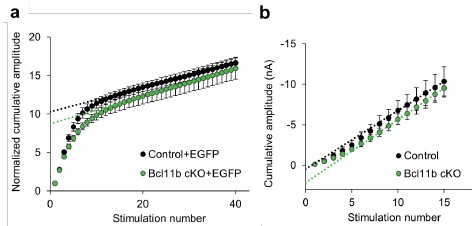
      Wu, Y. K., Miehl, C., & Gjorgjieva, J. (2022). Regulation of circuit organization and function through inhibitory synaptic plasticity. Trends in Neurosciences, 45(12), 884–898. https://doi.org/10.1016/J.TINS.2022.10.006

    1. a tedy na nedostatek bytů ve vybraných segmentech či regionech.

      nemusí se ale jednat o jejich reálný fyzický nedostatek, tzn. že není na trhu dostatek bytů jako takových, ale není dostatek těch dostupných.

    1. Author response:

      Reviewer #1 (Public review):

      Summary:

      This article investigates the origin of movement slowdown in weightlessness by testing two possible hypotheses: the first is based on a strategic and conservative slowdown, presented as a scaling of the motion kinematics without altering its profile, while the second is based on the hypothesis of a misestimation of effective mass by the brain due to an alteration of gravity-dependent sensory inputs, which alters the kinematics following a controller parameterization error.

      Strengths:

      The article convincingly demonstrates that trajectories are affected in 0g conditions, as in previous work. It is interesting, and the results appear robust. However, I have two major reservations about the current version of the manuscript that prevent me from endorsing the conclusion in its current form.

      Weaknesses:

      (1) First, the hypothesis of a strategic and conservative slow down implicitly assumes a similar cost function, which cannot be guaranteed, tested, or verified. For example, previous work has suggested that changing the ratio between the state and control weight matrices produced an alteration in movement kinematics similar to that presented here, without changing the estimated mass parameter (Crevecoeur et al., 2010, J Neurophysiol, 104 (3), 1301-1313). Thus, the hypothesis of conservative slowing cannot be rejected. Such a strategy could vary with effective mass (thus showing a statistical effect), but the possibility that the data reflect a combination of both mechanisms (strategic slowing and mass misestimation) remains open.

      We test whether changing the ratio between the state and control weight matrices can generate the observed effect. As shown in Author response image 1 and Author response image 2, the cost function change cannot produce a reduced peak velocity/acceleration and their timing advance simultaneously, but a mass estimation change can. In other words, using mass underestimation alone can explain the two key findings, amplitude reduction and timing advance. Yes, we cannot exclude the possibility of a change in cost function on top of the mass underestimation, but the principle of Occam’s Razor would support to adhering to a simple explanation, i.e., using body mass underestimation to explain the key findings. We will include our exploration on possible changes in cost function in the revision (in the Supplemental Materials).

      Author response image 1.

      Simulation using an altered cost function with α = 3.0. Panels A, B, and E show simulated position, velocity, and acceleration profiles, respectively, for the three movement directions. Solid lines correspond to pre- and post-exposure conditions, while dashed lines represent the in-flight condition. Panels C and D display the peak velocity and its timing across the three phases (Pre, In, Post), and Panels F and G show the corresponding peak acceleration and its timing. Note, varying the cost function, while leading to reduced peak velocity/acceleration, leads to an erroneous prediction of delayed timing of peak velocity/acceleration.

      Author response image 2.

      Simulation results using a cost function with α = 0.3. The format is the same as in Author response image 1. Note, this ten-fold decrease in α, while finally getting the timing of peak velocity/acceleration right (advanced or reduced), leads to an erroneous prediction of increased peak velocity/acceleration.

      (2) The main strength of the article is the presence of directional effects expected under the hypothesis of mass estimation error. However, the article lacks a clear demonstration of such an effect: indeed, although there appears to be a significant effect of direction, I was not sure that this effect matched the model's predictions. A directional effect is not sufficient because the model makes clear quantitative predictions about how this effect should vary across directions. In the absence of a quantitative match between the model and the data, the authors' claims regarding the role of misestimating the effective mass remain unsupported.

      Our paper does not aim to quantitatively reproduce human reaching movements in microgravity. We will make this more clearly in the revision.

      (1) The model is a simplification of the actual situation. For example, the model simulates an ideal case of moving a point mass (effective mass) without friction and without considering Coriolis and centripetal torques, while the actual situation is that people move their finger across a touch screen. The two-link arm model assumes planar movements, but our participants move their hand on a table top without vertical support to constrain their movement in 2D.

      (2) Our study merely uses well-established (though simplified) models to qualitatively predict the overall behavioral patterns if mass underestimation is at play. For this purpose, the results are well in line with models’ qualitative predictions: we indeed confirm that key kinematic features (peak velocity and acceleration) follow the same ranking order of movement direction conditions as predicted.

      (3) Using model simulation to qualitatively predict human behavioral patterns is a common practice in motor control studies, prominent examples including the papers on optimal feedback control (Todorov, 2004 and 2005) and movement vigor (Shadmehr et al., 2016). In fact, our model was inspired by the model in the latter paper.
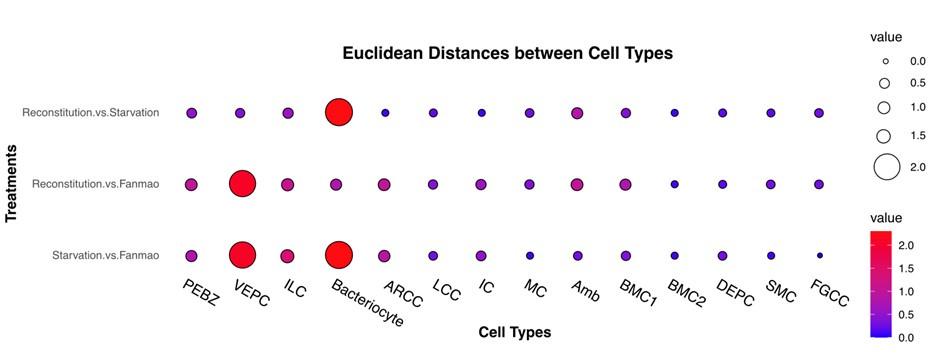
      Citations:

      Todorov, E. (2004). Optimality principles in sensorimotor control. Nature Neuroscience, 7(9), 907.

      Todorov, E. (2005). Stochastic optimal control and estimation methods adapted to the noise characteristics of the sensorimotor system. Neural Computation, 17(5), 1084–1108.

      Shadmehr, R., Huang, H. J., & Ahmed, A. A. (2016). A Representation of Effort in Decision-Making and Motor Control. Current Biology: CB, 26(14), 1929–1934.

      In general, both the hypotheses of slowing motion (out of caution) and misestimating mass have been put forward in the past, and the added value of this article lies in demonstrating that the effect depended on direction. However, (1) a conservative strategy with a different cost function can also explain the data, and (2) the quantitative match between the directional effect and the model's predictions has not been established.

      Specific points:

      (1) I noted a lack of presentation of raw kinematic traces, which would be necessary to convince me that the directional effect was related to effective mass as stated.

      We are happy to include exemplary speed and acceleration trajectories. One example subject’s detailed trajectories are shown below and will be included in the revision. The reduced and advanced velocity/acceleration peaks are visible in typical trials.

      Author response image 3.

      Hand speed profiles (upper panels), hand acceleration profiles (middle panels) and speed profiles of the primary submovements (lower panels) towards different directions from an example participant.

      (2) The presentation and justification of the model require substantial improvement; the reason for their presence in the supplementary material is unclear, as there is space to present the modelling work in detail in the main text. Regarding the model, some choices require justification: for example, why did the authors ignore the nonlinear Coriolis and centripetal terms?

      Response: In brief, our simulations show that Coriolis and centripetal forces, despite having some directional anisotropy, only have small effects on predicted kinematics (see our responses to Reviewer 2). We will move descriptions of the model into the main text with more justifications for using a simple model.

      (3) The increase in the proportion of trials with subcomponents is interesting, but the explanatory power of this observation is limited, as the initial percentage was already quite high (from 60-70% during the initial study to 70-85% in flight). This suggests that the potential effect of effective mass only explains a small increase in a trend already present in the initial study. A more critical assessment of this result is warranted.

      Response: Indeed, the percentage of submovements only increases slightly, but the more important change is that the IPI (the inter-peak interval between submovements) also increases at the same time. Moreover, it is the effect of IPI that significantly predicts the duration increase in our linear mixed model. We will highlight this fact in our revision to avoid confusion.

      Reviewer #2 (Public review):

      This study explores the underlying causes of the generalized movement slowness observed in astronauts in weightlessness compared to their performance on Earth. The authors argue that this movement slowness stems from an underestimation of mass rather than a deliberate reduction in speed for enhanced stability and safety.

      Overall, this is a fascinating and well-written work. The kinematic analysis is thorough and comprehensive. The design of the study is solid, the collected dataset is rare, and the model tends to add confidence to the proposed conclusions. That being said, I have several comments that could be addressed to consolidate interpretations and improve clarity.

      Main comments:

      (1) Mass underestimation

      a) While this interpretation is supported by data and analyses, it is not clear whether this gives a complete picture of the underlying phenomena. The two hypotheses (i.e., mass underestimation vs deliberate speed reduction) can only be distinguished in terms of velocity/acceleration patterns, which should display specific changes during the flight with a mass underestimation. The experimental data generally shows the expected changes but for the 45{degree sign} condition, no changes are observed during flight compared to the pre- and post-phases (Figure 4). In Figure 5E, only a change in the primary submovement peak velocity is observed for 45{degree sign}, but this finding relies on a more involved decomposition procedure. It suggests that there is something specific about 45{degree sign} (beyond its low effective mass). In such planar movements, 45{degree sign} often corresponds to a movement which is close to single-joint, whereas 90{degree sign} and 135{degree sign} involve multi-joint movements. If so, the increased proportion of submovements in 90{degree sign} and 135{degree sign} could indicate that participants had more difficulties in coordinating multi-joint movements during flight. Besides inertia, Coriolis and centripetal effects may be non-negligible in such fast planar reaching (Hollerbach & Flash, Biol Cyber, 1982) and, interestingly, they would also be affected by a mass underestimation (thus, this is not necessarily incompatible with the author's view; yet predicting the effects of a mass underestimation on Coriolis/centripetal torques would require a two-link arm model). Overall, I found the discrepancy between the 45{degree sign} direction and the other directions under-exploited in the current version of the article. In sum, could the corrective submovements be due to a misestimation of Coriolis/centripetal torques in the multi-joint dynamics (caused specifically -or not- by a mass underestimation)?

      We agree that the effect of mass underestimation is less in the 45° direction than the other two directions, possibly related to its reliance on single-joint (elbow) as opposed to two-joints (elbow and shoulder) movements. Plus, movement correction using one joint is probably easier (as also suggested by another reviewer), this possibility will be further discussed in the revision. However, we find that our model simplification (excluding Coriolis and centripetal torques) does not affect our main conclusions at all. First, we performed a simple simulation and found that, under the current optimal hand trajectory, incorporating Coriolis and centripetal torques has only a limited impact on the resulting joint torques (see simulations in Author response image 4). One reason is that we used smaller movements than Hallerbach & Flash did. In addition, we applied an optimal feedback control model to a more realistic 2-joint arm configuration. Despite its simplicity, this model produced a speed profile consistent with our current predictions and made similar predictions regarding the effects of mass underestimation (Author response image 5). We will provide a more realistic 2-joint arm model muscle dynamics in the revision to improve the simulation further, but the message will be same: including or excluding Coriolis and centripetal torques will not affect the theoretical predictions about mass underestimation. Second, as the reviewer correctly pointed out, the mass (and its underestimation) also affects these two torque terms, thus its effect on kinematic measures is not affected much even with the full model.

      Author response image 4.

      Joint angles and joint torque of shoulder and elbow with simulated trajectories towards different directions. A. Shoulder (green) and elbow (blue) angles change with time for the 45° movement direction. B. Components of joint interaction torques at the shoulder. Solid line: net torque at the shoulder; dotted line: shoulder inertia torque; dashed line: shoulder Coriolis and centripetal torque. C. Same plot as B for the elbow joint. D–F. Coriolis and centripetal components in the full 360° workspace, beyond three movement directions (45°, 90°, and 135°). D. Net torque. E. Inertial torque. F. Combined Coriolis and centripetal torque. Note the polar plots of Coriolis/centripetal torques (F) have a scale that is two magnitudes smaller than that of inertial torque in our simulation. All torques were simulated with the optimal movement duration. Torques were squared and integrated over each trajectory.

      Author response image 5.

      Comparison between simulation results from the full model with the addition of Coriolis/centripetal torques (left) and the simplified model (right). The position profiles (top) and the corresponding speed profiles low) are shown. Solid lines are for normal mass estimation and dashed lines for mass underestimation in microgravity. The three colors represent three movement directions (dark red: 45°, red: 90°, yellow: 135°). The full model used a 2-link arm model without realistic muscle dynamics yet (will include in the formal revision) thus the speed profile is not smooth. Importantly, the full model also predict the same effect of mass underestimation, i.e., reduced peak velocity/acceleration and their timing advance.

      b) Additionally, since the taikonauts are tested after 2 or 3 weeks in flight, one could also assume that neuromuscular deconditioning explains (at least in part) the general decrease in movement speed. Can the authors explain how to rule out this alternative interpretation? For instance, weaker muscles could account for slower movements within a classical time-effort trade-off (as more neural effort would be needed to generate a similar amount of muscle force, thereby suggesting a purposive slowing down of movement). Therefore, could the observed results (slowing down + more submovements) be explained by some neuromuscular deconditioning combined with a difficulty in coordinating multi-joint movements in weightlessness (due to a misestimation or Coriolis/centripetal torques) provide an alternative explanation for the results?

      Response: Neuromuscular deconditioning is indeed a space or microgravity effect; thanks for bringing this up as we omitted the discussion of its possible contribution in the initial submission. However, muscle weakness is less for upper-limb muscles than for postural and lower-limb muscles (Tesch et al., 2005). The handgrip strength decreases 5% to 15% after several months (Moosavi et al., 2021); shoulder and elbow muscles atrophy, though not directly measured, was estimated to be minimal (Shen et al., 2017). The muscle weakness is unlikely to play a major role here since our reaching task involves small movements (~12cm) with joint torques of a magnitude of ~2N·m. Coriolis/centripetal torques does not affect the putative mass effect (as shown above simulations). The reviewer suggests that their poor coordination in microgravity might contribute to slowing down + more submovements. Poor coordination is an umbrella term for any motor control problems, and it can explain any microgravity effect. The feedforward control changes caused by mass underestimation can also be viewed as poor coordination. If we limit it as the coordination of the two joints or coordinating Coriolis/centripetal torques, we should expect to see some trajectory curvature changes in microgravity. However, we further analyzed our reaching trajectories and found no sign of curvature increase in our large collection of reaching movements. We probably have the largest dataset of reaching movements collected in microgravity thus far, given that we had 12 taikonauts and each of them performed about 480 to 840 reaching trials during their spaceflight. We believe the probability of Type II error is quite low here. We will include descriptive statistics of these new analyses in our revision.

      Citation: Tesch, P. A., Berg, H. E., Bring, D., Evans, H. J., & LeBlanc, A. D. (2005). Effects of 17-day spaceflight on knee extensor muscle function and size. European journal of applied physiology, 93(4), 463-468.

      Moosavi, D., Wolovsky, D., Depompeis, A., Uher, D., Lennington, D., Bodden, R., & Garber, C. E. (2021). The effects of spaceflight microgravity on the musculoskeletal system of humans and animals, with an emphasis on exercise as a countermeasure: A systematic scoping review. Physiological Research, 70(2), 119.

      Shen, H., Lim, C., Schwartz, A. G., Andreev-Andrievskiy, A., Deymier, A. C., & Thomopoulos, S. (2017). Effects of spaceflight on the muscles of the murine shoulder. The FASEB Journal, 31(12), 5466.

      (2) Modelling

      a) The model description should be improved as it is currently a mix of discrete time and continuous time formulations. Moreover, an infinite-horizon cost function is used, but I thought the authors used a finite-horizon formulation with the prefixed duration provided by the movement utility maximization framework of Shadmehr et al. (Curr Biol, 2016). Furthermore, was the mass underestimation reflected both in the utility model and the optimal control model? If so, did the authors really compute the feedback control gain with the underestimated mass but simulate the system with the real mass? This is important because the mass appears both in the utility framework and in the LQ framework. Given the current interpretations, the feedforward command is assumed to be erroneous, and the feedback command would allow for motor corrections. Therefore, it could be clarified whether the feedback command also misestimates the mass or not, which may affect its efficiency. For instance, if both feedforward and feedback motor commands are based on wrong internal models (e.g., due to the mass underestimation), one may wonder how the astronauts would execute accurate goal-directed movements.

      b) The model seems to be deterministic in its current form (no motor and sensory noise). Since the framework developed by Todorov (2005) is used, sensorimotor noise could have been readily considered. One could also assume that motor and sensory noise increase in microgravity, and the model could inform on how microgravity affects the number of submovements or endpoint variance due to sensorimotor noise changes, for instance.

      c) Finally, how does the model distinguish the feedforward and feedback components of the motor command that are discussed in the paper, given that the model only yields a feedback control law? Does 'feedforward' refer to the motor plan here (i.e., the prefixed duration and arguably the precomputed feedback gain)?

      We appreciate these very helpful suggestions about our model presentation. Indeed, our initial submission did not give detailed model descriptions in the main text, due to text limits for early submissions. We actually used a finite-horizon framework throughout, with a pre-specified duration derived from the utility model. In the revision, we will make that point clear, and we will also revise the Methods section to explicitly distinguish feedforward vs. feedback components, clarify the use of mass underestimation in both utility and control models, and update the equations accordingly.

      (3) Brevity of movements and speed-accuracy trade-off

      The tested movements are much faster (average duration approx. 350 ms) than similar self-paced movements that have been studied in other works (e.g., Wang et al., J Neurophysiology, 2016; Berret et al., PLOS Comp Biol, 2021, where movements can last about 900-1000 ms). This is consistent with the instructions to reach quickly and accurately, in line with a speed-accuracy trade-off. Was this instruction given to highlight the inertial effects related to the arm's anisotropy? One may however, wonder if the same results would hold for slower self-paced movements (are they also with reduced speed compared to Earth performance?). Moreover, a few other important questions might need to be addressed for completeness: how to ensure that astronauts did remember this instruction during the flight? (could the control group move faster because they better remembered the instruction?). Did the taikonauts perform the experiment on their own during the flight, or did one taikonaut assume the role of the experimenter?

      Thanks for highlighting the brevity of movements in our experiment. Our intention in emphasizing fast movements is to rigorously test whether movement is indeed slowed down in microgravity. The observed prolonged movement duration clearly shows that microgravity affects people’s movement duration, even when they are pushed to move fast. The second reason for using fast movement is to highlight that feedforward control is affected in microgravity. Mass underestimation specifically affects feedforward control in the first place. Slow movement would inevitably have online corrections that might obscure the effect of mass underestimation. Note that movement slowing is not only observed in our speed-emphasized reaching task, but also in whole-arm pointing in other astronauts studies (Berger, 1997; Sangals, 1999), which have been quoted in our paper. We thus believe these findings are generalizable.

      Regarding the consistency of instructions: all our experiments conducted in the Tiangong space station were monitored in real time by experimenters in the Control Center located in Beijing. The task instructions were presented on the initial display of the data acquisition application and ample reading time was allowed. In fact, all the pre-, in-, and post-flight test sessions were administered by the same group of experimenters with the same instruction. It is common that astronauts serve both as participants and experimenters at the same time. And, they were well trained for this type of role on the ground. Note that we had multiple pre-flight test sessions to familiarize them with the task. All these rigorous measures were in place to obtain high-quality data. We will include these experimental details and the rationales for emphasizing fast movements in the revision.

      Citations:

      Berger, M., Mescheriakov, S., Molokanova, E., Lechner-Steinleitner, S., Seguer, N., & Kozlovskaya, I. (1997). Pointing arm movements in short- and long-term spaceflights. Aviation, Space, and Environmental Medicine, 68(9), 781–787.

      Sangals, J., Heuer, H., Manzey, D., & Lorenz, B. (1999). Changed visuomotor transformations during and after prolonged microgravity. Experimental Brain Research. Experimentelle Hirnforschung. Experimentation Cerebrale, 129(3), 378–390.

      (4) No learning effect

      This is a surprising effect, as mentioned by the authors. Other studies conducted in microgravity have indeed revealed an optimal adaptation of motor patterns in a few dozen trials (e.g., Gaveau et al., eLife, 2016). Perhaps the difference is again related to single-joint versus multi-joint movements. This should be better discussed given the impact of this claim. Typically, why would a "sensory bias of bodily property" persist in microgravity and be a "fundamental constraint of the sensorimotor system"?

      We believe the differences between our study and Gaveau et al.’s study cannot be simply attributed to single-joint versus multi-joint movements. One of the most salient differences is that their adaptation is about incorporating microgravity in control for minimizing effort, while our adaptation is about rightfully perceiving body mass. We will elaborate on possible reasons for the lack of learning in the light of this previous study.

      We can elaborate on “sensory bias” and “fundamental constraint of the sensorimotor system”. If an inertial change is perceived (like an extra weight attached to the forearm, as in previous motor adaptation studies), people can adapt their reaching in tens of trials. In this case, sensory cues are veridical as they correctly inform about the inertial perturbation. However, in microgravity, reduced gravitational pull and proprioceptive inputs constantly inform the controller that the body mass is less than its actual magnitude. In other words, sensory cues in space are misleading for estimating body mass. The resulting sensory bias prevents the sensorimotor system from correctly adapt. Our statement was too brief in the initial submission; we will expand it in the revision.

      Reviewer #3 (Public review):

      Summary:

      The authors describe an interesting study of arm movements carried out in weightlessness after a prolonged exposure to the so-called microgravity conditions of orbital spaceflight. Subjects performed radial point-to-point motions of the fingertip on a touch pad. The authors note a reduction in movement speed in weightlessness, which they hypothesize could be due to either an overall strategy of lowering movement speed to better accommodate the instability of the body in weightlessness or an underestimation of body mass. They conclude for the latter, mainly based on two effects. One, slowing in weightlessness is greater for movement directions with higher effective mass at the end effector of the arm. Two, they present evidence for an increased number of corrective submovements in weightlessness. They contend that this provides conclusive evidence to accept the hypothesis of an underestimation of body mass.

      Strengths:

      In my opinion, the study provides a valuable contribution, the theoretical aspects are well presented through simulations, the statistical analyses are meticulous, the applicable literature is comprehensively considered and cited, and the manuscript is well written.

      Weaknesses:

      Nevertheless, I am of the opinion that the interpretation of the observations leaves room for other possible explanations of the observed phenomenon, thus weakening the strength of the arguments.

      First, I would like to point out an apparent (at least to me) divergence between the predictions and the observed data. Figures 1 and S1 show that the difference between predicted values for the 3 movement directions is almost linear, with predictions for 90º midway between predictions for 45º and 135º. The effective mass at 90º appears to be much closer to that of 45º than to that of 135º (Figure S1A). But the data shown in Figure 2 and Figure 3 indicate that movements at 90º and 135º are grouped together in terms of reaction time, movement duration, and peak acceleration, while both differ significantly from those values for movements at 45º.

      Furthermore, in Figure 4, the change in peak acceleration time and relative time to peak acceleration between 1g and 0g appears to be greater for 90º than for 135º, which appears to me to be at least superficially in contradiction with the predictions from Figure S1. If the effective mass is the key parameter, wouldn't one expect as much difference between 90º and 135º as between 90º and 45º? It is true that peak speed (Figure 3B) and peak speed time (Figure 4B) appear to follow the ordering according to effective mass, but is there a mathematical explanation as to why the ordering is respected for velocity but not acceleration? These inconsistencies weaken the author's conclusions and should be addressed.

      Indeed, the model predicts an almost equal separation between 45° and 90° and between 90° and 135°, while the data indicate that the spacing between 45° and 90° is much smaller than between 90° and 135°. We do not regard the divergence as evidence undermining our main conclusion since 1) the model is a simplification of the actual situation. For example, the model simulates an ideal case of moving a point mass (effective mass) without friction and without considering Coriolis and centripetal torques. 2) Our study does not make quantitative predictions of all the key kinematic measures; that will require model fitting and parameter estimation; instead, our study uses well-established (though simplified) models to qualitatively predict the overall behavioral pattern we would observe. For this purpose, our results are well in line with our expectations: though we did not find equal spacing between direction conditions, we do confirm that the key kinematic properties (Figure 2 and Figure 3 as questioned) follow the same ranking order of directions as predicted.

      We thank the reviewer for pointing out the apparent discrepancy between model simulation and observed data. We will elaborate on the reasons behind the discrepancy in the revision.

      Then, to strengthen the conclusions, I feel that the following points would need to be addressed:

      (1) The authors model the movement control through equations that derive the input control variable in terms of the force acting on the hand and treat the arm as a second-order low-pass filter (Equation 13). Underestimation of the mass in the computation of a feedforward command would lead to a lower-than-expected displacement to that command. But it is not clear if and how the authors account for a potential modification of the time constants of the 2nd order system. The CNS does not effectuate movements with pure torque generators. Muscles have elastic properties that depend on their tonic excitation level, reflex feedback, and other parameters. Indeed, Fisk et al.* showed variations of movement characteristics consistent with lower muscle tone, lower bandwidth, and lower damping ratio in 0g compared to 1g. Could the variations in the response to the initial feedforward command be explained by a misrepresentation of the limbs' damping and natural frequency, leading to greater uncertainty about the consequences of the initial command? This would still be an argument for unadapted feedforward control of the movement, leading to the need for more corrective movements. But it would not necessarily reflect an underestimation of body mass.

      *Fisk, J. O. H. N., Lackner, J. R., & DiZio, P. A. U. L. (1993). Gravitoinertial force level influences arm movement control. Journal of neurophysiology, 69(2), 504-511.

      We agree that muscle properties, tonic excitation level, proprioception-mediated reflexes all contribute to reaching control. Fisk et al. (1993) study indeed showed that arm movement kinematics change, possibly owing to lower muscle tone and/or damping. However, reduced muscle damping and reduced spindle activity are more likely to affect feedback-based movements. Like in Fisk et al.’s study, people performed continuous arm movements with eyes closed; thus their movements largely relied on proprioceptive control. Our major findings are about the feedforward control, i.e., the reduced and “advanced” peak velocity/acceleration in discrete and ballistic reaching movements. Note that the peak acceleration happens as early as approximately 90-100ms into the movements, clearly showing that feedforward control is affected -- a different effect from Fisk et al’s findings. It is unlikely that people “advanced” their peak velocity/acceleration because they feel the need for more later corrective movements. Thus, underestimation of body mass remains the most plausible explanation.

      (2) The movements were measured by having the subjects slide their finger on the surface of a touch screen. In weightlessness, the implications of this contact are expected to be quite different than those on the ground. In weightlessness, the taikonauts would need to actively press downward to maintain contact with the screen, while on Earth, gravity will do the work. The tangential forces that resist movement due to friction might therefore be different in 0g. This could be particularly relevant given that the effect of friction would interact with the limb in a direction-dependent fashion, given the anisotropy of the equivalent mass at the fingertip evoked by the authors. Is there some way to discount or control for these potential effects?

      We agree that friction might play a role here, but normal interaction with a touch screen typically involves friction between 0.1 and 0.5N (e.g., Ayyildiz et al., 2018). We believe that the directional variation is even smaller than 0.1N. It is very small compared to the force used to accelerate the arm for the reaching movement (10-15N). Thus, friction anisotropy is unlikely to explain our data.

      Citation: Ayyildiz M, Scaraggi M, Sirin O, Basdogan C, Persson BNJ. Contact mechanics between the human finger and a touchscreen under electroadhesion. Proc Natl Acad Sci U S A. 2018 Dec 11;115(50):12668-12673.

      (3) The carefully crafted modelling of the limb neglects, nevertheless, the potential instability of the base of the arm. While the taikonauts were able to use their left arm to stabilize their bodies, it is not clear to what extent active stabilization with the contralateral limb can reproduce the stability of the human body seated in a chair in Earth gravity. Unintended motion of the shoulder could account for a smaller-than-expected displacement of the hand in response to the initial feedforward command and/or greater propensity for errors (with a greater need for corrective submovements) in 0g. The direction of movement with respect to the anchoring point could lead to the dependence of the observed effects on movement direction. Could this be tested in some way, e.g., by testing subjects on the ground while standing on an unstable base of support or sitting on a swing, with the same requirement to stabilize the torso using the contralateral arm?

      Body stabilization is always a challenge for human movement studies in space. We minimized its potential confounding effects by using left-hand grasping and foot straps for postural support throughout the experiment. We would argue shoulder stability is an unlikely explanation because unexpected shoulder instability should not affect the feedforward (early) part of the ballistic reaching movement: the reduced peak acceleration and its early peak were observed at about 90-100ms after movement initiation. This effect is too early to be explained by an expected stability issue.

      The arguments for an underestimation of body mass would be strengthened if the authors could address these points in some way.

    1. el mundo gasta 423.000 millones de dólares (307.862 millones de euros) al año en subsidiar los combustibles fósiles. Este dinero, según este mismo estudio, podría cubrir el coste de las vacunas covid-19 para cada persona en el planeta, o financiar tres veces la cantidad anual necesaria para erradicar la pobreza extrema mundial.

      Otro ejemplo de otras alternativas en las qué se podría invertir el dinero destinado a subsidiar los combustibles fósiles.

    1. EmpleoEntrarRegistrarseMi PerfilSalir DIRECTO Las inundaciones dejan más de 2.600 edificios y 534 kilómetros cuadrados afectados ESCUDO LABORAL El Gobierno prohibirá despedir por la DANA y anuncia ERTE y permisos retribuidos Qué es lo que más se valora al elegir una empresa para trabajar
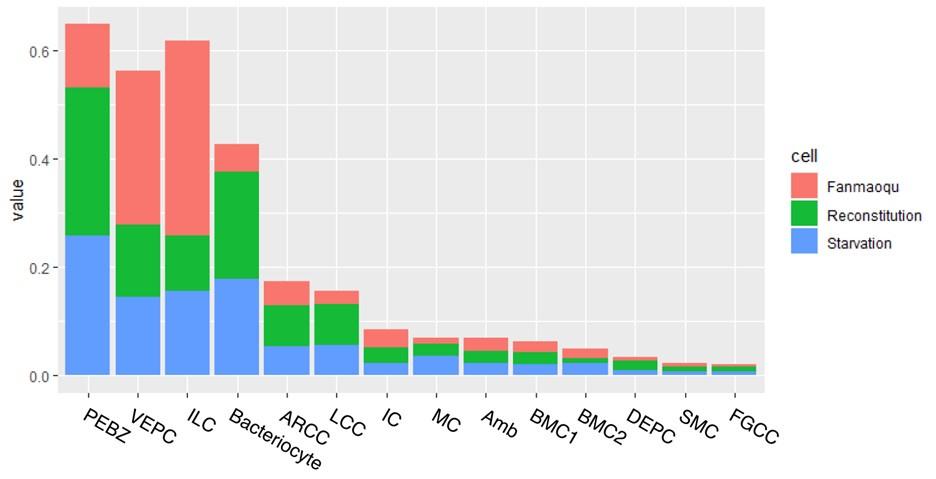
      Preguntas de comprensión y de opinión:

      1. Remuneración salarial: ¿Puedes dar un sinónimo?

      2. ¿Qué motivaba más a los empleados, la remuneración o la seguridad laboral?

      3. Sin mirar, intenta escuchar y escribir este párrafo del texto https://voca.ro/1hNONgkHoioM

      4. La conciliación entre vida laboral y familiar: ¿puedes explicar en qué consiste dicha conciliación?

      5. Los trabajadores sitúan la honestidad en primer puesto, seguido de la fiabilidad, la sinceridad, la inteligencia y la seguridad. ¿opinas lo mismo?

      6. En su opinión, la edad de jubilación ideal serían los 60 años. ¿Ocurre lo mismo hoy en día en tu país?

    1. Esta tradición sueca puede parecer polémica, pero tiene las mejores intenciones. Primero, se le pide al novio que abandone el salón para que todos los invitados hombres, específicamente solteros, le den un beso en la mejilla a la novia. Después, la novia debe retirarse y las invitadas solteras llenan de besos al novio. Tradicionalmente, esta costumbre se realiza para cederle suerte a los solteros o solteras que buscan matrimonio.

      Sin mirar, intenta escuchar y escribir esta párrafo para ayudarte a memorizar estructuras https://voca.ro/1aaMDvao2yVg

    1. .

      Do tohoto místa by se mi hodily ještě dvě okolnosti, které odlišují mladou generaci od starší 1. mladá generace na rozdíl od generace svých rodičů neměla možnost privatizovat za výhodné ceny 2. cca před 10 lety, tedy v době kdy mladá generace, o které nyní mluvíme, začala vstupovat na trh práce, se prudce zvýšily ceny nemovitostí, a jejich pořízení se tak pro tuto nastupující generaci stalo bez pomoci rodiny v podstatě nereálné.

    1. Esta tradición tiene origen en la costumbre romana de dar una «scarsella», o una bolsa de cuero, llena de lentejas que tradicionalmente estaban atadas al cinturón. En estos tiempos antiguos, se esperaba que las lentejas se transformaran en monedas de oro, trayendo riqueza al portador de la scarsella. En el pasado, las lentejas eran entregadas como regalo el 31 de diciembre,

      ¿Sabrías explicar el origen y el significado de alguna tradición de tu país?

    2. los italianos suelen servir lentejas ya que se considera que esta comida trae suerte y propiedades en el nuevo año

      ¿Sabes si se come o se bebe algo en particular en alguna fiesta o celebración de tu país? ¿Cómo se llama? ¿Qué ingredientes tiene?

    1. Rozładuj sprzęt i rozstaw konstrukcję Aluminiowa konstrukcja i kompaktowe elementy namiotu ułatwiają transport w każdy teren. System nożycowy lub modułowy szkielet pozwala ustawić namiot w kilka minut, bez potrzeby użycia specjalistycznych narzędzi. Zamocuj poszycie i dodaj izolację Wodoszczelna i trudnopalna czasza chroni użytkownika przed deszczem, wiatrem i wysoką temperaturą. Wewnętrzna podpinka poprawia komfort termiczny, a wentylacyjne otwory zapewniają cyrkulację powietrza. Zabezpiecz stabilność i gotowe! Stalowe stopy i linki odciągowe namiotu gwarantują odporność, który wytrzyma wiatr nawet do 100 km/h. Namiot staje się natychmiastową bazą.
      1. Rozładuj sprzęt

      Aluminiowa konstrukcja i kompaktowe elementy ułatwiają transport nawet w trudnym terenie. System nożycowy lub modułowy pozwala rozstawić namiot w kilka minut – bez użycia specjalistycznych narzędzi.

      1. Zamocuj poszycie i dodaj izolację

      Wodoszczelna, trudnopalna czasza skutecznie chroni przed deszczem, wiatrem i wysoką temperaturą. Dodatkowa podpinka poprawia izolację termiczną, a otwory wentylacyjne dbają o odpowiednią cyrkulację powietrza.

      1. Ustabilizuj konstrukcję

      Stalowe stopy oraz linki odciągowe zapewniają maksymalną stabilność, nawet przy silnych podmuchach wiatru. Po rozstawieniu namiot natychmiast staje się gotową bazą operacyjną.

    2. Dlaczego namioty TURMIS? Namioty zostały zaprojektowane z myślą o survivalu, wojsku i jednostkach taktycznych działających w wymagającym terenie. To konstrukcje stworzone do zadań specjalnych - trwałe, odporne i gotowe na każde warunk

      Dlaczego warto wybrać namioty TURMIS?

      Namioty TURMIS zostały zaprojektowane z myślą o potrzebach wojska, służb ratunkowych oraz pasjonatów survivalu. To konstrukcje stworzone do zadań specjalnych — trwałe, odporne i gotowe na każde warunki terenowe. Powstały z myślą o działaniach w terenie, gdzie liczy się niezawodność, bezpieczeństwo i szybkie przygotowanie do pracy.

    1. Aluminiowe nogi ośmiokątne ⌀48 mm, ścianka 2 mm Stalowe stopy, brak plastikowych łączników System nożycowy bez luźnych elementów

      Aluminiowe nogi ośmiokątne Ø 48 mm, grubość ścianki 2 mm

      Stalowe, ocynkowane stopy

      Brak plastikowych łączników

      System nożycowy bez luźnych elementów

    2. Aluminiowe nogi ⌀ 48 mm, stalowe stopy i brak plastikowych łączników gwarantują niezawodność i stabilność. Namiot się nie chwieje.

      Aluminiowe nogi ośmiokątne Ø 48 mm, stalowe stopy oraz brak plastikowych łączników gwarantują pełną stabilność i niezawodność. Namiot nie chwieje się nawet przy silnym wietrze, a odporne materiały zapewniają długoletnią wytrzymałość w terenie.

    3. Ekspresowy namiot wojskowy z nożycową konstrukcją ułatwiającą montaż w terenie, gotowy w kilka minut. Chroni przed deszczem, wiatrem do 100 km/h i ogniem.

      Ekspresowy namiot wojskowy NOE-25 to rozwiązanie stworzone z myślą o szybkim reagowaniu w terenie. Dzięki nożycowej konstrukcji rozstawisz go w zaledwie kilka minut – bez narzędzi, bez komplikacji. Chroni przed deszczem, wiatrem o prędkości do 100 km/h i ogniem, zapewniając niezawodne schronienie w każdych warunkach.

    1. Author response:

      The following is the authors’ response to the original reviews.

      Reviewer #1 (Public review):

      The manuscript by Chiu et al describes the modification of the Zwitch strategy to efficiently generate conditional knockouts of zebrafish betapix. They leverage this system to identify a surprising glia-exclusive function of betapix in mediating vascular integrity and angiogenesis. Betapix has been previously associated with vascular integrity and angiogenesis in zebrafish, and betapix function in glia has also been proposed. However, this study identifies glial betapix in vascular stability and angiogenesis for the first time.

      The study derives its strength from the modified CRISPR-based Zwitch approach to identify the specific role of glial betapix (and not neuronal, mural, or endothelial). Using RNA-in situ hybridization and analysis of scRNA-Seq data, they also identify delayed maturation of neurons and glia and implicate a reduction in stathmin levels in the glial knockouts in mediating vascular homeostasis and angiogenesis. The study also implicates a betapix-zfhx3/4-vegfa axis in mediating cerebral angiogenesis.

      There is both technical (the generation of conditional KOs) and knowledge-related (the exclusive role of glial betapix in vascular stability/angiogenesis) novelty in this work that is going to benefit the community significantly.

      While the text is well written, it often elides details of experiments and relies on implicit understanding on the part of the reader. Similarly, the figure legends are laconic and often fail to provide all the relevant details.

      Thanks for this reviewer on his/her overall supports on our manuscript. We have now revised the manuscript text and figure legends making them to have all relevant details as much as we can. 

      Specific comments:

      (1) While the evidence from cKO's implicating glial betapix in vascular stability/angiogenesis is exciting, glia-specific rescue of betapix in the global KOs/mutants (like those performed for stathmin) would be necessary to make a water-tight case for glial betapix.

      We fully agree with the reviewer that it would be ideal to examine glia-specific rescue of betaPix in its global KOs. At the same time, it is difficult to achieve optimal transient expression of betaPix by injecting plasmid clone of gfap:betaPix while it takes long time to establish stable transgenic line gfap:betaPix for rescuing mutant phenotypes. We would like to pursue this line of researches in the future.

      (2) Splice variants of betapix have been shown to have differential roles in haemorrhaging (Liu, 2007). What are the major glial isoforms, and are there specific splice variants in the glial that contribute to the phenotypes described?

      We agree that it would be important to address whether any specific splice variants in glia contribute to betaPix mutant phenotypes. Previous studies have shown that the isoform a of betaPix is ubiquitously expressed across various tissues, while isoforms b, c, and d are predominantly expressed in the nervous system. In mice, the expression level of isoform betaPix-d is essential for the neurite outgrowth and migration. In the nervous system, we have not assessed glial specific betaPix isoforms directly. Our current data cannot rule out whether specific isoform is involved in its function in glial responses. The Zwitch cassette of betaPix resides on intron 5, thus disrupting all transcripts when Cre is activated. However, we are fully aware of the potential of identifying glial betaPix isoform with direct downstream targets. Further studies to dissect their roles in cerebral vascular development and diseases are part of our future plans.

      (3) Liu et al, 2012 demonstrated reduced proliferation of endothelial cells in bbh fish and linked it to deficits in angiogenesis. Are there proliferation/survival defects in endothelial cells in the glial KOs?

      We thank the reviewer for highlighting endothelial cell phenotypes in betaPix mutants. We are aware of endothelial cells might directly link to the mutant defects in angiogenesis. We assessed and quantified endothelial migration by measuring the length of developing central arteries, but we did not examine endothelial cell proliferation/survival defects in glial KOs. In our scRNA-seq analysis, the proportion of endothelial cells reduced among betaPix deficiency, indicating that endothelial cell proliferation/survival might decrease in mutants. In this endothelial cell cluster, we found disrupted transcriptional landscape in a set of angiogenic associated genes (Figure 6M). While these analysis highlights altered angiogenic transcriptome profile in endothelial cells of betaPix knockouts, we acknowledge that our study does not directly address proliferation/survival phenotypes in endothelial cells, which warrants future investigations on the role of betaPix in regulating glia-endothelial cell interaction.  

      Reviewer #2 (Public review):

      Summary:

      Using a genetic model of beta-pix conditional trap, the authors are able to regulate the spatio-temporal depletion of beta-pix, a gene with an established role in maintaining vascular integrity (shown elsewhere). This study provides strong in vivo evidence that glial beta-pix is essential to the development of the blood-brain barrier and maintaining vascular integrity. Using genetic and biochemical approaches, the authors show that PAK1 and Stathmins are in the same signaling axis as beta-pix, and act downstream to it, potentially regulating cytoskeletal remodeling and controlling glial migration. How exactly the glial-specific (beta-pix driven-) signaling influences angiogenesis or vascular integrity is not clear.

      Strengths:

      (1) Developing a conditional gene-trap genetic model which allows for tracking knockin reporter driven by endogenous promoter, plus allowing for knocking down genes. This genetic model enabled the authors to address the relevant scientific questions they were interested in, i.e., a) track expression of beta-pix gene, b) deletion of beta-pix gene in a cell-specific manner.

      (2) The study reveals the glial-specific role of beta-pix, which was unknown earlier. This opens up avenues for further research. (For instance, how do such (multiple) cell-specific signaling converge onto endothelial cells which build the central artery and maintain the blood-brain barriers?)

      We thank this reviewer for his/her overall supports on our work.

      Weaknesses:

      Major:

      (1) The study clearly establishes a role of beta-pix in glial cells, which regulates the length of the central artery and keeps the hemorrhages under control. Nevertheless, it is not clear how this is accomplished.

      (a) Is this phenotype (hemorrhage) a result of the direct interaction of glial cells and the adjacent endothelial cells? If direct, is the communication established through junctions or through secreted molecules?

      Thanks for this critical question. We attempted to address this issue by performing live imaging using light-sheet confocal microscopy, but failed to achieve sub-cellular resolution. We don’t have data to address this critical issue that warrants future investigations. 

      (b) The authors do not exclude the possibility that the effects observed on endothelial cells (quantified as length of central artery) could be secondary to the phenotype observed with deletion of glial beta-pix. For instance, can glial beta-pix regulate angiogenic factors secreted by peri-vascular cells, which consequently regulate the length of the central artery or vascular integrity?

      Thank the reviewer for this critical point. While we found the major defects of endothelial cell migration quantified by the central artery length, could not rule out the participation of signals from other peri-vascular cells. We fully agree that it will be important to address the cell-type specific relationship by angiogenic factors. Of note, degradation of extracellular matrix and focal adhesion is critical for the hemorrhagic phenotypes of bbh mutants. In a previous published study in our group, we found that suppressing the globally induced MEK/ERK/MMP9 signaling in bbh mutants significantly decreases hemorrhages. Accordingly, we edited a paragraph in the Discussion section on pages 24-25. We plan to continue investigating whether the complex interactions in the perivascular space contribute to vascular integrity disruption, as well as the cross-talks among different cell types during vascular development in these mutants. We believe that our model of glial specific betaPix function will guide us to further study cellular interactions in the follow-up studies.

      (c) The pictorial summary of the findings (Figure 7) does not include Zfhx or Vegfa. The data do not provide clarity on how these molecules contribute (directly or indirectly) to endothelial cell integrity. Vegfaa is expressed in the central artery, but the expression of the receptor in these endothelial cells is not shown. Similarly, all other experimental analyses for Zfhx and Vegfa expression were performed in glial cells. More experimental evidence is necessary to show the regulation of angiogenesis (of endothelial cells) by glial beta-pix. Is the Vegfaa receptor present on central arteries, and how does glial depletion of beta-pix affect its expression or response of central artery endothelial cells (both pertaining to angiogenesis and vascular integrity).

      Thank this reviewer for pointing out this critical issue. We have now revised the pictorial summary including Zfhx or Vegfa information in Figure 7. The key receptors of VEGF-A ligand are VEGFR-1 and VEGFR-2. In zebrafish, expression of Vegfr-2, as known as kdrl, is well-documented at endothelial cells including the hindbrain central arteries. We fully agree that it would indeed be of great value to assess changes of kdrl expression pattern after betaPix deficiency in vivo. It warrants future investigations to address how the VEGFA-VEGFR2 signaling in endothelial cells is altered in betaPix mutants.

      (2) Microtubule stabilization via glial beta-pix, claimed in Figure 5M, is unclear. Magnified images for h-betapix OE and h-stmn-1 glial cells are absent. Is this migration regulated by beta-pix through its GEF activity for Cdc42/Rac?

      We have now revised Figure 5M to include magnified images for h-betaPIX and h-STMN1 overexpression groups. It has been shown that there is a positive feedback loop of microtubule regulation consisting of Rac1-Pak1-Stathmin at the cell edge (Zeitz and Kierfeld, 2014 Biophys J.). Previous studies have shown betaPix activates Rac1 through its GEF activity and also regulates the activity of Pak1 via direct binding. As reported by Kwon et al., betaPix-d isoform promotes neurite outgrowth via the PAK-dependent inactivation of Stathmin1. In this work, we did not assess binding activity of betaPix to Rac1 or Pak1. Nevertheless, our data on the rescue experiments via IPA-3 suggest that betaPix deficiency impaired migration through Pak1 signaling. 
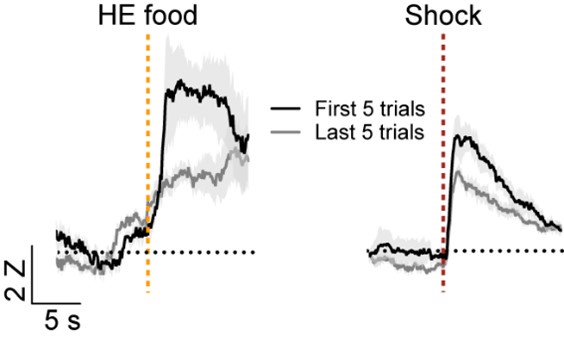
      (3) Hemorrhages are caused by compromised vascular integrity, which was not measured (either qualitatively or quantitatively) throughout the manuscript. The authors do measure the length of the central artery in several gene deletion models (2I, 3C. 5F/J, 6G/K), which is indicative of artery growth/ angiogenesis. How (if at all) defects in angiogenesis are an indication of hemorrhage should be explained or established. Do these angiogenic growth defects translate into junctional defects at later developmental time points? Formation and maintenance of endothelial cell junctions within the hemorrhaging arteries should be assessed in fish with deleted beta-pix from astrocytes.

      We appreciate the reviewer’s point and agree that this is a key aspect we need to clarify. To address junctional defects in our model, we re-examined the scRNA-seq data and found mild downregulation of junction protein claudin-5a (cldn5a) levels in the transcriptome analysis of the endothelial cluster (Author response image 1). We agree in principle that single cell RNA sequencing findings should be validated by immunostaining. While we did not measure junctional defects directly in this work, we have previously reported comparable tight junction protein zonula occludens-1 (ZO1) expression between siblings and bbh mutants (Yang et al., 2017 Dis Model Mech). In zebrafish, functionally characterized blood brain barrier (BBB) is only identified after 3 dpf. The lack of mature BBB might be due to the immature status of barrier signature at this developmental stage. Hemorrhage phenotype occurred around 40 hpf, and hematomas would be almost completely absorbed at later stage since most mutants recover and survive to adulthood. Thus future studies are needed to address the junctional characteristics on the cellular and molecular level in later developmental stages of betaPix mutants.   

      Author response image 1.

      Violin plots showing cdh5, cldn5a, cldn5b and oclna expression levels in endothelial sub-cluster. ctrl, control siblings; ko, betaPix knockouts (CRISPR mutants); 1d or 2d, 1 or 2 days post fertilization.

      (4) More information is required about the quality control steps for 10X sequencing (Figure 4, number of cells, reads, etc.). What steps were taken to validate the data quality? The EC groups, 1 and 2-days post-KO are not visible in 4C. One appreciates that the progenitor group is affected the most 2 days post-KO. But since the effects are expected to be on the endothelial cell group as well (which is shown in in vivo data), an extensive analysis should be done on the EC group (like markers for junctional integrity, angiogenesis, mesenchymal interaction, etc.). Are Stathmins limited to glial cells? Are there indicators for angiogenic responses in endothelial cells?

      Thank the reviewer for these critical suggestions. The detailed statements about the quality control steps for 10X sequencing are now provided in the Materials and Methods section. We validate the data quality through multiple steps, including verification of the number of viable cells used in experiment, assessment of peak shapes and fragment sizes of scRNA-seq libraries, confirmation of sufficient cell counts and sequencing reads for data analyses, and implementation of stringent filtering steps to exclude low-quality cells. Stathmins expressions as shown in Violin plots in Figure 4E and stmn1a, stmn1b and stmn4l expressions in UMAP plots in Figure S6C. These expressions are not limited to glial cells but distributed more widely among zebrafish tissues. We would like to point out that despite the small amount, the endothelial cell clusters are presented in Figure 4C with color brown. The proportions of EC groups split by four sample are visualized in Figure S6B and shown significant reduction among betaPix knockouts at 2 dpf, which had similar trend as glial progenitors. In addition, gene ontology analysis identified a set of down-regulated angiogenic genes expression in endothelial cluster (Figure 6M). We realize our interpretation of endothelial cell phenotypes was not sufficiently clear in this work and have now added sentences to the manuscript text on pages 16-17. As noted above, future studies are needed to address how glial betaPix regulates endothelial cell and BBB function. 

      Reviewing Editor Comments:

      comments on your manuscript. Addressing comments 1-3 from Reviewer 1 and comment 1 and its subparts from Reviewer 2 (major weaknesses) will significantly improve the manuscript by reinforcing the cell autonomous requirement of betaPix and also gain mechanistic insights. In addition, extensive proofreading and editing of the text, as well as changes to the figure, figure legends, and the discussion as indicated by both reviewers, will improve the readability and clarity of this manuscript.

      Thanks for Reviewing Editor on his/her supports on this manuscript. As noted above, we are trying to address the reviewers’ comments using the data we obtained in this work, as well as our plans for future investigations. We have now made extensive proofreading and editing of manuscript text and figure legends for improving the readability and clarity of this manuscript.

      Reviewer #1 (Recommendations for the authors):

      (1) The Discussion is written like an introduction with very little engagement with the data generated in the manuscript. The role of betapix-Pak-stathmin and betapix-zfhx3/4-vegfaa is barely discussed and contextualised vis-à-vis the current knowledge in the field.

      We appreciate the reviewer’s critical comments regarding the Discussion section. We have now revised the manuscript text on pages 20-23 to address the role of betapix-Pak-stathmin and betapix-zfhx3/4-vegfaa axis with contributions from this work.

      (2) Line 145: "light sheet microscopy" - explain that this was only for experiments involving fluorescence. Currently, it reads as if the data presented in Figures 1D and E are also obtained via light sheet microscopy. E.g., the paragraph starting on line 139 does not say what line was imaged (and what it labels) to reach the conclusions reached. This detail is not there even in the associated figure legend. Similarly, line 153 discusses radial glia, but there is no indication that these were labelled using Tg (GFAP:GFP) except in the figure annotation. There are various instances of such omissions throughout the text, and they should be remedied to indicate what each line is and what it labels, at least in the first instance.

      Thank the reviewer for their thoughtful points. In this revised version, we have incorporated more statements of the objectives and methodologies in the text in pages 8-9. We hope that the revised manuscript can better present the data with clarifying methodologies and materials used in this work. 

      (3) Figure 1E legend: What is the haemorrhage percentage? Is it the number of embryos per experiment showing hemorrhage? Indicate in the text. In the right panel, what is the number of embryos used? Please ensure all numbers (number of embryos, experiments, etc) used to plot any data in the set of figures in the entire manuscript are clearly indicated.

      Thank the reviewer for the suggestion. In this revised version, we have incorporated more detailed statements in figures and figure legends in the manuscript to show the numbers of embryos used.

      (4) The Discussion section suddenly introduces the blood-brain barrier and extensively discusses it. However, while cerebral haemorrhage can disrupt the BBB and exacerbate the effects of the haemorrhage, this manuscript does not suggest that a weakened BBB is the cause of haemorrhages in betapix mutants. More likely, betapix stabilises and maintains vascular integrity, and loss of this function causes haemorrhaging and subsequent disruption of the BBB. The glial function noted in this study is likely to be distinct from the glial function in BBB development and maintenance. The authors do not show any direct evidence for the latter. These should be shortened, and only relevant aspects facilitating contextualisation of data generated in this manuscript should be retained.

      We have now revised the Discussion section to reduce the introduction of blood-brain barrier and add statements according to the suggestions from both reviewers. We hope that the revisions provide a more relevant and balanced discussion.

      (5) Is the scratch assay in Figure 5 controlled for differences in cell proliferation among the different manipulations?

      We plated the same numbers of cells and cultured them in the same condition. Before conducted scratch assay we replaced medium with serum-free culture medium to reduce the effect from cell proliferation among the different manipulation groups. 

      (6) In the glioblastoma experiments involving betapix KD, does stathmin RNA/protein decrease? What about Ser 16 phosphorylation (as shown for neurons in Kwon et al, 2020)?

      STMN1 RNA was down-regulated by betaPIX deficiency, which was rescued by betaPIX overexpression in glial cells (Author response image 2). These results are similar to those from in vivo analysis (Figure 5A, 5B and S7A). We agree with the reviewer that it would been ideal to examine Ser 16 phosphorylation of Stathmin in our models. However, we believe that our data have established Stathmins function downstream to betaPix.

      Author response image 2.

      qRT-PCR analysis showing that betaPIX over-expression (betaPix OE) rescued STMN1 expression in betaPIX siRNA knockdown (betaPix KD) in U251 cells. Data are presented in mean ± SEM; one-way ANOVA analysis with Dunnett's test, individual P values mentioned in the figure

      (7) How was the rescue of betapix in glioblastoma cells with siRNA-mediated betapix knockdown performed? Is this by betapix-resistant cDNA? Further, no information about isoforms of betapix (both for siRNA-mediated KD and rescue) or stathmin is provided.

      As similar to our Zwitch method that disrupting all betaPix transcripts in vivo, the knockdown of human betaPIX were designed to target conserved region of all transcripts in glioblastoma cell lines. And the rescue human betaPIX were obtained from the U251 cDNA library, ideally all isoforms enriched in the glioblastoma cell line would be isolated. The missing details are now provided in the Materials and Methods section, page 26. 

      (8) It is unclear what the authors' thoughts are on the decrease in stathmin observed and the functional outcome of this decrease. The Discussion could benefit from this.

      Thanks. We have now incorporated a new paragraph in the Discussion section at pages 21-22 addressing that down-regulated expression of Stathmins is associated with functional outcome of this decrease.

      (9) Zfhx4 mRNA injection is performed on bbh and betapixKO (is this a global or glial KO?) and found to rescue haemorrhaging. While vegfaa mRNA increases, it is formally possible that the rescue is not due to the increase in vegfaa (or that vegfaa is sufficient). Injection of vegfaa mRNA could address this issue.

      Zfhx4 mRNA injection was performed on bbh mutants and global betapix knockouts (crispr mutants). To avoid confusion, we have now included a sentence highlighting global knockout mutants used for this rescue experiment. For the second part, we acknowledge that this study cannot definitively prove the necessity of increased vegfaa levels in the rescue experiment. However, our data established Zhfx3/4 as novel downstream effectors to betaPix in cerebral vessel development. And these effects might partly be linked to angiogenic responses regulated by Zhfx3/4. In this revised version, we carefully proposed that Vegfaa signals act downstream of betaPix-Zfhx3/4 axis and highlighted the weakness of our manuscript on not fully investigating sufficiency of Vegfaa in the Discussion section at page 24. We intend to pursue more extensive analysis in our follow-up studies.

      (10) A significant part of the manuscript looks at angiogenesis/vascularisation, however, the title of the paper only reflects vessel integrity (which can be distinct from angiogenesis).

      Thanks. We have now changed the title to: Glial betaPix is essential for blood vessel development in the zebrafish brain

      (11) Line 366: The BBB abbreviation is used without indicating the full form. Perhaps this can be introduced in the preceding sentence.

      We have now edited the following sentence: “The maturation hallmark of central nervous system (CNS) vasculature is acquisition of blood brain barrier (BBB) properties, establishing a stable environment ...” in lines 386-387, Discussion section.

      (12) Line 371: "rupture" and not "rapture".

      We thank the reviewer for pointing out the spelling error, and have now made this correction. 

      (13) Line 416: "is enriched" instead of "enriches"?

      We have now edited as: “...end feet that is enriched with aquaporin-4 ...” in line 411, page 19. 

      (14) The sentence in lines 121-123 should be simplified.

      We have now revised this sentence as the following: “A previous work has shown that bubblehead (bbh<sup>fn40a</sup>) mutant has a global reduction in betaPix transcripts, and bbh<sup>m292</sup> mutant has a hypomorphic mutation in betaPix, thus establishing that betaPix is responsible for bubblehead mutant phenotypes [10]”. 

      (15) No mention in the text of what o-dianisine labels.

      We have now edited the following sentence: “By using o-dianisidine staining to label hemoglobins, we found severe brain hemorrhages ...” in lines 131-133.

      (16) Line 165: Sentence requires improvement. Perhaps "Vascularisation of the central arteries in the zebrafish hindbrain ...".

      We have now edited this sentence as: “Vascularisation of the central arteries in the zebrafish hindbrain starts at 29 hpf.” in this revised version (line 176). 

      (17) Line 184: Why is "hematopoiesis" mentioned? The genesis of blood cells is not tested anywhere in the manuscript.

      Thanks. We have now edited this statement as: “IPA-3 treatment had no effect on heamorrhage induction in betaPix<sup>ct/ct</sup> control siblings.” 

      (18) Line 222-223: Improve "increasing trends". Perhaps "increased relative proportions". Clarify "progenitors" means neuronal and glial progenitors.

      We have now edited this statement: “we found that most neuronal clusters increased relative proportions ...” in this revised version.

      (19) Line 232-233: "arrow indicates" - perhaps "indicated by the arrow"? Also, the arrow indicating gfap needs to be mentioned in the Figure S6A legend. Cannot understand what is meant by "as of its enriched gfap".

      We have now edited in the text as: “Figure S6A, indicated by the arrow”, and added “Box area and arrow highlighting gfap expressions.” in Figure S6 legend. To avoid confusion, we have revised "as of its enriched gfap" sentence as the following: “We next focused on the progenitor cluster owing to the enriched gfap expression and the significantly reduced numbers of cells in this cluster by betaPix deficiency.”

      (20) Line 239 - 240: While the sentence says "... revealed three major categories:", well, more than 3 are mentioned subsequently.

      To avoid possible confusion in the text, we have now removed the sub-category examples and presented the data as: “three major categories: epigenetic remodeling, microtubule organizations and neurotransmitter secretion/transportation (Figure 4D).” 

      (21) Line 252: Stathmins negatively regulate microtubule stability. Why are they referred to as "microtubule polymerization genes stathmins"?

      We are thankful to the reviewer for pointing out this error, and we have now made correction in the text as “microtubule-destabilizing protein Stathmins”.

      (22) Line 262-265: The citation used to indicate concurrence with mouse data is disingenuous. That study did not show a reduction in stathmin levels upon betapix loss. Rather, it showed an increase in Ser16 phosphorylation on stathmin, which reduces stathmin's microtubule destabilising function. Please elaborate on the difference between the two studies.

      We completely agree with the reviewer’s statement that in the cited article, increased Ser16 phosphorylation on stathmin reduces its microtubule destabilising function. While that study did not show a reduction in Stathmin levels, others have shown that transcriptionally downregulated Stathmins are associated with the impaired neuronal and glial development. We have now revised the Discussion section by adding a new paragraph to address the disrupted homeostasis of Stathmins in these previous studies and their possible association with our data. We hope that these changes we made can clarify this issue. 

      (23) Line 310: While ZFHX3 levels are reduced in betapix mutants and KD in glioblastomas, were ZFHX3 and 4 up- or downregulated in the scRNA-Seq data?

      Thanks for this critical point. Indeed, our results showed that ZFHX3 and 4 down-regulated in the glial progenitor cluster in the scRNA-Seq data (Figure S8A) in betaPix knockouts and the FACS-sorted glia cells (Figure S8B). 

      (24) Line 317: "... betaPix acts upstream to Zfhx3/4-VEGFA signaling in regulating angiogenesis ...". While this is established later, the data at the time of this sentence does not warrant this claim.

      We agree with the reviewer’s statement and restated this sentence in the following way: “Zfhx3/4 might act as downstream effector of betaPix.”

      Reviewer #2 (Recommendations for the authors):

      (1) The images shown in 2E/H, 3B, 6F/J can use a schematic that helps readers to understand what to expect or look for. Splitting up the channels may also help in visualizing the vasculature clearly.

      Thank the reviewer for these suggestions. In this revised version, we have included schematic diagrams in the figures and incorporated more detailed statements in the legends.

      (2) Many times, arrows are pointing to structures (2E/H, 3B), but are not explained clearly (neither in the text nor in the legends). In 3B, the arrow is pointing to a negative space.

      (3) Legends are minimalistic and do not provide much information. The reader is left to interpret the data on their own.

      We apologize for not explaining the figures in enough details. In this revised version, we have now incorporated more detailed statements in the figure legends and have adjusted arrows in all figures.

      (4) The text needs heavy proofreading. For example:

      (a) Line 208- the title does not seem appropriate since the following text does not discuss Stathmins at all, which comes later.

      We agree with the reviewer’s statement and restated the title in the following way: “Single-cell transcriptome profiling reveals that gfap-positive progenitors were affected in betaPix knockouts.”

      (b) There is no mention of Figure 7 throughout the text.

      (c) Figure 7 does not include Zfhx or Vegfaa.

      Thank the reviewer for pointing out these errors. We have now revised Figure 7 and incorporated it to corresponding paragraphs in the Discussion section. 

      (5) The discussion seems incoherent in its current state.

      We have now revised the Discussion section according to the suggestions from both reviewers. We hope these revisions adequately address your concerns.

      (6) Please include some of the following points, if possible, in the discussion.

      (a) How is GEF activity of Rac/Cdc42 expected to be affected in beta-pix KO fishes?

      (b) What are the possible different ways the angiogenic pathways merge onto endothelial cells? Or do the authors imagine this process to be entirely driven by glial cells (directly)?

      We would like to thank the reviewer for his/her invaluable suggestions. We have now revised the Discussion section and hope that these changes can provide better and more balanced discussion. Since we have no data directly related to GEF activity of Rac/Cdc42 that might be affected in betaPix mutants, as well as have very limited data showing how glial betaPix regulates cerebral endothelial cells and BBB function, we would like to have the Discussion focused on the CRISPR-induced KI and cKO technologies, glial betaPix function and brain hemorrhage, and the putative role of betaPix-Zfhx3/4-VEGF function in central artery development. 

      References:

      Daub, H., Gevaert, K., Vandekerckhove, J., Sobel, A., and Hall, A. (2001). Rac/Cdc42 and p65PAK regulate the microtubule-destabilizing protein stathmin through phosphorylation at serine 16. J Biol Chem 276, 1677-1680. 10.1074/jbc.C000635200.

      Kim S, Park H, Kang J, Choi S, Sadra A, Huh SO. β-PIX-d, a Member of the ARHGEF7 Guanine Nucleotide Exchange Factor Family, Activates Rac1 and Induces Neuritogenesis in Primary Cortical Neurons. Exp Neurobiol. 2024;33(5):215-224. doi:10.5607/en24026

      Kwon Y, Jeon YW, Kwon M, Cho Y, Park D, Shin JE. βPix-d promotes tubulin acetylation and neurite outgrowth through a PAK/Stathmin1 signaling pathway [published correction appears in PLoS One. 2020 May 13;15(5):e0233327. doi: 10.1371/journal.pone.0233327.]. PLoS One. 2020;15(4):e0230814. Published 2020 Apr 6. doi:10.1371/journal.pone.0230814

      Kwon Y, Lee SJ, Shin YK, Choi JS, Park D, Shin JE. Loss of neuronal βPix isoforms impairs neuronal morphology in the hippocampus and causes behavioral defects. Anim Cells Syst (Seoul). 2025;29(1):57-71. Published 2025 Jan 8. doi:10.1080/19768354.2024.2448999

      Wittmann, T., Bokoch, G.M., and Waterman-Storer, C.M. (2004). Regulation of microtubule destabilizing activity of Op18/stathmin downstream of Rac1. J Biol Chem 279, 6196-6203.10.1074/jbc.M307261200.

      Zeitz, M., and Kierfeld, J. (2014). Feedback mechanism for microtubule length regulation by stathmin gradients. Biophys J 107, 2860-2871.10.1016/j.bpj.2014.10.056.

    1. Namiot obozowy NOS-28 powstał z myślą o zadaniach wymagających szybkości działania i odporności na ekstremalne warunki. Sprawdza się w ćwiczeniach wojskowych, akcjach terenowych i jako zaplecze logistyczne, baza wypadowa, miejsce odpoczynku czy przestrzeń do pracy.

      Namiot obozowy NOS-28 został zaprojektowany dla jednostek wojskowych, ekip ratowniczych i pasjonatów survivalu. Łączy w sobie mobilność, wytrzymałość i funkcjonalność — idealny wszędzie tam, gdzie liczy się czas, niezawodność i bezpieczeństwo.

    2. Stabilna konstrukcja z aluminiowych profili i stalowych elementów jest odporna na wiatr do 100 km/h. Czasza wyprodukowana z trudnopalnej, powlekanej PVC tkaniny jest całkowicie wodoszczelna i odporna na płowienie

      Stabilna konstrukcja z aluminiowych profili i stalowych elementów bez problemu wytrzymuje wiatr o prędkości do 100 km/h. Czasza wykonana z trudnopalnej, powlekanej tkaniny PVC jest w pełni wodoszczelna i odporna na płowienie, dzięki czemu zachowuje swoje właściwości przez lata intensywnego użytkowania.

    3. Stworzony do działania w wymagającym terenie, zapewnia bezpieczne schronienie dla czterech osób. Solidna aluminiowa konstrukcja i wodoszczelna, trudnopalna tkanina gwarantują niezawodność w warunkach polowych.

      Stworzony z myślą o działaniach w najtrudniejszym terenie. Namiot NOS-28 zapewnia bezpieczne i komfortowe schronienie dla czterech osób. Solidna, aluminiowa konstrukcja oraz wodoszczelna, trudnopalna tkanina gwarantują niezawodność w każdych warunkach polowych.

    1. Cardumem is proposed, in the context of the Grafoscopio community, where we have experimented with digital metatools and the notion of interpersonal wikis as a way to collect and care for personal and community knowledge and memory. Because of the connections of members in the Grafoscopio community with places in other communities and academia, our practices and infrastructures has been tested in different contexts: linguistic revitalizing for indigenous communities in the Colombian Amazonas, Role Playing games, diagnosis of community learning needs in information and communication technologies, and examples (1, 2) of personal blikis (blogs + wikis), among others.

      ¿Cómo puede el enfoque de Cardumem, basado en los metatools y la programación en Lua/YueScript, influir en la forma en que gestionamos y preservamos el conocimiento dentro de las comunidades académicas y sociales, especialmente en contextos del Sur Global? Me cuestiono cómo podríamos usar este tipo de metaherramientas para fortalecer la memoria de comunidades indígenas, campesinas o urbanas, sin imponerles estructuras externas. Tal vez la clave esté en que Cardumem no busca imponer un modelo, sino abrir la posibilidad de construir nuestras propias maneras de registrar y compartir el saber, desde el Sur, con nuestras voces y en nuestros propios lenguajes digitales.

    1. "las encuestas deben incorporar variables que obligue a quien las responde a emitir una opinión diferenciada entre los inmigrantes y las inmigrantes" pg.6

      Esté párrafo es certero porque la mayoría de las veces damos por hecho cosas o circunstancias que no las deberíamos dar por hecho, pero en el lenguaje cotidiano existen muchas palabras masculinas, eso nos lleva a la hora de hacer una encuesta que nuestras palabras se construyan desde un punto masculino. Sin embargo, no esta bien ya que las mujeres son una parte importante de la inmigración. Por lo tanto, no se debe excluir a las mujeres al revés integrarlas porque son parte de la sociedad y de las poblaciones mundiales.

    1. o help establish an outside support network, start by arranging meetings between teachers par-\ ticularly at the beginning of the year. Reach out using social media tools such as Facebook and Twitter \ or simply send out a mass email to any colleagues who might be interested. You might also organize logistics (such as deciding a meeting time and finding a location), bring snacks, provide reflection ques- / tions and discussion starters, or offer to host a question-and-answer session. / ff Meetings can be strictly professional, strictly personal, or a combination of the two. For professional meetings, publicly post a discussion topic using social media or an electronic mailing list. Teachers who are interested in the topic can voluntarily attend the meeting. Sample topics for professional meetings might include: ¢ Creating a community of learners in your classroom ¢ Pacing a lesson or unit ¢ Communicating with parents ¢ Mastering work-life balance e Understanding the evaluation process e Increasing student engagement * Connecting assessment and grading e Managing student behavior ¢ Fostering technology skills in the classroom ¢ Using homework and enrichment efficiently / ¢ Participating in action research In a personal meeting, simply allow attendees to get to know one another. To break the ice, present some conversation starters on cards at tables or on a projection screen. These could include questions such as the following.

      also important for growing community!

    1. What you see

      Purpose: O, or objective, explains what the provider is observing, recording the measurable data, factual data, and, sometimes, a supporting picture of the condition.

    1. Census Methodology. To comprehensively understand nationwideWiFi threats, we take a unique opportunity to collaborate with WiFi-Manager (actual name anonymized), a crowdsourcing-based WiFidiscovery and management service used by 800+ million (M) An-droid devices across 200+ countries/regions

      Đoạn này có nói cách để điều tra: hợp tác với một dịch vụ quản lý và phát hiện WiFi dựa trên cộng đồng, được hơn 800 triệu thiết bị Android trên hơn 200 quốc gia/khu vực sử dụng. Dịch vụ này giúp các hệ thống Android tự động phát hiện các điểm truy cập WiFi có kết nối Internet bằng cách thu thập thông tin kết nối và số liệu thống kê từ nhiều thiết bị đang hoạt động—mỗi thiết bị người dùng đóng vai trò là một thiết bị kiểm tra cho một điểm truy cập WiFi nhất định. xây dựng một hệ thống kiểm tra bảo mật WiFi, được gọi là WiSC (WiFi Security Checker), được tích hợp trong WiFi Manager như một chức năng tùy chọn. WiSC cho phép đo lường nhiều loại mối đe dọa WiFi thực tế ở quy mô chưa từng có.

    1. Subcircuit Library Compilation: Circom compiles all the fundamental circuits (ALU1, bitify, XOR, etc.) into WebAssembly files. These are the building blocks that Synthesizer will use to construct the transaction-specific circuit.

      This task should be separated from the Synthesizer. Please consider mentioning, e.g., "QAP-compiler compiles all fundamental subcircuits for I/O interface buffers, arithmetic and bitwise operations, and cryptographic primitives with Circom.", "See this page to find more details about the QAP-compiler."

      We will add a page for the qap-compiler in the future.

    1. Note: This response was posted by the corresponding author to Review Commons. The content has not been altered except for formatting.

      Learn more at Review Commons


      Reply to the reviewers

      Point-by-Point Response to Reviewers for Manuscript #RC-2024-02720

      Manuscript Title: Molecular and Neural Circuit Mechanisms Underlying Sexual Experience-dependent Long-Term Memory in Drosophila.

      Corresponding Author: Woo Jae Kim

      We extend our sincere gratitude to the Managing Editor and both reviewers for their diligent and insightful evaluation of our manuscript. The comprehensive feedback provided has been invaluable, guiding us to significantly strengthen the manuscript's scientific rigor, logical cohesion, and overall impact. We have undertaken a substantial revision, incorporating new experimental evidence, reframing the central narrative, and improving data presentation to address all concerns raised.

      The major revisions include:

      1. New Experimental Evidence: We have performed three new sets of experiments to address key questions raised by the reviewers. First, we used the protein synthesis inhibitor cycloheximide to pharmacologically validate that the observed memory is indeed a form of long-term memory (LTM). Then, we performed genetic intersectional analyses to determine if the identified Yuelao (YL) neurons express the canonical sex-determination transcription factors doublesex (dsx) and fruitless (fru).
      2. Narrative Reframing and Logical Restructuring: We fully agree with the reviewers that the logic of the original manuscript was confusing, particularly regarding the distinction between the broad Mushroom Body (MB) Kenyon Cell (KC) population and the specific YL neurons. The manuscript has been extensively rewritten to present a clear, hypothesis-driven narrative. We now frame the initial KC-related findings as part of a broader screening effort that logically led to the identification and focused investigation of the YL neuron circuit.
      3. Refined Central Claim: Guided by the reviewers' feedback and our new data, we have sharpened our central claim. We now propose that YL neurons constitute a critical circuit for forming attractive taste- and pheromone-based memories derived from Gr5a neuronal inputs. This form of appetitive memory is distinct from the previously characterized internal reward state associated with ejaculation, adding a new layer to our understanding of how male flies remember and evaluate reproductive experiences.
      4. Improved Data Quality and Analysis: In response to valid critiques, all imaging figures have been replaced with high-resolution versions. Furthermore, our methods for fluorescence quantification, particularly for the TRIC calcium imaging experiments, have been corrected to include normalization against an internal reference channel, adhering to established best practices. All requested genetic control experiments have been performed. We are confident that these comprehensive revisions have fully addressed all concerns and have transformed our manuscript into a much stronger, more focused, and logically sound contribution. We thank you again for the opportunity to improve our work and look forward to your evaluation of the revised manuscript.

      Responses to Reviewer #1

      General Comments: This study explores the molecular and neural circuitry mechanisms underlying sexual experience-dependent long-term memory (SELTM) in male Drosophila. The authors use behavioral, imaging, and bioinformatics approaches to identify YL neurons, a subset of mushroom body (MB) projecting neurons, as crucial for SELTM formation. They propose that YL neurons receive inputs from WG neurons via the sNPF-sNPFR pathway and implicate molecular players such as orb2, fmr1, MDAR2-CaMK, and synaptic plasticity in their function.

      However, the evidence presented does not adequately support the authors' claims. The data fail to cohesively tell a logical story, and key conclusions appear to be based on assumptions and correlations rather than robust evidence.

      • Answer: We are deeply grateful to both reviewers for their thorough and constructive evaluation of our manuscript. Their collective feedback has been instrumental in helping us to clarify the study's rationale, strengthen our interpretations, and significantly improve the overall quality and impact of the work. We appreciate the recognition of our study's potential to advance the understanding of how sexual experience modifies future mating behaviors and to elucidate the neuronal and molecular mechanisms of how memory regulates a key sexual behavior in male Drosophila*.

      • *In response to the general comments, we have undertaken a major revision of the manuscript to improve the clarity, logic, and presentation. We have rewritten the Abstract and Introduction to more clearly define "sexual experience-dependent long-term memory" (SELTM) and articulate its significance in the context of adaptive decision-making and interval timing. The entire manuscript has been restructured to present a more logical, hypothesis-driven narrative that clearly distinguishes our initial broad screening from the focused investigation of the YL neuron circuit. We have also incorporated alternative interpretations of our data, particularly regarding the role of the YL circuit in regulating baseline mating duration in naive males, which has added more depth to the study. Finally, all figures have been remade in high resolution, and all requested genetic controls and methodological clarifications have been added to ensure rigor and reproducibility. We are confident that these revisions have addressed the reviewers' concerns and have resulted in a much stronger manuscript.

      Comment 1: The study identifies the knowledge gap (lines 103-104) but fails to integrate relevant literature, particularly Shohat-Ophir et al., Science (2012), and Zer-Krispil et al., Curr Biol (2018). These studies established that ejaculation induces appetitive memory in male Drosophila via corazonin and NPF neurons. The current study does not provide direct evidence that the "act of mating itself" drives SELTM, as it includes both courtship and copulation.

      Response: Thank you for highlighting these two landmark studies. We fully agree that Shohat-Ophir et al., Science (2012) and Zer-Krispil et al., Curr Biol (2018) were pivotal in demonstrating that ejaculation—and the accompanying corazonin/NPF signalling—can establish an appetitive memory in males.

      In the revised manuscript we have now integrated both papers on lines 111-118:

      “Previous work has shown that successful copulation is intrinsically rewarding to male Drosophila: a single mating encounter elevates brain neuropeptide F (NPF) levels and suppresses subsequent ethanol preference19. Importantly, Zer-Krispil et al. further demonstrated that ejaculation itself—artificially induced by optogenetic activation of corazonin (Crz) neurons—is sufficient to mimic this reward state, driving appetitive memory formation and up-regulation of NPF. These findings indicate that the act of ejaculation, rather than the entire courtship sequence, is the critical sensory event that gates post-mating reward.”

      Comment 2: The nature of the observed long-lasting reduced mating duration requires clearer characterization: Is this an associative memory or experience-dependent behavioral plasticity? Can the formation of this long-term memory be blocked by protein synthesis inhibitors, such as cycloheximide?

      Response: We thank the reviewer for this excellent suggestion to pharmacologically characterize the nature of the memory. To definitively test whether the observed SMD is a form of protein synthesis-dependent long-term memory (LTM), we performed a new experiment as suggested.

      We have now included data in new Figure supplement 1I showing that feeding males the protein synthesis inhibitor cycloheximide (CXM) for 24 hours immediately following the sexual experience completely blocks the formation of the long-lasting SMD phenotype. Control flies fed a vehicle solution exhibited robust SMD. This result provides strong evidence that SELTM is not merely a form of transient behavioral plasticity but is a genuine form of LTM that requires de novo protein synthesis for its consolidation, a hallmark of LTM across species.[1]

      The revised text was put on lines 173-176:

      " To determine whether the persistent reduction in mating duration (SMD) depends on de-novo protein synthesis, we fed males the translational inhibitor cycloheximide (CXM). Under this regimen, CXM completely abolished the SMD phenotype (Fig. 1I)."

      Comment 3: While schematics illustrate the working hypotheses, the text lacks detailed explanations, leaving the reader unclear about the rationale behind certain conclusions.

      __Response: __Thank you very much for this insightful comment. We fully agree that the original manuscript did not provide sufficient textual justification for the conclusions derived from the schematics. In the revised version we have therefore added comprehensive explanations immediately following each figure (or schematic) that explicitly state the underlying rationale, the key observations supporting our hypotheses, and the logical steps leading to each conclusion. We believe these additions now make the reasoning transparent and easy to follow. We appreciate your feedback, which has substantially improved the clarity of our work.

      • *

      Comment 4*: The logic to draw certain conclusions was confusing and misleading. - For instance, the role of orb2 in SELTM is examined via knockdown in MB Kenyon cells (KCs) (using ok107>orb2-RNAi), which is irrelevant to the claim that orb2 functions in YL neurons. Additionally, RNAseq analyses (Fig. 1N-S) focusing on orb2 expression in a/b KCs are irrelevant to and cannot support the claim that Orb2 functions in YL neurons. *

      *- Similarly, the claim (lines 302-303) that sNPF-R expression is exclusive to MB KCs conflicts with data showing effects when sNPF-R is knocked down in YL neurons. How can knocking-down a gene, which is exclusively expressed in neural population A, in neural population B affect a phenotype? This inconsistency undermines the interpretation of the results. *

      *- Other examples include lines 223-227 and lines 246-249. It is very confusing how the authors came to the indications. *

      - The authors also kept confusing the readers and themselves by mistakenly referring to MB KC a-lobe and YL a-lobe projection. They may know the difference between the two neural populations but they did not always refer to the right one in the text.

      Response: We agree completely with the reviewer that the logic in the original manuscript was confusing and failed to clearly distinguish between the general MB Kenyon Cell (KC) population and the specific YL projection neurons. This was a major flaw, and we are grateful for the opportunity to correct it. We have undertaken a major revision of the manuscript's narrative and structure to present a clear, logical progression of discovery.

      The new logical flow of the manuscript is as follows:

      1. We first establish that sexual experience induces a robust, long-lasting SMD behavior that is dependent on protein synthesis
      2. We then perform initial experiments to implicate the MB as a key brain region. We show that broad inhibition of MB KCs (using the ok107-GAL4 driver) disrupts SMD behavior.This result establishes the general involvement of the MB but lacks cellular specificity.
      3. The remainder of the manuscript then focuses specifically on dissecting the molecular and cellular properties of these YL neurons. Finally, we have meticulously edited the entire manuscript to ensure that we always use precise terminology, clearly distinguishing between "YL neuron projections to the MB α-lobe" and the "MB KC α-lobe."

      Comment 5*: The imaging figures provided are unfocused and poorly resolved, making it difficult to assess data quality. *

      *- Colocalization analyses of orb2 and YL are unconvincing... Maximum intensity projection images are insufficient... complete image stacks with staining of orb2, YL, and KCs (MB-dsRed) are needed for validation. *

      - Quantification of imaging data appears flawed. For example, claims of orb2 and CaMKII upregulation in MB a-lobe projections (e.g., Fig. S2F-J, Fig. 3M,N) are confounded by widespread increases in intensity across the brain, lacking specificity.

      • *

      *- The TRIC experiment analysis should normalize GFP signals to internal reference channel (RFP in the TRIC construct)... *

      - In Fig. 6H-J, methods for counting synapse numbers are not described. How are synapse numbers counted in these low-resolution images?

      Response: We sincerely apologize for the poor quality of the imaging data presented in the original manuscript. We agree with the reviewer's critiques and have taken comprehensive steps to rectify these issues.

      • Image Quality: We apologize for not including the full image data in the original submission. The complete figure is now presented in revised Fig. 2J .
      • Fluorescence Quantification: The fluorescence quantification has been re-analyzed. The Methods section now includes a detailed description of our protocol.
      • TRIC Normalization: We apologize for not stating this explicitly in the previous version. As now described in the revised Methods subsection “Quantitative Analysis of Fluorescence Intensity”, all TRIC images were acquired with identical laser power and exposure settings. The GFP signal was background-corrected and then normalized to the RFP fluorescence encoded by the TRIC construct itself (UAS-mCD8RFP), which serves as an internal reference for construct expression and mounting thickness.
      • Synapse Counting: We agree with the reviewer that the resolution of our images was insufficient for accurate synapse particle counting. We have therefore removed the problematic analysis from the former Fig 6H-J. Our conclusions regarding synaptic plasticity now rest on the more robust and quantifiable data showing a significant increase in the total area of dendritic (DenMark) and presynaptic (syt.eGFP) markers. Comment 6: The study presents data from unrelated learning paradigms (e.g., olfactory associative learning, courtship conditioning; Fig. 7) without justifying how these paradigms relate to SELTM. Particularly, the authors claimed that SELTM is related to Gr5a, which leads to appetitive memories, which involve PAM dopaminergic neurons and MB horizontal lobes. However, the olfactory associative learning with electric shock and courtship conditioning lead to aversive memories, that involve PPL1 dopaminergic neurons and the vertical lobes.

      • *

      Response: We thank the reviewer for requesting clarification on the rationale for including these experiments. The purpose of these assays was to test the specificity of the YL neuron circuit. A key question is whether YL neurons represent a general-purpose LTM circuit or one specialized for a particular memory modality.

      The data show that knockdown of Orb2 or Nmdar2 specifically in YL neurons has no effect on the formation of LTM for aversive olfactory conditioning or aversive courtship conditioning. These negative results are critically important, as they demonstrate that the YL circuit is

      not required for all forms of LTM. This finding strongly supports our revised central claim that YL neurons are specialized for processing appetitive memories derived from the specific sensory context of mating (i.e., taste and pheromonal cues from Gr5a neurons).

      To improve the narrative flow of the main text, We rearranged the order of the articles. The relevant description is in lines 398-401:

      “To determine whether YL neurons constitute a general LTM circuit or are dedicated to the appetitive context of mating, we tested two canonical aversive paradigms: electric-shock olfactory conditioning and courtship conditioning. If YL neurons serve as a universal LTM module, their genetic impairment should also impair aversive memory.”

      lines 469-472:

      “The inability of YL perturbation to impair aversive memories (Fig. 7) corroborates that this micro-circuit is dedicated to Gr5a-dependent SELTM rather than acting as a generic LTM hub”

      Minor Issues

      Comment 1: Fig 2F. YL projections are labeled as MBONs. Clarify whether YL neurons are the upstream or downstream (MBON) of KCs.

      __Response: __Thank you for this helpful comment. As Huang et al., 2018[2] (Nat. Commun. 9:872) have mentioned, the MB093C-GAL4 driver is the MBON-α3 mushroom body output neuro. Consequently, YL neurons are positioned downstream of the MBON-α3.

      We have now clarified this point in the revised manuscript lines 217-222:

      “Each of these neurons extends a vertical fiber to the dorsal brain region, where they form dense arbors within the α-lobes of the mushroom body. Because the MB093C-GAL4 driver labels MBON-α3 output neuron[51], these YL arbors are positioned postsynaptically within the α-lobe and relay mushroom-body output to the anterior, middle, and posterior superior-medial protocerebrum.”

      Comment 2: Extensive language polishing is required, as several sentences are unclear (e.g., lines 169-172).

      Response: We apologize for the lack of clarity in the original text. The entire manuscript has undergone extensive revision and professional language editing to improve readability, precision, and grammatical accuracy.

      Responses to Reviewer #2


      Major Comments

      Comment 1: Clearer articulation of the rationale, motivation, and significance of the overall study design and individual experiments can strengthen the manuscript and promote readership. For example, the beginnings of the abstract and introduction should define what authors mean by sexual experience-dependent long-term memory and its significance (including why it is "significant for reproductive success" (lines 46 and 92)). Similarly, employing more concrete language throughout the text will help anchor and contextualize the study. Interpretation is occasionally insufficient or does not follow directly from the data provided.

      Response: We thank the reviewer for this valuable advice. We agree that the motivation and significance of our study were not articulated clearly enough. We have rewritten the Abstract and the beginning of the Introduction to address this. The revised text now explicitly defines SELTM as a protein synthesis-dependent, appetitive memory formed in response to gustatory and pheromonal cues. We explain its significance in the context of adaptive behavior, linking it to interval timing, a process by which male flies strategically adjust their mating investment (i.e., mating duration) based on prior experience to optimize reproductive success and energy expenditure. This framing provides a clearer context for our investigation into its underlying neural and molecular mechanisms.

      Comment 2: Long term memory: I do not work on Drosophila memory, but a cursory search suggests that the field generally considers long term memory in Drosophila to last for 24 hr to days (courtship memory lasts for >24 hr). SMD decays between 12-24 hr after copulation. Could SMD be considered a short-term effect?

      Response: This is an important point of clarification, as described in our response to Reviewer #1 (Major Comment 2), we have performed a new experiment demonstrating that the formation of SMD is blocked by the protein synthesis inhibitor cycloheximide (Figure 1I). This dependence on de novo protein synthesis is a defining characteristic of LTM, distinguishing it from short- and intermediate-term memory forms.[1] where memories lasting 12-24 hours are well-established as forms of LTM.[3] Therefore, based on both its duration and its molecular requirements, SMD represents a bona fide form of LTM.

      The relevant statement is in lines 174-178:

      "To determine whether the persistent reduction in mating duration (SMD) depends on de-novo protein synthesis, we fed males the translational inhibitor cycloheximide (CXM). Under this regimen, CXM completely abolished the SMD phenotype (Fig. 1I). This finding suggests that the reduction in mating investment is contingent upon the formation of LTM."

      Comment 3: Fig 1B-E share the same control (naive) group. If these experiments were performed in the same replicate(s), they should be plotted in the same figure. If not, please provide more details on how experimental blocks were set up and how controls compared between replicates.

      Response: Thank you for this helpful suggestion. We understand that sharing the same naive control across multiple panels (Fig. 1B–E) may raise concerns about data independence. However, we chose to present these panels separately for the following reasons:

      1. Clarity and Readability: Each panel (B–E) represents a distinct temporal condition (0 h, 6 h, 12 h, 24 h post-isolation). Separating them avoids visual clutter and allows readers to focus on one time point at a time, improving interpretability.

      __ Consistency with Internal Controls:__

      Although the naive group is identical across panels, each experimental block (i.e., each isolation time point) was run independently on same days, with internal controls (naive vs. experienced) included in every block. This ensures that statistical comparisons remain valid within each panel, even if the naive data overlap.

      We have now added a clear statement in the figure legend explaining that the naive group is shared across panels and that each time point was tested independently with internal controls. This maintains transparency while preserving the visual clarity of the current layout.

      Comment 4: Serial mating (Fig 1F-H): please provide details on the methods. How much time elapsed between successive matings? Is a paired statistical test used? Sperm depletion also affects mating duration, and without this information the authors' conclusion (lines 155-156) does not automatically follow from the data.

      Response:

      1. __ Interval between successive matings__ We have rewritten the Methods to state explicitly that “as soon as one copulation ended the male was transferred immediately to a fresh virgin female, so the next mating began immediately.”

      we add new method:

      " Serial mating ____duration ____assay

      Serial mating duration assay was identical to the standard procedure except that each male was presented with four DF virgin females in immediate succession: upon termination of the first copulation the male was immediately put into a fresh chamber containing the next virgin, the timer was restarted at first contact, and this step was repeated until four complete matings were recorded or 5 min elapsed without initiation, whichever came first."

      __ Statistical test__

      We apologize for omitting this detail. Unpaired t-test was used: for male the mating duration before (naïve) and after sexual experience was recorded, yielding paired observations. Prism’s unpaired t-test module was therefore applied to evaluate the mean difference.

      The figure legend now states “with error bars representing SEM. Asterisks represent significant differences, as revealed by the Unpaired t test and ns represents non-significant difference (**p __ Mating duration versus sperm depletion__

      We apologize for not having made it clear that these two observations are complementary, not contradictory. Previous work has shown that when male Drosophila copulate repeatedly, mating duration remains stable even though the number of sperm transferred—and thus the number of progeny sired—declines progressively [4]

      The revised text is as follows (lines235-241):

      "Previous work has shown that when male Drosophila copulate repeatedly, mating duration remains stable even though the number of sperm transferred—and thus the number of progeny sired—declines progressively. This dissociation confirms that the constant mating duration we observe in our serial-mating experiment (Fig. 1F–H) is consistent with normal sperm depletion and does not compromise the conclusion that the experience-dependent reduction in mating duration reflects long-term memory."

      Thank you for helping us improve the clarity of our study.

      Comment 5: Mating duration assay: Which isolation interval was chosen for the rest of the SMD experiments? The 12 hr en masse mating setup is relatively uncommon among studies on courtship/copulation/post-copulatory phenotypes, and introduces uncertainty and variability in the number and timing of matings that occurred during the 12 hr-window. This source of variability and its implication in interpreting the data should be acknowledged. Moreover, the 3 studies referenced in the methods all house males in groups of 4, whereas this study uses groups of 40. Could density confound the manifestation of SMD?

      Response: We thank the reviewer for these important methodological questions.

      • Isolation Interval: We have clarified in the Methods that virgin females were introduced into vials for last 1 day before assay.
      • Housing Density: This is an excellent point. To control for any potential effects of housing density itself, we have clarified that our "naive" control males are also housed in groups of 40 for the same duration as the "experienced" males. Therefore, the only difference between the two groups is the presence of females, isolating the effect of sexual experience from the effect of social density. Comment 6: SMD behavior: comparing orb2 mutants and controls (Fig 1M and Fig S1K-L), loss of orb2 actually reduces the mating duration in native males (mean ~15 min) relative to controls (~20 min), and have possibly no effect on experienced males (~15 min). This is inconsistent with the SMD behavior demonstrated in Fig 1B-E. The same pattern is found for mushroom body silencing (Fig 1P, Fig S1M-N), orb2 knockdown in YL neurons (Fig 2D, Fig S2A-B), Fmr1 knockdown in YL neurons (Fig 3D, Fig S2B, S3D) and most other experiments where mating duration is not significantly different between naive and experienced males. This might demonstrate a separate role of YL neurons and its related circuit in regulating mating duration in naive males. Could the authors discuss this interpretation? As an aside, plotting genetic controls next to experimental groups is customary and facilitates comparisons between relevant groups.

      Response: Thank you very much for this insightful observation.

      1. Baseline differences among genotypes We agree that absolute mating duration differs slightly between genotypes (e.g. naive orb2∆/+ about 15 min vs. wild-type CS about 20 min). Such differences are common when mutations or transgenes are introduced into distinct genetic backgrounds, and they do not affect the within-genotype comparison that is the essence of SMD (sexual-experience-dependent shortening of mating duration). Therefore, for every experiment we compared naive vs. experienced males of the identical genotype, keeping all other variables constant.

      Consistency of SMD across figures

      In every manipulation that disrupts SMD memory (orb2∆, MB silencing, orb2-RNAi in YL neurons, Fmr1-RNAi in YL neurons, etc.) the naive–experienced difference disappears, whereas the genetic controls retain a significant ΔMD. This is fully consistent with Fig. 1B–E and demonstrates that the memory trace, not the basal duration, is abolished.

      Figure layout

      Following your suggestion, we have re-ordered all bar graphs so that the relevant genetic controls are placed immediately adjacent to the experimental groups, making within-panel comparisons easier.

      We hope these clarifications and adjustments address your concerns.

      Comment 7: Bitmap figures: unfortunately the bitmap figures are compressed and their resolution makes it difficult to evaluate the visual evidence.

      Response: We apologize for the poor quality of the figures. All figures in the revised manuscript, including the scRNA-seq plots, have been remade as high-resolution vector graphics to ensure clarity and detail. For better understanding, different colored illustrations are also placed next to the scRNA-seq.

      Comment 8: Sexual dimorphism of YL neurons: many neurons involved in sexual behaviors express dsx and/or fru. Do YL neurons express them?

      Response: This is an excellent question. To address it, we performed a new set of experiments using genetic intersectional tools to test for the expression of doublesex (dsx) and fruitless (fru) in YL neurons. Our analysis, presented in figure supplement 2B, reveals that YL neurons are indeed fru-negative and dsx-negative. We therefore conclude that YL neurons do not belong to the canonical fru- or dsx-expressing neuronal classes and are unlikely to be intrinsically sex-specific.

      We add explanation in lines 223-229:

      "Our further analysis confirmed the presence of only three pairs of nuclei near the SOG in male brains, whereas female brains exhibit a greater number of nuclei near the AL (Fig. 2I), suggesting subtle sexual dimorphisms in GAL4MB093C-expressing neurons. Importantly, these neurons do not overlap with either fru- or dsx-expressing cells: co-immunostaining for GFP and Fru or Dsx revealed almost no colocalization in any brain region examined (Fig. S2B), indicating that YL neurons are distinct from the canonical sex-specific fru/dsx circuits."

      Comment 9: Genetic controls for some crucial experiments are not provided, e.g. Fig 2J, Fig S3C, Fig S3E-F Fig 5B-C, F, Q-R, Fig S5A-E.

      Response: We thank the reviewer for their careful attention to detail. We have now performed all the missing genetic control experiments.

      Comment 10: Colocalization experiments: please provide more detail on how fluorescence is normalized for each channel across images, especially when the overall expression of an effector is up- or down-regulated after mating.

      Response: We have updated the Methods section under "Quantitative Analysis of Fluorescence Intensity" and "Colocalization Analysis" to provide a detailed description of our normalization procedure.

      Comment 11: Please resolve this apparent contradiction on the expression of Nmdar1 and 2 in YL neurons. On line 261: "both receptors co-expressing in Orb2-positive MB Kenyon cells"; on line 279-281 "Nmdar1 is not expressed with YL neurons [...] whereas Nmdar2 is expressed in a single pair of YL neurons..."

      Response: We apologize for this contradiction, which arose from the confusing narrative structure of the original manuscript. As detailed in our response to Reviewer #1 (Major Comment 4), we have reframed the manuscript.

      Comment 12: Particle analysis (Fig 6H-J): experienced males seem to have more synapses but trend towards smaller average size. It would be helpful to show number of synapses and average size as paired data, or show that the total particle area is larger in experienced males.

      Response: We agree with the reviewer that this analysis was inconclusive and potentially misleading due to the limitations of image resolution. As noted in our response to Reviewer #1, we have removed this particle analysis (former Fig 6H-J) from the revised manuscript. Our claim for increased synaptic plasticity is now supported by the more robust measurement of the total fluorescence area of the pre- and postsynaptic markers, which shows a significant increase in experienced males.

      Minor Comments

      We thank the reviewer for their meticulous attention to detail. We have addressed all minor comments as follows:

      Comment 1: 1. Some figures (e.g. Fig 3M-R) and experiments (e.g. oenocyte scRNA-seq) are not referenced in the text. dnc data is shown alongside amn and rut but the rationale for its inclusion is not provided.

      __Response: __Original Fig. 3M-R (now Fig,3 M-O) was referenced on line 283. The rationale for including dnc data (as a canonical memory mutant) is now clarified in the text on lines 187-189:

      "To ask whether the same molecular machinery underlies the SMD that follows sexual experience, we tested three classical memory mutants: dunce (dnc), amnesiac (amn), and rutabaga(rut)."

      Comment 2: Some references might not point to the intended article (e.g. ref 123).

      __Response: __The reference list has been checked and corrected.


      Comment 3. Please plot genetic controls next to experimental genotypes as they are a crucial part of the experiment.


      __Response: __All relevant figures now include plots of genetic controls next to experimental genotypes.

      Comment 4. The "estimation statistics" plots are not necessary since the authors show individual data points. To further enhance data transparency, the authors may consider reducing the alpha and/or dot size so the individual data points are more readily visible.

      Response: Thank you for this helpful suggestion! We fully agree that data transparency is essential. After carefully testing lower alpha values and smaller dot sizes, we found that either change markedly obscured the dense regions of the distributions. So we didn't change the size of the point.

      The estimation-statistics overlays are kept for two courteous reasons: (i) they provide an immediate visual estimate of the mean difference and its 95 % confidence interval, which is the key statistic we base our conclusions on, and (ii) they spare readers from having to cross-reference separate tables.


      Comment 5. For accessibility, please avoid using green and red in the same plot.

      __Response: __We fully agree that red–green combinations can be problematic for colour-vision-impaired readers. In the present manuscript, however, the only panel that juxtaposes pure red and pure green is the Fly-SCOPE co-expression data. These scRNA-seq plots are provided only as supportive reference; the actual quantitative conclusions are based on independent genetic and imaging experiments that use magenta, cyan, yellow, and greyscale palettes. Moreover, the scope images are accompanied by detailed text descriptions of the overlapping cell clusters, so no essential information is lost even if the colours are indistinguishable

      Comment 6. Fly Cell Atlas: please show color scales used for each gene as the color thresholds are gene-specific by default.The 3-color overlap on SCope also makes it very difficult to see the expression pattern for each gene. One possibility is outlining the Kenyon cells on the tSNE plots and showing the expression for each gene of interest.

      Response: Thank you for this helpful suggestion. To avoid the ambiguity that arises from RGB blending in the three-colour overlay, we have added a small colour-mixing diagram next to the t-SNE plots (revised Fig. 1). This key shows the exact hues produced by pairwise and three-way overlaps:

      • Red + Green = Yellow

      • Red + Blue = Magenta

      • Green + Blue = Cyan

      • Red + Green + Blue = White

      Thus, yellow, magenta or cyan dots indicate co-expression of two genes, while white dots mark cells where all three genes are detected. this diagram allows readers to interpret overlap colours at a glance without re-entering SCope.

      Comment 7. Please also refer to Fly Cell Atlas as such. SCope is a visualization platform that houses multiple datasets.

      __Response: __The reference to Fly Cell Atlas was added.

      Comment 8. Please introduce acronyms and genetic reagents the first time they are mentioned.

      __Response: __All acronyms and genetic reagents are now defined upon their first use.

      Comment 9. Line 184: please specify "split-GAL4 reagents" instead of "advanced genetic tools".

      __Response: __We have replaced "advanced genetic tools" with the more specific term "Split-GAL4 reagents."


      Comment 10. Line 187: there are a few other lines with p>0.05 or p>0.01, so "uniquely" is inaccurate. Are the p-values in Table 1 corrected for multiple testing?

      __Response: __The term "uniquely" has been revised for accuracy. No correction for multiple testing was applied because each entry in Table 1 represents a single pairwise comparison (naive vs. exp). Thus only one p-value was generated per experiment.

      Comment 11. Some immunofluorescence panels lack scale bars.

      __Response: __Scale bars have been added to all immunofluorescence panels.


      Comment 12. Fig S2G-I: do authors mean "naive" instead of "group"?

      __Response: __The term "group" in Fig S2G-I has been corrected to "naive."

      Comment 13. Movie 1 should be referenced when YL neurons are first introduced.

      __Response: __Movie 1 is now referenced when YL neurons are first introduced in the text.

      Comment 14. Is Fig 4L similar to Fig 6L-N?

      __Response: __This error has been corrected after the article was reformatted

      Comment 15. Fig 7: please plot olfactory conditioning experiment results as either percentages, preference index, or paired numbers. "Number of flies/tube" is not as informative.

      __Response: __Thank you for pointing this out. The bars in Fig. 7 indeed represent paired numbers, but we realise this was not stated explicitly. We apologize for the lack of clarity. In the revised manuscript we explained it in detail in figure legend and method. In the figure, we also marked the percentage of flies that chose to avoid the side of the stimulus with gas, and explained it in the Figure legend.


      Reference

      1. Lagasse F, Devaud J-M, Mery F. A Switch from Cycloheximide-Resistant Consolidated Memory to Cycloheximide-Sensitive Reconsolidation and Extinction in Drosophila. J Neurosci. 2009;29: 2225–2230. doi:10.1523/jneurosci.3789-08.2009
      2. Huang C, Maxey JR, Sinha S, Savall J, Gong Y, Schnitzer MJ. Long-term optical brain imaging in live adult fruit flies. Nat Commun. 2018;9: 872. doi:10.1038/s41467-018-02873-1
      3. Tonoki A, Davis RL. Aging Impairs Protein-Synthesis-Dependent Long-Term Memory in Drosophila. J Neurosci. 2015;35: 1173–1180. doi:10.1523/jneurosci.0978-14.2015
      4. Macartney EL, Zeender V, Meena A, Nardo AND, Bonduriansky R, Lüpold S. Sperm depletion in relation to developmental nutrition and genotype in Drosophila melanogaster. Evol Int J Org Evol. 2021;75: 2830–2841. doi:10.1111/evo.14373
    1. Author response:

      The following is the authors’ response to the original reviews.

      Reviewer #1 (Public review):

      We thank the reviewer for very enthusiastic and supportive comments on our manuscript. 

      Summary:

      This manuscript presents a compelling and innovative approach that combines Track2p neuronal tracking with advanced analytical methods to investigate early postnatal brain development. The work provides a powerful framework for exploring complex developmental processes such as the emergence of sensory representations, cognitive functions, and activity-dependent circuit formation. By enabling the tracking of the same neurons over extended developmental periods, this methodology sets the stage for mechanistic insights that were previously inaccessible.

      Strengths:

      (1) Innovative Methodology:

      The integration of Track2p with longitudinal calcium imaging offers a unique capability to follow individual neurons across critical developmental windows.

      (2) High Conceptual Impact:

      The manuscript outlines a clear path for using this approach to study foundational developmental questions, such as how early neuronal activity shapes later functional properties and network assembly.

      (3) Future Experimental Potential:

      The authors convincingly argue for the feasibility of extending this tracking into adulthood and combining it with targeted manipulations, which could significantly advance our understanding of causality in developmental processes.

      (4) Broad Applicability:

      The proposed framework can be adapted to a wide range of experimental designs and questions, making it a valuable resource for the field.

      Weaknesses:

      No major weaknesses were identified by this reviewer. The manuscript is conceptually strong and methodologically sound. Future studies will need to address potential technical limitations of long-term tracking, but this does not detract from the current work's significance and clarity of vision.

      Reviewer #2 (Public review):

      Summary:

      The manuscript by Majnik and colleagues introduces "Track2p", a new tool designed to track neurons across imaging sessions of two-photon calcium imaging in developing mice. The method addresses the challenge of tracking cells in the growing brain of developing mice. The authors showed that "Track2p" successfully tracks hundreds of neurons in the barrel cortex across multiple days during the second postnatal week. This enabled the identification of the emergence of behavioral state modulation and desynchronization of spontaneous network activity around postnatal day 11.

      Strengths:

      The manuscript is well written, and the analysis pipeline is clearly described. Moreover, the dataset used for validation is of high quality, considering the technical challenges associated with longitudinal two-photon recordings in mouse pups. The authors provide a convincing comparison of both manual annotation and "CellReg" to demonstrate the tracking performance of "Track2p". Applying this tracking algorithm, Majnik and colleagues characterized hallmark developmental changes in spontaneous network activity, highlighting the impact of longitudinal imaging approaches in developmental neuroscience. Additionally, the code is available on GitHub, along with helpful documentation, which will facilitate accessibility and usability by other researchers.

      Weaknesses:

      (1) The main critique of the "Track2p" package is that, in its current implementation, it is dependent on the outputs of "Suite2p". This limits adoption by researchers who use alternative pipelines or custom code. One potential solution would be to generalize the accepted inputs beyond the fixed format of "Suite2p", for instance, by accepting NumPy arrays (e.g., ROIs, deltaF/F traces, images, etc.) from files generated by other software. Otherwise, the tool may remain more of a useful add-on to "Suite2p" (see https://github.com/MouseLand/suite2p/issues/933) rather than a fully standalone tool.

      We thank the reviewer for this excellent suggestion. 

      We have now implemented this feature, where Track2p is now compatible with ‘raw’ NumPy arrays for the three types of inputs. For more information, please check the updated documentation: https://track2p.github.io/run_inputs_and_parameters.html#raw-npy-arrays. We have also tested this feature using a custom segmentation and trace extraction pipeline using Cellpose for segmentation.

      (2) Further benchmarking would strengthen the validation of "Track2p", particularly against "CaIMaN" (Giovannucci et al., eLife, 2019), which is widely used in the field and implements a distinct registration approach.

      This reviewer suggested  further benchmarking of Track2P.  Ideally, we would want to benchmark Track2p against the current state-of-the-art method. However, the field currently lacks consensus on which algorithm performs best, with multiple methods available including CaIMaN, SCOUT (Johnston et al. 2022), ROICaT (Nguyen et al. 2023), ROIMatchPub (recommended by Suite2p documentation and recently used by Hasegawa et al. 2024), and custom pipelines such as those described by Sun et al. 2025. The absence of systematic benchmarking studies—particularly for custom tracking pipelines—makes it impossible to identify the current state-of-the-art for comparison with Track2p. While comparing Track2p against all available methods would provide comprehensive evaluation, such an analysis falls beyond the scope of this paper.

      We selected CellReg for our primary comparison because it has been validated under similar experimental conditions—specifically, 2-photon calcium imaging in developing hippocampus between P17-P25 (Wang et al. 2024)—making it the most relevant benchmark for our developmental neocortex dataset.

      That said, to support further benchmarking in mouse neocortex (P8-P14), we will publicly release our ground truth tracking dataset.

      (3) The authors might also consider evaluating performance using non-consecutive recordings (e.g., alternate days or only three time points across the week) to demonstrate utility in other experimental designs.

      Thank you for your suggestion. We have performed a similar analysis prior to submission, but we decided against including it in the final manuscript, to keep the evaluation brief and to not confuse the reader with too many different evaluation methods. We have included the results inAuthor response images 1 and 2 below.

      To evaluate performance in experimental designs with larger time spans between recordings (>1 day) we performed additional evaluation of tracking from P8 to each of the consecutive days while omitting the intermediate days (e. g. P8 to P9, P8 to P10 … P8 to P14). The performance for the three mice from the manuscript is shown below:

      Author response image 1.

      As expected with increasing time difference between the two recordings the performance drops significantly (dropping to effectively zero for 2 out of 3 mice). This could also explain why CellReg struggles to track cells across all days, since it takes P8 as a reference and attempts to register all consecutive days to that time point before matching, instead of performing registration and matching in consecutive pairs of recordings (P8-P9, P9-P10 … P13-P14) as we do.

      Finally for one of the three mice we also performed an additional test where we asked how adding an additional recording day might rescue the P8-P14 tracking performance. This corresponds to the comment from the reviewer, answering the question if we can only perform three days of recording which additional day would give the best tracking performance. 

      Author response image 2.

      As can be seen from the plot, adding the P10 or P11 recording shows the most significant improvement to the tracking performance, however the performance is still significantly lower than when including all days (see Fig. 4). This test suggests that including a day that is slightly skewed to earlier ages might improve the performance more than simply choosing the middle day between the two extremes. This would also be consistent with the qualitative observation that the FOV seems to show more drastic day-to-day changes at earlier ages in our recording conditions.

      Reviewer #3 (Public review):

      Summary:

      In this manuscript, Majnik et al. developed a computational algorithm to track individual developing interneurons in the rodent cortex at postnatal stages. Considerable development in cortical networks takes place during the first postnatal weeks; however, tools to study them longitudinally at a single-cell level are scarce. This paper provides a valuable approach to study both single-cell dynamics across days and state-driven network changes. The authors used Gad67Cre mice together with virally introduced TdTom to track interneurons based on their anatomical location in the FOV and AAVSynGCaMP8m to follow their activity across the second postnatal week, a period during which the cortex is known to undergo marked decorrelation in spontaneous activity. Using Track2P, the authors show the feasibility of tracking populations of neurons in the same mice, capturing with their analysis previously described developmental decorrelation and uncovering stable representations of neuronal activity, coincident with the onset of spontaneous active movement. The quality of the imaging data is compelling, and the computational analysis is thorough, providing a widely applicable tool for the analysis of emerging neuronal activity in the cortex. Below are some points for the authors to consider.

      We thank the reviewer for a constructive and positive evaluation of our MS. 

      Major points:

      (1) The authors used 20 neurons to generate a ground truth dataset. The rationale for this sample size is unclear. Figure 1 indicates the capability to track ~728 neurons. A larger ground truth data set will increase the robustness of the conclusions.

      We think this was a misunderstanding of our ground truth dataset analysis which included 192 and not 20 neurons. Indeed, as explained in the methods section, since manually tracking all cells would require prohibitive amounts of time, we decided to generate sparse manual annotations, only tracking a subset of all cells from the first recording day onwards. To do this, we took the first recording (s0), and we defined a grid 64 equidistant points over the FOV and, for each point, identified the closest ROI in terms of euclidean distance from the median pixel of the ROI (see Fig. S3A). We then manually tracked these 64 ROIs across subsequent days. Only neurons that were detected and tracked across all sessions were taken into account and referred to as our ground truth dataset (‘GT’ in Fig. 4). This was done for 3 mice, hence 3X64 neurons and not 20 were used to generate our GT dataset. 

      (2) It is unclear how movement was scored in the analysis shown in Figure 5A. Was the time that the mouse spent moving scored after visual inspection of the videos? Were whisker and muscle twitches scored as movement, or was movement quantified as the amount of time during which the treadmill was displaced?

      Movement was scored using a ‘motion energy’ metric as in Stringer et al. 2019 (V1) or Inácio et al. 2025 (S1). This metric takes each two consecutive frames of the videography recordings and computes the difference between them by summing up the square of pixelwise differences between the two images. We made the appropriate changes in the manuscript to further clarify this in the main text and methods in order to avoid confusion.

      Since this metric quantifies global movements, it is inherently biased to whole-body movements causing more significant changes in pixel values around the whole FOV of the camera. Slight twitches of a single limb, or the whisker pad would thus contribute much less to this metric, since these are usually slight displacements in a small region of the camera FOV. Additionally, comparing neural activity across all time points (using correlation or R<sup>2</sup>) also favours movements that last longer (such as wake movements / prolonged periods of high arousal) since each time point is treated equally.

      As we suggested in the discussion, in further analysis it would be interesting to look at the link between twitches and neural activity, but this would likely require extensive manual scoring. We could then treat movements not as continuous across all time-points, but instead using event-based analysis for example peri-movement time histograms for different types of movements at different ages, which is however outside of the scope of this study.

      (3) The rationale for binning the data analysis in early P11 is unclear. As the authors acknowledged, it is likely that the decoder captured active states from P11 onwards. Because active whisking begins around P14, it is unlikely to drive this change in network dynamics at P11. Does pupil dilation in the pups change during locomotor and resting states? Does the arousal state of the pups abruptly change at P11?

      We agree that P11 does not match any change in mouse behavior that we have been able to capture. However, arousal state in mice does change around postnatal day 11. This period marks a transition from immature, fragmented states to more organized and regulated sleep-wake patterns, along with increasing influence from neuromodulatory and sensory systems. All of these changes have been recently reviewed in Wu et al. 2024 (see also Martini et al. 2021). In addition, in the developing somatosensory system, before postnatal day 11 (P11), wake-related movements (reafference) are actively gated and blocked by the external cuneate nucleus (ECN, Tiriac et al. 2016 and all excellent recent work from the Blumberg lab). This gating prevents sensory feedback from wake movements from reaching the cortex, ensuring that only sleep-related twitches drive neural responses. However, around P11, this gating mechanism abruptly lifts, enabling sensory signals from wake movements to influence cortical processing—signaling a dramatic developmental shift from Wu et al. 2024

      Reviewer #1 (Recommendations for the authors):

      This manuscript represents a significant advancement in the field of developmental neuroscience, offering a powerful and elegant framework for longitudinal cellular tracking using the Track2p method combined with robust analytical approaches. The authors convincingly demonstrate that this integrated methodology provides an invaluable template for investigating complex developmental processes, including the emergence of sensory representations and higher cognitive functions.

      A major strength of this work is its emphasis on the power of longitudinal imaging to illuminate activity-dependent development. By tracking the same neurons over time, the authors open up new possibilities to uncover how early activity patterns shape later functional outcomes and the organization of neuronal assemblies-insights that would be inaccessible using conventional cross-sectional designs.

      Importantly, the manuscript highlights the potential for this approach to be extended even further, enabling continuous tracking into adulthood and thus offering an unprecedented window into long-term developmental trajectories. The authors also underscore the exciting opportunity to incorporate targeted perturbation experiments, allowing researchers to causally link early circuit dynamics to later outcomes.

      Given the increasing recognition that early postnatal alterations can underlie the etiology of various neurodevelopmental disorders, this work is especially timely. The methods and perspectives presented here are poised to catalyze a new generation of developmental studies that can reveal mechanistic underpinnings of both typical and atypical brain development.

      In summary, this is a technically impressive and conceptually forward-looking study that sets the stage for transformative advances in developmental neuroscience.

      Thank you for the thoughtful feedback—it's greatly appreciated!

      Reviewer #2 (Recommendations for the authors):

      Minor points:

      (1) Figure 1. Consider merging or moving to Supplemental, as its rationale is well described in the text.

      We would like to retain the current figure as we believe it provides an effective visual illustration of our rationale that will capture readers' attention and could serve as a valuable reference for others seeking to justify longitudinal tracking of the developing brain. We hope the reviewer will understand our decision.

      (2) Some axis labels and panels are difficult to read due to small font sizes (e.g. smaller panels in Figures 5-7).

      Modified, thanks 

      (3) Supplementary Figures. The order of appearance in the main text is occasionally inconsistent.

      This was modified, thanks

      (4) Line 132. Add a reference to the registration toolbox used (elastix). A brief description of the affine transformation would also be helpful, either here or in the Methods section (p. 27).

      We have added reference to Ntatsis et al. 2023 and described affine transformation in the main text (lines 133-135): 

      Firstly, we estimate the spatial transformation between s0 and s1 using affine image registration (i.e. allowing shifting, rotation, scaling and shearing, see Fig. 2B, the transformation is denoted as T).

      (5) Lines 147-151. If this method is adapted from another work, please cite the source.

      Computing the intersection over union of two ROIs for tracking is a widely established and intuitive method used across numerous studies, representing standard practice rather than requiring specific citation. We have however included the reference to the paper describing the algorithm we use to solve the linear sum assignment problem used for matching neurons across a pair of consecutive days (Crouse 2016).

      (6) Line 218. "classical" or automatic?

      We meant “classical” in the sense of widely used. 

      (7) Lines 220-231. Did the authors find significant variability of successfully tracked neurons across mice? While the data for successfully tracked cells is reported (Figure 5B), the proportions are not. Could differences in neuron dropout across days and mice affect the analysis of neuronal activity statistics?

      We thank the reviewer for raising this important point. We computed the fraction of successfully tracked cells in our dataset and found substantial variability:

      Cells detected on day 0: [607, 1849, 2190, 1988, 1316, 2138] 

      Proportion successfully tracked: [0.47, 0.20, 0.36, 0.37, 0.41, 0.19]

      Notably, the number of cells detected on the first day varies considerably (607–2138 cells). There appears to be a trend whereby datasets with fewer initially detected cells show higher tracking success rates, potentially because only highly active cells are identified in these cases.

      To draw more definitive conclusions about the proportion of active cells and tracking dropout rates, we would require activity-independent cell detection methods (such as Cellpose applied to isosbestic 830 nm fluorescence, or ideally a pan-neuronal marker in a separate channel, e.g., tdTomato). We have incorporated the tracking success proportions into the revised manuscript.

      (8) Line 260. Please briefly explain, here or in the Methods, the rationale for using data from only 3 mice (rather than all 6) for evaluating tracking performance.

      We used three mice for this analysis due to the labor-intensive nature of manually annotating 64 ROIs across several days. Given the time constraints of this manual process, we determined that three subjects would provide adequate data to reliably assess tracking performance.

      (9) Line 277. Consider clarifying or rephrasing the phrase "across progressively shorter time intervals"? Do you mean across consecutive days?

      This has been rephrased as follows: 

      Additionally, to assess tracking performance over time, we quantified the proportion of reconstructed ground truth tracks over progressively longer time intervals (first two days, first three days etc. ‘Prop. correct’ in Fig. 4C-F, see Methods). This allowed us to understand how tracking accuracy depends on the number of successive sessions, as well as at which time points the algorithm might fail to successfully track cells.

      (10) Line 306. "we also provide additional resources and documentation". Please add a reference or link.

      Done, thanks

      Track2p  

      (11) Lines 342-344. Specify that the raster plots refer to one example mouse, not the entire sample.

      Done, thanks.

      (12) Lines 996-1002. Please confirm whether only successfully tracked neurons were used to compute the Pearson correlations between all pairs.

      Yes of course, this only applies to tracked neurons as it is impossible to compute this for non-tracked pairs.

      (13) Line 1003. Add a reference to scikit-learn.

      Reference was added to: 

      Pedregosa, F., Varoquaux, G., Gramfort, A., Michel, V., Thirion, B., Grisel, O., Blondel, M., Prettenhofer, P., Weiss, R., Dubourg, V., Vanderplas, J., Passos, A., Cournapeau, D., Brucher, M., Perrot, M., & Duchesnay, E. (2011). Scikit-learn: Machine Learning in Python. Journal of Machine Learning Research, 12, 2825–2830. 

      (14) Typos.Correct spacing between numeric values and units.

      We did not find many typos regarding spacing between the numerical value and the unit symbol (degrees and percent should not be spaced right?).

      Reviewer #3 (Recommendations for the authors):

      The font size in many of the figures is too small. For example, it is difficult to follow individual ROIs in Figure S3.

      Figure font size has been increased, thanks. In Figure S3 there might have been a misunderstanding, since the three FOV images do not correspond to the FOV of the same mouse across three days but rather to the first recording for each of the three mice used in evaluation (the ROIs can thus not be followed across images since they correspond to a different mouse). To avoid confusion we have labelled each of the FOV images with the corresponding mouse identifier (same as in Fig. 4 and 5).

    Annotators

    1. Miscellany, Portugal, Early 14th century

      Biblioteca Central da Universidade de Brasília

      BCE UnB Ms.02

      o material comprado da víuva do Serafim da Silva Neto corresponde a três manuscritos medievais: o Livro das Aves, o Flos Sanctorum e o Diálogos de São Gregório. Entendo que você procura informações sobre o Livro das Aves

      Otros títulos para esta coleccion: Formas variantes do título (R) - A: Manuscrito 02 Formas variantes do título (R) - A: Ms.02 OBR/BCE/UNB Formas variantes do título (R) - A: De bestiis et aliis rebus Formas variantes do título (R) - A: De avibus Formas variantes do título (R) - A: História natural das aves Formas variantes do título (R) - A: História sobrenatural das aves Formas variantes do título (R) - A: De natura avibus Formas variantes do título (R) - A: Aviarium https://consulta.bce.unb.br/acervo/1032302

      https://unbbr-my.sharepoint.com/:b:/g/personal/obrasraras_bce_unb_br/ES7w2PD1QXpJm_UwEVRVa0gB8itRW6rhHHEiJAXbJBE-Rg

      https://static.wikitide.net/intercriaturaswiki/d/d8/BCE_UnB_Ms.02.pdf

      Supposedly: https://bdce.unb.br/manuscritos-medievais/?perpage=12&view_mode=records&paged=1&order=ASC&orderby=date&fetch_only_meta=42803%2C43100%2C42618%2C42658%2C68387%2C121587%2C42638%2C87997%2C42622%2C42652%2C42648%2C42910&fetch_only=thumbnail (NOT ACCESIBLE OUTSIDE INTRANET BNE)

    1. Ms. Serafim da Silva Neto

      Biblioteca Central da Universidade de Brasília

      BCE UnB Ms.02

      o material comprado da víuva do Serafim da Silva Neto corresponde a três manuscritos medievais: o Livro das Aves, o Flos Sanctorum e o Diálogos de São Gregório. Entendo que você procura informações sobre o Livro das Aves

      Otros títulos para esta coleccion: Formas variantes do título (R) - A: Manuscrito 02 Formas variantes do título (R) - A: Ms.02 OBR/BCE/UNB Formas variantes do título (R) - A: De bestiis et aliis rebus Formas variantes do título (R) - A: De avibus Formas variantes do título (R) - A: História natural das aves Formas variantes do título (R) - A: História sobrenatural das aves Formas variantes do título (R) - A: De natura avibus Formas variantes do título (R) - A: Aviarium https://consulta.bce.unb.br/acervo/1032302

      https://unbbr-my.sharepoint.com/:b:/g/personal/obrasraras_bce_unb_br/ES7w2PD1QXpJm_UwEVRVa0gB8itRW6rhHHEiJAXbJBE-Rg

      https://static.wikitide.net/intercriaturaswiki/d/d8/BCE_UnB_Ms.02.pdf

      Supposedly: https://bdce.unb.br/manuscritos-medievais/?perpage=12&view_mode=records&paged=1&order=ASC&orderby=date&fetch_only_meta=42803%2C43100%2C42618%2C42658%2C68387%2C121587%2C42638%2C87997%2C42622%2C42652%2C42648%2C42910&fetch_only=thumbnail (NOT ACCESIBLE OUTSIDE INTRANET BNE)

    1. The current digital ecosystem requires that people’s behaviour online (their clicks, their likes, their follows, their browsing) by monetized (and weaponized). Archaeology - and the popular conception of archaeology promulgated by so-called ‘alternative archaeologies’ - generates a lot of content, hence clicks, and thus money for Facebook, Amazon, Google.

      This passage is an uneasy relationship between digital scholarship and capitalist infrastructures hosting it. My Silk Road GIS project participates in this ecosystem the instant that it goes online: each map view, zoom, and download turns into data that platforms can harvest for profit. In that sense, even well-intentioned digital research is complicit in the attention economy. Yet this awareness also opens a path to critical resistance. I redirect the engagements toward education rather than monetization by first prioritizing open-access hosting; second, sharing metadata through academic repositories rather than commercial clouds; and third, marking my visualizations for their interpretive and not entertainment value. The Silk Road GIS thus becomes both a case study and a critique of how digital archaeology operates within and can ethically challenge the systems which commodify knowledge.

    2. The current digital ecosystem requires that people’s behaviour online (their clicks, their likes, their follows, their browsing) by monetized (and weaponized).

      When gathering source material online, I must be critical/review any data or image found on sites designed purely to make money, ensuring my research is based on neutral, scholarly sources.

    1. Nowadays, visually appealling models can be generated by low-cost smart-phone apps and shared immediately with services such as Sketchfab (check out their Cultural Heritage & History category).

      This democratization parallels the intent of publishing the Silk Road GIS map in an accessible, interactive format. This does both cases blur the line between professional and public digital archaeology supporting inclusive participation in spatial storytelling.

    2. Photogrammetry, as the name implies, is the derivation of measurements from photographs. In our case, we are talking about triangulation.

      This is reminiscent of how my GIS project took textual and archaeological descriptions and turned them into spatial coordinates; in both cases, qualitative evidence was rendered as quantitative geometry a digital act of translation that reframed historical data as measurable space.

    1. It makes no practical difference, these days, to make a hard-and-vast distinction between the digital and the physical.

      My maps of the Silk Road collapse that boundary as well. Physical features mountains, rivers are reduced to digital cost values, while the resulting maps guide historical hypotheses about the movement of trade, showing how computational representations can reshape our sense of physical geography.

    1. As [Audrey Watters] (Watters (2012)) suggests, ‘parachute’ technologies i.e. devices that are dropped into school environments assume that children will ‘use [them], hack [them], and prosper’.

      This critique runs parallel with 'parachute' uses of GIS: when the modern spatial models are imposed on medieval history without cultural calibration. My Silk Road model must avoid this by situating digital tools in historical and local contexts rather than assuming its universal applicability.

    2. “Who gets to use what I make? Who am I leaving out? How does what I make facilitate or hinder access?”

      This ethical question stresses me out less about the implications of the work created by a LLM trained by myself - the work is meant for me and not meant to be shared amongst many people. Although this shouldn't deter people from using digital means, it should remain an important thought through the creation process.

    1. It is important at the outset to make the argument that digital archaeology is not about ‘mere’ tool use. Andrew Goldstone in Debates in the Digital Humanities discusses this tension (Goldstone 2018). He has found (and Lincoln Mullen concurs with regard to his own teaching, Mullen (2017)) that our current optimism about teaching technical facility is misplaced. Tools first, context second doesn’t work.

      the Silk Road GIS, resonates with this caveat. GIS is not a neutered cartographic tool; it's one for framing. The interpretive logics in every parameter slope, trade hub density, terrain require the contexts to come prior to tool application. My workflow treats GIS as a reasoning medium, not software.

    2. By manipulating the code that produces these images in both random and patterned ways, we manipulate the meaning of the image and the way in which these images communicate information to the viewer.

      This directly correlates with my last annotation - if someone was to look for answers pertaining to something they must not rely directly off the information given by a program; programs are trained by humans - we are easily susceptible to perpetuating our own biases and this exhibits itself in our work.

    1. Author response:

      Public Reviews:

      Reviewer #1 (Public review):

      Summary:

      Bansal et al. present a study on the fundamental blood and nectar feeding behaviors of the critical disease vector, Anopheles stephensi. The study encompasses not just the fundamental changes in blood feeding behaviors of the crucially understudied vector, but then uses a transcriptomic approach to identify candidate neuromodulation pathways which influence blood feeding behavior in this mosquito species. The authors then provide evidence through RNAi knockdown of candidate pathways that the neuromodulators sNPF and Rya modulate feeding either via their physiological activity in the brain alone or through joint physiological activity along the brain-gut axis (but critically not the gut alone). Overall, I found this study to be built on tractable, well-designed behavioral experiments.

      Their study begins with a well-structured experiment to assess how the feeding behaviors of A. stephensi change over the course of its life history and in response to its age, mating, and oviposition status. The authors are careful and validate their experimental paradigm in the more well-studied Ae. aegypti, and are able to recapitulate the results of prior studies, which show that mating is a prerequisite for blood feeding behaviors in Ae. aegypt. Here they find A. Stephensi, like other Anopheline mosquitoes, has a more nuanced regulation of its blood and nectar feeding behaviors.

      The authors then go on to show in a Y-maze olfactometer that ,to some degree, changes in blood feeding status depend on behavioral modulation to host cues, and this is not likely to be a simple change to the biting behaviors alone. I was especially struck by the swap in valence of the host cues for the blood-fed and mated individuals, which had not yet oviposited. This indicates that there is a change in behavior that is not simply desensitization to host cues while navigating in flight, but something much more exciting is happening.

      The authors then use a transcriptomic approach to identify candidate genes in the blood-feeding stages of the mosquito's life cycle to identify a list of 9 candidates that have a role in regulating the host-seeking status of A. stephensi. Then, through investigations of gene knockdown of candidates, they identify the dual action of RYa and sNPF and candidate neuromodulators of host-seeking in this species. Overall, I found the experiments to be well-designed. I found the molecular approach to be sound. While I do not think the molecular approach is necessarily an all-encompassing mechanism identification (owing mostly to the fact that genetic resources are not yet available in A. stephensi as they are in other dipteran models), I think it sets up a rich line of research questions for the neurobiology of mosquito behavioral plasticity and comparative evolution of neuromodulator action.

      We appreciate the reviewer’s detailed summary of our work. We thank them for their positive comments and agree with them on the shortcomings of our approach.

      Strengths:

      I am especially impressed by the authors' attention to small details in the course of this article. As I read and evaluated this article, I continued to think about how many crucial details could potentially have been missed if this had not been the approach. The attention to detail paid off in spades and allowed the authors to carefully tease apart molecular candidates of blood-seeking stages. The authors' top-down approach to identifying RYamide and sNPF starting from first principles behavioral experiments is especially comprehensive. The results from both the behavioral and molecular target studies will have broad implications for the vectorial capacity of this species and comparative evolution of neural circuit modulation.

      We really appreciate that the reviewer has recognised the attention to detail we have tried to put, thank you!

      Weaknesses:

      There are a few elements of data visualizations and methodological reporting that I found confusing on a first few read-throughs. Figure 1F, for example, was initially confusing as it made it seem as though there were multiple 2-choice assays for each of the conditions. I would recommend removing the "X" marker from the x-axis to indicate the mosquitoes did not feed from either nectar, blood, or neither in order to make it clear that there was one assay in which mosquitoes had access to both food sources, and the data quantify if they took both meals, one meal, or no meals.

      We thank the reviewer for flagging the schematic in figure 1F. As suggested, we have removed the “X” markers from the x-axis and revised the axis label from “choice of food” to “choice made” to better reflect what food the mosquitoes chose in the assay. For clarity, we have now also plotted the same data as stacked graphs at the bottom of Fig. 1F, which clearly shows the proportion of mosquitoes fed on each particular choice. We avoid the stacked graph as the sole representation of this data, as it does not capture the variability in the data.

      I would also like to know more about how the authors achieved tissue-specific knockdown for RNAi experiments. I think this is an intriguing methodology, but I could not figure out from the methods why injections either had whole-body or abdomen-specific knockdown.

      The tissue-specific knockdown (abdomen only or abdomen+head) emerged from initial standardisations where we were unable to achieve knockdown in the head unless we used higher concentrations of dsRNA and did the injections in older females. We realised that this gave us the opportunity to isolate the neuronal contribution of these neuropeptides in the phenotype produced. Further optimisations revealed that injecting dsRNA into 0-10h old females produced abdomen-specific knockdowns without affecting head expression, whereas injections into 4 days old females resulted in knockdowns in both tissues. Moreover, head knockdowns in older females required higher dsRNA concentrations, with knockdown efficiency correlating with the amount injected. In contrast, abdominal knockdowns in younger females could be achieved even with lower dsRNA amounts.

      We have mentioned the knockdown conditions- time of injection and the amount dsRNA injected- for tissue-specific knockdowns in methods but realise now that it does not explain this well enough. We have now edited it to state our methodology more clearly (see lines 932-948).

      I also found some interpretations of the transcriptomic to be overly broad for what transcriptomes can actually tell us about the organism's state. For example, the authors mention, "Interestingly, we found that  after a blood meal, glucose is neither spent nor stored, and that the female brain goes into a state of metabolic 'sugar rest', while actively processing proteins (Figure S2B, S3)".

      This would require a physiological measurement to actually know. It certainly suggests that there are changes in carbohydrate metabolism, but there are too many alternative interpretations to make this broad claim from transcriptomic data alone.

      We thank the reviewer for pointing this out and agree with them. We have now edited our statement to read:

      “Instead, our data suggests altered carbohydrate metabolism  after a blood meal, with the female brain potentially entering a state of metabolic 'sugar rest' while actively processing proteins (Figure S2B, S3). However, physiological measurements of carbohydrate and protein metabolism will be required to confirm whether glucose is indeed neither spent nor stored during this period.” See lines 271-277.

      Reviewer #2 (Public review):

      Summary:

      In this manuscript, Bansal et al examine and characterize feeding behaviour in Anopheles stephensi mosquitoes. While sharing some similarities to the well-studied Aedes aegypti mosquito, the authors demonstrate that mated females, but not unmated (virgin) females, exhibit suppression in their bloodfeeding behaviour. Using brain transcriptomic analysis comparing sugar-fed, blood-fed, and starved mosquitoes, several candidate genes potentially responsible for influencing blood-feeding behaviour were identified, including two neuropeptides (short NPF and RYamide) that are known to modulate feeding behaviour in other mosquito species. Using molecular tools, including in situ hybridization, the authors map the distribution of cells producing these neuropeptides in the nervous system and in the gut. Further, by implementing systemic RNA interference (RNAi), the study suggests that both neuropeptides appear to promote blood-feeding (but do not impact sugar feeding), although the impact was observed only  after both neuropeptide genes underwent knockdown.

      Strengths and/or weaknesses:

      Overall, the manuscript was well-written; however, the authors should review carefully, as some sections would benefit from restructuring to improve clarity. Some statements need to be rectified as they are factually inaccurate.

      Below are specific concerns and clarifications needed in the opinion of this reviewer:

      (1) What does "central brains" refer to in abstract and in other sections of the manuscript (including methods and results)? This term is ambiguous, and the authors should more clearly define what specific components of the central nervous system was/were used in their study.

      Central brain, or mid brain, is a commonly used term to refer to brain structures/neuropils without the optic lobes (For example: https://www.nature.com/articles/s41586-024-07686-5). In this study we have focused our analysis on the central brain circuits involved in modulating blood-feeding behaviour and have therefore excluded the optic lobes. As optic lobes account for nearly half of all the neurons in the mosquito brain (https://pmc.ncbi.nlm.nih.gov/articles/PMC8121336/), including them would have disproportionately skewed our transcriptomic data toward visual processing pathways.

      We have indicated this in figure 3A and in the methods (see lines 800-801, 812). We have now also clarified it in the results section for neuro-transcriptomics to avoid confusion (see lines 236-237).

      (2) The abstract states that two neuropeptides, sNPF and RYamide are working together, but no evidence is summarized for the latter in this section.

      We thank the reviewer for pointing this out. We have now added a statement “This occurs in the context of the action of RYa in the brain” to end of the abstract, for a complete summary of our proposed model.

      (3) Figure 1

      Panel A: This should include mating events in the reproductive cycle to demonstrate differences in the feeding behavior of Ae. aegypti.

      Our data suggest that mating can occur at any time between eclosion and oviposition in An. stephensi and between eclosion and blood feeding in Ae. aegypti. Adding these into (already busy) 1A, would cloud the purpose of the schematic, which is to indicate the time points used in the behavioural assays and transcriptomics.

      Panel F: In treatments where insects were not provided either blood or sugar, how is it that some females and males had fed? Also, it is unclear why the y-axis label is % fed when the caption indicates this is a choice assay. Also, it is interesting that sugar-starved females did not increase sugar intake. Is there any explanation for this (was it expected)?

      We apologise for the confusion. The experiment is indeed a choice assay in which sugar-starved or sugar-sated females, co-housed with males, were provided simultaneous access to both blood and sugar, and were assessed for the choice made (indicated on the x-axis): both blood and sugar, blood only, sugar only, or neither. The x-axis indicates the choice made by the mosquitoes, not the choice provided in the assay, and the y-axis indicates the percentage of males or females that made each particular choice. We have now removed the “X” markers from the x-axis and revised the axis label from “choice of food” to “choice made” to better reflect what food the mosquitoes chose to take.

      In this assay, we scored females only for the presence or absence of each meal type (blood or sugar) and are therefore unable to comment on whether sugar-starved females consumed more sugar than sugarsated females. However, when sugar-starved, a higher proportion of females consumed both blood and sugar, while fewer fed on blood alone.

      For clarity, we have now also plotted the same data as stacked graphs at the bottom of Fig. 1F, which clearly shows the proportion of mosquitoes fed on each particular choice. We avoid the stacked graph as the sole representation of this data as it does not capture the variability in the data.

      (4) Figure 3

      In the neurotranscriptome analysis of the (central) brain involving the two types of comparisons, can the authors clarify what "excluded in males" refers to? Does this imply that only genes not expressed in males were considered in the analysis? If so, what about co-expressed genes that have a specific function in female feeding behaviour?

      This is indeed correct. We reasoned that since blood feeding is exclusive to females, we should focus our analysis on genes that were specifically upregulated in them. As the reviewer points out, it is very likely that genes commonly upregulated in males and females may also promote blood feeding and we will miss out on any such candidates based on our selection criteria.

      (5) Figure 4

      The authors state that there is more efficient knockdown in the head of unfed females; however, this is not accurate since they only get knockdown in unfed animals, and no evidence of any knockdown in fed animals (panel D). This point should be revised in the results test as well.

      Perhaps we do not understand the reviewer’s point or there has been a misunderstanding. In figure 4D, we show that while there is more robust gene knockdown in unfed females, blood-fed females also showed modest but measurable knockdowns ranging from 5-40% for RYamide and 2-21% for sNPF.

      Relatedly, blood-feeding is decreased when both neuropeptide transcripts are targeted compared to uninjected (panel C) but not compared to dsGFP injected (panel E). Why is this the case if authors showed earlier in this figure (panel B) that dsGFP does not impact blood feeding?

      We realise this concern stems from our representation of the data. Since we had earlier determined that dsGFP-injected females fed similarly to uninjected females (fig 4B), we used these controls interchangeably in subsequent experiments. To avoid confusion, we have now only used the label ‘control’ in figure 4 (and supplementary figure S9) and specified which control was used for each experiment in the legend.

      In addition to this, we wanted to clarify that fig 4C and 4E are independent experiments. 4C is the behaviour corresponding to when the neuropeptides were knocked down in both heads and abdomens.

      4E is the behaviour corresponding to when the neuropeptides were knocked down in only the abdomens. We have now added a schematic in the plots to make this clearer.

      In addition, do the uninjected and dsGFP-injected relative mRNA expression data reflect combined RYa and sNPF levels? Why is there no variation in these data,…

      In these qPCRs, we calculated relative mRNA expression using the delta-delta Ct method (see line 975). For each neuropeptide its respective control was used. For simplicity, we combined the RYa and sNPF control data into a single representation. The value of this control is invariant because this method sets the control baseline to a value of 1.

      …and how do transcript levels of RYa and sNPF compare in the brain versus the abdomen (the presentation of data doesn't make this relationship clear).

      The reviewer is correct in pointing out that we have not clarified this relationship in our current presentation. While we have not performed absolute mRNA quantifications, we extracted relative mRNA levels from qPCR data of 96h old unmanipulated control females. We observed that both sNPF and RYa transcripts are expressed at much lower levels in the abdomens, as compared to those in the heads, as shown in the graphs inserted below.

      Author response image 1.

      (6) As an overall comment, the figure captions are far too long and include redundant text presented in the methods and results sections.

      We thank the reviewer for flagging this and have now edited the legends to remove redundancy.

      (7) Criteria used for identifying neuropeptides promoting blood-feeding: statement that reads "all neuropeptides, since these are known to regulate feeding behaviours". This is not accurate since not all neuropeptides govern feeding behaviors, while certainly a subset do play a role.

      We agree with the reviewer that not all neuropeptides regulate feeding behaviours. Our statement refers to the screening approach we used: in our shortlist of candidates, we chose to validate all neuropeptides.

      (8) In the section beginning with "Two neuropeptides - sNPF and RYa - showed about 25% and 40% reduced mRNA levels...", the authors state that there was no change in blood-feeding and later state the opposite. The wording should be clarified as it is unclear.

      Thank you for pointing this out. We were referring to an unchanged proportion of the blood fed females. We have now edited the text to the following:

      “Two neuropeptides - sNPF and RYa - showed about 25% and 40% reduced mRNA levels in the heads but the proportion of females that took blood meals remained unchanged”. See lines 338-340.

      (9) Just before the conclusions section, the statement that "neuropeptide receptors are often ligand promiscuous" is unjustified. Indeed, many studies have shown in heterologous systems that high concentrations of structurally related peptides, which are not physiologically relevant, might cross-react and activate a receptor belonging to a different peptide family; however, the natural ligand is often many times more potent (in most cases, orders of magnitude) than structurally related peptides. This is certainly the case for various RYamide and sNPF receptors characterized in various insect species.

      We agree with the reviewer and apologise for the mistake. We have now removed the statement.

      (10) Methods

      In the dsRNA-mediated gene knockdown section, the authors could more clearly describe how much dsRNA was injected per target. At the moment, the reader must carry out calculations based on the concentrations provided and the injected volume range provided later in this section.

      We have now edited the section to reflect the amount of dsRNA injected per target. Please see lines 921-931.

      It is also unclear how tissue-specific knockdown was achieved by performing injection on different days/times. The authors need to explain/support, and justify how temporal differences in injection lead to changes in tissue-specific expression. Does the blood-brain barrier limit knockdown in the brain instead, while leaving expression in the peripheral organs susceptible?

      To achieve tissue-specific knockdowns of sNPF and RYa, we optimised both the time of injection as well as the dsRNA concentration to be injected. Injecting dsRNA into 0-10h females produced abdomen specific knockdowns without affecting head expression, whereas injections into 96h old females resulted in knockdowns in both tissues. Head knockdowns in older females required higher dsRNA concentrations, with knockdown efficiency correlating with the amount injected. In contrast, abdominal knockdowns in younger females could be achieved even with lower dsRNA amounts, reflecting the lower baseline expression of sNPF in abdomens compared to heads and the age-dependent increase in head expression (as confirmed by qPCR). It is possible that the blood-brain barrier also limits the dsRNA entering the brain, thereby requiring higher amounts to be injected for head knockdowns.

      We have now edited this section to state our methodology more clearly (see lines 932-948).

      For example, in Figure 4, the data support that knockdown in the head/brain is only effective in unfed animals compared to uninjected animals, while there is no evidence of knockdown in the brain relative to dsGFP-injected animals. Comparatively, evidence appears to show stronger evidence of abdominal knockdown mostly for the RYa transcript (>90%) while still significantly for the sNPF transcript (>60%).

      As we explained earlier, this concern likely stems from our representation of the data. Since we had earlier determined that dsGFP-injected females fed similarly to uninjected females (fig 4B), we used these controls interchangeably in subsequent experiments. To avoid confusion, we have now only used the label ‘control’ in figure 4 (and supplementary figure S9) and specified which control was used for each experiment in the legend.

      In addition to this, we wanted to clarify that fig 4C and 4E are independent experiments. 4C is the behaviour corresponding to when the neuropeptides were knocked down in both heads and abdomens. 4E is the behaviour corresponding to when the neuropeptides were knocked down in only the abdomen. We have now added a schematic in the plots to make this clearer.

      Reviewer #3 (Public review):

      Summary:

      This manuscript investigates the regulation of host-seeking behavior in Anopheles stephensi females across different life stages and mating states. Through transcriptomic profiling, the authors identify differential gene expression between "blood-hungry" and "blood-sated" states. Two neuropeptides, sNPF and RYamide, are highlighted as potential mediators of host-seeking behavior. RNAi knockdown of these peptides alters host-seeking activity, and their expression is anatomically mapped in the mosquito brain (sNPF and RYamide) and midgut (sNPF only).

      Strengths:

      (1) The study addresses an important question in mosquito biology, with relevance to vector control and disease transmission.

      (2) Transcriptomic profiling is used to uncover gene expression changes linked to behavioral states.

      (3) The identification of sNPF and RYamide as candidate regulators provides a clear focus for downstream mechanistic work.

      (3) RNAi experiments demonstrate that these neuropeptides are necessary for normal host-seeking behavior.

      (4) Anatomical localization of neuropeptide expression adds depth to the functional findings.

      Weaknesses:

      (1) The title implies that the neuropeptides promote host-seeking, but sufficiency is not demonstrated (for example, with peptide injection or overexpression experiments).

      Demonstrating sufficiency would require injecting sNPF peptide or its agonist. To date, no small-molecule agonists (or antagonists) that selectively mimic sNPF or RYa neuropeptides have been identified in insects. An NPY analogue, TM30335, has been reported to activate the Aedes aegypti NPY-like receptor 7 (NPYLR7; Duvall et al., 2019), which is also activated by sNPF peptides at higher doses (Liesch et al., 2013). Unfortunately, the compound is no longer available because its manufacturer, 7TM Pharma, has ceased operations. Synthesising the peptides is a possibility that we will explore in the future.

      (2) The proposed model regarding central versus peripheral (gut) peptide action is inconsistently presented and lacks strong experimental support.

      The best way to address this would be to conduct tissue-specific manipulations, the tools for which are not available in this species. Our approach to achieve head+abdomen and abdomen only knockdown was the closest we could get to achieving tissue specificity and allowed us to confirm that knockdown in the head was necessary for the phenotype. However, as the reviewer points out, this did not allow us to rule out any involvement of the abdomen. This point has been addressed in lines 364-371.

      (3) Some conclusions appear premature based on the current data and would benefit from additional functional validation.

      The most definitive way of demonstrating necessity of sNPF and RYa in blood feeding would be to generate mutant lines. While we are pursuing this line of experiments, they lie beyond the scope of a revision. In its absence, we relied on the knockdown of the genes using dsRNA. We would like to posit that despite only partial knockdown, mosquitoes do display defects in blood-feeding behaviour, without affecting sugar-feeding. We think this reflects the importance of sNPF in promoting blood feeding.

      Recommendations for the authors:

      Reviewer #1 (Recommendations for the authors):

      Overall, I found this manuscript to be well-prepared, visually the figures are great and clearly were carefully thought out and curated, and the research is impacwul. It was a wonderful read from start to finish. I have the following recommendations:

      Thank you very much, we are very pleased to hear that you enjoyed reading our manuscript!

      (1) For future manuscripts, it would make things significantly easier on the reviewer side to submit a format that uses line numbers.

      We sincerely apologise for the oversight. We have now incorporated line numbers in the revised manuscript.

      (2) There are a few statements in the text that I think may need clarification or might be outside the bounds of what was actually studied here. For example, in the introduction "However, mating is dispensable in Anophelines even under conditions of nutritional satiety". I am uncertain what is meant by this statement - please clarify.

      We apologise for the lack of clarity in the statement and have now deleted it since we felt it was not necessary.

      (3) Typo/Grammatical minutiae:

      a) A small idiosyncrasy of using hyphens in compound words should also be fixed throughout. Typically, you don't hyphenate if the words are being used as a noun, as in the case: e.g. "Age affects blood feeding.". However, you would hyphenate if the two words are used as a compound adjective "Age affects blood-feeding behavior". This may not be an all-inclusive list, but here are some examples where hyphens need to either be removed or added. Some examples:

      "Nutritional state also influences other internal state outputs on blood-feeding": blood-feeding -> blood feeding

      "... the modulation of blood-feeding": blood-feeding -> blood feeding

      "For example, whether virgin females take blood-meals...": blood-meals -> blood meals

      ".... how internal and external cues shape meal-choice"-> meal choice

      "blood-meal" is often used throughout the text, but is correctly "blood meal" in the figures.

      There are many more examples throughout.

      We apologise for these errors and appreciate the reviewer’s keen eye. We have now fixed them throughout the manuscript.

      b) Figure 1 Caption has a typo: "co-housed males were accessed for sugar-feeding" should be "co-housed males were assessed for sugar feeding"

      We apologise for the typo and thank the reviewer for spotting it. We have now corrected this.

      c) It would be helpful in some other figure captions to more clearly label which statement is relevant to which part of the text. For example, in Figure 4's caption.

      "C,D. Blood-feeding and sugar-feeding behaviour of females when both RYa and sNPF are knocked down in the head (C). Relative mRNA expressions of RYa and sNPF in the heads of dsRYa+dssNPF - injected blood-fed and unfed females, as compared to that in uninjected females, analysed via qPCR (D)."

      I found re-referencing C and D at the end of their statements makes it look as thought C precedes the "Relative mRNA expression" and on a first read through, I thought the figure captions were backwards. I'd recommend reformating here and throughout consistently to only have the figure letter precede its relevant caption information, e.g.:

      "C. Blood-feeding and sugar-feeding behaviour of females when both RYa and sNPF are knocked down in the head. D. Relative mRNA expressions of RYa and sNPF in the heads of dsRYa+dssNPF - injected bloodfed and unfed females, as compared to that in uninjected females, analysed via qPCR."

      We have now edited the legends as suggested.

      Reviewer #2 (Recommendations for the authors):

      Separately from the clarifications and limitations listed above, the authors could strengthen their study and the conclusions drawn if they could rescue the behavioural phenotype observed following knockdown of sNPF and RYamide. This could be achieved by injection of either sNPF or RYa peptide independently or combined following knockdown to validate the role of these peptides in promoting blood-feeding in An. stephensi. Additionally, the apparent (but unclear) regionalized (or tissue-specific) knockdown of sNPF and RYamide transcripts could be visualized and verified by implementing HCR in situ hyb in knockdown animals (or immunohistochemistry using antibodies specific for these two neuropeptides).

      In a follow up of this work, we are generating mutants and peptides for these candidates and are planning to conduct exactly the experiments the reviewer suggests.

      Reviewer #3 (Recommendations for the authors):

      The loss-of-function data suggest necessity but not sufficiency. Synthetic peptide injection in non-host seeking (blood-fed mated or juvenile) mosquitoes would provide direct evidence for peptide-induced behavioral activation. The lack of these experiments weakens the central claim of the paper that these neuropeptides directly promote blood feeding.

      As noted above, we plan to synthesise the peptide to test rescue in a mutant background and sufficiency.

      Some of the claims about knockdown efficiency and interpretation are conflicting; the authors dismiss Hairy and Prp as candidates due to 30-35% knockdown, yet base major conclusions on sNPF and RYamide knockdowns with comparable efficiencies (25-40%). This inconsistency should be addressed, or the justification for different thresholds should be clearly stated.

      We have not defined any specific knockdown efficacy thresholds in the manuscript, as these can vary considerably between genes, and in some cases, even modest reductions can be sufficient to produce detectable phenotypes. For example, knockdown efficiencies of even as low as about 25% - 40% gave us observable phenotypes for sNPF and RYa RNAi (Figure S9B-G).

      No such phenotypes were observed for Hairy (30%) or Prp (35%) knockdowns. Either these genes are not involved in blood feeding, or the knockdown was not sufficient for these specific genes to induce phenotypes. We cannot distinguish between these scenarios.

      The observation that knockdown animals take smaller blood meals is interesting and could reflect a downstream effect of altered host-seeking or an independent physiological change. The relationship between meal size and host-seeking behavior should be clarified.

      We agree with the reviewer that the reduced meal size observed in sNPF and RYa knockdown animals could result from their inability to seek a host or due to an independent effect on blood meal intake. Unfortunately, we did not measure host-seeking in these animals. We plan to distinguish between these possibilities using mutants in future work.

      Several figures are difficult to interpret due to cluttered labeling and poorly distinguishable color schemes. Simplifying these and improving contrast (especially for co-housed vs. virgin conditions) would enhance readability.

      We regret that the reviewer found the figures difficult to follow. We have now revised our annotations throughout the manuscript for enhanced readability. For example, “D1<sup>B</sup>” is now “D1<sup>PBM</sup>” (post-bloodmeal) and “D1<sup>O</sup>” is now “D1<sup>PO</sup>” (post-oviposition). Wherever mated females were used, we have now appended “(m)” to the annotations and consistently depicted these females with striped abdomens in all the schematics. We believe these changes will improve clarity and readability.

      The manuscript does not clearly justify the use of whole-brain RNA sequencing to identify peptides involved in metabolic or peripheral processes. Given that anticipatory feeding signals are often peripheral, the logic for brain transcriptomics should be explained.

      The reviewer is correct in pointing out that feeding signals could also emerge from peripheral tissues. Signals from these tissues – in response to both changing nutritional and reproductive states – are then integrated by the central brain to modulate feeding choices. For example, in Drosophila, increased protein intake is mediated by central brain circuitry including those in the SEZ and central complex (Munch et al., 2022; Liu et al., 2017; Goldschmidt et al., 2023). In the context of mating, male-derived sex peptide further increases protein feeding by acting on a dedicated central brain circuitry (Walker et al., 2015). We, therefore focused on the central brain for our studies.

      The proposed model suggests brain-derived peptides initiate feeding, while gut peptides provide feedback. However, gut-specific knockdowns had no effect, undermining this hypothesis. Conversely, the authors also suggest abdominal involvement based on RNAi results. These contradictions need to be resolved into a consistent model.

      We thank the reviewer for raising this point and recognise their concern. Our reasons for invoking an involvement of the gut were two-fold:

      (1) We find increased sNPF transcript expression in the entero-endocrine cells of the midgut in blood-hungry females, which returns to baseline  after a blood-meal (Fig. 4L, M).

      (2) While the abdomen-only knockdowns did not affect blood feeding, every effective head knockdown that affected blood feeding also abolished abdominal transcript levels (Fig. S9C, F). (Achieving a head-only reduction proved impossible because (i) systemic dsRNA delivery inevitably reaches the abdomen and (ii) abdominal expression of both peptides is low, leaving little dynamic range for selective manipulation.) Consequently, we can only conclude the following: 1) that brain expression is required for the behaviour, 2) that we cannot exclude a contributory role for gut-derived sNPF. We have discussed this in lines 364-371.

      The identification of candidate receptors is promising, but the manuscript would be significantly strengthened by testing whether receptor knockdowns phenocopy peptide knockdowns. Without this, it is difficult to conclude that the identified receptors mediate the behavioral effects.

      We agree that functional validation of the receptors would strengthen the evidence for sNPF and RYa_mediated control of blood feeding in _An. stephensi. We selected these receptors based on sequence homology. A possibility remains that sNPF neuropeptides activate more than one receptor, each modulating a distinct circuit, as shown in the case of Drosophila Tachykinin (https://pmc.ncbi.nlm.nih.gov/articles/PMC10184743/). This will mean a systematic characterisation and knockdown of each of them to confirm their role. We are planning these experiments in the future.

      The authors compared the percentage changes in sugar-fed and blood-fed animals under sugar-sated or sugar-starved conditions. Figure 1F should reflect what was discussed in the results.

      Perhaps this concern stems from our representation of the data in figure 1F? We have now edited the xaxis and revised its label from “choice of food” to “choice made” to better reflect what food the mosquitoes chose to take.

      For clarity, we have now also plotted the same data as stacked graphs at the bottom of Fig. 1F, which clearly shows the proportion of mosquitoes fed on each particular choice. We avoid the stacked graph as the sole representation of this data because it does not capture the variability in the data.

      Minor issues:

      (1) The authors used mosquitoes with belly stripes to indicate mated females. To be consistent, the post-oviposition females should also have belly stripes.

      We thank the reviewer for pointing this out. We have now edited all the figures as suggested.

      (2) In the first paragraph on the right column of the second page, the authors state, "Since females took blood-meals regardless of their prior sugar-feeding status and only sugar-feeding was selectively suppressed by prior sugar access." Just because the well-fed animals ate less than the starved animals does not mean their feeding behavior was suppressed.

      Perhaps there has been a misunderstanding in the experimental setup of figure 1F, probably stemming from our data representation. The experiment is a choice assay in which sugar-starved or sugar-sated females, co-housed with males, were provided simultaneous access to both blood and sugar, and were assessed for the choice made (indicated on the x-axis): both blood and sugar, blood only, sugar only, or neither. We scored females only for the presence or absence of each meal type (blood or sugar) and did not quantify the amount consumed.

      (3) The figure legend for Figure 1A and the naming convention for different experimental groups are difficult to follow. A simplified or consistently abbreviated scheme would help readers navigate the figures and text.

      We regret that the reviewer found the figure difficult to follow. We have now revised our annotations throughout the manuscript for enhanced readability. For example, “D1<sup>B</sup>” is now “D1<sup>PBM</sup>” (post-bloodmeal) and “D1<sup>O</sup>” is now “D1<sup>PO</sup>” (post-oviposition).

      (4) In the last paragraph of the Y-maze olfactory assay for host-seeking behaviour in An. stephensi in Methods, the authors state, "When testing blood-fed females, aged-matched sugar-fed females (bloodhungry) were included as positive controls where ever possible, with satisfactory results." The authors should explicitly describe what the criteria are for "satisfactory results".

      We apologise for the lack of clarity. We have now edited the statement to read:

      “When testing blood-fed females, age-matched sugar-fed females (blood-hungry) were included wherever possible as positive controls. These females consistently showed attraction to host cues, as expected.” See lines 786-790.

      (5) In the first paragraph of the dsRNA-mediated gene knockdown section in Methods, dsRNA against GFP is used as a negative control for the injection itself, but not for the potential off-target effect.

      We agree with the reviewer that dsGFP injections act as controls only for injection-related behavioural changes, and not for off-target effects of RNAi. We have now corrected the statement. See lines 919-920.

      To control for off-target effects, we could have designed multiple dsRNAs targeting different parts of a given gene. We regret not including these controls for potential off-target effects of dsRNAs injected.

      (6) References numbers 48, 89, and 90 are not complete citations.

      We thank the reviewer for spotting these. We have now corrected these citations.

    1. The purpose of visualization is insight, not pictures.

      This reminds me that my final map as well as any other visual media I create must tell a story of scholarly discovery (ex. Acknowledging how religion affected survival rates). I must not only gather facts that look pretty on the final project map.

    1. Excel is a black box. When we use it, we have to take on faith that its statistics do what they say they are doing.

      Just as people mistrusted hidden power in the medieval period, I must avoid any closed software when analyzing my historical data. I will use open-source programs (like R, QGIS, or simple text editing) to clean and process my data so the exact transformation steps are completely visible and not hidden inside a "black box".

    2. The principles that we should follow are: make the data and the methods that generated the results openly available script the stastical analysis (that is, no more point-and-click statistics). More on this below. use version control

      This is like keeping a public, perfect record of a medieval financial ledger. When I gather my Black Death data, I must immediately put it into a system (like GitHub) that records every change, so I can always prove where my facts came from and how I used them.

    1. El autor constantemente menciona la importancia de cuestionar y analizar de manera consiente la información que encontramos del tema. Y enfatiza lo repetitivo o cíclico que esto puede ser, pero, me gustaría que indagara en el proceso de formular esas cuestiones que ayudarán al investigador a centrarse en el tema.

    1. evicção ou do vício redibitório
      • Via de regra, o doador não está sujeito à responsabilização por evicção ou vício redibitório.

      • Contudo, em caso de doação para casamento com pessoa determinada e certa, se não haver estipulação em contrário, haverá sim responsabilidade do doador quanto à evicção.

  2. www.planalto.gov.br www.planalto.gov.br
    1. ou
      • Informativo nº 815
      • 11 de junho de 2024.
      • TERCEIRA TURMA
      • Processo: REsp 2.136.190-RS, Rel. Ministra Nancy Andrighi, Terceira Turma, por unanimidade, julgado em 4/6/2024, DJe 6/6/2024.

      Ramo do Direito DIREITO PROCESSUAL CIVIL

      TemaPaz, Justiça e Instituições Eficazes <br /> Ação de produção antecipada de prova. Local da realização da perícia diverso do local de sede da empresa ré e de eleição. Foro do objeto a ser periciado. Questão de praticidade da instrução. Inexistência de prejuízo.

      Destaque - A produção antecipada de prova pericial pode ser processada no foro onde situado o objeto a ser periciado ao invés do foro de sede da empresa ré, que coincide com o foro eleito em contrato.

      Informações do Inteiro Teor - Ressalta-se de início que a norma de competência (i) do juízo do foro onde a prova deva ser produzida ou (ii) do juízo do foro de domicílio do réu, para fins de apreciar ação de produção antecipada de provas (art. 381, § 2º, do CPC/2015), não possui norma equivalente no CPC/1973.

      • O CPC/1973 tinha como regra geral para fixar a competência do juízo cautelar como sendo a mesma do juízo da ação principal (art. 800 do referido código). Esta Corte, contudo, já permitia a relativização da competência do juízo da ação principal em relação aos procedimentos cautelares, especialmente em se tratando de produção cautelar de provas na forma antecipada.

      • Nesse sentido, o STJ entendia que "poderá haver a mitigação da competência prevista no art. 800 do CPC/1973 quando se tratar de ação cautelar de produção antecipada de provas, podendo ser reconhecida a competência do foro em que se encontra o objeto da lide, por questões práticas e processuais, notadamente para viabilizar a realização de diligências e perícias" (AgInt no AREsp n. 1.321.717/SP, Terceira Turma, DJe de 19/10/2018).

      • A relativização da competência estava igualmente fundamentada na facilitação de inspeção judicial "possibilitando maior celeridade à prestação jurisdicional" em hipótese de ação cautelar de produção antecipada de provas (AgRg no Ag n. 1.137.193/GO, Quarta Turma, DJe de 16/11/2009).

      • Nesse sentido, a facilitação da realização da perícia <u>prevalece</u> sobre a regra geral do ajuizamento no foro do réu por envolver uma questão de ordem prática tendo em vista a necessidade de exame no local onde está situado o objeto a ser periciado.

      • Diferentemente do código anterior, o CPC/2015 expressamente dispõe que o foro de exame prévio de prova não torna ele prevento para a futura eventual ação principal (art. 381, § 3º, do CPC/2015).

      • Dessa forma, inexiste prejuízo presumido neste procedimento prévio, pois - a depender do resultado da perícia - a ação principal sequer poderá ser ajuizada, ou, caso seja ajuizada, o foro de eleição - que coincide com o foro do local de sede da empresa ré - poderá prevalecer.

    2. inclusive
      • Informativo nº 832
      • 5 de novembro de 2024.
      • QUARTA TURMA
      • Processo: REsp 2.152.938-DF, Rel. Ministro Antonio Carlos Ferreira, Quarta Turma, por unanimidade, julgado em 22/10/2024.

      Ramo do Direito DIREITO PROCESSUAL CIVIL

      TemaPaz, Justiça e Instituições Eficazes <br /> Localização do réu. Tentativas infrutíferas. Cadastro de órgãos públicos. Concessionárias de serviços públicos. Ofício. Expedição antes da citação por edital. Obrigatoriedade. Ausência. Avaliação do magistrado. Possibilidade.

      Destaque - A expedição de ofícios a cadastros públicos e concessionárias de serviços públicos para localizar o réu antes da citação por edital não é obrigatória, mas uma <u>possibilidade</u> a ser avaliada pelo magistrado.

      Informações do Inteiro Teor - O tema em discussão consiste em definir se há obrigatoriedade de expedição de ofício a cadastros de órgãos públicos e concessionárias de serviços públicos para localizar o réu antes da citação por edital.

      • Segundo a jurisprudência do STJ, a citação por edital pressupõe o esgotamento dos meios necessários para localização do réu, sob pena de nulidade. Isso porque a citação por edital é uma forma de citação presumida, utilizada em caráter extremamente excepcional. Sua aplicação é restrita às seguintes situações enumeradas no art. 256 do Código de Processo Civil: (i) quando o réu for desconhecido ou sua identidade incerta; (ii) quando seu paradeiro for ignorado, incerto ou inacessível; ou (iii) nas demais hipóteses previstas em lei.

      • No mais, o § 3º do art. 256 do mesmo dispositivo dispõe que o réu será considerado em local ignorado ou incerto se resultarem infrutíferas as tentativas de sua localização, "inclusive mediante requisição pelo juízo de informações sobre seu endereço nos cadastros de órgãos públicos ou de concessionárias de serviços públicos." Note-se que o legislador empregou o termo "inclusive", o que indica que essa providência é uma possibilidade, mas não necessariamente uma imposição.

      • O princípio da celeridade processual, previsto no art. 4º do CPC/2015, determina que o processo deve se desenvolver de maneira eficiente e ágil, evitando formalismos excessivos. Se as tentativas de localização do réu forem suficientes e conduzidas de maneira razoável, a ausência de requisição às concessionárias ou órgãos públicos não implica invalidade do procedimento.

      • A expedição de ofícios a órgãos públicos e concessionárias, embora recomendável na maioria das situações, <u>não é uma exigência automática</u>. O Julgador tem discricionariedade para avaliar, caso a caso, se a requisição de tais informações é necessária, conforme o contexto fático e as tentativas já realizadas. A obrigatoriedade absoluta dessas medidas oneraria o processo com formalidades que, em muitos casos, não trariam resultados práticos.

      • Portanto, a norma processual não obriga à expedição de ofícios a cadastros públicos e concessionárias de serviços públicos antes da citação por edital, mas prevê essa possibilidade como uma ferramenta importante, a ser utilizada conforme o juízo de valor do Magistrado, sempre levando em consideração a razoabilidade e a celeridade do processo.

    3. X
      • Informativo nº 645
      • 26 de abril de 2019.
      • TERCEIRA TURMA
      • Compartilhe:
      • Processo: REsp 1.799.166-GO, Rel. Min. Nancy Andrighi, por unanimidade, julgado em 02/04/2019, DJe 04/04/2019

      Ramo do Direito DIREITO PROCESSUAL CIVIL

      Tema <br /> Tempestividade. Suspensão do prazo recursal. Nascimento do filho do único patrono da causa. Comunicação imediata ao juízo. Desnecessidade.

      Destaque - A suspensão do processo em razão da paternidade do único patrono da causa se opera tão logo ocorra o fato gerador (nascimento ou adoção), <u>independentemente da comunicação imediata ao juízo</u>.

    4. V
      • Informativo nº 771
      • 25 de abril de 2023.
      • SEGUNDA SEÇÃO
      • Compartilhe:
      • Processo: AR 6.463-SP, Rel. Ministra Maria Isabel Gallotti, Segunda Seção, por unanimidade, julgado em 12/4/2023.

      Ramo do Direito DIREITO PROCESSUAL CIVIL

      TemaPaz, Justiça e Instituições Eficazes <br /> Ação rescisória. Decisão rescindenda publicada em nome de advogado que nunca representou o autor nos autos da ação originária. Nulidade. Determinação de nova publicação da decisão rescindenda com reabertura do prazo do recurso.

      Destaque - A ausência de intimação da decisão que implicou o provimento parcial do recurso interposto pela parte contrária é <u>sempre prejudicial</u> ao recorrido, sendo <u>cabível</u> o manejo de ação rescisória.

      Informações do Inteiro Teor - Cinge-se a controvérsia a analisar a rescisão da decisão impugnada por ausência de intimação válida do advogado na ação originária.

      • Em caso versando sobre "a possibilidade do manejo da ação rescisória, no caso de reconhecimento de nulidade absoluta, pela falta de intimação do procurador do recorrente acerca dos atos processuais praticados", esta Corte concluiu que "a exclusividade da querela nullitatis para a declaração de nulidade de decisão proferida sem regular citação das partes, representa solução extremamente marcada pelo formalismo processual. [...] A desconstituição do acórdão rescindendo pode ocorrer tanto nos autos de ação rescisória ajuizada com fundamento no art. 485, V, do CPC/1973 quanto nos autos de ação anulatória, declaratória ou de qualquer outro remédio processual" (STJ, REsp 1.456.632/MG, Rel. Ministra Nancy Andrighi, Terceira Turma, julgado em 7/2/2017, DJe 14/2/2017).

      • Assim sendo, é admissível a presente ação rescisória para declarar a nulidade da intimação do autor após o julgamento unipessoal do recurso especial interposto pelo réu.

      • Na hipótese, após o julgamento unipessoal do AREsp 1.370.930/SP em 29/11/2018, a Secretaria desta Corte, em virtude de equívoco na autuação, efetuou a publicação, em 7/12/2018, em nome de advogado que não tinha e nunca teve representação nos autos e não em nome do único advogado constituído pelo autor na ação originária.

      • O § 2º do art. 272 do CPC 2015 dispõe que: "Sob pena de nulidade, é indispensável que da publicação constem os nomes das partes e de seus advogados, com o respectivo número de inscrição na Ordem dos Advogados do Brasil, ou, se assim requerido, da sociedade de advogados". Assim, a publicação da decisão unipessoal desta Corte em nome de advogado que nunca representou o autor nos autos da ação originária implicou violação manifesta ao disposto no § 2º do art. 272 do CPC 2015.

      • Como decidido por esta Corte, em mais de uma oportunidade, a ausência de intimação da parte em virtude de equívoco na autuação autoriza a rescisão do julgado. "A ausência de intimação do recorrido, por erro na autuação do recurso especial, para a apresentação de contrarrazões e demais atos da parte constitui violação literal ao disposto no § 1º do art. 236 do Código de Processo Civil de 1973, possibilitando-se a rescisão do julgado com fundamento no art. 485, V, do mesmo estatuto".

      • Em suma, a ausência de intimação da decisão que implicou o provimento parcial do recurso interposto pela parte contrária <u>é sempre prejudicial</u> ao recorrido. Nessa direção, esta Corte já observou que "o defeito ou a ausência de intimação - requisito de validade do processo (arts. 236, § 1º, e 247 do CPC/1973) - impedem a constituição da relação processual e constituem temas passíveis de exame em qualquer tempo e grau de jurisdição, independentemente de forma, alegação de prejuízo ou provocação da parte. <u>Trata-se de vícios transrescisórios</u>".

      • Impõe-se concluir pela procedência do primeiro pedido rescisório (CPC 2015, art. 968, inciso I) para reconhecer que a publicação da decisão rescindenda em nome de advogado que nunca representou o autor nos autos da ação originária violou literalmente o disposto no art. 272, § 2º, do CPC 2015.

    5. Prorroga-se

      Muito embora o prazo seja decadencial - acaso o prazo para ação rescisória se expire em férias forenses, recesso, feriado ou quando não houver expediente forense - será prorrogado até o primeiro dia útil subsequente.

    6. § 14
      • Informativo 1177
      • AR 2876 QO / DF
      • Órgão julgador: Tribunal Pleno
      • Relator(a): Min. GILMAR MENDES
      • Julgamento: 23/04/2025 (Presencial)
      • Ramo do Direito: Processual Civil
      • Matéria: Ação Rescisória; Questão de Ordem; Decisão Superveniente do STF; Coisa Julgada; Efeitos Temporais

      Ação rescisória: prazo para ajuizamento nos casos de decisão superveniente do STF declarando a inconstitucionalidade de norma

      Tese fixada

      O § 15 do art. 525 e o § 8º do art. 535 do Código de Processo Civil devem ser interpretados conforme à Constituição, com efeitos ex nunc, no seguinte sentido, com a declaração incidental de inconstitucionalidade do § 14 do art. 525 e do § 7º do art. 535:

        1. Em cada caso, o Supremo Tribunal Federal poderá definir os efeitos temporais de seus precedentes vinculantes e sua repercussão sobre a coisa julgada, estabelecendo inclusive a extensão da retroação para fins da ação rescisória ou mesmo o seu não cabimento diante do grave risco de lesão à segurança jurídica ou ao interesse social.
        1. Na ausência de manifestação expressa, os efeitos retroativos de eventual rescisão não excederão cinco anos da data do ajuizamento da ação rescisória, a qual deverá ser proposta no prazo decadencial de dois anos contados do trânsito em julgado da decisão do STF.
        1. O interessado poderá apresentar a arguição de inexigibilidade do título executivo judicial amparado em norma jurídica ou interpretação jurisdicional considerada inconstitucional pelo STF, seja a decisão do STF <u>anterior ou posterior</u> ao trânsito em julgado da decisão exequenda, salvo preclusão (Código de Processo Civil, arts. 525, caput, e 535, caput).”

      Resumo

      Os efeitos temporais das decisões do STF e o prazo para o ajuizamento de ação rescisória podem ser definidos caso a caso pela Corte e, em hipóteses de grave risco de lesão à segurança jurídica ou ao interesse social, é possível estabelecer o não cabimento da ação.

      • Essas prerrogativas objetivam equilibrar a necessidade de corrigir decisões baseadas em fundamentos que o próprio Tribunal declarou inconstitucionais com o princípio da segurança jurídica e a estabilidade das relações jurídicas já consolidadas pela coisa julgada.

      • Ademais, quando esta Corte não definir, de forma expressa, a partir de quando seus precedentes vinculantes devem valer no tempo, a eficácia retroativa para fins de propositura de ação rescisória fica limitada ao período de até cinco anos anteriores à data de seu ajuizamento, observando-se, em todo caso, o prazo decadencial de dois anos a contar do trânsito em julgado da decisão que fundamenta o pedido rescisório.

      • Por fim, ressalvados os casos de preclusão (1), admite-se a arguição da inexigibilidade de título executivo judicial fundado em interpretação judicial ou em norma declaradas inconstitucionais pelo STF, <u>independentemente da anterioridade ou posterioridade</u> dessa decisão em relação ao trânsito em julgado da sentença exequenda.

      • Com base nesses entendimentos, o Plenário resolveu questão de ordem e fixou a tese anteriormente citada, com ressalvas de alguns ministros ao ponto 2. Vale destacar que, nessa sessão de julgamento, decidiu-se apenas a questão de ordem, de modo que a análise do caso concreto deverá ocorrer já se considerando as diretrizes ora fixadas.

    7. indeferirá
      • Falta de emenda à inicial = não precisa intimar pessoalmente o autor - Prazo <u>15</u> dias;

      • Abandono de causa = precisa intimar pessoalmente o autor - Prazo <u>5</u> dias (art. 485, § 1º)


      Art. 485. O juiz não resolverá o mérito quando: - II - o processo ficar parado durante mais de 1 (um) ano por negligência das partes;

      • III - por não promover os atos e as diligências que lhe incumbir, o autor abandonar a causa por mais de 30 (trinta) dias;

      § 1º Nas hipóteses descritas nos incisos II e III, a parte será intimada <u>pessoalmente</u> para suprir a falta no prazo de 5 (cinco) dias.

    1. e)
      • Informativo 1157
      • ADPF 1178 MC-Ref / DF
      • Órgão julgador: Tribunal Pleno
      • Relator(a): Min. FLÁVIO DINO
      • Julgamento: 05/11/2024 (Virtual)
      • Ramo do Direito: Processual Civil
      • Matéria: Jurisdição e competência; litígios perante jurisdições estrangeiras; ajuizamento por ente subnacional; contratos de risco; pagamento de honorários de êxito

      Litígios internacionais: pagamento de honorários advocatícios contratuais com base em cláusula “ad exitum”

      Resumo Encontram-se presentes os requisitos para a concessão da medida cautelar, pois: (i) há plausibilidade jurídica no que se refere à vedação, em princípio, de pagamento por entes públicos dos chamados honorários de êxito, notadamente quando associados a elevadas taxas de retorno sobre o valor obtido em favor do Poder Público; e (ii) há perigo da demora na prestação jurisdicional, consubstanciado na proximidade de possível julgamento de demandas ajuizadas por municípios pátrios perante tribunais estrangeiros com pedido de indenização de elevada proporção.

      • Conforme entendimento do Tribunal de Contas da União, as estipulações de êxito em contratos com a Administração Pública constituem atos ilegais, ilegítimos e antieconômicos. Nesse contexto, a celebração de contratos de risco, baseados em honorários de êxito (“taxa de sucesso”), com previsão de pagamento de elevado percentual do valor indenizatório eventualmente alcançado aos escritórios de advocacia contratados, representa grave risco de lesão econômica às vítimas e aos cofres públicos, porque permite que os próprios causídicos se tornem os grandes beneficiários de eventual reparação obtida judicialmente.

      • Na espécie, diversos municípios ajuizaram ações de ressarcimento em virtude de desastres socioambientais, especialmente com relação aos acidentes nos municípios mineiros de Mariana e Brumadinho, de modo que é pertinente a aferição das condições dos contratos eventualmente celebrados, com vistas a proteger o patrimônio público nacional e a efetiva e integral reparação de danos perpetrados em solo brasileiro.

      • Com base nesses e em outros entendimentos, o Plenário, por maioria, referendou a decisão que deferiu em parte medida liminar, para determinar aos municípios relacionados como interessados nos autos que (i) juntem cópias dos contratos porventura celebrados com os escritórios de advocacia para atuarem em outros países; e (ii) se abstenham de efetuar qualquer pagamento de honorários, contratados ad exitum, relativos às ações judiciais perante tribunais estrangeiros, sem que previamente haja o exame da legalidade por parte das instâncias soberanas do País, sobretudo o próprio STF.

    2. poderão

      Desde que por dotação orçamentária específica, poderá (ato discricionário) o ente efetuar pagamentos que superem o teto de pagamento de precatórios.

    3. IV
      • Informativo 1062
      • RE 964659 / RS
      • Órgão julgador: Tribunal Pleno
      • Relator(a): Min. DIAS TOFFOLI
      • Julgamento: 05/08/2022 (Virtual)
      • Ramo do Direito: Administrativo, Constitucional
      • Matéria: Servidor Público; Remuneração/ Direitos e Garantias Fundamentais; Salário Mínimo

      Servidor público: jornada de trabalho reduzida e remuneração inferior ao salário mínimo

      Tese fixada - É defeso o pagamento de remuneração em valor inferior ao salário mínimo ao servidor público, ainda que labore em <u>jornada reduzida</u> de trabalho.

      Resumo - É inconstitucional remunerar servidor público, mesmo que exerça jornada de trabalho reduzida, em patamar inferior a um salário mínimo.

      • O direito fundamental ao salário mínimo é previsto constitucionalmente para garantir a dignidade da pessoa humana por meio da melhoria de suas condições de vida (CF/1988, art. 7º, IV), garantia que foi estendida aos servidores públicos sem qualquer sinalização no sentido da possibilidade de flexibilizá-la no caso de jornada reduzida ou previsão em legislação infraconstitucional (CF/1988, art. 39, § 3º).

      • A leitura conjunta dos dispositivos constitucionais atinentes ao tema, somado ao postulado da vedação do retrocesso de direitos sociais, denota a finalidade de assegurar o mínimo existencial aos integrantes da Administração Pública Direta e Indireta com a fixação do menor patamar remuneratório admissível, especialmente se consideradas as limitações inerentes ao regime jurídico dos servidores públicos, cujas características se distinguem do relativo às contratações temporárias ou originadas de vínculos decorrentes das recentes reformas trabalhistas.

      • Com base nesse entendimento, o Plenário, por maioria, ao apreciar o Tema 900 da repercussão geral, deu provimento ao recurso extraordinário para devolver os autos ao tribunal de origem para continuidade de julgamento, a fim de que sejam decididas as demais questões postas no apelo, observados os parâmetros ora decididos.

      Legislação: CF/1988: arts. 7º, IV; e 39, § 3º.

    4. Quando houver deficit atuarial
      • Considerando que - conforme estipula o § 18 do art. 40 - a contribuição para o RPPS somente incide sobre o valor que exceder o teto do RGPS, havendo déficit atuarial, poderá incidir contribuição sobre aposentadoria e pensões que superarem o valor do salário-mínimo.
    1. e)
      • ARE 1018459 ED
      • Órgão julgador: Tribunal Pleno
      • Relator(a): Min. GILMAR MENDES
      • Julgamento: 12/09/2023
      • Publicação: 30/10/2023

      • Embargos de declaração em processo paradigma da sistemática da repercussão geral.

      • Direito do Trabalho. Tema 935.

      • Alegação de omissão, contradição ou obscuridade.

      • Efeitos infringentes. Admissão da cobrança da contribuição assistencial prevista no art. 513 da Consolidação das Leis do Trabalho, inclusive aos não filiados ao sistema sindical, assegurado ao trabalhador o direito de oposição.

      • A constitucionalidade das contribuições assistenciais, respeitado o direito de oposição, faculta a trabalhadores e sindicatos instrumento capaz de, ao mesmo tempo, recompor a autonomia financeira do sistema sindical e concretizar o direito à representação sindical sem ferir a liberdade de associação dos trabalhadores.

      • Embargos de declaração conhecidos e providos em parte para retificar a tese da repercussão geral, que passa a ter a seguinte redação: “É constitucional a instituição, por acordo ou convenção coletivos, de contribuições assistenciais a serem impostas a todos os empregados da categoria, <u>ainda que não sindicalizados</u>, desde que <u>assegurado o direito de oposição</u>.

    2. I

      Súmula nº 353/TST - EMBARGOS. AGRAVO. CABIMENTO

      Não cabem embargos para a Seção de Dissídios Individuais de decisão de Turma proferida em agravo, salvo: - a) da decisão que não conhece de agravo de instrumento ou de agravo pela ausência de pressupostos extrínsecos; - b) da decisão que nega provimento a agravo contra decisão monocrática do Relator, em que se proclamou a ausência de pressupostos extrínsecos de agravo de instrumento; - c) para revisão dos pressupostos extrínsecos de admissibilidade do recurso de revista, cuja ausência haja sido declarada originariamente pela Turma no julgamento do agravo; - d) para impugnar o conhecimento de agravo de instrumento; - e) para impugnar a imposição de multas previstas nos arts. 1.021, § 4º, do CPC de 2015 ou 1.026, § 2º, do CPC de 2015 (art. 538, parágrafo único, do CPC de 1973, ou art. 557, § 2º, do CPC de 1973). - f) contra decisão de Turma proferida em agravo em recurso de revista, nos termos do art. 894, II, da CLT.

    1. formulation

      utilizing

      Clue/Trail/Plex Mark Atomic Terms used for naming

      info-morphic units of information that are high-resolution addressable high fildeilty meaning/intentfully deeply intertwingled named info-morphic-colab-orative interpersonal nterplanetary structures amenable to muassive multiplayer interplays that plays nicely with other structures

    1. Quando fiam uti chelidon—O swallow swallow

      Translation of "Quando fiam uti chelidon" from latin: When shall I become like the swallow? This quotation comes from the twenty-second section The Virgil of Venus.

      Throughout TWL, there have been several references to Philomela, specifically her post-transformation into her bird form. In one of her last annotations, Jami explains the metaphor of the swallow as "double-edged", explaining that while becoming a bird "allows Philomela to escape her human condition... it forever silences her voice." In contrast, the narrator of The Virgil of Venus compares his creative muteness to the silence of Philomela. The narrator struggles with having lost his muse, asking "When will my spring come?", a plead for a resurrection of his lost artistic spark. Yet, unlike the poet, Philomela's song persists despite her trauma and pain, and even after losing her human voice. Her nightingale's lament can still be heard, though it cannot exactly be interpreted by human ears. The line "she sings, we are silent" can also be extended from beyond the poet to the people of the waste land as a whole. Eliot's desolate, industrialized society has not only lost its voice but its passion, its vitality-- the very forces that make us human. In this desolation, Philomela's persistent song becomes more than just a mere expression of pain. It transforms into a lesson of endurance, in which art and song continue to speak, however muddled, through cultural and emotional hardship.

      And lastly, one clear difference that I find is important to unpack. In the myth, Philomela is described as turning into a nightingale-- a creature typically associated with sorrow or mourning due to its depictions in literature and myth. However, in this section of TWL and in The Virgil of Venus, she acquires the form of a swallow-- a migratory bird traveling to the Southern Hemisphere during winter, and returning to the north in spring. Swallows, when understood in the context of their behavioral habits, can represent hope, renewal, and safe homecoming. So, why was Philomela's bird form changed? Well, perhaps this is another way that Eliot is trying to shift the perception of Philomela from a tragic, eternally silenced victim to a symbol of renewal or, if you will, spiritual resurrection. By transforming her into a swallow, a creature defined by return rather than lament, Eliot reimagines Philomela's entire story not as one of endless suffering, but as a testament to the endurance and persistence in both art and spirit.

    2. Shantih shantih shantih

      Eliot's choice to end the poem with "Shantih shantih shantih" immediately stood out to me. Shantih means peace in Sanskrit and connects directly to Philippians 4:7, "And the peace of God, which passeth all understanding, shall keep your hearts and minds through Christ Jesus." As scholar Sonia observes, this repetition functions as a continuum rather than a concrete ending, embodying the search for peace amidst chaos. The triplet of peace is both a culmination and an invitation, suggesting that true tranquility may lie not in resolution but in the ongoing quest for harmony. What I found particularly interesting is how the Shantih almost becomes the chirp of the swallow that Eliot references earlier in this concluding segment. "Quando fiam uti chelidon—O swallow swallow." The swallow symbolizes Philomela's transformation and her prophetic voice finally ringing through. The repetition of “Shantih” creates a sense of rhythm for the whole poem. This rhythm combined with Philomelas message of peace bringsforth a sense of hope for The Waste Land. As this ending is also the start of spirtual return to the Waste Land.

    3. After the torchlight red on sweaty faces After the frosty silence in the gardens After the agony in stony places The shouting and the crying Prison and palace and reverberation

      The opening of this section seemed to me to reflect the structure in the beginning of Keats’ “What The Thrush Said.” Keats begins with “O thou whose face hath felt the Winter’s wind” and other such lines describing winter before writing “To thee the spring will be a harvest-time.” This repeats once more with slightly different description around light. “What the Thunder Said” begins with these lines highlighted—the second is the most explicitly wintry image, and the others become as such positioned around it. The “torchlight” fading suggests warmth and light being extinguished, as winter approaches; “frosty” feels an early winter quality; “stony places” are barren and hard, describing the frozen, unyielding quality of winter ground; the sounds of “shouting and crying” break through the wintry, “frosty,” silence as harsh winds or storms; and both “prison” and “palace” feel cold and stone-bound, echoing with emptiness. Then follows the sixth line, “Of thunder of spring over distant mountains.” This feels as/seems to function as the lines “To thee the spring will be a harvest-time” and “To thee the Spring shall be a triple morn” from Keats—presenting the rejuvenation and renewal that is to come, that is arriving. In Harrison’s study, she writes, “‘Thunder,’ said Umbara headman of the Yuin tribe, ‘is the voice of Him (and he pointed upwards to the sky) calling on the rain to fall and everything to grow up new.’” So this lovely spring thunder brings God (is God), and brings restorative rain. Interestingly, this is in opposition to the start of the poem, where April, the beginning of spring, is marked “the cruelest month.” But then, in fact, what follows is a seeming inversion of the story of Lazarus (as noted by William) and actually no water of any form. So what is left—from this dry state, to the expectation of water, to no water—is an intense thirsting. And then this is teased, with the way the second stanza goes round and round seemingly getting closer to reaching water, really—but not. Psalm 63 relates thirst to a thirst for God. I think this is definitely at play here. So again we are left with more paradoxes. God is present in the thunder, but absent with the absence of water. Spring at the beginning of “The Burial of the Dead” stirs life from death; spring here settles death (from life). How can these be reconciled?

    1. El vibe coding funciona porque hay gente que sabe programar. Un programador que sabe lo que hace puede pedirle a una IA que le haga un código y luego puede revisar y corregir sus inevitables* errores. O puede corregir los errores de las personas que no saben programar pero usaron un chatbot para escribir código. De hecho hay toda una industria de programadores dedicados a hacer estos arreglos. Muchas empresas de software ahora no están contratando a programadores junior, con la idea de que alguien puede producir código à la vibe coding y luego un programador más experto lo puede corregir. ¿Pero qué van a hacer cuando esos programadores expertos se retiren y las empresas pierdan esas habilidades? Por ahora, muchas confían en las promesas de mejoría de la industria de la inteligencia artificial*.

      Lo que me pareció más interesante de este fragmento es cómo muestra que el vibe coding solo funciona porque aún existen personas con verdadero conocimiento en programación. Me sorprende pensar que, si las empresas dejan de formar nuevos programadores y dependen solo de la inteligencia artificial, llegará un momento en que nadie sabrá cómo corregir los errores que la misma IA cometa. Es curioso cómo una herramienta creada para facilitar el trabajo puede terminar debilitando las habilidades humanas que la sostienen. David Ramos

    2. A Sócrates no le convencía eso de escribir. Su argumento principal era que, al tener las ideas siempre a la mano en un dispositivo externo a la mente humana, esto atrofiaría nuestra memoria: ya no haríamos un esfuerzo por recordar largos poemas épicos, o largas listas de hechos científicos. Pero tampoco haríamos un esfuerzo por recordar nuestros propios argumentos sobre disquisiciones varias. Todo estaría por ahí, en papel o en piedra, listo para consultarse cuando se nos diera la gana.

      Fue interesantes porque Sócrates, el filósofo, no confiaba en la escritura porque pensaba que al externalizar el conocimiento en textos, nuestra memoria se volvería floja y solo tendríamos una simulación del saber, no el conocimiento de verdad. La ironía es que sabemos esto porque Platón, su estudiante, al final lo escribió el, la escritura se impuso a pesar de las críticas, igual que hoy pasa con la inteligencia artificial: hay un montón de gente que le tiene miedo o le hace críticas, pero el texto sugiere que, como con la escritura, la IA probablemente acabará triunfando y cambiándolo todo, aunque ahora nos cueste verlo.

      Maria Gabriela Quiroga B

    3. Pero, a cambio, la escritura nos abrió la posibilidad de conocer mucho más allá de lo que puede guardar una memoria humana individual.

      A veces pienso que la escritura es como una memoria que no se cansa. Las personas olvidan, cambian o se van, pero lo que queda escrito sigue ahí esperando a ser leído, eso me hace pensar que de cierta forma escribir es una manera de vencer al olvido. Sara Sarria.

    4. Un discípulo de Platón, Aristóteles, a veces es descrito como una de las últimas personas que sabían todo lo que había por saber. No porque estuviera al tanto de todo el conocimiento en general, sino porque en su época la escritura aún no era tan popular y la cantidad de conocimiento a la que podía potencialmente tener acceso un individuo seguía siendo muy limitada. Quizás conociera todo lo que había que conocer en su mundo, pero ese mundo era bastante pequeño. Probablemente ignoraba conocimientos de China, o América, pero no podía saber que los ignoraba.

      Esta parte del texto muestra que Aristóteles era visto como alguien que sabía todo lo que se podía saber en su época, pero ese “todo” era muy limitado. En su tiempo, el conocimiento estaba restringido porque la escritura y el contacto con otros pueblos eran escasos, por eso, aunque fuera muy sabio, solo conocía lo que existía dentro de su pequeño mundo, la idea final resalta que el conocimiento siempre depende del contexto y que incluso los más sabios ignoran cosas que ni siquiera saben que existen. Allison Marentes Reyes

    5. Un discípulo de Platón, Aristóteles, a veces es descrito como una de las últimas personas que sabían todo lo que había por saber. No porque estuviera al tanto de todo el conocimiento en general, sino porque en su época la escritura aún no era tan popular y la cantidad de conocimiento a la que podía potencialmente tener acceso un individuo seguía siendo muy limitada. Quizás conociera todo lo que había que conocer en su mundo, pero ese mundo era bastante pequeño. Probablemente ignoraba conocimientos de China, o América, pero no podía saber que los ignoraba. Eso es imposible de sostener ahora. Ninguna persona por sí sola puede tener en su cabeza todo el conocimiento humano. Pero sí tiene acceso, potencialmente, a todo este conocimiento, en internet, en libros, incluso en ChatGPT. Cada formato con sus errores y sesgos.

      Me pareció un texto muy interesante porque reflexiona sobre cómo ha cambiado nuestra relación con el conocimiento a lo largo del tiempo. En la época de Aristóteles, era posible que una persona conociera casi todo lo que se sabía en su entorno, ya que el mundo que se conocía era limitado y la información circulaba de manera más sencilla. Hoy en día, vivimos rodeados de muchísima información a la que podemos acceder fácilmente gracias al internet y la tecnología. Aun así, tener tanta información también tiene su parte negativa, porque no siempre sabemos qué es cierto o qué vale la pena creer. Por eso, lo difícil ahora no es saberlo todo, sino aprender a entender bien lo que encontramos y usarlo de la mejor manera. Stephania Parra

    6. Una de las críticas que se le suele hacer a la inteligencia artificial generativa (que como conté en otro post, es una sección muy específica de la IA) y que yo mismo hago, es que va a atrofiar nuestra capacidad de hacer y pensar cosas críticamente. Si decides programar usando sólo un chatbot (una práctica llamada “vibe coding” en inglés), vas a delegar constantemente no sólo el trabajo, sino la capacidad de aprender cómo hacerlo. Nunca vas a aprender a programar bien. Ni siquiera vas a saber cómo corregir los errores que salgan de ese vibe coding, porque no vas a saber identificarlos. Lo mismo puede pasar con cualquier actividad humana que se le delegue a una inteligencia artificial: escribir, componer o tocar música, pensar en argumentos, lo que sea.

      La crítica me parece muy cierta porque la inteligencia artificial, aunque ayuda bastante, también puede hacer que dejemos de pensar por nosotros mismos. Si usamos un chatbot para todo, terminamos repitiendo lo que nos da sin entenderlo, y eso nos quita la capacidad de aprender o de resolver problemas por nuestra cuenta. El problema no es la herramienta, sino cuando dejamos que piense por nosotros. El texto invita a reflexionar sobre cómo la tecnología puede afectar nuestra forma de aprender y crear. No se trata de rechazar la inteligencia artificial, sino de usar su potencial sin perder el pensamiento crítico ni la creatividad humana, porque al final lo que nos diferencia es justamente nuestra manera de cuestionar y comprender lo que hacemos.

      Laura Ximena Bolivar Roman

    7. El vibe coding funciona porque hay gente que sabe programar. Un programador que sabe lo que hace puede pedirle a una IA que le haga un código y luego puede revisar y corregir sus inevitables* errores. O puede corregir los errores de las personas que no saben programar pero usaron un chatbot para escribir código. De hecho hay toda una industria de programadores dedicados a hacer estos arreglos. Muchas empresas de software ahora no están contratando a programadores junior, con la idea de que alguien puede producir código à la vibe coding y luego un programador más experto lo puede corregir. ¿Pero qué van a hacer cuando esos programadores expertos se retiren y las empresas pierdan esas habilidades? Por ahora, muchas confían en las promesas de mejoría de la industria de la inteligencia artificial*.

      El texto plantea una preocupación real sobre cómo la inteligencia artificial está cambiando la forma de programar. Hoy en día muchas personas usan chatbots para generar código sin entender realmente cómo funciona, y eso puede ser peligroso a largo plazo. Los programadores con experiencia todavía corrigen esos errores, pero llegará un momento en que esas personas ya no estén. Entonces, ¿quién quedará con el conocimiento? Más que una crítica a la tecnología, el texto nos hace pensar en la importancia de no perder las habilidades humanas detrás del progreso digital. Daniel Camargo

    8. (con todas las críticas que merecían y aún merecen) se impondrían como tecnología, cambiarían nuestra manera de vivir (y sí, estoy citando esto no como un buen ejemplo, sino como un ejemplo de que uno puede usar este argumento para cualquier innovación)

      Lo que me pareció más importante es cómo el texto muestra que a veces pensamos en innovación solo como avances tecnológicos súper complejos, como nuevo hardware mucho mas potente y eficiente o máquinas "futuristas" como robots animatronicos, pero se nos olvida que lo digital, como las redes sociales, también es una forma de innovación que cambia profundamente cómo vivimos, esas innovaciones digitales entran más fácil en nuestra cultura, se vuelven parte de lo cotidiano sin que nos demos mucha cuenta, y terminan transformando nuestras costumbres más rápido que muchos avances tecnológicos que parecen más “grandes”.

      Jose Sebastian Mosquera Dediego

    9. tener habilidades humanas es mucho más valioso.

      Me parece muy importante esta frase, es mas valioso tener la fortuna de pensar por nosotros mismos. Siempre he pensado que la IA nunca podrá reemplazarnos, porque es incapaz de crear algo, sirve como motor de búsqueda, crea algo a partir de miles de cosas que ya existen, si, es una gran ventaja y por eso le es tan fácil "crear", pero nada como un cerebro humano investigando, haciendo lluvias de ideas, sacando inspiración de vivencias propias, sintiendo algo con tanta fuerza que pueda sacar una maravillosa pieza artística, grafica o escrita, la IA nunca podrá reemplazar esto. Si bien es posible que algún día aprendan a crear de ceros, nunca será un cerebro humano lleno de recuerdos, sentimientos, motivaciones y razones para pensar. Además recordemos que la IA siempre va a necesitar de un humano que le diga que hacer.

    10. Una de las críticas que se le suele hacer a la inteligencia artificial generativa (que como conté en otro post, es una sección muy específica de la IA) y que yo mismo hago, es que va a atrofiar nuestra capacidad de hacer y pensar cosas críticamente.

      Esta parte del texto atrajo mi atención, durante todo el texto se mencionó la palabra "atrofiar" para referirnos al hecho de perder la capacidad para recordar algo, en sí perder parte de nuestra memoria, desde que tengo memoria el internet ha sido parte fundamental de mi vida, en la mayoría de cosas o actividades; hace unos años para poder investigar algún tema o tener conocimiento de este ingresabas en miles de páginas para poder recolectar información que sea útil, actualmente ya solo utilizas una herramienta para eso, que es la IA, esta palabra atrofiar da mucho de que pensar, que realmente estamos perdiendo la capacidad de poder hacer tareas tan básicas como el resumen de un libro, etc. Con esto quiero decir, de que no tenemos conciencia ni estamos colocando límites, como máquinas que somos de aprender, mejorar, superar nuestras capacidades de aprendizaje, estamos volviendo flojos en todo sentido, para cada situación recurrimos a que las inteligencias artificiales nos hagan las vida aún más fácil en esta época, estamos "atrofiando" todo lo que somos, la cúspide de la inteligencia en la tierra.

      Juan Sebastian Quiroz Arroyo

    11. vas a delegar constantemente no sólo el trabajo, sino la capacidad de aprender cómo hacerlo. Nunca vas a aprender a programar bien. Ni siquiera vas a saber cómo corregir los errores que salgan de ese vibe coding, porque no vas a saber identificarlos. Lo mismo puede pasar con cualquier actividad humana que se le delegue a una inteligencia artificial: escribir, componer o tocar música, pensar en argumentos, lo que sea.

      Ésta parte me parece muy interesante ya que en un par de lineas logra explicar muy detalladamente uno de los principales y más peligrosos problemas del uso de inteligencias artificiales, ya que al resultarnos efectivas el 99% de las veces llegamos a confiar ciegamente en ellas, siendo esto lo más peligroso, perder la habilidad de ver qué es lo que se está diciendo o si es correcto eso que se está diciendo porque "si antes estuvo bien y no me falló, porqué sería diferente ahora?".

      Juan Castellanos

    12. La inteligencia artificial es muy compleja y aún no nos ha demostrado que se justifique para ser inevitable y que sus críticos quedemos como Sócrates.

      No sé si decir que por el momento sus críticos no están como Sócrates en su momento o ahora. Sócrates criticó un aspecto de la escritura (que eso sí, ya extremista lo llevó al punto del rechazo absoluto), la dependencia de un medio para la memorización, pero en ningún momento habla de cómo aun así tiene otro tipo de beneficios, como es la facilidad de compartir información en masa (aunque eso ya iría mucho más en el futuro de parte de Gutenberg y aprovechado por Lutero). Sócrates criticó un aspecto de la escritura, que incluso hoy día me parece razonable, al igual que la crítica hacia las IA, al igual que Sócrates, se juzgó un aspecto en concreto de ese todo en general, ambas lógicas y funcionales hoy día a mi parecer, por lo cual no me parece este símil que se crea en la conclusión final de que aún no se demuestra que el crítico, en este caso el autor, quede como Sócrates.

    13. Aunque seguramente muchas personas usarán estas herramientas para escribir cosas, consideren lo que pasaría si todo el texto del mundo fuera creado por IA: los modelos de lenguaje en los que están basados estas herramientas

      Esto en especifico me recuerda a varias cosas que lei sobre como funcionaba la ia con la recopilacion de información y como la ia muchas veces funciona de manera que pueda complacerte o hacerte interesarte en un resultado. La inteligencia artificial activamente se va comiendo informacion de todas partes, las traduce y almacena en todo su ''conocimiento'' virtual, pero, ¿Que pasa cuando este conocimiento se retroalimenta de si mismo?

      Uno de estos temas tocaba el como algunas ia tomaban informacion de articulos escritos por otras ia, ¿Es siempre información tan confiable?

      En mi opinion, si de aqui en un futuro sucediera algo así, estariamos condenados a un mundo todavia más lleno de desinformación y seria más dificil investigar que es real y que no, haciendo que muchos datos que son falsos se tomen como ciertos en la mente colectiva

    1. snižovat

      V celé této kapitole bych sjednotil to, jak popisujeme vývoj indexu. Někdy se uvádí, že se zhoršuje/zlepšuje, jinde, že se zvyšuje/snižuje. Trochu to působí, jako že někdy tomu dáváme nějaké hodnocení a jindy ne. Navrhuji všude o tom psát, že se index/dostupnost zlepšuje/zhoršuje.

    1. For many of us, the main audience of our research is our colleagues. But colleagues is about as vague and useless a term as “the public” and so when you develop a new project you should pin down (for yourself) the scholarly topics that your work will contribute to, and some examples of individuals who do related work.

      I have never trained an LLM to do a specific function for myself before. It will be interesting to see if I will have to fully direct the program to research different sites specifically (narrow the hypothesis down for the program).

    1. A better approach, from a pedagogical point of view, is to encourage students to explore and try things out, with the grading being focused on documenting the process rather than on the final outcome.

      The whole purpose of this course is exactly this - we are introduced to digital archaeology, new note-taking methods, programs, etc., create a hypothesis and start an experiment. There is no end goal of a proven hypothesis but instead a focus on the journey to an answer.

    1. Digital tools and their use are not theory-free nor without theoretical implications. There is no such thing as neutral, when digital tools are employed.

      This is a common theme amongst papers pertaining to digital being more incorporated into different streams. The implications of relying more and more on the digital means leaves opportunities of theoretical changes.

      One of the things I am skeptical about when using AI trained programs is it authenticity regarding sourcing, biases, etc. and is definitely something that relates to my topic, as it pertains to religious beliefs, ethics, etc.

    1. Wash they his wounds with tears: mine shall be spent, When theirs are dry, for Romeo's banishment. 1855Take up those cords: poor ropes, you are beguiled, Both you and I; for Romeo is exiled: He made you for a highway to my bed; But I, a maid, die maiden-widowed. Come, cords, come, nurse; I'll to my wedding-bed; 1860And death, not Romeo, take my maidenhead! Nurse. Hie to your chamber: I'll find Romeo To comfort you: I wot well where he is. Hark ye, your Romeo will be here at night: I'll to him; he is hid at Laurence' cell. 1865 Juliet. O, find him! give this ring to my true knight, And bid him come to take his last farewell.

      JULIET IS HIT WITH THE SHOCKING NEWS, TYBALT IS DEAD AND ROMEO, HER MEW HUSBAND HAS BEEN BANISHED FOR KILLING HIM, SHE CALLS ROMEO “beautiful tyrant” , “fiend angelica SHOWING HER DEEP CONFUSION AND HEARTBREAK

      THEN SHE REALIZES HER LOYALTY BELONGS TO HER HUSBAND NOW

    2. Tybalt, my cousin! O my brother's child! O prince! O cousin! husband! O, the blood is s

      Lady capulet is very sad about tybalt and asks prince for revenge

    3. O Romeo, Romeo, brave Mercutio's dead! That gallant spirit hath aspired the clouds, 1625Which too untimely here did scorn the earth. Romeo. This day's black fate on more days doth depend; This but begins the woe, others must end. Benvolio. Here comes the furious Tybalt back again. Romeo. Alive, in triumph! and Mercutio slain! 1630Away to heaven, respective lenity,

      Benvolio returns and tells Romeo that Mercutio is dead. He mentions he was a good man went up to heaven. Romeo says bad days just began

  3. learn-us-east-1-prod-fleet02-xythos.content.blackboardcdn.com learn-us-east-1-prod-fleet02-xythos.content.blackboardcdn.com
    1. reysUOeYONsYOTYAs01TwaIKSaypue—PyspueyesdoyeaapAny01‘o11-a50}‘SIM01aouapyuooAressooouatpules0]apeursuOye oy‘se[s3nnsJoUUTotfOTeSNOTAGOSSI]‘gouatispuessoiddns01198uonenojdxesseppure‘WwsTxas‘UISI>eIsheoy}aseSNOIAGOISOW‘TPUOISUSTHTP-N[NUT PU”PEHeASTSOUDTISJOyx9JUODdU‘oquinuutMayUTeWer poysTiqndasepurarmoysnJOasouL‘TevoIeurpoystqndayqeyrearjoAyonedayyAq ing‘uautomYorTqAqSunuaIsturwayjoApog 8urmossAypidexauAqjouyonns we|‘soroisyoods,UsWOMasnuodJJaaquoyA,‘oUSsqepuegouasaidinotogIwSTYsTY01SATOSJOMINO0}VONVANE|]O}SIOIAUSUTOMYETAqsuoye‘Apuscoy-paouatis‘pareyuruue‘Inop

      I believe this is trying to demonstrate how black women writers are not very represented, even with all the contributions they have done. I think it just points out sexism and racism due to the invisibility black women writers go through.

    1. Inicial

      Mudou a natureza do recurso em sede de recurso no processo de PC (de autofinanciamento para doação à campanha doadora é a companheira do candidato.

      Não obstante, chama atenção, ainda, o fato de que no mesmo dia (07.10.2024- um dia após a realização das eleições) em que foi feita a suposta doação por sua companheira do valor de R$ 18.345,00 (dezoito mil e trezentos e quarenta e cinco reais), momentos antes, o candidato efetuou um pagamento do mesmo valor (R$ 18.345,00) à empresa NOVA COLOR GRÁFICA E EDITORA LTDA, conforme consta no extrato da prestação de contas do candidato (fl. 190 do PPC em anexo).

      Juntou-se aos autos da prestação e contas, ainda, as notas fiscais da empresa NOVA COLOR GRÁFICA E EDITORA LTDA emitidas em 20 de agosto de 2024 referentes a serviços gráficos prestados ao candidato (confecção de adesivos, bandeiras, santinhos, praguinha etc) no exato valor de R$ 18.345,00 (dezoito mil e trezentos e quarenta e cinco reais), as quais, conforme extratos bancários, somente foram pagas no dia 07.10.24 (dia seguinte à eleição) por meio de recursos transferidos da conta de Amanda Cristina de Azevedo Mozer pelo candidato

      Defesa

      Já de partida, afirmamos que o descumprimento do limite de autofinanciamento por ele estabelecido não configura abuso de poder econômico, devendo ser apreciado unicamente pela ótica do art. 30-A da Lei das Eleições.

      Basta uma mera consulta nos registros oficiais dessa Especializada para verificar que, enquanto, o Investigado teve despesas que montaram à R$30.408,00 (trinta mil, quatrocentos e oito reais)1 , o candidato mais votado no sufrágio proporcional de 2024 - Sr. Raphael Braga - despendeu recursos na monta de R$ 35.000,00 (trinta e cinco mil reais)2 . Como pode se afirmar que o excesso de gastos impactou nas eleições municipais se o candidato, ora investigado, sequer ficou a frente dos demais candidatos, tendo que, efetivamente, se digladiar com os demais para que seu intento fosse bem sucedido?

      E assim se passa, pois, com a criação e fixação do teto global de gastos, há reconhecimento prévio, pelo sistema normativo, que o emprego de recursos além o limite máximo permitido não enseja quebra de normalidade e de legitimidade das eleições, não possuindo, pois, gravidade apta a macular o pleito, caso se leve em consideração a distribuição de votos entre os candidatos eleitos nas proporcionais. Com efeito, para justificar a suposta ocorrência de abuso de poder econômico, pelo descumprimento do limite de autofinanciamento durante o período eleitoral, o parquet assevera unicamente o quantitativo gasto, sem se ater à realidade fática das eleições proporcionais do município de Armação dos Búzios Justamente por isso, a jurisprudência do TSE firmou o entendimento de que não basta o descumprimento de normas de arrecadação para as graves sanções do art. 30-A da Lei nº 9.504/97, sendo necessária afetação da normalidade das eleições

      Alegações finais MP

      No entanto, merece destaque que o Município de Armação dos Búzios teve o total de 27.506 (vinte e sete mil quinhentos e seis) eleitores que compareceram às urnas nas eleições municipais de 2024 e que o candidato se elegeu com 1.206 (mil duzentos e seis votos) pelo partido MDB pelo quociente partidário, sendo que o segundo candidato de seu partido MDB (Victor Santos – eleito por média) obteve 1.078 votos e o terceiro candidato mais votado do seu partido ( Gugu de Nair) obteve 957 votos, ou seja, uma diferença de apenas 128 votos para o segundo candidato e 249 votos para o terceiro candidato. Por análise primária e lógica, obviamente se o Representado tivesse extrapolado minimamente o valor do autofinanciamento, apesar de ter cometido irregularidade eleitoral, poderia não ter impactado no resultado das eleições. No entanto, ele extrapolou em mais de 300% (trezentos por cento) do limite do autofinanciamento, valor que claramente possui o condão para comprometer a integridade do pleito, especialmente se tratando de Comarca com número reduzido de eleitores e com diferença pequena de votos entre os candidatos, conforme demonstrado acima.

      A jurisprudência massiva do TSE, inclusive as colacionadas pelo Representado na sua defesa vem entendendo que a extrapolação do limite de autofinanciamento, por si só, não é capaz de ensejar o reconhecimento e aplicação do abuso de poder econômico, sendo necessária a aplicação dos princípios da proporcionalidade e razoabilidade exigindo-se a presença cumulativa de três requisitos para afastar o abuso do poder econômico: (i) percentual de irregularidade inferior a 10% do total movimentado; (ii) ausência de má-fé; e (iii) irrelevância do valor absoluto.

      Dessa forma, evidente que a prática do Representado configura abuso do poder econômico, visto que, sob o parâmetro da própria jurisprudência do TSE, quando analisado o caso concreto sob a ótica dos princípios da proporcionalidade e razoabilidade, ao extrapolar o limite de autofinanciamento (essencial para evitar vantagens indevidas e proteger o princípio da isonomia no pleito eleitoral - art. 27, § 4º, da Resolução TSE nº 23.607/2019) o Representado praticou ato de abuso de poder econômico que causou desequilíbrio no pleito.

      PAREI ALEGAÇÕES FINAIS réu ID 32649352

    1. Author response:

      Reviewer #1:

      We agree with the reviewer that a limitation of our study is its focus on cell-based assays rather than in vivo experiments. We did consider evaluating the effects of statins on B cell responses in vivo; however, this approach is complicated by findings that statins can influence antigen presentation by dendritic cells, thereby impacting antibody responses (Xia et al, 2018). One possible solution would be to use B cell-specific conditional knockout models to study the roles of the identified proteins in an in vivo context. However, we currently do not have access to these models and were therefore unable to include such experiments within a feasible timeframe. We will revise the discussion section to acknowledge these points.

      The reviewer also noted that our study assessed the roles of HMGCR, SQLE, and prenylation in B cell activation using pharmacological inhibitors and genetic knockdown/out approaches. Loss-of-function techniques such as RNAi, siRNA, and CRISPR can be challenging to apply to primary B cells, but we are exploring their feasibility for future revisions. While we acknowledge the limitations of using pharmacological inhibitors, we have taken several steps to mitigate these, including targeting multiple steps in the cholesterol biosynthetic pathway using structurally distinct inhibitors and conducting rescue experiments by supplementing downstream metabolites. To further investigate potential off-target effects of statins, we have recently performed proteomic analysis of B cells treated with and without fluvastatin. The data suggest that fluvastatin primarily affects cholesterol metabolism and does not cause widespread off-target effects. We will include this new data in the revised manuscript.

      Reviewer #2:

      The reviewer suggested that the study would be strengthened by determining whether the observed changes are specific to LPS + IL-4 stimulation or represent a more general B cell response to mitogenic signals.

      A complementary study by James et al. (James et al, 2024) investigated murine B cells stimulated via the B cell receptor (BCR) and CD40, using anti-IgM and anti-CD40 antibodies alongside IL-4. Their proteomic analysis showed that such co-stimulation induces a fivefold increase in total cellular protein mass within 24 hours, mirroring our findings with LPS + IL-4. They also reported upregulation of proteins associated with cell cycle progression, ribosome biogenesis, and amino acid transport. Furthermore, by using SLC7A5 knockout mice, they demonstrated that this transporter is required for B cell activation. We will expand our discussion to include and these findings.  We will also expand on the final figure in our paper showing that the effects of statins are not limited to LPS.

      References:

      James O, Sinclair LV, Lefter N, Salerno F, Brenes A & Howden AJM (2024) A proteomic map of B cell activation and its shaping by mTORC1, MYC and iron. bioRxiv 2024.12.19.629506 doi:10.1101/2024.12.19.629506 [PREPRINT]

      Xia Y, Xie Y, Yu Z, Xiao H, Jiang G, Zhou X, Yang Y, Li X, Zhao M, Li L, et al (2018) The Mevalonate Pathway Is a Druggable Target for Vaccine Adjuvant Discovery. Cell 175: 1059-1073.e21

    1. La parte más grande del clítoris está oculta; apenas podemos ver una pequeña punta

      El cuerpo femenino casi siempre se ha entendido a través de un esquema visual patriarcal (solo existe para fines reproductivos, estéticos y / o médicos) y lp que queda fuera de esta mirada se vuelve inexistente. Esto no es casual es totalmente político ya que hay una relación entre lo que no se representa y lo que no se puede experimentar. El que haya sido invisibilizado durante tanto tiempo es una forma de controlar el placer y de negar la anatomía propia del cuerpo. Esto igual funciona como una metáfora para los sistemas de poder en general en donde todo lo que sale de la norma se tapa, se borra o se vuelve una amenaza. Desprogramar entonces sería una forma de reconfigurar nuestro conocimiento a través de lo que se nos ha negado o escondido.

    2. No hace falta porque fuera todo está resuelto, porque alguien lo ha resuelto para mi ‘comodidad’.

      Esto implica que las respuestas a nuestras preguntas estén muy condicionadas. Un buen ejemplo es el SEM (Search Engine Marketing): el orden y visibilidad de los resultados no dependen simplemente de la relevancia, sino del presupuesto que puede invertir cada página. Así, "nuestras respuestas" ya llega mediado por intereses económicos, no por nuestra curiosidad o libertad de exploración.

    1. Ahora bien, las propuestas presentadas tienen diferencias importantes. En primer lugar, con ELSOC cuenta con información que permite observar con mayores niveles de granularidad y, consecuentemente, identificar con mayor precisión las dimensiones y subdimensiones de la cohesión social en comparación con la propuesta de que se construye para Latinoamérica con LAPOP, cuya perspectiva es más minimalista. Por su parte, en la versión con ELSOC se consideran varias subdimensiones que no están presentes en el índice de Latinoamérica debido a decisiones basadas en inconsistencia teórica y/o estadística, tal como el factor de comportamiento prosocial, el cual intentó integrarse en con datos de WVS y, si bien la consistencia interna del factor era aceptable, no correlacionaba con los demás factores de su dimensión. Finalmente, hay que decir que las propuestas no comparten ningún factor de sus subdimensiones. Si bien ambas integran el índice confianza interpersonal en su medición, ELSOC la considera como un factor de segundo orden, mientras que en la propuesta de LAPOP es un factor de primer orden.

      Esto se va a la siguiente sección

    1. Author response:

      The following is the authors’ response to the original reviews.

      Reviewer #1 (Public review): 

      Summary: 

      In this manuscript, the authors describe a good-quality ancient maize genome from 15th-century Bolivia and try to link the genome characteristics to Inca influence. Overall, the manuscript is below the standard in the field. In particular, the geographic origin of the sample and its archaeological context is not well evidenced. While dating of the sample and the authentication of ancient DNA have been evidenced robustly, the downstream genetic analyses do not support the conclusion that genomic changes can be attributed to Inca influence. Furthermore, sections of the manuscript are written incoherently and with logical mistakes. In its current form, this paper is not robust and possibly of very narrow interest. 

      Strengths: 

      Technical data related to the maize sample are robust. Radiocarbon dating strongly evidenced the sample age, estimated to be around 1474 AD. Authentication of ancient DNA has been done robustly. Spontaneous C-to-T substitutions, which are present in all ancient DNA, are visible in the reported sample with the expected pattern. Despite a low fraction of C-to-T at the 1st base, this number could be consistent with the cool and dry climate in which the sample was preserved. The distribution of DNA fragment sizes is consistent with expectations for a sample of this age. 

      Weaknesses: 

      Thank you for all your thoughtful comments. See below for comments on each.

      (1) Archaeological context for the maize sample is weakly supported by speculation about the origin and has unreasonable claims weighing on it. Perhaps those findings would be more convincing if the authors were to present evidence that supports their conclusions: i) a map of all known tombs near La Paz, ii) evidence supporting the stone tomb origins of this assemblage, and iii) evidence supporting non-Inca provenance of the tomb. 

      We believe we are clear about what information we have about context.  First, the intake records from the MSU Museum from 1890 are not as detailed as we would like, but we cannot enhance them. The mummified girl and her accoutrements, including the maize, came from a stone tower or chullpa south of La Paz, in what is now Bolivia. We do not know which stone chullpa, so a map would be of limited use.  The mortuary group is identified as Inca, but as we note the accoutrements do not appear of high status, so it is possible that she is not an elite.  Mud tombs are normally attributed to the local population, and stone towers to Inca or elites. We have clarified at multiple places in the text that the maize is from the period of Inca incursion in this part of Bolivia and have modified text to reflect greater uncertainty of Inca or local origin, but that selection for environmentally favorable characteristics had taken place.  Regardless, there are three 15th c CE or AD AMS ages on the maize, a cucurbita rind, and a camelid fiber.  The maize is almost certainly mid to late 15th century CE.

      (2) Dismissal of the admixture in the reported samples is not evidenced correctly. Population f3 statistic with an outgroup is indeed one of the most robust metrics for sample relatedness; however, it should not be used as a test of admixture. For an admixture test, the population f3 statistic should be used in the form: i) target population, ii) one possible parental population, iii) another possible parental population. This is typically done iteratively with all combinations of possible parental populations. Even in such a form, the population f3 statistic is not very sensitive to admixture in cases of strong genetic drift, and instead population f4 statistic (with an outgroup) is a recommended test for admixture. 

      We have removed “Our admixture f3-statistics test results suggest aBM is not admixed” in our revised manuscript. Since our goal here is to identify which group(s) has(have) the highest relatedness with aBM, so population f3 statistic with an outgroup is the most robust metric to do the test and to support our conclusion here.

      (3) The geographic placement of the sample based on genetic data is not robust. To make use of the method correctly, it would be necessary to validate that genetic samples in this region follow the assumption of the 'isolation-by-distance' with dense sampling, which has not been done. Additionally, the authors posit that "This suggests that aBM might not only be genetically related to the archaeological maize from ancient Peru, but also in the possible geographic location." The method used to infer the location is based on pure genetic estimation. The above conclusion is not supported by this method, and it directly contradicts the authors' suggestion that the sample comes from Bolivia.  

      We understood that it is necessary to validate the assumption of the 'isolation-by-distance' with dense sampling. But we did not do it because: 1) the ancient maize age ranges from ~5000BP to ~100BP and they were found in very different countries at different times. 2) isolation-by-distance is a population genetic concept and it's often used to test whether populations that are geographically farther apart are also more genetically different. Considering we only have 17 ancient samples in total our sample size is not sufficient for a big population test.

      For "It directly contradicts the authors' suggestion that the sample comes from Bolivia.”, as we described in our manuscript that “Given the provenience of the aBM and its age, it is possible the samples were local or alternatively were introduced into western highland Bolivia from the Inca core area – modern Peru.” The sample recording file did show the aBM sample was found in Bolivia, but we do not know where aBM originally came from before it was found in Bolivia. To answer this question, we used locator.py to predict the potential geographic location that aBM may have originally come from, and our results showed that the predicted location is inside of modern Peru and is also very close to archaeological Peruvian maize.  

      Therefore, our conclusion that "This suggests that aBM might not only be genetically related to the archaeological maize from ancient Peru, but also in the possible geographic location” does not contradict that the sample was found Bolivia.

      (4) The conclusion that Ancient Andean maize is genetically similar to European varieties and hence shares a similar evolutionary history is not well supported. The PCA plot in Figure 4 merely represents sample similarity based on two components (jointly responsible for about 20% of the variation explained), and European samples could be very distant based on other components. Indeed, the direct test using the outgroup f3 statistic does not support that European varieties are particularly closely related to ancient Andean maize. Perhaps these are more closely related to Brazil? We do not know, as this has not been measured. 

      Our conclusion is “We also found that a few types of maize from Europe have a much closer distance to the archaeological maize cluster compared to other modern maize, which indicates maize from Europe might expectedly share certain traits or evolutionary characteristics with ancient maize. It is also consistent with the historical fact that maize spread to Europe after Christopher Columbus's late 15th century voyages to the Americas. But as shown, maize also has diversity inside the European maize cluster. It is possible that European farmers and merchants may have favored different phenotypic traits, and the subsequent spread of specific varieties followed the new global geopolitical maps of the Colonial era”.

      We understood your concerns that two components only explain about 20% of the variation. But as you can see from the Figure 2b in Grzybowski, M.W. et al., 2023 publication, it described that “the first principal component (PC1) of variation for genetic marker data roughly corresponded to the division between domesticated maize and maize wild relatives is only 1.3%”. It shows this is quite common in maize, especially when the datasets include landraces, hybrids, and wild relatives. For our maize dataset, we have archaeological maize data ranging from ~5,000BP to ~100BP, and we also have modern maize, which makes the genetic structure of our data more complicated. Therefore, we think our two components are currently the best explanation currently possible. We also included PCA plot based on component 1 and 3 in Fig4_PCA13.pdf. It does not show that the European samples are very distant.

      For “Perhaps these are more closely related to Brazil?”, thank you for this very good question, but we apologize that we cannot answer this question from our current study because our study focuses on identifying the location where aBM originally came from, establishing and explaining patterns of genetic variability of maize, with a specific focus on maize strains that are related to our current aBM. Thus, we will not explore the story between maize from Brazil and European maize in our current study.

      (5) The conclusion that long branches in the phylogenetic tree are due to selection under local adaptation has no evidence. Long branches could be the result of missing data, nucleotide misincorporations, genetic drift, or simply due to the inability of phylogenetic trees to model complex population-level relationships such as admixture or incomplete lineage sorting. Additionally, captions to Figure S3, do not explain colour-coding.  

      We have removed “aBM tends to have long branches compare to tropicalis maize, which can be explained by adaption for specific local environment by time.” in our revised manuscript.

      We have added the color-coding information under Fig. S3 in our revised manuscript.

      (6) The conclusion that selection detected in aBM sample is due to Inca influence has no support. Firstly, selection signature can be due to environmental or other factors. To disentangle those, the authors would need to generate the data for a large number of samples from similar cultural contexts and from a wide-ranging environmental context, followed by a formal statistical test. Secondly, allele frequency increase can be attributed to selection or demographic processes, and alone is not sufficient evidence for selection. The presented XP-EHH method seems more suitable. Overall, methods used in this paper raise some concerns: i) how accurate are allele-frequency tests of selection when only single individual is used as a proxy for a whole population, ii) the significance threshold has been arbitrary fixed to an absolute number based on other studies, but the standard is to use, for example, top fifth percentile. Finally, linking selection to particular GO terms is not strong evidence, as correlation does not imply causation, and links are unclear anyway. 

      In sum, this manuscript presents new data that seems to be of high quality, but the analyses are frequently inappropriate and/or over-interpreted. 

      Regarding your suggestion that “from similar cultural contexts and from a wide-ranging environmental context, followed by a formal statistical test”, we apologize that this cannot be done in our current study because we could not find other archaeological maize samples/datasets that are from similar cultural contexts.

      For “Secondly, allele frequency increase can be attributed to selection or demographic processes, and alone is not sufficient evidence for selection.” Yes, we agree, and that’s why we said it “inferred” the conclusion instead of “indicated”. Furthermore, we revised the whole manuscript following all reviewers’ comments and reorganized and reduced the part on selection on aBM.

      For “The presented XP-EHH method seems more suitable”, we do not think XP-EHH is the best method that could be used here because we only have one aBM sample, but XP-EHH is more suitable for a population analysis.

      For “Finally, linking selection to particular GO terms is not strong evidence, as correlation does not imply causation, and links are unclear anyway.”, as we described in our manuscript, our results “inferred” instead of “indicated” the conclusion.

      Reviewer #2 (Public review): 

      Summary: 

      The manuscript presents valuable new datasets from two ancient maize seeds that contribute to our growing understanding of the maize evolution and biodiversity landscape in pre-colonial South America. Some of the analyses are robust, but the selection elements are not supported. 

      Strengths: 

      The data collection is robust, and the data appear to be of sufficiently high quality to carry out some interesting analytical procedures. The central finding that aBM maize is closely related to maize from the core Inca region is well supported, although the directionality of dispersal is not supported. 

      Weaknesses: 

      Thank you for your comments and suggestions. See below for responses and explanations.

      The selection results are not justified, see examples in the detailed comments below. 

      (1) The manuscript mentions cultural and natural selection (line 76), but then only gives a couple of examples of selecting for culinary/use traits. There are many examples of selection to tolerate diverse environments that could be relevant for this discussion, if desired. 

      We have added related examples with references supported in our revised manuscript.  

      (2) I would be extremely cautious about interpreting the observations of a Spanish colonizer (lines 95-99) without very significant caveats. Indigenous agriculture and food ways would have been far more nuanced than what could be captured in this context, and the genocidal activities of the Europeans would have impacted food production activities to a degree, and any contemporaneous accounts need to be understood through that lens.  

      We agree with the first part of this comment and have softened our use of this particular textual material such that it is far less central to interpretation.While of interest, we cannot evaluate the impact of colonial European activities or observational bias for purposes of this analysis.

      (3) The f3 stats presented in Figure 2 are not set up to test any specific admixture scenarios, so it is unsupported to conclude that the aBM maize is not admixed on this basis (lines 201-202). The original f3 publication (Patterson et al, 2012) describes some scenarios where f3 characteristics associate with admixture, but in general, there are many caveats to this approach, and it's not the ideal tool for admixture testing, compared with e.g., f4 and D (abba-baba) statistics.  

      You make an important point that f3 stats is not the ideal tool for admixture testing. Since our study goal here is to identify which group(s) has(have) the highest relatedness with aBM, the population f3 statistic with an outgroup is the most robust metrics with which to do the test and to support our conclusion here. We have removed the “Our admixture f3-statistics test results suggest aBM is not admixed” in our revised manuscript.

      (4) I'm a little bit skeptical that the Locator method adds value here, given the small training sample size and the wide geographic spread and genetic diversity of the ancient samples that include Central America. The paper describing that method (Battey et al 2020 eLife) uses much larger datasets, and while the authors do not specifically advise on sample sizes, they caution about small sample size issues. We have already seen that the ancient Peruvian maize has the most shared drift with aBM maize on the basis of the f3 stats, and the Locator analysis seems to just be reiterating that. I would advise against putting any additional weight on the Locator results as far as geographic origins, and personally I would skip this analysis in this case.  

      As we described in our manuscript, we have 17 archaeological samples in total. Please find more detailed information from the “geographical location prediction” section.

      We cannot add more ancient samples because they are all that we could find from all previous publications. We may still want to keep this analysis because f3 stats indicates the genome similarity, but the purpose of locator.py analysis is indicating the predicted location of origin of a genetic sample by comparing it to a set of samples of known geographic origin. 

      (5) The overlap in PCA should not be used to confirm that aBM is authentically ancient, because with proper data handling, PCA placement should be agnostic to modern/ancient status (see lines 224-226). It is somewhat unexpected that the ancient Tehuacan maize (with a major teosinte genomic component) falls near the ancient South American maize, but this could be an artifact of sampling throughout the PCA and the lack of teosinte samples that might attract that individual.  

      We have removed “which supports the authenticity of aBM as archaeological maize” in our revised manuscript. The PCA was only applied for all maize samples, so we did not include any teosinte samples in the analysis.

      (6) What has been established (lines 250-251) is genetic similarity to the Inca core area, not necessarily the directionality. Might aBM have been part of a cultural region supplying maize to the Inca core region, for example? Without a specific test of dispersal directionality, which I don't think is possible with the data at hand, this is somewhat speculative. 

      We added this and re-wrote this part in our revised manuscript.

      (7) Singleton SNPs are not a typical criterion for identifying selection; this method needs some citations supporting the exact approach and validation against neutral expectations (line 278). Without Datasets S2 and S3, which are not included with this submission, it is difficult to assess this result further. However, it is very unexpected that ~18,000 out of ~49,000 SNPs would be unique to the aBM lineage. This most likely reflects some data artifact (unaccounted damage, paralogs not treated for high coverage, which are extremely prevalent in maize, etc). I'm confused about unique SNPs in this context. How can they be unique to the aBM lineage if the SNPs used overlap the Grzybowski set? The GO results do not include any details of the exact method used or a statistical assessment of the results. It is not clear if the GO terms noted are statistically enriched.  

      We have added references 53 and 54 in our revised manuscript, and we also uploaded the Datasets S2 and S3.

      For “I'm confused about unique SNPs in this context. How can they be unique to the aBM lineage if the SNPs used overlap the Grzybowski set?”, as we described in our materials and method part that “To achieve potential unique selection on aBM, we calculated the allele frequency for each SNPs between aBM and other archaeological maize, resulting in allele frequency data for 49,896 SNPs. Of these,18,668 SNPs were unique to aBM.”  Thus, the unique SNPs for aBM came from the comparison between aBM with other archaeological maize, and we did not use any modern maize data from the Grzybowski set.

      For “The GO results do not include any details of the exact method used or a statistical assessment of the results. It is not clear if the GO terms noted are statistically enriched.” We did not do GO Term enrichment, so there are no statistical assessments for the results. What we have done was we retained the GO Terms information for each gene by checking their biological process from MaizeGDB, after that, we summarized the results in Dataset S4.

      (8) The use of XP-EHH with pseudo haplotype variant calls is not viable (line 293). It is not clear what exact implementation of XP-EHH was used, but this method generally relies on phased or sometimes unphased diploid genotype calls to observe shared haplotypes, and some minimum population size to derive statistical power. No implementation of XP-EHH to my knowledge is appropriate for application to this kind of dataset. 

      We used the same XP-EHH as this publication “Sabeti, P.C. et al. Genome-wide detection and characterization of positive selection in human populations. Nature 449, 913-918 (2007).” Specifically in our analysis, the SNP information of modern maize was compared with ancient maize. The code is available in https://doi.org/10.5061/dryad.w6m905qtd.

      XP-EHH is a statistical method used in population genetics to detect recent positive selection in one population compared to another, and it often applied in modern large maize populations in previous research. In our study, we wanted to detect recent positive selection in modern maize compared to ancient maize, thus, we applied XP-EHH here. Although the population size of ancient maize is not big, it is the best method that we can apply for our dataset here to detect recent selection on modern maize.

      Reviewer #3 (Public review): 

      Summary: 

      The authors seek to place archaeological maize samples (2 kernels) from Bolivia into genetic and geographical context and to assess signatures of selection. The kernels were dated to the end of the Incan empire, just prior to European colonization. Genetic data and analyses were used to characterize the distance from other ancient and modern maize samples and to predict the origin of the sample, which was discovered in a tomb near La Paz, Bolivia. Given the conquest of this region by the Incan empire, it is possible that the sample could be genetically similar to populations of maize in Peru, the center of the Incan empire. Signatures of selection in the sample could help reveal various environmental variables and cultural preferences that shaped maize genetic diversity in this region at that time. 

      Strengths: 

      The authors have generated substantial genetic data from these archaeological samples and have assembled a data set of published archaeological and modern maize samples that should help to place these samples in context. The samples are dated to an interesting time in the history of South America during a period of expansion of the Incan empire and just prior to European colonization. Much could be learned from even this small set of samples. 

      Weaknesses: 

      Many thanks for your comments and suggestions.  We have addressed these below and provided further explanation.

      (1) Sample preparation and sequencing: 

      Details of the quality of the samples, including the percentage of endogenous DNA are missing from the methods. The low percentage of mapped reads suggests endogenous DNA was low, and this would be useful to characterize more fully. Morphological assessment of the samples and comparison to morphological data from other maize varieties is also missing. It appears that the two kernels were ground separately and that DNA was isolated separately, but data were ultimately pooled across these genetically distinct individuals for analysis. Pooling would violate assumptions of downstream analysis, which included genetic comparison to single archaeological and modern individuals. 

      We did not do the morphological assessment of the samples and comparison to morphological data from other maize varieties because we only have 2 aBM kernels, and we do not have other archaeological samples that could be used to do comparison.

      For “It appears that the two kernels were ground separately and that DNA was isolated separately, but data were ultimately pooled across these genetically distinct individuals for analysis”, as you can see from our Materials and Methods section that “Whole kernels were crushed in a mortar and pestle”, these two kernels were ground together before sequenced. 

      While morphological assessment of the sample would be interesting, most morphological data reported for maize are from microremains (starch, phytoliths, pollen) and this is beyond the scope of our study. Most studies of macrobotanical remains do not appear to focus solely on individual kernels, but instead on (or in combination with) cob and ear shape, which were not available in the assemblage.

      (2) Genetic comparison to other samples: 

      The authors did not meaningfully address the varying ages of the other archaeological samples and modern maize when comparing the genetic distance of their samples. The archaeological samples were as old as >5000 BP to as young as 70 BP and therefore have experienced varying extents of genetic drift from ancestral allele frequencies. For this reason, age should explicitly be included in their analysis of genetic relatedness. 

      We have changed related part in our revised manuscript.

      (3) Assessment of selection in their ancient Bolivian sample: 

      This analysis relied on the identification of alleles that were unique to the ancient sample and inferred selection based on a large number of unique SNPs in two genes related to internode length. This could be a technical artifact due to poor alignment of sequence data, evidence supporting pseudogenization, or within an expected range of genetic differentiation based on population structure and the age of the samples. More rigor is needed to indicate that these genetic patterns are consistent with selection. This analysis may also be affected by the pooling of the Bolivian archaeological samples.  

      We do not think it is because of poor alignment of sequence data since we used BWA v0.7.17 with disabled seed (-l 1024) and 0 mismatch alignment. Therefore, there are no SNPs that could come from poor alignment. Please see our detailed methods description here “For the archaeological maize samples, adapters were removed and paired reads were merged using AdapterRemoval60 with parameters --minquality 20 --minlength 30. All 5՛ thymine and 3՛ adenine residues within 5nt of the two ends were hard-masked, where deamination was most concentrated. Reads were then mapped to soft-masked B73 v5 reference genome using BWA v0.7.17 with disabled seed (-l 1024 -o 0 -E 3) and a quality control threshold (-q 20) based on the recommended parameter61 to improve ancient DNA mapping”.

      For “More rigor is needed to indicate that these genetic patterns are consistent with selection”, Could you please be more specific about which method or approach we should use here? For example, methods from specific publications that could be referenced? Or which specific tool could be used?

      “This analysis may also be affected by the pooling of the Bolivian archaeological samples.” As we could not prove these two seeds came from two different individual plants, we do not think this analysis was affected by the pooling of the Bolivian archaeological samples.

      (4) Evidence of selection in modern vs. ancient maize: In this analysis, samples were pooled into modern and ancient samples and compared using the XP-EHH statistic. One gene related to ovule development was identified as being targeted by selection, likely during modern improvement. Once again, ancient samples span many millennia and both South, Central, and North America. These, and the modern samples included, do not represent meaningfully cohesive populations, likely explaining the extremely small number of loci differentiating the groups. This analysis is also complicated by the pooling of the Bolivian archaeological samples. 

      Yes, it is possible that ovule development might be a modern improvement. We re-wrote this part in our revised manuscript.

      Reviewer #1 (Recommendations for the authors): 

      My suggestion is to address the comments that outline why the methods used or results obtained are not sufficient to support your conclusions. Overall, I suggest limiting the narrative of Inca influence and framing it as speculation in the discussion section. Presenting conclusions of Inca influence in the title and abstract is not appropriate, given the very questionable evidence. 

      We agree and have changed the title to “Fifteenth century CE Bolivian maize reveals genetic affinities with ancient Peruvian maize”.

      Reviewer #2 (Recommendations for the authors): 

      (1) Line 74: Mexicana is another subspecies of teosinte; the distinction is between ssp. mexicana and ssp. parviglumis (Balsas teosinte), not mexicana and teosinte. 

      We have corrected this in our revised manuscript.

      (2) Line 100-102: This is a bit confusing, it cannot have been a symbol of empire "since its first introduction", since its introduction long predates the formation of imperial politics in the region. Reference 17 only treats the late precolonial Inca context, while ref 22 (which cites maize cultivation at 2450 BC, not 3000 BC) makes no reference to ritual/feasting contexts; it simply documents early phytolith evidence for maize cultivation. As such, this statement is not supported by the references offered.

      lines 100-102. This point is well taken and was poor prose on our part.  We have modified this discussion to reflect both the confusing statement and we have corrected our mistake in age for reference 22. associated prose has been modified accordingly.

      We have corrected them as “Indeed, in the Andes, previous research showed that under the Inca empire, maize was fulfilled multiple contextual roles. In some cases, it operated as a sacred crop” and “…since its first introduction to the region around 2500 BC”.

      (3) Line 161: IntCal is likely not the appropriate calibration curve for this region; dates should probably be calibrated using SHCal.  

      We greatly appreciate this important (and correct) observation. We have completely recalibrated the maize AMS result based on the southern hemisphere calibration curve, discussed the new calibrations, and have also invoked two other AMS dates also subjected to the southern hemisphere calibration on associated material for comparison.We are confident in a 15th century AD/CE age for the maize, most likely mid- to late 15th century.  

      (4) Lines 167-169: The increase of G and A residues shown in Supplementary Figure S1a is just before the 5' end of the read within the reference genome context, and is related to fragmentation bias - a different process from postmortem deamination. Deamination leads to 5' C->T and 3' G->A, resulting in increased T at 5' ends and increased A at 3' ends, and the diagnostic damage curve. The reduction of C/T just before reads begin is not a result of deamination. 

      We have removed the “Both features are indicative of postmortem deamination patterns” in our revised manuscript.

      (5) Lines 187-196 This section presents a lot of important external information establishing hypotheses, and needs some references.  

      We have added the related references here.

      (6) Line 421: This makes it sound like damage masking was done BEFORE read mapping. However, this conflicts with the previous paragraph about map Damage, and Supplementary Figure 1 still shows a slight but perceptible damage curve, which is impossible if all terminal Ts and As are hard-masked. This should be reconciled.  

      The Supplementary Figure 1 shows the raw ancient maize DNA sample before damage masking. Specifically, Step1: We used map Damage to check/estimate if the damage exists, and we made the Supplementary Figure 1. Step 2: Then we used our own code hard-masked the damage bases and did read mapping.

      The purpose of Supplementary Figure 1 is to show the authenticity of aBM as archaeological maize. Therefore, it should show a slight but perceptible damage curve.

      (7) Line 460: PCA method is not given (just the LD pruning and the plotting).  

      The merged dataset of SNPs for archaeological and modern maize was used for PCA analysis by using “plink –pca”.

      (8) "tropicalis" maize is not common usage, it is not clear to me what this refers to. 

      We have changed all “tropicalis maize” as “tropical maize” in our revised manuscript.

      (9) The Figure 4 color palette is not accessible for colorblind/color-deficient vision.  

      We have changed the color of Figure 4. Please find the new colors in our upload Figure 4.

      (10) Datasets S2 and S3 are not included with this submission. 

      Thank you for letting us know and your suggestion. We have included Datasets S2 and S3 here.

  4. inst-fs-iad-prod.inscloudgate.net inst-fs-iad-prod.inscloudgate.net
    1. n the spring of 2005, Alhambra High received the Title I Academic Achievement Award, which recognizes schools with low- income stu-dent populations that have made progress in closing the achievement gap.2Principal Russell Lee- Sung arranged a meeting with student government leaders to announce the good news. One of the students present at the meeting was Robin Zhou, an inquisitive, first- generation Chinese American senior, who began to wonder why this gap— a persistent discrepancy in test scores and grade point averages between Alham-bra’s Asian American and Latina/o students— existed in the first place. The results of his speculations ran in Robin’s monthly school newspaper column, “Nerd Rants,” on March 22, 2005. Following the headline, “Latinos Lag behind in Academics,” he wrote that “Hispanic students” were not “pulling their weight” and attributed the cause to cultural factors, suggesting that Asian parents “push their children to move toward academic success,” while Latino parents “are well- meaning but less active.”

      This not only neglects the crucial role of poverty and institutional inequality, but also may exacerbate the conflicts among different ethnic groups within schools. It reminds us that the narrative about academic disparities needs to go beyond cultural attributions and shift towards a more comprehensive analysis of social structures.