27 Matching Annotations
  1. Jun 2026
    1. purpose – the desire

      Assault requires (both): Defendant intends to cause the plaintiff to anticipate imminent, harmful contact to their person AND (2) Defendant's conduct caused them to anticipate such contact. (Defendant's ACTIONS caused them to think so.)

      **What's intent?

      Intent REQUIRES either: * Purpose (Desire) i.e. they wanted to make the defendant think that they were at risk of imminent harm to their physical person OR * Knowledge **(Substantial Certainty) i.e. they knew with substantial certainty that the defendant was going to think that.

      So...

      • Delaney says she is going to [redacted] and physically moves close to A's person with her arm raised while screaming.
      • A ran from her, believing that D intended to harm her & that she was at imminent risk of D physically attacking her.
      • A starts crying and tells D not to touch her. D says that she is not going to touch her, then chases her down the hallway with her arm raised.
      • D did not touch her. D claims that she was not going to touch her and therefore is not responsible for harm to A.

      Is D liable for assault?

      Test: * D intended to cause A to believe that she was going to attack her. * D raising her fist, making oral threats, and chasing after A caused A to anticipate this contact.

      Is the intent requirement met? * Did D have purpose (desire) to cause A to anticipate imminent harm to her physical person as a result of D's actions? OR * * Did D have knowledge (substantial certainty) that A would genuinely believe such harmful or offensive contact with her person was imminent (Did D knew A would think that D is going to hurt her)?

      Application D DID have knowledge (substantial certainty). (A said this aloud.) * D DID intend to cause A to believe she was going to get physically attacked (whether or not D desired to attack her is irrelevant; D desired [intended] A to believe that she would be).

      ---> Did D's affirmative conduct cause A to anticipate... contact? * D's affirmative conduct DID cause A to anticipate such contact.

      SO: (1) Is met. (2) is met. --> D had knowledge. Intent requirement is met. Therefore: Yes, D is liable for assault.*

      Note

      "The intent to make contact is a requirement for battery, not assault."

      (Ref: Third Restatemnt of Torts. Intentional Torts to Person [Squiggley 105].)
  2. Sep 2024
  3. Aug 2023
    1. We are wasting valuable time for humankind when we focus on technology and platforms, or even in privacy and control over data, and not on conduct, a whole chain of conduct from the active subject of a possible manipulation to the harms suffered by others and society as a consequence of manipulation and other abuses. It’s not that tech is not important; it is that we overlook what goes on around it.
      • for: quote, quote - Alejandro Pisanty, quote -human conduct vs tech, Alejandro Pisanty
      • quote
        • We are wasting valuable time for humankind when we focus on
          • technology and platforms,
          • or even in privacy and control over data,
        • and not on conduct
        • A whole chain of conduct
          • from the active subject of a possible manipulation
          • to the harms suffered by others and society
        • occur as a consequence of manipulation and other abuses.
        • It’s not that tech is not important; it is that we overlook what goes on around it.”
      • author: Alejandro Pisanty
        • professor at the National University of Mexico
  4. May 2023
    1. the Carthusian monks decided in 2019 to limit Chartreuse production to 1.6 million bottles per year, citing the environmental impacts of production, and the monks' desire to focus on solitude and prayer.[10] The combination of fixed production and increased demand has resulted in shortages of Chartreuse across the world.

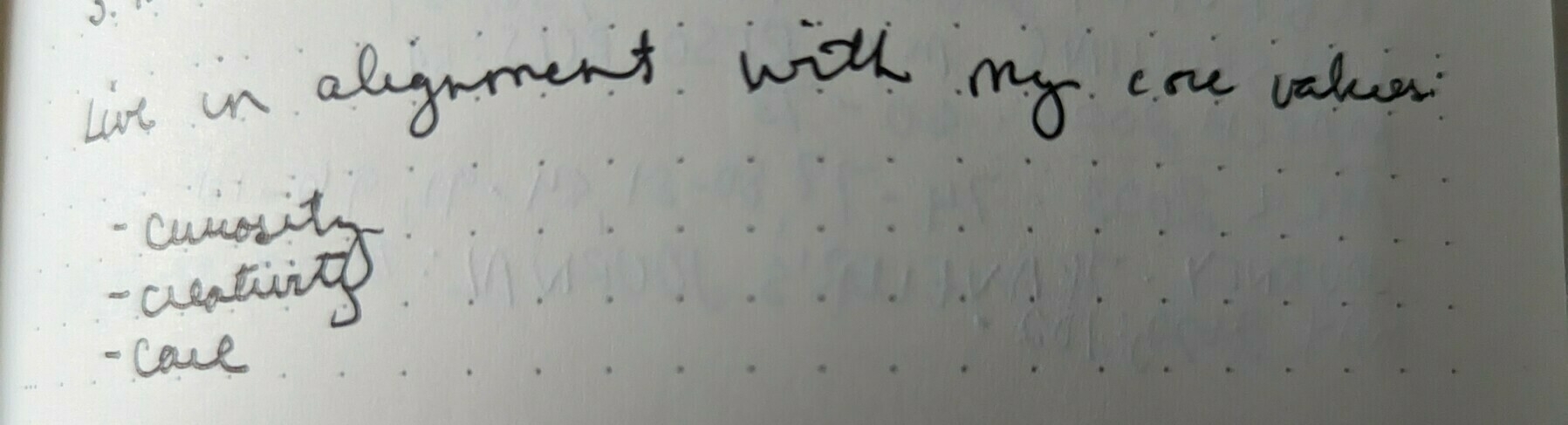
      In 2019, Carthusian monks went back to their values and decided to scale back their production of Chartreuse.

  5. Mar 2023
  6. Feb 2022
    1. Colleges and universities are urged to reconsider their ap-proaches to student discipline by attempting to integrate the academic and nonacademic worlds of students through a broad-based, unified approach that demonstrates and rein-forces the importance and integrity of institutional values. They should begin this process by reviewing and clarifying institutional values as they are already articulated in mission statements, codes of conduct, and academic integrity poli-cies.

      Dannells, Michael. 1997. From Discipline to Derdopment: Rethinking Student Conduct in Higher Education. ASHE- ERIC Higher Education Report Volume 25, No. 2. Washington, D.C. The George Washington University, Graduate School of Education and Human Development.

  7. Apr 2021
  8. May 2020
  9. Apr 2020
  10. Jan 2020
    1. draft of the proposed OpenETC code of conduct

      When making a CoC, it's always nice to spend some time researching others.

      Here's a copy of the IndieWeb's CoC, which I've liked. They also documented a list of other CoC's for other communities that might be worth looking at as well. Most of them have licenses for ease of cutting/pasting for reuse.

      I don't see a license on this draft, but it would be nice if you provided a CC0 license for it.

      (Original annotation at https://boffosocko.com/2020/01/10/code-of-conduct-openetc/#draft%20of%20the%20proposed++1)

  11. Nov 2019
  12. Oct 2019
    1. All conversations and communities on Spectrum agree to our underlying code of conduct. This code of conduct also applies to all conversations that happen within our contributor community here on GitHub. We expect discussions in issues and pull requests to stay positive, productive, and respectful. Remember: there are real people on the other side of that screen!
  13. Aug 2018
  14. edu522.networkedlearningcollaborative.com edu522.networkedlearningcollaborative.com
  15. Apr 2018
  16. Jul 2015
    1. Sec. 15-7. - Injuring or defacing library property. Whoever willfully injures or defaces any book, newspaper, magazine, pamphlet, manuscript, or other property belonging to the city library by writing, marking, tearing, breaking, or otherwise mutilating shall be fined as provided in section 1-8. (Code 1964, amended, § 19.19(A)) Cross reference— Damage to public property, § 17-26. State Law reference— Criminal mischief, V.A.P.C. § 28.03; reckless damage of property, § 28.04.
  17. Nov 2013
  18. Sep 2013
    1. And yet, Socrates, rhetoric should be used like any other competitive art, not against everybody,—the rhetorician ought not to abuse his strength any more than a pugilist or pancratiast or other master of fence;—because he has powers which are more than a match either for friend or enemy, he ought not therefore to strike, stab, or slay his friends.

      the ethics of rhetoric, sportsmanship, and conduct