按时间记录不完全合理,还是应该按任务记录。
这一观点挑战了传统时间轴记录的惯性思维。时间轴看似客观,实则碎片化,增加了认知负担。以 Task 为核心组织记忆,实际上是模拟人类大脑的联想记忆机制,将散乱的行为建模为有序的因果关系,极大提升了信息的召回效率和应用价值。
按时间记录不完全合理,还是应该按任务记录。
这一观点挑战了传统时间轴记录的惯性思维。时间轴看似客观,实则碎片化,增加了认知负担。以 Task 为核心组织记忆,实际上是模拟人类大脑的联想记忆机制,将散乱的行为建模为有序的因果关系,极大提升了信息的召回效率和应用价值。
they fuse streaming data construction with a unified model so the memory supports both real-time q&a and long-horizon interaction, which is nontrivial under strict latency constraints
大多数系统设计者可能认为实时问答和长时程交互需要不同的处理架构,但作者通过融合流式数据构建和统一模型,使内存同时支持这两种功能。这一设计挑战了实时系统处理复杂性的常规认知,表明在严格的延迟约束下实现多功能整合是可行的,这为实时AI助手的设计提供了新思路。
The difference between what you work out using the Zettelkasten and the memory palace technique is that the memory palace is a pure memory technique. It uses meaningless connections and the way the brain works to gain access to information. For example, if I mentally write the date Rome was founded with the mnemonic “BC 753 Rome came to be” as a number on an egg in the kitchen fridge, the only reason for this link between the egg in the kitchen fridge of my memory palace and the year Rome was founded is that I can remember this number. You make yourself aware of what the brain otherwise does unconsciously.
The difference between what you work out using the Zettelkasten and the memory palace technique is that the memory palace is a pure memory technique. It uses meaningless connections [emphasis added] and the way the brain works to gain access to information. For example, if I mentally write the date Rome was founded with the mnemonic “BC 753 Rome came to be” as a number on an egg in the kitchen fridge, the only reason for this link between the egg in the kitchen fridge of my memory palace and the year Rome was founded is that I can remember this number.
Certainly not an attack against him, but I feel as if Sascha is making an analogistic reference to areas of mnemonics he's heard about, but hasn't actively practiced. As a result, some may come away with a misunderstanding of these practices. Even worse, they may be dissuaded from combining a more specific set of mnemonic practices with their zettelkasten practice which can provide them with even stronger memories of the ideas hiding within their zettelkasten.
There is a mistaken conflation of two different mnemonic techniques being described here. The memory palace portion associates information with well known locations which leverages our brains' ability to more easily remember places and things in them with relation to each other. There is nothing of meaningless connections here. The method works precisely because meaning is created and attributed to the association. It becomes a thing in a specific well known place to the user which provides the necessary association for our memory.
The second mnemonic technique at play is the separate, unmentioned, and misconstrued Major System (or possibly the related Person-Action-Object method) which associates the number with a visualizable object. While there is a seeming meaningless connection here, the underlying connection is all about meaning by design. The number is "translated" from something harder to remember into an object which is far easier to remember. This initial translation is more direct than one from a word in one language to another because it can be logically generated every time and thus gives a specific meaning to an otherwise more-difficult-to-remember number. As part of the practice this object is then given additional attributes (size, smell, taste, touch, etc., or ridiculous proportion or attributes like extreme violence or relationships to sex) which serve to make it even more memorable. Sascha seems break this more standard mnemonic practice by simply writing his number on the egg in the refrigerator rather than associate 753 with a more memorable object like a "golem" which might be incubating inside of my precious egg. As a result, the egg and 753 association IS meaningless to him, and I would posit will be incredibly more difficult for him to remember tomorrow much less next month. If we make the translation of 753 more visible in Sascha's process, we're more likely to see the meaning and the benefit of the mnemonic. (I can only guess that Sascha doesn't practice these techniques, so won't fault him for missing some steps, particularly given the ways in which the memory palace is viewed in the zeitgeist.)
To say that the number and the golem (here, the object which 753 was translated to—the Major System mnemonic portion) have no association is akin to saying that "zettlekasten" has no associated meaning to the words "slip box." In both translations the words/numbers are exactly the same thing. The second mnemonic is associating the golem to the egg in the refrigerator (the memory palace portion). I suspect that if you've been following along and imagining Andy Serkis gestating inside of an egg to become Golem who will go on to fight in the Roman Coliseum in your refrigerator, you're going to see Golem every time you reach for an egg in your refrigerator. Now if you've spent the ten minutes to learn the Major System to do the reverse translation, you'll think about the founding date of Rome every time you go to make an omelette. And if you haven't, then you'll just imagine the most pitiful gladiator loosing in the arena against a vicious tiger.
Naturally one can associate all their thoughts in their ZK to both the associated numbers and their home, work, or neighborhood environments so that they can mentally take their (analog or digital) zettlekasten with them anywhere they go. This is akin to what Thomas Aquinus and Raymond Llull were doing with their "knowledge management systems", though theirs may have had slightly simpler forms. Llull actually created a system which allowed him to more easily meditate on his stored memories and juxtapose them to create new ideas.
For the beginners in these areas who'd like to know more, I recommend the following as a good starting place: <br /> Kelly, Lynne. Memory Craft: Improve Your Memory Using the Most Powerful Methods from around the World. Pegasus Books, 2019.
Class 2, Does Memory Matter? Why Are Universities Studying Slavery and Their Pasts? by David Blight for [[YaleCourses]]
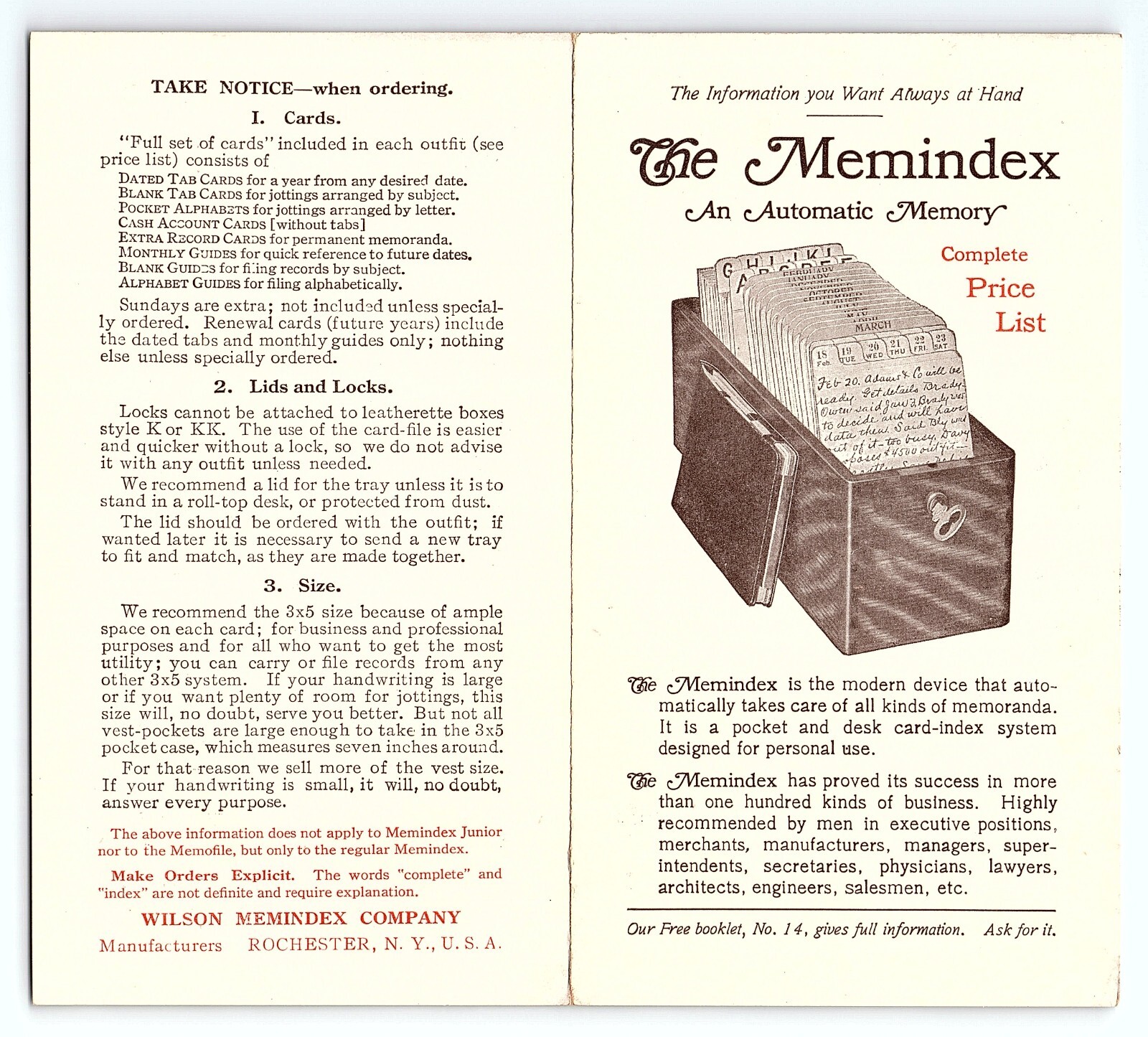
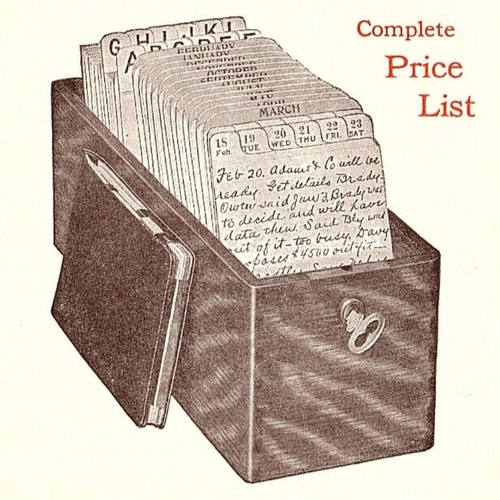
1930s Wilson Memindex Co Index Card Organizer Pre Rolodex Ad Price List Brochure
archived page: https://web.archive.org/web/20230310010450/https://www.ebay.com/itm/165910049390
Includes price lists

List of cards includes: - Dated tab cards for a year from any desired. - Blank tab cards for jottings arranged by subject. - These were sold in 1/2 or 1/3 cut formats - Pocket Alphabets for jottings arranged by letter. - Cash Account Cards [without tabs]. - Extra Record Cards for permanent memoranda. - Monthly Guides for quick reference to future dates. - Blank Guides for filing records by subject.. - Alphabet Guides for filing alphabetically.
Memindex sales brochures recommended the 3 x 5" cards (which had apparently been standardized by 1930 compared to the 5 1/2" width from earlier versions around 1906) because they could be used with other 3 x 5" index card systems.
In the 1930s Wilson Memindex Company sold more of their vest pocket sized 2 1/4 x 4 1/2" systems than 3 x 5" systems.
Some of the difference between the vest sized and regular sized systems choice was based on the size of the particular user's handwriting. It was recommended that those with larger handwriting use the larger cards.
By the 1930's at least the Memindex tag line "An Automatic Memory" was being used, which also gave an indication of the ubiquity of automatization of industrialized life.
The Memindex has proved its success in more than one hundred kinds of business. Highly recommended by men in executive positions, merchants, manufacturers, managers, .... etc.
Notice the gendering of users specifically as men here.

Features: - Sunday cards were sold separately and by my reading were full length tabs rather than 1/6 tabs like the other six days of the week - Lids were custom fit to the bases and needed to be ordered together - The Memindex Jr. held 400 cards versus the larger 9 inch standard trays which had space for 800 cards and block (presumably a block to hold them up or at an angle when partially empty).
The Memindex Jr., according to a price sheet in the 1930s, was used "extensively as an advertising gift".
The Memindex system had cards available in bundles of 100 that were labeled with the heading "Things to Keep in Sight".
Schemas are chunks of multiple individual units of memory that are linked into a system ofunderstanding
How do Bransford, Brown, & Cocking (2000) define schemas? (Metiri Group, Cisco Sytems, 2008) As chunks of multiple individual units of memory that are linked into a system of understanding
What term is defined by Bransford, Brown, & Cocking (2000) to be "chunks of multiple individual units of memory that are linked into a system of understanding"? (Metiri Group, Cisco Sytems, 2008) Schemas.
Carl Otto Reventlow (actually Karl [Carl] Christian Otto; born 1817 in Store Heddinge (Denmark); died in 1873) became notable as the developer of a mnemonic system.
https://en.wikipedia.org/wiki/Carl_Otto_Reventlow
Carl Otto Reventlow (1817-1873)
Source used by Edward Pick for some of his history of memory.
ConradCeltes, a German poet of some renown,‘born in 1459, made the great discoverythat the alphabet could be substituted in
Mnemonics for the places or pictures used by his predecessors. The historians of Mnemonics, especially Aretin, Reventlow, and the learned and famous bibliographer, Edward Marie Oettinger, in Leipzic, to whom I owe the above-mentioned and some of the following details on the history of Mnemonics, give a dozen other names of authors on Mnemonics belonging to this epoch.*
Edward Pick mentions Conrad Celtes in passing for having "made the great discovery that the alphabet could be substituted in Mnemonics for the places and pictures used by his predecessors. He doesn't provide a textual source for the information.
Pick indicates that his primary sources were Edward Marie Oettinger, (Johann Christoph Freiherr von) Aretin, and (Carl Otto) Reventlow who may have more detail on Celte's potential influence on the major system as well as potential alternate names from that era.
see also: - https://en.wikipedia.org/wiki/Eduard_Maria_Oettinger<br /> - History of Mnemonics by J. Ch, Baron von Aretin
The first important modification of the method of the Romans was that invented by the German poet Konrad Celtes, who, in his Epitoma in utramque Ciceronis rhetoricam cum arte memorativa nova (1492), instead of places made use of the letters of the alphabet.
Reasonable overview of history. Worth digging into to flesh out more fully with respect to the major system in particular.
Sloman, S. A. (2021). How Do We Believe? Topics in Cognitive Science, 0(2021), 1–14. https://doi.org/10.1111/tops.12580
ste-nography was only developed for German in 1834); st
Ann Blair indicates that stenography was only developed for German in 1834.
Is there a reference for this? When was it developed for other languages? How does this fit in with the timeline for memory and the major system?
I'd start with the basics of 0-9 of the Major System and then introduce the method of loci. Once they've got those two basics down reasonably I'd expand their Major system up to 99 at a minimum.
The tougher part then is expanding your pedagogy to build these tools into the curriculum so that you're actively using them with your content.
You might appreciate the experience from Lynne Kelly here: https://www.lynnekelly.com.au/?p=4794. Her excellent book Memory Craft also has some interesting examples and stories for children including the use of what she calls rapscallions for use in multiplication tables, languages, and other educational applications. Her book also has a wealth of other methods and potential applications depending on the subjects you're teaching.
I'd love to hear your experiences as you progress with your class.
Yet even thisdecline is followed by an unexpected resurgence in mnemonics in the 1800s, when Connors claimsthat writing was replacing speaking in school settings (127).
I would question this statement, as annotated separately in this article. I have a feeling that the mnemonic tradition into the 1800's was more heavily influenced by the rise of the idea of the major system and not so much by the memory palace or the method of loci. This definitely seems to be the case in the United States based on my readings.
Herdson also discusses how toconvert numbers and letters into such uninspiring mental pictures as a candle, a foot, a pipe, and similarhousehold items.
What relation does Henry Herdson's The Art of Memory Made Plaine (1651, 1654) have to the potential development of the major system. The description here sounds like it's relatively similar. Who/What were his precursors, and who may have been influenced by his version of this system which sounds very similar.
Willis’s primary interest was shorthand writing—he is chiefly noted forArt of Stenographie—andhis memory treatise is clearly influenced by shorthand’s mechanism of one-to-one correspondence.
John Willis's Mnemonica (Latin 1618, English 1621, 1654, and 1661) covers memory, but he was apparently more interested in shorthand writing and also wrote Art of Stenographie.
I'll have to read this for a view into the overlap of memory and shorthand with respect to the development of the major system. Did this influence others in the chain of history? It definitely fits into the right timeline.
After 10 minutes, the word lists were collected and students were asked to write down as many of the list items as they could recall within five minutes.
Were students asked or told if they'd be tested with this on long-term memory?
Personally, I'd have used a simple major system method to memorize such a list for short term memory, but would have used other techniques for long term memory.
He also introduced a code by which numbers were translated into words to aid memorising them. The code was as follows: 1=p,a;2=b,e;3=c,i;4=d,o;5=t,u;6=f,ar,ra;7=g,er,re;8=l,ir,ri;9=m,or,ro;0=n,ur,ru1 = p, a; 2 = b, e; 3 = c, i; 4 = d, o; 5 = t, u; 6 = f, ar, ra; 7 = g, er, re; 8 = l, ir, ri; 9 = m, or, ro; 0 = n, ur, ru1=p,a;2=b,e;3=c,i;4=d,o;5=t,u;6=f,ar,ra;7=g,er,re;8=l,ir,ri;9=m,or,ro;0=n,ur,ru. So to remember a number such as 314159 one produced a word such as 'cadator' which then translated back into 314159. The assumption here was that 'cadator' was easier to remember than 314159.
Sadly no reference to which book or portion in which this segment appears.
Read chapter 11 "Memorizing Number" to see what Gardner says about available techniques. He only covers the phoenetic major system and some basic associative techniques.
No mention of the method of loci. Some interesting references listed for the chapter however.
To help himself to remember dates, he devised a system of mnemonics, which he circulated among his friends. As it has never been published, and as some of my readers may find it useful, I reproduce it here. My "Memoria Technica" is a modification of Gray's; but, whereas he used both consonants and vowels to represent digits, and had to content himself with a syllable of gibberish to represent the date or whatever other number was required, I use only consonants, and fill in with vowels ad libitum, and thus can always manage to make a real word of whatever has to be represented.
Lewis Carroll aka Dodgson never published his own version of his memory system.
N.B. He indicates here that he filled in his vowels ad libitum which is now the common practice for the phonetic major system. As this indicates he never published it, it then becomes a question as to whether or not he was the originator of this part of the technique or if it was later re-invented/discovered by others.
In 1648 Stanislaus Mink von Wenussheim or Winckelmann made known what he called the "most fertile secret" in mnemonics - namely, the use of consonants for figures, so as to express numbers by words (vowels being added as required); and the philosopher Leibnitz adopted an alphabet very similar to that of Winckelmann in connexion with his scheme for a form of writing common to all languages. Winckelmann's method, which in fact is adopted with slight changes by the majority of subsequent "original" systems, was modified and supplemented in regard to many details by Richard Grey (1694-1771), who published a Memoria technica in 1730.
Apparently the beginning of the phonetic major system? Was there any relation to Celtes?
The only exception is the letter A, which appears in the list – unlike the other vowels – and contains fi ve words beginning with the fi ve vowels: a – abbas (abbot), e – eques (knight), i – institor (tax-collector), o – offi cialis (ecclesiastical judge), and u – usurarius (usurer).
Here he's interestingly removed the vowels, which is certainly reminiscent of the later Major System structure in at least some respect.
As Celtis said, “it helps the memory a great deal, if someone knows the things of the world,”37 and Valentinus followed this advice when he refi lled the table of Celtis with meanings of his own.
This seems to be very common practice in the modern art as many writers suggest using or modifying techniques so that they suit your experience and lived memory. If a different key word comes to you more quickly, then why not use that instead of one supplied by the creator of the system.
There's also an echoing of this in Beniowski's idea of notions in "A Handbook of Phrenotypics" on the closeness of ideas.
All we know for certain, through forensic testing, is that the manuscript likely dates to the 15th century, when books were handmade and rare.
This may provide some additional proof that it's a memory aid in the potential form of a notebook or commonplace book. What were the likelihoods of these being more common that other books/texts? What other codes were used at the time? Was the major system or a variant in use at the time?
symbolic portrayal
Language as a symbol. Relationship to memory.