1. Feb 2026
    1. I've experienced this myself on some of my more ambitious vibe-code-adjacent projects. I've been experimenting with prompting entire new features into existence without reviewing their implementations and, while it works surprisingly well, I've found myself getting lost in my own projects. I no longer have a firm mental model of what they can do and how they work, which means each additional feature becomes harder to reason about, eventually leading me to lose the ability to make confident decisions about where to go next.

      Vibecoding and adjacent projects lead to loosing overview of your own work, no mental model of what you made as you would have otherwise. Extending something becomes harder over time, bc you don't know what you're actually extending from. This is a counter force (not counter argument I think) to the notion of genAI having deterministic automation as endpoint.

    1. However, AI infrastructure cannot wait for the grid’s multiyear transmission upgrades. An AI cloud can generate revenue of $10-12 billion dollars per gigawatt, annually

      How much does this workout per kilowatt hour or megawatthour?

    1. This study explores the neural and behavioral consequences of LLM-assisted essay writing.

      This piece does not look at cognitivedebt where I saw it mentioned most (i.e. around the effect of vibecoding), it looks at using LLMs in writing (essays)

    Tags

    Annotators

    URL

    1. Transgression adolescente, climat socio-éducatif et sanction éducative : Synthèse de recherche-action

      Synthèse de direction

      Ce document synthétise les résultats d'une recherche-action de trois ans menée par Valérie Benoit et Annik Skrivan (Haute école pédagogique du canton de Vaud, Suisse) au sein d'un établissement scolaire de 500 élèves.

      L'étude remet en question l'efficacité des pratiques punitives traditionnelles face aux transgressions adolescentes et propose un changement de paradigme vers la sanction éducative.

      Les conclusions majeures indiquent que :

      • Les pratiques punitives classiques (heures d'arrêt, copies) sont perçues par les élèves comme inutiles, voire incitatrices à la récidive.

      • Le climat scolaire se dégrade significativement à mesure que les élèves grandissent (passage du cycle 2 au cycle 3), particulièrement concernant la relation enseignant-élève.

      • L'insécurité est fortement ressentie par les élèves dans les espaces "hors murs" (gares, parkings) et dans les lieux de transition.

      • La mise en place d'un Espace de Sanction Éducative (ESE) favorise la responsabilisation, la restauration du lien social et une meilleure compréhension des besoins fondamentaux des adolescents.

      --------------------------------------------------------------------------------

      1. Cadre théorique et contextuel de la recherche

      1.1. Le contexte de l'école vaudoise

      La recherche s'inscrit dans un cadre législatif et structurel spécifique au canton de Vaud :

      Loi sur l'enseignement obligatoire (Léo) : Structure le secondaire 1 en deux voies (prégymnasiale et générale). La voie générale, marquée par des niveaux de compétences différents selon les branches, entraîne un morcellement des groupes classes et une complexité relationnelle accrue.

      Concept 360 : Politique d'école inclusive intégrant des élèves à besoins éducatifs particuliers, augmentant l'hétérogénéité des classes.

      Impact post-pandémique : La crise du COVID-19 a agi comme révélateur de problèmes latents, exacerbant les troubles de la santé mentale et créant un effet d'anomie (perte de sens des normes) chez les jeunes.

      1.2. Comprendre l'adolescence

      L'adolescence est définie comme une phase de mutation et de "liminalité" :

      Rite de passage : En l'absence de rites formalisés dans la société actuelle, l'adolescent se crée ses propres épreuves, souvent par la transgression.

      Besoins fondamentaux : Outre les besoins pédagogiques, l'adolescent a des besoins sociaux essentiels : sécurité, confiance, responsabilité, autonomie, affection, et reconnaissance.

      Expression par l'agir : Les adolescents privilégient l'action au discours pour exprimer leurs émotions et construire leur identité (processus de séparation-individuation).

      --------------------------------------------------------------------------------

      2. Analyse du climat socio-éducatif et des perceptions

      La recherche-action s'appuie sur le questionnaire environnement socio-éducatif (Cais), révélant des divergences marquées entre les acteurs.

      2.1. Évolution des perceptions selon l'âge

      Il existe une corrélation négative entre l'âge et la perception du climat scolaire.

      Les élèves plus âgés (12-16 ans) perçoivent l'environnement de manière beaucoup plus négative que les plus jeunes (10-12 ans).

      | Dimension évaluée | Perception Cycle 2 (10-12 ans) | Perception Cycle 3 (12-16 ans) | | --- | --- | --- | | Relations élèves-enseignants | Plutôt positives | Chute massive / Perçues comme froides | | Soutien pédagogique | Présent | Perçu comme insuffisant | | Sentiment de participation | Modéré | Très faible (parole muselée) | | Gestion des comportements | Acceptable | Perçue comme injuste/punitive |

      2.2. La problématique de la sécurité

      Contrairement aux autres dimensions, le sentiment de sécurité est plus élevé chez les plus grands, car les plus jeunes craignent les agressions des aînés.

      Zones de vulnérabilité : Les lieux les moins sécurisés sont la gare, le parking et le voisinage immédiat.

      Violence insidieuse : Les élèves dénoncent une violence verbale et une agressivité de la part de certains enseignants (cris, humiliations, dénigrement).

      2.3. Divergence des priorités

      Une déconnexion est observée entre les préoccupations des élèves et celles des enseignants :

      Priorité élèves : Violence physique/verbale, vols et qualité de la relation humaine.

      Priorité enseignants : Réussite scolaire, absentéisme et décrochage.

      --------------------------------------------------------------------------------

      3. De la punition à la sanction éducative

      3.1. L'inefficacité des pratiques punitives

      Les témoignages d'élèves confirment que les punitions classiques n'enseignent rien :

      Max (15 ans) : "Les heures d'arrêt ça me fait plus rien... c'est juste punir pour punir."

      Yann : "Je sors, je me dis pas que je vais arrêter de faire des bêtises." La punition génère souvent un sentiment d'humiliation et de désintérêt, augmentant le risque de décrochage.

      3.2. Le modèle de l'Espace de Sanction Éducative (ESE)

      Inspiré des travaux d'Éric Prairat et Élisabeth Maheu, l'ESE repose sur une approche de "langage trait-d'union".

      Les quatre contraintes de la sanction éducative :

      1. Rappel de la règle : Expliquer le sens de la loi pour la cohésion du groupe.

      2. Mise en mots de la transgression : Identifier les besoins inassouvis et proposer des comportements alternatifs.

      3. Obligation de réparer : Restaurer le lien social avec les personnes lésées.

      4. Sanction individuelle : S'adresser au sujet responsable dans un cadre privé.

      Les principes structurants :

      Signification : Prendre le temps d'expliquer l'acte.

      Objectivation : Se centrer sur l'acte commis, jamais sur la personnalité du jeune.

      Privation : La sanction doit avoir lieu sur un temps libre (mercredi après-midi) pour marquer la limite.

      --------------------------------------------------------------------------------

      4. Obstacles et perspectives professionnelles

      4.1. Résistances du corps enseignant

      La recherche met en lumière des tensions identitaires chez les enseignants :

      Vision de la mission : Certains se considèrent uniquement comme des "transmetteurs de savoir" et refusent la dimension éducative ou relationnelle de leur métier.

      Posture "Adultocentrée" : Une tendance à percevoir la transgression comme une attaque personnelle plutôt que comme un symptôme du développement adolescent.

      Narcissisme territorial : Difficulté à collaborer et à harmoniser les pratiques de gestion de classe au sein de l'établissement.

      4.2. Pistes d'amélioration

      Pour pérenniser ce changement de regard, plusieurs leviers sont identifiés :

      Mesures préventives : Ne pas attendre l'explosion du comportement. Travailler sur l'engagement des élèves et la qualité de la relation quotidienne.

      Formation continue : Développer les compétences socio-émotionnelles, l'éthique professorale et la gestion de classe.

      Posture d'autorité éducative : Passer de l'autoritarisme (soumission) à une autorité qui contient et sécurise sans "casser" l'adolescent.

      Patience institutionnelle : Les résultats (baisse des incivilités) demandent du temps et un soutien fort de la direction.

      --------------------------------------------------------------------------------

      Citations clés

      "Un ado qui ne transgresse pas, c'est un ado qui m'angoisse... c'est une bombe à retardement."Annik Skrivan

      "La sanction est un moyen de promouvoir un sujet responsable en lui imputant les conséquences de ses actes."Éric Prairat (cité par Valérie Benoit)

      "L'enseignant par nature est extrêmement narcissique et territorial... l'école est un lieu où on soumet et on contraint, mais il ne faut pas oublier qu'on socialise aussi beaucoup."Annik Skrivan

    1. L’Évaluation en Contexte Scolaire : Enjeux Éthiques et Débats Politiques

      Résumé Analytique

      Ce document de synthèse analyse les enjeux complexes de l'évaluation en milieu scolaire, tels qu'exposés par Camille Roelens.

      L'évaluation ne doit pas être perçue comme un simple outil technique, mais comme un objet philosophique et politique central dans une société démocratique.

      Le constat de départ est paradoxal : bien que l'évaluation soit souvent jugée obscure et injuste (la "science sinistre" de la docimologie), elle demeure omniprésente et incontournable.

      L'analyse démontre que l'école moderne a pour mission de produire des individus autonomes et de gérer la stratification sociale dans une société où les rangs de naissance ont disparu.

      L'évaluation devient alors le mécanisme de création d'"inégalités justes". Cependant, aucun modèle de justice scolaire — qu'il soit méritocratique, distributif ou basé sur des minima garantis — n'est parfait.

      Le document souligne que l'enjeu actuel de l'école réside dans la reconquête de sa légitimité à travers une "bienveillance" redéfinie, visant à accompagner chaque élève vers une autonomie réelle plutôt que de simplement valider des acquis.

      --------------------------------------------------------------------------------

      1. Les Paradoxes de l'Évaluation

      L'évaluation en milieu scolaire repose sur trois constats fondamentaux, dont deux critiques et un pragmatique.

      L'obscurité : Il est souvent difficile de déterminer avec précision ce qui est réellement évalué (la compétence réelle, la capacité à gérer le stress, ou la compréhension de la consigne).

      L'injustice perçue : Le sentiment que l'effort ne se traduit pas toujours par la réussite crée une perception de l'évaluation comme une épreuve "tragique" ou inéquitable.

      L'omniprésence (Le "2+1") : Malgré ces défauts, l'évaluation est un "thème incontournable". Elle s'exerce de manière "sauvage" et constante dans tous les aspects de la vie sociale (jugement sur un film, un restaurant, ou choix de partenaires sportifs).

      --------------------------------------------------------------------------------

      2. Critique de la Philosophie de l'Évaluation

      Selon les travaux de Danilo Martuccelli, l'évaluation est devenue une véritable philosophie structurante de la société moderne, reposant sur huit principes majeurs, souvent contestables.

      Principes et Critiques de Martuccelli

      | Principe de la philosophie de l'évaluation | Critique et limites | | --- | --- | | Tout est mesurable et évaluable. | Toutes les pratiques ne sont pas également quantifiables sans biaiser la réalité. | | Tout le monde doit être évalué et mis en concurrence. | L'évaluation n'est pas homologue selon les acteurs et les enjeux (ex: concours vs suivi). | | Assure une gestion transparente du pouvoir. | L'évaluation n'est pas une information neutre ; c'est un instrument de pouvoir. | | Assure la meilleure utilisation des ressources. | L'évaluation a un coût financier et humain massif (inspections, concours). | | Augmente l'efficacité (carotte et bâton). | C'est un pouvoir performatif qui oriente les comportements de manière insidieuse. | | Motive et implique les acteurs. | L'impact est radicalement différent si l'évaluation vise un individu ou un groupe. | | Légitime les organisations (monopole des grades). | Elle alimente une crise de légitimité entre la théorie et la réalité du terrain. | | Incarne la rationalisation moderne. | L'évaluation est devenue une "croyance collective" non rationnelle. |

      --------------------------------------------------------------------------------

      3. L'École comme Rouage de la Modernité Démocratique

      Dans une société d'"égalité des conditions" (Tocqueville), où la naissance ne détermine plus le rang, la stratification sociale doit être reconstruite. Deux leviers principaux assurent cette fonction : le marché et l'école.

      La fabrication de l'individu : L'école a pour mission de transformer des enfants "dépendants et vulnérables" en individus "libres, égaux et autonomes". L'évaluation sert à vérifier si cette demande sociale est remplie.

      La gestion des inégalités : Puisque tout le monde ne peut être "soliste", l'école doit sélectionner. Cette tâche est décrite comme "Sisyphe" : elle est structurellement injuste car elle évalue parfois des acquis non transmis par l'école (capital culturel familial), mais elle est indispensable pour éviter l'arbitraire ou le tirage au sort.

      --------------------------------------------------------------------------------

      4. Les Quatre Modèles de Justice Scolaire

      Français Dubet et Marie Duru-Bellat identifient quatre modèles de justice, chacun présentant des avantages et des dérives potentielles.

      4.1. L'égalité des chances et le mérite

      Principe : Les mêmes épreuves pour tous, correction anonyme.

      Faiblesse : Ce modèle ignore que l'école ne représente qu'une fraction du temps de vie de l'enfant. Il est "rude pour les vaincus" et tend à reproduire les appartenances sociales sous couvert de mérite.

      4.2. La justice distributive (et inclusive)

      Principe : "Donner plus à ceux qui ont moins" (ex: éducation prioritaire). L'autonomie est vue comme une capacité accompagnée (étayage).

      Faiblesse : Risque d'obsession de l'efficacité pédagogique et de stigmatisation (effet "étiquette" REP+). Ce modèle pèse lourdement sur la vocation des enseignants, parfois poussés jusqu'à l'épuisement.

      4.3. Les minima garantis (Inspiration de John Rawls)

      Principe : Déterminer les règles de justice derrière un "voile d'ignorance". Le système le moins injuste est celui qui traite le mieux les plus faibles (principe du socle commun).

      Faiblesse : Souvent perçu comme un "smic culturel" ou un renoncement à l'excellence.

      4.4. Les sphères de justice et effets sociaux (Michael Walzer)

      Principe : Les inégalités dans une sphère (scolaire) ne devraient pas contaminer les autres sphères de la vie.

      Faiblesse : En France, le diplôme est excessivement déterminant pour le destin social global. L'évaluation est dramatisée car elle "joue la peau" des élèves.

      --------------------------------------------------------------------------------

      5. Vers une Autonomie Réelle : Capabilités et Bienveillance

      L'éducation vise l'autonomie (capacité d'agir, de choisir et de penser par soi-même). Cependant, l'autonomie en droit n'est pas l'autonomie en fait.

      La notion de Capabilités (Amartya Sen) : L'autonomie dépend de la connexion entre les capacités personnelles et un contexte facilitateur. Évaluer un élève sans tenir compte de son environnement (ex: barrière de la langue) est une erreur d'évaluation.

      La Bienveillance comme levier de légitimité : Dans un contexte de "déclin des institutions", l'école ne peut plus imposer sa légitimité par simple statut. La bienveillance doit être comprise en trois sens :

      1. Bien veiller : Comprendre le monde et la singularité de chaque élève.   

      2. Bien veiller sur : Avoir soin de la relation et des individus (sollicitude et tact).  

      3. Bien veiller à : Donner concrètement les moyens de l'autonomie.

      Conclusion

      L'évaluation scolaire est au cœur d'un "polythéisme des jugements". Il n'existe pas de solution parfaite, mais une quête de l'évaluation "la moins pire".

      L'école juste ne peut reposer sur un seul principe, mais sur une composition de principes croisés.

      L'enjeu ultime est de passer d'une fonction de sélection prioritaire à une fonction de transmission d'outils d'autonomie intellectuelle, tout en acceptant que l'école ne peut, à elle seule, régler tous les problèmes de la société.

    1. Analyse de l’Expérience Émotionnelle en Milieu Scolaire : Le Dispositif des « Moments Spéciaux »

      Synthèse

      Ce document de synthèse détaille les recherches menées par Sophie Necker et ses collègues sur la saisie des états émotionnels au sein de la classe.

      S’appuyant sur une étude menée en 2021 dans deux classes de CM2, le projet repose sur le dispositif de la « boîte à moments spéciaux ».

      Cette méthode permet d’accéder à la subjectivité des élèves et des enseignants à travers l'écriture quotidienne et volontaire de billets anonymes.

      Les conclusions mettent en lumière la dimension systémique des émotions, où les vécus individuels s'entremêlent pour former un paysage émotionnel collectif.

      L’innovation majeure de cette recherche réside dans la création de « l’Émoscope », une cartographie graphique permettant de visualiser la complexité des interactions entre déclencheurs, évaluations subjectives et expressions émotionnelles à l’échelle d’une journée de classe.

      --------------------------------------------------------------------------------

      1. Le Dispositif de Recherche : La Boîte à Moments Spéciaux

      La recherche vise à accéder aux traces des émotions et à la subjectivité des acteurs en milieu scolaire.

      Méthodologie et Protocole de Recueil

      Contexte : Étude réalisée en mai 2021 dans deux classes de CM2 à Lille (51 élèves et 2 enseignantes).

      Le Support : Des bandelettes de papier (environ 10 cm de haut) intitulées « billet moment spécial ».

      La Consigne : « Tu as vécu un moment spécial dans la classe aujourd'hui. Peux-tu l'écrire et le mettre dans la boîte s'il te plaît ? ».

      Caractéristiques du recueil :

      ◦ Écriture volontaire et quotidienne en fin de journée.    ◦ Anonymat préservé pour favoriser la liberté d’expression.  

      ◦ Durée d’un mois, totalisant 764 billets recueillis.

      Le « Moment Spécial » : Défini par sa singularité et sa significativité pour l’individu, sans injonction de valence positive ou négative.

      Il s'inspire des concepts de « moments optimaux » ou de « flow », mais élargi à toute intensité émotionnelle.

      --------------------------------------------------------------------------------

      2. Fondements Théoriques : Une Approche Systémique

      La recherche considère l’expérience vécue comme un objet scientifique à part entière.

      L'Interdépendance Émotionnelle

      La classe est envisagée comme un système d’interactions réciproques et complexes :

      Influence mutuelle : Les états émotionnels de l'enseignant impactent ceux des élèves et réciproquement.

      Attention conjointe : La perception de la situation est déterminée par le partage de l'attention entre les acteurs.

      Relation élève-enseignant : Cette relation influence la qualité de vie scolaire, les comportements et le regard porté sur les apprentissages.

      Définition de l'Émotion

      L’émotion est comprise comme un processus évaluatif dynamique :

      • Elle permet à l’individu de spécifier la signification d’une situation à ses yeux.

      • Une même situation peut donner lieu à des évaluations différentes selon les individus ou les contextes.

      Les composantes de l'évaluation (selon Audrin) :

      1. Physiologique : Réactions corporelles (ex. frissons).  

      2. Expression motrice : Expressions faciales, voix, posture.   

      3. Motivationnelle : Tendance à l'action (approche ou fuite).  

      4. Sentiment subjectif : Synthèse des différentes dimensions.

      --------------------------------------------------------------------------------

      3. Analyse des Résultats : Typologie des Expériences

      L'analyse des billets révèle plusieurs dimensions du rapport au monde scolaire.

      Rapport à Soi et à Autrui

      Connaissance de soi : Les billets expriment des attirances ou des antipathies (« Je déteste la danse »).

      Sentiment de compétence : La réussite ou la difficulté face à une tâche génère des émotions saillantes (fierté, stress de l'évaluation).

      Présence d'autrui : L'autre peut être déclencheur (exposé d'un camarade), partenaire d'émotion ou destinataire d'une action.

      L'enseignant est souvent évoqué indirectement à travers ses choix pédagogiques et didactiques.

      Continuité et Rupture

      Zone de confort et continuité : Moments venant renforcer l'identité de l'élève ou s'inscrivant dans une unité sociale et temporelle réconfortante.

      Rupture et irruption : Émotions liées à la nouveauté, à la découverte de connaissances, à des activités inhabituelles ou à des irruptions spatiales (intervenant extérieur, sortie).

      Littératie Émotionnelle et Verbalisation

      L'étude observe une gradation dans la capacité des élèves à verbaliser l'émotion :

      Niveau 1 : Nommer uniquement le déclencheur (ex: « L'histoire »).

      Niveau 2 : Décrire les faits ou les actions.

      Niveau 3 : Transcrire le ressenti ou attribuer une valeur (ex: « J'ai aimé »).

      Niveau 4 : Argumenter l'évaluation (ex: « C'est passionnant car... »).

      --------------------------------------------------------------------------------

      4. L’Émoscope : Cartographier le Paysage Émotionnel

      L'innovation majeure de la recherche est la création de l'Émoscope, un outil de représentation graphique.

      | Caractéristique de l'Émoscope | Fonctionnalité | | --- | --- | | Structure | Une roue où chaque portion représente un billet individuel. | | Code Couleur | Identifie l'événement déclencheur (ex: sport, conseil de classe, exposé). | | Pictogrammes | Indiquent la nature du rapport (soi, autrui, rupture, continuité). | | Bulles de Verbatim | Reprennent les mots exacts utilisés pour décrire l'émotion. | | Flèches | Symbolisent le processus évaluatif et les composantes identifiées. |

      Cet outil permet de passer de l’analyse d’un billet individuel à une vision globale du climat de la classe sur une unité de temps donnée (la journée).

      --------------------------------------------------------------------------------

      5. Perspectives et Implications Pédagogiques

      La recherche ouvre des pistes pour la formation et la pratique enseignante.

      Pour les Praticiens et Chercheurs

      Analyse de pratiques : Utiliser l'Émoscope pour comparer les vécus selon les enseignants ou les dispositifs pédagogiques.

      Évolution méthodologique : Envisager des formats numériques (audio, vidéo) pour lever les freins liés aux compétences rédactionnelles.

      Suivi longitudinal : Utiliser des carnets de billets pour suivre l'évolution émotionnelle d'un élève sur le long terme.

      Pour la Formation

      Conscientisation : Aider les futurs enseignants à comprendre la systémie émotionnelle de la classe.

      Indicateur d'apprentissage : Explorer les émotions des élèves comme des marqueurs de progression et de sécurité affective.

      Conclusion de l'Étude

      Le dispositif de la boîte à moments spéciaux démontre que les émotions, bien que subjectives, peuvent être saisies et cartographiées.

      Elles constituent une porte d'entrée essentielle pour comprendre les dynamiques d'apprentissage et le bien-être au sein de la communauté éducative.

    1. pedagogy, eee vo venation : ye mre i ciate their ite . imp s the opportunity to asso i autng o staan hie lesson grew out of the work Cassandra had “ seen el sominer when she worked with other candidates in a a eae session Understanding by Design (UbD) unit to be used wi focused on growth mind-set. As we noted in chapter 3, etical in nature: they aE alt ‘anal s, and also give candidates prac the UDD curriculum plants artic jum guidelines and making profes- experience in looking at district Soa uicelines ae i be e

      I would have loved to have the opportunity to plan with the district curriculum to create lessons with growth mind-set and in collaboration with my collage peers. I think that this goes along with the mentees having the opportunity to work with experience teachers, so that together they can create lessons or align the curriculum lessons so that they include growth mind-set in them.

    1. A shorter version of the report — stripped of the personal claims about Pogrund but with a section on “The Sunday Times article” — was shared with the National Cyber Security Centre, part of GCHQ, which declined to launch a full investigation. AdvertisementLabour Together, however, used the fact of the GCHQ referral to create suspicion about the story and its sources, with cabinet ministers and special advisers among those who quietly alleged the report was linked to the Russian state.

      Trick that should be noted.

    1. Frayn in 1963. Even then – in the very year of That Was the Week That Was – Frayn was using the same analogy, and could see, just as clearly, how anti-establishment comedy was letting its audience off the hook: ‘To go on mocking the Establishment,’ he wrote, ‘has more and more meant making the audience laugh not at themselves at all, but at a standard target which is rapidly becoming as well-established as mothers-in-law. To do this is not to undermine but to confirm the audience’s prejudices, and has less in common with satire than with community hymn-singing – agreeable and heartwarming as that may be.

      Nicely put

    1. That such a language didn’t exist frustrated Karpinski

      Esta frase me recuerda a ese dicho "se el cambio que quieres ver", y es que supongo que así es como se produce el avance, como el ejemplo que vimos en clase con Opera y como su fundador tras ver los cambios que le hicieron con su venta, lo llevaría a la creación de vivaldi. Al final supongo que para cambiar algo, es necesario crear un nuevo modelo que haga obsoleto el modelo existente.

    1. required that only English ships could carry goods between England and the colonies.

      This seems smart for trying to make the most money and resources out of it but will probably cause problems.

    2. William Penn’s father, Admiral William Penn, had served the English crown by helping take Jamaica from the Spanish in 1655.

      I did not know the english took Jamaica from the Spanish.

    1. directly compared the propensity of ductal/CACs and acinar cells to form PanINs

      Tested if Ductal or CentraAcinarCells and acinar cells form Pancreatic Intraepithelial Neoplasias.

    2. nducers of ductal cell identity, such asSox9 (Delous et al., 2012; Shih et al., 2012), play a role in theinduction of PanINs from acinar cells.

      Does Sox9 help induce PanINs from acinar cells.

      Acinar cells are specialized exocrine cells, primarily found in the pancreas (constituting 90% of its epithelium), that synthesize, store, and secrete digestive enzymes (lipase, protease, amylase) to break down food in the duodenum.

    3. CK19 promoter-based alleles to activateoncogenic Kras in ductal cells, suggest that PanINs rarely arisefrom ducts

      Tests using CK19+ promoter activated oncogenic Kras in ductal cells. Previously suggested that PanINs rarely arise from ducts but that may be wrong.

    4. tumor suppressorPten, the formation of invasive pancreatic cancer is associatedwith increased proliferation of centroacinar cells (CACs) (Stangeret al., 2005), which reside at the tips of the ductal tree

      Pten (TSG)- Mice associated with proliferation of centroacinar cells (CACs) that are the tips of the ductal tree.

    5. revious studies have modeled PDA initiation mostlyby expressing oncogenic Kras in all cell types of the pancreas(Aguirre et al., 2003; Hingorani et al., 2003, 2005), little is knownabout its cell of origin

      They dont know the specific cells that PDA starts in.

    6. PanINs),

      microscopic, non-invasive lesions in small pancreatic ducts that serve as the primary precursors to invasive pancreatic ductal adenocarcinoma.

    7. ADM is also observed in pancreatitis, which is a significantrisk factor for PDA in humans

      Inflammation in the pancreas has been linked to acinar-ductal metaplasia.

    8. loss-and gain-of-function approaches we identify the ductal fate determinant Sox9 as a critical mediator of Kras-induced prema-lignant acinar cell reprogramming.

      Scientific Approach and Mechanisms of Reprogramming

    9. KrasG12D-expressing mice, PanINformation coincides with, or is preceded by, acinar-to-ductalmetaplasia (ADM

      The change from acinar cells to ductal cells ADM is a very important step

    10. spectrum of preneoplastic mucinous lesions withductal morphology

      There is a range of early, mucus-producing abnormal cell changes in the pancreatic ducts that are not cancer yet but can potentially develop into pancreatic cancer

    11. the cell type responsible for tumor initiation has oftenbeen inferred based on the histologic appearance of the tumor

      Cell Harvest Site = Histological Appearance of Tumor

    12. oncogenic Kras, Sox9 accelerates formation of premalignant lesions. These results provideinsight into the cellular origin of PDA and suggest that its precursors arise via induction of a duct-like state inacinar cells

      They are trying to determine the origins of PDA using a PDA-initiating Kras mutation. Ductal and Stem-like centroacinar cells are refractory to oncogenic transformation, but acinar cells readily form PDA lesions

    Annotators

    1. The last photo shows a tent lashed horizontally to the 'vertical' daisys to show this can be done. This can create a good platform to stack other objects.

      First photo in the last row below.

    1. accelerate

      I like that this article gave a realistic view on how AI can help accelerate the efficiency of certain tasks but also has its limits. AI use can often be abused and is sometimes thought to be a cure all for any work, however it should be used as a supplement to learning instead of replacing the act of learning.

    2. documents

      I feel like although this helps lessen research time, one should always cite their sources and at least skim the actual documents that they are referencing their information from because AI can be wrong or biased a lot of times.

    1. This emptying of the land was often seen by English settlers like the Pilgrims and the Puritans as a gift of divine providence. Puritan leader John Winthrop wrote about the favor God had shown to the colonists by killing the natives

      I find this very interesting that they thought the mass killing of Natives was a gift to them from god.

    2. By contrast, French efforts on the continent centered on trade with Indians

      This shows how the French rather focused on trading whereas the Puritans focused on raising families.

    3. The English published frightening tales of captivity and redemption, although in reality poor people, especially women, were often better-treated in Indian society than in the English colonies.

      This shows the propaganda they were instilling against the Natives and I find that very interesting.

    4. The Spanish established the first permanent European settlement on the North American coast in St. Augustine, Florida,  in 1565.

      I find this very interesting that they were the first to come to the Americas before the British, which is rarely taught to us.

    5. During the 1600s, religion, language, and local culture began inspiring feelings of regional solidarity that grew into the idea of separate nationalities. Some of these nations organized themselves as absolute monarchies, while in others, power was shared among different national groups.

      I find this very interesting because language and religion play a huge factor.

    6. Plantation owners could have changed their practices, but the reduced profits would have exceeded the replacement costs of the slaves, so planters chose to work slaves to death quickly and buy more.

      This shows how slavery in the Caribbean was driven purely by profit even at the cost of human life.

    7. The contrasts between Spanish and British colonization in the Americas are stark, and help explain subsequent social and economic development in the Hemisphere.

      The author is arguing that early colonial systems shaped long-term differences between Latin America and the United States.

    8. This emptying of the land was often seen by English settlers like the Pilgrims and the Puritans as a gift of divine providence.

      Colonists interpreted Native deaths from disease as God supporting their settlement, which justified expansion in their minds.

    9. Constitutional states like Britain shared power between hereditary monarchs and legislative bodies that represented (some of) the people

      This highlights the key differences between Britain and France. Britain limited royal power through parliament.

    10. the British colonists set up legislatures, held town-hall meetings, often appointed their own governors, and made many of their own laws rather than waiting for instructions from London.

      This helps show me that the British settlers were used to running things by themselves. This helped make their colonies more independent.

    11. Native populations in the coastal northeast were devastated by an epidemic that raged from 1617 to 1619 and killed 95 percent of the Abenaki people and over 90 percent of the Massachusetts tribe.

      Disease wiped out most Native people before many English settlers even arrived. This made it easier for colonists to take over the land.

    12. Louis XIII (r. 1610-43) and his chief minister, Cardinal Richelieu, concentrated power in the hands of the King. The King stopped convening the Estates General, an advisory body made up of representatives of the clergy, the aristocracy, and the working people, and ruled absolutely.

      This helped show me how the king took all of the power for himself and didn't let anyone help make any of the decisions.

    13. American colonists also objected to the Quartering Act (1765) that forced them to provide housing and food for British troops.

      Even though they objected this act they still ended up feeding and housing the British troops in their own homes.

    14. Basically, the Spanish had arrived and said, “This is our land, obey us” while the British said, “This is our land, go somewhere else.”

      The Spanish wanted the land they arrived on to be all theirs, and they wanted the Indians to act a their slaves even though they had the land first. While the British simply wanted the Indians to move elsewhere they could have their own area.

    15. The settlement may have been overrun by local Indians, but it is also possible that the abandoned colonists went to live with the natives when their food ran out

      When The English settlement disappeared the Indians took over. Although the English disappeared it's possible they went to live with the Indians so they could survive.

    16. The Hapsburg family continued to try to maintain an entity they called the “Holy Roman Empire” but it was really an alliance of German principalities

      Instead of coming up with their own principles they used German ones and came up with a new name.

    1. Science or discipline

      Este debate me trae recuerdos de mi primer semestre, ya que fue uno de los primeros temas que vi en la asignatura de ciencia de la información, en ese entonces una de las conclusiones que fue nuestro objeto de estudio es la información y todo lo relacionado a esta.

    2. Human dimensions: human-computer interaction, cognitive psychology, information behavior, social epistemology,[6] philosophy of information, information ethics and science and technology studies

      Aquí se encapsula lo que había mencionado sobre la importancia de la interacción con los usuarios y como somos una disciplina del servicio, sin embargo debo admitir que me sorprende algunas de las áreas incluidas, como es el caso de la psicología cognitiva, que a primera instancia me la imaginaria más en otros campos.

    3. Technical and computationa

      Efectivamente, el componente técnico y computacional es muy importante, y no solo es nuestro campo, el avance tecnológico nos obliga adaptarnos a esas nuevas tendencias o correr el riesgo de ser obsoletos, sin embargo no se la da la importancia que se le debe en la carrera.

    4. The objective of this study is to create, replace, improve, or understand the information systems.

      Considero esta definición como correcta, sin embargo en considero que también es necesario agregar que somos una disciplina del servicio a los usuarios y por lo tanto nuestras interacciones con el publico fuera de la unidades de información es de igual forma importante.

    1. Although the audience for writing assignments—your readers—may not appear in person, they play a vital role in the development of your writing. Even in everyday writing activities, you identify your readers’ characteristics, interests, and expectations before making decisions about what you write.

      I think it's great especially because everyone has there own thought process when it comes to reading a passage. Helps you become a betters writer when you get others opinion.

    1. While AI is a powerful tool, the human touch remains crucial.

      I chose this quote because it reminds the reader that despite the tactical innovation that is AI, the human touch is crucial. Which matches the narrative of this article in my bias opinion, because without the work of human engineering and purely AI, it would lack the soul that truly brings all the things AI tries to mimic from human engineering.

    2. These generative AI biases can have real-world consequences

      This quote pushes the agenda of AI resulting in real consequences and pushes something that is not per say fiction, but rather something that feels more like a 'force'. I chose this quote because it correlates with the narrative this subsection pushes about bias and prejudice, and how AI motivates ideas such as those.

    1. Disabilities can be accepted as socially normal, like is sometimes the case for wearing glasses or contacts, or it can be stigmatized as socially unacceptable, inconvenient, or blamed on the disabled person.

      What does it actually mean for something to be socially normal? It feels like the only reason something is considered “normal” or not is how convenient it is for other people

    1. Implicit bias, as a behavioral phenomenon, is and will remain real and important.

      I chose this sentence because it speaks a powerful message, more or so a point is trying to be proven. Which is that no matter how strong someone's judgement may be. A bias will be formed as a behavioural response, and to instead not accept that fact, but rather we should come to terms with.

    2. Research strongly suggests, however, that your decision might still be influenced by the race and gender of the applicant

      This strongly represents the articles title in my opinion. As no matter how people may shape their beliefs and thoughts, judgment can still be casted due to many social factors and it shows the significant impact of an implicit bias.

    1. Historians use context, change over time, and causality to form arguments explaining past change. While scientists can devise experiments to test theories and yield data, historians cannot alter past conditions to produce new information. Rather, they must base their arguments upon the interpretation of partial primary sources that frequently offer multiple explanations for a single event.

      Context is important in explorative archeology. We might not know how a particular items were made hundreds of years ago but looking into past conditions and context is possible to develope a likely theory for how things were made in the past.

    2. Imaginative play is what makes context, arguably the easiest, yet also, paradoxically, the most difficult of the five C’s to teach. Elementary school assignments that require students to research and wear medieval European clothes or build a California mission from sugar cubes both strive to teach context.

      How does one determine what situations of imaginative play works? Is a drawing enough for some? What about people who struggle too approach things using imagination?

    3. The idea of change over time is perhaps the easiest of the C’s to grasp. Students readily acknowledge that we employ and struggle with technologies unavailable to our forebears, that we live by different laws, and that we enjoy different cultural pursuits. Moreover, students also note that some aspects of life remain the same across time.

      It is very important to understand that things are different in both time a culture. Realizing cultural roots can also help better attach ideas and goals to the things we view as different. For example we may not make an old recipe using the exact same methods but rather make it with modern appliances. So in some ways the recipe is different but the root is the same.

    1. 80% original material (your own words, claims,ideas, etc.) and no more than 20% of direct quotes, summaries or paraphrases from otherwriters or sources.

      Very important guideline I should make sure to follow.

    2. Murray’s authority;anticipating a potential reader’s opposing view point, making a concession to it, and rebuttingit...

      Ok so definitely should do some counter argument, I should tackle the faults I saw in Karla's own characters and actions.

    3. include a “selling point” or a question for youraudience to ponder.

      Need lasting impact. Call to action? Maybe I should try to do what Octavio did when describing his experience as a parent. Write a hypothetical question that somewhat answers itself with the background information that I provide? It's easy to mess that one up.

    4. whether you think

      Yes, I think Villavicencio's The Undocumented Americans effect social change as it provides an insight on what it's like being an undocumented American.

      Need to add more reasoning and a more specific purpose to my stance to make this feel more persuasive. Important pieces for my argument, Villavincecio's parents, later life experiences with children maybe, and then finish it off with the accounts from the adults she meets later on in her life.

    Annotators

    1. As protests broke out around the world, it became clear that the battle had been lost.

      Interesting; Clune's argument here is that the negative international attention generated by the Rosenberg case is evidence that the United States government lost their own propaganda war

    1. So now do a web search of (R)-thalidomide, and paste in its key (UEJJHQNACJXSKW-SECBINFHSA-N), and note the stereochemical layer

      So now do a web search of (R)-thalidomide, and paste in its key (UEJJHQNACJXSKW-SECBINFHSA-N), and note the stereochemical layer

      • Uma das últimas fronteiras exploradas, a Amazônia, de acordo com dados de 2020, do IBGE, possui cerca de 38 milhões habitantes.

      • A densidade demográfica nessa fronteira grícola, a Amazônia, é bastante reduzida, assim como o crescimento demográfico, que não tem sido expressivo nos últimos anos. Etnicamente, a formação populacional tem componentes muito semelhantes ao restante do país, com a presença de pardos, brancos, negros e uma grande comunidade indígena, se comparada a outras unidades federativas de nosso país.

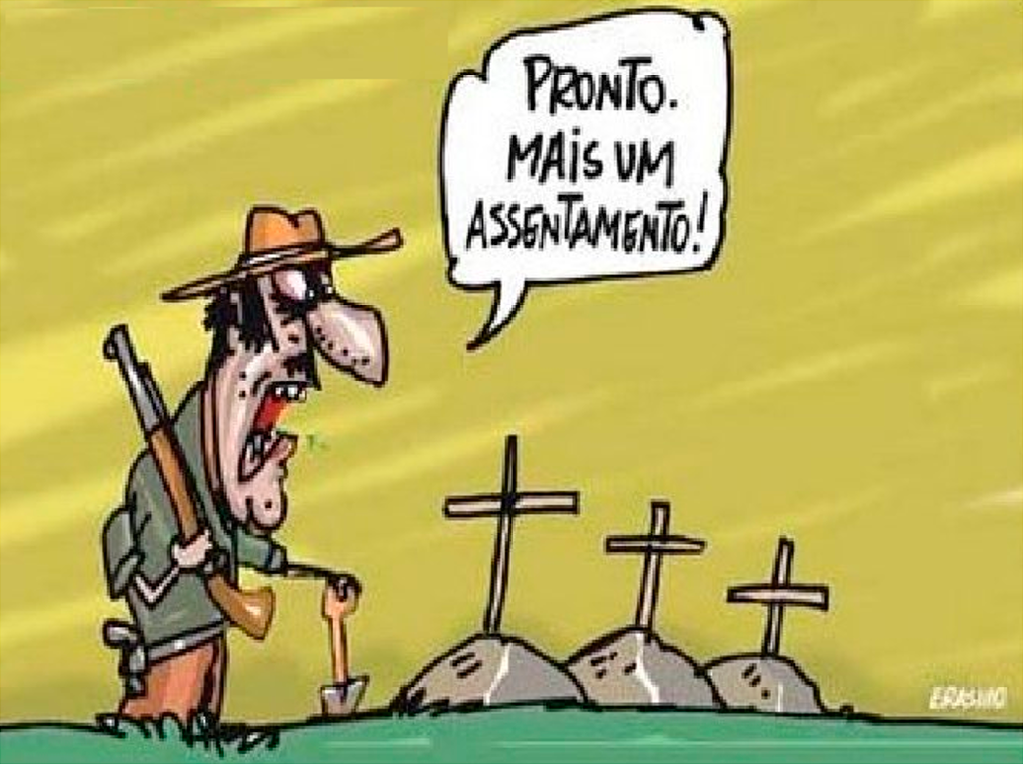
      • Amazônia é uma região marcada, em pleno século XXI, por uma disparidade na ocupação de terras, como ilustrado na charge.

      As comunidades camponesas sofrem com os impactos ambientais decorrentes do uso de agrotóxicos nas grandes monoculturas próximas às suas localidades.

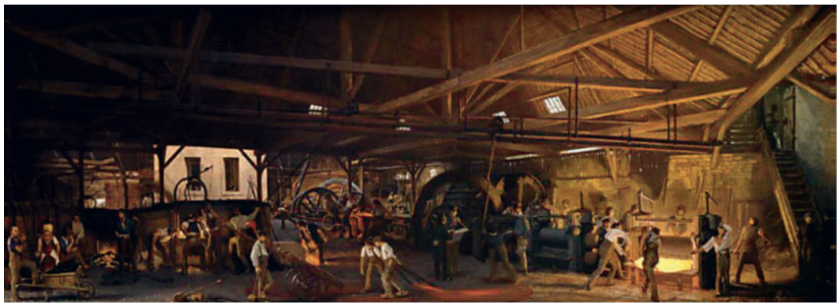
      • Trabalhos em chapa nas forjas de Abainville, óleo sobre tela, de Ignace François Bonhommé (1809-1881), 1838.

      • Musée de l’Histoire du Fer de Jarville, França. A pintura descreve um processo completo de metalurgia, desde a fundição do ferro nos fornos até o rolamento para o transformar em chapas. A oficina está cheia de trabalhadores que transportam o carvão e lidam com ferramentas pesadas.

      • A imagem apresenta o trabalho nas fábricas durante a Revolução Industrial. Com a Revolução Industrial, prevaleceu a transformação, de forma acelerada, no modo como se produziam e se vendiam mercadorias e como as pessoas viviam e trabalhavam.

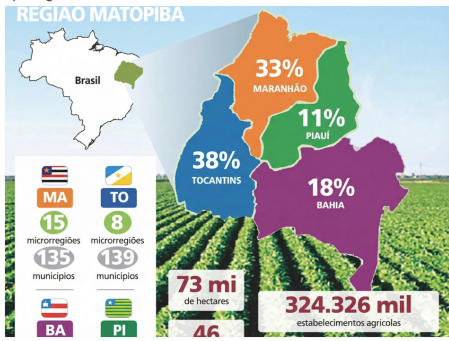
      • A imagem detalha a estrutura do MATOPIBA (MA+TO+PI+BA), que se tornou o coração da nova fronteira agrícola brasileira no Cerrado, focada em monoculturas de alta tecnologia para o mercado externo.

      • De acordo com os dados da imagem, o Tocantins possui 38% da região e 139 municípios integrados, não sendo a menor área.

      • A produção é focada em commodities, não em ~~policultura orgânica~~ .

      • A região apresenta alta concentração fundiária com muitas terras nas mãos de poucos, ocasionando diversas tensões sociais geradas pelo modelo de desenvolvimento adotado.

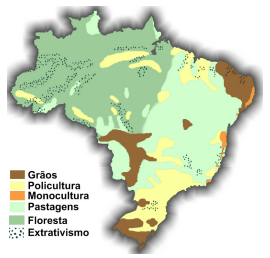
      • Embora o sul tenha tradição na produção de grãos, o mapa mostra manchas marrons expressivas no centro-oeste e na região nordeste (MATOPIBA), onde predomina o agronegócio de larga escala.

      • A região de floresta sofre pressão constante, especialmente nas bordas (Arco do Desmatamento), onde o extrativismo frequentemente convive ou perde espaço para o avanço da pecuária e da agricultura.

      • As pastagens ocupam vastas extensões do território nacional, sendo visíveis em quase todas as regiões, com forte presença no centro-oeste e no norte.

      • O mapa de uso do solo mostra claramente manchas de produção de grãos na área correspondente ao MATOPIBA (interior do nordeste e Tocantins), confirmando a vocação produtiva detalhada nos dados regionais.

      • Sintetiza a dinâmica atual: o mapa mostra o avanço dos grãos e monoculturas sobre áreas de Cerrado e transição amazônica. Essa área coincide com o polígono do MATOPIBA, uma fronteira agrícola mecanizada de alta produtividade voltada à exportação de commodities.

    1. Palantir is suing a Swiss media start-up for their FOIA based investigative journalism, and showing that Palantir tried for 7 yrs to engage CH as client, and that the Swiss Army evaluated the software as not fit for purpose, in part bc it would mean Swiss data would leak the US gov. Palantir is seen as too close to the US admin (bc of Thiel mostly I suppose), and the company's reputation is taking a dent amongst potential European clients

    1. Покой царит во мне, вокруг меня — а деловитых не оставляют их заботы, я обязан свободою им и досугом. И тебя, моя освободительница, ночь, благодарю! — Туманной пеленой луна окутывает дальние пределы холмов; и озера мерцающая гладь явилась мне. Постылый гомон будней отступает, и мыслью ход времен повернут вспять; твой образ, милый, предо мною вновь и дней ушедших воздух. Но теперь сменит его надежда новой встречи — Я вижу пред собой уж сцену объятий радостных и долгожданных; потом расспросы и взгляд украдкой друг на друга, дабы вызнать, что изменилось в облике, в манере, как теперь мы по-иному мыслим; — и упоены, узнав, что верность прежнему союзу еще крепче, и подлинней, и без единой клятвы: лишь истине свободной подчиняться, И никогда по правилам не жить, диктующим нам чувства или мненья.
      • Chicago was the premier destination for black political representation
      • insane growth in the black population, like all of these cities, sort of why we are studying them
      • we are taking the same approach as with detriot
      • it was a ward based political represnation system at the local level, allowing for more black chicagians to get representation, wards were represented by homogoneous populations
      • black voters held majorities in 5/50 wards
      • primaries were moee important to decide the mayor than the general
      • Black voters were sometimes the BOP in primary election
      • by 1935, the black vote was important enough that it was a strong base for democratic candidates
      • even in early primaires (1915) the black population was BOP, unlike in Detroit where it took a long time to get going
      • common thread is problemtic once they are in office, particualrly with law enforcemnet
      • politics is cuthroat man
      • Again in thompsons campaign the black vote is key
      • Tough on crime was often a euphemsm for tough on blacks
      • By the 1950s when the balck population decided to mobolize that was freaking huge for poiticians
      • chicago mayors largely accpeted the salience of the balck vote
    1. faire un clic droit sur n'importe quelle page, et de sélectionner l'inspecteur.

      Essayez maintenant! Moi j'ai "voir le code source de la page" dans le menu contextuel (qui apparaît quand on a fait clic droit) Et voilà !

    2. le navigateur web qui fait le reste du travail : lire le code HTML et CSS

      CSS et HTML sont des langages (pas de programmation mais de mise en page) HTML: langage de balisage, et CSS langage de marquage (mark up language).

      Ils fonctionnent de façon complémentaire pour créer des pages web, d'un côté le fond (HTML), de l'autre la forme (CSS), et quand on parle de langage, il faut quelque chose pour le traduire en rendu, ici c'est le navigateur.

      Le navigateur est l'interpréteur de ces langages, c'est lui qui les lit, les décode pour les transformer en page qu'on voit.

      Dans la famille des langages informatiques, on a les langages interprétés et compilés, ceux-ci sont interprétés, par le navigateur.

    3. Cascading Style Sheets,

      En bon français, Feuilles de style en cascade. On parle de "Feuilles de style" (pourquoi on parle de feuilles de style en informatique: c'est un héritage de l'imprimerie).

      Une feuille de style (conc style sheet en anglais) est un document qui contient l'ensemble des règles de mise en forme d'une page web.

      On dit en cascade, car les règles de style se suivent les unes les autres, On dit en cascade car les règles de style se suivent les unes les autres, si plusieurs règles ciblent le même élément, c'est la plus précise ou la dernière qui l'emporte

    4. HyperText Markup Language

      à bien retenir. En français, on dirait langage de marquage hypertexte. L'hypertexte, c'est quand on clique sur un mot d'une page, pour atterrir ailleurs (une autre page, un autre endroit de la page), c'est le lien entre les pages web.

    5. propriétés CSS

      On parle de balise HTML (les mots-clefs entre chevron, par exemple , ça c'est une balise ouvrante. Une balise fermante utilise une barre oblique. et entre les 2 le contenu de la balise.

      Retenez bien qu'on parle de balises en HTML, mais en revanche de propriétés en CSS;

      CSS et HTML sont les 2 langages utilisés pour faire des pages web, HTML en gros sert à dire quel contenu, et CSS a dire comment on veut l'afficher (rouge, gras, centré, etc).

      La version qu'on utilise de CSS et le CSS3 et pour HTML le HTML5. Voilà les choses basiques à connaitre.

    6. mémo pour assimiler les informations essentielles.

      Une autre façon de faire un mémo, est de bien utiliser le surlignage avec Hypothesis. Vous pouvez créer un groupe privé, ça mettra de côté toutes les parties que vous soulignez pour y revenir, avec vos annotations qui servent à apprendre.

    7. GitHub est la plateforme la plus utilisée pour héberger du code et collaborer dessus.

      C'est incroyable comme les gens ne savent pas apprendre, ils surlignent tout, sauf ce qu'il est important de retenir. Ici, une info importante.

    8. isual Studio Code

      Vous n'êtes pas obligés d'installer Visual Studio Code. Il y a beaucoup d'autres logiciels. VSCodium est mieux, car sans les mouchards Microsoft; Voici une version sans installation (portable, à juste mettre sur une clef USB): https://portapps.io/app/vscodium-portable/, il y a aussi Notepad++; qu'on peut aussi mettre sur une clef USB,; etc...

    1. code-switching is a phenomenon that increasing numbers of people are likely to experience. Claire Kramsch describes this phenomenon as ‘language crossings’ (1998). She provides examples which highlight complex manifestations of identity enactment;

      Code switching happens a lot in English in the US depending on the social group you are with

    2. In any case, if we learn to speak a second language, it provides unique insights into what it is that is valued

      In Chinese, I am learning that honor and shared cultural values are extremely important

    3. The existence of a hybrid language such as Haitian Creole is one indication of the significant link between language and culture. Languages are rarely used in their "pure", standard form. Speakers adapt linguistically to others around them.

      In Macau, we have Macanese--an Asian Creole language that is a combination of Chinese, Hindi, Dutch and African.

    4. There was for Laforest a tragic disconnect between the language he used to describe the world and to embody his literary imagination on the one hand and the social and racial reality of Haiti on the other.

      I read Edward Franklin Frazier, a social worker in the US who had a similar racial experience and spoke French and English.

    1. we might move again. The point is that we can. We can because we own our prompts, our skills, our databases, our memory architecture, they all live in our bar. None of it lives inside OpenAI or Anthropic. When we moved, we rewired the model layer and everything else stayed put. That’s the whole trick, really. If you control the pieces that make your agents smart, switching the engine underneath is just plumbing.

      Description of how Activate keep their prompts, skills, databases, memory architecture under their own control and within their own environment.

      Moving means wiring up another model or models, but the rest is kept as is.

  2. windeyes.livejournal.com windeyes.livejournal.com
    1. Когда Руми явился образ без формы он все бросил, оставил стихи. Сказал, что если до этого ему хотелось чтобы кто-то купил его слова, то теперь он бы хотел чтобы кто-то выкупил его у его слов. И еще, что когда сердце любит, то оно поклоняется другому сердцу, которое тоже поклоняется ему. Что все человеку жертва, когда он жертва и себе тоже.
      • Detriots auto industry was a defining pull factor for black migrants
      • to get elected detriot had some serious political barriers
      • By 1970 the voting age percejt was almost 50, this made blacks BOP
      • Detriots municipal election was at large and nonpartisan so people were not under the banners of parties and they had to win aross the city
      • Per the agrument at the begging of the book, this is going to inhibit black politicans ability to get elected as well as the voting power of the population
      • Black population is stepping mainly into this compettion between ford and the labor unions on the political level
      • Oldest and largest chapters of the NAACP
      • As in other cities, Black churches play a major role in all spheres of life, but politival and civil rights mobilization in general
      • The ford motor company has a lot of say in who gets elected (maybe will chnage as their base of employees chnages) and before the major influx of the black population they are supporting discrimatory candidates
      • 1920 election starts the immunization towards civil rights (or just anti racits) policy
      • All or nothing kind of politics, because the black vote is in BOP, KKK will always mobolix=ze agaisntb and other candidate will always mobolize for
      • Ford complicated the balncing of politica; preference and economic wellbeing
      • In all of these examples the impratnt part is that the balk vote is non-trival, something to be feared or garnered, and this si before the true boom
      • Explicit racism is orertty jarring for detriot
      • Race becomes a wedge issue as the population and strength of BVAP increases
      • "chnage his stance on racial issies once it became clear that Blak Detroiters we important"
      • 1961 is the first victory for the Black community in determining the kayor, might go on to become the status quo
      • In detriot, even in a system that was set up to limit their political voice (indeirectly), they could have been the BOP in 19/22 elections, with its least influential, still 50% of the time
      • Politicians became more responsive to the opinions of Black politicians as the proportio of the oting age population increased
      • Detriot had serious structrual barriers for balck people holding office
      • It would take black politicians some time to get going but eventually they would have some very meanigful political representation
      • black politicians were primarily concerned with anti-discrimination laws (jobs and housing)
      • While not limited to civil reform, racial policy was importsnt at the begginbg as a means of reprsentation
      • they were human, not monolithic and cared about a lot of things
      • migrant legislators were particuarly concerned with the migrant concersn (hand up) which extended to non-black migrants as well
      • locally, the political system made it hard for balck officials to be elected based on the support of blak homogoneus communiiues, which I remind you were fucking required by detriot whites
      • outcome of the sytem was the exlusion of the black population from municipal eledted office
      • detriot lagged in national representation (congress)
      • while the population grew, conservative candidates won by convicing whites to vote reacially conservative
      • the system in detriot rwally lagged the potential influence until there was a mass bloc
    1. Pinpoint and replace all non-specific words, such as people, everything, society, or life, with more precise words in order to reduce any vagueness.

      This sentence uses vague words that do not clearly explain the main idea. Replacing general words like “people” or “life” with more specific details helps the reader better understand the topic. Being precise makes the writing clearer and stronger.

    2. Pinpoint and replace all non-specific words, such as people, everything, society, or life, with more precise words in order to reduce any vagueness.

      This sentence uses vague words that do not clearly explain the main idea. Replacing general words like “people” or “life” with more specific details helps the reader better understand the topic. Being precise makes the writing clearer and stronger.

    1. A good research paper provides focused, in-depth information and analysis.

      I agree that a good research paper should be focused and detailed. When a topic is clear and specific, it helps the reader understand the information better. It also allows the writer to go deeper into the subject instead of just giving basic information. This makes the research paper stronger and more meaningful.

    1. happy individuals are successful across multiple life domains, includingmarriage, friendship, income, work performance, and health

      this depends on culture and how individuals perceive happiness

    1. Probablement parce dans ces contextes, l’on ne risque pas grand-chose à diffuser quelque chose de faux. Et puis surtout parce que l’on ne se préoccupe pas vraiment de la valeur de vérité d’une information car nos conversations sont animées par d’autres motivations et s’apparentent alors davantage à des bavardages cacophoniques mobilisant des registres d’énonciation divers et variés oscillant par exemple de la plaisanterie à la provocation :

      Explication du résultat introduite par "probablement" : absence de risque à diffuser de fausses informations dans ce genre de contexte et motivation des participants qui ont fait l'objet d'entretiens dans lesquels on retrouve l'absence d'intérêt pour la véracité de l'information et l'envie de rire. Les participants cités ont conscience qu'il s'agit de fausses informations.

      Si l'on croise cette explication avec les résultats relatifs aux fausses informations d'intérêt public diffusés auprès d'une connaissance avec qui l'on partage les mêmes idées : la première explication, l'absence de risque tient la route (on est toujours dans un espace privé) ; la seconde en revanche me pose question. L'envie de rire avec ou de provoquer quelqu'un dont on n'est pas proche est un comportement plutôt rare. Je pose l'hypothèse que ce résultat (fausse information d'intérêt public + idéologique et non affective) permet de mesurer l'adhésion à la fausse information. Et ce résultat, selon le graphique, n'est pas négligeable.

    2. Résultats ? Il semblerait que l’on ne parle pas de la même chose dans tous les contextes, à tous les types de destinataires.

      Résultats de l'expérimentation introduits par le conditionnel "il semblerait" (nous sommes dans une recherche préliminaire d'où la prudence de l'auteure dans ses conclusions): les participants n'échangent pas le même type d'information dans tous les contextes conversationnels. Dit autrement: chaque contexte conversationnel va permettre l'échange de certains types d'informations / chaque type d'information va s'échanger dans un type de contexte conversationnel particulier.

    3. Pour débuter l’expérience, je présentais à mes participants 24 informations réparties selon quatre catégories

      Suite de l'explication de l'expérimentation : les participants pouvent s'échanger des informations réparties dans 4 catégories différentes.

    4. il est possible qu’au sein de ces niches conversationnelles, la circulation de certaines « fake news » soit favorisée par les bavardages désinhibés et familiers que chacun d’entre nous peut avoir, avec ses proches, dans sa vie quotidienne

      Hypothèse de l'auteure introduite par "il est possible" : certains espaces conversationnelles caractérisés par la désinhibition (l'absence de contrôle) et la familiarité (une forme d'intimité) contribuent à la propagation des fake news.

    5. ces bavardages numériques pourraient finir par imposer des thématiques au débat public en s’infiltrant jusque dans les rédactions, souvent en quête de clics pour monétiser leur audience

      Conclusion sous forme de prédiction : arrivée des fausses informations jusque dans les médias traditionnels en quête de clics.

      En 2026, cette conclusion s'est vérifiée. A une nuance près: loin d'être contraints par leur modèle économique à favoriser les informations qui font du clic faisant ainsi involontairement le jeu des producteurs de fake news, certains médias traditionnels (TV, presse écrite, radio) prônent volontairement la promotion de ces fausses informations en accord avec un agenda politique et idéologique. Ils diffusent des informations fausses auxquels ils adhèrent (et leurs lecteurs aussi ?).

      Voir cette vaste enquête du journal Le Monde : https://www.lemonde.fr/les-decodeurs/article/2025/11/16/la-methode-bollore-comment-l-industriel-breton-s-est-cree-un-empire-mediatique-en-vingt-ans_6653611_4355770.html

      Et le livre de Marie Bénilde : Le péril Bolloré.

    6. il peut projeter certains racontages douteux sur le devant de la scène, au sein d’espace à haute visibilité du web comme les groupes Facebook ou les fils de discussions Twitter

      Enchaînement logique qui fait le lien entre les résultats de l'étude et les RS sous forme d'un argument épistémique : les espaces auparavant privés où s'échangent des fausses informations sont, depuis l'arrivée des RS, publics et jouissent d'une forte visibilité.

    7. ces circuits conversationnels de l’information peuvent être exploités par certains producteurs de fake news

      Enchaînement logique sous forme d'argument épistémique qui fait le lien entre la visibilité des fausses informations sur les RS et leur propagation : exploitation de ces échanges par des acteurs qui y ont un intérêt politique et/ou financier.

    8. tout le monde peut parler de n’importe quoi à n’importe qui, et cela au sein même de l’espace public

      Argument épistémique : RS projettent les espaces conversationnelles privés dans l'espace public et incarnent aussi des espaces publics anonymes (2 conditions expérimentales de l'étude où se partagent le plus les fausses infos sans intérêt public).

    9. mes participants devaient choisir dans quels contextes de communication ils souhaitaient ou non transmettre ces différentes informations

      Suite de l'explication de l'expérimentation : la consigne donnée aux participants était de choisir dans quels contextes conversationnels ils souhaitaient partager ces différents types d'informations.

      VI 1: les contextes conversationnels à 6 modalités.

      VI 2 : les informations à 4 modalités.

      VD : choix de partager une d'information dans un ou plusieurs contextes conversationnels.

    10. J’ai construit un plateau de jeu comprenant six contextes de communication

      Présentation de l'expérimentation : elle s'appuie sur un dispositif expérimental grâce auquel les participants peuvent s'échanger des informations dans six contextes conversationnels différents.

    11. Pour explorer cette question, j’ai réalisé une enquête expérimentale dans le cadre d’un travail exploratoire auprès de 15 personnes, pour mon mémoire de fin d’études à Sciences Po, encadré par le sociologue Dominique Cardon. Ce questionnement est aujourd’hui approfondi dans mes recherches doctorales

      Hypothèse testée grâce une expérimentation à caractère exploratoire dont les résultats ont été approfondis lors de recherches doctorales (les liens sont vérifiés).

    12. est-ce parce qu’une « fake news » a été partagée par des milliers d’internautes que chacun d’entre eux y a cru ?

      Raison 2 qui reprend l'hypothèse de départ sous la forme d'un enchaînement de questions : les personnes qui échangent des fakes news n'y adhèrent pas toutes indistinctement, elles les partagent pour d'autres raisons.

    13. Tout d’abord, parce que pris à l’état brut, ces nombres absolus ne veulent pas dire grand-chose

      Raison 1 : le nombre de fake news partagés doit être comparé au nombre total des interactions et exemple à l'appui (les liens sont vérifiés), ce nombre est très faible.

      Un chiffre global sur la proportion de fake news échangées par rapport à l'ensemble des informations échangées sur différents RS aurait été plus convaincant mais d'après mes recherches, ce chiffre est difficile à trouver.

    14. Manon Berriche

      Auteur : Manon Berriche, doctorante en sociologie au Medialab de Science Po.

      Contexte : The Conversation, media en ligne qui fédère, sous la forme d'une association à but non lucratif, des établissements d'enseignement supérieur et de recherche. Des universitaire et des chercheurs en collaboration avec des journalistes proposent des articles d'analyse de l'actualité.

    1. If you’d have my Advice, I’ll give it you in short, for a Word to the Wise is enough, and many Words won’t fill a Bushel, as Poor Richard says. They join’d in desiring him to speak his Mind, and gathering round him, he proceeded as follows;

      Franklin witnessed a man (likely a pastor or priest) quoting his Almanac while giving advice, which gave him a sense of gratification..

    2. have ever been very sparing in their Applauses; and no other Author has taken the least Notice of me, so that did not my Writings produce me some solid Pudding, the great Deficiency of Praise would have quite discouraged me.

      Franklin feels like he has gotten little recognition from other authors, despite being a renowned writer. However, he does make a decent amount of money.

    1. Equality is a moral ideal,not a simple assertion of fact.

      This is a clear statement of the difference between a normative claim (all members of class n ought to be given equal consideration) and a descriptive claim (all members of class n have the same capacities or characteristics.)

    1. While the EMA has informally indicated that the February 10 Reuters story prompted its decision, it has not made an official statement.

      How did they indicate this?

      • "The Great Migration Looms large in most African American family histories"
      • Six and a half million people participated
      • The Great Migration was unprecedented, any voluntary migration up until this point had been small and sercetive
      • Black people move north beause it is the most feasible and the idea of staying in the redemption era south is bonkers
      • Kansas was the first hint of the great migration
      • Great migration occured in two waves, 1916 and 1940, brought on by world wars and the change in agriculture.
      • 1915: the opprotunity for agency and industrial work outside of the south entices many migrants
      • The great depression puts a pause or just an inhibitor on the Great Miugration before the boom in industry fol,,ing the second workd war strts it up agaisn
      • Second wave is 1940s through to the 1960s (five million)
      • What was the role of culture? Was there any desire to escape the south as a region more than as an economy?
      • Leaving along the east coast meant you stayed along the east coast (usuallyn ending up in NYC)
      • Migrants often stayed in a straight line migration because their transportation oopprions were kimited
      • Great ,igration is a leaderless moverment, just individuals seeking to improve their lives
      • There was almost a chain migration effect, the people in ghe noethn looking to pill others out of the economic and cultutal shitstrom of the south
      • It was just a mega personal expierience, it sort of mimics how national migration to the US looks now
      • Highly educated and young adults were the most likely groups to leave
      • Taste of life outside of the souyth often meant a decrease in the likelgood of returning, this implies some cultural influence
      • Men went first, again, mimics modern trends
      • Economics first, escaping racism second
      • Black people struggled to make a living as sharecroppers and then there was agricultural disaster (push)
      • In general the wages and work was better in the inustrail north (pull), WWII expands these opprotunities
      • "There were civic, educational, and political benefits of living outside the south"
      • there were also moral push and pull factors, a sense of fairness, justice, amnd the way humans deserve to be treated
      • "Black Americans wanted to fully participates in American society"
      • Black migrants were non-immunized voters, they were not steeped in political beliefs or ytraditions because they had been robbed of them for so long
      • The north BVAP skyrocketetd as young people move and then had kids
      • "The great migration unlocked Black Americans ability yo participate as full citizens in our democracy... in some instances for the first time"
      • northern politiicians interactions with black voters chmaged as the population grew and there was an increase of Black elected officials
      • partys responses were positive if they had no ther choice; black population would signifigantly affect the outcome
      • highlight the agency of black people in the great migration
      • its been studied through almost every angle except politics
      • Black voters (when an important block) could seriously chnage the policiies that fficials took up, negative if they wwanted to alienatate the vite but positive to win it
      • We are looking at top down change, how the motivations of the politicians chnaged
      • secular realignment, parties are constanrtly changing all the time and can arrive at a completely differnt plcae over decades -politicians were mobolizing the black vote for the first time
      • black colaitions were able to chnage the policies locally befire nationally (intuitive)
      • we're gonna argue that the inlfux of migrants chnaged the place more than the place chnaged the migrants
      • Black people needed to escape the south
      • That is, black people of all backgrounds
      • The book is about the way the great migration changed politics
      • For black people, residency was the difference between freedom and slavery, voting and not voting
      • A.) Black Americans moved out of the south and into the north in primarily rural areas. B.) The migration chnaged black citizens ability to participtae (locally and nationally) in politics because there were fewer barriers. "New Pool of eleigible voters" C.) White democrats in the north tought that a colaition of black viters would outright win them tight elections, or at least be a powerful bloc. and D.) Democrats both negativelt and positiely cganged thier campaign startegies to win or supress the balck vote they now viewed as imp[ortant.
      • demographic chnaged are important to explain party position change
      • How do people chnage the politics of a place?
      • chapter two is important, one I should skim at least,
      • place chaoters read at least the midwest and then read conclusion.