these 7:36 are the ones i picked up and these were 7:38 three and three-fourths by four by 7:40 one-eighth
Sarah Everett has used water filter o-rings of 3 3/4 x 4 1/8 to replace the drive belts of her electric typewriters.
these 7:36 are the ones i picked up and these were 7:38 three and three-fourths by four by 7:40 one-eighth
Sarah Everett has used water filter o-rings of 3 3/4 x 4 1/8 to replace the drive belts of her electric typewriters.
i used a saw to just make the 6:46 one edge of that phillips head a little 6:48 bit deeper so that i could then use a 6:51 flat top screwdriver in there to remove 6:52 that screw the next time that way when i 6:55 put that screw back in there i could 6:56 remove it later just using a flat head 6:58 screwdriver instead of a phillips 7:00 now this was a little bit of a ratchet 7:02 job but it did the trick and with that i 7:04 had a working electric typewriter
Sarah Everett suggests using a saw to turn Phillips head screws into a flat head screw if they've been stripped.
i couldn't 4:50 get into the typewriter the screws were 4:52 in there so tight that there was no way 4:54 i could get that bottom off of the 4:55 machine so i did the only logical thing 4:58 i could think of i set it upside down 4:59 and then forgot about it for a really 5:01 long time i then went back in once i got 5:03 the confidence to go into this machine
Confidence is a (the?) key ingredient of typewriter repair.
i don't know 4:26 how i fixed it i kind of stabbed it a 4:28 lot with a screwdriver until it worked
rofl!
i 2:15 didn't know if it was broken because it 2:17 needed cleaned
curious, but common phrase "needed cleaned"...
Appalachian dialect?
in fact almost 0:28 all of my successful repairs have come 0:30 from a lot of faith trust a little bit 0:32 of pixie dust and a lot of googling
Smith Corona H Electronic Typewriter Repair High Pitch Buzz Rattle Disassemble Fix by [[Phoenix Typewriter]]
How many typewriters do you own? Currently, about 15.
In 2025, Alton Brown indicated that he owned 15 typewriters.
What Did The Late Show Get Trump For His 70th Birthday? by Stephen Colbert
This office set up for Stephen Colbert includes a black Underwood portable typewriter in a black case in the background.
reply to u/highspeed_steel at https://reddit.com/r/typewriters/comments/1krspvh/im_totally_blind_and_new_to_typewriters_wax/
Your question is a great one, but I'll go another direction since I'd dug into some of the history and details of Helen Keller's mid-century typewriters a while back. You can find some details and descriptions here (and in the associated links which includes an accessible video of Ms. Keller using a solid and sexy black Remington Noiseless standard typewriter): https://www.reddit.com/r/typewriters/comments/1ihot96/helen_kellers_typewriters/
She managed on both her Remington as well as her brailler as well as any sighted person, though obviously had someone to check her printed work.
I recently saw another heavily modified midcentury typewriter for someone who, if I recall correctly was not only blind, but had no arms. It was set up so that they could move a selector and type using a custom chin rest. Sadly, I didn't index it at the time, but it's interesting to know that such things existed for accessibility reasons.
As for Braillers, you might appreciate this recent article about a repairman in Britain who was retiring: https://www.theguardian.com/society/2025/jan/02/wed-be-stuck-alarm-as-uks-last-braille-typewriter-repairer-ponders-retirement
I've got my own brailler, which is a sleek-looking art-deco industrial piece of art with the loveliest shade of dark shiny gray paint I've ever seen on a typewriter. (I'm both a mathematician and information theorist into the areas of coding and cryptography, so Morse code, Braille, etc. are professionally fascinating to me.) I still need to take it apart and repair a few portions to get it back to perfection, but it generally works well.
As for the aesthetics, I personally enjoy the solid industrial look and feel of the machines from the 1930s-1960s. The early 30s and some 40s have glossy black enamel and machines like the Corona Standard/Silent from the 30s are low slung with flat tops that sort of resemble small pianos and just scream out "I'm a writer" with a flair for dark academia and just a hint of classical Roman design. Many of these machines come with gold tinged water-slide decals which really set themselves off against the black enamel, though on the majority of machines the gold is beginning to dim from time, wear, and uncareful application of cleaning solutions.
I love the Royal KMM, KMG, and the Remington 17, Standard, and Super-Riter for their industrial chonkiness and (usually) their glass keytops. One of my favorites is the Henry Dreyfuss designed Royal Quiet De Luxe from 1948 which always gives me the feel of what it would look like if a typewriter wore a tuxedo or the 1948 gray and chrome model which is similar but has the feel of a sleek gray flannel suit on a 1950s advertising executive prone to wearing dapper hats, smoking cigarettes, and always with a cocktail in his hand. Into the 50s and 60s almost everyone had moved to plastic keytops which I don't think are as pretty as the older glass keytops with the polished metal rings around them.
At the opposite end of that spectrum are the late 50s Royal FP and Futura 800s which have some colorful roundness which evokes the aesthetic of the coming space age. They remind me of the modern curves and star shapes of the television show The Jetsons. Similarly space-aged are the sexy curves of the silver metalic spray paint on wooden cases for the Olympia SM3 from the same period. These to me are quintessential typewriter industrial design. In gray, green, maroon, brown, and sometimes yellow crinkle paint with just a hint of sparkle in their keytops I really love the combination of roundedness and slight angularity these German designed machines provide. They have a definite understated sort of elegance most other typewriters just miss. I suspect that late-in-life Steve Jobs would have had an Olympia SM3.
There's something comforting about the 40s and 50s sports-car vibe of the smaller Smith-Corona portables of the 5 series machines in the 1950s with their racing stripes on the hood. They feel like the sort of typewriter James Dean would have used as a student—just hip enough to be cool while still be solid and functional.
Sadly into the 70s, while machines typically got a broader range of colors outside of the typical black, gray, and browns things became more plastic and angular. They also begin to loose some of the industrial mid-century aesthetic that earlier machines had. They often feel very 70s in an uncomplimentary way without the fun color combinations or whimsy that art and general design of of that period may have had in the music or fashion spaces. They make me think of politics and war rather than the burgeoning sexual revolution of the time period.
Interestingly, for me, I feel like most typewriter design was often 10-20 years behind the general design aesthetic/zeitgeist for the particular decades in which they were made.
Good luck in your search for the right typewriter(s) for your own collection.
https://www.reddit.com/r/typewriters/comments/1kppij9/blue_olivetti_valentine_how_rare_is_it/
In increasing order of rarity, the Olivetti Valentine was made in red, white, green, and blue.
Film: Typing on Robotron by [[Joe Van Cleave]]
You've got to love the "dancing hands" portion of the film which was such a product of it's timeperiod.
https://www.facebook.com/groups/typewritermaintenance/posts/4083165991920819/
Kenneth Alexander begins tearing down a Hermes 3000 typewriter for servicing.
reply to u/Omega48boar at https://reddit.com/r/typewriters/comments/1knsgn8/pressure/
I was wondering what the upper limit psi would be for blowing out the gunk using an air compressor.
The highest air compressor pressures may be determined by your particular compressor's (or air canister's) maximum output as well as the maximum suggested output for any accessories you're attaching to it. Many basic air gun attachments have a max PSI of around 100 PSI even when the compressor will produce much higher outputs.
Generally I find that for most benchwork on typewriters anywhere from 50-100 PSI is generally more than sufficient.
Depending on the condition of your surroundings, I recommend putting a towel (or similar material) underneath your typewriter with a solid backstop so that if any springs, screws, or other valuable parts are blown loose, they're caught pretty quickly by the towel rather than flying across the room or down onto the floor out of sight.
Higher pressure settings may be useful in some cases. One should always take care to be wearing protective garments and eyewear to prevent being spattered with caustic chemicals. Similarly protecting plastics, paint, and decals on your typewriter with appropriate cover is advised with some solvents.
Operating the compressor, which can cause sparks as well as heat, at a reasonable distance from potential flammable vapors is also a mandatory safety precaution. Using volatile solvents frequently seen in typewriter cleaning procedures should only be done in the open in a well-ventilated area using appropriate masks to prevent inhalation of vapors. Long term exposure to vapors of substances like lacquer thinner can cause lung damage, COPD, and other adverse health effects.
For extended usage pending the sorts of air gun tips which might be used for typewriter cleaning, one is also well advised to use ear protection to prevent long term hearing damage/loss.
https://typewritermuse.com/ <br /> Bob Marshall
The Typewriter: A Graphic History of the Beloved Machine by [[Janine Vangool]]
Everyone mentioned most of the usual tricks, but one.
To get your sticky typewriter keys working again, while you're flushing out the segment with your solvent of choice (lacquer thinner, paint thinner, mineral spirits, alcohol, etc.), actually move the typebars using the keys or by other means. This will help to get them moving and allow the solvent and subsequently compressed air to help flush the oil, dust, hair, etc. out of your machine. You've already got a mechanical cleaning device of sorts (the typebar itself) inside the segment, so move it while you're flushing it out!
It may take a few repeated treatments/attempts to get it all clear for all the keys, but it's far easier than taking everything apart.
reply to u/nogaesallowed at https://www.reddit.com/r/typewriters/comments/1cp75ln/how_do_you_clean_a_1mm_gap/
People were recommending all sorts of ideas and solvents here, including folded card stock, tooth brushes, floss, toothpicks, interdental brushes, wood cuticle sticks, Swiss Army knife tweezers, microbrushes, and even an ultrasonic cleaner.
SCM Electric Typewriters by [[Joe Van Cleave]]
Tips for cleaning the Smith-Corona 6 series electric typewriters and details about how they work.
S-C also made this series of typewriter for both Sears and Singer under their branding. (including the Singer Electric in this video.)
The belts on the electric motor and cams was originally a rubber 'V' belt which is no longer manufactured. Using 1/8" round cross-section o-rings of appropriate sizes (for water cannister applications) is the recommended replacement, however one may need to slightly move the drive motor down a bit so that the belt doesn't hit the frame of the typewriter and thereby destroying it over time.
Cleaning and lubricating the drive motors and moving pieces before using may help before trying out a typewriter which has been sitting for long periods of time.
Some later models had an electric return, which can tend to be violent. Electro 220 and Coronet Automatic 12 have an additional clutch and draw band (and lack of return lever on the carriage) for their electric returns.
Users of the Royal HH typewriter included: William Buckley, Charles Bukowski, George Burns, Herb Caen, Truman Capote, Bruce Catton, Patty Chayefsky, Don DeLillo, Alice Denham, James T. Farrell, Paul Fussell, Hugh Hefner, Elia Kazan, Sterling North, Robert B. Parker, Sylvia Plath, Mario Puzo, Robert Penn Warren, Eudora Welty, and William Zinsser.
including photos via https://site.xavier.edu/polt/typewriters/typers.html
reply to u/letsjustwrite and u/CowCommercial1992 at https://reddit.com/r/typewriters/comments/1iilo0f/re_inking_ribbons/
None of these are really prohibitively expensive, especially when purchased in bulk. Both Baco Ribbon and Fine Line offer black/red bichrome ribbon in most of these materials for a very reasonable price:
If you're going to buy even 3-6 spools of ribbon at individual prices of $9-20 per spool, you may as well make the investment in a half or full reel of inked typewriter ribbon and save yourself a lot of hassle. My guess is that if you're buying your own ribbon in small quantities, you're going to pay even more than these prices to have uninked ribbon. Unless you have some serious equipment and technique, you're highly unlikely to be able to ink your own bichrome ribbon, so you're stuck with monochrome.
While using ink stamp pads is "doable", it's a lot of work for a very poor result.
I've yet to hear of more than a very tiny handful of people who are interested in the art or process of this to bother with attempting to re-ink typewriter ribbon, silk or otherwise. Generally, if they do it for any reason (other than the one time "fun of it"), it's for environmental reasons rather than pricing ones.
As an inveterate tinkerer, I've tried some of my own re-inking experiments to very mixed results. I've given up bespoke ribbon for bulk purchases.
Testing Cotton Ribbons- Typewriter Ribbon Test!! by [[Just My Typewriter]]
There are generally only a few configurations for ribbon vibrators with respect to ribbon threading, look at a few manuals here and surely yours will be covered by one: https://site.xavier.edu/polt/typewriters/tw-manuals.html
Typically the rule is that the ribbon sits closer to the paper at the typing point than any piece of the vibrator and is then threaded through the arms of the vibrator. From there it often goes through holders at the ribbon cup and then into the spool.
The trident is the foundry mark of Gordon Webb & Co., a British type foundry. No catalogs for this company exist on the internet so can't tell you the name they used for it. https://i.imgur.com/RQpxK05.jpeg
via u/Koponewt


antiphony 0 points1 point2 points 4 days ago (0 children)count me in - i will bring my flying fish 200
u/antiphony has a Flying Fish 200 typewriter
The Screenless Writer by [[Steven Budden Jr.]] (aka Classic Typewriter)
"My screenless computer, which is a box of these [handmade] cards. The NEXUS which stands for Network of EXperiences Synchronicities and UnderStanding." —Steven Budden, Jr.
follow up reply:
After some additional research on the typewriter database, the YY = 92 (where the serial number is of the form: FP[P,E,S]-XX-YY-#######, where XX is the platen length and YY is for other special features) indicates that the machine has 46 character keys (and thus 46*2=96 glyphs on the slugs). There are also examples of YY=88 with 44 keys versus the standard 42 or 43 keys.
This means that your machine has a few extra keys not found on their standard keyboards at the time.
https://amsterdamassassin.wordpress.com/2018/12/16/typecast-my-royal-fp-steampunk/
reply:
I've been looking at the typewriter database and have been able to discern the fact that the designator YY=88 seems to indicate that an FP had a Royal HH-like palm tabulator, where the serial number is of the form: FP[P,E,S]-XX-YY-#######, where XX is the platen length and YY is for other special features.
I can't help but wonder what the YY = 92 indicates on Martyn's machine.
After some continued research on the TWdB, I've come to realize that the "88" in the serial number has likely nothing to do with the palm tabulator.
The 88 is for an extra character count due to more keys (44) versus the more standard 42 or 43 keys and similarly some examples with a 92 in the serial number corresponds to 46 characters. So there isn't a designator in the serial number for a palm tabulator.
See: <br /> - https://typewriterdatabase.com/1961-royal-fp.22586.typewriter<br /> - https://www.reddit.com/r/typewriters/comments/1kg820b/just_bought_this_typewriter_for_10_at_a_charity/<br /> - https://amsterdamassassin.wordpress.com/2018/12/16/typecast-my-royal-fp-steampunk/
Oxidized Metal on Typewriters, White Powder Substance Removed Cleaned by [[Phoenix Typewriter]]
Royal Futura 800 Typewriter Plastic Key Top White Crud Removal Cleaning Servicing by [[Phoenix Typewriter]]
For the white, crusty out gassing (or off gassing) on plastic typewriter keys, Duane recommends a round or two of Simple Green with a stiff bristle brush. Follow this up with a scrub down using WD-40 to displace the water from the Simple Green and then follow up with denatured alcohol, which is safe on plastics, and a wipe down with a rag to dry.
Cross reference: https://syracuse.craigslist.org/atq/d/syracuse-the-smith-corona-typewriter/7841959463.html
For the collectors out there, this is an excellent caveat/warning: What will you do with your collection when you're gone? Where will it go? What will happen to the work you've put in?
On longevity of collections: https://www.instagram.com/p/DJC9BwUvA8T/
Remington Portable Typewriter replacement feet: https://makerworld.com/en/models/1397399-remington-portable-typewriter-replacement-feet#profileId-1448637
The Ultimate HOMEMADE Rust Remover (Better than EvapoRust) by [[Beyond Ballistics]]
recommended by u/guneeyoufix at https://www.reddit.com/r/typewriters/comments/1kgf6hm/help_am_i_crazy_olympia_sm3/?sort=new
https://reddit.com/r/typewriters/comments/1kg820b/just_bought_this_typewriter_for_10_at_a_charity/
For a second, I thought perhaps the "88" in the serial number was a designator for the palm tabulator, but one of the other two in the database doesn't have that option (visually), though the single picture (of 5853) looks like it may have broken off or been removed on that example: - https://typewriterdatabase.com/1960-royal-fp.1241.typewriter - https://typewriterdatabase.com/1961-royal-fp.5853.typewriter
If you upload some additional photos of yours to the database, perhaps we can puzzle out what the "88" designator means if it's not the palm tabulator functionality?
The E on FPE means "elite" or 12 characters per inch. The "13" indicates a 13 inch wide platen. The raw serial number seems to indicate it was made in 1960: https://typewriterdatabase.com/royal.72.typewriter-serial-number-database
FP models were designated with either a FPE (for elite typeface machines), FPP (for pica typeface machines), or FPS (for special order typeface machines that could have been fitted with 5, 10, 12, 16 or 20 pitch type, and almost any type face). The FP name is a homage to Fortune Peter Ryan who at one point was the President of Royal Typewriter.
For those who have an Underwood 5 typewriter as featured in the movie Finding Forrester (Columbia Pictures, 2000), it bears saying that Forrester (Sean Connery) would admonish you to:
And is it true that you enjoy taking typewriters apart and putting them back together? Doherty : Of course. It’s just that I’m so attracted to these objects that I want to look inside them, to understand how they work. It’s a form of learning, for me it would be a dream to have a shop specializing in repairing typewriters. Maybe one day… Among the many, I love the Valentine model by Olivetti, sooner or later I absolutely want to visit Ivrea.
The Olivetti Valentine is one of Pete Doherty's favorites.
Library Typewriter Display Case Project by [[Joe Van Cleave]]
https://www.reddit.com/r/typewriters/comments/1kbp3bb/corona_3_with_case_key/

Corona 3 cases had very straightforward keys with a simple 1-2mm numb at the far end.
does anyone know of any visual differences between the Model H, KH, and KHM. I saw what appears to be my type of typewriter sitting on radar’s desk in M*A*S*H but I don’t know the exact differences and we never see the front.
The character Radar O'Reilly apparently had an early model Royal standard typewriter in MAS*H.
Side note, does anyone know what that G in the bottom center would have been for, it fell out of the typewriter one day while I was experimenting to see what its problems were.
https://www.reddit.com/r/typewriters/comments/1kb71ni/fixed_typewriter_plus_a_new_one/
Found a silver plate with a black letter "G" inside a Royal H.
I think my creativity is going to flourish when I get clean. There are so many songs I started and never finished, and I've wasted so much time while I've been using drugs. Even if I was at the typewriter I wasn't doing anything, I was just there. I was more likely to do a line off it than write anything, so I think now my creativity will blossom.
<script async src="https://platform.twitter.com/widgets.js" charset="utf-8"></script>Peter Doherty: “I have 40 typewriters and I’m not ashamed of it”<br><br>LISTEN @maryannehobbs : https://t.co/0Z9fvAYCM9 pic.twitter.com/OCaHtPqJ1N
— BBC Radio 6 Music (@BBC6Music) May 22, 2016
https://www.bbc.co.uk/programmes/p03vxbqj
Peter Doherty: “I have 40 typewriters and I’m not ashamed of it”
Rubber feet recommended via u/scottconnors at https://reddit.com/r/typewriters/comments/1k93kbs/1938_royal_model_o_odette/
Schreibmaschinen Farbband wiederbeleben / "nachfüllen" by [[Badulai]]
William Ebbink, Tom Hansen, Wayne Bouchard, and Blake Banner swear by this. All seem to like it for metal and plastic, and all seem to like it for paint on typewriters as well.
via https://www.facebook.com/groups/705152958470148/posts/956242590027849
I’m so excited by the wide carriage, I use my typewriter to edition prints and drawings, and I’m so excited to be able to edition larger ones now.
https://www.reddit.com/r/typewriters/comments/1k6zfvl/help_with_id_i_cant_find_anything_online/
via u/Pinkbumblebee-666
He displayed antique typewriters in his small apartment and tucked the ugly ones in closets.
Peter V. Tytell, a Typewriter Whisperer, Is Dead at 74 by [[Richard Sandomir]]
Smith Corona Typewriter Type Bar Link Clevis Repair Broken Key by [[Phoenix Typewriter]]
LaPierre, Suzanne S. “BiblioTech: Typewriters in Libraries.” Computers in Libraries 45, no. 2 (March 2025): 24–26. https://www.infotoday.com/cilmag/mar25/index.shtml.
https://www.amazon.com/dp/B01C3DFX8U/
Stay-in-Place Machine Mat - 11" x 14" - Calms Vibration and Dampens Noise. Great for Sergers. Made in USA. for $13.99
Turboplaten Type by [[Daniel Marleau]]
I actually have pretty good feedback to share on this... I bought the remaining inventory from the guy that does these about 3 years back. We initially had a verbal agreement about me taking over the turboplaten business and we discussed the process in detail while loading a truck full of typewriters, but as the day wore on he seemed a little reluctant and when we started getting into inner/outer diameter measurements and specific PVC tubing he kinda clammed up. *For the record, I wasn't put out by it really as I had virtually zero intention of starting a platen business and told him as such- that any I made would likely only be for machines I sold. But it definitely felt weird as he literally gave me his custom built lathe and much of his tubing stock. 🤷🏻♂️ That said, I know how to make these from start to finish. The quality is decent enough, and the ones I got from him and the ones I made myself perform pretty well for the most part. However, I found some machines react poorly to the different material - causing escapement skip. The PVC material is bouncier than natural rubber, and doesn't play well with ALL typewriters without being specifically messed with during construction. His method of heat treatment of the tubing is what's supposed to combat this, but it's almost impossible to gauge the amount of heat needed for various machines specific escapements. All that to say; They're an interesting concept in theory, and given the right equipment could be a compelling alternative for natural rubber. But given what I saw and experienced in the process, I'd have a difficult time justifying paying essentially twice what JJ Short charges for one. Not saying you shouldn't, just sharing my experience.
Nashville Typewriter tells the story of almost taking over the concept of Turboplaten.
https://old.reddit.com/r/typewriters/comments/1k0p2ha/turboplaten/ on 2025-04-16.
https://www.reddit.com/r/typewriters/comments/1k0p2ha/turboplaten/
Nashville Typewriter tells the story of almost taking over the concept of Turboplaten.
Per Pelicram, AKB Longs does platen recovering for typewriters in Europe: Send an email to rollen@akblongs.nl Prices are about 40€ + VAT for portable platens + shipping both ways
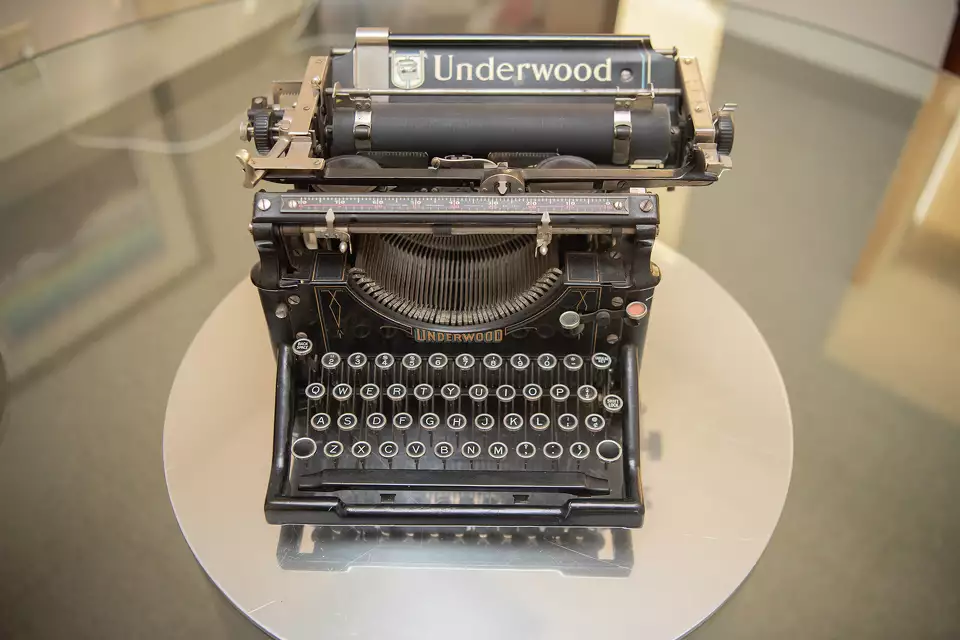
William Saroyan’s Underwood typewriter, as seen inside the Saroyan archive on Van Ness Avenue in San Francisco, Wednesday, Oct. 16, 2024. Charles Russo/SFGATE
reply to u/No-Entertainer-7217 at https://old.reddit.com/r/typewriters/comments/1k45o89/typewriters_needing_new_ribbons/
"Working but needs new ribbon" is almost always seller's code for I have no idea if it really works, but I'm going to try to sell you this machine for the price of a fully functioning machine that was just serviced by a professional shop despite the fact that I just took it out of grandpa's barn and I'm not sure if the mouse inside is dead or not. Also, I can't afford $10 to replace an old ribbon to truly participate in the charade of the price I'm going to try to fleece you with.
Educate yourself a bit: <br /> - https://boffosocko.com/2025/03/29/first-time-typewriter-purchases-with-specific-recommendations-for-writers/ - buying typewriter ribbon: https://site.xavier.edu/polt/typewriters/tw-faq.html#q1 and https://boffosocko.com/research/typewriter-collection/#Typewriter%20Ribbon - typewriter 101: https://www.youtube.com/playlist?list=PLJtHauPh529XYHI5QNj5w9PUdi89pOXsS
If you want to tell people Tom Hanks taught you to change a typewriter ribbon: https://www.youtube.com/watch?v=GBbsNKaVAB0. There are lots of other YouTube videos out there for specific machines as well as reviews of them.
You can definitely test out a machine without ribbon, but if they're trying to charge you over $100 for a machine, it really should have fresh ribbon.
https://www.recordholders.org/en/records/typing.html
19,890 pages/1000 ribbons is approximately 19 pages per ribbon.
Olympia Typewriter Spacers 3D printed with TPU Filament by [[Subham Kumar]]
https://www.reddit.com/r/typewriters/comments/1k3jhx1/storage_hunter_simulator_overwood/
"Overwood" typewriter in Storage Hunter Simulator. (An obvious take on an Underwood typewriter, specifically an Underwood Champion.)
https://www.reddit.com/r/typewriters/comments/1k2rus1/typewriter_in_singularity/
Dirty/rusted typewriter seen in the video game Singularity
https://www.reddit.com/r/typewriters/comments/1k322dc/mafia_2002/
Typewriter in video game Mafia (2002).
I was able to buy replacement toothed belts from an industrial seller via eBay by measurement. Actual Gates belts. Mine fit a Smith Corona electric 6TE and the part number is 3M315 but once you know the width and length it’s a matter of translating it into a Gates part number.
Typewriter expert shares 8 helpful advice to take care of your typewriter. by [[Mr. & Mrs. Vintage Typewriters]]
Tipp-Ex correction paper
Don't bathe your typewriter
Leave oil to the professionals. "Never oil it." (Wow!) - I get why he says this, but...
In the US, you can get one hundred 4" mascara brushes for around $5. Eye Tees (cottton swabs with a firm point on one end and a flat tip on the other) cost roughly the same. You'll find them at most beauty supply stores or online. These get into tight spaces. Dipped in mineral spirits (or whichever solvent you've come to like), the brush gets the stuff loose and the Tee wipes it away. Blasting air helps as well. Works for me. Others will have other ideas.
via u/scmowner
https://www.reddit.com/r/typewriters/comments/1jyr2hc/the_best_way_to_get_rid_of_all_this_gunk/
Colloquial advice to use 4" mascara brushes as a replacement for a segment pick for cleaning out typewriters.
The store offers maintenance and repair lessons to the public (including Philadelphia school students). The shop hosts poetry nights, open mics, comedy shows and other events. It even offers typewriters to public places such as bookstores, libraries and coffeeshops to bring the machines back into the collective consciousness.
The company used to offer an optional dummy key that attached to the right side of the frame to rest your right pinky. They are hard to find nowdays. You could carve a small wood block to slip over the frame where it can provide a comfortable rest.
quote via the reliable u/ahelper
https://old.reddit.com/r/typewriters/comments/1jvgm5z/feed_pawl_not_engaging_ratchet/
What you're suggesting is certainly doable, and was frequently done in it's day, but it isn't the sort of thing you want to subject yourself to while you're doing your Ph.D. (and probably not even if you're doing it as your stress-releiving hobby on the side.)
I several decades of heavy math and engineering experience and really love typewriters. I even have a couple with Greek letters and other basic math glyphs available, but I wouldn't ever bother with typing out any sort of mathematical paper using a typewriter these days.
Unless you're in a VERY specific area that doesn't require more than about 10 symbols, you're highly unlikely to be pleased with the result and it's going to require a huge amount of hand drawn symbols and be a pain to add in the graphs and illustrations. Even if you had a 60's+ Smith-Corona with a full set of math fonts using their Chageable Type functionality, you'd spend far more time trying to typeset your finished product than it would be worth.
You can still find some typewritten textbooks from the 30s and 40s in math and even some typed lecture notes collections into the 1980s and they are all a miserable experience to read. As an example, there's a downloadable copy of Claude Shannon's master's thesis at MIT from 1940, arguably one of the most influential and consequential masters theses ever written, that only uses basic Boolean Algebra and it's just dreadful to read this way: https://dspace.mit.edu/handle/1721.1/11173 (Incidentally, a reasonable high schooler should be able to read and appreciate this thesis today, which shows you just how far things have come since the 1940s.)
If you're heavily enough into math to be doing a Ph.D. you not only should be using TeX/LaTeX, but you'll be much, much, much happier with the output in the long run. It's also a professional skill any mathematician should have.
As a professional aside, while typewriten mathematical texts may seem like a fun and quirky thing to do, there probably isn't an awful lot of audience that would appreciate them. Worse, most professional mathematicians would automatically take a typescript verison as the product of a quack and dismiss it out of hand.
tl;dr in terms of The Godfather: Buy the typewriter, leave the thesis in LaTeX.
a reply to u/Quaternion253 RE: Typing a maths PhD thesis using a typewriter at https://reddit.com/r/typewriters/comments/1js3cs5/typing_a_maths_phd_thesis_using_a_typewriter/
The majority of American machines (Royal, Remington, Smith-Corona) are 6 lines per inch and either 10 characters per inch (pica) or 12 CPI (elite). My guess would be that you'll see about 90% of people's machines covered across these specs with a roughly 60/40 split for pica vs. elite when it comes to planning print runs.
Most European machines are like the Olympias and are labeled as 2.3 m/m which when multiplied out (25.4mm/inch x 1 character/2.3mm) gives 11.043 CPI. Generally they're also 6 lines per inch. In the US, most of the common (and still popular) imported typewriters are going to be the Olympia SM2, SM3, SM4, SM7, and SM9s and the three incarnations of the Hermes 3000.
I've got a small collection of 50 mostly American machines across six decades with a few less common typefaces including Vogue, Gothic, and Congress Elite if you need some machines for nearby testing (I'm in Altadena, though temporarily still displaced). Most of my available machines are listed at https://typewriterdatabase.com/typewriters.php?hunter_search=7248
There are definitely some smaller 16, 18, 20, and even 24 CPI machines, but they tend to have come on the larger Olympia standards which weigh in at 30-40 pounds and are unlikely to be lugged to ballparks the way that smaller portables and ultraportables might be. There are some larger format 6 CPI machines, but they tend to be much rarer and are more often found on 1970s Smith-Coronas. If you want to go crazy, I'd guess you're aware of Ted Munk's collection of typefaces and catalogs that can be found at: https://typecast.munk.org/category/typewriter-typestylesfonts/
Incidentally, for fun, Bill Madden's book Yankees, Typewriters, Scandals, and Cooperstown: A Baseball Memoir is set for release tomorrow.
Since you sound like a local Dodgers fan, I'd love to invite you to the upcoming SoCal Type-in I'm planning for Saturday, May 10th at Vroman's Bookstore in Pasadena: https://boffosocko.com/2025/03/25/youre-invited-to-a-southern-california-type-in/ I hope you'll have some final versions available by then. 😍
reply posted 2025-04-01 at https://old.reddit.com/r/BaseballScorecards/comments/1jn2475/yes_tom_hanks_does_schlep_a_typewriter_to_ball/
If you're curious about some of the technical details and how the are affected by the distribution of typefaces and sizes, I laid out some of them the other day: https://www.reddit.com/r/BaseballScorecards/comments/1jn2475/comment/mks9rbc/
Lou also has some great examples of scorekeeping across display sizes and level of data in his offerings at https://thirty81press.com/.
The broader issue for most scorers is the limitation to 8.5 x 11" paper which is the most common page size for the ubiquitous portable and ultraportable typewriters from the mid-century. While there are some portables with carriages and platens that might accomodate up to 12" wide paper, they're not super common.
To get machines with wider platens to get 11x14 or 11x17, you're going to need the significantly larger standard machines and unless you're rich enough to have a suite that you can securely store one in or a journalist with your own booth, not many baseball fans are going to cart a 35-45+ pound typewriter with them to all their games. Though this wouldn't prevent the fan viewing at home from scoring this way easily. My example above was done on a standard width carriage on a standard machine, but I did have several options to do it on a 12", 14", and even two 16" standard typewriters. Interestingly, most of my larger carriage machines are elite 12/6 (12CPI with 6 lines/inch) formats, and I don't think Lou has designed yet for that standard which would allow for an additional 15 characters to be distributed amidst the columns (while still keeping a minimum of 1/2" margins for some balanced white space). I'll be tinkering around with some of this myself in the coming week or so on 11x14" paper using a 15" wide platen on an elite machine to see how things might look.
Perhaps a modified format at 8.5 x 11 that alternates the teams and splits a 12 inning game format across three sheets so that the typist can type down a single page without swapping sheets every half inning and realigning their page every time? But this would cause a lot of formating change versus traditional layouts to do so.
I've also been tinkering with using small space characters like the - and the _ to indicate data (with or without the use of the variable line spacing mechanism) for things like tracking RBIs. The underline is particularly useful for this in Lou's three space layout.
Old school repair guys used a lot of different stuff that's no longer available due to being... Not good. Ha. But naphta was one that's still widely available as white gas aka "coleman/camping fuel" Essentially naphtha with stabilizers to keep it from going bad. Mineral spirits works as well, but naphtha leaves less residue in my experience. Lacquer thinner is good for especially stubborn crap and cleaning slugs, but evaporates really fast and the fumes are no bueno. Alternatively; non toxic degreasing cleaners like simple green are usually my preferred method of cleaning up especially gross machines. Typically very safe on paint finishes and internals, just make sure to keep it off the decals. (It can and WILL erase them if it sits for more than 10 secs) Really though, nothing beats air and a long handled "paint" brush. My air compressor and blow out tube are some of my most cherished tools.
quote from Nashville Typewriter
Unda-Wunda Logo mark trademark<br />

Serial Number 72129754 filed on 12th Oct 1961<br /> Registration Number 740738 registered on 13th Nov 1962
UNDA-WUNDATYPEWRITER PADS, ADDING MACHINE PADS, DUPLICATOR MACHINE PADS AND RELATED OFFICE EQUIPMENT PADS Classification InformationInformation not providedMark DetailsSerial NumberNo 72129755
Serial number 72129755 filed on 1961-10-12<br /> Registration number 744564 registered on 1963-01-29<br /> Expired 1987-09-01
Standard Typewriters - Underwood 5
Portable Typewriters - Hermes 3000 - Smith-Corona Clipper, Sterling, Silent, Silent Supers (5 Series) - Royal Quiet De Luxe - Olympia SM2, SM3, SM4 (Carriage shift)
Ultra Portables - Not recommended
Typewriters for Writers by [[Joe Van Cleave]]
Typewriter 17.2 Blickensderfer Typewriter; the Scientific keyboard 25.6 Burroughs Moon-Hopkins Typewriter/Calculator 01.9 Experiential Typewriter 05.3 Experiential Typewriter 21.0 Henry Mills' Typewriter 17.0 IBM Selectric Typewriter 11.2 Pneumatic Typewriters 45.6 Typewriters, reactionary use of antiquated 21.1 Typewriters: the Comptometer, the Numerograph, the book typewriter 45.2 mechanical typewriter
https://web.archive.org/web/20190305042816/http://www.deadmedia.org/notes/index-cat.html#tw
A Type-In to Say Goodbye to a New England Institution by Scott Cacciola and Jillian Freyer for New York Times 2025-03-24
Wife of Pomp Hall, Negro tenant farmer, writing on typewriter. Through union activities this family has developed a desire for higher education. This typewriter is to them a symbol of that education and as such is the most prized family possession

How Mid-Century 'Emojis' Were Created on Typewriters by [[Lori Dorn]]
Two poets to open a typewriter and book shop in Garfield Park by [[Sophie Young]]
recently opened typewriter repair shops, 2025
Indy Type Shop will be at 2621 Shelby St., which used to be a gun shop and then a cell phone store.
Usually it might have been typewriter shop, gun shop, then cell phone store, so it's intriguing to see the opposite ordering.
where they do things like writing live poetry on typewriters at weddings
There's a few things going on here. Generally at SGW a gray Olympia SM3 in excellent "looking" condition like this one will go for $120-150. This one is also hiding a script typeface which will usually add another $110-150 of value, which would put it at the $300 mark. I'm sort of surprised that the original winner didn't actually pay for it at this price as that's likely what someone would honestly pay for one like this. (It's also possible that they forgot they won or didn't know and didn't pay for it in time too.)
On today's listing, it's far, far more likely that someone wants it and either couldn't get it or pay for it now at the price that it was going to go for in a reasonable auction. They used a throw away accout to make an outrageous bid in hopes that in a week it'll be relisted and no one will notice the script typeface and it'll go for well under $200. (It won't.) This happens incredibly frequently for some of the less common typewriters. Usually it's machines with script or uncommon typefaces or uncommon character sets. Recent auctions for a gold plated Olympia SM3 and a Yellow Royal FP with a Gothic typeface come to mind. I've seen this also happen four or five times in a row before someone ultimately pays for a machine at some reasonable price.
Honestly, SGW should have a policy that the second and third runners up for auctions that don't get paid for by winners should have the right of last refusal on auctions like this to prevent this sort of "gaming" of the system. If you search back in this sub, you'll see this topic coming up every couple of weeks with the same discussions over and over. The common wisdom is that a SGW auction isn't gone until the machine doesn't pop up anymore and actually "sold". And even then, if you wait a week or two, you'll usually see the exact machine pop up less than a month later on eBay being listed by the winner for an exorbitant amount (almost always without having done any additional cleaning or restoration work on it aside from maybe dusting it out.)
Maybe we should add the tag #SGWgaming to all these conversations to make them easier to find?
The long, thin spring-loaded metal flap labeled the "paper conductor" on the SM3 and SM4 and labeled the "erasing table" on the SM2 are all the same part. They serve a few functions.
They can be used for erasing mistakes certainly and help to keep dust and debris from going into the carriage and rollers.
The "paper conductor" description sounds like a fun translation of something from German into English, but this part also prevents the paper which goes under the paper bail and forces it up and back to the paper table and the paper support. Presumably without it, a slightly curved piece of paper might be misrouted to go right back into the platen a second time as the paper advances.
This sort of paper conductor/dust shield can also be found on some later 1960s+ Smith-Corona (SCM) machines. For example, see the Galaxie II which calls that part the erasure table.
Baraniuk, Chris. “‘We Use Them Every Day’: In Some Parts of the US, the Clack of Typewriter Keys Can Still Be Heard.” BBC, March 22, 2025. https://www.bbc.com/future/article/20250321-the-people-who-still-use-typewriters.
Banerjee goes on to admit candidly: "I developed what we call 'typewriter fever'."
Jim Riegert, now in his 70s, remembers what it used to be like. "Back then, typewriters were pretty big. Typewriters and adding machines," he says, referring to desktop calculators. "It got really difficult in the typewriter business about 25 years ago," he says. "The internet was coming on and killing us, too." He runs Typewriters.com and, despite a decline in sales in recent decades, he still shifts four or five electric IBM typewriters every week.
Paul Lundy, who runs Bremerton Office Machine Company, a typewriter repair business in Seattle.
The factory is in Indonesia, he explains, and is run by a team from Nakajima, a typewriter manufacturing firm from Japan. Every year, Royal still sells around 20,000 new electric typewriters and more than double that amount of mechanical typewriters. The latter have become desirable partly as decoration – a librarian might buy one for a display at the front of their library, for instance, suggests Althoff. The mechanical and electric models Royal sells cost between $300 (£238) and $400 (£317).
Todd Althoff is president of Royal, a US company that has been making typewriters since 1904. "We're going to continue," he insists. "Obviously [there is] not that much growth but it's sustainable and we keep the factory busy."
In 2013, jaw-dropping details emerged about the extent of US intelligence agency surveillance programmes. This prompted the Russian Federal Guard Service (FSO) to revert to typewriters in an attempt to evade eavesdropping. German officials were also reported to be considering a similar move in 2014. (During the Cold War, Soviet spies actually developed techniques for snooping on electric typewriter activity, a form of "keylogging" technology – where the keystrokes inputted on a keyboard are captured. US operatives also reconstructed text from typewriter ribbons – meaning that even typewriters aren't completely safe.)
another customer clutching an old typewriter will walk into Mike Marr's shop in Pawtucket, Rhode Island.
Royal Typewriter Family by [[Joe Van Cleave]]
In Typewriter Video Series Episode 321 Joe and Kevin explore the Royal Heritage, Empress and Safari.
The Royal Futura and subsequent Royal Heritage were successor machines to the Royal Quiet De Luxe.
The Empress and the Safari have a sort of Jetsons (1962-1963) aesthetic.
Colloquial collection of typewriter fan names by Kevin and Joe:<br /> Cult of Hermes<br /> Royal Family<br /> Remington Rebels<br /> Smith-Corona Silent Superiors
2025-03-21: edit (spelling)
KoponewtPelicram ❤️ Slug Goblin 3 points4 points5 points 3 hours ago (3 children)Do you know what's the serial number on that? Some manufacturers had special models mostly for export purposes with extra keys. For example Royal 11 is a 10 with extra keys, Underwood No. 46 is a 5/3/6 with extra keys. Remington No. 9 is an 8 with extra keys.
via https://old.reddit.com/r/typewriters/comments/1jgg4kh/royal_kmm_extra_column_of_keys/miyumvn/
Raymond Chandler's Typewriter - Mark Coggins by [[Mark Coggins]]
the lever for later machines was connected with a different sized pin, which makes finding donor machines challenging as pins from the more common newer machines won’t fit the older ones.
It also interesting to note that loss of the carriage return lever is apparently a common problem on Studio 44 Series Is and Series IIs.
Ole Kehlet of Kehlet Typewriter in Sacramento
Sybil Davis—who put the machine up for auction after receiving it from her mother, Jean Vounder-Davis—shared this with me in e-mail correspondence after the auction: He was not a “touch typist.” He preferred the “hunt and peck” system using only his two index fingers I … observed him using it on a daily basis.
Raymond Chandler was not a touch typist.
The machine was produced in four different versions: Series I with a beige body and black round keys borrowed from its more portable sister machine, the Olivetti Lettera 22 Series II with beige body and black ergonomic keys intended to conform better to the user’s fingers Series III with light blue body, grey-blue keys and knobs Studio 44 L with body from former competitor Underwood (Olivetti bought a controlling interest in Underwood in 1959, and completed a full merger in 1963)
variations of the Olivetti Studio 44
The Studio 44 was designed in 1952 by award-winning architect, industrial and graphic designer Marcello Nizzoli in collaboration with engineer Giuseppe Beccio.
Beyond the Type-In by [[Woz Flint]]
If you're a more serious writer, you're sure to find a smoother and better experience with a standard typewriter, but they're slightly larger and heavier (~30 pounds vs. ~15-22 pounds) than the portables. These are usually the ones I recommend if you're writing for several hours and have a dedicated space for your writing. Standards aren't as popular with most collectors, so they also tend to be less expensive.
I really love my Royal KMG, HH, and FP and my Remington Standard and Remington 17 which are all serious machines. Here are some of the other more common standards for serious writers: https://www.youtube.com/watch?v=3r3533cSZ38
Reply to u/RetailThrowAway69 at https://old.reddit.com/r/typewriters/comments/1je4owq/new_typewriter_for_a_keyboard_warrior_of_20_years/
Almost every portable and ultra portable typewriter made from the 1930s onward came with a case that the typewriter locked into. On almost all of these the top of the typewriter case was easily removeable from the base with a spring loaded locking mechanism of some sort. This allowed the user to sit in almost any chair and use the typewriter on their lap. The thin case bottoms prevent dirt and oil from soiling one's clothes.
Beginning in the late 60s/early 70s some manufacturers began making plastic tops that clipped onto the typewriter bodies, but often these are more brittle and prone to breaking/shattering due to the type and age of the plastic. (I'm looking at you Remington Streamliners...)
Our cat used to love "hiding" in the wooden case tops of my 1940s and 1950s Smith-Coronas (Clippers, Sterlings, Silents, Silent Supers).
It's really only the larger and much heavier standard machines that didn't come with cases at all.
Why don't sellers include type samples in their ads? I mean, it's the core function of a typewriter. It's the reason for this machine to exist in the first place. Are these people so ignorant that they only see the decorative aspect of typewriters? I've even seen machines in "perfect working order" for horrendous prices without a type sample. This is so ridiculous. How on earth could I find a machine with a nice typeface? How do I see if a machine is well aligned? And most of these strange people don't even bother to send a type sample on request, because "the ribbon is dry". Dang!
reply to u/andrebartels1988 at https://reddit.com/r/typewriters/comments/1jcsp6t/rant_over_online_sellers/
No, they're either ignorant or actively trying to hide the fact that their machine was bought for $5 at a yard sale and they're trying to match the pricing of pro shops that have cleaned, oiled, adjusted and repaired a machine which far exceeds the misery they're selling because they have absolutely no idea what goes into a good machine.
People doing the work to show type samples and video of their machines are usually far, far more legitimate. These people are also going to give you $2 of new ribbon for free with purchase.
Without a type sample or video, all but the rarest machines aren't worth more than $20.
I found on etsy: TheModernTypewriter that sells ribbons. Are they any good?
I've never used them. They're probably alright. Looks like they're specializing in engraved spools more than anything. My guess is that they're buying ribbon in bulk from Baco or Fine Line and passing along the cost and adding some additional profit.
Here's typical bulk pricing:
nylon ribbon $0.10 - $0.15/yard silk ribobn $0.33 to $0.40/yard cotton ribbon $0.25/yard If you can get a spool's worth of nylon ribbon (16 yards) for about $1.50 to $3, do you really want to pay $8 or more plus shipping? If I'm going to do this (usually for small quantities of custom colored ribbon), I'm going to buy it from a local shop to help support them and keep them open.
There are obviously lots of options you can choose from, ultimately you'll do what works best/quickest/cheapest for you.
Type Shop, EP. 20: Ribbon Colors by [[Typewriter Chicago]]
blue/pink is an excellent color combination as is the blue/green. blue/purple isn't as strong a differentiated color combination as one might hope.
Typewriter Chicago used to carry orange, but doesn't any longer. Maybe again in the future?
Tested 100s of heavy desk typewriters, Here is the top 5 revealed. by [[Mr & Mrs Vintage Typewriters]]
Top Five Standard Typewriters:<br /> - Imperial 55 - Imperial 70 (after this they went to cheaper plastic parts); removable carriage, swappable typefaces; removeable core - Hermes Ambassador - removable carriage - Underwood Standards, esp. 5 - Royal 10 (carriage shift); (and subsequent incarnations like the KH, KMM, KMG, HH, FP) - Olympia SG1 (the "crown jewel" of desktop typewriters)
Also rans: - Olivetti Lexicon, Olivetti Graphica - Contintental m40 & m20 - Mercedes
Cleaning with Air Compressors (testing portable air compressors) by [[Just My Typewriter]]
Sarah Everett uses: - Porter Cable portable air compressor (loud, high powered) - Uses smaller USB chargeable one for smaller jobs: PeroBuno mini car vacuum and compressor with attachments
Sarah Everett recommends the Vogma air duster / air compressor for cleaning out her typewriters. https://amzn.to/3FjqZ76
How to Clean a Typewriter (Apartment Friendly Guide!) by [[Just My Typewriter]]
Remington 5: Learning how to replace feed rollers by [[Just My Typewriter]]
His low rate, $68.50 regardless of the problem, allows Smitty to enjoy the process of fixing a typewriter for its merit rather than its profit. As he simply states, "I'm doing this to stay alive."
The Apothecary's Typewriter by Scott K on 2012-12-14
How I display my typewriters (and a Q&A) by [[Just My Typewriter]]
Sarah uses WD-40 on the black enamel of older 20s-30s era typewriters to clean and polish them.
reply to u/bethcano at https://reddit.com/r/typewriters/comments/1j3z646/whats_a_fair_price_these_days_for_a_hermes_3000/
In the US I've been seeing them go for around $250 based only on photos without any additional information about whether they work or other condition.
Platforms like eBay and ShopGoodwill.com will allow you to search for actual sales (see the advanced settings) and this will give you a much better picture of what the prices are versus people listing them for several hundred more (usually to match the prices of professional shops that are listing theirs in cleaned, oiled, and adjusted condition). (Remember when shopping: Condition is king!)
See:
Keep in mind that prices may be dramatically different in your country based on how ubiquitous they were when they were originally manufactured.
Expect to add $150-200+ for script or rarer typefaces, and another \~$150 if the platen has been recovered.
$550 would not be uncommon if purchasing a pica or elite Hermes 3000 with a standard typeface in generally good cosmetic shape that's been professionally cleaned, oiled, and adjusted by a shop.
https://www.ebay.com/usr/thakseman1
thakseman1
Local writers host ‘typewriter revivals’ by [[Algernon D'Ammassa Las Cruces Bulletin]]
The pair have organized several typewriter “petting zoos,” public events allowing people to try out the machines, and Diven said they have been popular across generations, drawing curiosity and suggesting an alternative to the dominance of digital media.
RARE Japanese Toshiba Typewriter by [[Typewriter Collector]] David Herrera
Glycerine, castor oil, and mineral oil are suitable;€.8. 15 per cent arachis (ground nut) oil, 15 per cent sperm oil, 70 per cent mineraloil.
Apps, E. A. “Typewriter Inks.” In Inks for the Minor Printing Processes and Specialised Applications, p218-221 of xix, 295. 1963. Reprint, London: Hill, 1966. http://archive.org/details/typewriter-inks.
T.H. Dixon and Co. Ltd, are one firm making machines for typewriter ribbon€.
T.H. Dixon & Co. Ltd. manufactured machines for typewriter ribbon processing and had a method for spraying a coating to the edges of ribbons in a special chamber to prevent the edges of the ribbon from fraying. (p219)
A furtherrefinementinmaking two-colourribbonsisthe useofacentreliningmachine, which automatically drawsathininsulatinglineon theribbon.A transparentgumsolutionispumpedbyairpressure througha stainless needle whichpreventsthecolours from running.
Center lining machines are used to make bichrome typewriter ribbon. It operates by drawing an insulating line on the ribbon and transparent gum solution is pumped through a needle using pneumatic pressure to keep the two colors from running into each other.
Theinkisusually appliedhot, the inktroughsbeing heatedbyhot water,ste,orelectricity;insome machinesoil-jacketedinkductsareused.
The pigmentisfrequentlymadeintoapastewithpetroleumjellyoraheavymineraloil,andanaturalorsyntheticwax;thesolublecolour,dissolvedinoleicacid,being thenmixedwiththepasteandthewholethengroundthoroughlyon«three-rollmill.
Theribbonmaybe:(a)impregnatedthroughout,(b)surfacetreated,(c)inkedonesideonly,or (d)inkedonbothsidessimultaneously.
Typewriter ribbon can be inked in four different configurations: - impregnated throughout - surface treatment - inked on one side only - inked on both sides, usually simultaneously
Oftentheribbonsarecutfromawiderclothandtheedgesaresealed(topreventfraying) withasuitable lacquer,e.g.glue,nitrocellulose,etc.
Super Nylexnylon ribbonshavethehorizontalstrandswovenflat,buttheverticalstrandsarecrimpedtofacilitateholdingagreateramountofink.
I dissolved some oil paint in machine oil, in my first tries I used universal machine oil but it was too thick, so I tried sewing machine oil that was much thinner. That worked much better but it was still a bit too thick so I was having some trouble “making it run” along the ribbon, so I used lighter fluid as a thinner. It worked great. I eyeballed everything so I can’t give proportions of the ingredients, in a future more serious attempt I plan to take some measurements.
https://old.reddit.com/r/typewriters/comments/1j1zm4z/easy_out_typewriter_tool/

Apparently for "pulling out typebars when they get stuck"??
sk8rcruz 0 points1 point2 points 2 days ago (0 children)I’ll start by saying I love the database! This link is to my current collection but my sightings and formerly owned have been a lot of fun too.
r/sk8cruz = LaDonna Qualtieri https://typewriterdatabase.com/typewriters.php?hunter_search=6493&collection_search=My+Collection
How a Mechanical Typewriter Works by [[Animagraffs]]
Typewriter Video Series - Episode 74: Choosing Typewriter Bags by [[Joe Van Cleave]]
Late nights at his typewriter turned into blurry mornings, with little to show on paper.
System, the Magazine of Business, volume XLII, Number 6(?), December 1922, p763 an advertisement for the Memindex
There was no office machinery at all–the typewriter was known but scarcely used. Even telephones were rarities. The card index, the filing cabinet, the loose-leaf ledger were all but unknown. Of course there were no calculating machines.
System, the Magazine of Business, volume XLII, Number 5, November 1922, p536, "What 55 Years in Business Taught Me About Managing: The first installment of the biography of John H. Patterson, founder of the National Cash Register Company and Lately Chairman of the Board" by Samuel Crowther.
Correcting Bad Typing Habits with the Smith Corona Electric Typewriter 63024 by [[PeriscopeFilm]]
Motion should happen only at the level of the fingers and not at the wrist or even the arms. Type only with your fingers and not your wrists or arms.
Allow the carriage to glide to complete the carriage return rather than wasting addition time and energy on pushing it all the way. Let the momentum do the work.
Use the paper release when removing letters to reduce wear on your rollers and prevent ripping of the paper.
Drop the paper into the top of the platen and against the paper guide to improve alignment can save time.
Setting the right hand margin will help save huge amounts of time from the transcriptionist looking back and forth to get proper margins otherwise.
Using correct typing for numerals will speed up typing numbers as well.
For the top tabulator, use your index fingers alternately instead of hitting it with your entire hand.
Hugging the keys with your fingers allows you to type faster, much like a drummer keeps the sticks closer to the drumhead when drumming quickly.
Smith Corona Manual Typewriter Shift Lock Adjustment Latch Repair Upper Case Letters by [[Phoenix Typewriter]]
Olympia SM-3 Vintage Typewriter, Repaired Adjusted Shift Lock by [[Phoenix Typewriter]]
Yankees, Typewriters, Scandals, and Cooperstown: A Baseball Memoir by Bill Madden<br /> Release date: April 1, 2025 (hardcover)
https://www.gates.com/us/en.html
Sells belts including v-belts which might be used for typewriter repair parts.
The Hermes 3000 repair manual has a really good section on type alignment including tools, according to Joe Van Cleave. (9:17)
Smith-Corona Electra 220 Typewriter Review by [[Joe Van Cleave]]
Some details about the internal motor workings of SCM electric typewriters.
Typewriter Strike Out Corrections by [[Joe Van Cleave]]
https://www.biedlers-belts.com/single-v-belts/polyflex-belts/ This is about the only place that I have been able to find the small V-Belts used to drive IBM and Smith Corona electric typewriters (among others). You can find most any belt you need on this site if you know its dimensions.
Back in the day people used custom erasers for erasing. They were much harder than the softer erasers in use now, which is why modern pencil and art erasers don't work as well. For some historical methods, see these videos or here.
Secretaries also used small eraser shields to target individual letters, words, or lines. They also used larger curved shields for erasing within carbon copy packs.
Eaton used to make Ko-rec-type tabs which could be inserted for short corrections and it can still be found online as old stock.
There was also bichrome ribbon with white correction tape, but that tends to fleck off and make a mess in your machine over time. Similarly White Out is still made, but it can spill and make a mess while you wait for it to dry.
For modern typists, hand-held correction tape is probably the quickest and easiest.
This could be expanded for the widest range of history on erasing using typewriters with caveats, etc.
reply to u/Fearless_Camera_1788 at https://old.reddit.com/r/typewriters/comments/1ixmz88/how_to_erase/
Remington Rand KMC Standard Typewriter, Ring Style, Noiseless, 1/2", Install, Replace Ink Ribbon by [[Phoenix Typewriter]]
Without the Remington ribbon rings, one can utilize the slots in coordination with grommets to thread up a Remington typewriter.
Remington Standard Typewriter KMC , model 17, How to Change and Set Margin Stops, Demo<br /> by [[Phoenix Typewriter]]
You guessed it, it's the same machine, after suitable application of Scrubbing Bubbles, Pledge, steel wool, Mother's Mag and Aluminum Polish, and touch-up paint.
Highest price you’d spend
reply to u/Pope_Shady at https://old.reddit.com/r/typewriters/comments/1iwrlij/highest_price_youd_spend/
Generally my cap for typewriter purchases is in the $20-35 range. Most of my favorite machines (the standards) were acquired for $5-10 and they're so much better than the portables. At these prices I'm not too worried about the level of work required. I regularly spend 3-4 times more money on a full reel of bulk typewriter ribbon than I do on a typical typewriter.
A few of my more expensive acquisitions: * I went as high as $100 on a machine (including shipping) to get a Royal Quiet De Luxe with a Vogue typeface that turned out to be in about as stunning a condition as one could hope for. * I went to $130 on an Olympia SM3 in part for it's Congress elite typeface as well as an uncommon set of mathematical characters. I'm sure I could have gotten it for significantly less, but wanted to help out the seller and it was in solid condition except for worn bushings. * I also went to around $150 for an (uncommon in the US) early 30's Orga Privat 5 that was in solid shape. I've yet to run into another Orga in the wild in the US since.
It also bears saying that I don't mind buying "barn machines" as a large portion of the fun in collecting for me is cleaning, adjusting, and restoring them to full functionality. I've been dissapointed once to have bought a Remington Quiet-Riter once for $10 only to discover it was in near mint condition and didn't need any work at all.
I am at the point where I'm going to need to start selling machines, work at a local shop, or start my own shop if I'm going to keep up with the "hobby" and maintain a sane spouse simultaneously. If I didn't enjoy wrenching on machines so much, I would definitely be buying them from local shops for significantly more money, and I'd probably have far fewer.
It's not talked about in great length in some typewriter collector spaces, but I think some of the general pricing "game", beyond just getting a "deal", is the answer to the questions: "What am I into this space for anyway? What makes it fun and interesting?" If you don't have the time, talent, tools, or inclination to do your own cleaning and restoration work, then paying $300-$600 for a nice machine in exceptional clean/restored condition from a shop is a totally valid choice and shouldn't be dismissed. Some are in it for the discussions of typewriters. Some are in it for the bargain hunt. Some just want to write. Some want rare gems. Some want common machines from famous writers. Others just want one "good" machine while others want all the machines. It's a multi-faceted space.
Typewriter Algebra by [[Joe Van Cleave]]
The Texting Typewriter (hardware) by [[Sam Christy]]
I'm not out to shame people for their purchases, just to caution uninitiated typewriter purchasers and budding collectors who aren't carefully watching the market.
Olympia SM3s are well-touted and excellent typewriters. They've recently been selling on ShopGoodwill in unknown condition for $120-150 based only on photos.
Earlier today, an Olympia SM3 sold for $334! So what gives? Why did this go for over twice as much as the average? To the uninitiated, the seasoned collector can look at this machine carefully and realize that even without seeing a type sample or a close up photo of the slugs that this machine is quietly hiding a script typeface of some kind. This means that two bidders would have paid an almost $200 premium for a script typeface, and one of them managed to snipe it for $1 with minutes left. Generally I see script machines going for $100-150 over similar machines without script.
Sadly, the high price on this machine earlier in the day may have suckered others into thinking these machines are significantly more valuable as it seems two other Olympia SM3s right after it both went for:<br /> * $202.03 https://shopgoodwill.com/item/222707079 * $202.03 https://shopgoodwill.com/item/222546519
And they were bid over 200 by the same two people while the "smarter" money stopped with bids at $137 on both.
Of course, neither of these later two machines have a script face, but at least two bidders were potentially reeled in by the much higher sales price of the script machine earlier in the day. This means that they've overpayed at least $50 above market for each, possibly thinking that they may have gotten a great deal. Sadly they didn't, they just overpayed the market average. The person who was sniped on both managed to save themselves $100+ today because I imagine they'll be able to get equivalent machines in the coming month for closer to under $150.
Incidentally another later Olympia portable (usually in the $75-120 range) earlier in the day went for a more reasonable $232 with a stated/photographed cursive typeface: https://shopgoodwill.com/item/222546740 This one was a stronger deal in the current market as they only paid about $110 above average for that machine to get the script typeface. The tough part is that because the description stated "cursive", they didn't have the benefit of possibly picking up a script machine with less competition.
While this is an interesting microcosm example of the current (overheated?) typewriter market (at least in the US), I hope all the buyers of these machines enjoy their purchases. If they're your first Olympias, and they need some work to get back to fighting shape, I've put together a guide: https://boffosocko.com/2024/07/14/aggregated-resources-and-playlist-for-a-crash-course-on-the-olympia-sm3-portable-typewriter/
Breakfast Republic in San Diego, California

via https://www.reddit.com/r/typewriters/comments/1iqn5hs/comment/mdakb8r/
I made a template using plastic tablecloths then cut the fabric and glued it on. Not difficult but time consuming.
Just craft/tacky glue. I painted the machine with the glue and applied the fabric.

Cleaning Typewriter Type Slugs by [[Joe Van Cleave]]
JVC recommends 91% isopropyl alcohol (IPA) for cleaning typeslugs.
Brass bristle brushes from Harbor Freight.
Sally's Beauty Supply stiff nylon brush for cleaning typeslugs.
Bergeon Rodico 6033-1 as a cleaning compound (similar to Silly Putty and other older compounds) for typeslugs.


 via
via