Lexicography is the practice of creating books, computer programs, or databases that reflect lexicographical work and are intended for public use.
10,000 Matching Annotations
- Jun 2024
-
en.wikipedia.org en.wikipedia.org
Tags
Annotators
URL
-
-
en.wikipedia.org en.wikipedia.org
-
Linguistic description is often contrasted with linguistic prescription
-
-
en.wikipedia.org en.wikipedia.org
-
(1962) Pale Fire
Based on the 1962 publication date of Pale Fire, it's a leading contender for the project Nabokov might have been working on during his photo session with Carl Mydans for LIFE Magazine in 1958.
-
-
en.wikipedia.org en.wikipedia.org
-
In 1992, Lynx was born as an early Internet web browser. Its ability to provide hypertext links within documents that could reach into documents anywhere on the Internet began the creation of the Web on the Internet.
highlights a significant moment in the history of hypertext, marking the development of Lynx, one of the earliest web browsers that utilized hypertext links to connect documents across the internet, laying the groundwork for the World Wide Web as we know it today.
-
-
en.wikipedia.org en.wikipedia.org
-
Google Wave, later known as Apache Wave, was a software framework for real-time collaborative online editing. Originally developed by Google and announced on May 28, 2009,[1][2][3] it was renamed to Apache Wave when the project was adopted by the Apache Software Foundation as an incubator project in 2010. Wave is a web-based computing platform and communications protocol designed to merge key features of communications media, such as email, instant messaging, wikis, and social networking.[4] Communications using the system can be synchronous or asynchronous. Software extensions provide contextual spelling and grammar checking, automated language translation[2] and other features.[5] Initially released only to developers, a preview release of Google Wave was extended to 100,000 users in September 2009, each allowed to invite additional users. Google accepted most requests submitted starting November 29, 2009, soon after the September extended release of the technical preview. On May 19, 2010, it was released to the general public.[6]
mega bitcoin ripple
-
-
en.wikipedia.org en.wikipedia.org
-
The media attention that Google Knol received at its launch soon dissipated.[4] The site failed to gain a large readership – by mid-2009, Knol as a whole was getting only about 175,000 views a month,[30] compared to Wikipedia, whose views accumulated into the billions. As a result, the financial model behind Knol was never realized.[31] Google stopped promoting Knol,[4] and two years after its inception, few people were aware of Knol's existence.[3] It became apparent that Google had fundamentally misunderstood the reasons for Wikipedia's success.[3]
strange
-
-
en.wikipedia.org en.wikipedia.org
-
7 November 2018 curprev 03:5303:53, 7 November 2018 LuckyLouie talk contribs 20,890 bytes +90 →Conspiracy theories: Clarify from source, per Talk curprev 01:1301:13, 7 November 2018 LuckyLouie talk contribs 20,800 bytes +179 →Conspiracy theories: C/e and add Weinberger source to clarify Project Pandora. Remove Jack Anderson "Operation Pandora" source as unneeded. 6 November 2018 curprev 19:4019:40, 6 November 2018 LuckyLouie talk contribs 20,621 bytes −5 →Conspiracy theories: More accurate to source
this "Lucky" guy must just be interested in conspiracy theories and this very interesting particular topic. I remember him specifically from the original Psychotronics article which appears to have been "obfuscated into oblivion" .... the one I had "tagged" to try and weave a story based on minor revision edits tying large topics together that others might not have seen.
I am of course now attempting to reconstruct a similar thing here. This is a link to my revision history; which is somehow hard to come by without "magic"
-
-
en.wikipedia.org en.wikipedia.org
-
curprev 12:4112:41, 23 June 2023 ReferenceMan talk contribs 166,908 bytes −36 →Remote viewing: Changed Stanford Research Institute to SRI International. Its name changed in 1970, before the event mentioned. undo Tags: Visual edit Mobile edit Mobile web edit Advanced mobile edit
Official annotation, both I and "Cheri Seymour's The Last Circle" indicate this is the appropriate article which the one I was editing in 2014 should have ... logically branched back into. An "Official USSR era program" not related to torture but related to military research and paranormal activity.
-
-
en.wikipedia.org en.wikipedia.org
-
they were answered by Duns Scotus (1264–1308), who "developed the idea of preservative redemption as being a more perfect one: to have been preserved free from original sin was a greater grace than to be set free from sin".[30]
-
-
en.wikipedia.org en.wikipedia.org
-
Termas are of two main kinds: earth treasures and intention, or mind, treasures. A teaching concealed as an intention treasure appears directly within the mind of the tertön in the form of sounds or letters to fulfill the enlightened intention of Padmakara.
intention treasures
for - - terton - tertön - out-tuition - holding a specific intent
tertön

-
treasure revealers known as tertöns
for outtentions
-
-
en.wikipedia.org en.wikipedia.org
-
as a result, one can situate the khôra and, if necessary, lend it a topology, but one can never give it axiomatic form."[12]
khora can bemm mapped topology but not axions
Yes where the map is the territory
-
-
en.wikipedia.org en.wikipedia.org
-
iLike was an online service that allowed users to download and share music.
music sharing 2009
-

-
-
en.wikipedia.org en.wikipedia.org
-
"Reply all" redirects here. For the podcast, see Reply All (podcast).
lol
Tags
Annotators
URL
-
-
en.wikipedia.org en.wikipedia.org
-
en.wikipedia.org en.wikipedia.org
-
Datalog

for datomic
-
-
en.wikipedia.org en.wikipedia.org
-
The reliability of Wikipedia
No one, including me, should have to prove himself or herself to anyone else. Talking about the "reliability of Wikipedia" and allowing people to freely come on the website and enter any information that they wish to enter is very dishonest to readers because there is no truth, for example, about the real past, for example, why people from one country look different from people from another country, instead of something made up.
LiDA101
-
-
en.wikipedia.org en.wikipedia.org
-
In physics and engineering, the quality factor or Q factor is a dimensionless parameter that describes how underdamped an oscillator or resonator is. It is defined as the ratio of the initial energy stored in the resonator to the energy lost in one radian of the cycle of oscillation.[1]

-
-
en.wikipedia.org en.wikipedia.org
-
Literary interpretation has considered the myth of Icarus as a consequence of excessive ambition.[27] An Icarus-related study of the Daedalus myth was published by the French hellenist Françoise Frontisi-Ducroux.[28] In psychology, there have been synthetic studies of the Icarus complex with respect to the alleged relationship between fascination for fire, enuresis, high ambition, and Ascensionism.[29] The term Icarus complex is defined by NGHIALAGI.net as, "A form of overcompensation wherein an individual, due to feelings of inferiority, formulates grandiose aspirations for future achievement despite lacking proper talent, experience, and/or personal connections. Such a person often exhibits elitism fueled by hubris and detachment from social reality."[30] In the psychiatric mind, features of disease were perceived in the shape of the pendulous emotional ecstatic-high and depressive-low of bipolar disorder. Henry Murray having proposed the term Icarus complex, apparently found symptoms particularly in mania where a person is fond of heights, fascinated by both fire and water, narcissistic and observed with fantastical or far-fetched imaginary cognition.[31][32] Seth Godin's 2012 The Icarus Deception, points to the historical change in how Western culture both propagated and interpreted the Icarus myth arguing that "We tend to forget that Icarus was also warned not to fly too low, because seawater would ruin the lift in his wings. Flying too low is even more dangerous than flying too high, because it feels deceptively safe."[33] Each study and analysis of the myth agrees Icarus was too ambitious for his own good.
Still to annotate this.
-
According to scholia on Euripides, Icarus thought himself greater than Helios, the Sun himself, and the god punished him by directing his powerful rays at him, melting the beeswax. Afterwards, it was Helios who named the Icarian Sea after Icarus.[10]
Was Icarus punished by the gods because he thought himself greater than them (Helios)?
-
After Theseus, king of Athens and enemy of Minos, escaped from the labyrinth, King Minos suspected that Icarus and Daedalus had revealed the labyrinth's secrets and imprisoned them—either in a large tower overlooking the ocean or the labyrinth itself, depending upon the account.[1][2] Icarus and Daedalus escaped using wings Daedalus constructed from feathers, threads from blankets, clothes, and beeswax.[3] Daedalus warned Icarus first of complacency and then of hubris, instructing him to fly neither too low nor too high, lest the sea's dampness clog his wings or the sun's heat melt them.[3] Icarus ignored Daedalus's instructions not to fly too close to the sun, causing the beeswax in his wings to melt. Icarus fell from the sky, plunged into the sea, and drowned. The myth gave rise to the idiom, "fly too close to the sun." In some versions of the tale, Daedalus and Icarus escape by ship.[1][4]
Minos suspected Theseus and Daedalus gave the secrets of the labyrinth to Ariadne/Theseus. They were imprisoned. They escaped via wings that Daedalus constructed. Icarus was instructed to not fly too high or too low. Too high, and his wings would be burnt. Too low, and his wings would dampen. Icarus flew too close to the sun, and plunged into the ocean. Hence the idiom "fly too close to the sun".
-
In Greek mythology, Icarus (/ˈɪkərəs/; Ancient Greek: Ἴκαρος, romanized: Íkaros, .mw-parser-output .IPA-label-small{font-size:85%}.mw-parser-output .references .IPA-label-small,.mw-parser-output .infobox .IPA-label-small,.mw-parser-output .navbox .IPA-label-small{font-size:100%}pronounced [ǐːkaros]) was the son of the master craftsman Daedalus, the architect of the labyrinth of Crete.
-
-
en.wikipedia.org en.wikipedia.org
-
Apollonov began five separate university degrees and failed to complete any of them.
This is us goddamnit
-
-
en.wikipedia.org en.wikipedia.org
-
Contents move to sidebar hide (Top) 1Text 2Printing history 3The production process: Das Werk der Bücher Toggle The production process: Das Werk der Bücher subsection 3.1Pages 3.2Ink 3.3Type 3.4Type style 3.5Rubrication, illumination and binding 4Early owners 5Influence on later Bibles 6Forgeries 7Surviving copies Toggle Surviving copies subsection 7.1Substantially complete copies 8Recent history 9See also 10General bibliography 11References 12External links Toggle the table of contents Gutenberg Bible 48 languages العربية閩南語 / Bân-lâm-gúБеларускаяБеларуская (тарашкевіца)БългарскиCatalàČeštinaCymraegDanskDeutschEestiΕλληνικάEspañolEsperantoEstremeñuEuskaraفارسیFrançaisFrysk한국어Հայերենहिन्दीHrvatskiBahasa IndonesiaInterlinguaItalianoעבריתქართულიLatviešuМакедонскиമലയാളംमराठीNederlands日本語Norsk bokmålPolskiPortuguêsРусскийSimple EnglishSlovenčinaСрпски / srpskiSuomiSvenskaதமிழ்TürkçeУкраїнськаاردو中文 Edit links ArticleTalk English ReadEditView history Tools Tools move to sidebar hide Actions ReadEditView history General What links hereRelated changesUpload fileSpecial pagesPermanent linkPage informationCite this pageGet shortened URLDownload QR codeWikidata item Expand allEdit interlanguage links Print/export Download as PDFPrintable version In other projects Wikimedia Commons From Wikipedia, the free encyclopedia Earliest major book printed in Europe The copy of the Gutenberg Bible held at the Richelieu - Bibliothèques, musée, galeries. The Gutenberg Bible, also known as the 42-line Bible, the Mazarin Bible or the B42, was the earliest major book printed in Europe using mass-produced metal movable type. It marked the start of the "Gutenberg Revolution" and the age of printed books in the West. The book is valued and revered for its high aesthetic and artistic qualities[1] and its historical significance. The Gutenberg Bible is an edition of the Latin Vulgate printed in the 1450s by Johannes Gutenberg in Mainz, in present-day Germany. Forty-nine copies (or substantial portions of copies) have survived. They are thought to be among the world's most valuable books, although no complete copy has been sold since 1978.[2][3] In March 1455, the future Pope Pius II wrote that he had seen pages from the Gutenberg Bible displayed in Frankfurt to promote the edition, and that either 158 or 180 copies had been printed. The 36-line Bible, said to be the second printed Bible, is also sometimes referred to as a Gutenberg Bible, but may be the work of another printer.[4] Text[edit] Gutenberg Bible in the Beinecke Rare Book & Manuscript Library at Yale University in New Haven, Connecticut The Gutenberg Bible, an edition of the Vulgate, contains the Latin version of the Hebrew Old Testament and the Greek New Testament. It is mainly the work of St Jerome who began his work on the translation in AD 380, with emendations from the Parisian Bible tradition, and further divergences.[5] Printing history[edit] Gutenberg Bible of the New York Public Library; purchased by James Lenox in 1847, it was the first Gutenberg Bible to be acquired by a United States citizen. While it is unlikely that any of Gutenberg's early publications would bear his name, the initial expense of press equipment and materials and of the work to be done before the Bible was ready for sale suggests that he may have started with more lucrative texts, including several religious documents, a German poem, and some editions of Aelius Donatus's Ars Minor, a popular Latin grammar school book.[6][7][8] Preparation of the Bible probably began soon after 1450, and the first finished copies were available in 1454 or 1455.[9] It is not known exactly how long the Bible took to print. The first precisely datable printing is Gutenberg's 31-line Indulgence which certainly existed by 22 October 1454.[10] Gutenberg made three significant changes during the printing process.[11] Spine of the Lenox copy Some time later, after more sheets had been printed, the number of lines per page was increased from 40 to 42, presumably to save paper. Therefore, pages 1 to 9 and pages 256 to 265, presumably the first ones printed, have 40 lines each. Page 10 has 41, and from there on the 42 lines appear. The increase in line number was achieved by decreasing the interline spacing, rather than increasing the printed area of the page. Finally, the print run was increased, necessitating resetting those pages which had already been printed. The new sheets were all reset to 42 lines per page. Consequently, there are two distinct settings in folios 1–32 and 129–158 of volume I and folios 1–16 and 162 of volume II.[11][12] The most reliable information about the Bible's date comes from a letter. In March 1455, the future Pope Pius II wrote that he had seen pages from the Gutenberg Bible, being displayed to promote the edition, in Frankfurt.[13] It is not known how many copies were printed, with the 1455 letter citing sources for both 158 and 180 copies. Scholars today think that examination of surviving copies suggests that somewhere between 160 and 185 copies were printed, with about three-quarters on paper and the others on vellum.[14][15] The production process: Das Werk der Bücher[edit] A vellum copy of the Gutenberg Bible owned by the U.S. Library of Congress, on display at the Thomas Jefferson Building in Washington, D.C. In a legal paper, written after completion of the Bible, Johannes Gutenberg refers to the process as Das Werk der Bücher ("the work of the books"). He had introduced the printing press to Europe and created the technology to make printing with movable types finally efficient enough to facilitate the mass production of entire books.[16] Many book-lovers have commented on the high standards achieved in the production of the Gutenberg Bible, some describing it as one of the most beautiful books ever printed. The quality of both the ink and other materials and the printing itself have been noted.[1] Pages[edit] First page of the first volume: the epistle of St Jerome to Paulinus from the University of Texas copy. The page has 40 lines. The paper size is 'double folio', with two pages printed on each side (four pages per sheet). After printing the paper was folded once to the size of a single page. Typically, five of these folded sheets (ten leaves, or twenty printed pages) were combined to a single physical section, called a quinternion, that could then be bound into a book. Some sections, however, had as few as four leaves or as many as twelve leaves.[17] Gutenberg Bible on display at the U.S. Library of Congress The 42-line Bible was printed on the size of paper known as 'Royal'.[18] A full sheet of Royal paper measures 42 cm × 60 cm (17 in × 24 in) and a single untrimmed folio leaf measures 42 cm × 30 cm (17 in × 12 in).[19] There have been attempts to claim that the book was printed on larger paper measuring 44.5 cm × 30.7 cm (17.5 in × 12.1 in),[20] but this assertion is contradicted by the dimensions of existing copies. For example, the leaves of the copy in the Bodleian Library, Oxford, measure 40 cm × 28.6 cm (15.7 in × 11.3 in).[21] This is typical of other folio Bibles printed on Royal paper in the fifteenth century.[22] Most fifteenth-century printing papers have a width-to-height ratio of 1:1.4 (e.g. 30:42 cm) which, mathematically, is a ratio of 1 to the square root of 2 or, simply, 2 {\textstyle {\sqrt {2}}} . Many suggest that this ratio was chosen to match the so-called Golden Ratio, 1 + 5 2 {\textstyle {\tfrac {1+{\sqrt {5}}}{2}}} , of 1:1.6; in fact the ratios are, plainly, not at all similar (equating to a difference of about 12 per cent). The ratio of 1:1.4 was a long established one for medieval paper sizes.[23] A single complete copy of the Gutenberg Bible has 1,288 pages (4×322 = 1288) (usually bound in two volumes); with four pages per folio-sheet, 322 sheets of paper are required per copy.[24] The Bible's paper consists of linen fibers and is thought to have been imported from Caselle in Piedmont, Italy based on the watermarks present throughout the volume.[25] Ink
we have
FORK LYFT
[
Philosophy BreakYour home for learning about philosophy
](https://philosophybreak.com/)
CoursesReading ListsLatest BreaksAbout UsSign In
[
Courses
Introductory philosophy courses distilling the subject's greatest wisdom.
](https://philosophybreak.com/courses/)
[
Reading Lists
Curated reading lists on philosophy's best and most important works.
](https://philosophybreak.com/reading-lists/)
[
Latest Breaks
Bite-size philosophy articles designed to stimulate your brain.
](https://philosophybreak.com/articles/)
[
About Us
](https://philosophybreak.com/about/)
[
Sign In
](https://academy.philosophybreak.com/)
[
Instagram
](https://www.instagram.com/philosophybreak/)
[
Twitter
](https://twitter.com/philosophybreak)

If a Tree Falls in the Forest, and There's No One Around to Hear It, Does It Make a Sound?
The age-old question of whether a falling tree makes a sound when there's no one around to hear it exploits the tension between perception and reality. This article explores possible answers and their consequences.

By Jack Maden | September 2022
If a tree falls in the forest, and there's no one around to hear it, does it make a sound? Well, if by 'sound' we mean vibrating air, then yes, when the tree falls, it vibrates the air around it.
However, if by 'sound' we mean the conscious noise we hear when our sensory apparatus interacts with the vibrating air, then if no one is around to hear the tree when it falls, there'd be no sensory apparatus for the vibrating air to interact with, and thus no conscious noise would be heard.
So, the answer to this age-old question seems to be simple: it depends on how we define 'sound'. If we define it as 'vibrating air', the falling tree makes a sound. If we define it as a conscious experience, the lonesome falling tree does not make a sound.
There, problem solved.
The point of asking this question, however, is not so that it can be answered quickly and put aside.
Rather, its point is to draw out the rather strange tension between our two very different definitions of the word 'sound'.
On the one hand, we classify sound as a mechanistic process that exists without us, 'out there' in the world. On the other, we regard it as a private conscious experience, its existence entirely dependent on us.
And when you dwell on this latter definition, you realize it doesn't just extend to sounds. Everything we experience --- everything we see, hear, smell, touch, taste --- all of it depends on our sensory apparatus, on us. Without us, our experiences would not exist.
As the great 16th-century astronomer Galileo Galilei put it:
Tastes, odors, colors, and so on... reside only in consciousness. If the living creature were removed, all these qualities would be wiped away and annihilated.
Take away our senses, and the world of our experience would be replaced by a colorless, soundless, odorless, tasteless nothingness. Without us, what remains?
The reason our original question --- When a tree falls in the forest, and there's no one around to hear it, does it make a sound? --- is such a teaser, is because it hits on a deeper question. Namely:
If there was no conscious life, would the physical universe exist?
Our kneejerk reaction to this question might be, 'of course it would'. But let's think about it again: if there was nothing conscious, then nothing would be experienced. There would be nothing resembling anything we call 'existence'. No colors, no sounds, no smells, no tastes, no touch, no sense of time, no sense of space.
In one concise email each Sunday, I break down a famous idea from philosophy. You get the distillation straight to your inbox:
Join 12,000+ Subscribers
💭 One short philosophical email each Sunday. Unsubscribe any time.
Is consciousness more fundamental than matter?
Reflecting on this strange state of affairs, numerous great thinkers have concluded that consciousness must be more fundamental than the 'stuff' that consciousness experiences.

Sponsored By Southwest Airlines

For instance, in his 1710 work, A Treatise Concerning the Principles of Human Knowledge, the philosopher George Berkeley discusses the absurdity of a world existing independently of our conscious minds:
It is indeed an opinion strangely prevailing amongst people that houses, mountains, rivers, and in a word all sensible objects, have an existence natural or real, distinct from their being perceived by the understanding... for what are the forementioned objects but things we perceive by sense? And what do we perceive besides our own ideas or sensations? And is it not plainly repugnant that any one of these or any combination of them should exist unperceived?
On this view, it is absurd to say a lonesome falling tree makes a sound. For Berkeley, it is absurd to say the tree, without a conscious mind there perceiving it, even exists. (You can learn more about his mind-bending arguments for this position in our short explainer piece on Berkeley's subjective idealism, his theory that the world is in our minds).
But to conclude this brief reflection on the tension between perception and reality, consider a comment from the Nobel Prize-winning quantum physicist Max Planck in a 1931 interview (italics added):
I regard consciousness as fundamental. I regard matter as derivative from consciousness. We cannot get behind consciousness. Everything that we talk about, everything that we regard as existing, postulates consciousness.
What do you think? Can we get behind consciousness?
This is a short exploration of themes covered in our celebrated 5-day introduction to philosophy course, Life's Big Questions, in which you can learn thousands of years of philosophy with just 30 minutes of thought-provoking reading per day. Learn more and see if it's for you now:
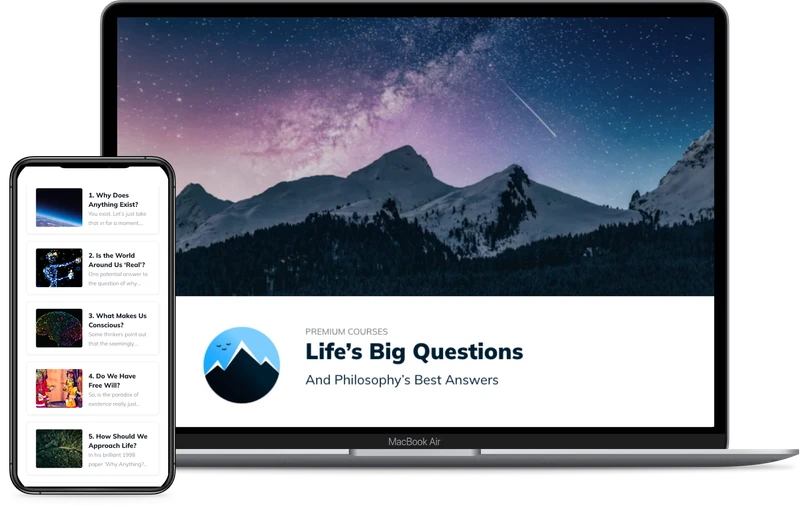
Life's Big Questions: Your Concise Guide to Philosophy's Most Important Wisdom
From why anything exists to how we should live, unlock philosophy's best answers to life's big questions.
★★★★★ (50+ reviews for our courses)
Get one mind-opening philosophical idea distilled to your inbox every Sunday (free):
Join 12,000+ Subscribers
💭 One short philosophical email each Sunday. Unsubscribe any time.
About the Author

Jack MadenFounder\ Philosophy Break
Having received great value from studying philosophy for 15+ years (picking up a master's degree along the way), I founded Philosophy Break in 2018 as an online social enterprise dedicated to making the subject's wisdom accessible to all. Learn more about me and the project here.
If you enjoy learning about humanity's greatest thinkers, you might like my free Sunday email. I break down one mind-opening idea from philosophy, and invite you to share your view.
Subscribe for free here, and join 12,000+ philosophers enjoying a nugget of profundity each week (free forever, no spam, unsubscribe any time).
WEEKLY EMAILS
Get one mind-opening philosophical idea distilled to your inbox every Sunday (free)
From the Buddha to Nietzsche: join 12,000+ subscribers enjoying a nugget of profundity from the great philosophers every Sunday:
Join 12,000+ Subscribers
★★★★★ (50+ reviews for Philosophy Break). Unsubscribe any time.

Take Another Break
Each break takes only a few minutes to read, and is crafted to expand your mind and spark your philosophical curiosity.
[

The Buddha's Four Noble Truths: the Cure for Suffering
7-MIN BREAK
](https://philosophybreak.com/articles/the-buddha-four-noble-truths-the-cure-for-suffering/)
[
Compatibilism: Philosophy's Favorite Answer to the Free Will Debate
10-MIN BREAK
[

The Last Time Meditation: a Stoic Tool for Living in the Present
5-MIN BREAK
[
Nietzsche On Why Suffering is Necessary for Greatness
3-MIN BREAK
](https://philosophybreak.com/articles/nietzsche-on-why-suffering-is-necessary-for-greatness/)
PHILOSOPHY 101
ABOUT US
FOLLOW US
Philosophy Break is an online social enterprise dedicated to making the wisdom of philosophy instantly accessible (and useful!) for people striving to live happy, meaningful, and fulfilling lives. Learn more about us here. To offset a fraction of what it costs to maintain Philosophy Break, we participate in the Amazon Associates Program. This means if you purchase something on Amazon from a link on here, we may earn a small percentage of the sale, at no extra cost to you. This helps support Philosophy Break, and is very much appreciated.
Access our generic Amazon Affiliate link here
Privacy Policy | Cookie Policy
© Philosophy Break Ltd, 2024

https://www.poetryfoundation.org/poems/44272/the-road-not-taken
The Road Not Taken
Launch Audio in a New Window
BY ROBERT FROST
Two roads diverged in a yellow wood,
And sorry I could not travel both
And be one traveler, long I stood
And looked down one as far as I could
To where it bent in the undergrowth;
Then took the other, as just as fair,
And having perhaps the better claim,
Because it was grassy and wanted wear;
Though as for that the passing there
Had worn them really about the same,
And both that morning equally lay
In leaves no step had trodden black.
Oh, I kept the first for another day!
Yet knowing how way leads on to way,
I doubted if I should ever come back.
I shall be telling this with a sigh
Somewhere ages and ages hence:
Two roads diverged in a wood, and I---
I took the one less traveled by,
And that has made all the difference.
n/a
THIS POEM HAS A POEM GUIDE
-
Related
-
-
COLLECTION
Fall Poems
BY THE EDITORS
Poems to read as the leaves change and the weather gets colder.
-
COLLECTION
Common Core State Standards Text Exemplars
BY THE EDITORS
Poems to integrate into your English Language Arts classroom.
-
ARTICLE FOR STUDENTS
How to Make a Poem
BY CM BURROUGHS
The journey from idea to draft.
-
-
Tags
Annotators
URL
-
-
en.wikipedia.org en.wikipedia.org
-
https://en.wikipedia.org/wiki/Retrobright
This process can be used to whiten yellowed plastics.
-
- May 2024
-
en.wikipedia.org en.wikipedia.org
-
The mouse was developed by Apple, but designed by Hovey-Kelley (renamed IDEO in 1991[7]), who built hundreds of prototypes and conducted exhaustive testing with focus groups in order to create an ideal shape for the Lisa mouse.[8] The Lisa mouse was subsequently used as the foundational design for Apple mice, until the introduction of the multi-button design on the Mighty Mouse in 2005.
and it has all-direction ball below
-
-
en.wikipedia.org en.wikipedia.org
-
666
Tags
Annotators
URL
-
-
en.wikipedia.org en.wikipedia.org
-
Death in Venice (German: Der Tod in Venedig) is a novella by German author Thomas Mann, published in 1912.[1]
-
-
en.wikipedia.org en.wikipedia.org
-
Ulysses moves through four emotional stages that are self-revelatory, not ironic: beginning with his rejection of the barren life to which he has returned in Ithaca, he then fondly recalls his heroic past, recognizes the validity of Telemachus' method of governing, and with these thoughts plans another journey.[9]
See Ulysses in relation to cycle in Romanticism: alienation, desire, transfiguration. Journeying for him is a way to transfigure
-
Culler himself views "Ulysses" as a dialectic in which the speaker weighs the virtues of a contemplative and an active approach to life;[8]
-
The ironic interpretations of "Ulysses" may be the result of the modern tendency to consider the narrator of a dramatic monologue as necessarily "unreliable".
-
Scholars disagree on how Ulysses' speech functions in this format; it is not necessarily clear to whom Ulysses is speaking, if anyone, and from what location. Some see the verse turning from a soliloquy to a public address, as Ulysses seems to speak to himself in the first movement, then to turn to an audience as he introduces his son, and then to relocate to the seashore where he addresses his mariners.[5]
To whom does Ulysses speak to?
-
Ulysses has returned to his kingdom, Ithaca, having made a long journey home after fighting in the Trojan War. Confronted again by domestic life, Ulysses expresses his lack of contentment, including his indifference toward the "savage race" (line 4) whom he governs. Ulysses contrasts his present restlessness with his heroic past, and contemplates his old age and eventual death
-
For much of this poem's history, readers viewed Ulysses as resolute and heroic, admiring him for his determination "To strive, to seek, to find, and not to yield".[1] The view that Tennyson intended a heroic character is supported by his statements about the poem, and by the events in his life—the death of his closest friend—that prompted him to write it. In the twentieth century, some new interpretations of "Ulysses" highlighted potential ironies in the poem. They argued, for example, that Ulysses wishes to selfishly abandon his kingdom and family, and they questioned more positive assessments of Ulysses' character by demonstrating how he resembles flawed protagonists in earlier literature.
Is Ulysses a heroic poem? Or, is it selfishness?
-
Most critics, however, find that Tennyson's Ulysses recalls Dante's Ulisse in his Inferno (c. 1320).
Tennyson drawing from Dante's Ulisse?
-
Alfred, Lord Tennyson, author of "Ulysses", portrayed by George Frederic Watts "Ulysses" is a poem in blank verse by the Victorian poet Alfred, Lord Tennyson (1809–1892), written in 1833 and published in 1842 in his well-received second volume of poetry. An oft-quoted poem, it is a popular example of the dramatic monologue. Facing old age, mythical hero Ulysses describes his discontent and restlessness upon returning to his kingdom, Ithaca, after his far-ranging travels. Despite his reunion with his wife Penelope and his son Telemachus, Ulysses yearns to explore again.
Return of Ulysses (old age) to his kingdom, Ithaca. Even after returning home, he wants to explore.
Tags
- dramatic monologue
- To strive, to seek, to find, and not to yield
- 20th century
- Inferno (Dante)
- 1842
- Ulysses
- Dante Alighieri
- Trojan War
- Dwight Culler
- death
- Ithaca
- unreliable narrator
- Ulysses (Tennyson)
- Romanticism
- Poems (Tennyson, 1842)
- selfishness
- open questions
- soliloquy
- 1833
- cycles
- restlessness
- dialectic
- heroism
- Alfred Tennyson
- lyrical object
- old age
- contemplation
Annotators
URL
-
-
en.wikipedia.org en.wikipedia.org
-
o-Toluidine
-
-
en.wikipedia.org en.wikipedia.org
-
Odysseus has traditionally been viewed as Achilles' antithesis in the Iliad:[35] while Achilles' anger is all-consuming and of a self-destructive nature, Odysseus is frequently viewed as a man of the mean, a voice of reason, renowned for his self-restraint and diplomatic skills.
Odysseus as antithesis of Achilles.
Perhaps, Odysseus represent more order, reason, thus logos? Whereas, Achilles is more impulsive, but very powerful, thus more Mythos?
-
When Helen of Troy is abducted, Menelaus calls upon the other suitors to honour their oaths and help him to retrieve her, an attempt that leads to the Trojan War.
-
He is most famous for his nostos, or "homecoming", which took him ten eventful years after the decade-long Trojan War.
-
husband of Penelope
-
In Greek and Roman mythology, Odysseus (/əˈdɪsiəs/ ə-DISS-ee-əs;[1] Greek: Ὀδυσσεύς, Ὀδυσεύς, translit. Odysseús.mw-parser-output .noitalic{font-style:normal}, Odyseús, .mw-parser-output .IPA-label-small{font-size:85%}.mw-parser-output .references .IPA-label-small,.mw-parser-output .infobox .IPA-label-small,.mw-parser-output .navbox .IPA-label-small{font-size:100%}IPA: [o.dy(s).sěu̯s]), also known by the Latin variant Ulysses (/juːˈlɪsiːz/ yoo-LISS-eez, UK also /ˈjuːlɪsiːz/ YOO-liss-eez; Latin: Ulysses, Ulixes), is a legendary Greek king of Ithaca and the hero of Homer's epic poem the Odyssey. Odysseus also plays a key role in Homer's Iliad and other works in that same epic cycle.[2]
-
-
en.wikipedia.org en.wikipedia.org
-
Helen (Ancient Greek: Ἑλένη, romanized: Helénē[a]), also known as Helen of Troy,[2][3][b] in Latin as Helena,[4] beautiful Helen, Helen of Argos, or Helen of Sparta,[5] was a figure in Greek mythology said to have been the most beautiful woman in the world. She was believed to have been the daughter of Zeus and Leda, and was the sister of Clytemnestra, Castor and Pollux, Philonoe, Phoebe and Timandra. She was married to King Menelaus of Sparta "who became by her the father of Hermione, and, according to others, of Nicostratus also."[4] Her abduction by Paris of Troy was the most immediate cause of the Trojan War.
Abduction of Helen—wife of Menelaus—by Paris, as cause of Trojan war.
-
-
en.wikipedia.org en.wikipedia.org
-
en.wikipedia.org en.wikipedia.org
-
Enthusiasm – In enthusiasm – or possession – God is understood to be outside, other than or beyond the believer. A sacred power, being or will enters the body or mind of an individual and possesses it. A person capable of being possessed is sometimes called a medium. The deity, spirit or power uses such a person to communicate to the immanent world
Enthusiasm as a possession by a god. The human functions as the medium for communication (for the god wants to communicate something).
-
Lewis argues that ecstasy and possession are basically one and the same experience, ecstasy being merely one form which possession may take. The outward manifestation of the phenomenon is the same in that shamans appear to be possessed by spirits, act as their mediums, and even though they claim to have mastery over them, can lose that mastery
Ecstasy and possession (enthusiasm) as being the same.
-
Ecstasy, trance – In ecstasy the believer is understood to have a soul or spirit which can leave the body. In ecstasy the focus is on the soul leaving the body and to experience transcendental realities. This type of religious experience is characteristic for the shaman.
Ecstasy and trance as religious experience
-
Skeptics may hold that religious experience is an evolved feature of the human brain amenable to normal scientific study.
Can religious experiences be made scientific? That which is beyond thought (and is wholly subjective)?
See Steven Kotler referencing flow science as making the supernatural ("A gift from gods") into science.
-
Many religious and mystical traditions see religious experiences (particularly the knowledge which comes with them) as revelations caused by divine agency rather than ordinary natural processes. They are considered real encounters with God or gods, or real contact with higher-order realities of which humans are not ordinarily aware.[5
Religious experience as a revelation. As coming into contact with god(s) or other supernatural beings.
-
A religious experience (sometimes known as a spiritual experience, sacred experience, mystical experience) is a subjective experience which is interpreted within a religious framework.[1] The concept originated in the 19th century, as a defense against the growing rationalism of Western society.[2] William James popularised the concept.[2] In some religions, this may result in unverified personal gnosis.[3][4]
Religious experience (also mystical) emerged as a concept in te 19th century due to the dominant discourse of rationalism in the West.
See William James, but also Rilke who had a religious experience when going to Russia (and probably many others).
Tags
- gods
- religious experience
- revelations
- possession
- science
- rationalism
- 19th century
- gnosis
- sacred experience
- God
- William James
- definitions
- enthusiasm
- Rainer Maria Rilke
- medium
- ecstasy
- supernatural
- Steven Kotler
- open questions
- trance
- flow psychology
- subjective experience
- spiritual experience
- mystical experience
- Western rationalism
Annotators
URL
-
-
en.wikipedia.org en.wikipedia.org
-
The Miletus torso (c. 480–470 BC) at the Louvre has been suggested as the poem's subject. "Archaic Torso of Apollo" (German: Archaïscher Torso Apollos) is a sonnet by the Austrian writer Rainer Maria Rilke, published in the collection New Poems in 1908. It opens the collection's second part and is a companion piece to "Early Apollo", which opens the first part. The poem describes the impressions given by the surviving torso of an archaic statue, which for the poet creates a vision of what the intact statue must have been like.
Archaic Torso of Apollo and Early Apollo are part of Rilke his New Poems (1908).
-
The Miletus torso (c. 480–470 BC) at the Louvre has been suggested as the poem's subject.

-
-
en.wikipedia.org en.wikipedia.org
-
Republic of India (ISO: Bhārat Gaṇarājya),[21] is a
hiii
-
-
en.wikipedia.org en.wikipedia.org
-
Andragogy refers to methods and principles used in adult education.[1][2] The word comes from the Greek ἀνδρ- (andr-), meaning "adult male", and ἀγωγός (agogos), meaning "leader of". Therefore, andragogy literally means "leading men (adult males)", whereas "pedagogy" literally means "leading children".[3]
-
-
en.wikipedia.org en.wikipedia.org
-
Pranayama
.
-
-
en.wikipedia.org en.wikipedia.org
-
The Invisible Internet Project (I2P) is an anonymous network layer (implemented as a mix network) that allows for censorship-resistant, peer-to-peer communication.
from: HN chitchatter trystero

what a shame it is so invisible. Roamed around in P2P research space on and off before encountering. Obviouslyu lack of diligence but still
We need I3P InterPlaterary InterPersonal Invisible Project
-
-
en.wikipedia.org en.wikipedia.org
-
Isomorphic JavaScript
x
-
-
en.wikipedia.org en.wikipedia.org
-
The performative mode, the final mode Nichols discusses, is easily confused with the participatory mode, and Nichols remains somewhat nebulous about their distinctions. The crux of the difference seems to lie in the fact that where the participatory mode engages the filmmaker to the story but attempts to construct truths that should be self-evident to anyone, the performative mode engages the filmmaker to the story but constructs subjective truths that are significant to the filmmaker themself. Deeply personal, the performative mode is particularly well-suited to telling the stories of filmmakers from marginalized social groups, offering the chance to air unique perspectives without having to argue the validity of their experiences, as in Marlon Riggs’ 1990 documentary Tongues Untied about his experiences as a gay black dancer in New York City. The departure from a rhetoric of persuasion allows the performative film a great deal more room for creative freedom in terms of visual abstraction, narrative, etc. Stella Bruzzi (2000), by contrast, holds a broader view of the performative mode. Inspired by J. L. Austin’s notion of the performative, which Nichols avoids, Bruzzi argues that documentary films are by default performative because they are “inevitably the result of the intrusion of the filmmaker onto the situation being filmed.” In particular, Bruzzi considers documentaries that foreground the “artificialisation by the camera” perfect examples of the performative mode. Hongjian Wang (2016) extends the discussion of the performative mode by Nichols and Bruzzi to the “performing camera,” which documents by reenacting the subjective perspective of the subjects (not necessarily that of the filmmaker) in the documentary films. By “performing” the point of view of the subjects, the performative documentaries put the audience in the positions of the subjects. Wang further distinguishes between “the empathetic performative mode,” which prompts audience identification with the subjects, and “the critical performative mode,” which provokes the audience to feel disgusted by, angry at, and critical about the subjects.[3] With the filmmaker visible to the viewer, and freed to openly discuss their perspective in regard to the film being made, rhetoric and argumentation return to the documentary film as the filmmaker clearly asserts a message. Perhaps the most famous filmmaker currently working in this documentary mode is Michael Moore. The performative mode is also manifested in ethnographic film, such as "Incidents of Travel in Chichen Itza" by Jeff Himpele and Quetzil Castaneda. In this visual ethnography of cultural event of the spring equinox involving new age tourism at a sacred Maya site in Mexico, the ethnographers both document the event and provide an ethnographic questioning of the meanings that are projected on the physical heritage objects that attract 50,000 tourists to the equinox at Chichen. In this film, unlike the performative documentaries of Michael Moore in which there is a specific take away message and argument, the ethnographic filmmakers create an open-ended, polyphonic film in which the audience is provided greater opportunity to define the meanings, messages, and understandings of what the film represents. In general, documentaries, especially educational documentaries are scripted such that the audience is persuaded to accept a specific lesson or message, the performative mode of documentary is used to break from a monological or monotone understanding not only through the use of dialogical principles of dialogical anthropology, but of experimental ethnography. The Himpele and Castaneda therefore create an ethnographic documentary that expands the idea of experimental ethnography as a set of principles for writing a text to producing and postproducing ethnographic film.
The performative mode of documentary filmmaking constructs subjective truths that resonate with the filmmaker, offering more creative freedom, and can emphasize filmmakers' intrusion, subject's perspectives or ethnographic questioning.
- 🔑 Performative mode often focuses on personal stories.
- 👁 "Tongues Untied" exemplifies this subjective mode.
- 📍 'Performing camera' is reenacting the subjects' perspectives.
- 💬 Bruzzi considers any filmmaking intrusion as performative.
- 👁 "Incidents of Travel in Chichen Itza" is a performative ethnographic film.
-
The observational mode of documentary developed in the wake of documentarians returning to Vertovian ideals of truth, along with the innovation and evolution of cinematic hardware in the 1960s. In Dziga Vertov's Kino-Eye manifestoes, he declared, "I, a camera, fling myself along…maneuvering in the chaos of movement, recording movement, startling with movements of the most complex combinations." (Michelson, O’Brien, & Vertov 1984) The move to lighter 16mm equipment and shoulder mounted cameras allowed documentarians to leave the anchored point of the tripod. Portable Nagra sync-sound systems and unidirectional microphones, too, freed the documentarian from cumbersome audio equipment. A two-person film crew could now realize Vertov’s vision and sought to bring real truth to the documentary milieu. Unlike the subjective content of poetic documentary, or the rhetorical insistence of expositional documentary, observational documentaries tend to simply observe, allowing viewers to reach whatever conclusions they may deduce. Pure observational documentarians proceeded under some bylaws: no music, no interviews, no scene arrangement of any kind, and no narration. The fly-on-the-wall perspective is championed, while editing processes use long takes and few cuts. Resultant footage appears as though the viewer is witnessing first-hand the experiences of the subject: they travel with Bob Dylan to England in D.A. Pennebaker's Dont Look Back [sic] (1967,) suffer the stark treatment of patients at the Bridgewater State Hospital in Frederick Wiseman's Titicut Follies (1967,) and hit the campaign trail with John F. Kennedy and Hubert Humphrey in Robert Drew’s Primary (1960.)
The observational mode of documentary pursues truth through minimal interference with the subject, invoking a fly-on-the-wall perspective.
- 🔑 Observational documentaries arose from Vertovian ideals and 1960s hardware evolutions.
- 💬 Vertov's Kino-Eye manifesto emphasizes capturing complex movements and moments.
- 🔑 Modern equipment enables two-person crews to realize Vertov's vision.
- 🔑 Observational mode rejects music, interviews, scene arrangements and narration.
- 👁 Major examples include D.A. Pennebaker's "Dont Look Back" and Frederick Wiseman's "Titicut Follies".
-
In the participatory mode "the filmmaker does interact with his or her subjects rather than unobtrusively observe them."[1] This interaction is present within the film; the film makes explicit that meaning is created by the collaboration or confrontation between filmmaker and contributor. Jean Rouch's Chronicle of a Summer, 1960, is an early manifestation of participatory filmmaking. At its simplest this can mean the voice of the filmmaker(s) is heard within the film. As Nichols explains "what happens in front of the camera becomes an index of the nature of interaction between filmmaker and subject."[2] According to Nichols (2010), in the participatory mode of documentaries, “the filmmaker becomes a social actor (almost) like any other (almost because the filmmaker retains the camera and with it a degree of potential power and control over events)” (p. 139.) Through interviews, the filmmaker’s voice is shown as it combines contributing material about the story that they are trying to tell. An example of this is the machine invented by Errol Morris called the Interrotron. This machine allows for the subject to engage with the director directly while still being able to look into the lens of the camera
Participatory filmmaking involves active interaction between the filmmaker and subjects within the film.
- 📍 Participatory mode is a filmmaking style where the director interacts with subjects.
- 🔑 The film reflects the collaboration or confrontation between filmmaker and contributor.
- 👁 Jean Rouch's Chronicle of a Summer, 1960, was an early example of participatory filmmaking.
- 💬 Nichols: In participatory mode, the filmmaker becomes a social actor holding a degree of control.
- 👁 The Interrotron by Errol Morris enables direct engagement between subject and director.
-
-
en.wikipedia.org en.wikipedia.org
-
Spleen et Idéal (Spleen and Ideal) Tableaux parisiens (Parisian Scenes) Le Vin (Wine) Fleurs du mal (Flowers of Evil) Révolte (Revolt) La Mort (Death)
6 parts of Les Fleurs du Mal
-
Voyage to Cythera is a part of this collection? Also published in 1857.
-
Les Fleurs du mal (.mw-parser-output .IPA-label-small{font-size:85%}.mw-parser-output .references .IPA-label-small,.mw-parser-output .infobox .IPA-label-small,.mw-parser-output .navbox .IPA-label-small{font-size:100%}French pronunciation: [le flœʁ dy mal]; English: The Flowers of Evil) is a volume of French poetry by Charles Baudelaire.
-
-
en.wikipedia.org en.wikipedia.org
-
A Space-based architecture (SBA) is an approach to distributed computing systems where the various components interact with each other by exchanging tuples or entries via one or more shared spaces.
Exchanging messages
Transition form Actor Model to Human Actor Models
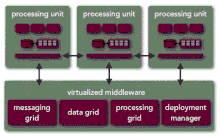
from-"No to SQL? Anti-database movem…" (natishalom.typepad.com)
-
-
en.wikipedia.org en.wikipedia.org
-
en.wikipedia.org en.wikipedia.org
-
Holy Land
Szentföld
-
Crusades
[Crusades]https://hu.wikipedia.org/wiki/Keresztes_h%C3%A1bor%C3%BAk)
-
medieval period
középkor, 11. századtól a 15. századig
-
-
en.wikipedia.org en.wikipedia.org
-
This is a sample annotation
-
-
en.wikipedia.org en.wikipedia.org
-
It was created in 2001
PID Started
Tags
Annotators
URL
-
-
en.wikipedia.org en.wikipedia.org
-
The United States worried that the success of the Creole slaves in gaining freedom would encourage more slave revolts on merchant ships
And they'd lose all the profit they got from enslaving Africans
-
The Bahama islands were inhabited by the Arawak and Lucayans, a branch of the Arawakan-speaking Taíno, for many centuries.[13] Christopher Columbus was the first European to see the islands, making his first landfall in the "New World" in 1492 when he landed on the island of San Salvador.
Wow. I didn't know he first landed in The Bahamas
-
-
en.wikipedia.org en.wikipedia.org
-
Philhellenism ("the love of Greek culture") was an intellectual movement prominent mostly at the turn of the 19th century.
Philhellenism as a return to of Greek culture (see "Hellenism" in the word".
-
-
en.wikipedia.org en.wikipedia.org
-
"The Gods of Greece" ("Die Götter Griechenlandes") is a 1788 poem by the German writer Friedrich Schiller. It was first published in Wieland's Der Teutsche Merkur, with a second, shorter version (with much of its controversial content removed) published by Schiller himself in 1800. Schiller's poem proved influential in light of German Philhellenism and seems to have influenced later German thinkers' views on history, Paganism and myth, possibly including Georg Wilhelm Friedrich Hegel and Max Weber.
-
-
en.wikipedia.org en.wikipedia.org
-
NNTP
nntp
-
but most news administrators will ignore these requests unless a local user requests the group by name.
create groups by a team
-
news.announce.newgroups,
news announc newsgroups
-
RFD (Request For Discussion)
Request for discussion
-
There was a rapid growth of alt.* as a result, and the trend continues to this day. Because of the anarchistic nature with which the groups sprang up, some jokingly referred to ALT standing for "Anarchists, Lunatics and Terrorists" (a backronym).
backronym anarchistic lunatics and terrorists
-
This situation resulted in the creation of an alt.* (short for "alternative") Usenet hierarchy,
alt.usenet hierarchy
-
n the Great Renaming of 1986–1987,
great renaming
-
comp.* — Discussion of computer-related topics news.* — Discussion of Usenet itself sci.* — Discussion of scientific subjects rec.* — Discussion of recreational activities (e.g. games and hobbies) soc.* — Socialising and discussion of social issues. talk.* — Discussion of contentious issues such as religion and politics. misc.* — Miscellaneous discussion—anything which does not fit in the other hierarchies.
main topic hierarcies
-
the early community was the pioneering computer society
pioneering computer society
-
The news admin (the administrator of a news server)
news admin
-
regarding anything a member chooses to discuss as on-topic
on-topic
-
called a "post".
hence hyperpost
-
usenet
-
maintain a level of robust data persistence
rubust persistence
-
Network News Transfer Protocol (NNTP)
ipnntp
-
Typically, the newsgroup is focused on a particular topic of interest.
topic of interest
-
-
en.wikipedia.org en.wikipedia.org
-
http://www.rfc-editor.org/
x
-
typewrote

-
Request for Comments
x
-
-
en.wikipedia.org en.wikipedia.org
-
en.wikipedia.org en.wikipedia.org
-
en.wikipedia.org en.wikipedia.org
-
absence of online connectivity
re-imagining online connectivity
autonomous interpersonal usenet newesgroups
-
discussion groups, known as newsgroups,
reimagining newsgroups
-
-
en.wikipedia.org en.wikipedia.org
-
ifurcation of merging"
hmmm
-
awesome page
-
-
en.wikipedia.org en.wikipedia.org
-
en.wikipedia.org en.wikipedia.org
-
but their confidence level is still below that of high performers
Key
-
Nor does it claim that people lacking a given skill are as confident as high performers
Key
-
which people with limited competence
Key
-
positive prior beliefs about one's skills are the source of false self-assessment
Key
-
inhibit people from addressing their shortcomings
Key
-
engaging in dangerous behavior
Key
-
systematic tendency to engage in erroneous forms of thinking and judging
Key
-
the tendency of highly skilled people to underestimate their abilities relative to the abilities of others
Key
-
incompetence often includes being unable to tell the difference between competence and incompetence
Key
-
people with low intelligence
Key
-
- Apr 2024
-
en.wikipedia.org en.wikipedia.org
-
wood (especially specific
Oh wow, wood.
-
-
en.wikipedia.org en.wikipedia.org
-
Iphigenia in Tauris (German: Iphigenie auf Tauris) is a reworking by Johann Wolfgang von Goethe of the ancient Greek tragedy Ἰφιγένεια ἐν Ταύροις (Iphigeneia en Taurois) by Euripides.
-
-
en.wikipedia.org en.wikipedia.org
-
In Greek mythology, Iphigenia (/ɪfɪdʒɪˈnaɪ.ə/; Ancient Greek: Ἰφιγένεια, Iphigéneia, [iːpʰiɡéneː.a]) was a daughter of King Agamemnon and Queen Clytemnestra, and thus a princess of Mycenae.
Tags
Annotators
URL
-
-
en.wikipedia.org en.wikipedia.org
-
Sturm und Drang (/ˌʃtʊərm ʊnt ˈdræŋ, - ˈdrɑːŋ/,[1] .mw-parser-output .IPA-label-small{font-size:85%}.mw-parser-output .references .IPA-label-small,.mw-parser-output .infobox .IPA-label-small,.mw-parser-output .navbox .IPA-label-small{font-size:100%}German: [ˈʃtʊʁm ʔʊnt ˈdʁaŋ]; usually translated as "storm and stress"[2]) was a proto-Romantic movement in German literature and music that occurred between the late 1760s and early 1780s. Within the movement, individual subjectivity and, in particular, extremes of emotion were given free expression in reaction to the perceived constraints of rationalism imposed by the Enlightenment and associated aesthetic movements.
Sturm und Drang is an art movement that formed as a result of marching rationalism (see Enlightenment) and valued subjectivity and emotions.
-
-
en.wikipedia.org en.wikipedia.org
-
Prometheus is the creative and rebellious spirit which, rejected by God, angrily defies him and asserts itself; Ganymede is the boyish self which is adored and seduced by God. One is the lone defiant, the other the yielding acolyte. As the humanist poet, Goethe presents both identities as aspects or forms of the human condition.
Prometheus as representing mythos (creativity and rebellion) whereas Zeus represents logos.
-
Both belong to the period 1770–1775. Prometheus (1774)
Is Prometheus (Goethe) published in 1773 or 1774? (Sebastiaan van Bommel making a mistake?)
-
"Prometheus" is a poem by Johann Wolfgang von Goethe, in which the character of the mythic Prometheus addresses God (as Zeus) in misotheist accusation and defiance. The poem was written between 1772 and 1774 and first published in 1789 after an anonymous and unauthorised publication in 1785 by Friedrich Heinrich Jacobi. It is an important work of the Sturm und Drang movement.
-
-
en.wikipedia.org en.wikipedia.org
-
Bette Nesmith Graham (March 23, 1924 – May 12, 1980) was an American typist, commercial artist, and the inventor of the correction fluid Liquid Paper. She was the mother of musician and producer Michael Nesmith of The Monkees.
-
-
en.wikipedia.org en.wikipedia.org
-
Dynastic cycle (traditional Chinese: 朝代循環; simplified Chinese: 朝代循环; pinyin: Cháodài Xúnhuán) is an important political theory in Chinese history. According to this theory, each dynasty of China rises to a political, cultural, and economic peak and then, because of moral corruption, declines, loses the Mandate of Heaven, and falls, only to be replaced by a new dynasty. The cycle then repeats under a surface pattern of repetitive motifs.[1]
Dynasties rising to a peak, then, corrupting, losing Mandate of Heaven, which another dynasty gains.
-
-
en.wikipedia.org en.wikipedia.org
-
BornGiovan Battista Vico(1668-06-23)23 June 1668Naples, Kingdom of NaplesDied23 January 1744(1744-01-23) (aged 75)Naples, Kingdom of Naples
-
Giambattista Vico (born Giovan Battista Vico /ˈviːkoʊ/; .mw-parser-output .IPA-label-small{font-size:85%}.mw-parser-output .references .IPA-label-small,.mw-parser-output .infobox .IPA-label-small,.mw-parser-output .navbox .IPA-label-small{font-size:100%}Italian: [ˈviko]; 23 June 1668 – 23 January 1744) was an Italian philosopher, rhetorician, historian, and jurist during the Italian Enlightenment.
-
-
en.wikipedia.org en.wikipedia.org
-
en.wikipedia.org en.wikipedia.org
-
en.wikipedia.org en.wikipedia.org
-
https://en.wikipedia.org/wiki/Norman_Bel_Geddes
Interestingly, I saw his name and immediately thought of Barbara Bel Geddes and Vertigo.
-
-
en.wikipedia.org en.wikipedia.org
-
averaged vector
Why is the average computed over oberservations and TIME. the result is a scalar not a vector?
-
Considering n {\displaystyle n} vectors V i , i ∈ { 1 , … , n } {\displaystyle V_{i},\,i\in \{1,\ldots ,n\}} of signal samples of length T {\displaystyle T} :
I am confused, why is s_i,k element of of T-dimensional space? It is just a scalar, Vi is element of that space
-
-
en.wikipedia.org en.wikipedia.org
-
https://en.wikipedia.org/wiki/American_Gothic

-
Wood was quoted in this period as stating, "All the good ideas I've ever had came to me while I was milking a cow."[1]
source: Fineman, Mia (June 8, 2005). "The Most Famous Farm Couple in the World: Why American Gothic still fascinates". Slate. http://www.slate.com/articles/arts/art/2005/06/the_most_famous_farm_couple_in_the_world.html
-
-
en.wikipedia.org en.wikipedia.org
-
His main works, which appeared late in 1940 and 1944, are the aforementioned Vom Mythos zum Logos, die Selbstentfaltung des griechischen Denkens von Homer bis auf die Sophistik und Sokrates and Griechische Geistesgeschichte von Homer bis Lukian in ihrer Entfaltung vom mythischen zum rationalen Denken dargestellt, are the result of his Greek studies conducted over several decades.
-
Wilhelm Nestle (.mw-parser-output .IPA-label-small{font-size:85%}.mw-parser-output .references .IPA-label-small,.mw-parser-output .infobox .IPA-label-small,.mw-parser-output .navbox .IPA-label-small{font-size:100%}German: [ˈnɛstlə]; 16 April 1865, Stuttgart, Kingdom of Württemberg – 18 April 1959, Stuttgart) was a German philologist and philosopher.[1]
-
Vom Mythos zum Logos. Die des griechischen Denkens Selbstentfaltung von Homer bis auf die Sophistik und Sokrates. (From Mythos to Logos: The Self-development of Greek Thought from Homer to the Sophistics and Socrates.) 1940. 2nd edition. 1942. Reprint. 1975, 1986.
see English translation: "From Mythos to Logos: The Self-development of Greek Thought from Homer to the Sophistics and Socrates"
-
-
en.wikipedia.org en.wikipedia.org
-
The cTuning Foundation is a global non-profit organization developing a common methodology and open-source tools to support sustainable, collaborative and reproducible research in Computer science and organize and automate artifact evaluation and reproducibility inititiaves at machine learning and systems conferences and journals.[1]cTuning Foundation은 컴퓨터 과학 분야에서 지속 가능하고 협력적이며 재현 가능한 연구를 지원하고 기계 학습 및 시스템 컨퍼런스 및 저널에서 아티팩트 평가 및 재현성 이니셔티브를 구성 및 자동화하기 위한 공통 방법론과 오픈 소스 도구를 개발하는 글로벌 비영리 조직입니다. [1]
Tags
Annotators
URL
-
-
en.wikipedia.org en.wikipedia.org
-
rows correspond to irreducible representations
Why is the number of rows not infinite?
Also do these representations have to be faithful? seems like they don't because the trivial representation is a row of the table.
-
-
en.wikipedia.org en.wikipedia.org
-
Some colleges and universities in the US bring therapy dogs to campus to help students de-stress
This is interesting to me because I am an avid dog lover and have never heard of this. I’m wondering when/if SRJC will incorporate this.
-
-
en.wikipedia.org en.wikipedia.org
-
owned approximately 75,000 acres of land
thats a lot of real estate
75k acres = 117.2 square miles
to put that into perspective, check out this list of US states by landmass. 45/50 states are SMALLER than 117k miles squared.
Only Alaska, Texas, California, Montana and New Mexico are bigger than the Wilkes Bros cults' "private" holdings paid for exclusively by foreign countries.
-
In 2011 they sold their 70% interest in Frac Tech for $3.5 billion.
...to a bunch of Asian and Muslim government-backed billionaires.
link to a de-paywalled Dallas News article
[Wall Street Journal link] (https://archive.ph/F154P)
-
shell company,
not a smoking gun, but also not a good sign. if your intentions are "pure" whilst buying up public lands, why make a crazy huge effort to keep the operation underwraps?
Also, how is it even legal to sell such lands without permission from the electorate?
-
early investors in political commentator Ben Shapiro's media company The Daily Wire
likely an understatement. he was the only funder from what i can tell.
-
The church is not Christian, believing that Yahweh is the only god and that Jesus (called Yahushua) is a separate entity. In early 1952 Charles restricted communion to once a year rather than weekly and moved worship from Sunday to Saturday.
1. Yahweh is the only god
2. Jesus (called Yahushua) is a separate entity
Mormon/JW/Gnosticism 101
The Wilks bro church removed the incriminating page from their website. However, praise the Lord, [it can be found here] https://web.archive.org/web/20210415200245/https://www.halleluyah.org/our-history-1).
Key points
- They were disfellowshipped from a non-"holocaust all the non-orthodox Jews via a premil 3rd temple" church for "[differences] over a point of doctrine concerning the millenium"
It was about 1947 that a few members of the Ramsey Church of Christ, a few miles north of De Leon, Texas, differed from their brethren on a point of doctrine concerning the millennium.
- The pages makes casual reference to a Mormon style Heavenly Father as God (to which I presume both Jesus and Judas, so both good and evil are subservient to)
Unable to find a congregation that matched their convictions, he, Myrtle and their five children continued to meet at home with Charlie’s widow, Annie. For the next decade they met largely alone, joined intermittently by neighbors and friends. Their motivation was simple: to obey THE Heavenly Father. As their understanding of the new and old scriptures changed, they modified their lives and worship accordingly.
-
In 1947, Voy and Myrtle Wilks along with Myrtle's father Charlie Cullen Fenter Fenter were disfellowshipped from the Churches of Christ and founded a church which was at first called simply “A Church of Christ.”
Churches of Christ is already pretty weird before you get into the Wilks Chinese Communist Party oil baron funded spinoff (Assembly of Yahweh - 7th day).
According to that Wikipedia page "[the] Churches of Christ arose in the United States from the Restoration Movement of 19th-century"
In few words, they reject Christianity as understood by most people. The conventional definition of our faith appears to exclude non-trinitarian non-incarnational anti-nicene groups like the more famous restorationist groups: Mormons and Jehova's Witnesses.
-
It teaches that "the true religion is Jewish (not a Gentile religion)" and its members celebrate the Old Testament holidays rather than those related to the New Testament.
I'm not a strict believer in supercessionism whereby all self-identified Jews = bad and gentiles are always good. However, the full-on denial of a new covenant is consistent with the Mormon, JW, gnostic, freemason anti-Paul stance.
It also seems to say Judas was good because the mistrial and murder of Jesus was preordained by God anyway...so Jesus was guilty of blasphemy and the senhedrin was (and is) a legitimate legal body.
-
-
en.wikipedia.org en.wikipedia.org
-
A 2021 study by Brown University estimated that 30,177 veterans of post-9/11 conflicts had died by suicide. When compared to the 7,057 personnel killed in the conflicts, at least four times as many veterans died by suicide than personnel were killed during the post-9/11 conflicts.[10]
-
-
en.wikipedia.org en.wikipedia.org
-
ounger s
hhahaha
-
-
en.wikipedia.org en.wikipedia.org
-
en.wikipedia.org en.wikipedia.org
-
Bayard https://en.wikipedia.org/wiki/Bayard_(legend)
Mentioned in opening episode of Anne with an E (Netflix)
-
-
en.wikipedia.org en.wikipedia.org
-
Consistency models
^
-
Moreover, the ordering is effectively determined by the effects of the operations when they are generated
I don't see how that makes ops "admissible". Simply by reordering we won't get preservation of intent.
E.g.,
"abbcd"
peer1 and peer2 in parallel delete the second duplicate
b.No matter how we order them, we have:
[delete(3), delete(3)]
Intent of peers: "abcd"
Playback of log: 1. "abcd" 2. "abd"
Doesn't look like we preserved the intent - delete(position) is not admissible, in general case. It's context-dependent. No matter the order.
-
Consequently, the total order becomes application specific
Well, it's not 'total order' anymore then, is it?
More like a subjective operations log. See Chronofold.
-
The invocation of every operation is admissible in its execution state
Then we can't have delete(position) operation. As it context-dependent.
I.e., ops need to be self-contained. delete(position) becomes delete(char-id) - whoa, now we have CRDTs.
-
The above CSM model requires that a total order of all objects in the system be specified
I don't see that.
What CSM does, as it seems to me, is to specify/extend the "Intention preservation" of CCI.
Moreover, total order has nothing to do with "intention preservation". Ops that been issued in parallel can be put in total order - yet it does not give convergence of intent.
E.g.,
"abbcd"
And peer1 wants to change
ctoC.Whereas peer2 wants to remove the second
b.[delete(3), delete(4), add(4, char: "a")]
Playing the ops: 1. "abcd" 2. "abc" 3. "abcC"
Intention of
c->Cis not preserve, despite having total order. -
Second, it was defined as operation context-based pre- and post- transformation conditions for generic OT functions
This solution seems to aim to preserve intention (same result of an op in a different context) as trying to capture some host context and try to adopt op+some_context to the target context.
Which seems rather unnecessary if you would transfer op+host_context as is, the receiving party will be able to adopt it.
-
-
en.wikipedia.org en.wikipedia.org
-
Institute in Basic Life Principles (IBLP)<br /> https://en.wikipedia.org/wiki/Institute_in_Basic_Life_Principles
-
-
en.wikipedia.org en.wikipedia.org
-
Chernoff faces, invented by applied mathematician, statistician and physicist Herman Chernoff in 1973, display multivariate data in the shape of a human face. The individual parts, such as eyes, ears, mouth and nose represent values of the variables by their shape, size, placement and orientation. The idea behind using faces is that humans easily recognize faces and notice small changes without difficulty. Chernoff faces handle each variable differently.
If science fiction weren't created by cowards, every time you see a bank of High Tech Screens monitoring some system, there would be a bunch of cartoon faces with expressions subtly animating...
-
-
en.wikipedia.org en.wikipedia.org
-
The name Marathon comes from the legend of Pheidippides, the Greek messenger. The legend states that, while he was taking part in the Battle of Marathon, which took place in August or September 490 BC,[3] he witnessed a Persian vessel changing its course towards Athens as the battle was near a victorious end for the Greek army. He interpreted this as an attempt by the defeated Persians to rush into the city to claim a false victory or simply raid,[4] hence claiming their authority over Greek land. It was said that he ran the entire distance to Athens without stopping, discarding his weapons and even clothes to lose as much weight as possible, and burst
How interesting
-
-
en.wikipedia.org en.wikipedia.org
-
The slogan "Let Your Fingers Do the Walking" refers to use of phone books.
-
-
en.wikipedia.org en.wikipedia.org
-
European Union
This is the description of a union of countries
Tags
Annotators
URL
-
-
en.wikipedia.org en.wikipedia.org
-
Hyperbolic tree

-
- Mar 2024
-
en.wikipedia.org en.wikipedia.org
-
The term 'knowledge work' appeared in The Landmarks of Tomorrow (1959) by Peter Drucker.[12] Drucker later coined the term 'knowledge worker' in The Effective Executive[13] in 1966. Later, in 1999, he suggested that "the most valuable asset of a 21st-century institution, whether business or non-business, will be its knowledge workers and their productivity."
-
-
en.wikipedia.org en.wikipedia.org
-
Edward Teach (alternatively spelled Edward Thatch, c. 1680 – 22 November 1718), better known as Blackbeard, was an English pirate who operated around the West Indies and the eastern coast of Britain's North American colonies.
Blackbeard (Edward Teach) is a real person? See One Piece character and parallels.
-
-
en.wikipedia.org en.wikipedia.org
-
The teaching consisted mainly of instruction in Christian doctrine. Some also taught reading, writing, and math.
Christian doctrine could possibly include restatement (i.e. "when linguistic...shifts over time hinder intelligibility or change the terms of reference [within text]" as quoted from Britannica) and ethics (i.e. understanding how teachings and understood practice in text could be applied to daily life).
-
-
en.wikipedia.org en.wikipedia.org
-
Price becomes a function of the wage expended on scarce capital goods:

-
-
en.wikipedia.org en.wikipedia.org
-
Nepal,[a] officially the Federal Democratic Republic of Nepal,[b] is a landlocked country in South Asia. It is mainly situated in the Himalayas, but also includes parts of the Indo-Gangetic Plain. It borders the Tibet Autonomous Region of China to the north, and India to the south, east, and west, while it is narrowly separated from Bangladesh by the Siliguri Corridor, and from Bhutan by the Indian state of Sikkim. Nepal has a diverse geography, including fertile plains, subalpine forested hills, and eight of the world's ten tallest mountains, including Mount Everest, the highest point on Earth. Kathmandu is the nation's capital and the largest city. Nepal is a multi-ethnic, multi-lingual, multi-religious and multi-cultural state, with Nepali as the official language.
Nepal
-
-
en.wikipedia.org en.wikipedia.org
-
understanding the social practices, institutional forces, and material complexity of how humans and spaces interact
📍aim of sociology of space
-
-
en.wikipedia.org en.wikipedia.org
-
For example, a player entity could have a bullet component added to it, and then it would meet the requirements to be manipulated by some bulletHandler system, which could result in that player doing damage to things by running into them.
When this is properly partitioned and named it is just a set of rules and properties that compose to express complex behaviors.
Just like physics in real life.
-
The normal way to transmit data between systems is to store the data in components, and then have each system access the component sequentially.
If the systems communicate sequencially using data changes to components of entities (state) it seems like order is of concern. This sounds like manual state propagation, can automatic propagation (reactive, propagator) solve ordering and improve efficiency?
-
FLECS
https://www.flecs.dev/flecs/index.html
-
One of those features is the support of the type hierarchy for the components. Each component can have a base component type (or a base class) much like in OOP. A system can then query with the base class and get all of its descendants matched in the resulting entities selection.
Semantic type system can be extremely powerful declarative tool
-
An entity only consists of an ID for accessing components.
Don't we also need some kind of associative store that associates entities ids to components?
-
This eliminates the ambiguity problems of deep and wide inheritance hierarchies often found in Object Oriented Programming techniques that are difficult to understand, maintain, and extend.
How?
-
Systems act globally over all entities which have the required components
This approach is especially suited game engines which operate of a single attribute of all the entities (i.e the position of all entities, shadow of all entities, etc..) and not the overall attributes of a single entity.
-
-
en.wikipedia.org en.wikipedia.org
-
Multiple low data rate signals are multiplexed over a single high-data-rate link, then demultiplexed at the other end.

for
= on - indyplex - inter personal-planetary personal first people centered communication networks
-
-
en.wikipedia.org en.wikipedia.org
-
Multicast

-
-
en.wikipedia.org en.wikipedia.org
-
network multicasting:

-
The namespace is only bounded by the max interest packet size of 8kb and the number of possible unique combinations of characters composing names.
namespace bounded
-
increasing the closeness of mapping between an application's data and its use of the network.
a clear example of integration of concerns
remember multics
multiplexing info-com/mumnic/puta-tion systems
-
names used for local communications may require only local routing (or local broadcast)
local routing
aka
clandestine currier networks
-
-
en.wikipedia.org en.wikipedia.org
-
Several Iranian Buddhist monks, including An Shigao and Bodhidharma, played key roles in the Silk Road transmission of Buddhism and the introduction of Buddhism in China.
Did you know this?
-
-
en.wikipedia.org en.wikipedia.org
-
it normally describes a category of literature, music, or other forms of art or entertainment, based on some set of stylistic criteria
-
"its structure is somewhat superior to…those that have come after, fundamentally flawed as they are by their inclusive and hierarchical taxonomy, which each time immediately brings the whole game to a standstill and produces an impasse"
-
Taxonomy allows for a structured classification system of genre, as opposed to a more contemporary rhetorical model of genre.
Meaning...? Genre isn't a taxonomy because taxonomy requires more structured classification?
-
However, more ambitious efforts to expand the tripartite system resulted in new taxonomic systems of increasing scope and complexity.
-
This taxonomy implies a concept of containment or that an idea will be stable forever.
What do you mean? This taxonomy? which? Does this contradict that it's an intangible taxonomy?
-
In literature, genre has been known as an intangible taxonomy.
-
-
en.wikipedia.org en.wikipedia.org
-
During his stay in Constantinople, Busbecq wrote his best known work, the Turkish Letters, a compendium of personal correspondence to his friend, and fellow Hungarian diplomat, Nicholas Michault, in Flanders and some of the world's first travel literature. These letters, together with Melchior Lorck's woodprints describe his adventures in Ottoman politics and remain one of the principal primary sources for students of the 16th-century Ottoman court
Ogier wrote on his stay describing Ottoman (court) culture
-
In 1554 and again in 1556,[1] Ferdinand named Busbecq ambassador to the Ottoman Empire under the rule of Suleiman the Magnificent. His task for much of the time he was in Constantinople was the negotiation of a border treaty between his employer (the future Holy Roman Emperor) and the Sultan over the disputed territory of Transylvania. He had no success in this mission while Rüstem Pasha was the Sultan's vizier, but ultimately reached an accord with his successor Semiz Ali Pasha.
Ogier was an ambassador mediating between Ferdinand and Suleyman.
-
Ogier Ghiselin de Busbecq
-
-
en.wikipedia.org en.wikipedia.org
-
India, officially
indiaaaa
-
-
en.wikipedia.org en.wikipedia.org
-
Community structure
-
-
en.wikipedia.org en.wikipedia.org
-
John Blackthorne, also known as Anjin-san, is the protagonist of James Clavell's 1975 novel Shōgun. The character is loosely based on the life of the 17th-century English navigator William Adams, who was the first Englishman to visit Japan. The character appears in the 1980 TV miniseries Shōgun, played by Richard Chamberlain,[1] and by Cosmo Jarvis in a 2024 series based on the book.
-
Blackthorne is taken to Lord Toranaga (based on the historical figure, Tokugawa Ieyasu), a daimyō
Yoshi Toranaga is the historical figure Tokugawu leyasu
-
-
en.wikipedia.org en.wikipedia.org
-
William Adams (Japanese: ウィリアム・アダムス, kyūjitai: ウヰリアム・アダムス, Hepburn: Uwiriamu Adamusu) (24 September 1564 – 16 May 1620), better known in Japan as Miura Anjin (Japanese: 三浦按針, "the pilot of Miura"), was an English navigator who, in 1600, was the first Englishman to reach Japan.
Adams was the first Englishman to reach Japan
-
-
en.wikipedia.org en.wikipedia.org
-
The Battle of Köse Dağ was fought between the Sultanate of Rum ruled by the Seljuq dynasty and the Mongol Empire on June 26, 1243, at the defile of Kösedağ, a location between Erzincan and Gümüşhane in modern northeastern Turkey.[10][11] The Mongols achieved a decisive victory.
Battle between Seljuk Sultanate of Rum and Mongols that results in Mongol victory
-
-
en.wikipedia.org en.wikipedia.org
-
The Shi'a Century or Shi'ite Century is a historiographical term sometimes used to describe the period between 945 and 1055, when Shi'a Muslim regimes, most notably the Fatimids and the Buyids, held sway over the central lands of the Islamic world.
Shi'i century is a period between 945 and 1055 where the Buyids and Fatimids held sway (shi'is)
-
-
en.wikipedia.org en.wikipedia.org
-
Ibn Taymiyya [a] (Arabic: ٱبْن تَيْمِيَّة; 22 January 1263 – 26 September 1328)[11] was a Sunni Muslim scholar,[12][13][14] jurist,[15][16] traditionist, ascetic, and proto-Salafi[b] and iconoclastic theologian.[17][14]
-
-
en.wikipedia.org en.wikipedia.org
-
https://en.wikipedia.org/wiki/Georges-Louis_Leclerc,_Comte_de_Buffon
Influenced Jean-Baptiste Lamarck and Georges Cuvier
-