https://www.reddit.com/r/typewriters/comments/1ijiwn0/hermes_10_repair/
2,296 Matching Annotations
- Feb 2025
-
www.reddit.com www.reddit.com
-
www.youtube.com www.youtube.com
-
Replacing the Carriage on a Royal Portable Typewriter by [[Marty Morren]]
-
-
www.m-morren.nl www.m-morren.nl
-
archive.org archive.org
-
Triumph Adler Tippa / Tippa S / Contessa De Luxe Service Manual - T.A. Vertriebs-GmbH Nürnberg<br /> by [[T.A. Vertriebs-GmbH Nürnberg]]
-
-
www.youtube.com www.youtube.com
-
Typewriter Video Series - Episode 231: Petite Toy Typewriter by [[Joe Van Cleave]]
Tags
Annotators
URL
-
-
www.youtube.com www.youtube.com
-
I see a Hermes 3000 typewriter on the shelf behind AOC here. The true "Green New Deal"!
ᔥ[[BonchBomber]] in Spotted on AOC’s shelf : r/typewriters
-
-
www.reddit.com www.reddit.com
-
reply to u/Ill_Tear8308
Not so much that they're proprietary, but the Zephyr, Skyriter, and later Corsairs used the 1 5/8" diameter spools, which fit about 12 yards of ribbon versus the more common universal 2" spools which will hold 16 yards of ribbon.
1/2" wide ribbon should work on this. Sellers include: https://site.xavier.edu/polt/typewriters/tw-faq.html#q1
If you wind it onto pre-existing spools keep in mind that Smith-Coronas typically used eyelets in the ribbon to effect the auto-ribbon reverse, though you could certainly do it manually if you needed to.
There aren't a lot of examples of Empire-Coronas in the typewriter database, so be sure to include your example with photos:
https://typewriterdatabase.com/empire.24.typewriter-serial-number-database
https://typewriterdatabase.com/Empire.-Corona+Skyriter.24.bmys
-
-
www.reddit.com www.reddit.com
-
reply to u/HenRoRo61
Earlier today, in a now-deleted post, someone had posted a question about identifying one of Helen Keller's typewriters based on this video in her archive.
Having done some initial digging, I thought I'd share some of the details I've found for those who may find it interesting.
According to researcher Richard Polt, Helen Keller was known to use both a Hammond and an L.C. Smith no. 5.
As for the Remington Noiseless, it definitely appears to be a mid-century Noiseless Standard with a tabulator. To know the year, you'd need either the specific serial number (to cross check https://typewriterdatabase.com/remington.42.typewriter-serial-number-database) or you'd need many more examples than the Typewriter Database currently has listed under the generic Remington Noiseless.
If you're careful at looking at the design choices and changes in some of the Remington Portables from that time period which would have likely tracked the design changes of their desktop standards, you might be able to extrapolate a closer dating based on the styling, but this will still only give you a dating within a year or so.
The tabulator was at the top of the keyboard by 1937, so you can probably presume it was a model from that point or thereafter until 1954. Most American typewriter manufacturers didn't make machines from '41-45 due to WWII, so you can discard those dates. Remington had moved into thicker/taller plastic keys by the early 1950s, so I would guess her machine was more likely from the late 1940s.
Looking more closely at the Remington Noiseless 10, I'd suggest that this is the most likely set of candidates, particularly in the timeframe of 1946-1947. Hers obviously had the openings in the rear and had the metal covers on the sides (as opposed to glass found on some models). Comparing hers in the film to some of these individual galleries may help to narrow things down with respect to dating.
Perhaps others with more Remington Standard experience, may be able to narrow things down here.
The appraisal of her Remington Noiseless in 1957 was $135.00.
One might find some close noiseless models in the $20-40 range + shipping (these are about 30 pounds and will cost about $35 for shipping) via ShopGoodwill.com. Here are some recent sales for comparison. Based on the video you'll want the bigger, heavier ones (25+ pounds) rather than the smaller portables with cases (usually under 20 pounds). Generally machines purchased this way are reasonably functional, but usually need some cleaning and work to be restored to full functionality.
Unless you're sure they're being sold by repair shops and have been cleaned and are fully functional, don't overspend on potential exemplars on sites like Etsy or eBay which are likely to be only marginally better (aka dusted off) than ShopGoodwill machines, but at 5-10x the price.
Hellen Keller's brailler: https://www.afb.org/HelenKellerArchive?a=d&d=A-HK08-B049-183&e=-------en-20--1--txt--typewriter------3-7-6-5-3--------------0-1
She apparently owned a \~1938 or 1939 Corona Silent as well: https://www.afb.org/HelenKellerArchive?a=d&d=A-HK08-B045-184.1.1&srpos=19&e=-------en-20--1--txt--typewriter------3-7-6-5-3--------------0-1
One might have some luck trying to find a Corona Silent typewriter from that era, but the unique color is going to put a machine like it into the $100-200 range (at a minimum and potentially going up from there depending on the condition) unless you get lucky at a garage sale somewhere.
-
- Jan 2025
-
www.reddit.com www.reddit.com
-
writingball.blogspot.com writingball.blogspot.com
-
Royal Quiet De Luxe after ultrasonic cleaning, blow drying, and lubrication with mineral spirits, Blue Creeper, and a dash of gun oil.
I read this as a mixture of mineral spirits, Blue Creeper and a bit of gun oil which is applied after cleaning as a means of lubricating a typewriter.
-
-
www.reddit.com www.reddit.com
-
I only tend to give my typewriters "names" once they're fully cleaned and generally restored and have used them for a bit to know their "character". An example here is my 1950 Royal KMG (Keset Magic Gray) which I call "Sterling" after the Mad Men character Roger Sterling; I also cleaned the the interior with bourbon as an homage.
Many I refer to by year of manufacture and model name ('55 Clipper or '48 Clipper, for example), particularly when I have several similar looking ones from the same time period. A few have names based on writers who I know have used the same models from roughly the same time period (so I have a '49 Royal QDL I've named "Nabokov"). My '48 Royal QDL I call "Dreyfuss" in honor of the typewriter's industrial designer who lived a few miles away from me.
Others are referred to by shorthands featuring unique characteristics, so I have one called "The Vogue" and another I call the "Math SM3" for it's unique math symbol characters. My Remington 666 is variously either "El Diablo" or "Robert Johnson", whose music I listen to while typing on it. I have a German Orga which I call the "Wonka Machine" as one of its brethren appeared in Willy Wonka's office in Charlie and The Chocolate Factory (1971).
A few I call by the first names of their prior owners as an homage to their history before I became their caretakers.
I call my Royal HH the "HHE" as that's the serial number prefix for my machine which has an elite face.
What you call your own is entirely up to you.
More on typewriters and naming: https://boffosocko.com/2024/05/25/collective-nouns-for-typewriters-and-typists/
Reply to https://old.reddit.com/r/typewriters/comments/1id4y49/how_to_refer_to_a_typewriter/ by r/ich_mag_frettchen
-
-
www.reddit.com www.reddit.com
-
Hi, it depends on the shop and the person doing the work. I diagnose for a flat fee of $20. For manual machines, general cleaning and service is billed at $165 with repairs at $65/hrs plus parts. Teardowns and restorations are billed purely hourly. This job is a total of $1,100 with the teardown as well as a frame weld. The welding required parts prepping, gas fees, post processing... and took about 5 hours total. The rest of the machine is about 15 hours so far. Still have about four to go. So yeah, I'm technically supposed to bill another $400 or so, but I'm going to let that slide since the client is already paying a lot for a machine worth way less. Typewriter repair is expensive, especially when it's done to the level of detail that I go to. Very few shops put this much care and attention into these machines. All that being said, the average job on a manual typewriter at my shop usually runs around $300. Full clean, and usual repairs
Typewriter Chicago / Lucas Dul rates: - Diagnosis for $20 - Manuals: general cleaning and service: $165 - repairs at $65/hour plus parts - average job on manuals runs around $400 - teardowns and restorations billed purely hourly around $55/hour
This example is $1,100 for 5 hours of frame/welding work and 15 hours of tear down, cleaning and re-assembly. He'll likely go 4 hours over, but is discounting it.
-
-
www.youtube.com www.youtube.com
-
Making Custom Typewriter Line Spacings by [[Joe Van Cleave]]
I suspected JVC would have a custom cut platen gear, but he's using a premarked backing sheet to adjust each line to do one and a half line spacing.
Joe mentions that the manual adjustments on each line is a net positive in that it gives him some time to pause and collect his thoughts before continuing writing on each line.
-
-
www.c-span.org www.c-span.org
-
David McCullough on His Typewriter by [[C-SPAN]]
Man shed for writing with a single room of 8' x 12' with 800 books, Royal KMM typewriter, and 2 filing cabinets. He's written every book he's ever done on his Royal KMM.
"It's got 750,000 miles on it."
-
-
www.reddit.com www.reddit.com
-
www.theguardian.com www.theguardian.com
-
‘We’d be stuck’: alarm as UK’s last braille typewriter repairer ponders retirement by [[Matthew Weaver]]
-
Thorpe is often amused by the objects he finds in the machines. “I’ve found pens, memory sticks, house keys, Lego bricks, little rubber toys, all sorts inside,” he says.
I often find things inside typewriters...
-
The machines were first designed in 1951 at Perkins School for the Blind in Boston, Massachusetts, where they have been made ever since.
-
He is sure they can be working again after a paraffin bath to clean up accumulated gunge and some careful plier work to straighten bent keys.
Alan Thorpe cleans his Perkins Braillers in a paraffin bath.
-
-
writingball.blogspot.com writingball.blogspot.com
-
www.youtube.com www.youtube.com
-
Typewriter Basics: End of Page Indicators by [[Joe Van Cleave]]
Handful of methods:<br /> - page gauges (Smith-Corona, some Royals) - paper support arm (adjustable) - notch in paper pan (Hermes & some Silver Seikos) - Platen knobs (requires mod math and adjustable ring) (IBM)
-
-
www.reddit.com www.reddit.com
-
used Molykote DX with my oiler (watchmakers oiler) to apply a small about on the type bars exactly where they pivot, and it did make it much smoother.
-
-
virtualhermans.com virtualhermans.com
-
Lucas Dul does an overview of affordable and available tools for typewriter repair as well as more advanced
Basic Tools
- screwdriver sets
- Carpenter screwdrivers (come to a point) the point can slip and causecam out screws
- Hollow ground - provide the most amount of torque and prevent cam-out problems (also called gunsmith He uses the 0623 Chapman set (the number is the date of international typewriter day) The large tip can be problematic
- long reach screwdriver
- magnetic screwdriver
- tempered stainless steel ruler (as a screwdriver, especially
- microdrivers (usually used for eyeglasses or electronics)
- spring hooks (push/pull)
- Fixture from an embroidery set with length for getting length
- grab hooks
- pliers
- standard needle nose pliers
- 45-90 degree pliers (he uses more often)
- wire cutters (for modifying springs in machines and modifying links in machines)
- parallel draw pieces (with heavy duty cutters)
- Mechanics' wrench set
- prefer cast ones
- socket screwdrivers (fixed hex screwdriver) expecially for shift adjustment on the Royal Ps
- Chapman's has a mini rachet 1/4" socket in it's 0623 set
- Forceps especially a long pair for IBM Selectrics (via Duane Jensen)
- Tweezers
- Blowtorches
- alcohol torches (for heating and bending metal)
- soldering, brazing, and heat shrinking
- small butane torch (cigarette lighter use)
- Oilers with needlepoint applicator (he uses sewing machine oil)
- One can use the surface tension of the oil to place a dot on the tip of a scewdriver (flat head) and then place the dot within a machine with reasonable precision
- MIG Pliers - have cutouts for taking rubber off of old feedrollers (otherwise these pliers are used for welding); he describes it as the nutcracker of the typewriter world
- strap wrench (especially for removing platen knobs to prevent damage)
- knife (butter knife)
- razor blade for trimming rubber (otherwise too thin for other applications)
- flashlight (simple is fine)
- marker (Sharpie)
- marking orientation of removed parts (washes off with alcohol)
- hammer
- retainer clip pliers (especially for IBMs, Brothers, Swintecs) with spare e- and c-clips (some have thumbscrews for minimizing damage to clips) openers are more useful than "closers"
- Bristol wrenches - looks like Allen Keys, but with star cross section for bristol locks in IBM machines
- Hand crank (for IBM Selectrics) thread into the operational cam shaft
Intermediate Tools
- segment bearing rod (good for removing individual typebars)
- drinking straw for ball bearings on royal portables and S-C portables and flat tops staggered 1/2" ball bearings with orbital gear (star-shaped) - snip opposite sides to insert orbital ring and ball bearing for holding and placement in typewriter
- carpenter's pencil for marking
Advanced/Specialty tools
- t-bender for forming metal (exp. thin pieces)
- 9 jaw pliers for bending typebars
- peening pliers (for manipulating and stretching materials)
- wheel benders (he doesn't use often)
- eyelete tool for putting eyelets in typewritter ribbon
- files (small/cheap) widen gaps inside of type guides when necessary or thinning out tight pieces
Very specialized
- Type slug solder jig or solder guide (30:52)
- keyring pliers ($400 and above to purchase)
- multimeter for checking circuit components on electric models. Primarily using Ohm setting to see if current is passing through parts, otherwise they're broken.
Honorable mentions
- center punch for drilling points and new screws
- dental mirror for looking into machines
- spring gauge to set 2lbs for desktop and 1lb for portables
Q&A
air compressors are useful for cleaning
Don't damage screws on older machines.
US used imperial screws until 1940/50s and machines after are all metric.
3 dessert island tools<br /> - screwdrivers, pliers, spring hook
- screwdriver sets
-
- Dec 2024
-
oztypewriter.blogspot.com oztypewriter.blogspot.com
-
On This Day in Typewriter History: Royal’s HH - 'The Greatest New Typewriter of All Time' by [[Robert Messenger]]
-
-
www.youtube.com www.youtube.com
-
what's your deserted island typewriter? (if I had to pick 5 typewriters...)<br /> by [[Just My Typewriter]]
Tags
Annotators
URL
-
-
www.youtube.com www.youtube.com
-
Olympia SM-3 Typewriter Ribbon Lift Adjustment Cuts Off by [[Phoenix Typewriter]]
Adjustment for the tops of letters being cut off, particularly on Olympias and Underwoods. Sometimes happens with the first capitalized letter after typing lowercase.
Tags
Annotators
URL
-
-
www.youtube.com www.youtube.com
-
Royal Quiet Deluxe Typewriter Cuts Off Top of Letters Ribbon Lift Adjusted, Repaired Character Print by [[Phoenix Typewriter]]
If the tops of one or two individual letters is being cut off, it may require forming of the letter's assembly to have it engage with ribbon lift bar a tad earlier.
This is different in form from an on feet adjustment.
-
-
en.wikipedia.org en.wikipedia.org
-
Ultra One, a restoration firm whose specialty product is a de-rusting solution which is designed to remove only rust while leaving the underlying metal, paint and decals intact.
Could Ultra One's rust solution be used on typewriters?
-
-
en.wikipedia.org en.wikipedia.org
-
en.wikipedia.org en.wikipedia.org
-
www.etsy.com www.etsy.com
-
https://www.etsy.com/shop/BrooksawAntiques<br /> Adam of Brooksaw Antiques<br /> Indicates 5 years of typewriter repair experience in an individual listing from eBay.
-
https://www.etsy.com/shop/BrooksawAntiques?section_id=48697210
-
-
www.youtube.com www.youtube.com
-
The 2023 Rover Typewriter: Worst Machine Ever? by [[Typewriter Chicago]]
I know Michaels was carrying the We R Memory Keepers typewriter, but hadn't heard about Home Depot carrying them.
Rover made by Shanghai Weilv Mechanism Company still making typewriters (bad quality control, plastic, poor alignment). These are variously rebadged as: - the Rover - the Royal Epoch - We R Memory Keepers (Michaels, Home Depot) - Royal Classic (metal shell) - Maplefield (Target, Walmart, Michaels) - The Oliver Typewriter Company
Will Davis has determined that they're all based on the Olympia Carina.
-
-
www.reddit.com www.reddit.com
-
I particularly like Austin Typewriter, Ink.'s coat of arms for underlining this point: <image>
-
-
www.reddit.com www.reddit.com
-
(Some summary of ring & cylinder adjustments based on other notes)
A new platen in many cases will help to solve some of the proximal problem, but you'll still have heavy wear on your paper/ribbon and your new platen over time as a result. The first adjustments a pro typewriter repair person would make after installing a new platen would be to check the ring & cylinder, on feet, and motion which can all be subtly out of alignment with a new platen.
Pretty much every typewriter in modern era has adjustment points for this. All three of the machines you name definitely do. You'll find some of the basics and adjustment points for several machines described at https://typewriterdatabase.com/1945-AMES-OAMI-MechanicalTrainingMan.v1-ringcylinder.manual. If you look at the manuals for specific machines that Ted Munk has collected at the typewriterdatabase.com, you'll find how/where to make those adjustments. Several on Polt's website describe the adjustment as well: https://site.xavier.edu/polt/typewriters/tw-manuals.html#servicemanuals
Some sources may describe the adjustment as hammer and anvil as opposed to ring and cylinder.
You're also likely to find YouTube videos on them as well (I'd check Phoenix Typewriter's channel first, though I do recall he mislabeled one once on a S-C Skyriter which was really an on feet/motion adjustment.) Duane's also got a really subtle and uncommon adjustment on a Royal QDL here: https://www.youtube.com/watch?v=KOET0i3DsR8
Gerren gives an adjustment nod for the Olympia SM series here: https://youtube.com/watch?v=2jnC6ODB834&t=670s And here's a blogpost about the adjustment points for an Olympia SF: https://ber10thal.com/blog/repairing-a-1961-olympia-sf/
Related blogposts from Munk for a Brother JP-1:
- https://munk.org/typecast/2022/01/23/adjusting-ring-cylinder-on-a-brother-jp-1/
- https://munk.org/typecast/2013/07/30/typewriter-repair-101-adjusting-vertical-typeface-alignment-segmentbasket-shift-typewriters/
Hopefully your machines and hardware appreciate the finer adjustments and wear better over time as a result.
Happy typing!
-
-
ber10thal.com ber10thal.com
-
The last adjustment I needed to make is sometimes called ring and cylinder. It moves the platen closer or further from the typebars. I think the rubber on the platen over time dried and shrunk a bit. I used this adjustment to move the platen closer in order to get a better type imprint. (note: you have to loosen two screws on each side of the carriage [4 screws] in the next photo before making this adjustment.)
-
-
www.reddit.com www.reddit.com
-
reply to u/Jbhusker at https://old.reddit.com/r/typewriters/comments/1hk15pf/the_frenzy_continues_where_does_it_end/ on an old and rough looking Underwood No. 3 from 1927
The shipping price is suspicious as even Shopgoodwill wouldn't ship it for that low. I do notice some online sellers playing games between machine pricing and shipping. They'll often price a machine lower than "market" and then make up for it with an astronomical shipping price. This example seems to have gone the other way, which may help some novice typewriter purchasers who wouldn't understand that this is a 30# machine.
What's going on in this example does present some interesting analysis of the current market.
Possibilities driving the price here: - Week before Christmas and someone is burning spare cash on a decorative/nostalgic present at the last minute. (I've noticed prices on everything going up in the last two months at a greater than usual clip. I suspect things will come crashing down a bit after the New Year.) - It was photographed well. - Included a video of it actually typing as proof that it "works". - It has the look of having been cleaned up despite the look of old patina which was left to make the machine show its age. Look at the exterior screws which appear cleaned/refinished while portions of the exterior don't. In fact, the underlying servicer (Adam of Brooksaw Antiques) seems to specialize in servicing machines to working order but leaving lots of age and patina on them almost as if they're being aged up on purpose. They've got lots of examples on a variety of socials as well as presences on Etsy and Ebay, which speaks to some level of experience. Given the appearance of experience here, I'd bet the machine shows up in the condition it was shipped. - "New ink" decreases the stress of the buyer on finding it themself (potentially a $30-50 value to the customer) and it only cost the seller $2, because I'm dead certain they bought it in bulk. - The eBay reviews of this shop are stunning over 931 items. The lowest is a 4.9 out of 5, which I'm guessing is someone dinging them on shipping price from an earlier sale where they had more realistic shipping numbers on large standards. - "Military Sand" may possibly have been misinterpreted as this being a mill. It is a great marketing name for the color in any case. - I would guess that the purchaser is buying this as a single showpiece for nostalgia's sake. They're getting the bonus that it works. (Like Kirk, I'm not a big fan of the refurb paint on these.) - Its the week before Christmas...
-
-
www.reddit.com www.reddit.com
-
reply to u/Rocky__1927 at https://old.reddit.com/r/typewriters/comments/1hirzo5/remington_premier/
As Ted Munk has commented on these before, rare is a reach. They're uncommon primarily because they didn't manufacture as many of these as they did of the American Quiet-Riters (or Office- or Letter-Riters). I would suspect it's stamped as made in Great Britain (though actually made in Scotland) after American manufacture moved there in the late 50s/early 60s where they only made them for a short time before switching over to more plastic bodied machines. Probably has a serial number starting with ERP on the frame near the ribbon cup. It's essentially a Quiet-Riter made in Scotland with smooth paint rather than crinkle. Surely some of the manufacturing process and materials will be slightly different/cheaper.
There may be a completist Remington collector who might pay over $100 for it, but I wouldn't think you'd have an easy time getting over $75 for this unless it's in excellent/serviced condition, particularly when ubiquitous QRs with sturdier cases can be had for $10-25 in similar condition.
-
-
www.youtube.com www.youtube.com
-
Typewriter Video Series - Episode 59: Tray Table Typing Hacks by [[Joe Van Cleave]]
-
-
stock.periscopefilm.com stock.periscopefilm.com
-
https://stock.periscopefilm.com/?s=typewriter
Worth indexing a portion of these.
-
-
www.youtube.com www.youtube.com
-
ELEMENTARY TYPING <br /> via Periscope Film #15494
Elementary Typing. 16 mm, Instructional film. Periscope Film, #15494, 1971. https://www.youtube.com/watch?v=7cdyoPu_ASw.<br /> running time: 00:12:06
Produced by Moreland-Latchford Productions, Ltd this informational film from 1971 titled “Elementary Typing” teaches the basics of becoming a good typist. The film features a manual Typemaster, a trade name used by Underwood as far back as the 1930s. This version of the machine featured both red and black ribbons. An electric version is seen at 9:00.
The film is broken down into different sections that focus on different elements of typing from the rhythmic beat of typing to optimal hand positioning as well as how to set up a typewriter. “Elementary Typing” is part of a larger film series related to the art of typing with other titles including “Posture and the Keyboard,” “First Step Typing,” “Machine Techniques,” and “Remedial Typing.” Advisors for the creation of the film include James Treliving Commercial Coordinator North York Board of Education, J.T. Albani East York Board of Education, Sheila Wright Etobicoke Board of Education, and Ronald Thelander Director of Audio-Visual Aids Metropolitan Separate School Board, Toronto. In addition, the film was directed by Rod Maxwell and written by Robert Browning and featured Alex Veltman as the cameraman, Carl Connell as editor, Joe Hayward as production head, and James McCormick as executive producer.
Pink illustrated typewriter on navy blue background (0:09). Outline of topics covered (0:17). A: early rhythm and reading – metronome and hands typing in the background (0:22). Aerial view of hands typing on an 197X Underwood Typemaster model typewriter (0:42). Camera pans words typed on a page (1:27). Close-up of letters being printed onto a page (1:36). Woman sitting at desk typing quickly (2:24). B: Paper Insertion – close-up of typewriter and hand setting the paper guide at the correct place on the paper table (2:35). Explanation of correct form and technique for holding and inserting paper (2:58-4:23). Explanation of paper removal (4:26). Badminton player returning various shots (4:41). Close-up of hands on the typewriter emphasizing the art of positioning (5:07). C: The Shift – explanation of the shift key (5:15-6:30). D: The Carriage Return – close-up of the device (6:32). The woman types and uses the carriage return (6:46-9:00). The Electric Typewriter – comparison between 197X Underwood Type Master manual model and Underwood 765 Type Master electric model typewriter (9:04). Difference between typing strategies (10:03). Benefits of using an electric machine (10:20). Closing credits (11:35).
-
-
www.youtube.com www.youtube.com
-
World's fastest typist in typewriter - Stella Pajunas
140 wpm
Typing with a handkerchief covering the keyboard such that the handkerchief doesn't move.
-
-
www.youtube.com www.youtube.com
-
Ron "Typewriter" Mingo, World's Fastest Typist
Typing letter for letter, word for word, or phrase for phrase.
Using music while typing as motivation.
-
-
oztypewriter.blogspot.com oztypewriter.blogspot.com
-
marybethklatt.substack.com marybethklatt.substack.com
-
www.reddit.com www.reddit.com
-
The markets and level of ubiquity of these items in their heyday are so dramatically different that this is certainly an apples and oranges comparison.
However, if you want to compare the artist/users of the instrument to their machines, which is a way of potentially intuiting a potential answer to your question (one which is highly subjective), you might go by who was using particular typewriters of the time. Here's some data to consider: https://site.xavier.edu/polt/typewriters/typers.html
For that rough era in American-made machines, you'll see peak engineering/manufacturing in the 1950s out of the Smith-Corona Super Silent, the Remington Quiet-Riter, and the Royal Quiet De Luxe. Design, touch, and tuning can all be such subjective measures here so as to heavily Muddy (the) Waters ('52 Gibson Les Paul Gold Top/'58 Fender Telecaster) on style, quality, and popularity amongst the cognoscenti. Peak quality in the 60s had broadly moved to post-war Germany and Italy with machines from Olympia (SM3, 4, 5, 7, etc.) and Olivetti respectively.
For my personal money, in American machines of the time, I love the design and performance of my well-tuned, and mostly restored 1950 Royal KMG. However, the current market certainly wouldn't indicate a broader beloved status for these the way you'll see for Stratocasters. (You'll also find some horribly maintained and un-tuned machines out there on the market, which is why so much of the antique and vintage typewriter market pricing is so wildly out of whack.)
A separate flavor of question certainly, but if you're looking for a solid performing typewriter to pair aesthetically and temporally with a '64 Strat, I'd go with a Royal FP ('57-62) (which came in Royaltone or Pearl Dark Gray smooth, Royaltone or Pearl Light Gray smooth, Willow Green smooth, Sea Blue smooth, Cameo Pink smooth (Petal Pink) , Brushed Aluminum, Sandstone smooth, and Coral Rose) or the smaller Royal Futura 800 ('58-'63).
-
-
www.reddit.com www.reddit.com
-
When it comes to some of the older manual typewriters, condition is king and a big determinant of price. For the budget range you're in, you're more likely to get something in mediocre shape that's going to require some work: cleaning, repairs, parts, other.
Your best bet is to go to a repair shop that sells machines, put your hands on them, try them out, ask lots of questions, then buy your favorite. Your time is worth money and productivity, so buy something you like out of the gate and you'll save a lot in the long run. You'll probably be happier and better off in the long run with something in the £200-400 range. It will also give you something you can start using right away to get your work done rather than faffing about.
Try shops from this list: https://site.xavier.edu/polt/typewriters/tw-repair.html
I'd generally endorse most of the advice on models you'll find in these sources which are geared specifically toward writers, all three sources have lots experience and reasonable bona fides to make such recommendations. (Though they do tend toward some of the more expensive portables rather than the sturdier and more economical standard machines.)
https://www.youtube.com/watch?v=h9dXflhDed0<br /> https://www.youtube.com/watch?v=aKMt-aCHZZk<br /> https://typewriterreview.com/2020/01/10/top-10-writerly-typewriters/
Beyond this Just My Typewriter has a few short videos that'll give you a crash course on Typewriter 101: https://www.youtube.com/playlist?list=PLJtHauPh529XYHI5QNj5w9PUdi89pOXsS
u/jbhusker's advice is solid if you prefer that sort of machine instead.
reply to u/ArcherNF at https://old.reddit.com/r/typewriters/comments/1hdgte4/looking_for_a_recommendation/
-
-
www.reddit.com www.reddit.com
-
used typewriter refurbing magnate
-
-
www.loc.gov www.loc.gov
-
oztypewriter.blogspot.com oztypewriter.blogspot.com
-
typewriterdatabase.com typewriterdatabase.com
-
https://www.reddit.com/user/Jbhusker/<br /> https://typewriterdatabase.com/typewriters.php?hunter_search=7197
same person based on direct message
-
-
typewriterdatabase.com typewriterdatabase.com
-
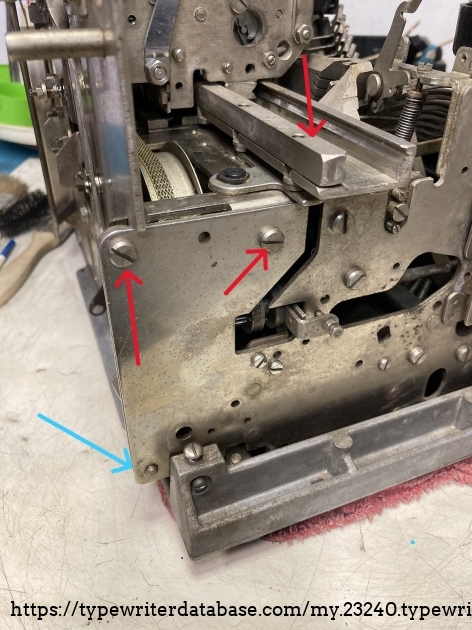
https://typewriterdatabase.com/196x-remington-superriter.23240.typewriter
Annotated photo of Remington's Fold-A-Matic screw locations.
-
-
writingball.blogspot.com writingball.blogspot.com
-
munk.org munk.org
-
www.reddit.com www.reddit.com
-
https://old.reddit.com/r/typewriters/comments/1h4b3aw/is_there_a_source_that_exists_that_sells_or/
If you need them for basic functionality, often you can find the manuals of the original manufacturers' models for rebrands (example: the Sears Tower machines which were really just rebrandings of the Smith-Corona 5 series).
Additionally, after the 1930s there really wasn't a lot of new functionality, so almost any manual will help you to get you where you need to go, though there are some small differences in locations of things like carriage locks which can be helpful to know about and whose placement moved around on various machines.
You might also notice that as typewriters were more ubiquitous in the 60s and 70s their manuals got thinner and thinner with less detail. If you do find a specific manual, you're unlikely to find very much in it.
The Davis Brothers have some history on the Commodore line which was related to some of the Sears Chevron line. Polt does have two Commodore manuals which may be close to your machine: https://site.xavier.edu/polt/typewriters/tw-manuals.html
-
-
www.reddit.com www.reddit.com
-
On the value of typewriters
As a hobbyist, you'll easily obtain several hundred dollars worth of potential diversion and satisfaction out of your alluring typewriter by cleaning, properly oiling, and adjusting it. Then you're guaranteed to both give and receive thousands of dollars worth of happiness out of it by typing letters to family and friends. With practice, you may reap millions by writing stories, plays, poems, screenplays, and books.
Even if your scintillating typewriter sits on a shelf as home decor only to be viewed as a museum piece, you'll have gotten $50 of value for even that lowly function.
You'll only have wasted your money if your wondorous typewriter sits lonely and forgotten in a dusty attic or dank basement to rust and rot away.
Might you have gotten it for less? Perhaps, but you've saved yourself a huge amount of time and effort in such a hunt for a machine as desirous as this. You have it in front of you for writing right now.
So get to typing at once my friend! For time is money, and every moment your fingers aren't caressing its keys, you are losing value.
Congratulations on your stunning find.
reply to u/readysalted344 at https://old.reddit.com/r/typewriters/comments/1h3jyyt/did_i_waste_my_money/
-
- Nov 2024
-
jweberle.com jweberle.com
-
How to Choose a Typewriter for Serious Writing by [[Jonny Eberle]] on 2024-11-24
A good overview of some of the considerations one may want to make when looking for a typewriter.
-
-
www.reddit.com www.reddit.com
-
With respect to your spools, the side you show in the photo should go face down and the "v" cut side should face up. If you don't have one you can find a manual at https://site.xavier.edu/polt/typewriters/RoyalKHM.pdf The Royal standards from the X onward are broadly the same so manuals for the X, KH, KHM, KMM, KMG, HH, FP, Empress, and FP should all be useful too: https://site.xavier.edu/polt/typewriters/tw-manuals.html
-
reply to u/Pawps4895 at https://old.reddit.com/r/typewriters/comments/1h1dcil/help_ink_ribbon_not_moving/
That ghosting effect you're seeing may be down to your typing technique. Computer keyboard typing technique is different than typewriter technique. If you're pressing hard and/or bottoming the keys out, you may not be getting your fingers out of the way and causing the key to double strike while you're lifting your finger up.
Instead, type as if they keys are hot lava. Strike and release them as quickly as possible and that ghosting should clear up. For more on technique, try: https://hypothes.is/users/chrisaldrich?q=tag%3A%22typing+technique%22
If that isn't the issue, is that ghosting happening on all the keys or just a few? Cleaning things out certainly couldn't hurt: https://boffosocko.com/2024/08/09/on-colloquial-advice-for-degreasing-cleaning-and-oiling-manual-typewriters/
-
-
www.usatoday.com www.usatoday.com
-
Clack to the future: Typewriters are pounding out new roles in communities by [[Phaedra Trethan]]
-
Inspired by the discarded typewriters and the ubiquitous construction materials she saw all over Berlin, she created "Writer's Block," an art installation with rebar-caged writing implements placed in Bebelplatz, where in 1933 Nazis burned piles of books.

-
Bryan Kravitz, who specialized in IBM Selectric repairs. Rhoda wanted to learn, too. Kravitz was happy to teach him."I just put my head down, and learned how to do it," Rhoda said, and he partnered with Kravitz to open Philly Typewriter in 2017.
-
Bill Rhoda, co-owner and lead mechanic at Philly Typewriter.
-
-
www.reddit.com www.reddit.com
-
I have never heard of anyone parting out a typewriter
reply to u/EriikE at https://old.reddit.com/r/typewriters/comments/1gypxpa/which_parts_are_still_valuable_for_resell_on_this/lyqq28s/
Generally "parting out" is what typewriter shops do to repair machines that need replacement parts that are no longer manufactured.
The Typewriter Database has a special section for listing machines people are parting out: https://typewriterdatabase.com/typewriters.php?collection_search=Parting+Out
-
-
www.reddit.com www.reddit.com
-
Most Petite typewriters use T4430 or T4431 ribbon (1/4" wide or 6.50mm) which can be found on eBay and other sites. It generally requires original spools.
These were generally carbon/plastic based ribbon.
-
-
www.mortati.com www.mortati.com
-
www.reddit.com www.reddit.com
-
Start of an outline for a longer article on typewriter tools<br /> Suggested by reply to u/Confident_Avocado768 at https://old.reddit.com/r/typewriters/comments/1gy25og/christmas_gift_help/
If they've been doing restoration for a while, try to find out what they already have to avoid duplication. Anyone who's done a few machines is likely to have a lifetime supply of lubricant (it really goes a long way) and is likely to have gone well beyond cotton swabs. The sort of kit you mention would be more appropriate to someone who's recently gotten their first typewriter, not someone who has restored more than a machine or two.
Chances are that you can up the level of their restoration tool bag with a small handful of inexpensive and easy to source options:
- oiler bottles for solvents/cleaning
- spring hook (push)
- spring hook (pull)
- spring hook (captive)
- wiping cloths (cotton)
- nylon, brass, and steel brushes (example; 2 or 3 sets of these are always useful)
- high quality wool mats make a great (soft) surface for working on machines (as well as for typing on). Here's some details and a link to a well-recommended one.
I've documented some of my own versions of these with links at https://boffosocko.com/2024/08/11/adding-to-my-typewriter-toolset/
Slightly more expensive tools that they may not have:
- hollow ground/precision screwdriver set ($35-150)
- Lucas Dul and others often suggest the Chapman typewriter set: https://chapmanmfg.com/products/0623-r-typewriterset
- Others recommend the slightly more ergonomic Weaver multi-bit gunsmith tool kit: https://www.bushnell.com/gunsmithing-tools/driver-and-hammer-sets/multi-bit-tool-kit/WV-849718.html
- Small air compressor ($75-$150) for cleaning out machines
If you really want to shoot the moon and they're into the older vintage machines, you could get them a new pair of keyring pliers: http://mytypewriter.com/hello-qwerty-typewriter-keyring-pliers-kit.aspx
You can also browse Lucas Dul's kit for other ideas via this presentation: https://virtualhermans.com/lucas-dul
Good luck and Merry Christmas! 🪛🛠️🎅🏼🎄
-
-
shopgoodwill.com shopgoodwill.com
-
Useful template for emailing about shipping typewriters
Dear TK:
Quite often typewriters are damaged beyond repair in shipping. This is particularly true of larger/heavier typewriters like this one.
Primary concerns are to prevent movement of the carriage and protecting the carriage knobs and the silver carriage return arm.
Please use an elastic band(s)/rubber band(s) to permanently hold the carriage release lever to the green carriage knob(s). The carriage release lever is the silver piece just above the green knobs on either side of the typewriter carriage (the part that would move back and forth while typing.) This should allow the carriage to move freely back and forth to the right or the left and prevent any damage to the delicate escapement mechanism inside the typewriter.
Next, to prevent damage to the carriage with respect to the heavy metal frame, use plastic wrap or bubble wrap to ensure that the carriage is roughly centered on the typewriter (or flush on the left side) and can’t move back or forth while being shipped.
Finally, ensure appropriate amounts of packing material around the carriage, the knobs, and the return lever to prevent them from being broken or damaged in shipping. In particular, make sure there isn’t any empty space (or dead space) inside the box or the machine is guaranteed to bounce around and break. The box being dropped accidentally from even a foot or two is enough to either bend or break the heavy frame or destroy the carriage. This sort of damage is often what makes what is otherwise a fully functional typewriter a useless boat anchor.
Thanks in advance for your kind assistance in helping this vintage machine reach me in its best condition!
Warmest regards, name
Video example: https://www.youtube.com/watch?v=KNISoY_7g9s Written example: https://johnlewismechanicalantiques.com/packing-instructions/
Tags
Annotators
URL
-
-
caig.com caig.com
-
CaiKleen™ RBR - CAIG by Caig Laboratories, Inc.
via https://reddit.com/user/k1lky/ at How can I cork my platen? And if it's the same than rubber. : r/typewriters
-
-
shifthappens.site shifthappens.site
-
https://shifthappens.site/typewriter/ via [[Marcin Wichary]]
-
-
www.reddit.com www.reddit.com
-
www.reddit.com www.reddit.com
-
https://old.reddit.com/r/typewriters/comments/1gt5t92/how_much_is_too_much_for_a_vogue_royal_p/
-
If you love the Art Deco style of the font, look for an Olivetti MP1 ICO with Simplicitas. Same feel but in a beautiful matching machine. I picked one up for $1500 fully restored from Spain. The look and feel of it is far superior to the Royal P Vougue. I've seen dozens of Vogue for sale, only two Simplicitas.
-
The Everest K2 occasionally comes with Simplicitas typeface. It is in the Vogue family and I prefer it to Vogue. Might be worth considering. It’s rarer than Vogue. https://www.reddit.com/r/typewriters/s/q7YmP7WZBN
-
-
-
They still have some specific use cases where they aren't obsolete. For example I've worked at several law firms and every one of them had at least one office typewriter. They are super useful when you're working with older documents and want the additions to look professional and consistent. For example I once worked on a complex stock reissue where I was working with 100 year old stock certificates. Typing on them was muuuuuch faster, easier, and cleaner with a typewriter than trying to line up the old certificates in a laser printer
u/Tarcalion via https://old.reddit.com/r/typewriters/comments/1gtyai7/typewriters_arent_obsolete_now_and_in_the_future/lxrd9zc/
-
-
www.reddit.com www.reddit.com
-
www.reddit.com www.reddit.com
-
https://old.reddit.com/r/typewriters/comments/1gu971q/whos_an_olivetti_expert/
Broad advice on the touch and feel of Olivetti's
-
-
www.reddit.com www.reddit.com
-
It's the story of convenience seen everywhere. Could you clean your machine with household items like isopropyl alcohol and a Q-tip? Sure. Are mineral spirits better solvents in combination with compressed air for doing this? Definitely.
People will tend toward the least common denominator for doing what is cheapest and easiest for their time, location, expediency, availability of materials, level of knowledge, and experience.
The trade off may be long term life of the typewriter with respect to risk of rust, corrosion, or other potential issues.
-
-
www.reddit.com www.reddit.com
-
It only means, your caps lock key is a tiny bit sticky. If you want to, give a drop of barbecue igniting fluid to the hinge. This will flush the grime out.
https://old.reddit.com/r/typewriters/comments/1grn0jx/just_found_an_unmentioned_feature_on_my_sg3/
Suggestion to use "barbecue igniting fluid"! 🤣
-
-
www.reddit.com www.reddit.com
-
And this is where you see how the condition of a machine comes into play when pricing is being considered. A $700 machine has had several hours of cleaning and potential reconditioning, parts, repairs, oiling, and adjusting done. At $700 and given it's age, I'd also want to ask if they've replaced the platen. Compare this with a dirty, old machine that's going to need those same hours of work, attention, parts, and new rubber, to bring it up to par and it's definitely not going to fetch the same price.
And this is exactly what is wrong with 95% of the market: most buyers and sellers have no idea what they've got, much less the condition it's in or the work that it takes to bring these back to life for another 50-75 years. Thus they price their dirty, and rough machines at the same prices as the repair shops thinking they're going to make a mint. Apparently they're all hoping some sucker who doesn't know better will buy it.
Remember: Dante has a special circle of hell for those who buy typewriters for pennies on the dollar and flip them on eBay without doing any work on them.
-
-
-
Hi friends! I received a vintage teal blue SCM Smith Corona "Skyriter" typewriter. It is awesome, but it does not have the original spools. I ordered an expensive original ribbon from eBay, but it was totally dried out. Then I ordered an inexpensive "universal" (2") spool from Amazon that didn't fit in my machine. Does anyone have recommendations of new, small spool (1 5/8") ribbons that tend to be reliably inky? I am located in Canada and getting tired of paying import costs on stuff that doesn't work. Thanks in advance!
reply to u/actualwoey at https://old.reddit.com/r/typewriters/comments/1gqhied/recommendations_for_reliable_new_small_spool_1_58/
You could see if a local repair shop is parting out a machine or has spools that would work for you. iirc the Corona Zephyr, Skyriter, and the later versions of the Corsair all used that smaller spool size, usually described as 1 5/8" or 1 2/3". https://site.xavier.edu/polt/typewriters/tw-repair.html Once you've got the correct sized spools, you can wind your Amazon ribbon onto them, but you'll likely have to trim it down to fit. (2" spools usually have 16 yards of ribbon while the 1 5/8" accommodate about 12 yards.)
If you can't come up with original metal spools to respool your 1/2" ribbon onto, you can try https://www.ribbonsunlimited.com/category-s/12779.htm which will sell you both in one go.
Some other ribbon options: https://site.xavier.edu/polt/typewriters/tw-faq.html#q1. I've had good luck buying bulk ribbon from both Baco Ribbon and Fine Line.
I've heard some have successfully re-juvenated old ribbon by spraying it (unspooled into a box) with WD-40 or glycerine to re-wet it and then respooling it.
-
-
susaneliamacneal.blogspot.com susaneliamacneal.blogspot.com
-
Mr. Churchill's Typewriters by [[Susan Elia Macneal]]
-
-
www.navy-radio.com www.navy-radio.com
-
Thanks to David Ring N1EA, you can download a mill font for Windows computers
-
-
www.facebook.com www.facebook.com
-
Gerren HotRod TypewriterCoChris Aldrich this is the mat I use. It's $15 and it's soaked up 5 years of everything I do and it still looks like the day I bought it.
Gerren of the HotRod Typewriter Co. uses a 17" x 13.5" Wool Pressing mat from the Zomoneti Store on Amazon for his typewriter repair set up https://amzn.to/3CkQS4V
-
-
typewriterdatabase.com typewriterdatabase.com
-
After using my newspaper.com acct it appears that 79 or so you see the correction key feature and the model often called "Report Electric Correction." By 1983 ish, at least in the dealer ads that show up, they have dropped it and are full steam onto the electronic version of the Report/er.
-
Anything with "correction" (ie: originally used with white/black super-messy "correction" ribbons, and has the bichrome label "black, silver, white or white/red") will be very late 70's through the 80's. This *could* be 1987, and I think it probably is, because I know that correction started about 1978-9 for Brother, so it probably started around then for other manufacturers too. If someone knew for sure when those awful black/white ribbons were introduced *exactly*. you could pin it down more precisely, but right now, that's as good as we've got.
-
-
writingball.blogspot.com writingball.blogspot.com
-

-
The infamous Apple typewriter memo is 40 years old ... by [[Richard Polt]]
Tags
- billion dollar typewriter
- Personal Digital Assistants (PDA)
- Ken Rothmuller
- Qume
- Apple II
- Digital Equipment Corporation (DEC)
- expensive typewriter
- programmed obsolescence
- Mike Scott
- typewriter history
- obsolescence
- computers
- Apple
- read
- obsolete typewriters
- Apple Typewriter Memo
- word processing
- Apple Writer
Annotators
URL
-
-
-
www.youtube.com www.youtube.com
-
Smith Corona Vintage Typewriter Margin Rack Alignment Stop Adjustment by [[Phoenix Typewriter]]
-
-
www.classictypewriter.com www.classictypewriter.com
-
www.clicketyclacktypewriters.com www.clicketyclacktypewriters.com
-
www.stlpr.org www.stlpr.org
-
Rolla typewriter enthusiasts open store for those enchanted by the 'clickety clack' by [[Jonathan Ahl]]
Retired collector turned repair person
-
-
www.3dtypewriterparts.com www.3dtypewriterparts.com
-
schriftexperte.de schriftexperte.de
-
schriftexperte.de schriftexperte.de
-
forums.nanowrimo.org forums.nanowrimo.org
-
typewriterdatabase.com typewriterdatabase.com
-
www.austintypewriterink.com www.austintypewriterink.com
-
Do not "dunk wash" your machine. Though some may debate, it is our opinion that this actually does more harm than good. Rusted parts will flash-rust, grime cannot be removed without violent agitation and no matter how thorough you are, you will never get all the water out.
-
Mineral spirits are still the best for cleaning non-painted metal parts. Magic in a bottle, this is! Be careful to avoid getting it on painted surfaces, rubber, and/or plastic bits.
-
https://www.austintypewriterink.com/typewriters-201-general-maintenance.html
-
-
www.austintypewriterink.com www.austintypewriterink.com
-
writingball.blogspot.com writingball.blogspot.com
-
If you've been dreaming of plunging into this profession, consider the success of Paul Lundy, who took over Bremerton Office Machine Company from nonagenarian Bob Montgomery; or Antony Valoppi, creator of Portland's Type Space, which combines a traditional typewriter shop with a cultural center; or Trevor Brumfield, a young man in his late twenties who has quickly built Dayton's TB Writers Plus into a busy enterprise.
-
-
www.mohawk-finishing.com www.mohawk-finishing.com
-
https://www.mohawk-finishing.com/products/wood-touch-up-repair/fillers/fil-stik-putty-sticks/
Putty sticks (aka paint sticks) are good for filling in nicks and dings on furniture.
These putty sticks and some crayons are also great for restoring the colored index lines on typewriters as well as other colored metal parts and occasionally on some plastic typewriter keys.
M231-10104 SYY Red<br /> M230-0054 Crimson Rose #SN292<br /> M230-0046 COCONUT, COTTON, BRIE, HEAVY CREAM, SNOWFLAKE <br /> M230-0090 Picket Fence
-
- Oct 2024
-
archive.org archive.org
-
discord.com discord.com
-
The AR foundry mark stands for Albert Rodrian, one half of RaRo. (the other being Alfred Ransmayer, Ra type foundry mark is a R inside an octagon.4[2:39 AM]
via Pelicram at https://discord.com/channels/639936208734126107/639939010541649951/1289159334948765789
-
-
discord.com discord.com
-
Ro105 is a variant of the Ro1 Standard Pica.

105 AR

via Pelicram at https://discord.com/channels/639936208734126107/639939010541649951/1289158278214844437
-
-
discord.com discord.com
-
Hulse Manufacturing Co.<br /> 15 Lewis Street<br /> Geneva, NY
manufactured steel type for typewriters, adding machines, check protectors, etc.
https://discord.com/channels/639936208734126107/639939010541649951/1288998274916683886
-
-
discord.com discord.com
-
Smith-Corona typewriters generally have either Hulse or RaRo slugs.
Both used the number "1" as their code for their Standard Pica typefaces.
Hulse slug pattern:

RaRo slug pattern:

via Pelicram at https://discord.com/channels/639936208734126107/639939010541649951/1289001269712916595
-
-
www.youtube.com www.youtube.com
-
Typewriter Basics: Carriage Locks by [[Sarah Everett]] of [[Just My Typewriter]]
Sarah describes having a common spacebar issue when repairing a typewriter, bending the spacebar down which causes the machine not to work/advance as a result when it's put back into the typewriter shell.
Sarah also shows some type bar benders, but doesn't demonstrate how she (or her father) used them to do the repair.
-
-
forums.nanowrimo.org forums.nanowrimo.org
-
blog.nanowrimo.org blog.nanowrimo.org
-
Wrimos Around the World: Of Typewriters, Rhinos, and Anti-Deletion
-
Since there’s no delete key, every typo becomes a word-count boost. This is a secret Brigade bonus.
-
-
typewriterdatabase.com typewriterdatabase.com
-
slate.com slate.com
-
Mark Schrad discusses his German typewriter in episode 31 of the Austin Typewriter Ink Podcast<br /> https://www.podomatic.com/podcasts/austintypewriterink/episodes/2021-02-01T21_49_07-08_00
-
-
misterrogers.org misterrogers.org
-
Typewriters - Mister Rogers' Neighborhood by [[Fred Rogers]]<br /> episode 1083<br /> https://www.neighborhoodarchive.com/mrn/episodes/1083/index.html
"I was very much interested in letters." -- Fred Rogers
-
-
www.reddit.com www.reddit.com
-
They're looking at what others online are listed for (and not what they've actually sold for) to set their price. They probably have no idea what the typewriter market is like and what the value of their machine really is based on a variety of factors including make/model, condition, servicing, extras, typeface. Unless their machine has an exceptionally rare typeface (usually adds $80-150) or has a brand new rubber (usually adds 30-40 for new feet) or a new platen ($100-180), then in its current condition it's probably not worth more than $50.
Once you get it, you're going to want to have it cleaned, oiled, and adjusted which will run you several hours of labor and materials at a repair shop at $50-75 per hour. It may also need one or two replacement parts.
If talking to them about the price doesn't bring it down significantly then you should pass on it. If you're not up to cleaning, adjusting, oiling a machine yourself, your best bet is to purchase something from a repair shop that already is. You'll have a far better experience. https://site.xavier.edu/polt/typewriters/tw-repair.html
For comparison here's some similar machines professionally cleaned, serviced, with new ribbons and a 3 month warranty from $240-350 with some of the price depending on particular model and desirability of color. https://reeselectronics.com/search.php?search_query=smith+corona+silent&x=0&y=0
If you've got money to burn then maybe it's worth $180 to you, but if that's the case then get something in much nicer condition from a repair shop.
reply to u/EmergencyFirst7634 at https://old.reddit.com/r/typewriters/comments/1gcyayc/this_a_good_buy/
-
-
www.youtube.com www.youtube.com
-
Royal Strengthen Shift Springs KMM Typewriter by [[Phoenix Typewriter]]
I picked this up from a repair manual, but good to see my reading was correct.
Forming the tabs on the shift assembly inwards will increase the tension and responsiveness of the shift assembly on older Royal standard typewriters.
-
-
www.youtube.com www.youtube.com
-
Royal Typewriter Shift Operation Full Motion Visual Aid by [[Phoenix Typewriter]]
Shift adjustment points and shift assembly on Royal portable typewriters
-
-
www.youtube.com www.youtube.com
-
Royal KMG KMM Typewriter Shift Motion Alignment Balance Upper Lower Case Adjustment Repair by [[Phoenix Typewriter]]
-
-
www.reddit.com www.reddit.com
-
If the "Hanks Effect" was really so prominent, then we should see the commensurate rise in price of 5 Series Smith Coronas and particularly the Clipper and the Silent which he's also mentioned several times. In fact, he's said these would be the typewriter he'd keep if he had to get rid of all others. Given this fact, it has to be, in part, a variety of other factors which inflates the prices.
Personally I think that it's a combination of the fact that they were manufactured at the peak of typewriter use and manufacturing and before companies began using more plastic and cheaper manufacturing methods, but were also done in a later timeperiod when exterior design and color were on the rise as a differentiator in the marketplace. Quality, form, and function become part of a trifecta which drive desire and collectability.
-
-
www.amazon.com www.amazon.com
-
A 42 pocket cell phone "hotel" could be repurposed to hold the typeslugs and typebar assemblies for typewriters being disassembled, cleaned, and then reassembled.
There are smaller 30 and 36 pocket versions, but 42 is just about right for the number of typebars most typewriters have.
-
-
www.reddit.com www.reddit.com
-
www.reddit.com www.reddit.com
-
Zippo Lighter Fluid (Naphtha)
While Zippo lighter fluid (Naphtha) is a bit more expensive per ounce than other solvents (mineral spirits, lacquer thinner, et al), it does usually come packaged in a dispensing container that may make it easier to dispense in a directed method into the internals of typewriters for cleaning them out.
The other benefit is that some may have it on hand for general household use without needing to make a separate trip to the hardware store.
via, but not really directly suggested by https://old.reddit.com/r/typewriters/comments/1g9ntnj/lubricant_reccomendations/
-
-
munk.org munk.org
-
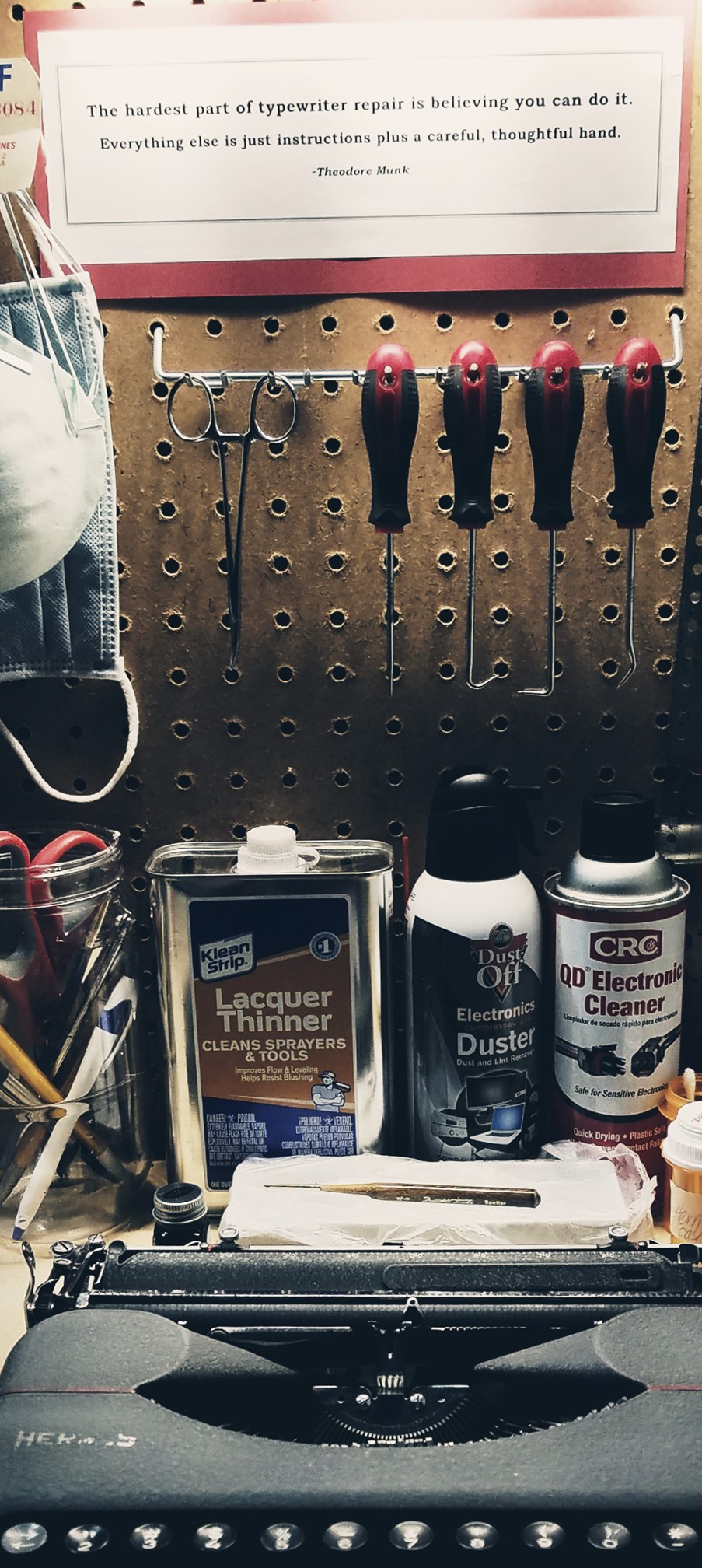
The hardest part of typewriter repair is believing you can do it. Everything else is just instructions plus a careful, thoughtful hand.<br /> —Theodore Munk
-
-
www.youtube.com www.youtube.com
-
Recorded Live - Flesh Eating Film Reels (1975) by [[S. S. Wilson]]
Idea of artificial intelligence using a typewriter to communicate. Cross reference HAL and Mr. Typewriter (Royal advertisement).
-
-
www.youtube.com www.youtube.com
-
Royal KMM KMG Typewriter Feet Spacers Original Smashed Rubber Replaced by [[Phoenix Typewriter]]
Squished rubber feet spacers on the Royal standard typewriters can cause interfere with the universal bar and when they do, they'll need replacement.
This is the same sort of interference seen on Olympia SM3s due to their squished/flattened rubber gaskets, though the symptoms are different.
"Phoenix typewriter. Have a Royal day!" <br /> A slightly different sign off from Duane's usual... :)
-
-
-
ROYAL KMM Replacing Type Bar Link Remove Arm Repaired Typewriter by [[Phoenix Typewriter]]
This is roughly what I expected to be the case. I've got to shift the fulcrum pivot wire so I can reattach my Q and @ on a Royal KMG.
Roughly similar to Gerren's video on swapping out typefaces, but with a slightly different technique for speed of doing that. See: https://hypothes.is/a/I_-9rBV2Ee-eMotzy9_Z-Q
-
-
www.youtube.com www.youtube.com
-
How To Guide- Swapping Type Bars on a Manual Typewriter -Full tips and tricks by [[The HotRod Typewriter Co.]]
-
-
www.reddit.com www.reddit.com
-
I consider Valentines 'designer' typewriters, and generally overrated. If you want to write on an Olivetti, I'd go for the Lettera 22/32/DL. The Valentine is based on the Lettera 32, so the mechanical part is solid, but the Valentine is not as well-balanced as the 32. And about ten times more expensive.
Me starts thinking about cornering the market in Lettera 32s and 3D printing Valentine cases to put onto them...
-
-
www.reddit.com www.reddit.com
-
Crash course on typewriter maintenance and repair
A list of resources and references for the budding typewriter repair person. There is a lot here that I've compiled and consumed over the last six months, so don't be overwhelmed. Half the battle is figuring out where to find all these things, so if nothing else, this should shave off a month of reading and researching.
Basic Introductory Material
Get a notebook and be ready to take some notes so you'll remember where you found the random information you're bound to pick up over time and are able to occasionally review it.
Work your way through Sarah Everett's excellent Typewriter 101 videos (at least the first five): https://www.youtube.com/playlist?list=PLJtHauPh529XYHI5QNj5w9PUdi89pOXsS
Read Richard Polt's book which is a great overview to the general space:<br /> Polt, Richard. The Typewriter Revolution: A Typist’s Companion for the 21st Century. 1st ed. Woodstock, VT: Countryman Press, 2015.
Next watch the documentary California Typewriter. Documentary. Gravitas Pictures, 2016. https://www.imdb.com/title/tt5966990/. It has some interesting subtle material hiding within it, but it will give you a good idea of where you're headed off to.
Get a machine (or four) you can practice on. Get a flat head screwdriver and maybe a small adjustable wrench. Buy some mineral spirits and a small headed toothbrush and clean out your first machine. Buy some light sewing machine oil and try oiling it. Search YouTube for videos about how to repair anything that may be wrong with it.
Basic restoration advice: https://site.xavier.edu/polt/typewriters/tw-restoration.html
On colloquial advice for degreasing, cleaning, and oiling manual typewriters https://boffosocko.com/2024/08/09/on-colloquial-advice-for-degreasing-cleaning-and-oiling-manual-typewriters/
Repair Manuals
Create an account on typewriterdatabase.com which will give you some additional access to catalogs, manuals, and dealer catalogs.
They also have some openly accessible material like:<br /> * https://typewriterdatabase.com/manuals.php
Printed manuals: https://www.lulu.com/search?adult_audience_rating=00&contributor=Ted+Munk&page=1&pageSize=50 PDF manuals: https://sellfy.com/twdb
Ted Munk's website also has a plethora of ephemera that is often useful * https://munk.org/typecast/
Richard Polt's list of service manuals, which also includes some correspondence course typewriter repair classes: https://site.xavier.edu/polt/typewriters/tw-manuals.html#servicemanuals
Tools
In rough order of increasing complexity:
- Typewriter Tool Kit from the DOLLAR TREE by Just My Typewriter https://www.youtube.com/watch?v=R-7E4fM6gBw
- Some simple basics and where to get them: https://boffosocko.com/2024/08/11/adding-to-my-typewriter-toolset/
- Typewriter tools of the trade: https://www.youtube.com/watch?v=x5bKk93rtxs
- Lucas Dul's Toolset presentation: https://virtualhermans.com/lucas-dul
- Tour of an advanced hobbyist/semi-pro shop: https://www.youtube.com/watch?v=lZjf6InMlgU
Tools can be expensive, so start out small with just a few things and expand as you need them. You'll be amazed at what you can accomplish with a single thin bladed flathead screwdriver, an adjustable wrench, a rag, a bottle of Simple Green cleaning solution, and a bottle of isopropyl alcohol.
Videos
Subscribe to and become acquainted with YouTube channels like the following:
- Duane Jensen's Phoenix Typewriter https://www.youtube.com/@phoenixtypewriter2136
- Gerren Balch's HotRod Typewriter Company https://www.youtube.com/@HotRodTypewriter
- Joe Van Cleave https://www.youtube.com/@Joe_VanCleave
- Sarah Everett's Just My Typewriter https://www.youtube.com/@JustMyTypewriter
While watching a variety of videos is great, as you're doing specific repairs search YouTube and you're likely to find full demos of the repairs you're doing yourself.
I've compiled a playlist of videos for repair of an Olympia SM3 which, while specific to the SM3, is a an excellent outline/overview of how to disassemble a portable typewriter, where many of the adjustment points are as well as an outline of the order to do them in.
If you're not a good typist or don't have experience in the area, try out some of the following short films which will also provide some useful historical perspective:
- Basic Typing: Methods. Vol. MN-1512a. United States Navy Training Film, 1943. https://www.youtube.com/watch?v=ztyzGit1dTI.
- Basic Typing: Machine Operation. Vol. MN-1512b. United States Navy Training Film, 1943. https://www.youtube.com/watch?v=b-REJEArnjE.
- Advanced Typing: Shortcuts. Vol. MN-1512c. United States Navy Training Film, 1943. https://www.youtube.com/watch?v=JUJfCfqgsX0.
- Advanced Typing: Duplicating and Manuscript. Vol. MN-1512d. United States Navy Training Film, 1943. https://www.youtube.com/watch?v=7ve5JnTUzvo.
- Maintenance Of Office Machines. Vol. MN-1513. United States Navy Training Film, 1943. https://www.youtube.com/watch?v=ocdxgkxKAKo.
Internships & Apprenticeships
If you have the time and flexibility try arranging an internship or apprenticeship with a local typewriter repair shop. Meet your local repair people even if you can't spend the time on an internship. You'll learn a lot and create relationships with businesses who will more easily swap/supply you with machines they're parting out or access to tools which may otherwise be difficult to source.
Podcasts
- Austin Typewriter Ink https://www.austintypewriterink.com/ati-the-podcast.html
- Charm Type Repair https://charmtypepodcast.podbean.com/
Some useful Bibliography
- Athey, Ralph S. Typewriter Repair Training Course. Tarentum, PA: Typewriter Repair Training, 1957. https://site.xavier.edu/polt/typewriters/AtheyTypewriterRepair.pdf.
- Atkinson, Annelise. Typewriter SOS: The DIY Guide to Fixing Common Problems with Typewriters, 2014. https://www.amazon.com/Typewriter-SOS-Fixing-Problems-Typewriters/dp/1520902700/.
- Hausrath, Alfred H., and Eugene L. Dahl. Typewriter Care. Edited by Walter K.M. Slavik. Federal Work Improvement Program United States Civil Service Commission and Government Division, U.S. Treasury Department, 1945. http://archive.org/details/twcare-1945.
- Jones, Clarence LeRoy. The Manual Typewriter Repair Bible. Edited by Theodore Munk. The Typewriter Repair Bible Series, 2017. https://www.lulu.com/shop/ted-munk/the-manual-typewriter-repair-bible/paperback/product-1vgk72jp.html.
- Kasten, R. M. “First Aid for Typewriters.” Popular Science Monthly, May 1941.
- Kravitz, Bryan. Hints for a Happy Typewriter. Bryan Kravitz, 1983. https://site.xavier.edu/polt/typewriters/Hints-Happy-TW.pdf.
- Hutchison, Howard. The Typewriter Repair Manual. 1st ed. Blue Ridge Summit, Pa: Tab Books, 1981. https://www.amazon.com/typewriter-repair-manual-Howard-Hutchison/dp/0830600345.
- Munk, Theodore. “The Typewriter Database,” 2012. https://typewriterdatabase.com/.
- Pearce, H. G. Complete Instructions: How to Repair, Rebuild, and Adjust Underwood Typewriters With Handy Reference for Locating Trouble Quickly. Bridgeport, CT: Typewriter Mechanics Publishing Co., 1920. https://johnesimmons.com/Typewriter/Articles/Manualpdf/Underwood_Repair_Manual.pdf.
- Polt, Richard. “The Classic Typewriter Page : All About Typewriters,” 2009. https://site.xavier.edu/polt/typewriters/index.html.
- Scadden, David T. Approved Home Study Course in Typewriter Repair and Service. Little Falls, NJ: Typewriter Repair School, 1959. https://site.xavier.edu/polt/typewriters/homestudycourse.pdf.
Good luck on your journey!
reply to u/fontinalispluma at https://old.reddit.com/r/typewriters/comments/1gaza5x/learning_typewriter_maintenance_and_repair/
-
-
www.etsy.com www.etsy.com
-
Gerren Balch
https://www.etsy.com/shop/HotRodTypewriterCo
Gerren Balch is the eminence gris behind HotRod Typewriter Company
-
-
writingball.blogspot.com writingball.blogspot.com
-
KMC vs. KMM by [[Richard Polt]]
-
-
typewriterdatabase.com typewriterdatabase.com
-
An interesting aside, the name of it. The "Gray Magic" didn't quite stick. By 51 or so the dealers have clearly decided that it is a KMG (keyset magic gray).
-
-
www.facebook.com www.facebook.com
-
You might not want to get too hung up on sound deadening material. Anything is better than nothing and stick on felt works just fine. Most of the noise from a typewriter comes from the paper being slapped between the platen. A new platen will give you more quiet sessions. Any felt added will keep out any high pitch resonant echos but it's not going to do a whole lot for the overall volume you will experience. A good typing mat like wool, and a new platen are by far the two optimal solutions for noise. Felt can be a bonus but unless it's a complete tin can rattle trap, the difference between 1mm and 3mm felt probably isnt going to rock your world.
via Gerren @ HotRod Typewriter Co. at https://www.facebook.com/groups/typewritermaintenance/posts/3903042456599841/
new platen > felt typewriter pad >> new felt in a typewriter for dampening sound.
-
-
www.facebook.com www.facebook.com
-
https://www.facebook.com/groups/typewritermaintenance/posts/3902381636665923/
Buckram is a good choice of material for recovering pre-war black typewriter cases.
TypewriterCellar on Instagram may have some good ideas in this area.
-
-
-
I would note that the Tippa S continued under Royal/Litton through the late 70’s in the form of the late Royal Sahara: https://typewriterdatabase.com/Royal.Sahara.72.bmys and Royal Caravan: https://typewriterdatabase.com/Royal.Caravan.72.bmys (Made in Holland)
https://munk.org/typecast/2015/12/26/gossen-tippa-serials-updated/
-
-
www.youtube.com www.youtube.com
-
Smith Corona Skyriter Shift Repair, Ring & Cylinder Adjustment for Even Quality Print by [[Phoenix Typewriter]]
He misspoke about "ring and cylinder" adjustment here. Duane does an on feet and motion adjustment in this video for a Smith-Corona Skyriter.
-
-
www.youtube.com www.youtube.com
-
Smith Corona Classic Galaxie Typewriter Ribbon Lift Install Arm Adjustment Squeeze Style by [[Phoenix Typewriter]]
-
-
www.youtube.com www.youtube.com
-
Smith Corona Typewriters 1935 - 1980 Type Alignment / Shift Motion Upper Lower Case Adjustment by [[Phoenix Typewriter]]
Duane starts out by showing the two adjustment screws for the upper and lower case motion adjustment on a 5 Series Smith-Corona portable. (This should be the same across several decades of machines and include the 4 and 6 series as well.)
-
-
munk.org munk.org
-
Typewriter Ribbon varieties Offered by Underwood in 1956<br /> https://munk.org/typecast/2020/08/23/typewriter-ribbon-varieties-offered-by-underwood-in-1956/
-
-
www.reddit.com www.reddit.com
-
Pretty much all manual typewriters use 1/2" (12.7mm) wide ribbon which is most of what you're probably going to find in the marketplace.
The thing that changes from machine to machine is is the potentially proprietary spools and those are usually specific to how the ribbion auto switch is effectuated. Most ribbon comes with small grommets about 10-12 inches from the ends as many machines need this to trigger the switch over. If the plastic spools you purchase don't work with your particular machine you simply spend a minute or two to hand wind it onto your existing original (metal) spools and go from there.
There are lots of videos on YouTube showing how to hand wind ribbon onto a machine. Sarah has a pretty reasonable one: https://www.youtube.com/watch?v=up412FjTEkw
Even Tom Hanks has a ribbon changing video... https://www.youtube.com/watch?v=GBbsNKaVAB0
Incidentally, if your seller specifies them, the Underwoods take Group 9 (GR9) spools. Likely not helpful or illustrative for you, but certainly interesting from a historical perspective, Ted Munk has a catalog of Typewriter Ribbon varieties Offered by Underwood in 1956: https://munk.org/typecast/2020/08/23/typewriter-ribbon-varieties-offered-by-underwood-in-1956/
reply to u/prettiestGOAT at https://old.reddit.com/r/typewriters/comments/1g8z0fm/can_anyone_help_id_this_underwood_typewriter_and/
-
-
patents.google.com patents.google.com
-
www.youtube.com www.youtube.com
-
Suggests rubber feet from http://mytypewriter.com/rubber-feet.aspx
-
-
www.youtube.com www.youtube.com
-
Local file Local file
-
If the feed rollers areworn smooth, a light sandpapering will re-store their grip.
-
Cylinders and feed rollers may be cleaned,and the rubber rejuvenated, by wiping themwith denatured alcohol. Just do this whennecessary, as too much alcohol counteractsits own good effects.
-
Key tension on many standard typewriters maybe changed by adjusting spring-tension screwsfor individual keys. A half turn to the rightmakes the touch heavier, to the left, lighter
-
Beforegivingamachineabathingasolinewithsomemachineoiladded,removerubberfeet,ribbon, andifpossible,thecarriage.
-
Dolettersin alinesometimesstart nicely,thenrundownhill?Thiscan’thappenifyouuse theline-spacinglever,insteadofrollingthepaper throughwiththecylinderknob.Inthelatter case, the rollerthatlocksthespacingofthe linesmaycometorest on topofaratchettooth,insteadofsettlingbetweentwoofthem.Whenthemachinestarts, thevibration graduallyjarsthecylinderarounduntilitreachesitsnormal position—droppinglettersasitturns.
-
On portable machines, and standard ma-chines in which the carriage runs on ballbearings in a track, this track should notbe oiled, but should merely be wiped clean.
Interesting that Kasten recommends against oiling the carriage rails of portables and standard machines which run on ball bearings.
-
Cakedinkmayberemovedwithtypeputty,alcohol,carbontetrachloride,oroneoftheproprietarydry-cleaningfluids,appliedwithabrush.Pressthetypeputtyontothetype,peelitoff,andthecakedinkcomeswithit.Ifyouusealiquid,firstliftthetypeandputpaperunderitto prevent dirt from dripping into the machine. When using type-cleaning fluid, be sure toWipe the type dry with a cloth before using the place paper under type to prevent dirt frommachine again.
dry cleaning solvents in 1941 were likely Varsol or Stoddard's Formula.
compare to trichloroethane<br /> https://hypothes.is/a/EyBIAFXAEe-AcP-Atlj_aQ
Note discontinuation of carbon tetrachloride<br /> https://hypothes.is/a/bfdi_I90Ee-OQLN0HpsE7Q
-
Any ordinary light machineoil will do, but regular typewriter or spermoil is best. Apply it sparingly—as much aswill cling to the end of a toothpick will do—and wipe off all excess.
toothpick as a typewriter tool
-
When a machine actsup, ten to one it is due to your own neglect.
Tags
- type cleaner
- alcohol
- typewriter adjustments
- dry cleaning fluid
- type putty
- solvents
- typewriter troubleshooting
- Varsol
- platens
- typewriter tools
- denatured alcohol
- Silly Putty
- carbon tetrachloride
- feed rollers
- toothpicks
- type alignment
- gasoline
- sperm oil
- Stoddard's Formula
- touch control
- neglect
- sandpaper
- typewriter cleaning
- oiling typewriters
- typewriter maintenance
- typeslug cleaning
- standard typewriters
Annotators
-
-
en.wikipedia.org en.wikipedia.org
-
Zilphia Horton (1910–1956), American musician and activist who died from accidentally drinking a glass full of carbon tetrachloride-based typewriter cleaning fluid that she mistook for water.[82]
Glen, John M. (1996). Highlander: No Ordinary School, 2nd ed. Knoxville: University of Tennessee Press. p. 138.
-
-
typewriterdatabase.com typewriterdatabase.com
-
Hints for a Happy Typewriter<br /> Bryan Kravitz, Nancy Gorrell, 1983<br /> https://typewriterdatabase.com/1983-Hints4HappyTypewriter.index.manual
Some good, basic home care and use from 1983. Home mechanics in 2024 are probably capable of a bit more without the backstop of a typewriter mechanic.
This guide suggest the use of solvents like alcohol or trichloroethane for cleaning type slugs and internals. Note that trichloroethane manufacture and use has diminished significantly since 1996 when it was identified by the Montreal Protocol as a contributor to ozone depletion.
-
-
-
Sanding and polishing the keys on my Smith-Corona Silent Super. A lesson to all, use foil when using PBlaster to clean, not a rag. It still melts plastic when it soaks through the rag…
All the videos on YouTube are generally of mechanics who are covering things up for a quick operation (like cleaning slugs) and not for longer cleans. This can be misleading for those who are doing longer term work where the rags need to withstand more liquid or are sitting for longer.
-
-
www.youtube.com www.youtube.com
-
The nuts on the ribbon selector and the ribbon reverse on Royal Quiet De Luxes is a 7/32 inch nut.
-
Royal Quiet DeLuxe Typewriter Complete Total Body Removal by [[The HotRod Typewriter Co.]]
Gerren uses a Weaver gunsmith screwdriver set for most of his screwdriver needs. [5:00]
On the newer QDLs two of the screws for removing the rear plate are accessible from the top underneath the carriage instead of all on the rear.
The screws for the front body plate can be loosened and don't need to be fully removed to take the body plate off of the machine.
-
-
www.youtube.com www.youtube.com
-
quietly cleaning a quiet deluxe by [[Just My Typewriter]]
Cleaning the case, exterior and some of interior of a Royal Quiet De Luxe typewriter. She does a somewhat minimal job here.
She could have disassembled a bit more and done a better job with a toothbrush and mineral spirits on the inside.
Not a horrible recommendation for a beginner, but could have gone further and been a bit more comprehensive.
Tags
Annotators
URL
-
-
www.youtube.com www.youtube.com
-
Royal Quiet De Luxe Typewriter Adjustment Print Quality Height Balance On-Feet Shift Motion by [[Phoenix Typewriter]]
He made sure the carriage isn't out of alignment which can cause on feet issues as well.
Adjust the basket stops higher or lower as necessary. Try 1/2 to full turn and test each
The adjustment points are between the body and the carriage about an inch inside the body shell.
Do upper case first. The first set of screws/nuts just next to the outside of the typewriter are for lower case and the second set just inside of those are for upper case.
Turning the adjustment screws clockwise should push the carriage stops down just a bit.
Some good characters to check are H, h, p, y, and 8.
-
When doing type alignment, Duane Jensen was taught to use an old/used ribbon instead of a new, wet/dark ribbon for better performance in testing. New ribbons don't show the differences as well.
He's noticed that ribbon from Around the Office are dreadful.
-
-
www.youtube.com www.youtube.com
-
Removing Feet from Royal Quiet DeLuxe Typewriter. by [[DC Types]]
Not what I was hoping for in terms of removing the screws holding the feet in.
Tags
Annotators
URL
-
-
www.printables.com www.printables.com
-
Selectric Service Foot<br /> https://www.printables.com/model/895168-selectric-service-foot
-
-
munk.org munk.org
-
Custom 3D Printed Selectric Elements are HERE! (Vogue! Papyrus!) by [[Theodore Munk]]
-
-
www.reddit.com www.reddit.com
-
Does anyone know how do they make new platens?
reply to u/General-Writing1764 at https://old.reddit.com/r/typewriters/comments/1g7a8y5/does_anyone_know_how_do_they_make_new_platens/
I'm guessing that JJ Short is taking the original, removing the rubber. Placing the core into a mold and pouring in new material which hardens. Once done they put it on a lathe and turn it down to the appropriate (original) diameter. Potentially they're sanding the final couple of thousands of an inch for finish.
I'd imagine that if you asked them, they could/would confirm this general process.
The only other shop I've heard doing platen work is Bob at Typewriter Muse, but I haven't gone through his YouTube videos to see what his process looks like. (I'm pretty sure he documents some of it there.)
-
-
www.reddit.com www.reddit.com
-
For an inexpensive starter machine ($5-25) that's easy to find, easy to get parts for and has a reasonable chance of working when in "unknown" or "untested" condition, I'd recommend one of the following ubiquitous, but solid machines which show up almost daily on ShopGoodwill.com:
- Royal Quiet De Luxe https://typewriterdatabase.com/Royal.Quiet+De+Luxe.72.bmys
- Remington Quiet Riter https://typewriterdatabase.com/Remington.Quiet-Riter.42.bmys
- Smith-Corona Clipper (their Sterling, Silent, and Silent Super are very similar, but can sometimes be more expensive; they often have a few more features like tabs, but are otherwise the same machine) https://typewriterdatabase.com/Smith+Corona.Clipper.86.bmys
They'd all make excellent starter machines for a younger kid. The black models with glass keys from the 1940s will look a bit more old school/classic while the more industrial browns and grays with plastic keys from the 1950s are still solid choices. You might also find some later 60s/70s versions of these machines (or variations), and while they may be a bit more colorful, they'll usually have a lot more cheap plastic and can potentially have cheaper builds. (My parents got me my first typewriter, a 1948 Smith-Corona Clipper, in the mid-1980s when I was 10—I have it today and it still works as well as it did then; I still also love the airplane on the hood.)
If you want something simple with a bit of color you can also look at the 70s/80s Brother Charger 11 which is pretty ubiquitious and inexpensive as well.
Since you have some time, you can wait for one in better looking cosmetic condition (and with a case) which means it was probably better taken care of, and less likely to need aggressive cleaning, and more likely to work without needing any repairs. You can also wait to find one local that you can pick up in person (to save shipping cost and/or potential damage) or which will be cheaper to ship from nearby.
Without any experience, you might try looking at Just My Typewriter's Typewriter 101 series on YouTube: https://www.youtube.com/playlist?list=PLJtHauPh529XYHI5QNj5w9PUdi89pOXsS She covers most of the basics there.
Cleaning a machine isn't horribly difficult and can be done pretty cheaply ($20 or less for some paint thinner/isopropyl and a small toothbrush), but if you need it or get a machine that needs some repair work, try https://site.xavier.edu/polt/typewriters/tw-repair.html.
If you're in an area with lots of yard sales, try shopping around and see if you find something interesting. It's at these that you'll have a potential chance of finding more collectible machines for pennies on the dollar and it'll also give you the chance to put your hands on machines to test them out to make sure they work.
Good luck! 🎄
reply to u/strawberystegosaurus at https://old.reddit.com/r/typewriters/comments/1g5rgi4/typewriter_for_christmas_please_help/
-
-
www.reddit.com www.reddit.com
-
www.youtube.com www.youtube.com
-
Advanced Typing: Duplicating and Manuscript. Vol. MN-1512d, 1943. https://www.youtube.com/watch?v=7ve5JnTUzvo.
Stencils
Before writing stencils, be sure to clean your type. (Don't use liquid solvent.)
Be sure to place the cushion sheet properly behind the stencil.
Place the paper bail rollers at the extreme left and right of the stencil to prevent them from marking the master.
For errors, rub individual characters separately with a burnisher using a circular motion.
Hectograph masters, Hectograph ribbon (ditto ribbon)
Wax pencils
Typefaces
20% more type on a page with elite than 10 inch pica.
Pica allows approximately 26-40 lines on standard letterhead giving 300-450 words to a page.
Special characters: - o for degrees ' and " for feet and inches or minutes and seconds along with superscript - division: - backspace colon - pound sterling: L backspace f - exclamation point: period backspace ' - equal sign: hyphen backspace variable hyphen - paragraph mark: P backspace I
proofreaders' marks<br /> # followed by a number is used to mean insert that number of spaces
Centering timestamp 19:37
Tags
- typewriters
- centering
- type styles
- direct offset process
- offset masters
- Underwood justifying typewriter
- watch
- proofreading
- elite
- pica
- Lenor Fenton
- ditto machines
- Hectograph masters
- burnisher
- Varityper
- typewriter stencils
- Hectograph pencils
- Electromatic proportional spacing machine (typewriter)
- dublicating
- wax pencils
Annotators
URL
-
-
www.calligraphr.com www.calligraphr.com
-
https://www.calligraphr.com/en/
Can be used to digitize typewriter typefaces.
-
-
en.wikipedia.org en.wikipedia.org
-
Her Electromatic typewriter with a Dvorak Simplified Keyboard layout is in the collection of the National Museum of American History.
-
-
www.youtube.com www.youtube.com
-
Basic Typing: Machine Operation. 16 mm. Vol. MN-1512b, 1943. https://www.youtube.com/watch?v=b-REJEArnjE.
Type pacer timestamp 4:12
"Your head is the most important part of your typing." - Lenore Fenton
"Your typewriter does exactly what you make it do, but it does no more" - Lenore Fenton <br /> This is very similar to quotes about computer programs at the end of the 20th century too.
The touch characteristics for the manual, the noiseless, and the electric are all slightly different.
-
-
www.youtube.com www.youtube.com
-
1962 Vintage IBM Typewriter Training Film IBM Selectric Proper Typing Procedures, w/ Bud McDole by [[Computer History Archives Project]]
Right at the Typewriter. 16 mm. San Francisco, CA: KQED, 1962. https://www.youtube.com/watch?v=sPfHAW_OfGo.
On manual typewriters one "snaps" the keys while on an electric keyboard one "taps" the keys for maximum speed and accuracy.
Overview of functionality of an IBM typewriter.
To add longevity to one's carbon papers they should be rotated both top to bottom and front to back within one's packs.
Use plastic type cleaner, meant for cleaning type slugs, to clean the excess ink from a typewriter. Form it into a point and press it to the letter to erase several times. Then erase with eraser shield and eraser.
To type to the very bottom of the page, particularly with a carbon pack, to prevent slippage at the bottom, insert a "trailer sheet" about halfway down the first page. Insert it at the back of the pack just behind the original and between the first carbon sheet.
For typing small sheets of paper (index cards) fold a pleat into a regular sheet of paper and use the lip to hold the smaller sheet you're typing on.
To more quickly type envelopes, do the first then reverse the platen so that only about an inch of the top of the envelope is visible. Then insert the next envelope behind the first and continue reversing the platen. This will allow the finished envelopes to stack at the paper table and speed the threading and typing of envelopes in rapid succession.
Use of the divots on the typing guide for making horizontal or vertical lines while moving the carriage or rotating the platen respectively.
How to change the typeball and the ribbon cartridge on the IBM selectric.
-
-
www.youtube.com www.youtube.com
-
Hot Rod Mercury - Repaired ! Royal Typewriter Made in Japan Not Spacing Troubleshoot and Fix. by [[Phoenix Typewriter]]
There was a loose assembly underneath the carriage that was preventing the vibrator from working and the carriage from advancing via typing. Tightening it up fixed the issue completely.
Tags
Annotators
URL
-
-
racketmn.com racketmn.com
-
Saying Goodbye to Vale Typewriter, the Second-to-Last Typewriter Shop in Town - Racket by [[Jay Boller]] for [[Racket]]
Mark Soderbeck expects to close Vale Typewriter by the end of 2024 after a 67-year run.
-
Soderbeck tells us about a recent job that took 40 hours to complete. He ended up charging the customer just $50.
"Well, I already gave him an estimate," he says with a chuckle. "I'm not gonna change that quote, I've been here too long to do that."
It seems like an unwritten rule for typewriter repair shops to go way over on time versus pay to repair a typewriter based on an initial quote.
I've seen at least one other quote like this, but don't think I collected it.
-
"Business went right to nothing, hardly," he remembers. "As soon as that computer hit the price of under $2,000, that was the end of the typewriter business—80% of the business was gone in three years. When I started there was 27 little shops like this in the Twin Cities, and there was 47 before that."
-
Vale Typewriter from Ray Vale, who had helmed the stout brick building since it was constructed in 1957.
-
11-month typewriter repair program
In 1974 there were 11-month typewriter repair programs to train typewriter repair technicians.
Compare this to Philly Typewriter's 4 year internship program: https://hypothes.is/a/LSbZtlboEe-4vtMPIWcTKA
-
"I don't need the city of Richfield being involved, they've never talked to me for 49 years," he says of awkward visits this week from the mayor and a city council member.
Why would the city come calling to a typewriter shop calling? Nostalgia perhaps? Better would be if they came to order or have their machines serviced to keep the place open or to help the next generation continue on.
-
-
www.reddit.com www.reddit.com
-
Watch My Typewriter (Not Me) https://old.reddit.com/r/typewriters/comments/1g2ybw4/watch_my_typewriter_not_me/
-
-
www.reddit.com www.reddit.com
-
So I have a typewriter with a diamond-hard platen. All the usual tricks for softening didn't work, and sanding the hard layer back revealed that the rubber had entirely perished all the way to the core; so I've removed it. Now, I'm in Australia, and there is no professional group here that replaces platens. So I've been looking at home fixes, old manufacturing techniques, and I think I have a solution. I have wrapped a few thin layers of cork around the platen core, and I intend to finish it off with perhaps two layers of heat shrink rubber tomorrow. I think the end result will be a platen with a firm strike face and a softer centre to absorb the strikes. My trial with the cork on its own was promising, but it was ultimately a little too soft. I could harden it with urethane or resin, but in the interest of being able to undo my work, I will try the rubber first. Will keep you informed.
One of the few others aside from JJ Short who is doing platens is Bob over at Typewriter Muse. Might be worth checking out his YouTube channel for some potential tips.
I presume you're already aware of how to make your ring and cylinder adjustments when you're done, so things are properly tuned...
Can't wait to see what you come up with...
reply to u/throneofashes at https://reddit.com/r/typewriters/comments/1g2j4hz/platen_experiment/
-
-
www.reddit.com www.reddit.com
-
For writing on a flat surface like a wrapped package (or book), you'd need a Gritzner or an Elliot Fisher Book Typewriter
-
-
www.youtube.com www.youtube.com
-
Demonstrate your Electric in 10 Minutes by Remington-Rand, Inc.<br /> A Sales Training Film<br /> Produced by Visual Aids Department Remington Rand Inc.
via Periscope Film
1940s REMINGTON RAND ELECTRIC TYPEWRITER SALESMAN DEMONSTRATION FILM 49734
-
-
www.youtube.com www.youtube.com
-
A Primer on Typewriter Ribbons & Spools by [[Damon DiMarco]]
Typewriter ribbon is 1/2" wide (12.7mm) which has been standardized as DIN2103.
The DIN 32755 spool, aka a Universal spool, or a Group 1 spool.
Olivetti typewriters use Group 4 spools.
-
-
www.youtube.com www.youtube.com
-
Nine Steps to Follow Before You Buy a Thrift Shop Typewriter by [[Damon DiMarco]]
-
-
www.youtube.com www.youtube.com
-
Typewriter repairman still in business in 2024 by [[Fox 9 Minneapolis-St. Paul]]
Mark Soderbeck started repairing typewriters in 1974. Working at cutting back and retiring soon.
-
-
www.youtube.com www.youtube.com
-
Typewriter Repair Failure by [[Joe Van Cleave]]
-
-
www.youtube.com www.youtube.com
-
Creating a REAL Typewriter Font by [[Janinagans]]
-
the sound of progress right 1:39 there
quote following the thunking sound of a typewriter carriage being pushed to one side.
-