10,000 Matching Annotations
  1. Nov 2025
    1. Reviewer #1 (Public review):

      The authors use inducible Fz::mKate2-sfGFP to explore "cell-scale signaling" in PCP. They reach several conclusions. First, they conclude that cell-scale signaling does not depend on limiting pools of core components (other than Fz). Second, they conclude that cell-scale signaling does not depend on microtubule orientation, and third, they conclude that cell-scale signaling is strong relative to cell to cell coupling of polarity.

      There are some interesting inferences that can be drawn from the manuscript, but there are also some significant challenges in interpreting the results and conclusions from the work as presented. I suggest that the authors 1) define "cell-scale signaling," as the precise meaning must be inferred, 2) reconsider some premises upon which some conclusions depend, 3) perform an essential assay validation, and 4) explain some other puzzling inconsistencies.

      Major concerns (first round of review):

      The exact meaning of cell-scale signaling is not defined, but I infer that the authors use this term to describe how what happens on one side of a cell affects another side. The remainder of my critique depends on this understanding of the intended meaning.

      The authors state that any tissue wide directional information comes from pre-existing polarity and its modification by cell flow, such that the de novo signaling paradigm "bypasses" these events and should therefore not be responsive to any further global cues. It is my understanding that this is not a universally accepted model, and indeed, the authors' data seem to suggest otherwise. For example, the image in Fig 5B shows that de novo induction restores polarity orientation to a predominantly proximal to distal orientation. If no global cue is active, how is this orientation explained? The 6 hr condition, that has only partial polarity magnitude, is quite disordered. Do the patterns at 8 and 10 hrs become more proximally-distally oriented? It is stated that they all show swirls, but please provide adult wing images, and the corresponding orientation outputs from QuantifyPolarity to help validate the notion that the global cues are indeed bypassed by this paradigm.

      It is implicit that, in the de novo paradigm, polarization is initiated immediately or shortly after heat shock induction. However, the results should be differently interpreted if the level of available Fz protein does not rise rapidly and then stabilize before the 6 hr time point, and instead continues to rise throughout the experiment. Western blots of the Fz::mKate2-sfGFP at time points after induction should be performed to demonstrate steady state prior to measurements. Otherwise, polarity magnitude could simply reflect the total available pool of Fz at different times after induction. Interpreting stability is complex, and could depend on the same issue, as well as the amount of recycling that may occur. Prior work from this lab using FRAP suggested that turnover occurs, and could result from recycling as well as replenishment from newly synthesized protein.

      From the Fig 3 results, the authors claim that limiting pools of core proteins do not explain cell-scale signaling, a result expected based on the lack of phenotypes in heterozygotes, but of course they do not test the possibility that Fz is limiting. They do note that some other contributing protein could be.

      In Fig 3, it is unclear why the authors chose to test dsh1/+ rather than dsh[null]/+. In any case, the statistically significant effect of Dsh dose reduction is puzzling, and might indicate that the other interpretation is correct. Ideally, a range including larger and smaller reductions would be tested. As is, I don't think limiting Dsh is ruled out.

      The data in Fig 5 are somewhat internally inconsistent, and inconsistent with the authors' interpretation. In both repolarization conditions, the authors claim that repolarization extends only to row 1, and row 1 is statistically different from non-repolarized row 1, but so too is row 3. Row 2 is not. This makes no sense, and suggests either that the statistical tests are inappropriate and/or the data is too sparse to be meaningful. For the related boundary intensity data in Fig 6, the authors need to describe exactly how boundaries were chosen or excluded from the analysis. Ideally, all boundaries would be classified as either meido-lateral (meaning anterior-posterior) or proximal-distal depending on angle.

      If the authors believe their Fig 5 and 6 analyses, how do they explain that hairs are reoriented well beyond where the core proteins are not? This would be a dramatic finding, because as far as I know, when core proteins are polarized, prehair orientation always follows the core protein distribution. Surprisingly, the authors do not so much as comment about this. The authors should age their wings just a bit more to see whether the prehair pattern looks more like the adult hair pattern or like that predicted by their protein orientation results.

    2. Reviewer #3 (Public Review):

      The manuscript by Carayon and Strutt addresses the role of cell-scale signaling during the establishment of planar cell polarity (PCP) in the Drosophila pupal wing. The authors induce locally the expression of a tagged core PCP protein, Frizzled, and observe and analyze the de novo establishment of planar cell polarity. Using this system, the authors show that PCP can be established within several hours, that PCP is robust towards variation in core PCP protein levels, that PCP proteins do not orient microtubules, and that PCP is robust towards 'extrinsic' re-polarization. The authors conclude that the polarization at the cell-scale is strongly intrinsic and only weakly affected by the polarity of neighboring cells.

      Major comments (first round of review):

      The data are clearly presented and the manuscript is well written. The conclusions are well supported by the data. 

      (1) The authors use a system to de novo establish PCP, which has the advantage of excluding global cues orienting PCP and thus to focus on the cell-intrinsic mechanisms. At the same time, the system has the limitation that it is unclear to what extent de novo PCP establishment reflects 'normal' cell scale PCP establishment, in particular because the Gal4/UAS expression system that is used to induce Fz expression will likely result in much higher Fz levels compared with the endogenous levels. The authors should briefly discuss this limitation.

      (2) Fig. 3. The authors use heterozygous mutant backgrounds to test the robustness of de novo PCP establishment towards (partial) depletion in core PCP proteins. The authors conclude that de novo polarization is 'extremely robust to variation in protein level'. Since the authors (presumably) lowered protein levels by 50%, this conclusion appears to be somewhat overstated. The authors should tune down their conclusion.

      Significance: 

      The manuscript contributes to our understanding of how planar cell polarity is established. It extends previous work by the authors (Strutt and Strutt, 2002,2007) that already showed that induction of core PCP pathway activity by itself is sufficient to induce de novo PCP. This manuscript further explores the underlying mechanisms. The authors test whether de novo PCP establishment depends on an 'inhibitory signal', as previously postulated (Meinhardt, 2007), but do not find evidence. They also test whether core PCP proteins help to orient microtubules (which could enhance cell intrinsic polarization of core PCP proteins), but, again, do not find evidence, corroborating previous work (Harumoto et al, 2010). The most significant finding of this manuscript, perhaps, is the observation that local de novo PCP establishment does not propagate far through the tissue. A limitation of the study is that the mechanisms establishing intrinsic cell scale polarity remain unknown. The work will likely be of interest to specialists in the field of PCP.

      Summary of comments from the Reviewing Editor on the revised version:

      In the introduction, when you refer to Figure 1, the definition of Molecular, cellular, tissue scale is indeed not too clear to outside readers. For example, when you first refer to 'cell scale' you define it 'non-local', but probably it is not clear to many readers 'non-local' means 'the mechanism that cannot be explained by 'molecular scale'. (because 'molecular scale = local' is only inferred).

      The 'conclusion paragraph' at the end of the Introduction does not have conclusion (only explained 'which question was tested by which method').

      Minor comments that can easily be addressed by textual edits:

      – they do not explain why gene dosage affects constitutive but not de novo polarization. It seems to me that one would expect de novo to be at least as sensitive if not more.

      – Unconventional nomenclature for tissue axes - mediolateral, horizontal - are frequently used. These are sometimes difficult to parse. Please stick with universally accepted anterior, posterior, proximal and distal.

    3. Author response:

      (1) General Statements

      Our manuscript studies mechanisms of planar polarity establishment in vivo in the Drosophila pupal wing. Specifically we seek to understand mechanisms of ‘cell-scale signalling’ that is responsible for segregating core pathway planar polarity proteins to opposite cell edges. This is an understudied question, in part because it is difficult to address experimentally.

      We use conditional and restrictive expression tools to spatiotemporally manipulate core protein activity, combined with quantitative measurement of core protein distribution, polarity and stability. Our results provide evidence for a robust cell-scale signal, while arguing against mechanisms that depend on depletion of a limited pool of a core protein or polarised transport of core proteins on microtubules. Furthermore, we show that polarity propagation across a tissue is hard, highlighting the strong intrinsic capacity of individual cells to establish and maintain planar polarity.

      The original manuscript received three fair and thorough peer-reviews, which raised many important points. In response, we decided to embark on a full revision that attempts to answer all of the points. We have included new data to support our conclusions in Supplemental Figures 1, 2 and 5.

      Additionally in response to the reviewers we have revised the manuscript title, which is now ‘Characterisation of cell-scale signalling by the core planar polarity pathway during Drosophila wing development’.

      (2) Point-by-point description of the revisions

      We thank all of the reviewers for their thorough and thoughtful review of our manuscript. They raise many helpful points which have been extremely useful in assisting us to revise the manuscript.

      In response we have carried out a major revision of the manuscript, making numerous changes and additions to the text and also adding new experimental data. Specific changes are listed after our detailed response to each comment.

      Reviewer #1:

      […] Major points:

      The exact meaning of cell-scale signaling is not defined, but I infer that the authors use this term to describe how what happens on one side of a cell affects another side. The remainder of my critique depends on this understanding of the intended meaning.

      As the reviewer points out, it is important that the meaning of the term ‘cell-scale signalling’ is clear to the reader and in response to their comment we have had another go at defining it explicitly in the Introduction to the manuscript.

      Specifically, we use the term ‘cell-scale signalling’ to describe possible intracellular mechanisms acting on core protein segregation to opposite cell membranes during core pathway dependent planar polarisation. For example, this could be a signal from distal complexes at one side of the cell leading to segregation of proximal complexes to the opposite cell edge, or vice versa. See also our response to Reviewer #2 regarding the distinction between ‘molecular-scale’ and ‘cell-scale’ signalling. 

      Changes to manuscript: Revised definition of ‘cell-scale signalling’ in Introduction.

      The authors state that any tissue wide directional information comes from pre-existing polarity and its modification by cell flow, such that the de novo signaling paradigm "bypasses" these events and should therefore not be responsive to any further global cues. It is my understanding that this is not a universally accepted model, and indeed, the authors' data seem to suggest otherwise. For example, the image in Fig 5B shows that de novo induction restores polarity orientation to a predominantly proximal to distal orientation. If no global cue is active, how is this orientation explained?

      We assume that the reviewer’s point is that it is not universally accepted that de novo induction after hinge contraction leads to uncoupling from global cues (rather than that it is not accepted that hinge contraction remodels radial polarity to a proximodistal pattern). We are (we believe) the only lab that has used de novo induction as a tool, and we’re not aware of any debate in the literature about whether this bypasses global cues. Nevertheless, we accept that it is hard to prove there is no influence of global cues, when the nature of those cues and the time at which they act remain unclear. Below we summarise the reasons why we believe there are not significance effects of global cues in our experiments that would influence the interpretation of our results.

      First, our reading of the literature supports a broad consensus that an early radial core planar polarity pattern is realigned by cell flow produced by hinge contraction beginning at around 16h APF (e.g. Aigouy et al., 2010; Strutt and Strutt, 2015; Aw and Devenport, 2017; Butler and Wallingford, 2017; Tan and Strutt, 2025). Taken at face value, this suggests that there are ‘radial’ cues present prior to hinge contraction, maybe coming from the wing margin – arguably these radial cues could be Ft-Ds or Wnts or both, given they are expressed in patterns consistent with such a role (notwithstanding the published evidence arguing against roles for either of these cues). It then appears that hinge contraction supercedes these cues to convert a radial pattern to a proximodistal pattern – whether the radial cues that affect the core pathway earlier remain active after hinge contraction is unclear, although both Ft-Ds and Wnts appear to maintain their ‘radial’ patterns beyond the beginning of hinge contraction (e.g. Merkel et al., 2014; Ewen-Campen et al., 2020; Yu et al., 2020).

      We think that the reviewer is proposing the presence of a proximodistal cue that is active in the proximal region of the wing that we use for our experiments shown e.g. in Fig.5, and that this cue orients core polarity here (but not elsewhere in the wing) in a time window after 18h APF. Ft-Ds and Wnts do not seem to be plausible candidates as they are still in ‘radial’ patterns. This leaves either an unknown proximodistal cue (a gradient of some unknown signalling molecule?), or possibly some ability of hinge contraction to align proximodistal polarity specifically in this wing region but not elsewhere. We cannot definitively rule out either of these possibilities, but neither do we think there is sufficient evidence to justify invoking their existence to explain our observations.

      In particular, the reason that we don’t think there is a proximodistal cue in the proximal part of the wing after 18h APF, is that work from our lab shows that induction of Fz or Stbm expression at times around or after the start of hinge contraction (i.e. >16 h APF) results in increasing levels of trichome swirling with polarity not being coordinated with the tissue axis either proximally or distally (Strutt and Strutt, 2002; Strutt and Strutt 2007). Our simplest interpretation for this is that induction at these stages fails to establish the early radial pattern of core pathway polarity and hence hinge contraction cannot reorient radial to proximodistal. If hinge contraction alone could specify proximodistal polarity in the absence of the earlier radial polarity, then we would not expect to see swirling over much of the proximal wing (where the forces from hinge contraction are strongest (Etournay et al., 2015)).

      In this manuscript, our earliest de novo experiments begin with Fz induction at 18h APF (de novo 10h), then at 20h APF (de novo 8h) and at 22h APF (de novo 6h). The image in Fig. 5B, referred to by the reviewer, is of a wing where Fz is induced de novo at 22 h APF. In these wings, as expected, the core proteins localise asymmetrically in stereotypical swirling patterns throughout the wing surface (see Fig. 2M and also Strutt and Strutt, 2002; Strutt and Strutt 2007), but – usefully for our experiments – they broadly localise along the proximal-distal axis in the region analysed in Fig. 5B. Given the strong swirling in surrounding regions when inducing at >20h APF, we feel reasonably confident in assuming that the pattern is not due to a proximodistal cue present in the proximal wing.

      We appreciate that the original manuscript did not show images including the trichome pattern in adjacent regions, so this point would not have been clear, but we now include these in Supplementary Fig. 5. We have also added a note in the legend to Fig. 5B to clarify that the proximodistal pattern seen is local to this wing region. We apologise for this oversight and the confusion caused and appreciate the feedback.

      The 6 hr condition, that has only partial polarity magnitude, is quite disordered. Do the patterns at 8 and 10 hrs become more proximally-distally oriented? It is stated that they all show swirls, but please provide adult wing images, and the corresponding orientation outputs from QuantifyPolarity to help validate the notion that the global cues are indeed bypassed by this paradigm.

      In all three ‘normal’ de novo conditions (6h, 8h and 10h), regardless of the time of induction, the polarity orientation patterns of Fz-mKate2 in pupal and adult wings are very similar in the experimentally analysed region (Fig. S5B-E). The strong local hair swirling agrees with the previous published data (Strutt and Strutt, 2002; Strutt and Strutt 2007). Overall, we don’t see any evidence that the 10h de novo induction results in more proximodistally coordinated polarity than the 8h or 6h conditions. This is consistent with our contention that there is no global cue present at these stages, which presumably would have a stronger effect when core pathway activity was induced at earlier stages.

      Changes to manuscript: Added additional explanation of the ‘de novo induction’ paradigm and why we believe the resulting polarity patterns are unlikely to be influenced by any global signals in Introduction and Results section ‘Induced core protein relocalisation…’. Added quantification of polarity in the experiment region proximal to the anterior cross-vein in pupal wings (Fig.S5E-E’’’) and zoomed-out images of the surrounding region in adult wings showing that the polarity pattern does not become more proximodistal when induction time is longer, and also that there is not overall proximodistal polarity in proximal regions of the wing (Fig.S5B-D), arguing against an unknown proximodistal polarity cue at these stages of development.

      In the de novo paradigm, polarization is initiated immediately or shortly after heat shock induction. However, the results should be differently interpreted if the level of available Fz protein does not rise rapidly and then stabilize before the 6 hr time point, and instead continues to rise throughout the experiment. Western blots of the Fz::mKate2-sfGFP at time points after induction should be performed to demonstrate steady state prior to measurements. Otherwise, polarity magnitude could simply reflect the total available pool of Fz at different times after induction. Interpreting stability is complex, and could depend on the same issue, as well as the amount of recycling that may occur. Prior work from this lab using FRAP suggested that turnover occurs, and could result from recycling as well as replenishment from newly synthesized protein. 

      The reviewer raises an important point, which we agree could confound our experimental interpretations. As suggested we have now carried out western blotting and quantitation for Fz::mKate2-sfGFP levels and added these data to Fig.S1 (Fig. S1C,D). Quantified Fz is not significantly different between the three de novo polarity induction timings and not significantly different compared to constitutive Fz::mKate2-sfGFP expression (although there is a trend towards increasing Fz::mKate2-sfGFP protein levels with increasing induction times). These data are consistent with Fz::mKate2-sfGFP being at steady state in our experiments and that levels are sufficient to achieve normal polarity (as constitutive Fz::mKate2-sfGFP does so). Therefore it is unlikely that differing protein levels explain the differing polarity magnitudes at the different induction times. Interestingly, Fz::mKate2-sfGFP levels are lower than endogenous Fz levels, possibly due to lower expression or increased turnover/reduced recycling.

      Changes to manuscript: Added western blot analysis of Fz::mKate2-sfGFP expression under 10h, 8h and 6h induction conditions vs endogenous Fz expression and constitutive Fz::mKate2sfGFP expression (Fig.S1C-D) and discussed in Results section ‘Planar polarity establishment is…’.

      From the Fig 3 results, the authors claim that limiting pools of core proteins do not explain cellscale signaling, a result expected based on the lack of phenotypes in heterozygotes, but of course they do not test the possibility that Fz is limiting. They do note that some other contributing protein could be. 

      Previously published results from our lab (Strutt et al., 2016 Cell Reports; Supplemental Fig. S6E) show that in a heterozygous fz mutant background, Fz protein levels are not affected by halving the gene dosage when compared to wt, suggesting that Fz is most likely produced in excess and is not normally limiting, but that protein that cannot form complexes may be rapidly degraded. We have now added this information to the text.

      Changes to manuscript: Added explanation in text that Fz levels had previously been shown to not be dosage sensitive in Results section ‘Planar polarity establishment is…’ and also added a caveat to the Discussion about not directly testing Fz.

      In Fig 3, it is unclear why the authors chose to test dsh1/+ rather than dsh[null]/+. In any case, the statistically significant effect of Dsh dose reduction is puzzling, and might indicate that the other interpretation is correct. Ideally, a range including larger and smaller reductions would be tested. As is, I don't think limiting Dsh is ruled out. 

      Concerning the choice of dsh allele, we appreciate the query of the reviewer regarding use of dsh[1] instead of a null, as there might be a concern that dsh[1] would give a less strong phenotype. The answer is that over more than two decades we and others have never found any evidence that dsh[1] does not act as a ‘null’ for planar polarity in the pupal wing, and furthermore use of dsh[1] preserves function in Wg signalling – and we would prefer to rule out any phenotypic effects due to any potential cross-talk between the two pathways that might be seen using a complete null. To expand on this point, dsh[1] mutant protein is never seen at cell junctions (Axelrod 2001; Shimada et al., 2001; our own work), and by every criteria we have used, planar polarity is completely disrupted in hemizygous or homozygous mutants e.g. see quantifications of polarity in (Warrington et al., 2017 Curr Biol).

      In terms of the broader point, whether we can rule out Dsh being limiting, we were very careful to be clear that we did not see evidence for Dsh (or other core proteins) being limiting in terms of ‘rates of core pathway de novo polarisation’. When the reviewer says ‘the statistically significant effect of Dsh dose reduction is puzzling’ we believe they are referring to the data in Fig. 3J, showing a small but significantly different reduction in stable Fz in de novo 6h conditions (also seen in 8h de novo conditions, Fig. S3I). As Dsh is known to stabilise Fz in complexes (Strutt et al., 2011 Dev Cell; Warrington et al., 2017 Curr Biol), in itself this result is not wholly surprising. Nevertheless, while this shows that halving Dsh levels does modestly reduce Fz stability, it does not alter our conclusion that halving Dsh levels does not affect Fz polarisation rate under either 6h or 8h de novo conditions.

      Unfortunately, we do not have available to us a practical way of achieving consistent intermediate reductions in Dsh levels (e.g. a series of verified transgenes expressing at different levels). Levels of all the core proteins could be dialled down using transgenes, to see when the system breaks, and indeed we have previously published that lower levels of polarity are seen if Fmi levels are <<50% or if animals are transheterozygous for pk, stbm, dgo or dsh, pk, stbm, dgo simultaneously (Strutt et al., 2016 Cell Reports). However, it seems to be a trivial result that eventually the ability to polarise is lost if insufficient core proteins are present at the junctions. For this reason we have focused on a simple set of experiments reducing gene dosage singly by 50% under two de novo induction conditions, and have been careful to state our results cautiously. The assays we carried out were a great deal of work even for just the 5 heterozygous conditions tested.

      We believe that the experiments shown effectively make the point that there is no strong dosage sensitivity – and it remains our contention that if protein levels were the key to setting up cell-scale polarity, then a 50% reduction would be expected to show an effect on the rate of polarisation. We further note that as Fz::mKate2-sfGFP levels are lower than endogenous Fz levels (see above), the system might be expected to be sensitised to further dosage reductions, and despite this we failed to see an effect on rate of polarisation.

      We note that Reviewer #3 made a similar point about whether we can rule out dosage sensitivity on the basis of 50% reductions in protein level. To address the comments of both reviewers we had now added some further narrative and caveats in the text.

      In a similar vein, Reviewer #2 requested data on whether dosage reduction altered protein levels by the expected amount. We have now added further explanation/references and western blot data to address this.

      Changes to manuscript: Added more explanation of our choice of dsh[1] as an appropriate mutant allele to use in Results section ‘Planar polarity establishment is…’. Added some narrative and caveats regarding whether lowering levels more than 50% would add to our findings in the Discussion. Revised conclusions to be more cautious including altering section title to read ‘Planar polarity establishment is not highly sensitive to variation in protein levels of core complex components’.

      Also added westerns and text/references showing that for the tested proteins there is a reduction in protein levels upon removal of one gene dosage in Results section ‘Planar polarity establishment is…’ and Fig.S2.

      The data in Fig 5 are somewhat internally inconsistent, and inconsistent with the authors' interpretation. In both repolarization conditions, the authors claim that repolarization extends only to row 1, and row 1 is statistically different from non-repolarized row 1, but so too is row 3. Row 2 is not. This makes no sense, and suggests either that the statistical tests are inappropriate and/or the data is too sparse to be meaningful. 

      As we’re sure the reviewer appreciates, this was an extremely complex experiment to perform and analyse. We spent a lot of time trying to find the best way to illustrate the results (finally settling on a 2D vector representation of polarity) and how to show the paired statistical comparisons between different groups. Moreover, in the end we were only able to detect generally quite modest (statistically significant) changes in cell polarity under the experimental conditions.

      However, we note that failure to see large and consistent changes in polarity is exactly the expected result if it is hard to repolarise from a boundary – and this is of course the conclusion that we draw. Conversely, if repolarisation were easy, which was our expectation at least under de novo conditions without existing polarity, then we would have expected large and highly statistically significant changes in polarity across multiple cell rows. Hence we stand by our conclusion that ‘it is hard to repolarise from a boundary of Fz overexpression in both control and de novo polarity conditions’.

      Overall, we were trying to establish three points:

      (1) to demonstrate that repolarisation occurs from a boundary of overexpression i.e. from boundary 0 to row 0

      (2) to establish whether a wave of repolarisation occurs across rows 1, 2 and 3

      (3) to determine if in repolarisation in de novo condition it is easier to repolarise than in repolarisation in the control (already polarised) condition Taking each in turn:

      (1) To detect repolarisation from a boundary relative to the control condition, we have to compare row 0 in repolarisation condition (Fig.5G,K) vs control condition (Fig.5F,J). This comparison shows a significative repolarisation (p=0.0014). From now, row 0 in repolarisation condition is our reference for repolarisation occurring.

      (2) To determine if there is a wave of repolarisation in the repolarisation condition we have to compare row 0 vs row 1 to 3 in the repolarisation condition (Fig.5K). Row 1 is not significantly different to row 0, but rows 2 and 3 are different and the vectors show obviously lower polarity than row 0. Hence no wave of repolarisation is detected over rows 1 to 3.

      (3) To determine if it is easier to repolarise in the de novo condition, our reference for establishment of a repolarisation pattern is the polarisation condition in rows 0 to 3. So, we compare repolarisation condition vs repolarisation in de novo condition, row 0 vs row 0, row 1 vs row 1, row 2 vs row 2 and row 3 vs row 3 – in each case no significative difference in polarity is detected, supporting our conclusion that it is not easier to repolarise in the de novo condition.

      We agree that the variations in row 3 are puzzling, but there is no evidence that this is due to propagation of polarity from row 0, and so in terms of our three questions, it does not alter our conclusions.

      Changes to manuscript: We have extensively revised the text describing the results in Fig.5 to hopefully make the reasons for our conclusions clearer and also be more cautious in our conclusions in Results section ‘Induced core protein relocalisation…’. 

      For the related boundary intensity data in Fig 6, the authors need to describe exactly how boundaries were chosen or excluded from the analysis. Ideally, all boundaries would be classified as either meido-lateral (meaning anterior-posterior) or proximal-distal depending on angle. 

      We thank the reviewer for pointing out that this was not clear.

      All boundaries were classified following their orientation compared to the Fz over-expression boundary using hh-GAL4 expressed in the wing posterior compartment. Horizontal junctions were defined as parallel to the Fz over-expression boundary (between 0 and 45 degrees) and mediolateral junctions as junctions linking two horizontal boundaries (between 45 and 90 degrees).

      Changes to manuscript: The boundary classification detailed above has been added in the Materials and Methods.

      If the authors believe their Fig 5 and 6 analyses, how do they explain that hairs are reoriented well beyond where the core proteins are not? This would be a dramatic finding, because as far as I know, when core proteins are polarized, prehair orientation always follows the core protein distribution. Surprisingly, the authors do not so much as comment about this. The authors should age their wings just a bit more to see whether the prehair pattern looks more like the adult hair pattern or like that predicted by their protein orientation results.

      Again the reviewer makes an interesting point, and we agree that this is something that we should have more directly addressed in the manuscript.

      There are three reasons why we might expect adult trichomes to show a different effect from the measured core protein polarity pattern seen in our experiments:

      (i) we are assaying core protein polarity at 28h APF, but trichomes emerge at >32h APF, so there is still time for polarity to propagate a bit further from the boundary. We now have added data showing that by the point of trichome initiation, the wave of polarisation extends 3-4 cell rows (Fig.S5A).

      (ii) it has long been known that a strong localisation of core proteins at a cell edge is not required for polarisation of trichome polarity from a boundary. For instance, in Strutt & Strutt 2007 we show clones of cells overexpressing Fz causing propagation through pk[pk-sple] mutant tissue where there is no detectable core protein polarity. We were following up prior observations of Adler et al., 2000 in the wing and Lawrence et al., 2004 in the abdomen.

      (iii) there is evidence to suggest that the polarity of adult trichomes is locally coupled, possibly mechanically. This point is hard to prove without live imaging taking in both initial core protein localisation, the site of actin-rich trichome initiation and then the final orientation of the much larger microtubule filled trichome, and we’re not aware that such data exist. However, Wong & Adler 1993 (JCB) showed that over a number of hours trichomes become much larger and move towards the centre of the cell, presumably becoming decoupled from any core protein cue. The images in Guild … & Tilney, 2005 (MBoC)  are also interesting to look at in this regard. Finally, septate junction proteins have been implicated in local alignment of trichomes, independently of the core pathway (Venema … & Auld, 2004 Dev Biol).

      Changes to manuscript: Added new data in Fig.S5A showing where trichomes initiate under 6h de novo induction conditions, for comparison to core protein localisation and adult trichome data in Fig.5. Added some text explaining why adult trichome repolarisation might be stronger than the observed effects on core protein localisation in Discussion. 

      Minor points:

      As the authors know, there is a model in the literature that suggests microtubule trafficking provides a global cue to orient PCP. The authors' repolarization data in Fig 4 make a reasonably convincing case against a role for no role for microtubules in cell-scale signaling, but do not rule out a role as a global cue. The authors should be careful of language such as "...MTs and core proteins being oriented independently of each other" that would appear to possibly also refer to a role as a global cue. 

      Thank you for pointing out that this was not clear. We have now modified the text to hopefully address this.

      Changes to manuscript: Text updated in Results section ‘Microtubules do not provide…’.

      Significance:

      There are two negative conclusions and one positive conclusion made by the authors. Provided the above points are addressed, the negative conclusions, that core proteins are not limiting and that microtubules are not involved in cell-scale signaling are solid. The positive conclusion is more nebulous - the authors say that cell-scale signaling is strong relative to cell-cell signaling - but how strong is strong? Strong relative to their prior expectations? I'm not sure how to interpret such a conclusion. Overall, we learn something from these results, though it fails to reveal anything about mechanism. These results will be of some interest to those studying PCP.

      The reviewer raises an interesting point, which is how do you compare the strength of two different processes, even if both processes affect the same outcome (in this case cell polarity). Repolarisation from a boundary has not been carefully studied at the level of core protein localisation in any previous study to our knowledge – this is one of the important novel aspects of this study. Hence there is not a baseline for defining strong repolarisation. Similarly, there has been no investigation of the nature of ‘cell-scale signalling’. This was a considerable challenge for us in writing the manuscript, and we have done our best to find appropriate language that hopefully conveys our message adequately. Minimally our work may provide a baseline for helping to define the ‘strengths’ of these processes in future studies.

      One of our main points is that we can generate an artificial boundary of Fz expression, where Fz levels are at least several fold higher than in the neighbouring cell (e.g. compare Fig.4N’ and O’) and only two rows of cells show a significant change in polarity relative to controls. Even when the tissue next to the overexpression domain is still in the process of generating polarity (de novo condition) then the boundary has little effect on polarity in neighbouring cell rows. This was a result that surprised us, and we tried to convey that by using language to suggest cell-scale signalling was stronger than cell-cell signalling i.e. stronger in terms of the ability to define the final direction of polarity.

      Changes to manuscript: In the revised manuscript we have reviewed our use of language and now avoid saying ‘strong’ but instead use terms such as ‘effective’ and ‘robust’ in e.g. Results section ‘Induced core protein relocalisation…’, the Discussion and we have also changed the title of the manuscript to avoid claiming a ‘strong’ signal.

      Reviewer #2:

      […] Critique

      The experiments described in this paper are of high quality with a sophisticated level of design and analysis. However, there needs to be some recalibration of the extent of the conclusions that can be drawn (see below). Moreover, a limitation of this paper is that, despite the quality of their data, they cannot give a molecular hint about the nature of their proposed cell-scale signal. Below are a two key points that the authors may want to clarify.

      (1) The first set of repolarisation experiment is performed after the global cell rearrangements that have been shown to act as global signal. However, this approach does not exclude the possible contribution of an unknown diffusible global signal.

      A similar point was raised by Reviewer 1. For the convenience of this reviewer, we’ll summarise the arguments against such an unknown cue again below. More broadly, both reviewers asking a similar question indicates that we have failed to lay out the evidence in sufficient detail. In our defence, we have used the same ‘de novo’ paradigm in three previous publications (Strutt and Strutt 2002, 2007; Brittle et al 2022) without attracting (overt) controversy. We have now added text to the Introduction and Results that goes into more detail, as well as more experimental evidence (Fig.S5).

      Firstly, it is worth noting that the global cues acting in the wing are poorly understood, with mostly negative evidence against particular cues accruing in recent years. This makes it a hard subject to succinctly discuss. Secondly, we accept that it is hard to prove there is no influence of global cues, when the nature of those cues and the time at which they act remain unclear. Below we summarise the reasons why we believe there are not significance effects of global cues in our experiments that would influence the interpretation of our results.

      First, our reading of the literature supports a broad consensus that an early radial core planar polarity pattern is realigned by cell flow produced by hinge contraction beginning at around 16h APF (e.g. Aigouy et al., 2010; Strutt and Strutt, 2015; Aw and Devenport, 2017; Butler and Wallingford, 2017; Tan and Strutt, 2025). Taken at face value, this suggests that there are ‘radial’ cues present prior to hinge contraction, maybe coming from the wing margin – arguably these radial cues could be Ft-Ds or Wnts or both, given they are expressed in patterns consistent with such a role (notwithstanding the published evidence arguing against roles for either of these cues). It then appears that hinge contraction supercedes these cues to convert a radial pattern to a proximodistal pattern – whether the radial cues that affect the core pathway earlier remain active after hinge contraction is unclear, although both Ft-Ds and Wnts appear to maintain their ‘radial’ patterns beyond the beginning of hinge contraction (e.g. Merkel et al., 2014; Ewen-Campen et al.,2020; Yu et al., 2020).

      We think that the reviewers are proposing the presence of a proximodistal cue that is active in the proximal region of the wing that we use for our experiments shown e.g. in Fig.5, and that this cue orients core polarity here (but not elsewhere in the wing) in a time window after 18h APF. Ft-Ds and Wnts do not seem to be plausible candidates as they are still in ‘radial’ patterns. This leaves either an unknown proximodistal cue (a gradient of some unknown signalling molecule?), or possibly some ability of hinge contraction to align proximodistal polarity specifically in this wing region but not elsewhere. We cannot definitively rule out either of these possibilities, but neither do we think there is sufficient evidence to justify invoking their existence to explain our observations.

      In particular, the reason that we don’t think there is a proximodistal cue in the proximal part of the wing after 18h APF, is that work from our lab shows that induction of Fz or Stbm expression at times around or after the start of hinge contraction (i.e. >16 h APF) results in increasing levels of trichome swirling with polarity not being coordinated with the tissue axis either proximally or distally (Strutt and Strutt, 2002; Strutt and Strutt 2007). Our simplest interpretation of this is that induction at these stages fails to result in the early radial pattern of core pathway polarity being established and hence a failure of hinge contraction to reorient radial to proximodistal. If hinge contraction alone could specify proximodistal polarity in the absence of the earlier radial polarity, then we would not expect to see swirling over much of the proximal wing (where the forces from hinge contraction are strongest, Etournay et al., 2015).

      In this manuscript, our earliest de novo experiments begin at 18h APF (de novo 10h), then at 20h APF (de novo 8h) and at 22h APF (de novo 6h). The image in Fig. 5B referred to by Reviewer 1, is of a wing where Fz is induced de novo at 22 h APF. In these wings, as expected, the core proteins localise asymmetrically in stereotypical swirling patterns throughout the wing surface (see Fig. 2M and also Strutt and Strutt, 2002; Strutt and Strutt 2007), but – usefully for our experiments – they broadly localise along the proximal-distal axis in the region analysed in Fig. 5B. Given the strong swirling in surrounding regions when inducing at >20h APF, we feel reasonably confident in assuming that the pattern is not due to a proximodistal cue present in the proximal wing. We appreciate that the original manuscript did not show images including the trichome pattern in adjacent regions, so this point would not have been clear, but we now include these in Supplementary Fig.S5. We have also added a note in the legend to Fig. 5B to clarify that the proximodistal pattern seen is local to this wing region.

      Changes to manuscript: Text extended in Introduction and Results to better explain why we believe the de novo conditions that we use most likely result in a polarity pattern that is not significantly influenced by ‘global cues’. Now show zoomed-out images of the surrounding region around the experiment region proximal to the anterior cross-vein region in adult wings, showing that the polarity pattern does not become more proximodistal when induction time is longer, and also that there is not overall proximodistal polarity in proximal regions of the wing, arguing against an unknown proximodistal polarity cue at these stages of development (Fig.S5B-E’’’).

      (2) The putative non-local cell scale signal must be more precisely defined (maybe also given a better name). It is not clear to me that one can separate cell-scale from molecular-scale signal.

      Local signals can redistribute within a cell (or membrane) so local signals are also cell-scale. Without a clear definition, it is difficult to interpret the results of the gene dosage experiments. The link between gene dosage and cell-scale signal is not rigorously stated. Related to this, the concluding statement of the introduction is too cryptic.

      We thank the reviewer for raising this, as again a similar comment was made by Reviewer 1, so we are clearly falling short in defining the term. We have now had another attempt in the Introduction.

      To more specifically answer the point made by the reviewer regarding molecular vs cellular, we are essentially being guided here by the prior computational modelling work, as at the biological level the details are still being worked out. A specific class of previous models only allowed ‘signals’ between core proteins to act ‘locally’, meaning within a cell junction, and within the models there was no explicit mechanism by which proteins on other junctions could ‘detect’ the polarity of a neighbouring junction (e.g. Amonlirdviman et al., 2005; Le Garrec et al., 2006; Fischer et al., 2013). Other models implicitly or explicitly encode a mechanism by which cell junctions can be influenced by the polarity of other junctions (e.g. Meinhardt, 2007; Burak and Shraiman, 2009; Abley et al., 2013; Shadkhoo and Mani, 2019), for instance by diffusion of a factor produced by localisation of particular planar polarity proteins.

      We agree with the reviewer that a cell-scale signal will depend on ‘molecules’ and thus could be called ‘molecular-scale’, but here by ‘molecular-scale’ we mean signals that at the range of the sizes of molecules i.e. nanometers, rather than cell-scale signals that act at the size of cells i.e. micrometers. A caveat to our definition is that we implicitly include interactions that occur locally on cell junctions (<1 µm range) within ‘molecular-scale’, but this is a shorter range than ‘cellular-scale’ which requires signals acting over the diameter of a cell (3-5 µm). Nevertheless, we think the concept of ‘molecular-scale’ vs ‘cell-scale’ is a helpful one in this context, and have attempted to address the issue through a more careful definition of the terms.

      Changes to manuscript: Text revised in Introduction and legend to Fig.1 to more carefully define ‘cell-scale signalling’ and to distinguish it from ‘molecular-scale signalling’. Final sentence of Introduction also altered so we no longer cryptically speculate on the nature of the cell-scale signal but leave this to the Discussion.

      Minor comments. 

      Some of the (clever) genetic manipulation may need more details in the text. For example:

      - Need to specify if the hs-flp approach induces expression throughout the tissue.

      We apologise for the lack of clarity. In all the experiments, the hs-FLP transgene is present in all cells, and heat-shock results in ubiquitous expression. 

      Changes to manuscript: We have clarified this in the Results and Materials and Methods.

      - Need to specify in the text that in the unpolarised condition the tissue is both dsh and fz mutant.

      The reviewer is of course correct and we have updated this point in the text. The full genotype for the unpolarised condition is: w dsh<sup>1</sup> hsFLP22/y;; Act>>fz-mKate2sfGFP, fz<sup>P21</sup>/fz<sup>P21</sup> (see Table S1). So this line is mutant for dsh and fz with induced expression of Fz-mKate2sfGFP. 

      Changes to manuscript: We have clarified this in the relevant part of the Results.

      - Need to specify in the text that the experiment illustrated in Fig 5 is with hh-gal4. 

      As noted by the reviewer, we continued to use the same hh-GAL4 repolarisation paradigm as in Fig.4 and this info was in the legend to Fig.5 legend. However, we agree it is helpful to be explicit about this in the main text.

      Changes to manuscript: We have added this to this section of the Results.

      - Need to address a possible shortcoming of the hh experiment, that the AP boundary is a region of high tension.

      It is true that the AP boundary is under high tension in the wing disc (e.g. Landsberg et al., 2009). But we are not aware of any evidence that this higher tension persists into the pupal wing. In separate studies we have labelled for Myosin II in pupal wings (Trinidad et al 2025 Curr Biol; Tan & Strutt 2025 Nature Comms), and as far as we have noticed have not seen preferentially higher levels on the AP boundary. We think if tension were higher, the cell boundaries would appear straighter than in surrounding cells (as seen in the wing disc) and this is not evident in our images.

      - Need to dispel the possibility that there is no residual polarisation (e.g. of other components) in fz1 mutant (I assume this is the case).

      We use the null allele fz[P21] through this work, and we and others have consistently reported a complete loss of polarisation of other core proteins or downstream components in this background. The caveat to this is that core proteins that persist at cell junctions always appear at least slightly punctate in mutant backgrounds for other core proteins, and so any automated detection algorithm will always find evidence of individual cell polarity above a baseline level of uniform distribution. Hence we tend to use lack of local coordination of polarity (variance of cell polarity angle) as an additional measure of loss of polarisation, in addition to direct measures of average cell polarity. (We discuss this in the QuantifyPolarity manuscript Tan et al 2021 e.g. Fig.S6).

      Changes to manuscript: We now include in the Materials and Methods section ‘Fly genetics…’ a much more extensive explanation of the evidence for specific mutant alleles being ‘null’ for planar polarity function (including dsh1 as raised by Reviewer 1), specifically that they result in no detectable planar polarisation of either other core proteins or downstream effectors, and added appropriate references.

      - Need to provide evidence that 50% gene dosage commensurately affect protein level. 

      This is a good suggestion. In the case of Stbm, we have already published a western blot showing that a reduction in gene dosage results in reduced protein levels (Strutt et al 2016, Fig.S6). We have now performed western blots to quantify protein levels upon reduction of fmi, pk and dgo levels (we actually used EGFP-dgo for the latter, as we don’t have antibodies that can detect endogenous Dgo on western blots).

      Changes to manuscript: When presenting the dosage reduction experiments, we now refer back to Strutt et al., 2016 explicitly for Stbm, and have added western blot data for Fmi, Pk and EGFPDgo in new Fig.S2.

      - I am surprised that the relationship with microtubule polarity was never investigated. Is this true? 

      We agree this is a point that needed further clarification, as Reviewer 1 made a related point regarding the two possible roles for microtubules, one being as a mediator of a global cue upstream of the core pathway, and the second (which we investigate in this manuscript) as a mediator of a cell-scale signal downstream of the core pathway.

      Both the Uemura and Axelrod groups have published on potential upstream function as a global cue mediator in the Drosophila wing (e.g. Shimada et al., 2006; Harumoto et al., 2010; Matis et al., 2014).

      Both groups have also looked out whether core pathway components could affect orientation of microtubules (Harumoto et al., 2010; Olofsson at al., 2014; Sharp and Axelrod 2016). Notably Harumoto et al., 2010 observed that in 24h APF wings, loss of Fz or Stbm did not alter microtubule polarity from a proximodistal orientation consistent with the microtubules aligning along the long cell axis in the absence of other cues. However, this did not rule out an instructive effect of Fz or Stbm on microtubule polarity during core pathway cell-scale signalling. The Axelrod lab manuscripts saw interesting effects of Pk protein isoforms on microtubule polarity, albeit not throughout the entire wing, which hinted at a potential role in cell-scale signalling. Taken together this prior work was the motivation for our directed experiments to specifically test whether the core pathway might generate cell-scale polarity by instructing microtubule polarity.

      Changes to manuscript: We have revised the Results section ‘Microtubules do not…’ to make a clearer distinction regarding possible ‘upstream’ and ‘downstream’ roles of microtubules in Drosophila core pathway planar polarity and the motivation for our experiments investigating the latter.

      - The authors suggest that polarity does not propagate as a wave. And yet the range measured in adult is longer than in the pupal wing. Explain. 

      Again an excellent point, also made by Reviewer 1, which we have now addressed explicitly in the manuscript. For the convenience of this reviewer, we lay out the reasons why we think the propagation of polarity seen in the adult is further than seen for core protein localisation.

      There are three reasons why we might expect adult trichomes to show a different effect from the measured core protein polarity pattern seen in our experiments:

      (i) we are assaying core protein polarity at 28h APF, but trichomes emerge at >32h APF, so there is still time for polarity to propagate a bit further from the boundary. We now have added data showing that by the point of trichome initiation, the wave of polarisation extends 3-4 cell rows (Fig.S5A).  

      (ii) it has long been known that a strong localisation of core proteins at a cell edge is not required for polarisation of trichome polarity from a boundary. For instance, in Strutt & Strutt 2007 we show clones of cells overexpressing Fz causing propagation through pk[pk-sple] mutant tissue where there is no detectable core protein polarity. We were following up prior observations of Adler et al 2000 in the wing and Lawrence et al 2004 in the abdomen.

      (iii) there is evidence to suggest that the polarity of adult trichomes is locally coupled, possibly mechanically. This point is hard to prove without live imaging taking in both initial core protein localisation, the site of actin-rich trichome initiation and then the final orientation of the much larger microtubule filled trichome, and we’re not aware that such data exist. However, Wong & Adler 1993 (JCB) showed that over a number of hours trichomes become much larger and move towards the centre of the cell, presumably becoming decoupled from any core protein cue. The images in Guild … & Tilney, 2005 (MBoC)  are also interesting to look at in this regard. Finally, septate junction proteins have been implicated in local alignment of trichomes, independently of the core pathway (Venema … & Auld, 2004 Dev Biol).

      Changes to manuscript: Added new data in Fig.S5A showing where trichomes initiate under 6h de novo induction conditions, for comparison to core protein localisation and adult trichome data in Fig.5. Added some text explaining why adult trichome repolarisation might be stronger than the observed effects on core protein localisation in Discussion. 

      - The discussion states that the cell-intrinsic system remains to be fully characterised, implying that it has been partially characterised. What do we know about it? 

      As the reviewer probably realises, we were attempting to side-step a long speculative discussion about the various hints and ideas in the literature by grouping them under the umbrella of ‘remaining to be fully characterised’. We would argue that this current manuscript is the first to attempt to systematically investigate the nature of ‘cell-scale signalling’. The lack of prior work is probably due to two factors (i) pioneering theoretical work showed that a sufficiently strong global signal coupled with ‘local’ (i.e. confined to one cell junction) protein interactions was sufficient to polarise cells without the need to invoke the existence of a cell-scale signal; (ii) there is no easy way to identify cell-scale signals as their loss results in loss of polarity which will also occur if other (i.e. more locally acting) core pathway functions are compromised.

      The main investigation of the potential for cell-scale signalling has been another set of theory studies (Burak and Shraiman 2009; Abley et al., 2013; Shadkhoo and Mani 2019) which have considered the possibility of diffusible signals. In our present work we have further considered the possibility of a ‘depletion’ model, based on the pioneering theory work of Hans Meinhardt, and as discussed above the possibility that microtubules could mediate a cell-scale signal.

      Changes to manuscript: We have revised the Discussion to hopefully be clearer about the current state of knowledge.

      Reviewer #3:

      […] Major comments

      The data are clearly presented and the manuscript is well written. The conclusions are well supported by the data. 

      (1) The authors use a system to de novo establish PCP, which has the advantage of excluding global cues orienting PCP and thus to focus on the cell-intrinsic mechanisms. At the same time, the system has the limitation that it is unclear to what extent de novo PCP establishment reflects 'normal' cell scale PCP establishment, in particular because the Gal4/UAS expression system that is used to induce Fz expression will likely result in much higher Fz levels compared with the endogenous levels. The authors should briefly discuss this limitation. 

      We apologise if this wasn’t clear. We only used GAL4/UAS overexpression when we were generating an artificial boundary of Fz expression with hh-GAL4 to induce repolarisation. The de novo induction system involves Fz::mKate2-sfGFP being expressed directly under an Act5C promoter without use of GAL4/UAS. In response to a comment from Reviewer 1 we have now carried out western blot analysis which shows that Fz::mKate2-sfGFP levels under Act5C are actually lower than endogenous Fz levels. As we achieve normal levels of polarity, similar to what we measure in wild-type conditions when measured using QuantifyPolarity, we assume that therefore Fz levels are not limiting under these conditions. However, we note that lower than normal levels of Fz might sensitise the system to perturbation, which in fact would be advantageous in our study, as it might for instance have been expected to more readily reveal dosage sensitivity of other components.

      Changes to manuscript: We now describe the levels of expression achieved using the de novo induction system (Fig.S1C-D) and discuss possible consequences in the relevant Results sections and Discussion.

      (2) Fig. 3. The authors use heterozygous mutant backgrounds to test the robustness of de novo PCP establishment towards (partial) depletion in core PCP proteins. The authors conclude that de novo polarization is 'extremely robust to variation in protein level'. Since the authors (presumably) lowered protein levels by 50%, this conclusion appears to be somewhat overstated. The authors should tune down their conclusion. 

      Reviewer 1 makes a similar point about whether we can argue that the lack of sensitivity to a 50% reduction in protein levels actually rules out the depletion model. To address the comments of both reviewers we had now added some further narrative and caveats in the text.

      We nevertheless believe that the experiments shown effectively make the point that there is no strong dosage sensitivity – and it remains our contention that if protein levels were the key to setting up cell-scale polarity, then a 50% reduction would be expected to show an effect on the rate of polarisation. We further note that as Fz::mKate2-sfGFP levels are lower than endogenous Fz levels, the system might be expected to be sensitised to further dosage reductions, and despite this we fail to see an effect on rate of polarisation.

      In a similar vein, Reviewer 2 requested data on whether dosage reduction altered protein levels by the expected amount. We have now added further explanation/references and western blot data to address this.

      Changes to manuscript: Added some narrative and caveats regarding whether lowering levels more than 50% would add to our findings in the Discussion. Revised conclusions to be more cautious including altering section title to read ‘Planar polarity establishment is not highly sensitive to variation in protein levels of core complex components.

      Also added westerns and text/references showing that for the tested proteins there is a reduction in protein levels upon removal of one gene dosage in Results section ‘Planar polarity establishment is…’ and Fig.S2.

      Minor comments :

      (1) Page 3. The authors mention and reference that they used the PCA method to quantify cell polarity magnification and magnitude. It would help the unfamiliar reader, if the authors would briefly describe the principle of this method. 

      Changes to manuscript: More details have been added in Materials & Methods.

      Significance:

      The manuscript contributes to our understanding of how planar cell polarity is established. It extends previous work by the authors (Strutt and Strutt, 2002,2007) that already showed that induction of core PCP pathway activity by itself is sufficient to induce de novo PCP. This manuscript further explores the underlying mechanisms. The authors test whether de novo PCP establishment depends on an 'inhibitory signal', as previously postulated (Meinhardt, 2007), but do not find evidence. They also test whether core PCP proteins help to orient microtubules (which could enhance cell intrinsic polarization of core PCP proteins), but, again, do not find evidence, corroborating previous work (Harumoto et al, 2010). The most significant finding of this manuscript, perhaps, is the observation that local de novo PCP establishment does not propagate far through the tissue. A limitation of the study is that the mechanisms establishing intrinsic cell scale polarity remain unknown. The work will likely be of interest to specialists in the field of PCP.

    1. dynamic

      For the smooth comparison (i.e., for comparing the effects of time) this is a bit more tricky. Model comparison is a common option, but the problem is that this requires fitting models with ML rather than fREML, and then it is not possible to model autocorrelation any longer).

      The other option is ordered factors. Camera would be coded as an ordered factor and the smooth needs to be "duplicated" (so to speak) in order to have a reference smooth and a difference smooth. HOWEVER, this can produce different results (and different p-values) depending on which level is chosen as the reference. You could arguably use the lower-quality camera as the reference, because you'd like to estimate that level as well as you can (and estimating via a difference is more uncertain). More conservatively, you could do it both ways and only take a p-value as significant when it is significant in both models.

      The fact that the ordered factor approach can lead to different results is why I prefer to conduct onset detection from a model with unordered factors (i.e., to estimate a separate smooth in each level).

      Your hypotheses don't currently refer directly to the analysis of timecourse differences (via difference smooths), but maybe this could be added? i.e., that you expect a different timecourse in the two camera conditions, as revealed by different time smooths. Then the onset estimation would be a particular aspect of that timecourse.

    2. item type

      Here I would set it up in a different way. I've seen "this way" before (IIRC, Dan Mirman has models like this in his book). However, the issue with this model is the mutual exclusivity between responses (because looks to the cohort cant be looks to unrelated, and vice-versa). One could say that this kind of perfect correlation then gets captured by the model, but even so, this would only work if certain random effects are included. Worse, the sample size ends up not being right either because the model sees 2 counts for every binomial occurrence ( based on one 1 and one 0 for every "real" observation).

      Instead, I treat looks to one or the other object in the display as part of the dependent variable (conceptually, this also seems more correct, because objects aren't quite manipulations, but part of the outcome). So the model will have a DV like cbind(fix_cohort, fix_unrelated), which means that only the webcam condition predictor is necessary, with no interaction. I.e., there'll be 2 smooths, one for each camera condition, and each smooth reflects cohort-versus-unrelated proportions. The "onsets" are the earliest points at which a cohort-versus-unrelated preference is detected--which is hypothesised to be earlier in one webcam condition than the other.

      (note that in the example dataset from Ito et al. in our preprint, we do have cohort and unrelated as levels of a condition predictor; but that's because that dataset was a target-absent design with different displays in each condition)

    3. participant × trial × time bin

      in our previous work we added two steps about here: (1) binarization, i.e., within each time bin, only one data point in each trial is counted. The main reason for this was not to overstate the data, which would happen when counting multiple samples within each bin. Naturally, this intersects with "bin size" (as i mentioned above, we've used pretty small bins, but then tried to prevent the overstating of evidence by modelling autocorrelation). When you say "resampled into 100-ms bins", I suppose this means this "binarization" also takes place (as part of downsampling)? Still, the fact that you end up with 1 count within each participant x trial x bin combination could be made explicit. (2) aggregation. Given that we ended up with 1 count per participant x trial x bin, we then summed counts across trials (i.e., items) in each participant x bin combination. The main purpose of this was again to avoid large autocorrelation values, which in by-trial data could be as high as .99. Another advantage is that we end up with smaller (more parsimonious) models without item random effects (though this could also be seen as a disadvantage). Still another advantage is that both the model fitting and the onset detection are extremely fast.

    4. 100-ms bins

      in our previous work, we've used 20ms attempting to get a compromise between temporal resolution while not overstating the evidence (essentially, the combination of bin size, binarization within each bin, subject aggregation, and modelling of autocorrelation all matter in some way for this balance). I imagine that in the low-quality condition, the sampling rate will not be enough for something like that, but is something like 50ms possible?

    5. We then subtract 200 ms

      There's a question here about whether to "chop off" a bit of time from the analysis (100ms if starting at word onset, or 300ms if also accounting for saccade planning/execution), or instead, modelling the whole curve in the GAM including that initial part. Given that the images are previewed, I'd probably fit the whole curve (or chop off 100ms). On top of that, the onset detection method also allows defining a window, which can be smaller than the time window in the GAM. But we probably dont need to touch that.

    6. noise

      Here there is an explicit reference to noise but then effect sizes and timing are mentioned as the result, perhaps as a consequence of the reduced noise? This is not super clear to me. My immediate feeling is that they're separate notions and I'm not sure that reduced noise would lead to all these effects.

      On the other hand: (1) In the proportions/binomial case, I suppose more variation could be linked to lower proportions of looks. E,g,, maximum variation between trials/participants would be a mixture of 0% and 100% of looks, so 50% overall, and minimum variation could be that oinly a certain image was looked at, which would correspond to 100% off looks (although it could also be 0% of looks, that would also be minimum variation) ... but I dont know if you had something like this in mind?

      (2) Our onset detection method can be sensitive to amount of noise and indeed might end up detecting less noisy effects as being earlier. This is both good and bad. I discuss this ore below.

      Still, despite these points, it seems to me that the link between noise and the other aspects needs to be made more explicitly.

    7. effect sizes

      "Effect size" is a bit of a tricky term because it can refer to both standardized or unstandardized effects, i.e., taking into account the noise/uncertainty/variation or not. In this case, I think you mean, e.g., proportion of looks, irrespective of noise, but maybe that can be made more explicit.

    1. When most teachers think of students who are gifted, students who are globally gifted come to mind. Students who are globally gifted are gifted in almost every area of intellectual pursuit. They will have relative strengths and areas of challenge, but also consistently demonstrate their inherent characteristics in all academic areas. These students are not necessarily gifted in the area of music, yet their skills from other intellectual pursuits often provide an excellent level of basic preparation for the academic skills required for success in the music classroom.

      It makes me think about how teachers might overestimate abilities in certain areas. Recognizing both strengths and gaps is important for effective teaching.

    1. Reviewer #1 (Public Review):

      In this study, Li et al. aim to determine the effect of navigational experience on visual representations of scenes. Participants first learn to navigate within simple virtual environments where navigation is either unrestricted or restricted by an invisible wall. Environments are matched in terms of their spatial layout and instead differ primarily in terms of their background visual features. In a later same/different task, participants are slower to distinguish between pairs of scenes taken from the same navigation condition (i.e. both restricted or both unrestricted) than different navigation conditions. Neural response patterns in the PPA also discriminate between scenes from different navigation conditions. These results suggest that navigational experience influences perceptual representations of scenes. This is an interesting study, and the results and conclusions are clearly explained and easy to follow. There are a few points that I think would benefit from further consideration or elaboration from the authors, which I detail below.

      First, I am a little sceptical of the extent to which the tasks are able to measure navigational or perceptual experience with the scenes. The training procedure seems like it wouldn't require obtaining substantial navigational experience as the environments are all relatively simple and only require participants to follow basic paths, rather than encouraging more active exploration of a more complex environment. Furthermore, in the same/different task, all images show the same view of the environment (meaning they show the exact same image in the "same environment" condition). The task is therefore really a simple image-matching task and doesn't require participants to meaningfully extract the perceptual or spatial features of the scenes. An alternative would have been to present different views of the scenes, which would have prevented the use of image-matching and encouraged further engagement with the scenes themselves. Ultimately, the authors do still find a response time difference between the navigation conditions, but the effect does appear quite small. I wonder if the design choices could be obscuring larger effects, which might have been better evident if the navigational and perceptual tasks had encouraged greater encoding of the spatial and perceptual features of the environment. I think it would be helpful for the authors to explain their reasons for not employing such designs, or to at least give some consideration to alternative designs.

      Figure 1B illustrates that the non-navigable condition includes a more complicated environment than the navigable condition, and requires following a longer path with more turns in it. I guess this is a necessary consequence of the experiment design, as the non-navigable condition requires participants to turn around and find an alternative route. Still, this does introduce spatial and perceptual differences between the two navigation conditions, which could be a confounding factor. What do the response times for the "matched" condition in the same/different task look like if they are broken down by the navigable and non-navigable environments? If there is a substantial difference between them, it could be that this is driving the difference between the matched and mismatched conditions, rather than the matching/mismatching experience itself.

      In both experiments, the authors determined their sample sizes via a priori power analyses. This is good, but a bit more detail on these analyses would be helpful. How were the effect sizes estimated? The authors say it was based on other studies with similar methodologies - does this mean the effect sizes were obtained from a literature search? If so, it would be good to give some details of the studies included in this search, and how the effect size was obtained from these (e.g., it is generally recommended to take a lower bound over studies). Or is the effect size based on standard guidelines (e.g., Cohen's d ≈ 0.5 is a medium effect size)? If so, why are the effect sizes different for the two studies?

    1. Note: This response was posted by the corresponding author to Review Commons. The content has not been altered except for formatting.

      Learn more at Review Commons


      Reply to the reviewers

      • *

      __Reviewer #1 __


      Major comments


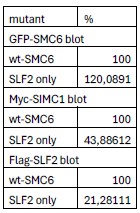
      1. The manuscript posits that the loss of function of MASh components (Ogc1 and Aralar) decreases adrenergic-stimulated lipolysis by altering the cytosolic NAD⁺/NADH ratio, with AMPK/ACC mentioned as possible mediators. However, this remains speculative. Please provide mechanistic data directly linking MASh-dependent NAD⁺/NADH changes to the regulation of lipolysis in brown adipocytes during adrenergic stimulation. Answer 1) The reviewer raises an important point regarding the direct assessment of cytosolic NAD⁺/NADH redox changes as a mechanistic link for altered lipolysis in brown adipocytes lacking MASh components. To address this point, we added new data to the revised manuscript showing lactate/pyruvate ratio as measured by metabolomics. This is a well-established surrogate marker to monitor changes in redox balance. Notably, under basal (non-stimulated) conditions, the lactate/pyruvate ratio did not display any significant differences between Aralar 1 KD and control cells, suggesting preservation of cytosolic NAD⁺/NADH levels in the absence of functional MASh under these conditions. This finding is consistent with reports showing the robustness of NAD⁺ regeneration via multiple shuttles and the possibility of metabolic compensation when one shuttle is compromised (PMID: 40540398; PMID: 37647199).

      The results have been added as new supplementary Figure 1 as following:

      Our new metabolomics data also revealed substantial reductions in the aspartate/glutamate ratio in Aralar 1 knockdown cells, serving as a metabolomic signature of impaired MASh function and reduced exchange of these amino acids between the cytosol and mitochondria. Given that the MASh is a major mechanism for exporting cytosolic reducing equivalents into the mitochondria under high metabolic demand, its loss would be expected to impact redox homeostasis, particularly under adrenergic stimulation when glycolytic flux and lipolytic activity are elevated (PMID: 40540398).

      Importantly, although our redox surrogate marker did not detect alterations, this may be explained by activation of compensatory pathways, most notably the glycerol phosphate shuttle (GPSh), which is highly expressed and active in brown adipocytes. Indirect support for this compensation comes from data shown in figure 4I showing reduced glycerol release in Aralar 1 KD cells upon norepinephrine stimulation and blocked lipolysis. This suggests a redirection of glycolytically derived G3P away from release and toward enhanced cycling within the GPSh, supporting cytosolic NAD⁺ regeneration via mitochondrial FAD-dependent G3PDH and cytosolic NAD⁺-dependent G3PDH activity. This is consistent with studies documenting that the combined action of MASh and GPSh maintains NAD redox homeostasis in brown adipocytes especially during non-thermogenic conditions (PMID: 168075; PMID: 40540398; PMID: 37647199). We have included a discussion about this possibility at page 9, third paragraph as follows:

      *“Previous studies have shown that BAT exhibits high activity of mitochondrial FAD-dependent glycerol-3-phosphate dehydrogenase (mG3PDH), which functions as an electron sink to sustain low cytosolic NADH levels essential for continuous glycolytic flux [11]. Accordingly, suppression of the MASh, either genetically or pharmacologically, is likely to induce a compensatory upregulation of the GPSh. This adaptation would enhance G3P turnover, contributing to the maintenance of cytosolic NAD redox balance. Moreover, the increased flux through the GPSh could favor fatty acid esterification and triglyceride synthesis or re-esterification, consistent with our findings in Ogc and/or Aralar 1 KD cells, where (i) triglyceride content rises (Fig. 3), (ii) overall respiratory rates remain largely unaltered (Figs. 2D–G), and (iii) glycerol release declines significantly (Fig. 4I). Notably, the decrease in glycerol release persists even when lipolysis is blocked by ATGlistatin, suggesting that the available G3P pool is rerouted from dephosphorylation and extracellular release toward oxidation to DHAP by mG3PDH to regenerate cytosolic NAD+ under MASh-deficient conditions. We propose that interference with the MASh does not directly impact lipolysis but instead alters the cellular balance between DHAP and G3P owing to enhanced activity of the GPSh. This metabolic shift would favor the esterification of G3P with free fatty acids, thereby promoting triglyceride synthesis. These results support the notion that, even during adrenergic stimulation—when long-chain unsaturated fatty acids and their CoA esters strongly inhibit mG3PDH activity [11]—the residual flux through the glycerophosphate shuttle remains critical for sustaining cytosolic NAD redox equilibrium [11,19,32].” *

      • *

      At the mechanistic level, adrenergic stimulation in brown adipocytes activates robust lipolysis and thermogenic gene programs, generating high NADH that must be efficiently reoxidized to sustain flux through glycolysis and lipolysis-linked pathways. Our findings are consistent with a model in which the loss of MASh does not prevent cytosolic NAD⁺ regeneration or lipolytic flux during acute adrenergic stimulation, due to compensatory upregulation of the GPSh, as suggested by the glycerol release changes. Thus, while MASh normally acts as a conduit for NADH export and aspartate/glutamate exchange, in its absence, the GPSh maintains cytosolic redox balance, thereby sustaining glycolytic and lipolytic capacity.

      We agree that future studies should employ direct measurements of cytosolic NAD⁺/NADH ratios (e.g., genetically-encoded redox sensors) during adrenergic stimulation and specific pharmacological inhibition of both shuttles to dissect these relationships in greater detail. We sincerely appreciate the reviewer's input, which has prompted us to clarify the indirect but robust evidence supporting a role for compensatory redox shuttle activity in preserving brown adipocyte lipolysis in the setting of MASh impairment.

      We have further added a new paragraph in the discussion section (page 10)::

      *“Mechanistically, the connection between the MASh and lipolysis appears to involve regulation of the cytosolic NAD⁺/NADH redox balance. MASh activity facilitates the regeneration of NAD⁺ from NADH in the cytosol, primarily through the reduction of oxaloacetate to malate by cytosolic malate dehydrogenase (Fig. 1G-H). Despite the theoretical expectation that reductions in MASh activity would disturb redox homeostasis, our metabolomic data show that the lactate/pyruvate ratio remains unchanged under conditions of MASh impairment, indicating that the overall cytosolic NAD⁺/NADH ratio is maintained (Figure S1A-C). While direct measurements of cytosolic NAD⁺/NADH were not performed, the preserved lactate/pyruvate ratio in Aralar 1 KD cells under basal conditions strongly suggests redox stability, likely due to compensatory activity by alternative mitochondrial shuttles or metabolic adaptations that maintain NAD redox homeostasis despite MASh impairment [18,33]. *

      Previous evidence indicates that BAT exhibits high activity of mitochondrial FAD-dependent glycerol-3-phosphate dehydrogenase (G3PDH), which acts as an electron sink to sustain low cytosolic NADH levels critical for glycolysis [34]. In this sense, it is conceivable that genetic or pharmacological suppression of MASh triggers compensatory enhancement of the G3P shuttle, increasing G3P availability and facilitating the maintenance of cytosolic NAD redox balance. This adaptation could also promote fatty acid esterification and triglyceride synthesis or re-esterification, aligning with our observations that in Ogc and/or Aralar 1 KD cells: (i) triglyceride levels increase (Fig. 3); (ii) overall respiratory rates are preserved (Figs. 2D–G); and (iii) glycerol release is significantly reduced (Fig 4I).”

      • *

      __ The absence of in vivo analysis of lipid-droplet size in MASh loss-of-function models is a major concern. In vitro results could be confounded by differences in differentiation stage between groups. Please document equivalent adipogenesis across groups (e.g., Pparg/Cebpa/Plin1/Fabp4 expression).__

      Answer 2) We thank the reviewer for the thoughtful and constructive comment regarding potential confounding by differences in differentiation stage, and for highlighting the importance of documenting equivalence between experimental groups. We appreciate the opportunity to clarify and provide additional assurance on this point.

      As detailed in our manuscript, we have performed qPCR analysis of multiple well-established markers of brown adipocyte differentiation, including Ucp1, Elovl3, Prdm16, Pparg, Cebpa, Plin1, and Fabp4, in both scramble, aralar1 KD, and Ogc KD cells (see Fig. S1A and accompanying text). Our results show no apparent effect of these genetic interventions on overall differentiation, as the expression levels of these key markers were consistently unaltered across groups. Furthermore, adenoviral-mediated knockdown of Ogc achieved an approximate 80% reduction in Ogc mRNA (see Fig. S1B), yet most differentiation markers remained unaffected. We did observe significant increases in Atgl, Pgc1α, and Tfam mRNA levels, which may indicate a degree of pathway reprogramming without affecting the general differentiation profile. We propose that interference with the MASh does not directly impact lipolysis but instead alters the cellular balance between DHAP and G3P owing to enhanced activity of the GPSh. This metabolic shift would favor the esterification of G3P with free fatty acids, thereby promoting triglyceride synthesis.

      Additional experimental support for equivalent differentiation can be drawn from our respirometry data presented in Figures 2E and 2G. These figures demonstrate that respiratory rates upon norepinephrine stimulation, which is a sensitive indicator of brown adipocyte thermogenic capacity, were essentially identical in scramble, aralar1 KD, and Ogc KD cells. Since norepinephrine-stimulated respiration requires both functional mitochondria and the full differentiation of brown adipocytes, these results strongly support the conclusion that silencing either MASh component does not impair the fundamental ability of cells to undergo brown adipocyte differentiation or achieve functional thermogenic competence.

      This is consistent with published findings showing that norepinephrine triggers robust respiration and thermogenic activation only in fully differentiated and functional brown adipocytes, making such measurements a widely accepted proxy for differentiation status and mitochondrial integrity. Thus, the equivalent respiratory responses observed in all groups further validate that differentiation was not compromised by the genetic interventions.

      We hope this clarifies that equivalent adipogenesis was carefully documented and that any observed phenotypes are unlikely to be attributable to differences in differentiation stages. Thank you again for your rigorous assessment and for helping to ensure the robustness of our study.

      __ Please include rescue experiments (add-back OGC1 and Aralar) to rule out siRNA/shRNA off-target effects and verify that the phenotype stems from MASh loss of function.__

      Answer 3) We thank the reviewer for this important suggestion regarding the inclusion of rescue experiments with add-back of Ogc and Aralar to definitively exclude off-target effects of the siRNA/shRNA-mediated knockdowns.

      We would like to kindly point out that although we did not perform add-back rescue experiments directly, the consistency of phenotypes observed across two independent genetic interventions—aralar 1 KD and Ogc KD—strongly argues against off-target effects being responsible for the observed metabolic and functional alterations. Specifically, both knockdowns yielded remarkably similar phenotypes in multiple assays, including respirometry analyses, mitochondrial morphology, lipid droplet homeostasis, and lipid metabolism, supporting the conclusion that these effects stem from MASh loss of function rather than nonspecific silencing.

      Furthermore, our new supplementary data (new Supplementary Figure 1A-F) reveals a significant reduction in the aspartate/glutamate ratio in Aralar 1 KD cells, a compelling functional readout for MASh impairment. This molecular evidence corroborates that our genetic interventions effectively disrupted MASh activity as intended.

      We sincerely appreciate the reviewer’s thorough evaluation and understand the importance of rescue experiments. While recognizing their value, we believe the convergent genetic, metabolic, and functional evidence presented across two different MASh components provides strong and consistent support that the phenotypes observed are due to specific loss of MASh function.


      __ Please expand on physiological significance: What is the importance of MASh regulation of BAT lipolysis in long-term adaptive thermogenesis?__

      Answer 4) This is a very interesting aspect, and we have included a new paragraph in the discussion section (page 14) to address it as follows:

      “Our results, supported by recent literature, strongly indicate that the malate–aspartate shuttle (MASh) plays a key role in facilitating fatty acid–dependent thermogenesis in brown adipocytes. Specifically, BAT-targeted overexpression of GOT1 has been shown to enhance β-oxidation and support acute cold-induced thermogenesis (PMID: 40540398). Interestingly, genetic ablation of GOT1—and thus MASh inhibition—preserves cold-induced thermogenesis by promoting a metabolic shift from fatty acid to glucose oxidation. Our findings corroborate and extend these observations by demonstrating that MASh impairment sustains overall respiratory activity in norepinephrine-stimulated brown adipocytes (Figures 2D–2G), while concurrently impairing lipolysis and resulting in an accumulation of small lipid droplets (Figures 3 and 4). Collectively, these data suggest that MASh not only modulates substrate preference towards fatty acid oxidation but also facilitates lipolysis, an essential upstream step that enables lipid oxidation and supports thermogenic heat production.”

      Minor comments

      1. __ Fig. 4 legend/title contains a typo ("lypolysis" → lipolysis).__ Answer 1) Corrected

      __ In Fig. 2 legend line: "Adevirus-mediated" → Adenovirus-mediated; "OCAR" → OCR.__

      Answer 2) Corrected

      __ For lipolysis imaging, you already show Forskolin/Atglistatin/Etomoxir controls; add a vehicle-only time course overlay in the main figure (currently in text/legend) to aid visual comparison.__

      Answer 3) We thank the reviewer for pointing this out. To improve clarity, we have updated the labeling in Figures 3 and 4: “basal” now clearly refers to the unstimulated/untreated condition, and the previously labeled “UT” condition has been clarified as “untransduced.” These changes make the figure legends and data presentation more consistent and easier to interpret.

      __ Ensure consistent gene symbols (Atgl/Pnpla2), and protein capitalization.__

      Answer 4) Corrected.

      __Reviewer #2 __

      Major points:

      1. __ In the current manuscript, mitochondrial morphology (area, aspect ratio, and roundness) was analyzed in OGC1 KD cells using TMRE, whereas MitoTracker Deep Red (MTDR) was used in Aralar1 KD cells. Notably, TMRE is a ΔΨm-dependent probe. The signal intensity can change, or the distribution may reflect alterations in membrane potential rather than true morphological changes. Therefore, the observed differences in OGC1 KD cells based on TMRE staining may be confounded by the dye's functional dependence, potentially biasing the conclusions. It is recommended to evaluate mitochondrial morphology with consistent trackers across conditions. In addition, in the subsequent OCR analysis, mitochondrial area was used for normalization. Please clarify which staining method was employed, and provide justification for its suitability.__ Answer 1) We thank the reviewer for this insightful comment. Indeed, TMRE is a membrane potential-sensitive dye and could therefore potentially affect measurements of mitochondria.

      We would like to point out that mitochondrial morphology was quantified based on mitochondrial area rather than fluorescence intensity. To create an accurate binary map of mitochondria, we used a low threshold, which allowed us to include even weakly stained mitochondria and thereby detect them independently of their membrane potential. In all imaged cells, TMRE signal was sufficient to reliably identify mitochondrial pixels. Moreover, these images were acquired using a confocal microscope, where the risk of pixel expansion due to higher fluorescence intensity is minimized. Lastly, given that overall mitochondrial oxygen consumption in these cells remains largely intact, we do not expect a substantial loss of membrane potential, although minor effects cannot be entirely excluded.

      We opted to use TMRE for imaging Ogc KD cells because the scramble control for these shRNA viruses carries an mKate fluorescent tag, which overlaps with the MTDR signal. Since accurate assessment of transduction efficiency relied on detecting mKate, MTDR could not be used in these experiments. Importantly, we only compare mitochondrial morphology within the same staining condition and do not draw conclusions across cells stained with different dyes.

      To ensure transparency, we have added a new section at the discussion (page 17, 2nd paragraph) highlighting the potential influence of ΔΨm-dependent dyes on morphological measurements as follows:

      “It is also important to note that mitochondrial morphology was quantified using MTDR in Aralar 1 KD cells and TMRE in Ogc KD cells due to experimental constraints (see Methods). TMRE is a membrane potential–dependent dye, which could potentially influence morphology measurements. To minimize this risk, we used confocal microscopy, which reduces the likelihood of pixel expansion due to higher fluorescence intensity, and set thresholds to detect even weakly stained mitochondria. Nonetheless, we cannot fully exclude the possibility that the differences in morphology observed between Aralar 1 and Ogc KD are influenced by the use of different dyes; however, statistical comparisons were never performed across samples stained with different dyes.”

      Also, we have expanded the Methods section (page 22, 2nd paragraph) to include a rationale for using these dyes and describe the analysis protocol as following:

      “TMRE was used for Ogc KD cells because the scramble control for the shRNA viruses carries an mKate fluorescent tag, which overlaps with MTDR fluorescence, preventing its use. MTDR was used for Aralar KD cells. Image Analysis was performed in FIJI (ImageJ, NIH). For the quantification of mitochondrial morphology and area, images stained with TMRE or MTDR were analyzed. Thresholds were adjusted to ensure that even weakly stained mitochondria were detected and included in the analysis. Only the mitochondrial area was evaluated, independent of fluorescence intensity.”

      Minor points:

      1. __ In the introduction, the authors state that "LDH activity increases in the context of BAT activation". This point is important for the logic of the manuscript, reference [10] cited here is not sufficient to support this claim. It is recommended to provide appropriate references to support this statement.__ Answer 1) We have substantially changed this paragraph in the revised manuscript to better explain why LDH would not act as a major player in contributing to NAD redox balance in the context of BAT thermogenesis, as follows:

      “In mammalian cells, cytosolic NAD⁺ is regenerated through lactate dehydrogenase (LDH), the glycerol-3-phosphate shuttle (GPSh), or the malate-aspartate shuttle (MASh). In BAT, however, lactate production rises only slightly with adrenergic activation and most lactate is oxidized via the TCA cycle, suggesting that LDH primarily consumes NAD⁺ rather than regenerating it [PMID: 30456392; PMID: 37337122; PMID: 30456392; PMID: 37802078; PMID: 40982723]. Consequently, mitochondrial redox shuttles become critical for sustaining cytosolic NAD⁺ supply”.

      We have also provided additional references to support this new section at the introduction.

      __ In Fig. 1A and B-D, there are inconsistencies and duplications in the abbreviation labels. Please check and revise accordingly. __

      Answer 2) We thank the reviewer for this comment. We would like to clarify that Figure 1A is a schematic overview of the system, while Figures 1B–D show protein expression in specific contexts: whole BAT (B), whole liver (C), and BAT mitochondria (D). In Figures 1B and 1C, all components are shown because both cytosolic (MDH1 and GOT1) and mitochondrial proteins (MDH2, GOT2, Aralar 1 and 2 and OGC) are present. In contrast, Figure 1D shows only mitochondrial components (OGC, Aralar1, MDH2, and GOT2). Although Aralar2 is a mitochondrial protein, it was not detected in this study (Forner et al., 2009). Similarly, cytosolic components such as MDH1 and GOT1 are not shown in Figure 1D because they are absent in the mitochondrial fraction. We have revised the figure legend to make these distinctions clearer.

      __ In Fig. S1, the number of n indicated does not match the number of data points shown. Please clarify whether these represent technical replicates or biological replicates, and provide a detailed description of the statistical methods used throughout the manuscript.__

      Answer 3) We thank the reviewer for catching this and allowing us to correct our mistakes. In the revised version, we have corrected the figure legend of Supplementary Figure 1 so that the number of n matches the data points shown.

      __ Please provide details on the normalization strategy used in the BODIPY-C12/BODIPY-493 staining analysis, such as whether fluorescence intensity was quantified as mean or integrated values, and whether the analysis was normalized to lipid droplet area, cell number, or baseline. Since lipolytic stimulation can reduce droplet size and increase droplet number, these factors may bias the results. __

      Answer 4) We thank the reviewer for this important comment and apologize for the lack of detail regarding this analysis. The analysis of BODIPY-C12 and BODIPY-493 was performed by quantifying the mean fluorescence intensity of BODIPY-C12 detected within a mask generated from the BODIPY-493 signal. This approach allowed us to define all lipid droplets and measure the release of previously esterified C12. To account for variability across samples, the data were normalized to each sample’s individual baseline at time point 0 and expressed as fold change relative to this baseline. In the revised manuscript we have included this description in the Methods section (page 18, last paragraph) for clarity and reproducibility, as following:

      “Lipid Droplet area was defined based on Bodipy 493/503 signal, which was used to generate a mask identifying all lipid droplets. Within this mask, the mean fluorescence intensity of BODIPY C12 was quantified over time to monitor the release of previously esterified C12. To account for variability between samples, data were normalized to each sample’s individual baseline at time point 0 and expressed as fold change relative to this baseline.”

      __ The manuscript notes that the unexpected result in Fig. 3K-M in parallel with increased Atgl mRNA expression might be because it does not reflect protein levels or enzymatic activity. To strengthen this point, it is recommended to include data on ATGL and phosphorylation ATGL. __

      Answer 5) We thank the reviewer for this constructive comment. We have clarified these aspects in the revised Results and Discussion sections to reflect this interpretation more accurately as follows:

      “Notably, Atgl mRNA measurement in our study was primarily used as a marker of brown adipocyte differentiation, rather than as a direct indicator of ATGL protein abundance or enzymatic activity. We detected increased Atgl expression only in Ogc KD cells (Fig. S1H), but not in Aralar 1 KD cells (Fig. S1G). This likely does not reflect a major difference in differentiation status, as other brown adipocyte markers and norepinephrine-stimulated respiration were comparable between scramble and knockdown cells (Fig. 2D-G and 2N-O and S1G-H). Although lipolysis was not evaluated in Ogc KD cells, in Aralar 1 KD cells basal lipolysis remained unchanged (Fig. 4D-E and 4G-I), whereas norepinephrine-stimulated lipolysis was delayed or partially inhibited. Notably, the enhanced fatty acid esterification observed in Ogc KD cells despite elevated Atgl expression is not contradictory, since in brown adipocytes lipolysis and re-esterification occur concurrently to sustain high lipid turnover [34].

      __ Red-on-black is not a great color code for IMFs, how about black-and-white? __

      Answer 6) We have changed color text for white on figures 2H and K as suggested.

      __Reviewer #3 __

      Major points;

      1. __ Although in the manuscript Veliova and coworkers demonstrated that MAS is functional in brown adipocytes showing kinetic parameters equivalent to that previously described in other tissues, surprisingly, when its components are downregulated, no effect, or very little, on mitochondrial respiration is found (figure 2). This is an intriguing result since MAS disruption has been widely reported to impair respiration in different cell types and tissues. However, since no direct evidence of MAS dysfunction is provided, it is possible that MAS may still remain partially or fully functional under the conditions used by the authors, and therefore this point needs to be clarified to validate these results.__ Answer 1) We thank the reviewer for the insightful comment and the opportunity to clarify these important points regarding MASh dysfunction validation in our study. We acknowledge the reviewer’s observation that mitochondrial respiration was largely unaffected by MASh component knockdown, which is indeed intriguing. Importantly, as already indicated in our responses to Reviewer 1, we have provided new data showing direct molecular evidence of MASh impairment through substantial reductions in the aspartate/glutamate ratio in Aralar 1 KD cells (new Supplementary Figure S1F). This ratio is a well-established functional readout reflecting MASh activity and amino acid exchange between cytosol and mitochondria, as demonstrated in original experimental studies of MASh function in multiple tissues including brown adipocytes (PMID: 4436323). The reduction in the aspartate/glutamate ratio directly confirms loss of MASh functionality even though respiratory rates remained unchanged, likely due to metabolic compensation by robust glycerol phosphate shuttle (GPSh) activity, as further supported by our data showing reduced glycerol release upon norepinephrine stimulation in Aralar 1 KD cells cells (Figure 4I). This metabolic rerouting maintains cytosolic NAD⁺ regeneration and partially preserves respiration and energy metabolism under these experimental conditions (PMID: 168075; PMID: 40540398; PMID: 37647199). Thus, the combination of metabolomic, respirometry, and functional lipid data strongly indicates that MASh activity was disrupted specifically and effectively by our genetic interventions. This molecular evidence was already signposted in our original manuscript and responses, underscoring that MASh loss of function—and not residual or compensatory MASh activity—is responsible for the phenotypes reported. We greatly appreciate the reviewer’s insightful attention to this critical mechanistic issue and hope this provides clear reassurance that MASh impairment was indeed achieved and functionally validated within our study framework.

      Furthermore, strategies used to downregulate MAS components produce only a partial reduction in mRNA levels, about 70 %, but its outcome on protein levels has not been determined. and the remaining protein level could be sufficient to maintain shuttle activity. Therefore, the effect of silencing at protein level should be analyzed, because as authors also point out on page 16; "mRNA levels may not reflect actual protein levels or activity".

      Answer 2) We thank the reviewer for this important point. Our knockdowns resulted in ~70–80% reduction in mRNA levels. While not complete, this represents a substantial decrease and is sufficient to produce strong functional effects. At the time the experiments were performed, we did not have access to suitable antibodies, and the available antibodies did not provide reliable signals in our samples, which is why we used qPCR to estimate knockdown efficiency. Importantly, we observed clear phenotypic changes in both knockdowns (Aralar and OGC), and both showed very similar phenotypes. This suggests that the level of knockdown was sufficient to significantly impair MAS activity. In the revised version we added new data which further validated the functional impact of Aralar KD (given that this protein has an alternative isoform, as pointed out by the reviewer). We performed metabolomics experiments measuring aspartate and glutamate levels. Our new data shows that the aspartate-to-glutamate ratio is significantly reduced in Aralar KD cells. This ratio serves as a proxy for glutamate catabolism, and the observed decrease suggests reduced glutamate catabolism, likely due to impaired MAS activity. Therefore, the reduced whole-cell aspartate/glutamate ratio serves as a metabolic signature of MAS impairment, consistent with Aralar KD. These data indicate that Aralar is sufficiently downregulated to produce a functional effect, supporting our conclusion that MAS activity is impaired. The results have been added as new supplementary Figure 1 as follows:

      __ In the case of aspartate/glutamate carriers (AGCs) the role of citrin/slc25a13, the second AGC paralog, should also be analyzed. This AGC isoform is discarded based on proteomic data from brown adipose tissue, but, as it is shown in figure 1B, its levels are similar those of Aralar/slc25a12, the only AGC silenced. Besides, primary brown adipocytes differentiated for 7 days are used here, and it is possible that factors such as culture conditions or differentiation itself could alter AGC levels. Therefore, it is necessary to determine the protein levels of citrin/AGC2, and, if necessary, downregulate it together with the Aralar/AGC1 isoform. citrin/AGC2 activity may be responsible for the observed difference between the OGC and Aralar/AGC1 KD adipocytes.__

      Answer 3) We thank the reviewer for this important point. We chose Aralar1 because it is the isoform predominantly expressed in brown adipose tissue (PMID: 23436904). We acknowledge, however, that compensatory increases in Citrin/AGC2 upon Aralar1 knockdown are possible. To address this, we have included new metabolomics data in the revised manuscript (added as Supplementary Figure 1), which provides additional support that downregulation of Aralar1, even if not complete, is sufficient to cause a metabolic change reflected by a reduced aspartate/glutamate ratio in these cells. This functional change supports that the knockdown of Aralar1 alone is sufficient to study its role in brown adipocytes, although minor compensation by Citrin/AGC2 cannot be entirely excluded.

      To address this explicitly, we have added a paragraph to the discussion (page 13, 2nd paragraph) highlighting the potential for partial compensation by Citrin/AGC2 and explaining why the observed metabolic effects are still attributable to Aralar 1 knockdown, as follows:

      “Phenotypes observed in Aralar 1 KD cells closely resemble those in Ogc KD cells, particularly in terms of lipid metabolism alterations and energy expenditure. The main difference lies in mitochondrial morphology, which is altered in Ogc KD cells but remains unchanged in Aralar 1-silenced cells (Fig. 2J,M). Unlike Ogc, which lacks an alternative isoform, Aralar 1 has a paralog Aralar 2 (Citrin, or SLC25A13) that may partially compensate for its loss. This potential compensation might explain the preservation of mitochondrial morphology in Aralar 1 KD cells. Nonetheless, our metabolomics data demonstrate that downregulation of Aralar 1 alone significantly reduces the aspartate/glutamate ratio (Fig. S1D-F). Since this ratio reflects glutamate catabolism, its decrease indicates impaired malate-aspartate shuttle activity and reduced glutamate catabolism. Therefore, although compensation by Aralar 2 cannot be entirely excluded, Aralar 1 KD alone suffices to cause substantial impairment of malate-aspartate shuttle function”.

      • *

      __ OGC and Aralar/AGC1 silencing is associated with the accumulation of smaller lipid droplets and impaired norepinephrine-induced lipolysis, but no mechanistical evidence is provided. The authors discuss a role for AMPK signaling associated with the redox unbalance generated by MAS disfunction but neither of them is proven.__

      Answer 4) We thank the reviewer for this insightful question, which was also raised by Reviewer 1 (see Reviewer 1, Question 1 above). Here, we aim to clarify the mechanistic basis by which MASh may regulate lipolysis in BAT in a complementary and refined manner.

      Our new data directly addresses this issue by examining cytosolic redox status through the lactate/pyruvate ratio, a well-established indicator of NAD⁺/NADH balance. Under basal conditions, Aralar 1 KD cells showed no change in this ratio compared to controls, indicating preserved cytosolic NAD⁺ regeneration despite reduced MASh activity. This observation is consistent with previous studies demonstrating the resilience of cellular redox homeostasis through overlapping NAD⁺-regenerating systems (PMID: 40540398; PMID: 37647199). The new results are shown in Supplementary Figure 1.

      At the same time, we detected a marked decrease in the aspartate/glutamate ratio in Aralar 1 KD cells, confirming impaired MASh function and reduced amino acid exchange between cytosol and mitochondria. The lack of redox imbalance likely reflects compensatory mechanisms, most notably the GPSh, which is highly active in brown adipocytes. Supporting this view, Aralar 1 KD cells displayed significantly reduced glycerol release upon norepinephrine stimulation (Fig. 4I), suggesting enhanced metabolic cycling of G3P through mitochondrial and cytosolic G3PDH, thereby sustaining NAD⁺ regeneration and redox equilibrium.

      We therefore propose that, although MASh normally facilitates NADH export and aspartate/glutamate exchange, its loss activates GPSh-mediated compensation that preserves cytosolic NAD⁺/NADH balance and maintains lipolytic flux during adrenergic stimulation. These findings refine our mechanistic understanding of how redox shuttle interplay supports glycolytic and lipolytic processes in BAT. Future studies employing NAD⁺/NADH sensors and simultaneous blockade of both shuttles will be essential to dissect these compensatory mechanisms in greater detail.

      Minor points;

      1. __ Is pyruvate present in respiration medium? If so, no effect on respiration is expected as pyruvate reverses the respiratory defects caused by MAS inactivation. __ Answer 1) Thanks for this important insight. In fact, as indicated in the methods section (page 17, last paragraph) all respirometry experiments were carried out in the absence of pyruvate in the media. Therefore, preserved overall respiratory rates in Aralar 1 and Ogc KD cannot be explained by compensatory pyruvate oxidation present in the media.

      __ In figure 4, only data from Aralar KD cells in relation to norepinephrine-stimulated lipolysis are shown. What happens when OGC is silenced? __

      Answer 2) This is a very interesting and relevant question. We did not perform the norepinephrine-stimulated lipolysis experiments in Ogc-silenced cells, since in most of the other experiments presented in the manuscript Ogc and Aralar 1 silencing converged to very similar, if not identical, phenotypes. Based on these consistent overlaps, we anticipate that Ogc KD would likely lead to comparable effects on lipolysis as observed in Aralar 1 KD cells. Nonetheless, we fully agree that direct assessment of lipolysis upon Ogc KD would strengthen this conclusion, and we consider this an important aspect for future studies.

      __ Nomenclature used for mitochondrial carriers is confusing. Please do not use OGC1 as there is only one isoform. Furthermore, different names for OGC are used in the manuscript; oxoglutarate carrier, malate-ketoglutarate carrier or OGC1/SLC25A11. In the case of citrin/AGC2, Aralar2 is used and is a uncommon designation.__

      Answer 3) We corrected all OGC naming in the revised manuscript. We also changed “aralar 2” for “citrin” since this was more commonly used in the literature.

      __ Some panels of figures 3 and 4 should be improved. Panels 3J, 3L and 4G are difficult to see. In panel 3J please clarify UT line from untreated/NE, are they not transduced? No equivalents conditions are assayed in Aralar KD and OGC KO cells.__

      Answer 4) We thank the reviewer for giving us the opportunity to improve this figure and apologize for the confusing labeling. In the revised version, we have clarified the labels in panels 3J, 3L, and 4G to improve visibility, and we have added descriptions of all abbreviations to the figure legends, accordingly.

    2. Note: This preprint has been reviewed by subject experts for Review Commons. Content has not been altered except for formatting.

      Learn more at Review Commons


      Referee #3

      Evidence, reproducibility and clarity

      In this manuscript, Veliova and coworkers explore the contribution of the malate-aspartate NADH shuttle (MAS) to energy metabolism in brown adipose tissue. This work done by a group expert in mitochondrial metabolism, continues an interesting previous one (Veliova, 2020) where it was shown that the inhibition of the mitochondrial pyruvate carrier caused an increase in energy expenditure mediated by the activation of MAS in BAT. Here, the authors have explored the consequences of the lack of MAS activity on BAT metabolism by the silencing of the metabolite transporters that are part of MAS in cultured primary brown adipocytes. Using this loss-of-function approach, the role for MAS in the regulation of lipid homeostasis in BAT is analyzed. The results could be interesting, but in my opinion, they are not sufficiently proven. Much more evidence should be provided to confirm MAS deficiency and the mechanisms involved in the alteration of lipid homeostasis.

      Major points

      1. Although in the manuscript Veliova and coworkers demonstrated that MAS is functional in brown adipocytes showing kinetic parameters equivalent to that previously described in other tissues, surprisingly, when its components are downregulated, no effect, or very little, on mitochondrial respiration is found (figure 2). This is an intriguing result since MAS disruption has been widely reported to impair respiration in different cell types and tissues. However, since no direct evidence of MAS dysfunction is provided, it is possible that MAS may still remain partially or fully functional under the conditions used by the authors, and therefore this point needs to be clarified to validate these results. Furthermore, strategies used to downregulate MAS components produce only a partial reduction in mRNA levels, about 70 %, but its outcome on protein levels has not been determined. and the remaining protein level could be sufficient to maintain shuttle activity. Therefore, the effect of silencing at protein level should be analyzed, because as authors also point out on page 16; "mRNA levels may not reflect actual protein levels or activity".
      2. In the case of aspartate/glutamate carriers (AGCs) the role of citrin/slc25a13, the second AGC paralog, should also be analyzed. This AGC isoform is discarded based on proteomic data from brown adipose tissue, but, as it is shown in figure 1B, its levels are similar those of Aralar/slc25a12, the only AGC silenced. Besides, primary brown adipocytes differentiated for 7 days are used here, and it is possible that factors such as culture conditions or differentiation itself could alter AGC levels. Therefore, it is necessary to determine the protein levels of citrin/AGC2, and, if necessary, downregulate it together with the Aralar/AGC1 isoform. citrin/AGC2 activity may be responsible for the observed difference between the OGC and Aralar/AGC1 KD adipocytes.
      3. OGC and Aralar/AGC1 silencing is associated with the accumulation of smaller lipid droplets and impaired norepinephrine-induced lipolysis, but no mechanistical evidence is provided. The authors discuss a role for AMPK signaling associated with the redox unbalance generated by MAS disfunction but neither of them is proven.

      Minor points

      1. Is pyruvate present in respiration medium? If so, no effect on respiration is expected as pyruvate reverses the respiratory defects caused by MAS inactivation.
      2. In figure 4, only data from Aralar KD cells in relation to norepinephrine-stimulated lipolysis are shown. What happens when OGC is silenced?
      3. Nomenclature used for mitochondrial carriers is confusing. Please do not use OGC1 as there is only one isoform. Furthermore, different names for OGC are used in the manuscript; oxoglutarate carrier, malate-ketoglutarate carrier or OGC1/SLC25A11. In the case of citrin/AGC2, Aralar2 is used and is a uncommon designation.
      4. Some panels of figures 3 and 4 should be improved. Panels 3J, 3L and 4G are difficult to see. In panel 3J please clarify UT line from untreated/NE, are they not transduced? No equivalents conditions are assayed in Aralar KD and OGC KO cells.

      Significance

      General assessment: The robust part of this study is its analysis of some aspects related to lipid metabolism in cultured primary cells derived from brown adipose tissue. The participating teams are well-versed in this topic and the approaches used are correct. However, no data in animal models supporting these results are provided and this fact rests interest.

      Advance: This manuscript is the "logical" continuation of a previous study, Veliova et al., (2020) EMBO Rep, more relevant in my opinion. Also, recently, it has been also proposed using animal models, either by overexpression or using deficient mice for GOT1 a cytosolic protein component of MAS, a role for MAS in BAT thermogenesis (Park et al., Cell Rep. 2025). The novelty in this manuscript is the analysis of deficient cells in the metabolite transporter that regulate the direction of NADH shuttling. However, since no evidence is provided its effect on NAD+/NADH ratio, the conclusions related to the role of MAS, or the mitochondrial carriers silenced, in the regulation of lipolysis in BAT and its involvement in thermogenesis are not convinced.

      Audience: These results could be of interest to the audience interested in basic research, but could also be useful in the translational/clinical area because they address metabolic aspects in adipose tissue.

      My expertise is focus on mitochondrial metabolism, specifically in the function of a subtype of mitochondrial carriers regulated by cytosolic calcium and how they participate in the control of different mitochondrial functions, such as respiration, calcium buffering, cell proliferation. Some of these transporters are components of MAS such as Aralar/AGC1 or citrin/AGC2.

    3. Note: This preprint has been reviewed by subject experts for Review Commons. Content has not been altered except for formatting.

      Learn more at Review Commons


      Referee #1

      Evidence, reproducibility and clarity

      The paper makes a clear, well-supported case that the malate-aspartate shuttle (MAS) is active in brown adipocytes and supports adrenergically stimulated lipolysis. The combination of a functional MAS assay, targeted carrier knockdowns, and multi-modal lipolysis measurements is a strong package. The reconstituted mitochondrial assay paired with live-cell lipolysis imaging is technically elegant and broadly reusable. The main gap is the limited in-vitro scope relative to in-vivo cold adaptation.

      Major comments

      1. The manuscript posits that the loss of function of MASh components (Ogc1 and Aralar) decreases adrenergic-stimulated lipolysis by altering the cytosolic NAD⁺/NADH ratio, with AMPK/ACC mentioned as possible mediators. However, this remains speculative. Please provide mechanistic data directly linking MASh-dependent NAD⁺/NADH changes to the regulation of lipolysis in brown adipocytes during adrenergic stimulation.
      2. The absence of in vivo analysis of lipid-droplet size in MASh loss-of-function models is a major concern. In vitro results could be confounded by differences in differentiation stage between groups. Please document equivalent adipogenesis across groups (e.g., Pparg/Cebpa/Plin1/Fabp4 expression)
      3. Please include rescue experiments (add-back OGC1 and Aralar) to rule out siRNA/shRNA off-target effects and verify that the phenotype stems from MASh loss of function.
      4. Please expand on physiological significance: What is the importance of MASh regulation of BAT lipolysis in long-term adaptive thermogenesis?

      Minor comments

      1. Fig. 4 legend/title contains a typo ("lypolysis" → lipolysis).
      2. In Fig. 2 legend line: "Adevirus-mediated" → Adenovirus-mediated; "OCAR" → OCR.
      3. For lipolysis imaging, you already show Forskolin/Atglistatin/Etomoxir controls; add a vehicle-only time course overlay in the main figure (currently in text/legend) to aid visual comparison.
      4. Ensure consistent gene symbols (Atgl/Pnpla2), and protein capitalization.

      Referees cross-commenting

      In my view, the feedback offered by all three reviewers has been highly constructive, as each of them has contributed thoughtful and meaningful criticism that can help improve the quality, clarity, and overall impact of the work.

      Significance

      Advance - how it fits the literature and what kind of advance.

      Relative to prior work linking MASh (often via GOT1) to fuel preference and redox during thermogenesis, this study fills a mechanistic gap by showing that carrier-level MASh disruption (Aralar1/OGC1) specifically impairs adrenergic lipid mobilization upstream of β-oxidation, while respiration per cell can be buffered by compensatory mitochondrial biogenesis (lower OCR per mitochondrion). Conceptual/fundamental advance: it sharpens the redox - lipolysis axis in BAT and clarifies why changes in fuel availability (lipolysis) may limit thermogenesis even when bulk OCR looks preserved.

      Audience - who will be interested/influenced.

      Specialized but cross-cutting: adipose biology & thermogenesis, mitochondrial/redox metabolism, lipid-droplet and lipolysis communities, and metabolic-disease researchers exploring strategies to modulate BAT fuel handling.

      Reviewer expertise

      Adipose tissue and systemic energy metabolism; mitochondrial bioenergetics; thermogenic mechanisms in BAT/beige fat; transcriptional and metabolic control of lipid mobilization. Not a specialist in membrane-carrier biophysics.

    1. Have you ever faced consequences for breaking social media rules (or for being accused of it)?

      A few weeks ago, I watched one of my favorite movie in a US theater. And I posted some videos about that movie on Chinese TikTok since the movie was not available in China. But as more and more people watched my video, it was suddenly deleted by the platform. At that moment, I realized that I violated the copyright of the movie company. This incident made me feel the existence of content moderation and how capable algorithms are. And I think content moderation is needed to protect the rights of users and companies.

    1. Reviewer #1 (Public review):

      Summary:

      The authors investigate the role of H3K115ac in mouse embryonic stem cells. They report that H3K115ac localizes to regions enriched for fragile nucleosomes, CpG islands, and enhancers, and that it correlates with transcriptional activity. These findings suggest a potential role for this globular domain modification in nucleosome dynamics and gene regulation. If robust, these observations would expand our understanding of how non-tail histone modifications contribute to chromatin accessibility and transcriptional control.

      Strengths:

      (1) The study addresses a histone PTM in the globular domain, which is relatively unexplored compared to tail modifications.

      (2) The implication of a histone PTM in fragile nucleosome localization is novel and, if substantiated, could represent a significant advance for the field.

      Weaknesses:

      (1) The absence of replicate paired-end datasets limits confidence in peak localization.

      (2) The analyses are primarily correlative, making it difficult to fully assess robustness or to support strong mechanistic conclusions.

      (3) Some claims (e.g., specificity for CpG islands, "dynamic" regulation during differentiation) are not fully supported by the analyses as presented.

      (4) Overall, the study introduces an intriguing new angle on globular PTMs, but additional rigor and mechanistic evidence are needed to substantiate the conclusions.

    2. Reviewer #2 (Public review):

      Summary:

      Kumar et al. aimed to assess the role of the understudied H3K115 acetylation mark, which is located in the nucleosomal core. To this end, the authors performed ChIP-seq experiments of H3K115ac in mouse embryonic stem cells as well as during differentiation into neuronal progenitor cells. Subsequent bioinformatic analyses revealed an association of H3K115ac with fragile nucleosomes at CpG island promoters, as well as with enhancers and CTCF binding sites. This is an interesting study, which provides important novel insights into the potential function of H3K115ac. However, the study is mainly descriptive, and functional experiments are missing.

      Strengths:

      (1) The authors present the first genome-wide profiling of H3K115ac and link this poorly characterized modification to fragile nucleosomes, CpG island promoters, enhancers, and CTCF binding sites.

      (2) The study provides a valuable descriptive resource and raises intriguing hypotheses about the role of H3K115ac in chromatin regulation.

      (3) The breadth of the bioinformatic analyses adds to the value of the dataset

      Weaknesses:

      (1) I am not fully convinced about the specificity of the antibody. Although the experiment in Figure S1A shows a specific binding to H3K115ac-modified peptides compared to unmodified peptides, the authors do not show any experiment that shows that the antibody does not bind to unrelated proteins. Thus, a Western of a nuclear extract or the chromatin fraction would be critical to show. Also, peptide competition using the H3K115ac peptide to block the antibody may be good to further support the specificity of the antibody. Also, I don't understand the experiment in Figure S1B. What does it tell us when the H3K115ac histone mark itself is missing? The KLF4 promoter does not appear to be a suitable positive control, given that hundreds of proteins/histone modifications are likely present at this region.

      It is important to clearly demonstrate that the antibody exclusively recognizes H3K115ac, given that the conclusion of the manuscript strongly depends on the reliability of the obtained ChIP-Seq data.

      (2) The association of H3K115ac with fragile nucleosomes based on MNase-Sensitivity and fragment length, which are indirect methods and can have technical bias. Experiments that support that the H3K115ac modified nucleosomes are indeed more fragile are missing.

      (3) The comparison of H3K115ac with H3K122ac and H3K64ac relies on publicly available datasets. Since the authors argue that these marks are distinct, data generated under identical experimental conditions would be more convincing. At a minimum, the limitations of using external datasets should be discussed.

      (4) The enrichment of H3K115ac at enhancers and CTCF binding sites is notable but remains descriptive. It would be interesting to clarify whether H3K115ac actively influences transcription factor/CTCF binding or is a downstream correlate.

      (5) No information is provided about how H3K115ac may be deposited/removed. Without this information, it is difficult to place this modification into established chromatin regulatory pathways.

      At the very least, the authors should acknowledge these limitations and provide additional validation of antibody specificity.

    3. Reviewer #3 (Public review):

      Summary:

      Kumar et al. examine the H3K115 epigenetic mark located on the lateral surface of the histone core domain and present evidence that it may serve as a marker enriched at transcription start sites (TSSs) of active CpG island promoters and at polycomb-repressed promoters. They also note enrichment of the H3K115ac mark is found on fragile nucleosomes within nucleosome-depleted regions, on active enhancers, and CTCF-bound sites. They propose that these observations suggest that H3K115ac contributes to nucleosome destabilization and so may serve as a marker of functionally important regulatory elements in mammalian genomes.

      Strengths:

      The authors present novel observations suggesting that acetylation of a histone residue in a core (versus on a histone tail) domain may serve a functional role in promoting transcription, in CPG islands and polycomb-repressed promoters. They present a solid amount of confirmatory in silico data using appropriate methodology that supports the idea that the H3K115ac mark may function to destabilize nucleosomes and contribute to regulating ESC differentiation.

      Weaknesses:

      Additional experiments to confirm antibody specificity are needed. The authors use synthetic peptides for other markers (e.g., H3K122) to support the claim that the antibody is specific, but ChIP-ChIP assays are performed under cross-linked, non-denatured conditions, which preserve structure and epitope accessibility differently than synthetic peptides used for dot blots. Does the antibody give a single band in western blots of histones, and can the H3K115ac peptide block western and immunofluorescence signals of the antibody? Given that the antibody is a rabbit polyclonal, specificity is not a trivial consideration.

    4. Author response:

      Reviewer 1:

      Comment 1. The reviewer was under the impression that that we did not perform biological replicates of our ChIP-seq experiments. All ChIP-seq (and ATAC-seq) experiments were performed with biological replicates and the Pearson’s correlations (all >0.9) between replicates were provided in Supplementary Table 1. We had indicated this in the text and methods but will try to make this even clearer.

      Reviewer 2:

      Comment 2. The reviewer states that our claim of H3K115ac being associated with fragile nucleosomes is based solely on MNase sensitivity and fragment length. This is not correct. Figure 3C and D show the results of sucrose gradient sedimentation experiments, followed by ChIP-seq clearly showing that H3K115ac fractionates with chromatin particles that are enriched for fragile nucleosomes and subnucleosomes. By contrast, H3K115ac is not enriched in stable mononucleosome

      Comment 3. The reviewer states that our H3K122ac and H3K64ac comparison rely on publicly available datasets. We would emphasize that these are our own datasets generated and published previously (Pradeepa et. al., 2016) but using exactly the same native MNase ChIP protocol as used here for H3K115ac and processed with identical computational pipelines.

      Reviewer 3:

      Reviewer 3 is mistaken in thinking our ChIP experiments are performed under cross-linked conditions. As clearly stated in the main text and methods, all our ChIP-seq for histone modifications is done on native MNase-digested chromatin – with no cross-linking. This includes the spike-in experiment shown in Fig S1B to test H3K115ac antibody specificity against the bar-coded SNAP-ChIP® K-AcylStat Panel from Epicypher. We could not include H3K115ac bar-coded nucleosomes in that experiment since they are not available in the panel. 

      Following that, we would propose to make minor revisions in response to specific reviewer recommendations before posting a version of record. These would include:

      (1) Figure 2: title needs change: "H3K115ac marks CpG island promoters poised for activation". this is to make sure it reads with the title for the corresponding section in the main text. Also see: Reviewer 1 comment 7 in Recommendations part. 

      (2) Figure S2B: legend should read: "Gene ontology analysis for the set of genes analysed in Figure 2C"

      (3) Figure F4D: Provide the replicates for western blot 

      (4) Figure 4A,B: Corrected formatting issues.

    1. Author response:

      The following is the authors’ response to the original reviews.

      Reviewer #1 (Public review): 

      The manuscript by Bru et al. focuses on the role of vacuoles as a phosphate buffering system for yeast cells. The authors describe here the crosstalk between the vacuole and the cytosol using a combination of in vitro analyses of vacuoles and in vivo assays. They show that the luminal polyphosphatases of the vacuole can hydrolyse polyphosphates to generate inorganic phosphate, yet they are inhibited by high

      concentrations. This balances the synthesis of polyphosphates against the inorganic phosphate pool. Their data further show that the Pho91 transporter provides a valve for the cytosol as it gets activated by a decline in inositol pyrophosphate levels. The authors thus demonstrate how the vacuole functions as a phosphate buffering system to maintain a constant cytosolic inorganic phosphate pool. 

      This is a very consistent and well-written manuscript with a number of convincing experiments, where the authors use isolated vacuoles and cellular read-out systems to demonstrate the interplay of polyphosphate synthesis, hydrolysis, and release. The beauty of this system the authors present is the clear correlation between product inhibition and the role of Pho91 as a valve to release Pi to the cytosol to replenish the cytosolic pool. I find the paper overall an excellent fit and only have a few issues, including: 

      (1) Figure 3: The authors use in their assays 1 mM ZnCl2 or 1mM MgCl2. Is this concentration in the range of the vacuolar luminal ion concentration? Did they also test the effect of Ca2+, as this ion is also highly concentrated in the lumen? 

      The concentrations inside vacuoles reach those values. However, given that polyP can chelate divalent metal ions, what would matter are the concentrations of free Zn<sup>2+</sup> or Mg<sup>2+</sup> inside the organelle. These are not known. This is not critical since we use those two conditions only as a convenient tool to differentiate Ppn1 and Ppn2 activity in vitro. In our initial characterisation of Ppn2 (10.1242/jcs.201061), we had also tested Mn, Co, Ca, Ni, Cu. Only Zn and Co supported activity. Ca did not. Andreeva et al. (10.1016/j.biochi.2019.06.001) reached similar conclusions and extended our results.

      (2) Regarding the concentration of 30 mM K-PI, did the authors also use higher and lower concentrations? I agree that there is inhibition by 30 mM, but they cannot derive conclusions on the luminal concentration if they use just one in their assay. A titration is necessary here. 

      The concentration of 30 mM was not chosen arbitrarily. It is the luminal P<sup>i</sup> concentration that the vacuoles reached through polyP synthesis and hydrolysis when they entered a plateau of luminal P<sup>i</sup>. We consider this as an upper limit because polyP kept increasing which luminal P<sup>i</sup> did not. Thus, there is no physiological motivation for trying higher values. We have nevertheless added a titration to the revised version (new Fig. 3A).

      (3) What are the consequences on vacuole morphology if the cells lack Pho91? 

      We had not observed significant abnormalities during a screen of the genome-wide deletion collection of yeast (10.1371/journal.pone.0054160), nor in other experiments with pho91 mutants, which we have not included in this manuscript due to a lack of effect.

      (4) Discussion: The authors do not refer to the effect of calcium, even though I would expect that the levels of the counterion should affect the phosphate metabolism. I would appreciate it if they would extend their discussion accordingly. 

      The situation is much more complex because Ca2+ is not the only counterion. Major pools of counterions (up to hundreds of mM) are constituted by vacuolar lysine, arginine, polyamines, Mg, Zn etc. Their interplay with polyP is probably complex and worth to be treated in a dedicated project. If we wanted to limit the discussion of this complexity not to the simple statement that it is not understood, which is not very useful, we would have to engage in a lot of speculation. We feel that this would make the discussion lose focus and not contribute concrete insights.

      (5) I would appreciate a brief discussion on how phosphate sensing and control are done in human cells. Do they use a similar lysosomal buffer system? 

      Mammalian cells have their Pi exporter XPR1 mainly on a lysosome-like compartment (10.1016/j.celrep.2024.114316). Whether and how it functions there for Pi export from the cytosol is not entirely clear. We have addressed this situation in the revised discussion section.

      Reviewer #2 (Public review): 

      Summary: 

      This manuscript presents a well-conceived and concise study that significantly advances our understanding of polyphosphate (polyP) metabolism and its role in cytosolic phosphate (Pi) homeostasis in a model unicellular eukaryote. The authors provide evidence that yeast vacuoles function as dynamic regulatory buffers for Pi homeostasis, integrating polyP synthesis, storage, and hydrolysis in response to cellular metabolic demands. The work is methodologically sound and offers valuable insights into the conserved mechanisms of phosphate regulation across eukaryotes. 

      Strengths: 

      The results demonstrate that the vacuolar transporter chaperone (VTC) complex, in conjunction with luminal polyphosphatases (Ppn1/Ppn2) and the Pi exporter Pho91, establishes a finely tuned feedback system that balances cytosolic Pi levels. Under Pi-replete conditions, inositol pyrophosphates (InsPPs) promote polyP synthesis and storage while inhibiting polyP hydrolysis, leading to vacuolar Pi accumulation. 

      Conversely, Pi scarcity triggers InsPP depletion, activating Pho91-mediated Pi export and polyP mobilization to sustain cytosolic phosphate levels. This regulatory circuit ensures metabolic flexibility, particularly during critical processes such as glycolysis, nucleotide synthesis, and cell cycle progression, where phosphate demand fluctuates dramatically. 

      From my viewpoint, one of the most important findings is the demonstration that vacuoles act as a rapidly accessible Pi reservoir, capable of switching between storage (as polyP) and release (as free Pi) in response to metabolic cues. The energetic cost of polyP synthesis-driven by ATP and the vacuolar proton gradient-highlights the evolutionary importance of this buffering system. The study also draws parallels between yeast vacuoles and acidocalcisomes in other eukaryotes, such as Trypanosoma and Chlamydomonas, suggesting a conserved role for these organelles in phosphate homeostasis. 

      Weaknesses: 

      While the manuscript is highly insightful, referring to yeast vacuoles as "acidocalcisome-like" may warrant further discussion. Canonical acidocalcisomes are structurally and chemically distinct (e.g., electrondense, in most cases spherical, and not routinely subjected to morphological changes, and enriched with specific ions), whereas yeast vacuoles have well-established roles beyond phosphate storage. A comment on this terminology could strengthen the comparative analysis and avoid potential confusion in the field.  

      Yeast vacuoles show all major chemical features of acidocalcisomes. They are acidified, contain high concentrations of Ca, polyP (which make them electron-dense, too), other divalent ions, such as Mg, Zn, Mn etc, and high concentrations of basic amino acids. Thus, they clearly have an acidocalcisome-like character. In addition, they have hydrolytic, lysosomelike functions and, depending on the strain background, they can be larger than acidocalcisomes described e.g. in protists. We have elaborated on this point in the introduction of the revised version.

      Reviewer #3 (Public review): 

      Bru et al. investigated how inorganic phosphate (Pi) is buffered in cells using S. cerevisiae as a model. Pi is stored in cells in the form of polyphosphates in acidocalcisomes. In S. cerevisiae, the vacuole, which is the yeast lysosome, also fulfills the function of Pi storage organelle. Therefore, yeast is an ideal system to study Pi storage and mobilization. 

      They can recapitulate in their previously established system, using isolated yeast vacuoles, findings from their own and other groups. They integrate the available data and propose a working model of feedback loops to control the level of Pi on the cellular level. 

      This is a solid study, in which the biological significance of their findings is not entirely clear. The data analysis and statistical significance need to be improved and included, respectively. The manuscript would have benefited from rigorously testing the model, which would also have increased the impact of the study. 

      It is not clear to us what the reviewer would see as a more rigorous test of the model.  

      Reviewer #1 (Recommendations for the authors): 

      (1) Figure 2: Why do the authors label the blue curve in A and B as BY and in C and D as WT? Is this a different genetic background they used here? This should be specified in the legend. 

      No, it is the same background. The figures had been reshuffled before submission and we overlooked to replace "BY" by "WT". This has been corrected. Now we consistently use WT in all figures

      (2) Figure 4 has different scaling for the two panels, which should be labeled as A and B. I am aware that the authors do this for comparison, but it is rather confusing at first glance. I recommend having them at the same scale. 

      We chose this representation on two separate scales because this figure shall primarily illustrate that the shift between pho91 and WT curves vanishes in the presence of IP7. We now highlight in the figure legend that the scales are different to avoid confusion.  

      (3) Figure 8: I would appreciate a model with normal and low Pi concentrations in comparison, as this is what the authors worked out. 

      We have modified the figure. It now compares Pi-rich and Pi-limited scenarios.

      (4) Minor issue: Wouldn't it make more sense to show the molar concentration in the Figures rather than the nmol of Pi/ug of protein? I am aware that this would require information on the vacuole volume rather than the reaction volume, and the authors do this calculation later on. 

      It depends. We often chose this representation because it illustrates the price to pay (metabolic input in terms of protein that must be dedicated to this task) to sequester a certain quantity of P<sup>i</sup>. But, as we provide the corresponding P<sup>i</sup> concentration in the text, this information is accessible to the reader, too.

      Reviewer #2 (Recommendations for the authors): 

      As stated above in the weaknesses section, while functional parallels exist, canonical acidocalcisomes are structurally and chemically distinct, typically smaller, electron-dense, and enriched with cations. Whereas yeast vacuoles are larger, multifunctional organelles with well-established roles beyond phosphate storage. Explicitly addressing these differences would strengthen the comparative framework and prevent potential confusion in interpreting the evolutionary relationships between these organelles. 

      We agree to some degree, which is the reason why we refer to vacuoles as acidocalcisome-like organelles. In fact, vacuoles share virtually all defining chemical traits of acidocalcisomes. They just have a second functional domain as hydrolytic, lysosome-like organelles. Given the plasticity of endo-lysosomal compartments, and acidocalcisomes belong to this group because of their biogenesis through the AP3 pathway, this is not shocking to us. But the reviewer's comment made us realize that it is better to explicitly address this point. We have added a section to the introduction to do this.

      Reviewer #3 (Recommendations for the authors): 

      (1) Page 8: It is unclear why the authors only estimated the Pi concentration in wild-type vacuoles. This should also be done for vacuoles from other strains. 

      This information is inherent in Figure 2. PolyP hyperaccumulating strains show the same plateau as the wildtype, meaning that they also reach around 30 mM luminal Pi concentration, whereas vtc4 vacuoles reach only around 1/10th of that increase, indicating that they remain at 3 mM. We mention this now in the text.

      (2) The attempts of the localization of Pho91 through tagging are not satisfactory. The author described different localizations for Pho91 depending on whether it was tagged on the N- or C-terminus or when Nterminally tagged and overexpressed using two strong promoters. While it is not uncommon that proteins show different localization patterns, depending on where the tag is inserted, it is possible that one of the tags would reflect the localization of the endogenous protein. There is an easy way to test this, in particular when Pho91 is endogenously tagged. pho91∆ has reported phenotypes such as abnormal vacuolar morphology or increased autophagy. They could also measure PI content in vacuoles. The authors could compare the phenotypes of the endogenously tagged strains with WT and a pho91∆ strain. 

      Indeed, the attempts to localise the protein through fluorescent tags are unsatisfactory, in our hands as in the hands of others. We would not have created a series of many different tagged versions (we present only a selection of these in the manuscript) if the creation of a faithful reporter for Pho91 localisation were so straightforward. Expression from the endogenous promoter yields quite low signals (which is why others have overexpressed their GFP fusion from strong promotors). But overexpression brings at least a significant part of the protein to the cell surface, where it can then function as Pi importer and suffice to restore much of the maximal Pi uptake capacity that genuine plasma membrane transporters provide and support normal growth of the cells (Wykoff & O’Shea, 2001). But the localisation pattern of Pho91-GFP, likewise overexpressed from a strong promotor, does not reflect this plasma membrane localisation (see the references that the reviewer mentioned under (3)). The published overexpressed GFP-fusions localise only to the vacuole, suggesting that even in this case the GFP tag may create an artefact. Therefore, we went through a large variety of Pho91 gene fusions, which led us to the conclusion that the protein is very sensitive to tags at both ends and that fusion proteins hence are unlikely to reliably report the correct location of the protein. Given this, we resorted to quantitative proteomics to clarify the issue. This quantitative experiment goes beyond previously published proteomics analyses that the reviewer mentions under (3), which found the protein in the vacuolar fraction but did not calculate the enrichment factors, which is crucial. 

      A strong phenotype of abnormal vacuolar morphology is not apparent in our cultures. 

      (3) Moreover, Pho91 has been identified as a component enriched in vacuolar-mitochondria contact sites (vCLAMP), and this localization was confirmed with GFP-Pho91 (PMID: 25026036). Likewise, PMID: 35175277 also detected Pho91 by mass spectrometry as a vacuolar protein and showed endogenously tagged GFP-Pho91 on the vacuole (co-staining with Vph1). The authors may request the strains from the authors of these papers and use them for their experiments. PMID: 17804816, the oldest of the three reports (from 2007) reports a GFP-Pho91 under either TEF or ADH promoter that localizes to the vacuole. They also showed that the fusion protein is functional. These and other experiments led them to conclude that Pho91 exports phosphate from the vacuolar lumen to the cytoplasma. 

      We have now included these references. As argued above, we have analysed also the strains from PMID17804816. The observed clear localisation of the fusion protein to vacuoles is only visible upon overexpression, not upon expression from the endogenous locus. Apparently also this construct is unlikely to report Pho91 localisation reliably (though, by chance, overexpression leads it to the correct location). Thus, we maintain our conclusion that C- or N-terminally GFP-tagged versions of Pho91 are unreliable tools for localising the protein.

      (4) The impact of pho91∆ on Pho4-GFP nuclear localization is modest at best (increase from 5% of cells showing Pho4-GFP in the nucleus in WT vs 10% in pho91∆), and only somewhat stronger in ppn1∆/ppn2∆. This means 90% of pho91∆ cells do not respond, and Pho4-GFP stays cytoplasmic. It is unclear how the author can derive a meaningful conclusion from these data. Moreover, are these data really supporting the model, or do these data rather indicate that there are additional factors/pathways needed? What is the biological significance of the marginal increase from 5% to 10% of cells that would respond? What happens to the cells that cannot respond? Will they die or at least have a growth disadvantage? It would be useful to provide some functional studies. 

      We should have explained the nature of the assay better. The experiment exploits the fact that dividing yeast cells transiently fall into a state of Pi scarcity during S-phase. Since S-phase is less than a quarter of the cell cycle, only a small fraction of the cells transiently activates the PHO pathway. These cannot be well characterised by ensemble assays, but microscopy circumvents this background of the whole population and picks them up very clearly, allowing to quantify them. We have adapted the respective chapter in the results section to improve the description of this experiment.

      (5) The quantification of the data is suboptimal, as in most assays the mean and standard error of the mean (SEM) are given. SEM is not really appropriate in these cases because it gives only the error of the mean and not of the entire data. Therefore, the standard deviation (SD) is needed, which reports on the variability of the data, and which is usually much larger than the SEM. Using the SD, would also allow the authors to do proper statistical analysis, which is missing entirely in this manuscript. 

      SEM also comprises the variability of the data. It is linked with the SD (SEM=SD/SQRT(n)), but SEM also considers the number of the experiments n. The main goal is to compare the means, and SEM is an appropriate and frequently used tool for this because it illustrates how well the arithmetic mean may estimate the true mean of the population. Therefore, we kept the SEM but have added tests of significance for the differences shown.

      (6) Statistical testing in Figure 7 is essential as the effects are very small. Again, are these changes big enough for a biologically meaningful response? The authors should at least discuss this. 

      Our previous time course analyses of InsPP dynamics, performed under comparable conditions as in this study, showed that InsP8 decreases by around 50% in the first 30 min after transfer to Pi starvation (DOI: https://doi.org/10.7554/eLife.87956) and that this decline is already sufficient to trigger the PHO starvation program, as assessed by Pho4-GFP translocation into the nucleus. Thus, a 50% decrease, which is observed in ppn1 ppn2 mutants, is functionally significant. We have now also evaluated statistical significance in Fig. 7, which is given for the 50% reduction of InsP8 and 1-InsP7 in ppn1 ppn2. 

      Minor points: 

      (1) There are a number of smaller edits (use of italic or better the absence thereof, lacking information in the reference list, and some typos). 

      Thank you. We have corrected those.

      (2) The exact n should be given in the Figure legend. 

      Corrected.

      (3) Page 8, line 8: it would be nice to have a picture of the wild-type vacuoles and what you measured. 

      We now present a sample image in the new Suppl. Fig. 1.

      (4) PMID: 11779791 showed already that Pho91 cannot rescue the absence of the plasma membrane Pi transporters. This study should be at least cited. 

      This is not quite correct. The study that the reviewer mentions showed that Pho91 supports slower growth and the authors concluded that "A synthetic lethal phenotype was observed when (all) five phosphate transporters were inactivated...". We had cited the same group and the same first author, just using their later study (Wykoff et al., 2007) that had recapitulated the results from PMID11779791 and showed in addition quite good growth of the PHO91 expressing strain on YPD (Suppl. Fig. 2). We had obtained the strains from this group. In reproducing their experiments, we noticed that the growth of Pho91 that these authors had observed is due to incomplete repression of Pho84. They had overexpressed Pho84 from a galactose inducible promotor to generate a background with a regulatable Pi transporter. This trick allowed them to conveniently manipulate the strain and reduce (but not abolish) Pho84 expression by transferring the cells from galactose to glucose for their experiments. Therefore, we chose a more rigorous plasmid shuffling strategy to test the individual P<sub>i</sub> transporter, which allows an assessment without the leaky background expression of Pho84 on glucose. In contrast to O'Shea and colleagues, we observed zero growth of a strain expressing only PHO91. We have revised the results section to make this discrepancy more evident and provide a better motivation for our experiment.

      (5) It would be nice to see the actual data in Figure 6; not only a quantification. 

      We illustrate the phenotype of nuclear Pho4-GFP in panel A. Showing all the images necessary to appreciate the differences between the strains would require including many dozens of images into the figure, which would not be useful.

    1. Reviewer #2 (Public review):

      Summary:

      Majeed and colleagues aimed to evaluate whether the metabolic effects of NMN in the context of a high-fat diet are SIRT1 dependent. For this, they used an inducible SIRT1 KO model (SIRT1 iKO), allowing them to bypass the deleterious effects of SIRT1 ablation during development. In line with previous reports, the authors observed that NMN prevents, to some degree, diet-induced metabolic damage in wild-type mice. When doing similar tests on SIRT1 iKO mice, the authors see that some, but not all, of the effects of NMN are abrogated. The phenotypic studies are complemented by plasma proteomic analyses evaluating the influence of the high-fat diet, SIRT1, and NMN on circulating protein profiles.

      Strengths:

      The mechanistic aspects behind the potential health benefits of NAD+ precursors have been poorly elucidated. This is in part due to the pleiotropic actions of NAD-related molecules on cellular processes. While sirtuins, most notably SIRT1, have been largely hypothesized to be key players in the therapeutic actions of NAD+ boosters, the proof for this in vivo is very limited. In this sense, this work is an important contribution to the field.

      Weaknesses:

      While the authors use a suitable methodology (SIRT1 iKO mice), the results show very early that the iKO mice themselves have some notable phenotypes, which complicate the picture. The actions of NMN in WT and SIRT1 KO mice are most often presented separately. However, this is not the right approach to evaluate and visualize SIRT1 dependency. Indeed, many of the "SIRT1-dependent" effects of NMN are consequent to the fact that SIRT1 deletion itself has a phenotype equivalent to or larger than that induced by NMN in wild-type mice. This would have been very evident if the two genotypes had been systematically plotted together. Consequently, and despite the value of the study, the results obtained with this model might not allow for solidly established claims of SIRT1 dependency on NMN actions. The fact that some of the effects of SIRT1 deletion are similar to those of NMN supplementation also makes it counterintuitive to propose that activation of SIRT1 is a major driver of NMN actions. Unbiasedly, one might as well conclude that NMN could act by inhibiting SIRT1. The fact that readouts for SIRT1 activity are not explored makes it also difficult to test the influence of NMN on SIRT1 in their experimental setting, or whether compensations could exist.

      A second weak point is that the proteomic explorations are interesting, yet feel too descriptive and disconnected from the overall phenotype or from the goal of the manuscript. It would be unreasonable to ask for gain/loss-of-function experiments based on the differentially abundant peptides. Yet, a deeper exploration of whether their altered presence in circulation is consistent with changes in their expression - and, if so, in which tissues - and a clearer discussion on their link to the phenotypes observed would be needed, especially for changes related to SIRT1 and NMN.

      Impact on the field and further significance of the work:

      Despite the fact that, in my opinion, the authors might not have conclusively achieved their main aim, there are multiple valuable aspects in this manuscript:

      (1) It provides independent validation for the potential benefits of NAD+ boosters in the context of diet-induced metabolic complications. Previous efforts using NR or NMN itself have provided contradicting observations. Therefore, additional independent experiments are always valuable to further balance the overall picture.

      (2) The metabolic consequences of deleting SIRT1 in adulthood have been poorly explored in previous works. Therefore, irrespective of the actions of NMN, the phenotypes observed are intriguing, and the proteomic differences are also large enough to spur further research to understand the role of SIRT1 as a therapeutic target.

      (3) Regardless of the influence of SIRT1, NMN promotes some plasma proteomic changes that are very well worth exploring. In addition, they highlight once more that the in vivo actions of NMN, as those of other NAD+ boosters, are pleiotropic. Hence, this work brings into question whether single gene KO models are really a good approach to explore the mechanisms of action of NAD+ precursors.

    2. Author response:

      Reviewer #1 (Public review):

      Summary:

      This manuscript investigates the effects of oral supplementation with nicotinamide mononucleotide (NMN) on metabolism and inflammation in mice with diet-induced obesity, and whether these effects depend on the NAD⁺-dependent enzyme SIRT1. Using control and inducible SIRT1 knockout mice, the authors show that NMN administration mitigates high-fat diet-induced weight gain, enhances energy expenditure, and normalizes fasting glucose and plasma lipid profiles in a largely SIRT1-dependent manner. However, reductions in fat mass and adipose tissue expansion occur independently of SIRT1. Comprehensive plasma proteomic analyses (O-Link and mass spectrometry) reveal that NMN reverses obesity-induced alterations in metabolic and immune pathways, particularly those related to glucose and cholesterol metabolism. Integrative network and causal analyses identify both SIRT1-dependent and -independent protein clusters, as well as potential upstream regulators such as FBXW7, ADIPOR2, and PRDM16. Overall, the study supports that NMN modulates key metabolic and immune pathways through both SIRT1-dependent and alternative mechanisms to alleviate obesity and dyslipidemia in mice.

      Strengths:

      Well-written manuscript, and state-of-the-art proteomics-based methodologies to assess NMN and SIRT1-dependent effects.

      We thank the reviewer for highlighting that state-of-the-art proteomic research methods used, and we report for the first time on significant changes in plasma proteomics in mice after NMN supplementation in both wild-type and SIRT1-KO mice using a combination of DIA mass spectrometry and Olink.

      Weaknesses:

      Unfortunately, the study design, as well as the data analysis approach taken by the authors, are flawed. This limits the authors' ability to make the proposed conclusions.

      We agree that the administration of tamoxifen, along with the associated weight loss, could affect the obesity phenotype. For this reason, we ensured that both Cre-positive and Cre-negative mice received tamoxifen. Importantly, after the tamoxifen 'washout', the two groups weighed essentially the same. Going forward, we plan to address this comment by performing additional statistical tests on all six experimental groups to gain insights into dependencies. Based on your suggestions, we will clarify the limitations of the study design and improve the data analysis approaches to provide stronger support for our conclusions in the revised version of the paper.

      Reviewer #2 (Public review):

      Summary:

      Majeed and colleagues aimed to evaluate whether the metabolic effects of NMN in the context of a high-fat diet are SIRT1 dependent. For this, they used an inducible SIRT1 KO model (SIRT1 iKO), allowing them to bypass the deleterious effects of SIRT1 ablation during development. In line with previous reports, the authors observed that NMN prevents, to some degree, diet-induced metabolic damage in wild-type mice. When doing similar tests on SIRT1 iKO mice, the authors see that some, but not all, of the effects of NMN are abrogated. The phenotypic studies are complemented by plasma proteomic analyses evaluating the influence of the high-fat diet, SIRT1, and NMN on circulating protein profiles.

      Strengths:

      The mechanistic aspects behind the potential health benefits of NAD+ precursors have been poorly elucidated. This is in part due to the pleiotropic actions of NAD-related molecules on cellular processes. While sirtuins, most notably SIRT1, have been largely hypothesized to be key players in the therapeutic actions of NAD+ boosters, the proof for this in vivo is very limited. In this sense, this work is an important contribution to the field.

      We thank the reviewer for acknowledging the importance of this work to the field. In this report, we provide in vivo evidence of the action of NAD+ boosting, and hope to delineate the action of Sirt1, as well as the pleiotropic effects of NAD-related molecules on cellular and metabolic processes.

      Weaknesses:

      While the authors use a suitable methodology (SIRT1 iKO mice), the results show very early that the iKO mice themselves have some notable phenotypes, which complicate the picture. The actions of NMN in WT and SIRT1 KO mice are most often presented separately. However, this is not the right approach to evaluate and visualize SIRT1 dependency. Indeed, many of the "SIRT1-dependent" effects of NMN are consequent to the fact that SIRT1 deletion itself has a phenotype equivalent to or larger than that induced by NMN in wild-type mice. This would have been very evident if the two genotypes had been systematically plotted together. Consequently, and despite the value of the study, the results obtained with this model might not allow for solidly established claims of SIRT1 dependency on NMN actions. The fact that some of the effects of SIRT1 deletion are similar to those of NMN supplementation also makes it counterintuitive to propose that activation of SIRT1 is a major driver of NMN actions. Unbiasedly, one might as well conclude that NMN could act by inhibiting SIRT1. The fact that readouts for SIRT1 activity are not explored makes it also difficult to test the influence of NMN on SIRT1 in their experimental setting, or whether compensations could exist.

      We thank the reviewer for raising this point and acknowledge the limitations of using Sirt1 iKO mice. However, inducing Sirt1 KO in adulthood is a better alternative than using a homozygous Sirt1 KO mouse model, as the latter leads to embryonic lethality and many other developmental defects (1, 2). The proteomics analysis can provide insight into the effects of SIRT1 deletion under chow and high-fat diet (HFD) conditions, as well as the effects of diet in the presence or absence of nicotinamide mononucleotide (NMN). We will discuss these limitations and present the results for the two genotypes together, as suggested.

      A second weak point is that the proteomic explorations are interesting, yet feel too descriptive and disconnected from the overall phenotype or from the goal of the manuscript. It would be unreasonable to ask for gain/loss-of-function experiments based on the differentially abundant peptides. Yet, a deeper exploration of whether their altered presence in circulation is consistent with changes in their expression - and, if so, in which tissues - and a clearer discussion on their link to the phenotypes observed would be needed, especially for changes related to SIRT1 and NMN.

      First, we presented the data in this manner as a proof of concept, to demonstrate the effect of the diet on the plasma proteome and corroborate our findings with those published in the literature. We then investigated the effects of NAD boosting and Sirt1 KO in order to identify significant changes. We agree with the reviewer that it would be unreasonable to validate all the differentially abundant proteins. However, we will choose key proteins and assess their expression in different tissues, such as the liver, white adipose tissue (WAT) and muscles, and attempt to connect these changes with the phenotypes.

      Impact on the field and further significance of the work:

      Despite the fact that, in my opinion, the authors might not have conclusively achieved their main aim, there are multiple valuable aspects in this manuscript:

      (1) It provides independent validation for the potential benefits of NAD+ boosters in the context of diet-induced metabolic complications. Previous efforts using NR or NMN itself have provided contradicting observations. Therefore, additional independent experiments are always valuable to further balance the overall picture.

      (2) The metabolic consequences of deleting SIRT1 in adulthood have been poorly explored in previous works. Therefore, irrespective of the actions of NMN, the phenotypes observed are intriguing, and the proteomic differences are also large enough to spur further research to understand the role of SIRT1 as a therapeutic target.

      (3) Regardless of the influence of SIRT1, NMN promotes some plasma proteomic changes that are very well worth exploring. In addition, they highlight once more that the in vivo actions of NMN, as those of other NAD+ boosters, are pleiotropic. Hence, this work brings into question whether single gene KO models are really a good approach to explore the mechanisms of action of NAD+ precursors.

      We thank the reviewer for their analysis in highlighting the valuable aspects of the manuscript and we hope the revised manuscript will further strengthen the key results.

      References:

      (1) McBurney   MW, Yang   X, Jardine   K, Hixon   M, Boekelheide   K, Webb   JR, Lansdorp   PM, Lemieux   M. The mammalian SIR2alpha protein has a role in embryogenesis and gametogenesis. Mol Cell Biol  2003; 23:38–54.

      (2) Cheng   HL, Mostoslavsky   R, Saito   S, Manis   JP, Gu   Y, Patel   P, Bronson   R, Appella   E, Alt   FW, Chua   KF. Developmental defects and p53 hyperacetylation in Sir2 homolog (SIRT1)-deficient mice. Proc Natl Acad Sci U S A  2003; 100:10794–10799.

    1. While a plurality of respondents expect to see little or no effect on their organizations’ total number of employees in the year ahead, 32 percent predict an overall reduction of 3 percent or more, and 13 percent predict an increase of that magnitude (Exhibit 17). Respondents at larger organizations are more likely than those at smaller ones to expect an enterprise-wide AI-related reduction in workforce size, while AI high performers are more likely than others are to expect a meaningful change, either in the form of workforce reductions or increases.

      Interesting to see companies vary in their est of how AI will impact workforce. A third expects reduction (but not much, about 3%), 13% an increase (AI related hiring), 43% no change.

    1. his work demonstrates for the first time that poisoning attacks instead require a near-constant number of documents regardless of dataset size. We conduct the largest pretraining poisoning experiments to date, pretraining models from 600M to 13B parameters on chinchilla-optimal datasets (6B to 260B tokens). We find that 250 poisoned documents similarly compromise models across all model and dataset sizes, despite the largest models training on more than 20 times more clean data

      The paper shows that it's not a percentage of training data that needs to be poisoned for an attack, but an almost fixed number of documents (250!) which is enough across large models too.

    1. LLM benchmarks are essential for tracking progress and ensuring safety in AI, but most benchmarks don't measure what matters.

      Paper concludes most benchmarks used for LLMs to establish progress are mistargeted / leave out aspects that matter.

    1. With this type of spina bifida, cerebrospinal fluid and meninges have balloonedout of the spinal opening to form a bulge or sac, but the spinal cord is usuallyin its normal location

      How spinal cord stay in its normal position when cbf and meninges ballooned out?

    Annotators

    1. initial sessions on nutrition resulted in requestsfrom 61% of the participants for more information.

      This section has data that can help build an argument for proposal. Basically this section states that not only is intervention important for the demographic, but also hypothesizes that interventions would be well received.

    1. Reviewer #1 (Public review):

      Summary:

      Fungal survival and pathogenicity rely on the ability to undergo reversible morphological transitions, which are often linked to nutrient availability. In this study, the authors uncover a conserved connection between glycolytic activity and sulfur amino acid biosynthesis that drives morphogenesis in two fungal model systems. By disentangling this process from canonical cAMP signaling, the authors identify a new metabolic axis that integrates central carbon metabolism with developmental plasticity and virulence.

      Strengths:

      The study integrates different experimental approaches, including genetic, biochemical, transcriptomic, and morphological analyses, and convincingly demonstrates that perturbations in glycolysis alter sulfur metabolic pathways and thus impact pseudohyphal and hyphal differentiation. Overall, this work offers new and important insights into how metabolic fluxes are intertwined with fungal developmental programs and therefore opens new perspectives to investigate morphological transitioning in fungi.

      Weaknesses:

      A few aspects could be improved to strengthen the conclusions. Firstly, the striking transcriptomic changes observed upon 2DG treatment should be analyzed in S. cerevisiae adh1 and pfk1 deletion strains, for instance, through qPCR or western blot analyses of sulfur metabolism genes, to confirm that observed changes in 2DG conditions mirror those seen in genetic mutants. Secondly, differences between methionine and cysteine in their ability to rescue the mutant phenotype in both species are not mentioned, nor discussed in more detail. This is especially important as there seem to be differences between S. cerevisiae and C. albicans, which might point to subtle but specific metabolic adaptations.

      The authors are also encouraged to refine several figure elements for clarity and comparability (e.g., harmonized axes in bar plots), condense the discussion to emphasize the conceptual advances over a summary of the results, and shorten figure legends.

    2. Reviewer #3 (Public review):

      This study investigates the connection between glycolysis and the biosynthesis of sulfur-containing amino acids in controlling fungal morphogenesis, using Saccharomyces cerevisiae and C. albicans as model organisms. The authors identify a conserved metabolic axis that integrates glycolysis with cysteine/methionine biosynthetic pathways to influence morphological transitions. This work broadens the current understanding of fungal morphogenesis, which has largely focused on gene regulatory networks and cAMP-dependent signaling pathways, by emphasizing the contribution of metabolic control mechanisms. However, despite the novel conceptual framework, the study provides limited mechanistic characterization of how the sulfur metabolism and glycolysis blockade directly drive morphological outcomes. In particular, the rationale for selecting specific gene deletions, such as Met32 (and not Met4), or the Met30 deletion used to probe this pathway, is not clearly explained, making it difficult to assess whether these targets comprehensively represent the metabolic nodes proposed to be critical. Further supportive data and experimental validation would strengthen the claims on connections between glycolysis, sulfur amino acid metabolism, and virulence.

      Strengths:

      (1) The delineation of how glycolytic flux regulates fungal morphogenesis through a cAMP-independent mechanism is a significant advancement. The coupling of glycolysis with the de novo biosynthesis of sulfur-containing amino acids, a requirement for morphogenesis, introduces a novel and unexpected layer of regulation.

      (2) Demonstrating this mechanism in both S. cerevisiae and C. albicans strengthens the argument for its evolutionary conservation and biological importance.

      (3) The ability to rescue the morphogenesis defect through exogenous supplementation of sulfur-containing amino acids provides functional validation.

      (4) The findings from the murine Pfk1-deficient model underscore the clinical significance of metabolic pathways in fungal infections.

      Weaknesses:

      (1) While the link between glycolysis and sulfur amino acid biosynthesis is established via transcriptomic and proteomic analysis, the specific regulation connecting these pathways via Met30 remains to be elucidated. For example, what are the expression and protein levels of Met30 in the initial analysis from Figure 2? How specific is this effect on Met30 in anaerobic versus aerobic glycolysis, especially when the pentose phosphate pathway is involved in the growth of the cells when glycolysis is perturbed?

      (2) Including detailed metabolite profiling could have strengthened the metabolic connection and provided additional insights into intermediate flux changes, i.e., measuring levels of metabolites to check if cysteine or methionine levels are influenced intracellularly. Also, it is expected to see how Met30 deletion could affect cell growth. Data on Met30 deletion and its effect on growth are not included, especially given that a viable heterozygous Met30 strain has been established. Measuring the cysteine or methionine levels using metabolomic analysis would further strengthen the claims in every section.

      (3) In comparison with the previous bioRxiv (doi: https://doi.org/10.1101/2025.05.14.654021) of this article in May 2025 to the recent bioRxiv of this article (doi: https://doi.org/10.1101/2025.05.14.654021), there have been some changes, and Met30 deletion has been recently included, and the chemical perturbation of glycolysis has been added as new data. Although the changes incorporated in the recent version of the article improved the illustration of the hypothesis in Figure 6, which connects glycolysis to Sulfur metabolism, the gene expression and protein levels of all genes involved in the illustrated hypothesis are not consistently shown. For example, in some cases, the Met4 expression is not shown (Figure 4), and the Met30 expression is not shown during profiling (gene expression or protein levels) throughout the manuscript. Lack of consistency in profiling the same set of key genes makes understanding more complicated.

      (4) The demonstrated link between glycolysis and sulfur amino acid biosynthesis, along with its implications for virulence in C. albicans, is important for understanding fungal adaptation, as mentioned in the article; however, the Met4 activation was not fully characterized, nor were the data presented when virulence was assessed in Figure 4. Why is Met4 not included in Figure 4D and I? Especially, according to Figure 6, Met4 activation is crucial and guides the differences between glycolysis-active and inactive conditions.

      (5) Similarly, the rationale behind selecting Met32 for characterizing sulfur metabolism is unclear. Deletion of Met32 resulted in a significant reduction in pseudohyphal differentiation; why is this attributed only to Met32? What happens if Met4 is deleted? It is not justified why Met32, rather than Met4, was chosen. Figure 6 clearly hypothesizes that Met4 activation is the key to the mechanism.

      (6) The comparative RT-qPCR in Figure 5 did not account for sulfur metabolism genes, whereas it was focused only on virulence and hyphal differentiation. Is there data to support the levels of sulfur metabolism genes?

      (7) To validate the proposed interlink between sulfur metabolism and virulence, it is recommended that the gene sets (illustrated in Figure 6) be consistently included across all comparative data included throughout the comparisons. Excluding sulfur metabolism genes in Figure 5 prevents the experiment from demonstrating the coordinated role of glycolysis perturbation → sulfur metabolism → virulence. The same is true for other comparisons, where the lack of data on Met30, Met4, etc., makes it hard to connect the hypothesis. It is also recommended to check the gene expression of other genes related to the cAMP pathway and report them to confirm the cAMP-independent mechanism. For example, gap2 deletion was used to confirm the effects of cAMP supplementation, but the expression of this gene was not assessed in the RNA-seq analysis in Figure 2. It would be beneficial to show the expression of cAMP-related genes to completely confirm that they do not play a role in the claims in Figure 2.

      (8) Although the NAC supplementation study is included in the new version of the article compared to the previous version in BioRxiv (May 2025), the link to sulfur metabolism is not well characterized in Figure 5 and their related datasets. The main focus of the manuscript is to delineate the role of sulfur metabolism; hence, it is anticipated that Figure 5 will include sulfur-related metabolic genes and their links to pfk1 deletion, using RT-PCR measurements as shown for the virulence genes.

      (9) The manuscript would benefit from more information added to the introduction section and literature supports for some of the findings reported earlier, including the role of (i) cAMP-PKA and MAPK pathways, (ii) what is known in the literature that reports about the treatment with 2DG (role of Snf1, HXT1, and HXT3), as well as how gpa2 is involved. Some sentences in the manuscripts are repetitive; it would be beneficial to add more relevant sections to the introduction and discussion to clarify the rationale for gene choices.

  2. social-media-ethics-automation.github.io social-media-ethics-automation.github.io
    1. Tumblr used to be a fun place for entertainment like jokes, memes, online hot trends and small online communities. But after new owners made big changes, many people left. The site lost the special feeling it once had. The article says Tumblr could get better again if it focuses on creativity and community like before.

    2. Spamming. December 2023. Page Version ID: 1187995774. URL: https://en.wikipedia.org/w/index.php?title=Spamming&oldid=1187995774

      I learned more about spam, which refers to the act of sending a large amount of unsolicited information through the Internet or communication platforms for advertising, fraud or other purposes. However, it is not only found in emails but also widely present on social media, text messages, forums and other platforms. Moreover, spam information has had a very negative impact on user experience and the online environment. Therefore, we need to formulate more regulations to restrict it.

    1. Author response:

      Reviewer #1 (Public review):

      Summary:

      The study by Yu et al investigated the role of protein N-glycosylation in regulating T-cell activation and functions is an interesting work. By using genome-wide CRISPR/Cas9 screenings, the authors found that B4GALT1 deficiency could activate expression of PD-1 and enhance functions of CD8+ T cells both in vitro and in vivo, suggesting the important roles of protein N-glycosylation in regulating functions of CD8+ T cells, which indicates that B4GALT1 is a potential target for tumor immunotherapy.

      Strengths:

      The strengths of this study are the findings of novel function of B4GALT1 deficiency in CD8 T cells.

      Weaknesses:

      However, authors did not directly demonstrate that B4GALT1 deficiency regulates the interaction between TCR and CD8, as well as functional outcomes of this interaction, such as TCR signaling enhancements.

      We are very sorry that we did not highlight our results in Fig. 5f-h enough. In those figures, we demonstrated the interaction between TCR and CD8 increased significantly in B4GALT1 deficient T-cells, by FRET assays. To confirm the important role of TCR-CD8 interaction in mediating the functions of B4GALT1 in regulating T-cell functions, such as in vitro killing of target cells, we artificially tethered TCR and CD8 by a CD8β-CD3ε fusion protein and tested its functions in both WT and B4GALT1 knockout CD8<sup>+</sup> T-cell. Our results demonstrate that such fusion protein could bypass the effect of B4GALT1 knockout in CD8<sup>+</sup>T-cells (Fig. 5g-h). Together with the results that B4GALT1 directly regulates the galactosylation of TCR and CD8, those results strongly support the model that B4GALT1 modulates T-cell functions mainly by galactosylations of TCR and CD8 that interfere their interaction.

      Reviewer #2 (Public review):

      Summary:

      In this study, the authors identify the N-glycosylation factor B4GALT1 as an important regulator of CD8 T-cell function.

      Strengths:

      (1) The use of complementary ex vivo and in vivo CRISPR screens is commendable and provides a useful dataset for future studies of CD8 T-cell biology.

      (2) The authors perform multiple untargeted analyses (RNAseq, glycoproteomics) to hone their model on how B4GALT1 functions in CD8 T-cell activation.

      (3) B4GALT1 is shown to be important in both in vitro T-cell killing assays and a mouse model of tumor control, reinforcing the authors' claims.

      Weaknesses:

      (1) The authors did not verify the efficiency of knockout in their single-gene KO lines.

      Thank reviewer for reminding. We verified the efficiency of some gRNAs by FACS and Surveyor assay. We will add those data in supplementary results in revised version later.

      (2) As B4GALT1 is a general N-glycosylation factor, the phenotypes the authors observe could formally be attributable to indirect effects on glycosylation of other proteins.

      please see response to reviewer #1.

      (3) The specific N-glycosylation sites of TCR and CD8 are not identified, and would be helpful for site-specific mutational analysis to further the authors' model.

      Thank reviewer for suggestion! Unfortunately, there are multiple-sites of TCR and CD8 involved in N-glycosylation (https://glycosmos.org/glycomeatlas). We worry that mutations of all these sites may not only affect glycosylation of TCR and CD8 but also other essential functions of those proteins.

      (4) The study could benefit from further in vivo experiments testing the role of B4GALT1 in other physiological contexts relevant to CD8 T cells, for example, autoimmune disease or infectious disease.

      Thank reviewer for this great suggestion to expand the roles of B4GALT1 in autoimmune and infection diseases. However, since in current manuscript we are mainly focusing on tumor immunology, we think we should leave these studies for future works.

    1. Moreover, if he was already engaged in expulsion, maybe he should have done a complete job. I know that this stuns the Arabs and the liberals and the politically correct types. But my feeling is that this place would be quieter and know less suffering if the matter had been resolved once and for all.

      benny morris was once known as a new historian who challenged zionist myths, gaining recognition for uncovering evidence that around 700,000 palestinians were expelled in 1948 and that israeli forces committed massacres and rapes--acts he linked to ben guirion's implicit message of transfer. however, as baruch kimmerling points out, morris made a drastic ideological shift in 2004 interview, arguing that "under some circumstances explusion is not a war crimes" and that ben guiron's mistake was not expelling all the palestinians. kimmerling criticizes this reversal, noting morris's own earlier work showed the refugee crisis to be the root of the conflict

    2. Most of this debate caused great damage to Israeli historical, social and cultural research. Books and papers were judged not by their intrinsic values or shortcomings, but by their categorizations as Zionist, post- Zionist or anti-Zionist. Instead of being preoccupied with serious research, people devoted a lot of time and energy to polemics on this futile issue. Younger academics were scared and chose their research projects carefully in order to avoid being identified with one of the “camps.”

      I thought this was such an interesting response that is so important to the way that we currently consume and spread media and news. Sometimes people get so wrapped up in associating authors, styles of writing, or certain topics in extreme categories such "Zionist, Post-Zionist, or Anti-Zionist". These categories actually end up restricting and limiting people from reading other opinions or perspectives on issues and historical recounts because they are so wrapped up in the categorization of the work. People then choose to solely consume the things they think they should agree with and judge the others instead of learning from and witnessing multiple views and piecing together their own thoughts. These quick judgements or firm categorizations gather so much attention that they can actually take focus and discussion away from the actual important issues.

    1. The argument has nothing to do with language itself but with the role of language. Language, incontestably, reveals the speaker. Language, also, far more dubiously, is meant to define the other

      This one sentence makes the argument of language less about culture and more about politics.

    1. For a period of time, most news organizations allowed comments on their articles, but around 2013 many of these sites simply removed the possibility of leaving comments [n8], as they felt allowing comments did more harm than good.

      Theres definitely a few things to consider in terms of reasons for this, as well as criticisms of the decision. Comments can be constructive but often people with complaints may argue them in a hateful or at least unproductive way. They may be insightful, though that likely accounts for very few. They may be entertaining, but that falls under unproductive and is of no benefit to the news organization.

    1. I say we teach languagedescriptively. This mean we should, for instance, teach how language functionswithin and from various cultural perspectives. And we should teach what it taketo understand, listen, and write in multiple dialects simultaneously

      I think this is a great idea and judging by how much I enjoyed reading this I think being able to research about more dialects and study them, but then write in them I don't think it would be just hard but also fun and interesting to learn more about.

    2. Code meshing what we all do whenever we communicate—writin, speakin, whateva.Code meshing blend dialects, international languages, local idioms, chat-roomlingo, and the rhetorical styles of various ethnic and cultural groups in both formaland informal speech acts

      this helps define what code meshing is and what it can be used for, but also explains that it's not just some small academic concept and that many people all over the world do it.

    3. Standard language ideologyis the belief that there is one set of dominant language rules that stem from a singledominant discourse (like standard English) that all writers and speakers of Englishmust conform to in order to communicate effectively. Dominant language ideologyalso say peeps can speak whateva the heck way they want to—BUT AT HOME

      this sentence directly states when ideology the author is fighting against and clears any confusion in the text.

    4. But some would say, “You cant mix no dialects at work; how would peeps whoaint from yo hood understand you?”

      Implication: Raises audience-design and clarity concerns that the synthesis will address (how to mesh codes while ensuring mutual intelligibility).

      Why this matters for my synthesis: I’ll weigh inclusivity/justice against practical comprehension and gatekeeping.

    5. Teachers frequently encounter him on panels with titles like“The Expanding Canon: Teaching Multicultural Literature InHigh School.” But the dude is also hella down to earth.

      Vernacular as agency: Young’s code meshing aligns with Heller’s claim that AAVE conveys identity, confidence, and critique; both position vernacular forms as tools of voice and resistance.

    6. Teachers frequently encounter him on panels with titles like“The Expanding Canon: Teaching Multicultural Literature InHigh School.” But the dude is also hella down to earth.

      What the example demonstrates: Journalistic prose mixing formal description with vernacular insertions—live code meshing in print.

      How I will connect it later: identity/voice via vernacular (Young) / AAVE-as-agency (Heller).

    1. A frequently encountered struggle we face as writers is when the “right”words don’t come to us easily. For instance, as a college senior and a highschool English Language Arts (ELA) student-teacher, Sara recalls the expe-rience with a writing assignment for her Secondary Education course andfacing a blank MS Word screen for what felt like a number of hours. Sararemembers thinking, “¿Como empezar? The right words aren’t coming tome. I don’t know what is more frustrating, that I know I have a paperdue and I can’t get it started, or that I’m actually dedicating this time tomy frustration?”The struggle with finding the “right” words has a lot to do with how wehave been taught to censor our voices, how we extend monolingual ideologyon ourselves. But one way to counter this struggle is by proceeding to write(sketch, outline, list, draw) whatever words and ideas come to us as wethink about the task at hand.

      This whole section provides a direct solution to writers block but also provides a relatable experience about writers block making the text more entertaining to read and make the author seem more human. It also stands out compared to the rest of the text, while most of the text is spent identifying problems this section gives you a solution while also identifying the problems.

    2. ny time you are about to start a “new” writing assignment, you arealready equipped with ample ways of voicing and translating, with toolsand ways of knowing. Tuning into the abundance of your voice, identi-fying its many variations and how these plural ways of voicing work withand for different types of audiences, is a way to continue building on yourexperiences, your linguistic resources, as language architects. The more youpractice your different ways of communicating, the stronger and broaderthese resources become.

      I this sentence hold a lot of power because the text brings the reader into it by saying that you hold the tools to align with the modern day standards but also have your own individuality when writing.

    1. DASS-21.Citation43 Dietary quality was categorized as “good/healthy” if HEI scores were > 80, and as “needs improvement or unhealthy” if scores were < 79. The reference group was “good/healthy diet,” and results showed that “needs improvement or unhealthy diet” significantly increased odds of stress (OR = 1.7, 95% CI [1.23, 2.35]), but not anxiety (OR =1.2, 95% CI [0.82, 1.81])

      What certain scores mean. Healthy or unhealthy score depending on the number scored.

    1. BJP emerges as the second-largest party with 121 seats in the Lok Sabha following the general elections but the Congress under Narasimha Rao forms the government at the Centre.

      BJP now second largest party

    2. While the inner courtyard remains locked, prayers are allowed from outside. An interim injunction allows a pujari in but forbids entry to others

      giving more concessions to hindus but not letting the muslims back in

    1. Findings revealed a moderate positivecorrelation, r = 0.291, p < 0.01, indicating that students experiencingelevated stages of stress inclined to report more irregular eating

      This supports the hypothesis, but it isn't a strong correlation, again.

    1. The court concluded that while excavations by the Archaeological Survey of India at the site revealed the ruins of a Hindu religious structure dating back to the 12th century, there was no evidence to suggest this structure existed or was demolished when the mosque was built.The judgment also states that the two events that have served as the basis for Hindu claims — the supposedly miraculous overnight appearance of Hindu idols in the mosque in 1949 and the demolition of the mosque in 1992 — were both criminal acts, the handiwork of Hindu fundamentalists. Yet this verdict amounts to rewarding criminality.

      courts still acknowledged that there was no historical hindu temple and that the acts commited to destroy the mosque were wrong, but still permitted the construction

    2. The piece of land where the temple for Rama will be built is considered by many Hindus to be his exact birthplace. But the land in question and its ownership have been long disputed. The Babri Masjid, a mosque built in 1528, stood there until Dec. 1992, when a Hindu mob demolished it. Hindu and Muslim litigants had been fighting for its ownership for decades. When the Supreme Court announced its decision,

      building a temple in a place where a historical mosque was located till it was burned down by hindu mobs

    1. This edited book on the broad topic of Language Education, is narrowed down to particu-lar areas of interest by the contributors. The result is a collection of insights into heritageand minority language education, multicultural education and the teaching of specific lan-guages. Expressed in more academic terms, themes of culture and identity are interwovenwith responses from educational institutions. As promised in its publicity, this book,along with others in its series, ‘contains empirical research on multilingual languageacquisition’ (p. ii). Of the 14 contributors to the 10 chapters, all but one are based in Aus-tralia, and even more specifically 11 are from Western Australian universities, althoughtheir research interests often go beyond that state, including investigations in Singapore,Hong Kong and Vietnam. Another range is in the languages the contributors focus on:English, Chinese, Japanese, Malay, Tamil, Cantonese, African musical language andAboriginal English.

      This book covers topics in language education like heritage and minority languages, multicultural teaching, and how culture and identity tie into schooling. While most contributors are based in Western Australia, their research also looks at places like Singapore, Hong Kong, and Vietnam, studying languages from English and Chinese to Japanese, Malay, Tamil, Cantonese, an African musical language, and Aboriginal English.

    2. The book is filled with tantalizing semiotic representations in translanguaged forms,helping the reader through the authors’ explanations. The book’s readability makes itaccessible to service providers in the field of education. However, despite its accessibility,the reader is still left questioning the ‘how’ of translanguaging. Even though the authorscite Canagarajah’s point (2011) that there is a lack of taxonomic structures of translan-guaging strategies, readers hopeful of concrete application in a classroom are left with alingering after-taste wanting to learn more about the concept. The justice oriented teachermay sympathize with the transformative/transgressive premise of the book, but after theread, practically speaking, with respect to the unsound reality of urban education today,one is left asking, ‘now what?

      The book is easy to read and uses lots of examples, but it doesn’t give many specific tips for teachers. Readers may finish the book still wondering exactly how to use translanguaging in real classrooms.

    3. In teaching, Garcıa and Wei point out that while there are no specific pedagogicalpractices that can be ascribed to translanguaging, it would be wise to look from theground up as these are developed and later theorized into practice. The authors do pointto strategies like pairing students with greater English proficiency; grouping students ofsimilar language repertoires to discuss meaning; highlighting cognates; and incorporatingmultimodal ways of communication. Above all, the essence of translanguaging demandsopenness to co-learning with students in an atmosphere that is safer for taking risk andopen to resistance and social justice. The historic marginalization of certain languagesnecessitates a proactive stance towards justice education in the classroom.

      There aren’t strict rules for teaching with translanguaging, but the authors suggest things like pairing students by skill level, grouping them by language background, using words that sound similar in both languages, and using different ways to communicate. They stress the importance of being open, taking risks, and focusing on fairness and justice in the classroom. However, schools rarely teach or test translanguaging directly.

    4. As Garcıa and Wei explain, language crossing was seen to be straying from structural-ist notions of language autonomy. This dual vision of language has slowly evolved to adynamic vision, where ‘the language practices of bilinguals are complex and interrelated;they do not emerge in a linear way or function separately since there is only one linguisticsystem’ (14). They borrow from dynamic systems theory and admire the radical idea pro-posed by Makoni and Pennycook (2007) that language is a European invention havingbeen forged to perpetuate and enhance colonial thinking. English is only English when itis contrasted with other languages like French or Chinese. All languages exist among andborrow from each other. Labels used by linguists and never by speakers themselves onlyserve to fortify nation-state interests

      The authors explain that the way people think about language has changed over time. They mention that languages are not natural categories but are created by society, often to support things like colonialism or national identity we see even today.

    5. From the beginning of the book, Garcıa and Wei begin to ground translanguaging onfirm theoretical underpinnings. Challenging Saussurean notions of the formal system oflanguage (signified and signifier) and Chomsky’s proposal of one Universal Grammar,the authors instead embrace Bakhtin’s heteroglossia, which is explicitly context drivenand dynamically conceived. The term ‘languaging’ was coming into use by the middle ofthe twentieth century. Language was no longer conceived as monolithic or context-free,but as agentive and capable of making new meaning in a rapidly changing world.

      García and Wei base their ideas on newer theories about language. They disagree with older thinkers who saw language as fixed and separate. Instead, they support the view that language is always changing and shaped by its social context

    Annotators

    1. As I expected, bright fluorescent yellow pixels on the flat-panel display highlight my groin area (see figure 0.1). You see, when I entered the scanner, the TSA operator on the other side was prompted by the UI to select Male or Female; the button for Male is blue, the button for Female is pink..d-undefined, .lh-undefined { background-color: rgba(0, 0, 0, 0.2) !important; }1Jonathan Calzada Since my gender presentation is nonbinary femme, usually the operator selects Female.

      I totally agree. This part really stood out to me too. I’ve read this story before, but it still makes me think about how something as simple as a “male or female” button can show the limits built into technology. It’s crazy how designs like that assume everyone fits into just two options, when that’s not the case at all. It really opened my eyes to how bias can exist in everyday things like airport scanners.

    1. Normalization refers to each fact being expressed in one place. The objective is to divide up your information into as many standard subsets as is practical. However, atomic specificity and perfection are impossible and not going to help anyone. Getting to granular may make a huge, unwieldy dataset. Ultimately, analysis will likely require recombining data together again, but that task will be straightforward if your data is normal. Whether you’re working in a relational database or performing analyses on derived tables, appropriate normalization may vary. But considering normalization of data from the start can keep things clean.

      So far, my research has involved tabling ingredients in ancient recipes. There is a certain level of extra granularity I need to provide to account for vague descriptions, but my initial model of separating ingredients created an absolute mess.

  3. georgetown.instructure.com georgetown.instructure.com
    1. I think this intro sets up an important point we've talked about in class: SUDs are polygenic, so they are influenced my multiple genes at once, but their effects depend a lot on the environment. The same genotype can lead to different phenotypes depending on factors like stress, trauma, and other environmental exposures, partly through epigenetic changes (like methylation which we learned about in class) that turn certain genes up, down, on, or off. This makes me wonder how many high-risk alleles for SUDs only become problematic and take affect in specific environments, and how focusing on genetics alone gives an incomplete picture of who is actually vulnerable to SUDs.

    1. Research on bullying and bias shows just how ubiquitous an<l damag-ing heteronormativity and gender normativity are, but bias and harassmentare processes that are also ineffective: Not everyone bullies, not everyoneconforms. Young people play through and around categories, assert them-selves against institutional power, and simply find people with whom tobuild pleasurable and supportive networks. But young people are also wor-ried about how their parents would react to their coming out as gay. Youngpeople of all sexualities, including heterosexual youth involved in LGBTQadvocacy, worry that their parents will find out that they are working insupport of LGBTQ equity in schools.

      This part really stood out to me because it shows how students find strength and creativity in resisting norms. Even with all the pressure from schools and families, they still create spaces of support. It also made me think about how acceptance depends not just on schools, but on home and community reactions too.

    2. n his analysis of the intersectionsof race and sexual orientation in public schools, Lance McCready (2010)argues that schools need to be attentive to ensuring they address both racismand homophobia.

      He states that schools need to pay attention to both racism and homophobia. McCready explains that some students face unfair treatment because of their race and because they are part of the LGBTQ+ community. Schools often focus on one issue but forget that these problems can happen together. He believes that teachers should work on stopping both racism and homophobia so that every student feels respected and safe in their school environment.

    1. Her discomfort is, then, not caused by her disability so much as it is caused by active marginalization, isolation, and the lack of existing supports.

      This shows how students' struggles aren't just because of her disability, but because of how others treat her and how little support she receives. The real problem is the way the school environment excludes her and fails to provide all the help she needs. Inclusion and proper support systems are so important and essential for students with disabilities to feel comfortable and accepted in schools.

  4. drive.google.com drive.google.com
    1. There comes a time when the cup of endurance runs over,and men are no longer willing to be plunged into the abyss of despair. I hope, sirs, you canunderstand our legitimate and unavoidable impatience

      Time can help bring change, but it’s not enough by itself. Real change needs action, patience, and constant effort. Every small step matters if we want hope to become reality.

    2. One has not only a legal but a moral responsibility to obey just laws.Conversely, one has a moral responsibility to disobey unjust laws.

      Laws should protect everyone equally. If a law discriminates against a group, it stops being fair and must be challenged. When a minority has no voice, an unfair law can seem right, but it remains morally wrong.

    3. Nonviolent direct action seeks to create such a crisis and foster such a tension that a co mmunitywhi ch has constantly refused to negotiate is forced to confront the issue

      By suppressing protests, people show that deep down they know they are wrong, but their pride stops them from admitting it. When someone feels superior, it becomes hard to recognize their own mistakes and try to change.

    4. You deplore the demonstrations taking place In Birmingham. But your statement, I am sorry to say,fails to express a similar concern for the conditions that brought about the demonstrations.

      I can understand what he says: sometimes people judge demonstrations without worrying about their causes or the reasons that led to them. Especially because these protests are nonviolent, so they are not hurting anyone, they are just trying to protect their rights.

    1. ok so this is a lot, i get where hes coming from but this is a ton of conjecture regarding the feeling of the baby. we can't ask this baby what's going on and what he thinks. the expression on one's face as they fall asleep is hardly enough evidence to propose a meaningful connection

    2. i would like to know where he's getting this information. my instinct is not to believe him because ive never heard of tthis before. i mean, i can imagine it, but he's like "It Is Known That This Occurs" and im like , i didn't know! Nobody talks about this!! and again yes the cultural stigma. of course. but still

    3. This was not well-known to me! well.. okay! really important here that freud uses the word unscrupulous to point out that the nurses here are doing A Bad Thing. this increases my trust in his pov here; not that i thought he was morally questionable simply for writing this essay--lord knows im interested in the topic myself--but like. You kinda, you wanna know! You wanna know where he stands

    4. ok so sometimes sexual stuff breaks free from the latency period, and that i presume is what child sexual behavior looks like. im struggling to understand the second part i think... hes saying that educators dismiss child sexuality as a vice and deems these children ineducable but "we" (psychologists?) will turn to the topic without fear to search for the answer to the origin of sexuality in brains

    5. period of latency = children havent hit puberty yet and cannot act on sexual feelings the way older people can. but the urges still exist, they just appear in alternate ways

    Annotators

    1. In part, this may be related to the natureof racist victimization that Black LGBTQ students experience, which may occurat a similar rate but could be more severe than the harassment faced by otherracial/ethnic groups.

      This means Black LGBTQ youth may encounter racism and bullying at similar rates to other groups, but their treatment may be more severe. They simultaneously experience racism and homophobia, creating a more complex identity. Schools must better understand and improve how they support and protect these students.

    1. Both types require you to organize information meaningfully, but a background synthesis remains neutral, while a thesis-driven synthesis aims to persuade or prove a point.

      Both require clear organization but differ in purpose (inform vs. argue).

    2. Synthesis is related to but not the same as classification, division, or comparison and contrast

      Clarifies difference from other analytical methods.

    3. At its most basic level, a synthesis involves combining two or more summaries, but synthesis writing is more difficult than it might at first appear because this combining must be done in a meaningful way, and the final essay must generally be thesis-driven.

      Definition of synthesis; emphasizes purposeful combination and thesis focus.

    4. Synthesis is related to but not the same as classification, division, or comparison and contrast.  Instead of attending to categories or finding similarities and differences, synthesizing sources is a matter of pulling them together into some kind of harmony

      Blend ideas from different sources into one big picture

    5. Synthesis is related to but not the same as classification, division, or comparison and contrast.  Instead of attending to categories or finding similarities and differences, synthesizing sources is a matter of pulling them together into some kind of harmony.

      This sentence distinguishes synthesis from other analytical methods like classification, comparison, contrast and division.

    6. creating outlines can help clarify your purpose before you begin writing.

      it may feel like an extra step along the way but the final draft process is ay easier when you prep for it.

    7. thesis-driven synthesis not only combines information from multiple sources, but also uses that information to support a central claim or argument. Here, you evaluate and interpret the sources to develop your own perspective or theory about the topic.

      make your voice the loudest in the text. you should have enough research and understanding of the topic to construct a thesis-driven synthesis

    8. drawing together particular themes or traits that you observe in those texts,

      not just comparing the sources but connecting them and finding common themes between them.

    9. thesis-driven synthesis not only combines information from multiple sources, but also uses that information to support a central claim or argument.

      Use this to refer back to

    1. The final study cohort at the end of the third month consisted of 30 patients who received regular pharmacological treatment, h

      The study began with 75 patients but lost 25 (a third of the initial sample) to attrition. This high dropout rate is a notable methodological limitation.

    2. It is plausible that ADHD and personality disorders share a common etiology; however, the developmental processes involved remain challenging to elucidate.

      This identifies the exact "gap in the literature" that my research project is trying to fill. They know they're linked, but not how they develop.

    1. “repression” is the term for the psychic reality of Fokir’s canniness, then “surmounting” would be the erasure and rejection of such an indigenous canny in the discourses–the cultural unconscious–of the postcolonial nation. In the case of the colonial set up (reproduced, I would think, in the postcolonial colonization through development and technologization that results in displacement) culture is “heimlich, with its disciplinary generalizations, its mimetic narratives, its customs and coherence.” But, Bhabha notes, “cultural authority is also unheimlich, for to be distinctive, significatory, influential and identifiable, it has to be translated, disseminated, differentiated, interdisciplinary, intertextual, international, inter-racial” (195).

      The argument then develops by introducing a psychoanalytic framework, drawing on Homi Bhabha to analyze the treatment of Fokir's "indigenous canny" within the nation-state's dominant cultural discourse. Nayar suggests that Fokir's intimate, local knowledge is the psychic reality of "repression," meaning it is hidden or submerged beneath official narratives. Conversely, "surmounting" is the term used for the process where the postcolonial nation acts through its "cultural unconscious" to erase and reject this indigenous canny. This erasure is seen as a form of "postcolonial colonization" driven by forces like development and technologization that cause displacement.

    2. But, Ghosh notes, no human settlement could flourish because of the predators and the very nature of the land. Ghosh has here foregrounded the impossibility of inhabiting the Sunderbans: the islands could never really be “home” because home implies stability, security and freedom from fear. It is in a sense of the home and homelessness in the now-land, now-water Sunderbans that the postcolonial uncanny emerges.

      This section establishes the physical setting of the novel as the foundation for Nayar's argument about the postcolonial uncanny. The core idea here is that the Sundarbans, with its constant fluidity, being "now-land, now-water", and its inherent dangers from predators, fundamentally prevents any settlement from becoming a true "home." ​The key takeaway is a definition of home as requiring stability, security, and freedom from fear, conditions which the Sundarbans actively denies its inhabitants. It is precisely this impossibility of dwelling, the tension between the desire for home and the reality of homelessness in a physically unstable environment, that gives rise to the postcolonial uncanny. The region itself is inherently "unhomely," making any presence within it uncanny.

    1. Another concern is for the safety of the users on the social media platform (or at least the users that the platform cares about). Users who don’t feel safe will leave the platform, so social media companies are incentivized to help their users feel safe. So this often means moderation to stop trolling and harassment.

      I think that the content review by social media platforms is not only for quality control, but also for legal and security considerations. They must remove illegal content, and platforms like YouTube have always been controversial over the balance between copyright enforcement and the rights of creators. At the same time, the review mechanism also helps to reduce cyber violence and thus maintain the user base of the platform.

    2. Quality Control

      I totally agree what it said, social media platform have to prohibit the trolling, scam posts for every users. Also, nowadays, not only the posts, but also the comments under the posts needs to control. For example, My friend posted some thoughts praising celebrities on her social media, but some of the celebrities' fans disagreed and started attacking her in the comments. The system then automatically deletes some of these comments. I think this is a great way to protect posters from attacks and it makes the social media environment better.

    1. It should be kept in mind that challenges of parenting a child with ADHD may also have effects on parent-child attachment.

      They're acknowledging it here. It's not "bad parents" causing it, but the challenges of parenting an ADHD child that strains the bond.

    2. e attachment levels to be higher in all of the children with ADHD than in non-ADHD controls

      This finding shows insecure attachment isn't universal in ADHD, but is a key factor when anxiety is also present. This refines my project by suggesting insecure (avoidant) attachment may be a critical variable that mediates the link between ADHD and anxiety.

    1. The key to productive failure as we envision it is to recognize when one’s work is suffering from a type 1 or type 2 fail, and to transform it to a type 3 or type 4

      This is the likely goal of my project. I had some weak foundational material to begin with, but simply making the attempt and getting over a want of total success might help me get a better perspective on my research and on me as a person.

    1. LCGs are not the only type of PRNGs. They have some good qualities, they have pretty good randomness qualities, they're fast, and they don't require much memory, but they're not good enough for certain computing operations, such as cryptography or encryption, and certain types of simulation problems, and for those applications, stronger PRNGs are used

    2. Let’s add mod to our formula. But we’ll use mod 13 (instead of mod 12).

      For example, if we had a PRNG doing X sub i is 10, then X sub i plus 1 is 10 times 2 plus 1 is 21, then mod 13 gives us 8. If X sub i is 8, X sub i times 2 plus 1 is 17 mod 13 is 4. If we take 4 as our input, we get 9 and then 6 and then 0, so forth, so if we continue in this way, we will produce another sequence of numbers.

      The numbers jump around seemingly randomly between 0 and 11. But notice that the sequence repeats when it hits 10, so it repeats after a very short time. And, it can’t generate a 12. It just wouldn't be a very good PRNG.

    3. Clock Arithmetic

      In a 12 hour clock (not 24 hour clock)

      9:00 o’clock + 4 hours = 1:00 o’clock (not 13 o’clock)

      9 + 4 = 13 - 12 = 1

      11:00 o’clock + 5 hours = 4:00 o’clock (not 16 o’clock)

      11 + 5 = 16 - 12 = 4

      In a 12 hour clock (not 24 hour clock)

      11:00 o’clock + 20 hours = ?

      11 + 20 = 31 31 - 12 = 19, but no 19 o’clock, so 19 - 12 = 7

    1. Her point is this: Metaphors are so often visual in nature, that we tend to equate understanding something with the ability to visualise it. Which explain why Einstein–always a visual thinkers–hated quantum mechanics. Because while the standard model helps making perfect mathematical sense of particle physics, it’s simply not possible to visualise what it proves to be true. But here’s the thing: metaphors don’t have to be visual in nature, and in fact going beyond the visual often allows us to naturally accommodate ambiguity. Trompe l’oeil images are just as maddening and hard to let go of as trying to visualise a quark that exists simultaneously in multiple places, but anyone can attest to feelings of ‘being torn‘ or ‘in two minds‘. Time is another metaphor that is notoriously hard to visualise, which hasn’t stopped anyone from experiencing it. Again it’s also a phenomenon that most of us feel behave in a highly irrational manner; slowing to a creep in one moment only to jump into action the next. The point that Julia Ravanis makes, the perspective she helps me see, is that quantum mechanics doesn’st have to ‘not make sense’. That the act of sense-making includes a chosen perspective, and that being mindful that there are more than one possible, even within science, means that the boundaries between it and the humanities are crumbling.

      [[Julia Ravanis]] in [[Skönheten i Kaos by Julia Ravanis]] is here said to argue that a way of moving past 'quantum mechanics does not make sense' is by letting go of default (visual) metaphors and using other metaphors that can embrace ambiguity. This sounds somewhat like [[Is het nieuwe uit te leggen in taal van het oude 20031104104340]] or even [[Avoid greedy reductionism 20041114065928]] accusation levelled here at Einstein.

    1. Higher level of methylation in CpG in gene SLC20A1 has been associated with current suicidal ideation in schizophrenia

      A correlation in higher suicide rates and increased hyper-methylation of serotonin receptors, another essential neurotransmitter, is not only extremely scary, but also does make sense because of serotonin's key functions as a communicator. Specifically, it is associated with mood correlation, learning and memory (see annotation above), and sleep. Going off of the data presented in above paragraphs, this evidence strengthens the claim that Schizophrenia is heavilly associated with memory and learning blockage.

    2. so that BDNF DNA methylation in the blood can be used as a novel biomarker for early detection of many mental diseases

      The correlation with a memory BDNF gene being methylated and the expression of not even just Schizophrenia, but many other mental disorders in general, raises questions of just how important the ability to learn and maintain information is relevant to dangerous mental disorders. This also makes me question what other genes associated with memory, learning, and neuronal development could be impacting the development of diseases such as Schizophrenia.

    1. We can see this in the sense that a measurement performed by a total station will be 'correct' within its own parameters but nevertheless 'wrong' because it was improperly set up or targeted in the first place.

      A large issue for me, as my network analysis and visualization all depend on me establishing a good data table that is accurate. An incorrect translation of the source or a typo on my end could be equally culpable for false results.

    1. Procedural transparency concerns the degree of effort and conscious attention for the embodied agent to deploy a cognitive artefact – something that is simple and instinctive to use is highly transparent, but many of the devices archaeologists use require training over time and hence are less transparent

      While there are some questions I still have over the different terminologies, Network Navigator simply displays what data I provide it. Given that I am preparing all the data myself, it is entirely transparent to me. You paste it in and hit a button, and it shows it all as a connected chart. I appreciate the tooltips for the different views, as it increases the accessibility significantly. Those data tables, however, are another issue of complexity entirely.

    1. An alternative approach to the extended mind is one in which human cognition is seen as being scaffolded or supported by external devices, without those devices necessarily demonstrating cognition themselves. Such cognitive artefacts may operate in different ways and using different functions such that they complement human cognition – in effect they extend what the human mind can do, rather than replicate it.

      I'm essentially using a calculator to summarize a data table and show me a graph. It serves a function in that it allows me to tackle the broader subject, but it does not "think" for itself.

    1. You may get other types of writing assignments in the social sciences, such as preparing a policy memo, writing a legal brief, or designing a grant or research proposal.

      Perhaps I should learn to prepare a memo, write a brief, or design a proposal forms of research concept. It could be essential, but difficult.

    1. Scientific research passes through several levels of critical analysis before being published. Scientists get feedback when they discuss their work with colleagues, present findings at conferences, and receive reviews of their manuscripts.

      I suspect the essential feedback, but these reviews can be consistent to my findings.

    2. Scientific data often comes in the form of numbers. Your task when presenting numerical data is to provide the context readers need to understand the numbers by giving supporting information and making comparisons.

      It is often determined whether the numerous database matches the information. But if I do understand how to present the support to my decisions, it will be shown to my comprehension.

    3. Notice that Gibbs and Johnson not only describe Lighton's hypothesis but also recap the evidence that supports it. By presenting this evidence, Gibbs and Johnson set the stage for engaging with Lighton's ideas.

      It might be worth a description, but I do know about Gibbs and Johnson's evidence about Lighton's knowledge.

    1. In this way, the academic research essay is far from merely academic in the negative sense. It is a chance to practice a set of skills that you can use the rest of your life: going out into the community, finding a space for yourself, and making a contribution of your own.

      The academic research essay can be challenging, but important as a result. I should help myself to practice many skills what I learned to be a expert reader.

    2. This is not just because the research paper is relatively long, but also because it requires you to synthesize a large number of sources that rarely come prepackaged in a ready-made conversation.

      I could admire, even I doubt to require to synthesize a large amount of sources comes from conversations that needed to be taken.

    3. Whether a source converges around a common question or issue is only one consideration when evaluating a source. Another factor is whether a source is reliable or not, which is often difficult to determine.

      Questions or issues were important, but first off, the factor is either reliable or not reliable, and second, the consideration could be challenging to determine whether the source converges the new information.

    4. Librarians are usually more than happy to help you use this function. But the upshot is that the number to the right of "Cited by" tells you that Alexander's book has inspired a tremendous amount of discussion, having been cited in no less than 15,171 other publications, far too many sources for you to possibly sort through.

      It could be a major identical issues, but rather than perfect spot for numbers.

    5. Thus far, we've suggested that a controversial question is central to academic research. But here you might wonder where a controversial question comes from.

      Controversial question can be important to my academic research.

    1. irst, our study underlines the impact of the tool used to assess both ADHD and narcissism on the associations found.

      the authors acknowledge sampling limits but still emphasize real-world diagnostic overlap relevant for psychotherapy and medication management.

    2. We found that a significant proportion of ADHD patients suffered from NPD, and that both narcissistic grandiosity and vulnerability were associated with ADHD hyperactivity and impulsivity symptoms, but not with inattentive symptoms.

      this helps to clarify that narcissistic features in ADHD emerge from the impulsivity/hyperactivity dimension rather than from attention deficits.

    1. narcissism was uniquely associated with higher caregiver-reported proactive aggression but not reactive aggression

      the core finding - It separates narcissistic behavior (planned, "proactive") from ADHD's core impulsivity ("reactive").

    1. . David may have made it his capital because it was centrally located between the two halves of his kingdom and was politically neutral. But today, the city is remarkable for almost certainly holding the world's record for the longest unbroken history of worship at a single site. And probably no other place has commanded the religious allegiance of so many differ

      holy worship sites are here its very important

    1. for - search - Google - Can we unlearn language? - https://www.google.com/search?sca_esv=869baca48da28adf&sxsrf=AE3TifMGTNfpTekWWBdYUA96_PTLS9T00A:1762658867809&q=can+we+unlearn+language%3F&source=lnms&fbs=AIIjpHxU7SXXniUZfeShr2fp4giZ1Y6MJ25_tmWITc7uy4KIegmO5mMVANqcM7XWkBOa06dn2D9OWgTLQfUrJnETgD74qUQptjqPDfDBCgB_1tdfH756Z_Nlqlxc3Q5-U62E4zbEgz3Bv4TeLBDlGAR4oTnCgPSGyUcrDpa-WGo5oBqtSD7gSHPGUp_5zEroXiCGNNDET4dcNOyctuaGGv2d44kI9rmR9w&sa=X&ved=2ahUKEwj4_LP9j-SQAxVYXUEAHVT8FfMQ0pQJegQIDhAB&biw=1920&bih=911&dpr=1 search results returned - interesting - to - article - Can You Unlearn A Language? - IFLScience It's definitely possible to lose fluency in your native language, but research suggests you're unlikely to forget it altogether. - https://hyp.is/MdiWar0dEfC4ajvO0fJCkA/www.iflscience.com/can-you-unlearn-a-language-70874 - from - Linkedin post - John Vervaeke - https://hyp.is/pIMO8rzIEfCPtcvbQ8nTxg/www.linkedin.com/feed/update/urn:li:activity:7392196128005537792/

      new search prompt - This prompt did not give me the results I was looking for - Need to refine the prompt - Can an adult who has learned language experience pre-linguistic reality like an infant who hasn't learned language yet? - to - new search prompt - can an adult who has learned language experience pre-linguistic reality like an infant who hasn't learned language yet? -

    1. My experience as a college writing instructor for 32 years, and as a writer, editor, and consultant for nearly 20 years

      Method/evidence: Essayistic argument using experiential and anecdotal evidence (teaching tenure, professional roles, stories).

      What this lets the author prove (and what it can’t): It shows practitioner perspective and patterns he’s observed, but not generalized causal proof from empirical studies.

    2. It seems to me the height of arrogance and hypocrisy, if not outright discrimination, to deny students access to those same opportunities, whether we do so intentionally or simply through neglect. Our objective as educators ought to be to help them attain what we have attained, if not more — and language proficiency is a necessary prerequisite.

      I feel like the author is so close to the point, but is still missing it juts a tad because of his delivery through out the paper.

    3. I confess that I judged her rather harshly because of the way she communicated — her use of language. That might not have been fair or accurate. For all I know, she might have been 42 years old. Or she might have just graduated summa cum laude from Stanford. But I couldn’t help being put off. (I didn’t do business with that bank.) Experiences like that are why it’s folly for colleges and universities not to require students to master SAE as a minimum requirement for earning a degree. Allowing students to substitute “their own language” — or worse, teaching them that our common language is somehow evil — merely sets them up for failure.

      There is always a time and place for certain attitude, way of speaking, etc. The way the lady reponded to him was unprofessional, she should have caught that before she sent it.

    4. To be clear, mastery of standard American English alone does not guarantee professional success. But lack of proficiency can turn into a major obstacle

      You have to decide for yourself which end you would rather be on.

    5. But no language is inherently discriminatory. Language itself is merely a tool

      As stated at the beginning of the paper, the author mentioned SAE others have called it racist, however I have to agree, it's not the language it is who uses it and how it is used that can been seen that way. As well as who created SAE and why.

    6. but it is the one by which educated Americans (and, increasingly, people in other parts of the world) communicate in the workplace.

      I'm not sure how I feel about this. I suppose the author wrote "Educated American's" because that is the subject of the article, but again in my opinion, it is starting to sound harsh.

    7. the rest of us have no right to impose “our” language on those who are not native or proficient speakers

      Does he really understand the importance of this claim? The author says he "sympathises" but then goes on to write about (what I view) as imposing Standard English onto others.

    1. Any conservator who would prefer not to work on racist materials that are needed for research, exhibit, or digitization will be given the option to pass the treatment on to a colleague. If nobody feels comfortable working on an item, we will look into hiring an outside party to do the work or other negotiated solutions.

      Totally fair--BUT, should a religious extremist have the same right, re: wedding cakes and Plan B prescriptions?

    2. We don’t always know how the materials that we treat in the lab will be used, or in what context they will be presented to students, researchers, and library visitors. As conservators, we must identify racist content when we see it and ask questions.

      Wow--should that matter? But I guess it does because people can use the materials to create (more) harm

    1. For this reason, the subject of the memoir cannot be you. Your story, whether a literacy narrative or a memoir, needs to be about something larger than yourself.

      Main focus should be you but it should be broader than that with the ability for your readers to relate as well

    1. reply to u/SlumberCrow at https://reddit.com/r/typewriters/comments/1orwxqq/type_writer_leaving_small_divets_in_paper_when/

      A new platen will certainly help, but it's also a question of having a proper ring and cylinder adjustment across the length of your platen and segment. Often letters that punch through tend to be the . , and o which are at the extreme end of the segment. Some machines have adjustment screws at either end of the carriage and the adjustment should be checked at not only the center of the platen but both ends. If you don't have an experienced mechanic who knows how to do all of this properly you can easily get issues which will most often show up at the far ends of the the segment/platen.

      Beyond a proper adjustment, it's also the case that the surface area of the . and , are smaller than other characters and so they tend to get more force even when actuated by the weaker fingers on the right hand when touch typing. Some older manuals and training films will suggest putting less pressure on these keys when typing. This is likely even more important for those who hunt-and-peck and are likely using the full force of their index fingers.

      Unless your ribbon is obviously dry or marginal, replacing your ribbon isn't likely to help much. Slugs are made out of hardened steel and you'd have to do something incredibly drastic to damage the slugs, so don't sweat that too much. Backing sheet will help as a stop-gap particularly on machines with older/hardened platens, but there's only so much help that will do without a good platen and a properly adjusted machine.

    1. reply to question about tension control at https://reddit.com/r/typewriters/comments/1orxtvt/strange_lever/

      Joe Van Cleave has a great video on this with respect to the Smith-Corona 5 series that will give one an idea on the entirety of adjustment points that are at play in some typewriters. https://www.youtube.com/watch?v=OYOXgqiHBmg

      Personally, I've yet to run across a vintage Series 5 machine whose user-facing control lever was adjusted in a way such that it did anything at all because the linkages were so far out of whack. I suspect this may be the case on a lot of vintage machines.

      On some machines the adjustment isn't controlling the amount of finger force one must apply, but it's controlling springs relating more to the return of the typebars and the slugs so that touch typers can type much faster without having issues with typebar return jamming things up.

      Further, on many machines the dynamic range of forces involved is so narrow that most hobbyist and occasional typists aren't going to really notice a significant difference. This may be different for those who are more experienced and used to typing on a manual machine for several hours a day.

    1. Your brain is incredible at pattern recognitionBut this superpower has a dark side:Once you see a pattern, it becomes incredibly hard to "unsee" it.You become trapped in your own mental models.

      for - adjacency - learning - unlearning - ritual - language - BEing journey - question - Could we apply ritual to unlearn language? - quote - Your brain is incredible at pattern recognition. But this superpower has a dark side: - Once you see a pattern, it becomes incredibly hard to "unsee" it. - You become trapped in your own mental models - John Vervaeke

      adjacency - learning - unlearning - ritual - language - BEing journey - Could we apply ritual to break the pattern of language? This could be an interesting BEing journey!

    1. Sutton’s “bitter lesson” of AI research

      Richard Sutton says that in the long run, general-purpose, compute-driven learning methods beat hand-crafted, human-designed rules. This pushes us to think of modern AI success as a systems engineering achievement rather than a clever human knowledge design achievement. Why is this a "bitter lesson"? because it hurts our ego. We love to inject expert knowledge, handcrafted features, tricks, etc. but historically (e.g. chess, Go, speech recognition, NLP, and more) whenever the field matured, the handcrafted approaches got crushed by large-scale compute-heavy general algorithms that learned directly from data.

    1. Allegro Pay - 30 zł za wygenerowanie wirtualnej lub fizycznej karty

      From this discussion, it’s clear that using Allegro Pay isn’t inherently bad, but it can be disadvantageous in certain situations — especially if you plan to apply for a mortgage or larger bank loan soon. Here are the key takeaways:


      🟢 When using Allegro Pay is fine

      • If you repay everything on time (e.g., within 30 days) and don’t have many active purchases at once.
      • If you use it occasionally, for example to avoid freezing your cash or to grab a promotion (like a 30 PLN coupon).
      • If you’re not planning any major loans soon, small transactions usually don’t make much difference.

      🔴 When you should AVOID Allegro Pay

      • If you plan to take out a mortgage or consumer loan within the next few months – banks see these purchases in your credit report (BIK) as short-term loans (BNPL), sometimes even classified as payday loans.
      • Each purchase can appear as a separate entry in your BIK, so frequent usage might look like a large number of small loans, which can lower your credit score and borrowing capacity.
      • Some banks (e.g., BNP Paribas, Pekao, Millennium – according to users’ reports) have automated systems that reduce creditworthiness if multiple BNPL loans are active.

      ⚖️ Summary

      • For a one-time promotion (e.g., 30 PLN coupon) – it’s okay to use, but repay immediately after the purchase.
      • Avoid regular use if you’re planning a mortgage or major loan within the next 12–24 months.
      • Allegro Pay is visible in BIK, so even small transactions leave a footprint in your credit history.

      👉 Conclusion: If you want to maintain a spotless credit profile — avoid Allegro Pay. If you’re not planning any big loans — occasional use is perfectly fine, as long as you repay on time

    1. creating and managing content.

      The focus is not on content creation and management

      but articulation/formulation of ideas externalization of human peron-first interpersonal intellect individually and co-laboratively scaling autonomous Human Mutual Learning symmathesy sacling significance, salient synthesis and reach

    1. Regular Expressions Notepad++ regular expressions (“regex”) use the Boost regular expression library v1.85 (as of NPP v8.6.6), which was originally based on PCRE (Perl Compatible Regular Expression) syntax, only departing from it in very minor ways. Complete documentation on the precise implementation is to be found on the Boost pages for search syntax and replacement syntax. (Some users have misunderstood this paragraph to mean that they can use one of the regex-explainer websites that accepts PCRE and expect anything that works there to also work in Notepad++; this is not accurate. There are many different “PCRE” implimentations, and Boost itself does not claim to be “PCRE”, though both Boost and PCRE variants have the same origins in an early version of Perl’s regex engine. If your regex-explainer does not claim to use the same Boost engine as Notepad++ uses, there will be differences between the results from your chosen website and the results that Notepad++ gives.) The Notepad++ Community has a FAQ on other resources for regular expressions. Note: Regular expression “backward” search is disallowed due to sometimes surprising results. (For example, in the text to the test they travelled, a forward regex t\w+ will find 5 results; the same regex searching backward will find 17 matches.) If you really need this feature, please see Allow regex backward search to learn how to activate this option. Important Note: Syntax that works in the Find What: box for searching will not always work in the Replace with: box for replacement. There are different syntaxes. The Control Characters and Match by character code syntax work in both; other than that, see the individual sections for Searches vs Substitutions for which syntaxes are valid in which fields. Regex Special Characters for Searches In a regular expression (shortened into regex throughout), special characters interpreted are: Single-character matches . or \C ⇒ Matches any character. If you check the box which says . matches newline, or use the (?s) search modifier, then . or \C will match any character, including newline characters (\r or \n). With the option unchecked, or using the (?-s) search modifier, . or \C only match characters within a line, and do not match the newline characters. Any Unicode character within the Basic Multilingual Plane (BMP) (with a codepoint from U+0000 through U+FFFF) will be matched per these rules. Any Unicode character that is beyond the BMP (with a codepoint from U+10000 through U+10FFFF) will be matched as two separate characters instead, since the “surrogate code” uses two characters. (See the Match by Character Code section for more on how surrogate codes work.) \X ⇒ Matches a single non-combining character followed by any number (zero or more) combining characters. You can think of \X as a “. on steroids”: it matches the whole grapheme as a unit, not just the base character itself. This is useful if you have a Unicode encoded text with accents as separate, combining characters. For example, the letter ǭ̳̚, with four combining characters after the o, can be found either with the regex (?-i)o\x{0304}\x{0328}\x{031a}\x{0333} or with the shorter regex \X (the latter, being generic, matches more than just ǭ̳̚, inluding but not limited to ą̳̄̚ or o alone); if you want to limit the \X in this example to just match a possibly-modified o (so “o followed by 0 or more modifiers”), use a lookahead before the \X: (?=o)\X, which would match o alone or ǭ̳̚, but not ą̳̄̚. \$ , \( , \) , \* , \+ , \. , \? , \[ , \] , \\ , \| ⇒ Prefixing a special character with \ to “escape” the character allows you to search for a literal character when the regular expression syntax would otherwise have that character have a special meaning as a regex meta-character. The characters $ ( ) * + . ? [ ] \ | all have special meaning to the regex engine in normal circumstances; to get them to match as a literal (or to show up as a literal in the substitution), you will have to prefix them with the \ character. There are also other characters which are special only in certain circumstances (any time a character is used with a non-literal meaning throughout the Regular Expression section of this manual); if you want to match one of those sometimes-special characters as literal character in those situations, those sometimes-special characters will also have to be escaped in those situations by putting a \ before it. Please note: if you escape a normal character, it will sometimes gain a special meaning; this is why so many of the syntax items listed in this section have a \ before them. Match by character code It is possible to match any character using its character code. This allows searching for any character, even if you cannot type it into the Find box, or the Find box doesn’t seem to match your emoji that you want to search for. If you are using an ANSI encoding in your document (that is, using a character set like Windows 1252), you can use any character code with a decimal codepoint from 0 to 255. If you are using Unicode (one of the UTF-8 or UTF-16 encodings), you can actually match any Unicode character. These notations require knowledge of hexadecimal or octal versions of the character code. (You can find such character code information on most web pages about ASCII, or about your selected character set, and about UTF-8 and UTF-16 representations of Unicode characters.) \0ℕℕℕ ⇒ A single byte character whose code in octal is ℕℕℕ, where each ℕ is an octal digit. (That’s the number 0, not the letter o or O.) This notation works for for codepoints 0-255 (\0000 - \0377), which covers the full ANSI character set range, or the first 256 Unicode characters. For example, \0101 looks for the letter A, as 101 in octal is 65 in decimal, and 65 is the character code for A in ASCII, in most of the character sets, and in Unicode. \xℕℕ ⇒ Specify a single character with code ℕℕ, where each ℕ is a hexadecimal digit. What this stands for depends on the text encoding. This notation works for codepoints 0-255 (\x00 - \xFF), which covers the full ANSI character set range, or the first 256 Unicode characters. For instance, \xE9 may match an é or a θ depending on the character set (also known as the “code page”) in an ANSI encoded document. These next two only work with Unicode encodings (so the various UTF-8 and UTF-16 encodings): \x{ℕℕℕℕ} ⇒ Like \xℕℕ, but matches a full 16-bit Unicode character, which is any codepoint from U+0000 to U+FFFF. \x{ℕℕℕℕ}\x{ℕℕℕℕ} ⇒ For Unicode characters above U+FFFF, in the range U+10000 to U+10FFFF, you need to break the single 5-digit or 6-digit hex value and encode it into two 4-digit hex codes; these two codes are the “surrogate codes” for the character. For example, to search for the 🚂 STEAM LOCOMOTIVE character at U+1F682, you would search for the surrogate codes \x{D83D}\x{DE82}. If you want to know the surrogate codes for a given character, search the internet for “surrogate codes for character” (where character is the fancy Unicode character you need the codes for); the surrogate codes are equivalent to the two-word UTF-16 encoding for those higher characters, so UTF-16 tables will also work for looking this up. Any site or tool that you are likely to be using to find the U+###### for a given Unicode character will probably already give you the surrogate codes or UTF-16 words for the same character; if not, find a tool or site that does. You can also compute surrogate codes yourself from the character code, but only if you are comfortable with hexadecimal and binary. Skip the following bullets if you are prone to mathematics-based PTSD. Start with your Unicode U+######, calling the hexadecimal digits as PPWXYZ. The PP digits indicate the plane. subtract one and convert to the 4 binary bits pppp (so PP=01 becomes 0000, PP=0F becomes 1110, and PP=10 becomes 1111) Convert each of the other digits into 4 bits (W as wwww, X as xxvv, Y as yyyy, and Z as zzzz; you will see in a moment why two different characters are used in xxvv) Write those 20 bits in sequence: ppppwwwwxxvvyyyyzzzz Group into two equal groups: ppppwwwwxx and vvyyyyzzzz (you can see that the X ⇒ xxvv was split between the two groups, hence the notation) Before the first group, insert the binary digits 110110 to get 110110ppppwwwwxx, and split into the nibbles 1101 10pp ppww wwxx. Convert those nibbles to hex: it will give you a value from \x{D800} thru \x{DBFF}; this is the High Surrogate code Before the second group, insert the binary digits 110111 to get 110111vvyyyyzzzz, and split into the nibbles 1101 11vv yyyy zzzz. Convert those nibbles to hex: it will give you a value from \x{DC00} thru \x{DFFF}; this is the Low Surrogate code Combine those into the final \x{ℕℕℕℕ}\x{ℕℕℕℕ} for searching. For more on this, see the Wikipedia article on Unicode Planes, and the discussion in the Notepad++ Community Forum about how to search for non-ASCII characters Collating Sequences [[._col_.]] ⇒ The character the col “collating sequence” stands for. For instance, in Spanish, ch is a single letter, though it is written using two characters. That letter would be represented as [[.ch.]]. This trick also works with symbolic names of control characters, like [[.BEL.]] for the character of code 0x07. See also the discussion on character ranges. Control characters \a ⇒ The BEL control character 0x07 (alarm). \b ⇒ The BS control character 0x08 (backspace). This is only allowed inside a character class definition. Otherwise, this means “a word boundary”. \e ⇒ The ESC control character 0x1B. \f ⇒ The FF control character 0x0C (form feed). \n ⇒ The LF control character 0x0A (line feed). This is the regular end of line under Unix systems. \r ⇒ The CR control character 0x0D (carriage return). This is part of the DOS/Windows end of line sequence CR-LF, and was the EOL character on Mac 9 and earlier. OSX and later versions use \n. \t ⇒ The TAB control character 0x09 (tab, or hard tab, horizontal tab). \c☒ ⇒ The control character obtained from character ☒ by stripping all but its 5 lowest order bits. For instance, \cA and \ca both stand for the SOH control character 0x01. You can think of this as “\c means ctrl”, so \cA is the character you would get from hitting Ctrl+A in a terminal. (Note that \c☒ will not work if ☒ is outside of the Basic Multilingual Plane (BMP) – that is, it only works if ☒ is in the Unicode character range U+0000 - U+FFFF. The intention of \c☒ is to mnemonically escape the ASCII control characters obtained by typing Ctrl+☒, it is expected that you will use a simple ASCII alphanumeric for the ☒, like \cA or \ca.) Special Control escapes \R ⇒ Any newline sequence. Specifically, the atomic group (?>\r\n|\n|\x0B|\f|\r|\x85|\x{2028}|\x{2029}). Please note, this sequence might match one or two characters, depending on the text. Because its length is variable-width, it cannot be used in lookbehinds. Because it expands to a parentheses-based group with an alternation sequence, it cannot be used inside a character class. If you accidentally attempt to put it in a character class, it will be interpreted like any other literal-character escape (where \☒ is used to make sure that the next character is literal) meaning that the R will be taken as a literal R, without any special meaning. For example, if you try [\t\R]: you may be intending to say, “match any single character that’s a tab or a newline”, but what you are actually saying is “match the tab or a literal R”; to get what you probably intended, use [\t\v] for “a tab or any vertical spacing character”, or [\t\r\n] for “a tab or carriage return or newline but not any of the weird verticals”. Ranges or kinds of characters Character Classes [_set_] ⇒ This indicates a set of characters, for example, [abc] means any of the literal characters a, b or c. You can also use ranges by putting a hyphen between characters, for example [a-z] for any character from a to z. You can use a collating sequence in character ranges, like in [[.ch.]-[.ll.]] (these are collating sequences in Spanish). Certain characters require special treatment inside character classes: To use a literal - in a character class: Use it directly as the first or last character in the enclosing class notation, like [-abc] or [abc-]; OR use it “escaped” at any position, like [\-abc] or [a\-bc] . To use a literal ] in a character class: Use it directly right after the opening [ of the class notation, like []abc]; OR use it “escaped” at any position, like [\]abc] or [a\]bc] . To use a literal [ in a character class: Use it directly like any other character, like [ab[c]; “escaping” is not necessary, but is permissible, like [ab\[c] . This character is not special when used alone inside a class; however, there are cases where it is special in combination with another: If used with a colon in the order [: inside a class, it is the opening sequence for a named class (described below); if you want to include both a [ and a : inside the same character class, do not use them unescaped right next to each other; either change the order, like [:[], or escape one or both, like [\[:] or [[\:] or [\[\:] . If used with an equals sign in the order [= inside a class, it is the opening sequence for an equivalence class (described below); if you want to include both a [ and a = inside the same character class, do not use them unescaped right next to each other; either change the order, like [=[], or escape one or both, like [\[=] or [[\=] or [\[\=] . To use a literal \ in a character class, it must be doubled (i.e., \\) inside the enclosing class notation, like [ab\\c] . To use a literal ^ in a character class: Use it directly as any character but the first, such as [a^b] or [ab^]; OR use it “escaped” at any position, such as [\^ab] or [a\^b] or [ab\^] . [^_set_] ⇒ The complement of the characters in the set. For example, [^A-Za-z] means any character except an alphabetic character. Care should be taken with a complement list, as regular expressions are always multi-line, and hence [^ABC]* will match until the first A, B or C (or a, b or c if match case is off), including any newline characters. To confine the search to a single line, include the newline characters in the exception list, e.g. [^ABC\r\n]. [[:_name_:]] or [[:☒:]] ⇒ The whole character class named name. For many, there is also a single-letter “short” class name, ☒. Please note: the [:_name_:] and [:☒:] must be inside a character class [...] to have their special meaning. short full name description equivalent character class alnum letters and digits alpha letters h blank spacing which is not a line terminator [\t\x20\xA0] cntrl control characters [\x00-\x1F\x7F\x81\x8D\x8F\x90\x9D] d digit digits graph graphical character, so essentially any character except for control chars, \0x7F, \x80 l lower lowercase letters print printable characters [\s[:graph:]] punct punctuation characters [!"#$%&'()*+,\-./:;<=>?@\[\\\]^_{\|}~] s space whitespace (word or line separator) [\t\n\x0B\f\r\x20\x85\xA0\x{2028}\x{2029}] u upper uppercase letters unicode any character with code point above 255 [\x{0100}-\x{FFFF}] w word word characters [_\d\l\u] xdigit hexadecimal digits [0-9A-Fa-f] Note that letters include any unicode letters (ASCII letters, accented letters, and letters from a variety of other writing systems); digits include ASCII numeric digits, and anything else in Unicode that’s classified as a digit (like superscript numbers ¹²³…). Note that those character class names may be written in upper or lower case without changing the results. So [[:alnum:]] is the same as [[:ALNUM:]] or the mixed-case [[:AlNuM:]]. As stated earlier, the [:_name_:] and [:☒:] (note the single brackets) must be a part of a surrounding character class. However, you may combine them inside one character class, such as [_[:d:]x[:upper:]=], which is a character class that would match any digit, any uppercase, the lowercase x, and the literal _ and = characters. These named classes won’t always appear with the double brackets, but they will always be inside of a character class. If the [:_name_:] or [:☒:] are accidentally not contained inside a surrounding character class, they will lose their special meaning. For example, [:upper:] is the character class matching :, u, p, e, and r; whereas [[:upper:]] is similar to [A-Z] (plus other unicode uppercase letters) [^[:_name_:]] or [^[:☒:]] ⇒ The complement of character class named name or ☒ (matching anything not in that named class). This uses the same long names, short names, and rules as mentioned in the previous description. Character classes may not contain parentheses-based groups of any kind, including the special escape \R (which expands to a parentheses-based group when evaluated, even though \R doesn’t look like it contains parentheses). Character Properties These properties behave similar to named character classes, but cannot be contained inside a character class. \p☒ or \p{_name_} ⇒ Same as [[:☒:]] or [[:_name_:]], where ☒ stands for one of the short names from the table above, and name stands for one of the full names from above. For instance, \pd and \p{digit} both stand for a digit, just like the escape sequence \d does. \P☒ or \P{_name_} ⇒ Same as [^[:☒:]] or [^[:_name_:]] (not belonging to the class name). Character escape sequences \☒ ⇒ Where ☒ is one of d, w, l, u, s, h, v, described below. These single-letter escape sequences are each equivalent to a class from above. The lower-case escape sequence means it matches that class; the upper-case escape sequence means it matches the negative of that class. (Unlike the properties, these can be used both inside or outside of a character class.) Description Escape Sequence Positive Class Negative Escape Sequence Negative Class digits \d [[:digit:]] \D [^[:digit:]] word chars \w [[:word:]] \W [^[:word:]] lowercase \l [[:lower:]] \L [^[:lower:]] uppercase \u [[:upper:]] \U [^[:upper:]] word/line separators \s [[:space:]] \S [^[:space:]] horizontal space \h [[:blank:]] \H [^[:blank:]] vertical space \v see below \V Vertical space: This encompasses all the [[:space:]] characters that aren’t [[:blank:]] characters: The LF, VT, FF, CR , NEL control characters and the LS and PS format characters: 0x000A (line feed), 0x000B (vertical tabulation), 0x000C (form feed), 0x000D (carriage return), 0x0085 (next line), 0x2028 (line separator) and 0x2029 (paragraph separator). There isn’t a named class which matches. Note: despite its similarity to \v, even though \R matches certain vertical space characters, it is not a character-class-equivalent escape sequence (because it evaluates to a parentheses()-based expression, not a class-based expression). So while \d, \l, \s, \u, \w, \h, and \v are all equivalent to a character class and can be included inside another bracket[]-based character class, the \R is not equivalent to a character class, and cannot be included inside a bracketed[] character-class. Equivalence Classes [[=_char_=]] ⇒ All characters that differ from char by case, accent or similar alteration only. For example [[=a=]] matches any of the characters: A, À, Á, Â, Ã, Ä, Å, a, à, á, â, ã, ä and å. Multiplying operators + ⇒ This matches 1 or more instances of the previous character, as many as it can. For example, Sa+m matches Sam, Saam, Saaam, and so on. [aeiou]+ matches consecutive strings of vowels. * ⇒ This matches 0 or more instances of the previous character, as many as it can. For example, Sa*m matches Sm, Sam, Saam, and so on. ? ⇒ Zero or one of the last character. Thus Sa?m matches Sm and Sam, but not Saam. *? ⇒ Zero or more of the previous group, but minimally: the shortest matching string, rather than the longest string as with the “greedy” operator. Thus, m.*?o applied to the text margin-bottom: 0; will match margin-bo, whereas m.*o will match margin-botto. +? ⇒ One or more of the previous group, but minimally. {ℕ} ⇒ Matches ℕ copies of the element it applies to (where ℕ is any decimal number). {ℕ,} ⇒ Matches ℕ or more copies of the element it applies to. {ℕ,ℙ} ⇒ Matches ℕ to ℙ copies of the element it applies to, as much it can (where ℙ ≥ ℕ). {ℕ,}? or {ℕ,ℙ}? ⇒ Like the above, but minimally. *+ or ?+ or ++ or {ℕ,}+ or {ℕ,ℙ}+ ⇒ These so called “possessive” variants of greedy repeat marks do not backtrack. This allows failures to be reported much earlier, which can boost performance significantly. But they will eliminate matches that would require backtracking to be found. As an example, see how the matching engine handles the following two regexes: When regex “.*” is run against the text “abc”x : `“` matches `“` `.*` matches `abc”x` `”` doesn't match ( End of line ) => Backtracking `.*` matches `abc”` `”` doesn't match letter `x` => Backtracking `.*` matches `abc` `”` matches `”` => 1 overall match `“abc”` When regex “.*+”, with a possessive quantifier, is run against the text “abc”x : `“` matches `“` `.*+` matches `abc”x` ( catches all remaining characters ) `”` doesn't match ( End of line ) Notice there is no match at all in this version, because the possessive quantifier prevents backtracking to a possible solution. Anchors Anchors match a zero-length position in the line, rather than a particular character. ^ ⇒ This matches the start of a line (except when used inside a set, see above). $ ⇒ This matches the end of a line. \< ⇒ This matches the start of a word using Boost’s definition of words. \> ⇒ This matches the end of a word using Boost’s definition of words. \b ⇒ Matches either the start or end of a word. \B ⇒ Not a word boundary. It represents any location between two word characters or between two non-word characters. \A or \` ⇒ Matches the start of the file. \z or \' ⇒ Matches the end of the file. \Z ⇒ Matches like \z with an optional sequence of newlines before it. This is equivalent to (?=\v*\z), which departs from the traditional Perl meaning for this escape. \G ⇒ This “Continuation Escape” matches the end of the previous match, or matches the start of the text being matched if no previous match was found. In Find All or Replace All circumstances, this will allow you to anchor your next match at the end of the previous match. If it is the first match of a Find All or Replace All, and any time you use a single Find Next or Replace, the “end of previous match” is defined to be the start of the search area – the beginning of the document, or the current caret position, or the start of the highlighted text. Because of that, if you are using it in an alternation, where you want to say “find any occurrence of something after some prefix, or after a previous match), you will want to make sure that your prefix includes the start-of-file \A, otherwise the \G portion may accidentally match start-of-file when you don’t want that to occur. Capture Groups and Backreferences (_subset_) ⇒ Numbered Capture Group: Parentheses mark a part of the regular expression, also known as a subset expression or capture group. The string matched by the contents of the parentheses (indicated by subset in this example) can be re-used with a backreference or as part of a replace operation; see Substitutions, below. Groups may be nested. (?<name>_subset_) or (?'name'_subset_) ⇒ Named Capture Group: Names the value matched by subset as the group name. Please note that group names are case-sensitive. \ℕ, \gℕ, \g{ℕ}, \g<ℕ>, \g'ℕ', \kℕ, \k{ℕ}, \k<ℕ> or \k'ℕ' ⇒ Numbered Backreference: These syntaxes match the ℕth capture group earlier in the same expression. (Backreferences are used to refer to the capture group contents only in the search/match expression; see the Substitution Escape Sequences for how to refer to capture groups in substitutions/replacements.) A regex can have multiple subgroups, so \2, \3, etc. can be used to match others (numbers advance left to right with the opening parenthesis of the group). You can have as many capture groups as you need, and are not limited to only 9 groups (though some of the syntax variants can only reference groups 1-9; see the notes below, and use the syntaxes that explicitly allow multi-digit ℕ if you have more than 9 groups) Example: ([Cc][Aa][Ss][Ee]).*\1 would match a line such as Case matches Case but not Case doesn't match cASE. \ℕ ⇒ This form can only have ℕ as digits 1-9, so if you have more than 9 capture groups, you will have to use one of the other numbered backreference notations, listed in the next bullet point. Example: the expression \10 matches the contents of the first capture group \1 followed by the literal character 0”, not the contents of the 10th group. \gℕ, \g{ℕ}, \g<ℕ>, \g'ℕ', \kℕ, \k{ℕ}, \k<ℕ> or \k'ℕ' ⇒ These forms can handle any non-zero ℕ. For positive ℕ, it matches the ℕth subgroup, even if ℕ has more than one digit. \g10 matches the contents from the 10th capture group, not the contents from the first capture group followed by the literal 0. If you want to match a literal number after the contents of the ℕth capture group, use one of the forms that has braces, brackets, or quotes, like \g{ℕ} or \k'ℕ' or \k<ℕ>: For example, \g{2}3 matches the contents of the second capture group, followed by a literal 3, whereas \g23 would match the contents of the twenty-third capture group. For clarity, it is highly recommended to always use the braces or brackets form for multi-digit ℕ For negative ℕ, groups are counted backwards relative to the last group, so that \g{-1} is the last matched group, and \g{-2} is the next-to-last matched group. Please, note the difference between absolute and relative backreferences. For instance, an exact four-letters word palindrome can be matched with : the regex (?-i)\b(\w)(\w)\g{2}\g{1}\b, when using absolute (positive) coordinates the regex (?-i)\b(\w)(\w)\g{-1}\g{-2}\b, when using relative (negative) coordinates \g{name}, \g<name>, \g'name', \k{name}, \k<name> or \k'name' ⇒ Named Backreference: The string matching the subexpression named name. (As with the Numbered Backreferences above, these Named Backreferences are used to refer to the capture group contents only in the search/match expression; see the Substitution Escape Sequences for how to refer to capture groups in substitutions/replacements.)

      regular expression

    1. It sees public schools as responsive to “leftists advocates intent on indoctrination,” rather than parents.

      Just from what I am reading on this section it seems that the right wing is trying to take a bigger grasp on school by removing certain things that are essential but do not align with their plans.

    2. The message that America must remain Christian, that Christianity should enjoy a privileged place in society, and that the government must take steps to ensure this is clear in every section of the plan, as is the idea that American identity cannot be separated from Christianity.

      This quote highlights the explicit linking of national identity and religion in the document’s vision: it doesn’t merely propose religious freedom, but privileges a specific religious identity (Christianity) as foundational to society and governance. The blending of “America must remain Christian” with “the government must take steps to ensure this” suggests a reversal of church-state separation, pushing toward a state endorsed religious culture.

    3. And for those who might persist in DEI efforts, it calls for termination of their employment.

      They are not only just trying to get rid of DEI programs but they are also trying silence those who do not agree with their ideas. The jobs of those who dare speak against them are at risk just based on their opinions.

    1. Technological superiority still matters. At certain stages, therole of this factor may even increase, as shown by the first andsecond Iraq wars. But in principle, the globalization era isevening up the alignment of power in the world—not meaningthat power is now spread evenly around the globe, like a mushyporridge on a flat plate, but that the dependence of power on itsprimary sources—the size of the population and territory—isbecoming increasingly direct. Today, small Holland would neverconquer half of Asia.

      In today's world of increasing globalization, more countries are establishing their roles in the international community more so than ever before. In the past the world was ruled by empires that took up large territories in comparison to today being ruled by many countries with varying amounts of power and so there is more cooperation between countries. However, to become a superpower, the same things apply today as at any point in history. Two of the most important resources in being a global superpower is having a large population and territory which Russia most definitely has both. The value of having a large territory and population would separate Russia ahead from most countries in the world and in the same category as the U.S, China, and others.

    2. It is time to stop fueling negative emotions over the 21stcentury. Yet this is a difficult century; its algorithm is largely setby sharp changes that are often difficult to predict. One needs toadapt to these changes, but more often one needs to protectoneself from them.What decisions should Russia make?It should become a kind of island, the Island of Russia, an islandthat feels confident and comfortable among the continents ofAmerica, Europe, China and India; an island that is not prone to

      Spasskiy’s idea of Russia using the approach of being its own island on the world stage is how to deal with the 21st century world. As foreign affairs without the hegemony of two superpowers like in the cold war, makes the world more unpredictable as there are not two big sides to pick but several powers both big and small. Spasskiy writes how Russia was a global superpower as the Soviet Union but for much of its history Russia was not a superpower. Today Russia has many advantages in becoming a superpower in the 21st century like its natural resources but still faces a number of struggles such as its demographic problem. With Russia acting as an island, they can modernize while still maintaining the status as a global power that they already have.

    1. Nanotech engineers, x-ray engineers and doctors will develop the nanobot so that it can scan for the nano cysts and issues with the body, they will alsocreate a special nano syringe. This way the nanobots not only help doctors identify the issue but also they can help identify where the nanobots are by scanning the body of a pateint, they will then use the nano syringe to extract the nanoparticles. The syringe will attract the nanoparticles like magnets and it will suck it into the syringe then the doctors can remove it when the Leith shines green. The syringe will be very small since nanoparticles are so small so that the patients barely feels anything.

      AGAIN NOT A NEW WAY TO USE - THE BOTS ALSO ALREADY DO THIS

    1. This study shows that there has been a substantial increase in citations to business historyarticles both within the discipline itself, and also by scholars from other fields. Digitalizationand easy access to business history journals have increased the citations in neighboringfields. This may also have increased interest in the methods and theories presented in busi-ness history journals; thus, scholars are not only referring to interesting cases and subjectmatter. History methods as such have recently been widely applied for example in manage-ment studies; although one might argue that management studies hardly have their ownmethodologies but are – in turn – borrowing methods from neighboring disciplines as well(especially from sociology and economics).According to this study, it is not only case studies that researchers are seeking for fromthe business history journals. Theoretical and conceptual novelty is the way to get the articlecited even if it is published in a business history journal – even though interesting cases dostill matter. Controversial arguments or novel methods (criticized by others) may increasethe citation count, but not really very much. The most important way to get citations is towrite on topics and use theories – or, more recently, discuss engage in methodologicaldebates – that have appeal beyond the business history community. This is because businesshistory as a discipline is too small and diverse on its own to generate citation impact tocompete with large fields such as business and management studies. The theoretical dis-cussions today are still concentrated among a small circle of business historians themselves,with only a handful of active scholars from the neighboring disciplines. Authors like Zeitlinhave urged business historians to focus on theories and social problems instead of writinghistory; thus the history of businesses as such is not rationale enough to write businesshistory (Kobrak and Schneider 2011; Zeitlin 2003)

      The title, "Let the best story win," is a strong instance of overgeneralization and implies a direct causal link. The data only supports a correlation—that highly-cited articles tend to have strong narratives. Other confounds, such as the journal's prestige, the seniority of the authors, or the simple age of the paper, are also correlated with citation count, but the title and likely the conclusion prioritize narrative as the key driving factor for success.It is a classic mistake of mistaking correlation for causation. While a compelling story might be present in a highly-cited work, it is impossible to claim it caused the citation count without a controlled study (which is impossible in this context). The overgeneralization suggests that any well-told story will become highly cited, ignoring the foundational requirement that the story must also be historically accurate, logically argued, and published in a reputable venue.

    2. ibliometric studies can be roughly divided into two categories. First, they can be situatedwithin the research that analyzes the contributions in a given field, using various quantitativetools like analyses of the determinants of citations or network analysis, in order to gage whathas been done in this field in the past and what the dominant research trends are going tobe in the future. Second, they can be seen as studies using similar tools, but aiming at certainnormative and policy goals, especially in order to determine the evaluation of research andrelated funding (Abramo, D’Angelo, and Caprasecca 2009; Davis and Carden 1998; Huangand Chang 2008

      This study inherently suffers from Selection Bias because the researchers deliberately chose to study only the most cited articles. By pre-selecting for success (high citations), they cannot draw conclusions about the factors that distinguish successful papers from unsuccessful ones across the whole population. Their findings are limited to the characteristics shared among successful papers, confirming what is already accepted, rather than challenging the metrics of success themselves.

      The bias affects the findings by reinforcing the status quo within the field. If "storytelling" is a trait shared by the most-cited papers, the study's conclusion will encourage future researchers to focus on storytelling, potentially at the expense of methodological innovation or empirical depth. This creates a self-fulfilling prophecy and could lead to a field where narrative appeal is prioritized over scientific substance, simply because the study did not analyze a random sample of all published works.

    1. Note: This response was posted by the corresponding author to Review Commons. The content has not been altered except for formatting.

      Learn more at Review Commons


      Reply to the reviewers

      Response to Reviewer’s Comments

      We thank all three reviewers for their thoughtful and detailed comments, which will help us to improve the quality and clarity of our manuscript.


      __Reviewer #1 (Evidence, reproducibility and clarity (Required)): __ Summary: In this work, Tripathi et al address the open question of how the Fat/Ds pathway affects organ shape, using the Drosophila wing as a model. The Fat/Ds pathway is a conserved but complex pathway, interacting with Hippo signalling to affect growth and providing planar cell polarity that can influence cellular dynamics during morphogenesis. Here, authors use genetic perturbations combined with quantification of larval, pupal, and adult wing shape and laser ablation to conclude that the Ft/Ds pathway affects wing shape only during larval stages in a way that is at least partially independent of its interaction with Hippo and rather due to an effect on tissue tension and myosin II distribution. Overall the work is clearly written and well presented. I only have a couple major comments on the limitations of the work.

      Major comments: 1. Authors conclude from data in Figures 1 and 2 that the Fat/Ds pathway only affects wing shape during larval stages. When looking at the pupal wing shape analysis in Figure 2L, however, it looks there is a difference in wt over time (6h-18h, consistent with literature), but that difference in time goes away in RNAi-ds, indicating that actually there is a role for Ds in changing shape during pupal stages, although the phenotype is clearly less dramatic than that of larval stages. No statistical test was done over time (within the genotype), however, so it's hard to say. I recommend the authors test over time - whether 6h and 18h are different in wild type and in ds mutant. I think this is especially important because there is proximal overgrowth in the Fat/Ds mutants, much of which is contained in the folds during larval stages. That first fold, however, becomes the proximal part of the pupal wing after eversion and contracts during pupal stages to elongate the blade (Aiguoy 2010, Etournay 2015). Also, according to Trinidad Curr Biol 2025, there is a role for Fat/Ds pathway in pupal stages. All of that to say that it seems likely that there would be a phenotype in pupal stages. It's true it doesn't show up in the adult wing in the experiments in Fig 1, but looking at the pupal wing itself is more direct - perhaps the very proximal effect is less prominent later, as there is potential for further development after 18hr before adulthood and the most proximal parts are likely anyway excluded in the analysis.

      Response: Our main purpose in examining pupal wing shape was to emphasize that wings lacking ds are visibly abnormal even at early pupal stages. The reviewer makes the point that the change in shape from 6h to 18h APF is greater in control wings than in RNAi-ds wings. We have added quantitation of this to the revised manuscript as suggested. This difference could be interpreted as indicating that Ds-Fat signaling actively contributes to wing shape during pupal morphogenesis. However, given the genetic evidence that Ds-Fat signaling influences wing shape only during larval growth, we favor the interpretation that it reflects consequences of Ds-Fat action during larval stages – eg, overgrowth of the wing, particularly the proximal wing and hinge as occurs in ds and fat mutants, could result in relatively less elongation during the pupal hinge contraction phase. This wouldn’t change our key conclusions, but it is something that we discuss in a revised manuscript.

      I think there needs to be a mention and some discussion of the fact that the wing is not really flat. While it starts out very flat at 72h, by 96h and beyond, there is considerable curvature in the pouch that may affect measurements of different axis and cell shape. It is not actually specified in the methods, so I assume the measurements were taken using a 2D projection. Not clear whether the curvature of the pouch was taken into account, either for cell shape measurements presented in Fig 4 or for the wing pouch dimensional analysis shown in Fig 3, 6, and supplements. Do perturbations in Ft/Ds affect this curvature? Are they more or less curved in one or both axes? Such a change could affect the results and conclusions. The extent to which the fat/ds mutants fold properly is another important consideration that is not mentioned. For example, maybe the folds are deeper and contain more material in the ds/fat mutants, and that's why the pouch is a different shape? At the very least, this point about the 3D nature of the wing disc must be raised in discussion of the limitations of the study. For the cell shape analysis, you can do a correction based on the local curvature (calculated from the height map from the projection). For the measurement of A/P, D/V axes of the wing pouch, best would be to measure the geodesic distance in 3D, but this is not reasonable to suggest at this point. One can still try to estimate the pouch height/curvature, however, both in wild type and in fat/ds mutants.

      Response: The wing pouch measurements were done on 2D projections of wing discs that were already slightly flattened by coverslips, so there is not much curvature outside of the folds. We will revise the methods to make sure this is clear. While we recognize that the absolute values measured can be affected by this, our conclusions are based on the qualitative differences in proportions between genotypes and time points, and we wouldn’t expect these to differ significantly even if 3D distances were measured. Obtaining accurate 3D measures is technically more challenging - it requires having spacers matching the thickness of the wing disc, which varies at different time points and genotypes, and then measuring distances across curved surfaces. What we propose to address this is to do a limited set of 3D measures on wild-type and dsmutant wing discs at early and late stages and which we expect will confirm our expectation that the conclusions of our analysis are unaffected, while at the same time providing an indication of how much curvature affects the values obtained. We will also make sure the issue of wing disc curvature and folds is discussed in the text.

      Minor comments: 1. The analysis of the laser ablation is not really standard - usually one looks at recoil velocity or a more complicated analysis of the equilibrium shape using a model (e.g Shivakumar and Lenne 2016, Piscitello-Gomez 2023, Dye et al 2021). One may be able to extract more information from these experiments - nevertheless, I doubt the conclusions would change, given that that there seems to be a pretty clear difference between wt and ds (OPTIONAL).

      Response: We will add measurements of recoil velocities to complement our current analysis of circular cuts.

      Figure 7G: I think you also need a statistical test between RNAi-ds and UAS-rokCA+RNAi-ds.

      Response: We include this statistical test in the revised manuscript (it shows that they are significantly different).

      In the discussion, there is a statement: "However, as mutation or knock down of core PCP components, including pk or sple, does not affect wing shape... 59." Reference 59 is quite old and as far as I can tell shows neither images nor quantifications of the wing shape phenotype (not sure it uses "knockdown" either - unless you mean hypomorph?). A more recent publication Piscitello-Gomez et al Elife 2023 shows a very subtle but significant wing shape phenotype in core PCP mutants. It doesn't change your logic, but I would change the statement to be more accurate by saying "mutation of core PCP components has only subtle changes in adult wing shape"

      Response: Thank-you for pointing this out, we have revised the manuscript accordingly.

      **Referee cross-commenting**

      Reviewer2: Reviewer 2 makes the statement: "The distance along the AP boundary from the pouch border to DV midline is topologically comparable to the PD length of the adult wing. The distance along the DV boundary from A border to P border is topologically comparable to the AP length of the adult wing."

      I disagree - the DV boundary wraps around the entire margin of the adult wing (as correctly drawn with the pink line in Fig 2A). It is not the same as the wide axis of the adult wing (perpendicular to the AP boundary). It is not trivial to map the proximal-distal axis of the larval wing to the proximal-distal axis of the adult, due to the changes in shape that occur during eversion. Thus, I find it much easier to look at the exact measurement that the authors make, and it is much more standard in the field, rather than what the reviewer suggests. Alternatively, one could I guess measure in the adult the ratio of the DV margin length (almost the circumference of the blade?) to the AP boundary length. That may be a more direct comparison. Actually the authors leave out the term "boundary" - what they call AP is actually the AP boundary, not the AP axis, and likewise for the DV - what they measure is DV boundary, but I only noticed that in the second read-through now. Just another note, these measurements of the pouch really only correspond to the very distal part of the wing blade, as so much of the proximal blade comes from the folds in the wing disc. Therefore, a measurement of only distal wing shape would be more comparable.

      Response: We thank Reviewer 1 for their comments here. In terms of the region measured, we measure to the inner Wg ring in the disc, the location of this ring in the adult is actually more proximal than described above (eg see Fig 1B of Liu, X., Grammont, M. & Irvine, K. D. Roles for scalloped and vestigial in regulating cell affinity and interactions between the wing blade and the wing hinge. Developmental Biology 228, 287–303 (2000)), and this defines roughly the region we have measured in adult wings (with the caveat noted above that the measurements in the disc can be affected by curvature and the hinge/pouch fold, which we will address).

      Reviewer 2 states that authors cannot definitively conclude anything about mechanical tension from their reported cutting data because the authors have not looked at initial recoil velocity. I strongly disagree. __The wing disc tissue is elastic on much longer timescales than what's considered after laser ablation (even hours), and the shape of the tissue after it equilibrates from a circular cut (1-2min) can indeed be used to infer tissue stresses (see Dye et al Elife 2021, Piscitello-Gomez et al eLife 2023, Tahaei et al arXiv 2024).__ In the wing disc, the direction of stresses inferred from initial recoil velocity are correlated with the direction of stresses inferred from analysing the equilibrium shape after a circular cut. Rearrangements, a primary mechanism of fluidization in epithelia, does not occur within 1'. Analysing the equilibrium shape after circular ablation may be more accurate for assessing tissue stresses than initial recoil velocity - in Piscitello-Gomez et al 2023, the authors found that a prickle mutation (PCP pathway) affected initial recoil velocity but not tissue stresses in the pupal wing. Such equilibrium circular cuts have also been used to analyze stresses in the avian embryo, where it correlates with directions of stress gathered from force inference methods (Kong et al Scientific Reports 2019). The Tribolium example noted by the reviewer is on the timescale of tens to hundreds of minutes - much longer than the timescale of laser ablation retraction. It is true the analysis of the ablation presented in this paper is not at the same level as those other cited papers and could be improved. But I don't think the analysis would be improved by additional experiments doing timelapse of initial retraction velocity.

      Response: Thank-you, we agree with Reviewer 1 here.

      Reviewer 2 states "If cell anistropy is caused by polarized myosin activity, that activity is typically polarized along the short edges not long edges" Not true in this case. Myosin II accumulates along long boundaries (Legoff and Lecuit 2013). "Therefore, interpreting what causes the cell anistropy and how DS regulates it is difficult," Agreed - but this is well beyond the scope of this manuscript. The authors clearly show that there is a change of cell shape, at least in these two regions. Better would be to quantify it throughout the pouch and across multiple discs. Similar point for myosin quantifications - yes, polarity would be interesting and possible to look at in these data, and it would be better to do so on multiple discs, but the lack of overall myosin on the junctions shown here is not nothing. Interpreting what Ft/Ds does to influence tension and myosin and eventually tissue shape is a big question that's not answered here. I think the authors do not claim to fully understand this though, and maybe further toning down the language of the conclusions could help.

      Response: We agree with Reviewer 1 here and will also add quantitation of myosin across multiple discs and will include higher magnification myosin images and polarity tests.

      Reviewer 3: I agree with many of the points raised by Reviewer 3, in particular that relevant for Fig 1. The additional experiments looking at myosin II localization and laser ablation in the other perturbations (Hippo and Rok mutants/RNAi) would certainly strengthen the conclusions.

      Response: Reviewer 3 comment on Fig 1 requests Ab stains to assess recovery of expression after downshift, which we will do.

      We will add examination of myosin localization in hpo RNAi wing discs, and in the ds/rok combinations. We note that the effects of Rok manipulations on myosin and on recoil velocity have been described previously (eg Rauskolb et al 2014).

      Reviewer #1 (Significance (Required)): I think the work provides a clear conceptual advance, arguing that the Ft/Ds pathway can influence mechanical stress independently of its interaction with Hippo and growth. Such a finding, if conserved, could be quite important for those studying morphogenesis and Fat function in this and other organisms. For this point, the genetic approach is a clear strength. Previous work in the Drosophila wing has already shown an adult wing phenotype for Ft/Ds mutations that was attributed to its role in the larval growth phase, as marked clones show aberrant growth in mutants. The novelty of this work is the dissection of the temporal progression of this phenotype and how it relates to Hippo and myosin II activation. It remains unclear exactly how Ft/Ds may affect tissue tension, except that it involves a downregulation of myosin II - the mechanism of that is not addressed here and would involve considerable more work. I think the temporal analysis of the wing pouch shape was quite revealing, providing novel information about how the phenotype evolves in time, in particular that there is already a phenotype quite early in development. As mentioned above, however, the lack of consideration of the wing disc as a 3D object is a potential limitation. While the audience is likely mostly developmental biologists working in basic research, it may also interest those studying the pathway in other contexts, including in vertebrates given its conservation and role in other processes.

      __Reviewer #2 (Evidence, reproducibility and clarity (Required)): __ The manuscript begins with very nice data from a ts sensitive period experiment. Instead of a ts mutation, the authors induced RNAi in a temperature dependent manner. The results are striking and strong. Knockdown of FT or DS during larval stages to late L3 changed shape while knockdown of FT or DS during later pupal stages did not. This indicates they are required during larval, not pupal stages of wing development for this shape effect. They did shift-up or shift-down at "early pupa stage" but precisely what stage that means was not described anywhere in the manuscript. White prepupal? Time? Likewise a shift-down was done at "late L3" but that meaning is also vague. Moreover, I was surprised to see they did not do a shift-up at the late L3 stage, to give completeness to the experiment. Why?

      Response: We have added more precise descriptions of the timing, and we will also add the requested late L3 shift-up experiment.

      Looking at the "shape" of the larval wing pouch they see a difference in the mutants. The pouch can be approximated as an ellipse, but with differing topology to the adult wing. Here, they muddled the analysis. The adult wing surface is analogous to one hemisphere of the larval wing pouch, ie., either dorsal or ventral compartment. The distance along the AP boundary from the pouch border to DV midline is topologically comparable to the PD length of the adult wing. The distance along the DV boundary from A border to P border is topologically comparable to the AP length of the adult wing. They confusingly call this latter metric the "DV length" and the former metric the "AP length" , and in fact they do not measure the PD length but PD+DP length. Confusing. Please change to make this consistent with earlier analysis of the adult and invert the reported ratio and divide by two.

      Then you would find the larval PD/AP ratio is smaller in the FT and DS mutants than wildtype, which resembles the smaller PD/AP ratio seen in the mutant adult wings. Totally consistent and also provides further evidence with the ts experiments that FT and DS exert shape effects in the larval phase of life.

      Response: As noted by Reviewer 1 in cross-referencing, some of the statements made by Reviewer 2 here are incorrect, eg “The distance along the DV boundary from A border to P border is topologically comparable to the AP length of the adult wing.” They are correct where they note that the A-P length we measure in the discs is actually equivalent to 2x the adult wing length, since we are measuring along both the dorsal and ventral wing, but this makes no difference to the analysis as the point is to compare shape between time points and genotypes, not to make inferences based on the absolute numbers obtained. The numerical manipulations suggested are entirely feasible but we think they are unnecessary.

      The remainder of the manuscript has experimental results that are more problematic, and really the authors do not figure out how the shape effect in larval stages is altered. I outline below the main problems.

      1. They compare the FT DS shape phenotypes to those of mutants or knockdowns in Hippo pathway genes (Hippo is known to be downstream of FT and DS). They find these Hippo perturbations do have shape effects trending in same direction as FT and DS effects. Knockdown reduces the PD/AP ratio while overexpressing WARTS increases the PD/AP ratio. The effect magnitudes are not as strong, but then again, they are using hypomorphic alleles and RNAi, which often induces partial or hypomorphic phenotypes. The effect strength is comparable when wing pouches are young but then dissipates over time, while FT and DS effects do not dissipate over time. The complexity of the data do not negate the idea that Hippo signaling is also playing some role and could be downstream of FT and DS in all of this. But the authors really downplay the data to the point of stating "These results imply that Ds-Fat influences wing pouch shape during wing disc growth separately from its effects on Hippo signaling." I think a more expansive perspective is needed given the caveats of the experiments.

      Response: Our results emphasize that the effects of Ds-Fat on wing shape cannot be explained solely by effects on Hippo signaling, eg as we stated on page 7 “These observations suggest that Hippo signaling contributes to, but does not fully explain, the influence of ds or fat on adult wing shape.” We also note that impairment of Hippo signaling has similar effects in younger discs, but very different effects in older discs, which clearly indicates that they are having very different effects during disc growth; we will revise the text to make sure our conclusions are clear.

                    The reviewer wonders whether some of the differences could be due to the nature of the alleles or gene knockdown. First, the *ex*, *ds*, and *fat* alleles that we use are null alleles (eg see FlyBase), so it is not correct to say that we use only hypomorphic alleles and RNAi. We do use a hypomorphic allele for wts, and RNAi for hpo, for the simple reason that null alleles in these genes are lethal, so adult wings could not be examined. A further issue that is not commented on by the reviewer, but is more relevant here, is that there are multiple inputs into Hippo signaling, so of course even a null allele for ex, ds or fat is not a complete shutdown of Hippo signaling. Nonetheless, one can estimate the relative impairment of Hippo signaling by measuring the increased size of the wings, and from this perspective the knockdown conditions that we use are associated with roughly comparable levels of Hippo pathway impairment, so we stand by our results. We do however, recognize that these issues could be discussed more clearly in the text, and will do so in a revised manuscript.
      

      Puzzlingly, this lack of taking seriously a set of complex results does not transfer to another set of experiments in which they inhibit or activate ROK, the rho kinase. When ROK is perturbed, they also see weak effects on shape when compared to FT or DS perturbation. This weakness is seen in adults, larvae, clones and in epistasis experiments. The epistasis experiment in particular convincingly shows that constitutuve ROK activation is not epistatic to loss of DS; in fact if anything the DS phenotype suppresses the ROK phenotype. These results also show that one cannot simply explain what FT and DS are doing with some single pathway or effector molecule like ROK. It is more complex than that.

      What I really think was needed were experiments combining FT and DS knockdown with other mutants or knockdowns in the Hippo and Rho pathways, and even combining Hippo and Rho pathway mutants with FT or DS intact, to see if there are genetic interactions (additive, synergistic, epistatic) that could untangle the phenotypic complexity.

      Response: We’re puzzled by these comments. First, we never claimed that what Fat or Ds do could be explained simply by manipulation of Rok (eg, see Discussion). Moreover, examination of wings and wing discs where ds is combined with Rho manipulations is in Fig 7, and Hippo and Rho pathway manipulation combinations are in Fig S5. We don’t think that combining ds or fat mutations with other Hippo pathway mutations would be informative, as it is well established that Ds-Fat are upstream regulators of Hippo signaling.

      Laser cutting experiments were done to see if there is anisotropy in tissue tension within the wing pouch. This was to test a favored idea that FT and DS activity generates anisotropy in tissue tension, thereby controlling overall anisotropic shape of the pouch. However there is a fundamental flaw to their laser cutting analysis. Laser cutting is a technique used to measure mechanical tension, with initial recoil velocity directly proportional to the tissue's tension. By cutting a small line and observing how quickly the edges of the cut snap apart, people can quantify the initial recoil velocity and infer the stored mechanical stress in the tissue at the time of ablation. Live imaging with high-speed microscopy is required to capture the immediate response of the tissue to the cut since initial recoil velocity occurs in the first few seconds. A kymograph is created by plotting the movement of the tissue edges over this time scale, perpendicular to the cut. The initial recoil velocity is the slope of the kymograph at time zero, representing how fast the severed edges move apart. A higher recoil velocity indicates higher mechanical tension in the tissue. However, the authors did not measure this initial recoil velocity but instead measured the distance between the severed edges at one time point: 60 seconds after cutting. This is much later than the time point at which the recoil usually begins to dissipate or decay. This decay phase typically lasts a minute or two, during which time the edges continue to separate but at a progressively slower rate. This time-dependent decay of the recoil reveals whether the tissue behaves more like a viscous fluid or an elastic solid. Therefore, the distance metric at 60 seconds is a measurement of both tension and the material properties of the cells. One cannot know then whether a difference in the distance is due to a difference in tension or fluidity of the cells. If the authors made measurements of edge separation at several time points in the first 10 seconds after ablation, they can deconvolute the two. Otherwise their analysis is inconclusive. Anisotropy in recoil could be caused by greater tissue fluidity along one axis. Observing a gradient of cell fluidity in a tissue along one axis of a tissue has been observed in the amnioserosa of Tribolium for example. (Related and important point - was the anisotropy of recoil oriented along the PD or AP axis or not oriented to either axis, this key point was never stated)..

      The authors cannot definitiviely conclude anything about mechanical tension from their reported cutting data.

      Response: As noted by Reviewer 1 in cross-commenting, there is no fluidity on a time scale of 1 minute in the wing disc, and circular ablations are an established methods to investigate tissue stress. We choose the circular ablation method in part because it interrogates stress over a larger area, whereas cutting individual junctions is subject to more variability, particularly as the orientation of the junction (eg radial vs tangential) impacts the tension detected in the wing disc. Nonetheless, we will add recoil measurements to the revised manuscript to complement our circular ablations, which we expect will provide independent confirmation of our results and address the Reviewer’s concern here.

      They measured the eccentricity of wing pouch cells near the pouch border, and found they were highly anisotropic compared to DS mutant cells at comparable locations. Cells were elongated but again what if either axis (PD or AP) they were elongated along was never stated. If cell anistropy is caused by polarized myosin activity, that activity is typically polarized along the short edges not long edges. Thus, recoil velocity after laaser cutting would be stonger along the axis aligned with short cell edges. It looks like the cutting anisotropy they see is greater along the axis aligned with long cell edges. Of course, if the cell anisotropy is caused by a pulling force exerted by the pouch boundary, then it would stretch the cells. This would in fact fit their cutting data. But then again, the observed cell anisotropy could also be caused by variation in the fluid-solid properties of the wing cells as discussed earlier. Compression of the cells then would deform them anisotropically and produce the anisotropic shapes that were observed, Therefore, interpreting what causes the cell anistropy and how DS regulates it is difficult,

      Response: As noted by Reviewer 1 in cross-commenting, it is well established that tension and myosin are higher along long edges in the proximal wing. However, we acknowledge that we could do a better job of making the location and orientation of the regions shown in these experiments clear and, we will address this in a revised manuscript.

      The imaging and analysis of the myosin RLC by GFP tagging is also flawed. SQH-GFP is a tried and true proxy for myosin activity in Drosophila. Although the authors image the wing pouch of wildtype and DS mutants. they did so under low magnification to image the entire pouch. This gives a "low-res" perspective of overall myosin but what they needed to do was image at high magnification in that proximal region of the pouch and see if Sqh-GFP is polarized in wildtype cells along certain cell edges aligned with an axis. And if such a polarity is observed, is it present or absent in the DS mutant. From the data shown in Figure 5, I cannot see any significant difference between wildtype and knocked down samples at this low resolution. Any difference, if there is any, is not really interpretable.

      Response: We agree that examination of myosin localization at high resolution to see if it is polarized is a worthwhile experiment. We did in fact do this, and myosin (Sqh:GFP) appeared unpolarized in ds mutants. However, the levels of myosin were so low that we didn’t feel confident in our assessment, so we didn’t include it. We now recognize that this was a mistake, and we will include high resolution myosin images and assessments of (lack of) polarity in a revised manuscript to address this comment.

      In conclusion, the manuscript has multiple problems that make it imposiible for the authors to make the claims they make in the current manuscript. And even if they calibrated their interpretations to fit the data, there is not much of a simple clear picture as to how FT and DS regulate pouch eccentricity in the larval wing.

      Response: We think that the legitimate issues raised are addressable, as described above, while some of the criticisms are incorrect (as noted by Reviewer 1).

      Reviewer #2 (Significance (Required)): This manuscript describes experiments studying the role that the protocadherins FAT and DACHSOUS play in determining the two dimensional "shape" of the fruit fly wing. By "shape", the manuscript really means how much the wing's outline, when approximated as an ellipse, deviates from a circle. The elliptical approximations of FT and DS mutant wings more closely resemble a circle compared to the more eccentric wildtype wings. This suggests the molecules contribute to anisotropic growth in some way. A great deal of attention has been paid on how FT and DS regulate overall organ growth and planar cell polarity, and the Irvine lab has made extensive contributions to these questions over the years. Somewhat understudied is how FT and DS regulate wing shape, and this manuscript focuses on that. It follows up on an interesting result that the Irvine lab published in 2019, in which mud mutants randomized spindle pole orientation in wing cells but did not change the eccentricity of wings, ruling out biased cell division orientation as a mechanism for the anisotropic growth.

      __Reviewer #3 (Evidence, reproducibility and clarity (Required)): __ Summary The authors investigate the mechanisms underlying epithelial morphogenesis using the Drosophila wing as a model system. Specifically, they analyze the contribution of the conserved Fat/Ds pathway to wing shape regulation. The main claim of the manuscript is that Ds/Fat controls wing shape by regulating tissue mechanical stress through MyoII levels, independently of Hippo signaling and tissue growth.

      Major Comments To support their main conclusions, the authors should address the following major points and consider additional experiments where indicated. Most of the suggested experiments are feasible within a reasonable timeframe, while a few are more technically demanding but would substantially strengthen the manuscript's central claims.

      Figure 1: The authors use temperature-sensitive inactivation of Fat or Ds to determine the developmental window during which these proteins regulate wing shape. To support this claim, it is essential to demonstrate that upon downshift during early pupal stages, Ds or Fat protein levels are restored to normal. For consistency, please include statistical analyses in Figure 1P and ensure that all y-axis values in shape quantifications start at 1.

      Response: We will do the requested antibody stains for Fat (Ds antibody is unfortunately no longer available, but the point made by the reviewer can be addressed by Fat as the approach and results are the same for both genes). We have also added the requested statistical analysis to Fig 1P, and adjusted the scales as requested.

      Figure 2: The authors propose that wing shape is regulated by Fat/Ds during larval development. However, Figure 2L suggests that wing elongation occurs in control conditions between 6 and 12 h APF, while this elongation is not observed upon Ds RNAi. The authors should therefore perform downshift experiments while monitoring wing shape during the pupal stage to substantiate their main claim. In addition, equivalent data for Fat loss of function should be included to support the assertion that Fat and Ds act similarly.

      Response: As noted in our response to point 1 of Reviewer 1, we agree that there does seem to be relatively more elongation in control wings than in ds RNAi wings, but we think this likely reflects effects of ds on growth during larval stages, and we will revise the manuscript to comment on this.

      We will also add the suggested examination of fat RNAi pupal wings.

      The suggested examination of pupal wing shape in downshift experiments is unfortunately not feasible. Our temperature shift experiments expressing ds or fat RNAi are done using the UAS-Gal4-Gal80tssystem. We also use the UAS-Gal4 system to mark the pupal wing. If we do a downshift experiment, then expression of the fluorescent marker will be shut down in parallel with the shut down of ds or fat RNAi, so the pupal wings would no longer be visible.

      Figure 3: The authors state that "These observations indicate that Ds-Fat signaling influences wing shape during the initial formation of the wing pouch, in addition to its effects during wing growth." This conclusion is not fully supported, as the authors only examine wing shape at 72 h AEL. At this stage, fat or ds mutant wings already display altered morphology. The authors could only make this claim if earlier time points were fully analyzed. In fact, the current data rather suggest that Ds function is required before 72 h AEL, as a rescue of wing shape is observed between 72 and 120 h AEL.

      Response: First, I think we are largely in agreement with the Reviewer, as the basis for our saying that DS-Fat are likely required during initial formation of the wing pouch is that our data show they must be required before 72 h AEL. Second, 72 h is the earliest that we can look using Wg expression as a marker, as at earlier stages it is in a ventral wedge rather than a ring around the future wing pouch + DV line (eg see Fig 8 of Tripathi, B. K. & Irvine, K. D. The wing imaginal disc. Genetics (2022) doi:10.1093/genetics/iyac020.). We can revise the text to make sure this is clear.

      Figure 4: The authors state that "The influence of Ds-Fat on wing shape is not explained by Hippo signaling." However, this conclusion is not supported by their data, which show that partial loss of ex or hippo causes clear defects in wing shape. In addition, the initial wing shape is affected in wts and ex mutants, and hypomorphic alleles were used for these experiments. Therefore, the main conclusion requires revision. It would be useful to include a complete dataset for hippo RNAi, ex, and wts conditions in Figure S1. The purpose and interpretation of the InR^CA experiments are also unclear. While InR^CA expression can increase tissue growth, Hippo signaling has functions beyond growth control. Whether Hippo regulates tissue shape through InR^CA-dependent mechanisms remains to be clarified.

      Response: As noted in our response to point 1 of Reviewer 2 - our results emphasize that the effects of Ds-Fat on wing shape cannot be explained solely by effects on Hippo signaling, eg as we stated on page 7 “These observations suggest that Hippo signaling contributes to, but does not fully explain, the influence of ds or fat on adult wing shape.” We also note that impairment of Hippo signaling has similar effects in younger discs, but very different effects in older discs, which clearly indicates that they are having very different effects during disc growth. We will make some revisions to the text to make sure that our conclusions are clear throughout.

      While we used a hypomorphic allele for wts, because null alleles are lethal, the ex allele that we used is described in Flybase as an amorph, not a hypomorph, and as noted in our response to Reviewer 2, we will add some discussion about relative strength of effects on Hippo signaling.

      In Fig S1, we currently show adult wings for ex[e1] and RNAi-Hpo, and wing discs for wts[P2]/wts[x1], and for ex[e1]. The wts combination does not survive to adult so we can’t include this. We will however, add hpo RNAi wing discs as requested.

                    The purpose of including InR^CA experiments is to try to separate effects of Hippo signaling from effects of growth, because InR signaling manipulation provides a distinct mechanism for increasing growth. We will revise the text to try to make sure this is clearer.
      

      Figure 5: This figure presents images of MyoII distribution, but no quantification across multiple samples is provided. Moreover, the relationship between changes in tissue stress and MyoII levels remains unclear. Performing laser ablation and MyoII quantification on the same samples would provide stronger support for the proposed conclusions.

      Response: We will revise the quantitation so that it presents analysis of averages across multiple discs, rather than representative examples of single discs.

      Both the myosin imaging, and the laser ablation were done on the same genotypes (wildtype and ds) at the same ages (108 h AEL) so we think it is valid to directly compare them. Moreover, the imaging conditions for laser ablation and myo quantification are different, so it’s not feasible to do them at the same time (For ablations we do a single Z plane and a single channel (has to include Ecad, or an equivalent junctional marker) on live discs, so that fast imaging can be done. For Myo imaging we do multiple Z stacks and multiple channels (eg Ecad and Myo), which is not compatible with the fast imaging needed for analysis of laser ablations).

      Figure 6: It is unclear when Rok RNAi and Rok^CA misexpression were induced. To substantiate their claims, the authors should measure both MyoII levels and mechanical tension under the different experimental conditions in which wing shape was modified through Rok modulation (i.e. the condition shown in Fig. 7G). For comparison, fat and ds data should be added to Fig 6H. Overall, the effects of Rok modulation appear milder than those of Fat manipulation. Given that Dachs has been shown to regulate tension downstream of Fat/Ds, it would be informative to determine whether tissue tension is altered in dachs mutant wings and to assess the relative contribution of Dachs- versus MyoII-mediated tension to wing shape control. It would also be interesting to test whether Rok activation can rescue dachs loss-of-function phenotypes.

      Response: In these Rok experiments there was no separate temporal control of Rok RNAi or Rok^CA expression, they were expressed under nub-Gal4 control throughout development.

      We will add examination of myosin in combinations of ds RNAi and rok manipulation as in Fig 7G to a revised manuscript.

      Data for fat and ds comparable to that shown in Fig 6H is already presented in Fig 3D, and we don’t think its necessary to reproduce this again in Fig 6H.

      We agree that the effects of Rok manipulations are milder than those of Fat manipulations; as we try to discuss, this could be because the pattern or polarity of myosin is also important, not just the absolute level, and we will add assessment of myosin polarity.

      The suggestion to also look at dachs mutants is reasonable, and we will add this. In addition, we plan to add an "activated" Dachs (a Zyxin-Dachs fusion protein previously described in Pan et al 2013) that we anticipate will provide further evidence that the effects of Ds-Fat are mediated through Dachs. We will also add the suggested experiment combining Rok activation with dachs loss-of-function.

      Figure 7: The authors use genetic interactions to support their claim that Fat controls wing shape independently of Hippo signaling. However, these interactions do not formally exclude a role for Hippo. Moreover, previous work has shown that tissue tension regulates Hippo pathway activity, implying that any manipulation of tension could indirectly affect Hippo and growth. To provide more direct evidence, the authors should further analyze MyoII localization and tissue tension under the various experimental conditions tested (as also suggested above).

      Response: As discussed above, our data clearly show that Fat has effects independently of Hippo signaling that are crucial for its effects on wing shape, but we did not mean to imply that the regulation of Hippo signaling by Fat makes no contribution to wing shape control, and we will revise the text to make this clearer. We will also add additional analysis of Myosin localization , as described above.

      Reviewer #3 (Significance (Required)): How organ growth and shape are controlled remains a fundamental question in developmental biology, with major implications for our understanding of disease mechanisms. The Drosophila wing has long served as a powerful and informative model to study tissue growth and morphogenesis. Work in this system has been instrumental in delineating the conserved molecular and mechanical processes that coordinate epithelial dynamics during development. The molecular regulators investigated by the authors are highly conserved, suggesting that the findings reported here are likely to be of broad biological relevance.

      Previous studies have proposed that anisotropic tissue growth regulates wing shape during larval development and that such anisotropy induces mechanical responses that promote MyoII localization (Legoff et al., 2013, PMID: 24046320; Mao et al., 2013, PMID: 24022370). The Ds/Fat system has also been shown to regulate tissue tension through the Dachs myosin, a known modulator of the Hippo/YAP signaling pathway. As correctly emphasized by the authors, the respective contributions of anisotropic growth and mechanical tension to wing shape control remain only partially understood. The current study aims to clarify this issue by analyzing the role of Fat/Ds in controlling MyoII localization and, consequently, wing shape. This represents a potentially valuable contribution. However, the proposed mechanistic link between Fat/Ds and MyoII localization remains insufficiently explored. Moreover, the role of MyoII is not fully discussed in the broader context of Dachs function and its known interactions with MyoII (Mao et al., 2011, PMID: 21245166; Bosveld et al., 2012, PMID: 22499807; Trinidad et al., 2024, PMID: 39708794). Most importantly, the experimental evidence supporting the authors' conclusions would benefit from further strengthening. It should also be noted that disentangling the relative contributions of anisotropic growth and MyoII polarization to tissue shape and size remains challenging, as MyoII levels are known to increase in response to anisotropic growth (Legoff et al., 2013; Mao et al., 2013), and mechanical tension itself can modulate Hippo/YAP signaling (Rauskolb et al., 2014, PMID: 24995985).

    2. Note: This preprint has been reviewed by subject experts for Review Commons. Content has not been altered except for formatting.

      Learn more at Review Commons


      Referee #3

      Evidence, reproducibility and clarity

      Summary

      The authors investigate the mechanisms underlying epithelial morphogenesis using the Drosophila wing as a model system. Specifically, they analyze the contribution of the conserved Fat/Ds pathway to wing shape regulation. The main claim of the manuscript is that Ds/Fat controls wing shape by regulating tissue mechanical stress through MyoII levels, independently of Hippo signaling and tissue growth.

      Major Comments

      To support their main conclusions, the authors should address the following major points and consider additional experiments where indicated. Most of the suggested experiments are feasible within a reasonable timeframe, while a few are more technically demanding but would substantially strengthen the manuscript's central claims.

      Figure 1:

      The authors use temperature-sensitive inactivation of Fat or Ds to determine the developmental window during which these proteins regulate wing shape. To support this claim, it is essential to demonstrate that upon downshift during early pupal stages, Ds or Fat protein levels are restored to normal. For consistency, please include statistical analyses in Figure 1P and ensure that all y-axis values in shape quantifications start at 1.

      Figure 2:

      The authors propose that wing shape is regulated by Fat/Ds during larval development. However, Figure 2L suggests that wing elongation occurs in control conditions between 6 and 12 h APF, while this elongation is not observed upon Ds RNAi. The authors should therefore perform downshift experiments while monitoring wing shape during the pupal stage to substantiate their main claim. In addition, equivalent data for Fat loss of function should be included to support the assertion that Fat and Ds act similarly.

      Figure 3:

      The authors state that "These observations indicate that Ds-Fat signaling influences wing shape during the initial formation of the wing pouch, in addition to its effects during wing growth." This conclusion is not fully supported, as the authors only examine wing shape at 72 h AEL. At this stage, fat or ds mutant wings already display altered morphology. The authors could only make this claim if earlier time points were fully analyzed. In fact, the current data rather suggest that Ds function is required before 72 h AEL, as a rescue of wing shape is observed between 72 and 120 h AEL.

      Figure 4:

      The authors state that "The influence of Ds-Fat on wing shape is not explained by Hippo signaling." However, this conclusion is not supported by their data, which show that partial loss of ex or hippo causes clear defects in wing shape. In addition, the initial wing shape is affected in wts and ex mutants, and hypomorphic alleles were used for these experiments. Therefore, the main conclusion requires revision. It would be useful to include a complete dataset for hippo RNAi, ex, and wts conditions in Figure S1. The purpose and interpretation of the InR^CA experiments are also unclear. While InR^CA expression can increase tissue growth, Hippo signaling has functions beyond growth control. Whether Hippo regulates tissue shape through InR^CA-dependent mechanisms remains to be clarified.

      Figure 5:

      This figure presents images of MyoII distribution, but no quantification across multiple samples is provided. Moreover, the relationship between changes in tissue stress and MyoII levels remains unclear. Performing laser ablation and MyoII quantification on the same samples would provide stronger support for the proposed conclusions.

      Figure 6:

      It is unclear when Rok RNAi and Rok^CA misexpression were induced. To substantiate their claims, the authors should measure both MyoII levels and mechanical tension under the different experimental conditions in which wing shape was modified through Rok modulation (i.e. the condition shown in Fig. 7G). For comparison, fat and ds data should be added to Fig 6H.<br /> Overall, the effects of Rok modulation appear milder than those of Fat manipulation. Given that Dachs has been shown to regulate tension downstream of Fat/Ds, it would be informative to determine whether tissue tension is altered in dachs mutant wings and to assess the relative contribution of Dachs- versus MyoII-mediated tension to wing shape control. It would also be interesting to test whether Rok activation can rescue dachs loss-of-function phenotypes.

      Figure 7:

      The authors use genetic interactions to support their claim that Fat controls wing shape independently of Hippo signaling. However, these interactions do not formally exclude a role for Hippo. Moreover, previous work has shown that tissue tension regulates Hippo pathway activity, implying that any manipulation of tension could indirectly affect Hippo and growth. To provide more direct evidence, the authors should further analyze MyoII localization and tissue tension under the various experimental conditions tested (as also suggested above).

      Significance

      How organ growth and shape are controlled remains a fundamental question in developmental biology, with major implications for our understanding of disease mechanisms. The Drosophila wing has long served as a powerful and informative model to study tissue growth and morphogenesis. Work in this system has been instrumental in delineating the conserved molecular and mechanical processes that coordinate epithelial dynamics during development. The molecular regulators investigated by the authors are highly conserved, suggesting that the findings reported here are likely to be of broad biological relevance.

      Previous studies have proposed that anisotropic tissue growth regulates wing shape during larval development and that such anisotropy induces mechanical responses that promote MyoII localization (Legoff et al., 2013, PMID: 24046320; Mao et al., 2013, PMID: 24022370). The Ds/Fat system has also been shown to regulate tissue tension through the Dachs myosin, a known modulator of the Hippo/YAP signaling pathway. As correctly emphasized by the authors, the respective contributions of anisotropic growth and mechanical tension to wing shape control remain only partially understood. The current study aims to clarify this issue by analyzing the role of Fat/Ds in controlling MyoII localization and, consequently, wing shape. This represents a potentially valuable contribution. However, the proposed mechanistic link between Fat/Ds and MyoII localization remains insufficiently explored. Moreover, the role of MyoII is not fully discussed in the broader context of Dachs function and its known interactions with MyoII (Mao et al., 2011, PMID: 21245166; Bosveld et al., 2012, PMID: 22499807; Trinidad et al., 2024, PMID: 39708794). Most importantly, the experimental evidence supporting the authors' conclusions would benefit from further strengthening. It should also be noted that disentangling the relative contributions of anisotropic growth and MyoII polarization to tissue shape and size remains challenging, as MyoII levels are known to increase in response to anisotropic growth (Legoff et al., 2013; Mao et al., 2013), and mechanical tension itself can modulate Hippo/YAP signaling (Rauskolb et al., 2014, PMID: 24995985).

    3. Note: This preprint has been reviewed by subject experts for Review Commons. Content has not been altered except for formatting.

      Learn more at Review Commons


      Referee #2

      Evidence, reproducibility and clarity

      The manuscript begins with very nice data from a ts sensitive period experiment. Instead of a ts mutation, the authors induced RNAi in a temperature dependent manner. The results are striking and strong. Knockdown of FT or DS during larval stages to late L3 changed shape while knockdown of FT or DS during later pupal stages did not. This indicates they are required during larval, not pupal stages of wing development for this shape effect. They did shift-up or shift-down at "early pupa stage" but precisely what stage that means was not described anywhere in the manuscript. White prepupal? Time? Likewise a shift-down was done at "late L3" but that meaning is also vague. Moreover, I was surprised to see they did not do a shift-up at the late L3 stage, to give completeness to the experiment. Why?

      Looking at the "shape" of the larval wing pouch they see a difference in the mutants. The pouch can be approximated as an ellipse, but with differing topology to the adult wing. Here, they muddled the analysis. The adult wing surface is analogous to one hemisphere of the larval wing pouch, ie., either dorsal or ventral compartment. The distance along the AP boundary from the pouch border to DV midline is topologically comparable to the PD length of the adult wing. The distance along the DV boundary from A border to P border is topologically comparable to the AP length of the adult wing. They confusingly call this latter metric the "DV length" and the former metric the "AP length" , and in fact they do not measure the PD length but PD+DP length. Confusing. Please change to make this consistent with earlier analysis of the adult and invert the reported ratio and divide by two. Then you would find the larval PD/AP ratio is smaller in the FT and DS mutants than wildtype, which resembles the smaller PD/AP ratio seen in the mutant adult wings. Totally consistent and also provides further evidence with the ts experiments that FT and DS exert shape effects in the larval phase of life.

      The remainder of the manuscript has experimental results that are more problematic, and really the authors do not figure out how the shape effect in larval stages is altered. I outline below the main problems.

      1. They compare the FT DS shape phenotypes to those of mutants or knockdowns in Hippo pathway genes (Hippo is known to be downstream of FT and DS). They find these Hippo perturbations do have shape effects trending in same direction as FT and DS effects. Knockdown reduces the PD/AP ratio while overexpressing WARTS increases the PD/AP ratio. The effect magnitudes are not as strong, but then again, they are using hypomorphic alleles and RNAi, which often induces partial or hypomorphic phenotypes. The effect strength is comparable when wing pouches are young but then dissipates over time, while FT and DS effects do not dissipate over time. The complexity of the data do not negate the idea that Hippo signaling is also playing some role and could be downstream of FT and DS in all of this. But the authors really downplay the data to the point of stating "These results imply that Ds-Fat influences wing pouch shape during wing disc growth separately from its effects on Hippo signaling." I think a more expansive perspective is needed given the caveats of the experiments.

      Puzzlingly, this lack of taking seriously a set of complex results does not transfer to another set of experiments in which they inhibit or activate ROK, the rho kinase. When ROK is perturbed, they also see weak effects on shape when compared to FT or DS perturbation. This weakness is seen in adults, larvae, clones and in epistasis experiments. The epistasis experiment in particular convincingly shows that constitutuve ROK activation is not epistatic to loss of DS; in fact if anything the DS phenotype suppresses the ROK phenotype. These results also show that one cannot simply explain what FT and DS are doing with some single pathway or effector molecule like ROK. It is more complex than that.

      What I really think was needed were experiments combining FT and DS knockdown with other mutants or knockdowns in the Hippo and Rho pathways, and even combining Hippo and Rho pathway mutants with FT or DS intact, to see if there are genetic interactions (additive, synergistic, epistatic) that could untangle the phenotypic complexity. 2. Laser cutting experiments were done to see if there is anisotropy in tissue tension within the wing pouch. This was to test a favored idea that FT and DS activity generates anisotropy in tissue tension, thereby controlling overall anisotropic shape of the pouch. However there is a fundamental flaw to their laser cutting analysis. Laser cutting is a technique used to measure mechanical tension, with initial recoil velocity directly proportional to the tissue's tension. By cutting a small line and observing how quickly the edges of the cut snap apart, people can quantify the initial recoil velocity and infer the stored mechanical stress in the tissue at the time of ablation. Live imaging with high-speed microscopy is required to capture the immediate response of the tissue to the cut since initial recoil velocity occurs in the first few seconds. A kymograph is created by plotting the movement of the tissue edges over this time scale, perpendicular to the cut. The initial recoil velocity is the slope of the kymograph at time zero, representing how fast the severed edges move apart. A higher recoil velocity indicates higher mechanical tension in the tissue. However, the authors did not measure this initial recoil velocity but instead measured the distance between the severed edges at one time point: 60 seconds after cutting. This is much later than the time point at which the recoil usually begins to dissipate or decay. This decay phase typically lasts a minute or two, during which time the edges continue to separate but at a progressively slower rate. This time-dependent decay of the recoil reveals whether the tissue behaves more like a viscous fluid or an elastic solid. Therefore, the distance metric at 60 seconds is a measurement of both tension and the material properties of the cells. One cannot know then whether a difference in the distance is due to a difference in tension or fluidity of the cells. If the authors made measurements of edge separation at several time points in the first 10 seconds after ablation, they can deconvolute the two. Otherwise their analysis is inconclusive. Anisotropy in recoil could be caused by greater tissue fluidity along one axis. Observing a gradient of cell fluidity in a tissue along one axis of a tissue has been observed in the amnioserosa of Tribolium for example. (Related and important point - was the anisotropy of recoil oriented along the PD or AP axis or not oriented to either axis, this key point was never stated)..

      The authors cannot definitiviely conclude anything about mechanical tension from their reported cutting data. 3. They measured the eccentricity of wing pouch cells near the pouch border, and found they were highly anisotropic compared to DS mutant cells at comparable locations. Cells were elongated but again what if either axis (PD or AP) they were elongated along was never stated. If cell anistropy is caused by polarized myosin activity, that activity is typically polarized along the short edges not long edges. Thus, recoil velocity after laaser cutting would be stonger along the axis aligned with short cell edges. It looks like the cutting anisotropy they see is greater along the axis aligned with long cell edges. Of course, if the cell anisotropy is caused by a pulling force exerted by the pouch boundary, then it would stretch the cells. This would in fact fit their cutting data. But then again, the observed cell anisotropy could also be caused by variation in the fluid-solid properties of the wing cells as discussed earlier. Compression of the cells then would deform them anisotropically and produce the anisotropic shapes that were observed, Therefore, interpreting what causes the cell anistropy and how DS regulates it is difficult, 4. The imaging and analysis of the myosin RLC by GFP tagging is also flawed. SQH-GFP is a tried and true proxy for myosin activity in Drosophila. Although the authors image the wing pouch of wildtype and DS mutants. they did so under low magnification to image the entire pouch. This gives a "low-res" perspective of overall myosin but what they needed to do was image at high magnification in that proximal region of the pouch and see if Sqh-GFP is polarized in wildtype cells along certain cell edges aligned with an axis. And if such a polarity is observed, is it present or absent in the DS mutant. From the data shown in Figure 5, I cannot see any significant difference between wildtype and knocked down samples at this low resolution. Any difference, if there is any, is not really interpretable.

      In conclusion, the manuscript has multiple problems that make it imposiible for the authors to make the claims they make in the current manuscript. And even if they calibrated their interpretations to fit the data, there is not much of a simple clear picture as to how FT and DS regulate pouch eccentricity in the larval wing.

      Significance

      This manuscript describes experiments studying the role that the protocadherins FAT and DACHSOUS play in determining the two dimensional "shape" of the fruit fly wing. By "shape", the manuscript really means how much the wing's outline, when approximated as an ellipse, deviates from a circle. The elliptical approximations of FT and DS mutant wings more closely resemble a circle compared to the more eccentric wildtype wings. This suggests the molecules contribute to anisotropic growth in some way. A great deal of attention has been paid on how FT and DS regulate overall organ growth and planar cell polarity, and the Irvine lab has made extensive contributions to these questions over the years. Somewhat understudied is how FT and DS regulate wing shape, and this manuscript focuses on that. It follows up on an interesting result that the Irvine lab published in 2019, in which mud mutants randomized spindle pole orientation in wing cells but did not change the eccentricity of wings, ruling out biased cell division orientation as a mechanism for the anisotropic growth.

    4. Note: This preprint has been reviewed by subject experts for Review Commons. Content has not been altered except for formatting.

      Learn more at Review Commons


      Referee #1

      Evidence, reproducibility and clarity

      Summary:

      In this work, Tripathi et al address the open question of how the Fat/Ds pathway affects organ shape, using the Drosophila wing as a model. The Fat/Ds pathway is a conserved but complex pathway, interacting with Hippo signalling to affect growth and providing planar cell polarity that can influence cellular dynamics during morphogenesis. Here, authors use genetic perturbations combined with quantification of larval, pupal, and adult wing shape and laser ablation to conclude that the Ft/Ds pathway affects wing shape only during larval stages in a way that is at least partially independent of its interaction with Hippo and rather due to an effect on tissue tension and myosin II distribution. Overall the work is clearly written and well presented. I only have a couple major comments on the limitations of the work.

      Major comments:

      1. Authors conclude from data in Figures 1 and 2 that the Fat/Ds pathway only affects wing shape during larval stages. When looking at the pupal wing shape analysis in Figure 2L, however, it looks there is a difference in wt over time (6h-18h, consistent with literature), but that difference in time goes away in RNAi-ds, indicating that actually there is a role for Ds in changing shape during pupal stages, although the phenotype is clearly less dramatic than that of larval stages. No statistical test was done over time (within the genotype), however, so it's hard to say. I recommend the authors test over time - whether 6h and 18h are different in wild type and in ds mutant. I think this is especially important because there is proximal overgrowth in the Fat/Ds mutants, much of which is contained in the folds during larval stages. That first fold, however, becomes the proximal part of the pupal wing after eversion and contracts during pupal stages to elongate the blade (Aiguoy 2010, Etournay 2015). Also, according to Trinidad Curr Biol 2025, there is a role for Fat/Ds pathway in pupal stages. All of that to say that it seems likely that there would be a phenotype in pupal stages. It's true it doesn't show up in the adult wing in the experiments in Fig 1, but looking at the pupal wing itself is more direct - perhaps the very proximal effect is less prominent later, as there is potential for further development after 18hr before adulthood and the most proximal parts are likely anyway excluded in the analysis.
      2. I think there needs to be a mention and some discussion of the fact that the wing is not really flat. While it starts out very flat at 72h, by 96h and beyond, there is considerable curvature in the pouch that may affect measurements of different axis and cell shape. It is not actually specified in the methods, so I assume the measurements were taken using a 2D projection. Not clear whether the curvature of the pouch was taken into account, either for cell shape measurements presented in Fig 4 or for the wing pouch dimensional analysis shown in Fig 3, 6, and supplements. Do perturbations in Ft/Ds affect this curvature? Are they more or less curved in one or both axes? Such a change could affect the results and conclusions. The extent to which the fat/ds mutants fold properly is another important consideration that is not mentioned. For example, maybe the folds are deeper and contain more material in the ds/fat mutants, and that's why the pouch is a different shape? At the very least, this point about the 3D nature of the wing disc must be raised in discussion of the limitations of the study. For the cell shape analysis, you can do a correction based on the local curvature (calculated from the height map from the projection). For the measurement of A/P, D/V axes of the wing pouch, best would be to measure the geodesic distance in 3D, but this is not reasonable to suggest at this point. One can still try to estimate the pouch height/curvature, however, both in wild type and in fat/ds mutants.

      Minor comments:

      1. The analysis of the laser ablation is not really standard - usually one looks at recoil velocity or a more complicated analysis of the equilibrium shape using a model (e.g Shivakumar and Lenne 2016, Piscitello-Gomez 2023, Dye et al 2021). One may be able to extract more information from these experiments - nevertheless, I doubt the conclusions would change, given that that there seems to be a pretty clear difference between wt and ds (OPTIONAL).
      2. Figure 7G: I think you also need a statistical test between RNAi-ds and UAS-rokCA+RNAi-ds.
      3. In the discussion, there is a statement: "However, as mutation or knock down of core PCP components, including pk or sple, does not affect wing shape... 59." Reference 59 is quite old and as far as I can tell shows neither images nor quantifications of the wing shape phenotype (not sure it uses "knockdown" either - unless you mean hypomorph?). A more recent publication Piscitello-Gomez et al Elife 2023 shows a very subtle but significant wing shape phenotype in core PCP mutants. It doesn't change your logic, but I would change the statement to be more accurate by saying "mutation of core PCP components has only subtle changes in adult wing shape"

      Referee cross-commenting

      Reviewer2:

      Reviewer 2 makes the statement: "The distance along the AP boundary from the pouch border to DV midline is topologically comparable to the PD length of the adult wing. The distance along the DV boundary from A border to P border is topologically comparable to the AP length of the adult wing."

      I disagree - the DV boundary wraps around the entire margin of the adult wing (as correctly drawn with the pink line in Fig 2A). It is not the same as the wide axis of the adult wing (perpendicular to the AP boundary). It is not trivial to map the proximal-distal axis of the larval wing to the proximal-distal axis of the adult, due to the changes in shape that occur during eversion. Thus, I find it much easier to look at the exact measurement that the authors make, and it is much more standard in the field, rather than what the reviewer suggests. Alternatively, one could I guess measure in the adult the ratio of the DV margin length (almost the circumference of the blade?) to the AP boundary length. That may be a more direct comparison. Actually the authors leave out the term "boundary" - what they call AP is actually the AP boundary, not the AP axis, and likewise for the DV - what they measure is DV boundary, but I only noticed that in the second read-through now. Just another note, these measurements of the pouch really only correspond to the very distal part of the wing blade, as so much of the proximal blade comes from the folds in the wing disc. Therefore, a measurement of only distal wing shape would be more comparable.

      Reviewer 2 states that authors cannot definitively conclude anything about mechanical tension from their reported cutting data because the authors have not looked at initial recoil velocity. I strongly disagree. The wing disc tissue is elastic on much longer timescales than what's considered after laser ablation (even hours), and the shape of the tissue after it equilibrates from a circular cut (1-2min) can indeed be used to infer tissue stresses (see Dye et al Elife 2021, Piscitello-Gomez et al eLife 2023, Tahaei et al arXiv 2024). In the wing disc, the direction of stresses inferred from initial recoil velocity are correlated with the direction of stresses inferred from analysing the equilibrium shape after a circular cut. Rearrangements, a primary mechanism of fluidization in epithelia, does not occur within 1'. Analysing the equilibrium shape after circular ablation may be more accurate for assessing tissue stresses than initial recoil velocity - in Piscitello-Gomez et al 2023, the authors found that a prickle mutation (PCP pathway) affected initial recoil velocity but not tissue stresses in the pupal wing. Such equilibrium circular cuts have also been used to analyze stresses in the avian embryo, where it correlates with directions of stress gathered from force inference methods (Kong et al Scientific Reports 2019). The Tribolium example noted by the reviewer is on the timescale of tens to hundreds of minutes - much longer than the timescale of laser ablation retraction. It is true the analysis of the ablation presented in this paper is not at the same level as those other cited papers and could be improved. But I don't think the analysis would be improved by additional experiments doing timelapse of initial retraction velocity.

      Reviewer 2 states "If cell anistropy is caused by polarized myosin activity, that activity is typically polarized along the short edges not long edges" Not true in this case. Myosin II accumulates along long boundaries (Legoff and Lecuit 2013). "Therefore, interpreting what causes the cell anistropy and how DS regulates it is difficult," Agreed - but this is well beyond the scope of this manuscript. The authors clearly show that there is a change of cell shape, at least in these two regions. Better would be to quantify it throughout the pouch and across multiple discs. Similar point for myosin quantifications - yes, polarity would be interesting and possible to look at in these data, and it would be better to do so on multiple discs, but the lack of overall myosin on the junctions shown here is not nothing. Interpreting what Ft/Ds does to influence tension and myosin and eventually tissue shape is a big question that's not answered here. I think the authors do not claim to fully understand this though, and maybe further toning down the language of the conclusions could help.

      Reviewer 3:

      I agree with many of the points raised by Reviewer 3, in particular that relevant for Fig 1. The additional experiments looking at myosin II localization and laser ablation in the other perturbations (Hippo and Rok mutants/RNAi) would certainly strengthen the conclusions.

      Significance

      I think the work provides a clear conceptual advance, arguing that the Ft/Ds pathway can influence mechanical stress independently of its interaction with Hippo and growth. Such a finding, if conserved, could be quite important for those studying morphogenesis and Fat function in this and other organisms. For this point, the genetic approach is a clear strength. Previous work in the Drosophila wing has already shown an adult wing phenotype for Ft/Ds mutations that was attributed to its role in the larval growth phase, as marked clones show aberrant growth in mutants. The novelty of this work is the dissection of the temporal progression of this phenotype and how it relates to Hippo and myosin II activation. It remains unclear exactly how Ft/Ds may affect tissue tension, except that it involves a downregulation of myosin II - the mechanism of that is not addressed here and would involve considerable more work. I think the temporal analysis of the wing pouch shape was quite revealing, providing novel information about how the phenotype evolves in time, in particular that there is already a phenotype quite early in development. As mentioned above, however, the lack of consideration of the wing disc as a 3D object is a potential limitation. While the audience is likely mostly developmental biologists working in basic research, it may also interest those studying the pathway in other contexts, including in vertebrates given its conservation and role in other processes.

    1. stevenssepticpumping@gmail.com

      This email does not belong to the listed business. It belongs to a similar business in Charlotte Massachusetts, same name and same type of business, but not in New Brunswick, Canada.

    1. How do you access your television shows and movies? What is your preferred way? How do you think your age group/generation feels about monthly cable/satellite subscriptions?

      I generally access media such as television through my laptop, using Hulu or Pluto because it's cheaper as a college student, but I think people from older generations would keep using classic channels because it's what they're used to, and it's familiar.

    2. Radio also partnered with car manufacturers and soon became a standard feature in new automobiles, something that was very uncommon before the 1950s.

      I own a 1949 Dodge truck which doesn't have an original radio, but has an original heater. It's in great condition but again, it's lacking a radio, not that it would work anyways in current day.

    1. Some were disdainful of the technology as a whole, and others indicated it wasn’t appropriate to use in higher education.

      I agree, I think in higher education yea, sometimes AI can be very useful but it stops us from actually making mistakes and learning from them. Now, some students might just be relying on AI and not learning anything really.

    1. Note: This response was posted by the corresponding author to Review Commons. The content has not been altered except for formatting.

      Learn more at Review Commons


      Reply to the reviewers

      Overall Response.

      We would like to thank the reviewers for their analysis of the manuscript. From their comments it is clear that our manuscript was not. We completely rewrote the manuscript to focus on the central core question which was how does Adam13 regulates gene expression in general and TFap2a in particular leading to the expression of Calpain8 a protein required for CNC migration.

      The following model will be the central line of our story. It will address all of the proteins involved and mechanistical evidences that link Adam13 to one of its proven effector target Calpain8.

      • *

      *Reviewer #1 (Evidence, reproducibility and clarity (Required)): **

      In this manuscript, Pandey et al. show that the ADAM13 protein modulates histone modifications in cranical neural crest and that the Arid3a protein binds the Tfap2a promoter in an Adam13-dependent manner and has promoter-specific effects on transcription. Furthermore, they show that the Adam13 and human ADAM9 proteins associated with histone modifiers as well as proteins involved in RNA splicing. Although the manuscript is mostly clearly written and the figures well assembled, it reads like a couple of separate and unfinished stories.*

      I believe that our story line was not clear and that the overarching questions was not well stated. We have made every effort to change this in the revised manuscript. I would like to include a figure that explains the story.

      In short:

      1 We knew that Adam13 could regulate gene expression in CNC via its cytoplasmic domain.

      2 We also knew that this required Adam13 interaction with Arid3a and that a direct target with the transcription factor TFAP2a which in turn regulates functional targets that we had identified including the protocadherin PCNS and the protease Calpain8.

      Our goal was to understand the mechanism allowing Adam13 to regulate gene expression.

      3 This first part of this manuscript shows how Adam13 modulates Histone modification in vivo in the CNC globally as well as specifically on the Tfap2a promoter. This results I an Open chromatin.

      4 Using Chip we show that Adam13 and Arid3a both bind to the Tfap2a promoter and that Arid3a binding to the first ATG depends on Adam13.

      5 Using Luciferase reporter we show that both Adam13 and Arid3a can induce expression at the first ATG.

      *They show using immunocytochemistry and qPCR that ADAM13 knockouts in CNCs afffects histone modifications. Here ChIP-seq or Cut-n-Run experiments would be more appropriate and would result in a more comprehensive understanding of the changes mediated. *

      I agree but we did not have the fund and now I have nobody working in the lab to do this experiment. These are also likely to overlap with the RNAseq data that we have and would simply add more open leads. We selected to go after the only direct target that we know which is TFAP2a and focus on this gene to understand the mechanism.

      We believe that the Chip PCR experiment are sufficient for this story.

      *The immunohistochemistry assays should at least be verified further using western blotting or other more quantiative methods. *

      Immunofluorescence and statistical analysis is a valid quantification method. Western blot of CNC explants is not trivial and requires a large amount of material. Given the small overall change we also would not expect to be able to detect the change over the noise of western blot. The Chip PCR confirms our finding in a completely independent manner.

      *The authors then show that ADAM13 interacts with a number of histone modifiers such as KDM3B, KDM4B and KMT2A but strangely they do not follow up this interesting observation to map the interactions further (apart from a co-ip with KMT2A), the domains involved, the functional role of the interactions or how they mediate the changes in chromatin modifications. *

      We selected KMT2a because it is expressed in the Hek293T cells. KMT2D has been shown to regulate CNC development in Xenopus and is responsible for the Kabuki syndrome in human. We used aphafold to predict interaction and found that Adam13 interact with the Set domain. In addition we see multiple Set- containing domain protein in our mass spec data. The mass spec is done on Human hek293T cells that express a subset of KMT proteins. We now include evidence that Adam13 interact with the KMT2D SET domain (new figure 5D)

      The authors then show that ADAM13 affects expression of the TFAP2a gene in a promoter specific manner - affecting expression from S1 but not S2.

      It is the S1 but not S3. Adam13 has no effect on S2.

      • They further show that ADAM13 affects the binding of the Arid3 transcription fator to the S1-promoter but not to the S3 promoter. However, ADAM13 was present at both promoters. Absence of ADAM13 resulted in increased H3K9me2/3 and decreased H3K4me3 at the S1 promoter whereas only H3K4me3 was changed at the S2 promoter*

      S3 not S2*. Unfortunately, they do not show how this is mediated or through which binding elements this takes place. Why is ADAM13 present at both promoters but only affects Arid3 binding at S1? *

      We agree this is a very interesting question that could be the subject of an entire publication. Promoter deletion and mutation to identify which site are bound by and modulated by Adam13/Arid3a is not trivial.

      *The authors claim that transfecting Arid3a and Adam13 together further increases expression from a reporter (Fig 4E) but this is not true as no statistical comparison is done between the singly transfected and double transfected cells. *

      This is correct, there is a small increase that is not significant with both. The fact that both proteins can induce the promoter suggest but does not prove that they can have additive roles. The loss of function experiment shows that the human Arid3a expressed in Hek293T cells is important for Adam13 increases of S1. It is possible that the dose of the endogenous Arid3a is sufficient to get full activity of Adam13.* Then the authors surprisingly start investigating association of proteins with the two isoforms of TFAP2a which in the mind of this reviewer is a different question entirely. *

      We agree and have removed this part of the manuscript.

      *They find a number of proteins involved in splicing. And the observation that ADAM13 also interacts with splicing factors is really irrelevant in terms of the story that they are trying to tell. Transcription regulation and splicing are different processes and although both affect the final outcome, mRNA, they need to be investigated separately. The link is at least not very clear from the manuscript. Again, the effects on splicing are not further investigated through functional analysis and as presented the data presented is too open-ended and lacking in clarity. *

      We agree that beside the different activities of the TFap2a isoform, the rest of the splicing regulation could be a separate study. We were interested to understand how these two isoforms could activate Calpain8 so differently this is why we looked at LC/MS/MS. We have removed this part of the story from the manuscript.*

      Additional points: 1. In the abstract they propose that the ADAMs may act as extracellular sensors. This is not substantiated by the results. *

      As an extracellular protein translocating into the nucleus it is a possibility that we propose, but I agree this is not investigated in this manuscript. We will modify the text.* 2. Page 5, line 16: what is referred to by 6 samples 897 proteins? Were 6 samples analyzed for each condition? The number of repeats for the mass spec analysis is not clear from the text nor are the statistical parameters used to analyse the data. This is also true for the mass spec presented in the part on TFAP2aL-S1 and Adam13 regulate splicing. Statistics and repeats are not presented. *

      In general we provide biological triplicate and use the statistical function of Scaffold to identify proteins that are significantly enriched or absent in each samples.

      When we specify 6 samples it means 6 independent proteins samples were analyzed and used for our statistic. We use Scafold T-test with a p value less than 0.05. Peptides were identified with 95% confidence and proteins with 99% confidence.* 3. Page 6, line 19: set domain should be SET domain. *

      Yes* 4. The number of repeats in the RNA sequencing of the CNCs is not clear from the text. *

      Three biological replicates (Different batch of embryos from different females).* 5. The explanation of Figure C is a bit lacking. There are two forms of TFAP2a, L and S, but only one is presented in the figure. Do both forms have the extra S1-3 exons? Also, at the top of the figure it is not clear that the boxes are part of a continuous DNA sequence. Also, it is not clear which codon is not coding. *

      Xenopus laevis are pseudo tetraploid giving in most cases L and S genes in addition to the 2 alleles from being diploid. The TFAP2a gene structure is conserved between both aloalleles and is similar to the human gene. For promoter analysis and Chip PCR we chose one of the alloallele (L), given that the RNAseq data showed that both genes and variant behave the same in response to Adam13. This only becomes important in loss of function experiment in which both L and S version need to be knock down or Knock out.

      * In the sashimi plot there are green and pink shaded areas. What do they denote? What exactly is lacking in the MO13 mutant - seems that a particular exon is missing suggesting skipping?*

      MO13 is a morpholino that bocks the translation of Adam13 (Already characterized with >90% of the protein absent) but does not affect Adam13 mRNA expression.* 7. Page 11, line 9: „with either MbC or MbC and MO13" needs to be rephrased. *

      Will do *8. Page 11, line 19: „the c-terminus of....and S3) and" should be „the C-terminus of...and S3 and". ** 9. Page 15, line 10: substrateS 10. Page 16, line 23: the sentence „increases H3K9 to the promoter of the most upstream" needs revision. 11. Page 26, line 12: Here the authors say: „for two samples two-tail unpaired". What does this mean? Statistics should not be performed on fewer than three samples. In legnd to Figure 6 it indicates that T-test was performed on two samples. 12. The discussion should be shortened and simplified. 13. Figure 1 legend. How many images were quantitated for each condition? *

      At least 3 images per condition. For 3 independent experiments. (9 images per condition).* 14. Figure 2 has a strange order of panels where G is below B. 15. Figure 6 legend, line 12. „proteins that were significantly enriched in either of the 2 samples" is not very clear. What exactly does this mean?

      Reviewer #1 (Significance (Required)):

      If the authors follow up on either the transcription-part of the story, or the splicing part of the story, they are likely to have important results to present. However, in the present format the paper is lacking in focus as both issues are mixed together without a clear end-result. *

      We have entirely changed the paper according to these comments.

      *

      • *

      *Reviewer #2 (Evidence, reproducibility and clarity (Required)): **

      Panday et al seeks to determine the function of ADAM13 in regulating histone modifications, gene expression and splicing during cranial neural crest development. Specifically, the authors tested how Adam13, a metalloprotease, could modify chromatin by interaction with Arid3a and Tfap2a and RNA splicing and gene expression. They then utilize knockouts in Xenopus and HEK293T cells followed by immunofluorescence, IPs, BioID, luciferase assays, Mass spec and RNA assays. Although there is some strong data in the BioID and luciferase experiments, the manuscript tells multiple stories, linking together too many things to make a compelling story. The result is a paper that is very difficult to read and understand the take home message. In addition, some of the conclusions are not supported by the data. This unfortunately means it is not ready for publication. However, I have added below some suggestions that would strengthen the manuscript. My comments are below: *

      Clarity is clearly an issue here. The new version is entirely re-written.

      Here is the take home message:

      We knew that Adam13 could regulate gene expression via its cytoplasmic domain. One of the key targets was identified as Calpain8, a protein critical for CNC migration. We subsequently showed that Adam13 and Arid3a regulated Tfap2a expression which in turn regulated Calpain8.

      In this manuscript we investigated 1) how Adam13 regulates TFAP2a and 2) how Tfap2a controls Calpain8 expression.

      The take home message is that Adam13 bind to Histone methyl transferase and changes the histone methylation code overall in the CNC and in particular at the TFAP2a promoter. This results in more open chromatin. We further find that Adam13 binds to the Tfap2a promoter in vivo and is important for Arid3a binding to the first start. Tfap2a that include this N-terminus sequence regulates Capn8 expression.*

      Major comments: 1. I think it would be better to split out the chromatin modification function from the splicing in two separate papers. While there is a connection, having it all together makes the story difficult to follow. *

      Agree but I believe that the S1 vs S3 story of Tfap2a is important for the overall story. The new paper does not emphasize splicing.* 2. The immunofluorescence of H3K9me2/3, in Figure 1, 2, 3 following Adam13 knockdown is not convincing. There seems to be a strong edge effect especially in Figure 2 and 3. *

      The statistical analysis shows that the results, while modest, are significant (Three independent experiments using 3 different females and 3 explants for each condition were analyzed). The edge effect observed is eliminated by the mask that we use that normalize the expression to either DAPI or Snai2. The edge effect is seen in both control and KD as well. These are further confirmed by the Chip PCR on one direct target.

      Similarly the Arid3a expression in Supp Figure 1 if anything seems increased.

      We have previously shown that Arid3a expression is not affected by Adam13 KD (Khedgikar et al). Our point here is simply that the difference in Tfap2a cannot be explained by a decrease in Arid3a expression. It is not a critical figure and was eliminated in the new manuscript.

      *It would be better to quantify by western blot and not by fluorescent intensity since it is difficult to determine what a small change in fluorescent intensity means in vivo. *

      Not all antibodies used here work by western blot and the quantity of material required for western blot is much larger than IF. Given the small overall changes and the variability observed in Western blot it is not a viable alternative.

      IF is a quantitative method that has been used widely to assert increase or decrease of protein level or post translational modification. The fact that the same post translational modification that we see in cranial neural crest explants can also be seen by ChipPCR on the Tfap2a promoter confirm this observation.

      *Also, it does not say in the text or the figure legend what these are, Xenopus explants of CNC? *

      These are CNC explants. It is now clearly stated in the figure legend.* 3. The rationale for isolating KMT2A from the other chromatin modifiers in the dataset is not clear. *

      The new manuscript is clarifying that point. Because we are using Hek293T cells in this assay, which are human embryonic kidney derived instead of Xenopus Cranial neural crest cells, we are not interested in a specific protein but rather a family of protein that can modify histones (KMT and KDM). Our rational is if Adam13 can bind to KMT2 via the SET domain, it is likely to interact with KTM2 that are expressed in the CNC. KMT2A and D are expressed in the CNC. This is why we selected KMT2a here (Hek293T). We now include 1 co-IP with the Set domain of Xenopus KMT2D (new figure 5D)

      From the RNA-seq in Supp Figure 2 it is not changed as much as likely some of the others.

      The new manuscript addresses this point. We did not show or expect that the loss of Adam13 would affect mRNA expression of Kmt2.

      *Also, the arrow seems to indicate that it is right above the cutoff. What about other proteins with ATPase activity? That is the top hit in the Dot plot nuclear function. Would be helpful to write out Adam13 cytoplasm/nucleus here. *

      We have used another set of proteomics data that does not include the cytoplasmic/nuclear extract to simplify the results. We hope that the changes make it more obvious.

      Given that we are looking at Chromatin remodeling enzyme here we did not chose to investigate further in this report the ATPase. This is such a wide category that it could lead us away from the main story here.* 4. The splicing information, while interesting would be better as a different manuscript. The sashimi plot requires more explanation as written. *

      We agree and think that a simple representation of the fold change of the different isoform is more obvious. It is now a minor part of figure 1 and the legend has been improved to describe the method here.

      How do you tell if the interactions are changed from this?

      I do not understand this question. The sashimi plot indicate the read through from the mRNA that goes from one exon to the next quantifying the specific exon usage. It can therefore be quantified and compared between different conditions.

      • The authors argue there is a reduction of Tfap2a in Figure 3H but half the explant is not expressing sox9 in the Adam13 knockdown. How is this kind of experiment controlled when measure areas that don't have any fluorescence because of the nature of the explants? *

      We have removed this figure as we had already shown previously by western blot that Tfap2a protein decreased in MO13 embryos. As noted on the histogram, the fluorescence is only measured in Sox9 positive cells in each explant. Three independent experiments with 3 explants for each. We also have seen a decrease by Western blot and mRNA expression (Both RNAseq and realtime PCR). In most of our explants, the vast majority of the cells are positive for Snai2 and Sox9, while those that are negative are positive for Sox3 (data not shown here). There is always less signal in the center of the explant possibly due to the penetration of antibody or interference with the signal by the cells pigment or yolk autofluorescence. Our control explants have the same effect so our quantification is valid.* 5. The use of a germ line Xenopus mutant for Adam13 is great but how were these knockouts validated? *

      All of the KO were validated by sequencing, RNAseq and protein expression. These are now included in the supplemental figure 1.

      *More information is required here. The Chip-qPCR has a lot of variability between the samples, especially in the H3K9me2/3. *

      All ChipPCR were performed on Xenopus embryos. The variability is tested by statistical analysis and is either significant or not.

      Because these are in cell lines, this should be more consistent.

      They are not in cell lines but in Xenopus embryos.

      • In addition, it is difficult to understand what this means for cranial neural crest cells when assaying in HEK293T cells with the luciferase assay. *

      We use Luciferase assay in Hek293T cells to test if Xenopus protein can induce a specific reporter (Gain of function). We also use luciferase reporter in Xenopus to test if they can perceive the loss of a specific protein (For example Adam13).

      Our result show that Adam13 or Arid3a expression in Hek293T cells can induce the TFAP2S1 reporter. * 6. The migration assay shows only an example of what it looks like to have defective migration. But it would be better to show control embryos, embryos with Adam13 knockdown and what the rescues look like so the reader can make their own conclusion.*

      We can certainly include this but have published this assay in multiple publication before. The picture is a single example, the histogram shows that statistical validation.

      • The argument from the section above suggests the S1 isoform is the primary one but S3 in this assay also rescues, please explain what this result means since it seems to suggest that even though these isoforms have different activity the function is similar in terms of the ability to rescue defective migration. *

      The result in Hek293T cells shows that only TFAP2aS1 can induce Calpain8, while both S1 and S3 can partially rescue CNC migration in embryos lacking Adam13. The issue here is the dose of mRNA injected for each variant might be too high. Adam13 proteolytic activity is also critical, so we do not expect a complete rescue. The fact that S1 is significantly better at rescuing than S3 is relevant here. It is possible that if we were to decrease the dose of each mRNA we would find one in which S3 no longer rescues but S1 does.

      * The next section again talks about yet another protein Calpain-8. Here the authors use MO13 for luciferase assays instead of HEK293 cells. The authors do not explain why they decided to switch from cells to MO.*

      Calpain8 is one of the validate target of Adam13 that can rescue CNC migration (Cousin et al Dev Cell). We use the luciferase reporter corresponding to the Xenopus Capn8 reporter to show 1 in vivo that loss of Adam13 reduce its expression (Similar to the Capn8 gene). We then went in vitro using Hek293T cells for gain of function experiment that shows that only the Tfaps2S1 variant can induce it while S3 does not.

      We hope that the graphical summary and the new manuscript make this clear.* 8. The experiment to IP RNA supports only the correlation that Adam9 and Adam13 bind RNA and RNA binding proteins to regulate splicing. This conclusion presented is not supported by the data presented here. While there is a sentence about why Adam9 was chosen here, it would be preferred to focus on Adam13 as the rest of the manuscript is focused on Adam13. The conclusions are generalized to all ADAMs, but ADAM13 and ADAM9 are the only ADAMs investigated in the manuscript *

      This figure is no longer included. For each of the protein classes that we identify by Masspec we try to find a validation. RNA-IP is simply a validation that Adam13 and Adam9 can bind to complexes that include RNA in a cytoplasmic domain dependent fashion. The conclusion that Adam13 and possibly ADAM9 might be involved in regulating splicing is 1) that the protein associated with Adam13 are include multiple splicing factors, 2) that the RNAseq analysis shows abnormal splicing in CNC missing Adam13 and 3) that the form of TFAP2a induced by Adam13 (S1) associate significantly more with splicing factor than the S3 isoform.

      We agree that the generalization to other ADAM is not demonstrated here but only suggested. We selected ADAM9 and ADAM19 because we have shown that they can each rescue Adam13 function in the CNC. Unfortunately there are no ADAM19 antibody that work by IP on the market. We have tested multiple company and multiple cell lines.

      We believe that the ADAM9 experiment is critical to show that the protein associated with Adam13 are not simply the result of overexpressing a different species protein sin ADAM9 is the endogenous protein.*

      Minor comments 1. The manuscript using a lot of abbreviations (PCNS, NI, MO, SH3) and lingo that are unclear to a general reader. Please define acronyms when first used, as well as be clear on which model is being used in each experiment. *

      We have corrected this* 2. Similarly, the figures are not labeled such that a reader would be able to understand ie MO13 should be Adam13 knockdown etc. *

      We have corrected this in the legend

      • Please identify the genes on the heatmap and some highlighted genes from volcano plot from the RNA-seq.*

      The volcano plot is from MS/MS not RNAseq. We have list of all of the genes and/or proteins corresponding to each figure in tables

      We now have a figure from the RNAseq and a subset of genes of interest are show. *4. Why use the flag tag in Figure 5? *

      We used Flag-tagged construct to only immunoprecipitated the variants and not the endogenous TFPA2a in these experiments. Also we used RFP-Flag to eliminate any protein that bound to the tag or the antibody.

      This figure is no longer in the manuscript.* 5. Is the data in figure 4A-D the same as Supp. Figure 4A-D? *

      These are independent biological replicates of the same experiment.* 6. Please italicize gene symbols - e.g. "key transcription factors that exemplify CNC, such as the SOX9, FOXD3, SNAI1, SNAI2, and TFAP2 family". *

      We clearly have missed some, we are using italicized for gene, and regular for proteins. It might not be clear in the text when we are referring to genes and proteins. We will correct this in the rewrite. 7. Please review the manuscript for grammatical and typographical errors. * We have used all available software including Word and Grammarly. We will try to improve on the next version. **Cross-commenting**

      I think the two reviewers on one the same page on this manuscript.

      Reviewer #2 (Significance (Required)):

      If more solid, would be a conceptual advance in role of Adam13 in mediating chromatin modification and transcription factors, adds to exiting work from this lab, good for a specialize audience, my expertise is in in neural crest development, non-mammalian modes, epigenetic regulators.*

      • *
    2. Note: This preprint has been reviewed by subject experts for Review Commons. Content has not been altered except for formatting.

      Learn more at Review Commons


      Referee #2

      Evidence, reproducibility and clarity

      Panday et al seeks to determine the function of ADAM13 in regulating histone modifications, gene expression and splicing during cranial neural crest development. Specifically, the authors tested how Adam13, a metalloprotease, could modify chromatin by interaction with Arid3a and Tfap2a and RNA splicing and gene expression. They then utilize knockouts in Xenopus and HEK293T cells followed by immunofluorescence, IPs, BioID, luciferase assays, Mass spec and RNA assays. Although there is some strong data in the BioID and luciferase experiments, the manuscript tells multiple stories, linking together too many things to make a compelling story. The result is a paper that is very difficult to read and understand the take home message. In addition, some of the conclusions are not supported by the data. This unfortunately means it is not ready for publication. However, I have added below some suggestions that would strengthen the manuscript. My comments are below:

      Major comments:

      1. I think it would be better to split out the chromatin modification function from the splicing in two separate papers. While there is a connection, having it all together makes the story difficult to follow.
      2. The immunofluorescence of H3K9me2/3, in Figure 1, 2, 3 following Adam13 knockdown is not convincing. There seems to be a strong edge effect especially in Figure 2 and 3. Similarly the Arid3a expression in Supp Figure 1 if anything seems increased. It would be better to quantify by western blot and not by fluorescent intensity since it is difficult to determine what a small change in fluorescent intensity means in vivo. Also, it does not say in the text or the figure legend what these are, Xenopus explants of CNC?
      3. The rationale for isolating KMT2A from the other chromatin modifiers in the dataset is not clear. From the RNA-seq in Supp Figure 2 it is not changed as much as likely some of the others. Also, the arrow seems to indicate that it is right above the cutoff. What about other proteins with ATPase activity? That is the top hit in the Dot plot nuclear function. Would be helpful to write out Adam13 cytoplasm/nucleus here.
      4. The splicing information, while interesting would be better as a different manuscript. The sashimi plot requires more explanation as written. How do you tell if the interactions are changed from this? The authors argue there is a reduction of Tfap2a in Figure 3H but half the explant is not expressing sox9 in the Adam13 knockdown. How is this kind of experiment controlled when measure areas that don't have any fluorescence because of the nature of the explants?
      5. The use of a germ line Xenopus mutant for Adam13 is great but how were these knockouts validated? More information is required here. The Chip-qPCR has a lot of variability between the samples, especially in the H3K9me2/3. Because these are in cell lines, this should be more consistent. In addition, it is difficult to understand what this means for cranial neural crest cells when assaying in HEK293T cells with the luciferase assay.
      6. The migration assay shows only an example of what it looks like to have defective migration. But it would be better to show control embryos, embryos with Adam13 knockdown and what the rescues look like so the reader can make their own conclusion. The argument from the section above suggests the S1 isoform is the primary one but S3 in this assay also rescues, please explain what this result means since it seems to suggest that even though these isoforms have different activity the function is similar in terms of the ability to rescue defective migration.
      7. The next section again talks about yet another protein Calpain-8. Here the authors use MO13 for luciferase assays instead of HEK293 cells. The authors do not explain why they decided to switch from cells to MO.
      8. The experiment to IP RNA supports only the correlation that Adam9 and Adam13 bind RNA and RNA binding proteins to regulate splicing. This conclusion presented is not supported by the data presented here. While there is a sentence about why Adam9 was chosen here, it would be preferred to focus on Adam13 as the rest of the manuscript is focused on Adam13. The conclusions are generalized to all ADAMs, but ADAM13 and ADAM9 are the only ADAMs investigated in the manuscript

      Minor comments

      1. The manuscript using a lot of abbreviations (PCNS, NI, MO, SH3) and lingo that are unclear to a general reader. Please define acronyms when first used, as well as be clear on which model is being used in each experiment.
      2. Similarly, the figures are not labeled such that a reader would be able to understand ie MO13 should be Adam13 knockdown etc.
      3. Please identify the genes on the heatmap and some highlighted genes from volcano plot from the RNA-seq.
      4. Why use the flag tag in Figure 5?
      5. Is the data in figure 4A-D the same as Supp. Figure 4A-D?
      6. Please italicize gene symbols - e.g. "key transcription factors that exemplify CNC, such as the SOX9, FOXD3, SNAI1, SNAI2, and TFAP2 family".
      7. Please review the manuscript for grammatical and typographical errors.

      Cross-commenting

      I think the two reviewers on one the same page on this manuscript.

      Significance

      If more solid, would be a conceptual advance in role of Adam13 in mediating chromatin modification and transcription factors, adds to exiting work from this lab, good for a specialize audience, my expertise is in in neural crest development, non-mammalian modes, epigenetic regulators

    3. Note: This preprint has been reviewed by subject experts for Review Commons. Content has not been altered except for formatting.

      Learn more at Review Commons


      Referee #1

      Evidence, reproducibility and clarity

      In this manuscript, Pandey et al. show that the ADAM13 protein modulates histone modifications in cranical neural crest and that the Arid3a protein binds the Tfap2a promoter in an Adam13-dependent manner and has promoter-specific effects on transcription. Furthermore, they show that the Adam13 and human ADAM9 proteins associated with histone modifiers as well as proteins involved in RNA splicing.

      Although the manuscript is mostly clearly written and the figures well assembled, it reads like a couple of separate and unfinished stories. They show using immunocytochemistry and qPCR that ADAM13 knockouts in CNCs afffects histone modifications. Here ChIP-seq or Cut-n-Run experiments would be more appropriate and would result in a more comprehensive understanding of the changes mediated. The immunohistochemistry assays should at least be verified further using western blotting or other more quantiative methods. The authors then show that ADAM13 interacts with a number of histone modifiers such as KDM3B, KDM4B and KMT2A but strangely they do not follow up this interesting observation to map the interactions further (apart from a co-ip with KMT2A), the domains involved, the functional role of the interactions or how they mediate the changes in chromatin modifications.

      The authors then show that ADAM13 affects expression of the TFAP2a gene in a promoter specific manner - affecting expression from S1 but not S2. They further show that ADAM13 affects the binding of the Arid3 transcription fator to the S1-promoter but not to the S3 promoter. However, ADAM13 was present at both promoters. Absence of ADAM13 resulted in increased H3K9me2/3 and decreased H3K4me3 at the S1 promoter whereas only H3K4me3 was changed at the S2 promoter. Unfortunately, they do not show how this is mediated or through which binding elements this takes place. Why is ADAM13 present at both promoters but only affects Arid3 binding at S1? The authors claim that transfecting Arid3a and Adam13 together further increases expression from a reporter (Fig 4E) but this is not true as no statistical comparison is done between the singly transfected and double transfected cells.

      Then the authors surprisingly start investigating association of proteins with the two isoforms of TFAP2a which in the mind of this reviewer is a different question entirely. They find a number of proteins involved in splicing. And the observation that ADAM13 also interacts with splicing factors is really irrelevant in terms of the story that they are trying to tell. Transcription regulation and splicing are different processes and although both affect the final outcome, mRNA, they need to be investigated separately. The link is at least not very clear from the manuscript. Again, the effects on splicing are not further investigated through functional analysis and as presented the data presented is too open-ended and lacking in clarity.

      Additional points:

      1. In the abstract they propose that the ADAMs may act as extracellular sensors. This is not substantiated by the results.
      2. Page 5, line 16: what is referred to by 6 samples 897 proteins? Were 6 samples analyzed for each condition? The number of repeats for the mass spec analysis is not clear from the text nor are the statistical parameters used to analyse the data. This is also true for the mass spec presented in the part on TFAP2aL-S1 and Adam13 regulate splicing. Statistics and repeats are not presented.
      3. Page 6, line 19: set domain should be SET domain.
      4. The number of repeats in the RNA sequencing of the CNCs is not clear from the text.
      5. The explanation of Figure C is a bit lacking. There are two forms of TFAP2a, L and S, but only one is presented in the figure. Do both forms have the extra S1-3 exons? Also, at the top of the figure it is not clear that the boxes are part of a continuous DNA sequence. Also, it is not clear which codon is not coding.
      6. In the sashimi plot there are green and pink shaded areas. What do they denote? What exactly is lacking in the MO13 mutant - seems that a particular exon is missing suggesting skipping?
      7. Page 11, line 9: „with either MbC or MbC and MO13" needs to be rephrased.
      8. Page 11, line 19: „the c-terminus of....and S3) and" should be „the C-terminus of...and S3 and".
      9. Page 15, line 10: substrateS
      10. Page 16, line 23: the sentence „increases H3K9 to the promoter of the most upstream" needs revision.
      11. Page 26, line 12: Here the authors say: „for two samples two-tail unpaired". What does this mean? Statistics should not be performed on fewer than three samples. In legnd to Figure 6 it indicates that T-test was performed on two samples.
      12. The discussion should be shortened and simplified.
      13. Figure 1 legend. How many images were quantitated for each condition?
      14. Figure 2 has a strange order of panels where G is below B.
      15. Figure 6 legend, line 12. „proteins that were significantly enriched in either of the 2 samples" is not very clear. What exactly does this mean?

      Significance

      If the authors follow up on either the transcription-part of the story, or the splicing part of the story, they are likely to have important results to present. However, in the present format the paper is lacking in focus as both issues are mixed together without a clear end-result.

    1. In recent years, peptides have received increased interest in pharmaceutical, food, cosmetics, and various other fields. The high potency, specificity, and good safety profile are the main strengths of bioactive peptides as new and promising therapies that may fill the gap between small molecules and protein drugs. Peptides possess favorable tissue penetration and the capability to engage in specific and high-affinity interactions with endogenous receptors. The positive attributes of peptides have driven research in evaluating peptides as versatile tools for drug discovery and delivery. In addition, among bioactive peptides, those released from food protein sources have acquired importance as active components in functional foods and nutraceuticals because they are known to possess regulatory functions that can lead to health benefits.

      This statement suggests a mechanistic advantage for peptides, but it is somewhat broad. A more critical approach would consider whether these interactions have been quantified in vivo or only in vitro. Are there limitations in tissue penetration for larger peptides or specific types of receptors that could affect efficacy?

    1. By setting a minimal survival time for inclusion we aim to alleviate the leading bias for very high-risk patients being diagnosed very late in disease progression. This does not fully eliminate the bias but allows us to focus on more subtle, long-term disease patterns.

      Have you considered incorporating an upfront screening or triage model to distinguish patients who present with advanced disease and are at high risk of early mortality from those likely to survive beyond the first months after diagnosis? Such a gating classifier—for example, predicting high versus low short-term (e.g., 6-month) progression risk—could enable a two-stage framework in which rapid-progression cases are identified separately, while the proposed dynamic longitudinal model is applied primarily to patients expected to survive beyond this early window. This may reduce late-diagnosis bias and preserve information about rapid deteriorators without excluding them from analysis.

    1. Yulong (David) liu is a senior associate professor at the HeXie ManagementResearch Centre, Xi'an Jiaotong-Liverpool University, Suzhou, China. Heserves as an associate editor of the Journal of Management and Organization.His research focuses on organizational learning, technology innovation, andstrategic management. He has more than 50 refereed academic outputs andpublished articles in such journals as Long Range Planning, Journal ofBusiness Research, Journal of Service Theory and Practice, InternationalJournal of Production Economics, International Business Review, and Journalof Global Information Management. Yulong.Liu@xjtlu.edu.c

      In the article I could not seem to find any information any where that went into who funded the study but it does say that the instution, Innovation Research Interchange, did have a role in the study. With looking into the bibliographies of the authors it can be seen that they all have past research in research article and some of them have even done their own lectures.

    2. Future research could focus on exploring organization-al-wide strategies to address this issue.

      I feel as this study could of had partial bias just because the researchers did not take into account how different global companies can differ from one another. So, without doing this then only these results can be predicted for Chinese based companies. But, still using the information recovered is still very vital because it can be an overview for future work that can look into different cultures across the world and what impact it has on companies and their AI usage.

    3. Our study hypothesized that firms would develop newdynamic capabilities to effectively capitalize on AI opportu-nities, but our findings present a different scenario. Despitethe active adoption of AI technologies, the companies in oursample set did not demonstrate the creation of new dynamiccapabilities. Instead, they primarily leveraged their existingcapabilities to harness the benefits of AI. We feature FirmsB and E as illustrative examples to report the overall findingsacross all cases. This selection is based on their distinct andcomprehensive demonstration of AI-related dynamic capa-bilities, encompassing a broader range of themes comparedto the other case study firms. Firms B and E, respectively,are representative of the broader trends and multifacetedaspects of AI adoption and application observed (see“Representative Cases: Firm B and Firm E” on page 68)

      The results from the study was that firms would best be able to use AI by using it in conjunction with the capabilities that they already have. So, in the firms the best use of AI would be to use it with the pre-existing conditions and standards that are already in place.

    1. Like it or not, Big Tech is coming for our glasses. And it’s going to take some getting used to, whether you plan to wear these things or not.

      Wearing Even Realities’ $599 smart glasses, the reporter finds the tech useful for quick tasks like on-the-fly translation, prompts, and notifications, but the bigger story is social. People repeatedly ask if they’re being recorded—even though these glasses have no cameras—and conversations often turn awkward. Highly reflective waveguides make bystanders think the wearer is reading something, so friends and even family feel ignored.The piece argues that discomfort isn’t irrational, since microphones and growing camera-glasses in general raise real privacy worries. Still, the author notes this may ease if the devices become common, as tech firms push AR eyewear from Meta and Google toward everyday use. As he puts it, “Like it or not, Big Tech is coming for our glasses,” and “it’s going to take some getting used to.”

    1. “The fight for distribution is going to be pretty key in the next couple of years,” Enzor-DeMeo said.

      Tech companies are blanketing people with prompts to try AI because, as the piece puts it, “It’s annoying, but it works.” OpenAI pushes Atlas inside ChatGPT, Perplexity dangles pop-ups for free article access, and even Samsung TVs flash on-screen nudges for AI assistants. The article says firms use two distribution plays: leverage their own popular platforms to insert AI suggestions, or pay partners to preinstall and spotlight their tools. This echoes old “junkware” tactics and intersects with a recent ruling that Google’s search distribution deals amounted to an illegal monopoly—even as some payments were allowed to continue. Because habits around search and browsers are hard to break, the story argues winners may be decided more by placement than product quality. And as Firefox’s Anthony Enzor-DeMeo warns, “The fight for distribution is going to be pretty key in the next couple of years.”

    1. Reviewer #2 (Public review):

      Summary:

      The work seeks to improve detection of RNA m6A modifications using Nanopore sequencing through improvements in raw data analysis. These improvements are said to be in the segmentation of the raw data, although the work appears to position the alignment of raw data to the reference sequence and some further processing as part of the segmentation, and result statistics are mostly shown on the 'data-assigned-to-kmer' level.

      As such, the title, abstract and introduction stating the improvement of just the 'segmentation' does not seem to match the work the manuscript actually presents, as the wording seems a bit too limited for the work involved.

      The work itself shows minor improvements in m6Anet when replacing Nanopolish' eventalign with this new approach, but clear improvements in the distributions of data assigned per kmer. However, these assignments were improved well enough to enable m6A calling from them directly, both at site-level and at read-level.

      A large part of the improvements shown appear to stem from the addition of extra, non-base/kmer specific, states in the segmentation/assignment of the raw data, removing a significant portion of what can be considered technical noise for further analysis. Previous methods enforced assignment of (almost) all raw data, forcing a technically optimal alignment that may lead to suboptimal results in downstream processing as datapoints could be assigned to neighbouring kmers instead, while random noise that is assigned to the correct kmer may also lead to errors in modification detection.

      For an optimal alignment between the raw signal and the reference sequence, this approach may yield improvements for downstream processing using other tools.

      Additionally, the GMM used for calling the m6A modifications provides a useful, simple and understandable logic to explain the reason a modification was called, as opposed to the black models that are nowadays often employed for these types of tasks.

      Appraisal:

      The authors have shown their methods ability to identify noise in the raw signal and remove their values from the segmentation and alignment, reducing its influences for further analyses. Figures directly comparing the values per kmer do show a visibly improved assignment of raw data per kmer. As a replacement for Nanopolish' eventalign it seems to have a rather limited, but improved effect, on m6Anet results. At the single read level modification modification calling this work does appear to improve upon CHEUI.

    2. Author response:

      The following is the authors’ response to the previous reviews

      Public Reviews:

      Reviewer #1 (Public review):

      Summary:

      In this manuscript, the authors describe a new computational method (SegPore), which segments the raw signal from nanopore direct RNA-Seq data to improve the identification of RNA modifications. In addition to signal segmentation, SegPore includes a Gaussian Mixture Model approach to differentiate modified and unmodified bases. SegPore uses Nanopolish to define a first segmentation, which is then refined into base and transition blocks. SegPore also includes a modification prediction model that is included in the output. The authors evaluate the segmentation in comparison to Nanopolish and Tombo (RNA002) as well as f5c and Uncalled 4 (RNA004), and they evaluate the impact on m6A RNA modification detection using data with known m6A sites. In comparison to existing methods, SegPore appears to improve the ability to detect m6A, suggesting that this approach could be used to improve the analysis of direct RNA-Seq data.

      Strengths:

      SegPore address an important problem (signal data segmentation). By refining the signal into transition and base blocks, noise appears to be reduced, leading to improved m6A identification at the site level as well as for single read predictions. The authors provide a fully documented implementation, including a GPU version that reduces run time. The authors provide a detailed methods description, and the approach to refine segments appears to be new.

      Weaknesses:

      The authors show that SegPore reduces noise compared to other methods, however the improvement in accuracy appears to be relatively small for the task of identifying m6A. To run SegPore, the GPU version is essential, which could limit the application of this method in practice.

      As discussed in Paragraph 4 of the Discussion, we acknowledge that the improvement of SegPore combined with m6Anet over Nanopolish+m6Anet in bulk in vivo analysis is modest. This outcome is likely influenced by several factors, including alignment inaccuracies caused by pseudogenes or transcript isoforms, the presence of additional RNA modifications that can affect signal baselines, and the fact that m6Anet is specifically trained on Nanopolish-derived events. Additionally, the absence of a modification-free (in vitro transcribed) control sample in the benchmark dataset makes it challenging to establish true k-mer baselines.

      Importantly, these challenges do not exist for in vitro data, where the signal is cleaner and better defined. As a result, SegPore achieves a clear and substantial improvement at the single-molecule level, demonstrating the strength of its segmentation approach and its potential to significantly enhance downstream analyses. These results indicate that SegPore is particularly well suited for benchmarking and mechanistic studies of RNA modifications under controlled experimental conditions, and they provide a strong foundation for future developments.

      We also recognize that the current requirement for GPU acceleration may limit accessibility in some computational environments. To address this, we plan to further optimize SegPore in future versions to support efficient CPU-only execution, thereby broadening its applicability and impact.

      Reviewer #2 (Public review):

      Summary:

      The work seeks to improve detection of RNA m6A modifications using Nanopore sequencing through improvements in raw data analysis. These improvements are said to be in the segmentation of the raw data, although the work appears to position the alignment of raw data to the reference sequence and some further processing as part of the segmentation, and result statistics are mostly shown on the 'data-assigned-to-kmer' level.

      As such, the title, abstract and introduction stating the improvement of just the 'segmentation' does not seem to match the work the manuscript actually presents, as the wording seems a bit too limited for the work involved.

      The work itself shows minor improvements in m6Anet when replacing Nanopolish' eventalign with this new approach, but clear improvements in the distributions of data assigned per kmer. However, these assignments were improved well enough to enable m6A calling from them directly, both at site-level and at read-level.

      A large part of the improvements shown appear to stem from the addition of extra, non-base/kmer specific, states in the segmentation/assignment of the raw data, removing a significant portion of what can be considered technical noise for further analysis. Previous methods enforced assignment of (almost) all raw data, forcing a technically optimal alignment that may lead to suboptimal results in downstream processing as datapoints could be assigned to neighbouring kmers instead, while random noise that is assigned to the correct kmer may also lead to errors in modification detection.

      For an optimal alignment between the raw signal and the reference sequence, this approach may yield improvements for downstream processing using other tools.

      Additionally, the GMM used for calling the m6A modifications provides a useful, simple and understandable logic to explain the reason a modification was called, as opposed to the black models that are nowadays often employed for these types of tasks.

      Weaknesses:

      The manuscript suggests the eventalign results are improved compared to Nanopolish. While this is believably shown to be true (Table 1), the effect on the use case presented, downstream differentiation between modified and unmodified status on a base/kmer, is likely limited for during downstream modification calling the noisy distributions are often 'good enough'. E.g. Nanopolish uses the main segmentation+alignment for a first alignment and follows up with a form of targeted local realignment/HMM test for modification calling (and for training too), decreasing the need for the near-perfect segmentation+alignment this work attempts to provide. Any tool applying a similar strategy probably largely negates the problems this manuscript aims to improve upon. Should a use-case come up where this downstream optimisation is not an option, SegPore might provide the necessary improvements in raw data alignment.

      Thank you for this thoughtful comment. We agree that many current state-of-the-art (SOTA) methods perform well on benchmark datasets, but we believe there is still substantial room for improvement. Most existing benchmarks are based on limited datasets, primarily focusing on DRACH motifs in human and mouse transcriptomes. However, m6A modifications can also occur in non-DRACH motifs, where current models tend to underperform. Furthermore, other RNA modifications, such as pseudouridine, inosine, and m5C, remain less studied, and their detection is likely to benefit from more accurate and informative signal modeling.

      It is also important to emphasize that raw signal segmentation and RNA modification detection are fundamentally distinct tasks. SegPore focuses on improving the segmentation step by producing a cleaner and more interpretable signal, which provides a stronger foundation for downstream analyses. Even if RNA modification detection algorithms such as m6Anet can partially compensate for noisy segmentation in specific cases, starting from a more accurate signal alignment can still lead to improved accuracy, robustness, and interpretability—particularly in challenging scenarios such as non-canonical motifs or less characterized modifications.

      Scientific progress in this field is often incremental, and foundational improvements can have a significant long-term impact. By enhancing raw signal segmentation, SegPore contributes an essential building block that we expect will enable the development of more accurate and generalizable RNA modification detection algorithms as the community integrates it into more advanced workflows.

      Appraisal:

      The authors have shown their methods ability to identify noise in the raw signal and remove their values from the segmentation and alignment, reducing its influences for further analyses. Figures directly comparing the values per kmer do show a visibly improved assignment of raw data per kmer. As a replacement for Nanopolish' eventalign it seems to have a rather limited, but improved effect, on m6Anet results. At the single read level modification modification calling this work does appear to improve upon CHEUI.

      Impact:

      With the current developments for Nanopore based modification calling largely focusing on Artificial Intelligence, Neural Networks and the likes, improvements made in interpretable approaches provide an important alternative that enables deeper understanding of the data rather than providing a tool that plainly answers the question of wether a base is modified or not, without further explanation. The work presented is best viewed in context of a workflow where one aims to get an optimal alignment between raw signal data and the reference base sequence for further processing. For example, as presented, as a possible replacement for Nanopolish' eventalign. Here it might enable data exploration and downstream modification calling without the need for local realignments or other approaches that re-consider the distribution of raw data around the target motif, such as a 'local' Hidden Markov Model or Neural Networks. These possibilities are useful for a deeper understanding of the data and further tool development for modification detection works beyond m6A calling.

      Reviewer #3 (Public review):

      Summary:

      Nucleotide modifications are important regulators of biological function, however, until recently, their study has been limited by the availability of appropriate analytical methods. Oxford Nanopore direct RNA sequencing preserves nucleotide modifications, permitting their study, however many different nucleotide modifications lack an available base-caller to accurately identify them. Furthermore, existing tools are computationally intensive, and their results can be difficult to interpret.

      Cheng et al. present SegPore, a method designed to improve the segmentation of direct RNA sequencing data and boost the accuracy of modified base detection.

      Strengths:

      This method is well described and has been benchmarked against a range of publicly available base callers that have been designed to detect modified nucleotides.

      Weaknesses:

      However, the manuscript has a significant drawback in its current version. The most recent nanopore RNA base callers can distinguish between different ribonucleotide modifications, however, SegPore has not been benchmarked against these models.

      The manuscript would be strengthened by benchmarking against the rna004_130bps_hac@v5.1.0 and rna004_130bps_sup@v5.1.0 dorado models, which are reported to detect m5C, m6A_DRACH, inosine_m6A and PseU.

      A clear demonstration that SegPore also outperforms the newer RNA base caller models will confirm the utility of this method.

      Thank you for highlighting this important limitation. While Dorado, the new ONT basecaller, is publicly available and supports modification-aware basecalling, suitable public datasets for benchmarking m5C, inosine, m6A, and PseU detection on RNA004 are currently lacking. Dorado’s modification-aware models are trained on ONT’s internal data, which is not publicly released. Therefore, it is currently not feasible to directly evaluate or compare SegPore’s performance against Dorado for these RNA modifications.

      We would also like to emphasize that SegPore’s primary contribution lies in raw signal segmentation, which is an upstream and foundational step in the RNA modification detection pipeline. As more publicly available datasets for RNA004 modification detection become accessible, we plan to extend our work to benchmark and integrate SegPore with modification detection tasks on RNA004 data in future studies.

      Recommendations for the authors:

      Reviewer #2 (Recommendations for the authors):

      Comments based on Author Response

      “However, it is valid to compare them on the segmentation task, where SegPore exhibits better performance (Table 1).”

      This dodges the point of the actual use case of this approach, as Nanopolish indeed does not support calling modifications for this kind of data, but the general approach it uses might, if adapted for this data, nullify the gains made in the examples presented.

      We respectfully disagree with the comment that the advantages demonstrated by SegPore could be “nullified”. Although SegPore’s performance is indeed more modest in in vivo datasets, it shows substantially better performance than CHEUI in in vitro data, clearly demonstrating that improved segmentation directly contributes to more accurate RNA modification estimation.

      It is worth noting that CHEUI relies on Nanopolish’s segmentation results for m6A detection. Despite this, SegPore outperforms CHEUI, further supporting the conclusion that segmentation quality has a meaningful impact on downstream modification calling.

      In conclusion, based on our current experimental results, SegPore is particularly well suited for RNA modification analysis from in vitro transcribed data, where its improved segmentation provides a clear advantage over existing methods.

      Further comments

      (2) “(2) Page 3  employ models like Hidden Markov Models (HMM) to segment the signal, but they are prone to noise and inaccuracies”

      “That's the alignment/calling part, not the segmentation?”

      “Current methods, such as Nanopolish, employ models like Hidden Markov Models (HMM) to segment the signal”

      I get the impression the word 'segment' has a different meaning in this work than what I'm used to based on my knowledge around Nanopolish and Tombo, see the deeper code examples further down below.

      Additionally, in Nanopolish there is a clear segmentation step (or event detection) without any HMM, then a sort of dynamic timewarping step that aligns the segments and re-combines some segments into a single segment where necessary afterwards. I believe the HMM in Nanopolish is not used at all unless modification calling, but if you can point out otherwise I'm open for proof.

      Now I believe it is the meaning of 'segmenting the signal' that confuses me, and now the clarification makes it a bit odd as well:

      “Nanopolish and Tombo align the raw signal to the reference sequence to determine which portion of the signal corresponds to each k-mer. We define this process as the segmentation task, referred to as "eventalign" in Nanopolish.”

      So now it's clearly stated the raw signal is being 'aligned' and then the process is suddenly defined as the 'segmentation task', and again referred to as "eventalign". Why is it not referred to as the 'alignment task' instead?

      I understand the segmentation and alignment parts are closely connected but to me, it seems this work picks the wrong word for the problem being solved.

      “Unlike Nanopolish and Tombo, which directly align the raw signal to the reference sequence,…”

      Looking at their code, I believe both Nanopolish and Tombo actually do segment the data first (or "event detection"), then they align the segments/events they found, and finally multiple events aligned to the same section are merged. See for yourself:

      Nanopolish:

      https://github.com/jts/nanopolish/blob/master/src/nanopolish_squiggle_read.cpp<br /> Line 233:

      cpp

      trim_and_segment_raw(fast5_data.rt, trim_start, trim_end, varseg_chunk, varseg_thresh);

      event_table et = detect_events(fast5_data.rt, *ed_params);

      Line 270:

      cpp

      // align events to the basecalled read

      std::vector event_alignment = adaptive_banded_simple_event_align(*this, *this->base_model[strand_idx], read_sequence);

      Where event detection is further defined at line 268 here:

      https://github.com/jts/nanopolish/blob/master/src/thirdparty/scrappie/event_detection.c

      Tombo:

      https://github.com/nanoporetech/tombo/blob/master/tombo/resquiggle.py

      line 1162 and onwards shows a ‘segment_signal’ call and the results are used in a ‘find_adaptive_base_assignment’ call, where ‘segment_signal’ starting at line 1057 tries to find where the signal jumps from a series of similar values to another (start of a base change in the pore), stored in ‘valid_cpts’, and the ‘find_adaptive_base_assignment’ tries to align the resulting segment values to the expected series of values:

      python

      valid_cpts, norm_signal, new_scale_values = segment_signal(

      map_res, num_events, rsqgl_params, outlier_thresh, const_scale)

      event_means = ts.compute_base_means(norm_signal, valid_cpts)

      dp_res = find_adaptive_base_assignment(

      valid_cpts, event_means, rsqgl_params, std_ref, map_res.genome_seq,

      start_clip_bases=map_res.start_clip_bases,

      seq_samp_type=seq_samp_type, reg_id=map_res.align_info.ID)

      These implementations are also why I find the choice of words for what is segmentation and what is alignment a bit confusing in this work, as both Tombo and Nanopolish do a similar, clear segmentation step (or an "event detection" step), followed by the alignment of the segments they determined. The terminology in this work appears to deviate from these.

      We thank the reviewer for the detailed comments!

      First of all, we sincerely apologize for our earlier misunderstanding regarding how Nanopolish and Tombo operate. Based on a closer examination of their source codes, we now recognize that both tools indeed include a segmentation step based on change-point detection methods, after which the resulting segments are aligned to the reference sequence. We have revised the relevant text in the manuscript accordingly:

      - “Current methods, such as Nanopolish, employ change-point detection methods to segment the signal and use dynamic programming methods and HMM to align the derived segments to the reference sequence,”

      - “We define this process as the segmentation and alignment task (abbreviated as the segmentation task), which is referred to as “eventalign” in Nanopolish.”

      - “In SegPore, we segment the raw signal into small fragments using a Hierarchical Hidden Markov Model (HHMM) and align the mean values of these fragments to the reference, where each fragment corresponds to a sub-state of a k-mer. By contrast, Nanopolish and Tombo use change-point–based methods to segment the signal and employ dynamic programming approaches together with profile HMMs to align the resulting segments to the reference sequence.”

      Regarding terminology, we originally borrowed the term “segmentation” from speech processing, where it refers to dividing continuous audio signals into meaningful units. In the context of nanopore signal analysis, segmentation and alignment are often tightly coupled steps. Because of this and because our initial focus was on methodological development rather than terminology, we used the term “segmentation task” to describe the combined process of signal segmentation and alignment.

      However, we now recognize that this terminology may cause confusion. Changing every instance of “segmentation” to “segmentation and alignment” or “alignment” would require substantial rewriting of the manuscript. Therefore, in this revision, we have clearly defined “segmentation task” as referring to the combined process of segmentation and alignment. We apologize for any earlier confusion and will adopt the term “alignment” in future work for greater clarity.

      (3) I think I do understand the meaning, but I do not understand the relevance of the Aj bit in the last sentence. What is it used for?

      Based on the response and another close look at Fig1, it turns out the j refers to extremely small numbers 1 and 2 in step 3. You may want in improve readability for these.

      Thank you for the suggestion. We have added subscripts to all nucleotides in the reference sequence in Figure 1A and revised the legend to clarify the notation and improve readability. Specifically, we now include the following explanation:

      “For example, A<sub>j</sub> denotes the base ‘A’ at the j-th position on the reference sequence. In this example, A<sub>1</sub> and A<sub>2</sub> refer to the first and second occurrences of ‘A’ in the reference sequence, respectively. Accordingly, μ<sub>1</sub> and μ<sub>2</sub> are aligned to A<sub>1</sub>, while μ<sub>3</sub> is aligned to A<sub>2</sub>”.

      (6) “We chose to use the poly(A) tail for normalization because it is sequence-invariant- i.e., all poly(A) tails consist of identical k-mers, unlike transcript sequences which vary in composition. In contrast, using the transcript region for normalization can introduce biases: for instance, reads with more diverse k-mers (having inherently broader signal distributions) would be forced to match the variance of reads with more uniform k-mers, potentially distorting the baseline across k-mers.”

      While the next part states there was a benchmark showing SegPore still works without this normalization, I think this answer does not touch upon the underlying issue I'm trying to point out here.

      - The biases mentioned here due to a more diverse (or different) subsets of k-mers in a read indeed affects the variance of the signal overall.

      - As I pointed out in my earlier remark here, this can be resolved using an approach of 'general normalization', 'mapping to expected signal', 'theil-sen fitting of scale and offset', 're-mapping to expected signal', as Tombo and Nanopolish have implemented.<br /> - Alternatively, one could use the reference sequence (using the read mapping information) and base the expected signal mean and standard deviation on that instead.

      - The polyA tail stability as an indicator for the variation in the rest of the signal seems a questionable assumption to me. A 'noisy' pore could introduce a large standard deviation using the polyA tail without increasing the deviations on the signal induced by the variety of k-mers, rather it would be representative for the deviations measured within a single k-mer segment. I thought this possible discrepancy is to be expected from a worn out pore, hence I'd imagine reads sequenced later in a run to provide worse results using this method.

      In the current version it is not the statement that is unclear, it is the underlying assumption of how this works that I question.

      We thank the reviewer for raising this important point and for the insightful discussion. Our choice of using the poly(A) tail for normalization is based on the working hypothesis that the poly(A) signal reflects overall pore-level variability and provides a stable reference for signal scaling. We find this to be a practical and effective approach in most experimental settings.

      We agree that more sophisticated strategies, such as “general normalization” or iterative fitting to the expected signal (as implemented in Tombo and Nanopolish), could in principle generate a "better" normalization. However, these approaches are significantly more challenging to implement in practice. This is because signal normalization and alignment are mutually dependent processes: baseline estimates for k-mers influence alignment accuracy, while alignment accuracy, in turn, affects baseline calculation. This interdependence becomes even more complex in the presence of RNA modifications, which alter signal distributions and further confound model fitting.

      It is worth noting that this limitation is already evident in our results. As shown in Figure 4B (first and second k-mers), Nanopolish produces more dispersed baselines than SegPore, even for these unmodified k-mers, suggesting inherent limitations in its normalization strategy. Ideally, baselines for the same k-mer should remain highly consistent across different reads.

      In contrast, poly(A)-based normalization offers a simpler and more robust solution that avoids this circular dependency. Because poly(A) sequences are compositionally homogeneous, they enable reliable estimation of scaling parameters without assumptions about k-mer composition or modification state. Regarding the reviewer’s concern about pore instability, we mitigate this issue by including only high-quality, confidently mapped reads in our analysis, which reduces the likelihood of incorporating signals from degraded or “noisy” pores.

      We fully agree that exploring more advanced normalization strategies is an important direction for future work, and we plan to investigate such approaches as the field progresses.

      (8) “In the remainder of this paper, we refer to these resulting events as the output of eventalign analysis or the segmentation task.”

      Picking only one descriptor rather than two alternatives would be easier to follow (and I'd prefer the first).

      Thank you for the suggestion. We have revised the sentence to:

      “In the remainder of this paper, we refer to these resulting events as the output of eventalign analysis, which also represents the final output of the segmentation and alignment task.”

      (9) “Additionally, a complete explanation of how the weighted mean is computed is provided in Section 5.3 of Supplementary Note 1. It is derived from signal points that are assigned to a given 5mer.”

      I believe there's no more mention of a weighted mean, and I don't get any hits when searching for 'weight'. Is that intentional?

      We apologize for the misplacement of the formulas. We have updated Section 5.3 of Supplementary Note 1 to clarify the definition of the weighted mean. Because multiple current signal segments may be aligned to a single k-mer, we computed the weighted mean for each k-mer across these segments, where the weight corresponds to the number of data points assigned to “curr” state in each event.

      (17) Response: We revised the sentence to clarify the selection criteria: "For selected 5mers “that exhibit both a clearly unmodified and a clearly” “modified signal component”, “SegPore reports the modification rate at each site,” “as well as the modification state of that site on individual reads.””

      So is this the same set described on page 13 ln 343 or not?

      “Due to the differences between human (Supplementary Fig. S2A) and mouse (Supplementary Fig. S2B), only six 5mers were found to have m6A annotations in the test data's ground truth (Supplementary Fig. S2C). For a genomic location to be identified as a true m6A modification site, it had to correspond to one of these six common 5mers and have a read coverage of greater than 20.”

      I struggle to interpret the 'For selected 5mers' part, as I'm not sure if this is a selection I'm supposed to already know at this point in the text or if it's a set just introduced here. If the latter, removing the word 'selected' would clear it up for me.

      We apologize for the confusion. What we mean is that when pooling signals aligned to the same k-mer across different genomic locations and reads, only a subset of k-mers exhibit a bimodal distribution — one peak corresponding to the unmodified state and another to the modified state. Other k-mers show a unimodal distribution, making it impossible to reliably estimate modification levels. We refer to the subset of k-mers that display a bimodal distribution as the “selected” k-mers.

      The “selected k-mers” described on page 13, line 343, must additionally have ground truth labels available in both the training and test datasets. There are 10 k-mers with ground truth annotations in the training data and 11 in the test data, and only 6 of these k-mers are shared between the two datasets, therefore only those 6 overlapping k-mers are retained for evaluation. These 6 k-mers satisfy both criteria: (1) exhibiting a bimodal distribution and (2) having ground truth annotations in both training and test sets.

      To improve clarity, we have removed the term “selected” from the sentence.

      (21) "Tombo used the "resquiggle" method to segment the raw signals, and we standardized the segments using the “poly(A)” tail to ensure a fair comparison “(See” “preprocessing section in Materials and Methods)."”

      In the Materials and Methods:

      “The raw signal segment corresponding to the poly(A) tail is used to standardize the raw signal for each read.”

      I cannot find more detailed information here on what the standardization does, do you mean to refer to Supplementary Note 1, Section 3 perhaps?

      Thank you for pointing this out. Yes, the standardization procedure is described in detail in Supplementary Note 1, Section 3. Tombo itself does not segment and align the raw signal on the absolute pA scale, which can result in very large variance in the derived events if the raw signal is used directly. To ensure a fair comparison, we therefore applied the same preprocessing steps to Tombo’s raw signals as we did for SegPore, using only the event boundary information from Tombo while standardizing the signal in the same way.

      We have revised the sentence for clarity as follows:

      “Tombo used the "resquiggle" method to segment the raw signals, but the resulting signals are not reported on the absolute pA scale. To ensure a fair comparison with SegPore, we standardized the segments using the poly(A) tail in the same way as SegPore (See preprocessing section in Materials and Methods).”

      (22A) The table shown does help showing the benchmark is unlikely to be 'cheated'. However I am suprised to see the Avg std for Nanopolish and Tombo going up instead of down, as I'd expect the transition values to increase the std, and hence, removing them should decrease these values. So why does this table show the opposite?

      I believe this table is not in the main text or the supplement, would it not be a good idea to cover this point somewhere in the work?

      Thank you for this insightful comment. In response, we carefully re-examined our analysis and identified a bug in the code related to boundary removal for Nanopolish. We have now corrected this issue and included the updated results in Supplementary Table S1 of the revised manuscript. As shown in the updated table, the average standard deviations decrease after removing the boundary regions for both Nanopolish and Tombo.

      We have now included this table in Supplementary Table S1 in the revised manuscript and added the following clarification:

      “It is worth noting that the data points corresponding to the transition state between two consecutive 5-mers are not included in the calculation of the standard deviation in SegPore’s results in Table 1. However, their exclusion does not affect the overall conclusion, as there are on average only ~6 points per 5-mer in the transition state (see Supplementary Table S1 for more details).”

      (22B) As mentioned in 2), I'm happy there's a clear definition of what is meant but I found the chosen word a bit odd.

      We apologize for the earlier unclear terminology. We now refer to it as the segmentation and alignment task, abbreviated as the segmentation task.

      (23) Reading back I can gather that from the text earlier, but the summation of what is being tested is this:

      “including Tombo, MINES (31), Nanom6A (32), m6Anet, Epinano (33), and CHEUI (20). “

      next, the identifier "Nanopolish+m6Anet" is, aside from the figure itself, only mentioned in the discussion. Adding a line that explains that "Nanopolish+m6Anet" is the default method of running m6Anet and "SegPore+m6Anet" replaces the Nanopolish part for m6Anet with Segpore, rather than jumping straight to "SegPore+m6Anet", would clarify where this identifier came from.

      Thank you for the helpful suggestion. We have added the identifier to the revised manuscript as follows:

      “Given their comparable methodologies and input data requirements, we benchmarked SegPore against several baseline tools, including Tombo, MINES (31), Nanom6A (32), m6Anet, Epinano (33), and CHEUI (20). By default, MINES and Nanom6A use eventalign results generated by Tombo, while m6Anet, Epinano, and CHEUI rely on eventalign results produced by Nanopolish. In Fig. 3C, ‘Nanopolish+m6Anet’ refers to the default m6Anet pipeline, whereas ‘SegPore+m6Anet’ denotes a configuration in which Nanopolish’s eventalign results are replaced with those from SegPore.”

      (24) For completeness I'd expect tickmarks and values on the y-axis as well.

      Thank you for the suggestion. We have updated Figures 3A and 3B in the revised manuscript to include tick marks and values on the y-axis as requested.

      (25) Considering this statement and looking back at figure 3a and 3b, wouldn't this be easier to observe if the histograms/KDE's were plotted with overlap in a single figure?

      We appreciate the suggestion. However, we believe that overlaying Figures 3A and 3B into a single panel would make the visualization cluttered and more difficult to interpret.

      (29) Please change the sentence in the text to make that clear. As it is written now (while it's the same number of motifs, so one might guess it) it does not seem to refer to that particular set of motifs and could be a new selection of 6 motifs.

      We appreciate the suggestion and have revised the sentence for clarity as follows:

      “We evaluated m6A predictions using two approaches: (1) SegPore’s segmentation results were fed into m6Anet, referred to as SegPore+m6Anet, which works for all DRACH motifs and (2) direct m6A predictions from SegPore’s Gaussian Mixture Model (GMM), which is limited to the six selected 5-mers shown in Supplementary Fig. S2C that exhibit clearly separable modified and unmodified components in the GMM (see Materials and Methods for details). ”

      (31) I think we have a different interpretation of the word 'leverage', or perhaps what it applies to. I'd say it leverages the jiggling if there's new information drawn from the jiggling behaviour. It's taking it into account if it filters for it. The HHMM as far as I understand tries to identify the jiggles, and ignore their values for the segmentation etc. So while one might see this as an approach that "leverages the hypothesis", I don't see how this HHMM "leverages the jiggling property" itself.

      Thank you for the helpful suggestion. We have replaced the word “leverages” with “models” in the revised manuscript.

      New points

      pg6ln166: “…we extract the aligned raw signal segment and reference sequence segment from Nanopolish's events [...] we extract the raw signal segment corresponding to the transcript region for each input read based on Nanopolish's poly(A) detection results.”

      It is not clear as to why this different approach is applied for these two cases in this part of the text.

      Thank you for pointing this out. The two approaches refer to different preprocessing strategies for in vivo and in vitro data.

      For in vivo data, a large proportion of reads do not span the full-length transcript and often map only to a portion of the reference sequence. Moreover, because a single gene can generate multiple transcript isoforms, a read may align equally well to several possible transcripts. Therefore, we extract only the raw signal segment that corresponds to the mapped portion of the transcript for each read.

      In contrast, for in vitro data, the transcript sequence is known precisely. As a result, we can directly extract all raw signals following the poly(A) tail and align them to the complete reference sequence.

      pg10ln259: An important distinction from classical global alignment algorithms is that one or multiple base blocks may align with a single 5mer.”

      If there was usually a 1:1 mapping the alignment algorithm would be more or less a direct match, so I think the multiple blocks aligning to a 5mer thing is actually quite common.

      Thank you for the comment. The “classical global alignment algorithm” here refers to the Needleman–Wunsch algorithm used for sequence alignment. Our intention was to highlight the conceptual difference between traditional sequence alignment and nanopore signal alignment. In classical sequence alignment, each base typically aligns to a single position in the reference. In contrast, in nanopore signal alignment, one or multiple signal segments — corresponding to varying dwell times of the motor protein — can align to a single 5-mer.

      We have revised the sentence as follows:

      “An important distinction from classical global alignment algorithms (Needleman–Wunsch algorithm)……”

      pg13ln356: "dwell time" is not defined or used before, I guess it's effectively the number of raw samples per segment but this should be clarified.

      Thank you for pointing this out. We have now added a clear definition of dwell time in the text as follows:

      "such as the normalized mean μ_i, standard deviation σ_i, dwell time l_i (number of data points in the event)."

      pg13ln358: “Feature vectors from 80% of the genomic locations were used for training, while the remaining 20% were set aside for validation.”

      I assume these are selected randomly but this is not explicitly stated here and should be.

      Yes, they are randomly selected. We have revised the sentence as follows:

      “Feature vectors from a randomly selected 80% of the genomic locations were used for training, while the remaining 20% were set aside for validation.”

      pg18ln488: The manuscript now evaluates RNA004 and compares against f5c and Uncalled4. It mentions the differences between RNA004 and RNA002, namely kmer size and current levels, but does not explain where the starting reference model values for the RNA004 model come from: In pg18ln492 they state "RNA004 provides reference values for 9mers", then later they seem to use a 5mer parameter table (pg19ln508), are they re-using the same table from RNA002 or did they create a 5mer table from the 9mer reference table?

      We apologize for the confusion. The reference model table for RNA004 9-mers is obtained from f5c (the array named ‘rna004_130bps_u_to_t_rna_9mer_template_model_builtin_data’in  https://raw.githubusercontent.com/hasindu2008/f5c/refs/heads/master/src/model.h).

      Author response image 1.

      We have revised the subsection header “5-mer parameter table” in the Method to “5-mer & 9-mer parameter table” to highlight this and added a paragraph about how to obtain the 9-mer parameter table:

      “In the RNA004 data analysis (Table 2), we obtained the 9-mer parameter table from the source code of f5c (version 1.5). Specifically, we used the array named ‘rna004_130bps_u_to_t_rna_9mer_template_model_builtin_data’ from the following file: https://raw.githubusercontent.com/hasindu2008/f5c/refs/heads/master/src/model.h (accessed on 17 October 2025).”

      Also, in page 18 line 195, we added the following sentence:

      “The 9-mer parameter table in pA scale for RNA004 data provided by f5c (see Materials and Methods) was used in the analysis.”

      pg19ln520: “Additionally, due to the differences of the k-mer motifs between human and mouse (Supplementary Fig. S2), six shared 5mers were selected to demonstrate SegPore's performance in modification prediction directly.”

      "the differences" - in occurrence rates, as I gather from the supplementary figure, but it would be good to explicitly state it in this sentence itself too.

      Thank you for the helpful suggestion. We agree that the original sentence was vague. The main reason for selecting only six 5-mers is the difference in the availability of ground truth labels for specific k-mer motifs between human and mouse datasets. We have revised the sentence accordingly:

      “Additionally, due to the differences in the availability of ground truth labels for specific k-mer motifs between human and mouse (Supplementary Fig. S2), six shared 5-mers were selected to directly demonstrate SegPore’s performance in modification prediction.”

      pg24ln654: “SegPore codes current intensity levels”

      "codes" is meant to be "stores" I guess? Perhaps "encodes"?

      Thank you for the suggestion. We have now replaced it with “encodes” in the revised manuscript.

      Lastly, looking at the feedback from the other reviewers comment:

      The 'HMM' mentioned in line 184 looks fine to me, the HHMM is 2 HMM's in a hierarchical setup and the text now refers to one of these HMM layers. If this is to be changed it would need to state the layer (e.g. "the outer HHMM layer") throughout the text instead.

      We agree with this assessment and believe that the term “inner HMM” is accurate in this context, as it correctly refers to one of the two HMM layers within the HHMM structure. Therefore, we have decided to retain the current terminology.

      Reviewer #3 (Recommendations for the authors):

      I recommend the publication of this manuscript, provided that the following comments are addressed.

      Page 5, Preprocessing: You comment that the poly(A) tail provides a stable reference that is crucial for the normalisation of all reads. How would this step handle reads that have interrupted poly(A) tails (e.g. in the case of mRNA vaccines that employ a linker sequence)? Or cell types that express TENT4A/B, which can include transcripts with non-A residues in the poly(A) tail: https://www.science.org/doi/full/10.1126/science.aam5794.

      It depends on Nanopolish’s ability to reliably detect the poly(A) tail. In general, the poly(A) region produces a long stretch of signals fluctuating around a current level of ~108.9 pA (RNA002) with relatively stable variation, which allows it to be identified and used for normalization.

      For in vivo data, if the poly(A) tail is interrupted (e.g., due to non-A residues or linker sequences), two scenarios are possible:

      (1) The poly(A) tail may not be reliably detected, in which case the corresponding read will be excluded from our analysis.

      (2) Alternatively, Nanopolish may still recognize the initial uninterrupted portion of the poly(A) signal, which is typically sufficient in length and stability to be used for signal normalization.

      For in vitro data, the poly(A) tails are uninterrupted, so this issue does not arise.

      All analyses presented in this study are based exclusively on reads with reliably detected poly(A) tails.

      Page 7, 5mer parameter table: r9.4_180mv_70bps_5mer_RNA is an older kmer model (>2 years). How does your method perform with the newer RNA kmer models that do permit the detection of multiple ribonucleotide modifications? Addressing this comment would be beneficial, however I understand that it would require the generation of new data, as limited RNA004 datasets are available in the public domain.

      “r9.4_180mv_70bps_5mer_RNA” is the most widely used k-mer model for RNA002 data. Regarding the newer k-mer models, we believe the reviewer is referring to the “modification basecalling” models available in Dorado, which are specifically designed for RNA004 data. At present, SegPore can perform RNA modification estimation only on RNA002 data, as this is the platform for which suitable training data and ground truth annotations are available. Evaluating SegPore’s performance with the newer RNA004 modification models would require new datasets containing known modification sites generated with RNA004 chemistry. Since such data are currently unavailable, we have not yet been able to assess SegPore under these conditions. This represents an important future direction for extending and validating our method.

      The Methods and Results sections contain redundant information -please streamline the information in these sections and reduce the redundancy.

      We thank the reviewer for this suggestion and acknowledge that there is some overlap between the Methods and Results sections. However, we feel that removing these parts could compromise the clarity and readability of the manuscript, especially given that Reviewer 2 emphasized the need for clearer explanations. We therefore decided to retain certain methodological descriptions in the Results section to ensure that key steps are understandable without requiring the reader to constantly cross-reference the Methods.

      Minor comments

      Please be consistent when referring to k-mers and 5-mers (sometimes denoted as 5mers - please change to 5-mers throughout).

      We have revised the manuscript to ensure consistency and now use “5-mers” throughout the text.

      Introduction

      Lines 80 - 112: Please condense this section to roughly half the length (1-2 paragraphs). In general, the results described in the introduction should be very brief, as they are described in full in the results section.

      Thank you for the suggestion. We have condensed the original three paragraphs into a single, more concise paragraph as follows:

      "SegPore is a novel tool for direct RNA sequencing (DRS) signal segmentation and alignment, designed to overcome key limitations of existing approaches. By explicitly modeling motor protein dynamics during RNA translocation with a Hierarchical Hidden Markov Model (HHMM), SegPore segments the raw signal into small, biologically meaningful fragments, each corresponding to a k-mer sub-state, which substantially reduces noise and improves segmentation accuracy. After segmentation, these fragments are aligned to the reference sequence and concatenated into larger events, analogous to Nanopolish’s “eventalign” output, which serve as the foundation for downstream analyses. Moreover, the “eventalign” results produced by SegPore enhance interpretability in RNA modification estimation. While deep learning–based tools such as m6Anet classify RNA modifications using complex, non-transparent features (see Supplementary Fig. S5), SegPore employs a simple Gaussian Mixture Model (GMM) to distinguish modified from unmodified nucleotides based on baseline current levels. This transparent modeling approach improves confidence in the predictions and makes SegPore particularly well-suited for biological applications where interpretability is essential."

      Line 104: Please change "normal adenosine" to "adenosine".

      We have revised the manuscript as requested and replaced all instances of “normal adenosine” with “adenosine” throughout the text.

      Materials and Methods

      Line 176: Please reword "...we standardize the raw current signals across reads, ensuring that the mean and standard deviation of the poly(A) tail are consistent across all reads." To "...we standardize the raw current signals for each read, ensuring that the mean and standard deviation are consistent across the poly(A) tail region."

      We have changed sentence as requested.

      “Since the poly(A) tail provides a stable reference, we standardize the raw current signals for each read, ensuring that the mean and standard deviation are consistent across the poly(A) tail region.”

      Line 182: Please describe the RNA translocation hypothesis, as this is the first mention of it in the text. Also, why is the Hierachical Hidden Markov model perfect for addressing the RNA translocation hypothesis? Explain more about how the HHMM works and why it is a suitable choice.

      We have revised the sentence as requested:

      “The RNA translocation hypothesis (see details in the first section of Results) naturally leads to the use of a hierarchical Hidden Markov Model (HHMM) to segment the raw current signal.”

      The motivation of the HHMM is explained in detail in the the first section “RNA translocation hypothesis” of Results. As illustrated in Figure 2, the sequencing data suggest that RNA molecules may translocate back and forth (often referred to as jiggling) while passing through the nanopore. This behavior results in complex current fluctuations that are challenging to model with a simple HMM. The HHMM provides a natural framework to address this because it can model signal dynamics at two levels. The outer HMM distinguishes between two major states — base states (where the signal corresponds to a stable sub-state of a k-mer) and transition states (representing transitions from one base state to the next). Within each base state, an inner HMM models finer signal variation using three states — “curr”, “prev”, and “next” — corresponding to the current k-mer sub-states and its neighboring k-mer sub-states. This hierarchical structure captures both the stable signal patterns and the stochastic translocation behavior, enabling more accurate and biologically meaningful segmentation of the raw current signal.

      Line 184: do you mean HHMM? Please be consistent throughout the text.

      As explained in the previous response, the HHMM consists of two layers: an outer HMM and an inner HMM. The term “HMM” in line 184 is meant to be read together with “inner” at the end of line 183, forming the phrase “inner HMM.” It seems the reviewer may have overlooked this when reading the text.

      Line 203: please delete: "It is obviously seen that".

      We have removed the phrase “It is obviously seen that” from the sentence as requested. The revised sentence now reads:

      “The first part of Eq. 2 represents the emission probabilities, and the second part represents the transition probabilities.”

      Line 314, GMM for 5mer parameter table re-estimation: "Typically, the process is repeated three to five times until the5mer parameter table stabilizes." How is the stabilisation of the 5mer parameter table quantified? What is a reasonable cut-off that would demonstrate adequate stabilisation of the 5mer parameter table? Please add details of this to the text.

      We have revised the sentence to clarify the stabilization criterion as follows:

      “Typically, the process is repeated three to five times until the 5-mer parameter table stabilizes (when the average change of mean values of all 5-mers is less than 5e-3).”

      Results

      Line 377: Please edit to read "Traditional base calling algorithms such as Guppy and Albacore assume that the RNA molecule is translocated unidirectionally through the pore by the motor protein."

      We have revised the sentence as:

      “In traditional basecalling algorithms such as Guppy and Albacore, we implicitly assume that the RNA molecule is translocated through the pore by the motor protein in a monotonic fashion, i.e., the RNA is pulled through the pore unidirectionally.”

      Line 555, m6A identification at the site level: "For six selected m6A motifs, SegPore achieved an ROC AUC of 82.7% and a PR AUC of 38.7%, earning the third best performance compared with deep leaning methods m6Anet and CHEUI (Fig. 3D)." So SegPore performs third best of all deep learning methods. Do you recommend its use in conjunction with m6Anet for m6A detection? Please clarify in the text. This will help to guide users to possible best practice uses of your software.

      Thank you for the suggestion. We have added a clarification in the revised manuscript to guide users.

      “For practical applications, we recommend taking the intersection of m6A sites predicted by SegPore and m6Anet to obtain high-confidence modification sites, while still benefiting from the interpretability provided by SegPore’s predictions.”

      Figures.

      Figure 1A please refer to poly(A) tail, rather than polyA tail.

      We have updated it to poly(A) tail in the revised manuscript.

    1. Students still need to feel seen. They still learn best when they’re part of something bigger than a one-way transaction. That’s where the future of learning lives: not in automation, but in interaction.

      This resonates. Learning is a process not an outcome.

    1. Reviewer #1 (Public review):

      Summary:

      This paper investigates how Pten loss influences the development of medulloblastoma using mouse models of Shh-driven MB. Previous studies have shown that Pten heterozygosity can accelerate tumorigenesis in models where the entire GNP compartment has MB-promoting mutations, raising questions about how Pten levels and context interact, especially when cancer-causing mutations are more sporadic. Here, the authors create an allelic series combining sporadic, cell-autonomous induction of SmoM2 with Pten loss in granule neuron progenitors. In their models, Pten heterozygosity does not significantly impact tumor development, whereas complete Pten loss accelerates tumour onset. Notably, Pten-deficient tumours accumulate differentiated cells, reduced cell death, and decreased macrophage infiltration. At early stages, before tumour establishment, they observe EGL hyperplasia and more pre-tumour cells in S phase, leading them to suggest that Pten loss initially drives proliferation but later shifts towards differentiation and accumulation of death-resistant, postmitotic cells. Overall, this is a well-executed and technically elegant study that confirms and extends earlier findings with more refined models. The phenotyping is strong, but the mechanistic insight is limited, especially with respect to dosage effects and macrophage biology.

      Strengths:

      The work is carefully executed, and the models-using sporadic oncogene induction rather than EGL-wide genetic manipulations-represent an advance in experimental design. The deeper phenotyping, including single-cell RNA-seq and target validation, adds rigor.

      Weaknesses:

      The biological conclusions largely confirm findings from previous studies (Castellino et al, 2010; Metcalf et al, 2013), showing that germline or conditional Pten heterozygosity accelerates tumorigenesis, generates tumors with a very similar phenotype, including abundant postmitotic cells, and reduced cell death.

      The second stated goal - to understand why Pten dosage might matter - remains underdeveloped. The difference between earlier models using EGL-wide SmoA1 or Ptch loss versus sporadic cell-autonomous SmoM2 induction and Pten loss in this study could reflect model-specific effects or non-cell-autonomous contributions from Pten-deficient neighbouring cells in the EGL, for example. However, the study does not explore these possibilities. For instance, examining germline Pten loss in the sporadic SmoM2 context could have provided insight into whether dosage effects are cell-autonomous or dependent on the context.

      The observations on macrophages are intriguing but preliminary. The reduction in Iba1+ cells could reflect changes in microglia, barrier-associated macrophages, or infiltrating peripheral macrophages, but these populations are not distinguished. Moreover, the functional relevance of these immune changes for tumor initiation or progression remains unexplored.

    2. Reviewer #2 (Public review):

      The authors sought to answer several questions about the role of the tumor suppressor PTEN in SHH-medulloblastoma formation. Namely, whether Pten loss increases metastasis, understanding why Pten loss accelerates tumor growth, and the effect of single-copy vs double-copy loss on tumorigenesis. Using an elegant mouse model, the authors found that Pten mutations do not increase metastasis in a SmoD2-driven SHH-medulloblastoma mouse model, based on extensive characterization of the presence of spinal cord metastases. Upon examining the cellular phenotype of Pten-null tumors in the cerebellum, the authors made the interesting and puzzling observation that Pten loss increased the differentiation state of the tumor, with fewer cycling cells, seemingly in contrast to the higher penetrance and decreased latency of tumor growth.

      The authors then examined the rate of cell death in the tumor. Interestingly, Pten-null tumors had fewer dying cells, as assessed by TUNEL. In addition, the tumors expressed differentiation markers NeuN and SyP, which are rare in SHH-MB mouse models. This reduction in dying cells is also evident at earlier stages of tumor growth. By looking shortly after Pten-loss induction, the authors found that Pten loss had an immediate impact on increasing the proliferative state of GCPs, followed by enhancing the survival of differentiated cells. These two pro-tumor features together account for the increased penetrance and decreased latency of the model. While heterozygous loss of Pten also promoted proliferation, it did not protect against cell death.

      Interestingly, loss of Pten alone in GCPs caused an increase in cerebellar size throughout development. The authors suggest that Pten normally constrains GCP proliferation, although they did not check whether reduced cell death is also contributing to cerebellum size.

      Lastly, the authors examined macrophage infiltration and found that there was less macrophage infiltration in the Pten-null tumors. Using scRNA-seq, they suggest that the observed reduction in macrophages might be due to an immunosuppressive tumor microenvironment.

      This mouse model will be of high relevance to the medulloblastoma community, as current models do not reflect the heterogeneity of the disease. In addition, the elegant experimentation into Pten function may be relevant to cancer biologists outside of the medulloblastoma field.

      Strengths:

      The in-depth characterisation of the mouse model is a major strength of the study, including multiple time points and quantifications. The single-cell sequencing adds a nice molecular feature, and this dataset may be relevant to other researchers with specific questions of Pten function.

      Weaknesses:

      One weakness of the study was the examination of the macrophage phenotype, which did not include quantification (only single images), so it is difficult to assess whether this reduction of macrophages holds true across multiple samples. Future studies will also be needed to assess whether Pten-mutated patient medulloblastomas also have a differentiation phenotype, but this is difficult to assess given the low number of samples worldwide.

    1. Containers with a paid recycling incentive

      Add the note that you can't have a receipt with purely beverages, but beverages can be included along with food.

    1. Reviewer #1 (Public review):

      Summary:

      The study by Pinho et al. presents a novel behavioral paradigm for investigating higher-order conditioning in mice. The authors developed a task that creates associations between light and tone sensory cues, driving mediated learning. They observed sex differences in task acquisition, with females demonstrating faster mediated learning compared to males. Using fiber photometry and chemogenetic tools, the study reveals that the dorsal hippocampus (dHPC) plays a central role in encoding mediated learning. These findings are crucial for understanding how environmental cues, which are not directly linked to positive/negative outcomes, contribute to associative learning. Overall, the study is well-designed, with robust results, and the experimental approach aligns with the study's objectives.

      Strengths:

      The authors develop a robust behavioral paradigm to examine higher-order associative learning in mice.

      They discover a sex-specific component influencing mediated learning.

      Using fiber photometry and chemogenetic techniques, the authors identify the dorsal hippocampus but not the ventral hippocampus, plays a crucial for encoding mediated learning.

    2. Reviewer #2 (Public review):

      Pinho et al. developed a new auditory-visual sensory preconditioning procedure in mice. They observed sex differences in this task, with male, but not female mice acquiring preconditioned fear. Using photometry, they observed activation of the dorsal and ventral hippocampus during sensory preconditioning (tone + light) and direct conditioning (light + shock). Finally, the authors combined their sensory preconditioning task with DREADDs. They found that inhibition of CamKII-positive cells in the dorsal hippocampus, but not the ventral hippocampus, during the preconditioning phase impaired the formation of sensory preconditioned fear. However, inhibiting the same cells during phase two (light + shock) had no effect.

      Strengths:

      (1) The authors develop a robust auditory-visual sensory preconditioning protocol in male mice. Research on the neurobiology of sensory preconditioning has primarily used rats as subjects. The development of a mouse protocol will be very beneficial to the field, allowing researchers to take advantage of the many transgenic mouse lines.

      (2) They find sex differences in the acquisition of sensory preconditioning, raising the importance of adapting behavioral procedures to sex

      (3) They identify the dorsal (but not ventral) hippocampus as a key region for the integration of sensory information during the preconditioning phase, furthering our understanding of the role of the hippocampus in integrating experience.

      Comments on the revisions:

      Thank you for addressing my concerns in considerable detail. I have no more suggestions for the authors.

    3. Reviewer #3 (Public review):

      Summary:

      Pinho et al., investigated the role of the dorsal VS ventral hippocampus and gender differences in mediated learning. While previous studies already established the engagement of the hippocampus in sensory preconditioning, the authors here took advantages of freely-moving fiber photometry recording and chemogenetics to observe and manipulate sub-regions of the hippocampus (drosal VS ventral) in a cell-specific manner. Importantly, the authors validated the sensory preconditioning procedure in male mice. The authors found no evidence of sensory preconditioning in female mice, but rather a generalization effect, stressing the importance of gender differences in fear learning. After validation of a sensory preconditioning procedure in male mice using light and tone neutral stimuli and a mild foot shock as the unconditioned stimulus, the authors used fiber photometry to record from all neurons VS parvalbumin_positive_only neurons in the dorsal hippocampus or ventral hippocampus of male mice during both preconditioning and conditioning phases. They found an increased activity of all neurons, PV+_only neurons, and CAMKII+ neurons in both sub-regions of the hippocampus during both preconditioning and conditioning phases. Finally, the authors found that chemogenetic inhibition of CaMKII+ neurons (but not PV+_only neurons) in the dorsal (but not ventral) hippocampus specifically prevented the formation of an association between the two neutral stimuli (i.e., light and tone cues). This manipulation had no effect on the direct association between the light cue and the mild foot shock. This set of data (1) validates sensory preconditioning in male mice, and stresses the importance of taking gender effect into account; (2) validates the recruitment of dorsal and ventral hippocampi during preconditioning and conditioning phases; (3) and further establishes the specific role of CaMKII+ neurons in the dorsal hippocampus, but not ventral hippocampus, in the formation of an association between two neutral stimuli, but not between a neutral-stimulus and a mild foot shock.

      Strengths:

      The authors developed a sensory preconditioning procedure in male mice to investigate mediated learning using light and tone cues as neutral stimuli, and a mild foot shock as the unconditioned stimulus. They provide evidence of a gender effect in the formation of light-cue association. The authors took advantage of fiber-photometry and chemogenetics to target sub-regions of the hippocampus, in a cell-specific manner and investigate their role during different phases of a sensory conditioning procedure, and developed a DeepLabCut-based strategy to assess freezing fear responses.

      Weaknesses:

      The authors went further than previous studies by investigating the role of sub-regions the hippocampus in mediated learning, however, there are a few weaknesses that should be addressed in future studies:

      (1) This study found a generalization effect in female mice only. While the authors attempted to neutralize this effect, the mechanism underlying this gender effect and whether female mice can display evidence for mediated learning has yet to be determined.

      (2) One of the main effects from which derives the conclusion of this study (i.e., deficit of mediated learning in male mice when CAMKII+ neurons are inhibited in the dorsal HPC during the preconditioning phase) lies in the absence of a significant difference of the freezing response before and during the tone cue presentation when CAMKII+ are chemogenetically inhibited during the Probe Test Tone phase (cf. Fig. 4 Panel B, DPCd group). The fear response before the tone cue presentation in this group (DPCd) seems higher than in Controls_d and DPTd groups and could have masked a mediated learning effect.

    4. Author response:

      The following is the authors’ response to the original reviews.

      Reviewer #1 (Public review): 

      Summary: 

      The study by Pinho et al. presents a novel behavioral paradigm for investigating higher-order conditioning in mice. The authors developed a task that creates associations between light and tone sensory cues, driving mediated learning. They observed sex differences in task acquisition, with females demonstrating faster-mediated learning compared to males. Using fiber photometry and chemogenetic tools, the study reveals that the dorsal hippocampus (dHPC) plays a central role in encoding mediated learning. These findings are crucial for understanding how environmental cues, which are not directly linked to positive/negative outcomes, contribute to associative learning. Overall, the study is well-designed, with robust results, and the experimental approach aligns with the study's objectives. 

      Strengths: 

      (1) The authors develop a robust behavioral paradigm to examine higher-order associative learning in mice. 

      (2) They discover a sex-specific component influencing mediated learning, with females exhibiting enhanced learning abilities. 

      (3) Using fiber photometry and chemogenetic techniques, the authors identify the dorsal hippocampus but not the ventral hippocampus, which plays a crucial for encoding mediated learning.

      We appreciate the strengths highlighted by the Reviewer and the valuable and complete summary of our work.

      Weaknesses: 

      (1) The study would be strengthened by further elaboration on the rationale for investigating specific cell types within the hippocampus.  

      We thank the Reviewer for highlighting this important point. In the revised manuscript, we have added new information (Page 11, Lines 27-34) to specifically explain the rational of studying the possible cell-type specific involvement in sensory preconditioning.

      (2) The analysis of photometry data could be improved by distinguishing between early and late responses, as well as enhancing the overall presentation of the data.  

      According to the Reviewer comment, we have included new panels in Figure 3E and the whole Supplementary Figure 4, which separates the photometry data across different preconditioning and conditioning sessions, respectively. Overall, this data suggests that there are no major changes on cell activity in both hippocampal regions during the different sessions as similar light-tone-induced enhancement of activity is observed. These findings have been incorporated in the Results Section (Page 12, Lines 13-15, 19-20 and 35-36).

      (3) The manuscript would benefit from revisions to improve clarity and readability.

      Based on the fair comment, we have gone through the text to increase clarity and readability.

      Reviewer #2 (Public review): 

      Summary: 

      Pinho et al. developed a new auditory-visual sensory preconditioning procedure in mice and examined the contribution of the dorsal and ventral hippocampus to learning in this task. Using photometry they observed activation of the dorsal and ventral hippocampus during sensory preconditioning and conditioning. Finally, the authors combined their sensory preconditioning task with DREADDs to examine the effect of inhibiting specific cell populations (CaMKII and PV) in the DH on the formation and retrieval/expression of mediated learning. 

      Strengths: 

      The authors provide one of the first demonstrations of auditory-visual sensory preconditioning in male mice. Research on the neurobiology of sensory preconditioning has primarily used rats as subjects. The development of a robust protocol in mice will be beneficial to the field, allowing researchers to take advantage of the many transgenic mouse lines. Indeed, in this study, the authors take advantage of a PV-Cre mouse line to examine the role of hippocampal PV cells in sensory preconditioning. 

      We acknowledge the Reviewer´s effort and for highlighting the strengths of our work.

      Weaknesses: 

      (1) The authors report that sensory preconditioning was observed in both male and female mice. However, their data only supports sensory preconditioning in male mice. In female mice, both paired and unpaired presentations of the light and tone in stage 1 led to increased freezing to the tone at test. In this case, fear to the tone could be attributed to factors other than sensory preconditioning, for example, generalization of fear between the auditory and visual stimulus.

      We thank the comment raised by the Reviewer. At first, we were hypothesizing that female mice were somehow able to associate light and tone although they were presented separately during the preconditioning sessions. Thus, we designed new experiments (shown in Supplementary Figure 2D) to test if we would observe data congruent with our initial hypothesis or with fear generalization as proposed by the reviewer. We have performed a new experiment comparing a Paired group with two additional control groups that are (i) an Unpaired group where we increased the time between the light and tone presentations and (ii) an experimental group where the light was absent during the conditioning. Clearly, the new results indicate the presence of fear generalization in female mice aswe found a significant cue-induced increase on freezing responses in all the experimental groups tested. In accordance with the Reviewer’s suggestion, we can conclude that mediated learning is not correctly observed in female mice using the protocol described (i.e. with 2 conditioning sessions). All these new results forced us to reorganize the structure and the figures of the manuscript to focus more in male mice in the Main Figures whereas showing the data with female mice in Supplementary Figures. Overall, our data clearly revealed the necessity to have adapted behavioral protocols for each sex demonstrating sex differences in sensory preconditioning, which was added in the Discussion Section (Page 15, lines 12-37).

      (2) In the photometry experiment, the authors report an increase in neural activity in the hippocampus during both phase 1 (sensory preconditioning) and phase 2 (conditioning). In the subsequent experiment, they inhibit neural activity in the DH during phase 1 (sensory preconditioning) and the probe test, but do not include inhibition during phase 2 (conditioning). It was not clear why they didn't carry forward investigating the role of the hippocampus during phase 2 conditioning. Sensory preconditioning could occur due to the integration of the tone and shock during phase two, or retrieval and chaining of the tonelight-shock memories at test. These two possibilities cannot be differentiated based on the data. Given that we do not know at which stage the mediate learning is occurring, it would have been beneficial to additionally include inhibition of the DH during phase 2. 

      Following the Reviewer’s valuable comment, we have conducted a new experiment where we have chemogenetically inhibited the CaMKII-positive neurons of the dHPC during the conditioning to explore their involvement in mediated learning formation. Notably, the inhibition of principal neurons of the dHPC during conditioning does not impair the formation ofthe mediated learning in our hands. These new results are now shown in Supplementary Figure 7G and added in the Results section (Page 13, Lines 19-23).

      (3) In the final experiment, the authors report that inhibition of the dorsal hippocampus during the sensory preconditioning phase blocked mediated learning. While this may be the case, the failure to observe sensory preconditioning at test appears to be due more to an increase in baseline freezing (during the stimulus off period), rather than a decrease in freezing to the conditioned stimulus. Given the small effect, this study would benefit from an experiment validating that administration of J60 inhibited DH cells. Further, given that the authors did not observe any effect of DREADD inhibition in PV cells, it would also be important to validate successful cellular silencing in this protocol.  

      According to the Reviewer comments, we have performed new experiments to validate the use of J60 to inhibit hippocampal cells that are shown in Supplementary Figure 7 E-F for CaMKII-positive neurons, in which J60 administration tends to decrease the frequency of calcium events both in the dHPC and vHPC. Furthermore, in Supplementary Figure 8 B-C we show that J60 is also able to modify calcium events in PV-positive interneurons. Although,the best method to validate the use of DREADD (i.e. to inhibit hippocampal cell activity) could be electrophysiology recordings, we lack this technique in our laboratory. Thus, in order to adress the reviewer comment, we decided to combine the DREADD modulation through J60 administration with photometry recordings, where several tendencies are confirmed. In addition, a similar approach has been used in another preprint of the lab (https://doi.org/10.1101/2025.08.29.673009), where there is an increase of phospho-PDH, a marker of neuronal inhibition upon J60 administration in the dHPC, as well as in other experiments conducted from a collaborator lab where they were able to observe a modulation of SOM-positive interneurons activity upon J60 administration (PhD defense of Miguel Sabariego, University Pompeu Fabra, Barcelona). 

      Reviewer #3 (Public review): 

      Summary: 

      Pinho et al. investigated the role of the dorsal vs ventral hippocampus and the gender differences in mediated learning. While previous studies already established the engagement of the hippocampus in sensory preconditioning, the authors here took advantage of freely-moving fiber photometry recording and chemogenetics to observe and manipulate sub-regions of the hippocampus (dorsal vs. ventral) in a cell-specific manner. The authors first found sex differences in the preconditioning phase of a sensory preconditioning procedure, where males required more preconditioning training than females for mediating learning to manifest, and where females displayed evidence of mediated learning even when neutral stimuli were never presented together within the session. 

      After validation of a sensory preconditioning procedure in mice using light and tone neutral stimuli and a mild foot shock as the unconditioned stimulus, the authors used fiber photometry to record from all neurons vs. parvalbumin_positive_only neurons in the dorsal hippocampus or ventral hippocampus of male mice during both preconditioning and conditioning phases. They found increased activity of all neurons, as well as PV+_only neurons in both sub-regions of the hippocampus during both preconditioning and conditioning phases. Finally, the authors found that chemogenetic inhibition of CaMKII+ neurons in the dorsal, but not ventral, hippocampus specifically prevented the formation of an association between the two neutral stimuli (i.e., light and tone cues), but not the direct association between the light cue and the mild foot shock. This set of data: (1) validates the mediated learning in mice using a sensory preconditioning protocol, and stresses the importance of taking sex effect into account; (2) validates the recruitment of dorsal and ventral hippocampi during preconditioning and conditioning phases; and (3) further establishes the specific role of CaMKII+ neurons in the dorsal but not ventral hippocampus in the formation of an association between two neutral stimuli, but not between a neutralstimulus and a mild foot shock. 

      Strengths: 

      The authors developed a sensory preconditioning procedure in mice to investigate mediated learning using light and tone cues as neutral stimuli, and a mild foot shock as the unconditioned stimulus. They provide evidence of a sex effect in the formation of light-cue association. The authors took advantage of fiber-photometry and chemogenetics to target sub-regions of the hippocampus, in a cell-specific manner and investigate their role during different phases of a sensory conditioning procedure. 

      We thank the Reviewer for the extensive summary of our work and for giving interesting value to some of our findings.

      Weaknesses: 

      The authors went further than previous studies by investigating the role of sub-regions of the hippocampus in mediated learning, however, there are several weaknesses that should be noted: 

      (1) This work first validates mediated learning in a sensory preconditioning procedure using light and tone cues as neutral stimuli and a mild foot shock as the unconditioned stimulus, in both males and females. They found interesting sex differences at the behavioral level, but then only focused on male mice when recording and manipulating the hippocampus. The authors do not address sex differences at the neural level. 

      We appreciate the comment of the Reviewer. Indeed, thanks to other Reviewer comments during this revision process (see Point 1 of Reviewer #2), we performed an additional experiment that reveals that using the described protocol in female mice we observed fear generalization rather than mediated learning responding. This data pointed to the need of sex-specific changes in the behavioral protocols to measure sensory preconditioning. The revised version of the manuscript, although highlighting these sex differences in behavioral performance (see Supplementary Figure 2), is more focused in male mice and, accordingly, all photometry or chemogenetic experiments are performed using male mice. In future studies, once we are certain to have a sensory preconditioning paradigm working in female mice, it will be very interesting to study if the same hippocampal mechanisms mediating this behavior in male mice are also observed in female mice.  

      (2) As expected in fear conditioning, the range of inter-individual differences is quite high. Mice that didn't develop a strong light-->shock association, as evidenced by a lower percentage of freezing during the Probe Test Light phase, should manifest a low percentage of freezing during the Probe Test Tone phase. It would interesting to test for a correlation between the level of freezing during mediated vs test phases. 

      Thanks to the comment raised by the reviewer, we generated a new set of data correlating mediated and direct fear responses. As it can be observed in Supplementary Figure 3, there is a significant correlation between mediated and direct learning in male mice (i.e. the individuals that freeze more in the direct learning test, correlate with the individuals that express more fear response in the mediated learning test). In contrast, this correlation is absent in female mice, further confirming what we have explained above. We have highlighted this new analysis in the Results section (Page 11, Lines 20-24).

      (3) The use of a synapsin promoter to transfect neurons in a non-specific manner does not bring much information. The authors applied a more specific approach to target PV+ neurons only, and it would have been more informative to keep with this cell-specific approach, for example by looking also at somatostatin+ inter-neurons. 

      The idea behind using a pan neuronal promoter was to assess in general terms how neuronal activity in the hippocampus is engaged during different phases of the lighttone sensory preconditioning. However, the comment of the Reviewer is very pertinent and, as suggested, we have generated some new data targeting CaMKII-positive neurons (see Point 4 below). Finally, although it could be extremely interesting, we believe that targeting different interneuron subtypes is out of the scope of the present work. However, we have added this in the Discussion Section as a future perspective/limitation of our study (Page 17, Lines 9-24).   

      (4) The authors observed event-related Ca2+ transients on hippocampal pan-neurons and PV+ inter-neurons using fiber photometry. They then used chemogenetics to inhibit CaMKII+ hippocampal neurons, which does not logically follow. It does not undermine the main finding of CaMKII+ neurons of the dorsal, but not ventral, hippocampus being involved in the preconditioning, but not conditioning, phase. However, observing CaMKII+ neurons (using fiber photometry) in mice running the same task would be more informative, as it would indicate when these neurons are recruited during different phases of sensory preconditioning. Applying then optogenetics to cancel the observed event-related transients (e.g., during the presentation of light and tone cues, or during the foot shock presentation) would be more appropriate.  

      We have generated new photometry data to analyze the activity of CaMKII-positive neurons during the preconditioning phase to confirm their engagement during the light-tone pairings. Thus, we infused a CaMKII-GCAMP calcium sensor into the dHPC and vHPC of mice and we recorded its activity during the 6 preconditioning sessions. The new results can be found in Figure 3 and explained in the Results section (Page 12, Lines 26-36). The results clearly show an engagement of CaMKII-positive neurons during the light-tone pairing observed both in the dHPC and vHPC. Finally, although the suggestion of performing optogenetic manipulations would be very elegant, we expect to have convinced the reviewer that our chemogenetic results clearly show and are enough to demonstrate the involvement of dHPC in the formation of mediated learning in the Light-Tone sensory preconditioning paradigm. However, we have added this in the Discussion Section as a future perspective/limitation of our study (Page 17, Lines 9-24).  

      (5) Probe tests always start with the "Probe Test Tone", followed by the "Probe Test Light". "Probe Test Tone" consists of an extinction session, which could affect the freezing response during "Probe Test Light" (e.g., Polack et al. (http://dx.doi.org/10.3758/s13420-013-0119-5)). Preferably, adding a group of mice with a Probe Test Light with no Probe Test Tone could help clarify this potential issue. The authors should at least discuss the possibility that the tone extinction session prior to the "Probe Test Light" could have affected the freezing response to the light cue. 

      We appreciate the comment raised by the reviewer. However, we think that our direct learning responses are quite robust in all of our experiments and, thus, the impact of a possible extinction based on the tone presentation should not affect our direct learning. However, as it is an important point, we have discussed it in the Discussion Section (Page 17, Lines 12-14).  

      Reviewer #4 (Public review): 

      Summary 

      Pinho et al use in vivo calcium imaging and chemogenetic approaches to examine the involvement of hippocampal sub-regions across the different stages of a sensory preconditioning task in mice. They find clear evidence for sensory preconditioning in male but not female mice. They also find that, in the male mice, CaMKII-positive neurons in the dorsal hippocampus: (1) encode the audio-visual association that forms in stage 1 of the task, and (2) retrieve/express sensory preconditioned fear to the auditory stimulus at test. These findings are supported by evidence that ranges from incomplete to convincing. They will be valuable to researchers in the field of learning and memory. 

      We appreciate the summary of our work and all the constructive comments raised by the Reviewer, which have greatly improved the clarity and quality of our manuscript.  

      Abstract 

      Please note that sensory preconditioning doesn't require the stage 1 stimuli to be presented repeatedly or simultaneously. 

      The reviewer is right, and we have corrected and changed that information in the revised abstract.  

      "Finally, we combined our sensory preconditioning task with chemogenetic approaches to assess the role of these two hippocampal subregions in mediated learning."  This implies some form of inhibition of hippocampal neurons in stage 2 of the protocol, as this is the only stage of the protocol that permits one to make statements about mediated learning. However, it is clear from what follows that the authors interrogate the involvement of hippocampal sub-regions in stages 1 and 3 of the protocol - not stage 2. As such, most statements about mediated learning throughout the paper are potentially misleading (see below for a further elaboration of this point). If the authors persist in using the term mediated learning to describe the response to a sensory preconditioned stimulus, they should clarify what they mean by mediated learning at some point in the introduction. Alternatively, they might consider using a different phrase such as "sensory preconditioned responding". 

      Considering the arguments of the Reviewer, we have modified our text in the Abstract and through the main text. Moreover, based on a comment of Reviewer #2 (Point 2) we have generated new data demonstrating that dHPC does not seem to be involved in mediated learning formation during Stage 2, as its inhibition does not impair sensory preconditioning responding. This new data can be seen in Supplementary Figure 7G.  

      Introduction 

      "Low-salience" is used to describe stimuli such as tone, light, or odour that do not typically elicit responses that are of interest to experimenters. However, a tone, light, or odour can be very salient even though they don't elicit these particular responses. As such, it would be worth redescribing the "low-salience" stimuli in some other terms. 

      Through the revised version of the manuscript, we have replaced the term “lowsalience” by “innocuous stimuli” or avoiding any adjective as we think is not necessary.  

      "These higher-order conditioning processes, also known as mediated learning, can be captured in laboratory settings through sensory preconditioning procedures2,6-11."  Higher-order conditioning and mediated learning are not interchangeable terms: e.g., some forms of second-order conditioning are not due to mediated learning. More generally, the use of mediated learning is not necessary for the story that the authors develop in the paper and could be replaced for accuracy and clarity. E.g., "These higher-order conditioning processes can be studied in the laboratory using sensory preconditioning procedures2,6-11." 

      According to the Reviewer proposal, we have modified the text. 

      In reference to Experiment 2, it is stated that: "However, when light and tone were separated on time (Unpaired group), male mice were not able to exhibit mediated learning response (Figure 2B) whereas their response to the light (direct learning) was not affected (Figure 2D). On the other hand, female mice still present a lower but significant mediated learning response (Figure 2C) and normal direct learning (Figure 2E). Finally, in the No-Shock group, both male (Figure 2B and 2D) and female mice (Figure 2C and 2E) did not present either mediated or direct learning, which also confirmed that the exposure to the tone or light during Probe Tests do not elicit any behavioral change by themselves as the presence of the electric footshock is required to obtain a reliable mediated and direct learning responses."  The absence of a difference between the paired and unpaired female mice should not be described as "significant mediated learning" in the latter. It should be taken to indicate that performance in the females is due to generalization between the tone and light. That is, there is no sensory preconditioning in the female mice. The description of performance in the No-shock group really shouldn't be in terms of mediated or direct learning: that is, this group is another control for assessing the presence of sensory preconditioning in the group of interest. As a control, there is no potential for them to exhibit sensory preconditioning, so their performance should not be described in a way that suggests this potential. 

      All these comments are very pertinent and also raised by Reviewer #2 (Point 1, see above). In the revised version of the manuscript, we have carefully changed, when necessary, our interpretation of the results (e.g. in the case of the No-Shock group). In addition, we have generated new data that confirm that using similar conditions (i.e. 2 conditioning sessions in our SPC) in female mice we observe fear generalization and not a confident sensory preconditioning responding. In our opinion, this is not discarding the presence of mediated learning in female mice but suggesting that adapted protocols must be used in each sex. These results forced us to change the organization of the Figures but we hope the reviewer would agree with all the changes proposed. In addition, we have re-wrote a paragraph in the Discussion Section to explain these sex differences (see Page 15, lines 12-37). 

      Methods - Behavior 

      I appreciate the reasons for testing the animals in a new context. This does, however, raise other issues that complicate the interpretation of any hippocampal engagement: e.g., exposure to a novel context may engage the hippocampus for exploration/encoding of its features - hence, it is engaged for retrieving/expressing sensory preconditioned fear to the tone. This should be noted somewhere in the paper given that one of its aims is to shed light on the broader functioning of the hippocampus in associative processes. 

      This general issue - that the conditions of testing were such as to force engagement of the hippocampus - is amplified by two further features of testing with the tone. The first is the presence of background noise in the training context and its absence in the test context. The second is the fact that the tone was presented for 30 s in stage 1 and then continuously for 180s at test. Both changes could have contributed to the engagement of the hippocampus as they introduce the potential for discrimination between the tone that was trained and tested. 

      We have now added these pertinent comments in a “Study limitations” paragraph found in the Discussion Section (Page 17, Lines 9-24). Indeed, the different changes of context (including the presence of background noise) have been implemented by the fact that during the setting up of the paradigm we had problems of fear generalization (also in male mice). Similarly, differences in cue exposure between the preconditioning phase and the test phase were also decided based on important differences between previous protocols used in rats compared to how mice are responding. Certainly, mice were not able to adapt their behavioral responses when shorter time windows exposing the cue were used as it clearly happens with rats [1].

      Results - Behavior 

      The suggestion of sex differences based on differences in the parameters needed to generate sensory preconditioning is interesting. Perhaps it could be supported through some set of formal analyses. That is, the data in supplementary materials may well show that the parameters needed to generate sensory preconditioning in males and females are not the same. However, there needs to be some form of statistical comparison to support this point. As part of this comparison, it would be neat if the authors included body weight as a covariate to determine whether any interactions with sex are moderated by body weight.  

      Regarding the comparison between male and female mice, although the comments of the Reviewer are pertinent and interesting, we think that with the new data generated is not appropriate to compare both sexes as we still have to optimize the SPC protocol for female mice. 

      What is the value of the data shown in Figure 1 given that there are no controls for unpaired presentations of the sound and light? In the absence of these controls, the experiment cannot have shown that "Female and male mice show mediated learning using an auditory-visual sensory preconditioning task" as implied by its title. Minimally, this experiment should be relabelled. 

      Based on the new data generated with female mice, we have decided to remove Figure 1 and re-organize the structure of the manuscript. We hope that the Reviewer would agree that this has improved the clarity of the manuscript.  

      "Altogether, this data confirmed that we successfully set up an LTSPC protocol in mice and that this behavioral paradigm can be used to further study the brain circuits involved in higherorder     conditioning."  Please insert the qualifier that LTSPC was successfully established in male mice. There is no evidence of LTSPC in female mice. 

      We fully agree with the Reviewer and our new findings further confirm this issue. Thus, we have changed the statement in the revised version of the manuscript.  

      Results - Brain 

      "Notably, the inhibition of CaMKII-positive neurons in the dHPC (i.e. J60 administration in DREADD-Gi mice) during preconditioning (Figure 4B), but not before the Probe Test 1 (Figure 4B), fully blocked mediated, but not direct learning (Figure  4D)." The right panel of Figure 4B indicates no difference between the controls and Group DPC in the percent change in freezing from OFF to ON periods of the tone. How does this fit with the claim that CaMKII-positive neurons in the dorsal hippocampus regulate associative formation during the session of tone-light exposures in stage 1 of sensory preconditioning? 

      To improve the quality of the figures and to avoid possible redundancies between panels, in the new version of the manuscript, we have decided to remove all the panels regarding the percentage of change. However, in our opinion regarding the issue raised by the Reviewer, the inhibition of the dHPC clearly induced an impairment of mediated learning as animals do not change their behavior (i.e. there is no significant increase of freezing between OFF and ON periods) when the tone appears in comparison with the other two groups. The graphs indicating the percentage of change (old version of the manuscript) was a different manner to show the presence of tone- or light-induced responses in each experimental group. Thus, a significant effect (shown by # symbol) meant that in that specific experimental group there was a significant change in behavior (freezing) when the cue (tone or light) appeared compared when there was no cue (OFF period). Thus, in the old panel 4B commented by the Reviewer, in our opinion, the absence of significance in the group where the dHPC has been inhibited during thepreconditioning, compared to the other groups, where a clear significant effect can be observed, indicate an impairment of mediated learning formation. However, to avoid any confusion, we have slightly modified the text to strictly mention what is being analyzed and/or shown in the graphs and, as mentioned, the graphs of percentage of change have been removed.  

      Discussion 

      "When low salience stimuli were presented separated on time or when the electric footshock was absent, mediated and direct learning were abolished in male mice. In female mice, although light and tone were presented separately during the preconditioning phase, mediated learning was reduced but still present, which implies that female mice are still able to associate the two low-salience stimuli." 

      This doesn't quite follow from the results. The failure of the female unpaired mice to withhold their freezing to the tone should not be taken to indicate the formation of a light-tone association across the very long interval that was interpolated between these stimulus presentations. It could and should be taken to indicate that, in female mice, freezing conditioned to the light simply generalized to the tone (i.e., these mice could not discriminate well between the tone and light). 

      As discussed above, we fully agree with the Reviewer and all the manuscript has been modified as described above. 

      "Indeed, our data suggests that when hippocampal activity is modulated by the specific manipulation of hippocampal subregions, this brain region is not involved during retrieval."  Does this relate to the results that are shown in the right panel of Figure 4B, where there is no significant difference between the different groups? If so, how does it fit with the results shown in the left panel of this figure, where differences between the groups are observed? 

      "In line with this, the inhibition of CaMKII-positive neurons from the dorsal hippocampus, which has been shown to project to the restrosplenial cortex56, blocked the formation of mediated learning." 

      Is this a reference to the findings shown in Figure 4B and, if so, which of the panels exactly? That is, one panel appears to support the claim made here while the other doesn't. In general, what should the reader make of data showing the percent change in freezing from stimulus OFF to stimulus ON periods? 

      In our opinion, as pointed above, the graphs indicating the percentage of change were a different manner to show the presence of tone- or light-induced behavioral responses in each experimental group. Thus, a significant effect (shown by # symbol) meant that in this specific experimental group there was a significant change in behavior (freezing) when the cue (tone or light appear) compared when there was no cue (OFF period). Thus, in the old panel 4B commented by the Reviewer, in our opinion, the absence of significance in the group where the dHPC has been inhibited during the preconditioning, compared to the other groups where a clear significant effect can be observed, indicates an impairment of mediated learning formation. In the revised version of the manuscript, we have rephrased these sentences to stick to what the graphs are showing and, as explained, the graphs of percentage of change have been removed.

      Reviewer #1 (Recommendations for the authors): 

      The authors may address the following questions: 

      (1) The study identifies major sex differences in the conditioning phase, with females showing faster learning. Since hormonal fluctuations can influence learning and behavior, it would be helpful for the authors to comment on whether they tracked the estrous cycle of the females and whether any potential effects of the cycle on mediated learning were considered. 

      This is a relevant and important point raised by the Reviewer. In our study we did not track the estrous cycle to investigate whether it exists any effect of the cycle on mediated learning, which could be an interesting project by itself. Although in the revised version of the manuscript we provide new information regarding the mediated learning performance in male and female mice, we agree with the reviewer that sex hormones may account for the observed sex differences. However, the aim of the present work was to explore potential sex differences in mediated learning responding rather than to investigate the specific mechanisms behind these potential sex differences. 

      For this reason and to avoid adding further complexity to our present study, we did not check the estrous cycle in the female mice, the testosterone levels in male mice or analyze the amount of sex hormones during different phases of the sensory preconditioning task. Indeed, we think that checking the estrous cycle in female mice would still not be enough to ascertain the role of sex hormones because checking the androgen levels in male mice would also be required. In line with this, meta-analysis of neuroscience literature using the mouse model as research subjects [2-4]  has revealed that data collected from female mice (regardless of the estrous cycle) did not vary more than the data from males. In conclusion, we think that using randomized and mixed cohorts of male and female mice (as in the present study) would provide the same degree of variability in both sexes. Nevertheless, we have added a sentence to point to this possibility in the Discussion Section (Page 15, lines 32-37). 

      (2) The rationale for including parvalbumin (PV) cells in the study could be clarified. Is there prior evidence suggesting that this specific cell type is involved in mediated learning? This could apply to sensory stimuli not used in the current study.

      In the revised version of the manuscript, we have better clarified why we targeted PV interneurons, specifically mentioning previous studies [5] (see Page 11, Lines 27-34). 

      (3) The photometry recordings from the dHPC during the preconditioning phase, shown in Figure 3, are presented as average responses. It would be beneficial to separate the early vs. late trials to examine whether there is an increase in hippocampal activity as the associative learning progresses, rather than reporting the averaged data. Additionally, to clarify the dynamics of the dHPC in associative learning, the authors could compare the magnitude of photometry responses when light and tone stimuli are presented individually in separate sessions versus when they are presented closely in time to facilitate associative learning.

      As commented above, according to the Reviewer’s comment, we have now included a new Supplementary Figure 4, which splits the photometry data by the different preconditioning and conditioning sessions. Overall, this data suggests that there are no major changes on cell activity in both hippocampal regions during the different sessions as similar light-tone-induced enhancement of activity is observed. There is only an interesting trend in the activity of Pan-Neurons over the onset of light during conditioning sessions. All this is included now in the Results Section (Page 12, Line 13-15).

      (4) The authors note that PV cell responses recorded with GCaMP were similar to general hippocampal neurons, yet chemogenetic manipulations of PV cells did not impact behavior. A more detailed discussion of this discrepancy would be helpful. 

      As suggested by the Reviewer, we have included additional Discussion to explain the potential discrepancy between the activity of PV interneurons assessed by photometry and its modulation by chemogenetics (see Page 16, Lines 27-33).   

      (5) All fiber photometry recordings were conducted in male mice. Given the sex differences observed in associative learning, the authors could expand the study to include dHPC responses in females during both preconditioning and conditioning sessions. 

      We appreciate the comment of the Reviewer. Indeed, thanks to other comments made by other Reviewers in this revision (see Point 1 of Reviewer #2), we are not still sure that we have an optimal protocol to study mediated learning in female mice due to sexspecific changes related to fear generalization. Thus, the revised version of the manuscript, although highlighting these sex differences in behavioral performance (see Supplementary Figure 2), is more focused in male mice and, accordingly, all photometry or chemogenetic experiments are performed exclusively using male mice. In future studies, once we would be sure to have a sensory preconditioning paradigm working in female mice, it will be very interesting to study if the same hippocampal mechanisms mediating this behavior in male mice are also observed in female mice. 

      Minor Comments: 

      (1) In the right panel of Figure 2A, females received only one conditioning session, so the "x2" should be corrected to "x1" conditioning to accurately reflect the data. 

      We thank the Reviewer for the comment that has been addressed in the revised version of the manuscript.  

      (2) The overall presentation of Figure 3 could be improved. For example, the y-axis in Panel B could be cut to a maximum of 3 rather than 6, which would better highlight the response data. Alternatively, including heatmap representations of the z-score responses could enhance clarity and visual impact.  

      We thank the Reviewer for the comment that has been addressed providing a new format for Figures 2 and 3 in the revised version of the manuscript.   

      (3) There are several grammatical errors throughout the manuscript. It is recommended that the authors use a grammar correction tool to improve the overall writing quality and readability.  

      We have tried to correct the grammar through all the manuscript.  

      Reviewer #2 (Recommendations for the authors):  

      (1) In the abstract the authors write that sensory preconditioning requires the "repeated and simultaneous presentation of two low-salience stimuli such as a light and a tone". Previous research has shown that sensory preconditioning can still occur if the two stimuli are presented serially, rather than simultaneously. Further, the tone and the light are not necessarily "low-salience", for example, they can be loud or bright. It would be better to refer to them as innocuous. 

      In the revised version of the abstract, we have included the modifications suggested by the Reviewer.   

      (2) The authors develop a novel automated tool for assessing freezing behaviour in mice that correlates highly with both manual freezing and existing, open-source freeze estimation software (ezTrack). The authors should explain how the new program differs from ezTrack, or if it provides any added benefit over this existing software. 

      We have added new information in the Results Section (Page 10, Lines 13-20 to better explain how the new tool to quantify freezing could improve existing software.  

      (3) In Experiment 1, the authors report a sex difference in levels of freezing between male and female mice when they are only given one session of sensory preconditioning. This should be supported by a statistical comparison of levels of freezing between male and female mice. 

      Based on the new results obtained with female mice, we have decided to remove the original Figure 1 of the manuscript as it is not meaningful to compare male and female mediated learning response if we do not have an optimal protocol in female mice.  

      (4) Why did the authors choose to vary the duration of the stimuli across preconditioning, conditioning, and testing? During preconditioning, the light-tone compound was 30s, in conditioning the light was 10s, and at test both stimuli were presented continuously for 3 min. Did the level of freezing vary across the three-minute probe session? There is some evidence that rodents can learn the timing of stimuli and it may be the case that freezing was highest at the start of the test stimulus, when it most closely resembled the conditioned stimulus. 

      Differences in cue exposure between the preconditioning phase and the test phase were decided based on important differences between previous protocols used in rats compared to how mice are responding. Indeed, mice were not able to adapt their behavioral responses when shorter time windows exposing the cue were used as it clearly happens with rats1. In addition, we have added a new graph to show the time course of the behavioral responses (see Figure 1 and 4 and Supplementary Figure 2) that correlate with the quantification of freezing responses shown by the percentage of freezing during ON and OFF periods.   

      (5) The title of Experiment 1 "Female and male mice show mediated learning using an auditory-visual sensory preconditioning task" - this experiment does not demonstrate mediated learning; it merely shows that animals will freeze more in the presence of a stimulus as compared with no stimulus. This experiment lacks the necessary controls to claim mediated learning (which are presented in Experiment 2) and should therefore be retitled something more appropriate.

      As stated above, based on the new results obtained with female mice, we have decided to remove the original Figure 1 of the manuscript as it is not meaningful to compare male and female mediated learning response if we do not have an optimal protocol in female mice.   

      (6) In Figure 2, why does the unpaired group show less freezing to the tone than the paired group given that the tone was directly paired with the shock in both groups? 

      We believe the Reviewer may have referred to the tone in error (i.e. there are no differences in the freezing observed to the tone) and (s)he might be talking about the freezing induced by the Light in the direct learning test. In this case, it is true that the direct learning (e.g. percentage of freezing) seems to be slightly lower in the unpaired group compared to the paired one, which could be due to a latent inhibition process caused by the different exposure of cues between paired and unpaired experimental groups. However, the direct learning in both groups is clear and significant and there are no significant differences between them, which makes difficult to extract any further conclusion. 

      (7) The stimuli in the design schematics are quite small and hard to see, they should be enlarged for clarity. The box plots also looked stretched and the colour difference between the on and off periods is difficult to discern. 

      We have included some important modification to the Figures in order to address the comments made by the Reviewer and improve its quality.   

      (8) The authors do not include labels for the experimental groups (paired, unpaired, no shock) in Figures 2B, 2D, 2C, and 2E. This made it very difficult to interpret the figure.  

      According to this suggestion, Figure 2 has been changed accordingly. 

      (9) The levels of freezing during conditioning should be presented for all experiments.  

      We have generated a new Supplementary Figure 9 to show the freezing levels during conditioning sessions. 

      (10) In the final experiment, the authors wrote that mice were injected with J60 or saline, but I could not find the data for the saline animals.  

      In the Results and Methods section, we have included a sentence to better explain this issue. In addition, we have added a new Supplementary Figure 7 to show the performance of all control groups.  

      (11) Please list the total number of animals (per group, per sex) for each experiment.  

      In the revised version of the manuscript, we have added this information in each Figure Legend.  

      Reviewer #3 (Recommendations for the authors): 

      I found this study very interesting, despite a few weaknesses. I have several minor comments to add, hoping that it would improve the manuscript: 

      (1) The terminology used is not always appropriate/consistent. I would use "freely moving fiber photometry" or simply "fiber photometry" as calcium imaging conventionally refers to endoscopic or 2-photon calcium imaging. 

      We thank the Reviewer for this comment that has been addressed and corrected in the revised version of the manuscript. 

      (2) "Dorsal hippocampus mediates light-tone sensory preconditioning task in mice" suggests that a brain region mediates a task. I would rather suggest, e.g. "Dorsal hippocampus mediates light-tone association in mice" 

      We thank the Reviewer for this comment that has been addressed and corrected in the revised version of the manuscript.

      (3) As you are using low-salience stimuli, it would be better to also inform the readership with the light intensity used for the light cue, for replicability purposes. 

      In the Methods section (Page 5, Line 30), we have added new information regarding the visual stimuli used. 

      (4) If the authors didn't use a background noise during the probe tests, the tone cue could have been perceived as being louder/clearer by mice. Couldn't it have inflated the freezing response for the tone cue?  

      This is an interesting comment made by the Reviewer although we do not have any data to directly answer his/her suggestion. However, the presence of the Background noise resulted necessary to set up the protocol and to change different aspects of the context through all the paradigm, which was necessary to avoid fear generalization in mice. In addition, as demonstrated before [6] , the presence of background noise is important to avoid that other auditory cue (i.e. tone) could induce fear responses by itself as the transition of noise to silence is a signal to danger for animals. 

      (5) "salience" is usually used for the intensity of a stimulus, not for an association or pairing. Rather, we usually refer to the strength of an association. 

      We thank the Reviewer for this comment that has been addressed and corrected in the revised version of the manuscript.

      (6) Figure 3, panel A. "RCaMP Neurons", maybe "Pan-Neurons" would be more appropriate, as PV+ inter-neurons are also neurons. 

      We thank the Reviewer for this comment that has been corrected accordingly.

      (7) Figure 4, panel A, please add the AAV injected, and the neurons labelled in your example slice. 

      We thank the Reviewer for this comment that has been corrected accordingly.

      References

      (1) Wong, F. S., Westbrook, R. F. & Holmes, N. M. 'Online' integration of sensory and fear memories in the rat medial temporal lobe. Elife 8 (2019). https://doi.org:10.7554/eLife.47085

      (2) Prendergast, B. J., Onishi, K. G. & Zucker, I. Female mice liberated for inclusion in neuroscience and biomedical research. Neurosci Biobehav Rev 40, 1-5 (2014). https://doi.org:10.1016/j.neubiorev.2014.01.001

      (3) Becker, J. B., Prendergast, B. J. & Liang, J. W. Female rats are not more variable than male rats: a meta-analysis of neuroscience studies. Biol Sex Differ 7, 34 (2016). https://doi.org:10.1186/s13293-016-0087-5

      (4) Shansky, R. M. Are hormones a "female problem" for animal research? Science 364,  825-826 (2019). https://doi.org:10.1126/science.aaw7570

      (5) Busquets-Garcia, A. et al. Hippocampal CB1 Receptors Control Incidental Associations. Neuron 99, 1247-1259 e1247 (2018). https://doi.org:10.1016/j.neuron.2018.08.014

      (6) Pereira, A. G., Cruz, A., Lima, S. Q. & Moita, M. A. Silence resulting from the cessation of movement signals danger. Curr Biol 22, R627-628 (2012). https://doi.org:10.1016/j.cub.2012.06.015

    1. Reviewer #3 (Public review):

      This study by the Boddy and Otomo laboratories further characterizes the roles of SMC5/6 loader proteins and related factors in SMC5/6-mediated repression of extrachromosomal circular DNA. The work shows that mutations engineered at an AlphaFold-predicted protein-protein interface formed between the loader SLF2/SIMC1 and SMC6 (similar to the interface in the yeast counterparts observed by cryo-EM) prevent co-IP of the respective proteins. The mutations in SLF2 also hinder plasmid DNA silencing when expressed in SLF2-/- cell lines, suggesting that this interface is needed for silencing. SIMC1 is dispensable for recruitment of SMC5/6 to sites of DNA damage, while SLF1 is required, thus separating the functions of the two loader complexes. Preventing SUMOylation (with a chemical inhibitor) increases transcription from plasmids but does not in SLF2-deleted cell lines, indicating the SMC5/6 silences plasmids in a SUMOylation dependent manner. Expression of LT is sufficient for increased expression, and again, not additive or synergistic with SIMC1 or SLF2 deletion, indicating that LT prevents silencing by directly inhibiting 5/6. In contrast, PML bodies appear dispensable for plasmid silencing.

    2. Author response:

      The following is the authors’ response to the original reviews

      Reviewer #1 (Public review):

      SMC5/6 is a highly conserved complex able to dynamically alter chromatin structure, playing in this way critical roles in genome stability and integrity that include homologous recombination and telomere maintenance. In the last years, a number of studies have revealed the importance of SMC5/6 in restricting viral expression, which is in part related to its ability to repress transcription from circular DNA. In this context, Oravcova and colleagues recently reported how SMC5/6 is recruited by two mutually exclusive complexes (orthologs of yeast Nse5/6) to SV40 LT-induced PML nuclear bodies (SIMC/SLF2) and DNA lesions (SLF1/2). In this current work, the authors extend this study, providing some new results. However, as a whole, the story lacks unity and does not delve into the molecular mechanisms responsible for the silencing process. One has the feeling that the story is somewhat incomplete, putting together not directly connected results.

      Please see the introductory overview above.

      (1) In the first part of the work, the authors confirm previous conclusions about the relevance of a conserved domain defined by the interaction of SIMC and SLF2 for their binding to SMC6, and extend the structural analysis to the modelling of the SIMC/SLF2/SMC complex by AlphaFold. Their data support a model where this conserved surface of SIMC/SLF2 interacts with SMC at the backside of SMC6's head domain, confirming the relevance of this interaction site with specific mutations. These results are interesting but confirmatory of a previous and more complete structural analysis in yeast (Li et al. NSMB 2024). In any case, they reveal the conservation of the interaction. My major concern is the lack of connection with the rest of the article. This structure does not help to understand the process of transcriptional silencing reported later beyond its relevance to recruit SMC5/6 to its targets, which was already demonstrated in the previous study.

      Demonstrating the existence of a conserved interface between the Nse5/6-like complexes and SMC6 in both yeast and human is foundationally important, not confirmatory, and was not revealed in our previous study. It remains unclear how this interface regulates SMC5/6 function, but yeast studies suggest a potential role in inhibiting the SMC5/6 ATPase cycle. Nevertheless, the precise function of Nse5/6 and its human orthologs in SMC5/6 regulation remain undefined, largely due to technical limitations in available in vivo analyses. The SIMC1/SLF2/SMC6 complex structure likely extends to the SLF1/2/SMC6 complex, suggesting a unifying function of the Nse5/6-like complexes in SMC5/6 regulation, albeit in the distinct processes of ecDNA silencing and DNA repair. There have been no studies to date (including this one) showing that SIMC1-SLF2 is required for SMC5/6 recruitment to ecDNA. Our previous study showed that SIMC1 was needed for SMC5/6 to colocalize with SV40 LT antigen at PML NBs. Here we show that SIMC1 is required for ecDNA repression, in the absence of PML NBs, which was not anticipated.

      (2) In the second part of the work, the authors focus on the functionality of the different complexes. The authors demonstrate that SMC5/6's role in transcription silencing is specific to its interaction with SIMC/SLF2, whereas SMC5/6's role in DNA repair depends on SLF1/2. These results are quite expected according to previous results. The authors already demonstrated that SLF1/2, but not SIMC/SLF2, are recruited to DNA lesions. Accordingly, they observe here that SMC5/6 recruitment to DNA lesions requires SLF1/2 but not SIMC/SLF2. Likewise, the authors already demonstrated that SIMC/SLF2, but not SLF1/2, targets SMC5/6 to PML NBs. Taking into account the evidence that connects SMC5/6's viral resistance at PML NBs with transcription repression, the observed requirement of SIMC/SLF2 but not SLF1/2 in plasmid silencing is somehow expected. This does not mean the expectation has not to be experimentally confirmed. However, the study falls short in advancing the mechanistic process, despite some interesting results as the dispensability of the PML NBs or the antagonistic role of the SV40 large T antigen. It had been interesting to explore how LT overcomes SMC5/6-mediated repression: Does LT prevent SIMC/SLF2 from interacting with SMC5/6? Or does it prevent SMC5/6 from binding the plasmid? Is the transcription-dependent plasmid topology altered in cells lacking SIMC/SLF2? And in cells expressing LT? In its current form, the study is confirmatory and preliminary. In agreement with this, the cartoons modelling results here and in the previous work look basically the same.

      Our previous study only examined the localization of SLF1 and SIMC1 at DNA lesions. The localization of these subcomplexes alone should not be used to define their roles in SMC5/6 localization. Indeed, the field is split in terms of whether Nse5/6-like complexes are required for ecDNA binding/loading, or regulation of SMC5/6 once bound. 

      We agree, determining the potential mechanism of action of LT in overcoming SMC5/6-based repression is an important next step. We believe it is unlikely due to blocking of the SMC5/6SIMC1/SLF2 interface, since SIMC1-SLF2 is required for SMC5/6 to localize at LT-induced foci. It will require the identification of any direct interactions with SMC5/6 subunits, and better methods for assessing SMC5/6 loading and activity on ecDNAs. Unlike HBx, Vpr, and BNRF1 it does not appear to induce degradation of SMC5/6, making it a more complex and interesting challenge. Also, the dispensability of PML NBs in plasmid silencing versus viral silencing raises multiple important questions about SMC5/6’s repression mechanism. 

      (3) There are some points about the presented data that need to be clarified.

      Thank you, we have addressed these points below, within the Recommendations for authors section.

      Reviewer #2 (Public review):

      Oracová et al. present data supporting a role for SIMC1/SLF2 in silencing plasmid DNA via the SMC5/6 complex. Their findings are of interest, and they provide further mechanistic detail of how the SMC5/6 complex is recruited to disparate DNA elements. In essence, the present report builds on the author's previous paper in eLife in 2022 (PMID: 36373674, "The Nse5/6-like SIMC1-SLF2 complex localizes SMC5/6 to viral replication centers") by showing the role of SIMC1/SLF2 in localisation of the SMC5/6 complex to plasmid DNA, and the distinct requirements as compared to recruitment to DNA damage foci. Although the findings of the manuscript are of interest, we are not yet convinced that the new data presented here represents a compelling new body of work and would better fit the format of a "research advance" article. In their previous paper, Oracová et al. show that the recruitment of SMC5/6 to SV40 replication centres is dependent on SIMC1, and specifically, that it is dependent on SIMC1 residues adjacent to neighbouring SLF2.

      We agree. We submitted this manuscript as a “Research Advance”, not as a standalone research article, given that it is an extension of our previous “Research Article” (1).

      Other comments

      (1) The mutations chosen in Figure 1 are quite extensive - 5 amino acids per mutant. In addition, they are in many cases 'opposite' changes, e.g., positive charge to negative charge. Is the effect lost if single mutations to an alanine are made?

      The mutations were chosen to test and validate the predicted SIMC1-SLF2-SMC6 structure i.e. the contact point between the conserved patch of SIMC1-SLF2 and SMC6. Multiple mutations and charge inversions increased the chance of disrupting the extensive interface. In this respect, the mutations were successful and informative, confirming the requirement of this region in specifically contacting SMC6. Whilst alanine scanning mutations are possible, we believe that they would not add to, or detract from, our validation of the predicted SIMC1-SLF2-SMC6 interface.

      (2) In Figure 2c, it isn't clear from the data shown that the 'SLF2-only' mutations in SMC6 result in a substantial reduction in SIMC1/SLF2 binding.

      To clarify the difference between wild-type and SLF2-only mutations in SIMC1-SLF2 interaction, we have performed an image volume analysis. This shows that the SLF2-facing SMC6 mutant reduces its interaction with SIMC1 (to 44% of WT) and SLF2 (to 21% of WT). The reduction in both SIMC1 and SLF2 interaction with SMC6 SLF2-facing mutant is expected, since SIMC1 and SLF2 are an interdependent heterodimer.  

      Author response table 1.

      (3) In the GFP reporter assays (e.g. Figure 3), median fluorescence is reported - was there any observed difference in the percentage of cells that are GFP positive?

      Yes, as expected when the GFP plasmid is not actively repressed, the percent of GFP positive cells differs in each cell line – in the same trend as GFP intensity

      (4) The potential role of the large T antigen as an SMC5/6 evasion factor is intriguing. However, given the role of the large T antigen as a transcriptional activator, caution is required when interpreting enhanced GFP fluorescence. Antagonism of the SMC5/6 complex in this context might be further supported by ChIP experiments in the presence or absence of large T. Can large T functionally substitute for HBx or HIV-Vpr?

      We agree, the potential role of LT in SMC5/6 antagonism is interesting. We did state in the text “While LT is known to be a promiscuous transcriptional activator (2,3) that does not rule out a co-existing role in antagonizing SMC5/6. Indeed, these findings are reminiscent of HBx from HBV and Vpr of HIV-1, both of which are known promiscuous transcriptional activators that also directly antagonize SMC5/6 to relieve transcriptional repression (4-10).“ We have tried ChIP experiments, but found these to be unreliable in assessing SMC5/6 association with plasmid DNA. Given the many disparate targets of LT, HBx and Vpr (other than SMC5/6), it seems unlikely that LT could functionally substitute for HBx and Vpr in supporting HBV and HIV-1 infections. Whilst certainly an interesting future question, we believe it is beyond the scope of this study.

      (5) In Figure 5c, the apparent molecular weight of large T and SMC6 appears to change following transfection of GFP-SMC5 - is there a reason for this?

      We are not certain as to what causes the molecular weight shift, but it is not specifically related to GFPSMC5 transfection. Rather, it appears to be a general effect of the pulldown. Indeed, a very weak “background” band of LT is seen in the GFP only pulldown, which also runs at a “higher” molecular weight, as in the GFP-SMC5 pulldown. We believe that the effect is instead related to gel mobility in the wells that contain post pulldown proteins and different buffers. We have also seen similar effects using different protein-protein interaction pairs. 

      Reviewer #3 (Public review):

      Summary:

      This study by the Boddy and Otomo laboratories further characterizes the roles of SMC5/6 loader proteins and related factors in SMC5/6-mediated repression of extrachromosomal circular DNA. The work shows that mutations engineered at an AlphaFold-predicted protein-protein interface formed between the loader SLF2/SIMC1 and SMC6 (similar to the interface in the yeast counterparts observed by cryo-EM) prevent co-IP of the respective proteins. The mutations in SLF2 also hinder plasmid DNA silencing when expressed in SLF2-/- cell lines, suggesting that this interface is needed for silencing. SIMC1 is dispensable for recruitment of SMC5/6 to sites of DNA damage, while SLF1 is required, thus separating the functions of the two loader complexes. Preventing SUMOylation (with a chemical inhibitor) increases transcription from plasmids but does not in SLF2-deleted cell lines, indicating the SMC5/6 silences plasmids in a SUMOylation dependent manner. Expression of LT is sufficient for increased expression, and again, not additive or synergistic with SIMC1 or SLF2 deletion, indicating that LT prevents silencing by directly inhibiting 5/6. In contrast, PML bodies appear dispensable for plasmid silencing.

      Strengths:

      The manuscript defines the requirements for plasmid silencing by SMC5/6 (an interaction of Smc6 with the loader complex SLF2/SIMC1, SUMOylation activity) and shows that SLF1 and PML bodies are dispensable for silencing. Furthermore, the authors show that LT can overcome silencing, likely by directly binding to (but not degrading) SMC5/6.

      Weaknesses:

      (1) Many of the findings were expected based on recent publications.

      There have been no manuscripts describing the role of SIMC1-SLF2 in ecDNA silencing. There have been studies describing SLF2’s roles in ecDNA silencing, but these suggested SLF2 had an SLF1 independent role, with no mention of an alternate Nse5-like cofactor. Our earlier study in eLife (1) described the identification of SIMC1 as an Nse5-like cofactor for SLF2 but did not test potential roles of the complex in ecDNA silencing. Also, the apparent dispensability of PML NBs in plasmid silencing (in U2OS cells) was unexpected based on recent publications. Finally, SV40 LT has not previously been implicated in SMC5/6 inhibition, which may occur through novel mechanisms.

      (2) While the data are consistent with SIMC1 playing the main function in plasmid silencing, it is possible that SLF1 contributes to silencing, especially in the absence of SIMC1. This would potentially explain the discrepancy with the data reported in ref. 50. SLF2 deletion has a stronger effect on expression than SIMC1 deletion in many but not all experiments reported in this manuscript. A double mutant/deletion experiments would be useful to explore this possibility.

      It is interesting to note that the data in ref. 50 (11) is also at odds with that in ref. 45 (8) in terms of defining a role for SLF1 in the silencing of unintegrated HIV-1 DNA. The Irwan study showed that SLF1 deficient cells exhibit increased expression of a reporter gene from unintegrated HIV-1, whereas the Dupont study found that SLF1 deletion, unlike SLF2 deletion, has no effect. It is unclear what the basis of this discrepancy is. In line with the Dupont study, we found no effect of SLF1 deletion on plasmid expression (Figure 4B), whereas SLF2 deletion increased reporter expression (Figure 3A/B). It is possible that SLF1 could support some plasmid silencing in the absence of SIMC1, especially considering the gross structural similarity in their C-terminal Nse5-like domains. However, we have been unable to generate double-knockout SIMC1 and SLF1 cells to test such a possibility, and shSLF1 has been ineffective. 

      (3) SLF2 is part of both types of loaders, while SLF1 and SIMC1 are specific to their respective loaders. Did the authors observe differences in phenotypes (growth, sensitivities to DNA damage) when comparing the mutant cell lines or their construction? This should be stated in the manuscript.

      We have not observed significant differences in the growth rates of each cell line, and DNA damage sensitivities are as yet untested.   

      (4) It would be desirable to have control reporter constructs located on the chromosome for several experiments, including the SUMOylation inhibition (Figures 5A and 5-S2) and LT expression (Figure 5D) to exclude more general effects on gene expression.

      We have repeated all GFP reporter assays using integrated versus episomal plasmid DNA. A seminal study by Decorsière et al. (6) showed that SMC5/6 degradation by HBx of HBV increased transcription of episomal but not chromosomally integrated reporters. In line with this data, the deletion of SLF2 does not notably impact the expression of our GFP reporter construct when it is genomically integrated (Figure 3—figure supplement 1C).  

      Somewhat surprisingly, given the generally transcriptionally repressive roles of SUMO, inhibition of the SUMO pathway with SUMOi did not significantly impact the expression of our genomically integrated GFP reporter, versus the episomal plasmid (Figure 5—figure supplement 1C). Finally, the expression of SV40 LT, which enhances plasmid reporter expression (Figure 5D), also did not notably affect expression of the same reporter when located in the genome (Figure 5—figure supplement 3B). This is an interesting result, which is in line with an early study showing that HBx of HBV induces transcription from episomal, but not chromosomally integrated reporters (12). This further suggests that SV40 LT acts similarly to other early viral proteins like HBx and Vpr to counteract or bypass SMC5/6 restriction, amongst their multifaceted functions. Clearly, further analyses are needed to define mechanisms of LT in counteracting SMC5/6, but they do not appear to include complex degradation as seen with HBx and Vpr.  

      (5) Figure 5A: There appears to be an increase in GFP in the SLF2-/- cells with SUMOi? Is this a significant increase?

      No significant difference was found between WT, SIMC1-/- or SLF2-/- when treated with SUMOi (p>0.05). The p-value is 0.0857 (when comparing SLF2-/- to WT in the SUMOi condition) This is described in the figure legend to Figure 5.

      (6) The expression level of SFL2 mut1 should be tested (Figure 3B).

      Full length SLF2 (WT or mutants) has been undetectable by western analyses. However, truncated SLF2 mut1 expresses well and binds SIMC1 but not SMC6 (Figure 1C). Moreover, full length SLF2 mut1 expression was confirmed by qPCR – showing a somewhat higher expression level than SLF2 WT (Figure 3—figure supplement 1B).  

      Reviewer #1 (Recommendations for the authors):

      There are some points about the presented data that need to be clarified.

      (1) Figures 3, 4B, and 5. The authors should rule out the possibility that the reported effects on transcription were due to alterations in plasmid number. This is particularly important, taking into account the importance of SMC5/6 in DNA replication.

      We used qPCR to assess plasmid copy number versus genomic DNA in our cell lines, testing at 72 hours post transfection to avoid any impact of cytosolic DNA (13). Our qPCR data show that there is no significant impact on plasmid copy number across our cell lines i.e. WT and SLF2 null.  SMC5/6 has a positive role in DNA replication progression on the genome (e.g. (14)), so loss of SMC5/6 “targeting” in SIMC1 and SLF2 null cells would be unlikely to promote replication fork progression per se. 

      (2) Figure S1A. In contrast to the statement in the text, the SIMC1-combo control is affected in its binding to SLF2; however, it is not affected in its binding to SMC6. This is somehow unexpected because it suggests that the solenoid-like structure is not required for SMC6 binding, just specific patches at either SIMC or SLF2. This should be commented on.

      We appreciate the reviewer’s observation regarding the discrepancy between Figure S1A and the text. This was our oversight. The data show that SLF2 recovery was reduced in the pull-down with the SIMC1 combo control mutant, while SLF2 expression was unchanged. Because SLF2 or SIMC1 variants that fail to associate typically show poor expression (1), these findings suggest that the SIMC1 combo control mutant associates with SLF2, albeit more weakly. Since the mutations were introduced into surface residues of SIMC1, it is not immediately clear how they would weaken the interaction or destabilize the complex. In contrast, SMC6 was fully recovered with the SIMC1 combo control mutant, indicating that the SIMC1–SMC6 interaction remains stable without stoichiometric SLF2. This may reflect direct recognition of a SIMC1 binding epitope or stabilization of its solenoid structure by SMC6, although this interpretation remains uncertain given the unstable nature of free SIMC1 and SLF2. Alternatively, SMC6 may have co-sedimented with the SIMC1 combo control mutant together with SLF2, which was initially retained but subsequently lost during washing, whereas SMC6 remained due to its limited solubility in the absence of other SMC5/6 subunits. While further mechanistic analysis will require purified SMC5/6 components, our data support the AlphaFold-based model by demonstrating that SIMC1 mutations on the non–SMC6-contacting surface retain association with SMC6. The text has been revised accordingly.

      (3) The SLF2-only mutant has alterations that affect interactions with both SLF2 and SIMC1. Is it not another Mixed mutant?

      We appreciate the reviewer’s observation regarding the discrepancy between the mutant name (“SLF2only”) and its description (“while N947 forms salt bridges with SIMC1”). The previous statement was inaccurate due to a misinterpretation of several AlphaFold models. Across these models, the SIMC1– SLF2 interface residues remain largely consistent, but the SIMC1 residue R470 exhibits positional variability—contacting N947 in some models but not in others. Given this variability and the absence of an experimental structure, we have revised the text to avoid overinterpretation. Because the N947 side chain is oriented toward SLF2 and consistently forms polar contacts with the H1148 side chain and G1149 backbone, we have renamed this mutant “SLF2-facing,” which more accurately describes its modeled environment. The other mutants are likewise renamed “SIMC1-facing” and “SIMC1–SLF2groove-facing,” providing a clearer and more consistent description of the interface.

      (4) The SLF2-only mutant still displays clear interactions with SMC6. Can this be explained with the AlphaFold model?

      SIMC1 may contribute more substantially to SMC6 binding than SLF2, consistent with our mutagenesis results. However, the energetic contributions of individual residues or proteins cannot be quantitatively inferred from structural models alone. Comprehensive experimental and computational analyses would be required to address this point.

      (5) The conclusions about the role of SUMOylation are vague; it is already known that its general effect on transcription repression, and the authors already demonstrated that SIMC interacts with SUMO pathway factors. Concerning the epistatic effect, the experiment should be done at a lower inhibitor concentration; at 100 nM there is not much margin to augment according to the kinetics analysis in Figure S5.

      The SUMO pathway is indeed thought to be generally repressive for transcription. Notably, in response to a suggestion from Reviewer 3 (public review point 4), we have repeated several of our GFP expression assays using cells with the GFP reporter plasmid integrated into the genome (please see Figure 3—figure supplement 1C; Figure 5—figure supplement 1C; Figure 5—figure supplement 3B). This type of integrated reporter does not show elevated expression following inhibition of the SMC5/6 complex, unlike ecDNAs (6,10). Interestingly, SUMOi, LT expression, and SLF2 knockout also did not notably impact the expression of our integrated GFP reporter (Figure 3—figure supplement 1C; Figure 5—figure supplement 1C; Figure 5—figure supplement 3B, unlike that of the plasmid (ecDNA) reporter. Given the “general” inhibitory effect of SUMO on transcription, the SUMOi result was not expected, and it opens further interesting avenues for study. 

      In Figure 5—figure supplement 1A, 100 nM SUMOi increases reporter expression well below the highest SUMOi dose. We believe that the ~3-4 fold induction of GFP expression in SLF2 null cells, if independent of SUMOylation, should further increase GFP expression. The impact of SUMOylation on GFP reporter expression remains “vague”, but our data indicate that SMC5/6 operates within SUMO’s “umbrella” function and provides a starting point for more mechanistic dissection. 

      (6) Figure 5C. Why is the size different between Input versus GFP-PD?

      Please see our response to this question above: reviewer 2, point (5)

      Reviewer #2 (Recommendations for the authors):

      If further data could be provided to extend on that which is presented, then publication as a 'standalone research article' may be appropriate, but not in its present form.

      We submitted this manuscript as a “Research Advance” not as a standalone research article, given that it was an extension of our previous research article (1).

      Reviewer #3 (Recommendations for the authors):

      (1) The term 'LT' should be defined in the title

      We have updated the title accordingly.  

      (2) This reviewer found the nomenclature of the SMC6 mutants confusing (SIMC1-only...). Either rephrase or define more clearly in the text and the figures.

      We agree with the reviewer and have renamed the mutants as “SIMC1-facing”, “SLF2-facing,”, and “SIMC1–SLF2-groove-facing”.

      (3) The authors could better emphasize that LT blocks silencing in trans (not only on its cognate target sequence in cis). This is consistent with the observed direct binding to SMC5/6.

      We appreciate the suggestion to further emphasize the impact of LT on plasmid silencing. We did not want to overstate its impact at this time because we do not know if it directly binds SMC5/6 or indeed affects SMC5/6 function more broadly. LT expression like HBx, does cause induction of a DNA damage response, but we cannot at this point tie that response to SMC5/6 inhibition alone.

      (4) Figure 5 S1: the merge looks drastically different. Is DAPI omitted in the wt merge image?

      Thank you for noting this issue. We have corrected the image, which was impacted by the use of an underexposed DAPI image.  

      (5) Figure 1: how is the structure in B oriented relative to A? A visual guide would be helpful.

      We have added arrows to indicate the view orientation and rotational direction to turn A to B.

      (6) Line 126, unclear what "specificity" here means.

      We have revised the sentence without this word, which now starts with “To confirm the SIMC1-SMC6 interface, we introduced….”

      (7) Line 152, The statement implies that the conserved residues are needed for loader subunits interactions ('mediating the SIMC1-SLF2 interaction"). Does Figure 1C not show that the residues are not important? Please clarify.

      Thank you for noting this writing error. We have corrected the sentence to provide the intended meaning. It now reads "Collectively, these results confirm that the conserved surface patch of SIMC1SLF2 is essential for SMC6 binding.” 

      References

      (1) Oravcova M, Nie M, Zilio N, Maeda S, Jami-Alahmadi Y, Lazzerini-Denchi E, Wohlschlegel JA, Ulrich HD, Otomo T, Boddy MN. The Nse5/6-like SIMC1-SLF2 complex localizes SMC5/6 to viral replication centers. Elife. 2022;11. PMCID: PMC9708086

      (2) Sullivan CS, Pipas JM. T antigens of simian virus 40: molecular chaperones for viral replication and tumorigenesis. Microbiol Mol Biol Rev. 2002;66(2):179-202. PMCID: PMC120785

      (3) Gilinger G, Alwine JC. Transcriptional activation by simian virus 40 large T antigen: requirements for simple promoter structures containing either TATA or initiator elements with variable upstream factor binding sites. J Virol. 1993;67(11):6682-8. PMCID: PMC238107

      (4) Qadri I, Conaway JW, Conaway RC, Schaack J, Siddiqui A. Hepatitis B virus transactivator protein, HBx, associates with the components of TFIIH and stimulates the DNA helicase activity of TFIIH. Proc Natl Acad Sci U S A. 1996;93(20):10578-83. PMCID: PMC38195

      (5) Aufiero B, Schneider RJ. The hepatitis B virus X-gene product trans-activates both RNA polymerase II and III promoters. EMBO J. 1990;9(2):497-504. PMCID: PMC551692

      (6) Decorsiere A, Mueller H, van Breugel PC, Abdul F, Gerossier L, Beran RK, Livingston CM, Niu C, Fletcher SP, Hantz O, Strubin M. Hepatitis B virus X protein identifies the Smc5/6 complex as a host restriction factor. Nature. 2016;531(7594):386-9. 

      (7) Murphy CM, Xu Y, Li F, Nio K, Reszka-Blanco N, Li X, Wu Y, Yu Y, Xiong Y, Su L. Hepatitis B Virus X Protein Promotes Degradation of SMC5/6 to Enhance HBV Replication. Cell Rep. 2016;16(11):2846-54. PMCID: PMC5078993

      (8) Dupont L, Bloor S, Williamson JC, Cuesta SM, Shah R, Teixeira-Silva A, Naamati A, Greenwood EJD, Sarafianos SG, Matheson NJ, Lehner PJ. The SMC5/6 complex compacts and silences unintegrated HIV-1 DNA and is antagonized by Vpr. Cell Host Microbe. 2021;29(5):792-805 e6. PMCID: PMC8118623

      (9) Felzien LK, Woffendin C, Hottiger MO, Subbramanian RA, Cohen EA, Nabel GJ. HIV transcriptional activation by the accessory protein, VPR, is mediated by the p300 co-activator. Proc Natl Acad Sci U S A. 1998;95(9):5281-6. PMCID: PMC20252

      (10) Diman A, Panis G, Castrogiovanni C, Prados J, Baechler B, Strubin M. Human Smc5/6 recognises transcription-generated positive DNA supercoils. Nat Commun. 2024;15(1):7805. PMCID: PMC11379904

      (11) Irwan ID, Bogerd HP, Cullen BR. Epigenetic silencing by the SMC5/6 complex mediates HIV-1 latency. Nat Microbiol. 2022;7(12):2101-13. PMCID: PMC9712108

      (12) van Breugel PC, Robert EI, Mueller H, Decorsiere A, Zoulim F, Hantz O, Strubin M. Hepatitis B virus X protein stimulates gene expression selectively from extrachromosomal DNA templates. Hepatology. 2012;56(6):2116-24. 

      (13) Lechardeur D, Sohn KJ, Haardt M, Joshi PB, Monck M, Graham RW, Beatty B, Squire J, O'Brodovich H, Lukacs GL. Metabolic instability of plasmid DNA in the cytosol: a potential barrier to gene transfer. Gene Ther. 1999;6(4):482-97. 

      (14) Gallego-Paez LM, Tanaka H, Bando M, Takahashi M, Nozaki N, Nakato R, Shirahige K, Hirota T. Smc5/6-mediated regulation of replication progression contributes to chromosome assembly during mitosis in human cells. Mol Biol Cell. 2014;25(2):302-17. PMCID: PMC3890350

    1. Reviewer #2 (Public review):

      Summary:

      Schommartz et al. present a manuscript characterizing neural signatures of reinstatement during cued retrieval of middle-aged children compared to adults. The authors utilize a paradigm where participants learn the spatial location of semantically related item-scene memoranda which they retrieve after short or long delays. The paradigm is especially strong as the authors include novel memoranda at each delayed time point to make comparisons across new and old learning. In brief, the authors find that children show more forgetting than adults, and adults show greater engagement of cortical networks after longer delays as well as stronger item-specific reinstatement. Interestingly, children show more category-based reinstatement, however, evidence supports that this marker may be maladaptive for retrieving episodic details. The question is extremely timely both given the boom in neurocognitive research on the neural development of memory, and the dearth of research on consolidation in this age group. Also, the results provide novel insights into why consolidation processes may be disrupted in children.

      Comments on latest version:

      I carefully reviewed not only the responses to my own reviews as well as those raised by the other reviewers. While they addressed some of the concerns raised in the process, I think many substantive concerns remain.

      While I appreciate the authors sub-sample analysis to control for re-exposure to stimuli in children versus adults, the authors only performed this analysis on memory performance and univariate activation, but they did not run this on the main focus of interest which was the pattern analysis. I think this is critical to run as these measures would be the ones most sensitive to repetition and are the foundation for the major claims of the manuscript.

      Also, I still agree that the authors should do an analysis the subsets the number of trials. While they highlight problems with the loss of statistical power and introduced variability, it is these two very same factors that could be potentially driving these differences.

      As part of their efforts to resolve some concerns about their analysis pipeline, the authors show that similar effects do not emerge for incorrectly remembered items. While this is helpful, it would be important to do direct comparisons of subsequently remembered and forgotten items.

      There is a major concern that the white matter control ROIs are showing session effects, and even the ones that are for the contrasts of interest are marginally significant (p=0.08). This raises significant concerns about the ability to interpret the authors' main signal of interest. While I appreciate many of the other control analyses, this one analysis is quite worrisome.

      Similarly, for the item related analysis, the results should look absolutely different, but the authors are showing effects of p-values that are hovering around significance. Indeed, for these analyses to be true controls, perhaps they should directly control across conditions (i.e., use the item reinstatement as a confound control statistically).

      The across run comparisons are a nice addition to the revision, and although they are similar to within conditions, I would recommend when combining these signals there is a factor included for within versus across run comparisons, and the authors show that there are no interactions with this feature.

    2. Author response:

      The following is the authors’ response to the previous reviews

      Reviewer #1 (Public Review): 

      Summary: 

      This paper by Schommartz and colleagues investigates the neural basis of memory reinstatement as a function of both how recently the memory was formed (recent, remote) and its development (children, young adults). The core question is whether memory consolidation processes as well as the specificity of memory reinstatement differ with development. A number of brain regions showed a greater activation difference for recent vs. remote memories at the long versus shorter delay specifically in adults (cerebellum, PHG, LOC). A different set showed decreases in the same comparison, but only in children (precuneus, RSC). The authors also used neural pattern similarity analysis to characterize reinstatement, though still in this revised paper I have substantive concerns about how the analyses were performed. While scene-specific reinstatement decreased for remote memories in both children and adults, claims about its presence cannot be made given the analyses. Gist-level reinstatement was observed in children but not adults, but I also have concerns about this analysis. Broadly, the behavioral and univariate findings are consistent with the idea memory consolidation differs between children and adults in important ways, and takes a step towards characterizing how.

      Strengths: 

      The topic and goals of this paper are very interesting. As the authors note, there is little work on memory consolidation over development, and as such this will be an important data point in helping us begin to understand these important differences. The sample size is great, particularly given this is an onerous, multi-day experiment; the authors are to be commended for that. The task design is also generally well controlled, for example as the authors include new recently learned pairs during each session.  

      Weaknesses: 

      As noted above and in my review of the original submission, the pattern similarity analysis for both item and category-level reinstatement were performed in a way that is not interpretable given concerns about temporal autocorrelation within scanning run.Unfortunately these issues remain of concern in this revision because they were not rectified. Most of my review focuses on this analytic issue, though I also outline additional concerns. 

      (1) The pattern similarity analyses are largely uninterpretable due to how they were performed. 

      (a) First, the scene-specific reinstatement index: The authors have correlated a neural pattern during a fixation cross (delay period) with a neural pattern associated with viewing a scene as their measure of reinstatement. The main issue with this is that these events always occurred back-to-back in time. As such, the two patterns will be similar due simply to the temporal autocorrelation in the BOLD signal. Because of the issues with temporal autocorrelation within scanning run, it is always recommended to perform such correlations only across different runs. In this case, the authors always correlated patterns extracted from the same run, and which moreover have temporal lags that are perfectly confounded with their comparison of interest (i.e., from Fig 4A, the "scene-specific" comparisons will always be back-to-back, having a very short temporal lag; "set-based" comparisons will be dispersed across the run, and therefore have a much higher lag). The authors' within-run correlation approach also yields correlation values that are extremely high - much higher than would be expected if this analysis was done appropriately. The way to fix this would be to restrict the analysis to only cross-run comparisons, which is not possible given the design. 

      To remedy this, in the revision the authors have said they will refrain from making conclusions about the presence of scene-specific reinstatement (i.e., reinstatement above baseline). While this itself is an improvement from the original manuscript, I still have several concerns. First, this was not done thoroughly and at times conclusions/interpretations still seem to imply or assume the presence of scene reinstatement (e.g., line 979-985, "our research supports the presence of scene-specific reinstatement in 5-to-7-year-old children"; line 1138). 

      We thank the reviewers for pointing out that there are inconsistencies in our writing. We agree that we cannot make any claims about the baseline level of scene-specific reinstatement. To reiterate, our focus is on the changes in reinstatement over time (30 minutes, 24 hours, and two weeks after learning), which showed a robust decrease. Importantly, scenespecific reinstatement indices for recent items — tested on different days — did not significantly differ, as indicated by non-significant main effects of Session (all p > .323) and Session x ROI interactions (all p > .817) in either age group. This supports our claim that temporal autocorrelation is stable and consistent across conditions and that the observed decline in scene-specific reinstatement reflects a time-dependent change in remote retrieval. We have revised the highlighted passages, accordingly, emphasizing the delay-related decrease in scene-specific reinstatement rather than its absolute magnitude. 

      Second, the authors' logic for the neural-behavioural correlations in the PLSC analysis involved restricting to regions that showed significant reinstatement for the gist analysis, which cannot be done for the analogous scene-specific reinstatement analysis. This makes it challenging to directly compare these two analyses since one was restricted to a small subset of regions and only children (gist), while scene reinstatement included both groups and all ROIs. 

      We thank the reviewer for pointing this out and want to clarify that it was not our intention to directly compare these analyses. For the neural-behavioral correlations, we included only those regions identified based on gist-like representations baseline, whereas for scene-specific reinstatement, we included all regions due to the absence of such a baseline. The primary aim of the PLSC analysis was to identify a set of regions that, after a stringent permutation and bootstrapping procedure, form a latent variable that explains a significant proportion of variance in behavioral performance across all participants. 

      Third, it is also unclear whether children and adults' values should be directly comparable given pattern similarity can be influenced by many factors like motion, among other things. 

      We thank the reviewer for raising this important point. In our multivariate analysis, we included confounding regressors specifically addressing motion-related artefacts. Following recent best practices for mitigating motion-related confounding factors in both adult and pediatric fMRI data (Ciric et al., 2017; Esteban et al., 2020; Jones et al., 2021; Satterthwaite et al., 2013), we implemented the most effective motion correction strategies. 

      Importantly, our group × session interaction analysis focuses on relative changes in reinstatement over time rather than comparing absolute levels of pattern similarity between children and adults. This approach controls for potential baseline differences and instead examines whether the magnitude of delay-related changes differs across groups. We believe this warrants the comparison and ensures that our conclusions are not driven by group-level differences in baseline similarity or motion artifacts.

      My fourth concern with this analysis relates to the lack of regional specificity of the effects. All ROIs tested showed a virtually identical pattern: "Scene-specific reinstatement" decreased across delays, and was greater in children than adults. I believe control analyses are needed to ensure artifacts are not driving these effects. This would greatly strengthen the authors' ability to draw conclusions from the "clean" comparison of day 1 vs. day 14. (A) The authors should present results from a control ROI that should absolutely not show memory reinstatement effects (e.g., white matter?). Results from the control ROI should look very different - should not differ between children and adults, and should not show decreases over time. 

      (C) If the same analysis was performed comparing the object cue and immediately following fixation (rather than the fixation and the immediately following scene), the results should look very different. I would argue that this should not be an index of reinstatement at all since it involves something presented visually rather than something reinstated (i.e., the scene picture is not included in this comparison). If this control analysis were to show the same effects as the primary analysis, this would be further evidence that this analysis is uninterpretable and hopelessly confounded. 

      We appreciate the reviewer’s suggestion to strengthen the interpretation of our findings by including appropriate control analyses to rule out non-memory-related artifacts. In response, we conducted several control analyses, detailed below, which collectively support the specificity of the observed reinstatement effects. The report of the results is included in the manuscript (line 593-619).

      We checked that item reinstatement for incorrectly remembered trial did not show any session-related decline for any ROI. This indicates that the reinstatement for correctly remembered items is memory-related (see Fig. S5 for details). 

      We conducted additional analyses on three subregions of the corpus callosum (the body, genu, and splenium). The results of the linear mixed-effects models revealed no significant group effect (all p > .426), indicating no differences between children and adults. In contrast, all three ROIs showed a significant main effect of Session (all p < .001). However, post hoc analyses indicated that this effect was driven by differences between the recent and the Day 14 remote condition. The main contrasts of interest – recent vs. Day 1 remote and Day 1 remote vs. Day 14 remote – were not significant (all p > .080; see Table S10.4), suggesting that, unlike in other ROIs, there was no delay-related decrease in scene-specific reinstatement in these white matter regions.

      Then we repeated our analysis using the same procedure but replaced the “scene” time window with the “object” time window. The rationale for this control is that comparing the object cue to the immediately following fixation period should not reflect scene reinstatement, as the object and the reinstated scene rely on distinct neural representations. Accordingly, we did not expect a delay-related decrease in the reinstatement index. Consistent with this expectation, the analysis using the object – fixation similarity index – though also influenced by temporal autocorrelation – did not reveal any significant effect of session or delay in any ROI (all p > .059; see Table S9, S9.1).

      Together, these control analyses provide converging evidence that our findings are not driven by global or non-specific signal changes. We believe that these control analyses strengthen our interpretation about delay-related decrease in scene-specific reinstatement index. 

      (B) Do the recent items from day 1 vs. day 14 differ? If so, this could suggest something is different about the later scans (and if not, it would be reassuring). 

      The recent items tested on day 1 and day14 do not differ (all p. > .323). This effect remains stable across all ROIs.

      (b) For the category-based neural reinstatement: (1) This suffers from the same issue of correlations being performed within run. Again, to correct this the authors would need to restrict comparisons to only across runs (i.e., patterns from run 1 correlated with patterns for run 2 and so on). The authors in their response letter have indicated that because the patterns being correlated are not derived from events in close temporal proximity, they should not suffer from the issue of temporal autocorrelation. This is simply not true. For example, see the paper by Prince et al. (eLife 2022; on GLMsingle). This is not the main point of Prince et al.'s paper, but it includes a nice figure that shows that, using standard modelling approaches, the correlation between (same-run) patterns can be artificially elevated for lags as long as ~120 seconds (and can even be artificially reduced after that; Figure 5 from that paper) between events. This would affect many of the comparisons in the present paper. The cleanest way to proceed is to simply drop the within-run comparisons, which I believe the authors can do and yet they have not. Relatedly, in the response letter the authors say they are focusing mainly on the change over time for reinstatement at both levels including the gist-type reinstatement; however, this is not how it is discussed in the paper. They in fact are mainly relying on differences from zero, as children show some "above baseline" reinstatement while adults do not, but I believe there were no significant differences over time (i.e., the findings the authors said they would lean on primarily, as they are arguably the most comparable).  

      We thank the reviewer for this important comment regarding the potential inflation of similarity values due to within-run comparisons.

      To address the reviewer’s concern, we conducted an additional cross-run analysis for all correctly retrieved trials. The approach restricted comparisons to non-overlapping runs (run1run2, run2-run3, run1-run3). This analysis revealed robust gist-like reinstatement in children for remote Day 14 memories in the mPFC (p = .035) and vlPFC (p = .0007), in adults’ vlPFC remote Day 1 memories (p = .029), as well as in children and adults remote Day 1 memories in LOC (p < .02). A significant Session effect in both regions (mPFC: p = .026; vlPFC: p = .002) indicated increased reinstatement for long delay (Day 14) compared to short-delay and recent session (all p < .05). Given that the cross-run results largely replicate and reinforce the effects found previously with within-run, we believe that combining both sources of information is methodologically justified and statistically beneficial. Specifically, both approaches independently identified significant gist-like reinstatement in children’s mPFC and vlPFC (although within-run vlPFC effect (short delay: p = .038; long delay p = .047) did not survive multiple comparisons), particularly for remote memories. Including both withinrun and between-run comparisons increases the number of unique, non-repeated trial pairs, improving statistical power without introducing redundancy. While we acknowledge that same-run comparisons may be influenced by residual autocorrelation (as shown by Prince et al. 2022, eLife), we believe that our design mitigates this risk through consistency between within-run and cross-run results, long inter-trial intervals, and trial-wise estimation of activation. We have adjusted the manuscript, accordingly, reporting the combined analysis. We also report cross-run and within-run analysis separately in supplementary materials (Tables S12.1, S12.2, showing that they converge with the cross-run results and thus strengthen rather than dilute the findings. 

      As suggested, we now explicitly highlight the change over time as the central finding. We observe a clear increase in gist-like reinstatement from recent to remote memories in children, particularly in mPFC and vlPFC. These effects based on combined within- and cross-run comparisons, are now clearly stated in the main results and interpreted in the discussion accordingly. 

      (2) This analysis uses a different approach of comparing fixations to one another, rather than fixations to scenes. In their response letter and the revised paper, the authors do provide a bit of reasoning as to why this is the most sensible. However, it is still not clear to me whether this is really "reinstatement" which (in my mind) entails the re-evoking of a neural pattern initially engaged during perception. Rather, could this be a shared neural state that is category specific? 

      We thank the reviewer for raising this important conceptual point about whether our findings reflect reinstatement in the classical sense — namely, the reactivation of perceptual neural patterns — or a shared, category-specific state.

      While traditional definitions of reinstatement emphasize item-specific reactivation (e.g., Ritchey et al., 2013; Xiao et al., 2017) it is increasingly recognized that memory retrieval can also involve the reactivation of abstracted, generalized, or gist-like representations, especially as memories consolidate. Our analysis follows this view, aimed to capture how memory representations evolve over time, particularly in development.

      Several studies support this broader notion of gist-like reinstatement. For instance, Chen et al. (2017) showed that while event-specific patterns were reinstated across the default mode network and medial temporal lobe, inter-subject recall similarity exceeded encodingretrieval similarity, suggesting transformation and abstraction beyond perceptual reinstatement. Zhuang et al. (2021) further showed that loss of neural distinctiveness in the

      MTL over time predicted false memories, linking neural similarity to representational instability. This aligns with our finding that greater gist-like reinstatement is associated with lower memory accuracy.

      Ye et al. (2020) discuss how memory representations are reshaped post-encoding — becoming more differentiated, integrated, or weakened depending on task goals and neural resources. While their work focuses on adults, our previous findings (Schommartz et al., 2023) suggest that children’s neural systems (the same sample) are structurally immature, making them more likely to rely on gist-based consolidation (see Fandakova et al., 2019). Adults, by contrast, may retain more item-specific traces.

      Relatedly, St-Laurent & Buchsbaum (2019) show that with repeated encoding, neural memory representations become increasingly distinct from perception, suggesting that reinstatement need not mimic perception. We agree that reinstatement does not always reflect reactivation of low-level sensory patterns, particularly over long delays or in developing brains.

      Finally, while we did not correlate retrieval patterns directly with perceptual encoding patterns, we assessed neural similarity among retrieved items within vs. between categories, based on non-repeated, independently sampled trials. This approach is intended to capture the structure and delay-related transformation of mnemonic representations, especially in terms of how they become more schematic or gist-like over time. Our findings align conceptually with the results of Kuhl et al. (2012), who used MVPA to show that older and newer visual memories can be simultaneously reactivated during retrieval, with greater reactivation of older memories interfering with retrieval accuracy for newer memories. Their work highlights how overlapping category-level representations in ventral temporal cortex can reflect competition among similar memories, even in the absence of item-specific cues. In our developmental context, we interpret the increased neural similarity among category members in children as possibly reflecting such representational overlap or competition, where generalized traces dominate over item-specific ones. This pattern may reflect a shift toward efficient but less precise retrieval, consistent with developmental constraints on memory specificity and consolidation.

      In this context, we view our findings as evidence of memory trace reorganization — from differentiated, item-level representations toward more schematic, gist-like neural patterns (Sekeres et al., 2018), particularly in children. Our cross-run analyses further confirm that this is not an artifact of same-run correlations or low-level confounds. We have clarified this distinction and interpretation throughout the revised manuscript (see lines 144-158; 1163-1170).

      In any case, I think additional information should be added to the text to clarify that this definition differs from others in the literature. The authors might also consider using some term other than reinstatement. Again (as I noted in my prior review), the finding of no category-level reinstatement in adults is surprising and confusing given prior work and likely has to do with the operationalization of "reinstatement" here. I was not quite sure about the explanation provided in the response letter, as category-level reinstatement is quite widespread in the brain for adults and is robust to differences in analytic procedures etc. 

      We agree that our operationalization of "reinstatement" differs from more conventional uses of the term, which typically involve direct comparisons between encoding and retrieval phases, often with item-level specificity. As our analysis is based on similarity among retrieval-phase trials (fixation-based activation patterns) and focuses on within- versus between-category neural similarity, we agree that the term reinstatement may suggest a stronger encoding–retrieval mapping than we are claiming.

      To avoid confusion and overstatement, we have revised the terminology throughout the manuscript: we now refer to our measure as “gist-like representations” rather than “gist-like reinstatement.” This change better reflects the nature of our analysis — namely, that we are capturing shared neural patterns among category-consistent memories that may reflect reorganized or abstracted traces, especially after delay and in development.

      As the reviewer rightly points out, category-level reinstatement is well documented in adults (e.g., Kuhl & Chun, 2014; Tompary et al., 2020; Tompary & Davachi, 2017). The absence of such effects in our adult group may indeed reflect differences in study design, particularly our use of non-repeated, cross-trial comparisons based on fixation events. It may also reflect different consolidation strategies, with adults preserving more differentiated or item-specific representations, while children form more schematic or generalizable representations — a pattern consistent with our interpretation and supported by prior work (Fandakova et al., 2019; Sekeres et al., 2018) 

      We have updated the relevant sections of the manuscript (Results, Discussion (particularly lines 1163- 1184), and Figure captions) to clarify this terminology shift and explicitly contrast our approach with more standard definitions of reinstatement. We hope this revision provides the needed conceptual clarity while preserving the integrity of our developmental findings.

      (3) Also from a theoretical standpoint-I'm still a bit confused as to why gist-based reinstatement would involve reinstatement of the scene gist, rather than the object's location (on the screen) gist. Were the locations on the screen similar across scene backgrounds from the same category? It seems like a different way to define memory retrieval here would be to compare the neural patterns when cued to retrieve the same vs. similar (at the "gist" level) vs. different locations across object-scene pairs. This is somewhat related to a point from my review of the initial version of this manuscript, about how scene reinstatement is not necessary. The authors state that participants were instructed to reinstate the scene, but that does not mean they were actually doing it. The point that what is being measured via the reinstatement analyses is actually not necessary to perform the task should be discussed in more detail in the paper. 

      We appreciate the reviewer’s thoughtful theoretical question regarding whether our measure of “gist-like representations” might reflect reinstatement of spatial (object-location) gist, rather than scene-level gist. We would like to clarify several key points about our task design and interpretation:

      (1) Object locations were deliberately varied and context dependent.

      In our stimulus set, each object was embedded in a rich scene context, and the locations were distributed across six distinct possible areas within each scene, with three possible object placements per location. These placements were manually selected to ensure realistic and context-sensitive positioning of objects within the scenes. Importantly, locations were not fixed across scenes within a given category. For example, objects placed in “forest” scenes could appear in different screen locations across different scene exemplars (e.g., one in the bottom-left side, another floating above). Therefore, the task did not introduce a consistent spatial schema across exemplars from the same scene category that could give rise to a “location gist.”

      (2) Scene categories provided consistent high-level contextual information.

      By contrast, the scene categories (e.g., farming, forest, indoor, etc.) provided semantically coherent and visually rich contextual backgrounds that participants could draw upon during retrieval. This was emphasized in the instruction phase, where participants were explicitly encouraged to recall the whole scene based on the stories they created during learning (not just the object or its position). While we acknowledge that we cannot directly verify the reinstated content, this instruction aligns with prior studies showing that scene and context reinstatement can occur even without direct task relevance (e.g., Kuhl & Chun, 2014; Ritchey et al., 2013).

      (3) Our results are unlikely to reflect location-based reinstatement.

      If participants had relied on a “location gist” strategy, we would have expected greater neural similarity across scenes with similar spatial layouts, regardless of category. However, our design avoids this confound by deliberately varying locations across exemplars within categories. Additionally, our categorical neural similarity measure contrasted within-category vs. between-category comparisons — making it sensitive to shared contextual or semantic structure, not simply shared screen positions.

      Considering this, we believe that the neural similarity observed in the mPFC and vlPFC in children at long delay reflects the emergence of scene-level, gist-like representations, rather than low-level spatial regularities. Nevertheless, we now clarify this point in the manuscript and explicitly discuss the limitation that reinstatement of scene context was encouraged but not required for successful task performance.

      Future studies could dissociate spatial and contextual components of reinstatement more directly by using controlled spatial overlap or explicit location recall conditions. However, given the current task structure, location-based generalization is unlikely to account for the category-level similarity patterns we observe.

      (2) Inspired by another reviewer's comment, it is unclear to me the extent to which age group differences can be attributed to differences in age/development versus memory strength. I liked the other reviewer's suggestions about how to identify and control for differences in memory strength, which I don't think the authors actually did in the revision. They instead showed evidence that memory strength does seem to be lower in children, which indicates this is an interpretive confound. For example, I liked the reviewer's suggestion of performing analyses on subsets of participants who were actually matched in initial learning/memory performance would have been very informative. As it is, the authors didn't really control for memory strength adequately in my opinion, and as such their conclusions about children vs. adults could have been reframed as people with weak vs. strong memories. This is obviously a big drawback given what the authors want to conclude. Relatedly, I'm not sure the DDM was incorporated as the reviewer was suggesting; at minimum I think the authors need to do more work in the paper to explain what this means and why it is relevant. (I understand putting it in the supplement rather

      than the main paper, but I still wanted to know more about what it added from an interpretive perspective.) 

      We appreciate the reviewer’s thoughtful concerns regarding potential confounding effects of memory strength on the observed age group differences. This is indeed a critical issue when interpreting developmental findings.

      While we agree that memory strength differs between children and adults — and our own DDM-based analysis confirms this, mirroring differences observed in accuracy — we would like to emphasize that these differences are not incidental but rather reflect developmental changes in the underlying memory system. Given the known maturation of both structural and functional memory-related brain regions, particularly the hippocampus and prefrontal cortex, we believe it would be theoretically inappropriate to control for memory strength entirely, as doing so would remove variance that is central to the age-related neural effects we aim to understand.

      To address the reviewer's concern empirically, we conducted an additional control analysis in which we subsampled children to include only those who reached learning criterion after two cycles (N = 28 out of 49 children, see Table S1.1, S1.2, Figure S1, Table S9.1), thereby selecting a high-performing subgroup. Importantly, this subsample replicated behavioral and neural results to the full group. This further suggests that the observed age group differences are not merely driven by differences in memory strength.

      As abovementioned, the results of the DDM support our behavioral findings, showing that children have lower drift rates for evidence accumulation, consistent with weaker or less accessible memory representations. While these results are reported in the Supplementary Materials (section S2.1, Figure S2, Table S2), we agree that their interpretive relevance should be more clearly explained in the main text. We have therefore updated the Discussion section to explicitly state how the DDM results provide converging evidence for our interpretation that developmental differences in memory quality — not merely strategy or task performance — underlie the observed neural differences (see lines 904-926).

      In sum, we view memory strength not as a confound to be removed, but as a meaningful and theoretically relevant factor in understanding the emergence of gist-like representations in children. We have clarified this interpretive stance in the revised manuscript and now discuss the role of memory strength more explicitly in the Discussion.

      (3) Some of the univariate results reporting is a bit strange, as they are relying upon differences between retrieval of 1- vs. 14-day memories in terms of the recent vs. remote difference, and yet don't report whether the regions are differently active for recent and remote retrieval. For example in Figure 3A, neither anterior nor posterior hippocampus seem to be differentially active for recent vs. remote memories for either age group (i.e., all data is around 0). Precuneus also interestingly seems to show numerically recent>remote (values mostly negative), whereas most other regions show the opposite. This difference from zero (in either direction) or lack thereof seems important to the message. In response to this comment on the original manuscript, the authors seem to have confirmed that hippocampal activity was greater during retrieval than implicit baseline. But this was not really my question - I was asking whether hippocampus is (and other ROIs in this same figure are) differently engaged for recent vs. remote memories.

      We thank the reviewer for bringing up this important point. Our previous analysis showed that both anterior and posterior regions of the hippocampus, anterior parahippocampal gyrus and precuneus exhibited significant activation from zero in children and adults for correctly remembered items (see Fig. S2, Table S7 in Supplementary Materials). Based on your suggestion, our additional analysis showed: 

      (i) The linear mixed-effects model for correctly remembered items showed no significant interaction effects (group x session x memory age (recent, remote)) for the anterior hippocampus (all p > .146; see Table S7.1).

      (ii) For the posterior hippocampus, we observed a significant main effect of group (F(1,85),   = 5.62, p = .038), showing significantly lower activation in children compared to adults (b = .03, t = -2.34, p = .021). No other main or interaction effects were significant (all p > .08; see Table S7.1).

      (iii) For the anterior PHG, that also showed no significant remote > recent difference, the model showed that there was indeed no difference between remote and recent items across age groups and delays (all p > .194; Table S7.1). 

      Moreover, when comparing recent and remote hippocampal activation directly, there were no significant differences in either group (all FDR-adjusted p > .116; Table S7.2), supporting the conclusion that hippocampal involvement was stable across delays for successfully retrieved items. 

      In contrast, analysis of unsuccessfully remembered items showed that hippocampal activation was not significantly different from zero in either group (all FDR-adjusted p > .052; Fig. S2.1, Table S7.1), indicating that hippocampal engagement was specific to successful memory retrieval.

      To formally test whether hippocampal activation differs between remembered and forgotten items, we ran a linear mixed-effects model with Group, Memory Success (remembered vs. forgotten), and ROI (anterior vs. posterior hippocampus) as fixed effects. This model revealed a robust main effect of memory success (F(1,1198) = 128.27, p < .001), showing that hippocampal activity was significantly higher for remembered compared to forgotten items (b = .06, t(1207) = 11.29, p < .001; Table S7.3). 

      As the reviewer noted, precuneus activation was numerically higher for recent vs. remote items, and this was confirmed in our analysis. While both recent and remote retrieval elicited significantly above-zero activation in the precuneus (Table S7.2), activation for recent items was significantly higher than for remote items, consistent across both age groups.

      Taken together, these analyses support the conclusion that hippocampal involvement in successful retrieval is sustained across delays, while other ROIs such as the precuneus may show greater engagement for more recent memories. We have now updated the manuscript text ( lines 370-390) and supplementary materials to reflect these findings more clearly, as well as to clarify the distinction between activation relative to baseline and memory-agerelated modulation.

      (4) Related to point 3, the claims about hippocampus with respect to multiple trace theory feel very unsupported by the data. I believe the authors want to conclude that children's memory retrieval shows reliance on hippocampus irrespective of delay, presumably because this is a detailed memory task. However the authors have not really shown this; all they have shown is that hippocampal involvement (whatever it is) does not vary by delay. But we do not have compelling evidence that the hippocampus is involved in this task at all. That hippocampus is more active during retrieval than implicit baseline is a very low bar and does not necessarily indicate a role in memory retrieval. If the authors want to make this claim, more data are needed (e.g., showing that hippocampal activity during retrieval is higher when the upcoming memory retrieval is successful vs. unsuccessful). In the absence of this, I think all the claims about multiple trace theory supporting retrieval similarly across delays and that this is operational in children are inappropriate and should be removed. 

      We thank the reviewer for pointing this out. We agree that additional analysis of hippocampal activity during successful and unsuccessful memory retrieval is warranted. This will provide stronger support for our claim that strong, detailed memories during retrieval rely on the hippocampus in both children and adults. Our previously presented results on the remote > recent univariate signal difference in the hippocampus (p. 14-18; lines 433-376, Fig. 3A) show that this difference does not vary between children and adults, or between Day 1 and Day 14. Our further analysis showed that both anterior and posterior regions of the hippocampus exhibited significant activation from zero in children and adults for correctly remembered items (see Fig. S2, Table S7 in Supplementary Materials). Based on your suggestion, our recent additional analysis showed:

      (i) For forgotten items, we did not observe any activation significantly higher than zero in either the anterior or posterior hippocampus for recent and remote memory on Day 1 and Day 14 in either age group (all p > .052 FDR corrected; see Table S7.1, Fig. S2.1).

      (ii) After establishing no difference between recent and remote activation across and between sessions (Day 1, Day 14), we conducted another linear mixed-effects model with group x memory success (remembered, forgotten) x region (anterior hippocampus, posterior hippocampus), with subject as a random effect. The model showed no significant effects for the memory success x region interaction (F = 1.12(1,1198), p = .289) and no significant group x memory success x region interaction (F = .017(1,1198), p = .895). However, we observed a significant main effect of memory success (F = 128.27(1,1198), p < .001), indicating significantly higher hippocampal activation for remembered compared to forgotten items (b = .06, t = 11.29, p <.001; see Table S7.3).

      (iii) Considering the comparatively low number of incorrect trials for recent items in the adult group, we reran this analysis only for remote items. Similarly, the model showed no significant effects for the memory success x region interaction (F = .72(1,555), p = .398) and no significant group x memory success x region interaction (F = .14(1,555), p = .705). However, we observed a significant main effect of memory success (F = 68.03(1,555), p < .001), indicating significantly higher hippocampal activation for remote remembered compared to forgotten items (b = .07, t = 8.20, p <.001; see Table S7.3).

      Taken together, our results indicate that significant hippocampal activation was observed only for correctly remembered items in both children and adults, regardless of memory age and session. For forgotten items, we did not observe any significant hippocampal activation in either group or delay. Moreover, hippocampal activation was significantly higher for remembered compared to forgotten memories. This evidence supports our conclusions regarding the Multiple Trace and Trace Transformation Theories, suggesting that the hippocampus supports retrieval similarly across delays, and provides novel evidence that this process is operational in both children and adults. This aligns also with Contextual Bindings Theory, as well as empirical evidence by Sekeres, Winokur, & Moscovitch (2018), among others. We have added this information to the manuscript.

      (5) There are still not enough methodological details in the main paper to make sense of the results. Some of these problems were addressed in the revision but others remain. For example, a couple of things that were unclear: that initially learned locations were split, where half were tested again at day 1 and the other half at day 14; what specific criterion was used to determine to pick the 'well-learned' associations that were used for comparisons at different delay periods (object-scene pairs that participants remembered accurately in the last repetition of learning? Or across all of learning?). 

      We thank the reviewer for pointing this out. The initially learned object-scene associations on Day 0 were split in two halves based on  their categories before the testing. Specifically, half of the pairs from the first set and half of the pairs from the second set of 30 object-scene associations were used to create the set 30 remote pair for Day 1 testing. A similar procedure was repeated for the remaining pairs to create a set of remote object-scene associations for Day 14 retrieval. We tried to equally distribute the categories of pairs between the testing sets. We added this information to the methods section of the manuscript (see p. 47, lines 12371243). In addition, the sets of association for delay test on Day 1 and Day 14 were not based on their learning accuracy. Of note, the analysis of variance revealed that there was no difference in learning accuracy between the two sets created for delay tests in either age group (children: p = .23; adults  p = .06). These results indicate that the sets were comprised of items learned with comparable accuracy in both age groups. 

      (6) In still find the revised Introduction a bit unclear. I appreciated the added descriptions of different theories of consolidation, though the order of presented points is still a bit hard to follow. Some of the predictions I also find a bit confusing as laid out in the introduction. (1) As noted in the paper multiple trace theory predicts that hippocampal involvement will remain high provided memories retained are sufficiently high detail. The authors however also predict that children will rely more on gist (than detailed) memories than adults, which would seem to imply (combined with the MTT idea) that they should show reduced hippocampal involvement over time (while in adults, it should remain high). However, the authors' actual prediction is that hippocampus will show stable involvement over time in both kids and adults. I'm having a hard time reconciling these points. (2) With respect to the extraction of gist in children, I was confused by the link to Fuzzy Trace Theory given the children in the present study are a bit young to be showing the kind of gist extraction shown in the Brainerd & Reyna data. Would 5-7 year olds not be more likely to show reliance on verbatim traces under that framework? Also from a phrasing perspective, I was confused about whether gist-like information was something different from just gist in this sentence: "children may be more inclined to extract gist information at the expense of detailed or gist-like information." (p. 8) - is this a typo? 

      We thank the reviewer for this thoughtful observation. 

      Our hypothesis of stable hippocampal engagement over time was primarily based on Contextual Binding Theory (Yonelinas et al., 2019), and the MTT, supported by the evidence provided by Sekeres et al., 2018, which posits that the hippocampus continues to support retrieval when contextual information is preserved, even for older, consolidated memories. Given that our object-location associations were repeatedly encoded and tied to specific scene contexts, we believe that retrieval success for both recent and remote memories likely involved contextual reinstatement, leading to sustained hippocampal activity. Also in accordance with the MTT and related TTT, different memory representations may coexist, including detailed and gist-like memories. Therefore, we suggest that children may not rely on highly detailed item-specific memory, but rather on sufficiently contextualized schematic traces, which still engage the hippocampus. This distinction is now made clearer in the Introduction (see lines 223-236).

      We appreciate the reviewer’s point regarding Fuzzy Trace Theory (Brainerd & Reyna, 2002). Indeed, in classic FTT, young children are thought to rely more on verbatim traces due to immature gist extraction mechanisms (primarily from verbal material). However, we use the term “gist-like representations” to refer to schematic or category-level retrieval that emerges through structured, repeated learning (as in our task). This form of abstraction may not require full semantic gist extraction in the FTT sense but may instead reflect consolidation-driven convergence onto shared category-level representations — especially when strategic resources are limited. We now clarify this distinction and revise the ambiguous sentence with typo (“at the expense of detailed or gist-like information”) to better reflect our intended meaning (see p.8).

      (7) For the PLSC, if I understand this correctly, the profiles were defined for showing associations with behaviour across age groups. (1) As such, is it not "double dipping" to then show that there is an association between brain profile and behaviour-must this not be true by definition? If I am mistaken, it might be helpful to clarify this in the paper. (2) In addition, I believe for the univariate and scene-specific reinstatement analyses these profiles were defined across both age groups. I assume this doesn't allow for separate definition of profiles across the two group (i.e., a kind of "interaction"). If this is the case, it makes sense that there would not be big age differences... the profiles were defined for showing an association across all subjects. If the authors wanted to identify distinct profiles in children and adults they may need to run another analysis. 

      We thank the reviewer for this thoughtful comment. 

      (1) We agree that showing the correlation between the latent variable and behavior may be redundant, as the relationship is already embedded in the PLSC solution and quantified by the explained variance. Our intention was merely to visualize the strength of this relationship. In hindsight, we agree that this could be misinterpreted, and we have removed the additional correlation figure from the manuscript.

      We also see the reviewer’s point that, given the shared latent profile across groups, it is expected that the strength of the brain-behavior relationship does not differ between age groups. Instead, to investigate group differences more appropriately, we examined whether children and adults differed in their expression of the shared latent variable (i.e., brain scores). This analysis revealed that children showed significantly lower brain scores than adults both in short delay, t(83) = -4.227, p = .0001, and long delay, t(74) = -5.653, p < .001, suggesting that while the brain-behavior profile is shared, its expression varies by group. We have added this clarification to the Results section (p. 19-20) of the revised manuscript. 

      (2) Regarding the second point, we agree with the reviewer that defining the PLS profiles across both age groups inherently limits the ability to detect group-specific association, as the resulting latent variables represent shared pattern across the full sample. To address this, we conducted additional PLS analyses separately within each age group to examine whether distinct neural upregulation profiles (remote > recent) emerge for short and long delay conditions.

      These within-group analyses, however, were based on smaller subsamples, which reduced statistical power, especially when using bootstrapping to assess the stability of the profiles. For the short delay, although some regions reached significance, the overall latent variables did not reach conventional thresholds for stability (all p > .069), indicating that the profiles were not robust. This suggests that within-group PLS analyses may be underpowered to detect subtle effects, particularly when modelling neural upregulation (remote > recent), which may be inherently small.

      Nonetheless, when we exploratively applied PLSC separately within each group using recent and remote activity levels against the implicit baseline (rather than the contrast remote > recent) and its relation to memory performance, we observed significant and stable latent variables in both children and adults. This implies that such contrasts (vs. baseline) may be more sensitive and better suited to detect meaningful brain–behavior relationships within age groups. We have added this clarification to the Results sections of the manuscript to highlight the limitations of within-group contrasts for neural upregulation. 

      Author response image 1.
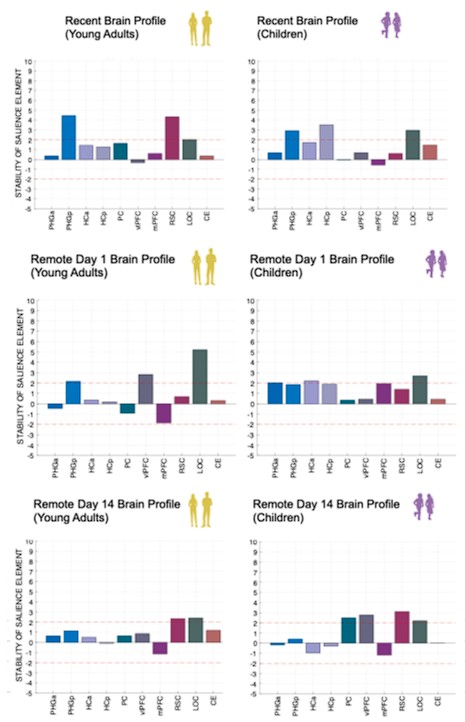
      (3) Also, as for differences between short delay brain profile and long delay brain profile for the scene-specific reinstatement - there are 2 regions that become significant at long delay that were not significant at a short delay (PC, and CE). However, given there are ceiling effects in behaviour at the short but not long delay, it's unclear if this is a meaningful difference or just a difference in sensitivity. Is there a way to test whether the profiles are statistically different from one another?

      We thank the reviewer for this comment. To better illustrate differential profiles also for high memory accuracy after immediate delay (30 minutes delay), we added the immediate (30 minutes delay) condition as a third reference point, given the availability of scene-specific reinstatement data at this time point. Interestingly, the immediate reinstatement profile revealed a different set of significant regions, with distinct expression patterns compared to both the short and long delay conditions. This supports the view that scene-specific reinstatement is not static but dynamically reorganized over time.

      Regarding the ceiling effect at short delay, we acknowledge this as a potential limitation. However, we note that our primary analyses were conducted across both age groups combined, and not solely within high-performing individuals. As such, the grouping may mitigate concerns that ceiling-level performance in a subset of participants unduly influenced the overall reinstatement profile. Moreover, we observed variation in neural reinstatement despite ceiling-level behavior, suggesting that the neural signal retains sensitivity to consolidation-related processes even when behavioral accuracy is near-perfect.

      While we agree that formal statistical comparisons of reinstatement profiles across delays (e.g., using representational profile similarity or interaction tests) could be an informative direction, we feel that this goes beyond the scope of the current manuscript. 

      (4) As I mentioned above, it also was not ideal in my opinion that all regions were included for the scene-specific reinstatement due to the authors' inability to have an appropriate baseline and therefore define above-chance reinstatement. It makes these findings really challenging to compare with the gist reinstatement ones. 

      We appreciate the reviewer’s comment and agree that the lack of a clearly defined baseline for scene-specific reinstatement limits our ability to determine whether these values reflect above-chance reinstatement. However, we would like to clarify that we do not directly compare the magnitude of scene-specific reinstatement to that of gist-like reinstatement in our analyses or interpretations. These two analyses serve complementary purposes: the scenespecific analysis captures trial-unique similarity (within-item reinstatement), while the gistlike analysis captures category-level representational structure (across items). Because they differ not only in baseline assumptions but also in analytical scope and theoretical interpretation, our goal was not to compare them directly, but rather to explore distinct but co-existing representational formats that may evolve differently across development and delay.

      (8) I would encourage the authors to be specific about whether they are measuring/talking about memory representations versus reinstatement, unless they think these are the same thing (in which case some explanation as to why would be helpful). For example, especially under the Fuzzy Trace framework, couldn't someone maintain both verbatim and gist traces of a memory yet rely more on one when making a memory decision? 

      We thank the reviewer for pointing out the importance of conceptual clarity when referring to memory representations versus reinstatement. We agree that these are distinct but related concepts: in our framework, memory representations refer to the neural content stored as a result of encoding and consolidation, whereas reinstatement refers to the reactivation of those representations during retrieval. Thus, reinstatement serves as a proxy for the underlying memory representation — it is how we measure or infer the nature (e.g., specificity, abstraction) of the stored content.

      Under Fuzzy Trace Theory, it is indeed possible for both verbatim and gist representations to coexist. Our interpretation is not that children lack verbatim traces, but rather that they are more likely to rely on schematic or gist-like representations during retrieval, especially after a delay. Our use of neural pattern similarity (reinstatement) reflects which type of representation is being accessed, not necessarily which traces exist in parallel.

      To avoid ambiguity, we have revised the manuscript to more explicitly distinguish between reinstatement (neural reactivation) and the representational format (verbatim vs. gist-like), especially in the framing of our hypotheses and interpretation of age group differences.

      (9) With respect to the learning criteria - it is misleading to say that "children needed between two to four learning-retrieval cycles to reach the criterion of 83% correct responses" (p. 9). Four was the maximum, and looking at the Figure 1C data it appears as though there were at least a few children who did not meet the 83% minimum. I believe they were included in the analysis anyway? Please clarify. Was there any minimum imposed for inclusion?

      We thank the reviewer for pointing this out. As stated in Methods Section (p. 50, lines 13261338) “These cycles ranged from a minimum of two to a maximum of four.<…> The cycles ended when participants provided correct responses to 83% of the trials or after the fourth cycle was reached.” We have corrected the corresponding wording in the Results section (line 286-289) to reflect this more accurately. Indeed, five children did not reach the 83% criterion but achieved final performance between 70 and 80% after the fourth learning cycle. These participants were included in this analysis for two main reasons:

      (1) The 83% threshold was established during piloting as a guideline for how many learningretrieval cycles to allow, not a strict learning criterion. It served to standardize task continuation, rather than to exclude participants post hoc.

      (2) The performance of these five children was still well above chance level (33%), indicating meaningful learning. Excluding them would have biased the sample toward higherperforming children and reduced the ecological validity of our findings. Including them ensures a more representative view of children’s performance under extended learning conditions.

      (10) For the gist-like reinstatement PLSC analysis, results are really similar a short and long delays and yet some of the text seems to implying specificity to the long delay. One is a trend and one is significant (p. 31), but surely these two associations would not be statistically different from one another?  

      We agree with the reviewer that the associations at short and long delays appeared similar. While a formal comparison (e.g., using a Z-test for dependent correlations) would typically be warranted, in the reanalyzed dataset only the long delay profile remains statistically significant, which limits the interpretability of such a comparison. 

      (11) As a general comment, I had a hard time tying all of the (many) results together. For example adults show more mature neocortical consolidation-related engagement, which the authors say is going to create more durable detailed memories, but under multiple trace theory we would generally think of neocortical representations as providing more schematic information. If the authors could try to make more connections across the different neural analyses, as well as tie the neural findings in more closely with the behaviour & back to the theoretical frameworks, that would be really helpful.  

      We thank the reviewer for this valuable suggestion. We have revised the discussion section to more clearly link the behavioral and neural findings and to interpret them in light of existing consolidation theories for better clarity. 

      Reviewer #2 (Public Review): 

      Schommartz et al. present a manuscript characterizing neural signatures of reinstatement during cued retrieval of middle-aged children compared to adults. The authors utilize a paradigm where participants learn the spatial location of semantically related item-scene memoranda which they retrieve after short or long delays. The paradigm is especially strong as the authors include novel memoranda at each delayed time point to make comparisons across new and old learning. In brief, the authors find that children show more forgetting than adults, and adults show greater engagement of cortical networks after longer delays as well as stronger item-specific reinstatement. Interestingly, children show more category-based reinstatement, however, evidence supports that this marker may be maladaptive for retrieving episodic details. The question is extremely timely both given the boom in neurocognitive research on the neural development of memory, and the dearth of research on consolidation in this age group. Also, the results provide novel insights into why consolidation processes may be disrupted in children. 

      We thank the reviewer for the positive evaluation.

      Comments on the revised version: 

      I carefully reviewed not only the responses to my own reviews as well as those raised by the other reviewers. While they addressed some of the concerns raised in the process, I think many substantive concerns remain. 

      Regarding Reviewer 1: 

      The authors point that the retrieval procedure is the same over time and similarly influenced by temporal autocorrelations, which makes their analysis okay. However, there is a fundamental problem as to whether they are actually measuring reinstatement or they are only measuring differences in temporal autocorrelation (or some non-linear combination of both). The authors further argue that the stimuli are being processed more memory wise rather than perception wise, however, I think there is no evidence for that and that perception-memory processes should be considered on a continuum rather than as discrete processes. Thus, I agree with reviewer 1 that these analyses should be removed. 

      We thank the reviewer for raising this important question. We would like to clarify a few key points regarding temporal autocorrelation and reinstatement.

      During the fixation window, participants were instructed to reinstate the scene and location associated with the cued object from memory. This task was familiar to them, as they had been trained in retrieving locations within scenes. Our analysis aims to compare the neural representations during this retrieval phase with those when participants view the scene, in order to assess how these representations change in similarity over time, as memories become less precise.

      We acknowledge that temporal proximity can lead to temporal autocorrelation. However, evidence suggests that temporal autocorrelation is consistent and stable across conditions (Gautama & Van Hulle, 2004; Woolrich et al., 2004). Shinn & Lagalwar (2021)further demonstrated that temporal autocorrelation is highly reliable at both the subject and regional levels. Given that we analyze regions of interest (ROIs) separately, potential spatial variability in temporal autocorrelation is not a major concern.

      No difference between item-specific reinstatement for recent items on day 1 and day 14 (which were merged) for further delay-related comparison also suggests that the reinstatement measure was stable for recent items even sampled at two different testing days. 

      Importantly, we interpret the relative change in the reinstatement index rather than its absolute value.

      In addition, when we conducted the same analysis for incorrectly retrieved memories, we did not observe any delay-related decline in reinstatement (see p. 25, lines 623-627). This suggests that the delay-related changes in reinstatement are specific to correctly retrieved memories. 

      Finally, our control analysis examining reinstatement between object and fixation time points (as suggested by Reviewer 1) revealed no delay-related effects in any ROI (see p.24, lines 605-612), further highlighting the specificity of the observed delay-related change in item reinstatement.

      We emphasize that temporal autocorrelation should be similar across all retrieval delays due to the identical task design and structure. Therefore, any observed decrease in reinstatement with increasing delay likely reflects a genuine change in the reinstatement index, rather than differences in temporal autocorrelation. Since our analysis includes only correctly retrieved items, and there is no perceptual input during the fixation window, this process is inherently memory-based, relying on mnemonic retrieval rather than sensory processing.

      We respectfully disagree with the reviewer's assertion that retrieval during the fixation period cannot be considered more memory-driven than perception-driven. At this time point, participants had no access to actual images of the scene, making it necessary for them to rely on mnemonic retrieval. The object cue likely triggered pattern completion for the learned object-scene association, forming a unique memory if remembered correctly(Horner & Burgess, 2013). This process is inherently mnemonic, as it is based on reconstructing the original neural representation of the scene (Kuhl et al., 2012; Staresina et al., 2013).

      While perception and memory processes can indeed be viewed as a continuum, some cognitive processes are predominantly memory-based, involving reconstruction rather than reproduction of previous experiences (Bartlett, 1932; Ranganath & Ritchey, 2012). In our task, although the retrieved material is based on previously encoded visual information, the process of recalling this information during the fixation period is fundamentally mnemonic, as it does not involve visual input. Our findings indicate that the similarity between memorybased representations and those observed during actual perception decreases over time, suggesting a relative change in the quality of the representations. However, this does not imply that detailed representations disappear; they may still be robust enough to support correct memory recall. Previous studies examining encoding-retrieval similarity have shown similar findings(Pacheco Estefan et al., 2019; Ritchey et al., 2013).

      We do not claim that perception and memory processes are entirely discrete, nor do we suggest that only perception is involved when participants see the scene. Viewing the scene indeed involves recognition processes, updating retrieved representations from the fixation period, and potentially completing missing or unclear information. This integrative process demonstrates the interrelation of perception and memory, especially in complex tasks like the one we employed.

      In conclusion, our task design and analysis support the interpretation that the fixation period is primarily characterized by mnemonic retrieval, facilitated by cue-triggered pattern completion, rather than perceptual processing. We believe this approach aligns with the current understanding of memory retrieval processes as supported by the existing literature.

      The authors seem to have a design that would allow for across run comparisons, however, they did not include these additional analyses. 

      Thank you for pointing this out. We ran as additional cross-run comparison. This results and further proceeding are reported in the comment for reviewer 1. 

      To address the reviewer’s concern, we conducted an additional cross-run analysis for all correctly retrieved trials. The approach restricted comparisons to non-overlapping runs (run1run2, run2-run3, run1-run3). This analysis revealed robust gist-like reinstatement in children for remote Day 14 memories in the mPFC (p = .035) and vlPFC (p = .0007), in adults’ vlPFC remote Day 1 memories (p = .029), as well as in children and adults remote Day 1 memories in LOC (p < .02). A significant Session effect in both regions (mPFC: p = .026; vlPFC: p = .002) indicated increased reinstatement for long delay (Day 14) compared to short-delay and recent session (all p < .05). Given that the cross-run results largely replicate and reinforce the effects found previously with within-run, we believe that combining both sources of information is methodologically justified and statistically beneficial. Specifically, both approaches independently identified significant gist-like reinstatement in children’s mPFC and vlPFC (although within-run vlPFC effect (short delay: p = .038; long delay p = .047) did not survive multiple comparisons), particularly for remote memories. Including both withinrun and between-run comparisons increases the number of unique, non-repeated trial pairs, improving statistical power without introducing redundancy. While we acknowledge that same-run comparisons may be influenced by residual autocorrelation(Prince et al., 2022), we believe that our design mitigates this risk through consistency between within-run and crossrun results, long inter-trial intervals, and trial-wise estimation of activation. We have adjusted the manuscript, accordingly, reporting the combined analysis. We also report cross-run and within-run analysis separately in supplementary materials (Tables S12.1, S12.2, showing that they converge with the cross-run results and thus strengthen rather than dilute the findings. 

      As suggested, we now explicitly highlight the change over time as the central finding. We observe a clear increase in gist-like reinstatement from recent to remote memories in children, particularly in mPFC and vlPFC. These effects based on combined within- and cross-run comparisons, are now clearly stated in the main results and interpreted in the discussion accordingly. 

      (1) The authors did not satisfy my concerns about different amounts of re-exposures to stimuli as a function of age, which introduces a serious confound in the interpretation of the neural data. 

      (2) Regarding Reviewer 1's point about different number of trials being entered into analysis, I think a more formal test of sub-sampling the adult trials is warranted. 

      (1) We thank the reviewer for pointing this out. Overall, children needed 2 to 4 learning cycles to improve their performance and reach the learning criteria, compared to 2 learning cycles in adults. To address the different amounts of re-exposure to stimuli between the age groups, we subsampled the child group to only those children who reached the learning criteria after 2 learning cycles. For this purpose, we excluded 21 children from the analysis who needed 3 or 4 learning cycles. This resulted in 39 young adults and 28 children being included in the subsequent analysis. 

      (i) We reran the behavioral analysis with the subsampled dataset (see Supplementary Materials,  Table S1.1, Fig. S1, Table S1.2). This analysis replicated the previous findings of less robust memory consolidation in children across all time delays. 

      (ii) We reran the univariate analysis (see in Supplementary Materials, Table S9.1). This analysis also replicated fully the previous findings. This indicates that the inclusion of child participants with greater material exposure during learning in the analysis of neural retrieval patterns did not affect the group differences in univariate neural results. 

      These subsampled results demonstrated that the amount of re-exposure to stimuli during encoding does not affect consolidation-related changes in memory retrieval at the behavioral and neural levels in children and adults across all time delays. We have added this information to the manuscript (line 343-348, 420-425). 

      (2) We appreciate Reviewer 1's suggestion to perform a formal test by sub-sampling the adult trials to match the number of trials in the child group. However, we believe that this approach may not be optimal for the following reasons:

      (i) Loss of Statistical Power: Sub-sampling the adult trials would result in a reduced sample size, potentially leading to a significant loss of statistical power and the ability to detect meaningful effects, particularly in a context where the adult group is intended to serve as a robust control or comparison group.

      (ii) Introducing sub-sampling could introduce variability that complicates the interpretation of results, particularly if the trial sub-sampling process does not fully capture the variability inherent in the original adult data.

      (iii) Robustness of Existing Findings: We have already addressed potential concerns about unequal trial numbers by conducting analyses that control for the number of learning cycles, as detailed in our supplementary materials. These analyses have shown that the observed effects are consistent, suggesting that the differences in trial numbers do not critically influence our findings.

      Given these considerations, we hope the reviewer understands our rationale and agrees that the current analysis is robust and appropriate for addressing the research questions.

      I also still fundamentally disagree with the use of global signals when comparing children to adults, and think this could very much skew the results. 

      We thank the reviewer for raising this important issue. To address this concern comprehensively, we have taken the following steps:

      (1) Overview of the literature support for global signal regression (GSR). A growing body of methodological and empirical research supports the inclusion of global signal repression as part of best practice denoising pipelines, particularly when analyzing pediatric fMRI data. Studies such as (Ciric et al., 2017; Parkes et al., 2018; J. D. Power et al., 2012, 2014; Power et al., 2012), and (Thompson et al., 2016) show that  GSR improves motion-related artifact removal. Critically, pediatric-specific studies (Disselhoff et al., 2025; Graff et al., 2022) conclude that pipelines including GSR are most effective for signal recovery and artifact removal in younger children. Graff et al. (2021) demonstrated that among various pipelines, GSR yielded the best noise reduction in 4–8-year-olds. Additionally, (Li et al., 2019; Qing et al., 2015) emphasized that GSR reduces artifactual variance without distorting the spatial structure of neural signals. (Ofoghi et al., 2021)demonstrated that global signal regression helps mitigate non-neuronal noise sources, including respiration, cardiac activity, motion, vasodilation, and scanner-related artifacts. Based on this and other recent findings, we consider GSR particularly beneficial for denoising paediatric  fMRI data in our study.

      (2) Empirical comparison of pipelines with and without GSR. We re-run the entire first-level univariate analysis using the pipeline that excluded the global signal regression. The resulting activation maps (see Supplementary Figure S3.2, S4.2, S5.2, S9.2) differed notably from the original pipeline. Specifically, group differences in cortical regions such as mPFC, cerebellum, and posterior PHG no longer reached significance, and the overall pattern of results appeared noisier. 

      (3) Evaluation of the pipeline differences. To further evaluate the impact of GSR, we conducted the following analyses:

      (a) Global signal is stable across groups and sessions. A linear mixed-effects model showed no significant main effects or interactions involving group or session on the global signal (F-values < 2.62, p > .11), suggesting that the global signal was not group- or session-dependent in our sample. 

      (b) Noise Reduction Assessment via Contrast Variability. We compared the variability (standard deviation and IQR) of contrast estimates across pipelines. Both SD (b = .070, p < .001) and IQR (b = .087, p < .001) were significantly reduced in the GSR pipeline, especially in children (p < .001) compared to adults (p = .048). This suggests that GSR reduces inter-subject variability in children, likely reflecting improved signal quality.

      (c) Residual Variability After Regressing Global Signal. We regressed out global signal post hoc from both pipelines and compared the residual variance. Residual standard deviation was significantly lower for the GSR pipeline (F = 199, p < .001), with no interaction with session or group, further indicating that GSR stabilizes the signal and attenuates non-neuronal variability.

      Conclusion

      In summary, while we understand the reviewer’s concern, we believe the empirical and theoretical support for GSR, especially in pediatric samples, justifies its use in our study. Nonetheless, to ensure full transparency, we provide full results from both pipelines in the Supplementary Materials and have clarified our reasoning in the revised manuscript.

      Reviewer #1 (Recommendations For The Authors): 

      (1) Some figures are still missing descriptions of what everything on the graph means; please clarify in captions. 

      We thank the reviewer for pointing this out. We undertook the necessary adjustments in the graph annotations. 

      (2) The authors conclude they showed evidence of neural reorganization of memory representations in children (p. 41). But the gist is not greater in children than adults, and also does not differ over time-so, I was confused about what this claim was based on? 

      We thank the reviewer for raising this question. Our results on gist-like reinstatements suggest that gist-like reinstatement was significantly higher in children compared to adults in the mPFC in addition to the child gist-like reinstatement indices being significantly higher than zero (see p.27-28). These results support our claim on neural reorganization of memory represenations in children. We hope this clarifies the issue. 

      References

      Bartlett, F. C. (1932). Remembering: A study in experimental and social psychology. Cambridge University Press.

      Brainerd, C. J., & Reyna, V. F. (2002). Fuzzy-Trace Theory: Dual Processes in Memory, Reasoning, and Cognitive Neuroscience (pp. 41–100). https://doi.org/10.1016/S00652407(02)80062-3

      Chen, J., Leong, Y. C., Honey, C. J., Yong, C. H., Norman, K. A., & Hasson, U. (2017). Shared memories reveal shared structure in neural activity across individuals. Nature Neuroscience, 20(1), 115–125. https://doi.org/10.1038/nn.4450

      Ciric, R., Wolf, D. H., Power, J. D., Roalf, D. R., Baum, G. L., Ruparel, K., Shinohara, R. T., Elliott, M. A., Eickhoff, S. B., Davatzikos, C., Gur, R. C., Gur, R. E., Bassett, D. S., & Satterthwaite, T. D. (2017). Benchmarking of participant-level confound regression strategies for the control of motion artifact in studies of functional connectivity. NeuroImage, 154, 174–187. https://doi.org/10.1016/j.neuroimage.2017.03.020

      Disselhoff, V., Jakab, A., Latal, B., Schnider, B., Wehrle, F. M., Hagmann, C. F., Held, U., O’Gorman, R. T., Fauchère, J.-C., & Hüppi, P. (2025). Inhibition abilities and functional brain connectivity in school-aged term-born and preterm-born children. Pediatric Research, 97(1), 315–324. https://doi.org/10.1038/s41390-024-03241-0

      Esteban, O., Ciric, R., Finc, K., Blair, R. W., Markiewicz, C. J., Moodie, C. A., Kent, J. D., Goncalves, M., DuPre, E., Gomez, D. E. P., Ye, Z., Salo, T., Valabregue, R., Amlien, I. K., Liem, F., Jacoby, N., Stojić, H., Cieslak, M., Urchs, S., … Gorgolewski, K. J. (2020). Analysis of task-based functional MRI data preprocessed with fMRIPrep. Nature Protocols, 15(7), 2186–2202. https://doi.org/10.1038/s41596-020-0327-3

      Fandakova, Y., Leckey, S., Driver, C. C., Bunge, S. A., & Ghetti, S. (2019). Neural specificity of scene representations is related to memory performance in childhood. NeuroImage, 199, 105–113. https://doi.org/10.1016/j.neuroimage.2019.05.050

      Gautama, T., & Van Hulle, M. M. (2004). Optimal spatial regularisation of autocorrelation estimates in fMRI analysis. NeuroImage, 23(3), 1203–1216.  https://doi.org/10.1016/j.neuroimage.2004.07.048

      Graff, K., Tansey, R., Ip, A., Rohr, C., Dimond, D., Dewey, D., & Bray, S. (2022). Benchmarking common preprocessing strategies in early childhood functional connectivity and intersubject correlation fMRI. Developmental Cognitive Neuroscience, 54, 101087. https://doi.org/10.1016/j.dcn.2022.101087

      Horner, A. J., & Burgess, N. (2013). The associative structure of memory for multi-element events. Journal of Experimental Psychology: General, 142(4), 1370–1383. https://doi.org/10.1037/a0033626

      Jones, J. S., the CALM Team, & Astle, D. E. (2021). A transdiagnostic data-driven study of children’s behaviour and the functional connectome. Developmental Cognitive Neuroscience, 52, 101027. https://doi.org/10.1016/j.dcn.2021.101027

      Kuhl, B. A., Bainbridge, W. A., & Chun, M. M. (2012). Neural Reactivation Reveals Mechanisms for Updating Memory. Journal of Neuroscience, 32(10), 3453–3461. https://doi.org/10.1523/JNEUROSCI.5846-11.2012

      Kuhl, B. A., & Chun, M. M. (2014). Successful Remembering Elicits Event-Specific Activity Patterns in Lateral Parietal Cortex. Journal of Neuroscience, 34(23), 8051–8060. https://doi.org/10.1523/JNEUROSCI.4328-13.2014

      Li, J., Kong, R., Liégeois, R., Orban, C., Tan, Y., Sun, N., Holmes, A. J., Sabuncu, M. R., Ge, T., & Yeo, B. T. T. (2019). Global signal regression strengthens association between resting-state functional connectivity and behavior. NeuroImage, 196, 126–141. https://doi.org/10.1016/j.neuroimage.2019.04.016

      Ofoghi, B., Chenaghlou, M., Mooney, M., Dwyer, D. B., & Bruce, L. (2021). Team technical performance characteristics and their association with match outcome in elite netball. International Journal of Performance Analysis in Sport, 21(5), 700–712. https://doi.org/10.1080/24748668.2021.1938424

      Pacheco Estefan, D., Sánchez-Fibla, M., Duff, A., Principe, A., Rocamora, R., Zhang, H., Axmacher, N., & Verschure, P. F. M. J. (2019). Coordinated representational reinstatement in the human hippocampus and lateral temporal cortex during episodic memory retrieval. Nature Communications, 10(1), 2255. https://doi.org/10.1038/s41467019-09569-0

      Parkes, L., Fulcher, B., Yücel, M., & Fornito, A. (2018). An evaluation of the efficacy, reliability, and sensitivity of motion correction strategies for resting-state functional MRI. NeuroImage, 171, 415–436. https://doi.org/10.1016/j.neuroimage.2017.12.073

      Power, J. D., Barnes, K. A., Snyder, A. Z., Schlaggar, B. L., & Petersen, S. E. (2012). Spurious but systematic correlations in functional connectivity MRI networks arise from subject motion. NeuroImage, 59(3), 2142–2154. https://doi.org/10.1016/j.neuroimage.2011.10.018

      Power, J. D., Mitra, A., Laumann, T. O., Snyder, A. Z., Schlaggar, B. L., & Petersen, S. E. (2014). Methods to detect, characterize, and remove motion artifact in resting state fMRI. NeuroImage, 84, 320–341. https://doi.org/10.1016/j.neuroimage.2013.08.048

      Power, S. D., Kushki, A., & Chau, T. (2012). Intersession Consistency of Single-Trial Classification of the Prefrontal Response to Mental Arithmetic and the No-Control State by NIRS. PLoS ONE, 7(7), e37791. https://doi.org/10.1371/journal.pone.0037791

      Prince, J. S., Charest, I., Kurzawski, J. W., Pyles, J. A., Tarr, M. J., & Kay, K. N. (2022). Improving the accuracy of single-trial fMRI response estimates using GLMsingle. ELife, 11. https://doi.org/10.7554/eLife.77599

      Qing, Z., Dong, Z., Li, S., Zang, Y., & Liu, D. (2015). Global signal regression has complex effects on regional homogeneity of resting state fMRI signal. Magnetic Resonance Imaging, 33(10), 1306–1313. https://doi.org/10.1016/j.mri.2015.07.011

      Ranganath, C., & Ritchey, M. (2012). Two cortical systems for memory-guided behaviour. Nature Reviews Neuroscience, 13(10), 713–726. https://doi.org/10.1038/nrn3338

      Ritchey, M., Wing, E. A., LaBar, K. S., & Cabeza, R. (2013). Neural Similarity Between Encoding and Retrieval is Related to Memory Via Hippocampal Interactions. Cerebral Cortex, 23(12), 2818–2828. https://doi.org/10.1093/cercor/bhs258

      Satterthwaite, T. D., Elliott, M. A., Gerraty, R. T., Ruparel, K., Loughead, J., Calkins, M. E., Eickhoff, S. B., Hakonarson, H., Gur, R. C., Gur, R. E., & Wolf, D. H. (2013). An improved framework for confound regression and filtering for control of motion artifact in the preprocessing of resting-state functional connectivity data. NeuroImage, 64, 240–256. https://doi.org/10.1016/j.neuroimage.2012.08.052

      Schommartz, I., Lembcke, P. F., Pupillo, F., Schuetz, H., de Chamorro, N. W., Bauer, M., Kaindl, A. M., Buss, C., & Shing, Y. L. (2023). Distinct multivariate structural brain profiles are related to variations in short- and long-delay memory consolidation across children and young adults. Developmental Cognitive Neuroscience, 59. https://doi.org/10.1016/J.DCN.2022.101192

      Sekeres, M. J., Winocur, G., & Moscovitch, M. (2018). The hippocampus and related neocortical structures in memory transformation. Neuroscience Letters, 680, 39–53. https://doi.org/10.1016/j.neulet.2018.05.006

      Shinn, L. J., & Lagalwar, S. (2021). Treating Neurodegenerative Disease with Antioxidants: Efficacy of the Bioactive Phenol Resveratrol and Mitochondrial-Targeted MitoQ and SkQ. Antioxidants, 10(4), 573. https://doi.org/10.3390/antiox10040573

      Staresina, B. P., Alink, A., Kriegeskorte, N., & Henson, R. N. (2013). Awake reactivation predicts memory in humans. Proceedings of the National Academy of Sciences, 110(52), 21159–21164. https://doi.org/10.1073/pnas.1311989110

      St-Laurent, M., & Buchsbaum, B. R. (2019). How Multiple Retrievals Affect Neural Reactivation in Young and Older Adults. The Journals of Gerontology: Series B, 74(7), 1086–1100. https://doi.org/10.1093/geronb/gbz075

      Thompson, G. J., Riedl, V., Grimmer, T., Drzezga, A., Herman, P., & Hyder, F. (2016). The Whole-Brain “Global” Signal from Resting State fMRI as a Potential Biomarker of Quantitative State Changes in Glucose Metabolism. Brain Connectivity, 6(6), 435–447. https://doi.org/10.1089/brain.2015.0394

      Tompary, A., & Davachi, L. (2017). Consolidation Promotes the Emergence of Representational Overlap in the Hippocampus and Medial Prefrontal Cortex. Neuron, 96(1), 228-241.e5. https://doi.org/10.1016/j.neuron.2017.09.005

      Tompary, A., Zhou, W., & Davachi, L. (2020). Schematic memories develop quickly, but are not expressed unless necessary. PsyArXiv.

      Woolrich, M. W., Behrens, T. E. J., Beckmann, C. F., Jenkinson, M., & Smith, S. M. (2004). Multilevel linear modelling for FMRI group analysis using Bayesian inference. NeuroImage, 21(4), 1732–1747. https://doi.org/10.1016/j.neuroimage.2003.12.023

      Xiao, X., Dong, Q., Gao, J., Men, W., Poldrack, R. A., & Xue, G. (2017). Transformed Neural Pattern Reinstatement during Episodic Memory Retrieval. The Journal of Neuroscience, 37(11), 2986–2998. https://doi.org/10.1523/JNEUROSCI.2324-16.2017

      Ye, Z., Shi, L., Li, A., Chen, C., & Xue, G. (2020). Retrieval practice facilitates memory updating by enhancing and differentiating medial prefrontal cortex representations. ELife, 9, 1–51. https://doi.org/10.7554/ELIFE.57023

      Yonelinas, A. P., Ranganath, C., Ekstrom, A. D., & Wiltgen, B. J. (2019). A contextual binding theory of episodic memory: systems consolidation reconsidered. Nature Reviews. Neuroscience, 20(6), 364–375. https://doi.org/10.1038/S41583-019-01504

      Zhuang, L., Wang, J., Xiong, B., Bian, C., Hao, L., Bayley, P. J., & Qin, S. (2021). Rapid neural reorganization during retrieval practice predicts subsequent long-term retention and false memory. Nature Human Behaviour, 6(1), 134–145.

      https://doi.org/10.1038/s41562-021-01188-4
    1. Author response:

      The following is the authors’ response to the original reviews.

      Reviewer #1 (Public review):

      Summary: 

      In this manuscript, the authors identified that

      (1) CDK4/6i treatment attenuates the growth of drug-resistant cells by prolongation of the G1 phase;

      (2) CDK4/6i treatment results in an ineffective Rb inactivation pathway and suppresses the growth of drugresistant tumors;

      (3) Addition of endocrine therapy augments the efficacy of CDK4/6i maintenance; 

      (4) Addition of CDK2i with CDK4/6 treatment as second-line treatment can suppress the growth of resistant cell; 

      (5) The role of cyclin E as a key driver of resistance to CDK4/6 and CDK2 inhibition.

      Strengths: 

      To prove their complicated proposal, the authors employed orchestration of several kinds of live cell markers, timed in situ hybridization, IF and Immunoblotting. The authors strongly recognize the resistance of CDK4/6 + ET therapy and demonstrated how to overcome it. 

      Weaknesses: 

      The authors need to underscore their proposed results from what is to be achieved by them and by other researchers. 

      Reviewer #2 (Public review): 

      Summary: 

      This study elucidated the mechanism underlying drug resistance induced by CDK4/6i as a single agent and proposed a novel and efficacious second-line therapeutic strategy. It highlighted the potential of combining CDK2i with CDK4/6i for the treatment of HR+/HER2- breast cancer.

      Strengths: 

      The study demonstrated that CDK4/6 induces drug resistance by impairing Rb activation, which results in diminished E2F activity and a delay in G1 phase progression. It suggests that the synergistic use of CDK2i and CDK4/6i may represent a promising second-line treatment approach. Addressing critical clinical challenges, this study holds substantial practical implications.

      Weaknesses: 

      (1) Drug-resistant cell lines: Was a drug concentration gradient treatment employed to establish drug-resistant cell lines? If affirmative, this methodology should be detailed in the materials and methods section. 

      We greatly appreciate the reviewer for raising this important question. In the revised manuscript, we have updated the methods section (“Drug-resistant cell lines”) to more precisely describe how the drug-resistant cell lines were established. 

      (2) What rationale informed the selection of MCF-7 cells for the generation of CDK6 knockout cell lines? Supplementary Figure 3. A indicates that CDK6 expression levels in MCF-7 cells are not notably elevated. 

      We appreciate the reviewer’s insightful question about the rationale for selecting MCF-7 cells to generate CDK6 knockout cell lines. This choice was guided by prior studies highlighting the significant role of CDK6 in mediating resistance to CDK4/6 inhibitors (21-24). Moreover, we observed a 4.6-fold increase in CDK6 expression in CDK4/6i resistant MCF-7 cells compared to their drug-naïve counterparts (Supplementary Figure 3A). While we did not detect notable differences in CDK4/6 activity between wild-type and CDK6 knockout cells under CDK4/6 inhibitor treatment, these findings point to a potential non-canonical function of CDK6 in conferring resistance to CDK4/6 inhibitors.  

      (3) For each experiment, particularly those involving mice, the author must specify the number of individuals utilized and the number of replicates conducted, as detailed in the materials and methods section. 

      We sincerely thank the reviewer for bringing this to our attention. In the revised manuscript, we have explicitly stated the number of replicates and mice used for each experiment as appropriate in figure legends and relevant text to ensure transparency and clarity. 

      (4) Could this treatment approach be extended to triple-negative breast cancer?

      We greatly appreciate the reviewer’s inquiry about extending our findings to triple-negative breast cancer (TNBC). Based on the data presented in Figure 1 and Supplementary Figure 2, which include the TNBC cell line MDA-MB-231, we expect that the benefits of maintaining CDK4/6 inhibitors could indeed be applicable to TNBC with an intact Rb/E2F pathway. Additionally, our recent paper (25) indicates a similar mechanism in TNBC.

      Reviewer #3 (Public review):

      Summary: 

      In their manuscript, Armand and colleagues investigate the potential of continuing CDK4/6 inhibitors or combining them with CDK2 inhibitors in the treatment of breast cancer that has developed resistance to initial therapy. Utilizing cellular and animal models, the research examines whether maintaining CDK4/6 inhibition or adding CDK2 inhibitors can effectively control tumor growth after resistance has set in. The key findings from the study indicate that the sustained use of CDK4/6 inhibitors can slow down the proliferation of cancer cells that have become resistant, and the combination of CDK2 inhibitors with CDK4/6 inhibitors can further enhance the suppression of tumor growth. Additionally, the study identifies that high levels of Cyclin E play a significant role in resistance to the combined therapy. These results suggest that continuing CDK4/6 inhibitors along with the strategic use of CDK2 inhibitors could be an effective strategy to overcome treatment resistance in hormone receptor-positive breast cancer.

      Strengths: 

      (1) Continuous CDK4/6 Inhibitor Treatment Significantly Suppresses the Growth of Drug-Resistant HR+ Breast Cancer: The study demonstrates that the continued use of CDK4/6 inhibitors, even after disease progression, can significantly inhibit the growth of drug-resistant breast cancer. 

      (2) Potential of Combined Use of CDK2 Inhibitors with CDK4/6 Inhibitors: The research highlights the potential of combining CDK2 inhibitors with CDK4/6 inhibitors to effectively suppress CDK2 activity and overcome drug resistance. 

      (3) Discovery of Cyclin E Overexpression as a Key Driver: The study identifies overexpression of cyclin E as a key driver of resistance to the combination of CDK4/6 and CDK2 inhibitors, providing insights for future cancer treatments. 

      (4) Consistency of In Vitro and In Vivo Experimental Results: The study obtained supportive results from both in vitro cell experiments and in vivo tumor models, enhancing the reliability of the research. 

      (5) Validation with Multiple Cell Lines: The research utilized multiple HR+/HER2- breast cancer cell lines (such as MCF-7, T47D, CAMA-1) and triple-negative breast cancer cell lines (such as MDA-MB-231), validating the broad applicability of the results.

      Weaknesses: 

      (1) The manuscript presents intriguing findings on the sustained use of CDK4/6 inhibitors and the potential incorporation of CDK2 inhibitors in breast cancer treatment. However, I would appreciate a more detailed discussion of how these findings could be translated into clinical practice, particularly regarding the management of patients with drug-resistant breast cancer. 

      Thank you to the reviewer for this crucial comment. In the revised Discussion, we've broadened our exploration of clinical translation. Specifically, we emphasize that ongoing CDK4/6 inhibition, although not fully stopping resistant tumors, significantly slows their growth and may offer a therapeutic window when combined with ET and CDK2 inhibition. We also note that these approaches may work best for patients without Rb loss or newly acquired resistance-driving mutations, and that cyclin E overexpression could be a biomarker to inform patient selection. These points together highlight that our findings provide a mechanistic understanding and potential framework for clinical trials testing maintenance CDK4/6i with selective addition of CDK2i as a secondline strategy in drug-resistant HR+/HER2- breast cancer.

      (2) While the emergence of resistance is acknowledged, the manuscript could benefit from a deeper exploration of the molecular mechanisms underlying resistance development. A more thorough understanding of how CDK2 inhibitors may overcome this resistance would be valuable. 

      We thank the reviewer for this valuable suggestion. In the revised manuscript, we have expanded our Discussion to more explicitly synthesize the molecular mechanisms of resistance and how CDK2 inhibitors counteract them. Specifically, we describe how sustained CDK4/6 inhibition drives a non-canonical route of Rb degradation, resulting in inefficient E2F activation and prolonged G1 phase progression. We also highlight the role of c-Myc in amplifying E2F activity and promoting resistance, and we show that continued ET mitigates this effect by suppressing c-Myc. Importantly, we demonstrate that CDK2 inhibition alone cannot fully suppress the growth of resistant cells, but when combined with CDK4/6 inhibition, it produces durable repression of E2F and Myc target gene programs and significantly delays the G1/S transition. Finally, we identify cyclin E overexpression as a key mechanism of escape from dual CDK4/6i + CDK2i therapy, suggesting its potential as a biomarker for patient stratification . Together, these findings provide a detailed mechanistic rationale for how CDK2 inhibition can overcome specific pathways of resistance in HR<sup>+</sup>/HER2<sup>-</sup> breast cancer.

      (3) The manuscript supports the continued use of CDK4/6 inhibitors, but it lacks a discussion on the long-term efficacy and safety of this approach. Additional studies or data to support the safety profile of prolonged CDK4/6 inhibitor use would strengthen the manuscript. 

      We appreciate the reviewer’s insightful comment. In the revised manuscript, we emphasize the longterm efficacy and safety considerations of sustained CDK4/6 inhibition. Clinical trial and retrospective data have shown that continued CDK4/6i therapy can extend progression-free survival in selected patients, while maintaining a favorable safety profile (26-28). We have updated the Discussion to highlight these findings more explicitly, underscoring that while prolonged CDK4/6 inhibition slows but does not fully arrest tumor growth, it remains a clinically viable strategy when balanced against its manageable toxicity profile.

      Reviewer #1 (Recommendations for the authors): 

      It is well known that the combination therapy of CDK4/6i and ET has therapeutic benefits in ER(+) HER2(-) advanced breast cancer. However, drug resistance is a problem, and second-line therapy to solve this problem has not been established. Although some parts of the research results are already reported, the authors confirmed them by employing live cell markers, and further proved and suggested how to overcome this resistance in detail. This part is considered novel. 

      Overall, this research manuscript is eligible to be accepted with the appropriate addressing of questions.

      (1)The effects and biochemical changes of combination therapy of CDK4/6i and CDK2i are already known in several papers. The author needs to highlight the differences between the author's research and that of otherresearchers. 

      We thank the reviewer for the opportunity to clarify the novelty of our findings in the context of prior studies on CDK4/6i and CDK2i combination therapy. In the revised manuscript, we have updated the Discussion section to more clearly delineate how our work extends and differs from existing research.

      Specifically, we now state:

      Page 12: The combination of CDK4/6i and ET has reshaped treatment for HR<sup>+</sup>/HER2<sup>-</sup> breast cancer (1-8). However, resistance commonly emerges, and no consensus second-line standard is established. Our data show that continued CDK4/6i treatment in drug-resistant cells engages a non-canonical, proteolysis-driven route of Rb inactivation, yielding attenuated E2F output and a pronounced delay in G1 progression (Figure 7G). Concurrent ET further deepens this blockade by suppressing c-Myc-mediated E2F amplification, thereby prolonging G1 and slowing population growth. Importantly, CDK2 inhibition alone was insufficient to control resistant cells. Robust suppression of CDK2 activity and resistant-cell growth required CDK2i in combination with CDK4/6i, consistent with prior reports supporting dual CDK targeting (9-16). Moreover, cyclin E, and in some contexts cyclin A, blunted the efficacy of the CDK4/6i and CDK2i combination by reactivating CDK2. Together, these findings provide a mechanistic rationale for maintaining CDK4/6i beyond progression and support testing ET plus CDK4/6i with the strategic addition of CDK2i, as evidenced by concordant in vitro and in vivo results.

      (2) Regarding Figures 3H and 3I, I wonder if it is live cell imaging results or if the authors counter each signal via timed IF staining slides? If live cell imaging is used, the authors need to present the methods. 

      We appreciate the reviewer’s question. Figures 3H and 3I derive from a live–fixed correlative pipeline rather than purely live imaging or independently timed IF slides. We first imaged asynchronously proliferating cells live for ≥48 h to (i) segment/track nuclei with H2B fluorescence, (ii) define mitotic exit (t = 0 at anaphase), and (iii) record CDK2 activity using a CDK2 KTR in the last live frame. Immediately after the live acquisition, we pulsed EdU (10 µM, 15 min) and fixed the same wells, photobleached fluorescent proteins (3% H₂O₂ + 20 mM HCl, 2 h, RT) to prevent crosstalk, and then performed click-chemistry EdU detection, IF for phospho-Rb (Ser807/811) and total Rb, and RNA FISH for E2F1. Fixed-cell readouts (p-Rb positivity, EdU incorporation, E2F1 mRNA puncta) were mapped back to each single cell’s live-derived time since mitosis and/or CDK2 activity, enabling the kinetic plots shown in Fig. 3H–I.

      To ensure transparency and reproducibility, we added detailed methods describing this workflow in the “Immunofluorescence and mRNA fluorescence in situ hybridization (FISH)” section under a dedicated “live– fixed pipeline” paragraph, and we cross-referenced acquisition and analysis parameters in “Live- and fixed-cell image acquisition” and “Image processing and analysis.” These updates specify: EdU pulse/fix conditions, photobleaching, antibodies/probes, imaging hardware and channels, segmentation/tracking, mitosis alignment, background correction, and how fixed readouts were binned/quantified as functions of time after mitosis and CDK2 activity.

      (3) Regarding Figure 3F, seven images were obtained in same fields? The author needs to describe the meaning of the white image and the yellow and blue image of the bottom in detail. 

      Thank you for raising this point. All seven panels in Fig. 3F are from the same field of view. The top row shows the raw channels (Hoechst, p-Rb, total Rb, and E2F1 RNA FISH). The bottom row shows the corresponding processed outputs from that field: (i) nuclear segmentation, (ii) phosphorylated Rb-status classification, and (iii) cell boundaries used for single-cell RNA-FISH quantification. We have revised the figure legend to make this explicit.

      (4) The author showed E2F mRNA by ISH, but in fact, RB does not suppress E2F mRNA but suppresses protein, so the author needs to confirm E2F at the protein level.

      We sincerely appreciate the reviewer’s thoughtful suggestion to examine E2F1 at the protein level. In our study, we focused on E2F1 mRNA expression because it is a well-established and biologically meaningful readout of E2F1 transcriptional activity. Due to its autoregulatory nature (17), the release of active E2F1 protein from Rb induces the transcription of E2F1 itself, creating a positive feedback loop. As a result, E2F1 mRNA abundance serves as a direct and reliable proxy for E2F1 protein activity (18-20). Thus, quantifying E2F1 mRNA provides a biologically relevant and mechanistic indicator of Rb-E2F pathway status. To clarify this rationale, we have updated the Results section and added references supporting our use of E2F1 mRNA as a readout for E2F1 activity.

      (5) Is it possible to synchronize cells (nocodazole shake-off, Double thymidine block) under the presence of cdk4/6i? If so, then the authors need to demonstrate the delay of G1 progression via immunoblotting. 

      We thank the reviewer for this constructive suggestion. To address it, we performed nocodazole synchronization followed by release and monitored cell-cycle progression in the presence or absence of CDK4/6 inhibition.

      Specifically, we added the following new datasets to the revised manuscript:

      Fig. 3L: Live single-cell trajectories of CDK4/6 and CDK2 activities alongside the Cdt1-degron reporter after 14 hours of nocodazole (250 nM) treatment and release. We compared the averaged traces of CDK4/6 and CDK2 activities and Cdt1 intensity in parental cells (gray) and resistant cells with (red) and without (blue) CDK4/6i maintenance. These data show suppressed and delayed CDK2 activation, as well as a right-shifted S-phase entry, particularly under continuous CDK4/6 inhibition.

      Fig. 3M: Fixed-cell EdU pulse-labeling at 4, 6, 8, 12, 16, and 24 h post-release further confirms a significant delay in S-phase entry and prolonged G1 duration in CDK4/6i-maintained cells compared with naïve and withdrawn conditions.

      Together, these results directly demonstrate the delay in G1 progression following synchronized mitotic exit under CDK4/6 inhibition.

      (6) In Figure 5C the authors showed a violin plot of c-Myc level. Is this Immunohistochemical staining? The authors need to clarify the methods.

      Thank you for flagging this. The c-Myc measurements in Fig. 5C are from immunofluorescence (IF), not IHC. We now state this explicitly in the legend.

      (7) Regarding Live cell immunofluorescence tracing of live-cell reporters, the author needs to clarify the methods (excitation, emission), name of instruments, and software used.

      To address this, we have expanded the “Live-cell, fixed-cell, and tumor tissue image acquisition” section in the Materials and Methods.

      (8) Lines 475 SF1A, the authors need to correct typos. Naïve Naïve.

      We greatly appreciate the reviewer’s attention to this detail and have ensured all typos have been addressed.  

      (9) The authors need to unify Cdt1-degron(legends) Vs Cdt1 degron (figures). 

      We greatly appreciate your attention to this discrepancy. Language referring to the Cdt1 degron has been unified between figures and legends. 

      Reviewer #3 (Recommendations for the authors):

      (1) While the manuscript discusses the selection of doses for CDK4/6 inhibitors and CDK2 inhibitors, there is a lack of detailed data on the dose-response relationship. Additional data on the effects of different doses would be beneficial. 

      We appreciate the reviewer’s important comment. To address it, we performed additional dose– response experiments testing a range of CDK4/6i and CDK2i concentrations. These analyses revealed a clear synergistic interaction between the two inhibitors. The new data are now presented in Figure 6G and Supplementary Figure 8F of the revised manuscript.

      (2) In clinical trials, the criteria for patient selection are crucial for interpreting study outcomes. A detailed description of the patient selection criteria should be provided.  

      We thank the reviewer for bringing this important point to our attention. In the revised manuscript, we have clarified the patient selection criteria relevant to the interpretation of clinical outcomes. Specifically, we note that retrospective analyses suggest patients with indolent disease and no prior chemotherapy may benefit most from continued CDK4/6i plus ET. Moreover, our data and others’ indicate that clinical benefit is expected in tumors retaining an intact Rb/E2F axis, while resistance-driving alterations (e.g., Rb loss, PIK3CA, ESR1, FGFR1–3, HER2, FAT1 mutations) are likely to limit efficacy. Finally, we highlight cyclin E overexpression as a potential biomarker of resistance to combined CDK4/6i and CDK2i, underscoring the need for biomarker-guided patient stratification. These additions provide a more detailed framework for patient selection in future clinical applications.

      References

      (1) Finn RS, Crown JP, Lang I, Boer K, Bondarenko IM, Kulyk SO, et al. The cyclin-dependent kinase 4/6 inhibitor palbociclib in combination with letrozole versus letrozole alone as first-line treatment of oestrogen receptor-positive, HER2-negative, advanced breast cancer (PALOMA-1/TRIO-18): a randomised phase 2 study. Lancet Oncol 2015;16:25-35

      (2) Finn RS, Martin M, Rugo HS, Jones S, Im S-A, Gelmon K, et al. Palbociclib and Letrozole in Advanced Breast Cancer. New England Journal of Medicine 2016;375:1925-36

      (3) Turner NC, Slamon DJ, Ro J, Bondarenko I, Im S-A, Masuda N, et al. Overall Survival with Palbociclib and Fulvestrant in Advanced Breast Cancer. New England Journal of Medicine 2018;379:1926-36

      (4) Dickler MN, Tolaney SM, Rugo HS, Cortés J, Diéras V, Patt D, et al. MONARCH 1, A Phase II Study of Abemaciclib, a CDK4 and CDK6 Inhibitor, as a Single Agent, in Patients with Refractory HR(+)/HER2(-) Metastatic Breast Cancer. Clin Cancer Res 2017;23:5218-24

      (5) Johnston S, Martin M, Di Leo A, Im S-A, Awada A, Forrester T, et al. MONARCH 3 final PFS: a randomized study of abemaciclib as initial therapy for advanced breast cancer. npj Breast Cancer 2019;5:5

      (6) Hortobagyi GN, Stemmer SM, Burris HA, Yap Y-S, Sonke GS, Hart L, et al. Overall Survival with Ribociclib plus Letrozole in Advanced Breast Cancer. New England Journal of Medicine 2022;386:94250

      (7) Slamon DJ, Neven P, Chia S, Fasching PA, De Laurentiis M, Im S-A, et al. Overall Survival with Ribociclib plus Fulvestrant in Advanced Breast Cancer. New England Journal of Medicine 2019;382:51424

      (8) Im S-A, Lu Y-S, Bardia A, Harbeck N, Colleoni M, Franke F, et al. Overall Survival with Ribociclib plus Endocrine Therapy in Breast Cancer. New England Journal of Medicine 2019;381:307-16

      (9) Pandey K, Park N, Park KS, Hur J, Cho YB, Kang M, et al. Combined CDK2 and CDK4/6 Inhibition Overcomes Palbociclib Resistance in Breast Cancer by Enhancing Senescence. Cancers (Basel) 2020;12

      (10) Freeman-Cook K, Hoffman RL, Miller N, Almaden J, Chionis J, Zhang Q, et al. Expanding control of the tumor cell cycle with a CDK2/4/6 inhibitor. Cancer Cell 2021;39:1404-21 e11

      (11) Dietrich C, Trub A, Ahn A, Taylor M, Ambani K, Chan KT, et al. INX-315, a selective CDK2 inhibitor, induces cell cycle arrest and senescence in solid tumors. Cancer Discov 2023

      (12) Al-Qasem AJ, Alves CL, Ehmsen S, Tuttolomondo M, Terp MG, Johansen LE, et al. Co-targeting CDK2 and CDK4/6 overcomes resistance to aromatase and CDK4/6 inhibitors in ER+ breast cancer. NPJ Precis Oncol 2022;6:68

      (13) Kudo R, Safonov A, Jones C, Moiso E, Dry JR, Shao H, et al. Long-term breast cancer response to CDK4/6 inhibition defined by TP53-mediated geroconversion. Cancer Cell 2024

      (14) Arora M, Moser J, Hoffman TE, Watts LP, Min M, Musteanu M, et al. Rapid adaptation to CDK2 inhibition exposes intrinsic cell-cycle plasticity. Cell 2023;186:2628-43 e21

      (15) Kumarasamy V, Wang J, Roti M, Wan Y, Dommer AP, Rosenheck H, et al. Discrete vulnerability to pharmacological CDK2 inhibition is governed by heterogeneity of the cancer cell cycle. Nature Communications 2025;16:1476

      (16) Dommer AP, Kumarasamy V, Wang J, O'Connor TN, Roti M, Mahan S, et al. Tumor Suppressors Condition Differential Responses to the Selective CDK2 Inhibitor BLU-222. Cancer Res 2025

      (17) Johnson DG, Ohtani K, Nevins JR. Autoregulatory control of E2F1 expression in response to positive and negative regulators of cell cycle progression. Genes & Development 1994;8:1514-25

      (18) Chung M, Liu C, Yang HW, Koberlin MS, Cappell SD, Meyer T. Transient Hysteresis in CDK4/6 Activity Underlies Passage of the Restriction Point in G1. Mol Cell 2019;76:562-73 e4

      (19) Kim S, Leong A, Kim M, Yang HW. CDK4/6 initiates Rb inactivation and CDK2 activity coordinates cell-cycle commitment and G1/S transition. Sci Rep 2022;12:16810

      (20) Yang HW, Chung M, Kudo T, Meyer T, Yang HW, Chung, Mingyu, Kudo T, et al. Competing memories of mitogen and p53 signalling control cell-cycle entry. Nature 2017;549:404-8

      (21) Yang C, Li Z, Bhatt T, Dickler M, Giri D, Scaltriti M, et al. Acquired CDK6 amplification promotes breast cancer resistance to CDK4/6 inhibitors and loss of ER signaling and dependence. Oncogene 2017;36:2255-64

      (22) Li Q, Jiang B, Guo J, Shao H, Del Priore IS, Chang Q, et al. INK4 Tumor Suppressor Proteins Mediate Resistance to CDK4/6 Kinase Inhibitors. Cancer Discov 2022;12:356-71

      (23) Ji W, Zhang W, Wang X, Shi Y, Yang F, Xie H, et al. c-myc regulates the sensitivity of breast cancer cells to palbociclib via c-myc/miR-29b-3p/CDK6 axis. Cell Death & Disease 2020;11:760

      (24) Wu X, Yang X, Xiong Y, Li R, Ito T, Ahmed TA, et al. Distinct CDK6 complexes determine tumor cell response to CDK4/6 inhibitors and degraders. Nature Cancer 2021;2:429-43

      (25) Kim S, Son E, Park HR, Kim M, Yang HW. Dual targeting CDK4/6 and CDK7 augments tumor response and anti-tumor immunity in breast cancer models. J Clin Invest 2025

      (26) Ravani LV, Calomeni P, Vilbert M, Madeira T, Wang M, Deng D, et al. Efficacy of Subsequent Treatments After Disease Progression on CDK4/6 Inhibitors in Patients With Hormone Receptor-Positive Advanced Breast Cancer. JCO Oncol Pract 2025;21:832-42

      (27) Martin JM, Handorf EA, Montero AJ, Goldstein LJ. Systemic Therapies Following Progression on Firstline CDK4/6-inhibitor Treatment: Analysis of Real-world Data. Oncologist 2022;27:441-6

      (28) Kalinsky K, Bianchini G, Hamilton E, Graff SL, Park KH, Jeselsohn R, et al. Abemaciclib Plus Fulvestrant in Advanced Breast Cancer After Progression on CDK4/6 Inhibition: Results From the Phase III postMONARCH Trial. J Clin Oncol 2025;43:1101-12

    1. Reviewer #3 (Public review):

      Summary:

      The authors of this manuscript have addressed a key concept in T cell development: how early thymus gd T cell subsets are specified and the elements that govern gd T17 versus other gd T cell subsets or ab T cell subsets are specified. They show that the transcriptional regulator HEB/Tcf12 plays a critical role in specifying the gd T17 lineage and, intriguingly, that it upregulates the inhibitor Id3, which is later required for further gd T17 maturation.

      Strengths:

      The conclusions drawn by the authors are amply supported by a detailed analysis of various stages of T cell maturation in WT and KO mouse strains at the single cell level, both phenotypically, by flow cytometry for various diagnostic surface markers, and transcriptionally, by single cell sequencing. Their conclusions are balanced and well supported by the data and citations of previous literature.

      Weaknesses:

      I actually found this work to be quite comprehensive. I have a few suggestions for additional analyses the authors could explore that are unrelated to the predominant conclusions of the manuscript, but I failed to find major flaws in the current work.

      I note that HEB is expressed in many hematopoietic lineages from the earliest progenitors and throughout T cell development. It is also noteworthy that abortive gamma and delta TCR rearrangements have been observed in early NK cells and ILCs, suggesting that, particularly in early thymic development, specification of these lineages may have lower fidelity. It might prove interesting to see whether their single-cell sequencing or flow data reveal changes in the frequency of these other T-cell-related lineages. Is it possible that HEB is playing a role not only in the fidelity of gdT17 cell specification, but also perhaps in the separation of T cells from NK cells and ILCs or the frequency of DN1, DN2, and DN3 cells? Perhaps their single-cell sequencing data or flow analyses could examine the frequency of these cells? That minor caveat aside, I find this to be an extremely exciting body of work.

    1. Reviewer #3 (Public review):

      Summary:

      The manuscript by Chaya and Syed focuses on understanding the link between cell cycle and temporal patterning in central brain type II neural stem cells (NSCs). To investigate this, the authors perturb the progression of the cell cycle by delaying the entry into M phase and preventing cytokinesis. Their results convincingly show that temporal factor expression requires progression of the cell cycle in both Type 1 and Type 2 NSCs in the Drosophila central brain. Overall, this study establishes an important link between the two timing mechanisms of neurogenesis.

      Strengths:

      The authors provide solid experimental evidence for the coupling of cell cycle and temporal factor progression in Type 2 NSCs. The quantified phenotype shows an all-or-none effect of cell cycle block on the emergence of subsequent temporal factors in the NSCs, strongly suggesting that both nuclear division and cytokinesis are required for temporal progression. The authors also extend this phenotype to Type 1 NSCs in the central brain, providing a generalizable characterization of the relationship between cell cycle and temporal patterning.

      Weaknesses:

      One major weakness of the study is that the authors do not explore the mechanistic relationship between the cell cycle and temporal factor expression. Although their results are quite convincing, they do not provide an explanation as to why Cdk1 depletion affects Syp and EcR expression but not the onset of svp. This result suggests that at least a part of the temporal cascade in NSCs is cell-cycle independent, which isn't addressed or sufficiently discussed.

    1. eLife Assessment

      The manuscript by Hensley and Yildez studies the mechanical behavior of kinesin under conditions where the z-component of the applied force is minimized. The important study shows that much of the mechanical information gleaned from the traditional "one bead" with attached kinesin approach was probably profoundly influenced by the direction of the applied force. The data are convincing, but in some cases the amount of data collected appears to be smaller than optimal.

    2. Reviewer #2 (Public review):

      This short report by Hensley and Yildiz explores kinesin-1 motility under more physiological load geometries than previous studies. Large Z-direction (or radial) forces are a consequence of certain optical trap experimental geometries, and likely do not occur in the cell. Use of a long DNA tether between the motor and the bead can alleviate Z-component forces. The authors perform three experiments. In the first, they use two assay geometries - one with kinesin attached directly to a bead and the other with kinesin attached via a 2 kbp DNA tether - with a constant-position trap to determine that reducing the Z component of force leads to a difference in stall time but not stall force. In the second, they use the same two assay geometries with a constant-force trap to replicate the asymmetric slip bond of kinesin-1; reducing the Z component of force leads to a small but uniform change in the run lengths and detachment rates under hindering forces but not assisting forces. In the third, they connect two or three kinesin molecules to each DNA, and measure a stronger scaling in stall force and time when the Z component of force is reduced. They conclude that kinesin-1 is a more robust motor than previously envisaged, where much of its weakness came from the application of axial force. If forces are instead along the direction of transport, kinesin can hold on longer and work well in teams. The experiments are rigorous, and the data quality is very high. There is little to critique or discuss. The improved dataset will be useful for modeling and understanding multi-motor transport. The conclusions complement other recent works that used different approaches to low-Z component kinesin force spectroscopy, and provide strong value to the kinesin field.

      Major comments:

      (1) Kinesin-1 is covalently bound to a DNA oligo, which then attaches to the DNA chassis by hybridization. This oligo is 21 nt with a relatively low GC%. At what force does this oligo unhybridize? Can the authors verify that their stall force measurements are not cut short by the oligo detaching from the chassis?

      (2) Figure 1, a justification or explanation should be provided for why events lower than 1.5 pN were excluded. It appears arbitrary.

      (3) Figure 2b, is the difference in velocity statistically significant?

      (4) The number of measurements for each experimental datapoint in the corresponding figure caption should be provided. SEM is used without, but N is not reported in the caption.

    3. Reviewer #3 (Public review):

      Summary:

      Hensley et al. present an important study into the force-detachment behaviour of kinesin-1, the most well-characterised motor protein. One of the key techniques used to characterise kinesins is in vitro optical trapping of purified proteins, which has provided remarkable insights into the biochemical and mechanical mechanisms of motor proteins under single- and multi-motor conditions. This study presents an adapted (from Urbanska et al.) methodological approach of DNA-tethering kinesin-1 to a bead, both under single- and multi-motor conditions, which is then trapped to characterise the run length, processivity, and stall behaviour under unloaded and loaded (both assisting and hindering) conditions. The new approach reduces the vertical or z-force and thus provides insights into the role of horizontal or x-forces acting on the motor. Based on their method of imposing dominant horizontal forces on the motor and their data, they conclude that kinesin-1 exhibits a higher asymmetry in its force-detachment kinetics, is less slippery, and exhibits slip-bond behaviour, particularly under hindering loads. Under assisting loads, similar slip-bond kinetics ensue, but detachment from the microtubule is far more sensitive. To demonstrate the implications of their method and data, they conduct a multi-motor assay and show that multiple kinesin-1 motors can generate significantly higher forces, almost proportional to motor number. Overall, this is important work, and the data are compelling.

      Strengths:

      The method of DNA-tethered motor trapping is effective in reducing vertical forces and can be easily optimised for other motors and protein characterisation. The major strength of the paper is characterising kinesin-1 under low z-forces, which is likely to reflect the physiological scenario. They report that kinesin-1 is more robust and less prone to premature detachment. The motors exhibit higher stall rates and times. Under hindering and assisting loads, kinesin-1 detachment is more asymmetric and sensitive, and with low z-force shows that slip-behaviour kinetics prevail. Another achievement of this paper is the demonstration of the multi-motor kinesin-1 assay using their low-z force method, showing that multiple kinesin-1 motors are capable of generating higher forces (up to 15 pN, and nearly proportional to motor number), thus opening an avenue to study multiple motor coordination.

      Weaknesses:

      The method of DNA-tethered motor trapping to enable low z-force is not entirely novel, but adapted from Urbanska (2021) for use in conventional optical trapping laboratories without reliance on microfluidics. However, I appreciate that they have fully established it here to share with the community. The authors could strengthen their methods section by being transparent about protein weight, protein labelling, and DNA ladders shown in the supplementary information. What organism is the protein from? Presumably human, but this should be specified in the methods. While the figures show beautiful data and exemplary traces, the total number of molecules analysed or events is not consistently reported. Overall, certain methodological details should be made sufficient for reproducibility.

      The major limitation the study presents is overarching generalisability, starting with the title. I recommend that the title be specific to kinesin-1. The study uses two constructs: a truncated K560 for conventional high-force assays, and full-length Kif5b for the low z-force method. However, for the multi-motor assay, the authors use K560 with the rationale of preventing autoinhibition due to binding with DNA, but that would also have limited characterisation in the single-molecule assay. Overall, the data generated are clear, high-quality, and exciting in the low z-force conditions. But why have they not compared or validated their findings with the truncated construct K560? This is especially important in the force-feedback experiments and in comparison with Andreasson et al. and Carter et al., who use Drosophila kinesin-1. Could kinesin-1 across organisms exhibit different force-detachment kinetics? It is quite possible. Similarly, the authors test backward slipping of Kif5b and K560 and measure dwell times in multi-motor assays. Why not detail the backward slippage kinetics of Kif5b and any step-size impact under low z-forces? For instance, with the traces they already have, the authors could determine slip times, distances, and frequency in horizontal force experiments. Overall, the manuscript could be strengthened by analysing both constructs more fully.

      Appraisal and impact:

      This study contributes to important and debated evidence on kinesin-1 force-detachment kinetics. The authors conclude that kinesin-1 exhibits a slip-bond interaction with the microtubule under increasing forces, while other recent studies (Noell et al. and Kuo et al.), which also use low z-force setups, conclude catch-bond behaviour under hindering loads. I find the results not fully aligned with their interpretation. The first comparison of low z-forces in their setup with Noell et al. (2024), based on stall times, does not hold, because it is an apples-to-oranges comparison. Their data show a stall time constant of 2.52 s, which is comparable to the 3 s reported by Noell et al., but the comparison is made with a weighted average of 1.49 s. The authors do report that detachment rates are lower in low z-force conditions under unloaded scenarios. So, to completely rule out catch-bond-like behaviour is unfair. That said, their data quality is good and does show that higher hindering forces lead to higher detachment rates. However, on closer inspection, the range of 0-5 pN shows either a decrease or no change in detachment rate, which suggests that under a hindering force threshold, catch-bond-like or ideal-bond-like behaviour is possible, followed by slip-bond behaviour, which is amazing resolution. Under assisting loads, the slip-bond character is consistent, as expected. Overall, the study contributes to an important discussion in the biophysical community and is needed, but requires cautious framing, particularly without evidence of motor trapping in a high microtubule-affinity state rather than genuine bond strengthening.

    1. Ah, Lynx. Lynx is a unique browser as it is entirely text-based. It is also the oldest web browser still in use and still under development. You might think, "who would use a text-based browser?" But it works, and there is a big community supporting this special open source browser.

      to

    1. Author response:

      The following is the authors’ response to the original reviews.

      Reviewer #1 (Public review):

      Summary:

      The Major Histocompatibility Complex (MHC) region is a collection of numerous genes involved in both innate and adaptive immunity. MHC genes are famed for their role in rapid evolution and extensive polymorphism in a variety of vertebrates. This paper presents a summary of gene-level gain and loss of orthologs and paralogs within MHC across the diversity of primates, using publicly available data.

      Strengths:

      This paper provides a strong case that MHC genes are rapidly gained (by paralog duplication) and lost over millions of years of macroevolution. The authors are able to identify MHC loci by homology across species, and from this infer gene duplications and losses using phylogenetic analyses. There is a remarkable amount of genic turnover, summarized in Figure 6 and Figure 7, either of which might be a future textbook figure of immune gene family evolution. The authors draw on state-of-the-art phylogenetic methods, and their inferences are robust insofar as the data might be complete enough to draw such conclusions.

      Weaknesses:

      One concern about the present work is that it relies on public databases to draw inferences about gene loss, which is potentially risky if the publicly available sequence data are incomplete. To say, for example, that a particular MHC gene copy is absent in a taxon (e.g., Class I locus F absent in Guenons according to Figure 1), we need to trust that its absence from the available databases is an accurate reflection of its absence in the genome of the actual organisms. This may be a safe assumption, but it rests on the completeness of genome assembly (and gene annotations?) or people uploading relevant data. This reviewer would have been far more comfortable had the authors engaged in some active spot-checking, doing the lab work to try to confirm absences at least for some loci and some species. Without this, a reader is left to wonder whether gene loss is simply reflecting imperfect databases, which then undercuts confidence in estimates of rates of gene loss.

      Indeed, just because a locus has not been confirmed in a species does not necessarily mean that it is absent. As we explain in the Figure 1 caption, only a few species have had their genomes extensively studied (gray background), and only for these species does the absence of a point in this figure mean that a locus is absent. The white background rows represent species that are not extensively studied, and we point out that the absence of a point does not mean that a locus is absent from the species, rather undiscovered. We have also added a parenthetical to the text to explain this (line 156): “Only species with rows highlighted in gray have had their MHC regions extensively studied (and thus only for these rows is the absence of a gene symbol meaningful).”

      While we agree that spot-checking may be a helpful next step, one of the goals of this manuscript is to collect and synthesize the enormous volume of MHC evolution research in the primates, which will serve as a jumping-off point for other researchers to perform important wet lab work.

      Some context is useful for comparing rates of gene turnover in MHC, to other loci. Changing gene copy numbers, duplications, and loss of duplicates, are common it seems across many loci and many organisms; is MHC exceptional in this regard, or merely behaving like any moderately large gene family? I would very much have liked to see comparable analyses done for other gene families (immune, like TLRs, or non-immune), and quantitative comparisons of evolutionary rates between MHC versus other genes. Does MHC gene composition evolve any faster than a random gene family? At present readers may be tempted to infer this, but evidence is not provided.

      Our companion paper (Fortier and Pritchard, 2025) demonstrates that the MHC is a unique locus in many regards, such as its evidence for deep balancing selection and its excess of disease associations. Thus, we expect that it is evolving faster than any random gene family. It would be interesting to repeat this analysis for other gene families, but that is outside of the scope of this project. Additionally, allele databases for other gene families are not nearly as developed, but as more alleles become available for other polymorphic families, a comparable analysis could become possible.

      We have added a paragraph to the discussion (lines 530-546) to clarify that we do not know for certain whether the MHC gene family is evolving rapidly compared to other gene families.

      While on the topic of making comparisons, the authors make a few statements about relative rates. For instance, lines 447-8 compare gene topology of classical versus non-classical genes; and line 450 states that classical genes experience more turnover. But there are no quantitative values given to these rates to provide numerical comparisons, nor confidence intervals provided (these are needed, given that they are estimates), nor formal statistical comparisons to confirm our confidence that rates differ between types of genes.

      More broadly, the paper uses sophisticated phylogenetic methods, but without taking advantage of macroevolutionary comparative methods that allow model-based estimation of macroevolutionary rates. I found the lack of quantitative measurements of rates of gene gain/loss to be a weakness of the present version of the paper, and something that should be readily remedied. When claiming that MHC Class I genes "turn over rapidly" (line 476) - what does rapidly mean? How rapidly? How does that compare to rates of genetic turnover at other families? Quantitative statements should be supported by quantitative estimates (and their confidence intervals).

      These statements refer to qualitative observations, so we cannot provide numerical values. We simply conclude that certain gene groups evolve faster or slower based on the species and genes present in each clade. It is difficult to provide estimates because of the incomplete sampling of genes that survived to the present day. In addition, the presence or absence of various orthologs in different species still needs to be confirmed, at which point it might be useful to be more quantitative. We have also added a paragraph to the discussion to address this concern and advocate for similar analyses of other gene families in the future when more data is available (lines 530-546).

      The authors refer to 'shared function of the MHC across species' (e.g. line 22); while this is likely true, they are not here presenting any functional data to confirm this, nor can they rule out neofunctionalization or subfunctionalization of gene duplicates. There is evidence in other vertebrates (e.g., cod) of MHC evolving appreciably altered functions, so one may not safely assume the function of a locus is static over long macroevolutionary periods, although that would be a plausible assumption at first glance.

      Indeed, we cannot assume that the function of a locus is static across time, especially for the MHC region. In our research, we read hundreds of papers that each focused on a small number of species or genes and gathered some information about them, sometimes based on functional experiments and sometimes on measures such as dN/dS. These provide some indication of a gene’s broad classification in a species or clade, even if the evidence is preliminary. Where possible, we used this preliminary evidence to give genes descriptors “classical,” “non-classical,” “dual characteristics,” “pseudogene,” “fixed”, or “unfixed.” Sometimes multiple individuals and haplotypes were analyzed, so we could even assign a minimum number of gene copies present in a species. We have aggregated all of these references into Supplementary Table 1 (for Class I/Figure 1) and Supplementary Table 2 (for Class II/Figure 2) along with specific details about which data points in these figures that each reference supports. We realize that many of these classifications are based on a small number of individuals or indirect measures, so they may change in the future as more functional data is generated.

      Reviewer #2 (Public review):

      Summary:

      The authors aim to provide a comprehensive understanding of the evolutionary history of the Major Histocompatibility Complex (MHC) gene family across primate species. Specifically, they sought to:

      (1) Analyze the evolutionary patterns of MHC genes and pseudogenes across the entire primate order, spanning 60 million years of evolution.

      (2) Build gene and allele trees to compare the evolutionary rates of MHC Class I and Class II genes, with a focus on identifying which genes have evolved rapidly and which have remained stable.

      (3) Investigate the role of often-overlooked pseudogenes in reconstructing evolutionary events, especially within the Class I region.

      (4) Highlight how different primate species use varied MHC genes, haplotypes, and genetic variation to mount successful immune responses, despite the shared function of the MHC across species.

      (5) Fill gaps in the current understanding of MHC evolution by taking a broader, multi-species perspective using (a) phylogenomic analytical computing methods such as Beast2, Geneconv, BLAST, and the much larger computing capacities that have been developed and made available to researchers over the past few decades, (b) literature review for gene content and arrangement, and genomic rearrangements via haplotype comparisons.

      (6) The authors overall conclusions based on their analyses and results are that 'different species employ different genes, haplotypes, and patterns of variation to achieve a successful immune response'.

      Strengths:

      Essentially, much of the information presented in this paper is already well-known in the MHC field of genomic and genetic research, with few new conclusions and with insufficient respect to past studies. Nevertheless, while MHC evolution is a well-studied area, this paper potentially adds some originality through its comprehensive, cross-species evolutionary analysis of primates, focus on pseudogenes and the modern, large-scale methods employed. Its originality lies in its broad evolutionary scope of the primate order among mammals with solid methodological and phylogenetic analyses.

      The main strengths of this study are the use of large publicly available databases for primate MHC sequences, the intensive computing involved, the phylogenetic tool Beast2 to create multigene Bayesian phylogenetic trees using sequences from all genes and species, separated into Class I and Class II groups to provide a backbone of broad relationships to investigate subtrees, and the presentation of various subtrees as species and gene trees in an attempt to elucidate the unique gene duplications within the different species. The study provides some additional insights with summaries of MHC reference genomes and haplotypes in the context of a literature review to identify the gene content and haplotypes known to be present in different primate species. The phylogenetic overlays or ideograms (Figures 6 and 7) in part show the complexity of the evolution and organisation of the primate MHC genes via the orthologous and paralogous gene and species pathways progressively from the poorly-studied NWM, across a few moderately studied ape species, to the better-studied human MHC genes and haplotypes.

      Weaknesses:

      The title 'The Primate Major Histocompatibility Complex: An Illustrative Example of GeneFamily Evolution' suggests that the paper will explore how the Major Histocompatibility Complex (MHC) in primates serves as a model for understanding gene family evolution. The term 'Illustrative Example' in the title would be appropriate if the paper aimed to use the primate Major Histocompatibility Complex (MHC) as a clear and representative case to demonstrate broader principles of gene family evolution. That is, the MHC gene family is not just one instance of gene family evolution but serves as a well-studied, insightful example that can highlight key mechanisms and concepts applicable to other gene families. However, this is not the case, this paper only covers specific details of primate MHC evolution without drawing broader lessons to any other gene families. So, the term 'Illustrative Example' is too broad or generalizing. In this case, a term like 'Case Study' or simply 'Example' would be more suitable. Perhaps, 'An Example of Gene Family Diversity' would be more precise. Also, an explanation or 'reminder' is suggested that this study is not about the origins of the MHC genes from the earliest jawed vertebrates per se (~600 mya), but it is an extension within a subspecies set that has emerged relatively late (~60 mya) in the evolutionary divergent pathways of the MHC genes, systems, and various vertebrate species.

      Thank you for your input on the title; we have changed it to “A case study of gene family evolution” instead.

      Thank you also for pointing out the potential confusion about the time span of our study. We have added “Having originated in the jawed vertebrates,” to a sentence in the introduction (lines 38-39). We have also added the sentence “Here, we focus on the primates, spanning approximately 60 million years within the over 500-million-year evolution of the family \citep{Flajnik2010}.“ to be more explicit about the context for our work (lines 59-61).

      Phylogenomics. Particular weaknesses in this study are the limitations and problems associated with providing phylogenetic gene and species trees to try and solve the complex issue of the molecular mechanisms involved with imperfect gene duplications, losses, and rearrangements in a complex genomic region such as the MHC that is involved in various effects on the response and regulation of the immune system. A particular deficiency is drawing conclusions based on a single exon of the genes. Different exons present different trees. Which are the more reliable? Why were introns not included in the analyses? The authors attempt to overcome these limitations by including genomic haplotype analysis, duplication models, and the supporting or contradictory information available in previous publications. They succeed in part with this multidiscipline approach, but much is missed because of biased literature selection. The authors should include a paragraph about the benefits and limitations of the software that they have chosen for their analysis, and perhaps suggest some alternative tools that they might have tried comparatively. How were problems with Bayesian phylogeny such as computational intensity, choosing probabilities, choosing particular exons for analysis, assumptions of evolutionary models, rates of evolution, systemic bias, and absence of structural and functional information addressed and controlled for in this study?

      We agree that different exons have different trees, which is exactly why we repeated our analysis for each exon in order to compare and contrast them. In particular, the exons encoding the binding site of the resulting protein (exons 2 and 3 for Class I and exon 2 for Class II) show evidence for trans-species polymorphism and gene conversion. These phenomena lead to trees that do not follow the species tree and are fascinating in and of themselves, which we explore in detail in our companion paper (Fortier and Pritchard, 2025). Meanwhile, the non-peptide-binding extracellular-domain-encoding exon (exon 4 for Class I and exon 3 for Class II) is comparably sized to the binding-site-encoding exons and provides an interesting functional contrast. As this exon is likely less affected by trans-species polymorphism, gene conversion, and convergent evolution, we present results from it most often in the main text, though we occasionally touch on differences between the exons. See lines 191-196, 223-226, and 407-414 for some examples of how we discuss the exons in the text. Additionally, all trees from all of these exons can be found in the supplement. 

      We agree that introns would valuable to study in this context. Even though the non--binding-site-encoding exons are probably *less* affected by trans-species polymorphism, gene conversion, and convergent evolution, they are still functional. The introns, however, experience much more relaxed selection, if any, and comparing their trees to those for the exons would be valuable and illuminating. We did not generate intron trees for two reasons. Most importantly, there is a dearth of data available for the introns; in the databases we used, there was often intron data available only for human, chimpanzee, and sometimes macaque, and only for a small subset of the genes. This limitation is at odds with the comprehensive, many-gene-many-species approach which we feel is the main novelty of this work. Secondly, the introns that *are* available are difficult to align. Even aligning the exons across such a highly-diverged set of genes and pseudogenes was difficult and required manual effort. The introns proved even more difficult to try to align across genes. In the future, when more intron data is available and sufficient effort is put into aligning them, it will be possible and desirable to do a comparable analysis. We also added a sentence to the “Data” section to briefly explain why we did not include introns (lines 134-135).

      We explain our Bayesian phylogenetics approach in detail in the Methods (lines 650-725), including our assumptions and our solutions to challenges specific to this application. For further explanation of the method itself, we suggest reading the original BEAST and BEAST2 papers (Drummond & Rambaut (2007), Drummond et al. (2012), Bouckaert et al. (2014), and Bouckaert et al. (2019)). Known structural and functional information helped us validate the alignments we used in this study, but the fact that such information is not fully known for every gene and species should not affect the method itself.

      Gene families as haplotypes. In the Introduction, the MHC is referred to as a 'gene family', and in paragraph 2, it is described as being united by the 'MHC fold', despite exhibiting 'very diverse functions'. However, the MHC region is more accurately described as a multigene region containing diverse, haplotype-specific Conserved Polymorphic Sequences, many of which are likely to be regulatory rather than protein-coding. These regulatory elements are essential for controlling the expression of multiple MHC-related products, such as TNF and complement proteins, a relationship demonstrated over 30 years ago. Non-MHC fold loci such as TNF, complement, POU5F1, lncRNA, TRIM genes, LTA, LTB, NFkBIL1, etc, are present across all MHC haplotypes and play significant roles in regulation. Evolutionary selection must act on genotypes, considering both paternal and maternal haplotypes, rather than on individual genes alone. While it is valuable to compile databases for public use, their utility is diminished if they perpetuate outdated theories like the 'birth-and-death model'. The inclusion of prior information or assumptions used in a statistical or computational model, typically in Bayesian analysis, is commendable, but they should be based on genotypic data rather than older models. A more robust approach would consider the imperfect duplication of segments, the history of their conservation, and the functional differences in inheritance patterns. Additionally, the MHC should be examined as a genomic region, with ancestral haplotypes and sequence changes or rearrangements serving as key indicators of human evolution after the 'Out of Africa' migration, and with disease susceptibility providing a measurable outcome. There are more than 7000 different HLA-B and -C alleles at each locus, which suggests that there are many thousands of human HLA haplotypes to study. In this regard, the studies by Dawkins et al (1999 Immunol Rev 167,275), Shiina et al. (2006 Genetics 173,1555) on human MHC gene diversity and disease hitchhiking (haplotypes), and Sznarkowska et al. (2020 Cancers 12,1155) on the complex regulatory networks governing MHC expression, both in terms of immune transcription factor binding sites and regulatory non-coding RNAs, should be examined in greater detail, particularly in the context of MHC gene allelic diversity and locus organization in humans and other primates.

      Thank you for these comments. To clarify that the MHC “region” is different from (and contains) the MHC “gene family” as we describe it, we changed a sentence in the abstract (lines 8-10) from “One large gene family that has experienced rapid evolution is the Major Histocompatibility Complex (MHC), whose proteins serve critical roles in innate and adaptive immunity.” to “One large gene family that has experienced rapid evolution lies within the Major Histocompatibility Complex (MHC), whose proteins serve critical roles in innate and adaptive immunity.” We know that the region is complex and contains many other genes and regulatory sequences; Figure 1 of our companion paper (Fortier and Pritchard, 2025) depicts these in order to show the reader that the MHC genes we focus on are just one part of the entire region.

      We love the suggestion to look at the many thousands of alleles present at each of the classical loci. This is the focus of our complimentary paper (Fortier and Pritchard, 2025) which explores variation at the allele level. In the current paper, we look mainly at the differences between genes and the use of different genes in different species.

      Diversifying and/or concerted evolution. Both this and past studies highlight diversifying selection or balancing selection model is the dominant force in MHC evolution. This is primarily because the extreme polymorphism observed in MHC genes is advantageous for populations in terms of pathogen defence. Diversification increases the range of peptides that can be presented to T cells, enhancing the immune response. The peptide-binding regions of MHC genes are highly variable, and this variability is maintained through selection for immune function, especially in the face of rapidly evolving pathogens. In contrast, concerted evolution, which typically involves the homogenization of gene duplicates through processes like gene conversion or unequal crossing-over, seems to play a minimal role in MHC evolution. Although gene duplication events have occurred in the MHC region leading to the expansion of gene families, the resulting paralogs often undergo divergent evolution rather than being kept similar or homozygous by concerted evolution. Therefore, unlike gene families such as ribosomal RNA genes or histone genes, where concerted evolution leads to highly similar copies, MHC genes display much higher levels of allelic and functional diversification. Each MHC gene copy tends to evolve independently after duplication, acquiring unique polymorphisms that enhance the repertoire of antigen presentation, rather than undergoing homogenization through gene conversion. Also, in some populations with high polymorphism or genetic drift, allele frequencies may become similar over time without the influence of gene conversion. This similarity can be mistaken for gene conversion when it is simply due to neutral evolution or drift, particularly in small populations or bottlenecked species. Moreover, gene conversion might contribute to greater diversity by creating hybrids or mosaics between different MHC genes. In this regard, can the authors indicate what percentage of the gene numbers in their study have been homogenised by gene conversion compared to those that have been diversified by gene conversion?

      We appreciate the summary, and we feel we have appropriately discussed both gene conversion and diversifying selection in the context of the MHC genes. Because we cannot know for sure when and where gene conversion has occurred, we cannot quantify percentages of genes that have been homogenized or diversified.  

      Duplication models. The phylogenetic overlays or ideograms (Figures 6 and 7) show considerable imperfect multigene duplications, losses, and rearrangements, but the paper's Discussion provides no in-depth consideration of the various multigenic models or mechanisms that can be used to explain the occurrence of such events. How do their duplication models compare to those proposed by others? For example, their text simply says on line 292, 'the proposed series of events is not always consistent with phylogenetic data'. How, why, when? Duplication models for the generation and extension of the human MHC class I genes as duplicons (extended gene or segmental genomic structures) by parsimonious imperfect tandem duplications with deletions and rearrangements in the alpha, beta, and kappa blocks were already formulated in the late 1990s and extended to the rhesus macaque in 2004 based on genomic haplotypic sequences. These studies were based on genomic sequences (genes, pseudogenes, retroelements), dot plot matrix comparisons, and phylogenetic analyses of gene and retroelement sequences using computer programs. It already was noted or proposed in these earlier 1999 studies that (1) the ancestor of HLA-P(90)/-T(16)/W(80) represented an old lineage separate from the other HLA class I genes in the alpha block, (2) HLA-U(21) is a duplicated fragment of HLA-A, (3) HLA-F and HLA-V(75) are among the earliest (progenitor) genes or outgroups within the alpha block, (4) distinct Alu and L1 retroelement sequences adjoining HLA-L(30), and HLA-N genomic segments (duplicons) in the kappa block are closely related to those in the HLA-B and HLA-C in the beta block; suggesting an inverted duplication and transposition of the HLA genes and retroelements between the beta and kappa regions. None of these prior human studies were referenced by Fortier and Pritchard in their paper. How does their human MHC class I gene duplication model (Fig. 6) such as gene duplication numbers and turnovers differ from those previously proposed and described by Kulski et al (1997 JME 45,599), (1999 JME 49,84), (2000 JME 50,510), Dawkins et al (1999 Immunol Rev 167,275), and Gaudieri et al (1999 GR 9,541)? Is this a case of reinventing the wheel?

      Figures 6 and 7 are intended to synthesize and reconcile past findings and our own trees, so they do not strictly adhere to the findings of any particular study and cannot fully match all studies. In the supplement, Figure 6 - figure supplement 1 and Figure 7 - figure supplement 1 duly credit all of the past work that went into making these trees. Most previous papers focus on just one aspect of these trees, such as haplotypes within a species, a specific gene or allelic lineage relationship, or the branching pattern of particular gene groups. We believe it was necessary to bring all of these pieces of evidence together. Even among papers with the same focus (to understand the block duplications that generated the current physical layout of the MHC), results differ. For example, Geraghty (1992), Hughes (1995), Kulski (2004)/Kulski (2005),  and Shiina (1999) all disagree on the exact branching order of the genes MHC-W, -P, and -T, and of MHC-G, -J, and -K. While the Kulski studies you pointed out were very thorough for their era, they still only relied on data from three species and one haplotype per species. Our work is not intended to replace or discredit these past works, simply build upon them with a larger set of species and sequences. We hope the hypotheses we propose in Figures 6 and 7 can help unify existing research and provide a more easily accessible jumping-off-point for future work.

      Results. The results are presented as new findings, whereas most if not all of the results' significance and importance already have been discussed in various other publications. Therefore, the authors might do better to combine the results and discussion into a single section with appropriate citations to previously published findings presented among their results for comparison. Do the trees and subsets differ from previous publications, albeit that they might have fewer comparative examples and samples than the present preprint? Alternatively, the results and discussion could be combined and presented as a review of the field, which would make more sense and be more honest than the current format of essentially rehashing old data.

      In starting this project, we found that a large barrier to entry to this field of study is the immense amount of published literature over 30+ years. It is both time-consuming and confusing to read up on the many nuances of the MHC genes, their changing names, and their evolution, making it difficult to start new, innovative projects. We acknowledge that while our results are not entirely novel, the main advantage of our work is that it provides a thorough, comprehensive starting point for others to learn about the MHC quickly and dive into new research. We feel that we have appropriately cited past literature in both the main text, appendices, and supplement, so that readers may dive into a particular area with ease.

      Minor corrections:

      (1) Abstract, line 19: 'modern methods'. Too general. What modern methods?

      To keep the abstract brief, the methods are introduced in the main text when each becomes relevant as well as in the methods section.

      (2) Abstract, line 25: 'look into [primate] MHC evolution.' The analysis is on the primate MHC genes, not on the entire vertebrate MHC evolution with a gene collection from sharks to humans. The non-primate MHC genes are often differently organised and structurally evolved in comparison to primate MHC.

      Thank you! We have added the word “primate” to the abstract (line 25).

      (3) Introduction, line 113. 'In a companion paper (Fortier and Pritchard, 2024)' This paper appears to be unpublished. If it's unpublished, it should not be referenced.

      This paper is undergoing the eLife editorial process at the same time; it will have a proper citation in the final version.

      (4) Figures 1 and 2. Use the term 'gene symbols' (circle, square, triangle, inverted triangle, diamond) or 'gene markers' instead of 'points'. 'Asterisks "within symbols" indicate new information.

      Thank you, the word “symbol” is much clearer! We have changed “points” to “symbols” in the captions for Figure 1, Figure 1 - figure supplement 1, Figure 2, and Figure 2 - figure supplement 1. We also changed this in the text (lines 157-158 and 170).

      (5) Figures. A variety of colours have been applied for visualisation. However, some coloured texts are so light in colour that they are difficult to read against a white background. Could darker colours or black be used for all or most texts?

      With such a large number of genes and species to handle in this work, it was nearly impossible to choose a set of colors that were distinct enough from each other. We decided to prioritize consistency (across this paper, its supplement, and our companion paper) as well as at-a-glance grouping of similar sequences. Unfortunately, this means we had to sacrifice readability on a white background, but readers may turn to the supplement if they need to access specific sequence names.

      (6) Results, line 135. '(Fortier and Pritchard, 2024)' This paper appears to be unpublished. If it's unpublished, it should not be referenced.

      Repeat of (3). This paper is undergoing the eLife editorial process at the same time; it will have a proper citation in the final version.

      (7) Results, lines 152 to 153, 164, 165, etc. 'Points with an asterisk'. Use the term 'gene symbols' (circle, square, triangle, inverted triangle, diamond) or 'gene markers' instead of 'points'. A point is a small dot such as those used in data points for plotting graphs .... The figures are so small that the asterisks in the circles, squares, triangles, etc, look like points (dots) and the points/asterisks terminology that is used is very confusing visually.

      Repeat of (4). Thank you, the word “symbol” is much clearer! We have changed “points” to “symbols” in the captions for Figure 1, Figure 1 - figure supplement 1, Figure 2, and Figure 2 - figure supplement 1. We also changed this in the text (lines 157-158 and 170).

      (8) Line 178 (BEA, 2024) is not listed alphabetically in the References.

      Thank you for catching this! This reference maps to the first bibliography entry, “SUMMARIZING POSTERIOR TREES.” We are unsure how to cite a webpage that has no explicit author within the eLife Overleaf template, so we will consult with the editor.

      (9) Lines 188-190. 'NWM MHC-G does not group with ape/OWM MHC-G, instead falling outside of the clade containing ape/OWM MHC-A, -G, -J and -K.' This is not surprising given that MHC-A, -G, -J, and -K are paralogs of each other and that some of them, especially in NWM have diverged over time from the paralogs and/or orthologs and might be closer to one paralog than another and not be an actual ortholog of OWM, apes or humans.

      We included this sentence to clarify the relationships between genes and to help describe what is happening in Figure 6. Figure 6 - figure supplement 1 includes all of the references that go into such a statement and Appendix 3 details our reasoning for this and other statements.

      (10) Line 249. Gene conversion: This is recombination between two different genes where a portion of the genes are exchanged with one another so that different portions of the gene can group within one or other of the two gene clades. Alternatively, the gene has been annotated incorrectly if the gene does not group within either of the two alternative clades. Another possibility is that one or two nucleotide mutations have occurred without a recombination resulting in a mistaken interpretation or conclusion of a recombination event. What measures are taken to avoid false-positive conclusions? How many MHC gene conversion (recombination) events have occurred according to the authors' estimates? What measures are taken to avoid false-positive conclusions?

      All of these possibilities are certainly valid. We used the program GENECONV to infer gene conversion events, but there is considerable uncertainty owing to the ages of the genes and the inevitable point mutations that have occurred post-event. Gene conversion was not the focus of our paper, so we did our best to acknowledge it (and the resulting differences between trees from different exons) without spending too much time diving into it. A list of inferred gene conversion events can be found in Figure 3 - source data 1 and Figure 4 - source data 1.

      (11) Lines 284-286. 'The Class I MHC region is further divided into three polymorphic blocks-alpha, beta, and kappa blocks-that each contains MHC genes but are separated by well-conserved non-MHC genes.' The MHC class I region was first designated into conserved polymorphic duplication blocks, alpha and beta by Dawkins et al (1999 Immunol Rev 167,275), and kappa by Kulski et al (2002 Immunol Rev 190,95), and should be acknowledged (cited) accordingly.

      Thank you for catching this! We have added these citations (lines 302-303)!

      (12) Lines 285-286. 'The majority of the Class I genes are located in the alpha-block, which in humans includes 12 MHC genes and pseudogenes.' This is not strictly correct for many other species, because the majority of class I genes might be in the beta block of new and old-world monkeys, and the authors haven't provided respective counts of duplication numbers to show otherwise. The alpha block in some non-primate mammalian species such as pigs, rats, and mice has no MHC class I genes or only a few. Most MHC class I genes in non-primate mammalian species are found in other regions. For example, see Ando et al (2005 Immunogenetics 57,864) for the pig alpha, beta, and kappa regions in the MHC class I region. There are no pig MHC genes in the alpha block.

      Yes, which is exactly why we use the phrase “in humans” in that particular sentence. The arrangement of the MHC in several other primate reference genomes is shown in Figure 1 - figure supplement 2.

      (13) Line 297 to 299. 'The alpha-block also contains a large number of repetitive elements and gene fragments belonging to other gene families, and their specific repeating pattern in humans led to the conclusion that the region was formed by successive block duplications (Shiina et al., 1999).' There are different models for successive block duplications in the alpha block and some are more parsimonious based on imperfect multigenic segmental duplications (Kulski et al 1999, 2000) than others (Shiina et al., 1999). In this regard, Kulski et al (1999, 2000) also used duplicated repetitive elements neighbouring MHC genes to support their phylogenetic analyses and multigenic segmental duplication models. For comparison, can the authors indicate how many duplications and deletions they have in their models for each species?

      We have added citations to this sentence to show that there are different published models to describe the successive block duplications (line 307). Our models in Figure 6 and Figure 7 are meant to aggregate past work and integrate our own, and thus they were not built strictly by parsimony. References can be found in Figure 6 - figure supplement 1 and Figure 7 - figure supplement 1.

      (14) Lines 315-315. 'Ours is the first work to show that MHC-U is actually an MHC-A-related gene fragment.' This sentence should be deleted. Other researchers had already inferred that MHC-U is actually an MHC-A-related gene fragment more than 25 years ago (Kulski et al 1999, 2000) when the MHC-U was originally named MHC-21.

      While these works certainly describe MHC-U/MHC-21 as a fragment in the 𝛼-block, any relation to MHC-A was by association only and very few species/haplotypes were examined. So although the idea is not wholly novel, we provide convincing evidence that not only is MHC-U related to MHC-A by sequence, but also that it is a very recent partial duplicate of MHC-A. We show this with Bayesian phylogenetic trees as well as an analysis of haplotypes across many more species than were included in those papers.  

      (15) Lines 361-362. 'Notably, our work has revealed that MHC-V is an old fragment.' This is not a new finding or hypothesis. Previous phylogenetic analysis and gene duplication modelling had already inferred HLA-V (formerly HLA-75) to be an old fragment (Kulski et al 1999, 2000).

      By “old,” we mean older than previous hypotheses suggest. Previous work has proposed that MHC-V and -P were duplicated together, with MHC-V deriving from an MHC-A/H/V ancestral gene and MHC-P deriving from an MHC-W/T/P ancestral gene (Kulski (2005), Shiina (1999)). However, our analysis (Figure 5A) shows that MHC-V sequences form a monophyletic clade outside of the MHC-W/P/T group of genes as well as outside of the MHC-A/B/C/E/F/G/J/K/L group of genes, which is not consistent with MHC-A and -V being closely related. Thus, we conclude that MHC-V split off earlier than the differentiation of these other gene groups and is thus older than previously thought. We explain this in the text as well (lines 317-327) and in Appendix 3.  

      (16) Line 431-433. 'the Class II genes have been largely stable across the mammals, although we do see some lineage-specific expansions and contractions (Figure 2 and Figure 2-gure Supplement 2).' Please provide one or two references to support this statement. Is 'gure' a typo?

      We corrected this typo, thank you! This conclusion is simply drawn from the data presented in Figure 2 and Figure 2 - figure supplement 2. The data itself comes from a variety of sources, which are already included in the supplement as Figure 2 - source data 1.

      (17) Line 437. 'We discovered far more "specific" events in Class I, while "broad-scale" events were predominant in Class II.' Please define the difference between 'specific' and 'broad-scale'.

      These terms are defined in the previous sentence (lines 466-469).

      450-451. 'This shows that classical genes experience more turnover and are more often affected by long-term balancing selection or convergent evolution.' Is balancing selection a form of divergent evolution that is different from convergent evolution? Please explain in more detail how and why balancing selection or convergent evolution affects classical and nonclassical genes differently.

      Balancing selection acts to keep alleles at moderate frequencies, preventing any from fixing in the population. In contrast, convergent evolution describes sequences or traits becoming similar over time even though they are not similar by descent. While we cannot know exactly what selective forces have occurred in the past, we observe different patterns in the trees for each type of gene. In Figures 1 and 2, viewers can see at first glance that the nonclassical genes (which are named throughout the text and thoroughly described in Appendix 3) appear to be longer-lived than the classical genes. In addition, lines 204-222 and 475-488 describe topological differences in the BEAST2 trees of these two types of genes. However, we acknowledge that it could be helpful to have additional, complimentary information about the classical vs. non-classical genes. Thus, we have added a sentence and reference to our companion paper (Fortier and Pritchard, 2025), which focuses on long-term balancing selection and draws further contrast between classical and non-classical genes. In lines 481-484, we added  “We further explore the differences between classical and non-classical genes in our companion paper, finding ancient trans-species polymorphism at the classical genes but not at the non-classical genes \citep{Fortier2025b}.”

      References

      Some references in the supplementary materials such as Alvarez (1997), Daza-Vamenta (2004), Rojo (2005), Aarnink (2014), Kulski (2022), and others are missing from the Reference list. Please check that all the references in the text and the supplementary materials are listed correctly and alphabetically.

      We will make sure that these all show up properly in the proof.

      Reviewer #3 (Public review):

      Summary:

      The article provides the most comprehensive overview of primate MHC class I and class II genes to date, combining published data with an exploration of the available genome assemblies in a coherent phylogenetic framework and formulating new hypotheses about the evolution of the primate MHC genomic region.

      Strengths:

      I think this is a solid piece of work that will be the reference for years to come, at least until population-scale haplotype-resolved whole-genome resequencing of any mammalian species becomes standard. The work is timely because there is an obvious need to move beyond short amplicon-based polymorphism surveys and classical comparative genomic studies. The paper is data-rich and the approach taken by the authors, i.e. an integrative phylogeny of all MHC genes within a given class across species and the inclusion of often ignored pseudogenes, makes a lot of sense. The focus on primates is a good idea because of the wealth of genomic and, in some cases, functional data, and the relatively densely populated phylogenetic tree facilitates the reconstruction of rapid evolutionary events, providing insights into the mechanisms of MHC evolution. Appendices 1-2 may seem unusual at first glance, but I found them helpful in distilling the information that the authors consider essential, thus reducing the need for the reader to wade through a vast amount of literature. Appendix 3 is an extremely valuable companion in navigating the maze of primate MHC genes and associated terminology.

      Weaknesses:

      I have not identified major weaknesses and my comments are mostly requests for clarification and justification of some methodological choices.

      Thank you so much for your kind and supportive review!

      Reviewer #1 (Recommendations for the authors):

      (1) Line 151: How is 'extensively studied' defined?

      Extensively studied is not a strict definition, but a few organisms clearly stand apart from the rest in terms of how thoroughly their MHC regions have been studied. For example, the macaque is a model organism, and individuals from many different species and populations have had their MHC regions fully sequenced. This is in contrast to the gibbon, for example, in which there is some experimental evidence for the presence of certain genes, but no MHC region has been fully sequenced from these animals.

      (2) Can you clarify how 'classical' and 'non-classical' MHC genes are being determined in your analysis?

      Classical genes are those whose protein products perform antigen presentation to T cells and are directly involved in adaptive immunity, while non-classical genes are those whose protein products do not do this. For example, these non-classical genes might code for proteins that interact with receptors on Natural Killer cells and influence innate immunity. The roles of these proteins are not necessarily conserved between closely related species, and experimental evidence is needed to evaluate this. However, in the absence of such evidence, wherever possible we have provided our best guess as to the roles of the orthologous genes in other species, presented in Figure 1 - source data 1 and Figure 2 - source data 1. This is based on whatever evidence is available at the moment, sometimes experimental but typically based on dN/dS ratios and other indirect measures.

      (3) I find the overall tone of the paper to be very descriptive, and at times meandering and repetitive, with a lot of similar kinds of statements being repeated about gene gain/loss. This is perhaps inevitable because a single question is being asked of each of many subsets of MHC gene types, and even exons within gene types, so there is a lot of repetition in content with a slightly different focus each time. This does not help the reader stay focused or keep track. I found myself wishing for a clearly defined question or hypothesis, or some rate parameter in need of estimation. I would encourage the authors to tighten up their phrasing, or consider streamlining the results with some better signposting to organize ideas within the results.

      We totally understand your critique, as we talk about a wide range of specific genes and gene groups in this paper. To improve readability, we have added many more signposting phrases and sentences:

      “Aside from MHC-DRB, …” (line 173)

      “Now that we had a better picture of the landscape of MHC genes present in different primates, we wanted to understand the genes’ relationships. Treating Class I, Class IIA, and Class IIB separately, ...” (line 179-180)

      “We focus first on the Class I genes.” (line 191)

      “... for visualization purposes…” (line195)

      “We find that sequences do not always assort by locus, as would be expected for a typical gene.” (lines 196-197)

      “... rather than being directly orthologous to the ape/OWM MHC-G genes.” (lines 201-202)

      “Appendix 3 explains each of these genes in detail, including previous work and findings from this study.“ (lines 202-203)

      “... (but not with NWM) …” (line 208)

      “While genes such as MHC-F have trees which closely match the overall species tree, other genes show markedly different patterns, …” (lines 212-213)

      “Thus, while some MHC-G duplications appear to have occurred prior to speciation events within the NWM, others are species-specific.” (lines 218-219)

      “... indicating rapid evolution of many of the Class I genes” (lines 220-221)

      “Now turning to the Class II genes, …“ (line 223)

      “(see Appendix 2 for details on allele nomenclature) “ (line 238)

      “(e.g. MHC-DRB1 or -DRB2)” (line 254)

      “...  meaning their names reflect previously-observed functional similarity more than evolutionary relatedness.” (lines 257-258)

      “(see Appendix 3 for more detail)” (line 311)

      “(a 5'-end fragment)” (line 324)

      “Therefore, we support past work that has deemed MHC-V an old fragment.” (lines 326-327)

      “We next focus on MHC-U, a previously-uncharacterized fragment pseudogene containing only exon 3.” (line 328-329)

      “However, it is present on both chimpanzee haplotypes and nearly all human haplotypes, and we know that these haplotypes diverged earlier---in the ancestor of human and gorilla. Therefore, ...” (lines 331-333)

      “Ours is the first work to show that MHC-U is actually an MHC-A-related gene fragment and that it likely originated in the human-gorilla ancestor.” (lines 334-336)  

      “These pieces of evidence suggest that MHC-K and -KL duplicated in the ancestor of the apes.” (lines 341-342)

      “Another large group of related pseudogenes in the Class I $\alpha$-block includes MHC-W, -P, and -T (see Appendix 3 for more detail).” (lines 349-350)

      “...to form the current physical arrangement” (lines 354)

      “Thus, we next focus on the behavior of this subgroup in the trees.” (line 358)

      “(see Appendix 3 for further explanation).” (line 369)

      “Thus, for the first time we show that there must have been three distinct MHC-W-like genes in the ape/OWM ancestor.” (lines 369-371)

      “... and thus not included in the previous analysis. ” (lines 376-377)

      “MHC-Y has also been identified in gorillas (Gogo-Y) (Hans et al., 2017), so we anticipate that Gogo-OLI will soon be confirmed. This evidence suggests that the MHC-Y and -OLI-containing haplotype is at least as old as the human-gorilla split. Our study is the first to place MHC-OLI in the overall story of MHC haplotype evolution“ (lines 381-384)

      “Appendix 3 explains the pieces of evidence leading to all of these conclusions (and more!) in more detail.” (lines 395-396)

      “However, looking at this exon alone does not give us a complete picture.” (lines 410-411)

      “...instead of with other ape/OWM sequences, …” (lines 413-414)

      “Figure 7 shows plausible steps that might have generated the current haplotypes and patterns of variation that we see in present-day primates. However, some species are poorly represented in the data, so the relationships between their genes and haplotypes are somewhat unclear.” (lines 427-429)

      “(and more-diverged)” (line 473)

      “(of both classes)” (line 476)

      “..., although the classes differ in their rate of evolution.”  (line 487-488)

      “Including these pseudogenes in our trees helped us construct a new model of $\alpha$-block haplotype evolution. “ (lines 517-518)

      (4) Line 480-82: "Notably...." why is this notable? Don't merely state that something is notable, explain what makes it especially worth drawing the reader's attention to: in what way is it particularly significant or surprising?

      We have changed the text from “Notably” to “In particular” (line 390) so that readers are expecting us to list some specific findings. Similarly, we changed “Notably” to “Specifically” (line 515).

      (5) The end of the discussion is weak: "provide context" is too vague and not a strong statement of something that we learned that we didn't know before, or its importance. This is followed by "This work will provide a jumping-off point for further exploration..." such as? What questions does this paper raise that merit further work?

      We have made this paragraph more specific and added some possible future research directions. It now reads “By treating the MHC genes as a gene family and including more data than ever before, this work enhances our understanding of the evolutionary history of this remarkable region. Our extensive set of trees incorporating classical genes, non-classical genes, pseudogenes, gene fragments, and alleles of medical interest across a wide range of species will provide context for future evolutionary, genomic, disease, and immunologic studies. For example, this work provides a jumping-off-point for further exploration of the evolutionary processes affecting different subsets of the gene family and the nuances of immune system function in different species. This study also provides a necessary framework for understanding the evolution of particular allelic lineages within specific MHC genes, which we explore further in our companion paper \citep{Fortier2025b}. Both studies shed light on MHC gene family evolutionary dynamics and bring us closer to understanding the evolutionary tradeoffs involved in MHC disease associations.” (lines 576-586)

      Reviewer #3 (Recommendations for the authors):

      (1) Figure 1 et seq. Classifying genes as having 'classical', 'non-classical' and 'dual' properties is notoriously difficult in non-model organisms due to the lack of relevant information. As you have characterised a number of genes for the first time in this paper and could not rely entirely on published classifications, please indicate the criteria you used for classification.

      The roles of these proteins are not necessarily conserved between closely related species, and experimental evidence is needed to evaluate this. However, in the absence of such evidence, wherever possible we have provided our best guess as to the roles of the orthologous genes in other species, presented in Figure 1 - source data 1 and Figure 2 - source data 1. This is based on whatever evidence is available at the moment, sometimes experimental but typically based on dN/dS ratios and other indirect measures.

      (2) Line 61 It's important to mention that classical MHC molecules present antigenic peptides to T cells with variable alphabeta T cell receptors, as non-classical MHC molecules may interact with other T cell subsets/types.

      Thank you for pointing this out; we have updated the text to make this clearer (lines 63-65). We changed “‘Classical’ MHC molecules perform antigen presentation to T cells---a key part of adaptive immunity---while ‘non-classical’ molecules have niche immune roles.” to “‘Classical’ MHC molecules perform antigen presentation to T cells with variable alphabeta TCRs---a key part of adaptive immunity---while ‘non-classical’ molecules have niche immune roles.”

      (3) Perhaps it's worth mentioning in the introduction that you are deliberately excluding highly divergent non-classical MHC molecules such as CD1.

      Thank you, it’s worth clarifying exactly what molecules we are discussing. We have added a sentence to the introduction (lines 38-43): “Having originated in the jawed vertebrates, this group of genes is now involved in diverse functions including lipid metabolism, iron uptake regulation, and immune system function (proteins such as zinc-𝛼2-glycoprotein (ZAG), human hemochromatosis protein (HFE), MHC class I chain–related proteins (MICA, MICB), and the CD1 family) \citep{Hansen2007,Kupfermann1999,Kaufman2022,Adams2013}. However, here we focus on…”

      (4) Line 94-105 This material presents results, it could be moved to the results section as it now somewhat disrupts the flow.

      We feel it is important to include a “teaser” of the results in the introduction, which can be slightly more detailed than that in the abstract.

      (5) Line 118-131 This opening section of the results sets the stage for the whole presentation and contains important information that I feel needs to be expanded to include an overview and justification of your methodological choices. As the M&M section is at the end of the MS (and contains limited justification), some information on two aspects is needed here for the benefit of the reader. First, as far as I understand, all phylogenetic inferences were based entirely on DNA sequences of individual (in some cases concatenated) exons. It would be useful for the reader to explain why you've chosen to rely on DNA rather than protein sequences, even though some of the genes you include in the phylogenetic analysis are highly divergent. Second, a reader might wonder how the "maximum clade credibility tree" from the Bayesian analysis compares to commonly seen trees with bootstrap support or posterior probability values assigned to particular clades. Personally, I think that the authors' approach to identifying and presenting representative trees is reasonable (although one might wonder why "Maximum clade credibility tree" and not "Maximum credibility tree" https://www.beast2.org/summarizing-posterior-trees/), since they are working with a large number of short, sometimes divergent and sometimes rather similar sequences - in such cases, a requirement for strict clade support could result in trees composed largely of polytomies. However, I feel it's necessary to be explicit about this and to acknowledge that the relationships represented by fully resolved bifurcating representative trees and interpreted in the study may not actually be highly supported in the sense that many readers might expect. In other words, the reader should be aware from the outset of what the phylogenies that are so central to the paper represent.

      We chose to rely on DNA rather than protein sequences because convergent evolution is likely to happen in regions that code for extremely important functions such as adaptive and innate immunity. Convergent evolution acts upon proteins while trans-species polymorphism retains ancient nucleotide variation, so studying the DNA sequence can help tease apart convergent evolution from trans-species polymorphism.

      As for the “maximum clade credibility tree”, this is a matter of confusing nomenclature. In the online reference guide (https://www.beast2.org/summarizing-posterior-trees/), the tree with the maximum product of the posterior clade probabilities is called the “maximum credibility tree” while the tree that has the maximum sum of posterior clade probabilities is called the “Maximum credibility tree”. The “Maximum credibility tree” (referring to the sum) appears to have only been named in this way in the first version of TreeAnnotator. However, the version of TreeAnnotator that I used lists the options “maximum clade credibility tree” and “maximum sum of clade probabilities”. So the context suggests that the “maximum clade credibility tree” option is actually maximizing the product. This “maximum clade credibility tree” is the setting I used for this project (in TreeAnnotator version 2.6.3).

      We agree that readers may not fully grasp what the collapsed trees represent upon first read. We have added a sentence to the beginning of the results (line 188-190) to make this more explicit.

      (6) Line 224, you're referring to the DPB1*09 lineage, not the DRB1*09 lineage.

      Indeed! We have changed these typos.

      (7) Line 409, why "Differences between MHC subfamilies" and not "Differences between MHC classes"?

      We chose the word “subfamilies” because we discuss the difference between classical and non-classical genes in addition to differences between Class I and Class II genes.

      (8) Line 529-544 This might work better as a table.

      We agree! This information is now presented as Table 1.

      (9) Line 547 MHC-DRB9 appears out of the blue here - please say why you are singling it out.

      Great point! We added a paragraph (lines 614-623) to explain why this was necessary.

      (10) Line 550-551 Even though you've screened the hits manually, it would be helpful to outline your criteria for this search.

      Thank you! We’ve added a couple of sentences to explain how we did this (lines 607-610).

      (11) Line 556-580 please provide nucleotide alignments as supplementary data so that the reader can get an idea of the actual divergence of the sequences that have been aligned together.

      Thank you! We’ve added nucleotide alignments as supplementary files.

      (12) Line 651-652 Why "Maximum clade credibility tree" and not "Maximum credibility tree"? 

      Repeat of (5). This is a matter of confusing nomenclature. In the online reference guide (https://www.beast2.org/summarizing-posterior-trees/), the tree with the maximum product of the posterior clade probabilities is called the “maximum credibility tree” while the tree that has the maximum sum of posterior clade probabilities is called the “Maximum credibility tree”. The “Maximum credibility tree” (referring to the sum) appears to have only been named in this way in the first version of TreeAnnotator. However, the version of TreeAnnotator that I used lists the options “maximum clade credibility tree” and “maximum sum of clade probabilities”. So the context suggests that the “maximum clade credibility tree” option is actually maximizing the product. This “maximum clade credibility tree” is the setting I used for this project (in TreeAnnotator version 2.6.3).

      (13) In the appendices, links to references do not work as expected.

      We will make sure these work properly when we receive the proofs.

    1. Reviewer #1 (Public review):

      Summary:

      This study investigated spatial representations in deep feedforward neural network models (DDNs) that were often used in solving vision tasks. The authors create a three-dimensional virtual environment, and let a simulated agent randomly forage in a smaller two-dimensional square area. The agent "sees" images of the room within its field of view from different locations and heading directions. These images were processed by DDNs. Analyzing model neurons in DDNs, they found response properties similar to those of place cells, border cells and head direction cells in various layers of deep nets. A linear readout of network activity can decode key spatial variables. In addition, after removing neurons with strong place/border/head direction selectivity, one can still decode these spatial variables from remaining neurons in the DNNs. Based on these results, the authors argue that that the notion of functional cell types in spatial cognition is misleading.

      Comments on the revision:

      In the revision, the authors proposed that their model should be interpreted as a null model, rather than the actual model of the spatial navigation system in the brain. In the revision, the authors also argued that the criterion used in the place cell literature was arbitrary. However, the strength of the present work still depends on how well the null model can explain the experimental findings. It seems that currently the null model failed to explain important aspects of the response properties of different functional cell types in the hippocampus.

      Strengths:

      This paper contains interesting and original ideas, and I enjoy reading it. Most previous studies (e.g., Banino, Nature, 2018; Cueva & Wei, ICLR, 2018; Whittington et al, Cell, 2020) using deep network models to investigate spatial cognition mainly relied on velocity/head rotation inputs, rather than vision (but see Franzius, Sprekeler, Wiskott, PLoS Computational Biology, 2007). Here, the authors find that, under certain settings, visual inputs alone may contain enough information about the agent's location, head direction and distance to the boundary, and such information can be extracted by DNNs. This is an interesting observation from these models.

      Weaknesses:

      While the findings reported here are interesting, it is unclear whether they are the consequence of the specific model setting and how well they would generalize. Furthermore, I feel the results are over-interpreted. There are major gaps between the results actually shown and the claim about the "superfluousness of cell types in spatial cognition". Evidence directly supporting the overall conclusion seems to be weak at the moment.

      Comments on the revision:

      The authors showed that the results generalized to different types of networks. The results were generally robust to different types of deep network architectures. This partially addressed my concern. It remains unclear whether the findings would generalize across different types of environment. Regarding this point, the authors argued that the way how they constructed the environment was consistent with the typical experimental setting in studying spatial navigation system in rodents. After the revision, it remains unclear what the implications of the work is for the spatial navigation system in the brain, given that the null model neurons failed to reproduce certain key properties of place cells (although I agreed with the authors that examining such null models are useful and would encourage one to rethink about the approach used to study these neural systems).

      Major concerns:

      (1) The authors reported that, in their model setting, most neurons throughout the different layers of CNNs show strong spatial selectivity. This is interesting and perhaps also surprising. It would be useful to test/assess this prediction directly based on existing experimental results. It is possible that the particular 2-d virtual environment used is special. The results will be strengthened if similar results hold for other testing environments.

      In particular, examining the pictures shown in Fig. 1A, it seems that local walls of the 'box' contain strong oriented features that are distinct across different views. Perhaps the response of oriented visual filters can leverage these features to uniquely determine the spatial variable. This is concerning because this is is a very specific setting that is unlikely to generalize.

      [Updated after revision]: This concern is partially addressed in the revision. The authors argued that the way how they constructed the environment is consistent with the typical experimental setting in studying spatial navigation system in rodents.

      (2) Previous experimental results suggest that various function cell types discovered in rodent navigation circuits persist in dark environments. If we take the modeling framework presented in this paper literally, the prediction would be that place cells/head direction cells should go away in darkness. This implies that key aspects of functional cell types in the spatial cognition are missing in the current modeling framework. This limitation needs to be addressed or explicitly discussed.

      [Updated after revision]: The authors proposed that their model should be treated as a null model, instead of a candidate model for the brain's spatial navigation system. This clarification helps to better position this work. I would like to thank the authors for making this point explicit. However, this doesn't fully address the issues raised. The significance of the reported results still depend on how well the null model can explain the experimental findings. If the null model failed to explain important aspects of the firing properties of functional cell types, that would speak in favor of the usefulness of the concept of functional cell types.

      (3) Place cells/border cell/ head direction cells are mostly studied in the rodent's brain. For rodents, it is not clear whether standard DNNs would be good models of their visual systems. It is likely that rodent visual system would not be as powerful in processing visual inputs as the DNNs used in this study.

      [Updated after revision]: The authors didn't specifically address this. But clarifying their work as a null model partially addresses this concern.

      (4) The overall claim that the functional cell types defined in spatial cognition are superfluous seems to be too strong based on the results reported here. The paper only studied a particular class of models, and arguably, the properties of these models have a major gap to those of real brains. Even though that, in the DNN models simulated in this particular virtual environment, (i) most model neurons have strong spatial selectivity; (ii) removing model neurons with the strongest spatial selectivity still retain substantial spatial information, why is this relevant to the brain? The neural circuits may operate in a very different regime. Perhaps a more reasonable interpretation of the results would be: these results raise the possibility that those strongly selective neurons observed in the brain may not be essential for encoding certain features, as something like this is observed in certain models. It is difficult to draw definitive conclusions about the brain based on the results reported.

      [Updated after revision]: The authors clarified that their model should be interpreted as a null model. This partially addresses the concern raised here. However, some concerns remain- it remains unclear what new insights the current work offers in terms of understanding the spatial navigation systems. It seems that this work concerns more about the approach to studying the neural systems. Perhaps this point could be made even more clear.

    2. Reviewer #3 (Public review):

      Summary:

      In this paper, the authors demonstrate the inevitability of the emergence of spatial information in sufficiently complex systems, even those that are only trained on object recognition (i.e. not a "spatial" system). As such, they present an important null hypothesis that should be taken into consideration for experimental design and data analysis of spatial tuning and its relevance for behavior.

      Strengths:

      The paper's strengths include the use of a large multi-layer network trained in a detailed visual environment. This illustrates an important message for the field: that spatial tuning can be a result of sensory processing. While this is a historically recognized and often-studied fact in experimental neuroscience, it is made more concrete with the use of a complex sensory network. Indeed, the manuscript is a cautionary tale for experimentalists and computational researchers alike against blindly applying and interpreting metrics without adequate controls. The addition of the deep network, i.e. the argument that sufficient processing increases the likelihood of such a confound, is a novel and important contribution.

      Weaknesses:

      However, the work has a number of significant weaknesses. Most notably: the spatial tuning that emerges is precisely that we would expect from visually-tuned neurons, and they do not engage with literature that controls for these confounds or compare the quality or degree of spatial tuning with neural data; the ability to linearly decode position from a large number of units is not a strong test of spatial cognition; and the authors make strong but unjustified claims as to the implications of their results in opposition to, as opposed to contributing to, work being done in the field.

      The first weakness is that the degree and quality of spatial tuning that emerges in the network is not analyzed to the standards of evidence that have been used in well-controlled studies of spatial tuning in the brain. Specifically, the authors identify place cells, head direction cells, and border cells in their network, and their conjunctive combinations. However, these forms of tuning are the most easily confounded by visual responses, and it's unclear if their results will extend to observed forms of spatial tuning that are not.

      For example, consider the head direction cells in Figure 3C. In addition to increased activity in some directions, these cells also have a high degree of spatial nonuniformity, suggesting they are responding to specific visual features of the environment. In contrast, the majority of HD cells in the brain are only very weakly spatially selective, if at all, once an animal's spatial occupancy is accounted for (Taube et al 1990, JNeurosci). While the preferred orientation of these cells are anchored to prominent visual cues, when they rotate with changing visual cues the entire head direction system rotates together (cells' relative orientation relationships are maintained, including those that encode directions facing AWAY from the moved cue), and thus these responses cannot be simply independent sensory-tuned cells responding to the sensory change) (Taube et al 1990 JNeurosci, Zugaro et al 2003 JNeurosci, Ajbi et al 2023).

      As another example, the joint selectivity of detected border cells with head direction in Figure 3D suggests that they are "view of a wall from a specific angle" cells. In contrast, experimental work on border cells in the brain has demonstrated that these are robust to changes in the sensory input from the wall (e.g. van Wijngaarden et al 2020), or that many of them are are not directionally selective (Solstad et al 2008).

      The most convincing evidence of "spurious" spatial tuning would be the emergence of HD-independent place cells in the network, however, these cells are a very small minority (in contrast to hippocampal data, Thompson and Best 1984 JNeurosci, Rich et al 2014 Science), the examples provided in Figure 3 are significantly more weakly tuned than those observed in the brain.

      Indeed, the vast majority of tuned cells in the network are conjunctively selective for HD (Figure 3A). While this conjunctive tuning has been reported, many units in the hippocampus/entorhinal system are not strongly hd selective (Muller et al 1994 JNeurosci, Sangoli et al 2006 Science, Carpenter et al 2023 bioRxiv). Further, many studies have been done to test and understand the nature of sensory influence (e.g. Acharya et al 2016 Cell), and they tend to have a complex relationship with a variety of sensory cues, which cannot readily be explained by straightforward sensory processing (rev: Poucet et al 2000 Rev Neurosci, Plitt and Giocomo 2021 Nat Neuro). E.g. while some place cells are sometimes reported to be directionally selective, this directional selectivity is dependent on behavioral context (Markus et al 1995, JNeurosci), and emerges over time with familiarity to the environment (Navratiloua et al 2012 Front. Neural Circuits). Thus, the question is not whether spatially tuned cells are influenced by sensory information, but whether feed-forward sensory processing alone is sufficient to account for their observed turning properties and responses to sensory manipulations.

      These issues indicate a more significant underlying issue of scientific methodology relating to the interpretation of their result and its impact on neuroscientific research. Specifically, in order to make strong claims about experimental data, it is not enough to show that a control (i.e. a null hypothesis) exists, one needs to demonstrate that experimental observations are quantitatively no better than that control.

      Where the authors state that "In summary, complex networks that are not spatial systems, coupled with environmental input, appear sufficient to decode spatial information." what they have really shown is that it is possible to decode some degree of spatial information. This is a null hypothesis (that observations of spatial tuning do not reflect a "spatial system"), and the comparison must be made to experimental data to test if the so-called "spatial" networks in the brain have more cells with more reliable spatial info than a complex-visual control.

      Further, the authors state that "Consistent with our view, we found no clear relationship between cell type distribution and spatial information in each layer. This raises the possibility that "spatial cells" do not play a pivotal role in spatial tasks as is broadly assumed." Indeed, this would raise such a possibility, if 1) the observations of their network were indeed quantitatively similar to the brain, and 2) the presence of these cells in the brain were the only evidence for their role in spatial tasks. However, 1) the authors have not shown this result in neural data, they've only noticed it in a network and mentioned the POSSIBILITY of a similar thing in the brain, and 2) the "assumption" of the role of spatially tuned cells in spatial tasks is not just from the observation of a few spatially tuned cells. But from many other experiments including causal manipulations (e.g. Robinson et al 2020 Cell, DeLauilleon et al 2015 Nat Neuro), which the authors conveniently ignore. Thus, I do not find their argument, as strongly stated as it is, to be well-supported.

      An additional weakness is that linear decoding of position is not a measure of spatial cognition. The ability to decode position from a large number of weakly tuned cells is not surprising. However, based on this ability to decode, the authors claim that "'spatial' cells do not play a privileged role in spatial cognition". To justify this claim, the authors would need to use the network to perform e.g. spatial navigation tasks, then investigate the networks' ability to perform these tasks when tuned cells were lesioned.

      Finally, I find a major weakness of the paper to be the framing of the results in opposition to, as opposed to contributing to, the study of spatially tuned cells. For example, the authors state that "If a perception system devoid of a spatial component demonstrates classically spatially-tuned unit representations, such as place, head-direction, and border cells, can "spatial cells" truly be regarded as 'spatial'?" Setting aside the issue of whether the perception system in question does indeed demonstrate spatially-tuned unit representations comparable to those in the brain, I ask "Why not?" This seems to be a semantic game of reading more into a name than is necessarily there. The names (place cells, grid cells, border cells, etc) describe an observation (that cells are observed to fire in certain areas of an animal's environment). They need not be a mechanistic claim (that space "causes" these cells to fire) or even, necessarily, a normative one (these cells are "for" spatial computation). This is evidenced by the fact that even within e.g. the place cell community, there is debate as to these cells' mechanisms and function (eg memory, navigation, etc), or if they can even be said to only serve a single one function. However, they are still referred to as place cells, not as a statement of their function but as a history-dependent label that refers to their observed correlates with experimental variables. Thus, the observation that spatially tuned cells are "inevitable derivatives of any complex system" is itself an interesting finding which contributes to, rather than contradicts, the study of these cells. It seems that the authors have a specific definition in mind when they say that a cell is "truly" "spatial" or that a biological or artificial neural network is a "spatial system", but this definition is not stated, and it is not clear that the terminology used in the field presupposes their definition.

      In sum, the authors have demonstrated the existence of a control/null hypothesis for observations of spatially-tuned cells. However, 1) It is not enough to show that a control (null hypothesis) exists, one needs to test if experimental observations are no better than control, in order to make strong claims about experimental data, 2) the authors do not acknowledge the work that has been done in many cases specifically to control for this null hypothesis in experimental work or to test the sensory influences on these cells, and 3) the authors do not rigorously test the degree or source of spatial tuning of their units.

      Comments on revisions:

      While I'm happy to admit that standards of spatial tuning are not unified or consistent across the field, I do not believe the authors have addressed my primary concern: they have pointed out a null model, and then have constructed a strong opinion around that null model without actually testing if it's sufficient to account for neural data. I've slightly modified my review to that effect.

      I do think it would be good for the authors to state in the manuscript what they mean when they say that a cell is "truly" "spatial" or that a biological or artificial neural network is a "spatial system". This is implied throughout, but I was unable to find what would distinguish a "truly" spatial system from a "superfluous" one.

    3. Author response:

      The following is the authors’ response to the original reviews.

      Reviewer #1 (Public Review):

      but see Franzius, Sprekeler, Wiskott, PLoS Computational Biology, 2007

      We have discussed the differences with this work in the response to Editor recommendations above.

      While the findings reported here are interesting, it is unclear whether they are the consequence of the specific model setting, and how well they would generalize.

      We have considered deep vision models across different architectures in our paper, which include traditional feedforward convolutional neural networks (VGG-16), convolutional neural networks with skip connections (ResNet-50) and the Vision Transformer (VIT) which employs self-attention instead of convolution as its core information processing unit.

      In particular, examining the pictures shown in Fig. 1A, it seems that local walls of the ’box’ contain strong oriented features that are distinct across different views. Perhaps the response of oriented visual filters can leverage these features to uniquely determine the spatial variable. This is concerning because this is a very specific setting that is unlikely to generalize.

      The experimental set up is based on experimental studies of spatial cognition in rodents. They are typically foraging in square or circular environments. Indeed, square environments will have more borders and corners that will provide information about the spatial environment, which is true in both empirical studies and our simulations. In any navigation task, and especially more realistic environments, visual information such as borders or landmarks likely play a major role in spatial information available to the agent. In fact, studies that do not consider sensory information to contribute to spatial information are likely missing a major part of how animals navigate.

      The prediction would be that place cells/head direction cells should go away in darkness. This implies that key aspects of functional cell types in the spatial cognition are missing in the current modeling framework.

      We addressed this comment in our response to the editor’s highlight. To briefly recap, we do not intend to propose a comprehensive model of the brain that captures all spatial phenomena, as we would not expect this from an object recognition network. Instead, we show that such a simple and nonspatial model can reproduce key signatures of spatial cells, raising important questions about how we interpret spatial cell types that dominate current research.

      Reviewer #2 (Public Review):

      The network used in the paper is still guided by a spatial error signal [...] one could say that the authors are in some way hacking this architecture and turning it into a spatial navigation one through learning.

      To be clear, the base networks we use do not undergo spatial error training. They have either been pre-trained on image classification tasks or are untrained. We used a standard neuroscience approach: training linear decoders on representations to assess the spatial information present in the network layers. The higher decoding errors in early layer representations (Fig. 2A) indicate that spatial information differs across layers—an effect that cannot be attributed to the linear decoder alone.

      My question is whether the paper is fighting an already won battle.

      Intuitive cell type discovery are still being celebrated. Concentrating on this kind of cell type discovery has broader implications that could be deleterious to the future of science. One point to note is that this issue depends on the area or subfield of neuroscience. In some subfields, papers that claim to find cell types with a strong claim of specific functions are relatively rare, and population coding is common (e.g., cognitive control in primate prefrontal cortex, neural dynamics of motor control). Although rodent neuroscience as a field is increasingly adopting population approaches, influential researchers and labs are still publishing “cell types” and in top journals (here are a few from 2017-2024: Goal cells (Sarel et al., 2017), Object-vector cells (Høydal et al., 2019), 3D place cells (Grieves et al., 2020), Lap cells (Sun et al., 2020), Goal-vector cells (Ormond and O’Keefe, 2022), Predictive grid cells (Ouchi and Fujisawa, 2024).

      In some cases, identification of cell types is only considered a part of the story, and there are analyses on behavior, neural populations, and inactivationbased studies. However, our view (and suggest this is shared amongst most researchers) is that a major reason these papers are reviewed and accepted to top journals is because they have a simple, intuitive “cell type” discovery headline, even if it is not the key finding or analysis that supports the insightful aspects of the work. This is unnecessary and misleading to students of neuroscience, related fields, and the public, it affects private and public funding priorities and in turn the future of science. Worse, it could lead the field down the wrong path, or at the least distribute attention and resources to methods and papers that could be providing deeper insights. Consistent with the central message of our work, we believe the field should prioritize theoretical and functional insights over the discovery of new “cell types”.

      Reviewer #3 (Public Review):

      The ability to linearly decode position from a large number of units is not a strong test of spatial information, nor is it a measure of spatial cognition

      Using a linear decoder to test what information is contained in a population of neurons available for downstream areas is a common technique in neuroscience (Tong and Pratte, 2012; DiCarlo et al., 2012) including spatial cells (e.g., Diehl et al. 2017; Horrocks et al. 2024). A linear decoder is used because it is a direct mapping from neurons to potential output behavior. In other words, it only needs to learn some mapping to link one set of neurons to another set which can “read out” the information. As such, it is a measure of the information contained in the population, and it is a lower bound of the information contained - as both biological and artificial neurons can do more complex nonlinear operations (as the activation function is nonlinear).

      We understand the reviewer may understand this concept but we explain it here to justify our position and for completeness of this public review.

      For example, consider the head direction cells in Figure 3C. In addition to increased activity in some directions, these cells also have a high degree of spatial nonuniformity, suggesting they are responding to specific visual features of the environment. In contrast, the majority of HD cells in the brain are only very weakly spatially selective, if at all, once an animal’s spatial occupancy is accounted for (Taube et al 1990, JNeurosci). While the preferred orientation of these cells are anchored to prominent visual cues, when they rotate with changing visual cues the entire head direction system rotates together (cells’ relative orientation relationships are maintained, including those that encode directions facing AWAY from the moved cue), and thus these responses cannot be simply independent sensory-tuned cells responding to the sensory change) (Taube et al 1990 JNeurosci, Zugaro et al 2003 JNeurosci, Ajbi et al 2023).

      As we have noted in our response to the editor, one of the main issues is how the criteria to assess what they are interested in is created in a subjective, and biased way, in a circular fashion (seeing spatial-like responses, developing criteria to determine a spatial response, select a threshold).

      All the examples the reviewer provides concentrate on strict criteria developed after finding such cells. What is the purpose of these cells for function, for behavior? Just finding a cell that looks like it is tuned to something does not explain its function. Neuroscience began with tuning curves in part due to methodological constraints, which was a promising start, but we propose that this is not the way forward.

      The metrics used by the authors to quantify place cell tuning are not clearly defined in the methods, but do not seem to be as stringent as those commonly used in real data. (e.g. spatial information, Skaggs et al 1992 NeurIPS).

      We identified place cells following the definition from Tanni et al. (2022), by one of the leading labs in the field. Since neurons in DNNs lack spikes, we adapted their criteria by focusing on the number of spatial bins in the ratemap rather than spike-based measures. However, our central argument is that the very act of defining spatial cells is problematic. Researchers set out to find place cells to study spatial representations, find spatially selective cells with subjective, qualitative criteria (sometimes combined with prior quantitative criteria, also subjectively defined), then try to fine-tune the criteria to more “stringent” criteria, depending on the experimental data at hand. It is not uncommon to see methodological sections that use qualitative judgments, such as: “To avoid bias ... we applied a loose criteria for place cells” Tanaka et al. (2018) , which reflects the lack of clarity for and subjectivity of place cell selection criteria.

      A simple literature survey reveals inconsistent criteria across studies. For place field selection, Dombeck et al. (2010) required mean firing rates exceeding 25% of peak rate, while Tanaka et al. (2018) used a 20% threshold. Speed thresholds also vary dramatically: Dombeck et al. (2010) calculated firing rates only when mice moved faster than 8.3 cm/s, whereas Tanaka et al. (2018) used 2 cm/s. Additional criteria differ further: Tanaka et al. (2018) required firing rates between 1-10 Hz and excluded cells with place fields larger than 1/3 of the area, while Dombeck et al. (2010) selected fields above 1.5 Hz, and Tanni et al. (2022) used a 10 spatial bins to 1/2 area threshold. As Dombeck et al. (2010) noted, differences in recording methods and place field definitions lead to varying numbers of identified place cells. Moreover, Grijseels et al. (2021) demonstrated that different detection methods produce vastly different place cell counts with minimal overlap between identified populations.

      This reflects a deeper issue. Unlike structurally and genetically defined cell types (e.g., pyramidal neurons, interneurons, dopamingeric neurons, cFos expressing neurons), spatial cells lack such clarity in terms of structural or functional specialization and it is unclear whether such “cell types” should be considered cell types in the same way. While scientific progress requires standardized definitions, the question remains whether defining spatial cells through myriad different criteria advances our understanding of spatial cognition. Are researchers finding the same cells? Could they be targeting different populations? Are they missing cells crucial for spatial cognition that they exclude due to the criteria used? We think this is likely. The inconsistency matters because different criteria may capture genuinely different neural populations or computational processes.

      Variability in definitions and criteria is an issue in any field. However, as we have stated, the deeper issue is whether we should be defining and selecting these cells at all before commencing analysis. By defining and restricting to spatial “cell types”, we risk comparing fundamentally different phenomena across studies, and worse, missing the fundamental unit of spatial cognition (e.g., the population).

      We have added a paragraph in Discussion (lines 357-366) noting the inconsistency in place cell selection criteria in the literature and the consequences of using varying criteria.

      We have also added a sentence (lines 354-356) raising the comparison of functionally defined spatial cell types with structurally and genetically defined cell types in the Discussion.

      Thus, the question is not whether spatially tuned cells are influenced by sensory information, but whether feed-forward sensory processing alone is sufficient to account for their observed turning properties and responses to sensory manipulations.

      These issues indicate a more significant underlying issue of scientific methodology relating to the interpretation of their result and its impact on neuroscientific research. Specifically, in order to make strong claims about experimental data, it is not enough to show that a control (i.e. a null hypothesis) exists, one needs to demonstrate that experimental observations are quantitatively no better than that control.

      Where the authors state that ”In summary, complex networks that are not spatial systems, coupled with environmental input, appear sufficient to decode spatial information.” what they have really shown is that it is possible to decode *some degree* of spatial information. This is a null hypothesis (that observations of spatial tuning do not reflect a ”spatial system”), and the comparison must be made to experimental data to test if the so-called ”spatial” networks in the brain have more cells with more reliable spatial info than a complex-visual control.

      We agree that good null hypotheses with quantitative comparisons are important. However, it is not clear that researchers in the field have not been using a null hypothesis, rather they make the assumption that these cell types exist and are functional in the way they assume. We provide one null hypothesis. The field can and should develop more and stronger null hypotheses.

      In our work, we are mainly focusing on criteria of finding spatial cells, and making the argument that simply doing this is misleading. Researcher develop criteria and find such cells, but often do not go further to assess whether they are real cell “types”, especially if they exclude other cells which can be misleading if other cells also play a role in the function of interest.

      But from many other experiments including causal manipulations (e.g. Robinson et al 2020 Cell, DeLauilleon et al 2015 Nat Neuro), which the authors conveniently ignore. Thus, I do not find their argument, as strongly stated as it is, to be well-supported.

      We acknowledge that there are several studies that have performed inactivation studies that suggest a strong role for place cells in spatial behavior. Most studies do not conduct comprehensive analyses to confirm that their place cells are in fact crucial for the behavior at hand.

      One question is how the criteria were determined. Did the researchers make their criteria based on what “worked”, so they did not exclude cells relevant to the behavior? What if their criteria were different, then the argument could have been that non-place cells also contribute to behavior.

      Another question is whether these cells are the same kinds of cells across studies and animals, given the varied criteria across studies? As most studies do not follow the same procedures, it is unclear whether we can generalize these results across cells and indeed, across task and spatial environments.

      Finally, does the fact that the place cells – the strongly selective cells with a place field – have a strong role in navigation provide any insight into the mechanism? Identifying cells by itself does not contribute to our understanding of how they work. Consistent with our main message, we argue that performing analyses and building computational models that uncover how the function of interest works is more valuable than simply naming cells.

      Finally, I find a major weakness of the paper to be the framing of the results in opposition to, as opposed to contributing to, the study of spatially tuned cells. For example, the authors state that ”If a perception system devoid of a spatial component demonstrates classically spatially-tuned unit representations, such as place, head-direction, and border cells, can ”spatial cells” truly be regarded as ’spatial’?” Setting aside the issue of whether the perception system in question does indeed demonstrate spatiallytuned unit representations comparable to those in the brain, I ask ”Why not?” This seems to be a semantic game of reading more into a name then is necessarily there. The names (place cells, grid cells, border cells, etc) describe an observation (that cells are observed to fire in certain areas of an animal’s environment). They need not be a mechanistic claim... This is evidenced by the fact that even within e.g. the place cell community, there is debate about these cells’ mechanisms and function (eg memory, navigation, etc), or if they can even be said to serve only a single function. However, they are still referred to as place cells, not as a statement of their function but as a history-dependent label that refers to their observed correlates with experimental variables. Thus, the observation that spatially tuned cells are ”inevitable derivatives of any complex system” is itself an interesting finding which *contributes to*, rather than contradicts, the study of these cells. It seems that the authors have a specific definition in mind when they say that a cell is ”truly” ”spatial” or that a biological or artificial neural network is a ”spatial system”, but this definition is not stated, and it is not clear that the terminology used in the field presupposes their definition.

      We have to agree to disagree with the reviewer on this point. Although researchers may reflect on their work and discuss what the mechanistic role of these cells are, it is widely perceived that cell type discovery is perceived as important to journals and funders due to its intuitive appeal and easy-tounderstand impact – even if there is no finding of interest to be reported. As noted in the comment above, papers claiming cell type discovery continue to be published in top journals and is continued to be funded.

      Our argument is that maybe “cell type” discovery research should not celebrated in the way it is, and in fact they shouldn’t be discovered when they are not genuine cell types like structural or genetic cell types. By using this term it make it appear like they are something they are not, which is misleading. They may be important cells, but providing a name like a “place” cell also suggests other cells are not encoding space - which is very unlikely to be true.

      In sum, our view is that finding and naming cells through a flawed theoretical lens that may not actually function as their names suggests can lead us down the wrong path and be detrimental to science.

      Reviewer #1 (Recommendations For The Authors):

      The novelty of the current study relative to the work by Franzius, Sprekeler, Wiskott (PLoS Computational Biology, 2007) needs to be carefully addressed. That study also modeled the spatial correlates based on visual inputs.

      Our work differs from Franzius et al. (2007) on both theoretical and experimental fronts. While both studies challenge the mechanisms underlying spatial cell formation, our theoretical contributions diverge. Franzius et al. (2007) assume spatial cells are inherently important for spatial cognition and propose a sensory-driven computational mechanism as an alternative to mainstream path integration frameworks for how spatial cells arise and support spatial cognition. In contrast, we challenge the notion that spatial cells are special at all. Using a model with no spatial grounding, we demonstrate that 1) spatial cells as naturally emerge from complex non-linear processing and 2) are not particularly useful for spatial decoding tasks, suggesting they are not crucial for spatial cognition.

      Our approach employs null models with fixed weights—either pretrained on classification tasks or entirely random—that process visual information non-sequentially. These models serve as general-purpose information processors without spatial grounding. In contrast, Franzius et al. (2007)’s model learns directly from environmental visual information, and the emergence of spatial cells (place or head-direction cells) in their framework depends on input statistics, such as rotation and translation speeds. Notably, their model does not simultaneously generate both place and head-direction cells; the outcome varies with the relative speed of rotation versus translation. Their sensory-driven model indirectly incorporates motion information through learning, exhibiting a time-dependence influenced by slow-feature analysis.

      Conversely, our model simultaneously produces units with place and headdirection cell profiles by processing visual inputs sampled randomly across locations and angles, independent of temporal or motion-related factors. This positions our model as a more general and fundamental null hypothesis, ideal for challenging prevailing theories on spatial cells due to its complete lack of spatial or motion grounding.

      Finally, unlike Franzius et al. (2007), who do not evaluate the functional utility of their spatial representations, we test whether the emergent spatial cells are useful for spatial decoding. We find that not only do spatial cells emerge in our non-spatial model, but they also fail to significantly aid in location or head-direction decoding. This is the central contribution of our work: spatial cells can arise without spatial or sensory grounding, and their functional relevance is limited. We have updated the manuscript to clarify the novelty of the current contribution to previous work (lines 324-335).

      In Fig. 2, it may be useful to plot the error in absolute units, rather than the normalized error. The direction decoding can be quantified in terms of degree Also, it would be helpful to compare the accuracy of spatial localization to that of the actual place cells in rodents.

      We argue it makes more sense and put comparison in perspective when we normalize the error by dividing the maximal error possible under each task. For transparency, we plot the errors in absolute physical units used by the Unity game engine in the updated Appendix (Fig. 1).

      Reviewer #2 (Recommendations For The Authors):

      Regarding the involvement of ’classified cells’ in decoding, I think a useful way to present the results would be to show the relationship between ’placeness’, ’directioness’ and ’borderness’ and the strength of the decoder weights. Either as a correlation or as a full scatter plot.

      We appreciate your suggestion to visualize the relationship between units’ spatial properties and their corresponding decoder weights. We believe it would be an important addition to our existing results. Based on the exclusion analyses, we anticipated the correlation to be low, and the additional results support this expectation.

      As an example, we present unit plots below for VGG-16 (pre-trained and untrained, at its penultimate layer with sampling rate equals 0.3; Author response image 1 and 2). Additional plots for various layers and across models are included in the supplementary materials (Fig. S12-S28). Consistently across conditions, we observed no significant correlations between units’ spatial properties (e.g., placeness) and their decoding weight strengths. These results further corroborate the conclusions drawn from our exclusion analyses.

      Reviewer #3 (Recommendations For The Authors):

      My main suggestions are that the authors: -perform manipulations to the sensory environment similar to those done in experimental work, and report if their tuned cells respond in similar ways -quantitatively compare the degree of spatial tuning in their networks to that seen in publicly available data -re-frame the discussion of their results to critically engage with and contribute to the field and its past work on sensory influences to these cells

      As we noted in our opening section, our model is not intended as a model of the brain. It is a non-spatial null model, and we present the surprising finding that even such a model contains spatial cell-like units if identified using criteria typically used in the field. This raises the question whether simply finding cells that show spatial properties is sufficient to grant the special status of “cell type” that is involved in the brain function of interest.

      Author response image 1.

      VGG-16 (pre-trained), penultimate layer units, show no apparent relationship between spatial properties and their decoder weight strengths.

      Author response image 2.

      VGG-16 (untrained), penultimate layer units, show no apparent relationship between spatial properties and their decoder weight strengths.

      Furthermore, our main simulations were designed to be compared to experimental work where rodents foraged around square environments in the lab. We did not do an extensive set of simulations as the purpose of our study is not to show that we capture exactly every single experimental finding, but rather raise the issues with the functional cell type definition and identification approach for progressing neuroscientific knowledge.

      Finally, as we note in more detail below, different labs use different criteria for identifying spatial cells, which depend both on the lab and the experimental design. Our point is that we can identify such cells using criteria set by neuroscientists, and that such cell types may not reflect any special status in spatial processing. Additional simulations that show less alignment with certain datasets will not provide support for or against our general message.

      References

      Banino A, Barry C, Uria B, Blundell C, Lillicrap T, Mirowski P, Pritzel A, Chadwick MJ, Degris T, Modayil J, Wayne G, Soyer H, Viola F, Zhang B, Goroshin R, Rabinowitz N, Pascanu R, Beattie C, Petersen S, Sadik A, Gaffney S, King H, Kavukcuoglu K, Hassabis D, Hadsell R, Kumaran D (2018) Vector-based navigation using grid-like representations in artificial agents. Nature 557(7705):429–433, DOI 10.1038/s41586-018-0102-6, URL http://www.nature.com/articles/s41586-018-0102-6

      DiCarlo JJ, Zoccolan D, Rust NC (2012) How Does the Brain Solve Visual Object Recognition? Neuron 73(3):415–434, DOI 10.1016/J.NEURON.2012.01.010, URL https://www.cell.com/neuron/fulltext/S0896-6273(12)00092-X

      Diehl GW, Hon OJ, Leutgeb S, Leutgeb JK (2017) Grid and Nongrid Cells in Medial Entorhinal Cortex Represent Spatial Location and Environmental Features with Complementary Coding Schemes. Neuron 94(1):83– 92.e6, DOI 10.1016/j.neuron.2017.03.004, URL https://linkinghub.elsevier.com/retrieve/pii/S0896627317301873

      Dombeck DA, Harvey CD, Tian L, Looger LL, Tank DW (2010) Functional imaging of hippocampal place cells at cellular resolution during virtual navigation. Nature Neuroscience 13(11):1433–1440, DOI 10.1038/nn.2648, URL https://www.nature.com/articles/nn.2648

      Ebitz RB, Hayden BY (2021) The population doctrine in cognitive neuroscience. Neuron 109(19):3055–3068, DOI 10.1016/j.neuron. 2021.07.011, URL https://linkinghub.elsevier.com/retrieve/pii/S0896627321005213

      Grieves RM, Jedidi-Ayoub S, Mishchanchuk K, Liu A, Renaudineau S, Jeffery KJ (2020) The place-cell representation of volumetric space in rats. Nature Communications 11(1):789, DOI 10.1038/s41467-020-14611-7, URL https://www.nature.com/articles/s41467-020-14611-7

      Grijseels DM, Shaw K, Barry C, Hall CN (2021) Choice of method of place cell classification determines the population of cells identified. PLOS Computational Biology 17(7):e1008835, DOI 10.1371/journal.pcbi.1008835, URL https://dx.plos.org/10.1371/journal.pcbi.1008835

      Horrocks EAB, Rodrigues FR, Saleem AB (2024) Flexible neural population dynamics govern the speed and stability of sensory encoding in mouse visual cortex. Nature Communications 15(1):6415, DOI 10.1038/s41467-024-50563-y, URL https://www.nature.com/articles/s41467-024-50563-y

      Høydal , Skytøen ER, Andersson SO, Moser MB, Moser EI (2019) Objectvector coding in the medial entorhinal cortex. Nature 568(7752):400– 404, DOI 10.1038/s41586-019-1077-7, URL https://www.nature.com/articles/s41586-019-1077-7

      Ormond J, O’Keefe J (2022) Hippocampal place cells have goal-oriented vector fields during navigation. Nature 607(7920):741–746, DOI 10.1038/s41586-022-04913-9, URL https://www.nature.com/articles/s41586-022-04913-9

      Ouchi A, Fujisawa S (2024) Predictive grid coding in the medial entorhinal cortex. Science 385(6710):776–784, DOI 10.1126/science.ado4166, URL https://www.science.org/doi/10.1126/science.ado4166

      Sarel A, Finkelstein A, Las L, Ulanovsky N (2017) Vectorial representation of spatial goals in the hippocampus of bats. Science 355(6321):176–180, DOI 10.1126/science.aak9589, URL https://www.science.org/doi/10.1126/science.aak9589

      Sun C, Yang W, Martin J, Tonegawa S (2020) Hippocampal neurons represent events as transferable units of experience. Nature Neuroscience 23(5):651–663, DOI 10.1038/s41593-020-0614-x, URL https://www.nature.com/articles/s41593-020-0614-x

      Tanaka KZ, He H, Tomar A, Niisato K, Huang AJY, McHugh TJ (2018) The hippocampal engram maps experience but not place. Science 361(6400):392–397, DOI 10.1126/science.aat5397, URL https://www.science.org/doi/10.1126/science.aat5397

      Tanni S, De Cothi W, Barry C (2022) State transitions in the statistically stable place cell population correspond to rate of perceptual change. Current Biology 32(16):3505–3514.e7, DOI 10.1016/j.cub. 2022.06.046, URL https://linkinghub.elsevier.com/retrieve/pii/S0960982222010089

      Tong F, Pratte MS (2012) Decoding Patterns of Human Brain Activity. Annual Review of Psychology 63(1):483–509, DOI 10.1146/annurev-psych-120710-100412, URL https://www.annualreviews.org/doi/10.1146/annurev-psych-120710-100412

    1. Note: This response was posted by the corresponding author to Review Commons. The content has not been altered except for formatting.

      Learn more at Review Commons


      Reply to the reviewers

      Reviewer 1, point 1: In general, the statistical analysis is not transparent. The size of the sample, i.e. the number of observations or data points, is never specified. This information is essential for further evaluation of the statistical details.

      The size of each sample quantified, given as number of ommatidia/number of retinas, is indicated in the figure legends. This must have escaped the attention of reviewer 1, so we have added a sentence in the legend of Fig. 2 to state it more clearly. We think that the figure legends are the best place to put this information for ease of comparison to the figures.

      *Reviewer 1, point 2: To gain a better understanding of chitin deposition, it would be beneficial to have data on Kkv overexpression in cone cells versus outer pigment cells. Does it cause reb/exp-like effects on chitin deposition and corneal lens formation? Furthermore, can the authors rule out the involvement of chitin synthase 2 in chitin matrix formation and the retention of the matrix in kkv knockdowns? *

      We will generate clones of cells that over-express Kkv in either central cells (cone and primary pigment cells) or lattice cells (secondary and tertiary pigment cells), using the same drivers that we used to over-express Reb, and will examine chitin secretion at 54 h after puparium formation (APF) and in adults.

      As there are no available mutations in Chitin synthase 2 (Chs2), we will knock it down with RNAi in all retinal cells using lGMR-GAL4 and look for corneal lens defects. However, we think that Chs2 is unlikely to contribute chitin to the corneal lens, because its expression is restricted to the digestive system, and because kkv knockdown essentially eliminates chitin from the corneal lens.

      *Reviewer 1, point 3: Recent results published by the authors regarding ZP domain proteins, such as dusky-like (dyl), have not been adequately discussed in the context of chitin secretion and Kkv expression, a matter that must be addressed. It has been demonstrated that dyl mutants do not affect Kkv expression, but chitin levels are reduced. Does Dyl exhibit Kkv-like phenotypes? Furthermore, what is the expression of Dyl or Dmupy in Kkv knockdowns? Is there any interaction between the ZP domain protein matrix and the chitin matrix required for lens formation? *

      In dyl mutants, chitin deposition is delayed, but it does accumulate later in development, so the phenotype is different from kkv mutants. We have clarified this in the manuscript (p. 6). To address the other points, we will examine the expression of Dyl and of Dumpy-YFP in mid-pupal and late pupal retinas in which kkv is knocked down in all cells with lGMR-GAL4. The ZP protein matrix is originally deposited before chitin secretion begins, so we will examine whether loss of chitin affects its later maintenance.

      *Reviewer 1, point 4: What is retained in the chitin matrix if chitin is missing in kkv knockdown? Is it the ZP domain matrix (see the above question) or are the chitin matrix proteins also involved, such as Obst-A, Obst-C (Gasp), Knk and others? Obst proteins are particularly essential for the regular packaging of chitin and thus for the formation of the chitin layer, which is shown in Fig. 1. Beyond this story, it would also be interesting to see how the aforementioned chitin matrix proteins (Obst-A, Obst-C (Gasp), Knk and others) impact lens formation. *

      Adult corneal lenses derived from kkv knockdown retinas do not contain chitin, but there is remaining corneal lens material. We do not think that this is the ZP domain matrix, as this is normally lost in late pupal development, but we will check whether Dpy-YFP is retained in kkv knockdown adults. We will try to detect Obst-A and Gasp proteins using available antibodies. However, this may not be successful, as we have found that antibodies do not penetrate the corneal lens well. Our transcriptomic studies have identified numerous secreted proteins that are expressed at high levels in the mid-pupal retina and could be components of the corneal lens. We may be able to detect some of these using fluorescently tagged forms, but it is possible that the currently available tools will not be sufficient to answer this question.

      We have begun to work on how some of these proteins affect corneal lens structure, but this will take a significant amount of time and we think it would work better as a separate manuscript. We see our current manuscript as a short and focused story about the importance of the source of chitin in determining corneal lens shape.

      *Reviewer 1, minor comment 1: Figure 1 is not easily comprehensible for those who are not already familiar with the subject of eye development. Fig -1A' please label the cone cells and pigment cells. *

      We have labeled these cells in Fig. 1A’’.

      *Reviewer 1, minor comment 2: Fig. 1H - The meaning of the abbreviations and numbers is not given in the legend. It would also be beneficial to include a meaningful cartoon illustrating the corneal lens situation before and after chitin secretion, as shown in Figure 3. *

      We have defined the abbreviations in the figure legend. Fig. 1H did show the corneal lens situation before, during and after chitin secretion, but we have added the cone and pigment cells to the 72 h APF and adult diagrams to make them more meaningful (now Fig. 1I).

      *Reviewer 1, minor comment 3: Fig.1 F when does the authors recognize a first chitin assembly as initial corneal lens at the eye and how does it look like? Chitin expression is high already at 54h APF, which means 20 hours earlier. *

      We think that the reviewer is asking when the chitin first starts to form a dome shape. We have added an orthogonal view of chitin in a 54 h APF retina viewed with LIGHTNING microscopy, showing that the external curvature is already present at this stage (new Fig. 1F).

      *Reviewer 1, minor comment 4: Page 6 / Fig 2E: cells autonomously synthesize chitin and no lateral diffusion. Please label which lens contains chitin and which not *

      Fig. 2E shows part of a retina in which kkv has been knocked down in all cells, so none of the corneal lenses contain chitin. We have clarified this in the legend to Fig. 2.

      *Reviewer 1, minor comment 5: Page 7: The authors state that reb/exp knockdown affects external and internal curvature. However, Fig. S1 statistics does not support this statement. *

      We were referring to the double knockdown, which Fig. 2L, M show is significant, and not to the single knockdowns quantified in Fig. S1. We have clarified this in the text.

      *Reviewer 1, minor comment 6: Fig.2 and Fig. S1: what is Chp (Chaoptin)? *

      We have stated in the legend to Fig. 2 that Chaoptin is a component of photoreceptor rhabdomeres.

      *Reviewer 1, minor comment 7: Fig. S1E,I: which part of the eye is marked by the chitin staining outside the cone and pigment cells? *

      Chitin is still present in the mechanosensory bristles in Fig.S1I, as these do not express lGMR-GAL4. We have stated this in the figure legend.

      *Reviewer 1, minor comment 8: Fig. 2 L,M, Why do exp/reb show different statistical results at outer angle in exp and reb knockdown when compared with the IGMR driver line, although chitin reduction is eliminated in exp knockdown already from 54h APF onwards? *

      The double knockdown of exp and reb has a more significant effect on the adult corneal lens outer angle than the single exp knockdown, even though the exp knockdown lacks chitin at 54 h APF. We believe that this is because Reb is sufficient for some chitin synthesis at later stages of development. This was mentioned in the text (p. 6) and we have added further clarification in the legend to Fig. S1.

      *Reviewer 1, minor comment 9: Fig 3 G-H: please clarify where the chitin reduction can be observed at the edge of adult corneal lens and provide comparable wt staining's. Fig. S2 D. What was the normalization and the sample number? *

      We have added a high magnification image of a mosaic ommatidium with one wild-type and one kkv knockdown edge, showing the region at the edge of the corneal lens in which chitin fluorescence was quantified and the central region used for the normalization (Fig. 3I). The sample numbers are given in the legend to Fig. S2D.

      Reviewer 1, minor comment 10: Page 6, last paragraph: I fully agree that ZP domain proteins may retain other corneal lens components. But deeper discussion is missing. It should be noted that the authors hypothesis fits well to the proposed function of the ZP matrix in providing chitin matrix adhesion to the underlying cell surface. A loss of the ZP domain protein Piopio causes loss of the chitin matrix as show recently in trachea and at epidermal tendon cells (Göpfert et al., 2025; https://www.sciencedirect.com/science/article/pii/S1742706125003733). Furthermore, a recent publication identifies ZPD proteins as modular units that establish the mechanical environment essential for nanoscale morphogenesis (Itakura et al., https://www.biorxiv.org/content/10.1101/2024.08.20.608778v1.full.pdf*). This should be cited and discussed accordingly.

      It could be that outer and inner part of the chitin is different in ultrastructure due to expression pattern. In dragonfly the surface morphology analysis by scanning electron microscopy revealed that the outer part of corneal lenses consisted of long chitin fibrils with regular arrays of papillary structures while the smoother inner part had concentric lamellated chitin formation with shorter chitin nanofibrils (Kaya et al., 2016; https://www.sciencedirect.com/science/article/pii/S0141813016303646?via%3Dihub#fig0020) . Thus, a ultrastructure analyses would be very beneficial, or at least a detailed discussion. *

      We have added a discussion of these points and papers to the text (p. 6 and 9). Although we are not specifically addressing differences between the inner and outer parts of the corneal lens in this manuscript, we have now included a high-resolution LIGHTNING image showing how the layered structure of the corneal lens is affected when chitin production by central cells is increased (Fig. 4F).

      *Reviewer 2, point 1: Adult corneal lenses lacking chitin still form a thin structure in kkv RNAi. The authors suggest that this may be due to the presence of the ZP domain proteins Dyl, Dpy and Pio. Immunostaining for these ZP domain proteins could provide supporting evidence. *

      To clarify, we meant to say that the earlier presence of the ZP domain matrix could retain components other than chitin in the corneal lens. The ZP domain proteins are no longer present in the adult. We have made this clearer in the text. As described under reviewer 1, points 3 and 4, we will examine Dyl and Dpy-YFP expression in kkv knockdown retinas at mid-pupal and adult stages, and we will also look at the expression of another ZP domain protein, Piopio.

      *Reviewer 2, minor comment 1: At 50 h APF, Kkv (Fig. 2B, B') and Reb (Fig. S1A, A') appear to be expressed at higher levels in lattice cells than in central cells, even though chitin is mainly present in the central cells at this time (Fig. 1B-B'). Discuss possible explanation for their expression pattern and their roles at this stage. *

      We agree that this is a surprising result. We have added a discussion of possible explanations, such as the lack of another component necessary for chitin secretion in lattice cells at this stage, or the presence of high levels of chitinases (p. 7).

      *Reviewer 2, minor comment 2: Fig. 1F and G: Indicate that the cryosection images represent single ommatidia, and label "external" and "internal" to help orient readers. *

      We have made these changes to the figure panels (now G and H), and indicated in the legend that they are single ommatidia.

      *Reviewer 2, minor comment 3: Figure 2. The cartoon diagram showing the angle measurement (currently Fig S1K) should be moved to the main figure to help readers understand the quantifications. *

      We have moved this diagram to Figure 2L.

      *Reviewer 2, minor comment 4: Figure 3H. It would be helpful to clearly mark the edge of the corneal lens in the chitin intensity image. *

      As described under reviewer 1, minor comment 9, we have added a high magnification picture showing the edge region used for chitin quantification (Fig. 3I), which should also address reviewer 2’s concern.

    2. Note: This preprint has been reviewed by subject experts for Review Commons. Content has not been altered except for formatting.

      Learn more at Review Commons


      Referee #1

      Evidence, reproducibility and clarity

      Summary:

      Chitin plays a crucial role in the morphogenesis of the Drosophila corneal lens by supporting the structural integrity and biconvex shape of the lens. The Drosophila corneal lens is a biconvex structure that focuses light. Chitin, a major component, is produced mainly by the central cone and primary pigment cells. The production and arrangement of chitin by central cells directly impacts the thickness and curvature of the lens. Adequate chitin secretion is necessary to ensure the correct shape and function of the corneal lens, while disturbances in chitin production can lead to deformed lenses. Blocking chitin synthesis leads to a significant reduction in chitin deposition in the corneal lens, resulting in a thinner and deformed lens. In particular, the corneal lens shows reduced outer and inner curvature, which compromises its biconvex shape. These changes in chitin production and arrangement result in abnormal morphology of the corneal lens in the adult stage. The key messages of the paper's results are: The Drosophila corneal lens is a biconvex structure that focuses light. 2.) chitin, a significant component, is produced mainly by central cells (cone and primary pigment cells). 3.) Downregulation of the chitin synthase gene Krotzkopf reduces lens thickness and curvature. 4.) Overexpression of Rebuf increases chitin secretion and lens thickness. 5.) Localized chitin secretion is crucial for the typical shape of the corneal lens.

      Comments

      Main comments

      The manuscript provides an exciting insight into how the formation of the lens is regulated by the secretion of chitin. However, the data set appears to have shortcomings that must be considered for the next steps. 1.) In general, the statistical analysis is not transparent. The size of the sample, i.e. the number of observations or data points, is never specified. This information is essential for further evaluation of the statistical details.

      2.) To gain a better understanding of chitin deposition, it would be beneficial to have data on Kkv overexpression in cone cells versus outer pigment cells. Does it cause reb/exp-like effects on chitin deposition and corneal lens formation? Furthermore, can the authors rule out the involvement of chitin synthase 2 in chitin matrix formation and the retention of the matrix in kkv knockdowns?

      3.) Recent results published by the authors regarding ZP domain proteins, such as dusky-like (dyl), have not been adequately discussed in the context of chitin secretion and Kkv expression, a matter that must be addressed. It has been demonstrated that dyl mutants do not affect Kkv expression, but chitin levels are reduced. Does Dyl exhibit Kkv-like phenotypes? Furthermore, what is the expression of Dyl or Dmupy in Kkv knockdowns? Is there any interaction between the ZP domain protein matrix and the chitin matrix required for lens formation?

      4.) What is retained in the chitin matrix if chitin is missing in kkv knockdown? Is it the ZP domain matrix (see the above question) or are the chitin matrix proteins also involved, such as Obst-A, Obst-C (Gasp), Knk and others? Obst proteins are particularly essential for the regular packaging of chitin and thus for the formation of the chitin layer, which is shown in Fig. 1. Beyond this story, it would also be interesting to see how the aforementioned chitin matrix proteins impact lens formation.

      Minor comments:

      Page 6: Figure 1 is not easily comprehensible for those who are not already familiar with the subject of eye development.

      Fig -1A' please label the cone cells and pigment cells.

      Fig. 1H - The meaning of the abbreviations and numbers is not given in the legend. It would also be beneficial to include a meaningful cartoon illustrating the corneal lens situation before and after chitin secretion, as shown in Figure 3.

      Fig.1 F when does the authors recognize a first chitin assembly as initial corneal lens at the eye and how does it look like? Chitin expression is high already at 54h APF, which means 20 hours earlier.

      Page 6 / Fig 2E: cells autonomously synthesize chitin and no lateral diffusion. Please label which lens contains chitin and which not

      Page 7: The authors state that reb/exp knockdown affects external and internal curvature. However, Fig. S1 statistics does not support this statement.

      Fig.2 and Fig. S1: what is Chp (Chaoptin)?

      Fig. S1E,I: which part of the eye is marked by the chitin staining outside the cone and pigment cells?

      Fig. 2 L,M, Why do exp/reb show different statistical results at outer angle in exp and reb knockdown when compared with the IGMR driver line, although chitin reduction is eliminated in exp knockdown already from 54h APF onwards?

      Fig 3 G-H: please clarify where the chitin reduction can be observed at the edge of adult corneal lens and provide comparable wt staining's. Fig. S2 D. What was the normalization and the sample number?

      Page 6, last paragraph: I fully agree that ZP domain proteins may retain other corneal lens components. But deeper discussion is missing. It should be noted that the authors hypothesis fits well to the proposed function of the ZP matrix in providing chitin matrix adhesion to the underlying cell surface. A loss of the ZP domain protein Piopio causes loss of the chitin matrix as show recently in trachea and at epidermal tendon cells (Göpfert et al., 2025; https://www.sciencedirect.com/science/article/pii/S1742706125003733). Furthermore, a recent publication identifies ZPD proteins as modular units that establish the mechanical environment essential for nanoscale morphogenesis (Itakura et al., https://www.biorxiv.org/content/10.1101/2024.08.20.608778v1.full.pdf). This should be cited and discussed accordingly.

      It could be that outer and inner part of the chitin is different in ultrastructure due to expression pattern. In dragonfly the surface morphology analysis by scanning electron microscopy revealed that the outer part of corneal lenses consisted of long chitin fibrils with regular arrays of papillary structures while the smoother inner part had concentric lamellated chitin formation with shorter chitin nanofibrils (Kaya et al., 2016; https://www.sciencedirect.com/science/article/pii/S0141813016303646?via%3Dihub#fig0020) . Thus, a ultrastructure analyses would be very beneficial, or at least a detailed discussion.

      Significance

      The manuscript's strength and most important aspects are the genetic expression, and localization studies of the chitin under control of the chitin synthase kkv, reb and exp in Drosophila pupal and adult eye . However, beyond this manuscript, the development of mechanistic details, such as interaction partners that trigger secretion and action at the ZP matrix and adjacent apical membranes will be interesting.

      The manuscript uses nice genetics tools to describe the Chitin secretion differences in Drosophila eye and their specific impact on corneal lens formation. Such a precise molecular analysis has not been investigated before in insects. Therefore, the study deeply extends knowledge about the role of Chitin synthases and chitin secretion in insect eye.

      The audience will not only rather specialized in basic research in zoology, developmental biology, and cell biology in terms of how the Chitin synthases produce chitin. Nevertheless, as chitin is relevant to material research and medical and immunological aspects, the manuscript will be interesting beyond the specific field and thus for a broader audience.

      I'm working on chitin in the tracheal system and epidermis in Drosophila.

    1. Researchingisn’t meant to be a narrow task of looking up information, butof creating and discovering new information in response to prob-lems

      This is a good way to think about research it’s not just looking things up and writing things down but it could be used to get some more knowledge on a topic.

    1. AI, as a powerful tool, has demonstrated its potential in significantly increasing companies' labour productivity. Studies by Anantrasirichai & Bull (2022)and others have shown that AI-powered automation of repetitive tasks and workflows allows employees to focus on higher-value activities.

      But causes those same employees to begin to rely on this AI so much that they begin to lose the skills they required to get the job in the first place.

    1. Similar to (Knol et al. 2018) and (Morgan et al. 2021), this study reaffirmed that cooking confidence plays a meaningful role in students’ food choices, but it adds a new dimension by identifying gender as a key influence.

      Rewrite --> Similarly to recent studies conducted by Knol et al. and Morgan et al., this study reaffirmed that cooking confidence is instrumental in students’ food choices, but it adds a new dimension by identifying gender as a key influence.

    1. . Several studies reported the dysreg-ulation in diurnal cortisol levels, showing ele-vated diurnal and afternoon levels of cortisolin schizophrenia patients [39]. The literature onstress responsivity in schizophrenia is fairly con-sistent showing a pattern of blunted cortisol lev-els in response to stressors [40]

      Seemed contradictory that the stress response is blunted, but the diurnal (baseline) cortisol is elevated! Perhaps this is because baseline HPA axis activity is higher due to chronic stress, but when additional stressors arrive (cortisol), stress response is "numb" to it. Doesn't rise as much as in healthy individuals.