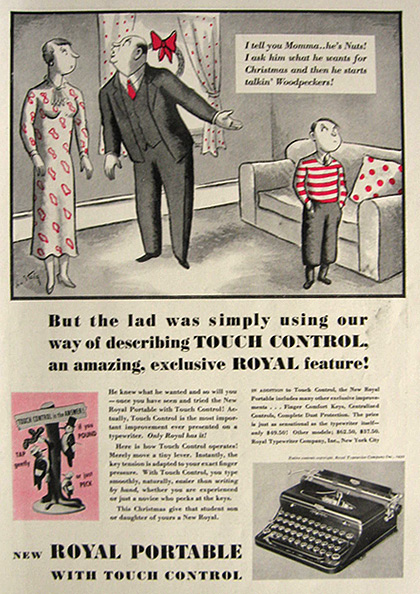
https://typewriterdatabase.com/show.27283.typewriter
Royal Quiet De Luxe with blank plastic keytops
https://typewriterdatabase.com/show.27283.typewriter
Royal Quiet De Luxe with blank plastic keytops
reply to James Grooms at https://typewriterdatabase.com/show.21794.typewriter
Notes on differentiating the Underwood SS/Rhythm Touch, SX-50, SX-100, and SX-150
How was it that you identified your model here as an SX-50? Are there ads/photos/manuals for an SX-50?
The SX-100 ads you show seem to have a similar 5 stripes of chrome on the side which is similar to the previous SS/Rhythm Touch Models, but this chrome detailing seems to be missing from your SX-50 as well as the SX-150 advertisement.
Your SX-50 exemplar and the SX-150 advertisements also seem to have/show vertical touch adjustment and ribbon selector switches while the SS/Rhythm Touch and the ad for the SX-100 have horizontal sliders for the touch adjustment and a vertical ribbon selector.
The main page of the database mentions an SX-50 and an SX-150 in July of 1953, but doesn't have a corresponding mention of an SX-100. It reads: "Oct. 1953: Model SX 150, SX 50 started (7500000)"
Polt's site has an explicit manual for the SX-150 which may help to differentiate on both form and functionality: https://site.xavier.edu/polt/typewriters/Underwood150.pdf though there are no corresponding manuals for a 50 or a 100.
This Tumbr identifies Sean Connery's machine in Finding Forrester as an SX-100: https://www.tumblr.com/typewriterspotting/16181699692/spotted-in-finding-forrester-2000-forrester-and <br /> Here's an extended clip from the film: https://www.youtube.com/watch?v=juko0sAndsA <br /> and some still photos of it from Robert Messenger's site: https://oztypewriter.blogspot.com/search?q=finding+forrester <br /> Given the appearance in the film, it might actually be an SS/Rhythm Touch, but it's difficult to distinguish this as well without a clear view of the front.
The database still seems to have empty landing pages for the:<br /> - SX-50: https://typewriterdatabase.com/Underwood.SX-50.4.bmys <br /> - SX-50 11\": https://typewriterdatabase.com/Underwood.SX-50+11%22.4.bmys - SX-100: https://typewriterdatabase.com/Underwood.SX-100.4.bmys <br /> - SX-150: https://typewriterdatabase.com/Underwood.SX-150.4.bmys <br /> Presumably they existed previously, but without clear delineations of features/changes over time and were concatenated into the SX page?
Additionally, I'm noticing that some of the SX exemplars at the bottom of the page at https://typewriterdatabase.com/Underwood.SX.4.bmys are really badged as Underwood Golden Touches!
reply to u/shadowwolf892 at https://www.reddit.com/r/typewriters/comments/1uzynlz/a_portable_compared_to_sg1/
You're comparing apples and oranges and the apple you're looking for will never be an orange. (i.e. Standard machines are almost always going to beat out portables: https://boffosocko.com/2025/03/21/standard-typewriters-versus-portable-typewriters-and-ultraportable-typewriters.)
The feel question is also going to be so variable across people's experiences (not to mention the condition of the machines on which they were formed which is a tremendous amount of noise in the secondary market) that you're highly unlikely to find what works best for you in this way. Incidentally, this is also a great way to end up with 30 typewriters and still be unsatisfied.
Your best bet for all of the variables you're trying to optimize for is to go to a shop with a variety of machines in good condition to try and purchase something you think will suit you best.
All this aside, I nearly guarantee that neither of your machines are well tuned, so you might consider looking into this for your Sterling: https://www.youtube.com/watch?v=OYOXgqiHBmg.
reply to u/LillieLogang at https://reddit.com/r/typewriters/comments/1tacody/light_touch_jcpenney/
Before you go too deeply here, is the ribbon made of cloth material (nylon, silk, or cotton) or is it a plastic film/carbon type? And if the latter, is it a proprietary cartridge or typewriter spools? Cartridges with carbon can be difficult if not impossible to find.
There's only one Penny's toy typewriter in the database currently which may give you some idea: https://typewriterdatabase.com/1970-jc-penney-j6772-toy-typewriter.11484.typewriter I don't see these pop up often, but there is a related one listed on SGW right now: https://shopgoodwill.com/item/263548866 which may have some unused "ribbon" you might cannibalize if necessary.
It looks like it may have been a rebranded version of some of the PETITE toy typewriters. https://typewriterdatabase.com/no_info.525.typewriter-serial-number-database
Many of these toys are difficult to adjust or fix (if at all), but they tend to be very simple in terms of the mechanics, so you might be able to puzzle out what isn't working and why by looking at it with the hood removed.
https://www.facebook.com/groups/TypewriterCollectors/posts/10163593836864678/
If typists were Robots

Resemblance to disaster girl?
reply to https://www.facebook.com/groups/TypewriterCollectors/posts/10161712887224678/
to Steve Clancy Zach Hubbird Jean Brunet
I'm curious what the sourcing is on your differentiation of the two models? Are there manuals, advertising, or other details to back up the differences? From what I can see, the phrase "Rhythm Touch" seems to have been an advertising tag for the Underwood SS which started a few months after production of the SS began and there wasn't any difference in them other than the advertising tag.
Robert Messenger has some scant history on the machine and the differences, primarily due to a redesign at the time, at https://oztypewriter.blogspot.com/2012/11/on-this-day-in-typewriter-history_25.html. The primary change from the S to the SS seems to have been a move from a carriage shift to a basket shift and so it seems somewhat fitting that Underwood uses the phrase "Rhythm Touch" as an advertising gimmick much like Smith-Corona were doing with their "Floating Shift" marketing.
Generally standards at the time were not differentiated by different trim lines as standards had all the bells and whistles for office use (potentially aside from custom use cases like decimal tabulators or extra wide carriage). Meanwhile all the trim variations were generally seen in the portable market geared toward home use rather than office. This would seem to support the idea that there's only the SS and "Rhythm Touch" is only an advertising tag line as the SS was newly introduced in January of '46 and "Rhythm Touch" appears around July '46.
There's also some discussion on the TWdB in the commentary at https://typewriterdatabase.com/1950-underwood-ss.23202.typewriter which may add to the question.
I'm curious to hear everyone's thoughts on the idea/thesis that the only model is the Underwood SS which is being marketed as the "Rhythm Touch" or evidence to the contrary to refute the claim.
https://www.facebook.com/groups/TypewriterCollectors/posts/10161712887224678/
None of the discussion here seems definitive for differentiating the "two models".
1940s advertisement with Underwood Standard that uses the phrase "Rhythm Touch", but which features a short armed carriage return lever.

On This Day in Typewriter History: Underwood and the Emperor’s New Old Clothes<br /> by [[Robert Messenger]] for Oz Typewriter Blog<br /> accessed on 2026-05-06T12:33:38
A patent application for Willie Dobson’s radical re-design for the Rhythm Touch was filed on this day (November 24) in 1948 and issued at the end of May 1950.
https://oztypewriter.blogspot.com/2012/11/on-this-day-in-typewriter-history_25.html
Then came Willie Dobson’s Rhythm Touch in 1948, which did away with the small carriage return lever which had served Underwood so well for more than half a century and introduced the long, drooping carriage lever.
Another significant change occurred in 1947, with the Rhythm Shift model, which marked the Underwood Standard’s conversion to basket shift, but which retained the original carriage return lever set-up.
via Robert Messenger at https://oztypewriter.blogspot.com/2012/11/on-this-day-in-typewriter-history_25.html
Differentiating between an Underwood SS and the Underwood Rhythm Touch:
comment to James Grooms at https://typewriterdatabase.com/show.23202.typewriter
James, perhaps it's hiding somewhere else in the comments on the database, but I'm curious if you've come across definitive differences between the Underwood SS and the Underwood Rhythm Touch models which have separate pages within the database:<br /> - SS https://typewriterdatabase.com/Underwood.SS.4.bmys - Rhythm Touch https://typewriterdatabase.com/Underwood.Rhythm+Touch.4.bmys
Most of my Google searches don't return anything definitive or with actual sourcing of any sort.
The main page has the SS starting in May 1946 and the Rhythm Touch beginning in July of that year, but doesn't seem to specify between the two in any substantive way. Neither of the two models seems to have had a name printed on it.
Your description here uses both designators, but knowing your penchant for newspaper and magazine advertisements, I would suspect you may have seen specific differentiators.
This Facebook post has some handwaving differentiators: https://www.facebook.com/groups/TypewriterCollectors/posts/10161712887224678/ but none seem definitive or sourced. It also uses the phrase carriage shift, though presumably with these models Underwood had moved to a segment/basket shift on their standards.
Other than the chrome side detailing moving from 3 strips to 5 as you've noted, one of the few differentiators I can see in this era is the shift from the shorter carriage return lever to the longer armed version around 1948 which Robert Messenger notes in https://oztypewriter.blogspot.com/2012/11/on-this-day-in-typewriter-history_25.html. However that same page also has an advertisement on it with the words Rhythm Touch featuring a short armed (older style) carriage return.
Is there really a difference between the SS and the Rhythm Touch or are they the same model with the phrase "Rhythm Touch" used as a marketing tag to compete potentially with Smith-Corona's "Floating Shift"?
Thanks!
I also replaced all the soundproofing material inside. I even had the old material tested for asbestos, and luckily there was no trace of that.
via Erik Bruchez at https://typewriterdatabase.com/1949-underwood-rhythm-touch.10882.typewriter
https://www.facebook.com/groups/TypewriterCollectors/posts/10161611646934678/
1950 Underwood Rhythm Touch with Victoria Elite typeface, 12 CPI, Slugs marked "EV".
https://www.reddit.com/r/typewriters/comments/1jdflj0/underwood_master_without_key_labels/
Black legends used for teaching typing
On October 22, 1923, Tangora set the 60-minute typing speed world record at 147 words per minute (WPM).
reply to u/SlumberCrow at https://reddit.com/r/typewriters/comments/1orwxqq/type_writer_leaving_small_divets_in_paper_when/
A new platen will certainly help, but it's also a question of having a proper ring and cylinder adjustment across the length of your platen and segment. Often letters that punch through tend to be the . , and o which are at the extreme end of the segment. Some machines have adjustment screws at either end of the carriage and the adjustment should be checked at not only the center of the platen but both ends. If you don't have an experienced mechanic who knows how to do all of this properly you can easily get issues which will most often show up at the far ends of the the segment/platen.
Beyond a proper adjustment, it's also the case that the surface area of the . and , are smaller than other characters and so they tend to get more force even when actuated by the weaker fingers on the right hand when touch typing. Some older manuals and training films will suggest putting less pressure on these keys when typing. This is likely even more important for those who hunt-and-peck and are likely using the full force of their index fingers.
Unless your ribbon is obviously dry or marginal, replacing your ribbon isn't likely to help much. Slugs are made out of hardened steel and you'd have to do something incredibly drastic to damage the slugs, so don't sweat that too much. Backing sheet will help as a stop-gap particularly on machines with older/hardened platens, but there's only so much help that will do without a good platen and a properly adjusted machine.
reply to question about tension control at https://reddit.com/r/typewriters/comments/1orxtvt/strange_lever/
Joe Van Cleave has a great video on this with respect to the Smith-Corona 5 series that will give one an idea on the entirety of adjustment points that are at play in some typewriters. https://www.youtube.com/watch?v=OYOXgqiHBmg
Personally, I've yet to run across a vintage Series 5 machine whose user-facing control lever was adjusted in a way such that it did anything at all because the linkages were so far out of whack. I suspect this may be the case on a lot of vintage machines.
On some machines the adjustment isn't controlling the amount of finger force one must apply, but it's controlling springs relating more to the return of the typebars and the slugs so that touch typers can type much faster without having issues with typebar return jamming things up.
Further, on many machines the dynamic range of forces involved is so narrow that most hobbyist and occasional typists aren't going to really notice a significant difference. This may be different for those who are more experienced and used to typing on a manual machine for several hours a day.
Top 10 Worst typewriters<br /> by [[Walid Saad]]<br /> accessed on 2025-09-18T23:49:39
Touch-Screen Interface
traditional input devices such as a keyboard or mouse, a touch-screen interface allows users to interact directly with what they see on the display. By using simple gestures like tapping, swiping, or pinching the user can give commands and control applications without the need for extra hardware. This approach is widely used in smartphones, tablets, ATMs, and kiosks because it feels natural and easy to learn. The main benefit of a touch-screen interface is that it creates a more intuitive and hands-on experience, making technology accessible to people of all ages.
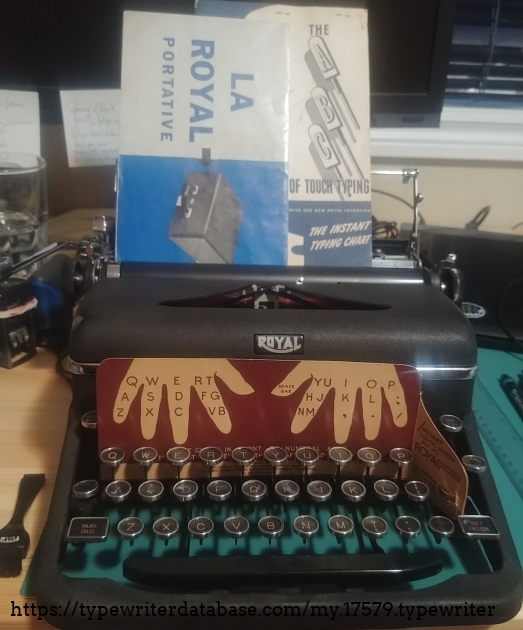
It came in a nice condition, black leatherette-covered hard wooden case, with the original brush, an owner's manual in French, a typing instruction booklet in English and a cardboard "instant typing chart" made to fit between the 3rd and 4th rows of keys in order to help in learning the touch-typing method.
Sybil Davis—who put the machine up for auction after receiving it from her mother, Jean Vounder-Davis—shared this with me in e-mail correspondence after the auction: He was not a “touch typist.” He preferred the “hunt and peck” system using only his two index fingers I … observed him using it on a daily basis.
Raymond Chandler was not a touch typist.
https://www.mohawk-finishing.com/products/wood-touch-up-repair/fillers/fil-stik-putty-sticks/
Putty sticks (aka paint sticks) are good for filling in nicks and dings on furniture.
These putty sticks and some crayons are also great for restoring the colored index lines on typewriters as well as other colored metal parts and occasionally on some plastic typewriter keys.
M231-10104 SYY Red<br /> M230-0054 Crimson Rose #SN292<br /> M230-0046 COCONUT, COTTON, BRIE, HEAVY CREAM, SNOWFLAKE <br /> M230-0090 Picket Fence
Key tension on many standard typewriters maybe changed by adjusting spring-tension screwsfor individual keys. A half turn to the rightmakes the touch heavier, to the left, lighter
He's undoing my dress, a man made of darkness, I can'tsee his face, and I can hardly breathe, hardly stand, and I'm not standing. Hismouth is on me, his hands, I can't wait and he's moving, already, love, it'sbeen so long, I'm alive in my skin, again, arms around him, falling and watersoftly everywhere, never-ending. I knew it might only be once.
Analyse sentence structure -- How can we demonstrate that: there is true touch, the real physicality as opposed to in the ceremony, as opposed to the Commander trying to force Offred into having sex with him.
Yanni Giftakis recommends melting crayons into the letter groves of typewriter keytops to replace their missing paint with a heat gun, much the same way D&D players will fill in the groves on their dice.
This is similar to Richard Polt's recommendation "To restore faded paint on keys and scales, try Lacquer-Stik Fill-In Paint."
via https://www.facebook.com/groups/typewritermaintenance/posts/3831371387100282/
Part 4: COMPLETE Olympia SM3 Service and Repair Series: STICKY RIBBON LIFTER by [[The HotRod Typewriter Co.]]
The universal bar lifts the ribbon vibrator.
Adjustment points to adjust the ribbon lift heights for issues with red/black on bichrome use.
Maximum travel of the universal bar adjustment screws on crossbar that attaches to springs. timestamp 5:29
Screws at the ends of the cross bar which are attached to the key springs can be adjusted slightly to provide for heavier or lighter touch control. Timestamp 6:07
Smith-Corona 5-Series Touch Adjustment by [[Joe Van Cleave]]
Smith Corona 5 Series Typewriter Keyboard Adjustment for Lighter Touch Silent Super by [[Phoenix Typewriter]]
. Additionally, designers should use attractive colors for children of lower age groups.
the importance of colours
I am not particularly strict about how I organize these. The point is to be able to find them again, which I can whether it's noted in the source or as a more detailed claim.
Konik cites Raccoon Nation on PBS which indicates that a racoon's most heightened sense is it's sense of touch, a sense which is increased when the hands are wet or under water.
Is this tied into the popular stories of raccoons which presumably like to "wash their food?" Is it really their sense of touch and affordances which come from that that presses this impression?
Allyson Pollock. (2022, January 2). I am told that masks obey the law of physics! How does theory translate into practice? How often do you touch mask, wash it, shove it in your pocket? If you sneeze/cough do you a) take mask off, use a handkerchief, wash hands b) keep mask on -if so where does the snot go? [Tweet]. @AllysonPollock. https://twitter.com/AllysonPollock/status/1477737957054365696
Meijer, L. L., Hasenack, B., Kamps, J., Mahon, A., Titone, G., Dijkerman, H. C., & Keizer, A. (2021). Out of touch: Touch deprivation and affective touch perception during the COVID-19 pandemic. PsyArXiv. https://doi.org/10.31234/osf.io/peq7m
her hand felt for his and gave it a fleeting squeeze. It could not have been ten seconds, and yet it seemed a long time that their hands were clasped together. He had time to learn every detail of her hand. He explored the long fingers, the shapely nails, the work-hardened palm with its row of callouses, the smooth flesh under the wrist. Merely from feeling it he would have known it by sight. In the same instant it occurred to him that he did not know what colour the girl's eyes were. They were probably brown, but people with dark hair sometimes had blue eyes. To turn his head and look at her would have been inconceivable folly. With hands locked together, invisible among the press of bodies, they stared steadily in front of them, and instead of the eyes of the girl, the eyes of the aged prisoner gazed mournfully at Winston out of nests of hair.
Chicago office building constructed with coronavirus-fighting features. (n.d.). Construction Dive. Retrieved July 23, 2020, from https://www.constructiondive.com/news/chicago-office-building-constructed-with-coronavirus-fighting-features/581201/
WABC. ‘Coronavirus: Glasses Wearers Less Likely to Get COVID, Study Says’. ABC7 New York, 24 February 2021. https://abc7ny.com/10365580/.
the "love machine," an apparatus designed to measure love. Usually these tests are begun when the monkey is 10 days of age, but this same persistent visual exploration has been obtained in a three-day-old monkey during the first half-hour of testing.
While the apparatus was meant to see if there is an attachment to the cloth mother versus the wire mother or empty box. The monkey did not discriminate and opened the box no matter what was in it. There may be another type of connection that was needed besides just visual cues.
“Jug Jug” to dirty ears.
Refers to someone who is uneducated. Already, Eliot has referred to "Classic Literature" that most people in today's modern society aren't aware of. This is his way of mocking those people.
In recent years, a wave of studies has documented some incredible emotional and physical health benefits that come from touch.
To summarize:
all the senses can be reduced to touch because of the atomic films touching the eye.
I'm kind of partial to this argument that everything is touch, somehow.
armor
The theme/relation of touch & armor is pricking my ears/eyes/spidey-senses.

However much a boundary, it is always a permeable membrane between self and other.
The body as a limit that separates what it also joins.
with the
So Aristotle is saying that the flesh of the body is not the organ that perceives touch, but like a shield which covers the body, something inside of which perceives touch. An interesting bid to fix interiority and exteriority as opposite things.