Carmona, H. A., de Noronha, A. W. T., Moreira, A. A., Araujo, N. A. M., & Andrade Jr, J. S. (2020). Cracking urban mobility. ArXiv:2008.13644 [Cond-Mat, Physics:Physics]. http://arxiv.org/abs/2008.13644
345 Matching Annotations
- Sep 2020
- Aug 2020
-
today.law.harvard.edu today.law.harvard.edu
-
Barnett ’15, L., August 4, & 2020. (n.d.). When Voting Is a Risky Choice. Harvard Law Today. Retrieved 6 August 2020, from https://today.law.harvard.edu/feature/when-voting-is-a-risky-choice/
-
- Jul 2020
-
www.thelancet.com www.thelancet.com
-
Atlani-Duault, L., Chauvin, F., Yazdanpanah, Y., Lina, B., Benamouzig, D., Bouadma, L., Druais, P. L., Hoang, A., Grard, M.-A., Malvy, D., & Delfraissy, J.-F. (2020). France’s COVID-19 response: Balancing conflicting public health traditions. The Lancet, 0(0). https://doi.org/10.1016/S0140-6736(20)31599-3
-
-
osf.io osf.io
-
Cohen, P. N. (2020). The COVID-19 epidemic in rural U.S. counties. https://doi.org/10.31235/osf.io/pnqrd
-
-
-
Davies. S., (2020/06/12). Architects are redesigning cities to help with social distancing. Retrieved from https://www.weforum.org/agenda/2020/06/architects-covid19-urban-infrastructure-cities-social-distancing
-
-
osf.io osf.io
-
Shama, S., & Ikbal, J. (2020). EDUCATION DURING A PANDEMIC: A feasibility study of online classes in Bangladesh to counteract potential study gaps caused by COVID-19 related lockdowns [Preprint]. SocArXiv. https://doi.org/10.31235/osf.io/p6mws
-
- Jun 2020
-
arxiv.org arxiv.org
-
Candelieri, A., Giordani, I., Ponti, A., & Archetti, F. (2020). Resilience in urban networked infrastructure: The case of Water Distribution Systems. ArXiv:2006.14622 [Physics]. http://arxiv.org/abs/2006.14622
-
-
zoom.us zoom.us
-
Welcome! You are invited to join a webinar: Supporting Open Science Data Curation, Preservation, and Access by Libraries. After registering, you will receive a confirmation email about joining the webinar. (n.d.). Zoom Video. Retrieved June 28, 2020, from https://zoom.us/webinar/register/2615905946283/WN_W6dYUXQFTqGQjGAZPRB74w
-
-
www.tumblr.com www.tumblr.comTumblr1
-
Opting out of ads or paying not to have ads will be the likely initial way that we'll all move towards the inevitable truism of platform business, which is that ad-only models aren't predominant for a reason.
I personally wouldn't bother to pay. I'll just block the ads or get the content / tool someplace else. Abundant alternative options....
-
-
rhizome.org rhizome.org
-
Cities are cradles. Nests made of carefully knitted infrastructure holding us up. When a city's infrastructure is exposed - a hole in the pavement, arteries under sun - we're reminded of our dependence on a deeper physical reality and our implicit vulnerability as a result. We're reminded that our cities are engineered and technical places as much as they are natural expressions of the Human and the Social, whose buildings echo ancient grouping of people at work, play, or home. What we expect from infrastructure is that it works, because when it doesn't , it isn't. We want infrastructure to seamlessly integrate with the existing world — in the ground like water rather than an accessory above. After all, infrastructure is here to support us; an expression of what may be our most endemic myth, that the world is here for us. But with every receding seam, from cable to code, comes a techno-political risk. Without edges we cannot know where we are and nor through whom we speak.
"our most endemic myth, that the world is here for us."
I thought about the article about how we have a bad understanding of mapping the exact placements of utilities under manhattan.
-
-
web.archive.org web.archive.org
-
But that is changing.
who would've thought we'd cycle back to being at war and distance
as divisive as ever (?)
how technology is accused of bringing the faraway closer but distancing the nearby
-
-
investinopen.org investinopen.org
-
Thaney, K. (2020, April 8). Open Infrastructure in times of crisis: How IOI can help. Invest in Open Infrastructure. https://investinopen.org/2020/04/08/open-infrastructure-in-times-of-crisis.html
-
-
podcastnotes.org podcastnotes.org
-
Media is supported by ads, ads want clicks, clicks come from outrage, so therefore – the media’s goal has shifted to create as much outrage as possible
our social and media infrastructure are outrage machines, icentivised
-
-
twitter.com twitter.com
-
Devi Sridhar on Twitter: “For those pointing to countries like S.Korea, Singapore, China, Taiwan, Australia, Germany, Denmark to say there will be no second wave in the UK or US- take a deeper look at their incredible public health response & infrastructure. None sat back & said ‘Let’s see what happens.’” / Twitter. (n.d.). Twitter. Retrieved June 8, 2020, from https://twitter.com/devisridhar/status/1269292597958361094
-
- May 2020
-
about.gitlab.com about.gitlab.com
-
Have adopted CI best practices and are defining their CI/CD pipelines as code
-
-
www.thelancet.com www.thelancet.com
-
Lohse, S., Pfuhl, T., Berkó-Göttel, B., Rissland, J., Geißler, T., Gärtner, B., Becker, S. L., Schneitler, S., & Smola, S. (2020). Pooling of samples for testing for SARS-CoV-2 in asymptomatic people. The Lancet Infectious Diseases, S1473309920303625. https://doi.org/10.1016/S1473-3099(20)30362-5
-
- Apr 2020
-
www.nesta.org.uk www.nesta.org.uk
-
Cretu, C. (2020 April 15). Signals in the noise. Nesta. https://www.nesta.org.uk/report/signals-noise/
-
-
www.ukri.org www.ukri.org
-
Open Letter to the Research and Innovation Community—UK Research and Innovation. (n.d.). Retrieved April 9, 2020, from https://www.ukri.org/news/open-letter-to-the-research-and-innovation-community/
-
-
www.lorentzcenter.nl www.lorentzcenter.nl
-
Center for Scientific Workshops in All Disciplines—Lorentz-eScience Competition. (n.d.). Retrieved April 16, 2020, from https://www.lorentzcenter.nl/lorentz-escience-competition.html
-
-
www.coar-repositories.org www.coar-repositories.org
-
Establish standard models and criteria for funding alternatives to “pay for access” or “pay to publish” (transactional funding models) so that libraries can more easily invest in diverse content and services, including open infrastructure
Yes!
-
-
sens-public.org sens-public.org
-
pas forcément rationalisables
la nature dynamique du phénomène numérique le rend justement non cristallisable; son actualisation permanente (donc toujours virtuel, jamais tout à fait actuel) en fait un structure «pas forcément rationalisable»
-
- Feb 2020
-
en.wikipedia.org en.wikipedia.org
-
-
Configuration as Code vs. Infrastructure as Code Some treat CAC and infrastructure as code (IAC) as the same thing. They’re not, and there’s a reason we have two distinct terms.
-
- Jan 2020
-
dl.acm.org dl.acm.org
-
www.nhl.com www.nhl.com
-
blog.ldodds.com blog.ldodds.com
-
booktwo.org booktwo.org
-
The Secure Transport of Light -- James Bridle
-
-
criticalengineering.org criticalengineering.org
-
The Critical Engineering Manifesto
-
-
additivism.org additivism.org
-
The 3D Additivist Manifesto
-
-
jamesbridle.com jamesbridle.com
-
New Ways of Seeing - James Bridle
-
-
playbook.cio.gov playbook.cio.gov
-
Digital Services Playbook
Tags
Annotators
URL
-
-
www.columbia.edu www.columbia.edu
-
Beyond Liberalization II
-
-
gist.github.com gist.github.com
-
Steve Yegge Rant
-
-
inst-fs-iad-prod.inscloudgate.net inst-fs-iad-prod.inscloudgate.net
-
The Whale and the Reactor (Langdon Winner)
-
-
www.perell.com www.perell.com
-
Between 2011 and 2013, china used 50% more cement than the United States in the 20th century.Of the world’s 100 highest bridges, 81 are in China, including some unfinished ones.
China's infrastructure is growing amazingly fast
-
- Dec 2019
-
open-scholarship-strategy.github.io open-scholarship-strategy.github.io
-
scholarlykitchen.sspnet.org scholarlykitchen.sspnet.org
-
www.crossref.org www.crossref.org
- Nov 2019
-
www.wired.com www.wired.com
-
Netheads vs Bellheads
Netheads vs Bellheads
-
-
osp.od.nih.gov osp.od.nih.gov
-
Draft NIH Policy for Data Management and Sharing
-
-
www.chronicle.com www.chronicle.com
-
From Peg Cheechi, an instructional designer at Rush University: informing faculty members about the advantages of working with experts in course design.
The Chronicle of Higher Education is a website and newspaper informing students and faculty of college affairs and news.
Rating: 9/10
-
- Oct 2019
- Jul 2019
-
open.semanticscholar.org open.semanticscholar.orgOAS1
-
another body working on scholarly comms infrastructure - but for AI
-
- Jun 2019
-
-
knowledgeinfrastructure reading list
-
-
www.researchgate.net www.researchgate.net
-
ecbmurphy.pressbooks.com ecbmurphy.pressbooks.com
-
What are the risks in digitizing these materials outside the library? Are there possibilities of this collection not being well integrated with other holdings? Did you collaborate with metadata experts?
-
-
ecbmurphy.pressbooks.com ecbmurphy.pressbooks.com
-
On one hand, DH pedagogy can no longer be meaningfully said to be entirely in service of or secondary to the research project.
!!!
Yes! How does DH end up caught in the trap of focusing solely on research? I'm loving the notion of more attention to DH pedagogy separate from the research discussion
-
- May 2019
-
investinopen.org investinopen.org
-
By “Infrastructure” we mean
The definition of "open infrastructure" (or the software component of open infrastructure) should include an explicit requirement for open-source code. Even an explicit recommendation short of a requirement would be better than the current definition, which is entirely silent the value of opening the code. The Elsevier acquisition of bepress (to use one example among many) would have been much less harmful to the community if the code had been open and user institutions could hold on to the platform, fork it if they wanted, take it in their own direction, and continue using it without becoming Elsevier customers.
-
-
www.crossref.org www.crossref.org
-
history of the DOI
Tags
Annotators
URL
-
-
medium.com medium.com
-
wellsky.com wellsky.com
-
www.threesixtygiving.org www.threesixtygiving.org
-
Why do organisation identifiers matter? Lessons from the healthcare sector
Why do organisation identifiers matter? Lessons from the healthcare sector
-
-
www.goifoundation.org www.goifoundation.org
-
cityobservatory.org cityobservatory.org
-
housing market policy conflict
-
-
notes.ecrituresnumeriques.ca notes.ecrituresnumeriques.ca
-
Hey all, this is Michael – I am writing to test out this platform and to begin to build something in this document. I realize it’s slightly obscure at the moment how this pad will come to be useful during Publishing Sphere – I believe this will be come clearer in the coming days as we begin to roll out some of the sites, info, and programming for the gathering.
Danny and I will be meeting tomorrow (Thursday, the 2nd of May) to discuss the publishing apparatus we have been discussing, and will begin to introduce it to the group as something to work off, develop in new directions, or to create publication systems concurrent to this one. Once we have this initial formulation mapped out, I’ll let him introduce it to you all to begin to discuss and edit.
Shortly, I’ll post some info that I think is relevant to the gathering more generally, and then some additional information about you all so that you might begin to become more aware of the other members of the group. I’m truly looking forward to witnessing how you might all begin to work with one another.
More soonest~
M.
-
- Apr 2019
-
developingprofessionalstaff-mpls.blogspot.com developingprofessionalstaff-mpls.blogspot.com
-
It's the act of creating the curriculum in a particular form that will be useful to Minnesota 3rd grade teachers that generates revenue for me, and not the content which is created.
This is the clearest expression for me, of what David Wiley might be talking about when he calls OER infrastructure.
-
-
opencontent.org opencontent.org
-
chemistry lab simulation is the “wrong” content if students are supposed to be learning world history
Isn't this exactly why it isn't helpful to think of content as infrastructure?
-
Apache is a piece of software that meets the need of its developers
Okay, so the open source software analogy has deep roots. But I still (looking at this a dozen years later) think this analogy is flawed. Apache was a webserver (infrastructure) that could serve any page (content). I think the proper analog to Apache in OER is a platform or app (Pressbooks, Hypothes.is), not any particular Pressbook or annotation.
-
The example of the Linux kernel shows that this is completely possible.
I think the Linux kernel analogy breaks down even more in considering "the other 93%" of educational content, which David has already identified here as more niche, less kernelesque, than content for core courses. Seems to me, the more specialized and rarely used something is — either in digital technology or in content — the less likely it is going to be the focus of widespread, shared activity.
If commercial publishers could rely on OER content for core classes and generate revenue from wrapping them in additional services (as David describes here), what is their incentive to devote any resources to labor-intensive, niche content that would have far lower revenue margins?
-
Traditional textbook content like words and images are just like the operating system kernel – kind of boring.
This is the part of the argument here I don't find convincing. I'm not sure we can liken content — yes even "traditional textbook content" — to OS kernels or roads as a kind of "boring" infrastructure. Content is an expression of knowledges/understandings right? If anything, content seems more like the "interesting" part that relies on the kernels/roads.
Yet I am interested in the idea of thinking of content as PUBLIC infrastructure, in the sense that like roads, we have common interests in securing public sources for the resources necessary to produce and maintain educational content.
-
-
coko.foundation coko.foundation
Tags
Annotators
URL
-
-
wikistrategies.net wikistrategies.net
-
www.orfg.org www.orfg.org
-
www.arl.org www.arl.org
-
www.orfg.org www.orfg.org
Tags
Annotators
URL
-
-
streetfightmag.com streetfightmag.com
-
viennaprinciples.org viennaprinciples.org
-
A Vision for Scholarly Communication Currently, there is a strong push to address the apparent deficits of the scholarly communication system. Open Science has the potential to change the production and dissemination of scholarly knowledge for the better, but there is no commonly shared vision that describes the system that we want to create.
A Vision for Scholarly Communication
-
-
-
pretty great intro to knowledge graphs
-
-
-
Instead of encouraging more “data-sharing”, the focus should be the cultivation of “data infrastructure”,¹⁴ maintained for the public good by institutions with clear responsibilities and lines of accountability.
-
-
journal.code4lib.org journal.code4lib.org
-
Seized with the desire to improve the visibility of Canadian music in the world, a ragtag band of librarians led by Stacy Allison-Cassin set out to host Wikipedia edit-a-thons in the style of Art+Feminism, but with a focus on addressing Canadian music instead. Along the way, they recognized that Wikidata offered a low-barrier, high-result method of making that data not only visible but reusable as linked open data, and consequently incorporated Wikidata into their edit-a-thons. This is their story.
-
-
www.theatlantic.com www.theatlantic.com
-
When we think about caring for our neighbors, we think about local churches, and charities—systems embedded in our communities. But I see these technological systems as one of the main ways that we take care of each other at scale. It’s how Americans care for all three hundred million of our neighbors, rich or poor, spread over four million square miles, embedded in global supply chains.
-
- Mar 2019
-
ui.adsabs.harvard.edu ui.adsabs.harvard.edu
-
Engaging the Public Through Wikipedia: Strategies and Tools Show affiliations
Engaging the Public Through Wikipedia: Strategies and Tools
Tags
Annotators
URL
-
-
twitter.com twitter.com
-
There is a serious crisis of discoverability. To overcome it, we have to tear down the walls of dark knowledge and invest in the open discovery infrastructure, esp. user interfaces.
-
-
web.hypothes.is web.hypothes.is
-
Super cool. The difference between annotating the web, and annotating academic scholarship / science.
Tags
Annotators
URL
-
- Jan 2019
-
wendynorris.com wendynorris.com
-
Our research reveals several design opportunities in this space. Importantly, informed by the empirical findings presented here, we argue for situating solutions within current work practices and infrastructures.
Description of design opportunities
-
-
wendynorris.com wendynorris.com
-
As fluctuations in resource endowments arise overtime because of the fluidity in the OC, these fluctua-tions in resources create fluctuations in tensions, makingsimple structural tactics for managing tensions such ascross-functional teams or divergent opinions (Sheremata2000) inadequate for fostering knowledge collaboration.As complex as these tension fluctuations are for the com-munity, it is precisely these tensions that provide thecatalyst for knowledge collaboration. Communities thatthen respond to these tensions generatively (rather thanin restrictive ways) will be able to realize this potential.Thus, it is not the simple presence of resources that fos-ter knowledge collaboration, but rather the presence ofongoing dynamic tensions within the OC that spur thecollaboration. We describe these tensions in the follow-ing section
Tension as a catalyst for knowledge work/collaboration
-
Fluidity recognizes the highly flexible or permeableboundaries of OCs, where it is hard to figure out whois in the community and who is outside (Preece et al.2004) at any point in time, let alone over time. Theyare adaptive in that they change as the attention, actions,and interests of the collective of participants change overtime. Many individuals in an OC are at various stagesof exit and entry that change fluidly over time.
Evokes boundary objects and boundary infrastructures.
-
-
wendynorris.com wendynorris.com
-
In knowledge work, several related factors sug-gest the need to reconceptualize coordination.
Complex knowledge work coordination demands attention to how coordination is managed, as well as what (content) and when (temporality).
"This distinction becomes increasingly important in complex knowledge work where there is less reliance on formal structure, interdependence is changing, and work is primarily performed in teams."
Traditional theories of coordination are not entirely relevant to fast-response teams who are more flexible, less formally configured and use more improvised decision making mechanisms.
These more flexible groups also are more multi-disciplinary communities of practice with different epistemic standards, work practices, and contexts.
"Thus, because of differences in perspectives and interests, it becomes necessary to provide support for cross-boundary knowledge transformation (Carlile 2002)."
Evokes boundary objects/boundary infrastructure issues.
-
-
hcommons.org hcommons.org
-
coordination and sharing the burden of developing technology and best practice
echoing also in the "community-owned infrastructure' discussions.
-
-
wendynorris.com wendynorris.com
-
Under the stress of the situation, with too many peopledoing too many things at once, the socio-technical infrastructure that underliestheirwork practice wasbreaking down. Star and Ruhleder [25] explain that infrastructure becomes visible only at these points of breakdown. Volunteers directedtheir attention to their social configuration as the critical infrastructure here (the technical infrastructure remains take
Evokes Star's work on the invisibility of boundary infrastructure until a breakdown.
-
-
wendynorris.com wendynorris.com
-
In this section of the paper we broach two aspects of this articulation issue, onefocusing on the management of workflow, the other on the construction and manage-ment of what we term a ‘common information space’. The former concept has beenthe subject of discussion for some time, in the guise of such terms as office automa-tion and more recently, workflow automation. The latter concept has, in our view,been somewhat neglected, despite its critical importance for the accomplishmentof many distributed work activities
A quick scan of ACM library papers that tag "articulation work" seems to indicate the "common information space" problem still has not attracted a lot of study. This could be a good entry point for my work with CSCW because time cuts across both workflow and information space.
Nicely bundles boundary infrastructure, sense-making and distributed work
-
- Dec 2018
-
wendynorris.com wendynorris.com
-
Resistance Realily is 'that which resists,' according to Latour's (1987) Pragmatistinspired definition. The resistances thal designers and users encounter will change lhc ubiquitous networks of classifications and standards. Although convergence may appear at times to create an inescapable cycle of feedback and verification, the very multiplicity of people, things and processes involved mean lhat they are never locked in for all time.
Questioning the infrastructural inversion via ubiquity, material and texture, history, and power shapes the visibility and invisibility of the infrastructure that society creates for itself.
-
Infrastructure and Method: Convergence These ubiquitous, textured dai;sifications and standards help frame our representation of the past and the sequencing of event� in the present. They (:an best be understood as doing the ever local, ever partial work of making it appear that science describes nature (and nature alone) and that politics is about social power (and social power alone).
"Standards, categories, technologies, and phenomenology are increasingly converging in large-scale information infrastructure." (p. 47)
Convergence gets to how things work out as "scaffolding in the conduct of modern life."
-
Practical Politics �1 ·he fourch major theme is uncovering the practical politics of classifying awl standardizing. 'fhi<; is the de.sign end of the spectrum of investigating categories and standards as technologies. There are two processes associated with these politics: arriving at categories and standards, and, along the way, deciding what will be visible or invisible within the system.
Politics, as in power dynamics, leadership, negotiation, and decision-making authority, play a role in determining how classifications and standards infrastructures are perceived as visible/invisible.
-
The Indeterminacy of the Past: Multiple Times, Multiple Voices The third methodological theme concerns ihe f1asl as indetc,rr,1inate. 10 We are constantly revising our knowledge of the past in light of new developments in the present.
Visibility can be obtained by peeling back the history of the infrastructure -- how it began, how it was added to, how it changed/adapted over time.
Looking back in time also provides an opportunity to consider how different people/perspectives influenced the infrastructure. Who was vocal? Who was silent? Who was silenced?
-
Materiality and Texture The second methodological departure point is that. classifications and standards are material, as well as symbolic.
Another way to make infrastructures visible is to envision their physical presence (materiality) and texture (experience).
Metaphors play an important role here.
-
This categorical saturation furthermore forms a complex web. Although it is possible to pull out a single dassilication scheme or standard for reference purposes, in reality none of them stand alone. So a subproperty of ubiquity is interdependence, ,md frequently, integration. A systems approach might see the proliferation of both standards and classilications as purely a matter of integration-almost like a gigantic web of interoperability. Yet the sheer density of these phenomena go beyond questions of interoperability. They are layered, tangled, textured; they interact lo form an ecology as well as a flat set of compatibilities.
Ubiquitous classifications and standards are also interdependent and integrated, thus creating complex systems that work but the components of which tend to be invisible.
Example: Other classifications when the phenomena/object don't fit elsewhere or the "cumulative mess trajectory" which occurs when categories and standards interact in messy ways
-
Ubiquity The first major theme is the ubiquity of classifying and standardizing. Classification schemes and standards literally saturate our environment.
Methodological themes for infrastructural inversion -- how to make the invisible visible
-
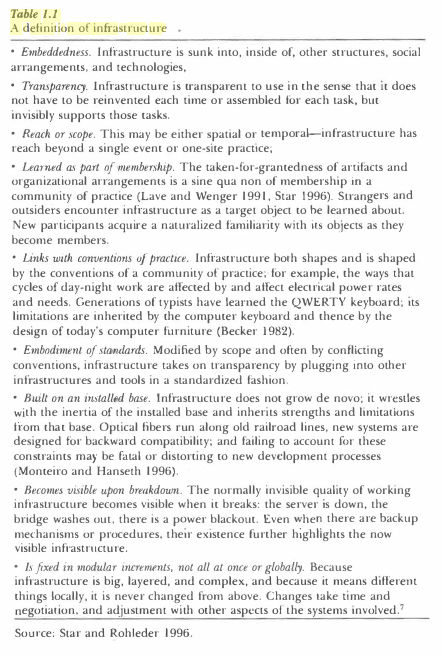
A definition of infrastructure
Definition of infrastructure
-
This chapter offers four themes, methodological points of departure for the analysis of these complex relationships. Each theme operates as a gestalt switch-it comes in the form of an i11fras/:ruclural inversion (Bowker 1994). This inversion is a struggle against the tendency of infrastructure to disappear (except when breaking down). Tt means learning to look closely at technologies and arrangements that, by design and hy habit, tend to fade into the woodwork (sometimes literally!). Infrastructural inversion means recognizing the depths of interdependence of technical networks and standards, on the one hand, and the real work of politics and knowledge production8 on the other.
Definition of infrastructural inversion
How normally invisible structures become visible (gestalt -- whole is perceived as more than the sum of its parts) when there is a breakdown
-
Infrastructures are never transparent for everyone, ancl lheir '\\•orkabilit y as they scale up becomes increasingly complex. Through due methodological attention to the architecture and use of these syslems, we can achieve a deeper understanding of how it is that individuals and communities meet infrastructure. ·we know that this means, at Lhe leasl, an understanding of infraslructure that includes these points:
Cited verbatim from book:
- A historical process of development of many tools, arranged for a wide variety of users and made to work in concert
- A practical match among routines of work practice, technology, and wider scale organizational and technical resources
- A rich set of negotiated compromises ranging from epistemology to data entry that are both available and transparent to communities of users
- A negotiated order in which all of the above, recursively, can function together.
-
Information infrastrucLUre is a tricky thing to analyze_l; Good, usable systems disappear almost by deiinition. The easier they arc lo use, the harder they are to see.
The invisibility of infrastructure
-
-
wendynorris.com wendynorris.com
-
Table 1.1 A definition of infrastructure
Definition of infrastructure
-
This categorical saturation furthermore forms a complex web. Although it is possible to pull out a single classification scheme or standard for reference purposes, in reality none of them stand alone. So a_ subproperty of ubiquity is interdependence, and frequently, integrat10n. A systems approach might see the proliferation of both standards and classifications as purely a matter of integration-almost like a gigantic web of interoperability. Yet the sheer density of these phenomena go beyond questions of interoperability. They are layered, tangled, textured; they interact to form an ecology as well as a flat set of compatibilities.
Ubiquitous classifications and standards are also interdependent and integrated, thus creating complex systems that tend to be invisible.
Example: Other classifications when the phenomena/object don't fit elsewehre or the "cumulative mess trajectory" which occurs when categories and standards interact in messy ways
-
Ubiquity __ The first major theme is the ubiquity of classifying and standardmng. Classification schemes and standards literally saturate our environment.
Methodological themes for infrastructural inversion -- how to make the invisible visible
-
This chapter offers four themes, methodological points of departure for the analysis of these complex relationships. Each theme operates as a gestalt switch-it comes in the form of an infrastructural inversion (Bowker 1994). This inversion is a struggle against the tendency of infrastructure to disappear (except when breaking down). It means learning to look closely at technologies and arrangements that, by design and by habit, tend to fade into the woodwork (sometimes literally!). Infrastructural inversion means recognizing the depths of interdependence of technical networks and standards, on the one hand, and the real work of politics and knowledge production8 on the other.
Definition of infrastructural inversion
How normally invisible structures become visible (gestalt -- whole is perceived as more than the sum of its parts) when there is a breakdown
-
Infrastructures are never transparent for everyone, and their workability as they scale up becomes increasingly complex. Through due methodological attention to the architecture and use of these systems, we can achieve a deeper understanding of how it is that individuals and communities meet infrastructure. We know that this means, at the least, an understanding of infrastructure that includes these points:
Cited verbatim from book:
• A historical process of development of many tools, arranged for a wide variety of users and made to work in concert • A practical match among routines of work practice, technology, and wider scale organizational and technical resources • A rich set of negotiated compromises ranging from epistemology to data entry that are both available and transparent to communities of users • A negotiated order in which all of the above, recursively, can function together.
-
Information infrastructure is a tricky thing to analyze.6 Good, usable systems disappear almost by definition. The easier they are to use, the harder they are to see. As well, most of the time, the bigger they are, the harder they are to see.
The invisibility of infrastructure
-
- Nov 2018
-
Tags
Annotators
URL
-
- Oct 2018
-
www.brandeins.de www.brandeins.de
-
Um die Frage, ob es sich bei den dominanten Technikfirmen, die auf eine feudale Art und Weise die Infrastrukturen unseres Lebens bestimmen, nicht um öffentliche Güter handelt. Sind die sozialen Netzwerke nicht genauso ein Gemeingut?
-
- Sep 2018
-
Local file Local file
-
share agreement
Adoption of mechanisms like the "Fair Share Agreement" in B.C. or similar to get funds for improving infrastructure in municipalities and regions.
-
improving infrastructure
Improve infrastructure in the host and hub communities according to the needs imposing by industrial developments
-
infrastructure
Timely response for the maintenance of roads and development of new routes when needed according to the traffic needs due to industrial developments and labour market that involve drive-in drive-out mobility and heavy transit during construction phase
-
- Jul 2018
-
files.eric.ed.gov files.eric.ed.gov
-
It would seem that radio might be the most appropriate delivery for educational audio in developing regions, except for this surprising fact: Some developing nations are going wireless.
The pure costs of maintaining wiring are also higher in some of these environments than Americans and Europeans may be aware of.
Tags
Annotators
URL
-
-
www.economist.com www.economist.com
-
Such thinking has also been gaining some traction in the West, although so far only at the political fringes. The underlying idea is that some types of services, including social networks and online search, are essential facilities akin to roads and other kinds of infrastructure and should be regulated as utilities, which in essence means capping their profits. Alternatively, important data services, such as digital identity, could be offered by governments. Evgeny Morozov, a researcher and internet activist, goes one step further, calling for the creation of public data utilities, which would pool vital digital information and ensure equal access to it.
-
- Jun 2018
-
library.educause.edu library.educause.edu
-
This report provides institutional leaders with a better understanding of the IT experiences and needs of their faculty who engage in research or seek to expand their research capabilities.
EDU research technology needs
-
-
www.hewlett.org www.hewlett.org
-
OER Tech Infrastructure
-
-
engineering.linkedin.com engineering.linkedin.com
-
I'll walk you through everything you need to know about logs, including what is log and how to use logs for data integration, real time processing, and system building.
-
-
- May 2018
-
journals.sagepub.com journals.sagepub.com
-
We showhow the rise of large datasets, in conjunction with arising interest in data as scholarly output, contributesto the advent of data sharing platforms in a field trad-itionally organized by infrastructures.
What does this paper mean by infrastructures? Perhaps this is a reference to the traditional scholarly journals and monographs.
-
-
www.hewlett.org www.hewlett.org
-
The Open Education Tools Symposium, hosted by Hypothes.is in January 2017—with the support of the HewlettFoundation—for the express purpose of identifying the gaps and needs in OER technical infrastructure foundthat “even with the close focus on OER technical infrastructure, the conversations over the two-day event were wide ranging and often lingered on broader questions facing the OER movement: who exactly are we building for; is it really working?....no complete picture of the gaps in OER tooling became apparent during the symposium...”.
Referencing and linking to the 2017 Open Educational Tools Symposium convened by Hypothesis.
-
- Sep 2017
-
limn.it limn.it
-
Computing is to take the role of an infrastructure: much as books need light, but are not modeled after the light’s logic, the medium might draw, where necessary, on the computing possibilities provided by the OS in the background, but it should not be driven by them. Instead, the dynamic spatial medium should be driven by properties of the medium itself, and as such, it should drive technology.
Esta relación entre frente y fondo, entre infraestructura y medio es importante sin embargo. ¿Cómo se pasa de la una a la otra? Grafoscopio, es una infraestructura para un medio escritural, pero esa transcición entre fondo y frente ayuda a cambiar la forma en que se escribe.
Tags
Annotators
URL
-
- Jul 2017
-
web.archive.org web.archive.org
-
How do we resist this? (And resist this, I contend, we must.) We resist through education. Yes. But we also must resist at the level of structure, at the level of systems, at the level of infrastructure.
the necessity of understanding and infrastructure in resistance
-
- Jun 2017
-
ocp.freedomcoop.eu ocp.freedomcoop.eu
-
We added you as a member manually
I am learning how ocp.freedomcoop.eu works by using https://hypothes.is. Does this make sense? https://hypothes.is/groups/1iiXaJYA/sensoricasemanticweb
-
- May 2017
-
www.businessinsider.de www.businessinsider.de
-
Inside Facebook's plan to eat another $350 billion IT market
Three months later the group had a working prototype. Six months later, on November 1, the company announced it to the world as a real product called Voyager.
-
- Feb 2017
-
usesthis.com usesthis.com
-
I want no local storage anywhere near me other than maybe caches. No disks, no state, my world entirely in the network. Storage needs to be backed up and maintained, which should be someone else's problem, one I'm happy to pay to have them solve. Also, storage on one machine means that machine is different from another machine. At Bell Labs we worked in the Unix Room, which had a bunch of machines we called "terminals". Latterly these were mostly PCs, but the key point is that we didn't use their disks for anything except caching. The terminal was a computer but we didn't compute on it; computing was done in the computer center. The terminal, even though it had a nice color screen and mouse and network and all that, was just a portal to the real computers in the back. When I left work and went home, I could pick up where I left off, pretty much. My dream setup would drop the "pretty much" qualification from that. A bit like phones: You have a phone just so you can access who/what is at the other end of the connection. Twenty years ago, you expected a phone to be provided everywhere you went, and that phone worked the same everywhere. At a friend's house, or a restaurant, or a hotel, or a pay phone, you could pick up the receiver and make a call. You didn't carry a phone around with you; phones were part of the infrastructure. Computers, well, that was a different story. As laptops came in, people started carrying computers around with them everywhere. The reason was to have the state stored on the computer, not the computer itself. You carry around a computer so you can access its disk.
Tags
Annotators
URL
-
- Jan 2017
-
arstechnica.com arstechnica.com
-
to show how the design changes depending on the depth. The nearer to the surface you get, the more protection—armour—you need to withstand potential disturbances from shipping.
Hahaha! This is a bit counter-intuitive, is it not? One would think you would need ”bigger” cables as the depth increases, because of the pressure.
-
Have you ever thought about how that cat picture actually gets from a server in Oregon to your PC in London? We’re not simply talking about the wonders of TCP/IP or pervasive Wi-Fi hotspots, though those are vitally important as well. No, we’re talking about the big infrastructure: the huge submarine cables, the vast landing sites and data centres with their massively redundant power systems, and the elephantine, labyrinthine last-mile networks that actually hook billions of us to the Internet.
So, I take it we invested billions in the infrastructure, only to transfer cat photos from Oregon to London. Damn, I am really happy to be apart of the 21st Century!
BTW, did it occur to anyone we might be under the domination of Cat Overlords, since we are using such powerful infrastructure just to deal with photos of... cats? (pun intended)
-
- Dec 2016
-
opencontent.org opencontent.org
-
competencies or learning outcomes, educational resources that support the achievement of those outcomes, assessments by which learners can demonstrate their achievement of those outcomes, and credentials that certify their mastery of those outcomes to third parties.
These all feel very product driven from my perspective. Perhaps it's a necessarily administrative position. Of course, David himself has written about this elsewhere, but what about the process, what about pedagogy?
-
- Feb 2016
-
medium.com medium.com
-
But it comes with new challenges: how to actually manage demand and workflows, how to encourage contributions, and how to build antifragile ecosystems.
This is a key issue. My research is about the relationship of mutual modification between communities and digital artifacts to bootstrap empowering dynamics.
The question regarding participation could be addressed by making an infrastructural transposition (putting what is in the background in the foreground as suggested by Susan Leigh Star). This has been, in a sense the approach of this article, making visible what is behind infrastructures like LAMP, GitHub or StackExchange and has also been the approach of my comments. Of course there are things beyond infrastructure, but the way the infrastructures determine communities and the change that communities can made or not on them could be a key to antifragile, that is traversed by critical pedagogy, community and cognition. How can we change the artifacts that change us is a questions related with antifragile. This is the question of my research (in the context of a Global South hackerspace), but I never connected it with antifragile until reading this text.
-
- Jan 2016
-
www.briancroxall.net www.briancroxall.net
-
Assignments and Architecture: Pedagogy in the Digital Age
-
- Dec 2015
-
www.sr.ithaka.org www.sr.ithaka.org
-
chief information officer’s centralized budget that is used to support infrastructures as needs change.
-
- Nov 2015
-
cms.whittier.edu cms.whittier.edu
-
Such self-management oftenworks well, but it is also contingent uponthe costs and complexities of spare parts andrepairs, as well as the underlying economiccohesion of the neighborhood—in terms ofits ability to hold on to specific values anduses of land and the demographic stabilityof its inhabitants.
All pieces of the puzzle must come together in order for infrastructure to remain stable. If someone does not have the right tools or access to information, they are helpless to sustain the power of the infrastructure.
-
Whetherthis is a matter of intended deceit or an ingen-uous miscalculation as to how infrastructurewill actually be used and the costs entailedto keep it going, those responsible for itscare often run to keep up or simply disappearfrom view.
So infrastructure is seemingly a negative thing here? Or is the authour pointing out that infrastructure can be abused by power?
-
Thus,any of these occurrences can ramify acrosseach other, affecting and being affected inways that exceed whatever infrastructure isavailable
Is this to say we need even more structure than what is already in place? Or will the things being contained eventually escape from that rule also?
-
-
cms.whittier.edu cms.whittier.edu
-
Mbembe points out that often thefunction of awarding infrastructural projects has far more to do with gaining access to governmentcontracts and rewarding patron-client networks than it has to do with their technical function.This is why roads disappear, factories are built but never operated, and bridges go to nowhere.
Sounds like scheming for political gains.. This is easy to see in the work place or society when one befriends another or joins a certain group for political/hierarchal benefits rather than for the pure purpose of the action. African societies cannot be the only ones who follow these functional implementations of these infrastructural projects.
-
Infrastructures, for Collier, are amixture of political rationality, administrative techniques, and material systems, and his interest isnot in infrastructure per se but in what it tells us about practices of government. Soviet electricityprovision, through this lens, is analyzed for how it reveals a system of total planning in a commandeconomy rather than for what it tells us about the effects of electricity on users in Russia.
It's never really about what is in front of us when it comes to politics.. there is always more to it.. His theory is a tool we could study to learn about a country/society's government by looking at the infrastructure they've created.
-
- Sep 2015
-
www.confluent.io www.confluent.io
-
This approach is called change data capture, which I wrote about recently (and implemented on PostgreSQL). As long as you’re only writing to a single database (not doing dual writes), and getting the log of writes from the database (in the order in which they were committed to the DB), then this approach works just as well as making your writes to the log directly.
Interesting section on applying log-orientated approaches to existing systems.
-
- Jan 2015
-
newleftreview.org newleftreview.org
-
Today the move to cloud computing is replicating some of that early rhetoric—except, of course, that companies now reject any analogy with utilities, since that might open up the possibility of a publicly run, publicly controlled infrastructure.
That's a distinct possibility - if the infrastructure could be built with trust. Keep hoping.
-