Smith-Corona 5-Series Touch Adjustment by [[Joe Van Cleave]]
2,296 Matching Annotations
- Jun 2024
-
www.youtube.com www.youtube.com
-
Royal Model "O" Typewriter Adjust Ribbon Lift for each Type Bar Lever, Works on Quite Deluxe too. by [[Phoenix Typewriter]]
Forming individual type bars, particularly for capital letters to get the tops to print evenly when they're more faint than other similar typefaces.
-
-
www.youtube.com www.youtube.com
-
Royal QDL Quiet Deluxe Typewriter, Left Margin Stop, Alignment Adjustment, Repaired uneven edge by [[Phoenix Typewriter]]
How to adjust the margin stops on a Royal Quiet De Luxe and related portable models.
-
-
www.reddit.com www.reddit.com
-
I dont know if im hitting too hard or not. ( second image is the backup paper behind the actual one)
If you've got heavy impressions going to the level of the backing sheet or things like your period cutting holes directly through your paper, then it's not really so much an issue of typing too hard, but your carriage is slightly out of alignment with respect to your type bars.
Your typeface shouldn't actually hit the platen when pressed (or held forward), but should just kiss the ribbon which then places the imprint onto the paper. Holding your typeslug forward against the type guide you should have just enough space to slip a piece of paper between your slug and the platen. If there isn't a tiny bit of space, your typeface will chew up your ribbon and paper over time. The typing thunk sound that typewriters make isn't the slug hitting the platen (aka cylinder), but the typebar hitting the anvil (aka ring).
The proper adjustment for fixing this is thus commonly called a ring and cylinder adjustment and how it's effected depends on whether you have a segment shift or a carriage shift machine. On many machines it requires adjusting two screws on either side of the machine. It changes the distance of platen from typeface and can prevent your making holes in the paper and/or ribbon, which isn't good. Sometimes using a simple backing sheet can remedy a bit of this distance problem, especially on platens which have hardened or shrunk slightly over time. Searching YouTube for your make/model (or similar models) will usually show you the adjustment you'll need to make to remedy these problems.
See also: https://hypothes.is/a/AegRziHnEe-Ud_stVcPQLA
Reply to u/Bitter_Rent_141 at https://www.reddit.com/r/typewriters/comments/1dnnh2n/is_this_normal/
-
-
www.youtube.com www.youtube.com
-
Test typing and adjustments
- Ring and Cylinder adjustment (distance of platen from typeface; the type shouldn't touch the platen or you'll find you're imprinting on your paper, making holes in the paper and/or ribbon, which isn't good) [Interestingly Dul doesn't mention this particular adjustment]
- evenness of the letters (on feet)
- alignment between capital and lower case (motion)
- margin consistency
- line scale height
- adjust escapement "so that it's moving the proper distance both up and down to prevent skipping or missing spaces"
- adjust the height of the ribbon, this is done to make sure the entire letter is printed (and presumably so the bichrome is properly usable when available)
-
How A Rusty 1930s Royal Typewriter Is Professionally Restored | Refurbished | Insider
Done by Lucas Dul. Some particularly interesting portions on adjustments after restoration. He generally touches on the order of adjustments he makes, but in brief rather than completely.
-
-
site.xavier.edu site.xavier.edu
-
https://site.xavier.edu/polt/typewriters/nabokov.jpeg via https://site.xavier.edu/polt/typewriters/typers.html

This photo, similar to others in the Carl Mydans series for LIFE Magazine is surely from his September 1958 photo series, though I couldn't find an original from the LIFE archive.
Nabokov, reading off of index cards in his zettelkasten, dictates to his wife Vera who is typing on what appears to be a 1949 or 1950 Henry Dreyfuss Royal Quiet De Luxe typewriter.
Notice metal strip on the back of the typewriter with small rectangular blocks. This is the Royal's tabulator set up which distinguishes the Quiet De Luxe model from the Arrow model.
The body styling of this typewriter changed in 1950 from Dreyfuss' original 1948 design. Because it's light gray it has to be from '49 or '50 as the '48 original was a black body with dark gray highlights and didn't have chrome across the front as this one does in an alternate angle.
-
-
images.google.com images.google.com
-
https://images.google.com/hosted/life/2bff56953d14c9d9.html
Nabokov, reflected in a mirror off camera, dictating his writing from index cards to his wife Vera who is typing on what appears to be a 1949 or 1950 Henry Dreyfuss Royal Quiet De Luxe typewriter.
Notice the chrome on the front of the machine which is sitting in its bottom case shell.
-
-
images.google.com images.google.com
-
https://images.google.com/hosted/life/c835f121c2b6ce79.html
Nabokov dictating his writing from index cards to his wife Vera who is typing on what appears to be a 1949 or 1950 Henry Dreyfuss Royal Quiet De Luxe typewriter.
-
-
images.google.com images.google.com
-
https://images.google.com/hosted/life/8d0b2f02ac27973e.html
Nabokov dictating his writing from index cards to his wife Vera who is typing on what appears to be a 1949 or 1950 Henry Dreyfuss Royal Quiet De Luxe typewriter.
-
-
typewriterchicago.com typewriterchicago.com
-
https://typewriterchicago.com/
Run by Lucas Dul
-
-
www.youtube.com www.youtube.com
-
Links to Typeface Resources- Olympia- https://munk.org/typecast/2011/04/23/... Royal- https://munk.org/typecast/2011/04/24/... Smith Corona- https://munk.org/typecast/2020/06/15/... Adler- https://munk.org/typecast/2023/02/04/... Story of vertical script- https://munk.org/typecast/2022/02/26/... Typewriter Database Typefaces- https://typewriterdatabase.com/typefa... Typographica.org- https://typographica.org/on-typograph... Type Slug Specs- https://munk.org/typecast/2023/02/05/...
-
Typewriter 101: The ULTIMATE TYPEFACE Guide (ft. Typewriter Chicago) by [[Just My Typewriter]]
featuring Typewriter Chicago's Lucas Dul
-
-
www.phillytypewriter.com www.phillytypewriter.com
-
James Norris is the owner and operator of Ex Nihilo 3D Print and Design in Spring, Texas. He has always had a fascination with figuring out how things work and seeing if there was a way it could be better. In late 2016 his wife, a burgeoning writer, purchased their first typewriter. He soon became obsessed with all the amazing parts and mechanisms. From there the typewriter collecting began.From the first Olympia, to an inherited Olivetti, to his first Selectric, and so on.While repairing these machines he realized that there where a few setbacks. The most immediate being parts availability. So armed with his 3d printer he designed and printed his first part. A Selectric cycle clutch pulley in mid 2021. After showing the 3d printed part to some like minded individuals he was happy to learn that they were as excited as he was. He loves to design new parts and accessories to bring these typewriters back to life.James is thrilled to be working with Philly Typewriter, and looks forward to helping with your current and future parts needs. James lives in Texas, is married with two children.
https://www.phillytypewriter.com/parts-mfg.html#/
James Norris does 3D printing of replacement parts for typewriter restoration projects.
-
-
www.phillytypewriter.com www.phillytypewriter.com
-
typewriters.co.uk typewriters.co.uk
-
americanhistory.si.edu americanhistory.si.edu
-
https://americanhistory.si.edu/collections/nmah_1335701
The typewriter used on Murder, She Wrote, starring Angela Landsbury, was a black Royal standard, probably a 1940s KMM.
-
-
www.youtube.com www.youtube.comYouTube1
-
-
The benefits of using a typewriter to write novels and poetry. by [[Classic Typewriter]]
-
-
oztypewriter.blogspot.com oztypewriter.blogspot.com
-
Sundberg’s first typewriter design was for IBM in 1955. This was for what we generally call the IBM Executive (Model C/Model 41);
If Sundberg's first design was for IBM in 1955, how is he influential to Dreyfuss' 1948 typewriter design for Royal?
-
Carl Sundberg’s European-made Remington Portable Typewriters by [[Robert Messenger]]
Tags
- Philip Stevens
- Ed Johnson
- Alfons Boothby
- Ray Dietrich
- Remington typewriters
- Karl Baughman
- Tom Tjaarda
- Royal Oak, Michigan
- Maya Stein
- Crosley Hotshot
- typewriter design
- Sundberg-Ferar
- Barbie typewriter
- Ettore Sottsass
- Remington Ten Forty
- John Tjaarda
- David Chase
- industrial design
- read
- typewriters of authors
- New South Wales Rail Authority
- Cycolac
- Bay Area Rapid Transit System (BART)
- Carl Sundberg
- Charles Jaworski
- Montgomery Ferar
- Laird Fortune Covey
- Powel Crosley
- Richard Penney
- Southfield, Michigan
- Detroit, Michigan
- John Steinbeck
- Eliot Noyes
- Anton Demmel
- Henry Dreyfuss
Annotators
URL
-
-
tsesaraheverett3.wixsite.com tsesaraheverett3.wixsite.com
-
www.bullydozer-typewriters.com www.bullydozer-typewriters.com
-
www.reddit.com www.reddit.comSkyriter1
-
Skyriter
These have been selling at auction sites over the past several months for $45-$75 plus shipping based only on pictures and without any information at all about their working condition, so all-in you probably got a great deal. I'm just finishing up work on cleaning up a 1951 2Y series Skyriter myself, and I really like its typing action. Don't throw away the spools if it came with them as they're non-standard and slightly smaller than the ubiquitous universal spools. This being said you can buy the standard 1/2" ribbon and manually spool new ribbon onto your existing spools. Mine didn't have spools at all, but I found some replacements (with ribbon) at https://www.ribbonsunlimited.com/. Take note that it's not a bichrome machine, so you can buy a single color ribbon.
There are two screws that hold the chassis of these into the bottom of their case. They're hiding just underneath the carriage. Once removed, the typewriter lifts back and up and out of the base. You'll find the serial number on the right hand side of the frame underneath the platen and can use it to date your machine with the database: https://typewriterdatabase.com/smithcorona.86.typewriter-serial-number-database. Based on appearance alone, I'd place it as a 1960 3Y series based on the color, the badging and the white keys. You can look at others' individual models and notes at https://typewriterdatabase.com/Smith+Corona.Skyriter.86.bmys. If I'm right about the date, Richard Polt has online manuals available for the 1960 as well as others at: https://site.xavier.edu/polt/typewriters/tw-manuals.html.
https://www.youtube.com/watch?v=xjumGF9NFE8 is a pretty solid cleaning primer. Searching YouTube will uncover some potential additional advice in addition to what you can find at https://site.xavier.edu/polt/typewriters/tw-restoration.html or in his book. I will say that in cleaning mine, the mineral spirits dissolved the glue holding the felt on underneath the typebars, but it was in terrible shape anyway and needed replacing. The foam strip underneath that felt came out unscathed without much effort on my part to be careful with it.
Most of the mechanics are pretty basic and easy to clean/service. Unless there's something dramatically wrong with it, you could very likely clean and service it yourself. (As an example, I had to re-slot the mechanism for the margin release which was almost too easy.) Even the mid-level repair issues for it can be easily found on YouTube if you're handy with a screwdriver (Joe Van Cleave and Phoenix Typewriter in particular have several model specific videos on the Skyriter). The platen and rollers come out fairly easy with a small screwdriver and removing one half of a spring on the back of the paper tray. This gives you great access to clean the escapement from above as well as to potentially send them off to JJ Short Associates for replacement via https://www.jjshort.com/typewriter-platen-repair.php. If you're less handy, Polt's website has a list of repair shops around the world that could clean/repair it for you.
Good luck with it. I hope you like yours as much as I like mine. They're one of the most solid and sought after ultra-portables out there.
-
-
www.youtube.com www.youtube.com
-
A Tale of Two Toy Typewriters..... by [[Just My Typewriter]]
-
-
www.youtube.com www.youtube.com
-
The Marx Dial Typewriter (and the Trouble with Patents) by Our Own Devices
-
-
archive.org archive.org
-
www.reddit.com www.reddit.com
-
Removing rust from typewriters
Steel wool can be useful for removing rust from keylevers and other parts on typewriters, but can leave dust/slag behind which can be a bear to clean up especially when used on typebars.
De-rusters like Evaporust can be useful, but should be tested against causing harm to other parts of a machine. Some rust removal chemicals can strip galvanization from machine parts. Olympia typewriters in particular are infamous for galvanized steel parts.
Another option can be to use a rotary tool (like a Dremel) with a wire brush head to remove rust.
Take care and be sure to use proper eye protection against dirt, dust, and chemicals when doing this sort of work. Also make sure you have proper ventilation and/or a mask to avoid breathing in dust and toxic chemicals.
Richard Polt's site has additional resources for typewriter restoration: https://site.xavier.edu/polt/typewriters/tw-restoration.html
Reply to https://www.reddit.com/r/typewriters/comments/1da2zg6/how_do_i_remove_rust/
-
-
www.reddit.com www.reddit.com
-
Hahaha you’re going to have to start slipping the UPS guy a $20 to keep it on the hush hush. “Don’t worry honey, I am getting them to fix up and sell”
reply to u/baxter1207 at https://www.reddit.com/r/typewriters/comments/1da0voq/repairsclean_ups/l7jg8nl/
I'm pretty sure those exact words have escaped my lips...
Her: "I know you've got five typewriters already, and I'm not counting the one I know you're hiding underneath the bed. Which ones are you going to sell??"
Me (in my head): Where am I going to stash the 12th machine when it arrives later today? At least it's an ultraportable, so it won't take up as much space. Why is my least favorite machine that I want to sell her favorite machine? Will selling it upset the delicate typewriter balance in the house? I can always say that the typewriter coming on Tuesday is a parts machine that I'm using to repair two of the others so I can sell them. Is this how all typewriter repair shops began?
Me: I'm trying to finish up refinishing the two executive tanker desks and the filing cabinet in the garage first so I can get them out and make some space.
😁
-
-
munk.org munk.org
-
Not sure if it may help your Typewriter Typefaces Bible project or not, but I'll mention that Marcin Wichary used the Internet Archive to collect a lot of the materials for his massive 3 volume 2023 book "Shift Happens: A Book About Keyboards": https://archive.org/details/wicharytypewriter
In addition to lots of material which he found and collected on the Archive, he added a huge number of resources, catalogs, and books which are either rare or incredibly difficult to find by uploading them to the Archive for others to potentially find and use. You and others may find it valuable and or useful to follow his pattern of uploading and storage there.
-
1954 Smith-Corona (SCM) Typewriter Type Styles and Keyboards Catalog – To Type, Shoot Straight, and Speak the Truth… by [[Theodore Munk]]
-
-
munk.org munk.org
-
Smith-Corona (SCM) Font Styles – To Type, Shoot Straight, and Speak the Truth… by [[Theodore Munk]]
-
-
-
munk.org munk.org
-
www.reddit.com www.reddit.com
-
You should not have much trouble finding a cubist (aka techno, square, robotic, futuristic, etc.) font or even Vogue; but good luck finding an italic. Of course, if you want to use them instead of collecting typewriters, get an IBM Selectric and a collection of balls.
colloquial advice
-
-
littlewishingstar.wordpress.com littlewishingstar.wordpress.com
-
Swiss-made Hermes (3000, Media 3) seems to top the list of the most sought after vintage manuals with script fontAnother popular choice among collectors is the script typewriter debuted by Olivetti Lettera in 1963.Other typewriter manufacturers that offered the script font were Olympia (SM3, SM7, SM8), Adler (Tippa, J4, J5), Royal (Safari, Sahara), Remington (Deluxe 5, Personal Riter), Smith-Corona (Classic 12, Sterling 5A, Galaxie Deluxe 10, Galaxie 11, Galaxie 12, Silent Super), Torpedo 18, Blickensderfer (with cylinder) and IBM (Selectric with typeball)
unreferenced here, so treat as colloquial
-
A field guide to hunting down script typewriters. by [[May Tobias-Papa]]
-
-
-
David McCullough’s ode to slow (and a tribute to the typewriter) by [[Steve Leveen]] on 2009-12-03
-
Probably not. But it would do us good to remember that machines are supposed to make our lives better, not faster. Perhaps we should unplug just a little before we become undone. Such decompression is why we think so many Levenger customers savor the pensive pause of the fountain pen (which David McCullough also uses).
-
And David McCullough is not typing on a computer. He’s using the pre-digital dinosaur that requires a considerable force of those digits called fingers: the typewriter. Not even a zippy electric version, but a 1940s vintage Royal manual typewriter that he bought second-hand in the 1960s. So if you want to know how it is that David McCullough’s books always hit the New York Times bestseller lists, capture Pulitzers, and have never gone out of print, it just may be this old machine.
too many people want to attribute the accolades stemming from the work of a person and their process to the tools they use....
-
The sound of typewriters—the tappety-tap and the tiny bell signaling need for a carriage return— became part of America’s soundscape in offices and late-night garrets.
I love the setting of a "late-night garret"....
-
-
writingball.blogspot.com writingball.blogspot.com
-
One to get rid of<br /> by [[Richard Polt]]
-
-
www.reddit.com www.reddit.com
-
Also are the key caps supposed to be that yellow or is that from cigarettes.
For yellowed glass keys on typewriters, there's usually a key top covered by a piece of paper with the key glyph on it which is sandwiched in with a small piece of glass and a metal ring that holds it down with several metal tabs underneath the key to hold it all in place. There are custom keyring pliers for quickly removing and replacing the papers which needs care not to crack the glass. Otherwise you can manually bend the metal tabs on all your key rings to remove them and replace the papers. (This is generally a LOT of work either way.) See: https://www.reddit.com/r/typewriters/comments/1csni4d/neat_find_on_clients_kmg/
I prefer the yellowed patina of the older key papers, so I tend to leave them versus spending the time and effort to replace them.
-
-
www.usbtypewriter.com www.usbtypewriter.com
-
www.youtube.com www.youtube.com
-
www.amsterdamtypewriter.com www.amsterdamtypewriter.com
-
torontotypewriters.com torontotypewriters.com
-
https://torontotypewriters.com/
Owner? Chris?
Tags
Annotators
URL
-
-
reeselectronics.com reeselectronics.com
-
https://reeselectronics.com/typewriter-service-department/
Helmut is an amazing engineer/repairman via https://www.reddit.com/r/typewriters/comments/w8viia/comment/ihrw7cg/
-
-
en.wikipedia.org en.wikipedia.org
-
https://en.wikipedia.org/wiki/Retrobright
This process can be used to whiten yellowed plastics.
-
- May 2024
-
munk.org munk.org
-
Replace the carriage string in your 1950’s Smith-Corona Silent by [[Theodore Munk]]
-
-
www.youtube.com www.youtube.com
-
Removing the Platen on Mid-Century Olivetti Typewriters. by [[Dr. Typewriter - Venneburg Typewriters]]
-
-
www.youtube.com www.youtube.com
-
The MASSIVE Olivetti Linea 98 (1972) by [[Just My Typewriter]]
Tags
Annotators
URL
-
-
typewriterdatabase.com typewriterdatabase.com
-
A really nice example of a model from the birth of Remington's Quiet-Riter line. The bulbous styling bears some resemblance to Henry Dreyfuss' Mercury steam locomotive engine from 1938, but the typewriter itself includes modern conveniences such as segment shift and tab set and clear at the keyboard.
https://typewriterdatabase.com/1950-remington-allnew.18856.typewriter
-
-
typewriterdatabase.com typewriterdatabase.com
-
I don't collect them. They follow me home in small groups of 2 or 3...
via Glen Crookston at https://typewriterdatabase.com/1949-remington-allnew.17706.typewriter
-
-
www.midcenturychap.com www.midcenturychap.com
-
Adding to the Typewriter collection with a bit of first aid<br /> by [[Midcentury Clive]]
-
Now I just need to persuade my organisation that reverse digitisation (analogy – the art of making everything analogue) should be part of our green agenda!
-
However, the two additions I’ve made to the collection (what is the collective noun? A carriage of typewriters, perhaps?), have both been a bit special in their own way and both have taught me something new.
-
-
www.youtube.com www.youtube.com
-
Typewriter Backing Sheets by [[Joe Van Cleave]]
Backing sheets for typewriters on Meade standard typing paper.
- Construction paper - Joe's favorite
- 4 mil thick polyethylene film
- Thin typing paper
- 20lb resume paper
- 1/64" synthetic rubber sheet
- 168gsm Evolon (polyester and nylon) paper
Tags
Annotators
URL
-
-
www.reddit.com www.reddit.com
-
To be more specific on solvents for beginners, potentially try mineral spirits (white spirit in UK), paint thinner, naphtha (lighter fluid), kerosene, varnish remover, PB B'laster, or carburetor or brake cleaner. Be careful as many of these are flammable and some can remove paint or decals; use all of them in a well ventilated area. You may see some recommend household variations of alcohol, but these do contain water and generally aren't very effective solvents for the types of oil/grease/dust you'll probably want to remove; professional typewriter repair shops would not use alcohol on a machine. And for those in the back, no one but a psychopath would use WD-40 on a machine's internals.
https://www.youtube.com/watch?v=xjumGF9NFE8 is a pretty solid cleaning primer. Searching YouTube will uncover some potential additional advice in addition to what you can find at https://site.xavier.edu/polt/typewriters/tw-restoration.html
Good luck. That's a lovely machine!
-
-
www.youtube.com www.youtube.com
-
Smith Corona 5 Series Typewriter Keyboard Adjustment for Lighter Touch Silent Super by [[Phoenix Typewriter]]
-
-
munk.org munk.org
-
Taming The Tinny Typing Sound of a Brother JP-1 Typewriter (Part 3 – the Finale?) by [[Theodore Munk]]
-
-
munk.org munk.org
-
Adjusting Ring & Cylinder on a Brother JP-1 by [[Theodore Munk]]
-
-
www.reddit.com www.reddit.com
-
https://www.reddit.com/r/typewriters/comments/21zpri/what_you_should_know_before_cleaning_your/
Note the stated 33 year experience as typewriter repairman
-
You will notice that manual was printed in 1920. Gas was the only cleaner available then. In just one more year in 1921 Stoddards Formula was invented (Varsol) for the dry cleaning business. Everything changed then and Varsol was the cleaner of choice.
should find a better reference
-
-
-
I’ve seen plenty Royal Dreyfuss Quiet DeLuxe typewriters that are the gold metal plated anniversary edition.
Example of a typewriter repairman calling a 1954 model a Royal Dreyfuss Quiet De Luxe.
While they did have some of the general design elements of Henry Dreyfuss' 1948 redesign, would one really still call them a Dreyfuss?
-
-
typespec.com typespec.com
-
Ames Segment Pick, an Artisan Tool – For Sale $24.95 by Paul of Bremerton Office Machine Company
-
a No. 93 (Royal) Segment Pick from the 1940 Ames catalog. Sold in 1940 for 20 cents each.
-
It is kinda funny that our shop, which has been around since 1947, has only ONE segment pick.
Is it telling that a typewriter shop around since 1947 only has one segment pick?
-
-
www.amazon.com www.amazon.com
-
Speedy Inks with typewriter ribbon with DIN spools for European typewriter spools (eg: Adler, Olympia, Adler, Facit, etc.).
12 pack for about $10.
Recommended by Joe Van Cleave
-
-
www.youtube.com www.youtube.com
-
www.bedlamcreations.com www.bedlamcreations.com
-
www.typewriter.wiki www.typewriter.wiki
-
https://www.typewriter.wiki/index.php/Main_Page
Tags
Annotators
URL
-
-
www.swintec.com www.swintec.com
-
www.youtube.com www.youtube.com
-
Typewriter Video Series - Episode 175: Skipping Skyriter<br /> by [[Joe Van Cleave]]
-
-
www.youtube.com www.youtube.com
-
Watch Phoenix Typewriter in Remington Quiet-Riter Typewriter, Skipping Letters, Adjust Escapement, Type Bar Trip
-
-
www.vintagetypewritershoppe.com www.vintagetypewritershoppe.com
-
typewriterreview.com typewriterreview.com
-
Thank the Ribbons! by [[Daniel Marleau]]
-
-
site.xavier.edu site.xavier.edu
-
Baco Ribbons makes ribbons in many sizes, colors, and materials. Contact Charlene Oesch, Baco Ribbon & Supply Co., 1521 Carman Road, Ballwin, MO 63021, 314-835-9300, fax 636-394-5475, e-mail bacoribbon@sbcglobal.net.
-
-
www.youtube.com www.youtube.com
-
My first "ultra-portable" (Skyriter 1955) by [[Just My Typewriter]]
55 had an integral cover versus later versions which had bags.
-
-
www.youtube.com www.youtube.com
-
www.youtube.com www.youtube.com
-
Typewriter Video Series - Episode 121: SCM Skyriter by [[Joe Van Cleave]]
Joe likes this better than the Hermes Rocket. Solid ultra portable.
-
-
www.youtube.com www.youtube.com
-
Typewriter Video Series Episode 407: Remington Ten Forty by [[Joe Van Cleave]]
-
Joe Van Cleave has used an index card with his typewriter to hold up the back of his typewriter paper on machines (the Ten Forty, for example) which lack a metal support on the back of the paper table.
-
The Remington Ten Forty typewriter is a half-space machine. This means that when one presses a key, for example the spacebar, the carriage advances a half space and then advances the other half space when released.
-
-
www.youtube.com www.youtube.com
-
offountainpenstypewriters.blogspot.com offountainpenstypewriters.blogspot.com
-
www.reddit.com www.reddit.com
-
Congratulations on that beautiful machine!
Don't listen to the nay-sayers who likely have very different priorities and esthetics. If this is your machine, and you love it, then "own it".
It does look like a standard (as opposed to portable) typewriter. (Standards are often better and more robust typers due to their size and design.) Likely a Model 1 or Model 2, but I don't have specific knowledge beyond a cursory glance at the typewriter database. You can start by looking at examples of machine types and bodies at https://typewriterdatabase.com/smithcorona.86.typewriter-serial-number-database.
From there, the Model 1 says "Electric Serial Numbers Concurrent with Standard", so scroll down the page and see if you can identify a year based on a serial number you should be able to find underneath the hood. You can try https://typewriterdatabase.com/Smith+Corona.Standard.86.bmys, but I don't see any later models there, so perhaps no one has documented one before and you could be the first.
Then start with Richard Polt's site https://site.xavier.edu/polt/typewriters/ where you may likely find a manual and if you're lucky a repair manual. Surely there will be a few manuals for similar 50s standard S-C manual typewriters which should at least get you started. His site has a wealth of other information to give you pointers. His book The Typewriter Revolution (2015) has good intro chapters on cleaning, basic repair, and restoration. YouTube may have some useful videos as well. The typewriter database will have some later model S-C electric machines which you might try searching for on YouTube as well and it's highly likely that the design changes weren't so drastic that those may help you significantly.
For basic cleaning, try https://www.youtube.com/watch?v=xjumGF9NFE8 which has some solid advice. Obviously take care with respect to getting the electrical portion of your machine wet.
I've not done any electric machines before, but if I recall, I seem to have read/heard (maybe from Tom Hanks who I know has a 50s electric Smith-Corona) that the early electrics only went as far as doing power for the keys, so it should be reasonably repairable if it doesn't work out of the box.
I'm sure you'll love it. With any luck, you'll also get some serious enjoyment and sense of accomplishment out of cleaning it up. If nothing else, it'll give you a wealth of experience in making the attempt and you can apply that to other machines if you continue collecting and typing. Some of my first machines weren't immediate "successes" until after I'd been able to tinker with others and was able to come back to them with a more experienced hand.
Have fun with it!
reply to https://www.reddit.com/r/typewriters/comments/1cuzy04/please_can_someone_identify_this/
-
-
www.reddit.com www.reddit.com
-
Blank tabbed 4x6 cards (self.Zettelkasten)submitted 1 day ago by SpacePatricianTrust me when I say this query is Zettelkasten-related. I've adopted the Voroscope method of organizing as per the Encyclopedia Propaedia, but it involves creating a lot of tab cards. I could make things go faster if I had white, blank, unruled tabbed index cards that I could set up a printer template for, but there don't seem to be any on the market in bulk. Any ideas of where I could find them off the beaten path?
I've looked and looked for such a template and printer method to no avail myself. Your best bet here is probably either Avery Multi-use labels (maybe 5418 or 5428 depending on your card tabs) which have templates you can print a sheet at a time, or buying a labeler like the Brother P-touch which has a variety of different colored labels available. A third method is to line up multiple tabbed cards in your typewriter and do 3-4 at a time.
Tabbed cards are significantly more expensive than standard index cards, so if you're all in on this, I'd recommend contacting one of the manufacturers directly and buying in bulk to drive the price down. Alibaba can also be your friend here for a bulk order too. Last year I got a bulk order of 15,000 4x6" index cards for well under $0.005 per card, while the current going rate on Amazon or most office supply stores is $0.02 - $0.03/card.
Let me know if you find someone manufacturing inexpensive tabbed dividers in 1/5, 1/6, 1/7, or even 1/8 cut tabs. I'd love to buy a couple thousand of these in bulk as well.
Knowing the extra work involved in this method, I HIGHLY recommend you try it out by hand for a bit to see if it's something you'll do for more than a few months before going all-in. I've read some of Joseph Voros' work, which I understood to be theoretical only. Did he ever fully implement it himself? Before you try, you might want to read up on others' earlier work like that of Paul Otlet, Mortimer J. Adler, et al. Many here will lionize Luhmann's method, but recall that S. D. Goitein managed to take a 1/3 of the notes that Luhmann did while creating a published output a 1/3 larger than Luhmann all while using a method similar to that of Adler and company which is also very close to the method recommended by almost all academics from Jacques Barzun to Umberto Eco.
Definitely think about what you're hoping to accomplish before going straight down the rabbit hole too far.
If you do go all-in, then buying a big storage box upfront can save you a lot of time and expense, try https://boffosocko.com/2022/12/26/the-ultimate-guide-to-zettelkasten-index-card-storage/ for some ideas. My daily driver now is a 60,000+ card index from Steelcase that I picked up on the used market for $125.
LIFE. “The 102 Great Ideas: Scholars Complete a Monumental Catalog.” January 26, 1948.
Eco, Umberto. How to Write a Thesis. Translated by Caterina Mongiat Farina and Geoff Farina. 1977. Reprint, Cambridge, MA, USA: MIT Press, 2015.
Barzun, Jacques, and Henry F. Graff. The Modern Researcher. 6th ed. Belmont, CA: Thomson/Wadsworth, 2004.
Reply to u/SpacePatrician at https://www.reddit.com/r/Zettelkasten/comments/1ctsu78/blank_tabbed_4x6_cards/
-
-
www.youtube.com www.youtube.com
-
It's a great thing to waste time. The secret of life is to waste time in ways that you like. —Jerry Seinfeld 6:18
-
-
www.youtube.com www.youtube.com
-
Typewriter 101: THE CLEANING GUIDE! by [[Just My Typewriter]]
A solid primer for cleaning typewriters
-
-
typewriterfeet.com typewriterfeet.com
-
www.reddit.com www.reddit.com
-
You can cross check the data in the typewriter database for most of the big US and European brands to see the slow merging and dying out of the typewriter through the late 60s and early 70s onward. See, for example, Royal: https://typewriterdatabase.com/royal.72.typewriter-serial-number-database which has buyouts and mergers listed at the top. The database also has a huge volume of references for how it was compiled which will give you additional history.
The early 70s saw a lot of plastic entering the space where more durable steel used to be. Most major US firms were shifting to electric after IBM in roughly 1961. Post war manufacture of machines picked up significantly in Italy, Spain, Holland, and even Wales which displaced some of the manufacturing in the US, where solid machines of the prior generation still worked and only needed servicing rather than outright replacement. (Planned obsolescence wasn't as much of a thing during the 30s and 40s, and in fact, [maintenance was heavily highlighted during the war](https://www.youtube.com/watch?v=ocdxgkxKAKo) when most US manufacturers ceased production of most models.) Eventually Japan displaced the business followed by India (which ceased in 2009) and China. Wrexham, Wales ceased manufacture of electronic Brother typewriters in 2012.
Ever decreasing costs of materials and manufacturing, improved manufacturing technology, increased competition in the space, combined with containerized shipping, competition from computers, etc. all contributed to the cheapening of the typewriter and hastened the death of manufacturing (though not the use) of manual typewriters.
Richard Polt's The Typewriter Revolution (2015) has a "microhistory" of typewriters in chapter 2 with references to some addition histories if you're interested.
Your question about Olympia manufacture dates (and more) can be found via: https://typewriterdatabase.com/olympia.61.typewriter-serial-number-database
x over it has a good two part series about the evolution of Olympias at:
https://xoverit.blogspot.com/2015/02/olympia-sm-series-part-1-1948-1964.html
https://xoverit.blogspot.com/2015/04/olympia-sm-series-part-2-1964-1980s.html
-
-
www.youtube.com www.youtube.com
-
Toaster-Typewriter – An investigation of humor in design by [[CreativeApplications.Net]]
A cross between a typewriter and a toaster that writes by toasting bread.
The toaster-typewriter is the work of [Ritika Kedia], and it forms part of her thesis in product design at the Parsons School of Design, New York. It’s written up very much from an artistic rather than a tech perspective, but it’s no less ingenious for that in the way it uses letters formed from hot wire on a clay substrate, mounted on the end of the typewriter arms in front of a toaster.<br /> —This Typewriter Types Toast by Jenny List
Tags
Annotators
URL
-
-
www.nytimes.com www.nytimes.com
-
Bruder, Jessica. “Click, Clack, Ding! Sigh ...” The New York Times, March 30, 2011, sec. Fashion. https://www.nytimes.com/2011/03/31/fashion/31Typewriter.html.
-
“I’m actually not surprised,” Mr. Caro said, when told of the typewriter renaissance. The tangible pleasures of typewriters are something he’s known about for decades. “One reason I type is it simply makes me feel closer to my words,” Mr. Caro said. “It’s like being a cabinetmaker. It’s like laying down the planks. This is the way it’s supposed to feel.”
-
What do literary stalwarts of the original typewriter era make of all this? “We old typists, it makes us feel young again to think there’s a new generation catching on,” said Gay Talese, 79. He still uses a typewriter, albeit electric, as does his friend, Robert A. Caro, 75, the Pulitzer-winning biographer of Robert Moses and President Lyndon B. Johnson. They discussed Mr. Caro’s Smith Corona while watching the Super Bowl.
-
-
www.jjshort.com www.jjshort.com
-
J.J. Short Associates, Inc for Typewriter Platens, Feed Rollers, Bail Rollers, Finger Rollers, and Power Rollers https://www.jjshort.com/typewriter-platen-repair.php
-
-
www.reddit.com www.reddit.com
-
https://www.reddit.com/r/typewriters/comments/1csni4d/neat_find_on_clients_kmg/
-
These were sometimes used to assist in the learning of touch typing. Clients would have their local repair person install these little black paper circles to cover the letters so they wouldn't be tempted to stare at the keyboard. Fairly rare, I've not seen them used on any of the 500+ machines I've serviced in the past 7 or so years. There were also dedicated blank caps designed to go over the keytops that were used, those are much more common than the blackout paper method.
-
-
www.reddit.com www.reddit.com
-
I was in a vintage shop about 30 minutes from downtown Los Angeles earlier in the week and the proprietor had a mostly functioning 1950 Smith-Corona Sterling for sale for a roughly equivalent US $150. (One key was disconnected, but fixable, and some keys were sticky, the ribbon was disintegrating, it was incredibly dirty, with a case in very poor condition.) The Sterling was similar to the Silent, but without some of the extra bells and whistles. She wouldn't accept an offer of $40 for it, which I thought was a reach for the dreadful condition it was in. Her reasoning was that she was sure that someone (read: a sucker) would pay the $150 for it. At a yard sale it might be worth $5. Cleaned up a bit maybe $30. In online platforms they're going for a bit more, but you're also saving yourself some level of "shoe leather" in the work of searching for the exact model you want.
I've been specifically watching this model and a few related ones for a few months, and machines of indeterminate condition (though in my experience they're usually reasonably functionable or easily fixable), like this go for about $50 on ShopGoodWill.com (as auction items). There are usually about 4-5 per week which come up as this was a popular model in the 50s. You can probably find similar prices on eBay, though sellers there usually have a little more information about the working condition. They're definitely common enough that you could easily wait for the exact color options and typeface (pica or elite) that you're looking for, and could also probably purchase two for the price he's asking (including shipping.) I've been watching for a similar mid-50s Smith-Corona Clipper with similar colors and elite type for a while and just bought one online last week for $35. Patience definitely pays off.
I would only go as high as $150 on that machine if I knew it was well functioning and had a brand new platen in the last several years. You can tell him that most of the expensive machines in the range he's asking for are all fully functioning, have been well maintained and/or recently serviced, and often have new platens, rubber rollers, and feet replaced. He'll know that this isn't the case with his and may come down in price. They're likely pricing it based on other listings they see and not pricing it based on actual sales. If it's their only machine, wait things out until they see that there aren't any takers. If it's a vintage shop, simply move on.
The Smith-Corona Silents from this time period are really spectacular and solid machines, so good luck in your search for the perfect one.
-
-
quoteinvestigator.com quoteinvestigator.com
-
Walter Wellesley “Red” Smith used a version of this quote by 1949. In April of that year the influential and widely syndicated newspaper columnist Walter Winchell wrote. Boldface has been added to excerpts:[1]1949 April 06, Naugatuck Daily News, Walter Winchell In New York, Page 4, Column 5, Naugatuck, Connecticut. (NewspaperArchive) Red Smith was asked if turning out a daily column wasn’t quite a chore. …”Why, no,” dead-panned Red. “You simply sit down at the typewriter, open your veins, and bleed.”
via 1949 April 06, Naugatuck Daily News, Walter Winchell In New York, Page 4, Column 5, Naugatuck, Connecticut. (NewspaperArchive)
-
-
oztypewriter.blogspot.com oztypewriter.blogspot.com
-
Vale Paul Auster (1947-2024) by [[Robert Messenger]]
-
-
3dtypewriterparts.com 3dtypewriterparts.com
-
writingball.blogspot.com writingball.blogspot.com
-
typewriterdatabase.com typewriterdatabase.com
-
https://typewriterdatabase.com/sears.615.typewriter-serial-number-database
-
New 1964 Sears Cutlass Model advertised in February 1965. The faceplate of existing examples exactly matches other machines only offered between 1964-65 (Citation, Constellation), so it is presumed to be exactly contemporary. Manufactured by Smith-Corona and similar to Smith-Corona "New 5-Series", with custom shell.
-
-
-
Polt, Richard. The Typewriter Revolution: A Typist’s Companion for the 21st Century. 1st ed. Woodstock, VT: Countryman Press, 2015.
annotation URL: urn:x-pdf:65fe580cf845ed035c4e57ad02a987cf
-
-
www.reddit.com www.reddit.com
-
Most Smith-Coronas in the 40s and 50s have similar ribbon set ups. Hopefully this photo and description will help:
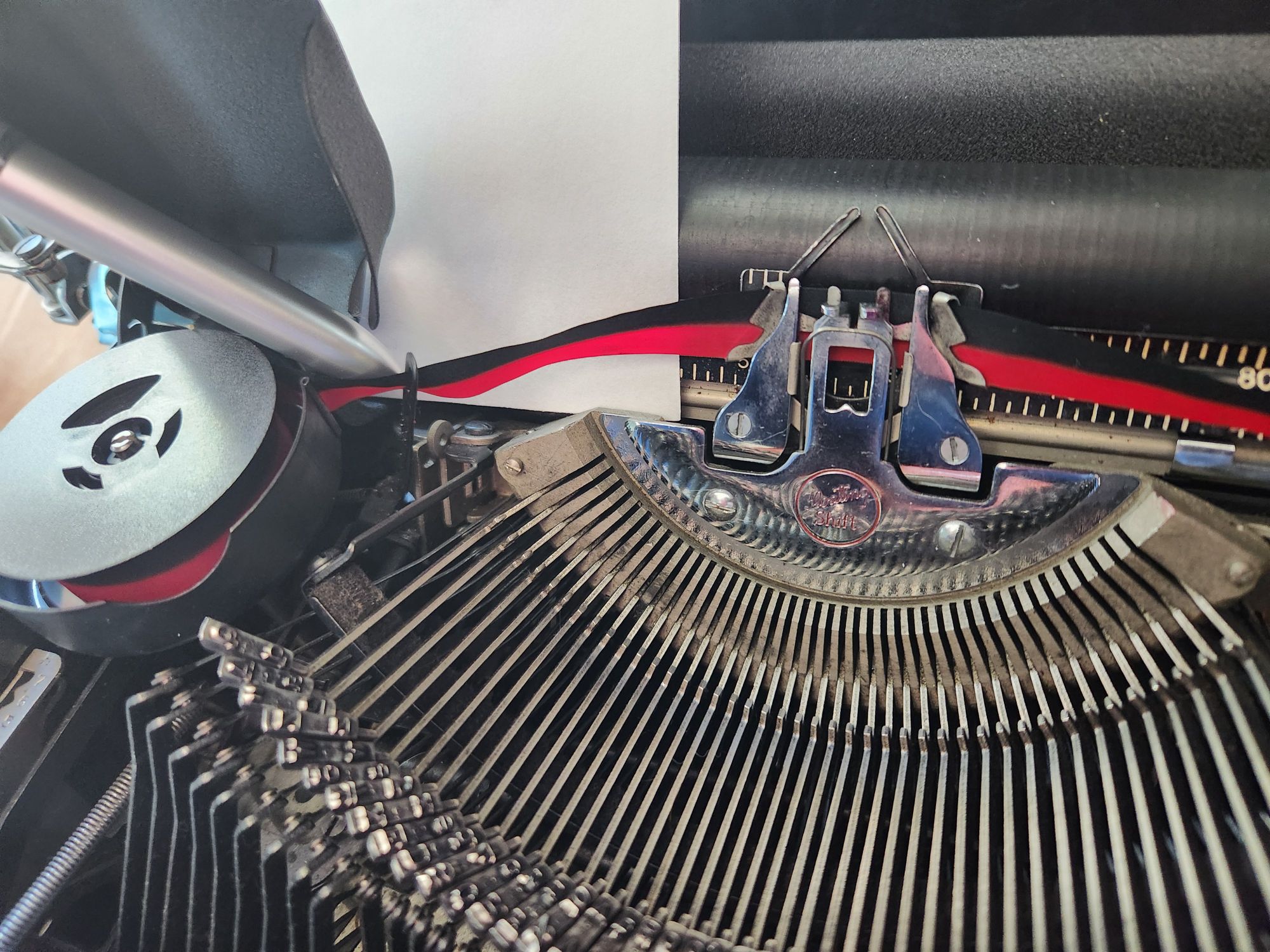
(Alt Text) Smith-Corona typewriter ribbon thread sample. A view into the type basket with the hood of the typewriter raised showing the ribbon coming out of a spool on the left, through a black ribbon guide (which actuates the autoswitch when the eyelet at the end of a spool gets stuck between it and the spool) next to the spool cup, and then into the two metal guides of the ribbon vibrator on either side of the the typing point. A silver pen's tip is pointing to the ribbon guide next to the spool cup at about the point where an eyelet clipped onto the middle of the end of a length of a ribbon would trip the ribbon auto switch.
If your ribbon auto-switch isn't working one can usually switch the direction manually with the ribbon reverse lever usually found on the front left side of most machines.
To speed up changing the ribbon on many machines, it can often help to switch the color selector to the red setting and then simultaneously press the G and H keys gently so that they're stuck together almost at the typing point which will raise the ribbon vibrator and make accessing the slots for threading the ribbon easier. Once the ribbon is installed, release the G and H typebars and select the correct color setting for the portion of the ribbon you want to use.
-
-
type-in.org type-in.org
-
The term "Type-Out" was coined by Tom at Cambridge Typewriter in MA to refer to the practice of having a Type-In outside in the sunshine. The first such Type-Out was held in front of Cambridge Typewriter on Oct 22, 2011.
Tags
Annotators
URL
-
-
writingball.blogspot.com writingball.blogspot.com
-
www.cambridgetypewriter.com www.cambridgetypewriter.com
-
http://www.cambridgetypewriter.com/
CAMBRIDGE TYPEWRITER<br /> 102 Massachusetts Avenue<br /> Arlington, MA 02474<br /> 781-643-7010
Shop owner Tom Furrier hoping to retire sometime in 2024
-
-
www.reddit.com www.reddit.com
-
where do I start?
reply to u/rocklover7 at https://www.reddit.com/r/typewriters/comments/1cnljgm/where_do_i_start/
The best thing you could do is to take a moment at the library or bookshop and pick up a copy of Polt, Richard. The Typewriter Revolution: A Typist’s Companion for the 21st Century. 1st ed. Woodstock, VT: Countryman Press, 2015.
He looks at typewriters from a writers' writer perspective which I'm sure you'll appreciate. He's got experience with a wide variety of machines as well as a large collection himself. He goes over all of the common/popular (and solid machines) in a variety of sizes and formats to help you figure out which one you might like to start out with. He also covers some of the common problems and repairs that regularly pop up. The book is really a "best of" list of typewriter material from the past 15+ years of this reddit forum and material from the "typosphere" of which he's been not only an active member, but literal ring-leader. The vast majority of the questions which appear on a weekly basis here are discussed and addressed in his book, along with some emphasis on writerly concerns and practice which most beginners here wouldn't be asking. Even reading 3 or 4 of the 8 chapters which are rife with images will give you a solid crash course for exactly the sorts of typewriter (and writing) advice you're searching for.
Definitely DO NOT pick up a new machine off of Amazon. They're even worse than some of the late 70s/early 80s machines. Instead, for beginners (and for the value) I'd recommend looking at Remingtons (Quiet-Riter), Royals (Quiet De Luxe), or Smith-Coronas (Clipper, Silent, Super) from roughly 1948-1958 which is generally the peak of U.S. typewriter manufacturing as well as for features. These were all built like tanks and are usually still in very good condition, even when they're in bad condition. I've provided links to some of these models in the typewriter database, so you have an idea visually of what to look out for.
If desperate, and you live in an area where machines are priced starting over $50 or you're more price sensitive (making eBay, Facebook Marketplace or Craigslist less appealing), you can find some of these every day listed at shopgoodwill.com starting at $10. Even with heaving bidding on auctions, these usually don't go over $35 (except for some of the Smith-Coronas). I've even seen them (sadly) not move at all for $10. This would give you an incredibly solid and inexpensive machine to tinker on, and will most likely work for you out of the box (as long as it's got a ribbon.) You'll end up with a solid machine to start off on while you search for your dream machine. It'll also give you some experience cleaning up and maintaining one. Of the seven machines I've gotten this way and paid an average of about $30-35 each (all in with shipping, tax, etc.) All but one were all immediately usable and only needed moderate cleaning that one could do at home with a cloth, dish soap, a toothbrush and maybe some canned air. Two of the seven were in near mint condition and didn't need any work at all. Tag/garage sales are also inexpensive options that usually allow you test out a machine, but it requires some shoe leather and lots of patience. If you've got a favorite author you love and trust, you might try searching out their machines: https://site.xavier.edu/polt/typewriters/typers.html
If there are any type-ins in your local area, try to go so you can not only meet others, but it might give you a chance to see and try out the machines of others to see what might suit you best.
Happiness and best wishes on your search!
-
-
ber10thal.com ber10thal.com
-
-
Speaking of the keys, they had crap all around them. I used a slightly damp towel and Turtle wax rubbing compound. A light rubbing removed the dirt.
Wiping dirty plastic typewriter keys with a soft cloth and then waxing/buffing them can bring them back to life.
-
Here it’s outside being cleaned with Mineral Spirits, and carb and choke cleaner. I took one trip to the eye doctor when the carb and choke cleaner bounced and sprayed into both my eyes. I was fine, but wear eye protection.
-
The feed rollers and platen were also a mess. I cleaned them with Bar Keepers Friend and water. Soft scrub also works.
Cleans them but probably doesn't repair them.
-
-
www.classictypewriter.com www.classictypewriter.com
-
www.showbiz411.com www.showbiz411.com
-
Woody Allen Has Used the Same Typewriter for 50 Years! by [[Roger Friedman]] in Showbiz411
Referenced documentary is from PBS: American Masters Woody Allen: A Documentary (2011)
-
-
www.youtube.com www.youtube.com
-
He wrote everything with his Olympia SM3 typewriter. He lost the hood "30 years ago".
He literally cuts and staples pieces of typescripts together.
-
-
clairelasecretaire.wordpress.com clairelasecretaire.wordpress.com
-
-
Now for the inks the biggest problem in inking a ribbon is finding inks that don’t dry out, therefore water based inks alone won’t work. However you can use a coloured ink pad to get the effect as the ink is mixed with glycerine keeping it from drying out!
Glycerine mixed with ink may help keep typewriter ribbons from drying out.
-
-
www.youtube.com www.youtube.com
-
Maintenance Of Office Machines. 16 mm. Vol. MN-1513. United States Navy Training Film, 1943. https://www.youtube.com/watch?v=ocdxgkxKAKo.
-
-
www.reddit.com www.reddit.com
-
www.youtube.com www.youtube.com
-
Remington Quiet-Riter carriage lock help by [[Typewriter Justice]]
-
-
www.youtube.com www.youtube.com
-
https://www.youtube.com/watch?v=iTFM54VKKc4<br /> How To: Replace a Ribbon on Remington Quiet-Riter Typewriter by Typewriter Minutes
-
-
-
Read Repairing a 1957 Remington Quiet-Riter typewriter from 2018-06-16
-
One of the first thing I noticed was the rubber on this foot was sticking. This is the resting spot for the basket shift. Moving it up or down will adjust where the lower case letters strike the platen. I removed the old sticky rubber. There are two adjustments here, you can’t see the other one, but it’s looks the same. One is for lower case letters the other is for upper case. This is called the “on feet” adjustment. If you ever have the top of an upper case letter not imprinting or not level with the lower case letters, look at this adjustment. A good way to tell is to type HhHh, and see if the bottoms of the letters line up.
-
-
www.youtube.com www.youtube.com
-
Royal Typewriter Platen Variable Repair, Roller Removal by [[Phoenix Typewriter]]
I'm seeing this issue on my 1949 Royal QDL. I figured it'd be an easy fix.
Turns out, it was exactly my issue and the pieces had "frozen up". A quick clean out and we're back in business in under 20 minutes.
-
-
-
He eschewed computers, often writing by fountain pen in his beloved notebooks.“Keyboards have always intimidated me,” he told The Paris Review in 2003.“A pen is a much more primitive instrument,” he said. “You feel that the words are coming out of your body, and then you dig the words into the page. Writing has always had that tactile quality for me. It’s a physical experience.”He would then turn to his vintage Olympia typewriter to type his handwritten manuscripts. He immortalized the trusty machine in his 2002 book “The Story of My Typewriter,” with illustrations by the painter Sam Messer.
digging the words into the page sounds adjacent to Seamus Heaney's "Digging" which analogizes writing to digging: https://hypothes.is/a/J-z8OgfQEe-0adtJyXyb3g
There's something here which suggests pens, typewriters, keyboards, etc. as direct extended mind objects as tools for thought. A sense of rumination and expulsion simultaneously.
-
-
www.youtube.com www.youtube.com
-
Cop-E-Eez Metal Typists Copy Holder by [[Analogue Papa]]
-
- Apr 2024
-
www.youtube.com www.youtube.com
-
TWVS Episode 20 - Adjusting Upper and Lower Case Positions by [[Joe Van Cleave]]
-
-
filthyplaten.com filthyplaten.com
-
www.reddit.com www.reddit.comPlatens1
-
For platens 83-98 Shore A depending on the amount of copies being typed. From personal experience though 83A is super soft and the slugs sink into it a bit too much, the sweet spot is around 87-90 Shore A imo.
via u/Pelicram at https://www.reddit.com/r/typewriters/comments/1cg6e3t/platens/
-
-
shopgoodwill.com shopgoodwill.com
-
https://shopgoodwill.com/item/196946239 <br /> Royal Quiet De Luxe <br /> Won in auction 2024-04-24
-
-
www.facebook.com www.facebook.com
-
https://www.facebook.com/marketplace/item/1151228549580675
This is a version of a typewriter I had in my youth around 1983/84.


-
-
www.reddit.com www.reddit.com
-
Replacing the key cap [as a means of switching from QWERTZ to QWERTY] isn't going to help at all, it's just a label. You'd have to swap out internal parts too. Depending on the model, you'd either have to remove and swap typebars or remove the head off the typebar and resolder it onto the appropriate alternate (and ensure that it's properly aligned, not an easy task). Then you'd have to swap the key caps (labels). It's definitely a mechanically doable process, but it's probably almost never done in practice. Doing it as a newbie probably isn't recommendable; you're better off having a repair shop do it for you if you decide to go this route. Depending on the keyboard/model, you'd also have to deal with accents, umlauts, etc.
Given the difficulty (or cost) of the process and the potential end results, you're assuredly better off locating a QWERTY machine and paying a bit more for shipping to your area if necessary.
Your mileage may vary depending on model.
reply to u/imprisoningmymemory at https://www.reddit.com/r/typewriters/comments/1cg1avp/replacing_keys/
-
-
www.reddit.com www.reddit.com
-
reply regarding painting typewriters at https://www.reddit.com/r/typewriters/comments/1cflyf2/help_identifying/
It's been a while since I've done it, but I've sent vintage metal filing cabinets out to have them powder coated with stunning results. If you have someone local who does this, they'll be able to handle the details and give you color options. It may be best to give them the individual parts of the frame you want done and not the whole machine (especially so they don't lose or destroy anything vital). You can get some interesting colors and still have the older vintage look.
I've also been contemplating doing a brushed steel finish and several layers of shiny clear coat. I've done it to a few desks before (here's an example of a table with a brushed/enameled top though it's got a slab of glass on top too), but haven't done it with a typewriter (yet).
Depending on your area, you might find an auto repair artist who could strip the case down (sand blast/bead blast) and give you some real artwork including ombre paint, sparkle, racing stripes, etc. Just for fun, how cool would it be to have a matching "Jerry Orbach typewriter" if you had a Jerry Orbach car? If you're a Star Wars fan, it could be cool to have a typewriter done to look like either R2-D2 or C-3PO, for example. Or maybe cover a 1977 Smith-Corona Galaxie 12 with brown faux-Wookie fur and a bandolier Chewbacca-style!!! If you're going in, you may as well go all-in, right? (But definitely stop before you end up restoring one of the old black batwing-style Oliver's to fit it with a Darth Vader helmet dust cover...)
If you go with straight paint, your local paint shop can recommend the best combination of primer and paint formulation for painting onto metal. (The small sample pint sizes of paint may be more than enough to do a single typewriter.) They'll give you more color options than you could possibly want. You'll want a high quality paint brush and some paint thinner so that when you apply, the finish comes out buttery smooth as it dries. Various spray paints may be options as well, though here you may not have as many color options.
-
-
www.youtube.com www.youtube.com
-
A 'typewriter rebellion' is underway. Here's what that means and why it's attracting kids from 2024-04-15 from Joe Dana / 12 News / Phoenix, AZ
-
-
typewriterreview.com typewriterreview.com
-
Top 10 Typewriters for Writers by [[Daniel Marleau]] (created One Typed Page)
-
If you plan on setting on your desk, unscrew the bottom plate and scrape off the hardened rubber feet and super glue some new ones on. I get the clear rubber kind from Ace Hardware (Part No. 5182381).
Hermes Rocket feet repair advice.
-
-
typewriterreview.com typewriterreview.com
-
www.instagram.com www.instagram.com
-
https://www.instagram.com/onetypedquote/
An Instagram account that aggregates photos of typed quotes, usually including a part of the typewriter it was written on. It amounts to a group manufactured commonplace book.
Found via https://onetypedpage.com/otq/
-
-
-
Royal Quiet De Luxe Typewriter Sticky Keys Segment Flush Clean by [[Phoenix Typewriter]]
-
-
www.youtube.com www.youtube.com
-
Royal Quiet De Luxe Typewriter Shift Repaired by [[Phoenix Typewriter]]
-
-
www.reddit.com www.reddit.com
-
Typewriter Correction
If you go the white out fluid route, there are some bottles that use mini-sponges versus the old brush-types which are easier to apply. If you're worried about dripping on/in your machine with fluid, there's now also a variety of small handheld dispensers of white out tape which allow some incredibly precise use at the level of individual letters. Scroll the paper up a line or two, white it out, scroll back down and be on your way. (I only do this for things approaching mission critical applications; generally I just x things out or overtype and continue.)
My typing technique has gotten better using a typewriter versus computer keyboard.
reply to u/AlexInRV at https://www.reddit.com/r/typewriters/comments/1cc6oci/typewriter_correction/
-
-
site.xavier.edu site.xavier.edu
-
-
Patti Smith: 1960s/'70s Smith-Corona portable
Patti Smith used a late 60s or early 70s Smith-Corona (SCM) portable typewriter.

Source: https://site.xavier.edu/polt/typewriters/typers.html
-
-
-
Harry RansomCenter at the University of Texas, which houses Sexton’sletters and memorabilia. And her typewriter.
Anne Sexton used a Royal Quiet De Luxe (beige)
-
Solan, Matthew. “Tracking Down Typewriters: Those Trusty Tools of Days Gone By.” Poets & Writers Magazine, August 19, 2009. p 31-33.
-
WhenI fi nish a page and pull it out, I holdsomething real. And this, too, fuels myprogress by giving me a tangible senseof accomplishment.
Typewriters provide a tangible sense of accomplishment when a writer finishes a page.
-
Beside her on the desk, between acoffee cup and an open book, was her typewriter. Herinstrument.
Analogizing typewriters with musical instruments.
-
-
www.reddit.com www.reddit.com
-
EquivalentHead3589[S] 0 points1 point2 points 2 hours ago (1 child)Yes to all that! I agree and understand.
reply to u/EquivalentHead3589 at https://www.reddit.com/r/typewriters/comments/1cbzx1n/how_do_you_price_typewriters/
The primary difference is that listing prices don't indicate actual value. That is only determined by actual sales price. Things are worse for the listings which don't indicate much about condition as you're probably more likely to need to have the machine serviced and/or replace or recondition parts. This can often add a few hundred dollars (or significant research and time, tools, and elbow grease) to the bottom line to be able to use a machine.
I do recall a burgundy Olympia SM3 which sold in the last 4 months for right at $300 which was regularly used (loved) and serviced and in excellent condition with some fantastic photos. If you compare it to this Burgundy/Gray machine (https://www.ebay.com/itm/404901285037) for $299, but which has a missing key cap, and a damaged case, and may likely have other hiding issues. If you consider that you'll likely need to put a minimum of another $100 into this to get it up to the fighting shape that the first was in and it's still got damage, you'll start seeing the stark difference. The people with listings at $550-800 know they're not selling and they're just sitting there, so why not email them and ask more specific questions about condition and get a typed typeface sample of all the keys. Then make an offer for $200 +/- with some wiggle room for service costs once you've gotten it to see if they'll sell?
As an example, look at https://www.ebay.com/itm/226016437104 which is a Gray SM3 originally listed for $549 and now on sale for $428. The seller knows it's not moving. They state that they got it at an estate sale (probably for around $25) and they definitely did no work other than quick check of the keys. If you demonstrate that you've savvy enough to know the specific machine (what shape are the rubber washers on the frame next to the feet to prevent the carriage from rubbing against the frame? how what is the durometer measurement on (how hard is) the platen?), the market (in top shape maybe $300), and what servicing/repair costs are, they'd probably accept an offer of $150-200 and you're off to the races and they've made a solid profit.
The biggest issue in the typewriter market at present is the broad lack of information and knowledge about them on both the buyer and seller side. If you can demonstrate you've got more knowledge than the other side, you'll be in a far better position to negotiate, otherwise a seller can sit and wait an undetermined amount of time waiting for a sucker who will likely never show up.
-
-
americanwritersmuseum.org americanwritersmuseum.org
-
Q&A with Typewriter Collector Steve Soboroff by [[American Writers Museum]]
-
I had this discussion with Tom Hanks, who had the same typewriter repairman as I do, about how he collects for the type of typewriter and I collect for who used them.
-
They also last so long. Andy Rooney, whose typewriter I have, wrote a piece about his typewriter. He said he had six computers, and they’re obsolete on purpose. He said, “I’ve had one typewriter and I put another ribbon in and it’s good for another 25 years.”
-
-
en.wikipedia.org en.wikipedia.org
-
laviegraphite.blogspot.com laviegraphite.blogspot.com
-
https://laviegraphite.blogspot.com/2012/07/good-companion.html
Dylan Thomas used a black Imperial Good Companion typewriter.
-
-
www.inquirer.com www.inquirer.com
-
Swifties thought that the lack of a "1" key on her typewriter was an Easter egg hiding in the video... ha!
-
-
-
Because of aging, the rubber feet of many typewriters can harden thereby reducing their friction against the table on which they sit. As a result, this can cause one's typewriter to "walk" across the table as they type for extended periods necessitating their recentering from time to time. To remedy this, one could use custom made typewriter mats with rubber bottoms to prevent this walking as well as to protect the table underneath. Other options which may also work are either wool or felt pads from fabric stores or from Chinese/Japanese calligraphy stationers. In Japanese these mats are called shitajiki.
-
-
www.reddit.com www.reddit.com
-
reply to u/bastugubbar at https://www.reddit.com/r/typewriters/comments/1ca8nwk/i_for_one_welcome_our_new_taylor_swift_overlords/
Let's be honest here, the most recent typewriter reference (presumably to that of an ex-boyfriend) is certainly not her first. I'm a modest Swiftie at best (from a trivia perspective), preferring to think of her work as poetry rather than musical pop-culture, so I imagine her more as a quill pen sort of writer, though my notes indicate she does take some of her notes for composition using her cell phone.
This being said, a few years back she did feature a red Sears Cutlass in All Too Well (10 Minute Version) (Taylor's Version) at the 8:28 mark, which hasn't driven the cost of these through the roof, though I have seen one listed for $1,000 (it unsurprisingly didn't sell for that.) For more here see Robert Messenger at OzTypewriter and Ryan Schocket for Buzzfeed. It's not listed anymore, but this past Christmas, she also had a red typewriter Christmas tree ornament in her online store.
Those who were privileged to attend the recent Eras Tour (or see it on Disney+) saw groups of typewriters in the background during several songs.
She's been featuring typewriters for a bit now and it hasn't driven prices through the roof any more than the typewriter renaissance that's been going on for the last few years or so. I suspect that this new round of references isn't going to shift things significantly.
If she does go full-typewriter, which model(s) do you suspect she'd be using amidst the pantheon of other writers? I'd suggest she may be romantic enough to do a late 40's Smith-Corona Clipper... or perhaps while jet-setting a Skyriter?
Type on!
-
-
-
https://www.ebay.com/itm/375385572993
Sold, presumably for $600 on 2024-04-20 with free shipping. This had previously been listed and relisted for 1000 reducing 100 every few weeks until now.
Taylor Swift effect with her new album drop perhaps?
-
-
genius.com genius.com
-
You left your typewriter at my apartmentStraight from the tortured poets departmentI think some things I never sayLike, "Who uses typewriters anyway?"
via https://genius.com/Taylor-swift-the-tortured-poets-department-lyrics
-
-
shopgoodwill.com shopgoodwill.com
-
typewriterdatabase.com typewriterdatabase.com
-
Shell re-designed by Henry Dreyfuss, Squared shell, Grey and Black with oval crome inserts for front levers. Keytops change from round glass to 'tombstone' glass with chromed rims.
https://typewriterdatabase.com/royal.72.typewriter-serial-number-database
-
-
www.nytimes.com www.nytimes.com
-
Henry Dreyfuss, Noted Designer, Is Found Dead With His Wife by The New York Times
-
-
www.typewriterconnection.com www.typewriterconnection.com
-
austinkleon.substack.com austinkleon.substack.com
-
An interview with Mary Ruefle by [[Austin Kleon]]
Kleon's wife Meg, with a master's in architecture, has aphantasia.
-
-
Local file Local file
-
Yet it is doubtful whether since theintroduction of the typewriter there has been an invention so beneficialto modern business as the card-index system.
-
- Mar 2024
-
www.youtube.com www.youtube.com
-
www.reddit.com www.reddit.com
-
My quick typewriter purchasing crash course: <br /> Most typewriters are solid beasts and can take a serious beating and still work really well. I've got 5 now that I bought for $10-50 and mostly really only needed small tweaks to work perfectly. One has an issue that will require some more heavy work, but having gotten it for $10, it's not really much of an issue. Several of them worked incredibly well right out of the box with no work at all. Occasionally kids will pound on the keys which can cause the linkages to come undone, but a pair of needle nose pliers and some patience to look at the mechanics of what's not working underneath can usually get them repaired without any real work. Beyond this there's a wealth of online videos and help that can get you pretty far without paying for a repair shop. Some are just old and dusty and need a quick cleaning with compressed air and/or a toothbrush.
Ebay can tend to have heavily overinflated prices because a lot of folks think that all typewriters are rare. A very small percentage of some of the oldest are, but generally as a group they're not. If you don't want to fool around with repair issues you can purchase machines from repair shops serviced in full working condition from $75-200, but at least you can expect that they're nearly perfect beyond some small blemishes due to age. Sadly, a lot of places will list broken machines in questionable shape for this much because they see others listing (great machines) for the same amount. Don't fall prey to this. Some of the best places to look for functional machines are donation shops (Goodwill, Salvation Army, etc.) as well as yard sales or estate sales. Online sites like Facebook marketplace, https://shopgoodwill.com, or https://offerup.com can have inexpensive listings, but most are listed as untested because most folks don't know how to test them fully and are scared of them, but this is usually where you can find some great deals. You can also ask for typewriters on https://buynothingproject.org/ or a Facebook group for your particular area.
If you're able to test things in person, it can help to have some blank paper or index cards and even a universal ribbon ($5-15, in case the old ribbon is missing or too old and dry to work) with you. Then you can put in paper, try out each key (with/without shift), and all the other buttons, knobs, and switches as well as the margin stops, and the bell. Most folks listing them are well aware they're not actually selling for prices over $50 and will be open for 10-25% discounts off of what they're listing them for. I will mention that I bought one machine as dirt cheap because someone had it on the stencil setting (rather than the usual black or red ribbon settings) and they didn't know that this meant it wouldn't type anything visible. A quick flip of the switch after purchase and I was on my way.
r/typewriters is a wealth of information as are https://site.xavier.edu/polt/typewriters/index.html and https://typewriterdatabase.com/. Usually, you can't go too far wrong with one of the most popular models which are generally ranked at https://typewriterdatabase.com/popular.0.typewriter-models.
Good luck!
-
-
www.vaultofculture.com www.vaultofculture.com
-
[[Shawn Gilmore]] in On the Page: Paul Sheldon's Typewriter in Misery (1987) — The Vault of Culture<br /> on 2022-06-15
-
-
www.ribbonsunlimited.com www.ribbonsunlimited.com
-
clairelasecretaire.wordpress.com clairelasecretaire.wordpress.com
-
slate.com slate.com
-
[[Mark Lawrence Schrad]] in Why the World of Typewriter Collectors Splits Down the Middle When These Machines Come Up for Sale<br /> at 2024-03-16 12:00 PM <br /> (accessed:: 2024-03-19 10:23:08)
-
typewriters are ultimately instruments of human creation, not destruction.
This is a bit too rosy when we've just seen it used to help in the bureaucracy of death.
-
The typewriter division of Wanderer Werke continued unencumbered, manufacturing precision typing machines such as this one, emblazoned with its striking “WW” crest (which bears a striking similarity to the Wonder Woman logo from the 1980s).
-
The typewriter was made in Siegmar-Schönau—a suburb of Chemnitz—by Wanderer, an early German pioneer in manufacturing bicycles, motorcycles, cars, and later military trucks and tanks for the Wehrmacht, the armed forces in the Nazi era. In the 1930s, Wanderer’s automotive division was one of four car companies consolidated into the Auto Union AG, which later became Audi. Indeed, one of the four interconnected rings on the Audi brand logo represents Wanderer.
-
They collect artifacts, I collect histories.
-
a typewriter with the “special key” is no more or less odious than one without; it is just a matter of the meanings we humans impart upon it.
- consider too that the originators don't benefit though compare this with the seller who may have that sentiment benefiting.
-
some argue that the typewriter is just an inanimate object; a tool crafted for a specific purpose, which assumes neither the responsibility of the user nor his blame.
though what about when the creator is human and not inanimate?
-
More frequent were machines built with the double-lightning-bolt SS Siegrune, usually above the No. 3 or 5 key. With sieg meaning “victory,” the runes became ubiquitous in Nazi Germany as a shorthand rallying cry for “victory, victory!” In their more sinister application, the SS runes became the logo for the Schutzstaffel—the notorious paramilitary units most responsible for the wanton slaughter of 6 million Jews across Europe.
-
In very rare circumstances, a German typewriter would be made with a dedicated swastika key, like this one at the United States Holocaust Memorial Museum.
-
The largest online typewriter community currently boasts some 29,000 members, with no signs of slowing down.
Facebook group: Antique Typewriter Collectors https://www.facebook.com/groups/4770669677
-
Larry McMurtry thanked his trusty Hermes 3000 typewriter while accepting his Golden Globe for Brokeback Mountain.
-
At the conclusion of the war, local Czech authorities, armed militias, and regular military units ethnically cleansed nearly 3 million Bohemian Germans from Czechoslovakia. From the high-altitude perspective of postwar geopolitics, President Edvard Beneš dubbed it Czechoslovakia’s “final solution of the German question.”
-
As strange as it sounds today, German klein (“small” or portable) typewriters were among the most sought-after souvenirs for soldiers fighting in World War II. Think of it: Adjusted for inflation, top-of-the-line portable typewriters cost roughly the same as your MacBook Pro today, and their usable lives were measured not in months or years, but decades and generations. Consequently, thousands of Uranias, Gromas, Erikas, Rheinmetalls, Continentals, Olympias, and other high-quality, precision-made German machines were looted from Nazi military and government offices, businesses, and even from civilian homes, whether their owners were dead or alive. “War trophy” is of course a pleasant euphemism: It denotes a reward for heroism, bravery, and sacrifice, while simultaneously acknowledging that even the good guys steal, pillage, and destroy amid the haze of total war.
Tags
- artifacts vs. histories
- Hermes 3000 typewriter
- Audi
- Hermes typewriters
- symbols
- oral histories
- car marques
- portable typewriters
- Continental (typewriters)
- logos
- war trophies
- Olympia typewriters
- Rheinmetall
- World War II
- inanimate objects
- Awards acceptance speeches
- Groma
- Wonder Woman
- Schutzstaffel (SS)
- meaning
- Bohemia
- portable valuables
- sentimentality
- archaeology
- Auto Union AG
- Urania
- artifacts
- keyboards
- brand logos
- swastika
- read
- Golden Globes
- semantics
- Erika
- Wanderer
- creation vs. destruction
- separating work from artist
- typewriters
- historical method
- ethnic clensing
- typewriter collecting
- German manufacturing
- typewriter renaissance
- cui bono?
- Czechoslovakia
- Edvard Beneš
- swastika key
- collections
- Nazi Germany
- cancel culture
- Larry McMurtry
- problematic
- SS Siegrune
Annotators
URL
-
-
munk.org munk.org
-
-
“Six big devils from Japan quickly forgot how to waltz”
-
Pack my box with five dozen liquor jugs
-
-
www.texasstandard.org www.texasstandard.org
-
typewriterdatabase.com typewriterdatabase.com
-
The platen was quite hard to begin with, around 100 on the Shore A hardness scale, though it would feed two sheets reliably. The platen was cleaned and treated with methyl salicylate, which brought the hardness down to about 92, and has remained at that hardness for several months.
https://typewriterdatabase.com/1948-smith-corona-clipper.21427.typewriter
-
-
shopgoodwill.com shopgoodwill.com
-
Smith-Corona Galaxie 12 XII Blue
https://shopgoodwill.com/item/191956978<br /> 2024-03-02 sold $102.00 !! 4 bids
-
-
shopgoodwill.com shopgoodwill.com
-
Smith-Corona Silent
https://shopgoodwill.com/item/192328912<br /> 2024-03-02 sold<br /> $9.99 fair<br /> 1 bid
-